Specimen: Paper 1, Inorganic and physical chemistry

105 marks · 43 question parts · Paper, mark scheme and report on AQA's site · AQA's specimen paper for the current specification · Have the Data Booklet beside you

Question by question

QTopicMarksAOType
01.1 Bonding 6Level of response
01.2 Atomic structure 1AO1=1Short answer
01.3 Bonding 1AO3=1Short answer
01.4 Transition metals 2Short answer
02.1 Periodicity 2Explanation
02.2 Periodicity, Bonding 2Explanation
02.3 Period 3 elements and their oxides 2Explanation
02.4 Period 3 elements and their oxides 1AO2=1Equation writing
03.1 Electrode potentials and electrochemical cells 2Explanation
03.2 Electrode potentials and electrochemical cells 1AO3=1Short answer
03.3 Electrode potentials and electrochemical cells 1AO3=1Short answer
03.4 Electrode potentials and electrochemical cells 1AO2=1Calculation
03.5 Electrode potentials and electrochemical cells 1AO3=1Short answer
04.1 Energetics 3Calculation
04.2 Energetics 1AO1=1Short answer
04.3 Alcohols 1AO3=1Short answer
04.4 Chemical equilibria, Le Chatelier's principle and Kc 3Explanation
04.5 Transition metals 1AO1=1Short answer
04.6 Equilibrium constant Kp 7Calculation
05.1 Thermodynamics: Born–Haber cycles, entropy and Gibbs free energy 4Calculation
05.2 Thermodynamics: Born–Haber cycles, entropy and Gibbs free energy 2Calculation
05.3 Bonding 4Diagram or structure
06.1 Acids and bases: pH, Ka, titration curves and buffers 2Practical and data analysis
06.2 Acids and bases: pH, Ka, titration curves and buffers 2Explanation
06.3 Acids and bases: pH, Ka, titration curves and buffers 3Calculation
06.4 Acids and bases: pH, Ka, titration curves and buffers 3Calculation
06.5 Acids and bases: pH, Ka, titration curves and buffers 2Calculation
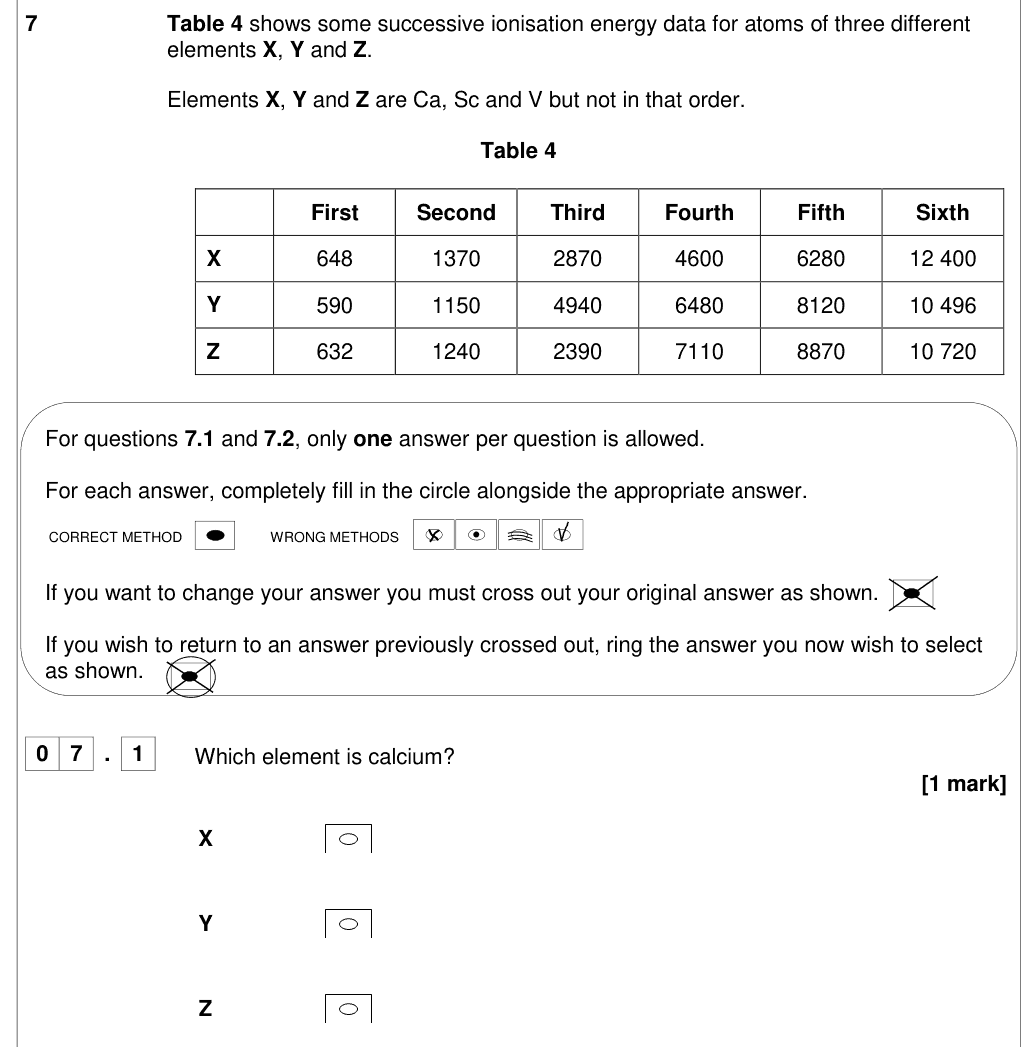
07.1 Atomic structure 1AO3=1Short answer
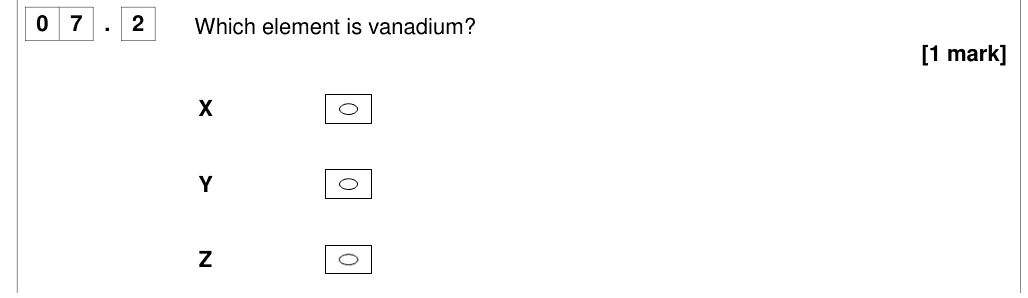
07.2 Atomic structure 1AO3=1Short answer
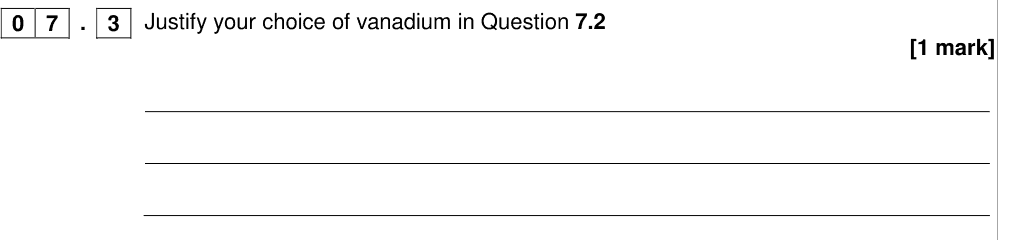
07.3 Atomic structure 1AO2=1Short answer
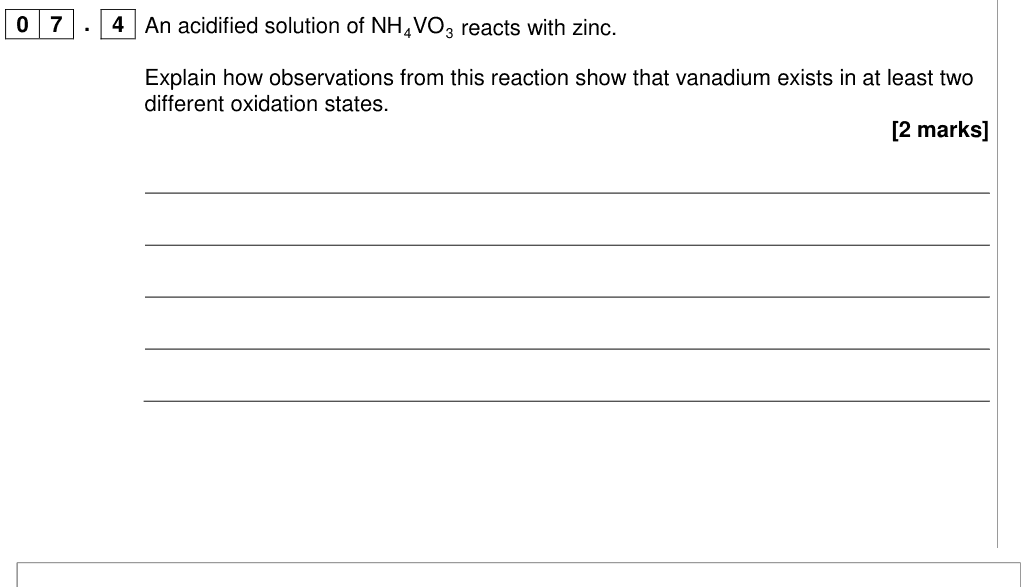
07.4 Transition metals 2Explanation
07.5 Amount of substance, Oxidation, reduction and redox equations, Transition metals 6Calculation
08.1 Transition metals, Bonding 2Explanation
08.2 Reactions of ions in aqueous solution, Transition metals 4Equation writing
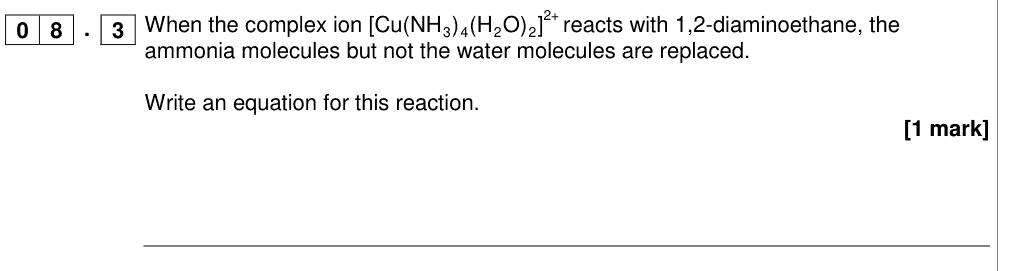
08.3 Transition metals 1AO2=1Equation writing
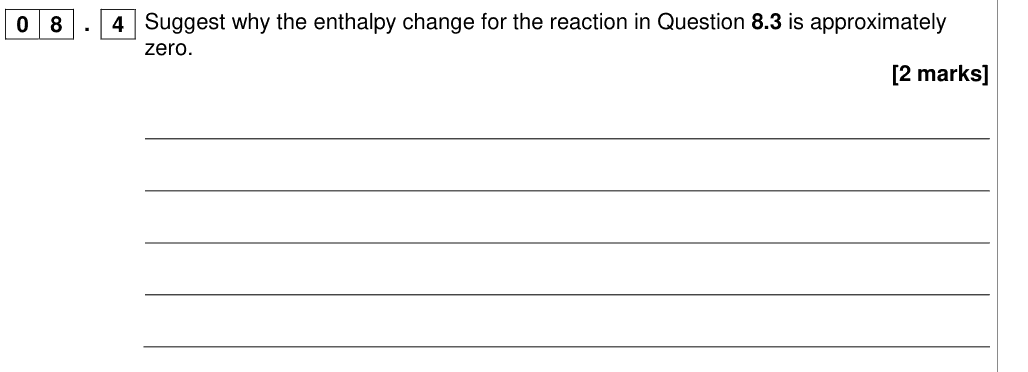
08.4 Transition metals 2Explanation
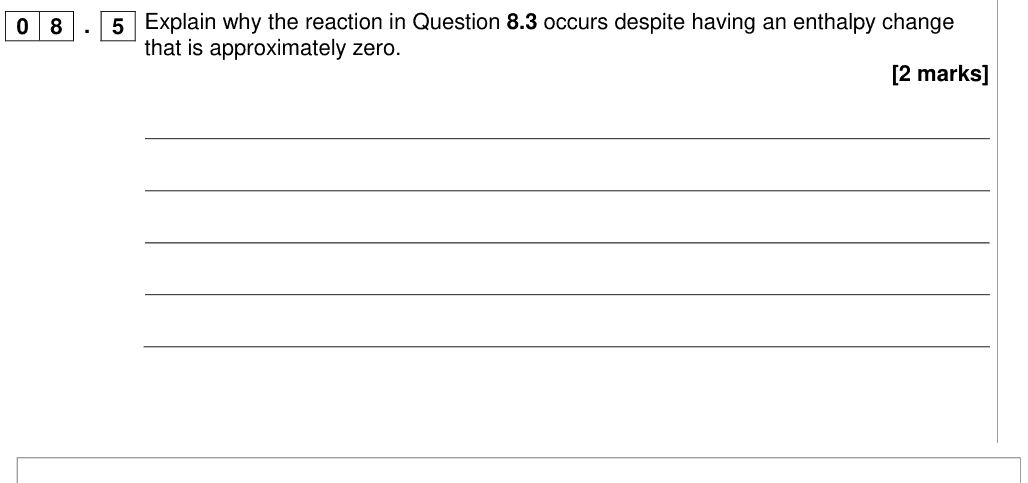
08.5 Transition metals, Thermodynamics: Born–Haber cycles, entropy and Gibbs free energy 2Explanation
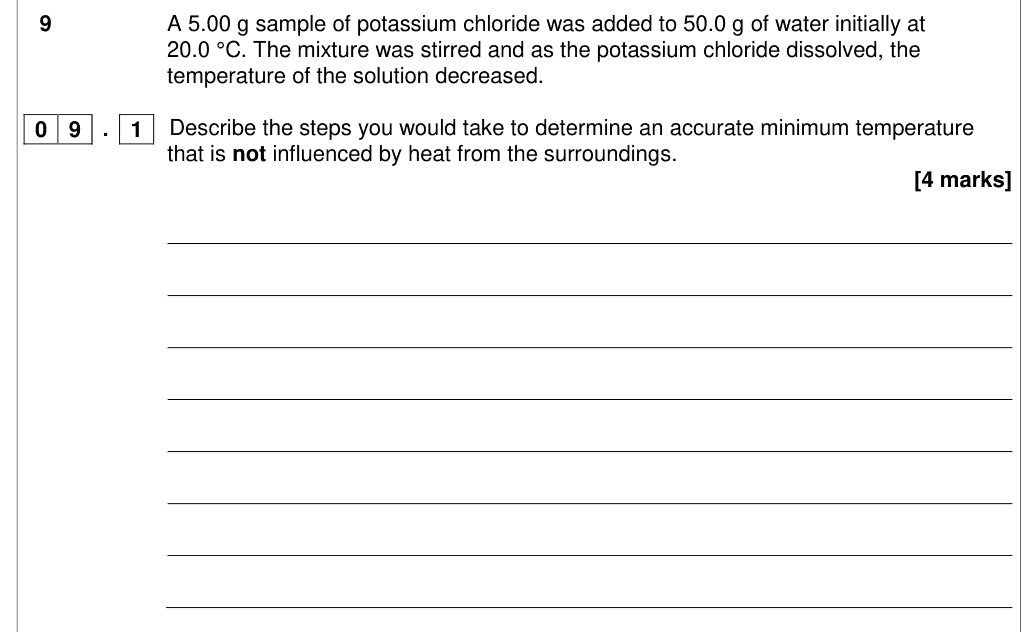
09.1 Energetics 4Practical and data analysis
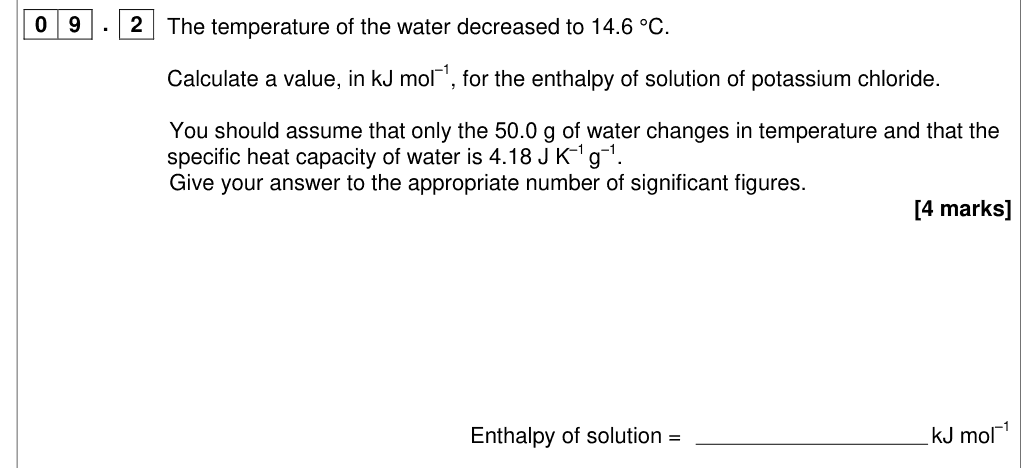
09.2 Energetics 4Calculation
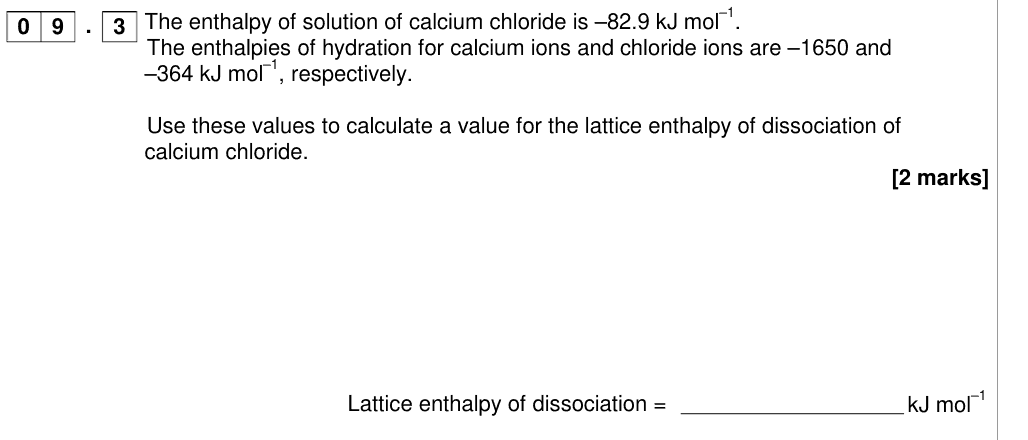
09.3 Thermodynamics: Born–Haber cycles, entropy and Gibbs free energy 2Calculation
09.4 Thermodynamics: Born–Haber cycles, entropy and Gibbs free energy, Bonding 2Explanation
10.1 Reactions of ions in aqueous solution, Group 7(17), the halogens, Group 2, the alkaline earth metals 6Practical and data analysis
10.2 Reactions of ions in aqueous solution, Group 2, the alkaline earth metals, Transition metals 4Equation writing

The questions

01.101.201.301.402.102.202.302.403.103.203.303.403.504.104.204.304.404.504.605.105.205.306.106.206.306.406.507.107.207.307.407.508.108.208.308.408.509.109.209.309.410.110.2
Specimen · Paper 1 · Q01.1 6 marks 6-mark level of response bonding
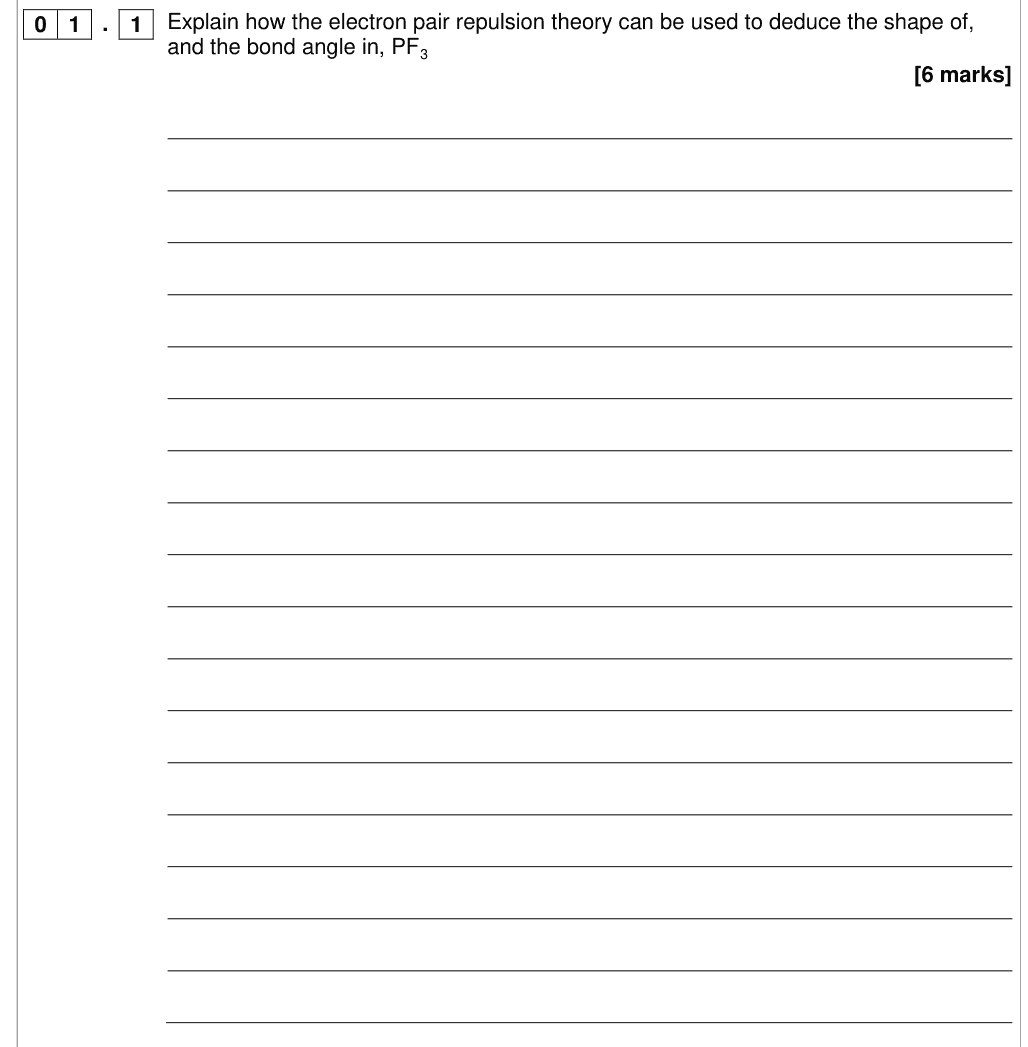
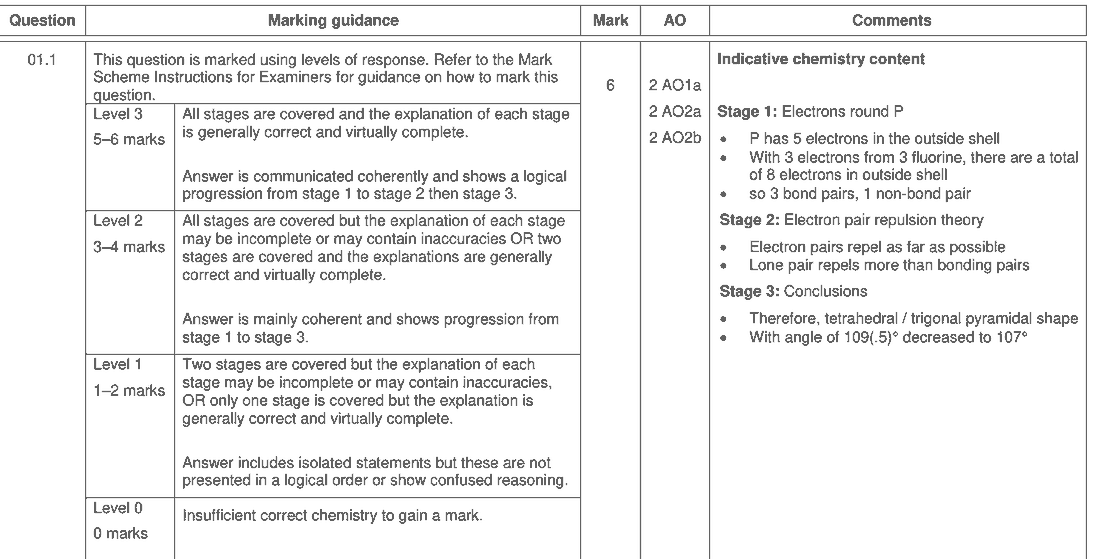
Explain how the electron pair repulsion theory can be used to deduce the shape of,
and the bond angle in, PF3
[6 marks]
Specimen · Paper 1 · Q01.2 1 mark AO1=1 Short answer atomic structure
Earlier part of question 01 that this part usesEarlier part of Specimen Paper 1 question 01
State the full electron configuration of a cobalt(II) ion.
[1 mark]
Specimen · Paper 1 · Q01.3 1 mark AO3=1 Short answer bonding
Earlier part of question 01 that this part usesEarlier part of Specimen Paper 1 question 01
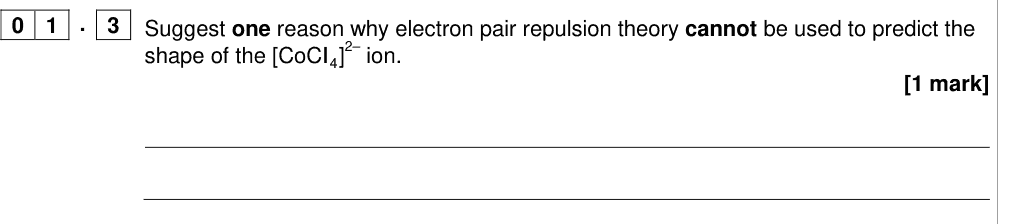
Suggest one reason why electron pair repulsion theory cannot be used to predict the
shape of the [CoCl4]
2– ion.
[1 mark]
Specimen · Paper 1 · Q01.4 2 marks Short answer transition metals
Earlier part of question 01 that this part usesEarlier part of Specimen Paper 1 question 01
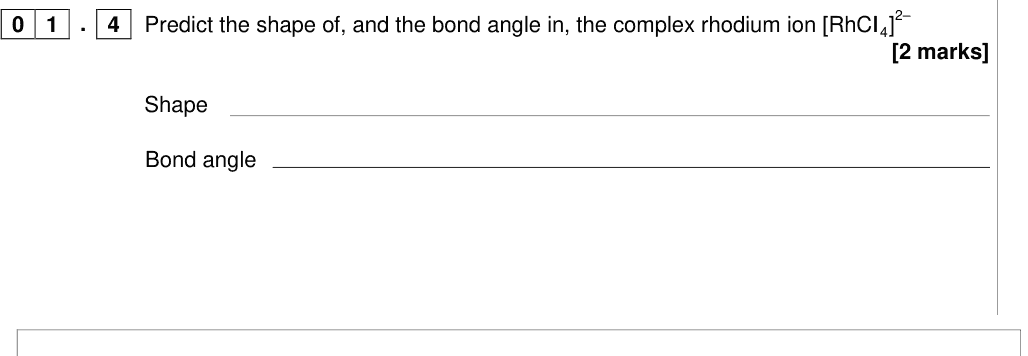
Predict the shape of, and the bond angle in, the complex rhodium ion [RhCl4]
2–
[2 marks]
Shape
Bond angle
Specimen · Paper 1 · Q02.1 2 marks Explanation periodicity
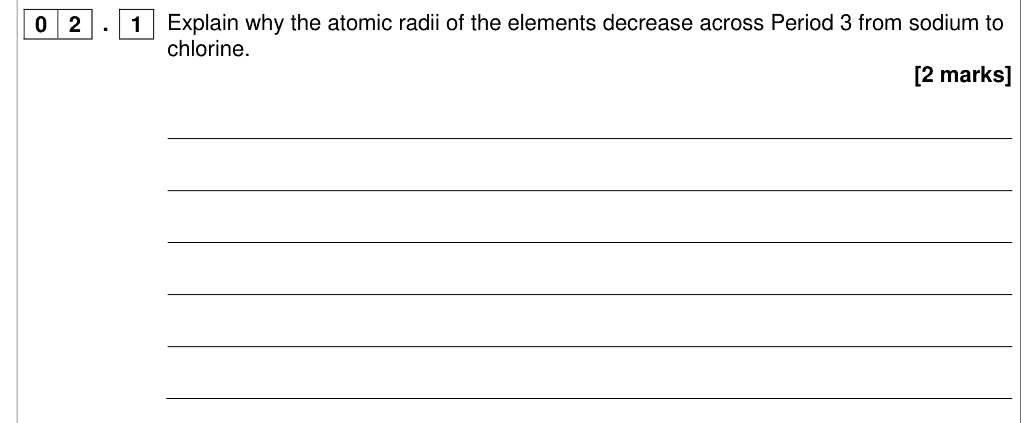
Explain why the atomic radii of the elements decrease across Period 3 from sodium to
chlorine.
[2 marks]
Specimen · Paper 1 · Q02.2 2 marks Explanation periodicitybonding
Earlier part of question 02 that this part usesEarlier part of Specimen Paper 1 question 02
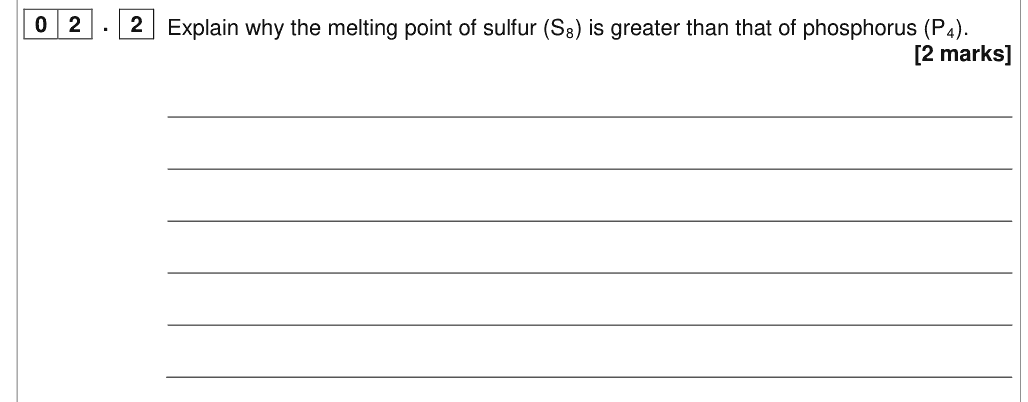
Explain why the melting point of sulfur (S8) is greater than that of phosphorus (P4).
[2 marks]
Specimen · Paper 1 · Q02.3 2 marks Explanation period 3 elements and oxides
Earlier part of question 02 that this part usesEarlier part of Specimen Paper 1 question 02
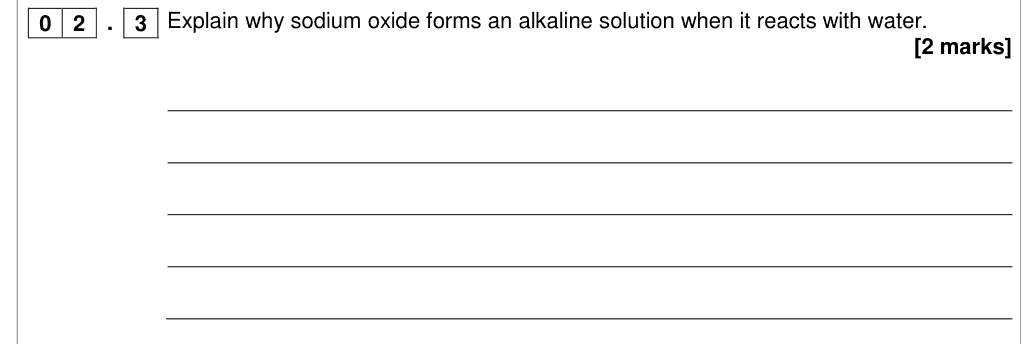
Explain why sodium oxide forms an alkaline solution when it reacts with water.
[2 marks]
Specimen · Paper 1 · Q02.4 1 mark AO2=1 Equation writing period 3 elements and oxides
Earlier part of question 02 that this part usesEarlier part of Specimen Paper 1 question 02
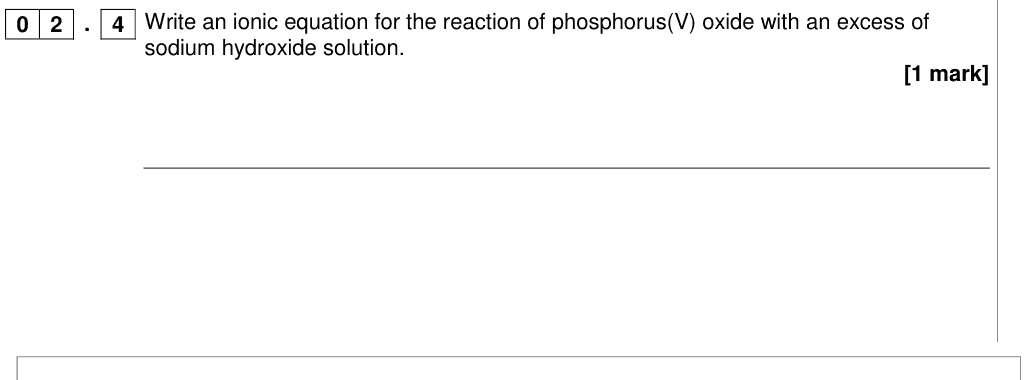
Write an ionic equation for the reaction of phosphorus(V) oxide with an excess of
sodium hydroxide solution.
[1 mark]
Specimen · Paper 1 · Q03.1 2 marks Explanation electrode potentials and cells
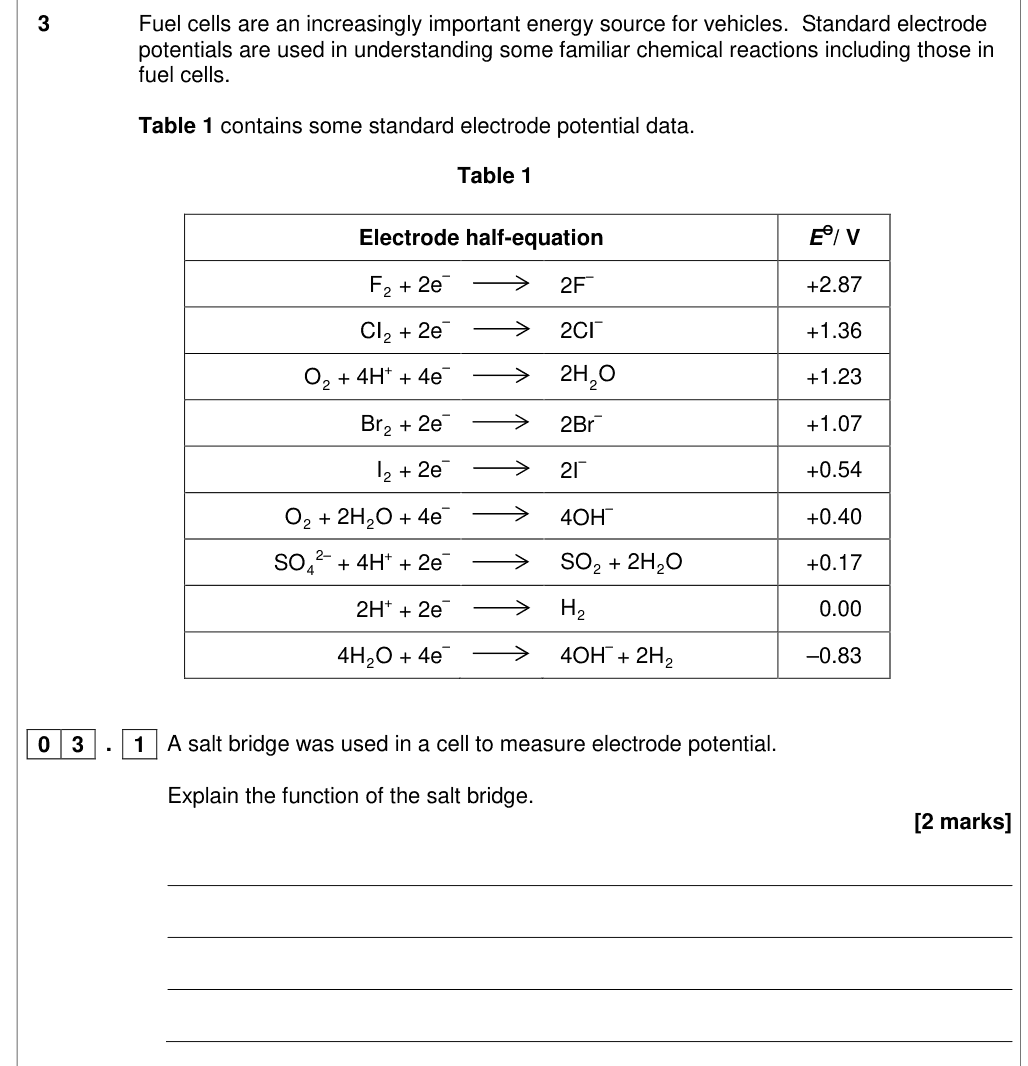
Fuel cells are an increasingly important energy source for vehicles.  Standard electrode
potentials are used in understanding some familiar chemical reactions including those in
fuel cells.
Table 1 contains some standard electrode potential data.
Table 1
Electrode half-equation
EƟ/ V
F2 + 2e
–
2F
–
+2.87
Cl2 + 2e
–
2Cl
–
+1.36
O2 + 4H+ + 4e
–
2H2O
+1.23
Br2 + 2e
–
2Br
–
+1.07
I2 + 2e
–
2I
–
+0.54
O2 + 2H2O + 4e
–
4OH
–
+0.40
SO4
2– + 4H+ + 2e
–
SO2 + 2H2O
+0.17
2H+ + 2e
–
H2
0.00
4H2O + 4e
–
4OH
– + 2H2
–0.83
A salt bridge was used in a cell to measure electrode potential.
Explain the function of the salt bridge.
[2 marks]
Specimen · Paper 1 · Q03.2 1 mark AO3=1 Short answer electrode potentials and cells
Earlier part of question 03 that this part usesEarlier part of Specimen Paper 1 question 03
Use data from Table 1 to deduce the halide ion that is the weakest reducing agent.
[1 mark]
Specimen · Paper 1 · Q03.3 1 mark AO3=1 Short answer electrode potentials and cells
Earlier part of question 03 that this part usesEarlier part of Specimen Paper 1 question 03
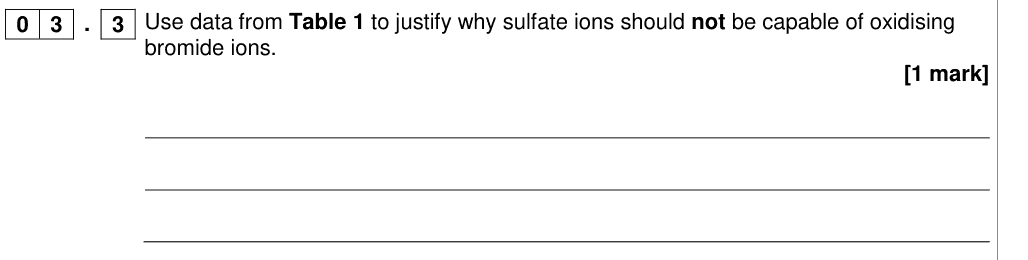
Use data from Table 1 to justify why sulfate ions should not be capable of oxidising
bromide ions.
[1 mark]
Specimen · Paper 1 · Q03.4 1 mark AO2=1 Calculation electrode potentials and cells
Earlier part of question 03 that this part usesEarlier part of Specimen Paper 1 question 03
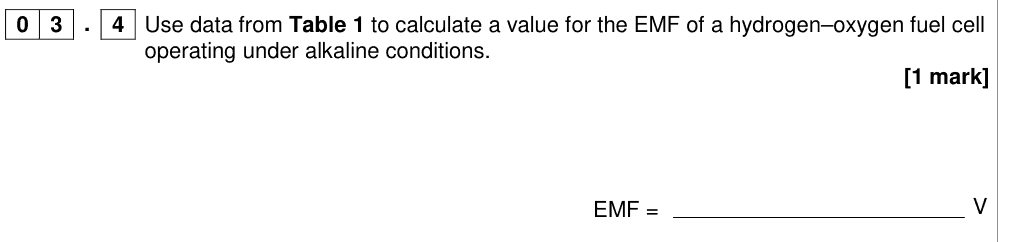
Use data from Table 1 to calculate a value for the EMF of a hydrogen–oxygen fuel cell
operating under alkaline conditions.
[1 mark]
EMF =
V
Specimen · Paper 1 · Q03.5 1 mark AO3=1 Short answer electrode potentials and cells
Earlier part of question 03 that this part usesEarlier part of Specimen Paper 1 question 03
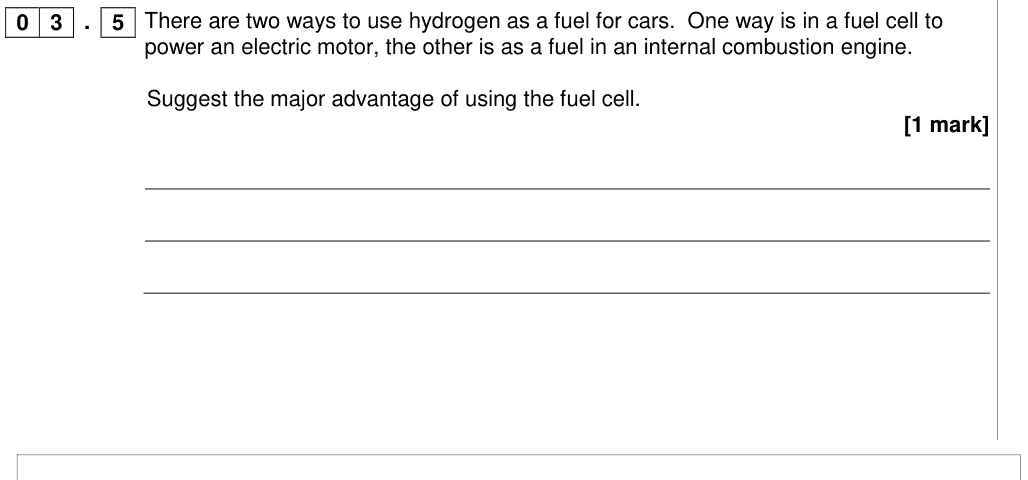
There are two ways to use hydrogen as a fuel for cars.  One way is in a fuel cell to
power an electric motor, the other is as a fuel in an internal combustion engine.
Suggest the major advantage of using the fuel cell.
[1 mark]
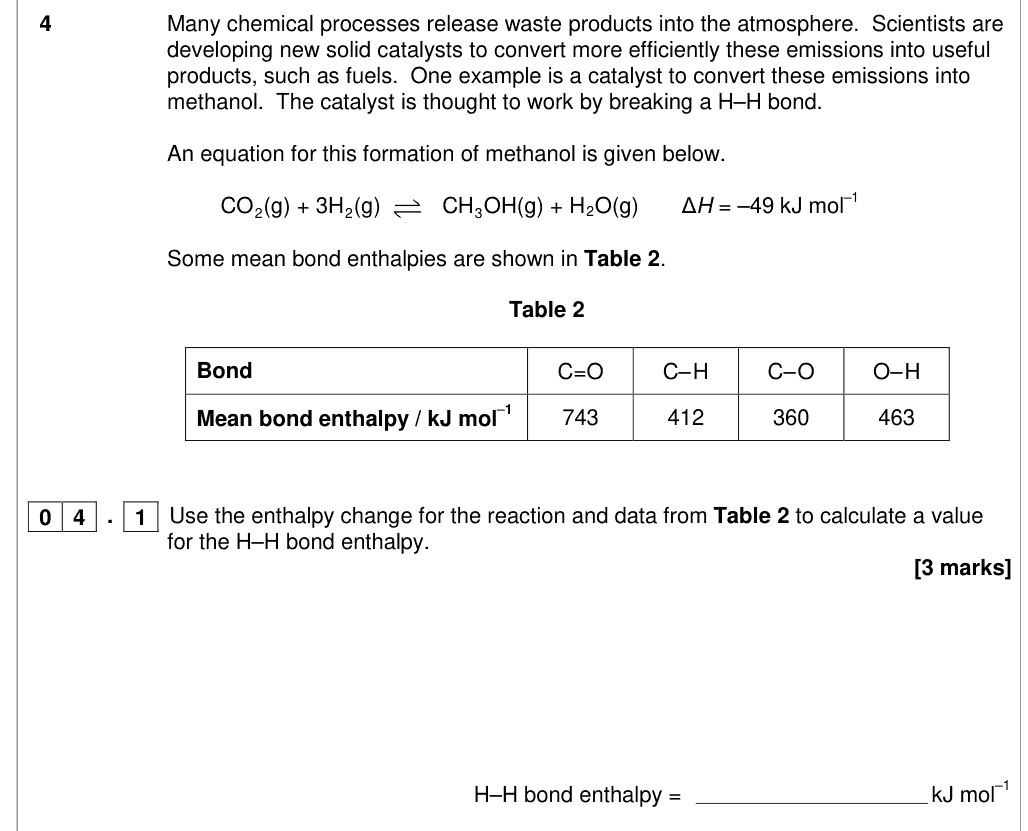
Specimen · Paper 1 · Q04.1 3 marks Calculation energetics
Many chemical processes release waste products into the atmosphere.  Scientists are
developing new solid catalysts to convert more efficiently these emissions into useful
products, such as fuels.  One example is a catalyst to convert these emissions into
methanol.  The catalyst is thought to work by breaking a H–H bond.
An equation for this formation of methanol is given below.
CO2(g) + 3H2(g)          CH3OH(g) + H2O(g)
ΔH = –49 kJ mol–1
Some mean bond enthalpies are shown in Table 2.
Table 2
Bond
C=O
C–H
C–O
O–H
Mean bond enthalpy / kJ mol
–1
743
412
360
463
Use the enthalpy change for the reaction and data from Table 2 to calculate a value
for the H–H bond enthalpy.
[3 marks]
H–H bond enthalpy =
kJ mol
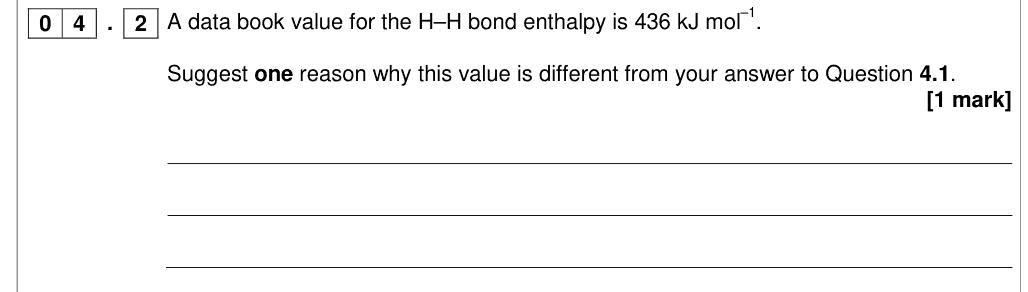
Specimen · Paper 1 · Q04.2 1 mark AO1=1 Short answer energetics
Earlier part of question 04 that this part usesEarlier part of Specimen Paper 1 question 04
A data book value for the H–H bond enthalpy is 436 kJ mol
–1.
Suggest one reason why this value is different from your answer to Question 4.1.
[1 mark]
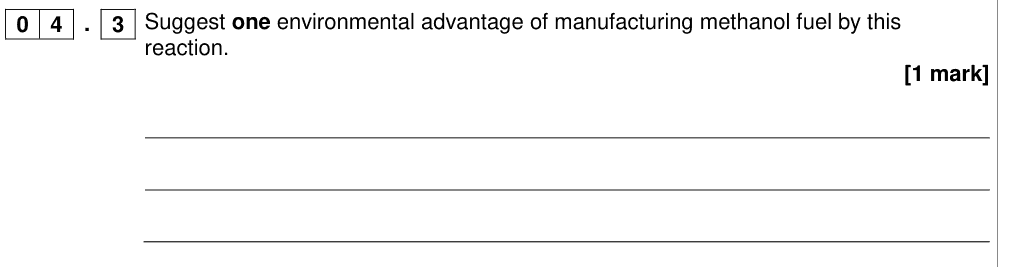
Specimen · Paper 1 · Q04.3 1 mark AO3=1 Short answer alcohols
Earlier part of question 04 that this part usesEarlier part of Specimen Paper 1 question 04
Suggest one environmental advantage of manufacturing methanol fuel by this
reaction.
[1 mark]
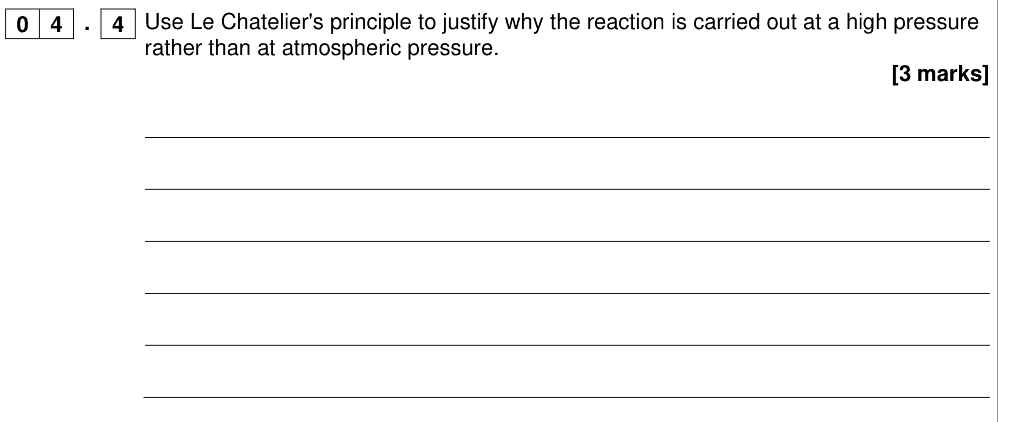
Specimen · Paper 1 · Q04.4 3 marks Explanation chemical equilibria and kc
Earlier part of question 04 that this part usesEarlier part of Specimen Paper 1 question 04
Use Le Chatelier's principle to justify why the reaction is carried out at a high pressure
rather than at atmospheric pressure.
[3 marks]
Specimen · Paper 1 · Q04.5 1 mark AO1=1 Short answer transition metals
Earlier part of question 04 that this part usesEarlier part of Specimen Paper 1 question 04
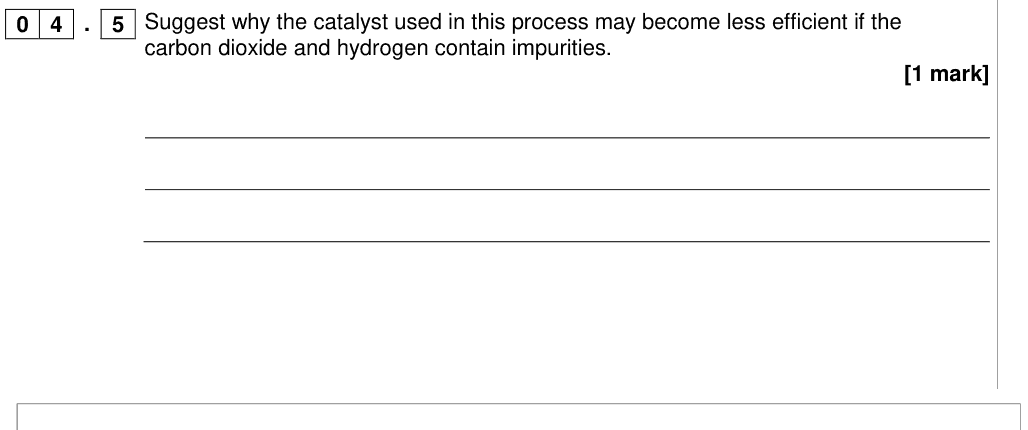
Suggest why the catalyst used in this process may become less efficient if the
carbon dioxide and hydrogen contain impurities.
[1 mark]
Specimen · Paper 1 · Q04.6 7 marks Calculation equilibrium constant kp
Earlier part of question 04 that this part usesEarlier part of Specimen Paper 1 question 04
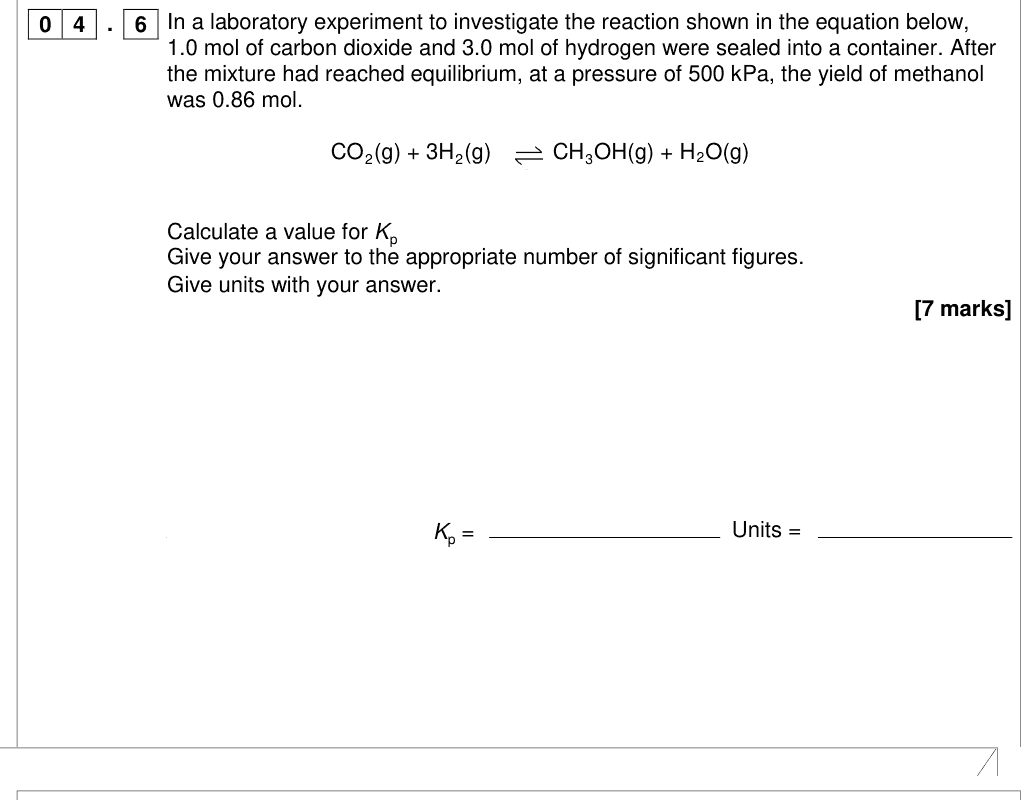
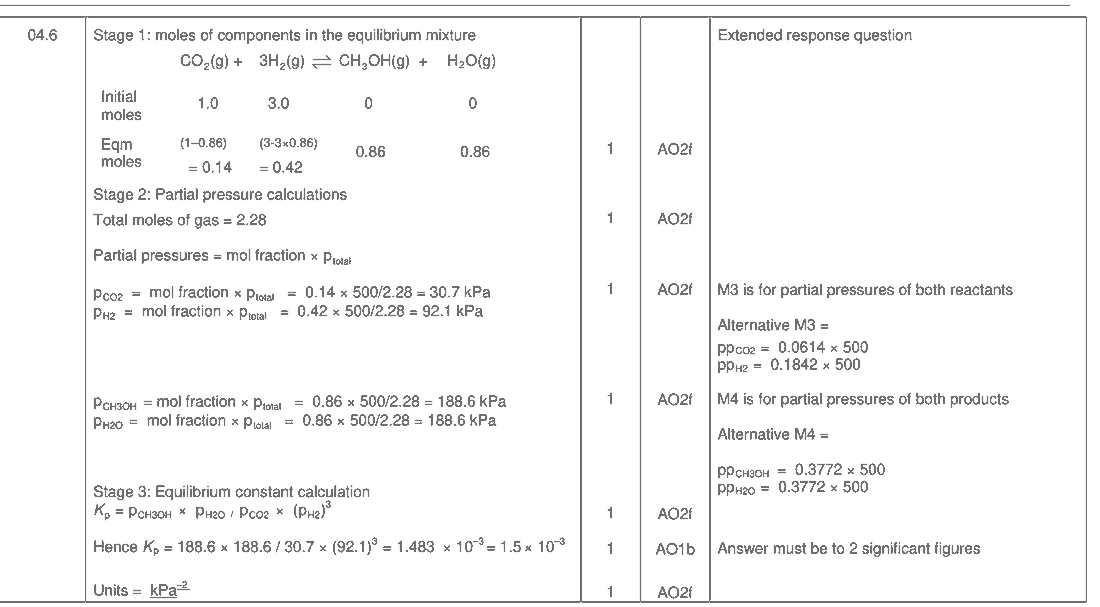
In a laboratory experiment to investigate the reaction shown in the equation below,
1.0 mol of carbon dioxide and 3.0 mol of hydrogen were sealed into a container. After
the mixture had reached equilibrium, at a pressure of 500 kPa, the yield of methanol
was 0.86 mol.
CO2(g) + 3H2(g)          CH3OH(g) + H2O(g)
Calculate a value for Kp
Give your answer to the appropriate number of significant figures.
Give units with your answer.
[7 marks]
Kp =
Units =
Specimen · Paper 1 · Q05.1 4 marks Calculation thermodynamics
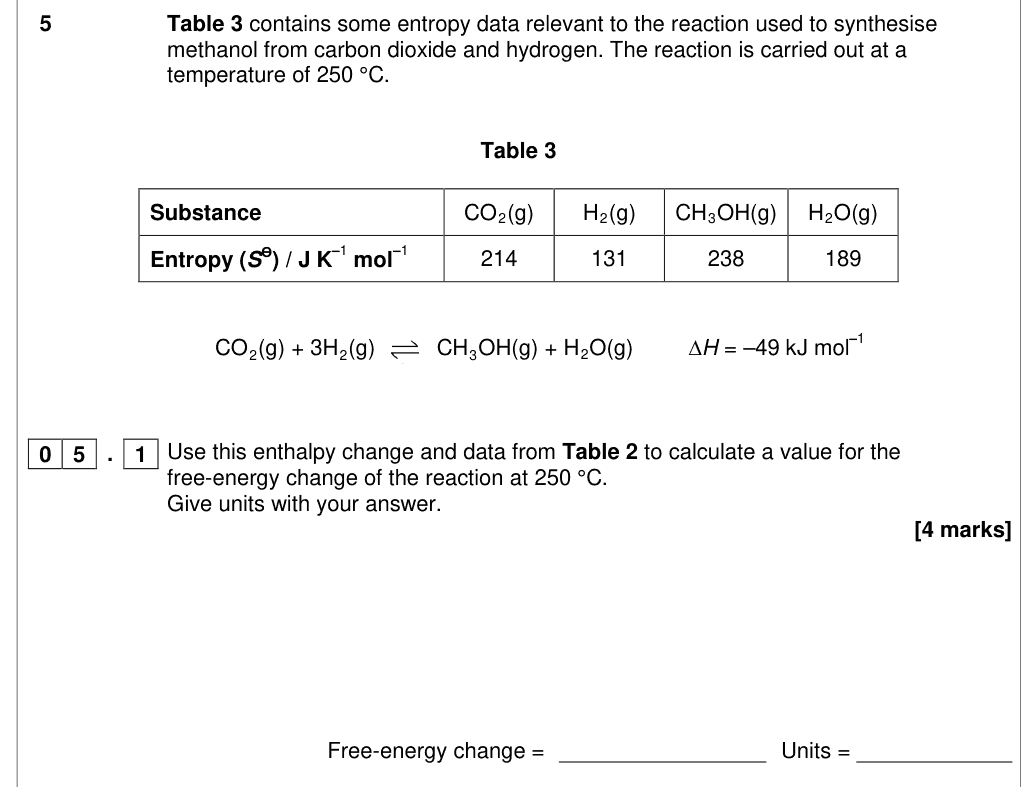
Table 3 contains some entropy data relevant to the reaction used to synthesise
methanol from carbon dioxide and hydrogen. The reaction is carried out at a
temperature of 250 °C.
Table 3
Substance
CO2(g)
H2(g)
CH3OH(g)
H2O(g)
Entropy (SƟ) / J K
–1 mol
–1
214
131
238
189
CO2(g) + 3H2(g)          CH3OH(g) + H2O(g)         ∆H = –49 kJ mol
–1
Use this enthalpy change and data from Table 2 to calculate a value for the
free-energy change of the reaction at 250 °C.
Give units with your answer.
[4 marks]
Free-energy change =
Units =
Specimen · Paper 1 · Q05.2 2 marks Calculation thermodynamics
Earlier part of question 05 that this part usesEarlier part of Specimen Paper 1 question 05
Calculate a value for the temperature when the reaction becomes feasible.
[2 marks]
Temperature =
K
Specimen · Paper 1 · Q05.3 4 marks Diagram or structure bonding
Earlier part of question 05 that this part usesEarlier part of Specimen Paper 1 question 05
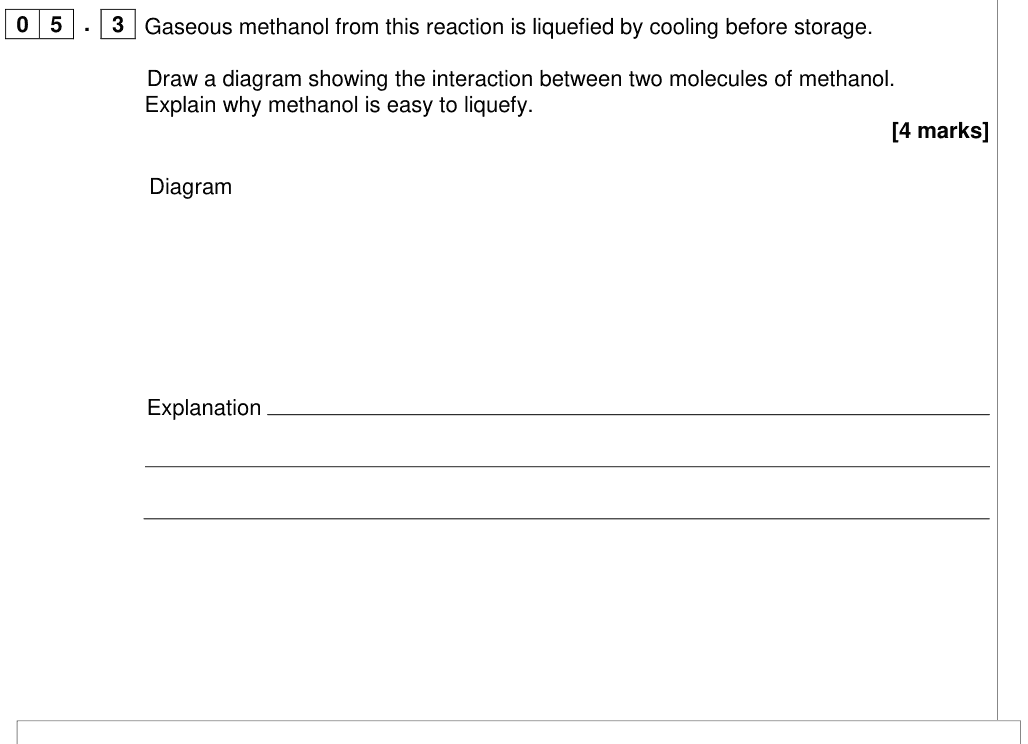
Gaseous methanol from this reaction is liquefied by cooling before storage.
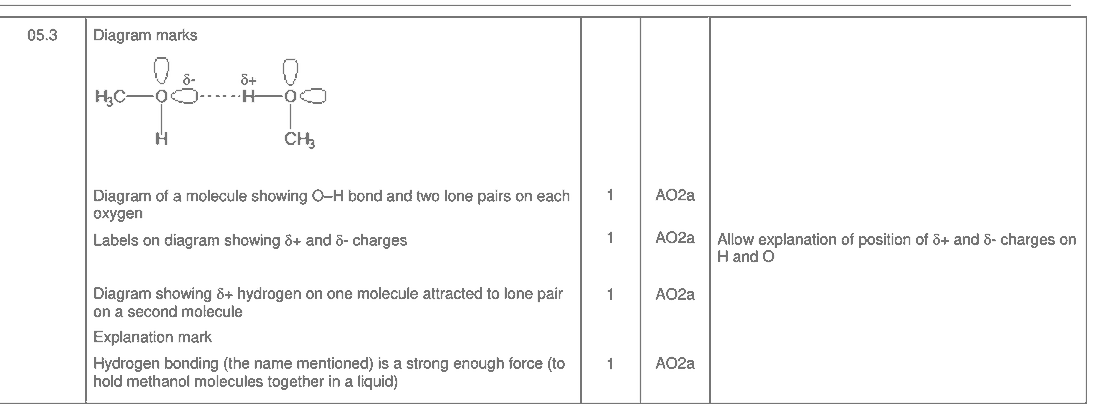
Draw a diagram showing the interaction between two molecules of methanol.
Explain why methanol is easy to liquefy.
[4 marks]
Diagram
Explanation
Specimen · Paper 1 · Q06.1 2 marks Practical and data analysis acids and bases
Ammonium chloride, when dissolved in water, can act as a weak acid as shown by the
following equation.
NH4
+(aq)       NH3(aq) + H+(aq)
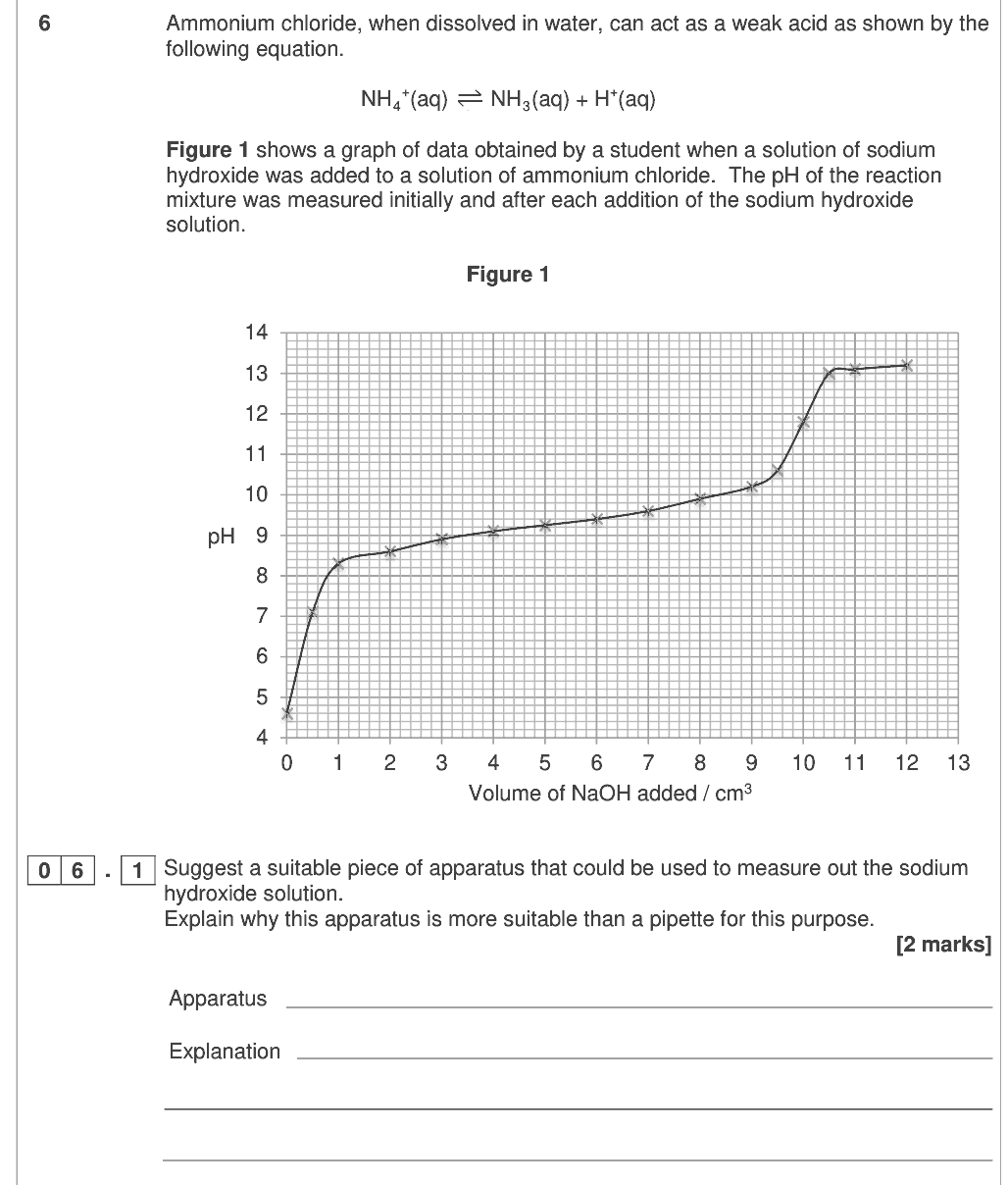
Figure 1 shows a graph of data obtained by a student when a solution of sodium
hydroxide was added to a solution of ammonium chloride.  The pH of the reaction
mixture was measured initially and after each addition of the sodium hydroxide
solution.
Figure 1
Suggest a suitable piece of apparatus that could be used to measure out the sodium
hydroxide solution.
Explain why this apparatus is more suitable than a pipette for this purpose.
[2 marks]
4
5
6
7
8
9
10
11
12
13
14
0
1
2
3
4
5
6
7
8
9
10
11
12
13
pH
Volume of NaOH added / cm3
Apparatus
Explanation
Specimen · Paper 1 · Q06.2 2 marks Explanation acids and bases
Earlier part of question 06 that this part usesEarlier part of Specimen Paper 1 question 06
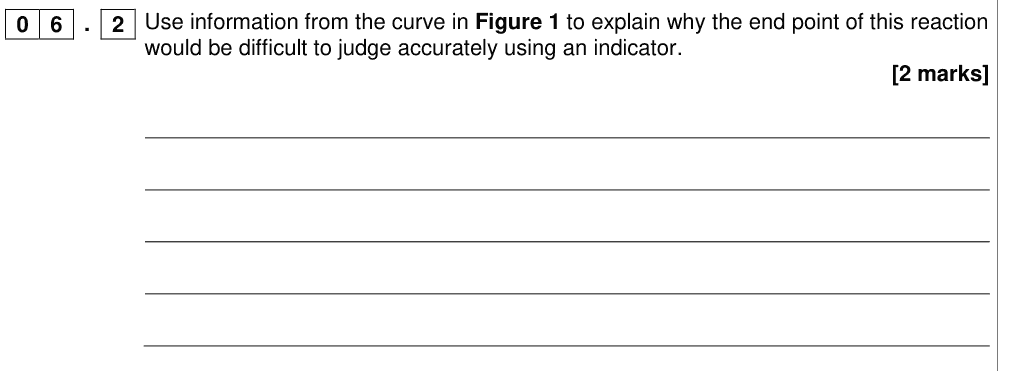
Use information from the curve in Figure 1 to explain why the end point of this reaction
would be difficult to judge accurately using an indicator.
[2 marks]
Specimen · Paper 1 · Q06.3 3 marks Calculation acids and bases
Earlier part of question 06 that this part usesEarlier part of Specimen Paper 1 question 06
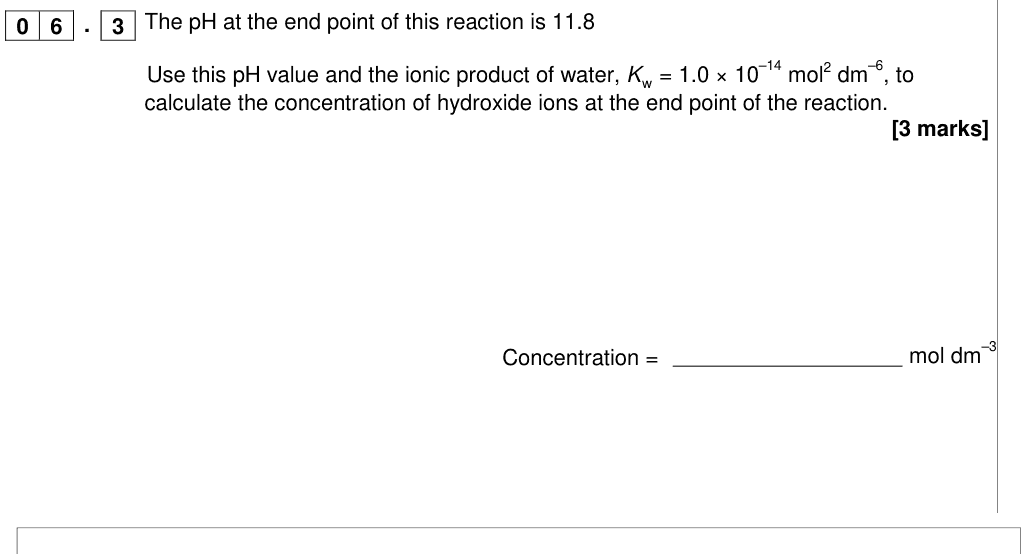
The pH at the end point of this reaction is 11.8
Use this pH value and the ionic product of water, Kw = 1.0 × 10
–14 mol2 dm
–6, to
calculate the concentration of hydroxide ions at the end point of the reaction.
[3 marks]
Concentration =
mol dm
–3
Specimen · Paper 1 · Q06.4 3 marks Calculation acids and bases
Earlier part of question 06 that this part usesEarlier part of Specimen Paper 1 question 06
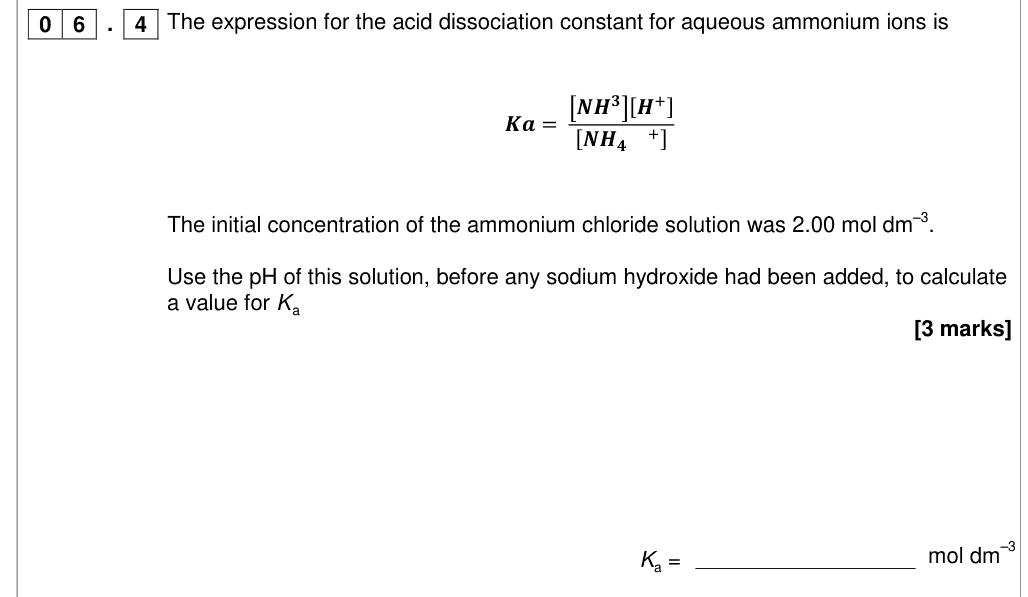
The expression for the acid dissociation constant for aqueous ammonium ions is
𝑲𝑲= ൣ𝑵𝑵𝟑൧[𝑯+]
[𝑵𝑯𝟒
+]
The initial concentration of the ammonium chloride solution was 2.00 mol dm–3.
Use the pH of this solution, before any sodium hydroxide had been added, to calculate
a value for Ka
[3 marks]
Ka =
mol dm
Specimen · Paper 1 · Q06.5 2 marks Calculation acids and bases
Earlier part of question 06 that this part usesEarlier part of Specimen Paper 1 question 06
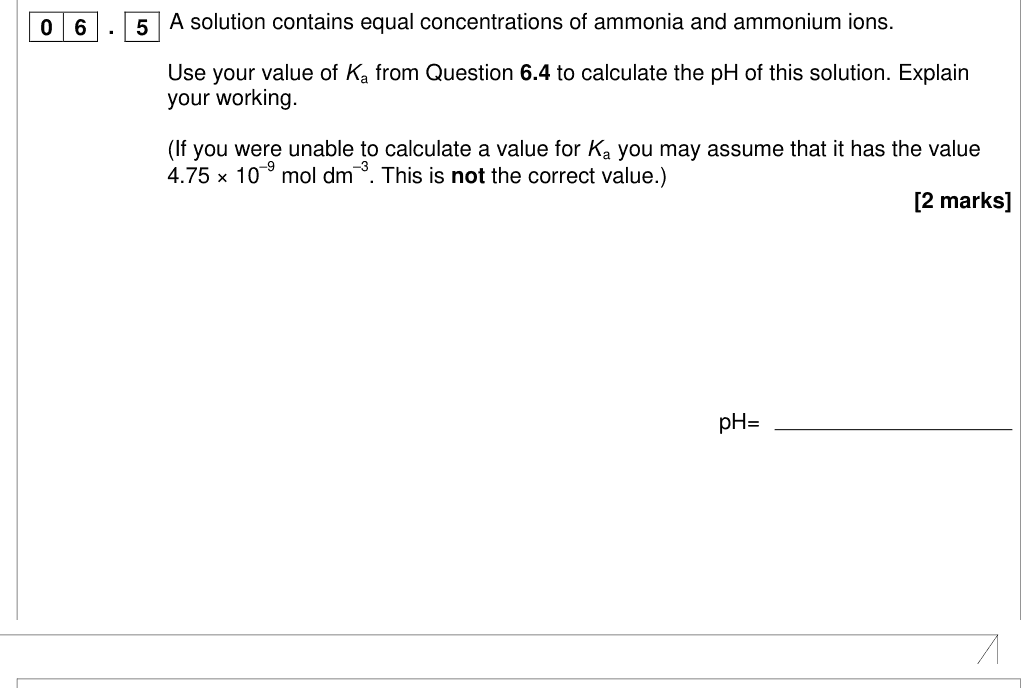
A solution contains equal concentrations of ammonia and ammonium ions.
Use your value of Ka from Question 6.4 to calculate the pH of this solution. Explain
your working.
(If you were unable to calculate a value for Ka you may assume that it has the value
4.75 × 10
–9 mol dm
–3. This is not the correct value.)
[2 marks]
pH=
Specimen · Paper 1 · Q07.1 1 mark AO3=1 Short answer atomic structure
Table 4 shows some successive ionisation energy data for atoms of three different
elements X, Y and Z.
Elements X, Y and Z are Ca, Sc and V but not in that order.
Table 4
First
Second
Third
Fourth
Fifth
Sixth
X
648
1370
2870
4600
6280
12 400
Y
590
1150
4940
6480
8120
10 496
Z
632
1240
2390
7110
8870
10 720
For questions 7.1 and 7.2, only one answer per question is allowed.
For each answer, completely fill in the circle alongside the appropriate answer.
If you want to change your answer you must cross out your original answer as shown.
If you wish to return to an answer previously crossed out, ring the answer you now wish to select
as shown.
Which element is calcium?
[1 mark]
X
Y
Z
CORRECT METHOD
WRONG METHODS
Specimen · Paper 1 · Q07.2 1 mark AO3=1 Short answer atomic structure
Earlier part of question 07 that this part usesEarlier part of Specimen Paper 1 question 07
Which element is vanadium?
[1 mark]
X
Y
Z
Specimen · Paper 1 · Q07.3 1 mark AO2=1 Short answer atomic structure
Earlier part of question 07 that this part usesEarlier part of Specimen Paper 1 question 07
Justify your choice of vanadium in Question 7.2
[1 mark]
Specimen · Paper 1 · Q07.4 2 marks Explanation transition metals
Earlier part of question 07 that this part usesEarlier part of Specimen Paper 1 question 07
An acidified solution of NH4VO3 reacts with zinc.
Explain how observations from this reaction show that vanadium exists in at least two
different oxidation states.
[2 marks]
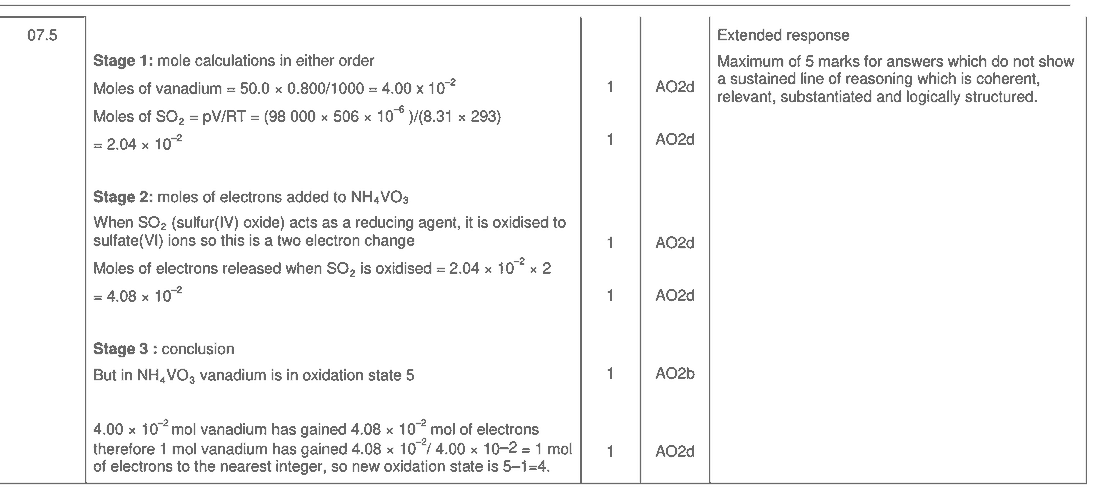
Specimen · Paper 1 · Q07.5 6 marks Calculation amount of substanceredoxtransition metals
Earlier part of question 07 that this part usesEarlier part of Specimen Paper 1 question 07
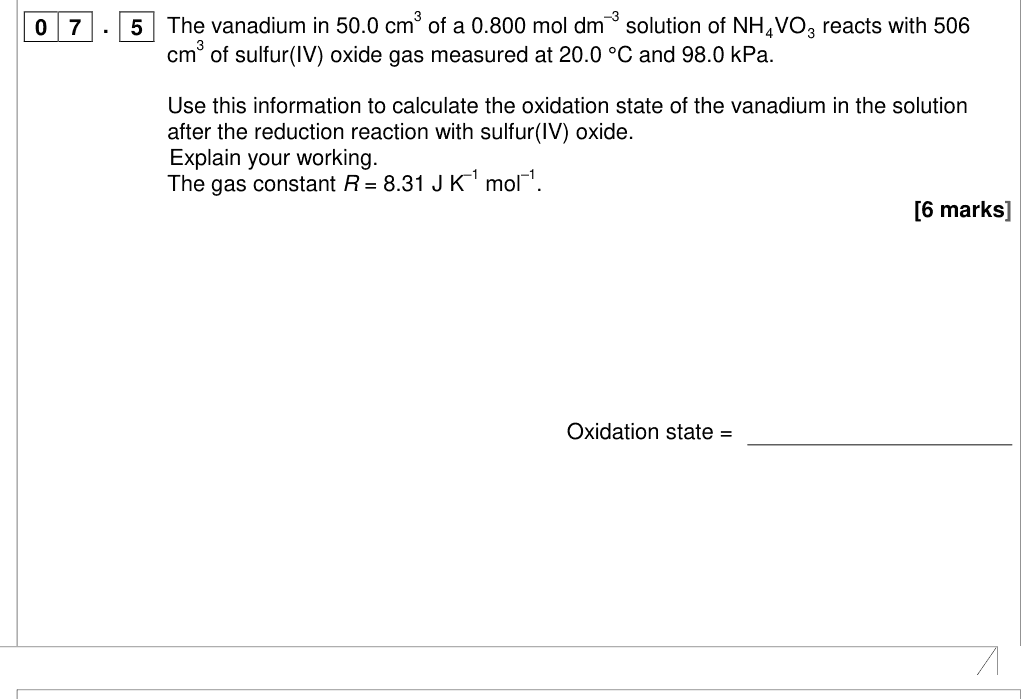
The vanadium in 50.0 cm
3 of a 0.800 mol dm
–3 solution of NH4VO3 reacts with 506
cm
3 of sulfur(IV) oxide gas measured at 20.0 °C and 98.0 kPa.
Use this information to calculate the oxidation state of the vanadium in the solution
after the reduction reaction with sulfur(IV) oxide.
Explain your working.
The gas constant R = 8.31 J K
–1 mol
–1.
[6 marks]
Oxidation state =
Specimen · Paper 1 · Q08.1 2 marks Explanation transition metalsbonding
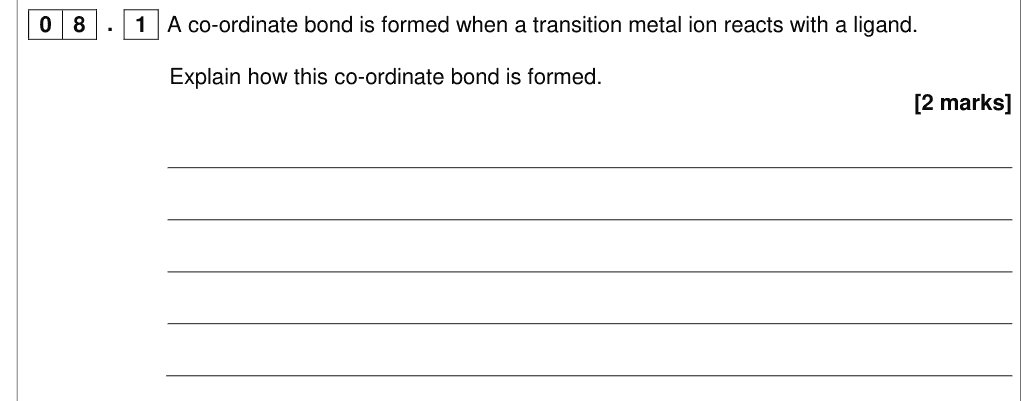
A co-ordinate bond is formed when a transition metal ion reacts with a ligand.
Explain how this co-ordinate bond is formed.
[2 marks]
Specimen · Paper 1 · Q08.2 4 marks Equation writing reactions of ions in aqueous solutiontransition metals
Earlier part of question 08 that this part usesEarlier part of Specimen Paper 1 question 08
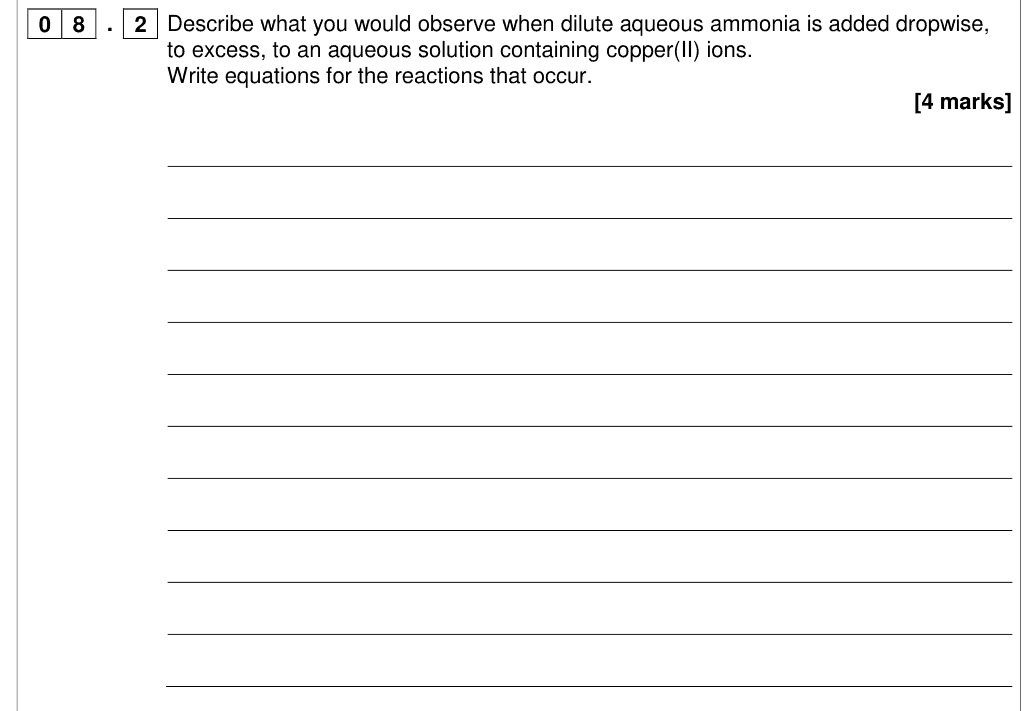
Describe what you would observe when dilute aqueous ammonia is added dropwise,
to excess, to an aqueous solution containing copper(II) ions.
Write equations for the reactions that occur.
[4 marks]
Specimen · Paper 1 · Q08.3 1 mark AO2=1 Equation writing transition metals
Earlier part of question 08 that this part usesEarlier part of Specimen Paper 1 question 08
When the complex ion [Cu(NH3)4(H2O)2]
2+ reacts with 1,2-diaminoethane, the
ammonia molecules but not the water molecules are replaced.
Write an equation for this reaction.
[1 mark]
Specimen · Paper 1 · Q08.4 2 marks Explanation transition metals
Earlier parts of question 08 that this part usesEarlier part of Specimen Paper 1 question 08Earlier part of Specimen Paper 1 question 08
Suggest why the enthalpy change for the reaction in Question 8.3 is approximately
zero.
[2 marks]
Specimen · Paper 1 · Q08.5 2 marks Explanation transition metalsthermodynamics
Earlier parts of question 08 that this part usesEarlier part of Specimen Paper 1 question 08Earlier part of Specimen Paper 1 question 08
Explain why the reaction in Question 8.3 occurs despite having an enthalpy change
that is approximately zero.
[2 marks]
Specimen · Paper 1 · Q09.1 4 marks Practical and data analysis energetics
A 5.00 g sample of potassium chloride was added to 50.0 g of water initially at
20.0 °C. The mixture was stirred and as the potassium chloride dissolved, the
temperature of the solution decreased.
Describe the steps you would take to determine an accurate minimum temperature
that is not influenced by heat from the surroundings.
[4 marks]
Specimen · Paper 1 · Q09.2 4 marks Calculation energetics
Earlier part of question 09 that this part usesEarlier part of Specimen Paper 1 question 09
The temperature of the water decreased to 14.6 °C.
Calculate a value, in kJ mol
–1, for the enthalpy of solution of potassium chloride.
You should assume that only the 50.0 g of water changes in temperature and that the
specific heat capacity of water is 4.18 J K–1 g–1.
Give your answer to the appropriate number of significant figures.
[4 marks]
Enthalpy of solution =
kJ mol
Specimen · Paper 1 · Q09.3 2 marks Calculation thermodynamics
Earlier part of question 09 that this part usesEarlier part of Specimen Paper 1 question 09
The enthalpy of solution of calcium chloride is –82.9 kJ mol
–1.
The enthalpies of hydration for calcium ions and chloride ions are –1650 and
–364 kJ mol
–1, respectively.
Use these values to calculate a value for the lattice enthalpy of dissociation of
calcium chloride.
[2 marks]
Lattice enthalpy of dissociation =
kJ mol
–1
Specimen · Paper 1 · Q09.4 2 marks Explanation thermodynamicsbonding
Earlier part of question 09 that this part usesEarlier part of Specimen Paper 1 question 09
Explain why your answer to Question 9.3 is different from the lattice enthalpy of
dissociation for magnesium chloride.
[2 marks]
Specimen · Paper 1 · Q10.1 6 marks Practical and data analysis reactions of ions in aqueous solutiongroup 7 the halogensgroup 2
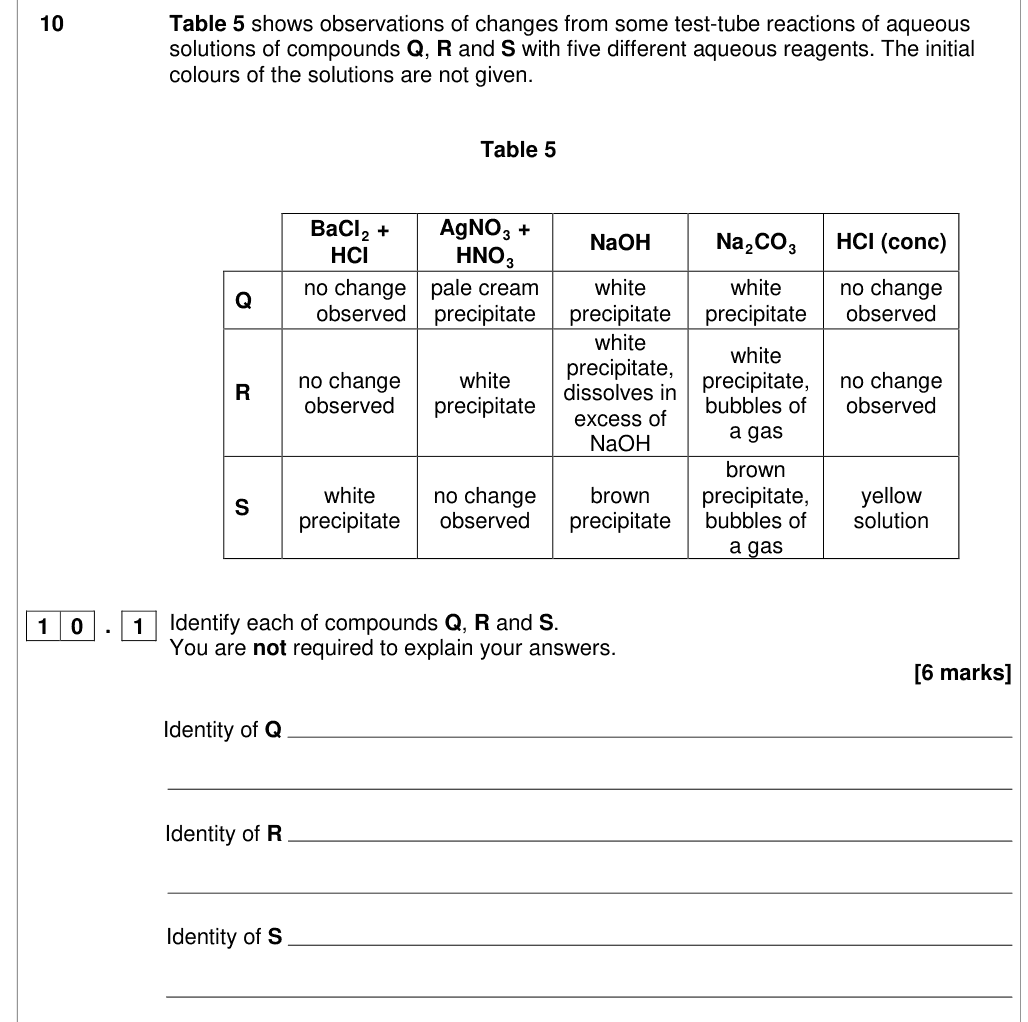
Table 5 shows observations of changes from some test-tube reactions of aqueous
solutions of compounds Q, R and S with five different aqueous reagents. The initial
colours of the solutions are not given.
Table 5
BaCl2 +
HCl
AgNO3 +
HNO3
NaOH
Na2CO3
HCl (conc)
Q
no change
observed
pale cream
precipitate
white
precipitate
white
precipitate
no change
observed
R
no change
observed
white
precipitate
white
precipitate,
dissolves in
excess of
NaOH
white
precipitate,
bubbles of
a gas
no change
observed
S
white
precipitate
no change
observed
brown
precipitate
brown
precipitate,
bubbles of
a gas
yellow
solution
Identify each of compounds Q, R and S.
You are not required to explain your answers.
[6 marks]
Identity of Q
Identity of R
Identity of S
Specimen · Paper 1 · Q10.2 4 marks Equation writing reactions of ions in aqueous solutiongroup 2transition metals
Earlier part of question 10 that this part usesEarlier part of Specimen Paper 1 question 10
Write ionic equations for each of the positive observations with S.
[4 marks]

Work with an A-level chemistry tutor

Want a paper marked and gone through with you? Message us.

Prefer email? Send an enquiry

If you are under 18, please include a parent's contact details. Enquiries go to enquiries@chemistryaleveltutor.com and are deleted once handled. All tutoring is online.