November 2020: Paper 3, Any content and practical skills

90 marks · 56 question parts · Paper, mark scheme and report on AQA's site · An autumn series using the paper written for the cancelled summer exams · Have the Data Booklet beside you

Question by question

QTopicMarksAOType
01.1 Alkanes 2Explanation
01.2 Alkanes 1Short answer
01.3 Oxidation, reduction and redox equations, Amount of substance 2Equation writing
01.4 Transition metals, Kinetics 2Short answer
01.5 Alkanes 1Short answer
02.1 Period 3 elements and their oxides 2Explanation
02.2 Period 3 elements and their oxides 1Equation writing
02.3 Transition metals 2Equation writing
03.1 Transition metals 3Explanation
03.2 Transition metals 3Calculation
03.3 Transition metals 3Practical and data analysis
03.4 Amount of substance 2Calculation
04.1 Amino acids, proteins and DNA 1Short answer
04.2 Transition metals, Amount of substance 2Equation writing
04.3 Amino acids, proteins and DNA, Bonding 2Diagram or structure
04.4 Rate equations 3Practical and data analysis
04.5 Rate equations 2Calculation
04.6 Rate equations 5Calculation
05.1 Energetics 3Calculation
05.2 Energetics 2Calculation
05.3 Energetics 1Short answer
05.4 Energetics 2Practical and data analysis
06.1 Electrode potentials and electrochemical cells 3Short answer
06.2 Electrode potentials and electrochemical cells 6Level of response
06.3 Oxidation, reduction and redox equations, Electrode potentials and electrochemical cells 1Equation writing
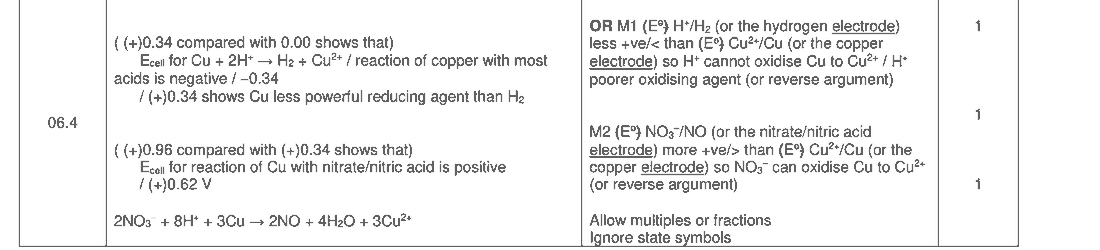
06.4 Electrode potentials and electrochemical cells, Oxidation, reduction and redox equations 3Explanation
07 Amount of substance 1Multiple choice
08 Bonding 1Multiple choice
09 Energetics 1Multiple choice
10 Energetics 1Multiple choice
11 Oxidation, reduction and redox equations 1Multiple choice
12 Rate equations 1Multiple choice
13 Acids and bases: pH, Ka, titration curves and buffers 1Multiple choice
14 Acids and bases: pH, Ka, titration curves and buffers 1Multiple choice
15 Group 7(17), the halogens 1Multiple choice
16 Group 7(17), the halogens 1Multiple choice
17 Transition metals, Atomic structure 1Multiple choice
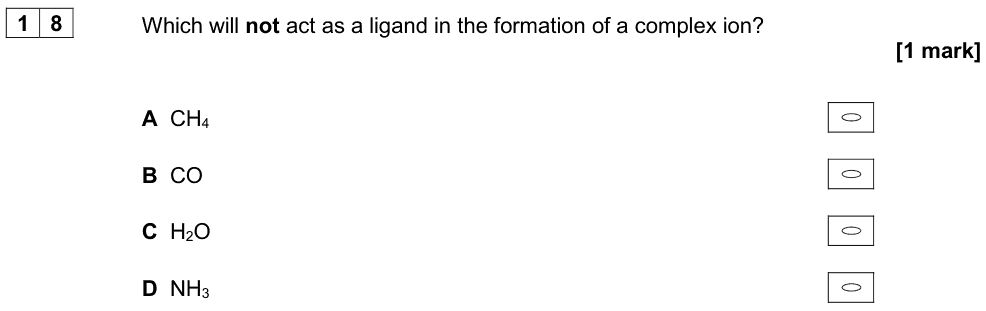
18 Transition metals 1Multiple choice
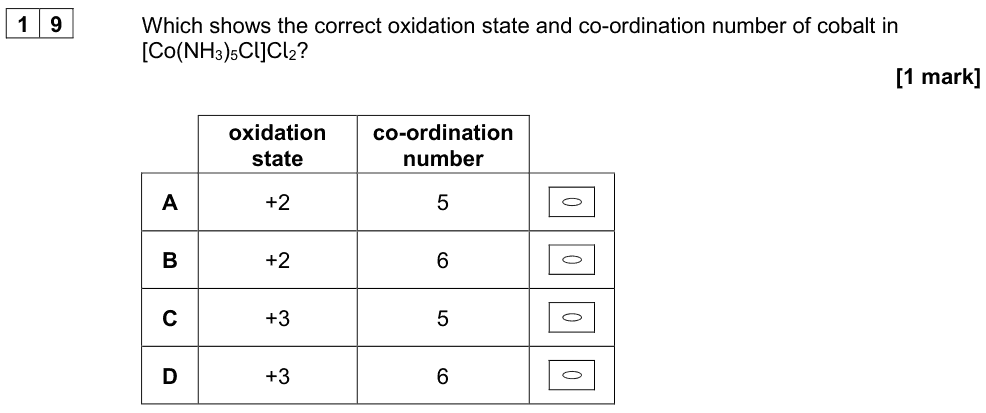
19 Transition metals, Oxidation, reduction and redox equations 1Multiple choice
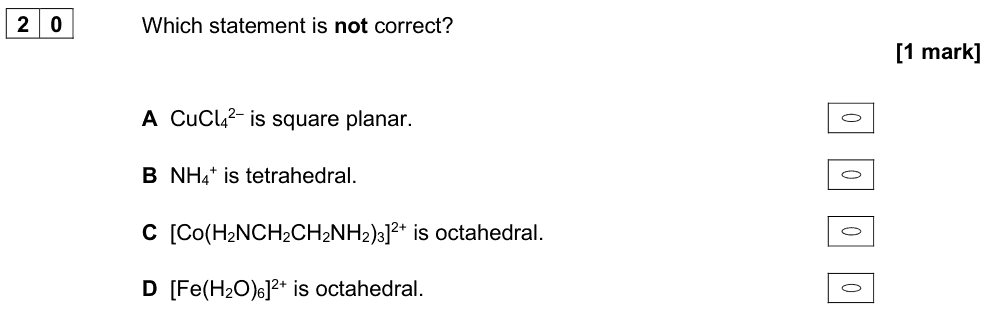
20 Transition metals 1Multiple choice
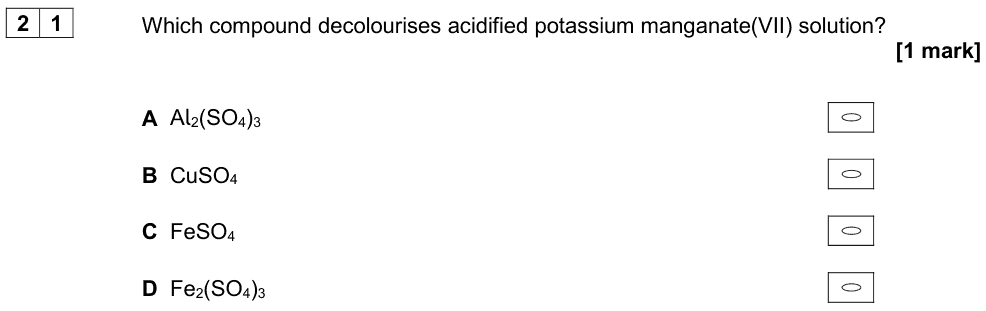
21 Transition metals, Oxidation, reduction and redox equations 1Multiple choice
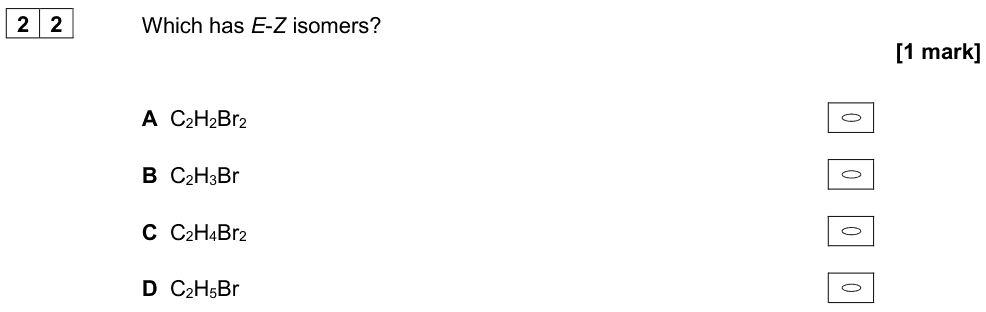
22 Introduction to organic chemistry: nomenclature, mechanisms and isomerism 1Multiple choice
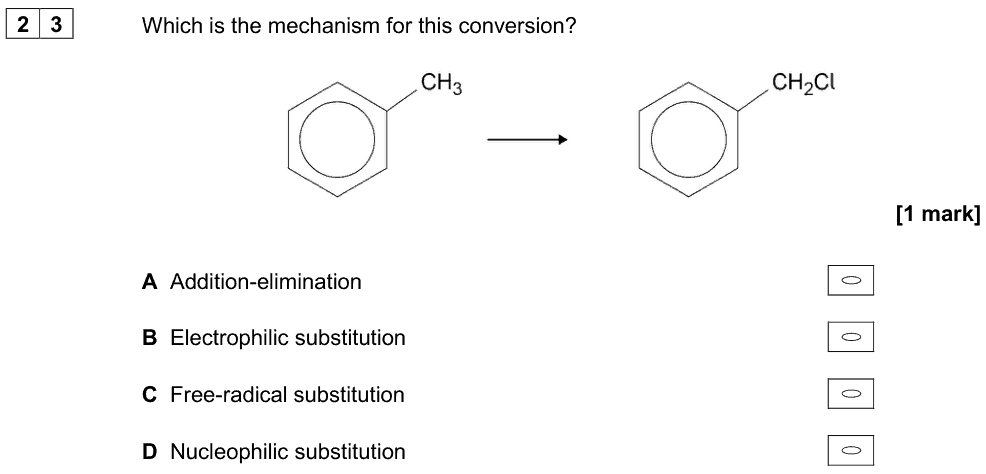
23 Alkanes 1Multiple choice
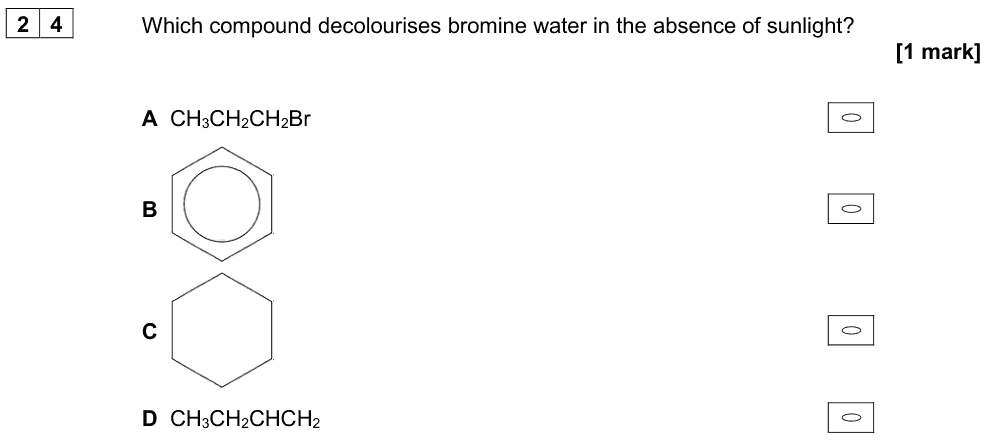
24 Alkenes 1Multiple choice
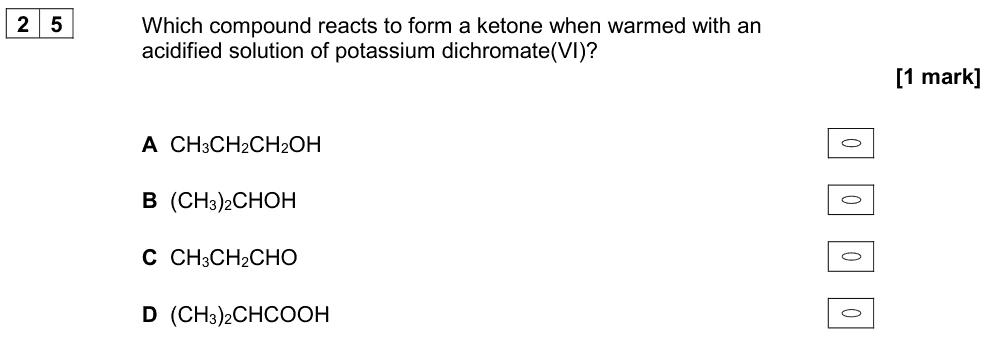
25 Alcohols 1Multiple choice
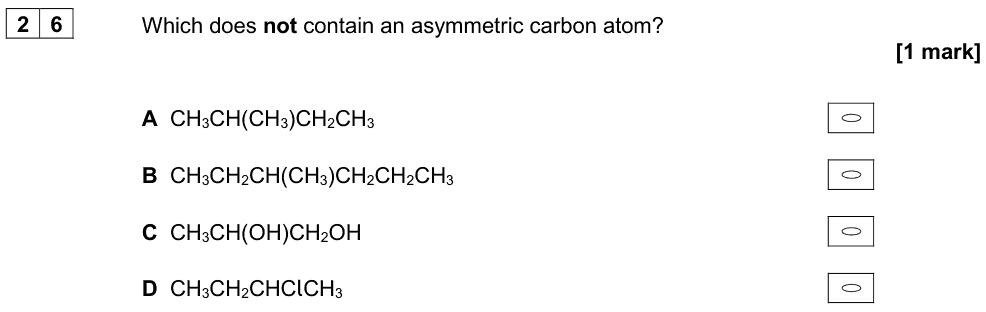
26 Optical isomerism 1Multiple choice
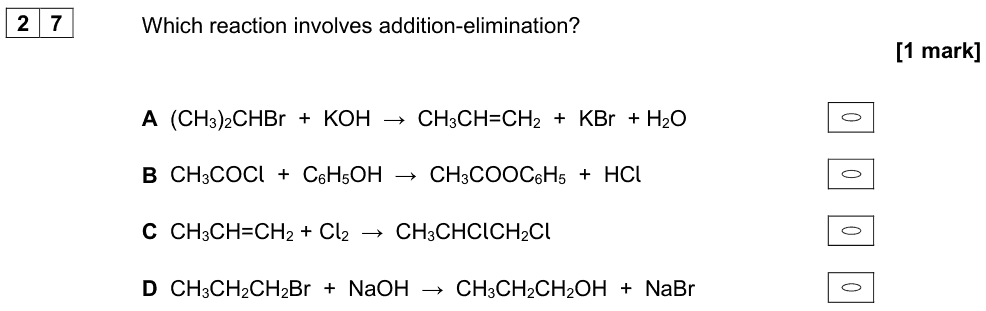
27 Carboxylic acids and derivatives 1Multiple choice
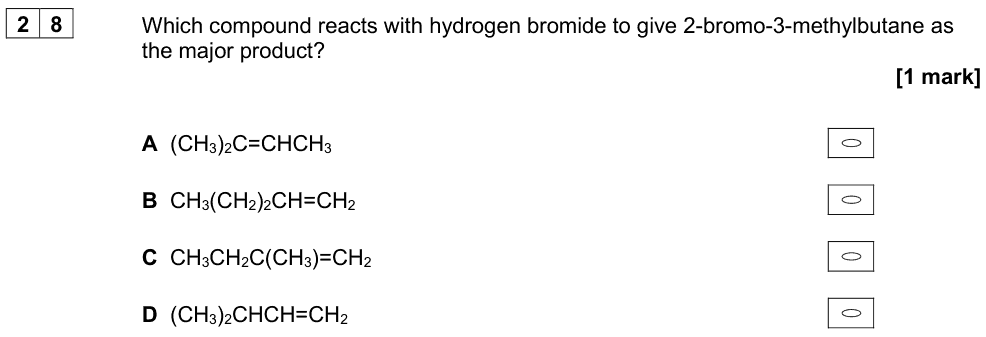
28 Alkenes 1Multiple choice
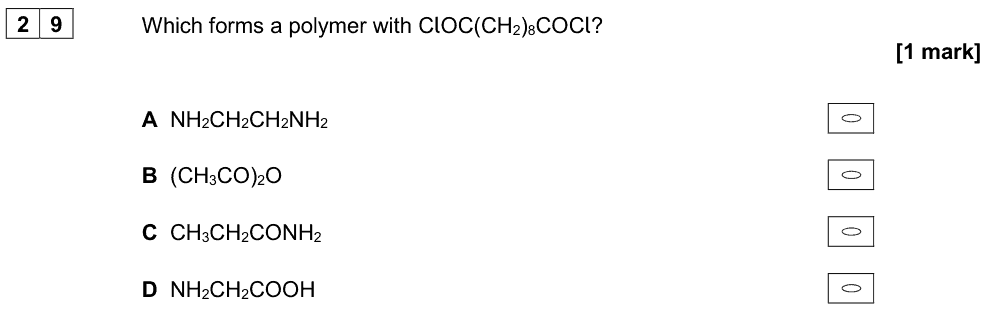
29 Polymers 1Multiple choice
30 Amino acids, proteins and DNA 1Multiple choice
31 Transition metals 1Multiple choice
32 Acids and bases: pH, Ka, titration curves and buffers 1Multiple choice
33 Rate equations 1Multiple choice
34 Acids and bases: pH, Ka, titration curves and buffers 1Multiple choice
35 Carboxylic acids and derivatives 1Multiple choice
36 Amount of substance 1Multiple choice

The questions

01.101.201.301.401.502.102.202.303.103.203.303.404.104.204.304.404.504.605.105.205.305.406.106.206.306.4070809101112131415161718192021222324252627282930313233343536
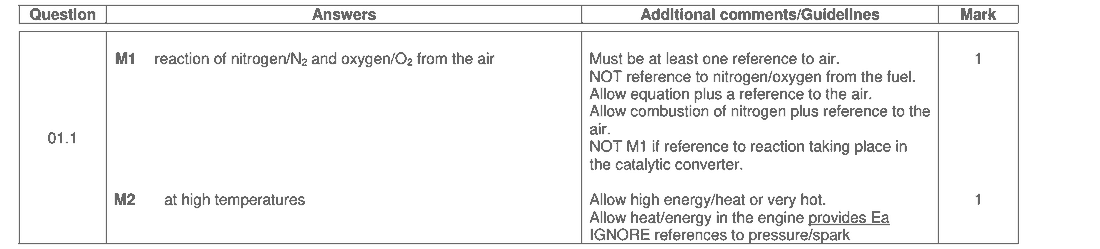
November 2020 · Paper 3 · Q01.1 2 marks Explanation alkanes
This question is about emissions of oxides of nitrogen from petrol and diesel engines.
Explain how oxides of nitrogen are formed in engines.
[2 marks]
November 2020 · Paper 3 · Q01.2 1 mark Short answer alkanes
Earlier part of question 01 that this part usesEarlier part of November 2020 Paper 3 question 01
State why it is desirable to decrease emissions of oxides of nitrogen from vehicles.
[1 mark]
November 2020 · Paper 3 · Q01.3 2 marks Equation writing redoxamount of substance
Earlier part of question 01 that this part usesEarlier part of November 2020 Paper 3 question 01
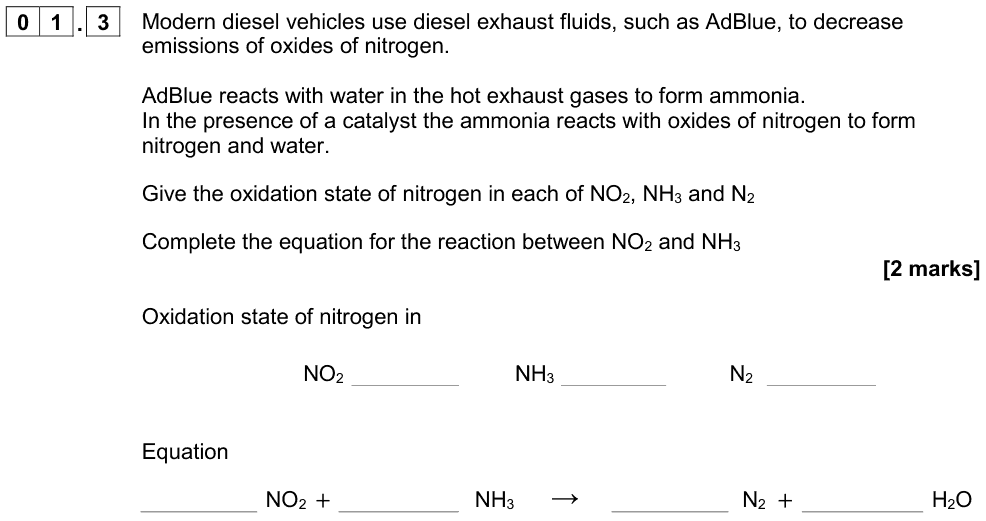
Modern diesel vehicles use diesel exhaust fluids, such as AdBlue, to decrease
emissions of oxides of nitrogen.
AdBlue reacts with water in the hot exhaust gases to form ammonia.
In the presence of a catalyst the ammonia reacts with oxides of nitrogen to form
nitrogen and water.
Give the oxidation state of nitrogen in each of NO2, NH3 and N2
Complete the equation for the reaction between NO2 and NH3
[2 marks]
Oxidation state of nitrogen in
NO2
NH3
N2
Equation
NO2 +
NH3
→
N2 +
H2O
November 2020 · Paper 3 · Q01.4 2 marks Short answer Hard transition metalskinetics
Earlier part of question 01 that this part usesEarlier part of November 2020 Paper 3 question 01
Petrol vehicles have a catalytic converter which decreases emissions of oxides of
nitrogen.
Platinum in the catalytic converter acts as a heterogeneous catalyst.
State the meaning of the term heterogeneous catalyst.
[2 marks]
November 2020 · Paper 3 · Q01.5 1 mark Short answer alkanes
Earlier part of question 01 that this part usesEarlier part of November 2020 Paper 3 question 01
Some carbon particulates are also formed in both diesel and petrol vehicles.
Explain why carbon particulates are formed.
[1 mark]
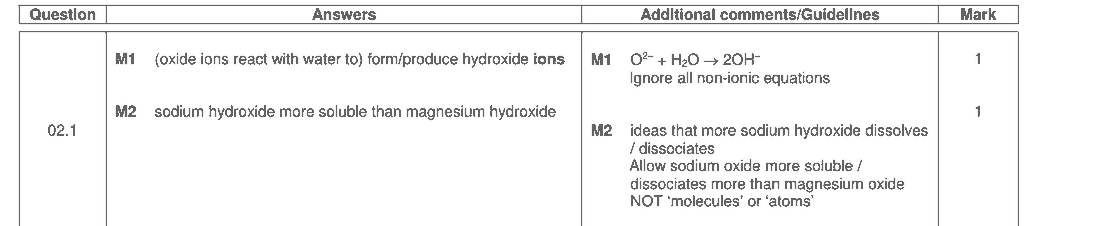
November 2020 · Paper 3 · Q02.1 2 marks Explanation period 3 elements and oxides
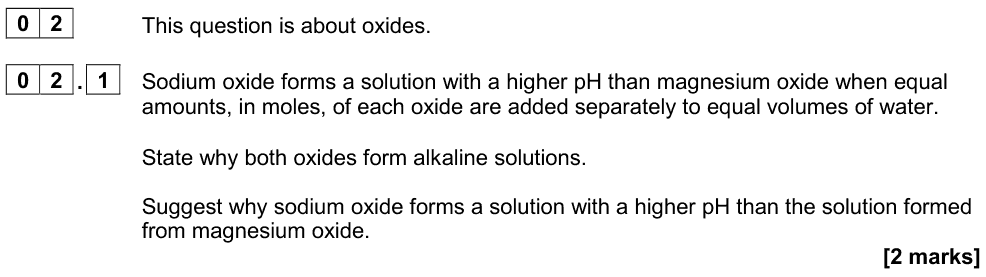
This question is about oxides.
Sodium oxide forms a solution with a higher pH than magnesium oxide when equal
amounts, in moles, of each oxide are added separately to equal volumes of water.
State why both oxides form alkaline solutions.
Suggest why sodium oxide forms a solution with a higher pH than the solution formed
from magnesium oxide.
[2 marks]
November 2020 · Paper 3 · Q02.2 1 mark Equation writing period 3 elements and oxides
Earlier part of question 02 that this part usesEarlier part of November 2020 Paper 3 question 02
Give an equation for the reaction between phosphorus(V) oxide and water.
[1 mark]
November 2020 · Paper 3 · Q02.3 2 marks Equation writing transition metals
Earlier part of question 02 that this part usesEarlier part of November 2020 Paper 3 question 02
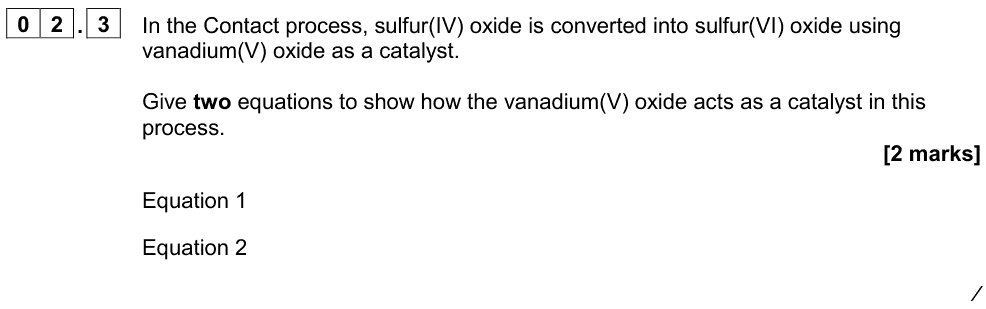
In the Contact process, sulfur(IV) oxide is converted into sulfur(VI) oxide using
vanadium(V) oxide as a catalyst.
Give two equations to show how the vanadium(V) oxide acts as a catalyst in this
process.
[2 marks]
Equation 1
Equation 2
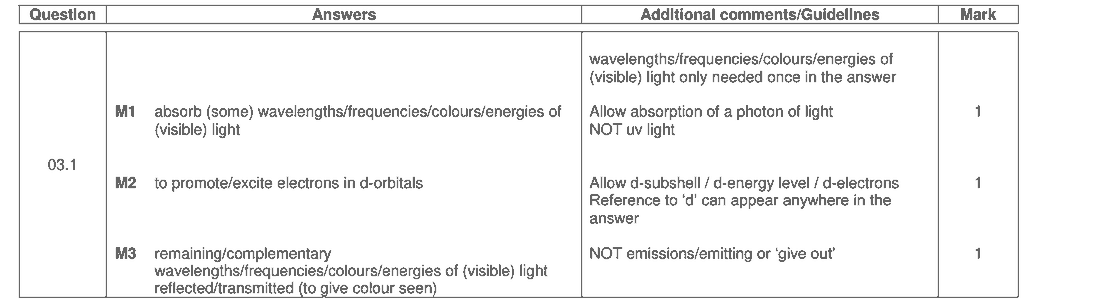
November 2020 · Paper 3 · Q03.1 3 marks Explanation Hard transition metals
Explain why complexes formed from transition metal ions are coloured.
[3 marks]
November 2020 · Paper 3 · Q03.2 3 marks Calculation transition metals
Earlier part of question 03 that this part usesEarlier part of November 2020 Paper 3 question 03
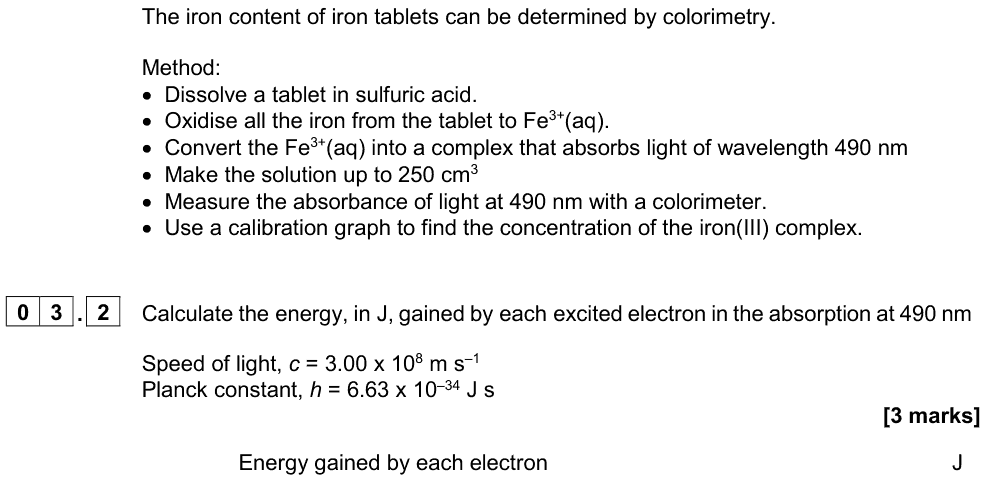
The iron content of iron tablets can be determined by colorimetry.
Method:
• Dissolve a tablet in sulfuric acid.
• Oxidise all the iron from the tablet to Fe3+(aq).
• Convert the Fe3+(aq) into a complex that absorbs light of wavelength 490 nm
• Make the solution up to 250 cm3
• Measure the absorbance of light at 490 nm with a colorimeter.
• Use a calibration graph to find the concentration of the iron(III) complex.
Calculate the energy, in J, gained by each excited electron in the absorption at 490 nm
Speed of light, c = 3.00 x 10⁸ m s–1
Planck constant, h = 6.63 x 10⁻³⁴ J s
[3 marks]
Energy gained by each electron
J
November 2020 · Paper 3 · Q03.3 3 marks Practical and data analysis transition metals
Earlier parts of question 03 that this part usesEarlier part of November 2020 Paper 3 question 03Earlier part of November 2020 Paper 3 question 03
Describe how a calibration graph is produced and used to find the concentration of the
iron(III) complex.
[3 marks]
November 2020 · Paper 3 · Q03.4 2 marks Calculation amount of substance
Earlier parts of question 03 that this part usesEarlier part of November 2020 Paper 3 question 03Earlier part of November 2020 Paper 3 question 03
The concentration of iron(III) in the solution is 4.66 x 10⁻³ mol dm–3
Calculate the mass, in mg, of iron in the tablet used to make the 250 cm3 of solution.
[2 marks]
Mass of iron in the tablet
mg
November 2020 · Paper 3 · Q04.1 1 mark Short answer amino acids proteins and dna
Cisplatin, [Pt(NH3)2Cl2], is used as an anti-cancer drug.
Cisplatin works by causing the death of rapidly dividing cells.
Name the process that is prevented by cisplatin during cell division.
[1 mark]
November 2020 · Paper 3 · Q04.2 2 marks Equation writing transition metalsamount of substance
Earlier part of question 04 that this part usesEarlier part of November 2020 Paper 3 question 04
After cisplatin enters a cell, one of the chloride ligands is replaced by a water
molecule to form a complex ion, B.
Give the equation for this reaction.
[2 marks]
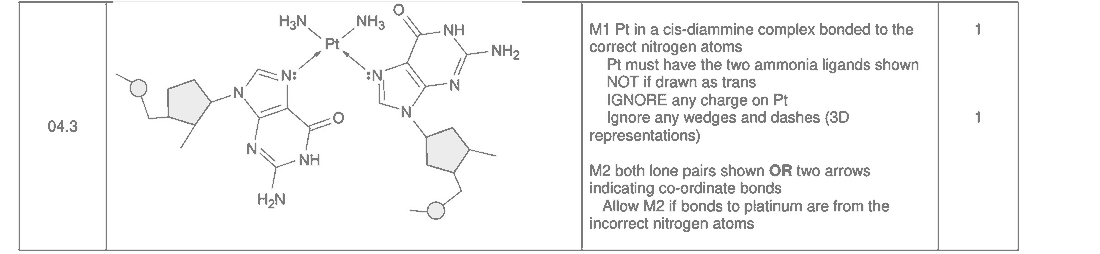
November 2020 · Paper 3 · Q04.3 2 marks Diagram or structure amino acids proteins and dnabonding
Earlier parts of question 04 that this part usesEarlier part of November 2020 Paper 3 question 04Earlier part of November 2020 Paper 3 question 04
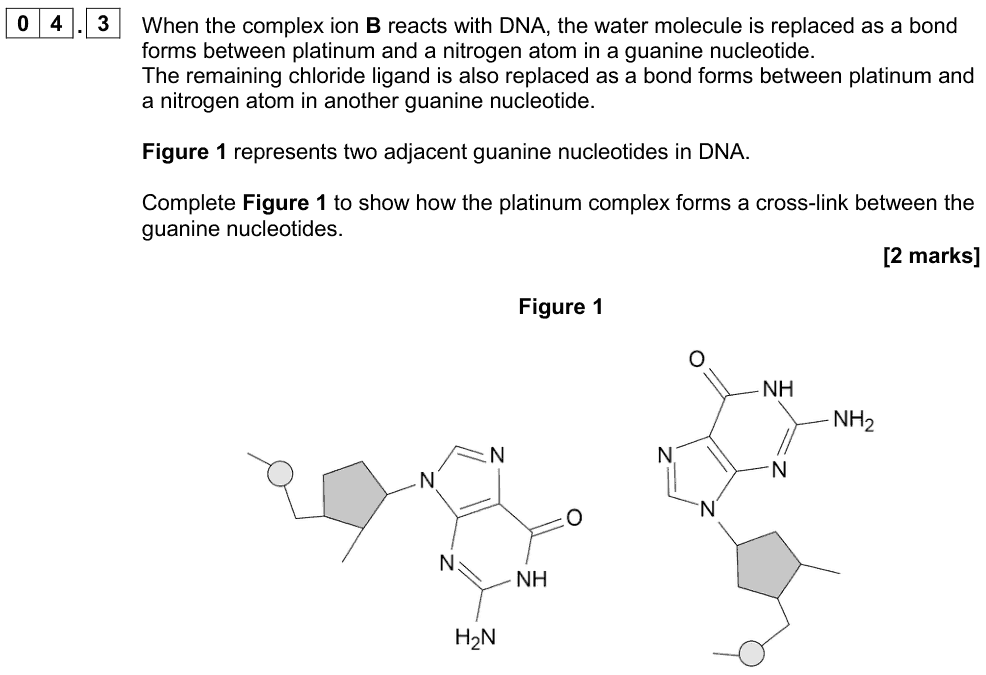
When the complex ion B reacts with DNA, the water molecule is replaced as a bond
forms between platinum and a nitrogen atom in a guanine nucleotide.
The remaining chloride ligand is also replaced as a bond forms between platinum and
a nitrogen atom in another guanine nucleotide.
Figure 1 represents two adjacent guanine nucleotides in DNA.
Complete Figure 1 to show how the platinum complex forms a cross-link between the
guanine nucleotides.
[2 marks]
Figure 1
November 2020 · Paper 3 · Q04.4 3 marks Practical and data analysis rate equations
Earlier parts of question 04 that this part usesEarlier part of November 2020 Paper 3 question 04Earlier part of November 2020 Paper 3 question 04
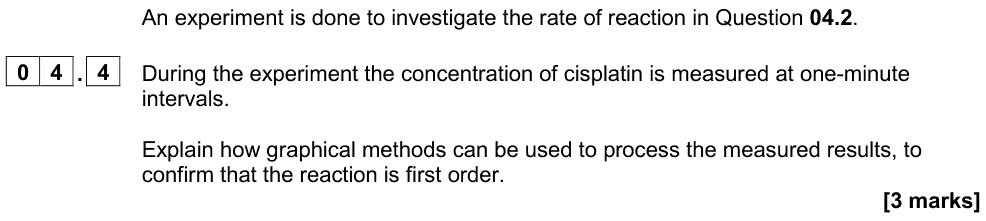
An experiment is done to investigate the rate of reaction in Question 04.2.
During the experiment the concentration of cisplatin is measured at one-minute
intervals.
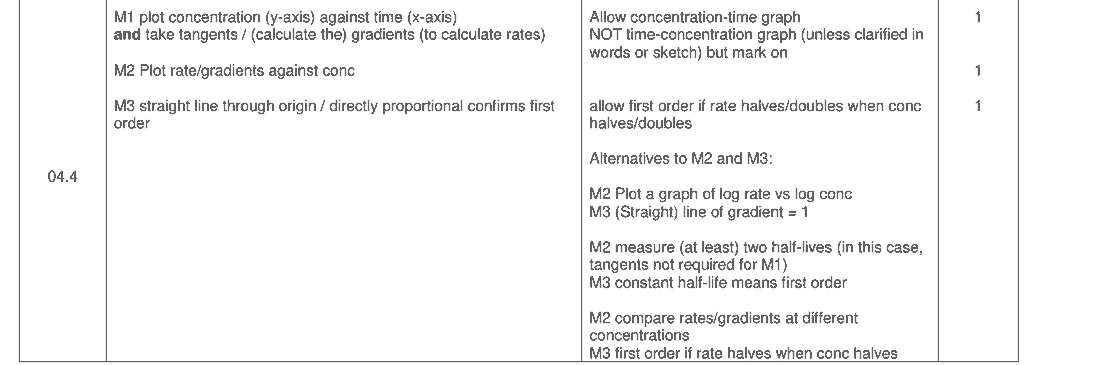
Explain how graphical methods can be used to process the measured results, to
confirm that the reaction is first order.
[3 marks]
November 2020 · Paper 3 · Q04.5 2 marks Calculation rate equations
Earlier parts of question 04 that this part usesEarlier part of November 2020 Paper 3 question 04Earlier part of November 2020 Paper 3 question 04Earlier part of November 2020 Paper 3 question 04
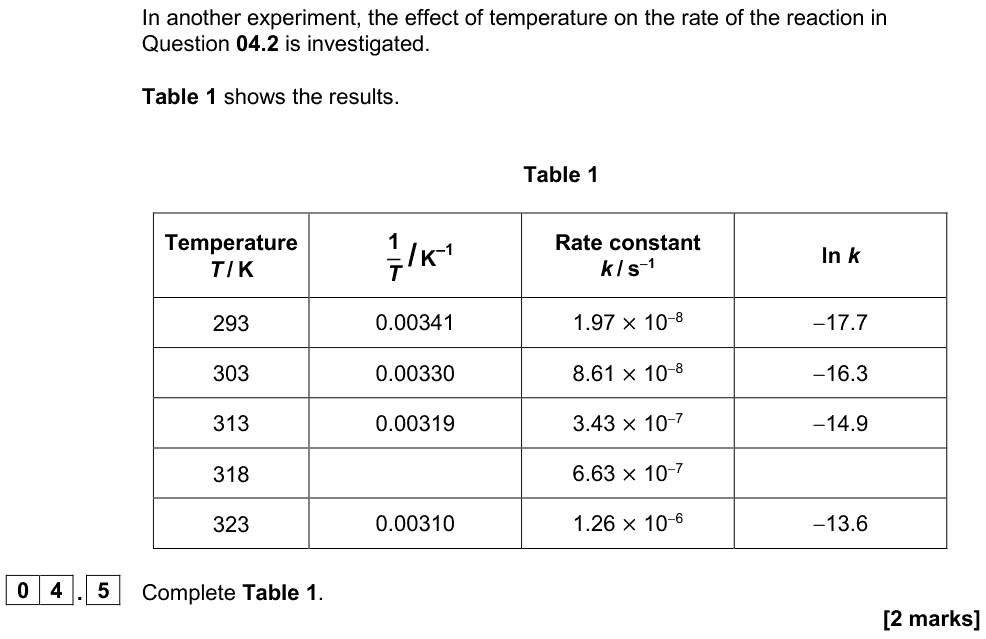
In another experiment, the effect of temperature on the rate of the reaction in
Question 04.2 is investigated.
Table 1 shows the results.
Table 1
Temperature
T / K
1
T / K–1
Rate constant
k / s 1
ln k
293
0.00341
1.97 × 10⁻⁸
−17.7
303
0.00330
8.61 × 10⁻⁸
−16.3
313
0.00319
3.43 × 10⁻⁷
−14.9
318
6.63 × 10⁻⁷
323
0.00310
1.26 × 10⁻⁶
−13.6
Complete Table 1.
[2 marks]
November 2020 · Paper 3 · Q04.6 5 marks Calculation rate equations
Earlier parts of question 04 that this part usesEarlier part of November 2020 Paper 3 question 04Earlier part of November 2020 Paper 3 question 04Earlier part of November 2020 Paper 3 question 04Earlier part of November 2020 Paper 3 question 04
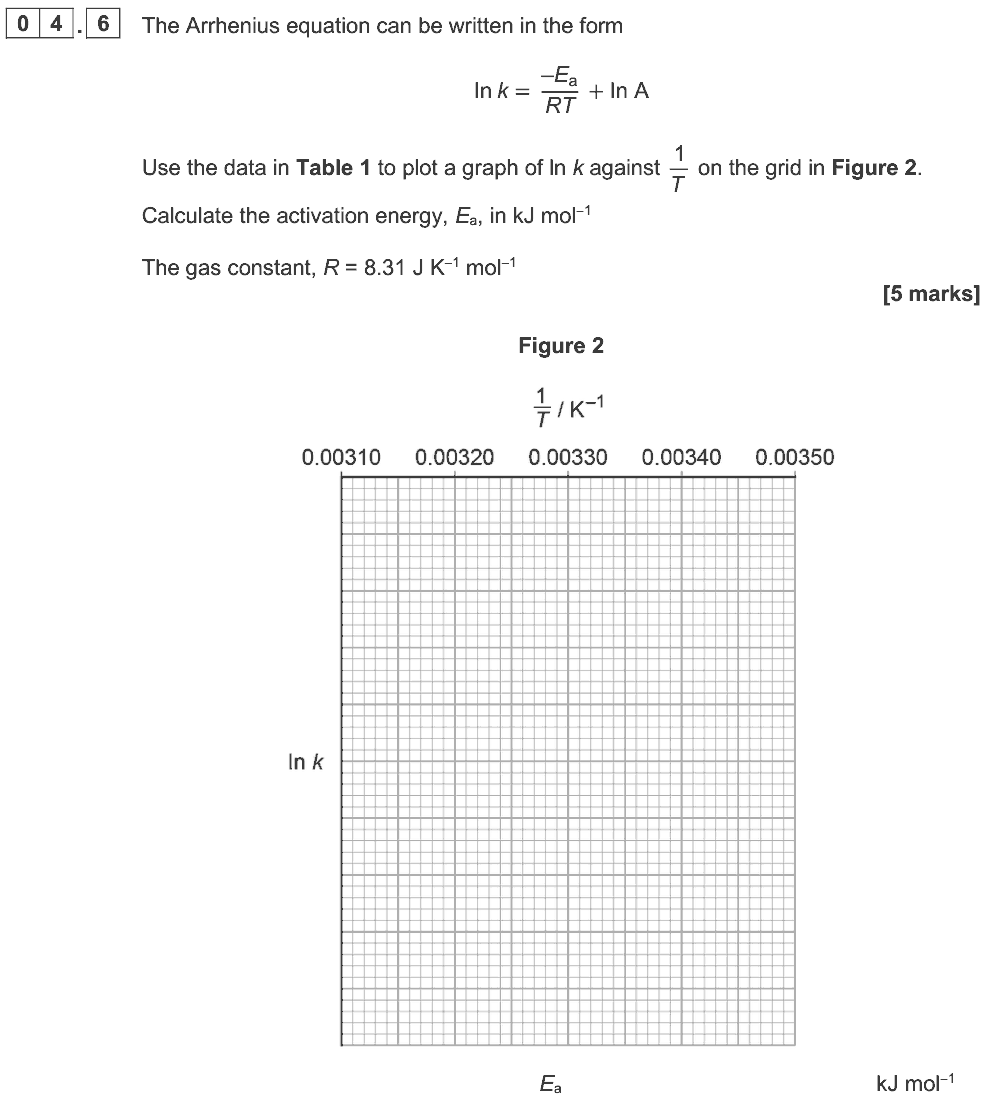
The Arrhenius equation can be written in the form
In k = –Ea
RT + In A
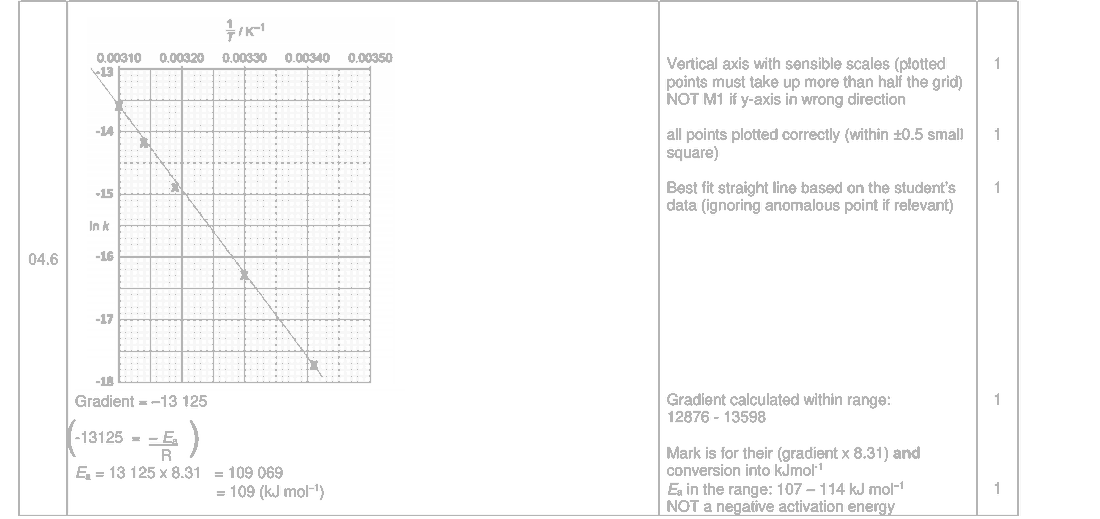
Use the data in Table 1 to plot a graph of ln k against 1
T on the grid in Figure 2.
Calculate the activation energy, Ea, in kJ mol−1
The gas constant, R = 8.31 J K−1 mol−1
[5 marks]
Figure 2
Ea
kJ mol−1
November 2020 · Paper 3 · Q05.1 3 marks Calculation energetics
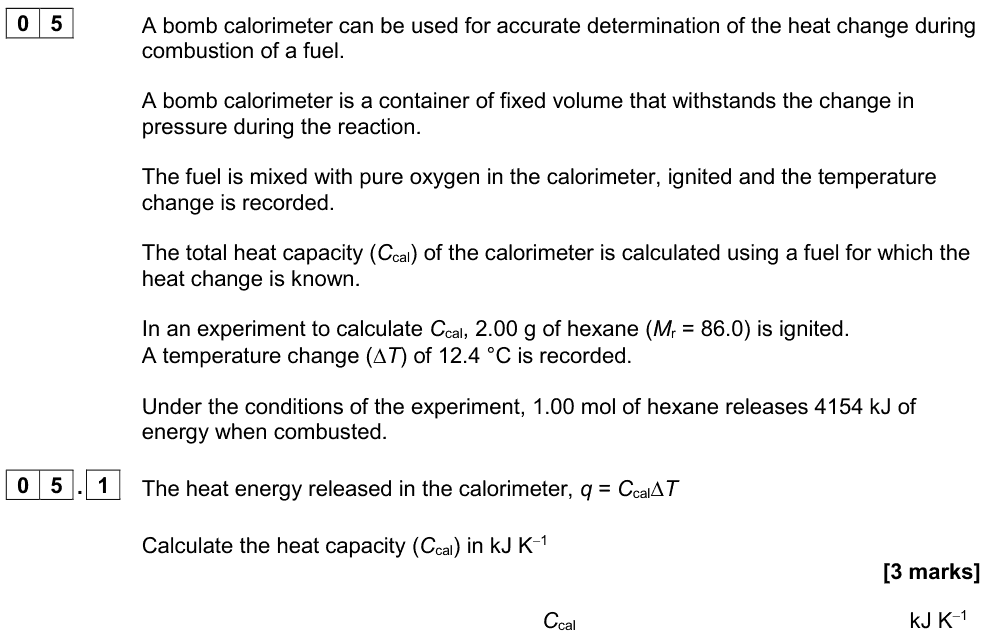
A bomb calorimeter can be used for accurate determination of the heat change during
combustion of a fuel.
A bomb calorimeter is a container of fixed volume that withstands the change in
pressure during the reaction.
The fuel is mixed with pure oxygen in the calorimeter, ignited and the temperature
change is recorded.
The total heat capacity (Ccal) of the calorimeter is calculated using a fuel for which the
heat change is known.
In an experiment to calculate Ccal, 2.00 g of hexane (Mr = 86.0) is ignited.
A temperature change (∆T) of 12.4 °C is recorded.
Under the conditions of the experiment, 1.00 mol of hexane releases 4154 kJ of
energy when combusted.
The heat energy released in the calorimeter, q = Ccal∆T
Calculate the heat capacity (Ccal) in kJ K−1
[3 marks]
Ccal
kJ K−1
November 2020 · Paper 3 · Q05.2 2 marks Calculation energetics
Earlier part of question 05 that this part usesEarlier part of November 2020 Paper 3 question 05
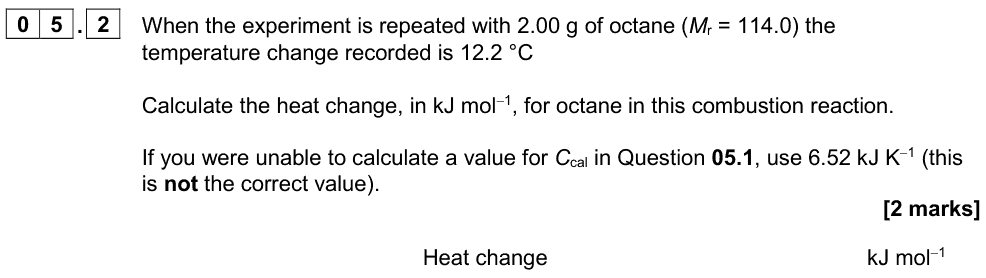
When the experiment is repeated with 2.00 g of octane (Mr = 114.0) the
temperature change recorded is 12.2 °C
Calculate the heat change, in kJ mol−1, for octane in this combustion reaction.
If you were unable to calculate a value for Ccal in Question 05.1, use 6.52 kJ K−1 (this
is not the correct value).
[2 marks]
Heat change
kJ mol−1
November 2020 · Paper 3 · Q05.3 1 mark Short answer energetics
Earlier part of question 05 that this part usesEarlier part of November 2020 Paper 3 question 05
State why the heat change calculated from the bomb calorimeter experiment is not an
enthalpy change.
[1 mark]
November 2020 · Paper 3 · Q05.4 2 marks Practical and data analysis energetics
Earlier part of question 05 that this part usesEarlier part of November 2020 Paper 3 question 05
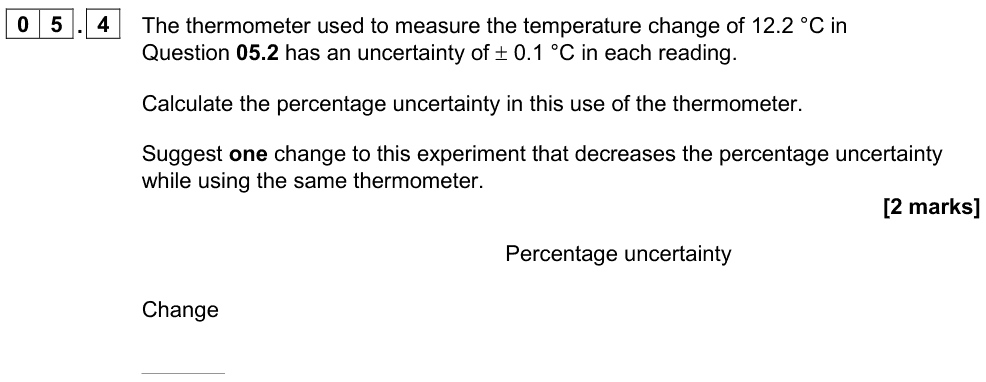
The thermometer used to measure the temperature change of 12.2 °C in
Question 05.2 has an uncertainty of ± 0.1 °C in each reading.
Calculate the percentage uncertainty in this use of the thermometer.
Suggest one change to this experiment that decreases the percentage uncertainty
while using the same thermometer.
[2 marks]
Percentage uncertainty
Change
November 2020 · Paper 3 · Q06.1 3 marks Short answer electrode potentials and cells
Standard electrode potentials are measured by comparison with the
standard hydrogen electrode.
State the substances and conditions needed in a standard hydrogen electrode.
[3 marks]
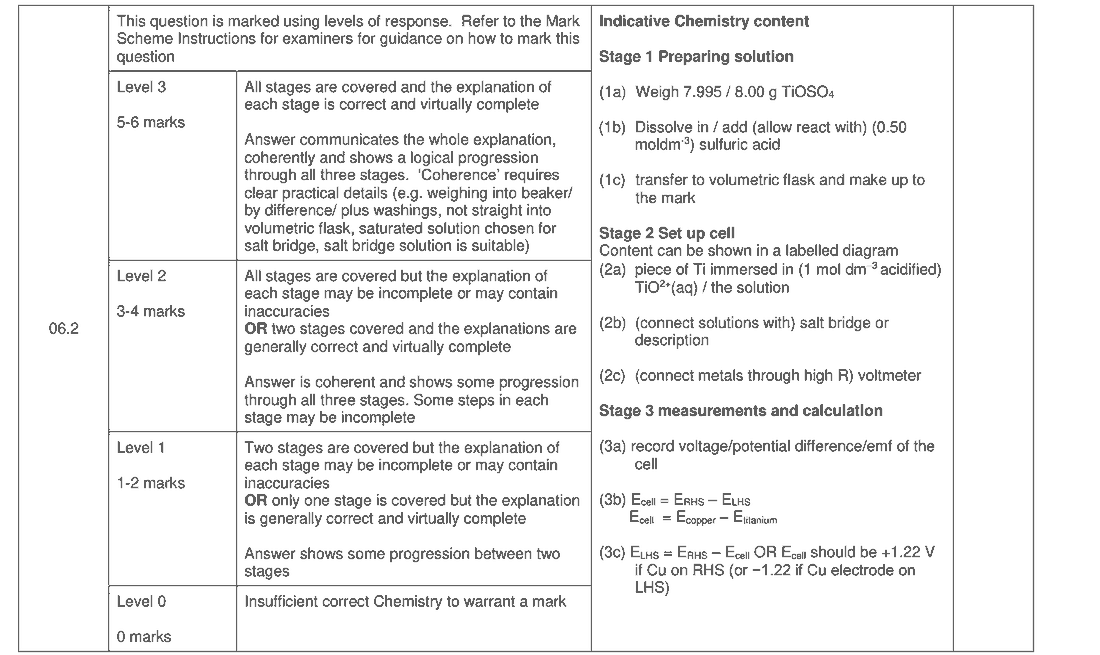
November 2020 · Paper 3 · Q06.2 6 marks 6-mark level of response Hard electrode potentials and cells
Earlier part of question 06 that this part usesEarlier part of November 2020 Paper 3 question 06
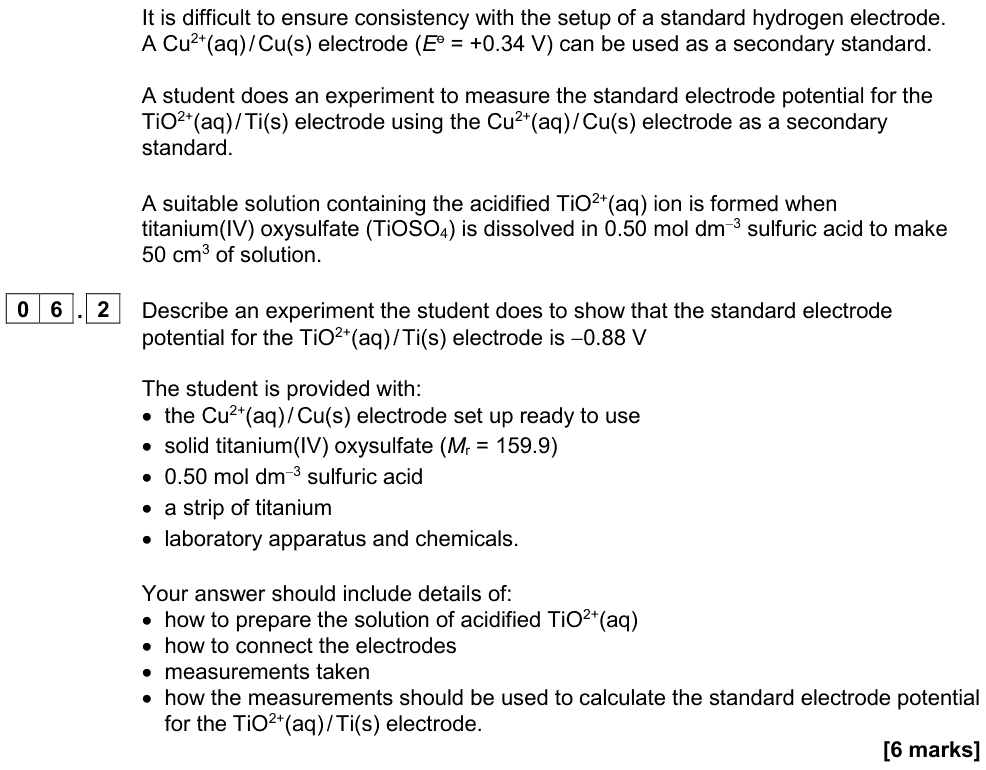
It is difficult to ensure consistency with the setup of a standard hydrogen electrode.
A Cu2+(aq) / Cu(s) electrode (Eo = +0.34 V) can be used as a secondary standard.
A student does an experiment to measure the standard electrode potential for the
TiO2+(aq) / Ti(s) electrode using the Cu2+(aq) / Cu(s) electrode as a secondary
standard.
A suitable solution containing the acidified TiO2+(aq) ion is formed when
titanium(IV) oxysulfate (TiOSO4) is dissolved in 0.50 mol dm−3 sulfuric acid to make
50 cm3 of solution.
Describe an experiment the student does to show that the standard electrode
potential for the TiO2+(aq) / Ti(s) electrode is −0.88 V
The student is provided with:
• the Cu2+(aq) / Cu(s) electrode set up ready to use
• solid titanium(IV) oxysulfate (Mr = 159.9)
• 0.50 mol dm−3 sulfuric acid
• a strip of titanium
• laboratory apparatus and chemicals.
Your answer should include details of:
• how to prepare the solution of acidified TiO2+(aq)
• how to connect the electrodes
• measurements taken
• how the measurements should be used to calculate the standard electrode potential
for the TiO2+(aq) / Ti(s) electrode.
[6 marks]
November 2020 · Paper 3 · Q06.3 1 mark Equation writing redoxelectrode potentials and cells
Earlier part of question 06 that this part usesEarlier part of November 2020 Paper 3 question 06
Give the half-equation for the electrode reaction in the TiO2+(aq) / Ti(s) electrode in
acidic conditions.
[1 mark]
November 2020 · Paper 3 · Q06.4 3 marks Explanation Hard electrode potentials and cellsredox
Earlier parts of question 06 that this part usesEarlier part of November 2020 Paper 3 question 06Earlier part of November 2020 Paper 3 question 06
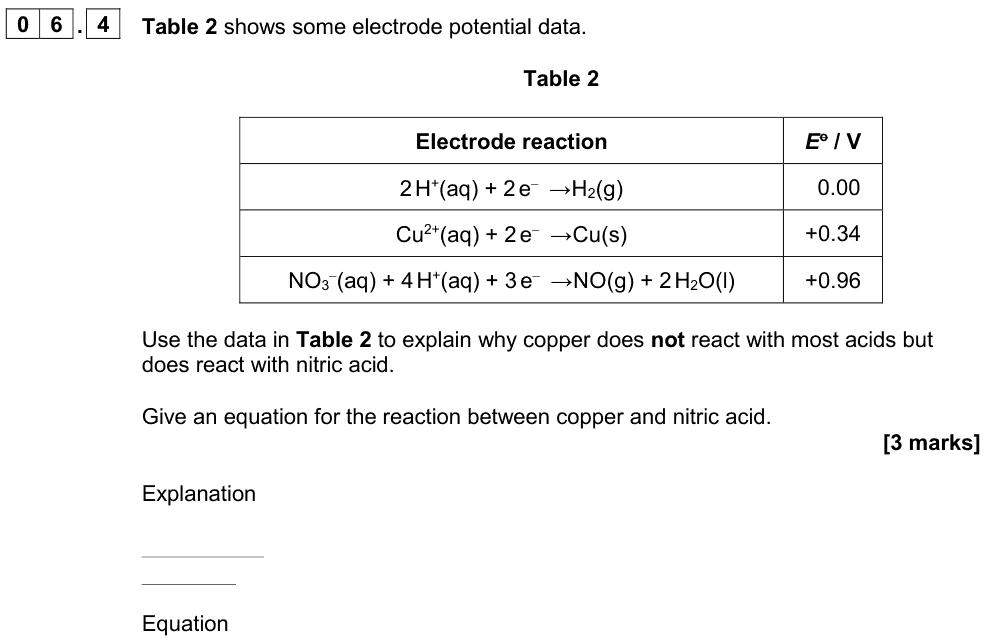
Table 2 shows some electrode potential data.
Table 2
Electrode reaction
Eo / V
2 H+(aq) + 2 e− → H2(g)
0.00
Cu2+(aq) + 2 e− → Cu(s)
+0.34
NO3−(aq) + 4 H+(aq) + 3 e− → NO(g) + 2 H2O(l)
+0.96
Use the data in Table 2 to explain why copper does not react with most acids but
does react with nitric acid.
Give an equation for the reaction between copper and nitric acid.
[3 marks]
Explanation
Equation
November 2020 · Paper 3 · Q07 1 mark Multiple choice amount of substance
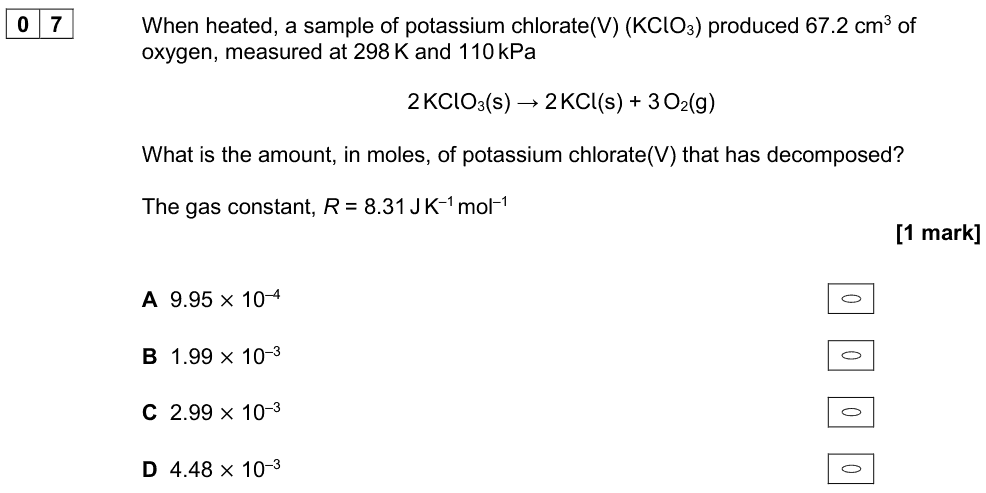
When heated, a sample of potassium chlorate(V) (KClO3) produced 67.2 cm3 of
oxygen, measured at 298 K and 110 kPa
2 KClO3(s) → 2 KCl(s) + 3 O2(g)
What is the amount, in moles, of potassium chlorate(V) that has decomposed?
The gas constant, R = 8.31 J K–1 mol–1
[1 mark]
A 9.95 × 10⁻⁴
B 1.99 × 10⁻³
C 2.99 × 10⁻³
D 4.48 × 10⁻³
November 2020 · Paper 3 · Q08 1 mark Multiple choice bonding
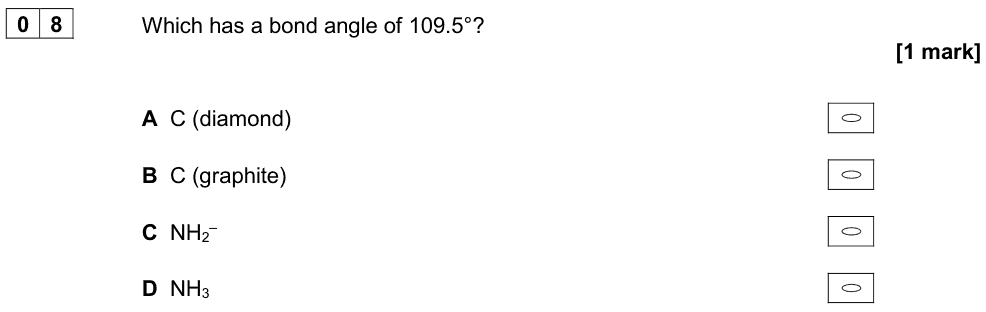
Which has a bond angle of 109.5°?
[1 mark]
A C (diamond)
B C (graphite)
C NH2–
D NH3
November 2020 · Paper 3 · Q09 1 mark Multiple choice energetics
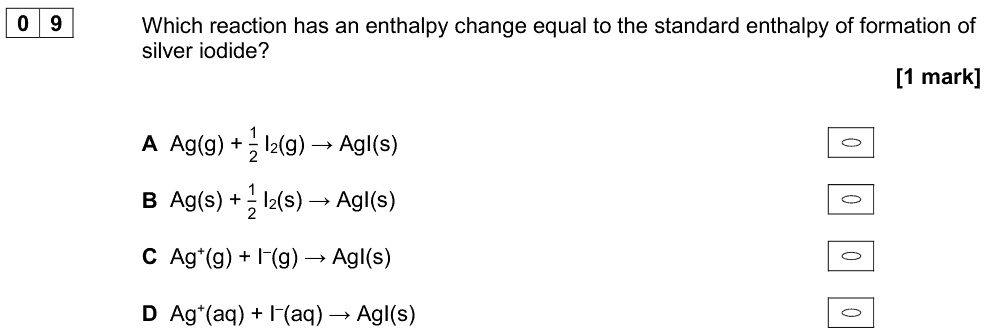
Which reaction has an enthalpy change equal to the standard enthalpy of formation of
silver iodide?
[1 mark]
A Ag(g) +
1
2 I2(g) → AgI(s)
B Ag(s) +
1
2 I2(s) → AgI(s)
C Ag+(g) + I–(g) → AgI(s)
D Ag+(aq) + I–(aq) → AgI(s)
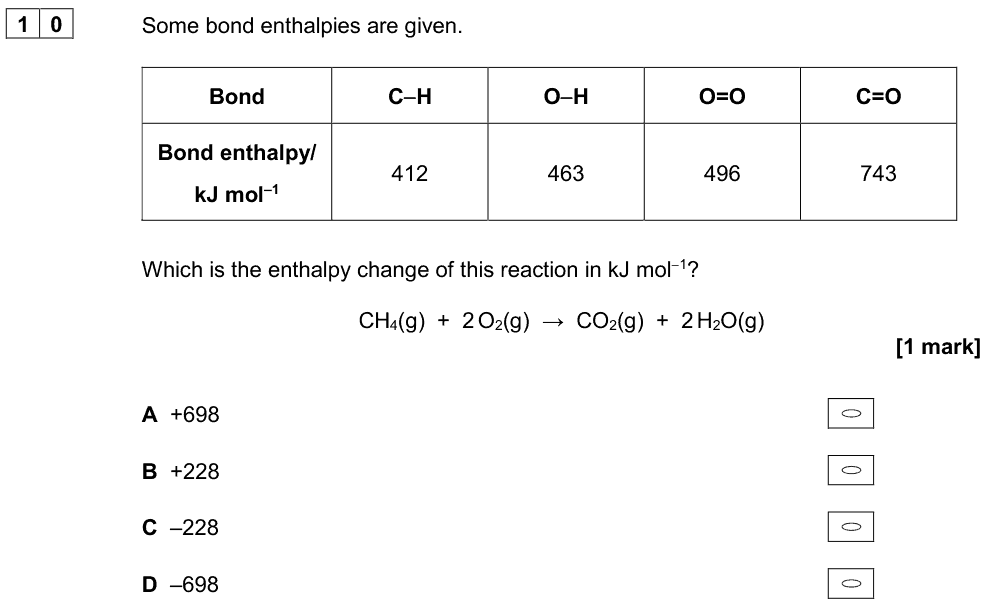
November 2020 · Paper 3 · Q10 1 mark Multiple choice energetics
Some bond enthalpies are given.
Bond
C H
O H
O=O
C=O
Bond enthalpy/
kJ mol–1
412
463
496
743
Which is the enthalpy change of this reaction in kJ mol−1?
CH4(g)  +  2 O2(g)  →  CO2(g)  +  2 H2O(g)
[1 mark]
A +698
B +228
C –228
D –698
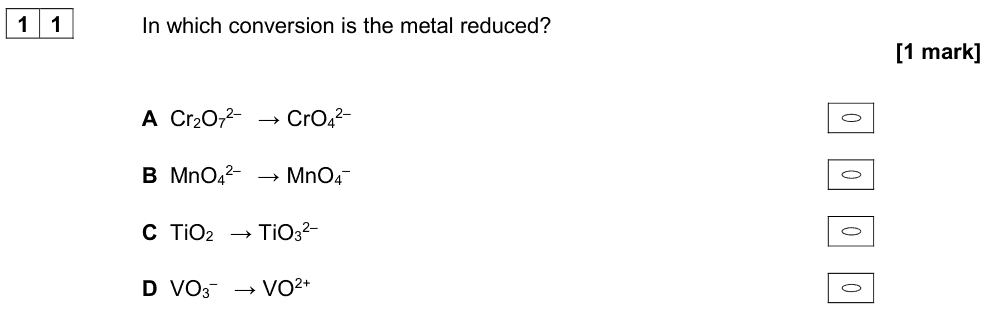
November 2020 · Paper 3 · Q11 1 mark Multiple choice redox
In which conversion is the metal reduced?
[1 mark]
A Cr2O72–  →  CrO42–
B MnO42–  →  MnO4–
C TiO2  →  TiO32–
D VO3–  →  VO2+
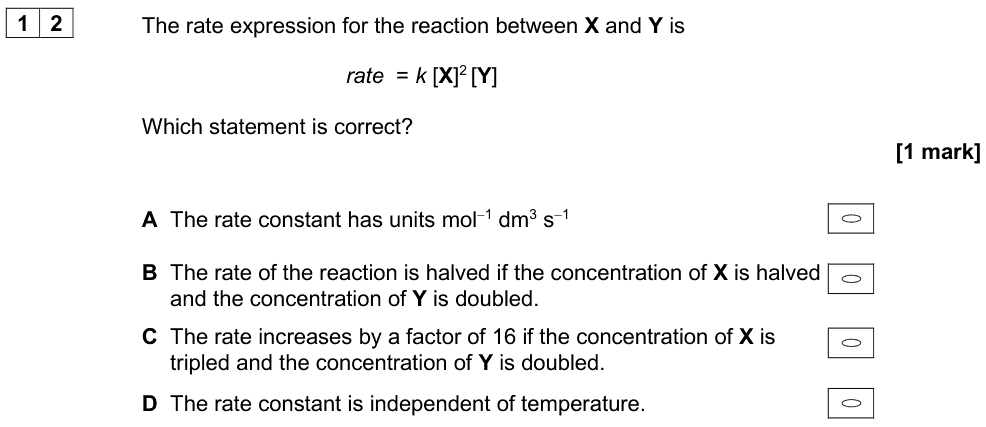
November 2020 · Paper 3 · Q12 1 mark Multiple choice rate equations
The rate expression for the reaction between X and Y is
rate  = k [X]2 [Y]
Which statement is correct?
[1 mark]
A The rate constant has units mol−1 dm3 s−1
B The rate of the reaction is halved if the concentration of X is halved
and the concentration of Y is doubled.
C The rate increases by a factor of 16 if the concentration of X is
tripled and the concentration of Y is doubled.
D The rate constant is independent of temperature.
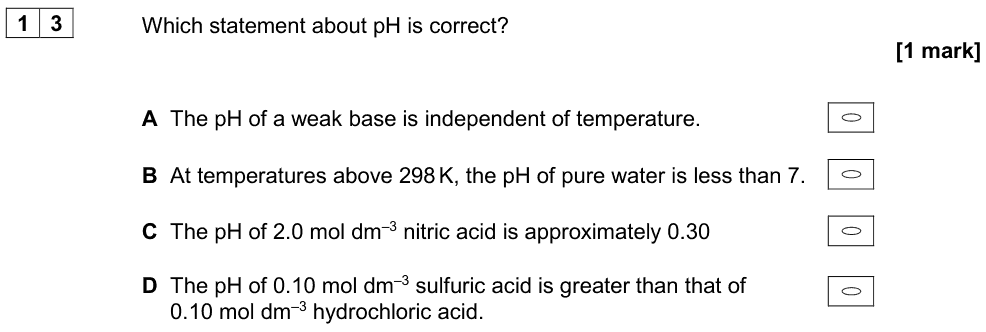
November 2020 · Paper 3 · Q13 1 mark Multiple choice acids and bases
Which statement about pH is correct?
[1 mark]
A The pH of a weak base is independent of temperature.
B At temperatures above 298 K, the pH of pure water is less than 7.
C The pH of 2.0 mol dm–3 nitric acid is approximately 0.30
D The pH of 0.10 mol dm–3 sulfuric acid is greater than that of
0.10 mol dm–3 hydrochloric acid.
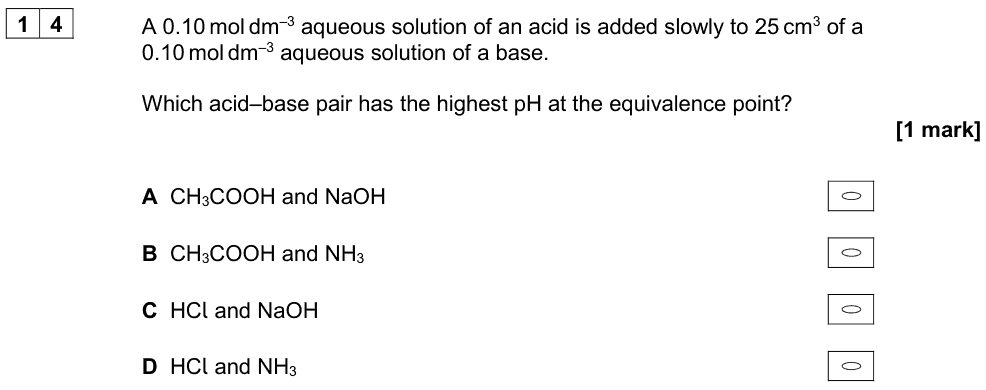
November 2020 · Paper 3 · Q14 1 mark Multiple choice acids and bases
A 0.10 mol dm–3 aqueous solution of an acid is added slowly to 25 cm3 of a
0.10 mol dm–3 aqueous solution of a base.
Which acid–base pair has the highest pH at the equivalence point?
[1 mark]
A CH3COOH and NaOH
B CH3COOH and NH3
C HCl and NaOH
D HCl and NH3
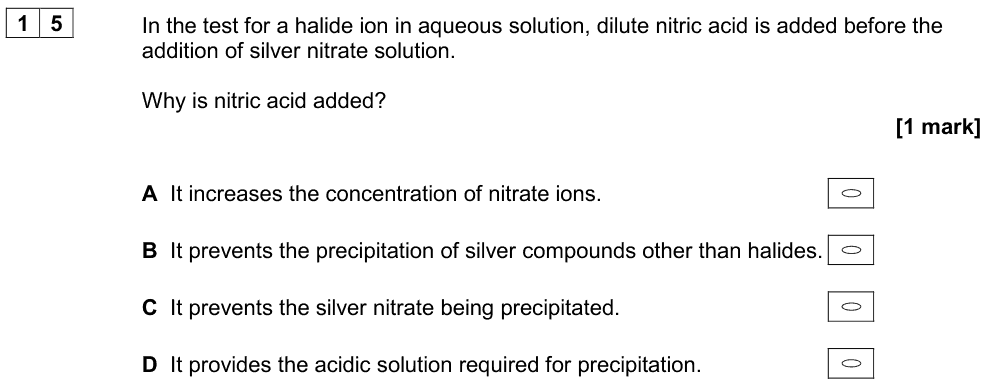
November 2020 · Paper 3 · Q15 1 mark Multiple choice group 7 the halogens
In the test for a halide ion in aqueous solution, dilute nitric acid is added before the
addition of silver nitrate solution.
Why is nitric acid added?
[1 mark]
A It increases the concentration of nitrate ions.
B It prevents the precipitation of silver compounds other than halides.
C It prevents the silver nitrate being precipitated.
D It provides the acidic solution required for precipitation.
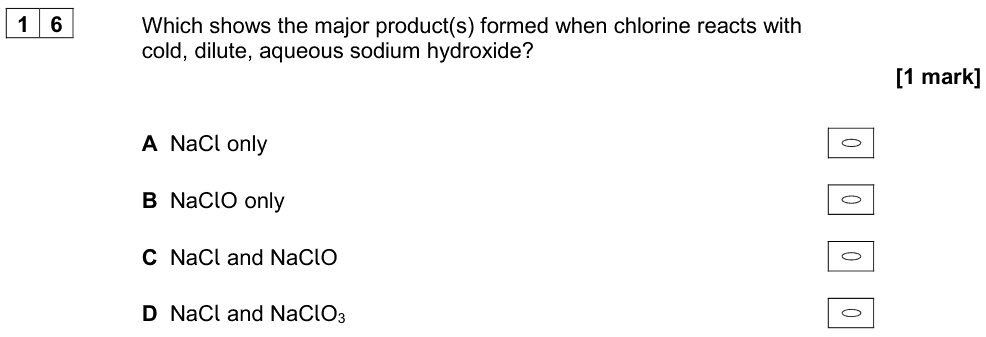
November 2020 · Paper 3 · Q16 1 mark Multiple choice group 7 the halogens
Which shows the major product(s) formed when chlorine reacts with
cold, dilute, aqueous sodium hydroxide?
[1 mark]
A NaCl only
B NaClO only
C NaCl and NaClO
D NaCl and NaClO3
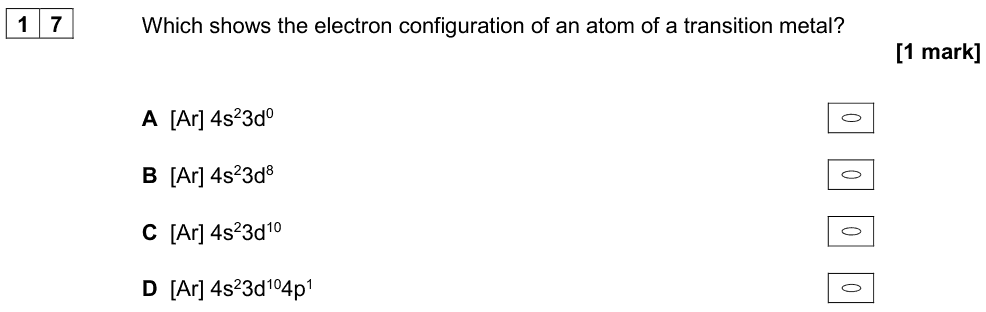
November 2020 · Paper 3 · Q17 1 mark Multiple choice transition metalsatomic structure
Which shows the electron configuration of an atom of a transition metal?
[1 mark]
A [Ar] 4s23d0
B [Ar] 4s23d8
C [Ar] 4s23d10
D [Ar] 4s23d104p1
November 2020 · Paper 3 · Q18 1 mark Multiple choice transition metals
Which will not act as a ligand in the formation of a complex ion?
[1 mark]
A CH4
B CO
C H2O
D NH3
November 2020 · Paper 3 · Q19 1 mark Multiple choice transition metalsredox
Which shows the correct oxidation state and co-ordination number of cobalt in
[Co(NH3)5Cl]Cl2?
[1 mark]
oxidation
state
co-ordination
number
A
+2
5
B
+2
6
C
+3
5
D
+3
6
November 2020 · Paper 3 · Q20 1 mark Multiple choice transition metals
Which statement is not correct?
[1 mark]
A CuCl42– is square planar.
B NH4+ is tetrahedral.
C [Co(H2NCH2CH2NH2)3]2+ is octahedral.
D [Fe(H2O)6]2+ is octahedral.
November 2020 · Paper 3 · Q21 1 mark Multiple choice transition metalsredox
Which compound decolourises acidified potassium manganate(VII) solution?
[1 mark]
A Al2(SO4)3
B CuSO4
C FeSO4
D Fe2(SO4)3
November 2020 · Paper 3 · Q22 1 mark Multiple choice introduction to organic chemistry
Which has E-Z isomers?
[1 mark]
A C2H2Br2
B C2H3Br
C C2H4Br2
D C2H5Br
November 2020 · Paper 3 · Q23 1 mark Multiple choice alkanes
Which is the mechanism for this conversion?
[1 mark]
A Addition-elimination
B Electrophilic substitution
C Free-radical substitution
D Nucleophilic substitution
November 2020 · Paper 3 · Q24 1 mark Multiple choice alkenes
Which compound decolourises bromine water in the absence of sunlight?
[1 mark]
A CH3CH2CH2Br
B
C
D CH3CH2CHCH2
November 2020 · Paper 3 · Q25 1 mark Multiple choice alcohols
Which compound reacts to form a ketone when warmed with an
acidified solution of potassium dichromate(VI)?
[1 mark]
A CH3CH2CH2OH
B (CH3)2CHOH
C CH3CH2CHO
D (CH3)2CHCOOH
November 2020 · Paper 3 · Q26 1 mark Multiple choice optical isomerism
Which does not contain an asymmetric carbon atom?
[1 mark]
A CH3CH(CH3)CH2CH3
B CH3CH2CH(CH3)CH2CH2CH3
C CH3CH(OH)CH2OH
D CH3CH2CHClCH3
November 2020 · Paper 3 · Q27 1 mark Multiple choice carboxylic acids and derivatives
Which reaction involves addition-elimination?
[1 mark]
A (CH3)2CHBr  +  KOH  →  CH3CH=CH2  +  KBr  + H2O
B CH3COCl  +  C6H5OH  →  CH3COOC6H5  +  HCl
C CH3CH=CH2 + Cl2  →  CH3CHClCH2Cl
D CH3CH2CH2Br  +  NaOH  →  CH3CH2CH2OH  +  NaBr
November 2020 · Paper 3 · Q28 1 mark Multiple choice alkenes
Which compound reacts with hydrogen bromide to give 2-bromo-3-methylbutane as
the major product?
[1 mark]
A (CH3)2C=CHCH3
B CH3(CH2)2CH=CH2
C CH3CH2C(CH3)=CH2
D (CH3)2CHCH=CH2
November 2020 · Paper 3 · Q29 1 mark Multiple choice polymers
Which forms a polymer with ClOC(CH2)8COCl?
[1 mark]
A NH2CH2CH2NH2
B (CH3CO)2O
C CH3CH2CONH2
D NH2CH2COOH
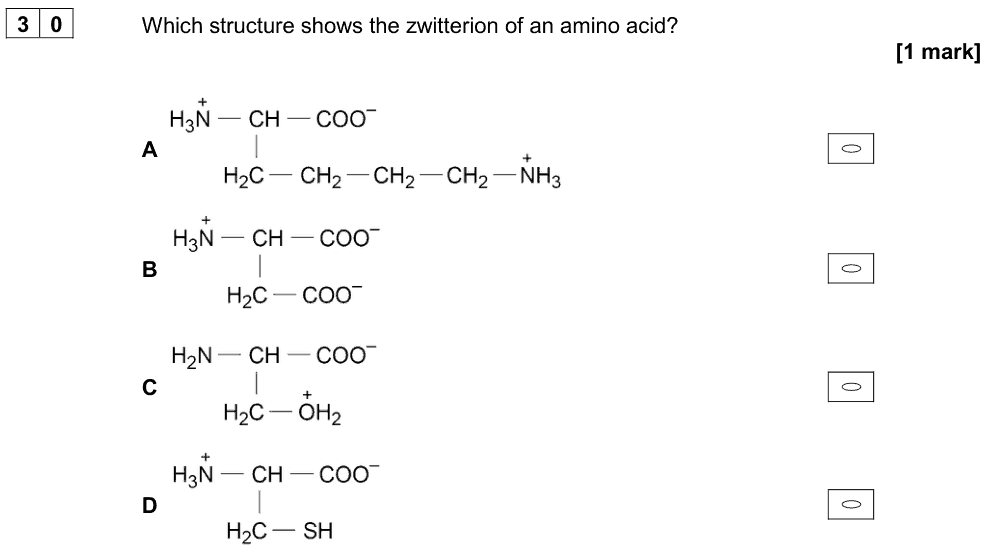
November 2020 · Paper 3 · Q30 1 mark Multiple choice amino acids proteins and dna
Which structure shows the zwitterion of an amino acid?
[1 mark]
A
B
C
D
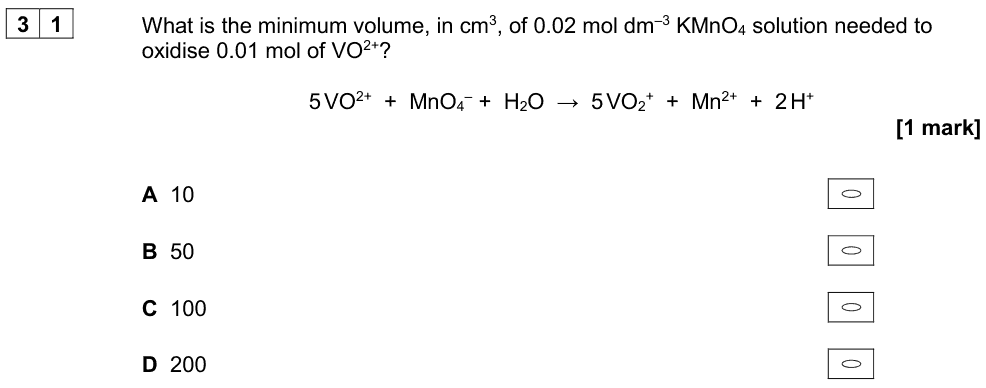
November 2020 · Paper 3 · Q31 1 mark Multiple choice transition metals
What is the minimum volume, in cm3, of 0.02 mol dm–3 KMnO4 solution needed to
oxidise 0.01 mol of VO2+?
5 VO2+  +  MnO4– +  H2O  →  5 VO2+  +  Mn2+  +  2 H+
[1 mark]
A 10
B 50
C 100
D 200
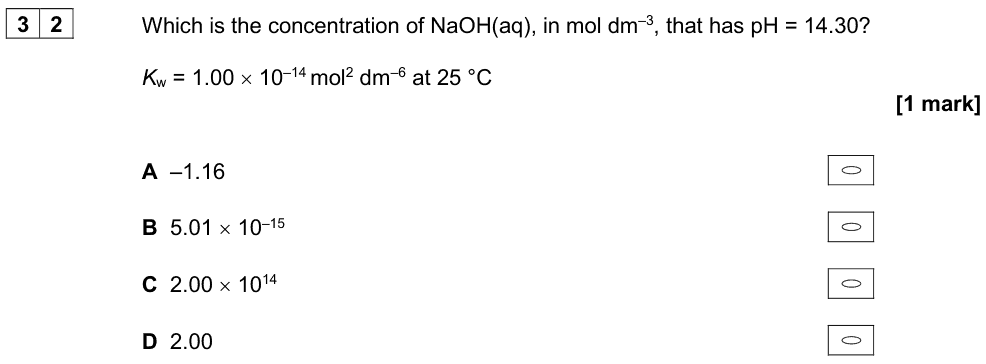
November 2020 · Paper 3 · Q32 1 mark Multiple choice acids and bases
Which is the concentration of NaOH(aq), in mol dm–3, that has pH = 14.30?
Kw = 1.00 × 10⁻¹⁴ mol2 dm–6 at 25 °C
[1 mark]
A –1.16
B 5.01 × 10⁻¹⁵
C 2.00 × 10¹⁴
D 2.00
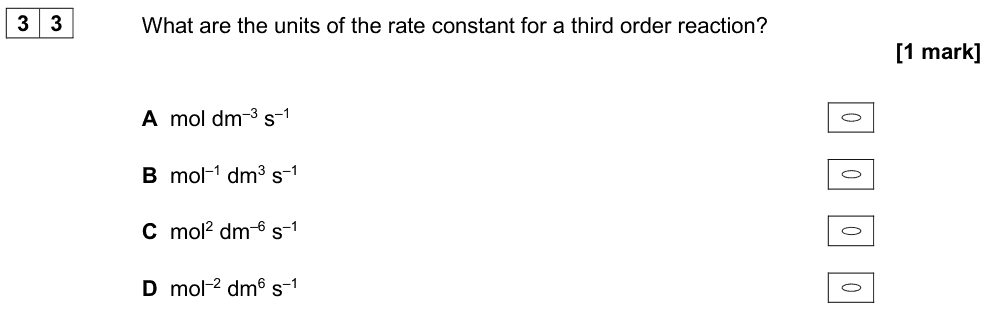
November 2020 · Paper 3 · Q33 1 mark Multiple choice rate equations
What are the units of the rate constant for a third order reaction?
[1 mark]
A mol dm–3 s–1
B mol–1 dm3 s–1
C mol2 dm–6 s–1
D mol–2 dm6 s–1
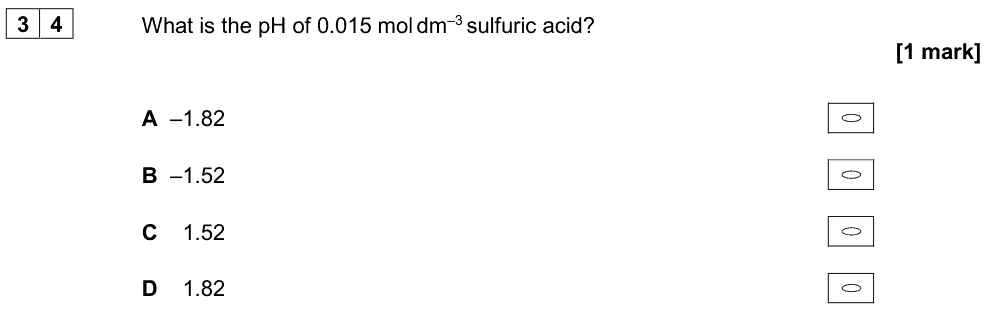
November 2020 · Paper 3 · Q34 1 mark Multiple choice acids and bases
What is the pH of 0.015 mol dm–3 sulfuric acid?
[1 mark]
A –1.82
B –1.52
C   1.52
D   1.82
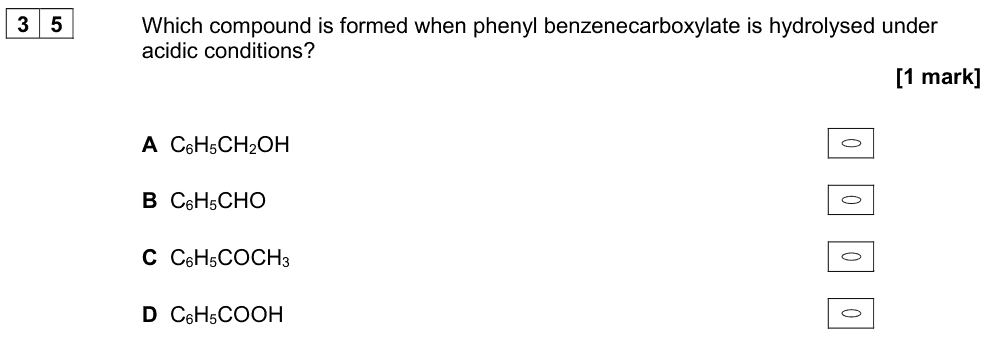
November 2020 · Paper 3 · Q35 1 mark Multiple choice carboxylic acids and derivatives
Which compound is formed when phenyl benzenecarboxylate is hydrolysed under
acidic conditions?
[1 mark]
A C6H5CH2OH
B C6H5CHO
C C6H5COCH3
D C6H5COOH
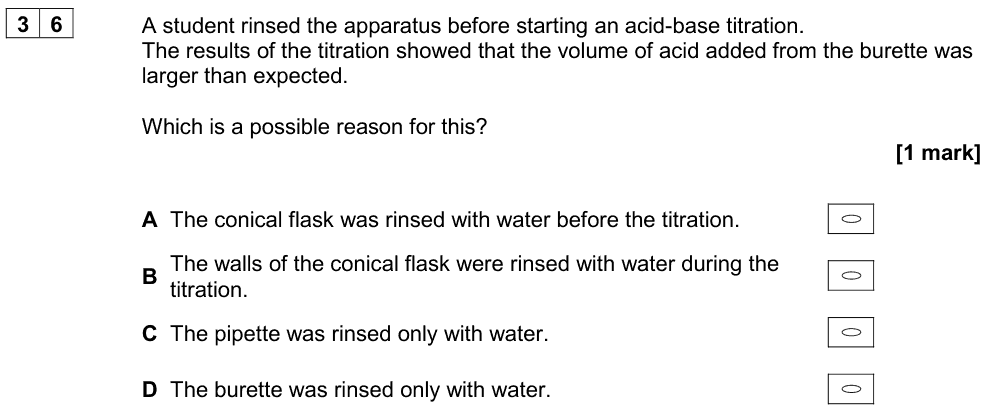
November 2020 · Paper 3 · Q36 1 mark Multiple choice amount of substance
A student rinsed the apparatus before starting an acid-base titration.
The results of the titration showed that the volume of acid added from the burette was
larger than expected.
Which is a possible reason for this?
[1 mark]
A The conical flask was rinsed with water before the titration.
B The walls of the conical flask were rinsed with water during the
titration.
C The pipette was rinsed only with water.
D The burette was rinsed only with water.

Work with an A-level chemistry tutor

Want a paper marked and gone through with you? Message us.

Prefer email? Send an enquiry

If you are under 18, please include a parent's contact details. Enquiries go to enquiries@chemistryaleveltutor.com and are deleted once handled. All tutoring is online.