June 2019: Paper 2, Organic and physical chemistry

105 marks · 51 question parts · Paper, mark scheme and report on AQA's site · Have the Data Booklet beside you

Question by question

QTopicMarksAOType
01.1 Amines, Amount of substance 2Equation writing
01.2 Amines, Halogenoalkanes 4Mechanism
01.3 Organic synthesis, Amines, Halogenoalkanes 3Short answer
01.4 Amines 2Explanation
01.5 Optical isomerism 1Short answer
02.1 Alcohols 2Diagram or structure
02.2 Alcohols 1Practical and data analysis
02.3 Alcohols 1Practical and data analysis
02.4 Amount of substance 5Calculation
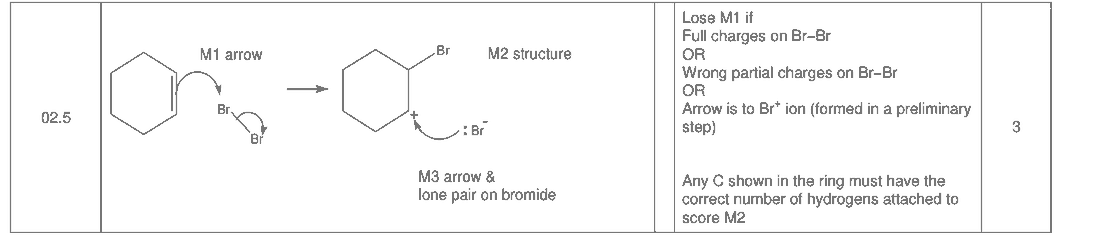
02.5 Alkenes, Introduction to organic chemistry: nomenclature, mechanisms and isomerism 3Mechanism
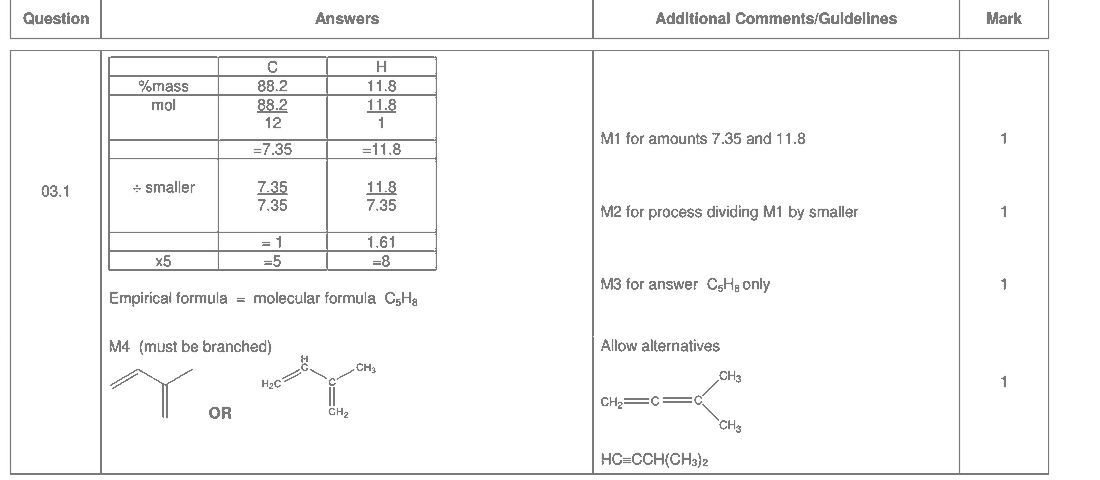
03.1 Amount of substance, Introduction to organic chemistry: nomenclature, mechanisms and isomerism 4Calculation
03.2 Alkenes, Introduction to organic chemistry: nomenclature, mechanisms and isomerism 2Diagram or structure
03.3 Introduction to organic chemistry: nomenclature, mechanisms and isomerism, Alkenes 2Diagram or structure
03.4 Polymers, Alkenes 1Short answer
04.1 Rate equations 1Calculation
04.2 Rate equations 2Short answer
04.3 Rate equations 3Calculation
05 Rate equations 4Calculation
06.1 Organic analysis: test-tube reactions, mass spectrometry and infrared, Alcohols 3Practical and data analysis
06.2 Nuclear magnetic resonance spectroscopy, Introduction to organic chemistry: nomenclature, mechanisms and isomerism 2Diagram or structure
06.3 Nuclear magnetic resonance spectroscopy 2Diagram or structure
06.4 Organic analysis: test-tube reactions, mass spectrometry and infrared 1Short answer
07.1 Introduction to organic chemistry: nomenclature, mechanisms and isomerism 1Short answer
07.2 Bonding, Nuclear magnetic resonance spectroscopy, Organic analysis: test-tube reactions, mass spectrometry and infrared 6Level of response
08.1 Aromatic chemistry 1Short answer
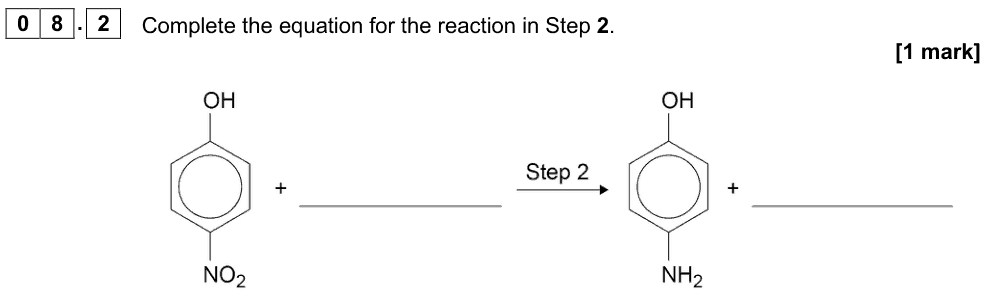
08.2 Amines, Amount of substance 1Equation writing
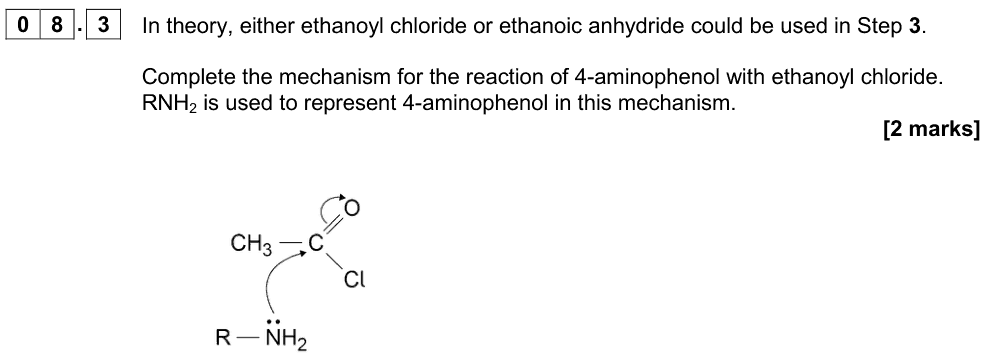
08.3 Amines, Carboxylic acids and derivatives 2Mechanism
08.4 Carboxylic acids and derivatives 1Short answer
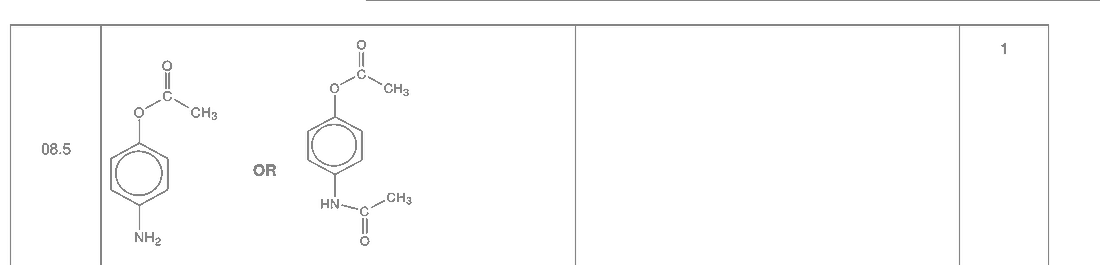
08.5 Carboxylic acids and derivatives, Amines 1Diagram or structure
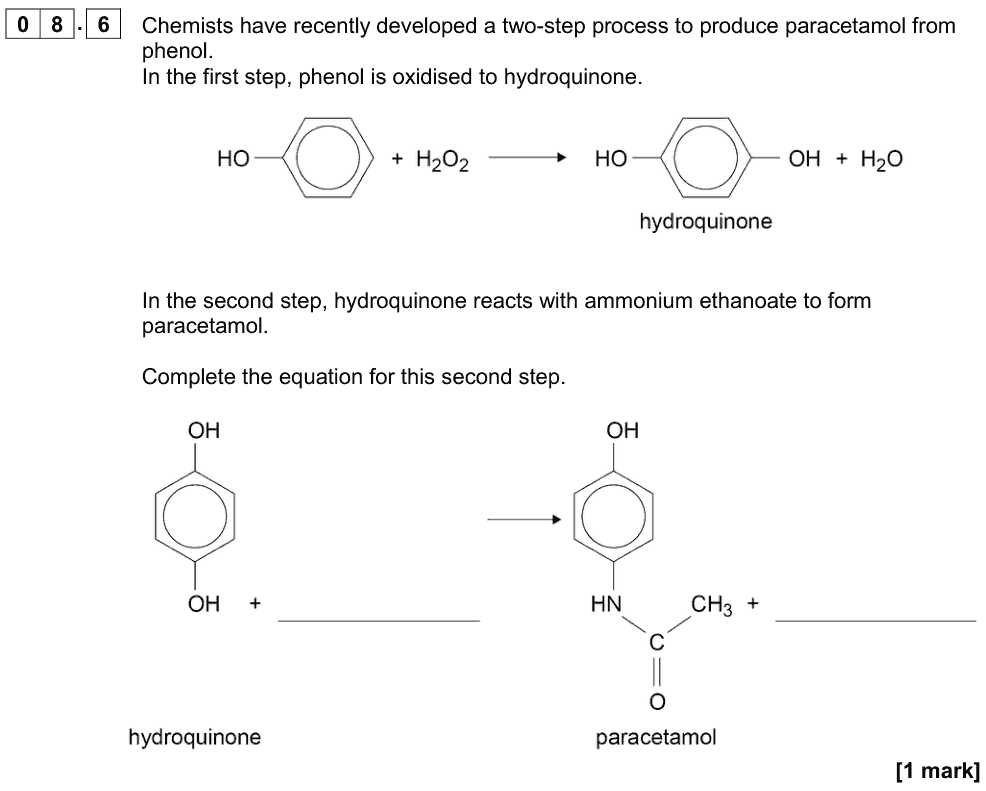
08.6 Amount of substance 1Equation writing
08.7 Amount of substance 3Calculation
09.1 Amino acids, proteins and DNA 1Short answer
09.2 Amino acids, proteins and DNA 1Practical and data analysis
09.3 Amino acids, proteins and DNA, Chromatography 1Practical and data analysis
09.4 Chromatography 1Practical and data analysis
10.1 Carboxylic acids and derivatives, Amount of substance 3Short answer
10.2 Amount of substance 4Calculation
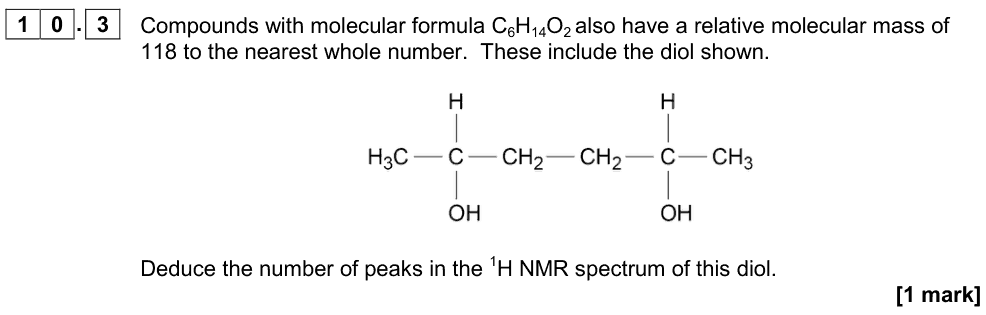
10.3 Nuclear magnetic resonance spectroscopy 1Short answer
10.4 Nuclear magnetic resonance spectroscopy, Introduction to organic chemistry: nomenclature, mechanisms and isomerism 1Diagram or structure
10.5 Organic analysis: test-tube reactions, mass spectrometry and infrared 1Short answer
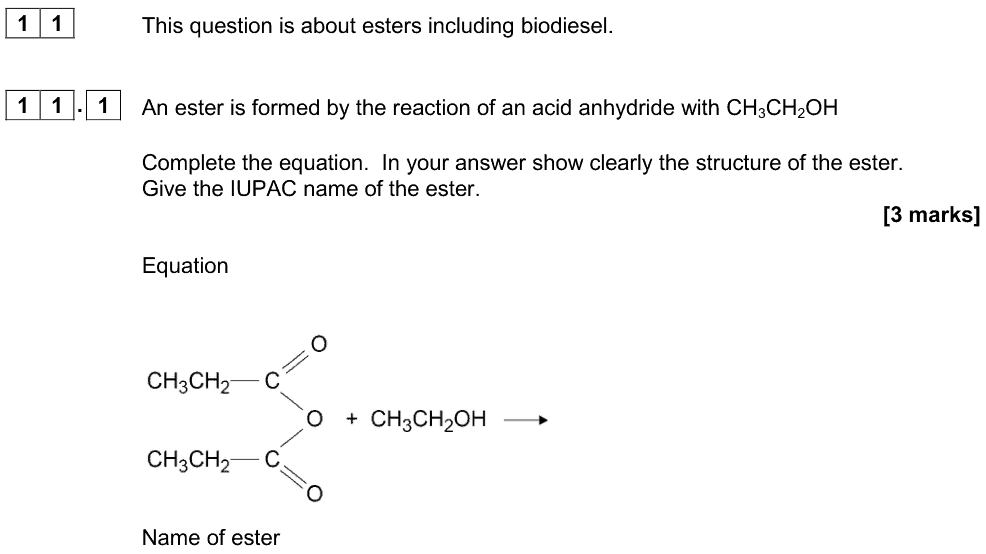
11.1 Carboxylic acids and derivatives, Introduction to organic chemistry: nomenclature, mechanisms and isomerism 3Equation writing
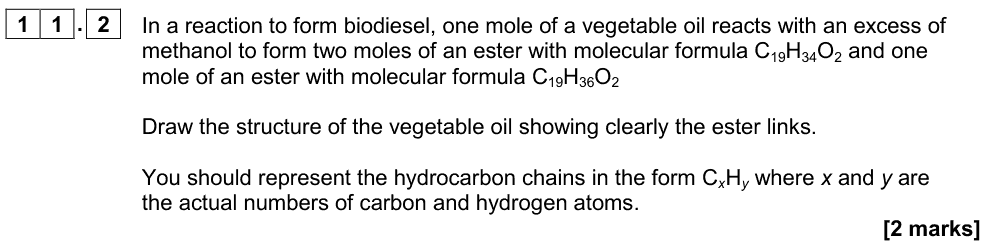
11.2 Carboxylic acids and derivatives 2Diagram or structure
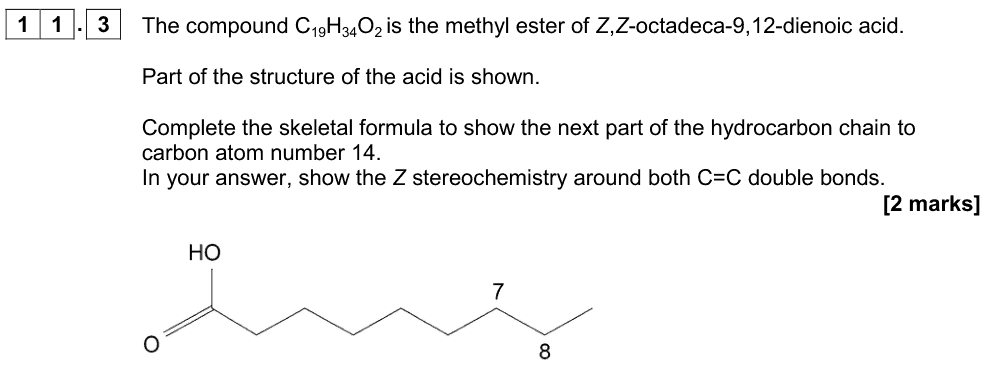
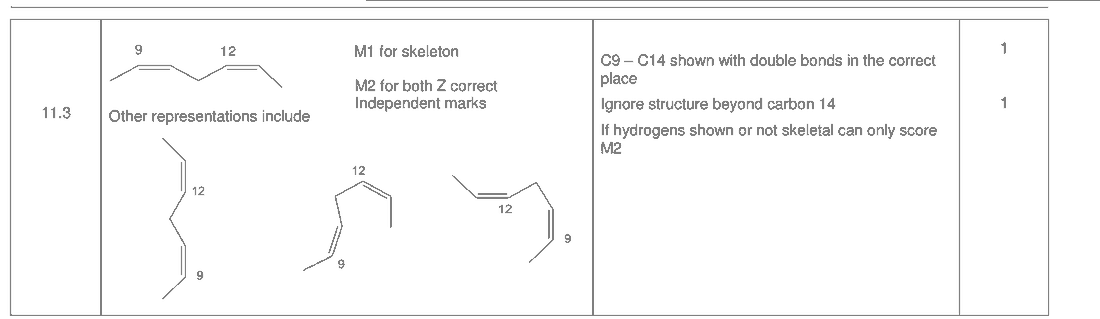
11.3 Introduction to organic chemistry: nomenclature, mechanisms and isomerism 2Diagram or structure
11.4 Alkanes, Amount of substance 1Equation writing
11.5 Organic analysis: test-tube reactions, mass spectrometry and infrared 1Short answer
11.6 Organic analysis: test-tube reactions, mass spectrometry and infrared 2Explanation
12.1 Amino acids, proteins and DNA 2Diagram or structure
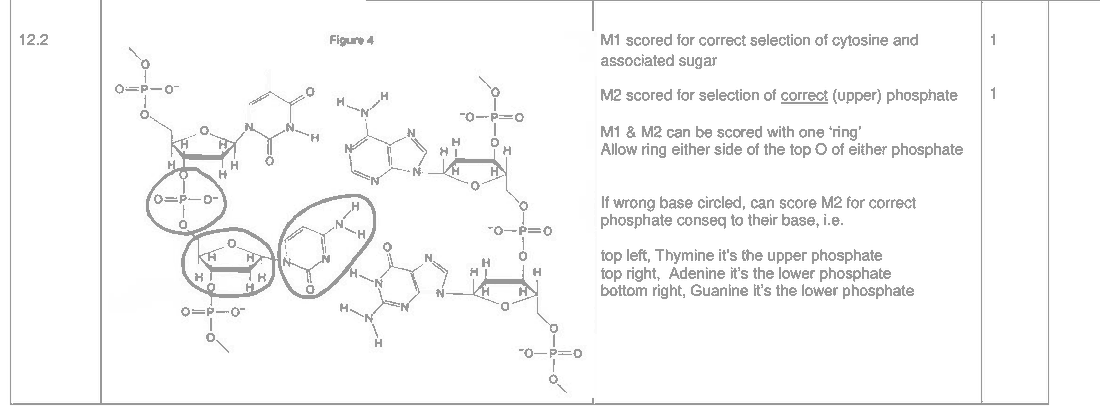
12.2 Amino acids, proteins and DNA 2Short answer
12.3 Amino acids, proteins and DNA 1Short answer
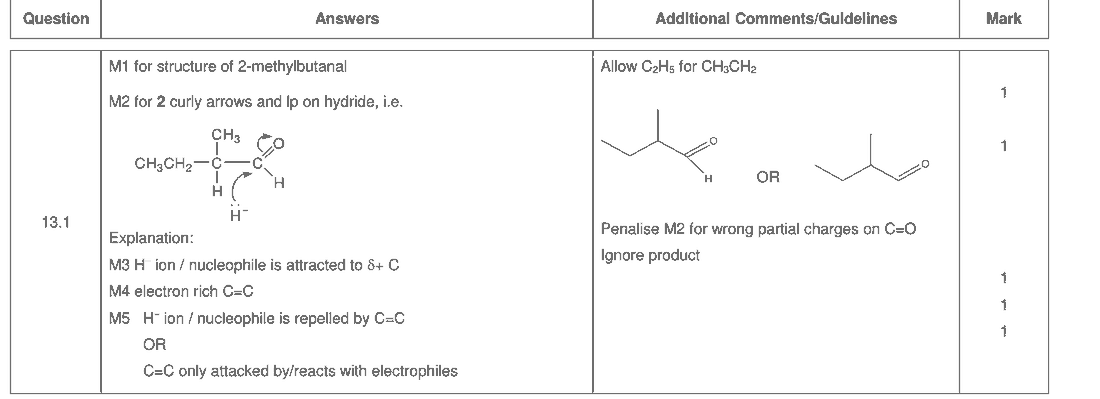
13.1 Aldehydes and ketones, Alkenes 5Mechanism
13.2 Aldehydes and ketones 2Practical and data analysis

The questions

01.101.201.301.401.502.102.202.302.402.503.103.203.303.404.104.204.30506.106.206.306.407.107.208.108.208.308.408.508.608.709.109.209.309.410.110.210.310.410.511.111.211.311.411.511.612.112.212.313.113.2
June 2019 · Paper 2 · Q01.1 2 marks Equation writing aminesamount of substance
This question is about amines.
Give an equation for the preparation of 1,6-diaminohexane by the reaction of
1,6-dibromohexane with an excess of ammonia.
[2 marks]
June 2019 · Paper 2 · Q01.2 4 marks Mechanism amineshalogenoalkanes
Earlier part of question 01 that this part usesEarlier part of June 2019 Paper 2 question 01
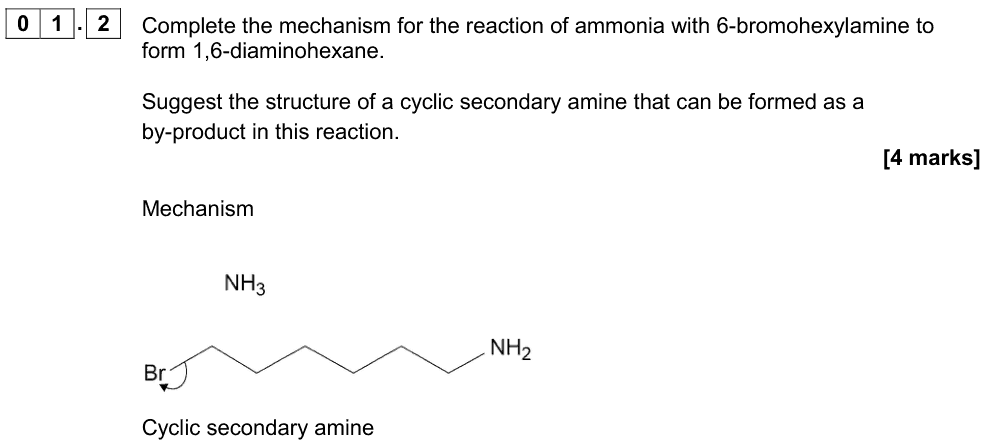
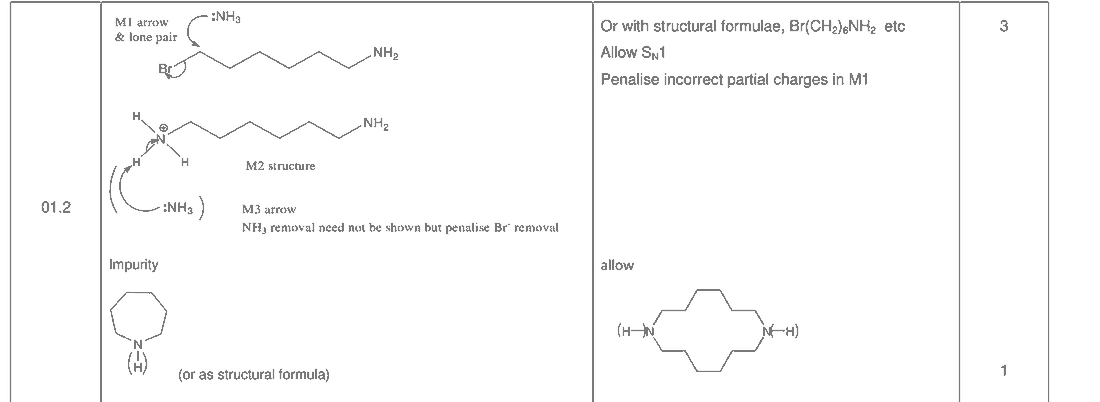
Complete the mechanism for the reaction of ammonia with 6-bromohexylamine to
form 1,6-diaminohexane.
Suggest the structure of a cyclic secondary amine that can be formed as a
by-product in this reaction.
[4 marks]
Mechanism
Cyclic secondary amine
June 2019 · Paper 2 · Q01.3 3 marks Short answer organic synthesisamineshalogenoalkanes
Earlier part of question 01 that this part usesEarlier part of June 2019 Paper 2 question 01
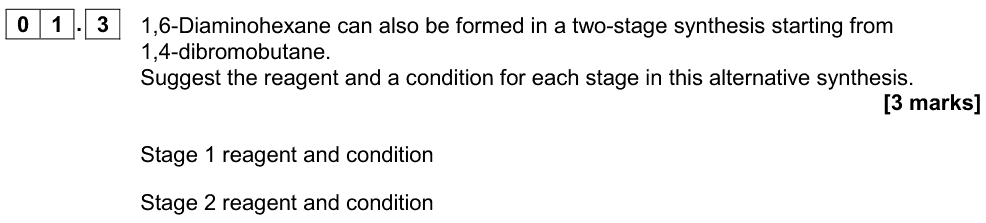
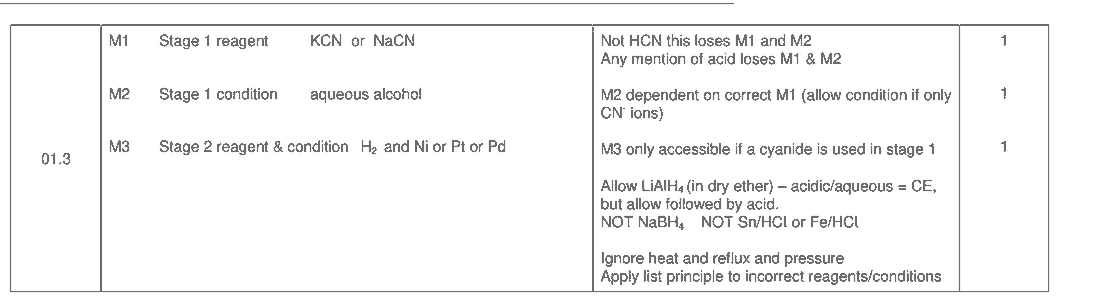
1,6-Diaminohexane can also be formed in a two-stage synthesis starting from
1,4-dibromobutane.
Suggest the reagent and a condition for each stage in this alternative synthesis.
[3 marks]
Stage 1 reagent and condition
Stage 2 reagent and condition
June 2019 · Paper 2 · Q01.4 2 marks Explanation Hard amines
Earlier part of question 01 that this part usesEarlier part of June 2019 Paper 2 question 01
Explain why 3-aminopentane is a stronger base than ammonia.
[2 marks]
June 2019 · Paper 2 · Q01.5 1 mark Short answer optical isomerism
Earlier part of question 01 that this part usesEarlier part of June 2019 Paper 2 question 01
Justify the statement that there are no chiral centres in 3-aminopentane.
[1 mark]
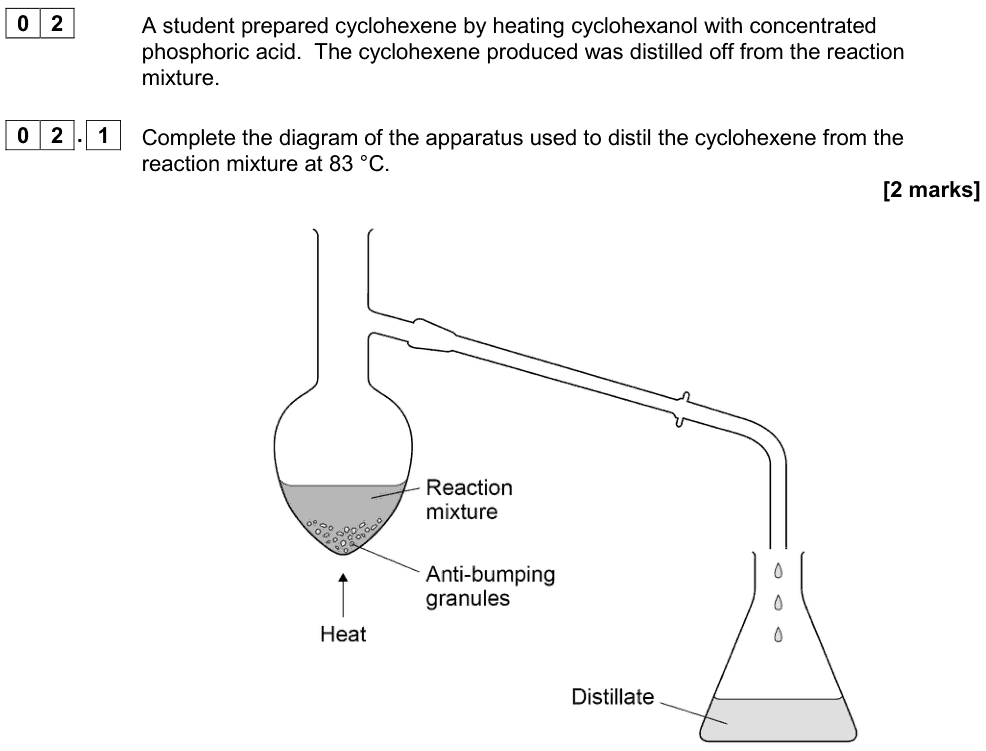
June 2019 · Paper 2 · Q02.1 2 marks Diagram or structure alcohols
A student prepared cyclohexene by heating cyclohexanol with concentrated
phosphoric acid.  The cyclohexene produced was distilled off from the reaction
mixture.
Complete the diagram of the apparatus used to distil the cyclohexene from the
reaction mixture at 83 °C.
[2 marks]
June 2019 · Paper 2 · Q02.2 1 mark Practical and data analysis alcohols
Earlier part of question 02 that this part usesEarlier part of June 2019 Paper 2 question 02
The distillate was shaken with saturated sodium chloride solution.  The cyclohexene
was separated from the aqueous solution using a separating funnel.
State why cyclohexene can be separated from the aqueous solution using the
separating funnel.
[1 mark]
June 2019 · Paper 2 · Q02.3 1 mark Practical and data analysis alcohols
Earlier part of question 02 that this part usesEarlier part of June 2019 Paper 2 question 02
The cyclohexene separated in Question 02.2 was obtained as a cloudy liquid.
The student dried this cyclohexene by adding a few lumps of anhydrous calcium
chloride and allowing the mixture to stand.
Give one observation that the student made to confirm that the cyclohexene was dry.
[1 mark]
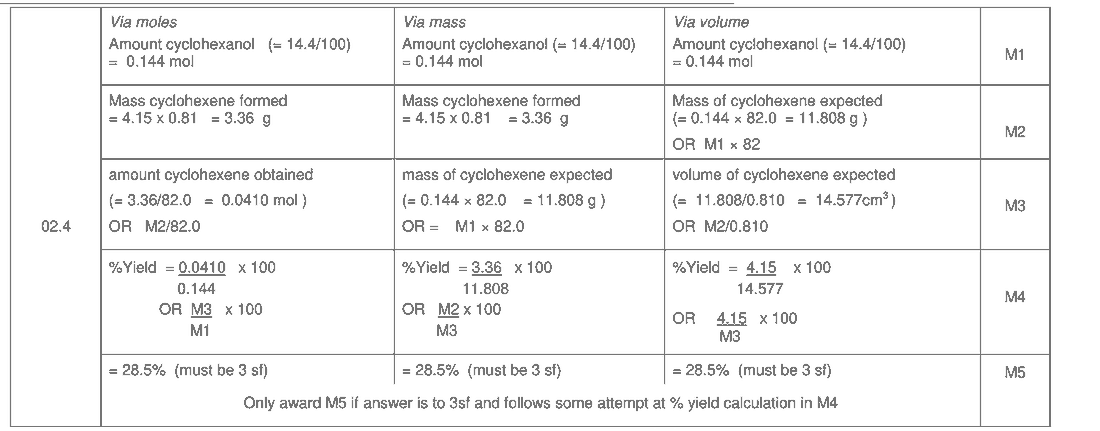
June 2019 · Paper 2 · Q02.4 5 marks Calculation amount of substance
Earlier part of question 02 that this part usesEarlier part of June 2019 Paper 2 question 02
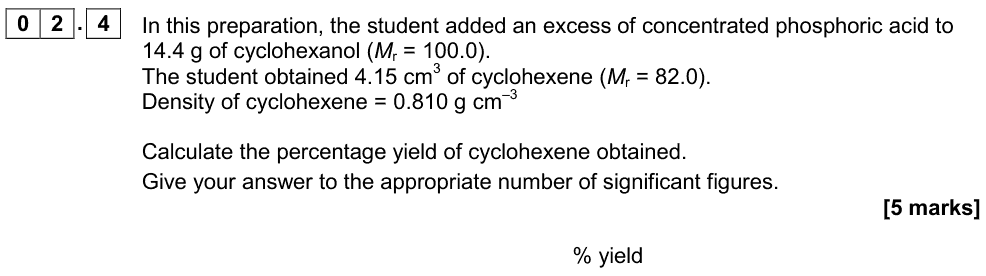
In this preparation, the student added an excess of concentrated phosphoric acid to
14.4 g of cyclohexanol (Mr = 100.0).
The student obtained 4.15 cm3 of cyclohexene (Mr = 82.0).
Density of cyclohexene = 0.810 g cm–3
Calculate the percentage yield of cyclohexene obtained.
Give your answer to the appropriate number of significant figures.
[5 marks]
% yield
June 2019 · Paper 2 · Q02.5 3 marks Mechanism alkenesintroduction to organic chemistry
Earlier part of question 02 that this part usesEarlier part of June 2019 Paper 2 question 02
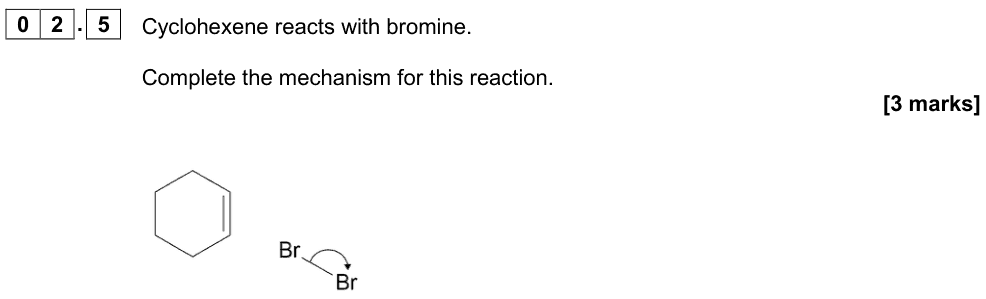
Cyclohexene reacts with bromine.
Complete the mechanism for this reaction.
[3 marks]
June 2019 · Paper 2 · Q03.1 4 marks Calculation amount of substanceintroduction to organic chemistry
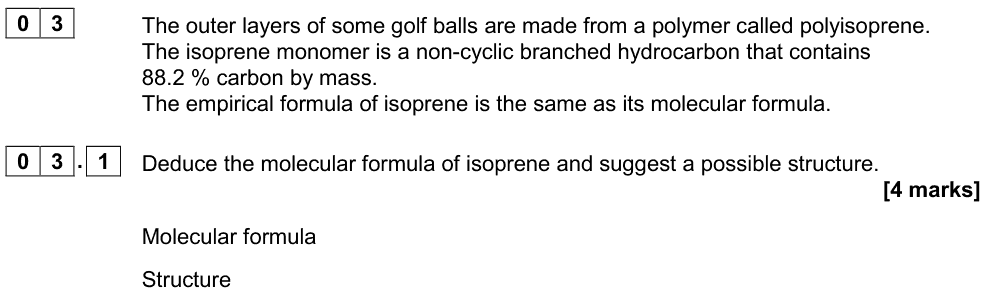
The outer layers of some golf balls are made from a polymer called polyisoprene.
The isoprene monomer is a non-cyclic branched hydrocarbon that contains
88.2 % carbon by mass.
The empirical formula of isoprene is the same as its molecular formula.
Deduce the molecular formula of isoprene and suggest a possible structure.
[4 marks]
Molecular formula
Structure
June 2019 · Paper 2 · Q03.2 2 marks Diagram or structure alkenesintroduction to organic chemistry
Earlier part of question 03 that this part usesEarlier part of June 2019 Paper 2 question 03
The insides of some golf balls are made from a mixture of three other polymers.
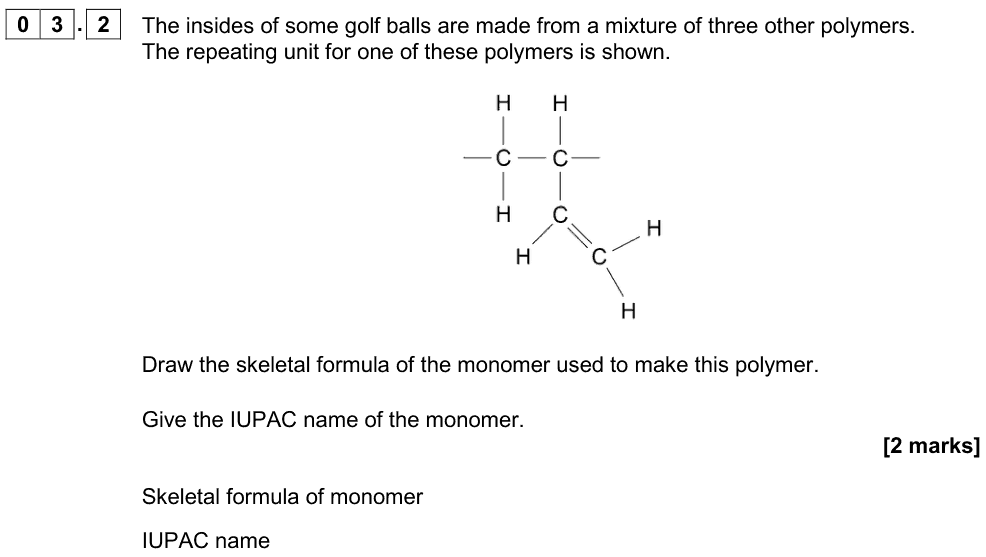
The repeating unit for one of these polymers is shown.
Draw the skeletal formula of the monomer used to make this polymer.
Give the IUPAC name of the monomer.
[2 marks]
Skeletal formula of monomer
IUPAC name
June 2019 · Paper 2 · Q03.3 2 marks Diagram or structure introduction to organic chemistryalkenes
Earlier part of question 03 that this part usesEarlier part of June 2019 Paper 2 question 03
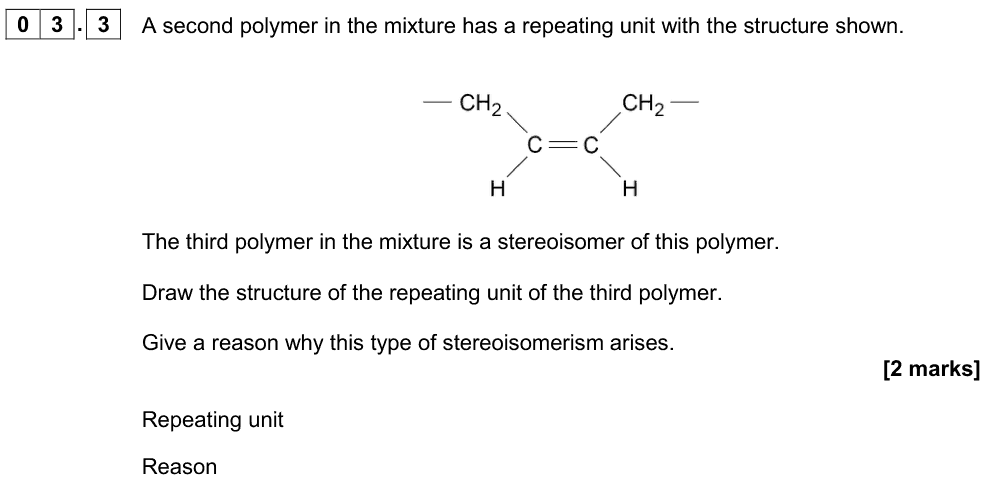
A second polymer in the mixture has a repeating unit with the structure shown.
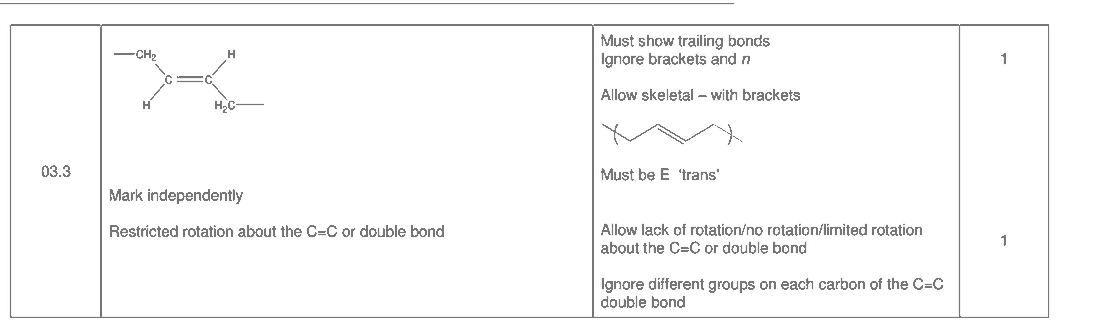
The third polymer in the mixture is a stereoisomer of this polymer.
Draw the structure of the repeating unit of the third polymer.
Give a reason why this type of stereoisomerism arises.
[2 marks]
Repeating unit
Reason
June 2019 · Paper 2 · Q03.4 1 mark Short answer polymersalkenes
Earlier part of question 03 that this part usesEarlier part of June 2019 Paper 2 question 03
Golf balls recovered from lakes and ponds can be used again even after being in
water for several years.
Explain why these golf balls do not biodegrade.
[1 mark]
June 2019 · Paper 2 · Q04.1 1 mark Calculation rate equations
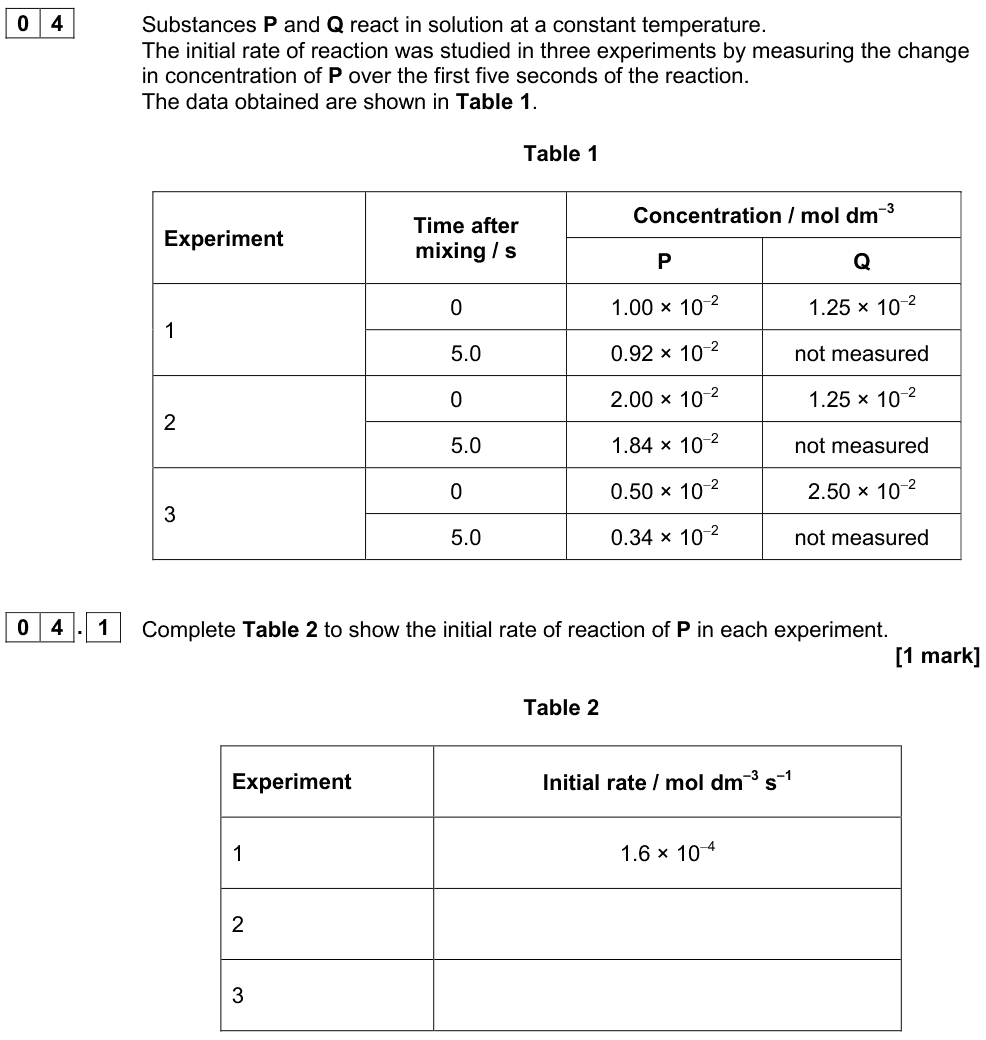
Substances P and Q react in solution at a constant temperature.
The initial rate of reaction was studied in three experiments by measuring the change
in concentration of P over the first five seconds of the reaction.
The data obtained are shown in Table 1.
Table 1
Experiment
Time after
mixing / s
Concentration / mol dm 3
P
Q
1
0
1.00 × 10⁻²
1.25 × 10⁻²
5.0
0.92 × 10⁻²
not measured
2
0
2.00 × 10⁻²
1.25 × 10⁻²
5.0
1.84 × 10⁻²
not measured
3
0
0.50 × 10⁻²
2.50 × 10⁻²
5.0
0.34 × 10⁻²
not measured
Complete Table 2 to show the initial rate of reaction of P in each experiment.
[1 mark]
Table 2
Experiment
Initial rate / mol dm 3 s 1
1
1.6 × 10⁻⁴
2
3
June 2019 · Paper 2 · Q04.2 2 marks Short answer rate equations
Earlier part of question 04 that this part usesEarlier part of June 2019 Paper 2 question 04
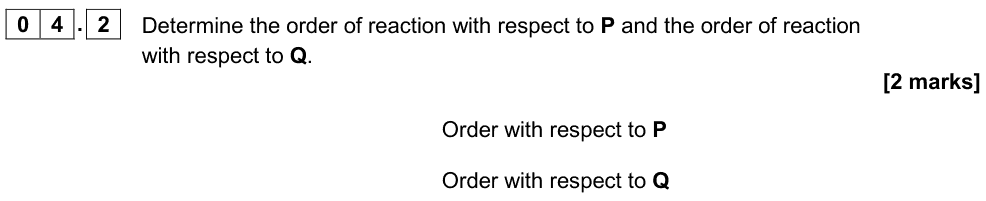
Determine the order of reaction with respect to P and the order of reaction
with respect to Q.
[2 marks]
Order with respect to P
Order with respect to Q
June 2019 · Paper 2 · Q04.3 3 marks Calculation rate equations
Earlier part of question 04 that this part usesEarlier part of June 2019 Paper 2 question 04
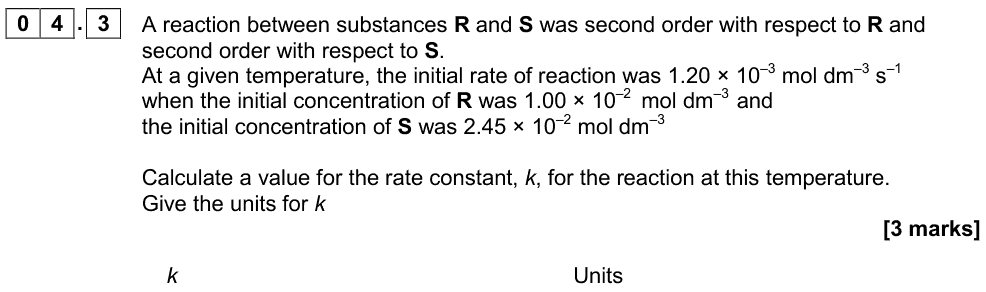
A reaction between substances R and S was second order with respect to R and
second order with respect to S.
At a given temperature, the initial rate of reaction was 1.20 × 10⁻³ mol dm–3 s–1
when the initial concentration of R was 1.00 × 10⁻²  mol dm–3  and
the initial concentration of S was 2.45 × 10⁻² mol dm–3
Calculate a value for the rate constant, k, for the reaction at this temperature.
Give the units for k
[3 marks]
k
Units
June 2019 · Paper 2 · Q05 4 marks Calculation rate equations
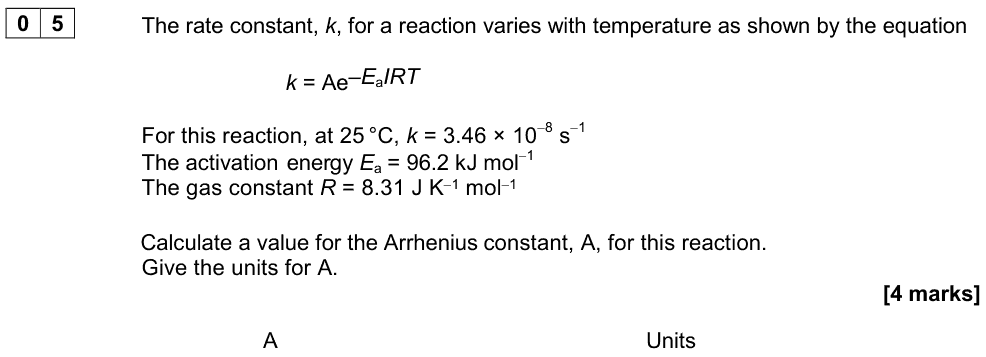
The rate constant, k, for a reaction varies with temperature as shown by the equation
k = Ae–EaIRT
For this reaction, at 25 °C, k = 3.46 × 10⁻⁸ s−1
The activation energy Ea = 96.2 kJ mol−1
The gas constant R = 8.31 J K−1 mol−1
Calculate a value for the Arrhenius constant, A, for this reaction.
Give the units for A.
[4 marks]
A
Units
June 2019 · Paper 2 · Q06.1 3 marks Practical and data analysis organic analysisalcohols
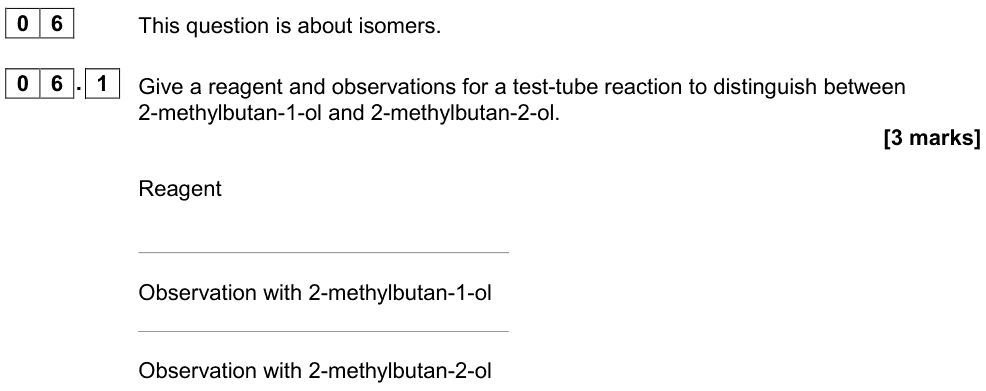
This question is about isomers.
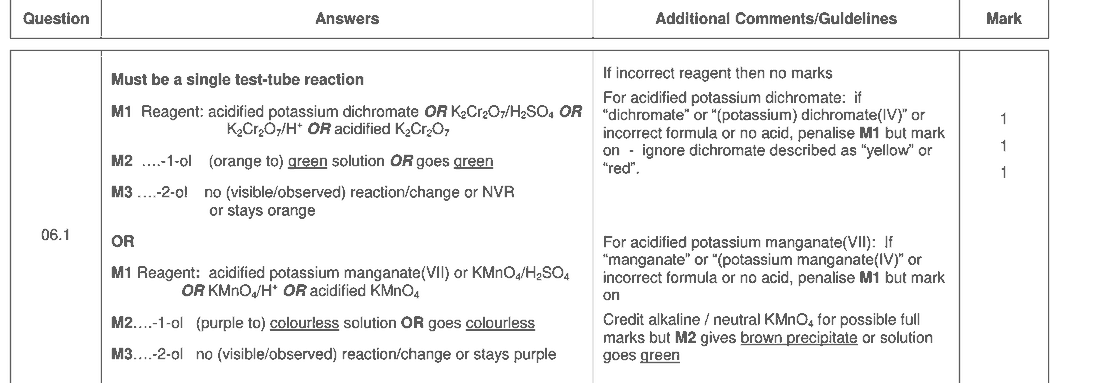
Give a reagent and observations for a test-tube reaction to distinguish between
2-methylbutan-1-ol and 2-methylbutan-2-ol.
[3 marks]
Reagent
Observation with 2-methylbutan-1-ol
Observation with 2-methylbutan-2-ol
June 2019 · Paper 2 · Q06.2 2 marks Diagram or structure nmr spectroscopyintroduction to organic chemistry
Earlier part of question 06 that this part usesEarlier part of June 2019 Paper 2 question 06
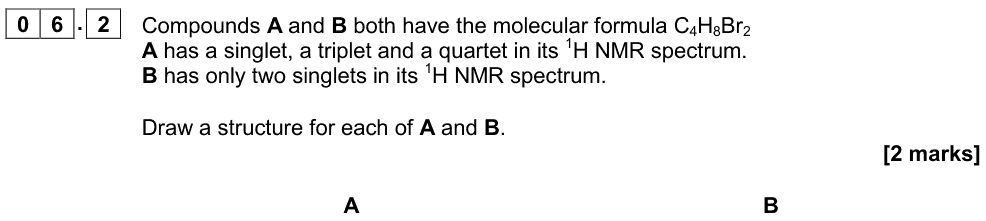
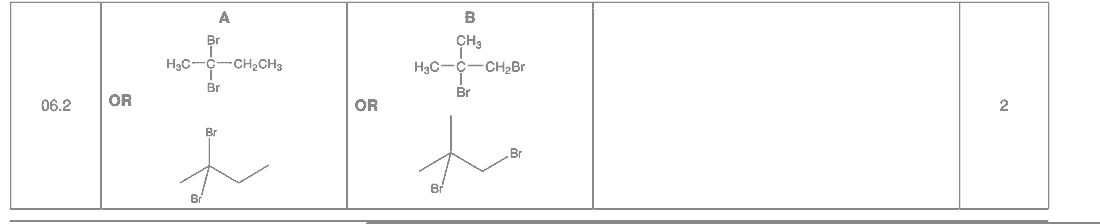
Compounds A and B both have the molecular formula C4H8Br2
A has a singlet, a triplet and a quartet in its 1H NMR spectrum.
B has only two singlets in its 1H NMR spectrum.
Draw a structure for each of A and B.
[2 marks]
A
B
June 2019 · Paper 2 · Q06.3 2 marks Diagram or structure nmr spectroscopy
Earlier part of question 06 that this part usesEarlier part of June 2019 Paper 2 question 06
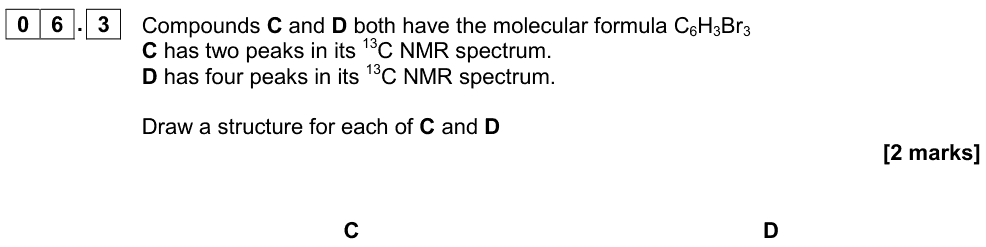
Compounds C and D both have the molecular formula C6H3Br3
C has two peaks in its 13C NMR spectrum.
D has four peaks in its 13C NMR spectrum.
Draw a structure for each of C and D
[2 marks]
C
D
June 2019 · Paper 2 · Q06.4 1 mark Short answer organic analysis
Earlier part of question 06 that this part usesEarlier part of June 2019 Paper 2 question 06
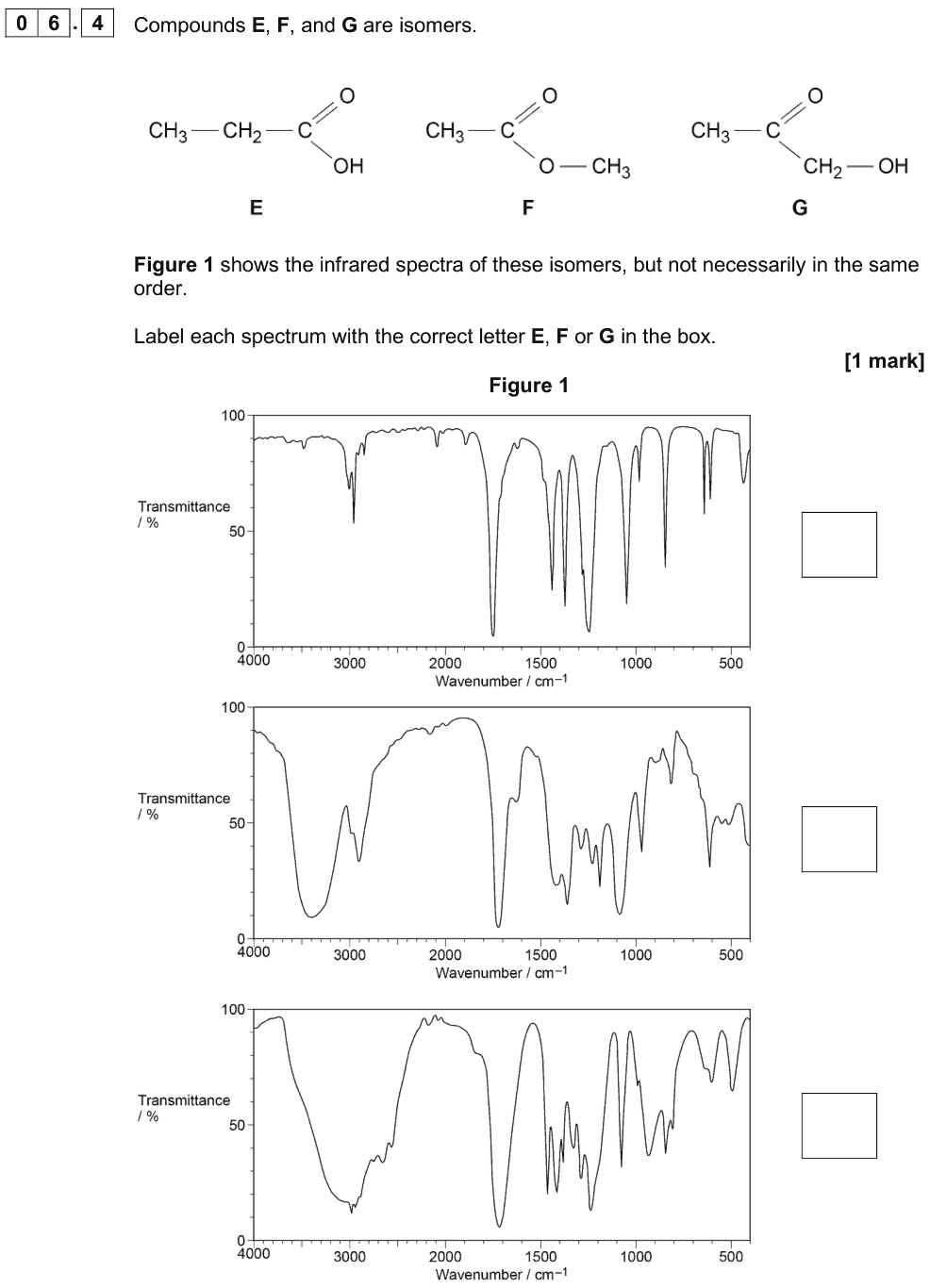
Compounds E, F, and G are isomers.
Figure 1 shows the infrared spectra of these isomers, but not necessarily in the same
order.
Label each spectrum with the correct letter E, F or G in the box.
[1 mark]
Figure 1
June 2019 · Paper 2 · Q07.1 1 mark Short answer introduction to organic chemistry
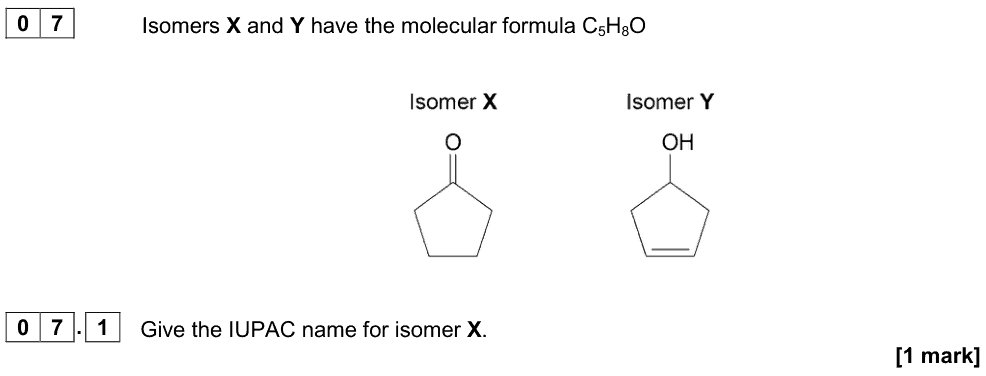
Isomers X and Y have the molecular formula C5H8O
Give the IUPAC name for isomer X.
[1 mark]
June 2019 · Paper 2 · Q07.2 6 marks 6-mark level of response bondingnmr spectroscopyorganic analysis
Earlier part of question 07 that this part usesEarlier part of June 2019 Paper 2 question 07
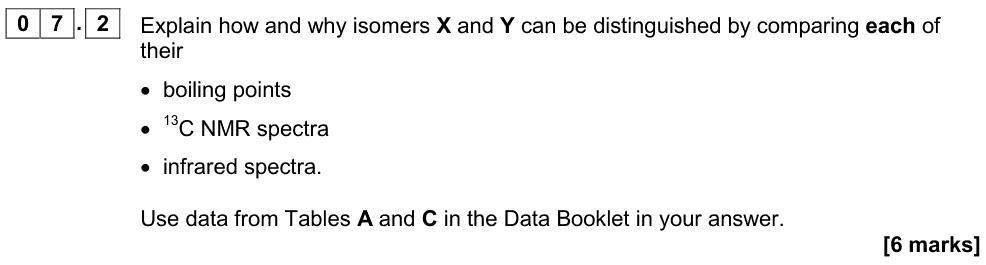
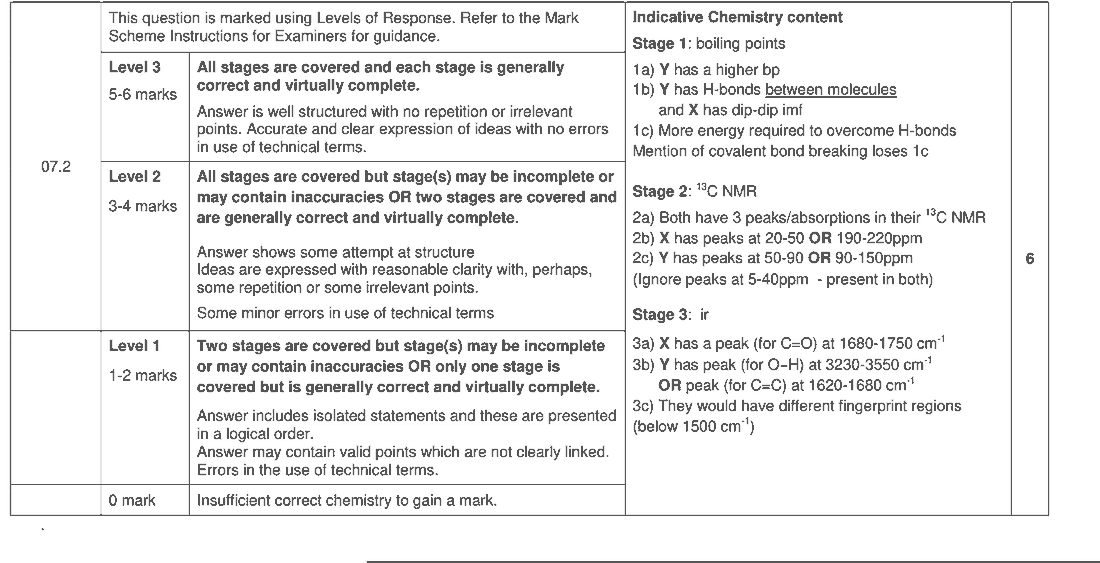
Explain how and why isomers X and Y can be distinguished by comparing each of
their
• boiling points
• 13C NMR spectra
• infrared spectra.
Use data from Tables A and C in the Data Booklet in your answer.
[6 marks]
June 2019 · Paper 2 · Q08.1 1 mark Short answer aromatic chemistry
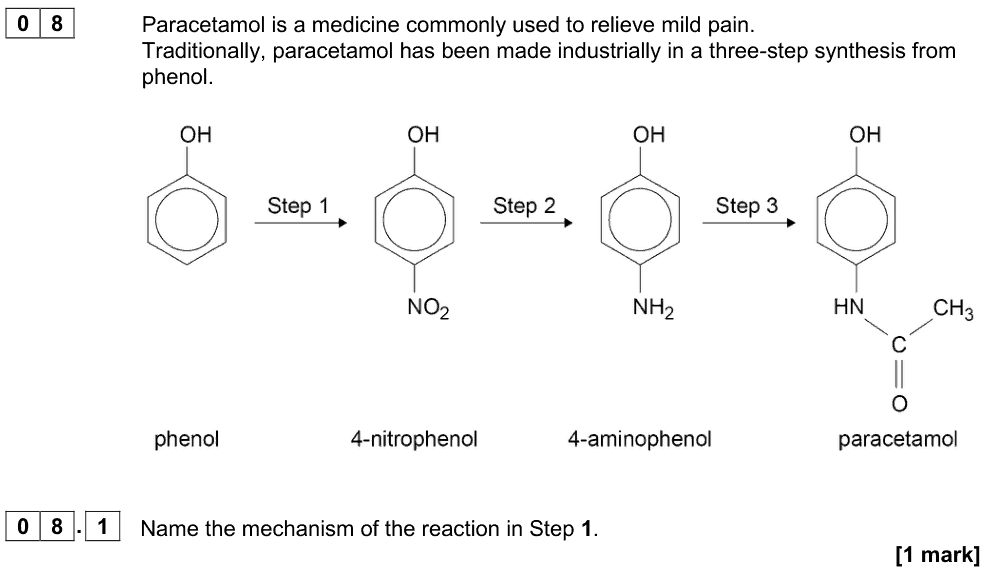
Paracetamol is a medicine commonly used to relieve mild pain.
Traditionally, paracetamol has been made industrially in a three-step synthesis from
phenol.
Name the mechanism of the reaction in Step 1.
[1 mark]
June 2019 · Paper 2 · Q08.2 1 mark Equation writing Hard aminesamount of substance
Earlier part of question 08 that this part usesEarlier part of June 2019 Paper 2 question 08
Complete the equation for the reaction in Step 2.
[1 mark]
June 2019 · Paper 2 · Q08.3 2 marks Mechanism aminescarboxylic acids and derivatives
Earlier part of question 08 that this part usesEarlier part of June 2019 Paper 2 question 08
In theory, either ethanoyl chloride or ethanoic anhydride could be used in Step 3.
Complete the mechanism for the reaction of 4-aminophenol with ethanoyl chloride.
RNH2 is used to represent 4-aminophenol in this mechanism.
[2 marks]
June 2019 · Paper 2 · Q08.4 1 mark Short answer carboxylic acids and derivatives
Earlier part of question 08 that this part usesEarlier part of June 2019 Paper 2 question 08
In practice, ethanoic anhydride is used in the industrial synthesis rather than
ethanoyl chloride.
Give one reason why ethanoyl chloride is not used in the industrial synthesis.
[1 mark]
June 2019 · Paper 2 · Q08.5 1 mark Diagram or structure carboxylic acids and derivativesamines
Earlier part of question 08 that this part usesEarlier part of June 2019 Paper 2 question 08
In Step 3 other aromatic products are formed as well as paracetamol.
Draw the structure of one of these other aromatic products.
[1 mark]
June 2019 · Paper 2 · Q08.6 1 mark Equation writing amount of substance
Earlier part of question 08 that this part usesEarlier part of June 2019 Paper 2 question 08
Chemists have recently developed a two-step process to produce paracetamol from
phenol.
In the first step, phenol is oxidised to hydroquinone.
In the second step, hydroquinone reacts with ammonium ethanoate to form
paracetamol.
Complete the equation for this second step.
[1 mark]
June 2019 · Paper 2 · Q08.7 3 marks Calculation amount of substance
Earlier part of question 08 that this part usesEarlier part of June 2019 Paper 2 question 08
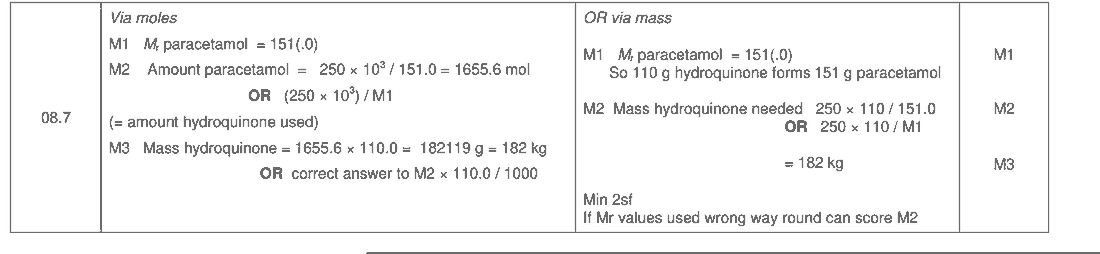
Calculate the mass, in kg, of hydroquinone (Mr = 110.0) needed to produce 250 kg of
paracetamol.
[3 marks]
Mass
kg
June 2019 · Paper 2 · Q09.1 1 mark Short answer amino acids proteins and dna
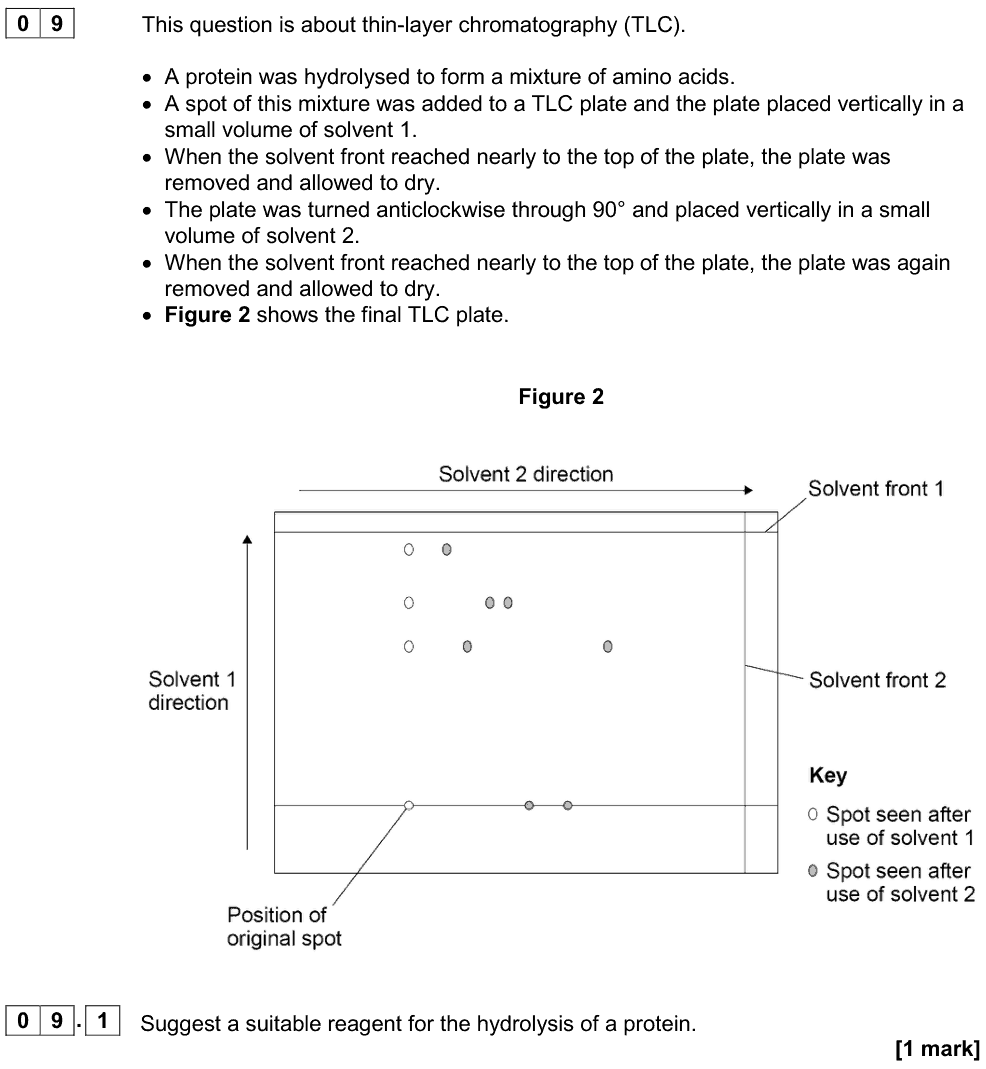
This question is about thin-layer chromatography (TLC).
• A protein was hydrolysed to form a mixture of amino acids.
• A spot of this mixture was added to a TLC plate and the plate placed vertically in a
small volume of solvent 1.
• When the solvent front reached nearly to the top of the plate, the plate was
removed and allowed to dry.
• The plate was turned anticlockwise through 90° and placed vertically in a small
volume of solvent 2.
• When the solvent front reached nearly to the top of the plate, the plate was again
removed and allowed to dry.
• Figure 2 shows the final TLC plate.
Figure 2
Suggest a suitable reagent for the hydrolysis of a protein.
[1 mark]
June 2019 · Paper 2 · Q09.2 1 mark Practical and data analysis amino acids proteins and dna
Earlier part of question 09 that this part usesEarlier part of June 2019 Paper 2 question 09
Suggest how the positions of the amino acids on the TLC plate were located.
[1 mark]
June 2019 · Paper 2 · Q09.3 1 mark Practical and data analysis Hard amino acids proteins and dnachromatography
Earlier part of question 09 that this part usesEarlier part of June 2019 Paper 2 question 09
Deduce the minimum number of amino acids present in the original mixture.
[1 mark]
June 2019 · Paper 2 · Q09.4 1 mark Practical and data analysis chromatography
Earlier part of question 09 that this part usesEarlier part of June 2019 Paper 2 question 09
Suggest why it was necessary to use two different solvents.
[1 mark]
June 2019 · Paper 2 · Q10.1 3 marks Short answer Easy carboxylic acids and derivativesamount of substance
Some compounds with different molecular formulas have the same relative molecular
mass to the nearest whole number.
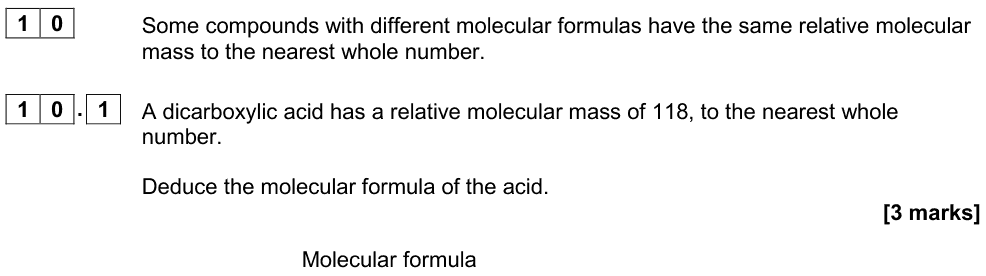
A dicarboxylic acid has a relative molecular mass of 118, to the nearest whole
number.
Deduce the molecular formula of the acid.
[3 marks]
Molecular formula
June 2019 · Paper 2 · Q10.2 4 marks Calculation Hard amount of substance
Earlier part of question 10 that this part usesEarlier part of June 2019 Paper 2 question 10
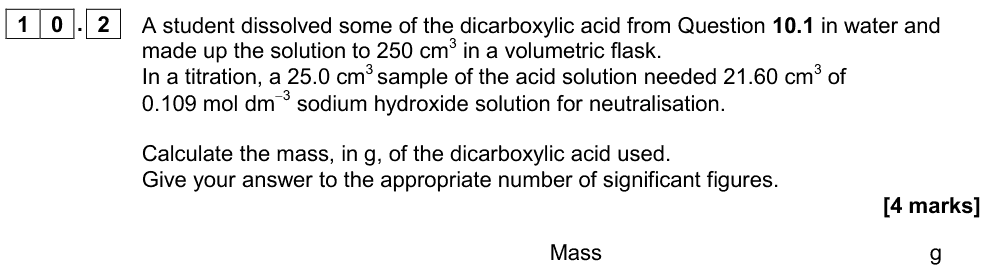
A student dissolved some of the dicarboxylic acid from Question 10.1 in water and
made up the solution to 250 cm3 in a volumetric flask.
In a titration, a 25.0 cm3 sample of the acid solution needed 21.60 cm3 of
0.109 mol dm−3 sodium hydroxide solution for neutralisation.
Calculate the mass, in g, of the dicarboxylic acid used.
Give your answer to the appropriate number of significant figures.
[4 marks]
Mass
g
June 2019 · Paper 2 · Q10.3 1 mark Short answer Easy nmr spectroscopy
Earlier part of question 10 that this part usesEarlier part of June 2019 Paper 2 question 10
Compounds with molecular formula C6H14O2 also have a relative molecular mass of
118 to the nearest whole number.  These include the diol shown.
Deduce the number of peaks in the 1H NMR spectrum of this diol.
[1 mark]
June 2019 · Paper 2 · Q10.4 1 mark Diagram or structure Hard nmr spectroscopyintroduction to organic chemistry
Earlier part of question 10 that this part usesEarlier part of June 2019 Paper 2 question 10
Draw the structure of a different diol also with molecular formula C6H14O2 that has a
1H NMR spectrum that consists of two singlet peaks.
[1 mark]
June 2019 · Paper 2 · Q10.5 1 mark Short answer organic analysis
Earlier part of question 10 that this part usesEarlier part of June 2019 Paper 2 question 10
The dicarboxylic acid in question 10.1 and the  isomers of C6H14O2 in Questions
10.3 and 10.4 all have a relative molecular mass of 118
State why the dicarboxylic acid can be distinguished from the two diols by
high resolution mass spectrometry using electrospray ionisation.
[1 mark]
June 2019 · Paper 2 · Q11.1 3 marks Equation writing carboxylic acids and derivativesintroduction to organic chemistry
This question is about esters including biodiesel.
An ester is formed by the reaction of an acid anhydride with CH3CH2OH
Complete the equation.  In your answer show clearly the structure of the ester.
Give the IUPAC name of the ester.
[3 marks]
Equation
Name of ester
June 2019 · Paper 2 · Q11.2 2 marks Diagram or structure carboxylic acids and derivatives
Earlier part of question 11 that this part usesEarlier part of June 2019 Paper 2 question 11
In a reaction to form biodiesel, one mole of a vegetable oil reacts with an excess of
methanol to form two moles of an ester with molecular formula C19H34O2 and one
mole of an ester with molecular formula C19H36O2
Draw the structure of the vegetable oil showing clearly the ester links.
You should represent the hydrocarbon chains in the form Cx Hy where x and y are
the actual numbers of carbon and hydrogen atoms.
[2 marks]
June 2019 · Paper 2 · Q11.3 2 marks Diagram or structure Hard introduction to organic chemistry
Earlier part of question 11 that this part usesEarlier part of June 2019 Paper 2 question 11
The compound C19H34O2 is the methyl ester of Z,Z-octadeca-9,12-dienoic acid.
Part of the structure of the acid is shown.
Complete the skeletal formula to show the next part of the hydrocarbon chain to
carbon atom number 14.
In your answer, show the Z stereochemistry around both C=C double bonds.
[2 marks]
June 2019 · Paper 2 · Q11.4 1 mark Equation writing alkanesamount of substance
Earlier part of question 11 that this part usesEarlier part of June 2019 Paper 2 question 11
Give an equation for the complete combustion of the ester C19H34O2
[1 mark]
June 2019 · Paper 2 · Q11.5 1 mark Short answer organic analysis
Earlier part of question 11 that this part usesEarlier part of June 2019 Paper 2 question 11
Combustion of biodiesel produces greenhouse gases such as carbon dioxide that
cause global warming.
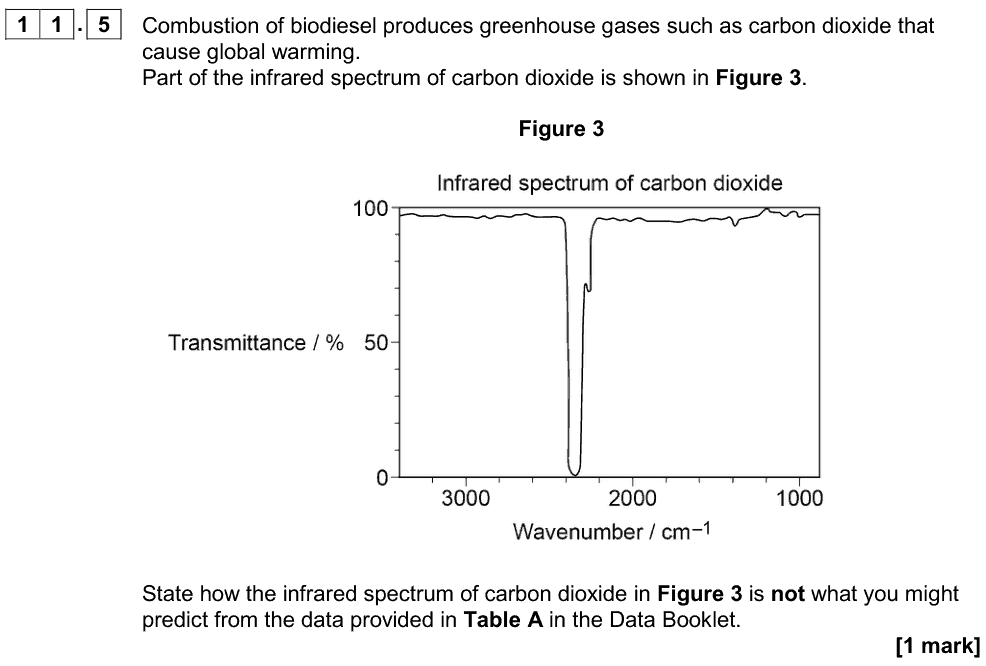
Part of the infrared spectrum of carbon dioxide is shown in Figure 3.
Figure 3
State how the infrared spectrum of carbon dioxide in Figure 3 is not what you might
predict from the data provided in Table A in the Data Booklet.
[1 mark]
June 2019 · Paper 2 · Q11.6 2 marks Explanation organic analysis
Earlier part of question 11 that this part usesEarlier part of June 2019 Paper 2 question 11
Explain how carbon dioxide causes global warming.
[2 marks]
June 2019 · Paper 2 · Q12.1 2 marks Diagram or structure amino acids proteins and dna
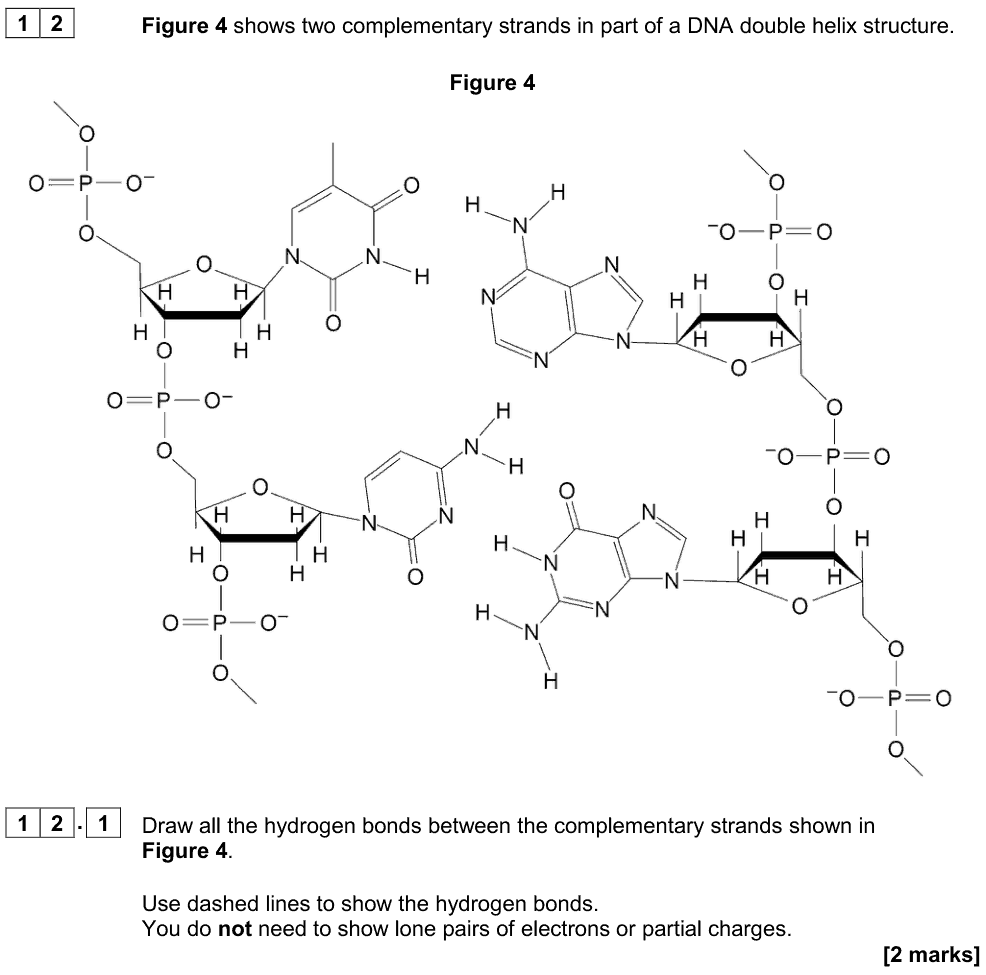
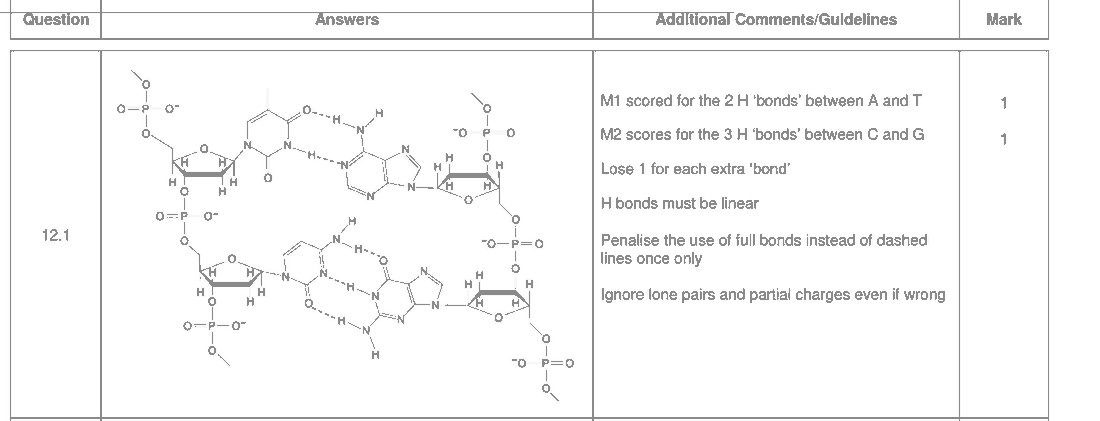
Figure 4 shows two complementary strands in part of a DNA double helix structure.
Figure 4
Draw all the hydrogen bonds between the complementary strands shown in
Figure 4.
Use dashed lines to show the hydrogen bonds.
You do not need to show lone pairs of electrons or partial charges.
[2 marks]
June 2019 · Paper 2 · Q12.2 2 marks Short answer amino acids proteins and dna
Earlier part of question 12 that this part usesEarlier part of June 2019 Paper 2 question 12
Draw a ring around each of the component parts that make up the cytosine nucleotide
in the section of DNA shown in Figure 4.
[2 marks]
June 2019 · Paper 2 · Q12.3 1 mark Short answer amino acids proteins and dna
Earlier part of question 12 that this part usesEarlier part of June 2019 Paper 2 question 12
State the meaning of the term complementary when it is used to refer to
DNA strands.
[1 mark]
June 2019 · Paper 2 · Q13.1 5 marks Mechanism aldehydes and ketonesalkenes
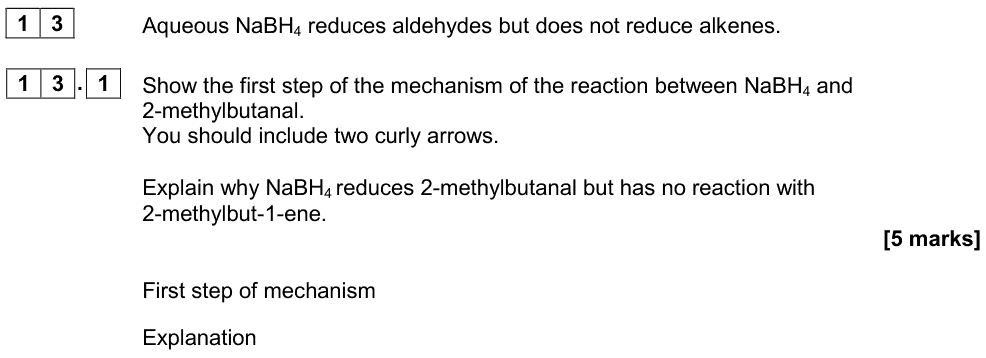
Aqueous NaBH4 reduces aldehydes but does not reduce alkenes.
Show the first step of the mechanism of the reaction between NaBH4 and
2-methylbutanal.
You should include two curly arrows.
Explain why NaBH4 reduces 2-methylbutanal but has no reaction with
2-methylbut-1-ene.
[5 marks]
First step of mechanism
Explanation
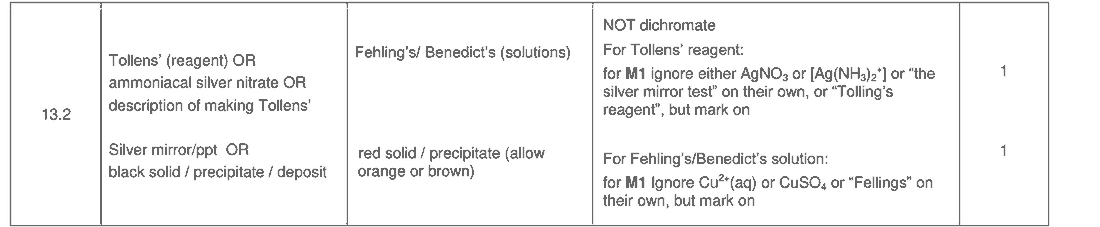
June 2019 · Paper 2 · Q13.2 2 marks Practical and data analysis Easy aldehydes and ketones
Earlier part of question 13 that this part usesEarlier part of June 2019 Paper 2 question 13
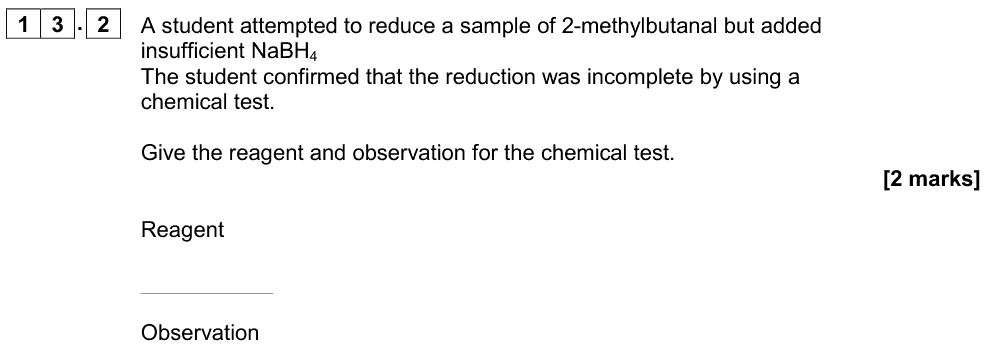
A student attempted to reduce a sample of 2-methylbutanal but added
insufficient NaBH4
The student confirmed that the reduction was incomplete by using a
chemical test.
Give the reagent and observation for the chemical test.
[2 marks]
Reagent
Observation

Work with an A-level chemistry tutor

Want a paper marked and gone through with you? Message us.

Prefer email? Send an enquiry

If you are under 18, please include a parent's contact details. Enquiries go to enquiries@chemistryaleveltutor.com and are deleted once handled. All tutoring is online.