June 2019: Paper 3, General and Practical Principles in Chemistry

120 marks · 53 question parts · Paper, mark scheme and report on Edexcel's site · Have the Data Booklet beside you

Question by question

QTopicMarksAOType
1(a) Acid-base equilibria 1Short answer
1(b) Acid-base equilibria 1Short answer
1(c) Acid-base equilibria 1Short answer
1(d) Acid-base equilibria 1Calculation
1(e) Acid-base equilibria 2Explanation
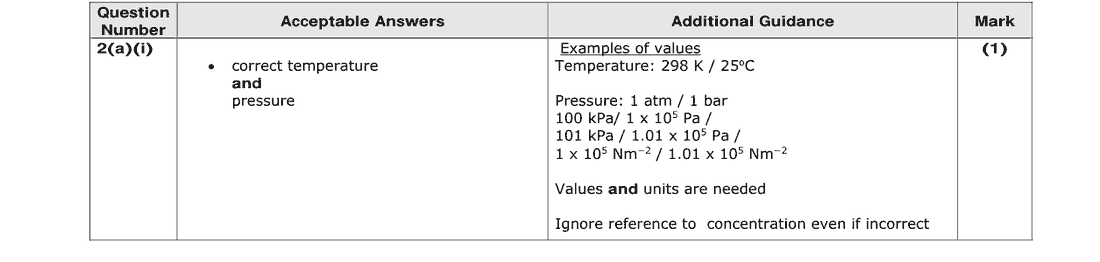
2(a)(i) Redox II 1Short answer
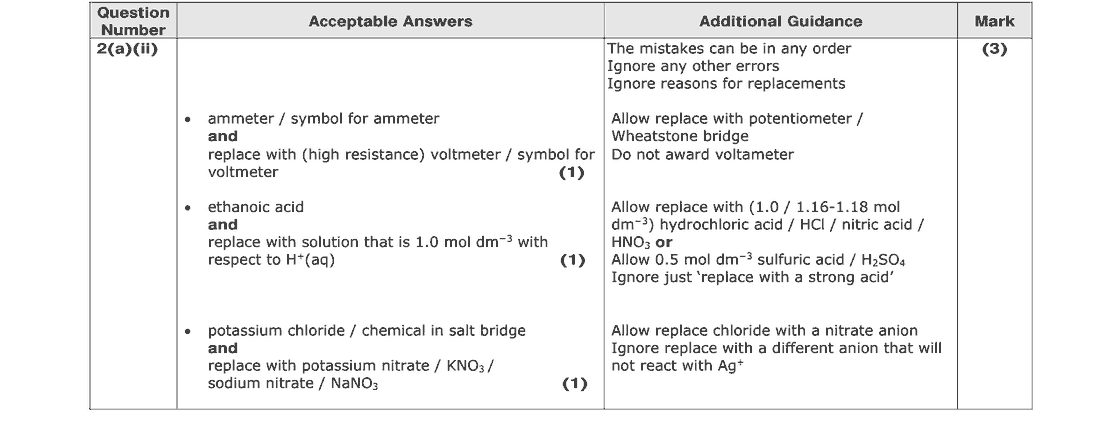
2(a)(ii) Redox II 3Practical and data analysis
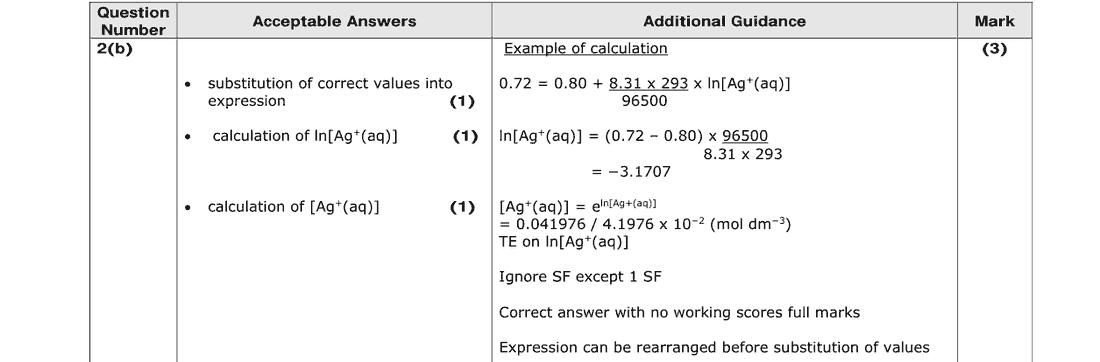
2(b) Redox II 3Calculation
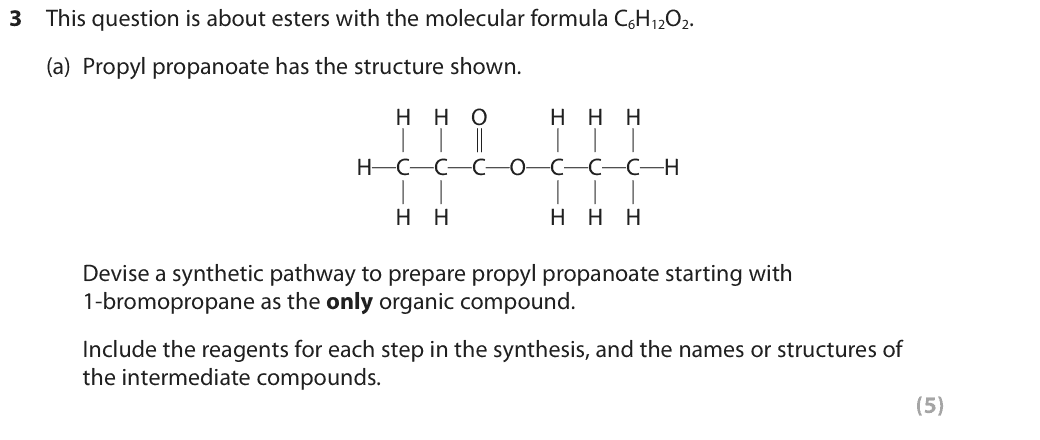
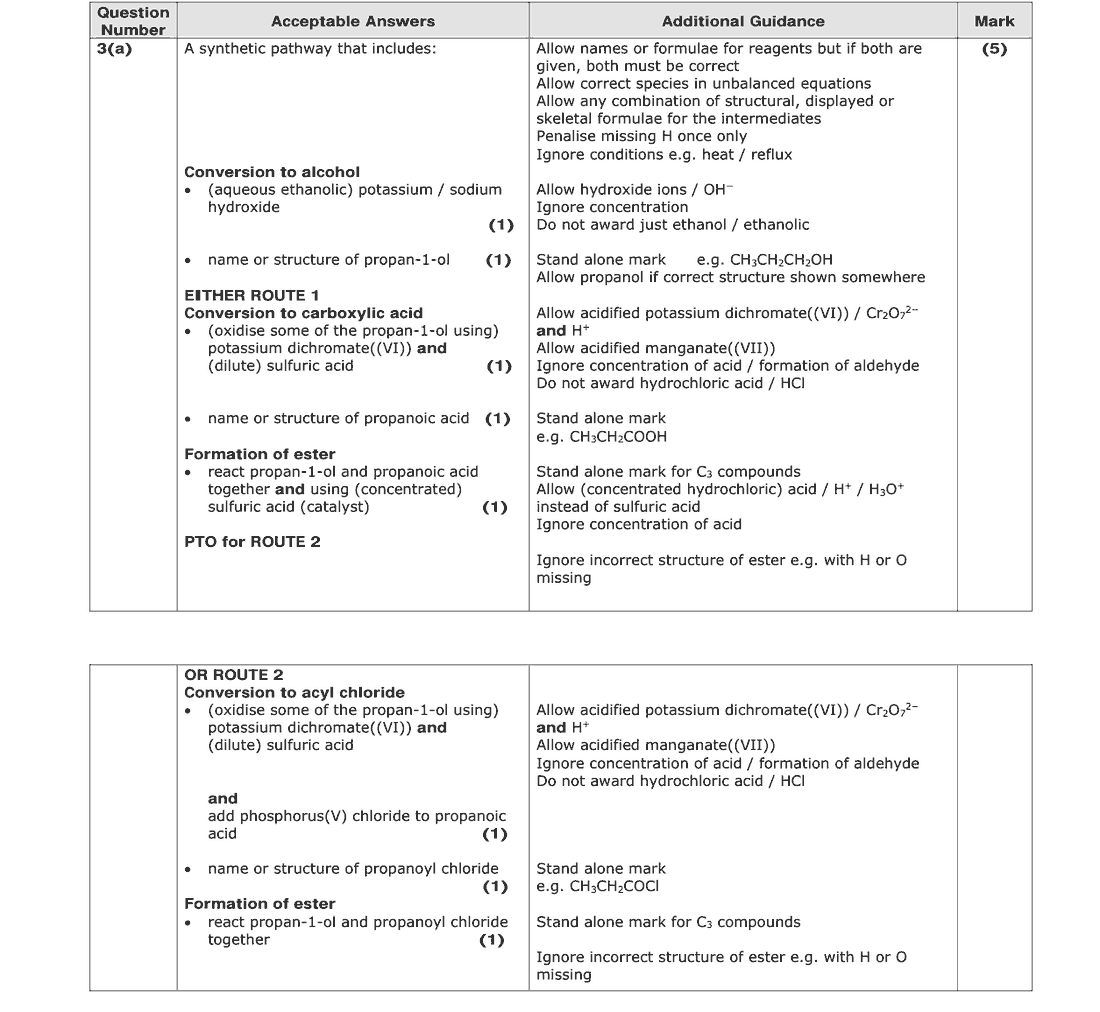
3(a) Organic synthesis, Halogenoalkanes, Carboxylic acids 5Short answer
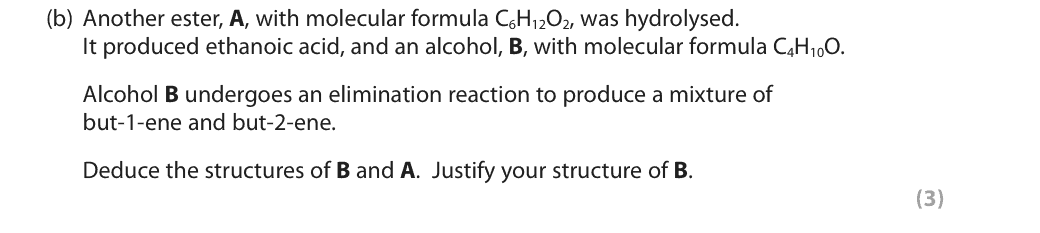
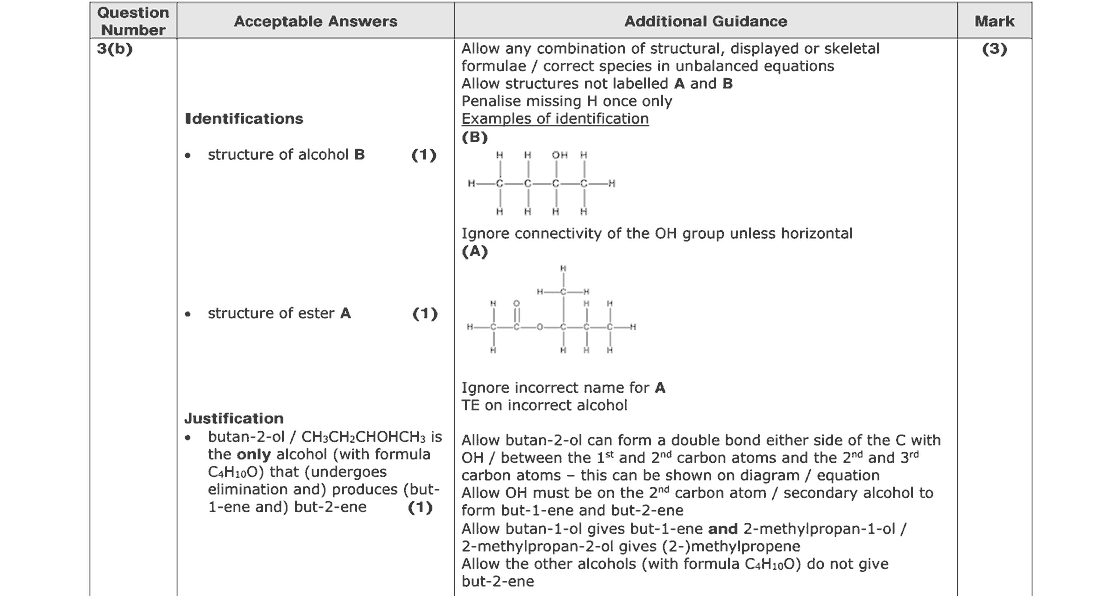
3(b) Organic synthesis, Carboxylic acids 3Diagram or structure
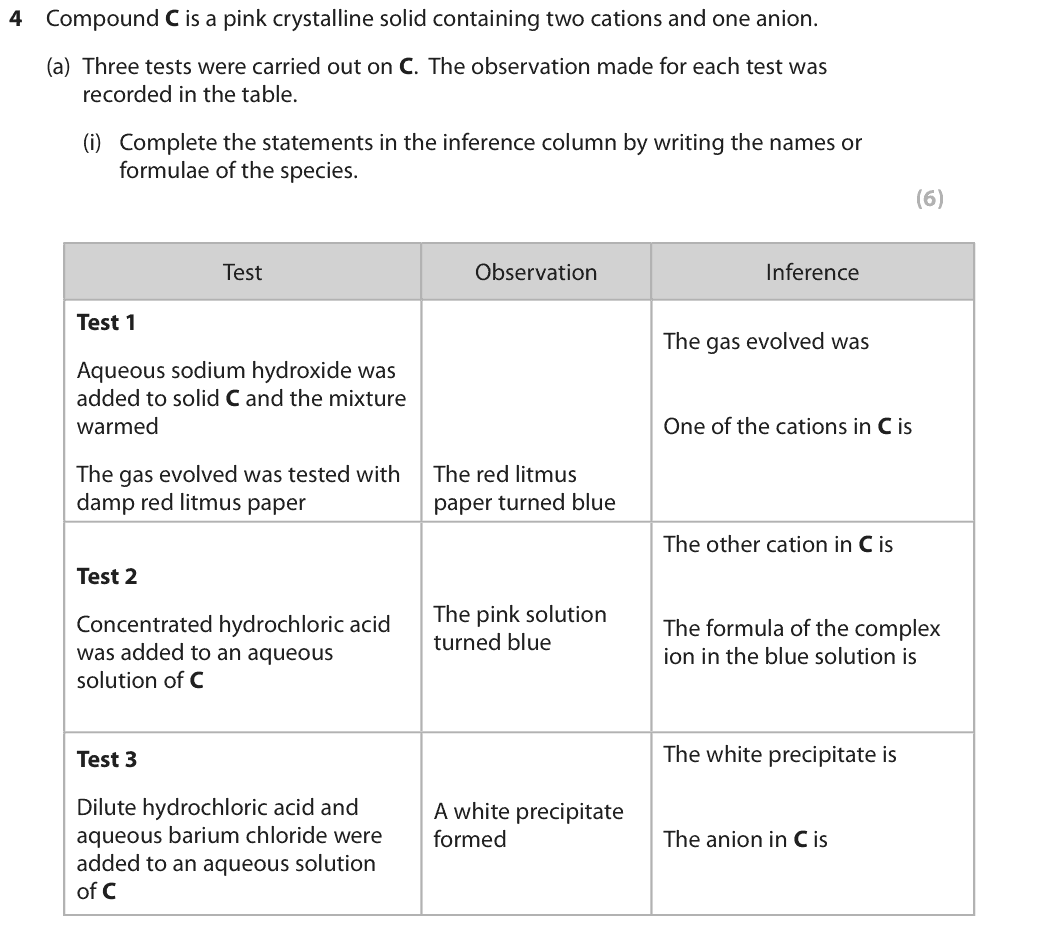
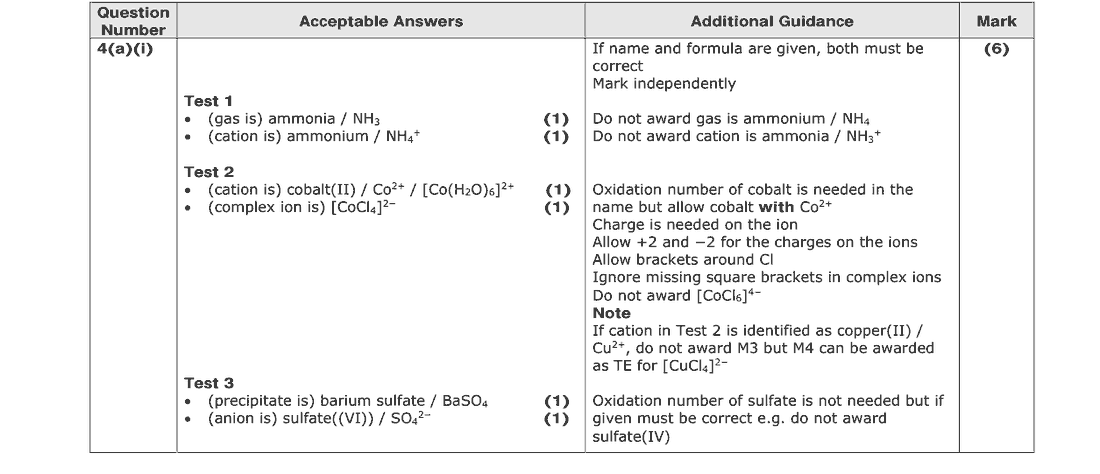
4(a)(i) Analysis of inorganic compounds, Transition metals: reactions 6Practical and data analysis
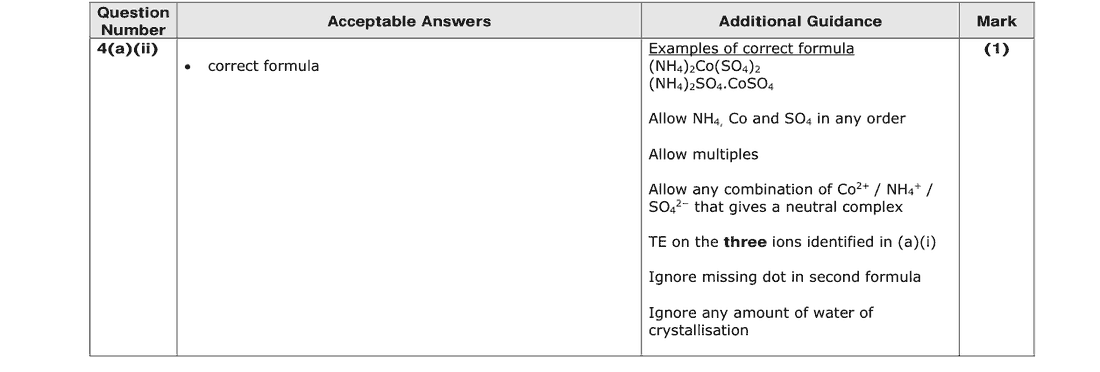
4(a)(ii) Redox I 1Short answer
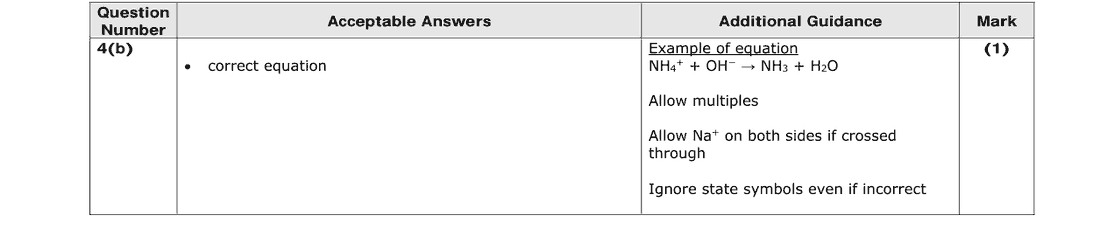
4(b) Analysis of inorganic compounds, Formulae, equations and amounts of substance 1Equation writing
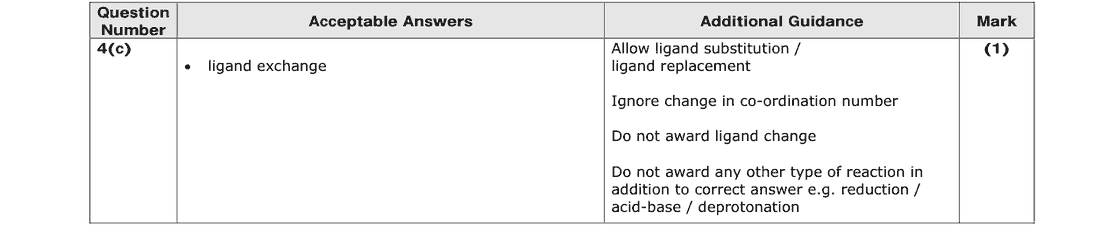
4(c) Transition metals: reactions 1Short answer
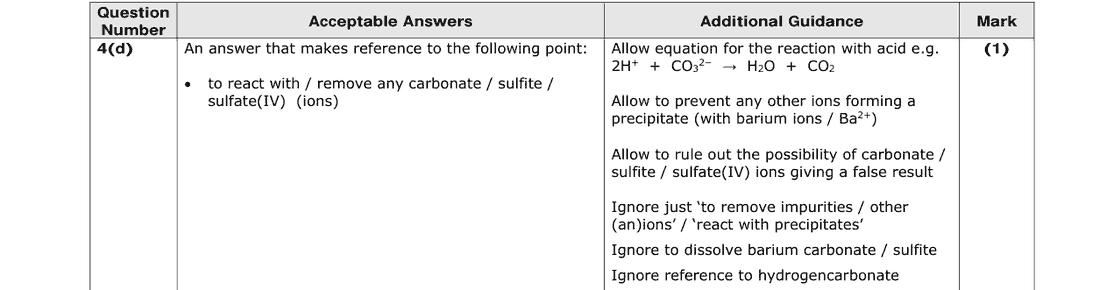
4(d) Analysis of inorganic compounds 1Practical and data analysis
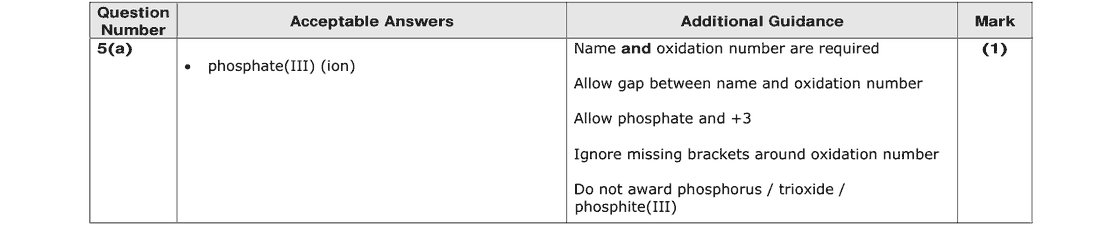
5(a) Redox I 1Short answer
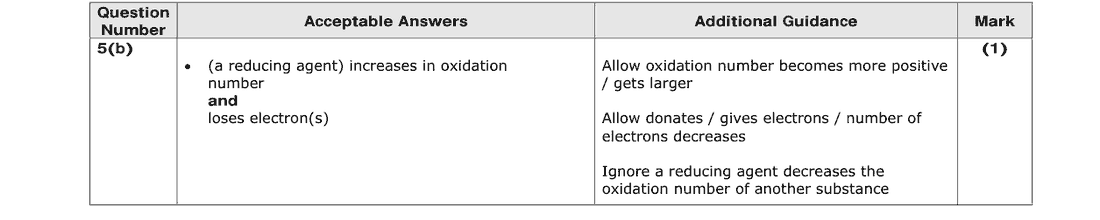
5(b) Redox I 1Short answer
5(c) Redox II 1Short answer
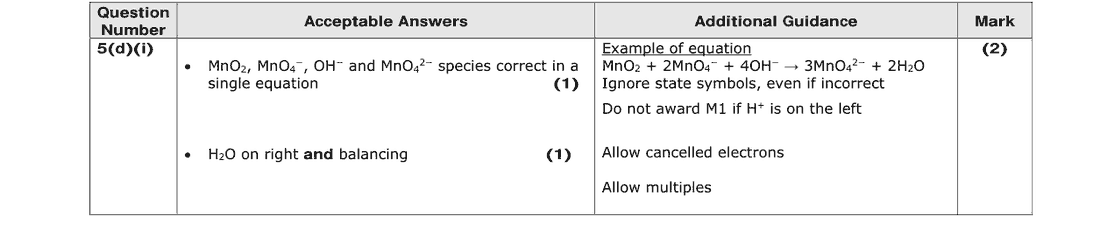
5(d)(i) Redox I 2Equation writing
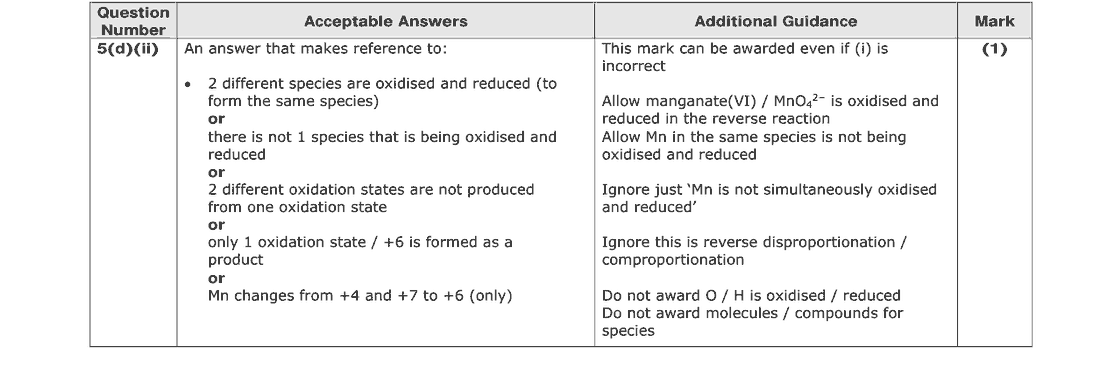
5(d)(ii) Redox I 1Short answer
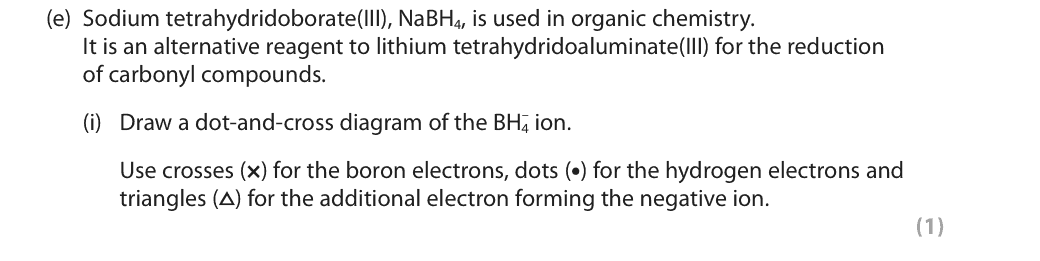
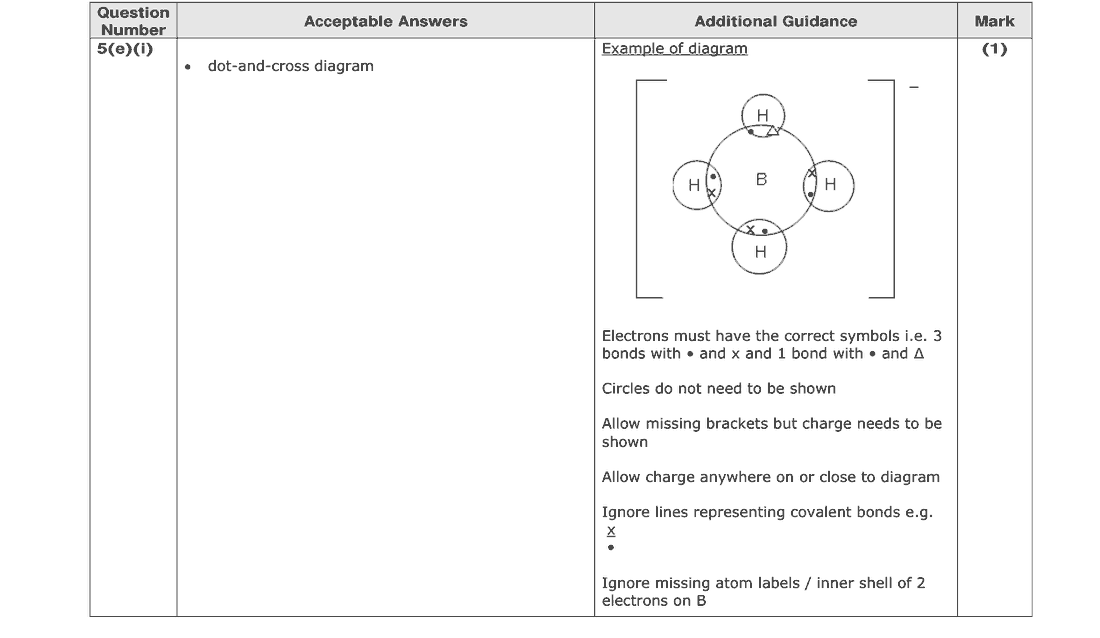
5(e)(i) Bonding 1Diagram or structure
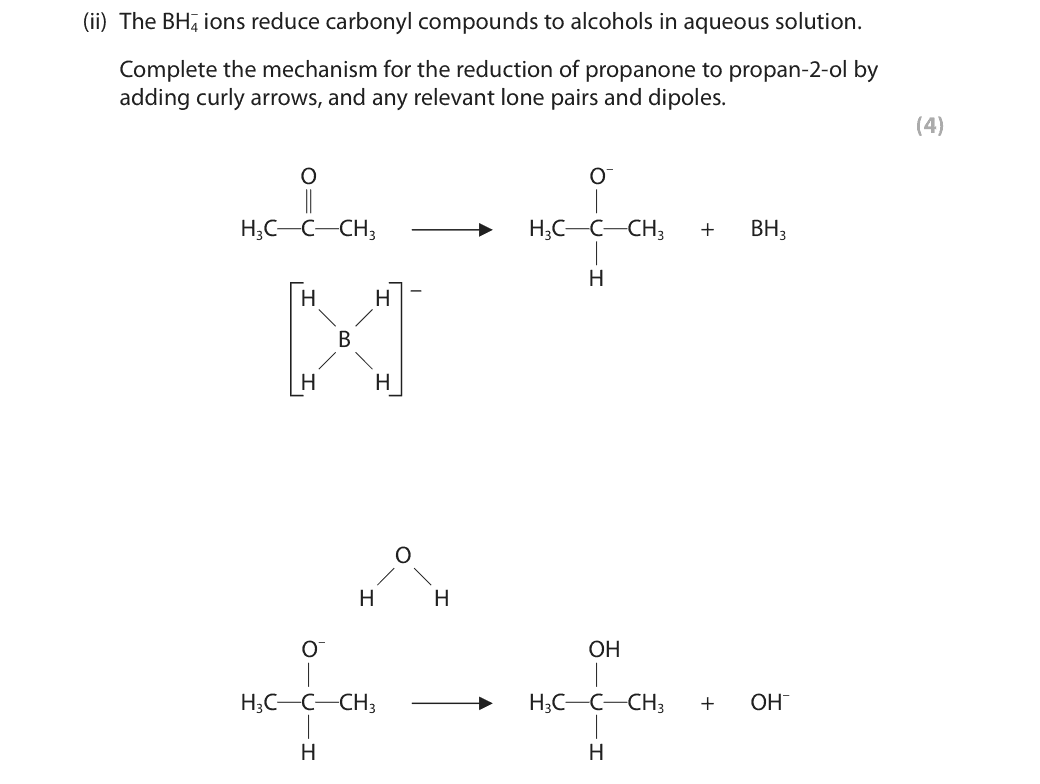
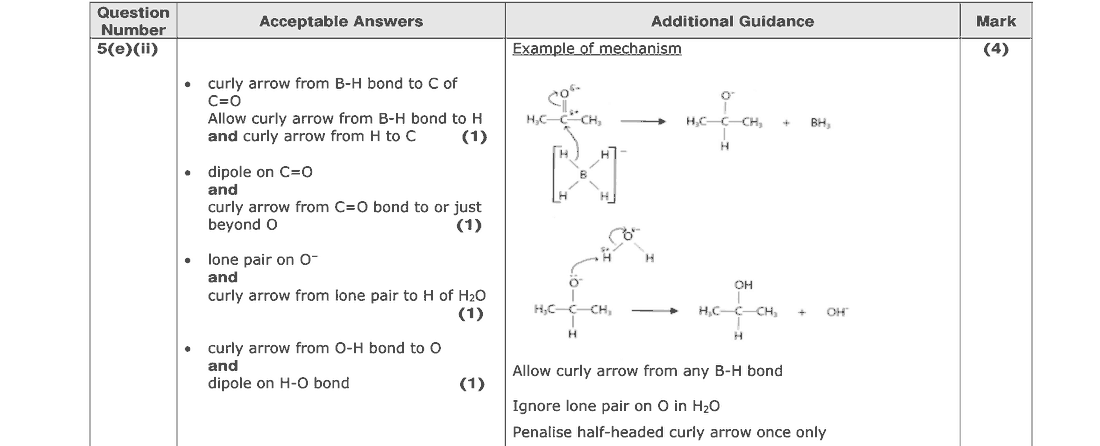
5(e)(ii) Carbonyl compounds 4Mechanism
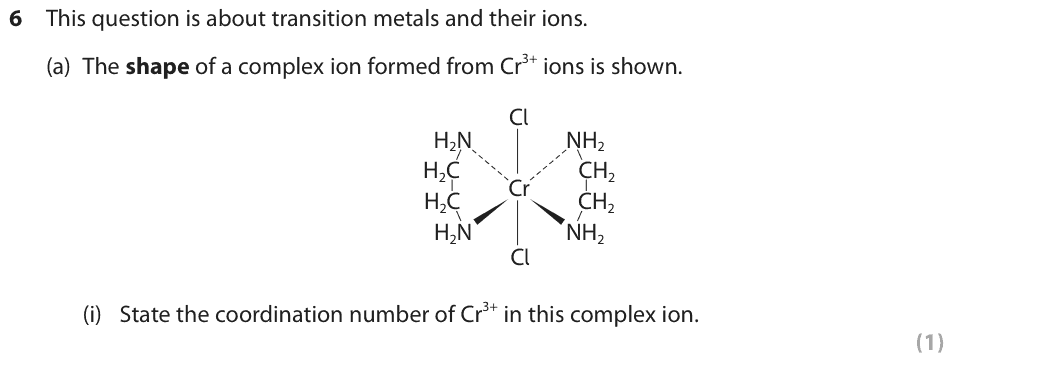
6(a)(i) Transition metals: principles 1Short answer
6(a)(ii) Transition metals: principles 1Short answer
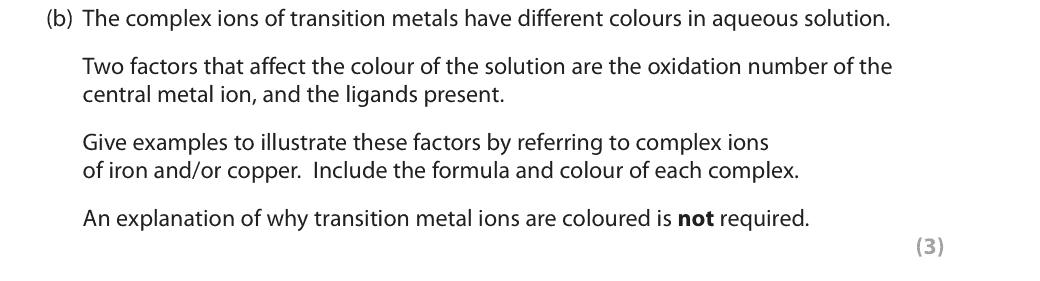
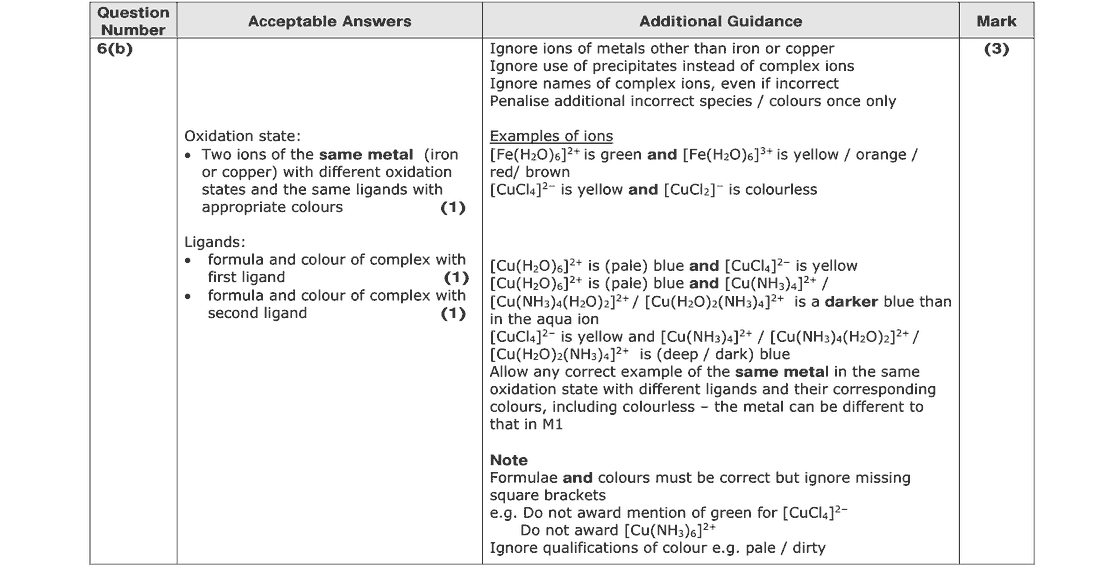
6(b) Transition metals: principles, Transition metals: reactions 3Short answer
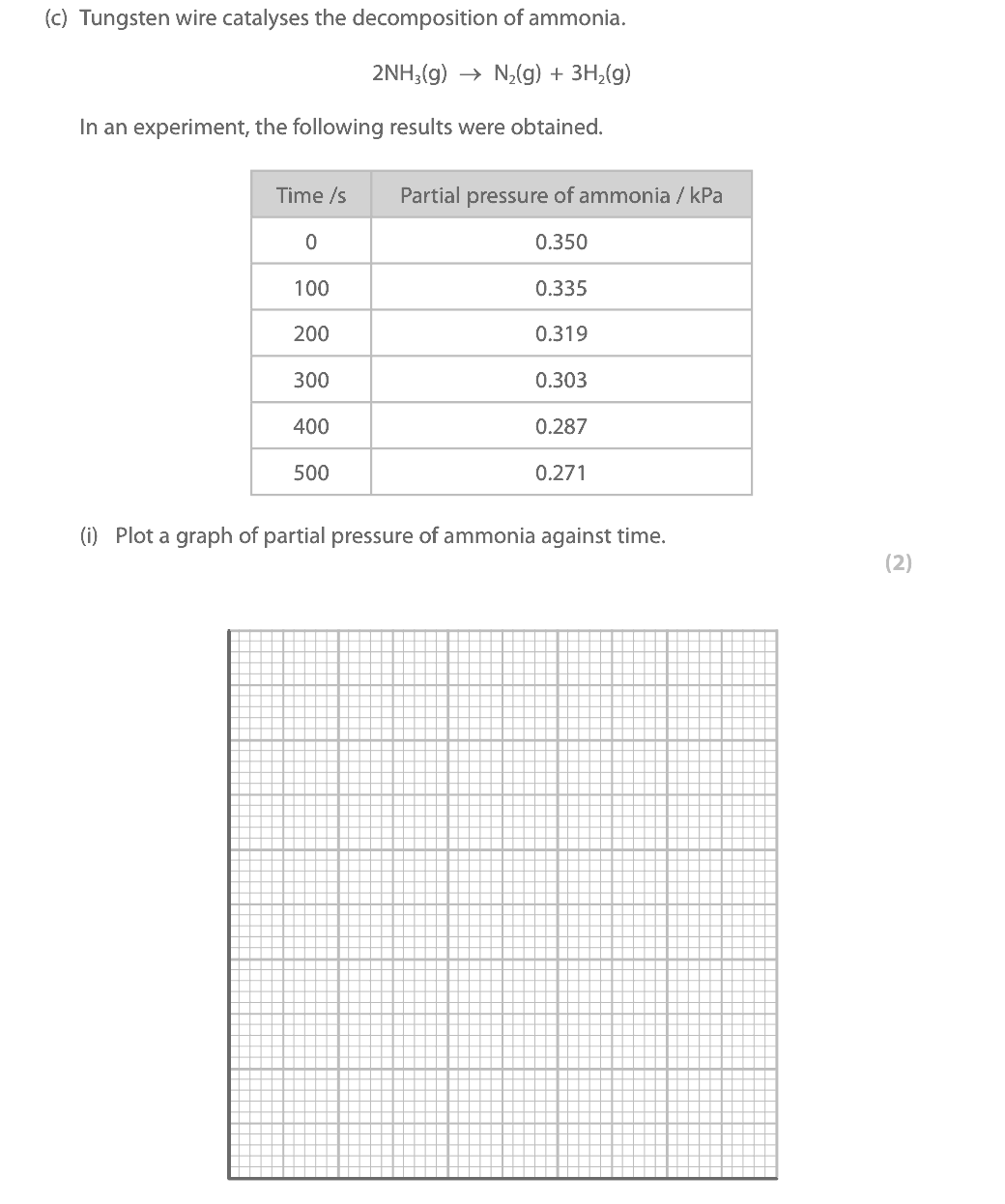
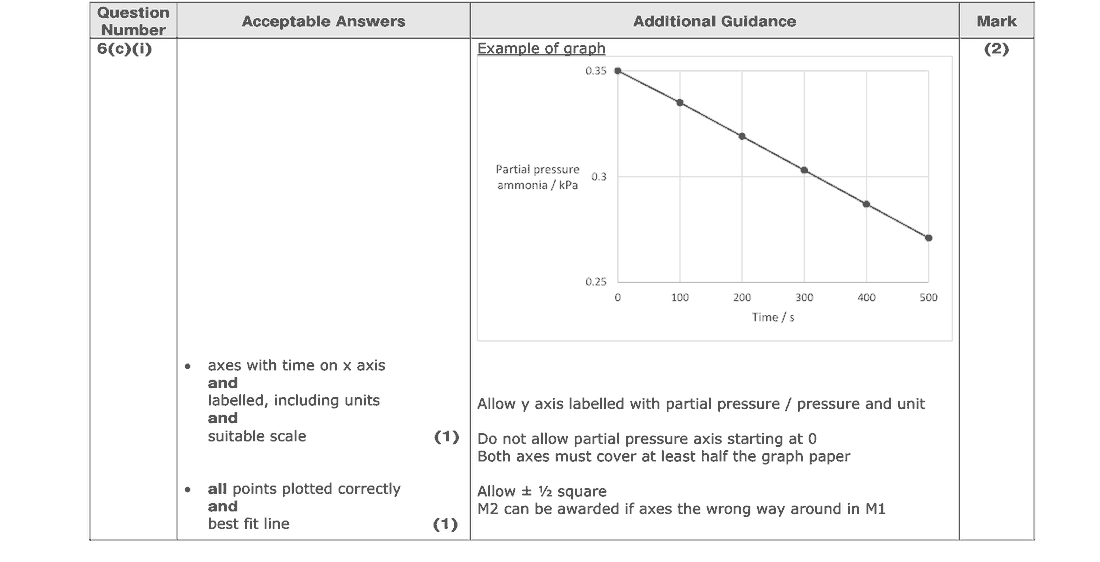
6(c)(i) Kinetics II 2Diagram or structure
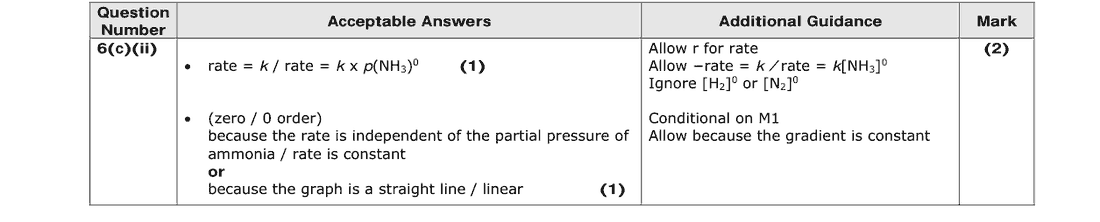
6(c)(ii) Kinetics II 2Short answer
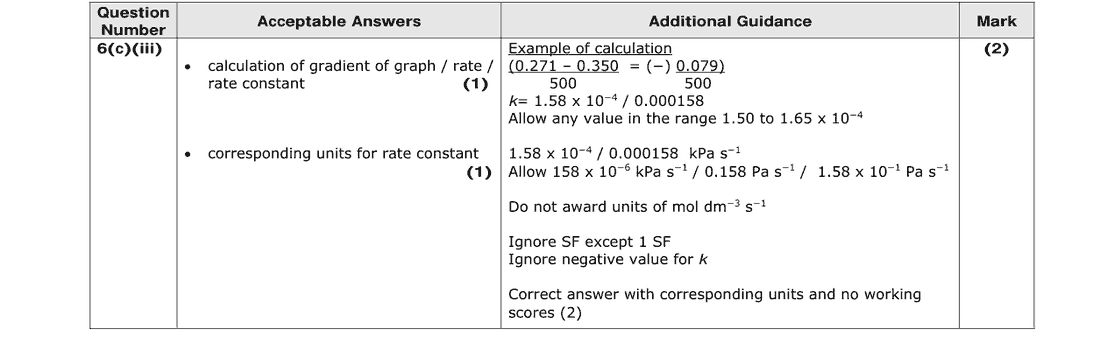
6(c)(iii) Kinetics II, Kinetics I 2Calculation
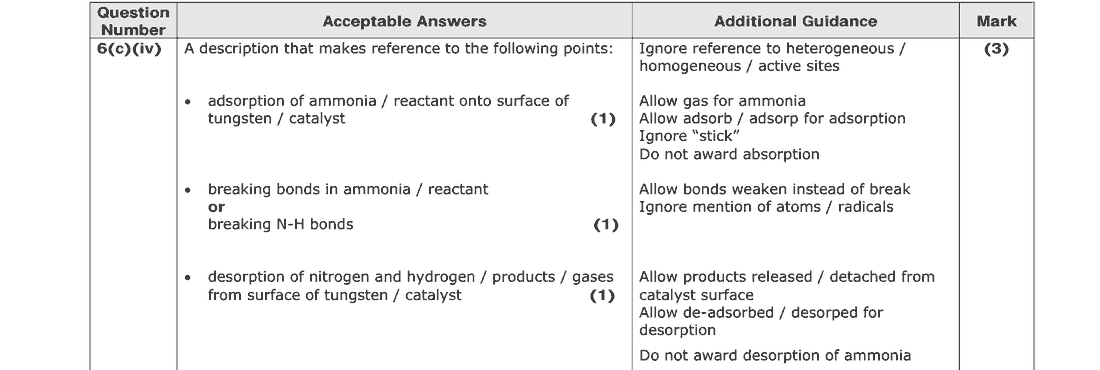
6(c)(iv) Transition metals: reactions 3Short answer
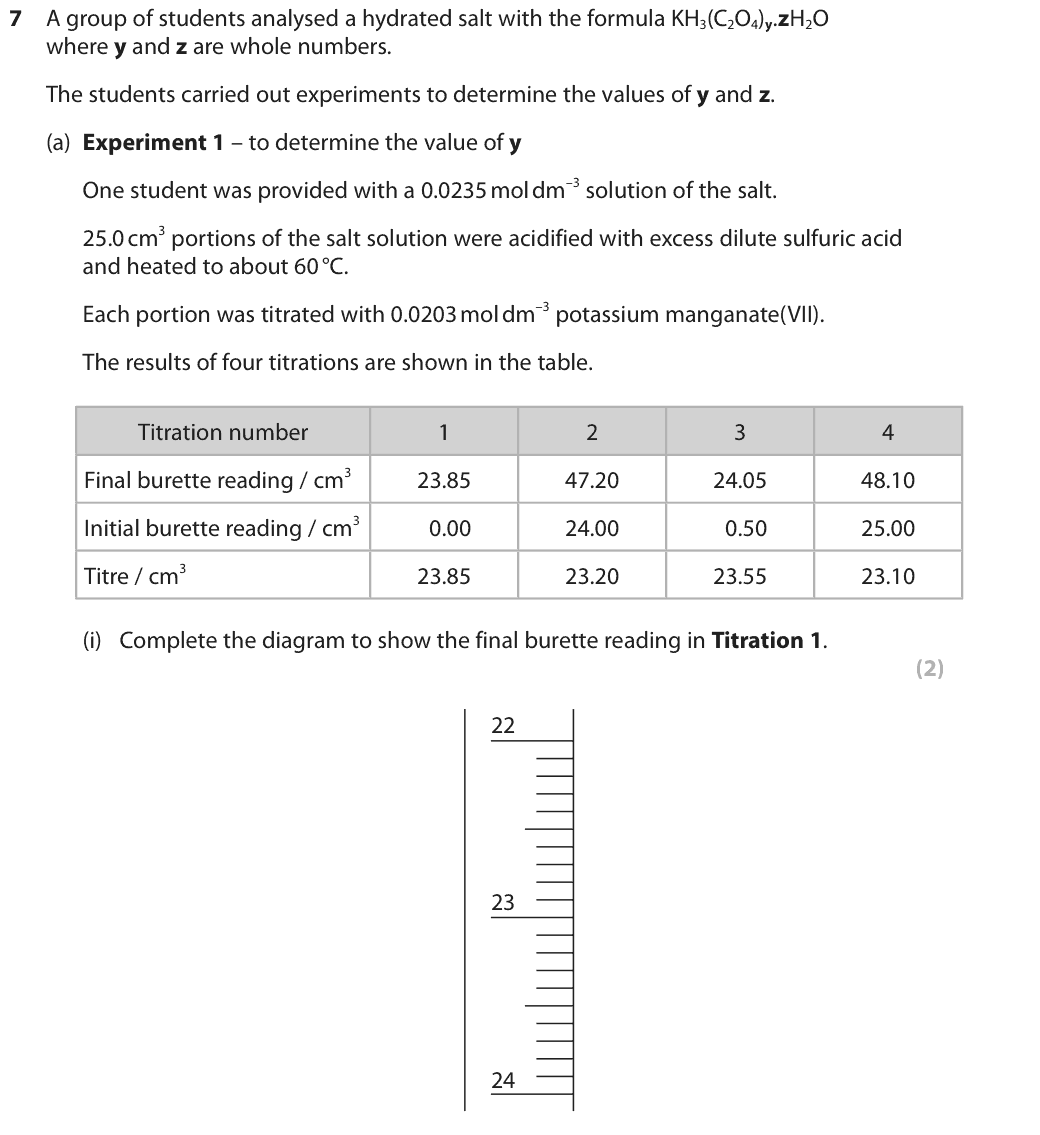
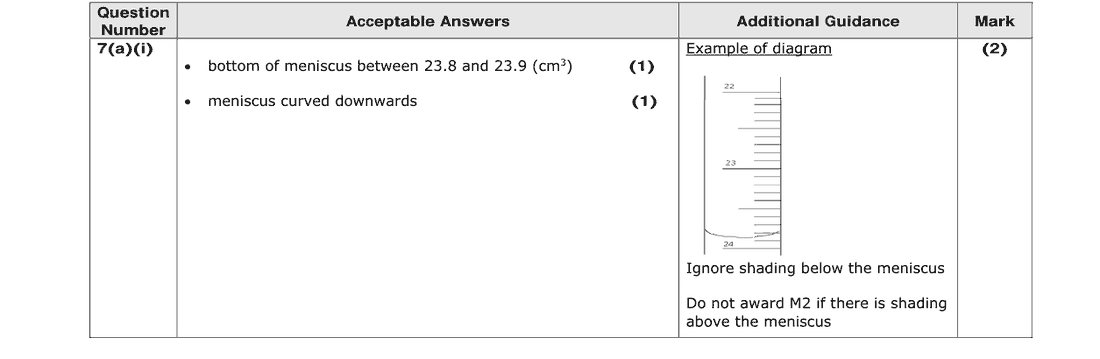
7(a)(i) Redox II 2Diagram or structure
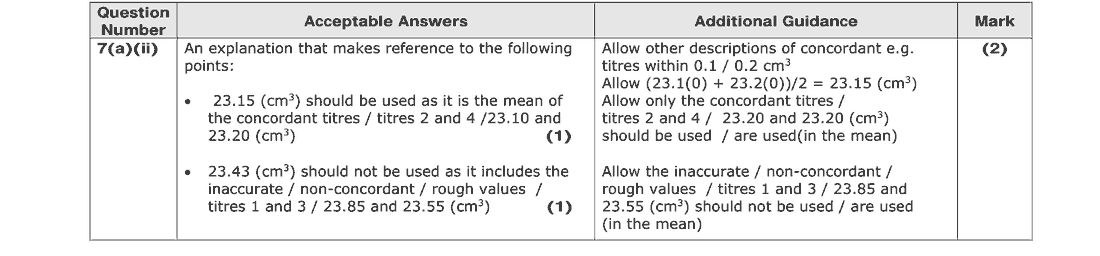
7(a)(ii) Redox II 2Explanation
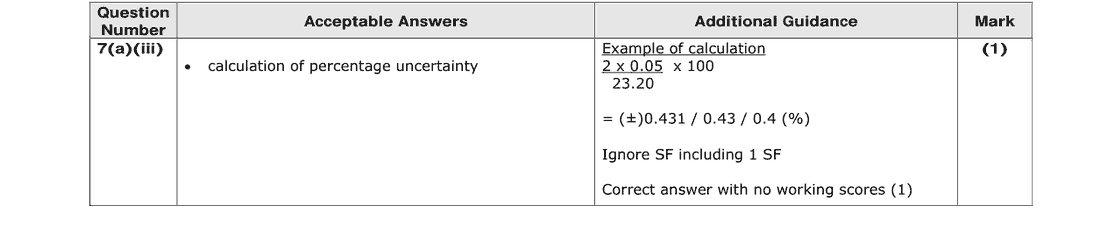
7(a)(iii) Formulae, equations and amounts of substance 1Calculation
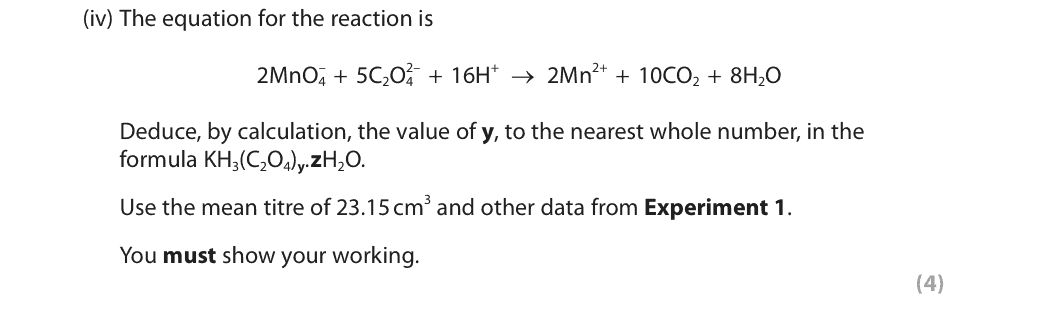
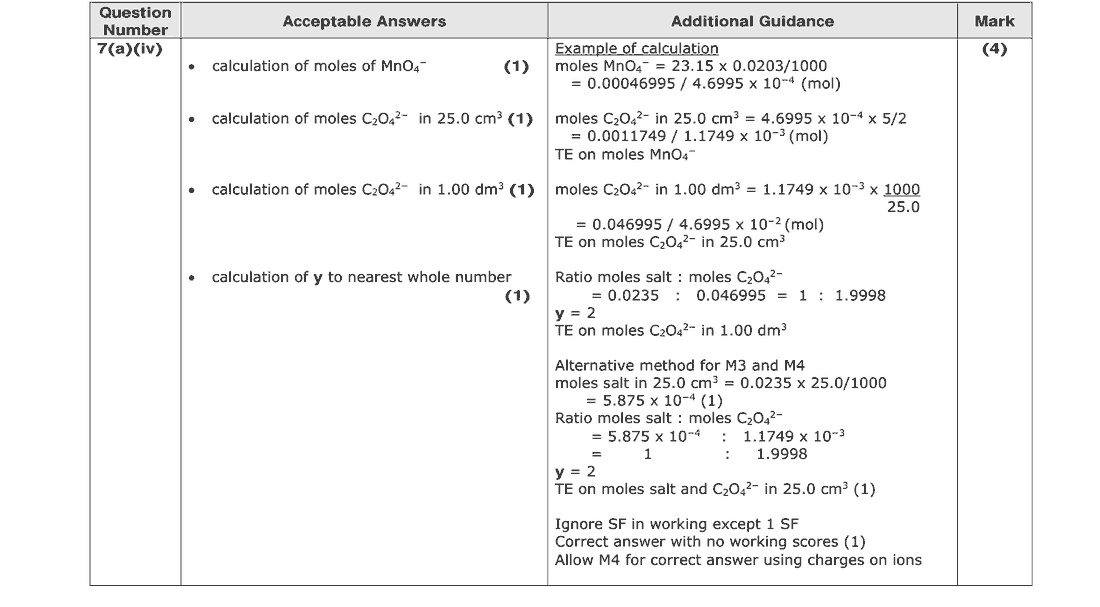
7(a)(iv) Redox II, Formulae, equations and amounts of substance 4Calculation
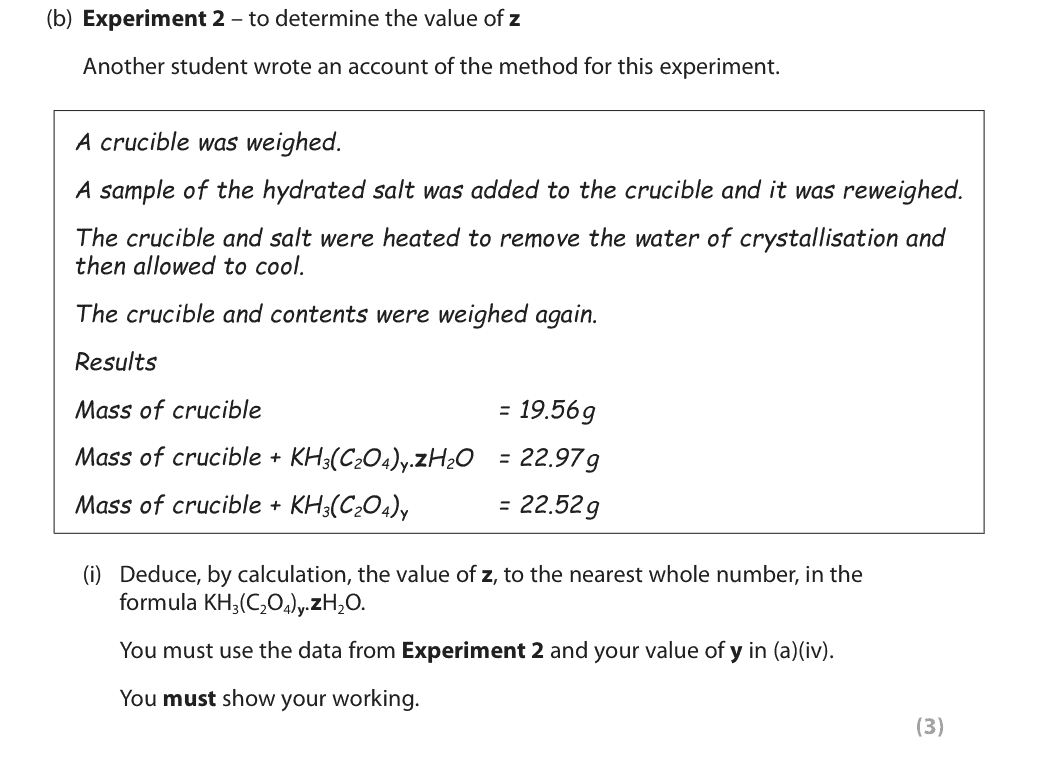
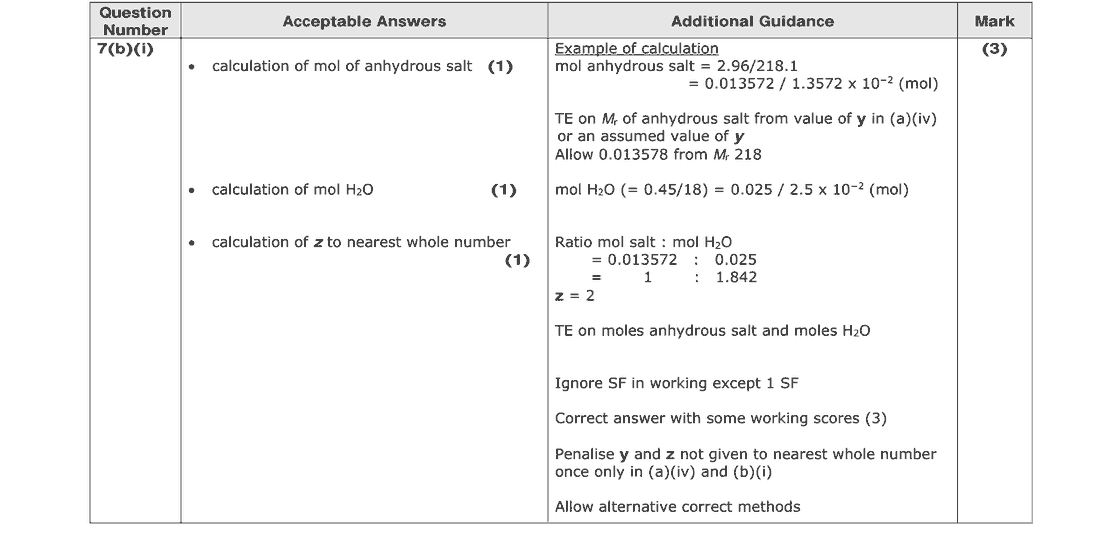
7(b)(i) Formulae, equations and amounts of substance 3Calculation
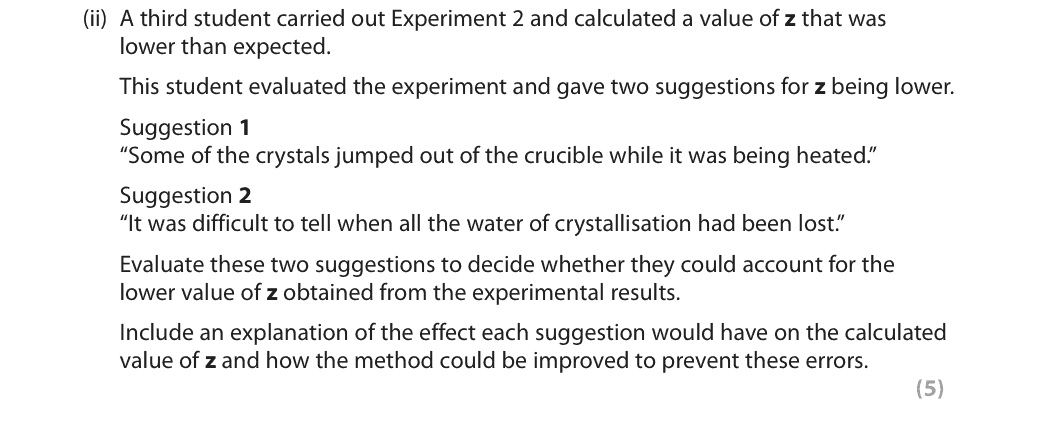
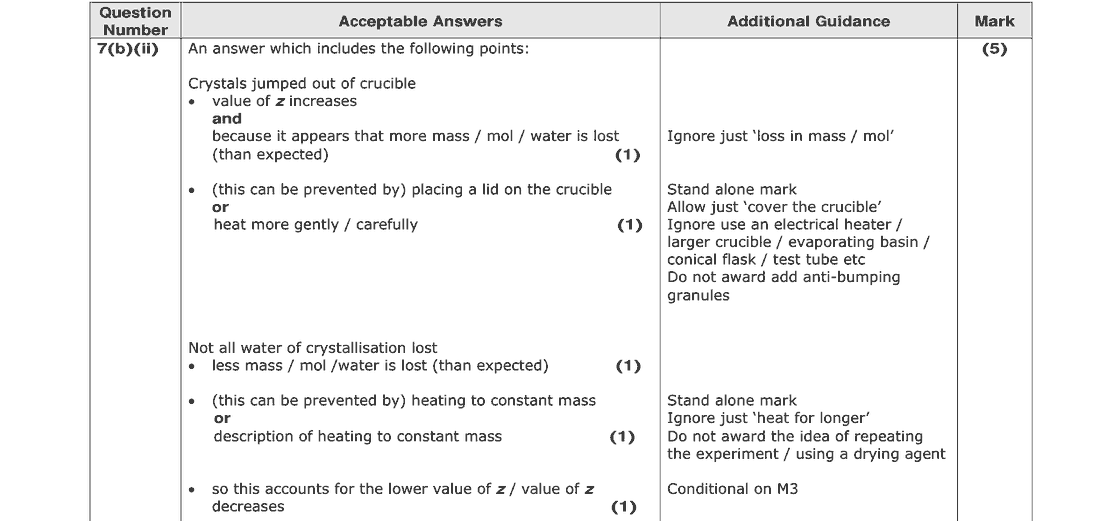
7(b)(ii) Formulae, equations and amounts of substance 5Explanation
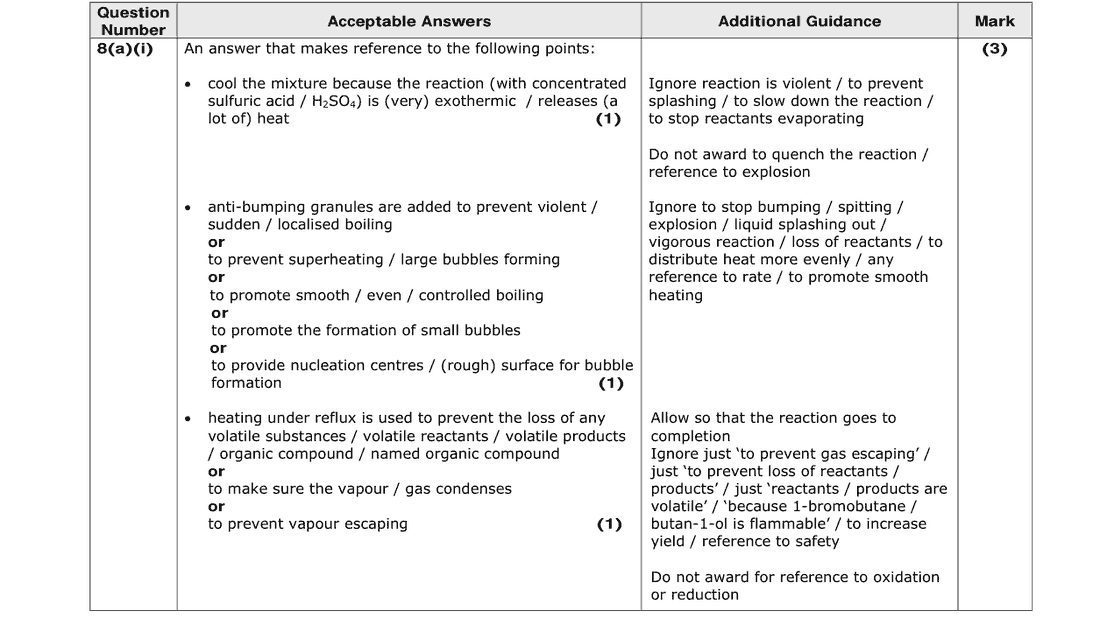
8(a)(i) Alcohols 3Practical and data analysis
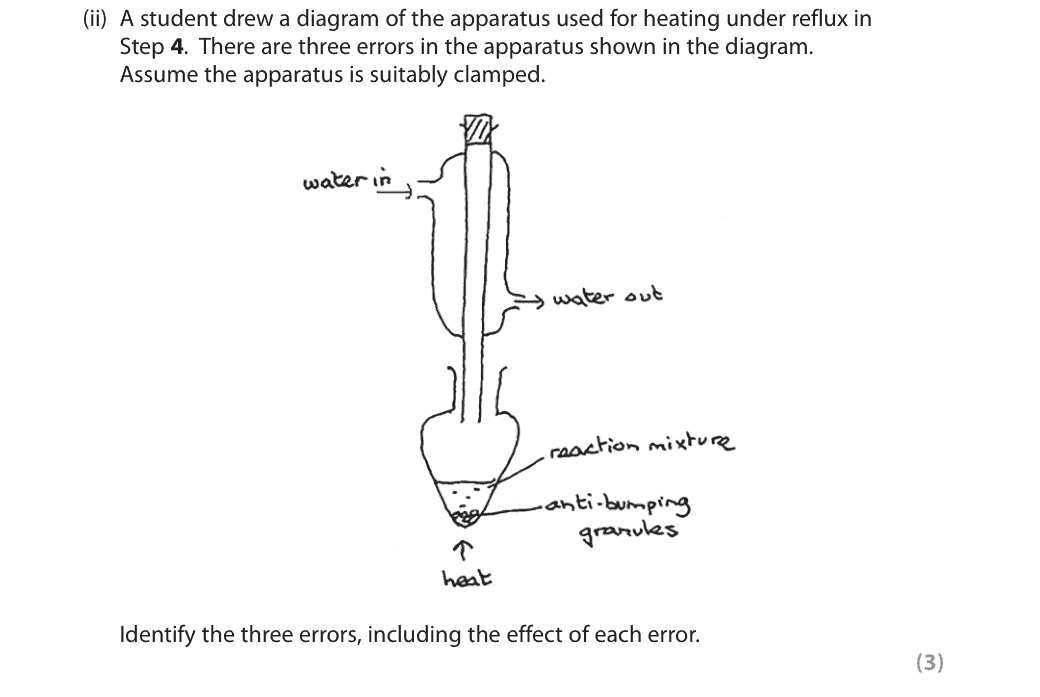
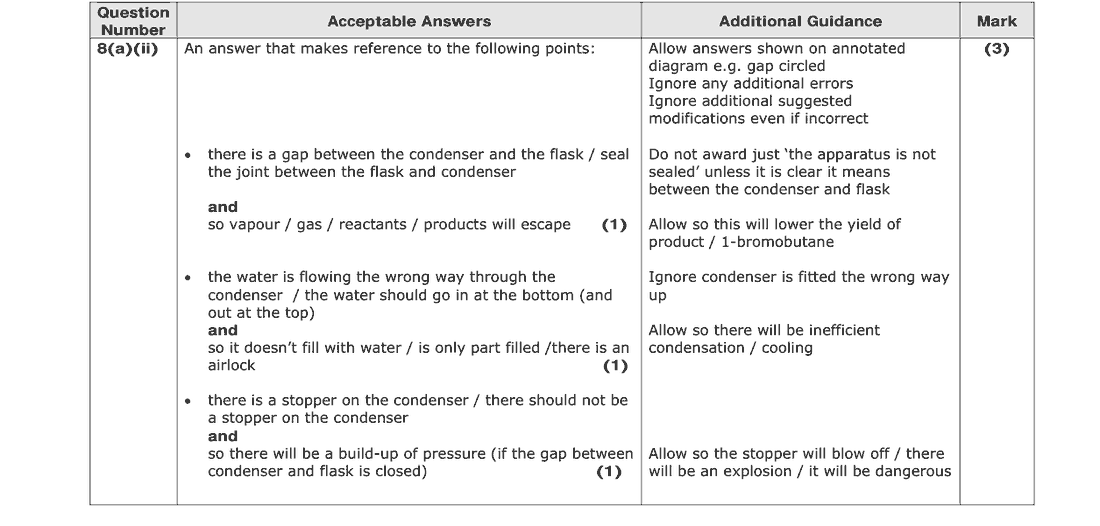
8(a)(ii) Alcohols 3Practical and data analysis
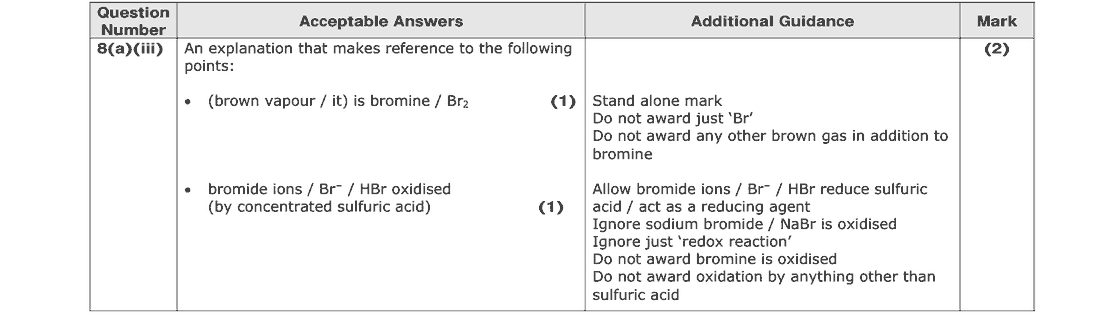
8(a)(iii) The elements of Group 7 (halogens) 2Explanation
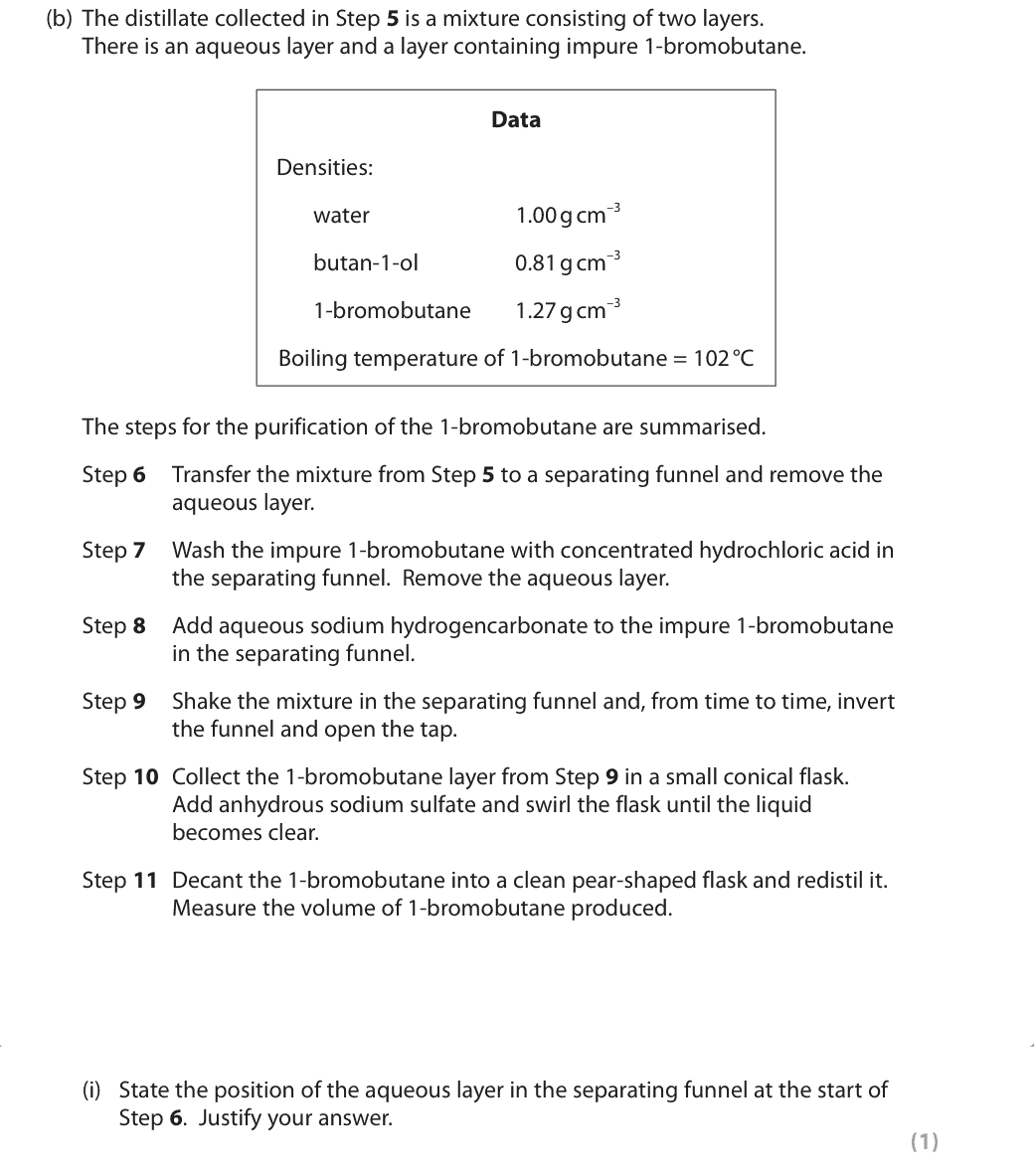
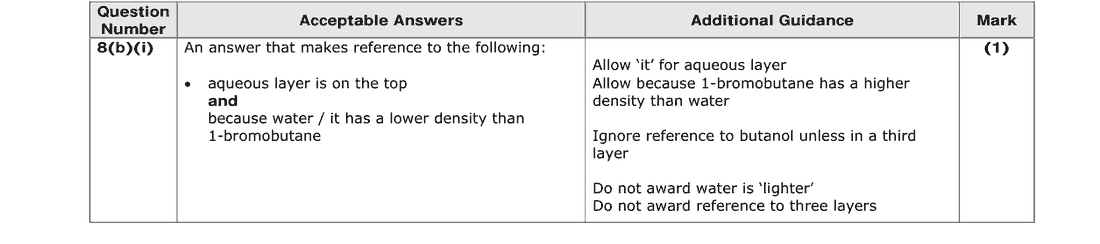
8(b)(i) Alcohols 1Practical and data analysis
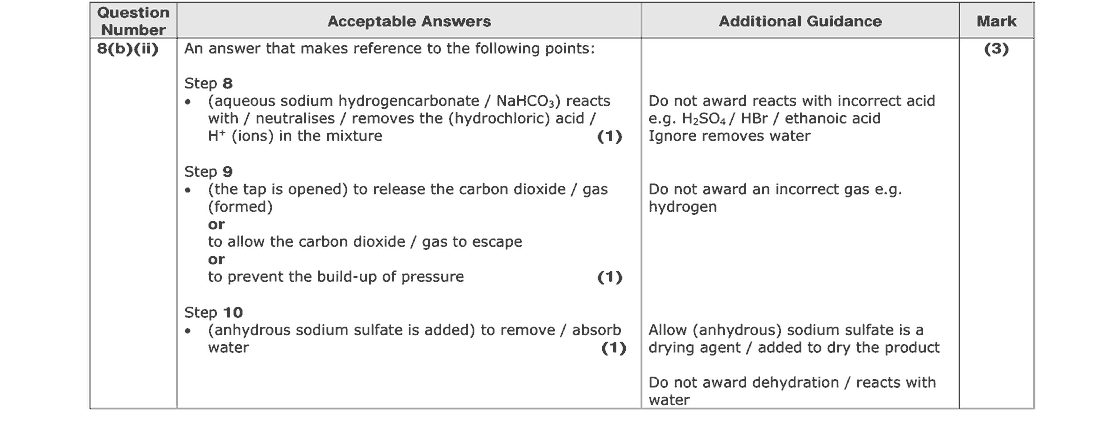
8(b)(ii) Alcohols 3Practical and data analysis
8(b)(iii) Alcohols 1Practical and data analysis
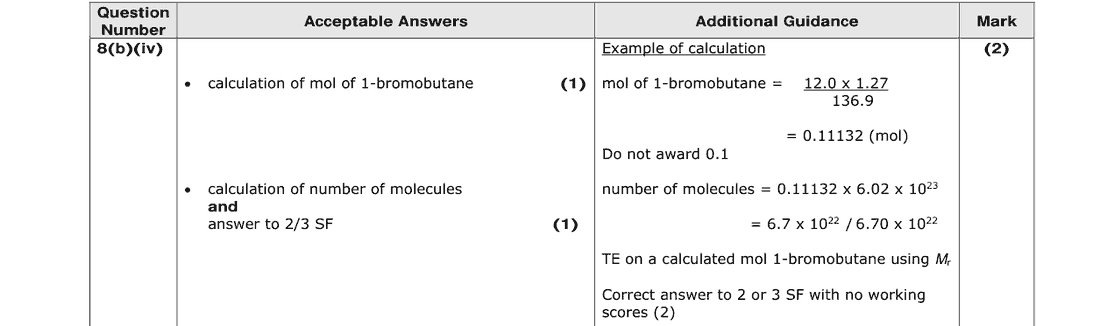
8(b)(iv) Formulae, equations and amounts of substance 2Calculation
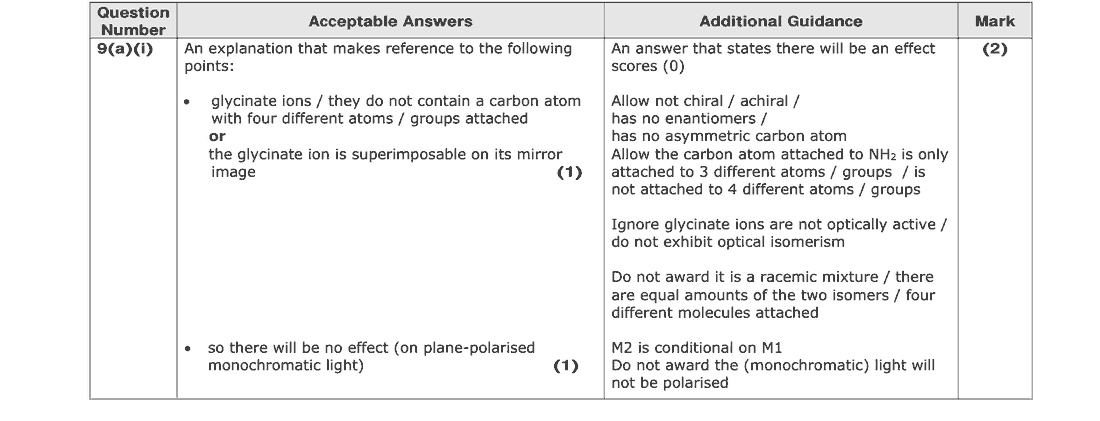
9(a)(i) Amines, amides, amino acids and proteins, Chirality 2Explanation
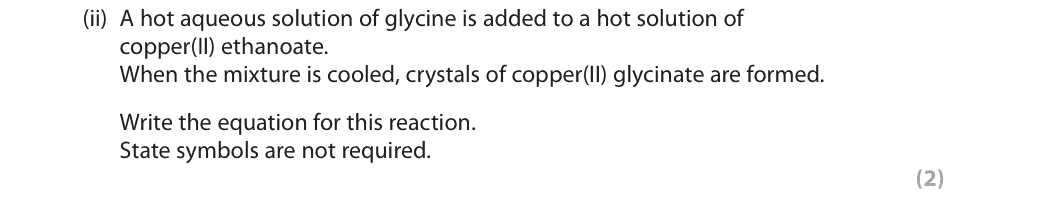
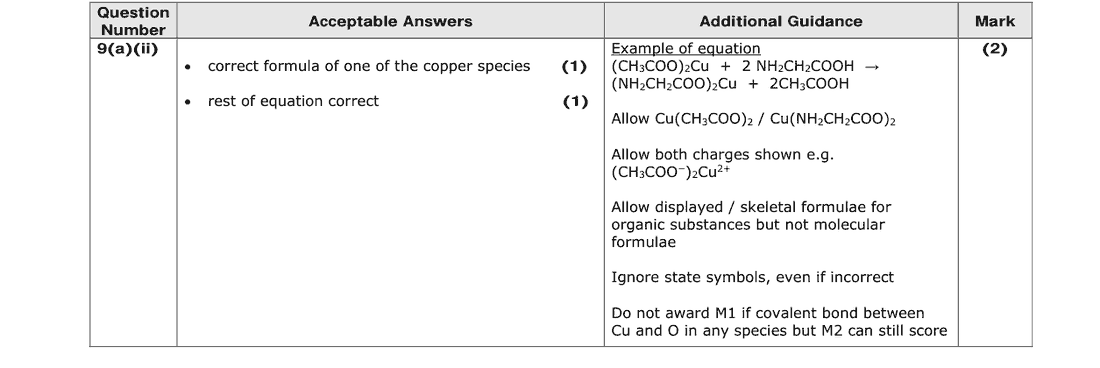
9(a)(ii) Formulae, equations and amounts of substance, Carboxylic acids 2Equation writing
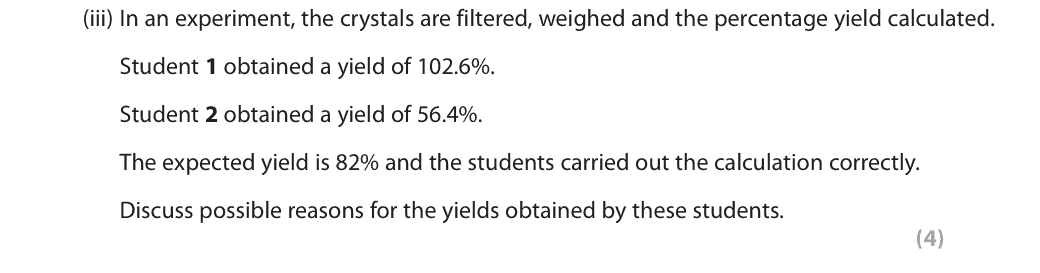
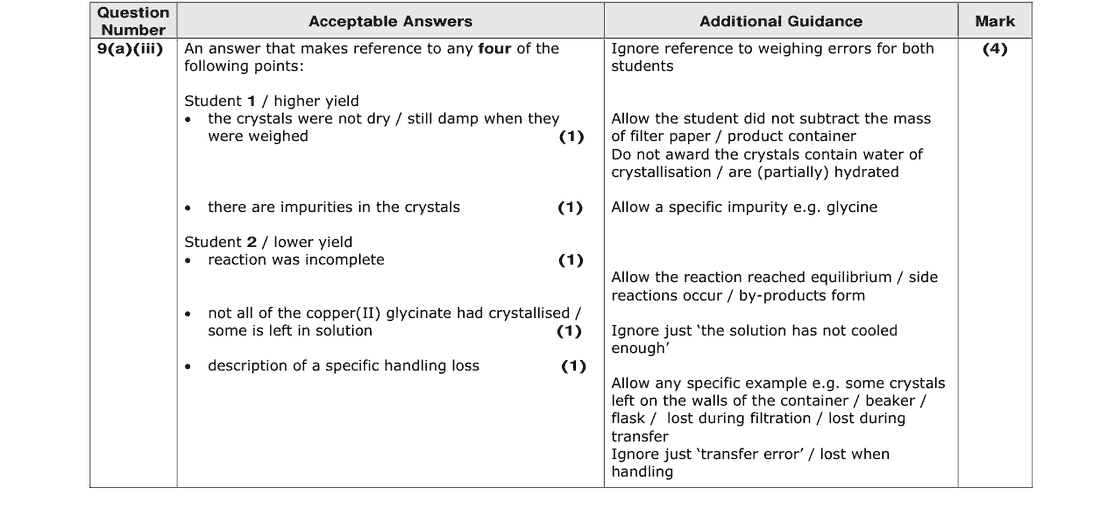
9(a)(iii) Formulae, equations and amounts of substance 4Explanation
9(b) Transition metals: principles 2Explanation
9(c) Organic synthesis 6Extended response
10(a)(i) Organic synthesis 3Explanation
10(a)(ii) Formulae, equations and amounts of substance, Organic synthesis 5Calculation
10(b) Modern analytical techniques I: mass spectrometry and infrared, Organic synthesis 2Short answer
10(c)(i) Modern analytical techniques I: mass spectrometry and infrared 1Short answer
10(c)(ii) Introduction to organic chemistry 2Diagram or structure
10(c)(iii) Modern analytical techniques II: NMR, mass spectrometry and chromatography 3Short answer

The questions

1(a)1(b)1(c)1(d)1(e)2(a)(i)2(a)(ii)2(b)3(a)3(b)4(a)(i)4(a)(ii)4(b)4(c)4(d)5(a)5(b)5(c)5(d)(i)5(d)(ii)5(e)(i)5(e)(ii)6(a)(i)6(a)(ii)6(b)6(c)(i)6(c)(ii)6(c)(iii)6(c)(iv)7(a)(i)7(a)(ii)7(a)(iii)7(a)(iv)7(b)(i)7(b)(ii)8(a)(i)8(a)(ii)8(a)(iii)8(b)(i)8(b)(ii)8(b)(iii)8(b)(iv)9(a)(i)9(a)(ii)9(a)(iii)9(b)9(c)10(a)(i)10(a)(ii)10(b)10(c)(i)10(c)(ii)10(c)(iii)
June 2019 · Paper 3 · Q1(a) 1 mark Short answer acid base equilibria
This question is about acids and bases.
State what is meant by a Brønsted-Lowry acid.
June 2019 · Paper 3 · Q1(b) 1 mark Short answer acid base equilibria
Earlier part of question 1 that this part usesEarlier part of June 2019 Paper 3 question 1
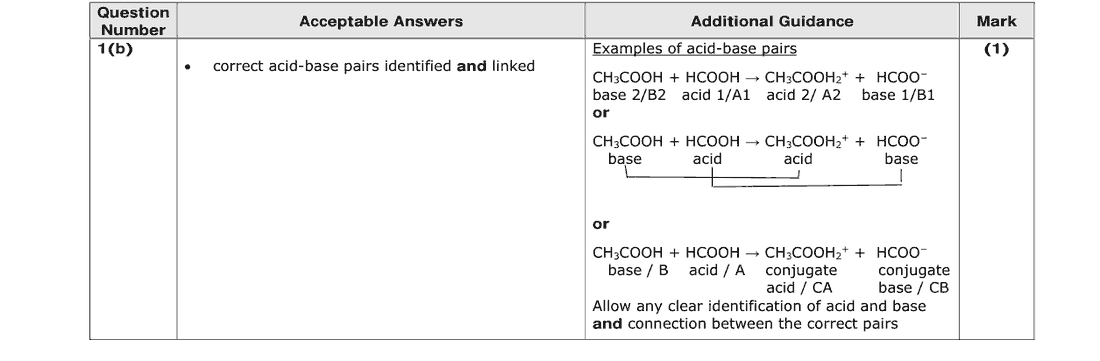
Identify the acid-base conjugate pairs in this reaction.
CH3COOH  +  HCOOH  o  CH3COOH2
+  +  HCOO–
June 2019 · Paper 3 · Q1(c) 1 mark Short answer acid base equilibria
Write the expression that defines the pH of a solution.
June 2019 · Paper 3 · Q1(d) 1 mark Calculation acid base equilibria
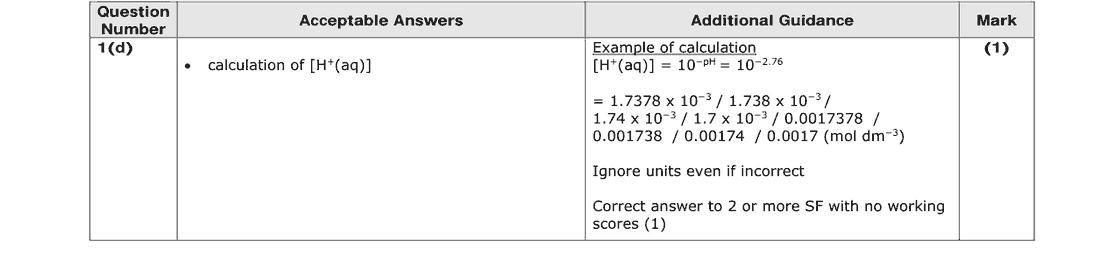
Calculate the concentration of hydrogen ions, in mol dm–3, in a solution with a
pH of 2.76
June 2019 · Paper 3 · Q1(e) 2 marks Explanation acid base equilibria
Earlier part of question 1 that this part usesEarlier part of June 2019 Paper 3 question 1
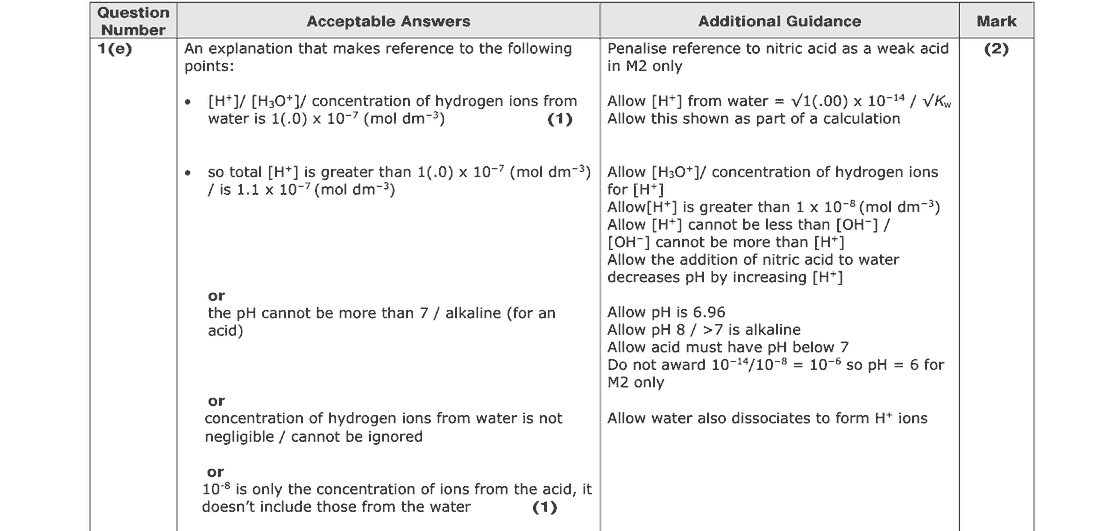
Explain why the pH of a 1 × 10⁻⁸ mol dm–3 solution of nitric acid, HNO3 , is not 8.
[Ionic product of water, Kw = 1.00 × 10⁻¹⁴ mol2 dm–6]
June 2019 · Paper 3 · Q2(a)(i) 1 mark Short answer redox ii
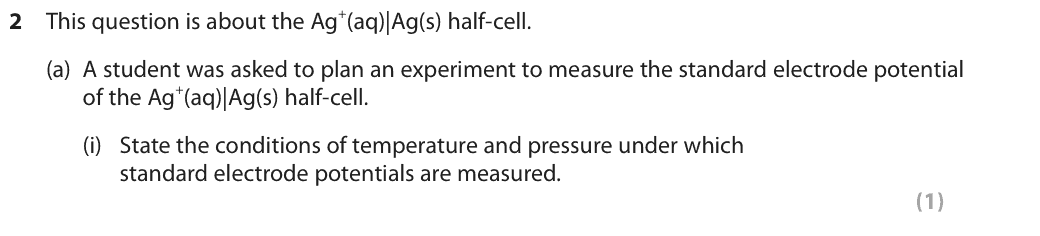
This question is about the Ag+(aq)|Ag(s) half-cell.
A student was asked to plan an experiment to measure the standard electrode potential
of the Ag+(aq)|Ag(s) half-cell.
State the conditions of temperature and pressure under which
standard electrode potentials are measured.
June 2019 · Paper 3 · Q2(a)(ii) 3 marks Practical and data analysis redox ii
Earlier part of question 2 that this part usesEarlier part of June 2019 Paper 3 question 2
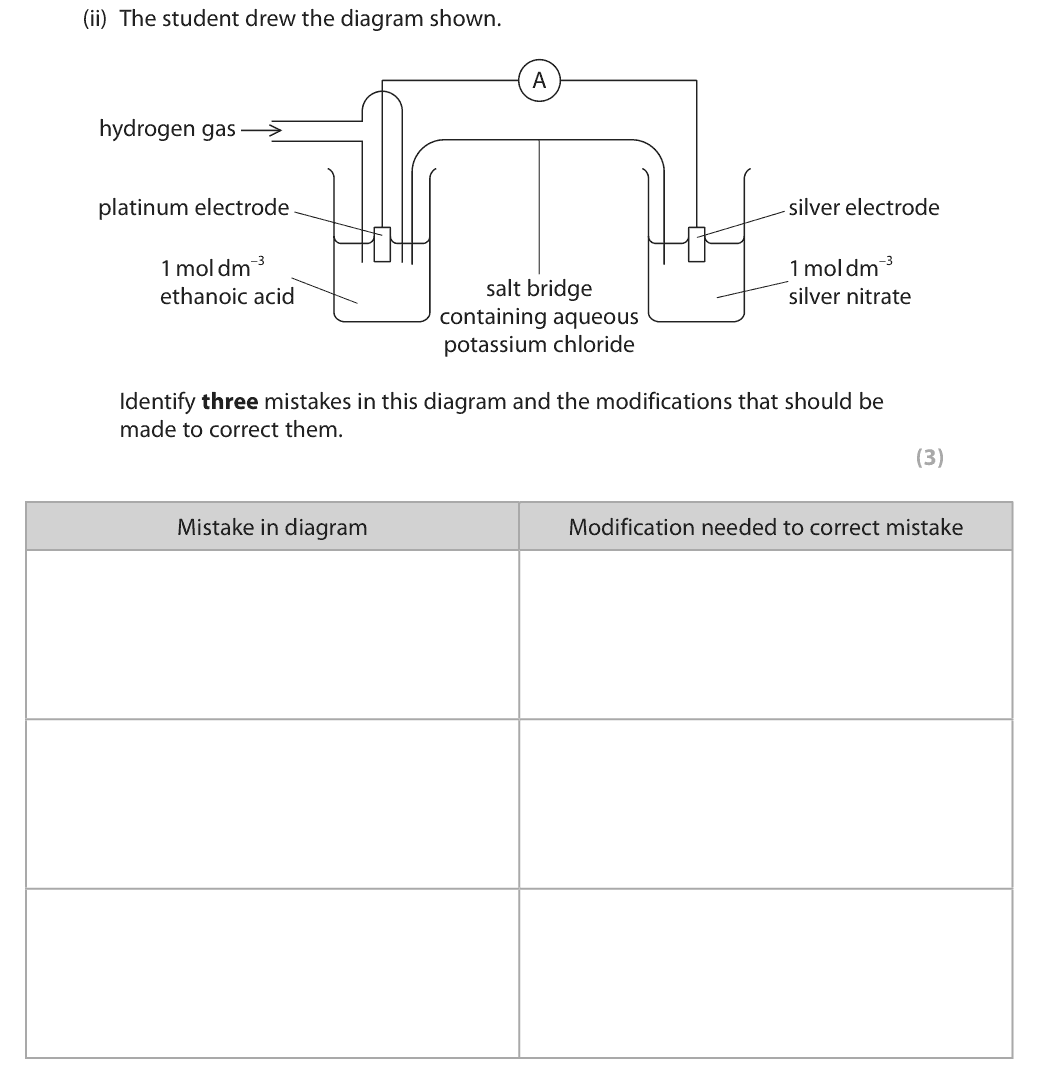
The student drew the diagram shown.
A
hydrogen gas
platinum electrode
silver electrode
1 mol dm–3
1 mol dm–3
salt bridge
ethanoic acid
silver nitrate
containing aqueous
potassium chloride
Identify three mistakes in this diagram and the modifications that should be
made to correct them.
Mistake in diagram
Modification needed to correct mistake
June 2019 · Paper 3 · Q2(b) 3 marks Calculation redox ii
Earlier part of question 2 that this part usesEarlier part of June 2019 Paper 3 question 2
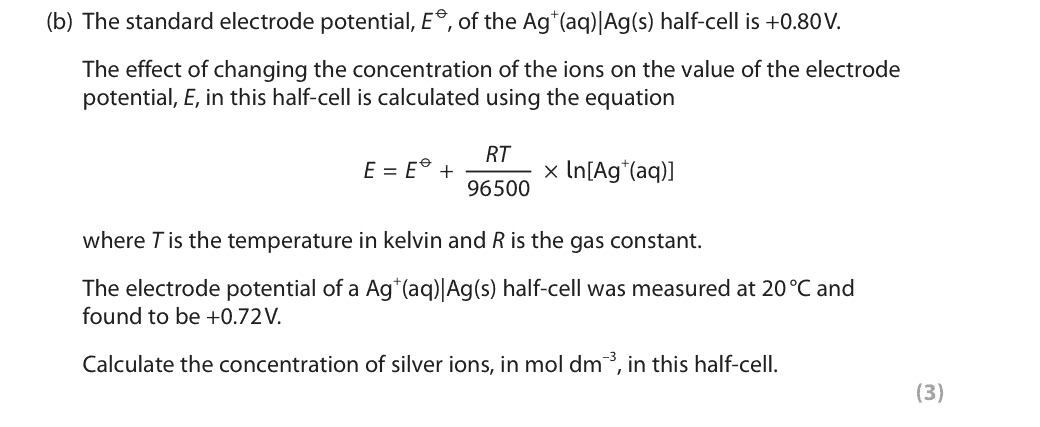
The standard electrode potential, E , of the Ag+(aq)|Ag(s) half-cell is +0.80 V.
The effect of changing the concentration of the ions on the value of the electrode
potential, E, in this half-cell is calculated using the equation
RT
E = E  +
96500 × ln[Ag+(aq)]
where T is the temperature in kelvin and R is the gas constant.
The electrode potential of a Ag+(aq)|Ag(s) half-cell was measured at 20 °C and
found to be +0.72 V.
Calculate the concentration of silver ions, in mol dm–3, in this half-cell.
June 2019 · Paper 3 · Q3(a) 5 marks Short answer organic synthesishalogenoalkanescarboxylic acids
This question is about esters with the molecular formula C6H12O2.
Propyl propanoate has the structure shown.
H
H
O
H
H
H
H
C
C
C
O
C
C
C
H
H
H
H
H
H
Devise a synthetic pathway to prepare propyl propanoate starting with
1-bromopropane as the only organic compound.
Include the reagents for each step in the synthesis, and the names or structures of
the intermediate compounds.
June 2019 · Paper 3 · Q3(b) 3 marks Diagram or structure organic synthesiscarboxylic acids
Earlier part of question 3 that this part usesEarlier part of June 2019 Paper 3 question 3
Another ester, A, with molecular formula C6H12O2, was hydrolysed.
It produced ethanoic acid, and an alcohol, B, with molecular formula C4H10O.
Alcohol B undergoes an elimination reaction to produce a mixture of
but-1-ene and but-2-ene.
Deduce the structures of B and A.  Justify your structure of B.
June 2019 · Paper 3 · Q4(a)(i) 6 marks Practical and data analysis analysis of inorganic compoundstransition metals reactions
Compound C is a pink crystalline solid containing two cations and one anion.
Three tests were carried out on C.  The observation made for each test was
recorded in the table.
Complete the statements in the inference column by writing the names or
formulae of the species.
Test
Observation
Inference
Test 1
The gas evolved was
Aqueous sodium hydroxide was
added to solid C and the mixture
warmed
One of the cations in C is
The gas evolved was tested with
The red litmus
damp red litmus paper
paper turned blue
The other cation in C is
Test 2
The pink solution
Concentrated hydrochloric acid
The formula of the complex
turned blue
was added to an aqueous
ion in the blue solution is
solution of C
The white precipitate is
Test 3
Dilute hydrochloric acid and
A white precipitate
aqueous barium chloride were
formed
The anion in C is
added to an aqueous solution
of C
June 2019 · Paper 3 · Q4(a)(ii) 1 mark Short answer redox i
Earlier part of question 4 that this part usesEarlier part of June 2019 Paper 3 question 4
Use the results of the tests in (a)(i) to give a formula of C.
Do not include water of crystallisation.
June 2019 · Paper 3 · Q4(b) 1 mark Equation writing Hard analysis of inorganic compoundsformulae equations and amounts of substance
Earlier part of question 4 that this part usesEarlier part of June 2019 Paper 3 question 4
Write the ionic equation for the reaction between the cation in C and
sodium hydroxide producing the gas in Test 1.
State symbols are not required.
June 2019 · Paper 3 · Q4(c) 1 mark Short answer transition metals reactions
Earlier part of question 4 that this part usesEarlier part of June 2019 Paper 3 question 4
State the type of reaction occurring in Test 2.
June 2019 · Paper 3 · Q4(d) 1 mark Practical and data analysis analysis of inorganic compounds
Earlier part of question 4 that this part usesEarlier part of June 2019 Paper 3 question 4
Give a reason why dilute hydrochloric acid is needed in Test 3.
June 2019 · Paper 3 · Q5(a) 1 mark Short answer Hard redox i
This question is about redox reactions.
3–.  Include the relevant oxidation number.
Name the ion with formula PO3
June 2019 · Paper 3 · Q5(b) 1 mark Short answer redox i
Earlier part of question 5 that this part usesEarlier part of June 2019 Paper 3 question 5
State what happens to a reducing agent during a reaction, in terms of oxidation number
and electrons.
June 2019 · Paper 3 · Q5(c) 1 mark Short answer redox ii
Earlier part of question 5 that this part usesEarlier part of June 2019 Paper 3 question 5
Identify the species that is the strongest reducing agent from the list of standard
electrode potentials in the Data Booklet.
– , react in alkaline
June 2019 · Paper 3 · Q5(d)(i) 2 marks Equation writing Hard redox i
Earlier part of question 5 that this part usesEarlier part of June 2019 Paper 3 question 5
Manganese(IV) oxide, MnO2 , and manganate(VII) ions, MnO4
solution to form manganate(VI) ions, MnO4
2–.
Write the ionic equation for this reaction.
State symbols are not required.
June 2019 · Paper 3 · Q5(d)(ii) 1 mark Short answer redox i
Earlier parts of question 5 that this part usesEarlier part of June 2019 Paper 3 question 5Earlier part of June 2019 Paper 3 question 5
Give a reason why this reaction is not disproportionation.
June 2019 · Paper 3 · Q5(e)(i) 1 mark Diagram or structure bonding
Earlier part of question 5 that this part usesEarlier part of June 2019 Paper 3 question 5
Sodium tetrahydridoborate(III), NaBH4, is used in organic chemistry.
It is an alternative reagent to lithium tetrahydridoaluminate(III) for the reduction
of carbonyl compounds.
– ion.
Draw a dot-and-cross diagram of the BH4
Use crosses (×) for the boron electrons, dots (•) for the hydrogen electrons and
triangles ( V ) for the additional electron forming the negative ion.
– ions reduce carbonyl compounds to alcohols in aqueous solution.
June 2019 · Paper 3 · Q5(e)(ii) 4 marks Mechanism carbonyl compounds
Earlier parts of question 5 that this part usesEarlier part of June 2019 Paper 3 question 5Earlier part of June 2019 Paper 3 question 5
The BH4
Complete the mechanism for the reduction of propanone to propan-2-ol by
adding curly arrows, and any relevant lone pairs and dipoles.
O–
O
H3C
C
CH3
H3C
C
CH3   +   BH3
H
–
H
H
B
H
H
O
H
H
O–
OH
H3C
C
CH3
H3C
C
CH3   +   OH–
H
H
June 2019 · Paper 3 · Q6(a)(i) 1 mark Short answer transition metals principles
This question is about transition metals and their ions.
The shape of a complex ion formed from Cr3+ ions is shown.
Cl
H2N
NH2
H2C
CH2
Cr
H2C
CH2
H2N
NH2
Cl
State the coordination number of Cr3+ in this complex ion.
June 2019 · Paper 3 · Q6(a)(ii) 1 mark Short answer transition metals principles
Earlier part of question 6 that this part usesEarlier part of June 2019 Paper 3 question 6
State the overall charge on this complex ion.
June 2019 · Paper 3 · Q6(b) 3 marks Short answer transition metals principlestransition metals reactions
The complex ions of transition metals have different colours in aqueous solution.
Two factors that affect the colour of the solution are the oxidation number of the
central metal ion, and the ligands present.
Give examples to illustrate these factors by referring to complex ions
of iron and/or copper.  Include the formula and colour of each complex.
An explanation of why transition metal ions are coloured is not required.
June 2019 · Paper 3 · Q6(c)(i) 2 marks Diagram or structure kinetics ii
Earlier part of question 6 that this part usesEarlier part of June 2019 Paper 3 question 6
Tungsten wire catalyses the decomposition of ammonia.
2NH3(g) o N2(g) + 3H2(g)
In an experiment, the following results were obtained.
Time /s
Partial pressure of ammonia / kPa
0
0.350
100
0.335
200
0.319
300
0.303
400
0.287
500
0.271
Plot a graph of partial pressure of ammonia against time.
June 2019 · Paper 3 · Q6(c)(ii) 2 marks Short answer kinetics ii
Earlier parts of question 6 that this part usesEarlier part of June 2019 Paper 3 question 6Earlier part of June 2019 Paper 3 question 6
Deduce the rate equation for this reaction by using your graph in (c)(i).
Justify your answer.
June 2019 · Paper 3 · Q6(c)(iii) 2 marks Calculation kinetics iikinetics i
Earlier parts of question 6 that this part usesEarlier part of June 2019 Paper 3 question 6Earlier part of June 2019 Paper 3 question 6Earlier part of June 2019 Paper 3 question 6
Use the graph to calculate the rate constant.  Include units in your answer.
June 2019 · Paper 3 · Q6(c)(iv) 3 marks Short answer transition metals reactions
Earlier part of question 6 that this part usesEarlier part of June 2019 Paper 3 question 6
Describe the stages in the catalytic decomposition of ammonia by tungsten.
June 2019 · Paper 3 · Q7(a)(i) 2 marks Diagram or structure redox ii
A group of students analysed a hydrated salt with the formula KH3(C2O4)y. zH2O
where y and z are whole numbers.
The students carried out experiments to determine the values of y and z.
Experiment 1 – to determine the value of y
One student was provided with a 0.0235 mol dm–3 solution of the salt.
25.0 cm3 portions of the salt solution were acidified with excess dilute sulfuric acid
and heated to about 60 °C.
Each portion was titrated with 0.0203 mol dm–3 potassium manganate(VII).
The results of four titrations are shown in the table.
Titration number
1
2
3
4
Final burette reading / cm3
23.85
47.20
24.05
48.10
Initial burette reading / cm3
0.00
24.00
0.50
25.00
Titre / cm3
23.85
23.20
23.55
23.10
Complete the diagram to show the final burette reading in Titration 1.
22
23
24
June 2019 · Paper 3 · Q7(a)(ii) 2 marks Explanation redox ii
Earlier part of question 7 that this part usesEarlier part of June 2019 Paper 3 question 7
Explain why this student should use a mean titre of 23.15 cm3 and not
23.43 cm3 in the calculation.
June 2019 · Paper 3 · Q7(a)(iii) 1 mark Calculation formulae equations and amounts of substance
Earlier part of question 7 that this part usesEarlier part of June 2019 Paper 3 question 7
The uncertainty in each burette reading is ±0.05 cm3.
Calculate the percentage uncertainty in the titre volume of
potassium manganate(VII) solution used in Titration 2.
June 2019 · Paper 3 · Q7(a)(iv) 4 marks Calculation redox iiformulae equations and amounts of substance
Earlier part of question 7 that this part usesEarlier part of June 2019 Paper 3 question 7
The equation for the reaction is
2– + 16H+ o 2Mn2+ + 10CO2 + 8H2O
2MnO4
– + 5C2O4
Deduce, by calculation, the value of y, to the nearest whole number, in the
formula KH3(C2O4)y. zH2O.
Use the mean titre of 23.15 cm3 and other data from Experiment 1.
You must show your working.
June 2019 · Paper 3 · Q7(b)(i) 3 marks Calculation formulae equations and amounts of substance
Earlier parts of question 7 that this part usesEarlier part of June 2019 Paper 3 question 7Earlier part of June 2019 Paper 3 question 7
Experiment 2 – to determine the value of z
Another student wrote an account of the method for this experiment.
A crucible was weighed.
A sample of the hydrated salt was added to the crucible and it was reweighed.
The crucible and salt were heated to remove the water of crystallisation and
then allowed to cool.
The crucible and contents were weighed again.
Results
Mass of crucible
= 19.56 g
Mass of crucible + KH3(C2O4) y.zH2O
= 22.97 g
Mass of crucible + KH3(C2O4) y
= 22.52 g
Deduce, by calculation, the value of z, to the nearest whole number, in the
formula KH3(C2O4)y. zH2O.
You must use the data from Experiment 2 and your value of y in (a)(iv).
You must show your working.
June 2019 · Paper 3 · Q7(b)(ii) 5 marks Explanation formulae equations and amounts of substance
Earlier parts of question 7 that this part usesEarlier part of June 2019 Paper 3 question 7Earlier part of June 2019 Paper 3 question 7
A third student carried out Experiment 2 and calculated a value of z that was
lower than expected.
This student evaluated the experiment and gave two suggestions for z being lower.
Suggestion 1
“Some of the crystals jumped out of the crucible while it was being heated.”
Suggestion 2
“It was difficult to tell when all the water of crystallisation had been lost.”
Evaluate these two suggestions to decide whether they could account for the
lower value of z obtained from the experimental results.
Include an explanation of the effect each suggestion would have on the calculated
value of z and how the method could be improved to prevent these errors.
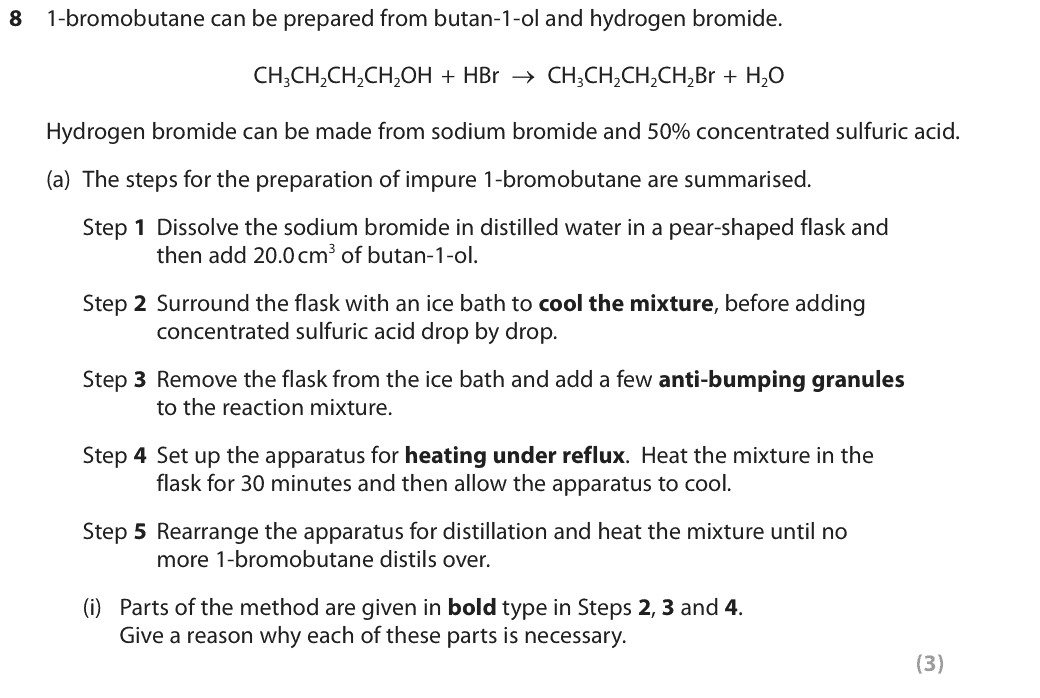
June 2019 · Paper 3 · Q8(a)(i) 3 marks Practical and data analysis alcohols
1-bromobutane can be prepared from butan-1-ol and hydrogen bromide.
CH3CH2CH2CH2OH + HBr o CH3CH2CH2CH2Br + H2O
Hydrogen bromide can be made from sodium bromide and 50% concentrated sulfuric acid.
The steps for the preparation of impure 1-bromobutane are summarised.
Step 1 Dissolve the sodium bromide in distilled water in a pear-shaped flask and
then add 20.0 cm3 of butan-1-ol.
Step 2 Surround the flask with an ice bath to cool the mixture, before adding
concentrated sulfuric acid drop by drop.
Step 3 Remove the flask from the ice bath and add a few anti-bumping granules
to the reaction mixture.
Step 4 Set up the apparatus for heating under reflux.  Heat the mixture in the
flask for 30 minutes and then allow the apparatus to cool.
Step 5 Rearrange the apparatus for distillation and heat the mixture until no
more 1-bromobutane distils over.
Parts of the method are given in bold type in Steps 2, 3 and 4.
Give a reason why each of these parts is necessary.
June 2019 · Paper 3 · Q8(a)(ii) 3 marks Practical and data analysis alcohols
Earlier part of question 8 that this part usesEarlier part of June 2019 Paper 3 question 8
A student drew a diagram of the apparatus used for heating under reflux in
Step 4.  There are three errors in the apparatus shown in the diagram.
Assume the apparatus is suitably clamped.
Identify the three errors, including the effect of each error.
June 2019 · Paper 3 · Q8(a)(iii) 2 marks Explanation group 7 the halogens
Earlier part of question 8 that this part usesEarlier part of June 2019 Paper 3 question 8
The student corrected the errors.
While the mixture was heating under reflux, the student noticed a small
amount of a brown vapour was formed.
Explain why the brown vapour forms.
June 2019 · Paper 3 · Q8(b)(i) 1 mark Practical and data analysis alcohols
Earlier part of question 8 that this part usesEarlier part of June 2019 Paper 3 question 8
The distillate collected in Step 5 is a mixture consisting of two layers.
There is an aqueous layer and a layer containing impure 1-bromobutane.
Data
Densities:
1.00 g cm–3
water
0.81 g cm–3
butan-1-ol
1.27 g cm–3
1-bromobutane
Boiling temperature of 1-bromobutane = 102 °C
The steps for the purification of the 1-bromobutane are summarised.
Step 6
Transfer the mixture from Step 5 to a separating funnel and remove the
aqueous layer.
Step 7
Wash the impure 1-bromobutane with concentrated hydrochloric acid in
the separating funnel.  Remove the aqueous layer.
Step 8
Add aqueous sodium hydrogencarbonate to the impure 1-bromobutane
in the separating funnel.
Step 9
Shake the mixture in the separating funnel and, from time to time, invert
the funnel and open the tap.
Step 10 Collect the 1-bromobutane layer from Step 9 in a small conical flask.
Add anhydrous sodium sulfate and swirl the flask until the liquid
becomes clear.
Step 11 Decant the 1-bromobutane into a clean pear-shaped flask and redistil it.
Measure the volume of 1-bromobutane produced.
State the position of the aqueous layer in the separating funnel at the start of
Step 6.  Justify your answer.
June 2019 · Paper 3 · Q8(b)(ii) 3 marks Practical and data analysis alcohols
Earlier parts of question 8 that this part usesEarlier part of June 2019 Paper 3 question 8Earlier part of June 2019 Paper 3 question 8
Concentrated hydrochloric acid is used to remove any unreacted butan-1-ol in
the mixture in Step 7.
Give the reasons for carrying out Steps 8, 9 and 10.
June 2019 · Paper 3 · Q8(b)(iii) 1 mark Practical and data analysis alcohols
Earlier parts of question 8 that this part usesEarlier part of June 2019 Paper 3 question 8Earlier part of June 2019 Paper 3 question 8
Give a suitable temperature range over which to collect the pure
1-bromobutane in the redistillation in Step 11.
June 2019 · Paper 3 · Q8(b)(iv) 2 marks Calculation Hard formulae equations and amounts of substance
Earlier parts of question 8 that this part usesEarlier part of June 2019 Paper 3 question 8Earlier part of June 2019 Paper 3 question 8Earlier part of June 2019 Paper 3 question 8Earlier part of June 2019 Paper 3 question 8
The volume of 1-bromobutane collected was 12.0 cm3.
Calculate the number of molecules of 1-bromobutane produced in this experiment.
Give your answer to an appropriate number of significant figures.
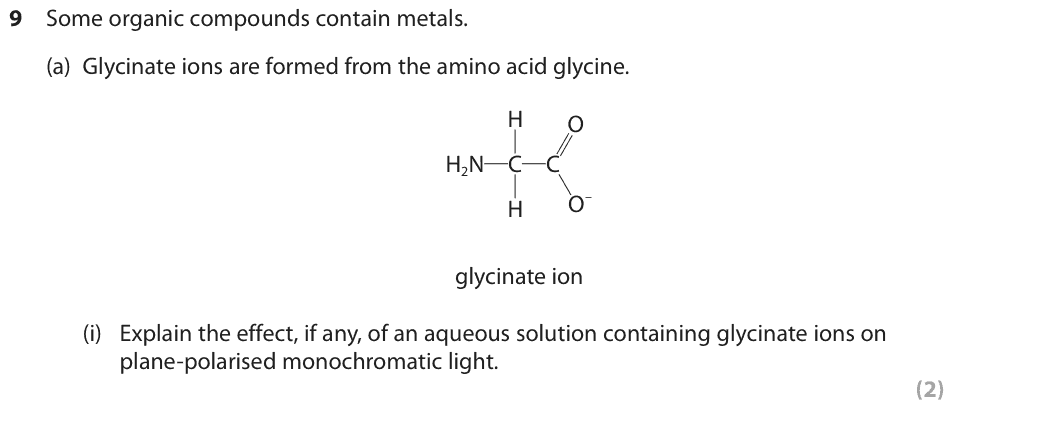
June 2019 · Paper 3 · Q9(a)(i) 2 marks Explanation amines amides amino acids and proteinschirality
Some organic compounds contain metals.
Glycinate ions are formed from the amino acid glycine.
H
O
H2N
C
C
O–
H
glycinate ion
Explain the effect, if any, of an aqueous solution containing glycinate ions on
plane-polarised monochromatic light.
June 2019 · Paper 3 · Q9(a)(ii) 2 marks Equation writing Hard formulae equations and amounts of substancecarboxylic acids
Earlier part of question 9 that this part usesEarlier part of June 2019 Paper 3 question 9
A hot aqueous solution of glycine is added to a hot solution of
copper(II) ethanoate.
When the mixture is cooled, crystals of copper(II) glycinate are formed.
Write the equation for this reaction.
State symbols are not required.
June 2019 · Paper 3 · Q9(a)(iii) 4 marks Explanation formulae equations and amounts of substance
Earlier part of question 9 that this part usesEarlier part of June 2019 Paper 3 question 9
In an experiment, the crystals are filtered, weighed and the percentage yield calculated.
Student 1 obtained a yield of 102.6%.
Student 2 obtained a yield of 56.4%.
The expected yield is 82% and the students carried out the calculation correctly.
Discuss possible reasons for the yields obtained by these students.
June 2019 · Paper 3 · Q9(b) 2 marks Explanation transition metals principles
Earlier part of question 9 that this part usesEarlier part of June 2019 Paper 3 question 9
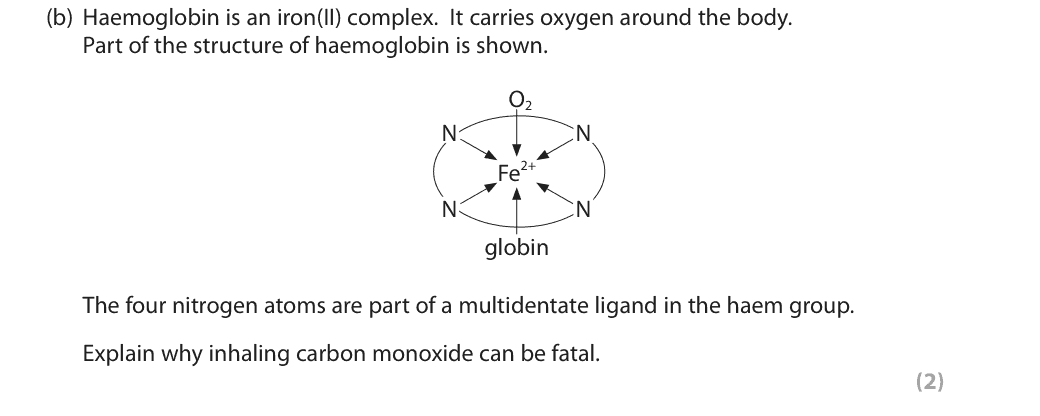
Haemoglobin is an iron(II) complex.  It carries oxygen around the body.
Part of the structure of haemoglobin is shown.
O2
N
N
Fe2+
N
N
globin
The four nitrogen atoms are part of a multidentate ligand in the haem group.
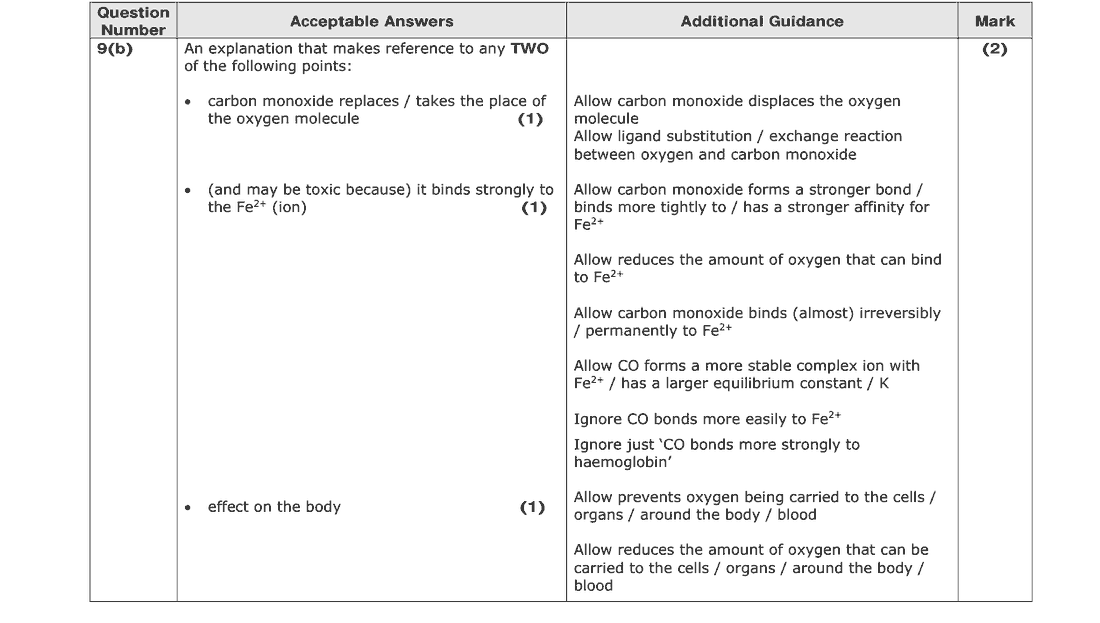
Explain why inhaling carbon monoxide can be fatal.
June 2019 · Paper 3 · Q9(c) 6 marks 6-mark extended response organic synthesis
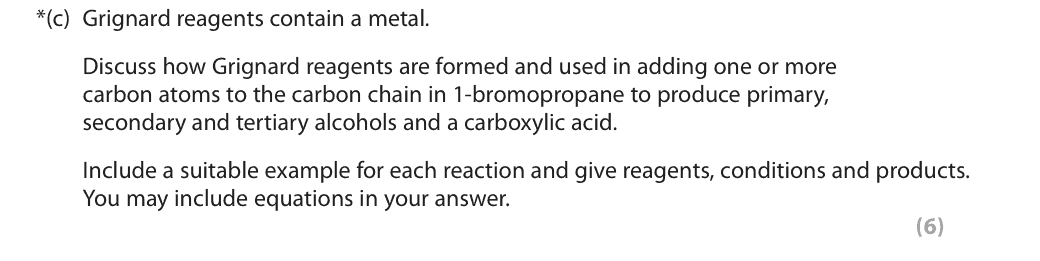
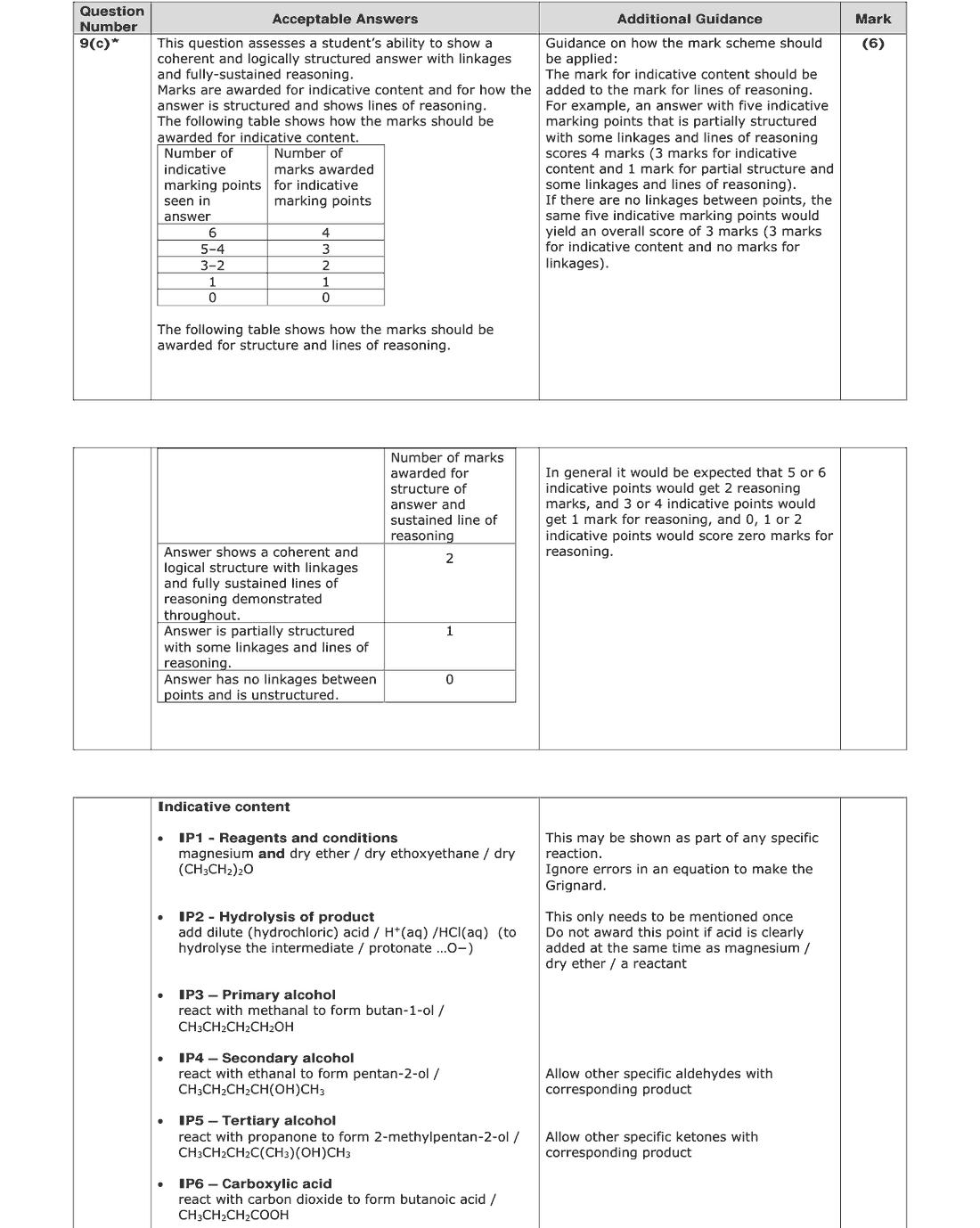
Grignard reagents contain a metal.
Discuss how Grignard reagents are formed and used in adding one or more
carbon atoms to the carbon chain in 1-bromopropane to produce primary,
secondary and tertiary alcohols and a carboxylic acid.
Include a suitable example for each reaction and give reagents, conditions and products.
You may include equations in your answer.
June 2019 · Paper 3 · Q10(a)(i) 3 marks Explanation organic synthesis
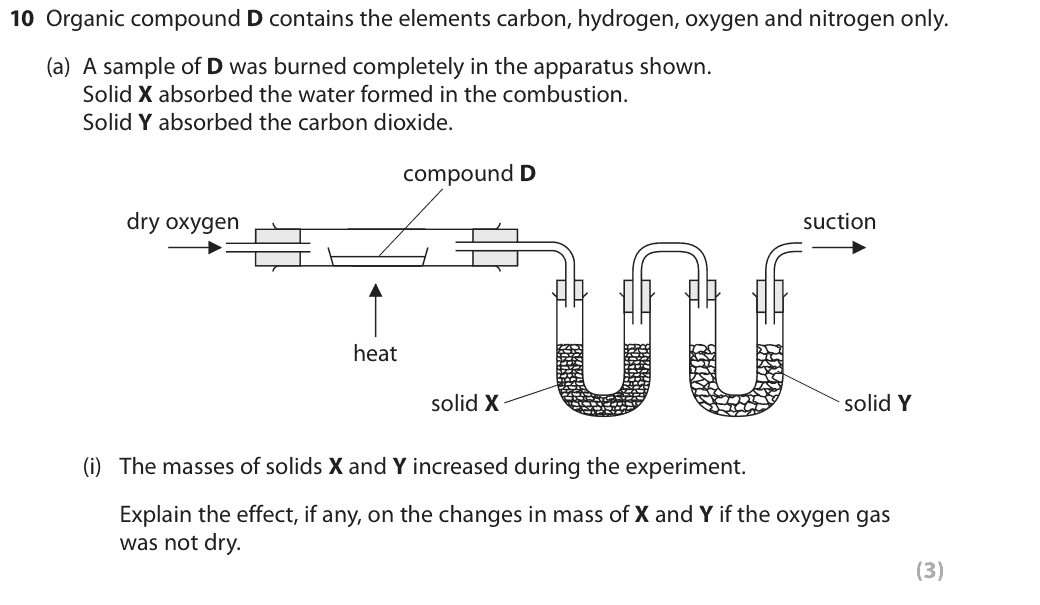
Organic compound D contains the elements carbon, hydrogen, oxygen and nitrogen only.
A sample of D was burned completely in the apparatus shown.
Solid X absorbed the water formed in the combustion.
Solid Y absorbed the carbon dioxide.
compound D
dry oxygen
suction
heat
solid X
solid Y
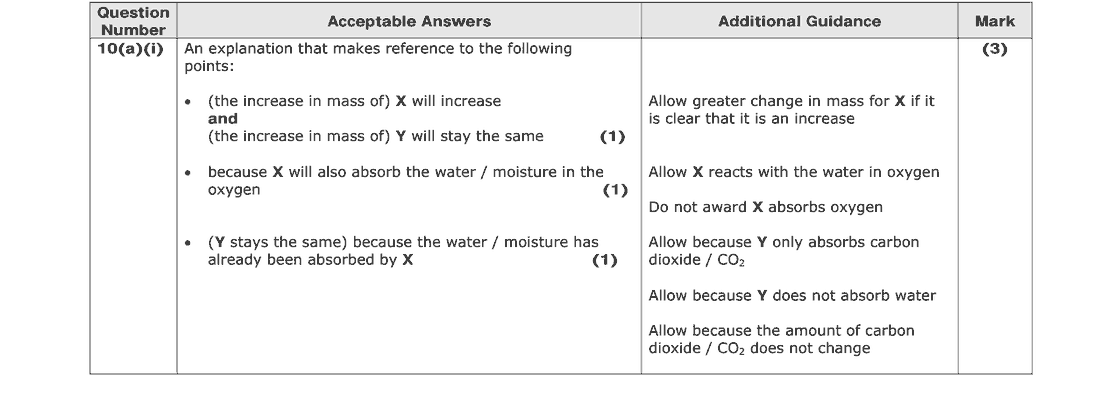
The masses of solids X and Y increased during the experiment.
Explain the effect, if any, on the changes in mass of X and Y if the oxygen gas
was not dry.
June 2019 · Paper 3 · Q10(a)(ii) 5 marks Calculation formulae equations and amounts of substanceorganic synthesis
Earlier part of question 10 that this part usesEarlier part of June 2019 Paper 3 question 10
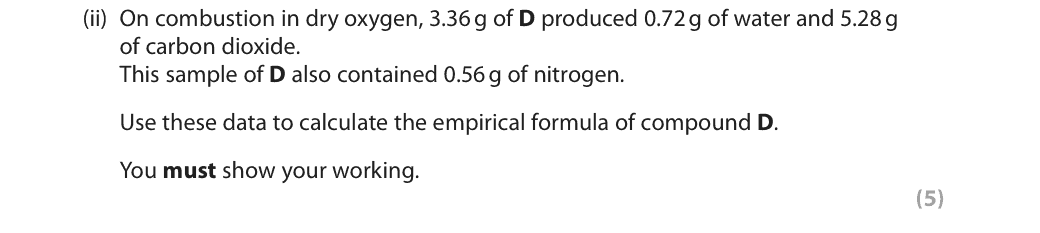
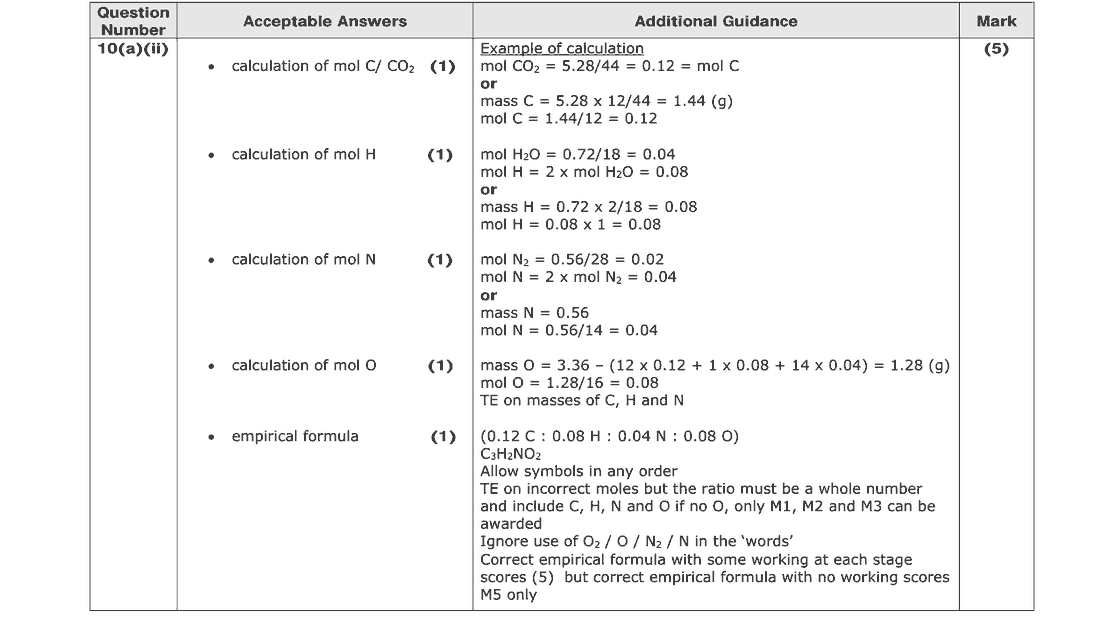
On combustion in dry oxygen, 3.36 g of D produced 0.72 g of water and 5.28 g
of carbon dioxide.
This sample of D also contained 0.56 g of nitrogen.
Use these data to calculate the empirical formula of compound D.
You must show your working.
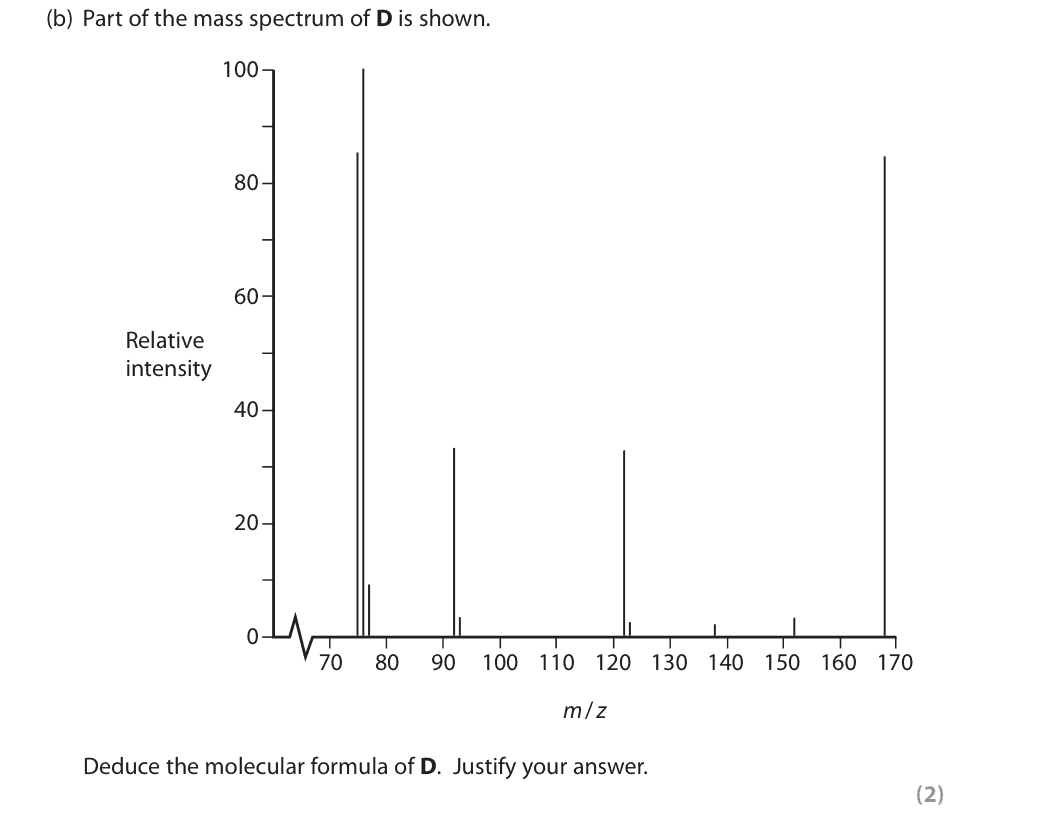
June 2019 · Paper 3 · Q10(b) 2 marks Short answer mass spectrometry and infrared spectroscopyorganic synthesis
Earlier part of question 10 that this part usesEarlier part of June 2019 Paper 3 question 10
Part of the mass spectrum of D is shown.
100
80
60
Relative
intensity
40
20
0
70
80
90
100
110
120
130
140
150
160
170
m / z
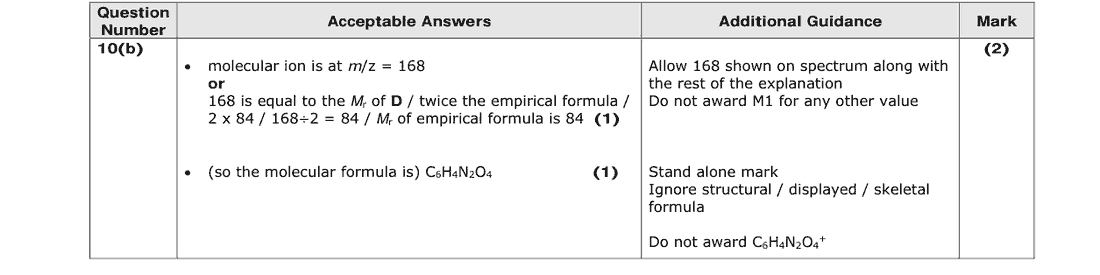
Deduce the molecular formula of D.  Justify your answer.
June 2019 · Paper 3 · Q10(c)(i) 1 mark Short answer mass spectrometry and infrared spectroscopy
Earlier part of question 10 that this part usesEarlier part of June 2019 Paper 3 question 10
Compound D contains a benzene ring.
Give the molecular formula of the species that causes the peak at  m / z = 76 in
the mass spectrum of D.
June 2019 · Paper 3 · Q10(c)(ii) 2 marks Diagram or structure introduction to organic chemistry
Earlier parts of question 10 that this part usesEarlier part of June 2019 Paper 3 question 10Earlier part of June 2019 Paper 3 question 10
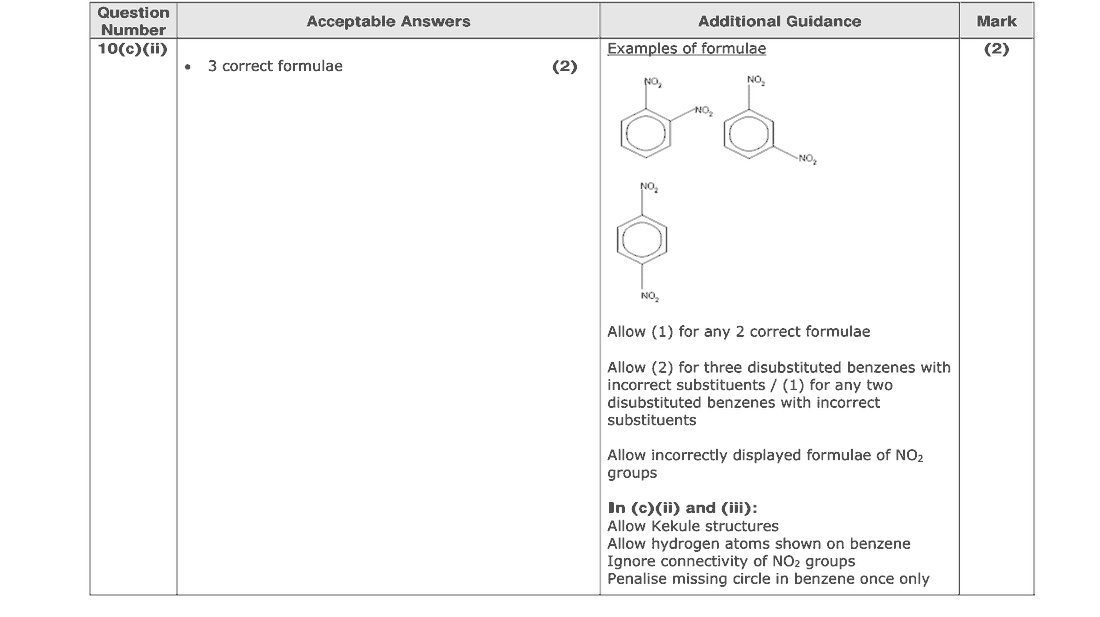
Draw the structures of the three possible isomers of D containing a
benzene ring.
June 2019 · Paper 3 · Q10(c)(iii) 3 marks Short answer nmr mass spectrometry and chromatography
Earlier parts of question 10 that this part usesEarlier part of June 2019 Paper 3 question 10Earlier part of June 2019 Paper 3 question 10Earlier part of June 2019 Paper 3 question 10
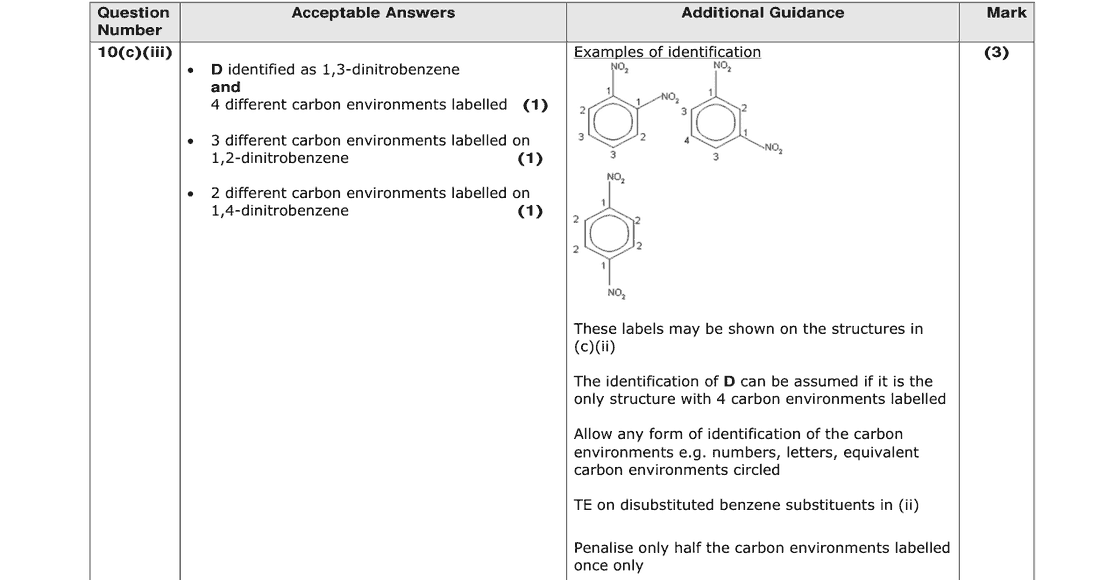
The 13C NMR spectrum of compound D has four peaks.
Identify the structure of D.  Justify your answer by labelling the different
carbon environments in all the structures drawn in (c)(ii).

Work with an A-level chemistry tutor

Want a paper marked and gone through with you? Message us.

Prefer email? Send an enquiry

If you are under 18, please include a parent's contact details. Enquiries go to enquiries@chemistryaleveltutor.com and are deleted once handled. All tutoring is online.