June 2017: Paper 3, General and Practical Principles in Chemistry

120 marks · 58 question parts · Paper, mark scheme and report on Edexcel's site · Have the Data Booklet beside you

Question by question

QTopicMarksAOType
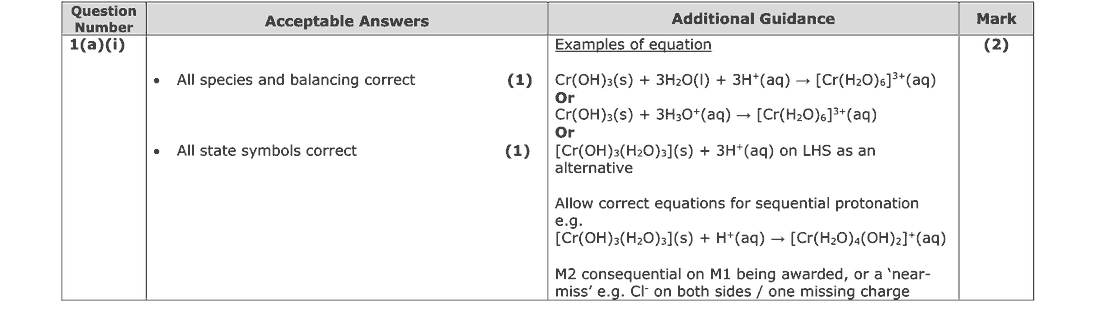
1(a)(i) Transition metals: reactions 2Equation writing
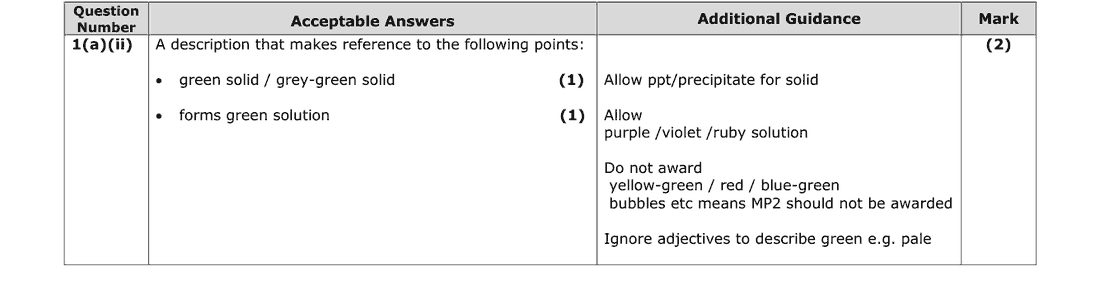
1(a)(ii) Transition metals: reactions 2Practical and data analysis
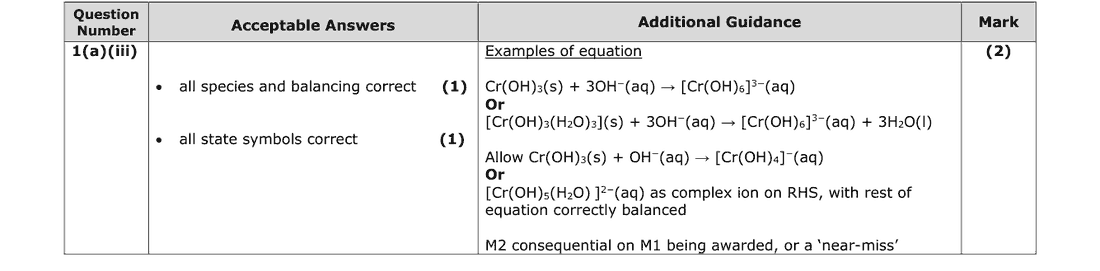
1(a)(iii) Transition metals: reactions 2Equation writing
1(a)(iv) Transition metals: reactions 1Practical and data analysis
1(b)(i) Transition metals: reactions 2Practical and data analysis
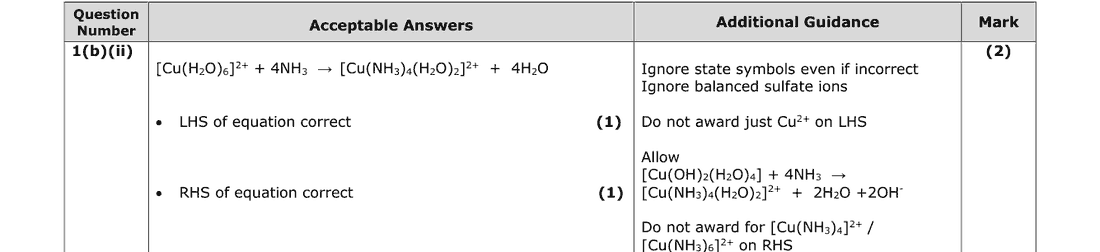
1(b)(ii) Transition metals: reactions 2Equation writing
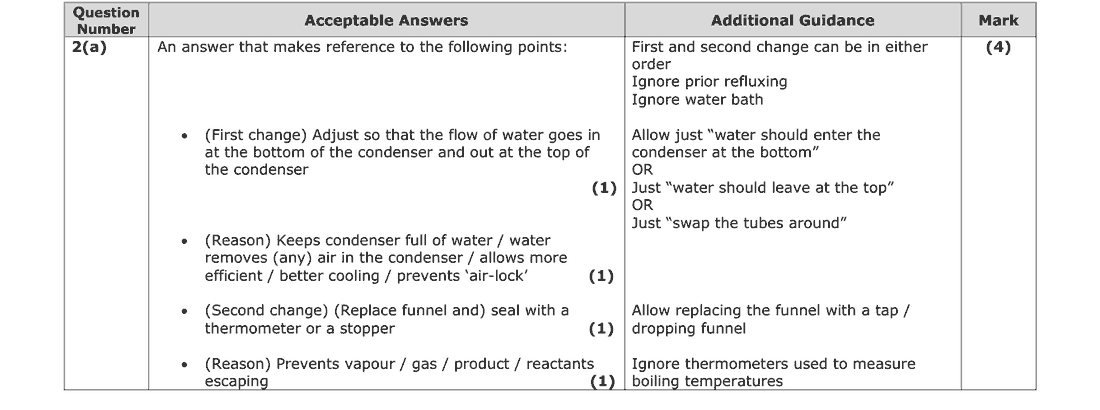
2(a) Alcohols 4Practical and data analysis
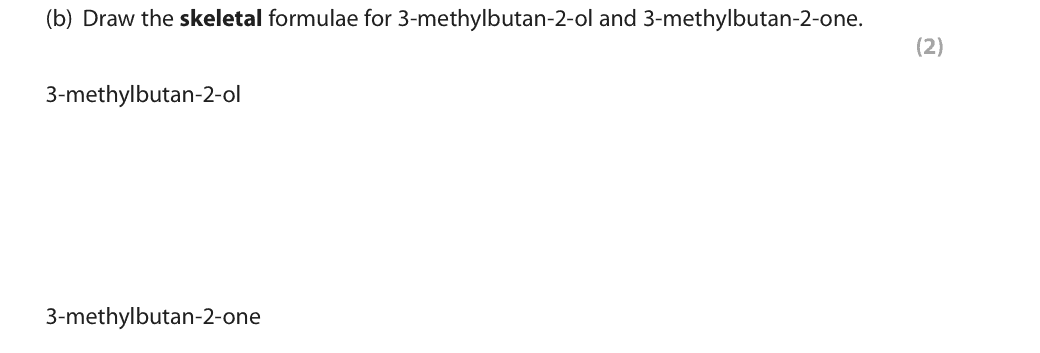
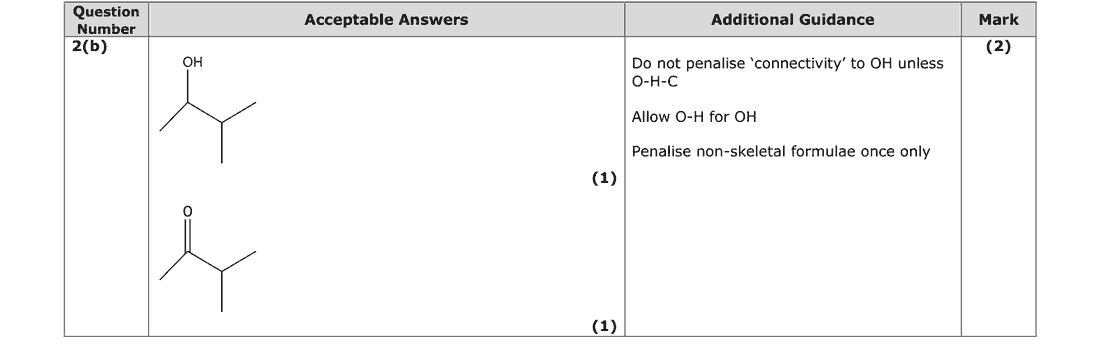
2(b) Introduction to organic chemistry 2Diagram or structure
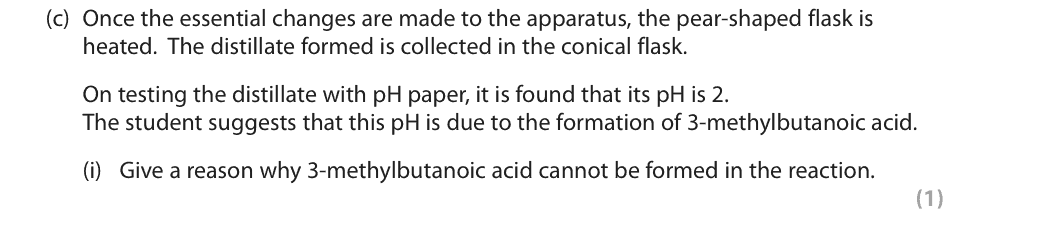
2(c)(i) Alcohols 1Short answer
2(c)(ii) Alcohols 1Short answer
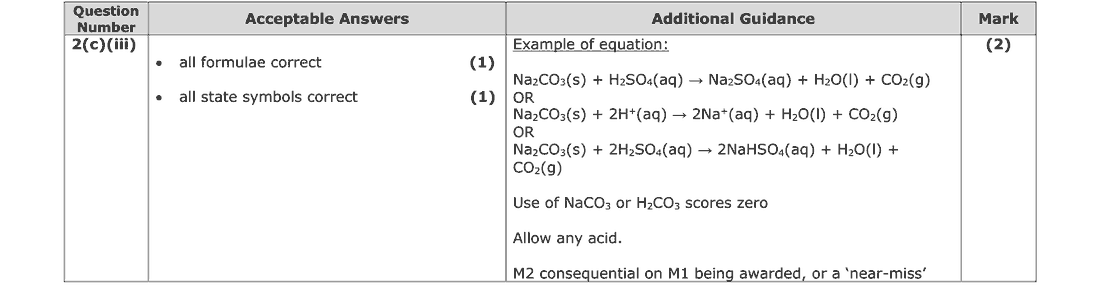
2(c)(iii) Formulae, equations and amounts of substance, Analysis of inorganic compounds 2Equation writing
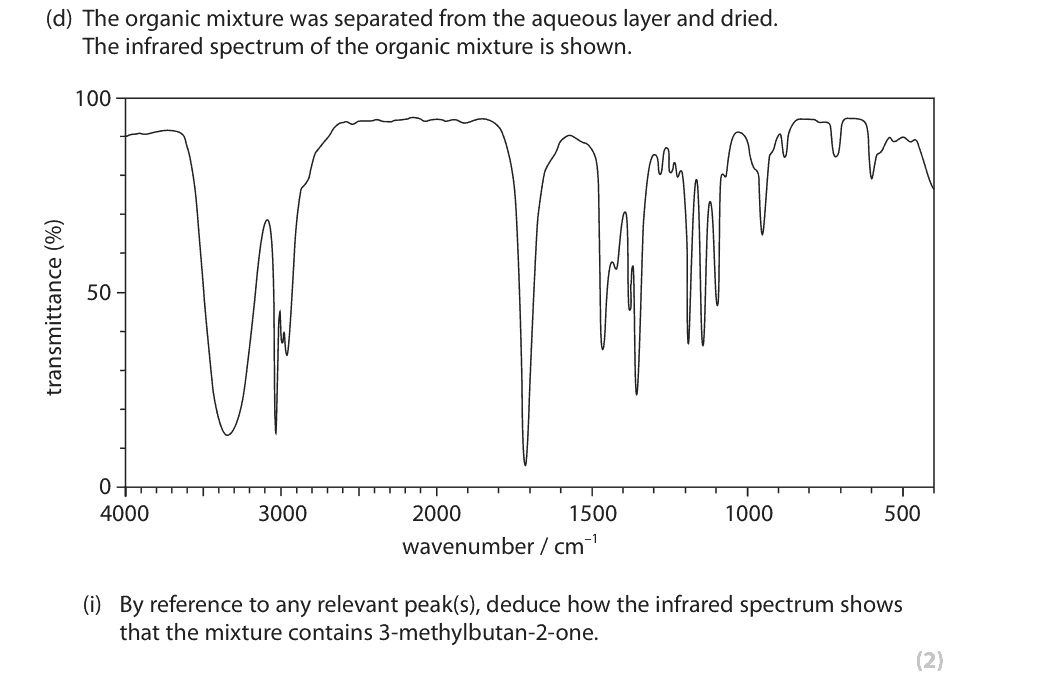
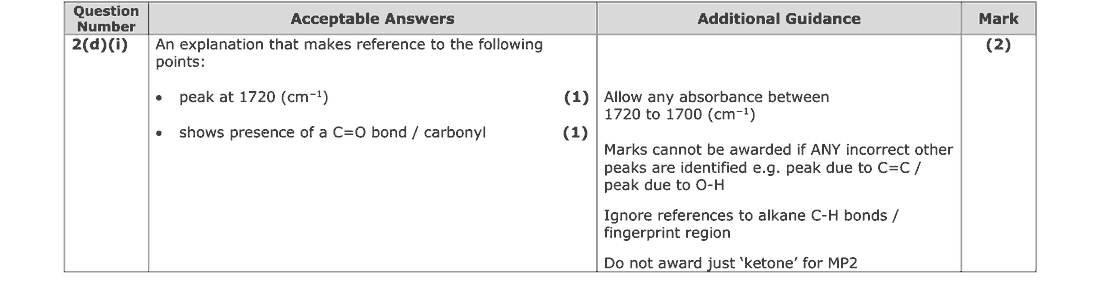
2(d)(i) Modern analytical techniques I: mass spectrometry and infrared 2Short answer
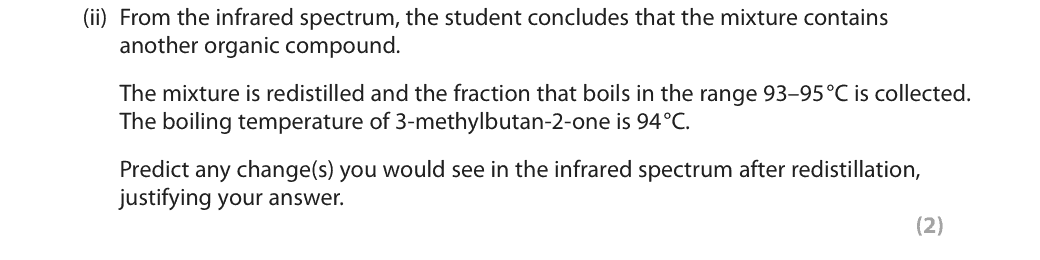
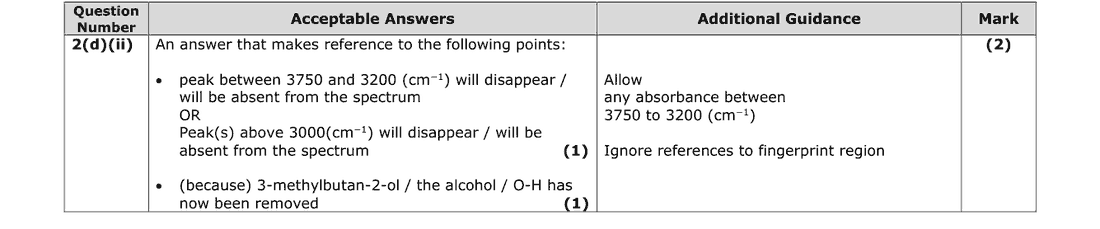
2(d)(ii) Modern analytical techniques I: mass spectrometry and infrared 2Explanation
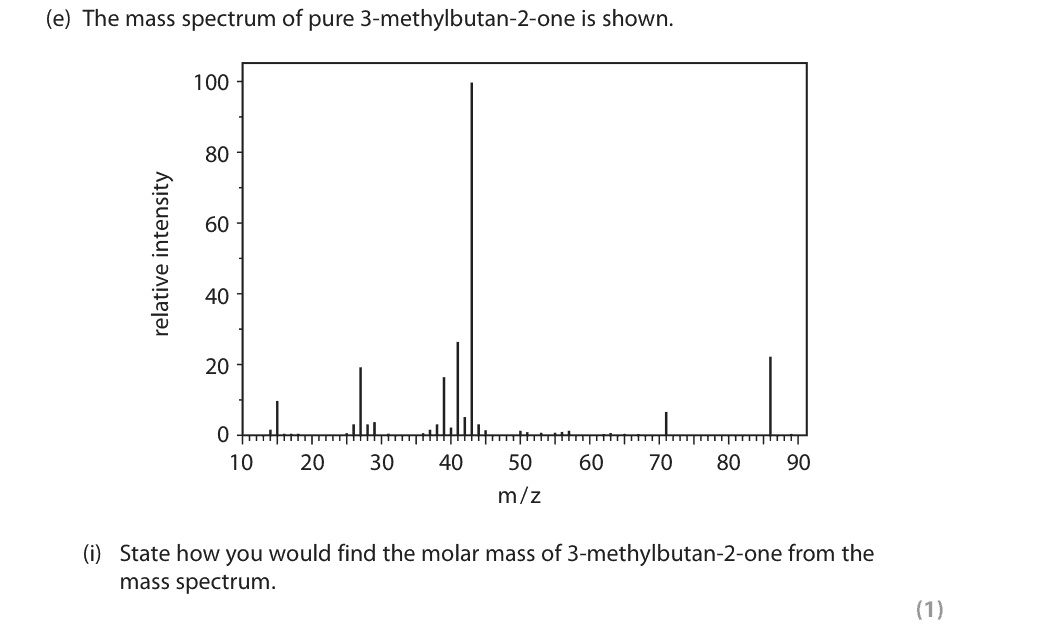
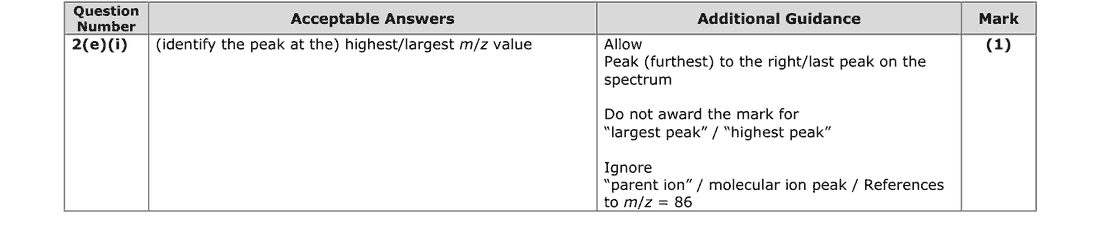
2(e)(i) Modern analytical techniques I: mass spectrometry and infrared 1Short answer
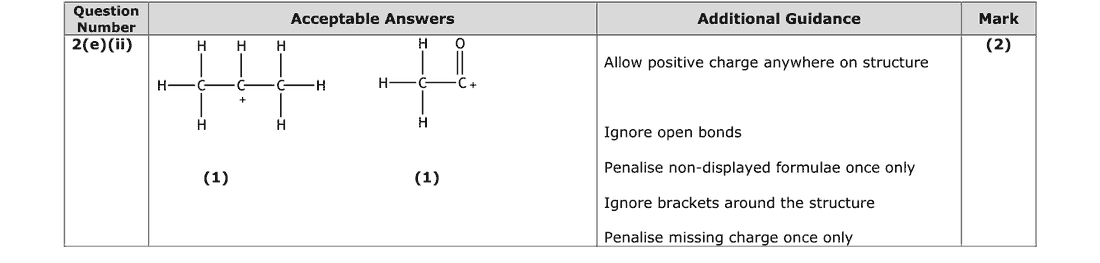
2(e)(ii) Modern analytical techniques I: mass spectrometry and infrared 2Diagram or structure
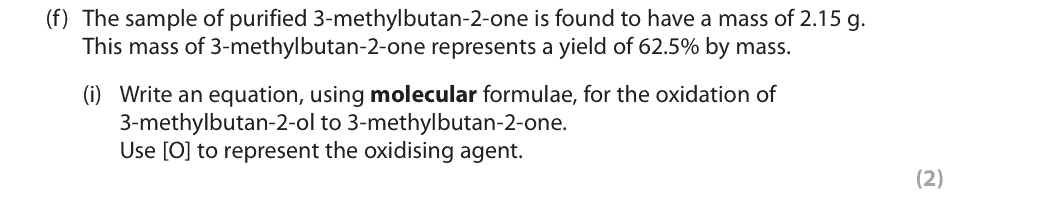
2(f)(i) Alcohols, Introduction to organic chemistry 2Equation writing
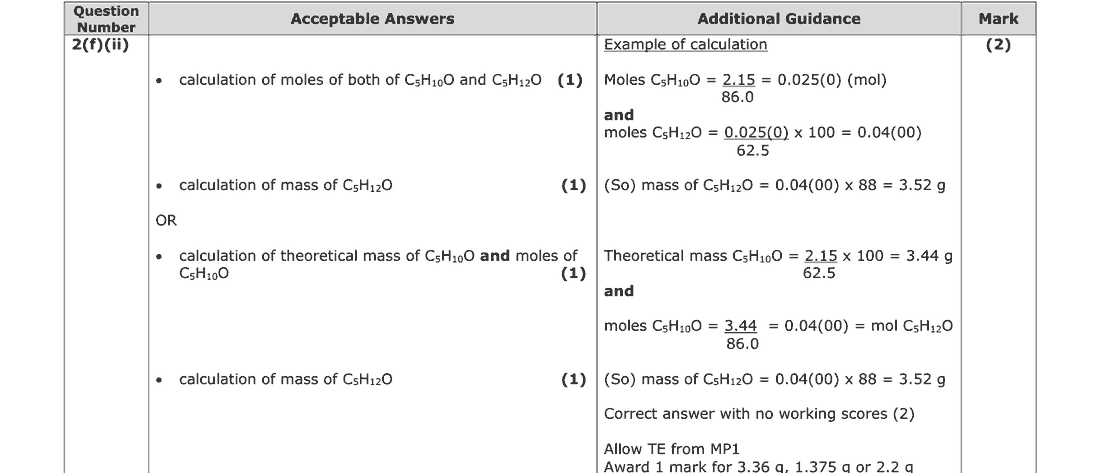
2(f)(ii) Formulae, equations and amounts of substance 2Calculation
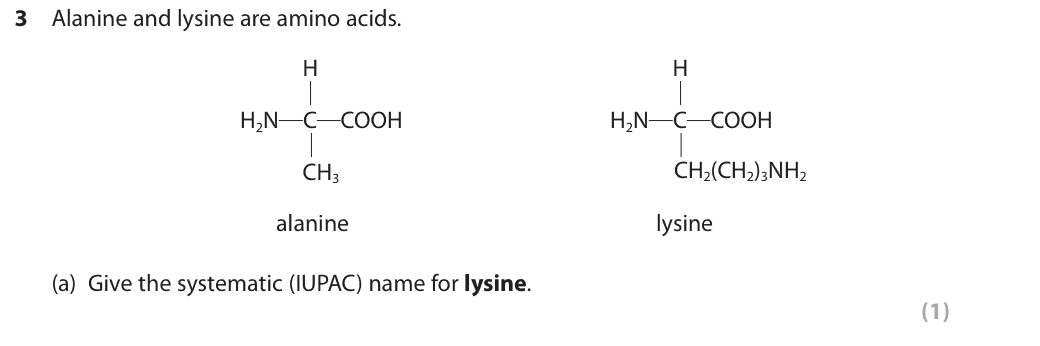
3(a) Introduction to organic chemistry 1Short answer
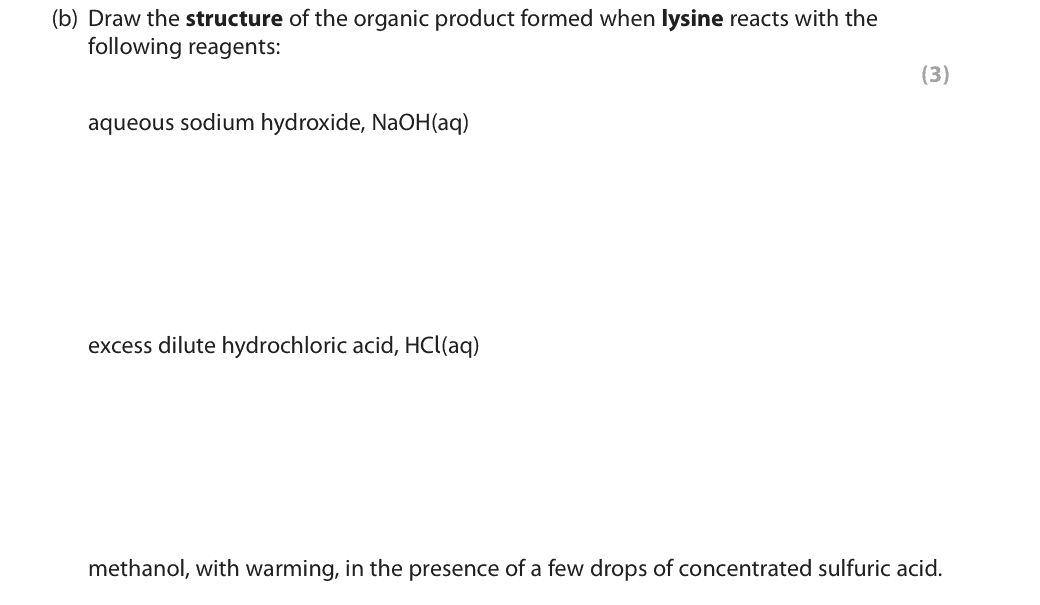
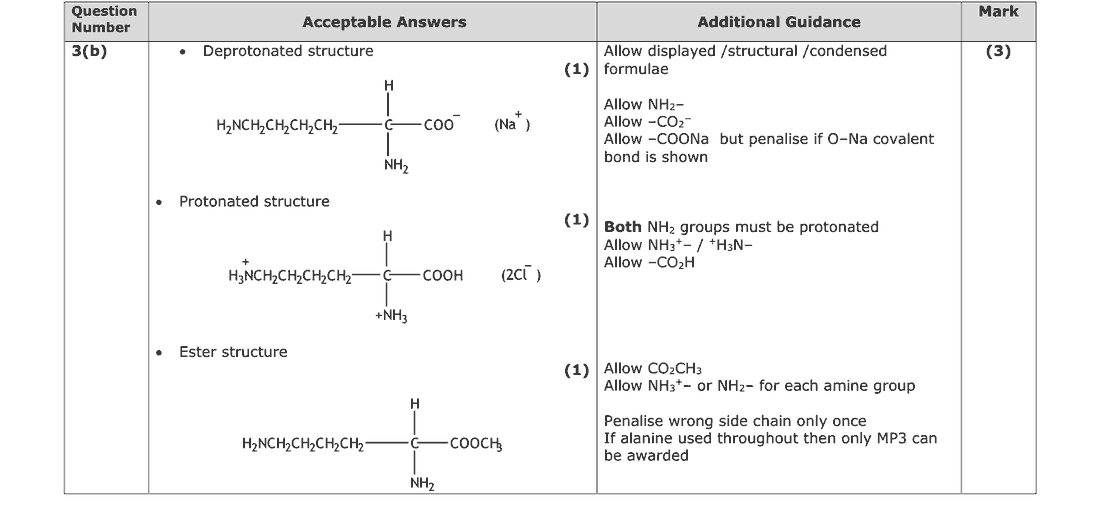
3(b) Amines, amides, amino acids and proteins, Carboxylic acids 3Diagram or structure
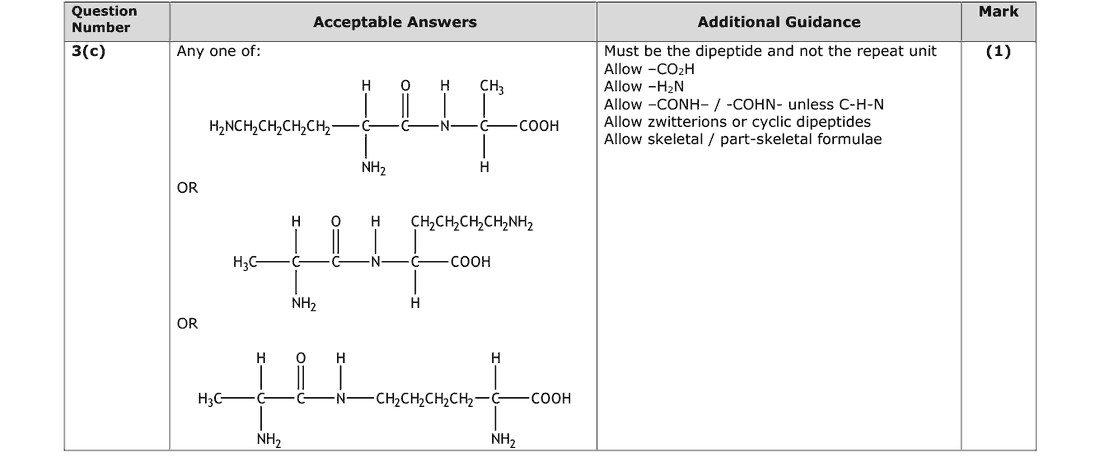
3(c) Amines, amides, amino acids and proteins 1Diagram or structure
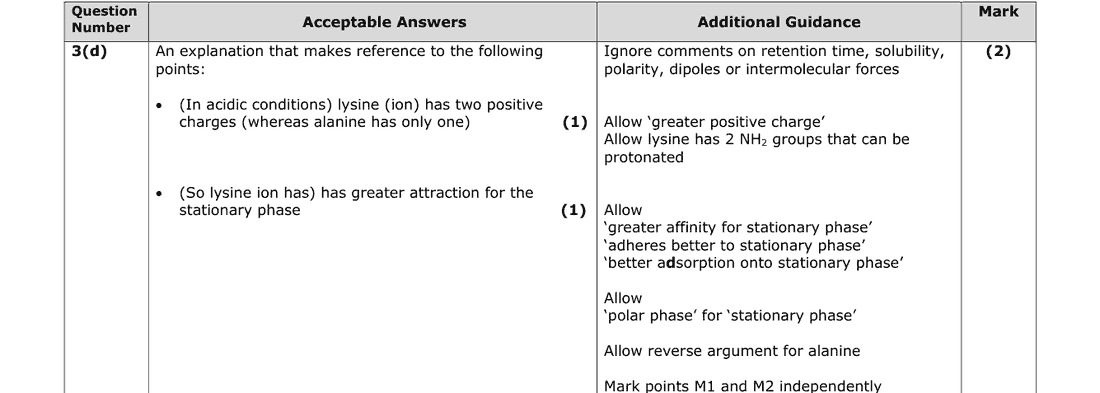
3(d) Modern analytical techniques II: NMR, mass spectrometry and chromatography, Amines, amides, amino acids and proteins 2Explanation
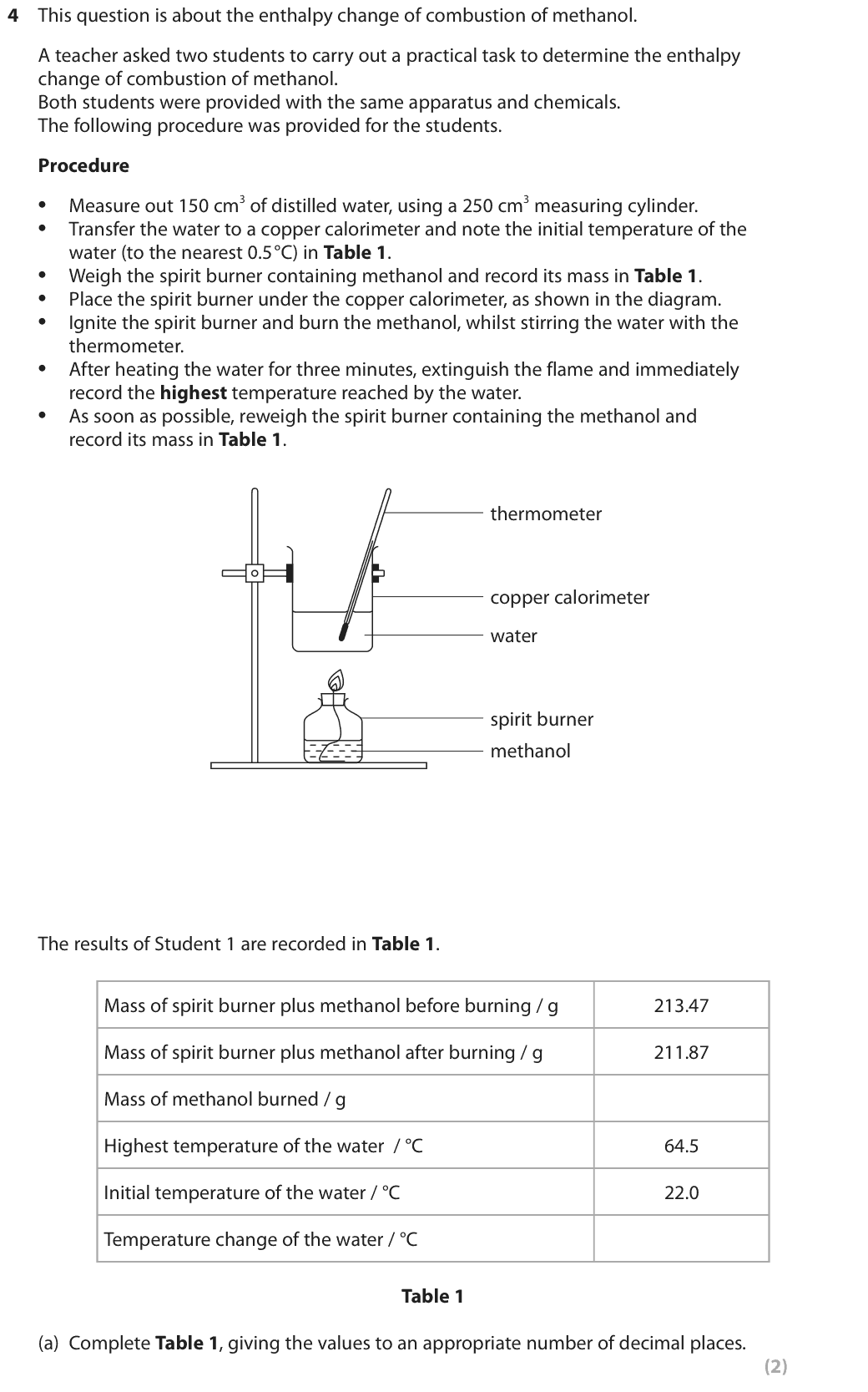
4(a) Energetics I 2Short answer
4(b) Energetics I, Formulae, equations and amounts of substance 2Equation writing
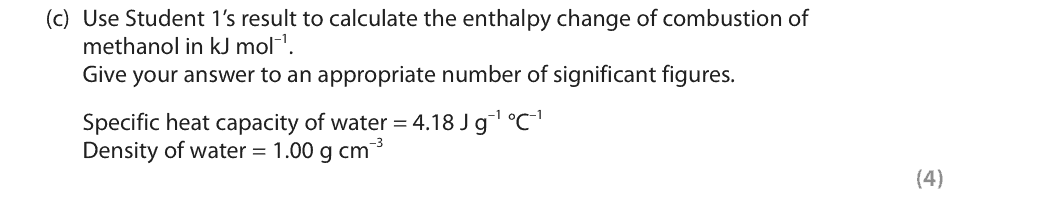
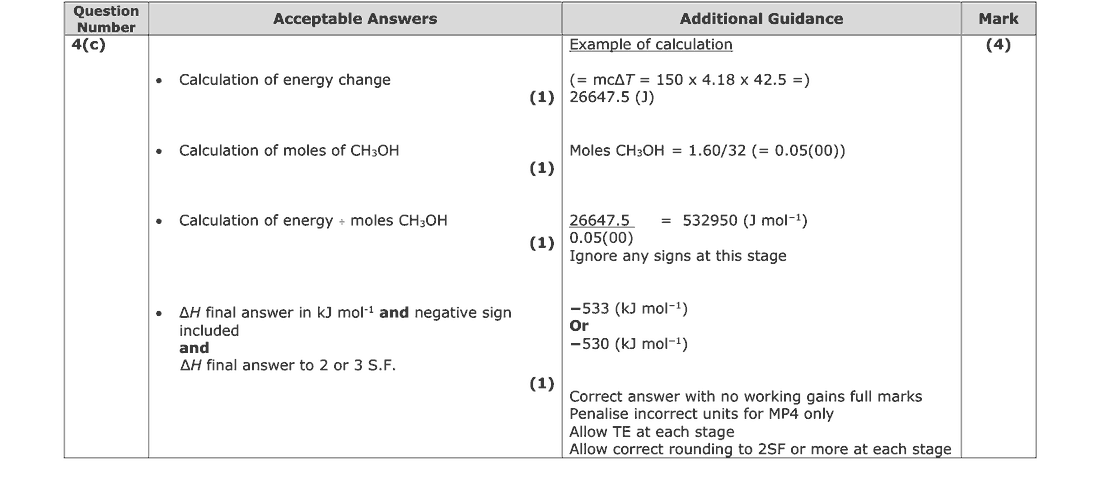
4(c) Energetics I 4Calculation
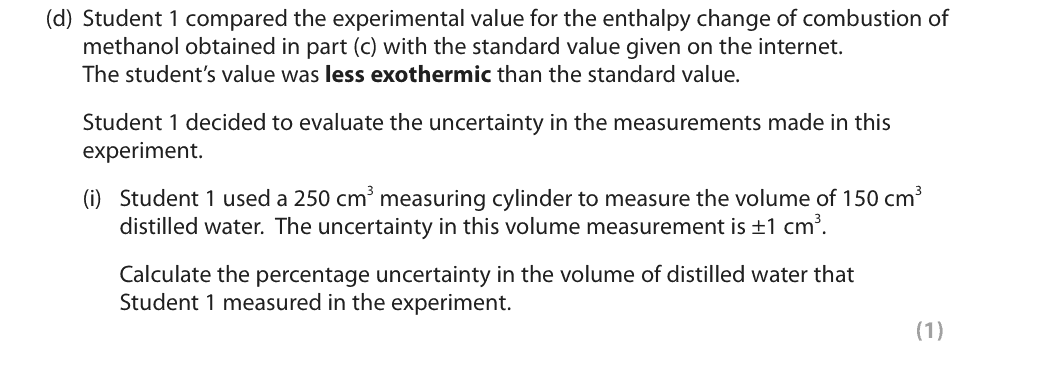
4(d)(i) Formulae, equations and amounts of substance 1Calculation
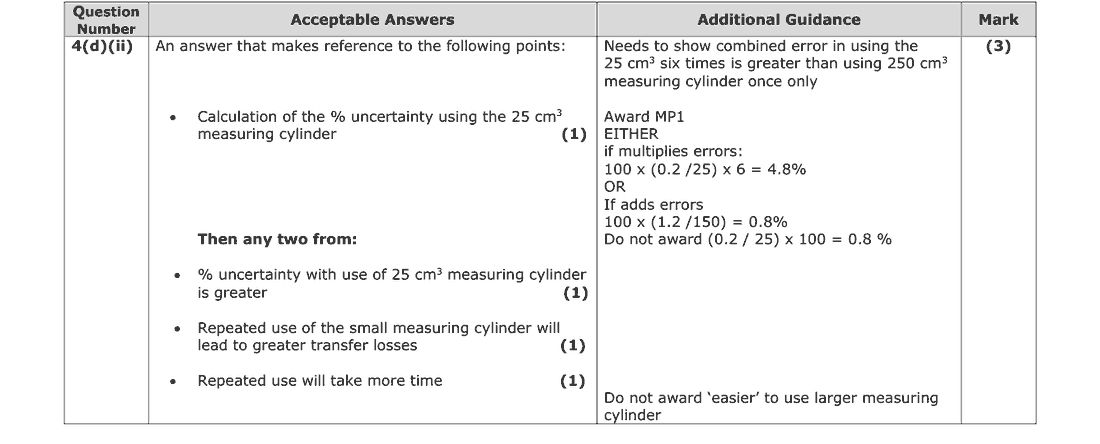
4(d)(ii) Formulae, equations and amounts of substance 3Explanation
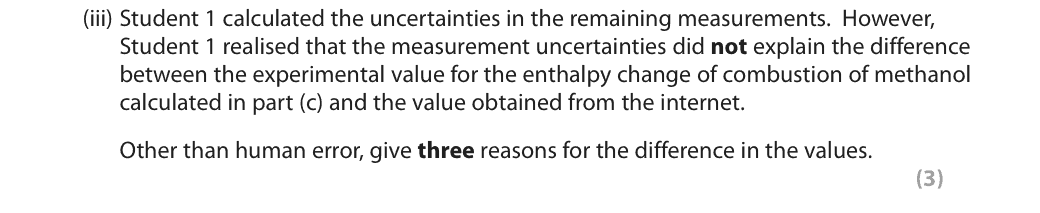
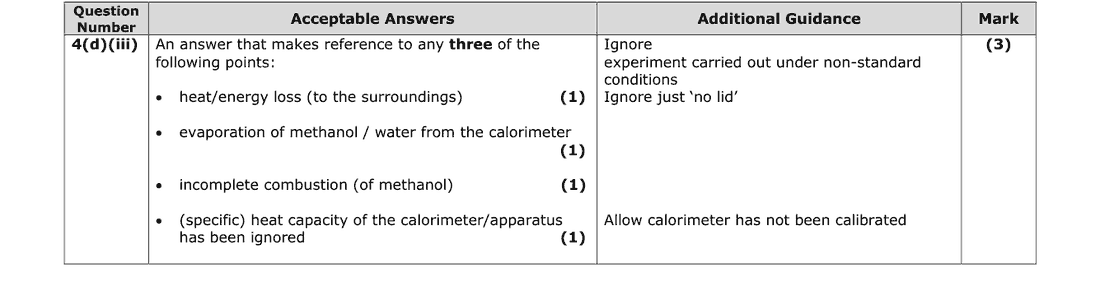
4(d)(iii) Energetics I 3Practical and data analysis
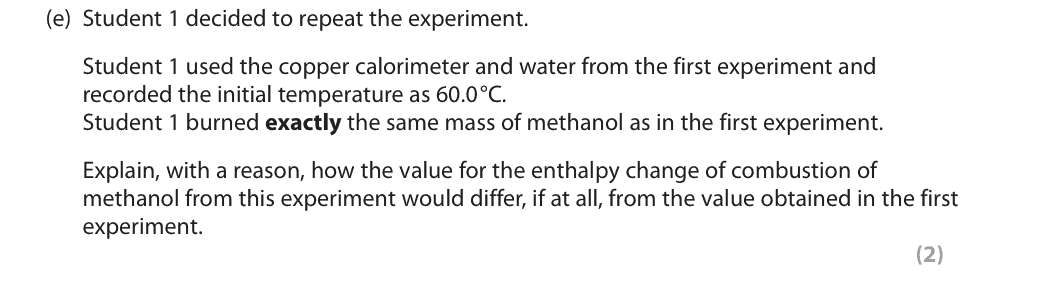
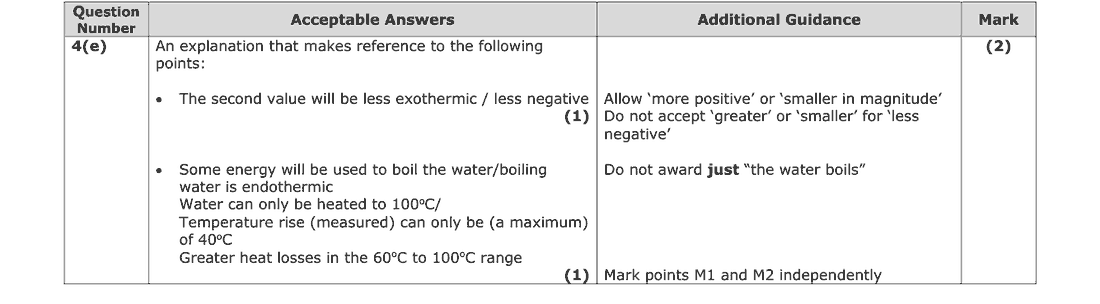
4(e) Energetics I 2Explanation
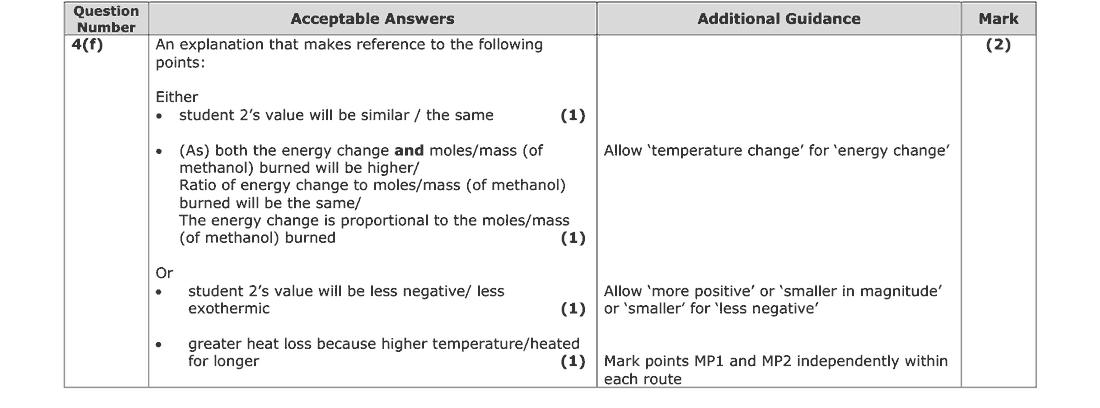
4(f) Energetics I 2Explanation
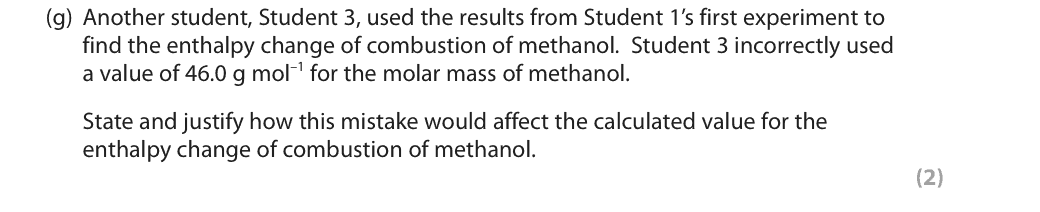
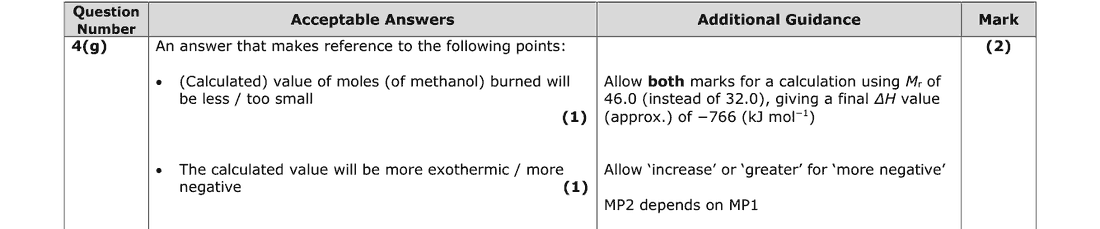
4(g) Energetics I 2Explanation
5(a) Bonding 1Diagram or structure
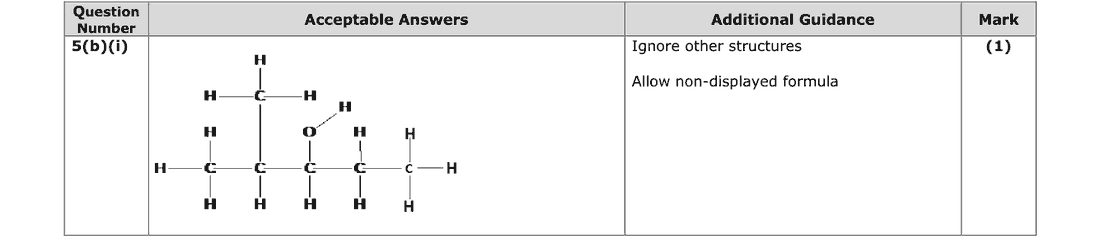
5(b)(i) Organic synthesis 1Diagram or structure
5(b)(ii) Introduction to organic chemistry 1Short answer
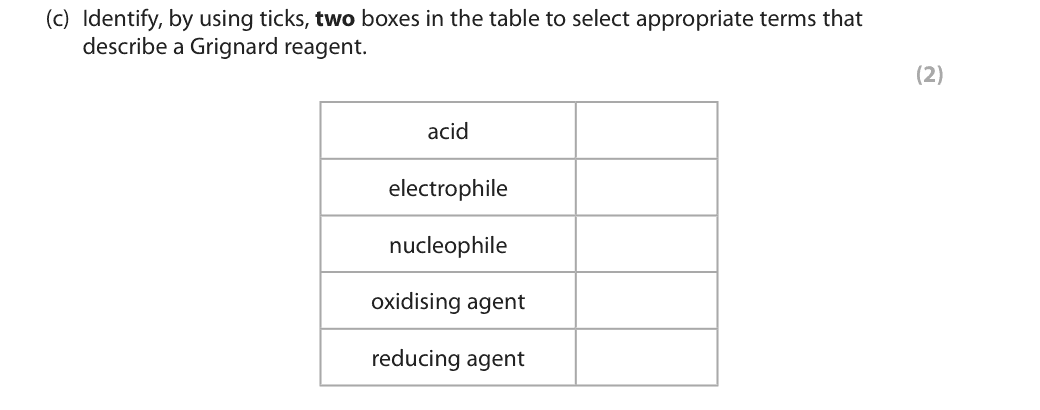
5(c) Organic synthesis, Halogenoalkanes 2Short answer
5(d) Organic synthesis 1Short answer
6(a) Redox II 2Short answer
6(b) Redox II 1Practical and data analysis
6(c) Redox II, Formulae, equations and amounts of substance 5Calculation
6(d) Redox I 2Equation writing
6(e) Formulae, equations and amounts of substance 2Explanation
6(f) Formulae, equations and amounts of substance 2Practical and data analysis
6(g) Formulae, equations and amounts of substance 1Practical and data analysis
6(h) Formulae, equations and amounts of substance 2Practical and data analysis
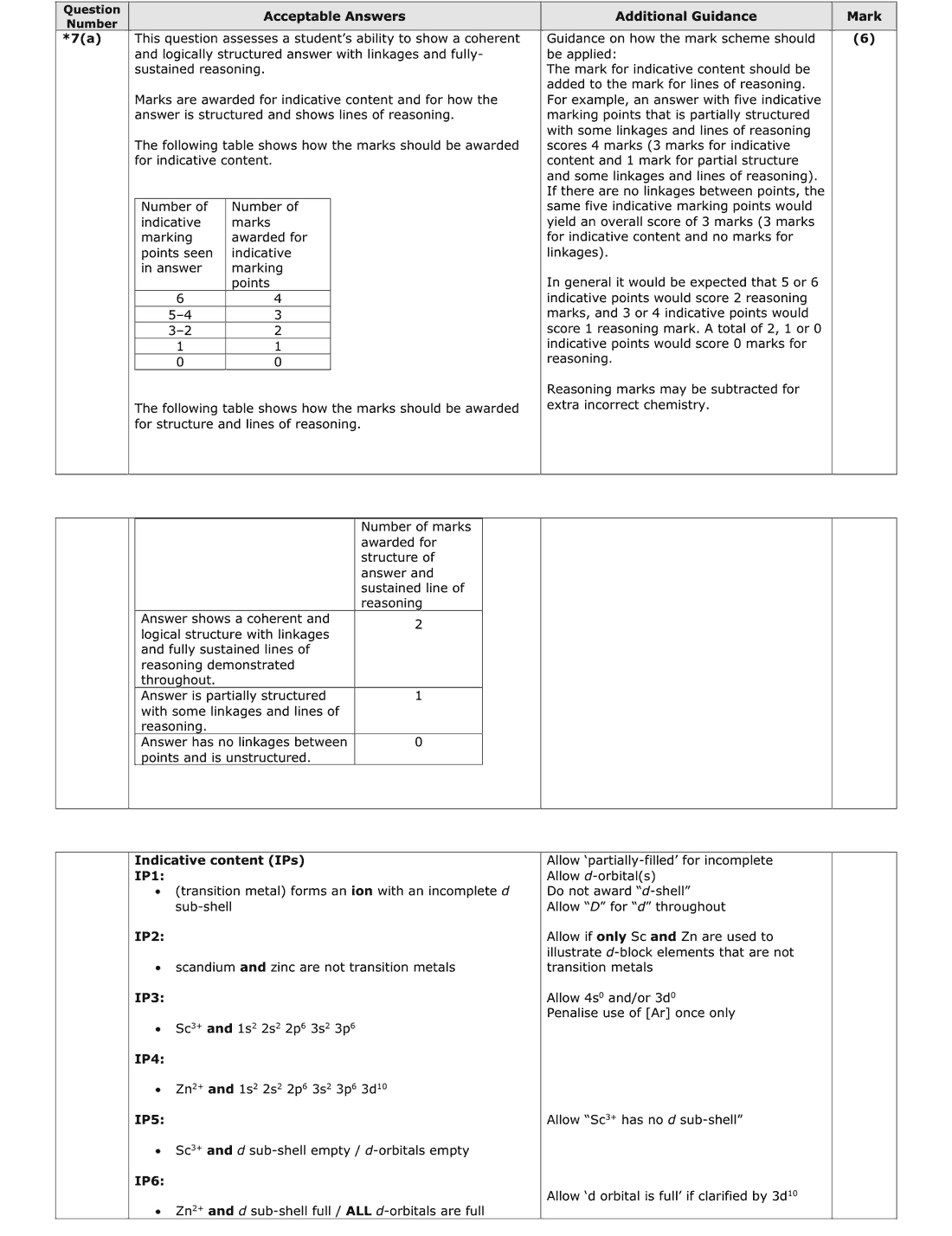
7(a) Transition metals: principles 6Extended response
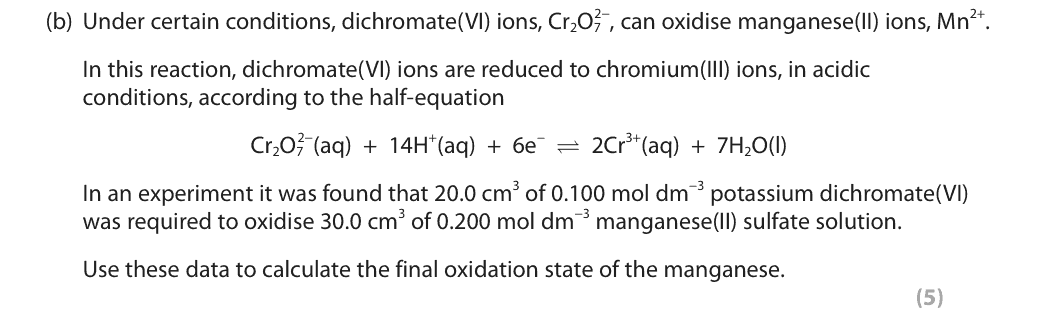
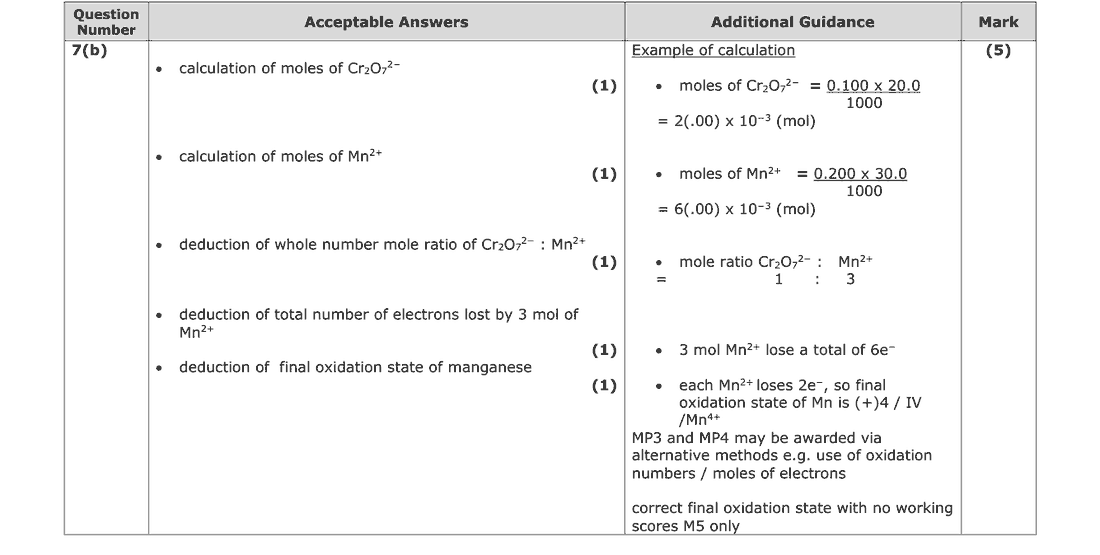
7(b) Redox II 5Calculation
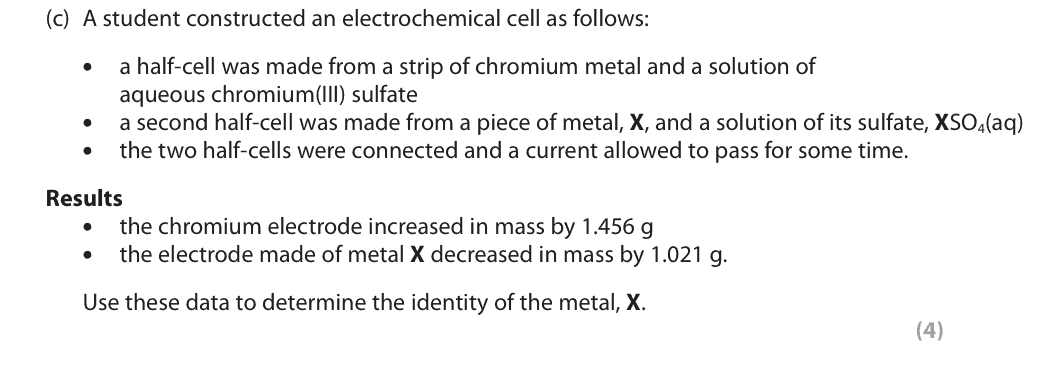
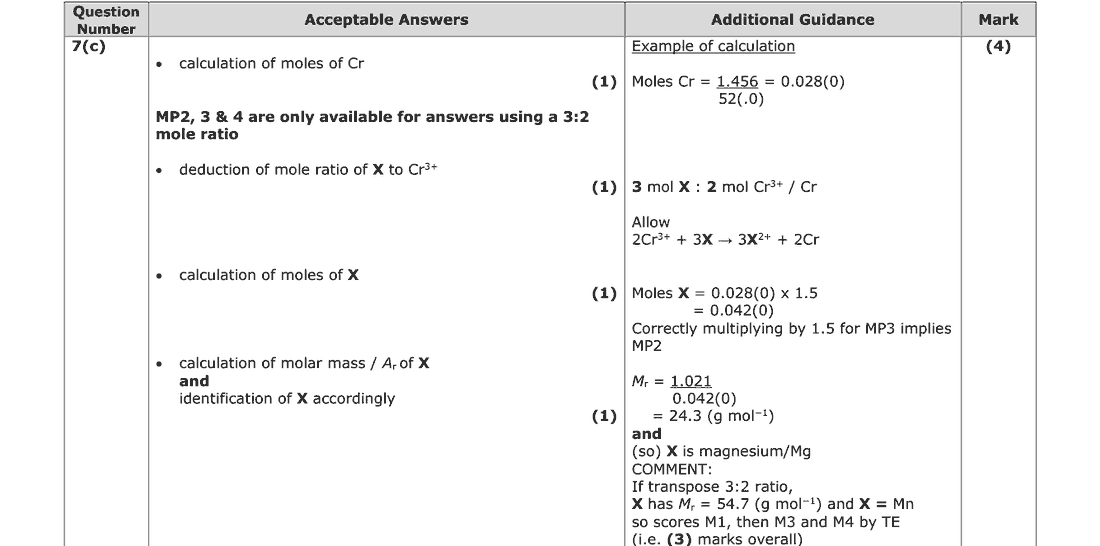
7(c) Formulae, equations and amounts of substance, Redox II 4Calculation
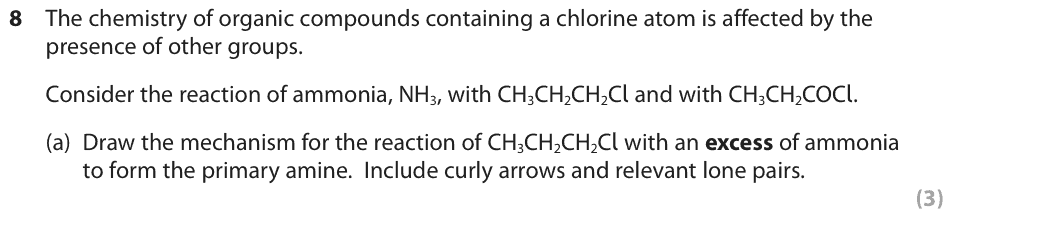
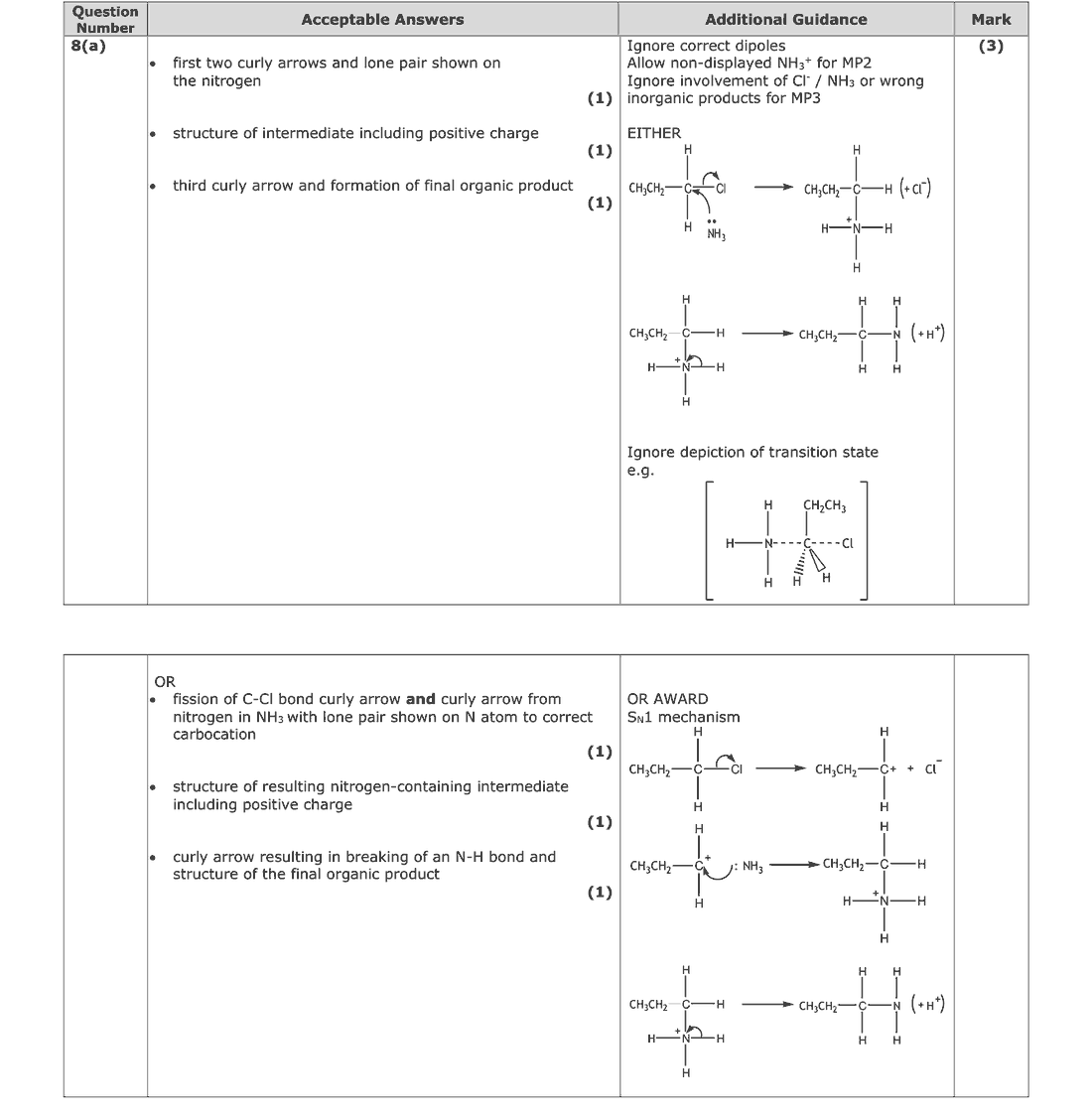
8(a) Halogenoalkanes 3Mechanism
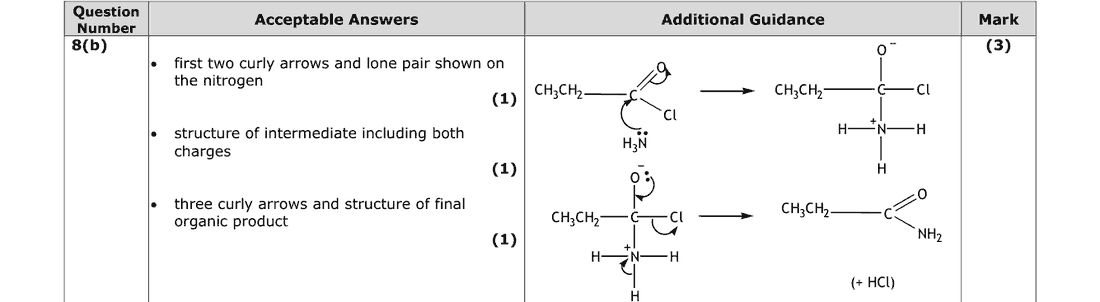
8(b) Carboxylic acids 3Mechanism
9(a)(i) Equilibrium I 1Short answer
9(a)(ii) Equilibrium I 2Short answer
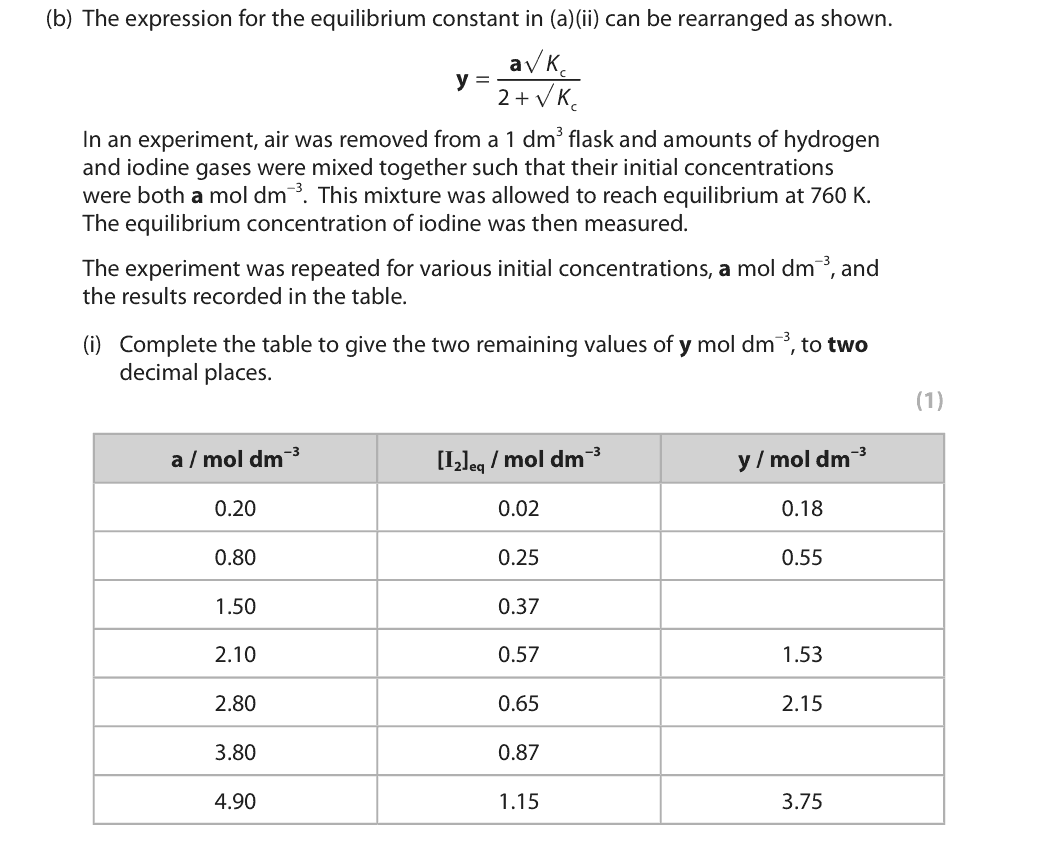
9(b)(i) Equilibrium II 1Calculation
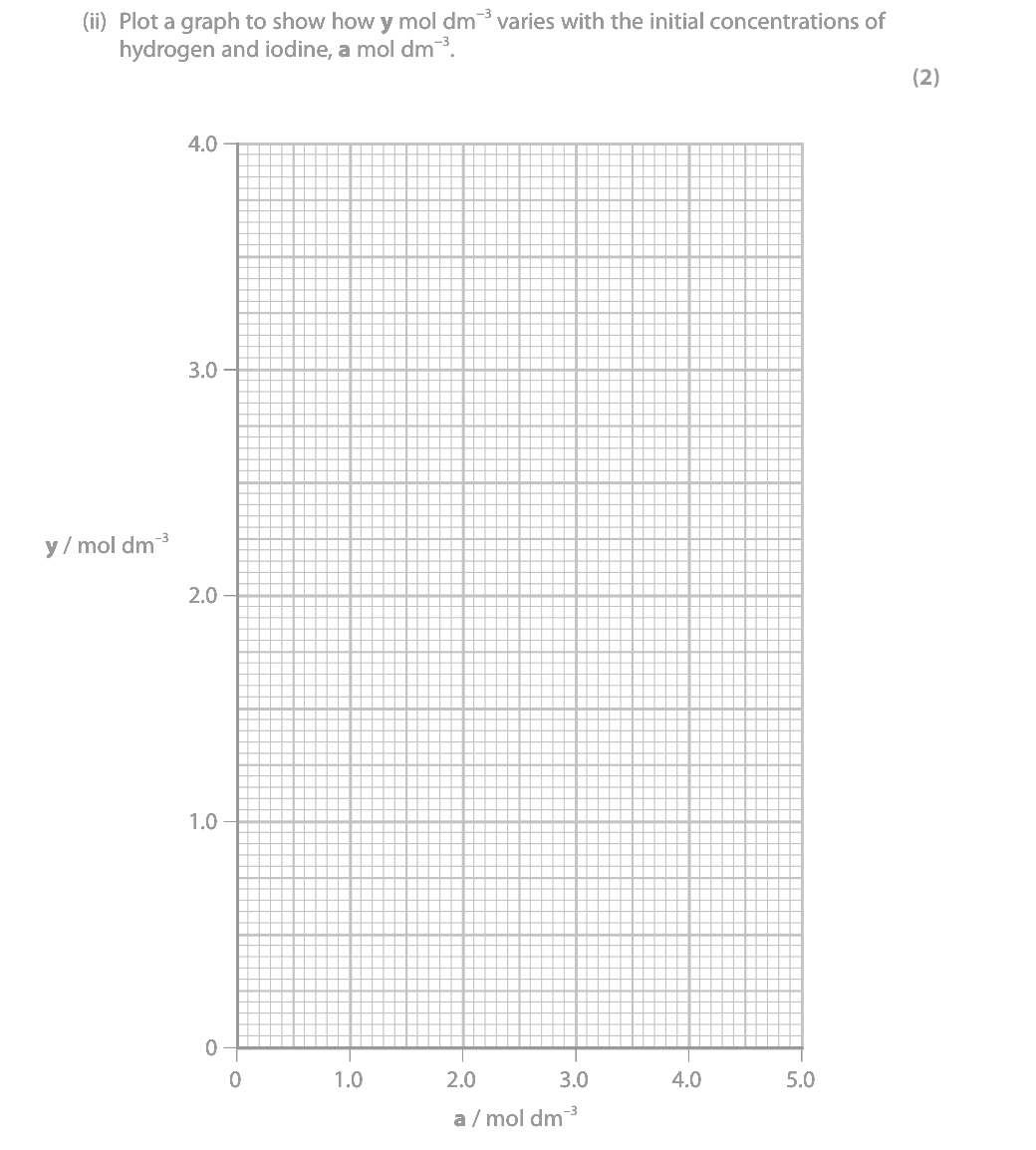
9(b)(ii) Equilibrium II 2Diagram or structure
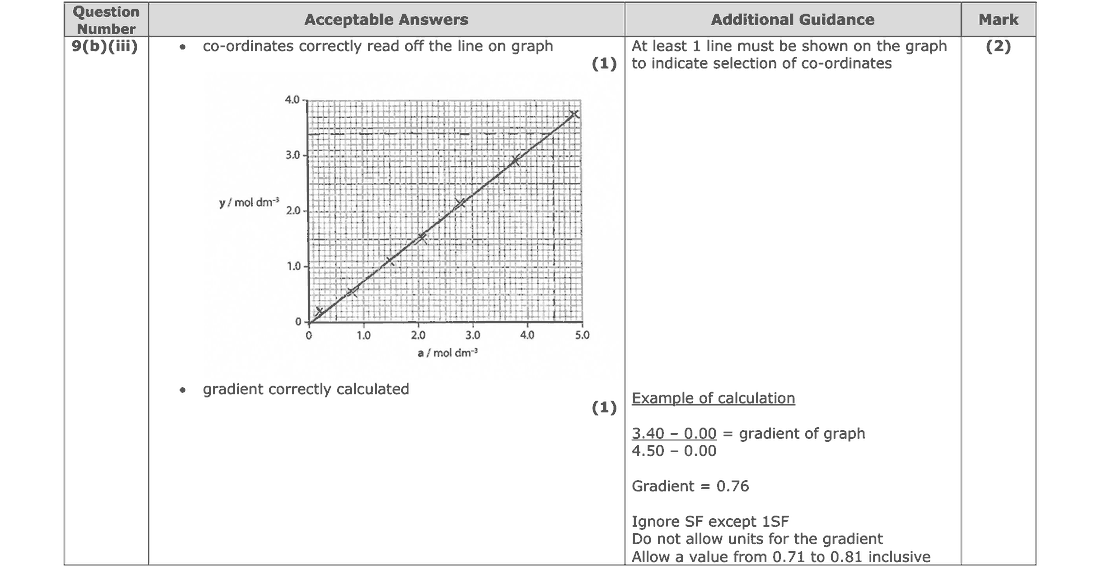
9(b)(iii) Equilibrium II 2Calculation
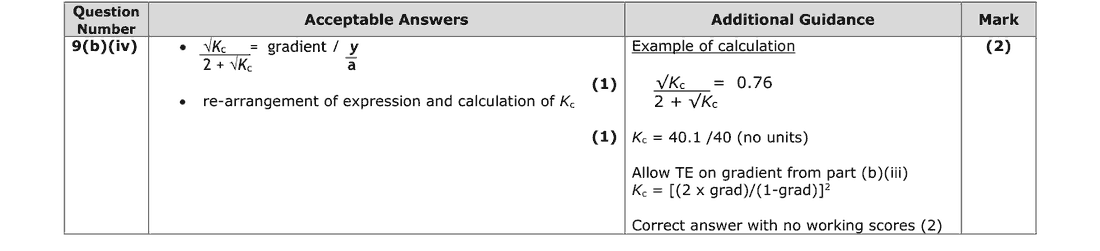
9(b)(iv) Equilibrium II 2Calculation
9(c) Formulae, equations and amounts of substance 1Practical and data analysis
9(d) Kinetics I, Equilibrium II 2Short answer
9(e)(i) Equilibrium II 2Explanation
9(e)(ii) Equilibrium II 1Diagram or structure

The questions

1(a)(i)1(a)(ii)1(a)(iii)1(a)(iv)1(b)(i)1(b)(ii)2(a)2(b)2(c)(i)2(c)(ii)2(c)(iii)2(d)(i)2(d)(ii)2(e)(i)2(e)(ii)2(f)(i)2(f)(ii)3(a)3(b)3(c)3(d)4(a)4(b)4(c)4(d)(i)4(d)(ii)4(d)(iii)4(e)4(f)4(g)5(a)5(b)(i)5(b)(ii)5(c)5(d)6(a)6(b)6(c)6(d)6(e)6(f)6(g)6(h)7(a)7(b)7(c)8(a)8(b)9(a)(i)9(a)(ii)9(b)(i)9(b)(ii)9(b)(iii)9(b)(iv)9(c)9(d)9(e)(i)9(e)(ii)
June 2017 · Paper 3 · Q1(a)(i) 2 marks Equation writing transition metals reactions
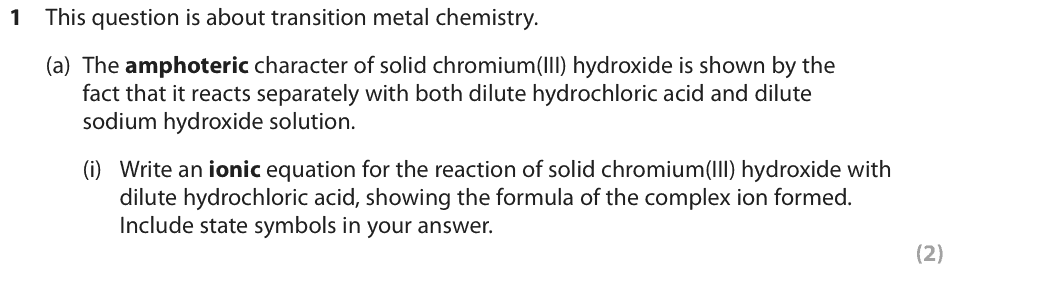
This question is about transition metal chemistry.
The amphoteric character of solid chromium(III) hydroxide is shown by the
fact that it reacts separately with both dilute hydrochloric acid and dilute
sodium hydroxide solution.
Write an ionic equation for the reaction of solid chromium(III) hydroxide with
dilute hydrochloric acid, showing the formula of the complex ion formed.
Include state symbols in your answer.
June 2017 · Paper 3 · Q1(a)(ii) 2 marks Practical and data analysis transition metals reactions
Earlier part of question 1 that this part usesEarlier part of June 2017 Paper 3 question 1
Describe the changes you would see when the reaction in (a)(i) is carried out.
June 2017 · Paper 3 · Q1(a)(iii) 2 marks Equation writing transition metals reactions
Earlier parts of question 1 that this part usesEarlier part of June 2017 Paper 3 question 1Earlier part of June 2017 Paper 3 question 1
Write an ionic equation for the reaction of solid chromium(III) hydroxide with dilute
sodium hydroxide solution, showing the formula of the complex ion formed.
Include state symbols in your answer.
June 2017 · Paper 3 · Q1(a)(iv) 1 mark Practical and data analysis transition metals reactions
Earlier parts of question 1 that this part usesEarlier part of June 2017 Paper 3 question 1Earlier part of June 2017 Paper 3 question 1
State the final appearance of the reaction mixture in (a)(iii).
June 2017 · Paper 3 · Q1(b)(i) 2 marks Practical and data analysis transition metals reactions
Dilute aqueous ammonia is added, drop by drop, to an aqueous solution of
copper(II) sulfate until the aqueous ammonia is in excess.
Describe what you would see during this experiment.
June 2017 · Paper 3 · Q1(b)(ii) 2 marks Equation writing transition metals reactions
Earlier part of question 1 that this part usesEarlier part of June 2017 Paper 3 question 1
The reaction between aqueous copper(II) sulfate and excess aqueous ammonia
is an example of a ligand substitution reaction.
Write an equation for the ligand substitution reaction that occurs, showing
the formulae of the complex ions involved.  State symbols are not required.
June 2017 · Paper 3 · Q2(a) 4 marks Practical and data analysis alcohols
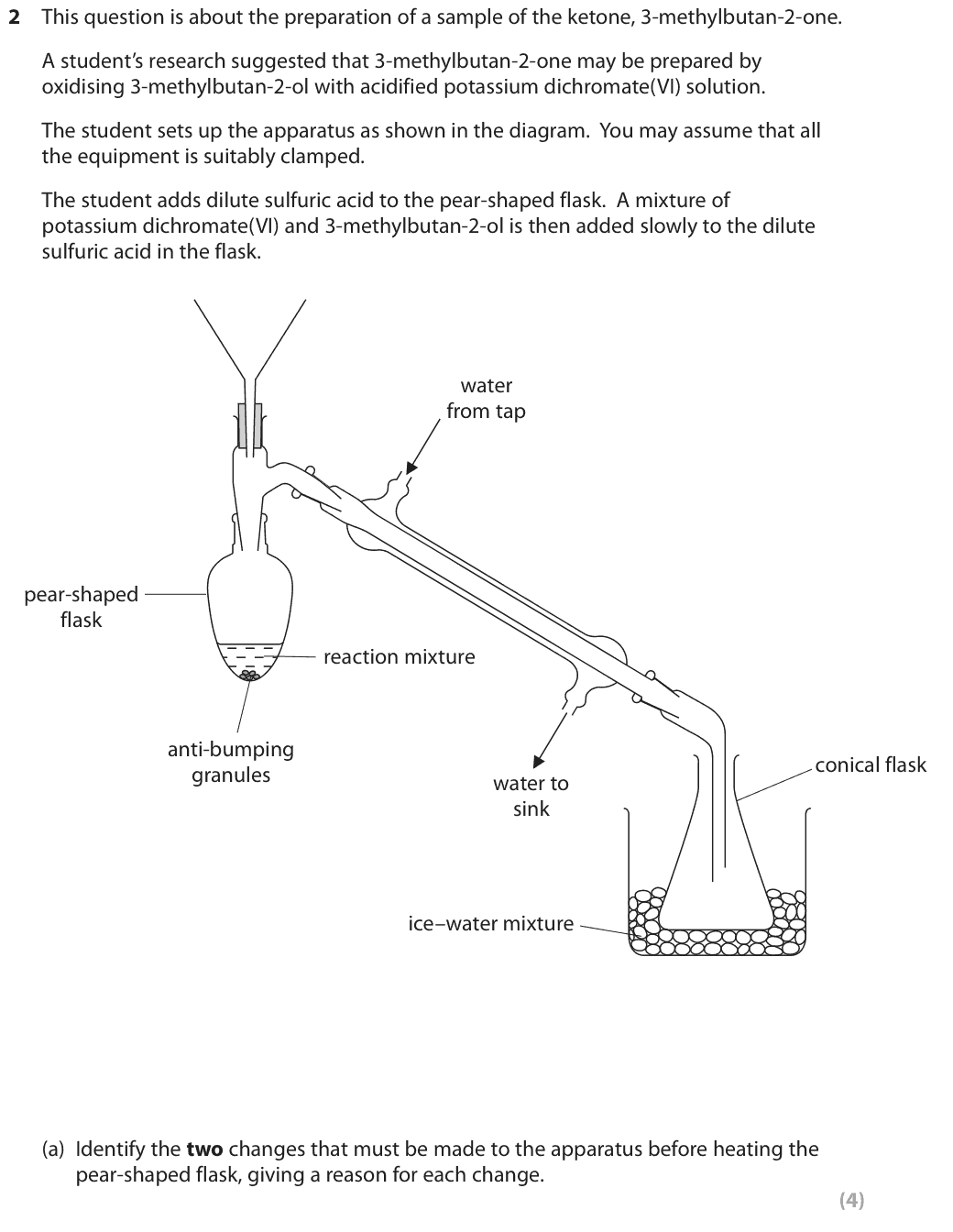
This question is about the preparation of a sample of the ketone, 3-methylbutan-2-one.
A student’s research suggested that 3-methylbutan-2-one may be prepared by
oxidising 3-methylbutan-2-ol with acidified potassium dichromate(VI) solution.
The student sets up the apparatus as shown in the diagram.  You may assume that all
the equipment is suitably clamped.
The student adds dilute sulfuric acid to the pear-shaped flask.  A mixture of
potassium dichromate(VI) and 3-methylbutan-2-ol is then added slowly to the dilute
sulfuric acid in the flask.
water
from tap
pear-shaped
flask
reaction mixture
anti-bumping
conical flask
granules
water to
sink
ice–water mixture
Identify the two changes that must be made to the apparatus before heating the
pear-shaped flask, giving a reason for each change.
June 2017 · Paper 3 · Q2(b) 2 marks Diagram or structure introduction to organic chemistry
Earlier part of question 2 that this part usesEarlier part of June 2017 Paper 3 question 2
Draw the skeletal formulae for 3-methylbutan-2-ol and 3-methylbutan-2-one.
3-methylbutan-2-ol
3-methylbutan-2-one
June 2017 · Paper 3 · Q2(c)(i) 1 mark Short answer alcohols
Earlier part of question 2 that this part usesEarlier part of June 2017 Paper 3 question 2
Once the essential changes are made to the apparatus, the pear-shaped flask is
heated.  The distillate formed is collected in the conical flask.
On testing the distillate with pH paper, it is found that its pH is 2.
The student suggests that this pH is due to the formation of 3-methylbutanoic acid.
Give a reason why 3-methylbutanoic acid cannot be formed in the reaction.
June 2017 · Paper 3 · Q2(c)(ii) 1 mark Short answer alcohols
Earlier parts of question 2 that this part usesEarlier part of June 2017 Paper 3 question 2Earlier part of June 2017 Paper 3 question 2
Deduce the formula of the compound that could cause the distillate to have a
pH value of 2.
June 2017 · Paper 3 · Q2(c)(iii) 2 marks Equation writing formulae equations and amounts of substanceanalysis of inorganic compounds
Earlier parts of question 2 that this part usesEarlier part of June 2017 Paper 3 question 2Earlier part of June 2017 Paper 3 question 2Earlier part of June 2017 Paper 3 question 2
Solid sodium carbonate is added to the distillate.  The sodium carbonate
disappears and fizzing occurs.
Write an equation, including state symbols, for the reaction that occurs
between sodium carbonate and the compound you have identified in (c)(ii).
June 2017 · Paper 3 · Q2(d)(i) 2 marks Short answer mass spectrometry and infrared spectroscopy
Earlier part of question 2 that this part usesEarlier part of June 2017 Paper 3 question 2
The organic mixture was separated from the aqueous layer and dried.
The infrared spectrum of the organic mixture is shown.
100
50
0
4000
3000
2000
1500
1000
500
wavenumber / cm–1
By reference to any relevant peak(s), deduce how the infrared spectrum shows
that the mixture contains 3-methylbutan-2-one.
June 2017 · Paper 3 · Q2(d)(ii) 2 marks Explanation mass spectrometry and infrared spectroscopy
Earlier parts of question 2 that this part usesEarlier part of June 2017 Paper 3 question 2Earlier part of June 2017 Paper 3 question 2
From the infrared spectrum, the student concludes that the mixture contains
another organic compound.
The mixture is redistilled and the fraction that boils in the range 93–95°C is collected.
The boiling temperature of 3-methylbutan-2-one is 94°C.
Predict any change(s) you would see in the infrared spectrum after redistillation,
justifying your answer.
June 2017 · Paper 3 · Q2(e)(i) 1 mark Short answer mass spectrometry and infrared spectroscopy
Earlier part of question 2 that this part usesEarlier part of June 2017 Paper 3 question 2
The mass spectrum of pure 3-methylbutan-2-one is shown.
100
80
60
40
20
0
10
20
30
40
50
60
70
80
90
m/z
State how you would find the molar mass of 3-methylbutan-2-one from the
mass spectrum.
June 2017 · Paper 3 · Q2(e)(ii) 2 marks Diagram or structure mass spectrometry and infrared spectroscopy
Earlier parts of question 2 that this part usesEarlier part of June 2017 Paper 3 question 2Earlier part of June 2017 Paper 3 question 2
The mass spectrum shows a peak at m/z = 43.
Draw the displayed formulae of two fragment ions that might be responsible
for this peak.
June 2017 · Paper 3 · Q2(f)(i) 2 marks Equation writing alcoholsintroduction to organic chemistry
Earlier part of question 2 that this part usesEarlier part of June 2017 Paper 3 question 2
The sample of purified 3-methylbutan-2-one is found to have a mass of 2.15 g.
This mass of 3-methylbutan-2-one represents a yield of 62.5% by mass.
Write an equation, using molecular formulae, for the oxidation of
3-methylbutan-2-ol to 3-methylbutan-2-one.
Use [O] to represent the oxidising agent.
June 2017 · Paper 3 · Q2(f)(ii) 2 marks Calculation formulae equations and amounts of substance
Earlier parts of question 2 that this part usesEarlier part of June 2017 Paper 3 question 2Earlier part of June 2017 Paper 3 question 2
Calculate the mass of 3-methylbutan-2-ol that the student uses at the start of
the preparation.
June 2017 · Paper 3 · Q3(a) 1 mark Short answer Hard introduction to organic chemistry
Alanine and lysine are amino acids.
H
H
H2N
C
COOH
H2N
C
COOH
CH3
CH2(CH2)3NH2
alanine
lysine
Give the systematic (IUPAC) name for lysine.
June 2017 · Paper 3 · Q3(b) 3 marks Diagram or structure amines amides amino acids and proteinscarboxylic acids
Earlier part of question 3 that this part usesEarlier part of June 2017 Paper 3 question 3
Draw the structure of the organic product formed when lysine reacts with the
following reagents:
aqueous sodium hydroxide, NaOH(aq)
excess dilute hydrochloric acid, HCl(aq)
methanol, with warming, in the presence of a few drops of concentrated sulfuric acid.
June 2017 · Paper 3 · Q3(c) 1 mark Diagram or structure amines amides amino acids and proteins
Earlier part of question 3 that this part usesEarlier part of June 2017 Paper 3 question 3
Draw the structure of a dipeptide formed when one molecule of alanine reacts with one
molecule of lysine.
June 2017 · Paper 3 · Q3(d) 2 marks Explanation nmr mass spectrometry and chromatographyamines amides amino acids and proteins
Earlier parts of question 3 that this part usesEarlier part of June 2017 Paper 3 question 3Earlier part of June 2017 Paper 3 question 3
The dipeptide formed in part (c) is hydrolysed under acidic conditions and the resulting
mixture is analysed by column chromatography.  The column uses a polar stationary phase.
Explain why lysine leaves the chromatography column after alanine.
June 2017 · Paper 3 · Q4(a) 2 marks Short answer energetics i
This question is about the enthalpy change of combustion of methanol.
A teacher asked two students to carry out a practical task to determine the enthalpy
change of combustion of methanol.
Both students were provided with the same apparatus and chemicals.
The following procedure was provided for the students.
Procedure
•
Measure out 150 cm3 of distilled water, using a 250 cm3 measuring cylinder.
•
Transfer the water to a copper calorimeter and note the initial temperature of the
water (to the nearest 0.5°C) in Table 1.
•
Weigh the spirit burner containing methanol and record its mass in Table 1.
•
Place the spirit burner under the copper calorimeter, as shown in the diagram.
•
Ignite the spirit burner and burn the methanol, whilst stirring the water with the
thermometer.
•
After heating the water for three minutes, extinguish the flame and immediately
record the highest temperature reached by the water.
•
As soon as possible, reweigh the spirit burner containing the methanol and
record its mass in Table 1.
thermometer
copper calorimeter
water
spirit burner
methanol
The results of Student 1 are recorded in Table 1.
Mass of spirit burner plus methanol before burning / g
213.47
Mass of spirit burner plus methanol after burning / g
211.87
Mass of methanol burned / g
Highest temperature of the water  / °C
64.5
Initial temperature of the water / °C
22.0
Temperature change of the water / °C
Table 1
Complete Table 1, giving the values to an appropriate number of decimal places.
June 2017 · Paper 3 · Q4(b) 2 marks Equation writing energetics iformulae equations and amounts of substance
Earlier part of question 4 that this part usesEarlier part of June 2017 Paper 3 question 4
Write the equation that represents the reaction that occurs when the standard
enthalpy change of combustion of methanol, CH3OH(l), is measured.  Include
state symbols.
June 2017 · Paper 3 · Q4(c) 4 marks Calculation energetics i
Earlier part of question 4 that this part usesEarlier part of June 2017 Paper 3 question 4
Use Student 1’s result to calculate the enthalpy change of combustion of
methanol in kJ mol–1.
Give your answer to an appropriate number of significant figures.
Specific heat capacity of water = 4.18 J g–1 °C–1
Density of water = 1.00 g cm–3
June 2017 · Paper 3 · Q4(d)(i) 1 mark Calculation formulae equations and amounts of substance
Earlier parts of question 4 that this part usesEarlier part of June 2017 Paper 3 question 4Earlier part of June 2017 Paper 3 question 4
Student 1 compared the experimental value for the enthalpy change of combustion of
methanol obtained in part (c) with the standard value given on the internet.
The student’s value was less exothermic than the standard value.
Student 1 decided to evaluate the uncertainty in the measurements made in this
experiment.
Student 1 used a 250 cm3 measuring cylinder to measure the volume of 150 cm3
distilled water.  The uncertainty in this volume measurement is ±1 cm3.
Calculate the percentage uncertainty in the volume of distilled water that
Student 1 measured in the experiment.
June 2017 · Paper 3 · Q4(d)(ii) 3 marks Explanation formulae equations and amounts of substance
Earlier parts of question 4 that this part usesEarlier part of June 2017 Paper 3 question 4Earlier part of June 2017 Paper 3 question 4
Compare and contrast the use of a 250 cm3 measuring cylinder to measure out the
150 cm3 distilled water with the use of a 25 cm3 measuring cylinder (uncertainty
±0.2 cm3 for each volume measurement) six times to measure the same volume.
June 2017 · Paper 3 · Q4(d)(iii) 3 marks Practical and data analysis energetics i
Earlier parts of question 4 that this part usesEarlier part of June 2017 Paper 3 question 4Earlier part of June 2017 Paper 3 question 4Earlier part of June 2017 Paper 3 question 4
Student 1 calculated the uncertainties in the remaining measurements.  However,
Student 1 realised that the measurement uncertainties did not explain the difference
between the experimental value for the enthalpy change of combustion of methanol
calculated in part (c) and the value obtained from the internet.
Other than human error, give three reasons for the difference in the values.
June 2017 · Paper 3 · Q4(e) 2 marks Explanation energetics i
Earlier part of question 4 that this part usesEarlier part of June 2017 Paper 3 question 4
Student 1 decided to repeat the experiment.
Student 1 used the copper calorimeter and water from the first experiment and
recorded the initial temperature as 60.0°C.
Student 1 burned exactly the same mass of methanol as in the first experiment.
Explain, with a reason, how the value for the enthalpy change of combustion of
methanol from this experiment would differ, if at all, from the value obtained in the first
experiment.
June 2017 · Paper 3 · Q4(f) 2 marks Explanation energetics i
Earlier part of question 4 that this part usesEarlier part of June 2017 Paper 3 question 4
Student 2 followed the original instructions provided, but extinguished the flame
after four minutes rather than after three minutes.
Explain how the value calculated by Student 2 for the enthalpy change of combustion of
methanol compared with that obtained in Student 1’s first experiment.
June 2017 · Paper 3 · Q4(g) 2 marks Explanation Easy energetics i
Earlier part of question 4 that this part usesEarlier part of June 2017 Paper 3 question 4
Another student, Student 3, used the results from Student 1’s first experiment to
find the enthalpy change of combustion of methanol.  Student 3 incorrectly used
a value of 46.0 g mol–1 for the molar mass of methanol.
State and justify how this mistake would affect the calculated value for the
enthalpy change of combustion of methanol.
June 2017 · Paper 3 · Q5(a) 1 mark Diagram or structure bonding
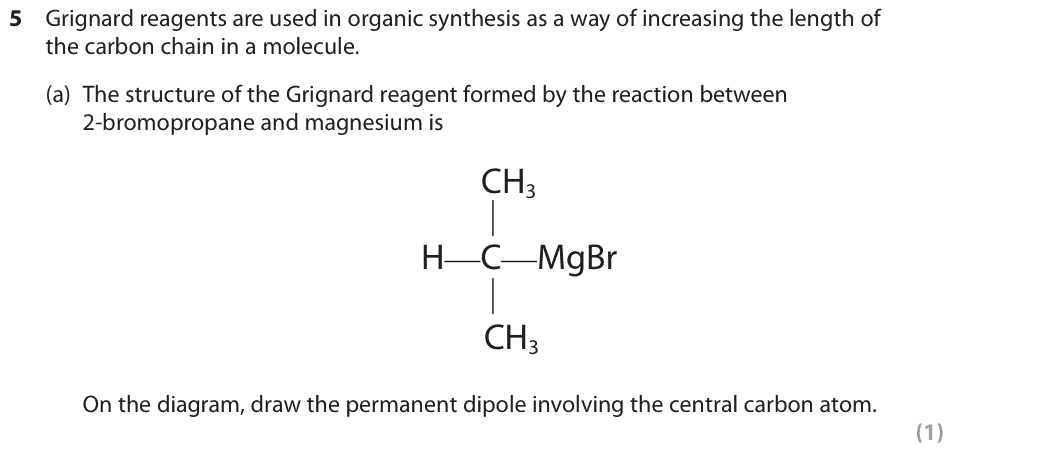
Grignard reagents are used in organic synthesis as a way of increasing the length of
the carbon chain in a molecule.
The structure of the Grignard reagent formed by the reaction between
2-bromopropane and magnesium is
CH3
H
C
MgBr
CH3
On the diagram, draw the permanent dipole involving the central carbon atom.
June 2017 · Paper 3 · Q5(b)(i) 1 mark Diagram or structure organic synthesis
Earlier part of question 5 that this part usesEarlier part of June 2017 Paper 3 question 5
The Grignard reagent in part (a) reacts with propanal.
Draw the fully displayed formula of the final organic product of this reaction.
June 2017 · Paper 3 · Q5(b)(ii) 1 mark Short answer introduction to organic chemistry
Earlier parts of question 5 that this part usesEarlier part of June 2017 Paper 3 question 5Earlier part of June 2017 Paper 3 question 5
Name the organic product in (b)(i).
June 2017 · Paper 3 · Q5(c) 2 marks Short answer organic synthesishalogenoalkanes
Earlier part of question 5 that this part usesEarlier part of June 2017 Paper 3 question 5
Identify, by using ticks, two boxes in the table to select appropriate terms that
describe a Grignard reagent.
acid
electrophile
nucleophile
oxidising agent
reducing agent
June 2017 · Paper 3 · Q5(d) 1 mark Short answer organic synthesis
Earlier part of question 5 that this part usesEarlier part of June 2017 Paper 3 question 5
The solvent used for Grignard reagents has to be completely dry.
By considering the dipole on the O—H bonds in water, predict the identity of the organic
product that forms if water is added to the Grignard compound in part (a).
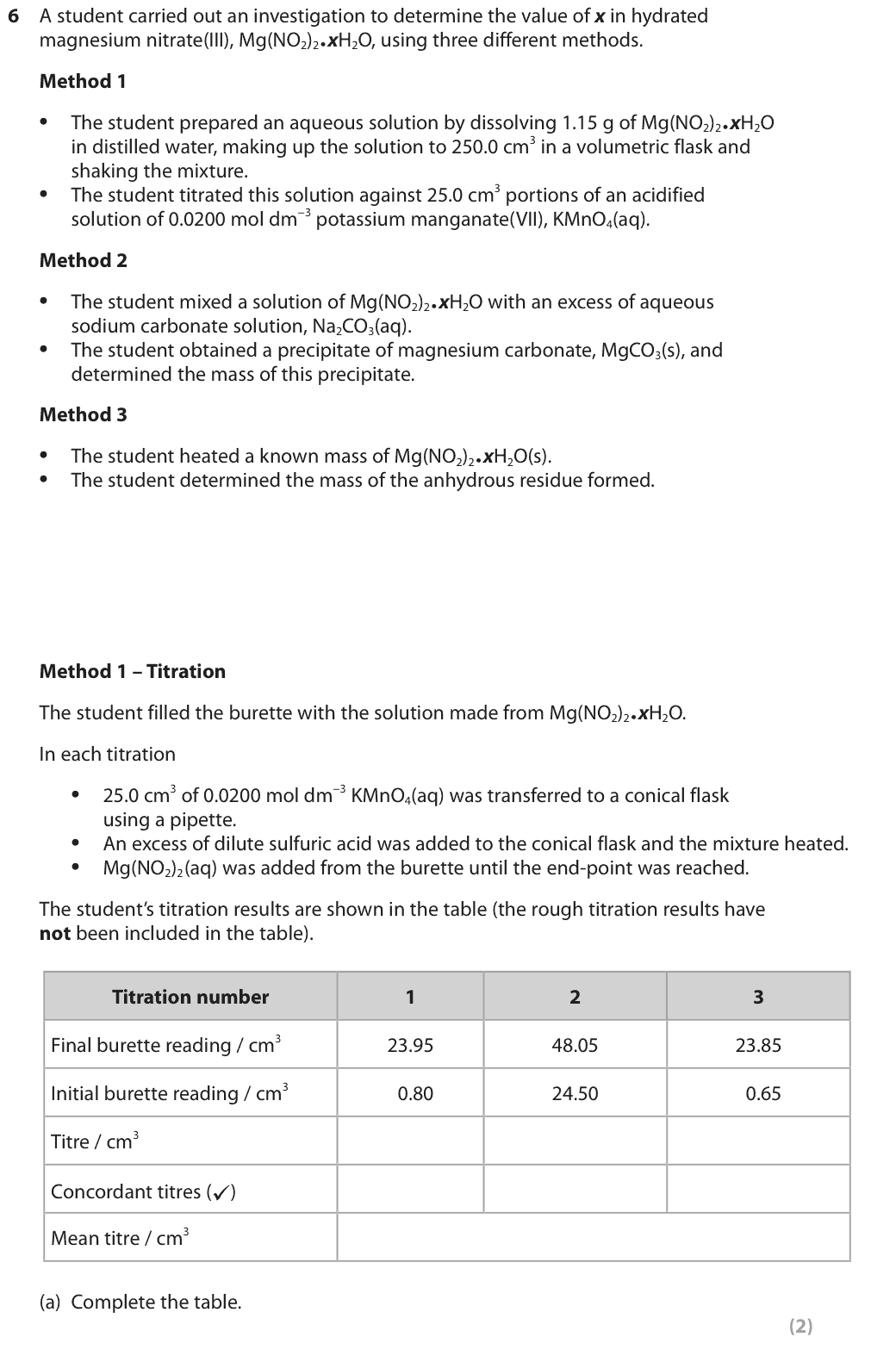
June 2017 · Paper 3 · Q6(a) 2 marks Short answer redox ii
A student carried out an investigation to determine the value of x in hydrated
magnesium nitrate(III), Mg(NO2)2•xH2O, using three different methods.
Method 1
•
The student prepared an aqueous solution by dissolving 1.15 g of Mg(NO2)2•xH2O
in distilled water, making up the solution to 250.0 cm3 in a volumetric flask and
shaking the mixture.
•
The student titrated this solution against 25.0 cm3 portions of an acidified
solution of 0.0200 mol dm−3 potassium manganate(VII), KMnO4(aq).
Method 2
•
The student mixed a solution of Mg(NO2)2•xH2O with an excess of aqueous
sodium carbonate solution, Na2CO3(aq).
•
The student obtained a precipitate of magnesium carbonate, MgCO3(s), and
determined the mass of this precipitate.
Method 3
•
The student heated a known mass of Mg(NO2)2•xH2O(s).
•
The student determined the mass of the anhydrous residue formed.
Method 1 – Titration
The student filled the burette with the solution made from Mg(NO2)2•xH2O.
In each titration
•
25.0 cm3 of 0.0200 mol dm−3 KMnO4(aq) was transferred to a conical flask
using a pipette.
•
An excess of dilute sulfuric acid was added to the conical flask and the mixture heated.
•
Mg(NO2)2(aq) was added from the burette until the end-point was reached.
The student’s titration results are shown in the table (the rough titration results have
not been included in the table).
Titration number
1
2
3
Final burette reading / cm3
23.95
48.05
23.85
Initial burette reading / cm3
0.80
24.50
0.65
Titre / cm3
Concordant titres (9)
Mean titre / cm3
Complete the table.
June 2017 · Paper 3 · Q6(b) 1 mark Practical and data analysis redox ii
Earlier part of question 6 that this part usesEarlier part of June 2017 Paper 3 question 6
Deduce the colour change that the student would see at the end-point in this titration.
From  to 
− react with 5 mol NO2
−.
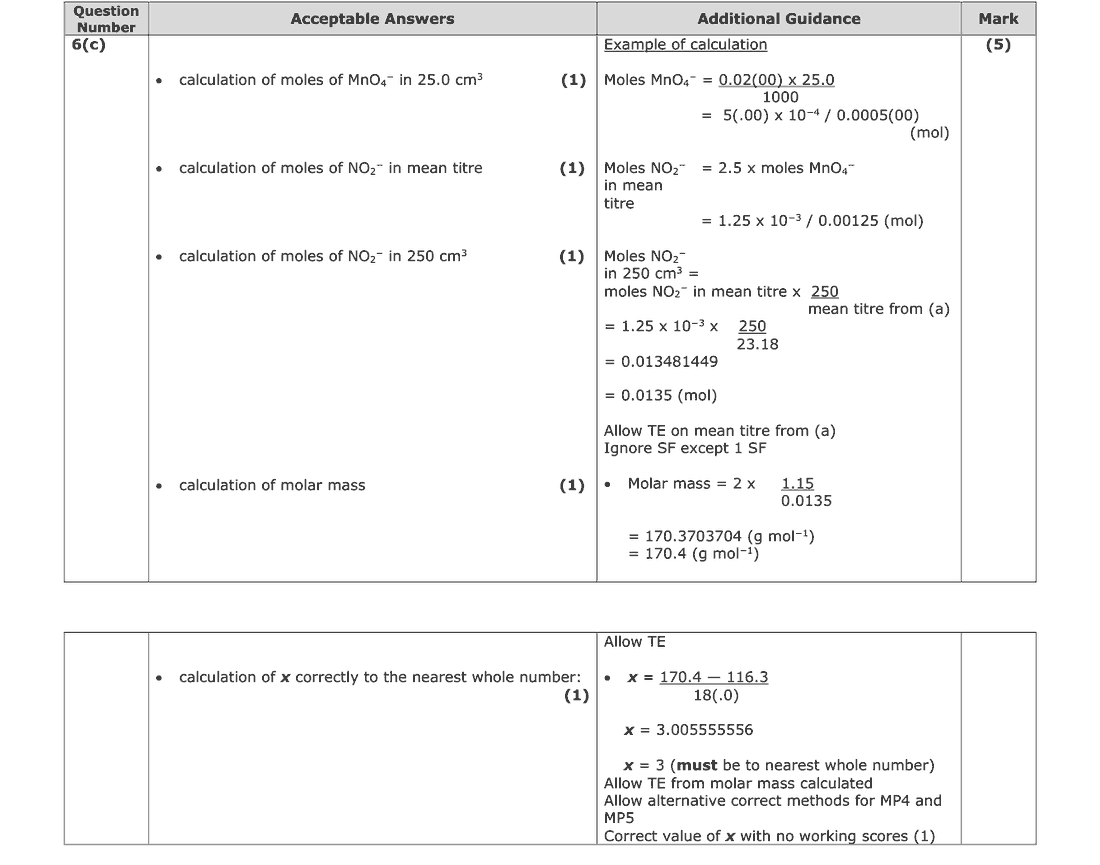
June 2017 · Paper 3 · Q6(c) 5 marks Calculation redox iiformulae equations and amounts of substance
Earlier part of question 6 that this part usesEarlier part of June 2017 Paper 3 question 6
In the titration reaction, 2 mol MnO4
Calculate the number of moles of NO2
−, in the 250 cm3 of solution prepared by the
student and hence the value of x in Mg(NO2)2•xH2O.
Give your answer to the nearest whole number.
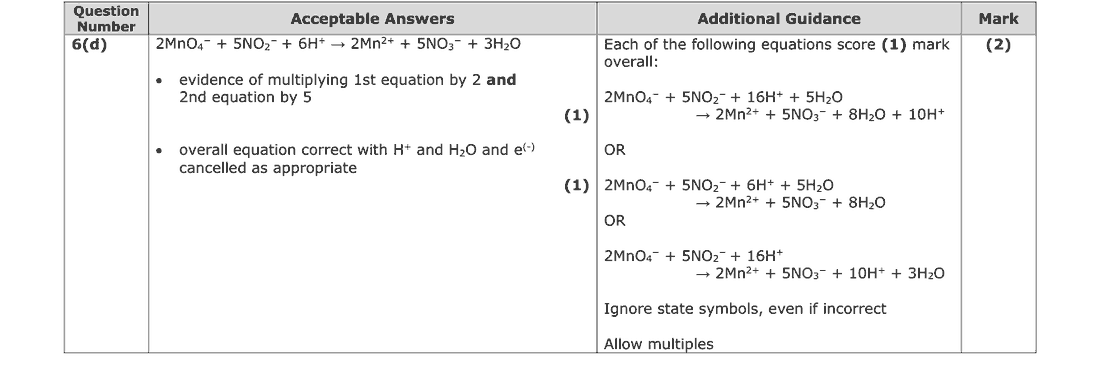
June 2017 · Paper 3 · Q6(d) 2 marks Equation writing redox i
Earlier part of question 6 that this part usesEarlier part of June 2017 Paper 3 question 6
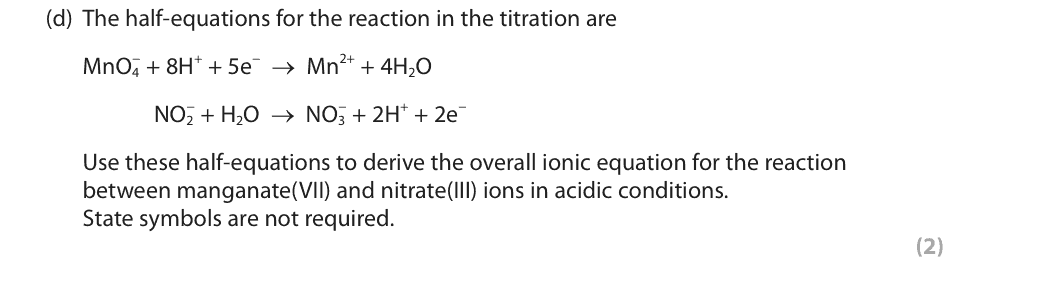
The half-equations for the reaction in the titration are
− + 8H+ + 5e−  o  Mn2+ + 4H2O
MnO4
− + H2O  o  NO3
− + 2H+ + 2e−
NO2
Use these half-equations to derive the overall ionic equation for the reaction
between manganate(VII) and nitrate(III) ions in acidic conditions.
State symbols are not required.
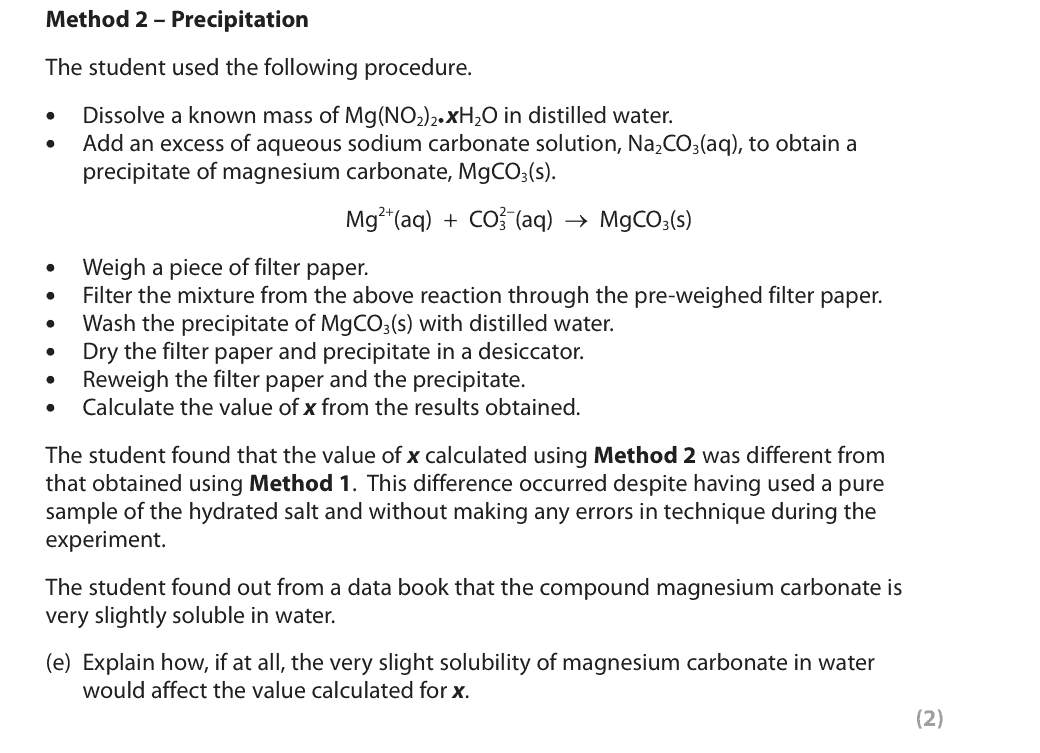
Method 2 – Precipitation
The student used the following procedure.
•
Dissolve a known mass of Mg(NO2)2•xH2O in distilled water.
•
Add an excess of aqueous sodium carbonate solution, Na2CO3(aq), to obtain a
precipitate of magnesium carbonate, MgCO3(s).
Mg2+(aq)  +  CO3
2−(aq)  o  MgCO3(s)
•
Weigh a piece of filter paper.
•
Filter the mixture from the above reaction through the pre-weighed filter paper.
•
Wash the precipitate of MgCO3(s) with distilled water.
•
Dry the filter paper and precipitate in a desiccator.
•
Reweigh the filter paper and the precipitate.
•
Calculate the value of x from the results obtained.
The student found that the value of x calculated using Method 2 was different from
that obtained using Method 1.  This difference occurred despite having used a pure
sample of the hydrated salt and without making any errors in technique during the
experiment.
The student found out from a data book that the compound magnesium carbonate is
very slightly soluble in water.
June 2017 · Paper 3 · Q6(e) 2 marks Explanation formulae equations and amounts of substance
Earlier part of question 6 that this part usesEarlier part of June 2017 Paper 3 question 6
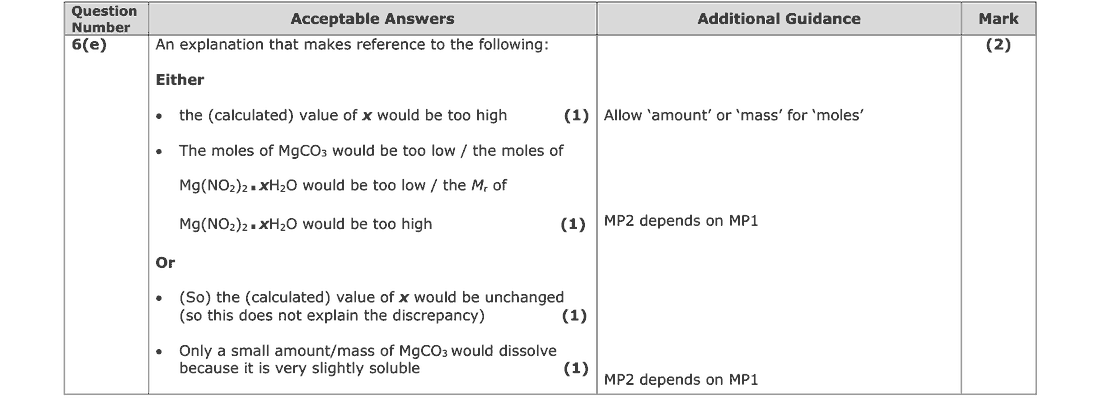
Explain how, if at all, the very slight solubility of magnesium carbonate in water
would affect the value calculated for x.
June 2017 · Paper 3 · Q6(f) 2 marks Practical and data analysis formulae equations and amounts of substance
Earlier part of question 6 that this part usesEarlier part of June 2017 Paper 3 question 6
The student planned to obtain any dissolved magnesium carbonate by
evaporating the filtrate, and then weighing the residue.
Criticise this student’s plan.
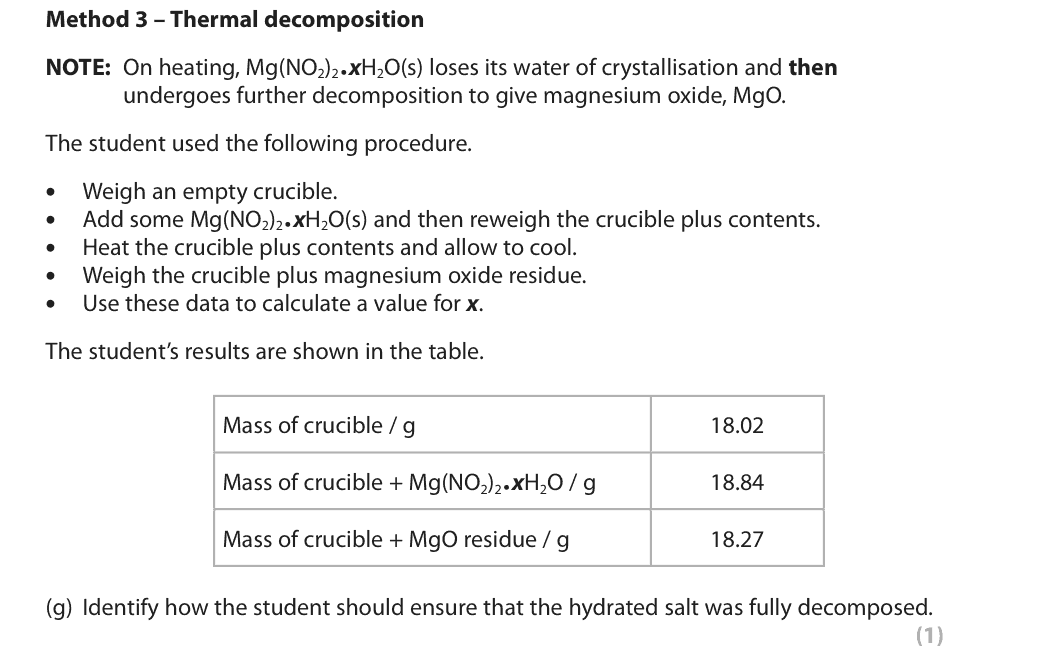
Method 3 – Thermal decomposition
NOTE:  On heating, Mg(NO2)2•xH2O(s) loses its water of crystallisation and then
undergoes further decomposition to give magnesium oxide, MgO.
The student used the following procedure.
•
Weigh an empty crucible.
•
Add some Mg(NO2)2•xH2O(s) and then reweigh the crucible plus contents.
•
Heat the crucible plus contents and allow to cool.
•
Weigh the crucible plus magnesium oxide residue.
•
Use these data to calculate a value for x.
The student’s results are shown in the table.
Mass of crucible / g
18.02
Mass of crucible + Mg(NO2)2•xH2O / g
18.84
Mass of crucible + MgO residue / g
18.27
June 2017 · Paper 3 · Q6(g) 1 mark Practical and data analysis formulae equations and amounts of substance
Earlier part of question 6 that this part usesEarlier part of June 2017 Paper 3 question 6
Identify how the student should ensure that the hydrated salt was fully decomposed.
June 2017 · Paper 3 · Q6(h) 2 marks Practical and data analysis formulae equations and amounts of substance
Earlier part of question 6 that this part usesEarlier part of June 2017 Paper 3 question 6
The student carried out an evaluation of the results obtained from Method 3
Identify two modifications to the method that would enable the student to lower
the percentage uncertainty in the measurement of the mass of the solid residue.
June 2017 · Paper 3 · Q7(a) 6 marks 6-mark extended response transition metals principles
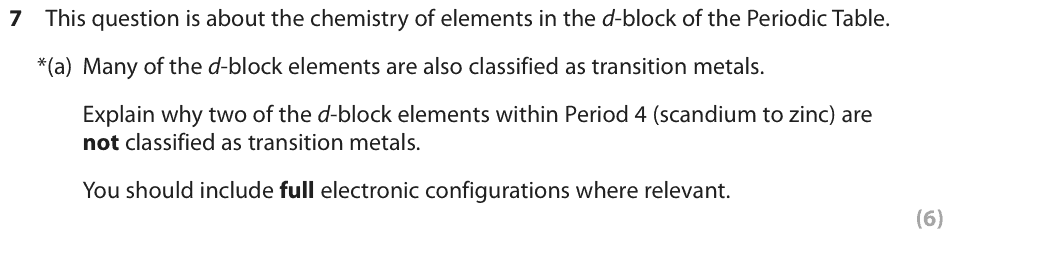
This question is about the chemistry of elements in the d-block of the Periodic Table.
Many of the d-block elements are also classified as transition metals.
Explain why two of the d-block elements within Period 4 (scandium to zinc) are
not classified as transition metals.
You should include full electronic configurations where relevant.
2−, can oxidise manganese(II) ions, Mn2+.
June 2017 · Paper 3 · Q7(b) 5 marks Calculation redox ii
Earlier part of question 7 that this part usesEarlier part of June 2017 Paper 3 question 7
Under certain conditions, dichromate(VI) ions, Cr2O7
In this reaction, dichromate(VI) ions are reduced to chromium(III) ions, in acidic
conditions, according to the half-equation
Cr2O7
2−(aq)  +  14H+(aq)  +  6e−  U  2Cr3+(aq)  +  7H2O(l)
In an experiment it was found that 20.0 cm3 of 0.100 mol dm−3 potassium dichromate(VI)
was required to oxidise 30.0 cm3 of 0.200 mol dm−3 manganese(II) sulfate solution.
Use these data to calculate the final oxidation state of the manganese.
June 2017 · Paper 3 · Q7(c) 4 marks Calculation formulae equations and amounts of substanceredox ii
Earlier part of question 7 that this part usesEarlier part of June 2017 Paper 3 question 7
A student constructed an electrochemical cell as follows:
•
a half-cell was made from a strip of chromium metal and a solution of
aqueous chromium(III) sulfate
•
a second half-cell was made from a piece of metal, X, and a solution of its sulfate, XSO4(aq)
•
the two half-cells were connected and a current allowed to pass for some time.
Results
•
the chromium electrode increased in mass by 1.456 g
•
the electrode made of metal X decreased in mass by 1.021 g.
Use these data to determine the identity of the metal, X.
June 2017 · Paper 3 · Q8(a) 3 marks Mechanism halogenoalkanes
The chemistry of organic compounds containing a chlorine atom is affected by the
presence of other groups.
Consider the reaction of ammonia, NH3, with CH3CH2CH2Cl and with CH3CH2COCl.
Draw the mechanism for the reaction of CH3CH2CH2Cl with an excess of ammonia
to form the primary amine.  Include curly arrows and relevant lone pairs.
June 2017 · Paper 3 · Q8(b) 3 marks Mechanism Hard carboxylic acids
Earlier part of question 8 that this part usesEarlier part of June 2017 Paper 3 question 8
Predict the mechanism for the reaction of CH3CH2COCl with ammonia.
Include curly arrows and relevant lone pairs.
June 2017 · Paper 3 · Q9(a)(i) 1 mark Short answer Easy equilibrium i
The gas phase reaction between hydrogen and iodine is reversible.
H2(g)  +  I2(g)  U  2HI(g)
Write the expression for the equilibrium constant, Kc, for this reaction.
June 2017 · Paper 3 · Q9(a)(ii) 2 marks Short answer equilibrium i
Earlier part of question 9 that this part usesEarlier part of June 2017 Paper 3 question 9
If the starting concentration of both hydrogen and iodine was a mol dm−3
and it was found that 2y mol dm−3 of hydrogen iodide had formed once
equilibrium had been established, write the Kc expression in terms of a and y.
June 2017 · Paper 3 · Q9(b)(i) 1 mark Calculation equilibrium ii
Earlier parts of question 9 that this part usesEarlier part of June 2017 Paper 3 question 9Earlier part of June 2017 Paper 3 question 9
The expression for the equilibrium constant in (a)(ii) can be rearranged as shown.

a
K
c
y
=

2 +
K
c
In an experiment, air was removed from a 1 dm3 flask and amounts of hydrogen
and iodine gases were mixed together such that their initial concentrations
were both a mol dm−3.  This mixture was allowed to reach equilibrium at 760 K.
The equilibrium concentration of iodine was then measured.
The experiment was repeated for various initial concentrations, a mol dm−3, and
the results recorded in the table.
Complete the table to give the two remaining values of y mol dm−3, to two
decimal places.
a / mol dm−3
[I2]eq / mol dm−3
y / mol dm−3
0.20
0.02
0.18
0.80
0.25
0.55
1.50
0.37
2.10
0.57
1.53
2.80
0.65
2.15
3.80
0.87
4.90
1.15
3.75
June 2017 · Paper 3 · Q9(b)(ii) 2 marks Diagram or structure equilibrium ii
Earlier parts of question 9 that this part usesEarlier part of June 2017 Paper 3 question 9Earlier part of June 2017 Paper 3 question 9
Plot a graph to show how y mol dm−3 varies with the initial concentrations of
hydrogen and iodine, a mol dm−3.
4.0
3.0
y / mol dm–3
2.0
1.0
0
0
1.0
2.0
3.0
4.0
5.0
a / mol dm–3
June 2017 · Paper 3 · Q9(b)(iii) 2 marks Calculation equilibrium ii
Earlier parts of question 9 that this part usesEarlier part of June 2017 Paper 3 question 9Earlier part of June 2017 Paper 3 question 9Earlier part of June 2017 Paper 3 question 9
Determine the gradient of your graph.
Show your working on the graph.

a
K
c
June 2017 · Paper 3 · Q9(b)(iv) 2 marks Calculation equilibrium ii
Earlier parts of question 9 that this part usesEarlier part of June 2017 Paper 3 question 9Earlier part of June 2017 Paper 3 question 9Earlier part of June 2017 Paper 3 question 9Earlier part of June 2017 Paper 3 question 9
Use your answer to (b)(iii) and the expression y
=
to calculate the

2 +
K
value of Kc.
c
June 2017 · Paper 3 · Q9(c) 1 mark Practical and data analysis formulae equations and amounts of substance
Earlier part of question 9 that this part usesEarlier part of June 2017 Paper 3 question 9
Identify a safety issue associated with this experiment.
June 2017 · Paper 3 · Q9(d) 2 marks Short answer kinetics iequilibrium ii
Earlier parts of question 9 that this part usesEarlier part of June 2017 Paper 3 question 9Earlier part of June 2017 Paper 3 question 9Earlier part of June 2017 Paper 3 question 9Earlier part of June 2017 Paper 3 question 9Earlier part of June 2017 Paper 3 question 9
One of the experiments in part (b) was repeated using the same molar quantities
of hydrogen and iodine but in a 500 cm3 flask instead of the 1 dm3 flask.
Deduce the effect, if any, that this would have on the rate of reaction and on the
value of Kc calculated.
June 2017 · Paper 3 · Q9(e)(i) 2 marks Explanation equilibrium ii
Earlier part of question 9 that this part usesEarlier part of June 2017 Paper 3 question 9
The equation for the reaction between hydrogen and iodine is
H2(g)  +  I2(g)   U  2HI(g)     ǻH = –9.6 kJ mol−1
Explain the effect, if any, on the value of Kc when the temperature is increased.
June 2017 · Paper 3 · Q9(e)(ii) 1 mark Diagram or structure equilibrium ii
Earlier parts of question 9 that this part usesEarlier part of June 2017 Paper 3 question 9Earlier part of June 2017 Paper 3 question 9Earlier part of June 2017 Paper 3 question 9
On your graph in (b)(ii), draw and label the line you would expect if the experiment
was carried out at 1000 K instead of 760 K.

Work with an A-level chemistry tutor

Want a paper marked and gone through with you? Message us.

Prefer email? Send an enquiry

If you are under 18, please include a parent's contact details. Enquiries go to enquiries@chemistryaleveltutor.com and are deleted once handled. All tutoring is online.