November 2020: Paper 2, Organic and physical chemistry

105 marks · 46 question parts · Paper, mark scheme and report on AQA's site · An autumn series using the paper written for the cancelled summer exams · Have the Data Booklet beside you

Question by question

QTopicMarksAOType
01.1 Rate equations 3Calculation
01.2 Rate equations 2Short answer
01.3 Rate equations 1Diagram or structure
01.4 Rate equations 1Short answer
01.5 Rate equations 3Calculation
01.6 Rate equations 1Short answer
02.1 Optical isomerism 1Short answer
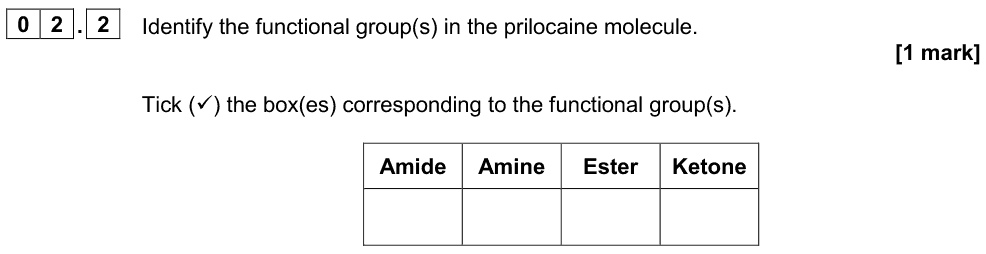
02.2 Carboxylic acids and derivatives, Amines 1Short answer
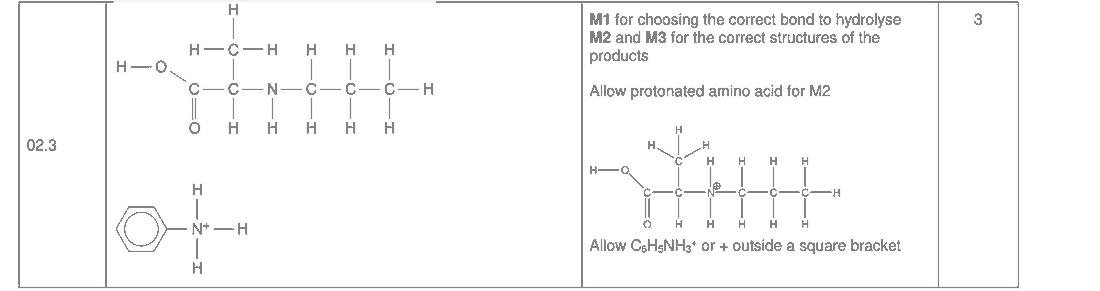
02.3 Polymers, Carboxylic acids and derivatives 3Diagram or structure
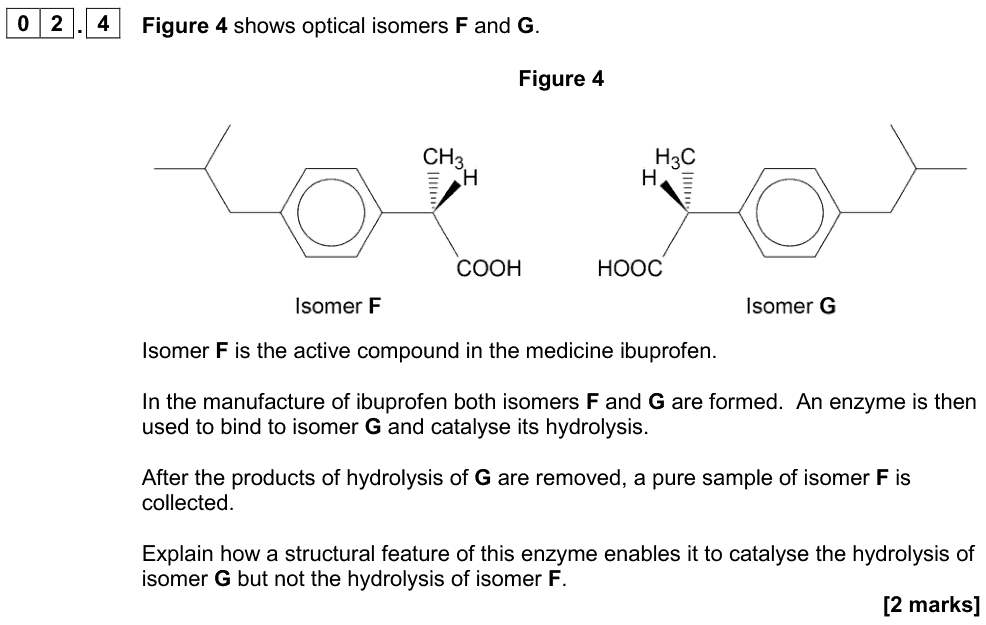
02.4 Amino acids, proteins and DNA 2Explanation
03.1 Alcohols 2Practical and data analysis
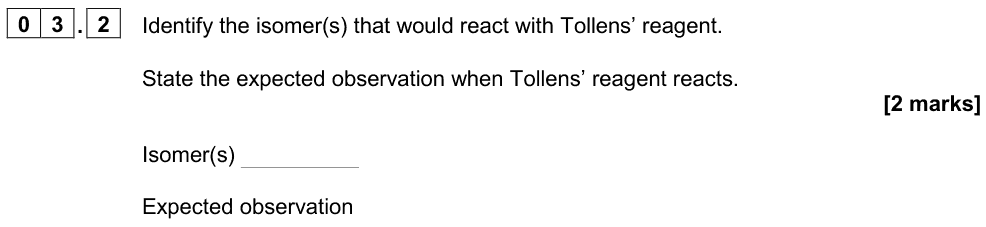
03.2 Aldehydes and ketones 2Practical and data analysis
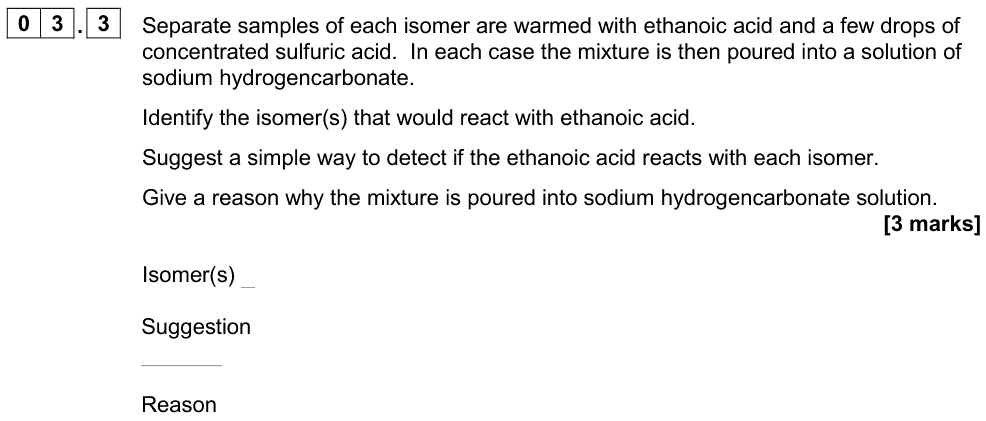
03.3 Carboxylic acids and derivatives 3Practical and data analysis
03.4 Introduction to organic chemistry: nomenclature, mechanisms and isomerism 1Short answer
03.5 Organic analysis: test-tube reactions, mass spectrometry and infrared 4Explanation
03.6 Organic analysis: test-tube reactions, mass spectrometry and infrared, Atomic structure 1Short answer
04.1 Carboxylic acids and derivatives 2Practical and data analysis
04.2 Carboxylic acids and derivatives 1Practical and data analysis
04.3 Carboxylic acids and derivatives 1Practical and data analysis
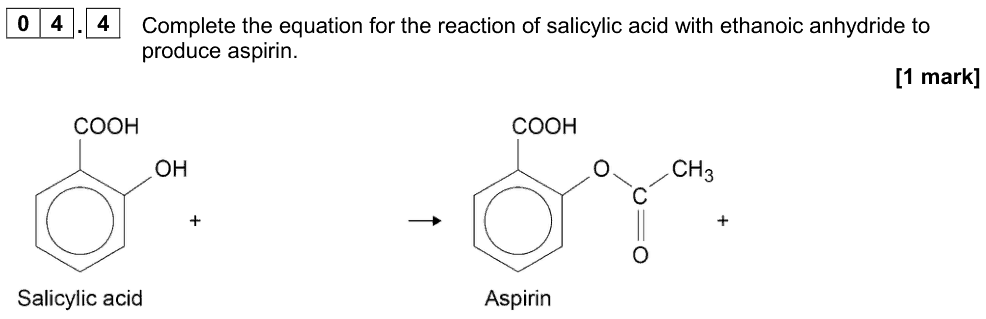
04.4 Carboxylic acids and derivatives 1Equation writing
04.5 Amount of substance 5Calculation
04.6 Carboxylic acids and derivatives 2Practical and data analysis
04.7 Carboxylic acids and derivatives 2Practical and data analysis
04.8 Carboxylic acids and derivatives 1Practical and data analysis
04.9 Carboxylic acids and derivatives 1Practical and data analysis
05.1 Bonding, Halogenoalkanes 3Short answer
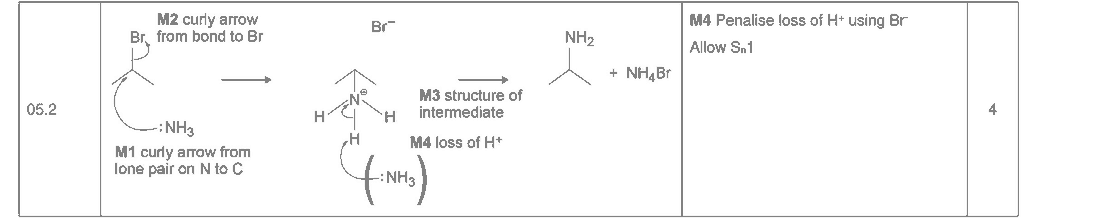
05.2 Amines, Halogenoalkanes 4Mechanism
05.3 Amines 2Diagram or structure
06.1 Aromatic chemistry 3Short answer
06.2 Aldehydes and ketones, Introduction to organic chemistry: nomenclature, mechanisms and isomerism 3Short answer
06.3 Alcohols 3Mechanism
06.4 Alkenes 1Diagram or structure
07.1 Nuclear magnetic resonance spectroscopy 6Level of response
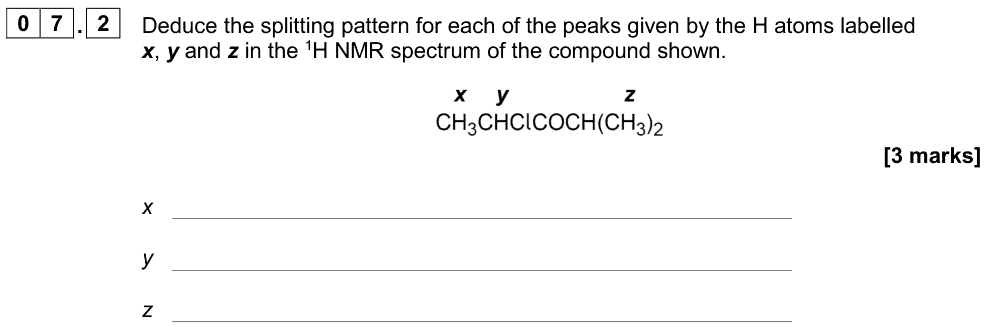
07.2 Nuclear magnetic resonance spectroscopy 3Short answer
07.3 Nuclear magnetic resonance spectroscopy 1Short answer
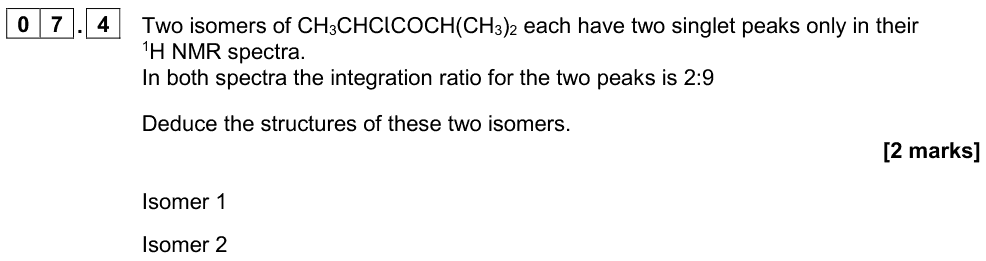
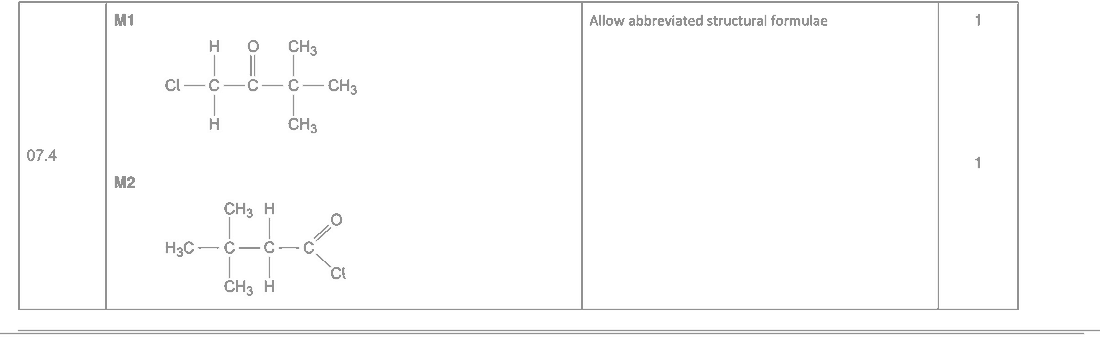
07.4 Nuclear magnetic resonance spectroscopy, Introduction to organic chemistry: nomenclature, mechanisms and isomerism 2Diagram or structure
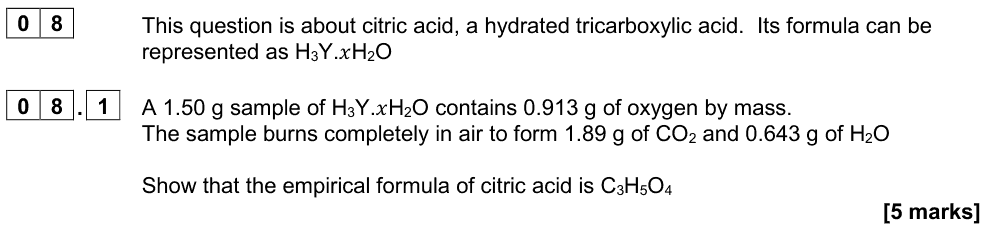
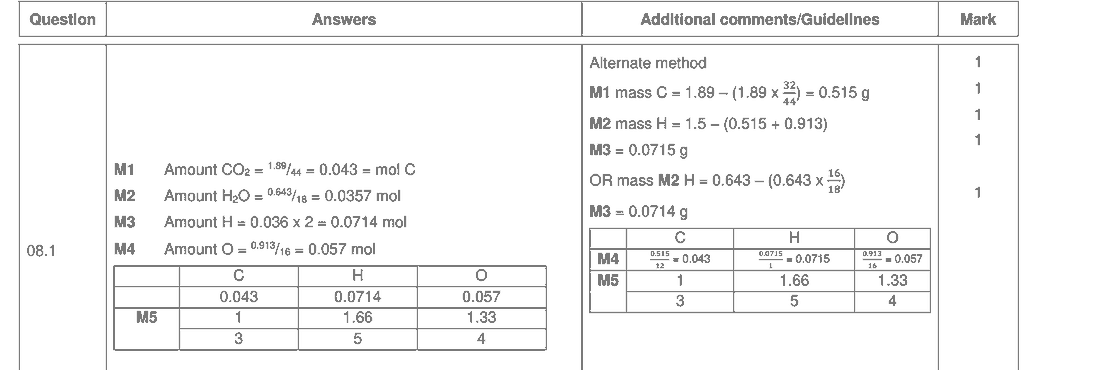
08.1 Amount of substance 5Calculation
08.2 Amount of substance 2Calculation
08.3 Introduction to organic chemistry: nomenclature, mechanisms and isomerism 1Short answer
08.4 Nuclear magnetic resonance spectroscopy 1Short answer
09.1 Chemical equilibria, Le Chatelier's principle and Kc 2Calculation
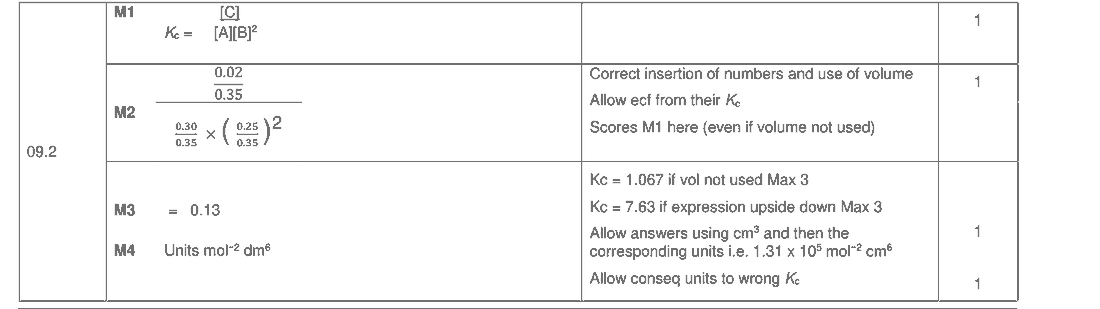
09.2 Chemical equilibria, Le Chatelier's principle and Kc 4Calculation
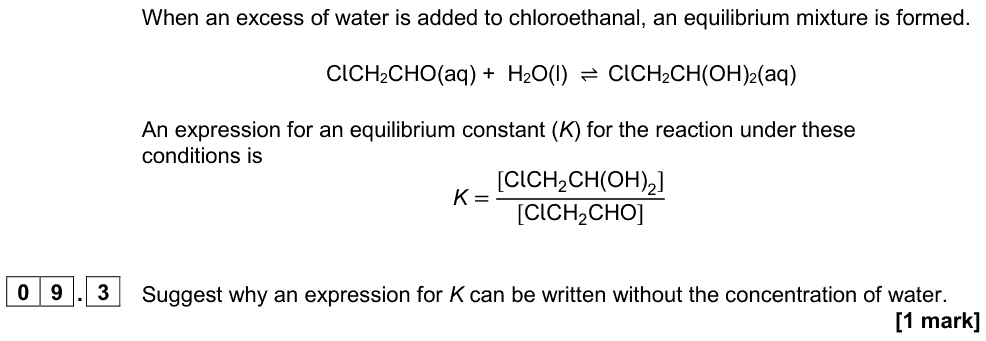
09.3 Chemical equilibria, Le Chatelier's principle and Kc 1Short answer
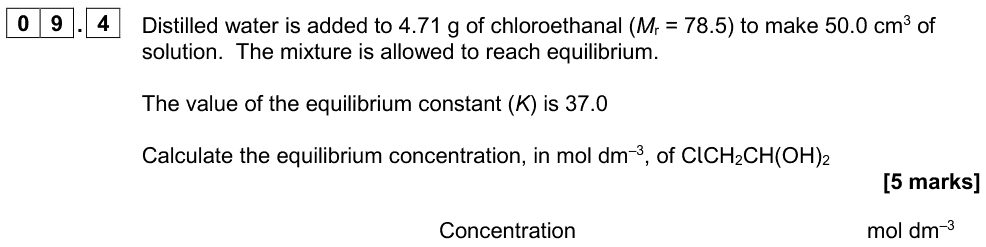
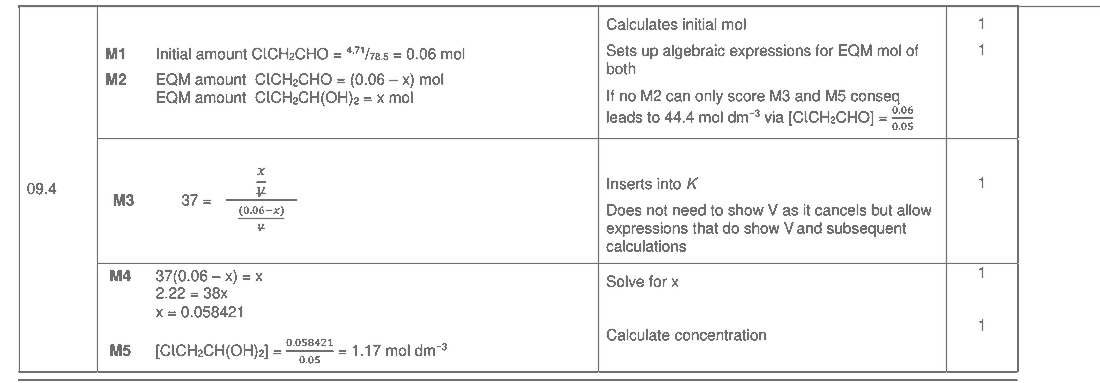
09.4 Chemical equilibria, Le Chatelier's principle and Kc, Amount of substance 5Calculation
09.5 Aldehydes and ketones, Introduction to organic chemistry: nomenclature, mechanisms and isomerism 3Mechanism
09.6 Aldehydes and ketones, Kinetics 3Explanation

The questions

01.101.201.301.401.501.602.102.202.302.403.103.203.303.403.503.604.104.204.304.404.504.604.704.804.905.105.205.306.106.206.306.407.107.207.307.408.108.208.308.409.109.209.309.409.509.6
November 2020 · Paper 2 · Q01.1 3 marks Calculation rate equations
This question is about rates of reaction.
Phosphinate ions (H2PO2–) react with hydroxide ions to produce hydrogen gas as
shown.
H2PO2– + OH− → HPO32– + H2
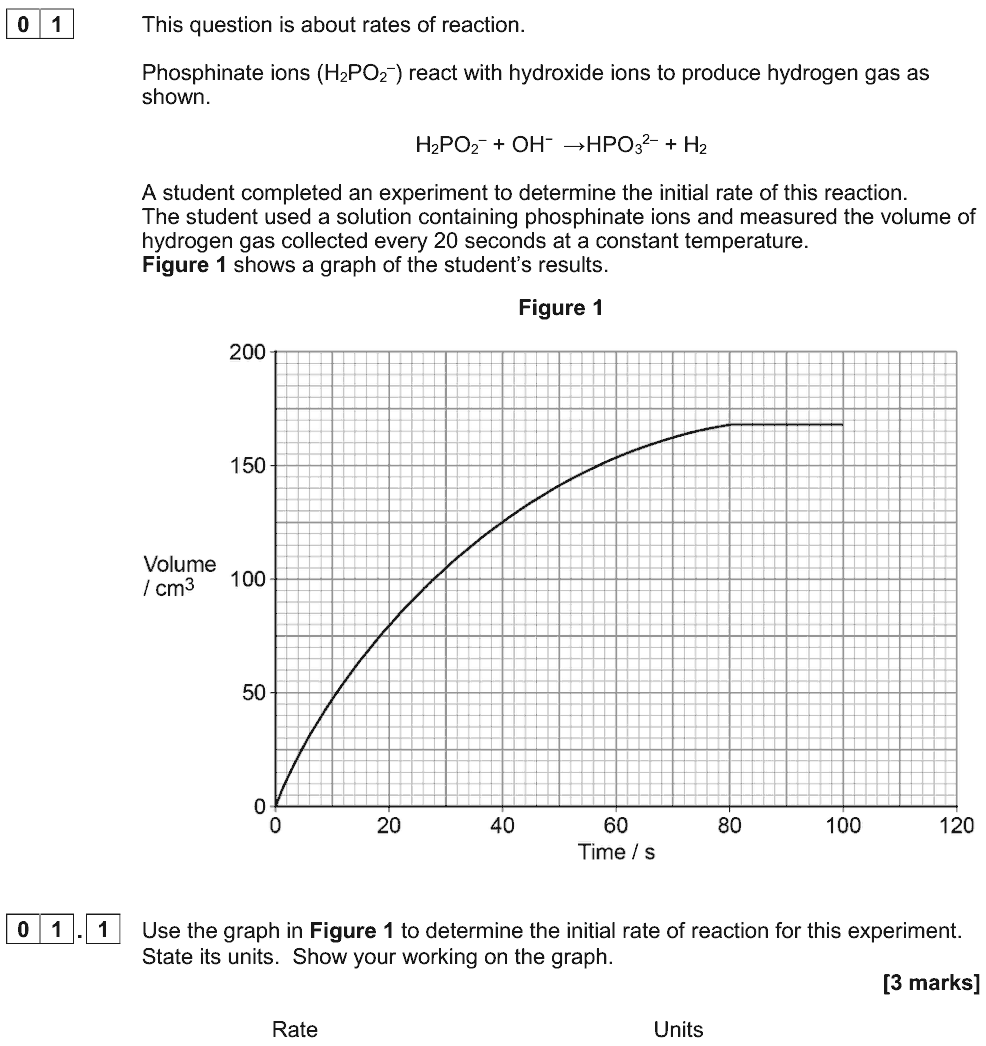
A student completed an experiment to determine the initial rate of this reaction.
The student used a solution containing phosphinate ions and measured the volume of
hydrogen gas collected every 20 seconds at a constant temperature.
Figure 1 shows a graph of the student’s results.
Figure 1
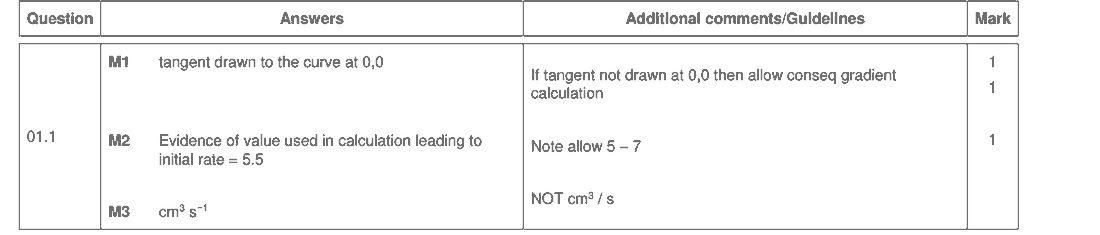
Use the graph in Figure 1 to determine the initial rate of reaction for this experiment.
State its units.  Show your working on the graph.
[3 marks]
Rate
Units
November 2020 · Paper 2 · Q01.2 2 marks Short answer rate equations
Earlier part of question 01 that this part usesEarlier part of November 2020 Paper 2 question 01
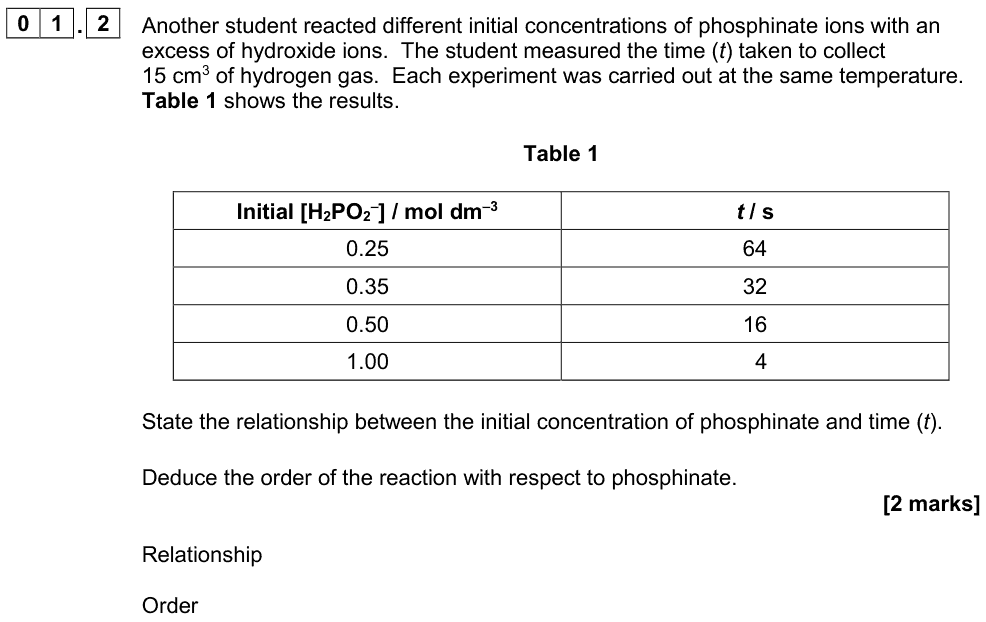
Another student reacted different initial concentrations of phosphinate ions with an
excess of hydroxide ions.  The student measured the time (t) taken to collect
15 cm3 of hydrogen gas.  Each experiment was carried out at the same temperature.
Table 1 shows the results.
Table 1
Initial [H2PO2–] / mol dm–3
t / s
0.25
64
0.35
32
0.50
16
1.00
4
State the relationship between the initial concentration of phosphinate and time (t).
Deduce the order of the reaction with respect to phosphinate.
[2 marks]
Relationship
Order
November 2020 · Paper 2 · Q01.3 1 mark Diagram or structure rate equations
Earlier part of question 01 that this part usesEarlier part of November 2020 Paper 2 question 01
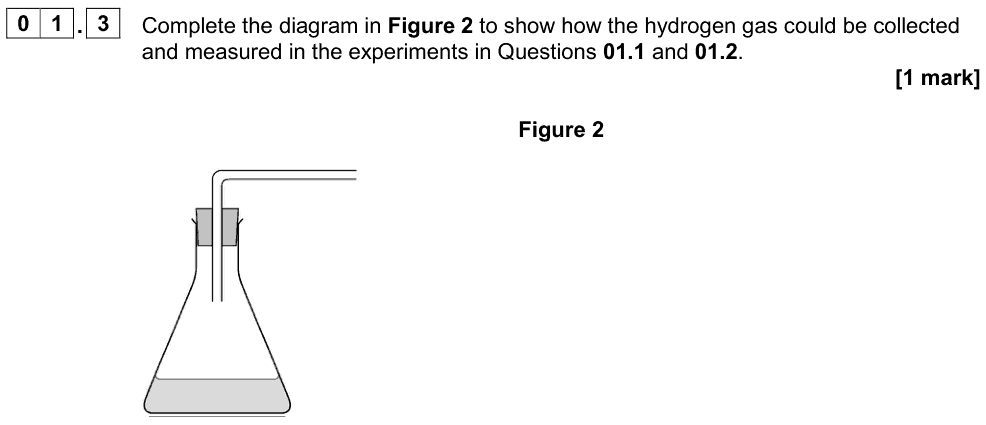
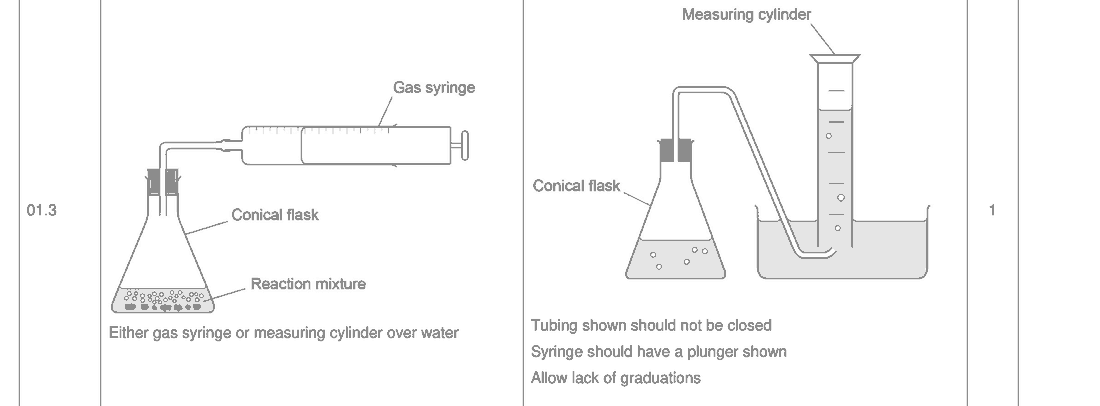
Complete the diagram in Figure 2 to show how the hydrogen gas could be collected
and measured in the experiments in Questions 01.1 and 01.2.
[1 mark]
Figure 2
November 2020 · Paper 2 · Q01.4 1 mark Short answer rate equations
Earlier part of question 01 that this part usesEarlier part of November 2020 Paper 2 question 01
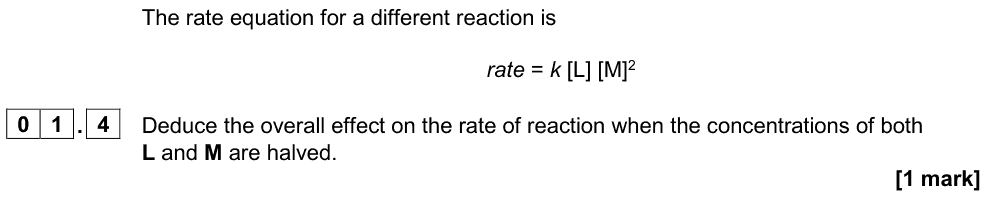
The rate equation for a different reaction is
rate = k [L] [M]2
Deduce the overall effect on the rate of reaction when the concentrations of both
L and M are halved.
[1 mark]
November 2020 · Paper 2 · Q01.5 3 marks Calculation rate equations
Earlier parts of question 01 that this part usesEarlier part of November 2020 Paper 2 question 01Earlier part of November 2020 Paper 2 question 01
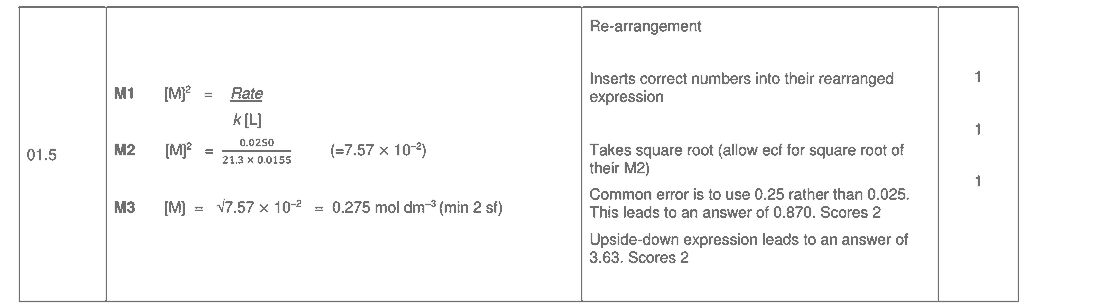
The rate of reaction is 0.0250 mol dm–3 s–1 when the
concentration of L is 0.0155 mol dm–3
Calculate the concentration of M if the rate constant is 21.3 mol–2 dm6 s–1
[3 marks]
Concentration of M
mol dm–3
November 2020 · Paper 2 · Q01.6 1 mark Short answer rate equations
Earlier part of question 01 that this part usesEarlier part of November 2020 Paper 2 question 01
Define the term overall order of reaction.
[1 mark]
November 2020 · Paper 2 · Q02.1 1 mark Short answer optical isomerism
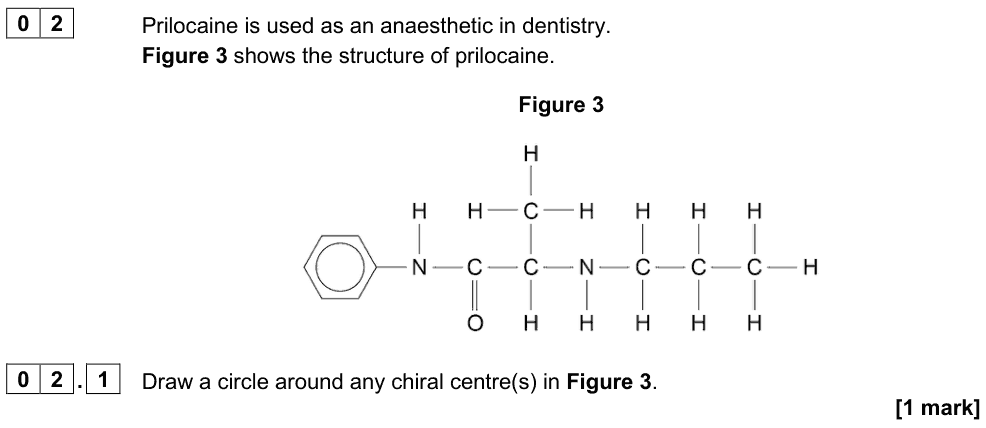
Prilocaine is used as an anaesthetic in dentistry.
Figure 3 shows the structure of prilocaine.
Figure 3
Draw a circle around any chiral centre(s) in Figure 3.
[1 mark]
November 2020 · Paper 2 · Q02.2 1 mark Short answer carboxylic acids and derivativesamines
Earlier part of question 02 that this part usesEarlier part of November 2020 Paper 2 question 02
Identify the functional group(s) in the prilocaine molecule.
[1 mark]
Tick () the box(es) corresponding to the functional group(s).
Amide
Amine
Ester
Ketone
November 2020 · Paper 2 · Q02.3 3 marks Diagram or structure polymerscarboxylic acids and derivatives
Earlier part of question 02 that this part usesEarlier part of November 2020 Paper 2 question 02
Prilocaine is completely hydrolysed in the human body to give a mixture of products.
Draw the structures of the two organic products formed in the
complete hydrolysis of prilocaine in acidic conditions.
[3 marks]
November 2020 · Paper 2 · Q02.4 2 marks Explanation amino acids proteins and dna
Earlier part of question 02 that this part usesEarlier part of November 2020 Paper 2 question 02
Figure 4 shows optical isomers F and G.
Figure 4
Isomer F is the active compound in the medicine ibuprofen.
In the manufacture of ibuprofen both isomers F and G are formed.  An enzyme is then
used to bind to isomer G and catalyse its hydrolysis.
After the products of hydrolysis of G are removed, a pure sample of isomer F is
collected.
Explain how a structural feature of this enzyme enables it to catalyse the hydrolysis of
isomer G but not the hydrolysis of isomer F.
[2 marks]
November 2020 · Paper 2 · Q03.1 2 marks Practical and data analysis alcohols
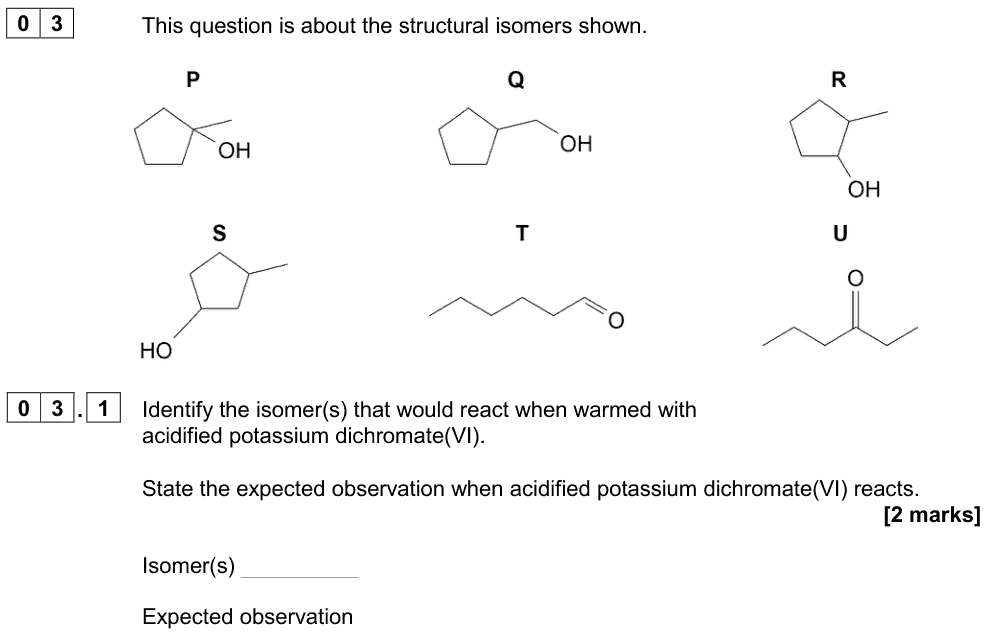
This question is about the structural isomers shown.
Identify the isomer(s) that would react when warmed with
acidified potassium dichromate(VI).
State the expected observation when acidified potassium dichromate(VI) reacts.
[2 marks]
Isomer(s)
Expected observation
November 2020 · Paper 2 · Q03.2 2 marks Practical and data analysis aldehydes and ketones
Earlier part of question 03 that this part usesEarlier part of November 2020 Paper 2 question 03
Identify the isomer(s) that would react with Tollens’ reagent.
State the expected observation when Tollens’ reagent reacts.
[2 marks]
Isomer(s)
Expected observation
November 2020 · Paper 2 · Q03.3 3 marks Practical and data analysis carboxylic acids and derivatives
Earlier part of question 03 that this part usesEarlier part of November 2020 Paper 2 question 03
Separate samples of each isomer are warmed with ethanoic acid and a few drops of
concentrated sulfuric acid.  In each case the mixture is then poured into a solution of
sodium hydrogencarbonate.
Identify the isomer(s) that would react with ethanoic acid.
Suggest a simple way to detect if the ethanoic acid reacts with each isomer.
Give a reason why the mixture is poured into sodium hydrogencarbonate solution.
[3 marks]
Isomer(s)
Suggestion
Reason
November 2020 · Paper 2 · Q03.4 1 mark Short answer introduction to organic chemistry
Earlier part of question 03 that this part usesEarlier part of November 2020 Paper 2 question 03
State the type of structural isomerism shown by isomers P, Q, R and S.
[1 mark]
November 2020 · Paper 2 · Q03.5 4 marks Explanation organic analysis
Earlier part of question 03 that this part usesEarlier part of November 2020 Paper 2 question 03
Describe fully how infrared spectra can be used to distinguish between
isomers R, S and T.
Use data from Table A in the Data Booklet in your answer.
[4 marks]
November 2020 · Paper 2 · Q03.6 1 mark Short answer organic analysisatomic structure
Earlier part of question 03 that this part usesEarlier part of November 2020 Paper 2 question 03
State why mass spectrometry using electrospray ionisation is not a suitable method to
distinguish between the isomers.
[1 mark]
November 2020 · Paper 2 · Q04.1 2 marks Practical and data analysis carboxylic acids and derivatives
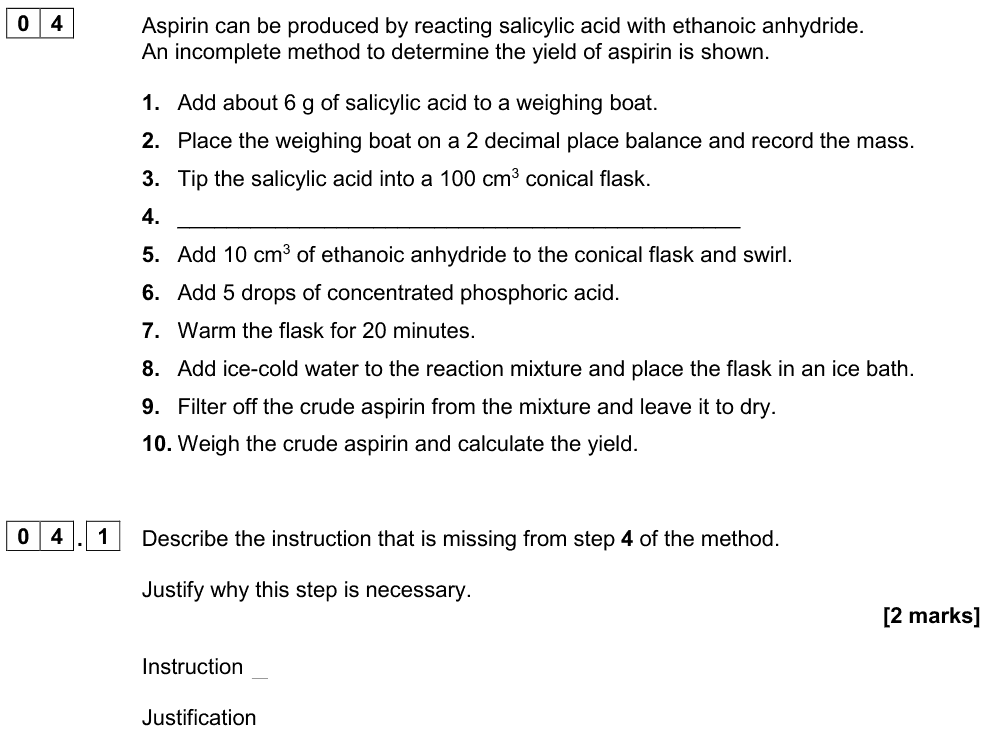
Aspirin can be produced by reacting salicylic acid with ethanoic anhydride.
An incomplete method to determine the yield of aspirin is shown.
1. Add about 6 g of salicylic acid to a weighing boat.
2. Place the weighing boat on a 2 decimal place balance and record the mass.
3. Tip the salicylic acid into a 100 cm3 conical flask.
4. 
5. Add 10 cm3 of ethanoic anhydride to the conical flask and swirl.
6. Add 5 drops of concentrated phosphoric acid.
7. Warm the flask for 20 minutes.
8. Add ice-cold water to the reaction mixture and place the flask in an ice bath.
9. Filter off the crude aspirin from the mixture and leave it to dry.
10. Weigh the crude aspirin and calculate the yield.
Describe the instruction that is missing from step 4 of the method.
Justify why this step is necessary.
[2 marks]
Instruction
Justification
November 2020 · Paper 2 · Q04.2 1 mark Practical and data analysis carboxylic acids and derivatives
Earlier part of question 04 that this part usesEarlier part of November 2020 Paper 2 question 04
Suggest a suitable piece of apparatus to measure out the ethanoic anhydride in
step 5.
[1 mark]
November 2020 · Paper 2 · Q04.3 1 mark Practical and data analysis carboxylic acids and derivatives
Earlier part of question 04 that this part usesEarlier part of November 2020 Paper 2 question 04
Identify a hazard of using concentrated phosphoric acid in step 6.
[1 mark]
November 2020 · Paper 2 · Q04.4 1 mark Equation writing carboxylic acids and derivatives
Earlier part of question 04 that this part usesEarlier part of November 2020 Paper 2 question 04
Complete the equation for the reaction of salicylic acid with ethanoic anhydride to
produce aspirin.
[1 mark]
November 2020 · Paper 2 · Q04.5 5 marks Calculation amount of substance
Earlier part of question 04 that this part usesEarlier part of November 2020 Paper 2 question 04
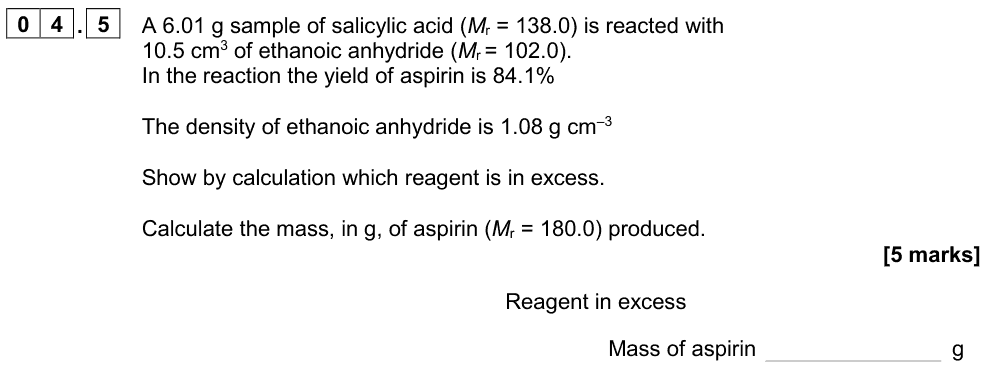
A 6.01 g sample of salicylic acid (Mr = 138.0) is reacted with
10.5 cm3 of ethanoic anhydride (Mr = 102.0).
In the reaction the yield of aspirin is 84.1%
The density of ethanoic anhydride is 1.08 g cm–3
Show by calculation which reagent is in excess.
Calculate the mass, in g, of aspirin (Mr = 180.0) produced.
[5 marks]
Reagent in excess
Mass of aspirin
g
November 2020 · Paper 2 · Q04.6 2 marks Practical and data analysis carboxylic acids and derivatives
Earlier part of question 04 that this part usesEarlier part of November 2020 Paper 2 question 04
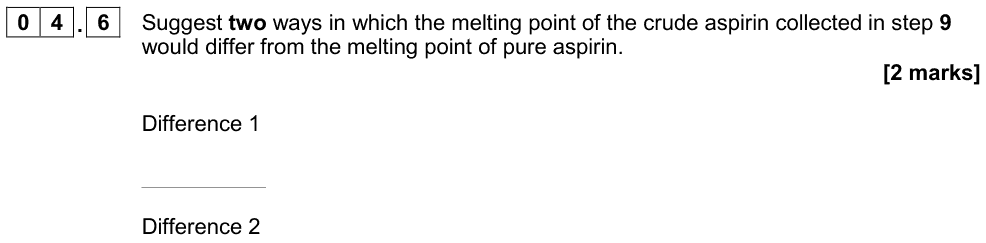
Suggest two ways in which the melting point of the crude aspirin collected in step 9
would differ from the melting point of pure aspirin.
[2 marks]
Difference 1
Difference 2
November 2020 · Paper 2 · Q04.7 2 marks Practical and data analysis carboxylic acids and derivatives
Earlier part of question 04 that this part usesEarlier part of November 2020 Paper 2 question 04
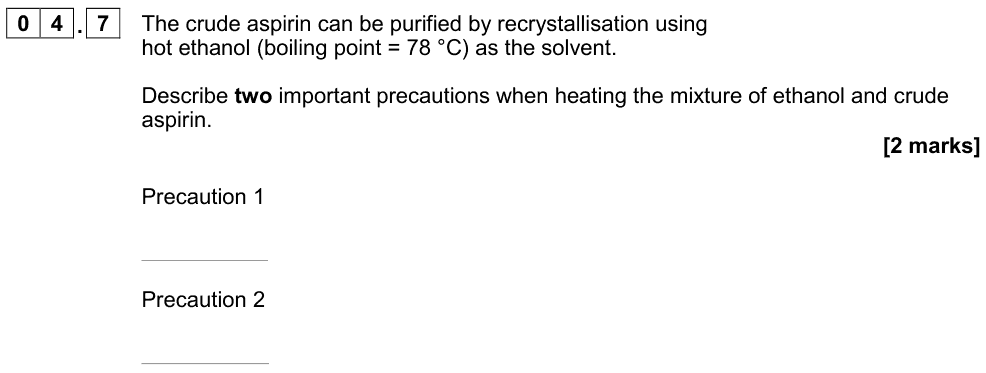
The crude aspirin can be purified by recrystallisation using
hot ethanol (boiling point = 78 °C) as the solvent.
Describe two important precautions when heating the mixture of ethanol and crude
aspirin.
[2 marks]
Precaution 1
Precaution 2
November 2020 · Paper 2 · Q04.8 1 mark Practical and data analysis carboxylic acids and derivatives
Earlier part of question 04 that this part usesEarlier part of November 2020 Paper 2 question 04
The pure aspirin is filtered under reduced pressure.
A small amount of cold ethanol is then poured through the Buchner funnel.
Explain the purpose of adding a small amount of cold ethanol.
[1 mark]
November 2020 · Paper 2 · Q04.9 1 mark Practical and data analysis carboxylic acids and derivatives
Earlier part of question 04 that this part usesEarlier part of November 2020 Paper 2 question 04
A sample of the crude aspirin is kept to compare with the purified aspirin.
Describe one difference in appearance you would expect to see between these two
solid samples.
[1 mark]
November 2020 · Paper 2 · Q05.1 3 marks Short answer bondinghalogenoalkanes
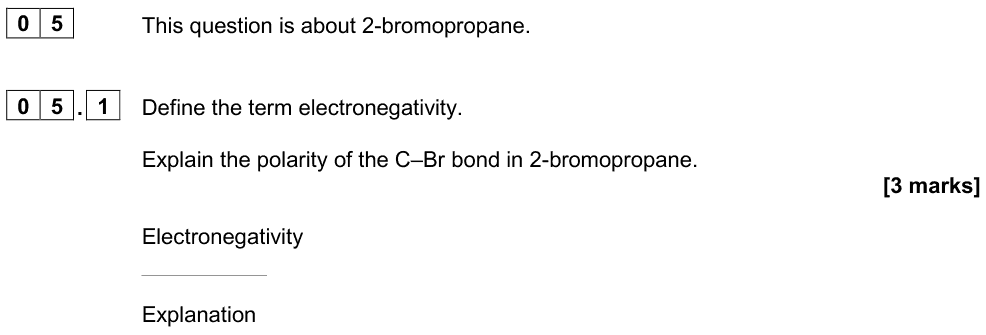
This question is about 2-bromopropane.
Define the term electronegativity.
Explain the polarity of the C–Br bond in 2-bromopropane.
[3 marks]
Electronegativity
Explanation
November 2020 · Paper 2 · Q05.2 4 marks Mechanism amineshalogenoalkanes
Earlier part of question 05 that this part usesEarlier part of November 2020 Paper 2 question 05
Outline the mechanism for the reaction of 2-bromopropane with an
excess of ammonia.
[4 marks]
November 2020 · Paper 2 · Q05.3 2 marks Diagram or structure Hard amines
Earlier part of question 05 that this part usesEarlier part of November 2020 Paper 2 question 05
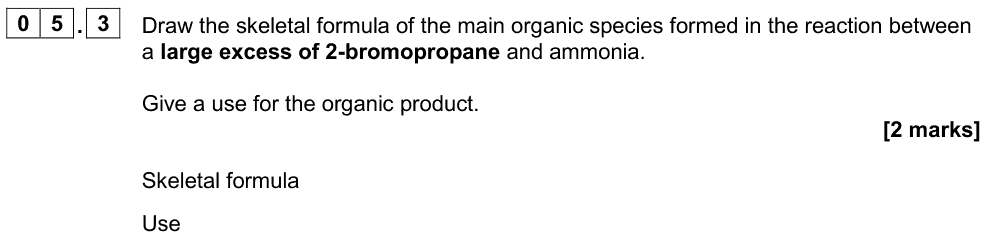
Draw the skeletal formula of the main organic species formed in the reaction between
a large excess of 2-bromopropane and ammonia.
Give a use for the organic product.
[2 marks]
Skeletal formula
Use
November 2020 · Paper 2 · Q06.1 3 marks Short answer aromatic chemistry
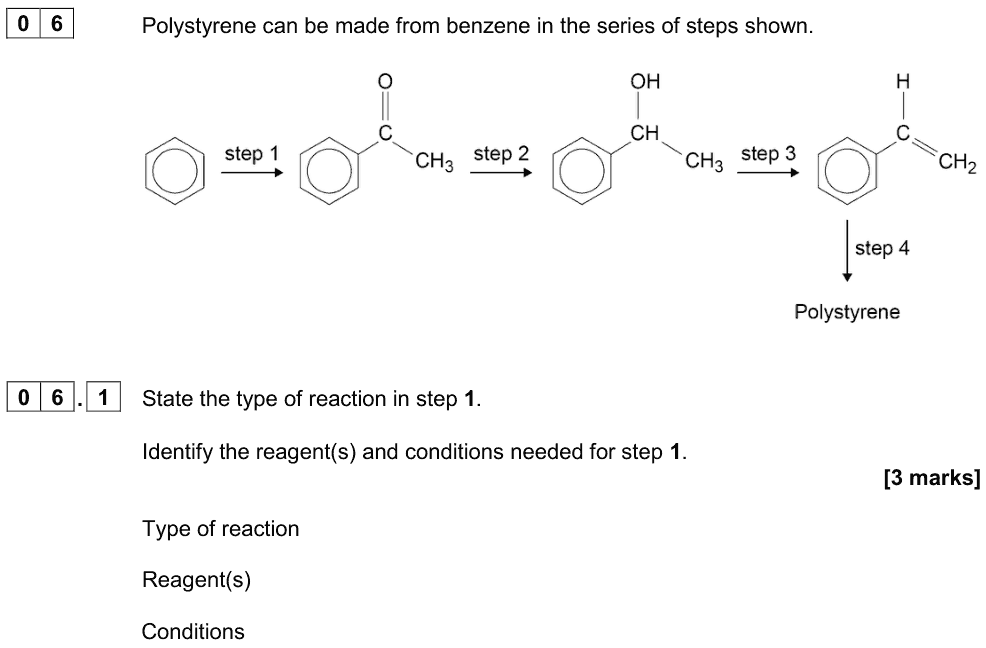
Polystyrene can be made from benzene in the series of steps shown.
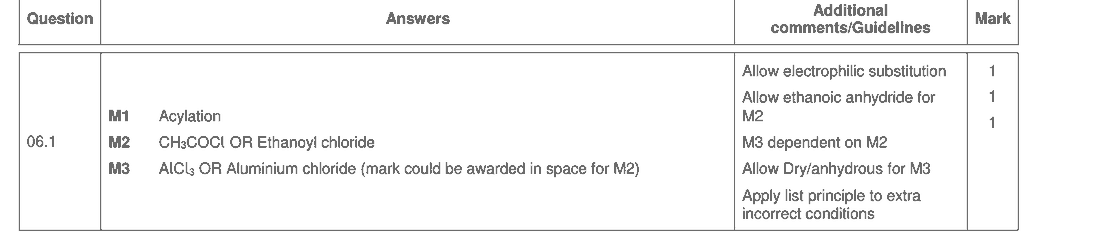
State the type of reaction in step 1.
Identify the reagent(s) and conditions needed for step 1.
[3 marks]
Type of reaction
Reagent(s)
Conditions
November 2020 · Paper 2 · Q06.2 3 marks Short answer aldehydes and ketonesintroduction to organic chemistry
Earlier part of question 06 that this part usesEarlier part of November 2020 Paper 2 question 06
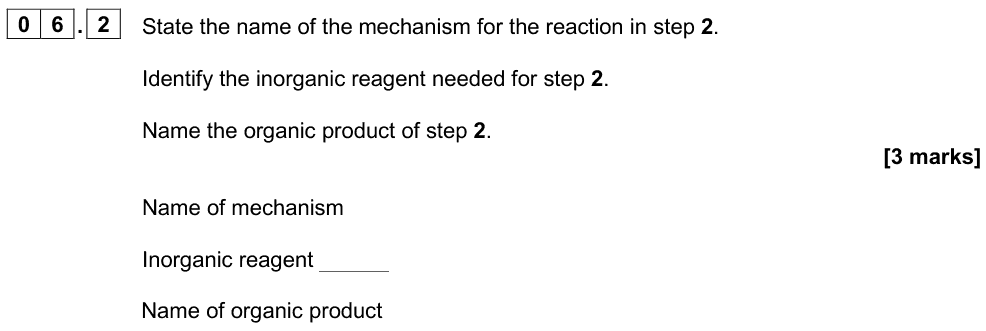
State the name of the mechanism for the reaction in step 2.
Identify the inorganic reagent needed for step 2.
Name the organic product of step 2.
[3 marks]
Name of mechanism
Inorganic reagent
Name of organic product
November 2020 · Paper 2 · Q06.3 3 marks Mechanism alcohols
Earlier part of question 06 that this part usesEarlier part of November 2020 Paper 2 question 06
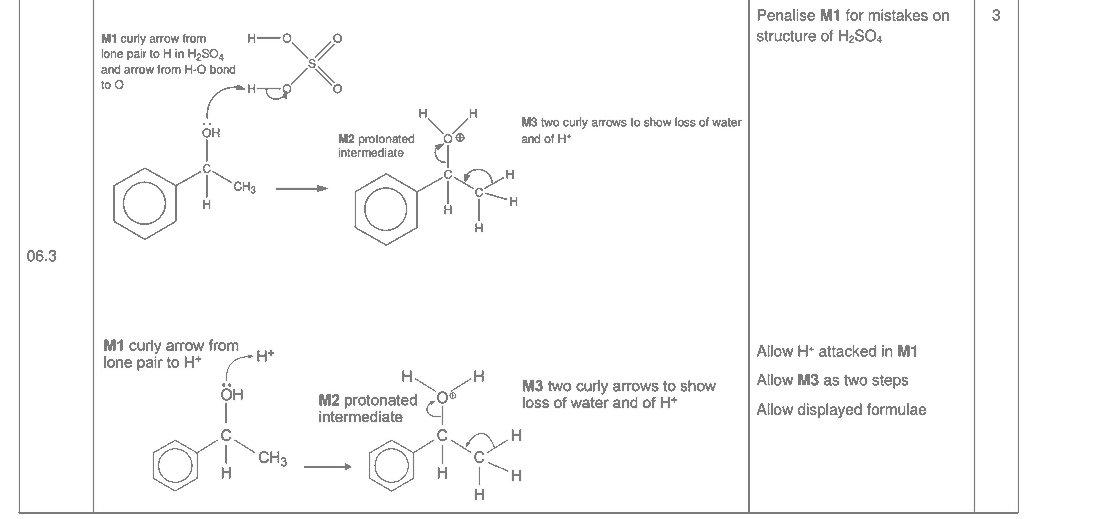
The organic product of step 2 is reacted with concentrated sulfuric acid in step 3.
Outline the mechanism for step 3.
[3 marks]
November 2020 · Paper 2 · Q06.4 1 mark Diagram or structure alkenes
Earlier part of question 06 that this part usesEarlier part of November 2020 Paper 2 question 06
Draw the repeating unit of polystyrene.
[1 mark]
November 2020 · Paper 2 · Q07.1 6 marks 6-mark level of response Hard nmr spectroscopy
This question is about NMR spectroscopy.
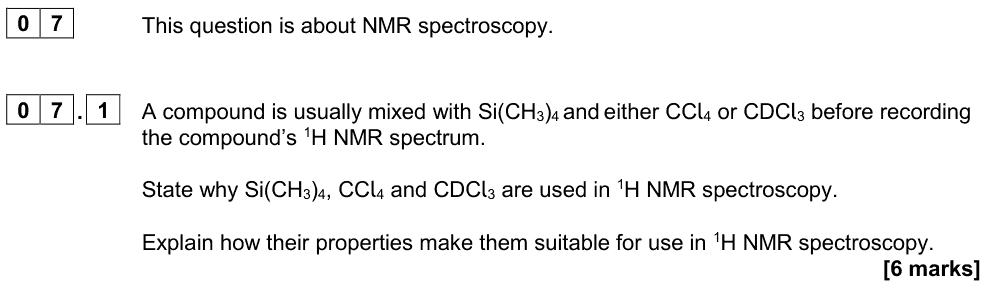
A compound is usually mixed with Si(CH3)4 and either CCl4 or CDCl3 before recording
the compound’s 1H NMR spectrum.
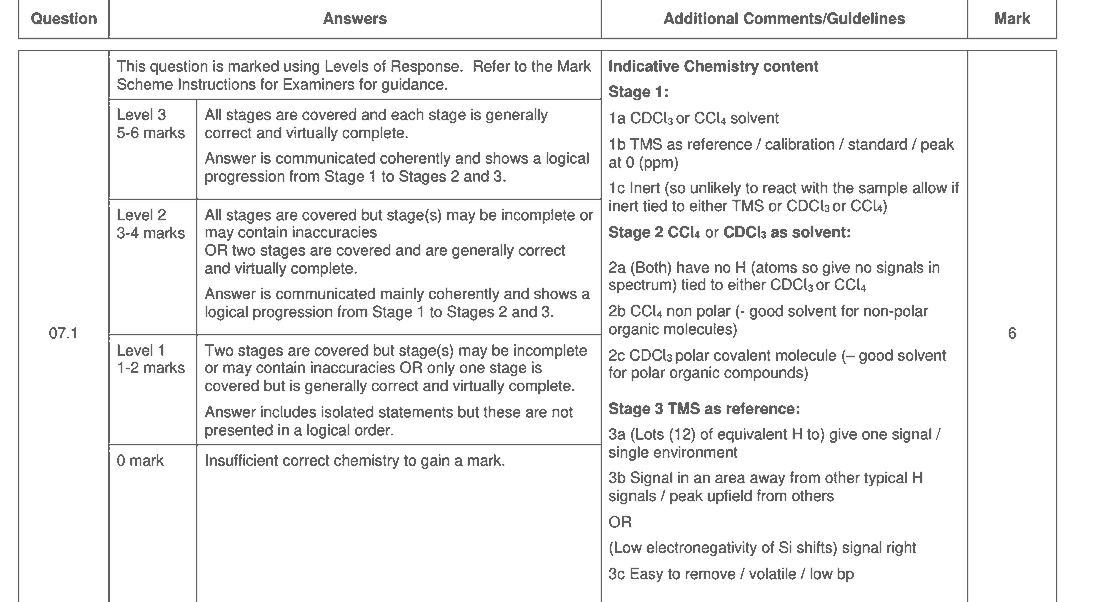
State why Si(CH3)4, CCl4 and CDCl3 are used in 1H NMR spectroscopy.
Explain how their properties make them suitable for use in 1H NMR spectroscopy.
[6 marks]
November 2020 · Paper 2 · Q07.2 3 marks Short answer nmr spectroscopy
Earlier part of question 07 that this part usesEarlier part of November 2020 Paper 2 question 07
Deduce the splitting pattern for each of the peaks given by the H atoms labelled
x, y and z in the 1H NMR spectrum of the compound shown.
[3 marks]
x
y
z
November 2020 · Paper 2 · Q07.3 1 mark Short answer nmr spectroscopy
Earlier part of question 07 that this part usesEarlier part of November 2020 Paper 2 question 07
Suggest why it is difficult to use Table B in the Data Booklet to predict the
chemical shift (δ value) for the peak given by the H atom labelled y.
[1 mark]
November 2020 · Paper 2 · Q07.4 2 marks Diagram or structure nmr spectroscopyintroduction to organic chemistry
Earlier part of question 07 that this part usesEarlier part of November 2020 Paper 2 question 07
Two isomers of CH3CHClCOCH(CH3)2 each have two singlet peaks only in their
1H NMR spectra.
In both spectra the integration ratio for the two peaks is 2:9
Deduce the structures of these two isomers.
[2 marks]
Isomer 1
Isomer 2
represented as H3Y.𝑥𝑥H2O
November 2020 · Paper 2 · Q08.1 5 marks Calculation Hard amount of substance
This question is about citric acid, a hydrated tricarboxylic acid.  Its formula can be
A 1.50 g sample of H3Y.𝑥𝑥H2O contains 0.913 g of oxygen by mass.
The sample burns completely in air to form 1.89 g of CO2 and 0.643 g of H2O
Show that the empirical formula of citric acid is C3H5O4
[5 marks]
November 2020 · Paper 2 · Q08.2 2 marks Calculation amount of substance
Earlier part of question 08 that this part usesEarlier part of November 2020 Paper 2 question 08
A 3.00 g sample of H3Y.𝑥𝑥H2O (Mr = 210.0) is heated to constant mass.
The anhydrous H3Y that remains has a mass of 2.74 g
Show, using these data, that the value of 𝑥𝑥 = 1
[2 marks]
November 2020 · Paper 2 · Q08.3 1 mark Short answer introduction to organic chemistry
Earlier part of question 08 that this part usesEarlier part of November 2020 Paper 2 question 08
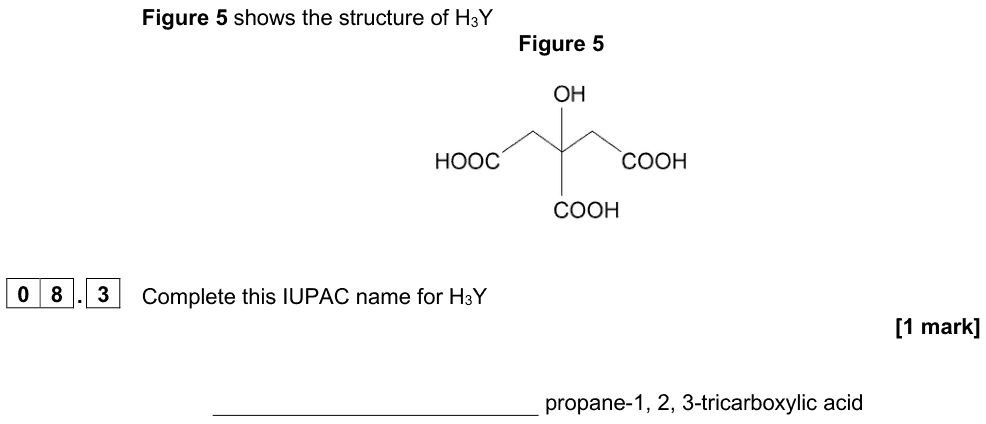
Figure 5 shows the structure of H3Y
Figure 5
Complete this IUPAC name for H3Y
[1 mark]
propane-1, 2, 3-tricarboxylic acid
November 2020 · Paper 2 · Q08.4 1 mark Short answer nmr spectroscopy
Earlier parts of question 08 that this part usesEarlier part of November 2020 Paper 2 question 08Earlier part of November 2020 Paper 2 question 08
State the number of peaks you would expect in the 13C NMR spectrum for H3Y
[1 mark]
November 2020 · Paper 2 · Q09.1 2 marks Calculation chemical equilibria and kc
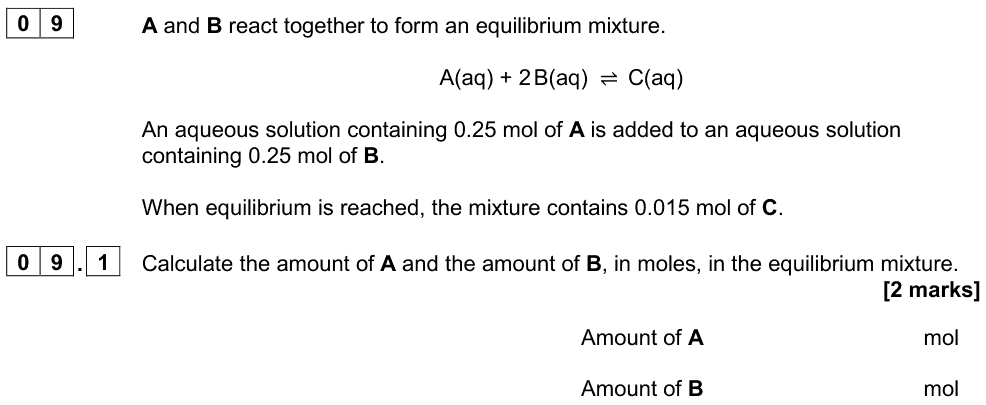
A and B react together to form an equilibrium mixture.
A(aq) + 2 B(aq)  ⇌  C(aq)
An aqueous solution containing 0.25 mol of A is added to an aqueous solution
containing 0.25 mol of B.
When equilibrium is reached, the mixture contains 0.015 mol of C.
Calculate the amount of A and the amount of B, in moles, in the equilibrium mixture.
[2 marks]
Amount of A
mol
Amount of B
mol
November 2020 · Paper 2 · Q09.2 4 marks Calculation chemical equilibria and kc
Earlier part of question 09 that this part usesEarlier part of November 2020 Paper 2 question 09
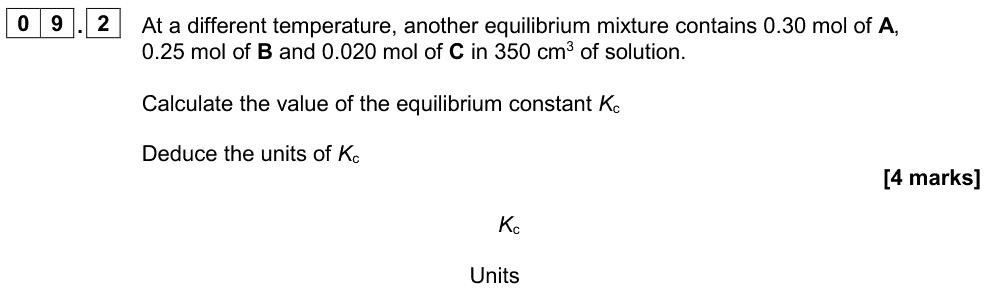
At a different temperature, another equilibrium mixture contains 0.30 mol of A,
0.25 mol of B and 0.020 mol of C in 350 cm3 of solution.
Calculate the value of the equilibrium constant Kc
Deduce the units of Kc
[4 marks]
Kc
Units
November 2020 · Paper 2 · Q09.3 1 mark Short answer Hard chemical equilibria and kc
Earlier part of question 09 that this part usesEarlier part of November 2020 Paper 2 question 09
When an excess of water is added to chloroethanal, an equilibrium mixture is formed.
ClCH2CHO(aq) +  H2O(l)  ⇌  ClCH2CH(OH)2(aq)
An expression for an equilibrium constant (K) for the reaction under these
conditions is
K =
[ClCH2CH(OH)2]
[ClCH2CHO]
Suggest why an expression for K can be written without the concentration of water.
[1 mark]
November 2020 · Paper 2 · Q09.4 5 marks Calculation chemical equilibria and kcamount of substance
Earlier parts of question 09 that this part usesEarlier part of November 2020 Paper 2 question 09Earlier part of November 2020 Paper 2 question 09
Distilled water is added to 4.71 g of chloroethanal (Mr = 78.5) to make 50.0 cm3 of
solution.  The mixture is allowed to reach equilibrium.
The value of the equilibrium constant (K) is 37.0
Calculate the equilibrium concentration, in mol dm–3, of ClCH2CH(OH)2
[5 marks]
Concentration
mol dm–3
November 2020 · Paper 2 · Q09.5 3 marks Mechanism aldehydes and ketonesintroduction to organic chemistry
Earlier parts of question 09 that this part usesEarlier part of November 2020 Paper 2 question 09Earlier part of November 2020 Paper 2 question 09
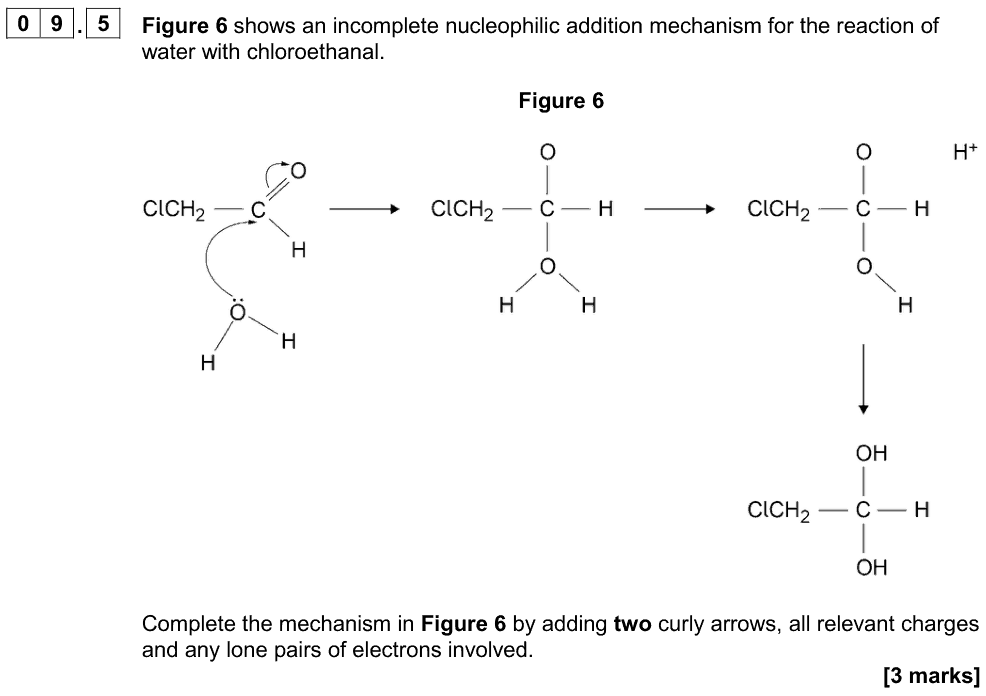
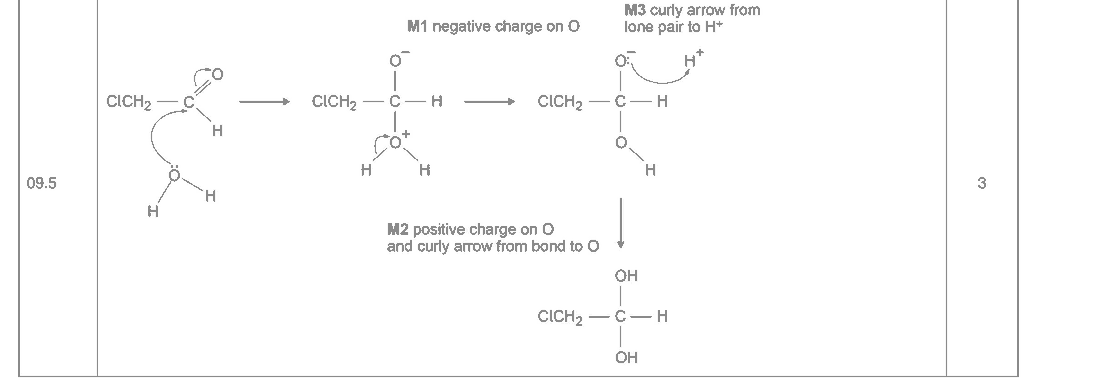
Figure 6 shows an incomplete nucleophilic addition mechanism for the reaction of
water with chloroethanal.
Figure 6
Complete the mechanism in Figure 6 by adding two curly arrows, all relevant charges
and any lone pairs of electrons involved.
[3 marks]
November 2020 · Paper 2 · Q09.6 3 marks Explanation aldehydes and ketoneskinetics
Earlier parts of question 09 that this part usesEarlier part of November 2020 Paper 2 question 09Earlier part of November 2020 Paper 2 question 09
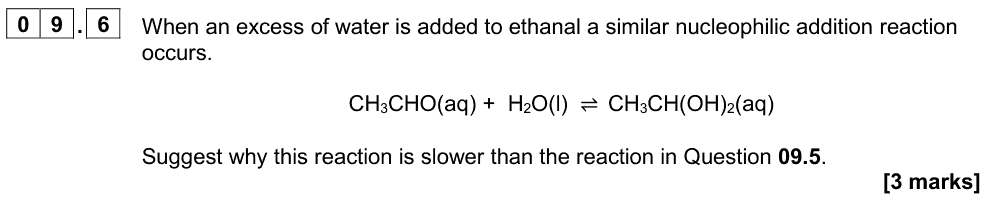
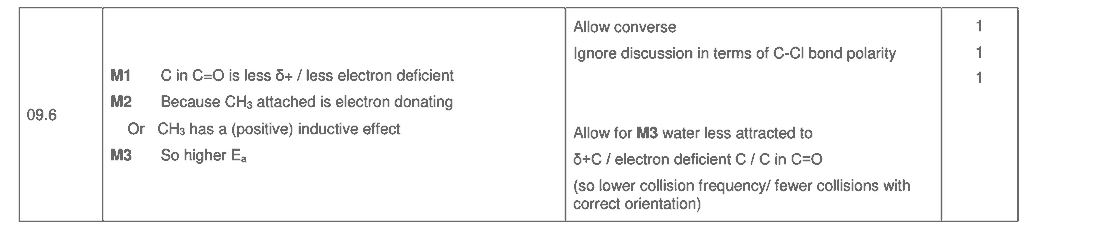
When an excess of water is added to ethanal a similar nucleophilic addition reaction
occurs.
CH3CHO(aq) +  H2O(l)  ⇌  CH3CH(OH)2(aq)
Suggest why this reaction is slower than the reaction in Question 09.5.
[3 marks]

Work with an A-level chemistry tutor

Want a paper marked and gone through with you? Message us.

Prefer email? Send an enquiry

If you are under 18, please include a parent's contact details. Enquiries go to enquiries@chemistryaleveltutor.com and are deleted once handled. All tutoring is online.