June 2025: Paper 2, Organic and physical chemistry

105 marks · 41 question parts · Paper, mark scheme and report on AQA's site · Have the Data Booklet beside you

Question by question

QTopicMarksAOType
01.1 Alkanes 2AO1=2Short answer
01.2 Alkanes, Introduction to organic chemistry: nomenclature, mechanisms and isomerism 3AO2=3Equation writing
01.3 Alkanes 2AO1=2Short answer
01.4 Halogenoalkanes 2AO1=1,AO2=1Short answer
01.5 Alkenes 2AO3=2Short answer
01.6 Halogenoalkanes, Alkenes 1AO3=1Diagram or structure
02.1 Introduction to organic chemistry: nomenclature, mechanisms and isomerism 3AO1=2,AO2=1Explanation
02.2 Optical isomerism, Introduction to organic chemistry: nomenclature, mechanisms and isomerism 2AO2=2Diagram or structure
02.3 Alkenes, Introduction to organic chemistry: nomenclature, mechanisms and isomerism 2AO2=2Mechanism
03.1 Alkenes 2AO1=2Short answer
03.2 Polymers, Alkenes 1AO2=1Short answer
03.3 Alkenes 1AO1=1Short answer
03.4 Carboxylic acids and derivatives, Amount of substance 4AO1=1,AO2=3Equation writing
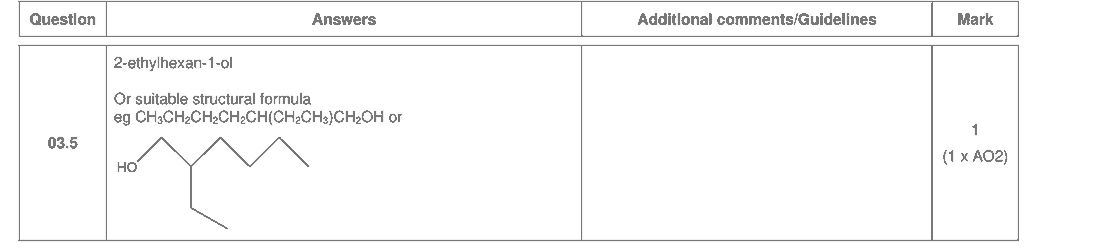
03.5 Carboxylic acids and derivatives, Introduction to organic chemistry: nomenclature, mechanisms and isomerism 1AO2=1Short answer
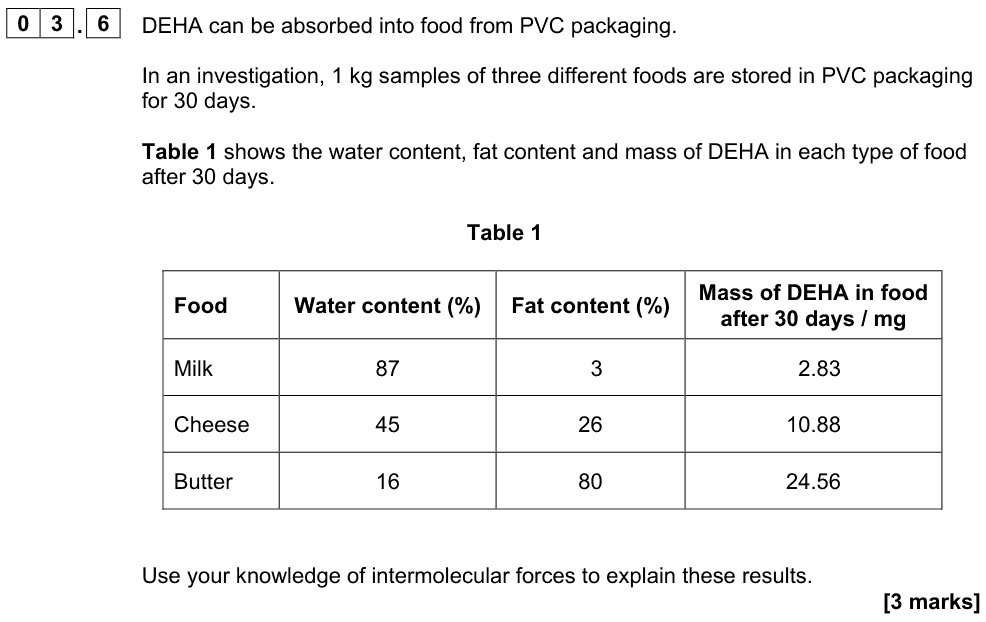
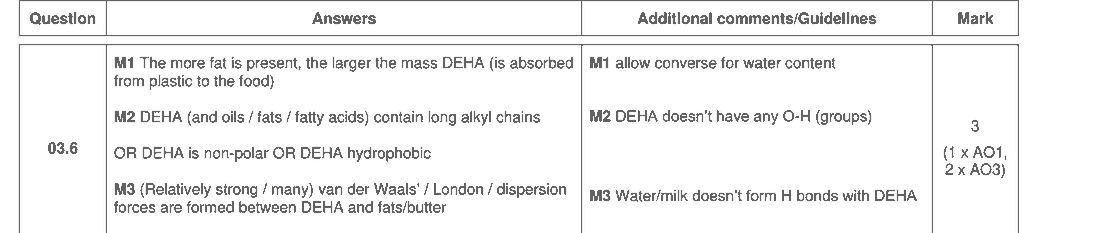
03.6 Bonding 3AO1=1,AO3=2Explanation
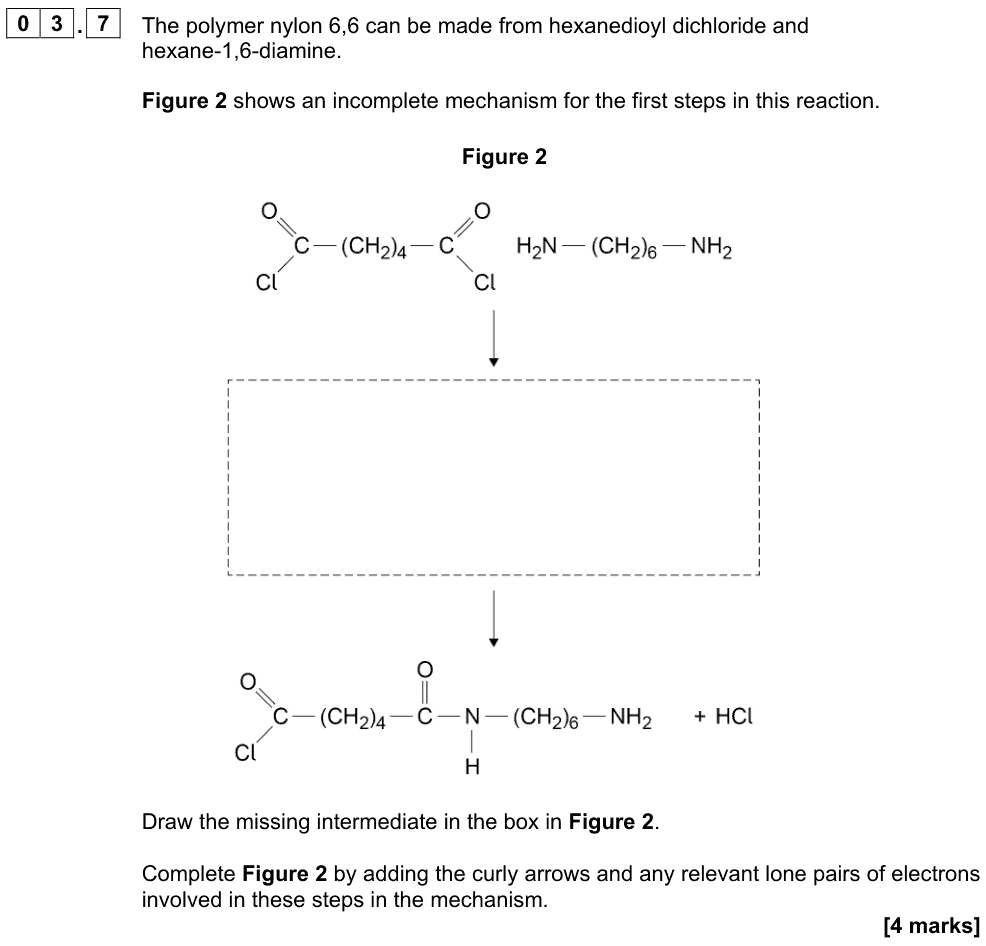
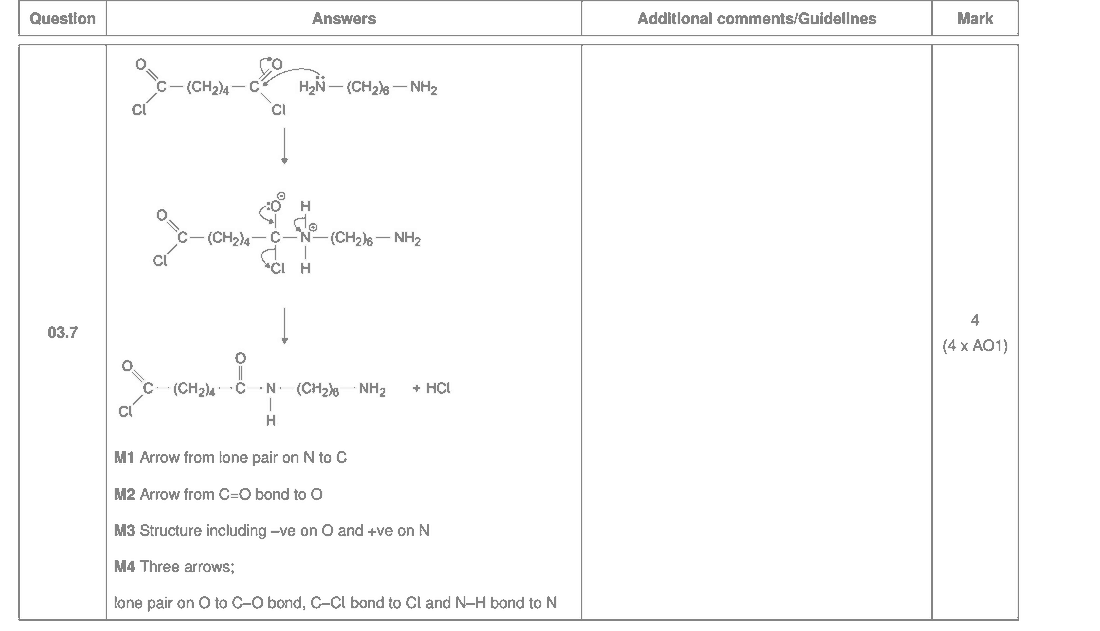
03.7 Carboxylic acids and derivatives, Amines 4AO1=4Mechanism
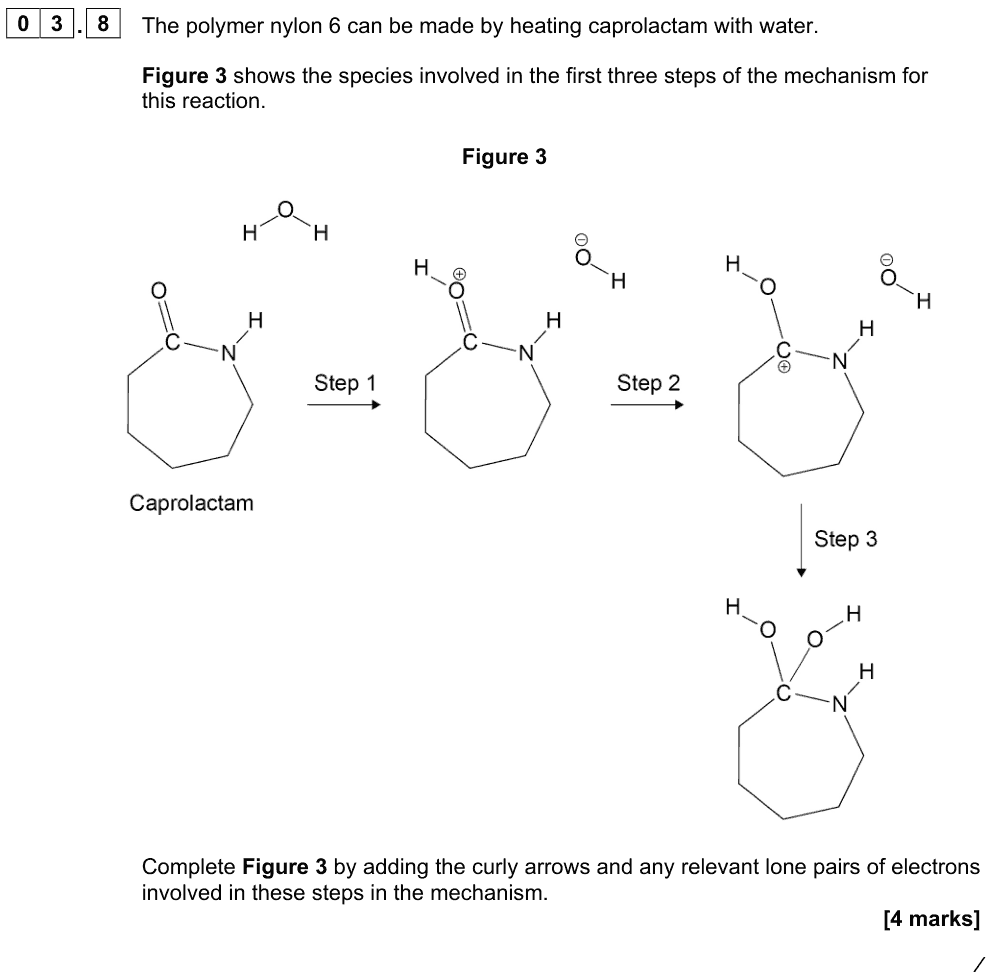
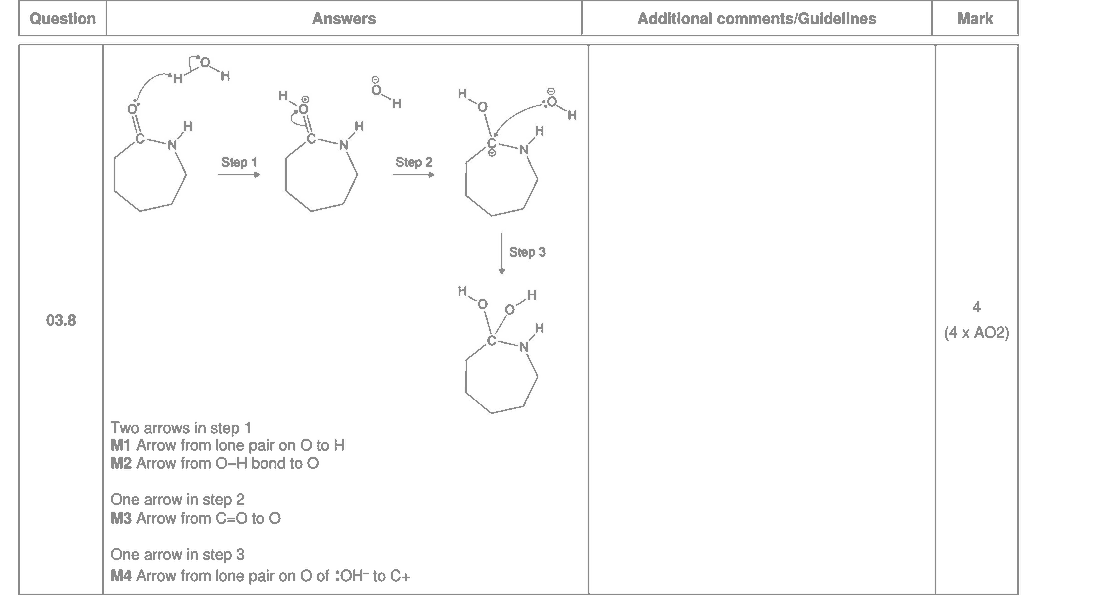
03.8 Introduction to organic chemistry: nomenclature, mechanisms and isomerism 4AO2=4Mechanism
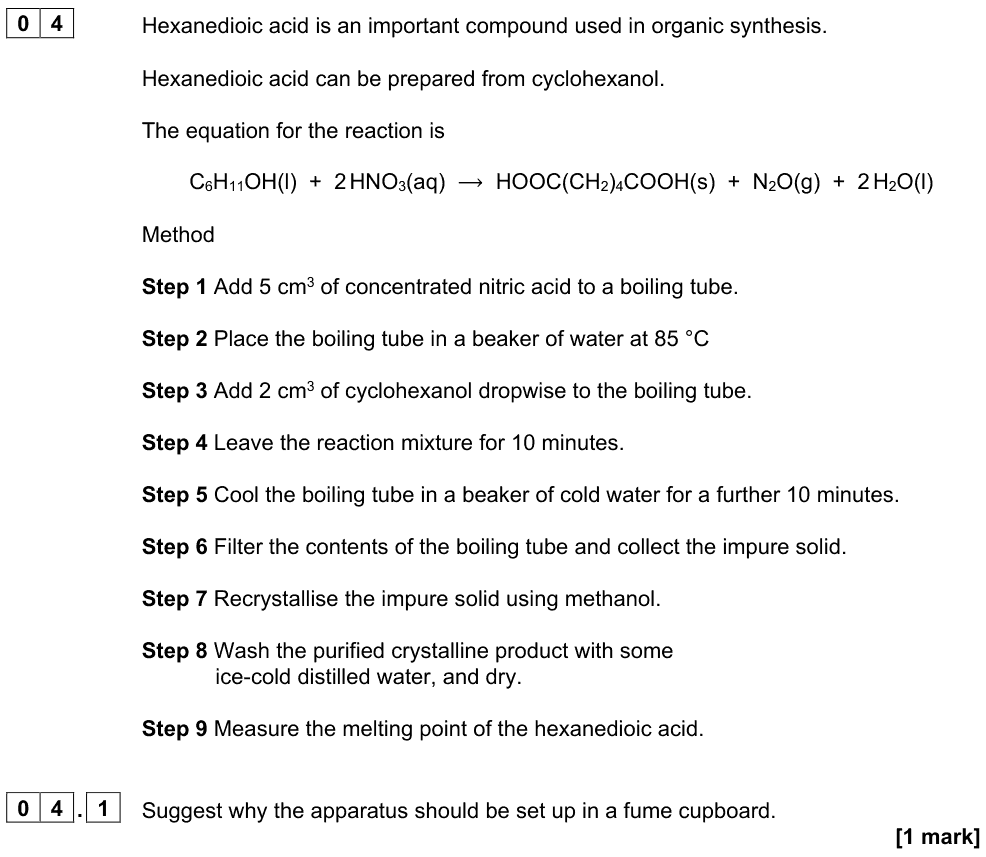
04.1 Carboxylic acids and derivatives 1AO3=1Practical and data analysis
04.2 Alcohols 1AO2=1Short answer
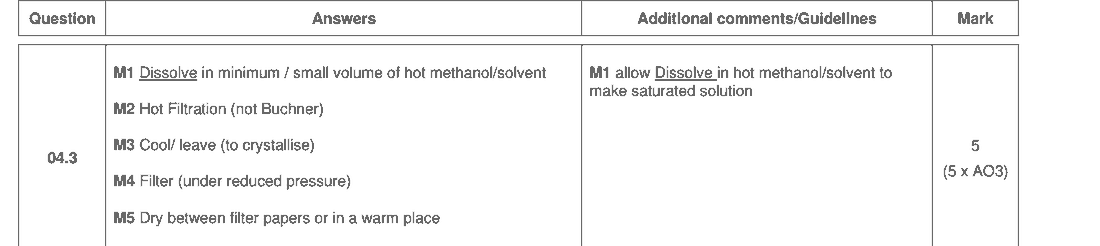
04.3 Carboxylic acids and derivatives 5AO3=5Practical and data analysis
04.4 Carboxylic acids and derivatives 1AO2=1Practical and data analysis
04.5 Carboxylic acids and derivatives 4AO3=4Practical and data analysis
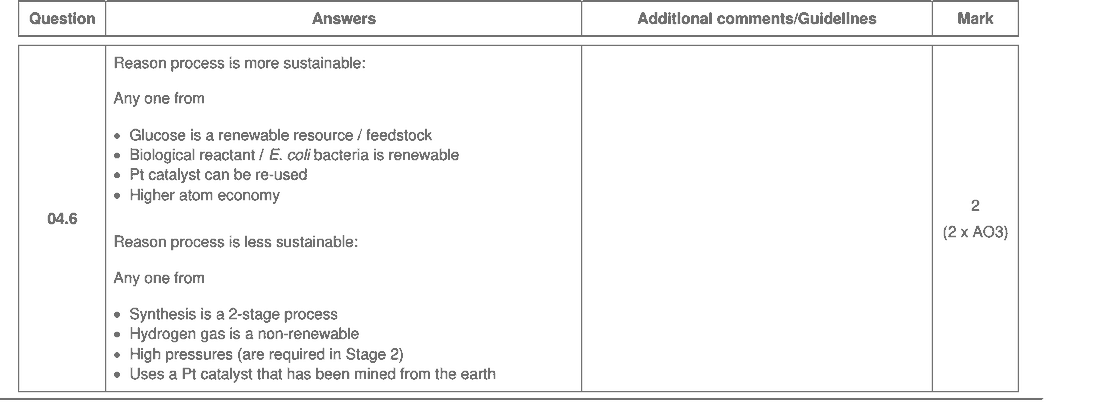
04.6 Organic synthesis 2AO3=2Short answer
05.1 Aromatic chemistry, Amount of substance 2AO1=2Equation writing
05.2 Amount of substance 4AO2=4Calculation
05.3 Aromatic chemistry 5AO1=5Mechanism
06.1 Nuclear magnetic resonance spectroscopy 2AO2=2Short answer
06.2 Amino acids, proteins and DNA 1AO1=1Diagram or structure
06.3 Amino acids, proteins and DNA 2AO1=2Short answer
07.1 Organic analysis: test-tube reactions, mass spectrometry and infrared, Nuclear magnetic resonance spectroscopy 5AO1=2,AO2=3Explanation
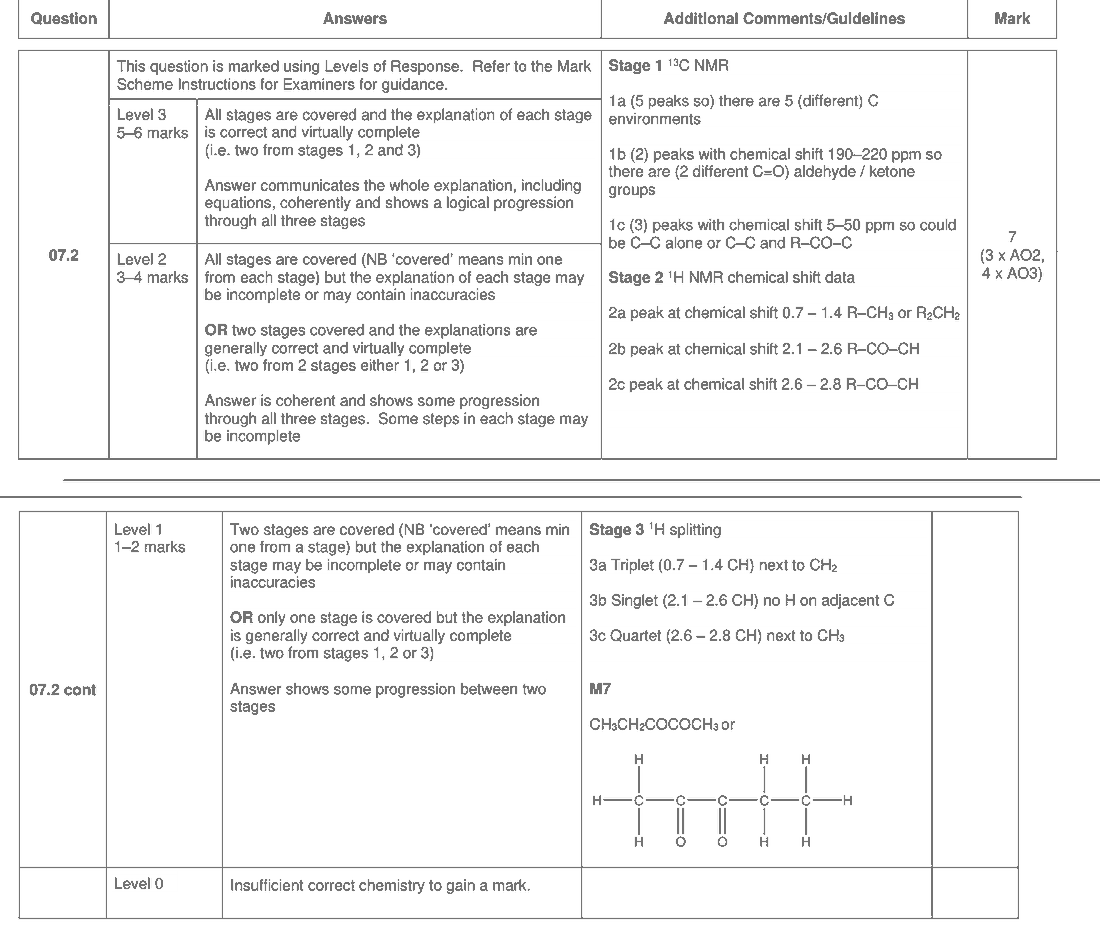
07.2 Nuclear magnetic resonance spectroscopy 7AO2=3,AO3=4Level of response
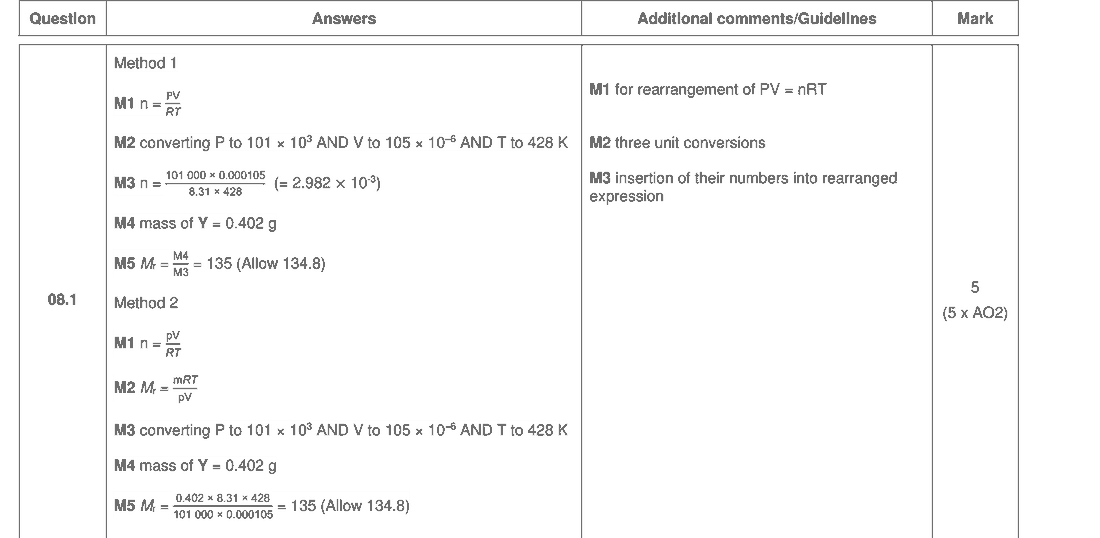
08.1 Amount of substance 5AO2=5Calculation
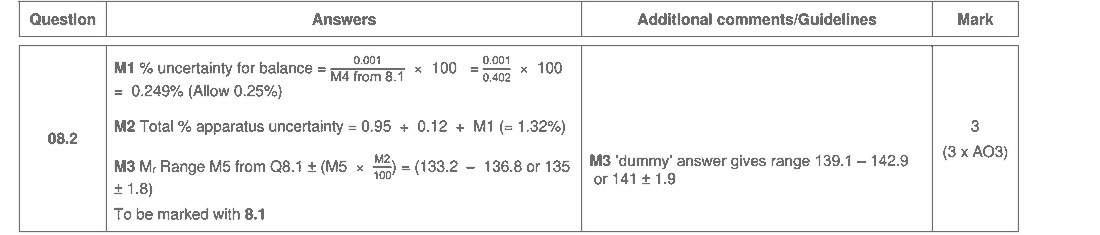
08.2 Amount of substance 3AO3=3Practical and data analysis
08.3 Amount of substance 1AO3=1Practical and data analysis
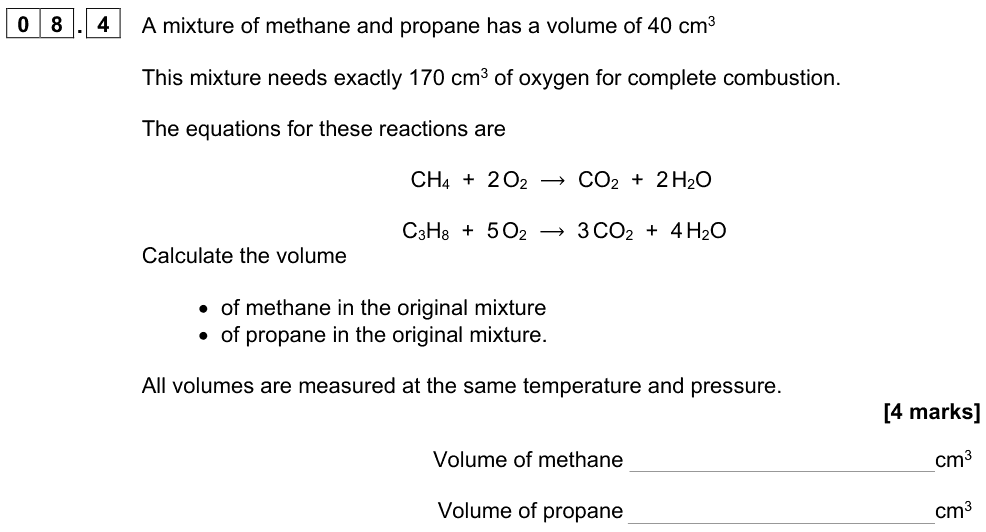
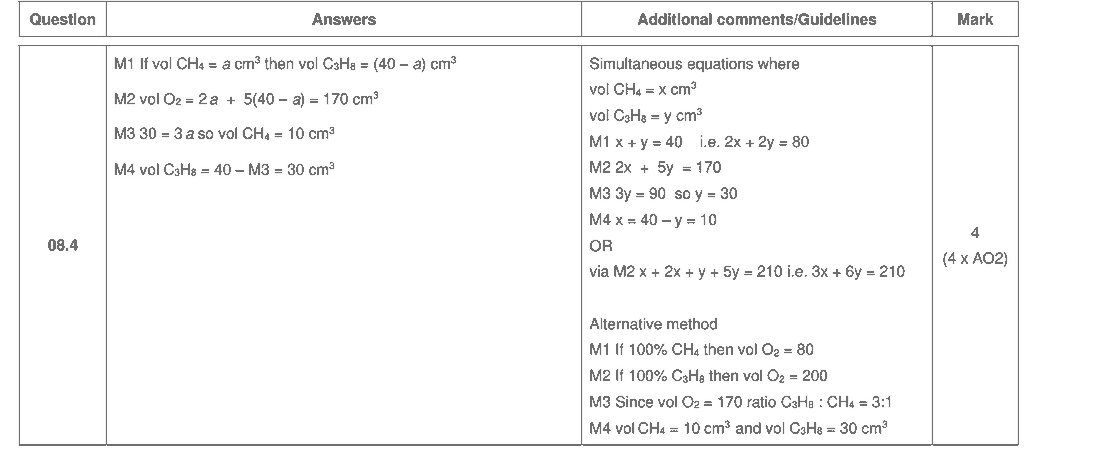
08.4 Amount of substance 4AO2=4Calculation
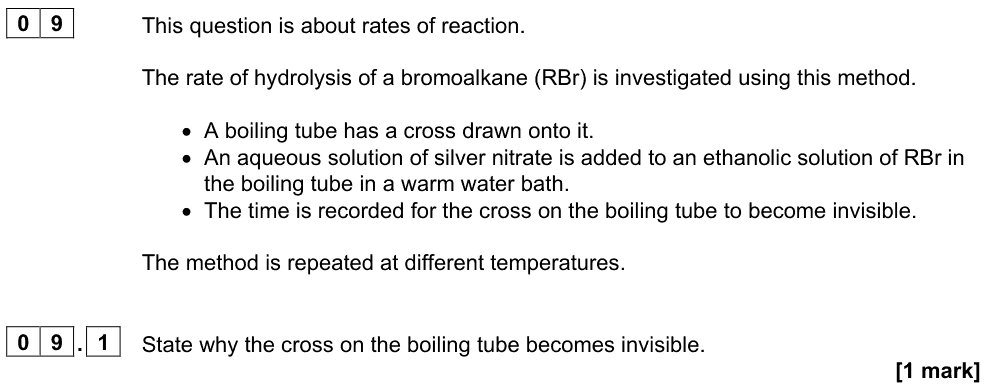
09.1 Group 7(17), the halogens 1AO1=1Short answer
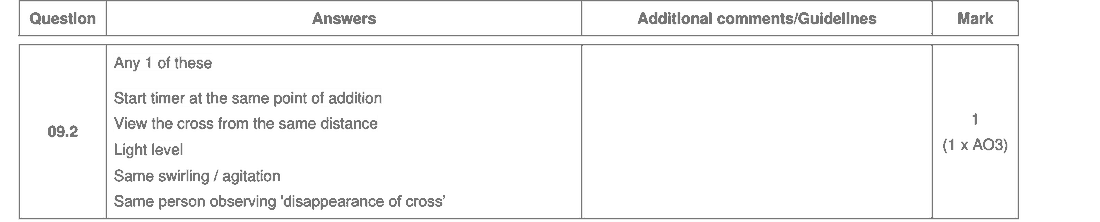
09.2 Kinetics 1AO3=1Practical and data analysis
09.3 Rate equations 1AO1=1Calculation
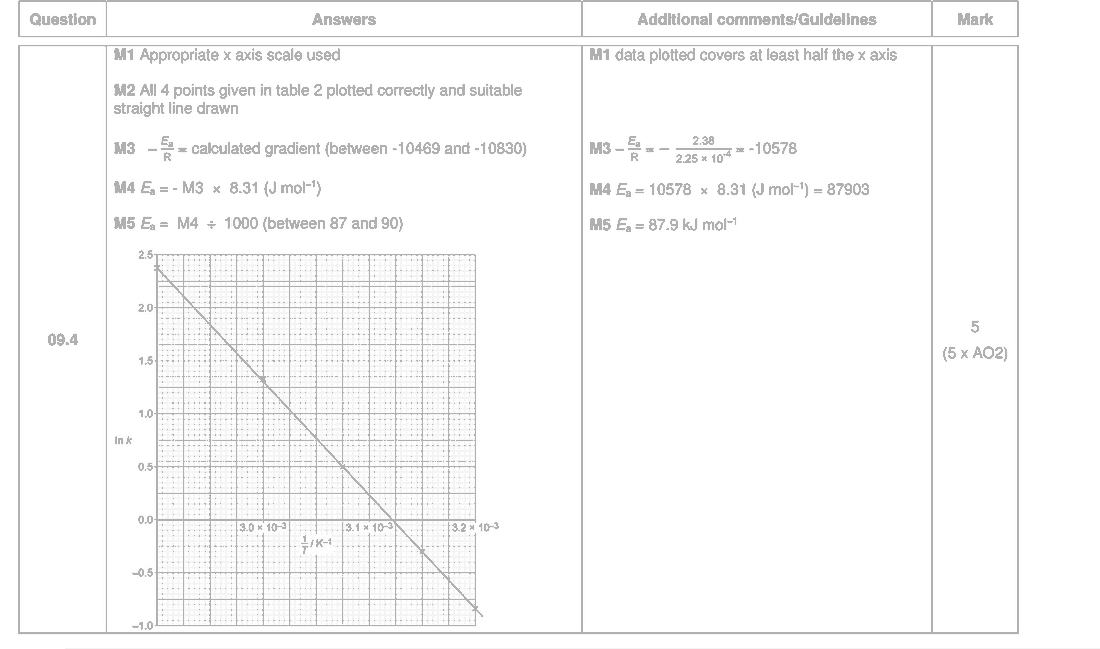
09.4 Rate equations 5AO2=5Calculation
09.5 Rate equations 1AO1=1Short answer
09.6 Halogenoalkanes, Bonding 2AO2=2Explanation

The questions

01.101.201.301.401.501.602.102.202.303.103.203.303.403.503.603.703.804.104.204.304.404.504.605.105.205.306.106.206.307.107.208.108.208.308.409.109.209.309.409.509.6
June 2025 · Paper 2 · Q01.1 2 marks AO1=2 Short answer alkanes
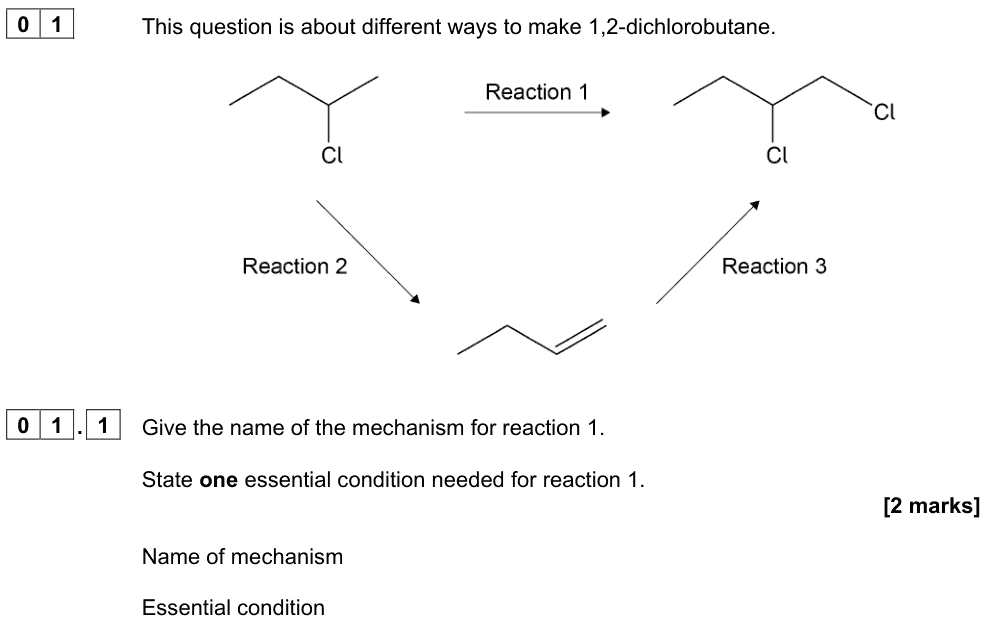
This question is about different ways to make 1,2-dichlorobutane.
Give the name of the mechanism for reaction 1.
State one essential condition needed for reaction 1.
[2 marks]
Name of mechanism
Essential condition
June 2025 · Paper 2 · Q01.2 3 marks AO2=3 Equation writing alkanesintroduction to organic chemistry
Earlier part of question 01 that this part usesEarlier part of June 2025 Paper 2 question 01
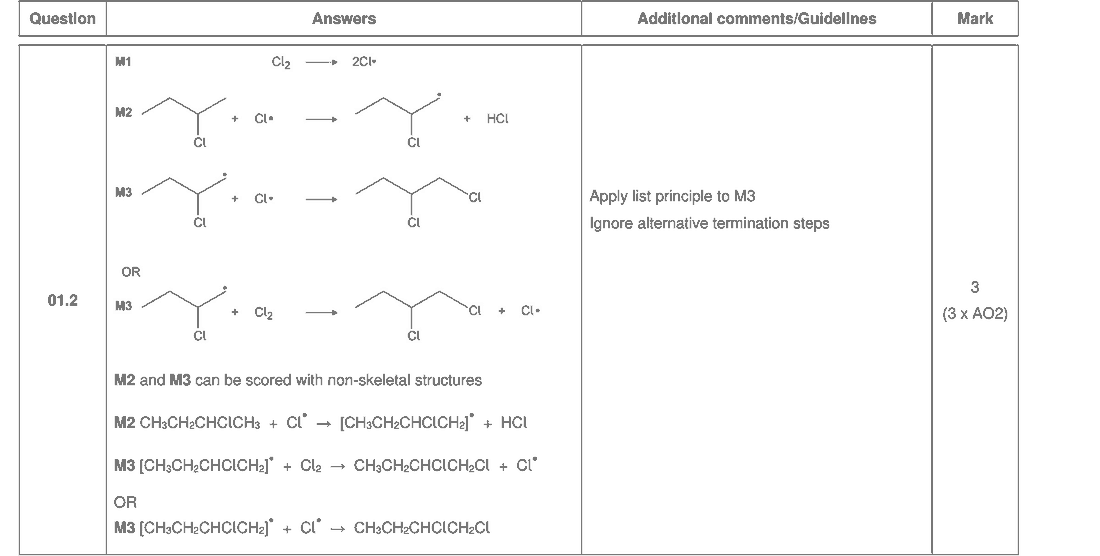
Give equations to show three essential steps in the mechanism for reaction 1.
[3 marks]
June 2025 · Paper 2 · Q01.3 2 marks AO1=2 Short answer alkanes
Earlier part of question 01 that this part usesEarlier part of June 2025 Paper 2 question 01
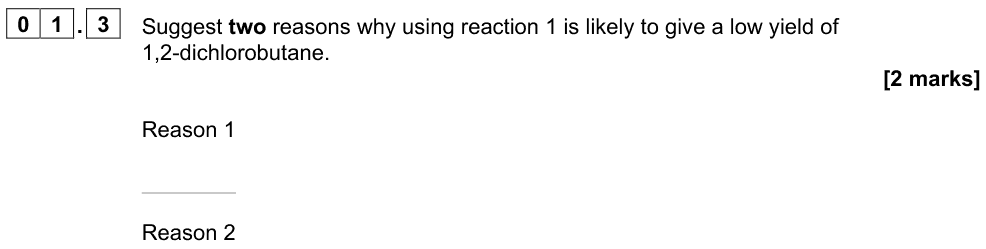
Suggest two reasons why using reaction 1 is likely to give a low yield of
1,2-dichlorobutane.
[2 marks]
Reason 1
Reason 2
June 2025 · Paper 2 · Q01.4 2 marks AO1=1, AO2=1 Short answer halogenoalkanes
Earlier part of question 01 that this part usesEarlier part of June 2025 Paper 2 question 01
Give a suitable reagent and conditions needed for reaction 2.
[2 marks]
Reagent
Conditions
June 2025 · Paper 2 · Q01.5 2 marks AO3=2 Short answer alkenes
Earlier part of question 01 that this part usesEarlier part of June 2025 Paper 2 question 01
Identify the reagent and name the mechanism for reaction 3.
[2 marks]
Reagent
Name of mechanism
June 2025 · Paper 2 · Q01.6 1 mark AO3=1 Diagram or structure halogenoalkanesalkenes
Earlier part of question 01 that this part usesEarlier part of June 2025 Paper 2 question 01
Use of the reagent for reaction 2 followed by the reagent for reaction 3 gives another
organic product.
Give the structure of the other organic product.
[1 mark]
June 2025 · Paper 2 · Q02.1 3 marks AO1=2, AO2=1 Explanation introduction to organic chemistry
This question is about isomerism.
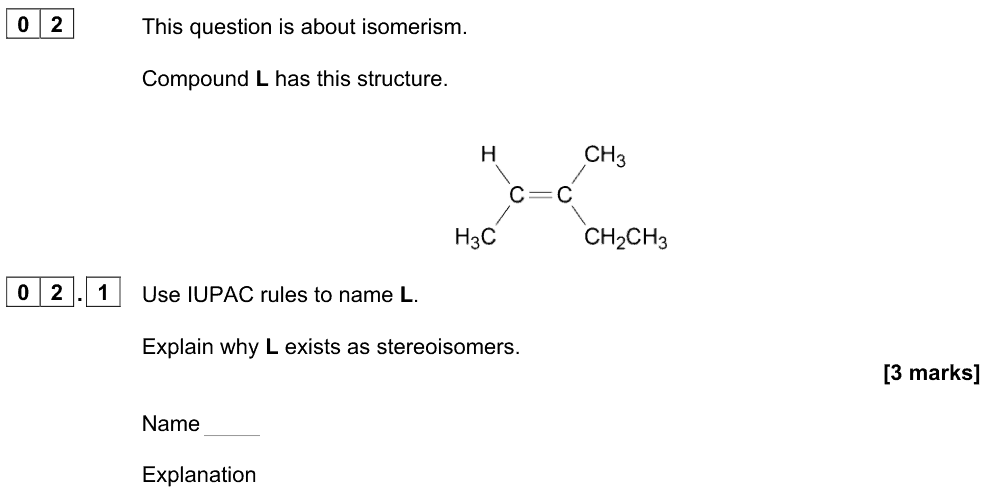
Compound L has this structure.
Use IUPAC rules to name L.
Explain why L exists as stereoisomers.
[3 marks]
Name
Explanation
June 2025 · Paper 2 · Q02.2 2 marks AO2=2 Diagram or structure optical isomerismintroduction to organic chemistry
Earlier part of question 02 that this part usesEarlier part of June 2025 Paper 2 question 02
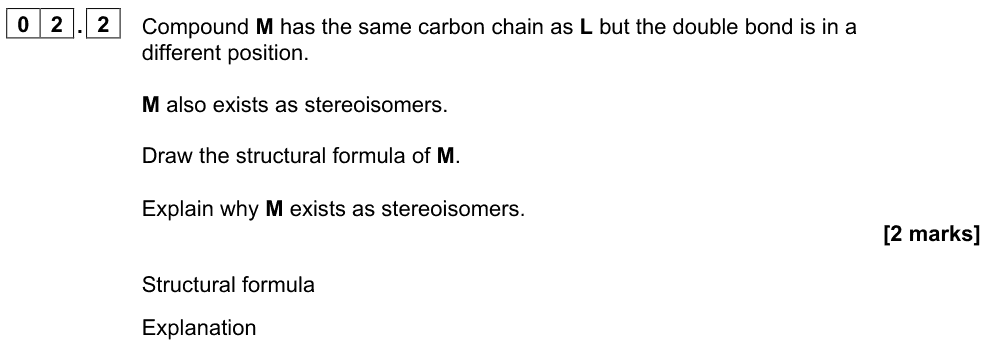
Compound M has the same carbon chain as L but the double bond is in a
different position.
M also exists as stereoisomers.
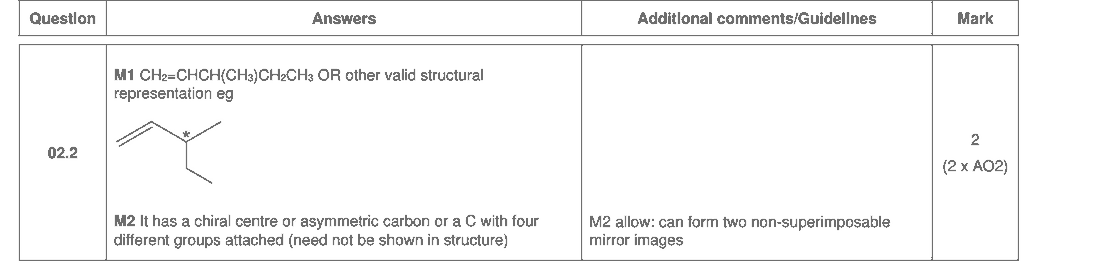
Draw the structural formula of M.
Explain why M exists as stereoisomers.
[2 marks]
Structural formula
Explanation
June 2025 · Paper 2 · Q02.3 2 marks AO2=2 Mechanism alkenesintroduction to organic chemistry
Earlier part of question 02 that this part usesEarlier part of June 2025 Paper 2 question 02
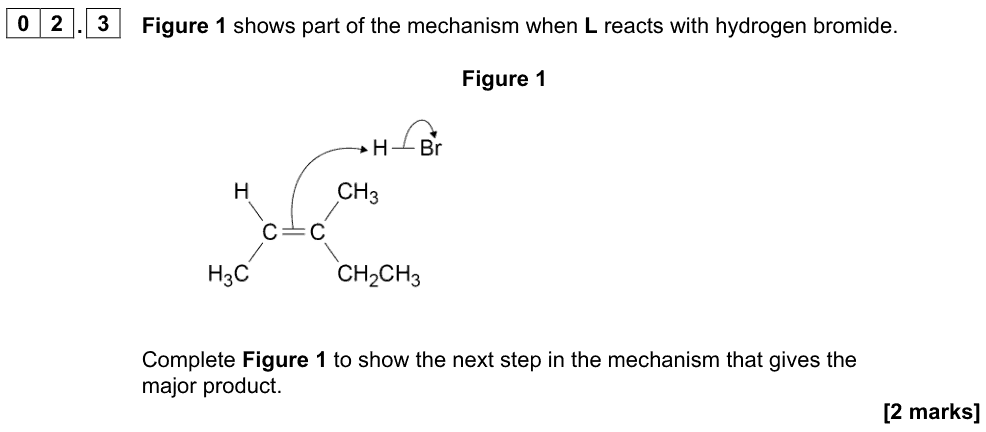
Figure 1 shows part of the mechanism when L reacts with hydrogen bromide.
Figure 1
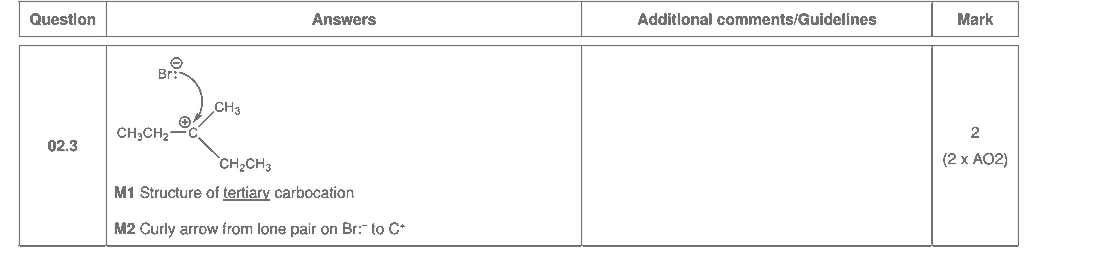
Complete Figure 1 to show the next step in the mechanism that gives the
major product.
[2 marks]
June 2025 · Paper 2 · Q03.1 2 marks AO1=2 Short answer alkenes
This question is about polymers.
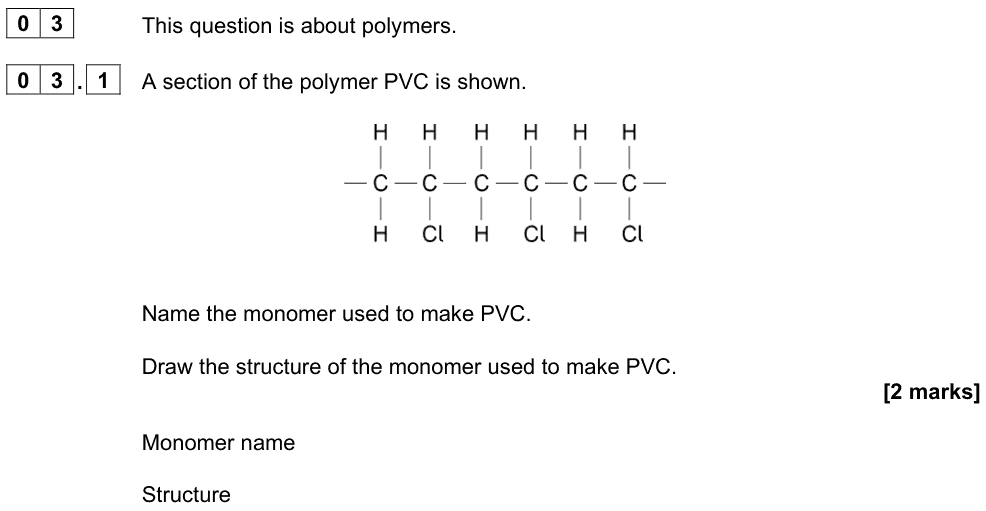
A section of the polymer PVC is shown.
Name the monomer used to make PVC.
Draw the structure of the monomer used to make PVC.
[2 marks]
Monomer name
Structure
June 2025 · Paper 2 · Q03.2 1 mark AO2=1 Short answer polymersalkenes
Earlier part of question 03 that this part usesEarlier part of June 2025 Paper 2 question 03
State why PVC is not biodegradable.
[1 mark]
June 2025 · Paper 2 · Q03.3 1 mark AO1=1 Short answer alkenes
Earlier part of question 03 that this part usesEarlier part of June 2025 Paper 2 question 03
Diisobutyl phthalate (DIBP) is a plasticiser added to PVC to modify its properties.
State how the properties of PVC are modified by the addition of DIBP.
[1 mark]
June 2025 · Paper 2 · Q03.4 4 marks AO1=1, AO2=3 Equation writing carboxylic acids and derivativesamount of substance
Earlier part of question 03 that this part usesEarlier part of June 2025 Paper 2 question 03
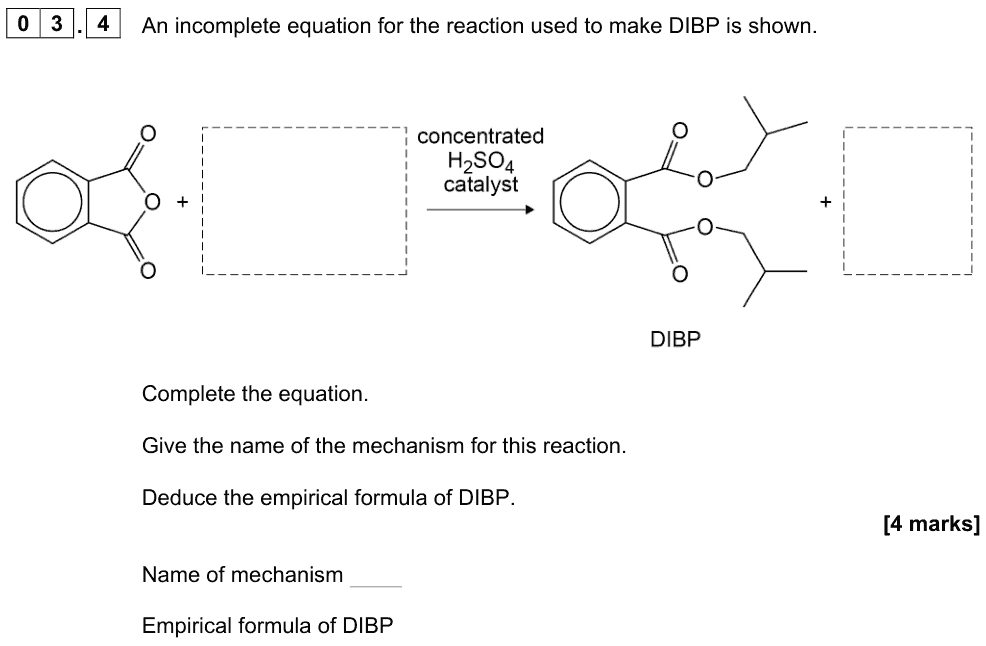
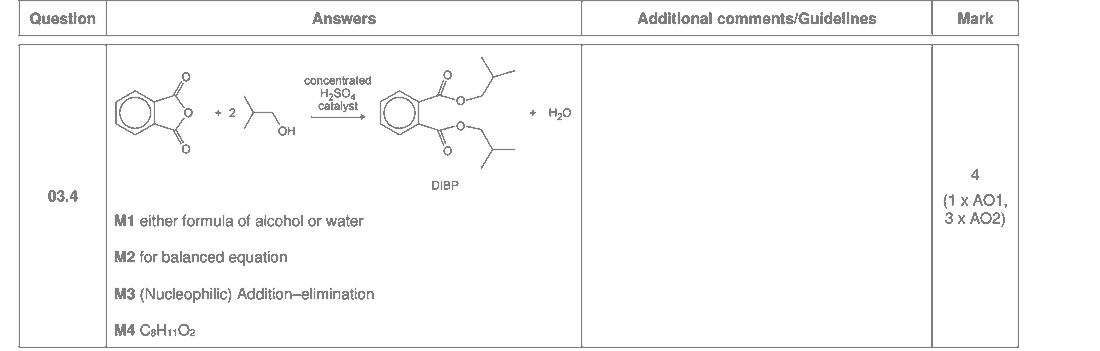
An incomplete equation for the reaction used to make DIBP is shown.
Complete the equation.
Give the name of the mechanism for this reaction.
Deduce the empirical formula of DIBP.
[4 marks]
Name of mechanism
Empirical formula of DIBP
June 2025 · Paper 2 · Q03.5 1 mark AO2=1 Short answer carboxylic acids and derivativesintroduction to organic chemistry
Earlier part of question 03 that this part usesEarlier part of June 2025 Paper 2 question 03
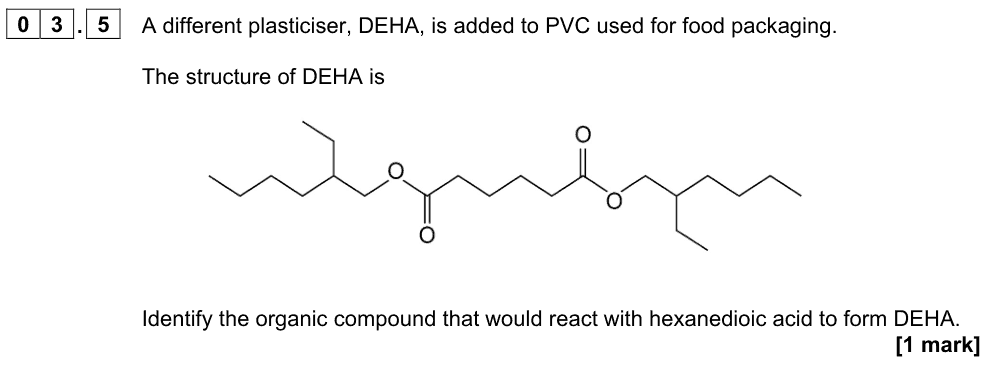
A different plasticiser, DEHA, is added to PVC used for food packaging.
The structure of DEHA is
Identify the organic compound that would react with hexanedioic acid to form DEHA.
[1 mark]
June 2025 · Paper 2 · Q03.6 3 marks AO1=1, AO3=2 Explanation bonding
Earlier part of question 03 that this part usesEarlier part of June 2025 Paper 2 question 03
DEHA can be absorbed into food from PVC packaging.
In an investigation, 1 kg samples of three different foods are stored in PVC packaging
for 30 days.
Table 1 shows the water content, fat content and mass of DEHA in each type of food
after 30 days.
Table 1
Food
Water content (%)
Fat content (%)
Mass of DEHA in food
after 30 days / mg
Milk
87
3
2.83
Cheese
45
26
10.88
Butter
16
80
24.56
Use your knowledge of intermolecular forces to explain these results.
[3 marks]
June 2025 · Paper 2 · Q03.7 4 marks AO1=4 Mechanism carboxylic acids and derivativesamines
Earlier part of question 03 that this part usesEarlier part of June 2025 Paper 2 question 03
The polymer nylon 6,6 can be made from hexanedioyl dichloride and
hexane-1,6-diamine.
Figure 2 shows an incomplete mechanism for the first steps in this reaction.
Figure 2
Draw the missing intermediate in the box in Figure 2.
Complete Figure 2 by adding the curly arrows and any relevant lone pairs of electrons
involved in these steps in the mechanism.
[4 marks]
June 2025 · Paper 2 · Q03.8 4 marks AO2=4 Mechanism introduction to organic chemistry
Earlier part of question 03 that this part usesEarlier part of June 2025 Paper 2 question 03
The polymer nylon 6 can be made by heating caprolactam with water.
Figure 3 shows the species involved in the first three steps of the mechanism for
this reaction.
Figure 3
Complete Figure 3 by adding the curly arrows and any relevant lone pairs of electrons
involved in these steps in the mechanism.
[4 marks]
June 2025 · Paper 2 · Q04.1 1 mark AO3=1 Practical and data analysis carboxylic acids and derivatives
Hexanedioic acid is an important compound used in organic synthesis.
Hexanedioic acid can be prepared from cyclohexanol.
The equation for the reaction is
C6H11OH(l)  +  2 HNO3(aq)  ⟶  HOOC(CH2)4COOH(s)  +  N2O(g)  +  2 H2O(l)
Method
Step 1 Add 5 cm3 of concentrated nitric acid to a boiling tube.
Step 2 Place the boiling tube in a beaker of water at 85 °C
Step 3 Add 2 cm3 of cyclohexanol dropwise to the boiling tube.
Step 4 Leave the reaction mixture for 10 minutes.
Step 5 Cool the boiling tube in a beaker of cold water for a further 10 minutes.
Step 6 Filter the contents of the boiling tube and collect the impure solid.
Step 7 Recrystallise the impure solid using methanol.
Step 8 Wash the purified crystalline product with some
ice-cold distilled water, and dry.
Step 9 Measure the melting point of the hexanedioic acid.
Suggest why the apparatus should be set up in a fume cupboard.
[1 mark]
June 2025 · Paper 2 · Q04.2 1 mark AO2=1 Short answer alcohols
Earlier part of question 04 that this part usesEarlier part of June 2025 Paper 2 question 04
Deduce the role of the concentrated nitric acid in the reaction.
[1 mark]
June 2025 · Paper 2 · Q04.3 5 marks AO3=5 Practical and data analysis carboxylic acids and derivatives
Earlier part of question 04 that this part usesEarlier part of June 2025 Paper 2 question 04
Outline how Steps 7 and 8 should be done to obtain the purified crystalline product.
[5 marks]
June 2025 · Paper 2 · Q04.4 1 mark AO2=1 Practical and data analysis carboxylic acids and derivatives
Earlier part of question 04 that this part usesEarlier part of June 2025 Paper 2 question 04
In Step 8, the distilled water must be ice-cold.
Suggest why using water at room temperature lowers the recorded yield of product.
[1 mark]
June 2025 · Paper 2 · Q04.5 4 marks AO3=4 Practical and data analysis carboxylic acids and derivatives
Earlier part of question 04 that this part usesEarlier part of June 2025 Paper 2 question 04
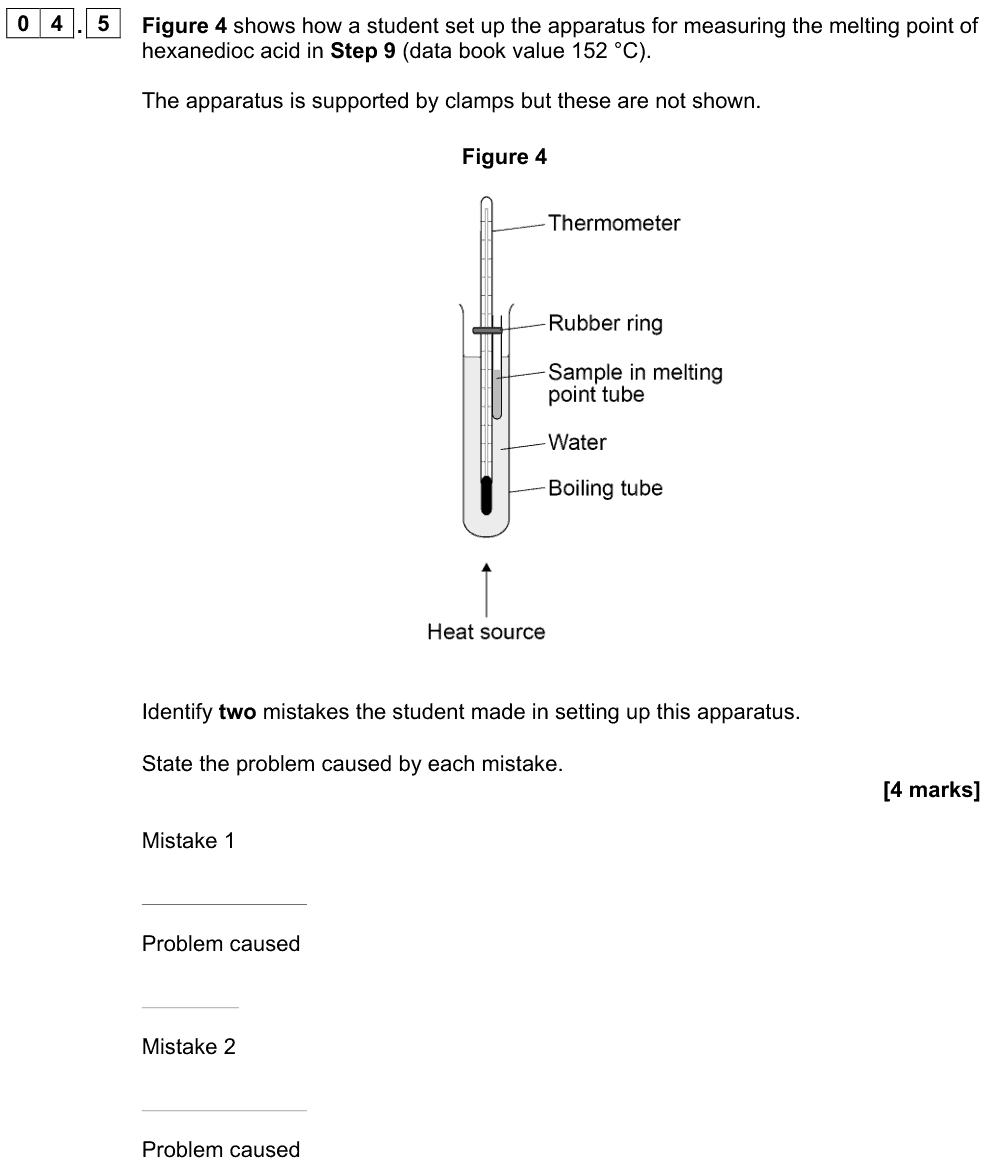
Figure 4 shows how a student set up the apparatus for measuring the melting point of
hexanedioc acid in Step 9 (data book value 152 °C).
The apparatus is supported by clamps but these are not shown.
Figure 4
Identify two mistakes the student made in setting up this apparatus.
State the problem caused by each mistake.
[4 marks]
Mistake 1
Problem caused
Mistake 2
Problem caused
June 2025 · Paper 2 · Q04.6 2 marks AO3=2 Short answer organic synthesis
Earlier part of question 04 that this part usesEarlier part of June 2025 Paper 2 question 04
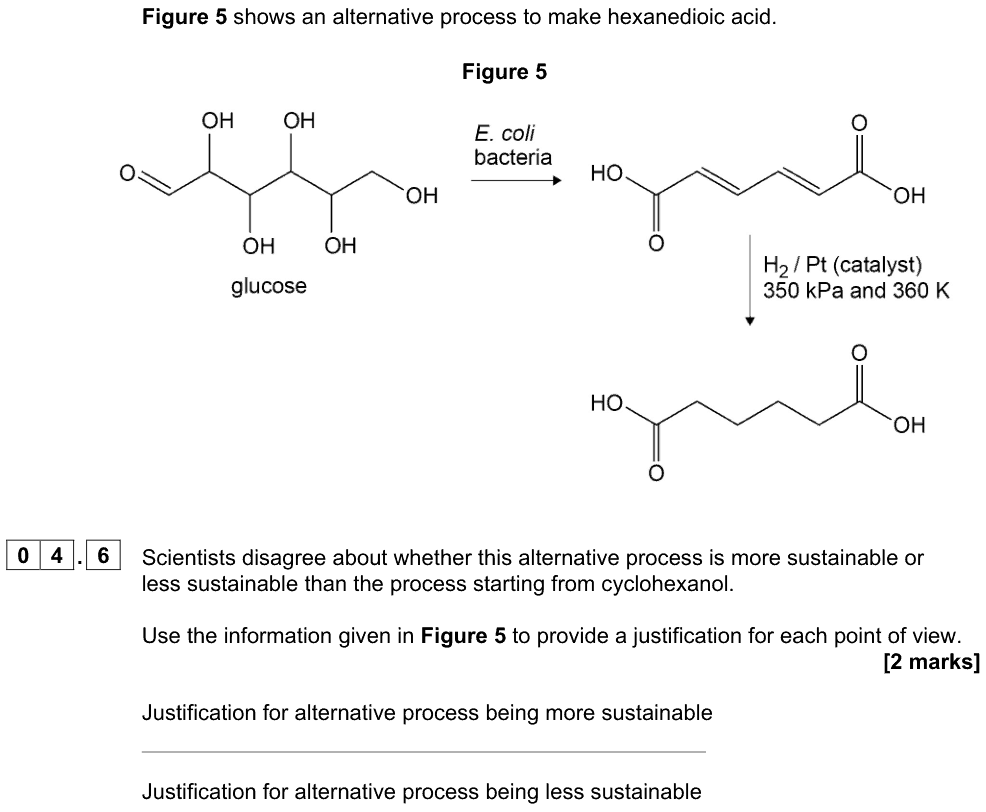
Figure 5 shows an alternative process to make hexanedioic acid.
Figure 5
Scientists disagree about whether this alternative process is more sustainable or
less sustainable than the process starting from cyclohexanol.
Use the information given in Figure 5 to provide a justification for each point of view.
[2 marks]
Justification for alternative process being more sustainable
Justification for alternative process being less sustainable
June 2025 · Paper 2 · Q05.1 2 marks AO1=2 Equation writing aromatic chemistryamount of substance
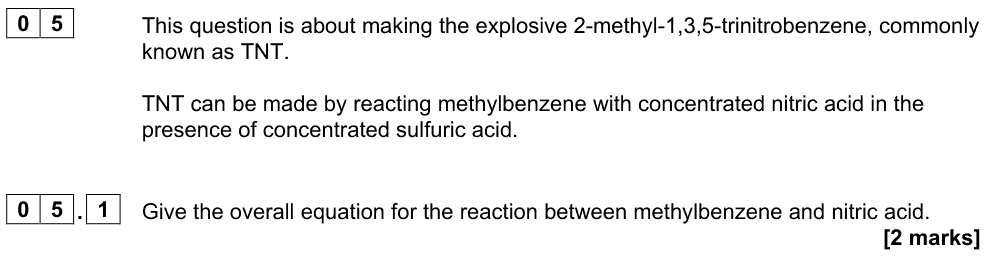
This question is about making the explosive 2-methyl-1,3,5-trinitrobenzene, commonly
known as TNT.
TNT can be made by reacting methylbenzene with concentrated nitric acid in the
presence of concentrated sulfuric acid.
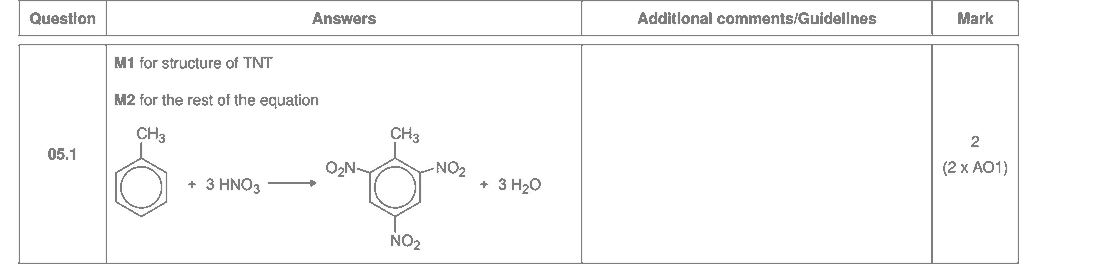
Give the overall equation for the reaction between methylbenzene and nitric acid.
[2 marks]
June 2025 · Paper 2 · Q05.2 4 marks AO2=4 Calculation amount of substance
Earlier part of question 05 that this part usesEarlier part of June 2025 Paper 2 question 05
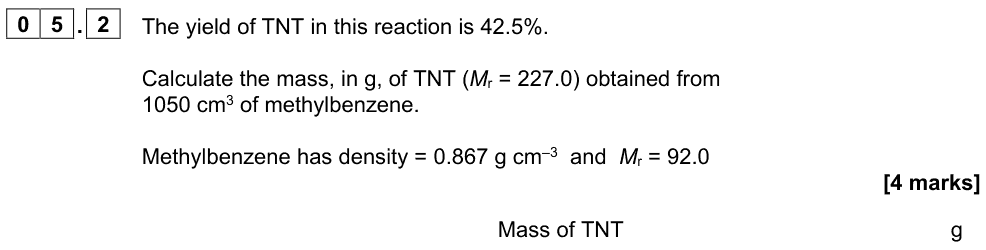
The yield of TNT in this reaction is 42.5%.
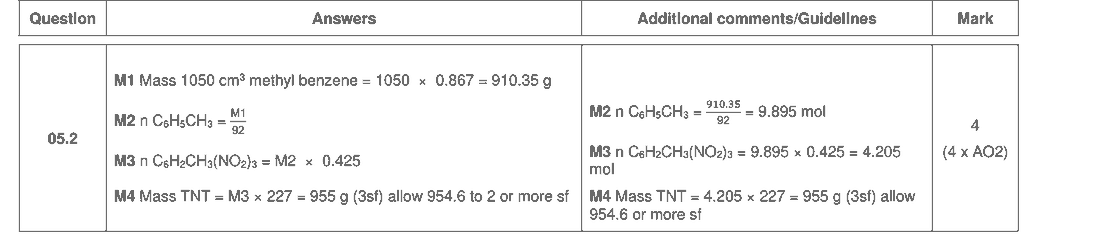
Calculate the mass, in g, of TNT (Mr = 227.0) obtained from
1050 cm3 of methylbenzene.
Methylbenzene has density = 0.867 g cm–3  and  Mr = 92.0
[4 marks]
Mass of TNT
g
June 2025 · Paper 2 · Q05.3 5 marks AO1=5 Mechanism aromatic chemistry
Earlier part of question 05 that this part usesEarlier part of June 2025 Paper 2 question 05
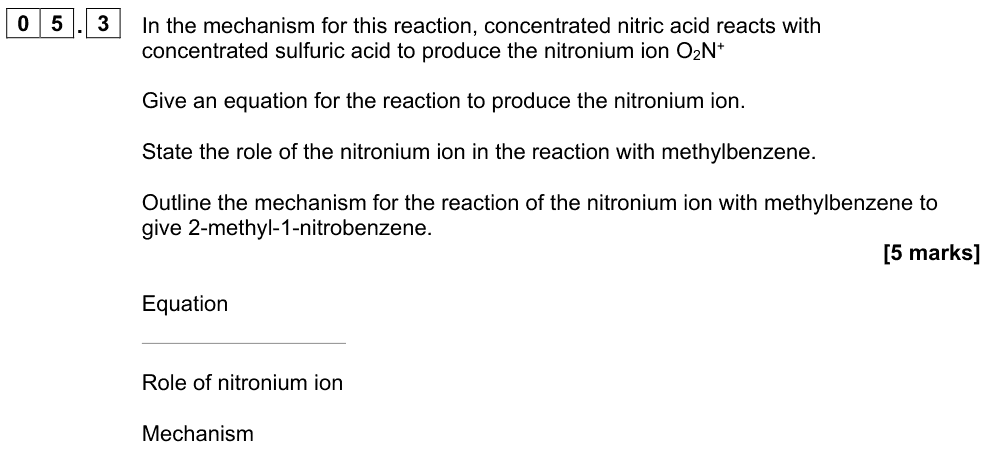
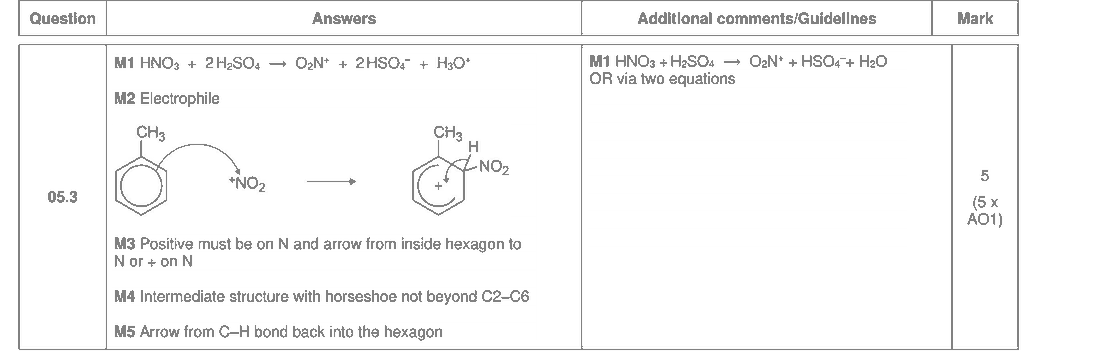
In the mechanism for this reaction, concentrated nitric acid reacts with
concentrated sulfuric acid to produce the nitronium ion O2N+
Give an equation for the reaction to produce the nitronium ion.
State the role of the nitronium ion in the reaction with methylbenzene.
Outline the mechanism for the reaction of the nitronium ion with methylbenzene to
give 2-methyl-1-nitrobenzene.
[5 marks]
Equation
Role of nitronium ion
Mechanism
June 2025 · Paper 2 · Q06.1 2 marks AO2=2 Short answer nmr spectroscopy
GHK is a natural tripeptide found in human blood plasma.
The amino acid sequence of GHK is Lys-His-Gly
Each amino acid is represented by a three-letter abbreviation.
Lys = lysine             His = histidine            Gly = glycine
Glycine has the structure H2NCH2COOH
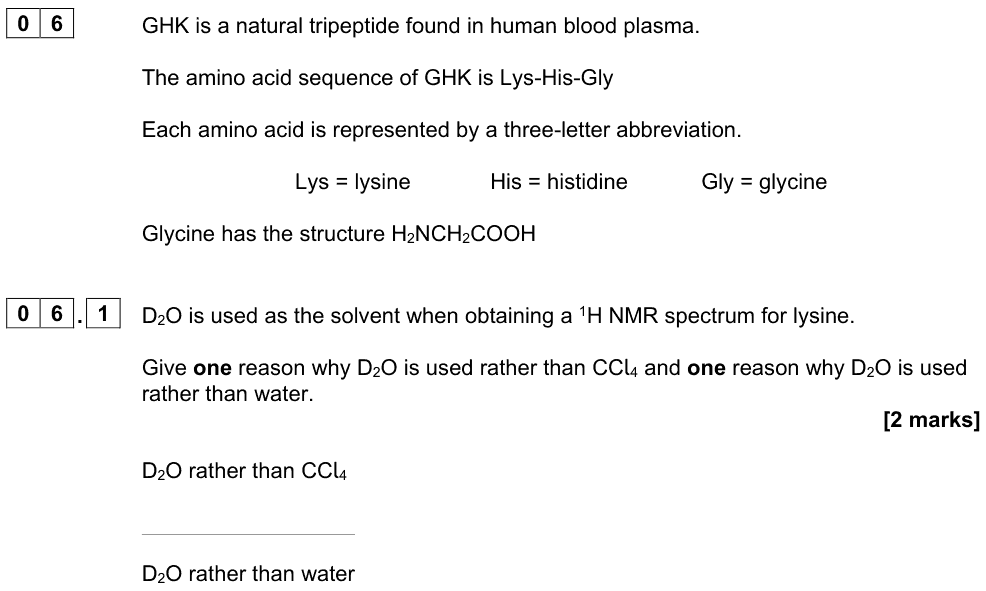
D2O is used as the solvent when obtaining a 1H NMR spectrum for lysine.
Give one reason why D2O is used rather than CCl4 and one reason why D2O is used
rather than water.
[2 marks]
D2O rather than CCl4
D2O rather than water
June 2025 · Paper 2 · Q06.2 1 mark AO1=1 Diagram or structure amino acids proteins and dna
Earlier part of question 06 that this part usesEarlier part of June 2025 Paper 2 question 06
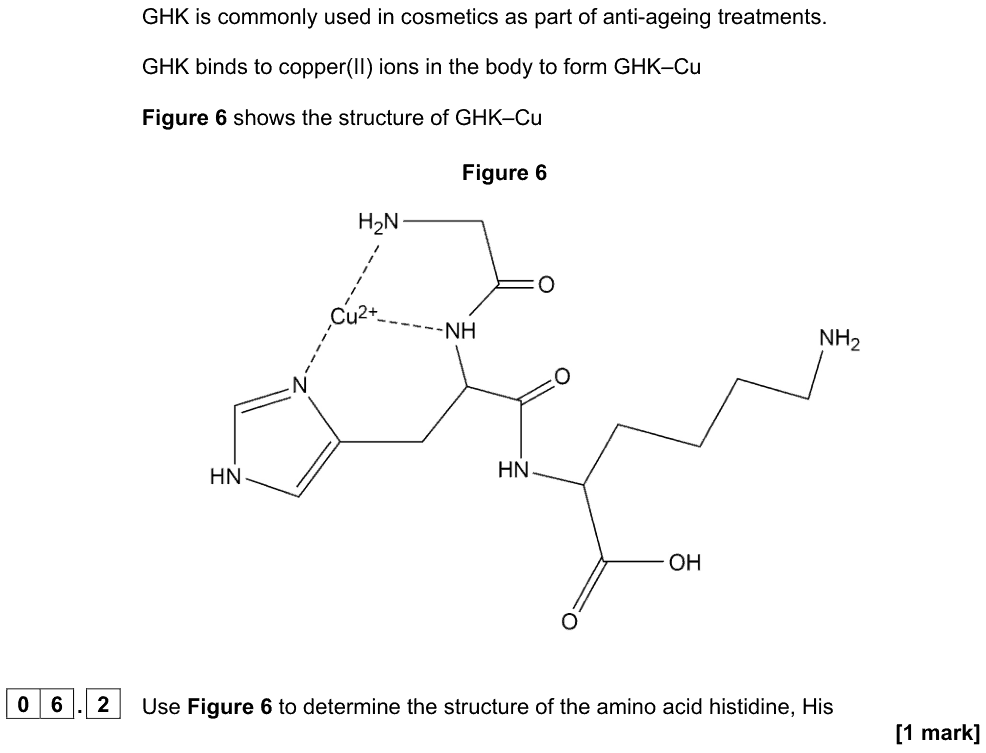
GHK is commonly used in cosmetics as part of anti-ageing treatments.
GHK binds to copper(II) ions in the body to form GHK–Cu
Figure 6 shows the structure of GHK–Cu
Figure 6
Use Figure 6 to determine the structure of the amino acid histidine, His
[1 mark]
June 2025 · Paper 2 · Q06.3 2 marks AO1=2 Short answer amino acids proteins and dna
Earlier part of question 06 that this part usesEarlier part of June 2025 Paper 2 question 06
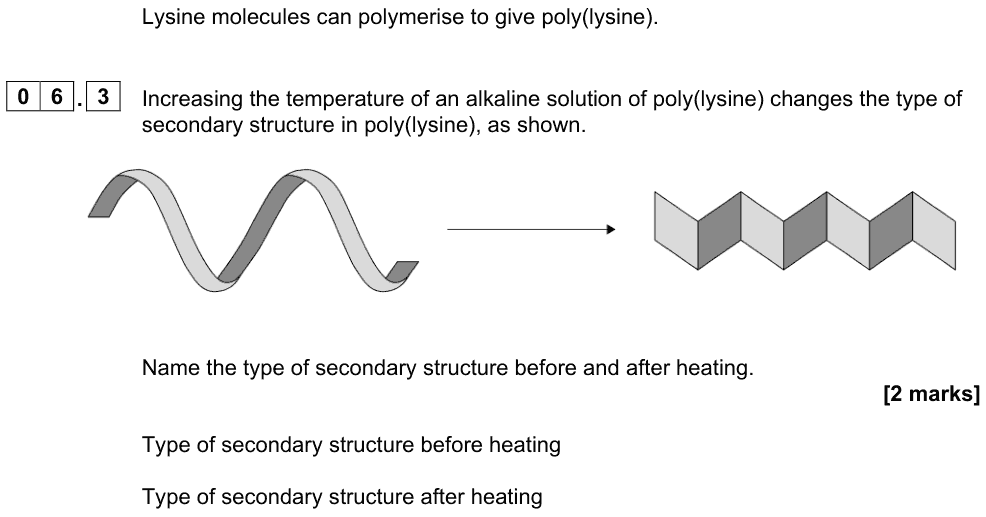
Lysine molecules can polymerise to give poly(lysine).
Increasing the temperature of an alkaline solution of poly(lysine) changes the type of
secondary structure in poly(lysine), as shown.
Name the type of secondary structure before and after heating.
[2 marks]
Type of secondary structure before heating
Type of secondary structure after heating
June 2025 · Paper 2 · Q07.1 5 marks AO1=2, AO2=3 Explanation organic analysisnmr spectroscopy
This question is about spectroscopy.
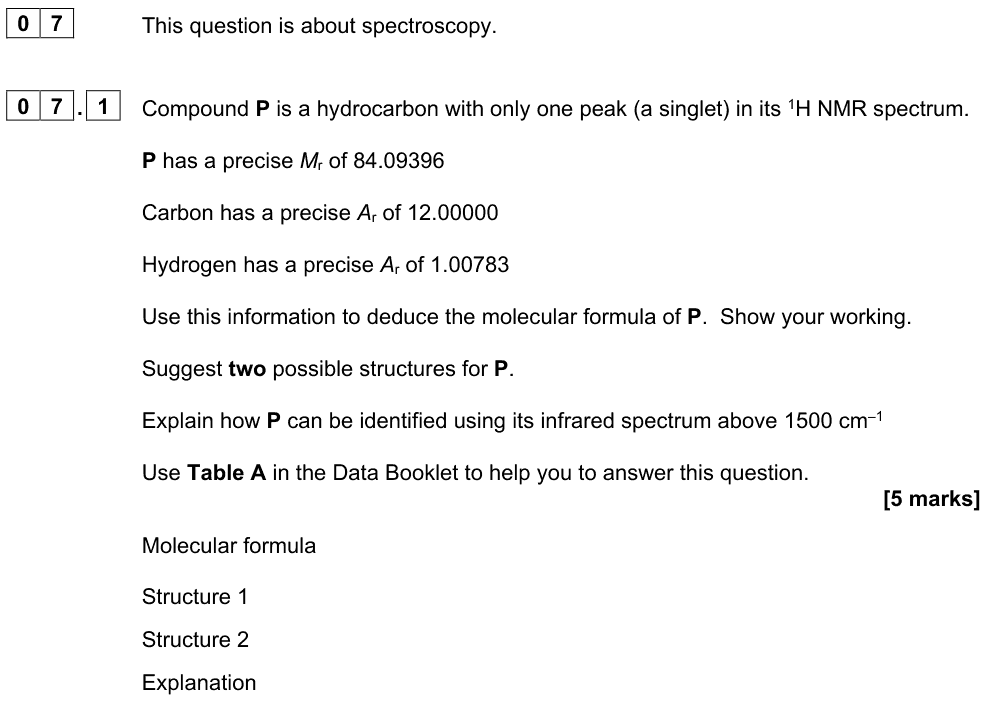
Compound P is a hydrocarbon with only one peak (a singlet) in its 1H NMR spectrum.
P has a precise Mr of 84.09396
Carbon has a precise Ar of 12.00000
Hydrogen has a precise Ar of 1.00783
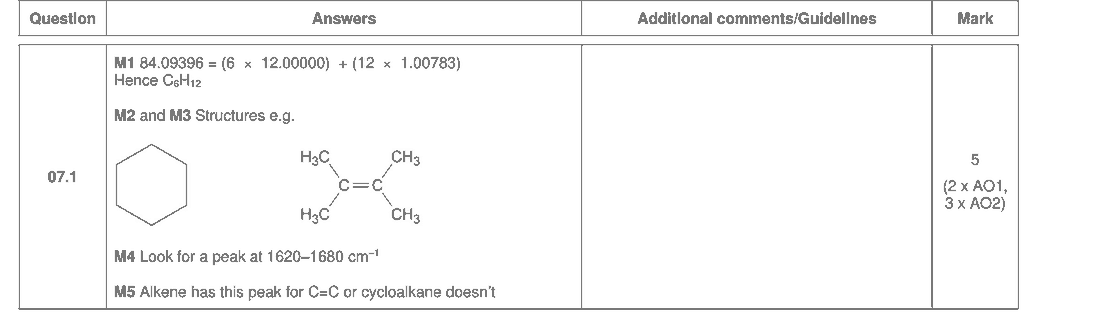
Use this information to deduce the molecular formula of P.  Show your working.
Suggest two possible structures for P.
Explain how P can be identified using its infrared spectrum above 1500 cm–1
Use Table A in the Data Booklet to help you to answer this question.
[5 marks]
Molecular formula
Structure 1
Structure 2
Explanation
June 2025 · Paper 2 · Q07.2 7 marks AO2=3, AO3=4 7-mark level of response nmr spectroscopy
Earlier part of question 07 that this part usesEarlier part of June 2025 Paper 2 question 07
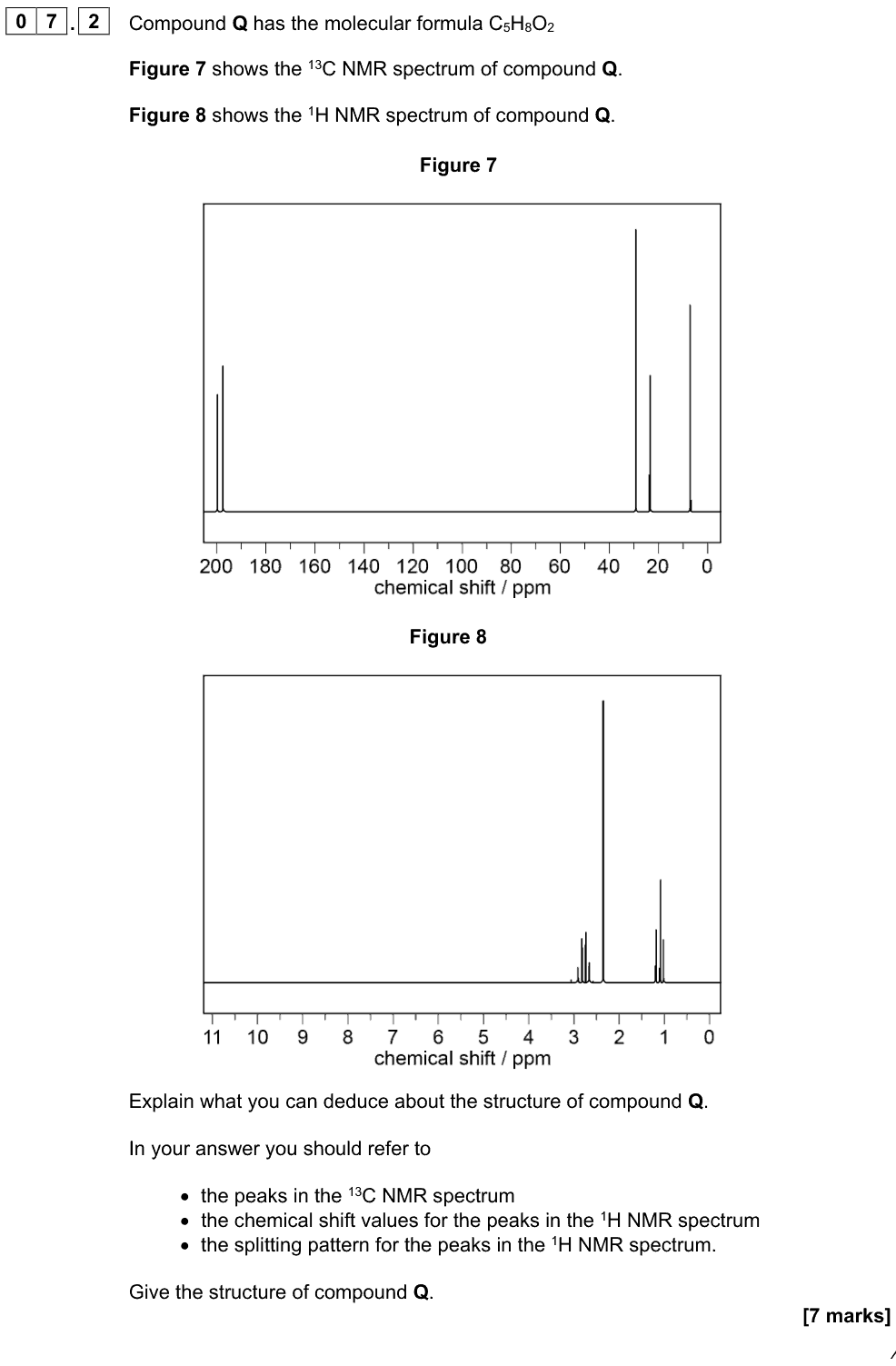
Compound Q has the molecular formula C5H8O2
Figure 7 shows the 13C NMR spectrum of compound Q.
Figure 8 shows the 1H NMR spectrum of compound Q.
Figure 7
Figure 8
Explain what you can deduce about the structure of compound Q.
In your answer you should refer to
• the peaks in the 13C NMR spectrum
• the chemical shift values for the peaks in the 1H NMR spectrum
• the splitting pattern for the peaks in the 1H NMR spectrum.
Give the structure of compound Q.
[7 marks]
June 2025 · Paper 2 · Q08.1 5 marks AO2=5 Calculation amount of substance
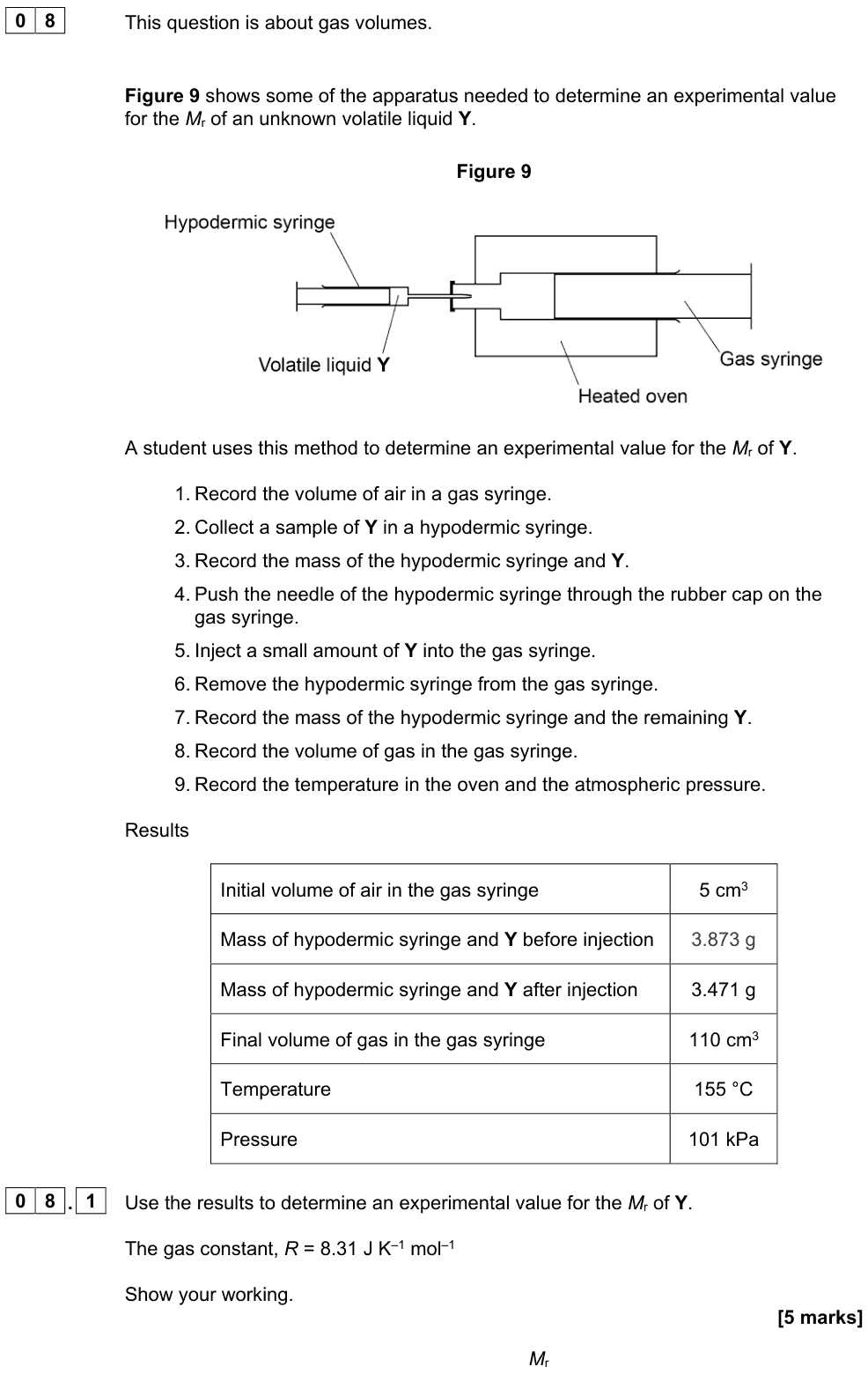
This question is about gas volumes.
Figure 9 shows some of the apparatus needed to determine an experimental value
for the Mr of an unknown volatile liquid Y.
Figure 9
A student uses this method to determine an experimental value for the Mr of Y.
1. Record the volume of air in a gas syringe.
2. Collect a sample of Y in a hypodermic syringe.
3. Record the mass of the hypodermic syringe and Y.
4. Push the needle of the hypodermic syringe through the rubber cap on the
gas syringe.
5. Inject a small amount of Y into the gas syringe.
6. Remove the hypodermic syringe from the gas syringe.
7. Record the mass of the hypodermic syringe and the remaining Y.
8. Record the volume of gas in the gas syringe.
9. Record the temperature in the oven and the atmospheric pressure.
Results
Initial volume of air in the gas syringe
5 cm3
Mass of hypodermic syringe and Y before injection
3.873 g
Mass of hypodermic syringe and Y after injection
3.471 g
Final volume of gas in the gas syringe
110 cm3
Temperature
155 °C
Pressure
101 kPa
Use the results to determine an experimental value for the Mr of Y.
The gas constant, R = 8.31 J K–1 mol–1
Show your working.
[5 marks]
Mr
June 2025 · Paper 2 · Q08.2 3 marks AO3=3 Practical and data analysis amount of substance
Earlier part of question 08 that this part usesEarlier part of June 2025 Paper 2 question 08
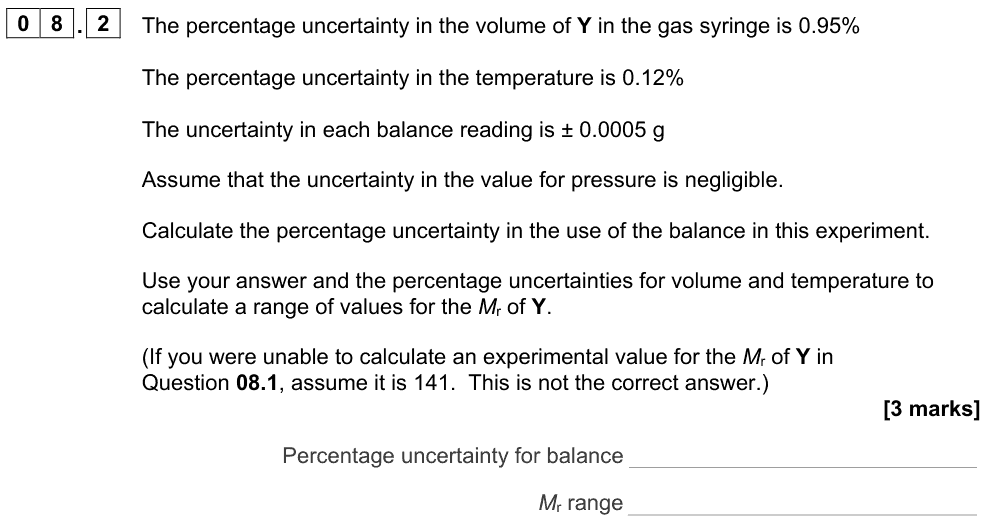
The percentage uncertainty in the volume of Y in the gas syringe is 0.95%
The percentage uncertainty in the temperature is 0.12%
The uncertainty in each balance reading is ± 0.0005 g
Assume that the uncertainty in the value for pressure is negligible.
Calculate the percentage uncertainty in the use of the balance in this experiment.
Use your answer and the percentage uncertainties for volume and temperature to
calculate a range of values for the Mr of Y.
(If you were unable to calculate an experimental value for the Mr of Y in
Question 08.1, assume it is 141.  This is not the correct answer.)
[3 marks]
Percentage uncertainty for balance
Mr range
June 2025 · Paper 2 · Q08.3 1 mark AO3=1 Practical and data analysis amount of substance
Earlier part of question 08 that this part usesEarlier part of June 2025 Paper 2 question 08
A teacher suggests placing a seal over the needle of the hypodermic syringe after
collecting the sample of liquid Y, and then replacing the seal after injecting the liquid Y
into the gas syringe.
Give a reason why the teacher’s suggestion will improve the experiment.
[1 mark]
June 2025 · Paper 2 · Q08.4 4 marks AO2=4 Calculation amount of substance
Earlier part of question 08 that this part usesEarlier part of June 2025 Paper 2 question 08
A mixture of methane and propane has a volume of 40 cm3
This mixture needs exactly 170 cm3 of oxygen for complete combustion.
The equations for these reactions are
CH4  +  2 O2  ⟶  CO2  +  2 H2O
C3H8  +  5 O2  ⟶  3 CO2  +  4 H2O
Calculate the volume
• of methane in the original mixture
• of propane in the original mixture.
All volumes are measured at the same temperature and pressure.
[4 marks]
Volume of methane
cm3
Volume of propane
cm3
June 2025 · Paper 2 · Q09.1 1 mark AO1=1 Short answer group 7 the halogens
This question is about rates of reaction.
The rate of hydrolysis of a bromoalkane (RBr) is investigated using this method.
• A boiling tube has a cross drawn onto it.
• An aqueous solution of silver nitrate is added to an ethanolic solution of RBr in
the boiling tube in a warm water bath.
• The time is recorded for the cross on the boiling tube to become invisible.
The method is repeated at different temperatures.
State why the cross on the boiling tube becomes invisible.
[1 mark]
June 2025 · Paper 2 · Q09.2 1 mark AO3=1 Practical and data analysis kinetics
Earlier part of question 09 that this part usesEarlier part of June 2025 Paper 2 question 09
The volume and concentration of each substance used at each temperature is
kept constant.
Identify one other variable that should be kept constant to ensure that the
investigation is fair.
[1 mark]
June 2025 · Paper 2 · Q09.3 1 mark AO1=1 Calculation rate equations
Earlier part of question 09 that this part usesEarlier part of June 2025 Paper 2 question 09
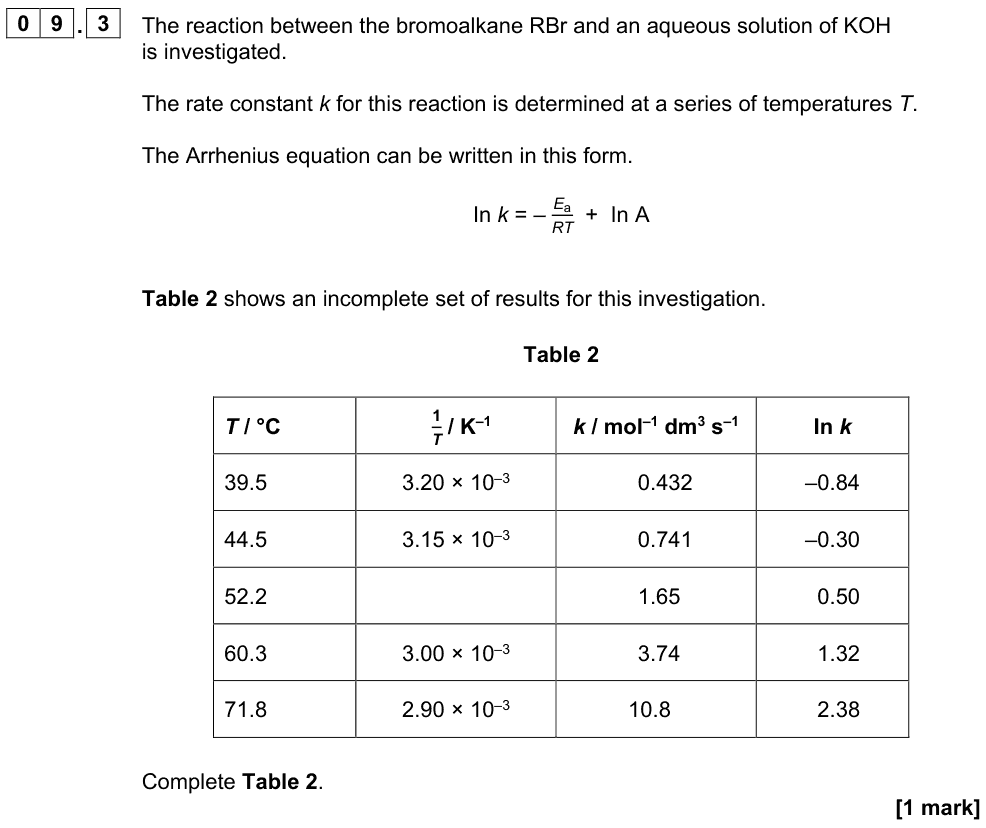
The reaction between the bromoalkane RBr and an aqueous solution of KOH
is investigated.
The rate constant k for this reaction is determined at a series of temperatures T.
The Arrhenius equation can be written in this form.
In k = –
Ea
RT  +  In A
Table 2 shows an incomplete set of results for this investigation.
Table 2
T / °C
1
T / K–1
k / mol–1 dm3 s–1
In k
39.5
3.20 × 10⁻³
0.432
–0.84
44.5
3.15 × 10⁻³
0.741
–0.30
52.2
1.65
0.50
60.3
3.00 × 10⁻³
3.74
1.32
71.8
2.90 × 10⁻³
10.8
2.38
Complete Table 2.
[1 mark]
June 2025 · Paper 2 · Q09.4 5 marks AO2=5 Calculation rate equations
Earlier parts of question 09 that this part usesEarlier part of June 2025 Paper 2 question 09Earlier part of June 2025 Paper 2 question 09
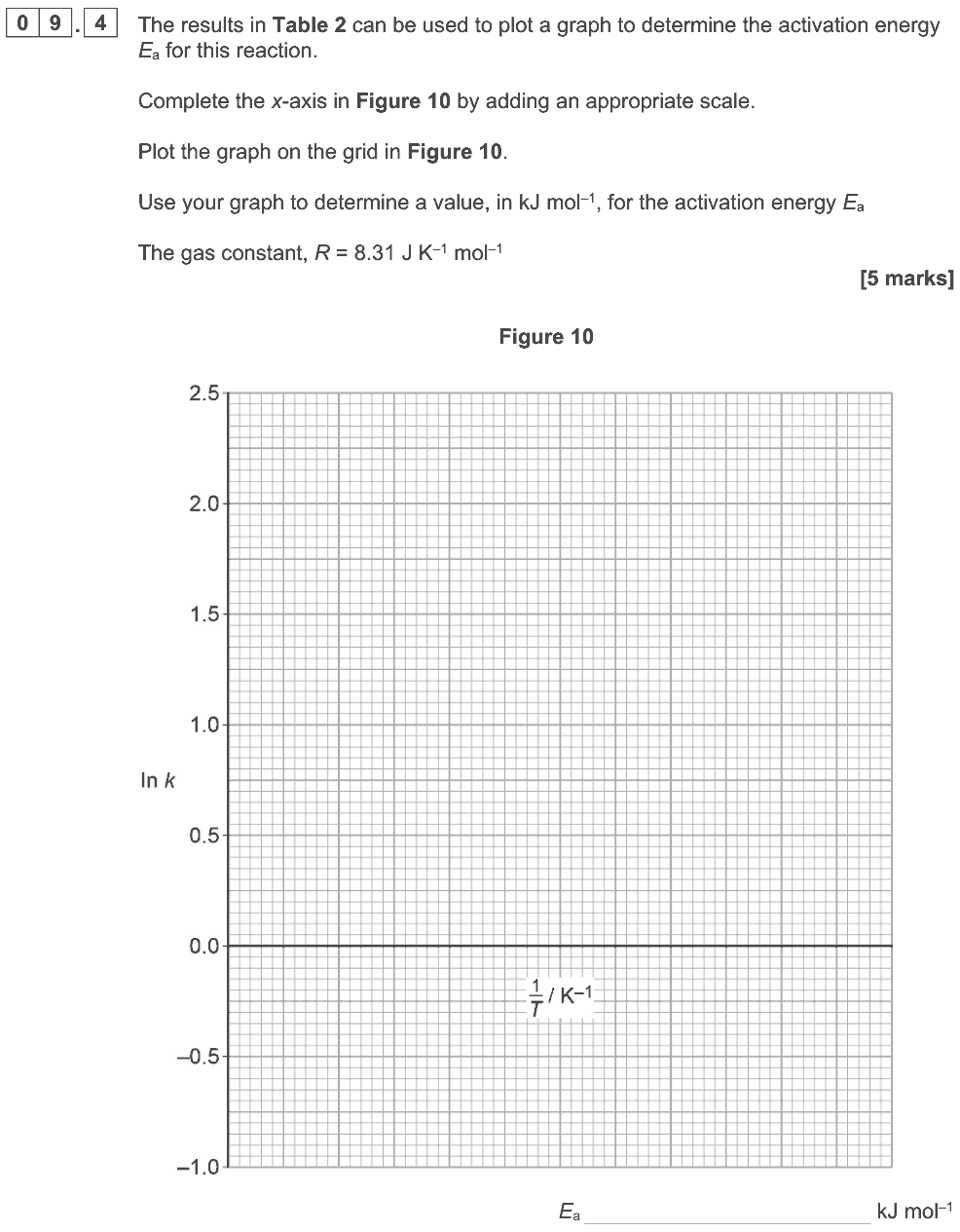
The results in Table 2 can be used to plot a graph to determine the activation energy
Ea for this reaction.
Complete the x-axis in Figure 10 by adding an appropriate scale.
Plot the graph on the grid in Figure 10.
Use your graph to determine a value, in kJ mol–1, for the activation energy Ea
The gas constant, R = 8.31 J K–1 mol–1
[5 marks]
Figure 10
Ea
kJ mol–1
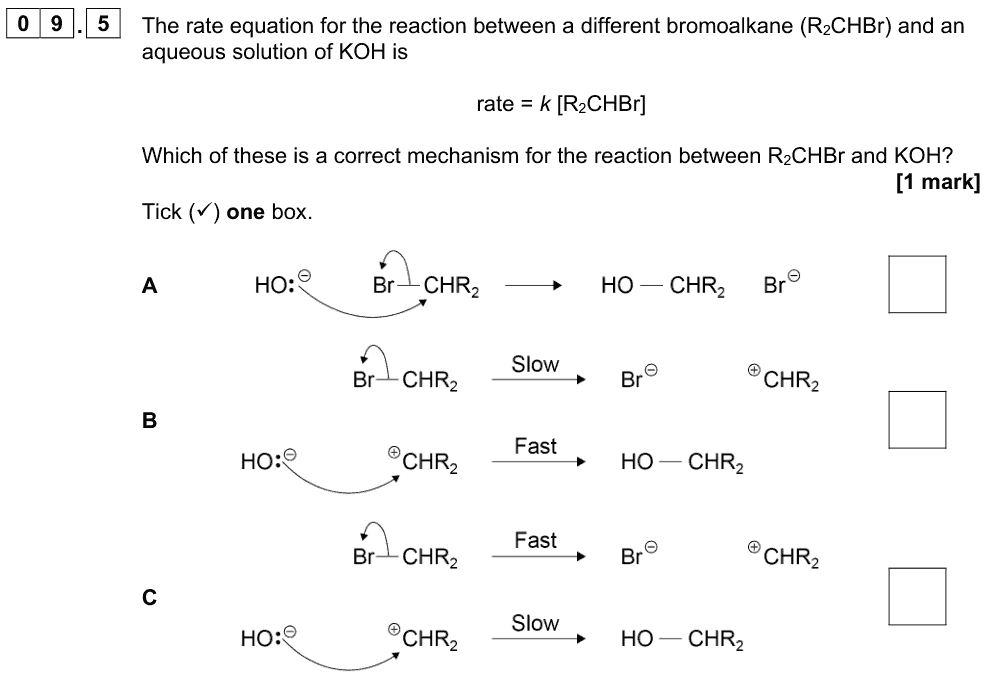
June 2025 · Paper 2 · Q09.5 1 mark AO1=1 Short answer rate equations
Earlier part of question 09 that this part usesEarlier part of June 2025 Paper 2 question 09
The rate equation for the reaction between a different bromoalkane (R2CHBr) and an
aqueous solution of KOH is
rate = k [R2CHBr]
Which of these is a correct mechanism for the reaction between R2CHBr and KOH?
[1 mark]
Tick () one box.
A
B
C
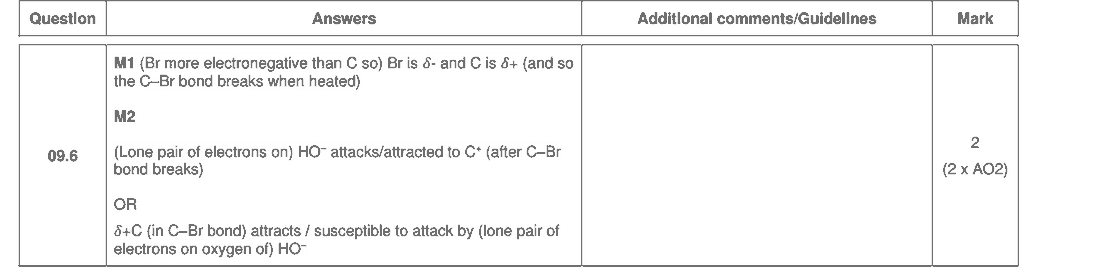
June 2025 · Paper 2 · Q09.6 2 marks AO2=2 Explanation halogenoalkanesbonding
Earlier part of question 09 that this part usesEarlier part of June 2025 Paper 2 question 09
Explain, in terms of bond polarity, why R2CHBr and KOH react together.
[2 marks]

Work with an A-level chemistry tutor

Want a paper marked and gone through with you? Message us.

Prefer email? Send an enquiry

If you are under 18, please include a parent's contact details. Enquiries go to enquiries@chemistryaleveltutor.com and are deleted once handled. All tutoring is online.