Specimen: Paper 2, Organic and physical chemistry

105 marks · 51 question parts · Paper, mark scheme and report on AQA's site · AQA's specimen paper for the current specification · Have the Data Booklet beside you

Question by question

QTopicMarksAOType
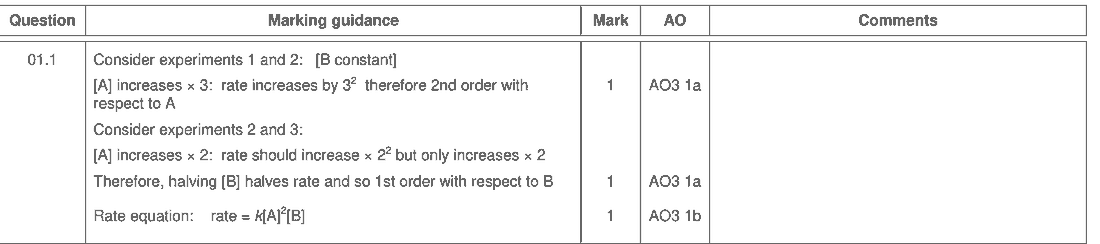
01.1 Rate equations 3Explanation
01.2 Rate equations 3AO2=3Calculation
01.3 Rate equations 1AO2=1Calculation
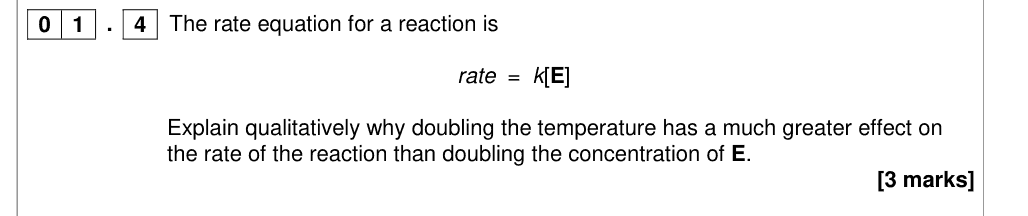
01.4 Rate equations, Kinetics 3Explanation
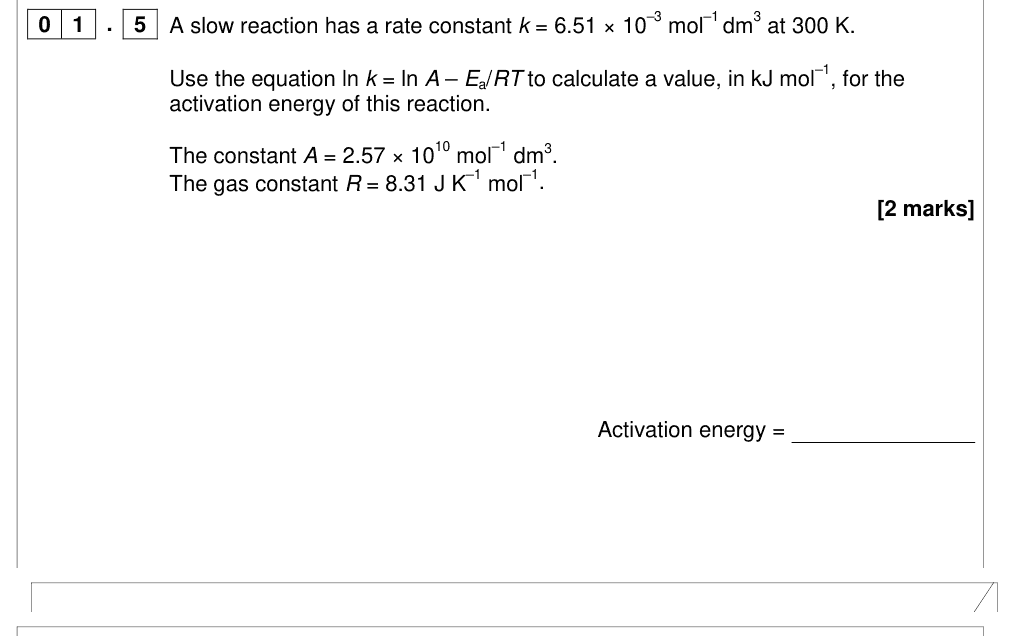
01.5 Rate equations 2Calculation
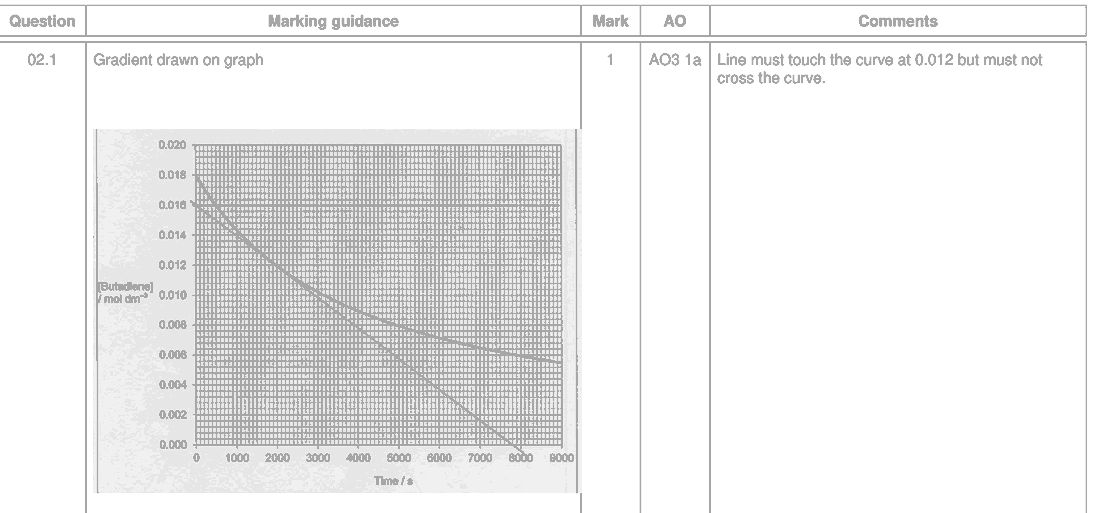
02.1 Rate equations 1AO3=1Practical and data analysis
02.2 Rate equations 5Calculation
03.1 Introduction to organic chemistry: nomenclature, mechanisms and isomerism 1AO1=1Short answer
03.2 Nuclear magnetic resonance spectroscopy 1AO2=1Short answer
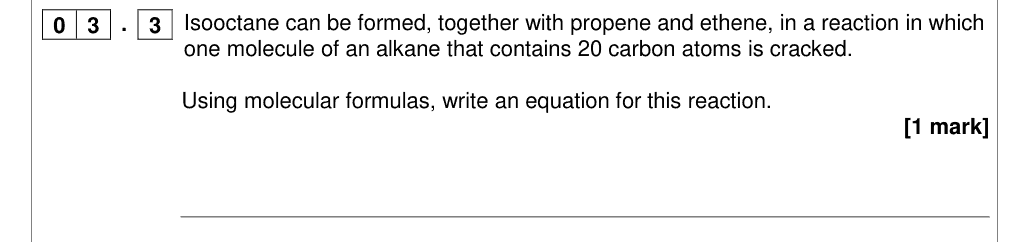
03.3 Alkanes, Amount of substance 1AO2=1Equation writing
03.4 Alkanes 1AO1=1Short answer
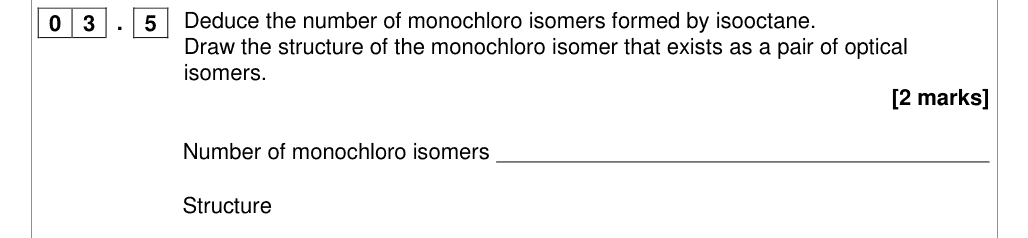
03.5 Introduction to organic chemistry: nomenclature, mechanisms and isomerism, Optical isomerism 2Diagram or structure
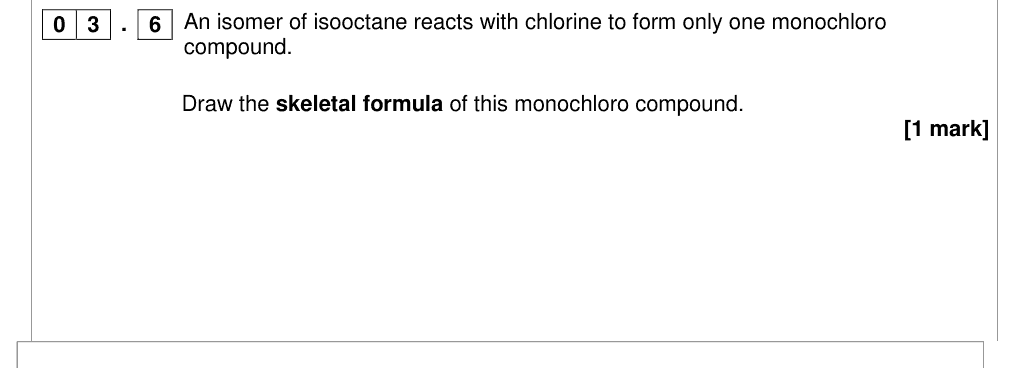
03.6 Introduction to organic chemistry: nomenclature, mechanisms and isomerism 1AO2=1Diagram or structure
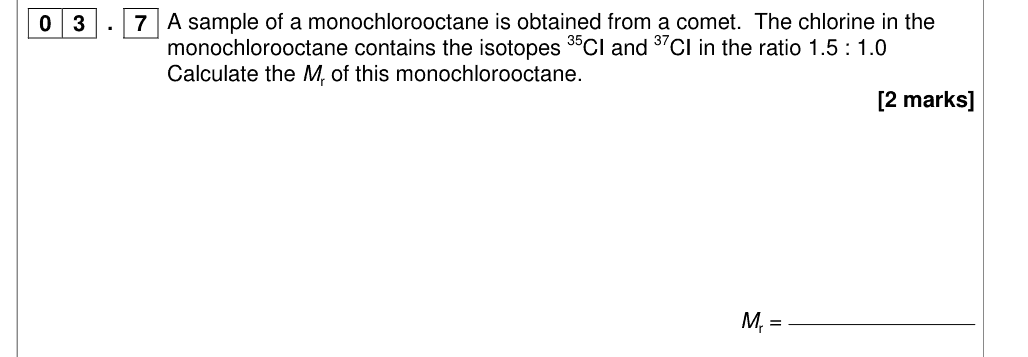
03.7 Atomic structure 2Calculation
03.8 Amount of substance 3Calculation
04.1 Introduction to organic chemistry: nomenclature, mechanisms and isomerism 1AO1=1Short answer
04.2 Alcohols 1AO2=1Diagram or structure
04.3 Alcohols 1AO1=1Short answer
04.4 Alcohols, Introduction to organic chemistry: nomenclature, mechanisms and isomerism 2AO2=2Diagram or structure
04.5 Introduction to organic chemistry: nomenclature, mechanisms and isomerism 1AO1=1Short answer
04.6 Bonding 1AO3=1Short answer
04.7 Alcohols, Introduction to organic chemistry: nomenclature, mechanisms and isomerism 1AO2=1Diagram or structure
04.8 Alcohols, Introduction to organic chemistry: nomenclature, mechanisms and isomerism 1AO2=1Diagram or structure
05.1 Amino acids, proteins and DNA 1AO1=1Short answer
05.2 Amino acids, proteins and DNA, Bonding 4Explanation
06.1 Optical isomerism 1AO2=1Short answer
06.2 Amino acids, proteins and DNA 1AO2=1Diagram or structure
06.3 Amines 1AO2=1Diagram or structure
06.4 Introduction to organic chemistry: nomenclature, mechanisms and isomerism 1AO2=1Short answer
06.5 Amino acids, proteins and DNA 1AO2=1Diagram or structure
07.1 Alkenes 2Diagram or structure
07.2 Polymers 2Diagram or structure
07.3 Polymers 3Explanation
08.1 Amino acids, proteins and DNA 1AO1=1Short answer
08.2 Amino acids, proteins and DNA 4Explanation
08.3 Amino acids, proteins and DNA 1AO2=1Short answer
08.4 Amino acids, proteins and DNA 1AO2=1Short answer
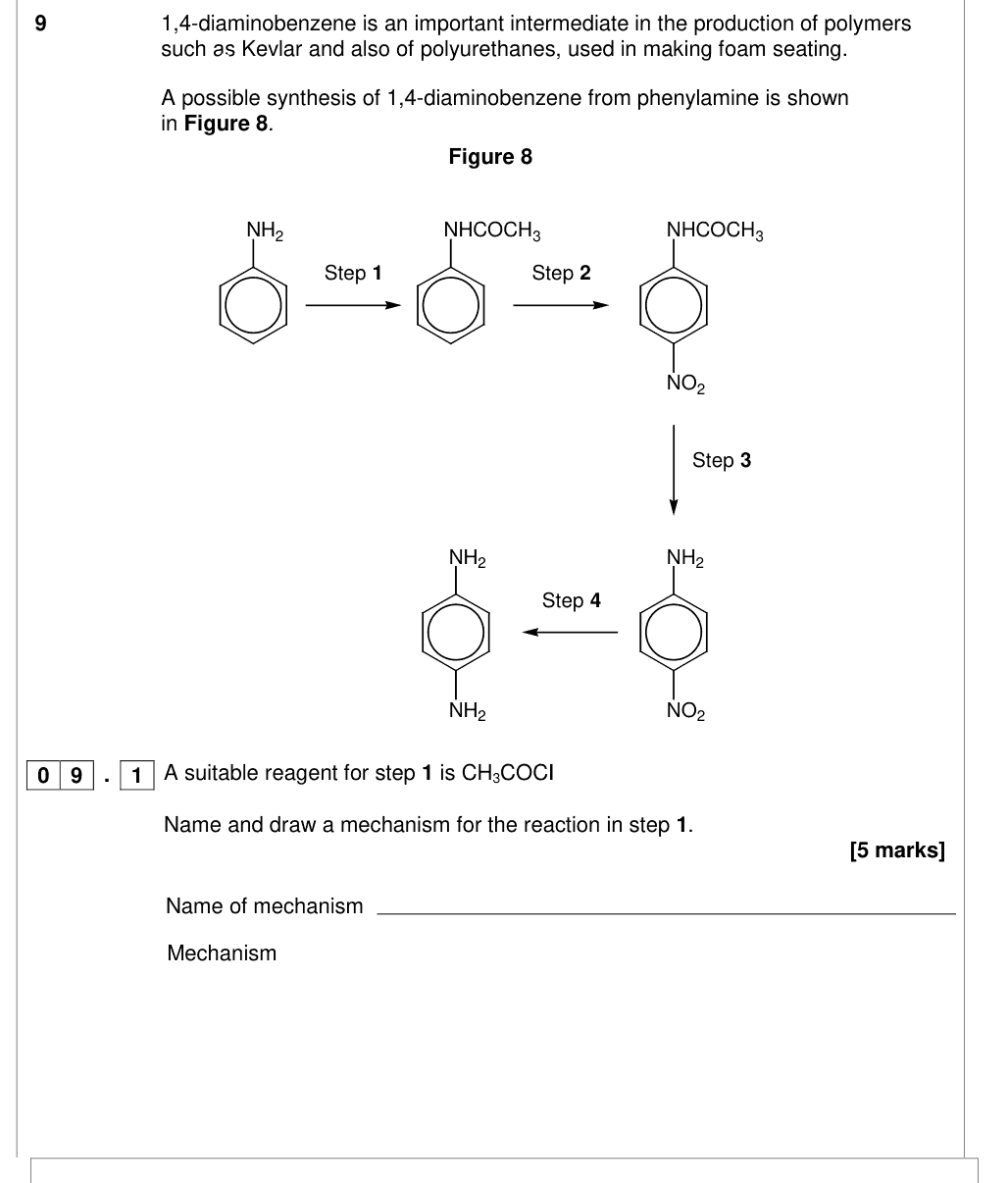
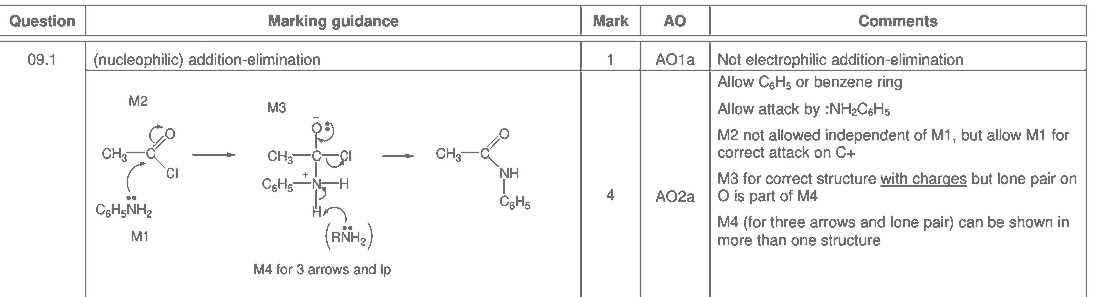
09.1 Amines, Carboxylic acids and derivatives 5AO1=1,AO2=4Mechanism
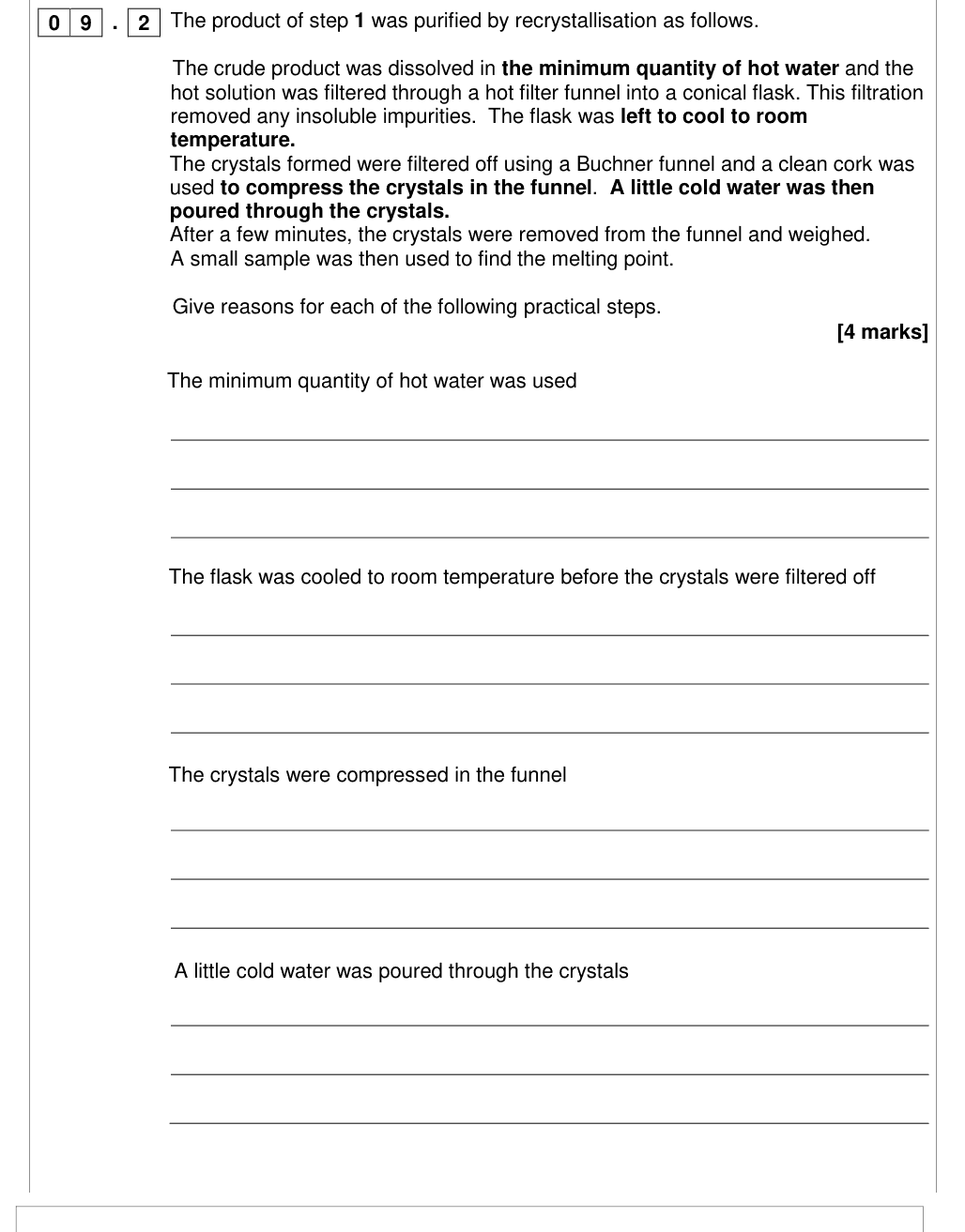
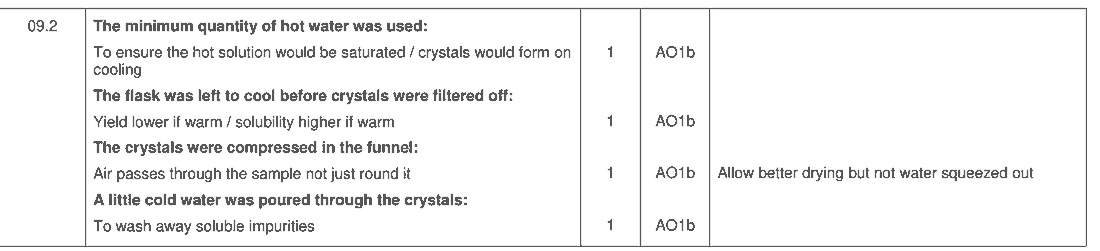
09.2 Carboxylic acids and derivatives 4Practical and data analysis
09.3 Carboxylic acids and derivatives 2Practical and data analysis
09.4 Amount of substance 3Calculation
09.5 Aromatic chemistry 1AO2=1Equation writing
09.6 Aromatic chemistry 1AO1=1Short answer
09.7 Polymers 1AO3=1Short answer
09.8 Amines 1AO1=1Short answer
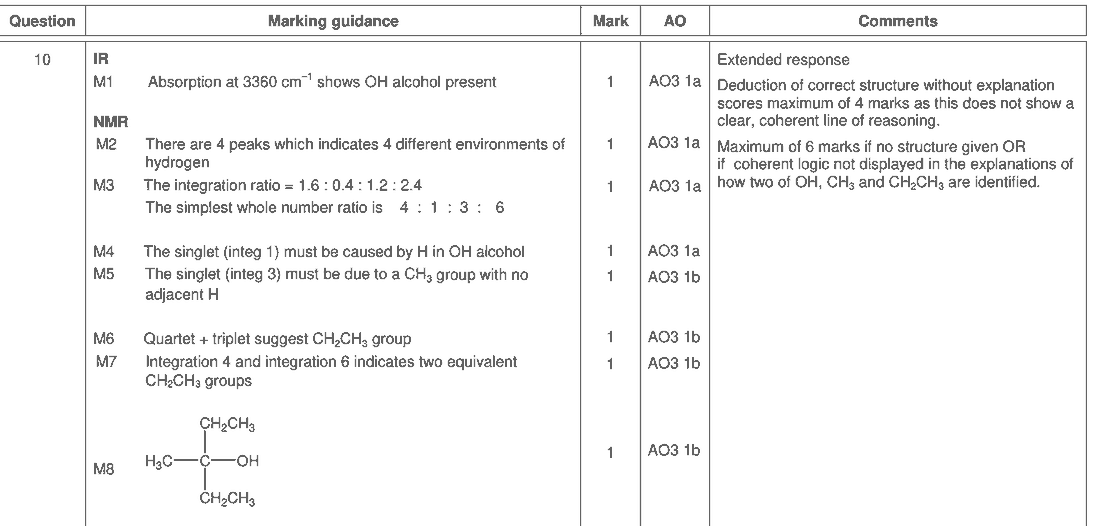
10 Nuclear magnetic resonance spectroscopy, Organic analysis: test-tube reactions, mass spectrometry and infrared 8Explanation
11.1 Aldehydes and ketones 1AO1=1Equation writing
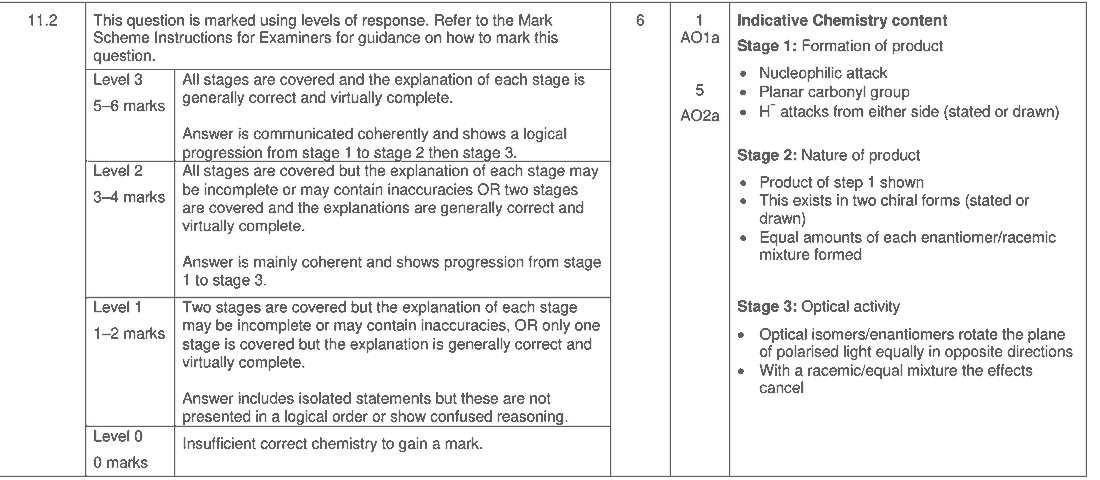
11.2 Optical isomerism, Aldehydes and ketones 6Level of response
12.1 Alkenes 1AO1=1Short answer
12.2 Alkenes 5Mechanism
12.3 Alkenes, Optical isomerism 3Explanation

The questions

01.101.201.301.401.502.102.203.103.203.303.403.503.603.703.804.104.204.304.404.504.604.704.805.105.206.106.206.306.406.507.107.207.308.108.208.308.409.109.209.309.409.509.609.709.81011.111.212.112.212.3
Specimen · Paper 2 · Q01.1 3 marks Explanation rate equations
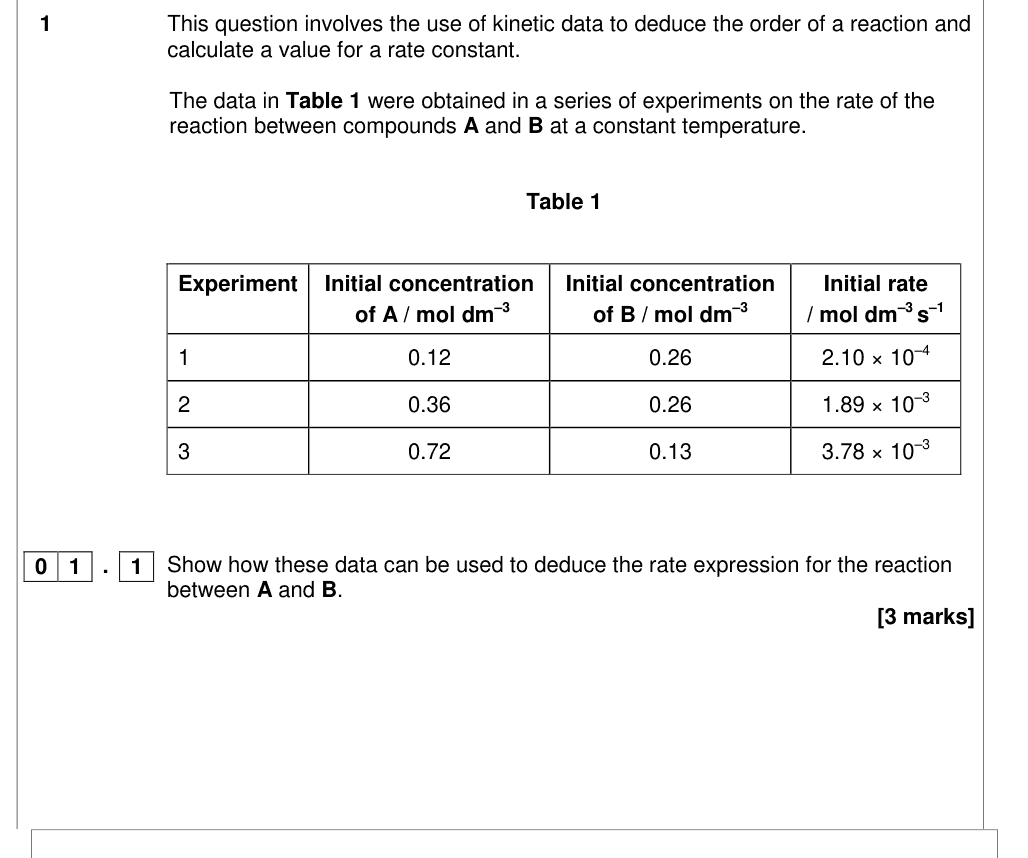
This question involves the use of kinetic data to deduce the order of a reaction and
calculate a value for a rate constant.
The data in Table 1 were obtained in a series of experiments on the rate of the
reaction between compounds A and B at a constant temperature.
Table 1
Experiment  Initial concentration
of A / mol dm–3
Initial concentration
of B / mol dm–3
Initial rate
/ mol dm–3 s–1
1
0.12
0.26
2.10 × 10⁻⁴
2
0.36
0.26
1.89 × 10⁻³
3
0.72
0.13
3.78 × 10⁻³
Show how these data can be used to deduce the rate expression for the reaction
between A and B.
[3 marks]
Specimen · Paper 2 · Q01.2 3 marks AO2=3 Calculation rate equations
Earlier part of question 01 that this part usesEarlier part of Specimen Paper 2 question 01
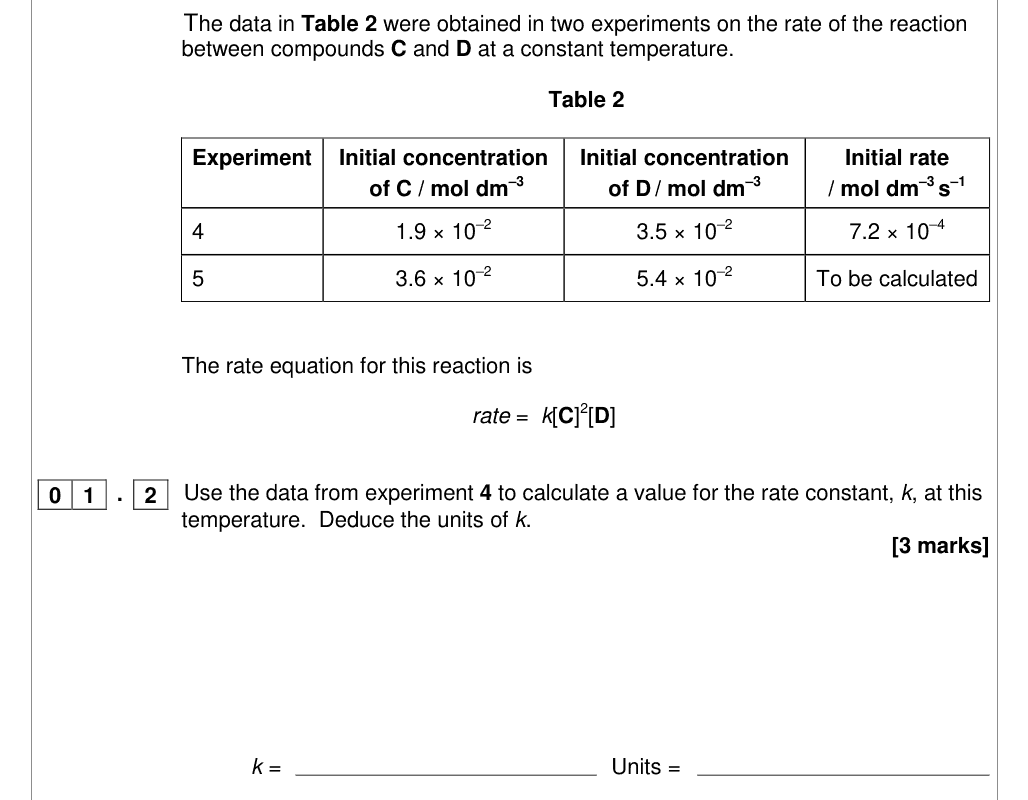
The data in Table 2 were obtained in two experiments on the rate of the reaction
between compounds C and D at a constant temperature.
Table 2
Experiment  Initial concentration
of C / mol dm–3
Initial concentration
of D / mol dm–3
Initial rate
/ mol dm–3 s–1
4
1.9 × 10⁻²
3.5 × 10⁻²
7.2 × 10⁻⁴
5
3.6 × 10⁻²
5.4 × 10⁻²
To be calculated
The rate equation for this reaction is
rate =  k[C]2[D]
Use the data from experiment 4 to calculate a value for the rate constant, k, at this
temperature.  Deduce the units of k.
[3 marks]
k =
Units =
Specimen · Paper 2 · Q01.3 1 mark AO2=1 Calculation rate equations
Earlier parts of question 01 that this part usesEarlier part of Specimen Paper 2 question 01Earlier part of Specimen Paper 2 question 01
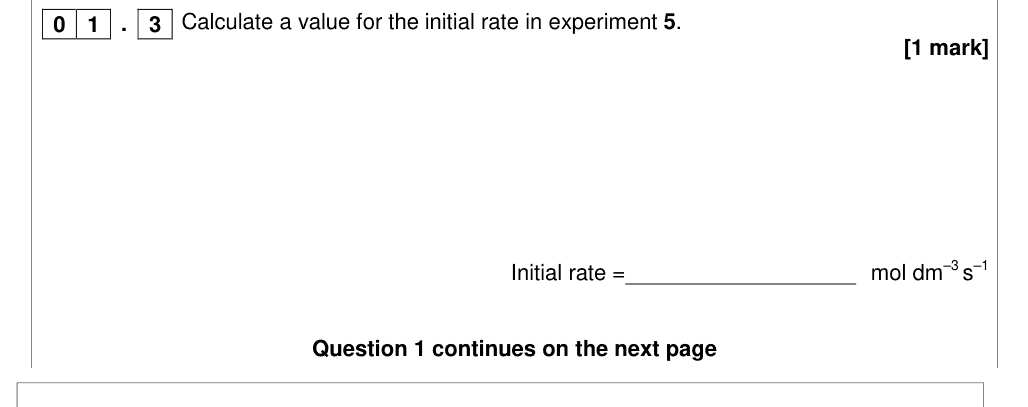
Calculate a value for the initial rate in experiment 5.
[1 mark]
Initial rate =
mol dm–3 s–1
Specimen · Paper 2 · Q01.4 3 marks Explanation rate equationskinetics
Earlier parts of question 01 that this part usesEarlier part of Specimen Paper 2 question 01Earlier part of Specimen Paper 2 question 01
The rate equation for a reaction is
rate  =  k[E]
Explain qualitatively why doubling the temperature has a much greater effect on
the rate of the reaction than doubling the concentration of E.
[3 marks]
Specimen · Paper 2 · Q01.5 2 marks Calculation rate equations
Earlier parts of question 01 that this part usesEarlier part of Specimen Paper 2 question 01Earlier part of Specimen Paper 2 question 01
A slow reaction has a rate constant k = 6.51 × 10
–3 mol
–1 dm
3 at 300 K.
Use the equation ln k = ln A – Ea/RT to calculate a value, in kJ mol
–1, for the
activation energy of this reaction.
The constant A = 2.57 × 10
10 mol
–1 dm3.
The gas constant R = 8.31 J K
–1 mol
–1.
[2 marks]
Activation energy =
Specimen · Paper 2 · Q02.1 1 mark AO3=1 Practical and data analysis rate equations
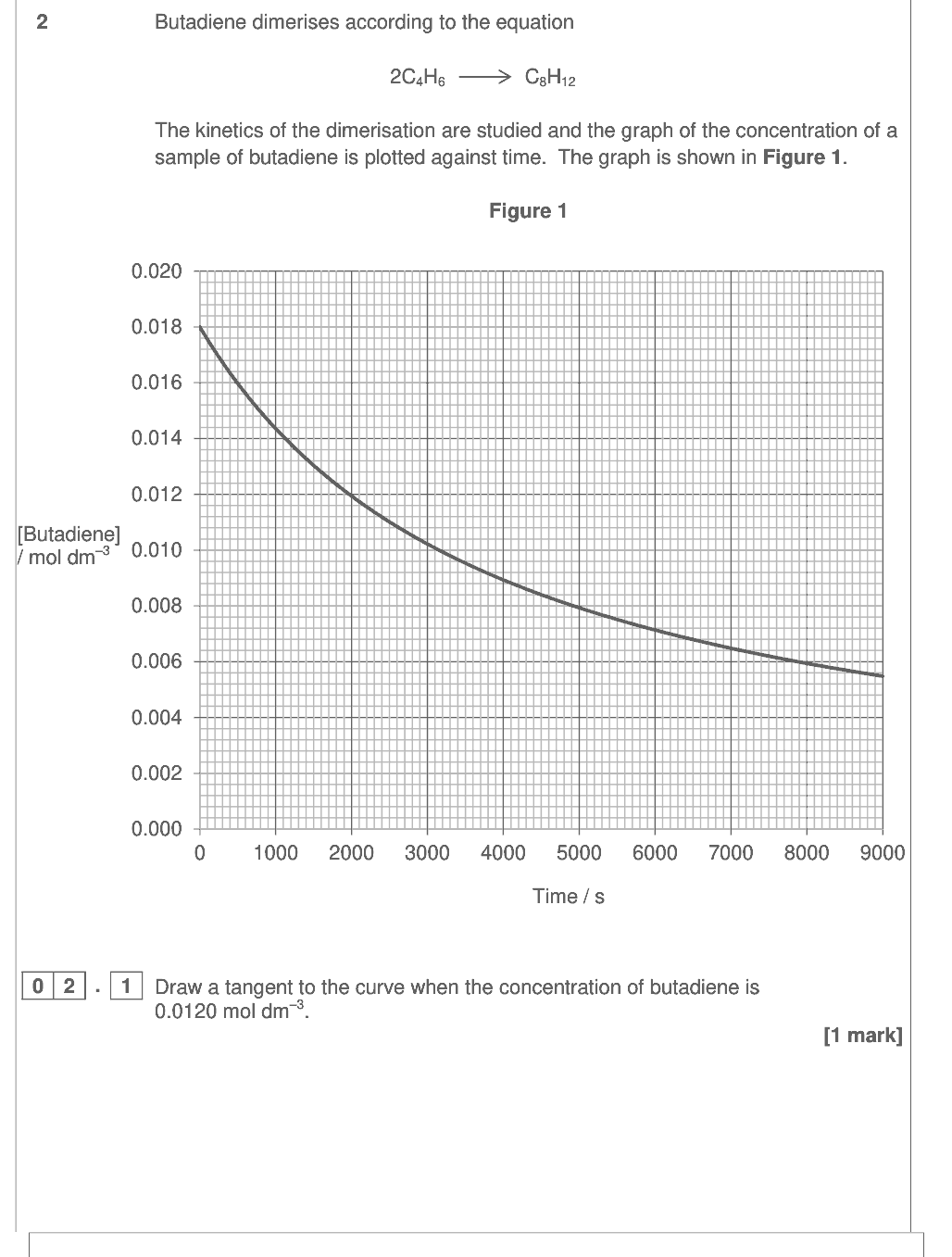
Butadiene dimerises according to the equation
2C4H6              C8H12
The kinetics of the dimerisation are studied and the graph of the concentration of a
sample of butadiene is plotted against time.  The graph is shown in Figure 1.
Figure 1
Draw a tangent to the curve when the concentration of butadiene is
0.0120 mol dm–3.
[1 mark]
0.000
0.002
0.004
0.006
0.008
0.010
0.012
0.014
0.016
0.018
0.020
0
1000
2000
3000
4000
5000
6000
7000
8000
9000
Time / s
[Butadiene]
/ mol dm–3
Specimen · Paper 2 · Q02.2 5 marks Calculation rate equations
Earlier part of question 02 that this part usesEarlier part of Specimen Paper 2 question 02
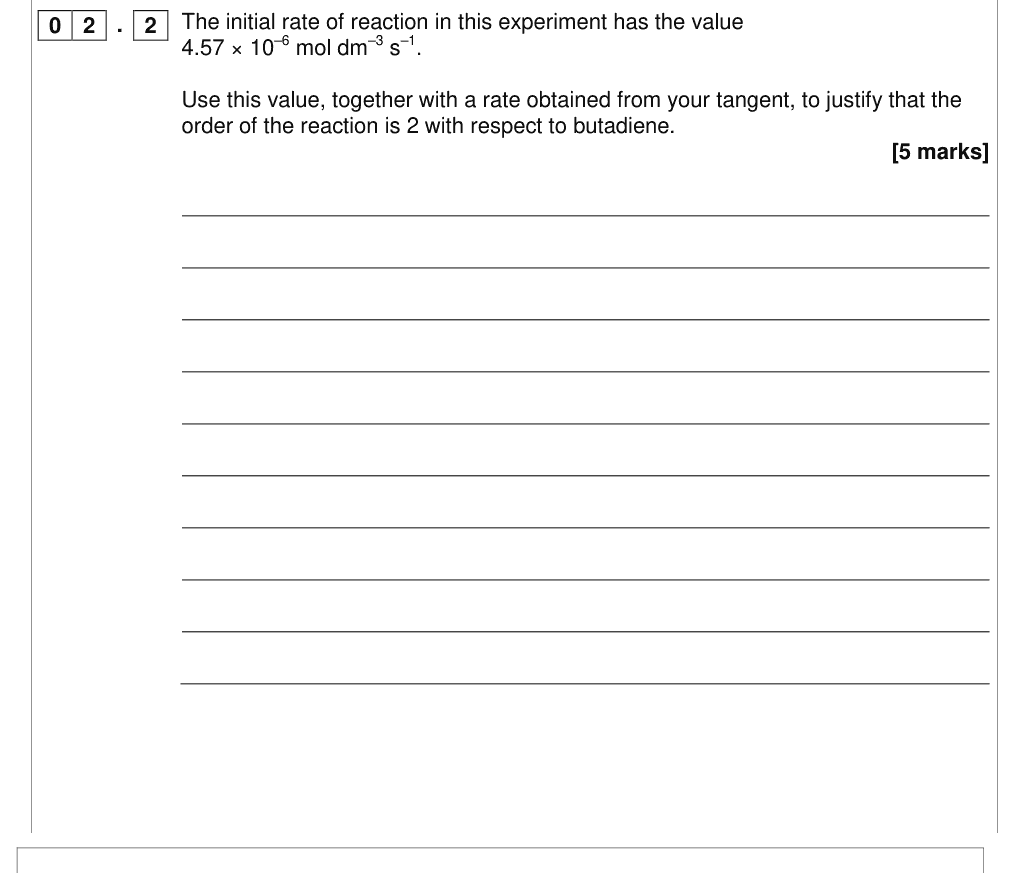
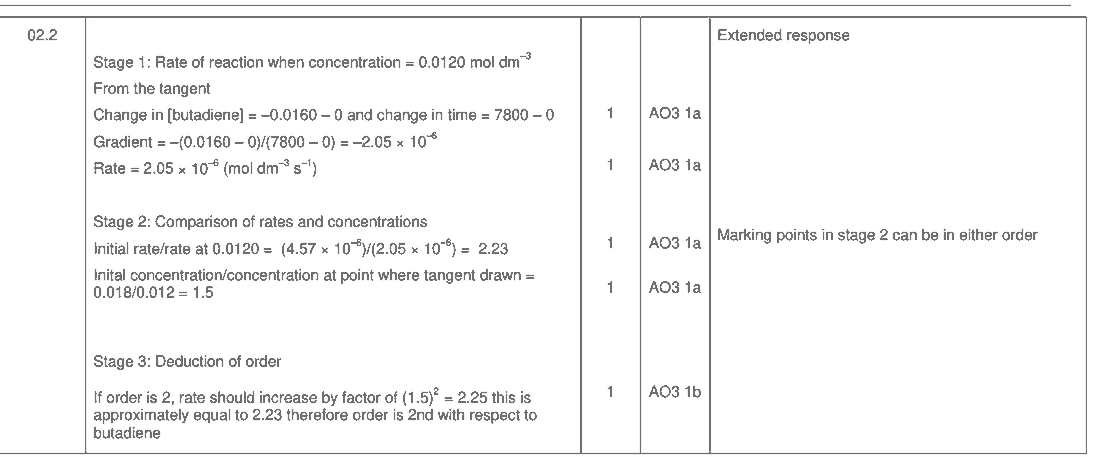
The initial rate of reaction in this experiment has the value
4.57 × 10⁻⁶ mol dm–3 s–1.
Use this value, together with a rate obtained from your tangent, to justify that the
order of the reaction is 2 with respect to butadiene.
[5 marks]
Specimen · Paper 2 · Q03.1 1 mark AO1=1 Short answer introduction to organic chemistry
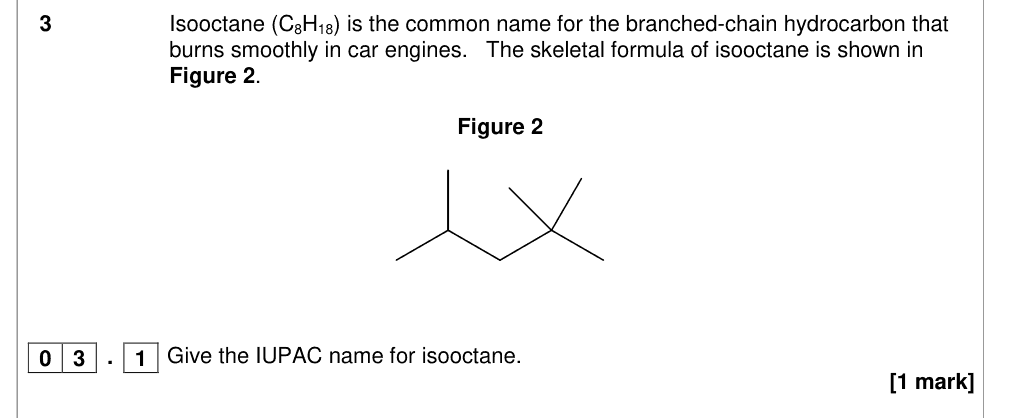
Isooctane (C8H18) is the common name for the branched-chain hydrocarbon that
burns smoothly in car engines.   The skeletal formula of isooctane is shown in
Figure 2.
Figure 2
Give the IUPAC name for isooctane.
[1 mark]
Specimen · Paper 2 · Q03.2 1 mark AO2=1 Short answer nmr spectroscopy
Earlier part of question 03 that this part usesEarlier part of Specimen Paper 2 question 03
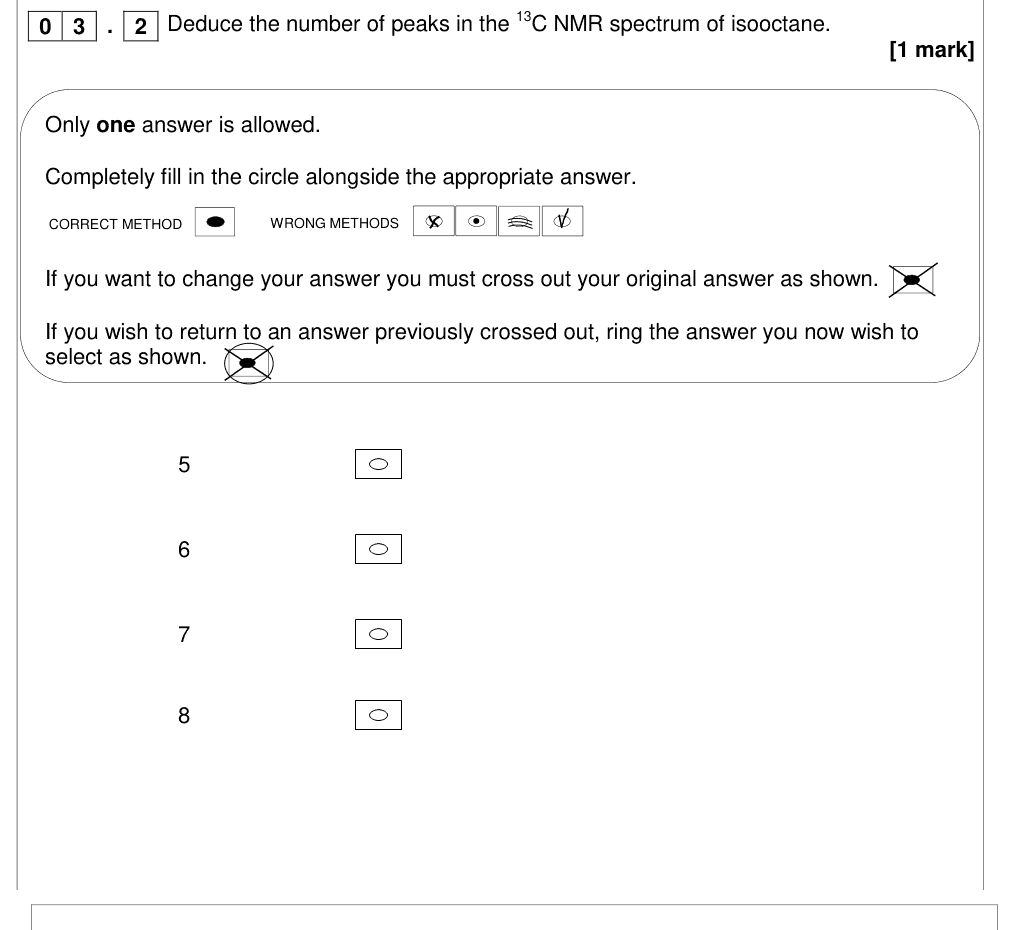
Deduce the number of peaks in the 13C NMR spectrum of isooctane.
[1 mark]
Only one answer is allowed.
Completely fill in the circle alongside the appropriate answer.
If you want to change your answer you must cross out your original answer as shown.
If you wish to return to an answer previously crossed out, ring the answer you now wish to
select as shown.
5
6
7
8
CORRECT METHOD
WRONG METHODS
Specimen · Paper 2 · Q03.3 1 mark AO2=1 Equation writing alkanesamount of substance
Earlier part of question 03 that this part usesEarlier part of Specimen Paper 2 question 03
Isooctane can be formed, together with propene and ethene, in a reaction in which
one molecule of an alkane that contains 20 carbon atoms is cracked.
Using molecular formulas, write an equation for this reaction.
[1 mark]
Specimen · Paper 2 · Q03.4 1 mark AO1=1 Short answer alkanes
Earlier part of question 03 that this part usesEarlier part of Specimen Paper 2 question 03
How do the products of the reaction in Question 3.3 show that the reaction is an
example of thermal cracking?
[1 mark]
Specimen · Paper 2 · Q03.5 2 marks Diagram or structure introduction to organic chemistryoptical isomerism
Earlier part of question 03 that this part usesEarlier part of Specimen Paper 2 question 03
Deduce the number of monochloro isomers formed by isooctane.
Draw the structure of the monochloro isomer that exists as a pair of optical
isomers.
[2 marks]
Number of monochloro isomers
Structure
Specimen · Paper 2 · Q03.6 1 mark AO2=1 Diagram or structure introduction to organic chemistry
Earlier part of question 03 that this part usesEarlier part of Specimen Paper 2 question 03
An isomer of isooctane reacts with chlorine to form only one monochloro
compound.
Draw the skeletal formula of this monochloro compound.
[1 mark]
Specimen · Paper 2 · Q03.7 2 marks Calculation atomic structure
Earlier part of question 03 that this part usesEarlier part of Specimen Paper 2 question 03
A sample of a monochlorooctane is obtained from a comet.  The chlorine in the
monochlorooctane contains the isotopes 35Cl and 37Cl in the ratio 1.5 : 1.0
Calculate the Mr of this monochlorooctane.
[2 marks]
Mr =
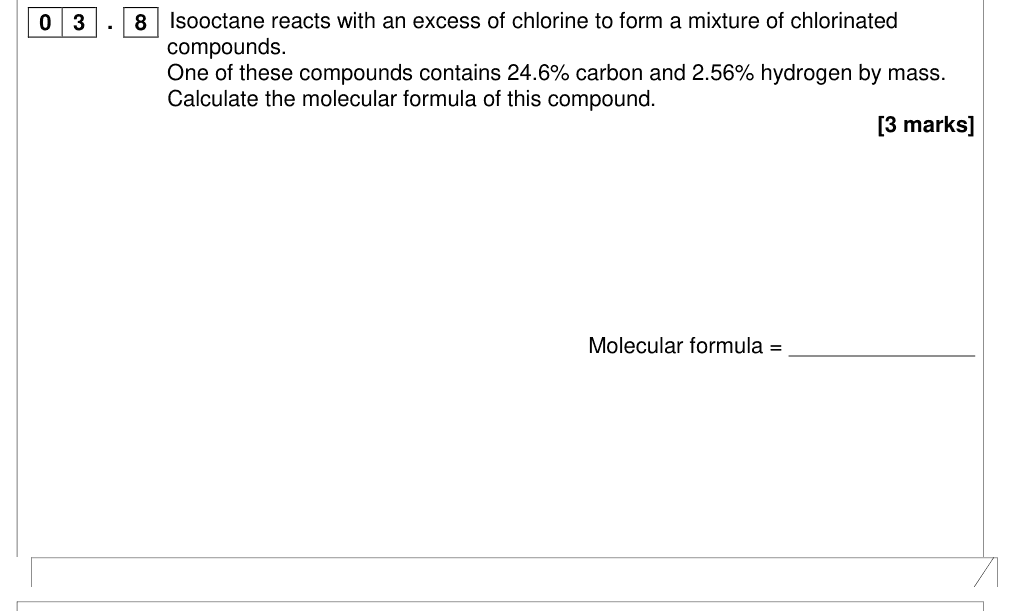
Specimen · Paper 2 · Q03.8 3 marks Calculation amount of substance
Earlier part of question 03 that this part usesEarlier part of Specimen Paper 2 question 03
Isooctane reacts with an excess of chlorine to form a mixture of chlorinated
compounds.
One of these compounds contains 24.6% carbon and 2.56% hydrogen by mass.
Calculate the molecular formula of this compound.
[3 marks]
Molecular formula =
Specimen · Paper 2 · Q04.1 1 mark AO1=1 Short answer introduction to organic chemistry
Alcohol A (CH3)2CHCH(OH)CH3 undergoes reactions separately with acidified
potassium dichromate(VI) and with concentrated sulfuric acid.
Deduce the IUPAC name for alcohol A.
[1 mark]
Specimen · Paper 2 · Q04.2 1 mark AO2=1 Diagram or structure alcohols
Earlier part of question 04 that this part usesEarlier part of Specimen Paper 2 question 04
Draw the structure of the organic product, B, formed when A is oxidised in the
reaction with acidified potassium dichromate(VI).
[1 mark]
Specimen · Paper 2 · Q04.3 1 mark AO1=1 Short answer alcohols
Earlier part of question 04 that this part usesEarlier part of Specimen Paper 2 question 04
Two isomeric alkenes, C and D, are formed when A is dehydrated in the reaction
with concentrated sulfuric acid.
Name the mechanism for this dehydration reaction.
[1 mark]
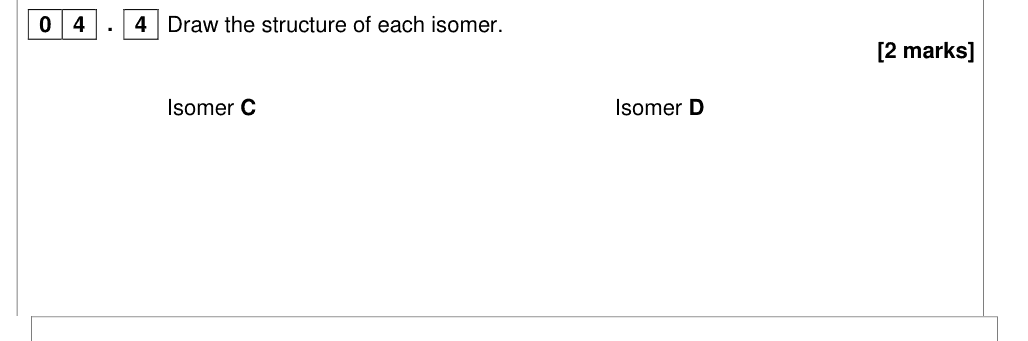
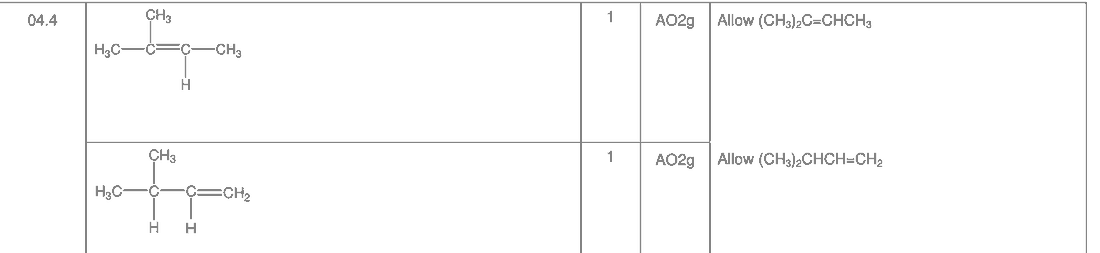
Specimen · Paper 2 · Q04.4 2 marks AO2=2 Diagram or structure alcoholsintroduction to organic chemistry
Earlier part of question 04 that this part usesEarlier part of Specimen Paper 2 question 04
Draw the structure of each isomer.
[2 marks]
Isomer C
Isomer D
Specimen · Paper 2 · Q04.5 1 mark AO1=1 Short answer introduction to organic chemistry
Earlier part of question 04 that this part usesEarlier part of Specimen Paper 2 question 04
Name the type of structural isomerism shown by C and D.
[1 mark]
Specimen · Paper 2 · Q04.6 1 mark AO3=1 Short answer bonding
Earlier part of question 04 that this part usesEarlier part of Specimen Paper 2 question 04
List alcohol A, product B and isomer C in order of increasing boiling point.
[1 mark]
Specimen · Paper 2 · Q04.7 1 mark AO2=1 Diagram or structure alcoholsintroduction to organic chemistry
Earlier part of question 04 that this part usesEarlier part of Specimen Paper 2 question 04
Draw the structure of the isomer of A that is not oxidised by acidified
potassium dichromate(VI).
[1 mark]
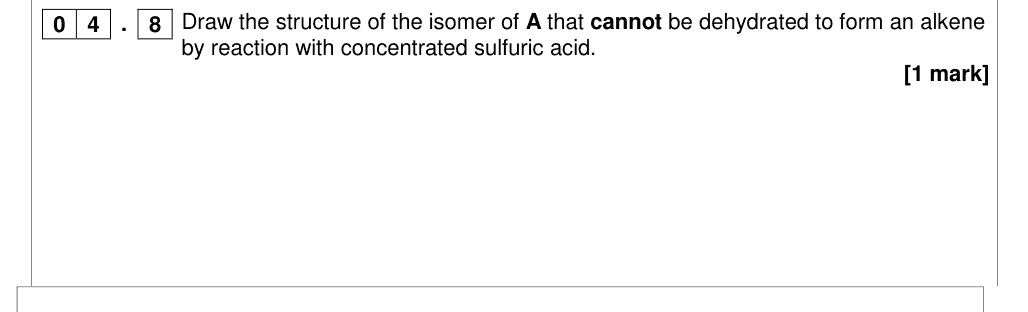
Specimen · Paper 2 · Q04.8 1 mark AO2=1 Diagram or structure alcoholsintroduction to organic chemistry
Earlier part of question 04 that this part usesEarlier part of Specimen Paper 2 question 04
Draw the structure of the isomer of A that cannot be dehydrated to form an alkene
by reaction with concentrated sulfuric acid.
[1 mark]
Specimen · Paper 2 · Q05.1 1 mark AO1=1 Short answer amino acids proteins and dna
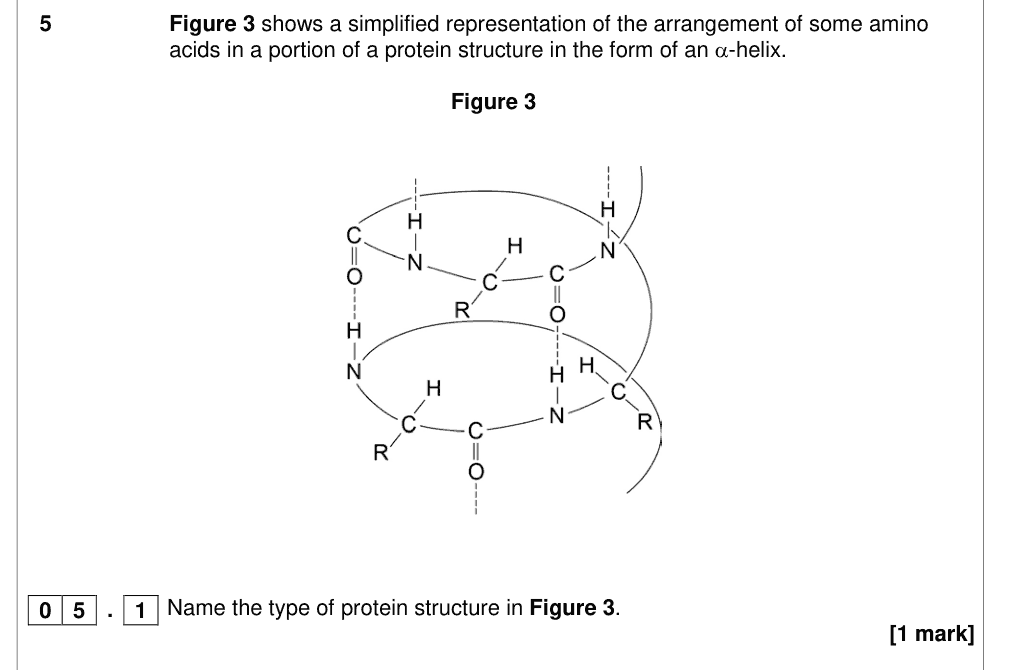
Figure 3 shows a simplified representation of the arrangement of some amino
acids in a portion of a protein structure in the form of an α-helix.
Figure 3
Name the type of protein structure in Figure 3.
[1 mark]
Specimen · Paper 2 · Q05.2 4 marks Explanation amino acids proteins and dnabonding
Earlier part of question 05 that this part usesEarlier part of Specimen Paper 2 question 05
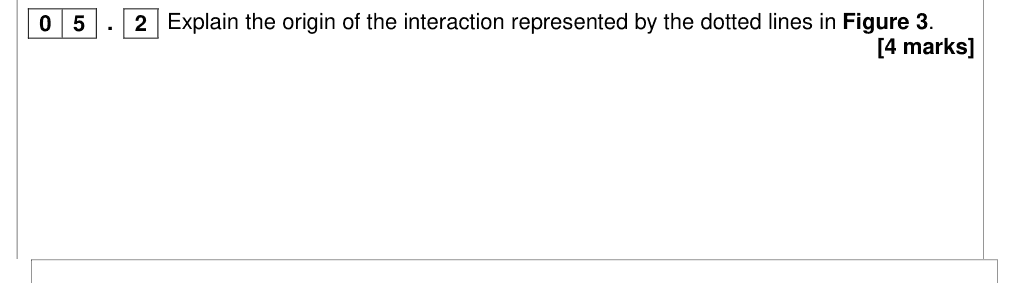
Explain the origin of the interaction represented by the dotted lines in Figure 3.
[4 marks]
Specimen · Paper 2 · Q06.1 1 mark AO2=1 Short answer optical isomerism
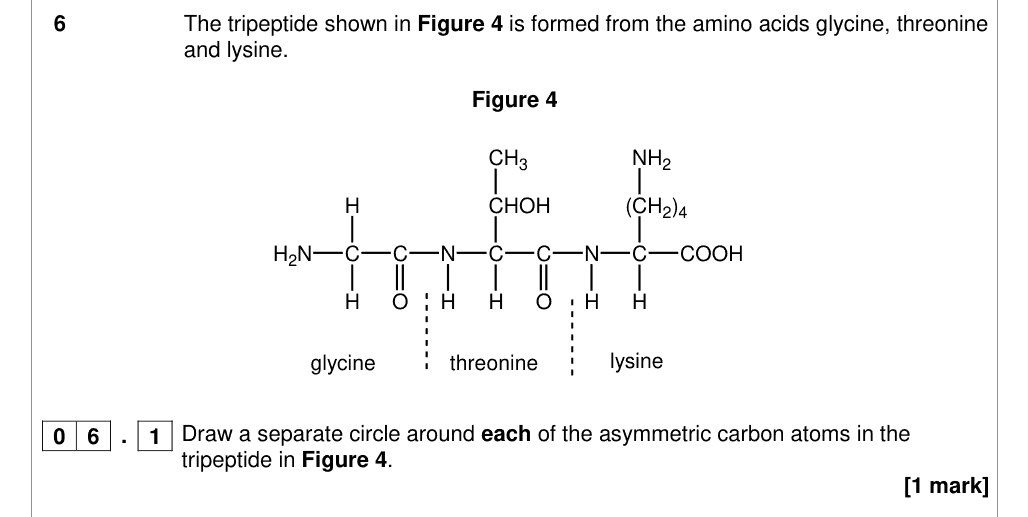
The tripeptide shown in Figure 4 is formed from the amino acids glycine, threonine
and lysine.
Figure 4
H2N
C
H
H
C
O
N
H
C
CHOH
H
C
CH3
O
N
H
C
(CH2)4
H
COOH
NH2
glycine
threonine
lysine
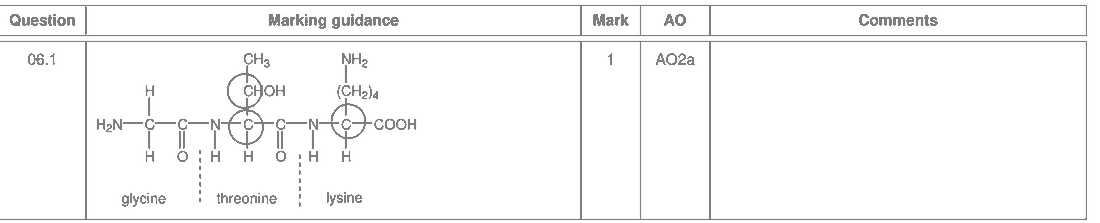
Draw a separate circle around each of the asymmetric carbon atoms in the
tripeptide in Figure 4.
[1 mark]
Specimen · Paper 2 · Q06.2 1 mark AO2=1 Diagram or structure amino acids proteins and dna
Earlier part of question 06 that this part usesEarlier part of Specimen Paper 2 question 06
Draw the zwitterion of glycine.
[1 mark]
Specimen · Paper 2 · Q06.3 1 mark AO2=1 Diagram or structure amines
Earlier part of question 06 that this part usesEarlier part of Specimen Paper 2 question 06
Draw the structure of the species formed when glycine reacts with an excess of
bromomethane.
[1 mark]
Specimen · Paper 2 · Q06.4 1 mark AO2=1 Short answer introduction to organic chemistry
Earlier part of question 06 that this part usesEarlier part of Specimen Paper 2 question 06
Deduce the IUPAC name of threonine.
[1 mark]
Specimen · Paper 2 · Q06.5 1 mark AO2=1 Diagram or structure amino acids proteins and dna
Earlier part of question 06 that this part usesEarlier part of Specimen Paper 2 question 06
Draw the structure of the species formed by lysine at low pH.
[1 mark]
Specimen · Paper 2 · Q07.1 2 marks Diagram or structure alkenes
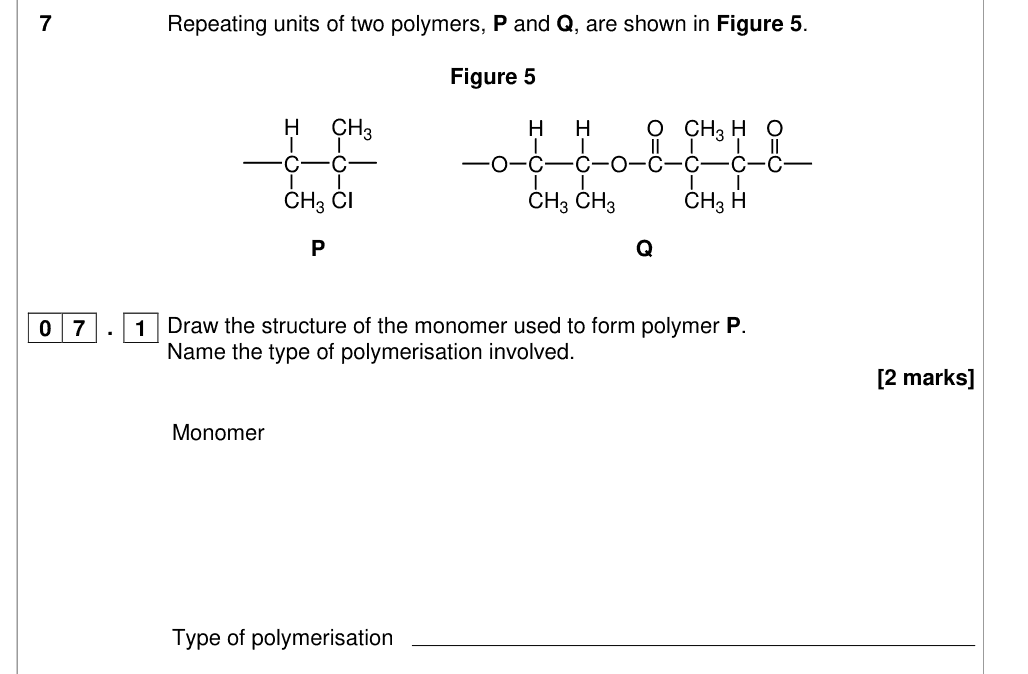
Repeating units of two polymers, P and Q, are shown in Figure 5.
Figure 5
C
C
H
CH3
CH3
Cl
O
C
H
CH3
C
H
CH3
O
C
O
C
CH3
CH3
C
H
H
C
O
P
Q
Draw the structure of the monomer used to form polymer P.
Name the type of polymerisation involved.
[2 marks]
Monomer
Type of polymerisation
l
Specimen · Paper 2 · Q07.2 2 marks Diagram or structure polymers
Earlier part of question 07 that this part usesEarlier part of Specimen Paper 2 question 07
Draw the structures of two compounds that react together to form polymer Q.
[2 marks]
Structure of compound 1
Structure of compound 2
Specimen · Paper 2 · Q07.3 3 marks Explanation polymers
Earlier part of question 07 that this part usesEarlier part of Specimen Paper 2 question 07
Suggest an environmental advantage of polymer Q over polymer P.
Justify your answer.
[3 marks]
Advantage
Justification
Specimen · Paper 2 · Q08.1 1 mark AO1=1 Short answer amino acids proteins and dna
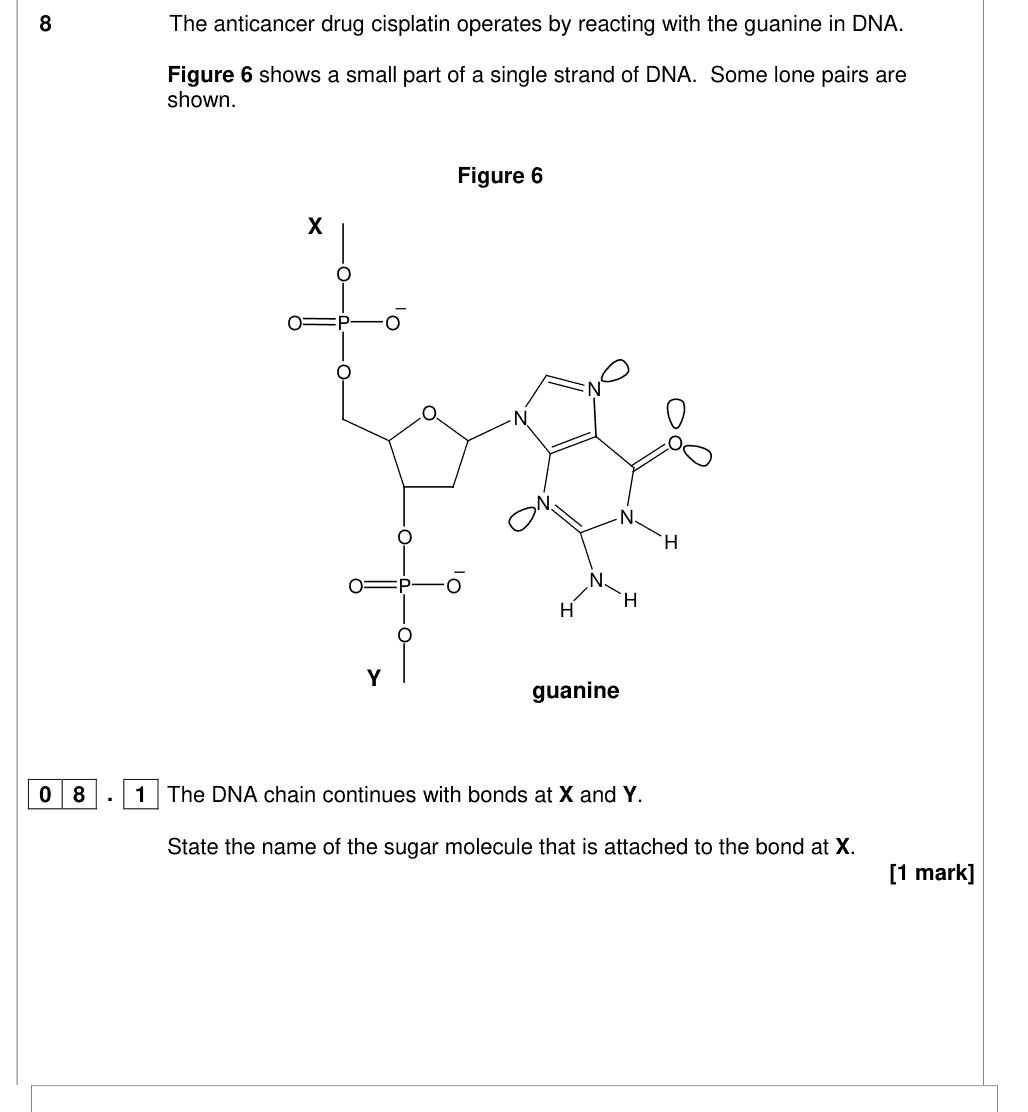
The anticancer drug cisplatin operates by reacting with the guanine in DNA.
Figure 6 shows a small part of a single strand of DNA.  Some lone pairs are
shown.
Figure 6
O
N
N
N
N
O
N
O
P
O
O
O
O
P
O
O
O
guanine
X
Y
H
H
H
The DNA chain continues with bonds at X and Y.
State the name of the sugar molecule that is attached to the bond at X.
[1 mark]
Specimen · Paper 2 · Q08.2 4 marks Explanation amino acids proteins and dna
Earlier part of question 08 that this part usesEarlier part of Specimen Paper 2 question 08
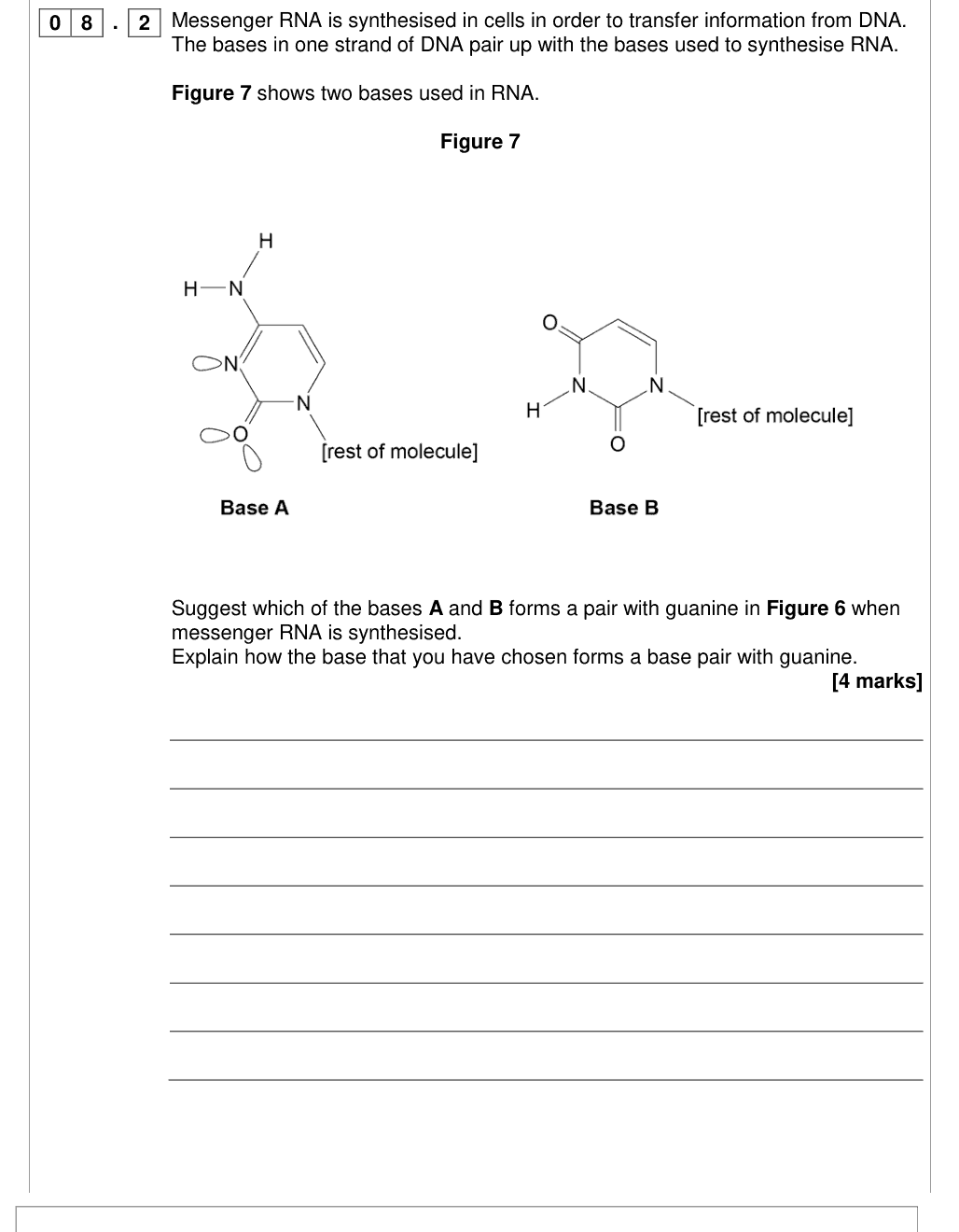
Messenger RNA is synthesised in cells in order to transfer information from DNA.
The bases in one strand of DNA pair up with the bases used to synthesise RNA.
Figure 7 shows two bases used in RNA.
Figure 7
Suggest which of the bases A and B forms a pair with guanine in Figure 6 when
messenger RNA is synthesised.
Explain how the base that you have chosen forms a base pair with guanine.
[4 marks]
Specimen · Paper 2 · Q08.3 1 mark AO2=1 Short answer amino acids proteins and dna
Earlier part of question 08 that this part usesEarlier part of Specimen Paper 2 question 08
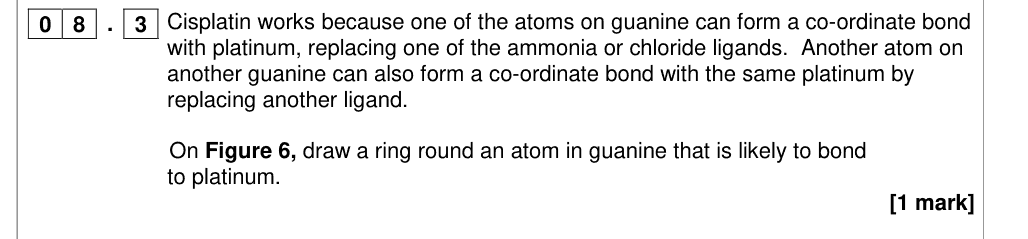
Cisplatin works because one of the atoms on guanine can form a co-ordinate bond
with platinum, replacing one of the ammonia or chloride ligands.  Another atom on
another guanine can also form a co-ordinate bond with the same platinum by
replacing another ligand.
On Figure 6, draw a ring round an atom in guanine that is likely to bond
to platinum.
[1 mark]
Specimen · Paper 2 · Q08.4 1 mark AO2=1 Short answer amino acids proteins and dna
Earlier part of question 08 that this part usesEarlier part of Specimen Paper 2 question 08
An adverse effect of cisplatin is that it also prevents normal healthy cells from
replicating.
Suggest one way in which cisplatin can be administered so that this side effect is
minimised.
[1 mark]
Specimen · Paper 2 · Q09.1 5 marks AO1=1, AO2=4 Mechanism aminescarboxylic acids and derivatives
Figure 8
NH2
NHCOCH3
NHCOCH3
Step 1
Step 2
NO2
Step 3
NH2
NO2
NH2
NH2
Step 4
A suitable reagent for step 1 is CH3COCl
Name and draw a mechanism for the reaction in step 1.
[5 marks]
1,4-diaminobenzene is an important intermediate in the production of polymers
such as Kevlar and also of polyurethanes, used in making foam seating.
A possible synthesis of 1,4-diaminobenzene from phenylamine is shown
in Figure 8.
Name of mechanism
Mechanism
Specimen · Paper 2 · Q09.2 4 marks Practical and data analysis carboxylic acids and derivatives
Earlier part of question 09 that this part usesEarlier part of Specimen Paper 2 question 09
The product of step 1 was purified by recrystallisation as follows.
The crude product was dissolved in the minimum quantity of hot water and the
hot solution was filtered through a hot filter funnel into a conical flask. This filtration
removed any insoluble impurities.  The flask was left to cool to room
temperature.
The crystals formed were filtered off using a Buchner funnel and a clean cork was
used to compress the crystals in the funnel.  A little cold water was then
poured through the crystals.
After a few minutes, the crystals were removed from the funnel and weighed.
A small sample was then used to find the melting point.
Give reasons for each of the following practical steps.
[4 marks]
The minimum quantity of hot water was used
The flask was cooled to room temperature before the crystals were filtered off
The crystals were compressed in the funnel
A little cold water was poured through the crystals
Specimen · Paper 2 · Q09.3 2 marks Practical and data analysis carboxylic acids and derivatives
Earlier part of question 09 that this part usesEarlier part of Specimen Paper 2 question 09
The melting point of the sample in Question 9.2 was found to be slightly lower than
a data-book value.
Suggest the most likely impurity to have caused this low value and an
improvement to the method so that a more accurate value for the melting point
would be obtained.
[2 marks]
Specimen · Paper 2 · Q09.4 3 marks Calculation amount of substance
Earlier part of question 09 that this part usesEarlier part of Specimen Paper 2 question 09
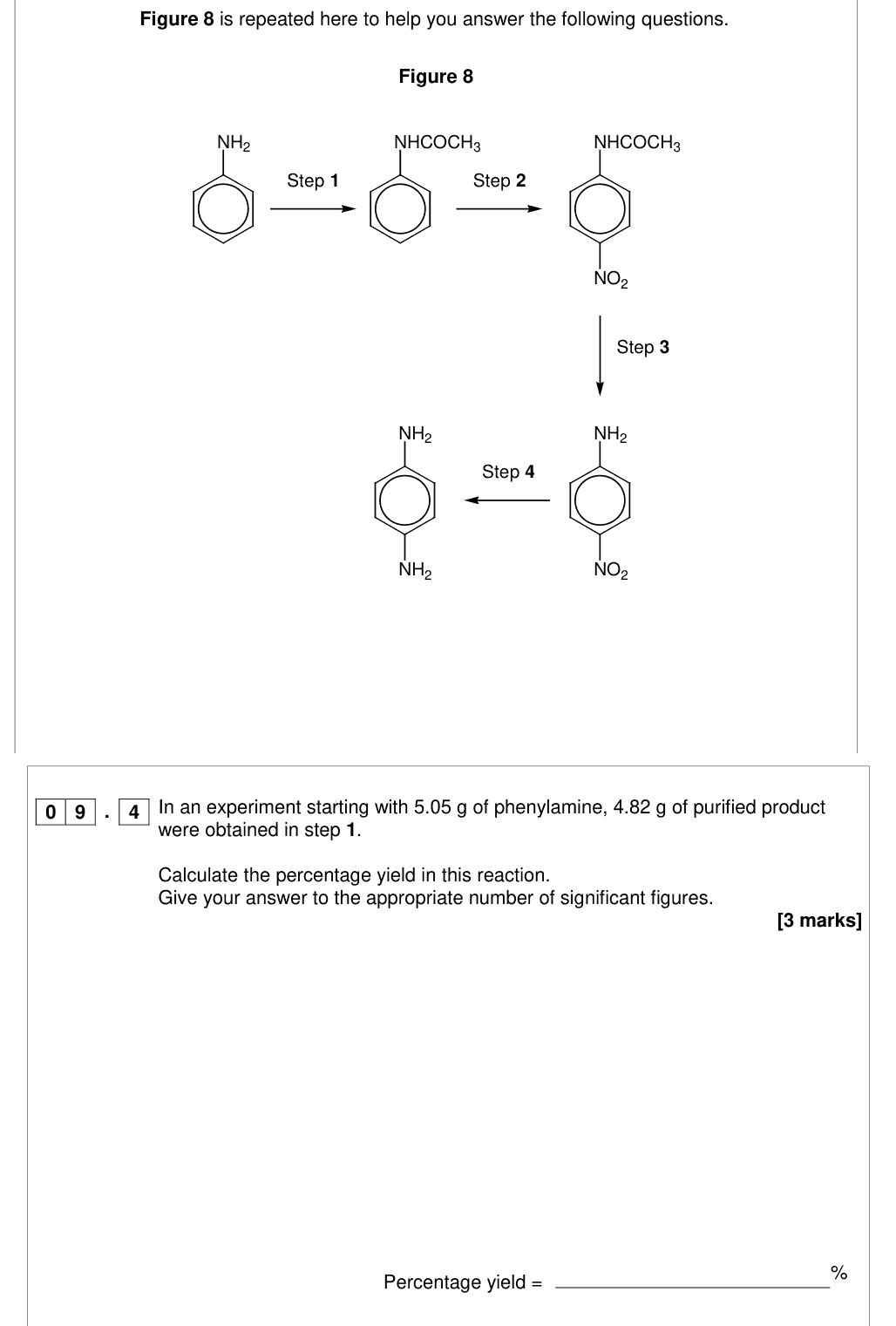
Figure 8
NH2
NHCOCH3
NHCOCH3
Step 1
Step 2
NO2
Step 3
NH2
NO2
NH2
NH2
Step 4
Figure 8 is repeated here to help you answer the following questions.
In an experiment starting with 5.05 g of phenylamine, 4.82 g of purified product
were obtained in step 1.
Calculate the percentage yield in this reaction.
Give your answer to the appropriate number of significant figures.
[3 marks]
Percentage yield =
%
Specimen · Paper 2 · Q09.5 1 mark AO2=1 Equation writing aromatic chemistry
Earlier parts of question 09 that this part usesEarlier part of Specimen Paper 2 question 09Earlier part of Specimen Paper 2 question 09
A reagent for step 2 is a mixture of concentrated nitric acid and concentrated
sulfuric acid, which react together to form a reactive intermediate.
Write an equation for the reaction of this intermediate in step 2.
[1 mark]
Specimen · Paper 2 · Q09.6 1 mark AO1=1 Short answer aromatic chemistry
Earlier parts of question 09 that this part usesEarlier part of Specimen Paper 2 question 09Earlier part of Specimen Paper 2 question 09
Name a mechanism for the reaction in step 2.
[1 mark]
Specimen · Paper 2 · Q09.7 1 mark AO3=1 Short answer polymers
Earlier parts of question 09 that this part usesEarlier part of Specimen Paper 2 question 09Earlier part of Specimen Paper 2 question 09
Suggest the type of reaction occurring in step 3.
[1 mark]
Specimen · Paper 2 · Q09.8 1 mark AO1=1 Short answer amines
Earlier parts of question 09 that this part usesEarlier part of Specimen Paper 2 question 09Earlier part of Specimen Paper 2 question 09
Identify the reagents used in step 4.
[1 mark]
Specimen · Paper 2 · Q10 8 marks Explanation nmr spectroscopyorganic analysis
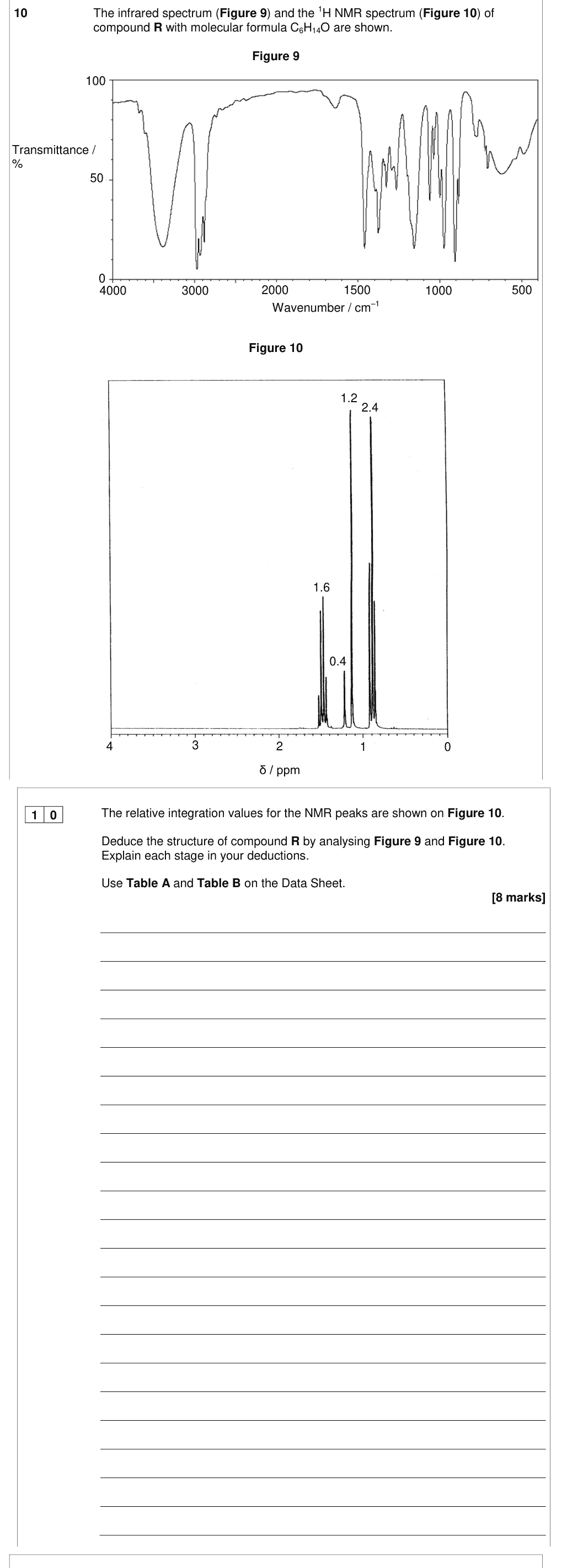
The infrared spectrum (Figure 9) and the 1H NMR spectrum (Figure 10) of
compound R with molecular formula C6H14O are shown.
Figure 9
Figure 10
100
50
0
Transmittance /
%
Wavenumber / cm–1
4000
3000
2000
1500
1000
500
0
4
1
3
2
0.4
1.6
2.4
1.2
The relative integration values for the NMR peaks are shown on Figure 10.
Deduce the structure of compound R by analysing Figure 9 and Figure 10.
Explain each stage in your deductions.
Use Table A and Table B on the Data Sheet.
[8 marks]
Specimen · Paper 2 · Q11.1 1 mark AO1=1 Equation writing aldehydes and ketones
Butanone is reduced in a two-step reaction using NaBH4 followed by
dilute hydrochloric acid.
Write an overall equation for the reduction of butanone using [H] to represent the
reductant.
[1 mark]
Specimen · Paper 2 · Q11.2 6 marks 6-mark level of response optical isomerismaldehydes and ketones
Earlier part of question 11 that this part usesEarlier part of Specimen Paper 2 question 11
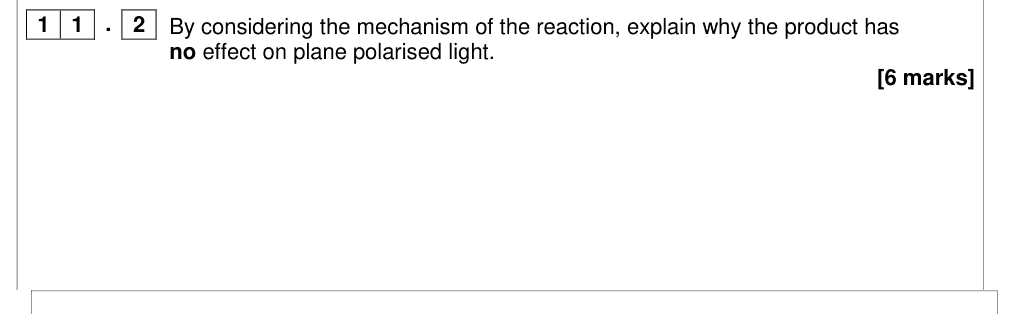
By considering the mechanism of the reaction, explain why the product has
no effect on plane polarised light.
[6 marks]
Specimen · Paper 2 · Q12.1 1 mark AO1=1 Short answer alkenes
But-1-ene reacts with a reagent of the form HY to form a saturated compound.
Suggest a reagent of the form HY which reacts with but-1-ene.
[1 mark]
Specimen · Paper 2 · Q12.2 5 marks Mechanism alkenes
Earlier part of question 12 that this part usesEarlier part of Specimen Paper 2 question 12
Name and draw a mechanism for the reaction in Question 12.1.
[5 marks]
Name of mechanism
Mechanism
Specimen · Paper 2 · Q12.3 3 marks Explanation alkenesoptical isomerism
Earlier part of question 12 that this part usesEarlier part of Specimen Paper 2 question 12
Explain how three isomeric products are formed when HY reacts with but-1-ene.
[3 marks]

Work with an A-level chemistry tutor

Want a paper marked and gone through with you? Message us.

Prefer email? Send an enquiry

If you are under 18, please include a parent's contact details. Enquiries go to enquiries@chemistryaleveltutor.com and are deleted once handled. All tutoring is online.