June 2025: Paper 1, Inorganic and physical chemistry

105 marks · 51 question parts · Paper, mark scheme and report on AQA's site · Have the Data Booklet beside you

Question by question

QTopicMarksAOType
01.1 Group 2, the alkaline earth metals, Oxidation, reduction and redox equations 2AO1=1,AO2=1Equation writing
01.2 Group 2, the alkaline earth metals 2AO1=2Short answer
01.3 Group 2, the alkaline earth metals 1AO3=1Short answer
01.4 Group 2, the alkaline earth metals, Amount of substance 2AO3=2Equation writing
01.5 Group 7(17), the halogens, Amount of substance 3AO2=1,AO3=2Equation writing
01.6 Group 2, the alkaline earth metals 1AO1=1Short answer
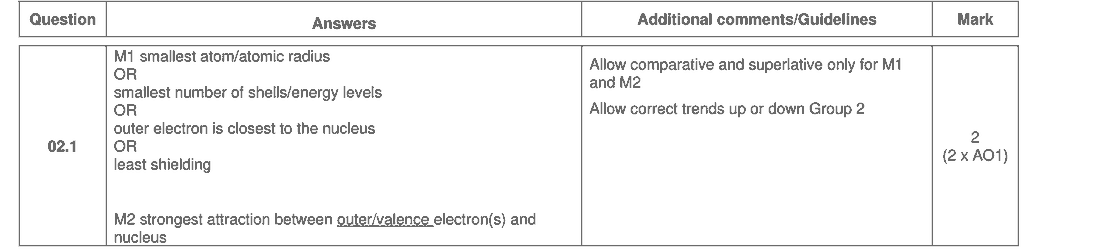
02.1 Group 2, the alkaline earth metals 2AO1=2Explanation
02.2 Atomic structure 1AO1=1Equation writing
02.3 Atomic structure 1AO3=1Short answer
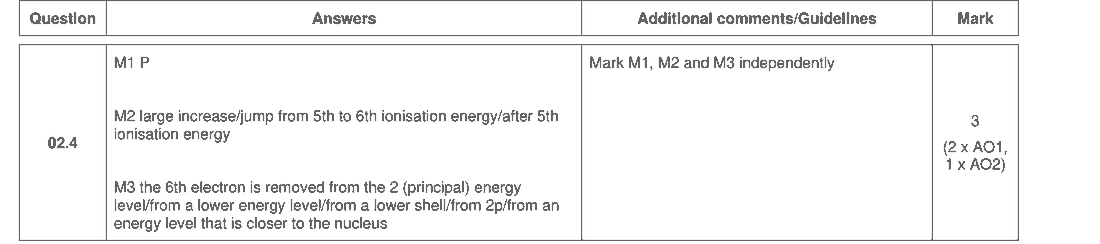
02.4 Atomic structure 3AO1=2,AO2=1Explanation
02.5 Atomic structure 1AO3=1Calculation
03.1 Atomic structure 1AO3=1Short answer
03.2 Transition metals 1AO1=1Short answer
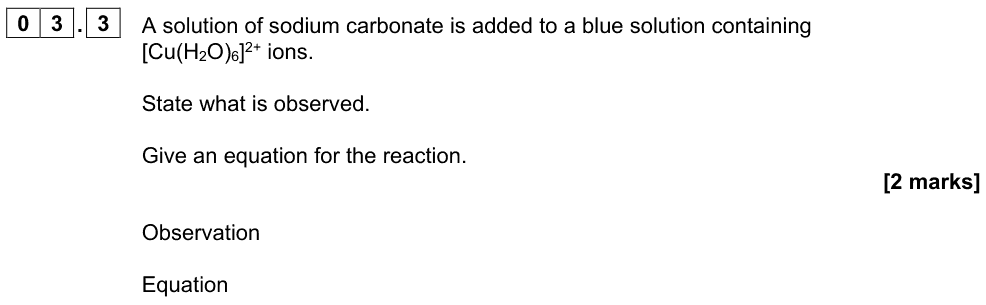
03.3 Reactions of ions in aqueous solution 2AO1=1,AO2=1Equation writing
03.4 Transition metals 6AO1=2,AO2=2,AO3=2Level of response
03.5 Transition metals 2AO1=1,AO2=1Equation writing
03.6 Transition metals, Oxidation, reduction and redox equations 1AO2=1Equation writing
03.7 Transition metals 1AO2=1Calculation
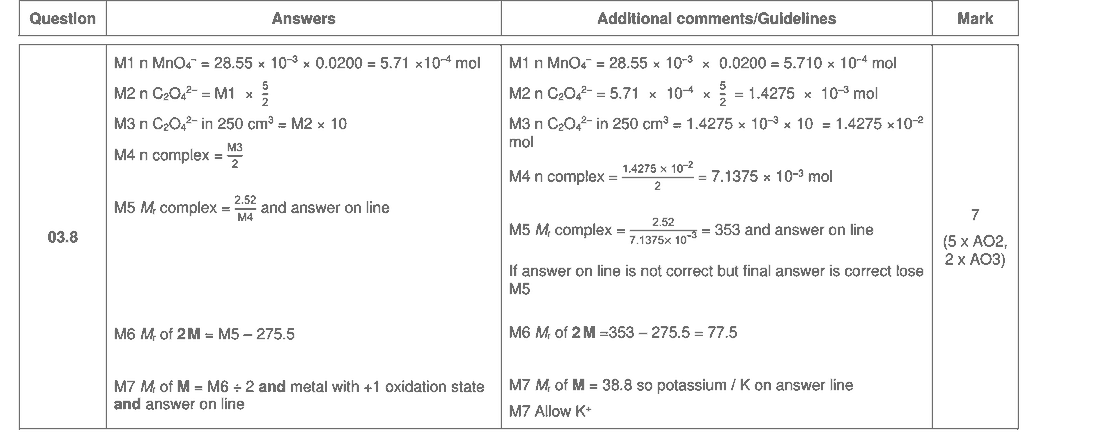
03.8 Transition metals, Amount of substance 7AO2=5,AO3=2Calculation
03.9 Transition metals 2AO3=2Diagram or structure
04.1 Energetics 1AO1=1Short answer
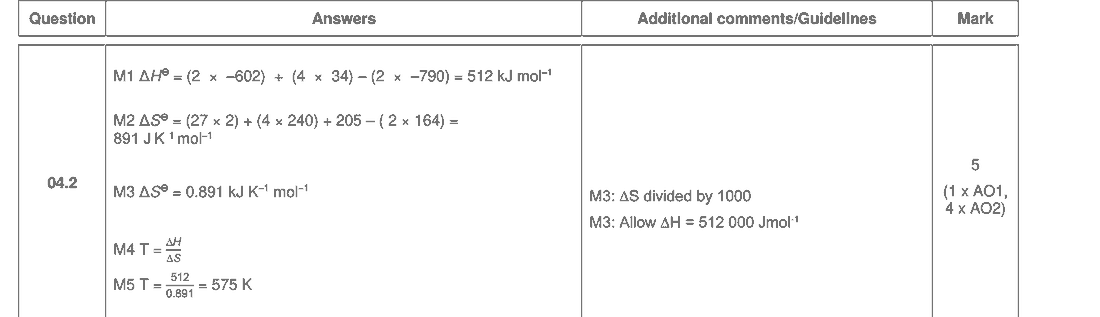
04.2 Thermodynamics: Born–Haber cycles, entropy and Gibbs free energy, Energetics 5AO1=1,AO2=4Calculation
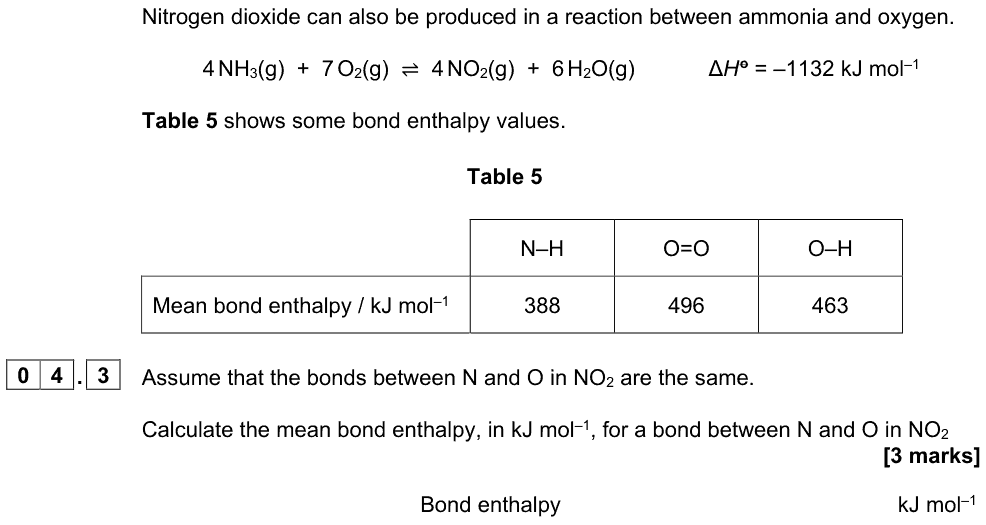
04.3 Energetics 3AO2=3Calculation
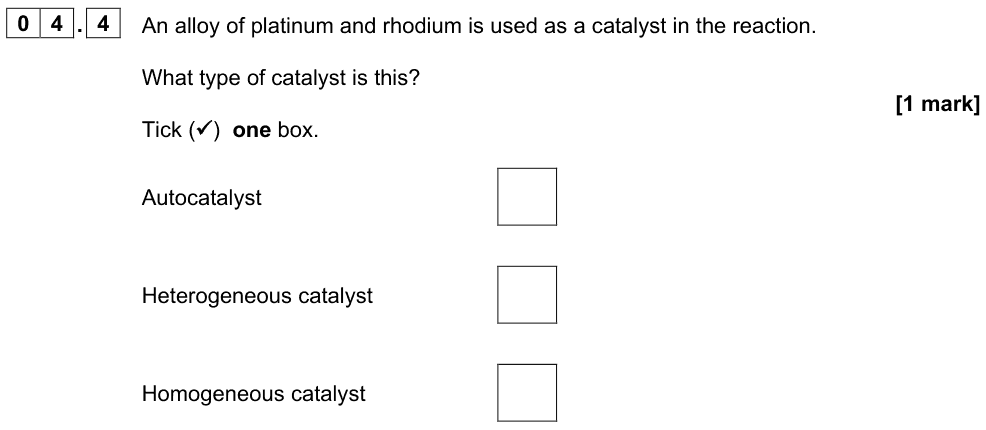
04.4 Transition metals 1AO1=1Short answer
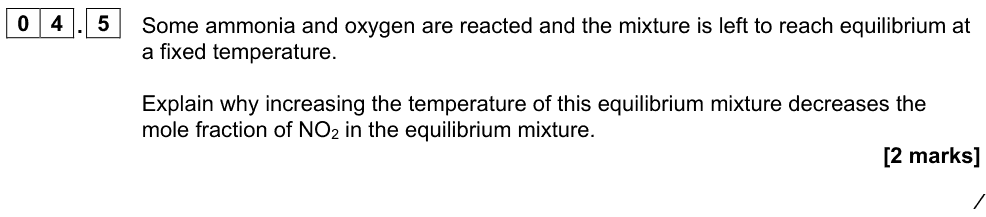
04.5 Chemical equilibria, Le Chatelier's principle and Kc, Equilibrium constant Kp 2AO1=1,AO2=1Explanation
05.1 Group 7(17), the halogens, Bonding 2AO1=2Explanation
05.2 Oxidation, reduction and redox equations 1AO3=1Short answer
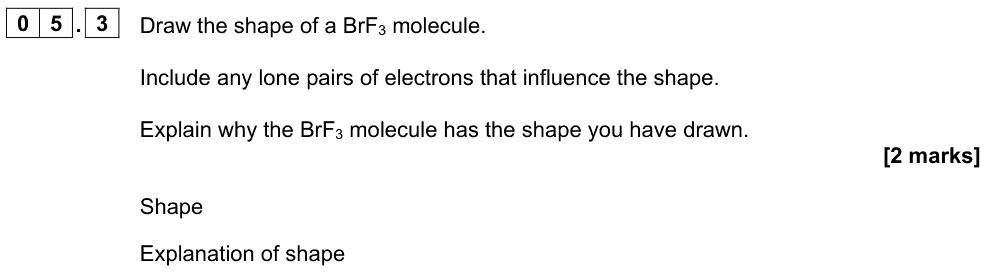
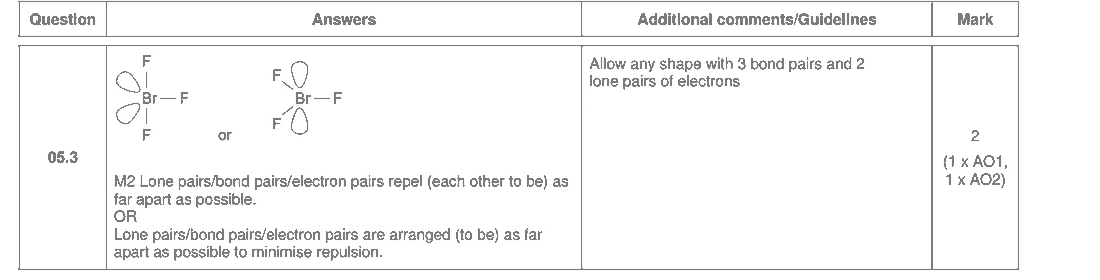
05.3 Bonding 2AO1=1,AO2=1Diagram or structure
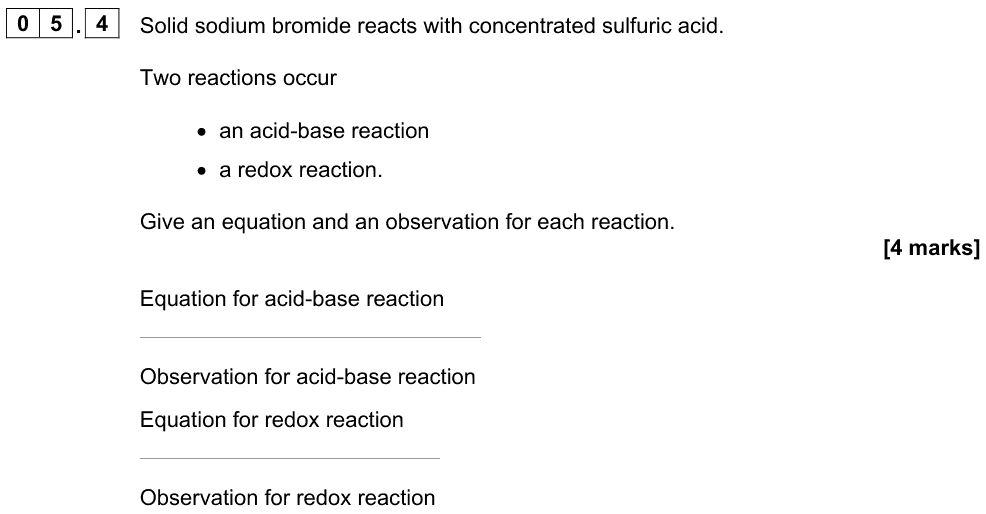
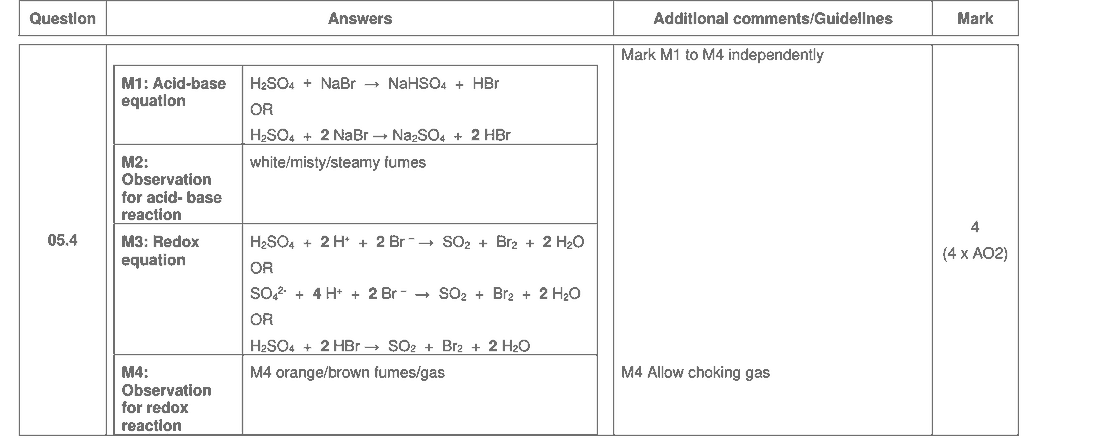
05.4 Group 7(17), the halogens 4AO2=4Equation writing
05.5 Oxidation, reduction and redox equations, Amount of substance 1AO2=1Equation writing
06.1 Electrode potentials and electrochemical cells 2AO2=2Equation writing
06.2 Electrode potentials and electrochemical cells 1AO2=1Short answer
06.3 Electrode potentials and electrochemical cells 2AO2=2Explanation
06.4 Electrode potentials and electrochemical cells 1AO3=1Short answer
06.5 Electrode potentials and electrochemical cells 1AO2=1Short answer
06.6 Electrode potentials and electrochemical cells 1AO1=1Short answer
06.7 Electrode potentials and electrochemical cells 1AO1=1Short answer
07.1 Periodicity 1AO1=1Short answer
07.2 Bonding 1AO1=1Short answer
07.3 Transition metals 2AO1=2Equation writing
07.4 Electrode potentials and electrochemical cells, Transition metals 2AO3=2Equation writing
07.5 Bonding 2AO1=2Explanation
07.6 Reactions of ions in aqueous solution 3AO2=1,AO3=2Explanation
07.7 Atomic structure 2AO1=1,AO3=1Equation writing
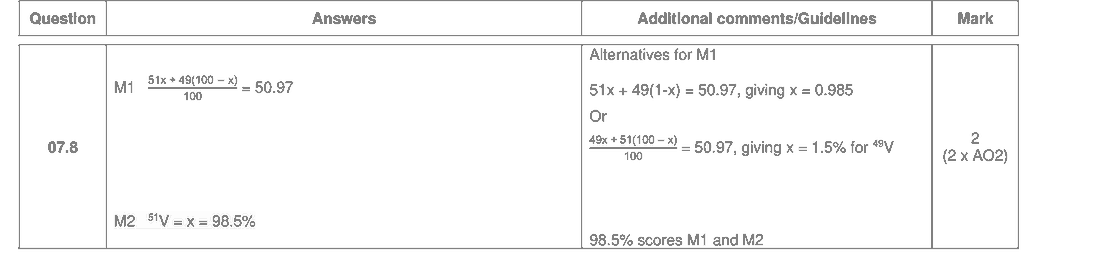
07.8 Atomic structure 2AO2=2Calculation
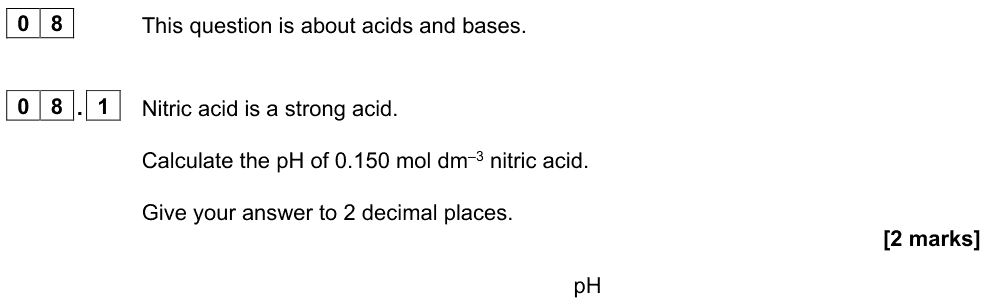
08.1 Acids and bases: pH, Ka, titration curves and buffers 2AO1=1,AO2=1Calculation
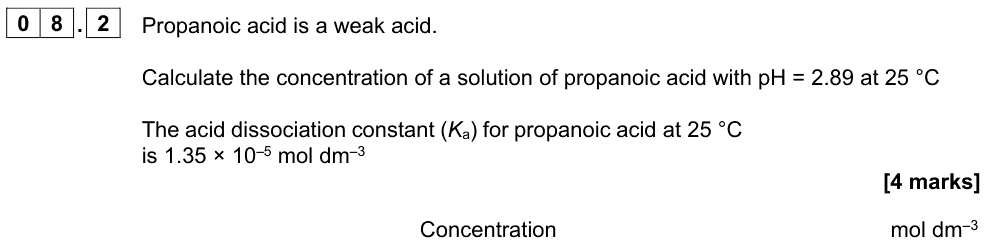
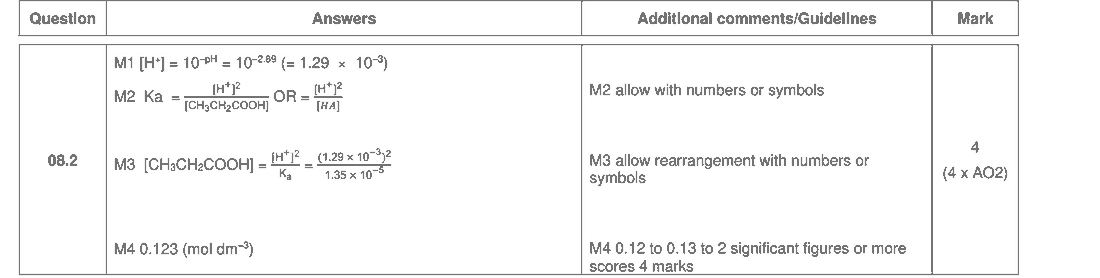
08.2 Acids and bases: pH, Ka, titration curves and buffers 4AO2=4Calculation
08.3 Acids and bases: pH, Ka, titration curves and buffers 1AO2=1Short answer
08.4 Acids and bases: pH, Ka, titration curves and buffers 1AO3=1Short answer
08.5 Acids and bases: pH, Ka, titration curves and buffers 2AO1=2Explanation
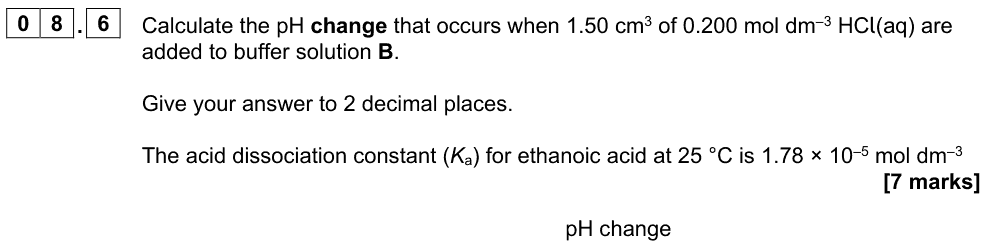
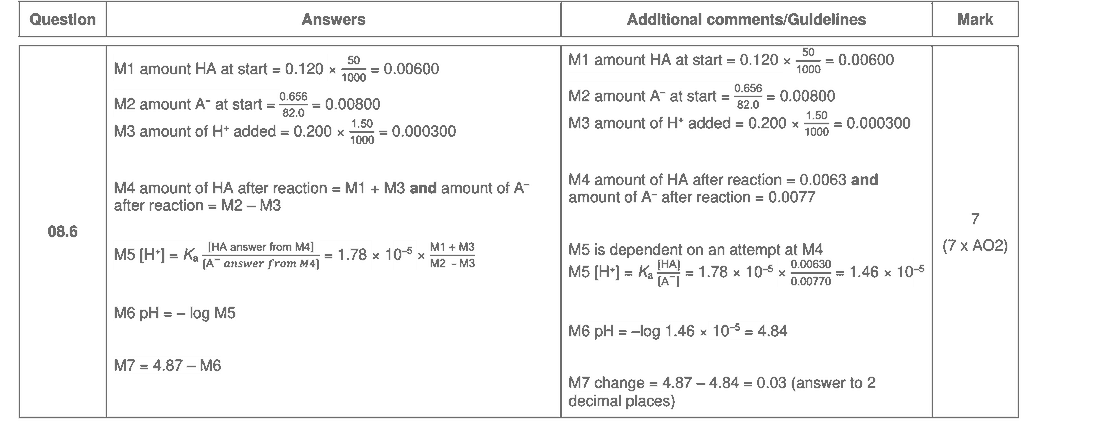
08.6 Acids and bases: pH, Ka, titration curves and buffers 7AO2=7Calculation

The questions

01.101.201.301.401.501.602.102.202.302.402.503.103.203.303.403.503.603.703.803.904.104.204.304.404.505.105.205.305.405.506.106.206.306.406.506.606.707.107.207.307.407.507.607.707.808.108.208.308.408.508.6
June 2025 · Paper 1 · Q01.1 2 marks AO1=1, AO2=1 Equation writing group 2redox
This question is about some Group 2 elements and their compounds.
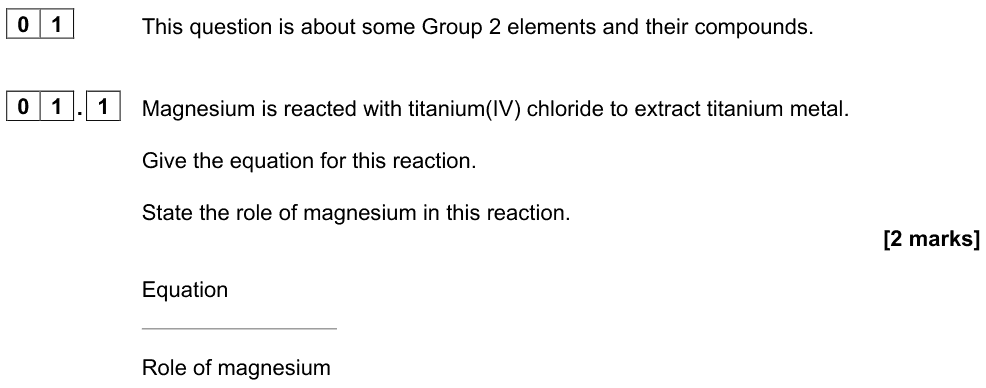
Magnesium is reacted with titanium(IV) chloride to extract titanium metal.
Give the equation for this reaction.
State the role of magnesium in this reaction.
[2 marks]
Equation
Role of magnesium
June 2025 · Paper 1 · Q01.2 2 marks AO1=2 Short answer group 2
Earlier part of question 01 that this part usesEarlier part of June 2025 Paper 1 question 01
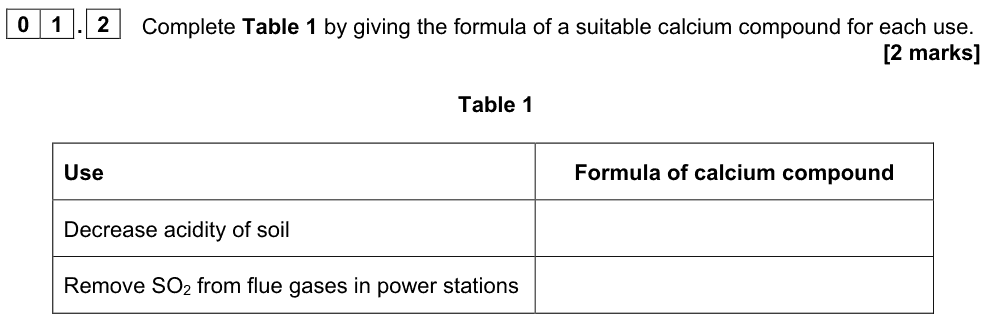
Complete Table 1 by giving the formula of a suitable calcium compound for each use.
[2 marks]
Table 1
Use
Formula of calcium compound
Decrease acidity of soil
Remove SO2 from flue gases in power stations
June 2025 · Paper 1 · Q01.3 1 mark AO3=1 Short answer group 2
Earlier part of question 01 that this part usesEarlier part of June 2025 Paper 1 question 01
Magnesium hydroxide is used to relieve the symptoms of indigestion by neutralising
stomach acid.
Suggest why magnesium hydroxide is safer than sodium hydroxide as a treatment for
indigestion.
[1 mark]
June 2025 · Paper 1 · Q01.4 2 marks AO3=2 Equation writing group 2amount of substance
Earlier part of question 01 that this part usesEarlier part of June 2025 Paper 1 question 01
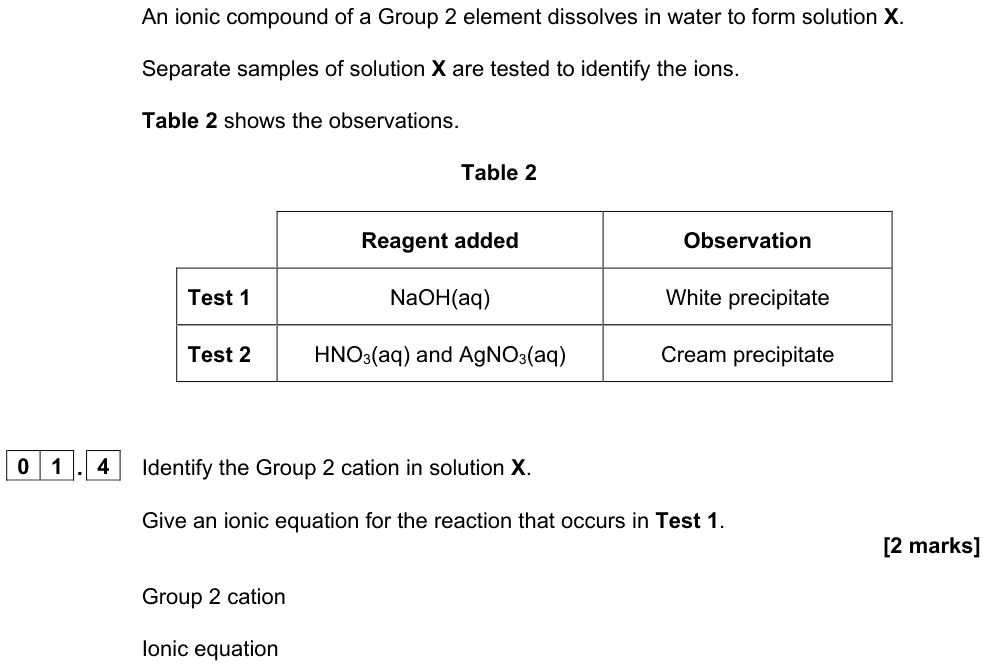
An ionic compound of a Group 2 element dissolves in water to form solution X.
Separate samples of solution X are tested to identify the ions.
Table 2 shows the observations.
Table 2
Reagent added
Observation
Test 1
NaOH(aq)
White precipitate
Test 2
HNO3(aq) and AgNO3(aq)
Cream precipitate
Identify the Group 2 cation in solution X.
Give an ionic equation for the reaction that occurs in Test 1.
[2 marks]
Group 2 cation
Ionic equation
June 2025 · Paper 1 · Q01.5 3 marks AO2=1, AO3=2 Equation writing group 7 the halogensamount of substance
Earlier parts of question 01 that this part usesEarlier part of June 2025 Paper 1 question 01Earlier part of June 2025 Paper 1 question 01
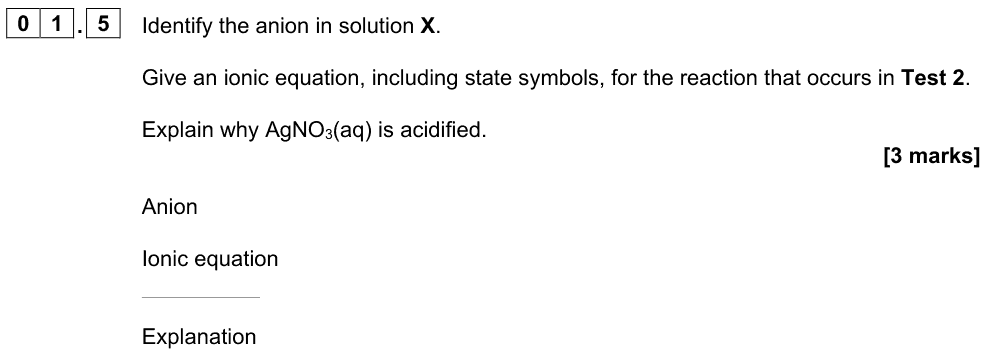
Identify the anion in solution X.
Give an ionic equation, including state symbols, for the reaction that occurs in Test 2.
Explain why AgNO3(aq) is acidified.
[3 marks]
Anion
Ionic equation
Explanation
June 2025 · Paper 1 · Q01.6 1 mark AO1=1 Short answer group 2
Earlier parts of question 01 that this part usesEarlier part of June 2025 Paper 1 question 01Earlier part of June 2025 Paper 1 question 01
Give one property of barium sulfate that makes it useful in hospitals.
[1 mark]
June 2025 · Paper 1 · Q02.1 2 marks AO1=2 Explanation group 2
This question is about ionisation energies.
Explain why beryllium is the element with the highest first ionisation energy in
Group 2.
[2 marks]
June 2025 · Paper 1 · Q02.2 1 mark AO1=1 Equation writing atomic structure
Earlier part of question 02 that this part usesEarlier part of June 2025 Paper 1 question 02
Give an equation, including state symbols, to show the process that occurs when
the second ionisation energy of beryllium is measured.
[1 mark]
June 2025 · Paper 1 · Q02.3 1 mark AO3=1 Short answer Hard atomic structure
Earlier part of question 02 that this part usesEarlier part of June 2025 Paper 1 question 02
Predict which element in Period 3 has the lowest second ionisation energy.
[1 mark]
June 2025 · Paper 1 · Q02.4 3 marks AO1=2, AO2=1 Explanation atomic structure
Earlier part of question 02 that this part usesEarlier part of June 2025 Paper 1 question 02
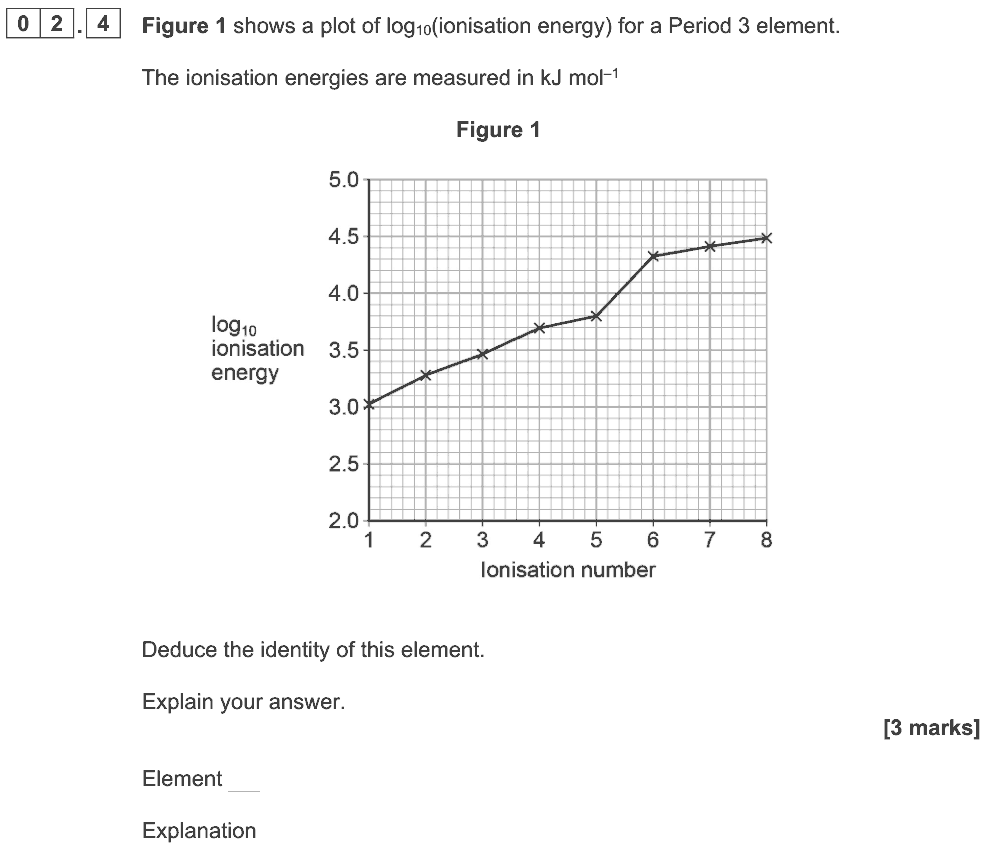
Figure 1 shows a plot of log10(ionisation energy) for a Period 3 element.
The ionisation energies are measured in kJ mol–1
Figure 1
Deduce the identity of this element.
Explain your answer.
[3 marks]
Element
Explanation
June 2025 · Paper 1 · Q02.5 1 mark AO3=1 Calculation atomic structure
Earlier parts of question 02 that this part usesEarlier part of June 2025 Paper 1 question 02Earlier part of June 2025 Paper 1 question 02
Use Figure 1 to determine the third ionisation energy, in kJ mol–1, of this element.
[1 mark]
kJ mol–1
June 2025 · Paper 1 · Q03.1 1 mark AO3=1 Short answer Easy atomic structure
This question is about the chemistry of copper.
Deduce the number of unpaired electrons in a Cu2+ ion.
[1 mark]
June 2025 · Paper 1 · Q03.2 1 mark AO1=1 Short answer transition metals
Earlier part of question 03 that this part usesEarlier part of June 2025 Paper 1 question 03
Describe how water acts as a ligand in the formation of [Cu(H2O)6]2+
[1 mark]
June 2025 · Paper 1 · Q03.3 2 marks AO1=1, AO2=1 Equation writing reactions of ions in aqueous solution
Earlier part of question 03 that this part usesEarlier part of June 2025 Paper 1 question 03
A solution of sodium carbonate is added to a blue solution containing
[Cu(H2O)6]2+ ions.
State what is observed.
Give an equation for the reaction.
[2 marks]
Observation
Equation
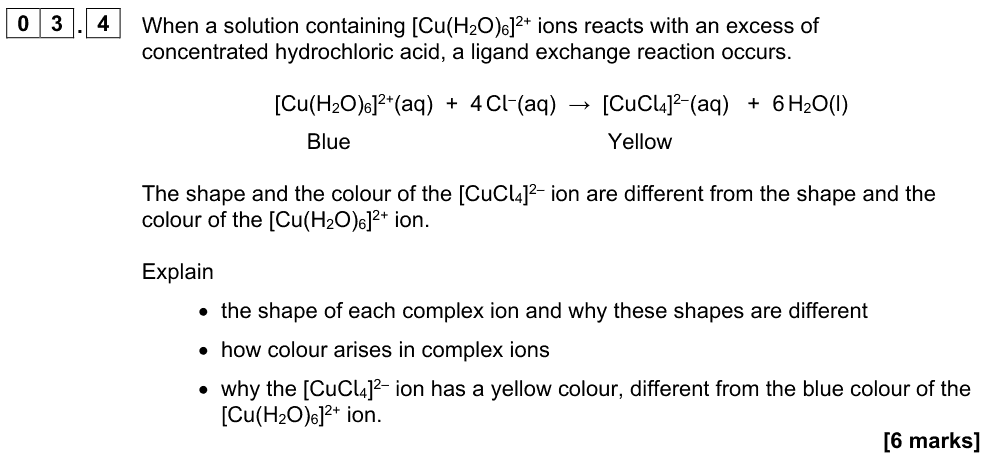
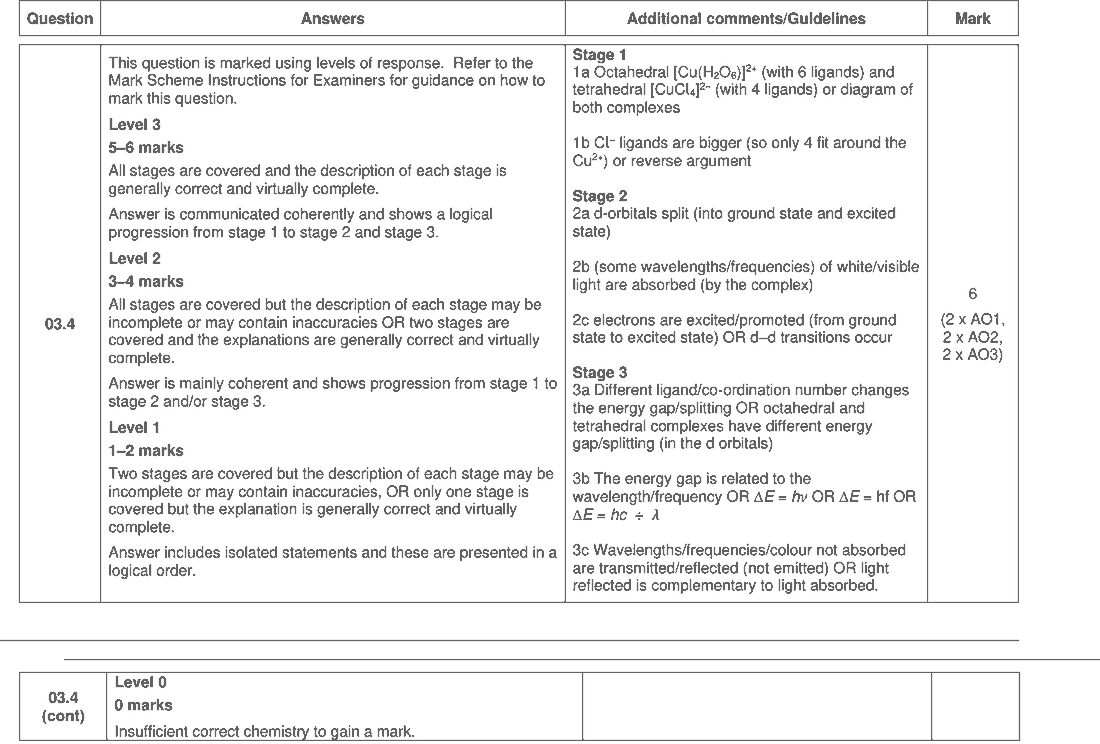
June 2025 · Paper 1 · Q03.4 6 marks AO1=2, AO2=2, AO3=2 6-mark level of response transition metals
Earlier part of question 03 that this part usesEarlier part of June 2025 Paper 1 question 03
When a solution containing [Cu(H2O)6]2+ ions reacts with an excess of
concentrated hydrochloric acid, a ligand exchange reaction occurs.
[Cu(H2O)6]2+(aq)  +  4 Cl–
(aq)  →  [CuCl4]2–
(aq)   +  6 H2O(l)
Blue                                          Yellow
The shape and the colour of the [CuCl4]2– ion are different from the shape and the
colour of the [Cu(H2O)6]2+ ion.
Explain
• the shape of each complex ion and why these shapes are different
• how colour arises in complex ions
• why the [CuCl4]2– ion has a yellow colour, different from the blue colour of the
[Cu(H2O)6]2+ ion.
[6 marks]
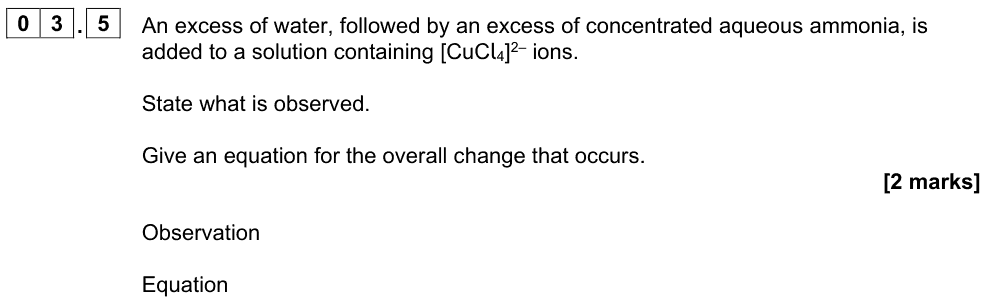
June 2025 · Paper 1 · Q03.5 2 marks AO1=1, AO2=1 Equation writing Hard transition metals
Earlier part of question 03 that this part usesEarlier part of June 2025 Paper 1 question 03
An excess of water, followed by an excess of concentrated aqueous ammonia, is
added to a solution containing [CuCl4]2– ions.
State what is observed.
Give an equation for the overall change that occurs.
[2 marks]
Observation
Equation
June 2025 · Paper 1 · Q03.6 1 mark AO2=1 Equation writing transition metalsredox
Earlier part of question 03 that this part usesEarlier part of June 2025 Paper 1 question 03
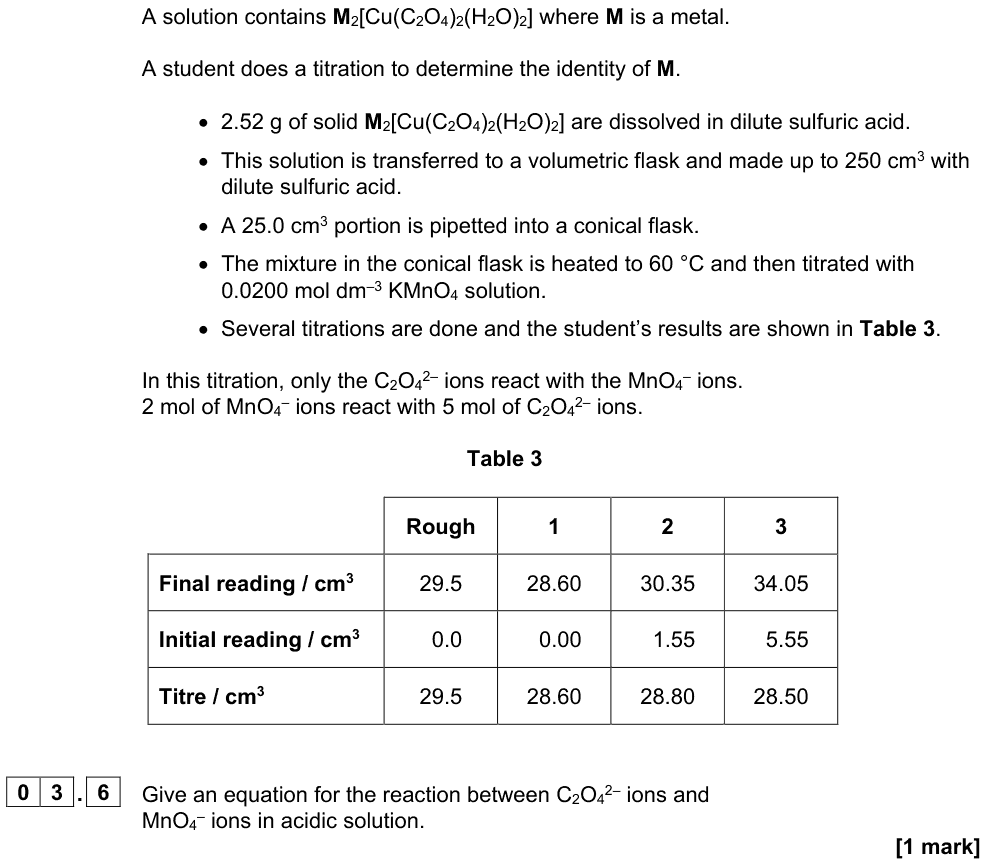
A solution contains M2[Cu(C2O4)2(H2O)2] where M is a metal.
A student does a titration to determine the identity of M.
• 2.52 g of solid M2[Cu(C2O4)2(H2O)2] are dissolved in dilute sulfuric acid.
• This solution is transferred to a volumetric flask and made up to 250 cm3 with
dilute sulfuric acid.
• A 25.0 cm3 portion is pipetted into a conical flask.
• The mixture in the conical flask is heated to 60 °C and then titrated with
0.0200 mol dm–3 KMnO4 solution.
• Several titrations are done and the student’s results are shown in Table 3.
In this titration, only the C2O42– ions react with the MnO4– ions.
2 mol of MnO4– ions react with 5 mol of C2O42– ions.
Table 3
Rough
1
2
3
Final reading / cm3
29.5
28.60
30.35
34.05
Initial reading / cm3
0.0
0.00
1.55
5.55
Titre / cm3
29.5
28.60
28.80
28.50
Give an equation for the reaction between C2O42– ions and
MnO4– ions in acidic solution.
[1 mark]
June 2025 · Paper 1 · Q03.7 1 mark AO2=1 Calculation transition metals
Earlier parts of question 03 that this part usesEarlier part of June 2025 Paper 1 question 03Earlier part of June 2025 Paper 1 question 03
Calculate the mean titre from the student’s results.
[1 mark]
cm3
June 2025 · Paper 1 · Q03.8 7 marks AO2=5, AO3=2 Calculation transition metalsamount of substance
Earlier parts of question 03 that this part usesEarlier part of June 2025 Paper 1 question 03Earlier part of June 2025 Paper 1 question 03
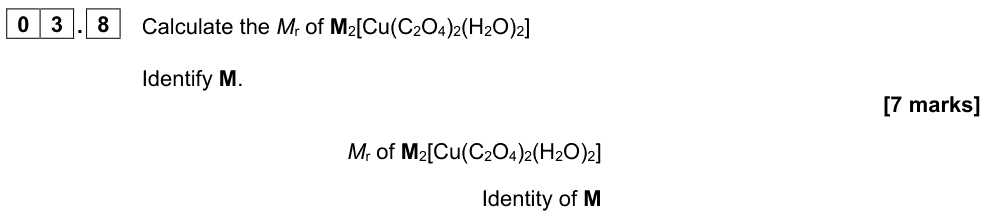
Calculate the Mr of M2[Cu(C2O4)2(H2O)2]
Identify M.
[7 marks]
Mr of M2[Cu(C2O4)2(H2O)2]
Identity of M
June 2025 · Paper 1 · Q03.9 2 marks AO3=2 Diagram or structure transition metals
Earlier parts of question 03 that this part usesEarlier part of June 2025 Paper 1 question 03Earlier part of June 2025 Paper 1 question 03
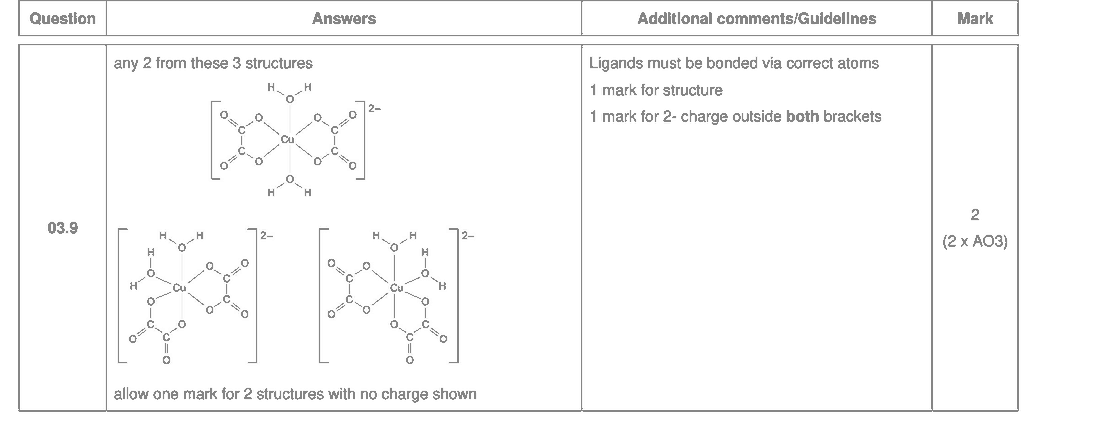
Draw the structure of two stereoisomers of the complex ion in M2[Cu(C2O4)2(H2O)2]
and include the charge on each structure.
[2 marks]
Structure 1
Structure 2
June 2025 · Paper 1 · Q04.1 1 mark AO1=1 Short answer energetics
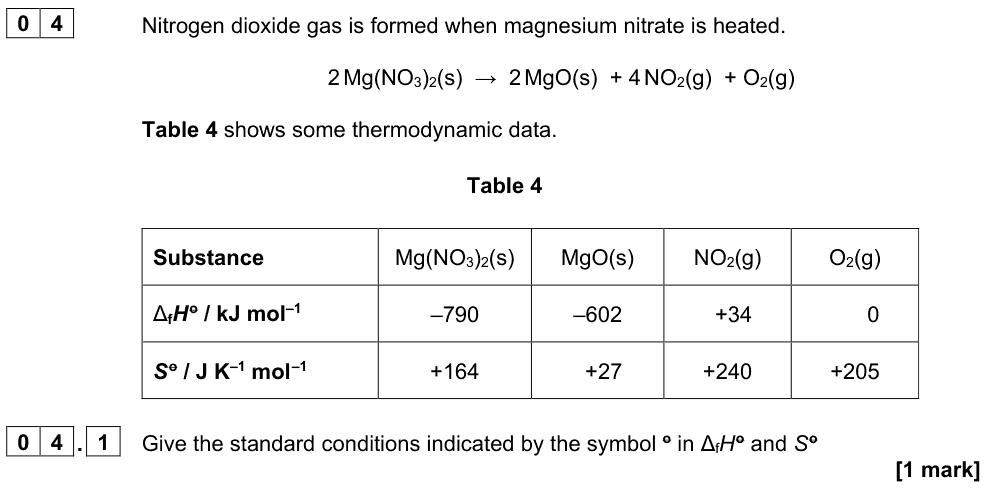
Nitrogen dioxide gas is formed when magnesium nitrate is heated.
2 Mg(NO3)2(s)  →  2 MgO(s)  + 4 NO2(g)  + O2(g)
Table 4 shows some thermodynamic data.
Table 4
Substance
Mg(NO3)2(s)
MgO(s)
NO2(g)
O2(g)
ΔfH o / kJ mol–1
–790
–602
+34
0
S o / J K–1 mol –1
+164
+27
+240
+205
Give the standard conditions indicated by the symbol o in ΔfH o and S o
[1 mark]
June 2025 · Paper 1 · Q04.2 5 marks AO1=1, AO2=4 Calculation thermodynamicsenergetics
Earlier part of question 04 that this part usesEarlier part of June 2025 Paper 1 question 04
Use the equation and the data in Table 4 to calculate the temperature at which this
reaction becomes feasible.
[5 marks]
Temperature
K
June 2025 · Paper 1 · Q04.3 3 marks AO2=3 Calculation energetics
Earlier part of question 04 that this part usesEarlier part of June 2025 Paper 1 question 04
Nitrogen dioxide can also be produced in a reaction between ammonia and oxygen.
4 NH3(g)  +  7 O2(g)  ⇌  4 NO2(g)  +  6 H2O(g)            ΔH o = –1132 kJ mol–1
Table 5 shows some bond enthalpy values.
Table 5
N–H
O=O
O–H
Mean bond enthalpy / kJ mol–1
388
496
463
Assume that the bonds between N and O in NO2 are the same.
Calculate the mean bond enthalpy, in kJ mol–1, for a bond between N and O in NO2
[3 marks]
Bond enthalpy
kJ mol–1
June 2025 · Paper 1 · Q04.4 1 mark AO1=1 Short answer transition metals
Earlier parts of question 04 that this part usesEarlier part of June 2025 Paper 1 question 04Earlier part of June 2025 Paper 1 question 04
An alloy of platinum and rhodium is used as a catalyst in the reaction.
What type of catalyst is this?
[1 mark]
Tick ( )  one box.
Autocatalyst
Heterogeneous catalyst
Homogeneous catalyst
June 2025 · Paper 1 · Q04.5 2 marks AO1=1, AO2=1 Explanation chemical equilibria and kcequilibrium constant kp
Earlier parts of question 04 that this part usesEarlier part of June 2025 Paper 1 question 04Earlier part of June 2025 Paper 1 question 04
Some ammonia and oxygen are reacted and the mixture is left to reach equilibrium at
a fixed temperature.
Explain why increasing the temperature of this equilibrium mixture decreases the
mole fraction of NO2 in the equilibrium mixture.
[2 marks]
June 2025 · Paper 1 · Q05.1 2 marks AO1=2 Explanation group 7 the halogensbonding
This question is about the halogens and some of their compounds.
Explain why chlorine has a lower boiling point than bromine.
[2 marks]
June 2025 · Paper 1 · Q05.2 1 mark AO3=1 Short answer redox
Earlier part of question 05 that this part usesEarlier part of June 2025 Paper 1 question 05
Bromine reacts with fluorine to form BrF3
Determine the oxidation state of bromine and of fluorine in BrF3
[1 mark]
Oxidation state of Br
Oxidation state of F
June 2025 · Paper 1 · Q05.3 2 marks AO1=1, AO2=1 Diagram or structure bonding
Earlier part of question 05 that this part usesEarlier part of June 2025 Paper 1 question 05
Draw the shape of a BrF3 molecule.
Include any lone pairs of electrons that influence the shape.
Explain why the BrF3 molecule has the shape you have drawn.
[2 marks]
Shape
Explanation of shape
June 2025 · Paper 1 · Q05.4 4 marks AO2=4 Equation writing group 7 the halogens
Earlier part of question 05 that this part usesEarlier part of June 2025 Paper 1 question 05
Solid sodium bromide reacts with concentrated sulfuric acid.
Two reactions occur
• an acid-base reaction
• a redox reaction.
Give an equation and an observation for each reaction.
[4 marks]
Equation for acid-base reaction
Observation for acid-base reaction
Equation for redox reaction
Observation for redox reaction
June 2025 · Paper 1 · Q05.5 1 mark AO2=1 Equation writing redoxamount of substance
Earlier part of question 05 that this part usesEarlier part of June 2025 Paper 1 question 05
Iodide ions reduce copper(II) ions in aqueous solution to form a
precipitate of copper(I) iodide.
Give an equation for this redox reaction.
[1 mark]
June 2025 · Paper 1 · Q06.1 2 marks AO2=2 Equation writing Hard electrode potentials and cells
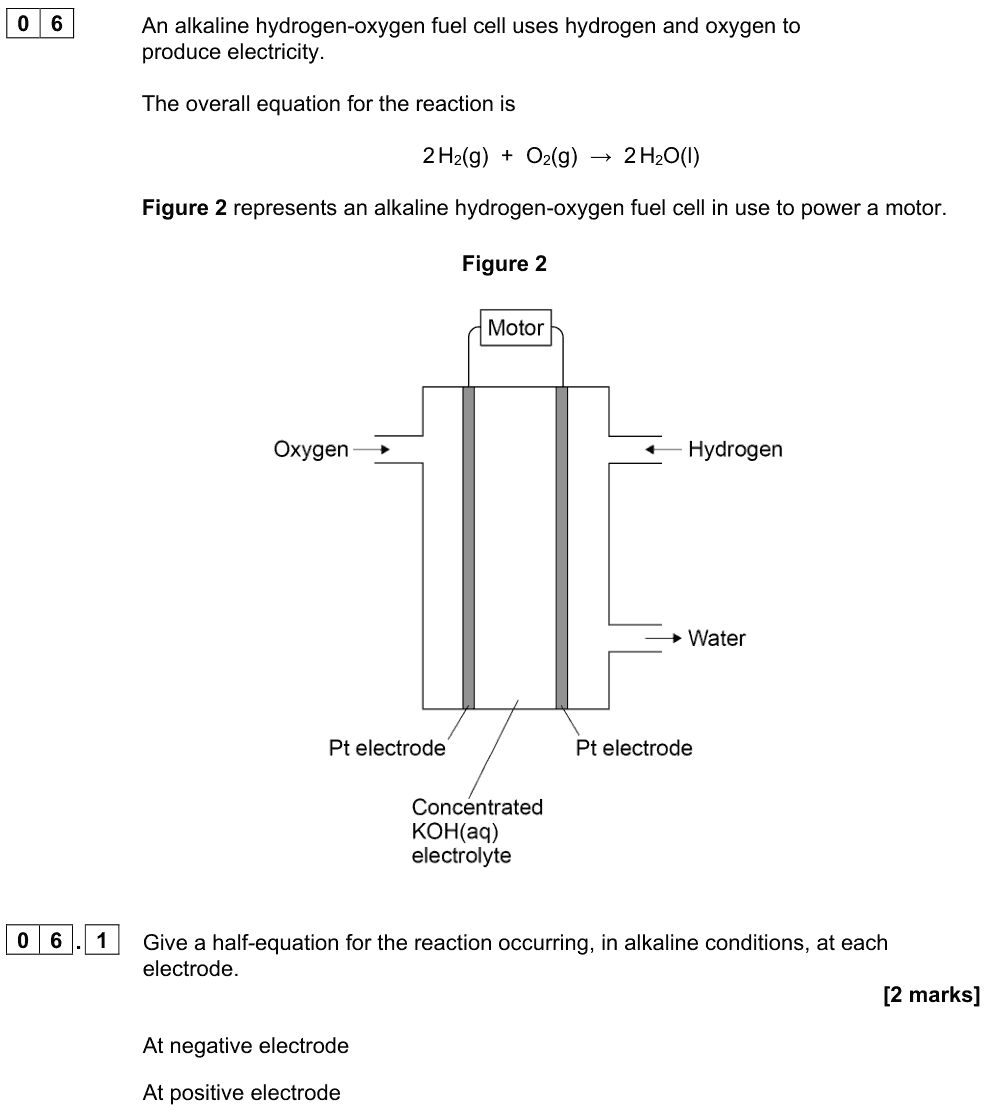
An alkaline hydrogen-oxygen fuel cell uses hydrogen and oxygen to
produce electricity.
The overall equation for the reaction is
2 H2(g)  +  O2(g)  →  2 H2O(l)
Figure 2 represents an alkaline hydrogen-oxygen fuel cell in use to power a motor.
Figure 2
Give a half-equation for the reaction occurring, in alkaline conditions, at each
electrode.
[2 marks]
At negative electrode
At positive electrode
June 2025 · Paper 1 · Q06.2 1 mark AO2=1 Short answer electrode potentials and cells
Earlier part of question 06 that this part usesEarlier part of June 2025 Paper 1 question 06
Suggest why it is not necessary to replace the KOH electrolyte during the operation of
this fuel cell.
[1 mark]
June 2025 · Paper 1 · Q06.3 2 marks AO2=2 Explanation electrode potentials and cells
Earlier part of question 06 that this part usesEarlier part of June 2025 Paper 1 question 06
Describe how the reactions at the electrodes generate an electric current that can
power the motor in the external circuit.
[2 marks]
June 2025 · Paper 1 · Q06.4 1 mark AO3=1 Short answer Hard electrode potentials and cells
Earlier part of question 06 that this part usesEarlier part of June 2025 Paper 1 question 06
This fuel cell uses pure oxygen, rather than air, as an oxidising agent.
Suggest the identity of the gas in air that would react with the KOH and affect the
efficient operation of the cell.
[1 mark]
June 2025 · Paper 1 · Q06.5 1 mark AO2=1 Short answer electrode potentials and cells
Earlier part of question 06 that this part usesEarlier part of June 2025 Paper 1 question 06
When an alkaline hydrogen-oxygen fuel cell is used to power the motor in a car, the
hydrogen can be stored as a liquid.
Suggest an advantage of storing hydrogen as a liquid.
[1 mark]
June 2025 · Paper 1 · Q06.6 1 mark AO1=1 Short answer electrode potentials and cells
Earlier part of question 06 that this part usesEarlier part of June 2025 Paper 1 question 06
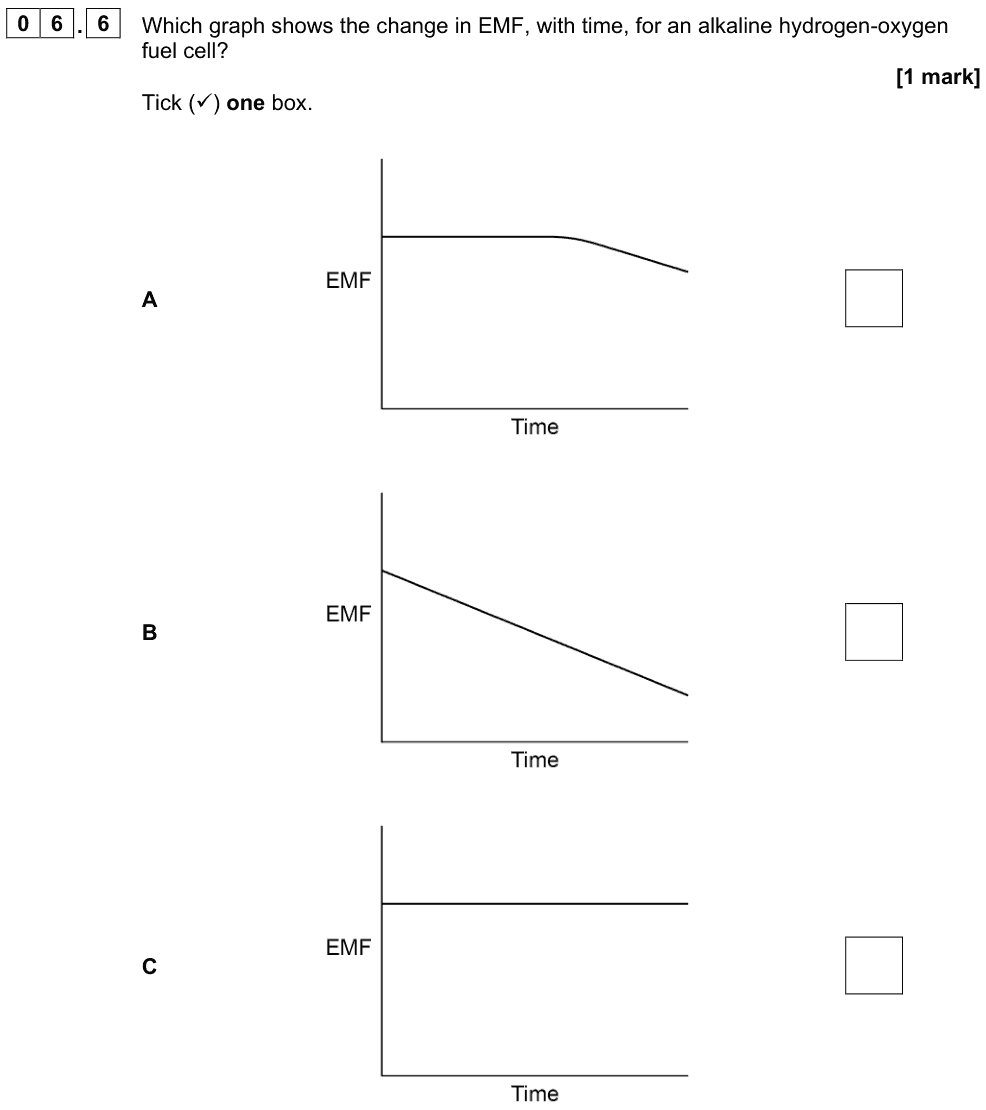
Which graph shows the change in EMF, with time, for an alkaline hydrogen-oxygen
fuel cell?
[1 mark]
Tick () one box.
A
B
C
June 2025 · Paper 1 · Q06.7 1 mark AO1=1 Short answer electrode potentials and cells
Earlier part of question 06 that this part usesEarlier part of June 2025 Paper 1 question 06
An acidic hydrogen-oxygen fuel cell has different reactions at the electrodes.
Suggest why the EMF of the acidic hydrogen-oxygen fuel cell is the same as that of
the alkaline hydrogen-oxygen fuel cell.
[1 mark]
June 2025 · Paper 1 · Q07.1 1 mark AO1=1 Short answer periodicity
This question is about vanadium and some of its compounds.
State the block in the Periodic Table that contains vanadium.
[1 mark]
June 2025 · Paper 1 · Q07.2 1 mark AO1=1 Short answer bonding
Earlier part of question 07 that this part usesEarlier part of June 2025 Paper 1 question 07
Suggest why vanadium can be pulled into thin wires.
[1 mark]
June 2025 · Paper 1 · Q07.3 2 marks AO1=2 Equation writing transition metals
Earlier part of question 07 that this part usesEarlier part of June 2025 Paper 1 question 07
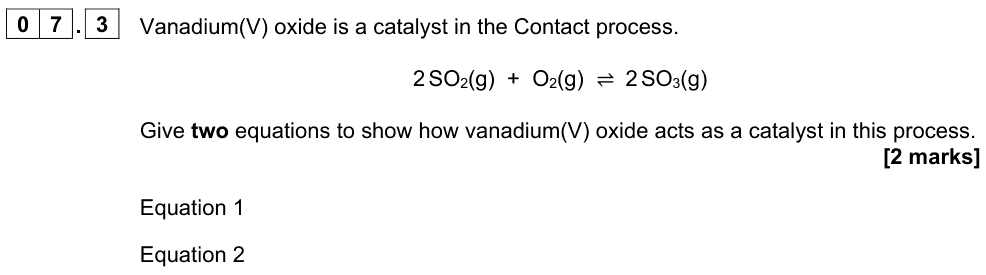
Vanadium(V) oxide is a catalyst in the Contact process.
2 SO2(g)  +  O2(g)  ⇌  2 SO3(g)
Give two equations to show how vanadium(V) oxide acts as a catalyst in this process.
[2 marks]
Equation 1
Equation 2
June 2025 · Paper 1 · Q07.4 2 marks AO3=2 Equation writing electrode potentials and cellstransition metals
Earlier part of question 07 that this part usesEarlier part of June 2025 Paper 1 question 07
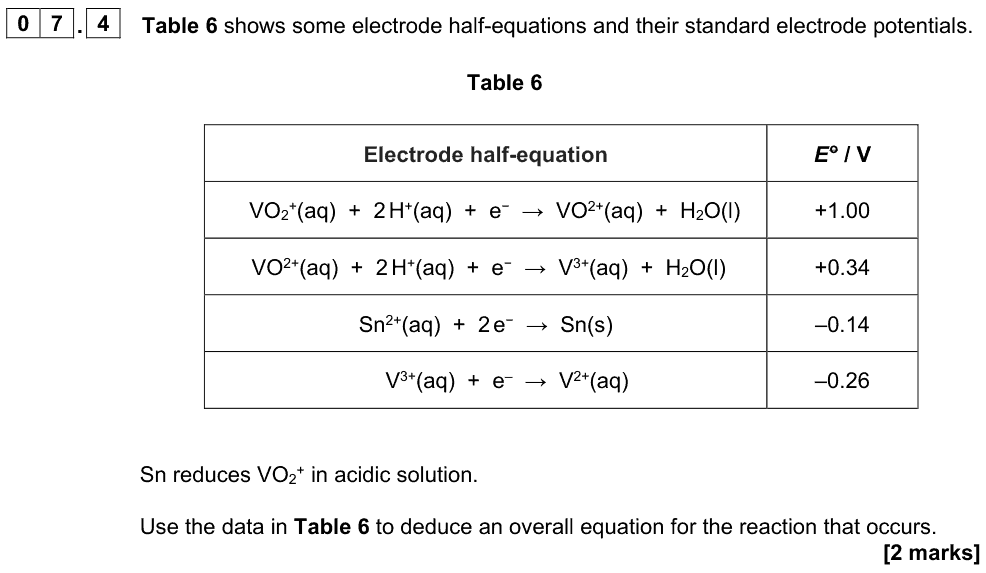
Table 6 shows some electrode half-equations and their standard electrode potentials.
Table 6
Electrode half-equation
E o / V
VO2+(aq)  +  2 H+(aq)  +  e−  →  VO2+(aq)  +  H2O(l)
+1.00
VO2+(aq)  +  2 H+(aq)  +  e−  →  V3+(aq)  +  H2O(l)
+0.34
Sn2+(aq)  +  2 e−  →  Sn(s)
–0.14
V3+(aq)  +  e–  →  V2+(aq)
–0.26
Sn reduces VO2+ in acidic solution.
Use the data in Table 6 to deduce an overall equation for the reaction that occurs.
[2 marks]
June 2025 · Paper 1 · Q07.5 2 marks AO1=2 Explanation bonding
Earlier part of question 07 that this part usesEarlier part of June 2025 Paper 1 question 07
Vanadium(III) sulfate is a pale yellow solid at room temperature.
Explain why vanadium(III) sulfate has a high melting point.
[2 marks]
June 2025 · Paper 1 · Q07.6 3 marks AO2=1, AO3=2 Explanation reactions of ions in aqueous solution
Earlier parts of question 07 that this part usesEarlier part of June 2025 Paper 1 question 07Earlier part of June 2025 Paper 1 question 07
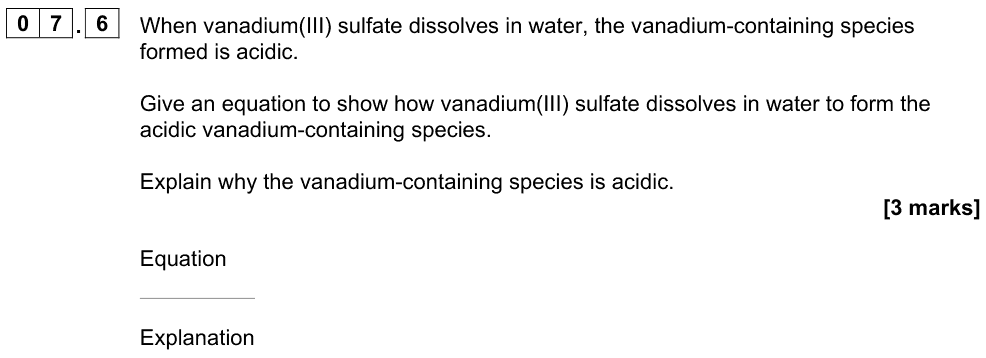
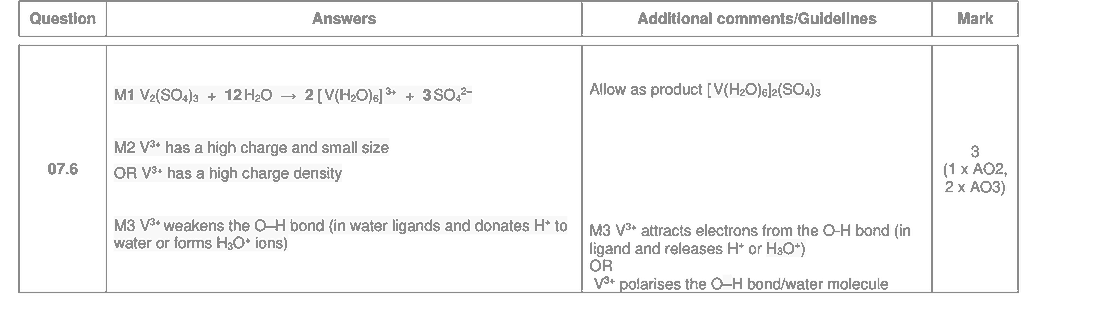
When vanadium(III) sulfate dissolves in water, the vanadium-containing species
formed is acidic.
Give an equation to show how vanadium(III) sulfate dissolves in water to form the
acidic vanadium-containing species.
Explain why the vanadium-containing species is acidic.
[3 marks]
Equation
Explanation
June 2025 · Paper 1 · Q07.7 2 marks AO1=1, AO3=1 Equation writing atomic structure
Earlier part of question 07 that this part usesEarlier part of June 2025 Paper 1 question 07
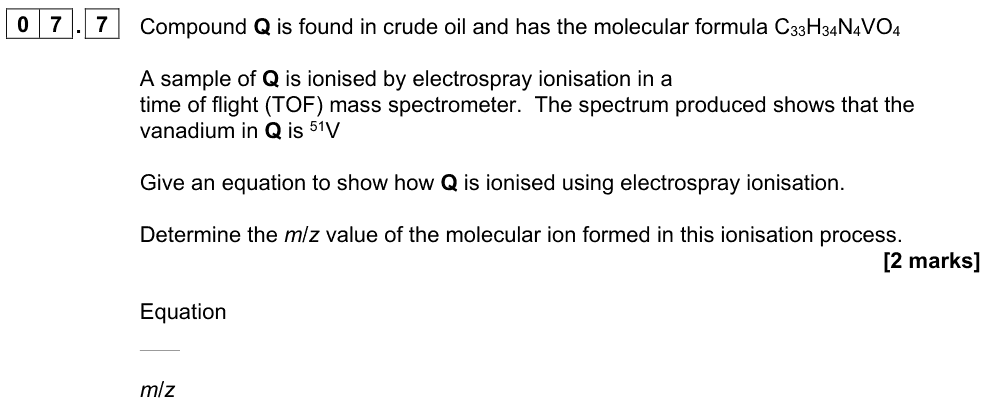
Compound Q is found in crude oil and has the molecular formula C33H34N4VO4
A sample of Q is ionised by electrospray ionisation in a
time of flight (TOF) mass spectrometer.  The spectrum produced shows that the
vanadium in Q is 51V
Give an equation to show how Q is ionised using electrospray ionisation.
Determine the m/z value of the molecular ion formed in this ionisation process.
[2 marks]
Equation
m/z
June 2025 · Paper 1 · Q07.8 2 marks AO2=2 Calculation Easy atomic structure
Earlier part of question 07 that this part usesEarlier part of June 2025 Paper 1 question 07
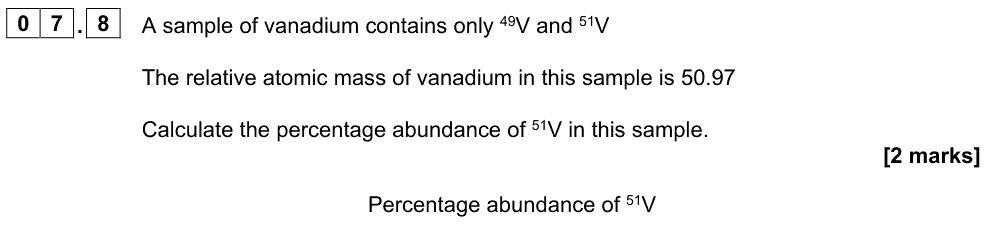
A sample of vanadium contains only 49V and 51V
The relative atomic mass of vanadium in this sample is 50.97
Calculate the percentage abundance of 51V in this sample.
[2 marks]
Percentage abundance of 51V
June 2025 · Paper 1 · Q08.1 2 marks AO1=1, AO2=1 Calculation acids and bases
This question is about acids and bases.
Nitric acid is a strong acid.
Calculate the pH of 0.150 mol dm–3 nitric acid.
Give your answer to 2 decimal places.
[2 marks]
pH
June 2025 · Paper 1 · Q08.2 4 marks AO2=4 Calculation acids and bases
Earlier part of question 08 that this part usesEarlier part of June 2025 Paper 1 question 08
Propanoic acid is a weak acid.
Calculate the concentration of a solution of propanoic acid with pH = 2.89 at 25 °C
The acid dissociation constant (Ka) for propanoic acid at 25 °C
is 1.35 × 10⁻⁵ mol dm–3
[4 marks]
Concentration
mol dm–3
June 2025 · Paper 1 · Q08.3 1 mark AO2=1 Short answer acids and bases
Earlier part of question 08 that this part usesEarlier part of June 2025 Paper 1 question 08
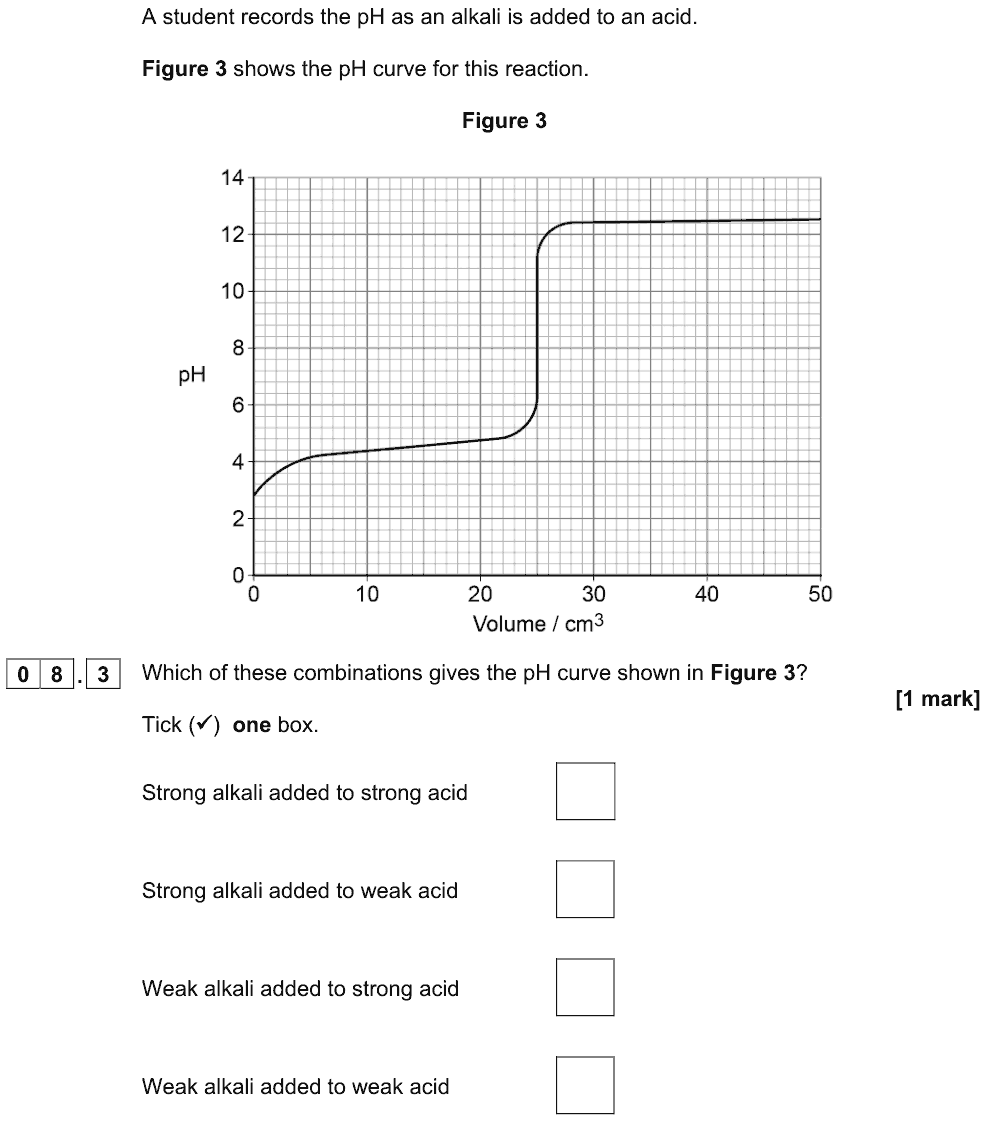
A student records the pH as an alkali is added to an acid.
Figure 3 shows the pH curve for this reaction.
Figure 3
Which of these combinations gives the pH curve shown in Figure 3?
[1 mark]
Tick ( )  one box.
Strong alkali added to strong acid
Strong alkali added to weak acid
Weak alkali added to strong acid
Weak alkali added to weak acid
June 2025 · Paper 1 · Q08.4 1 mark AO3=1 Short answer acids and bases
Earlier parts of question 08 that this part usesEarlier part of June 2025 Paper 1 question 08Earlier part of June 2025 Paper 1 question 08
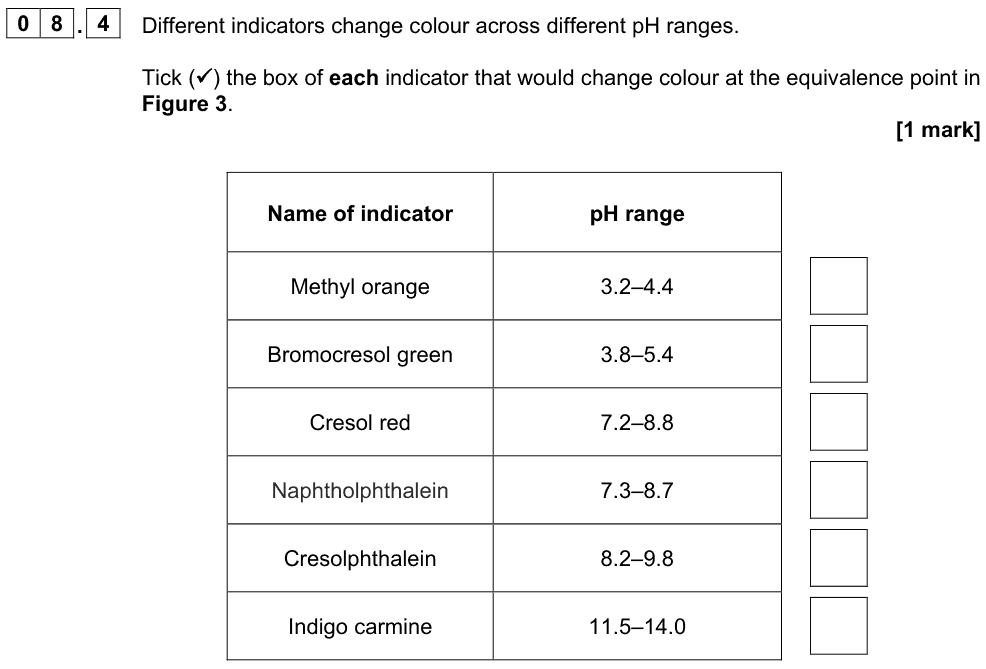
Different indicators change colour across different pH ranges.
Tick ( ) the box of each indicator that would change colour at the equivalence point in
Figure 3.
[1 mark]
Name of indicator
pH range
Methyl orange
3.2–4.4
Bromocresol green
3.8–5.4
Cresol red
7.2–8.8
Naphtholphthalein
7.3–8.7
Cresolphthalein
8.2–9.8
Indigo carmine
11.5–14.0
June 2025 · Paper 1 · Q08.5 2 marks AO1=2 Explanation acids and bases
Earlier part of question 08 that this part usesEarlier part of June 2025 Paper 1 question 08
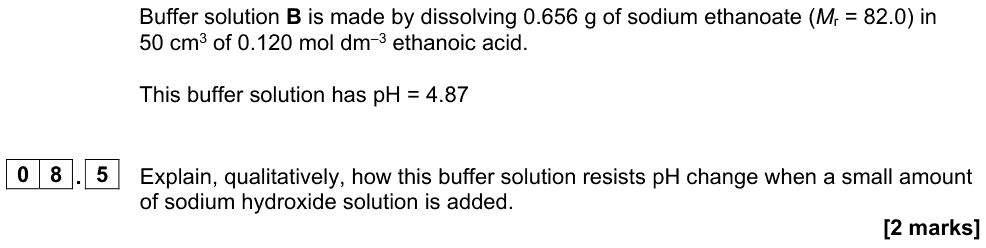
Buffer solution B is made by dissolving 0.656 g of sodium ethanoate (Mr = 82.0) in
50 cm3 of 0.120 mol dm–3 ethanoic acid.
This buffer solution has pH = 4.87
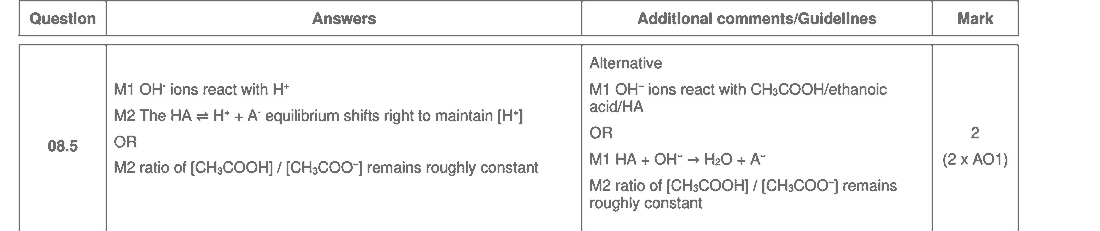
Explain, qualitatively, how this buffer solution resists pH change when a small amount
of sodium hydroxide solution is added.
[2 marks]
June 2025 · Paper 1 · Q08.6 7 marks AO2=7 Calculation acids and bases
Earlier parts of question 08 that this part usesEarlier part of June 2025 Paper 1 question 08Earlier part of June 2025 Paper 1 question 08
Calculate the pH change that occurs when 1.50 cm3 of 0.200 mol dm–3 HCl(aq) are
added to buffer solution B.
Give your answer to 2 decimal places.
The acid dissociation constant (Ka) for ethanoic acid at 25 °C is 1.78 × 10⁻⁵ mol dm–3
[7 marks]
pH change

Work with an A-level chemistry tutor

Want a paper marked and gone through with you? Message us.

Prefer email? Send an enquiry

If you are under 18, please include a parent's contact details. Enquiries go to enquiries@chemistryaleveltutor.com and are deleted once handled. All tutoring is online.