
June 2023: Paper 2, Organic and physical chemistry

105 marks · 40 question parts · Paper, mark scheme and report on AQA's site · Have the Data Booklet beside you

Question by question

QTopicMarksAOType
01.1 Rate equations 1AO3=1Practical and data analysis
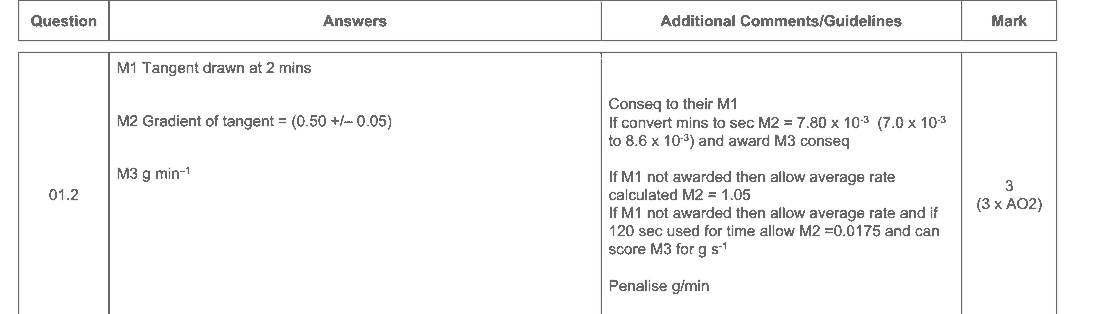
01.2 Rate equations 3AO2=3Calculation
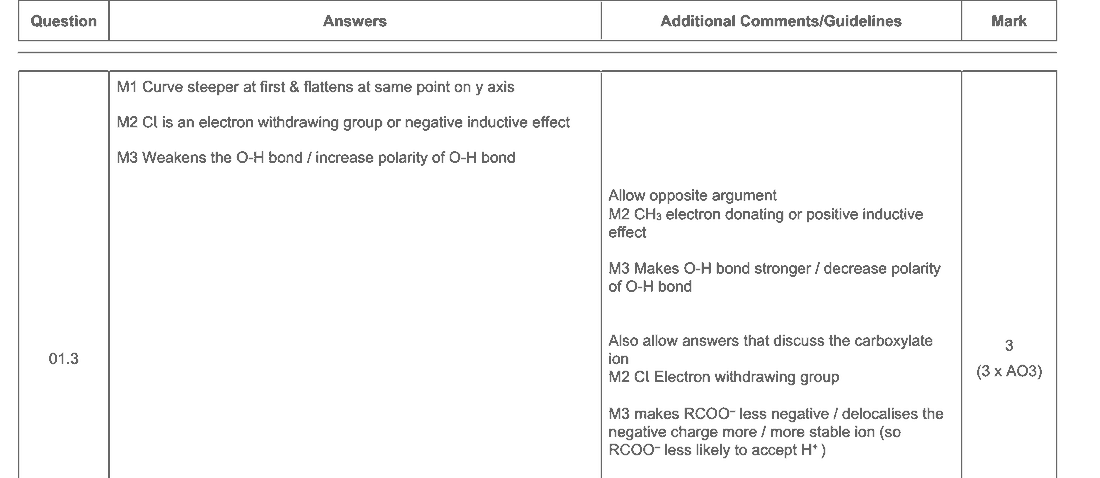
01.3 Carboxylic acids and derivatives, Rate equations 3AO3=3Explanation
02.1 Rate equations 3AO2=3Calculation
02.2 Rate equations 2AO2=2Short answer
03.1 Carboxylic acids and derivatives 4AO1=4Mechanism
03.2 Aromatic chemistry 4AO1=4Mechanism
03.3 Aldehydes and ketones 4AO1=4Mechanism
04.1 Introduction to organic chemistry: nomenclature, mechanisms and isomerism 1AO1=1Short answer
04.2 Alkenes, Optical isomerism 6AO1=3,AO3=3Level of response
04.3 Halogenoalkanes 2AO1=2Short answer
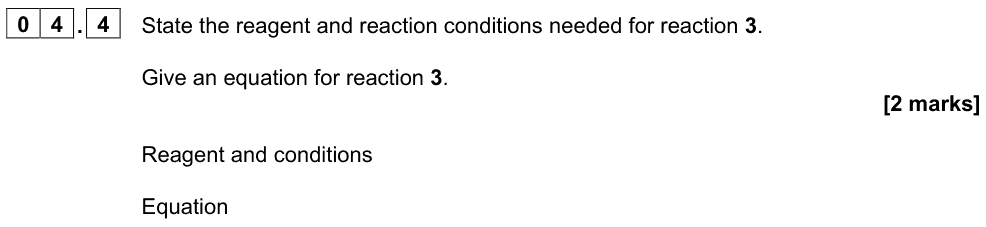
04.4 Amines 2AO1=1,AO2=1Equation writing
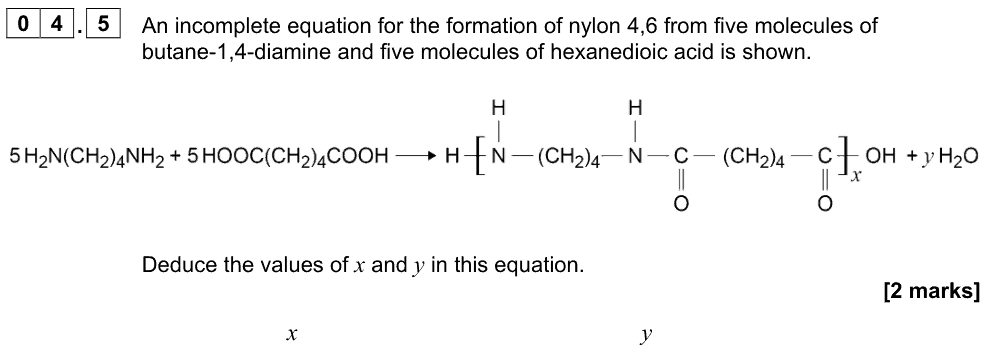
04.5 Polymers 2AO1=2Short answer
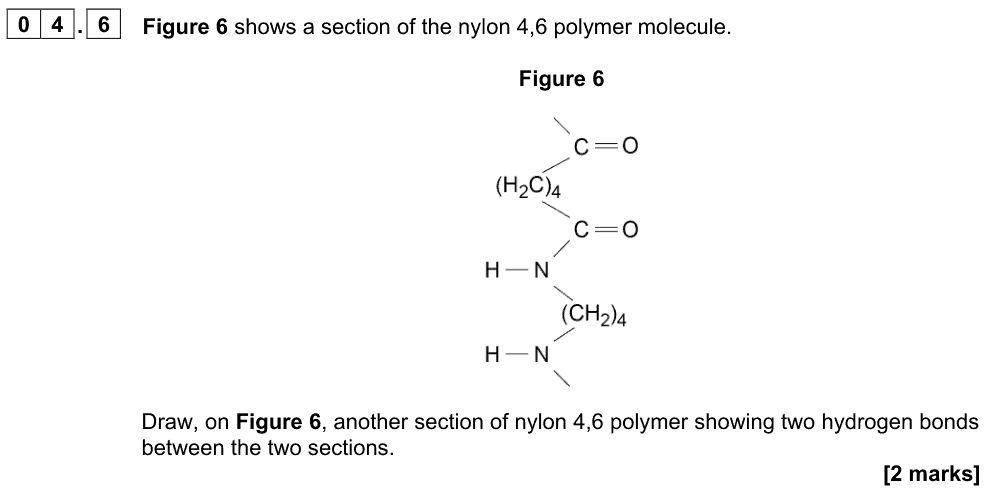
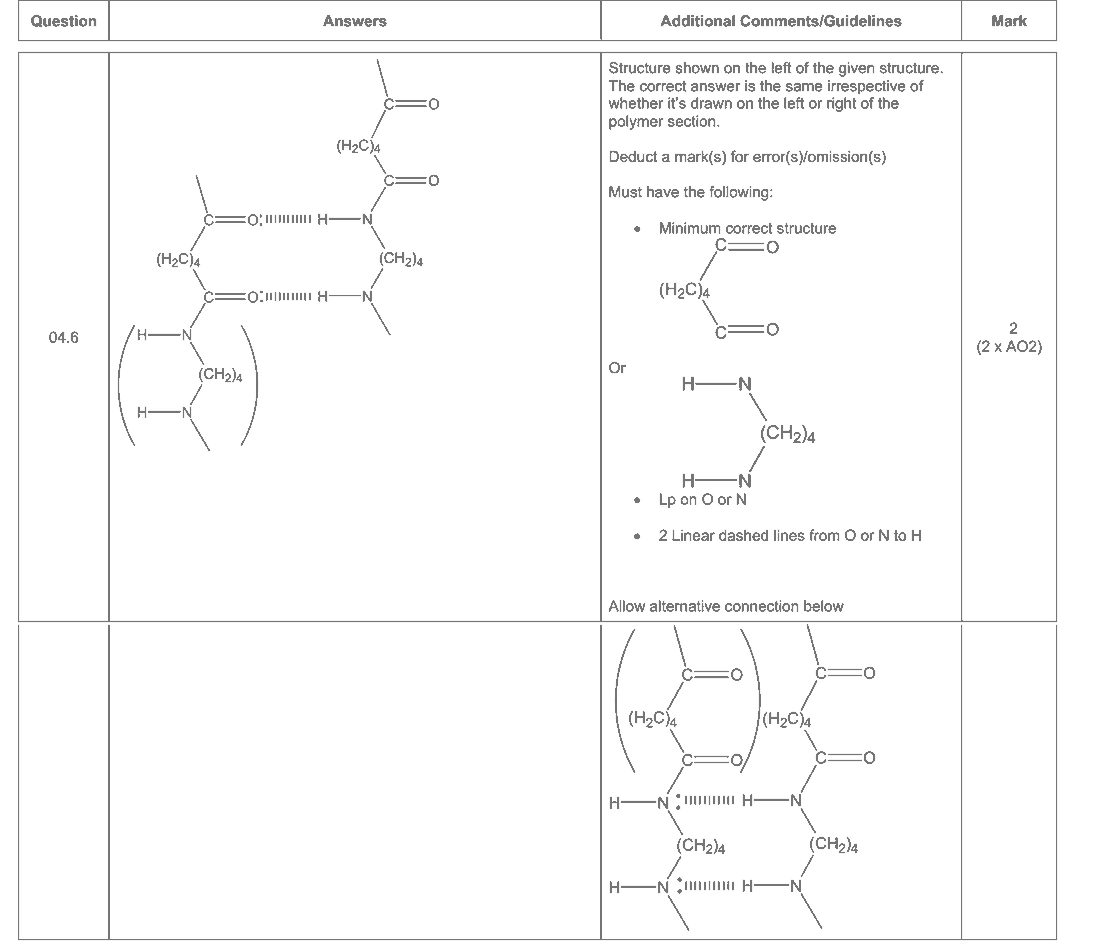
04.6 Polymers 2AO2=2Diagram or structure
05.1 Organic analysis: test-tube reactions, mass spectrometry and infrared 1AO1=1Short answer
05.2 Nuclear magnetic resonance spectroscopy 1AO1=1Short answer
05.3 Nuclear magnetic resonance spectroscopy 1AO1=1Short answer
05.4 Nuclear magnetic resonance spectroscopy 5AO2=5Explanation
05.5 Nuclear magnetic resonance spectroscopy 1AO2=1Diagram or structure
05.6 Nuclear magnetic resonance spectroscopy 1AO3=1Short answer
05.7 Nuclear magnetic resonance spectroscopy 1AO2=1Diagram or structure
06.1 Alcohols 1AO1=1Practical and data analysis
06.2 Organic analysis: test-tube reactions, mass spectrometry and infrared, Aldehydes and ketones 2AO3=2Practical and data analysis
06.3 Organic analysis: test-tube reactions, mass spectrometry and infrared, Alcohols, Carboxylic acids and derivatives 8AO3=8Practical and data analysis
06.4 Alcohols 3AO3=3Practical and data analysis
07.1 Amount of substance 4AO2=4Calculation
07.2 Amount of substance 2AO2=2Calculation
07.3 Amount of substance 2AO2=2Calculation
07.4 Amount of substance 2AO2=2Calculation
08.1 Carboxylic acids and derivatives 2AO2=2Equation writing
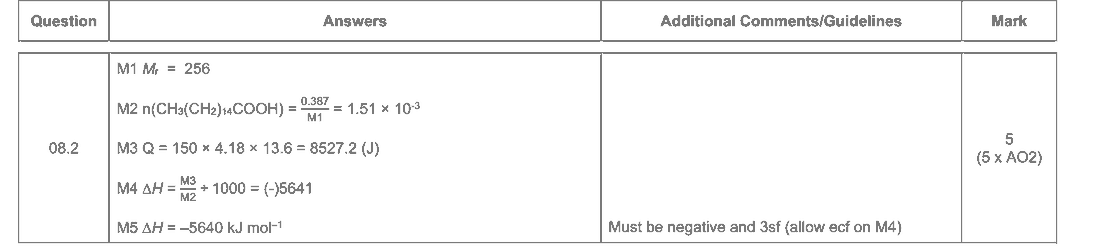
08.2 Energetics, Amount of substance 5AO2=5Calculation
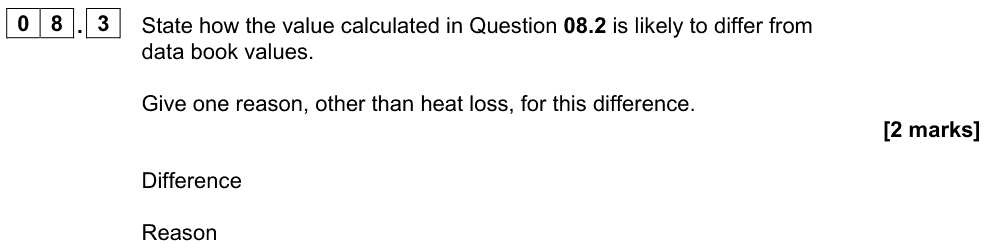
08.3 Energetics 2AO2=2Practical and data analysis
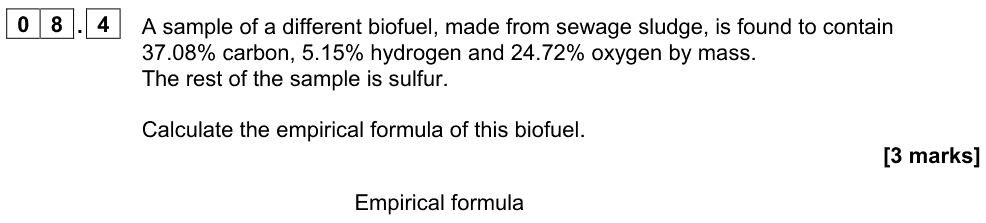
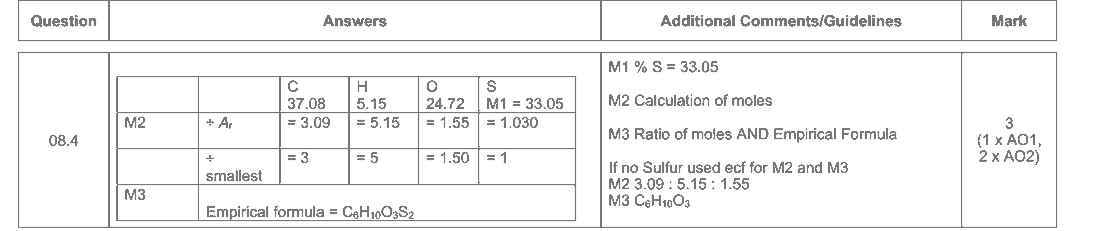
08.4 Amount of substance 3AO1=1,AO2=2Calculation
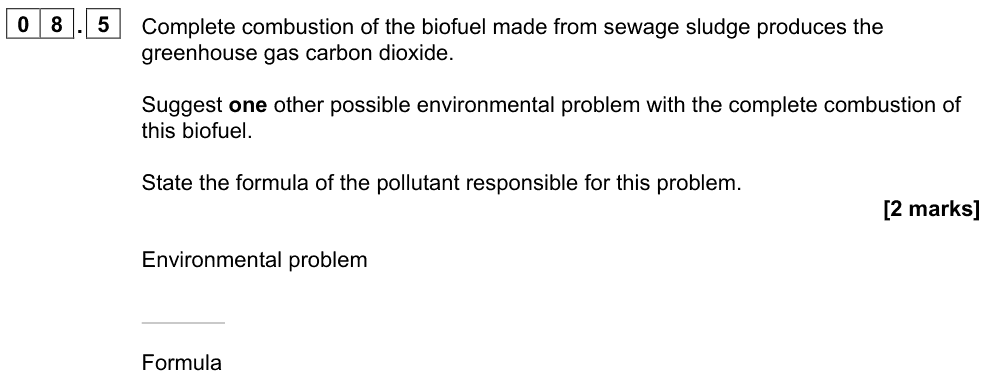
08.5 Alkanes 2AO3=2Short answer
08.6 Energetics 3AO2=3Calculation
08.7 Energetics 2AO2=2Calculation
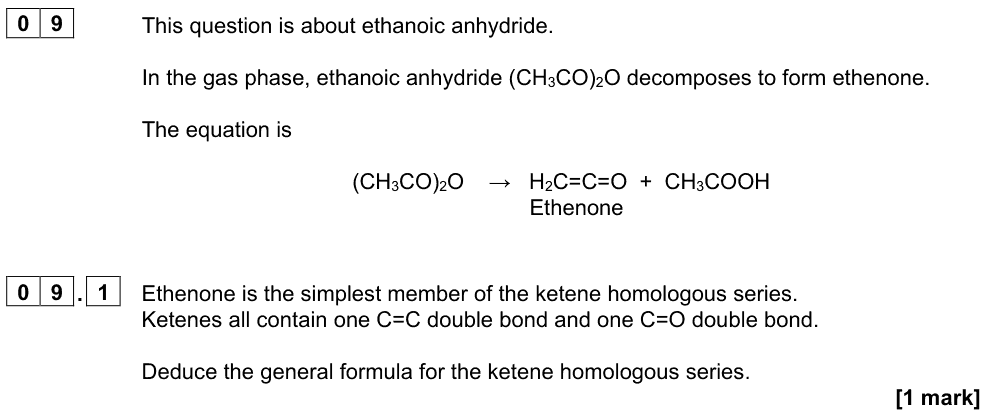
09.1 Introduction to organic chemistry: nomenclature, mechanisms and isomerism 1AO2=1Short answer
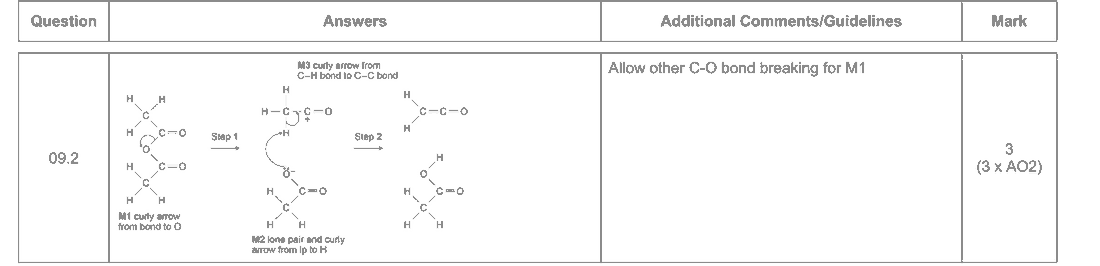
09.2 Introduction to organic chemistry: nomenclature, mechanisms and isomerism 3AO2=3Mechanism
09.3 Rate equations 3AO2=3Calculation
09.4 Kinetics 5AO1=5Diagram or structure

The questions

01.101.201.302.102.203.103.203.304.104.204.304.404.504.605.105.205.305.405.505.605.706.106.206.306.407.107.207.307.408.108.208.308.408.508.608.709.109.209.309.4
June 2023 · Paper 2 · Q01.1 1 mark AO3=1 Practical and data analysis rate equations
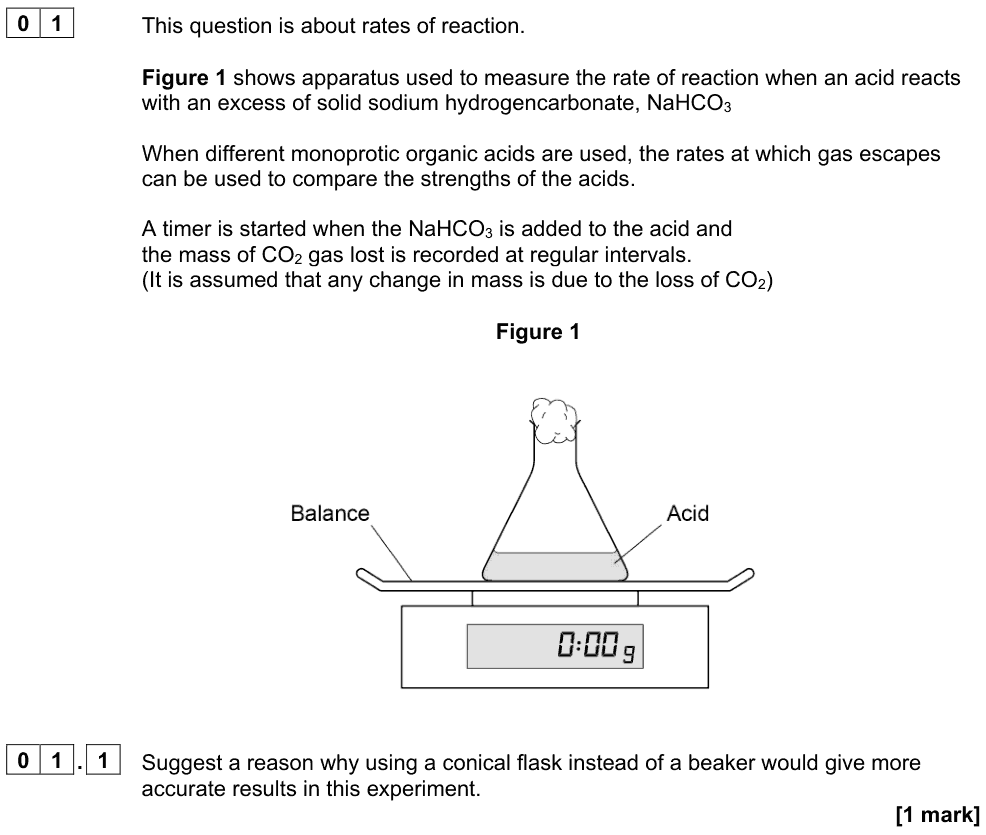
This question is about rates of reaction.
Figure 1 shows apparatus used to measure the rate of reaction when an acid reacts
with an excess of solid sodium hydrogencarbonate, NaHCO3
When different monoprotic organic acids are used, the rates at which gas escapes
can be used to compare the strengths of the acids.
A timer is started when the NaHCO3 is added to the acid and
the mass of CO2 gas lost is recorded at regular intervals.
(It is assumed that any change in mass is due to the loss of CO2)
Figure 1
Suggest a reason why using a conical flask instead of a beaker would give more
accurate results in this experiment.
[1 mark]
June 2023 · Paper 2 · Q01.2 3 marks AO2=3 Calculation rate equations
Earlier part of question 01 that this part usesEarlier part of June 2023 Paper 2 question 01
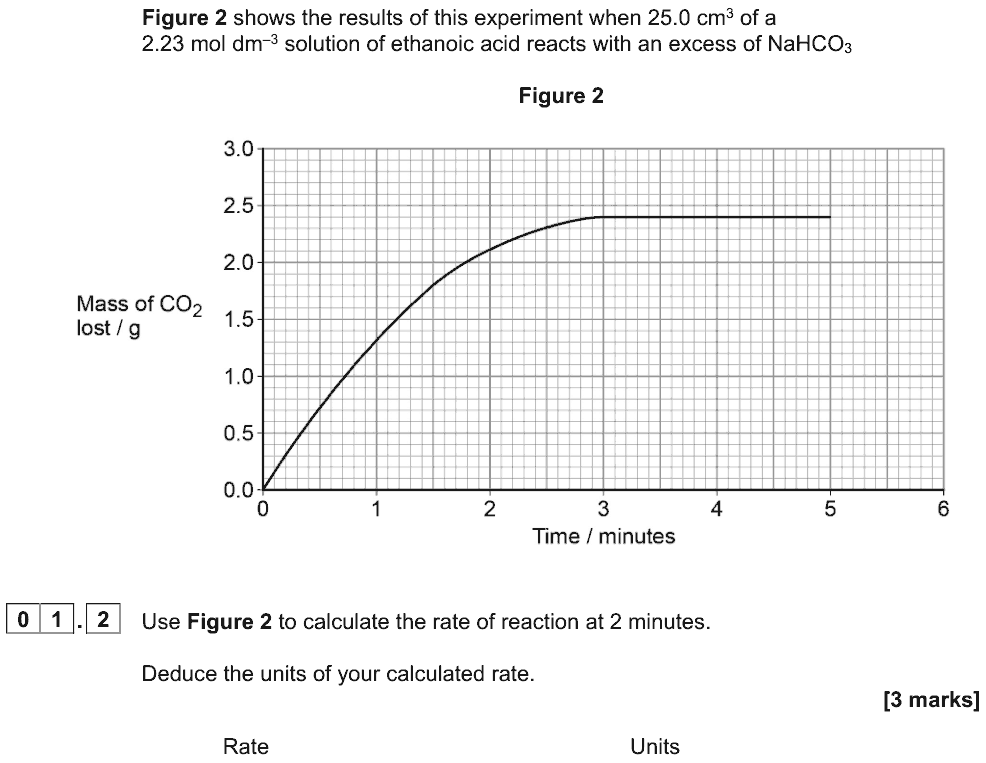
Figure 2 shows the results of this experiment when 25.0 cm3 of a
2.23 mol dm–3 solution of ethanoic acid reacts with an excess of NaHCO3
Figure 2
Use Figure 2 to calculate the rate of reaction at 2 minutes.
Deduce the units of your calculated rate.
[3 marks]
Rate
Units
June 2023 · Paper 2 · Q01.3 3 marks AO3=3 Explanation carboxylic acids and derivativesrate equations
Earlier parts of question 01 that this part usesEarlier part of June 2023 Paper 2 question 01Earlier part of June 2023 Paper 2 question 01
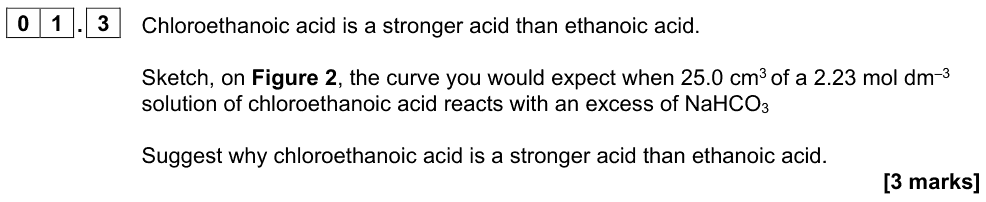
Chloroethanoic acid is a stronger acid than ethanoic acid.
Sketch, on Figure 2, the curve you would expect when 25.0 cm3 of a 2.23 mol dm–3
solution of chloroethanoic acid reacts with an excess of NaHCO3
Suggest why chloroethanoic acid is a stronger acid than ethanoic acid.
[3 marks]
June 2023 · Paper 2 · Q02.1 3 marks AO2=3 Calculation Easy rate equations
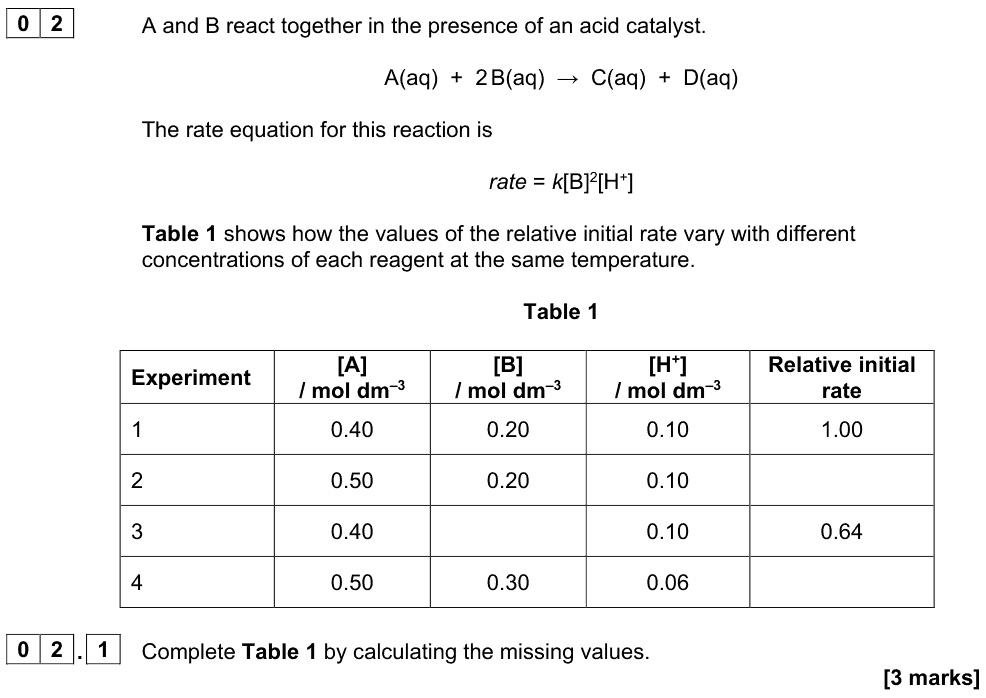
A and B react together in the presence of an acid catalyst.
A(aq)  +  2 B(aq)  →  C(aq)  +  D(aq)
The rate equation for this reaction is
rate = k[B]2[H+]
Table 1 shows how the values of the relative initial rate vary with different
concentrations of each reagent at the same temperature.
Table 1
Experiment
[A]
/ mol dm–3
[B]
/ mol dm–3
[H+]
/ mol dm–3
Relative initial
rate
1
0.40
0.20
0.10
1.00
2
0.50
0.20
0.10
3
0.40
0.10
0.64
4
0.50
0.30
0.06
Complete Table 1 by calculating the missing values.
[3 marks]
June 2023 · Paper 2 · Q02.2 2 marks AO2=2 Short answer rate equations
Earlier part of question 02 that this part usesEarlier part of June 2023 Paper 2 question 02
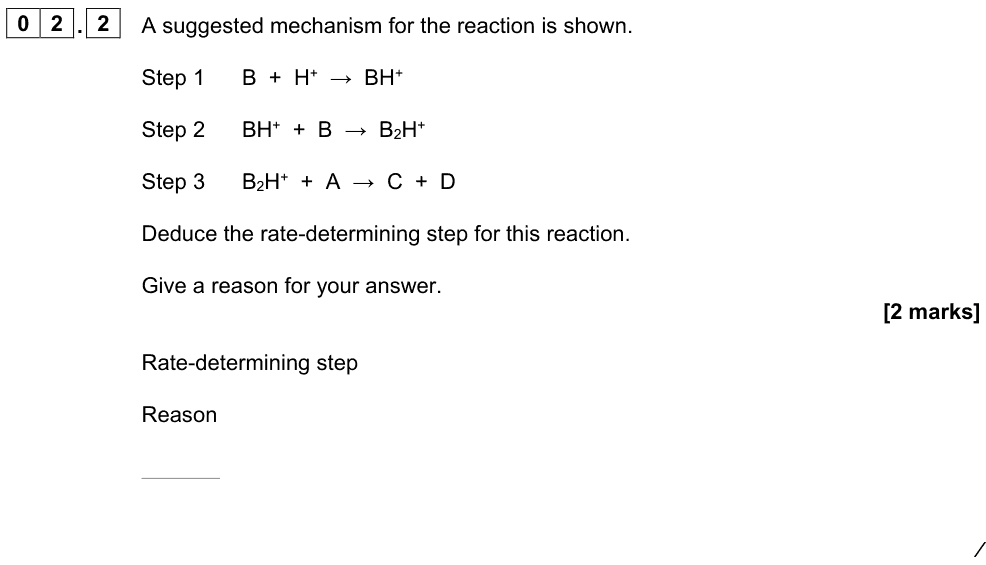
A suggested mechanism for the reaction is shown.
Step 1      B  +  H+  →  BH+
Step 2      BH+  +  B  →  B2H+
Step 3      B2H+  +  A  →  C  +  D
Deduce the rate-determining step for this reaction.
Give a reason for your answer.
[2 marks]
Rate-determining step
Reason
June 2023 · Paper 2 · Q03.1 4 marks AO1=4 Mechanism carboxylic acids and derivatives
This question is about intermediates in reaction mechanisms.
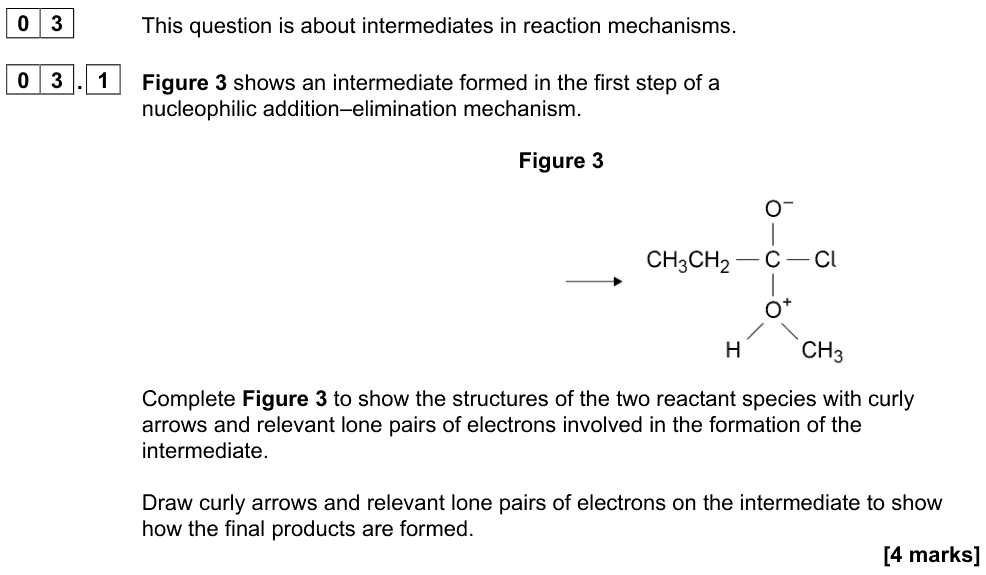
Figure 3 shows an intermediate formed in the first step of a
nucleophilic addition–elimination mechanism.
Figure 3
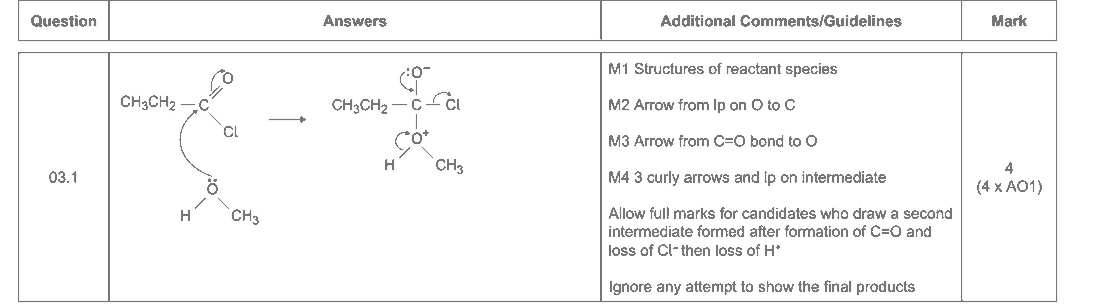
Complete Figure 3 to show the structures of the two reactant species with curly
arrows and relevant lone pairs of electrons involved in the formation of the
intermediate.
Draw curly arrows and relevant lone pairs of electrons on the intermediate to show
how the final products are formed.
[4 marks]
June 2023 · Paper 2 · Q03.2 4 marks AO1=4 Mechanism aromatic chemistry
Earlier part of question 03 that this part usesEarlier part of June 2023 Paper 2 question 03
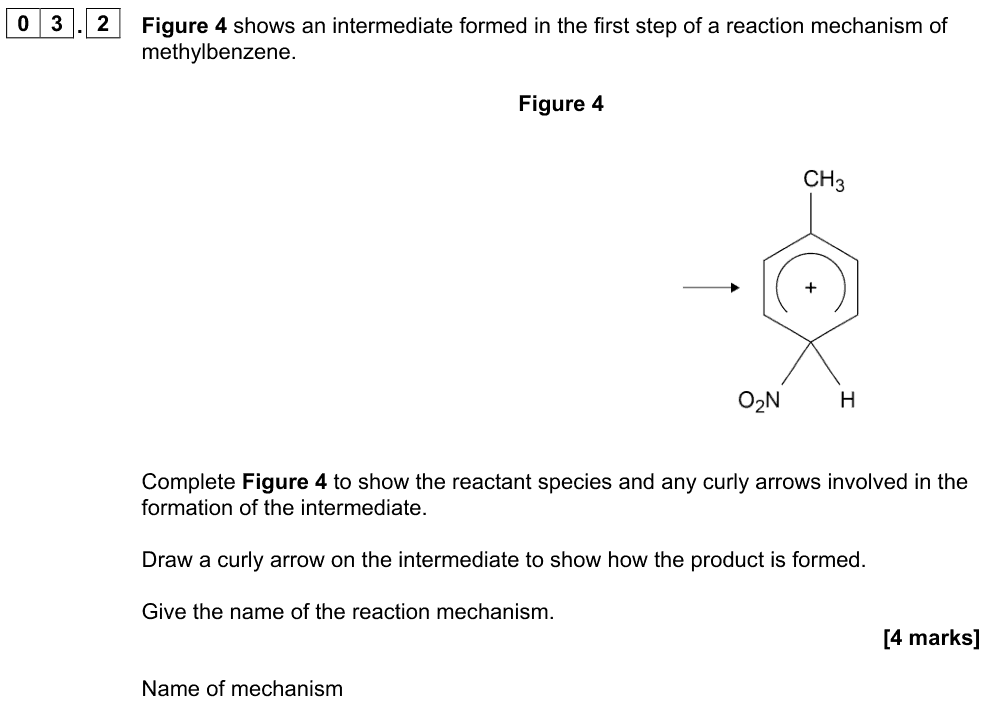
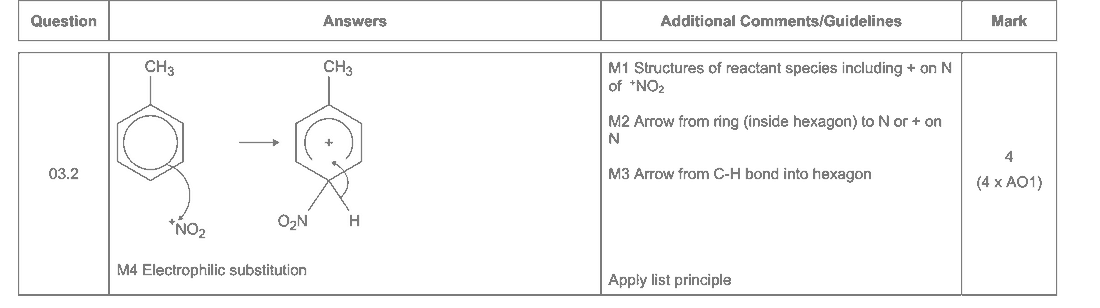
Figure 4 shows an intermediate formed in the first step of a reaction mechanism of
methylbenzene.
Figure 4
Complete Figure 4 to show the reactant species and any curly arrows involved in the
formation of the intermediate.
Draw a curly arrow on the intermediate to show how the product is formed.
Give the name of the reaction mechanism.
[4 marks]
Name of mechanism
June 2023 · Paper 2 · Q03.3 4 marks AO1=4 Mechanism aldehydes and ketones
Earlier part of question 03 that this part usesEarlier part of June 2023 Paper 2 question 03
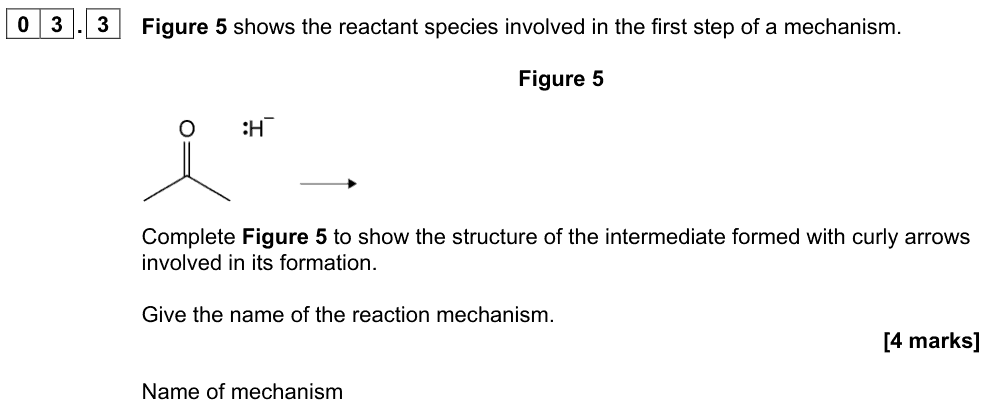
Figure 5 shows the reactant species involved in the first step of a mechanism.
Figure 5
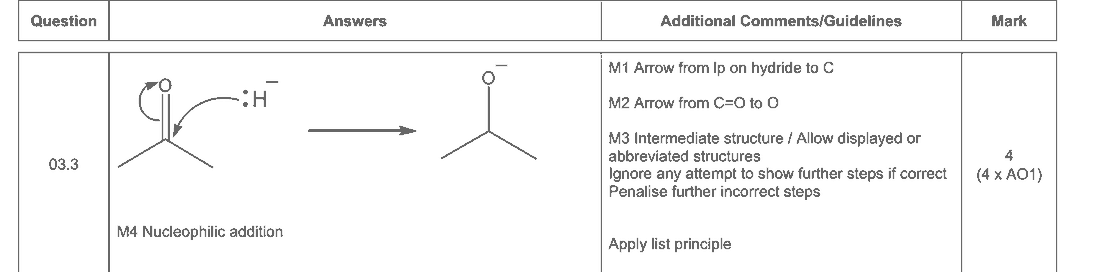
Complete Figure 5 to show the structure of the intermediate formed with curly arrows
involved in its formation.
Give the name of the reaction mechanism.
[4 marks]
Name of mechanism
June 2023 · Paper 2 · Q04.1 1 mark AO1=1 Short answer introduction to organic chemistry
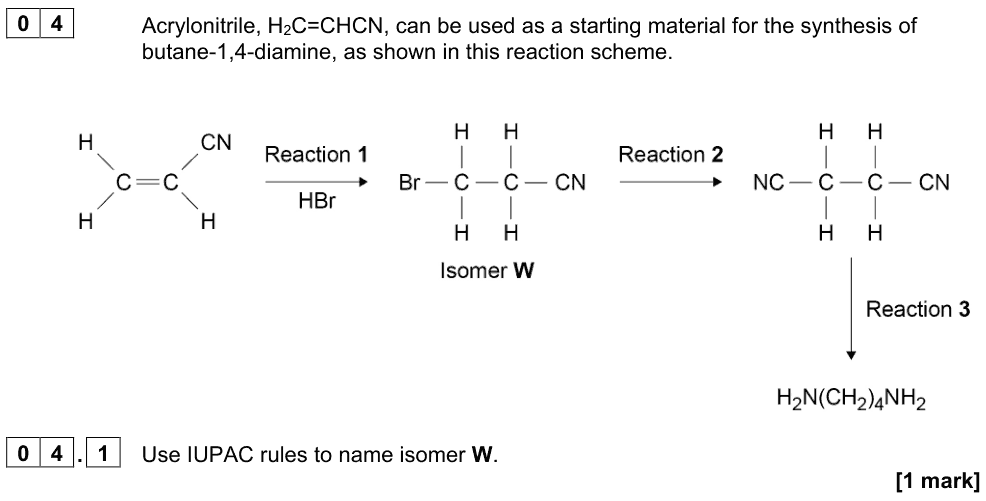
Acrylonitrile, H2C=CHCN, can be used as a starting material for the synthesis of
butane-1,4-diamine, as shown in this reaction scheme.
Use IUPAC rules to name isomer W.
[1 mark]
June 2023 · Paper 2 · Q04.2 6 marks AO1=3, AO3=3 6-mark level of response alkenesoptical isomerism
Earlier part of question 04 that this part usesEarlier part of June 2023 Paper 2 question 04
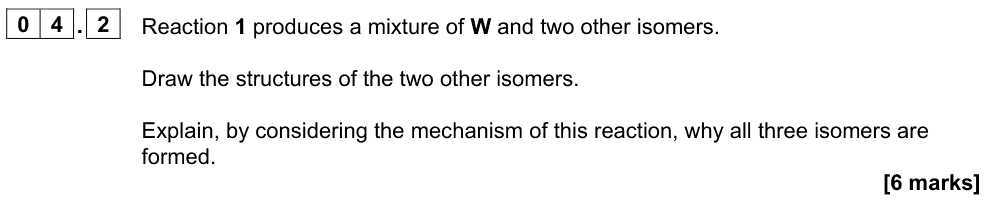
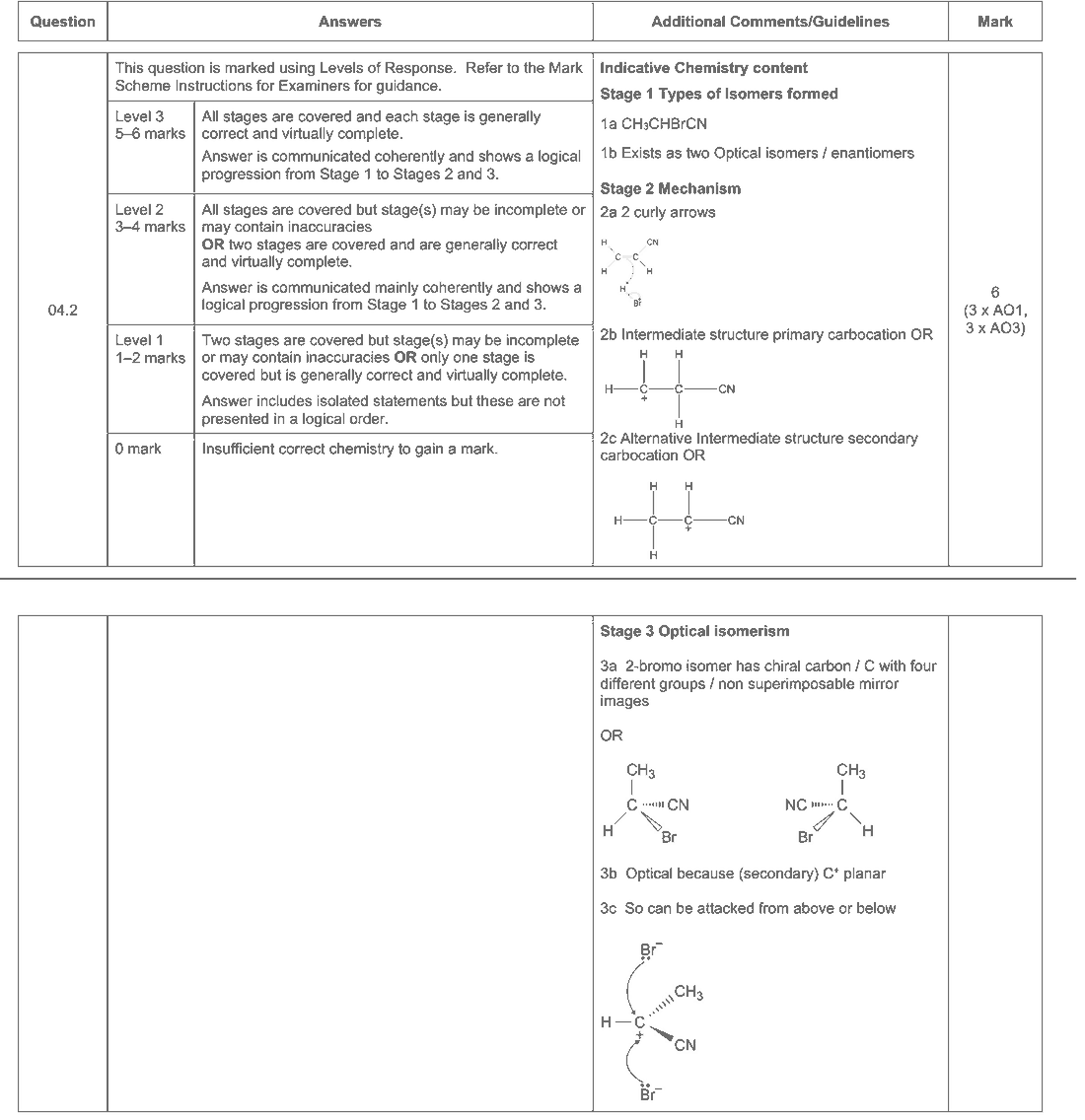
Reaction 1 produces a mixture of W and two other isomers.
Draw the structures of the two other isomers.
Explain, by considering the mechanism of this reaction, why all three isomers are
formed.
[6 marks]
June 2023 · Paper 2 · Q04.3 2 marks AO1=2 Short answer halogenoalkanes
Earlier part of question 04 that this part usesEarlier part of June 2023 Paper 2 question 04
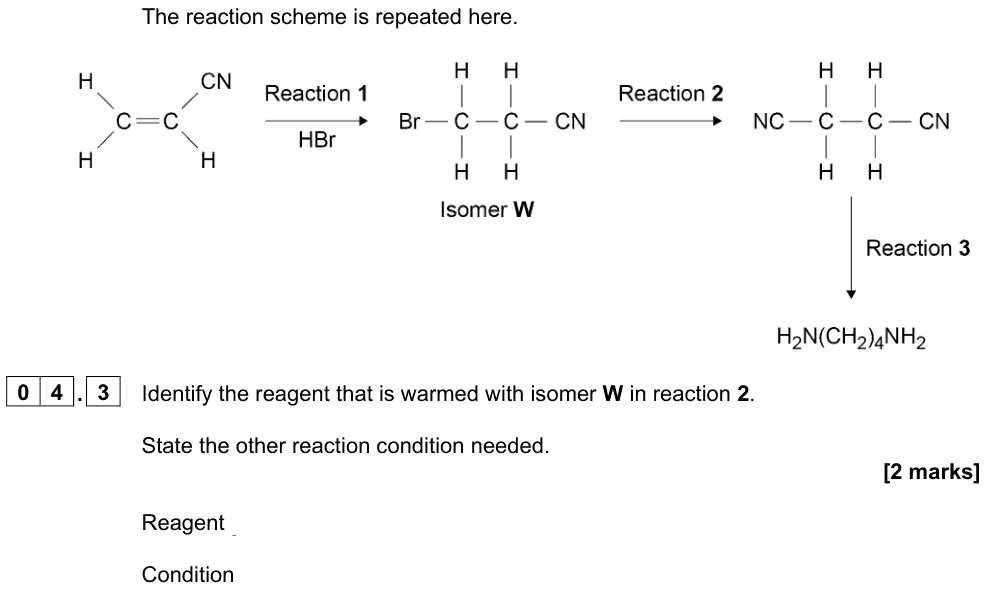
The reaction scheme is repeated here.
Identify the reagent that is warmed with isomer W in reaction 2.
State the other reaction condition needed.
[2 marks]
Reagent
Condition
June 2023 · Paper 2 · Q04.4 2 marks AO1=1, AO2=1 Equation writing Hard amines
Earlier parts of question 04 that this part usesEarlier part of June 2023 Paper 2 question 04Earlier part of June 2023 Paper 2 question 04
State the reagent and reaction conditions needed for reaction 3.
Give an equation for reaction 3.
[2 marks]
Reagent and conditions
Equation
June 2023 · Paper 2 · Q04.5 2 marks AO1=2 Short answer polymers
Earlier parts of question 04 that this part usesEarlier part of June 2023 Paper 2 question 04Earlier part of June 2023 Paper 2 question 04
An incomplete equation for the formation of nylon 4,6 from five molecules of
butane-1,4-diamine and five molecules of hexanedioic acid is shown.
Deduce the values of x and y in this equation.
[2 marks]
x
y
June 2023 · Paper 2 · Q04.6 2 marks AO2=2 Diagram or structure polymers
Earlier parts of question 04 that this part usesEarlier part of June 2023 Paper 2 question 04Earlier part of June 2023 Paper 2 question 04
Figure 6 shows a section of the nylon 4,6 polymer molecule.
Figure 6
Draw, on Figure 6, another section of nylon 4,6 polymer showing two hydrogen bonds
between the two sections.
[2 marks]
June 2023 · Paper 2 · Q05.1 1 mark AO1=1 Short answer organic analysis
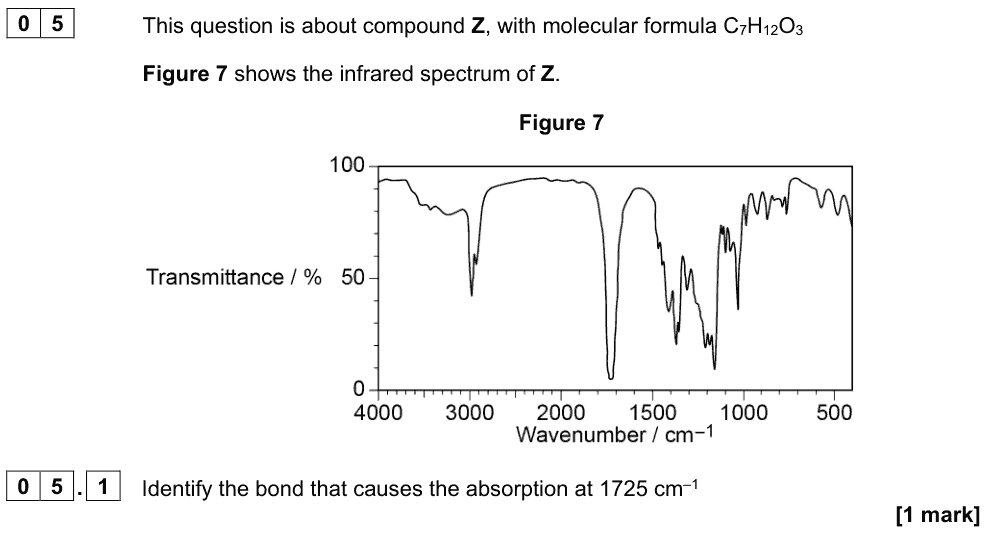
This question is about compound Z, with molecular formula C7H12O3
Figure 7 shows the infrared spectrum of Z.
Figure 7
Identify the bond that causes the absorption at 1725 cm–1
[1 mark]
June 2023 · Paper 2 · Q05.2 1 mark AO1=1 Short answer Easy nmr spectroscopy
Earlier part of question 05 that this part usesEarlier part of June 2023 Paper 2 question 05
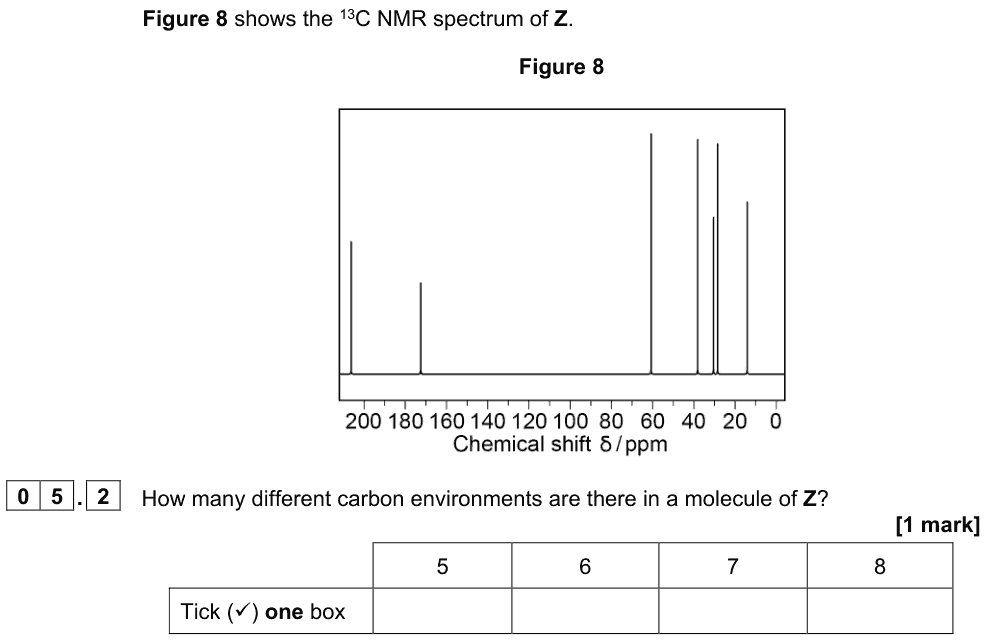
Figure 8 shows the 13C NMR spectrum of Z.
Figure 8
How many different carbon environments are there in a molecule of Z?
[1 mark]
5
6
7
8
Tick () one box
June 2023 · Paper 2 · Q05.3 1 mark AO1=1 Short answer nmr spectroscopy
Earlier parts of question 05 that this part usesEarlier part of June 2023 Paper 2 question 05Earlier part of June 2023 Paper 2 question 05
State the type of carbon environment that causes the peak at ẟ = 174 ppm
Use Table C in the Data Booklet to help you answer this question.
[1 mark]
June 2023 · Paper 2 · Q05.4 5 marks AO2=5 Explanation nmr spectroscopy
Earlier parts of question 05 that this part usesEarlier part of June 2023 Paper 2 question 05Earlier part of June 2023 Paper 2 question 05
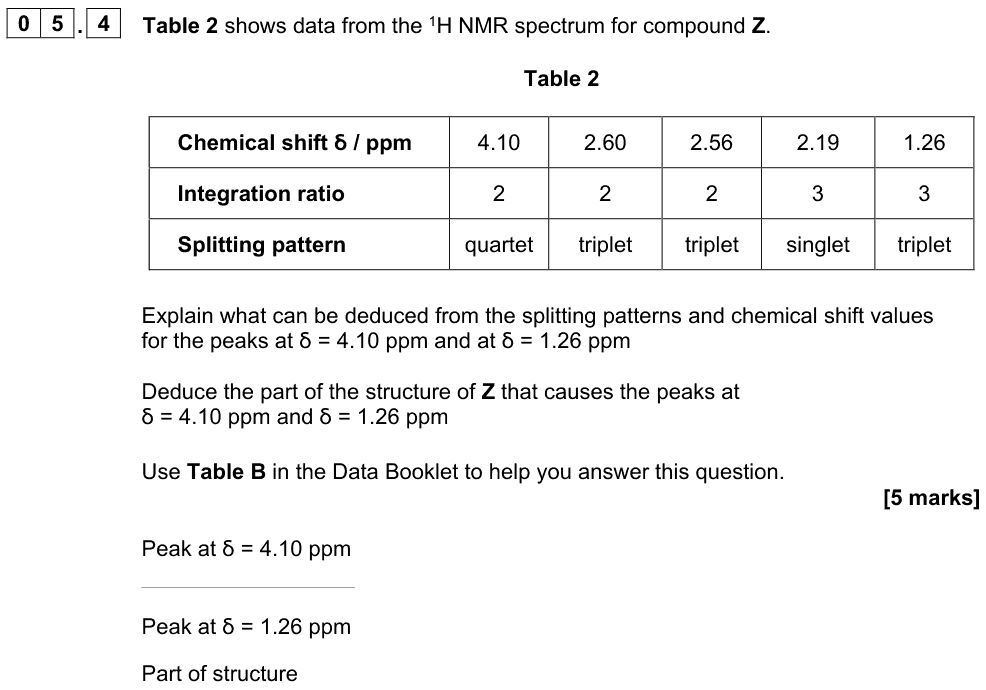
Table 2 shows data from the 1H NMR spectrum for compound Z.
Table 2
Chemical shift ẟ / ppm
4.10
2.60
2.56
2.19
1.26
Integration ratio
2
2
2
3
3
Splitting pattern
quartet
triplet
triplet
singlet
triplet
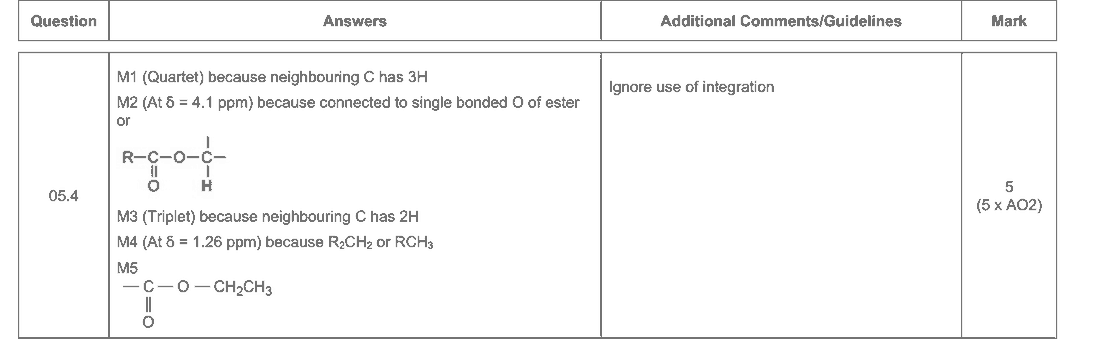
Explain what can be deduced from the splitting patterns and chemical shift values
for the peaks at ẟ = 4.10 ppm and at ẟ = 1.26 ppm
Deduce the part of the structure of Z that causes the peaks at
ẟ = 4.10 ppm and ẟ = 1.26 ppm
Use Table B in the Data Booklet to help you answer this question.
[5 marks]
Peak at ẟ = 4.10 ppm
Peak at ẟ = 1.26 ppm
Part of structure
June 2023 · Paper 2 · Q05.5 1 mark AO2=1 Diagram or structure Easy nmr spectroscopy
Earlier parts of question 05 that this part usesEarlier part of June 2023 Paper 2 question 05Earlier part of June 2023 Paper 2 question 05Earlier part of June 2023 Paper 2 question 05
Deduce the part of the structure of Z that causes the peak at ẟ = 2.19 ppm
[1 mark]
Part of structure
June 2023 · Paper 2 · Q05.6 1 mark AO3=1 Short answer nmr spectroscopy
Earlier parts of question 05 that this part usesEarlier part of June 2023 Paper 2 question 05Earlier part of June 2023 Paper 2 question 05Earlier part of June 2023 Paper 2 question 05
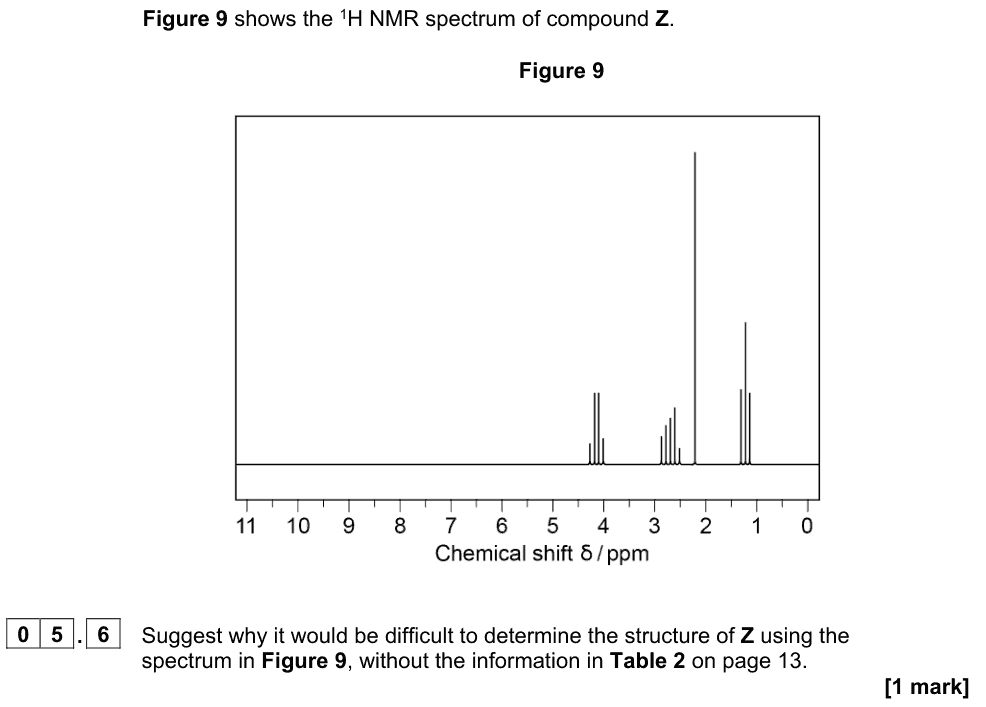
Figure 9 shows the 1H NMR spectrum of compound Z.
Figure 9
Suggest why it would be difficult to determine the structure of Z using the
spectrum in Figure 9, without the information in Table 2 on page 13.
[1 mark]
June 2023 · Paper 2 · Q05.7 1 mark AO2=1 Diagram or structure nmr spectroscopy
Earlier parts of question 05 that this part usesEarlier part of June 2023 Paper 2 question 05Earlier part of June 2023 Paper 2 question 05Earlier part of June 2023 Paper 2 question 05Earlier part of June 2023 Paper 2 question 05
Deduce the structure of Z.
[1 mark]
June 2023 · Paper 2 · Q06.1 1 mark AO1=1 Practical and data analysis Easy alcohols
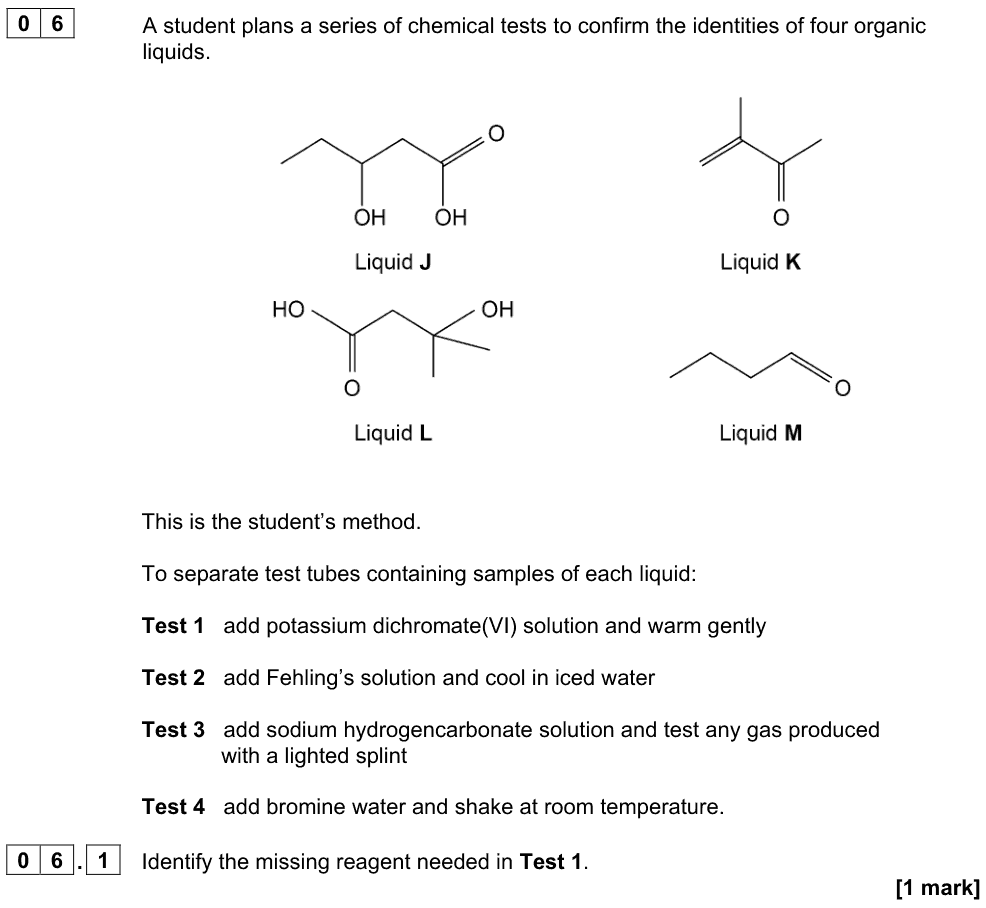
A student plans a series of chemical tests to confirm the identities of four organic
liquids.
This is the student’s method.
To separate test tubes containing samples of each liquid:
Test 1   add potassium dichromate(VI) solution and warm gently
Test 2   add Fehling’s solution and cool in iced water
Test 3   add sodium hydrogencarbonate solution and test any gas produced
with a lighted splint
Test 4   add bromine water and shake at room temperature.
Identify the missing reagent needed in Test 1.
[1 mark]
June 2023 · Paper 2 · Q06.2 2 marks AO3=2 Practical and data analysis organic analysisaldehydes and ketones
Earlier part of question 06 that this part usesEarlier part of June 2023 Paper 2 question 06
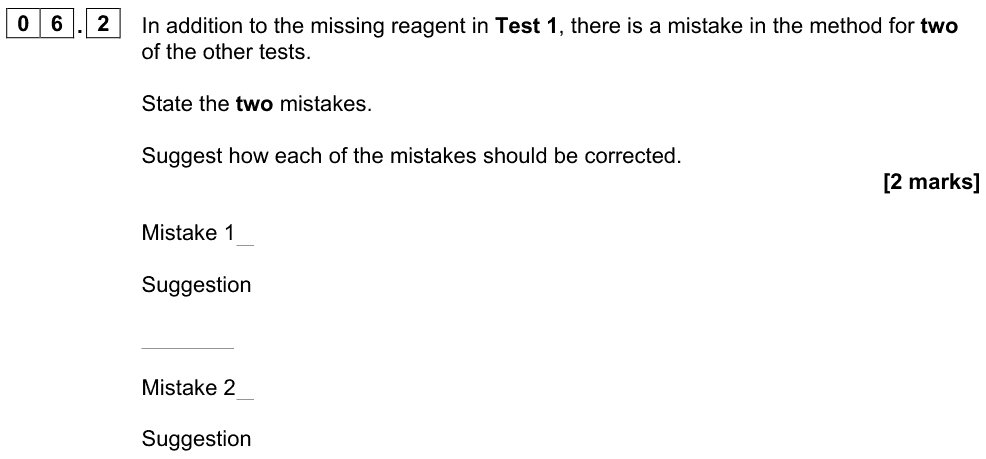
In addition to the missing reagent in Test 1, there is a mistake in the method for two
of the other tests.
State the two mistakes.
Suggest how each of the mistakes should be corrected.

[2 marks]
Mistake 1
Suggestion
Mistake 2
Suggestion
June 2023 · Paper 2 · Q06.3 8 marks AO3=8 Practical and data analysis organic analysisalcoholscarboxylic acids and derivatives
Earlier part of question 06 that this part usesEarlier part of June 2023 Paper 2 question 06
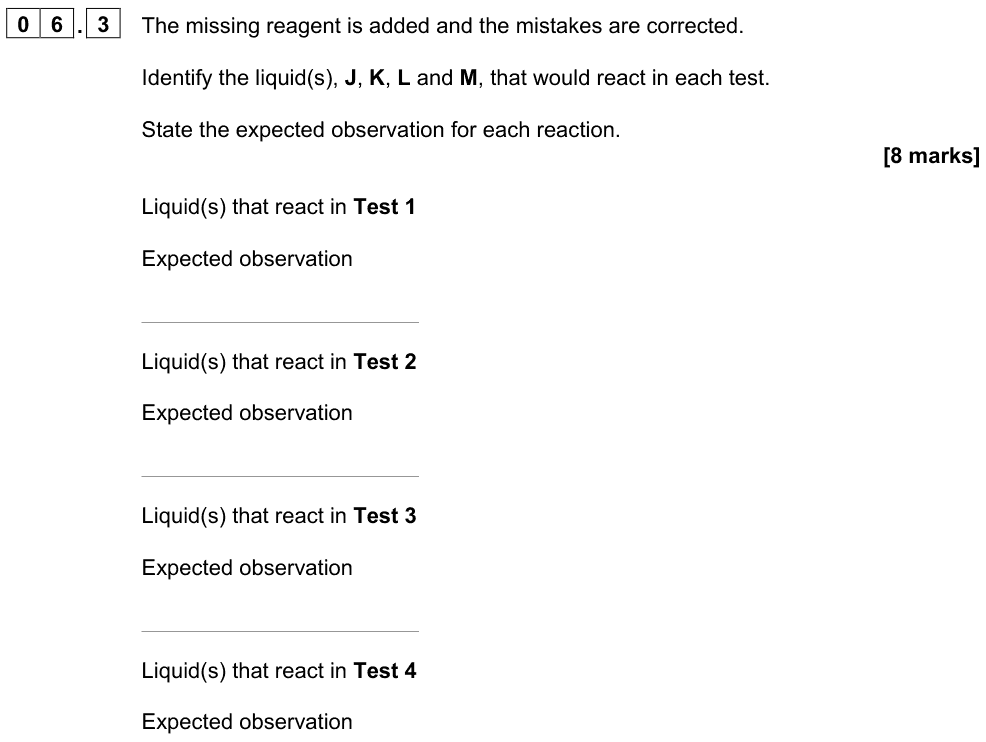
The missing reagent is added and the mistakes are corrected.
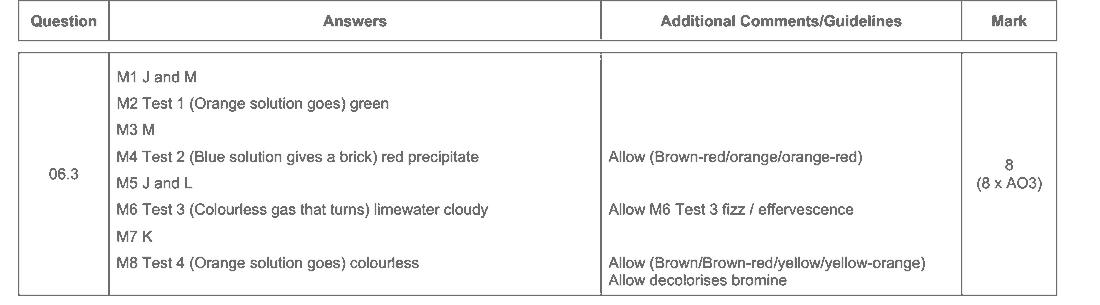
Identify the liquid(s), J, K, L and M, that would react in each test.
State the expected observation for each reaction.
[8 marks]
Liquid(s) that react in Test 1
Expected observation
Liquid(s) that react in Test 2
Expected observation
Liquid(s) that react in Test 3
Expected observation
Liquid(s) that react in Test 4
Expected observation
June 2023 · Paper 2 · Q06.4 3 marks AO3=3 Practical and data analysis alcohols
Earlier part of question 06 that this part usesEarlier part of June 2023 Paper 2 question 06
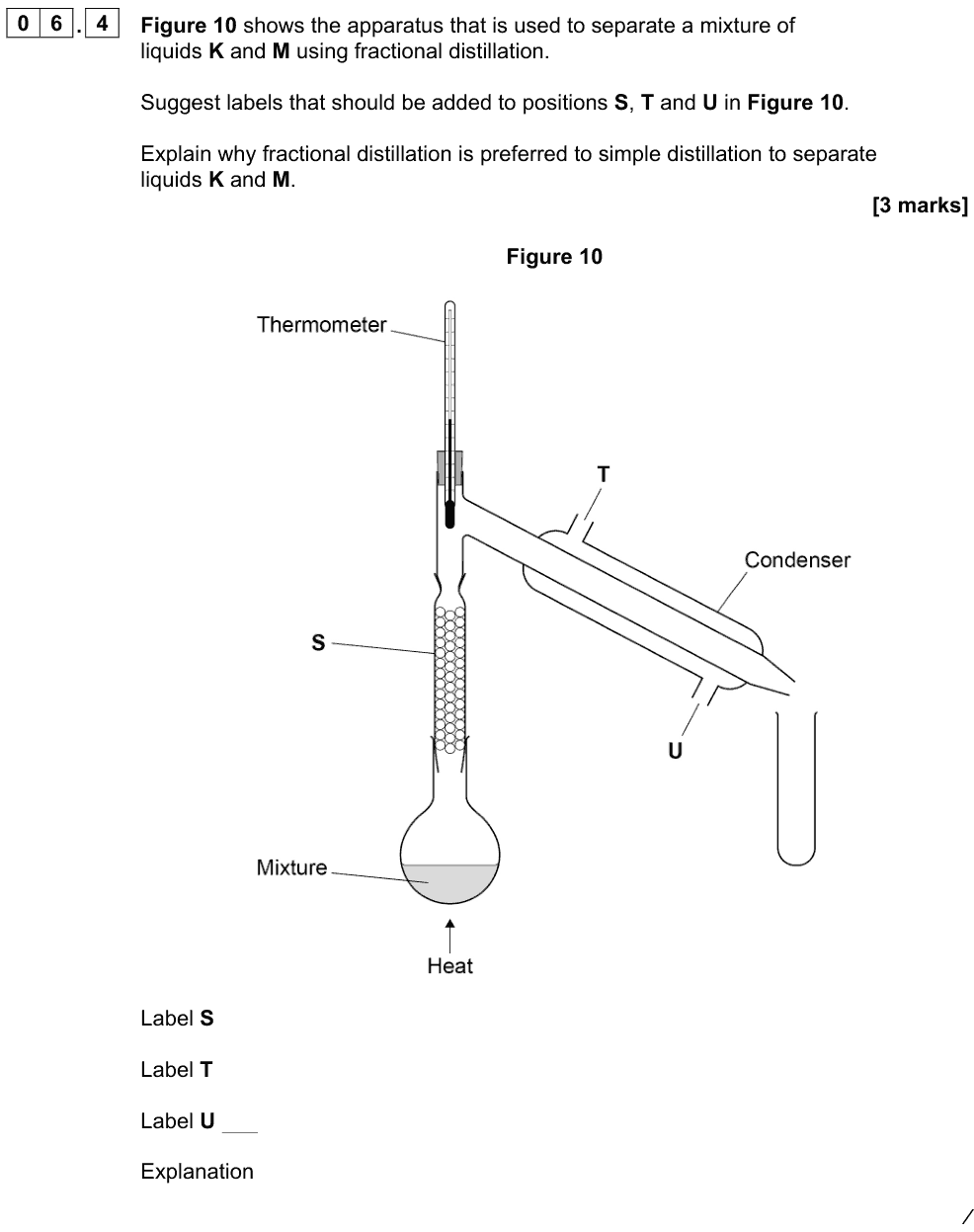
Figure 10 shows the apparatus that is used to separate a mixture of
liquids K and M using fractional distillation.
Suggest labels that should be added to positions S, T and U in Figure 10.
Explain why fractional distillation is preferred to simple distillation to separate
liquids K and M.
[3 marks]
Figure 10
Label S
Label T
Label U
Explanation
June 2023 · Paper 2 · Q07.1 4 marks AO2=4 Calculation Easy amount of substance
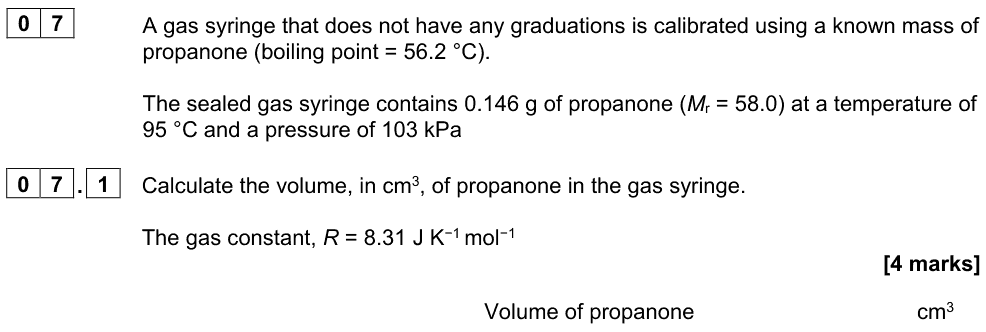
A gas syringe that does not have any graduations is calibrated using a known mass of
propanone (boiling point = 56.2 °C).
The sealed gas syringe contains 0.146 g of propanone (Mr = 58.0) at a temperature of
95 °C and a pressure of 103 kPa
Calculate the volume, in cm3, of propanone in the gas syringe.
The gas constant, R = 8.31 J K−1 mol−1
[4 marks]
Volume of propanone
cm3
June 2023 · Paper 2 · Q07.2 2 marks AO2=2 Calculation amount of substance
Earlier part of question 07 that this part usesEarlier part of June 2023 Paper 2 question 07
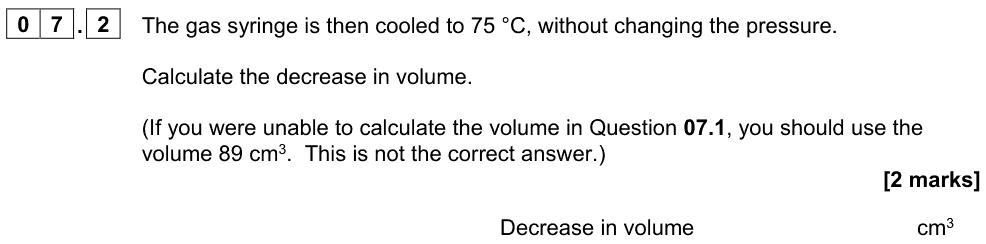
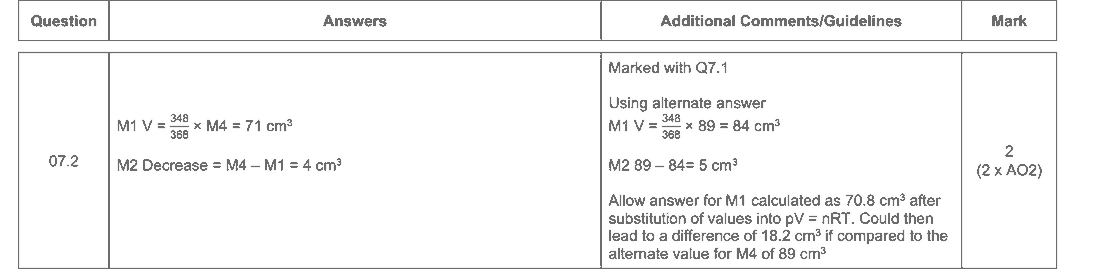
The gas syringe is then cooled to 75 °C, without changing the pressure.
Calculate the decrease in volume.
(If you were unable to calculate the volume in Question 07.1, you should use the
volume 89 cm3.  This is not the correct answer.)
[2 marks]
Decrease in volume
cm3
June 2023 · Paper 2 · Q07.3 2 marks AO2=2 Calculation amount of substance
Earlier part of question 07 that this part usesEarlier part of June 2023 Paper 2 question 07
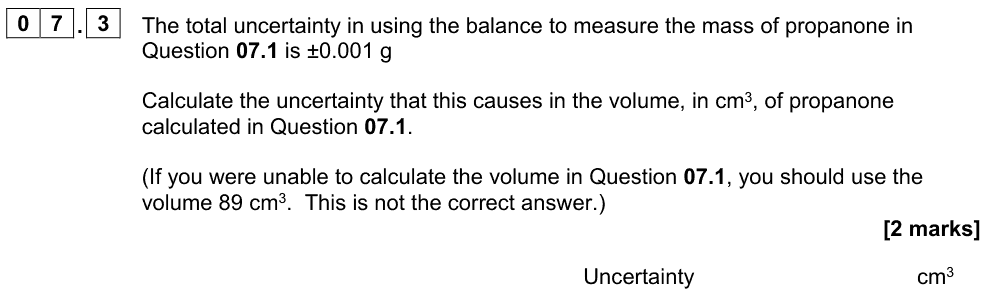
The total uncertainty in using the balance to measure the mass of propanone in
Question 07.1 is ±0.001 g
Calculate the uncertainty that this causes in the volume, in cm3, of propanone
calculated in Question 07.1.
(If you were unable to calculate the volume in Question 07.1, you should use the
volume 89 cm3.  This is not the correct answer.)
[2 marks]
Uncertainty
cm3
June 2023 · Paper 2 · Q07.4 2 marks AO2=2 Calculation amount of substance
Earlier part of question 07 that this part usesEarlier part of June 2023 Paper 2 question 07
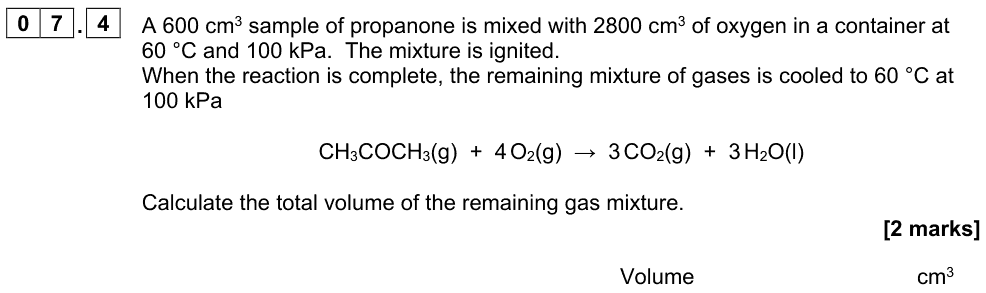
A 600 cm3 sample of propanone is mixed with 2800 cm3 of oxygen in a container at
60 °C and 100 kPa.  The mixture is ignited.
When the reaction is complete, the remaining mixture of gases is cooled to 60 °C at
100 kPa
CH3COCH3(g)  +  4 O2(g)  →  3 CO2(g)  +  3 H2O(l)
Calculate the total volume of the remaining gas mixture.
[2 marks]
Volume
cm3
June 2023 · Paper 2 · Q08.1 2 marks AO2=2 Equation writing carboxylic acids and derivatives
This question is about biofuels.
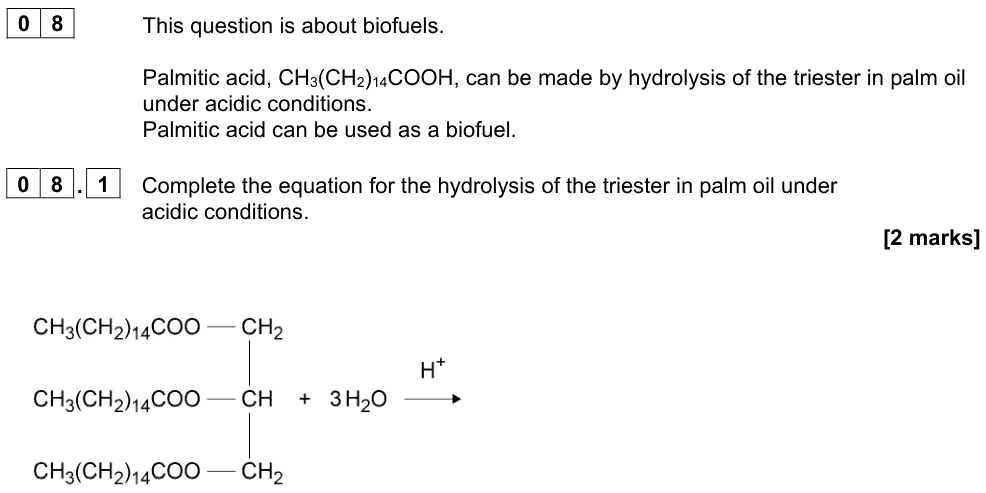
Palmitic acid, CH3(CH2)14COOH, can be made by hydrolysis of the triester in palm oil
under acidic conditions.
Palmitic acid can be used as a biofuel.
Complete the equation for the hydrolysis of the triester in palm oil under
acidic conditions.
[2 marks]
June 2023 · Paper 2 · Q08.2 5 marks AO2=5 Calculation energeticsamount of substance
Earlier part of question 08 that this part usesEarlier part of June 2023 Paper 2 question 08
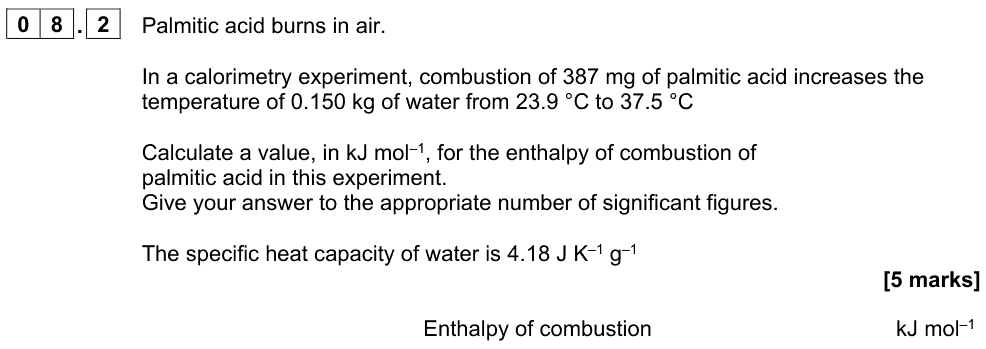
Palmitic acid burns in air.
In a calorimetry experiment, combustion of 387 mg of palmitic acid increases the
temperature of 0.150 kg of water from 23.9 °C to 37.5 °C
Calculate a value, in kJ mol–1, for the enthalpy of combustion of
palmitic acid in this experiment.
Give your answer to the appropriate number of significant figures.
The specific heat capacity of water is 4.18 J K–1 g–1
[5 marks]
Enthalpy of combustion
kJ mol–1
June 2023 · Paper 2 · Q08.3 2 marks AO2=2 Practical and data analysis energetics
Earlier part of question 08 that this part usesEarlier part of June 2023 Paper 2 question 08
State how the value calculated in Question 08.2 is likely to differ from
data book values.
Give one reason, other than heat loss, for this difference.
[2 marks]
Difference
Reason
June 2023 · Paper 2 · Q08.4 3 marks AO1=1, AO2=2 Calculation amount of substance
Earlier part of question 08 that this part usesEarlier part of June 2023 Paper 2 question 08
A sample of a different biofuel, made from sewage sludge, is found to contain
37.08% carbon, 5.15% hydrogen and 24.72% oxygen by mass.
The rest of the sample is sulfur.
Calculate the empirical formula of this biofuel.
[3 marks]
Empirical formula
June 2023 · Paper 2 · Q08.5 2 marks AO3=2 Short answer alkanes
Earlier parts of question 08 that this part usesEarlier part of June 2023 Paper 2 question 08Earlier part of June 2023 Paper 2 question 08
Complete combustion of the biofuel made from sewage sludge produces the
greenhouse gas carbon dioxide.
Suggest one other possible environmental problem with the complete combustion of
this biofuel.
State the formula of the pollutant responsible for this problem.
[2 marks]
Environmental problem
Formula
June 2023 · Paper 2 · Q08.6 3 marks AO2=3 Calculation energetics
Earlier part of question 08 that this part usesEarlier part of June 2023 Paper 2 question 08
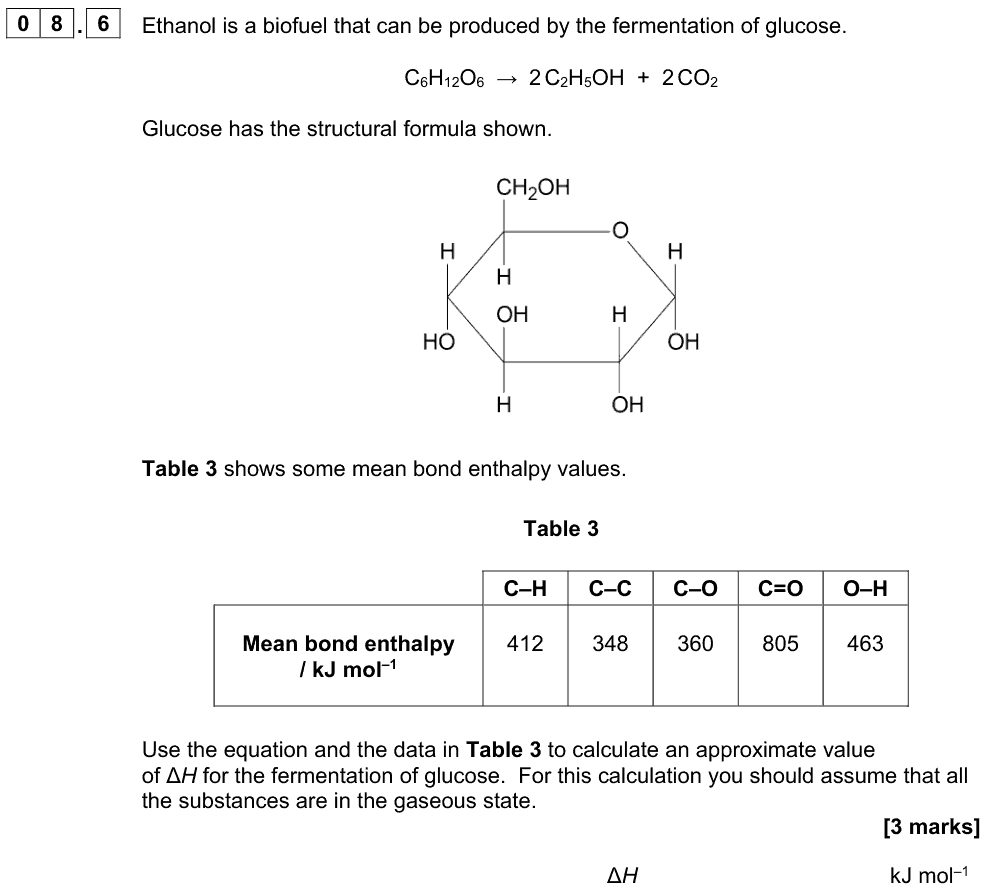
Ethanol is a biofuel that can be produced by the fermentation of glucose.
C6H12O6  →  2 C2H5OH  +  2 CO2
Glucose has the structural formula shown.
Table 3 shows some mean bond enthalpy values.
Table 3
C–H
C–C
C–O
C=O
O–H
Mean bond enthalpy
/ kJ mol–1
412
348
360
805
463
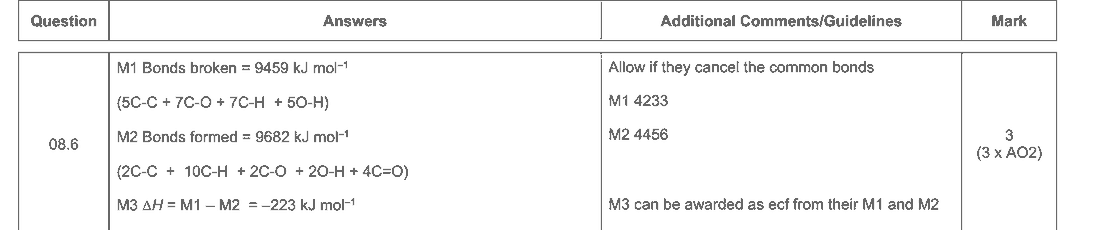
Use the equation and the data in Table 3 to calculate an approximate value
of ΔH for the fermentation of glucose.  For this calculation you should assume that all
the substances are in the gaseous state.
[3 marks]
ΔH
kJ mol–1
June 2023 · Paper 2 · Q08.7 2 marks AO2=2 Calculation energetics
Earlier part of question 08 that this part usesEarlier part of June 2023 Paper 2 question 08
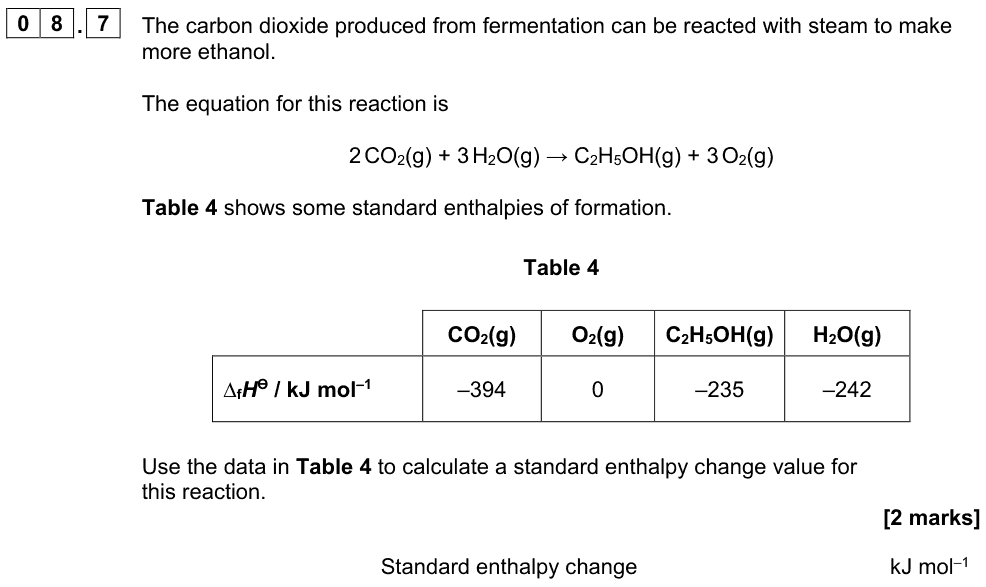
The carbon dioxide produced from fermentation can be reacted with steam to make
more ethanol.
The equation for this reaction is
2 CO2(g) + 3 H2O(g) → C2H5OH(g) + 3 O2(g)
Table 4 shows some standard enthalpies of formation.
Table 4
CO2(g)
O2(g)
C2H5OH(g)
H2O(g)
∆fHϴ / kJ mol–1
–394
0
–235
–242
Use the data in Table 4 to calculate a standard enthalpy change value for
this reaction.
[2 marks]
Standard enthalpy change
kJ mol–1
June 2023 · Paper 2 · Q09.1 1 mark AO2=1 Short answer introduction to organic chemistry
This question is about ethanoic anhydride.
In the gas phase, ethanoic anhydride (CH3CO)2O decomposes to form ethenone.
The equation is
(CH3CO)2O    →   H2C=C=O  +  CH3COOH
Ethenone
Ethenone is the simplest member of the ketene homologous series.
Ketenes all contain one C=C double bond and one C=O double bond.
Deduce the general formula for the ketene homologous series.
[1 mark]
June 2023 · Paper 2 · Q09.2 3 marks AO2=3 Mechanism introduction to organic chemistry
Earlier part of question 09 that this part usesEarlier part of June 2023 Paper 2 question 09
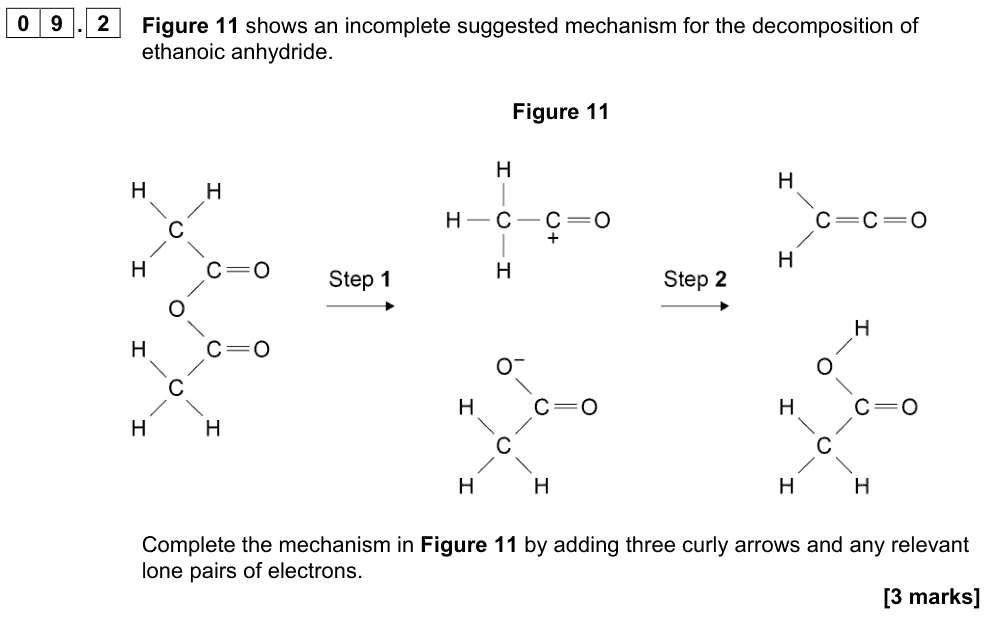
Figure 11 shows an incomplete suggested mechanism for the decomposition of
ethanoic anhydride.
Figure 11
Complete the mechanism in Figure 11 by adding three curly arrows and any relevant
lone pairs of electrons.
[3 marks]
June 2023 · Paper 2 · Q09.3 3 marks AO2=3 Calculation rate equations
Earlier part of question 09 that this part usesEarlier part of June 2023 Paper 2 question 09
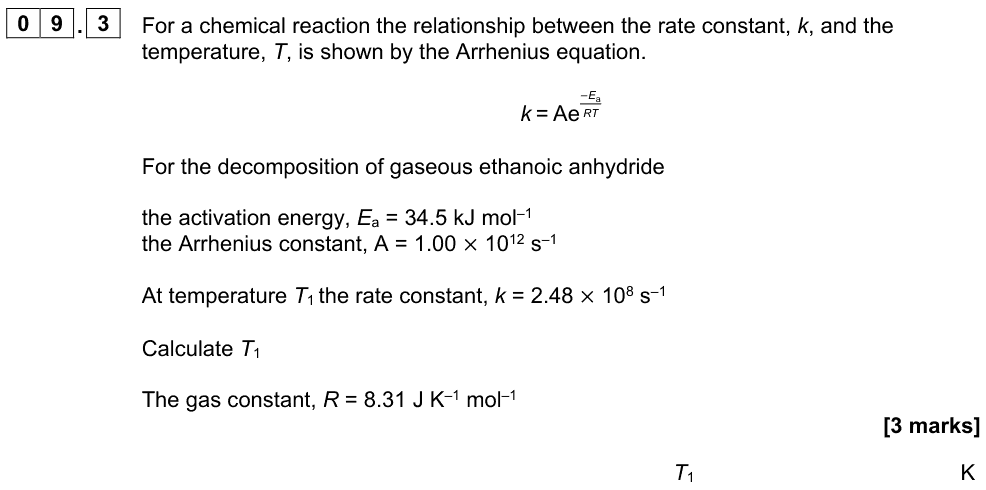
For a chemical reaction the relationship between the rate constant, k, and the
temperature, T, is shown by the Arrhenius equation.
k = Ae
−Ea
RT
For the decomposition of gaseous ethanoic anhydride
the activation energy, Ea = 34.5 kJ mol–1
the Arrhenius constant, A = 1.00 × 10¹² s–1
At temperature T1 the rate constant, k = 2.48 × 10⁸ s–1
Calculate T1
The gas constant, R = 8.31 J K–1 mol–1
[3 marks]
T1
K
June 2023 · Paper 2 · Q09.4 5 marks AO1=5 Diagram or structure kinetics
Earlier part of question 09 that this part usesEarlier part of June 2023 Paper 2 question 09
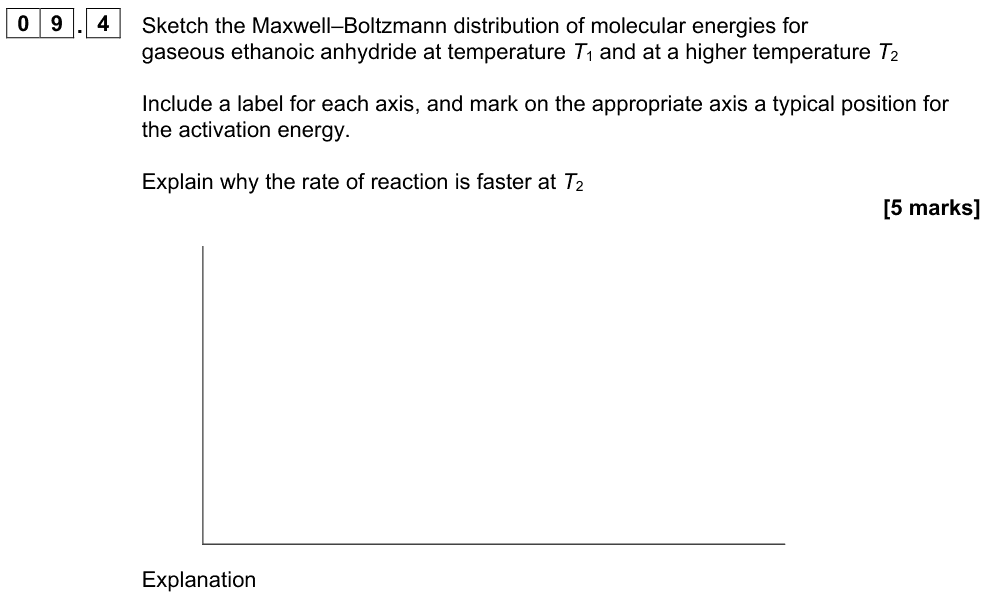
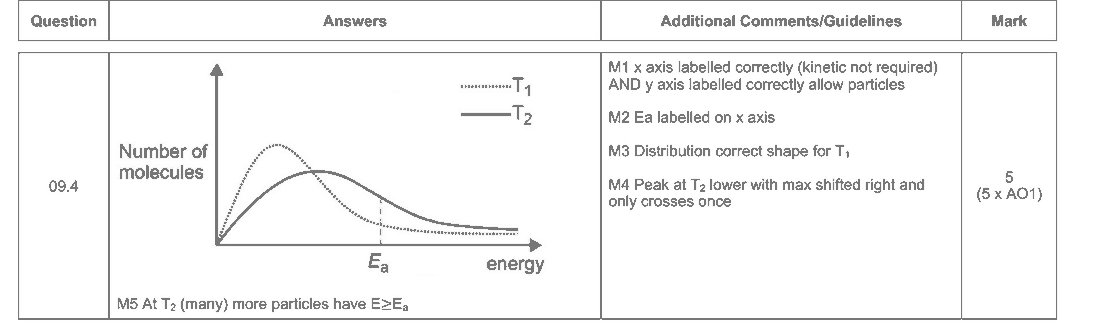
Sketch the Maxwell–Boltzmann distribution of molecular energies for
gaseous ethanoic anhydride at temperature T1 and at a higher temperature T2
Include a label for each axis, and mark on the appropriate axis a typical position for
the activation energy.
Explain why the rate of reaction is faster at T2
[5 marks]
Explanation

Work with an A-level chemistry tutor

Want a paper marked and gone through with you? Message us.

Prefer email? Send an enquiry

If you are under 18, please include a parent's contact details. Enquiries go to enquiries@chemistryaleveltutor.com and are deleted once handled. All tutoring is online.