Mark scheme

Examiner's comment
01.1 The equation was an easy starter and 90.1% of the students gained the mark.
Notes from the mark scheme and report
- C7H16 + 11O2 → 7CO2 + 8H2O
105 marks · 44 question parts · Paper, mark scheme and report on AQA's site · Have the Data Booklet beside you
01.1 The equation was an easy starter and 90.1% of the students gained the mark.
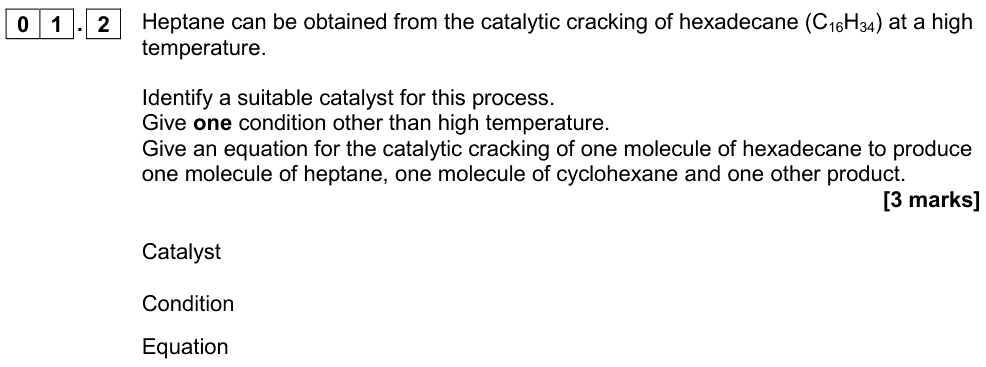
01.2 Most students were able to give a correct catalyst and the correct equation. However, the pressure condition was not answered well. Low or high pressure were common wrong answers and there were some contradictions. Although temperature was not required, it was sometimes given.

01.3 Only the better students scored both marks, but nearly two-thirds of the students scored one out of two. Common errors were to give the ambiguous radical, C4H9
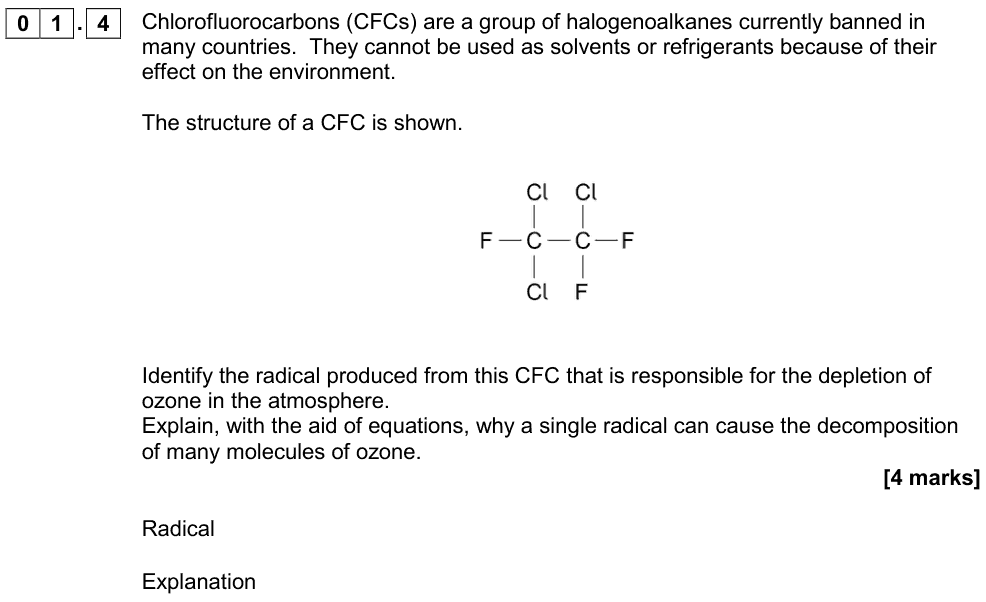
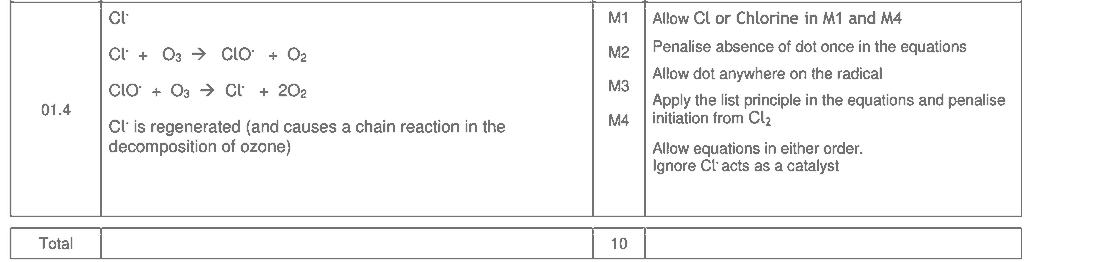
01.4 This four mark question was answered well and 40.2% of candidates gained full marks. The chlorine radical was well known although F. and other radicals from the CFC were seen. A few students thought that Cl. came from Cl2 rather than from the CFC and this was penalised. There were a few missing dots in the equations. Mark point 4 was usually gained, although some candidates wrote about Cl. acting as a catalyst and not being used up, without stating that it was regenerated/reformed.
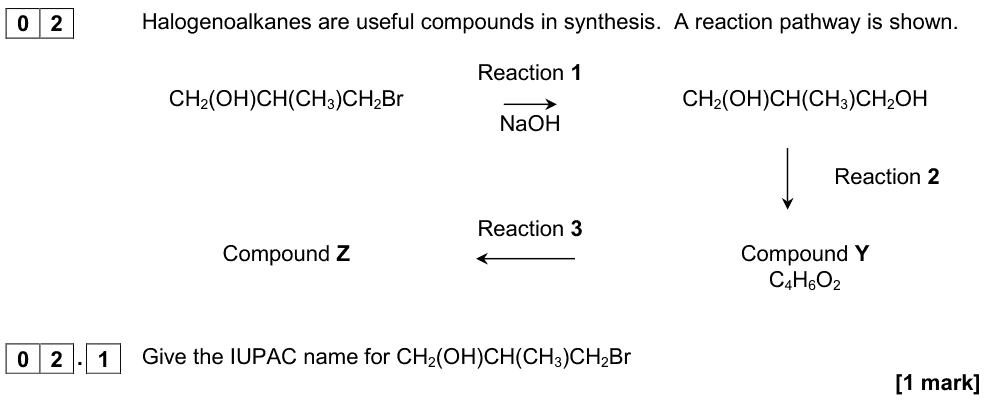
02.1 Most students correctly identified the main chain and the prefixes. However, only 40% gained the mark because of frequent errors in applying IUPAC rules in the numbering and alphabetical order of prefixes.

02.2 The polarity of the bond between the bromine and the carbon, with the result that the carbon was slightly positive, was well known, although many struggled to explain this by a comparison of electronegativities. Some students failed to gain mark point 3 as they referred to nucleophiles as electron donors rather than electron pair donors, or simply stated that the nucleophile was attracted to the slightly positive carbon atom.

02.3 This question was answered correctly by 39.4% of the students. Others identified the correct molecule but did not draw it as a displayed formula; −CH3 was the most common error here. Some students drew an −OH group and a −C=O group in the same molecule, rather than two aldehyde groups; another common mistake was to draw butanedial.
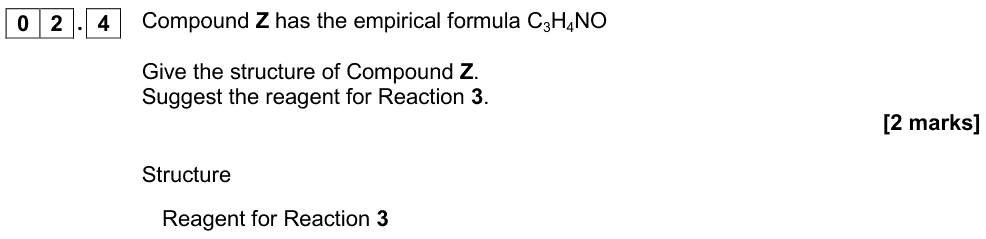
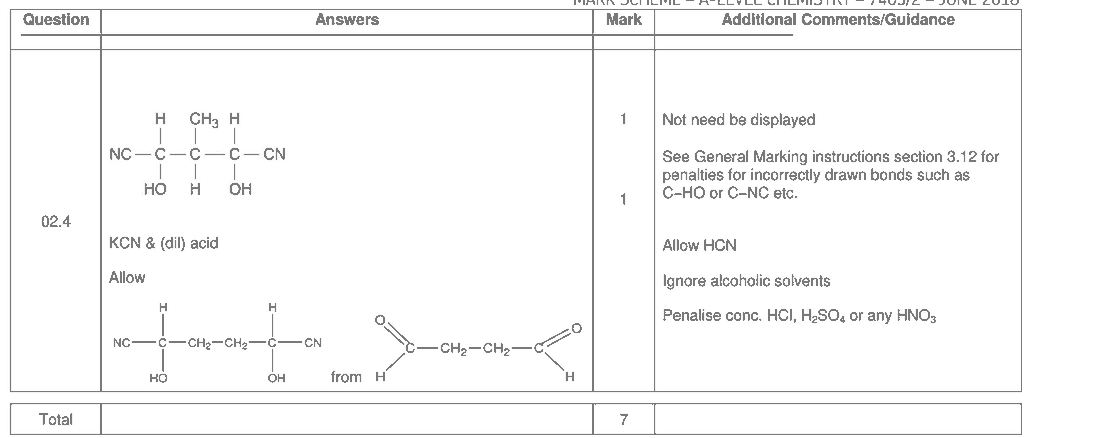
02.4 Most students identified that nitrile groups were present in this molecule, although some drew amines. There were some incorrectly drawn bonds, notably C–NC (see Mark Scheme Instructions for Examiners, section 3.12). Some who drew the incorrect butanedial in question 02.3 gained a mark here for a correct consequential structure. The reagent for Reaction 3 was not well answered. Many students missed the need for acid with KCN and some suggested the CN− ion, which is an incomplete reagent.
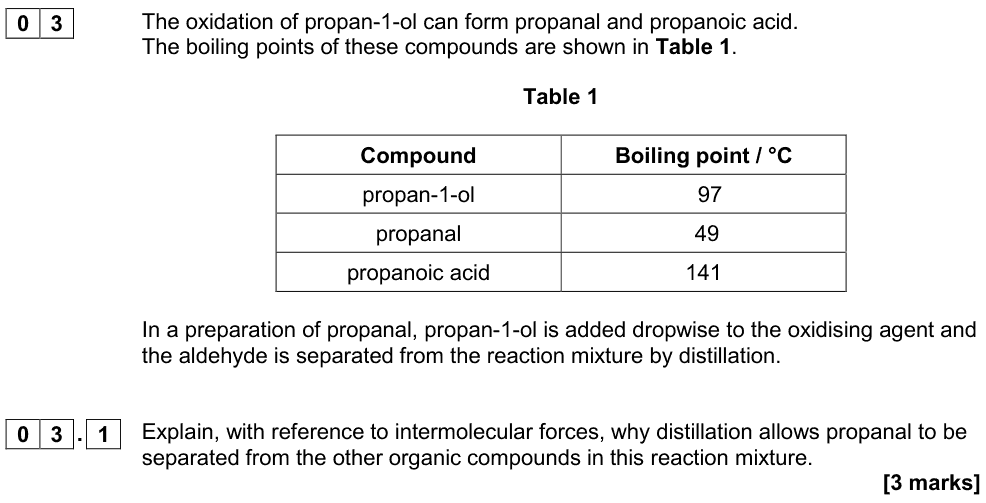
03.1 This question discriminated well: 28.3% of students correctly identified the types of intermolecular forces and noted that hydrogen bonding in the alcohol and the acid was stronger than dipole-dipole attractions between propanal molecules. Despite the request in the question to consider intermolecular forces, a few students still discussed the breaking of bonds in the molecules and so gained no marks, although fewer did this than is often the case in this type of question.
Skills: RP5 Distillation of a product from a reaction
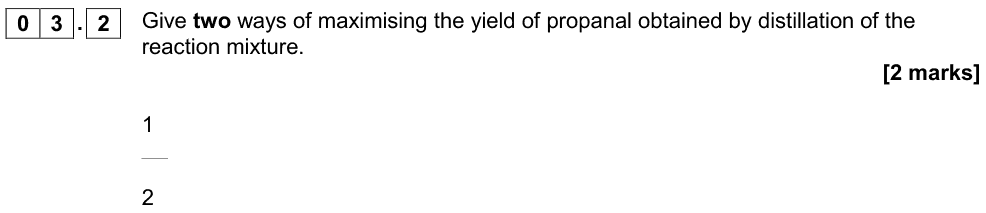
03.2 Very few students (4%) scored both marks in this question and only 39.2% scored at least one mark, despite the question being based on one of the required practical activities.
Skills: ATd Use laboratory apparatus for a variety of experimental techniques including: titration, using burette and pipette; distillation and heating under reflux, including setting up glassware using retort stand and clamps; qualitative tests for ions and organic functional groups; filtration, including use of fluted filter paper, or filtration under reduced pressure; PS4.1 Know and understand how to use a wide range of experimental and practical instruments, equipment and techniques appropriate to the knowledge and understanding included in the specification; PS2.1 Comment on experimental design and evaluate scientific methods; RP5 Distillation of a product from a reaction

03.3 This part was answered well by nearly two-thirds of the students. The main error was to test for the aldehyde rather than the acid.
Skills: ATd Use laboratory apparatus for a variety of experimental techniques including: titration, using burette and pipette; distillation and heating under reflux, including setting up glassware using retort stand and clamps; qualitative tests for ions and organic functional groups; filtration, including use of fluted filter paper, or filtration under reduced pressure; PS4.1 Know and understand how to use a wide range of experimental and practical instruments, equipment and techniques appropriate to the knowledge and understanding included in the specification; RP6 Tests for alcohol, aldehyde, alkene and carboxylic acid
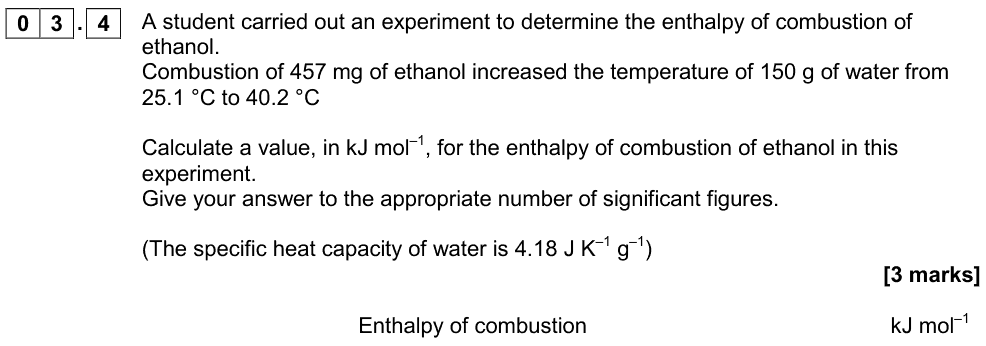
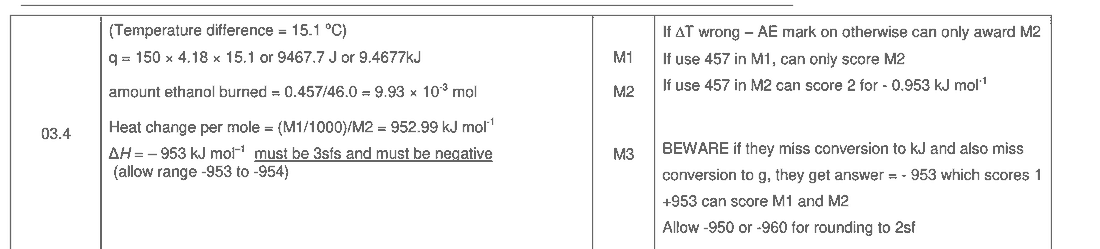
03.4 This question discriminated well and there was a good spread of marks. Sadly, some students did not quote their answers to three significant figures and/or remember the negative sign for their exothermic enthalpy change of combustion.
Skills: MS0.0 Recognise and make use of appropriate units in calculation; MS1.1 Use an appropriate number of significant figures; MS2.3 Substitute numerical values into algebraic equations using appropriate units for physical quantities; RP2 Measurement of an enthalpy change
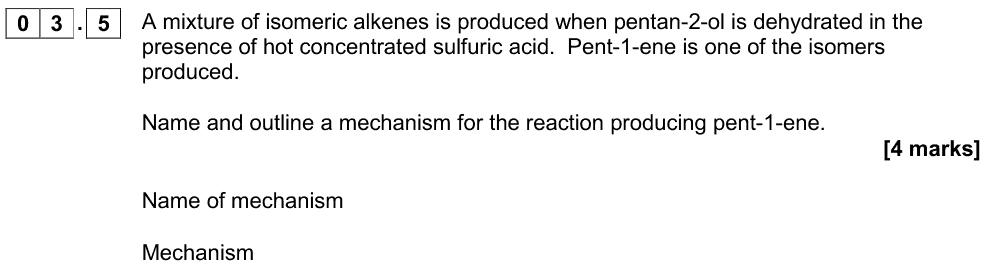
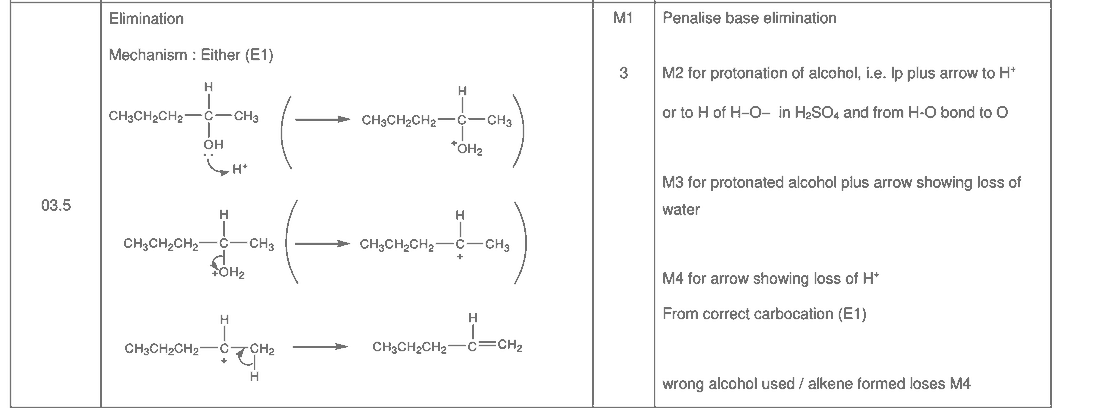
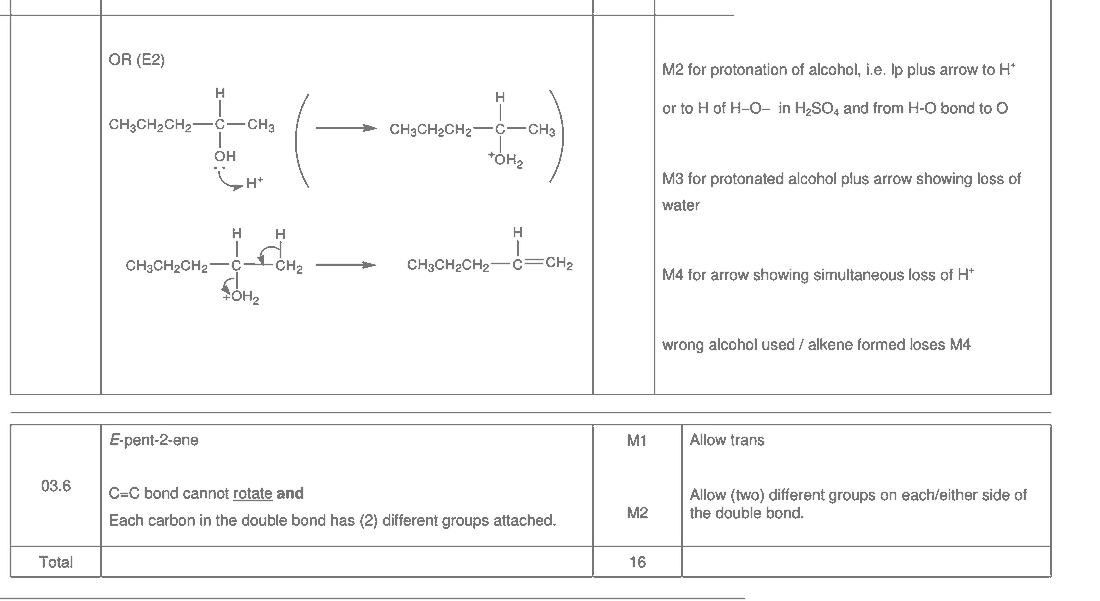
03.5 The major errors in the answers to this acid-catalysed elimination of water were where students confused this mechanism with the elimination of HX from a halogenoalkane using a base. However, just under a third of students scored full marks in a correct mechanism, either via the formation of a carbocation or by showing the simultaneous loss of water and H+ from a protonated alcohol.
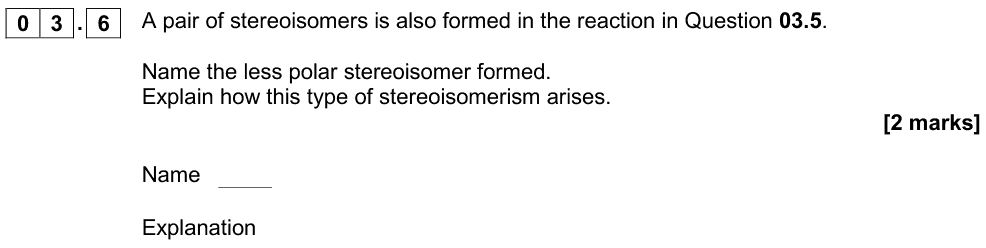
03.6 This part was challenging and a surprising proportion of students (8%) made no attempt. A large number scored no marks as they discussed the formation of different alkenes, rather than why pent-2-ene shows E-Z isomerism. Sadly, some of those who did gain the first mark failed to gain the second as this required two statements, not only that the C=C bond cannot rotate, but also that each carbon in the double bond has two different groups attached to it.
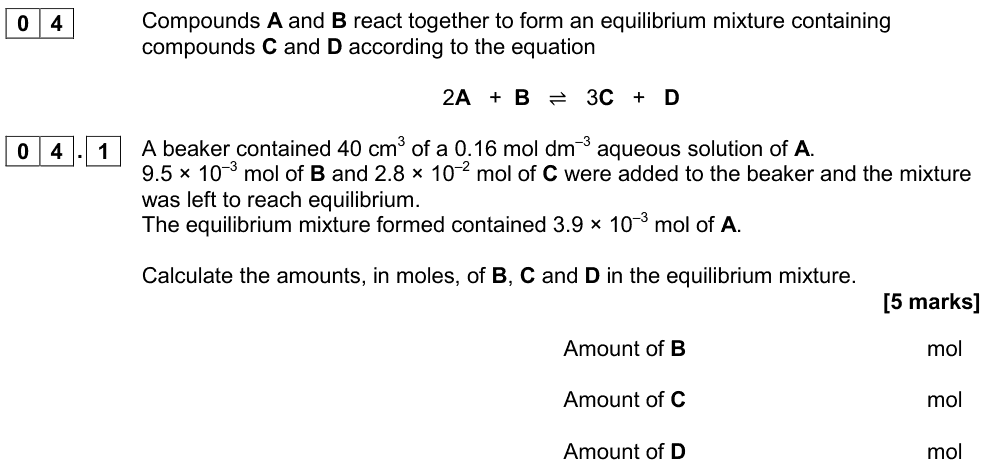
04.1 Many students gained high marks in this question – over 70% scored 4 or 5. Others often failed to use the mole ratio from the equation when deducing the amounts, in moles, of reagents at equilibrium.
Skills: MS0.2 Use ratios, fractions and percentages

04.2 The expression and its units were given correctly by over 82% of students.
Skills: MS0.0 Recognise and make use of appropriate units in calculation
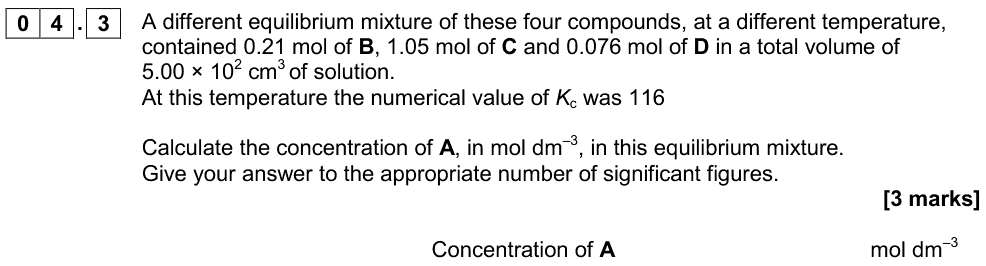
04.3 In this question, many students were able to re-arrange the expression for Kc but significant numbers failed to divide the amounts in moles that they were given by the correct volume in dm3. Some failed to gain a mark by giving the answer as the amount, in moles, of A rather than its concentration. Since the least precise data in the question were given to two significant figures, the final answer for concentration should have been given to two significant figures, so some students failed to gain the final mark because the answer was given to the wrong number of significant figures.
Skills: MS1.1 Use an appropriate number of significant figures; MS2.2 Change the subject of an equation; MS2.3 Substitute numerical values into algebraic equations using appropriate units for physical quantities

04.4 This question was poorly answered and showed that students were unfamiliar with the idea of the equilibrium moving to the side with a larger amount, in moles, to oppose the fall in concentrations of all reagents when more water was added to the equilibrium mixture. Credit was given to those few students who adopted a mathematical approach. 65.8% of students failed to score here.
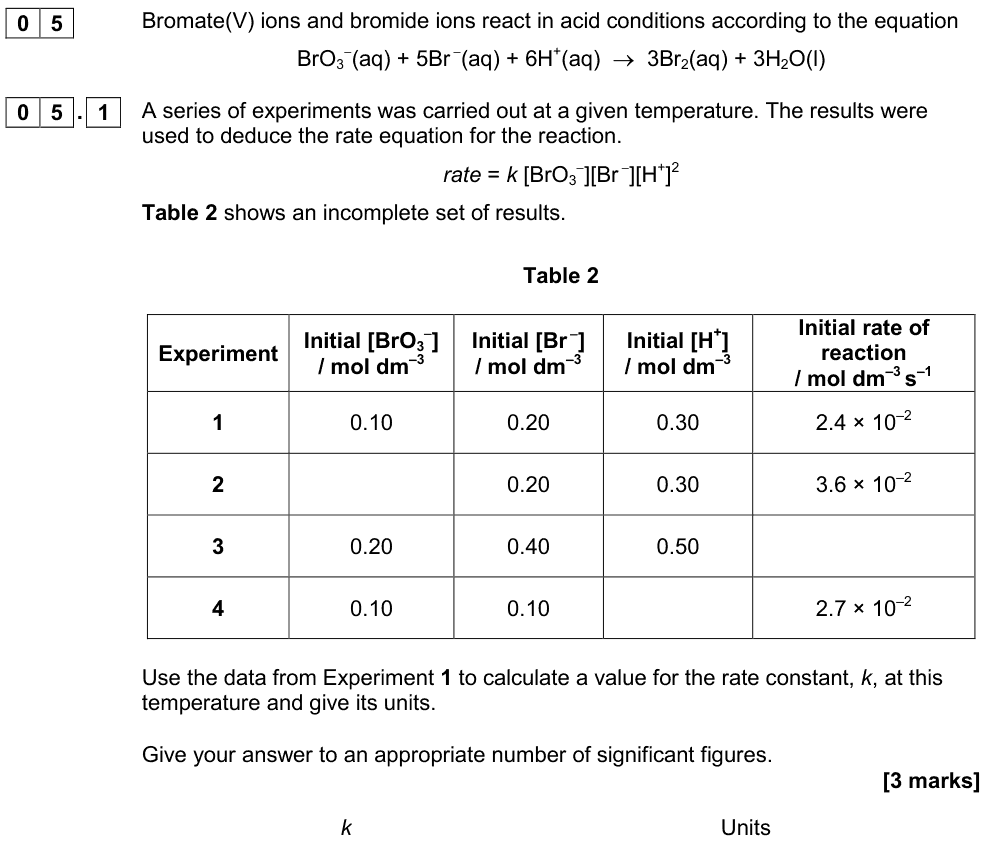
05.1 28.5% of students scored full marks in this question, but others failed to gain marks either by giving the answer to three significant figures (or as the fraction 40/3), or for incorrect signs for the powers in the units.
Skills: MS0.0 Recognise and make use of appropriate units in calculation; MS1.1 Use an appropriate number of significant figures; MS2.2 Change the subject of an equation; MS2.3 Substitute numerical values into algebraic equations using appropriate units for physical quantities

05.2 Almost all students gave the correct answer to Experiment 2. Over 60% of students also scored the other two marks but some found these two other parts harder. There were also some who rounded their answer to one figure and failed to gain the mark.
Skills: MS2.2 Change the subject of an equation; MS2.3 Substitute numerical values into algebraic equations using appropriate units for physical quantities
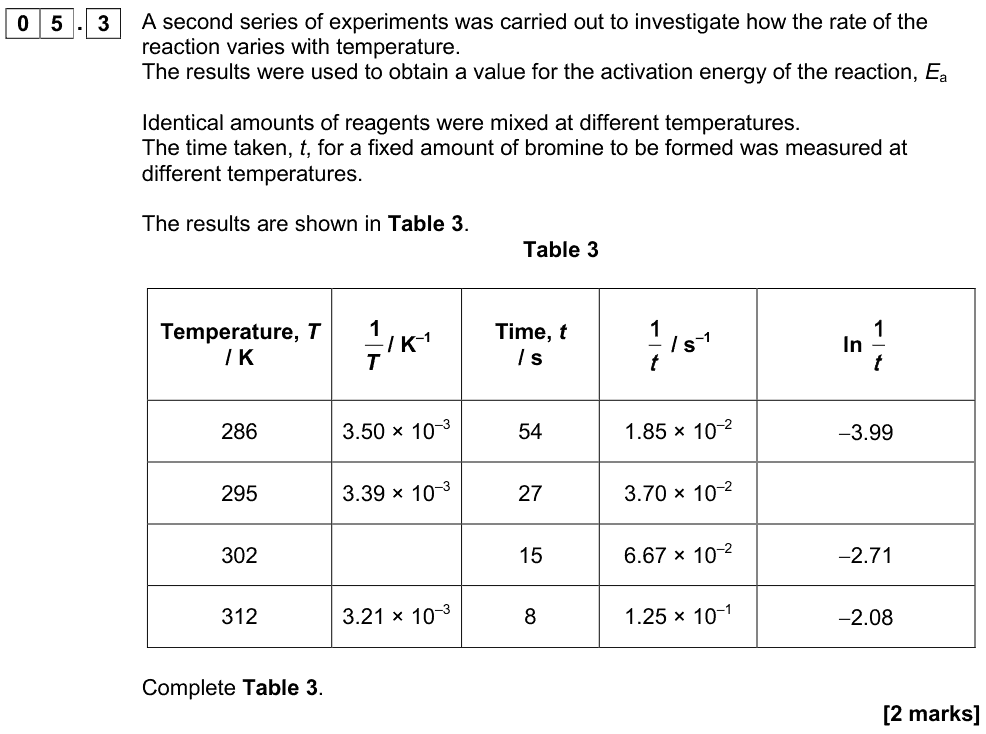
05.3 The two values in Table 3 were given correctly by 82% of students. Of the others, some gave values that were incorrectly rounded.
Skills: MS0.4 Use calculators to find and use power, exponential and logarithmic functions; MS1.1 Use an appropriate number of significant figures; MS2.5 Use logarithms in relation to quantities that range over several orders of magnitude; RP3 Investigation of how the rate of a reaction changes with temperature
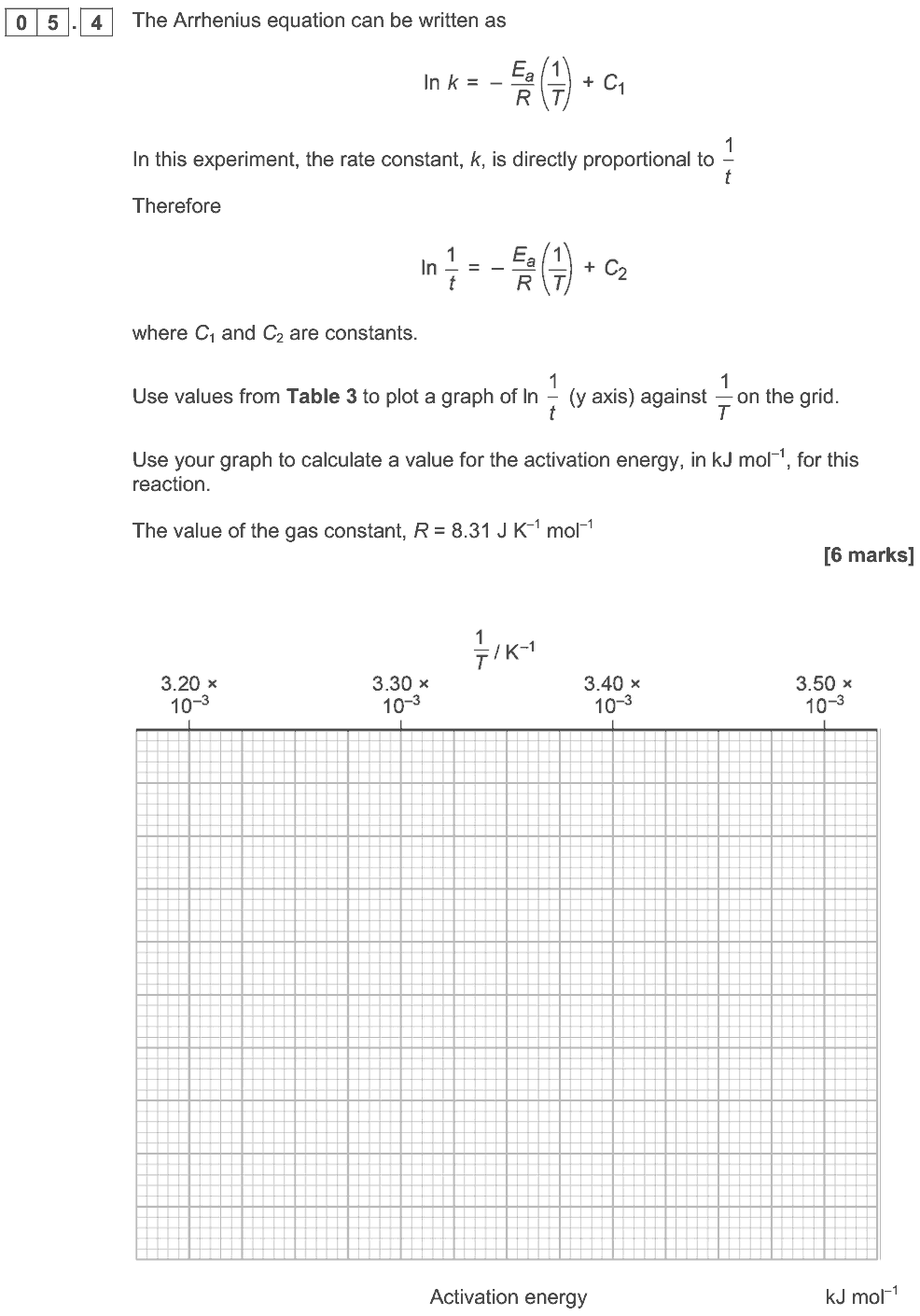
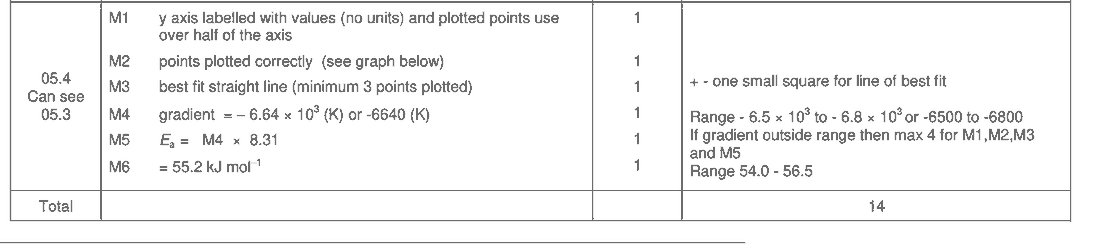
05.4 The best students scored full marks for answers which included carefully drawn graphs. However, there was a spread of marks down to those who were unable to plot the graph correctly or those few who made no attempt. An appreciable number of students chose a wrong scale for the y-axis and only used half of the grid provided. This small graph often led to an inaccurate gradient and so an activation energy that was outside the expected range.
Skills: MS2.5 Use logarithms in relation to quantities that range over several orders of magnitude; MS3.1 Translate information between graphical, numerical and algebraic forms; MS3.2 Plot two variables from experimental or other data; MS3.3 Determine the slope and intercept of a linear graph; PS3.1 Plot and interpret graphs; PS3.2 Process and analyse data using appropriate mathematical skills as exemplified in the mathematical appendix for each science; RP3 Investigation of how the rate of a reaction changes with temperature
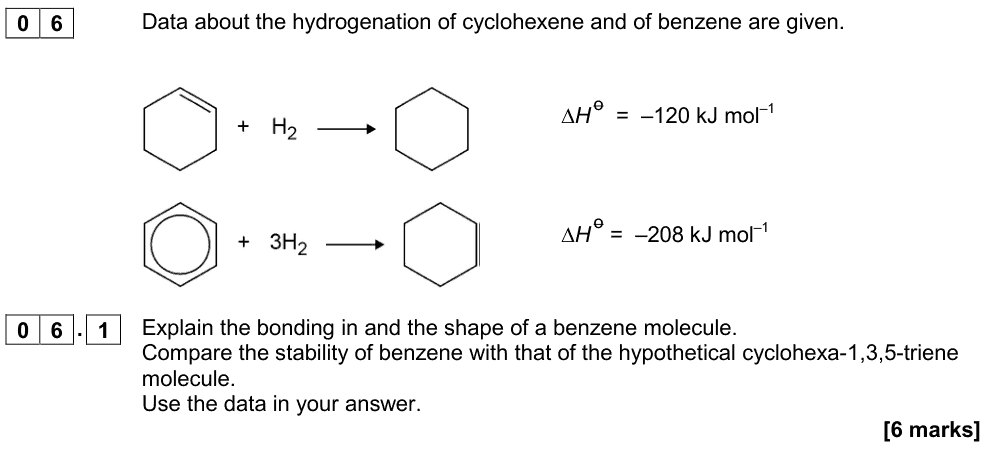
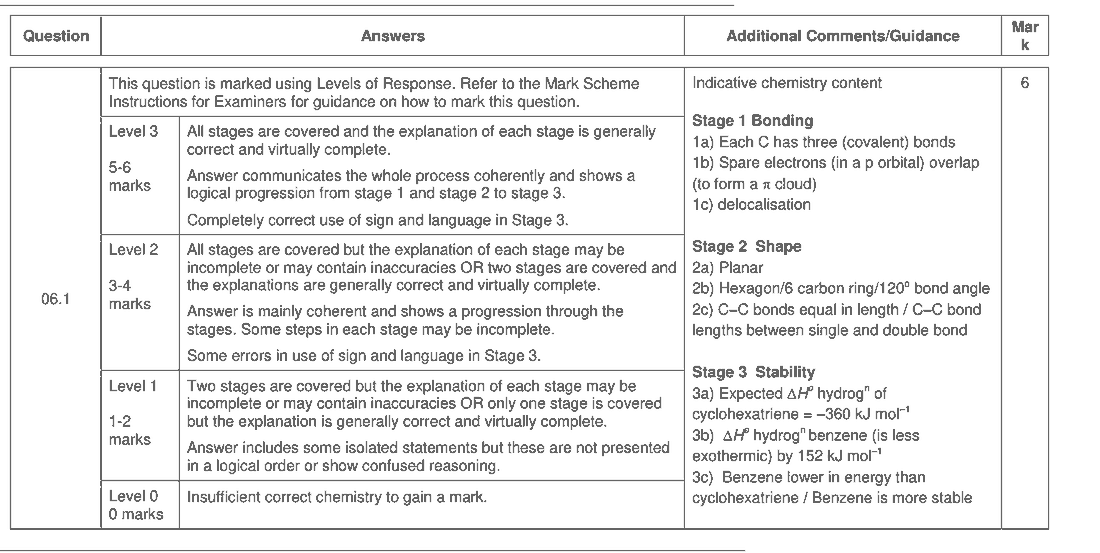
06.1 All but the weakest students were able to calculate the expected enthalpy of hydrogenation of –360 kJ mol–1 and the consequent 152 kJ mol–1 extra stability of benzene and explain this in terms of electron delocalisation. Most students knew that carbon formed three bonds but only a few were able to discuss that the extra outer shell p electrons overlap to form the pi cloud. Shape was less commonly discussed, although many noted that the molecule was planar. Sadly, although Level 3 answers were provided by 15.3% of the students, only a third of these gained full marks as their explanations often contained errors such as “hydration” for hydrogenation, or unclear discussion about bond breaking during the addition of hydrogen.
Skills: MS4.1 Use angles and shapes in regular 2D and 3D structures

06.2 This question proved challenging. Some students gave a wrong value that was more exothermic than –240 kJ mol−1. Of those who gave a suitable value, many were unable to explain it in terms of some extra stability due to delocalisation. Only 8.7% of students were able to justify this in terms of alternate single and double bonds forming a conjugated system and so gain full marks.
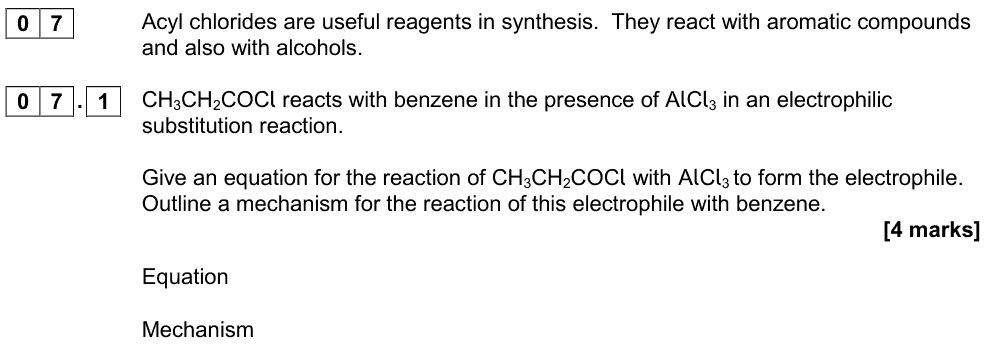
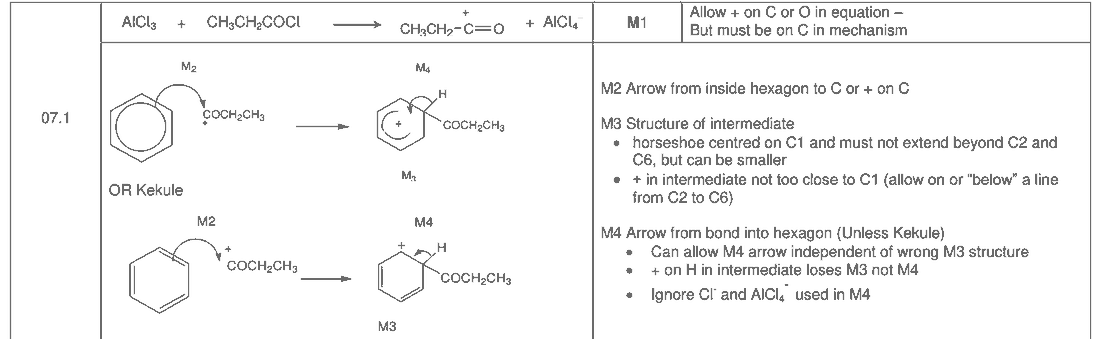
07.1 This was a straightforward question on a familiar topic and many good students (46.5%) scored full marks. However, some drew structures, such as the horseshoe in the mechanism, with insufficient care and consequently failed to gain marks. Others omitted charges on the ions in the equation (especially on AlCl4
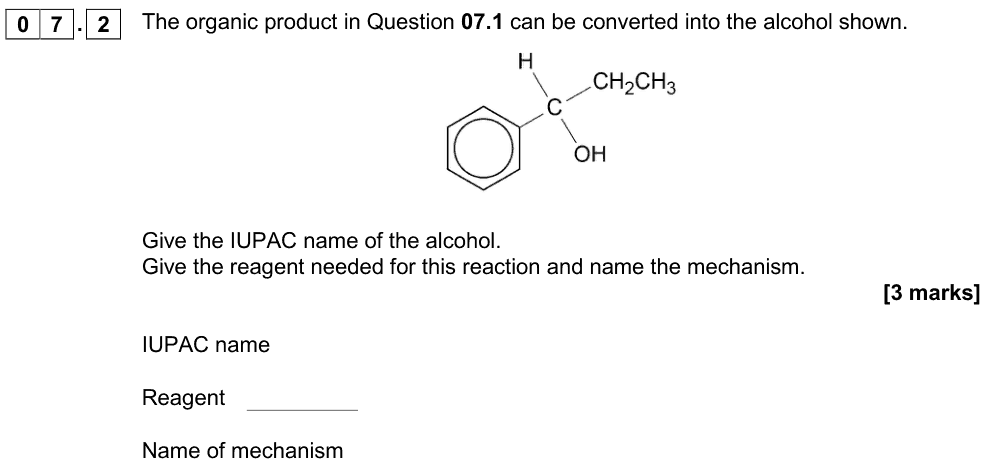
07.2 In this question, although some students struggled with the name, a number failed to gain the mark due to a failure to label 1-phenyl in an otherwise correct name. Most identified a correct reagent but “electrophilic addition” and “reduction” were frequent wrong answers for the name of the mechanism.
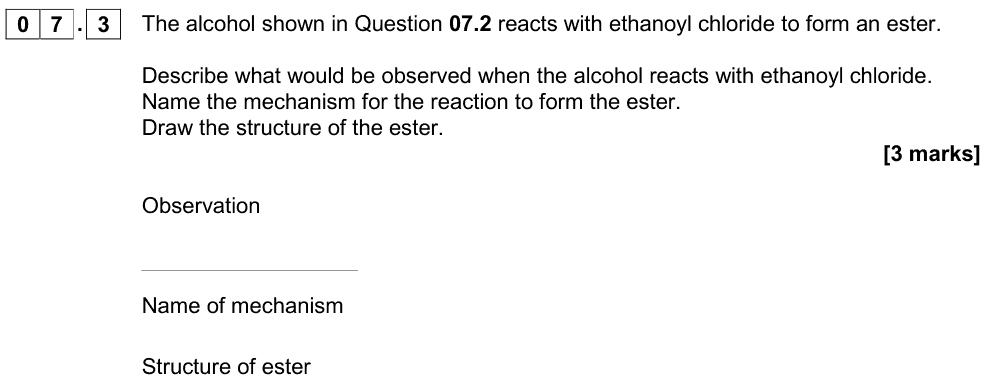
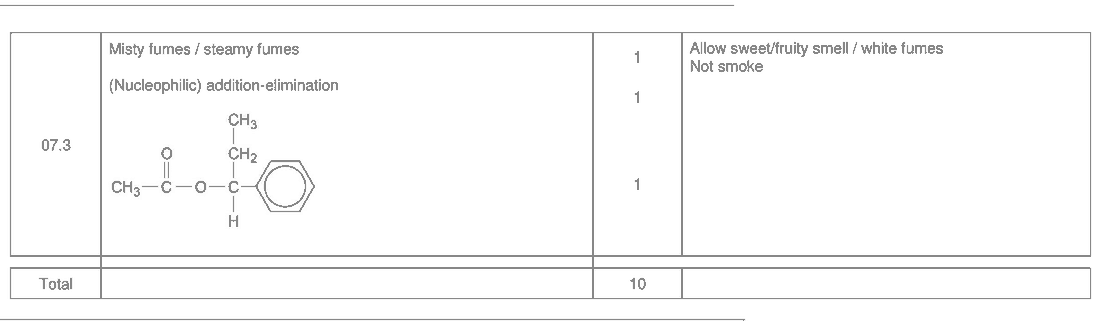
07.3 This question was generally answered well, especially the name of the mechanism and the structure of the ester. A common error was to give the name of the product, i.e. ‘HCl gas’, rather than an observation as required, or alternatively to describe this as a ‘white precipitate’.
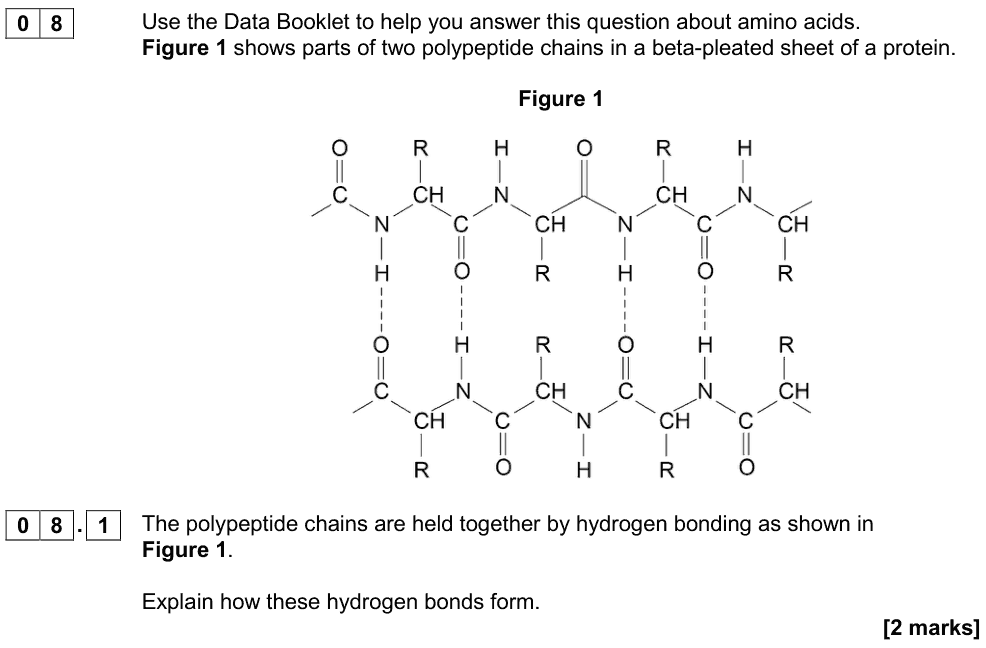
08.1 There were many good answers to this question. Most students scored the first mark for correctly identifying that the hydrogen on the nitrogen is electron deficient. The second mark proved to be more difficult and many failed to identify that the attraction was between the lone pair on the oxygen and the electron deficient hydrogen.
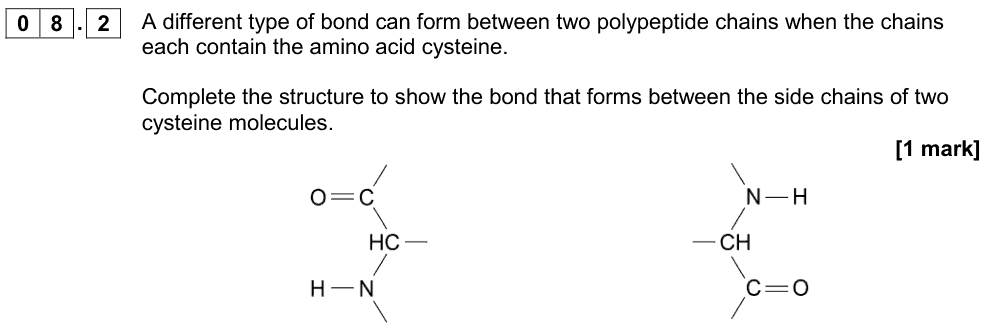
08.2 This question was not well answered and 12.6% of the students made no attempt at all. Of those who did, very few seemed to be aware of disulphide bridges. Others did not show the bridge as a covalent bond, omitted the two CH2 groups, or had an additional hydrogen attached to each sulfur.

08.3 This part was well known; 73.5% of students gained the mark.

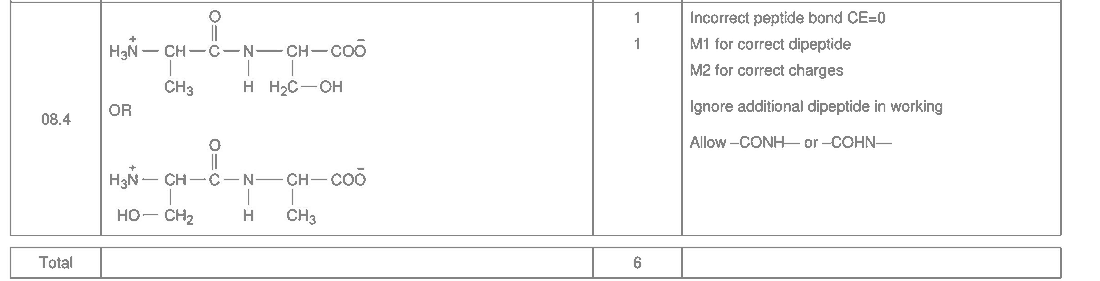
08.4 Over half of the students drew a correct zwitterion. The most common errors were using a wrong amino acid or including an oxygen atom between the C and N of the peptide link. Other students were penalised due to careless drawing of the structures (by including too many or too few H atoms) or if they showed loss of a proton from the alcohol group in serine.
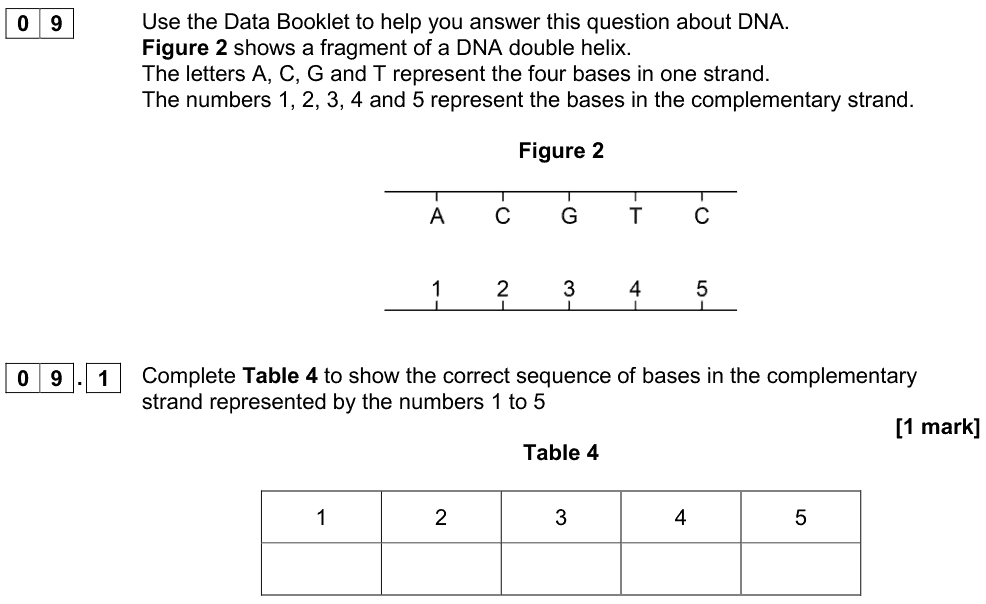
09.1 All but the weakest 9% of students answered this part correctly.
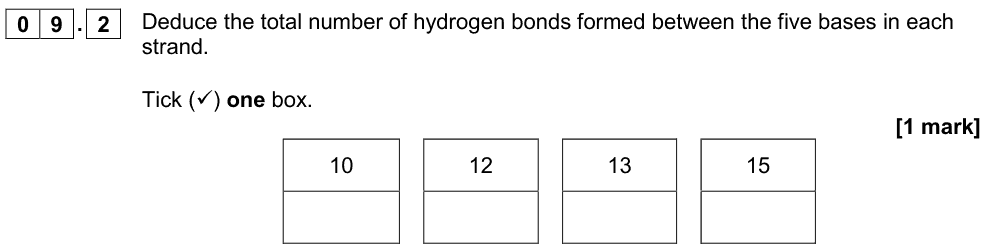
09.2 This question was also answered well and 78.3% of students gained the mark.
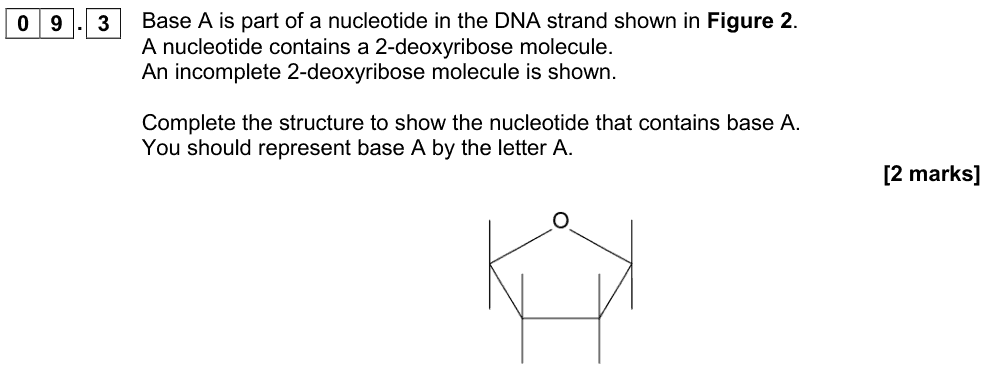
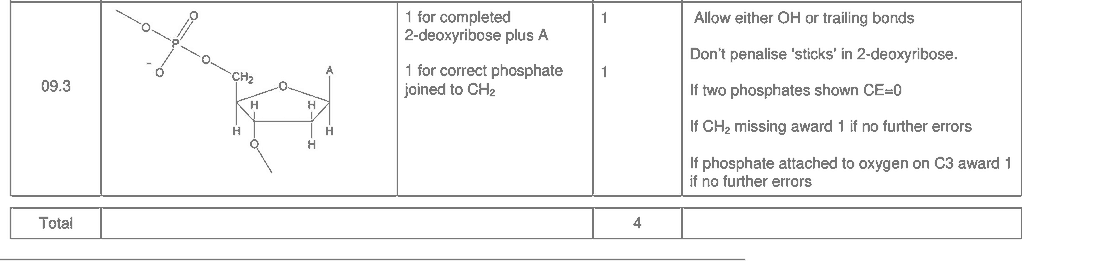
09.3 Only 14.4% of students gained two marks for this question. The drawing of the phosphate group in the correct place was the mark most commonly gained. Trailing bonds were rarely seen. It was common to see structures that had no phosphate groups attached at all, with students simply copying the sugar straight from the data sheet and adding the base A. A few scripts gave a structure with two phosphate groups rather than just one. The CH2 group linking the sugar to the phosphate was frequently omitted. For the attachment between the sugar and the base, an additional oxygen atom was sometimes shown incorrectly as a linking group.
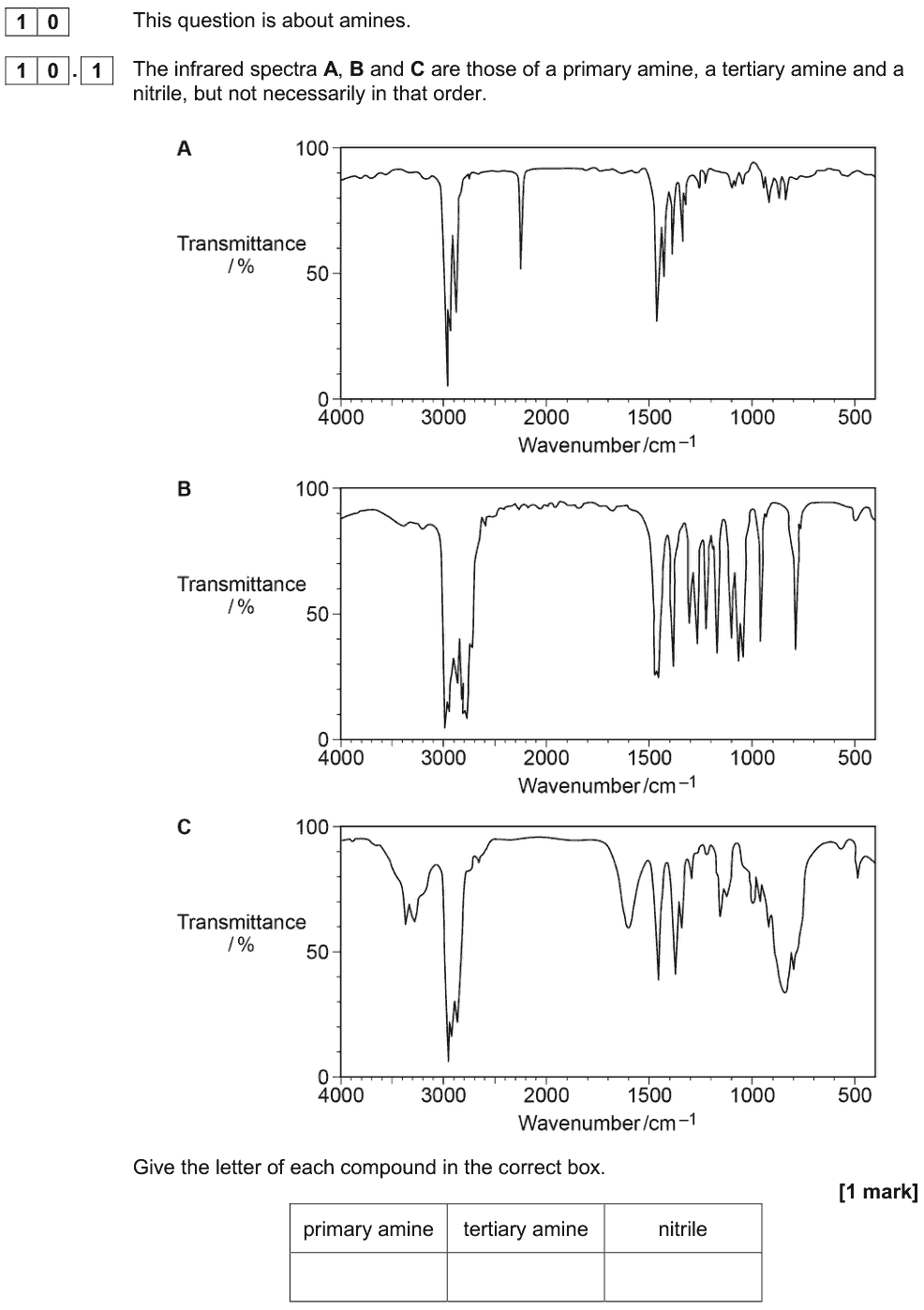
10.1 This was answered correctly by almost two-thirds of the students. The most common error was to confuse B and C.

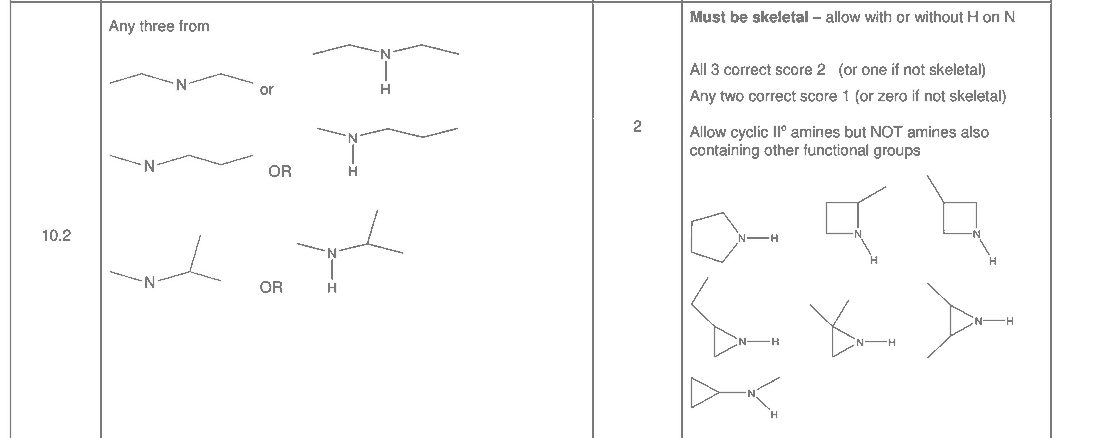
10.2 This question discriminated well and the best students drew three correct skeletal formulas. Cyclic secondary amines were accepted as long as there was no other functional group present, and one cyclic amine was sometimes included in place of the isomer with the branched propyl group. A common error was to draw primary amines based on branched alkyl groups.

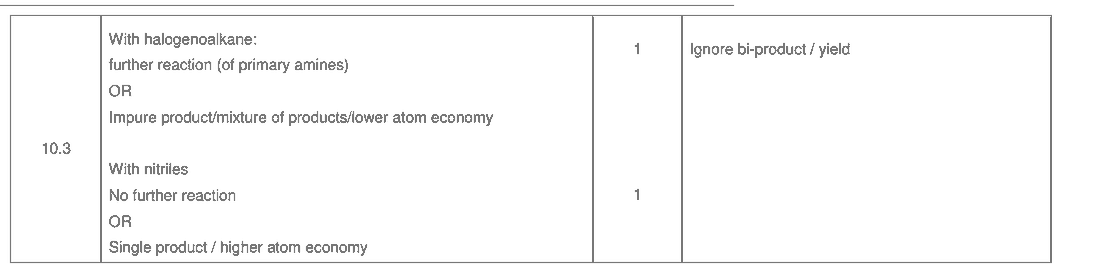
10.3 Both marks were gained by the 28.9% of the students who stated that further substitution reactions would occur following the formation of a primary amine from a halogenoalkane, and also that no further reaction would occur when primary amines were formed from nitriles. The second mark was less often gained, sometimes because students made no comment about nitriles at all.

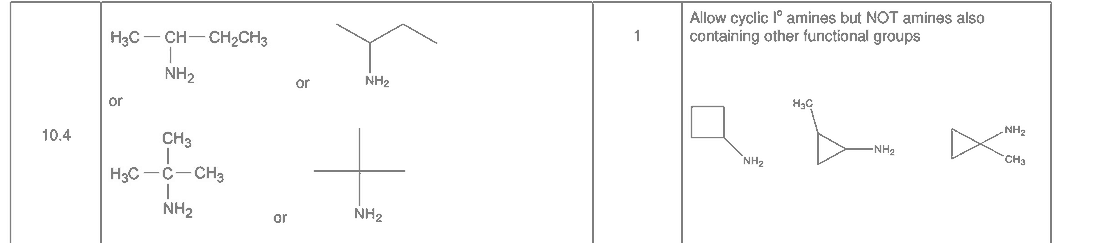
10.4 This was answered well although 12.4% of the students did not attempt the question.
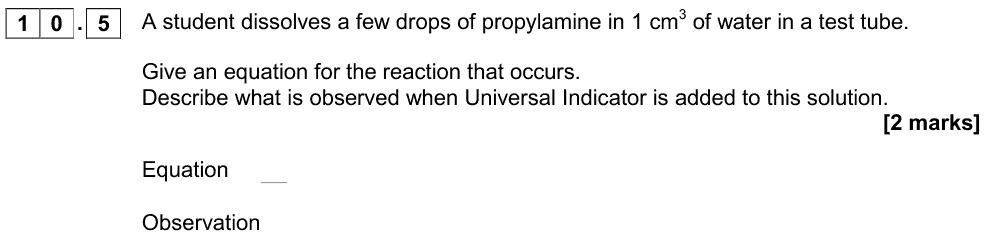
10.5 Many students were able to write a correct equation for the reaction between propylamine and water. However, some incorrectly suggested that the weak base would turn the indicator purple. Examiners noted that the use of litmus was sometimes described instead of Universal Indicator. The frequency with which this occurred suggests that some students do not necessarily make a distinction between U. I. and litmus.
Skills: ATc Measure pH using pH charts, or pH meter, or pH probe on a data logger
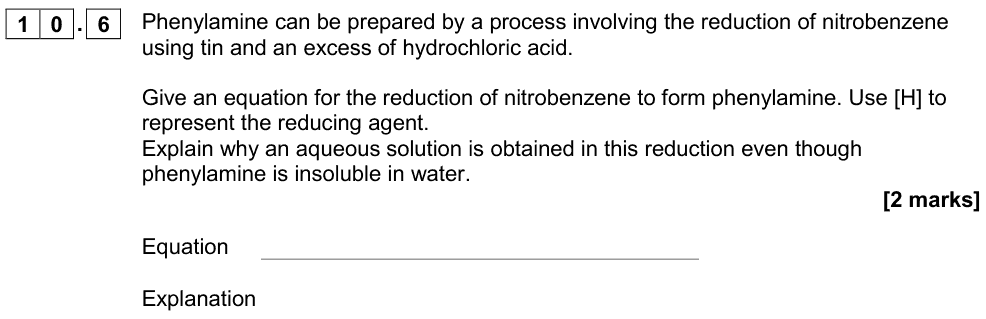
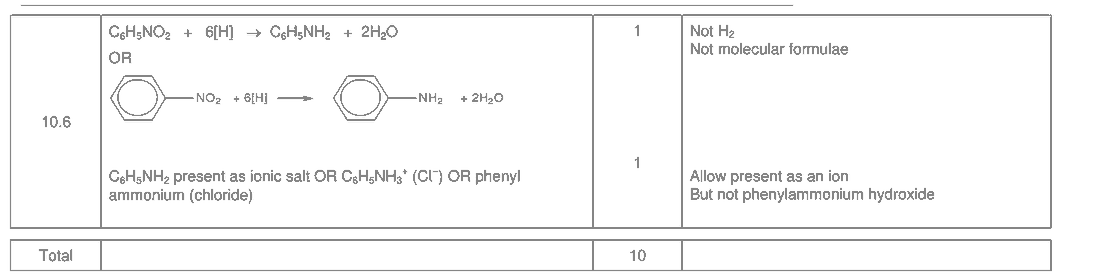
10.6 A good proportion of students gained the first mark for a correct equation. Only 7.7% could describe the formation of the phenylammonium ion and so explain the solubility of phenylamine in the aqueous acidic solution.
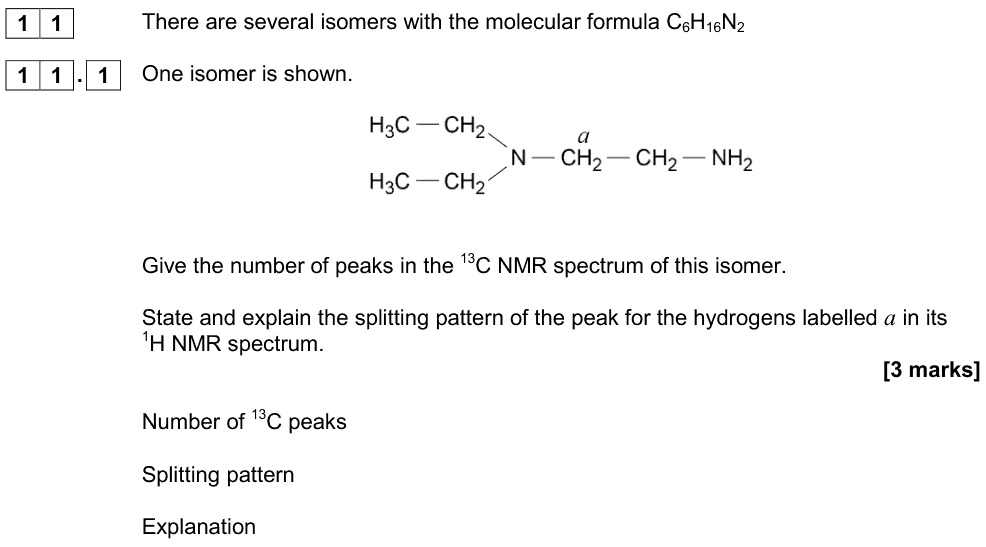
11.1 This part was answered well and over half of the students, 56.6%, gained full marks. The third ‘explanation’ mark was the one least frequently awarded. An explanation was required that referred to the number of adjacent hydrogens, not just a generic statement that the n+1 rule applies.

11.2 This was the most familiar of the three isomers required and was correctly answered by 55.3% of students. The most common errors seen were cyclic or aromatic structures or those with an incorrect number of carbon atoms in the chain. A disappointing proportion of students (17.5%) made no attempt to answer the question.

11.3 Although this isomer was found to be the most difficult of the three, 32% of the students answered correctly. Others suggested cyclic structures that contained two primary amine groups and produced only two 13C NMR peaks, but sadly contained too few hydrogen atoms to be isomers of C6H16N2. As with the previous part, there were many students, 15.6%, who did not attempt to answer this question.
Skills: MS4.3 Understand the symmetry of 2D and 3D shapes

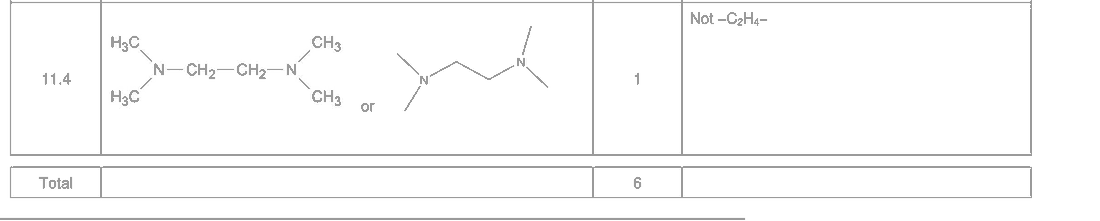
11.4 This isomer was drawn correctly by just over 40% of the students, but the question was also not attempted by 20.7%.
Skills: MS4.3 Understand the symmetry of 2D and 3D shapes
Want a paper marked and gone through with you? Message us.