June 2017: Paper 2, Organic and physical chemistry

105 marks · 42 question parts · Paper, mark scheme and report on AQA's site · Have the Data Booklet beside you

Question by question

QTopicMarksAOType
01.1 Halogenoalkanes, Introduction to organic chemistry: nomenclature, mechanisms and isomerism 1Diagram or structure
01.2 Halogenoalkanes, Amines 2Short answer
01.3 Amount of substance 3Calculation
01.4 Amines, Introduction to organic chemistry: nomenclature, mechanisms and isomerism 2Diagram or structure
01.5 Halogenoalkanes 1Short answer
01.6 Halogenoalkanes, Introduction to organic chemistry: nomenclature, mechanisms and isomerism 4Mechanism
02.1 Rate equations 1Diagram or structure
02.2 Rate equations 1Calculation
02.3 Rate equations 2Calculation
03.1 Rate equations 3Calculation
03.2 Rate equations 4Calculation
04.1 Introduction to organic chemistry: nomenclature, mechanisms and isomerism 1Short answer
04.2 Optical isomerism 2Short answer
04.3 Optical isomerism, Aldehydes and ketones 3Explanation
04.4 Aldehydes and ketones, Optical isomerism 2Diagram or structure
05.1 Carboxylic acids and derivatives 1Diagram or structure
05.2 Chemical equilibria, Le Chatelier's principle and Kc 3Calculation
05.3 Chemical equilibria, Le Chatelier's principle and Kc 2Short answer
05.4 Chemical equilibria, Le Chatelier's principle and Kc 3Calculation
06.1 Amino acids, proteins and DNA 1Diagram or structure
06.2 Amino acids, proteins and DNA 1Diagram or structure
06.3 Amino acids, proteins and DNA 2Diagram or structure
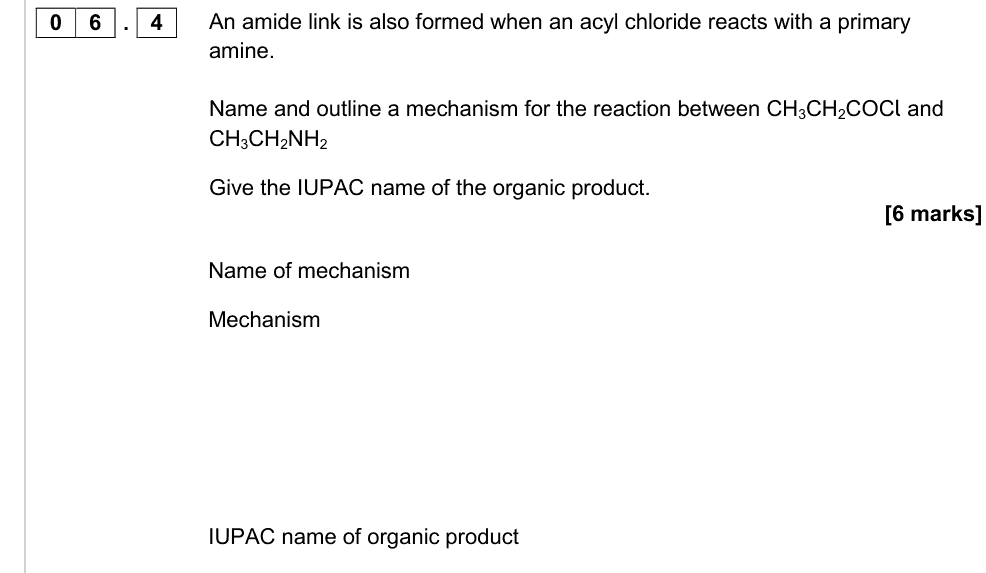
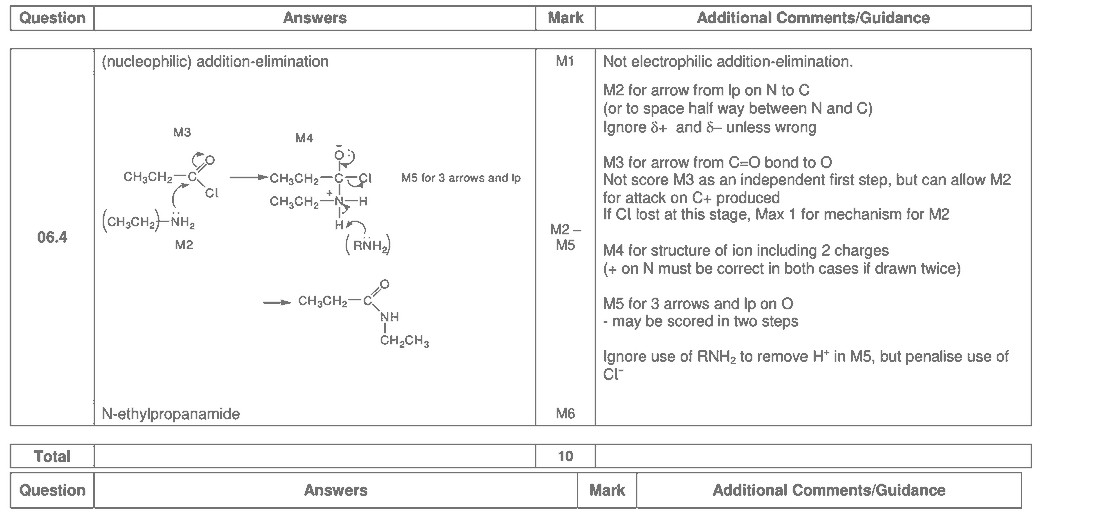
06.4 Carboxylic acids and derivatives, Amines, Introduction to organic chemistry: nomenclature, mechanisms and isomerism 6Mechanism
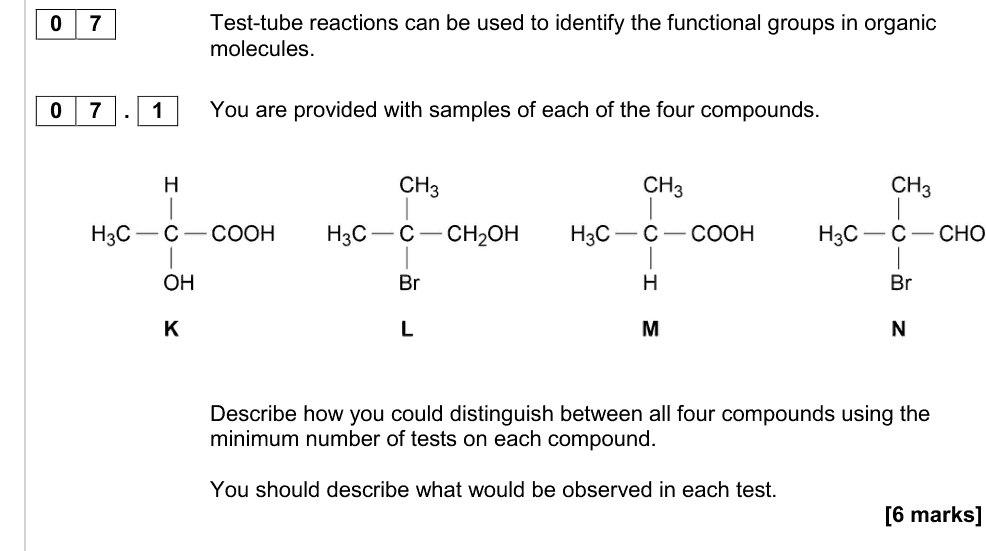
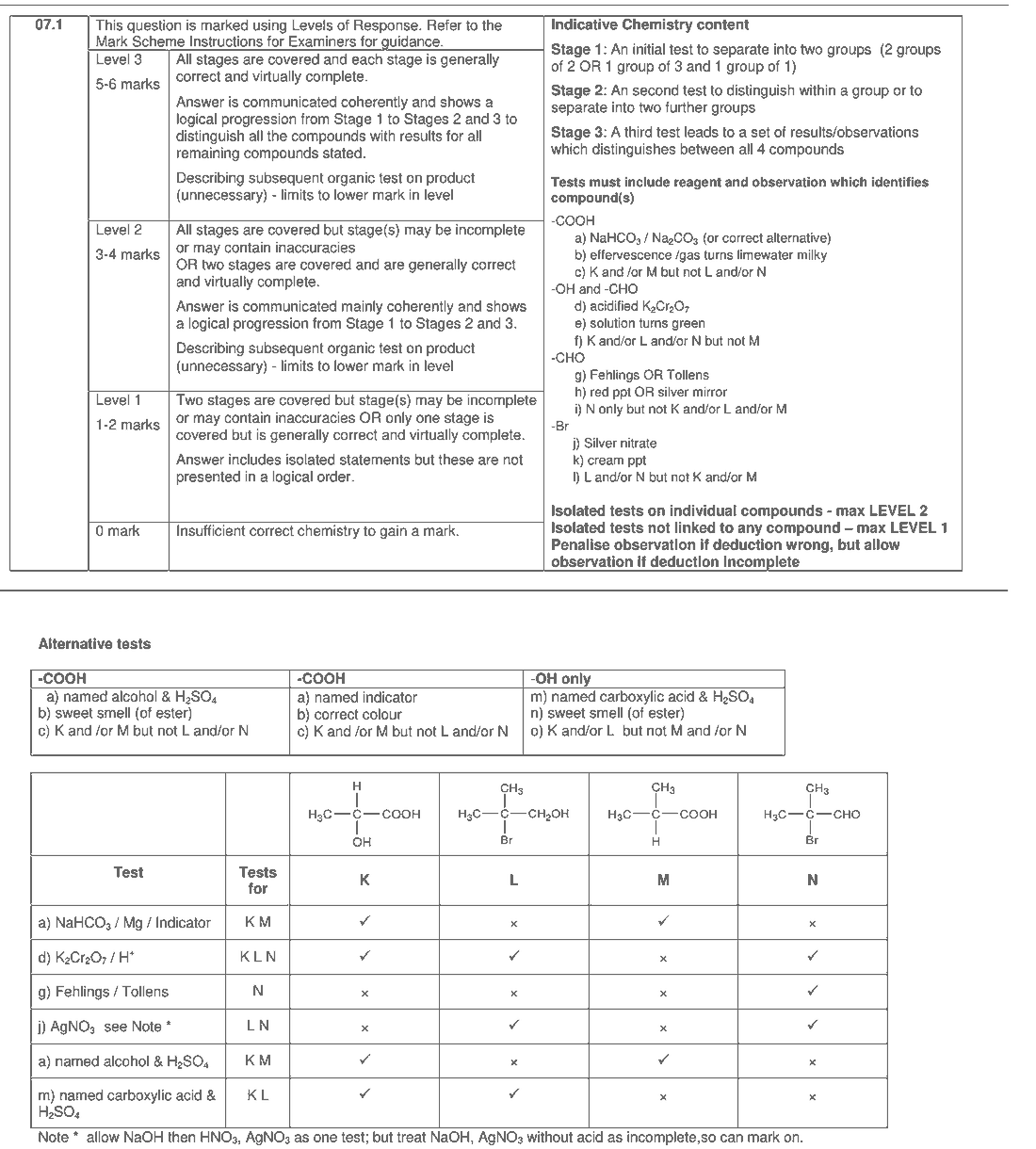
07.1 Organic analysis: test-tube reactions, mass spectrometry and infrared, Aldehydes and ketones, Carboxylic acids and derivatives 6Level of response
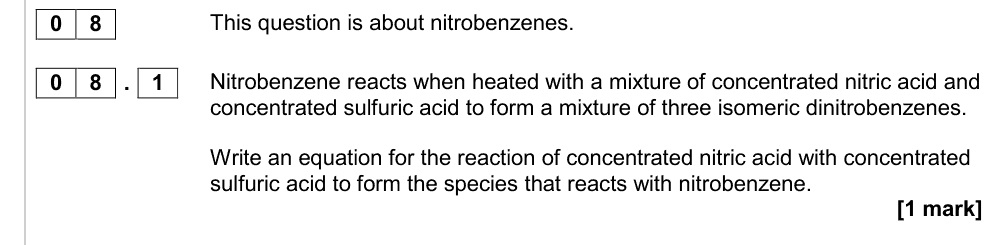
08.1 Aromatic chemistry 1Equation writing
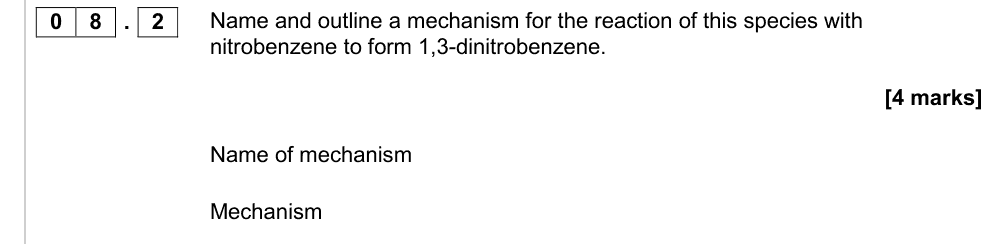
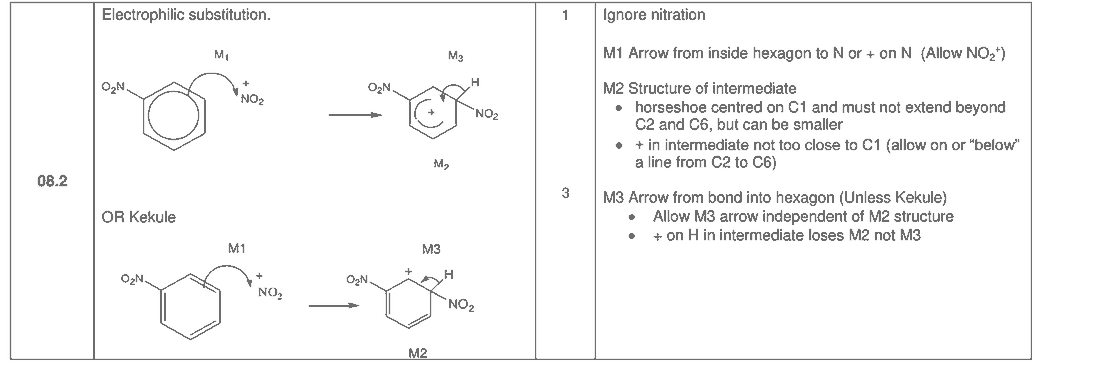
08.2 Aromatic chemistry 4Mechanism
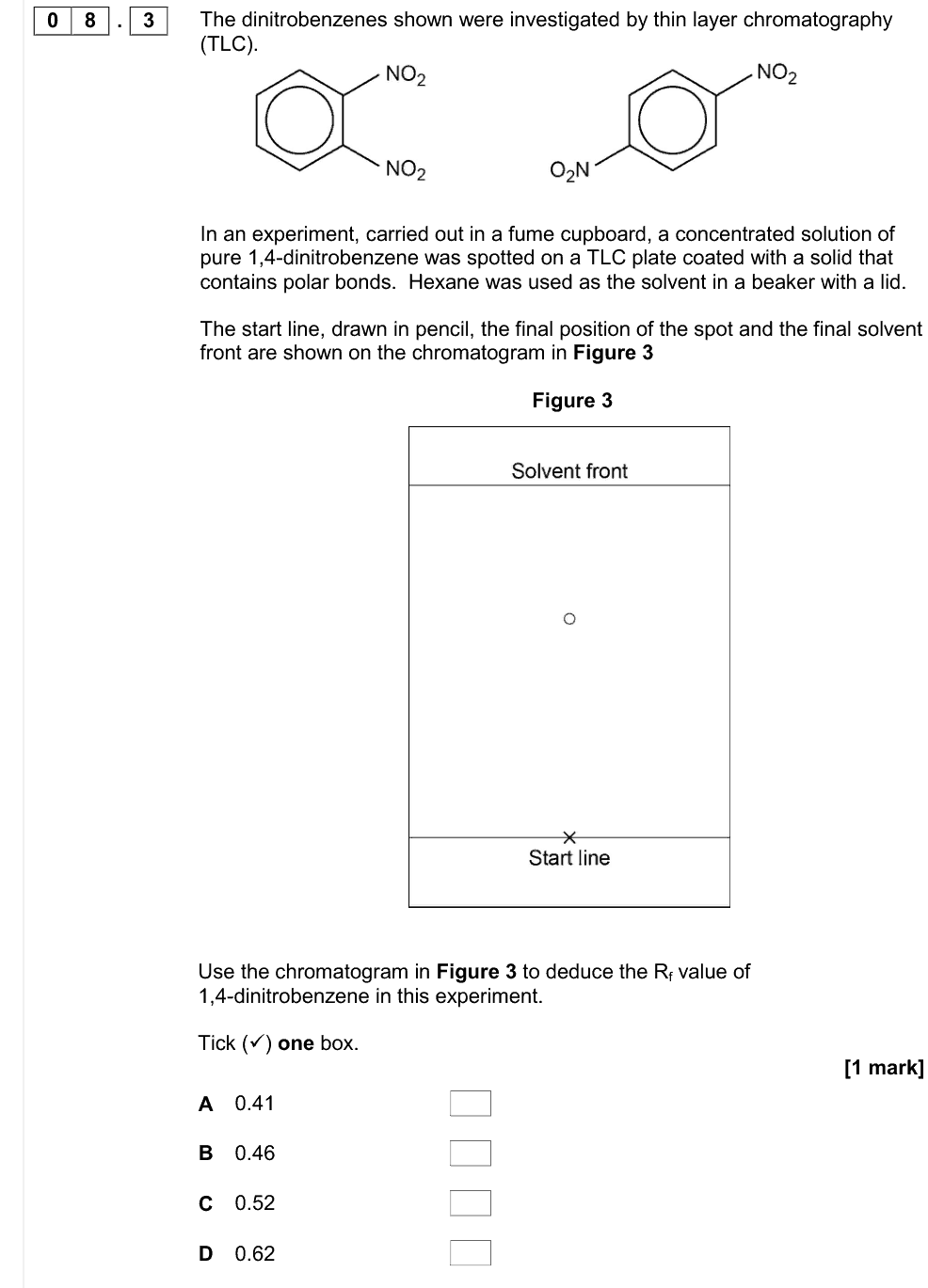
08.3 Chromatography 1Practical and data analysis
08.4 Chromatography 1Short answer
08.5 Chromatography 1Practical and data analysis
08.6 Chromatography 2Explanation
08.7 Chromatography 2Explanation
09.1 Amino acids, proteins and DNA 2Short answer
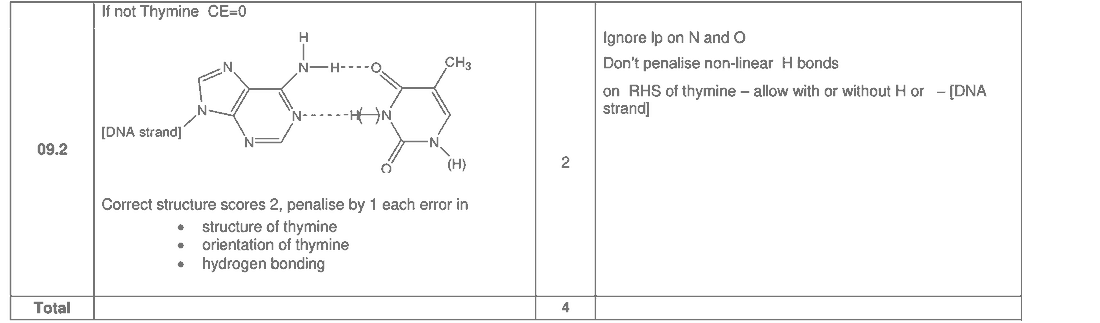
09.2 Amino acids, proteins and DNA 2Diagram or structure
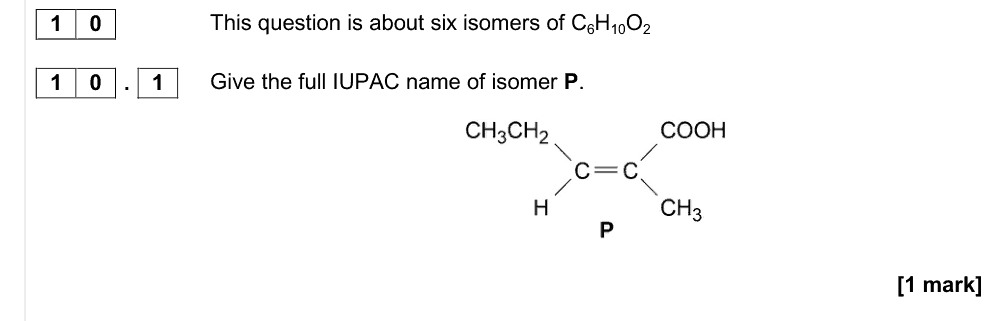
10.1 Introduction to organic chemistry: nomenclature, mechanisms and isomerism 1Short answer
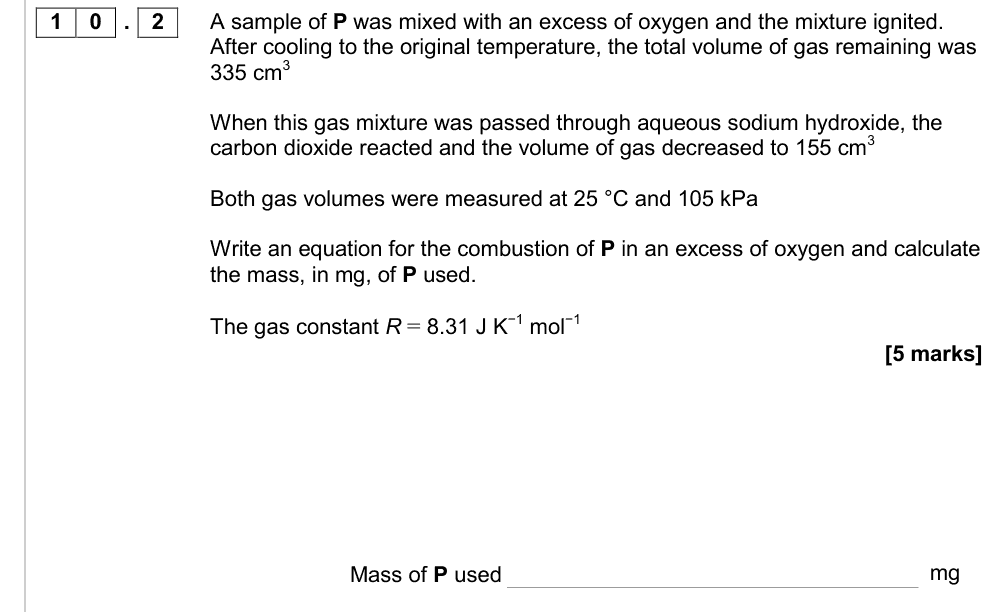
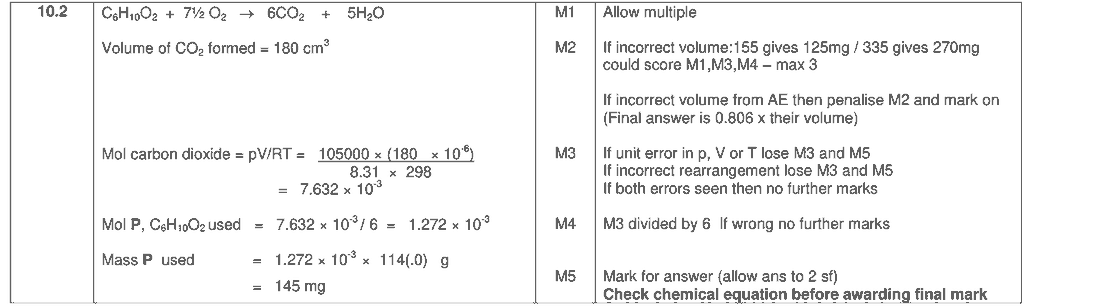
10.2 Amount of substance 5Calculation
10.3 Nuclear magnetic resonance spectroscopy, Organic analysis: test-tube reactions, mass spectrometry and infrared 3Diagram or structure
10.4 Nuclear magnetic resonance spectroscopy 3Explanation
10.5 Nuclear magnetic resonance spectroscopy 3Explanation
10.6 Polymers, Carboxylic acids and derivatives 3Diagram or structure
10.7 Alkenes, Polymers 3Diagram or structure
11.1 Amines 6Explanation
11.2 Organic synthesis, Amines, Halogenoalkanes 5Short answer

The questions

01.101.201.301.401.501.602.102.202.303.103.204.104.204.304.405.105.205.305.406.106.206.306.407.108.108.208.308.408.508.608.709.109.210.110.210.310.410.510.610.711.111.2
June 2017 · Paper 2 · Q01.1 1 mark Diagram or structure halogenoalkanesintroduction to organic chemistry
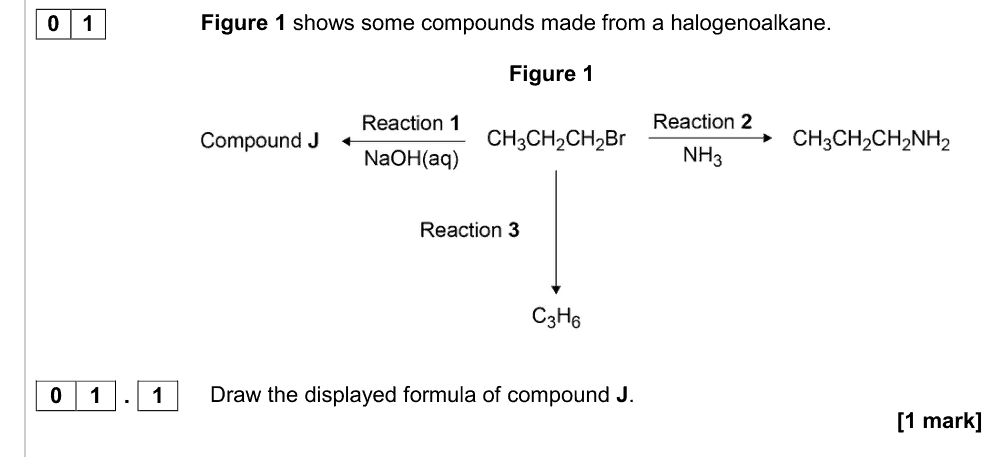
Figure 1 shows some compounds made from a halogenoalkane.
Figure 1
Draw the displayed formula of compound J.
[1 mark]
June 2017 · Paper 2 · Q01.2 2 marks Short answer halogenoalkanesamines
Earlier part of question 01 that this part usesEarlier part of June 2017 Paper 2 question 01
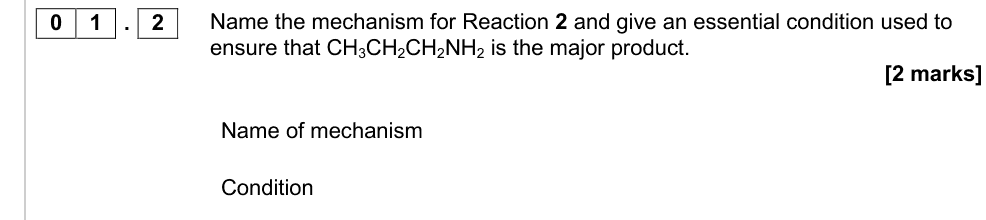
Name the mechanism for Reaction 2 and give an essential condition used to
ensure that CH3CH2CH2NH2 is the major product.
[2 marks]
Name of mechanism
Condition
June 2017 · Paper 2 · Q01.3 3 marks Calculation amount of substance
Earlier part of question 01 that this part usesEarlier part of June 2017 Paper 2 question 01
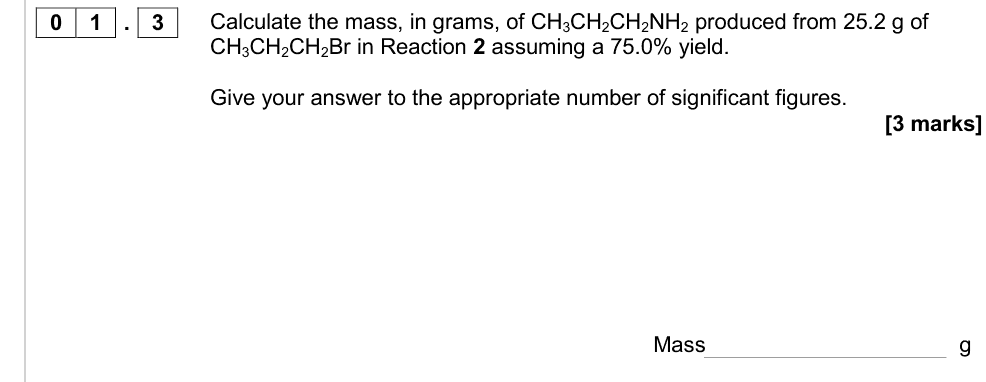
Calculate the mass, in grams, of CH3CH2CH2NH2 produced from 25.2 g of
CH3CH2CH2Br in Reaction 2 assuming a 75.0% yield.
Give your answer to the appropriate number of significant figures.
[3 marks]
Mass
g
June 2017 · Paper 2 · Q01.4 2 marks Diagram or structure Hard aminesintroduction to organic chemistry
Earlier part of question 01 that this part usesEarlier part of June 2017 Paper 2 question 01
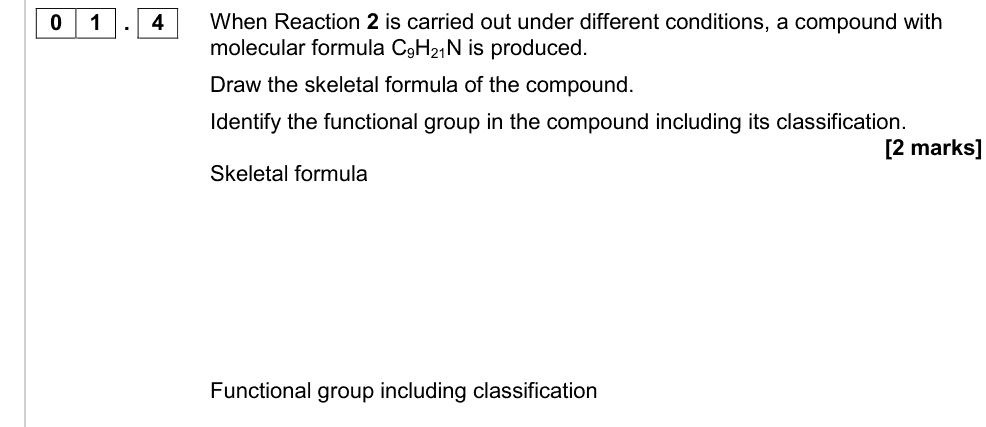
When Reaction 2 is carried out under different conditions, a compound with
molecular formula C9H21N is produced.
Draw the skeletal formula of the compound.
Identify the functional group in the compound including its classification.
[2 marks]
Skeletal formula
Functional group including classification
June 2017 · Paper 2 · Q01.5 1 mark Short answer halogenoalkanes
Earlier part of question 01 that this part usesEarlier part of June 2017 Paper 2 question 01
Identify the reagent and conditions used in Reaction 3.
[1 mark]
June 2017 · Paper 2 · Q01.6 4 marks Mechanism halogenoalkanesintroduction to organic chemistry
Earlier part of question 01 that this part usesEarlier part of June 2017 Paper 2 question 01
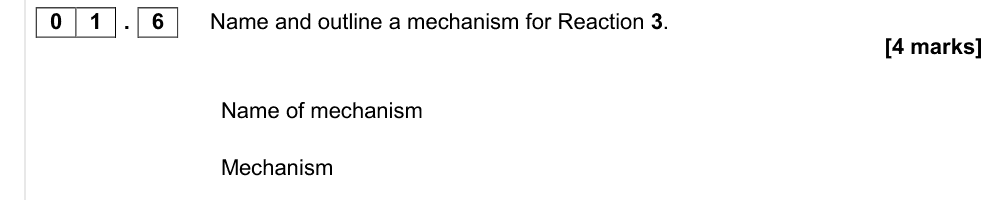
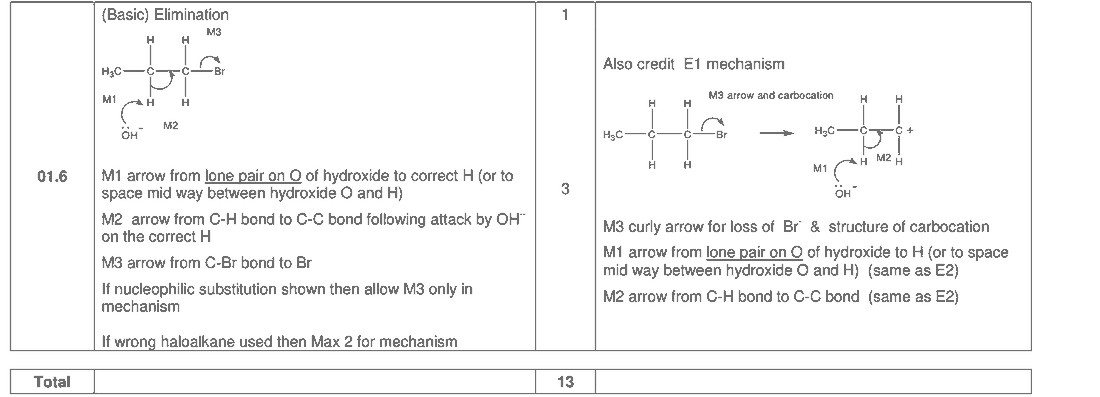
Name and outline a mechanism for Reaction 3.
[4 marks]
Name of mechanism
Mechanism
June 2017 · Paper 2 · Q02.1 1 mark Diagram or structure rate equations
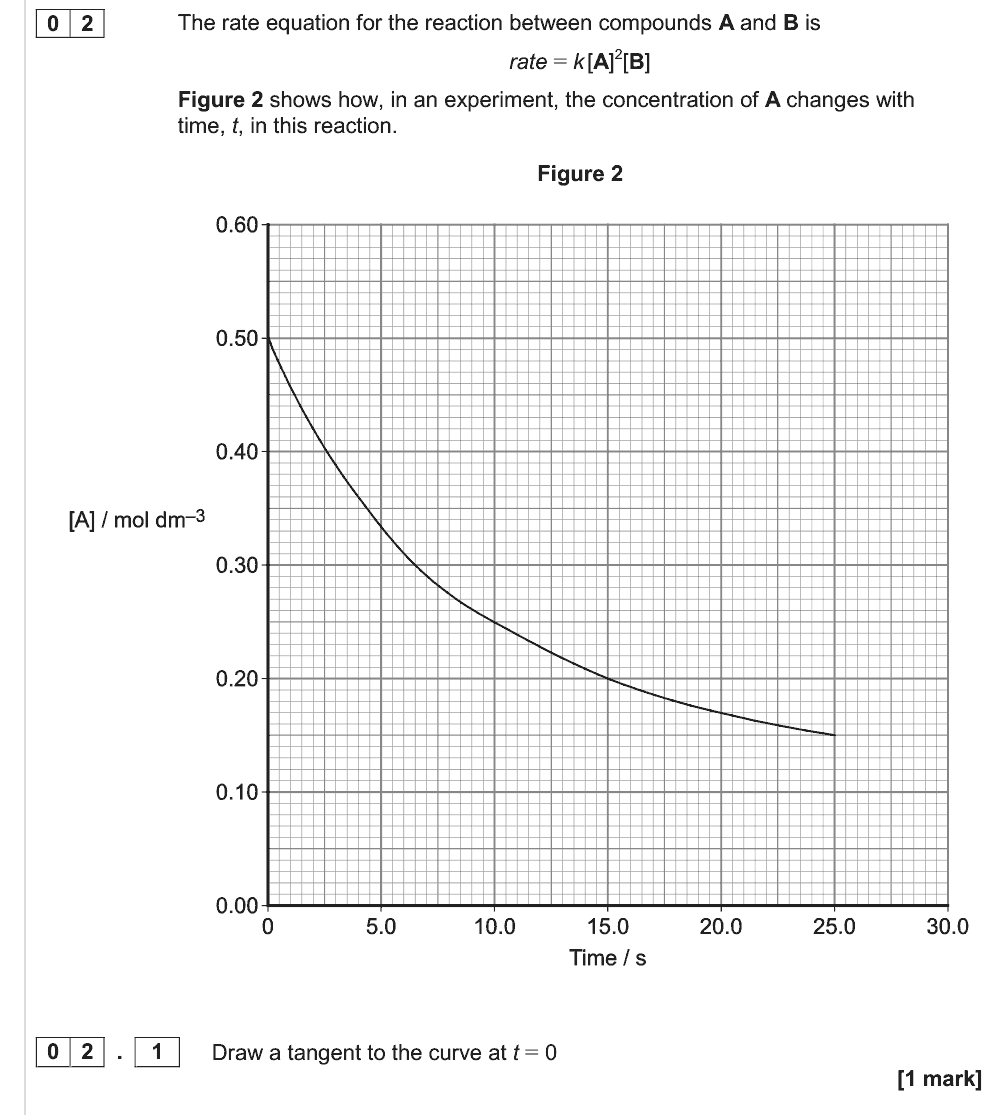
The rate equation for the reaction between compounds A and B is
rate = k [A]2[B]
Figure 2 shows how, in an experiment, the concentration of A changes with
time, t, in this reaction.
Figure 2
Draw a tangent to the curve at t = 0
[1 mark]
June 2017 · Paper 2 · Q02.2 1 mark Calculation Easy rate equations
Earlier part of question 02 that this part usesEarlier part of June 2017 Paper 2 question 02
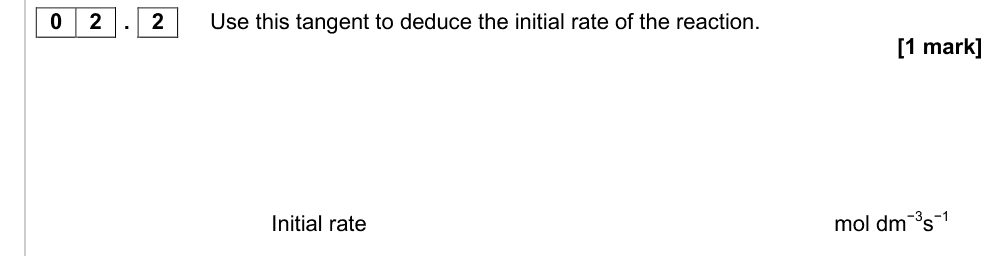
Use this tangent to deduce the initial rate of the reaction.
[1 mark]
Initial rate
mol dm−3s−1
June 2017 · Paper 2 · Q02.3 2 marks Calculation rate equations
Earlier part of question 02 that this part usesEarlier part of June 2017 Paper 2 question 02
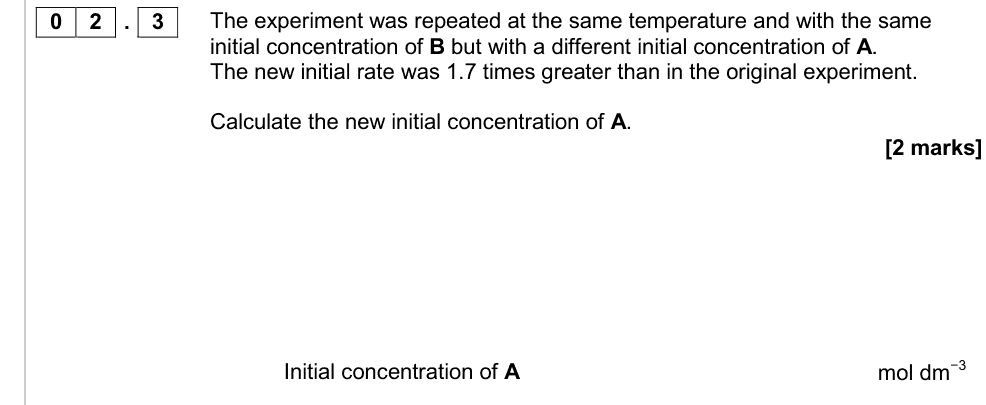
The experiment was repeated at the same temperature and with the same
initial concentration of B but with a different initial concentration of A.
The new initial rate was 1.7 times greater than in the original experiment.
Calculate the new initial concentration of A.
[2 marks]
Initial concentration of A
mol dm−3
June 2017 · Paper 2 · Q03.1 3 marks Calculation rate equations
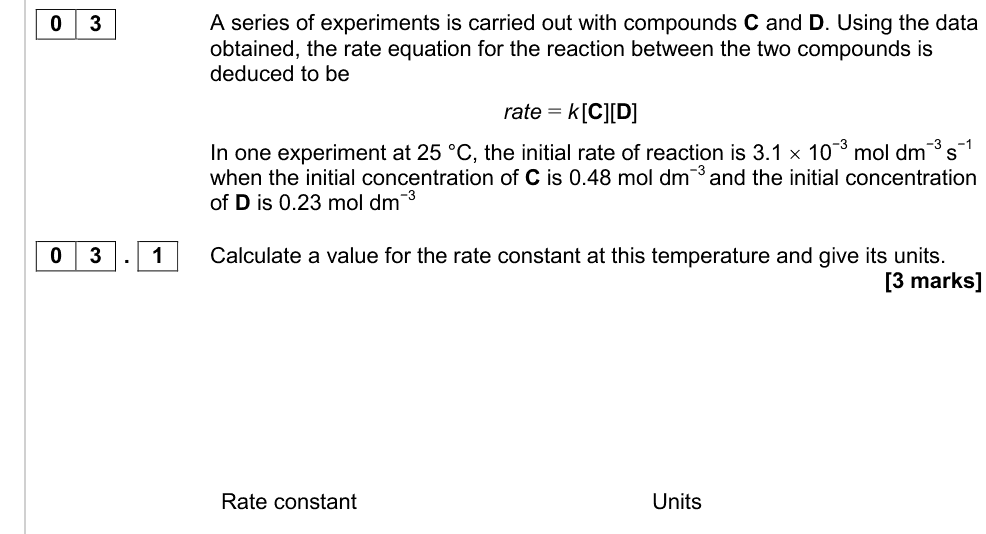
A series of experiments is carried out with compounds C and D. Using the data
obtained, the rate equation for the reaction between the two compounds is
deduced to be
rate = k [C][D]
In one experiment at 25 °C, the initial rate of reaction is 3.1 × 10⁻³ mol dm−3 s−1
when the initial concentration of C is 0.48 mol dm−3 and the initial concentration
of D is 0.23 mol dm−3
Calculate a value for the rate constant at this temperature and give its units.
[3 marks]
Rate constant
Units
June 2017 · Paper 2 · Q03.2 4 marks Calculation rate equations
Earlier part of question 03 that this part usesEarlier part of June 2017 Paper 2 question 03
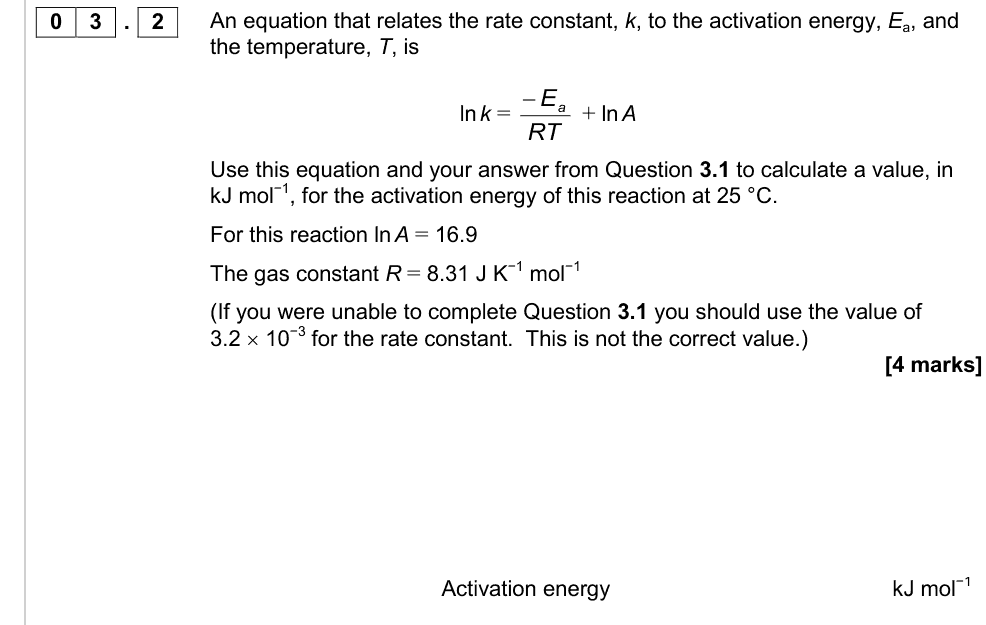
An equation that relates the rate constant, k, to the activation energy, Ea, and
the temperature, T, is
ln k = RT
Ea
−
+ ln A
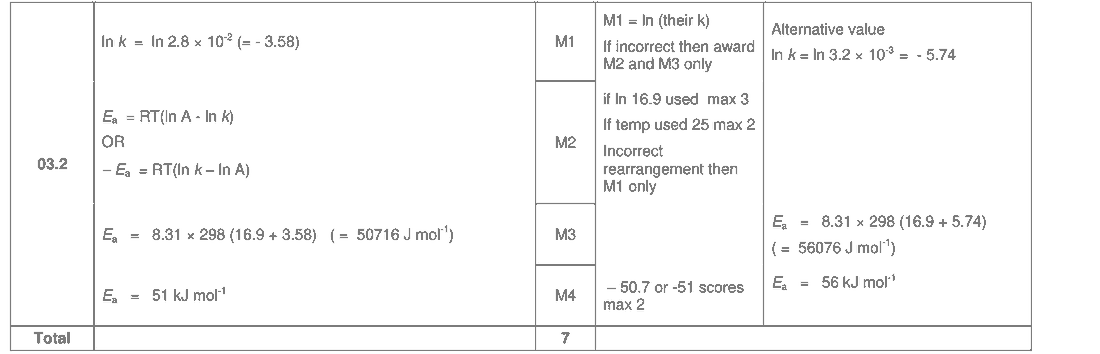
Use this equation and your answer from Question 3.1 to calculate a value, in
kJ mol−1, for the activation energy of this reaction at 25 °C.
For this reaction ln A = 16.9
The gas constant R = 8.31 J K−1 mol−1
(If you were unable to complete Question 3.1 you should use the value of
3.2 × 10⁻³ for the rate constant.  This is not the correct value.)
[4 marks]
Activation energy
kJ mol−1
June 2017 · Paper 2 · Q04.1 1 mark Short answer introduction to organic chemistry
The aldehyde CH3CH2CH2CH2CHO reacts with KCN followed by dilute acid to
form a racemic mixture of the two stereoisomers of CH3CH2CH2CH2CH(OH)CN
Give the IUPAC name of CH3CH2CH2CH2CH(OH)CN
[1 mark]
June 2017 · Paper 2 · Q04.2 2 marks Short answer optical isomerism
Earlier part of question 04 that this part usesEarlier part of June 2017 Paper 2 question 04
Describe how you would distinguish between separate samples of the two
stereoisomers of CH3CH2CH2CH2CH(OH)CN
[2 marks]
June 2017 · Paper 2 · Q04.3 3 marks Explanation optical isomerismaldehydes and ketones
Earlier part of question 04 that this part usesEarlier part of June 2017 Paper 2 question 04
Explain why the reaction produces a racemic mixture.
[3 marks]
June 2017 · Paper 2 · Q04.4 2 marks Diagram or structure aldehydes and ketonesoptical isomerism
Earlier part of question 04 that this part usesEarlier part of June 2017 Paper 2 question 04
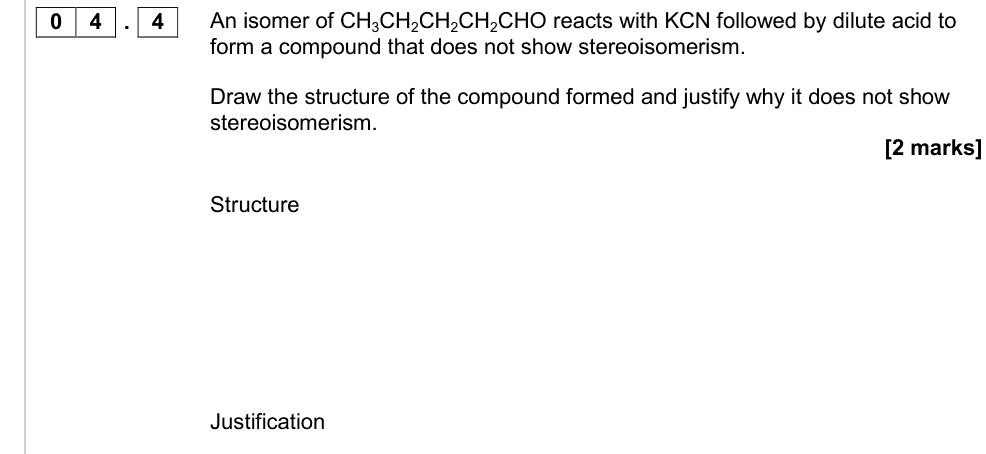
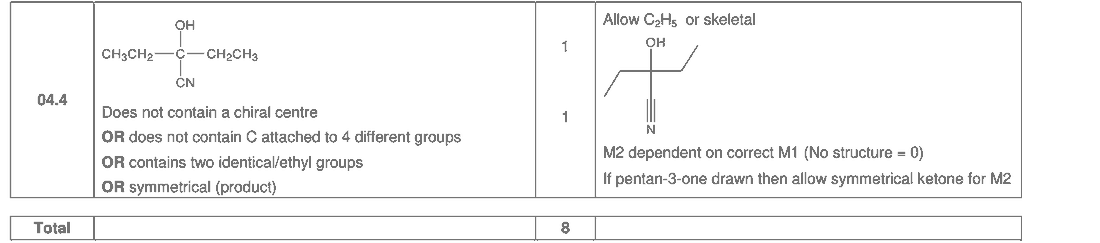
An isomer of CH3CH2CH2CH2CHO reacts with KCN followed by dilute acid to
form a compound that does not show stereoisomerism.
Draw the structure of the compound formed and justify why it does not show
stereoisomerism.
[2 marks]
Structure
Justification
June 2017 · Paper 2 · Q05.1 1 mark Diagram or structure Easy carboxylic acids and derivatives
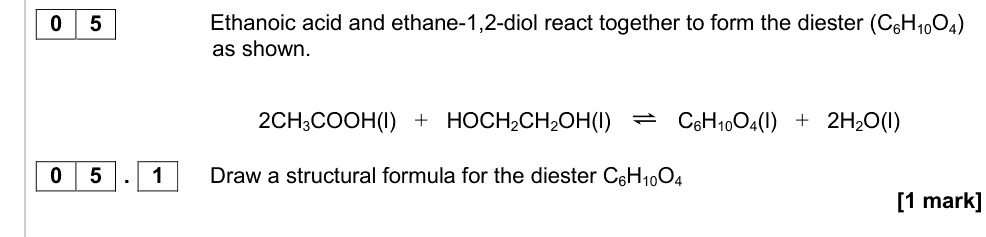
Ethanoic acid and ethane-1,2-diol react together to form the diester (C6H10O4)
as shown.
2CH3COOH(l)   +   HOCH2CH2OH(l)   ⇌   C6H10O4(l)   +   2H2O(l)
Draw a structural formula for the diester C6H10O4
[1 mark]
June 2017 · Paper 2 · Q05.2 3 marks Calculation Easy chemical equilibria and kc
Earlier part of question 05 that this part usesEarlier part of June 2017 Paper 2 question 05
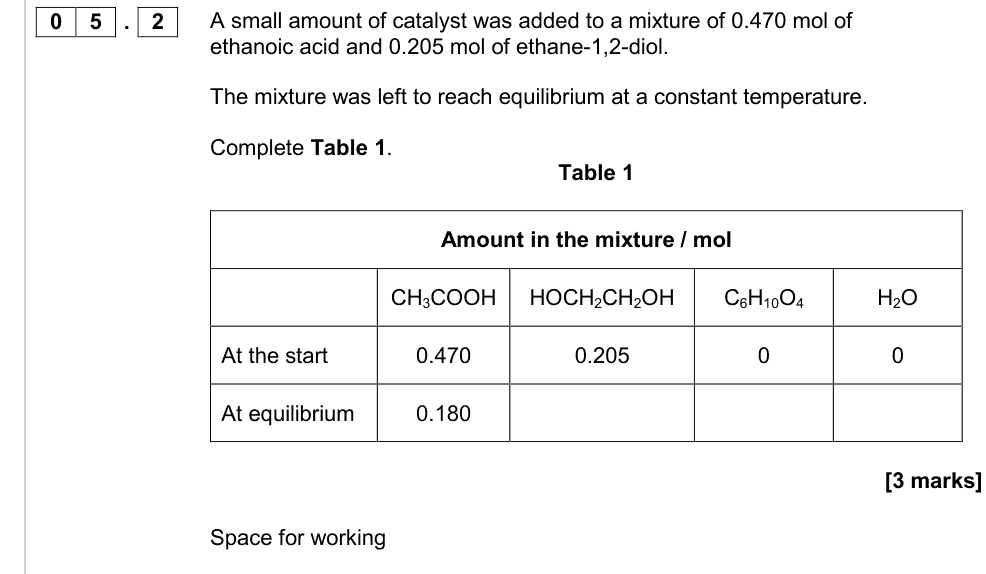
A small amount of catalyst was added to a mixture of 0.470 mol of
ethanoic acid and 0.205 mol of ethane-1,2-diol.
The mixture was left to reach equilibrium at a constant temperature.
Complete Table 1.
Table 1
Amount in the mixture / mol
CH3COOH
HOCH2CH2OH
C6H10O4
H2O
At the start
0.470
0.205
0
0
At equilibrium
0.180
[3 marks]
Space for working
June 2017 · Paper 2 · Q05.3 2 marks Short answer chemical equilibria and kc
Earlier part of question 05 that this part usesEarlier part of June 2017 Paper 2 question 05
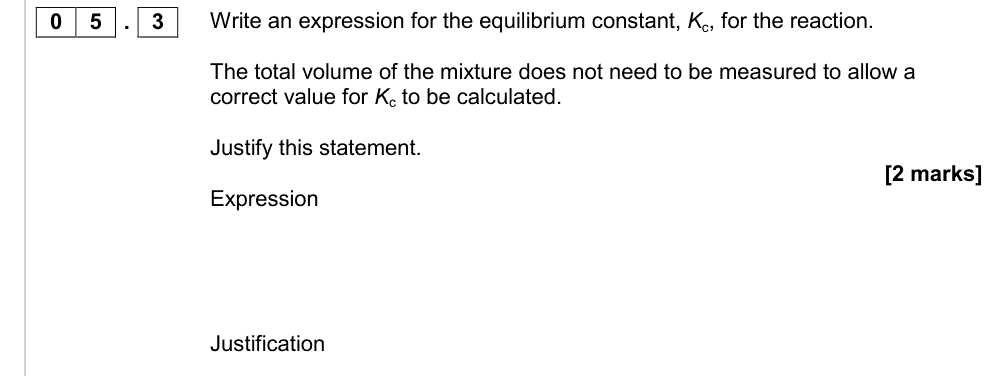
Write an expression for the equilibrium constant, Kc, for the reaction.
The total volume of the mixture does not need to be measured to allow a
correct value for Kc to be calculated.
Justify this statement.
[2 marks]
Expression
Justification
June 2017 · Paper 2 · Q05.4 3 marks Calculation Easy chemical equilibria and kc
Earlier part of question 05 that this part usesEarlier part of June 2017 Paper 2 question 05
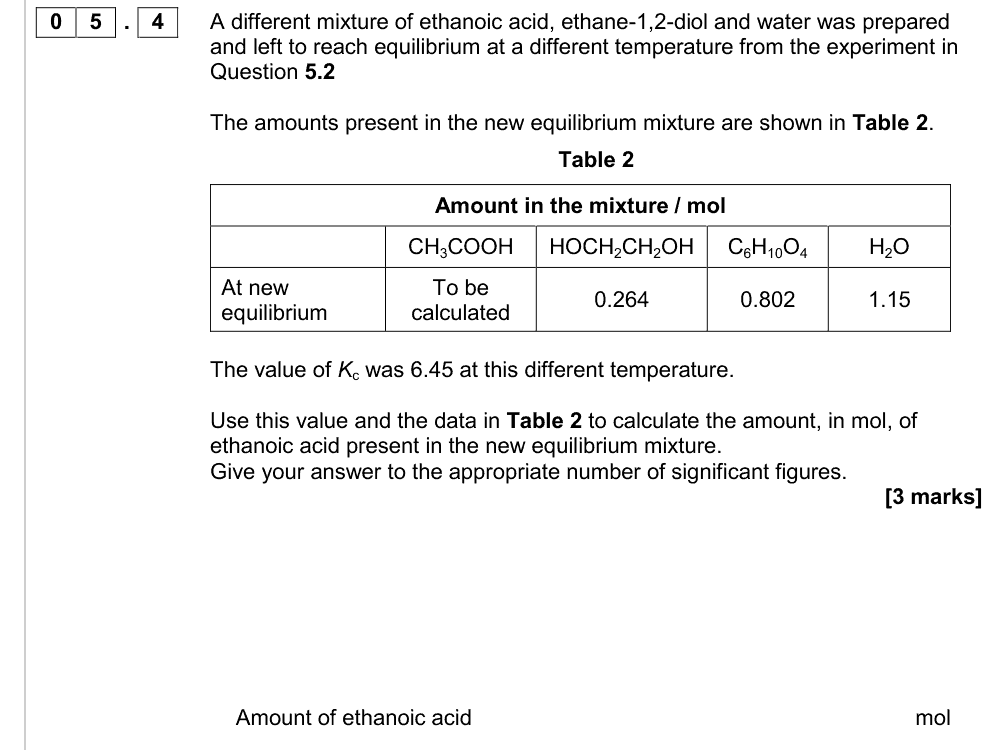
A different mixture of ethanoic acid, ethane-1,2-diol and water was prepared
and left to reach equilibrium at a different temperature from the experiment in
Question 5.2
The amounts present in the new equilibrium mixture are shown in Table 2.
Table 2
Amount in the mixture / mol
CH3COOH
HOCH2CH2OH
C6H10O4
H2O
At new
equilibrium
To be
calculated
0.264
0.802
1.15
The value of Kc was 6.45 at this different temperature.
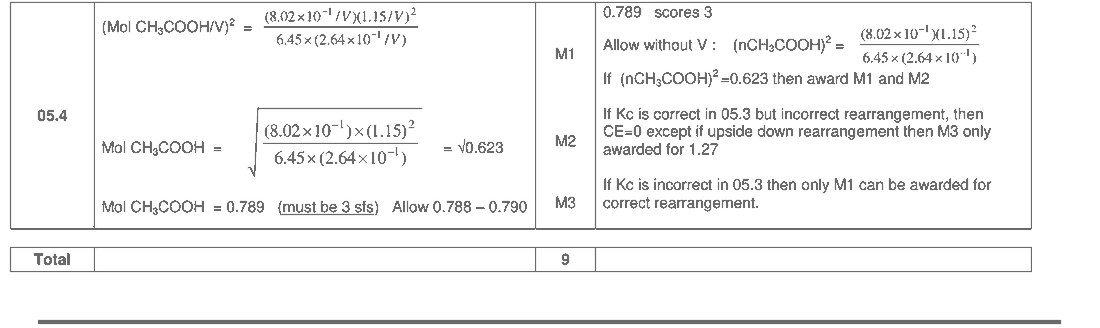
Use this value and the data in Table 2 to calculate the amount, in mol, of
ethanoic acid present in the new equilibrium mixture.
Give your answer to the appropriate number of significant figures.
[3 marks]
Amount of ethanoic acid
mol
June 2017 · Paper 2 · Q06.1 1 mark Diagram or structure amino acids proteins and dna
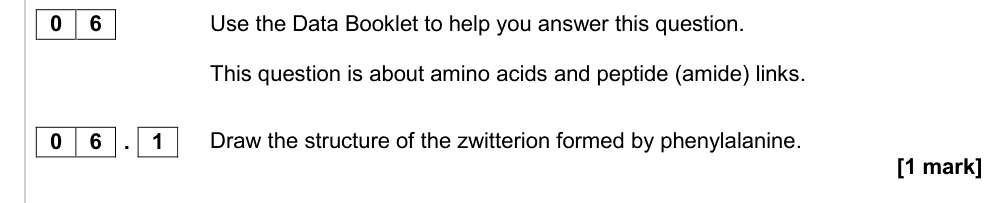
Use the Data Booklet to help you answer this question.
This question is about amino acids and peptide (amide) links.
Draw the structure of the zwitterion formed by phenylalanine.
[1 mark]
June 2017 · Paper 2 · Q06.2 1 mark Diagram or structure amino acids proteins and dna
Earlier part of question 06 that this part usesEarlier part of June 2017 Paper 2 question 06
Draw the structure of serine at high pH.
[1 mark]
June 2017 · Paper 2 · Q06.3 2 marks Diagram or structure amino acids proteins and dna
Earlier part of question 06 that this part usesEarlier part of June 2017 Paper 2 question 06
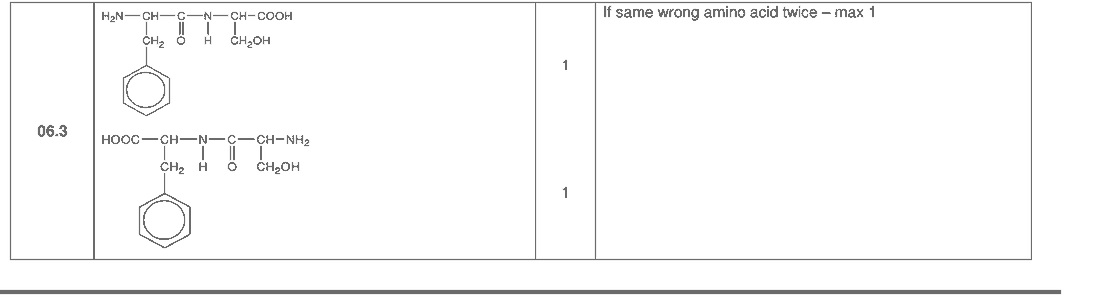
Draw the structures of both dipeptides formed when phenylalanine reacts with
serine.
In each structure show all the atoms and bonds in the amide link.
[2 marks]
June 2017 · Paper 2 · Q06.4 6 marks Mechanism Hard carboxylic acids and derivativesaminesintroduction to organic chemistry
Earlier part of question 06 that this part usesEarlier part of June 2017 Paper 2 question 06
An amide link is also formed when an acyl chloride reacts with a primary
amine.
Name and outline a mechanism for the reaction between CH3CH2COCl and
CH3CH2NH2
Give the IUPAC name of the organic product.
[6 marks]
Name of mechanism
Mechanism
IUPAC name of organic product
June 2017 · Paper 2 · Q07.1 6 marks 6-mark level of response Hard organic analysisaldehydes and ketonescarboxylic acids and derivatives
Test-tube reactions can be used to identify the functional groups in organic
molecules.
You are provided with samples of each of the four compounds.
Describe how you could distinguish between all four compounds using the
minimum number of tests on each compound.
You should describe what would be observed in each test.
[6 marks]
June 2017 · Paper 2 · Q08.1 1 mark Equation writing aromatic chemistry
This question is about nitrobenzenes.
Nitrobenzene reacts when heated with a mixture of concentrated nitric acid and
concentrated sulfuric acid to form a mixture of three isomeric dinitrobenzenes.
Write an equation for the reaction of concentrated nitric acid with concentrated
sulfuric acid to form the species that reacts with nitrobenzene.
[1 mark]
June 2017 · Paper 2 · Q08.2 4 marks Mechanism aromatic chemistry
Earlier part of question 08 that this part usesEarlier part of June 2017 Paper 2 question 08
Name and outline a mechanism for the reaction of this species with
nitrobenzene to form 1,3-dinitrobenzene.
[4 marks]
Name of mechanism
Mechanism
June 2017 · Paper 2 · Q08.3 1 mark Practical and data analysis Easy chromatography
Earlier part of question 08 that this part usesEarlier part of June 2017 Paper 2 question 08
The dinitrobenzenes shown were investigated by thin layer chromatography
(TLC).
In an experiment, carried out in a fume cupboard, a concentrated solution of
pure 1,4-dinitrobenzene was spotted on a TLC plate coated with a solid that
contains polar bonds.  Hexane was used as the solvent in a beaker with a lid.
The start line, drawn in pencil, the final position of the spot and the final solvent
front are shown on the chromatogram in Figure 3
Figure 3
Use the chromatogram in Figure 3 to deduce the Rf value of
1,4-dinitrobenzene in this experiment.
Tick () one box.
[1 mark]
A 0.41
B 0.46
C 0.52
D 0.62
June 2017 · Paper 2 · Q08.4 1 mark Short answer chromatography
Earlier part of question 08 that this part usesEarlier part of June 2017 Paper 2 question 08
State in general terms what determines the distance travelled by a spot in TLC.
[1 mark]
June 2017 · Paper 2 · Q08.5 1 mark Practical and data analysis chromatography
Earlier part of question 08 that this part usesEarlier part of June 2017 Paper 2 question 08
To obtain the chromatogram, the TLC plate was held by the edges and placed
in the solvent in the beaker in the fume cupboard.  The lid was then replaced
on the beaker.
Give one other practical requirement when placing the plate in the beaker.
[1 mark]
June 2017 · Paper 2 · Q08.6 2 marks Explanation Hard chromatography
Earlier part of question 08 that this part usesEarlier part of June 2017 Paper 2 question 08
A second TLC experiment was carried out using 1,2-dinitrobenzene and
1,4-dinitrobenzene.  An identical plate to that in Question 8.3 was used under
the same conditions with the same solvent.  In this experiment, the Rf value of
1,4-dinitrobenzene was found to be greater than that of 1,2-dinitrobenzene.
Deduce the relative polarities of the 1,2-dinitrobenzene and 1,4-dinitrobenzene
and explain why 1,4-dinitrobenzene has the greater Rf value.
[2 marks]
Relative polarities

Explanation
June 2017 · Paper 2 · Q08.7 2 marks Explanation chromatography
Earlier part of question 08 that this part usesEarlier part of June 2017 Paper 2 question 08
A third TLC experiment was carried out using 1,2-dinitrobenzene.  An identical
plate to that in Question 8.3 was used under the same conditions, but the
solvent used contained a mixture of hexane and ethyl ethanoate.
A student stated that the Rf value of 1,2-dinitrobenzene in this third experiment
would be greater than that of 1,2-dinitrobenzene in the experiment in
Question 8.6
Is the student correct? Justify your answer.
[2 marks]
June 2017 · Paper 2 · Q09.1 2 marks Short answer amino acids proteins and dna
Use the Data Booklet to help you answer these questions.
DNA exists as two strands of nucleotides in the form of a double helix with
hydrogen bonding between the two strands.
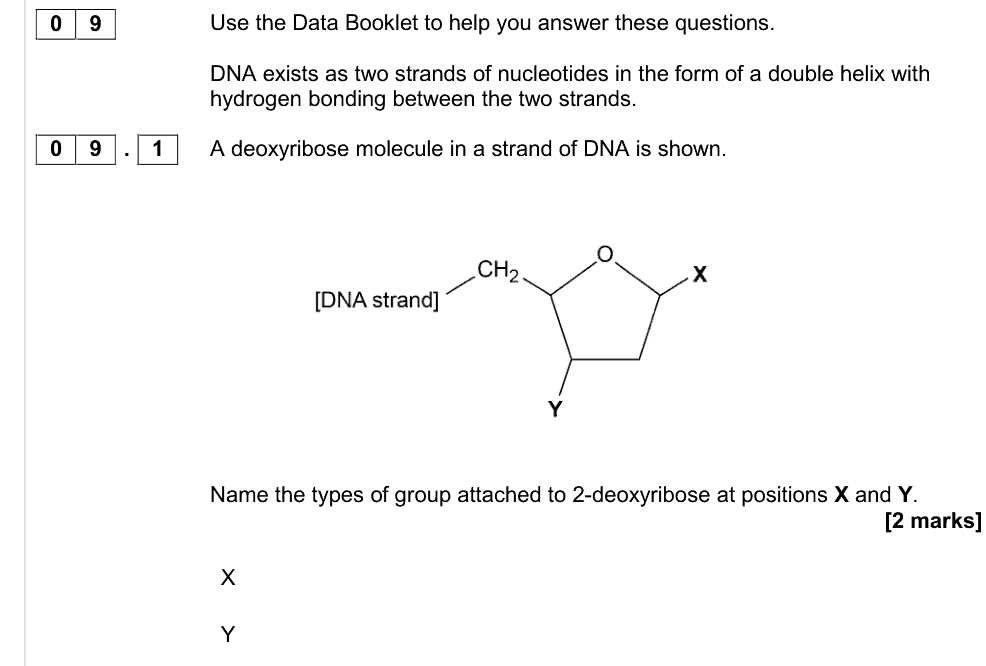
A deoxyribose molecule in a strand of DNA is shown.
Name the types of group attached to 2-deoxyribose at positions X and Y.
[2 marks]
X
Y
June 2017 · Paper 2 · Q09.2 2 marks Diagram or structure Hard amino acids proteins and dna
Earlier part of question 09 that this part usesEarlier part of June 2017 Paper 2 question 09
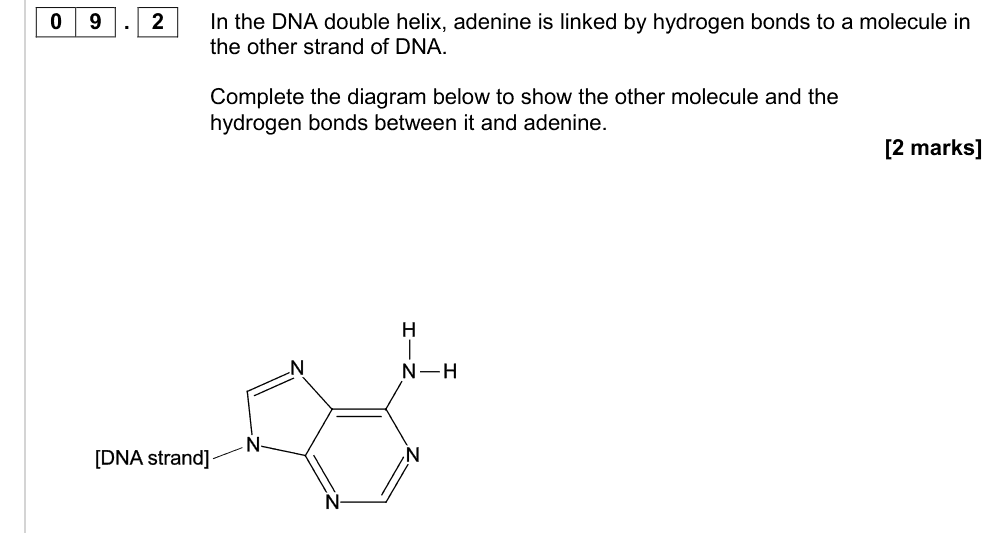
In the DNA double helix, adenine is linked by hydrogen bonds to a molecule in
the other strand of DNA.
Complete the diagram below to show the other molecule and the
hydrogen bonds between it and adenine.
[2 marks]
June 2017 · Paper 2 · Q10.1 1 mark Short answer Hard introduction to organic chemistry
This question is about six isomers of C6H10O2
Give the full IUPAC name of isomer P.
[1 mark]
June 2017 · Paper 2 · Q10.2 5 marks Calculation amount of substance
Earlier part of question 10 that this part usesEarlier part of June 2017 Paper 2 question 10
A sample of P was mixed with an excess of oxygen and the mixture ignited.
After cooling to the original temperature, the total volume of gas remaining was
335 cm3
When this gas mixture was passed through aqueous sodium hydroxide, the
carbon dioxide reacted and the volume of gas decreased to 155 cm3
Both gas volumes were measured at 25 °C and 105 kPa
Write an equation for the combustion of P in an excess of oxygen and calculate
the mass, in mg, of P used.
The gas constant R = 8.31 J K−1 mol−1
[5 marks]
Mass of P used
mg
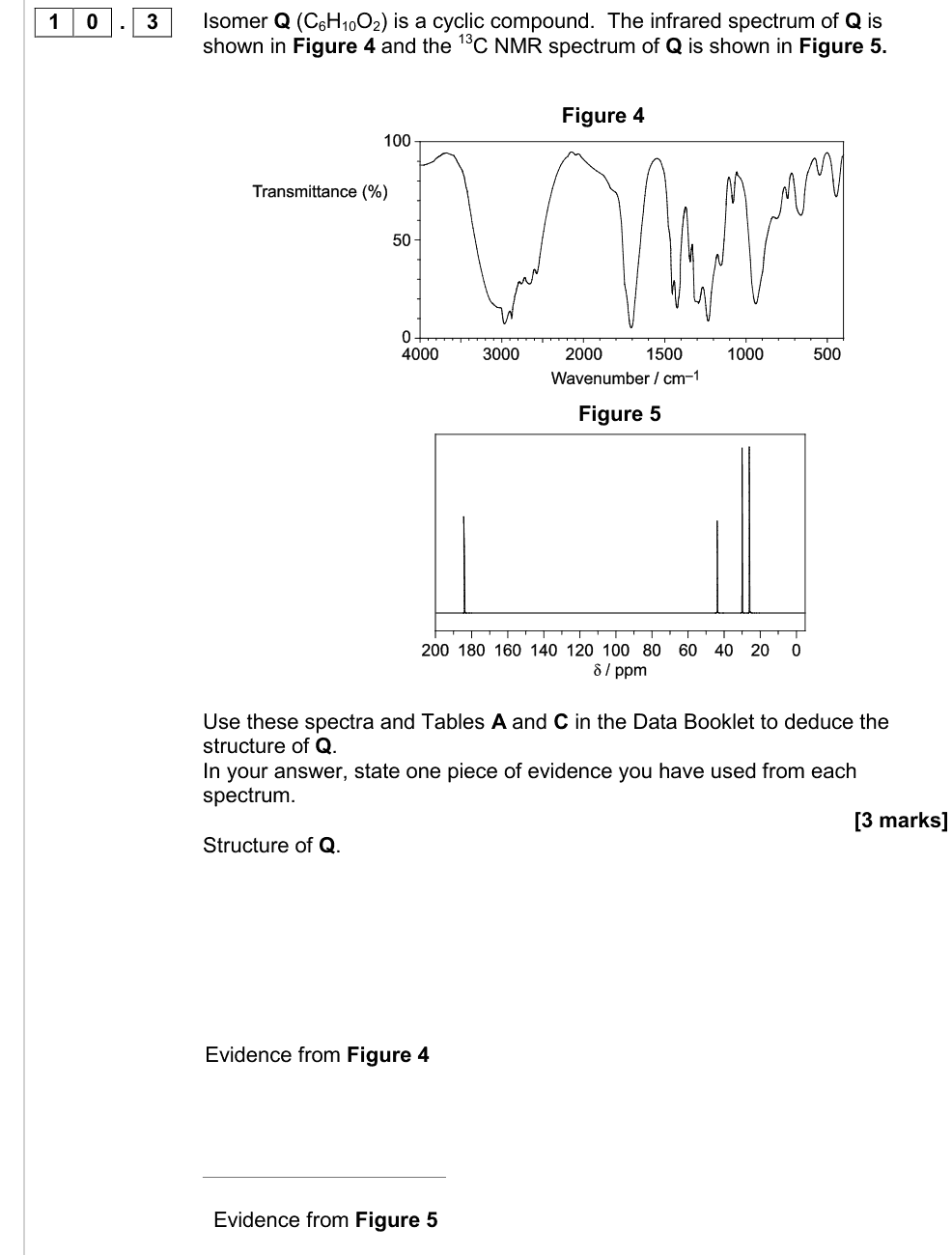
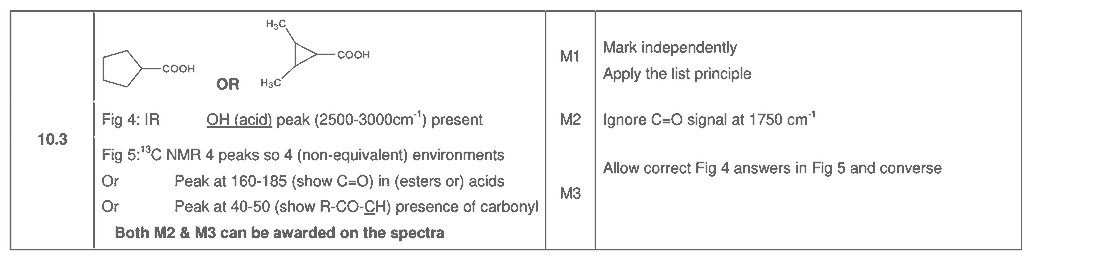
June 2017 · Paper 2 · Q10.3 3 marks Diagram or structure nmr spectroscopyorganic analysis
Earlier part of question 10 that this part usesEarlier part of June 2017 Paper 2 question 10
Figure 4
Isomer Q (C6H10O2) is a cyclic compound.  The infrared spectrum of Q is
shown in Figure 4 and the 13C NMR spectrum of Q is shown in Figure 5.
Use these spectra and Tables A and C in the Data Booklet to deduce the
structure of Q.
In your answer, state one piece of evidence you have used from each
spectrum.
[3 marks]
Structure of Q.
Evidence from Figure 4
Evidence from Figure 5
Figure 5
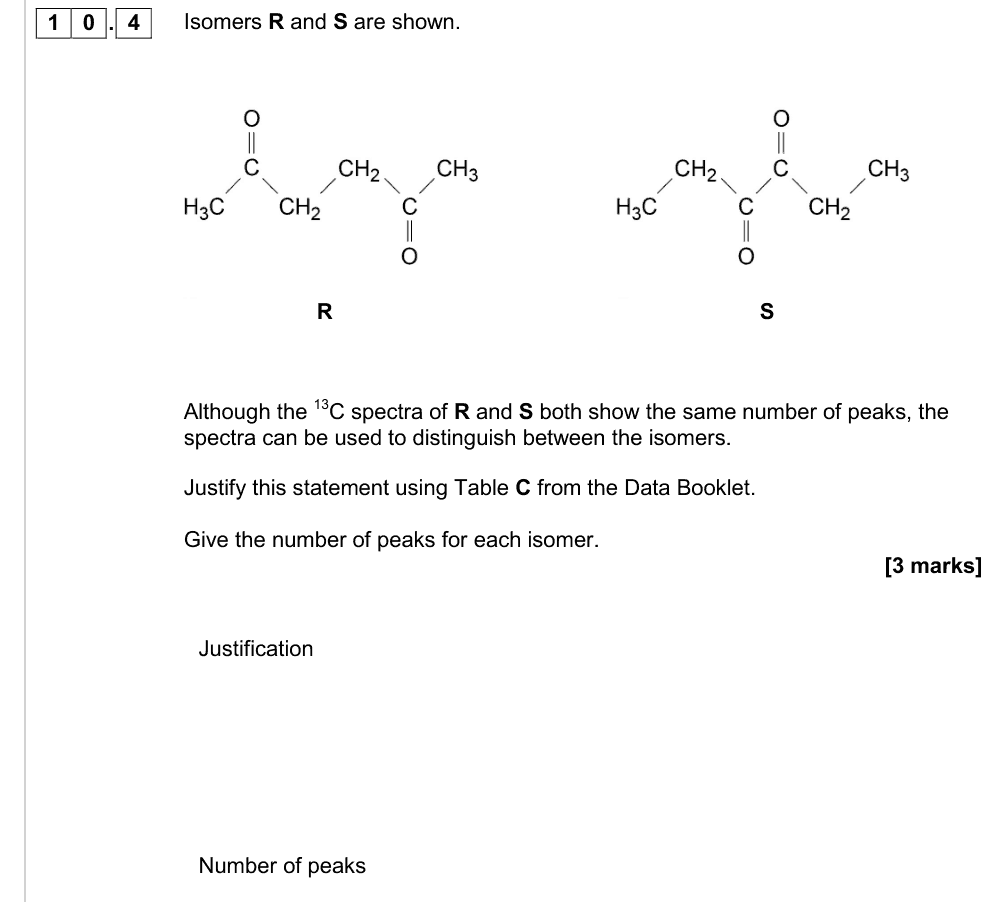
June 2017 · Paper 2 · Q10.4 3 marks Explanation nmr spectroscopy
Earlier part of question 10 that this part usesEarlier part of June 2017 Paper 2 question 10
Isomers R and S are shown.
R
S
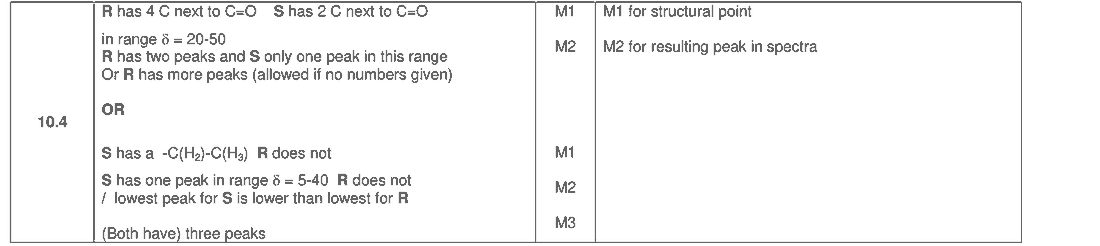
Although the 13C spectra of R and S both show the same number of peaks, the
spectra can be used to distinguish between the isomers.
Justify this statement using Table C from the Data Booklet.
Give the number of peaks for each isomer.
[3 marks]
Justification
Number of peaks
June 2017 · Paper 2 · Q10.5 3 marks Explanation nmr spectroscopy
Earlier parts of question 10 that this part usesEarlier part of June 2017 Paper 2 question 10Earlier part of June 2017 Paper 2 question 10
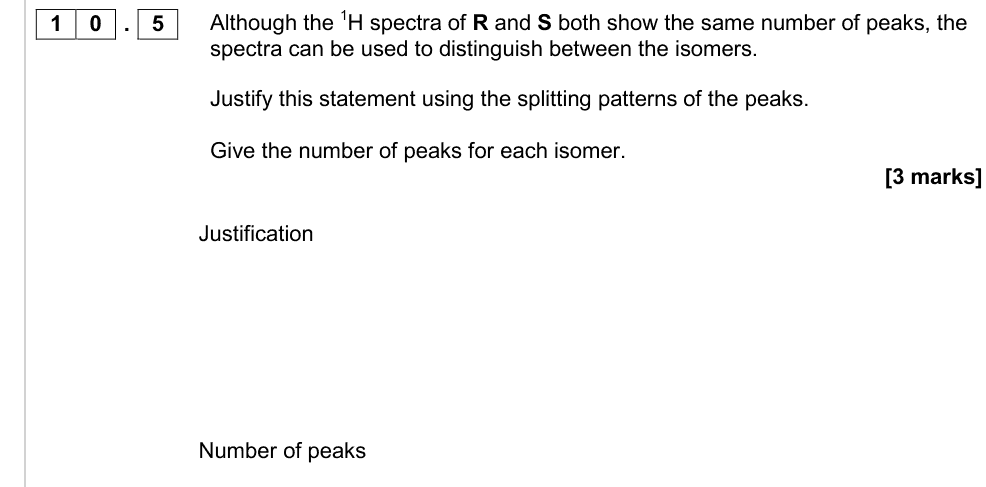
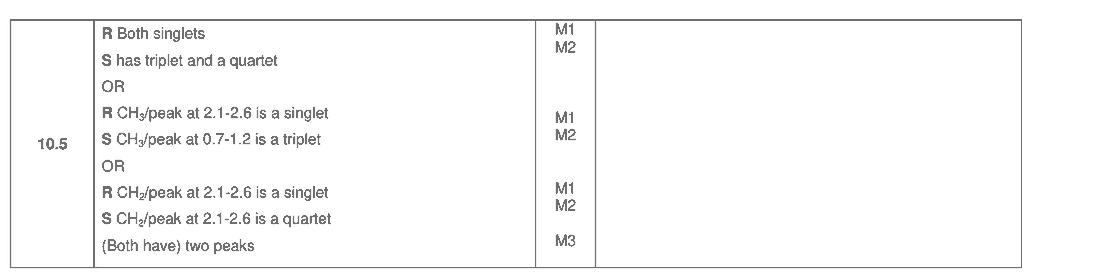
Although the 1H spectra of R and S both show the same number of peaks, the
spectra can be used to distinguish between the isomers.
Justify this statement using the splitting patterns of the peaks.
Give the number of peaks for each isomer.
[3 marks]
Justification
Number of peaks
June 2017 · Paper 2 · Q10.6 3 marks Diagram or structure polymerscarboxylic acids and derivatives
Earlier part of question 10 that this part usesEarlier part of June 2017 Paper 2 question 10
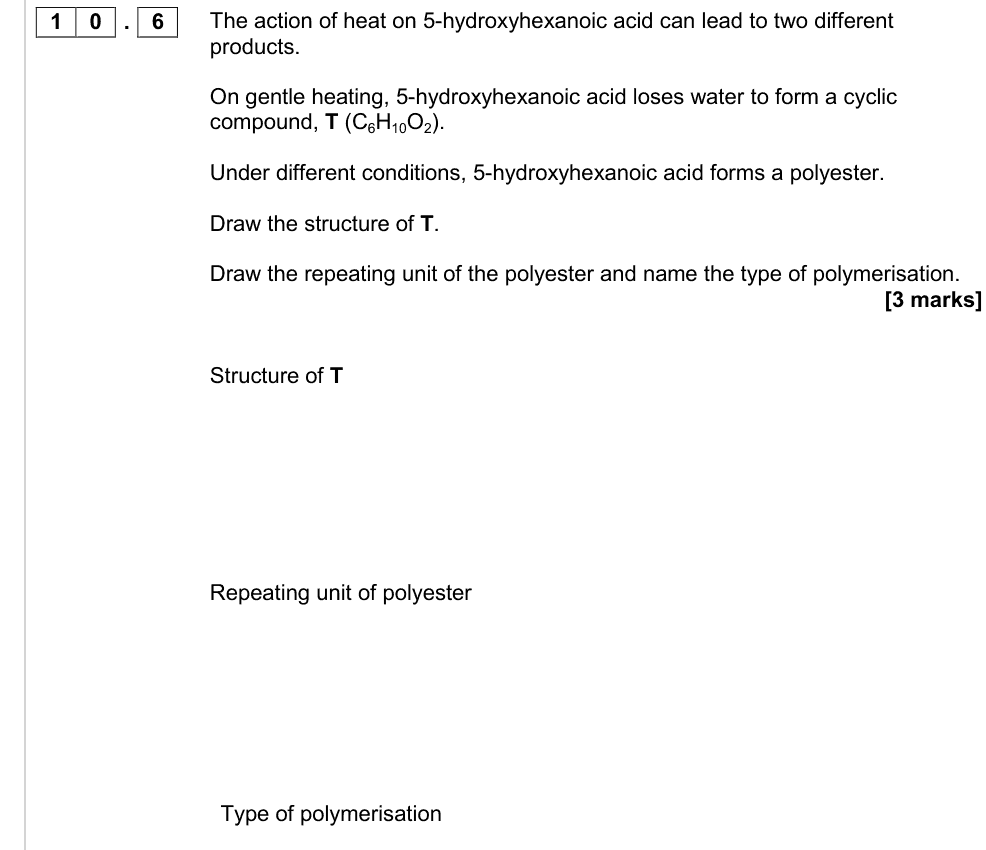
The action of heat on 5-hydroxyhexanoic acid can lead to two different
products.
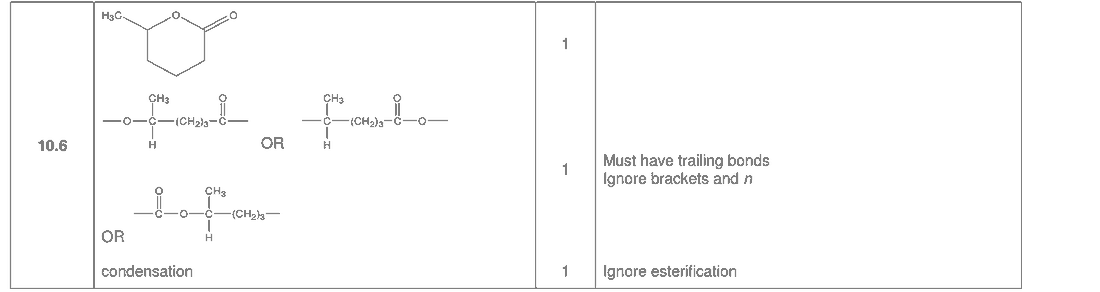
On gentle heating, 5-hydroxyhexanoic acid loses water to form a cyclic
compound, T (C6H10O2).
Under different conditions, 5-hydroxyhexanoic acid forms a polyester.
Draw the structure of T.
Draw the repeating unit of the polyester and name the type of polymerisation.
[3 marks]
Structure of T
Repeating unit of polyester
Type of polymerisation
June 2017 · Paper 2 · Q10.7 3 marks Diagram or structure alkenespolymers
Earlier part of question 10 that this part usesEarlier part of June 2017 Paper 2 question 10
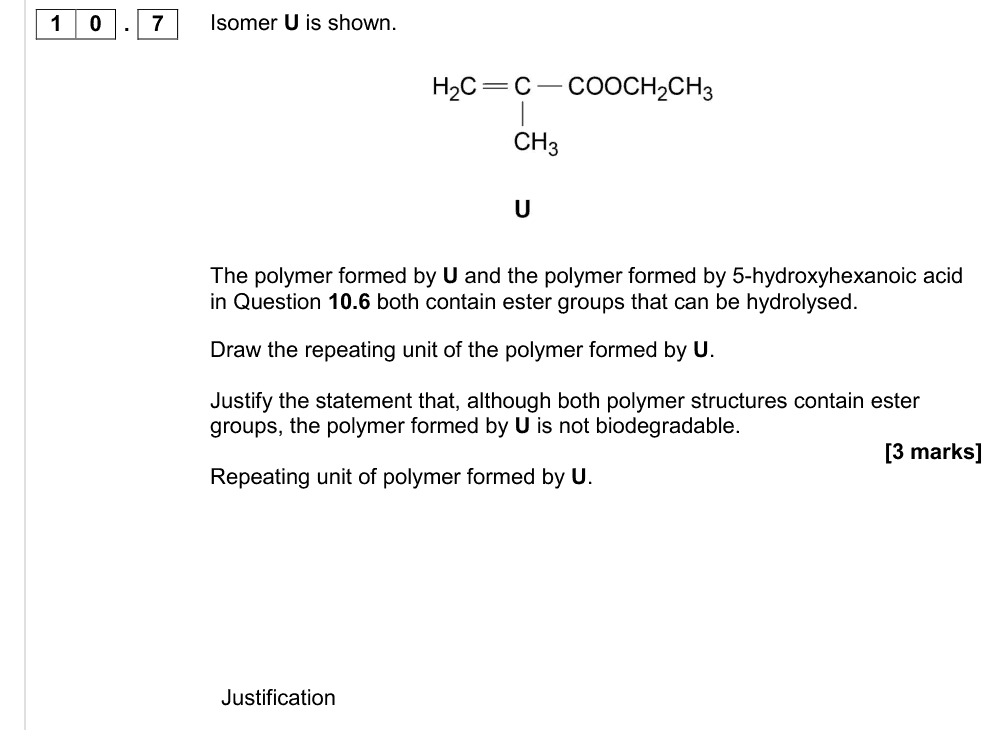
Isomer U is shown.
The polymer formed by U and the polymer formed by 5-hydroxyhexanoic acid
in Question 10.6 both contain ester groups that can be hydrolysed.
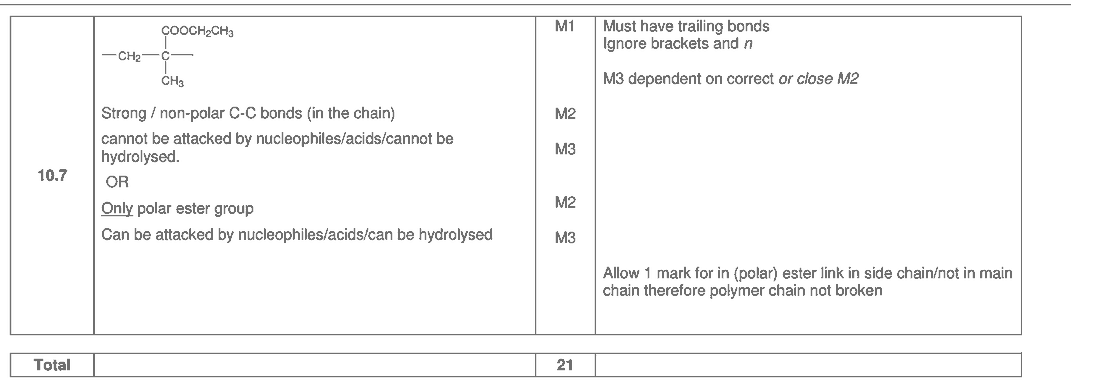
Draw the repeating unit of the polymer formed by U.
Justify the statement that, although both polymer structures contain ester
groups, the polymer formed by U is not biodegradable.
[3 marks]
Repeating unit of polymer formed by U.
Justification
June 2017 · Paper 2 · Q11.1 6 marks Explanation amines
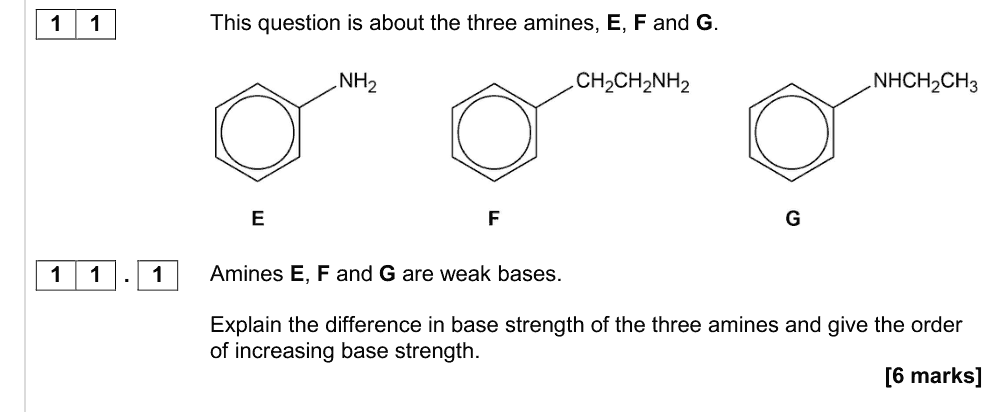
This question is about the three amines, E, F and G.
Amines E, F and G are weak bases.
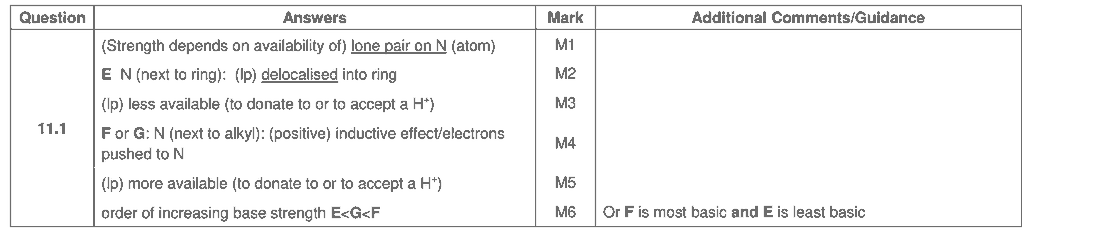
Explain the difference in base strength of the three amines and give the order
of increasing base strength.
[6 marks]
June 2017 · Paper 2 · Q11.2 5 marks Short answer organic synthesisamineshalogenoalkanes
Earlier part of question 11 that this part usesEarlier part of June 2017 Paper 2 question 11
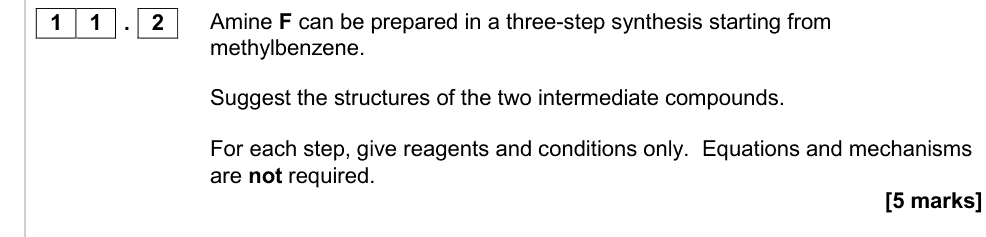
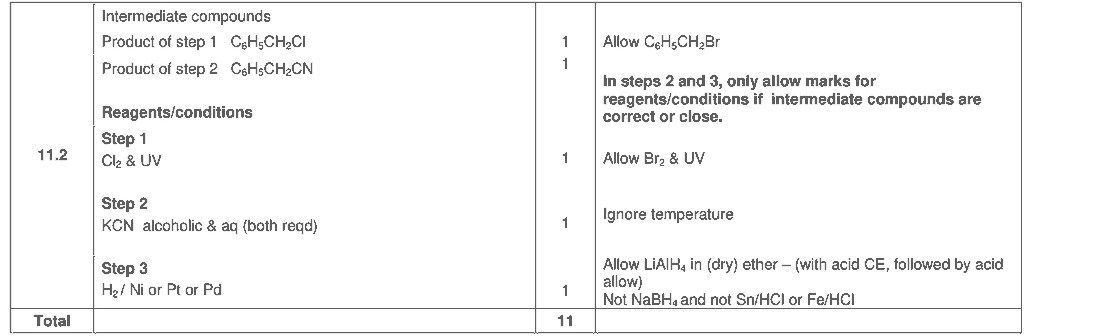
Amine F can be prepared in a three-step synthesis starting from
methylbenzene.
Suggest the structures of the two intermediate compounds.
For each step, give reagents and conditions only.  Equations and mechanisms
are not required.
[5 marks]

Work with an A-level chemistry tutor

Want a paper marked and gone through with you? Message us.

Prefer email? Send an enquiry

If you are under 18, please include a parent's contact details. Enquiries go to enquiries@chemistryaleveltutor.com and are deleted once handled. All tutoring is online.