October 2020: Paper 2, Advanced Organic and Physical Chemistry

90 marks · 42 question parts · Paper, mark scheme and report on Edexcel's site · An autumn series, sat in place of the cancelled summer exams · Have the Data Booklet beside you

Question by question

QTopicMarksAOType
1(a) Bonding 2Diagram or structure
1(b) Bonding 1Short answer
1(c)(i) Bonding 1Short answer
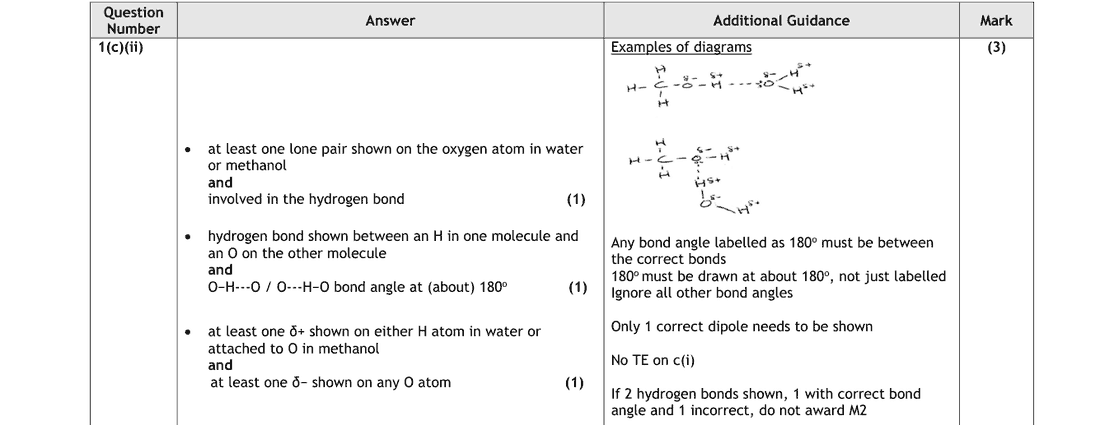
1(c)(ii) Bonding 3Diagram or structure
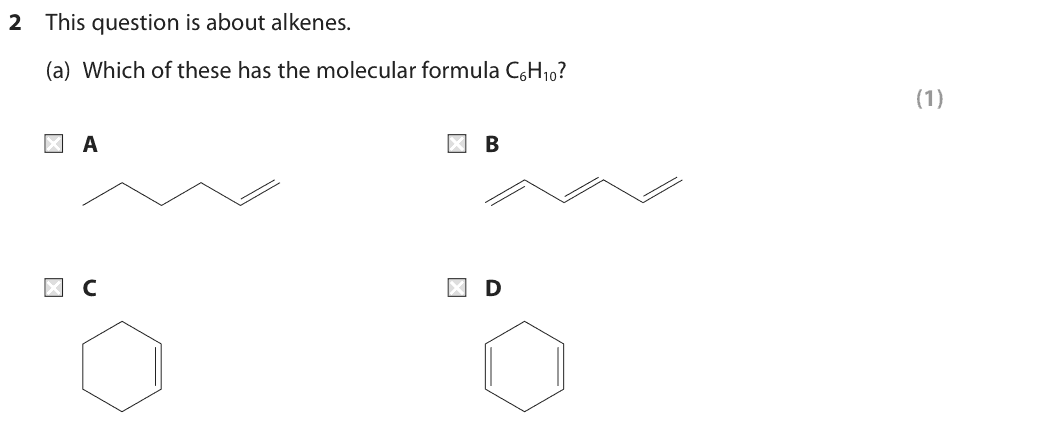
2(a) Introduction to organic chemistry 1Multiple choice
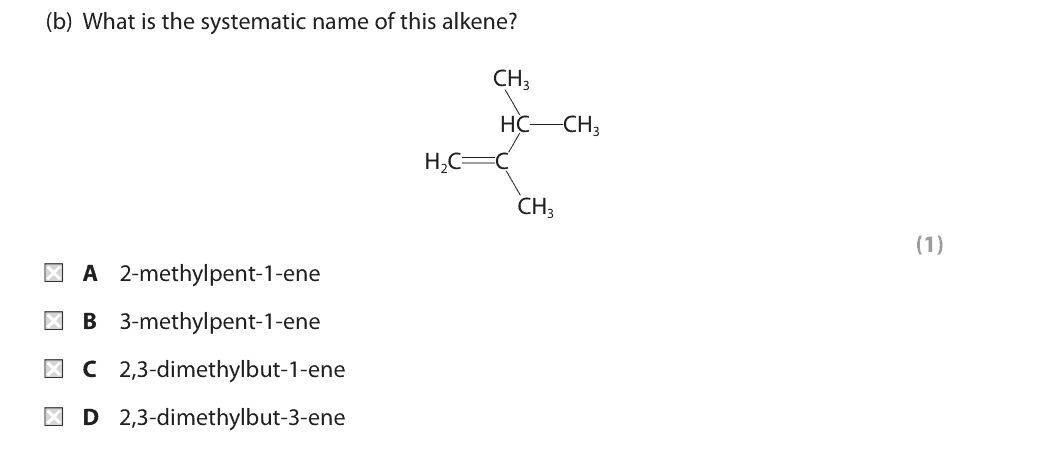
2(b) Introduction to organic chemistry 1Multiple choice
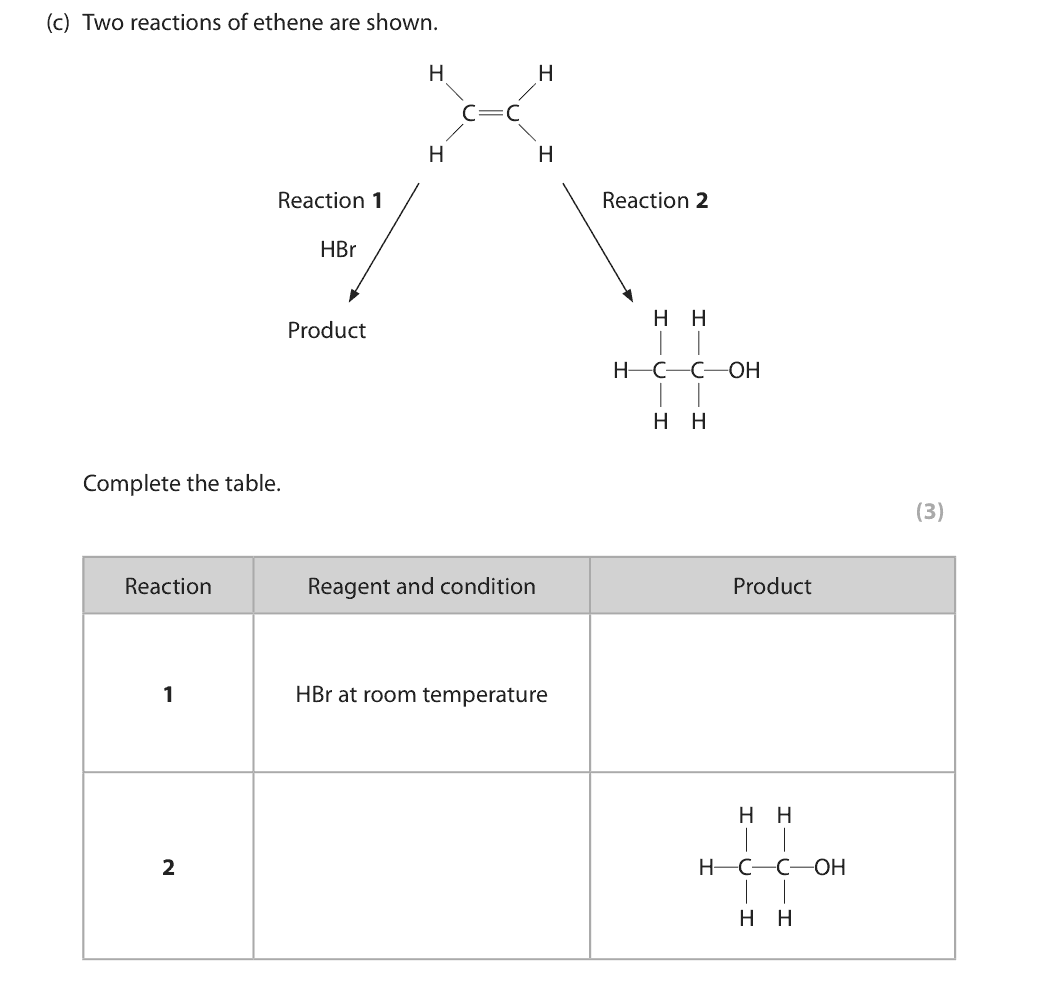
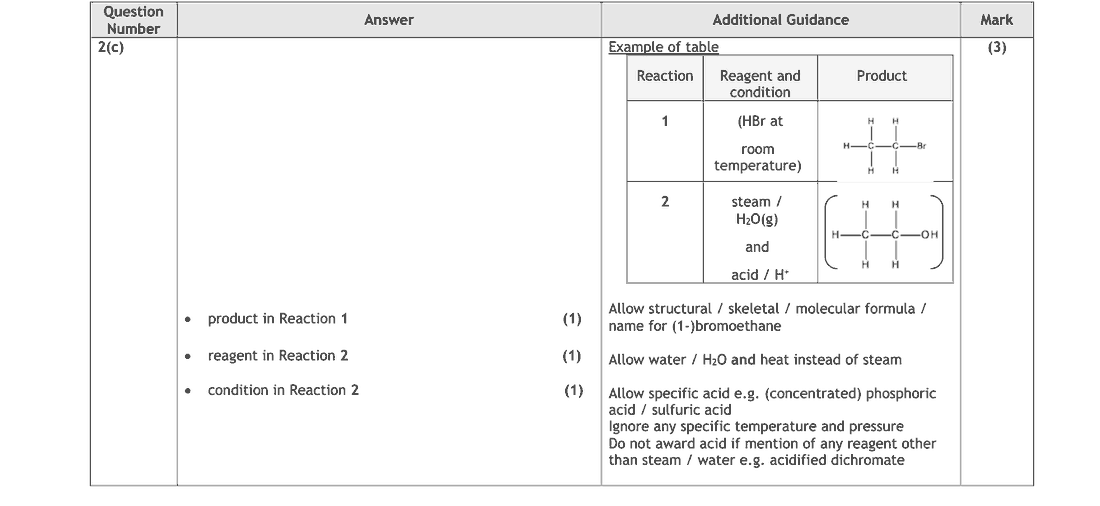
2(c) Alkenes 3Short answer
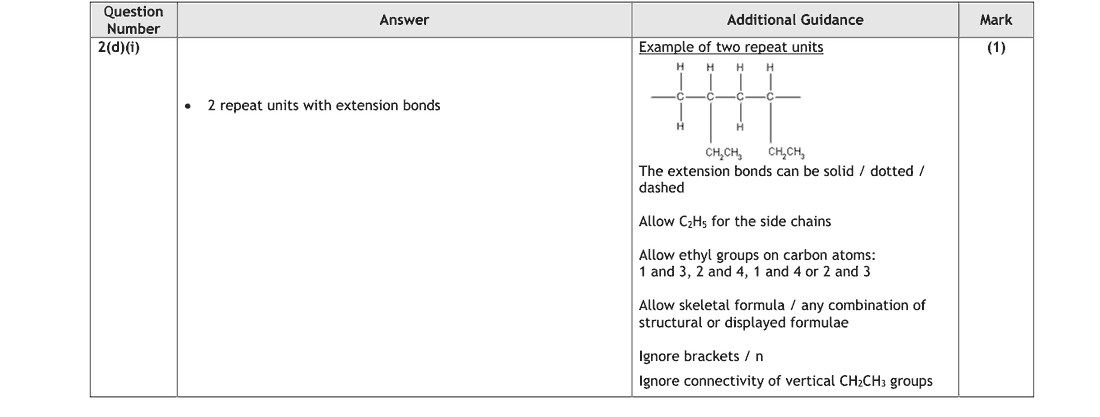
2(d)(i) Alkenes 1Diagram or structure
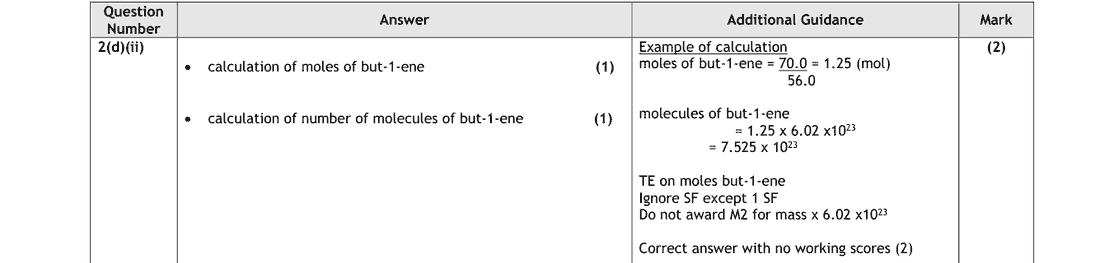
2(d)(ii) Formulae, equations and amounts of substance 2Calculation
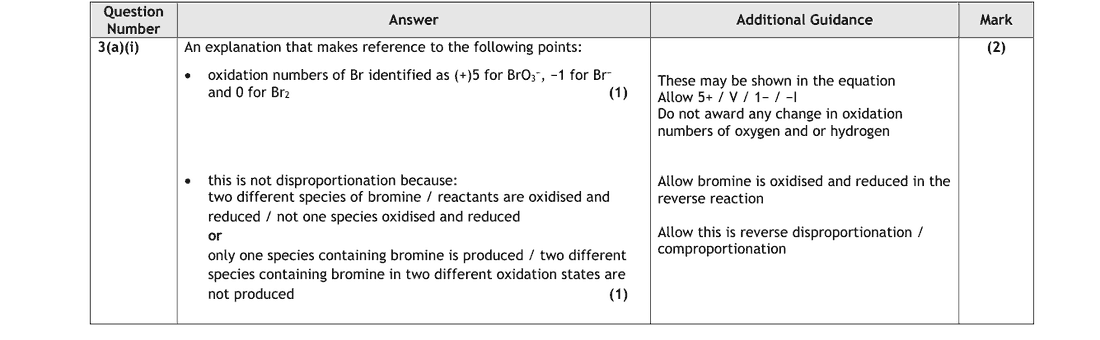
3(a)(i) Redox I 2Explanation
3(a)(ii) Kinetics II 1Multiple choice
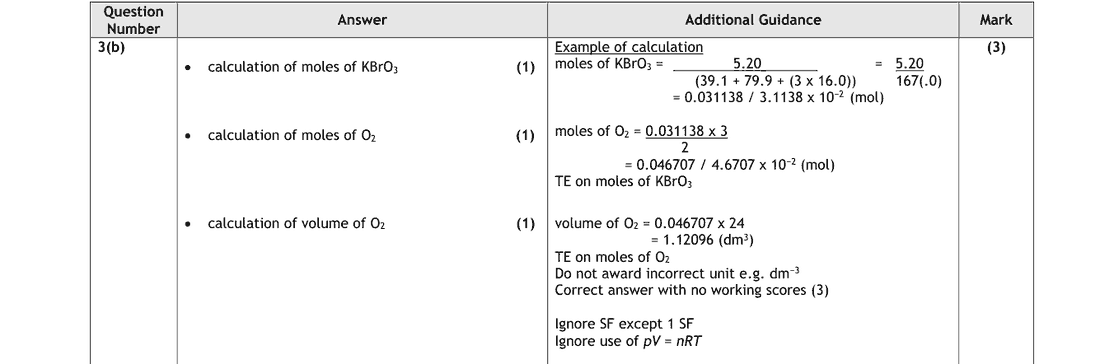
3(b) Formulae, equations and amounts of substance 3Calculation
4(a)(i) Carboxylic acids 1Multiple choice
4(a)(ii) Carboxylic acids 1Multiple choice
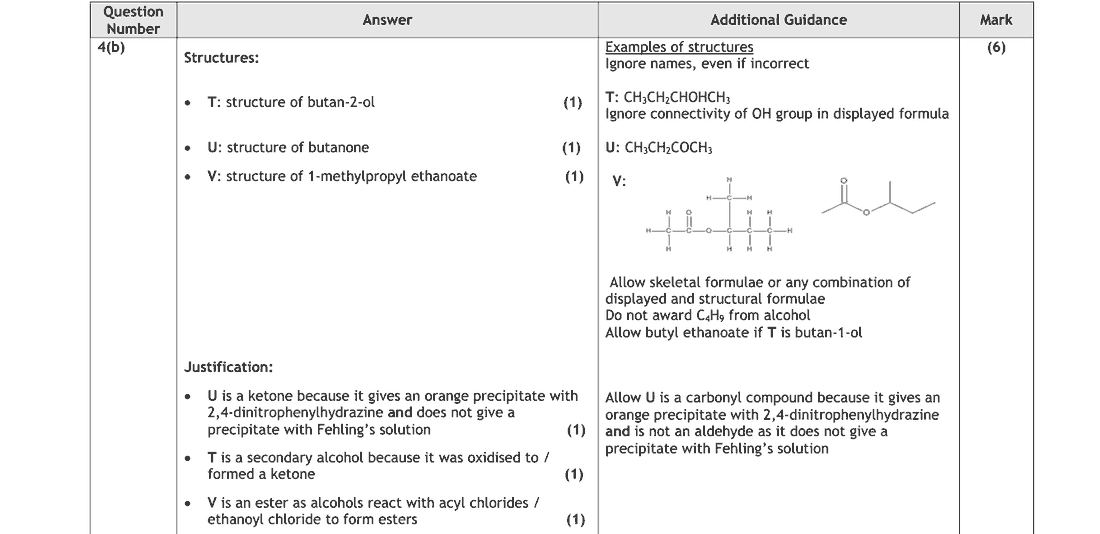
4(b) Organic synthesis, Carbonyl compounds, Carboxylic acids 6Short answer
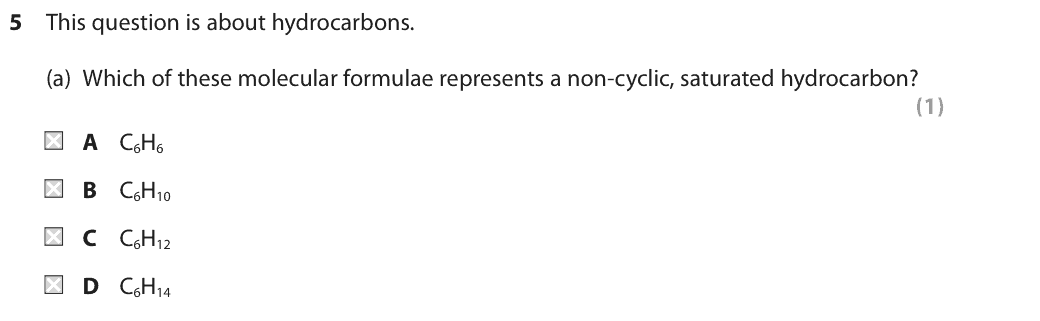
5(a) Alkanes 1Multiple choice
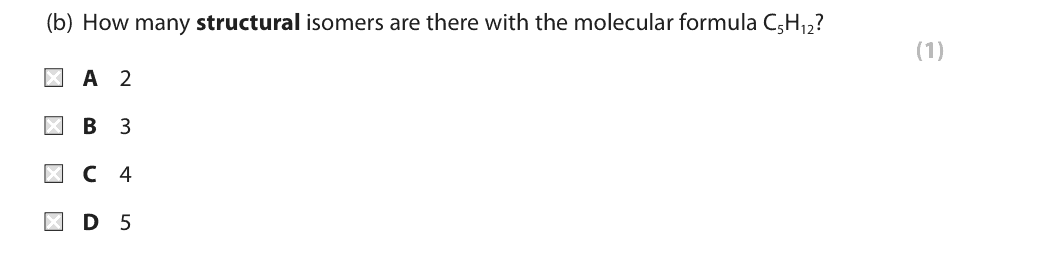
5(b) Introduction to organic chemistry 1Multiple choice
5(c) Alkenes 1Multiple choice
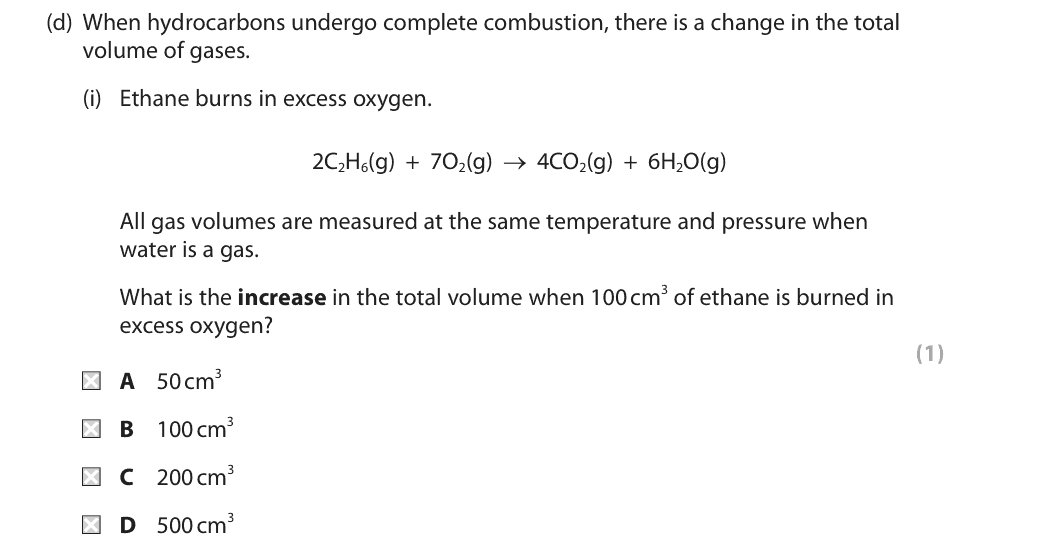
5(d)(i) Formulae, equations and amounts of substance 1Multiple choice
5(d)(ii) Formulae, equations and amounts of substance 3Calculation
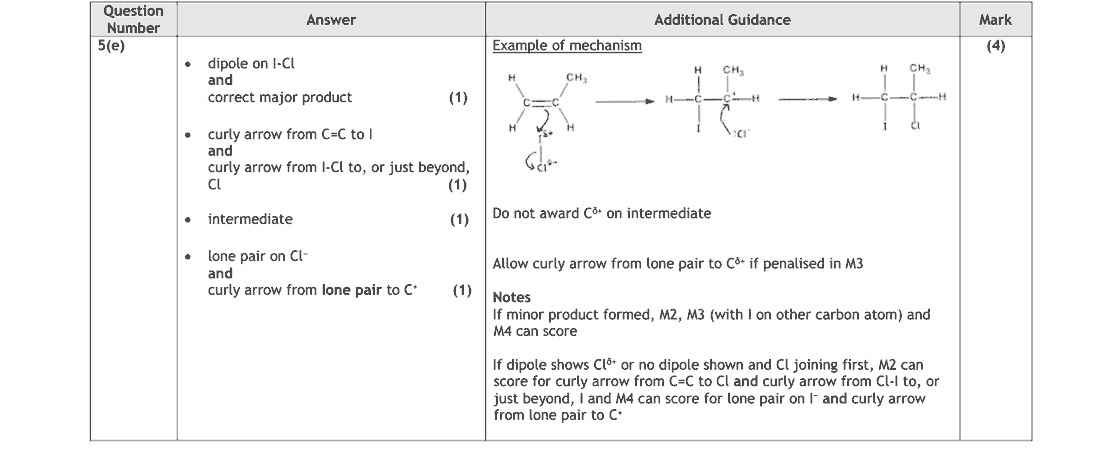
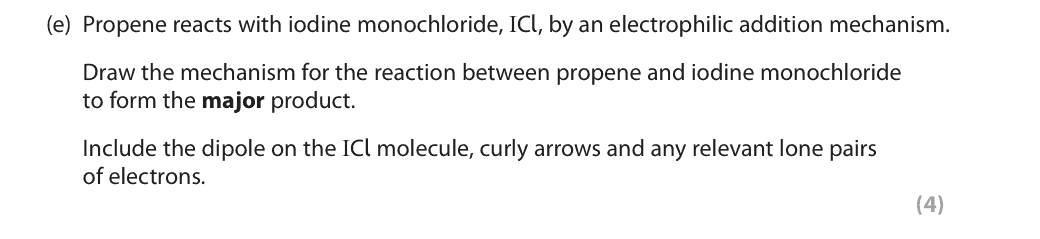
5(e) Alkenes 4Mechanism
5(f) Formulae, equations and amounts of substance 4Calculation
6(a) Halogenoalkanes 1Short answer
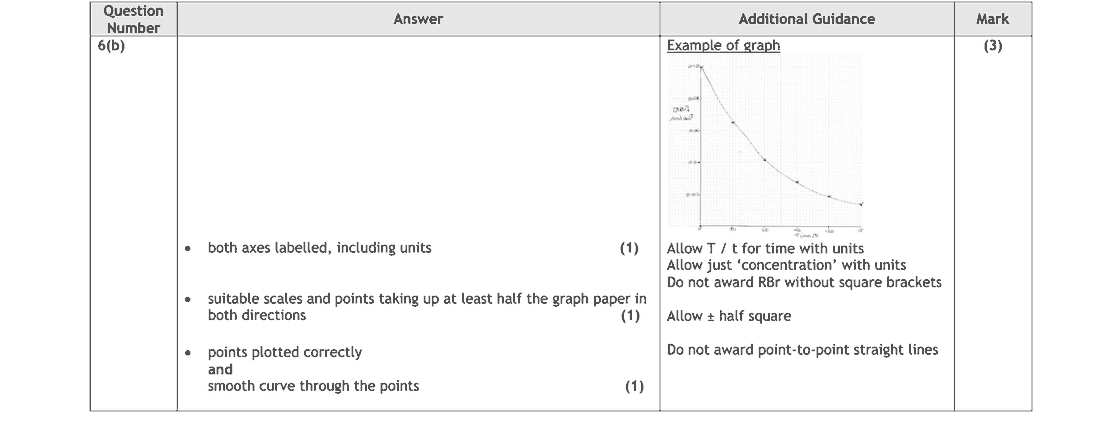
6(b) Kinetics II 3Diagram or structure
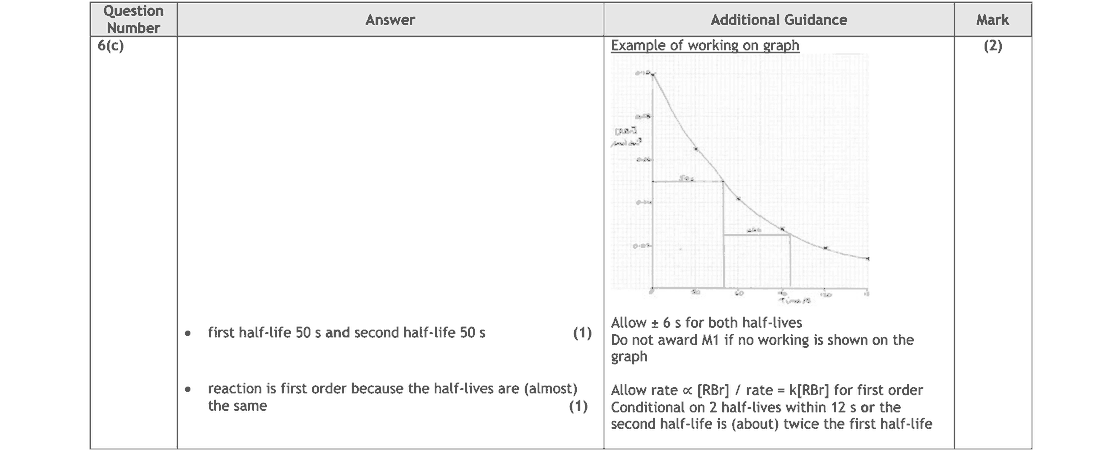
6(c) Kinetics II 2Explanation
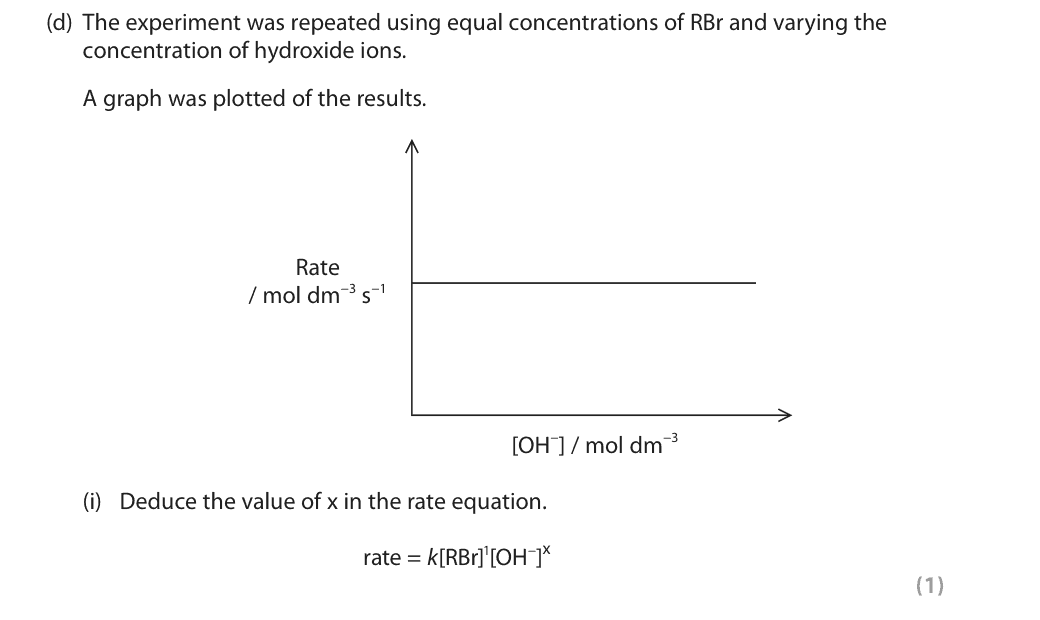
6(d)(i) Kinetics II 1Short answer
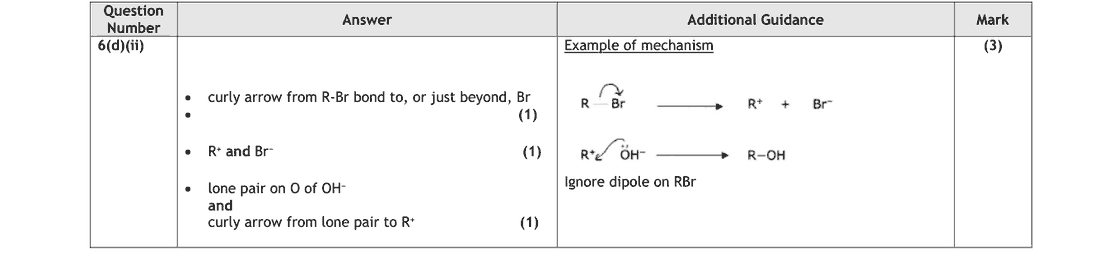
6(d)(ii) Kinetics II 3Mechanism
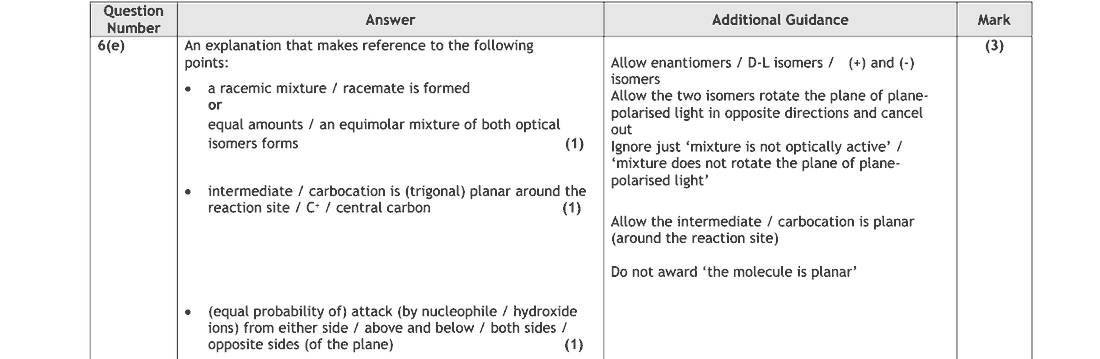
6(e) Chirality 3Explanation
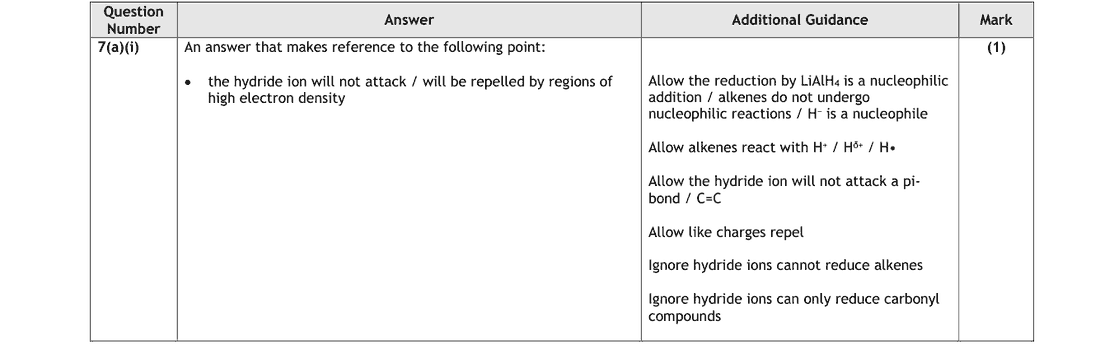
7(a)(i) Carbonyl compounds, Halogenoalkanes 1Short answer
7(a)(ii) Alkenes 2Short answer
7(a)(iii) Halogenoalkanes, Organic synthesis 1Short answer
7(a)(iv) Carboxylic acids 1Short answer
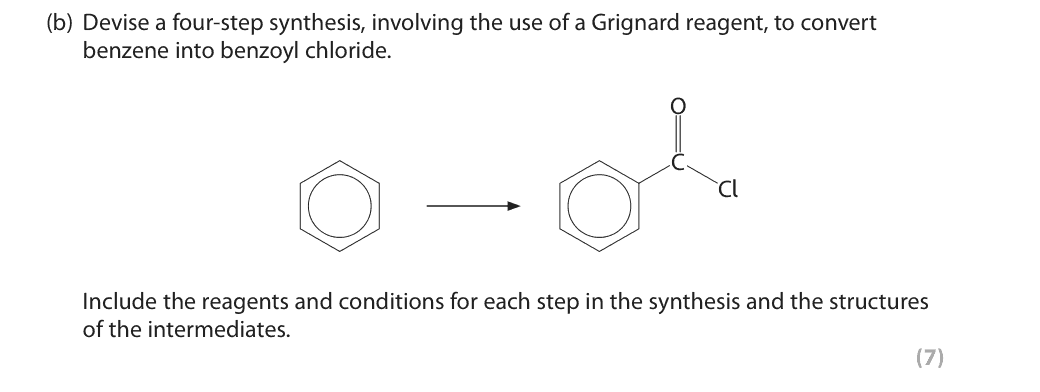
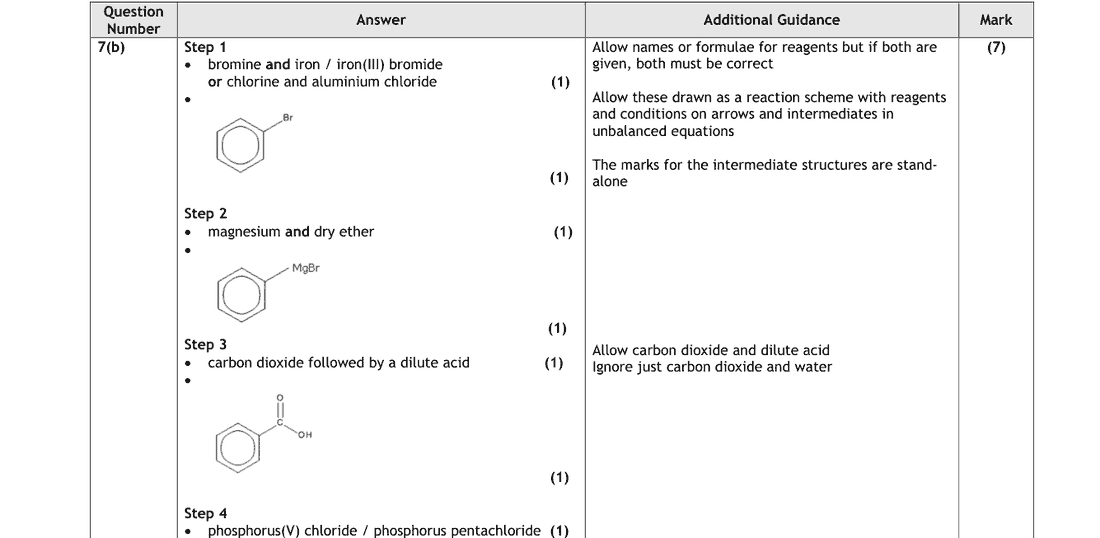
7(b) Organic synthesis, Arenes: benzene, Carboxylic acids 7Short answer
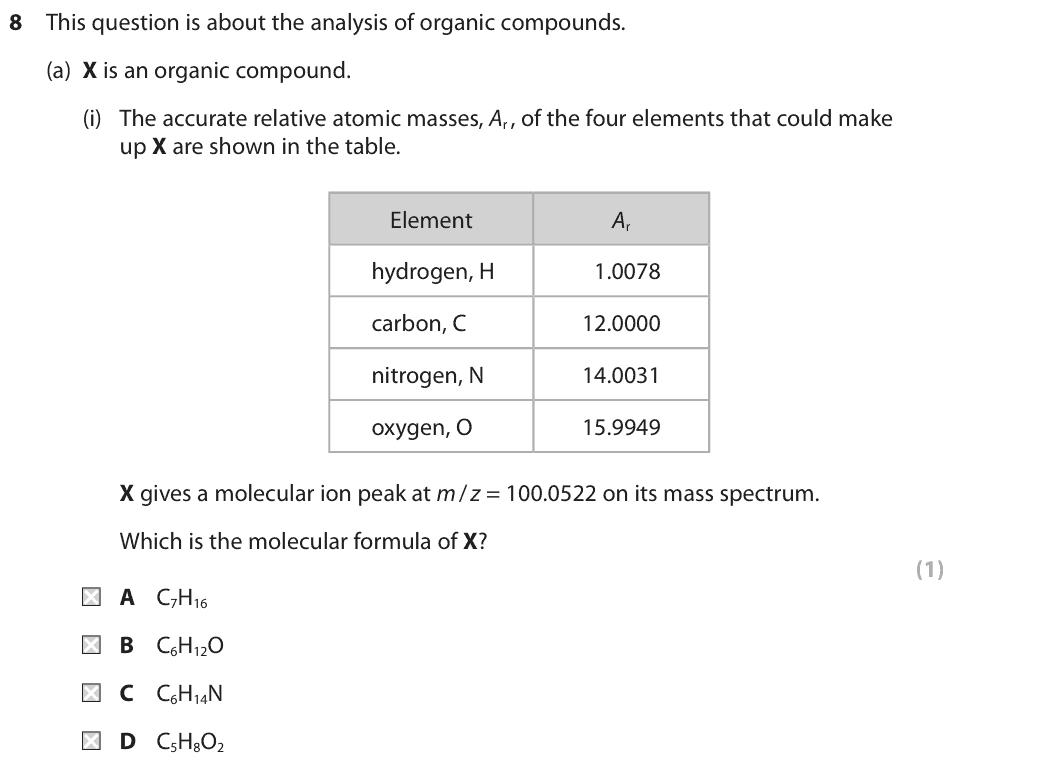
8(a)(i) Modern analytical techniques II: NMR, mass spectrometry and chromatography 1Multiple choice
8(a)(ii) Modern analytical techniques I: mass spectrometry and infrared 2Short answer
8(a)(iii) Organic synthesis, Introduction to organic chemistry 1Diagram or structure
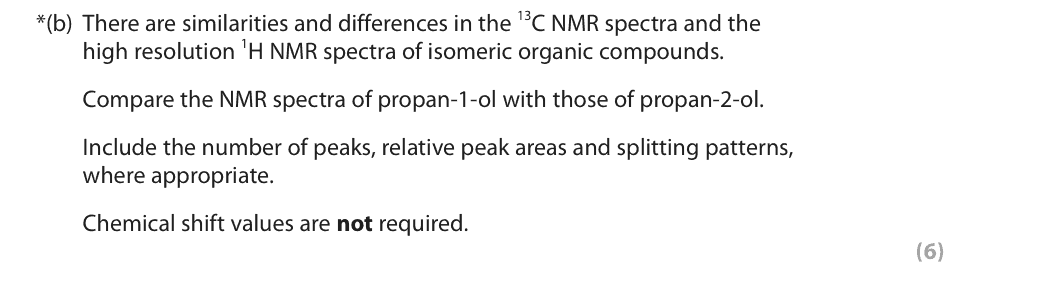
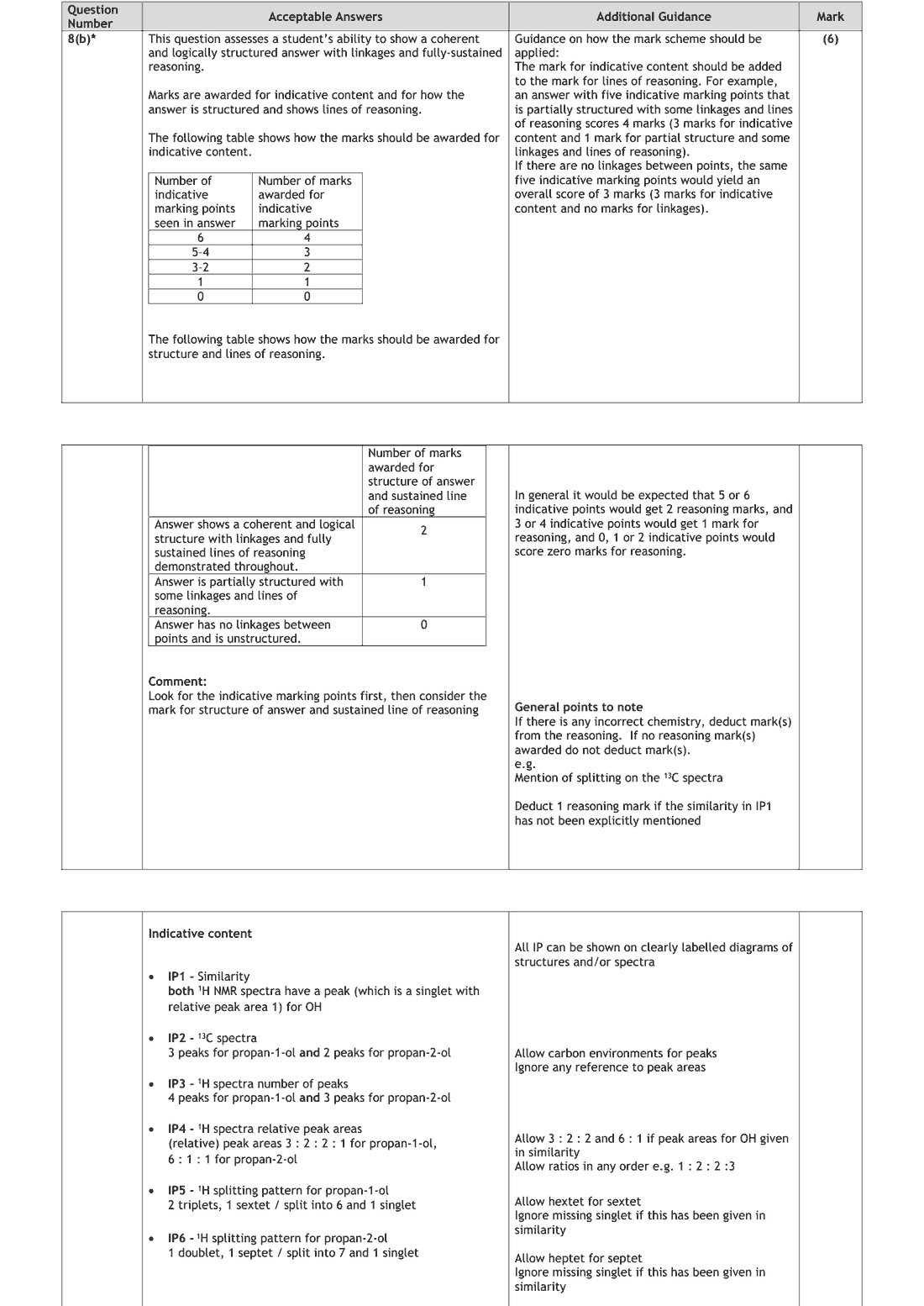
8(b) Modern analytical techniques II: NMR, mass spectrometry and chromatography 6Extended response
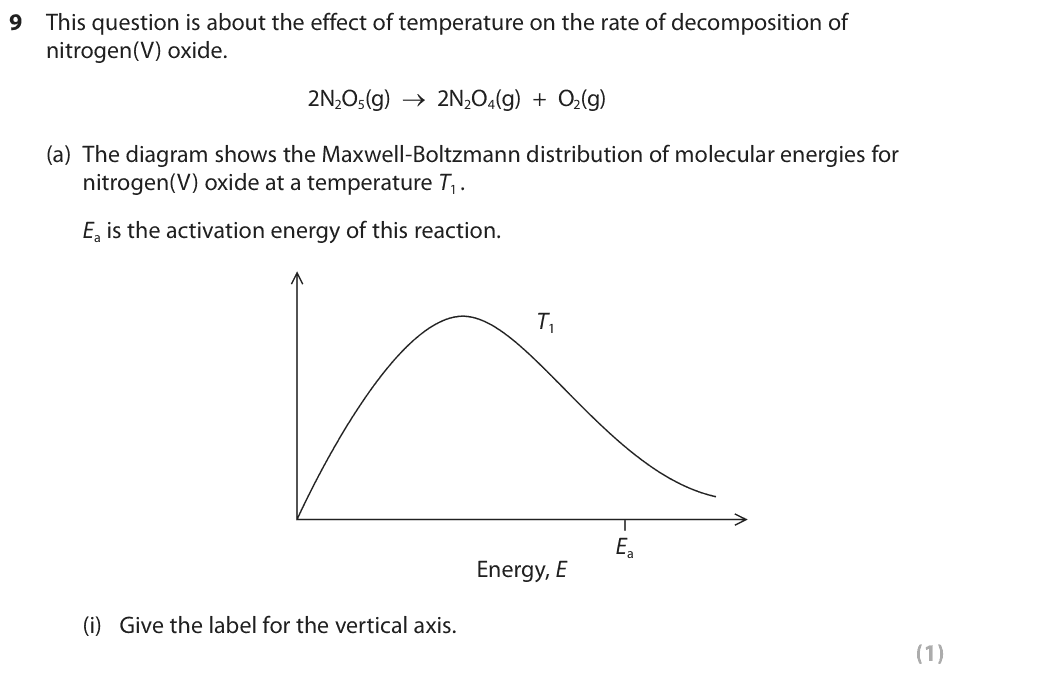
9(a)(i) Kinetics I 1Short answer
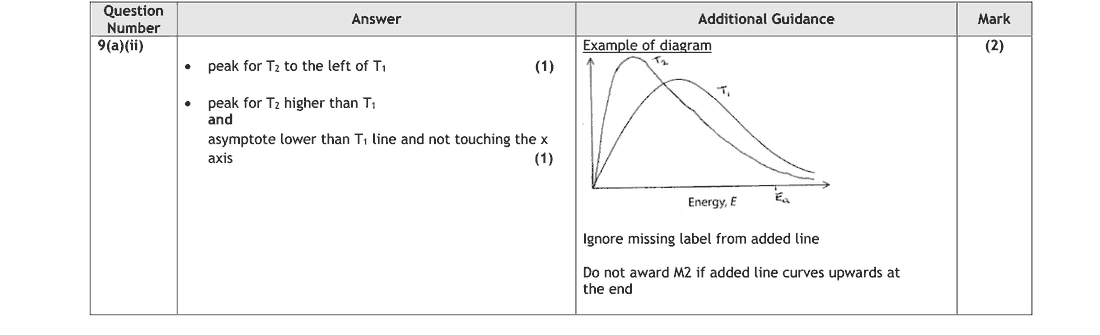
9(a)(ii) Kinetics I 2Diagram or structure
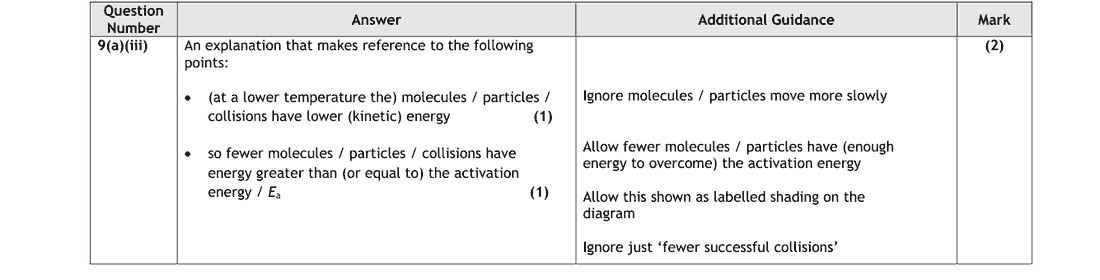
9(a)(iii) Kinetics I 2Explanation
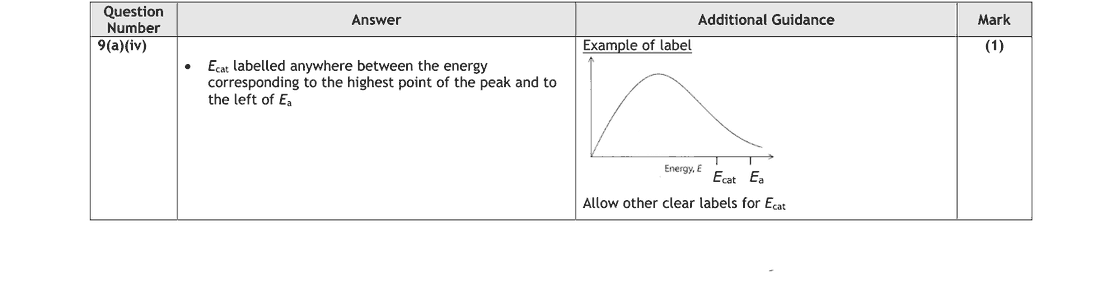
9(a)(iv) Kinetics I 1Diagram or structure
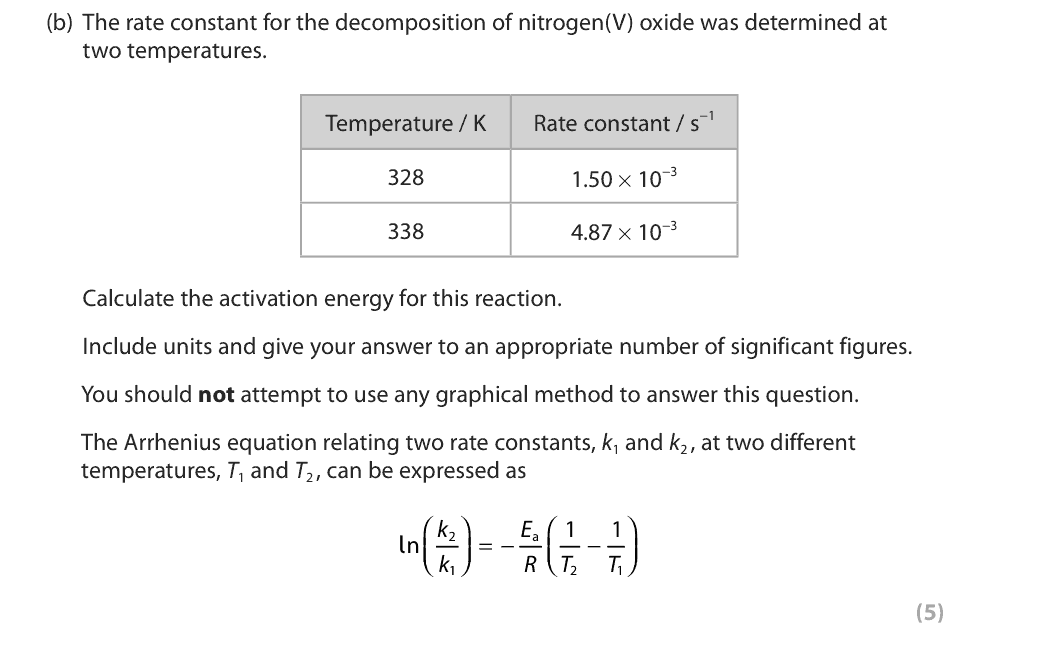
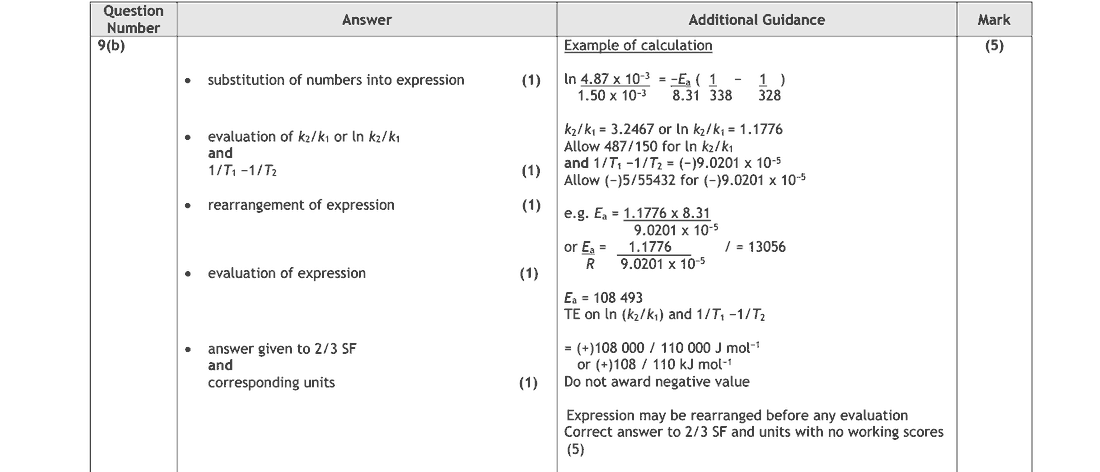
9(b) Kinetics II 5Calculation

The questions

1(a)1(b)1(c)(i)1(c)(ii)2(a)2(b)2(c)2(d)(i)2(d)(ii)3(a)(i)3(a)(ii)3(b)4(a)(i)4(a)(ii)4(b)5(a)5(b)5(c)5(d)(i)5(d)(ii)5(e)5(f)6(a)6(b)6(c)6(d)(i)6(d)(ii)6(e)7(a)(i)7(a)(ii)7(a)(iii)7(a)(iv)7(b)8(a)(i)8(a)(ii)8(a)(iii)8(b)9(a)(i)9(a)(ii)9(a)(iii)9(a)(iv)9(b)
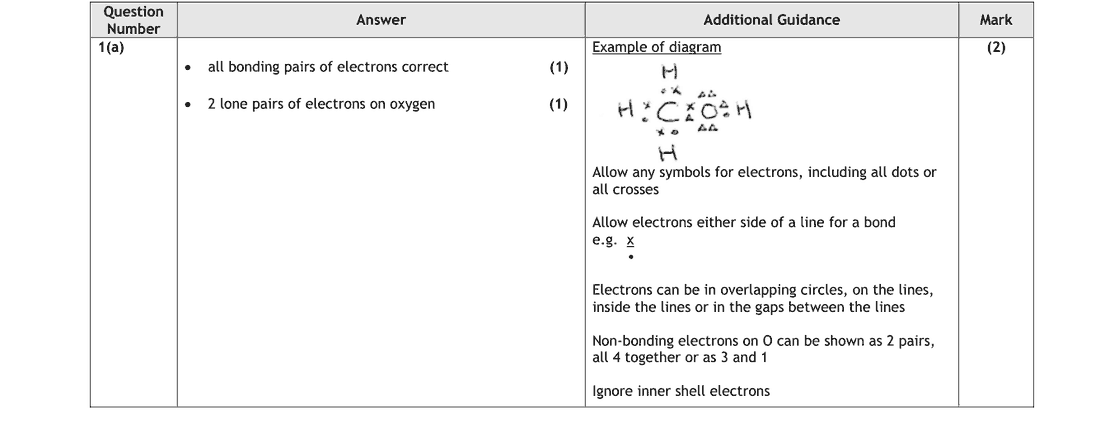
October 2020 · Paper 2 · Q1(a) 2 marks Diagram or structure Easy bonding

This question is about methanol, CH3OH .
Draw a dot-and-cross diagram to show the bonding in a molecule of methanol.
Show outer shell electrons only.
October 2020 · Paper 2 · Q1(b) 1 mark Short answer bonding

Predict which bond has the shortest bond length in a molecule of methanol.
October 2020 · Paper 2 · Q1(c)(i) 1 mark Short answer Easy bonding
Methanol is soluble in water.
State the strongest type of intermolecular force that occurs between
molecules of methanol and water.
October 2020 · Paper 2 · Q1(c)(ii) 3 marks Diagram or structure bonding

Earlier part of question 1 that this part usesEarlier part of October 2020 Paper 2 question 1
Draw a labelled diagram to show the interaction named in (c)(i) between one
molecule of methanol and one molecule of water.
Include any relevant lone pairs and dipoles in your diagram.
October 2020 · Paper 2 · Q2(a) 1 mark Multiple choice introduction to organic chemistry
This question is about alkenes.
Which of these has the molecular formula C6H10?
A
B
C
D
October 2020 · Paper 2 · Q2(b) 1 mark Multiple choice introduction to organic chemistry
Earlier part of question 2 that this part usesEarlier part of October 2020 Paper 2 question 2
What is the systematic name of this alkene?
CH3
HC
CH3
H2C
C
CH3
A  2-methylpent-1-ene
B  3-methylpent-1-ene
C  2,3-dimethylbut-1-ene
D  2,3-dimethylbut-3-ene
October 2020 · Paper 2 · Q2(c) 3 marks Short answer alkenes
Earlier part of question 2 that this part usesEarlier part of October 2020 Paper 2 question 2
Two reactions of ethene are shown.
H
H
C
C
H
H
Reaction 1
Reaction 2
HBr
H
H
Product
H
C
C
OH
H
H
Complete the table.
Reaction
Reagent and condition
Product
1
HBr at room temperature
H
H
2
H
C
C
OH
H
H
October 2020 · Paper 2 · Q2(d)(i) 1 mark Diagram or structure alkenes
Earlier part of question 2 that this part usesEarlier part of October 2020 Paper 2 question 2
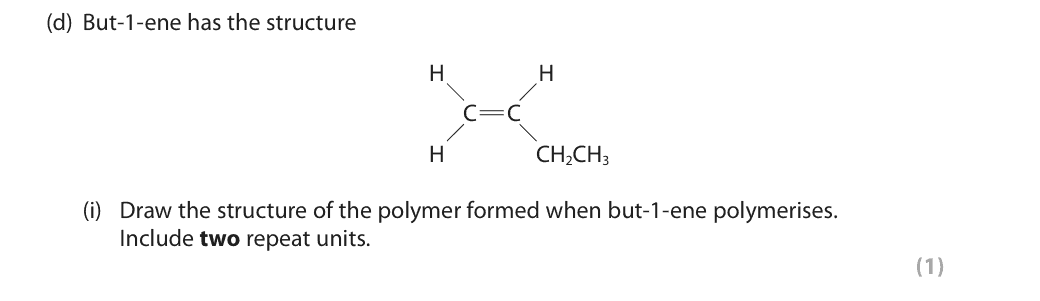
But-1-ene has the structure
H
H
C
C
H
CH2CH3
Draw the structure of the polymer formed when but-1-ene polymerises.
Include two repeat units.
October 2020 · Paper 2 · Q2(d)(ii) 2 marks Calculation formulae equations and amounts of substance
Earlier part of question 2 that this part usesEarlier part of October 2020 Paper 2 question 2
Calculate the number of molecules in 70.0 g of but-1-ene.
[Avogadro constant = 6.02 × 10²³ mol−1]
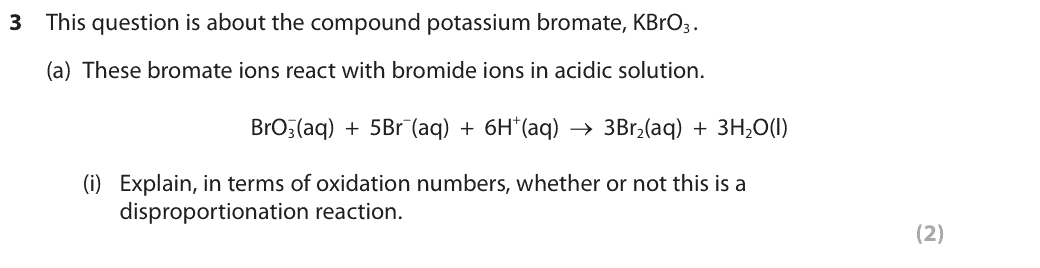
October 2020 · Paper 2 · Q3(a)(i) 2 marks Explanation redox i
This question is about the compound potassium bromate, KBrO3 .
These bromate ions react with bromide ions in acidic solution.
BrO3
−(aq)  +  5Br−(aq)  +  6H+(aq)  →  3Br2(aq)  +  3H2O(l)
Explain, in terms of oxidation numbers, whether or not this is a
disproportionation reaction.
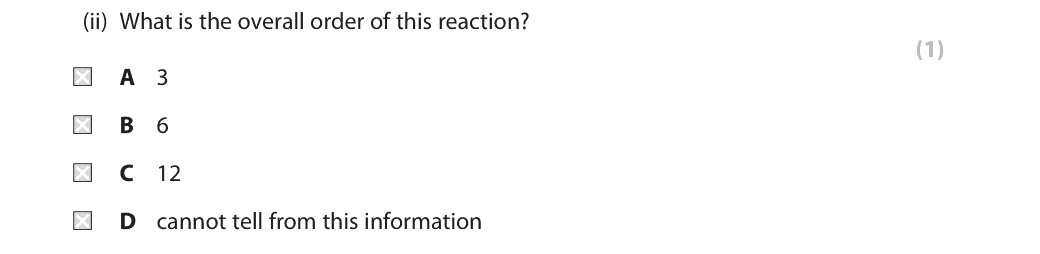
October 2020 · Paper 2 · Q3(a)(ii) 1 mark Multiple choice kinetics ii
Earlier part of question 3 that this part usesEarlier part of October 2020 Paper 2 question 3
What is the overall order of this reaction?
A  3
B  6
C  12
D  cannot tell from this information
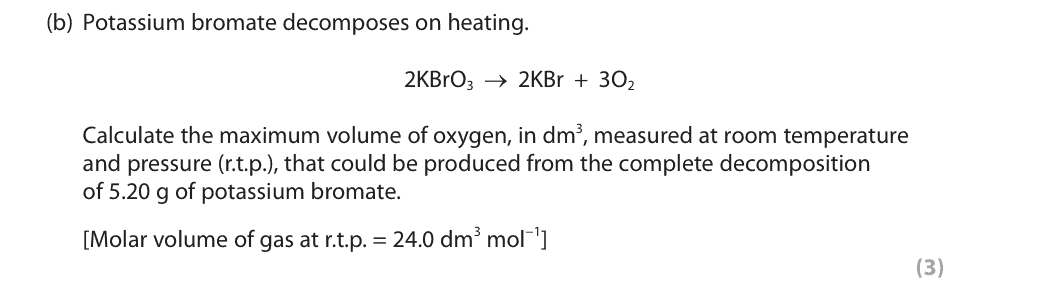
October 2020 · Paper 2 · Q3(b) 3 marks Calculation formulae equations and amounts of substance
Earlier part of question 3 that this part usesEarlier part of October 2020 Paper 2 question 3
Potassium bromate decomposes on heating.
2KBrO3  →  2KBr  +  3O2
Calculate the maximum volume of oxygen, in dm3, measured at room temperature
and pressure (r.t.p.), that could be produced from the complete decomposition
of 5.20 g of potassium bromate.
[Molar volume of gas at r.t.p. = 24.0 dm3 mol−1]
October 2020 · Paper 2 · Q4(a)(i) 1 mark Multiple choice carboxylic acids
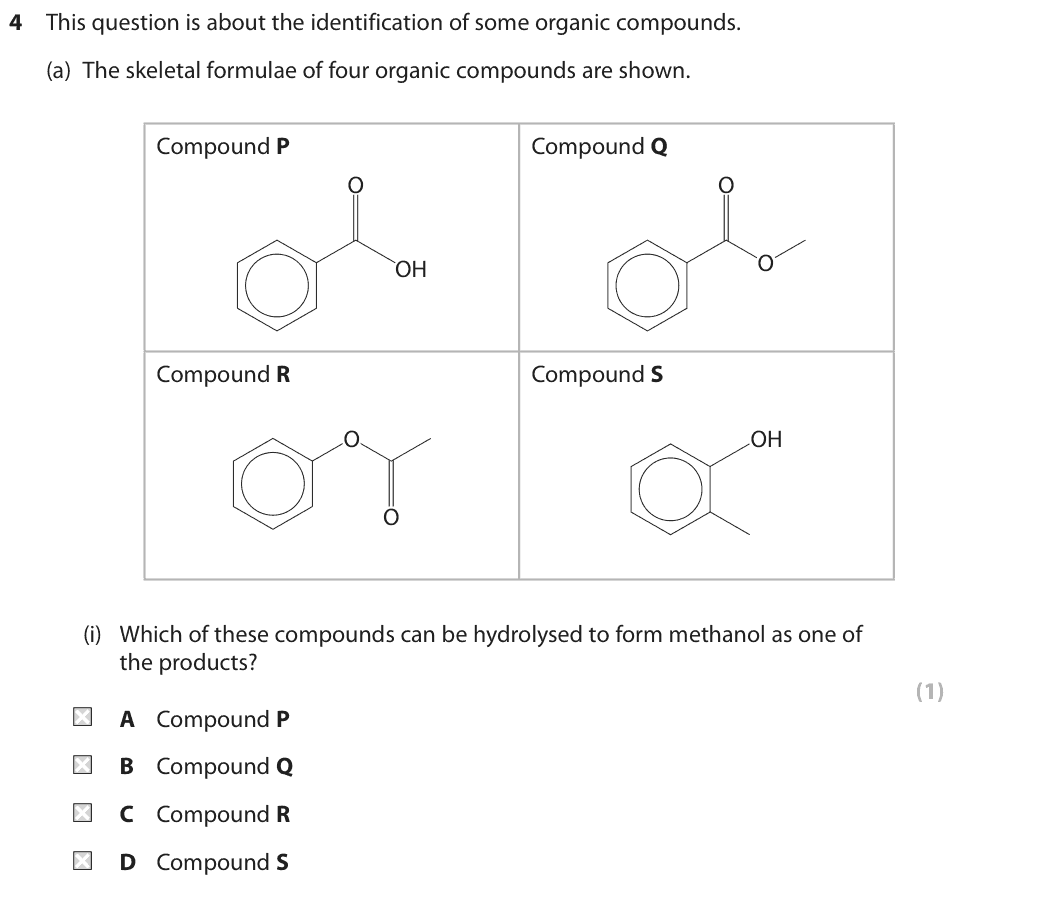
This question is about the identification of some organic compounds.
The skeletal formulae of four organic compounds are shown.
Compound P
Compound Q
O
O
O
OH
Compound R
Compound S
O
OH
O
Which of these compounds can be hydrolysed to form methanol as one of
the products?
A  Compound P
B  Compound Q
C  Compound R
D  Compound S
October 2020 · Paper 2 · Q4(a)(ii) 1 mark Multiple choice carboxylic acids
Earlier part of question 4 that this part usesEarlier part of October 2020 Paper 2 question 4
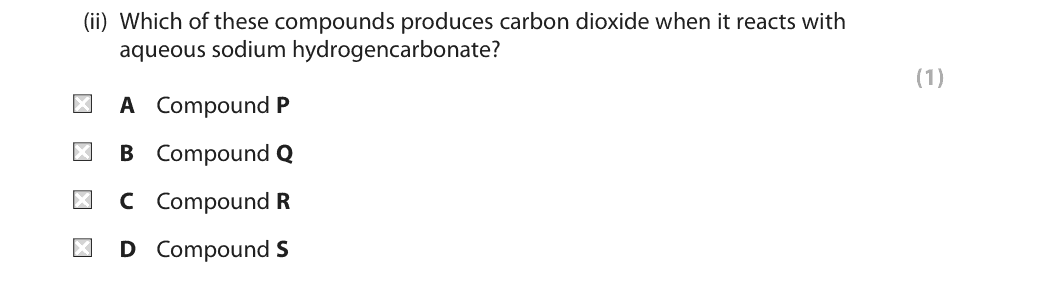
Which of these compounds produces carbon dioxide when it reacts with
aqueous sodium hydrogencarbonate?
A  Compound P
B  Compound Q
C  Compound R
D  Compound S
October 2020 · Paper 2 · Q4(b) 6 marks Short answer organic synthesiscarbonyl compoundscarboxylic acids
Earlier part of question 4 that this part usesEarlier part of October 2020 Paper 2 question 4
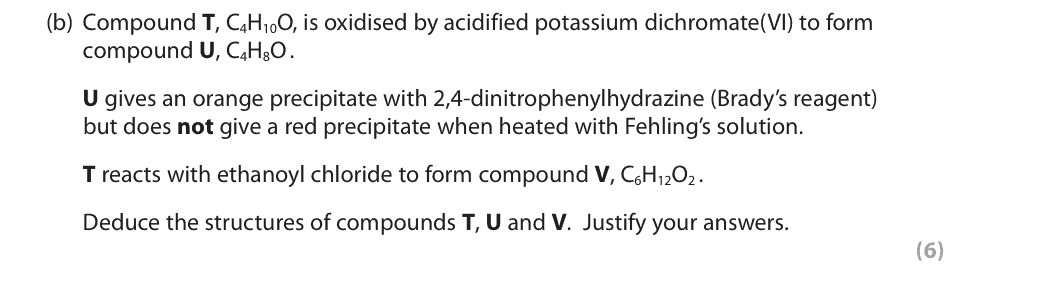
Compound T, C4H10O, is oxidised by acidified potassium dichromate(VI) to form
compound U, C4H8O .
U gives an orange precipitate with 2,4-dinitrophenylhydrazine (Brady’s reagent)
but does not give a red precipitate when heated with Fehling’s solution.
T reacts with ethanoyl chloride to form compound V, C6H12O2 .
Deduce the structures of compounds T, U and V.  Justify your answers.
October 2020 · Paper 2 · Q5(a) 1 mark Multiple choice alkanes
This question is about hydrocarbons.
Which of these molecular formulae represents a non-cyclic, saturated hydrocarbon?
A  C6H6
B  C6H10
C  C6H12
D  C6H14
October 2020 · Paper 2 · Q5(b) 1 mark Multiple choice introduction to organic chemistry
How many structural isomers are there with the molecular formula C5H12?
.
A  2
B  3
C  4
D  5
October 2020 · Paper 2 · Q5(c) 1 mark Multiple choice alkenes
Earlier part of question 5 that this part usesEarlier part of October 2020 Paper 2 question 5
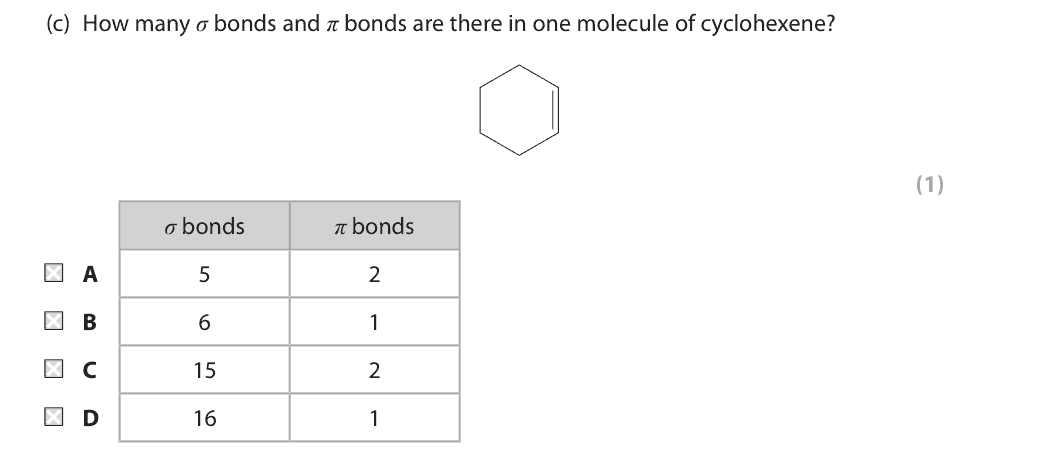
How many σ bonds and π bonds are there in one molecule of cyclohexene?
.
σ bonds
π bonds
A
5
2
B
6
1
C
15
2
D
16
1
October 2020 · Paper 2 · Q5(d)(i) 1 mark Multiple choice formulae equations and amounts of substance
Earlier part of question 5 that this part usesEarlier part of October 2020 Paper 2 question 5
When hydrocarbons undergo complete combustion, there is a change in the total
volume of gases.
Ethane burns in excess oxygen.
2C2H6(g)  +  7O2(g)  →  4CO2(g)  +  6H2O(g)
All gas volumes are measured at the same temperature and pressure when
water is a gas.
What is the increase in the total volume when 100 cm3 of ethane is burned in
excess oxygen?
A  50 cm3
B  100 cm3
C  200 cm3
D  500 cm3
October 2020 · Paper 2 · Q5(d)(ii) 3 marks Calculation Hard formulae equations and amounts of substance
Earlier parts of question 5 that this part usesEarlier part of October 2020 Paper 2 question 5Earlier part of October 2020 Paper 2 question 5
A combustion experiment was carried out using conditions under which
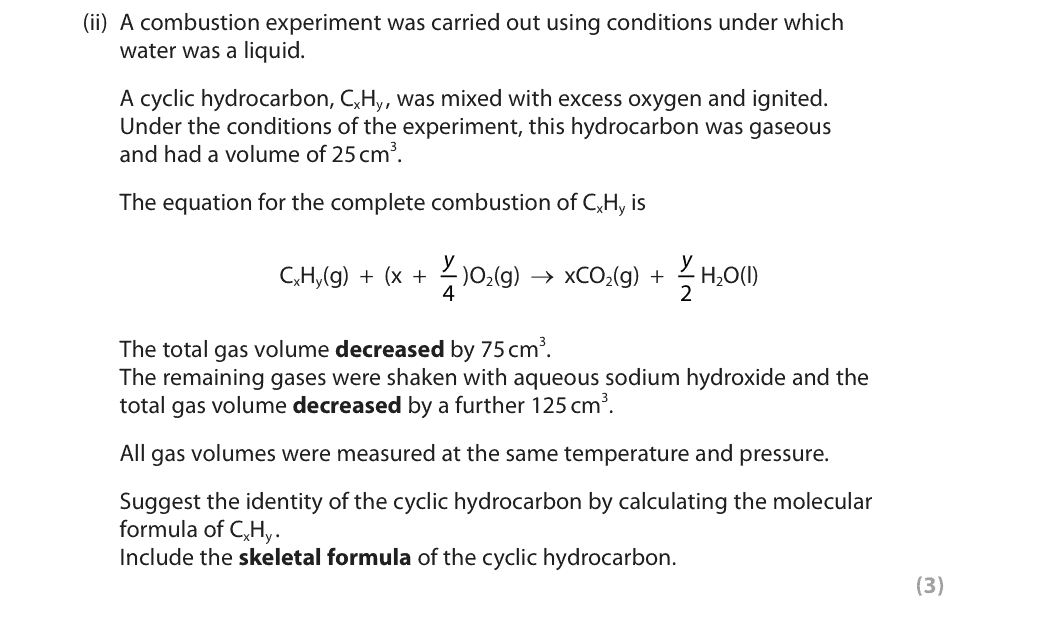
water was a liquid.
A cyclic hydrocarbon, CxHy , was mixed with excess oxygen and ignited.
Under the conditions of the experiment, this hydrocarbon was gaseous
and had a volume of 25 cm3.
The equation for the complete combustion of CxHy is
CxHy(g)  +  (x  +  y
4 )O2(g)  →  xCO2(g)  +  y
2 H2O(l)
The total gas volume decreased by 75 cm3.
The remaining gases were shaken with aqueous sodium hydroxide and the
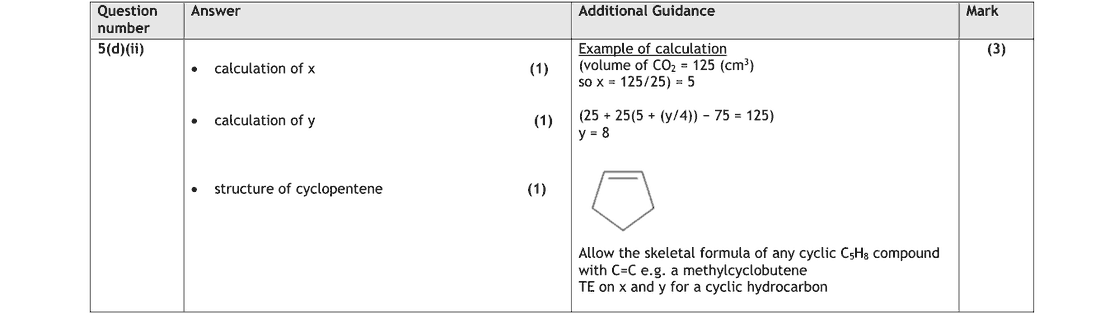
total gas volume decreased by a further 125 cm3.
All gas volumes were measured at the same temperature and pressure.
Suggest the identity of the cyclic hydrocarbon by calculating the molecular
formula of CxHy .
Include the skeletal formula of the cyclic hydrocarbon.
October 2020 · Paper 2 · Q5(e) 4 marks Mechanism alkenes
Propene reacts with iodine monochloride, ICl, by an electrophilic addition mechanism.
Draw the mechanism for the reaction between propene and iodine monochloride
to form the major product.
Include the dipole on the ICl molecule, curly arrows and any relevant lone pairs
of electrons.
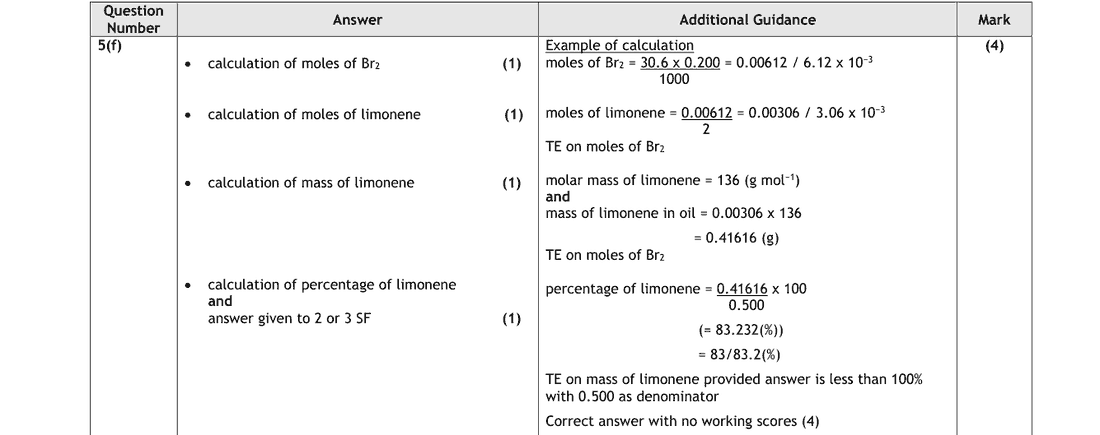
October 2020 · Paper 2 · Q5(f) 4 marks Calculation formulae equations and amounts of substance
Earlier part of question 5 that this part usesEarlier part of October 2020 Paper 2 question 5
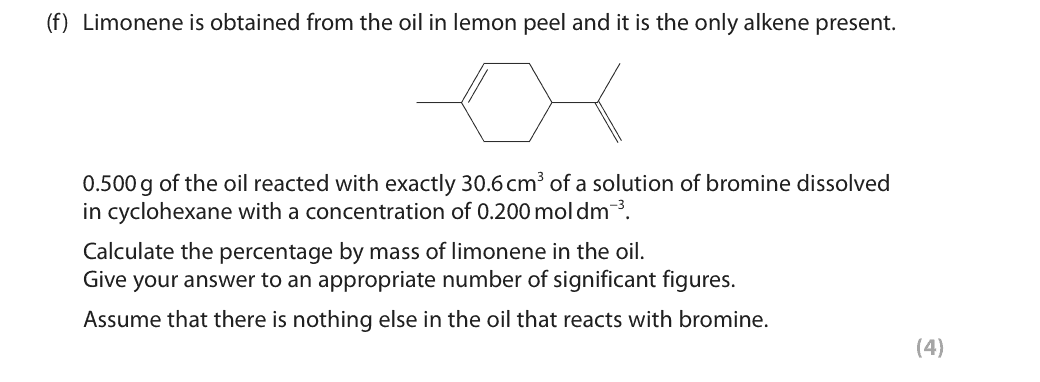
Limonene is obtained from the oil in lemon peel and it is the only alkene present.
0.500 g of the oil reacted with exactly 30.6 cm3 of a solution of bromine dissolved
in cyclohexane with a concentration of 0.200 mol dm−3.
Calculate the percentage by mass of limonene in the oil.
Give your answer to an appropriate number of significant figures.
Assume that there is nothing else in the oil that reacts with bromine.
October 2020 · Paper 2 · Q6(a) 1 mark Short answer halogenoalkanes
A bromoalkane, RBr, reacts with aqueous hydroxide ions in a nucleophilic substitution
reaction.
RBr  +  OH−  →  R
OH  +  Br−
This reaction is first order with respect to the bromoalkane and the rate equation is
rate  =  k[RBr]1[OH−]x
where x is the order of the reaction with respect to hydroxide ions.
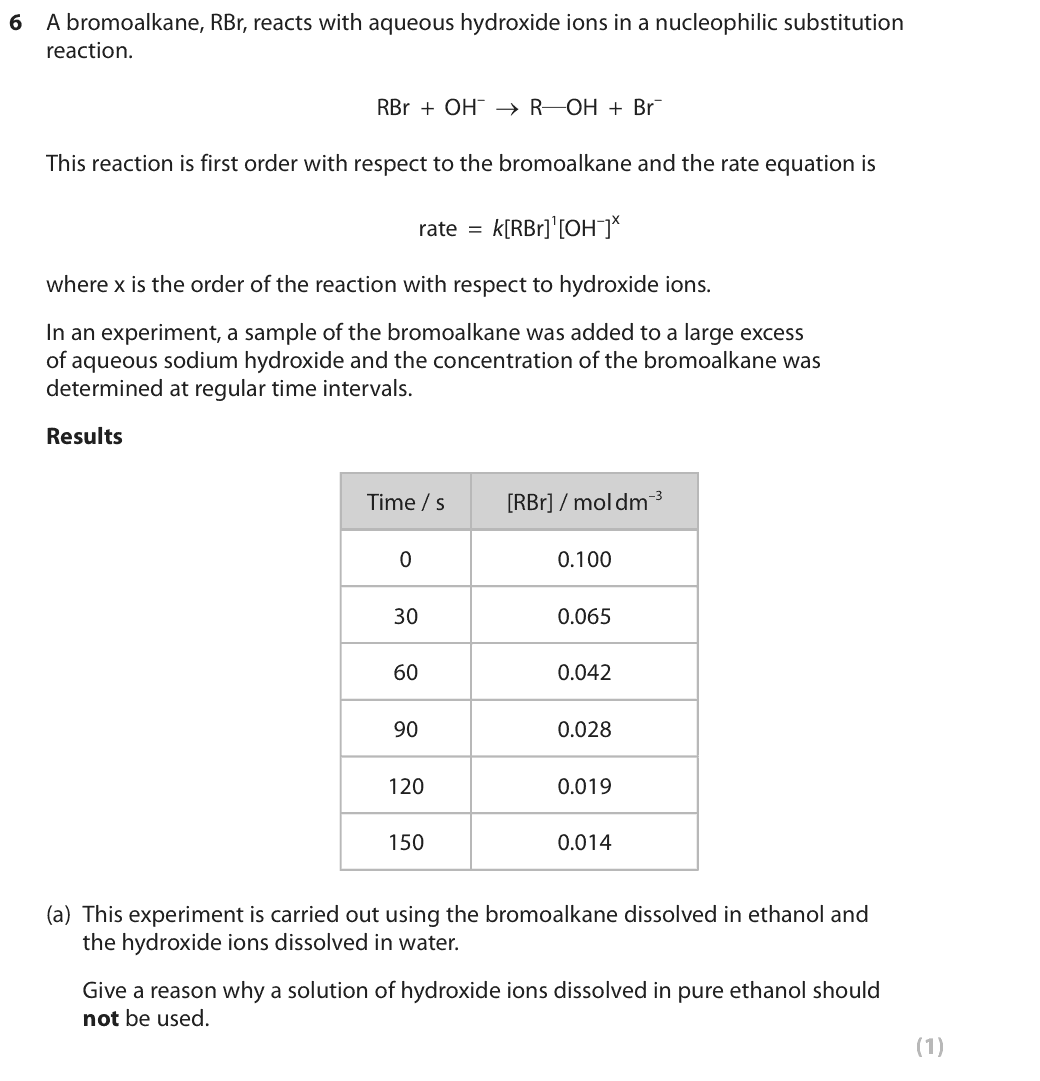
In an experiment, a sample of the bromoalkane was added to a large excess
of aqueous sodium hydroxide and the concentration of the bromoalkane was
determined at regular time intervals.
Results
Time / s
[RBr] / mol dm–3
0
0.100
30
0.065
60
0.042
90
0.028
120
0.019
150
0.014
This experiment is carried out using the bromoalkane dissolved in ethanol and
the hydroxide ions dissolved in water.
Give a reason why a solution of hydroxide ions dissolved in pure ethanol should
not be used.
October 2020 · Paper 2 · Q6(b) 3 marks Diagram or structure Easy kinetics ii
Earlier part of question 6 that this part usesEarlier part of October 2020 Paper 2 question 6
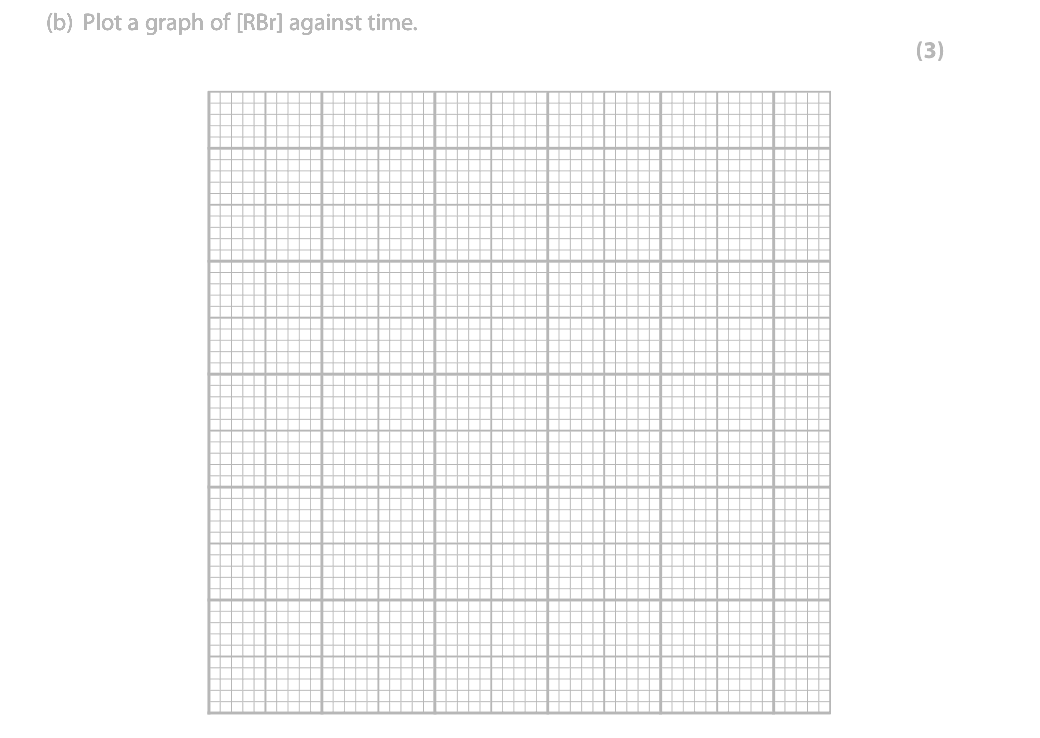
Plot a graph of [RBr] against time.
October 2020 · Paper 2 · Q6(c) 2 marks Explanation kinetics ii
Earlier part of question 6 that this part usesEarlier part of October 2020 Paper 2 question 6
Explain how the graph shows that the reaction is first order with respect to RBr.
Include the values of two consecutive half-lives.
You must show your working for the half-lives on the graph.
October 2020 · Paper 2 · Q6(d)(i) 1 mark Short answer Easy kinetics ii
Earlier part of question 6 that this part usesEarlier part of October 2020 Paper 2 question 6
The experiment was repeated using equal concentrations of RBr and varying the
concentration of hydroxide ions.
A graph was plotted of the results.
Rate
/ mol dm−3 s−1
[OH−] / mol dm−3
Deduce the value of x in the rate equation.
rate = k[RBr]1[OH−]x
October 2020 · Paper 2 · Q6(d)(ii) 3 marks Mechanism kinetics ii
Earlier parts of question 6 that this part usesEarlier part of October 2020 Paper 2 question 6Earlier part of October 2020 Paper 2 question 6
Give the mechanism for the reaction that is consistent with the orders of reaction
with respect to R
Br and hydroxide ions.
Include curly arrows and relevant lone pairs.
October 2020 · Paper 2 · Q6(e) 3 marks Explanation chirality
Earlier part of question 6 that this part usesEarlier part of October 2020 Paper 2 question 6
2-bromobutane can react with aqueous hydroxide ions by an SN1 mechanism.
Explain why the butan-2-ol produced from a single optical isomer of
2-bromobutane, using this mechanism, is not optically active.
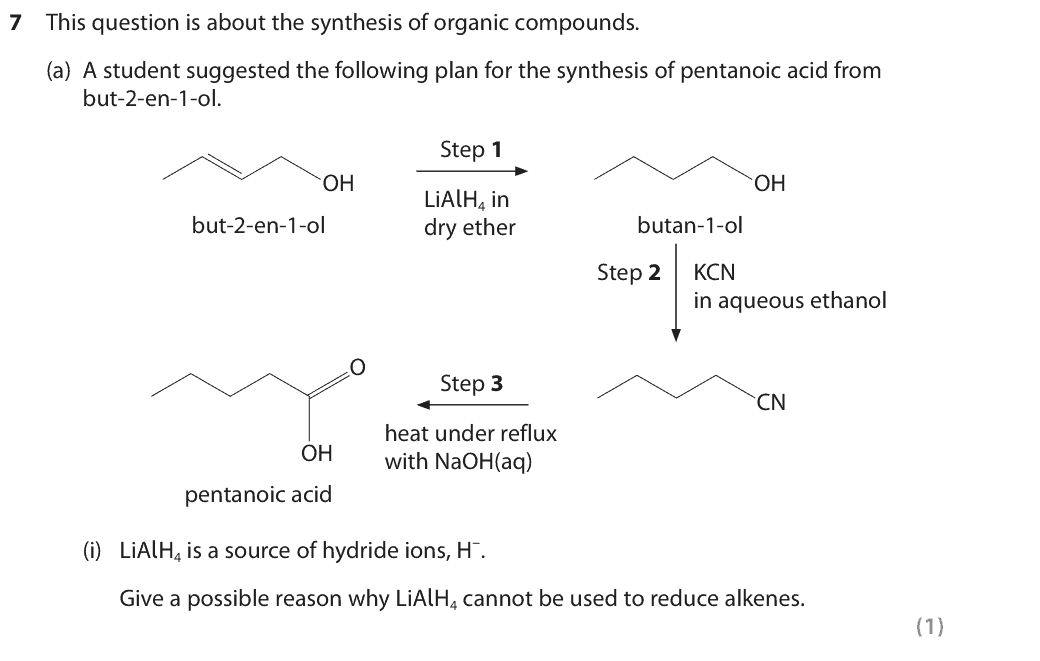
October 2020 · Paper 2 · Q7(a)(i) 1 mark Short answer carbonyl compoundshalogenoalkanes
This question is about the synthesis of organic compounds.
A student suggested the following plan for the synthesis of pentanoic acid from
but-2-en-1-ol.
Step 1
OH
OH
LiAlH4 in
but-2-en-1-ol
dry ether
butan-1-ol
Step 2
KCN
in aqueous ethanol
O
Step 3
CN
heat under reflux
OH
with NaOH(aq)
pentanoic acid
LiAlH4 is a source of hydride ions, H−.
Give a possible reason why LiAlH4 cannot be used to reduce alkenes.
October 2020 · Paper 2 · Q7(a)(ii) 2 marks Short answer alkenes
Earlier part of question 7 that this part usesEarlier part of October 2020 Paper 2 question 7
Give a suitable reagent and condition for Step 1.
October 2020 · Paper 2 · Q7(a)(iii) 1 mark Short answer halogenoalkanesorganic synthesis
Earlier part of question 7 that this part usesEarlier part of October 2020 Paper 2 question 7
Step 2 is incorrect because alcohols can only be converted to nitriles via an
intermediate compound.
Identify a suitable intermediate compound by name or formula.
October 2020 · Paper 2 · Q7(a)(iv) 1 mark Short answer carboxylic acids
Earlier part of question 7 that this part usesEarlier part of October 2020 Paper 2 question 7
Step 3 involves the hydrolysis of a nitrile.
Give the additional reagent that should be added after heating under reflux
with aqueous sodium hydroxide, to produce pentanoic acid.
October 2020 · Paper 2 · Q7(b) 7 marks Short answer organic synthesisarenes benzenecarboxylic acids
Devise a four-step synthesis, involving the use of a Grignard reagent, to convert
benzene into benzoyl chloride.
O
C
Cl
Include the reagents and conditions for each step in the synthesis and the structures
of the intermediates.
October 2020 · Paper 2 · Q8(a)(i) 1 mark Multiple choice nmr mass spectrometry and chromatography
This question is about the analysis of organic compounds.
X is an organic compound.
The accurate relative atomic masses, Ar , of the four elements that could make
up X are shown in the table.
Element
Ar
hydrogen, H
1.0078
carbon, C
12.0000
nitrogen, N
14.0031
oxygen, O
15.9949
X gives a molecular ion peak at m / z = 100.0522 on its mass spectrum.
Which is the molecular formula of X?
A  C7H16
B  C6H12O
C  C6H14N
D  C5H8O2
October 2020 · Paper 2 · Q8(a)(ii) 2 marks Short answer mass spectrometry and infrared spectroscopy
Earlier part of question 8 that this part usesEarlier part of October 2020 Paper 2 question 8
The infrared spectrum of X contains major absorption wavenumber ranges at
3300–2500 cm−1, 1725–1700 cm−1 and 1669–1645 cm−1.
Identify the two functional groups in X.
October 2020 · Paper 2 · Q8(a)(iii) 1 mark Diagram or structure organic synthesisintroduction to organic chemistry
Earlier part of question 8 that this part usesEarlier part of October 2020 Paper 2 question 8
X has an unbranched carbon chain and does not exhibit geometric isomerism.
Draw the skeletal formula of X.
October 2020 · Paper 2 · Q8(b) 6 marks 6-mark extended response nmr mass spectrometry and chromatography
There are similarities and differences in the 13C NMR spectra and the
high resolution 1H NMR spectra of isomeric organic compounds.
Compare the NMR spectra of propan-1-ol with those of propan-2-ol.
Include the number of peaks, relative peak areas and splitting patterns,
where appropriate.
Chemical shift values are not required.
October 2020 · Paper 2 · Q9(a)(i) 1 mark Short answer kinetics i
This question is about the effect of temperature on the rate of decomposition of
nitrogen(V) oxide.
2N2O5(g)  →  2N2O4(g)  +  O2(g)
The diagram shows the Maxwell-Boltzmann distribution of molecular energies for
nitrogen(V) oxide at a temperature T1 .
Ea is the activation energy of this reaction.
T1
Ea
Energy, E
Give the label for the vertical axis.
October 2020 · Paper 2 · Q9(a)(ii) 2 marks Diagram or structure kinetics i
Earlier part of question 9 that this part usesEarlier part of October 2020 Paper 2 question 9
Draw a second curve on the same set of axes for the same gas at a lower
temperature, T2.
October 2020 · Paper 2 · Q9(a)(iii) 2 marks Explanation kinetics i
Earlier part of question 9 that this part usesEarlier part of October 2020 Paper 2 question 9
Explain, in terms of collisions and energy, why lowering the temperature
decreases the rate of reaction.
October 2020 · Paper 2 · Q9(a)(iv) 1 mark Diagram or structure kinetics i
Earlier part of question 9 that this part usesEarlier part of October 2020 Paper 2 question 9
A catalyst is added to the gas.
Label the diagram above with the symbol Ecat to show a possible activation
energy for the reaction in the presence of a catalyst.
October 2020 · Paper 2 · Q9(b) 5 marks Calculation kinetics ii
Earlier part of question 9 that this part usesEarlier part of October 2020 Paper 2 question 9
The rate constant for the decomposition of nitrogen(V) oxide was determined at
two temperatures.
Temperature / K
Rate constant / s−1
328
1.50 × 10−3
338
4.87 × 10−3
Calculate the activation energy for this reaction.
Include units and give your answer to an appropriate number of significant figures.
You should not attempt to use any graphical method to answer this question.
The Arrhenius equation relating two rate constants, k1 and k2 , at two different
temperatures, T1 and T2 , can be expressed as
ln k


E

1
1

2
= −
a
−



k
R
T
T
1
2
1

Work with an A-level chemistry tutor

Want a paper marked and gone through with you? Message us.

Prefer email? Send an enquiry

If you are under 18, please include a parent's contact details. Enquiries go to enquiries@chemistryaleveltutor.com and are deleted once handled. All tutoring is online.