October 2020: Paper 1, Advanced Inorganic and Physical Chemistry

90 marks · 39 question parts · Paper, mark scheme and report on Edexcel's site · An autumn series, sat in place of the cancelled summer exams · Have the Data Booklet beside you

Question by question

QTopicMarksAOType
1(a) Atomic structure and the Periodic Table 1Multiple choice
1(b) Atomic structure and the Periodic Table 1Multiple choice
1(c) Atomic structure and the Periodic Table 1Multiple choice
1(d) Atomic structure and the Periodic Table 1Short answer
1(e) Transition metals: principles, Atomic structure and the Periodic Table 4Explanation
2(a) Acid-base equilibria 1Multiple choice
2(b) Acid-base equilibria 3Calculation
2(c) Acid-base equilibria 1Multiple choice
2(d) Acid-base equilibria 1Multiple choice
3(a) Bonding, Structure 4Explanation
3(b)(i) Transition metals: principles 1Short answer
3(b)(ii) Transition metals: principles 3Explanation
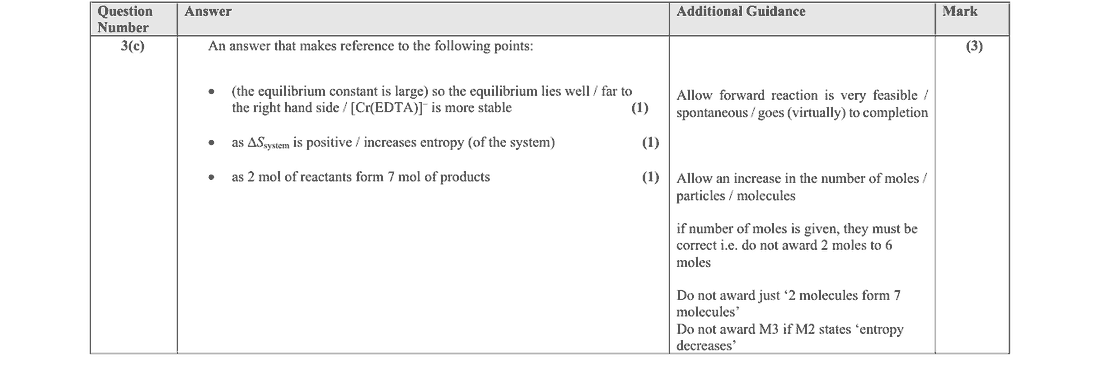
3(c) Transition metals: reactions 3Explanation
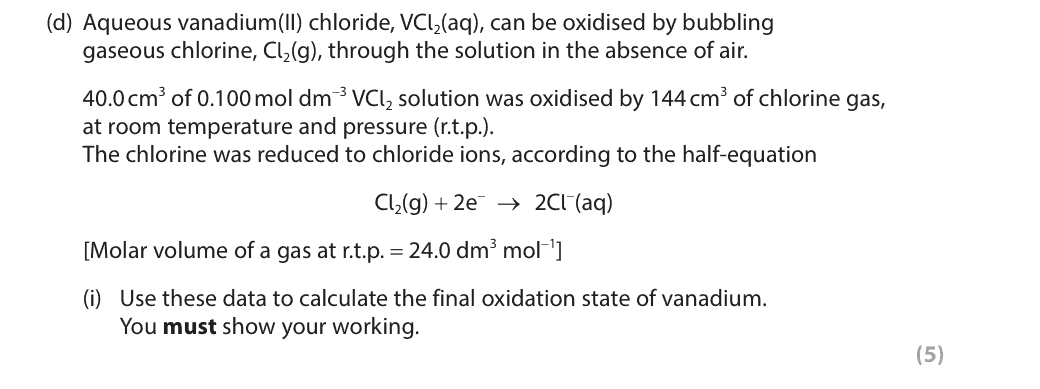
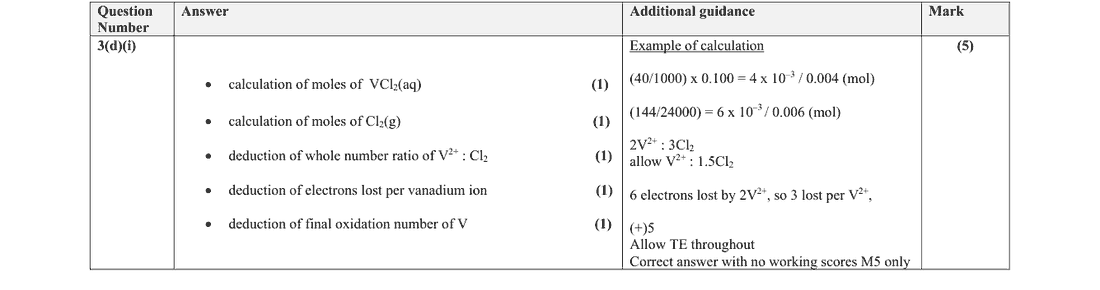
3(d)(i) Formulae, equations and amounts of substance, Redox II 5Calculation
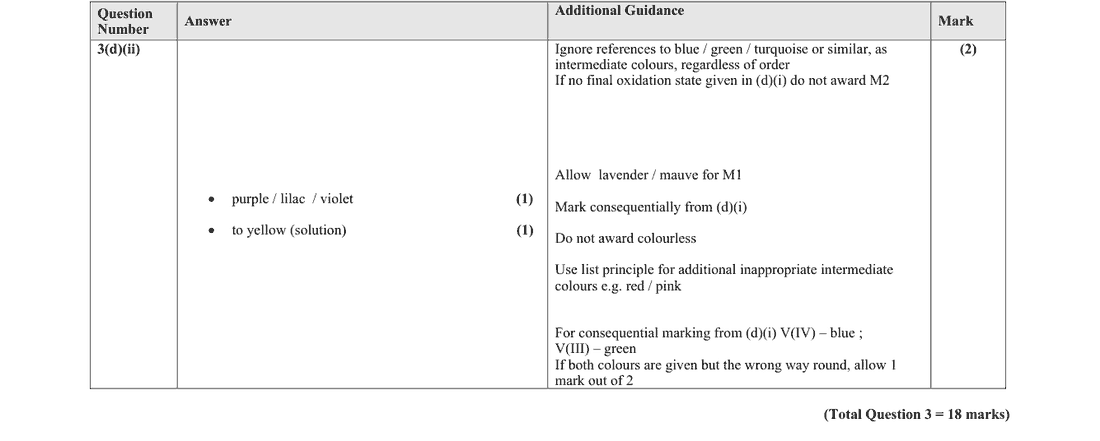
3(d)(ii) Transition metals: reactions 2Short answer
4(a) The elements of Groups 1 and 2 1Multiple choice
4(b) Energetics II: lattice energy 1Multiple choice
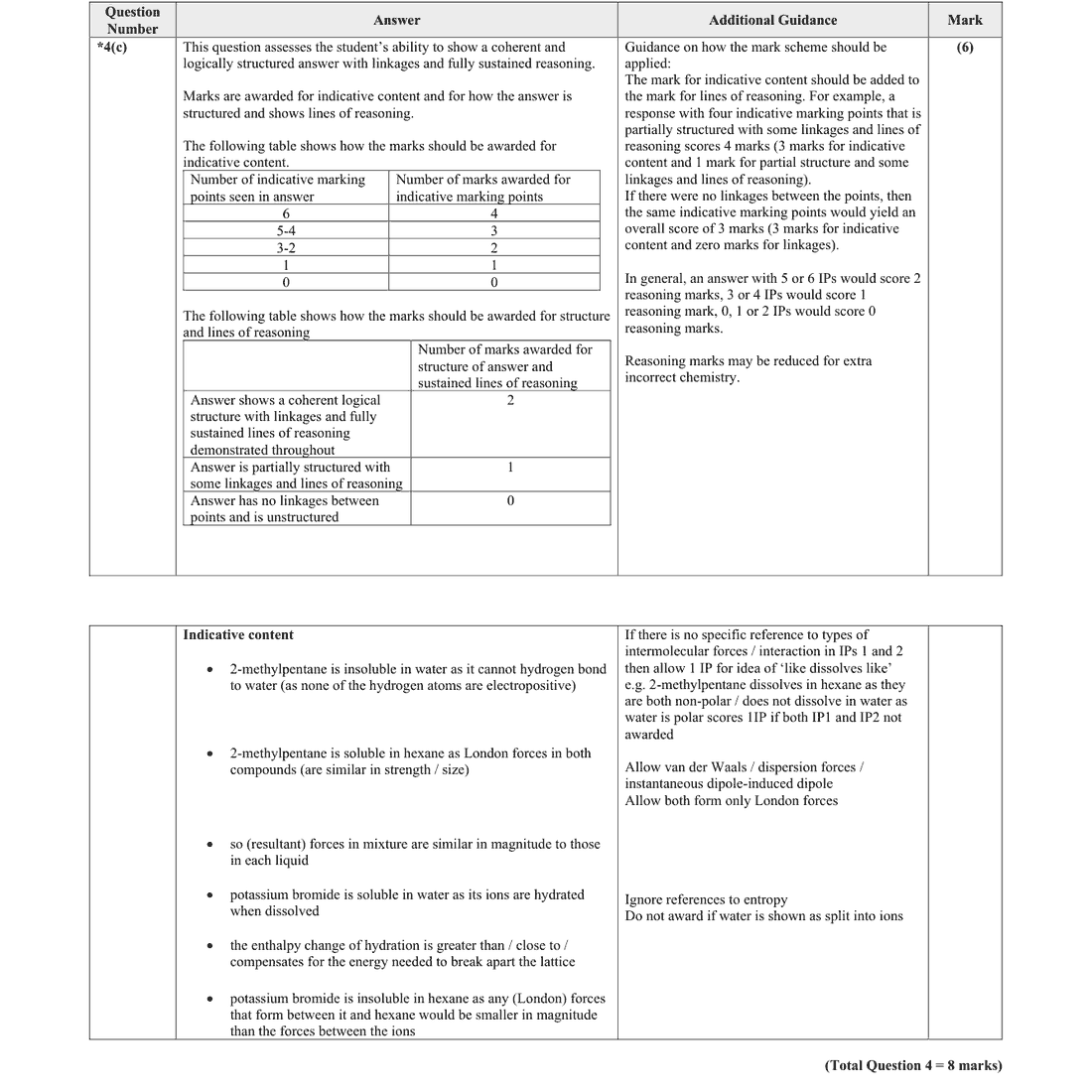
4(c) Bonding 6Extended response
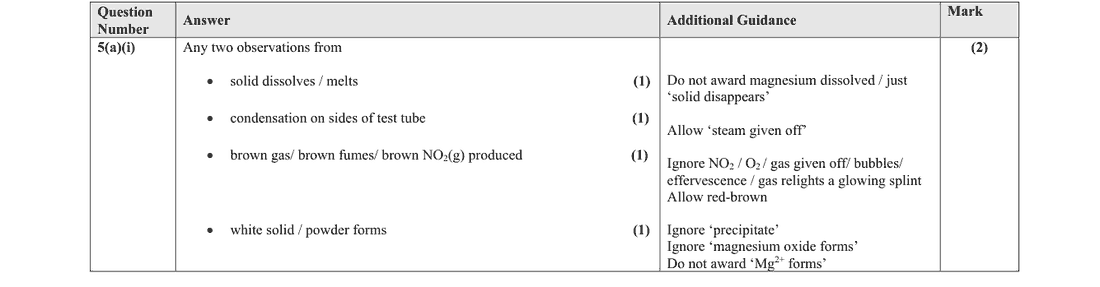
5(a)(i) The elements of Groups 1 and 2 2Practical and data analysis
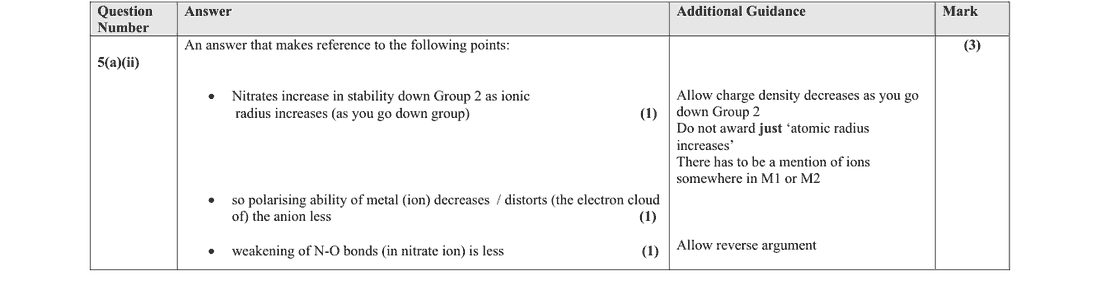
5(a)(ii) The elements of Groups 1 and 2 3Explanation
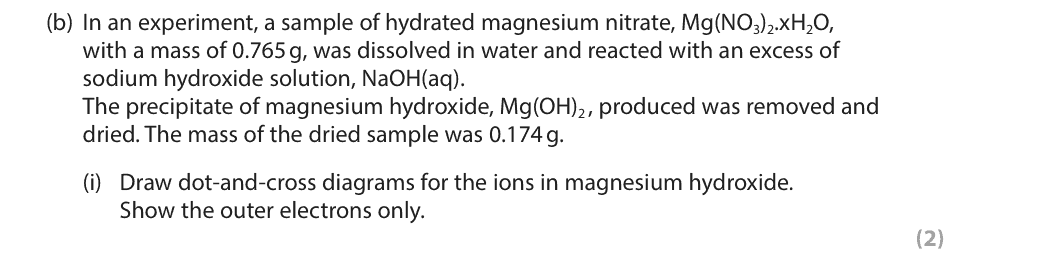
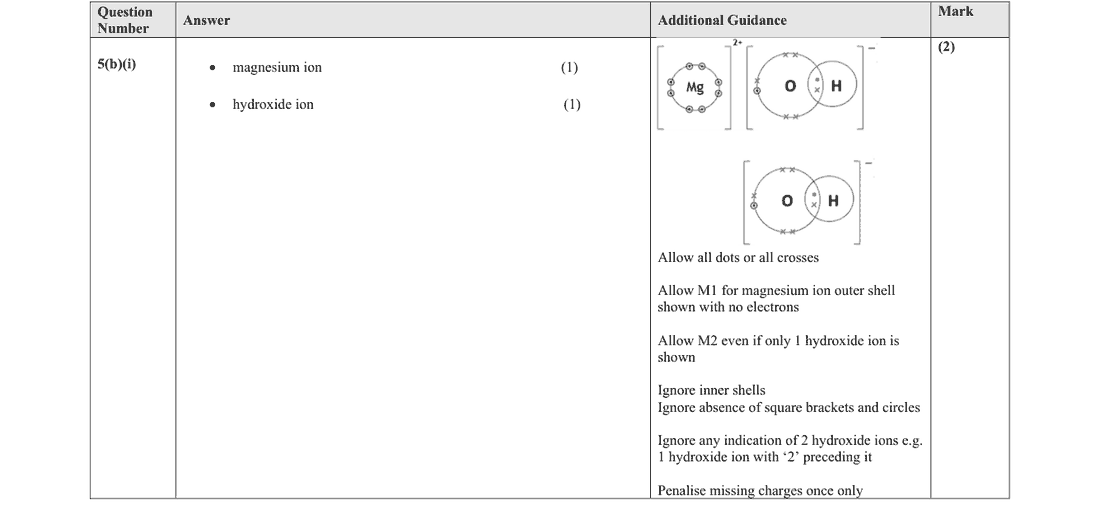
5(b)(i) Bonding 2Diagram or structure
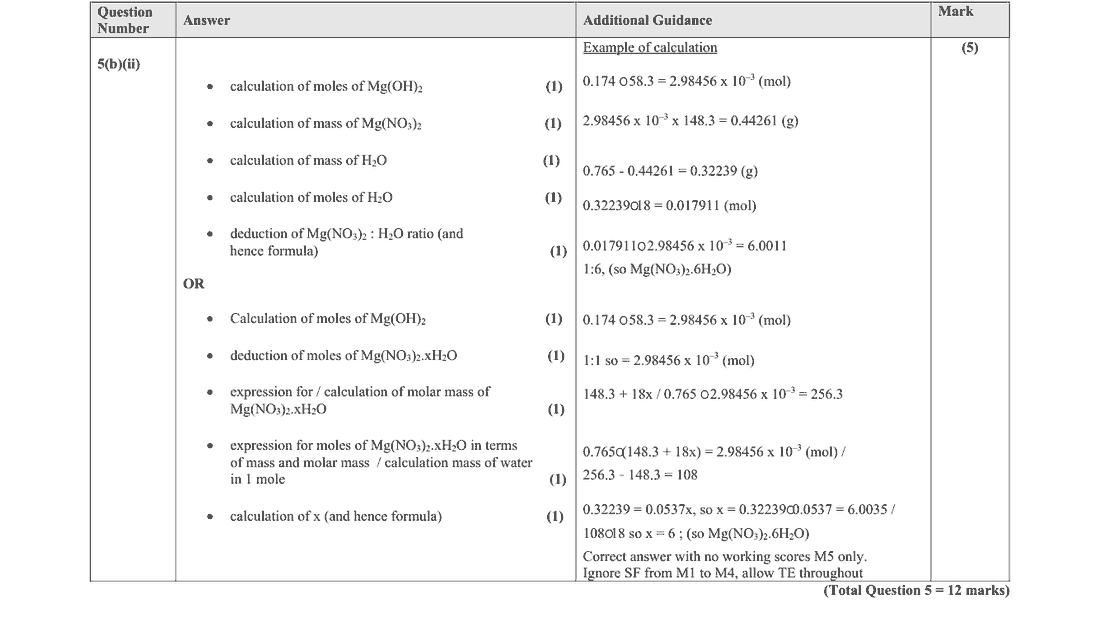
5(b)(ii) Formulae, equations and amounts of substance 5Calculation
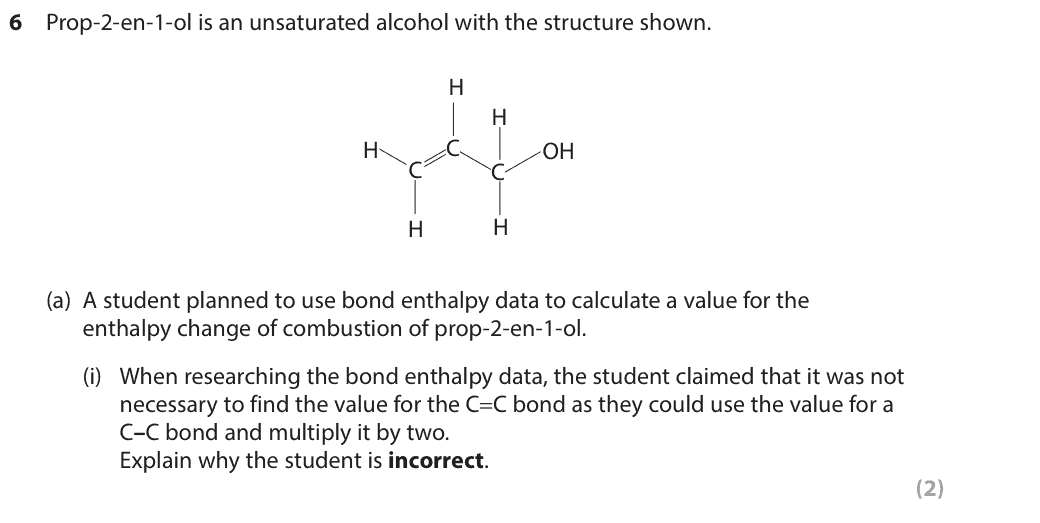
6(a)(i) Alkenes 2Explanation
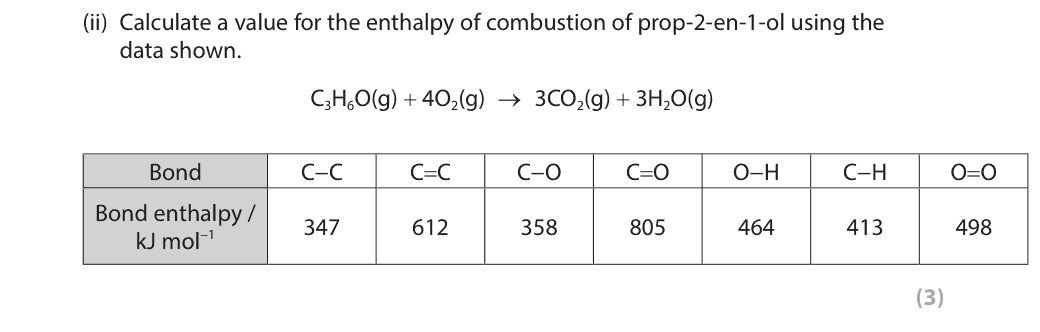
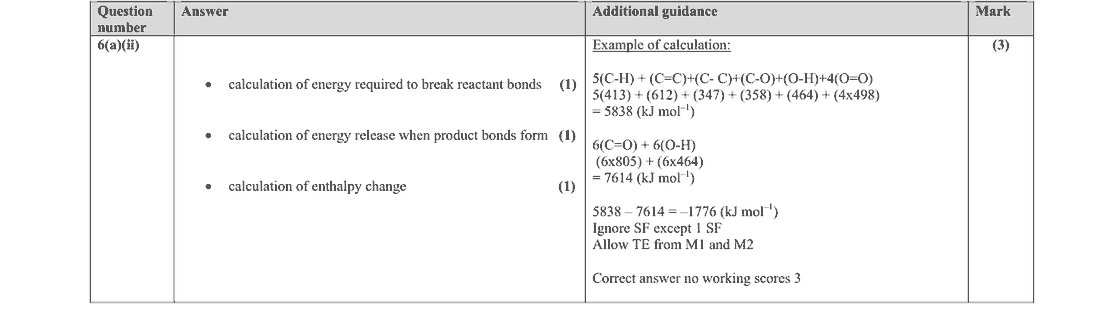
6(a)(ii) Energetics I 3Calculation
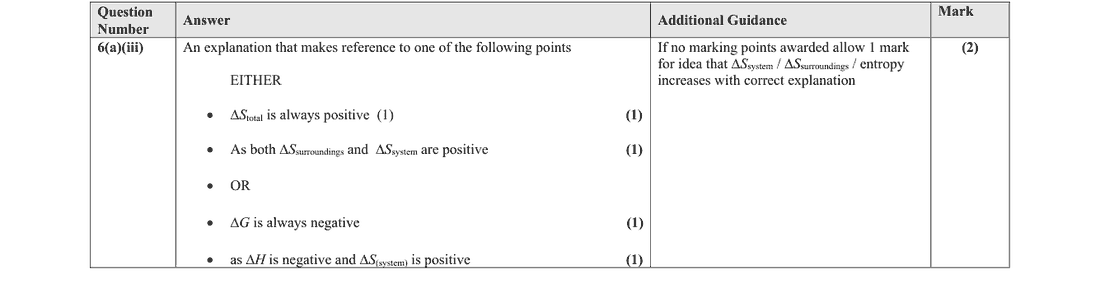
6(a)(iii) Energetics II: entropy 2Explanation
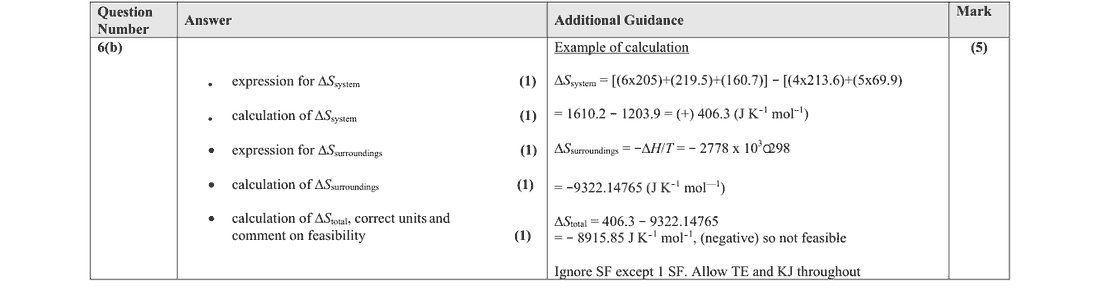
6(b) Energetics II: entropy 5Calculation
7(a)(i) Equilibrium I 1Short answer
7(a)(ii) Equilibrium II 3Calculation
7(b)(i) Bonding 1Multiple choice
7(b)(ii) Equilibrium II 1Multiple choice
7(b)(iii) Equilibrium II 2Explanation
8(a) Redox II 1Practical and data analysis
8(b)(i) Bonding 2Diagram or structure
8(b)(ii) Redox I 1Short answer
8(c) Redox II 1Practical and data analysis
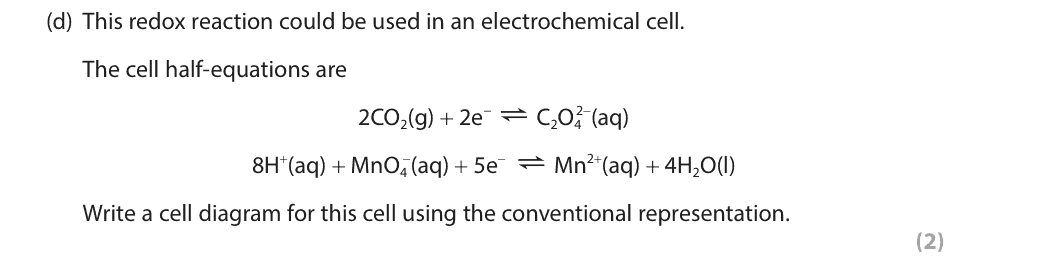
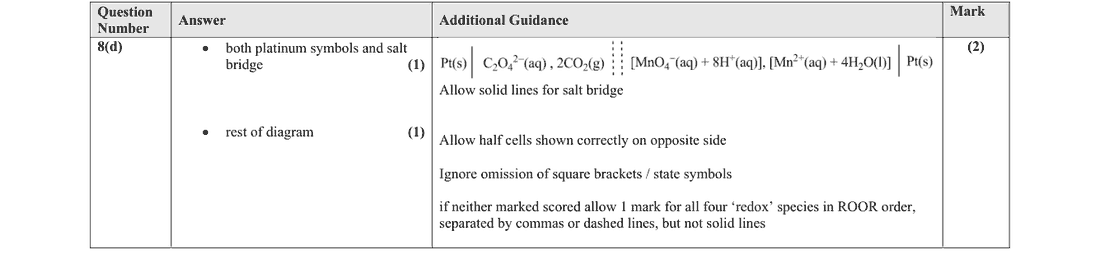
8(d) Redox II 2Short answer
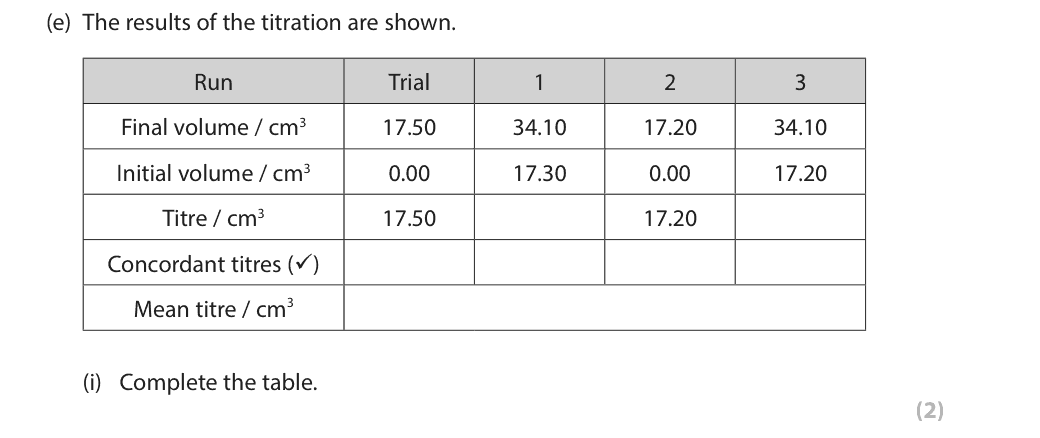
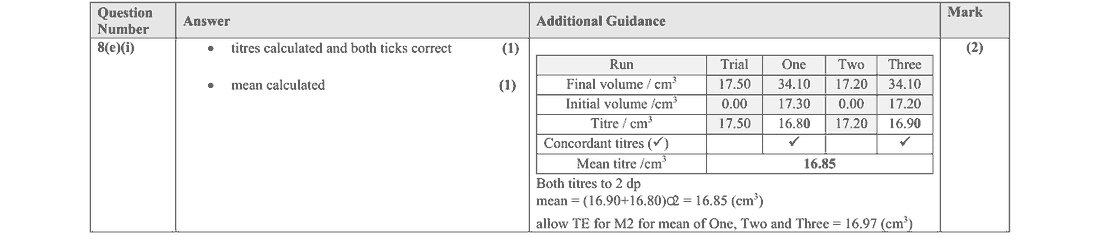
8(e)(i) Redox II 2Practical and data analysis
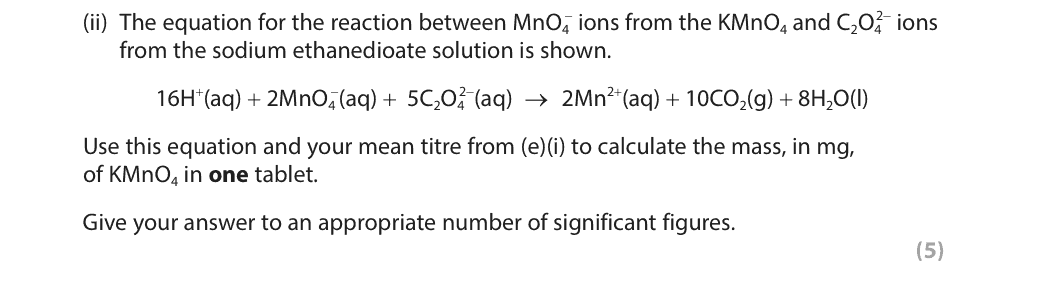
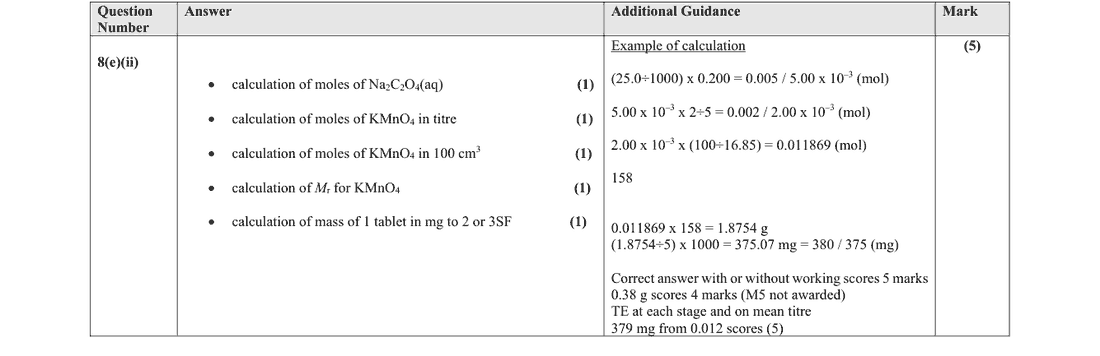
8(e)(ii) Redox II 5Calculation
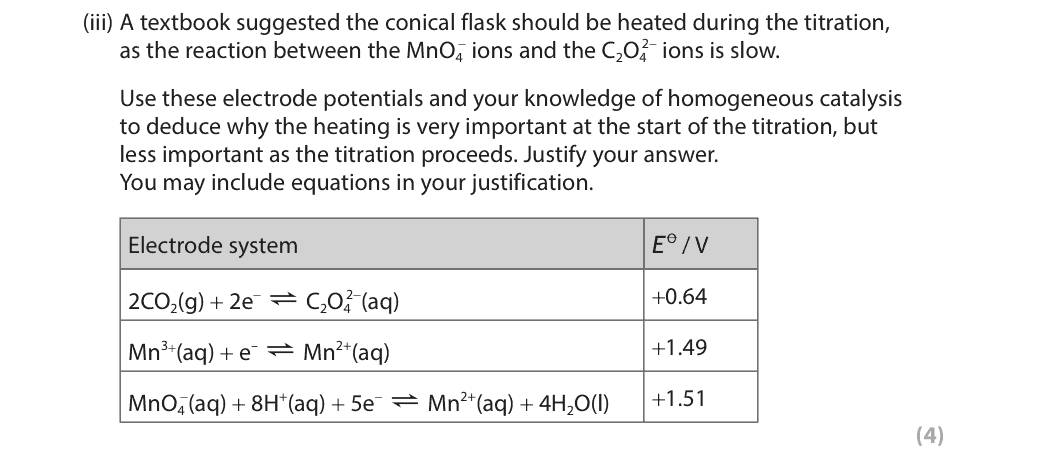
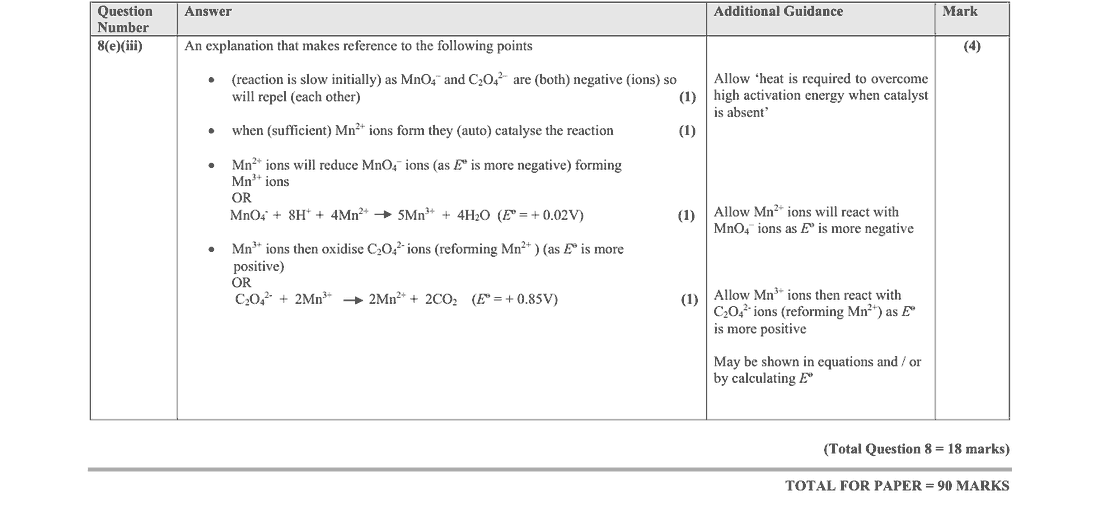
8(e)(iii) Transition metals: reactions, Redox II 4Explanation

The questions

1(a)1(b)1(c)1(d)1(e)2(a)2(b)2(c)2(d)3(a)3(b)(i)3(b)(ii)3(c)3(d)(i)3(d)(ii)4(a)4(b)4(c)5(a)(i)5(a)(ii)5(b)(i)5(b)(ii)6(a)(i)6(a)(ii)6(a)(iii)6(b)7(a)(i)7(a)(ii)7(b)(i)7(b)(ii)7(b)(iii)8(a)8(b)(i)8(b)(ii)8(c)8(d)8(e)(i)8(e)(ii)8(e)(iii)
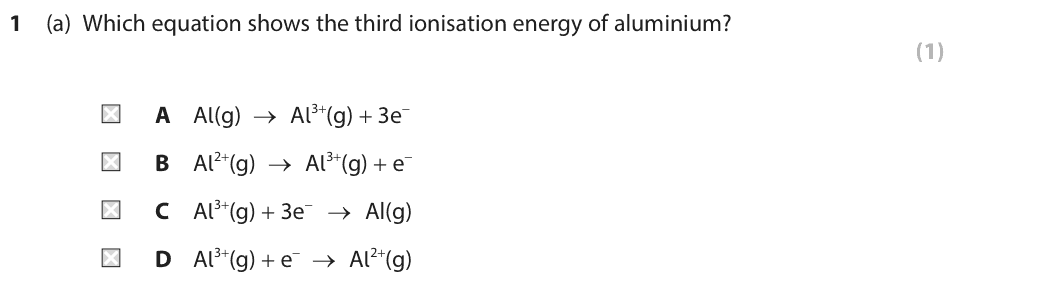
October 2020 · Paper 1 · Q1(a) 1 mark Multiple choice atomic structure and the periodic table
Which equation shows the third ionisation energy of aluminium?
A  Al(g)  →  Al3+(g) + 3e−
B  Al2+(g)  →  Al3+(g) + e−
C  Al3+(g) + 3e−   →  Al(g)
D  Al3+(g) + e−  →  Al2+(g)
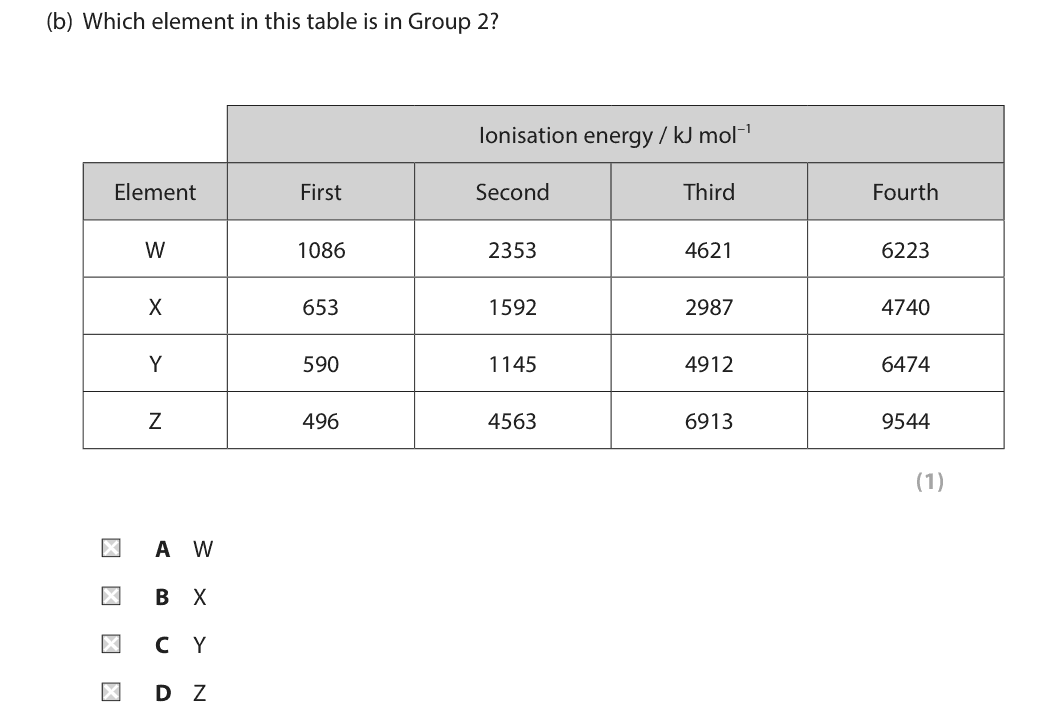
October 2020 · Paper 1 · Q1(b) 1 mark Multiple choice atomic structure and the periodic table
Earlier part of question 1 that this part usesEarlier part of October 2020 Paper 1 question 1
Which element in this table is in Group 2?
Ionisation energy / kJ mol−1
Element
First
Second
Third
Fourth
W
1086
2353
4621
6223
X
653
1592
2987
4740
Y
590
1145
4912
6474
Z
496
4563
6913
9544
A  W
B  X
C  Y
D  Z
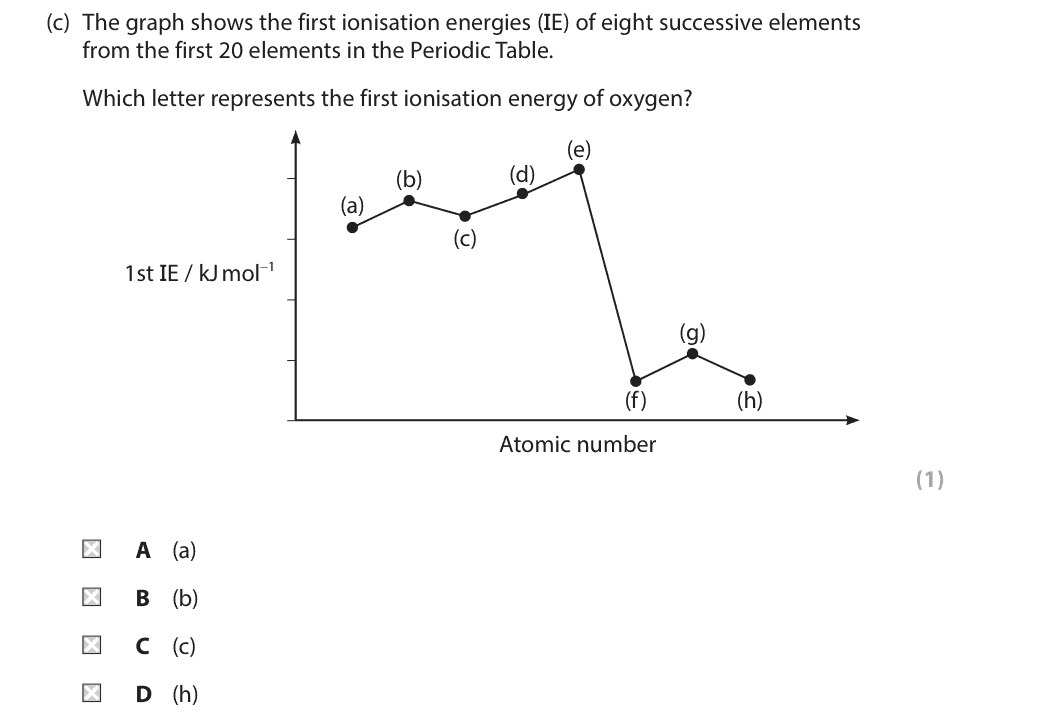
October 2020 · Paper 1 · Q1(c) 1 mark Multiple choice atomic structure and the periodic table
Earlier parts of question 1 that this part usesEarlier part of October 2020 Paper 1 question 1Earlier part of October 2020 Paper 1 question 1
The graph shows the first ionisation energies (IE) of eight successive elements
from the first 20 elements in the Periodic Table.
Which letter represents the first ionisation energy of oxygen?
(e)
(d)
(b)
(a)
(c)
1st IE / kJ mol-1
(g)
(f)
(h)
Atomic number
A  (a)
B  (b)
C  (c)
D  (h)
October 2020 · Paper 1 · Q1(d) 1 mark Short answer atomic structure and the periodic table
Give the formula of a stable ion that is isoelectronic with the
magnesium ion, Mg2+.
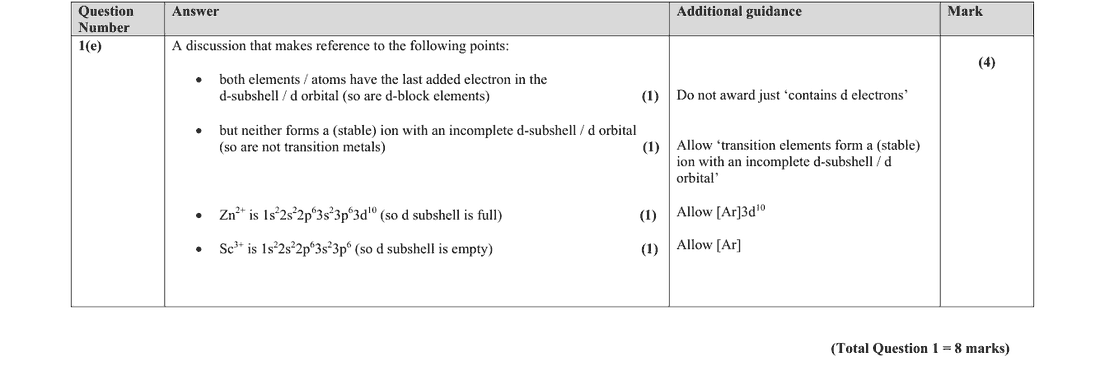
October 2020 · Paper 1 · Q1(e) 4 marks Explanation transition metals principlesatomic structure and the periodic table
A student stated that ‘the elements scandium and zinc are d-block elements but
are not transition metals’.
Discuss this statement, using appropriate electronic configurations to support
your answer.
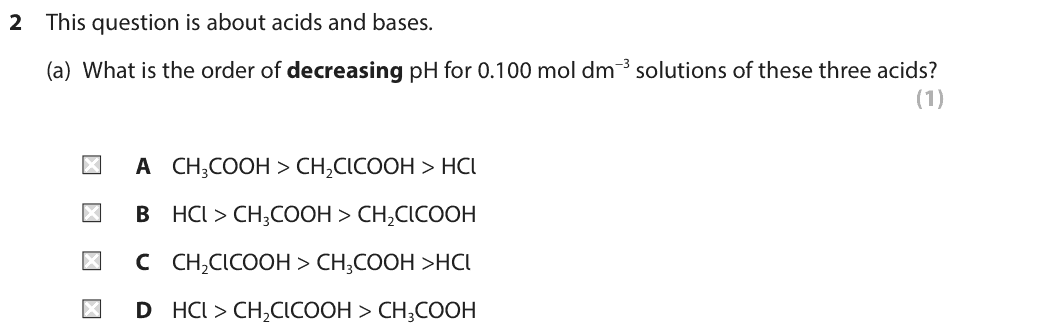
October 2020 · Paper 1 · Q2(a) 1 mark Multiple choice acid base equilibria
This question is about acids and bases.
What is the order of decreasing pH for 0.100 mol dm−3 solutions of these three acids?
A  CH3COOH > CH2ClCOOH > HCl
B  HCl > CH3COOH > CH2ClCOOH
C  CH2ClCOOH > CH3COOH >HCl
D  HCl > CH2ClCOOH > CH3COOH
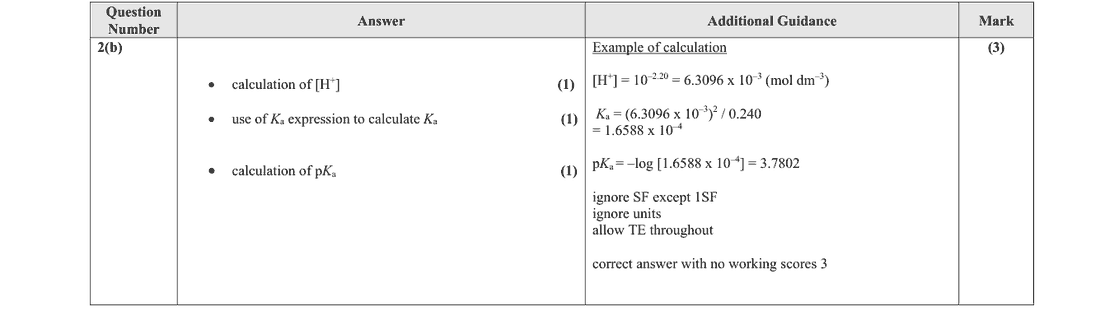
October 2020 · Paper 1 · Q2(b) 3 marks Calculation acid base equilibria
A solution of methanoic acid, HCOOH, has a concentration of 0.240 mol dm−3 and
a pH of 2.20.
Calculate the value of pKa for methanoic acid.
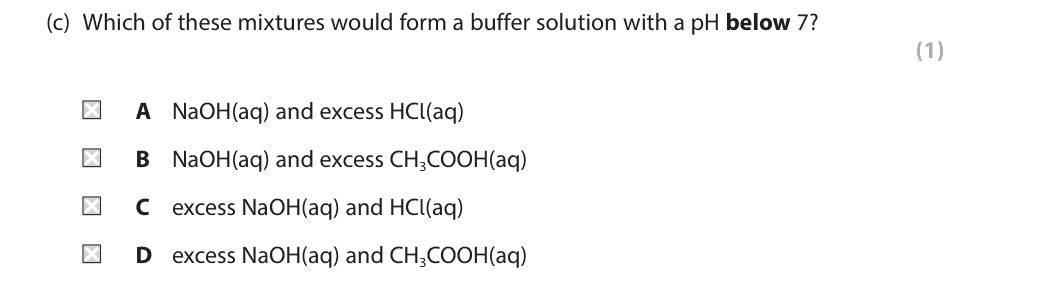
October 2020 · Paper 1 · Q2(c) 1 mark Multiple choice acid base equilibria
Which of these mixtures would form a buffer solution with a pH below 7?
A  NaOH(aq) and excess HCl(aq)
B  NaOH(aq) and excess CH3COOH(aq)
C  excess NaOH(aq) and HCl(aq)
D  excess NaOH(aq) and CH3COOH(aq)
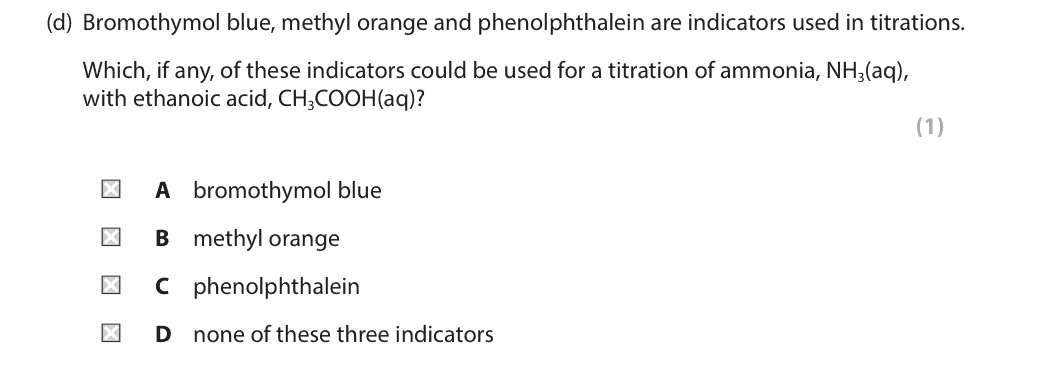
October 2020 · Paper 1 · Q2(d) 1 mark Multiple choice acid base equilibria
Bromothymol blue, methyl orange and phenolphthalein are indicators used in titrations.
Which, if any, of these indicators could be used for a titration of ammonia, NH3(aq),
with ethanoic acid, CH3COOH(aq)?
A  bromothymol blue
B  methyl orange
C  phenolphthalein
D  none of these three indicators
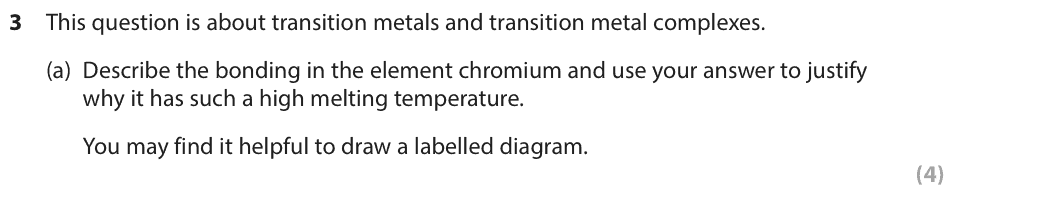
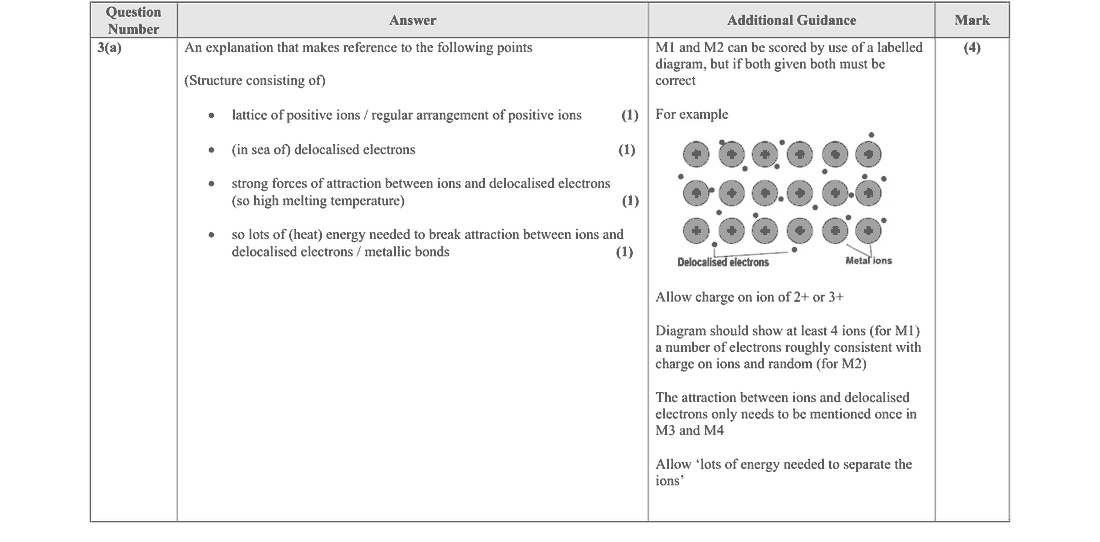
October 2020 · Paper 1 · Q3(a) 4 marks Explanation bondingstructure
This question is about transition metals and transition metal complexes.
Describe the bonding in the element chromium and use your answer to justify
why it has such a high melting temperature.
You may find it helpful to draw a labelled diagram.
October 2020 · Paper 1 · Q3(b)(i) 1 mark Short answer transition metals principles
Earlier part of question 3 that this part usesEarlier part of October 2020 Paper 1 question 3
When chromium(III) sulfate dissolves in water, a green solution containing the
[Cr(H2O)6]3+ ion forms.
Give the shape of this complex ion.
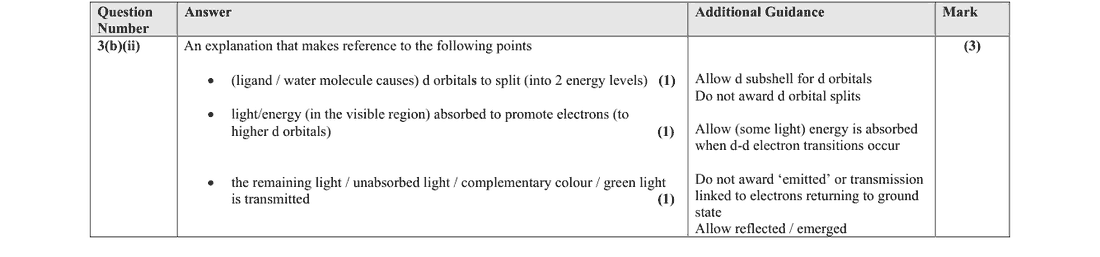
October 2020 · Paper 1 · Q3(b)(ii) 3 marks Explanation transition metals principles
Earlier part of question 3 that this part usesEarlier part of October 2020 Paper 1 question 3
Explain why the chromium complex ion is coloured.
October 2020 · Paper 1 · Q3(c) 3 marks Explanation transition metals reactions
Earlier part of question 3 that this part usesEarlier part of October 2020 Paper 1 question 3
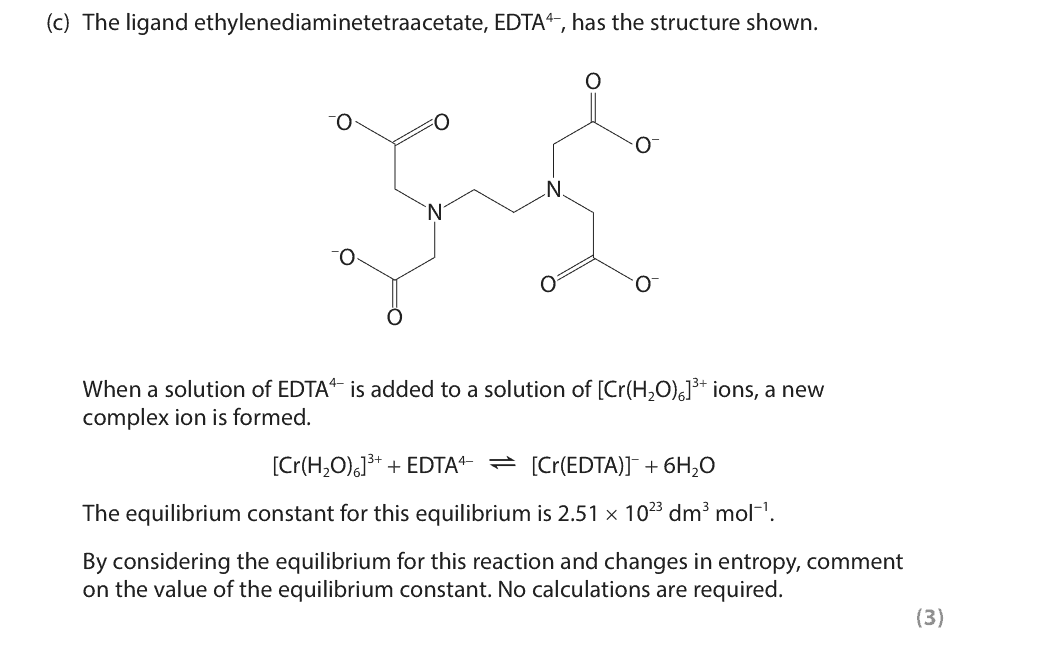
The ligand ethylenediaminetetraacetate, EDTA4−, has the structure shown.
O
−O
O
O−
N
N
−O
O−
O
O
When a solution of EDTA4− is added to a solution of [Cr(H2O)6]3+ ions, a new
complex ion is formed.
[Cr(H2O)6]3+ + EDTA4−  ⇌  [Cr(EDTA)]− + 6H2O
The equilibrium constant for this equilibrium is 2.51 × 10²³ dm3 mol−1.
By considering the equilibrium for this reaction and changes in entropy, comment
on the value of the equilibrium constant. No calculations are required.
October 2020 · Paper 1 · Q3(d)(i) 5 marks Calculation formulae equations and amounts of substanceredox ii
Earlier part of question 3 that this part usesEarlier part of October 2020 Paper 1 question 3
Aqueous vanadium(II) chloride, VCl2(aq), can be oxidised by bubbling
gaseous chlorine, Cl2(g), through the solution in the absence of air.
40.0 cm3 of 0.100 mol dm−3 VCl2 solution was oxidised by 144 cm3 of chlorine gas,
at room temperature and pressure (r.t.p.).
The chlorine was reduced to chloride ions, according to the half-equation
Cl2(g) + 2e−  →  2Cl−(aq)
[Molar volume of a gas at r.t.p. = 24.0 dm3 mol−1]
Use these data to calculate the final oxidation state of vanadium.
You must show your working.
October 2020 · Paper 1 · Q3(d)(ii) 2 marks Short answer transition metals reactions
Earlier parts of question 3 that this part usesEarlier part of October 2020 Paper 1 question 3Earlier part of October 2020 Paper 1 question 3
State the initial and final colours you would see as the chlorine bubbles
through the aqueous vanadium(II) chloride, VCl2(aq).
October 2020 · Paper 1 · Q4(a) 1 mark Multiple choice groups 1 and 2
This question is about dissolving different compounds.
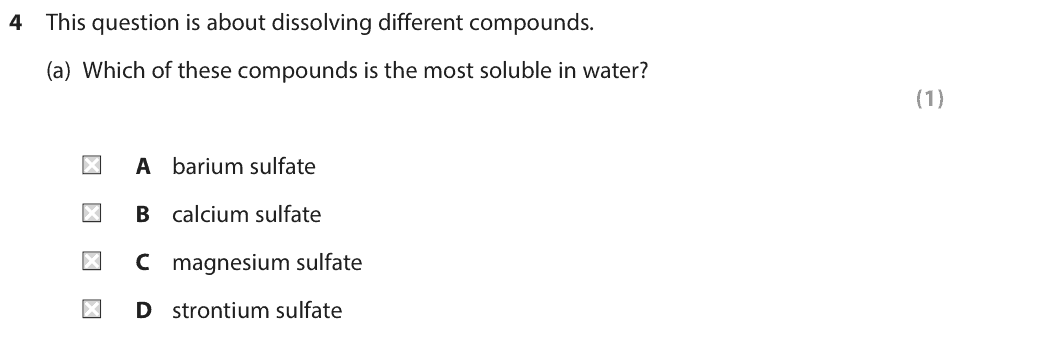
Which of these compounds is the most soluble in water?
A  barium sulfate
B  calcium sulfate
C  magnesium sulfate
D  strontium sulfate
October 2020 · Paper 1 · Q4(b) 1 mark Multiple choice lattice energy
Earlier part of question 4 that this part usesEarlier part of October 2020 Paper 1 question 4
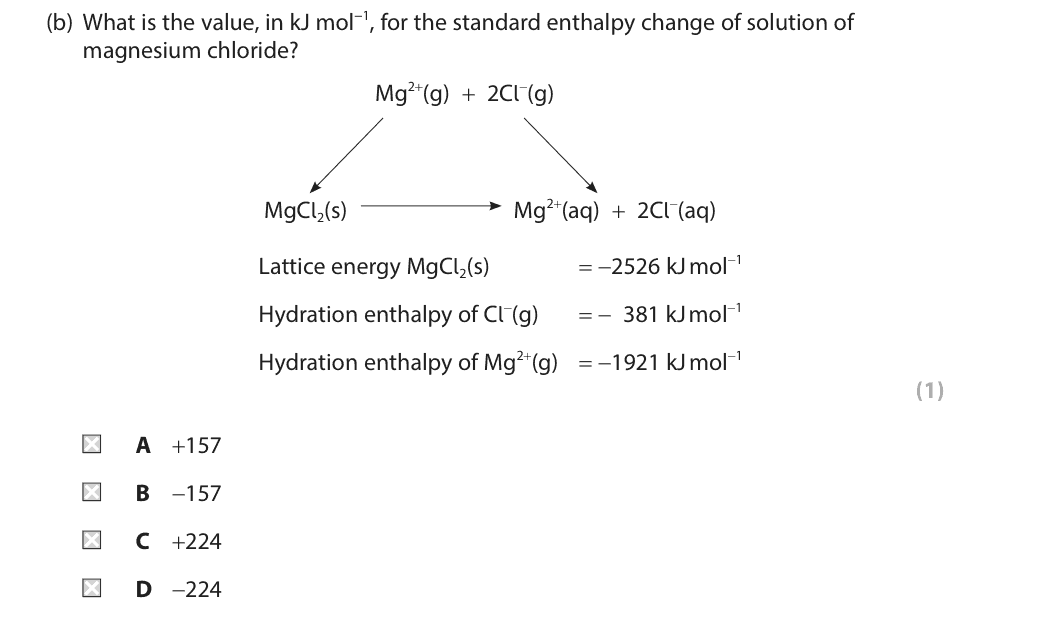
What is the value, in kJ mol−1, for the standard enthalpy change of solution of
magnesium chloride?
Mg2+(g)  +  2Cl−(g)
MgCl2(s)
Mg2+(aq)  +  2Cl−(aq)
Lattice energy MgCl2(s)
= −2526 kJ mol−1
Hydration enthalpy of Cl−(g)
= −  381 kJ mol−1
Hydration enthalpy of Mg2+(g)  = −1921 kJ mol−1
A  +157
B  −157
C  +224
D  −224
October 2020 · Paper 1 · Q4(c) 6 marks 6-mark extended response Hard bonding
Earlier part of question 4 that this part usesEarlier part of October 2020 Paper 1 question 4
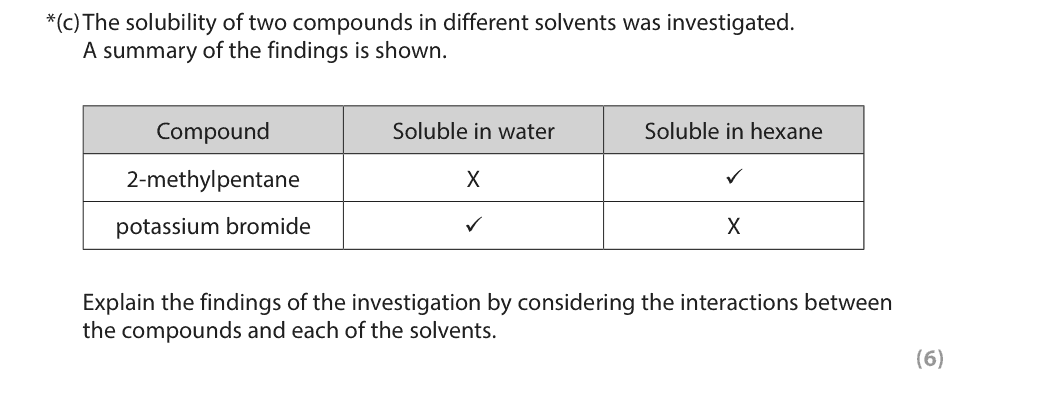
The solubility of two compounds in different solvents was investigated.
A summary of the findings is shown.
Compound
Soluble in water
Soluble in hexane
2-methylpentane
X

potassium bromide

X
Explain the findings of the investigation by considering the interactions between
the compounds and each of the solvents.
October 2020 · Paper 1 · Q5(a)(i) 2 marks Practical and data analysis groups 1 and 2
This question is about the chemistry of hydrated magnesium nitrate, Mg(NO3)2.xH2O .
Group 2 nitrates decompose when heated.
State two observations you would see when hydrated magnesium nitrate is heated.
October 2020 · Paper 1 · Q5(a)(ii) 3 marks Explanation groups 1 and 2
Earlier part of question 5 that this part usesEarlier part of October 2020 Paper 1 question 5
Explain the trend in thermal stability of Group 2 nitrates.
October 2020 · Paper 1 · Q5(b)(i) 2 marks Diagram or structure bonding
In an experiment, a sample of hydrated magnesium nitrate, Mg(NO3)2.xH2O,
with a mass of 0.765 g, was dissolved in water and reacted with an excess of
sodium hydroxide solution, NaOH(aq).
The precipitate of magnesium hydroxide, Mg(OH)2 , produced was removed and
dried. The mass of the dried sample was 0.174 g.
Draw dot-and-cross diagrams for the ions in magnesium hydroxide.
Show the outer electrons only.
October 2020 · Paper 1 · Q5(b)(ii) 5 marks Calculation formulae equations and amounts of substance
Earlier parts of question 5 that this part usesEarlier part of October 2020 Paper 1 question 5Earlier part of October 2020 Paper 1 question 5
Use the experimental data to calculate the value for x in the formula
Mg(NO3)2.xH2O .
You must show all your working.
October 2020 · Paper 1 · Q6(a)(i) 2 marks Explanation alkenes
Prop-2-en-1-ol is an unsaturated alcohol with the structure shown.
H
H
H
C
OH
C
C
H
H
A student planned to use bond enthalpy data to calculate a value for the
enthalpy change of combustion of prop-2-en-1-ol.
When researching the bond enthalpy data, the student claimed that it was not
necessary to find the value for the C=C bond as they could use the value for a
C–C bond and multiply it by two.
Explain why the student is incorrect.
October 2020 · Paper 1 · Q6(a)(ii) 3 marks Calculation energetics i
Earlier part of question 6 that this part usesEarlier part of October 2020 Paper 1 question 6
Calculate a value for the enthalpy of combustion of prop-2-en-1-ol using the
data shown.
C3H6O(g) + 4O2(g)  →  3CO2(g) + 3H2O(g)
Bond
C−C
C=C
C−O
C=O
O−H
C−H
O=O
Bond enthalpy /
347
612
358
805
464
413
498
kJ mol−1
October 2020 · Paper 1 · Q6(a)(iii) 2 marks Explanation entropy
Earlier part of question 6 that this part usesEarlier part of October 2020 Paper 1 question 6
Explain, in terms of entropy, why the combustion of prop-2-en-1-ol is always
feasible in the gaseous state.
October 2020 · Paper 1 · Q6(b) 5 marks Calculation entropy
Earlier part of question 6 that this part usesEarlier part of October 2020 Paper 1 question 6
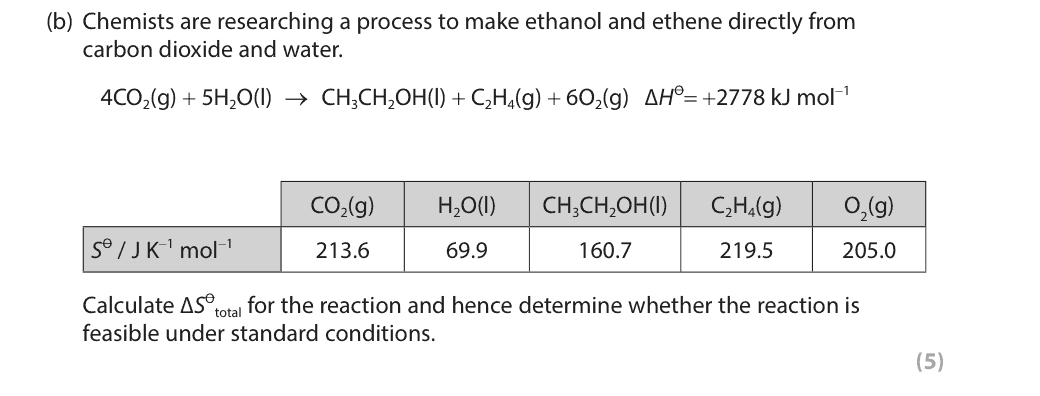
Chemists are researching a process to make ethanol and ethene directly from
carbon dioxide and water.
4CO2(g) + 5H2O(l)  →  CH3CH2OH(l) + C2H4(g) + 6O2(g)    ∆HO= +2778 kJ mol−1
CO2(g)
H2O(l)
CH3CH2OH(l)
C2H4(g)
O2(g)
SO / J K−1 mol−1
213.6
69.9
160.7
219.5
205.0
Calculate ∆SO
total for the reaction and hence determine whether the reaction is
feasible under standard conditions.
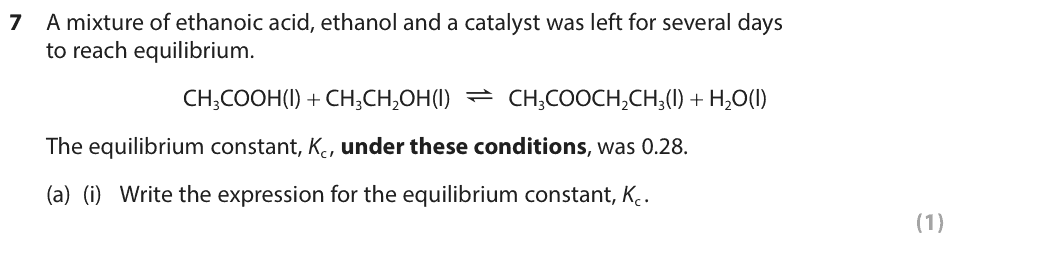
October 2020 · Paper 1 · Q7(a)(i) 1 mark Short answer Easy equilibrium i
A mixture of ethanoic acid, ethanol and a catalyst was left for several days
to reach equilibrium.
CH3COOH(l) + CH3CH2OH(l)  ⇌  CH3COOCH2CH3(l) + H2O(l)
The equilibrium constant, Kc , under these conditions, was 0.28.
Write the expression for the equilibrium constant, Kc .
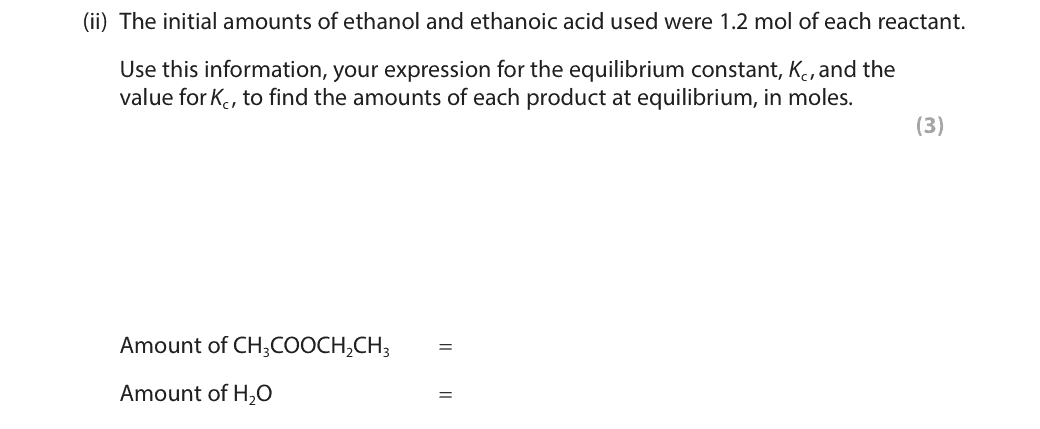
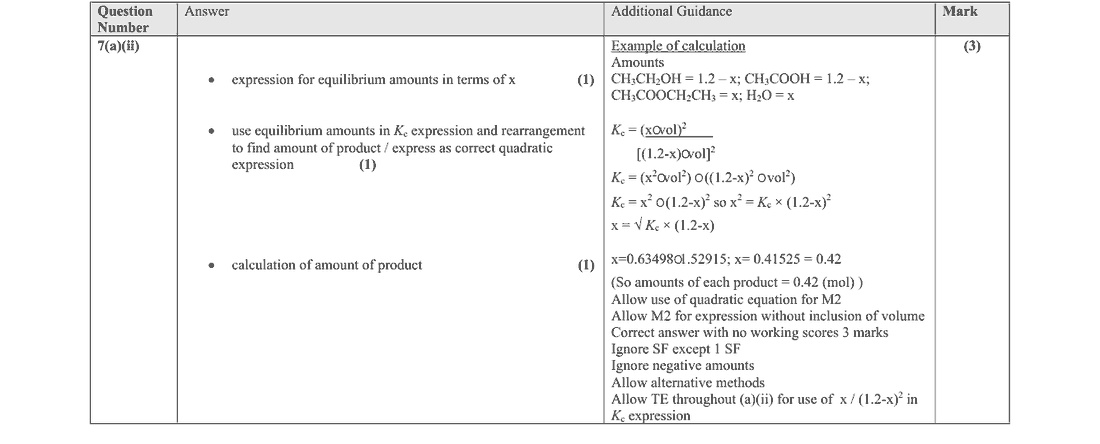
October 2020 · Paper 1 · Q7(a)(ii) 3 marks Calculation Hard equilibrium ii
Earlier part of question 7 that this part usesEarlier part of October 2020 Paper 1 question 7
The initial amounts of ethanol and ethanoic acid used were 1.2 mol of each reactant.
Use this information, your expression for the equilibrium constant, Kc , and the
value for Kc , to find the amounts of each product at equilibrium, in moles.
=
Amount of CH3COOCH2CH3
=
Amount of H2O
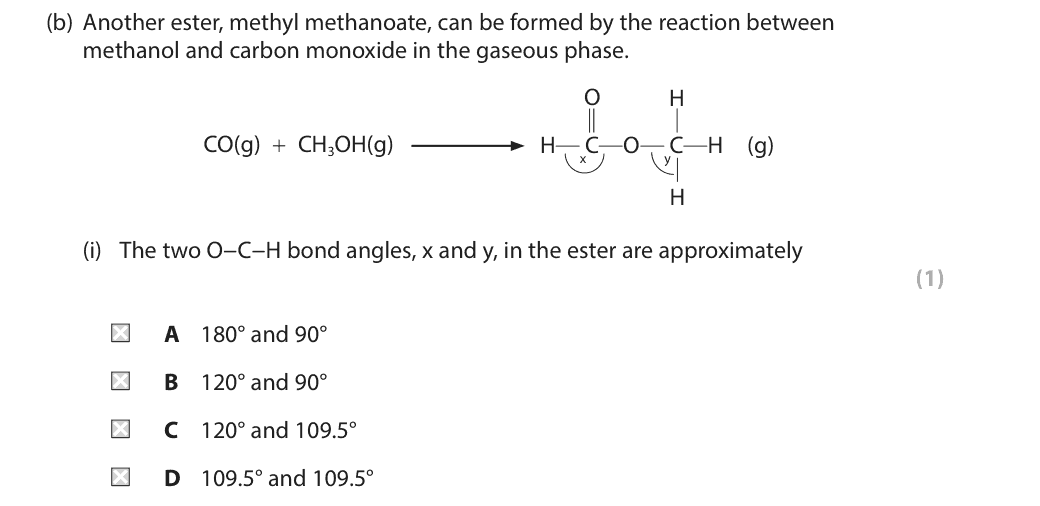
October 2020 · Paper 1 · Q7(b)(i) 1 mark Multiple choice bonding
Earlier part of question 7 that this part usesEarlier part of October 2020 Paper 1 question 7
Another ester, methyl methanoate, can be formed by the reaction between
methanol and carbon monoxide in the gaseous phase.
O
H
CO(g)  +  CH3OH(g)
H
xC
O
yC
H  (g)
H
The two O−C−H bond angles, x and y, in the ester are approximately
A  180° and 90°
B  120° and 90°
C  120° and 109.5°
D  109.5° and 109.5°
October 2020 · Paper 1 · Q7(b)(ii) 1 mark Multiple choice equilibrium ii
Earlier parts of question 7 that this part usesEarlier part of October 2020 Paper 1 question 7Earlier part of October 2020 Paper 1 question 7
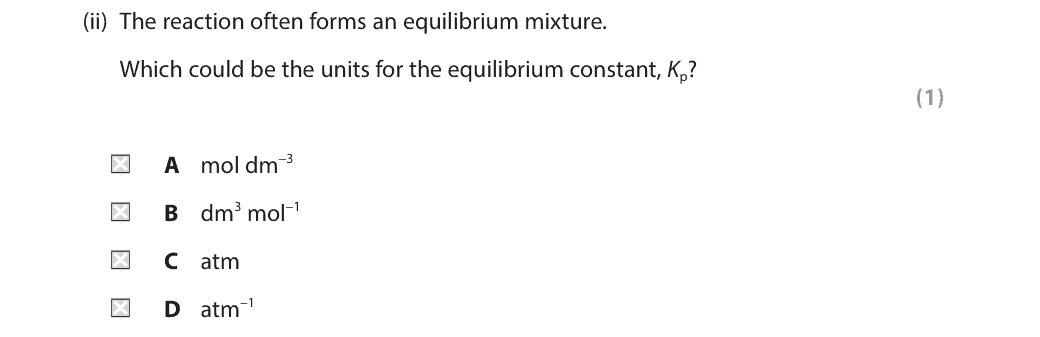
The reaction often forms an equilibrium mixture.
Which could be the units for the equilibrium constant, Kp?
A  mol dm−3
B  dm3 mol−1
C  atm
D  atm−1
October 2020 · Paper 1 · Q7(b)(iii) 2 marks Explanation equilibrium ii
Earlier parts of question 7 that this part usesEarlier part of October 2020 Paper 1 question 7Earlier part of October 2020 Paper 1 question 7Earlier part of October 2020 Paper 1 question 7
Describe what effect, if any, increasing the pressure would have on the
equilibrium constant, Kp. Justify your answer.
October 2020 · Paper 1 · Q8(a) 1 mark Practical and data analysis redox ii
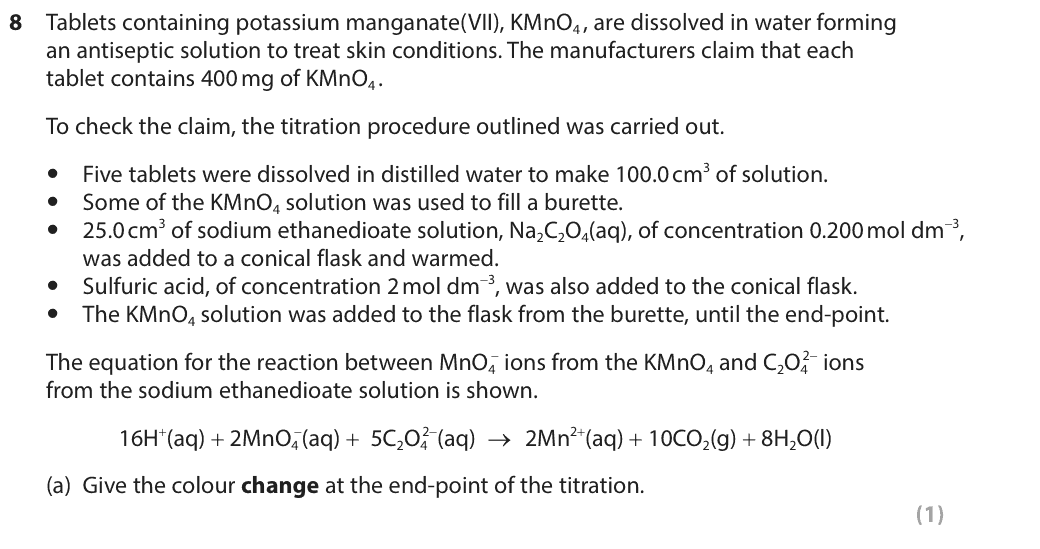
Tablets containing potassium manganate(VII), KMnO4 , are dissolved in water forming
an antiseptic solution to treat skin conditions. The manufacturers claim that each
tablet contains 400 mg of KMnO4 .
To check the claim, the titration procedure outlined was carried out.
  Five tablets were dissolved in distilled water to make 100.0 cm3 of solution.
  Some of the KMnO4 solution was used to fill a burette.
  25.0 cm3 of sodium ethanedioate solution, Na2C2O4(aq), of concentration 0.200 mol dm−3,
was added to a conical flask and warmed.
  Sulfuric acid, of concentration 2 mol dm−3, was also added to the conical flask.
  The KMnO4 solution was added to the flask from the burette, until the end-point.
− ions from the KMnO4 and C2O4
2− ions
The equation for the reaction between MnO4
from the sodium ethanedioate solution is shown.
16H+(aq) + 2MnO4
−(aq) +  5C2O4
2−(aq)  →  2Mn2+(aq) + 10CO2(g) + 8H2O(l)
Give the colour change at the end-point of the titration.
October 2020 · Paper 1 · Q8(b)(i) 2 marks Diagram or structure bonding
Earlier part of question 8 that this part usesEarlier part of October 2020 Paper 1 question 8
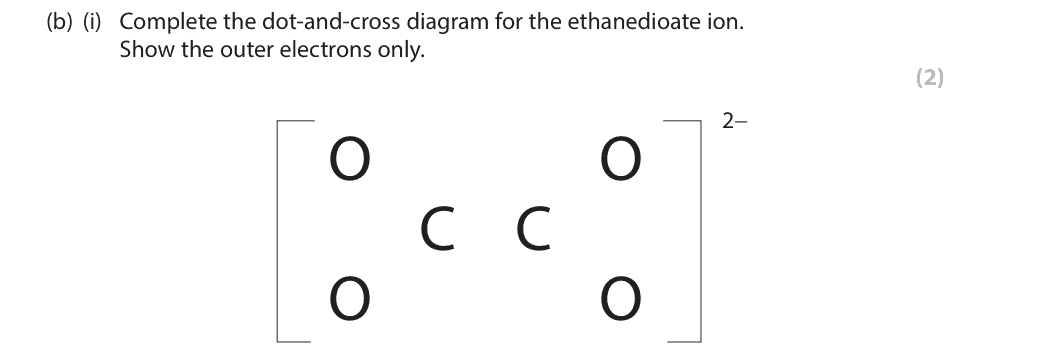
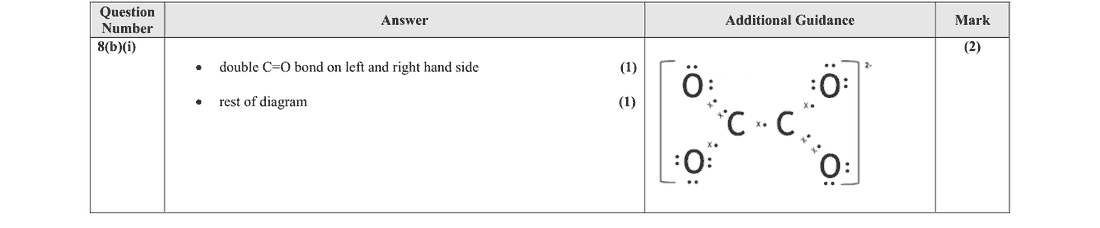
Complete the dot-and-cross diagram for the ethanedioate ion.
Show the outer electrons only.
2−
O
O
C C
O
O
2−.
October 2020 · Paper 1 · Q8(b)(ii) 1 mark Short answer redox i
Earlier parts of question 8 that this part usesEarlier part of October 2020 Paper 1 question 8Earlier part of October 2020 Paper 1 question 8
Determine the oxidation number of carbon in the ethanedioate ion, C2O4
October 2020 · Paper 1 · Q8(c) 1 mark Practical and data analysis redox ii
Earlier part of question 8 that this part usesEarlier part of October 2020 Paper 1 question 8
Give the reason why sulfuric acid was also added to the conical flask.
October 2020 · Paper 1 · Q8(d) 2 marks Short answer Hard redox ii
Earlier part of question 8 that this part usesEarlier part of October 2020 Paper 1 question 8
This redox reaction could be used in an electrochemical cell.
The cell half-equations are
2CO2(g) + 2e− ⇌ C2O4
2−(aq)
−(aq) + 5e−  ⇌ Mn2+(aq) + 4H2O(l)
8H+(aq) + MnO4
Write a cell diagram for this cell using the conventional representation.
October 2020 · Paper 1 · Q8(e)(i) 2 marks Practical and data analysis redox ii
Earlier part of question 8 that this part usesEarlier part of October 2020 Paper 1 question 8
The results of the titration are shown.

Run
Trial
1
2
3
Final volume / cm3
17.50
34.10
17.20
34.10
Initial volume / cm3
0.00
17.30
0.00
17.20
Titre / cm3
17.50
17.20
Concordant titres ()
Mean titre / cm3
Complete the table.
October 2020 · Paper 1 · Q8(e)(ii) 5 marks Calculation redox ii
Earlier parts of question 8 that this part usesEarlier part of October 2020 Paper 1 question 8Earlier part of October 2020 Paper 1 question 8
The equation for the reaction between MnO4
− ions from the KMnO4 and C2O4
2− ions
from the sodium ethanedioate solution is shown.
16H+(aq) + 2MnO4
−(aq) +  5C2O4
2−(aq)  →  2Mn2+(aq) + 10CO2(g) + 8H2O(l)
Use this equation and your mean titre from (e)(i) to calculate the mass, in mg,
of KMnO4 in one tablet.
Give your answer to an appropriate number of significant figures.
October 2020 · Paper 1 · Q8(e)(iii) 4 marks Explanation transition metals reactionsredox ii
Earlier parts of question 8 that this part usesEarlier part of October 2020 Paper 1 question 8Earlier part of October 2020 Paper 1 question 8Earlier part of October 2020 Paper 1 question 8
A textbook suggested the conical flask should be heated during the titration,
− ions and the C2O4
2− ions is slow.
as the reaction between the MnO4
Use these electrode potentials and your knowledge of homogeneous catalysis
to deduce why the heating is very important at the start of the titration, but
less important as the titration proceeds. Justify your answer.
You may include equations in your justification.

Electrode system
E O / V
2CO2(g) + 2e− ⇌ C2O4
+0.64
2−(aq)
Mn3+(aq) + e– ⇌ Mn2+(aq)
+1.49
−(aq) + 8H+(aq) + 5e− ⇌ Mn2+(aq) + 4H2O(l)
+1.51
MnO4

Work with an A-level chemistry tutor

Want a paper marked and gone through with you? Message us.

Prefer email? Send an enquiry

If you are under 18, please include a parent's contact details. Enquiries go to enquiries@chemistryaleveltutor.com and are deleted once handled. All tutoring is online.