June 2024: Paper 3, General and Practical Principles in Chemistry

120 marks · 48 question parts · Paper, mark scheme and report on Edexcel's site · Have the Data Booklet beside you

Question by question

QTopicMarksAOType
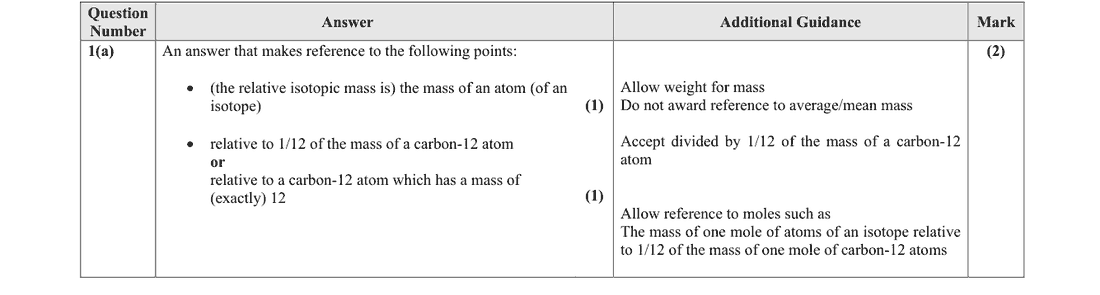
1(a) Atomic structure and the Periodic Table 2Short answer
1(b) Atomic structure and the Periodic Table 1Short answer
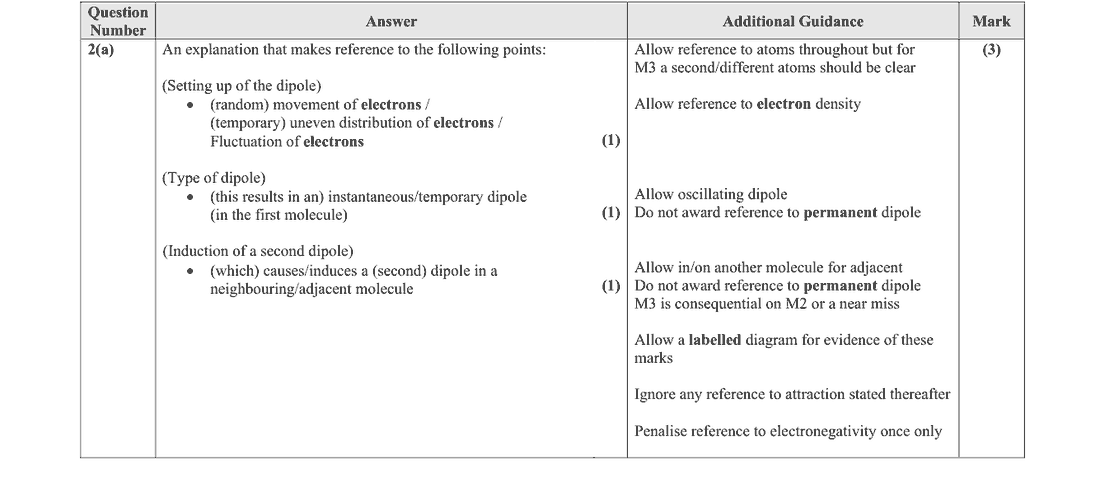
2(a) Bonding 3Explanation
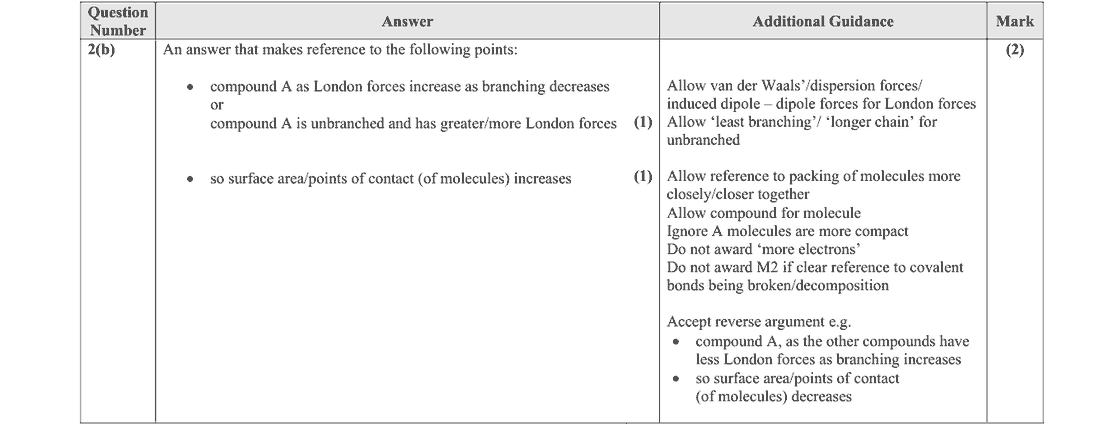
2(b) Bonding 2Explanation
2(c) Bonding 3Explanation
3(a) Formulae, equations and amounts of substance 1Practical and data analysis
3(b) Formulae, equations and amounts of substance 2Practical and data analysis
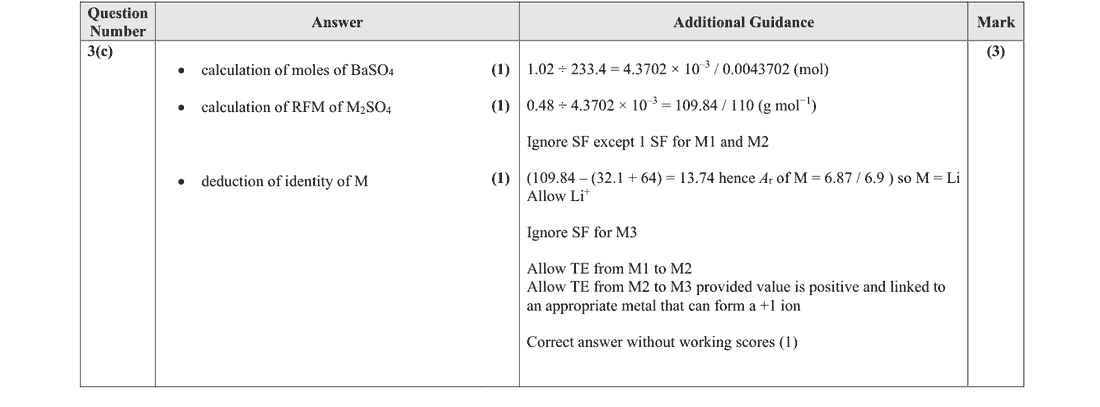
3(c) Formulae, equations and amounts of substance 3Calculation
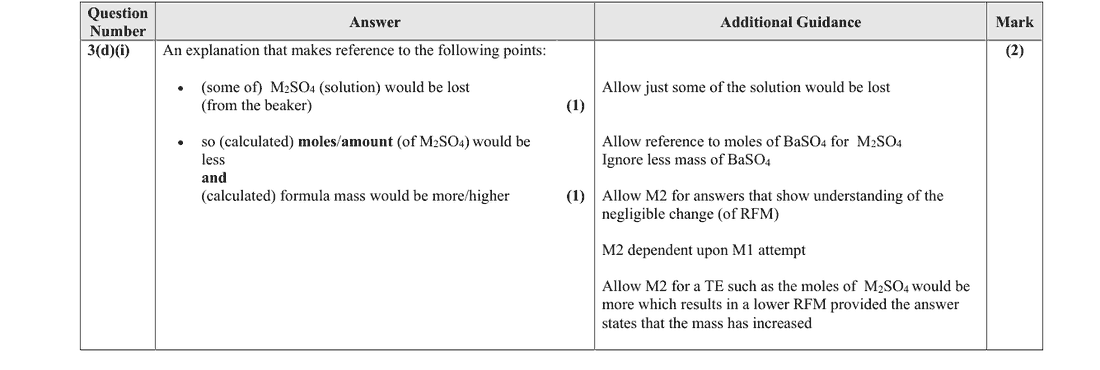
3(d)(i) Formulae, equations and amounts of substance 2Practical and data analysis
3(d)(ii) Formulae, equations and amounts of substance 1Practical and data analysis
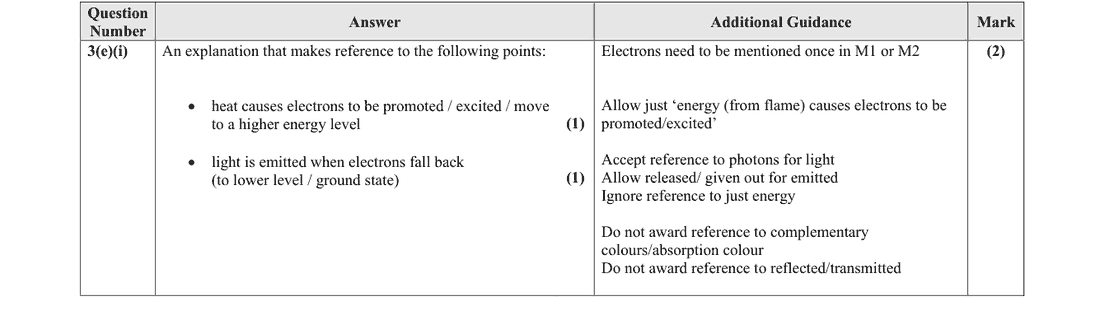
3(e)(i) The elements of Groups 1 and 2 2Explanation
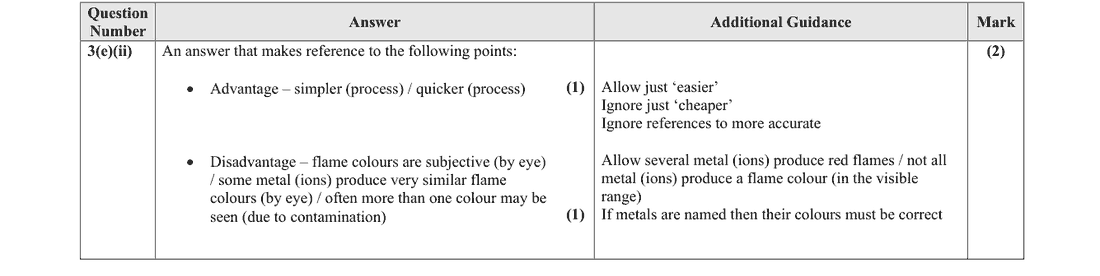
3(e)(ii) The elements of Groups 1 and 2 2Practical and data analysis
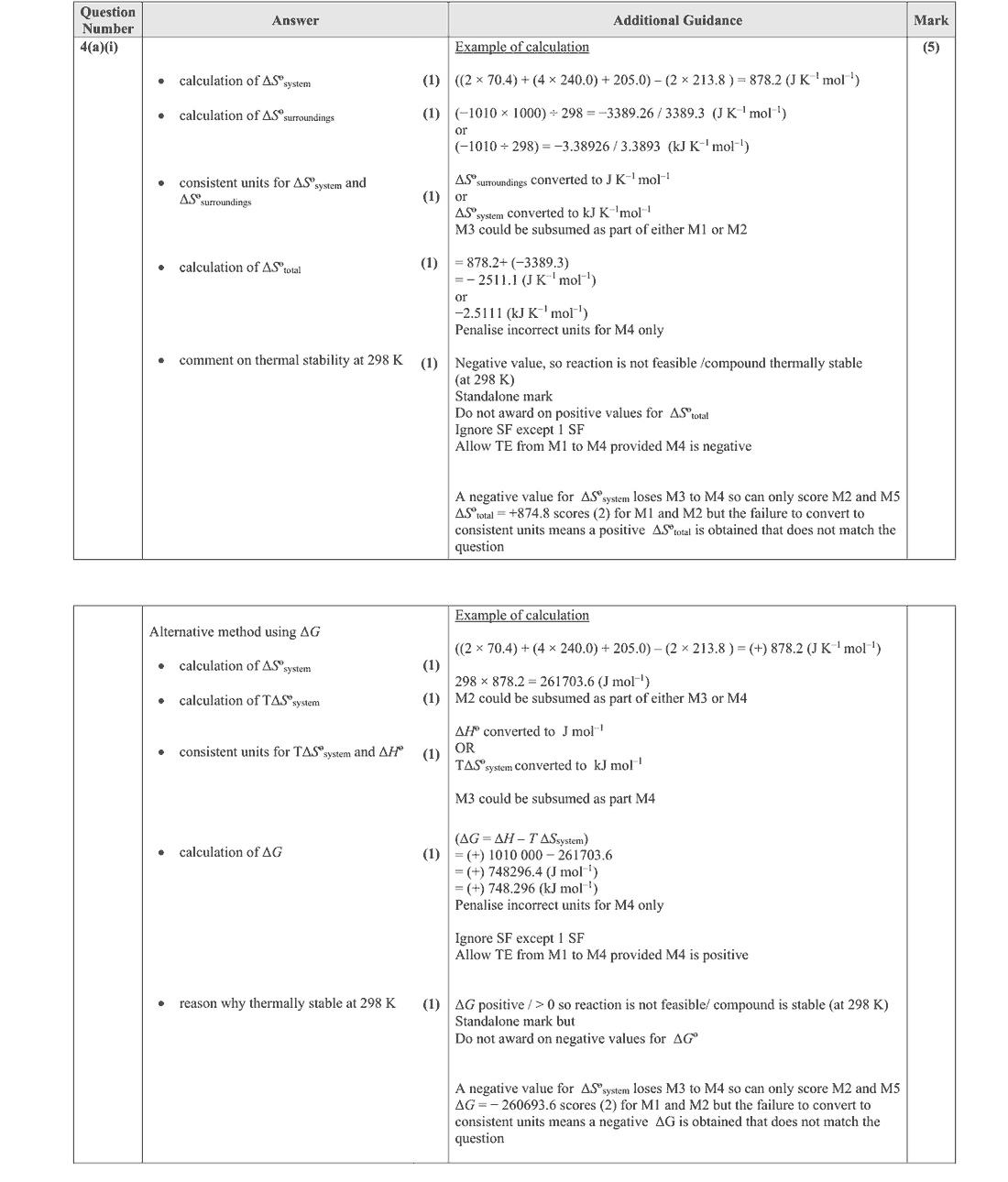
4(a)(i) Energetics II: entropy 5Calculation
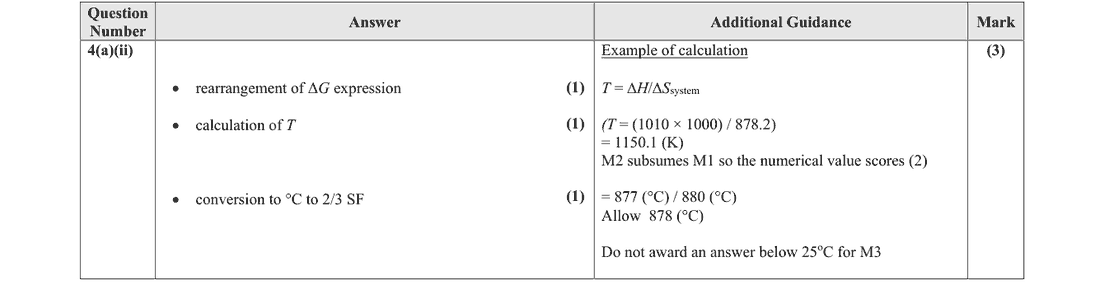
4(a)(ii) Energetics II: entropy 3Calculation
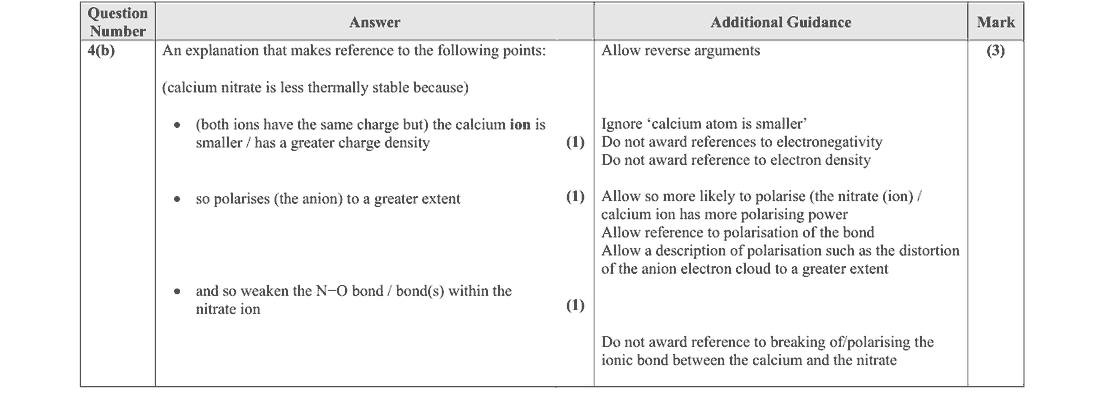
4(b) The elements of Groups 1 and 2 3Explanation
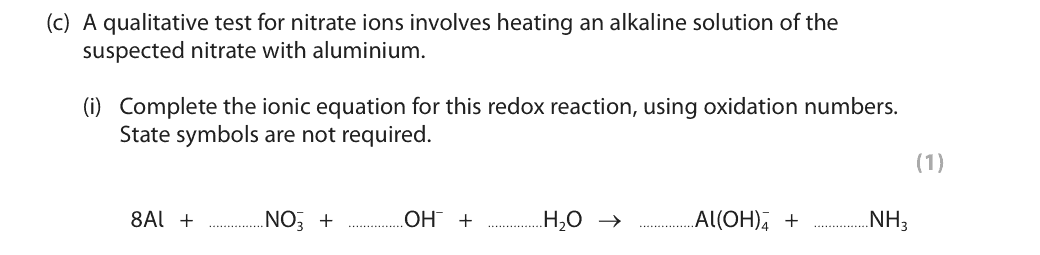
4(c)(i) Redox I 1Equation writing
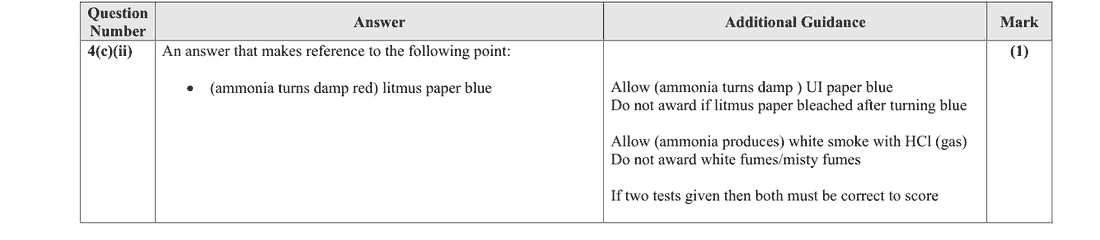
4(c)(ii) Analysis of inorganic compounds 1Practical and data analysis
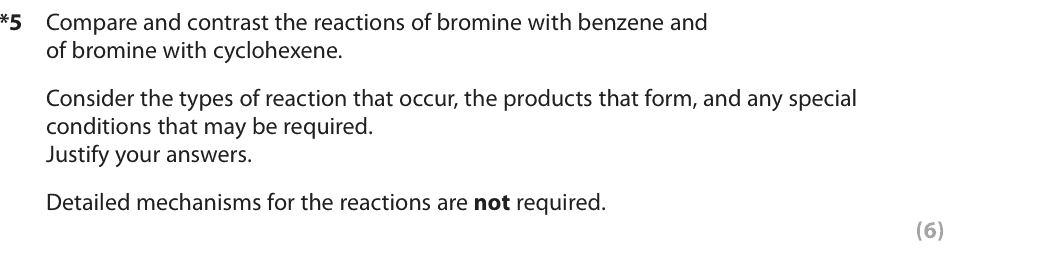
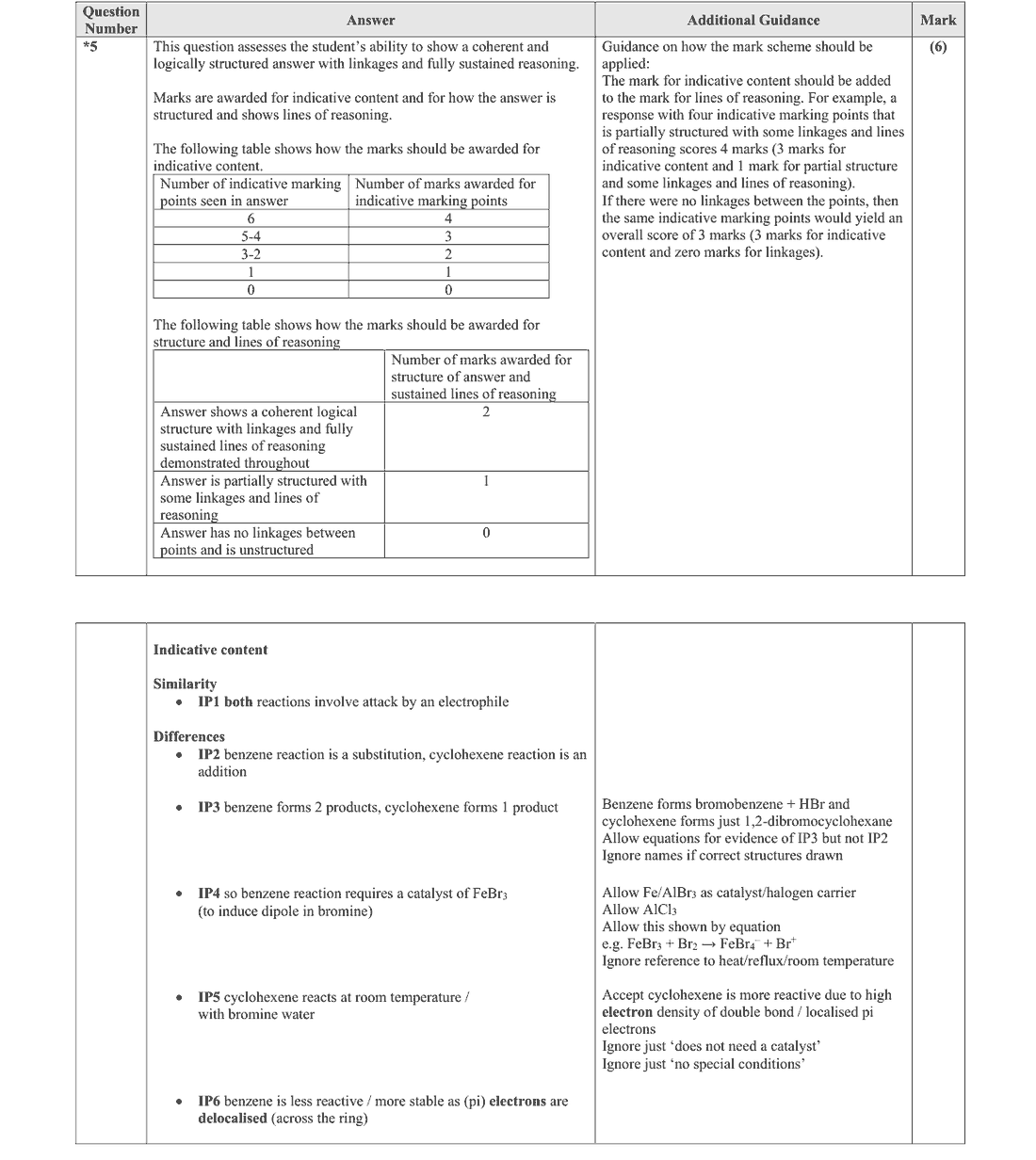
5 Arenes: benzene, Alkenes 6Extended response
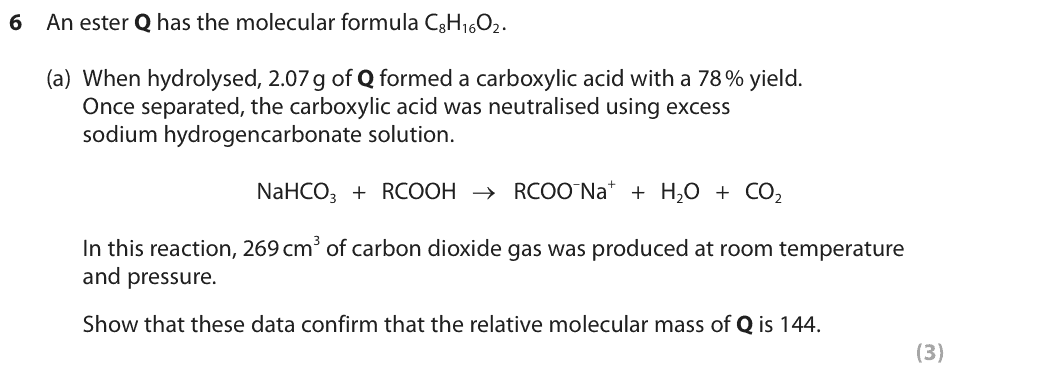
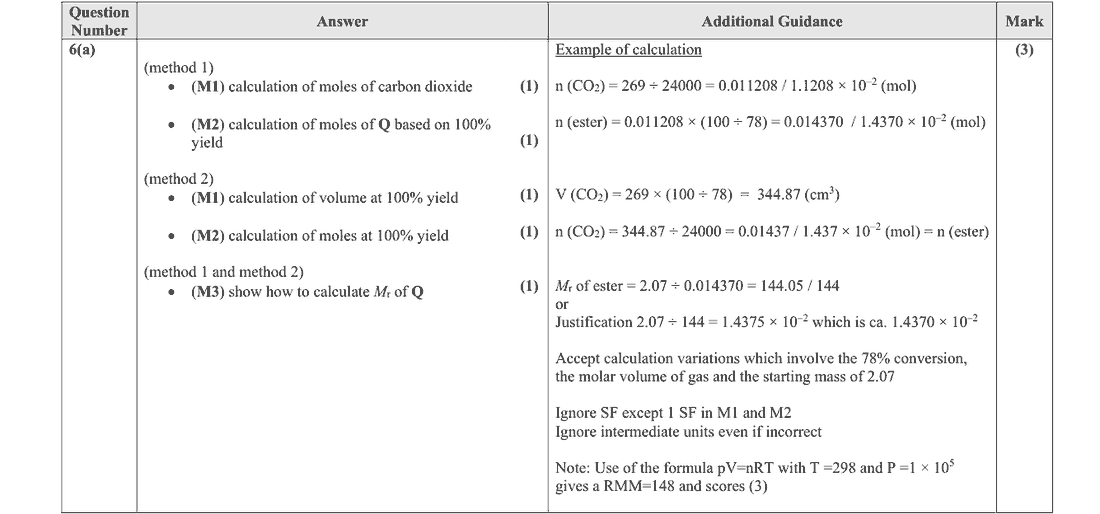
6(a) Formulae, equations and amounts of substance 3Calculation
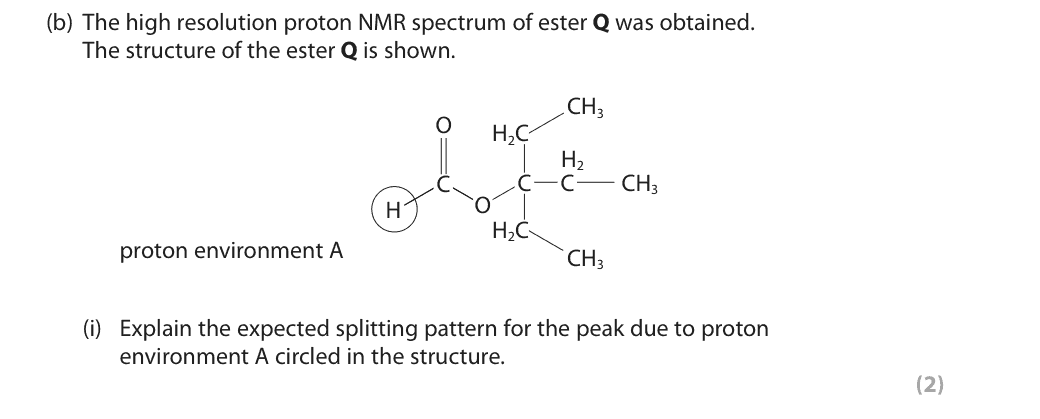
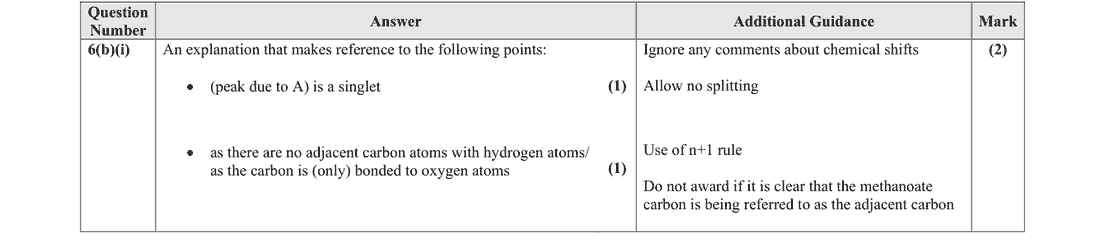
6(b)(i) Modern analytical techniques II: NMR, mass spectrometry and chromatography 2Explanation
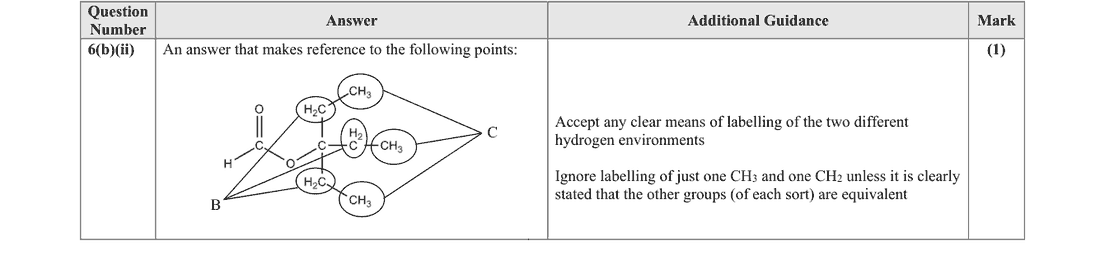
6(b)(ii) Modern analytical techniques II: NMR, mass spectrometry and chromatography 1Diagram or structure
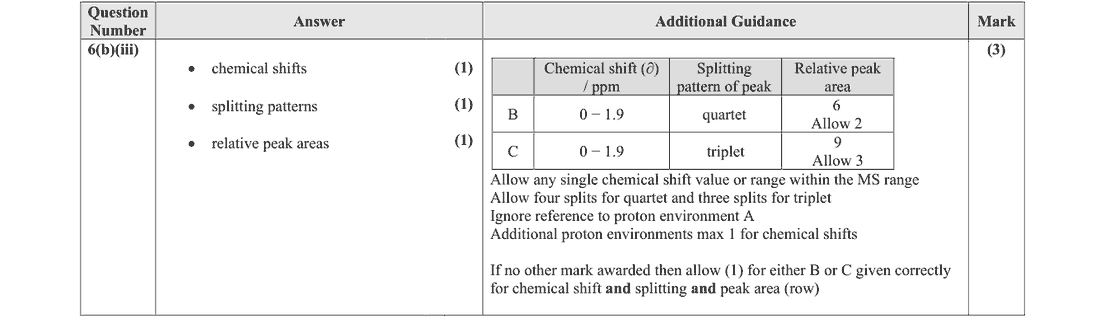
6(b)(iii) Modern analytical techniques II: NMR, mass spectrometry and chromatography 3Short answer
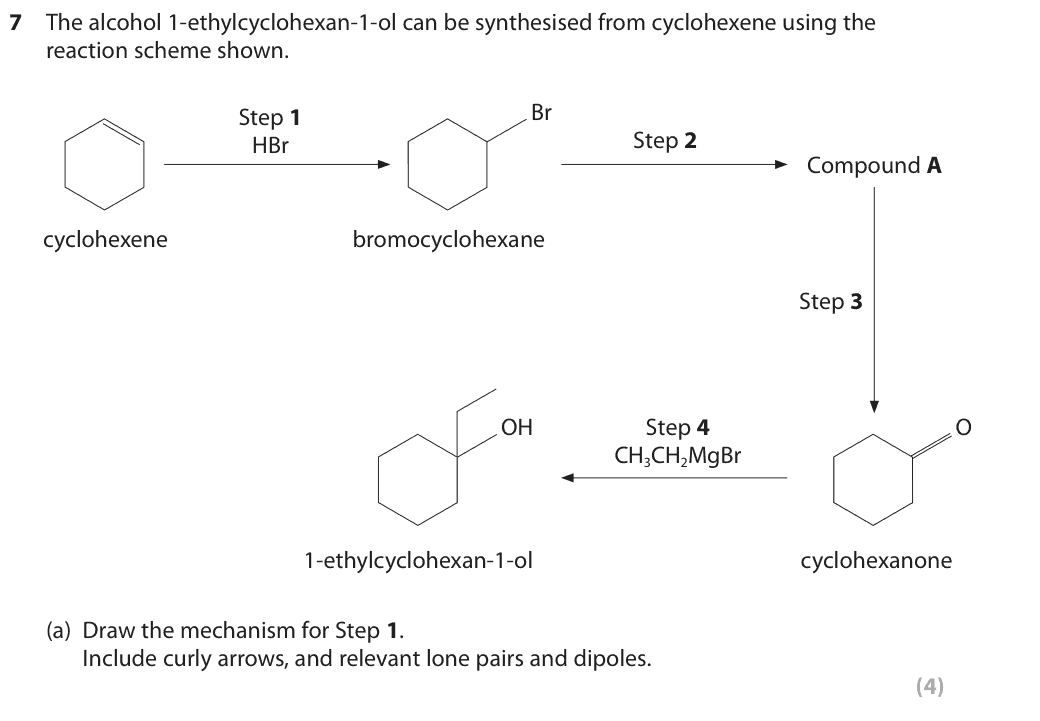
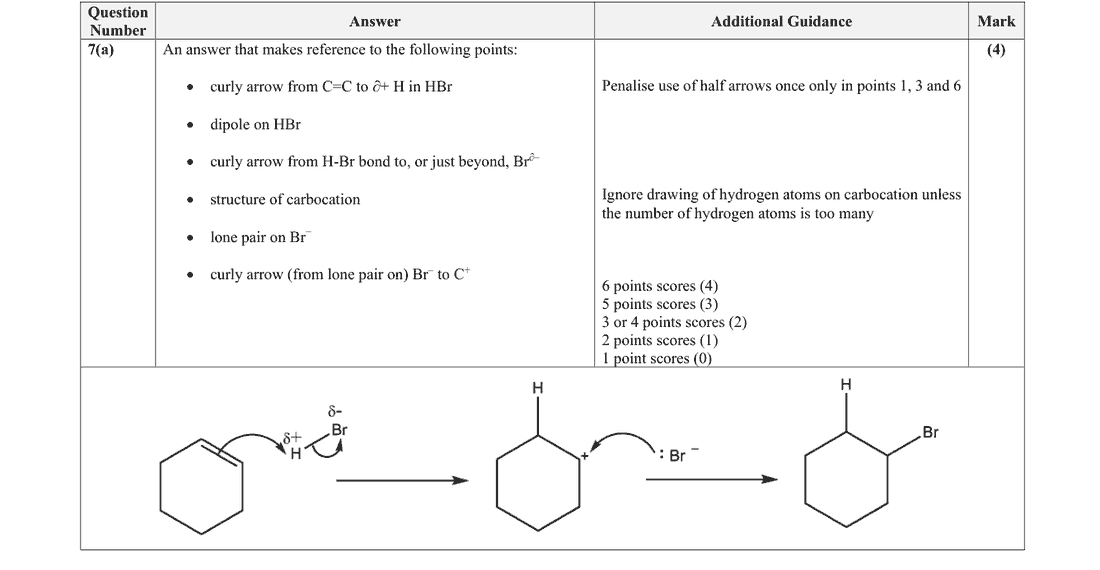
7(a) Alkenes 4Mechanism
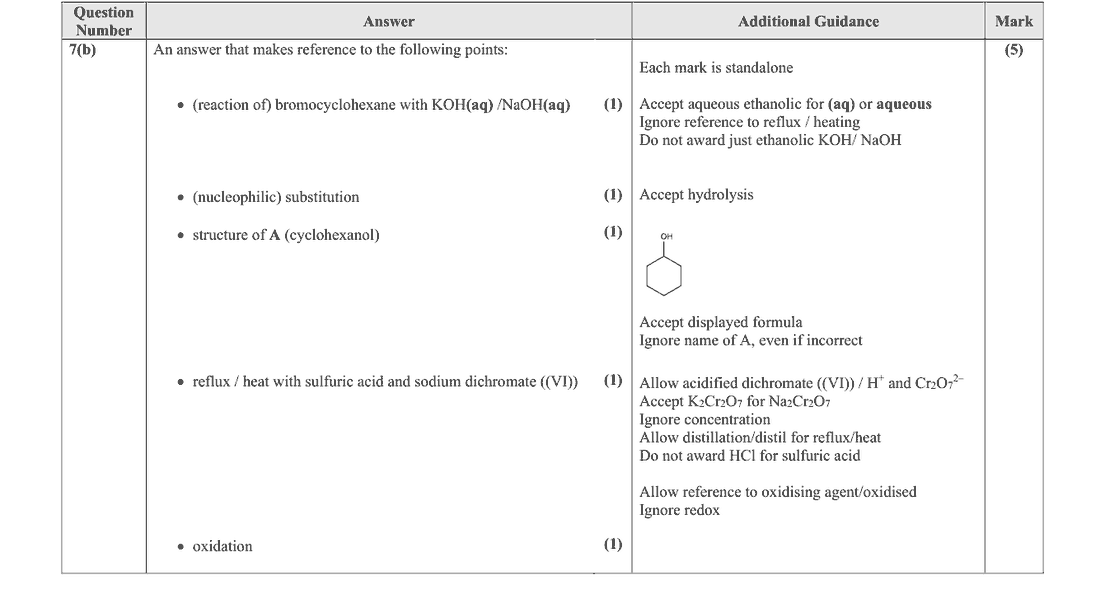
7(b) Organic synthesis, Halogenoalkanes, Alcohols 5Short answer
7(c)(i) Organic synthesis 1Short answer
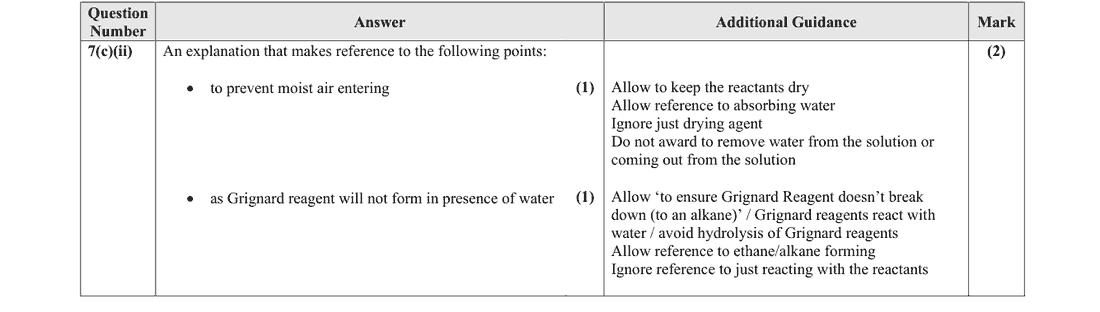
7(c)(ii) Organic synthesis 2Practical and data analysis
7(c)(iii) Organic synthesis 1Practical and data analysis
7(d)(i) Carbonyl compounds 1Practical and data analysis
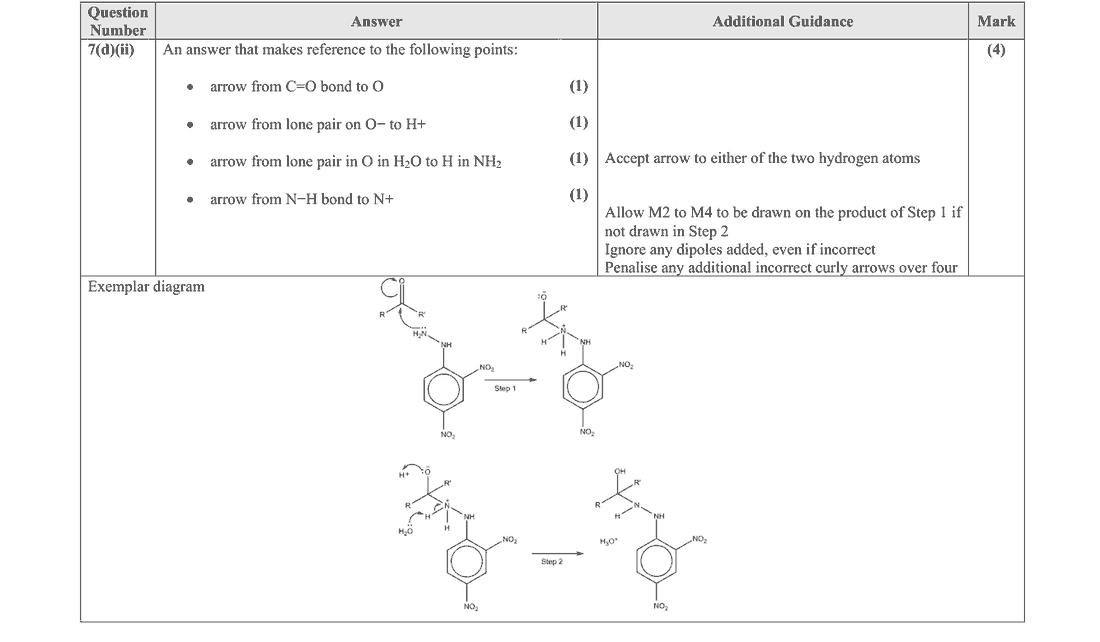
7(d)(ii) Carbonyl compounds 4Mechanism
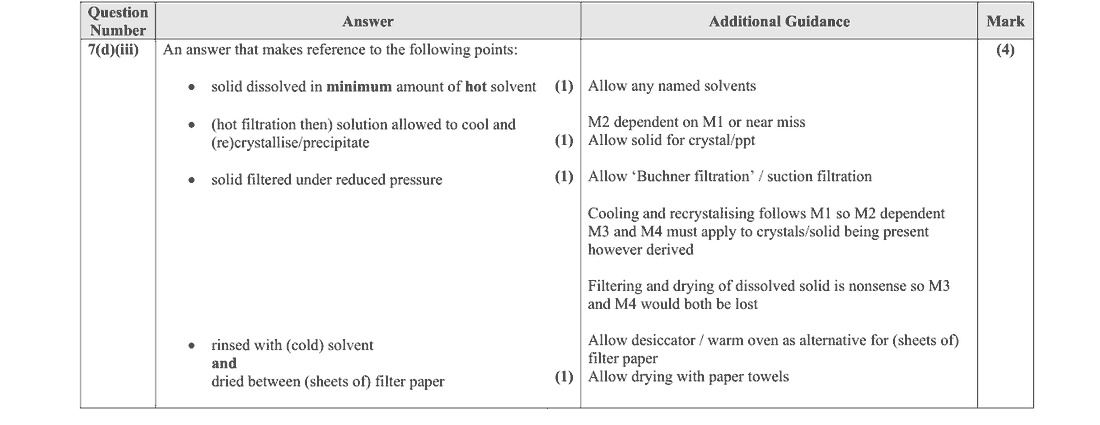
7(d)(iii) Organic synthesis 4Practical and data analysis
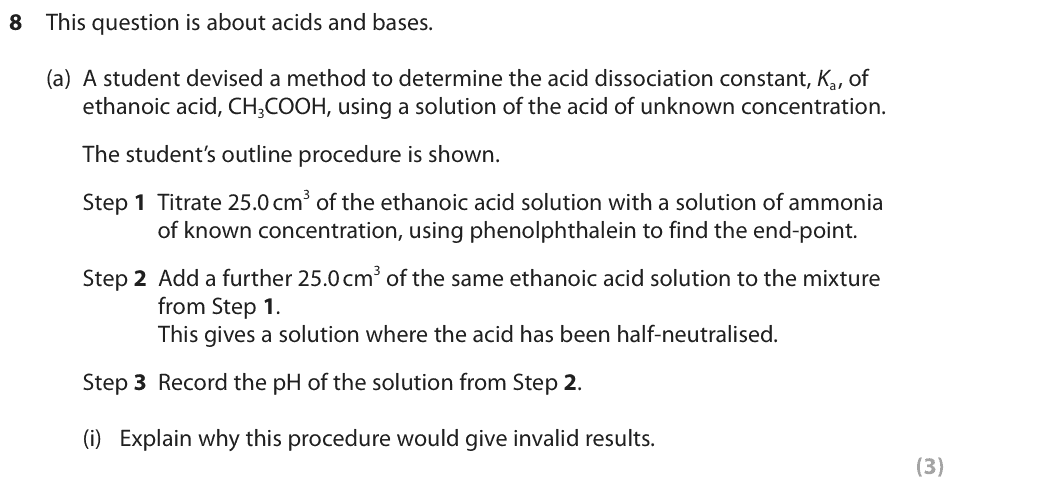
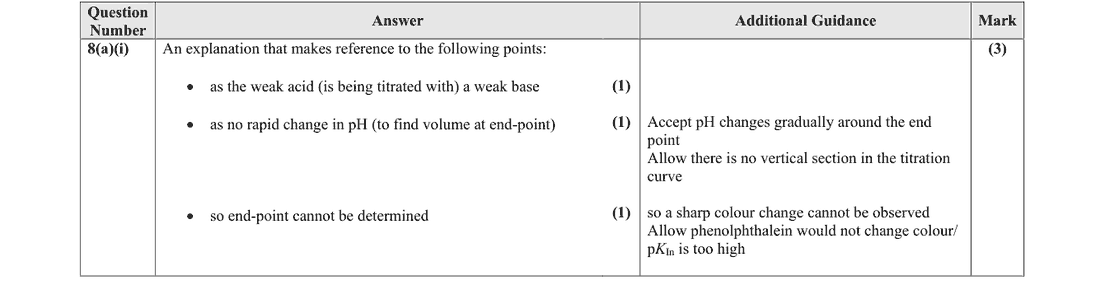
8(a)(i) Acid-base equilibria 3Practical and data analysis
8(a)(ii) Acid-base equilibria 1Practical and data analysis
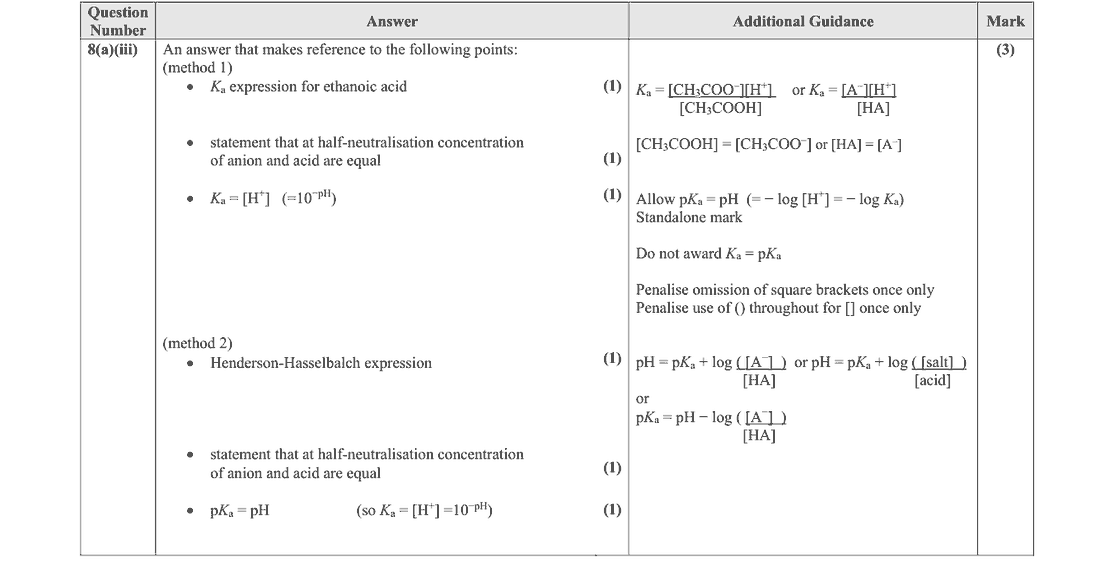
8(a)(iii) Acid-base equilibria 3Short answer
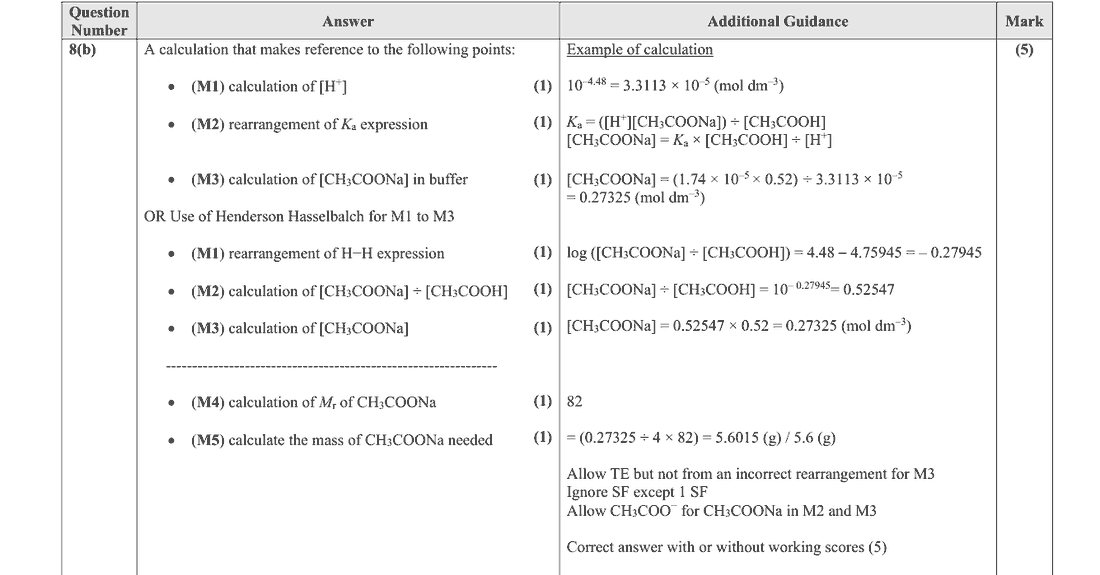
8(b) Acid-base equilibria 5Calculation
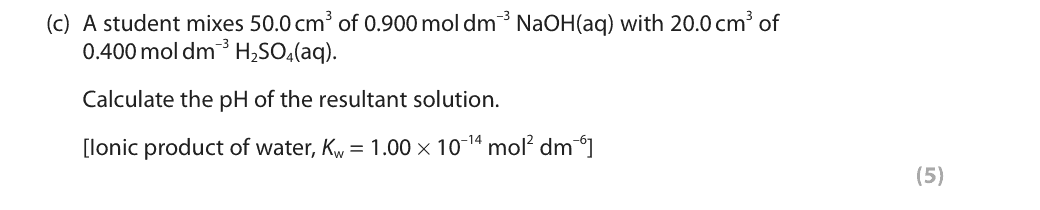
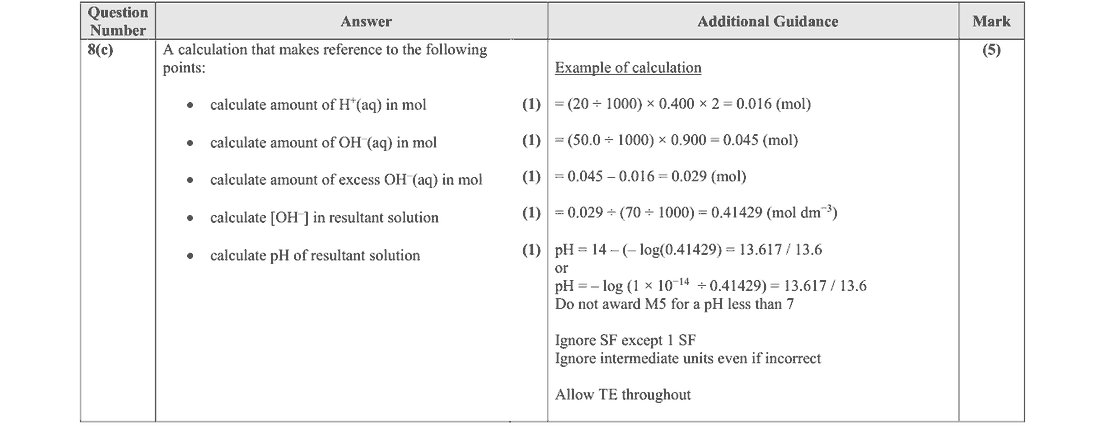
8(c) Acid-base equilibria, Formulae, equations and amounts of substance 5Calculation
9(a)(i) Formulae, equations and amounts of substance 2Practical and data analysis
9(a)(ii) Formulae, equations and amounts of substance 2Practical and data analysis
9(a)(iii) Formulae, equations and amounts of substance 3Calculation
9(a)(iv) Formulae, equations and amounts of substance 2Practical and data analysis
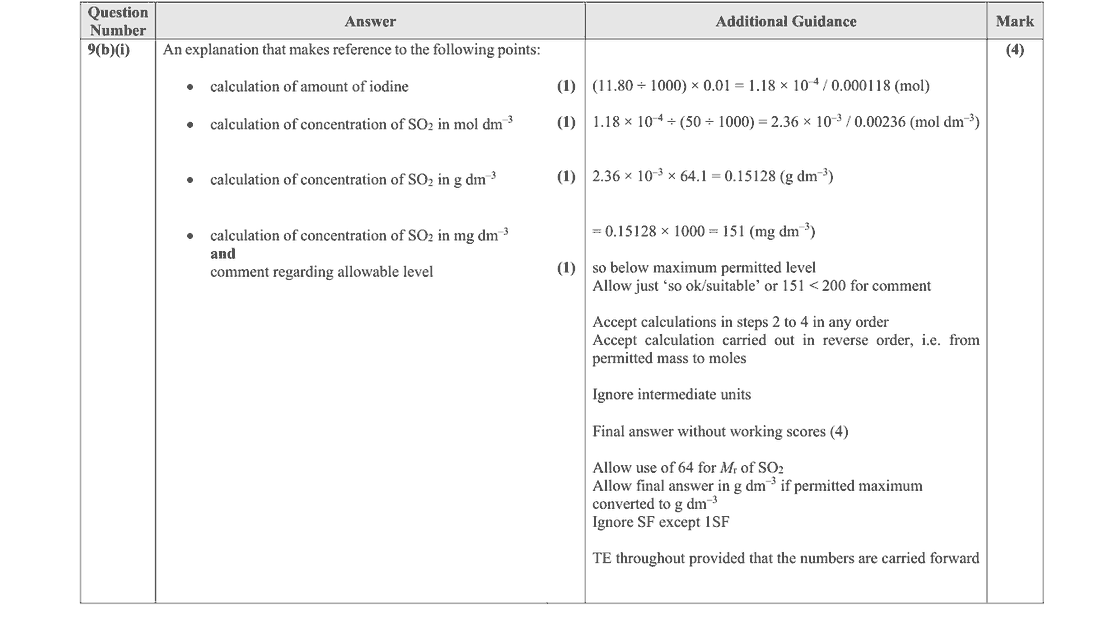
9(b)(i) Redox II 4Calculation
9(b)(ii) Redox II 2Practical and data analysis
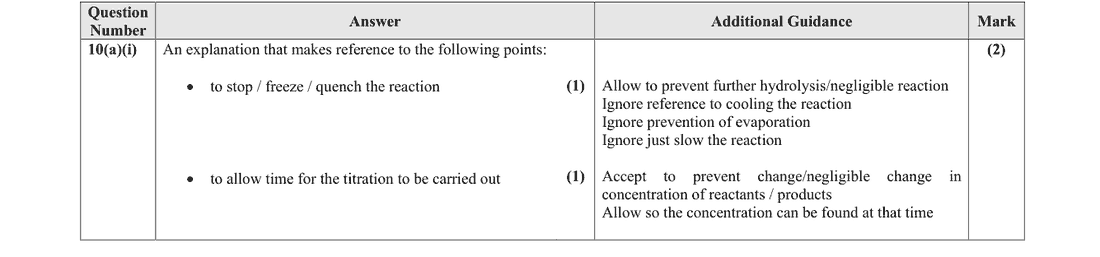
10(a)(i) Kinetics II 2Practical and data analysis
10(a)(ii) Kinetics II 2Practical and data analysis
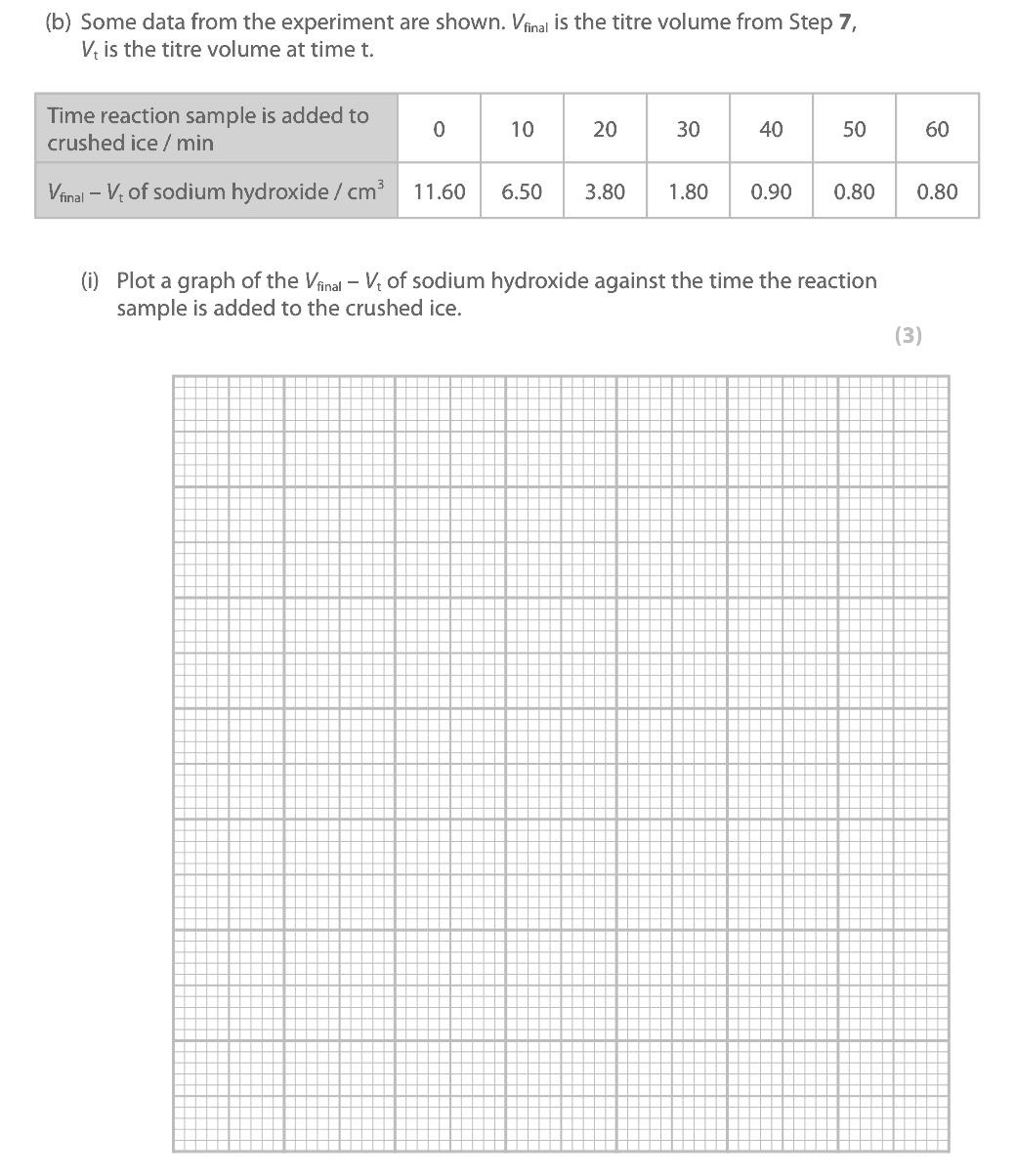
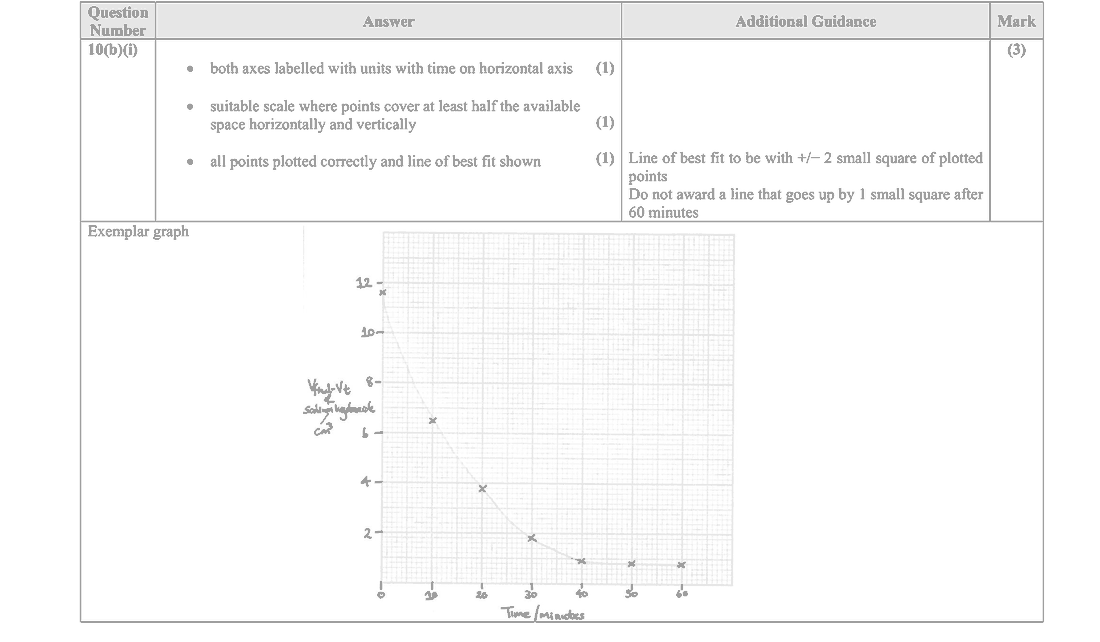
10(b)(i) Kinetics II 3Diagram or structure
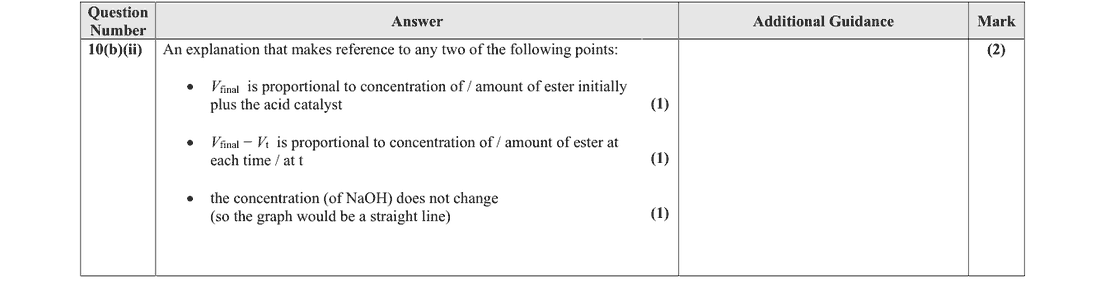
10(b)(ii) Kinetics II 2Explanation
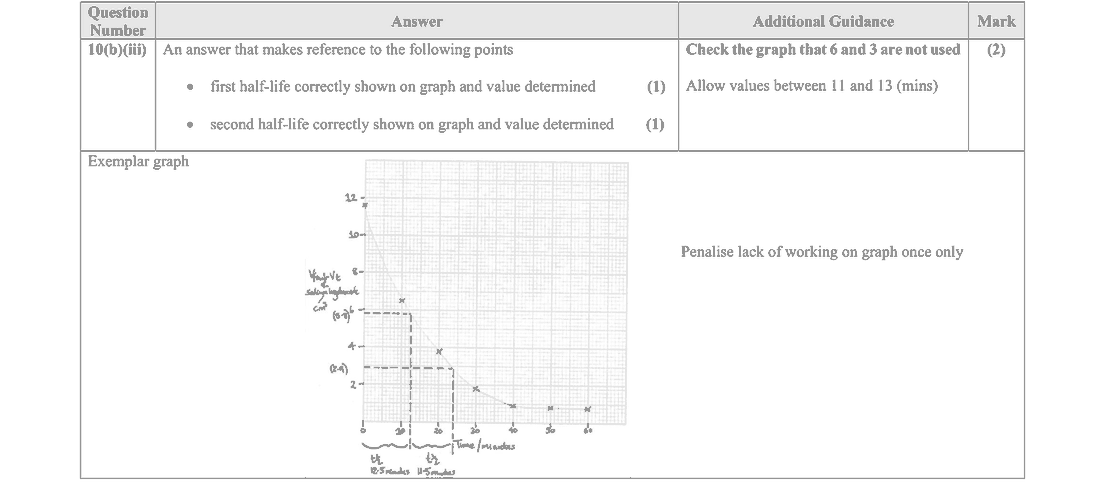
10(b)(iii) Kinetics II 2Short answer
10(b)(iv) Kinetics II 1Short answer
10(c) Kinetics II 2Short answer

The questions

1(a)1(b)2(a)2(b)2(c)3(a)3(b)3(c)3(d)(i)3(d)(ii)3(e)(i)3(e)(ii)4(a)(i)4(a)(ii)4(b)4(c)(i)4(c)(ii)56(a)6(b)(i)6(b)(ii)6(b)(iii)7(a)7(b)7(c)(i)7(c)(ii)7(c)(iii)7(d)(i)7(d)(ii)7(d)(iii)8(a)(i)8(a)(ii)8(a)(iii)8(b)8(c)9(a)(i)9(a)(ii)9(a)(iii)9(a)(iv)9(b)(i)9(b)(ii)10(a)(i)10(a)(ii)10(b)(i)10(b)(ii)10(b)(iii)10(b)(iv)10(c)
June 2024 · Paper 3 · Q1(a) 2 marks Short answer atomic structure and the periodic table
Relative isotopic mass is an important concept in chemistry.
Define relative isotopic mass.
June 2024 · Paper 3 · Q1(b) 1 mark Short answer Hard atomic structure and the periodic table
A sample of hydrogen gas is formed from atoms of three isotopes, 1H, 2H and 3H.
Deduce the number of peaks due to molecular ions, H2
+, in the mass spectrum of
this sample.
June 2024 · Paper 3 · Q2(a) 3 marks Explanation bonding
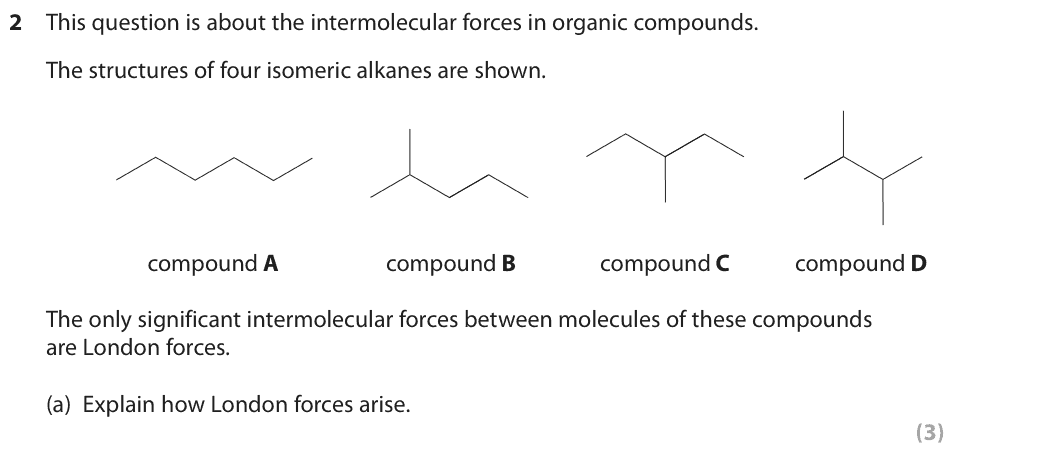
This question is about the intermolecular forces in organic compounds.
The structures of four isomeric alkanes are shown.
compound A
compound B
compound C
compound D
The only significant intermolecular forces between molecules of these compounds
are London forces.
Explain how London forces arise.
June 2024 · Paper 3 · Q2(b) 2 marks Explanation bonding
Earlier part of question 2 that this part usesEarlier part of June 2024 Paper 3 question 2
Explain which of the compounds A–D will have the highest boiling temperature.
June 2024 · Paper 3 · Q2(c) 3 marks Explanation bonding
Earlier part of question 2 that this part usesEarlier part of June 2024 Paper 3 question 2
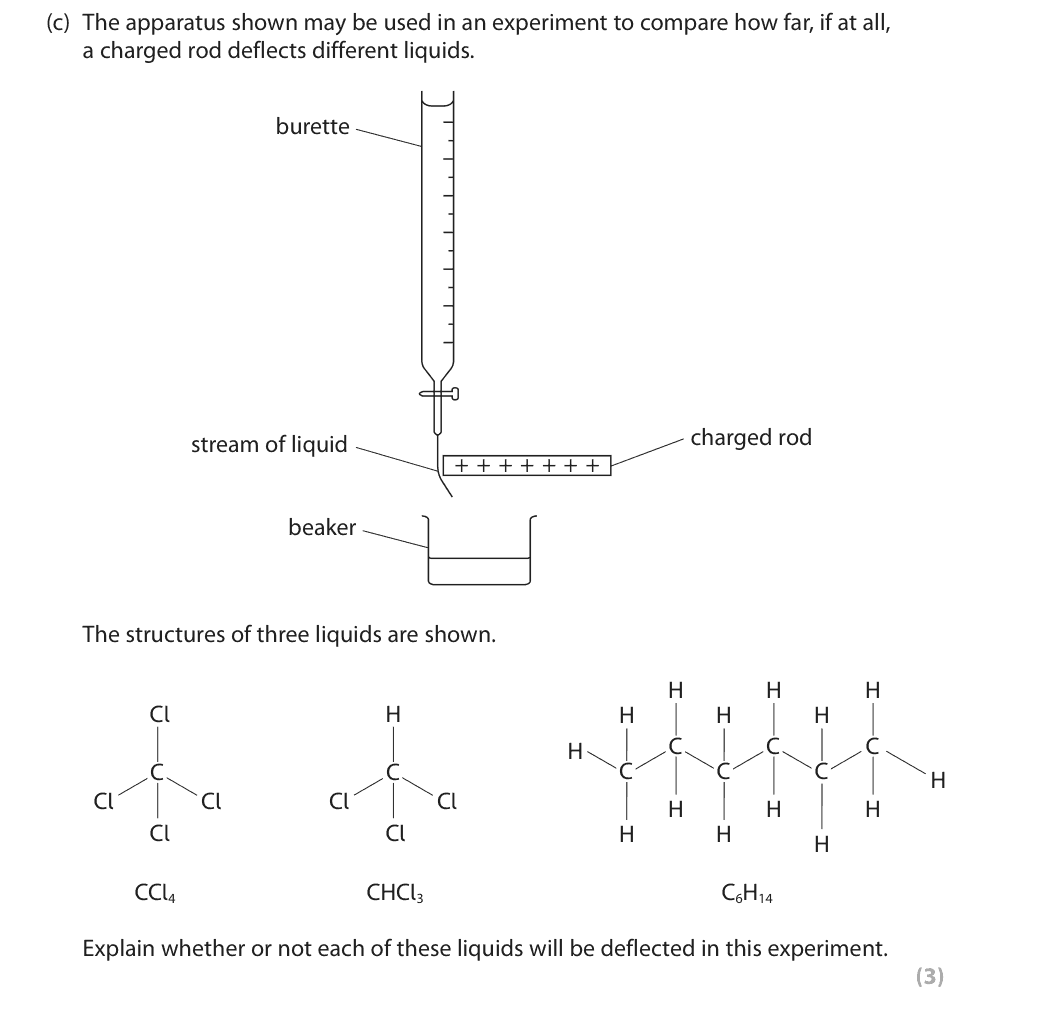
The apparatus shown may be used in an experiment to compare how far, if at all,
a charged rod deflects different liquids.
burette
charged rod
stream of liquid
+
+
+
+
+
+
+
beaker
The structures of three liquids are shown.
H
H
H
Cl
H
H
H
H
C
C
C
H
C
C
C
C
C
H
Cl
Cl
Cl
Cl
H
H
H
Cl
Cl
H
H
H
CCl4
CHCl3
C6H14
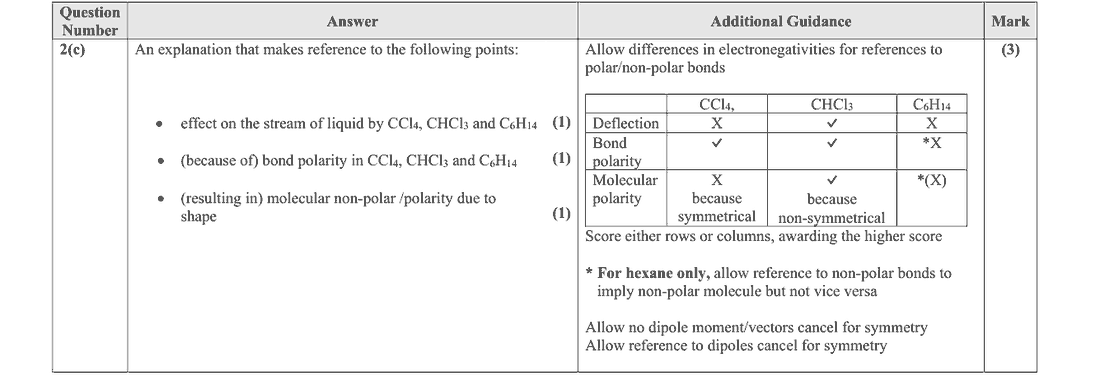
Explain whether or not each of these liquids will be deflected in this experiment.
June 2024 · Paper 3 · Q3(a) 1 mark Practical and data analysis formulae equations and amounts of substance
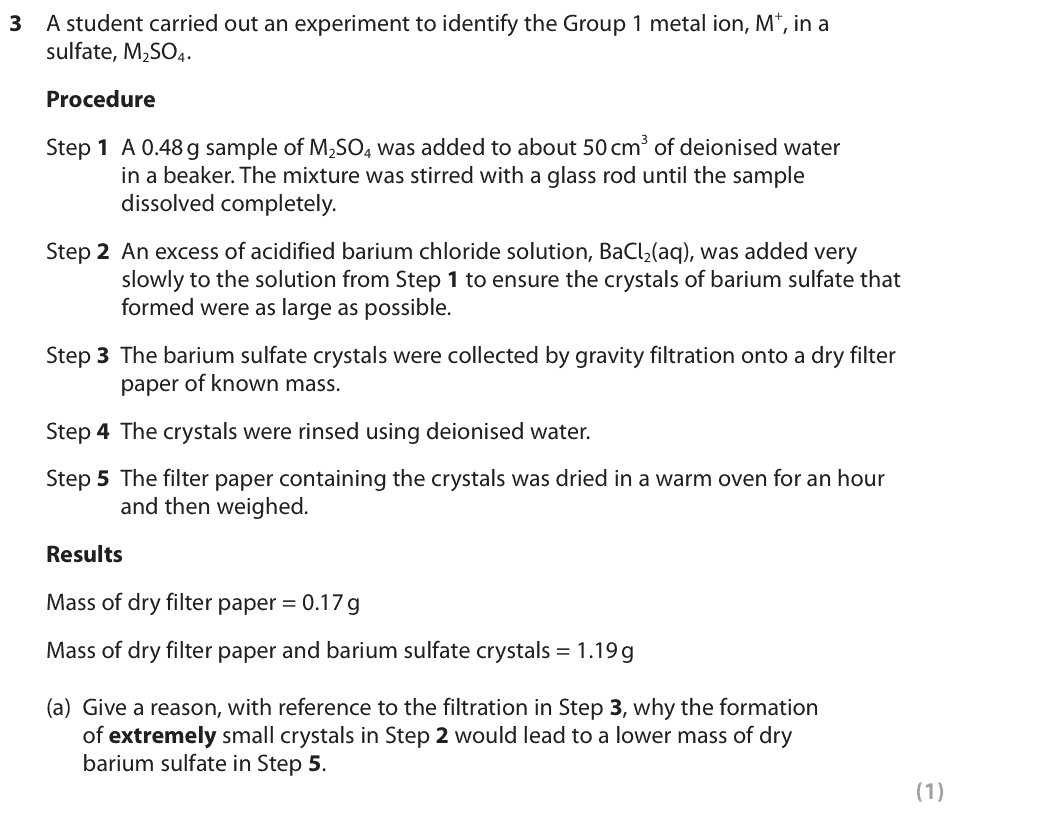
A student carried out an experiment to identify the Group 1 metal ion, M+, in a
sulfate, M2SO4.
Procedure
Step 1  A 0.48 g sample of M2SO4 was added to about 50 cm3 of deionised water
in a beaker. The mixture was stirred with a glass rod until the sample
dissolved completely.
Step 2  An excess of acidified barium chloride solution, BaCl2(aq), was added very
slowly to the solution from Step 1 to ensure the crystals of barium sulfate that
formed were as large as possible.
Step 3  The barium sulfate crystals were collected by gravity filtration onto a dry filter
paper of known mass.
Step 4  The crystals were rinsed using deionised water.
Step 5  The filter paper containing the crystals was dried in a warm oven for an hour
and then weighed.
Results
Mass of dry filter paper = 0.17 g
Mass of dry filter paper and barium sulfate crystals = 1.19 g
Give a reason, with reference to the filtration in Step 3, why the formation
of extremely small crystals in Step 2 would lead to a lower mass of dry
barium sulfate in Step 5.
June 2024 · Paper 3 · Q3(b) 2 marks Practical and data analysis formulae equations and amounts of substance
Earlier part of question 3 that this part usesEarlier part of June 2024 Paper 3 question 3
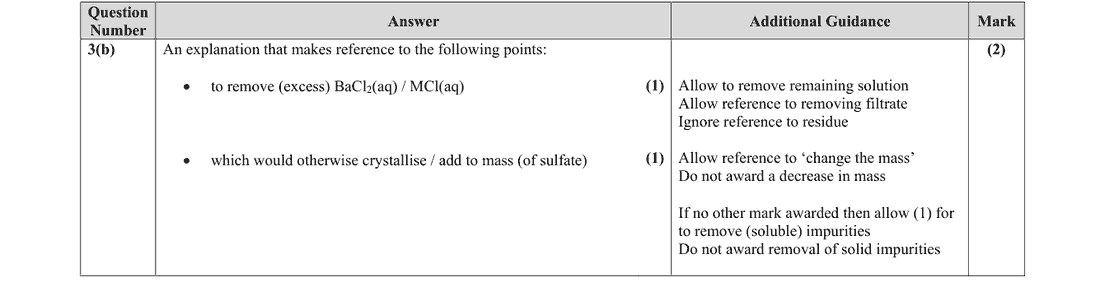
Explain why the crystals are rinsed in Step 4.
June 2024 · Paper 3 · Q3(c) 3 marks Calculation formulae equations and amounts of substance
Earlier part of question 3 that this part usesEarlier part of June 2024 Paper 3 question 3
Calculate the relative formula mass of M2SO4 and hence identify M.
M2SO4(aq)   +   BaCl2(aq)   →   BaSO4(s)   +   2MCl(aq)
[Mr of BaSO4 = 233.4]
June 2024 · Paper 3 · Q3(d)(i) 2 marks Practical and data analysis formulae equations and amounts of substance
Earlier part of question 3 that this part usesEarlier part of June 2024 Paper 3 question 3
Another student carrying out the experiment placed the glass rod on the
laboratory bench when the stirring was complete in Step 1.
Explain what effect this would have on the calculated value of the relative
formula mass of M2SO4.
June 2024 · Paper 3 · Q3(d)(ii) 1 mark Practical and data analysis formulae equations and amounts of substance
Earlier parts of question 3 that this part usesEarlier part of June 2024 Paper 3 question 3Earlier part of June 2024 Paper 3 question 3
Describe how the student should amend the procedure.
June 2024 · Paper 3 · Q3(e)(i) 2 marks Explanation groups 1 and 2
Earlier part of question 3 that this part usesEarlier part of June 2024 Paper 3 question 3
Another way to identify a metal ion is a flame test.
Explain what causes the flame colour in such a test.
June 2024 · Paper 3 · Q3(e)(ii) 2 marks Practical and data analysis groups 1 and 2
Earlier parts of question 3 that this part usesEarlier part of June 2024 Paper 3 question 3Earlier part of June 2024 Paper 3 question 3
Give one advantage and one disadvantage of using a flame test to identify a
metal cation, rather than the method followed by the students in Steps 1–5.
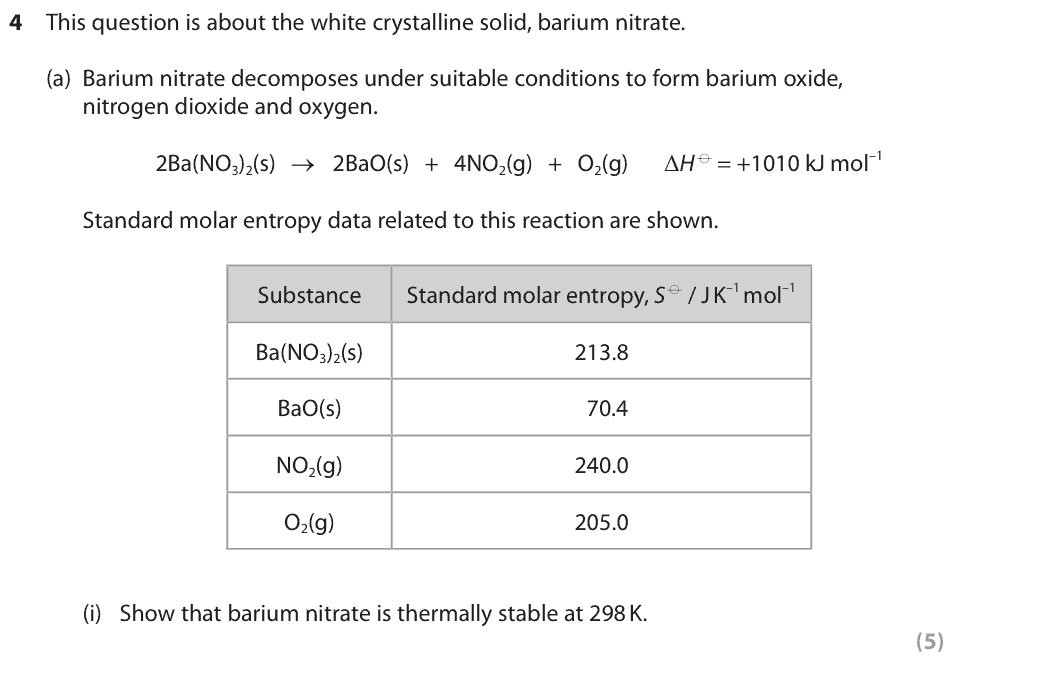
June 2024 · Paper 3 · Q4(a)(i) 5 marks Calculation entropy
This question is about the white crystalline solid, barium nitrate.
Barium nitrate decomposes under suitable conditions to form barium oxide,
nitrogen dioxide and oxygen.
2Ba(NO3)2(s)   →   2BaO(s)   +   4NO2(g)   +   O2(g)       ΔH d = +1010 kJ mol–1
Standard molar entropy data related to this reaction are shown.
Standard molar entropy, S d / J K–1 mol–1
Substance
Ba(NO3)2(s)
213.8
BaO(s)
70.4
NO2(g)
240.0
O2(g)
205.0
Show that barium nitrate is thermally stable at 298 K.
June 2024 · Paper 3 · Q4(a)(ii) 3 marks Calculation entropy
Earlier part of question 4 that this part usesEarlier part of June 2024 Paper 3 question 4
Calculate the minimum temperature, in °C, at which it is thermodynamically
feasible for barium nitrate to decompose.
Give your answer to an appropriate number of significant figures.
June 2024 · Paper 3 · Q4(b) 3 marks Explanation groups 1 and 2
Explain why calcium nitrate is less thermally stable than barium nitrate.
June 2024 · Paper 3 · Q4(c)(i) 1 mark Equation writing Hard redox i
Earlier part of question 4 that this part usesEarlier part of June 2024 Paper 3 question 4
A qualitative test for nitrate ions involves heating an alkaline solution of the
suspected nitrate with aluminium.
Complete the ionic equation for this redox reaction, using oxidation numbers.
State symbols are not required.
–   +   OH–   +   H2O   →   Al(OH)4
–   +   NH3
8Al   +   NO3
June 2024 · Paper 3 · Q4(c)(ii) 1 mark Practical and data analysis analysis of inorganic compounds
Earlier part of question 4 that this part usesEarlier part of June 2024 Paper 3 question 4
Describe a test to confirm that ammonia, NH3, has been produced.
June 2024 · Paper 3 · Q5 6 marks 6-mark extended response Easy arenes benzenealkenes
Compare and contrast the reactions of bromine with benzene and
of bromine with cyclohexene.
Consider the types of reaction that occur, the products that form, and any special
conditions that may be required.
Justify your answers.
Detailed mechanisms for the reactions are not required.
June 2024 · Paper 3 · Q6(a) 3 marks Calculation formulae equations and amounts of substance
An ester Q has the molecular formula C8H16O2.
When hydrolysed, 2.07 g of Q formed a carboxylic acid with a 78 % yield.
Once separated, the carboxylic acid was neutralised using excess
sodium hydrogencarbonate solution.
NaHCO3   +   RCOOH   →   RCOO–Na+   +   H2O   +   CO2
In this reaction, 269 cm3 of carbon dioxide gas was produced at room temperature
and pressure.
Show that these data confirm that the relative molecular mass of Q is 144.
June 2024 · Paper 3 · Q6(b)(i) 2 marks Explanation nmr mass spectrometry and chromatography
Earlier part of question 6 that this part usesEarlier part of June 2024 Paper 3 question 6
The high resolution proton NMR spectrum of ester Q was obtained.
The structure of the ester Q is shown.
CH3
O
H2C
H2
C
C
C
CH3
H
O
H2C
proton environment A
CH3
Explain the expected splitting pattern for the peak due to proton
environment A circled in the structure.
June 2024 · Paper 3 · Q6(b)(ii) 1 mark Diagram or structure nmr mass spectrometry and chromatography
Earlier parts of question 6 that this part usesEarlier part of June 2024 Paper 3 question 6Earlier part of June 2024 Paper 3 question 6
Label the structure to indicate the remaining equivalent proton environments
in ester Q.
June 2024 · Paper 3 · Q6(b)(iii) 3 marks Short answer nmr mass spectrometry and chromatography
Earlier parts of question 6 that this part usesEarlier part of June 2024 Paper 3 question 6Earlier part of June 2024 Paper 3 question 6
Predict the chemical shifts, relative peak areas and splitting patterns in the
high resolution proton NMR spectrum, due to the proton environments you
have labelled.
Do not consider proton environment A.
June 2024 · Paper 3 · Q7(a) 4 marks Mechanism alkenes
The alcohol 1-ethylcyclohexan-1-ol can be synthesised from cyclohexene using the
reaction scheme shown.
Br
Step 1
Step 2
HBr
Compound A
cyclohexene
bromocyclohexane
Step 3
Step 4
OH
O
CH3CH2MgBr
1-ethylcyclohexan-1-ol
cyclohexanone
Draw the mechanism for Step 1.
Include curly arrows, and relevant lone pairs and dipoles.
June 2024 · Paper 3 · Q7(b) 5 marks Short answer organic synthesishalogenoalkanesalcohols
Earlier part of question 7 that this part usesEarlier part of June 2024 Paper 3 question 7
Devise a reaction scheme for Step 2 and Step 3 of the synthesis.
Include in your answer all reagents and conditions, the type of reaction in each
step, and the structure of A.
June 2024 · Paper 3 · Q7(c)(i) 1 mark Short answer organic synthesis
Earlier part of question 7 that this part usesEarlier part of June 2024 Paper 3 question 7
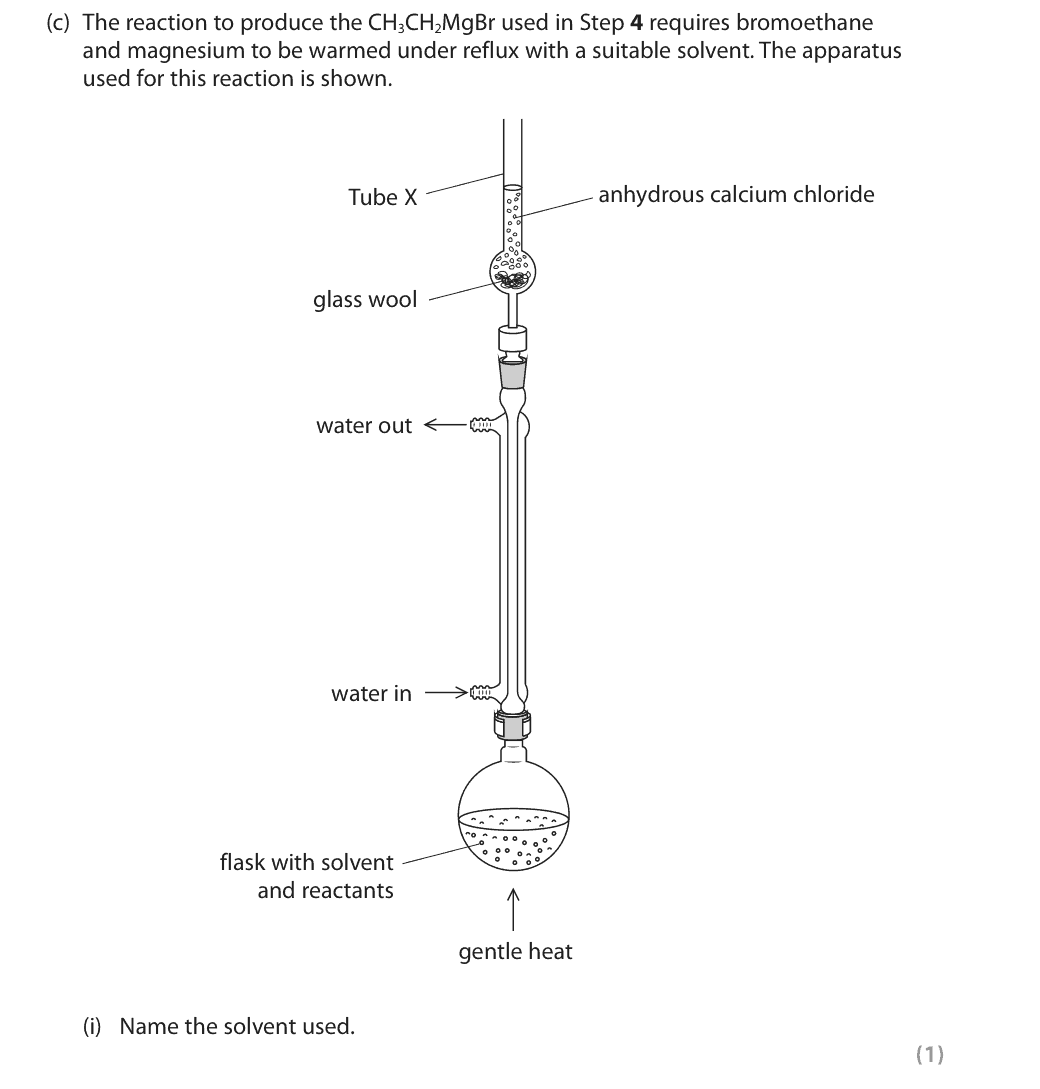
The reaction to produce the CH3CH2MgBr used in Step 4 requires bromoethane
and magnesium to be warmed under reflux with a suitable solvent. The apparatus
used for this reaction is shown.
Tube X
anhydrous calcium chloride
glass wool
water out
water in
flask with solvent
and reactants
gentle heat
Name the solvent used.
June 2024 · Paper 3 · Q7(c)(ii) 2 marks Practical and data analysis organic synthesis
Earlier parts of question 7 that this part usesEarlier part of June 2024 Paper 3 question 7Earlier part of June 2024 Paper 3 question 7
Explain why the anhydrous calcium chloride in Tube X is necessary.
June 2024 · Paper 3 · Q7(c)(iii) 1 mark Practical and data analysis organic synthesis
Earlier parts of question 7 that this part usesEarlier part of June 2024 Paper 3 question 7Earlier part of June 2024 Paper 3 question 7
Give a reason why it is best practice for the water in the condenser to flow in
the direction shown in the diagram.
June 2024 · Paper 3 · Q7(d)(i) 1 mark Practical and data analysis carbonyl compounds
Earlier part of question 7 that this part usesEarlier part of June 2024 Paper 3 question 7
Carbonyl compounds such as cyclohexanone can be identified by the reaction
with 2,4-dinitrophenylhydrazine.
Give the colour of the precipitate formed in this reaction.
June 2024 · Paper 3 · Q7(d)(ii) 4 marks Mechanism carbonyl compounds
Earlier parts of question 7 that this part usesEarlier part of June 2024 Paper 3 question 7Earlier part of June 2024 Paper 3 question 7
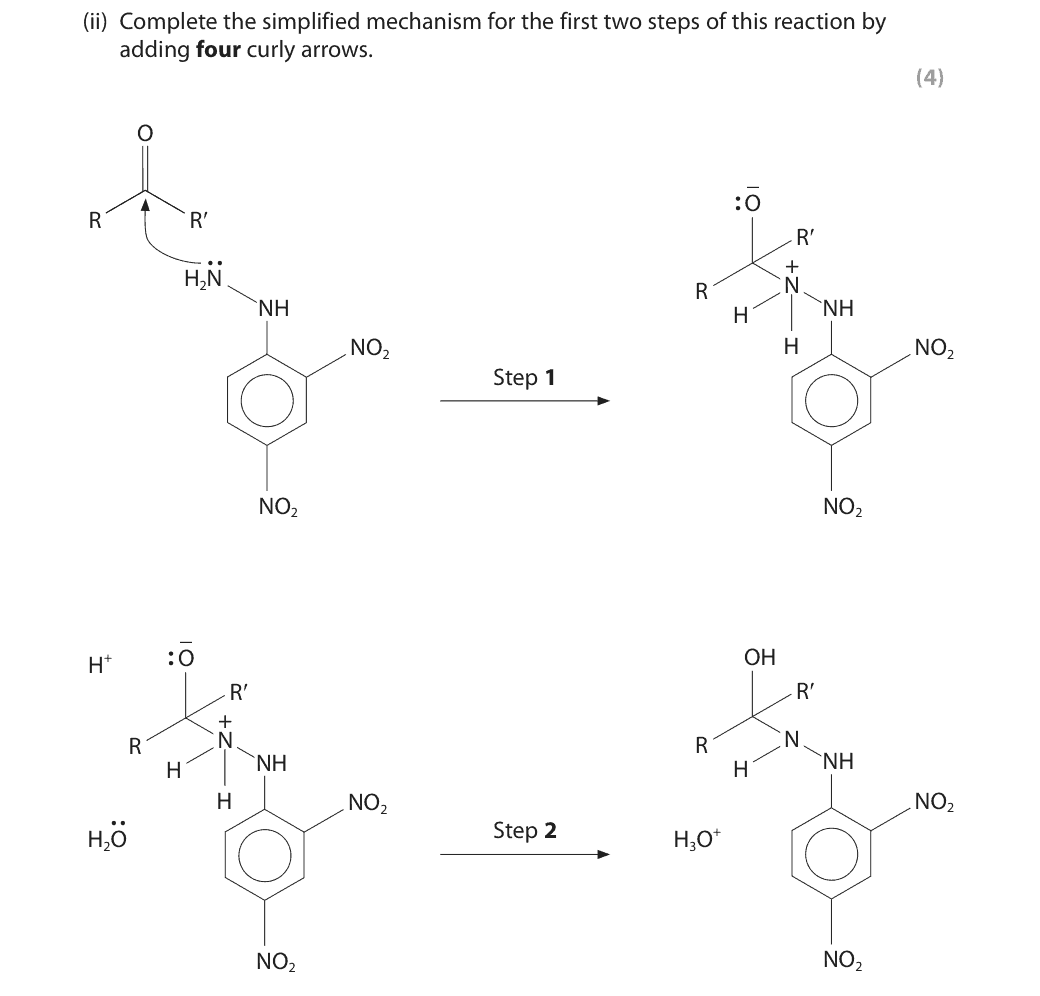
Complete the simplified mechanism for the first two steps of this reaction by
adding four curly arrows.
O
_
O
R′
R
R′
. .
+
H2N
N
R
NH
NH
H
NO2
H
NO2
Step 1
NO2
NO2
_
O
OH
H+
R′
R′
+
N
N
R
R
NH
NH
H
H
NO2
H
NO2
. .
Step 2
H2O
H3O+
NO2
NO2
June 2024 · Paper 3 · Q7(d)(iii) 4 marks Practical and data analysis organic synthesis
Earlier parts of question 7 that this part usesEarlier part of June 2024 Paper 3 question 7Earlier part of June 2024 Paper 3 question 7
Describe how you would obtain pure dry crystals from the precipitate.
June 2024 · Paper 3 · Q8(a)(i) 3 marks Practical and data analysis acid base equilibria
This question is about acids and bases.
A student devised a method to determine the acid dissociation constant, Ka, of
ethanoic acid, CH3COOH, using a solution of the acid of unknown concentration.
The student’s outline procedure is shown.
Step 1  Titrate 25.0 cm3 of the ethanoic acid solution with a solution of ammonia
of known concentration, using phenolphthalein to find the end-point.
Step 2  Add a further 25.0 cm3 of the same ethanoic acid solution to the mixture
from Step 1.
This gives a solution where the acid has been half-neutralised.
Step 3  Record the pH of the solution from Step 2.
Explain why this procedure would give invalid results.
June 2024 · Paper 3 · Q8(a)(ii) 1 mark Practical and data analysis acid base equilibria
Earlier part of question 8 that this part usesEarlier part of June 2024 Paper 3 question 8
State how Step 1 should be amended to give valid results.
June 2024 · Paper 3 · Q8(a)(iii) 3 marks Short answer acid base equilibria
Earlier part of question 8 that this part usesEarlier part of June 2024 Paper 3 question 8
Show that when the solution has been half-neutralised, the acid dissociation
constant is given by the expression
Ka = 10–pH
June 2024 · Paper 3 · Q8(b) 5 marks Calculation acid base equilibria
Calculate the mass of sodium ethanoate needed to be dissolved in 250 cm3 of
0.520 mol dm–3 ethanoic acid to form a buffer solution with pH = 4.48
[Ka for ethanoic acid = 1.74 × 10–5 mol dm–3]
June 2024 · Paper 3 · Q8(c) 5 marks Calculation acid base equilibriaformulae equations and amounts of substance
A student mixes 50.0 cm3 of 0.900 mol dm–3 NaOH(aq) with 20.0 cm3 of
0.400 mol dm–3 H2SO4(aq).
Calculate the pH of the resultant solution.
[Ionic product of water, Kw = 1.00 × 10–14 mol2 dm–6]
June 2024 · Paper 3 · Q9(a)(i) 2 marks Practical and data analysis formulae equations and amounts of substance
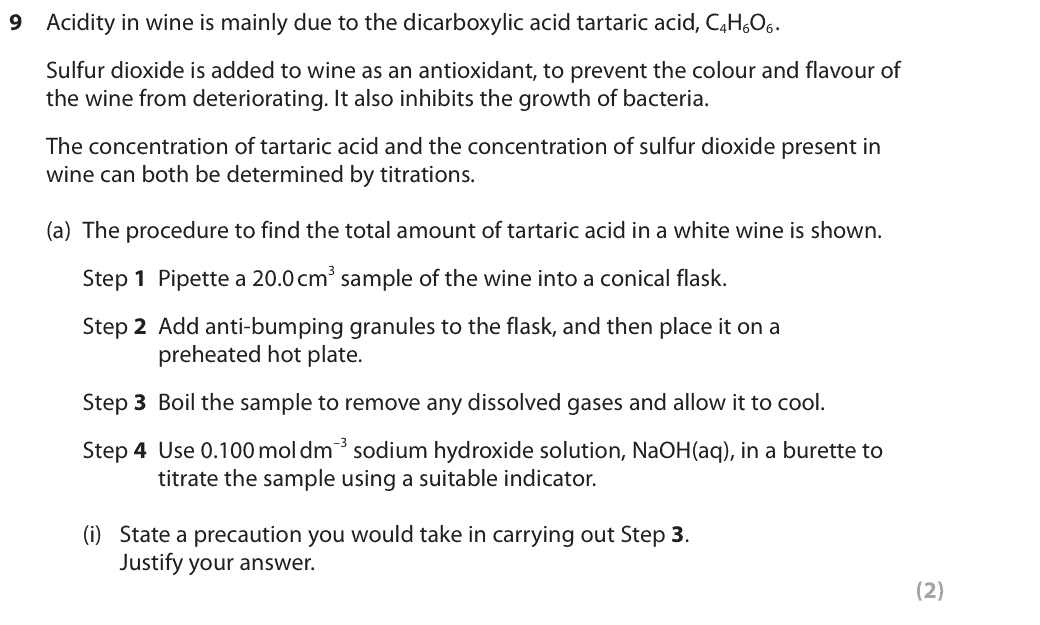
Acidity in wine is mainly due to the dicarboxylic acid tartaric acid, C4H6O6.
Sulfur dioxide is added to wine as an antioxidant, to prevent the colour and flavour of
the wine from deteriorating. It also inhibits the growth of bacteria.
The concentration of tartaric acid and the concentration of sulfur dioxide present in
wine can both be determined by titrations.
The procedure to find the total amount of tartaric acid in a white wine is shown.
Step 1  Pipette a 20.0 cm3 sample of the wine into a conical flask.
Step 2  Add anti-bumping granules to the flask, and then place it on a
preheated hot plate.
Step 3  Boil the sample to remove any dissolved gases and allow it to cool.
Step 4  Use 0.100 mol dm–3 sodium hydroxide solution, NaOH(aq), in a burette to
titrate the sample using a suitable indicator.
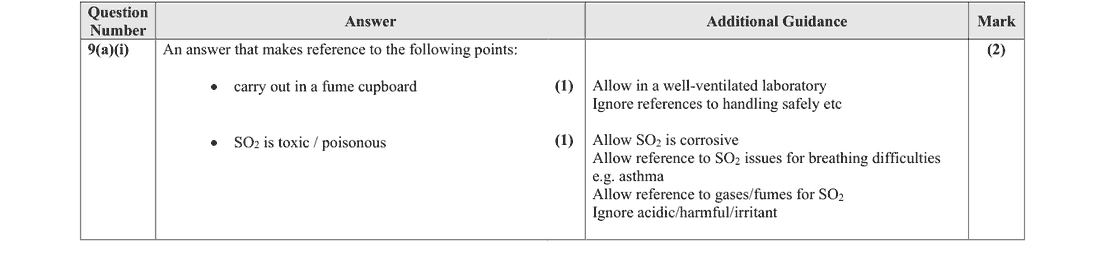
State a precaution you would take in carrying out Step 3.
Justify your answer.
June 2024 · Paper 3 · Q9(a)(ii) 2 marks Practical and data analysis formulae equations and amounts of substance
Earlier part of question 9 that this part usesEarlier part of June 2024 Paper 3 question 9
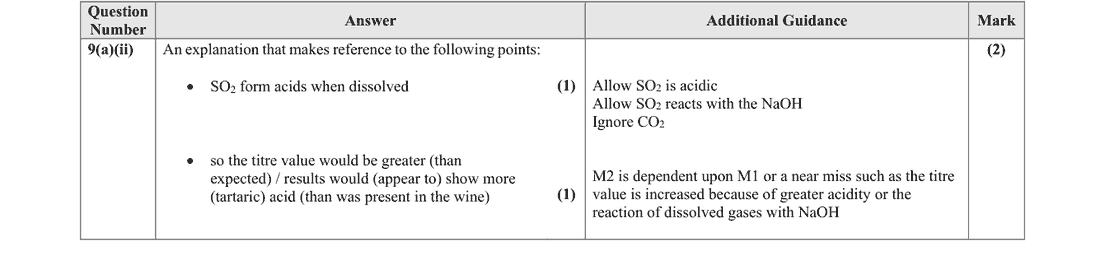
Explain what effect the omission of Step 3 would have on the titre.
June 2024 · Paper 3 · Q9(a)(iii) 3 marks Calculation formulae equations and amounts of substance
Earlier part of question 9 that this part usesEarlier part of June 2024 Paper 3 question 9
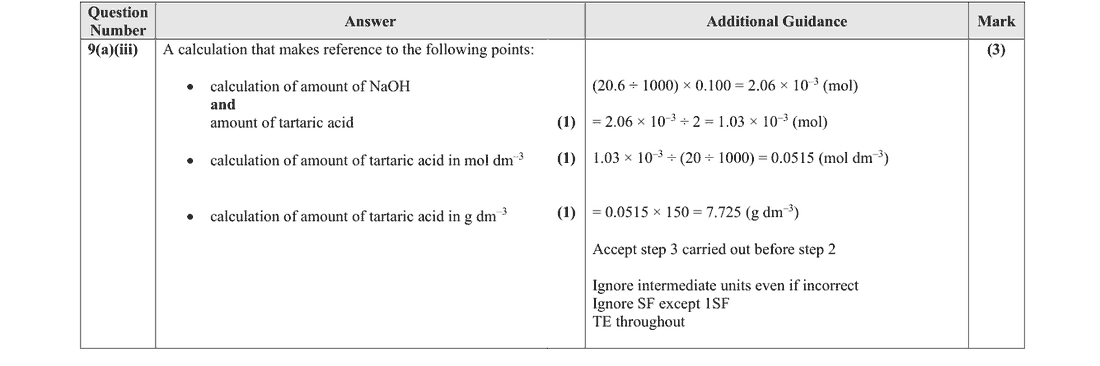
A mean titre of 20.60 cm3 was obtained.
Calculate the concentration, in  g dm–3, of tartaric acid in the white wine.
C4H6O6   +   2NaOH   →   C4H4O6Na2   +   2H2O
June 2024 · Paper 3 · Q9(a)(iv) 2 marks Practical and data analysis formulae equations and amounts of substance
Earlier part of question 9 that this part usesEarlier part of June 2024 Paper 3 question 9
A student carrying out the experiment forgot to remove an air bubble from
the tip of the burette before carrying out a titration. During the titration, the
air bubble escaped.
Explain the effect this mistake would have on the value of this titre.
June 2024 · Paper 3 · Q9(b)(i) 4 marks Calculation redox ii
Earlier part of question 9 that this part usesEarlier part of June 2024 Paper 3 question 9
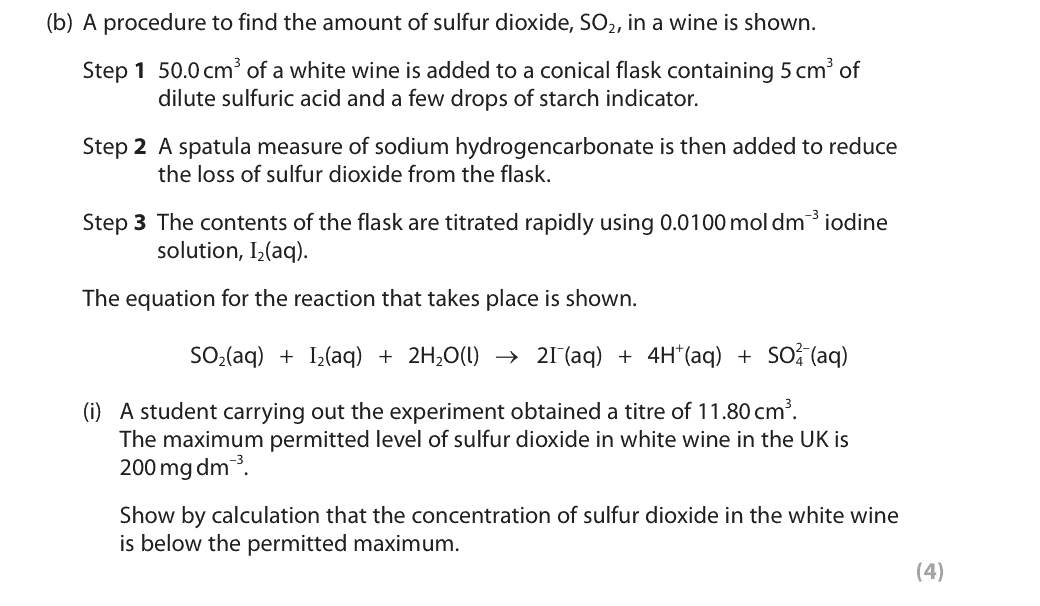
A procedure to find the amount of sulfur dioxide, SO2, in a wine is shown.
Step 1  50.0 cm3 of a white wine is added to a conical flask containing 5 cm3 of
dilute sulfuric acid and a few drops of starch indicator.
Step 2  A spatula measure of sodium hydrogencarbonate is then added to reduce
the loss of sulfur dioxide from the flask.
Step 3  The contents of the flask are titrated rapidly using 0.0100 mol dm–3 iodine
solution, I2(aq).
The equation for the reaction that takes place is shown.
SO2(aq)   +   I2(aq)   +   2H2O(l)   →   2I–(aq)   +   4H+(aq)   +   SO4
2–(aq)
A student carrying out the experiment obtained a titre of 11.80 cm3.
The maximum permitted level of sulfur dioxide in white wine in the UK is
200 mg dm–3.
Show by calculation that the concentration of sulfur dioxide in the white wine
is below the permitted maximum.
June 2024 · Paper 3 · Q9(b)(ii) 2 marks Practical and data analysis Hard redox ii
Earlier parts of question 9 that this part usesEarlier part of June 2024 Paper 3 question 9Earlier part of June 2024 Paper 3 question 9
Explain how the addition of sodium hydrogencarbonate in Step 2 reduces the
loss of sulfur dioxide from the flask.
June 2024 · Paper 3 · Q10(a)(i) 2 marks Practical and data analysis kinetics ii
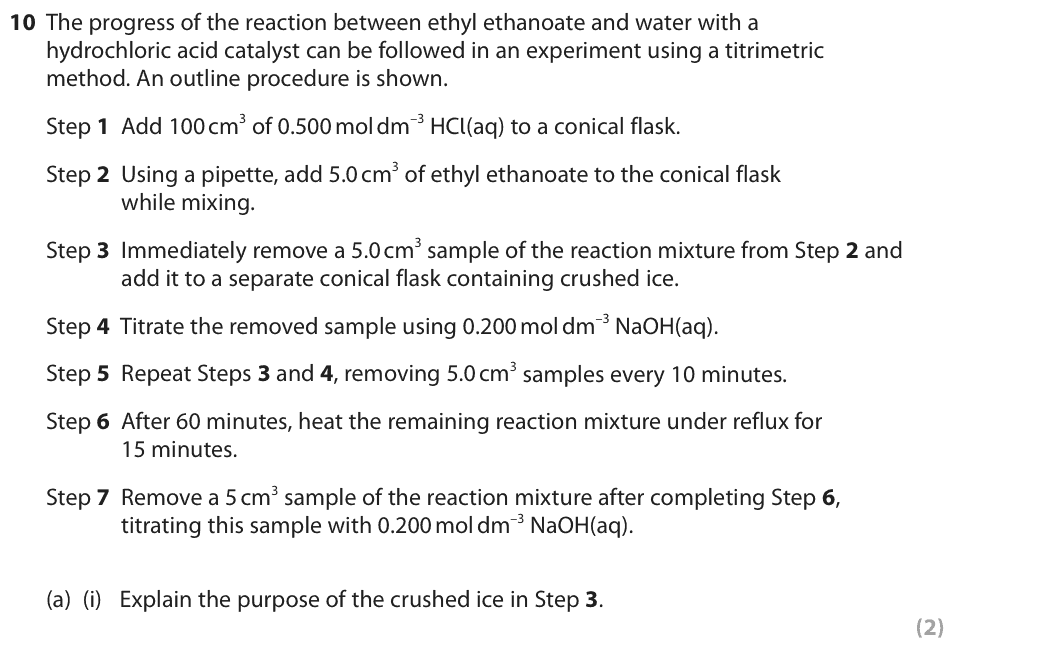
The progress of the reaction between ethyl ethanoate and water with a
hydrochloric acid catalyst can be followed in an experiment using a titrimetric
method. An outline procedure is shown.
Step 1  Add 100 cm3 of 0.500 mol dm–3 HCl(aq) to a conical flask.
Step 2  Using a pipette, add 5.0 cm3 of ethyl ethanoate to the conical flask
while mixing.
Step 3  Immediately remove a 5.0 cm3 sample of the reaction mixture from Step 2 and
add it to a separate conical flask containing crushed ice.
Step 4  Titrate the removed sample using 0.200 mol dm–3 NaOH(aq).
Step 5  Repeat Steps 3 and 4, removing 5.0 cm3 samples every 10 minutes.
Step 6  After 60 minutes, heat the remaining reaction mixture under reflux for
15 minutes.
Step 7  Remove a 5 cm3 sample of the reaction mixture after completing Step 6,
titrating this sample with 0.200 mol dm–3 NaOH(aq).
Explain the purpose of the crushed ice in Step 3.
June 2024 · Paper 3 · Q10(a)(ii) 2 marks Practical and data analysis kinetics ii
Earlier part of question 10 that this part usesEarlier part of June 2024 Paper 3 question 10
Explain why Step 6 is carried out before the final sample is removed and
titrated in Step 7.
June 2024 · Paper 3 · Q10(b)(i) 3 marks Diagram or structure kinetics ii
Earlier part of question 10 that this part usesEarlier part of June 2024 Paper 3 question 10
Some data from the experiment are shown. Vfinal is the titre volume from Step 7,
Vt is the titre volume at time t.
Time reaction sample is added to
0
10
20
30
40
50
60
crushed ice / min
Vfinal – Vt of sodium hydroxide / cm3
11.60
6.50
3.80
1.80
0.90
0.80
0.80
Plot a graph of the Vfinal – Vt of sodium hydroxide against the time the reaction
sample is added to the crushed ice.
June 2024 · Paper 3 · Q10(b)(ii) 2 marks Explanation Hard kinetics ii
Earlier parts of question 10 that this part usesEarlier part of June 2024 Paper 3 question 10Earlier part of June 2024 Paper 3 question 10
Explain why Vfinal – Vt is plotted rather than the concentration of
sodium hydroxide solution for each titre.
June 2024 · Paper 3 · Q10(b)(iii) 2 marks Short answer kinetics ii
Earlier parts of question 10 that this part usesEarlier part of June 2024 Paper 3 question 10Earlier part of June 2024 Paper 3 question 10Earlier part of June 2024 Paper 3 question 10
Determine two half-lives for the reaction, showing your working on the graph.
June 2024 · Paper 3 · Q10(b)(iv) 1 mark Short answer kinetics ii
Earlier parts of question 10 that this part usesEarlier part of June 2024 Paper 3 question 10Earlier part of June 2024 Paper 3 question 10Earlier part of June 2024 Paper 3 question 10Earlier part of June 2024 Paper 3 question 10
Deduce the order of the reaction, using your answer from (b)(iii) to justify
your deduction.
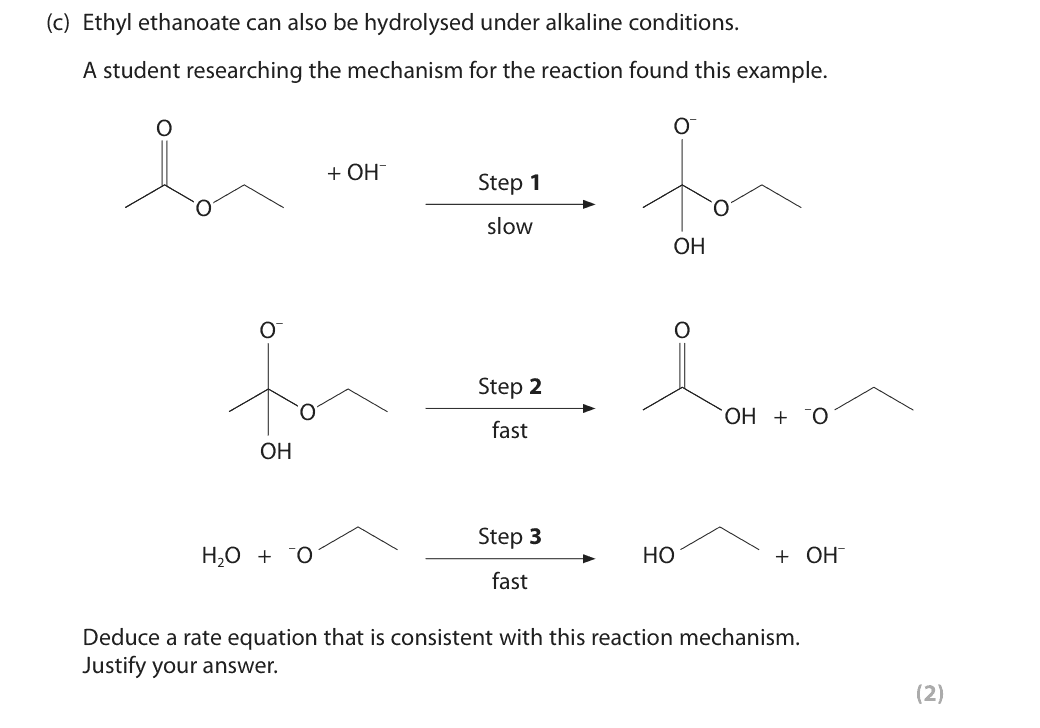
June 2024 · Paper 3 · Q10(c) 2 marks Short answer kinetics ii
Earlier part of question 10 that this part usesEarlier part of June 2024 Paper 3 question 10
Ethyl ethanoate can also be hydrolysed under alkaline conditions.
A student researching the mechanism for the reaction found this example.
O–
O
+ OH–
Step 1
O
O
slow
OH
O–
O
Step 2
O
OH   +   –O
fast
OH
Step 3
H2O   +   –O
HO
+   OH–
fast
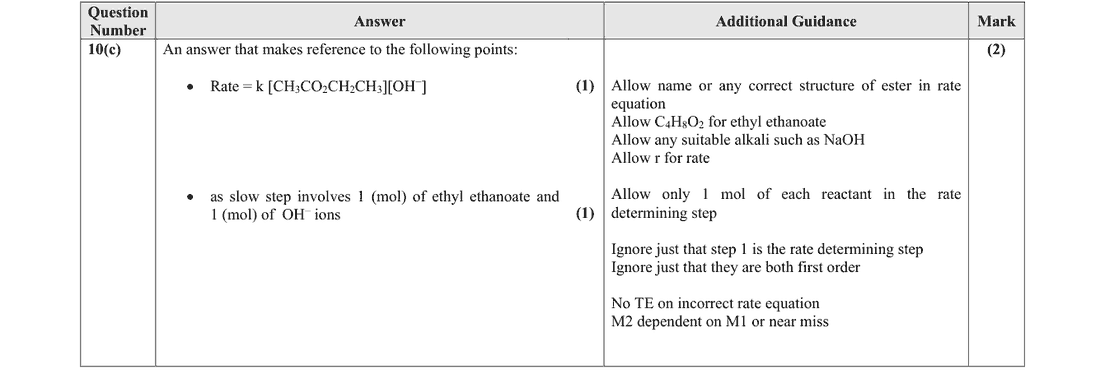
Deduce a rate equation that is consistent with this reaction mechanism.
Justify your answer.

Work with an A-level chemistry tutor

Want a paper marked and gone through with you? Message us.

Prefer email? Send an enquiry

If you are under 18, please include a parent's contact details. Enquiries go to enquiries@chemistryaleveltutor.com and are deleted once handled. All tutoring is online.