June 2022: Paper 3, General and Practical Principles in Chemistry

120 marks · 41 question parts · Paper, mark scheme and report on Edexcel's site · Have the Data Booklet beside you

Question by question

QTopicMarksAOType
1(a) Atomic structure and the Periodic Table 2Short answer
1(b) Atomic structure and the Periodic Table 2Calculation
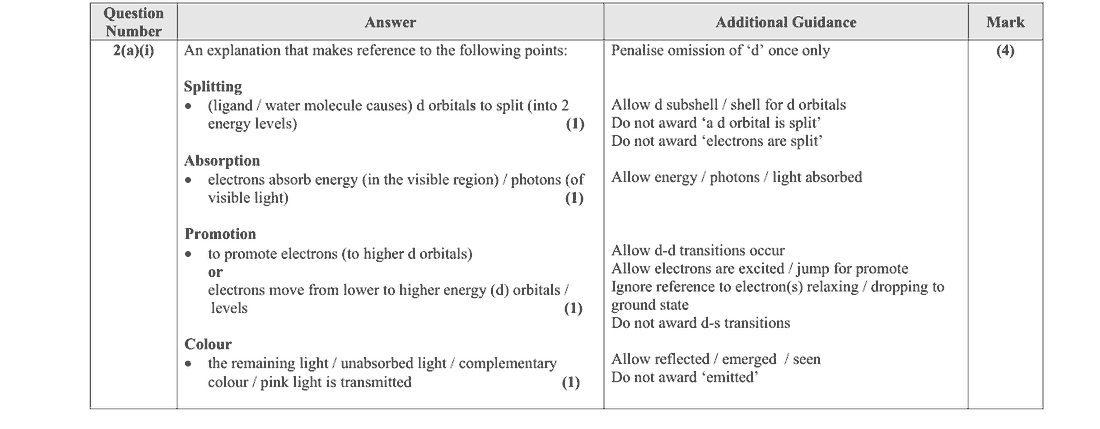
2(a)(i) Transition metals: principles 4Explanation
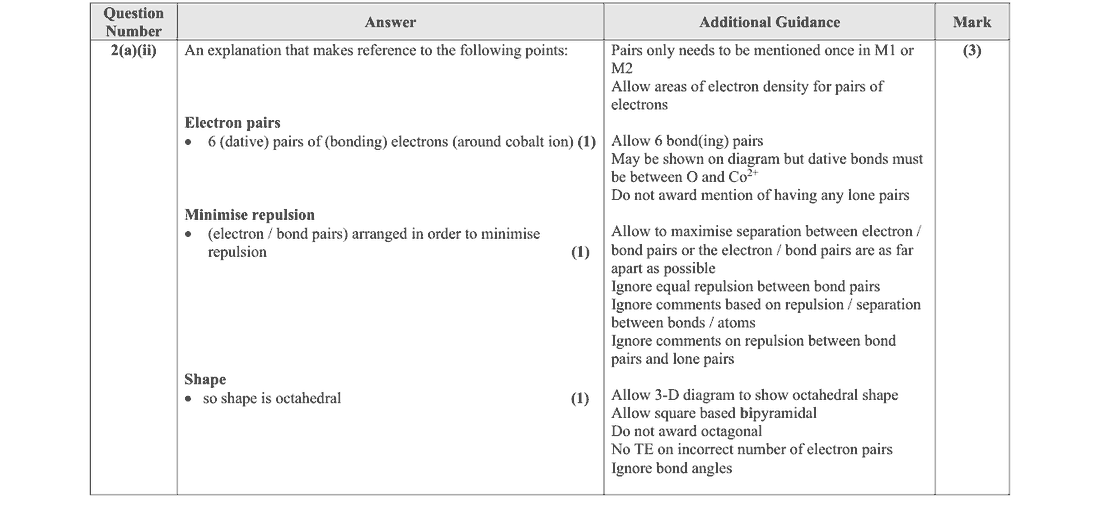
2(a)(ii) Transition metals: principles, Bonding 3Explanation
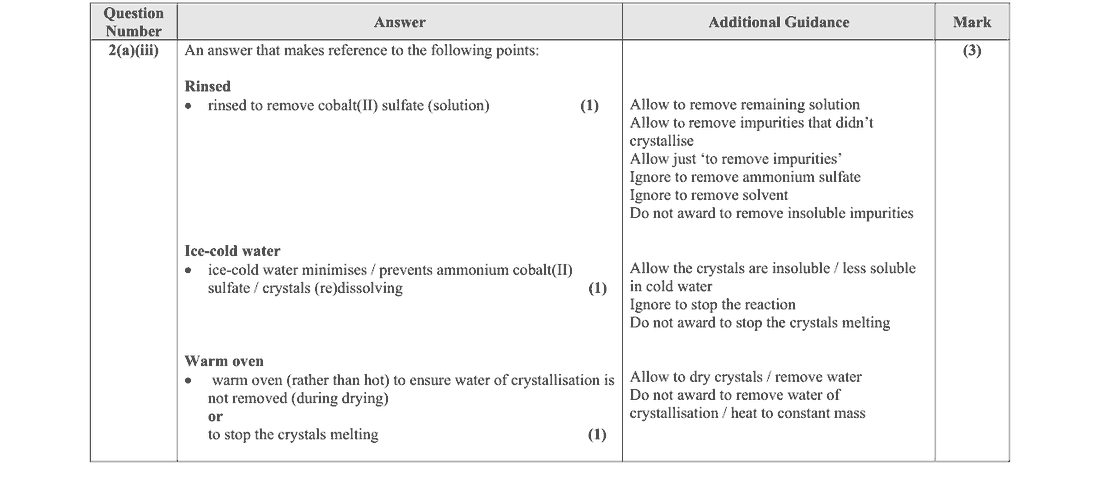
2(a)(iii) Transition metals: principles 3Practical and data analysis
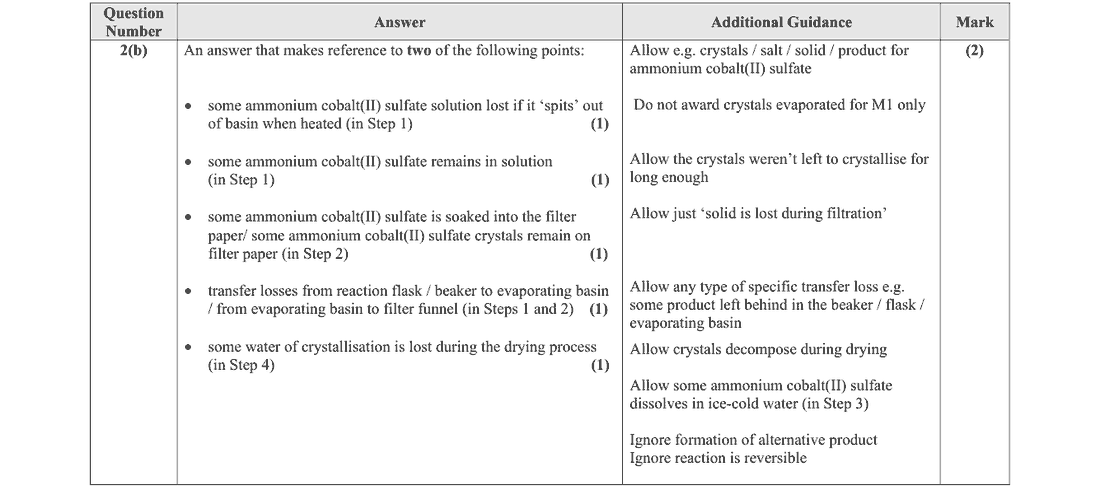
2(b) Formulae, equations and amounts of substance 2Practical and data analysis
3(a)(i) The elements of Groups 1 and 2 3Practical and data analysis
3(a)(ii) The elements of Groups 1 and 2 1Practical and data analysis
3(b)(i) Analysis of inorganic compounds 1Practical and data analysis
3(b)(ii) Analysis of inorganic compounds 1Short answer
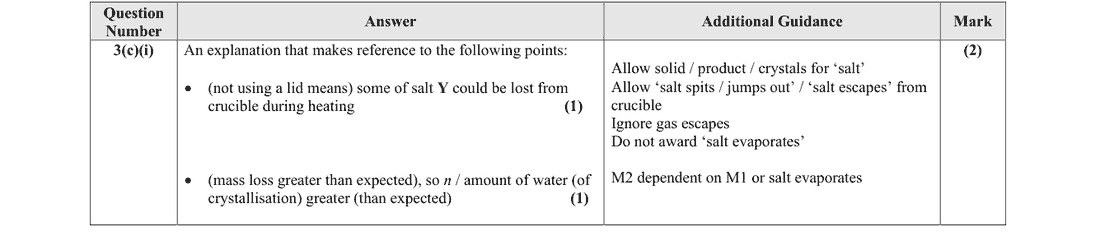
3(c)(i) Formulae, equations and amounts of substance 2Practical and data analysis
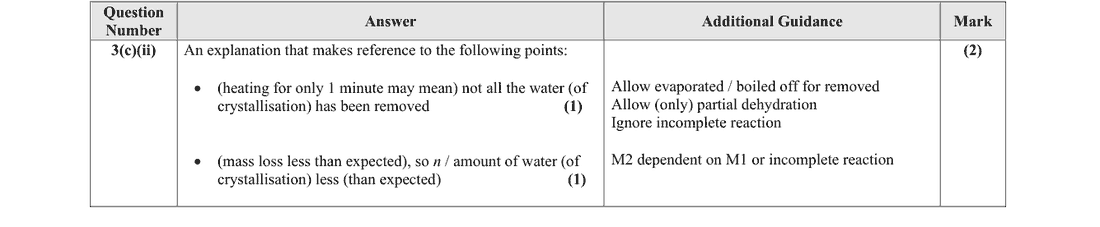
3(c)(ii) Formulae, equations and amounts of substance 2Practical and data analysis
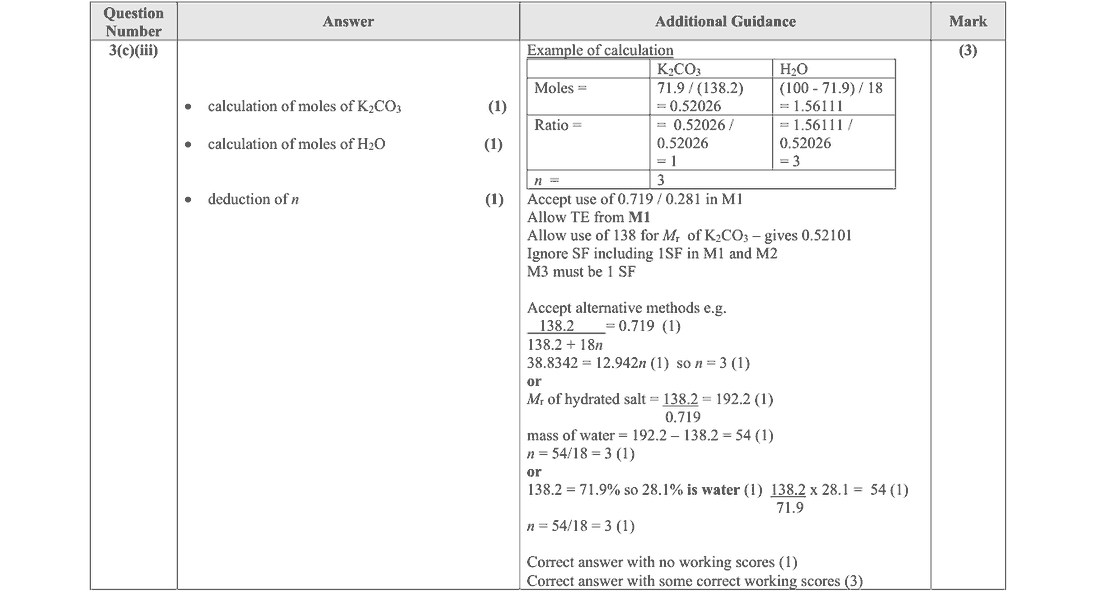
3(c)(iii) Formulae, equations and amounts of substance 3Calculation
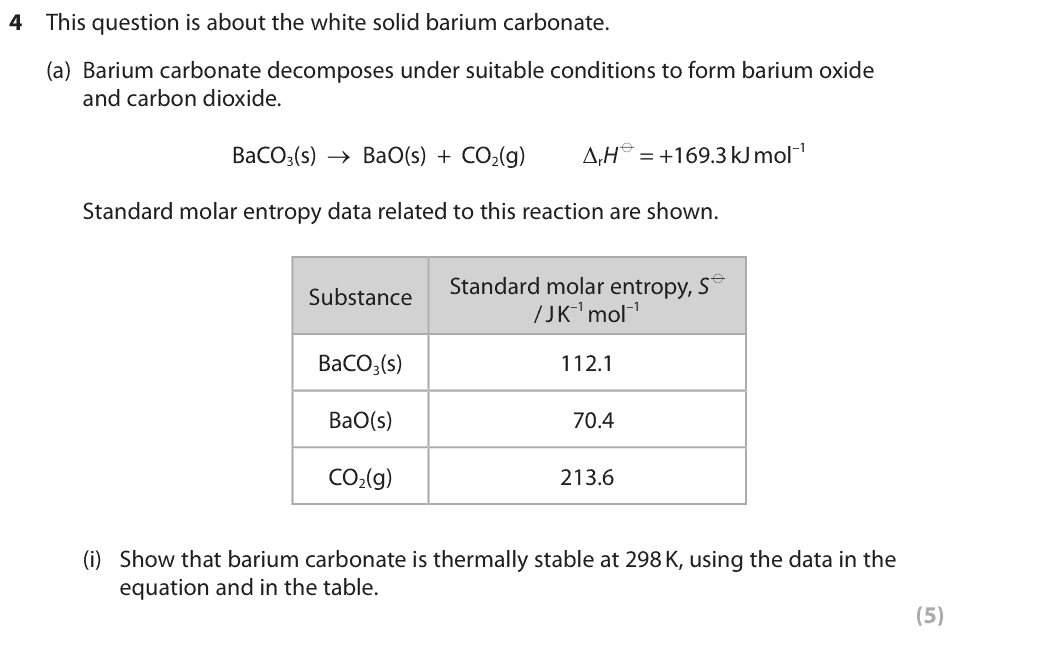
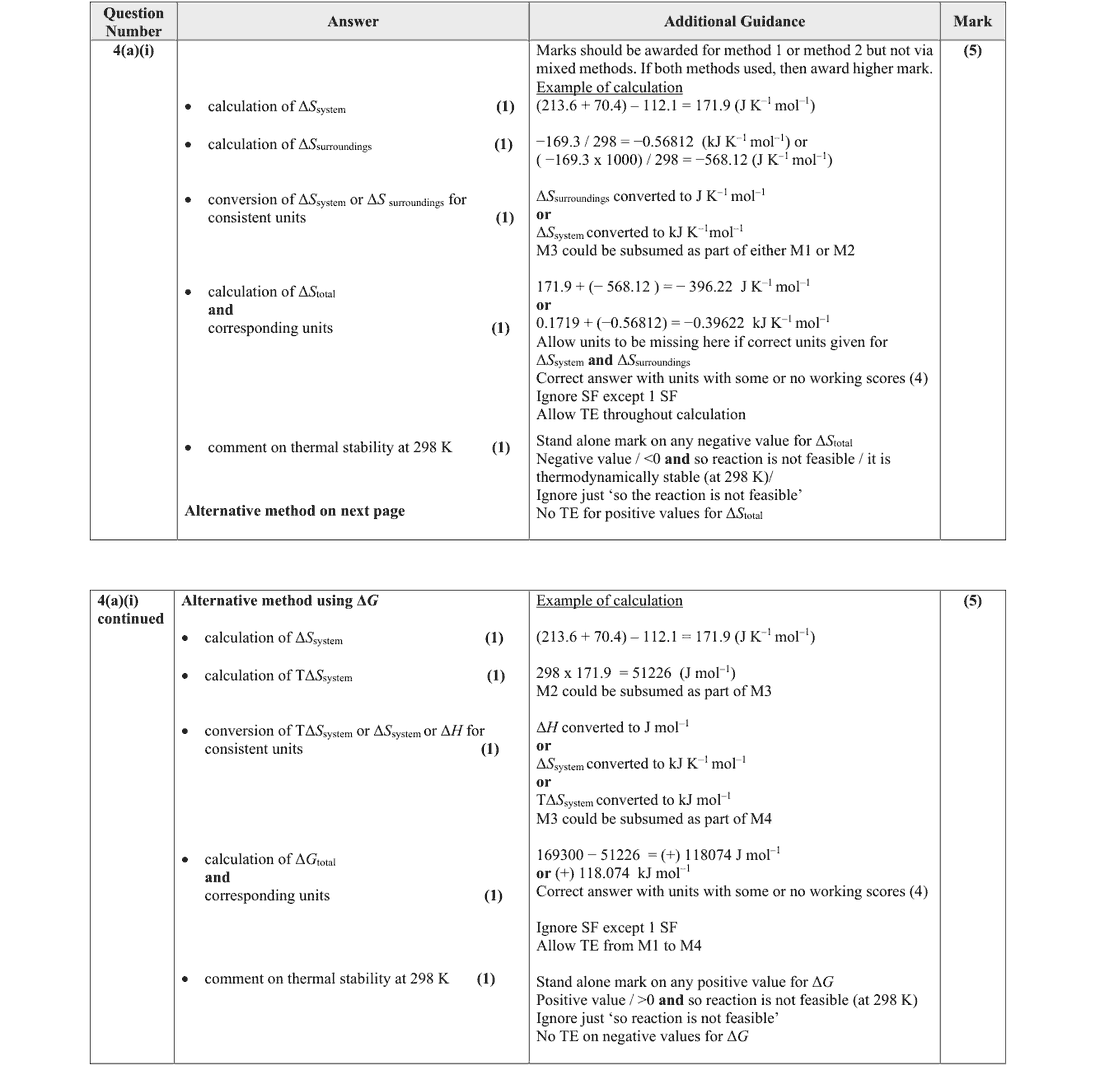
4(a)(i) Energetics II: entropy 5Calculation
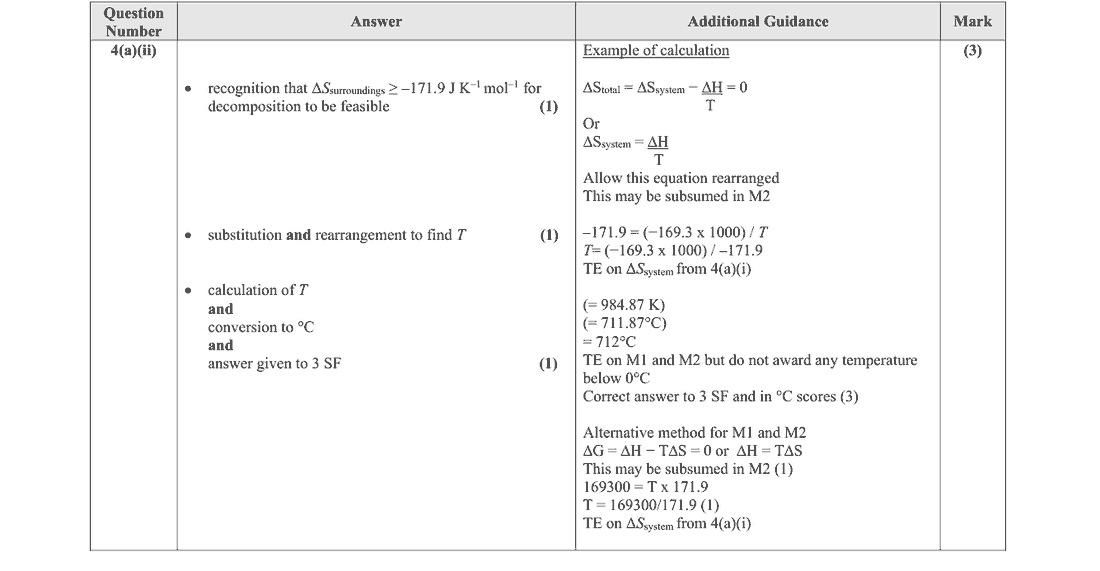
4(a)(ii) Energetics II: entropy 3Calculation
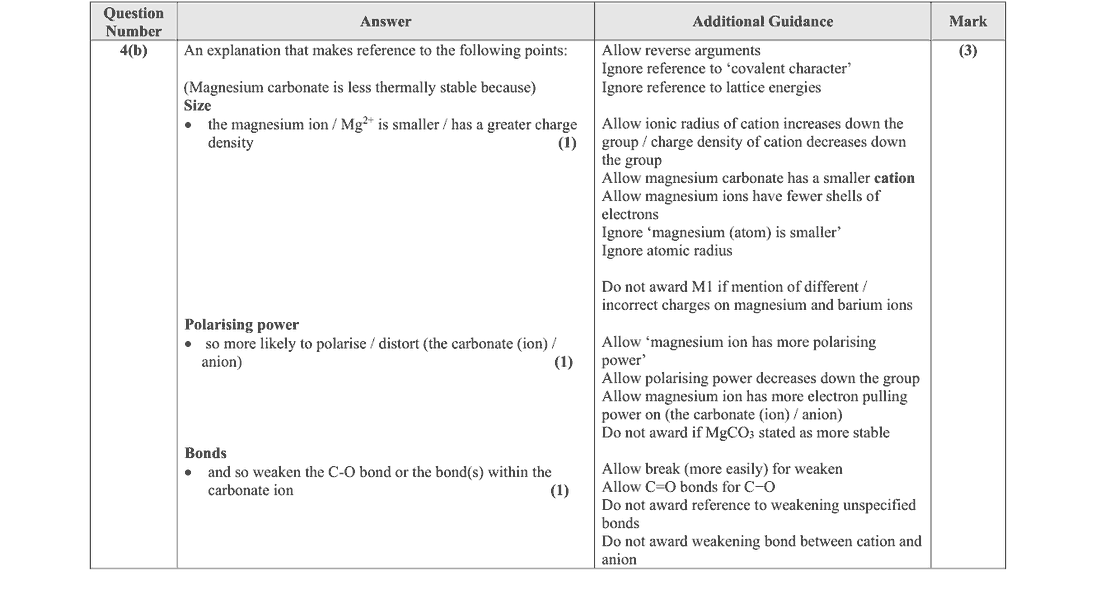
4(b) The elements of Groups 1 and 2 3Explanation
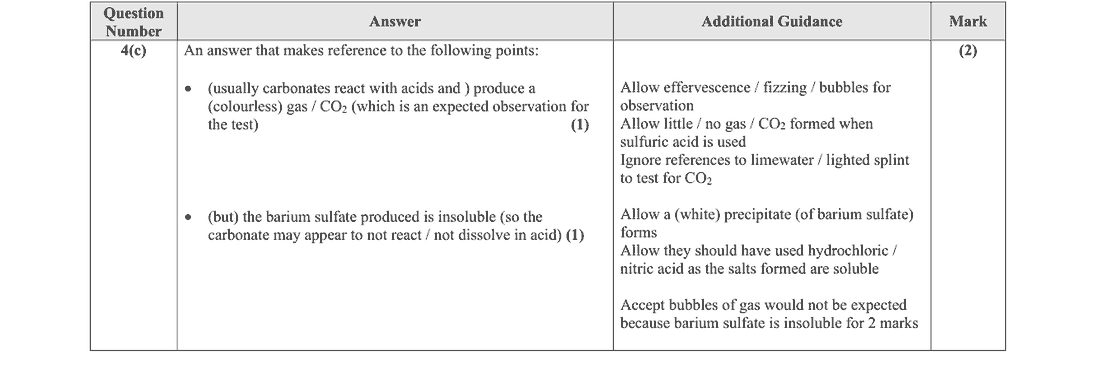
4(c) Analysis of inorganic compounds, The elements of Groups 1 and 2 2Practical and data analysis
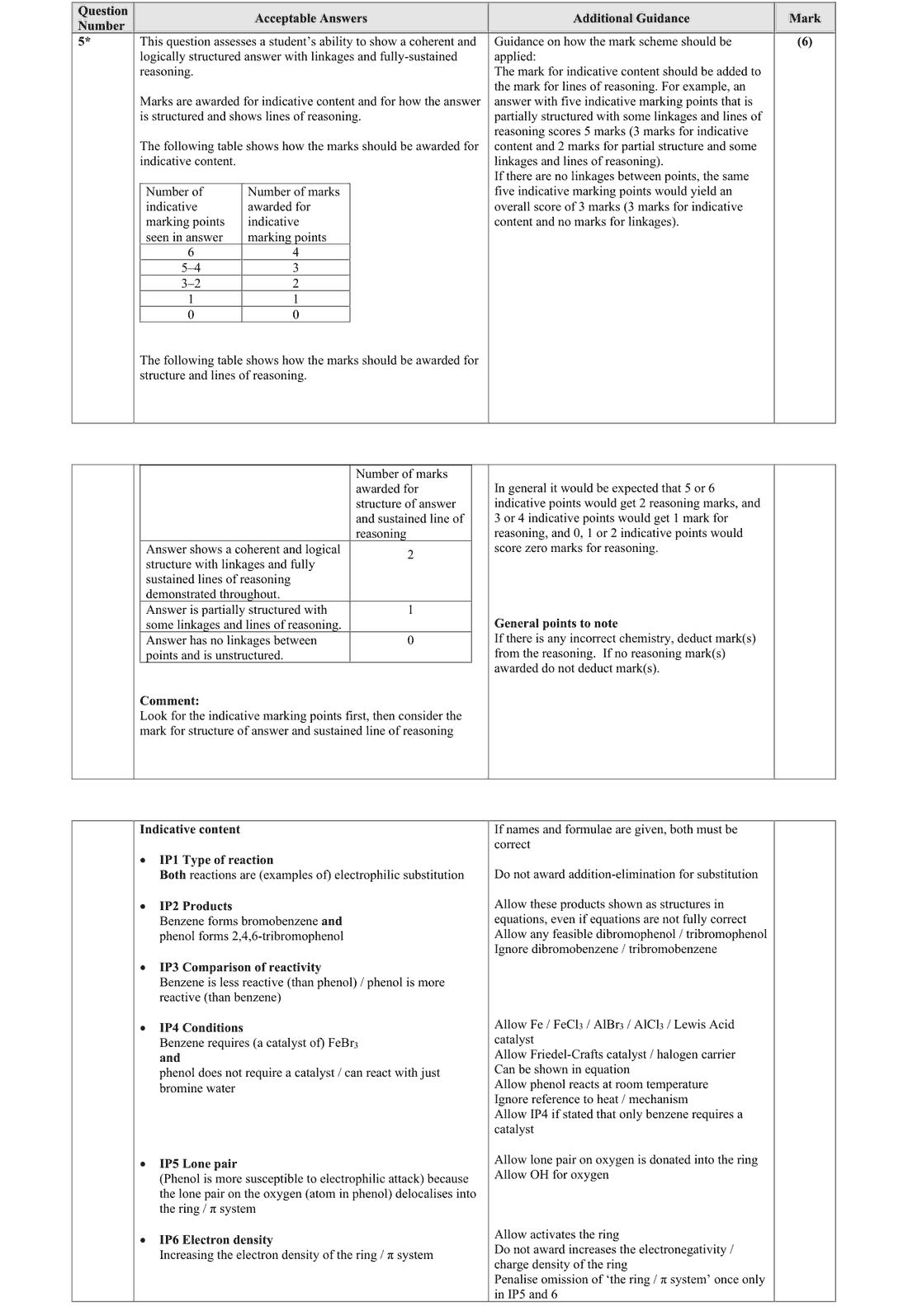
5 Arenes: benzene 6Extended response
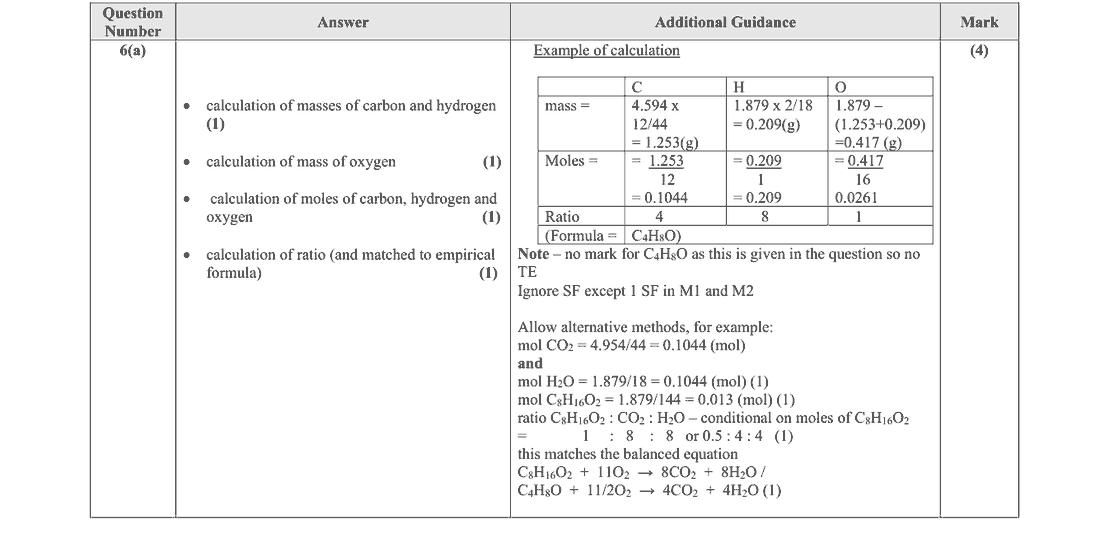
6(a) Organic synthesis, Formulae, equations and amounts of substance 4Calculation
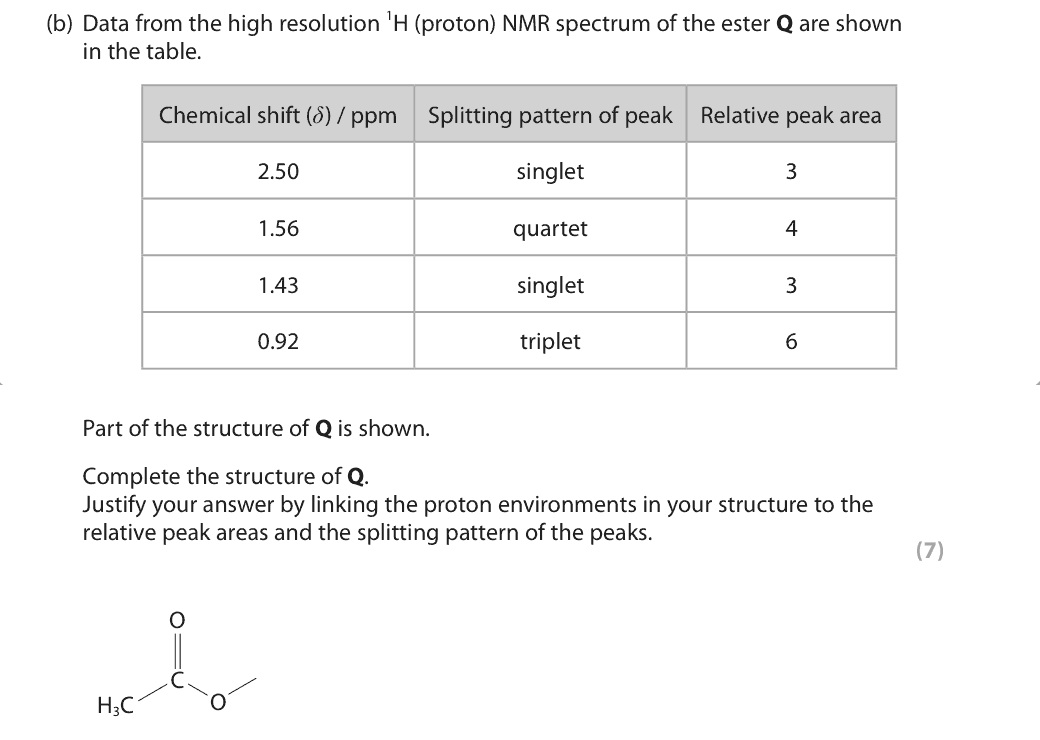
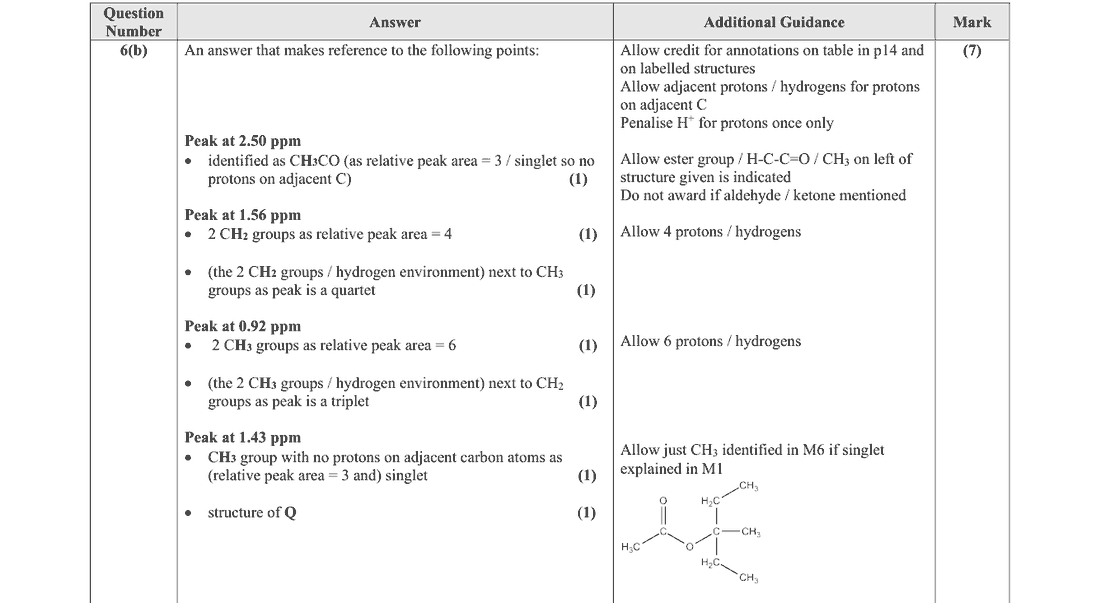
6(b) Modern analytical techniques II: NMR, mass spectrometry and chromatography, Organic synthesis 7Explanation
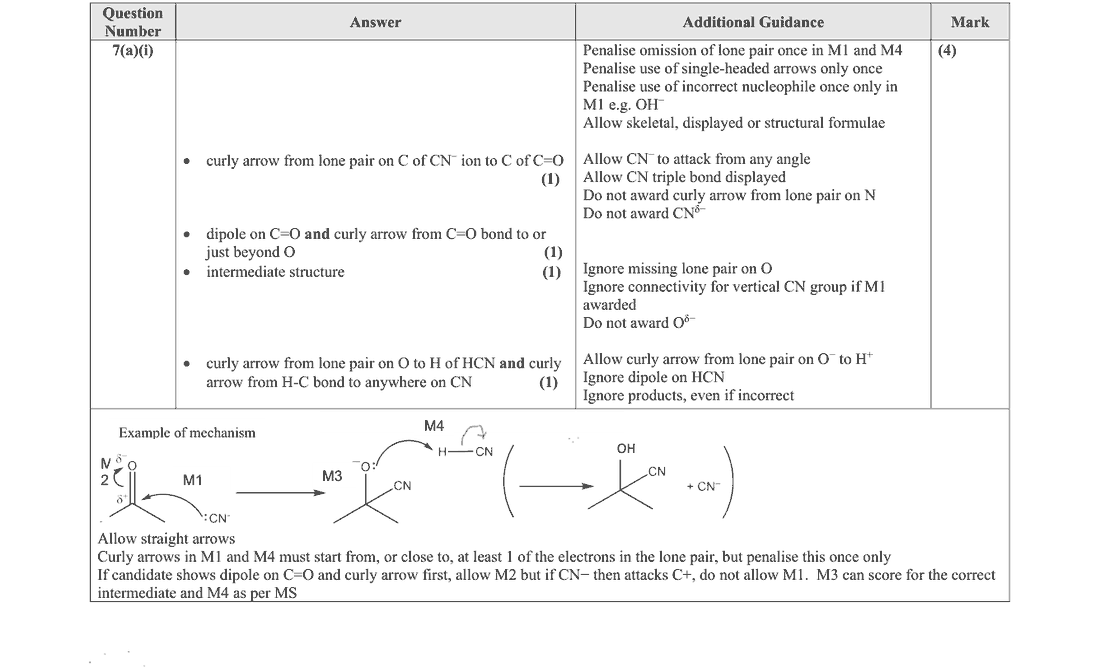
7(a)(i) Carbonyl compounds 4Mechanism
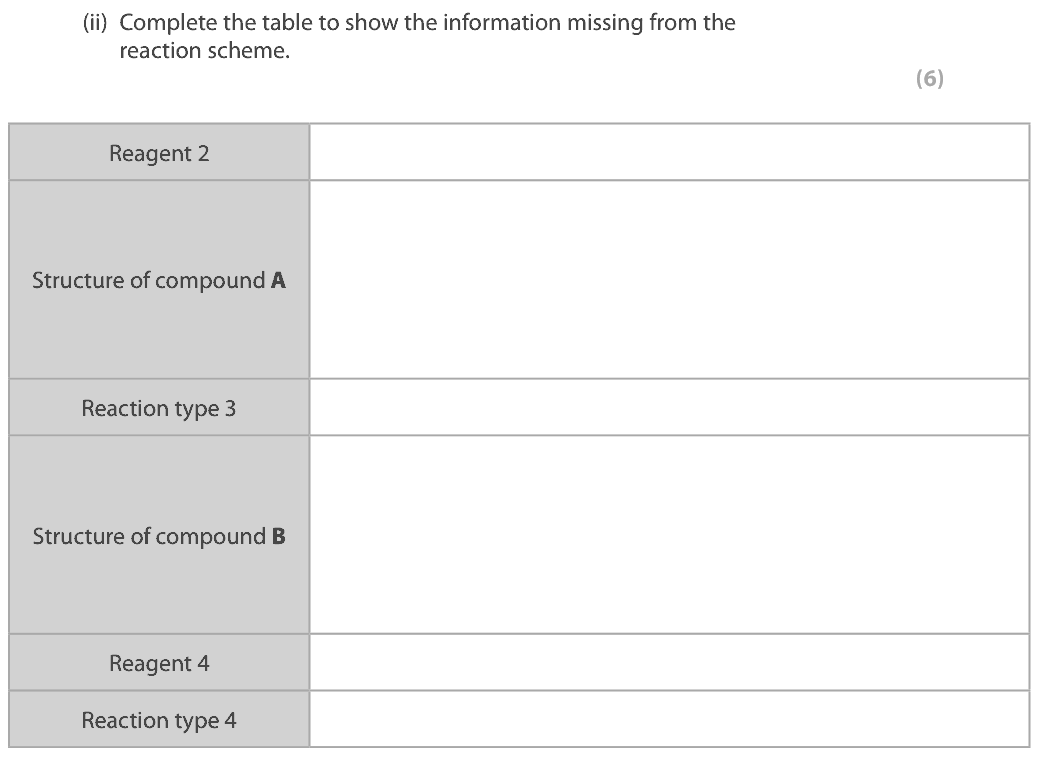
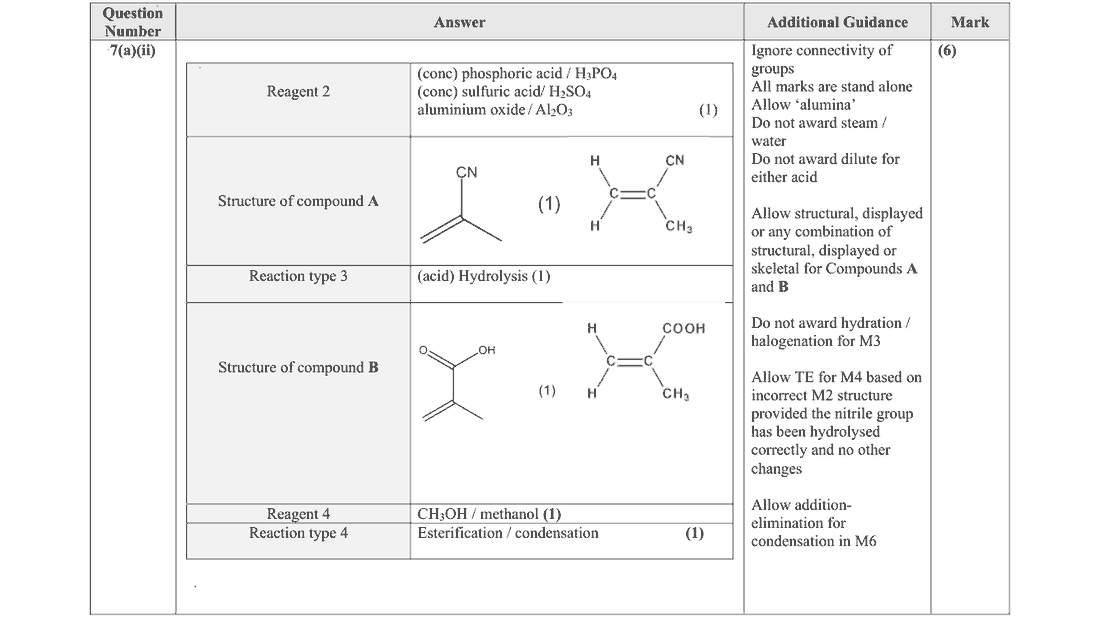
7(a)(ii) Alcohols, Carboxylic acids 6Short answer
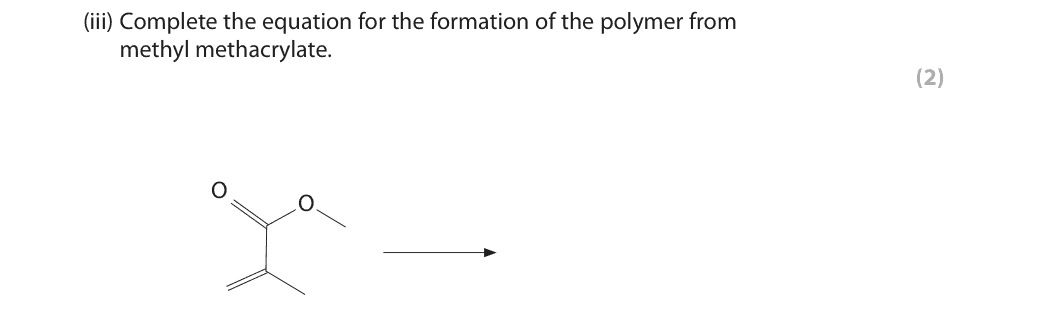
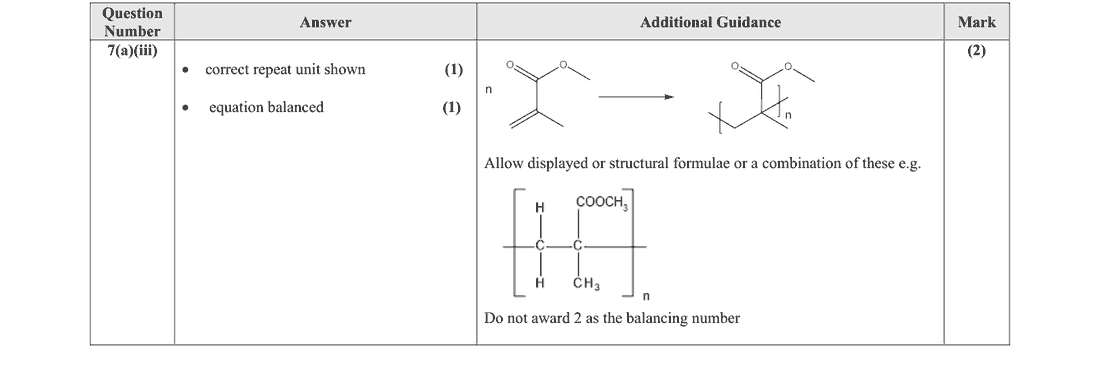
7(a)(iii) Alkenes 2Equation writing
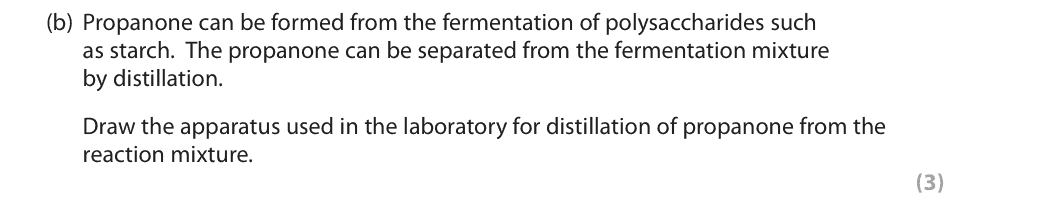
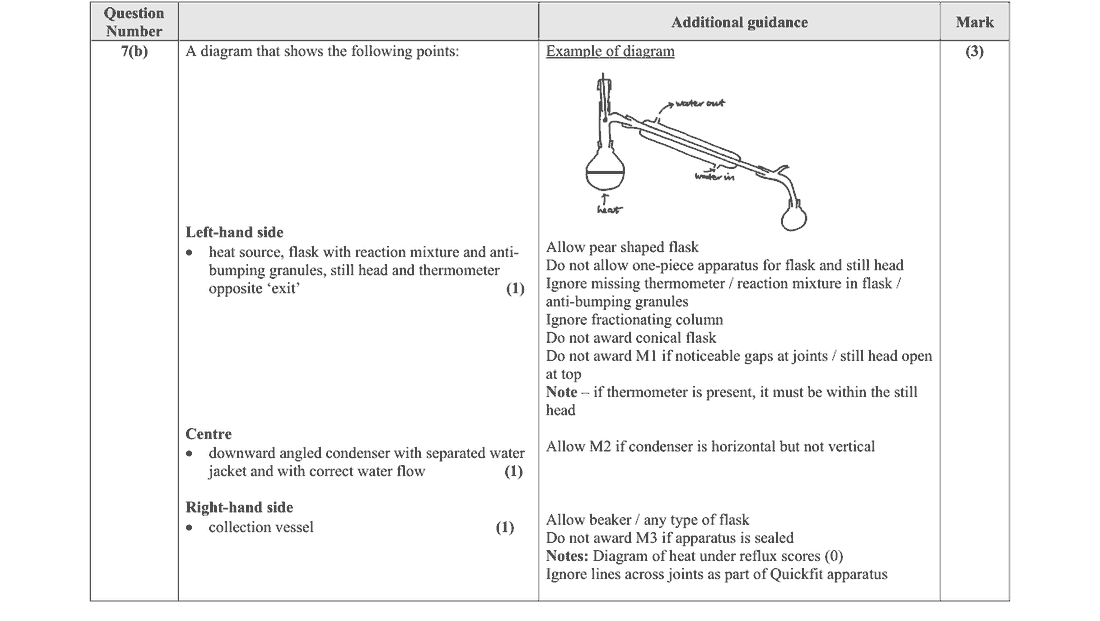
7(b) Alcohols 3Diagram or structure
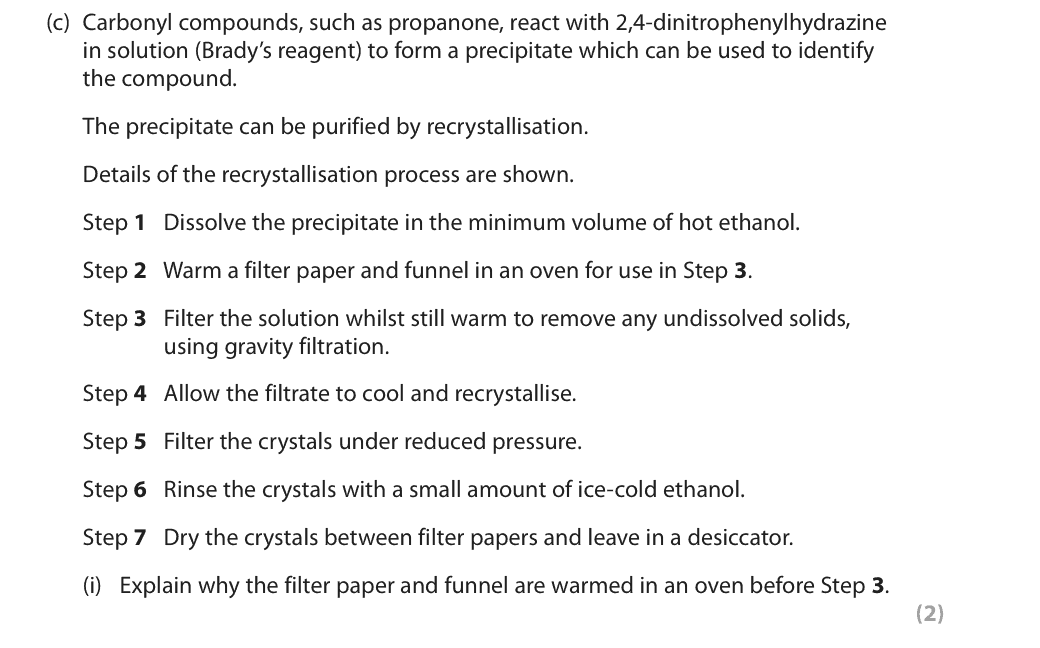
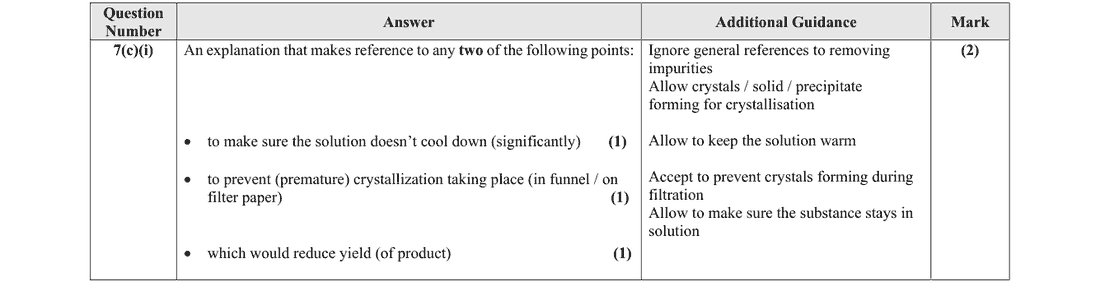
7(c)(i) Organic synthesis 2Practical and data analysis
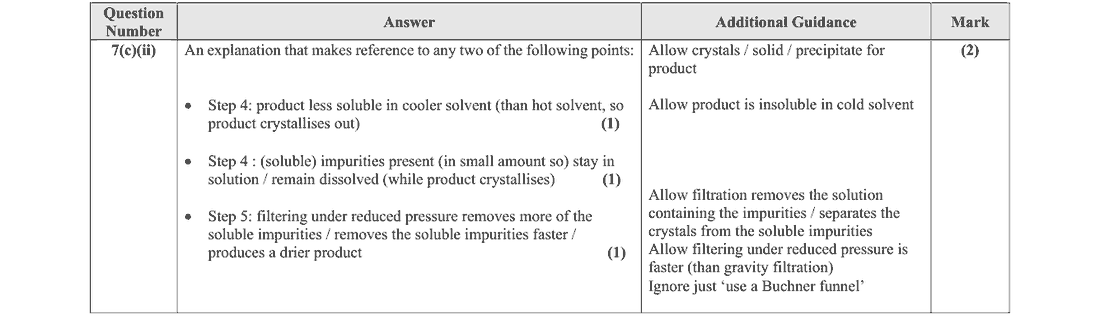
7(c)(ii) Organic synthesis 2Practical and data analysis
7(c)(iii) Carbonyl compounds 2Practical and data analysis
8(a) Acid-base equilibria 5Practical and data analysis
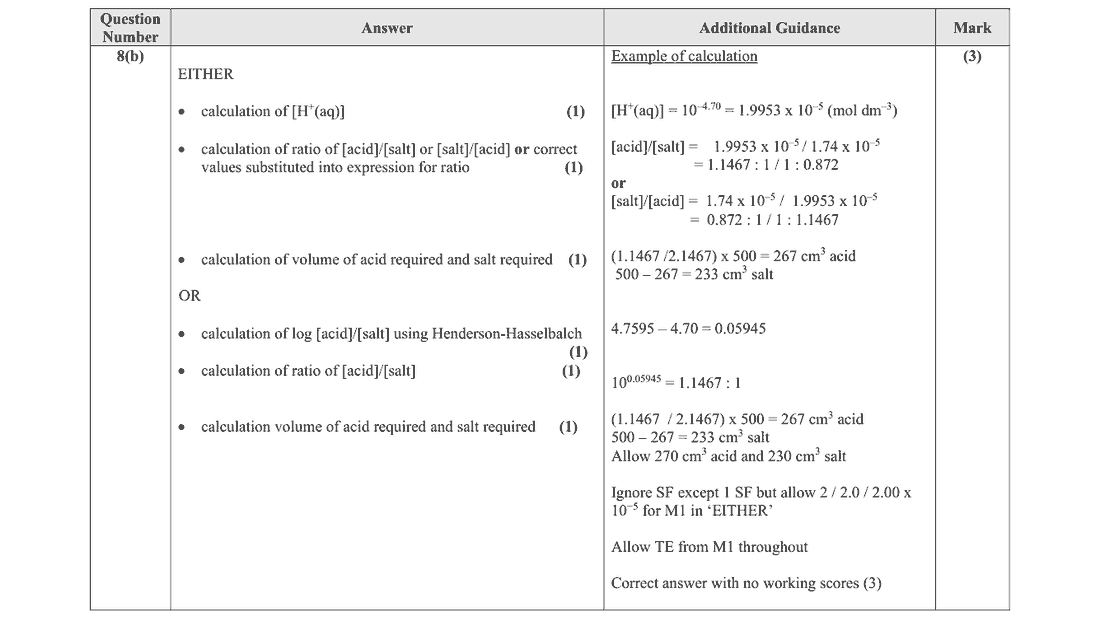
8(b) Acid-base equilibria 3Calculation
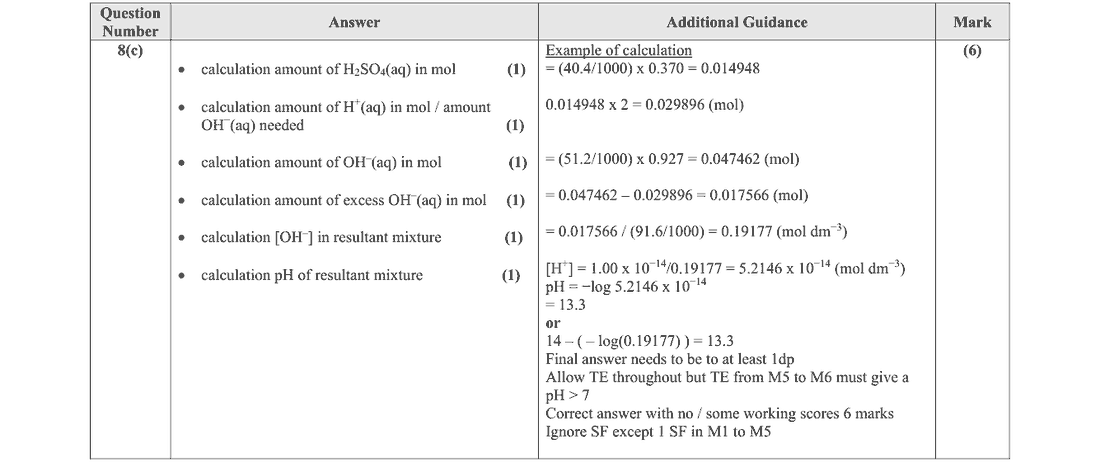
8(c) Acid-base equilibria 6Calculation
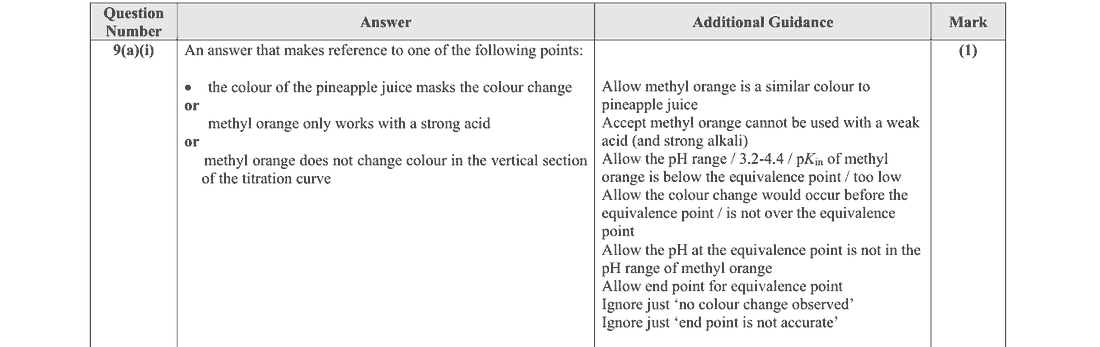
9(a)(i) Acid-base equilibria 1Short answer
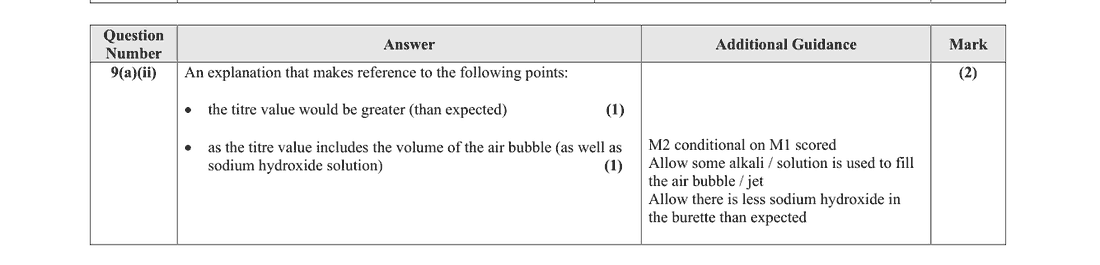
9(a)(ii) Formulae, equations and amounts of substance 2Practical and data analysis
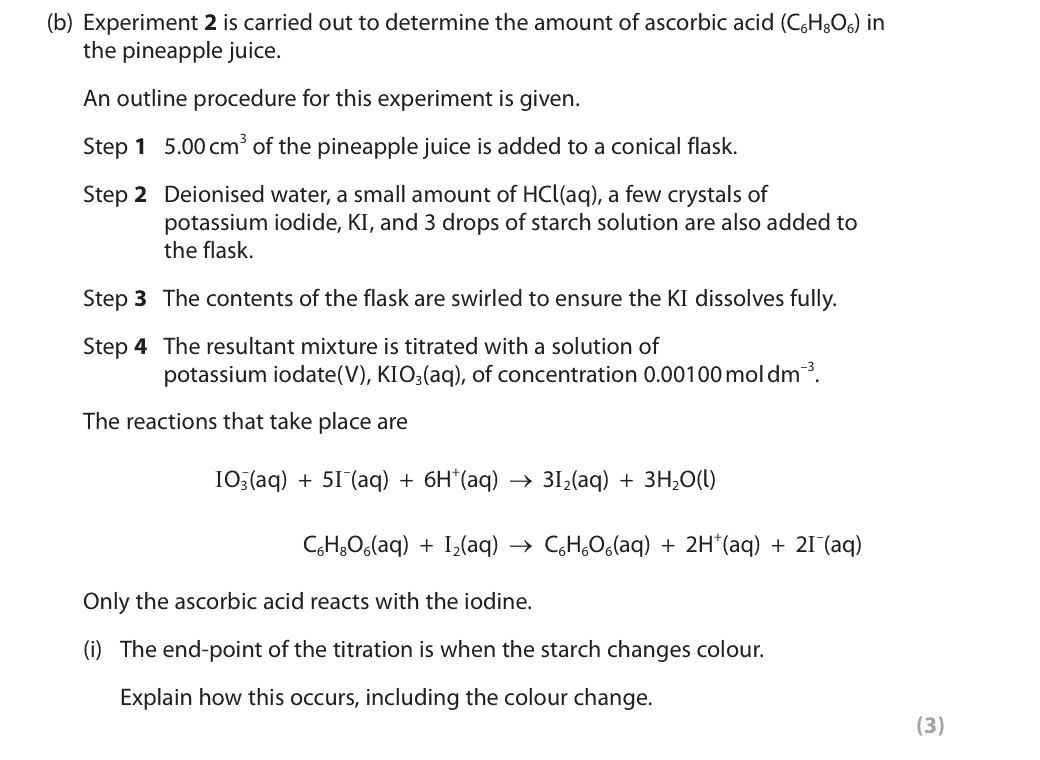
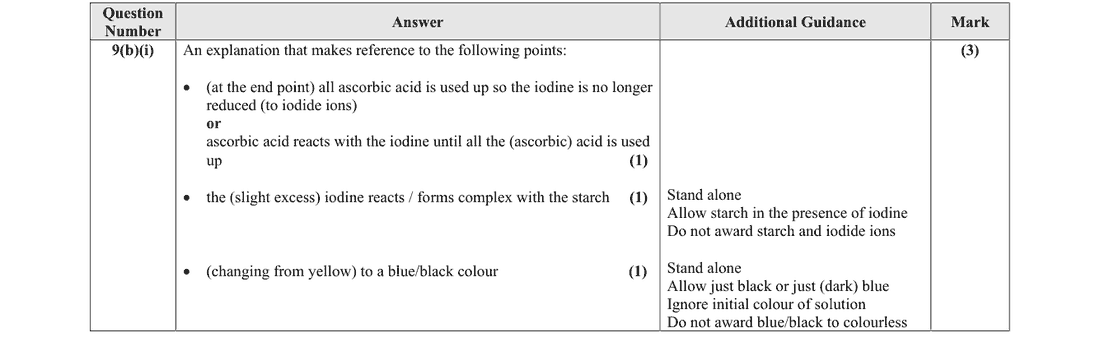
9(b)(i) Redox II 3Practical and data analysis
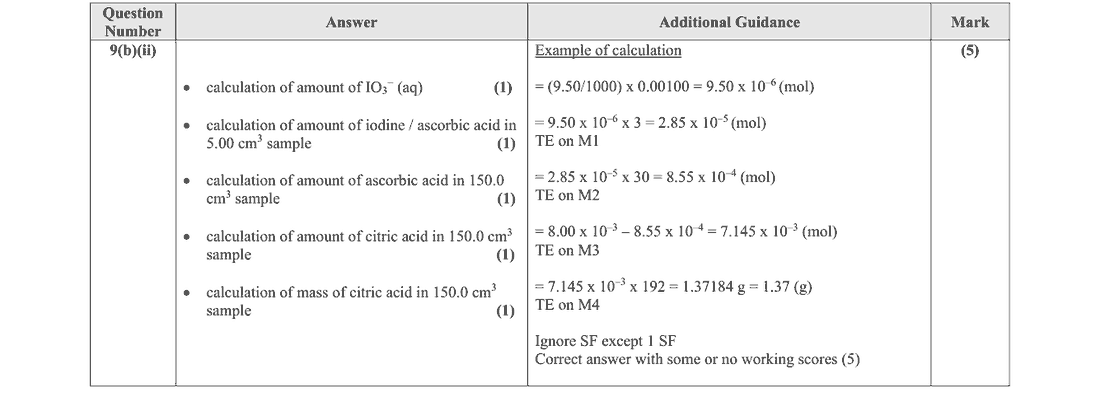
9(b)(ii) Redox II 5Calculation
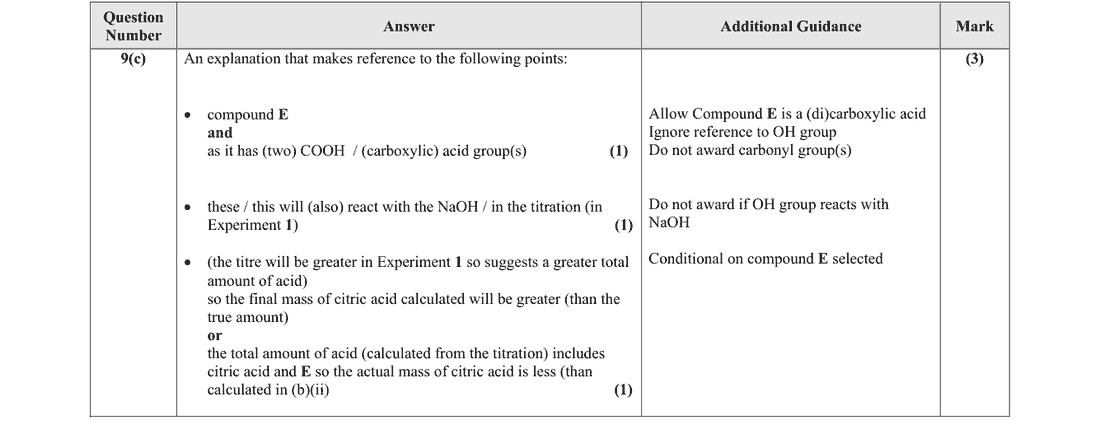
9(c) Carboxylic acids 3Explanation
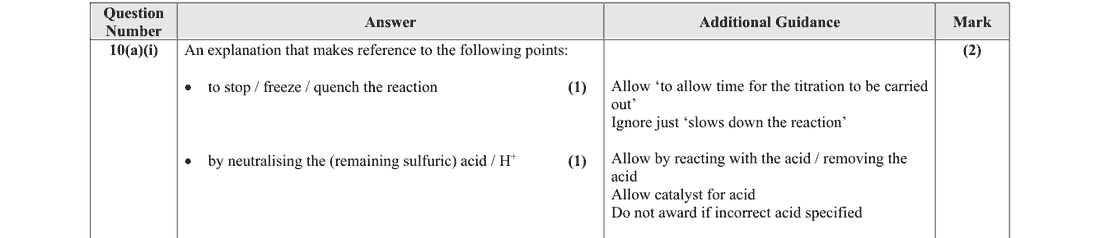
10(a)(i) Kinetics II 2Practical and data analysis
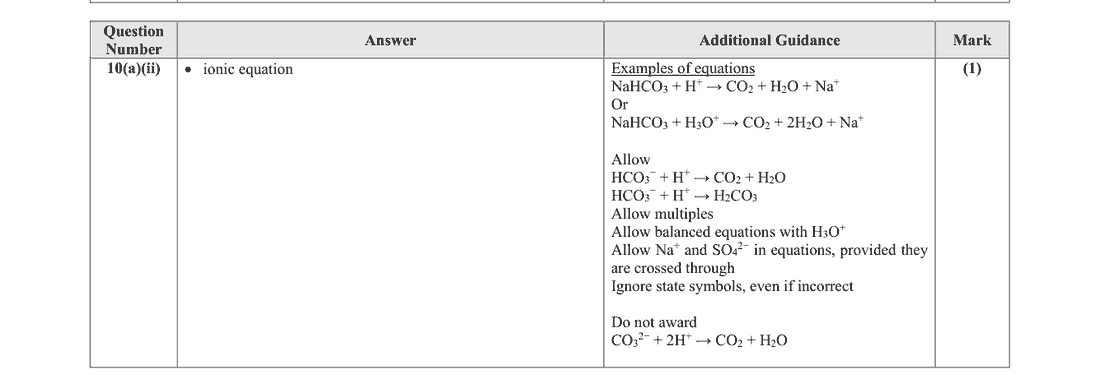
10(a)(ii) Formulae, equations and amounts of substance, Analysis of inorganic compounds 1Equation writing
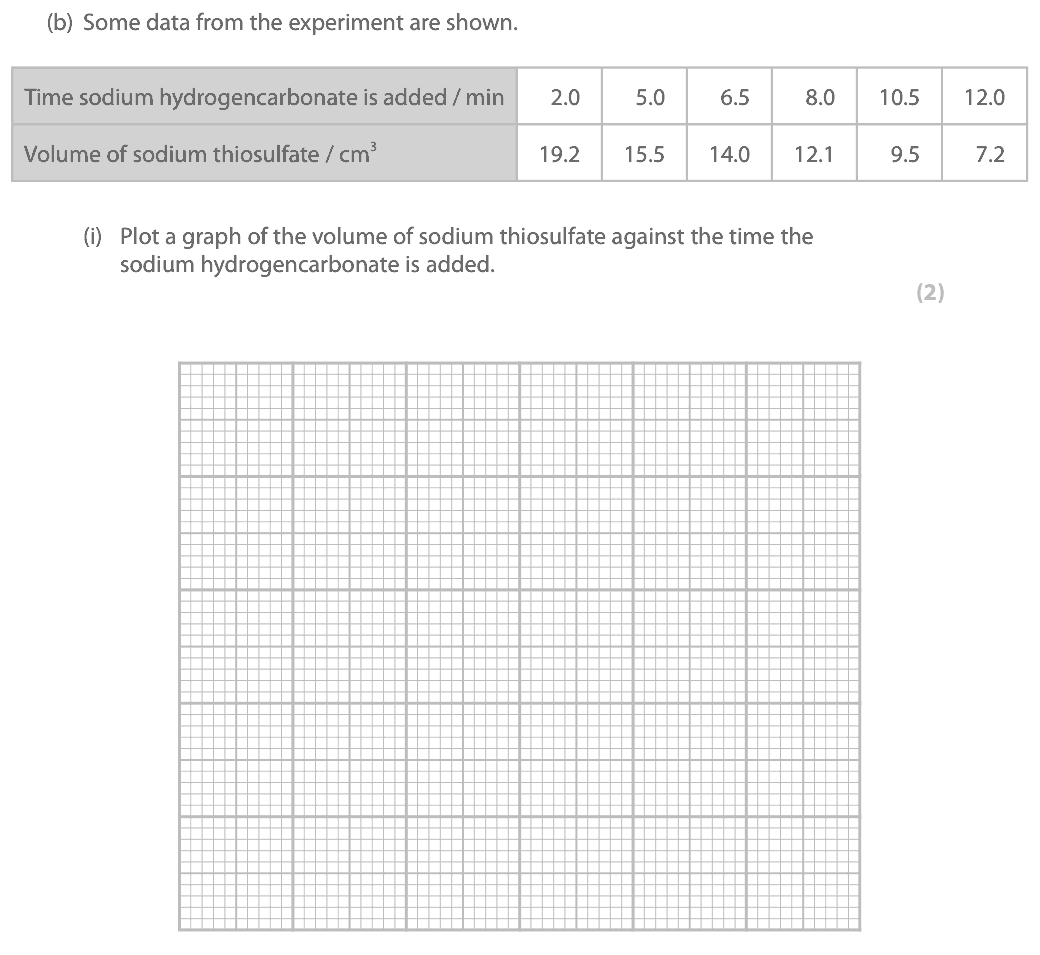
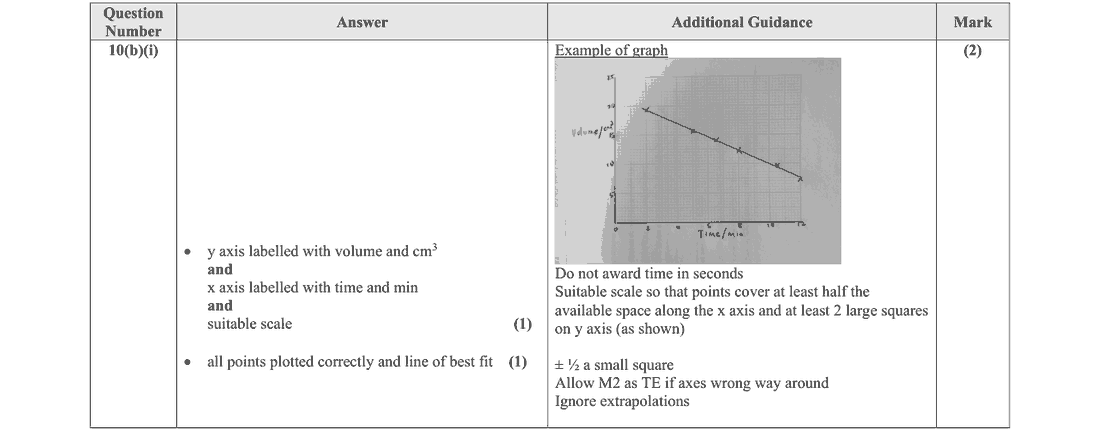
10(b)(i) Kinetics II 2Diagram or structure
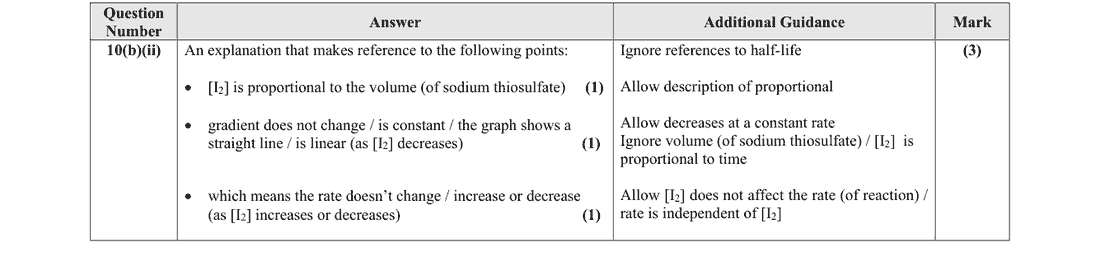
10(b)(ii) Kinetics II 3Explanation
10(c)(i) Kinetics II 2Short answer
10(c)(ii) Kinetics II 2Explanation

The questions

1(a)1(b)2(a)(i)2(a)(ii)2(a)(iii)2(b)3(a)(i)3(a)(ii)3(b)(i)3(b)(ii)3(c)(i)3(c)(ii)3(c)(iii)4(a)(i)4(a)(ii)4(b)4(c)56(a)6(b)7(a)(i)7(a)(ii)7(a)(iii)7(b)7(c)(i)7(c)(ii)7(c)(iii)8(a)8(b)8(c)9(a)(i)9(a)(ii)9(b)(i)9(b)(ii)9(c)10(a)(i)10(a)(ii)10(b)(i)10(b)(ii)10(c)(i)10(c)(ii)
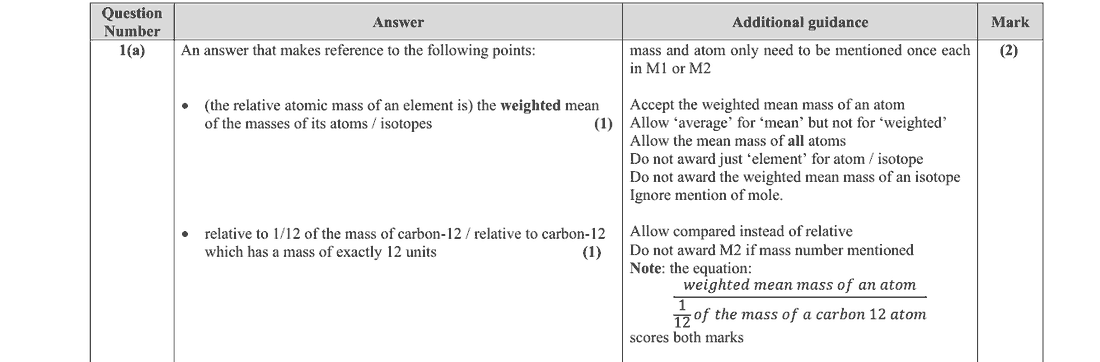
June 2022 · Paper 3 · Q1(a) 2 marks Short answer atomic structure and the periodic table
Relative atomic mass is an important concept in chemistry.
Define the term relative atomic mass.
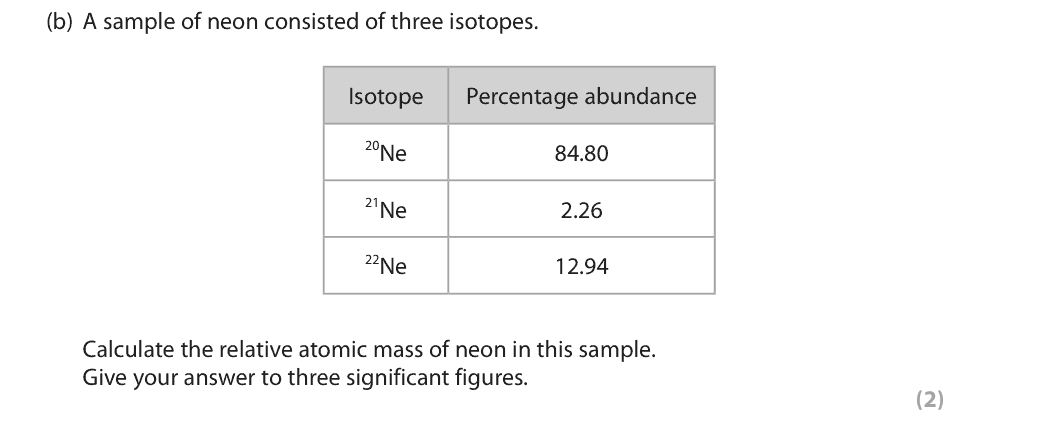
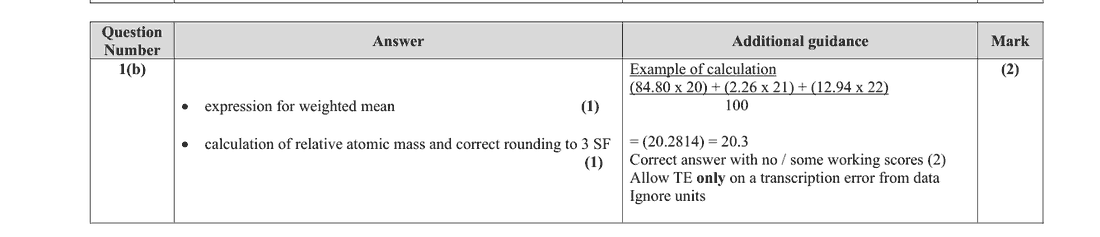
June 2022 · Paper 3 · Q1(b) 2 marks Calculation Easy atomic structure and the periodic table
Earlier part of question 1 that this part usesEarlier part of June 2022 Paper 3 question 1
A sample of neon consisted of three isotopes.
Isotope
Percentage abundance
20Ne
84.80
21Ne
2.26
22Ne
12.94
Calculate the relative atomic mass of neon in this sample.
Give your answer to three significant figures.
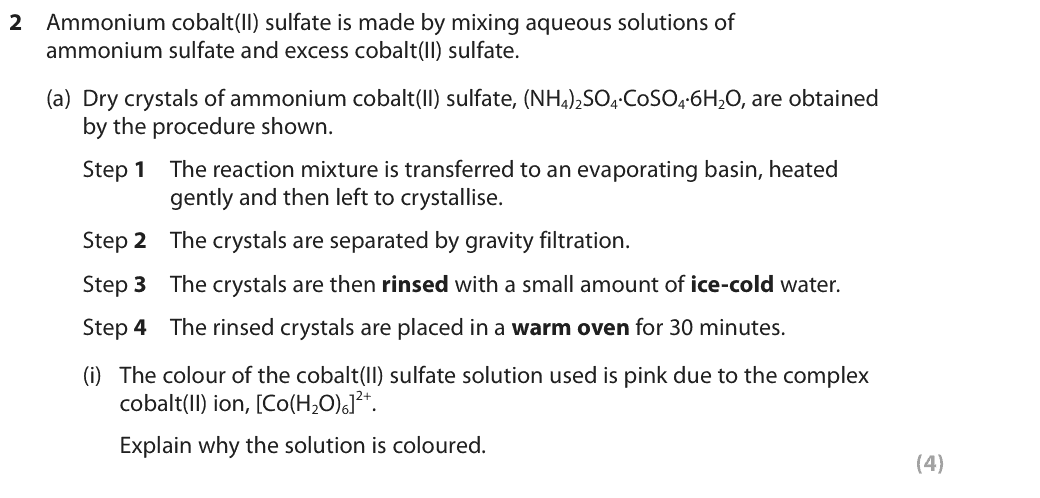
June 2022 · Paper 3 · Q2(a)(i) 4 marks Explanation transition metals principles
Ammonium cobalt(II) sulfate is made by mixing aqueous solutions of
ammonium sulfate and excess cobalt(II) sulfate.
Dry crystals of ammonium cobalt(II) sulfate, (NH4)2SO4·CoSO4·6H2O, are obtained
by the procedure shown.
Step 1    The reaction mixture is transferred to an evaporating basin, heated
gently and then left to crystallise.
Step 2    The crystals are separated by gravity filtration.
Step 3    The crystals are then rinsed with a small amount of ice‑cold water.
Step 4    The rinsed crystals are placed in a warm oven for 30 minutes.
The colour of the cobalt(II) sulfate solution used is pink due to the complex
cobalt(II) ion, [Co(H2O)6]2+.
Explain why the solution is coloured.
June 2022 · Paper 3 · Q2(a)(ii) 3 marks Explanation transition metals principlesbonding
Earlier part of question 2 that this part usesEarlier part of June 2022 Paper 3 question 2
Explain the shape of the cobalt(II) ion, [Co(H2O)6]2+ , using electron‑pair repulsion theory.
June 2022 · Paper 3 · Q2(a)(iii) 3 marks Practical and data analysis transition metals principles
Earlier part of question 2 that this part usesEarlier part of June 2022 Paper 3 question 2
Give the reasons for carrying out Steps 3 and 4 of the procedure, referring
particularly to the words in bold.
June 2022 · Paper 3 · Q2(b) 2 marks Practical and data analysis formulae equations and amounts of substance
Earlier part of question 2 that this part usesEarlier part of June 2022 Paper 3 question 2
The percentage yield of this reaction is 70.0 %.
Give two possible reasons, other than an incomplete reaction, why the yield is
less than 100 %.
June 2022 · Paper 3 · Q3(a)(i) 3 marks Practical and data analysis groups 1 and 2
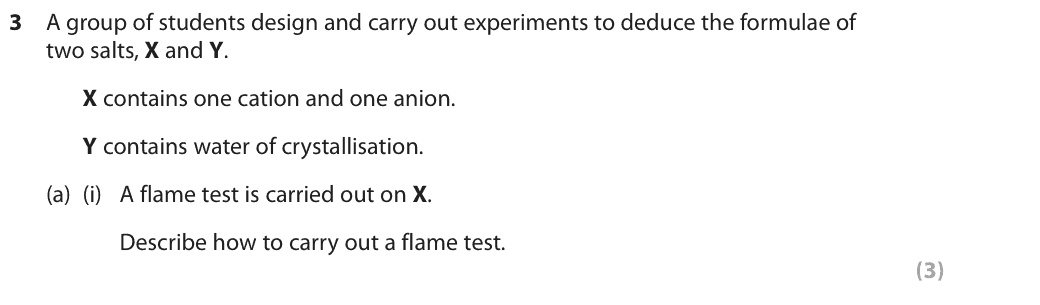
A group of students design and carry out experiments to deduce the formulae of
two salts, X and Y.
X contains one cation and one anion.
Y contains water of crystallisation.
A flame test is carried out on X.
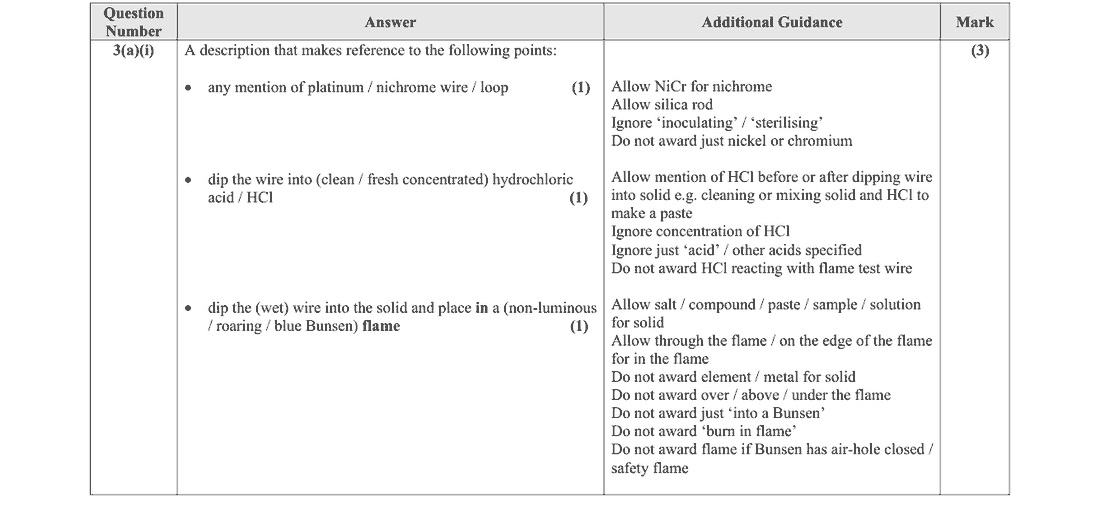
Describe how to carry out a flame test.
June 2022 · Paper 3 · Q3(a)(ii) 1 mark Practical and data analysis groups 1 and 2
Earlier part of question 3 that this part usesEarlier part of June 2022 Paper 3 question 3
The colour of the flame is yellow.
Give the formula of the metal ion present in salt X.
June 2022 · Paper 3 · Q3(b)(i) 1 mark Practical and data analysis analysis of inorganic compounds
Earlier part of question 3 that this part usesEarlier part of June 2022 Paper 3 question 3
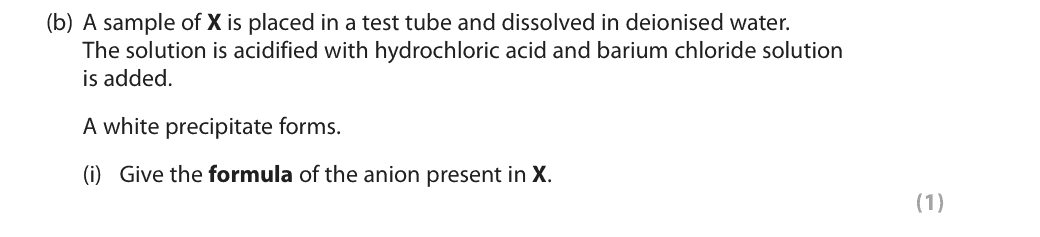
A sample of X is placed in a test tube and dissolved in deionised water.
The solution is acidified with hydrochloric acid and barium chloride solution
is added.
A white precipitate forms.
Give the formula of the anion present in X.
June 2022 · Paper 3 · Q3(b)(ii) 1 mark Short answer analysis of inorganic compounds
Earlier parts of question 3 that this part usesEarlier part of June 2022 Paper 3 question 3Earlier part of June 2022 Paper 3 question 3Earlier part of June 2022 Paper 3 question 3
Deduce the formula of X, using your answers to (a)(ii) and (b)(i).
June 2022 · Paper 3 · Q3(c)(i) 2 marks Practical and data analysis Hard formulae equations and amounts of substance
Earlier part of question 3 that this part usesEarlier part of June 2022 Paper 3 question 3
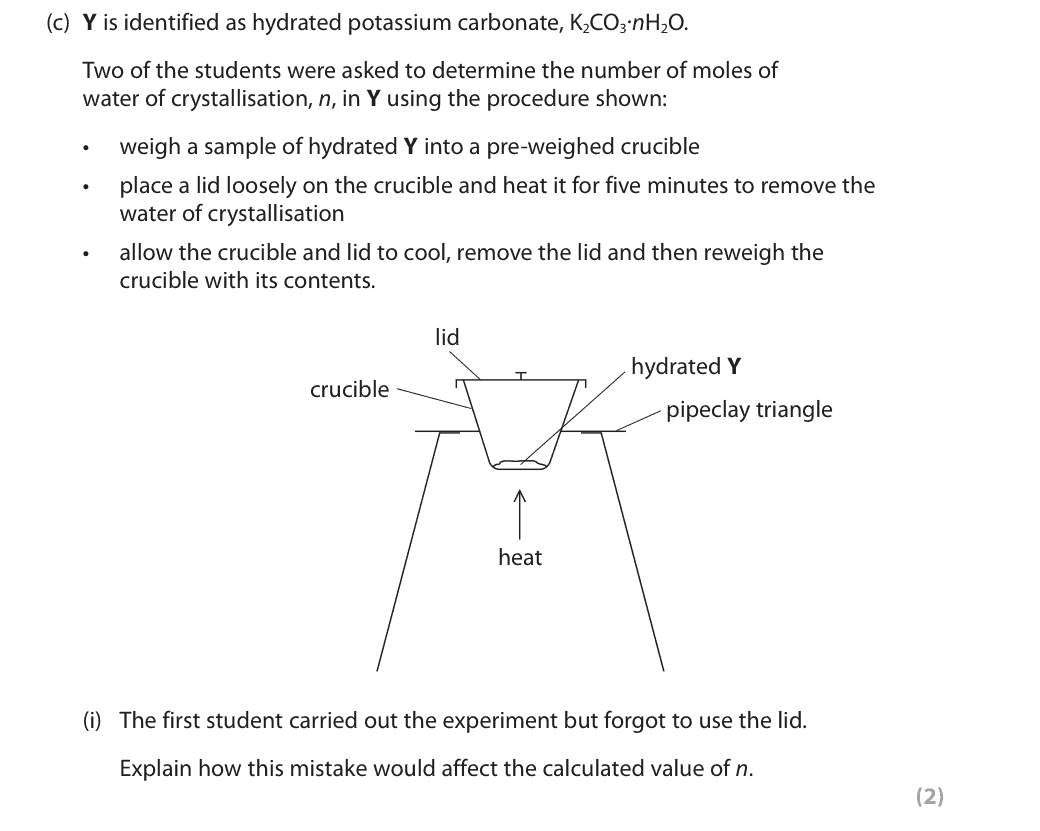
Y is identified as hydrated potassium carbonate, K2CO3·nH2O.
Two of the students were asked to determine the number of moles of
water of crystallisation, n, in Y using the procedure shown:
weigh a sample of hydrated Y into a pre‑weighed crucible
•
•
place a lid loosely on the crucible and heat it for five minutes to remove the
water of crystallisation
•
allow the crucible and lid to cool, remove the lid and then reweigh the
crucible with its contents.
lid
hydrated Y
crucible
pipeclay triangle
heat
The first student carried out the experiment but forgot to use the lid.
Explain how this mistake would affect the calculated value of n.
June 2022 · Paper 3 · Q3(c)(ii) 2 marks Practical and data analysis formulae equations and amounts of substance
Earlier parts of question 3 that this part usesEarlier part of June 2022 Paper 3 question 3Earlier part of June 2022 Paper 3 question 3
The second student carried out the experiment but heated the apparatus for
only one minute.
Explain how this mistake would affect the calculated value of n.
June 2022 · Paper 3 · Q3(c)(iii) 3 marks Calculation Easy formulae equations and amounts of substance
Earlier parts of question 3 that this part usesEarlier part of June 2022 Paper 3 question 3Earlier part of June 2022 Paper 3 question 3
In an accurate experiment, Y is found to consist of 71.9 % K2CO3 by mass.
Calculate the value of n.
June 2022 · Paper 3 · Q4(a)(i) 5 marks Calculation entropy
This question is about the white solid barium carbonate.
Barium carbonate decomposes under suitable conditions to form barium oxide
and carbon dioxide.
BaCO3(s)  →  BaO(s)  +  CO2(g)
ΔrH
d = +169.3 kJ mol–1
Standard molar entropy data related to this reaction are shown.
Standard molar entropy, S
d
Substance
/ J K–1 mol–1
BaCO3(s)
112.1
BaO(s)
70.4
CO2(g)
213.6
Show that barium carbonate is thermally stable at 298 K, using the data in the
equation and in the table.
June 2022 · Paper 3 · Q4(a)(ii) 3 marks Calculation entropy
Earlier part of question 4 that this part usesEarlier part of June 2022 Paper 3 question 4
Calculate the lowest temperature, in °C, at which it is thermodynamically
feasible for barium carbonate to decompose.
Give your answer to three significant figures.
June 2022 · Paper 3 · Q4(b) 3 marks Explanation groups 1 and 2
Explain whether magnesium carbonate is more or less thermally stable than
barium carbonate.
June 2022 · Paper 3 · Q4(c) 2 marks Practical and data analysis analysis of inorganic compoundsgroups 1 and 2
A white solid was thought to be barium carbonate.  A student suggested that the
presence of the carbonate ion could be tested for by adding a small amount of
sulfuric acid.
Explain whether or not this suggestion is valid.
June 2022 · Paper 3 · Q5 6 marks 6-mark extended response arenes benzene
Explain the difference in the reactivity of bromine with benzene and with phenol.
Include the type of reaction, the products that form, and any conditions required.
Mechanisms for the reactions are not required.
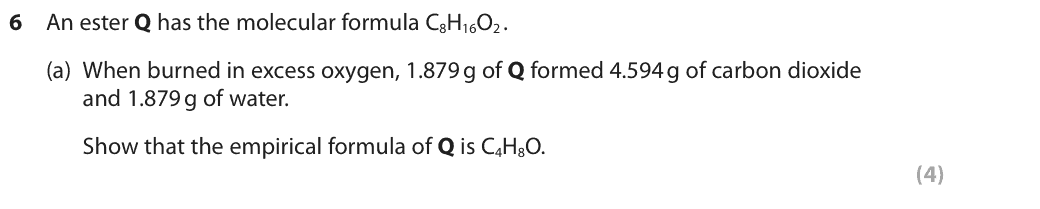
June 2022 · Paper 3 · Q6(a) 4 marks Calculation organic synthesisformulae equations and amounts of substance
An ester Q has the molecular formula C8H16O2 .
When burned in excess oxygen, 1.879 g of Q formed 4.594 g of carbon dioxide
and 1.879 g of water.
Show that the empirical formula of Q is C4H8O.
June 2022 · Paper 3 · Q6(b) 7 marks Explanation nmr mass spectrometry and chromatographyorganic synthesis
Earlier part of question 6 that this part usesEarlier part of June 2022 Paper 3 question 6
Data from the high resolution 1H (proton) NMR spectrum of the ester Q are shown
in the table.
Chemical shift (δ) / ppm
Splitting pattern of peak
Relative peak area
2.50
singlet
3
1.56
quartet
4
1.43
singlet
3
0.92
triplet
6
Part of the structure of Q is shown.
Complete the structure of Q.
Justify your answer by linking the proton environments in your structure to the
relative peak areas and the splitting pattern of the peaks.
O
C
H3C
O
June 2022 · Paper 3 · Q7(a)(i) 4 marks Mechanism carbonyl compounds
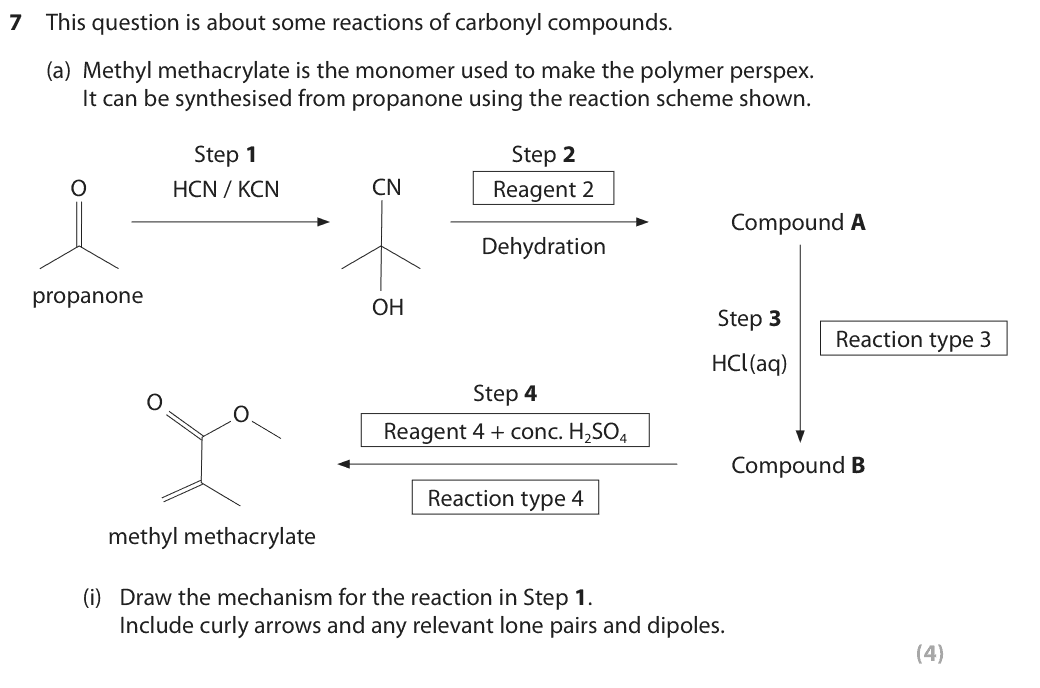
This question is about some reactions of carbonyl compounds.
Methyl methacrylate is the monomer used to make the polymer perspex.
It can be synthesised from propanone using the reaction scheme shown.
Step 1
Step 2
CN
O
HCN / KCN
Reagent 2
Compound A
Dehydration
propanone
OH
Step 3
Reaction type 3
HCl(aq)
Step 4
O
O
Reagent 4 + conc. H2SO4
Compound B
Reaction type 4
methyl methacrylate
Draw the mechanism for the reaction in Step 1.
Include curly arrows and any relevant lone pairs and dipoles.
June 2022 · Paper 3 · Q7(a)(ii) 6 marks Short answer alcoholscarboxylic acids
Earlier part of question 7 that this part usesEarlier part of June 2022 Paper 3 question 7
Complete the table to show the information missing from the
reaction scheme.
Reagent 2
Structure of compound A
Reaction type 3
Structure of compound B
Reagent 4
Reaction type 4
June 2022 · Paper 3 · Q7(a)(iii) 2 marks Equation writing alkenes
Earlier part of question 7 that this part usesEarlier part of June 2022 Paper 3 question 7
Complete the equation for the formation of the polymer from
methyl methacrylate.
O
O
June 2022 · Paper 3 · Q7(b) 3 marks Diagram or structure alcohols
Propanone can be formed from the fermentation of polysaccharides such
as starch.  The propanone can be separated from the fermentation mixture
by distillation.
Draw the apparatus used in the laboratory for distillation of propanone from the
reaction mixture.
June 2022 · Paper 3 · Q7(c)(i) 2 marks Practical and data analysis organic synthesis
Earlier part of question 7 that this part usesEarlier part of June 2022 Paper 3 question 7
Carbonyl compounds, such as propanone, react with 2,4‑dinitrophenylhydrazine
in solution (Brady’s reagent) to form a precipitate which can be used to identify
the compound.
The precipitate can be purified by recrystallisation.
Details of the recrystallisation process are shown.
Step 1   Dissolve the precipitate in the minimum volume of hot ethanol.
Step 2   Warm a filter paper and funnel in an oven for use in Step 3.
Step 3   Filter the solution whilst still warm to remove any undissolved solids,
using gravity filtration.
Step 4   Allow the filtrate to cool and recrystallise.
Step 5   Filter the crystals under reduced pressure.
Step 6   Rinse the crystals with a small amount of ice‑cold ethanol.
Step 7   Dry the crystals between filter papers and leave in a desiccator.
Explain why the filter paper and funnel are warmed in an oven before Step 3.
June 2022 · Paper 3 · Q7(c)(ii) 2 marks Practical and data analysis Hard organic synthesis
Earlier parts of question 7 that this part usesEarlier part of June 2022 Paper 3 question 7Earlier part of June 2022 Paper 3 question 7
Explain how Steps 4 and 5 remove impurities from the crystalline product.
June 2022 · Paper 3 · Q7(c)(iii) 2 marks Practical and data analysis carbonyl compounds
Earlier part of question 7 that this part usesEarlier part of June 2022 Paper 3 question 7
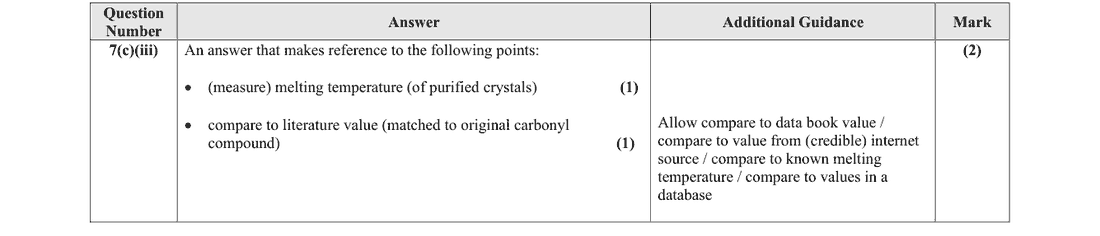
State how the purified crystals can be used to identify the carbonyl
compound that reacts with 2,4‑dinitrophenylhydrazine.
Detailed descriptions of practical procedures are not required.
June 2022 · Paper 3 · Q8(a) 5 marks Practical and data analysis acid base equilibria
This question is about acids and bases.
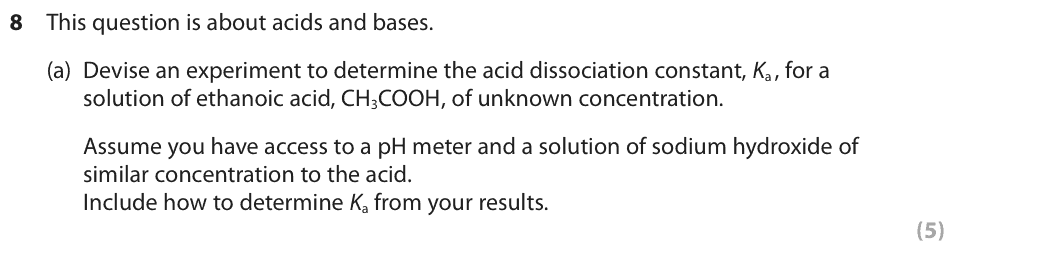
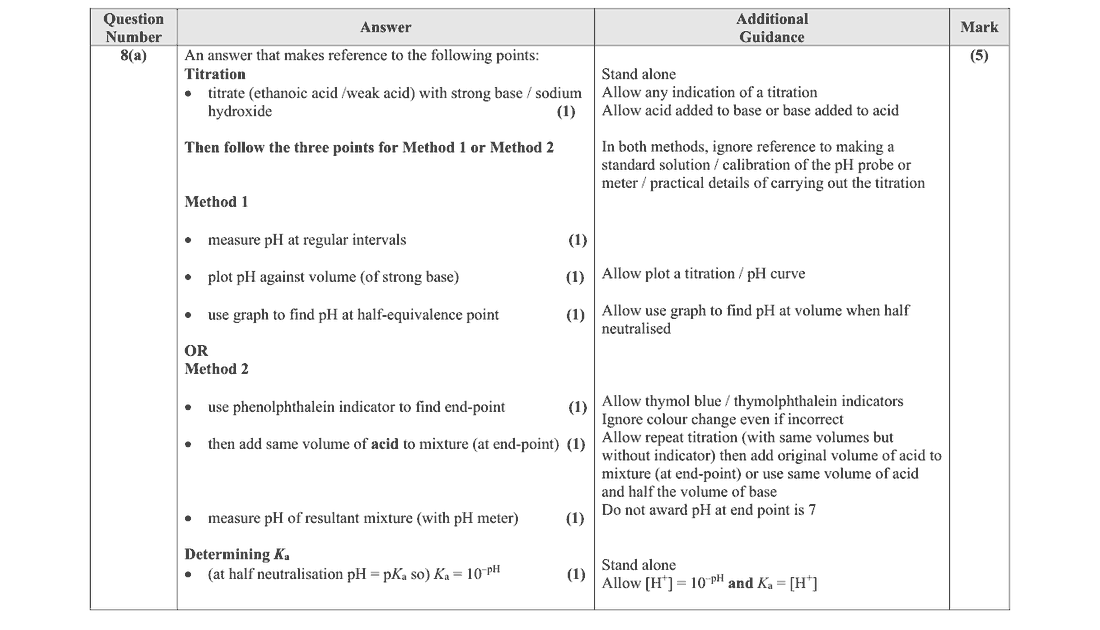
Devise an experiment to determine the acid dissociation constant, Ka , for a
solution of ethanoic acid, CH3COOH, of unknown concentration.
Assume you have access to a pH meter and a solution of sodium hydroxide of
similar concentration to the acid.
Include how to determine Ka from your results.
June 2022 · Paper 3 · Q8(b) 3 marks Calculation Hard acid base equilibria
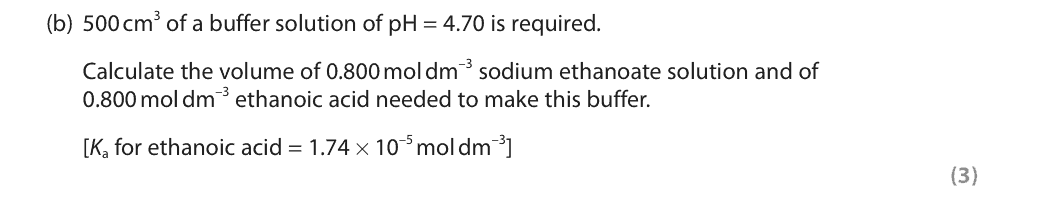
500 cm3 of a buffer solution of pH = 4.70 is required.
Calculate the volume of 0.800 mol dm–3 sodium ethanoate solution and of
0.800 mol dm–3 ethanoic acid needed to make this buffer.
[Ka for ethanoic acid = 1.74 × 10–5 mol dm–3]
(3).
June 2022 · Paper 3 · Q8(c) 6 marks Calculation acid base equilibria
Calculate the pH of the solution formed when
51.2 cm3 of 0.927 mol dm–3 NaOH(aq) is mixed with
40.4 cm3 of 0.370 mol dm–3 H2SO4(aq).
[Ionic product of water Kw = 1.00 × 10–14 mol2 dm–6]
June 2022 · Paper 3 · Q9(a)(i) 1 mark Short answer acid base equilibria
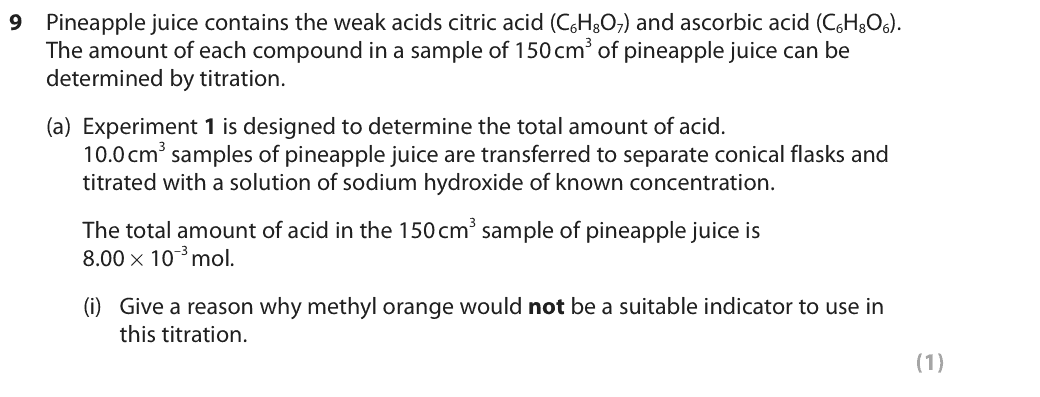
Pineapple juice contains the weak acids citric acid (C6H8O7) and ascorbic acid (C6H8O6).
The amount of each compound in a sample of 150 cm3 of pineapple juice can be
determined by titration.
Experiment 1 is designed to determine the total amount of acid.
10.0 cm3 samples of pineapple juice are transferred to separate conical flasks and
titrated with a solution of sodium hydroxide of known concentration.
The total amount of acid in the 150 cm3 sample of pineapple juice is
8.00 × 10–3 mol.
Give a reason why methyl orange would not be a suitable indicator to use in
this titration.
June 2022 · Paper 3 · Q9(a)(ii) 2 marks Practical and data analysis formulae equations and amounts of substance
Earlier part of question 9 that this part usesEarlier part of June 2022 Paper 3 question 9
A student did not notice an air bubble in the tip of the burette before
carrying out one of their accurate titrations.  During this titration, the air
bubble escaped.
Explain the effect this mistake would have on the value of this titre.
June 2022 · Paper 3 · Q9(b)(i) 3 marks Practical and data analysis Hard redox ii
Earlier part of question 9 that this part usesEarlier part of June 2022 Paper 3 question 9
Experiment 2 is carried out to determine the amount of ascorbic acid (C6H8O6) in
the pineapple juice.
An outline procedure for this experiment is given.
Step 1   5.00 cm3 of the pineapple juice is added to a conical flask.
Step 2   Deionised water, a small amount of HCl(aq), a few crystals of
potassium iodide, KI, and 3 drops of starch solution are also added to
the flask.
Step 3   The contents of the flask are swirled to ensure the KI dissolves fully.
Step 4   The resultant mixture is titrated with a solution of
potassium iodate(V), KIO3(aq), of concentration 0.00100 mol dm–3.
The reactions that take place are
IO3
–(aq)  +  5I–(aq)  +  6H+(aq)  →  3I2(aq)  +  3H2O(l)
C6H8O6(aq)  +  I2(aq)  →  C6H6O6(aq)  +  2H+(aq)  +  2I–(aq)
Only the ascorbic acid reacts with the iodine.
The end-point of the titration is when the starch changes colour.
Explain how this occurs, including the colour change.
June 2022 · Paper 3 · Q9(b)(ii) 5 marks Calculation redox ii
Earlier parts of question 9 that this part usesEarlier part of June 2022 Paper 3 question 9Earlier part of June 2022 Paper 3 question 9
The total amount of acid in the 150 cm3 sample is 8.00 × 10–3 mol.
The mean titre in Experiment 2 using 5.00 cm3 of pineapple juice is 9.50 cm3.
Calculate the mass of citric acid in the 150 cm3 sample.
June 2022 · Paper 3 · Q9(c) 3 marks Explanation carboxylic acids
Earlier parts of question 9 that this part usesEarlier part of June 2022 Paper 3 question 9Earlier part of June 2022 Paper 3 question 9
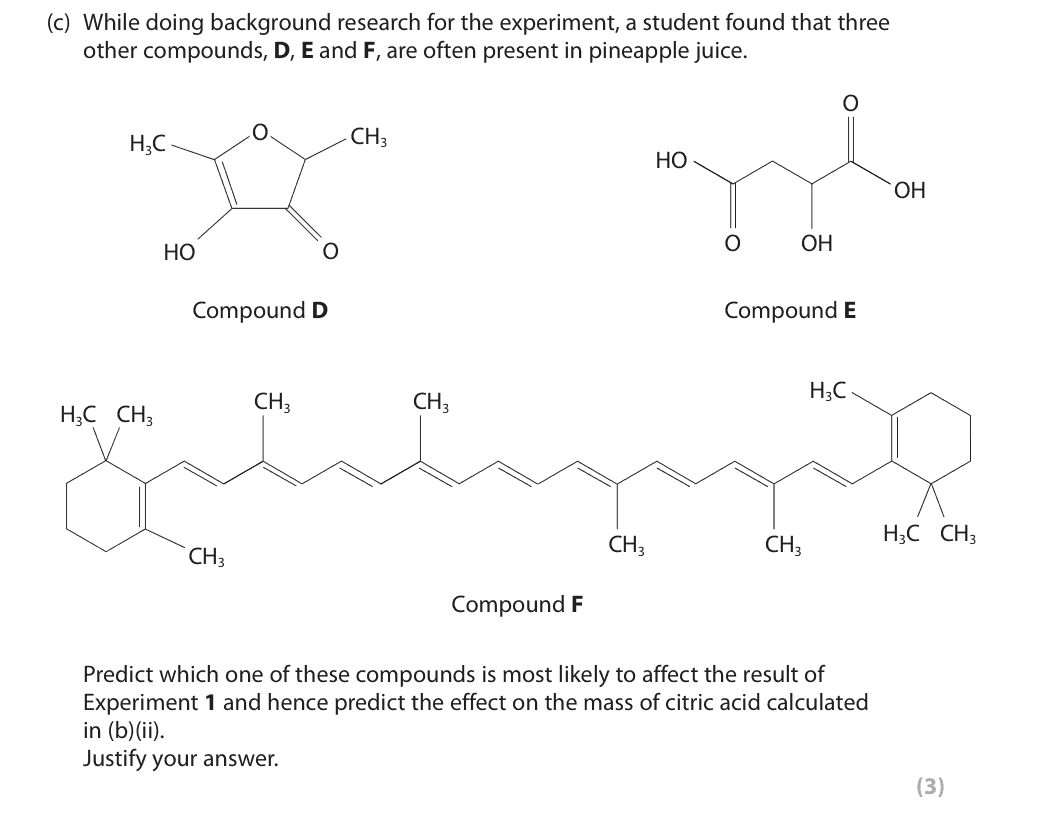
While doing background research for the experiment, a student found that three
other compounds, D, E and F, are often present in pineapple juice.
O
O
CH3
H3C
HO
OH
O
OH
HO
O
Compound D
Compound E
H3C
CH3
CH3
H3C
CH3
H3C
CH3
CH3
CH3
CH3
Compound F
Predict which one of these compounds is most likely to affect the result of
Experiment 1 and hence predict the effect on the mass of citric acid calculated
in (b)(ii).
Justify your answer.
June 2022 · Paper 3 · Q10(a)(i) 2 marks Practical and data analysis kinetics ii
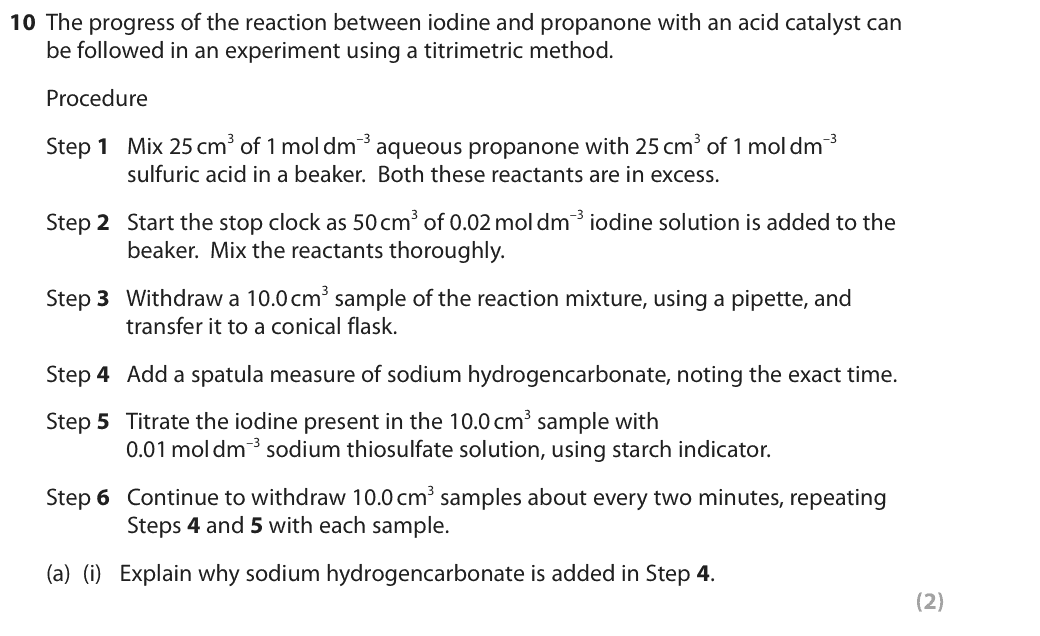
The progress of the reaction between iodine and propanone with an acid catalyst can
be followed in an experiment using a titrimetric method.
Procedure
Step 1   Mix 25 cm3 of 1 mol dm–3 aqueous propanone with 25 cm3 of 1 mol dm–3
sulfuric acid in a beaker.  Both these reactants are in excess.
Step 2   Start the stop clock as 50 cm3 of 0.02 mol dm–3 iodine solution is added to the
beaker.  Mix the reactants thoroughly.
Step 3   Withdraw a 10.0 cm3 sample of the reaction mixture, using a pipette, and
transfer it to a conical flask.
Step 4   Add a spatula measure of sodium hydrogencarbonate, noting the exact time.
Step 5   Titrate the iodine present in the 10.0 cm3 sample with
0.01 mol dm–3 sodium thiosulfate solution, using starch indicator.
Step 6   Continue to withdraw 10.0 cm3 samples about every two minutes, repeating
Steps 4 and 5 with each sample.
Explain why sodium hydrogencarbonate is added in Step 4.
June 2022 · Paper 3 · Q10(a)(ii) 1 mark Equation writing Hard formulae equations and amounts of substanceanalysis of inorganic compounds
Earlier part of question 10 that this part usesEarlier part of June 2022 Paper 3 question 10
Write the ionic equation for the reaction that takes place during Step 4.
State symbols are not required.
June 2022 · Paper 3 · Q10(b)(i) 2 marks Diagram or structure kinetics ii
Earlier part of question 10 that this part usesEarlier part of June 2022 Paper 3 question 10
Some data from the experiment are shown.
Time sodium hydrogencarbonate is added / min
2.0
5.0
6.5
8.0
10.5
12.0
Volume of sodium thiosulfate / cm3
19.2
15.5
14.0
12.1
9.5
7.2
Plot a graph of the volume of sodium thiosulfate against the time the
sodium hydrogencarbonate is added.
June 2022 · Paper 3 · Q10(b)(ii) 3 marks Explanation kinetics ii
Earlier parts of question 10 that this part usesEarlier part of June 2022 Paper 3 question 10Earlier part of June 2022 Paper 3 question 10
Explain how the graph of volume of thiosulfate against time confirms the
reaction is zero order with respect to iodine, I2.
June 2022 · Paper 3 · Q10(c)(i) 2 marks Short answer kinetics ii
Earlier part of question 10 that this part usesEarlier part of June 2022 Paper 3 question 10
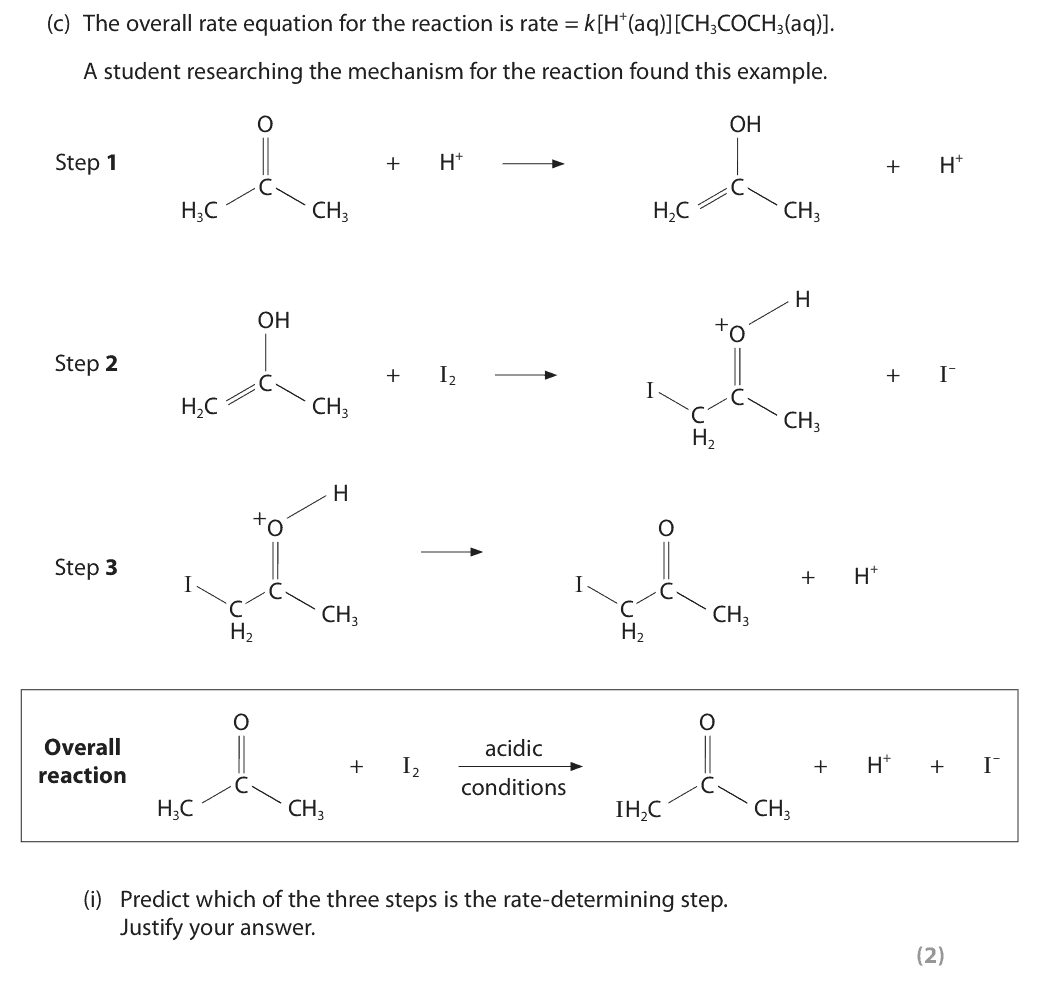
The overall rate equation for the reaction is rate = k[H+(aq)][CH3COCH3(aq)].
A student researching the mechanism for the reaction found this example.
O
OH
Step 1
+       H+
+       H+
C
C
H3C
CH3
H2C
CH3
H
OH
+
O
Step 2
+       I2
+       I–
C
I
C
H2C
CH3
C
CH3
H2
H
+
O
O
Step 3
+       H+
I
I
C
C
C
C
CH3
CH3
H2
H2
O
O
Overall
acidic
+       I2
+       H+       +       I–
reaction
C
conditions
C
H3C
CH3
IH2C
CH3
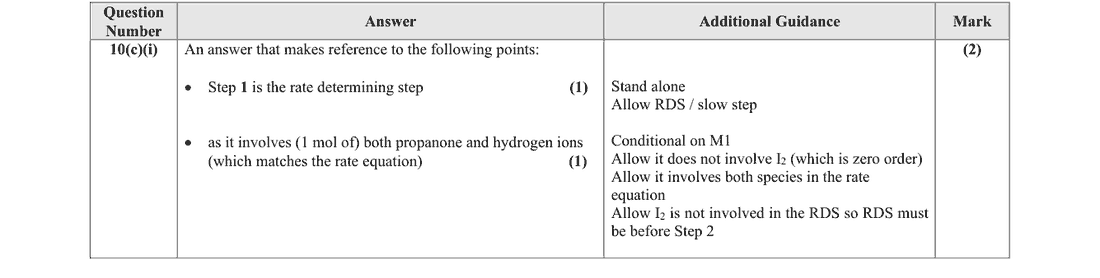
Predict which of the three steps is the rate‑determining step.
Justify your answer.
June 2022 · Paper 3 · Q10(c)(ii) 2 marks Explanation kinetics ii
Earlier parts of question 10 that this part usesEarlier part of June 2022 Paper 3 question 10Earlier part of June 2022 Paper 3 question 10
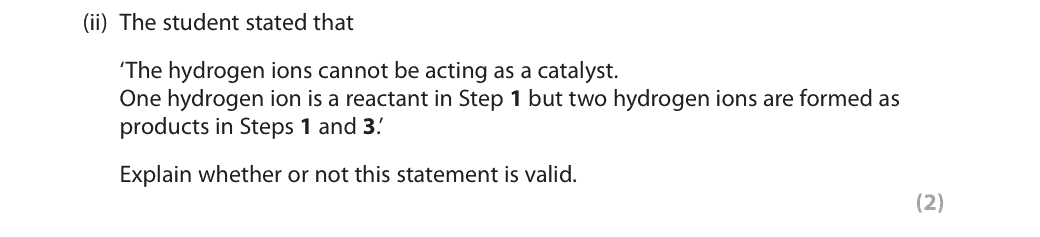
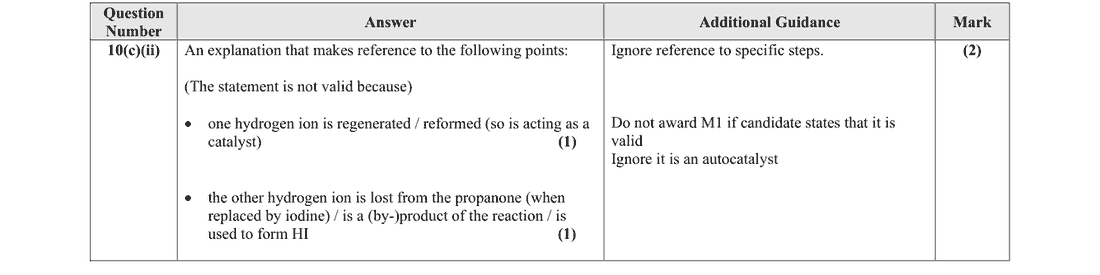
The student stated that
‘The hydrogen ions cannot be acting as a catalyst.
One hydrogen ion is a reactant in Step 1 but two hydrogen ions are formed as
products in Steps 1 and 3.’
Explain whether or not this statement is valid.

Work with an A-level chemistry tutor

Want a paper marked and gone through with you? Message us.

Prefer email? Send an enquiry

If you are under 18, please include a parent's contact details. Enquiries go to enquiries@chemistryaleveltutor.com and are deleted once handled. All tutoring is online.