Examiner's comment
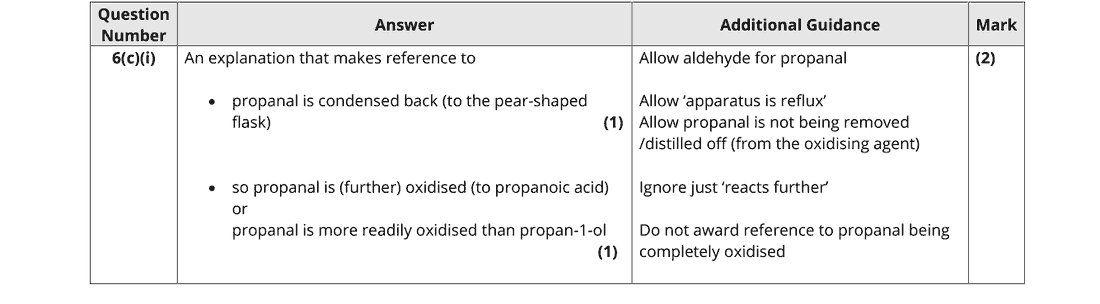
The inclusion of the MS allowed reference to the apparatus as “reflux” for M1, resulting in many candidates scoring one mark as indicated by the overall mean of 0.99. However there were a significant number of candidates who negated this mark by referring to the loss of gas through the top of the condenser.
There were also a large number of candidates who understood that the use of reflux apparatus results in the oxidation of the alcohol to the carboxylic acid but this question was focused on the yield of the aldehyde so this comment did not score. There needed to be reference to the propanal or the aldehyde being further oxidised to the carboxylic (which is why the yield is low).
It is worth highlighting to centres and their candidates that use of the term 'complete oxidation' is incorrect in this context and should not be used.
Notes from the mark scheme and report
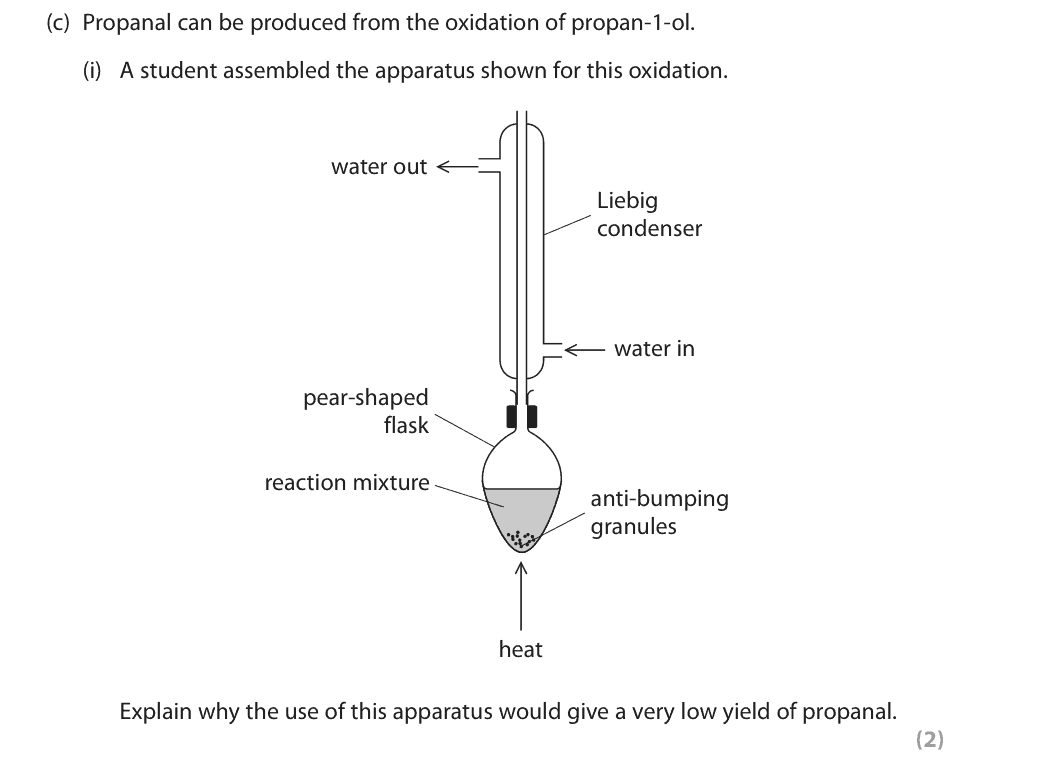
- The apparatus is set up for reflux, so the propanal is condensed back into the flask (it is not distilled off)
- so it is oxidised further to propanoic acid. Just 'reacts further' ignored
- not 'completely oxidised'. Many scored one mark for reflux
- some lost it by saying gas escapes from the top of the condenser
- many said the alcohol goes to the acid without saying that the aldehyde is oxidised further
Skills: PT4 use laboratory apparatus for a variety of experimental techniques, including: titration, using burette and pipette; distillation and heating under reflux, including setting up glassware using retort stand and clamps; qualitative tests for ions and organic functional groups; filtration, including use of fluted filter paper, or filtration under reduced pressure; CP5 Core practical 5: The oxidation of ethanol