June 2018: Paper 2, Advanced Organic and Physical Chemistry

90 marks · 44 question parts · Paper, mark scheme and report on Edexcel's site · Have the Data Booklet beside you

Question by question

QTopicMarksAOType
1(a) Introduction to organic chemistry 1Multiple choice
1(b) Alkanes 1Multiple choice
1(c) Alkanes 1Multiple choice
1(d) Introduction to organic chemistry 1Multiple choice
2(a) Kinetics I 1Multiple choice
2(b) Kinetics I, Alkanes 2Explanation
3(a)(i) Modern analytical techniques II: NMR, mass spectrometry and chromatography 1Calculation
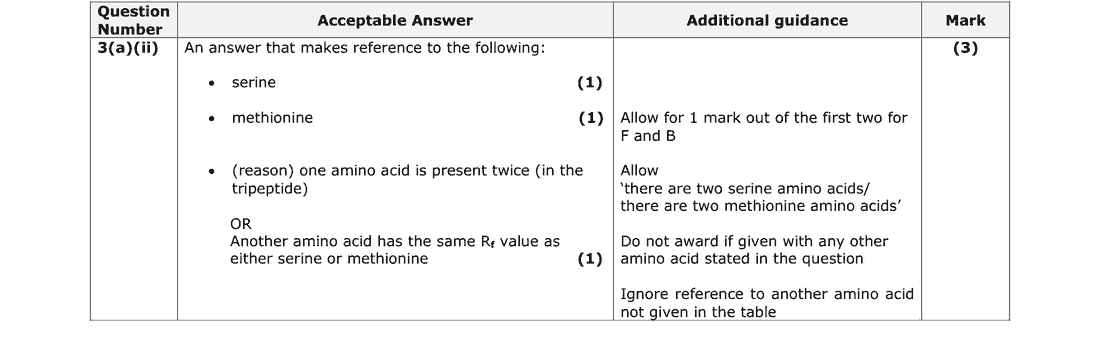
3(a)(ii) Amines, amides, amino acids and proteins 3Short answer
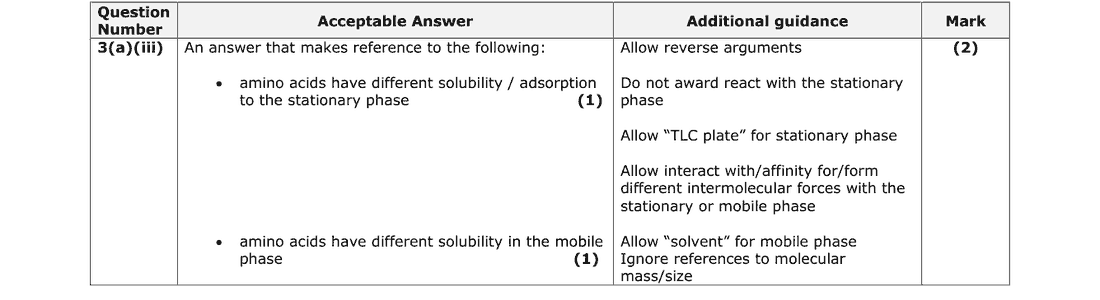
3(a)(iii) Modern analytical techniques II: NMR, mass spectrometry and chromatography 2Short answer
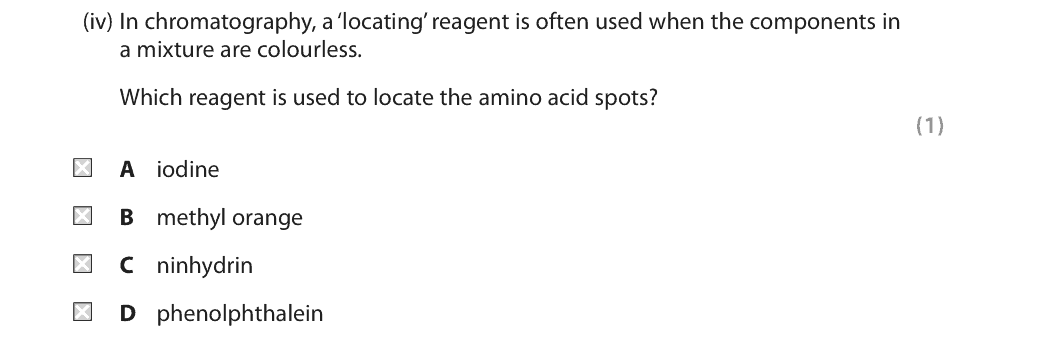
3(a)(iv) Amines, amides, amino acids and proteins 1Multiple choice
3(b)(i) Modern analytical techniques II: NMR, mass spectrometry and chromatography 1Short answer
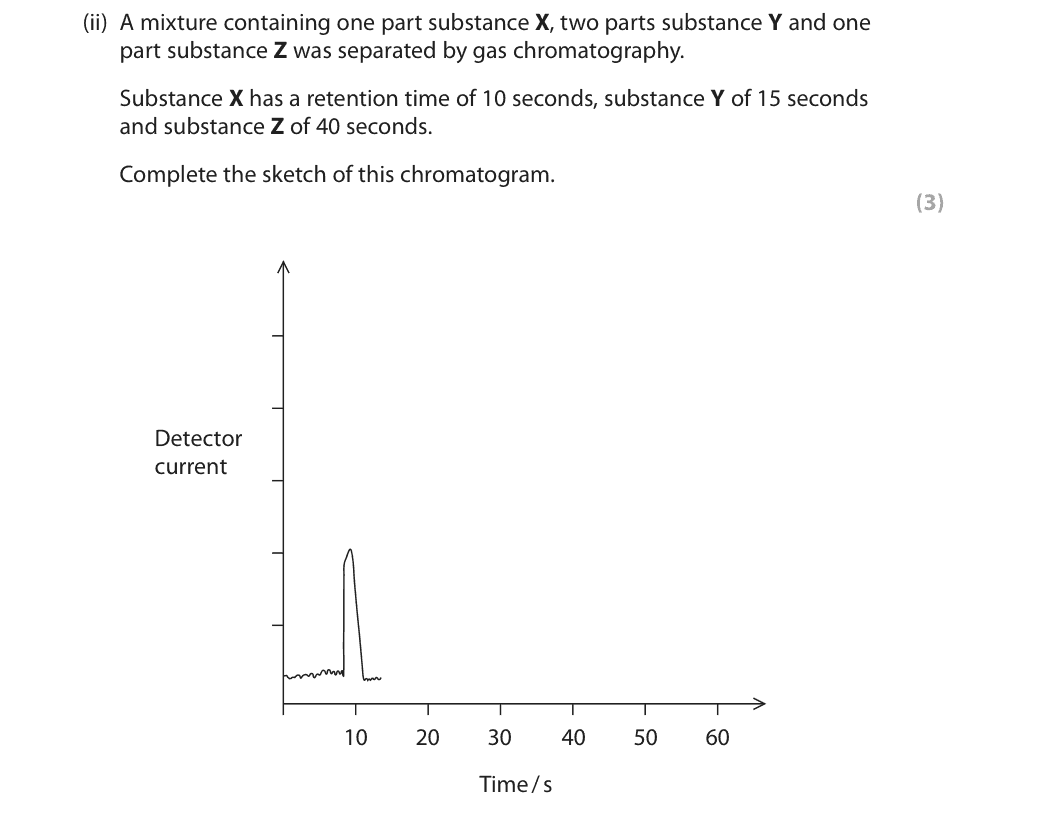
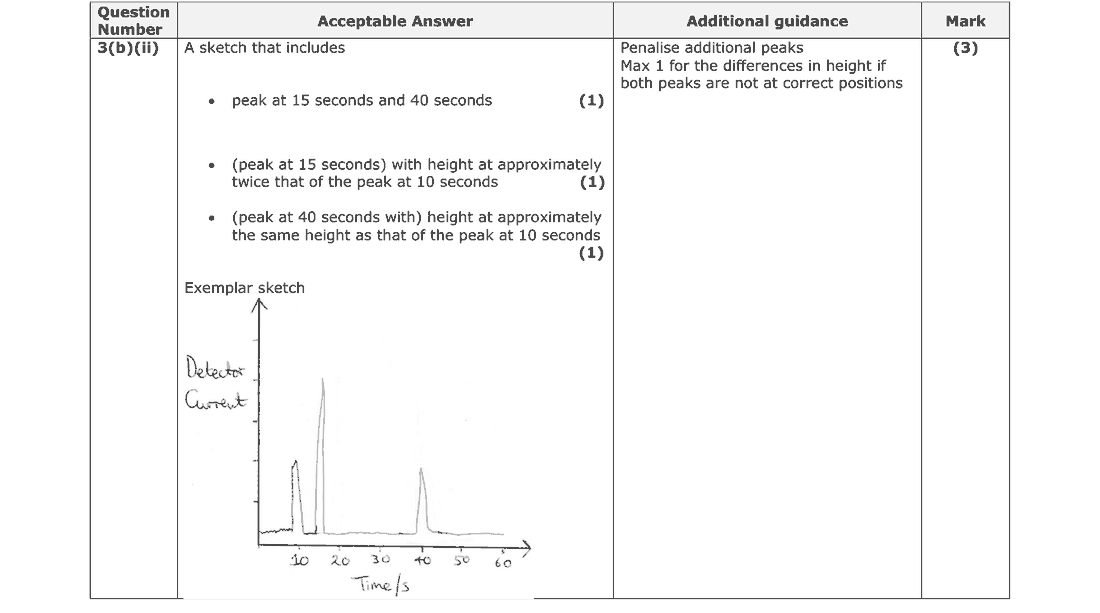
3(b)(ii) Modern analytical techniques II: NMR, mass spectrometry and chromatography 3Diagram or structure
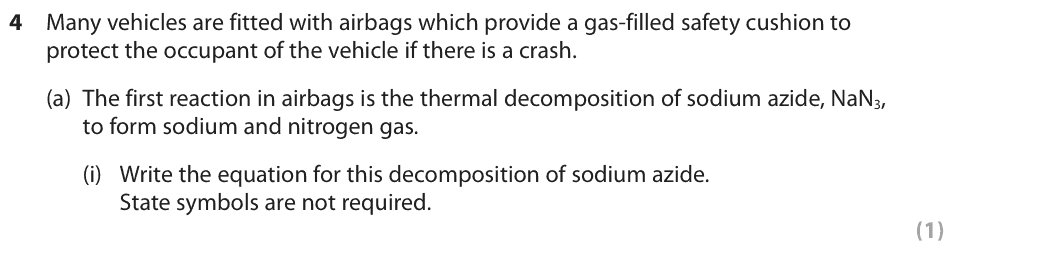
4(a)(i) Formulae, equations and amounts of substance 1Equation writing
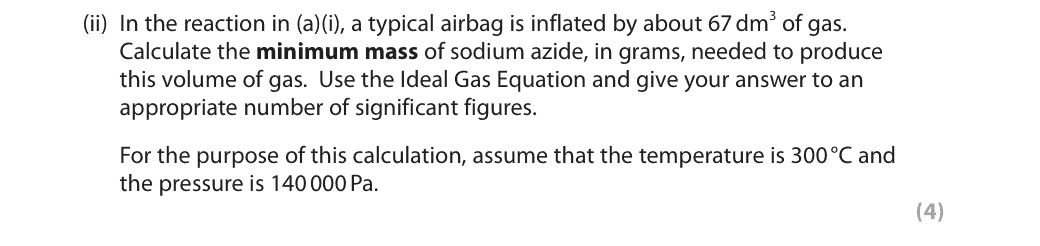
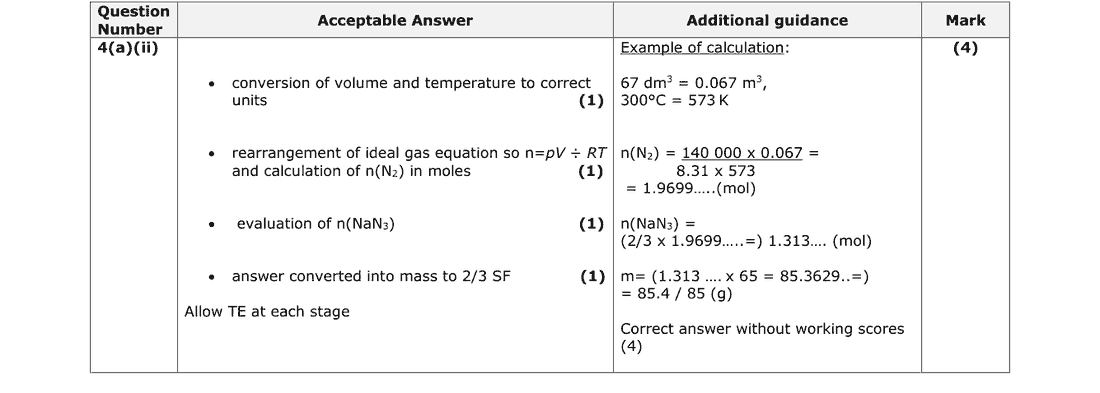
4(a)(ii) Formulae, equations and amounts of substance 4Calculation
4(b) Redox I, Formulae, equations and amounts of substance 3Short answer
4(c) Formulae, equations and amounts of substance 3Explanation
4(d) Kinetics I 1Multiple choice
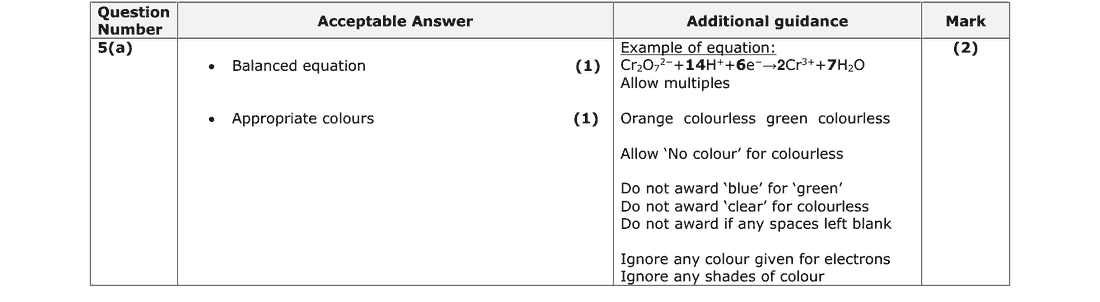
5(a) Redox I, Alcohols 2Equation writing
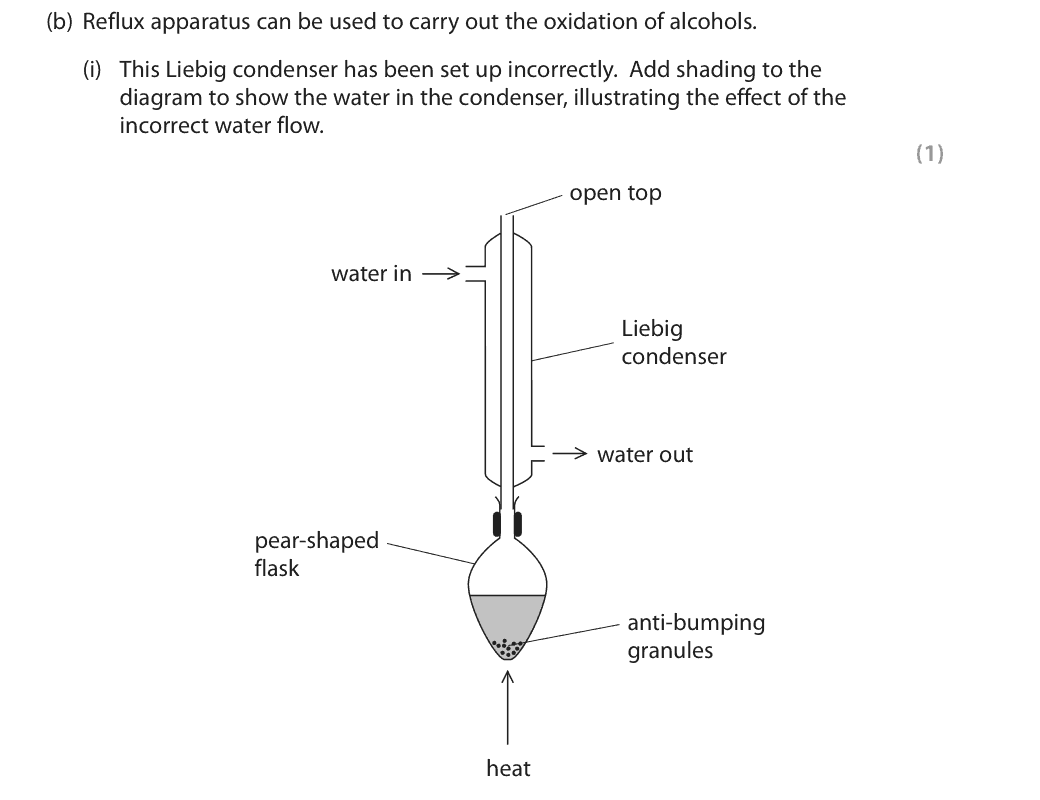
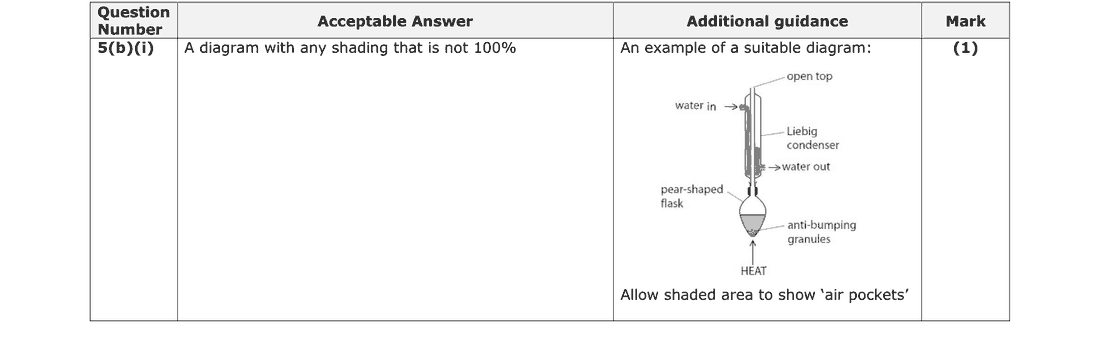
5(b)(i) Alcohols 1Diagram or structure
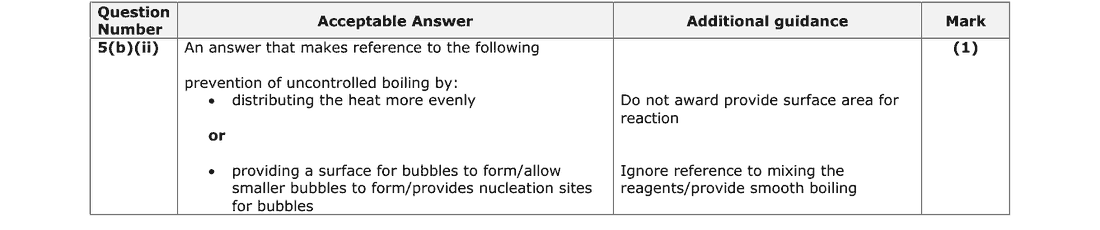
5(b)(ii) Alcohols 1Practical and data analysis
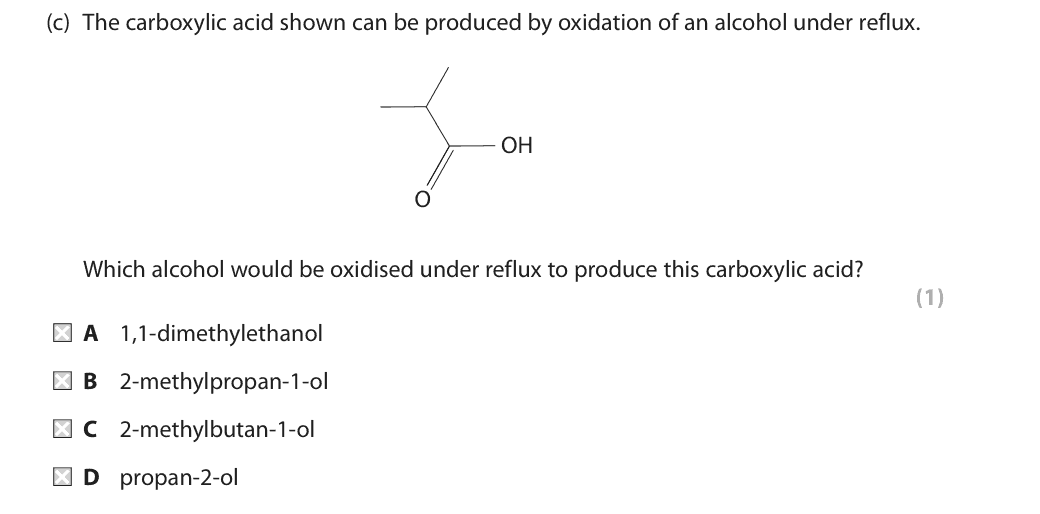
5(c) Alcohols, Introduction to organic chemistry 1Multiple choice
5(d) Alcohols 2Explanation
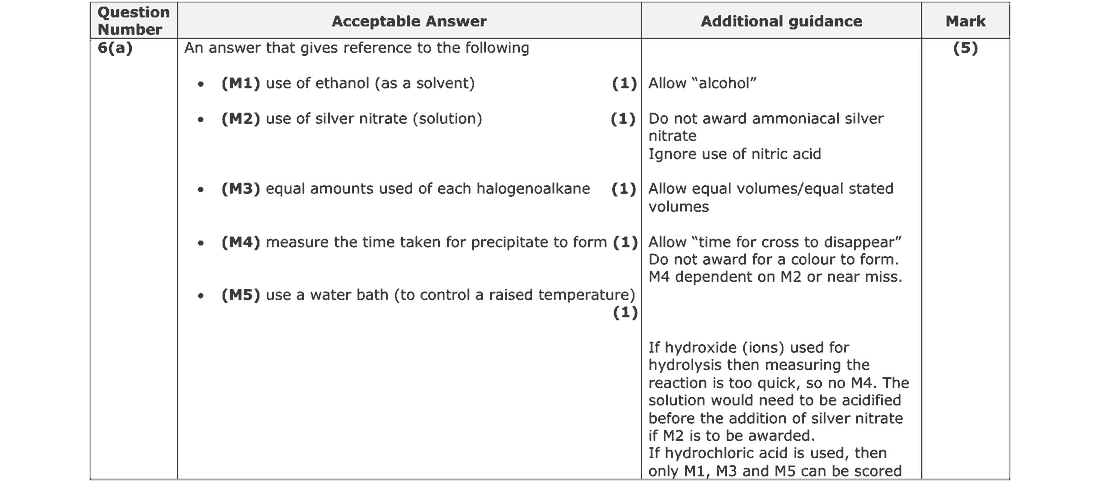
6(a) Halogenoalkanes 5Practical and data analysis
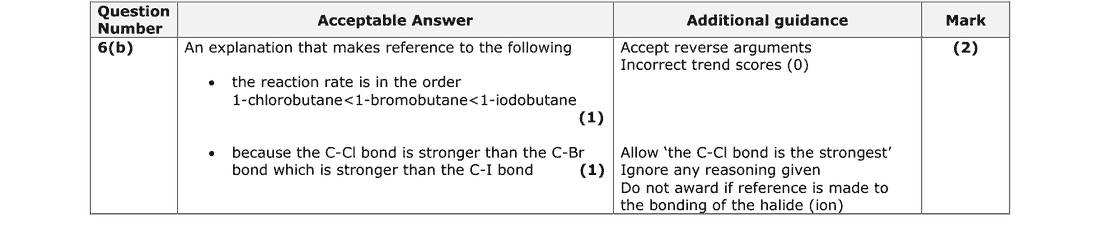
6(b) Halogenoalkanes 2Explanation
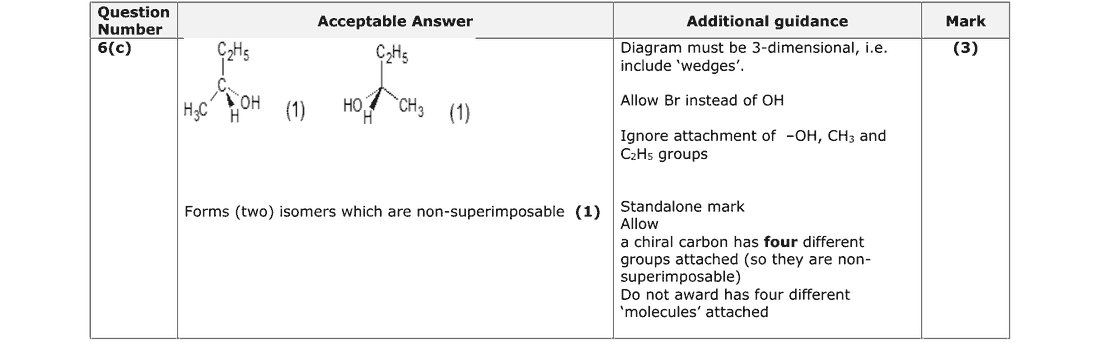
6(c) Chirality 3Diagram or structure
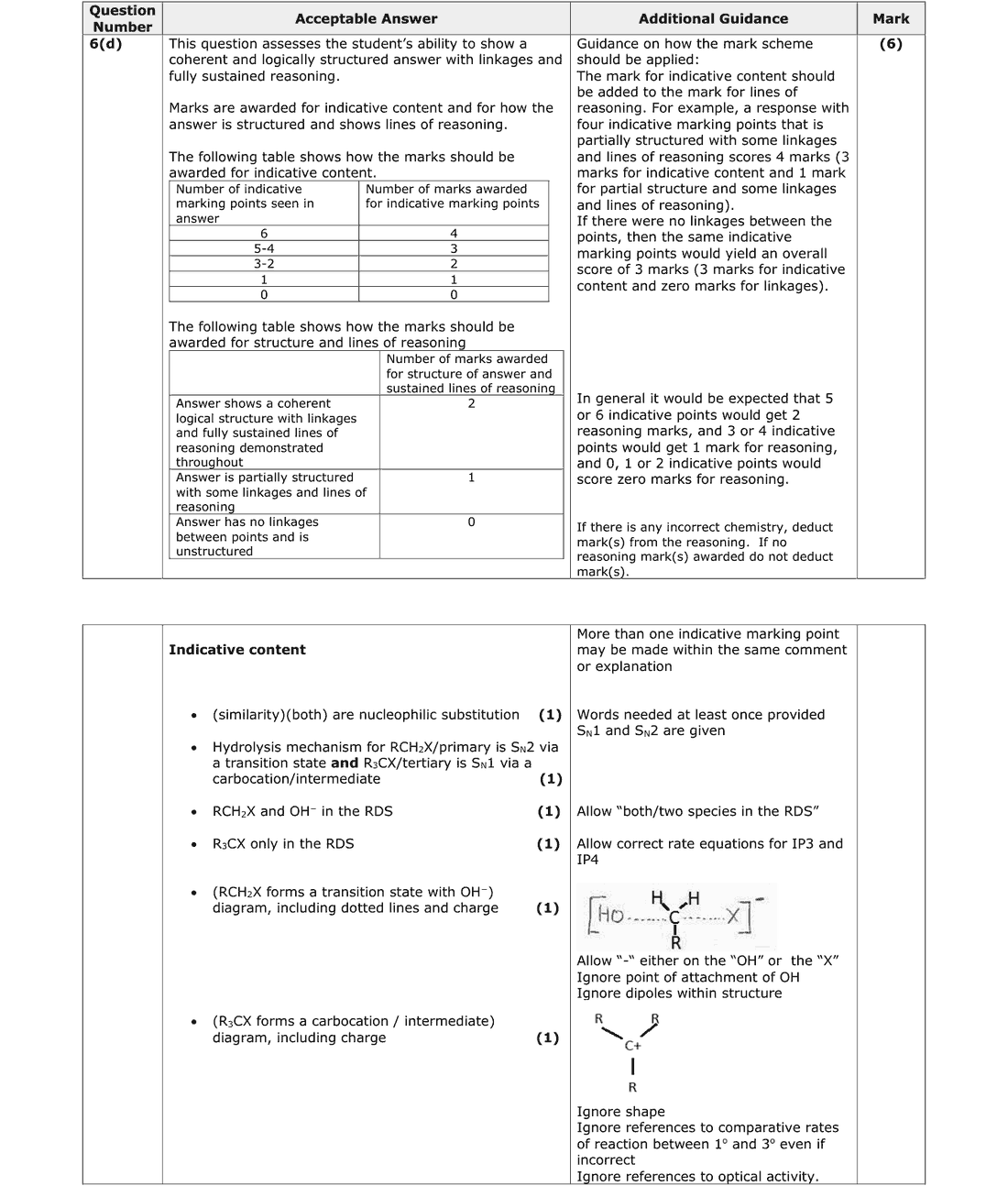
6(d) Kinetics II, Halogenoalkanes 6Extended response
7(a) Organic synthesis, Arenes: benzene, Carbonyl compounds 5Short answer
7(b) Alkenes 1Multiple choice
7(c) Alkenes 1Diagram or structure
7(d) Alkenes 2Short answer
7(e) Atomic structure and the Periodic Table 2Calculation
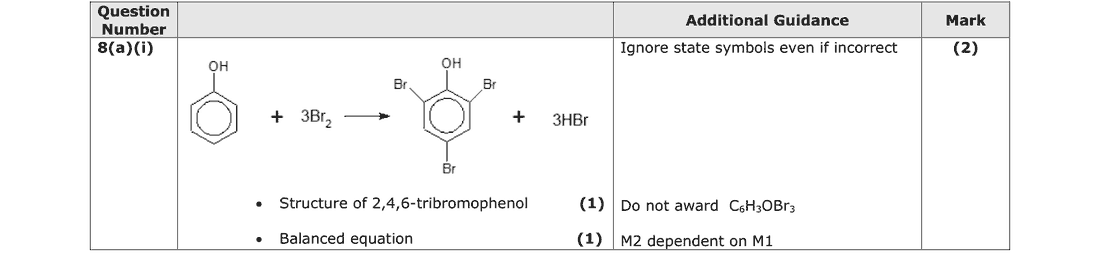
8(a)(i) Arenes: benzene 2Equation writing
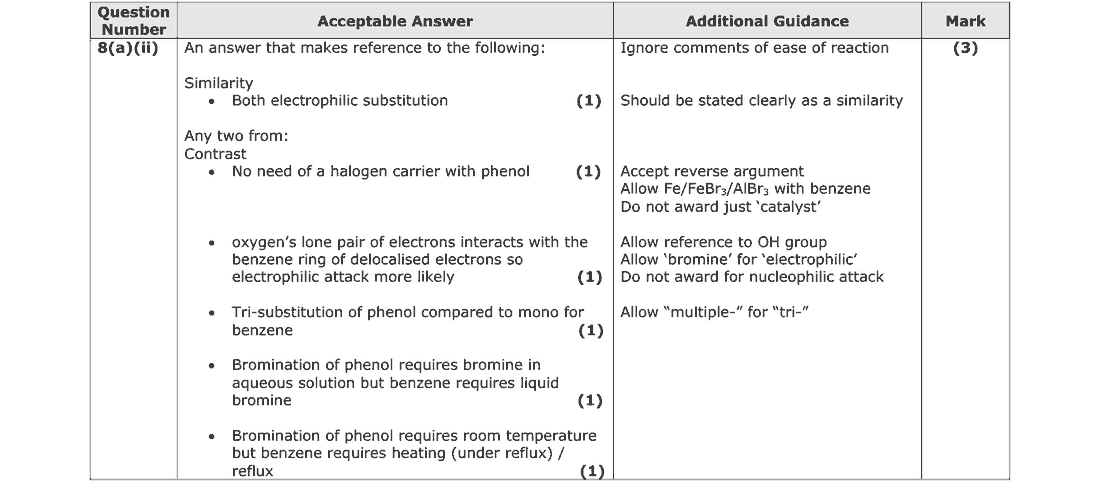
8(a)(ii) Arenes: benzene 3Explanation
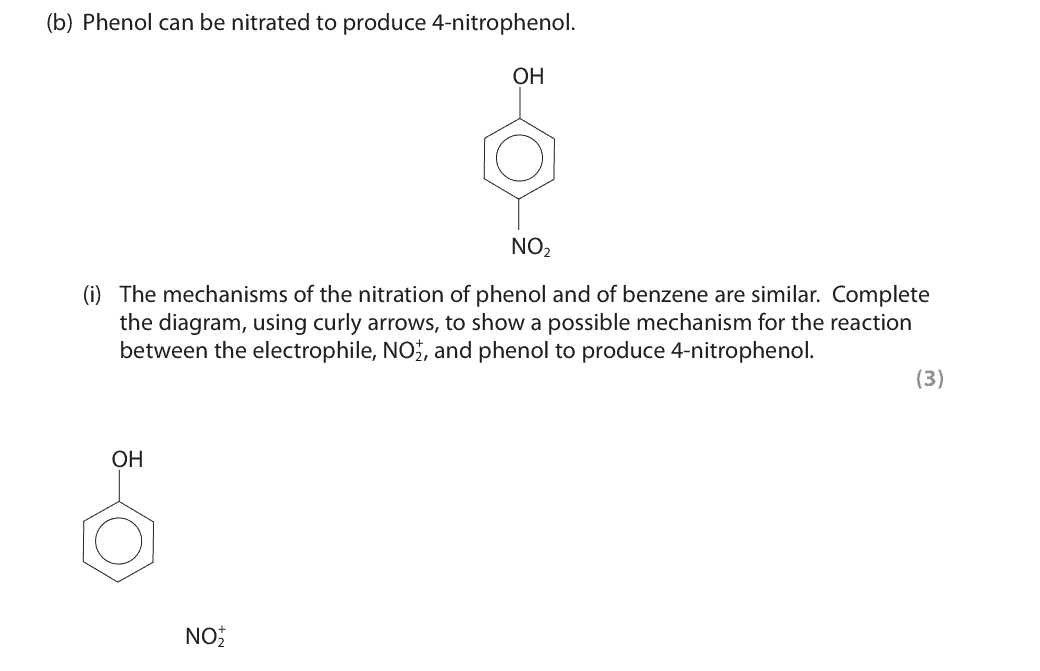
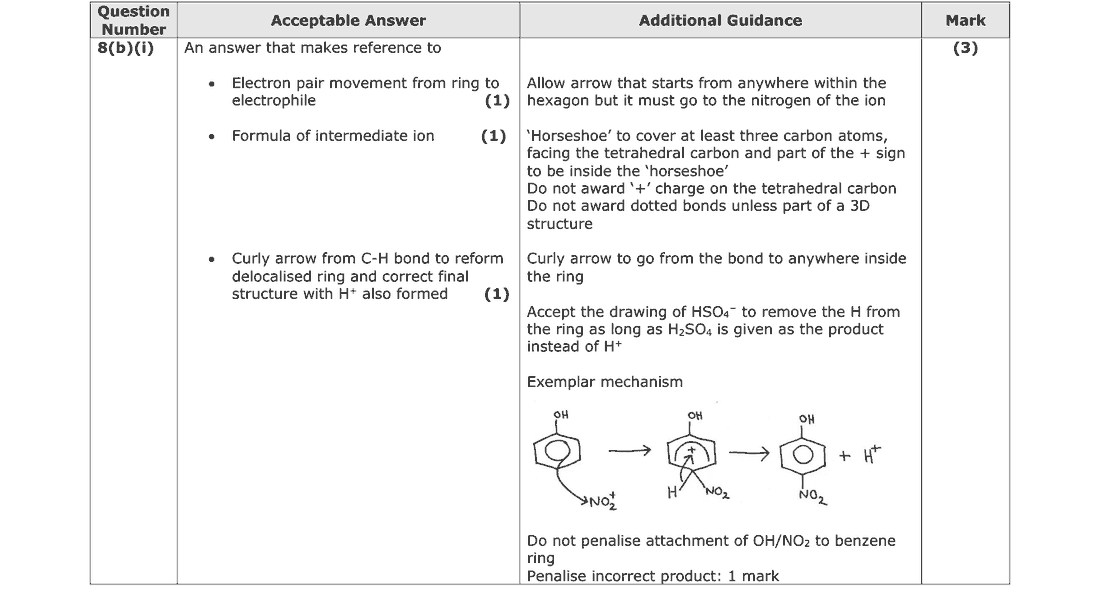
8(b)(i) Arenes: benzene 3Mechanism
8(b)(ii) Formulae, equations and amounts of substance 1Multiple choice
8(b)(iii) Introduction to organic chemistry 1Diagram or structure
9(a) Kinetics II 1Short answer
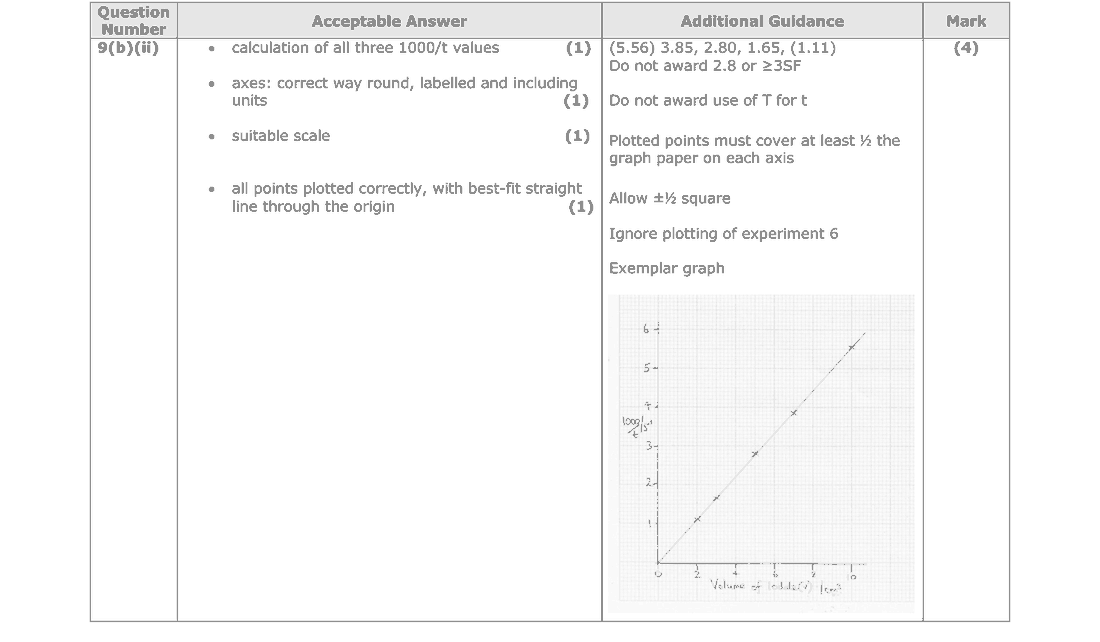
9(b)(i) Kinetics II 1Practical and data analysis
9(b)(ii) Kinetics II, Kinetics I 4Diagram or structure
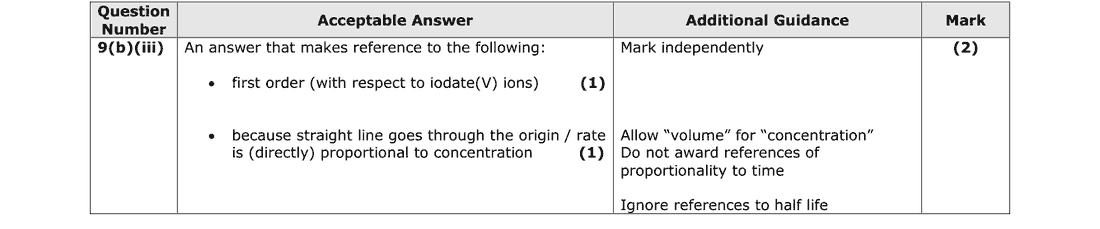
9(b)(iii) Kinetics II 2Short answer
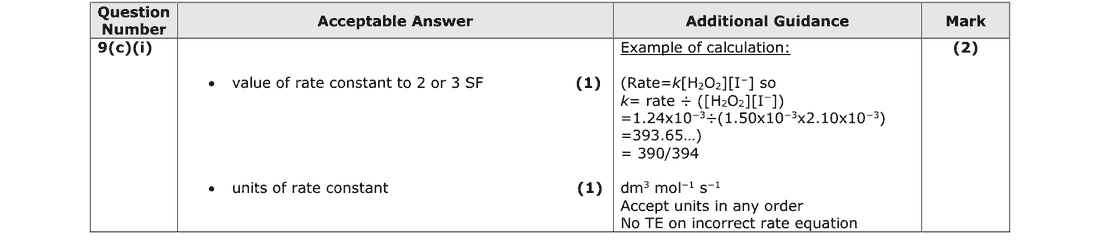
9(c)(i) Kinetics II 2Calculation
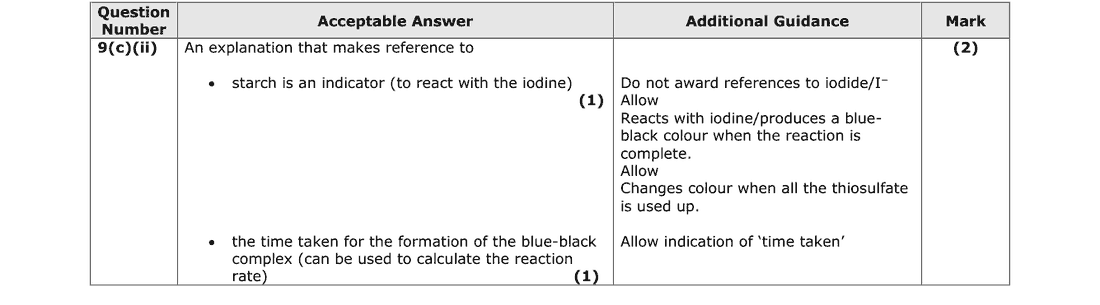
9(c)(ii) Kinetics II 2Practical and data analysis
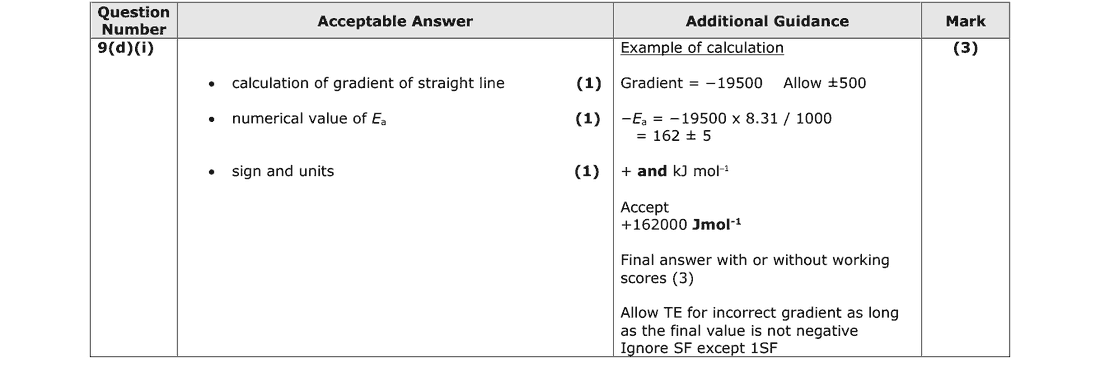
9(d)(i) Kinetics II 3Calculation
9(d)(ii) Kinetics II 1Short answer

The questions

1(a)1(b)1(c)1(d)2(a)2(b)3(a)(i)3(a)(ii)3(a)(iii)3(a)(iv)3(b)(i)3(b)(ii)4(a)(i)4(a)(ii)4(b)4(c)4(d)5(a)5(b)(i)5(b)(ii)5(c)5(d)6(a)6(b)6(c)6(d)7(a)7(b)7(c)7(d)7(e)8(a)(i)8(a)(ii)8(b)(i)8(b)(ii)8(b)(iii)9(a)9(b)(i)9(b)(ii)9(b)(iii)9(c)(i)9(c)(ii)9(d)(i)9(d)(ii)
June 2018 · Paper 2 · Q1(a) 1 mark Multiple choice introduction to organic chemistry
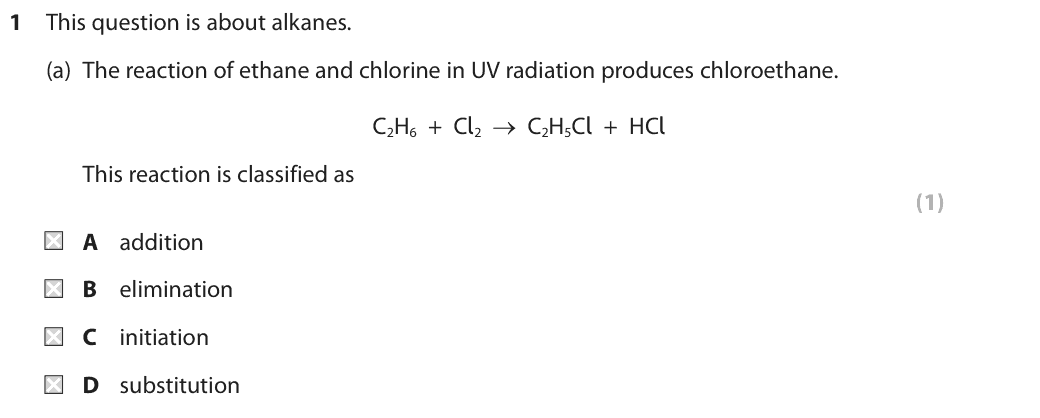
This question is about alkanes.
The reaction of ethane and chlorine in UV radiation produces chloroethane.
C2H6  +  Cl2  →  C2H5Cl  +  HCl
This reaction is classified as
A  addition
B  elimination
C  initiation
D  substitution
June 2018 · Paper 2 · Q1(b) 1 mark Multiple choice alkanes
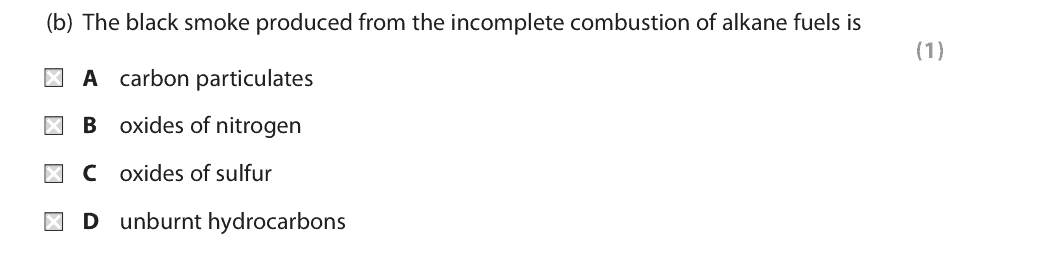
The black smoke produced from the incomplete combustion of alkane fuels is
A  carbon particulates
B  oxides of nitrogen
C  oxides of sulfur
D  unburnt hydrocarbons
June 2018 · Paper 2 · Q1(c) 1 mark Multiple choice alkanes
Earlier part of question 1 that this part usesEarlier part of June 2018 Paper 2 question 1
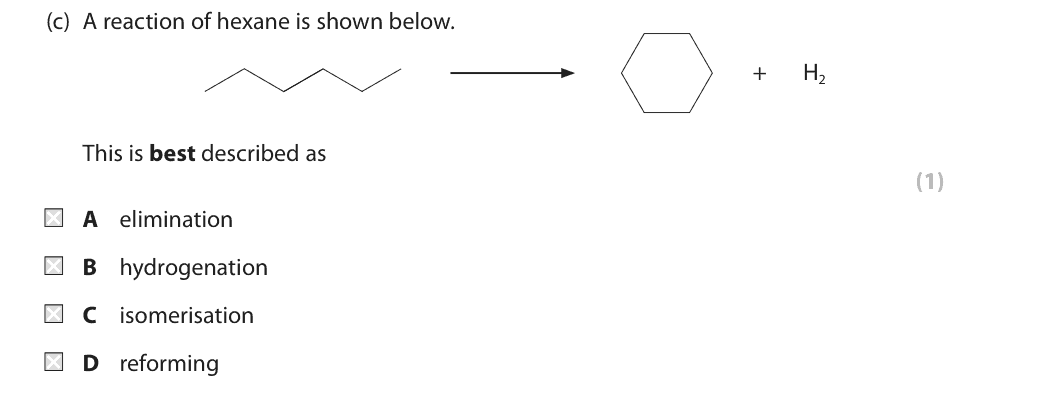
A reaction of hexane is shown below.
+      H2
This is best described as
A  elimination
B  hydrogenation
C  isomerisation
D  reforming
June 2018 · Paper 2 · Q1(d) 1 mark Multiple choice introduction to organic chemistry
Earlier part of question 1 that this part usesEarlier part of June 2018 Paper 2 question 1
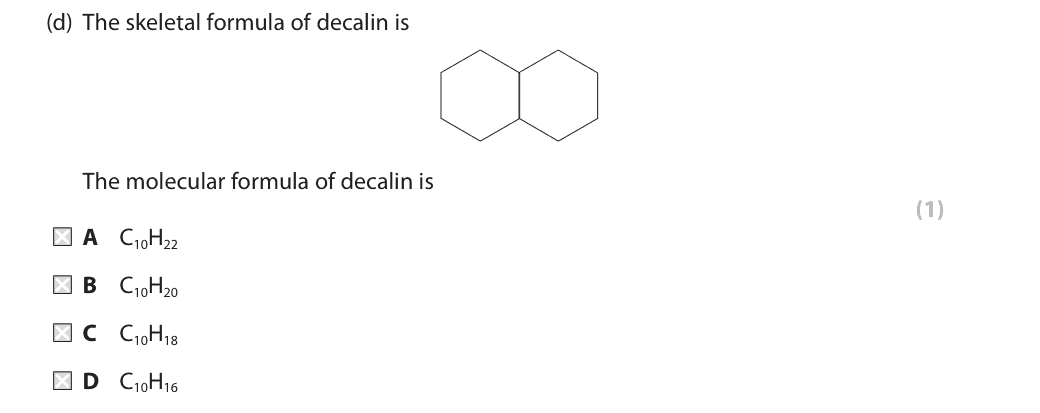
The skeletal formula of decalin is
The molecular formula of decalin is
A  C10H22
B  C10H20
C  C10H18
D  C10H16
June 2018 · Paper 2 · Q2(a) 1 mark Multiple choice kinetics i
This question is about how catalysts work.
Gaseous reactants attach to the catalytic surface by the process of
A  absorption
B  activation
C  adsorption
D  desorption
June 2018 · Paper 2 · Q2(b) 2 marks Explanation kinetics ialkanes
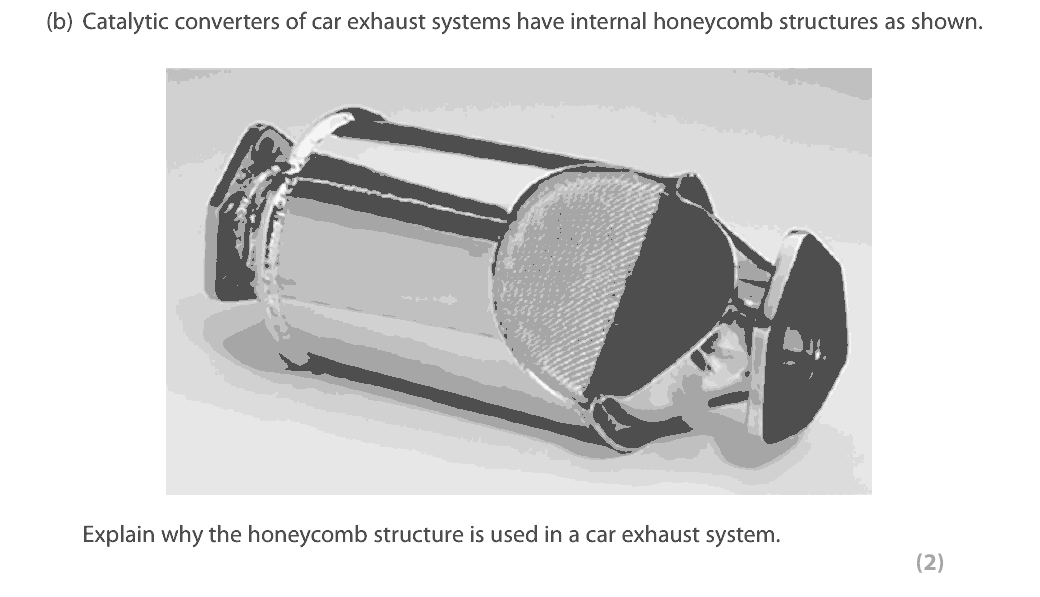
Catalytic converters of car exhaust systems have internal honeycomb structures as shown.
Explain why the honeycomb structure is used in a car exhaust system.
June 2018 · Paper 2 · Q3(a)(i) 1 mark Calculation nmr mass spectrometry and chromatography
Chromatography is a technique used to separate the components of a mixture.
A sample of a tripeptide was hydrolysed and then placed on a thin layer chromatography
(TLC) plate.  Samples of possible amino acids present were also placed on the TLC plate
for reference.
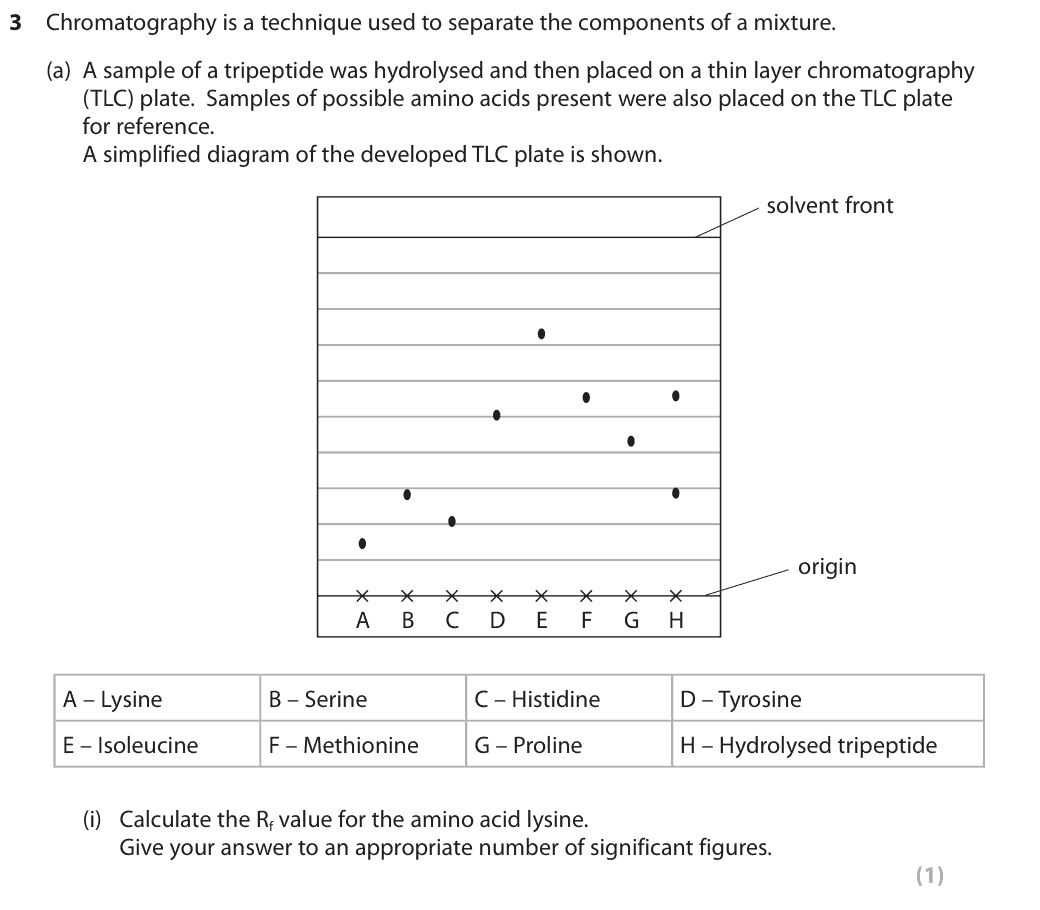
A simplified diagram of the developed TLC plate is shown.
solvent front
origin
A
B
C
D
E
F
G
H
A – Lysine
B – Serine
C – Histidine
D – Tyrosine
E – Isoleucine
F – Methionine
G – Proline
H – Hydrolysed tripeptide
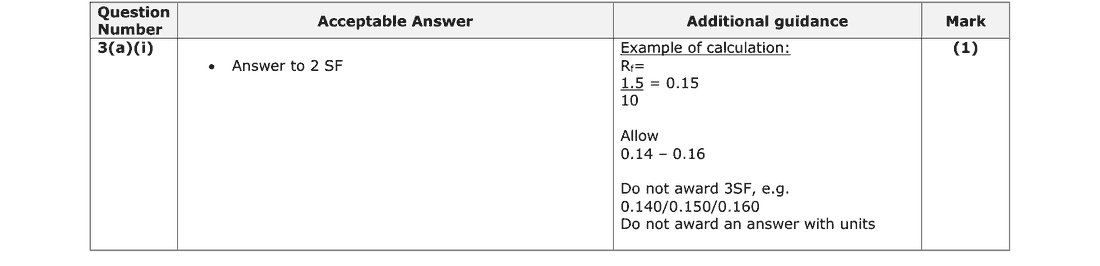
Calculate the Rf value for the amino acid lysine.
Give your answer to an appropriate number of significant figures.
June 2018 · Paper 2 · Q3(a)(ii) 3 marks Short answer amines amides amino acids and proteins
Earlier part of question 3 that this part usesEarlier part of June 2018 Paper 2 question 3
Identify by name the two amino acids present in the tripeptide, giving a
reason for the lack of a third spot.
June 2018 · Paper 2 · Q3(a)(iii) 2 marks Short answer nmr mass spectrometry and chromatography
Earlier part of question 3 that this part usesEarlier part of June 2018 Paper 2 question 3
Give two reasons why different amino acids have different Rf values.
June 2018 · Paper 2 · Q3(a)(iv) 1 mark Multiple choice amines amides amino acids and proteins
Earlier part of question 3 that this part usesEarlier part of June 2018 Paper 2 question 3
In chromatography, a ‘locating’ reagent is often used when the components in
a mixture are colourless.
Which reagent is used to locate the amino acid spots?
A  iodine
B  methyl orange
C  ninhydrin
D  phenolphthalein
June 2018 · Paper 2 · Q3(b)(i) 1 mark Short answer Easy nmr mass spectrometry and chromatography
Gas chromatography can be used both to separate the components in a mixture
and to determine the amount of each present.
State why argon and nitrogen are suitable carrier gases for gas chromatography.
June 2018 · Paper 2 · Q3(b)(ii) 3 marks Diagram or structure nmr mass spectrometry and chromatography
Earlier parts of question 3 that this part usesEarlier part of June 2018 Paper 2 question 3Earlier part of June 2018 Paper 2 question 3
A mixture containing one part substance X, two parts substance Y and one
part substance Z was separated by gas chromatography.

Substance X has a retention time of 10 seconds, substance Y of 15 seconds
and substance Z of 40 seconds.
Complete the sketch of this chromatogram.
Detector
current
10
20
30
40
50
60
Time / s
June 2018 · Paper 2 · Q4(a)(i) 1 mark Equation writing Easy formulae equations and amounts of substance
Many vehicles are fitted with airbags which provide a gas-filled safety cushion to
protect the occupant of the vehicle if there is a crash.
The first reaction in airbags is the thermal decomposition of sodium azide, NaN3,
to form sodium and nitrogen gas.
Write the equation for this decomposition of sodium azide.
State symbols are not required.
June 2018 · Paper 2 · Q4(a)(ii) 4 marks Calculation formulae equations and amounts of substance
Earlier part of question 4 that this part usesEarlier part of June 2018 Paper 2 question 4
In the reaction in (a)(i), a typical airbag is inflated by about 67 dm3 of gas.
Calculate the minimum mass of sodium azide, in grams, needed to produce
this volume of gas.  Use the Ideal Gas Equation and give your answer to an
appropriate number of significant figures.
For the purpose of this calculation, assume that the temperature is 300 °C and
the pressure is 140 000 Pa.
June 2018 · Paper 2 · Q4(b) 3 marks Short answer redox iformulae equations and amounts of substance
Earlier part of question 4 that this part usesEarlier part of June 2018 Paper 2 question 4
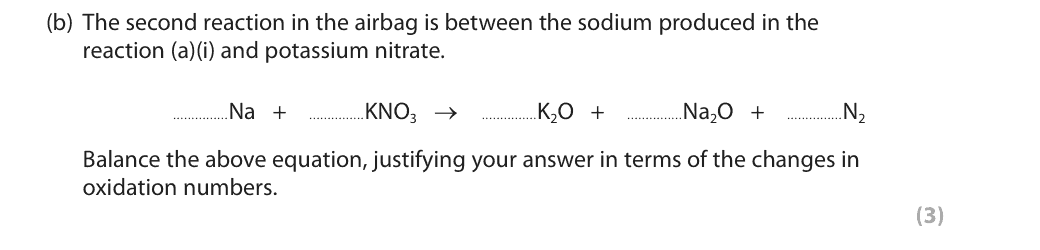
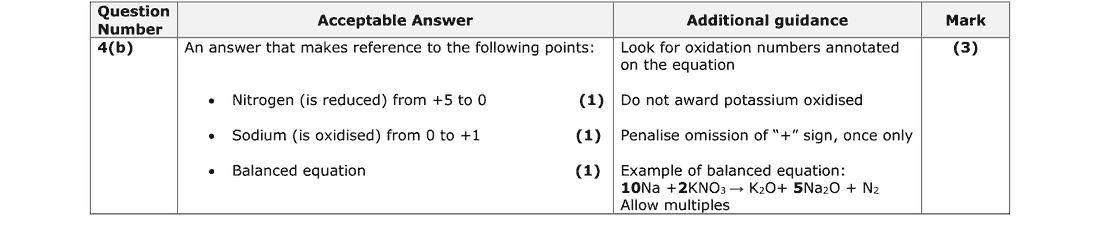
The second reaction in the airbag is between the sodium produced in the
reaction (a)(i) and potassium nitrate.
Na   +    KNO3   →    K2O   +    Na2O   +    N2
Balance the above equation, justifying your answer in terms of the changes in
oxidation numbers.
June 2018 · Paper 2 · Q4(c) 3 marks Explanation Hard formulae equations and amounts of substance
Earlier part of question 4 that this part usesEarlier part of June 2018 Paper 2 question 4
The third reaction in the airbag is between the metal oxides and silicon dioxide.
State the type of reaction taking place and justify why this reaction is necessary.
June 2018 · Paper 2 · Q4(d) 1 mark Multiple choice kinetics i
Earlier part of question 4 that this part usesEarlier part of June 2018 Paper 2 question 4
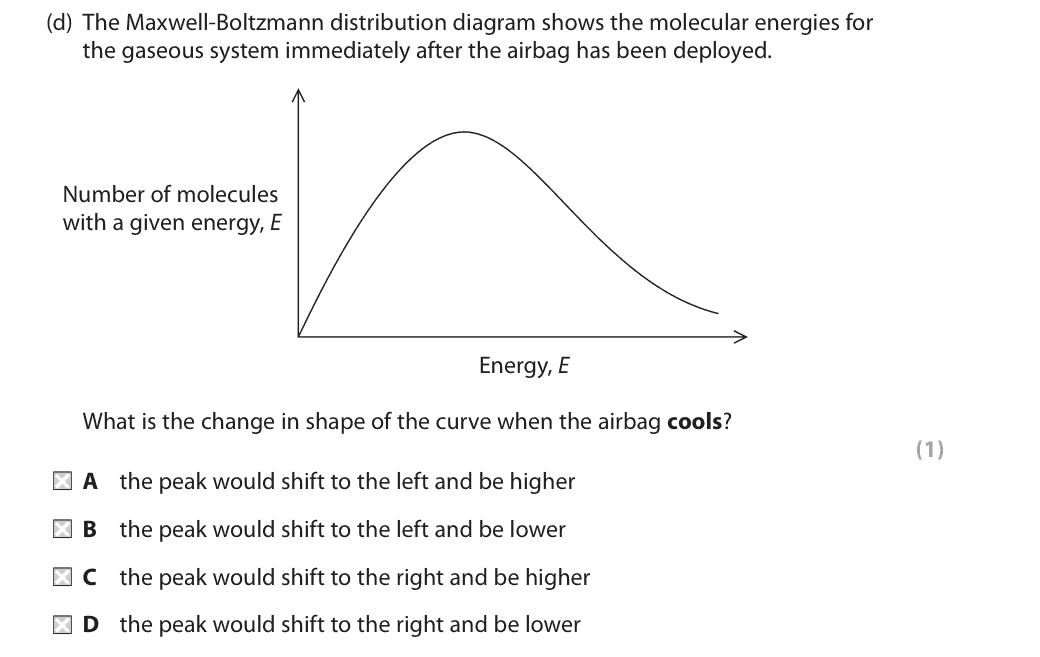
The Maxwell-Boltzmann distribution diagram shows the molecular energies for
the gaseous system immediately after the airbag has been deployed.
Number of molecules
with a given energy, E
Energy, E
What is the change in shape of the curve when the airbag cools?
A  the peak would shift to the left and be higher
B  the peak would shift to the left and be lower
C  the peak would shift to the right and be higher
D  the peak would shift to the right and be lower
June 2018 · Paper 2 · Q5(a) 2 marks Equation writing redox ialcohols
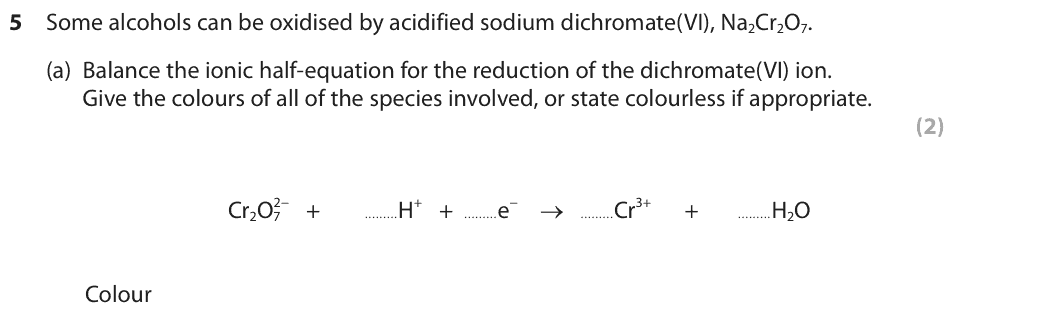
Some alcohols can be oxidised by acidified sodium dichromate(VI), Na2Cr2O7.
Balance the ionic half-equation for the reduction of the dichromate(VI) ion.
Give the colours of all of the species involved, or state colourless if appropriate.
Cr2O7
2−   +        H+   +  e−    →   Cr3+      +       H2O
Colour
June 2018 · Paper 2 · Q5(b)(i) 1 mark Diagram or structure alcohols
Earlier part of question 5 that this part usesEarlier part of June 2018 Paper 2 question 5
Reflux apparatus can be used to carry out the oxidation of alcohols.
This Liebig condenser has been set up incorrectly.  Add shading to the
diagram to show the water in the condenser, illustrating the effect of the
incorrect water flow.
open top
water in
Liebig
condenser
water out
pear-shaped
flask
anti-bumping
granules
heat
June 2018 · Paper 2 · Q5(b)(ii) 1 mark Practical and data analysis Hard alcohols
Earlier part of question 5 that this part usesEarlier part of June 2018 Paper 2 question 5
State how the granules prevent bumping.
June 2018 · Paper 2 · Q5(c) 1 mark Multiple choice alcoholsintroduction to organic chemistry
Earlier part of question 5 that this part usesEarlier part of June 2018 Paper 2 question 5
The carboxylic acid shown can be produced by oxidation of an alcohol under reflux.
OH
O
Which alcohol would be oxidised under reflux to produce this carboxylic acid?
A  1,1-dimethylethanol
B  2-methylpropan-1-ol
C  2-methylbutan-1-ol
D  propan-2-ol
June 2018 · Paper 2 · Q5(d) 2 marks Explanation alcohols
Using the apparatus for distillation instead of reflux is not an efficient way to
produce ethanoic acid from ethanol.  Explain why.
June 2018 · Paper 2 · Q6(a) 5 marks Practical and data analysis halogenoalkanes
This is a question about the hydrolysis of halogenoalkanes.
Devise an experiment, giving outline details only, that would enable the relative
rates of hydrolysis of halogenoalkanes to be compared.
June 2018 · Paper 2 · Q6(b) 2 marks Explanation halogenoalkanes
Explain the trend in the rates of hydrolysis of 1-chlorobutane, 1-bromobutane and
1-iodobutane.
June 2018 · Paper 2 · Q6(c) 3 marks Diagram or structure chirality
The product of the hydrolysis of 2-bromobutane is butan-2-ol.  Both molecules are chiral.
State what is meant by the term chiral, using three-dimensional diagrams of the
enantiomers of butan-2-ol to illustrate your answer.
June 2018 · Paper 2 · Q6(d) 6 marks 6-mark extended response kinetics iihalogenoalkanes
Compare and contrast the mechanism of hydrolysis, using aqueous potassium hydroxide,
of the primary halogenoalkane, RCH2X, with that of the tertiary halogenoalkane, R3CX.
Include diagrams of any intermediate or transition state.
Curly arrows are not required.
June 2018 · Paper 2 · Q7(a) 5 marks Short answer organic synthesisarenes benzenecarbonyl compounds
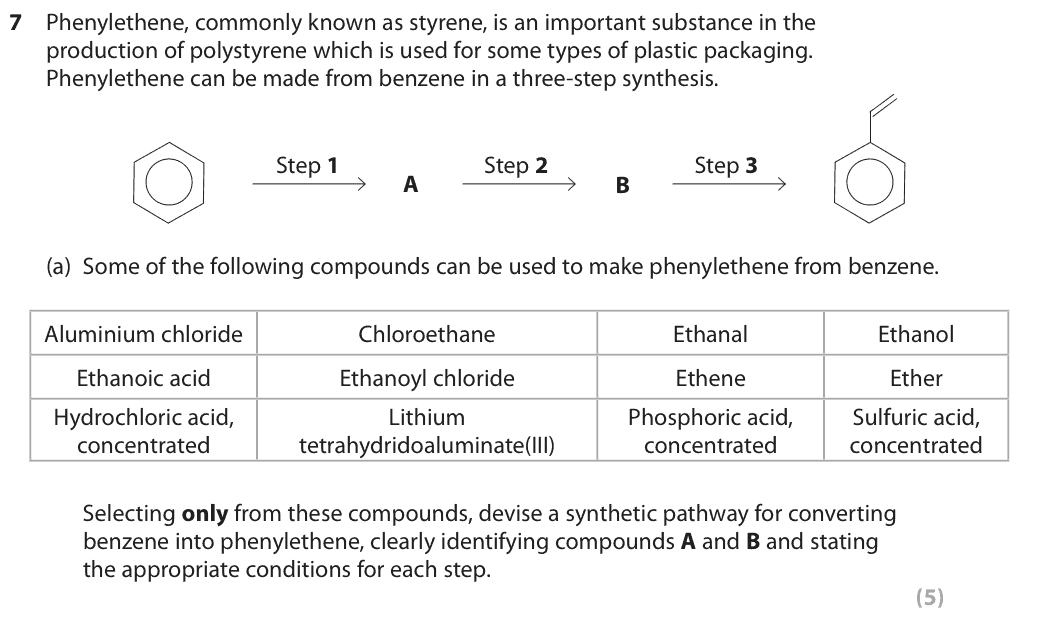
Phenylethene, commonly known as styrene, is an important substance in the
production of polystyrene which is used for some types of plastic packaging.
Phenylethene can be made from benzene in a three-step synthesis.
Step 1
Step 2
Step 3
A
B
Some of the following compounds can be used to make phenylethene from benzene.
Aluminium chloride
Chloroethane
Ethanal
Ethanol
Ethanoic acid
Ethanoyl chloride
Ethene
Ether
Hydrochloric acid,
Lithium
Phosphoric acid,
Sulfuric acid,
concentrated
tetrahydridoaluminate(III)
concentrated
concentrated
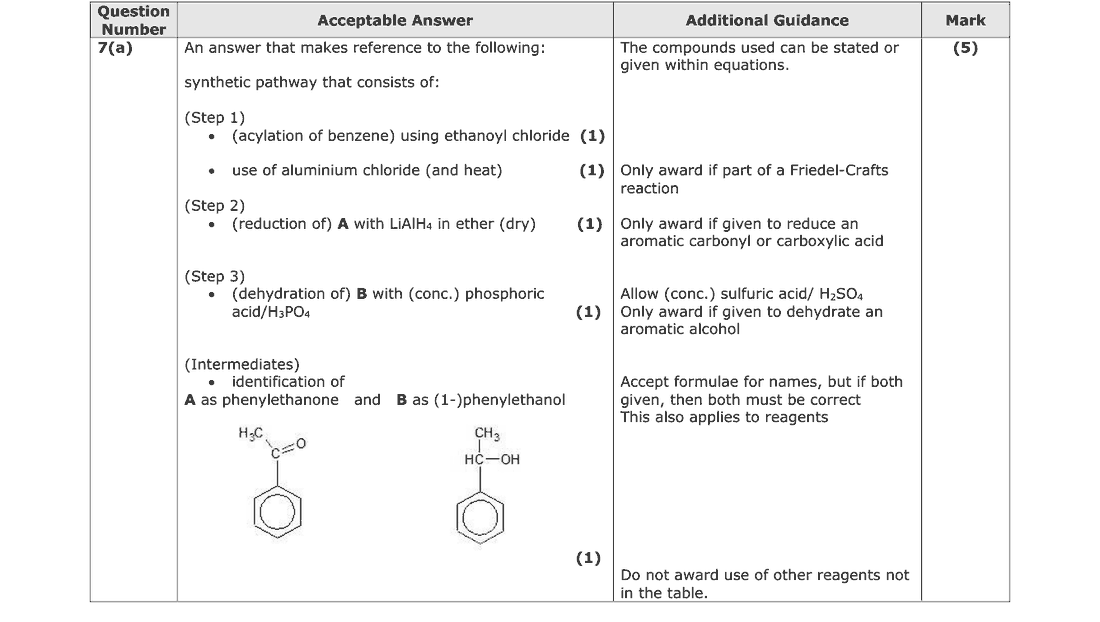
Selecting only from these compounds, devise a synthetic pathway for converting
benzene into phenylethene, clearly identifying compounds A and B and stating
the appropriate conditions for each step.
June 2018 · Paper 2 · Q7(b) 1 mark Multiple choice alkenes
Earlier part of question 7 that this part usesEarlier part of June 2018 Paper 2 question 7
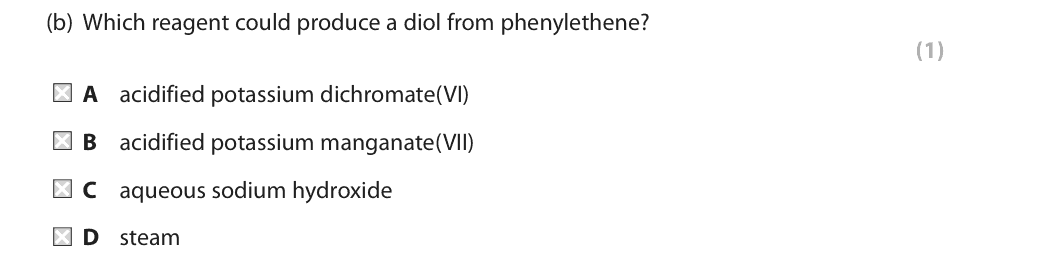
Which reagent could produce a diol from phenylethene?
A  acidified potassium dichromate(VI)
B  acidified potassium manganate(VII)
C  aqueous sodium hydroxide
D  steam
June 2018 · Paper 2 · Q7(c) 1 mark Diagram or structure Hard alkenes
Earlier part of question 7 that this part usesEarlier part of June 2018 Paper 2 question 7
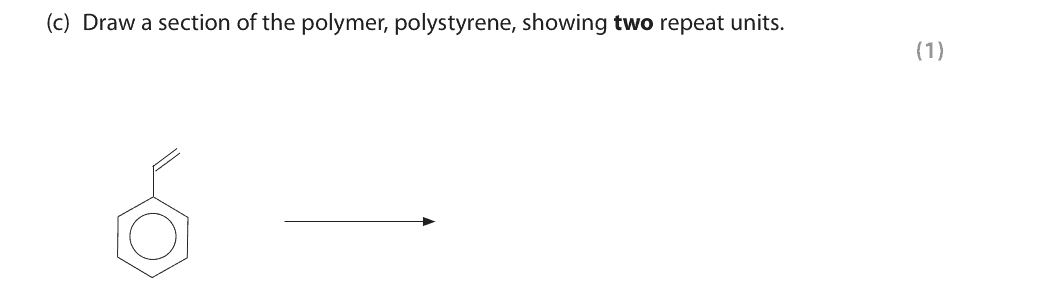
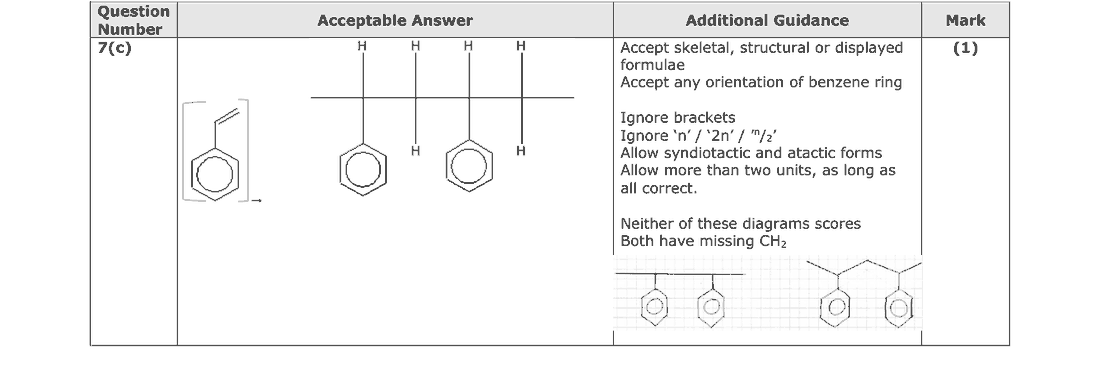
Draw a section of the polymer, polystyrene, showing two repeat units.
June 2018 · Paper 2 · Q7(d) 2 marks Short answer alkenes
Earlier part of question 7 that this part usesEarlier part of June 2018 Paper 2 question 7
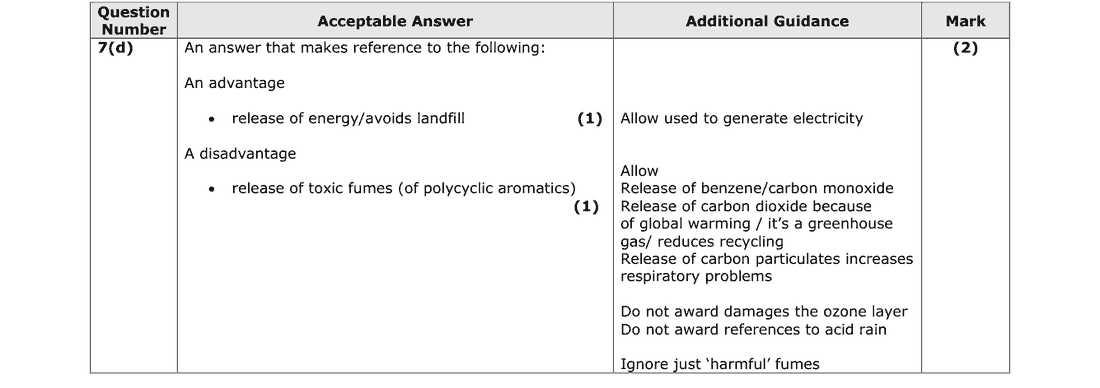
Give one advantage and one disadvantage of the disposal of polystyrene by
incineration.
June 2018 · Paper 2 · Q7(e) 2 marks Calculation atomic structure and the periodic table
Earlier part of question 7 that this part usesEarlier part of June 2018 Paper 2 question 7
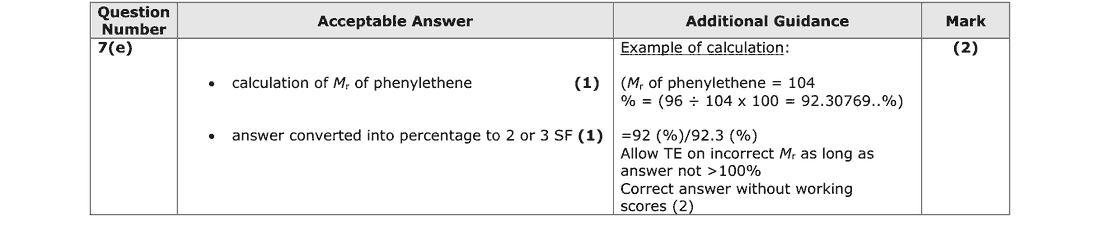
Calculate the percentage by mass of carbon in phenylethene, giving your answer
to an appropriate number of significant figures.
June 2018 · Paper 2 · Q8(a)(i) 2 marks Equation writing arenes benzene
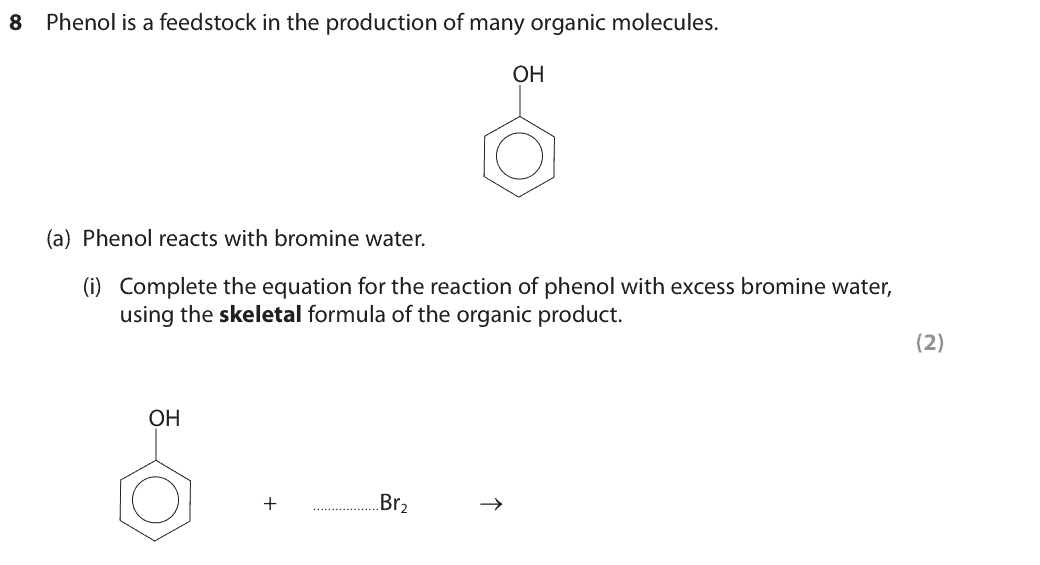
Phenol is a feedstock in the production of many organic molecules.
OH
Phenol reacts with bromine water.
Complete the equation for the reaction of phenol with excess bromine water,
using the skeletal formula of the organic product.
OH
+      Br2            →
June 2018 · Paper 2 · Q8(a)(ii) 3 marks Explanation arenes benzene
Earlier part of question 8 that this part usesEarlier part of June 2018 Paper 2 question 8
Compare and contrast the bromination of phenol with the bromination of benzene.
June 2018 · Paper 2 · Q8(b)(i) 3 marks Mechanism arenes benzene
Earlier part of question 8 that this part usesEarlier part of June 2018 Paper 2 question 8
Phenol can be nitrated to produce 4-nitrophenol.
OH
NO2
The mechanisms of the nitration of phenol and of benzene are similar.  Complete
the diagram, using curly arrows, to show a possible mechanism for the reaction
+, and phenol to produce 4-nitrophenol.
between the electrophile, NO2
OH
NO2
+
June 2018 · Paper 2 · Q8(b)(ii) 1 mark Multiple choice formulae equations and amounts of substance
Earlier parts of question 8 that this part usesEarlier part of June 2018 Paper 2 question 8Earlier part of June 2018 Paper 2 question 8
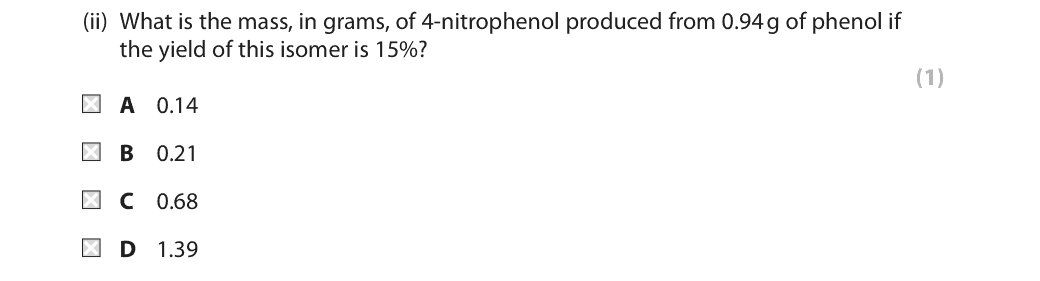
What is the mass, in grams, of 4-nitrophenol produced from 0.94 g of phenol if
the yield of this isomer is 15%?
A  0.14
B  0.21
C  0.68
D  1.39
June 2018 · Paper 2 · Q8(b)(iii) 1 mark Diagram or structure introduction to organic chemistry
Earlier parts of question 8 that this part usesEarlier part of June 2018 Paper 2 question 8Earlier part of June 2018 Paper 2 question 8
Draw two structural isomers of 4-nitrophenol which have a benzene ring.
June 2018 · Paper 2 · Q9(a) 1 mark Short answer Hard kinetics ii
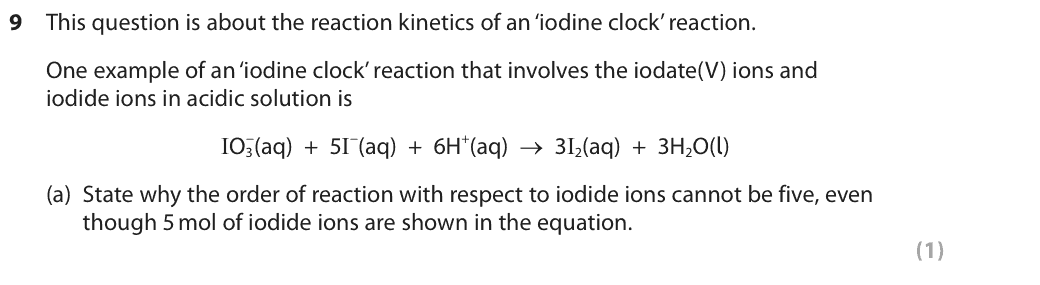
This question is about the reaction kinetics of an ‘iodine clock’ reaction.
One example of an ‘iodine clock’ reaction that involves the iodate(V) ions and
iodide ions in acidic solution is
IO3
−(aq)  +  5I−(aq)  +  6H+(aq)  →  3I2(aq)  +  3H2O(l)
State why the order of reaction with respect to iodide ions cannot be five, even
though 5 mol of iodide ions are shown in the equation.
June 2018 · Paper 2 · Q9(b)(i) 1 mark Practical and data analysis Hard kinetics ii
Earlier part of question 9 that this part usesEarlier part of June 2018 Paper 2 question 9
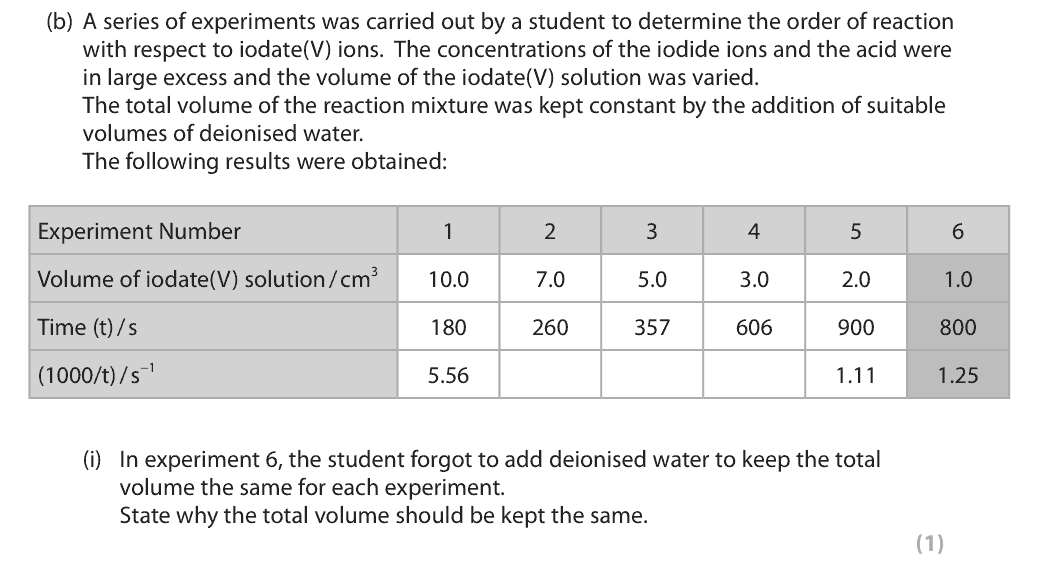
A series of experiments was carried out by a student to determine the order of reaction
with respect to iodate(V) ions.  The concentrations of the iodide ions and the acid were
in large excess and the volume of the iodate(V) solution was varied.
The total volume of the reaction mixture was kept constant by the addition of suitable
volumes of deionised water.
The following results were obtained:
Experiment Number
1
2
3
4
5
6
Volume of iodate(V) solution / cm3
10.0
7.0
5.0
3.0
2.0
1.0
Time (t) / s
180
260
357
606
900
800
(1000/t) / s−1
5.56
1.11
1.25
In experiment 6, the student forgot to add deionised water to keep the total
volume the same for each experiment.
State why the total volume should be kept the same.
June 2018 · Paper 2 · Q9(b)(ii) 4 marks Diagram or structure kinetics iikinetics i
Earlier parts of question 9 that this part usesEarlier part of June 2018 Paper 2 question 9Earlier part of June 2018 Paper 2 question 9
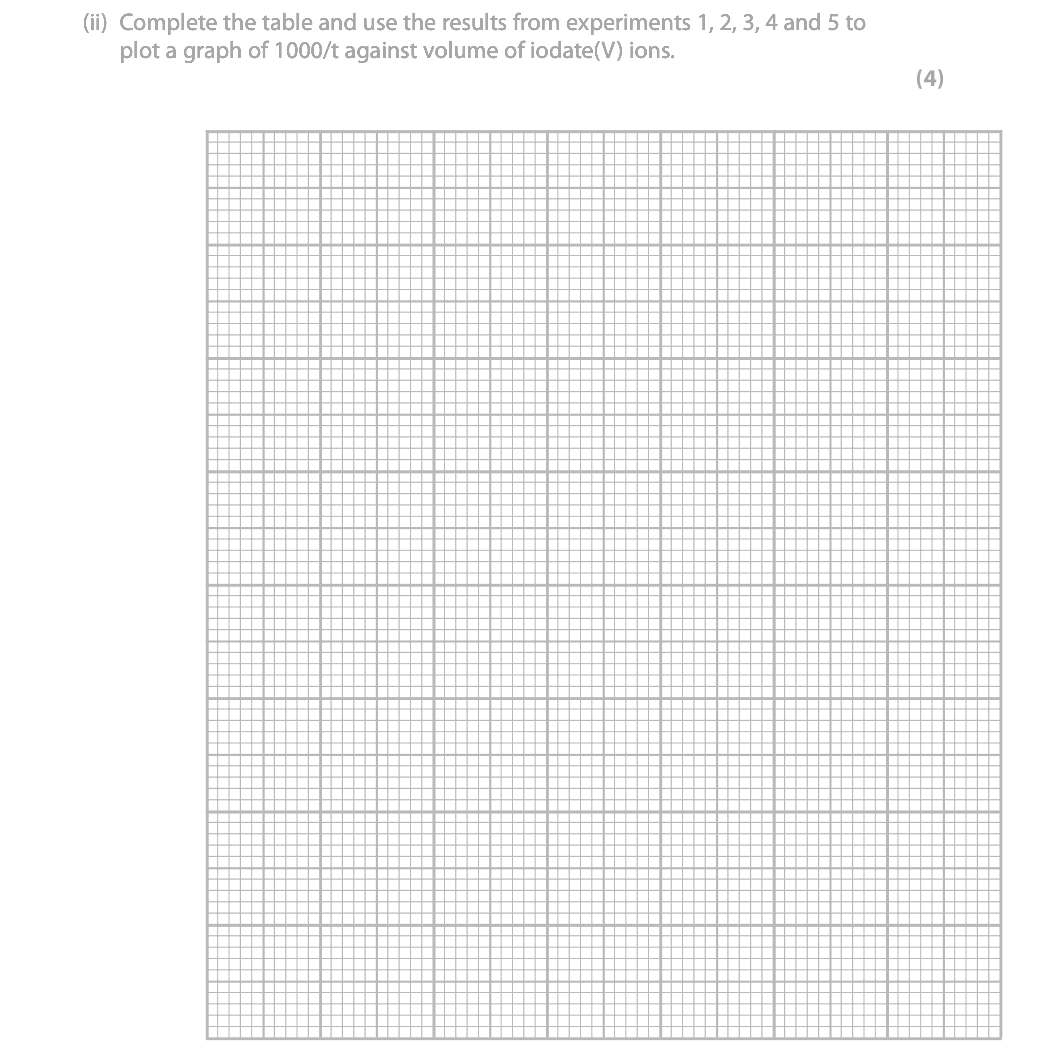
Complete the table and use the results from experiments 1, 2, 3, 4 and 5 to
plot a graph of 1000/t against volume of iodate(V) ions.
June 2018 · Paper 2 · Q9(b)(iii) 2 marks Short answer kinetics ii
Earlier parts of question 9 that this part usesEarlier part of June 2018 Paper 2 question 9Earlier part of June 2018 Paper 2 question 9Earlier part of June 2018 Paper 2 question 9
Deduce the order of reaction with respect to the iodate(V) ions.  Justify your answer.
June 2018 · Paper 2 · Q9(c)(i) 2 marks Calculation kinetics ii
Earlier part of question 9 that this part usesEarlier part of June 2018 Paper 2 question 9
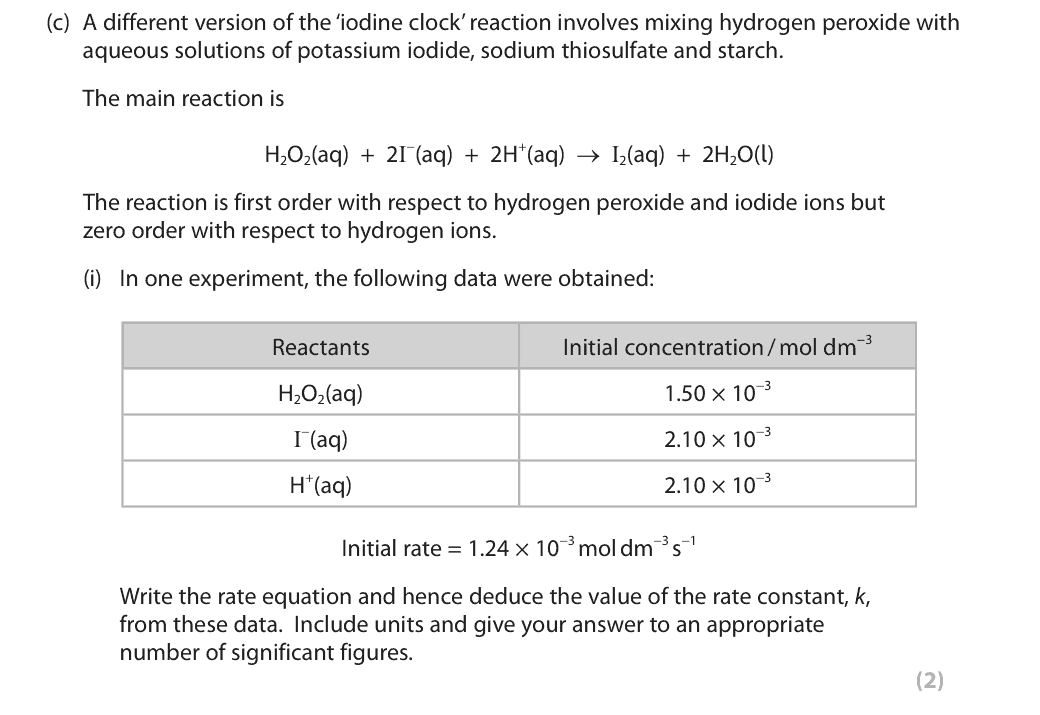
A different version of the ‘iodine clock’ reaction involves mixing hydrogen peroxide with
aqueous solutions of potassium iodide, sodium thiosulfate and starch.
The main reaction is
H2O2(aq)  +  2I−(aq)  +  2H+(aq)  →  I2(aq)  +  2H2O(l)
The reaction is first order with respect to hydrogen peroxide and iodide ions but
zero order with respect to hydrogen ions.
In one experiment, the following data were obtained:
Reactants
Initial concentration / mol dm−3
H2O2(aq)
1.50 × 10⁻³
I−(aq)
2.10 × 10⁻³
H+(aq)
2.10 × 10⁻³
Initial rate = 1.24 × 10⁻³ mol dm−3 s−1
Write the rate equation and hence deduce the value of the rate constant, k,
from these data.  Include units and give your answer to an appropriate
number of significant figures.
June 2018 · Paper 2 · Q9(c)(ii) 2 marks Practical and data analysis kinetics ii
Earlier parts of question 9 that this part usesEarlier part of June 2018 Paper 2 question 9Earlier part of June 2018 Paper 2 question 9
Explain the purpose of the starch present in the reaction mixture when starch
is neither in the rate equation, nor in the reaction equation.
June 2018 · Paper 2 · Q9(d)(i) 3 marks Calculation kinetics ii
Earlier part of question 9 that this part usesEarlier part of June 2018 Paper 2 question 9
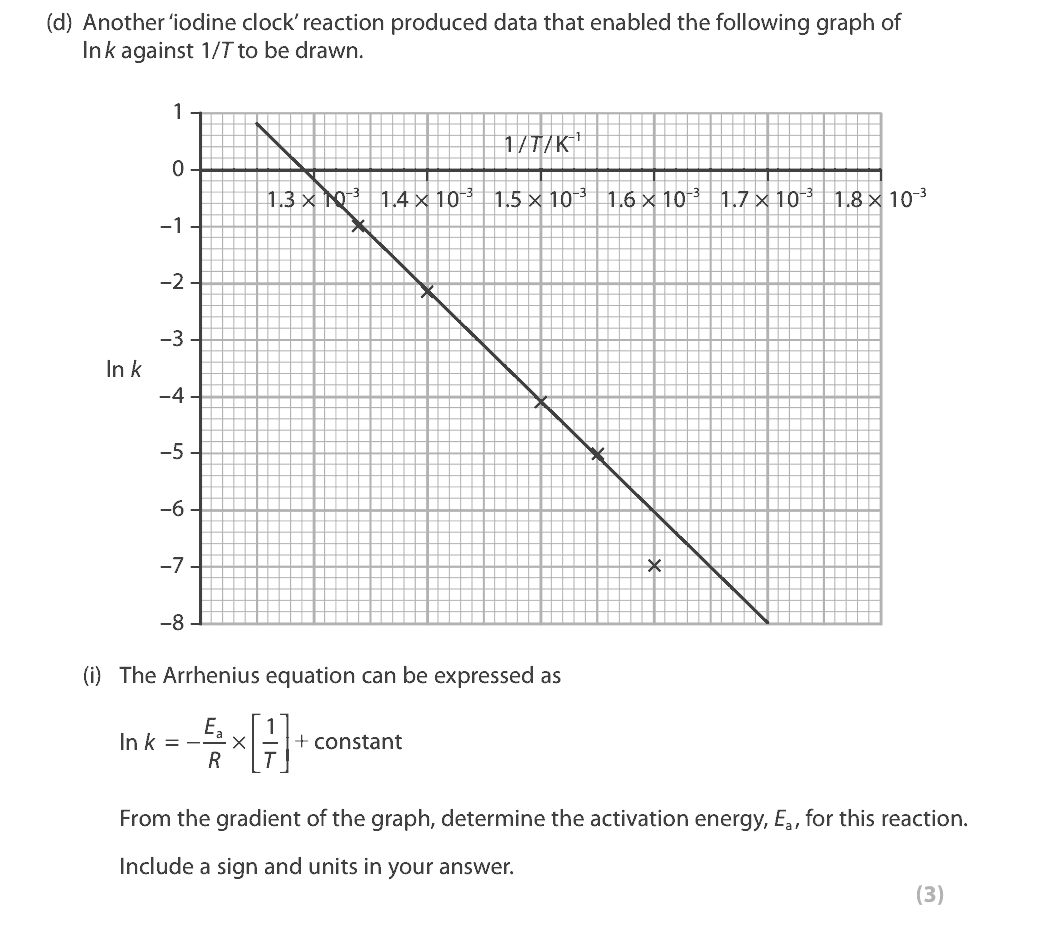
Another ‘iodine clock’ reaction produced data that enabled the following graph of
ln k against 1/T to be drawn.
1 –
1 / T / K–1
0 –
1.3 × 10⁻³
1.4 × 10⁻³
1.5 × 10⁻³
1.6 × 10⁻³
1.7 × 10⁻³
1.8 × 10⁻³
–1 –
–2 –
–3 –
ln k
–4 –
–5 –
–6 –
–7 –
–8 –
The Arrhenius equation can be expressed as
E
× 
1 +

ln k = −
a
constant


R
T
From the gradient of the graph, determine the activation energy, Ea, for this reaction.
Include a sign and units in your answer.
June 2018 · Paper 2 · Q9(d)(ii) 1 mark Short answer Easy kinetics ii
Earlier parts of question 9 that this part usesEarlier part of June 2018 Paper 2 question 9Earlier part of June 2018 Paper 2 question 9
Give a reason for the point at ln k = −7 not being included in the line drawn
on the graph.

Work with an A-level chemistry tutor

Want a paper marked and gone through with you? Message us.

Prefer email? Send an enquiry

If you are under 18, please include a parent's contact details. Enquiries go to enquiries@chemistryaleveltutor.com and are deleted once handled. All tutoring is online.