June 2017: Paper 2, Advanced Organic and Physical Chemistry

90 marks · 42 question parts · Paper, mark scheme and report on Edexcel's site · Have the Data Booklet beside you

Question by question

QTopicMarksAOType
1(a) Alkanes 1Multiple choice
1(b) Introduction to organic chemistry 1Multiple choice
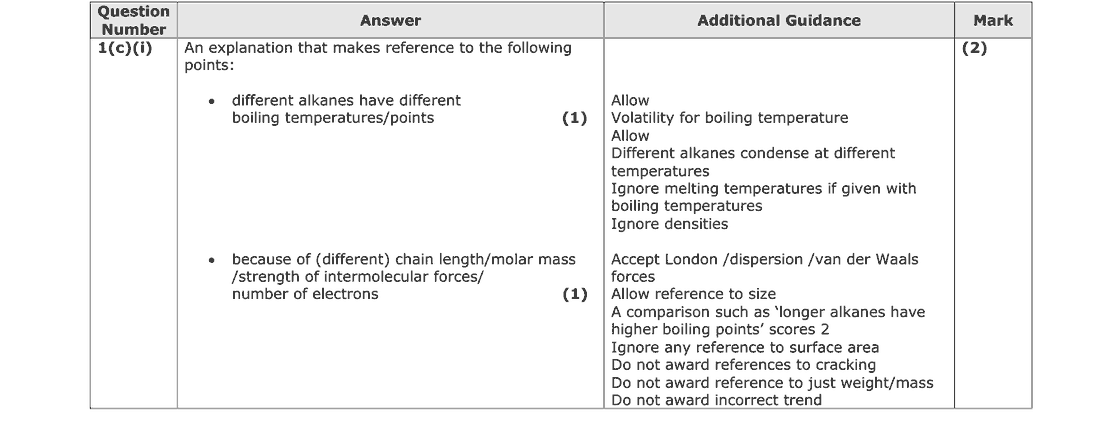
1(c)(i) Alkanes, Bonding 2Explanation
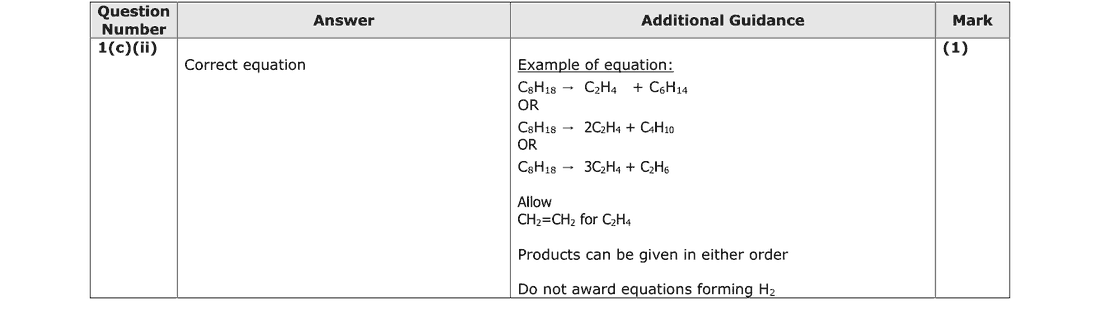
1(c)(ii) Alkanes 1Equation writing
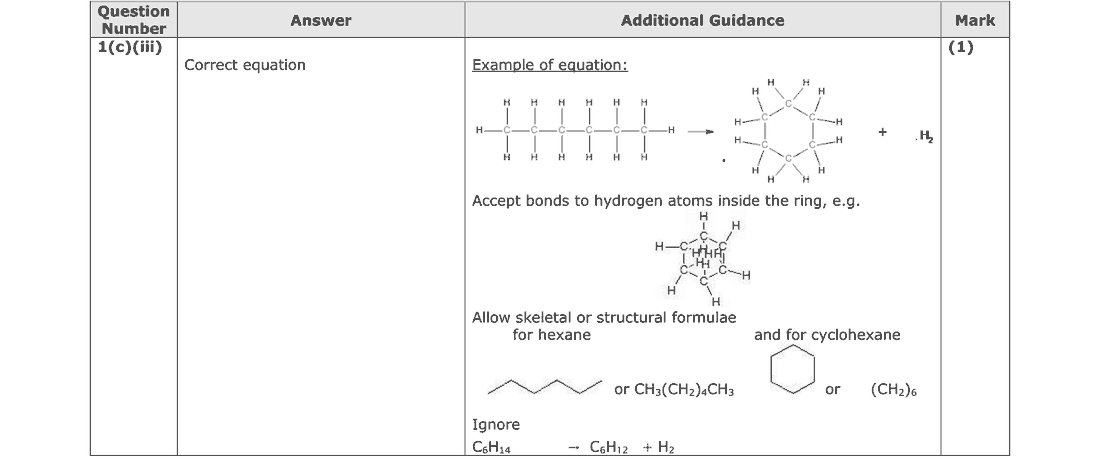
1(c)(iii) Alkanes, Introduction to organic chemistry 1Equation writing
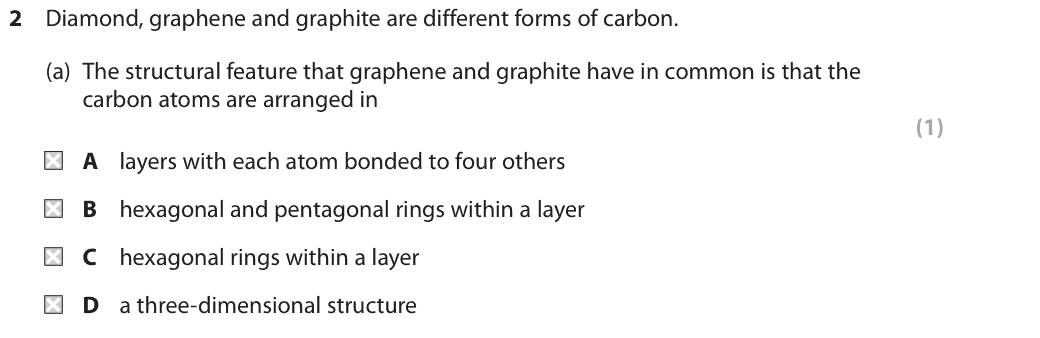
2(a) Structure 1Multiple choice
2(b) Structure 1Multiple choice
2(c) Structure 1Multiple choice
3(a) Halogenoalkanes 2Explanation
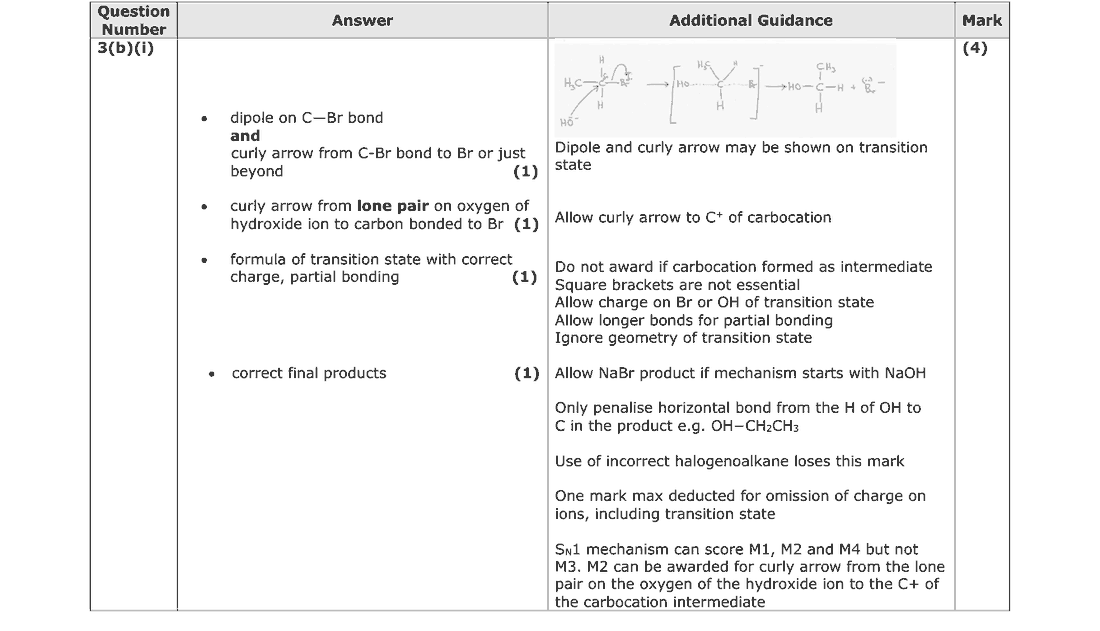
3(b)(i) Halogenoalkanes 4Mechanism
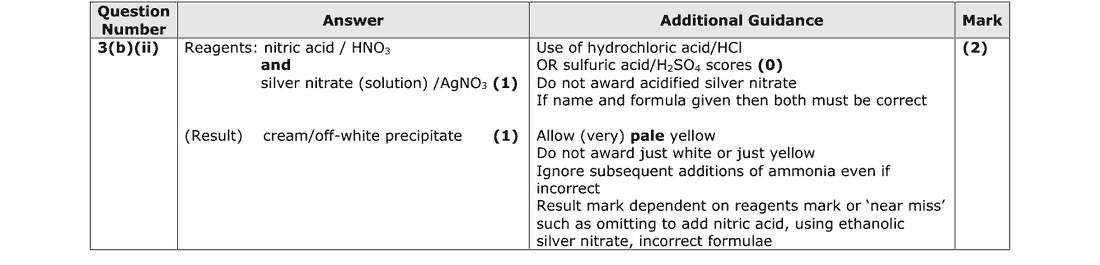
3(b)(ii) The elements of Group 7 (halogens) 2Practical and data analysis
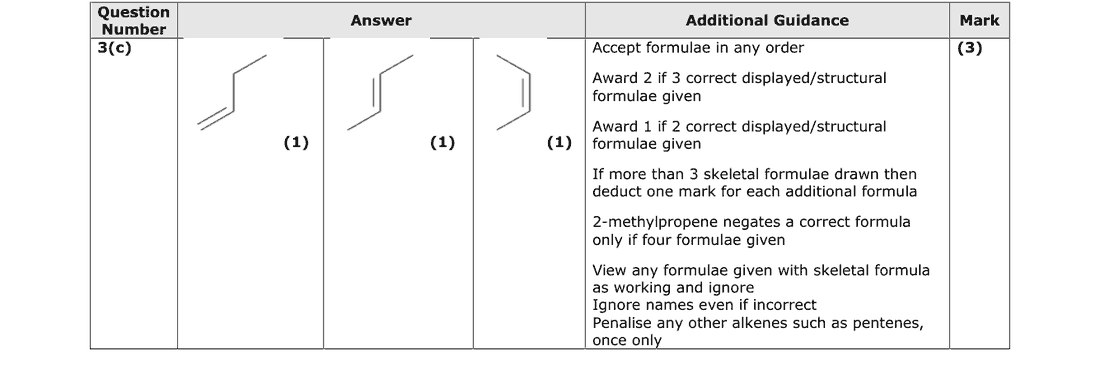
3(c) Halogenoalkanes, Introduction to organic chemistry 3Diagram or structure
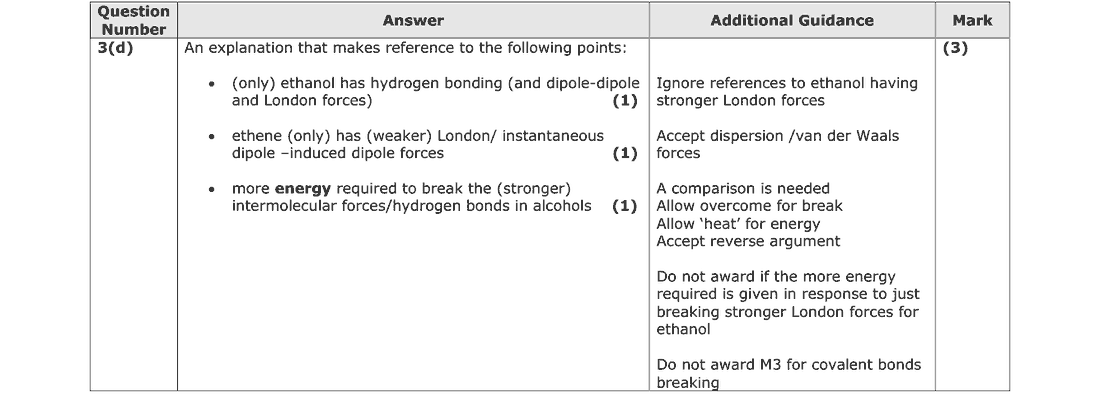
3(d) Bonding 3Explanation
4(a)(i) Formulae, equations and amounts of substance 3Calculation
4(a)(ii) Formulae, equations and amounts of substance 1Short answer
4(b) Atomic structure and the Periodic Table 2Explanation
5(a)(i) Alkanes 1Equation writing
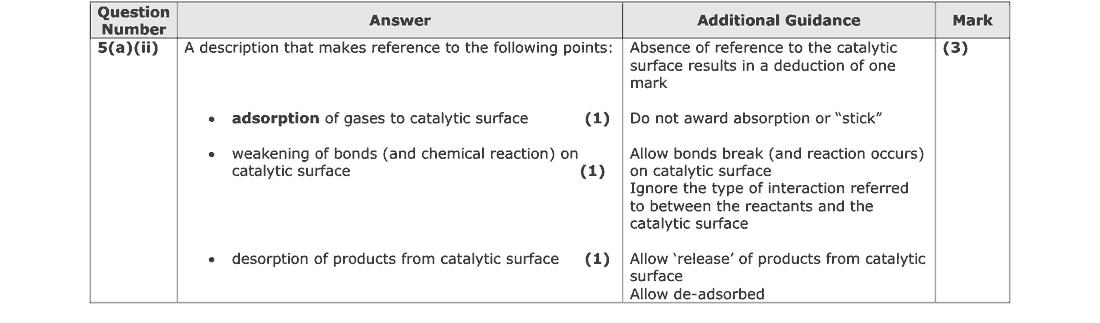
5(a)(ii) Kinetics I 3Short answer
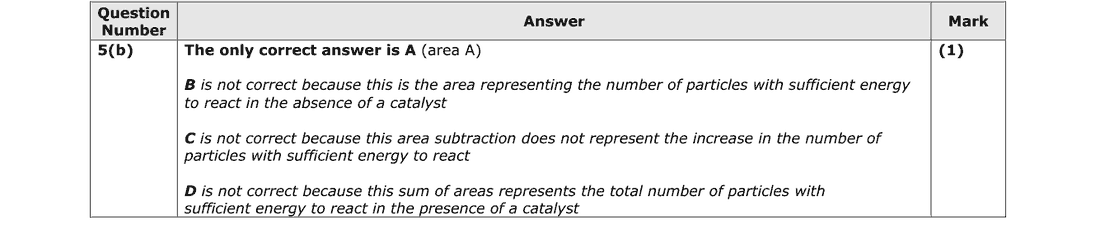
5(b) Kinetics I 1Multiple choice
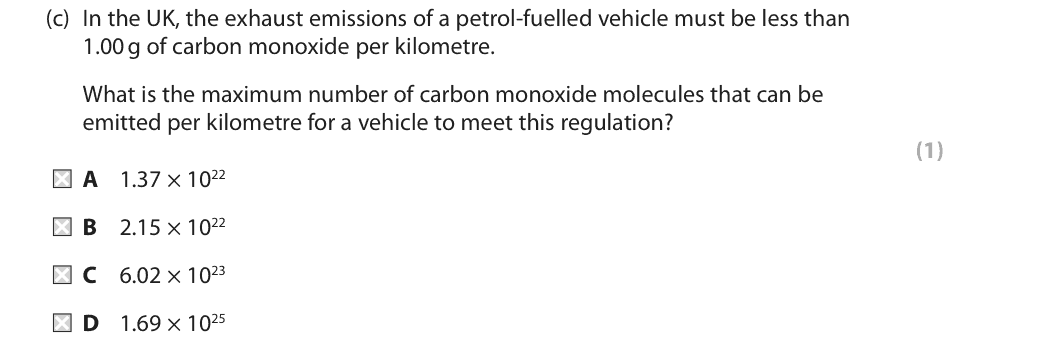
5(c) Formulae, equations and amounts of substance 1Multiple choice
6(a) Alkenes 2Diagram or structure
6(b) Amines, amides, amino acids and proteins 2Short answer
6(c) Amines, amides, amino acids and proteins 1Short answer
6(d)(i) Chirality 2Diagram or structure
6(d)(ii) Chirality 1Short answer
6(d)(iii) Alkenes 1Short answer
7(a) Organic synthesis, Arenes: benzene, Amines, amides, amino acids and proteins 5Short answer
7(b) Modern analytical techniques II: NMR, mass spectrometry and chromatography 1Multiple choice
7(c) Arenes: benzene 2Explanation
7(d) Formulae, equations and amounts of substance 2Calculation
8(a)(i) Arenes: benzene 1Equation writing
8(a)(ii) Arenes: benzene 4Mechanism
8(b)(i) Carbonyl compounds 1Multiple choice
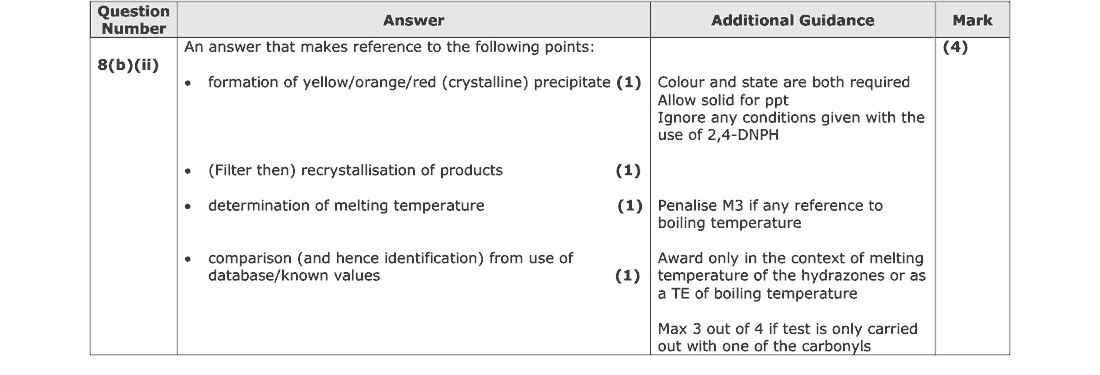
8(b)(ii) Carbonyl compounds, Organic synthesis 4Practical and data analysis
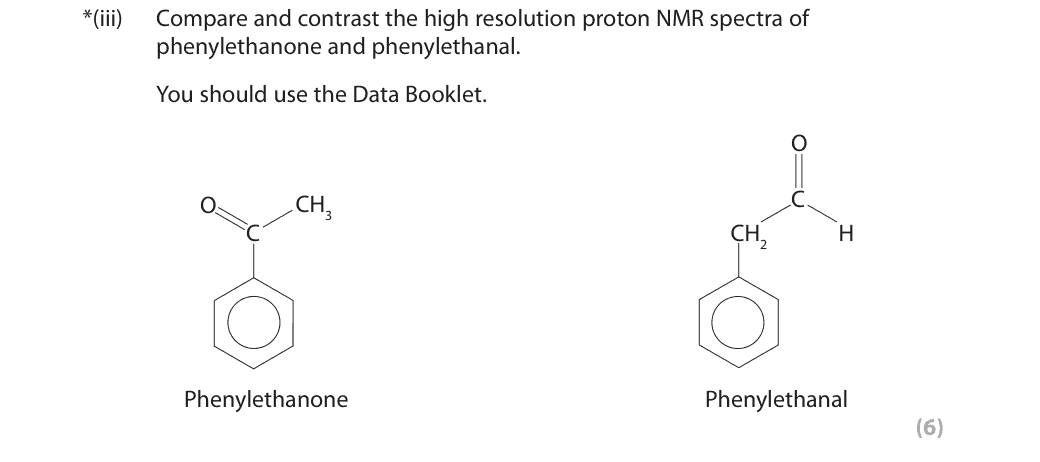
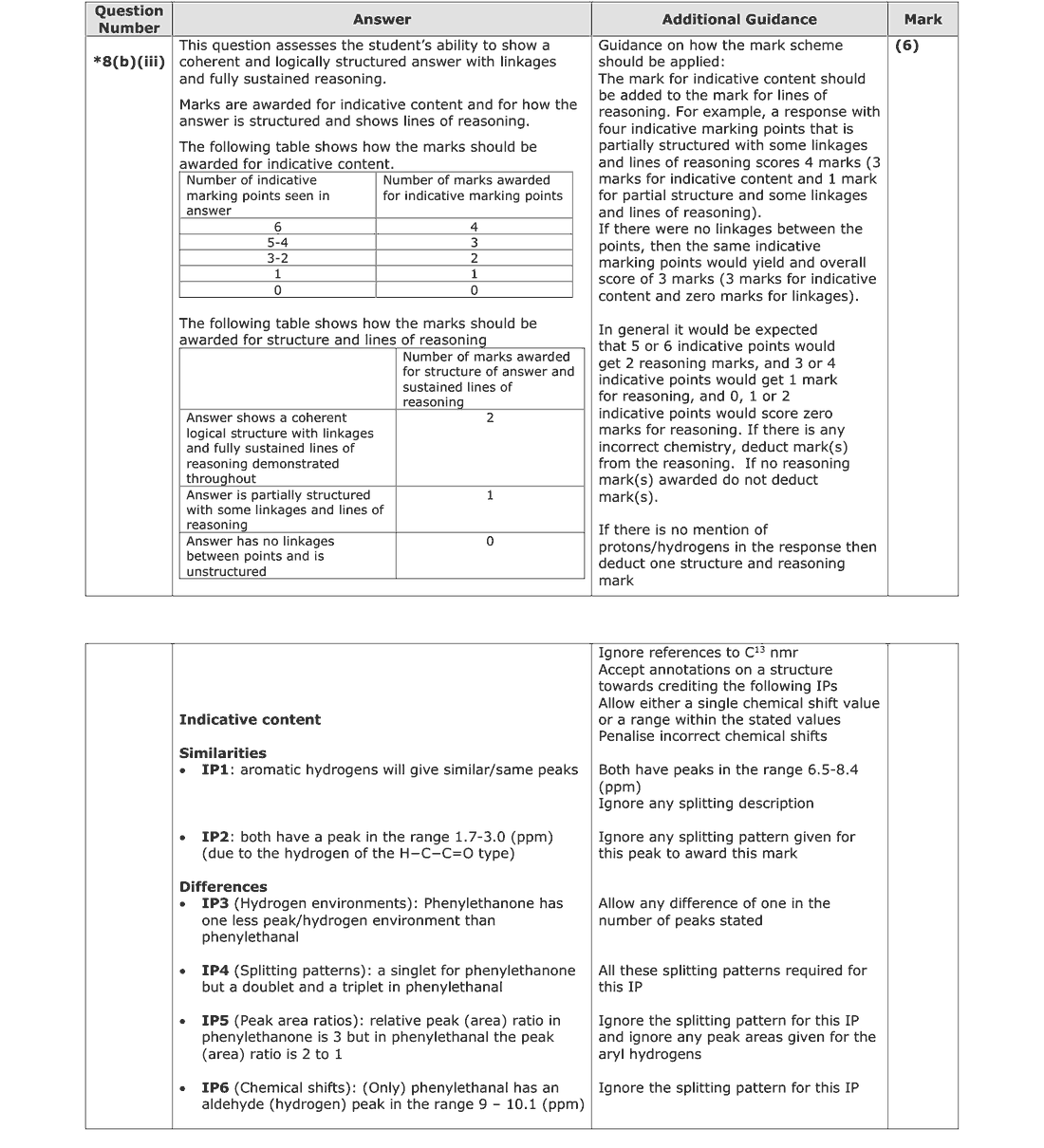
8(b)(iii) Modern analytical techniques II: NMR, mass spectrometry and chromatography 6Extended response
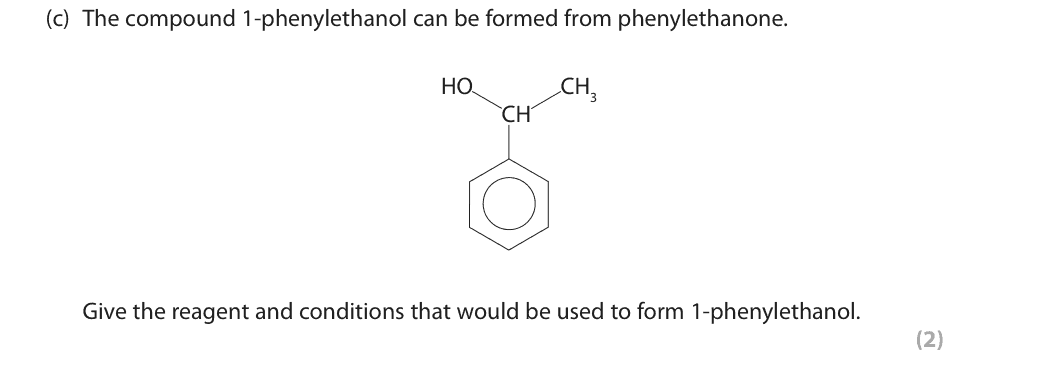
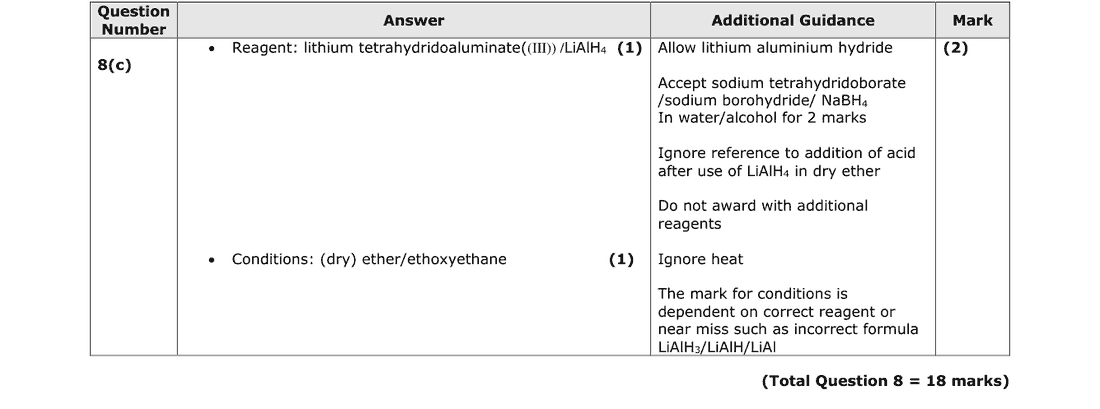
8(c) Carbonyl compounds 2Short answer
9(a) Kinetics II 1Calculation
9(b)(i) Kinetics II 3Short answer
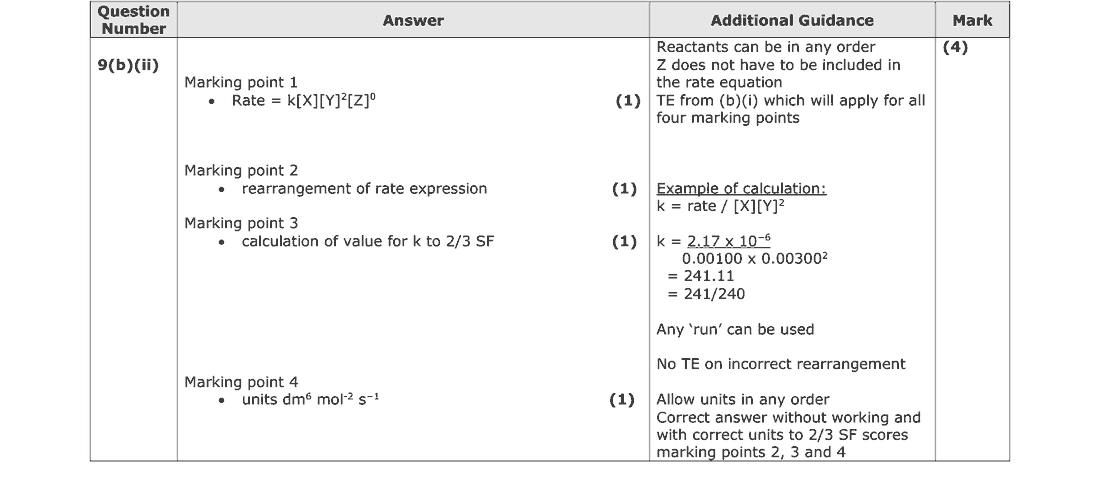
9(b)(ii) Kinetics II 4Calculation
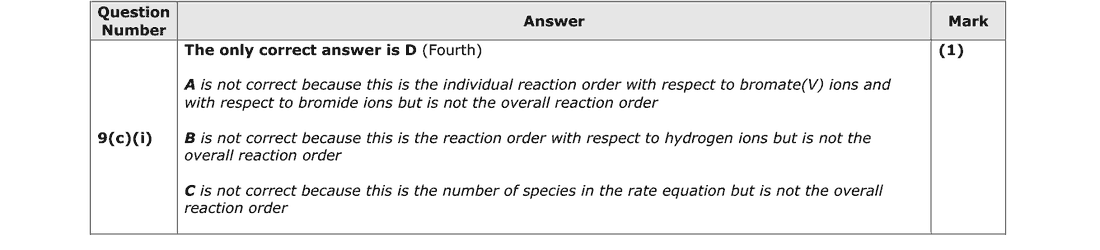
9(c)(i) Kinetics II 1Multiple choice
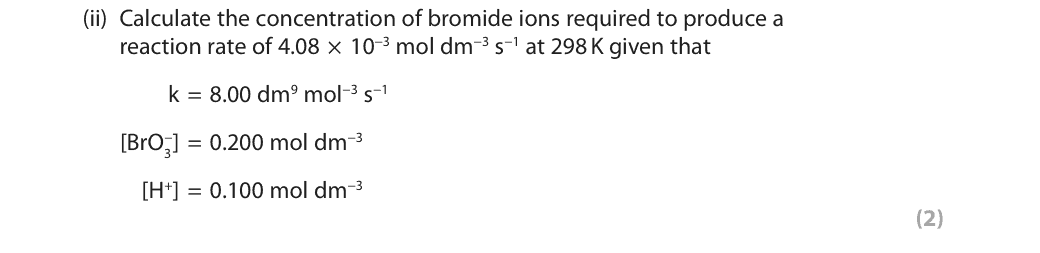
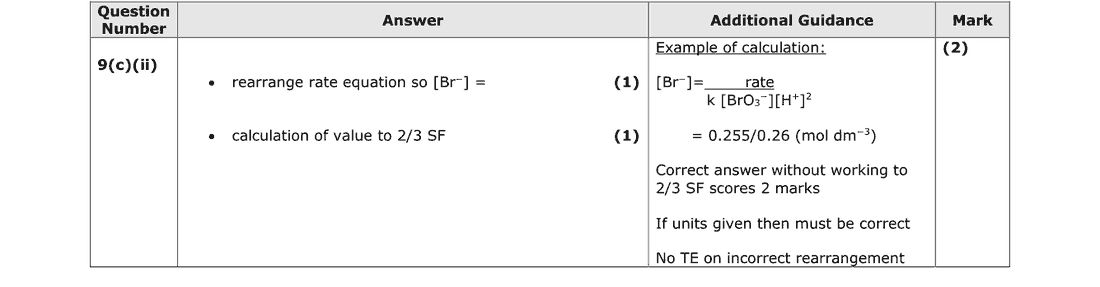
9(c)(ii) Kinetics II 2Calculation
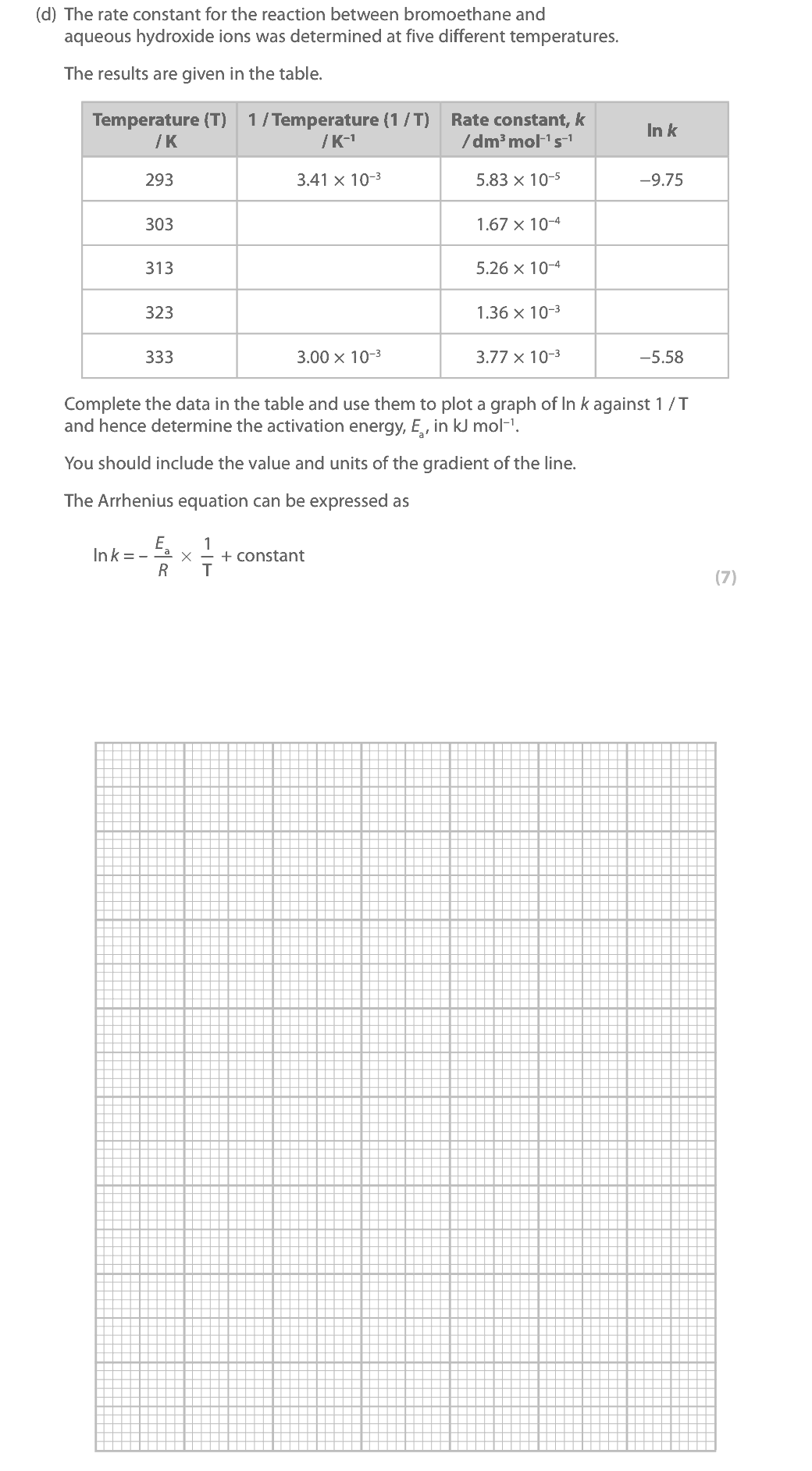
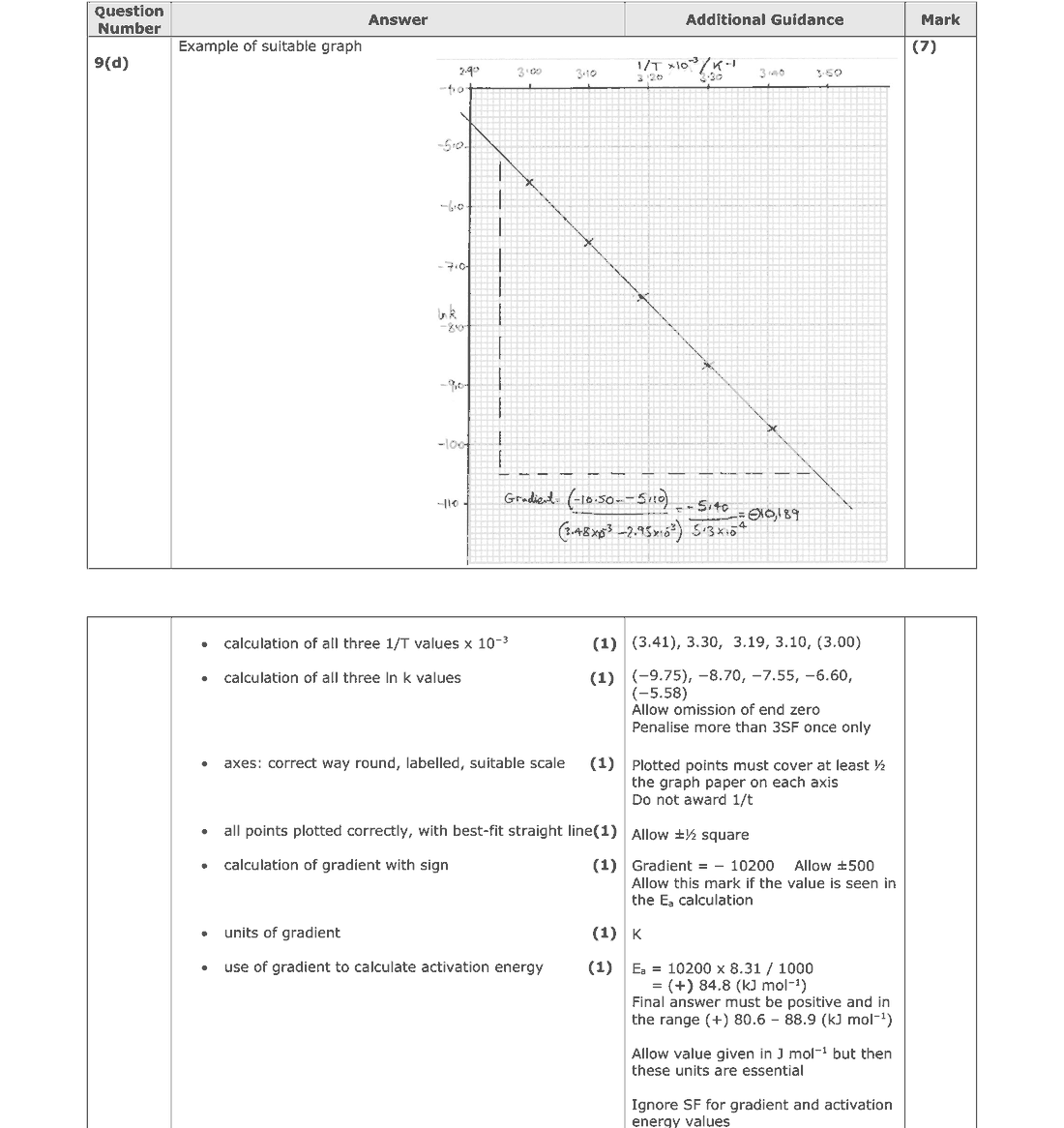
9(d) Kinetics II 7Calculation

The questions

1(a)1(b)1(c)(i)1(c)(ii)1(c)(iii)2(a)2(b)2(c)3(a)3(b)(i)3(b)(ii)3(c)3(d)4(a)(i)4(a)(ii)4(b)5(a)(i)5(a)(ii)5(b)5(c)6(a)6(b)6(c)6(d)(i)6(d)(ii)6(d)(iii)7(a)7(b)7(c)7(d)8(a)(i)8(a)(ii)8(b)(i)8(b)(ii)8(b)(iii)8(c)9(a)9(b)(i)9(b)(ii)9(c)(i)9(c)(ii)9(d)
June 2017 · Paper 2 · Q1(a) 1 mark Multiple choice alkanes
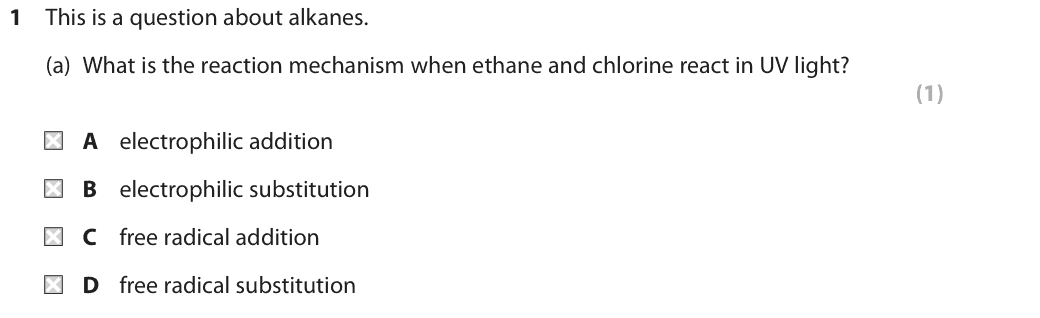
This is a question about alkanes.
What is the reaction mechanism when ethane and chlorine react in UV light?
A electrophilic addition
B electrophilic substitution
C free radical addition
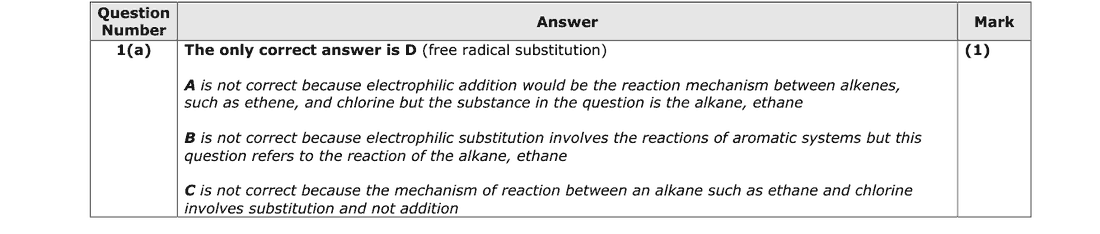
D free radical substitution
June 2017 · Paper 2 · Q1(b) 1 mark Multiple choice introduction to organic chemistry
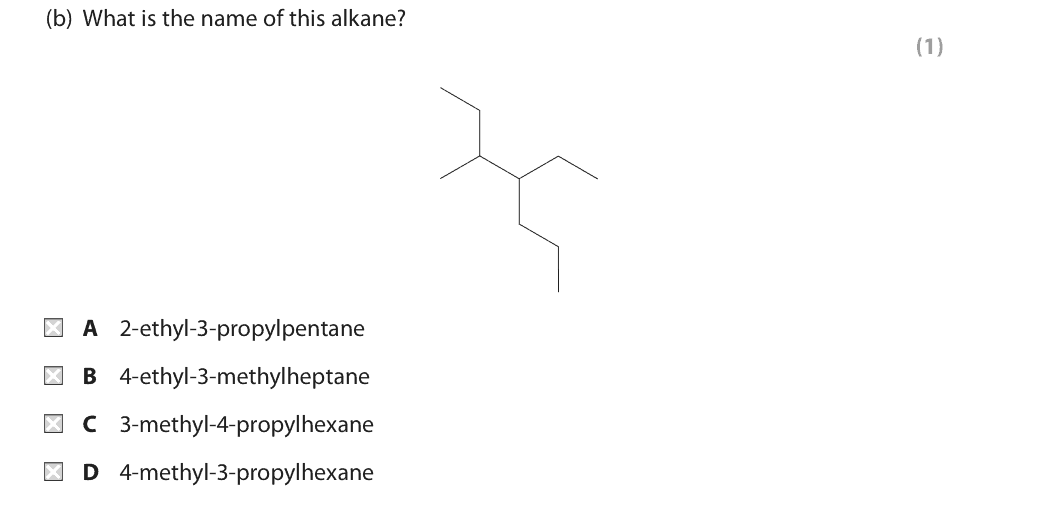
Earlier part of question 1 that this part usesEarlier part of June 2017 Paper 2 question 1
What is the name of this alkane?
A 2-ethyl-3-propylpentane
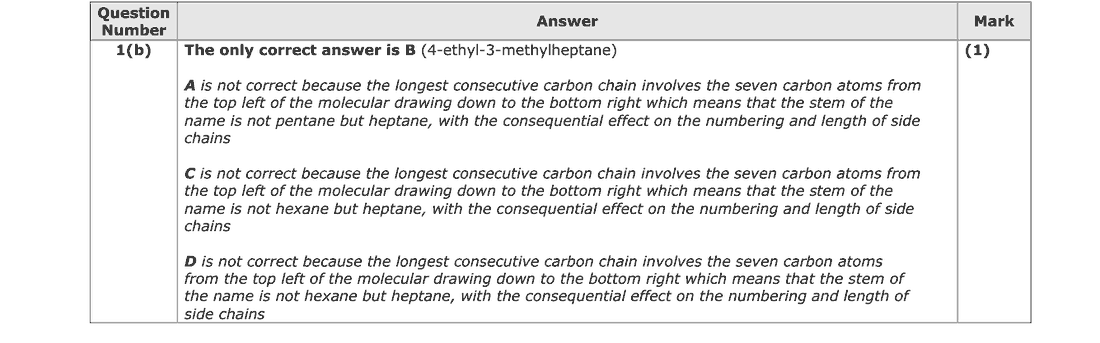
B 4-ethyl-3-methylheptane
C 3-methyl-4-propylhexane
D 4-methyl-3-propylhexane
June 2017 · Paper 2 · Q1(c)(i) 2 marks Explanation alkanesbonding
Alkanes are obtained by processing crude oil.
Explain why different alkanes in crude oil can be separated by fractional distillation.
June 2017 · Paper 2 · Q1(c)(ii) 1 mark Equation writing Easy alkanes
Earlier part of question 1 that this part usesEarlier part of June 2017 Paper 2 question 1
Complete the equation for the cracking of octane to produce ethene and only
one other organic compound.  State symbols are not required.
C8H18    r  +
June 2017 · Paper 2 · Q1(c)(iii) 1 mark Equation writing alkanesintroduction to organic chemistry
Earlier part of question 1 that this part usesEarlier part of June 2017 Paper 2 question 1
Write the equation for the reforming of hexane into cyclohexane, using
displayed formulae for the organic compounds.  State symbols are not required.
June 2017 · Paper 2 · Q2(a) 1 mark Multiple choice structure
Diamond, graphene and graphite are different forms of carbon.
The structural feature that graphene and graphite have in common is that the
carbon atoms are arranged in
A layers with each atom bonded to four others
B hexagonal and pentagonal rings within a layer
C hexagonal rings within a layer
D a three-dimensional structure
June 2017 · Paper 2 · Q2(b) 1 mark Multiple choice structure
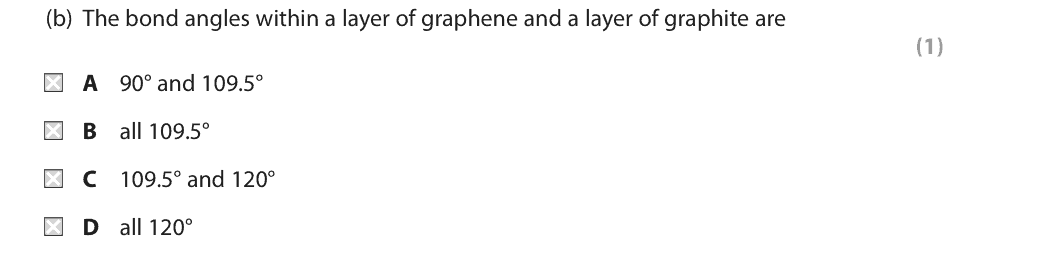
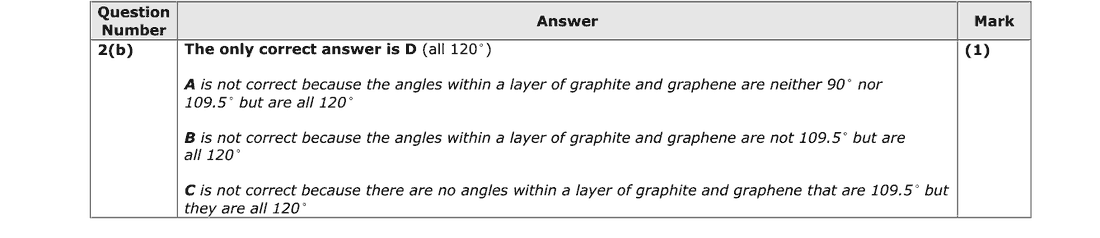
The bond angles within a layer of graphene and a layer of graphite are
A 90° and 109.5°
B all 109.5°
C 109.5° and 120°
D all 120°
June 2017 · Paper 2 · Q2(c) 1 mark Multiple choice structure
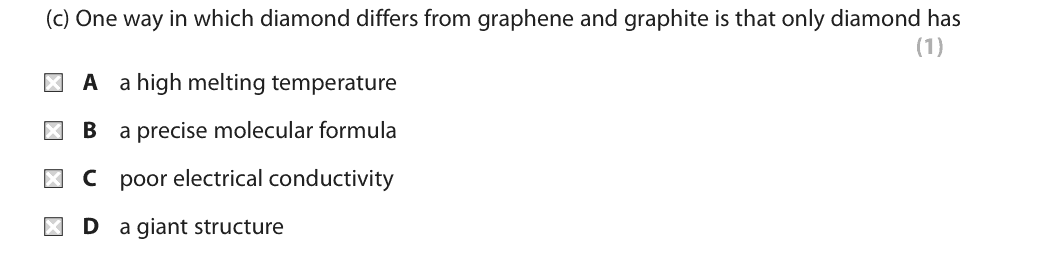
One way in which diamond differs from graphene and graphite is that only diamond has
A a high melting temperature
B a precise molecular formula
C poor electrical conductivity
D a giant structure
June 2017 · Paper 2 · Q3(a) 2 marks Explanation halogenoalkanes
This is a question about halogenoalkanes and related compounds.
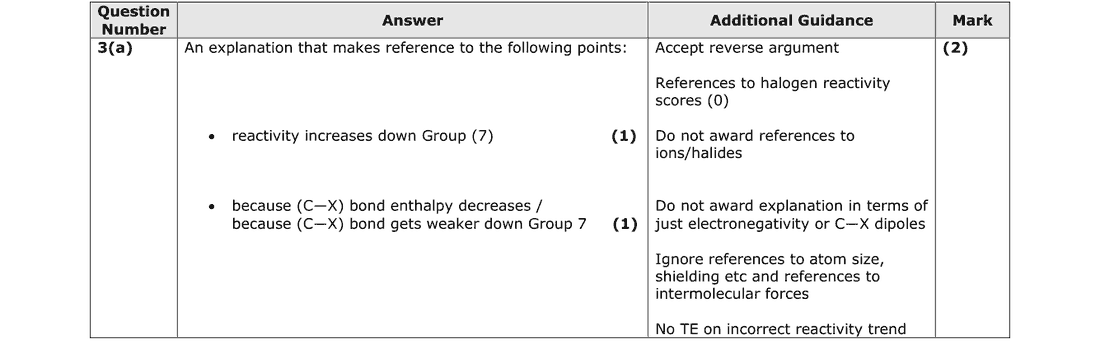
Explain the trend in reactivity of the primary chloro-, bromo- and iodoalkanes
with aqueous hydroxide ions.
June 2017 · Paper 2 · Q3(b)(i) 4 marks Mechanism halogenoalkanes
In aqueous sodium hydroxide, 1-bromoethane reacts to produce ethanol.
Write the mechanism for this reaction, including all relevant curly arrows,
lone pairs and dipoles. Include the transition state.
June 2017 · Paper 2 · Q3(b)(ii) 2 marks Practical and data analysis group 7 the halogens
Earlier part of question 3 that this part usesEarlier part of June 2017 Paper 2 question 3
Give the reagents that are used to test that bromide ions are formed in this
reaction mixture. Include the result of the test.
June 2017 · Paper 2 · Q3(c) 3 marks Diagram or structure halogenoalkanesintroduction to organic chemistry
The halogenoalkane 2-bromobutane reacts with ethanolic potassium hydroxide
to produce a mixture of alkenes.
Draw the skeletal formulae of all the alkenes that could be produced.
June 2017 · Paper 2 · Q3(d) 3 marks Explanation bonding
Explain why ethene has a boiling temperature of −104 °C, whereas ethanol has a
boiling temperature of 78 °C.
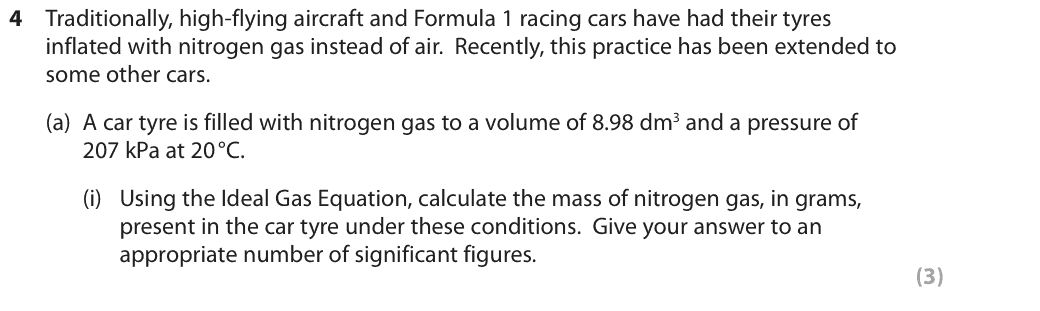
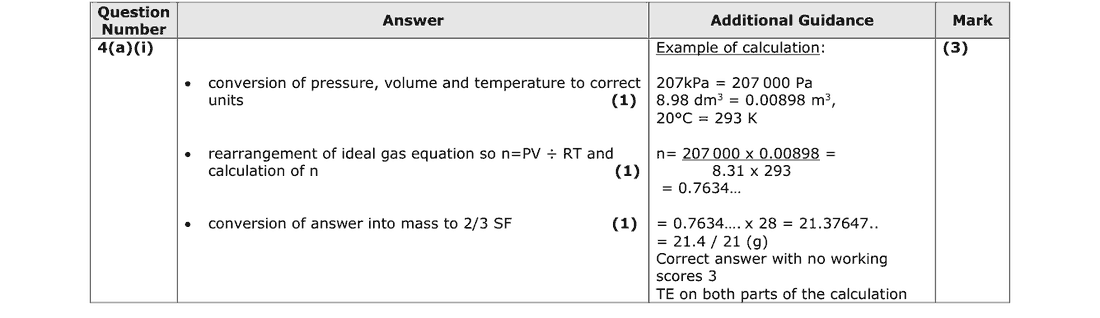
June 2017 · Paper 2 · Q4(a)(i) 3 marks Calculation formulae equations and amounts of substance
Traditionally, high-flying aircraft and Formula 1 racing cars have had their tyres
inflated with nitrogen gas instead of air.  Recently, this practice has been extended to
some other cars.
A car tyre is filled with nitrogen gas to a volume of 8.98 dm3 and a pressure of
207 kPa at 20 °C.
Using the Ideal Gas Equation, calculate the mass of nitrogen gas, in grams,
present in the car tyre under these conditions.  Give your answer to an
appropriate number of significant figures.
June 2017 · Paper 2 · Q4(a)(ii) 1 mark Short answer formulae equations and amounts of substance
Earlier part of question 4 that this part usesEarlier part of June 2017 Paper 2 question 4
During a car journey, the tyres become warm.  Use the Ideal Gas Equation to
deduce the effect that this has on the pressure in the tyres.
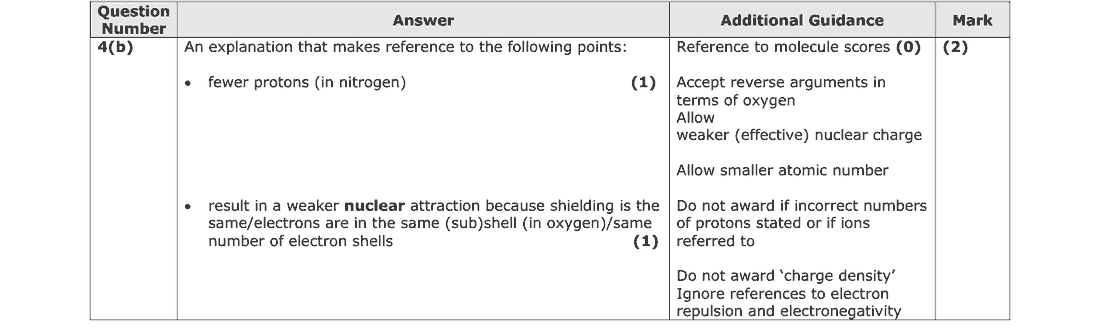
June 2017 · Paper 2 · Q4(b) 2 marks Explanation atomic structure and the periodic table
Earlier part of question 4 that this part usesEarlier part of June 2017 Paper 2 question 4
One reason for the use of nitrogen gas in car tyres is that less gas is lost from the
tyres during use because nitrogen molecules are larger than oxygen molecules.
A suggested explanation for this is that nitrogen atoms are larger than oxygen atoms.
Explain why a nitrogen atom is larger than an oxygen atom.
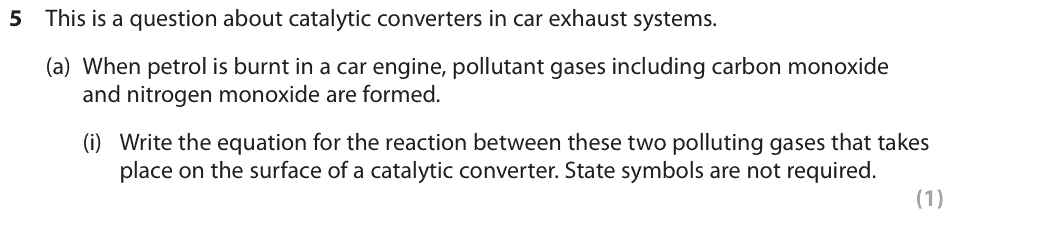
June 2017 · Paper 2 · Q5(a)(i) 1 mark Equation writing alkanes
This is a question about catalytic converters in car exhaust systems.
When petrol is burnt in a car engine, pollutant gases including carbon monoxide
and nitrogen monoxide are formed.
Write the equation for the reaction between these two polluting gases that takes
place on the surface of a catalytic converter. State symbols are not required.
June 2017 · Paper 2 · Q5(a)(ii) 3 marks Short answer kinetics i
Earlier part of question 5 that this part usesEarlier part of June 2017 Paper 2 question 5
Describe the stages by which the reaction in (a)(i) occurs in a catalytic converter.
June 2017 · Paper 2 · Q5(b) 1 mark Multiple choice kinetics i
Earlier part of question 5 that this part usesEarlier part of June 2017 Paper 2 question 5
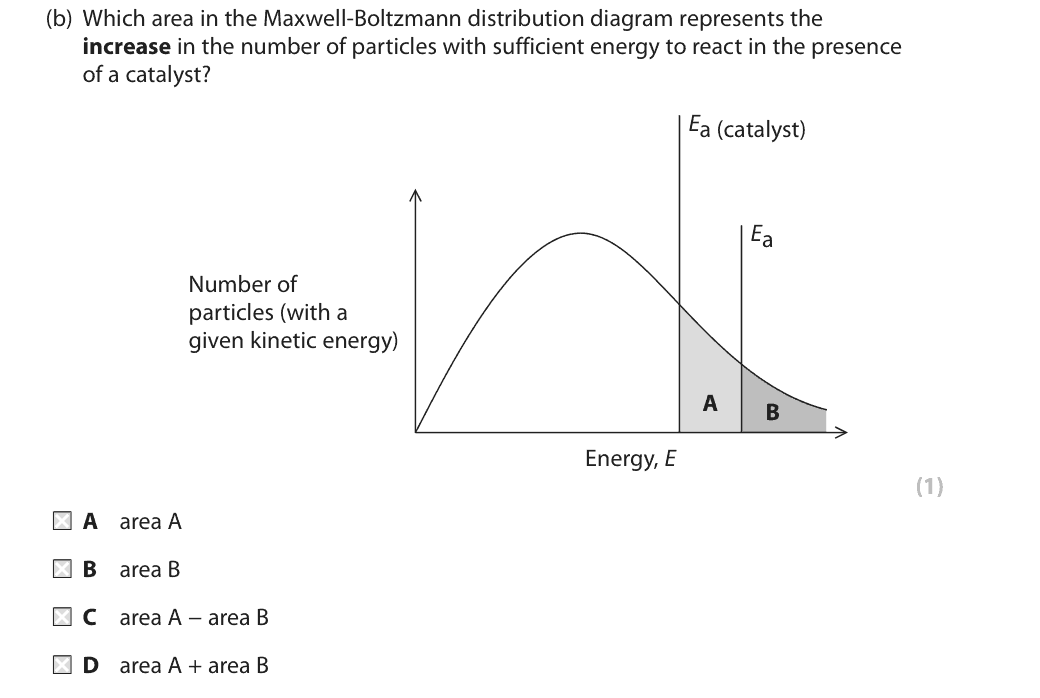
Which area in the Maxwell-Boltzmann distribution diagram represents the
increase in the number of particles with sufficient energy to react in the presence
of a catalyst?
Ea (catalyst)
Ea
Number of
particles (with a
given kinetic energy)
A
B
Energy, E
A area A
B area B
C area A − area B
D area A + area B
June 2017 · Paper 2 · Q5(c) 1 mark Multiple choice formulae equations and amounts of substance
In the UK, the exhaust emissions of a petrol-fuelled vehicle must be less than
1.00 g of carbon monoxide per kilometre.
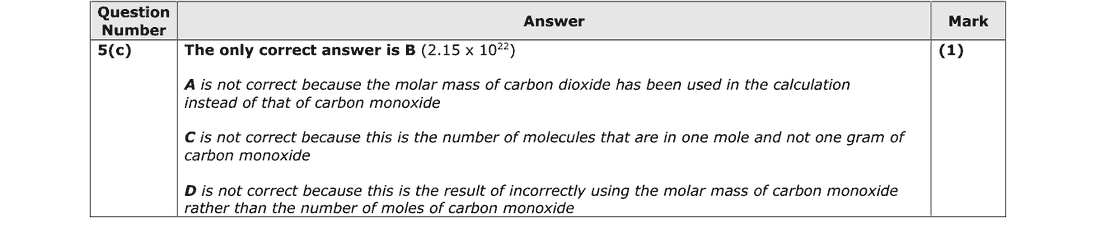
What is the maximum number of carbon monoxide molecules that can be
emitted per kilometre for a vehicle to meet this regulation?
A 1.37 × 10²²
B 2.15 × 10²²
C 6.02 × 10²³
D 1.69 × 1025
June 2017 · Paper 2 · Q6(a) 2 marks Diagram or structure alkenes
This is a question about polymerisation.
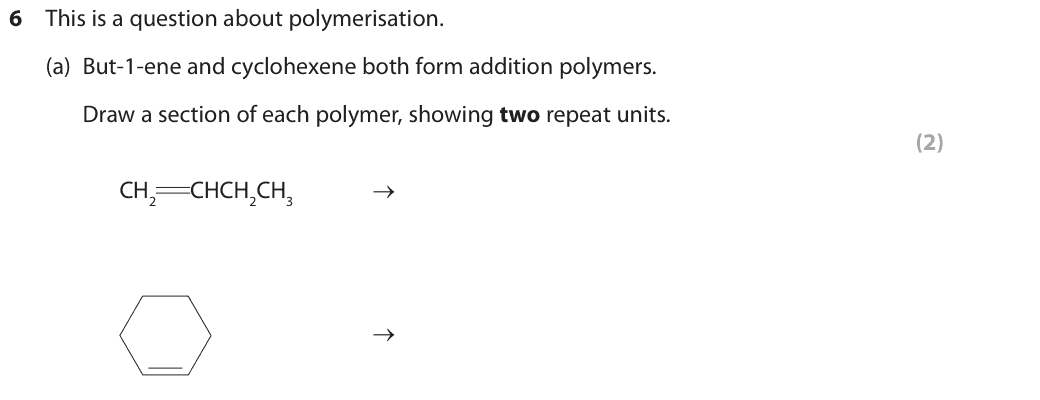
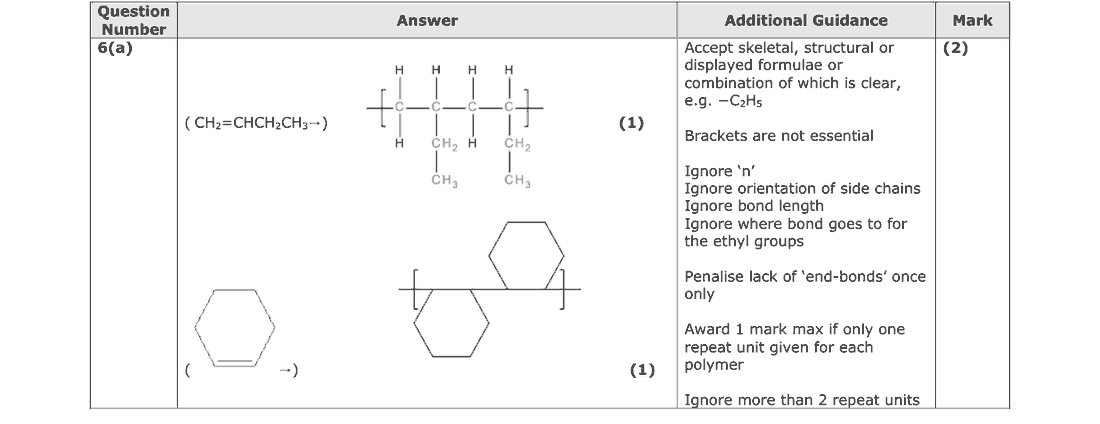
But-1-ene and cyclohexene both form addition polymers.
Draw a section of each polymer, showing two repeat units.
CH2
CHCH2CH3
r
r
June 2017 · Paper 2 · Q6(b) 2 marks Short answer amines amides amino acids and proteins
Earlier part of question 6 that this part usesEarlier part of June 2017 Paper 2 question 6
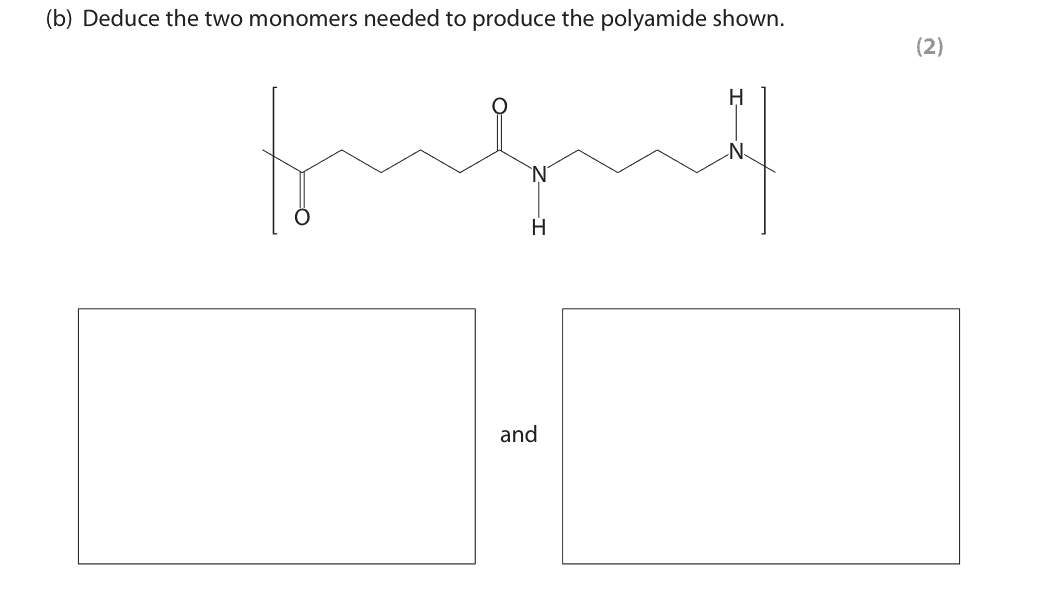
Deduce the two monomers needed to produce the polyamide shown.
H
O
N
N
O
H
and
June 2017 · Paper 2 · Q6(c) 1 mark Short answer amines amides amino acids and proteins
Earlier part of question 6 that this part usesEarlier part of June 2017 Paper 2 question 6
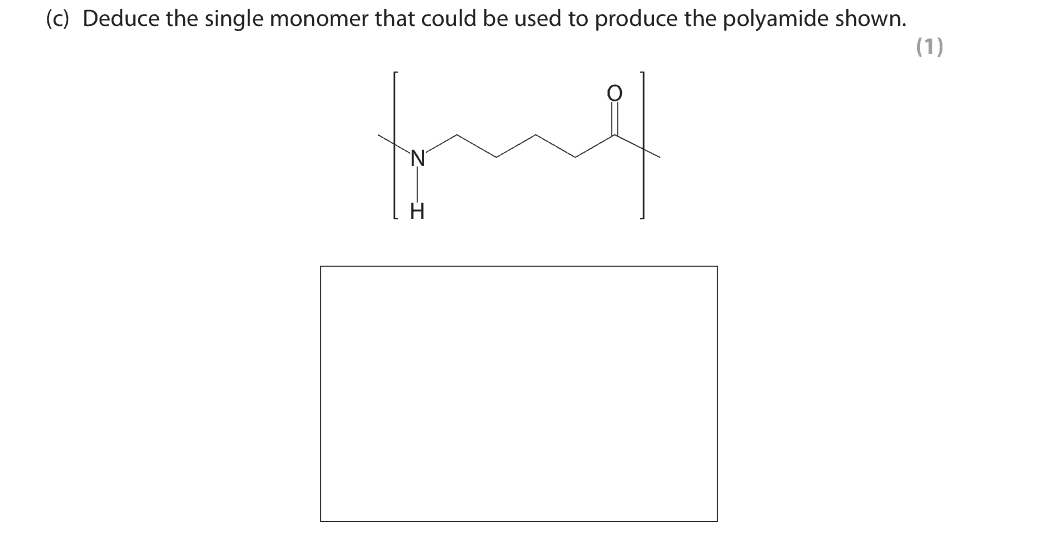
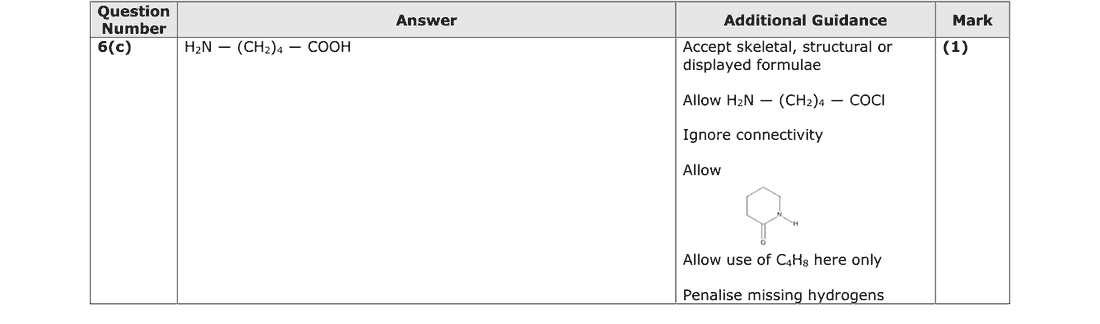
Deduce the single monomer that could be used to produce the polyamide shown.
O
N
H
June 2017 · Paper 2 · Q6(d)(i) 2 marks Diagram or structure chirality
PLA is a biodegradable polyester which is made from 2-hydroxypropanoic acid,
CH3CH(OH)COOH.
Draw the two enantiomers of 2-hydroxypropanoic acid.
June 2017 · Paper 2 · Q6(d)(ii) 1 mark Short answer chirality
Earlier part of question 6 that this part usesEarlier part of June 2017 Paper 2 question 6
State how separate samples of these two enantiomers could be distinguished
in a laboratory.
June 2017 · Paper 2 · Q6(d)(iii) 1 mark Short answer alkenes
Earlier part of question 6 that this part usesEarlier part of June 2017 Paper 2 question 6
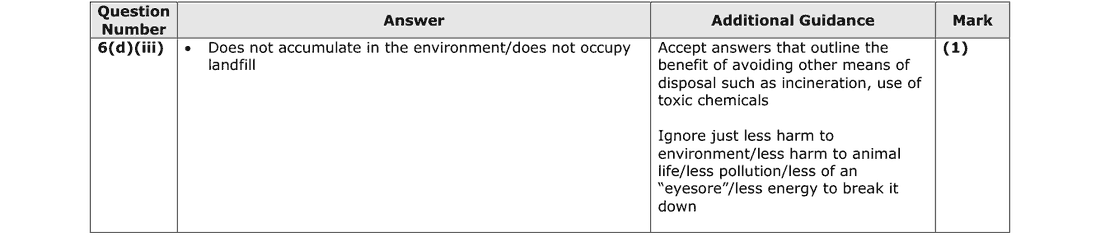
Biodegradable polyesters break down naturally.
State why this is an advantage.
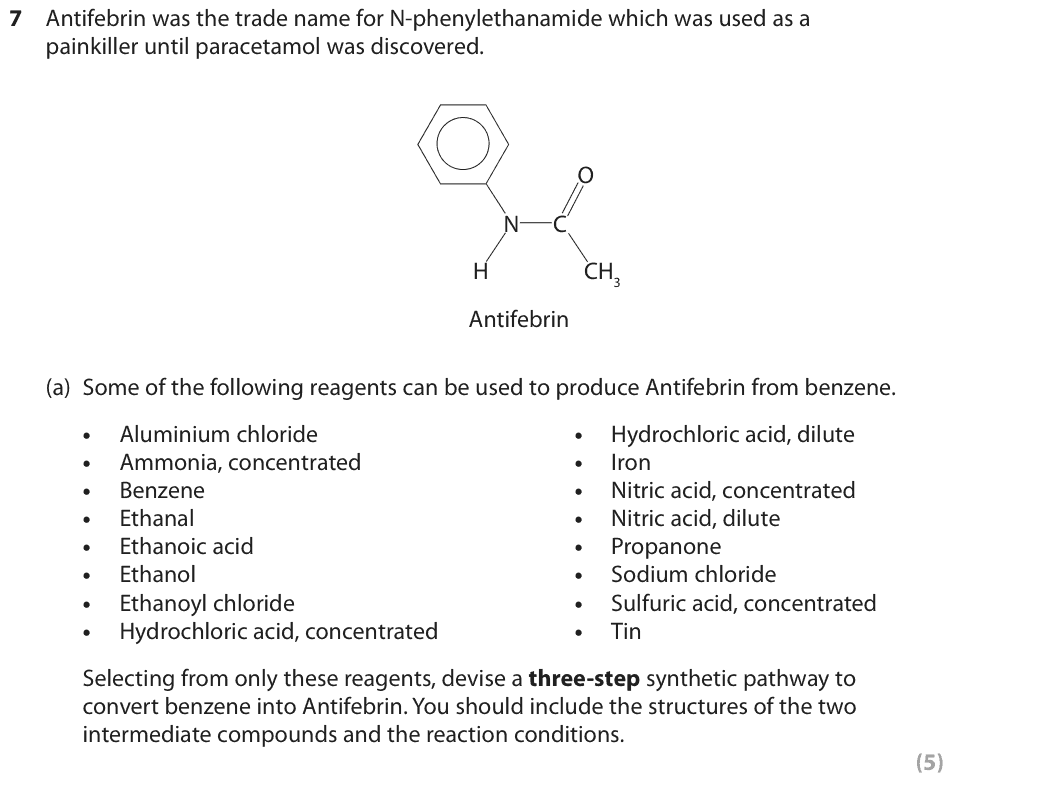
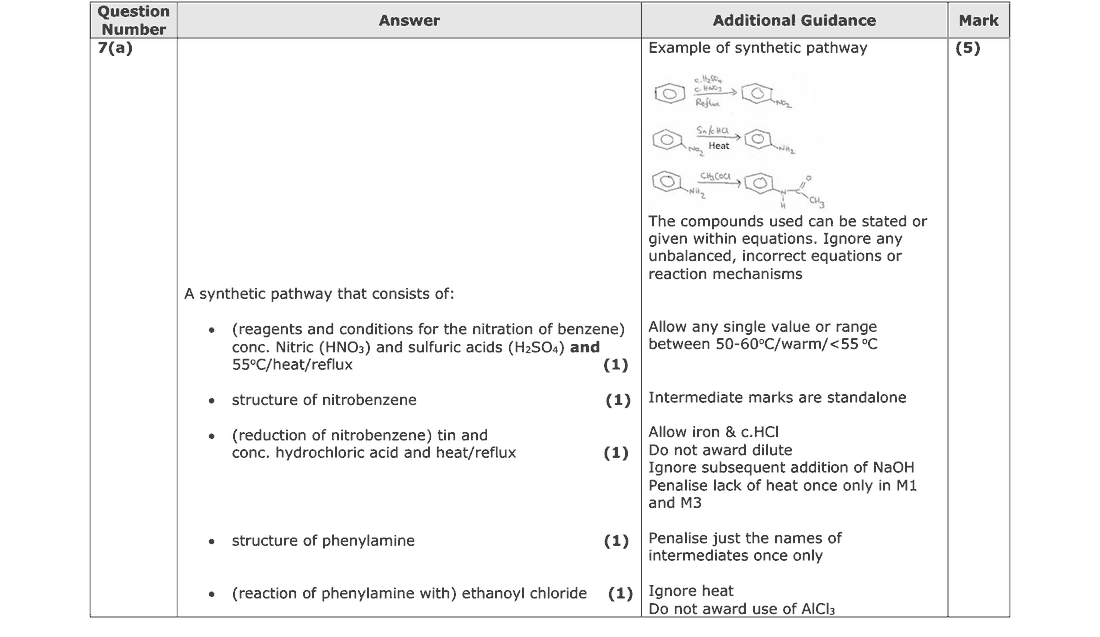
June 2017 · Paper 2 · Q7(a) 5 marks Short answer organic synthesisarenes benzeneamines amides amino acids and proteins
Antifebrin was the trade name for N-phenylethanamide which was used as a
painkiller until paracetamol was discovered.
O
N
C
H
CH3
Antifebrin
Some of the following reagents can be used to produce Antifebrin from benzene.
•
Aluminium chloride
•
Hydrochloric acid, dilute
•
Ammonia, concentrated
•
Iron
•
Benzene
•
Nitric acid, concentrated
•
Ethanal
•
Nitric acid, dilute
•
Ethanoic acid
•
Propanone
•
Ethanol
•
Sodium chloride
•
Ethanoyl chloride
•
Sulfuric acid, concentrated
•
Hydrochloric acid, concentrated
•
Tin
Selecting from only these reagents, devise a three-step synthetic pathway to
convert benzene into Antifebrin. You should include the structures of the two
intermediate compounds and the reaction conditions.
June 2017 · Paper 2 · Q7(b) 1 mark Multiple choice nmr mass spectrometry and chromatography
Earlier part of question 7 that this part usesEarlier part of June 2017 Paper 2 question 7
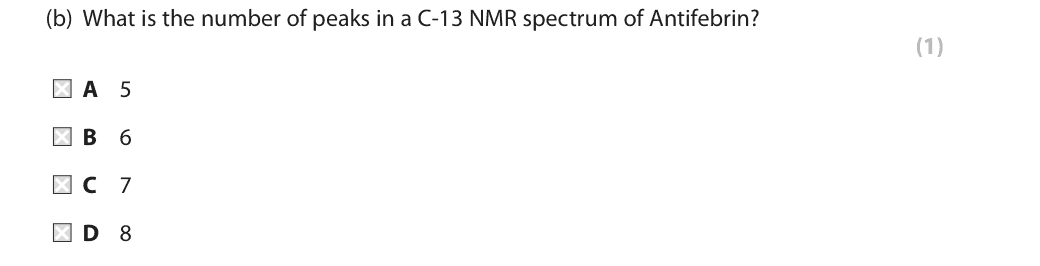
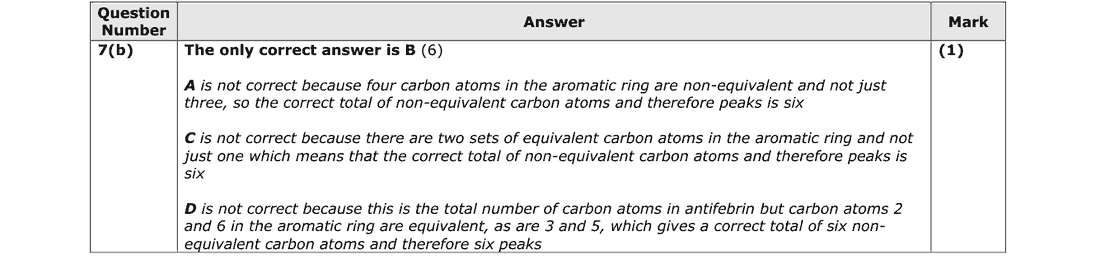
What is the number of peaks in a C-13 NMR spectrum of Antifebrin?
A 5
B 6
C 7
D 8
June 2017 · Paper 2 · Q7(c) 2 marks Explanation arenes benzene
Earlier part of question 7 that this part usesEarlier part of June 2017 Paper 2 question 7
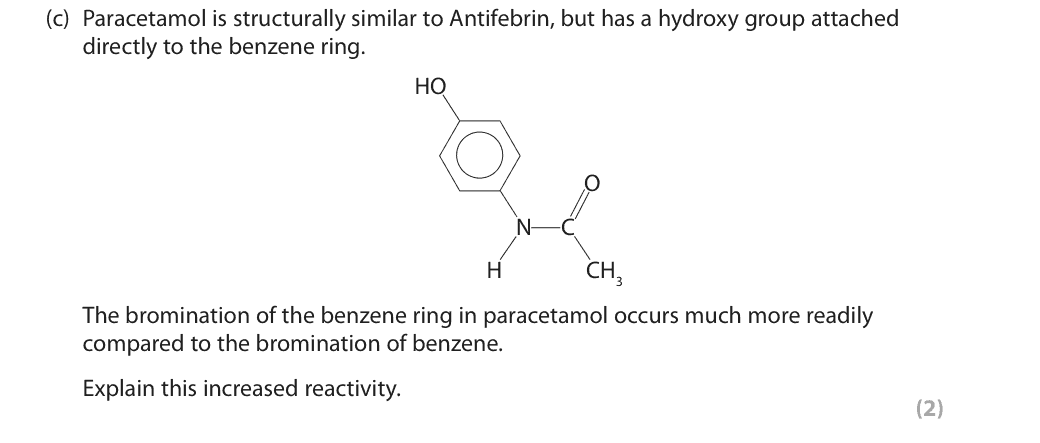
Paracetamol is structurally similar to Antifebrin, but has a hydroxy group attached
directly to the benzene ring.
HO
O
N
C
H
CH3
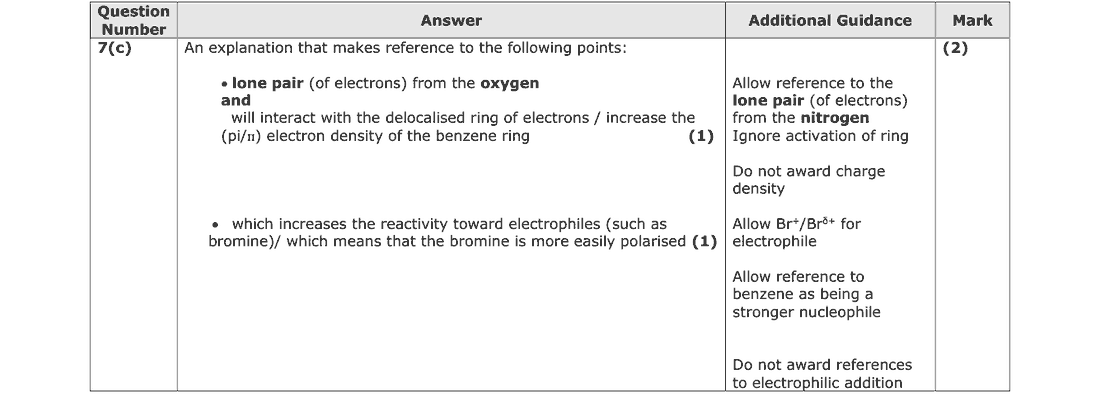
The bromination of the benzene ring in paracetamol occurs much more readily
compared to the bromination of benzene.
Explain this increased reactivity.
June 2017 · Paper 2 · Q7(d) 2 marks Calculation formulae equations and amounts of substance
Earlier part of question 7 that this part usesEarlier part of June 2017 Paper 2 question 7
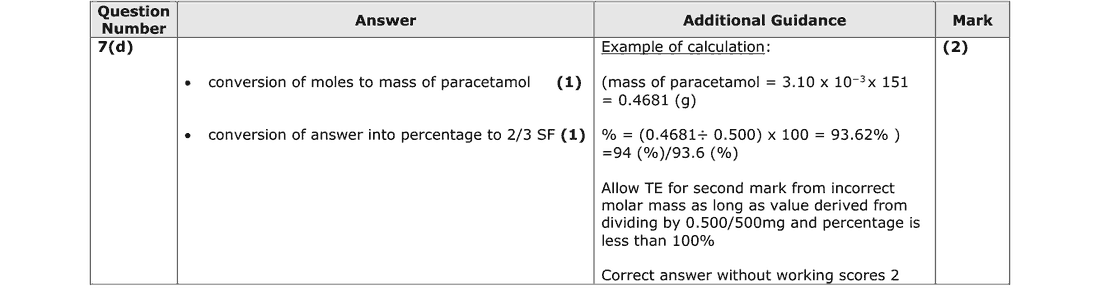
A tablet with a total mass of 500 mg contained 3.10 × 10⁻³ mol of paracetamol.
Calculate the percentage by mass of paracetamol in the tablet, quoting your
answer to an appropriate number of significant figures.
June 2017 · Paper 2 · Q8(a)(i) 1 mark Equation writing Easy arenes benzene
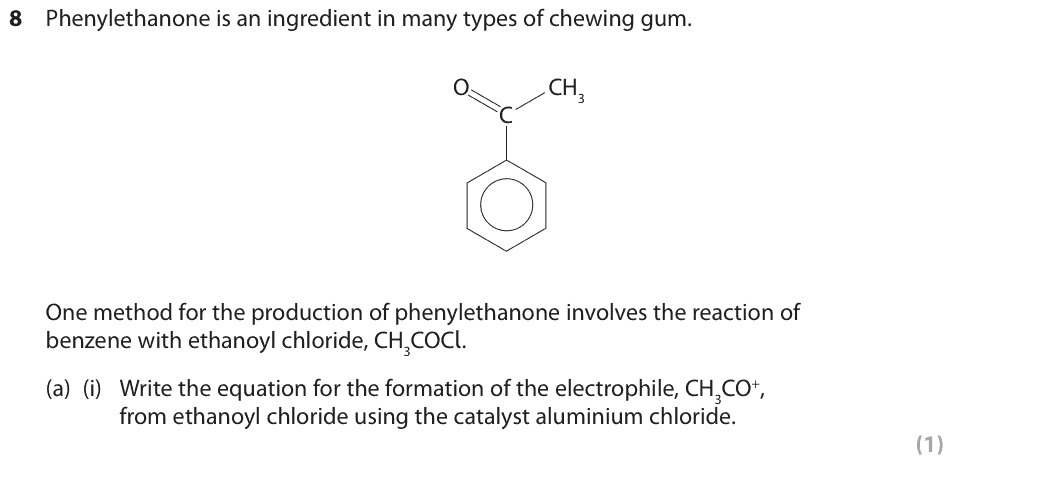
Phenylethanone is an ingredient in many types of chewing gum.
O
CH3
C
One method for the production of phenylethanone involves the reaction of
benzene with ethanoyl chloride, CH3COCl.
Write the equation for the formation of the electrophile, CH3CO+,
from ethanoyl chloride using the catalyst aluminium chloride.
June 2017 · Paper 2 · Q8(a)(ii) 4 marks Mechanism arenes benzene
Earlier part of question 8 that this part usesEarlier part of June 2017 Paper 2 question 8
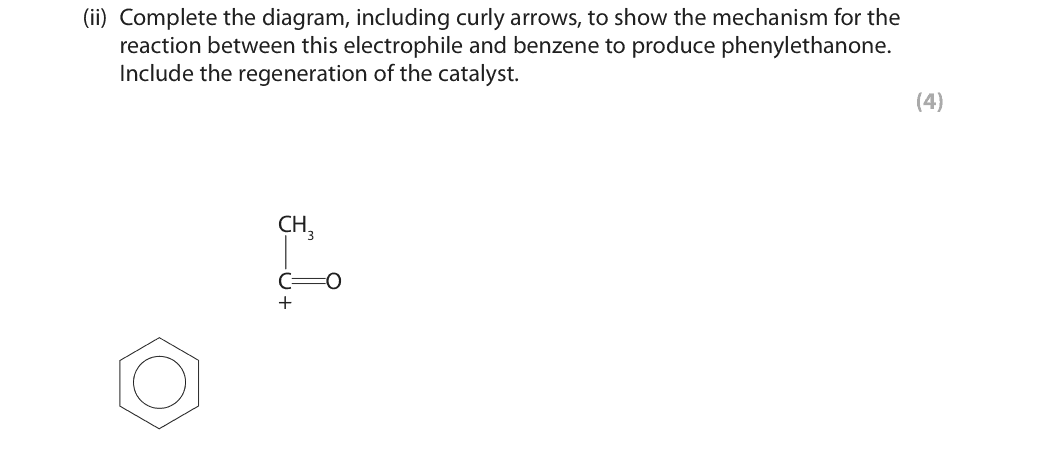
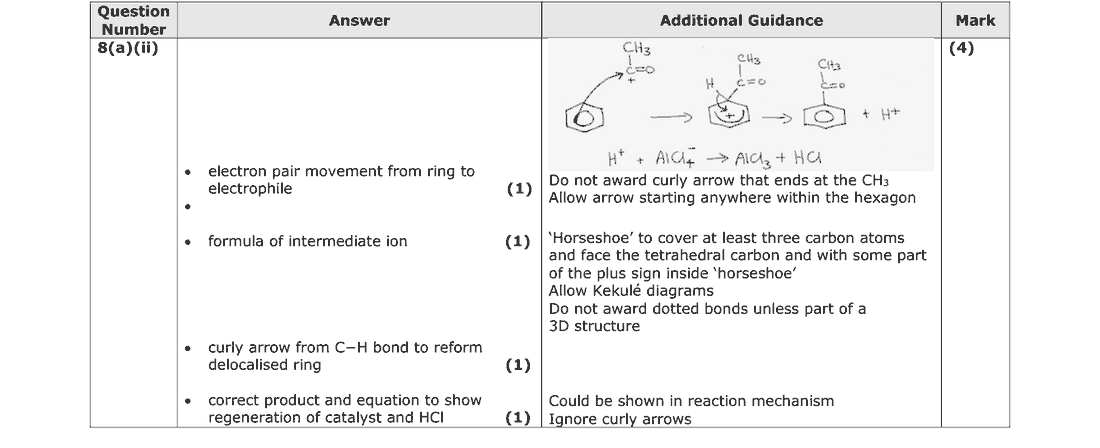
Complete the diagram, including curly arrows, to show the mechanism for the
reaction between this electrophile and benzene to produce phenylethanone.
Include the regeneration of the catalyst.
CH3
C
O
+
June 2017 · Paper 2 · Q8(b)(i) 1 mark Multiple choice carbonyl compounds
Earlier part of question 8 that this part usesEarlier part of June 2017 Paper 2 question 8
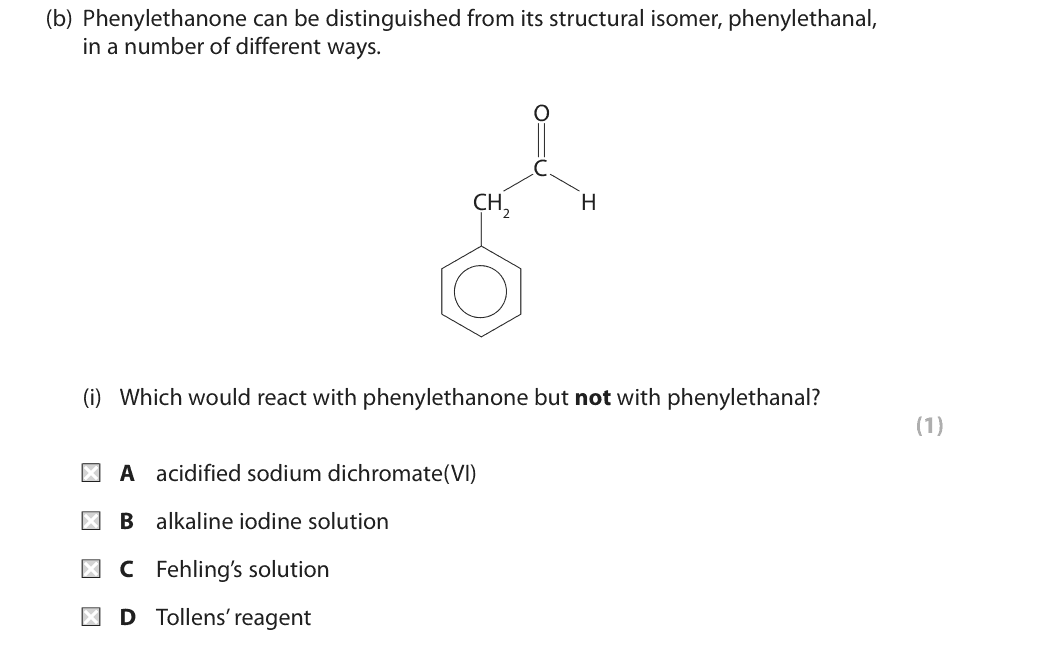
Phenylethanone can be distinguished from its structural isomer, phenylethanal,
in a number of different ways.
O
C
CH2
H
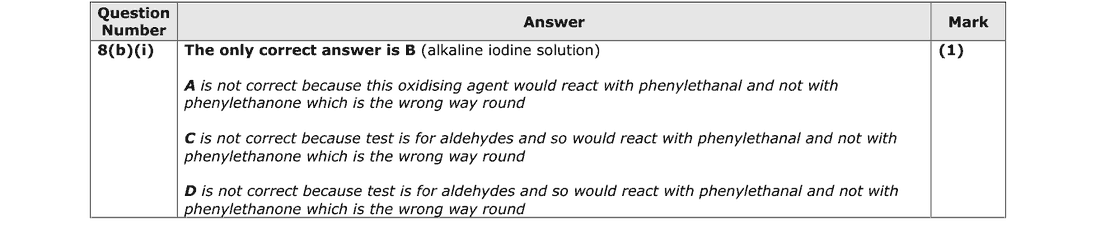
Which would react with phenylethanone but not with phenylethanal?
A acidified sodium dichromate(VI)
B alkaline iodine solution
C Fehling’s solution
D Tollens’ reagent
June 2017 · Paper 2 · Q8(b)(ii) 4 marks Practical and data analysis carbonyl compoundsorganic synthesis
Earlier parts of question 8 that this part usesEarlier part of June 2017 Paper 2 question 8Earlier part of June 2017 Paper 2 question 8
Give the steps to show how 2,4-dinitrophenylhydrazine could be used to
distinguish between phenylethanone and phenylethanal.
June 2017 · Paper 2 · Q8(b)(iii) 6 marks 6-mark extended response nmr mass spectrometry and chromatography
Earlier parts of question 8 that this part usesEarlier part of June 2017 Paper 2 question 8Earlier part of June 2017 Paper 2 question 8Earlier part of June 2017 Paper 2 question 8
Compare and contrast the high resolution proton NMR spectra of
phenylethanone and phenylethanal.
You should use the Data Booklet.
O
C
O
CH3
C
CH2
H
Phenylethanone
Phenylethanal
June 2017 · Paper 2 · Q8(c) 2 marks Short answer carbonyl compounds
Earlier part of question 8 that this part usesEarlier part of June 2017 Paper 2 question 8
The compound 1-phenylethanol can be formed from phenylethanone.
HO
CH3
CH
Give the reagent and conditions that would be used to form 1-phenylethanol.
June 2017 · Paper 2 · Q9(a) 1 mark Calculation Easy kinetics ii
This question is about reaction kinetics.
Compound A decomposes in a first order reaction.
Calculate the time it takes for the mass of A to decrease from 600 g to 37.5 g if the
decomposition has a constant half-life of 14 minutes.
June 2017 · Paper 2 · Q9(b)(i) 3 marks Short answer Easy kinetics ii
Earlier part of question 9 that this part usesEarlier part of June 2017 Paper 2 question 9
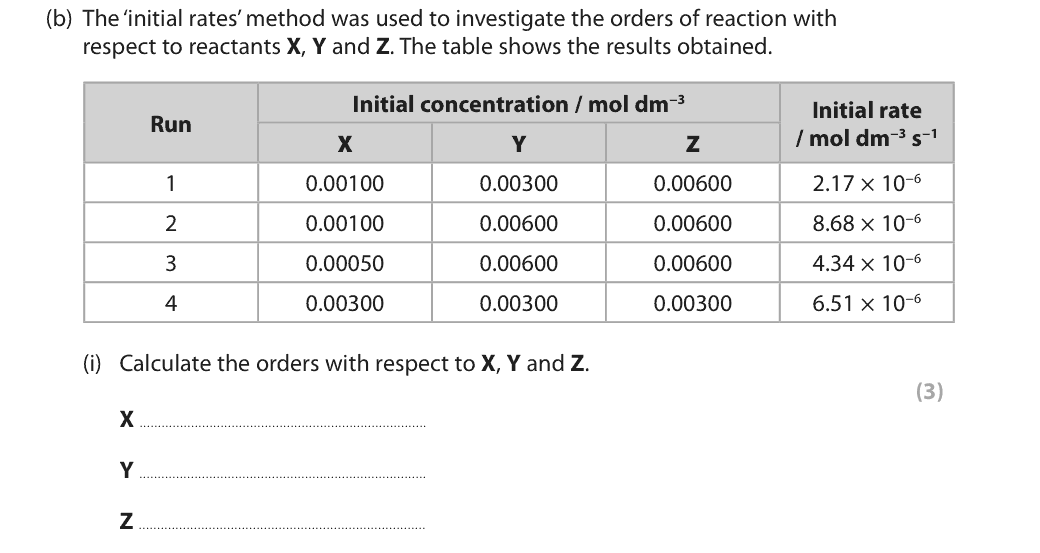
The ‘initial rates’ method was used to investigate the orders of reaction with
respect to reactants X, Y and Z. The table shows the results obtained.
Initial concentration / mol dm−3
Initial rate
Run
/ mol dm−3 s−1
X
Y
Z
1
0.00100
0.00300
0.00600
2.17 × 10⁻⁶
2
0.00100
0.00600
0.00600
8.68 × 10⁻⁶
3
0.00050
0.00600
0.00600
4.34 × 10⁻⁶
4
0.00300
0.00300
0.00300
6.51 × 10⁻⁶
Calculate the orders with respect to X, Y and Z.
X 
Y 
Z
June 2017 · Paper 2 · Q9(b)(ii) 4 marks Calculation Easy kinetics ii
Earlier parts of question 9 that this part usesEarlier part of June 2017 Paper 2 question 9Earlier part of June 2017 Paper 2 question 9
Give the rate equation for the reaction and hence calculate the rate constant, k,
to an appropriate number of significant figures.  Include units in your answer.
June 2017 · Paper 2 · Q9(c)(i) 1 mark Multiple choice kinetics ii
Earlier part of question 9 that this part usesEarlier part of June 2017 Paper 2 question 9
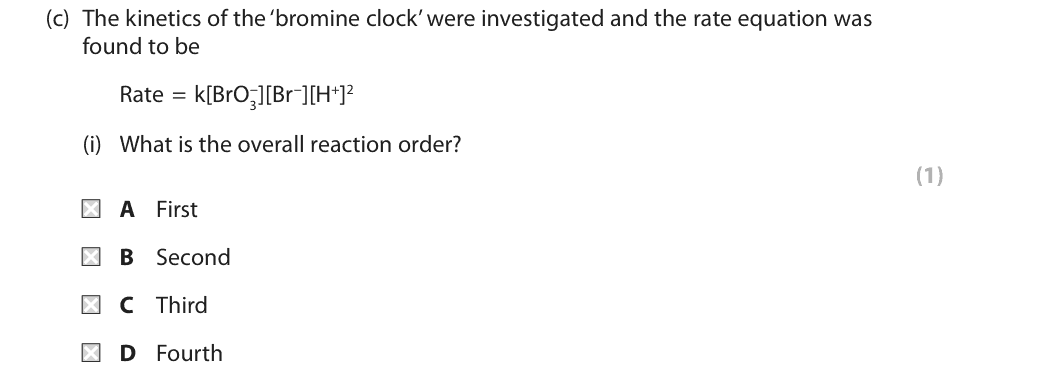
The kinetics of the ‘bromine clock’ were investigated and the rate equation was
found to be
Rate = k[BrO3
−][Br −][H+]2
What is the overall reaction order?
A First
B Second
C Third
D Fourth
June 2017 · Paper 2 · Q9(c)(ii) 2 marks Calculation Easy kinetics ii
Earlier parts of question 9 that this part usesEarlier part of June 2017 Paper 2 question 9Earlier part of June 2017 Paper 2 question 9
Calculate the concentration of bromide ions required to produce a
reaction rate of 4.08 × 10⁻³ mol dm−3 s−1 at 298 K given that
k = 8.00 dm9 mol−3 s−1
[BrO3
−] = 0.200 mol dm−3
[H+] = 0.100 mol dm−3
June 2017 · Paper 2 · Q9(d) 7 marks Calculation kinetics ii
Earlier part of question 9 that this part usesEarlier part of June 2017 Paper 2 question 9
The rate constant for the reaction between bromoethane and
aqueous hydroxide ions was determined at five different temperatures.
The results are given in the table.
Temperature (T)
1 / Temperature (1 / T)
Rate constant, k
ln k
/ K
/ K−1
/ dm3 mol–1 s–1
293
3.41 × 10⁻³
5.83 × 10⁻⁵
−9.75
303
1.67 × 10⁻⁴
313
5.26 × 10⁻⁴
323
1.36 × 10⁻³
333
3.00 × 10⁻³
3.77 × 10⁻³
−5.58
Complete the data in the table and use them to plot a graph of ln k against 1 / T
and hence determine the activation energy, Ea , in kJ mol−1.
You should include the value and units of the gradient of the line.
The Arrhenius equation can be expressed as
ln k = – E
a × 1
T + constant
R

Work with an A-level chemistry tutor

Want a paper marked and gone through with you? Message us.

Prefer email? Send an enquiry

If you are under 18, please include a parent's contact details. Enquiries go to enquiries@chemistryaleveltutor.com and are deleted once handled. All tutoring is online.