November 2021: Paper 1, Inorganic and physical chemistry

105 marks · 49 question parts · Paper, mark scheme and report on AQA's site · An autumn series using the paper written for the cancelled summer exams · Have the Data Booklet beside you

Question by question

QTopicMarksAOType
01.1 Energetics 1Short answer
01.2 Thermodynamics: Born–Haber cycles, entropy and Gibbs free energy 3Diagram or structure
01.3 Thermodynamics: Born–Haber cycles, entropy and Gibbs free energy 2Calculation
01.4 Thermodynamics: Born–Haber cycles, entropy and Gibbs free energy 1Equation writing
01.5 Thermodynamics: Born–Haber cycles, entropy and Gibbs free energy 2Calculation
01.6 Thermodynamics: Born–Haber cycles, entropy and Gibbs free energy 2Explanation
02.1 Atomic structure 1Short answer
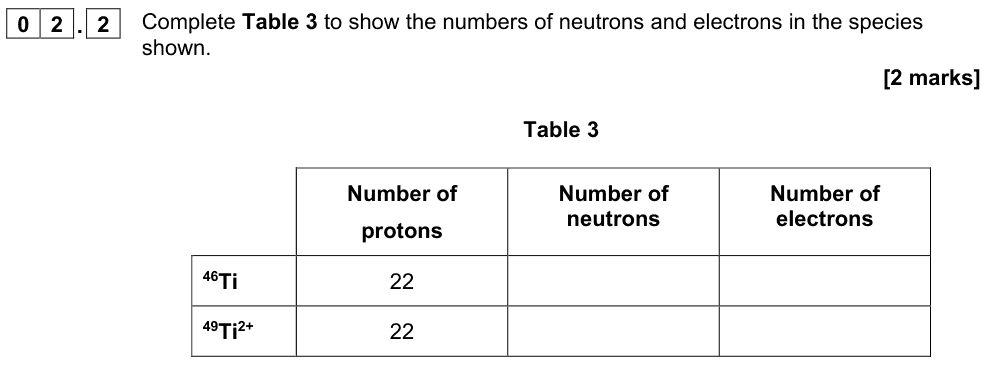
02.2 Atomic structure 2Short answer
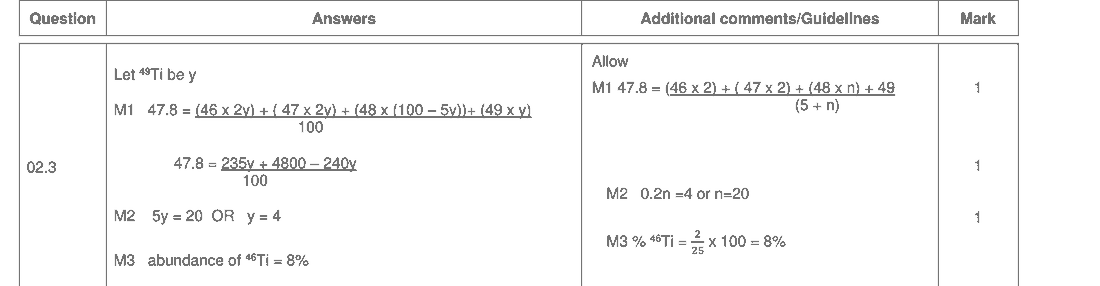
02.3 Atomic structure 3Calculation
03.1 Period 3 elements and their oxides 2Equation writing
03.2 Period 3 elements and their oxides 2Equation writing
03.3 Period 3 elements and their oxides 4Explanation
03.4 Period 3 elements and their oxides 2Equation writing
03.5 Group 2, the alkaline earth metals 1Short answer
03.6 Periodicity 1Short answer
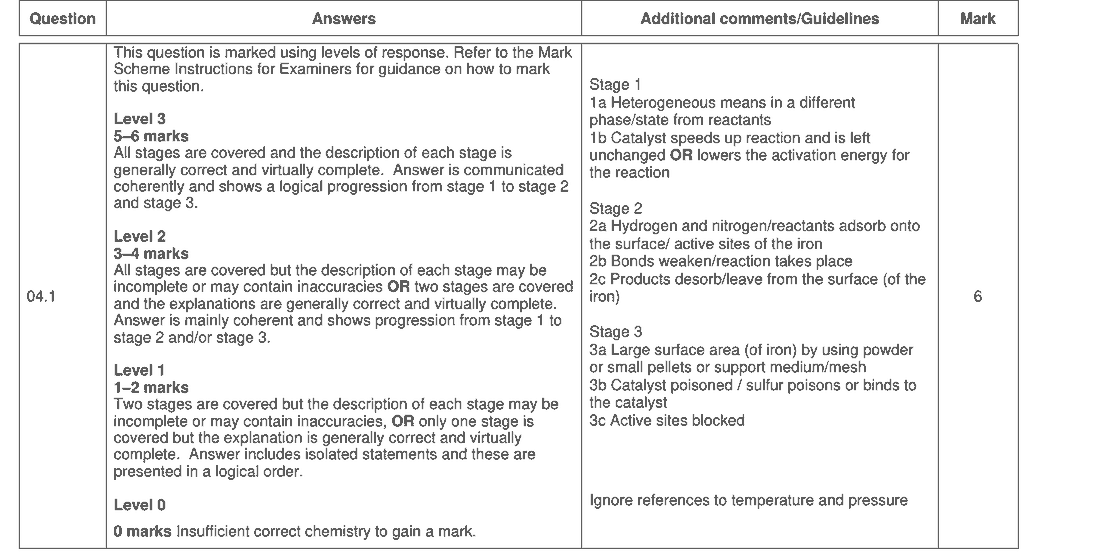
04.1 Transition metals 6Level of response
04.2 Transition metals 4Equation writing
04.3 Transition metals 1Short answer
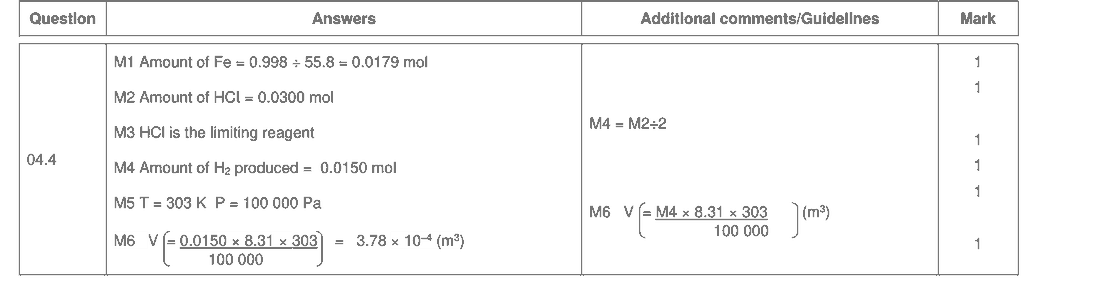
04.4 Amount of substance 6Calculation
04.5 Reactions of ions in aqueous solution 2Short answer
04.6 Reactions of ions in aqueous solution 3Equation writing
04.7 Reactions of ions in aqueous solution 3Explanation
05.1 Chemical equilibria, Le Chatelier's principle and Kc 3Explanation
05.2 Equilibrium constant Kp 4Calculation
05.3 Equilibrium constant Kp 3Calculation
05.4 Equilibrium constant Kp 1Short answer
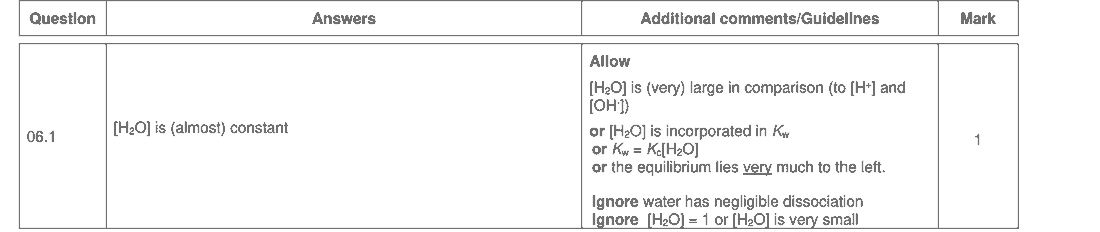
06.1 Acids and bases: pH, Ka, titration curves and buffers 1Short answer
06.2 Acids and bases: pH, Ka, titration curves and buffers, Chemical equilibria, Le Chatelier's principle and Kc 2Explanation
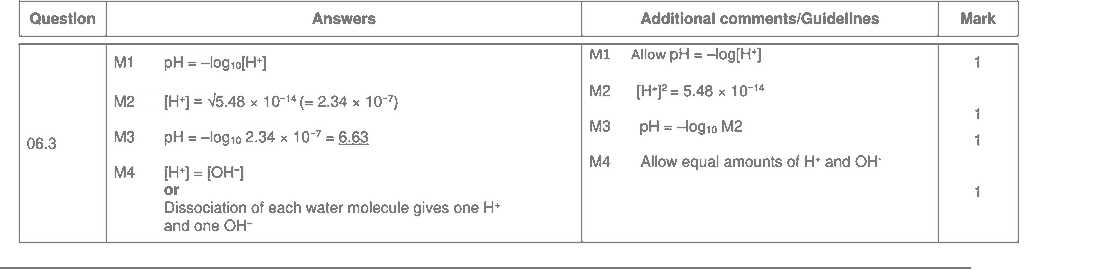
06.3 Acids and bases: pH, Ka, titration curves and buffers 4Calculation
06.4 Acids and bases: pH, Ka, titration curves and buffers 1Practical and data analysis
06.5 Acids and bases: pH, Ka, titration curves and buffers 1Practical and data analysis
06.6 Acids and bases: pH, Ka, titration curves and buffers 1Practical and data analysis
06.7 Acids and bases: pH, Ka, titration curves and buffers 1Short answer
06.8 Acids and bases: pH, Ka, titration curves and buffers 5Calculation
07.1 Thermodynamics: Born–Haber cycles, entropy and Gibbs free energy 1Short answer
07.2 Thermodynamics: Born–Haber cycles, entropy and Gibbs free energy 1Short answer
07.3 Thermodynamics: Born–Haber cycles, entropy and Gibbs free energy, Energetics 7Calculation
08.1 Electrode potentials and electrochemical cells 1Short answer
08.2 Electrode potentials and electrochemical cells 1Short answer
08.3 Electrode potentials and electrochemical cells 1Short answer
08.4 Electrode potentials and electrochemical cells, Oxidation, reduction and redox equations 2Equation writing
08.5 Electrode potentials and electrochemical cells 2Explanation
08.6 Transition metals 1Short answer
09.1 Electrode potentials and electrochemical cells 2Explanation
09.2 Electrode potentials and electrochemical cells 1Calculation
09.3 Electrode potentials and electrochemical cells 1Short answer
09.4 Oxidation, reduction and redox equations 1Short answer
09.5 Electrode potentials and electrochemical cells 1Equation writing
09.6 Electrode potentials and electrochemical cells 1Equation writing

The questions

01.101.201.301.401.501.602.102.202.303.103.203.303.403.503.604.104.204.304.404.504.604.705.105.205.305.406.106.206.306.406.506.606.706.807.107.207.308.108.208.308.408.508.609.109.209.309.409.509.6
November 2021 · Paper 1 · Q01.1 1 mark Short answer energetics
This question is about enthalpy changes for calcium chloride and
magnesium chloride.
State the meaning of the term enthalpy change.
[1 mark]
November 2021 · Paper 1 · Q01.2 3 marks Diagram or structure thermodynamics
Earlier part of question 01 that this part usesEarlier part of November 2021 Paper 1 question 01
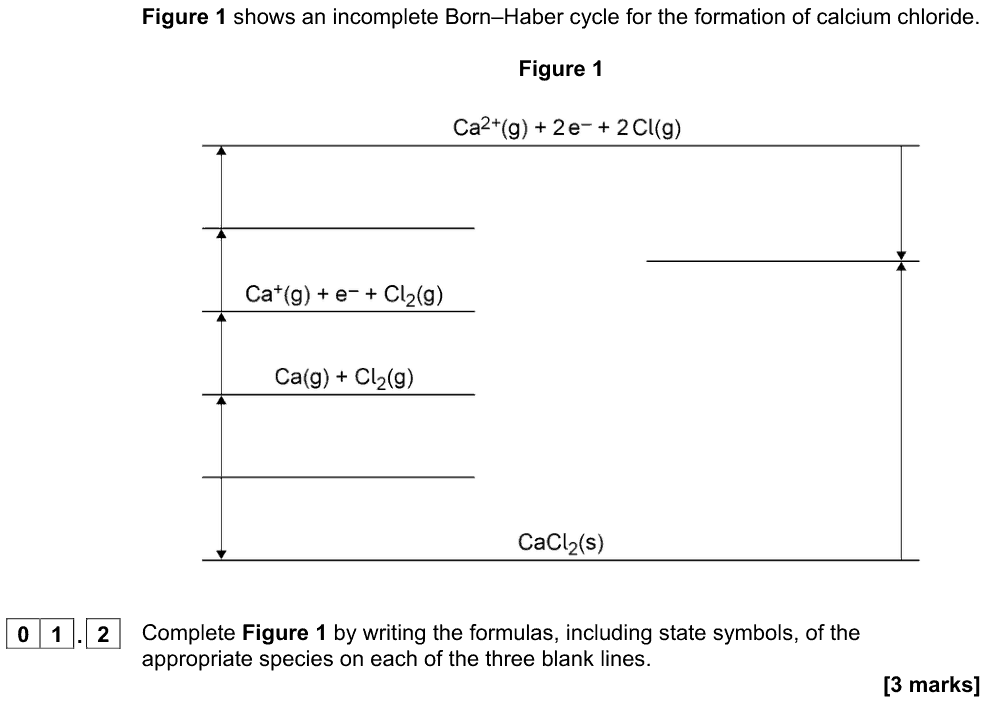
Figure 1 shows an incomplete Born–Haber cycle for the formation of calcium chloride.
Figure 1
Complete Figure 1 by writing the formulas, including state symbols, of the
appropriate species on each of the three blank lines.
[3 marks]
November 2021 · Paper 1 · Q01.3 2 marks Calculation thermodynamics
Earlier parts of question 01 that this part usesEarlier part of November 2021 Paper 1 question 01Earlier part of November 2021 Paper 1 question 01
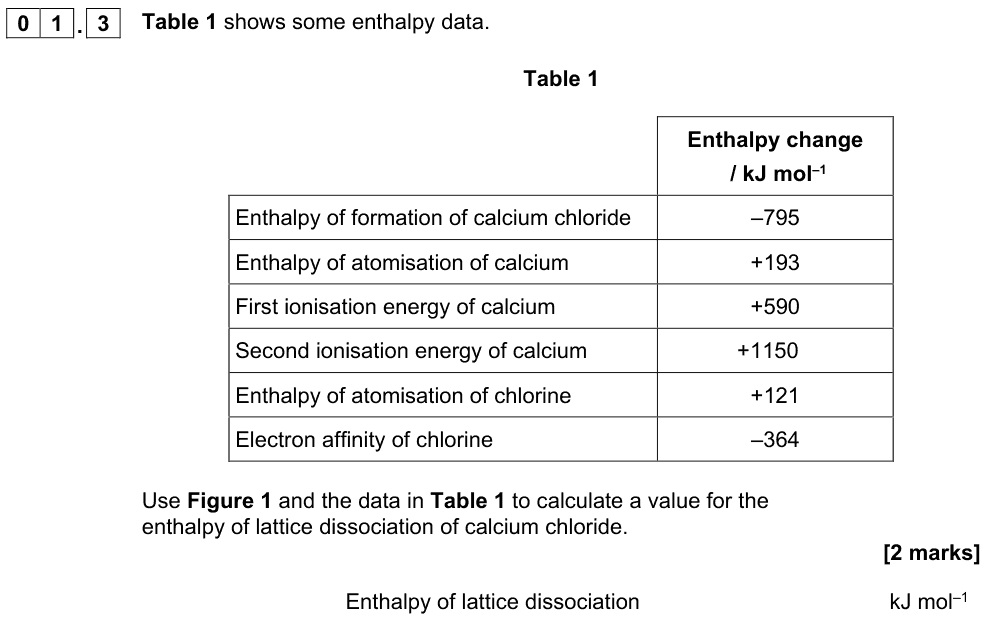
Table 1 shows some enthalpy data.
Table 1
Enthalpy change
/ kJ mol–1
Enthalpy of formation of calcium chloride
–795
Enthalpy of atomisation of calcium
+193
First ionisation energy of calcium
+590
Second ionisation energy of calcium
+1150
Enthalpy of atomisation of chlorine
+121
Electron affinity of chlorine
–364
Use Figure 1 and the data in Table 1 to calculate a value for the
enthalpy of lattice dissociation of calcium chloride.
[2 marks]
Enthalpy of lattice dissociation
kJ mol–1
November 2021 · Paper 1 · Q01.4 1 mark Equation writing thermodynamics
Earlier parts of question 01 that this part usesEarlier part of November 2021 Paper 1 question 01Earlier part of November 2021 Paper 1 question 01
Magnesium chloride dissolves in water.
Give an equation, including state symbols, to represent the process that occurs when
the enthalpy of solution of magnesium chloride is measured.
[1 mark]
November 2021 · Paper 1 · Q01.5 2 marks Calculation thermodynamics
Earlier part of question 01 that this part usesEarlier part of November 2021 Paper 1 question 01
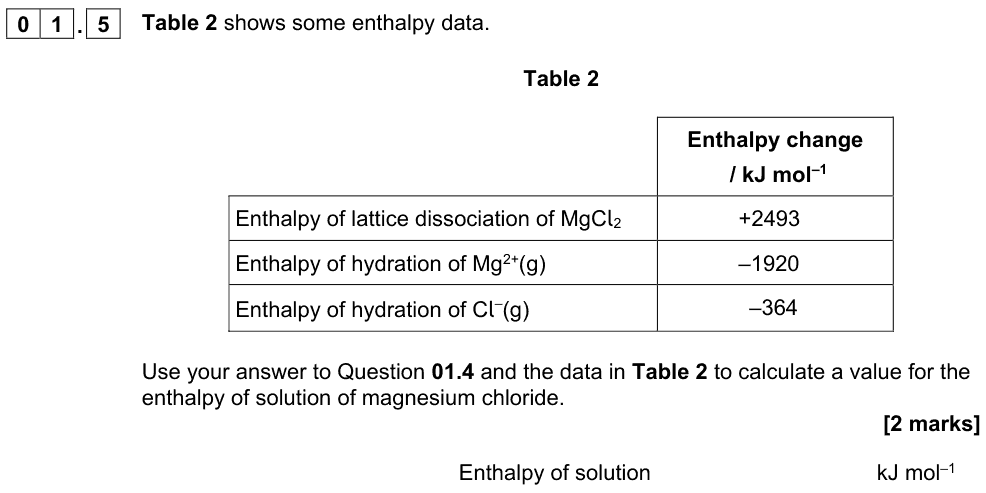
Table 2 shows some enthalpy data.
Table 2
Enthalpy change
/ kJ mol–1
Enthalpy of lattice dissociation of MgCl2
+2493
Enthalpy of hydration of Mg2+(g)
–1920
Enthalpy of hydration of Cl–(g)
–364
Use your answer to Question 01.4 and the data in Table 2 to calculate a value for the
enthalpy of solution of magnesium chloride.
[2 marks]
Enthalpy of solution
kJ mol–1
November 2021 · Paper 1 · Q01.6 2 marks Explanation thermodynamics
Earlier part of question 01 that this part usesEarlier part of November 2021 Paper 1 question 01
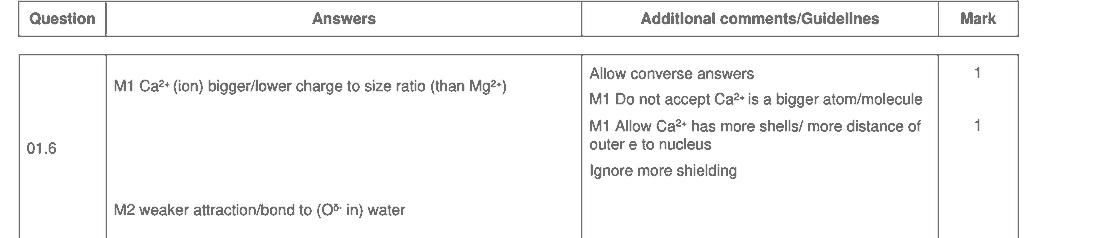
The enthalpy of hydration of Ca2+(g) is  –1650 kJ mol–1
Suggest why this value is less exothermic than that of Mg2+(g)
[2 marks]
November 2021 · Paper 1 · Q02.1 1 mark Short answer atomic structure
This question is about atomic structure.
Define the mass number of an atom.
[1 mark]
November 2021 · Paper 1 · Q02.2 2 marks Short answer atomic structure
Earlier part of question 02 that this part usesEarlier part of November 2021 Paper 1 question 02
Complete Table 3 to show the numbers of neutrons and electrons in the species
shown.
[2 marks]
Table 3
Number of
protons
Number of
neutrons
Number of
electrons
46Ti
22
49Ti2+
22
November 2021 · Paper 1 · Q02.3 3 marks Calculation atomic structure
Earlier part of question 02 that this part usesEarlier part of November 2021 Paper 1 question 02
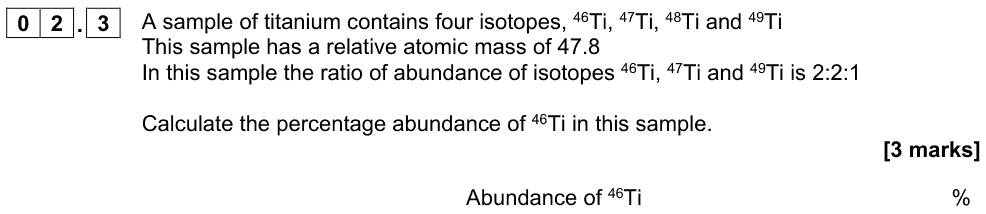
A sample of titanium contains four isotopes, 46Ti, 47Ti, 48Ti and 49Ti
This sample has a relative atomic mass of 47.8
In this sample the ratio of abundance of isotopes 46Ti, 47Ti and 49Ti is 2:2:1
Calculate the percentage abundance of 46Ti in this sample.
[3 marks]
Abundance of 46Ti
%
November 2021 · Paper 1 · Q03.1 2 marks Equation writing period 3 elements and oxides
This question is about elements in Period 3 and their compounds.
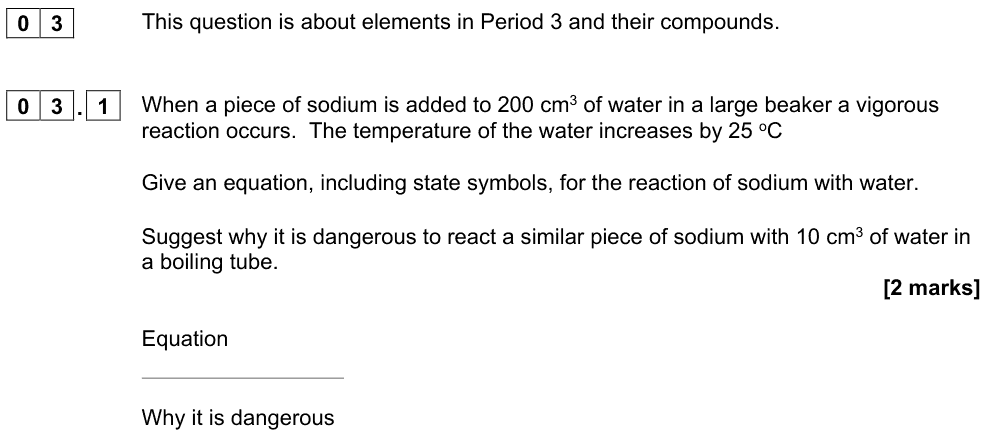
When a piece of sodium is added to 200 cm3 of water in a large beaker a vigorous
reaction occurs.  The temperature of the water increases by 25 oC
Give an equation, including state symbols, for the reaction of sodium with water.
Suggest why it is dangerous to react a similar piece of sodium with 10 cm3 of water in
a boiling tube.
[2 marks]
Equation
Why it is dangerous
November 2021 · Paper 1 · Q03.2 2 marks Equation writing period 3 elements and oxides
Earlier part of question 03 that this part usesEarlier part of November 2021 Paper 1 question 03
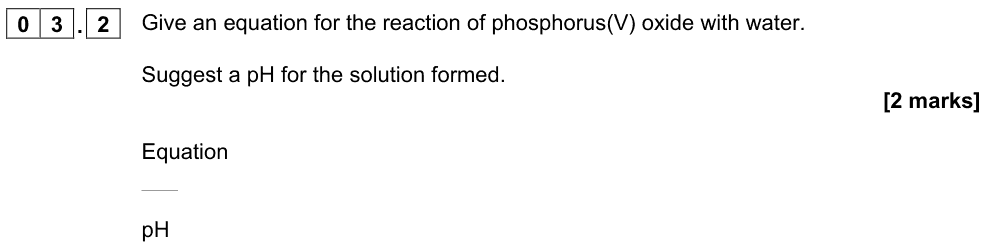
Give an equation for the reaction of phosphorus(V) oxide with water.
Suggest a pH for the solution formed.
[2 marks]
Equation
pH
November 2021 · Paper 1 · Q03.3 4 marks Explanation period 3 elements and oxides
Earlier part of question 03 that this part usesEarlier part of November 2021 Paper 1 question 03
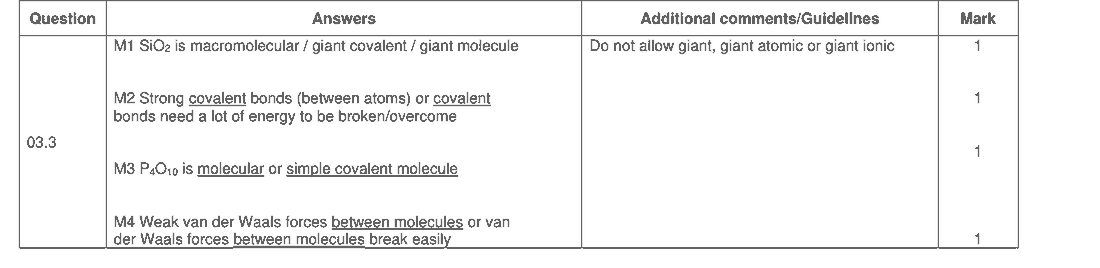
Explain, in terms of crystal structure and bonding, why silicon(IV) oxide has a higher
melting point than phosphorus(V) oxide.
[4 marks]
November 2021 · Paper 1 · Q03.4 2 marks Equation writing period 3 elements and oxides
Earlier part of question 03 that this part usesEarlier part of November 2021 Paper 1 question 03
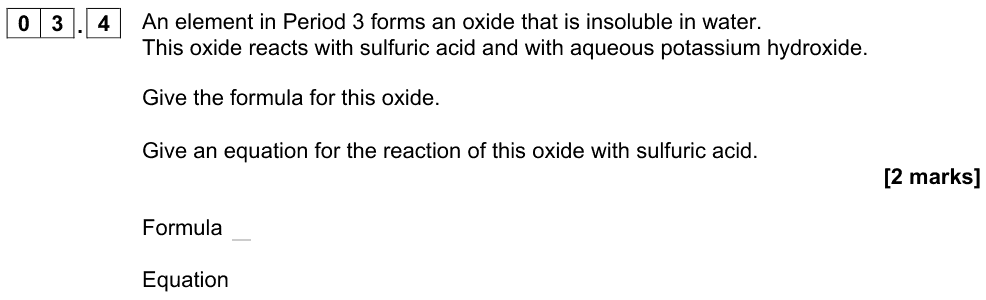
An element in Period 3 forms an oxide that is insoluble in water.
This oxide reacts with sulfuric acid and with aqueous potassium hydroxide.
Give the formula for this oxide.
Give an equation for the reaction of this oxide with sulfuric acid.
[2 marks]
Formula
Equation
November 2021 · Paper 1 · Q03.5 1 mark Short answer group 2
Earlier part of question 03 that this part usesEarlier part of November 2021 Paper 1 question 03
Give the formula of a hydroxide of an element in Period 3 used in medicine.
[1 mark]
November 2021 · Paper 1 · Q03.6 1 mark Short answer periodicity
Earlier part of question 03 that this part usesEarlier part of November 2021 Paper 1 question 03
Identify the element in Period 3, from sodium to chlorine, that has the
largest atomic radius.
[1 mark]
November 2021 · Paper 1 · Q04.1 6 marks 6-mark level of response transition metals
This question is about iron and its ions.
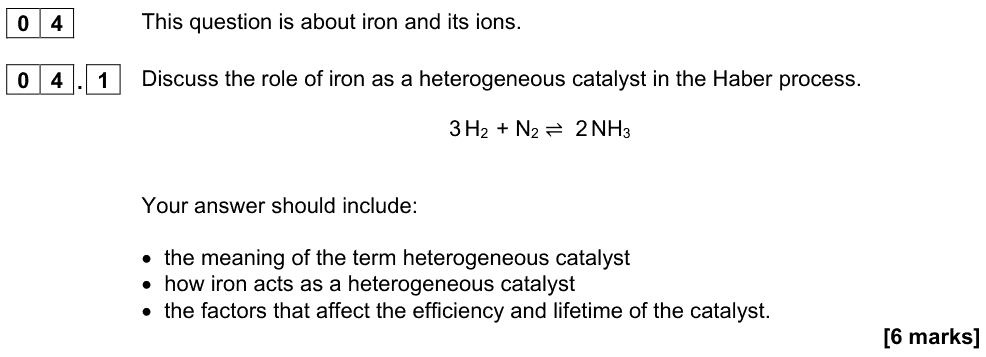
Discuss the role of iron as a heterogeneous catalyst in the Haber process.
3 H2  + N2 ⇌  2 NH3
Your answer should include:
• the meaning of the term heterogeneous catalyst
• how iron acts as a heterogeneous catalyst
• the factors that affect the efficiency and lifetime of the catalyst.
[6 marks]
November 2021 · Paper 1 · Q04.2 4 marks Equation writing transition metals
Earlier part of question 04 that this part usesEarlier part of November 2021 Paper 1 question 04
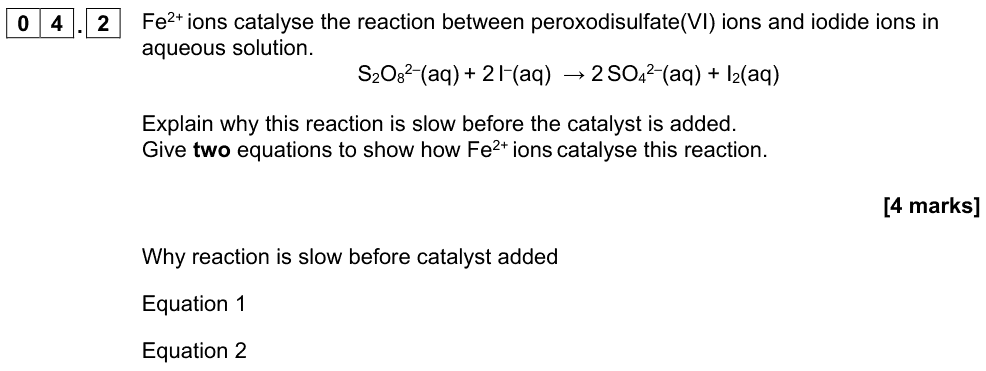
Fe2+ ions catalyse the reaction between peroxodisulfate(VI) ions and iodide ions in
aqueous solution.
S2O82–(aq) + 2 I–(aq)  → 2 SO42–(aq) + I2(aq)
Explain why this reaction is slow before the catalyst is added.
Give two equations to show how Fe2+ ions catalyse this reaction.
[4 marks]
Why reaction is slow before catalyst added
Equation 1
Equation 2
November 2021 · Paper 1 · Q04.3 1 mark Short answer transition metals
Earlier part of question 04 that this part usesEarlier part of November 2021 Paper 1 question 04
Give a reason why Zn2+ ions do not catalyse the reaction in Question 04.2.
[1 mark]
November 2021 · Paper 1 · Q04.4 6 marks Calculation amount of substance
Earlier part of question 04 that this part usesEarlier part of November 2021 Paper 1 question 04
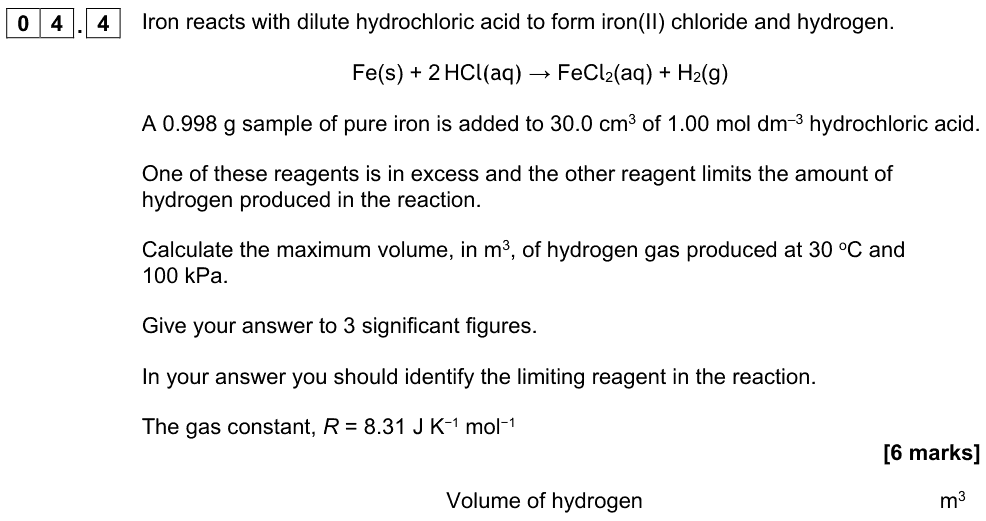
Iron reacts with dilute hydrochloric acid to form iron(II) chloride and hydrogen.
Fe(s) + 2 HCl(aq) → FeCl2(aq) + H2(g)
A 0.998 g sample of pure iron is added to 30.0 cm3 of 1.00 mol dm–3 hydrochloric acid.
One of these reagents is in excess and the other reagent limits the amount of
hydrogen produced in the reaction.
Calculate the maximum volume, in m3, of hydrogen gas produced at 30 oC and
100 kPa.
Give your answer to 3 significant figures.
In your answer you should identify the limiting reagent in the reaction.
The gas constant, R = 8.31 J K−1 mol−1
[6 marks]
Volume of hydrogen
m3
November 2021 · Paper 1 · Q04.5 2 marks Short answer reactions of ions in aqueous solution
Earlier part of question 04 that this part usesEarlier part of November 2021 Paper 1 question 04
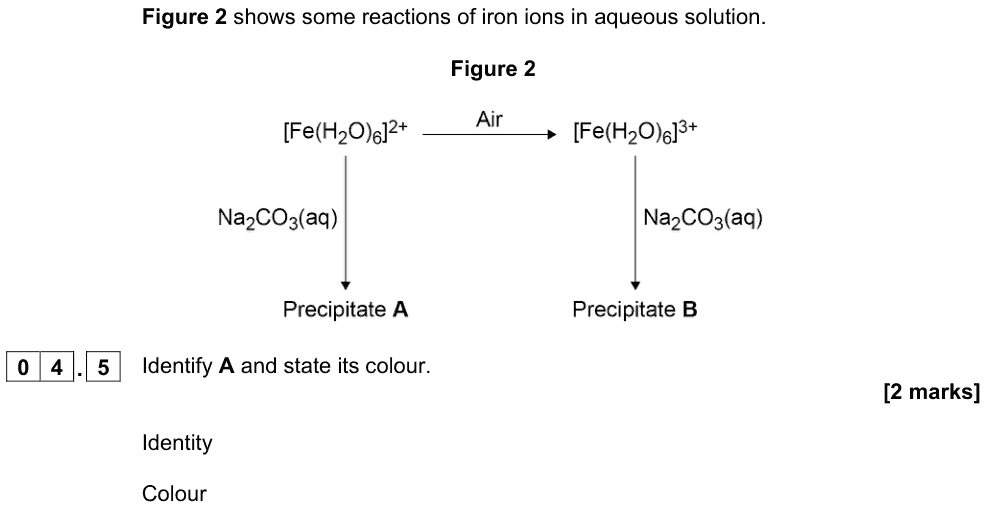
Figure 2 shows some reactions of iron ions in aqueous solution.
Figure 2
Identify A and state its colour.
[2 marks]
Identity
Colour
November 2021 · Paper 1 · Q04.6 3 marks Equation writing reactions of ions in aqueous solution
Earlier parts of question 04 that this part usesEarlier part of November 2021 Paper 1 question 04Earlier part of November 2021 Paper 1 question 04
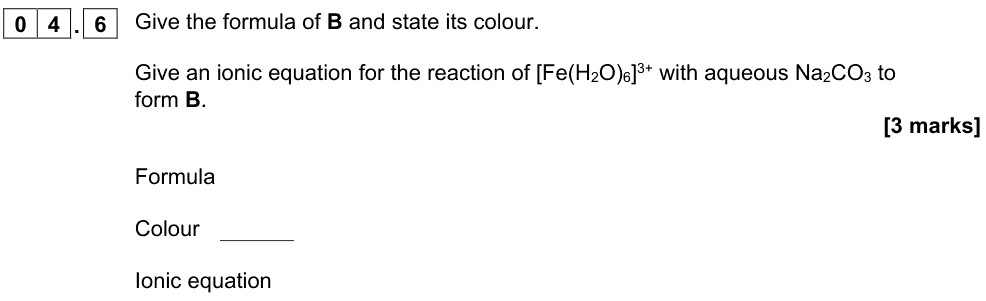
Give the formula of B and state its colour.
Give an ionic equation for the reaction of [Fe(H2O)6]3+ with aqueous Na2CO3 to
form B.
[3 marks]
Formula
Colour
Ionic equation
November 2021 · Paper 1 · Q04.7 3 marks Explanation reactions of ions in aqueous solution
Earlier part of question 04 that this part usesEarlier part of November 2021 Paper 1 question 04
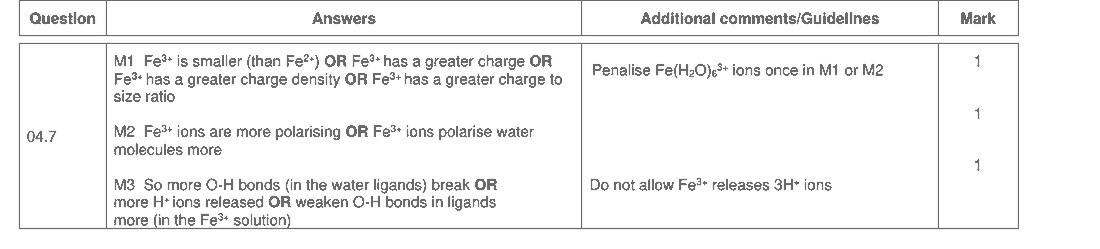
Explain why an aqueous solution containing [Fe(H2O)6]3+ ions has a lower pH than
an aqueous solution containing [Fe(H2O)6]2+ ions.
[3 marks]
November 2021 · Paper 1 · Q05.1 3 marks Explanation chemical equilibria and kc
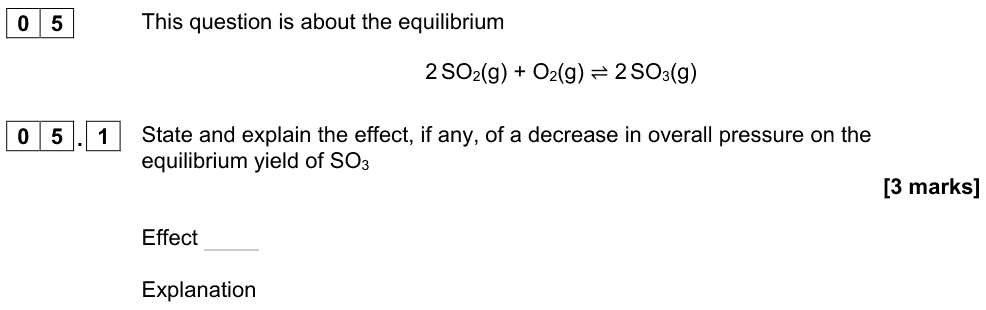
This question is about the equilibrium
2 SO2(g) + O2(g) ⇌ 2 SO3(g)
State and explain the effect, if any, of a decrease in overall pressure on the
equilibrium yield of SO3
[3 marks]
Effect
Explanation
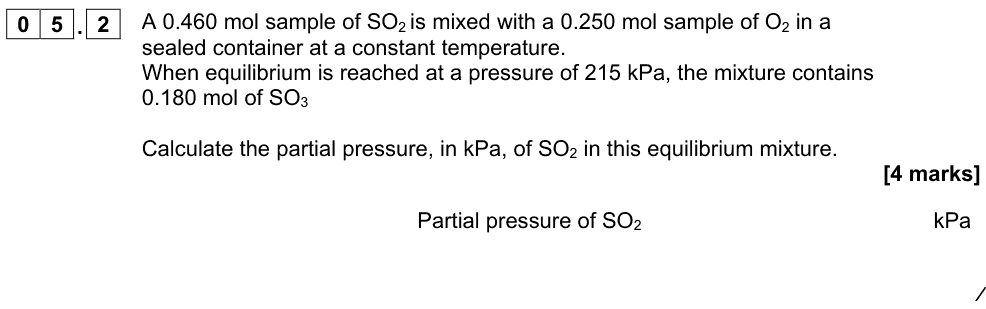
November 2021 · Paper 1 · Q05.2 4 marks Calculation equilibrium constant kp
Earlier part of question 05 that this part usesEarlier part of November 2021 Paper 1 question 05
A 0.460 mol sample of SO2 is mixed with a 0.250 mol sample of O2 in a
sealed container at a constant temperature.
When equilibrium is reached at a pressure of 215 kPa, the mixture contains
0.180 mol of SO3
Calculate the partial pressure, in kPa, of SO2 in this equilibrium mixture.
[4 marks]
Partial pressure of SO2
kPa
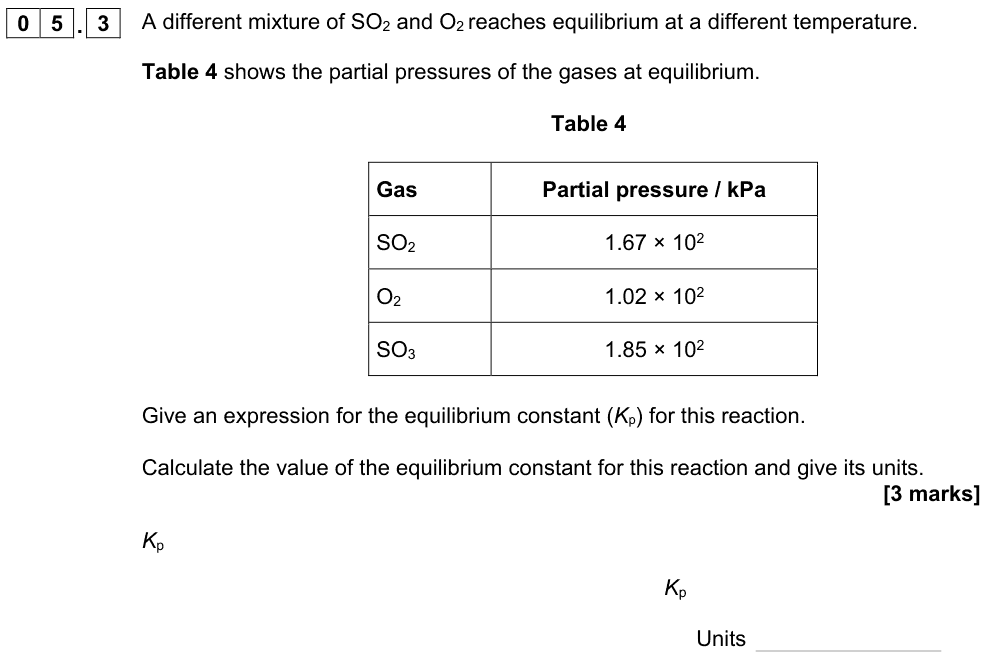
November 2021 · Paper 1 · Q05.3 3 marks Calculation equilibrium constant kp
Earlier part of question 05 that this part usesEarlier part of November 2021 Paper 1 question 05
A different mixture of SO2 and O2 reaches equilibrium at a different temperature.
Table 4 shows the partial pressures of the gases at equilibrium.
Table 4
Gas
Partial pressure / kPa
SO2
1.67 × 10²
O2
1.02 × 10²
SO3
1.85 × 10²
Give an expression for the equilibrium constant (Kp) for this reaction.
Calculate the value of the equilibrium constant for this reaction and give its units.
[3 marks]
Kp
Kp
Units
November 2021 · Paper 1 · Q05.4 1 mark Short answer equilibrium constant kp
Earlier part of question 05 that this part usesEarlier part of November 2021 Paper 1 question 05
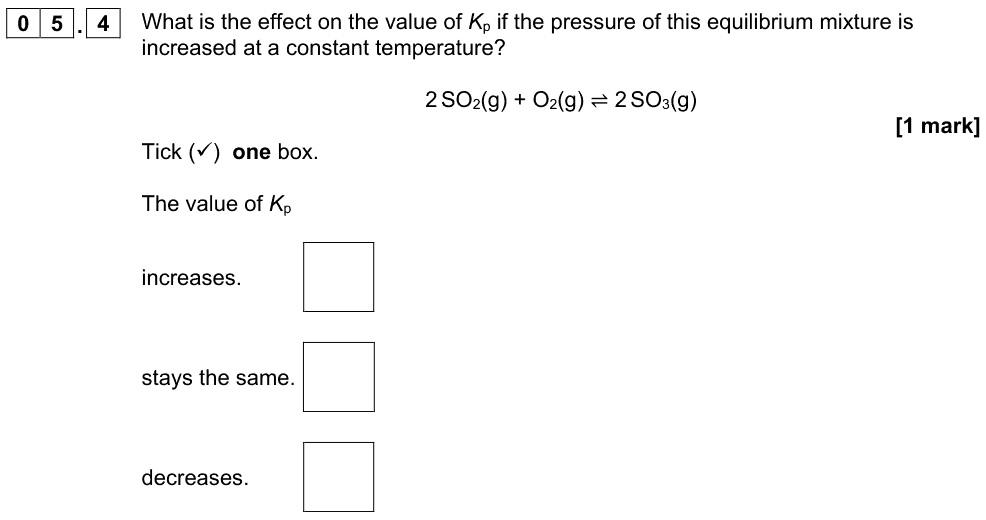
What is the effect on the value of Kp if the pressure of this equilibrium mixture is
increased at a constant temperature?
2 SO2(g) + O2(g) ⇌ 2 SO3(g)
[1 mark]
Tick ()  one box.
The value of Kp
increases.
stays the same.
decreases.
November 2021 · Paper 1 · Q06.1 1 mark Short answer acids and bases
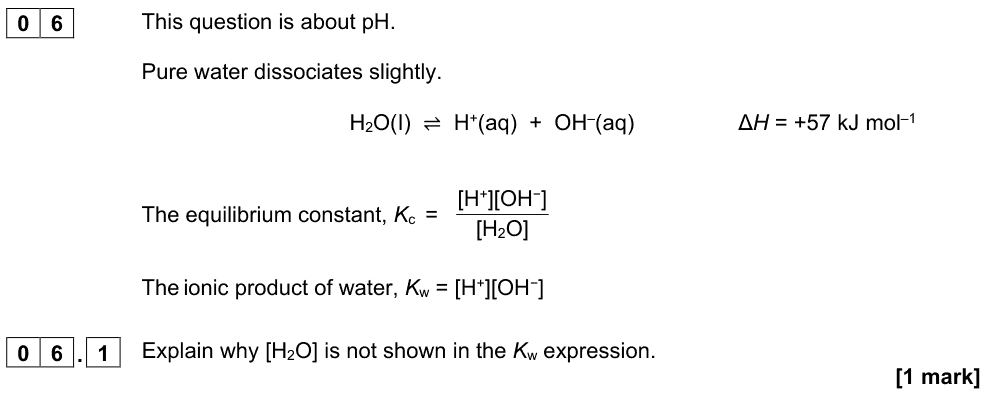
This question is about pH.
Pure water dissociates slightly.
H2O(I)  ⇌  H+(aq)  +  OH–(aq)                 ΔH = +57 kJ mol–1
The equilibrium constant, Kc  = [H+][OH−]
[H2O]
The ionic product of water, Kw = [H+][OH−]
Explain why [H2O] is not shown in the Kw expression.
[1 mark]
November 2021 · Paper 1 · Q06.2 2 marks Explanation acids and baseschemical equilibria and kc
Earlier part of question 06 that this part usesEarlier part of November 2021 Paper 1 question 06
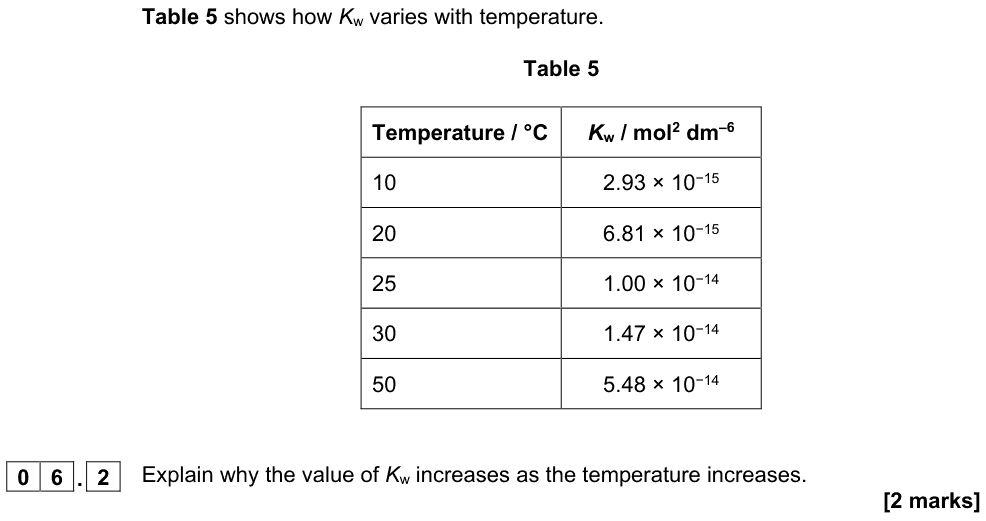
Table 5 shows how Kw varies with temperature.
Table 5
Temperature / °C
Kw / mol2 dm–6
10
2.93 × 10⁻¹⁵
20
6.81 × 10⁻¹⁵
25
1.00 × 10⁻¹⁴
30
1.47 × 10⁻¹⁴
50
5.48 × 10⁻¹⁴
Explain why the value of Kw increases as the temperature increases.
[2 marks]
November 2021 · Paper 1 · Q06.3 4 marks Calculation acids and bases
Earlier parts of question 06 that this part usesEarlier part of November 2021 Paper 1 question 06Earlier part of November 2021 Paper 1 question 06
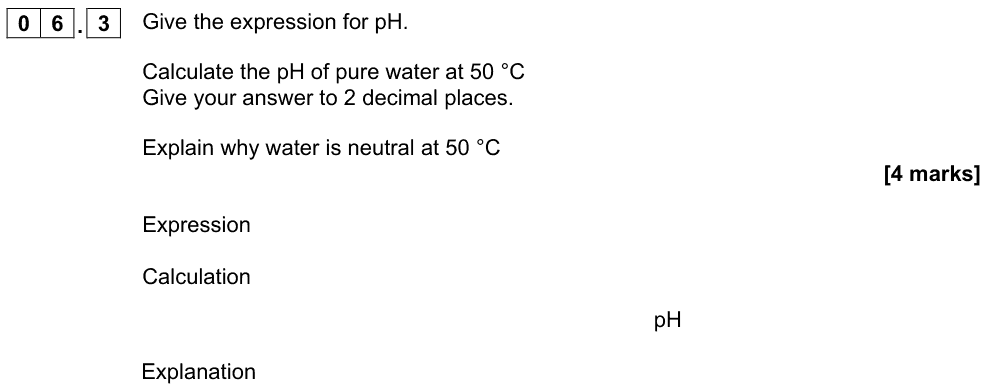
Give the expression for pH.
Calculate the pH of pure water at 50 °C
Give your answer to 2 decimal places.
Explain why water is neutral at 50 °C
[4 marks]
Expression
Calculation
pH
Explanation
November 2021 · Paper 1 · Q06.4 1 mark Practical and data analysis acids and bases
Earlier part of question 06 that this part usesEarlier part of November 2021 Paper 1 question 06
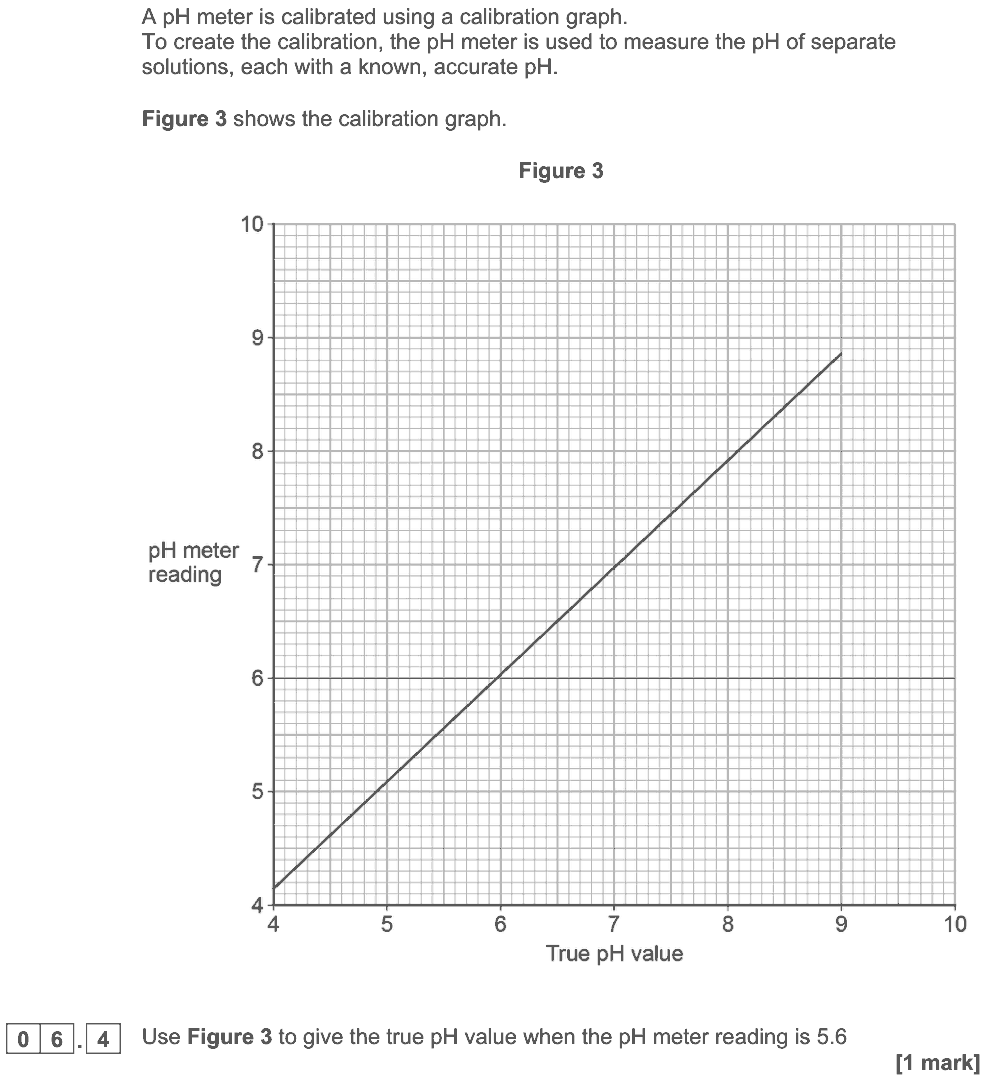
A pH meter is calibrated using a calibration graph.
To create the calibration, the pH meter is used to measure the pH of separate
solutions, each with a known, accurate pH.
Figure 3 shows the calibration graph.
Figure 3
Use Figure 3 to give the true pH value when the pH meter reading is 5.6
[1 mark]
November 2021 · Paper 1 · Q06.5 1 mark Practical and data analysis acids and bases
Earlier parts of question 06 that this part usesEarlier part of November 2021 Paper 1 question 06Earlier part of November 2021 Paper 1 question 06
Suggest why the pH probe is washed with distilled water between each of the
calibration measurements.
[1 mark]
November 2021 · Paper 1 · Q06.6 1 mark Practical and data analysis acids and bases
Earlier parts of question 06 that this part usesEarlier part of November 2021 Paper 1 question 06Earlier part of November 2021 Paper 1 question 06
The calibrated pH meter is used to monitor the pH during a titration of
hydrochloric acid with sodium hydroxide.
Explain why the volume of sodium hydroxide solution added between each
pH measurement is smaller as the end point of the titration is approached.
[1 mark]
November 2021 · Paper 1 · Q06.7 1 mark Short answer acids and bases
Earlier parts of question 06 that this part usesEarlier part of November 2021 Paper 1 question 06Earlier part of November 2021 Paper 1 question 06
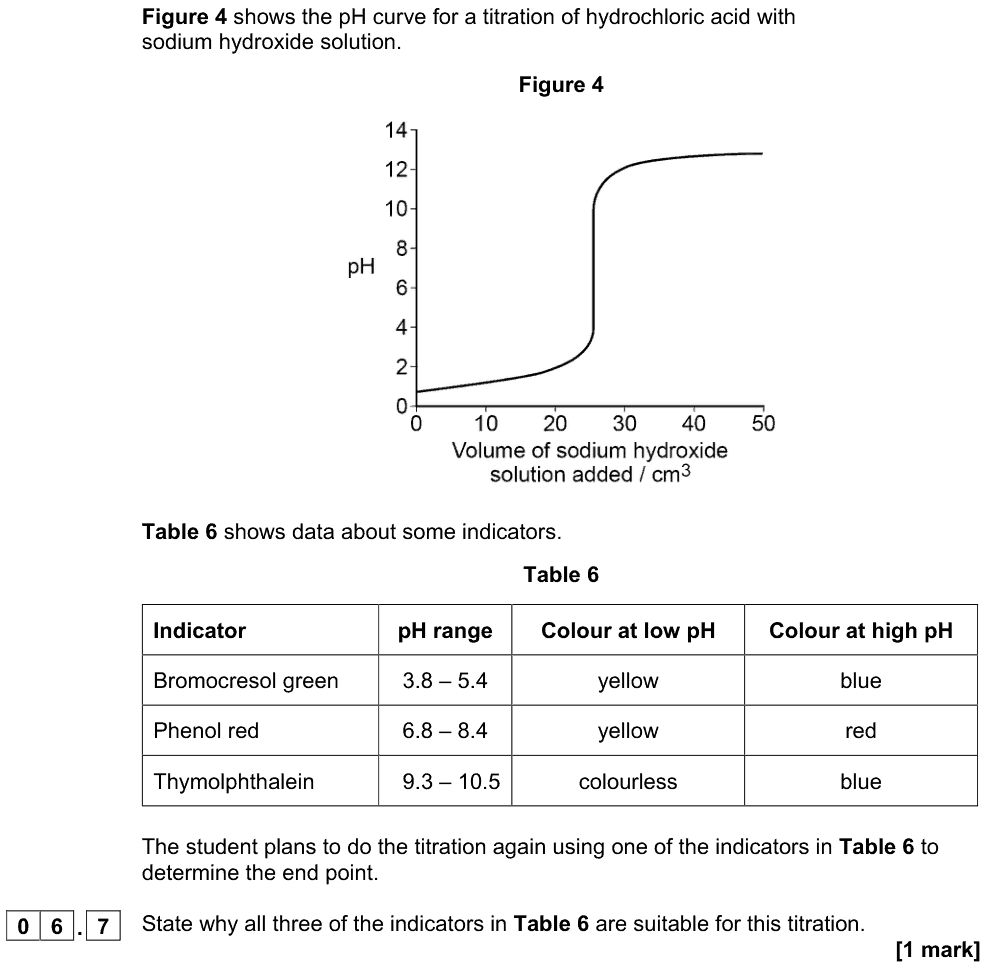
Figure 4 shows the pH curve for a titration of hydrochloric acid with
sodium hydroxide solution.
Figure 4
Table 6 shows data about some indicators.
Table 6
Indicator
pH range
Colour at low pH
Colour at high pH
Bromocresol green
3.8 – 5.4
yellow
blue
Phenol red
6.8 – 8.4
yellow
red
Thymolphthalein
9.3 – 10.5
colourless
blue
The student plans to do the titration again using one of the indicators in Table 6 to
determine the end point.
State why all three of the indicators in Table 6 are suitable for this titration.
[1 mark]
November 2021 · Paper 1 · Q06.8 5 marks Calculation acids and bases
Earlier parts of question 06 that this part usesEarlier part of November 2021 Paper 1 question 06Earlier part of November 2021 Paper 1 question 06
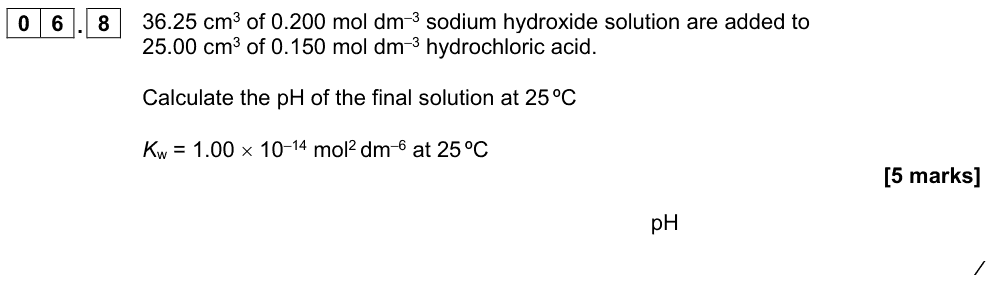
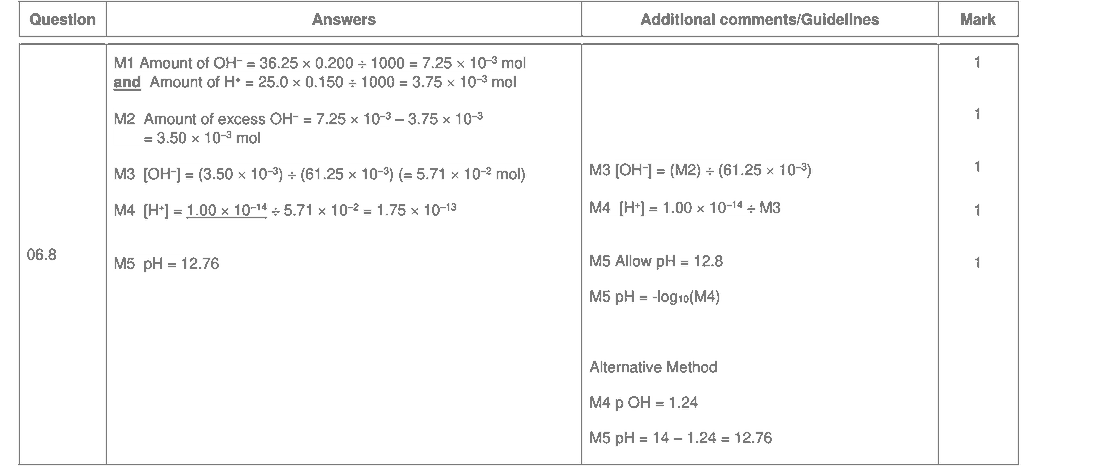
36.25 cm3 of 0.200 mol dm–3 sodium hydroxide solution are added to
25.00 cm3 of 0.150 mol dm–3 hydrochloric acid.
Calculate the pH of the final solution at 25 ºC
Kw = 1.00 × 10⁻¹⁴ mol2 dm–6 at 25 ºC
[5 marks]
pH
November 2021 · Paper 1 · Q07.1 1 mark Short answer thermodynamics
This question is about thermodynamics.
Consider the reaction shown.
2 Al2O3(s) + 3 C(s) → 4 Al(s) + 3 CO2(g)
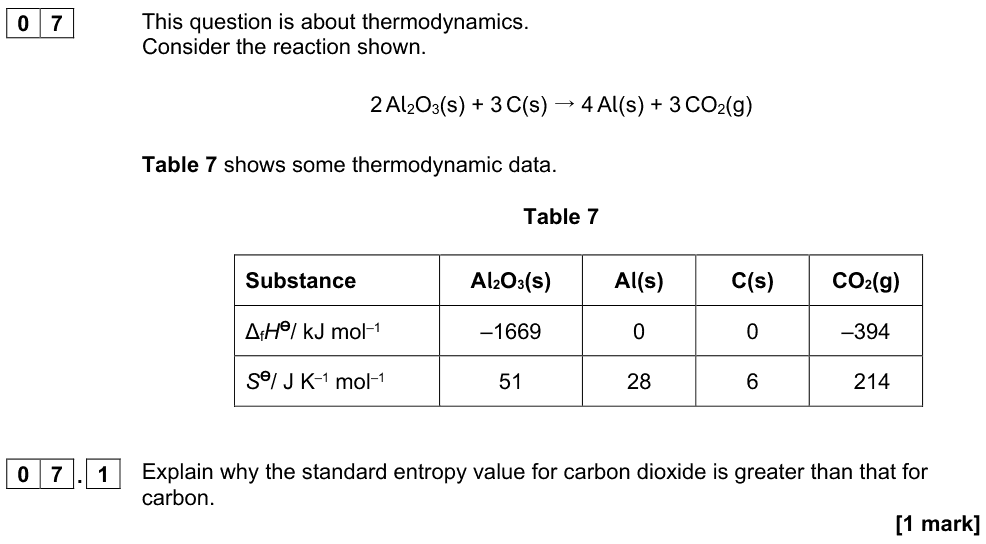
Table 7 shows some thermodynamic data.
Table 7
Substance
Al2O3(s)
Al(s)
C(s)
CO2(g)
ΔfHϴ/ kJ mol–1
–1669
0
0
–394
Sϴ/ J K–1 mol–1
51
28
6
214
Explain why the standard entropy value for carbon dioxide is greater than that for
carbon.
[1 mark]
November 2021 · Paper 1 · Q07.2 1 mark Short answer thermodynamics
Earlier part of question 07 that this part usesEarlier part of November 2021 Paper 1 question 07
State the temperature at which the standard entropy of aluminium is 0 J K–1 mol–1
[1 mark]
November 2021 · Paper 1 · Q07.3 7 marks Calculation thermodynamicsenergetics
Earlier part of question 07 that this part usesEarlier part of November 2021 Paper 1 question 07
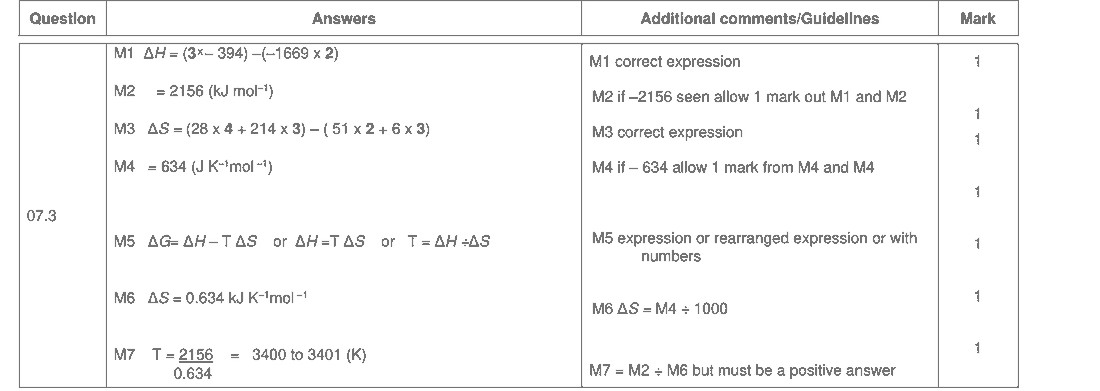
Use the equation and the data in Table 7 to calculate the minimum temperature,
in K, at which this reaction becomes feasible.
[7 marks]
Minimum temperature
K
November 2021 · Paper 1 · Q08.1 1 mark Short answer electrode potentials and cells
This question is about electrode potentials and electrochemical cells.
State the meaning of the term electrochemical series.
[1 mark]
November 2021 · Paper 1 · Q08.2 1 mark Short answer electrode potentials and cells
Earlier part of question 08 that this part usesEarlier part of November 2021 Paper 1 question 08
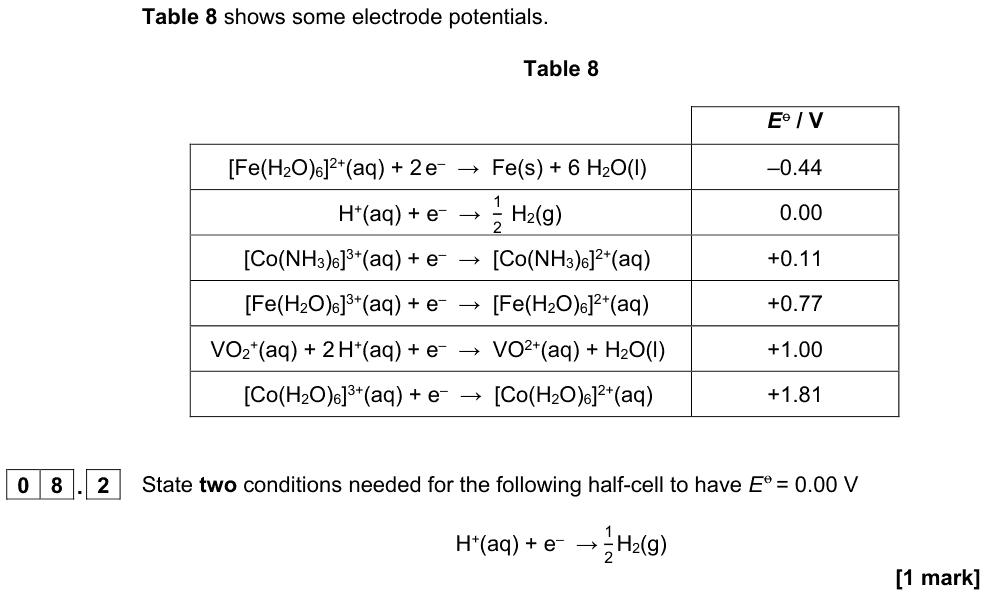
Table 8 shows some electrode potentials.
Table 8
E o / V
[Fe(H2O)6]2+(aq) + 2 e–  →  Fe(s) + 6 H2O(l)
–0.44
H+(aq) + e–  →
1
2  H2(g)
0.00
[Co(NH3)6]3+(aq) + e–  →  [Co(NH3)6]2+(aq)
+0.11
[Fe(H2O)6]3+(aq) + e–  →  [Fe(H2O)6]2+(aq)
+0.77
VO2+(aq) + 2 H+(aq) + e–  →  VO2+(aq) + H2O(l)
+1.00
[Co(H2O)6]3+(aq) + e–  →  [Co(H2O)6]2+(aq)
+1.81
State two conditions needed for the following half-cell to have E o = 0.00 V
H+(aq) + e–  →
1
2
H2(g)
[1 mark]
November 2021 · Paper 1 · Q08.3 1 mark Short answer electrode potentials and cells
Earlier parts of question 08 that this part usesEarlier part of November 2021 Paper 1 question 08Earlier part of November 2021 Paper 1 question 08
Identify the weakest reducing agent in Table 8.
[1 mark]
November 2021 · Paper 1 · Q08.4 2 marks Equation writing electrode potentials and cellsredox
Earlier parts of question 08 that this part usesEarlier part of November 2021 Paper 1 question 08Earlier part of November 2021 Paper 1 question 08
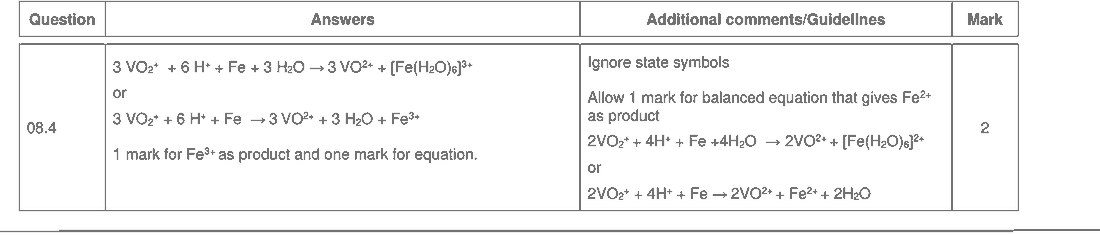
Use half-equations from Table 8 to deduce an equation for the reduction of VO2+ to
form VO2+ in aqueous solution by iron.
[2 marks]
November 2021 · Paper 1 · Q08.5 2 marks Explanation electrode potentials and cells
Earlier parts of question 08 that this part usesEarlier part of November 2021 Paper 1 question 08Earlier part of November 2021 Paper 1 question 08
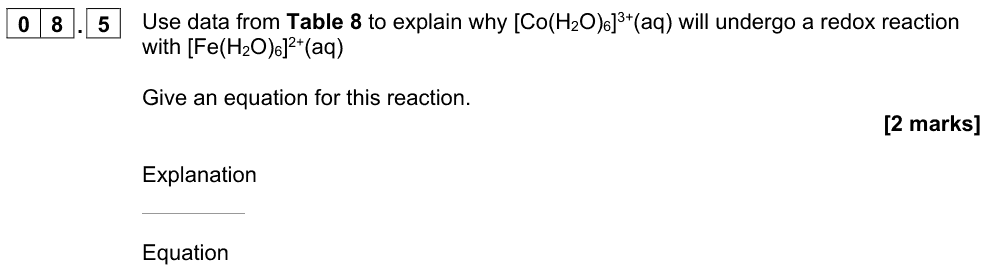
Use data from Table 8 to explain why [Co(H2O)6]3+(aq) will undergo a redox reaction
with [Fe(H2O)6]2+(aq)
Give an equation for this reaction.
[2 marks]
Explanation
Equation
November 2021 · Paper 1 · Q08.6 1 mark Short answer transition metals
Earlier parts of question 08 that this part usesEarlier part of November 2021 Paper 1 question 08Earlier part of November 2021 Paper 1 question 08
Suggest why the two cobalt(III) complex ions in Table 8 have different electrode
potentials.
[1 mark]
November 2021 · Paper 1 · Q09.1 2 marks Explanation electrode potentials and cells
This question is about the development of lithium cells.
The value of Eo for lithium suggests that a lithium cell could have a large EMF.
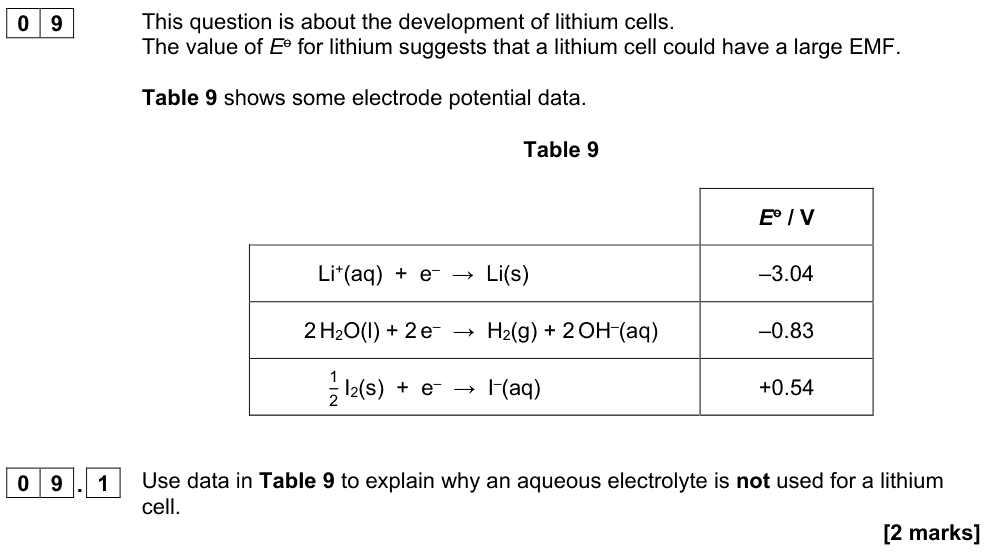
Table 9 shows some electrode potential data.
Table 9
Eo / V
Li+(aq)  +  e–  →  Li(s)
–3.04
2 H2O(l) + 2 e–  →  H2(g) + 2 OH–(aq)
–0.83
1
2 I2(s)  +  e–  →  I–(aq)
+0.54
Use data in Table 9 to explain why an aqueous electrolyte is not used for a lithium
cell.
[2 marks]
November 2021 · Paper 1 · Q09.2 1 mark Calculation electrode potentials and cells
Earlier part of question 09 that this part usesEarlier part of November 2021 Paper 1 question 09
In the 1970s lithium-iodine cells became a common power source for
heart pacemakers.  Lithium iodide is the final product of the cell reaction.
Use the data in Table 9 to calculate the cell EMF of a standard lithium-iodine cell.
[1 mark]
November 2021 · Paper 1 · Q09.3 1 mark Short answer electrode potentials and cells
Earlier part of question 09 that this part usesEarlier part of November 2021 Paper 1 question 09
An EMF value for a commercial lithium-iodine cell is 2.80 V
Suggest why this value is different from the value calculated in Question 09.2.
[1 mark]
November 2021 · Paper 1 · Q09.4 1 mark Short answer redox
Earlier part of question 09 that this part usesEarlier part of November 2021 Paper 1 question 09
In some lithium cells, lithium perchlorate (LiClO4) is used as the electrolyte.
Deduce the oxidation state of chlorine in LiClO4
[1 mark]
November 2021 · Paper 1 · Q09.5 1 mark Equation writing electrode potentials and cells
Earlier part of question 09 that this part usesEarlier part of November 2021 Paper 1 question 09
In other lithium cells, lithium cobalt oxide electrodes and lithium electrodes are used.
Give an equation for the reaction that occurs at the positive lithium cobalt oxide
electrode.
[1 mark]
November 2021 · Paper 1 · Q09.6 1 mark Equation writing electrode potentials and cells
Earlier parts of question 09 that this part usesEarlier part of November 2021 Paper 1 question 09Earlier part of November 2021 Paper 1 question 09
Give an equation for the reaction that occurs at the negative lithium electrode.
[1 mark]

Work with an A-level chemistry tutor

Want a paper marked and gone through with you? Message us.

Prefer email? Send an enquiry

If you are under 18, please include a parent's contact details. Enquiries go to enquiries@chemistryaleveltutor.com and are deleted once handled. All tutoring is online.