June 2024: Paper 3, Any content and practical skills

90 marks · 58 question parts · Paper, mark scheme and report on AQA's site · Have the Data Booklet beside you

Question by question

QTopicMarksAOType
01.1 Carboxylic acids and derivatives, Introduction to organic chemistry: nomenclature, mechanisms and isomerism 2AO2=2Equation writing
01.2 Carboxylic acids and derivatives 1AO1=1Short answer
01.3 Carboxylic acids and derivatives 1AO1=1Short answer
01.4 Kinetics 1AO3=1Short answer
01.5 Carboxylic acids and derivatives 1AO3=1Practical and data analysis
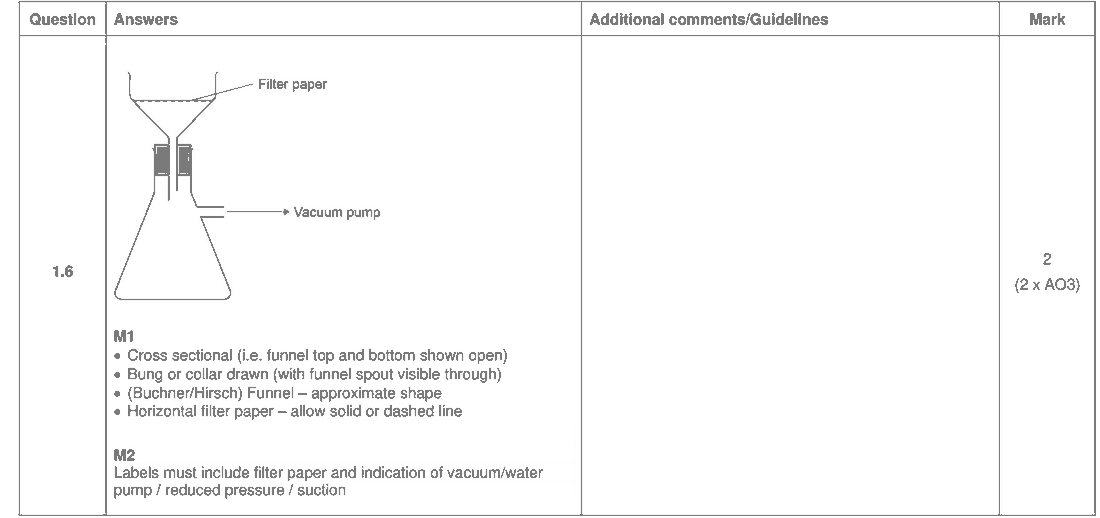
01.6 Carboxylic acids and derivatives 2AO3=2Diagram or structure
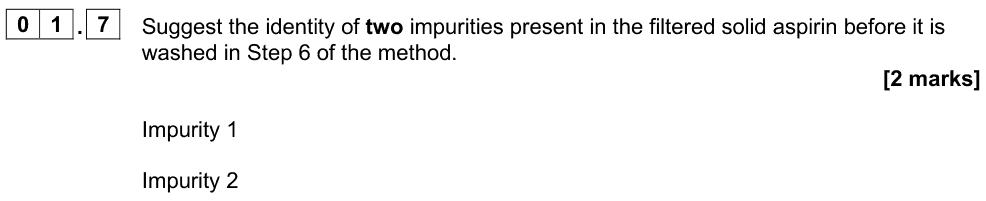
01.7 Carboxylic acids and derivatives 2AO3=2Short answer
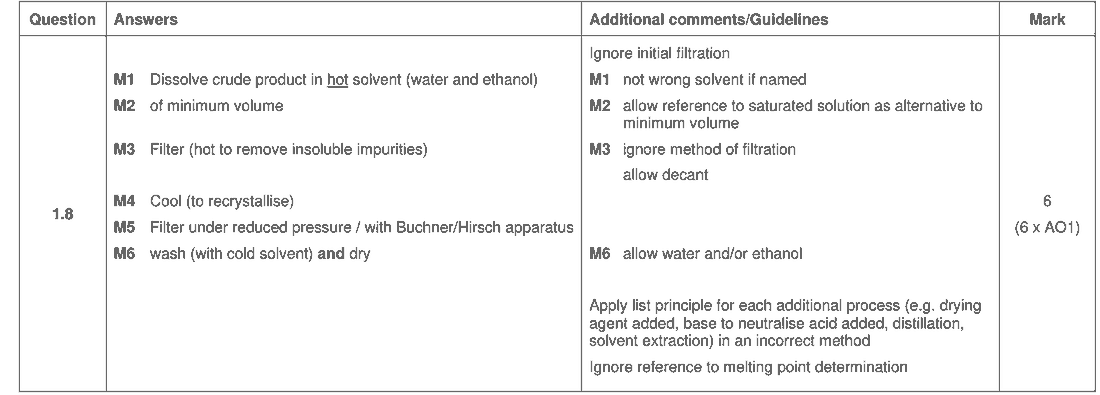
01.8 Carboxylic acids and derivatives 6AO1=6Practical and data analysis
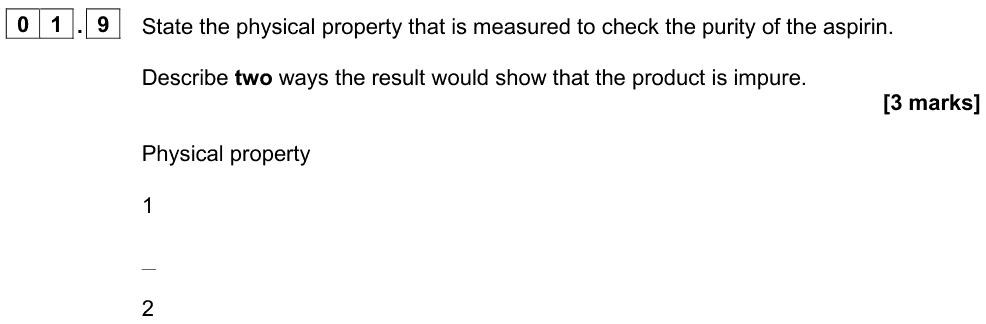
01.9 Carboxylic acids and derivatives 3AO1=3Practical and data analysis
02.1 Rate equations 2AO3=2Practical and data analysis
02.2 Rate equations 1AO3=1Practical and data analysis
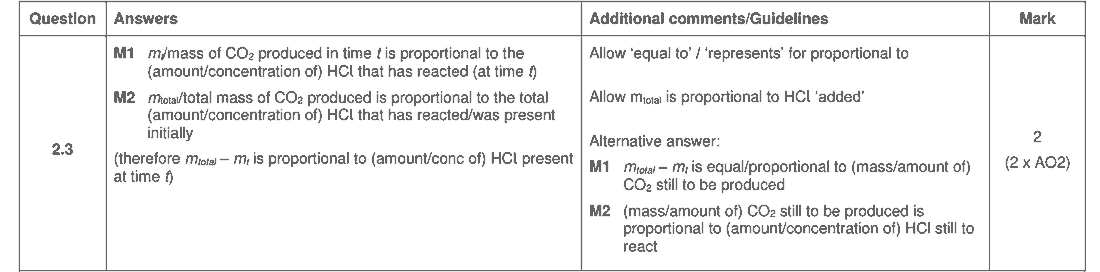
02.3 Rate equations, Amount of substance 2AO2=2Explanation
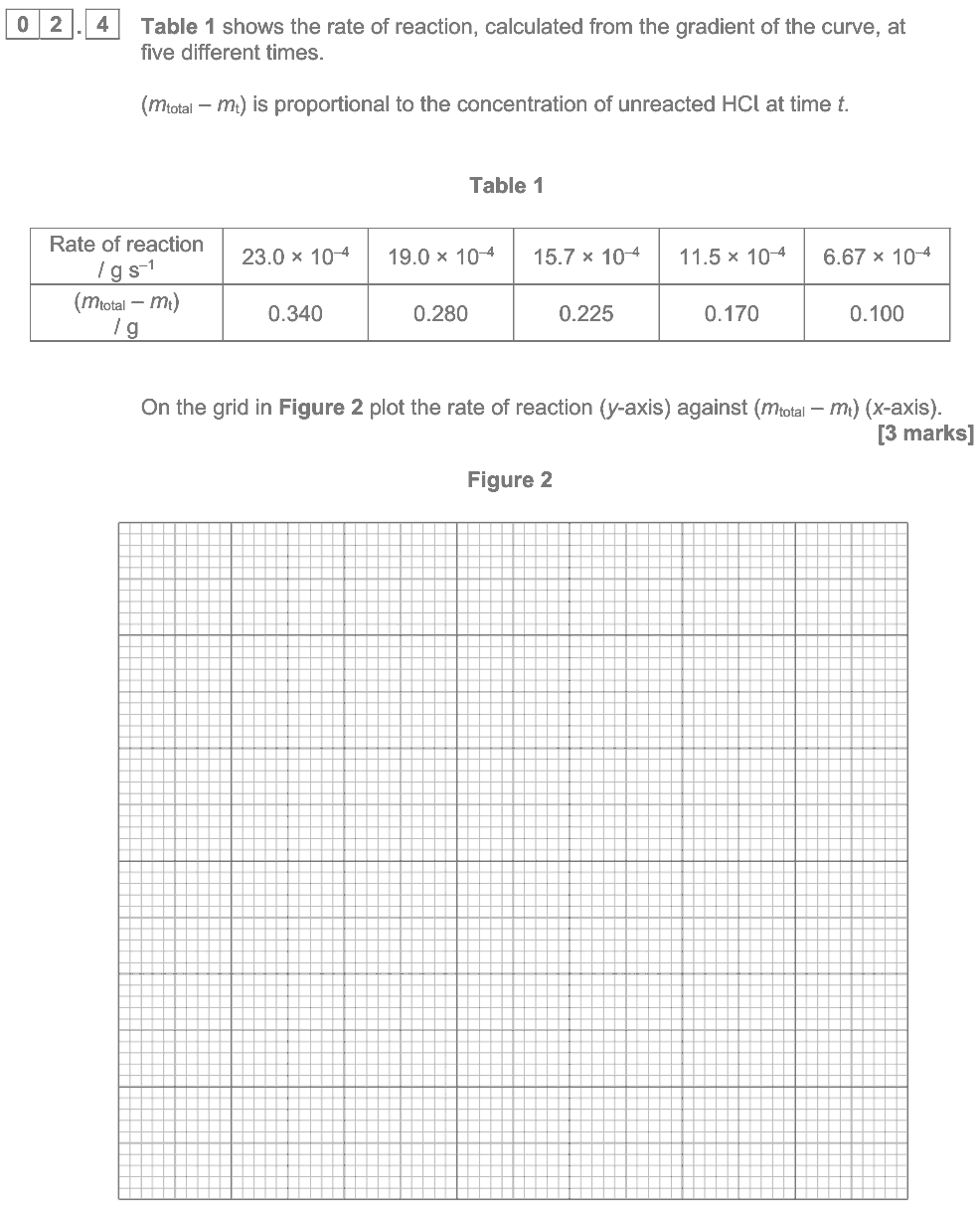
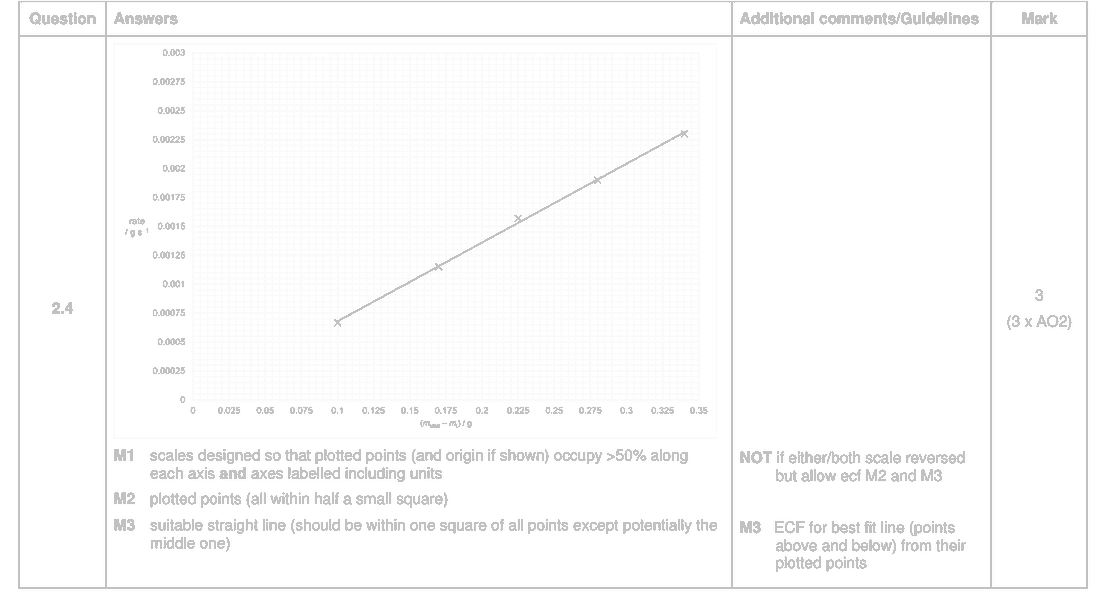
02.4 Rate equations 3AO2=3Practical and data analysis
02.5 Rate equations 1AO3=1Short answer
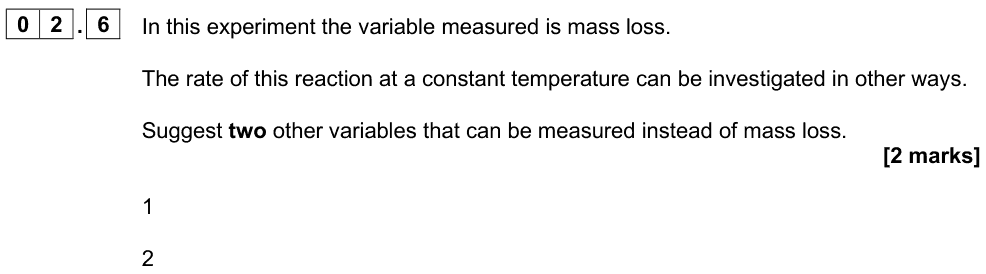
02.6 Rate equations 2AO3=2Practical and data analysis
03.1 Rate equations 1AO2=1Calculation
03.2 Rate equations 2AO1=2Short answer
03.3 Rate equations 2Practical and data analysis
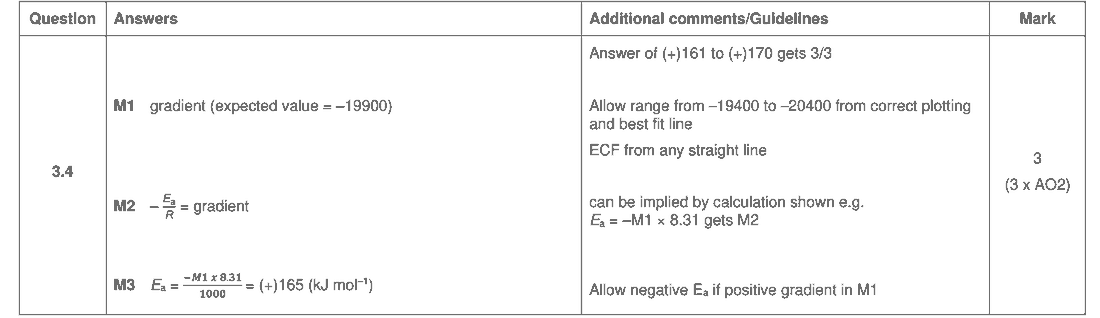
03.4 Rate equations 3AO2=3Calculation
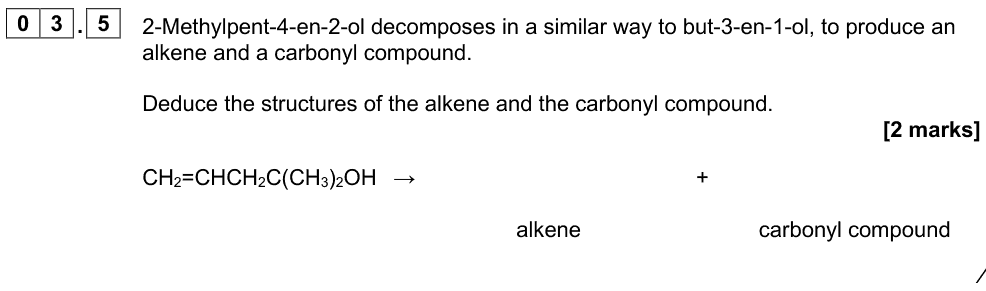
03.5 Introduction to organic chemistry: nomenclature, mechanisms and isomerism, Aldehydes and ketones 2AO2=2Short answer
04.1 Acids and bases: pH, Ka, titration curves and buffers 1AO1=1Short answer
04.2 Acids and bases: pH, Ka, titration curves and buffers 1AO3=1Practical and data analysis
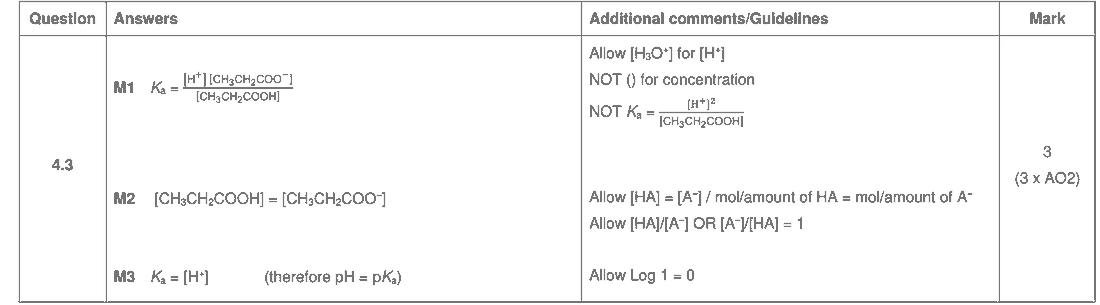
04.3 Acids and bases: pH, Ka, titration curves and buffers 3AO2=3Explanation
04.4 Acids and bases: pH, Ka, titration curves and buffers 2AO3=2Calculation
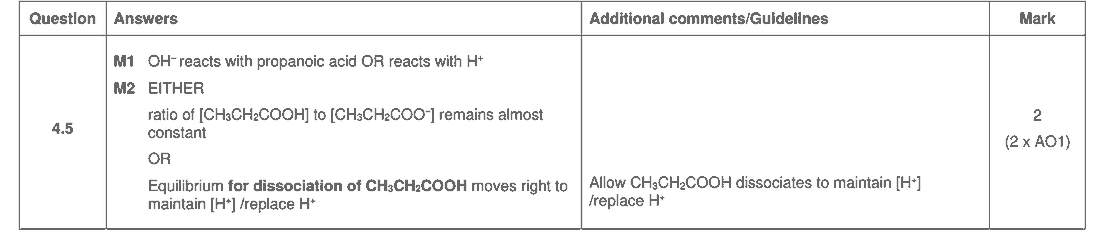
04.5 Acids and bases: pH, Ka, titration curves and buffers 2AO1=2Explanation
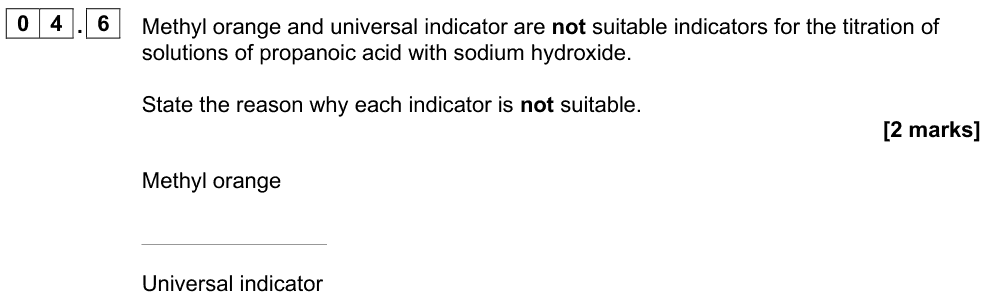
04.6 Acids and bases: pH, Ka, titration curves and buffers 2AO3=2Short answer
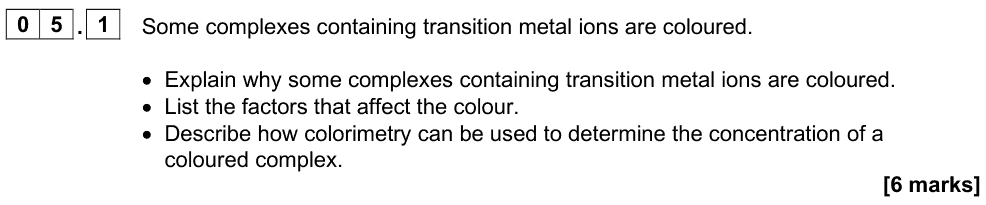
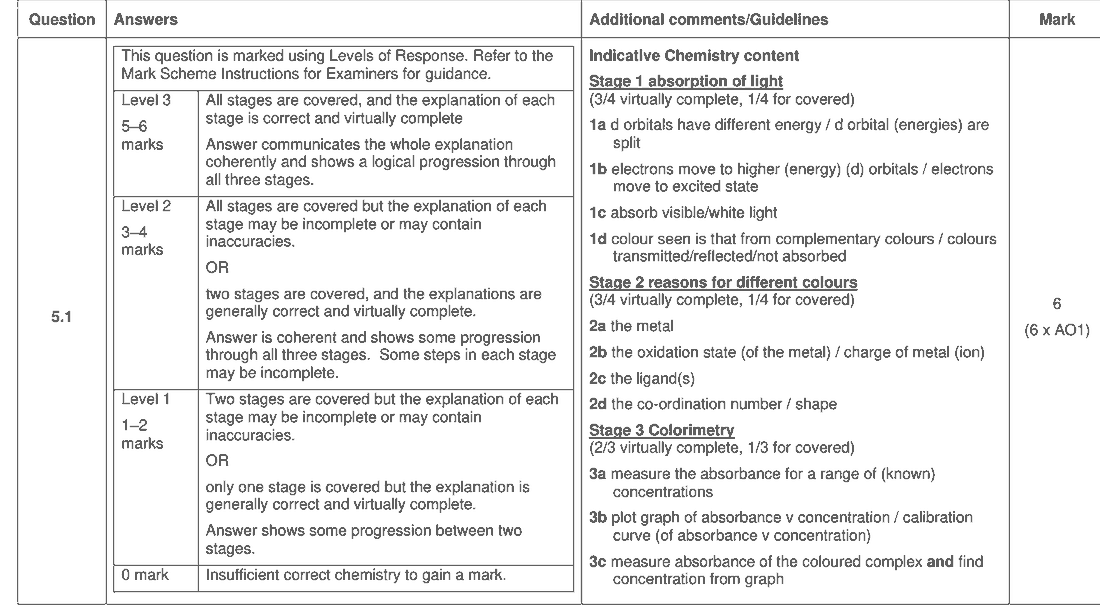
05.1 Transition metals 6AO1=6Level of response
05.2 Transition metals 3AO3=3Calculation
06 Atomic structure 1AO2=1Multiple choice
07 Atomic structure 1AO1=1Multiple choice
08 Amount of substance 1AO2=1Multiple choice
09 Bonding 1AO1=1Multiple choice
10 Bonding 1AO2=1Multiple choice
11 Bonding 1AO1=1Multiple choice
12 Bonding 1AO2=1Multiple choice
13 Bonding 1AO2=1Multiple choice
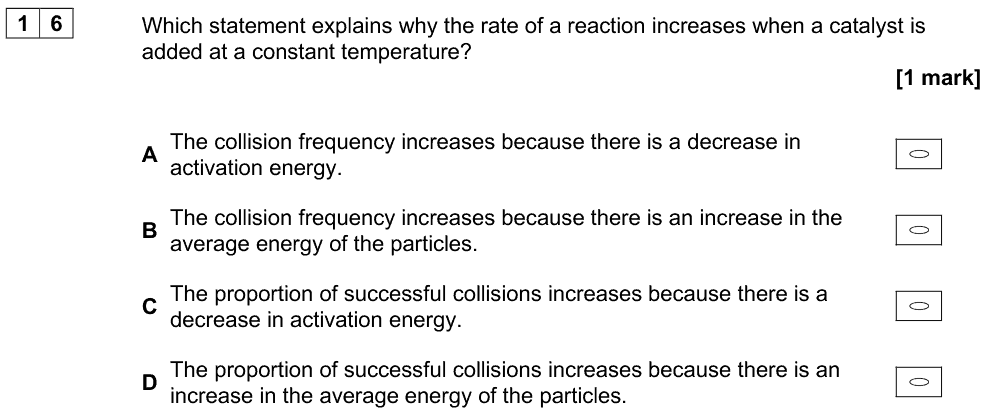
14 Kinetics 1AO1=1Multiple choice
15 Rate equations 1AO2=1Multiple choice
16 Kinetics 1AO1=1Multiple choice
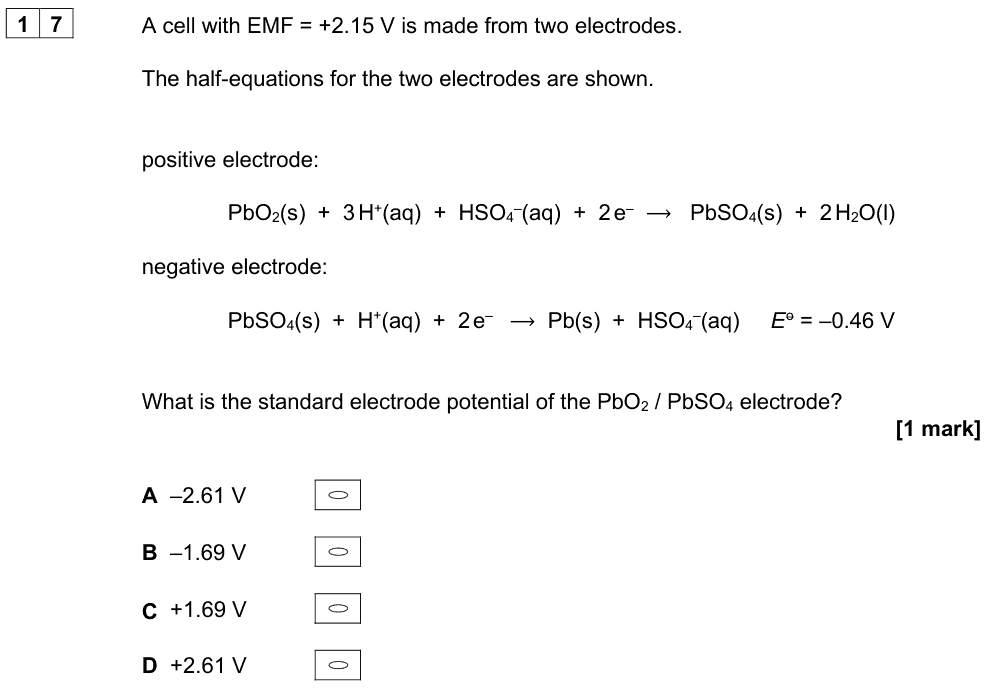
17 Electrode potentials and electrochemical cells 1AO2=1Multiple choice
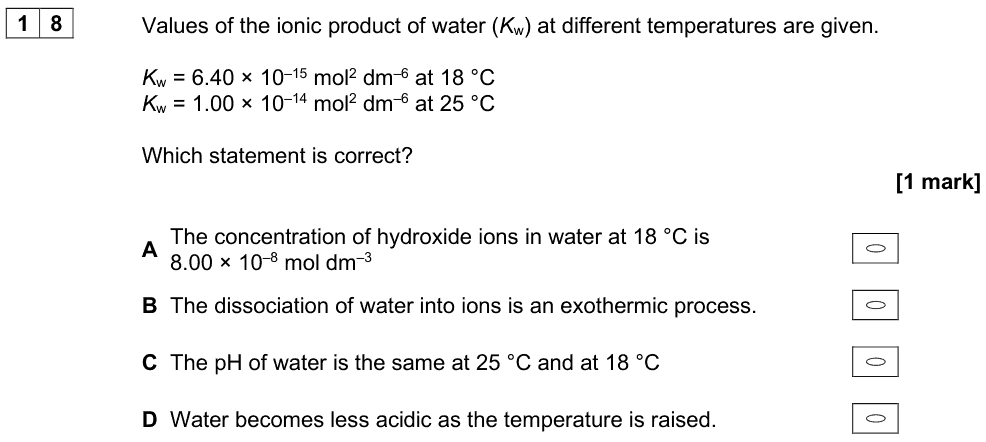
18 Acids and bases: pH, Ka, titration curves and buffers 1AO3=1Multiple choice
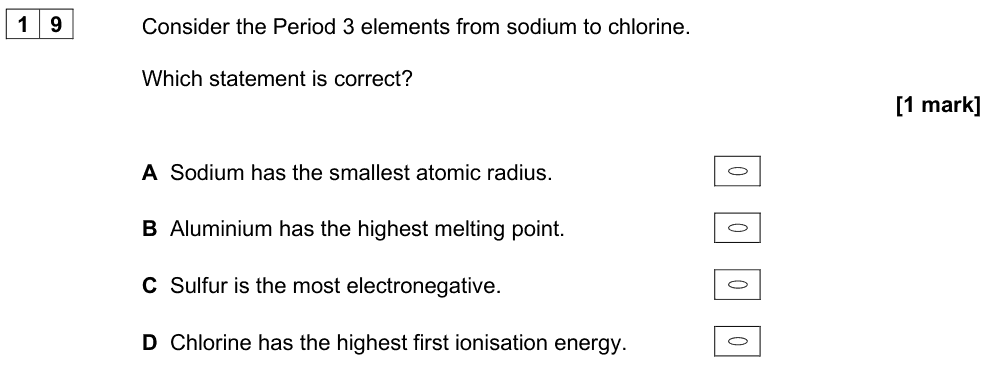
19 Periodicity 1AO2=1Multiple choice
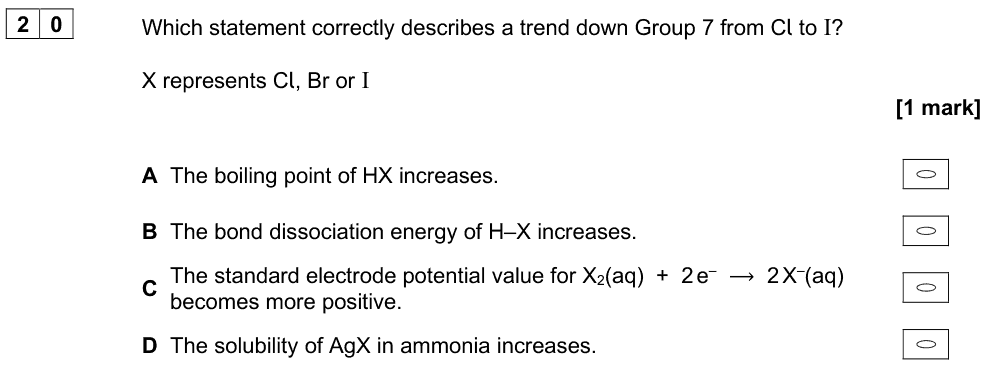
20 Bonding 1AO1=1Multiple choice
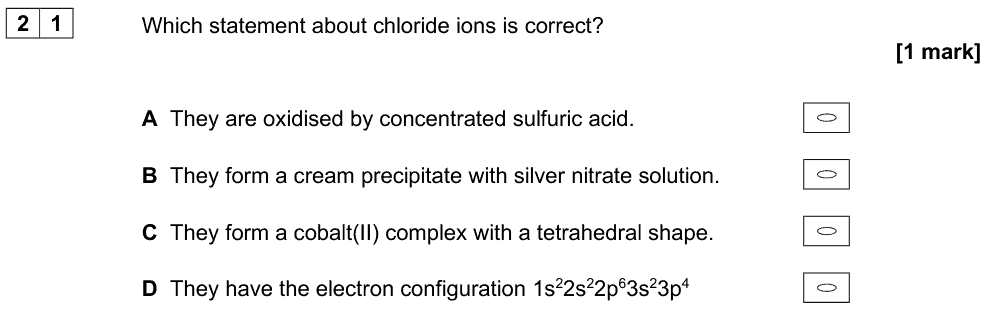
21 Transition metals 1AO1=1Multiple choice
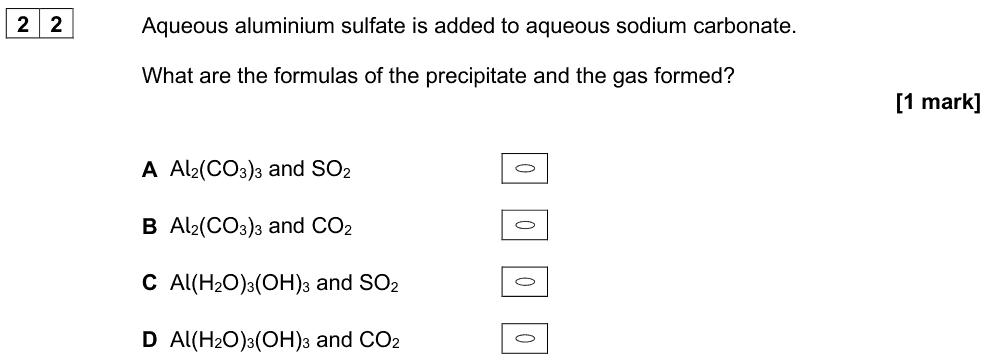
22 Reactions of ions in aqueous solution 1AO2=1Multiple choice
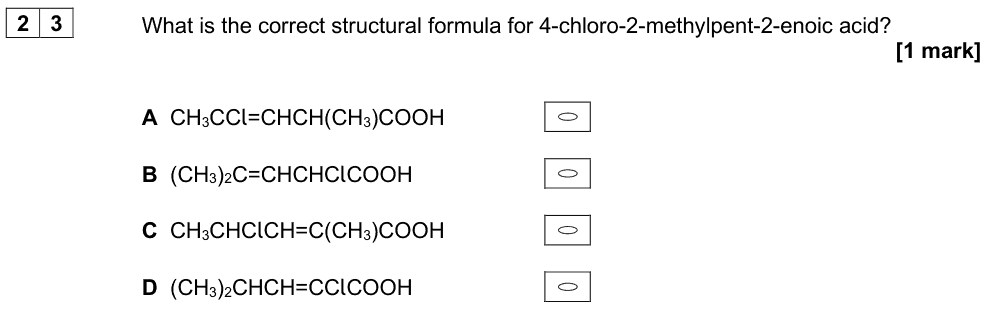
23 Introduction to organic chemistry: nomenclature, mechanisms and isomerism 1AO2=1Multiple choice
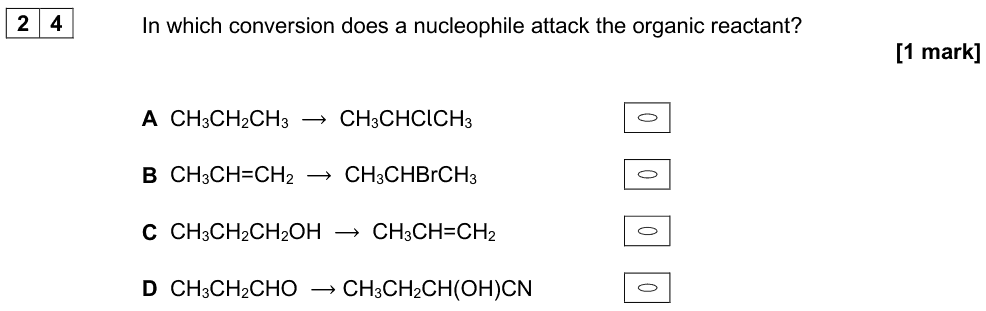
24 Aldehydes and ketones 1AO1=1Multiple choice
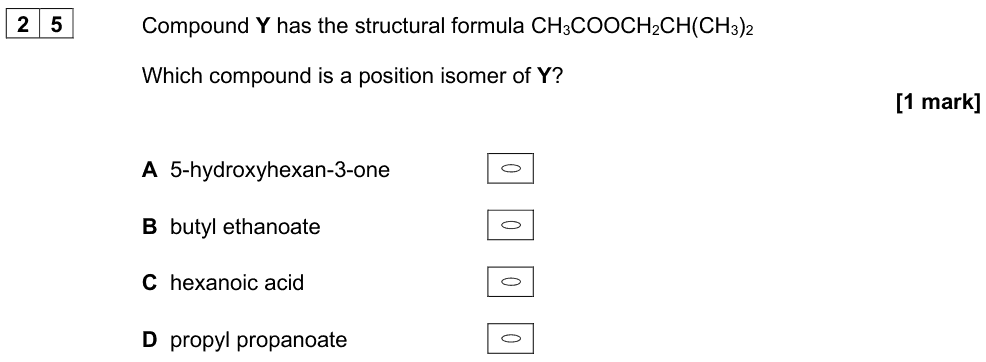
25 Introduction to organic chemistry: nomenclature, mechanisms and isomerism 1AO2=1Multiple choice
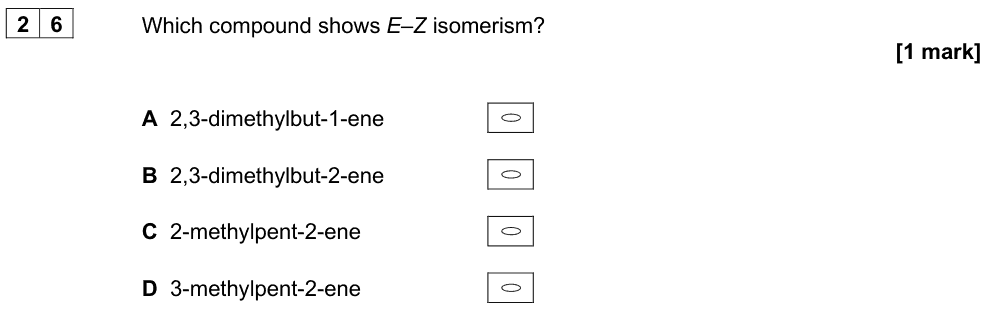
26 Introduction to organic chemistry: nomenclature, mechanisms and isomerism 1AO2=1Multiple choice
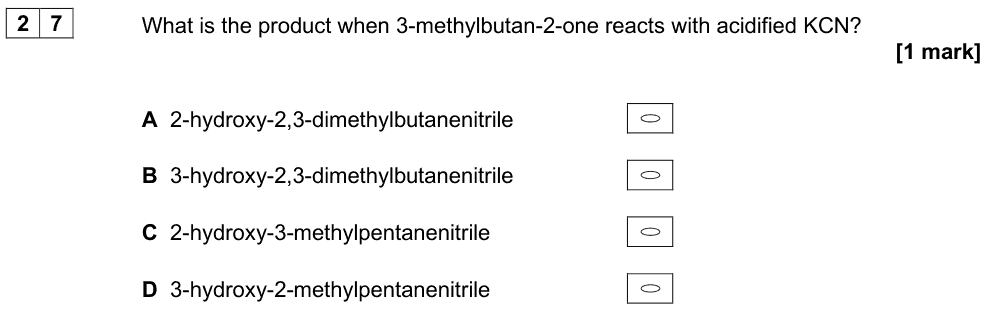
27 Aldehydes and ketones, Introduction to organic chemistry: nomenclature, mechanisms and isomerism 1AO3=1Multiple choice
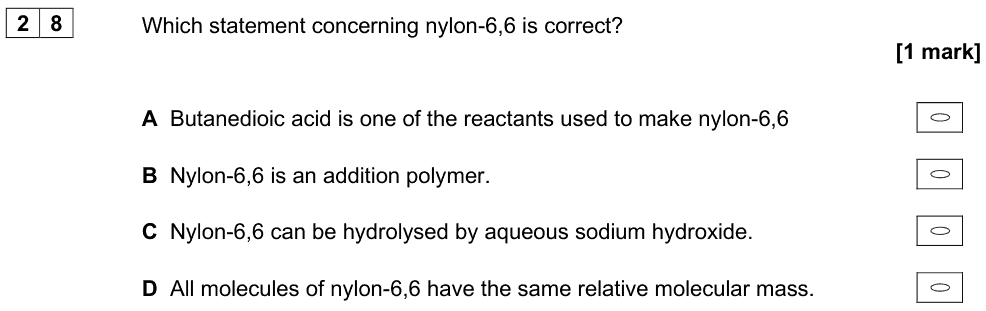
28 Polymers 1AO2=1Multiple choice
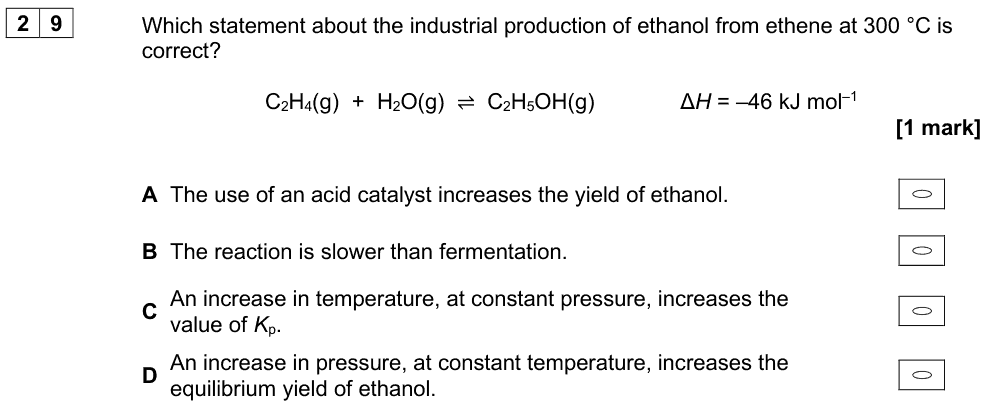
29 Equilibrium constant Kp 1AO2=1Multiple choice
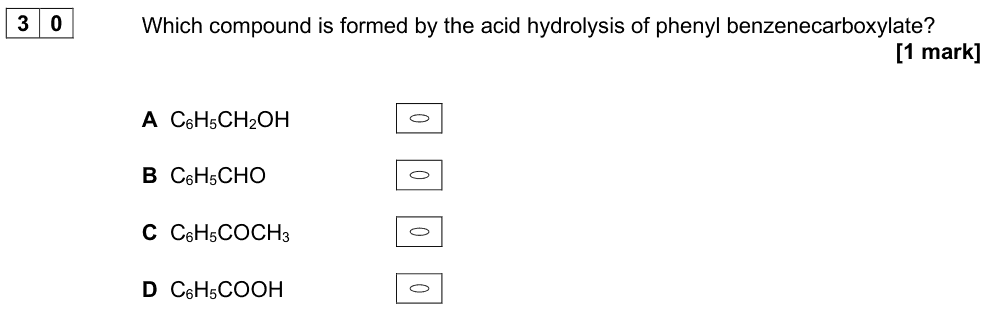
30 Carboxylic acids and derivatives 1AO2=1Multiple choice
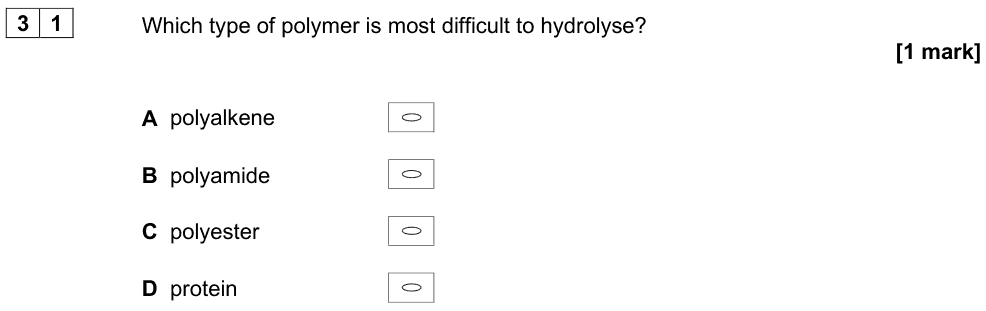
31 Polymers 1AO1=1Multiple choice
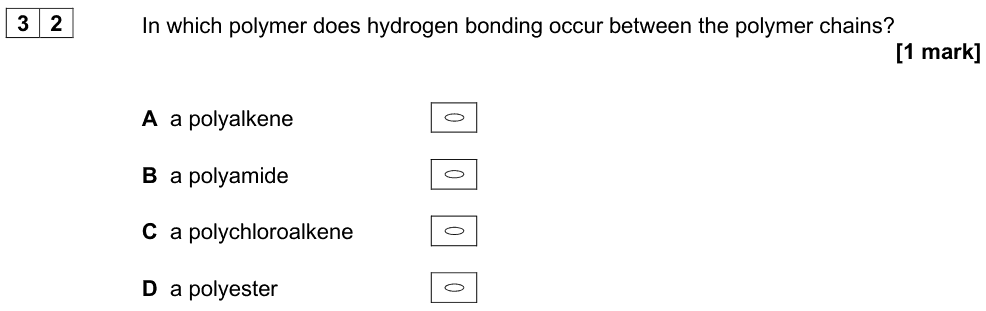
32 Polymers 1AO3=1Multiple choice
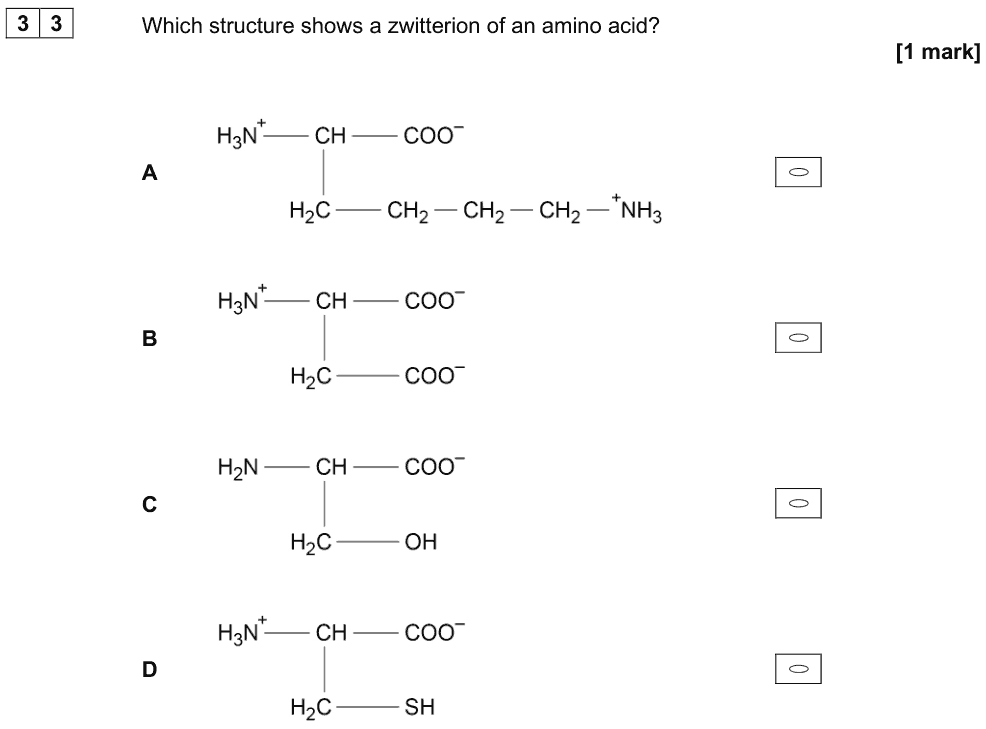
33 Amino acids, proteins and DNA 1AO1=1Multiple choice
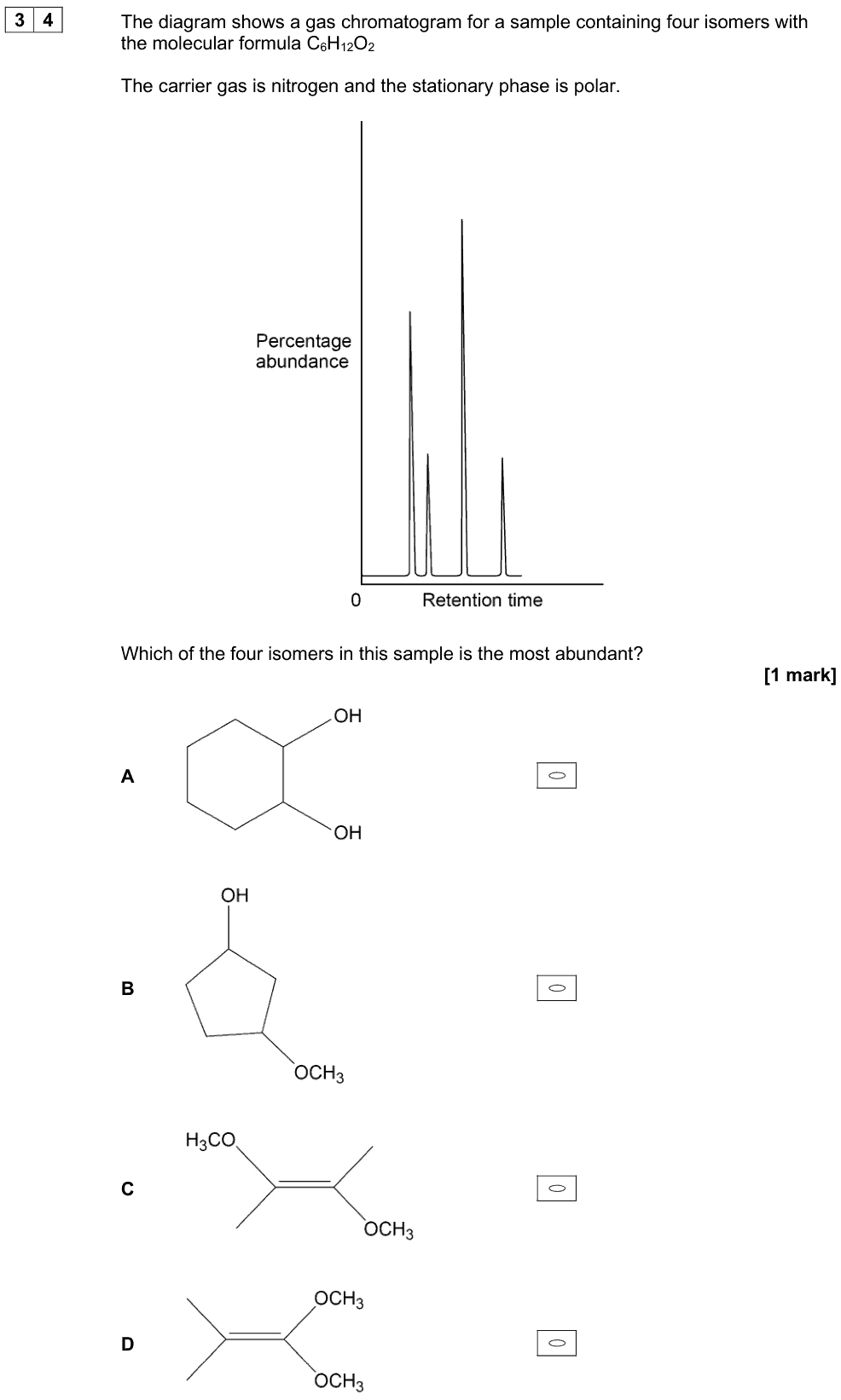
34 Chromatography 1AO3=1Multiple choice
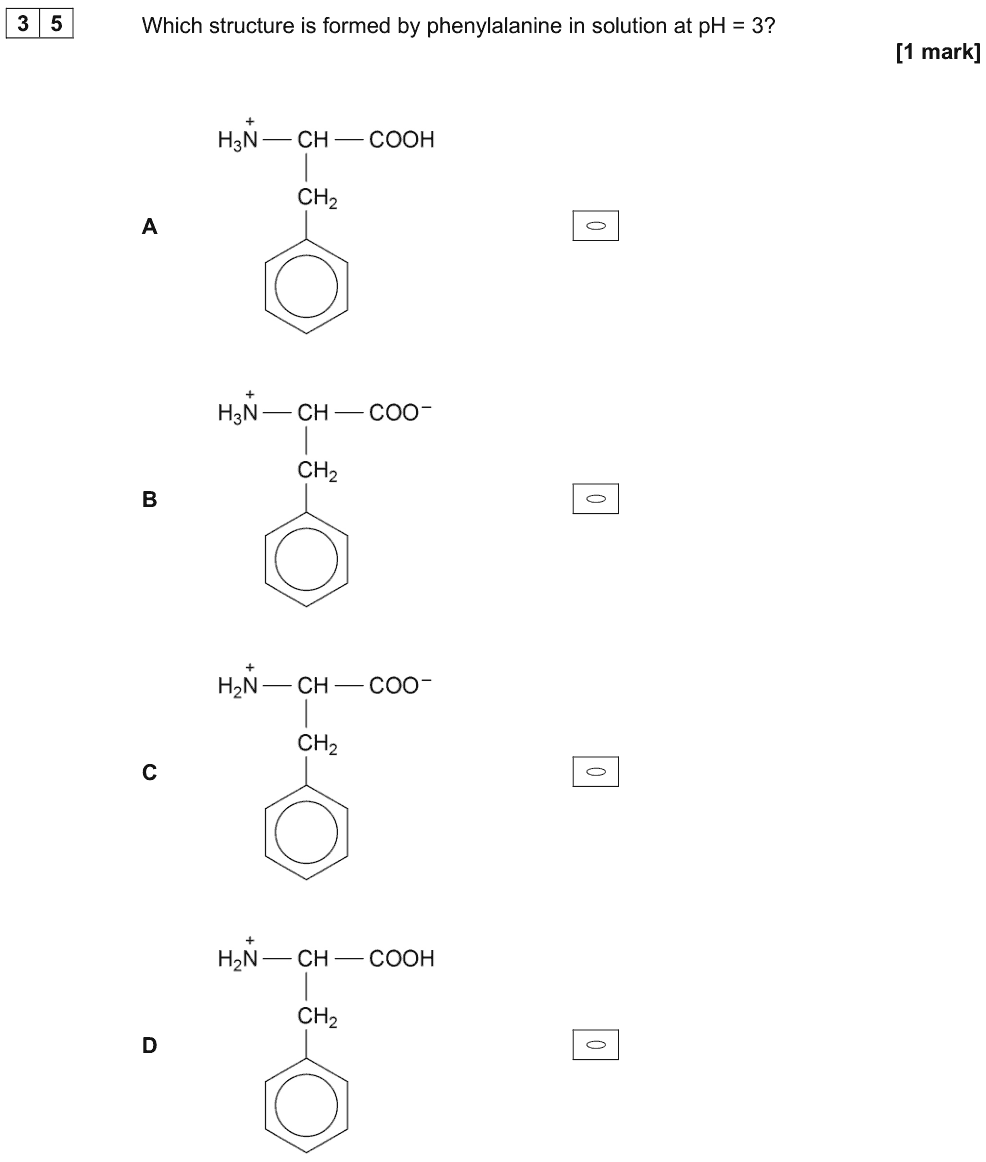
35 Amino acids, proteins and DNA 1AO2=1Multiple choice

The questions

01.101.201.301.401.501.601.701.801.902.102.202.302.402.502.603.103.203.303.403.504.104.204.304.404.504.605.105.2060708091011121314151617181920212223242526272829303132333435
June 2024 · Paper 3 · Q01.1 2 marks AO2=2 Equation writing carboxylic acids and derivativesintroduction to organic chemistry
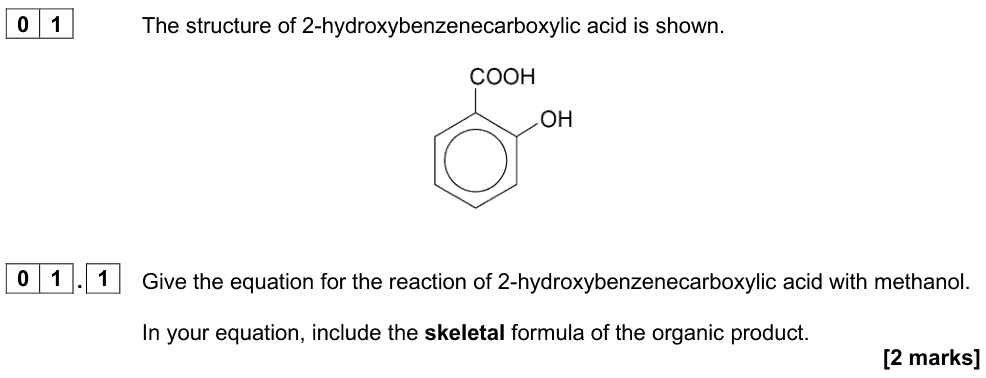
The structure of 2-hydroxybenzenecarboxylic acid is shown.
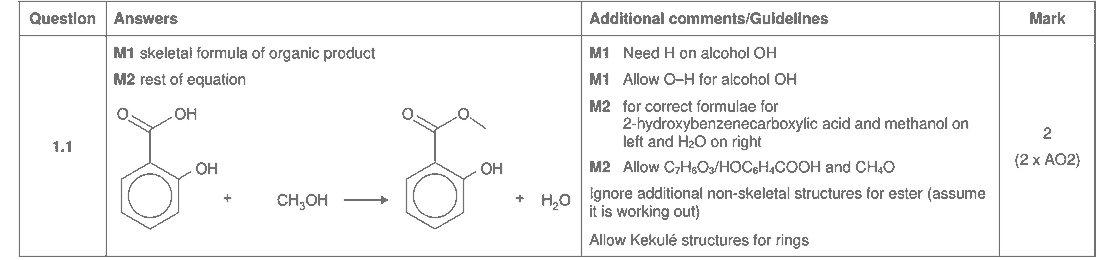
Give the equation for the reaction of 2-hydroxybenzenecarboxylic acid with methanol.
In your equation, include the skeletal formula of the organic product.
[2 marks]
June 2024 · Paper 3 · Q01.2 1 mark AO1=1 Short answer carboxylic acids and derivatives
Earlier part of question 01 that this part usesEarlier part of June 2024 Paper 3 question 01
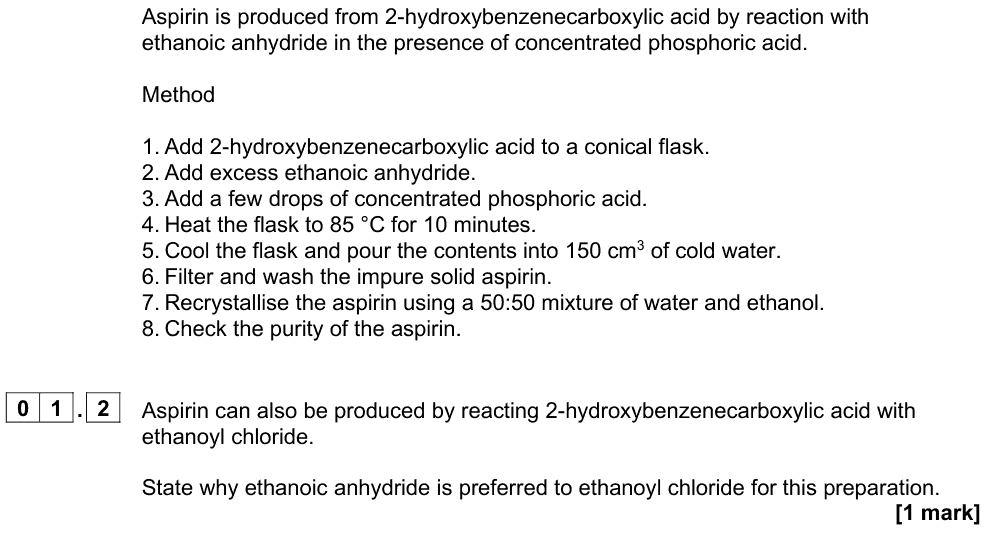
Aspirin is produced from 2-hydroxybenzenecarboxylic acid by reaction with
ethanoic anhydride in the presence of concentrated phosphoric acid.
Method
1. Add 2-hydroxybenzenecarboxylic acid to a conical flask.
2. Add excess ethanoic anhydride.
3. Add a few drops of concentrated phosphoric acid.
4. Heat the flask to 85 °C for 10 minutes.
5. Cool the flask and pour the contents into 150 cm3 of cold water.
6. Filter and wash the impure solid aspirin.
7. Recrystallise the aspirin using a 50:50 mixture of water and ethanol.
8. Check the purity of the aspirin.
Aspirin can also be produced by reacting 2-hydroxybenzenecarboxylic acid with
ethanoyl chloride.
State why ethanoic anhydride is preferred to ethanoyl chloride for this preparation.
[1 mark]
June 2024 · Paper 3 · Q01.3 1 mark AO1=1 Short answer carboxylic acids and derivatives
Earlier parts of question 01 that this part usesEarlier part of June 2024 Paper 3 question 01Earlier part of June 2024 Paper 3 question 01
Give the name of the mechanism for the reaction of
2-hydroxybenzenecarboxylic acid with ethanoic anhydride.
[1 mark]
June 2024 · Paper 3 · Q01.4 1 mark AO3=1 Short answer kinetics
Earlier parts of question 01 that this part usesEarlier part of June 2024 Paper 3 question 01Earlier part of June 2024 Paper 3 question 01
Suggest the role of the concentrated phosphoric acid.
[1 mark]
June 2024 · Paper 3 · Q01.5 1 mark AO3=1 Practical and data analysis Hard carboxylic acids and derivatives
Earlier parts of question 01 that this part usesEarlier part of June 2024 Paper 3 question 01Earlier part of June 2024 Paper 3 question 01
Suggest why reflux is not essential when the flask is heated to 85 °C for 10 minutes.
[1 mark]
June 2024 · Paper 3 · Q01.6 2 marks AO3=2 Diagram or structure carboxylic acids and derivatives
Earlier parts of question 01 that this part usesEarlier part of June 2024 Paper 3 question 01Earlier part of June 2024 Paper 3 question 01
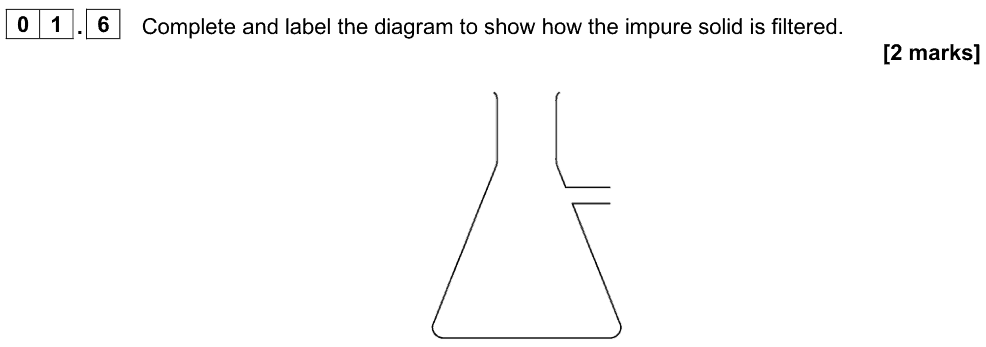
Complete and label the diagram to show how the impure solid is filtered.
[2 marks]
June 2024 · Paper 3 · Q01.7 2 marks AO3=2 Short answer carboxylic acids and derivatives
Earlier parts of question 01 that this part usesEarlier part of June 2024 Paper 3 question 01Earlier part of June 2024 Paper 3 question 01
Suggest the identity of two impurities present in the filtered solid aspirin before it is
washed in Step 6 of the method.
[2 marks]
Impurity 1
Impurity 2
June 2024 · Paper 3 · Q01.8 6 marks AO1=6 Practical and data analysis carboxylic acids and derivatives
Earlier parts of question 01 that this part usesEarlier part of June 2024 Paper 3 question 01Earlier part of June 2024 Paper 3 question 01
Describe the recrystallisation process used to purify the aspirin.
Include the method and apparatus used.
[6 marks]
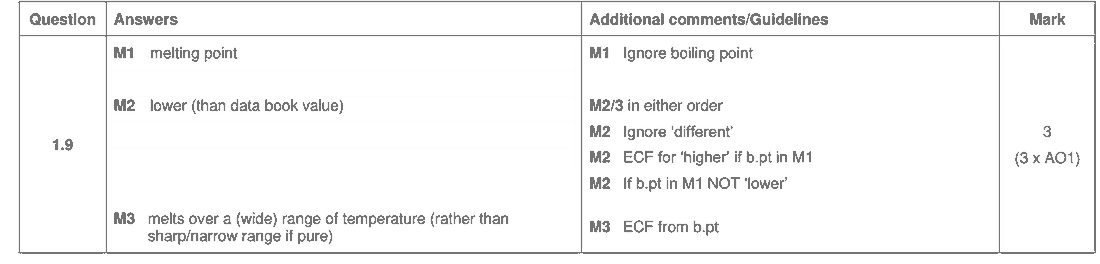
June 2024 · Paper 3 · Q01.9 3 marks AO1=3 Practical and data analysis carboxylic acids and derivatives
Earlier parts of question 01 that this part usesEarlier part of June 2024 Paper 3 question 01Earlier part of June 2024 Paper 3 question 01
State the physical property that is measured to check the purity of the aspirin.
Describe two ways the result would show that the product is impure.
[3 marks]
Physical property
1
2
June 2024 · Paper 3 · Q02.1 2 marks AO3=2 Practical and data analysis rate equations
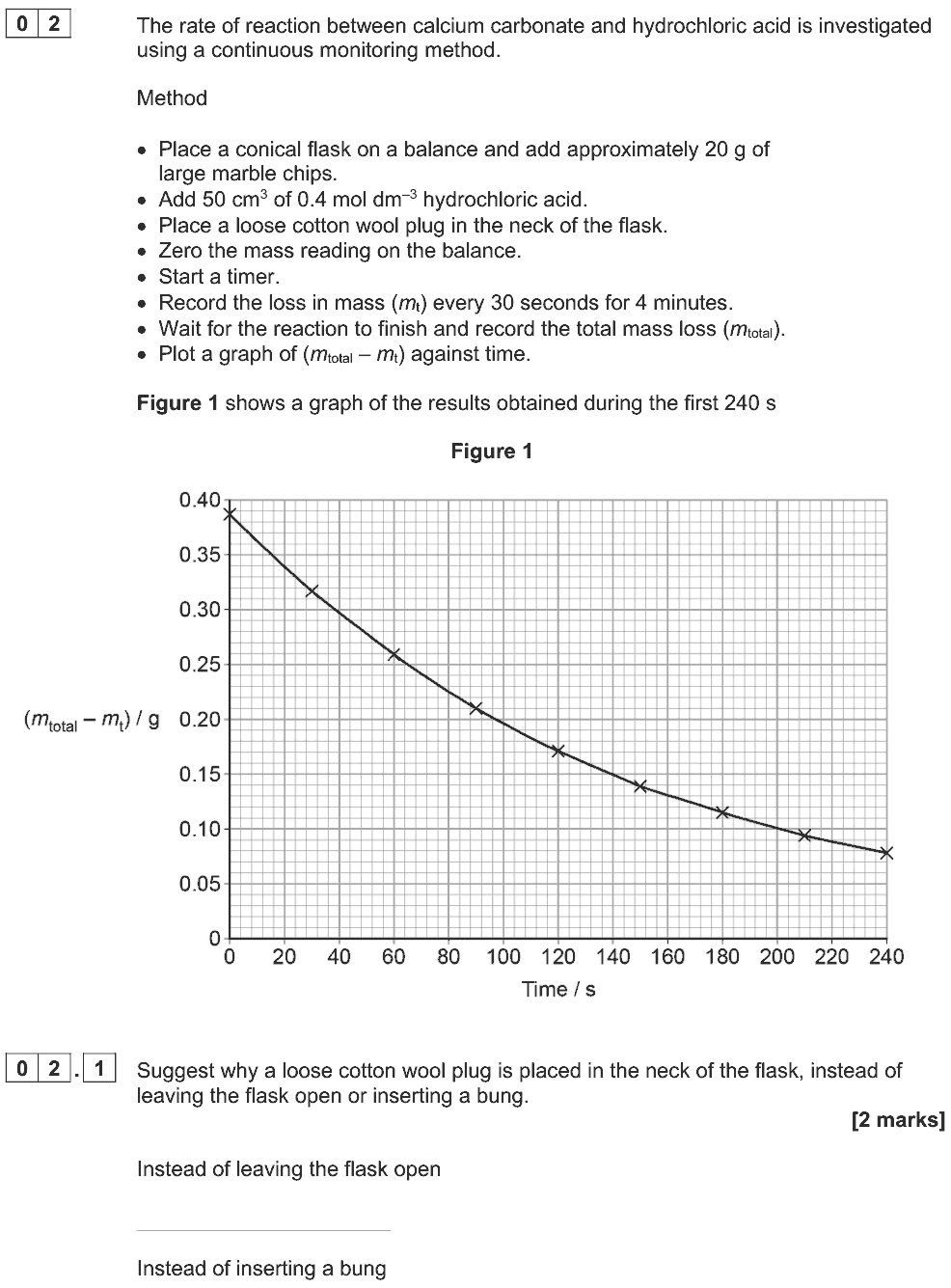
The rate of reaction between calcium carbonate and hydrochloric acid is investigated
using a continuous monitoring method.
Method
• Place a conical flask on a balance and add approximately 20 g of
large marble chips.
• Add 50 cm3 of 0.4 mol dm–3 hydrochloric acid.
• Place a loose cotton wool plug in the neck of the flask.
• Zero the mass reading on the balance.
• Start a timer.
• Record the loss in mass (mt) every 30 seconds for 4 minutes.
• Wait for the reaction to finish and record the total mass loss (mtotal).
• Plot a graph of (mtotal – mt) against time.
Figure 1 shows a graph of the results obtained during the first 240 s
Figure 1
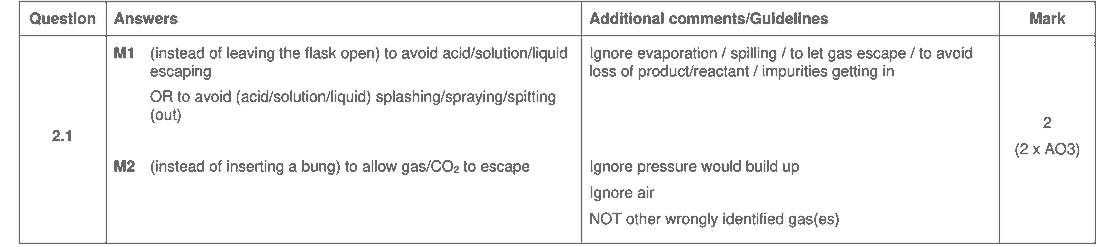
Suggest why a loose cotton wool plug is placed in the neck of the flask, instead of
leaving the flask open or inserting a bung.
[2 marks]
Instead of leaving the flask open
Instead of inserting a bung
June 2024 · Paper 3 · Q02.2 1 mark AO3=1 Practical and data analysis Hard rate equations
Earlier part of question 02 that this part usesEarlier part of June 2024 Paper 3 question 02
20 g of large marble chips is a large excess of calcium carbonate.
Suggest why using a large excess of calcium carbonate means that the rate is only
affected by the changing concentration of the hydrochloric acid.
[1 mark]
June 2024 · Paper 3 · Q02.3 2 marks AO2=2 Explanation rate equationsamount of substance
Earlier part of question 02 that this part usesEarlier part of June 2024 Paper 3 question 02
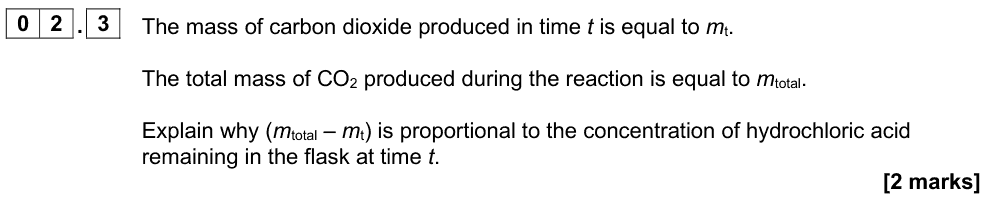
The mass of carbon dioxide produced in time t is equal to mt.
The total mass of CO2 produced during the reaction is equal to mtotal.
Explain why (mtotal – mt) is proportional to the concentration of hydrochloric acid
remaining in the flask at time t.
[2 marks]
June 2024 · Paper 3 · Q02.4 3 marks AO2=3 Practical and data analysis rate equations
Earlier part of question 02 that this part usesEarlier part of June 2024 Paper 3 question 02
Table 1 shows the rate of reaction, calculated from the gradient of the curve, at
five different times.
(mtotal – mt) is proportional to the concentration of unreacted HCl at time t.
Table 1
Rate of reaction
/ g s–1
23.0 × 10⁻⁴
19.0 × 10⁻⁴
15.7 × 10⁻⁴
11.5 × 10⁻⁴
6.67 × 10⁻⁴
(mtotal – mt)
/ g
0.340
0.280
0.225
0.170
0.100
On the grid in Figure 2 plot the rate of reaction (y-axis) against (mtotal – mt) (x-axis).
[3 marks]
Figure 2
June 2024 · Paper 3 · Q02.5 1 mark AO3=1 Short answer rate equations
Earlier parts of question 02 that this part usesEarlier part of June 2024 Paper 3 question 02Earlier part of June 2024 Paper 3 question 02
State how the graph in Figure 2 confirms that the rate equation for this reaction is
Rate = k[HCl]
[1 mark]
June 2024 · Paper 3 · Q02.6 2 marks AO3=2 Practical and data analysis Hard rate equations
Earlier part of question 02 that this part usesEarlier part of June 2024 Paper 3 question 02
In this experiment the variable measured is mass loss.
The rate of this reaction at a constant temperature can be investigated in other ways.
Suggest two other variables that can be measured instead of mass loss.
[2 marks]
1
2
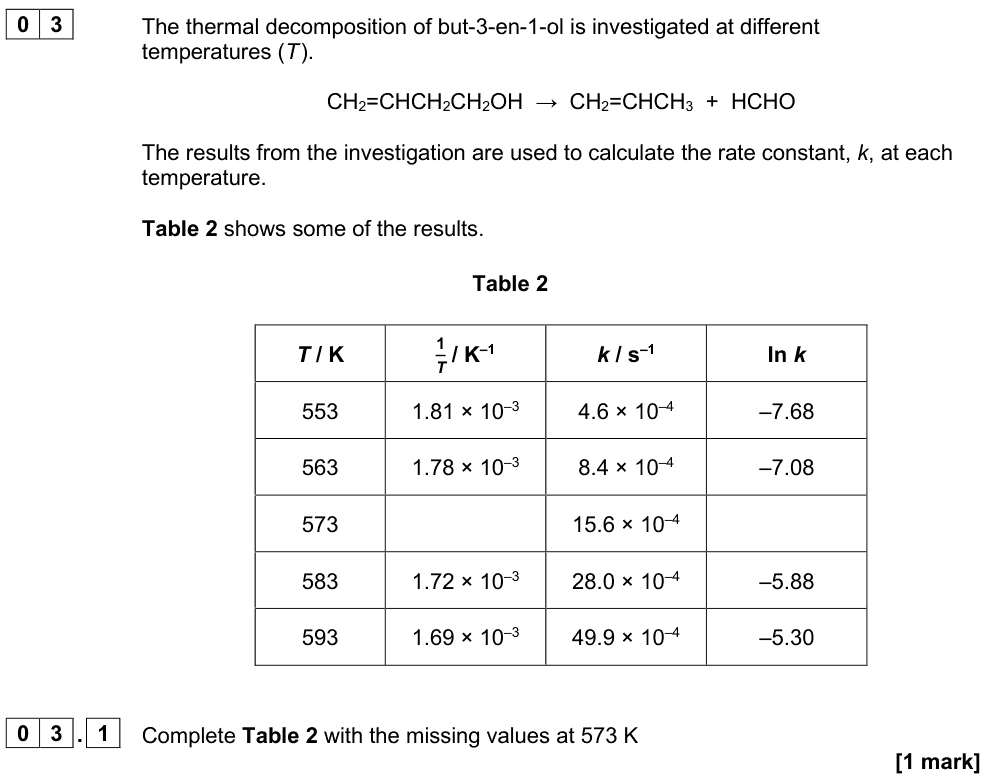
June 2024 · Paper 3 · Q03.1 1 mark AO2=1 Calculation Easy rate equations
The thermal decomposition of but-3-en-1-ol is investigated at different
temperatures (T ).
CH2=CHCH2CH2OH  →  CH2=CHCH3  +  HCHO
The results from the investigation are used to calculate the rate constant, k, at each
temperature.
Table 2 shows some of the results.
Table 2
T / K
1
T / K–1
k / s–1
In k
553
1.81 × 10⁻³
4.6 × 10⁻⁴
–7.68
563
1.78 × 10⁻³
8.4 × 10⁻⁴
–7.08
573
15.6 × 10⁻⁴
583
1.72 × 10⁻³
28.0 × 10⁻⁴
–5.88
593
1.69 × 10⁻³
49.9 × 10⁻⁴
–5.30
Complete Table 2 with the missing values at 573 K
[1 mark]
June 2024 · Paper 3 · Q03.2 2 marks AO1=2 Short answer rate equations
Earlier part of question 03 that this part usesEarlier part of June 2024 Paper 3 question 03
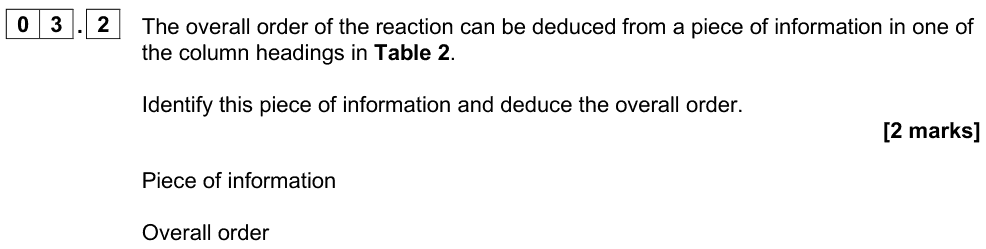
The overall order of the reaction can be deduced from a piece of information in one of
the column headings in Table 2.
Identify this piece of information and deduce the overall order.
[2 marks]
Piece of information
Overall order
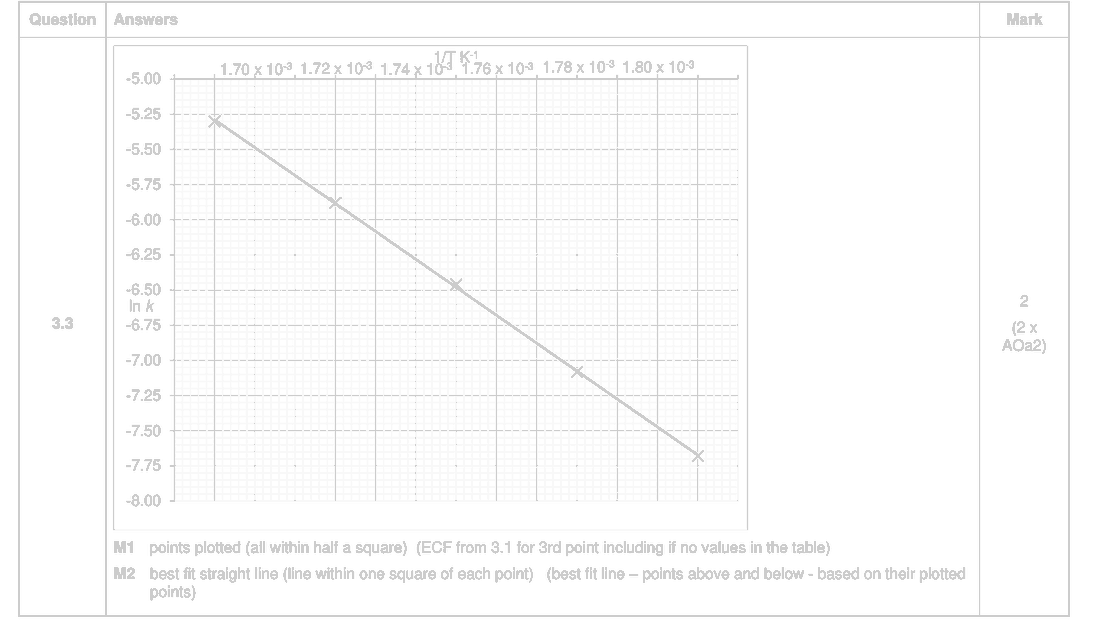
June 2024 · Paper 3 · Q03.3 2 marks Practical and data analysis rate equations
Earlier part of question 03 that this part usesEarlier part of June 2024 Paper 3 question 03
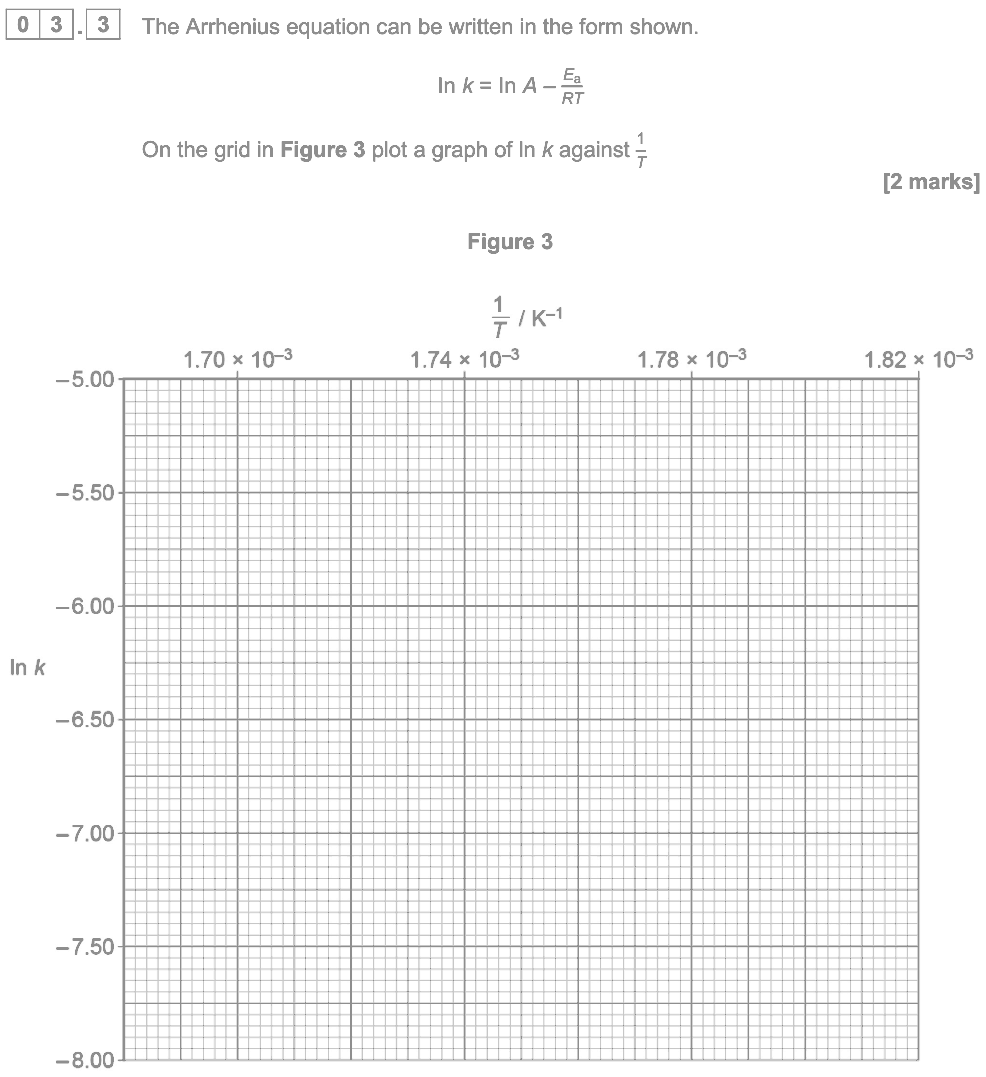
The Arrhenius equation can be written in the form shown.
In k = In A –
Ea
RT
On the grid in Figure 3 plot a graph of ln k against
1
T
[2 marks]
Figure 3
June 2024 · Paper 3 · Q03.4 3 marks AO2=3 Calculation rate equations
Earlier part of question 03 that this part usesEarlier part of June 2024 Paper 3 question 03
Use your graph from Question 03.3 to calculate a value for Ea, in kJ mol–1, for the
thermal decomposition of but-3-en-1-ol.
The gas constant, R = 8.31 J K–1 mol–1
[3 marks]
Ea
kJ mol–1
June 2024 · Paper 3 · Q03.5 2 marks AO2=2 Short answer introduction to organic chemistryaldehydes and ketones
Earlier part of question 03 that this part usesEarlier part of June 2024 Paper 3 question 03
2-Methylpent-4-en-2-ol decomposes in a similar way to but-3-en-1-ol, to produce an
alkene and a carbonyl compound.
Deduce the structures of the alkene and the carbonyl compound.
[2 marks]
CH2=CHCH2C(CH3)2OH →
+
alkene
carbonyl compound
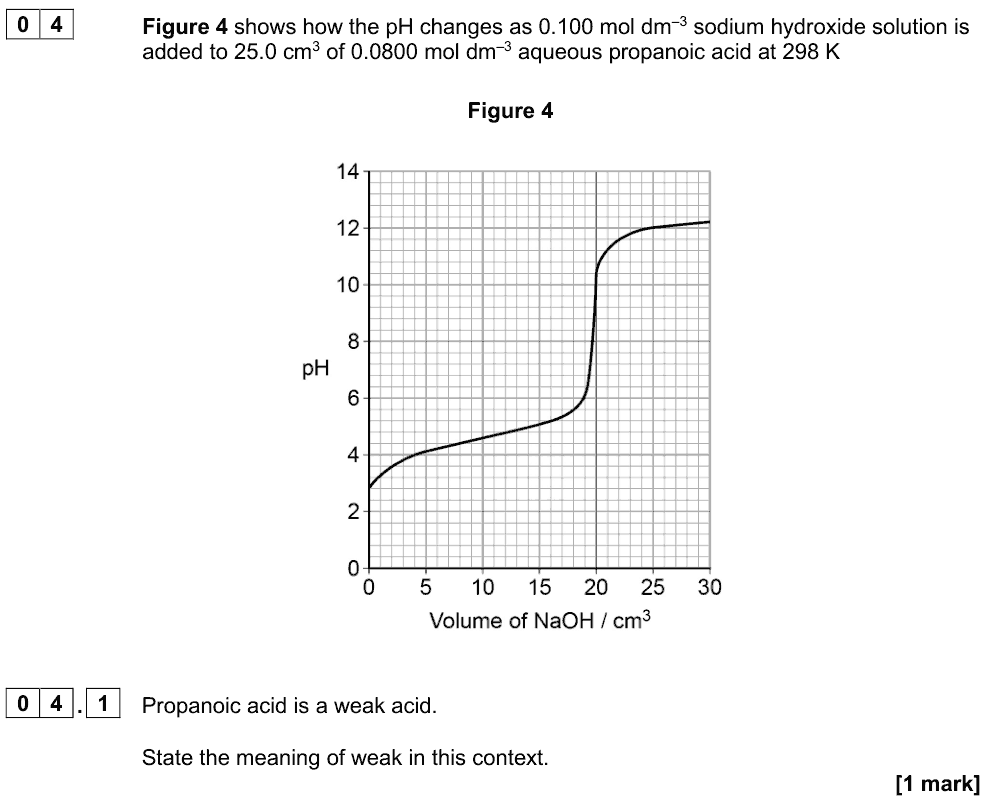
June 2024 · Paper 3 · Q04.1 1 mark AO1=1 Short answer Easy acids and bases
Figure 4 shows how the pH changes as 0.100 mol dm–3 sodium hydroxide solution is
added to 25.0 cm3 of 0.0800 mol dm–3 aqueous propanoic acid at 298 K
Figure 4
Propanoic acid is a weak acid.
State the meaning of weak in this context.
[1 mark]
June 2024 · Paper 3 · Q04.2 1 mark AO3=1 Practical and data analysis acids and bases
Earlier part of question 04 that this part usesEarlier part of June 2024 Paper 3 question 04
Suggest why a student doing an experiment to produce the curve in Figure 4 would
add the sodium hydroxide solution dropwise around the equivalence point.
[1 mark]
June 2024 · Paper 3 · Q04.3 3 marks AO2=3 Explanation acids and bases
Earlier part of question 04 that this part usesEarlier part of June 2024 Paper 3 question 04
Give an expression for Ka for propanoic acid (CH3CH2COOH).
Use this expression to show that pH = pKa when half of the propanoic acid has
reacted with sodium hydroxide.
[3 marks]
Ka
June 2024 · Paper 3 · Q04.4 2 marks AO3=2 Calculation acids and bases
Earlier part of question 04 that this part usesEarlier part of June 2024 Paper 3 question 04
Use the pH from Figure 4, when half of the propanoic acid has reacted, to calculate
Ka at 298 K
[2 marks]
Ka
mol dm–3
June 2024 · Paper 3 · Q04.5 2 marks AO1=2 Explanation acids and bases
Earlier part of question 04 that this part usesEarlier part of June 2024 Paper 3 question 04
When sodium hydroxide solution is added to aqueous propanoic acid, the solution
formed acts as a buffer when between 5 cm3 and 15 cm3 have been added.
Explain why the pH stays approximately constant during this part of the experiment.
[2 marks]
June 2024 · Paper 3 · Q04.6 2 marks AO3=2 Short answer acids and bases
Earlier part of question 04 that this part usesEarlier part of June 2024 Paper 3 question 04
Methyl orange and universal indicator are not suitable indicators for the titration of
solutions of propanoic acid with sodium hydroxide.
State the reason why each indicator is not suitable.
[2 marks]
Methyl orange
Universal indicator
June 2024 · Paper 3 · Q05.1 6 marks AO1=6 6-mark level of response Hard transition metals
Some complexes containing transition metal ions are coloured.
• Explain why some complexes containing transition metal ions are coloured.
• List the factors that affect the colour.
• Describe how colorimetry can be used to determine the concentration of a
coloured complex.
[6 marks]
June 2024 · Paper 3 · Q05.2 3 marks AO3=3 Calculation transition metals
Earlier part of question 05 that this part usesEarlier part of June 2024 Paper 3 question 05
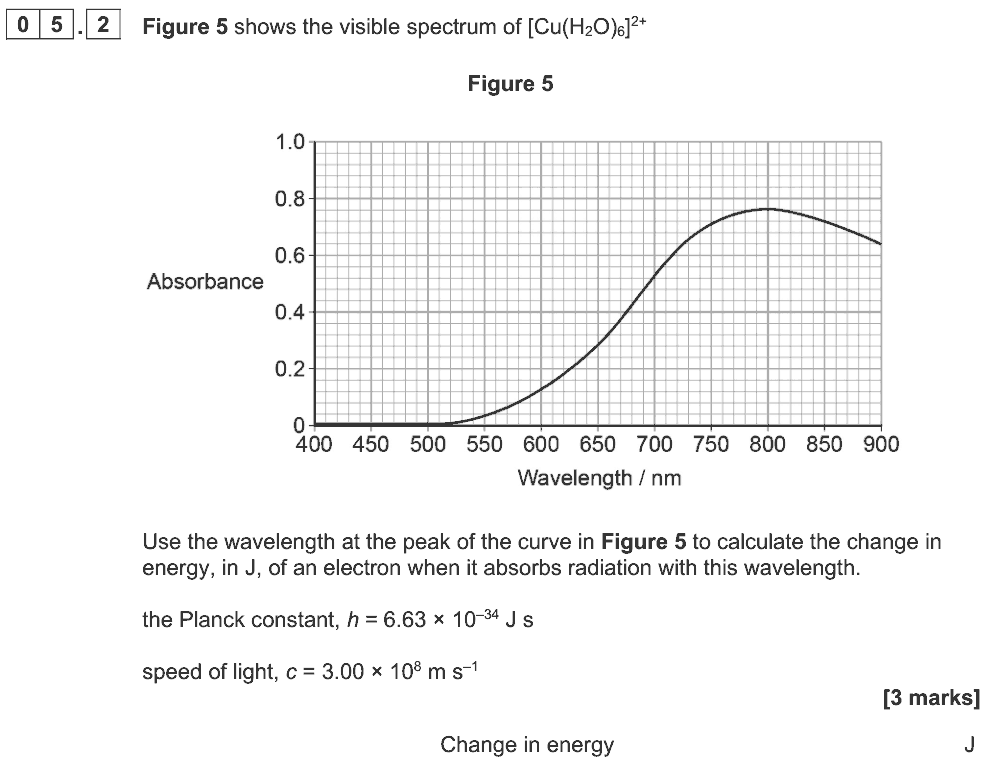
Figure 5 shows the visible spectrum of [Cu(H2O)6]2+
Figure 5
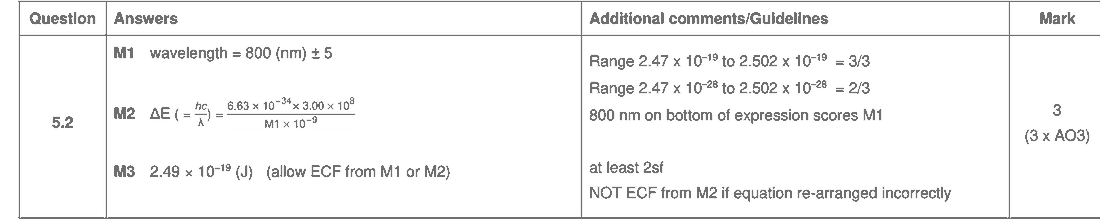
Use the wavelength at the peak of the curve in Figure 5 to calculate the change in
energy, in J, of an electron when it absorbs radiation with this wavelength.
the Planck constant, h = 6.63 × 10⁻³⁴ J s
speed of light, c = 3.00 × 10⁸ m s–1
[3 marks]
Change in energy
J
June 2024 · Paper 3 · Q06 1 mark AO2=1 Multiple choice atomic structure
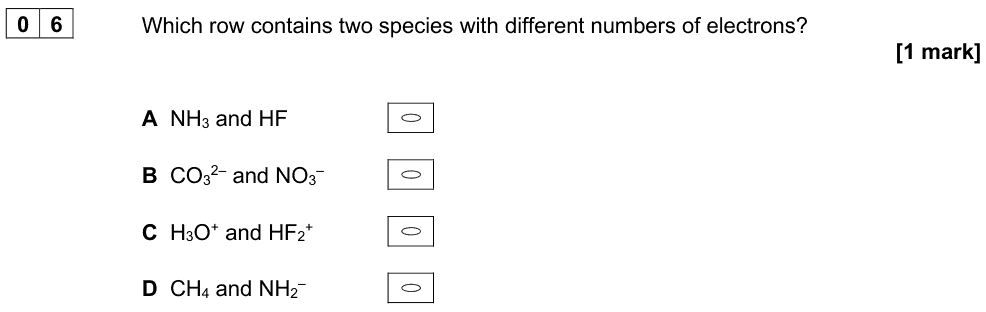
Which row contains two species with different numbers of electrons?
[1 mark]
A NH3 and HF
B CO32– and NO3–
C H3O+ and HF2+
D CH4 and NH2–
June 2024 · Paper 3 · Q07 1 mark AO1=1 Multiple choice atomic structure
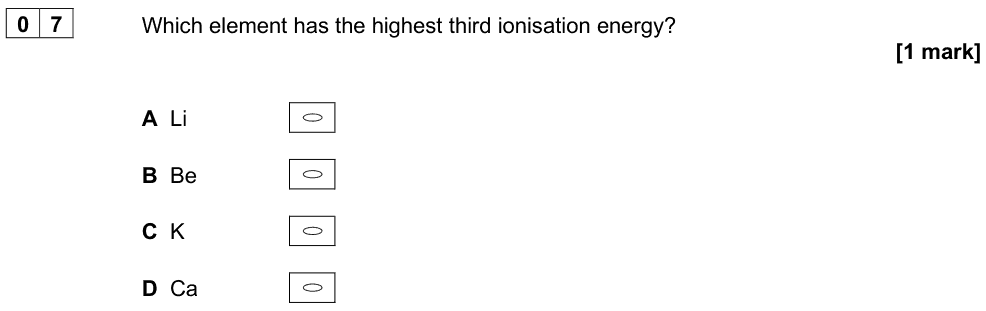
Which element has the highest third ionisation energy?
[1 mark]
A Li
B Be
C K
D Ca
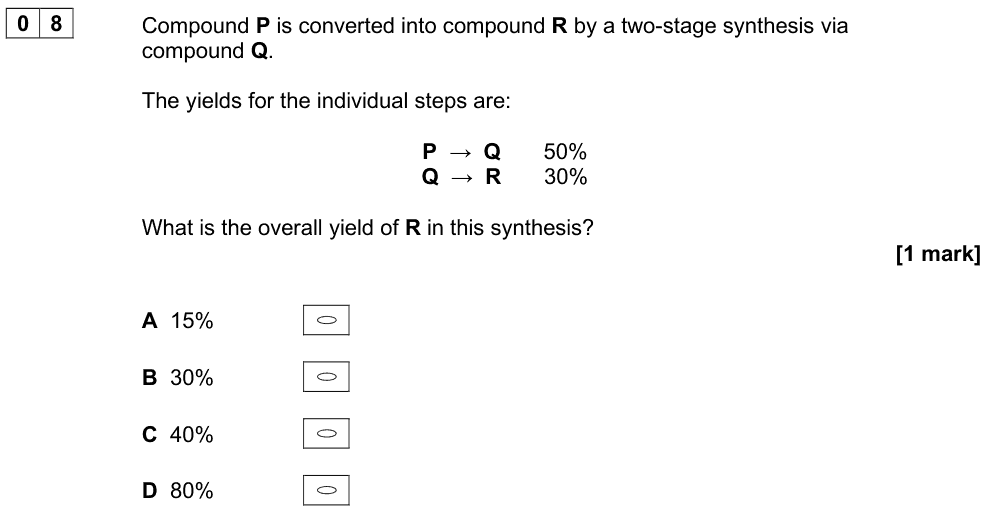
June 2024 · Paper 3 · Q08 1 mark AO2=1 Multiple choice amount of substance
Compound P is converted into compound R by a two-stage synthesis via
compound Q.
The yields for the individual steps are:
P  →  Q       50%
Q  →  R       30%
What is the overall yield of R in this synthesis?
[1 mark]
A 15%
B 30%
C 40%
D 80%
June 2024 · Paper 3 · Q09 1 mark AO1=1 Multiple choice bonding
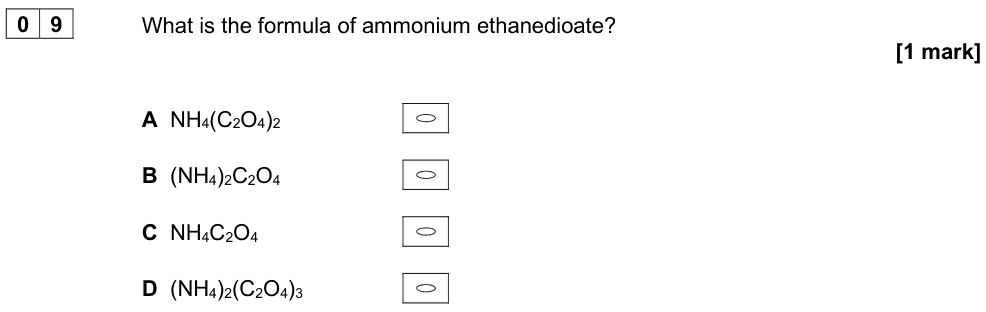
What is the formula of ammonium ethanedioate?
[1 mark]
A NH4(C2O4)2
B (NH4)2C2O4
C NH4C2O4
D (NH4)2(C2O4)3
June 2024 · Paper 3 · Q10 1 mark AO2=1 Multiple choice bonding
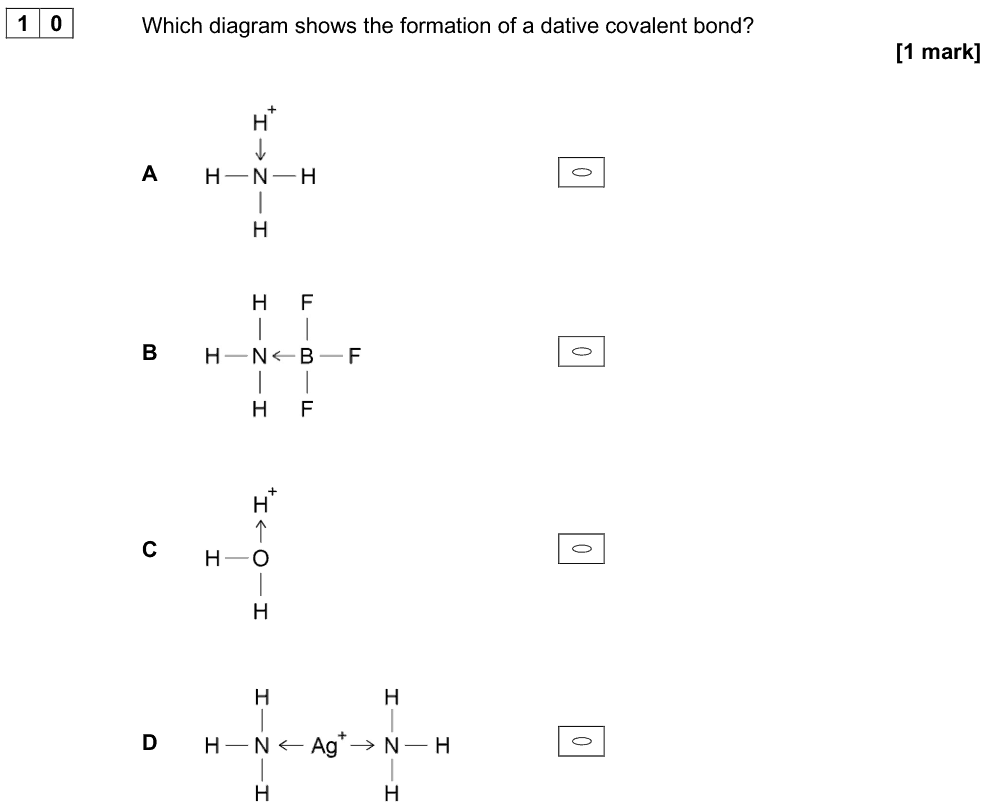
Which diagram shows the formation of a dative covalent bond?
[1 mark]
A
B
C
D
June 2024 · Paper 3 · Q11 1 mark AO1=1 Multiple choice bonding
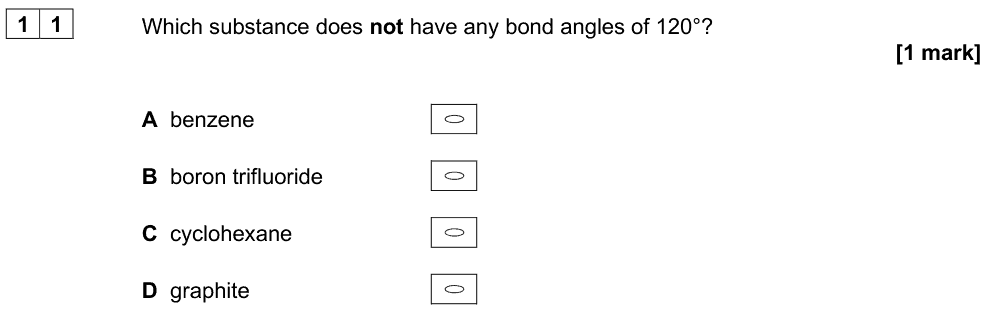
Which substance does not have any bond angles of 120°?
[1 mark]
A benzene
B boron trifluoride
C cyclohexane
D graphite
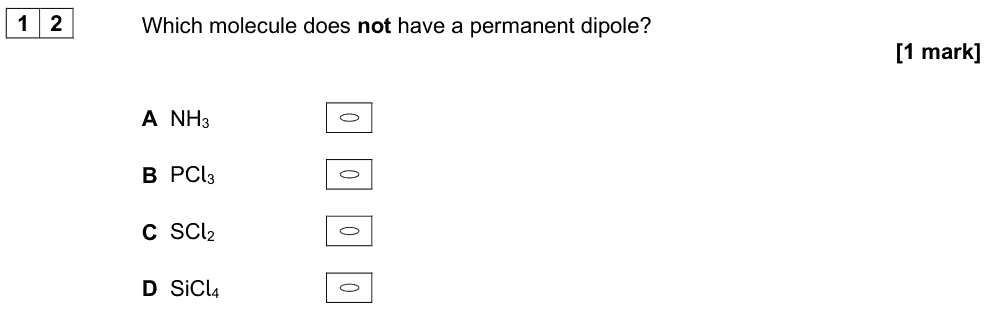
June 2024 · Paper 3 · Q12 1 mark AO2=1 Multiple choice bonding
Which molecule does not have a permanent dipole?
[1 mark]
A NH3
B PCl3
C SCl2
D SiCl4
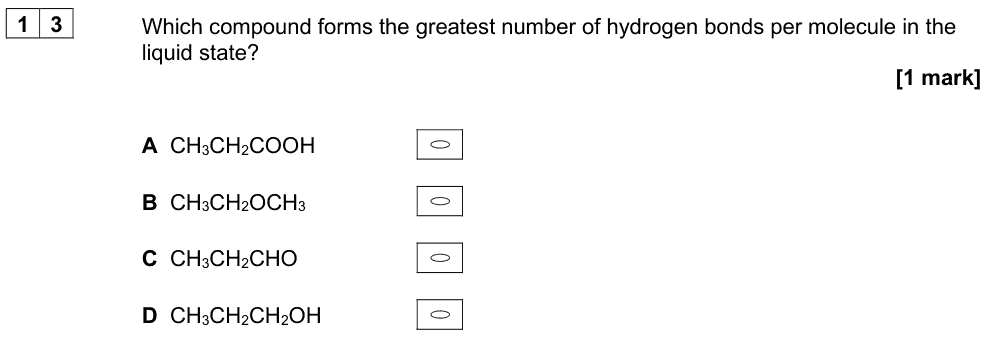
June 2024 · Paper 3 · Q13 1 mark AO2=1 Multiple choice bonding
Which compound forms the greatest number of hydrogen bonds per molecule in the
liquid state?
[1 mark]
A CH3CH2COOH
B CH3CH2OCH3
C CH3CH2CHO
D CH3CH2CH2OH
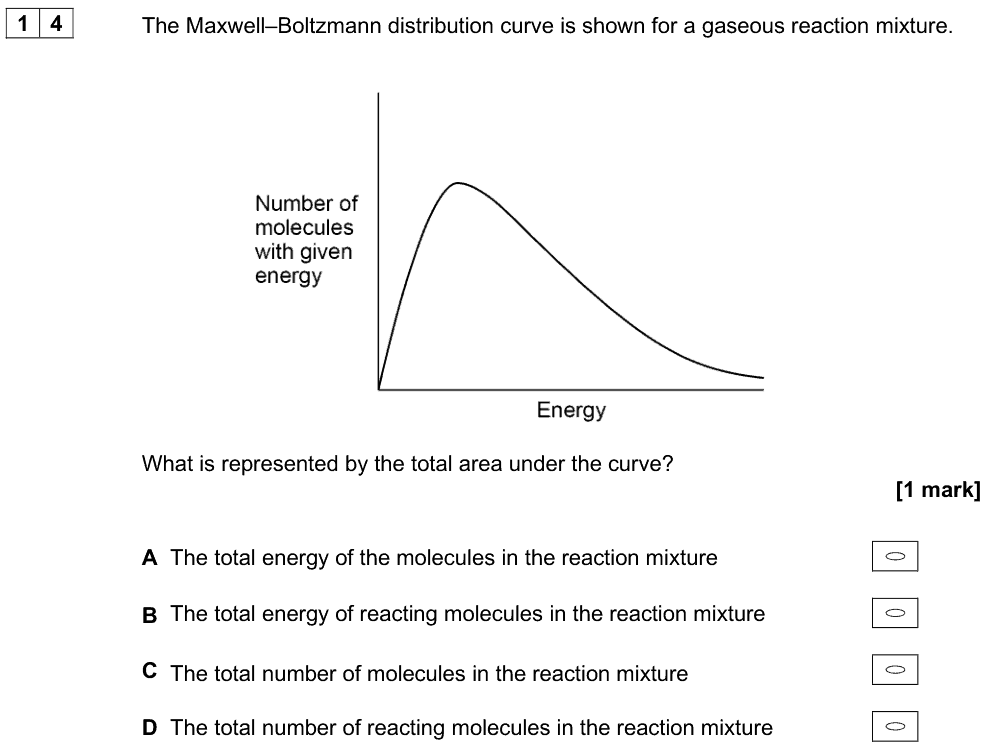
June 2024 · Paper 3 · Q14 1 mark AO1=1 Multiple choice kinetics
The Maxwell–Boltzmann distribution curve is shown for a gaseous reaction mixture.
What is represented by the total area under the curve?
[1 mark]
A The total energy of the molecules in the reaction mixture
B The total energy of reacting molecules in the reaction mixture
C The total number of molecules in the reaction mixture
D The total number of reacting molecules in the reaction mixture
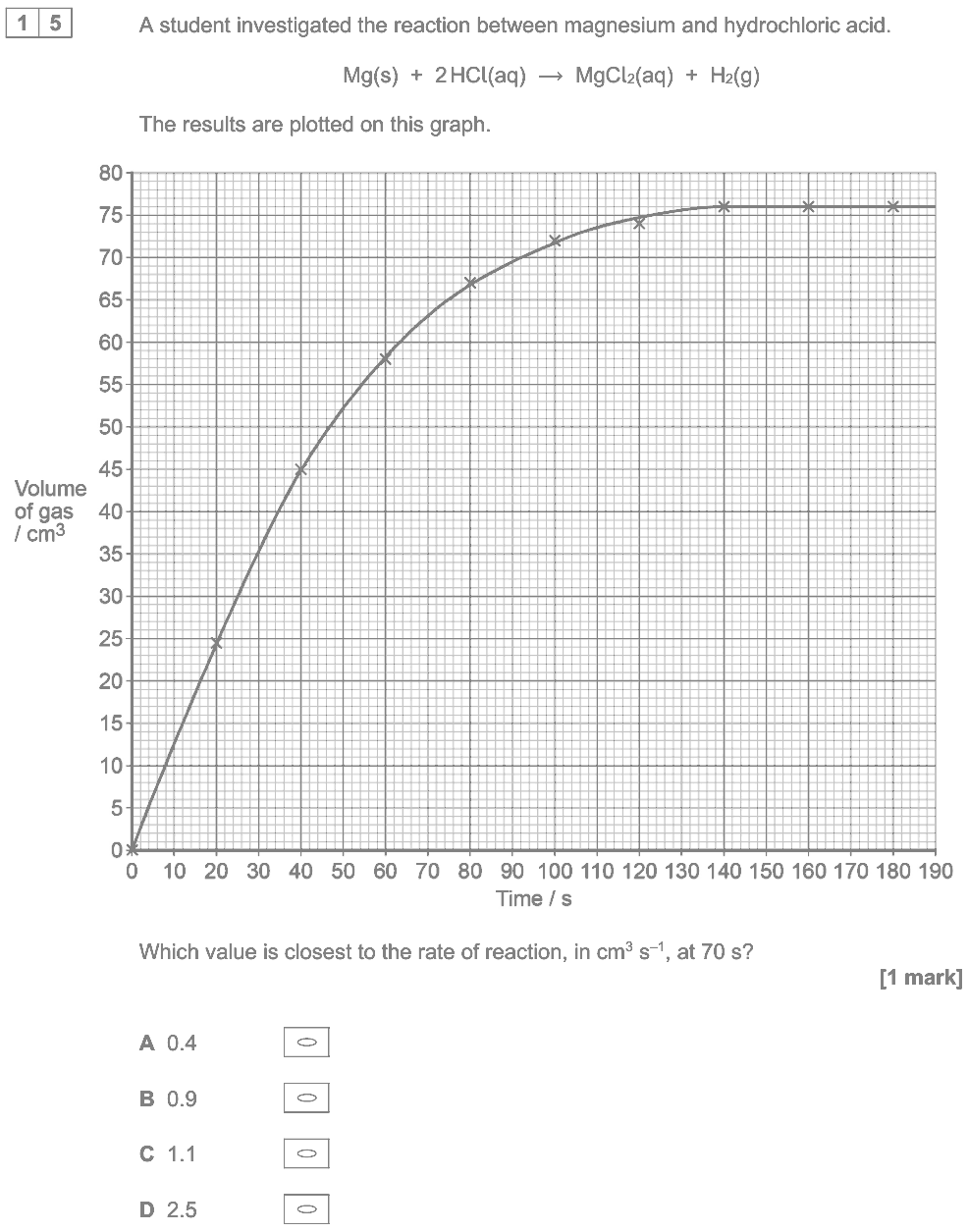
June 2024 · Paper 3 · Q15 1 mark AO2=1 Multiple choice rate equations
A student investigated the reaction between magnesium and hydrochloric acid.
Mg(s)  +  2 HCl(aq)  ⟶  MgCl2(aq)  +  H2(g)
The results are plotted on this graph.
Which value is closest to the rate of reaction, in cm3 s–1, at 70 s?
[1 mark]
A 0.4
B 0.9
C 1.1
D 2.5
June 2024 · Paper 3 · Q16 1 mark AO1=1 Multiple choice kinetics
Which statement explains why the rate of a reaction increases when a catalyst is
added at a constant temperature?
[1 mark]
A The collision frequency increases because there is a decrease in
activation energy.
B The collision frequency increases because there is an increase in the
average energy of the particles.
C The proportion of successful collisions increases because there is a
decrease in activation energy.
D The proportion of successful collisions increases because there is an
increase in the average energy of the particles.
June 2024 · Paper 3 · Q17 1 mark AO2=1 Multiple choice electrode potentials and cells
A cell with EMF = +2.15 V is made from two electrodes.
The half-equations for the two electrodes are shown.
positive electrode:
PbO2(s)  +  3 H+(aq)  +  HSO4–(aq)  +  2 e–  ⟶   PbSO4(s)  +  2 H2O(l)
negative electrode:
PbSO4(s)  +  H+(aq)  +  2 e–   ⟶  Pb(s)  +  HSO4–(aq)     E  o = –0.46 V
What is the standard electrode potential of the PbO2 / PbSO4 electrode?
[1 mark]
A –2.61 V
B –1.69 V
C +1.69 V
D +2.61 V
June 2024 · Paper 3 · Q18 1 mark AO3=1 Multiple choice acids and bases
Values of the ionic product of water (Kw) at different temperatures are given.
Kw = 6.40 × 10⁻¹⁵ mol2 dm–6 at 18 °C
Kw = 1.00 × 10⁻¹⁴ mol2 dm–6 at 25 °C
Which statement is correct?
[1 mark]
A The concentration of hydroxide ions in water at 18 °C is
8.00 × 10⁻⁸ mol dm–3
B The dissociation of water into ions is an exothermic process.
C The pH of water is the same at 25 °C and at 18 °C
D Water becomes less acidic as the temperature is raised.
June 2024 · Paper 3 · Q19 1 mark AO2=1 Multiple choice periodicity
Consider the Period 3 elements from sodium to chlorine.
Which statement is correct?
[1 mark]
A Sodium has the smallest atomic radius.
B Aluminium has the highest melting point.
C Sulfur is the most electronegative.
D Chlorine has the highest first ionisation energy.
June 2024 · Paper 3 · Q20 1 mark AO1=1 Multiple choice bonding
Which statement correctly describes a trend down Group 7 from Cl to I?
X represents Cl, Br or I
[1 mark]
A The boiling point of HX increases.
B The bond dissociation energy of H–X increases.
C The standard electrode potential value for X2(aq)  +  2 e–  ⟶  2 X–(aq)
becomes more positive.
D The solubility of AgX in ammonia increases.
June 2024 · Paper 3 · Q21 1 mark AO1=1 Multiple choice transition metals
Which statement about chloride ions is correct?
[1 mark]
A They are oxidised by concentrated sulfuric acid.
B They form a cream precipitate with silver nitrate solution.
C They form a cobalt(II) complex with a tetrahedral shape.
D They have the electron configuration 1s22s22p63s23p4
June 2024 · Paper 3 · Q22 1 mark AO2=1 Multiple choice reactions of ions in aqueous solution
Aqueous aluminium sulfate is added to aqueous sodium carbonate.
What are the formulas of the precipitate and the gas formed?
[1 mark]
A Al2(CO3)3 and SO2
B Al2(CO3)3 and CO2
C Al(H2O)3(OH)3 and SO2
D Al(H2O)3(OH)3 and CO2
June 2024 · Paper 3 · Q23 1 mark AO2=1 Multiple choice introduction to organic chemistry
What is the correct structural formula for 4-chloro-2-methylpent-2-enoic acid?
[1 mark]
A CH3CCl=CHCH(CH3)COOH
B (CH3)2C=CHCHClCOOH
C CH3CHClCH=C(CH3)COOH
D (CH3)2CHCH=CClCOOH
June 2024 · Paper 3 · Q24 1 mark AO1=1 Multiple choice aldehydes and ketones
In which conversion does a nucleophile attack the organic reactant?
[1 mark]
A CH3CH2CH3  ⟶  CH3CHClCH3
B CH3CH=CH2  ⟶  CH3CHBrCH3
C CH3CH2CH2OH  ⟶  CH3CH=CH2
D CH3CH2CHO  ⟶ CH3CH2CH(OH)CN
June 2024 · Paper 3 · Q25 1 mark AO2=1 Multiple choice introduction to organic chemistry
Compound Y has the structural formula CH3COOCH2CH(CH3)2
Which compound is a position isomer of Y?
[1 mark]
A 5-hydroxyhexan-3-one
B butyl ethanoate
C hexanoic acid
D propyl propanoate
June 2024 · Paper 3 · Q26 1 mark AO2=1 Multiple choice introduction to organic chemistry
Which compound shows E–Z isomerism?
[1 mark]
A 2,3-dimethylbut-1-ene
B 2,3-dimethylbut-2-ene
C 2-methylpent-2-ene
D 3-methylpent-2-ene
June 2024 · Paper 3 · Q27 1 mark AO3=1 Multiple choice aldehydes and ketonesintroduction to organic chemistry
What is the product when 3-methylbutan-2-one reacts with acidified KCN?
[1 mark]
A 2-hydroxy-2,3-dimethylbutanenitrile
B 3-hydroxy-2,3-dimethylbutanenitrile
C 2-hydroxy-3-methylpentanenitrile
D 3-hydroxy-2-methylpentanenitrile
June 2024 · Paper 3 · Q28 1 mark AO2=1 Multiple choice polymers
Which statement concerning nylon-6,6 is correct?
[1 mark]
A Butanedioic acid is one of the reactants used to make nylon-6,6
B Nylon-6,6 is an addition polymer.
C Nylon-6,6 can be hydrolysed by aqueous sodium hydroxide.
D All molecules of nylon-6,6 have the same relative molecular mass.
June 2024 · Paper 3 · Q29 1 mark AO2=1 Multiple choice equilibrium constant kp
Which statement about the industrial production of ethanol from ethene at 300 °C is
correct?
C2H4(g)  +  H2O(g)  ⇌  C2H5OH(g)              ΔH = –46 kJ mol–1
[1 mark]
A The use of an acid catalyst increases the yield of ethanol.
B The reaction is slower than fermentation.
C An increase in temperature, at constant pressure, increases the
value of Kp.
D An increase in pressure, at constant temperature, increases the
equilibrium yield of ethanol.
June 2024 · Paper 3 · Q30 1 mark AO2=1 Multiple choice carboxylic acids and derivatives
Which compound is formed by the acid hydrolysis of phenyl benzenecarboxylate?
[1 mark]
A C6H5CH2OH
B C6H5CHO
C C6H5COCH3
D C6H5COOH
June 2024 · Paper 3 · Q31 1 mark AO1=1 Multiple choice polymers
Which type of polymer is most difficult to hydrolyse?
[1 mark]
A polyalkene
B polyamide
C polyester
D protein
June 2024 · Paper 3 · Q32 1 mark AO3=1 Multiple choice polymers
In which polymer does hydrogen bonding occur between the polymer chains?
[1 mark]
A a polyalkene
B a polyamide
C a polychloroalkene
D a polyester
June 2024 · Paper 3 · Q33 1 mark AO1=1 Multiple choice amino acids proteins and dna
Which structure shows a zwitterion of an amino acid?
[1 mark]
A
B
C
D
June 2024 · Paper 3 · Q34 1 mark AO3=1 Multiple choice chromatography
The diagram shows a gas chromatogram for a sample containing four isomers with
the molecular formula C6H12O2
The carrier gas is nitrogen and the stationary phase is polar.
Which of the four isomers in this sample is the most abundant?
[1 mark]
A
B
C
D
June 2024 · Paper 3 · Q35 1 mark AO2=1 Multiple choice amino acids proteins and dna
Which structure is formed by phenylalanine in solution at pH = 3?
[1 mark]
A
B
C
D

Work with an A-level chemistry tutor

Want a paper marked and gone through with you? Message us.

Prefer email? Send an enquiry

If you are under 18, please include a parent's contact details. Enquiries go to enquiries@chemistryaleveltutor.com and are deleted once handled. All tutoring is online.