June 2024: Paper 1, Inorganic and physical chemistry

105 marks · 49 question parts · Paper, mark scheme and report on AQA's site · Have the Data Booklet beside you

Question by question

QTopicMarksAOType
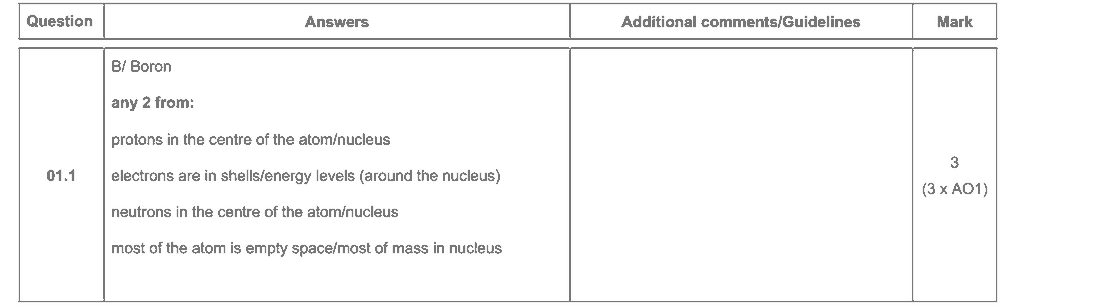
01.1 Atomic structure 3AO1=3Short answer
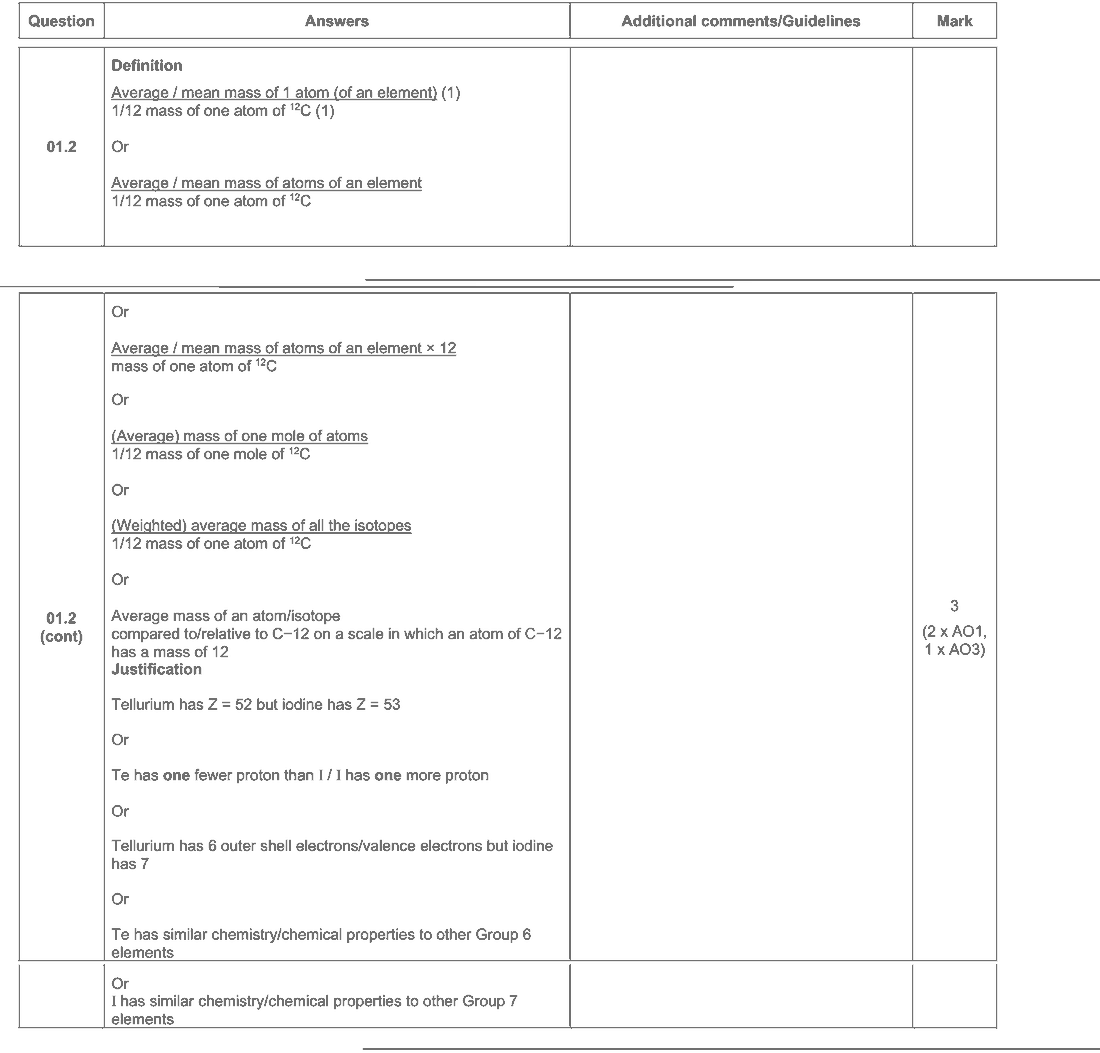
01.2 Amount of substance, Atomic structure 3AO1=2,AO3=1Short answer
01.3 Atomic structure 1AO1=1Equation writing
01.4 Atomic structure, Amount of substance 5AO2=4,AO3=1Calculation
01.5 Atomic structure 1AO1=1Short answer
02.1 Amount of substance 1AO3=1Practical and data analysis
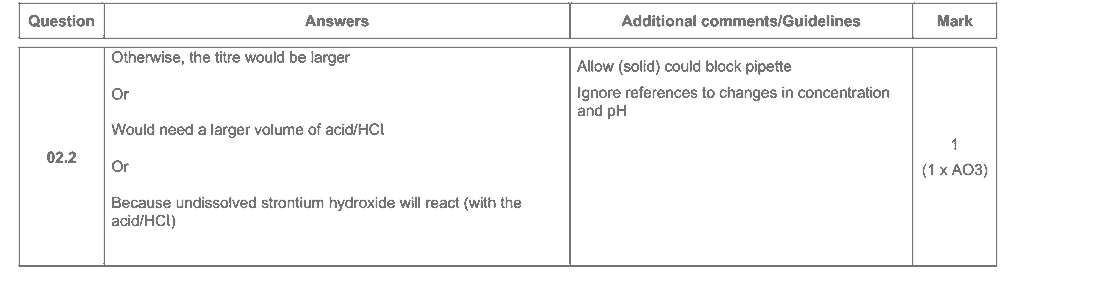
02.2 Amount of substance 1AO3=1Practical and data analysis
02.3 Amount of substance 1AO2=1Practical and data analysis
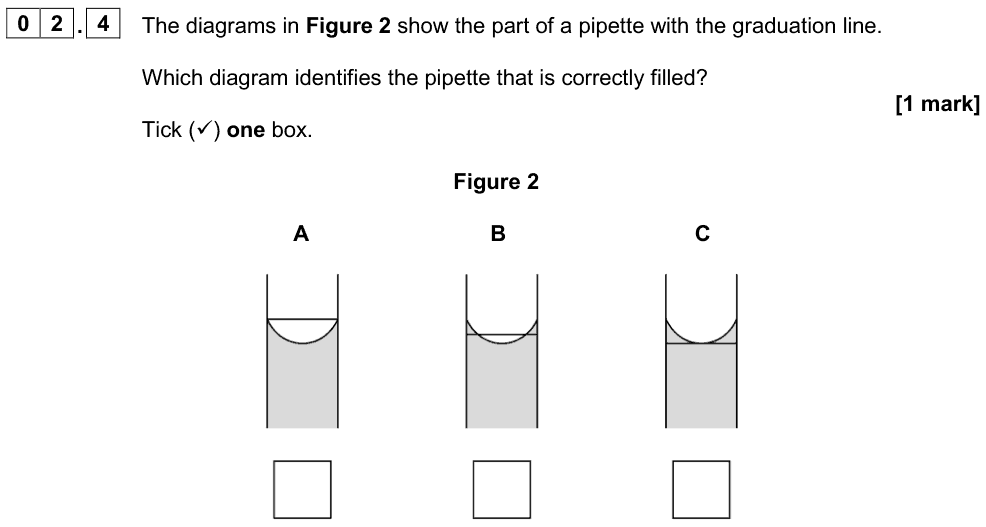
02.4 Amount of substance 1AO3=1Practical and data analysis
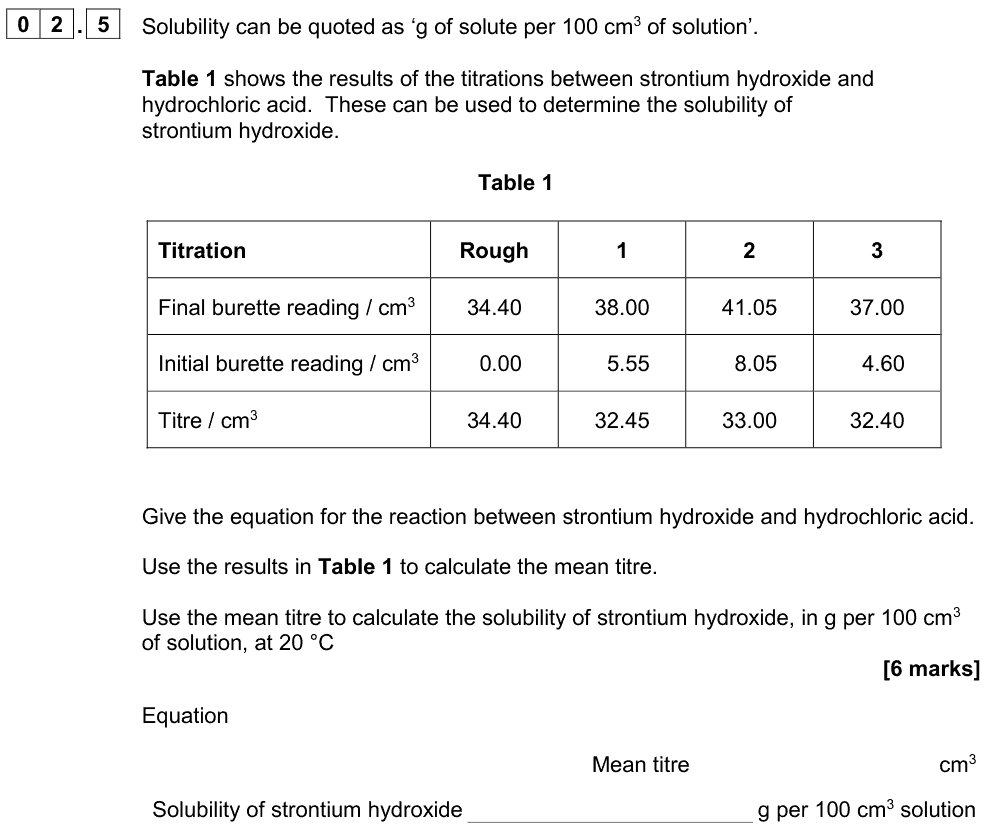
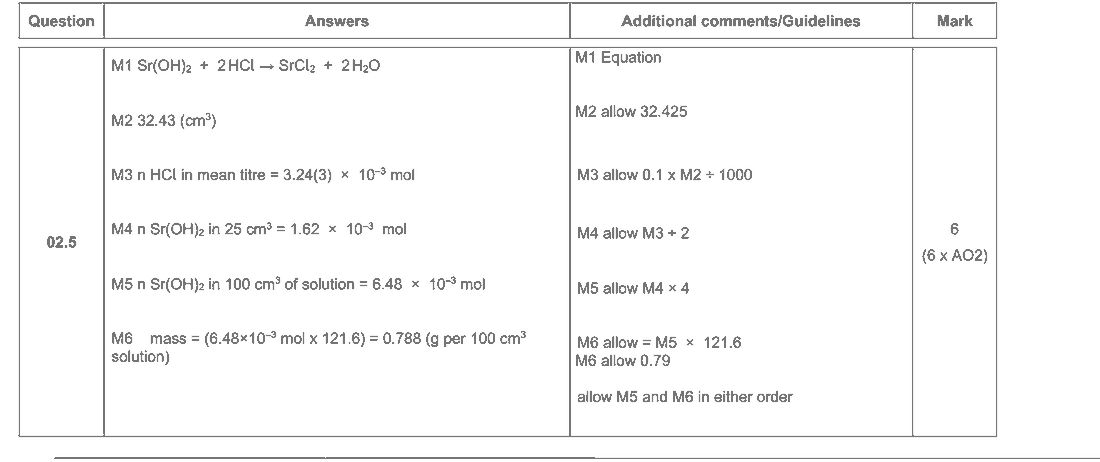
02.5 Amount of substance 6AO2=6Calculation
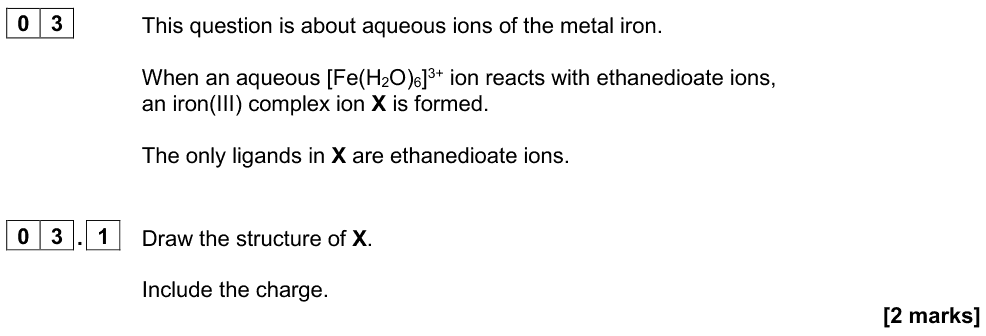
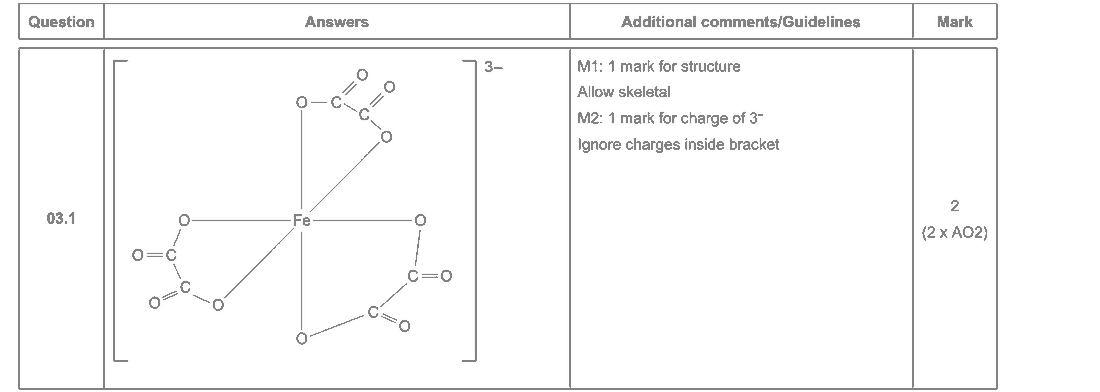
03.1 Transition metals 2AO2=2Diagram or structure
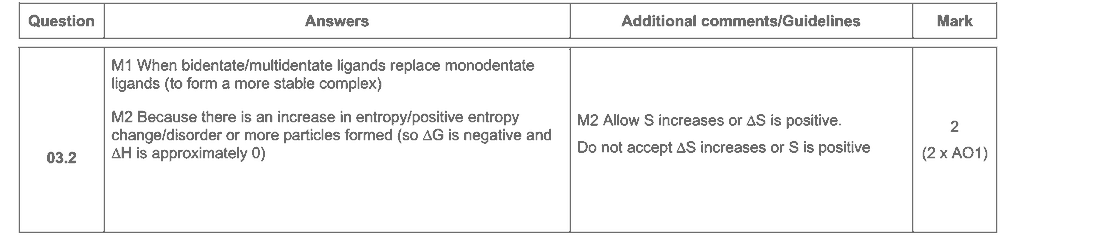
03.2 Transition metals 2AO1=2Explanation
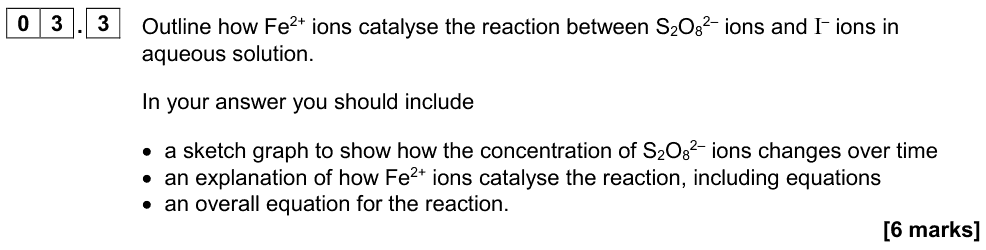
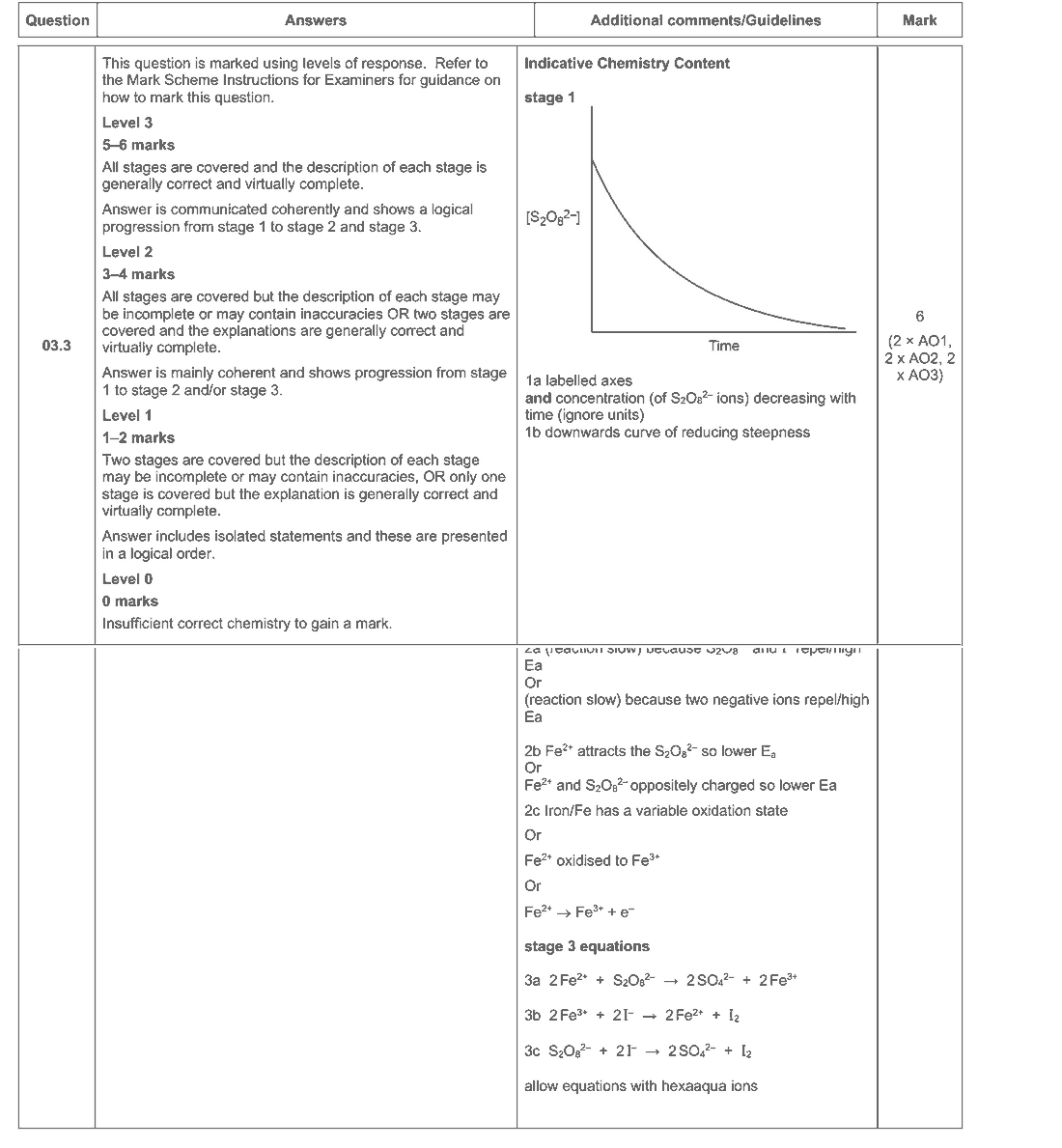
03.3 Transition metals 6AO1=2,AO2=2,AO3=2Level of response
03.4 Reactions of ions in aqueous solution 1AO2=1Short answer
03.5 Reactions of ions in aqueous solution 2AO1=1,AO2=1Equation writing
03.6 Reactions of ions in aqueous solution 1AO3=1Equation writing
04.1 Equilibrium constant Kp 2AO2=2Calculation
04.2 Equilibrium constant Kp 1AO1=1Short answer
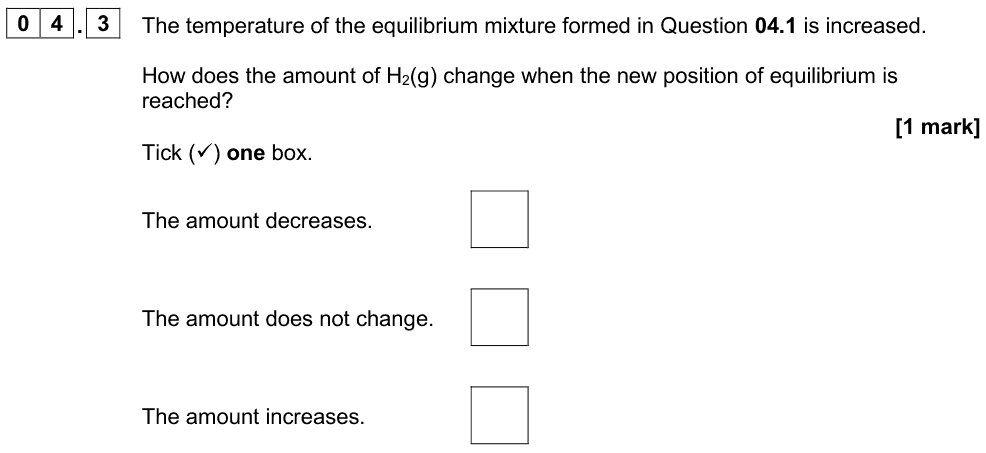
04.3 Chemical equilibria, Le Chatelier's principle and Kc, Equilibrium constant Kp 1AO1=1Short answer
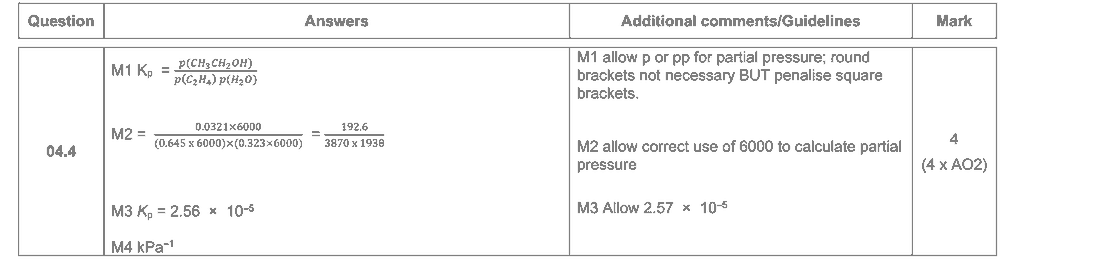
04.4 Equilibrium constant Kp 4AO2=4Calculation
04.5 Equilibrium constant Kp 1AO1=1Short answer
05.1 Group 7(17), the halogens 1AO1=1Equation writing
05.2 Group 7(17), the halogens 1AO1=1Equation writing
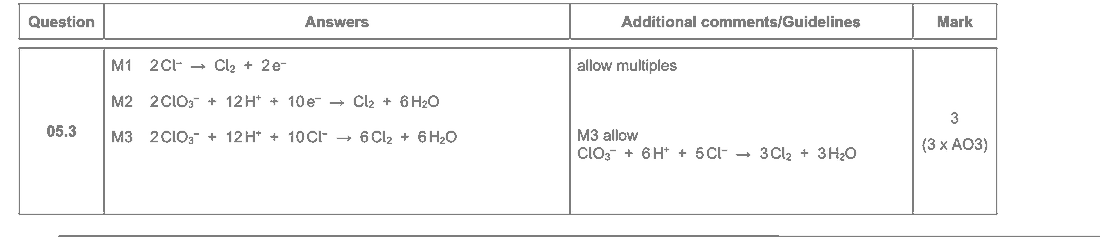
05.3 Oxidation, reduction and redox equations 3AO3=3Equation writing
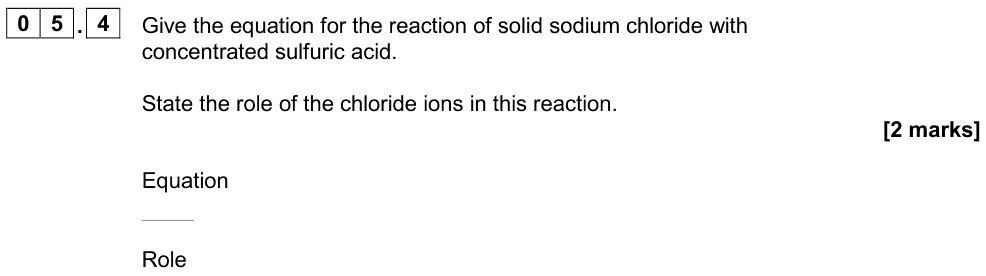
05.4 Group 7(17), the halogens, Acids and bases: pH, Ka, titration curves and buffers 2AO1=1,AO3=1Equation writing
05.5 Bonding 1AO2=1Diagram or structure
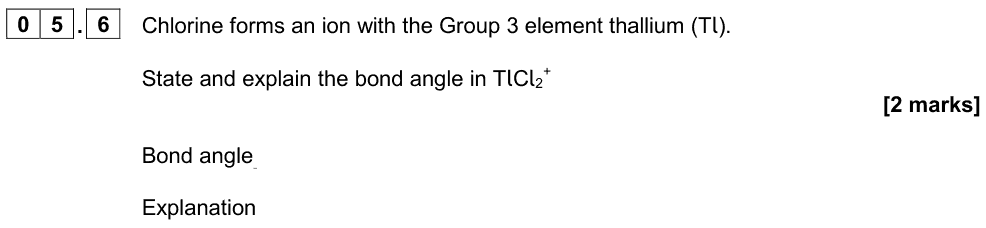
05.6 Bonding 2AO2=1,AO3=1Explanation
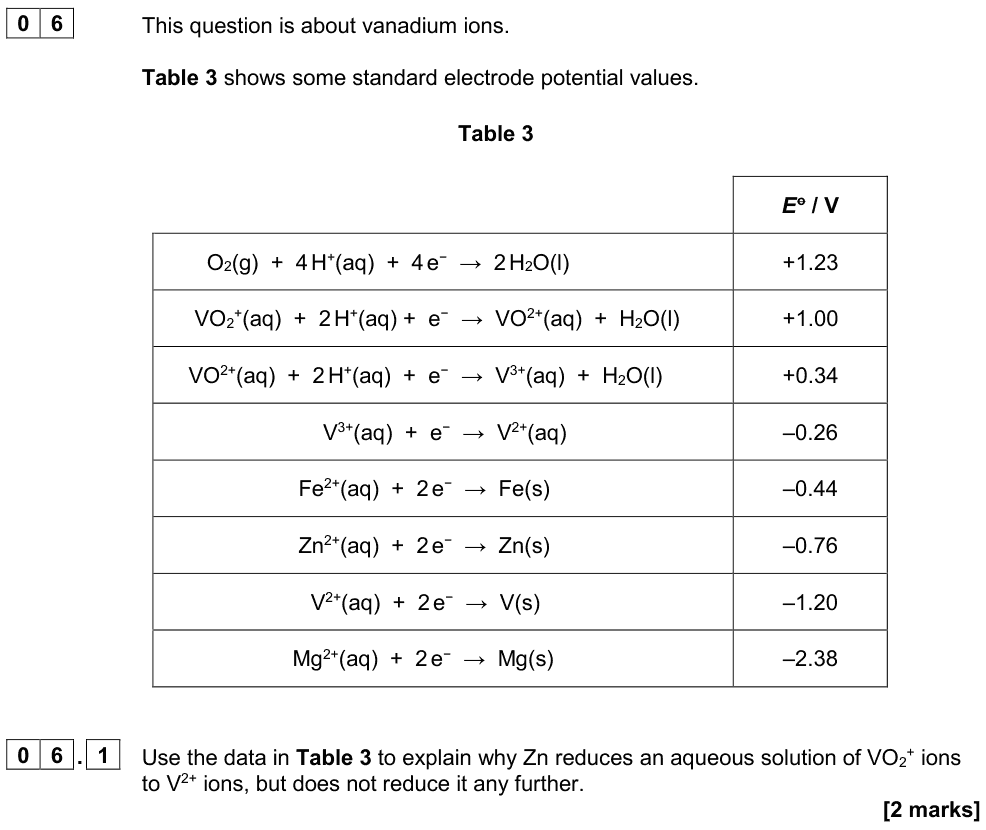
06.1 Electrode potentials and electrochemical cells, Transition metals 2AO3=2Explanation
06.2 Electrode potentials and electrochemical cells 1AO3=1Short answer
06.3 Electrode potentials and electrochemical cells 3AO1=1,AO2=2Calculation
06.4 Transition metals, Amount of substance 4AO2=4Calculation
07.1 Acids and bases: pH, Ka, titration curves and buffers 3AO1=1,AO2=2Calculation
07.2 Acids and bases: pH, Ka, titration curves and buffers 5AO2=5Calculation
08.1 Thermodynamics: Born–Haber cycles, entropy and Gibbs free energy 1AO1=1Short answer
08.2 Thermodynamics: Born–Haber cycles, entropy and Gibbs free energy 2AO2=2Diagram or structure
08.3 Thermodynamics: Born–Haber cycles, entropy and Gibbs free energy 2AO2=2Calculation
08.4 Thermodynamics: Born–Haber cycles, entropy and Gibbs free energy 1AO1=1Explanation
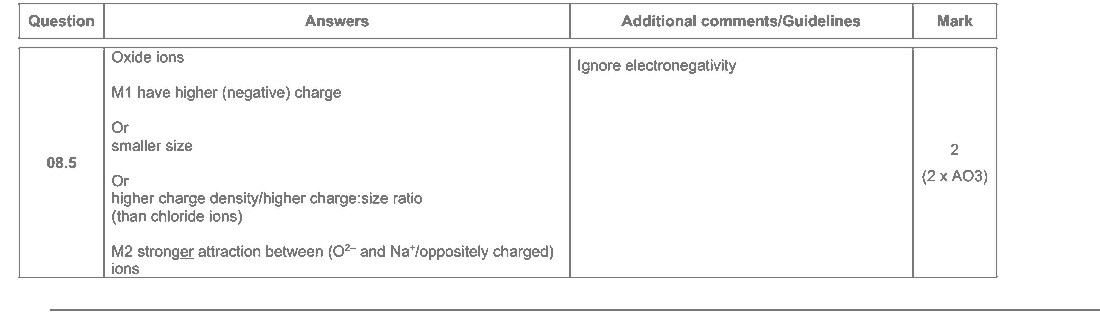
08.5 Thermodynamics: Born–Haber cycles, entropy and Gibbs free energy, Bonding 2AO3=2Explanation
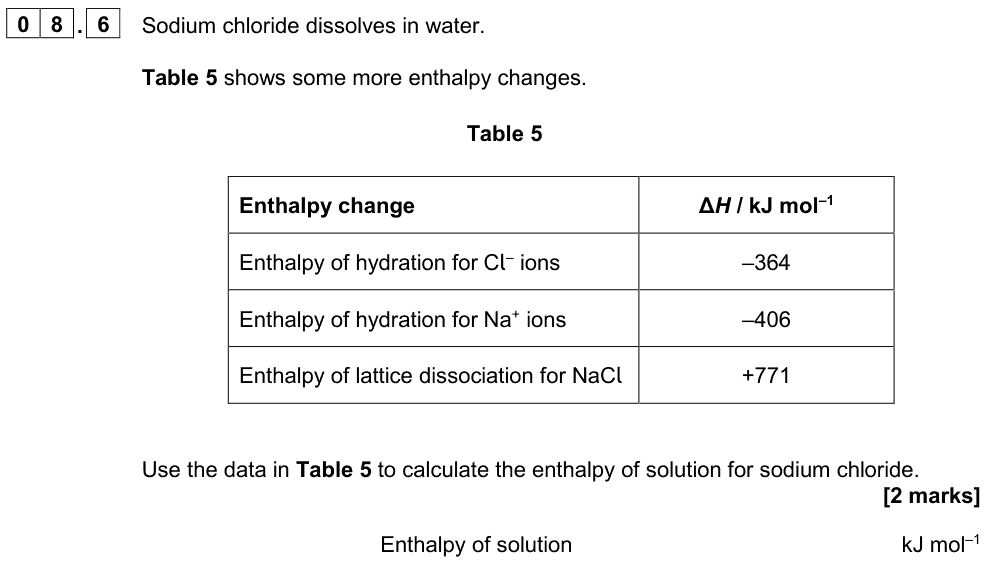
08.6 Thermodynamics: Born–Haber cycles, entropy and Gibbs free energy 2AO2=2Calculation
08.7 Period 3 elements and their oxides 1AO3=1Short answer
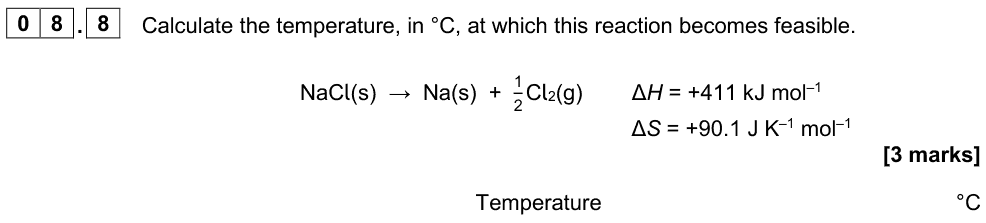
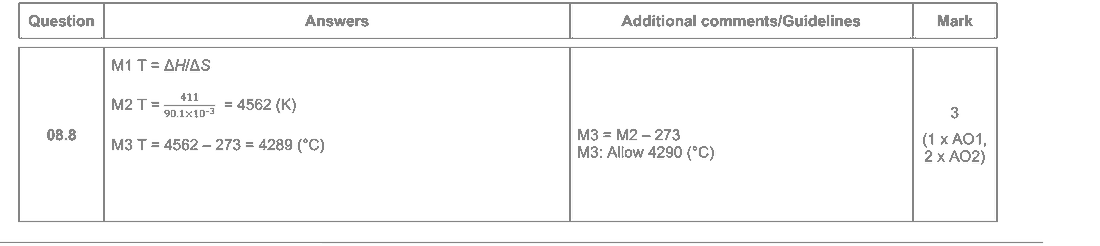
08.8 Thermodynamics: Born–Haber cycles, entropy and Gibbs free energy 3AO1=1,AO2=2Calculation
09.1 Group 2, the alkaline earth metals 1AO3=1Short answer
09.2 Group 2, the alkaline earth metals 1AO3=1Equation writing
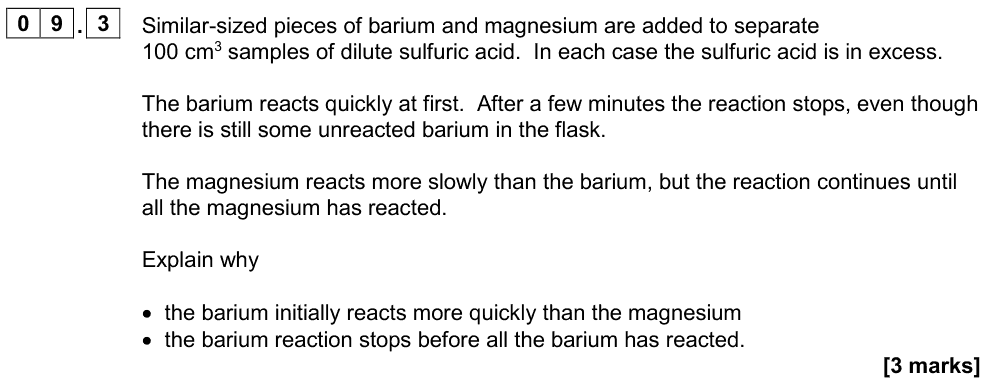
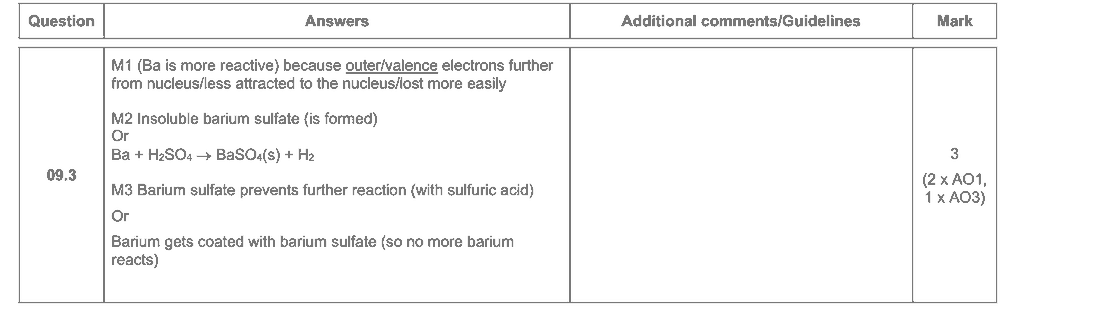
09.3 Group 2, the alkaline earth metals 3AO1=2,AO3=1Explanation
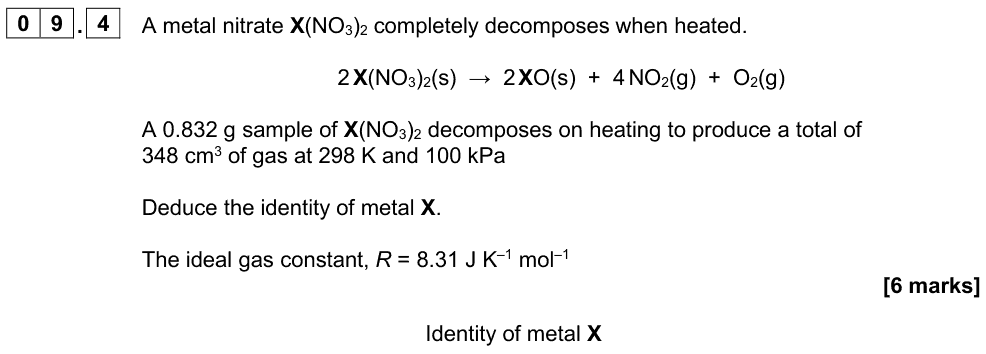
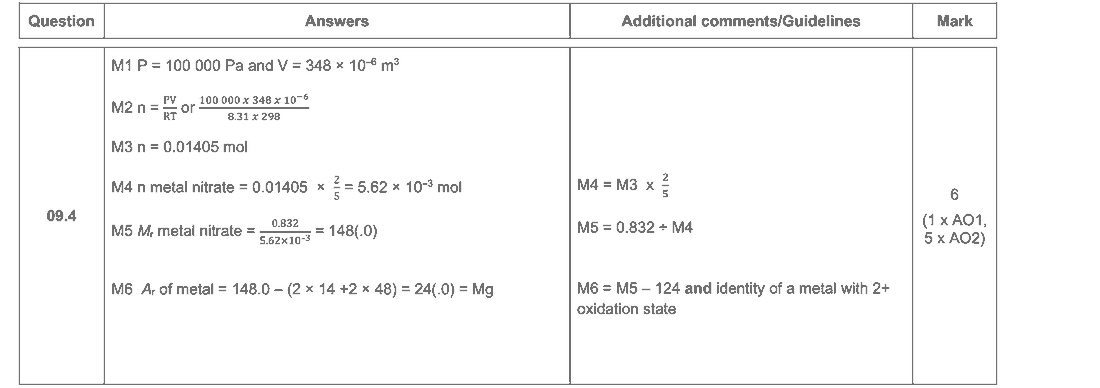
09.4 Amount of substance 6AO1=1,AO2=5Calculation
09.5 Amount of substance, Bonding 3AO2=2,AO3=1Explanation
09.6 Period 3 elements and their oxides 1AO3=1Equation writing
09.7 Electrode potentials and electrochemical cells 1AO1=1Equation writing
09.8 Electrode potentials and electrochemical cells 1AO1=1Short answer

The questions

01.101.201.301.401.502.102.202.302.402.503.103.203.303.403.503.604.104.204.304.404.505.105.205.305.405.505.606.106.206.306.407.107.208.108.208.308.408.508.608.708.809.109.209.309.409.509.609.709.8
June 2024 · Paper 1 · Q01.1 3 marks AO1=3 Short answer atomic structure
This question is about atomic structure.
In 1897 JJ Thomson discovered the electron.  He suggested that atoms were
positively charged spheres with electrons embedded within them.
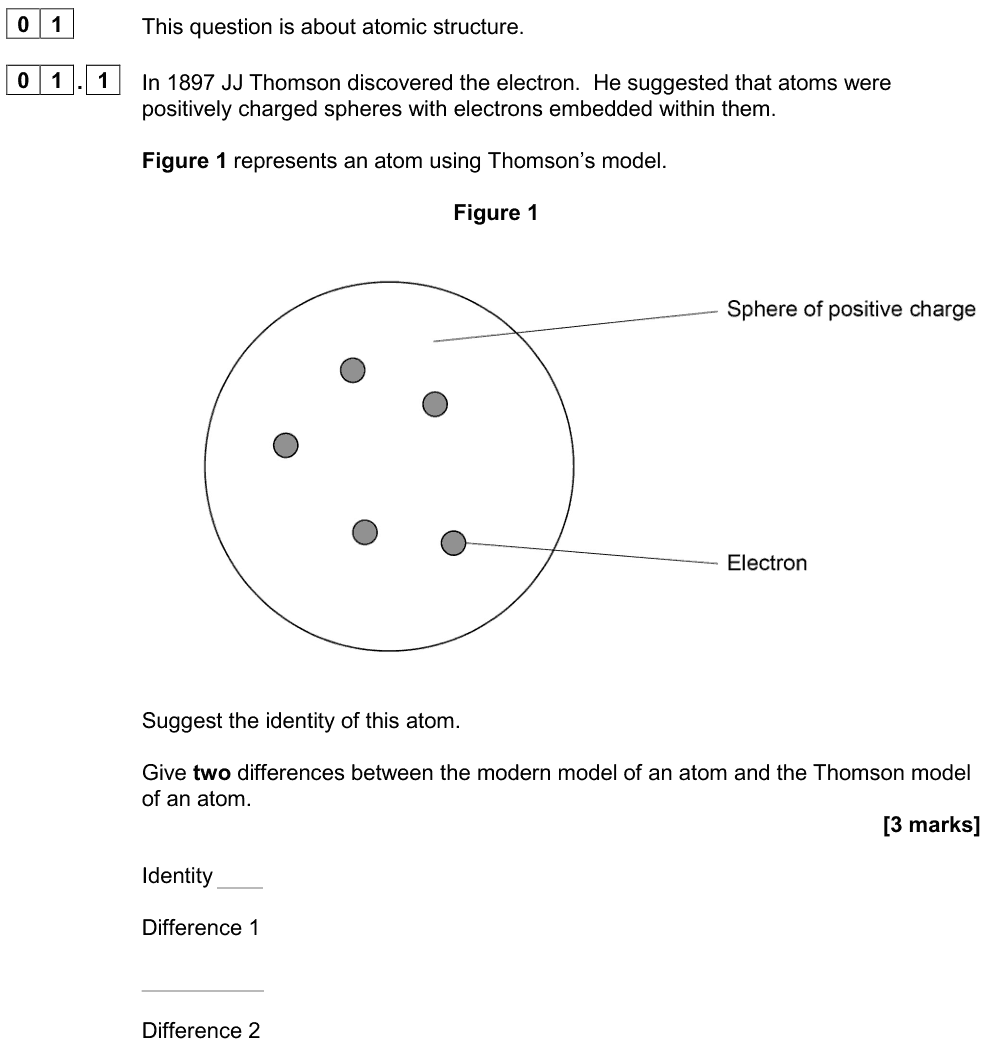
Figure 1 represents an atom using Thomson’s model.
Figure 1
Suggest the identity of this atom.
Give two differences between the modern model of an atom and the Thomson model
of an atom.
[3 marks]
Identity
Difference 1
Difference 2
June 2024 · Paper 1 · Q01.2 3 marks AO1=2, AO3=1 Short answer amount of substanceatomic structure
Earlier part of question 01 that this part usesEarlier part of June 2024 Paper 1 question 01
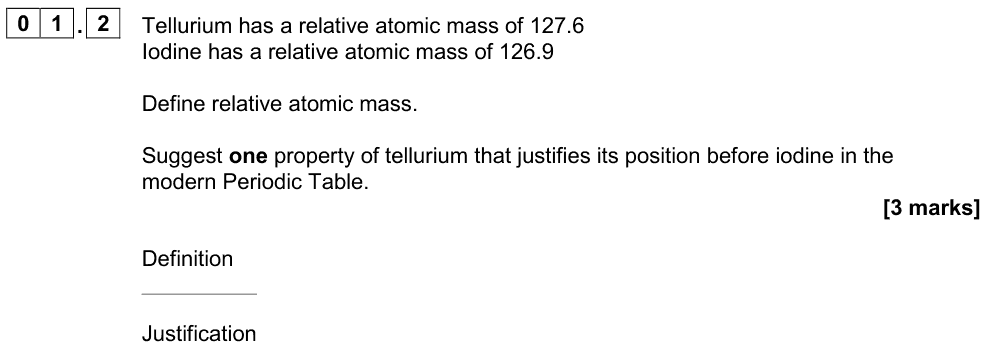
Tellurium has a relative atomic mass of 127.6
Iodine has a relative atomic mass of 126.9
Define relative atomic mass.
Suggest one property of tellurium that justifies its position before iodine in the
modern Periodic Table.
[3 marks]
Definition
Justification
June 2024 · Paper 1 · Q01.3 1 mark AO1=1 Equation writing atomic structure
Earlier part of question 01 that this part usesEarlier part of June 2024 Paper 1 question 01
A sample of tellurium is analysed in a time of flight (TOF) mass spectrometer using
electron impact ionisation.
Give an equation, including state symbols, for this ionisation.
[1 mark]
June 2024 · Paper 1 · Q01.4 5 marks AO2=4, AO3=1 Calculation Hard atomic structureamount of substance
Earlier part of question 01 that this part usesEarlier part of June 2024 Paper 1 question 01
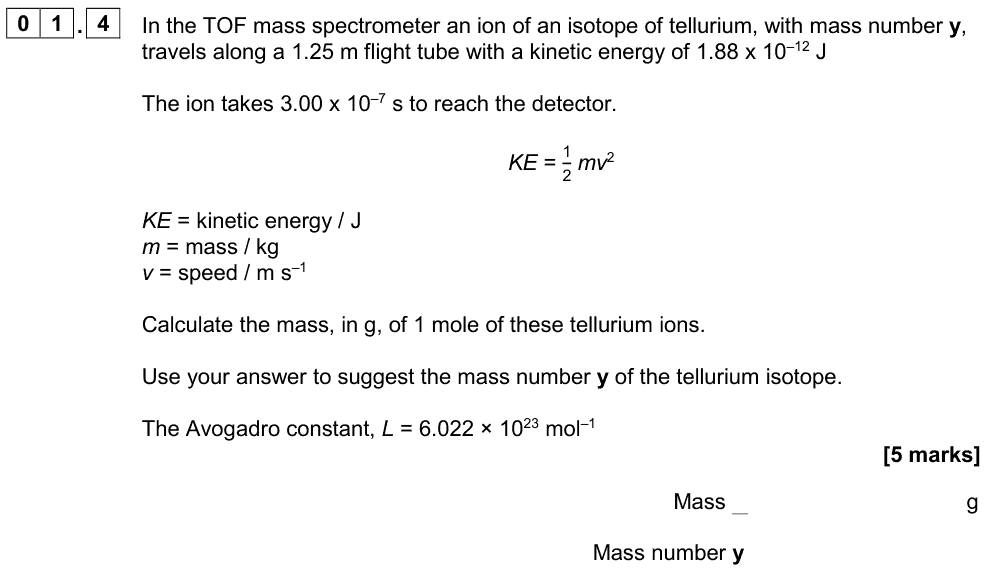
In the TOF mass spectrometer an ion of an isotope of tellurium, with mass number y,
travels along a 1.25 m flight tube with a kinetic energy of 1.88 x 10⁻¹² J
The ion takes 3.00 x 10⁻⁷ s to reach the detector.
KE =
1
2 mv2
KE = kinetic energy / J
m = mass / kg
v = speed / m s–1
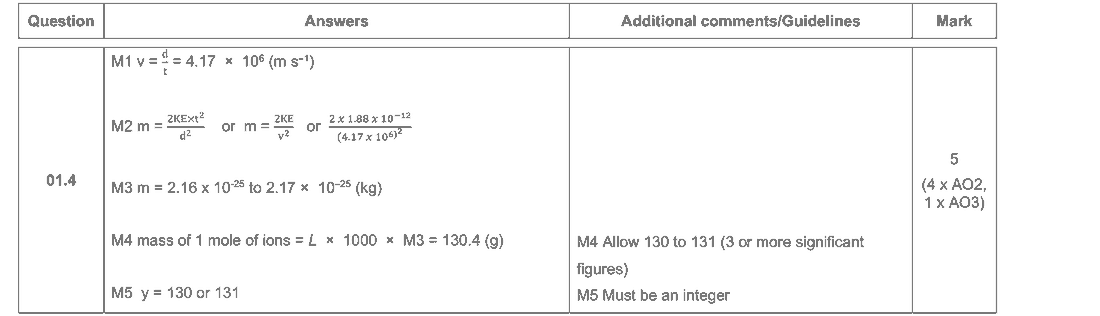
Calculate the mass, in g, of 1 mole of these tellurium ions.
Use your answer to suggest the mass number y of the tellurium isotope.
The Avogadro constant, L = 6.022 × 10²³ mol–1
[5 marks]
Mass
g
Mass number y
June 2024 · Paper 1 · Q01.5 1 mark AO1=1 Short answer atomic structure
Earlier part of question 01 that this part usesEarlier part of June 2024 Paper 1 question 01
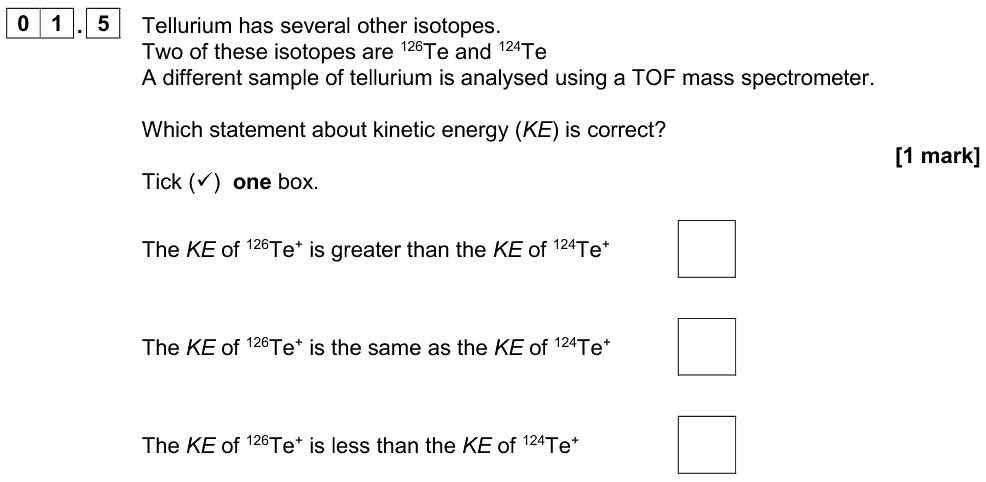
Tellurium has several other isotopes.
Two of these isotopes are 126Te and 124Te
A different sample of tellurium is analysed using a TOF mass spectrometer.
Which statement about kinetic energy (KE) is correct?
[1 mark]
Tick ()  one box.
The KE of 126Te+ is greater than the KE of 124Te+
The KE of 126Te+ is the same as the KE of 124Te+
The KE of 126Te+ is less than the KE of 124Te+
June 2024 · Paper 1 · Q02.1 1 mark AO3=1 Practical and data analysis amount of substance
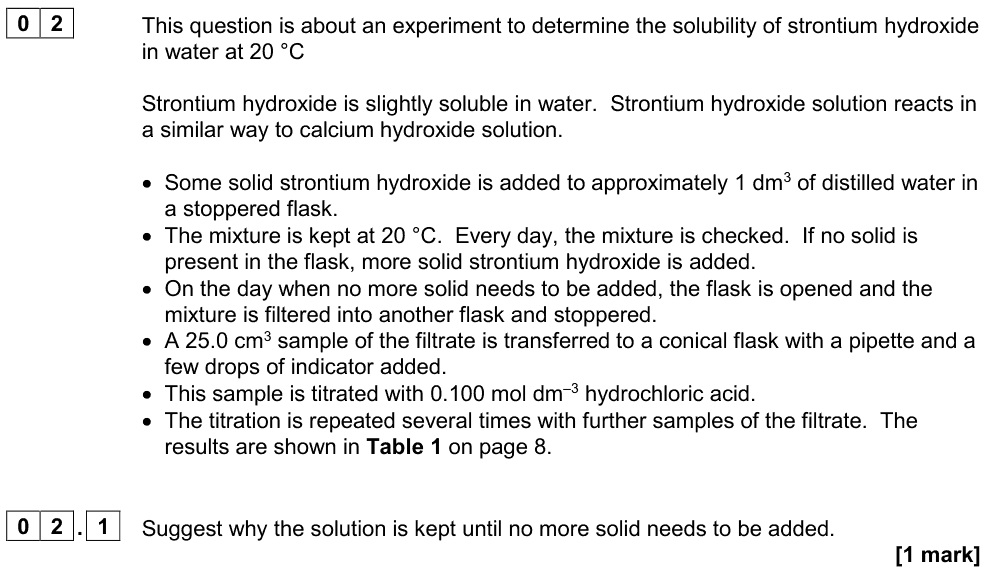
This question is about an experiment to determine the solubility of strontium hydroxide
in water at 20 °C
Strontium hydroxide is slightly soluble in water.  Strontium hydroxide solution reacts in
a similar way to calcium hydroxide solution.
• Some solid strontium hydroxide is added to approximately 1 dm3 of distilled water in
a stoppered flask.
• The mixture is kept at 20 °C.  Every day, the mixture is checked.  If no solid is
present in the flask, more solid strontium hydroxide is added.
• On the day when no more solid needs to be added, the flask is opened and the
mixture is filtered into another flask and stoppered.
• A 25.0 cm3 sample of the filtrate is transferred to a conical flask with a pipette and a
few drops of indicator added.
• This sample is titrated with 0.100 mol dm–3 hydrochloric acid.
• The titration is repeated several times with further samples of the filtrate.  The
results are shown in Table 1 on page 8.
Suggest why the solution is kept until no more solid needs to be added.
[1 mark]
June 2024 · Paper 1 · Q02.2 1 mark AO3=1 Practical and data analysis amount of substance
Earlier part of question 02 that this part usesEarlier part of June 2024 Paper 1 question 02
Suggest why it is important to remove the undissolved strontium hydroxide before the
titration.
[1 mark]
June 2024 · Paper 1 · Q02.3 1 mark AO2=1 Practical and data analysis amount of substance
Earlier part of question 02 that this part usesEarlier part of June 2024 Paper 1 question 02
After the filtration, the solution is stored in a stoppered flask.
Suggest a reason for stoppering the flask.
[1 mark]
June 2024 · Paper 1 · Q02.4 1 mark AO3=1 Practical and data analysis amount of substance
Earlier part of question 02 that this part usesEarlier part of June 2024 Paper 1 question 02
The diagrams in Figure 2 show the part of a pipette with the graduation line.
Which diagram identifies the pipette that is correctly filled?
[1 mark]
Tick () one box.
Figure 2
A
B
C
June 2024 · Paper 1 · Q02.5 6 marks AO2=6 Calculation Hard amount of substance
Earlier part of question 02 that this part usesEarlier part of June 2024 Paper 1 question 02
Solubility can be quoted as ‘g of solute per 100 cm3 of solution’.
Table 1 shows the results of the titrations between strontium hydroxide and
hydrochloric acid.  These can be used to determine the solubility of
strontium hydroxide.
Table 1
Titration
Rough
1
2
3
Final burette reading / cm3
34.40
38.00
41.05
37.00
Initial burette reading / cm3
0.00
5.55
8.05
4.60
Titre / cm3
34.40
32.45
33.00
32.40
Give the equation for the reaction between strontium hydroxide and hydrochloric acid.
Use the results in Table 1 to calculate the mean titre.
Use the mean titre to calculate the solubility of strontium hydroxide, in g per 100 cm3
of solution, at 20 °C
[6 marks]
Equation
Mean titre
cm3
Solubility of strontium hydroxide
g per 100 cm3 solution
June 2024 · Paper 1 · Q03.1 2 marks AO2=2 Diagram or structure transition metals
This question is about aqueous ions of the metal iron.
When an aqueous [Fe(H2O)6]3+ ion reacts with ethanedioate ions,
an iron(III) complex ion X is formed.
The only ligands in X are ethanedioate ions.
Draw the structure of X.
Include the charge.
[2 marks]
June 2024 · Paper 1 · Q03.2 2 marks AO1=2 Explanation transition metals
Earlier part of question 03 that this part usesEarlier part of June 2024 Paper 1 question 03
The formation of X is an example of the chelate effect.
Explain the meaning of the chelate effect.
[2 marks]
June 2024 · Paper 1 · Q03.3 6 marks AO1=2, AO2=2, AO3=2 6-mark level of response Hard transition metals
Earlier part of question 03 that this part usesEarlier part of June 2024 Paper 1 question 03
Outline how Fe2+ ions catalyse the reaction between S2O82– ions and I– ions in
aqueous solution.
In your answer you should include
• a sketch graph to show how the concentration of S2O82– ions changes over time
• an explanation of how Fe2+ ions catalyse the reaction, including equations
• an overall equation for the reaction.
[6 marks]
June 2024 · Paper 1 · Q03.4 1 mark AO2=1 Short answer reactions of ions in aqueous solution
Earlier part of question 03 that this part usesEarlier part of June 2024 Paper 1 question 03
A student adds dilute ammonia solution to a solution containing [Fe(H2O)6]2+ ions.
Give the formula of the precipitate that forms.
[1 mark]
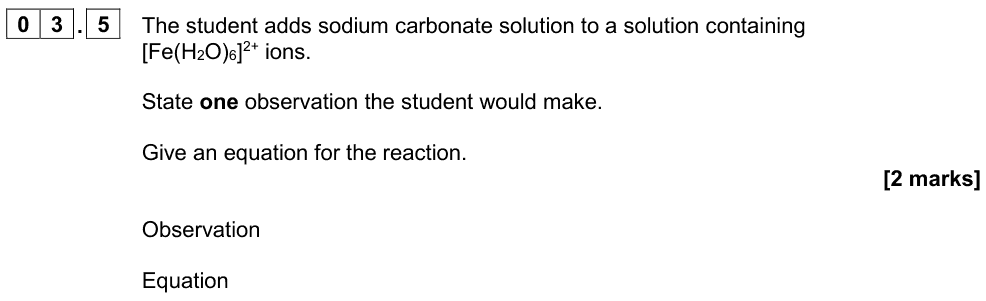
June 2024 · Paper 1 · Q03.5 2 marks AO1=1, AO2=1 Equation writing reactions of ions in aqueous solution
Earlier part of question 03 that this part usesEarlier part of June 2024 Paper 1 question 03
The student adds sodium carbonate solution to a solution containing
[Fe(H2O)6]2+ ions.
State one observation the student would make.
Give an equation for the reaction.
[2 marks]
Observation
Equation
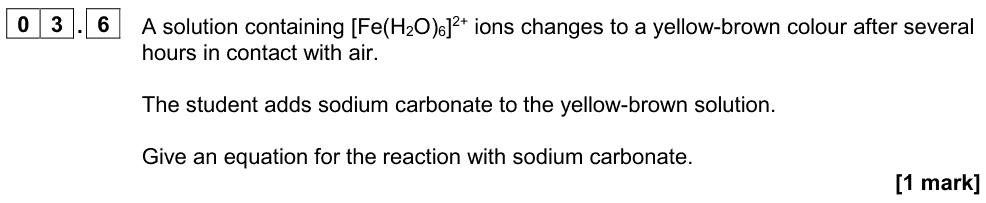
June 2024 · Paper 1 · Q03.6 1 mark AO3=1 Equation writing Hard reactions of ions in aqueous solution
Earlier part of question 03 that this part usesEarlier part of June 2024 Paper 1 question 03
A solution containing [Fe(H2O)6]2+ ions changes to a yellow-brown colour after several
hours in contact with air.
The student adds sodium carbonate to the yellow-brown solution.
Give an equation for the reaction with sodium carbonate.
[1 mark]
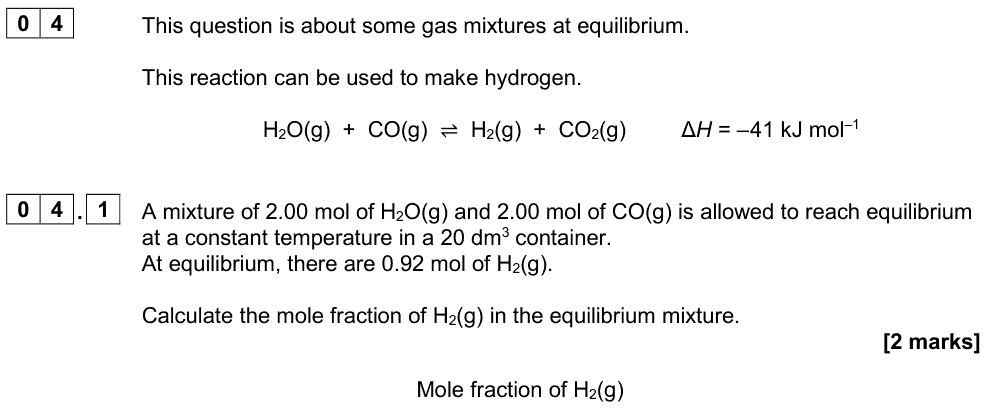
June 2024 · Paper 1 · Q04.1 2 marks AO2=2 Calculation equilibrium constant kp
This question is about some gas mixtures at equilibrium.
This reaction can be used to make hydrogen.
H2O(g)  +  CO(g)  ⇌  H2(g)  +  CO2(g)         ΔH = – 41 kJ mol–1
A mixture of 2.00 mol of H2O(g) and 2.00 mol of CO(g) is allowed to reach equilibrium
at a constant temperature in a 20 dm3 container.
At equilibrium, there are 0.92 mol of H2(g).
Calculate the mole fraction of H2(g) in the equilibrium mixture.
[2 marks]
Mole fraction of H2(g)
June 2024 · Paper 1 · Q04.2 1 mark AO1=1 Short answer equilibrium constant kp
Earlier part of question 04 that this part usesEarlier part of June 2024 Paper 1 question 04
State why the equilibrium constant (Kp) for this reaction has no units.
[1 mark]
June 2024 · Paper 1 · Q04.3 1 mark AO1=1 Short answer chemical equilibria and kcequilibrium constant kp
Earlier part of question 04 that this part usesEarlier part of June 2024 Paper 1 question 04
The temperature of the equilibrium mixture formed in Question 04.1 is increased.
How does the amount of H2(g) change when the new position of equilibrium is
reached?
[1 mark]
Tick () one box.
The amount decreases.
The amount does not change.
The amount increases.
June 2024 · Paper 1 · Q04.4 4 marks AO2=4 Calculation equilibrium constant kp
Earlier part of question 04 that this part usesEarlier part of June 2024 Paper 1 question 04
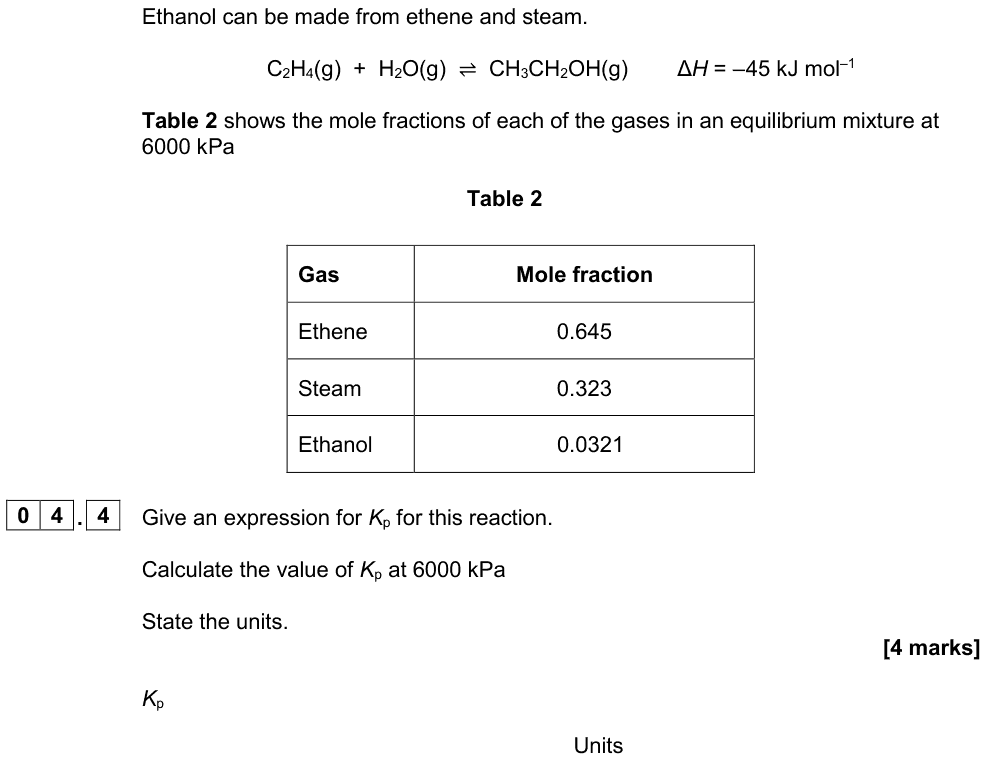
Ethanol can be made from ethene and steam.
C2H4(g)  +  H2O(g)  ⇌  CH3CH2OH(g)        ΔH = – 45 kJ mol–1
Table 2 shows the mole fractions of each of the gases in an equilibrium mixture at
6000 kPa
Table 2
Gas
Mole fraction
Ethene
0.645
Steam
0.323
Ethanol
0.0321
Give an expression for Kp for this reaction.
Calculate the value of Kp at 6000 kPa
State the units.
[4 marks]
Kp
Units
June 2024 · Paper 1 · Q04.5 1 mark AO1=1 Short answer Easy equilibrium constant kp
Earlier parts of question 04 that this part usesEarlier part of June 2024 Paper 1 question 04Earlier part of June 2024 Paper 1 question 04
State the effect, if any, of an increase in volume of the container on the value of Kp for
this reaction at a constant temperature.
[1 mark]
June 2024 · Paper 1 · Q05.1 1 mark AO1=1 Equation writing Easy group 7 the halogens
This question is about chlorine.
Give an equation to show how chlorine forms an acidic solution in water.
[1 mark]
June 2024 · Paper 1 · Q05.2 1 mark AO1=1 Equation writing group 7 the halogens
Earlier part of question 05 that this part usesEarlier part of June 2024 Paper 1 question 05
Give an equation for the reaction between chlorine and
cold, dilute aqueous sodium hydroxide.
[1 mark]
June 2024 · Paper 1 · Q05.3 3 marks AO3=3 Equation writing redox
Earlier part of question 05 that this part usesEarlier part of June 2024 Paper 1 question 05
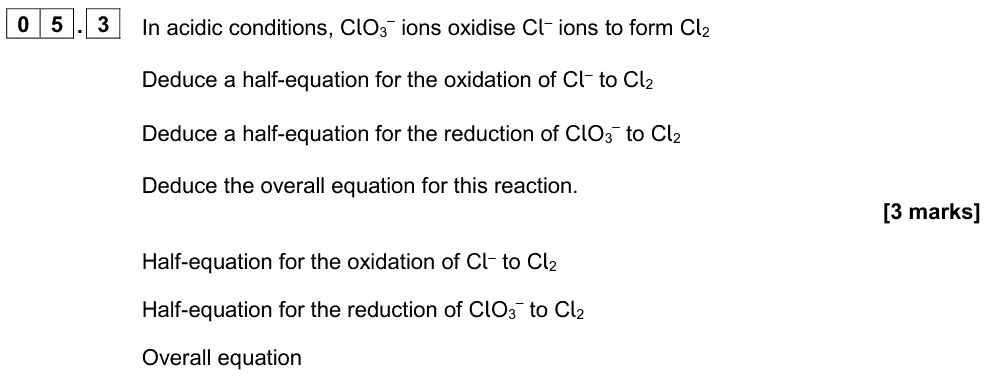
In acidic conditions, ClO3
– ions oxidise Cl– ions to form Cl2
Deduce a half-equation for the oxidation of Cl– to Cl2
Deduce a half-equation for the reduction of ClO3
– to Cl2
Deduce the overall equation for this reaction.
[3 marks]
Half-equation for the oxidation of Cl– to Cl2
Half-equation for the reduction of ClO3
– to Cl2
Overall equation
June 2024 · Paper 1 · Q05.4 2 marks AO1=1, AO3=1 Equation writing group 7 the halogensacids and bases
Earlier part of question 05 that this part usesEarlier part of June 2024 Paper 1 question 05
Give the equation for the reaction of solid sodium chloride with
concentrated sulfuric acid.
State the role of the chloride ions in this reaction.
[2 marks]
Equation
Role
June 2024 · Paper 1 · Q05.5 1 mark AO2=1 Diagram or structure bonding
Earlier part of question 05 that this part usesEarlier part of June 2024 Paper 1 question 05
Draw the shape of the Cl3
– ion.
Include any lone pairs of electrons that influence the shape.
[1 mark]
June 2024 · Paper 1 · Q05.6 2 marks AO2=1, AO3=1 Explanation Hard bonding
Earlier part of question 05 that this part usesEarlier part of June 2024 Paper 1 question 05
Chlorine forms an ion with the Group 3 element thallium (Tl).
State and explain the bond angle in TlCl2
+
[2 marks]
Bond angle
Explanation
June 2024 · Paper 1 · Q06.1 2 marks AO3=2 Explanation Hard electrode potentials and cellstransition metals
This question is about vanadium ions.
Table 3 shows some standard electrode potential values.
Table 3
E  o / V
O2(g)  +  4 H+(aq)  +  4 e−  →  2 H2O(l)
+1.23
VO2+(aq)  +  2 H+(aq) +  e−  →  VO2+(aq)  +  H2O(l)
+1.00
VO2+(aq)  +  2 H+(aq)  +  e−  →  V3+(aq)  +  H2O(l)
+0.34
V3+(aq)  +  e−  →  V2+(aq)
–0.26
Fe2+(aq)  +  2 e−  →  Fe(s)
–0.44
Zn2+(aq)  +  2 e−  →  Zn(s)
–0.76
V2+(aq)  +  2 e−  →  V(s)
–1.20
Mg2+(aq)  +  2 e−  →  Mg(s)
–2.38
Use the data in Table 3 to explain why Zn reduces an aqueous solution of VO2+ ions
to V2+ ions, but does not reduce it any further.
[2 marks]
June 2024 · Paper 1 · Q06.2 1 mark AO3=1 Short answer electrode potentials and cells
Earlier part of question 06 that this part usesEarlier part of June 2024 Paper 1 question 06
Identify the species in Table 3 that can reduce an aqueous solution of VO2+ to V
[1 mark]
June 2024 · Paper 1 · Q06.3 3 marks AO1=1, AO2=2 Calculation electrode potentials and cells
Earlier part of question 06 that this part usesEarlier part of June 2024 Paper 1 question 06
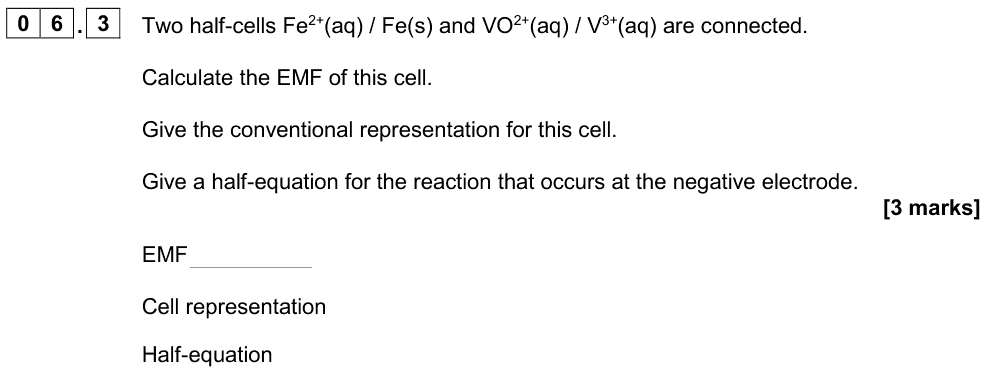
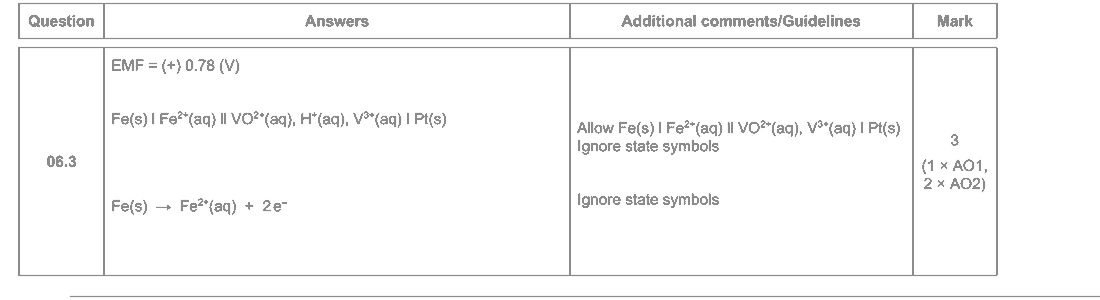
Two half-cells Fe2+(aq) / Fe(s) and VO2+(aq) / V3+(aq) are connected.
Calculate the EMF of this cell.
Give the conventional representation for this cell.
Give a half-equation for the reaction that occurs at the negative electrode.
[3 marks]
EMF
Cell representation
Half-equation
June 2024 · Paper 1 · Q06.4 4 marks AO2=4 Calculation Hard transition metalsamount of substance
Earlier part of question 06 that this part usesEarlier part of June 2024 Paper 1 question 06
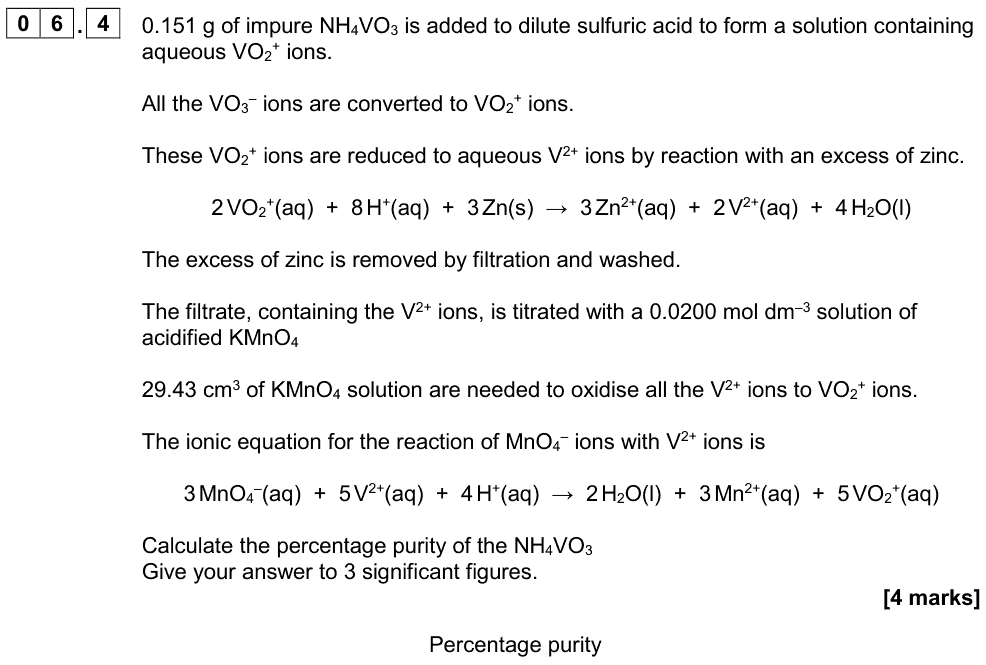
0.151 g of impure NH4VO3 is added to dilute sulfuric acid to form a solution containing
aqueous VO2+ ions.
All the VO3– ions are converted to VO2+ ions.
These VO2+ ions are reduced to aqueous V2+ ions by reaction with an excess of zinc.
2 VO2+(aq)  +  8 H+(aq)  +  3 Zn(s)  →  3 Zn2+(aq)  +  2 V2+(aq)  +  4 H2O(l)
The excess of zinc is removed by filtration and washed.
The filtrate, containing the V2+ ions, is titrated with a 0.0200 mol dm–3 solution of
acidified KMnO4
29.43 cm3 of KMnO4 solution are needed to oxidise all the V2+ ions to VO2+ ions.
The ionic equation for the reaction of MnO4– ions with V2+ ions is
3 MnO4–(aq)  +  5 V2+(aq)  +  4 H+(aq)  →  2 H2O(l)  +  3 Mn2+(aq)  +  5 VO2+(aq)
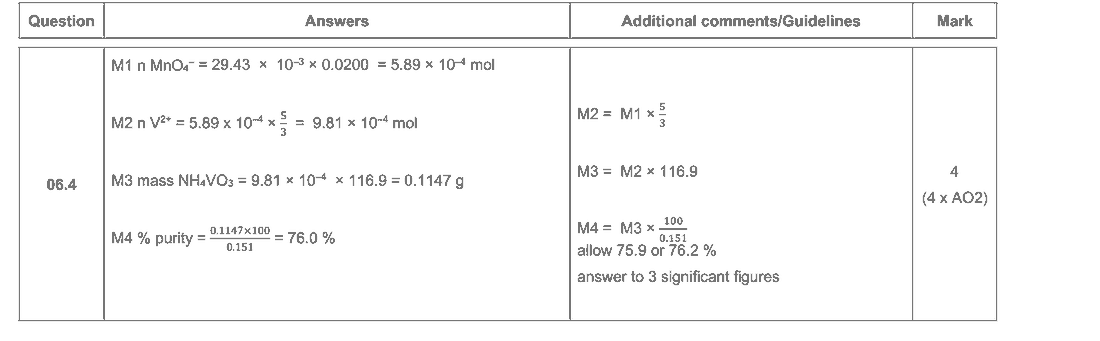
Calculate the percentage purity of the NH4VO3
Give your answer to 3 significant figures.
[4 marks]
Percentage purity
June 2024 · Paper 1 · Q07.1 3 marks AO1=1, AO2=2 Calculation acids and bases
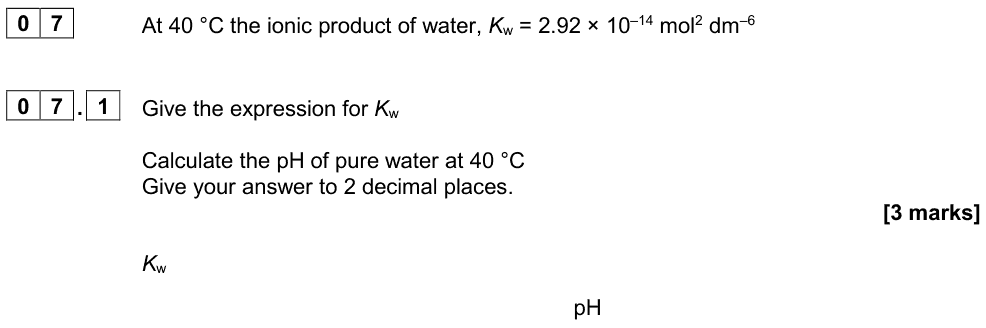
At 40 °C the ionic product of water, Kw = 2.92 × 10⁻¹⁴ mol2 dm–6
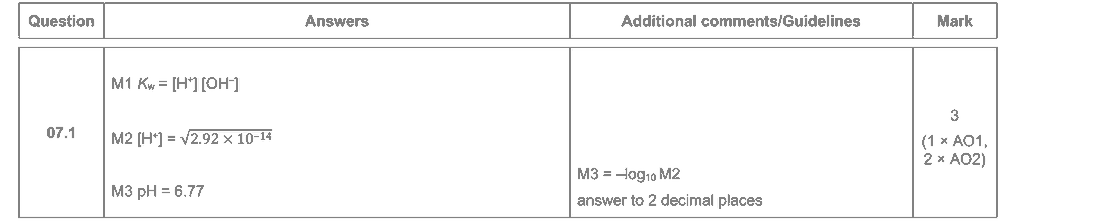
Give the expression for Kw
Calculate the pH of pure water at 40 °C
Give your answer to 2 decimal places.
[3 marks]
Kw
pH
June 2024 · Paper 1 · Q07.2 5 marks AO2=5 Calculation acids and bases
Earlier part of question 07 that this part usesEarlier part of June 2024 Paper 1 question 07
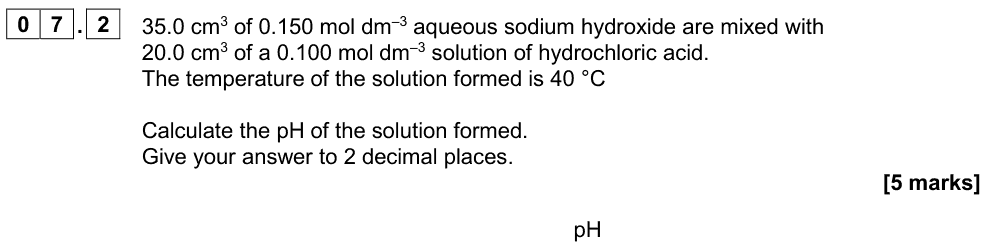
35.0 cm3 of 0.150 mol dm–3 aqueous sodium hydroxide are mixed with
20.0 cm3 of a 0.100 mol dm–3 solution of hydrochloric acid.
The temperature of the solution formed is 40 °C
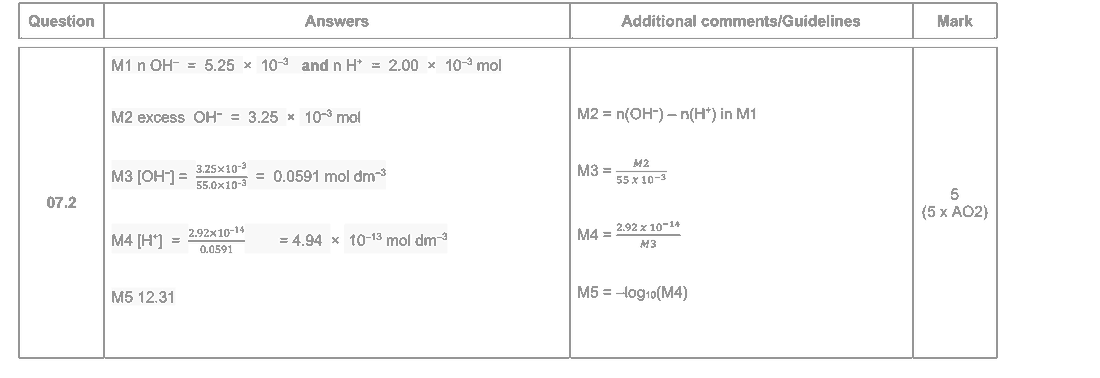
Calculate the pH of the solution formed.
Give your answer to 2 decimal places.
[5 marks]
pH
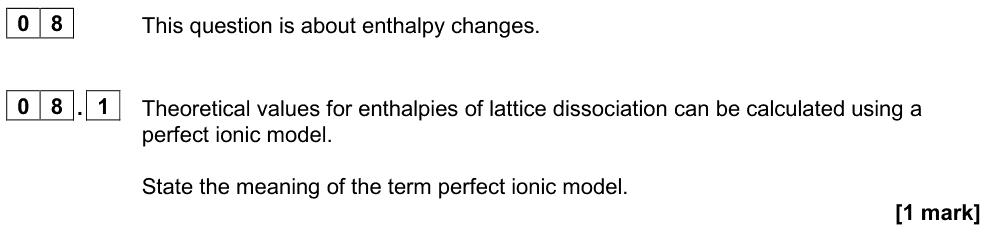
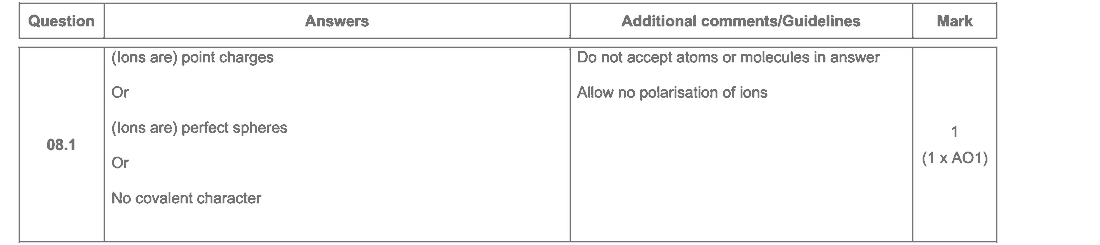
June 2024 · Paper 1 · Q08.1 1 mark AO1=1 Short answer thermodynamics
This question is about enthalpy changes.
Theoretical values for enthalpies of lattice dissociation can be calculated using a
perfect ionic model.
State the meaning of the term perfect ionic model.
[1 mark]
June 2024 · Paper 1 · Q08.2 2 marks AO2=2 Diagram or structure thermodynamics
Earlier part of question 08 that this part usesEarlier part of June 2024 Paper 1 question 08
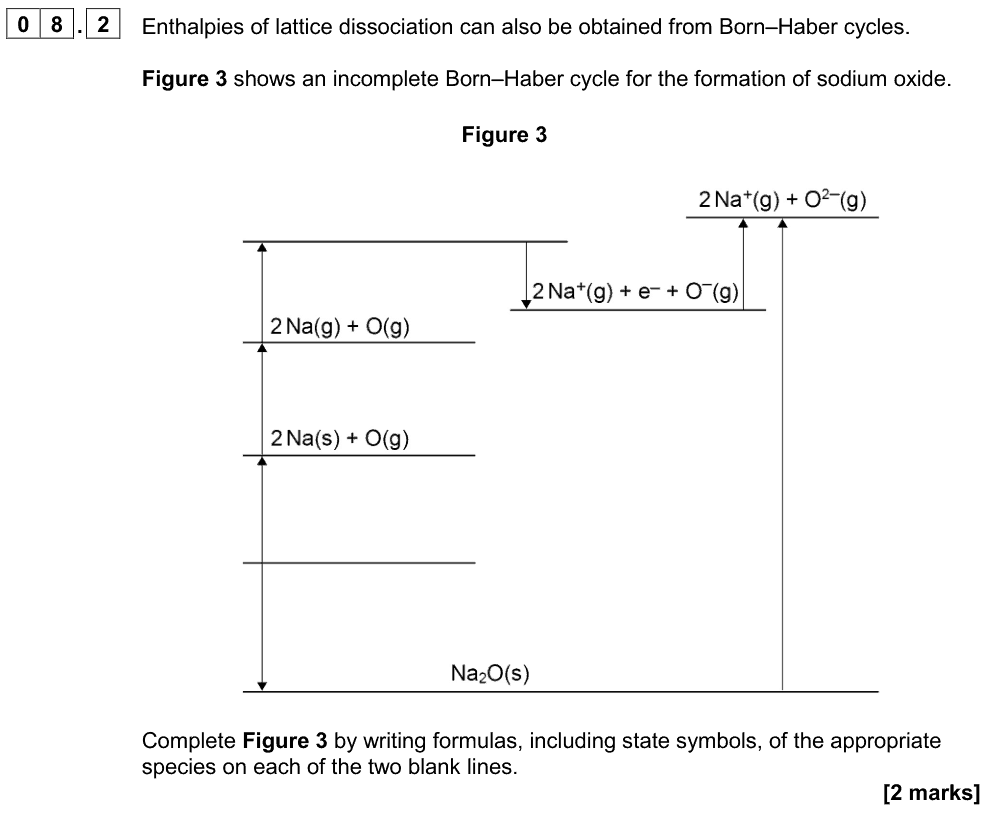
Enthalpies of lattice dissociation can also be obtained from Born–Haber cycles.
Figure 3 shows an incomplete Born–Haber cycle for the formation of sodium oxide.
Figure 3
Complete Figure 3 by writing formulas, including state symbols, of the appropriate
species on each of the two blank lines.
[2 marks]
June 2024 · Paper 1 · Q08.3 2 marks AO2=2 Calculation thermodynamics
Earlier part of question 08 that this part usesEarlier part of June 2024 Paper 1 question 08
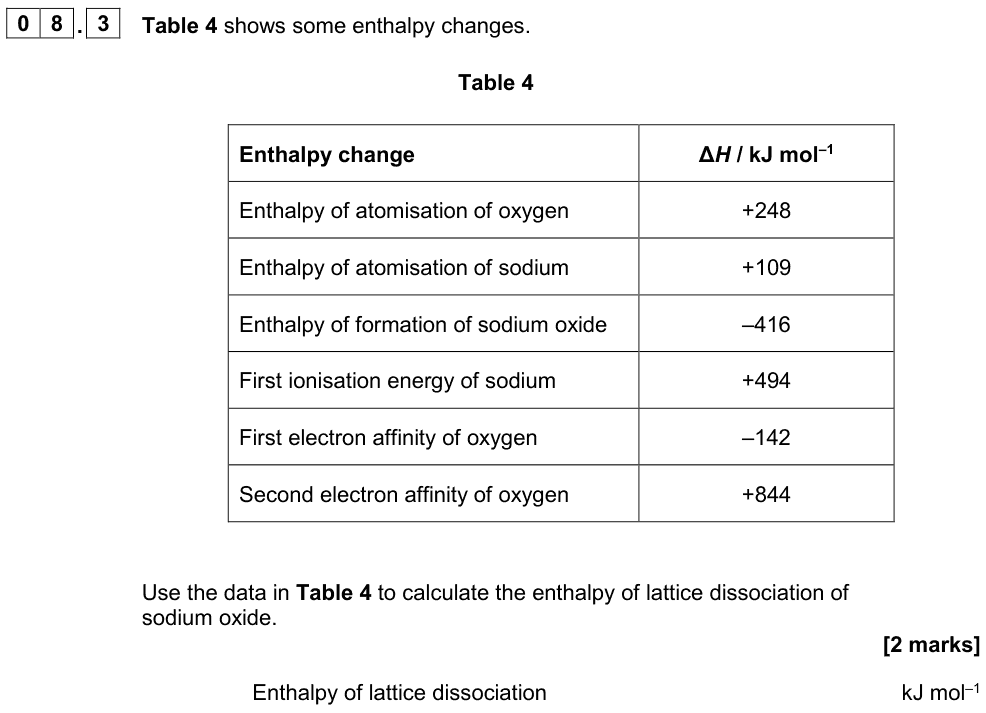
Table 4 shows some enthalpy changes.
Table 4
Enthalpy change
ΔH / kJ mol–1
Enthalpy of atomisation of oxygen
+248
Enthalpy of atomisation of sodium
+109
Enthalpy of formation of sodium oxide
–416
First ionisation energy of sodium
+494
First electron affinity of oxygen
–142
Second electron affinity of oxygen
+844
Use the data in Table 4 to calculate the enthalpy of lattice dissociation of
sodium oxide.
[2 marks]
Enthalpy of lattice dissociation
kJ mol–1
June 2024 · Paper 1 · Q08.4 1 mark AO1=1 Explanation Hard thermodynamics
Earlier part of question 08 that this part usesEarlier part of June 2024 Paper 1 question 08
Explain why the second electron affinity of oxygen has a positive value.
[1 mark]
June 2024 · Paper 1 · Q08.5 2 marks AO3=2 Explanation thermodynamicsbonding
Earlier part of question 08 that this part usesEarlier part of June 2024 Paper 1 question 08
Explain why the enthalpy of lattice dissociation for sodium oxide is greater than the
enthalpy of lattice dissociation for sodium chloride.
[2 marks]
June 2024 · Paper 1 · Q08.6 2 marks AO2=2 Calculation thermodynamics
Earlier part of question 08 that this part usesEarlier part of June 2024 Paper 1 question 08
Sodium chloride dissolves in water.
Table 5 shows some more enthalpy changes.
Table 5
Enthalpy change
ΔH / kJ mol–1
Enthalpy of hydration for Cl– ions
–364
Enthalpy of hydration for Na+ ions
–406
Enthalpy of lattice dissociation for NaCl
+771
Use the data in Table 5 to calculate the enthalpy of solution for sodium chloride.
[2 marks]
Enthalpy of solution
kJ mol–1
June 2024 · Paper 1 · Q08.7 1 mark AO3=1 Short answer period 3 elements and oxides
Earlier part of question 08 that this part usesEarlier part of June 2024 Paper 1 question 08
Give a reason why data books do not contain a value for the enthalpy of solution of
sodium oxide.
[1 mark]
June 2024 · Paper 1 · Q08.8 3 marks AO1=1, AO2=2 Calculation thermodynamics
Earlier part of question 08 that this part usesEarlier part of June 2024 Paper 1 question 08
Calculate the temperature, in °C, at which this reaction becomes feasible.
NaCl(s)  →  Na(s)  +
1
2
Cl2(g)        ΔH = +411 kJ mol–1
ΔS = +90.1 J K–1 mol–1
[3 marks]
Temperature
°C
June 2024 · Paper 1 · Q09.1 1 mark AO3=1 Short answer group 2
This question is about metals and their compounds.
State why the atomic radius of calcium is greater than the atomic radius of
magnesium.
[1 mark]
June 2024 · Paper 1 · Q09.2 1 mark AO3=1 Equation writing group 2
Earlier part of question 09 that this part usesEarlier part of June 2024 Paper 1 question 09
Magnesium reacts with steam.
Give an equation, including state symbols, for this reaction.
[1 mark]
June 2024 · Paper 1 · Q09.3 3 marks AO1=2, AO3=1 Explanation group 2
Earlier part of question 09 that this part usesEarlier part of June 2024 Paper 1 question 09
Similar-sized pieces of barium and magnesium are added to separate
100 cm3 samples of dilute sulfuric acid.  In each case the sulfuric acid is in excess.
The barium reacts quickly at first.  After a few minutes the reaction stops, even though
there is still some unreacted barium in the flask.
The magnesium reacts more slowly than the barium, but the reaction continues until
all the magnesium has reacted.
Explain why
• the barium initially reacts more quickly than the magnesium
• the barium reaction stops before all the barium has reacted.
[3 marks]
June 2024 · Paper 1 · Q09.4 6 marks AO1=1, AO2=5 Calculation amount of substance
Earlier part of question 09 that this part usesEarlier part of June 2024 Paper 1 question 09
A metal nitrate X(NO3)2 completely decomposes when heated.
2 X(NO3)2(s)  →  2 XO(s)  +  4 NO2(g)  +  O2(g)
A 0.832 g sample of X(NO3)2 decomposes on heating to produce a total of
348 cm3 of gas at 298 K and 100 kPa
Deduce the identity of metal X.
The ideal gas constant, R = 8.31 J K–1 mol–1
[6 marks]
Identity of metal X
June 2024 · Paper 1 · Q09.5 3 marks AO2=2, AO3=1 Explanation amount of substancebonding
Earlier part of question 09 that this part usesEarlier part of June 2024 Paper 1 question 09
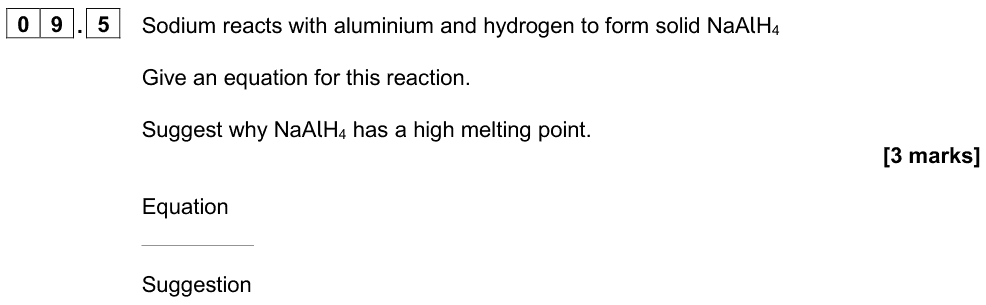
Sodium reacts with aluminium and hydrogen to form solid NaAlH4
Give an equation for this reaction.
Suggest why NaAlH4 has a high melting point.
[3 marks]
Equation
Suggestion
June 2024 · Paper 1 · Q09.6 1 mark AO3=1 Equation writing period 3 elements and oxides
Earlier part of question 09 that this part usesEarlier part of June 2024 Paper 1 question 09
Give the equation for the reaction between H3PO4 and an excess of NaOH
[1 mark]
June 2024 · Paper 1 · Q09.7 1 mark AO1=1 Equation writing Hard electrode potentials and cells
Earlier part of question 09 that this part usesEarlier part of June 2024 Paper 1 question 09
Lithium is an important metal used in cells to power mobile phones.
In a lithium cell, a lithium cobalt oxide electrode and a lithium electrode are used.
Give the equation for the reaction that occurs at the positive electrode.
[1 mark]
June 2024 · Paper 1 · Q09.8 1 mark AO1=1 Short answer electrode potentials and cells
Earlier part of question 09 that this part usesEarlier part of June 2024 Paper 1 question 09
Commercial electrochemical cells can be rechargeable or non-rechargeable.
State why lithium cells can be recharged.
[1 mark]

Work with an A-level chemistry tutor

Want a paper marked and gone through with you? Message us.

Prefer email? Send an enquiry

If you are under 18, please include a parent's contact details. Enquiries go to enquiries@chemistryaleveltutor.com and are deleted once handled. All tutoring is online.