June 2023: Paper 1, Inorganic and physical chemistry

105 marks · 57 question parts · Paper, mark scheme and report on AQA's site · Have the Data Booklet beside you

Question by question

QTopicMarksAOType
01.1 Transition metals 1AO1=1Short answer
01.2 Bonding 2AO1=1,AO2=1Diagram or structure
01.3 Oxidation, reduction and redox equations 1AO3=1Short answer
01.4 Oxidation, reduction and redox equations 1AO3=1Short answer
01.5 Bonding 1AO3=1Short answer
01.6 Transition metals 3AO2=3Diagram or structure
01.7 Transition metals 1AO3=1Equation writing
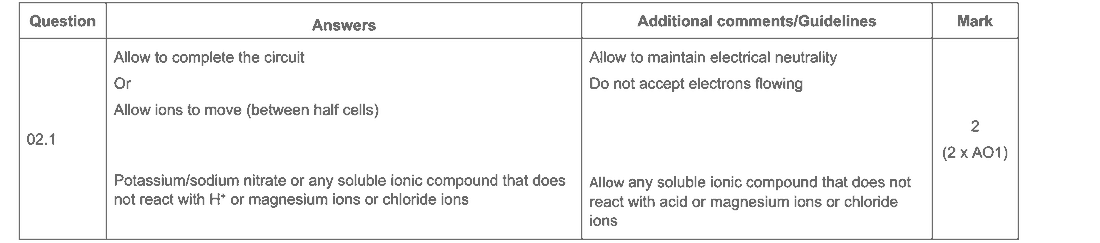
02.1 Electrode potentials and electrochemical cells 2AO1=2Short answer
02.2 Electrode potentials and electrochemical cells 1AO1=1Short answer
02.3 Electrode potentials and electrochemical cells 1AO3=1Short answer
02.4 Electrode potentials and electrochemical cells 1AO3=1Equation writing
03.1 Period 3 elements and their oxides 1AO1=1Equation writing
03.2 Period 3 elements and their oxides 1AO1=1Equation writing
03.3 Period 3 elements and their oxides 1AO1=1Diagram or structure
03.4 Period 3 elements and their oxides, Group 2, the alkaline earth metals 2AO1=2Equation writing
03.5 Period 3 elements and their oxides 1AO1=1Equation writing
04.1 Equilibrium constant Kp 3AO2=3Calculation
04.2 Equilibrium constant Kp 1AO2=1Calculation
04.3 Equilibrium constant Kp 3AO1=1,AO2=2Calculation
04.4 Equilibrium constant Kp 2AO1=1,AO3=1Short answer
04.5 Equilibrium constant Kp, Chemical equilibria, Le Chatelier's principle and Kc 2AO3=2Explanation
05.1 Thermodynamics: Born–Haber cycles, entropy and Gibbs free energy 2AO2=2Calculation
05.2 Energetics 1AO3=1Short answer
05.3 Thermodynamics: Born–Haber cycles, entropy and Gibbs free energy 2AO1=2Explanation
05.4 Thermodynamics: Born–Haber cycles, entropy and Gibbs free energy 2AO2=2Diagram or structure
05.5 Thermodynamics: Born–Haber cycles, entropy and Gibbs free energy 2AO2=2Calculation
05.6 Atomic structure 1AO3=1Short answer
05.7 Thermodynamics: Born–Haber cycles, entropy and Gibbs free energy, Bonding 6AO1=2,AO2=2,AO3=2Level of response
06.1 Amount of substance 1AO2=1Calculation
06.2 Amount of substance 3AO2=3Practical and data analysis
06.3 Amount of substance 1AO3=1Practical and data analysis
06.4 Amount of substance 1AO1=1Practical and data analysis
06.5 Amount of substance 3AO2=3Calculation
06.6 Amount of substance 1AO2=1Practical and data analysis
07.1 Atomic structure 1AO1=1Short answer
07.2 Reactions of ions in aqueous solution, Amount of substance 1AO1=1Equation writing
07.3 Reactions of ions in aqueous solution 2AO1=2Explanation
07.4 Transition metals 1AO3=1Short answer
07.5 Reactions of ions in aqueous solution 2AO1=1,AO2=1Equation writing
07.6 Reactions of ions in aqueous solution 1AO3=1Short answer
07.7 Transition metals 2AO1=2Short answer
07.8 Amount of substance 7AO2=7Calculation
08.1 Electrode potentials and electrochemical cells, Oxidation, reduction and redox equations 1AO1=1Equation writing
08.2 Electrode potentials and electrochemical cells, Oxidation, reduction and redox equations 1AO2=1Equation writing
08.3 Electrode potentials and electrochemical cells 1AO2=1Calculation
08.4 Electrode potentials and electrochemical cells 1AO1=1Short answer
08.5 Electrode potentials and electrochemical cells 1AO2=1Short answer
09.1 Atomic structure 1AO1=1Equation writing
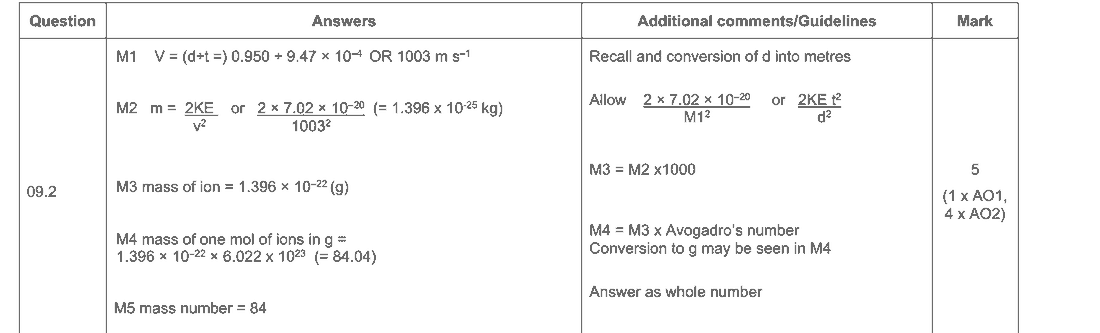
09.2 Atomic structure, Amount of substance 5AO1=1,AO2=4Calculation
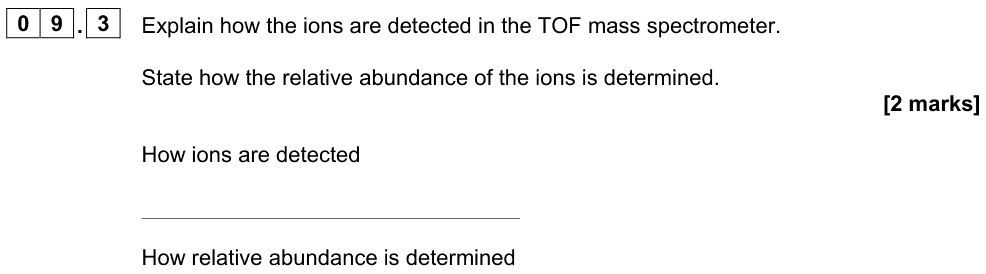
09.3 Atomic structure 2AO1=2Short answer
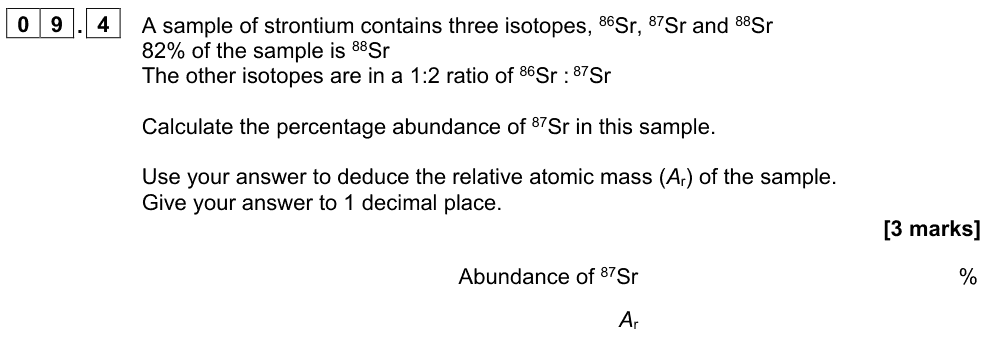
09.4 Atomic structure 3AO2=2,AO3=1Calculation
09.5 Atomic structure 1AO3=1Short answer
10.1 Acids and bases: pH, Ka, titration curves and buffers 1AO3=1Short answer
10.2 Acids and bases: pH, Ka, titration curves and buffers 1AO1=1Short answer
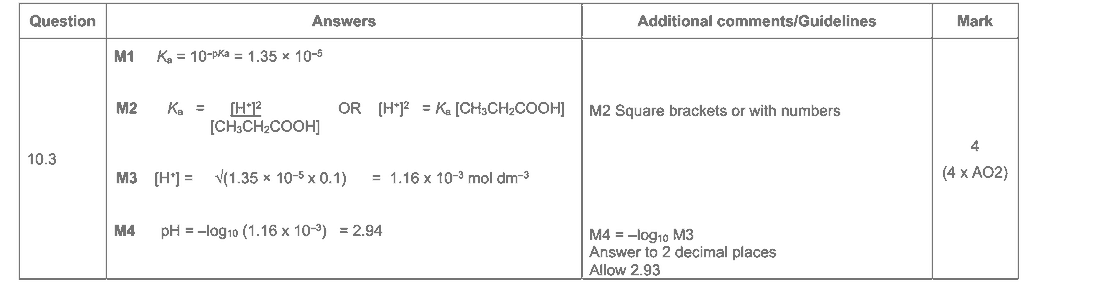
10.3 Acids and bases: pH, Ka, titration curves and buffers 4AO2=4Calculation
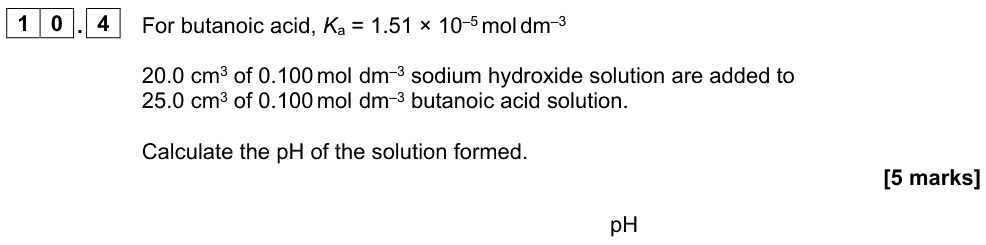
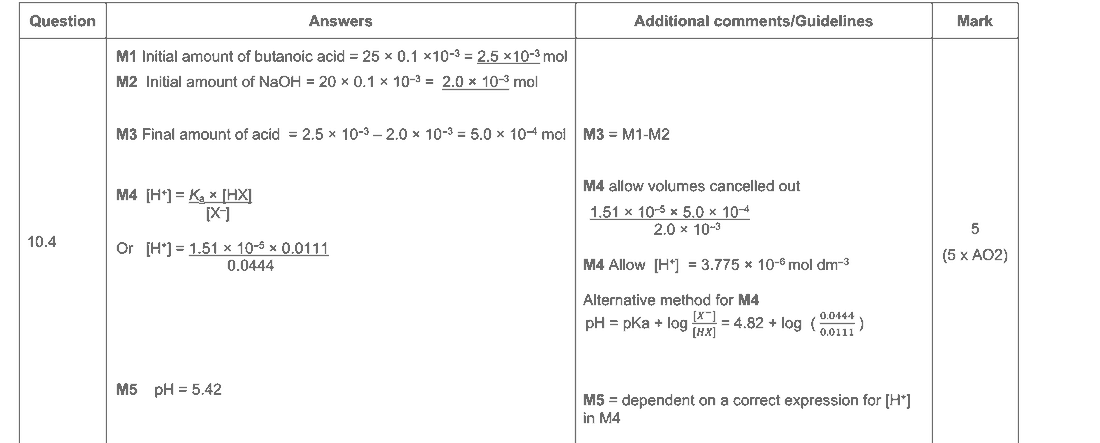
10.4 Acids and bases: pH, Ka, titration curves and buffers 5AO2=5Calculation
10.5 Acids and bases: pH, Ka, titration curves and buffers 2AO3=2Explanation

The questions

01.101.201.301.401.501.601.702.102.202.302.403.103.203.303.403.504.104.204.304.404.505.105.205.305.405.505.605.706.106.206.306.406.506.607.107.207.307.407.507.607.707.808.108.208.308.408.509.109.209.309.409.510.110.210.310.410.5
June 2023 · Paper 1 · Q01.1 1 mark AO1=1 Short answer transition metals
This question is about complexes of the transition metal chromium.
State the meaning of the term transition metal complex.
[1 mark]
June 2023 · Paper 1 · Q01.2 2 marks AO1=1, AO2=1 Diagram or structure bonding
Earlier part of question 01 that this part usesEarlier part of June 2023 Paper 1 question 01
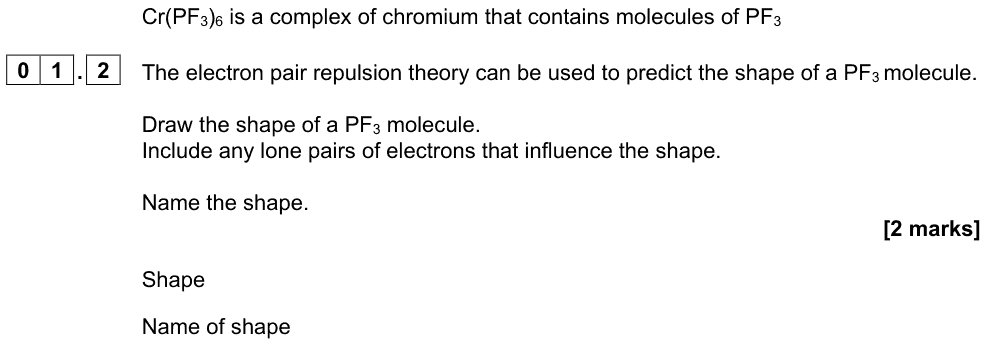
Cr(PF3)6 is a complex of chromium that contains molecules of PF3
The electron pair repulsion theory can be used to predict the shape of a PF3 molecule.
Draw the shape of a PF3 molecule.
Include any lone pairs of electrons that influence the shape.
Name the shape.
[2 marks]
Shape
Name of shape
June 2023 · Paper 1 · Q01.3 1 mark AO3=1 Short answer redox
Earlier part of question 01 that this part usesEarlier part of June 2023 Paper 1 question 01
Suggest why the oxidation state of chromium is zero in Cr(PF3)6
[1 mark]
June 2023 · Paper 1 · Q01.4 1 mark AO3=1 Short answer redox
Earlier parts of question 01 that this part usesEarlier part of June 2023 Paper 1 question 01Earlier part of June 2023 Paper 1 question 01
The compound [Cr(NH3)4Cl2]Cl contains ammonia molecules.
Deduce the oxidation state of chromium in [Cr(NH3)4Cl2]Cl
[1 mark]
June 2023 · Paper 1 · Q01.5 1 mark AO3=1 Short answer bonding
Earlier part of question 01 that this part usesEarlier part of June 2023 Paper 1 question 01
Name the type of bond between N and H in ammonia.
[1 mark]
June 2023 · Paper 1 · Q01.6 3 marks AO2=3 Diagram or structure transition metals
Earlier parts of question 01 that this part usesEarlier part of June 2023 Paper 1 question 01Earlier part of June 2023 Paper 1 question 01
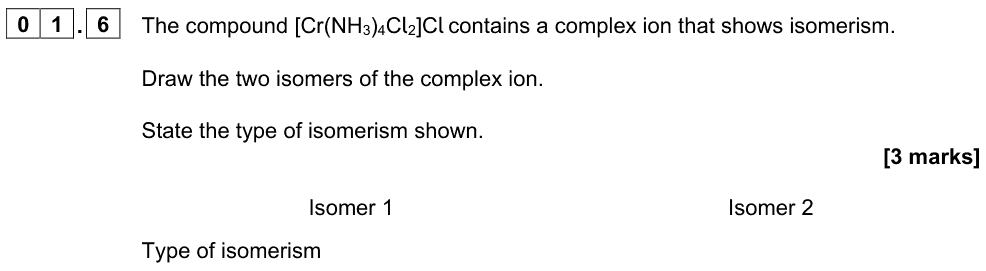
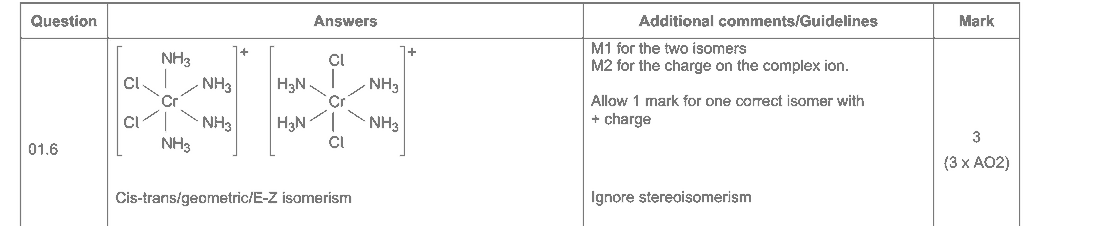
The compound [Cr(NH3)4Cl2]Cl contains a complex ion that shows isomerism.
Draw the two isomers of the complex ion.
State the type of isomerism shown.
[3 marks]
Isomer 1
Isomer 2
Type of isomerism
June 2023 · Paper 1 · Q01.7 1 mark AO3=1 Equation writing Hard transition metals
Earlier parts of question 01 that this part usesEarlier part of June 2023 Paper 1 question 01Earlier part of June 2023 Paper 1 question 01Earlier part of June 2023 Paper 1 question 01
Complete the equation to show the formation of one complex that contains chromium
in its +3 oxidation state.
[1 mark]
CrCl3  + 5 H2O  →
June 2023 · Paper 1 · Q02.1 2 marks AO1=2 Short answer electrode potentials and cells
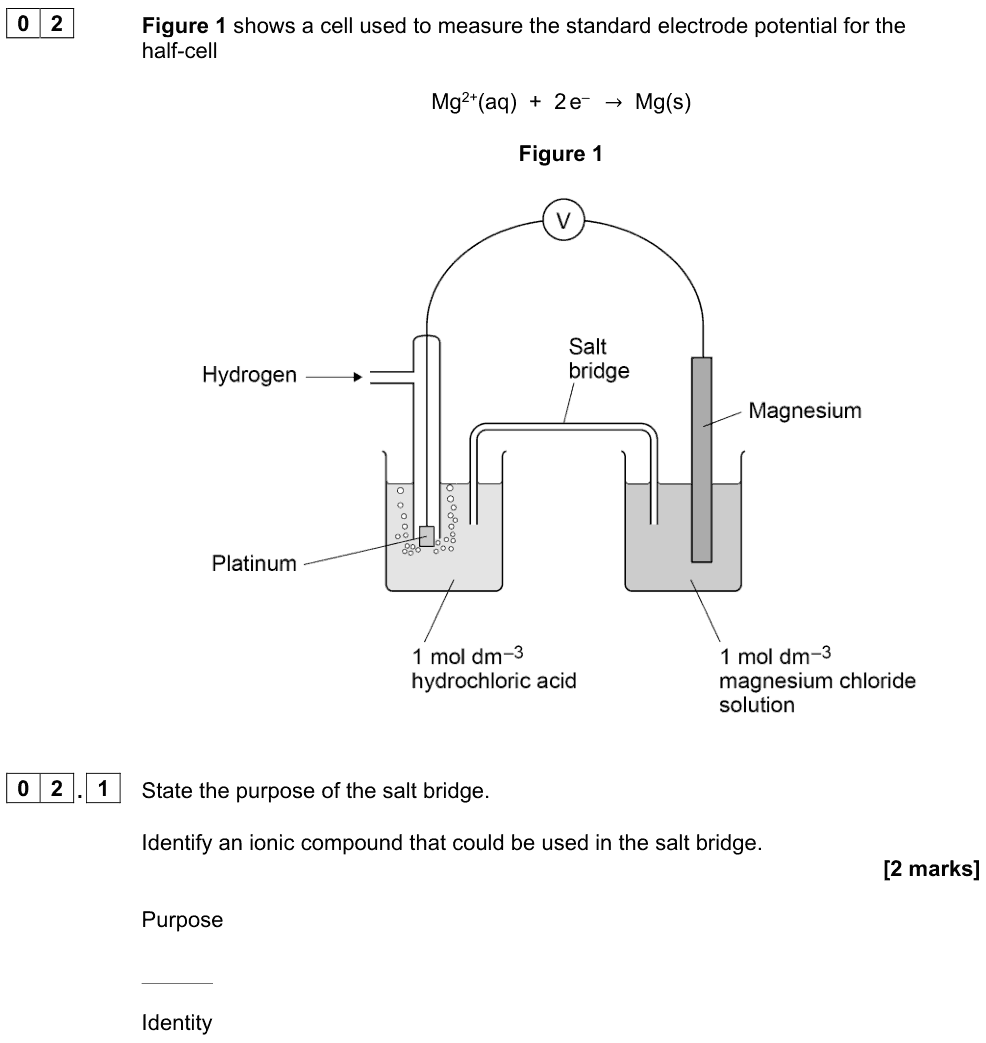
Figure 1 shows a cell used to measure the standard electrode potential for the
half-cell
Mg2+(aq)  +  2 e–   →  Mg(s)
Figure 1
State the purpose of the salt bridge.
Identify an ionic compound that could be used in the salt bridge.
[2 marks]
Purpose
Identity
June 2023 · Paper 1 · Q02.2 1 mark AO1=1 Short answer electrode potentials and cells
Earlier part of question 02 that this part usesEarlier part of June 2023 Paper 1 question 02
State how, if at all, the EMF of this cell will change if the surface area of the platinum
electrode is increased.
[1 mark]
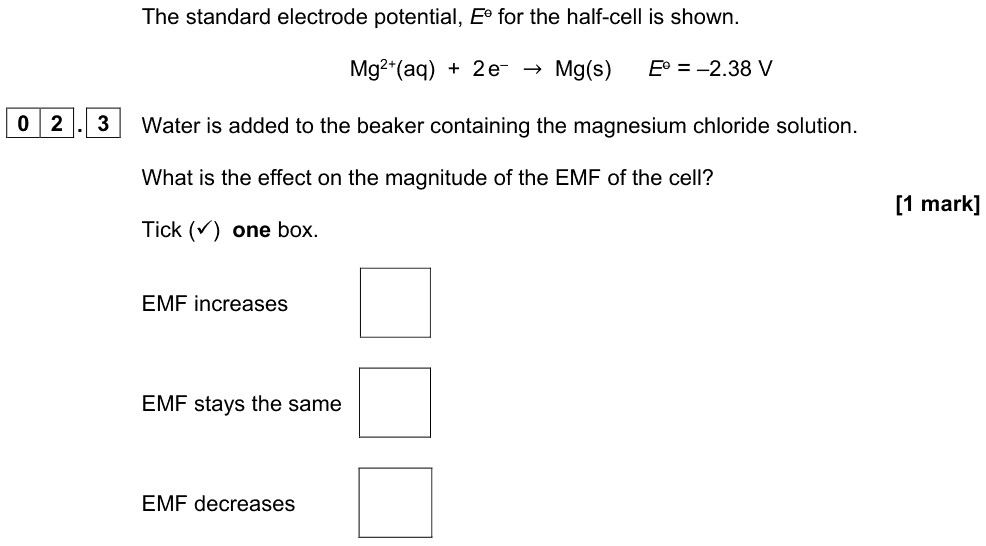
June 2023 · Paper 1 · Q02.3 1 mark AO3=1 Short answer electrode potentials and cells
Earlier part of question 02 that this part usesEarlier part of June 2023 Paper 1 question 02
The standard electrode potential, Eo for the half-cell is shown.
Mg2+(aq)  +  2 e–   →  Mg(s)      Eo = –2.38 V
Water is added to the beaker containing the magnesium chloride solution.
What is the effect on the magnitude of the EMF of the cell?
[1 mark]
Tick ()  one box.
EMF increases
EMF stays the same
EMF decreases
June 2023 · Paper 1 · Q02.4 1 mark AO3=1 Equation writing electrode potentials and cells
Earlier part of question 02 that this part usesEarlier part of June 2023 Paper 1 question 02
The voltmeter V shown in Figure 1 is replaced by a bulb.
Give an equation for the overall reaction that occurs when the cell is operating.
[1 mark]
June 2023 · Paper 1 · Q03.1 1 mark AO1=1 Equation writing period 3 elements and oxides
This question is about Period 3 elements and their oxides.
Give an equation for the reaction between phosphorus and an
excess of oxygen.
[1 mark]
June 2023 · Paper 1 · Q03.2 1 mark AO1=1 Equation writing period 3 elements and oxides
Earlier part of question 03 that this part usesEarlier part of June 2023 Paper 1 question 03
Give an equation for the reaction between sulfur dioxide and water.
[1 mark]
June 2023 · Paper 1 · Q03.3 1 mark AO1=1 Diagram or structure period 3 elements and oxides
Earlier part of question 03 that this part usesEarlier part of June 2023 Paper 1 question 03
Give the displayed formula for the anion formed when sulfur trioxide reacts with water.
[1 mark]
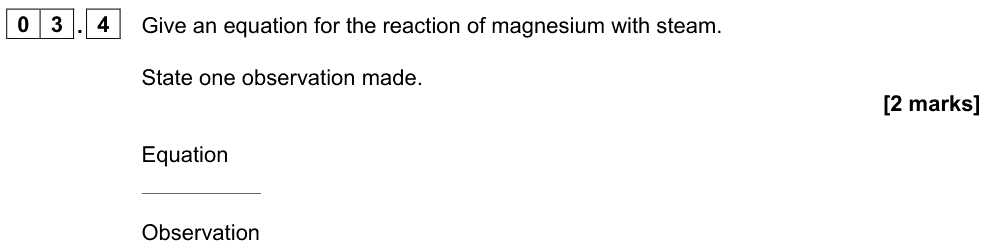
June 2023 · Paper 1 · Q03.4 2 marks AO1=2 Equation writing period 3 elements and oxidesgroup 2
Earlier part of question 03 that this part usesEarlier part of June 2023 Paper 1 question 03
Give an equation for the reaction of magnesium with steam.
State one observation made.
[2 marks]
Equation
Observation
June 2023 · Paper 1 · Q03.5 1 mark AO1=1 Equation writing period 3 elements and oxides
Earlier part of question 03 that this part usesEarlier part of June 2023 Paper 1 question 03
Give an equation to show how an excess of magnesium oxide reacts with
phosphoric acid (H3PO4).
[1 mark]
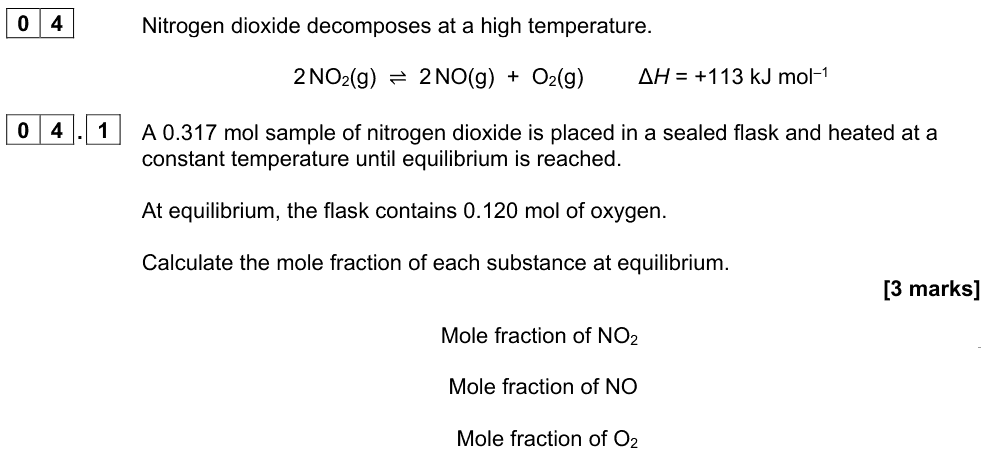
June 2023 · Paper 1 · Q04.1 3 marks AO2=3 Calculation equilibrium constant kp
Nitrogen dioxide decomposes at a high temperature.
2 NO2(g)  ⇌  2 NO(g)  +  O2(g)         ΔH = +113 kJ mol–1
A 0.317 mol sample of nitrogen dioxide is placed in a sealed flask and heated at a
constant temperature until equilibrium is reached.
At equilibrium, the flask contains 0.120 mol of oxygen.
Calculate the mole fraction of each substance at equilibrium.
[3 marks]
Mole fraction of NO2
Mole fraction of NO
Mole fraction of O2
June 2023 · Paper 1 · Q04.2 1 mark AO2=1 Calculation equilibrium constant kp
Earlier part of question 04 that this part usesEarlier part of June 2023 Paper 1 question 04
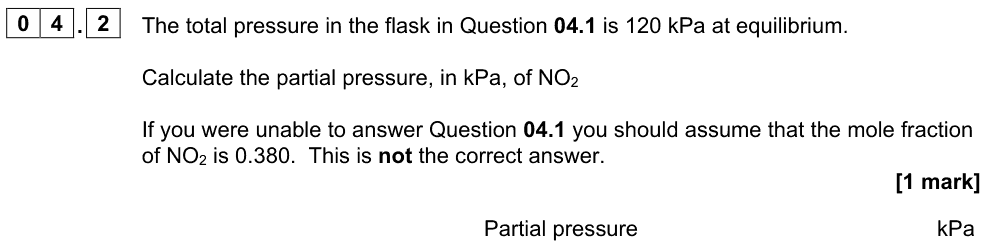
The total pressure in the flask in Question 04.1 is 120 kPa at equilibrium.
Calculate the partial pressure, in kPa, of NO2
If you were unable to answer Question 04.1 you should assume that the mole fraction
of NO2 is 0.380.  This is not the correct answer.
[1 mark]
Partial pressure
kPa
June 2023 · Paper 1 · Q04.3 3 marks AO1=1, AO2=2 Calculation equilibrium constant kp
Earlier part of question 04 that this part usesEarlier part of June 2023 Paper 1 question 04
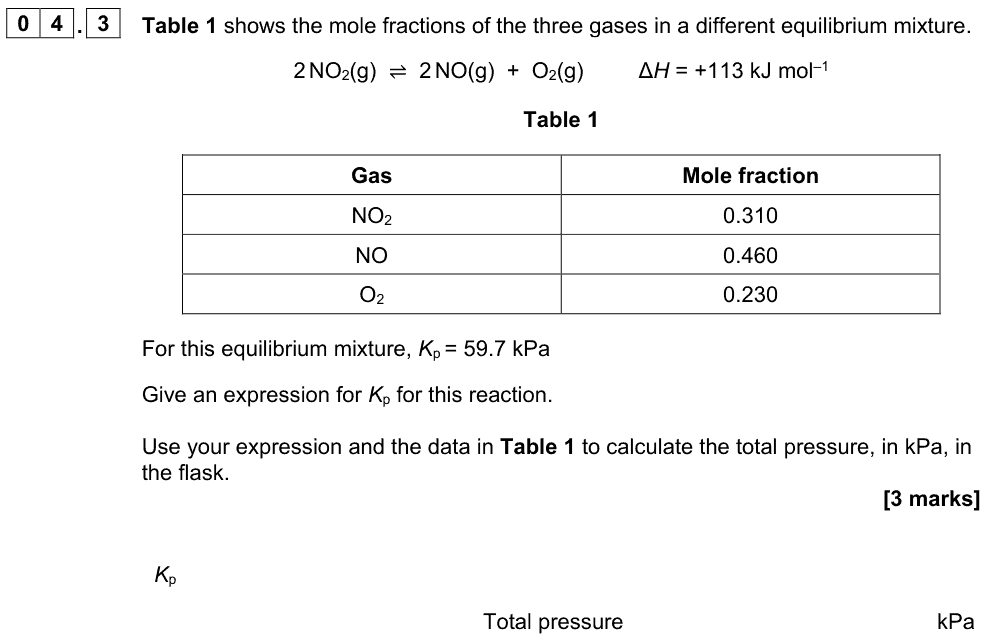
Table 1 shows the mole fractions of the three gases in a different equilibrium mixture.
2 NO2(g)  ⇌  2 NO(g)  +  O2(g)         ΔH = +113 kJ mol–1
Table 1
Gas
Mole fraction
NO2
0.310
NO
0.460
O2
0.230
For this equilibrium mixture, Kp = 59.7 kPa
Give an expression for Kp for this reaction.
Use your expression and the data in Table 1 to calculate the total pressure, in kPa, in
the flask.
[3 marks]
Kp
Total pressure
kPa
June 2023 · Paper 1 · Q04.4 2 marks AO1=1, AO3=1 Short answer equilibrium constant kp
Earlier part of question 04 that this part usesEarlier part of June 2023 Paper 1 question 04
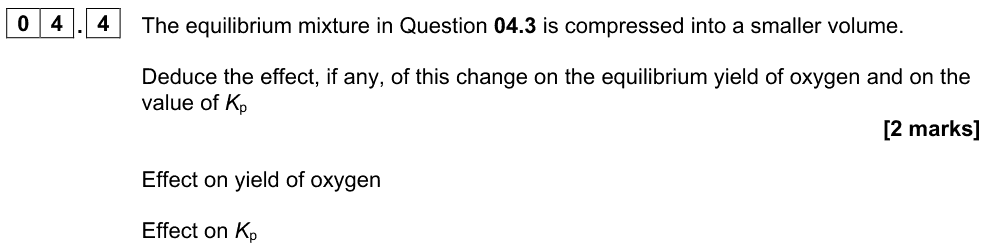
The equilibrium mixture in Question 04.3 is compressed into a smaller volume.
Deduce the effect, if any, of this change on the equilibrium yield of oxygen and on the
value of Kp
[2 marks]
Effect on yield of oxygen
Effect on Kp
June 2023 · Paper 1 · Q04.5 2 marks AO3=2 Explanation equilibrium constant kpchemical equilibria and kc
Earlier part of question 04 that this part usesEarlier part of June 2023 Paper 1 question 04
The equilibrium mixture in Question 04.3 is allowed to reach equilibrium at a lower
temperature.
Explain why the equilibrium yield of oxygen decreases.
[2 marks]
June 2023 · Paper 1 · Q05.1 2 marks AO2=2 Calculation thermodynamics
This question is about metal chlorides.
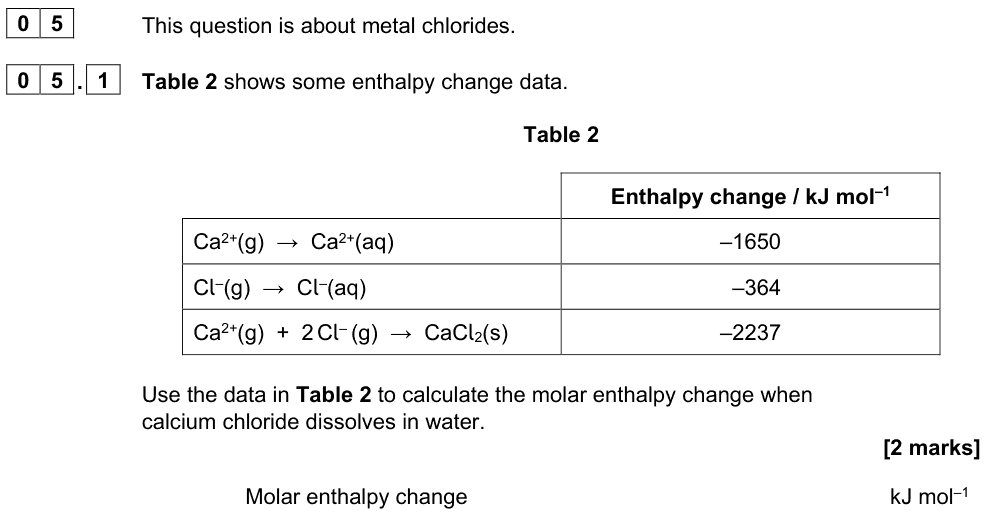
Table 2 shows some enthalpy change data.
Table 2
Enthalpy change / kJ mol–1
Ca2+(g)  →  Ca2+(aq)
–1650
Cl–(g)  →  Cl–(aq)
–364
Ca2+(g)  +  2 Cl– (g)  →  CaCl2(s)
–2237
Use the data in Table 2 to calculate the molar enthalpy change when
calcium chloride dissolves in water.
[2 marks]
Molar enthalpy change
kJ mol–1
June 2023 · Paper 1 · Q05.2 1 mark AO3=1 Short answer energetics
Earlier part of question 05 that this part usesEarlier part of June 2023 Paper 1 question 05
Use your answer to Question 05.1 to deduce how the temperature changes when
calcium chloride dissolves in water.
[1 mark]
June 2023 · Paper 1 · Q05.3 2 marks AO1=2 Explanation Hard thermodynamics
Earlier part of question 05 that this part usesEarlier part of June 2023 Paper 1 question 05
Explain why the enthalpy of hydration of fluoride ions is more negative than the
enthalpy of hydration of chloride ions.
[2 marks]
June 2023 · Paper 1 · Q05.4 2 marks AO2=2 Diagram or structure thermodynamics
Earlier part of question 05 that this part usesEarlier part of June 2023 Paper 1 question 05
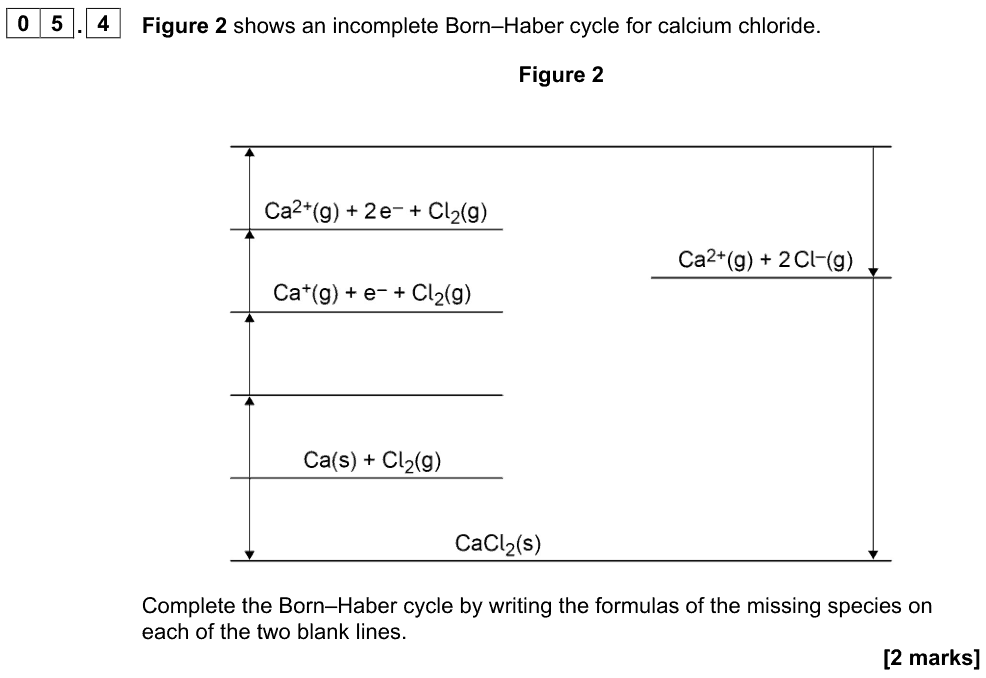
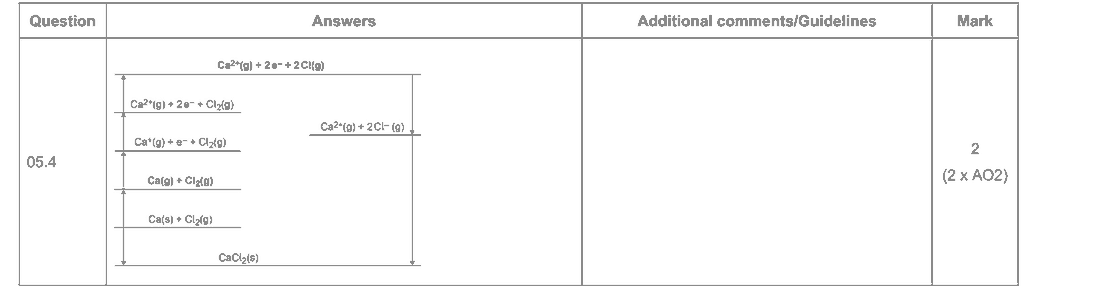
Figure 2 shows an incomplete Born–Haber cycle for calcium chloride.
Figure 2
Complete the Born–Haber cycle by writing the formulas of the missing species on
each of the two blank lines.
[2 marks]
June 2023 · Paper 1 · Q05.5 2 marks AO2=2 Calculation thermodynamics
Earlier parts of question 05 that this part usesEarlier part of June 2023 Paper 1 question 05Earlier part of June 2023 Paper 1 question 05
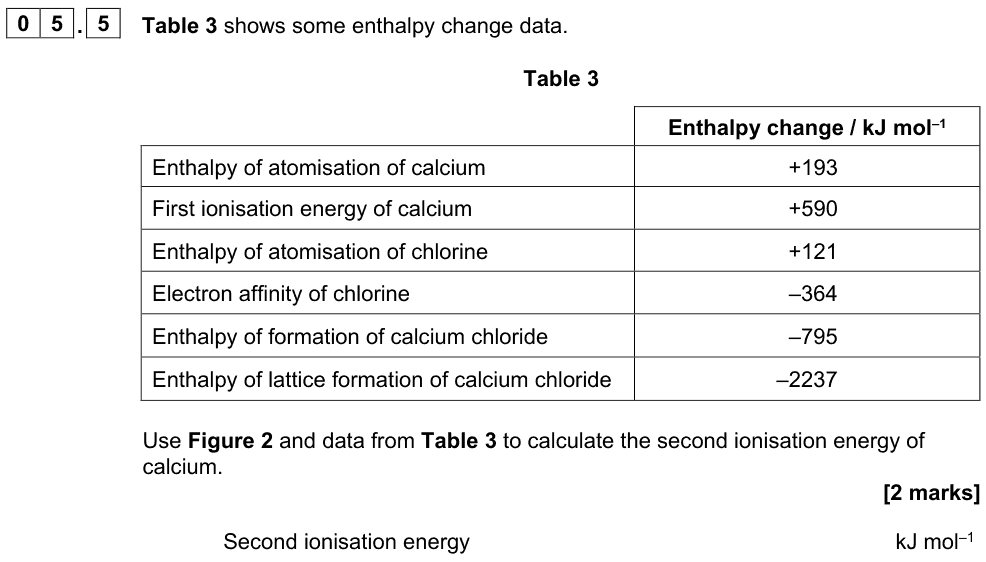
Table 3 shows some enthalpy change data.
Table 3
Enthalpy change / kJ mol–1
Enthalpy of atomisation of calcium
+193
First ionisation energy of calcium
+590
Enthalpy of atomisation of chlorine
+121
Electron affinity of chlorine
–364
Enthalpy of formation of calcium chloride
–795
Enthalpy of lattice formation of calcium chloride
–2237
Use Figure 2 and data from Table 3 to calculate the second ionisation energy of
calcium.
[2 marks]
Second ionisation energy
kJ mol–1
June 2023 · Paper 1 · Q05.6 1 mark AO3=1 Short answer atomic structure
Earlier part of question 05 that this part usesEarlier part of June 2023 Paper 1 question 05
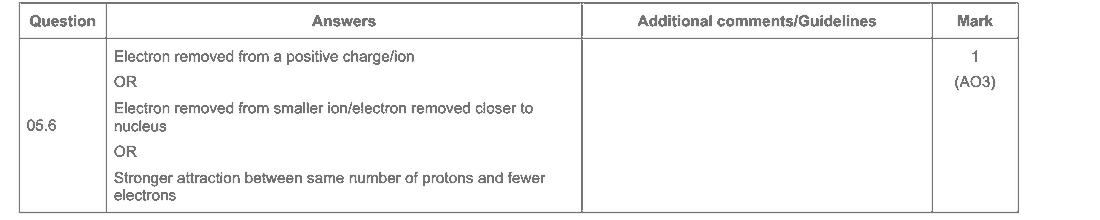
Explain why the second ionisation energy of calcium is greater than the
first ionisation energy of calcium.
[1 mark]
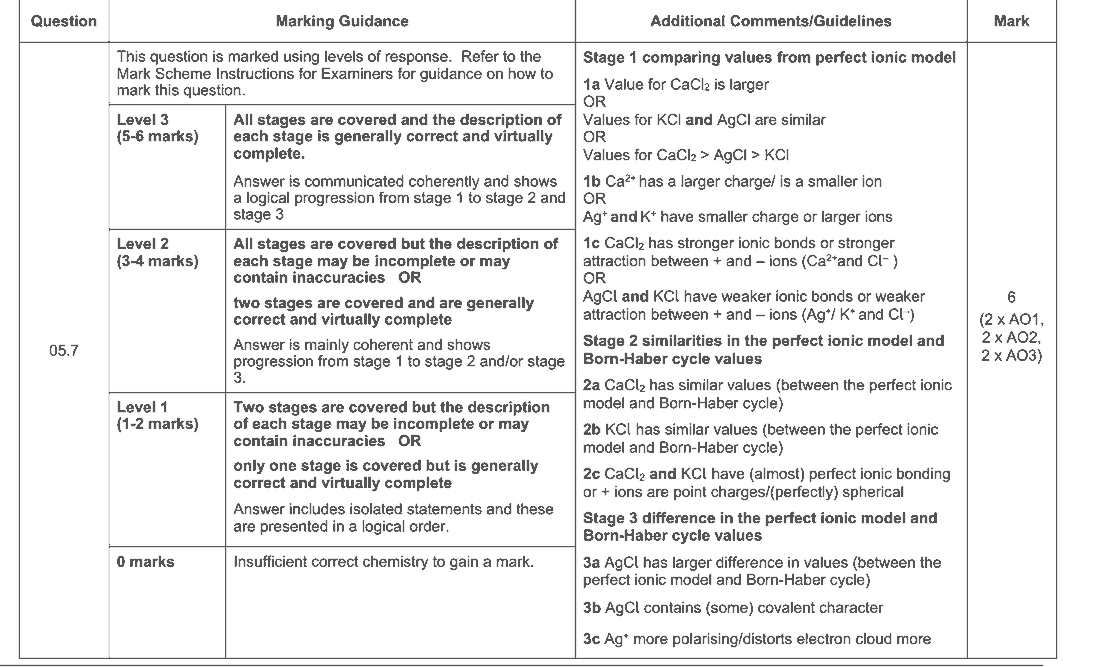
June 2023 · Paper 1 · Q05.7 6 marks AO1=2, AO2=2, AO3=2 6-mark level of response Hard thermodynamicsbonding
Earlier part of question 05 that this part usesEarlier part of June 2023 Paper 1 question 05
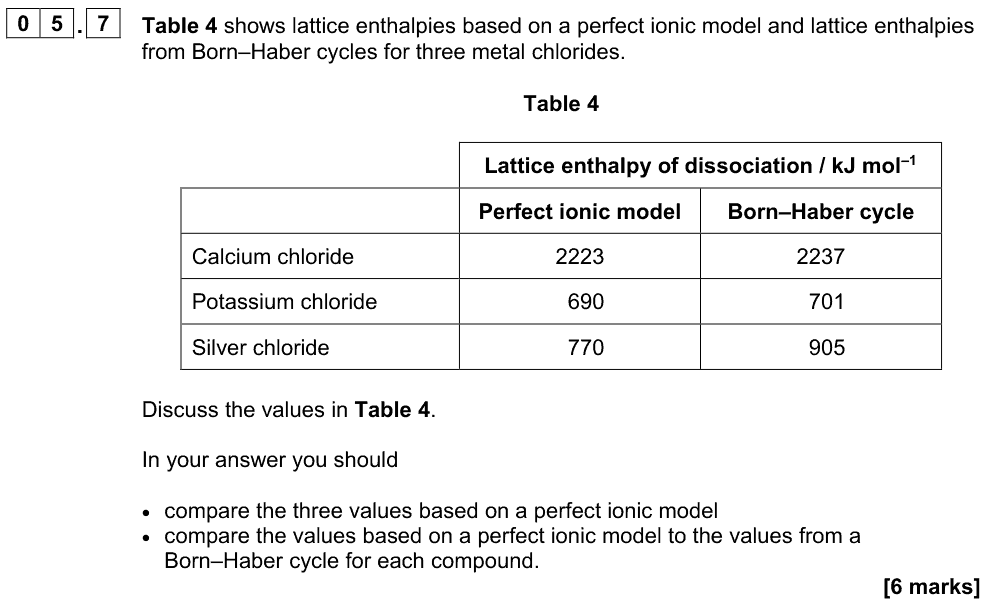
Table 4 shows lattice enthalpies based on a perfect ionic model and lattice enthalpies
from Born–Haber cycles for three metal chlorides.
Table 4
Lattice enthalpy of dissociation / kJ mol–1
Perfect ionic model
Born–Haber cycle
Calcium chloride
2223
2237
Potassium chloride
690
701
Silver chloride
770
905
Discuss the values in Table 4.
In your answer you should
• compare the three values based on a perfect ionic model
• compare the values based on a perfect ionic model to the values from a
Born–Haber cycle for each compound.
[6 marks]
June 2023 · Paper 1 · Q06.1 1 mark AO2=1 Calculation amount of substance
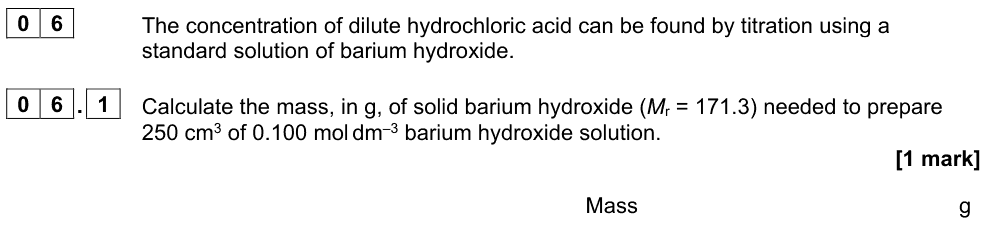
The concentration of dilute hydrochloric acid can be found by titration using a
standard solution of barium hydroxide.
Calculate the mass, in g, of solid barium hydroxide (Mr = 171.3) needed to prepare
250 cm3 of 0.100 mol dm–3 barium hydroxide solution.
[1 mark]
Mass
g
June 2023 · Paper 1 · Q06.2 3 marks AO2=3 Practical and data analysis amount of substance
Earlier part of question 06 that this part usesEarlier part of June 2023 Paper 1 question 06
The mass of barium hydroxide from Question 06.1 is dissolved in a beaker containing
150 cm3 of distilled water.
Describe how this solution is used to make 250 cm3 of the
0.100 mol dm–3 barium hydroxide solution.
[3 marks]
June 2023 · Paper 1 · Q06.3 1 mark AO3=1 Practical and data analysis amount of substance
Earlier part of question 06 that this part usesEarlier part of June 2023 Paper 1 question 06
Before the first titration, the 25 cm3 pipette is rinsed with a small volume of the
0.100 mol dm–3 barium hydroxide solution.
State why it is good practice to rinse the pipette in this way.
[1 mark]
June 2023 · Paper 1 · Q06.4 1 mark AO1=1 Practical and data analysis amount of substance
Earlier part of question 06 that this part usesEarlier part of June 2023 Paper 1 question 06
Hydrochloric acid is added to the burette using a funnel.
State why it is good practice to remove the funnel from the burette before the titration.
[1 mark]
June 2023 · Paper 1 · Q06.5 3 marks AO2=3 Calculation Hard amount of substance
Earlier part of question 06 that this part usesEarlier part of June 2023 Paper 1 question 06
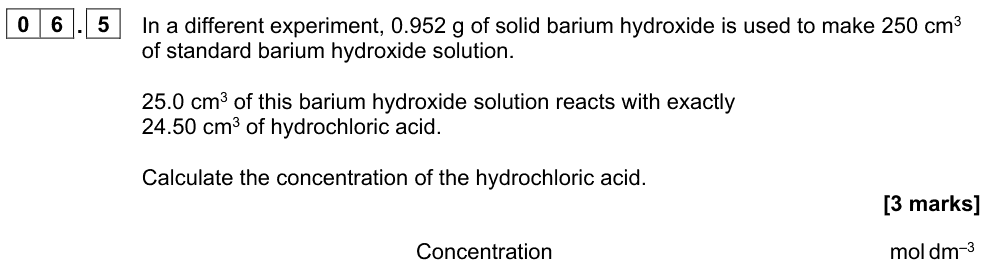
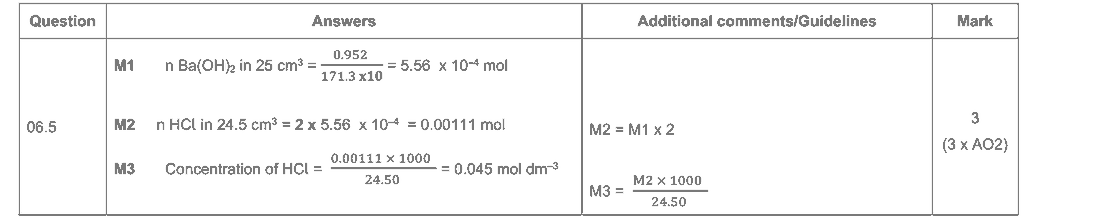
In a different experiment, 0.952 g of solid barium hydroxide is used to make 250 cm3
of standard barium hydroxide solution.
25.0 cm3 of this barium hydroxide solution reacts with exactly
24.50 cm3 of hydrochloric acid.
Calculate the concentration of the hydrochloric acid.
[3 marks]
Concentration
mol dm–3
June 2023 · Paper 1 · Q06.6 1 mark AO2=1 Practical and data analysis amount of substance
Earlier part of question 06 that this part usesEarlier part of June 2023 Paper 1 question 06
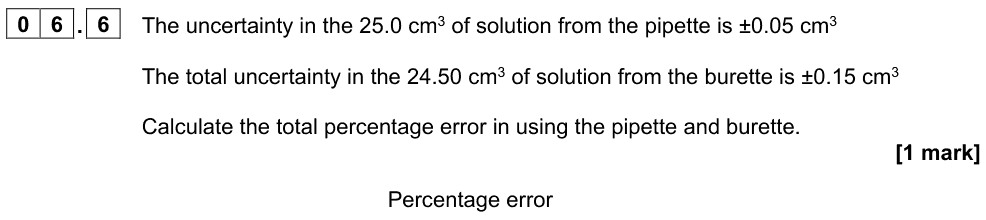
The uncertainty in the 25.0 cm3 of solution from the pipette is ±0.05 cm3
The total uncertainty in the 24.50 cm3 of solution from the burette is ±0.15 cm3
Calculate the total percentage error in using the pipette and burette.
[1 mark]
Percentage error
June 2023 · Paper 1 · Q07.1 1 mark AO1=1 Short answer atomic structure
This question is about complexes containing the aluminium ion.
Give the electron configuration of the Al3+ ion.
[1 mark]
June 2023 · Paper 1 · Q07.2 1 mark AO1=1 Equation writing reactions of ions in aqueous solutionamount of substance
Earlier part of question 07 that this part usesEarlier part of June 2023 Paper 1 question 07
When anhydrous aluminium sulfate, Al2(SO4)3, is added to water a solution forms that
contains the complex aluminium ion, [Al(H2O)6]3+
Give the equation for the reaction.
[1 mark]
June 2023 · Paper 1 · Q07.3 2 marks AO1=2 Explanation reactions of ions in aqueous solution
Earlier part of question 07 that this part usesEarlier part of June 2023 Paper 1 question 07
Explain why the solution containing [Al(H2O)6]3+ is acidic.
[2 marks]
June 2023 · Paper 1 · Q07.4 1 mark AO3=1 Short answer transition metals
Earlier part of question 07 that this part usesEarlier part of June 2023 Paper 1 question 07
State why the concentration of aluminium sulfate solution can not be determined by
colorimetry.
[1 mark]
June 2023 · Paper 1 · Q07.5 2 marks AO1=1, AO2=1 Equation writing reactions of ions in aqueous solution
Earlier part of question 07 that this part usesEarlier part of June 2023 Paper 1 question 07
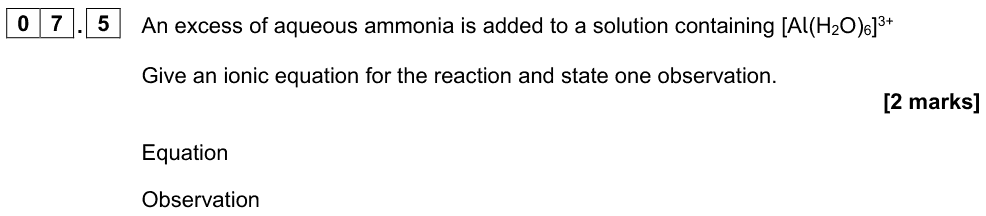
An excess of aqueous ammonia is added to a solution containing [Al(H2O)6]3+
Give an ionic equation for the reaction and state one observation.
[2 marks]
Equation
Observation
June 2023 · Paper 1 · Q07.6 1 mark AO3=1 Short answer reactions of ions in aqueous solution
Earlier part of question 07 that this part usesEarlier part of June 2023 Paper 1 question 07
An excess of dilute sulfuric acid is added to the products of the reaction in
Question 07.5
Identify the aluminium species produced.
[1 mark]
June 2023 · Paper 1 · Q07.7 2 marks AO1=2 Short answer transition metals
Earlier part of question 07 that this part usesEarlier part of June 2023 Paper 1 question 07
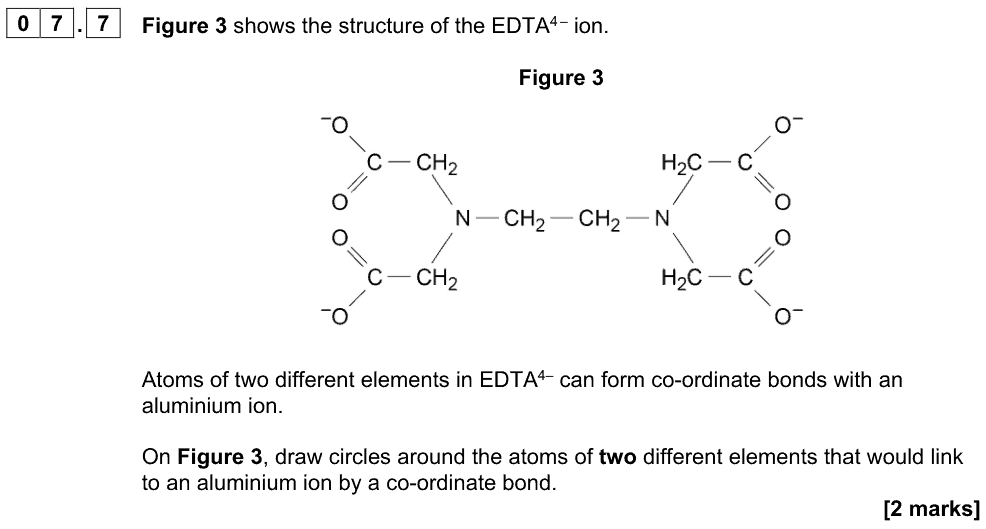
Figure 3 shows the structure of the EDTA4 – ion.
Figure 3
Atoms of two different elements in EDTA4– can form co-ordinate bonds with an
aluminium ion.
On Figure 3, draw circles around the atoms of two different elements that would link
to an aluminium ion by a co-ordinate bond.
[2 marks]
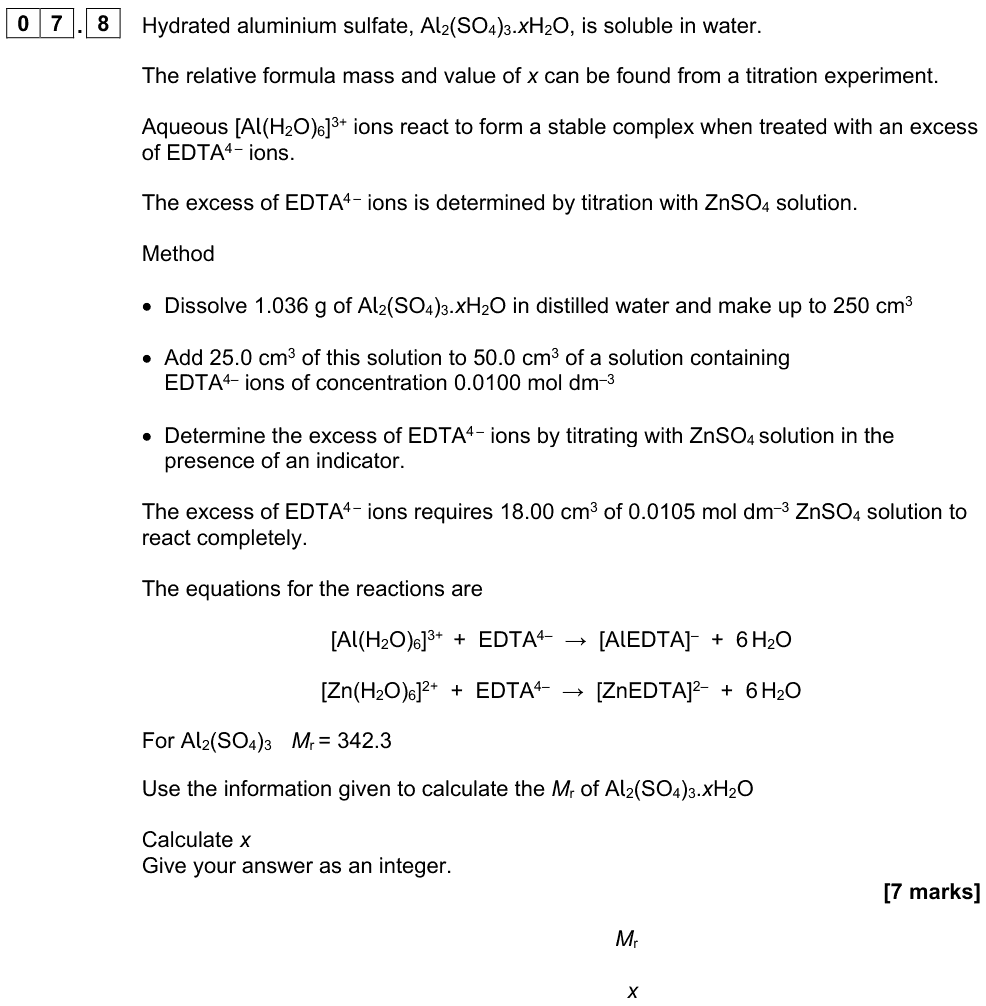
June 2023 · Paper 1 · Q07.8 7 marks AO2=7 Calculation amount of substance
Earlier part of question 07 that this part usesEarlier part of June 2023 Paper 1 question 07
Hydrated aluminium sulfate, Al2(SO4)3.xH2O, is soluble in water.
The relative formula mass and value of x can be found from a titration experiment.
Aqueous [Al(H2O)6]3+ ions react to form a stable complex when treated with an excess
of EDTA4 – ions.
The excess of EDTA4 – ions is determined by titration with ZnSO4 solution.
Method
• Dissolve 1.036 g of Al2(SO4)3.xH2O in distilled water and make up to 250 cm3
• Add 25.0 cm3 of this solution to 50.0 cm3 of a solution containing
EDTA4– ions of concentration 0.0100 mol dm–3
• Determine the excess of EDTA4 – ions by titrating with ZnSO4 solution in the
presence of an indicator.
The excess of EDTA4 – ions requires 18.00 cm3 of 0.0105 mol dm–3 ZnSO4 solution to
react completely.
The equations for the reactions are
[Al(H2O)6]3+  +  EDTA4–  →  [AlEDTA]–  +  6 H2O
[Zn(H2O)6]2+  +  EDTA4–  →  [ZnEDTA]2–  +  6 H2O
For Al2(SO4)3     Mr = 342.3
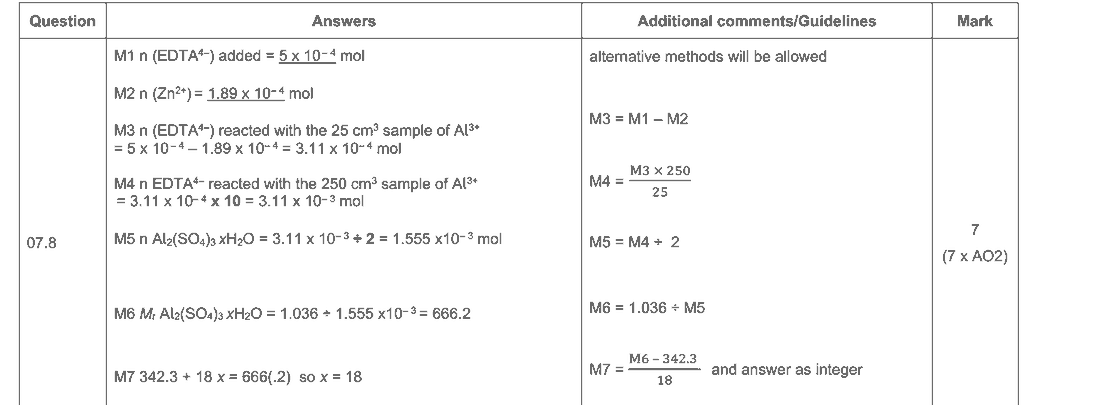
Use the information given to calculate the Mr of Al2(SO4)3.xH2O
Calculate x
Give your answer as an integer.
[7 marks]
Mr
x
June 2023 · Paper 1 · Q08.1 1 mark AO1=1 Equation writing electrode potentials and cellsredox
This question is about fuel cells.
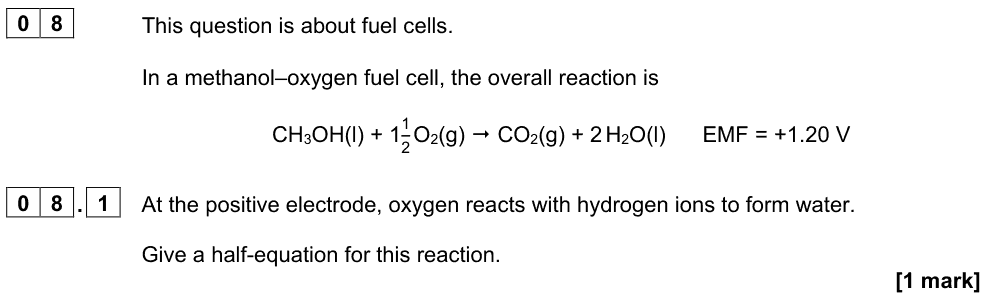
In a methanol–oxygen fuel cell, the overall reaction is
CH3OH(l) + 1
1
2
O2(g)  CO2(g) + 2 H2O(l)      EMF = +1.20 V
At the positive electrode, oxygen reacts with hydrogen ions to form water.
Give a half-equation for this reaction.
[1 mark]
June 2023 · Paper 1 · Q08.2 1 mark AO2=1 Equation writing electrode potentials and cellsredox
Earlier part of question 08 that this part usesEarlier part of June 2023 Paper 1 question 08
At the negative electrode, methanol reacts with water to produce
carbon dioxide and hydrogen ions.
Give a half-equation for this reaction.
[1 mark]
June 2023 · Paper 1 · Q08.3 1 mark AO2=1 Calculation electrode potentials and cells
Earlier part of question 08 that this part usesEarlier part of June 2023 Paper 1 question 08
The standard electrode potential for the CO2 / CH3OH electrode is +0.03 V
Calculate the standard electrode potential for the O2 / H2O electrode.
[1 mark]
June 2023 · Paper 1 · Q08.4 1 mark AO1=1 Short answer electrode potentials and cells
Earlier part of question 08 that this part usesEarlier part of June 2023 Paper 1 question 08
State why a fuel cell does not need to be electrically recharged.
[1 mark]
June 2023 · Paper 1 · Q08.5 1 mark AO2=1 Short answer electrode potentials and cells
Earlier part of question 08 that this part usesEarlier part of June 2023 Paper 1 question 08
Suggest one advantage of using methanol, rather than hydrogen, in a fuel cell for use
in cars.
[1 mark]
June 2023 · Paper 1 · Q09.1 1 mark AO1=1 Equation writing atomic structure
This is a question about time of flight (TOF) mass spectrometry.
Give the equation, including state symbols, for the formation of Sr + ions from
Sr atoms by electron impact.
[1 mark]
June 2023 · Paper 1 · Q09.2 5 marks AO1=1, AO2=4 Calculation atomic structureamount of substance
Earlier part of question 09 that this part usesEarlier part of June 2023 Paper 1 question 09
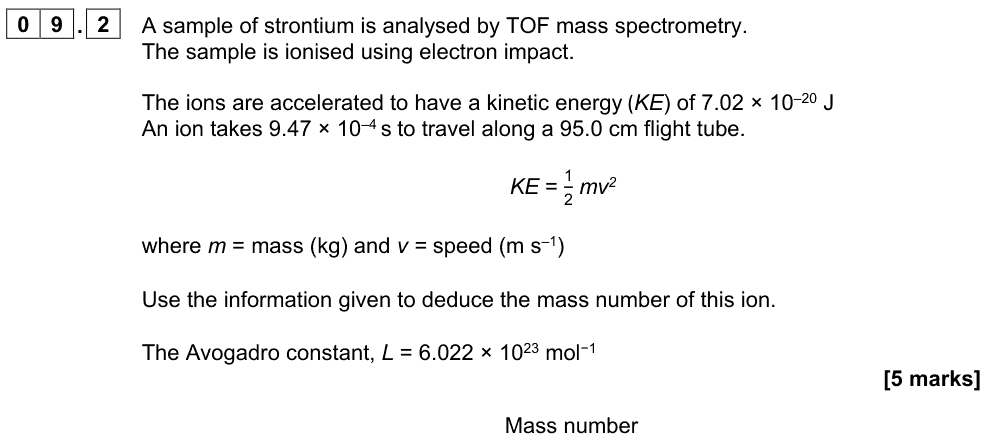
A sample of strontium is analysed by TOF mass spectrometry.
The sample is ionised using electron impact.
The ions are accelerated to have a kinetic energy (KE) of 7.02 × 10⁻²⁰ J
An ion takes 9.47 × 10⁻⁴ s to travel along a 95.0 cm flight tube.
KE =
1
2 mv2
where m = mass (kg) and v = speed (m s–1)
Use the information given to deduce the mass number of this ion.
The Avogadro constant, L = 6.022 × 10²³ mol−1
[5 marks]
Mass number
June 2023 · Paper 1 · Q09.3 2 marks AO1=2 Short answer atomic structure
Earlier part of question 09 that this part usesEarlier part of June 2023 Paper 1 question 09
Explain how the ions are detected in the TOF mass spectrometer.
State how the relative abundance of the ions is determined.
[2 marks]
How ions are detected
How relative abundance is determined
June 2023 · Paper 1 · Q09.4 3 marks AO2=2, AO3=1 Calculation atomic structure
Earlier part of question 09 that this part usesEarlier part of June 2023 Paper 1 question 09
A sample of strontium contains three isotopes, 86Sr, 87Sr and 88Sr
82% of the sample is 88Sr
The other isotopes are in a 1:2 ratio of 86Sr : 87Sr
Calculate the percentage abundance of 87Sr in this sample.
Use your answer to deduce the relative atomic mass (Ar) of the sample.
Give your answer to 1 decimal place.
[3 marks]
Abundance of 87Sr
%
Ar
June 2023 · Paper 1 · Q09.5 1 mark AO3=1 Short answer atomic structure
Earlier part of question 09 that this part usesEarlier part of June 2023 Paper 1 question 09
Electrospray ionisation is used instead of electron impact for the ionisation of a protein
in a mass spectrometry experiment.
Suggest why.
[1 mark]
June 2023 · Paper 1 · Q10.1 1 mark AO3=1 Short answer acids and bases
This question is about weak acids.
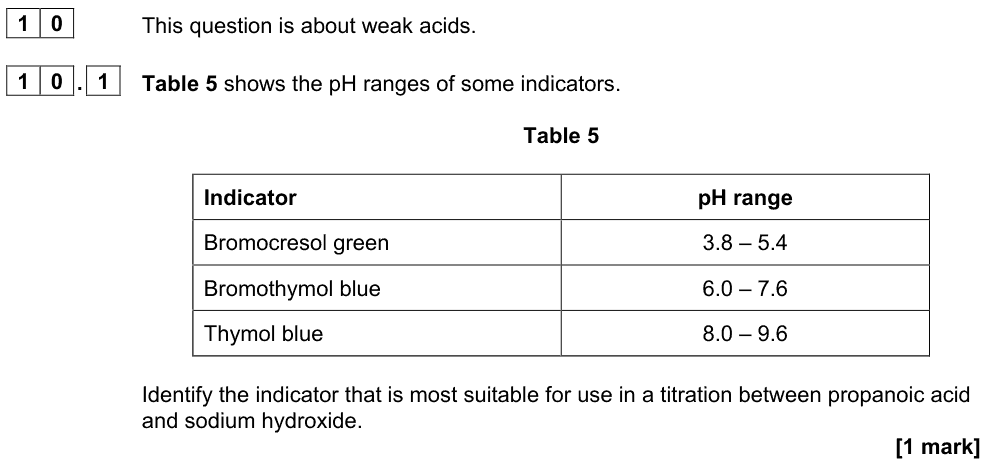
Table 5 shows the pH ranges of some indicators.
Table 5
Indicator
pH range
Bromocresol green
3.8 – 5.4
Bromothymol blue
6.0 – 7.6
Thymol blue
8.0 – 9.6
Identify the indicator that is most suitable for use in a titration between propanoic acid
and sodium hydroxide.
[1 mark]
June 2023 · Paper 1 · Q10.2 1 mark AO1=1 Short answer acids and bases
Earlier part of question 10 that this part usesEarlier part of June 2023 Paper 1 question 10
Give the expression for the acid dissociation constant (Ka) for propanoic acid
(CH3CH2COOH).
[1 mark]
Ka
June 2023 · Paper 1 · Q10.3 4 marks AO2=4 Calculation Easy acids and bases
Earlier part of question 10 that this part usesEarlier part of June 2023 Paper 1 question 10
Calculate the pH of a 0.100 mol dm–3 propanoic acid solution.
Give your answer to 2 decimal places.
For propanoic acid, pKa = 4.87
[4 marks]
pH
June 2023 · Paper 1 · Q10.4 5 marks AO2=5 Calculation Hard acids and bases
Earlier part of question 10 that this part usesEarlier part of June 2023 Paper 1 question 10
For butanoic acid, Ka = 1.51 × 10⁻⁵ mol dm–3
20.0 cm3 of 0.100 mol  dm–3 sodium hydroxide solution are added to
25.0 cm3 of 0.100 mol  dm–3 butanoic acid solution.
Calculate the pH of the solution formed.
[5 marks]
pH
June 2023 · Paper 1 · Q10.5 2 marks AO3=2 Explanation acids and bases
Earlier part of question 10 that this part usesEarlier part of June 2023 Paper 1 question 10
A student plans to titrate butanoic acid solution with a solution of ethylamine.
Explain why this titration could not be done using an indicator.
[2 marks]

Work with an A-level chemistry tutor

Want a paper marked and gone through with you? Message us.

Prefer email? Send an enquiry

If you are under 18, please include a parent's contact details. Enquiries go to enquiries@chemistryaleveltutor.com and are deleted once handled. All tutoring is online.