June 2022: Paper 2, Organic and physical chemistry

105 marks · 46 question parts · Paper, mark scheme and report on AQA's site · Have the Data Booklet beside you

Question by question

QTopicMarksAOType
01.1 Introduction to organic chemistry: nomenclature, mechanisms and isomerism 2AO1=2Diagram or structure
01.2 Rate equations 3AO1=3Calculation
01.3 Rate equations 1AO1=1Calculation
01.4 Rate equations 1AO3=1Practical and data analysis
01.5 Rate equations, Kinetics 3AO1=2,AO2=1Explanation
01.6 Kinetics 1AO2=1Calculation
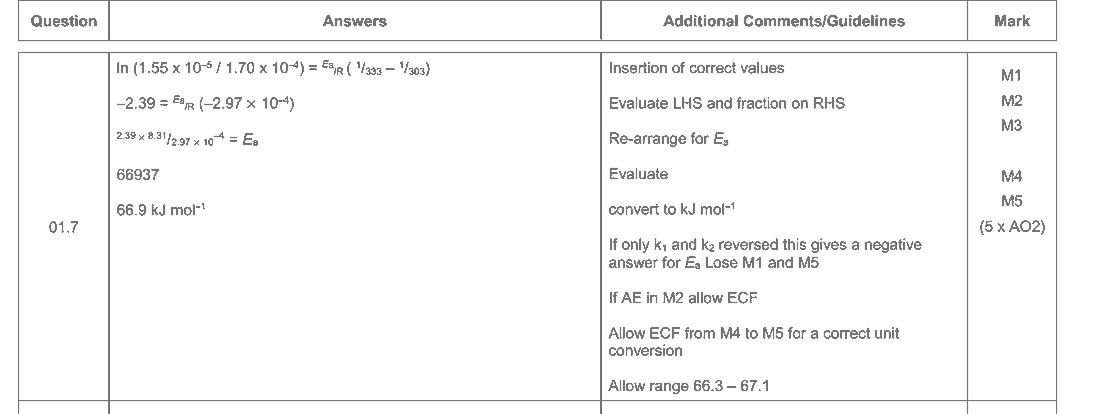
01.7 Rate equations 5AO2=5Calculation
01.8 Aldehydes and ketones 5AO1=1,AO2=4Mechanism
02.1 Chemical equilibria, Le Chatelier's principle and Kc 2AO2=2Calculation
02.2 Chemical equilibria, Le Chatelier's principle and Kc 1AO2=1Short answer
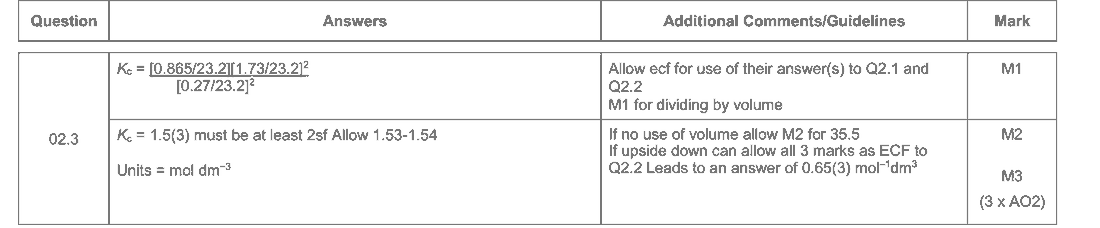
02.3 Chemical equilibria, Le Chatelier's principle and Kc 3AO2=3Calculation
02.4 Chemical equilibria, Le Chatelier's principle and Kc 3AO2=3Explanation
02.5 Halogenoalkanes 2AO1=2Short answer
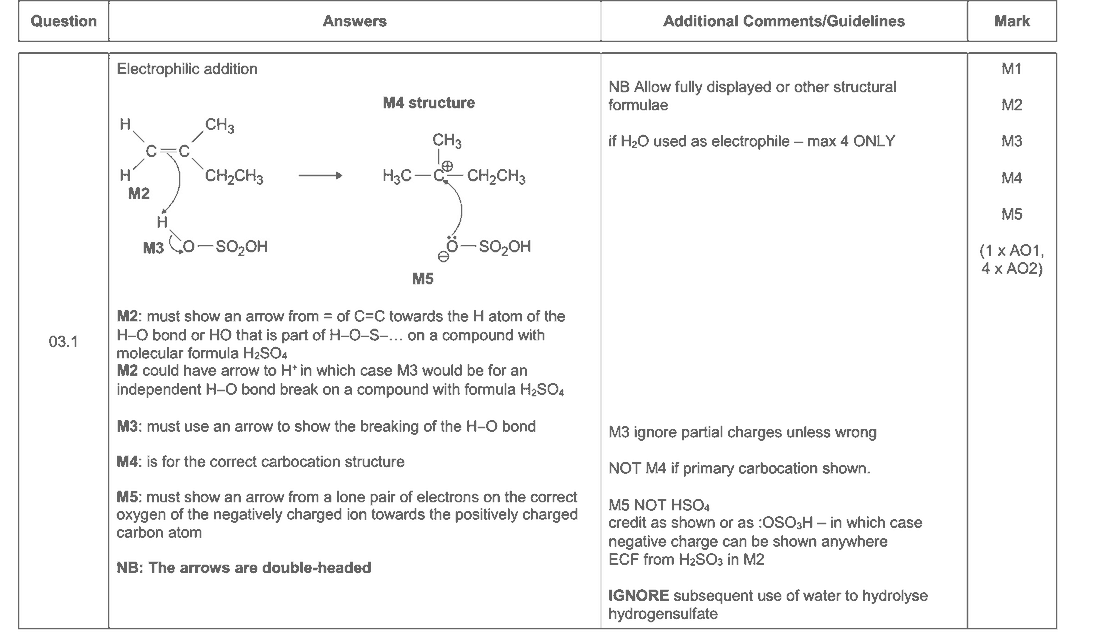
03.1 Alkenes 5AO1=1,AO2=4Mechanism
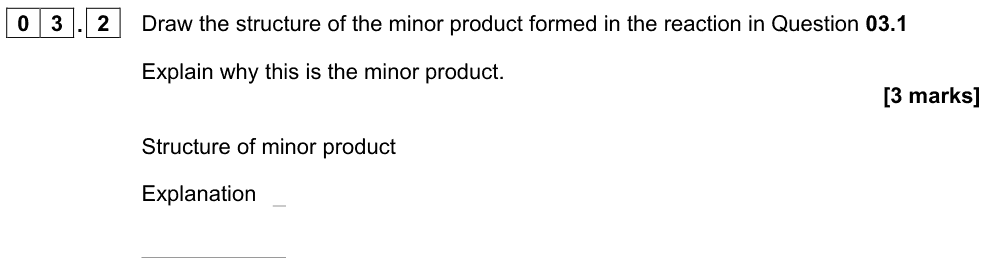
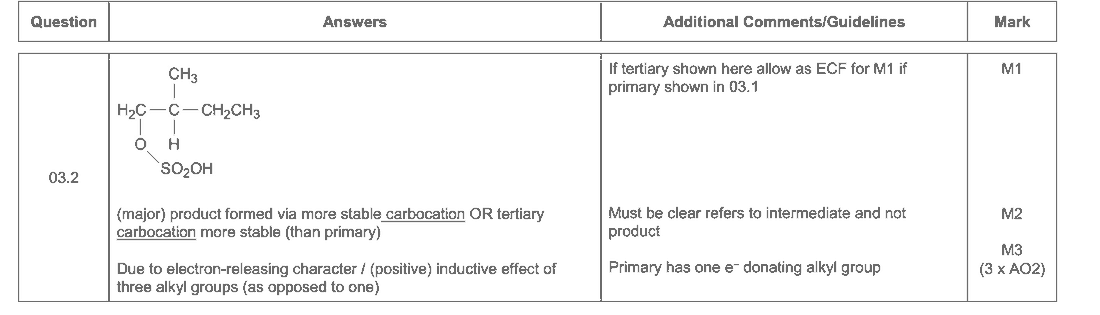
03.2 Alkenes 3AO2=3Explanation
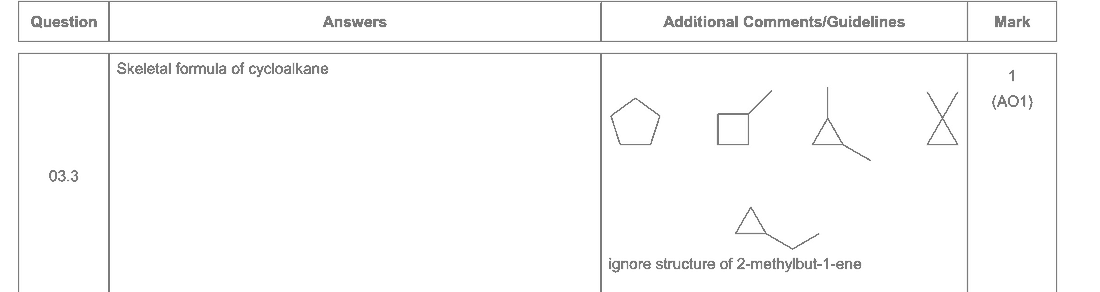
03.3 Introduction to organic chemistry: nomenclature, mechanisms and isomerism 1AO1=1Diagram or structure
03.4 Alkenes 2AO1=1,AO2=1Diagram or structure
04.1 Amino acids, proteins and DNA 1AO1=1Short answer
04.2 Amino acids, proteins and DNA 2AO2=2Diagram or structure
04.3 Amino acids, proteins and DNA 1AO1=1Short answer
04.4 Amino acids, proteins and DNA 4AO1=2,AO3=2Explanation
04.5 Amino acids, proteins and DNA 1AO3=1Short answer
05.1 Carboxylic acids and derivatives 2AO3=2Practical and data analysis
05.2 Carboxylic acids and derivatives 1AO2=1Practical and data analysis
05.3 Carboxylic acids and derivatives 1AO2=1Practical and data analysis
05.4 Carboxylic acids and derivatives 2AO2=2Diagram or structure
05.5 Alkenes, Alcohols 2AO2=2Short answer
05.6 Amount of substance 4AO2=4Calculation
06 Nuclear magnetic resonance spectroscopy, Organic analysis: test-tube reactions, mass spectrometry and infrared 6AO1=3,AO3=3Level of response
07.1 Carboxylic acids and derivatives, Introduction to organic chemistry: nomenclature, mechanisms and isomerism 3AO3=3Mechanism
07.2 Carboxylic acids and derivatives 1AO1=1Short answer
07.3 Carboxylic acids and derivatives 1AO1=1Short answer
07.4 Carboxylic acids and derivatives 1AO1=1Short answer
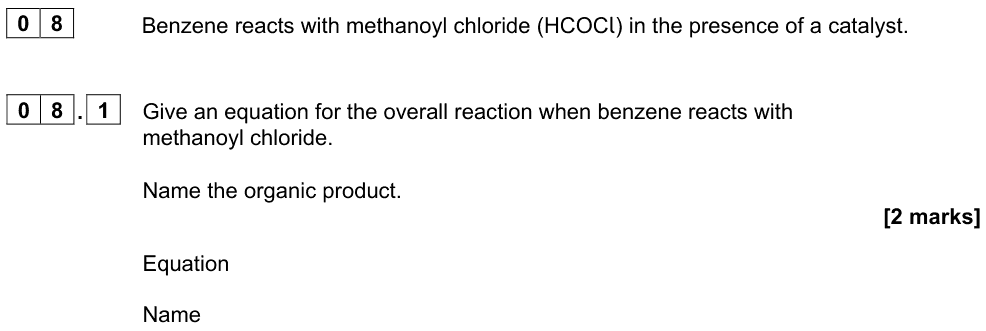
08.1 Aromatic chemistry, Introduction to organic chemistry: nomenclature, mechanisms and isomerism 2AO2=2Equation writing
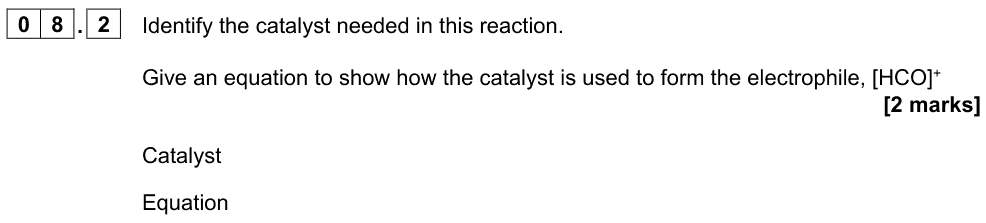
08.2 Aromatic chemistry 2AO1=1,AO2=1Equation writing
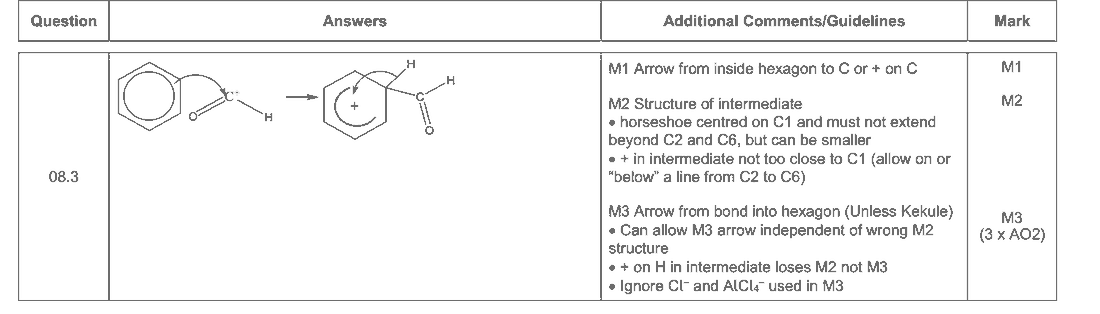
08.3 Aromatic chemistry 3AO2=3Mechanism
09.1 Amount of substance 2AO3=2Practical and data analysis
09.2 Amount of substance, Alkenes 5AO2=3,AO3=2Calculation
09.3 Amount of substance 2AO3=2Practical and data analysis
09.4 Amount of substance 1AO3=1Practical and data analysis
09.5 Amount of substance, Atomic structure 2AO2=2Calculation
10.1 Aromatic chemistry, Amines 3AO1=3Short answer
10.2 Amines 1AO1=1Short answer
10.3 Alkanes 2AO1=2Short answer
10.4 Amines 2AO3=2Explanation
10.5 Amines 2AO2=2Explanation

The questions

01.101.201.301.401.501.601.701.802.102.202.302.402.503.103.203.303.404.104.204.304.404.505.105.205.305.405.505.60607.107.207.307.408.108.208.309.109.209.309.409.510.110.210.310.410.5
June 2022 · Paper 2 · Q01.1 2 marks AO1=2 Diagram or structure introduction to organic chemistry
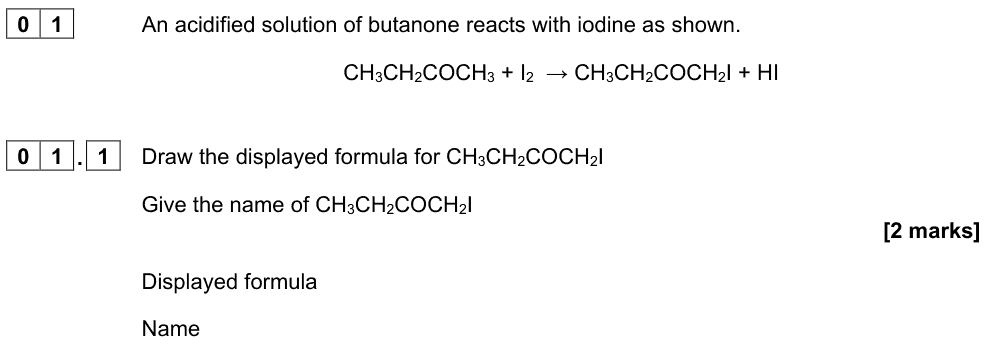
An acidified solution of butanone reacts with iodine as shown.
CH3CH2COCH3 + I2  → CH3CH2COCH2I + HI
Draw the displayed formula for CH3CH2COCH2I
Give the name of CH3CH2COCH2I
[2 marks]
Displayed formula
Name
June 2022 · Paper 2 · Q01.2 3 marks AO1=3 Calculation rate equations
Earlier part of question 01 that this part usesEarlier part of June 2022 Paper 2 question 01
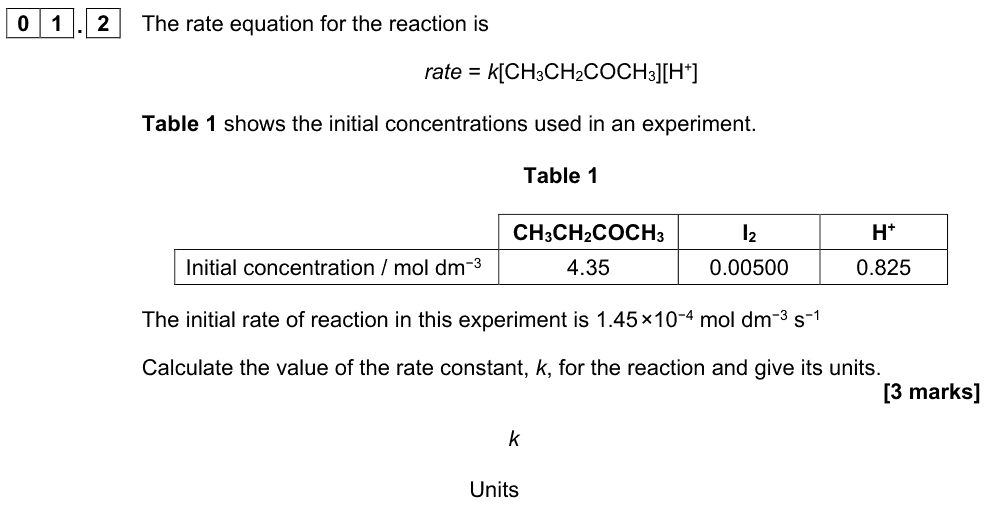
The rate equation for the reaction is
rate = k[CH3CH2COCH3][H+]
Table 1 shows the initial concentrations used in an experiment.
Table 1
CH3CH2COCH3
I2
H+
Initial concentration / mol dm−3
4.35
0.00500
0.825
The initial rate of reaction in this experiment is 1.45 ×10⁻⁴ mol dm−3 s−1
Calculate the value of the rate constant, k, for the reaction and give its units.
[3 marks]
k
Units
June 2022 · Paper 2 · Q01.3 1 mark AO1=1 Calculation rate equations
Earlier part of question 01 that this part usesEarlier part of June 2022 Paper 2 question 01
Calculate the initial rate of reaction when all of the initial concentrations are halved.
[1 mark]
Initial rate of reaction
mol dm−3 s−1
June 2022 · Paper 2 · Q01.4 1 mark AO3=1 Practical and data analysis rate equations
Earlier part of question 01 that this part usesEarlier part of June 2022 Paper 2 question 01
An experiment was done to measure the time, t, taken for a solution of iodine to react
completely when added to an excess of an acidified solution of butanone.
Suggest an observation used to judge when all the iodine had reacted.
[1 mark]
June 2022 · Paper 2 · Q01.5 3 marks AO1=2, AO2=1 Explanation rate equationskinetics
Earlier part of question 01 that this part usesEarlier part of June 2022 Paper 2 question 01
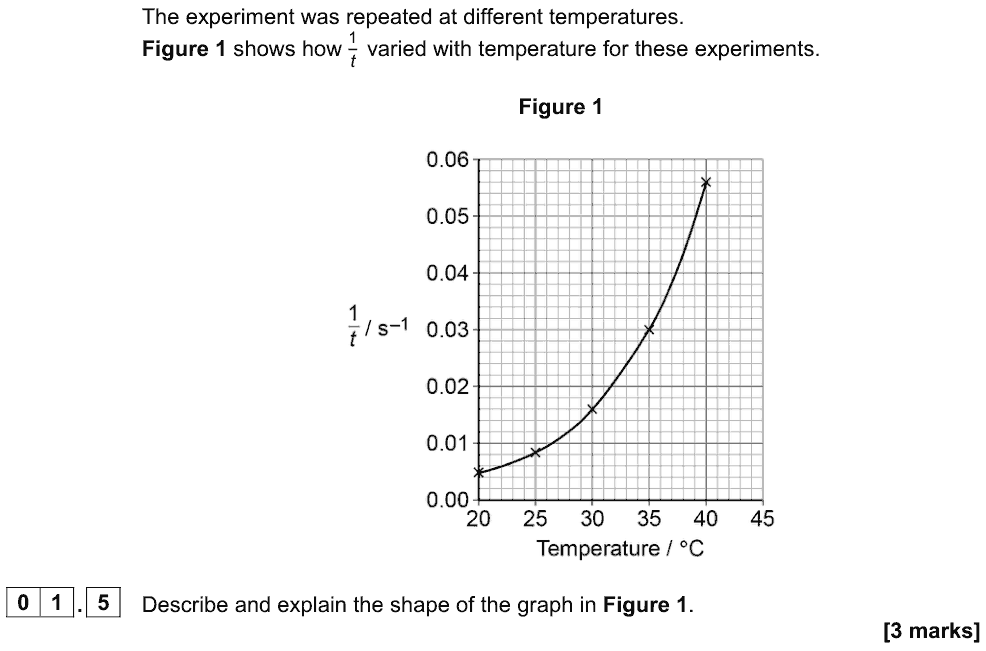
The experiment was repeated at different temperatures.
Figure 1 shows how
1
t  varied with temperature for these experiments.
Figure 1
Describe and explain the shape of the graph in Figure 1.
[3 marks]
June 2022 · Paper 2 · Q01.6 1 mark AO2=1 Calculation kinetics
Earlier parts of question 01 that this part usesEarlier part of June 2022 Paper 2 question 01Earlier part of June 2022 Paper 2 question 01
Deduce the time taken for the reaction at 35 oC
[1 mark]
Time
s
June 2022 · Paper 2 · Q01.7 5 marks AO2=5 Calculation rate equations
Earlier parts of question 01 that this part usesEarlier part of June 2022 Paper 2 question 01Earlier part of June 2022 Paper 2 question 01
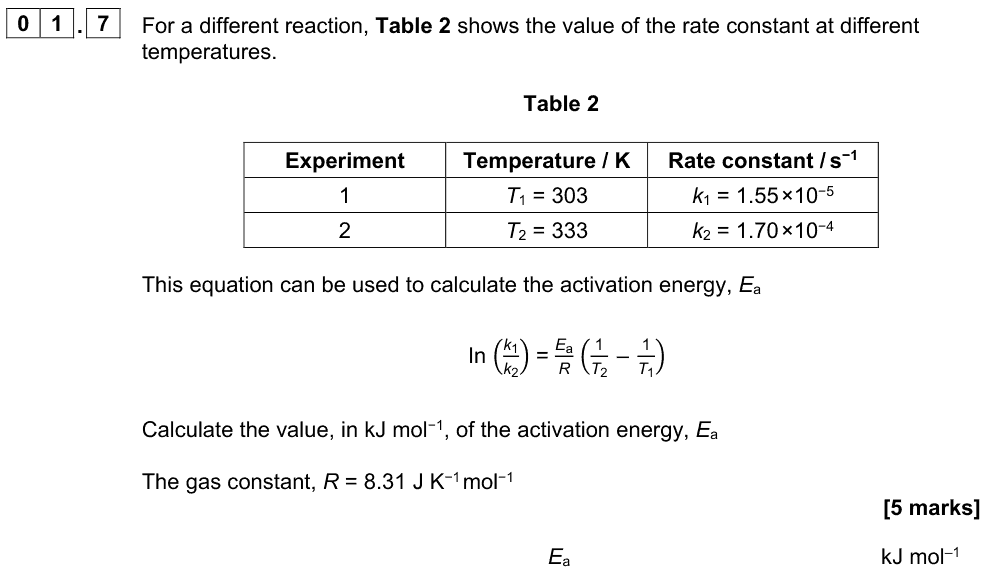
For a different reaction, Table 2 shows the value of the rate constant at different
temperatures.
Table 2
Experiment
Temperature / K
Rate constant / s−1
1
T1 = 303
k1 = 1.55 ×10⁻⁵
2
T2 = 333
k2 = 1.70 ×10⁻⁴
This equation can be used to calculate the activation energy, Ea
In ቀ
k1
k2ቁ =
Ea
R ቀ
1
T2 –
1
T1ቁ
Calculate the value, in kJ mol−1, of the activation energy, Ea
The gas constant, R = 8.31 J K−1
mol−1
[5 marks]
Ea
kJ mol–1
June 2022 · Paper 2 · Q01.8 5 marks AO1=1, AO2=4 Mechanism aldehydes and ketones
Earlier parts of question 01 that this part usesEarlier part of June 2022 Paper 2 question 01Earlier part of June 2022 Paper 2 question 01
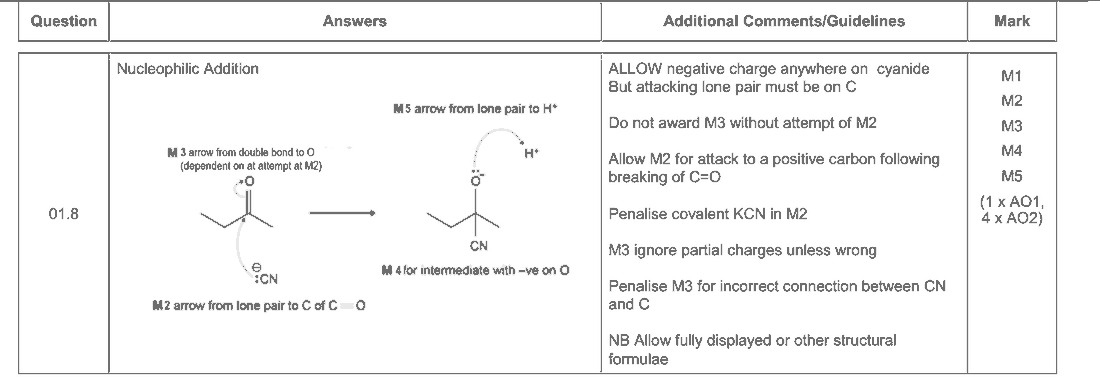
Name and outline the mechanism for the reaction of butanone with KCN followed by
dilute acid.
[5 marks]
Name of mechanism
Outline of mechanism
June 2022 · Paper 2 · Q02.1 2 marks AO2=2 Calculation chemical equilibria and kc
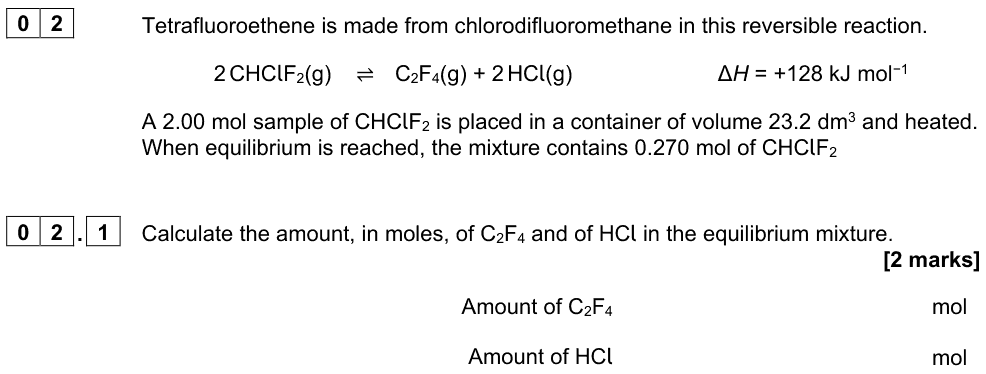
Tetrafluoroethene is made from chlorodifluoromethane in this reversible reaction.
2 CHClF2(g)    ⇌    C2F4(g) + 2 HCl(g)
ΔH = +128 kJ mol−1
A 2.00 mol sample of CHClF2 is placed in a container of volume 23.2 dm3 and heated.
When equilibrium is reached, the mixture contains 0.270 mol of CHClF2
Calculate the amount, in moles, of C2F4 and of HCl in the equilibrium mixture.
[2 marks]
Amount of C2F4
mol
Amount of HCl
mol
June 2022 · Paper 2 · Q02.2 1 mark AO2=1 Short answer chemical equilibria and kc
Earlier part of question 02 that this part usesEarlier part of June 2022 Paper 2 question 02
Give an expression for Kc for this equilibrium.
[1 mark]
Kc
June 2022 · Paper 2 · Q02.3 3 marks AO2=3 Calculation chemical equilibria and kc
Earlier part of question 02 that this part usesEarlier part of June 2022 Paper 2 question 02
Calculate a value for Kc
Give its units.
[3 marks]
Kc
Units
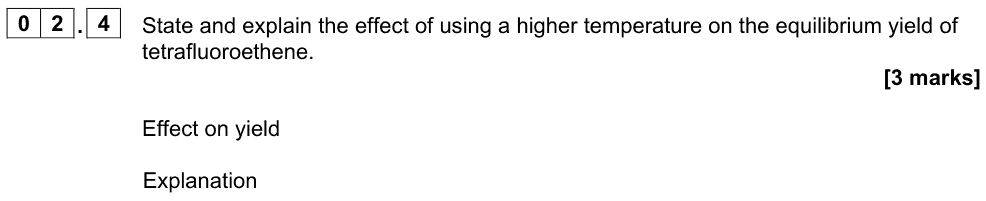
June 2022 · Paper 2 · Q02.4 3 marks AO2=3 Explanation chemical equilibria and kc
Earlier part of question 02 that this part usesEarlier part of June 2022 Paper 2 question 02
State and explain the effect of using a higher temperature on the equilibrium yield of
tetrafluoroethene.
[3 marks]
Effect on yield
Explanation
June 2022 · Paper 2 · Q02.5 2 marks AO1=2 Short answer halogenoalkanes
Earlier part of question 02 that this part usesEarlier part of June 2022 Paper 2 question 02
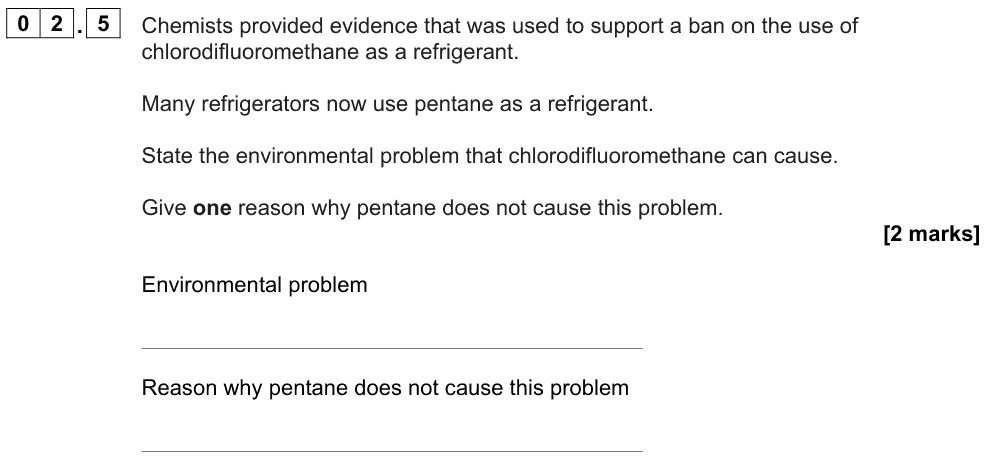
Chemists provided evidence that was used to support a ban on the use of
chlorodifluoromethane as a refrigerant.
Many refrigerators now use pentane as a refrigerant.
State the environmental problem that chlorodifluoromethane can cause.
Give one reason why pentane does not cause this problem.
[2 marks]
Environmental problem
Reason why pentane does not cause this problem
June 2022 · Paper 2 · Q03.1 5 marks AO1=1, AO2=4 Mechanism alkenes
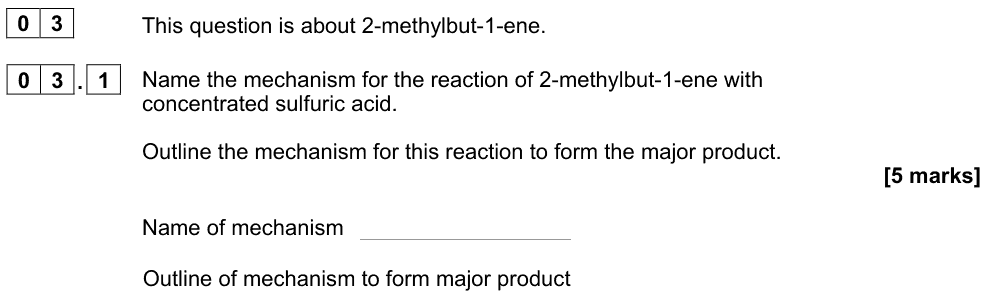
This question is about 2-methylbut-1-ene.
Name the mechanism for the reaction of 2-methylbut-1-ene with
concentrated sulfuric acid.
Outline the mechanism for this reaction to form the major product.
[5 marks]
Name of mechanism
Outline of mechanism to form major product
June 2022 · Paper 2 · Q03.2 3 marks AO2=3 Explanation alkenes
Earlier part of question 03 that this part usesEarlier part of June 2022 Paper 2 question 03
Draw the structure of the minor product formed in the reaction in Question 03.1
Explain why this is the minor product.
[3 marks]
Structure of minor product
Explanation
June 2022 · Paper 2 · Q03.3 1 mark AO1=1 Diagram or structure introduction to organic chemistry
Earlier part of question 03 that this part usesEarlier part of June 2022 Paper 2 question 03
Draw the skeletal formula of a functional group isomer of 2-methylbut-1-ene.
[1 mark]
June 2022 · Paper 2 · Q03.4 2 marks AO1=1, AO2=1 Diagram or structure alkenes
Earlier part of question 03 that this part usesEarlier part of June 2022 Paper 2 question 03
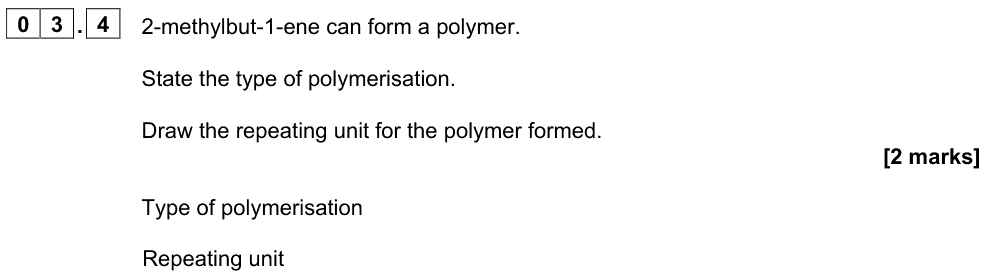
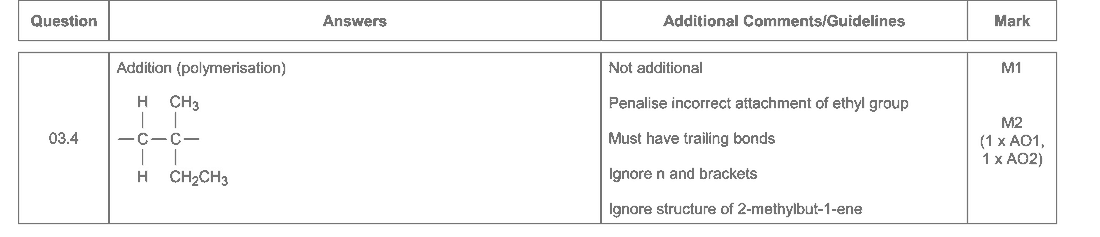
2-methylbut-1-ene can form a polymer.
State the type of polymerisation.
Draw the repeating unit for the polymer formed.
[2 marks]
Type of polymerisation
Repeating unit
June 2022 · Paper 2 · Q04.1 1 mark AO1=1 Short answer amino acids proteins and dna
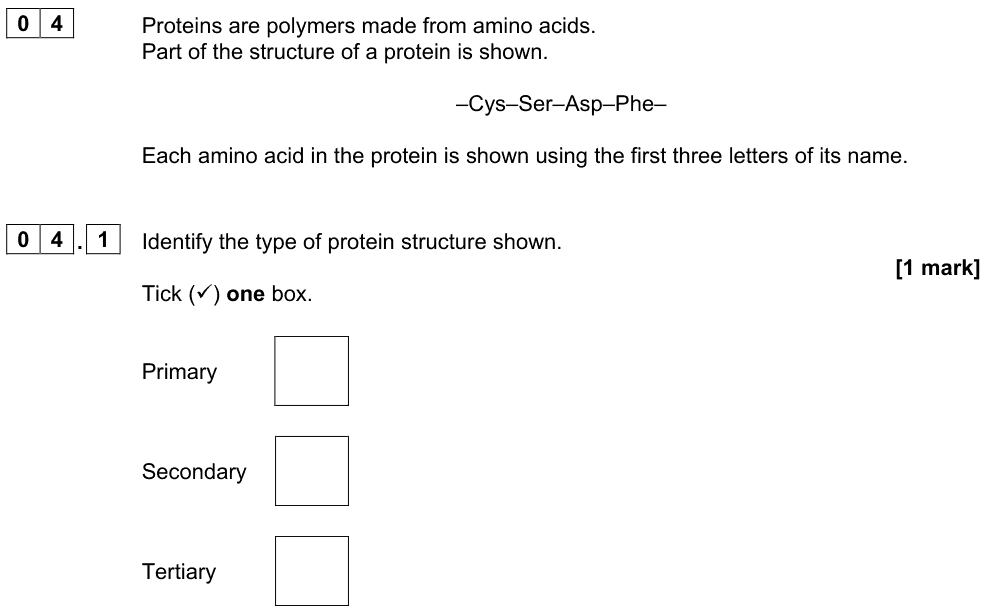
Proteins are polymers made from amino acids.
Part of the structure of a protein is shown.
–Cys–Ser–Asp–Phe–
Each amino acid in the protein is shown using the first three letters of its name.
Identify the type of protein structure shown.
[1 mark]
Tick () one box.
Primary
Secondary
Tertiary
June 2022 · Paper 2 · Q04.2 2 marks AO2=2 Diagram or structure amino acids proteins and dna
Earlier part of question 04 that this part usesEarlier part of June 2022 Paper 2 question 04
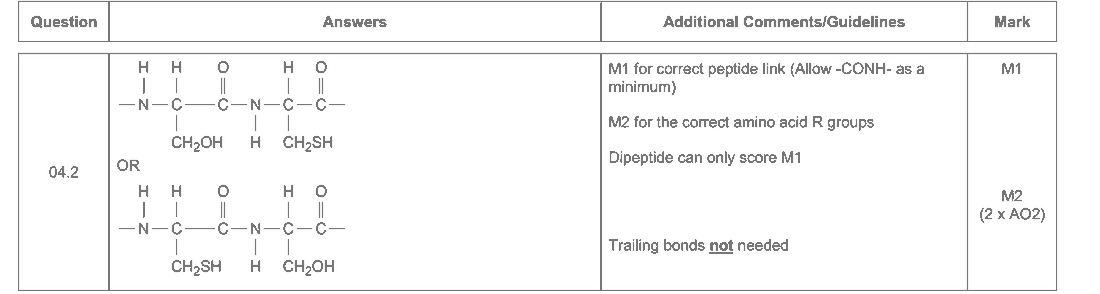
Draw a structure for the –Cys–Ser– section of the protein.
Use the Data Booklet to help you answer this question.
[2 marks]
June 2022 · Paper 2 · Q04.3 1 mark AO1=1 Short answer amino acids proteins and dna
Earlier part of question 04 that this part usesEarlier part of June 2022 Paper 2 question 04
Name the other substance formed when two amino acids react together to form part
of a protein chain.
[1 mark]
June 2022 · Paper 2 · Q04.4 4 marks AO1=2, AO3=2 Explanation amino acids proteins and dna
Earlier part of question 04 that this part usesEarlier part of June 2022 Paper 2 question 04
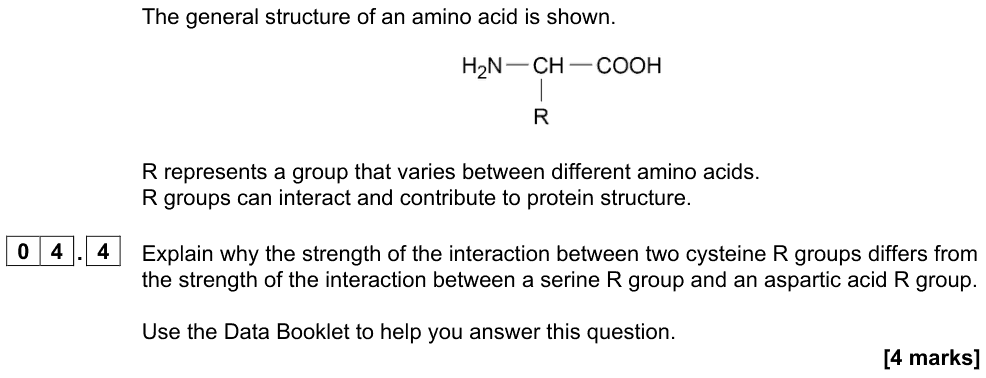
The general structure of an amino acid is shown.
R represents a group that varies between different amino acids.
R groups can interact and contribute to protein structure.
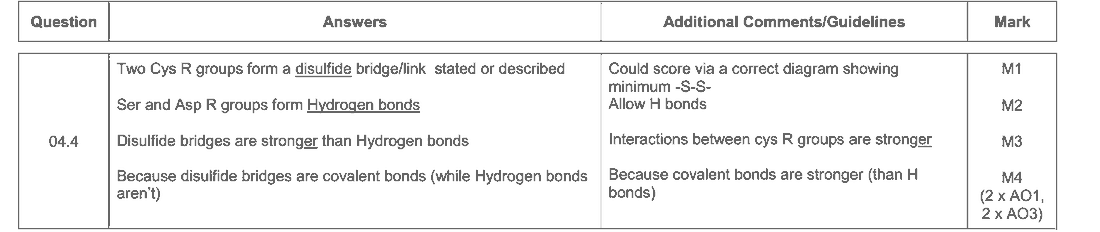
Explain why the strength of the interaction between two cysteine R groups differs from
the strength of the interaction between a serine R group and an aspartic acid R group.
Use the Data Booklet to help you answer this question.
[4 marks]
June 2022 · Paper 2 · Q04.5 1 mark AO3=1 Short answer amino acids proteins and dna
Earlier parts of question 04 that this part usesEarlier part of June 2022 Paper 2 question 04Earlier part of June 2022 Paper 2 question 04
Deduce the type of interaction that occurs between a lysine R group and an
aspartic acid R group.
[1 mark]
June 2022 · Paper 2 · Q05.1 2 marks AO3=2 Practical and data analysis carboxylic acids and derivatives
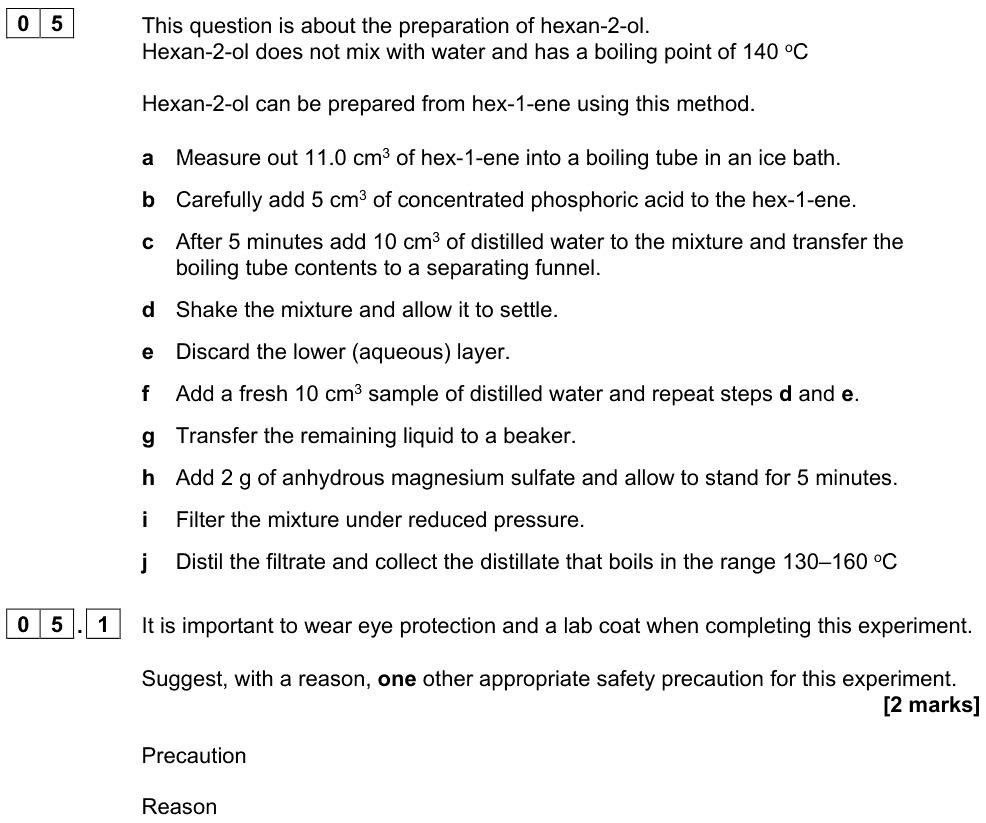
This question is about the preparation of hexan-2-ol.
Hexan-2-ol does not mix with water and has a boiling point of 140 oC
Hexan-2-ol can be prepared from hex-1-ene using this method.
a Measure out 11.0 cm3 of hex-1-ene into a boiling tube in an ice bath.
b Carefully add 5 cm3 of concentrated phosphoric acid to the hex-1-ene.
c After 5 minutes add 10 cm3 of distilled water to the mixture and transfer the
boiling tube contents to a separating funnel.
d Shake the mixture and allow it to settle.
e Discard the lower (aqueous) layer.
f
Add a fresh 10 cm3 sample of distilled water and repeat steps d and e.
g Transfer the remaining liquid to a beaker.
h Add 2 g of anhydrous magnesium sulfate and allow to stand for 5 minutes.
i
Filter the mixture under reduced pressure.
j
Distil the filtrate and collect the distillate that boils in the range 130–160 oC
It is important to wear eye protection and a lab coat when completing this experiment.
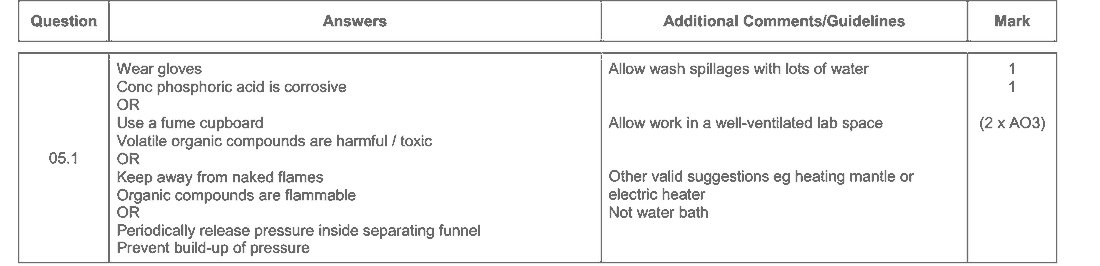
Suggest, with a reason, one other appropriate safety precaution for this experiment.
[2 marks]
Precaution
Reason
June 2022 · Paper 2 · Q05.2 1 mark AO2=1 Practical and data analysis carboxylic acids and derivatives
Earlier part of question 05 that this part usesEarlier part of June 2022 Paper 2 question 05
Give a reason for adding the distilled water in steps c and f.
[1 mark]
June 2022 · Paper 2 · Q05.3 1 mark AO2=1 Practical and data analysis carboxylic acids and derivatives
Earlier part of question 05 that this part usesEarlier part of June 2022 Paper 2 question 05
Give a reason for adding anhydrous magnesium sulfate in step h.
[1 mark]
June 2022 · Paper 2 · Q05.4 2 marks AO2=2 Diagram or structure carboxylic acids and derivatives
Earlier part of question 05 that this part usesEarlier part of June 2022 Paper 2 question 05
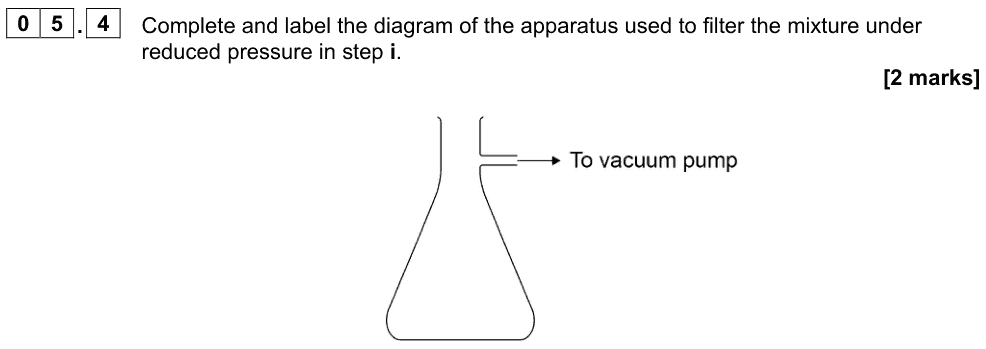
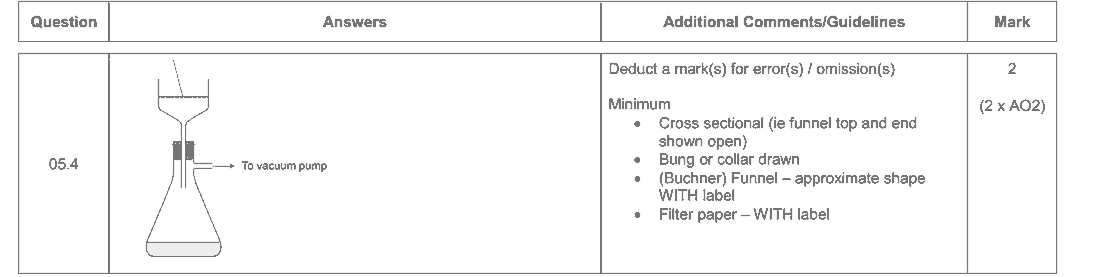
Complete and label the diagram of the apparatus used to filter the mixture under
reduced pressure in step i.
[2 marks]
June 2022 · Paper 2 · Q05.5 2 marks AO2=2 Short answer alkenesalcohols
Earlier part of question 05 that this part usesEarlier part of June 2022 Paper 2 question 05
Identify the most likely organic impurity, other than hex-1-ene, in the distillate collected
in step j.
Suggest one reason why it could be difficult to remove this impurity.
[2 marks]
Impurity
Reason
June 2022 · Paper 2 · Q05.6 4 marks AO2=4 Calculation amount of substance
Earlier part of question 05 that this part usesEarlier part of June 2022 Paper 2 question 05
Calculate the mass, in g, of hexan-2-ol formed from 11.0 cm3 of hex-1-ene if the
yield is 31.0%
Give your answer to 1 decimal place.
Density of hex-1-ene = 0.678 g cm−3
[4 marks]
Mass
g
June 2022 · Paper 2 · Q06 6 marks AO1=3, AO3=3 6-mark level of response nmr spectroscopyorganic analysis
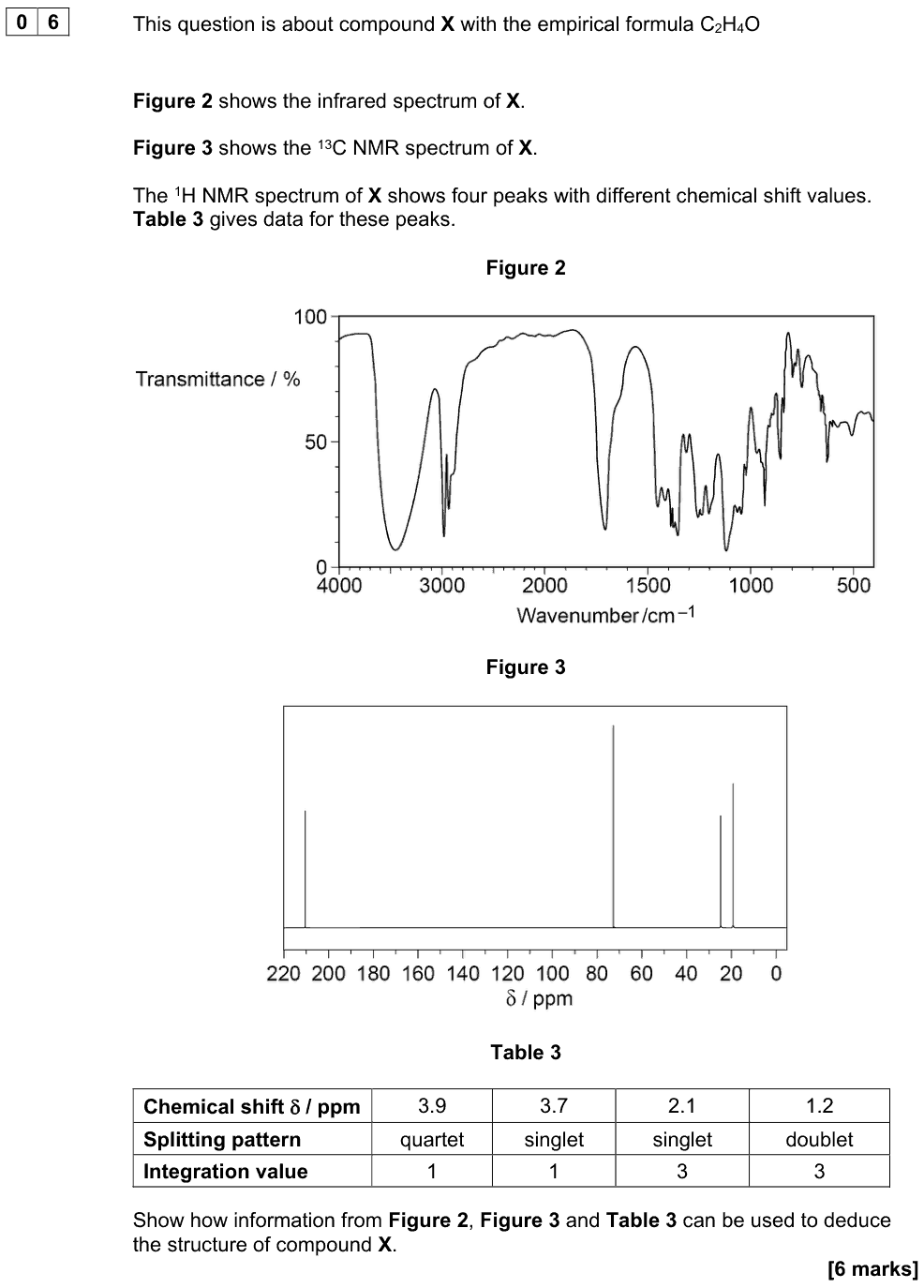
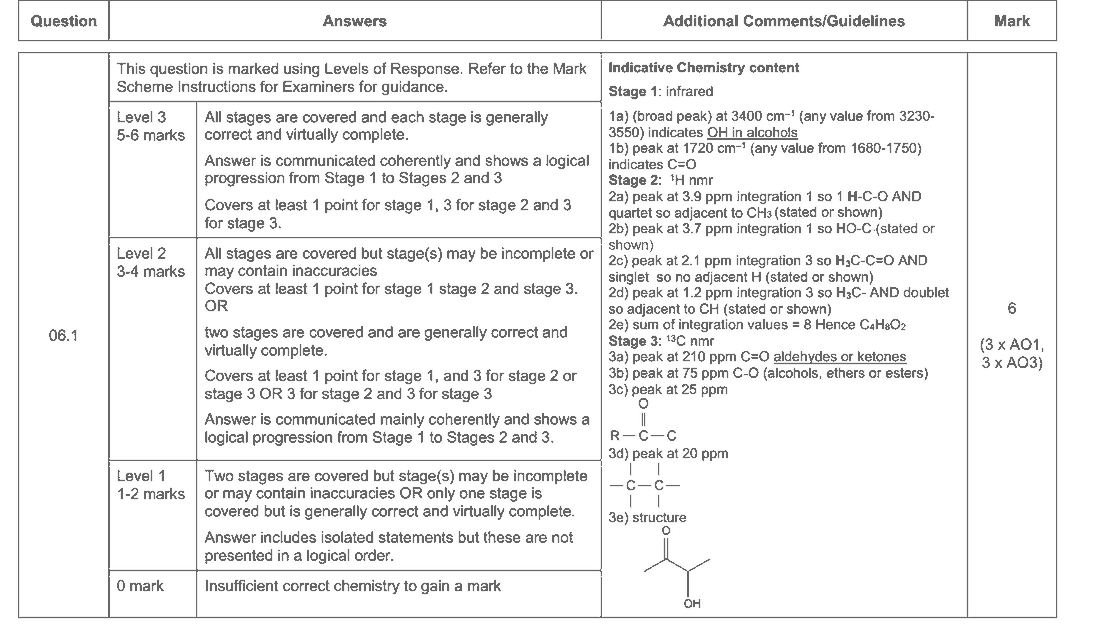
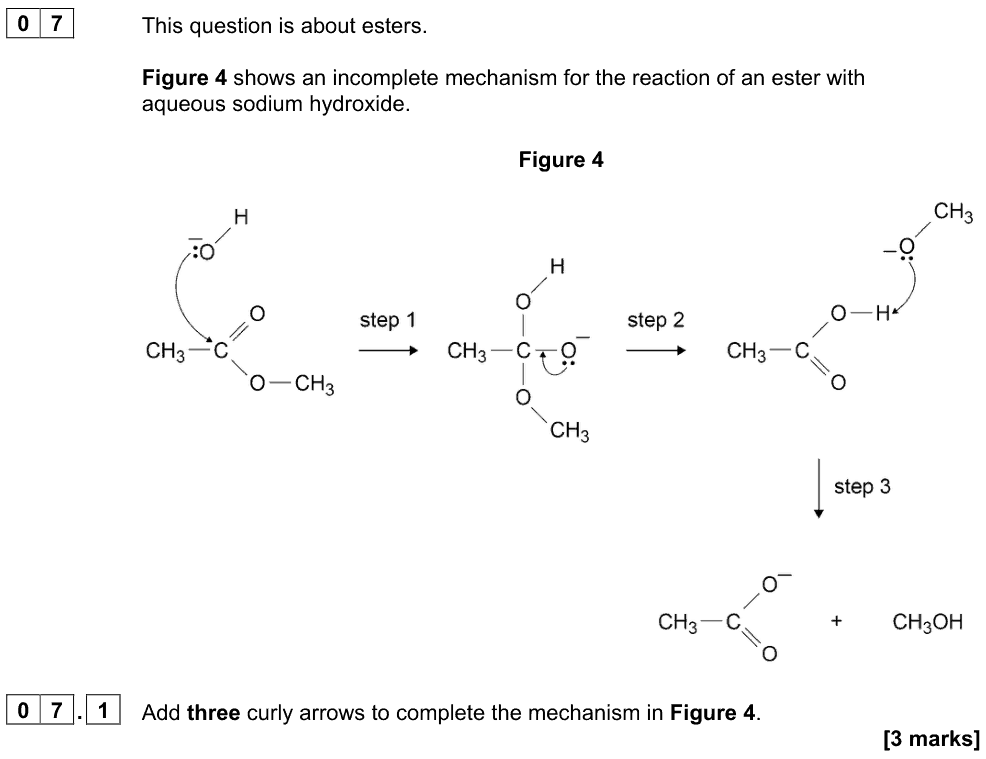
This question is about compound X with the empirical formula C2H4O
Figure 2 shows the infrared spectrum of X.
Figure 3 shows the 13C NMR spectrum of X.
The 1H NMR spectrum of X shows four peaks with different chemical shift values.
Table 3 gives data for these peaks.
Figure 2
Figure 3
Table 3
Chemical shift  / ppm
3.9
3.7
2.1
1.2
Splitting pattern
quartet
singlet
singlet
doublet
Integration value
1
1
3
3
Show how information from Figure 2, Figure 3 and Table 3 can be used to deduce
the structure of compound X.
[6 marks]
June 2022 · Paper 2 · Q07.1 3 marks AO3=3 Mechanism carboxylic acids and derivativesintroduction to organic chemistry
This question is about esters.
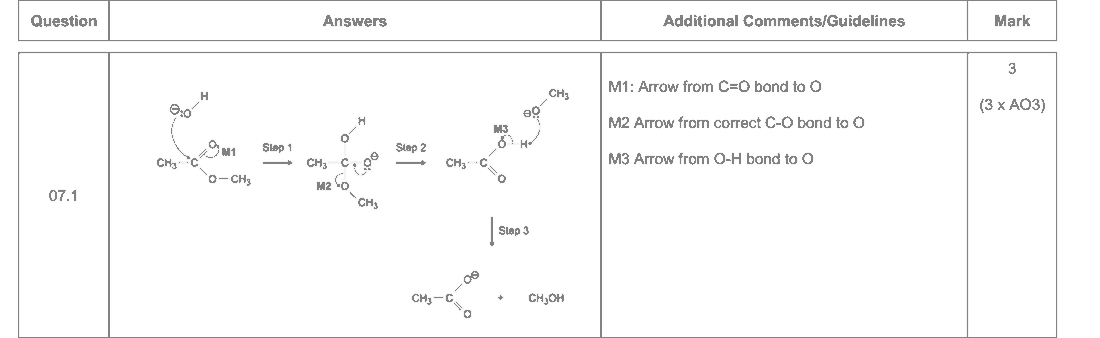
Figure 4 shows an incomplete mechanism for the reaction of an ester with
aqueous sodium hydroxide.
Figure 4
Add three curly arrows to complete the mechanism in Figure 4.
[3 marks]
June 2022 · Paper 2 · Q07.2 1 mark AO1=1 Short answer carboxylic acids and derivatives
Earlier part of question 07 that this part usesEarlier part of June 2022 Paper 2 question 07
Name the type of reaction shown in Figure 4.
[1 mark]
June 2022 · Paper 2 · Q07.3 1 mark AO1=1 Short answer carboxylic acids and derivatives
Earlier part of question 07 that this part usesEarlier part of June 2022 Paper 2 question 07
Deduce the role of the CH3O− ion in step 3 shown in Figure 4.
[1 mark]
June 2022 · Paper 2 · Q07.4 1 mark AO1=1 Short answer carboxylic acids and derivatives
Earlier part of question 07 that this part usesEarlier part of June 2022 Paper 2 question 07
A triester in vegetable oil reacts with sodium hydroxide in a similar way.
Give a use for a product of this reaction.
[1 mark]
June 2022 · Paper 2 · Q08.1 2 marks AO2=2 Equation writing aromatic chemistryintroduction to organic chemistry
Benzene reacts with methanoyl chloride (HCOCl) in the presence of a catalyst.
Give an equation for the overall reaction when benzene reacts with
methanoyl chloride.
Name the organic product.
[2 marks]
Equation
Name
June 2022 · Paper 2 · Q08.2 2 marks AO1=1, AO2=1 Equation writing aromatic chemistry
Earlier part of question 08 that this part usesEarlier part of June 2022 Paper 2 question 08
Identify the catalyst needed in this reaction.
Give an equation to show how the catalyst is used to form the electrophile, [HCO]+
[2 marks]
Catalyst
Equation
June 2022 · Paper 2 · Q08.3 3 marks AO2=3 Mechanism aromatic chemistry
Earlier part of question 08 that this part usesEarlier part of June 2022 Paper 2 question 08
Outline the mechanism for the reaction of benzene with the electrophile, [HCO]+
[3 marks]
June 2022 · Paper 2 · Q09.1 2 marks AO3=2 Practical and data analysis amount of substance
This question is about olive oil.
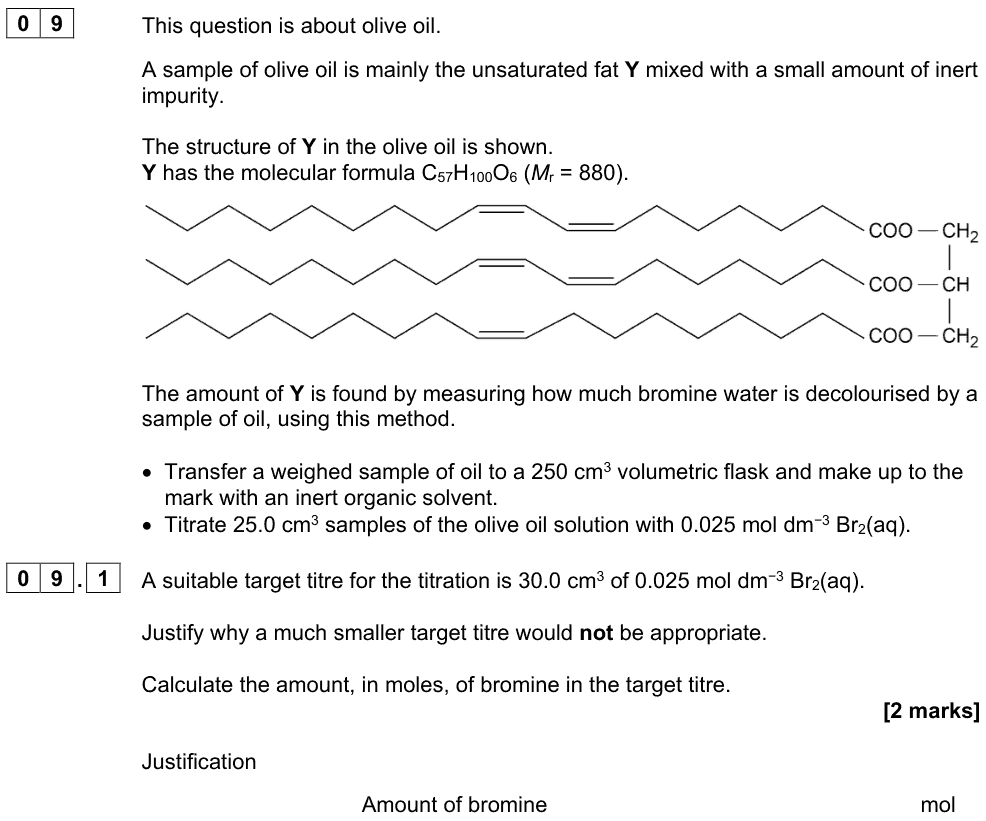
A sample of olive oil is mainly the unsaturated fat Y mixed with a small amount of inert
impurity.
The structure of Y in the olive oil is shown.
Y has the molecular formula C57H100O6 (Mr = 880).
The amount of Y is found by measuring how much bromine water is decolourised by a
sample of oil, using this method.
• Transfer a weighed sample of oil to a 250 cm3 volumetric flask and make up to the
mark with an inert organic solvent.
• Titrate 25.0 cm3 samples of the olive oil solution with 0.025 mol dm−3 Br2(aq).
A suitable target titre for the titration is 30.0 cm3 of 0.025 mol dm−3 Br2(aq).
Justify why a much smaller target titre would not be appropriate.
Calculate the amount, in moles, of bromine in the target titre.
[2 marks]
Justification
Amount of bromine
mol
June 2022 · Paper 2 · Q09.2 5 marks AO2=3, AO3=2 Calculation amount of substancealkenes
Earlier part of question 09 that this part usesEarlier part of June 2022 Paper 2 question 09
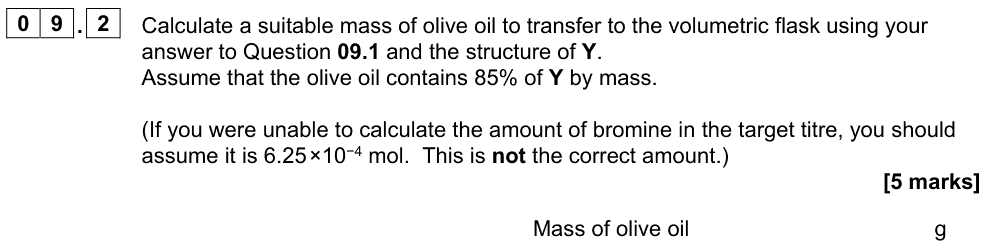
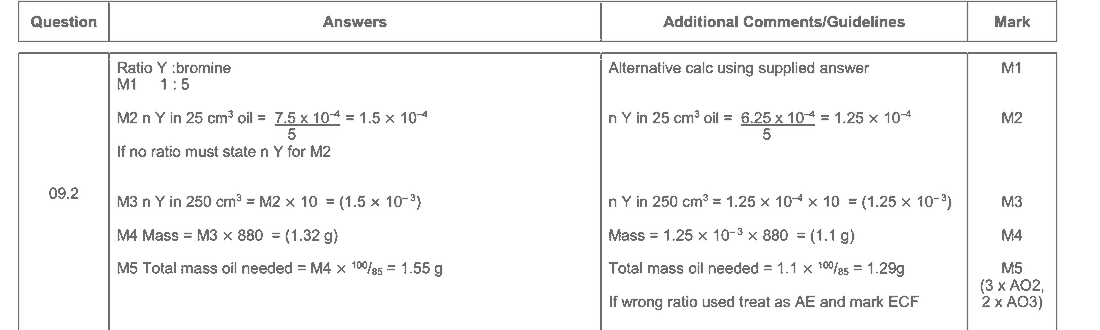
Calculate a suitable mass of olive oil to transfer to the volumetric flask using your
answer to Question 09.1 and the structure of Y.
Assume that the olive oil contains 85% of Y by mass.
(If you were unable to calculate the amount of bromine in the target titre, you should
assume it is 6.25 ×10⁻⁴ mol.  This is not the correct amount.)
[5 marks]
Mass of olive oil
g
June 2022 · Paper 2 · Q09.3 2 marks AO3=2 Practical and data analysis amount of substance
Earlier part of question 09 that this part usesEarlier part of June 2022 Paper 2 question 09
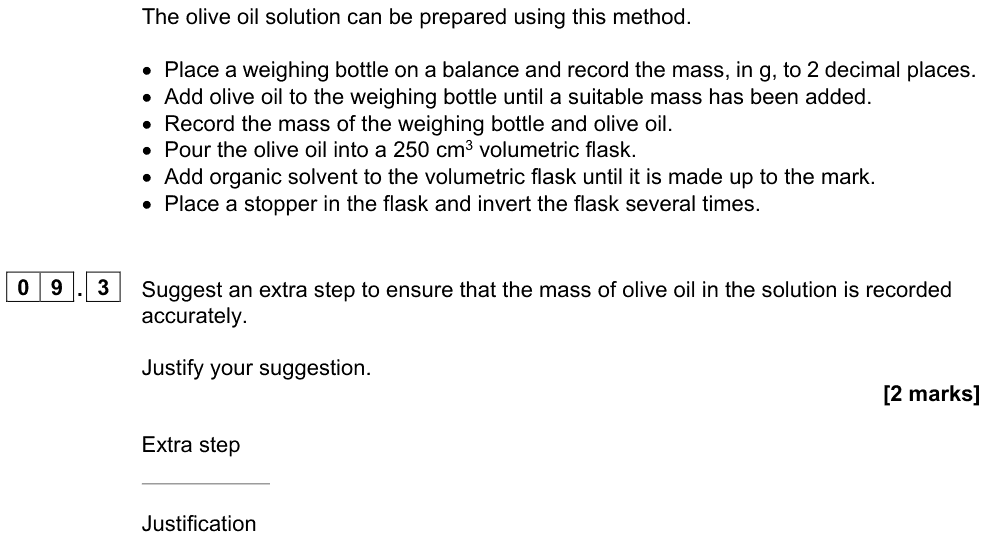
The olive oil solution can be prepared using this method.
• Place a weighing bottle on a balance and record the mass, in g, to 2 decimal places.
• Add olive oil to the weighing bottle until a suitable mass has been added.
• Record the mass of the weighing bottle and olive oil.
• Pour the olive oil into a 250 cm3 volumetric flask.
• Add organic solvent to the volumetric flask until it is made up to the mark.
• Place a stopper in the flask and invert the flask several times.
Suggest an extra step to ensure that the mass of olive oil in the solution is recorded
accurately.
Justify your suggestion.
[2 marks]
Extra step
Justification
June 2022 · Paper 2 · Q09.4 1 mark AO3=1 Practical and data analysis amount of substance
Earlier part of question 09 that this part usesEarlier part of June 2022 Paper 2 question 09
State the reason for inverting the flask several times.
[1 mark]
June 2022 · Paper 2 · Q09.5 2 marks AO2=2 Calculation amount of substanceatomic structure
Earlier parts of question 09 that this part usesEarlier part of June 2022 Paper 2 question 09Earlier part of June 2022 Paper 2 question 09
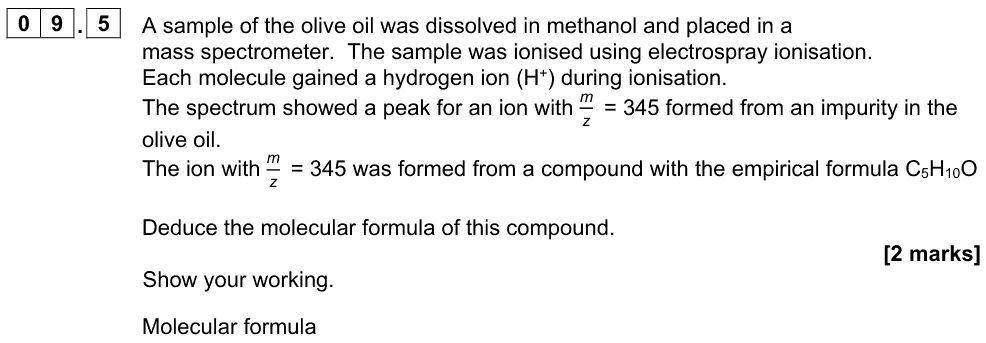
A sample of the olive oil was dissolved in methanol and placed in a
mass spectrometer.  The sample was ionised using electrospray ionisation.
Each molecule gained a hydrogen ion (H+) during ionisation.
The spectrum showed a peak for an ion with
m
z  = 345 formed from an impurity in the
olive oil.
The ion with
m
z  = 345 was formed from a compound with the empirical formula C5H10O
Deduce the molecular formula of this compound.
[2 marks]
Show your working.
Molecular formula
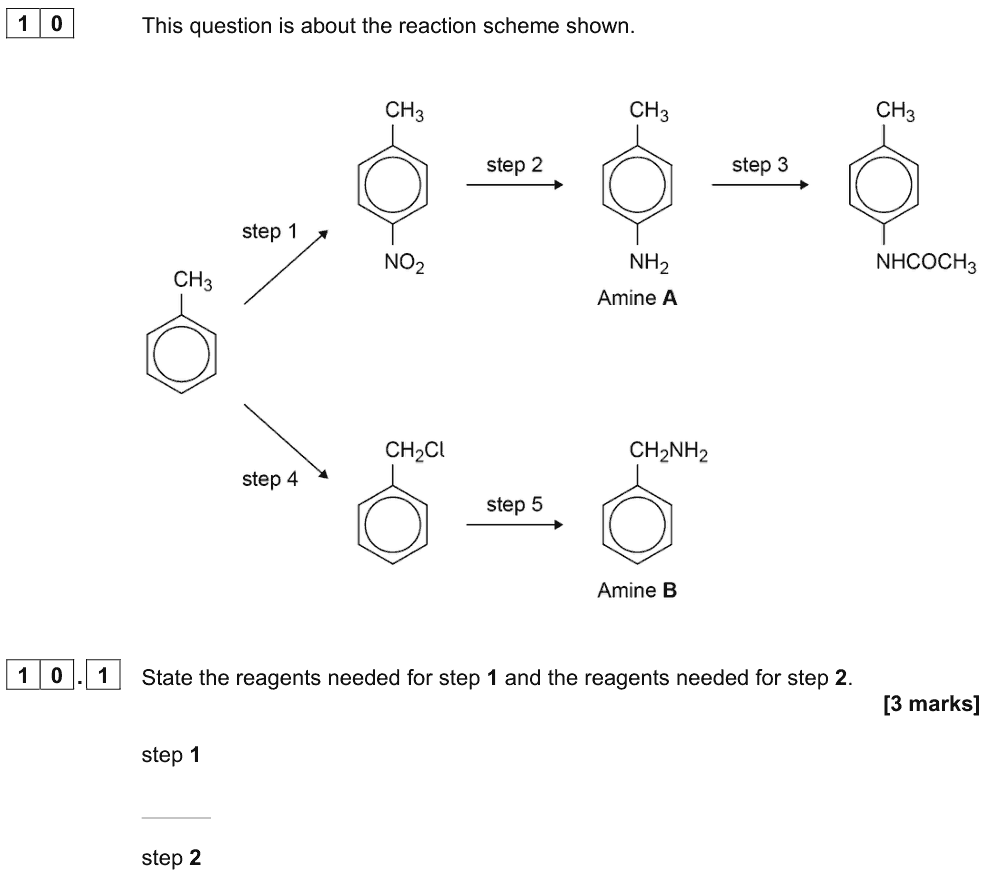
June 2022 · Paper 2 · Q10.1 3 marks AO1=3 Short answer aromatic chemistryamines
This question is about the reaction scheme shown.
State the reagents needed for step 1 and the reagents needed for step 2.
[3 marks]
step 1
step 2
June 2022 · Paper 2 · Q10.2 1 mark AO1=1 Short answer amines
Earlier part of question 10 that this part usesEarlier part of June 2022 Paper 2 question 10
Give the name of the mechanism for the reaction in step 3.
[1 mark]
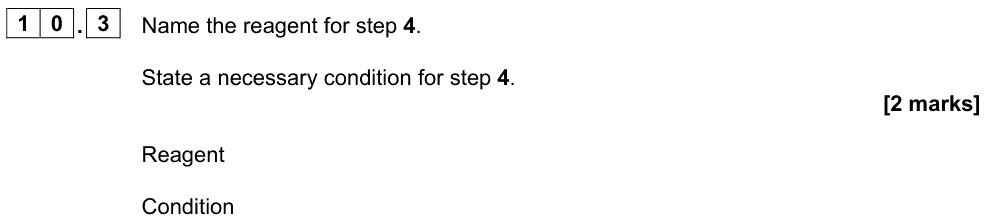
June 2022 · Paper 2 · Q10.3 2 marks AO1=2 Short answer alkanes
Earlier part of question 10 that this part usesEarlier part of June 2022 Paper 2 question 10
Name the reagent for step 4.
State a necessary condition for step 4.
[2 marks]
Reagent
Condition
June 2022 · Paper 2 · Q10.4 2 marks AO3=2 Explanation amines
Earlier part of question 10 that this part usesEarlier part of June 2022 Paper 2 question 10
Amine A is formed in step 2 and amine B is formed in step 5.
Explain why the yield of B in step 5 is less than the yield of A in step 2.
[2 marks]
June 2022 · Paper 2 · Q10.5 2 marks AO2=2 Explanation amines
Earlier part of question 10 that this part usesEarlier part of June 2022 Paper 2 question 10
Explain why amine B is a stronger base than amine A.
[2 marks]

Work with an A-level chemistry tutor

Want a paper marked and gone through with you? Message us.

Prefer email? Send an enquiry

If you are under 18, please include a parent's contact details. Enquiries go to enquiries@chemistryaleveltutor.com and are deleted once handled. All tutoring is online.