June 2022: Paper 1, Inorganic and physical chemistry

105 marks · 47 question parts · Paper, mark scheme and report on AQA's site · Have the Data Booklet beside you

Question by question

QTopicMarksAOType
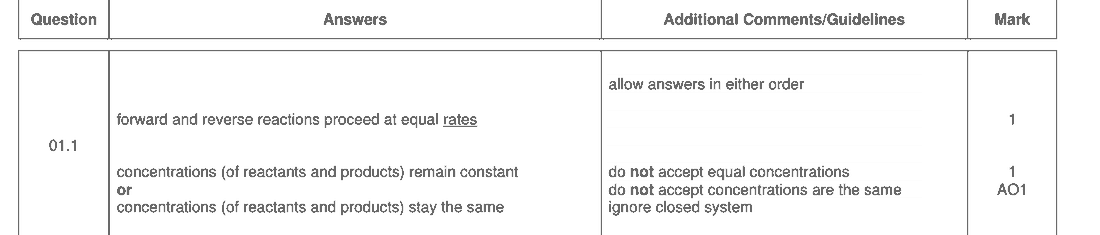
01.1 Chemical equilibria, Le Chatelier's principle and Kc 2AO1=2Short answer
01.2 Chemical equilibria, Le Chatelier's principle and Kc, Equilibrium constant Kp 1AO3=1Short answer
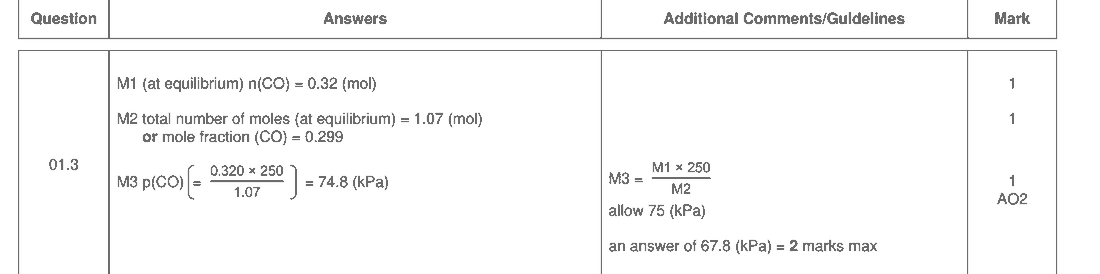
01.3 Equilibrium constant Kp 3AO2=3Calculation
01.4 Equilibrium constant Kp 1AO1=1Short answer
01.5 Equilibrium constant Kp 3AO2=3Calculation
01.6 Equilibrium constant Kp 2AO2=2Calculation
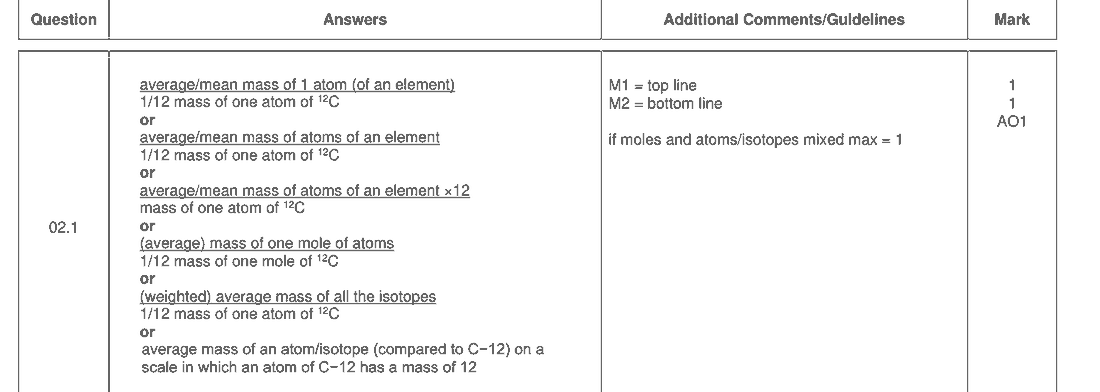
02.1 Amount of substance 2AO1=2Short answer
02.2 Atomic structure 2AO2=2Calculation
02.3 Atomic structure 1AO1=1Short answer
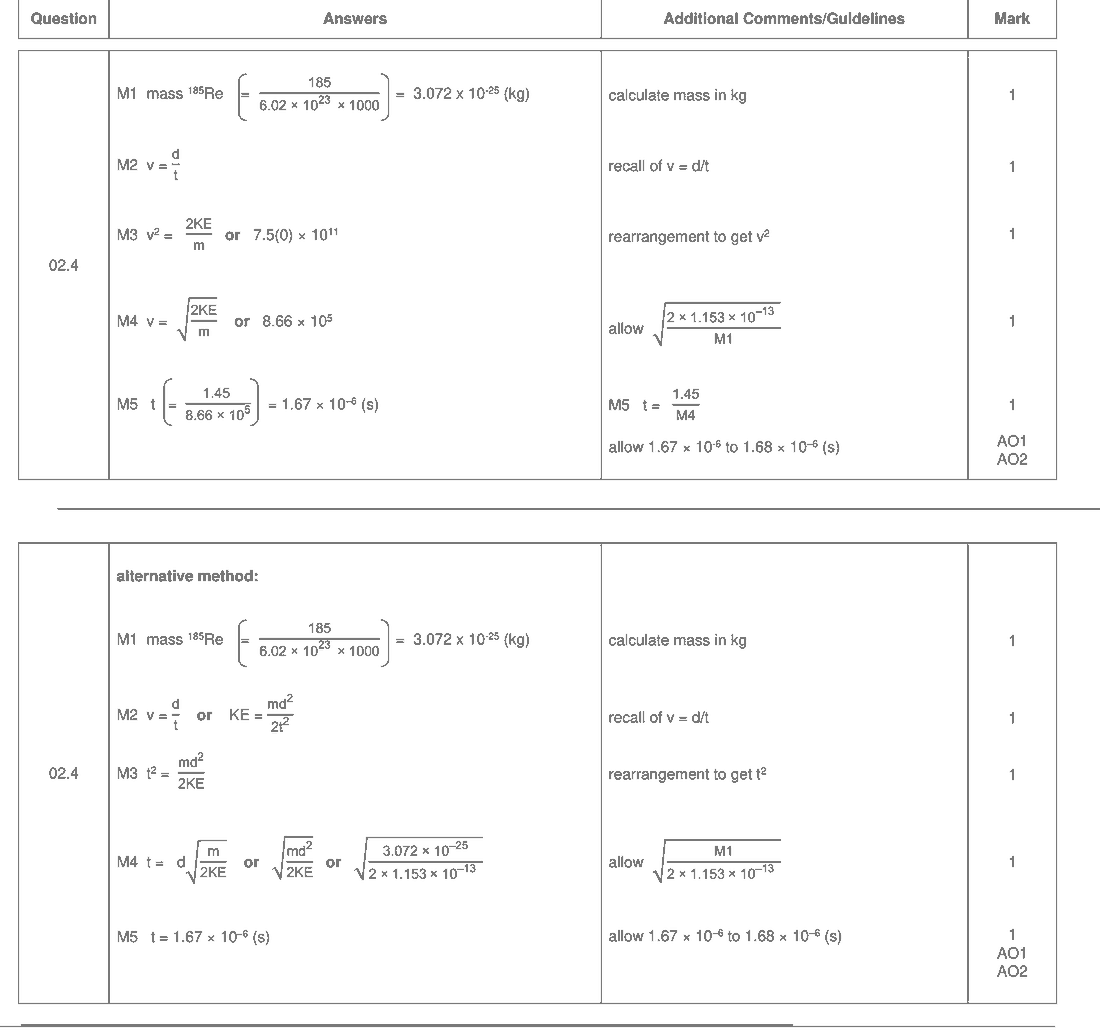
02.4 Atomic structure, Amount of substance 5Calculation
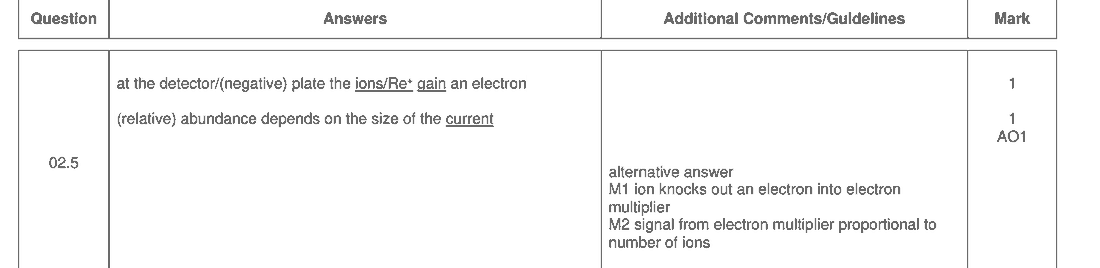
02.5 Atomic structure 2AO1=2Short answer
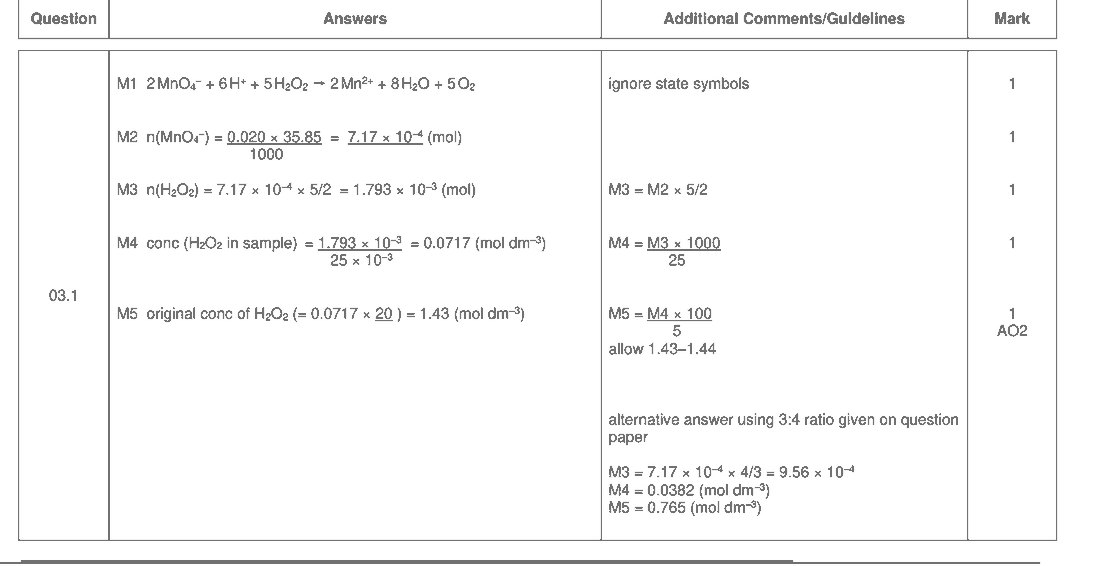
03.1 Transition metals, Oxidation, reduction and redox equations 5AO2=5Calculation
03.2 Transition metals 1AO1=1Short answer
03.3 Oxidation, reduction and redox equations 1AO2=1Short answer
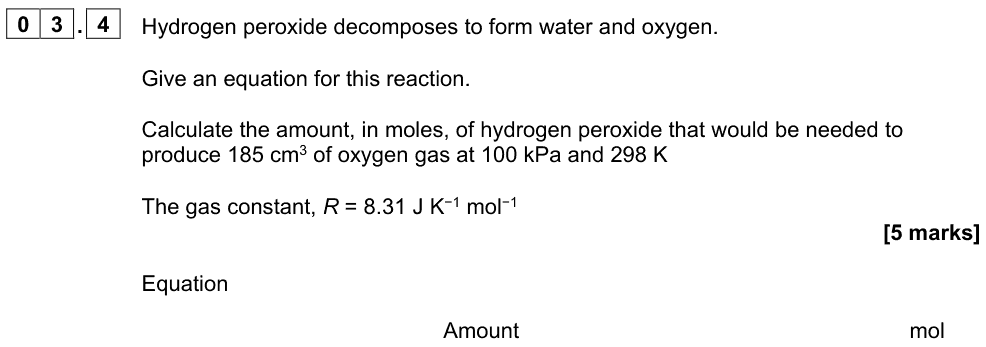
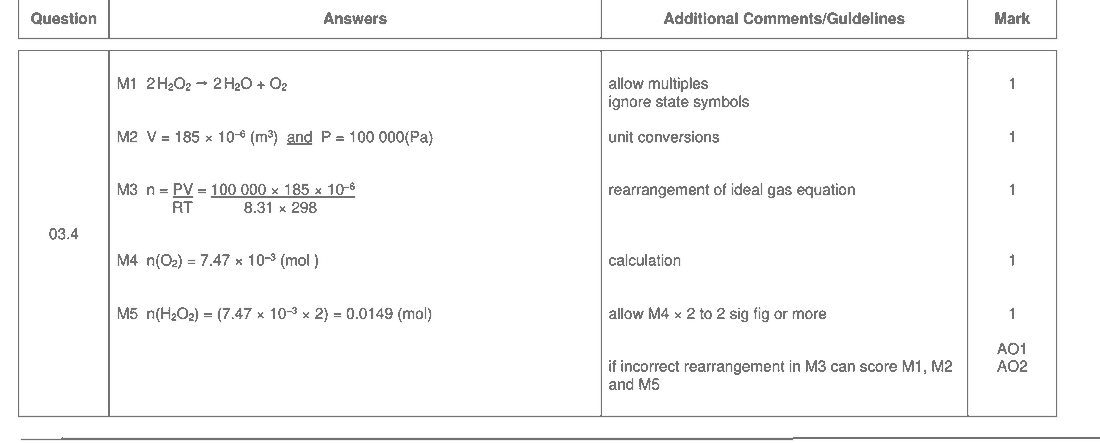
03.4 Amount of substance 5Calculation
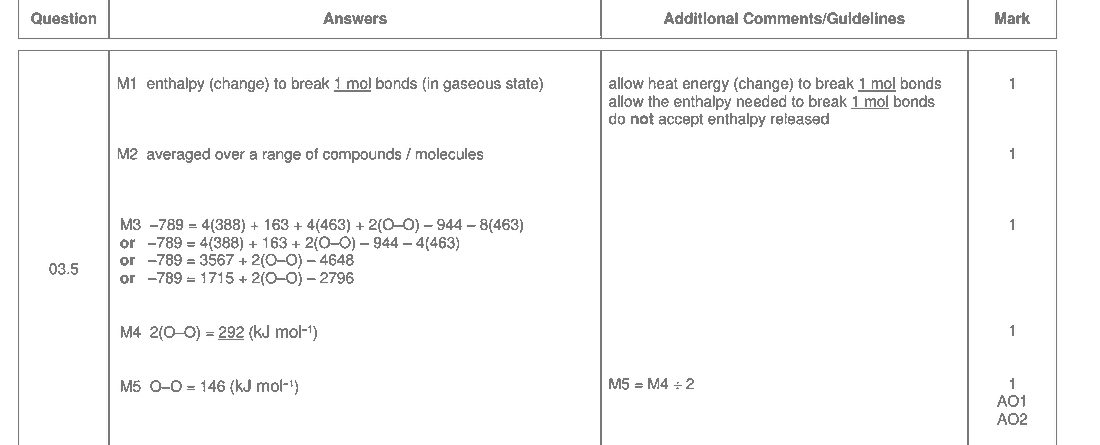
03.5 Energetics 5Calculation
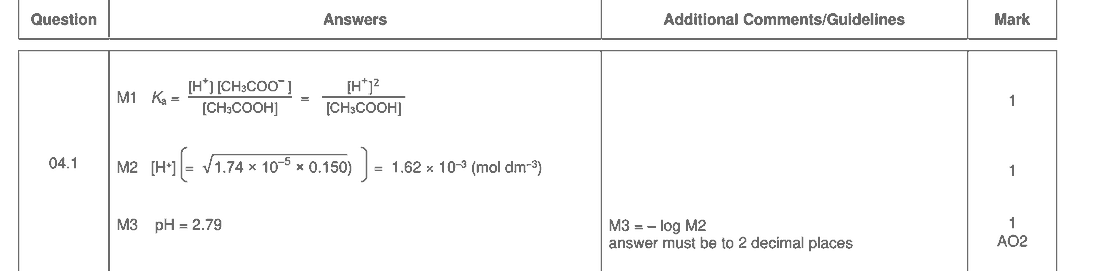
04.1 Acids and bases: pH, Ka, titration curves and buffers 3AO2=3Calculation
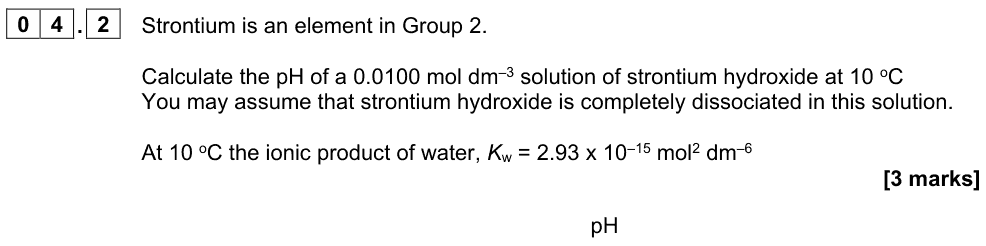
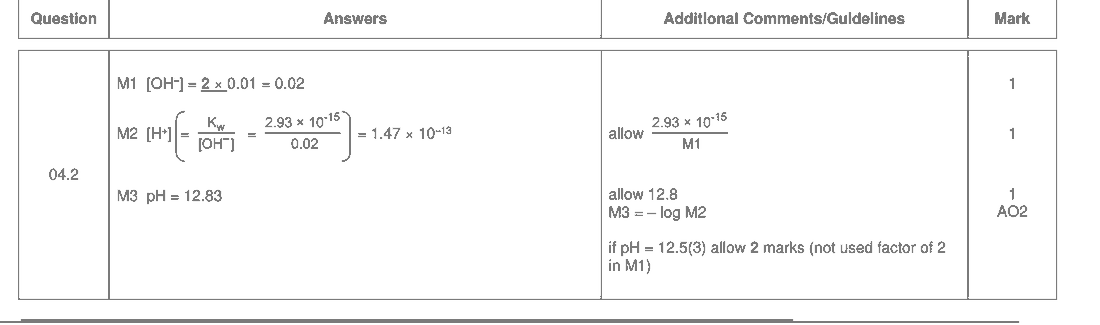
04.2 Acids and bases: pH, Ka, titration curves and buffers 3AO2=3Calculation
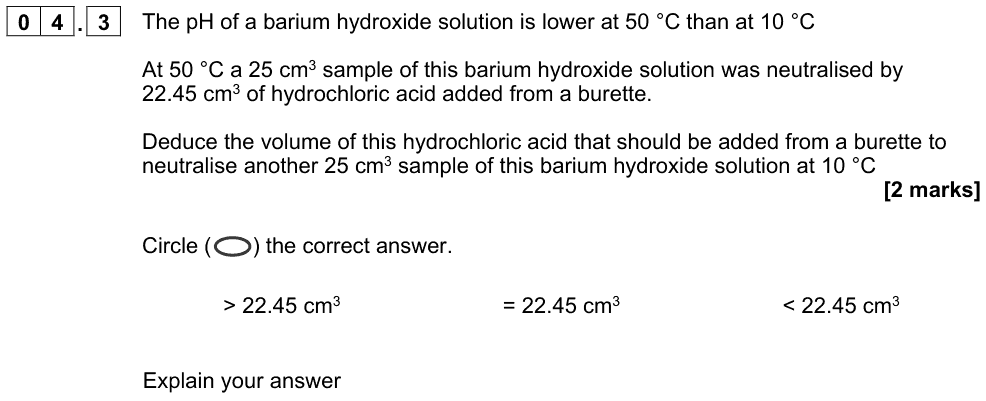
04.3 Acids and bases: pH, Ka, titration curves and buffers 2AO3=2Short answer
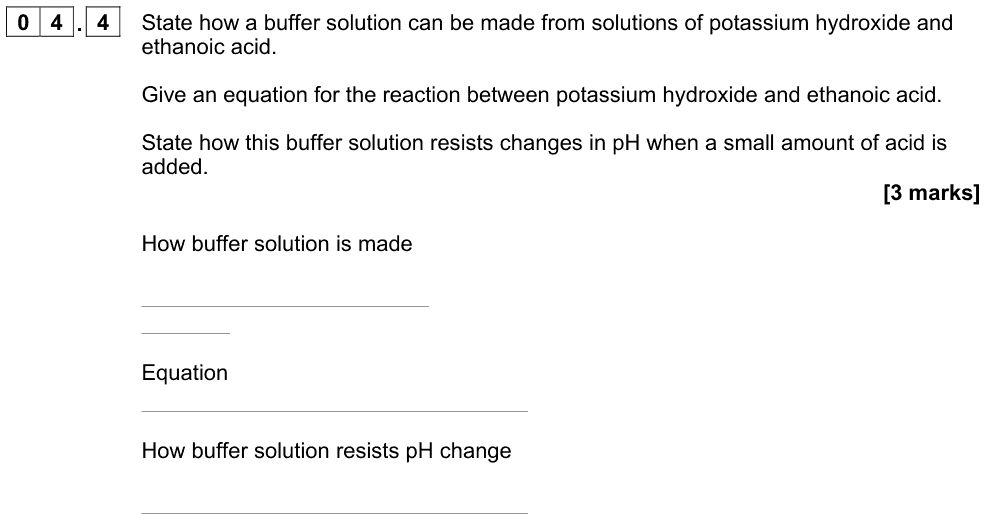
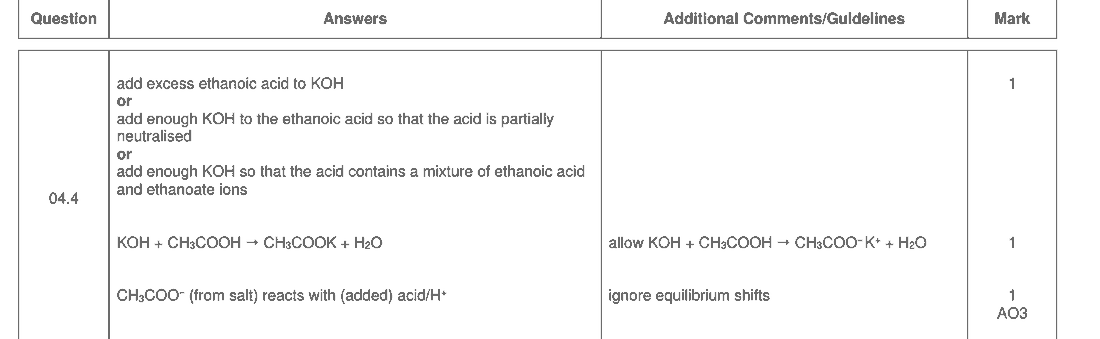
04.4 Acids and bases: pH, Ka, titration curves and buffers 3AO3=3Short answer
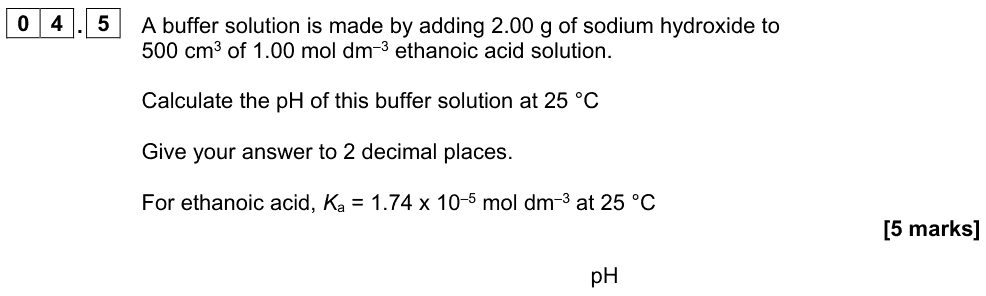
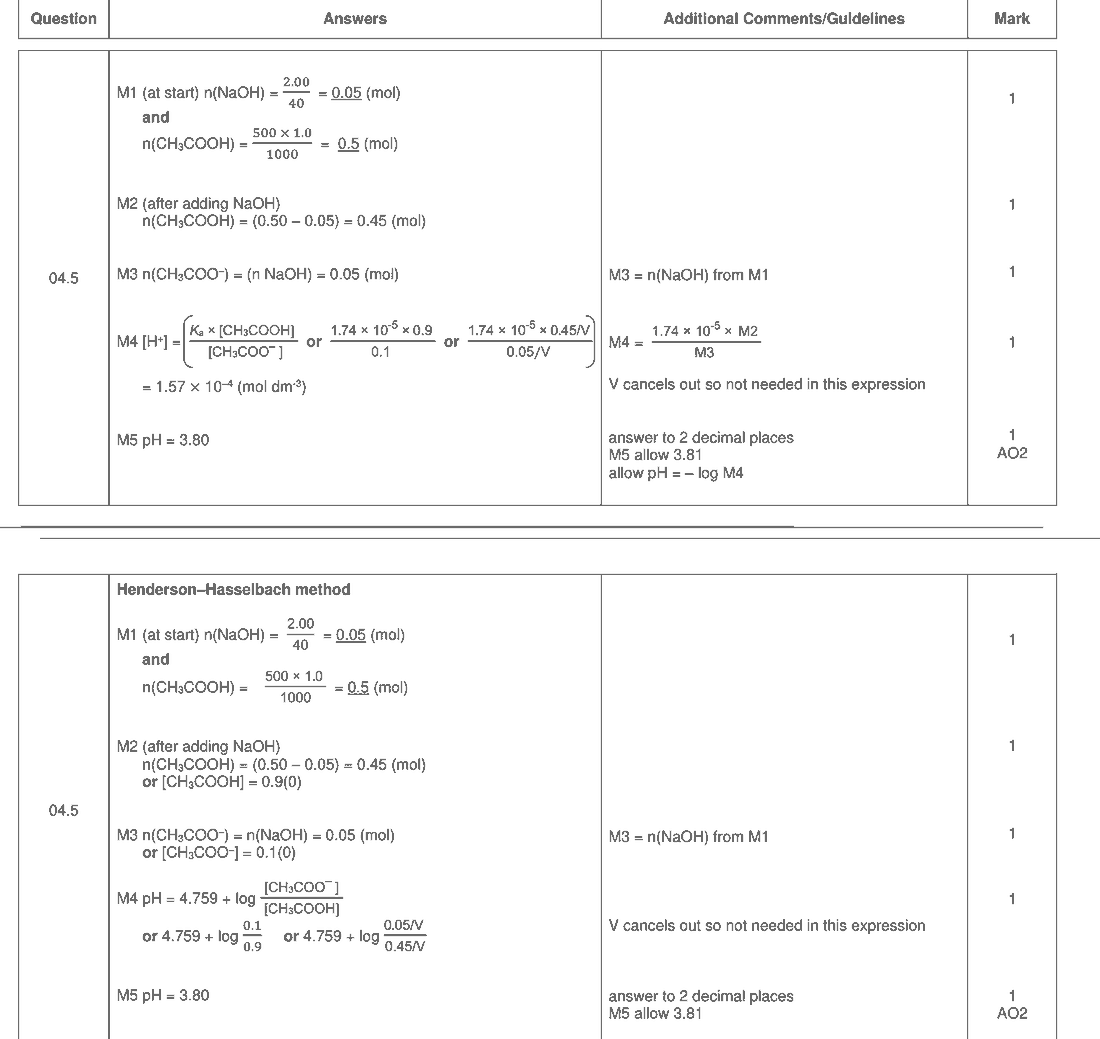
04.5 Acids and bases: pH, Ka, titration curves and buffers 5Calculation
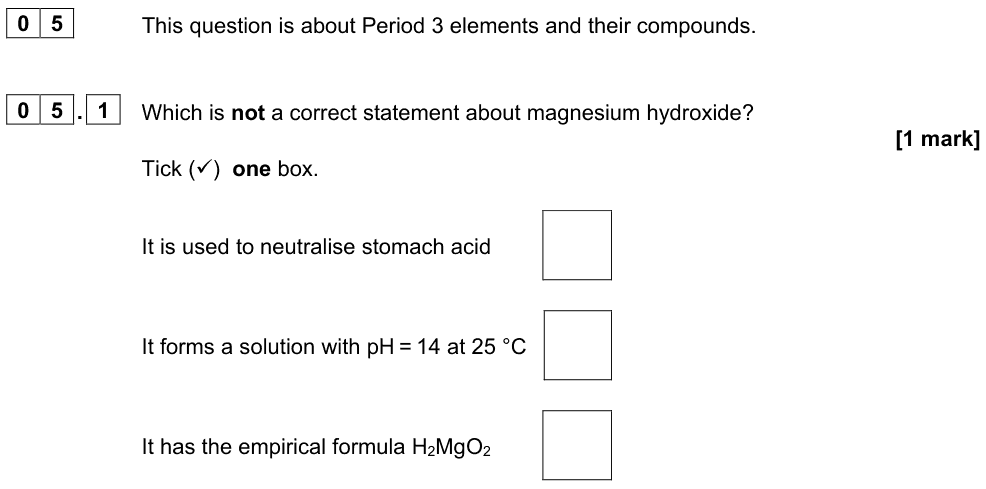
05.1 Group 2, the alkaline earth metals 1AO1=1Short answer
05.2 Period 3 elements and their oxides 1AO2=1Equation writing
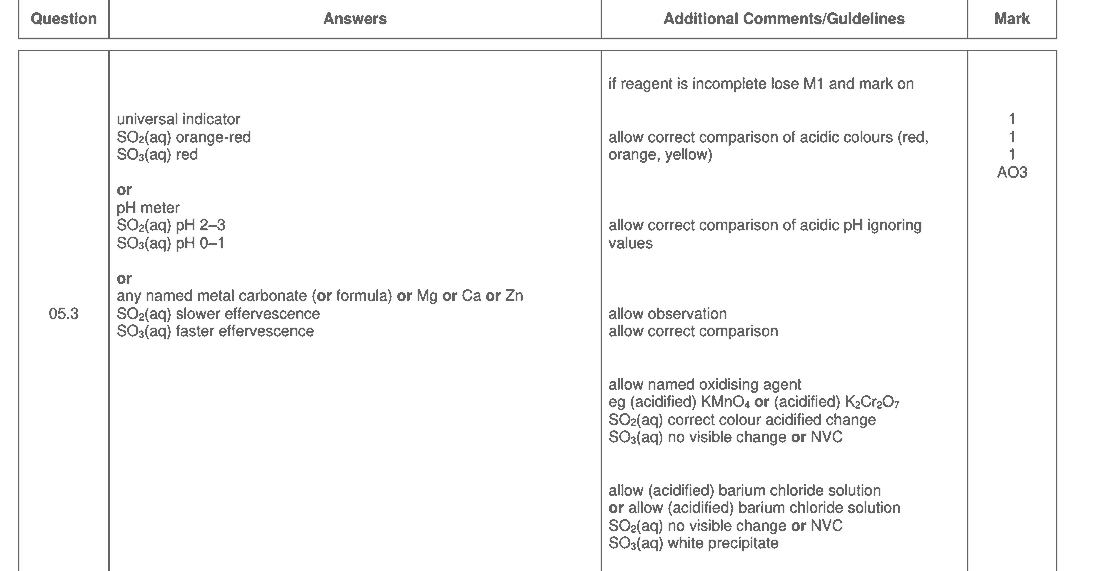
05.3 Period 3 elements and their oxides 3AO3=3Practical and data analysis
05.4 Atomic structure 2AO3=2Short answer
05.5 Period 3 elements and their oxides 1AO1=1Equation writing
05.6 Period 3 elements and their oxides 1AO2=1Diagram or structure
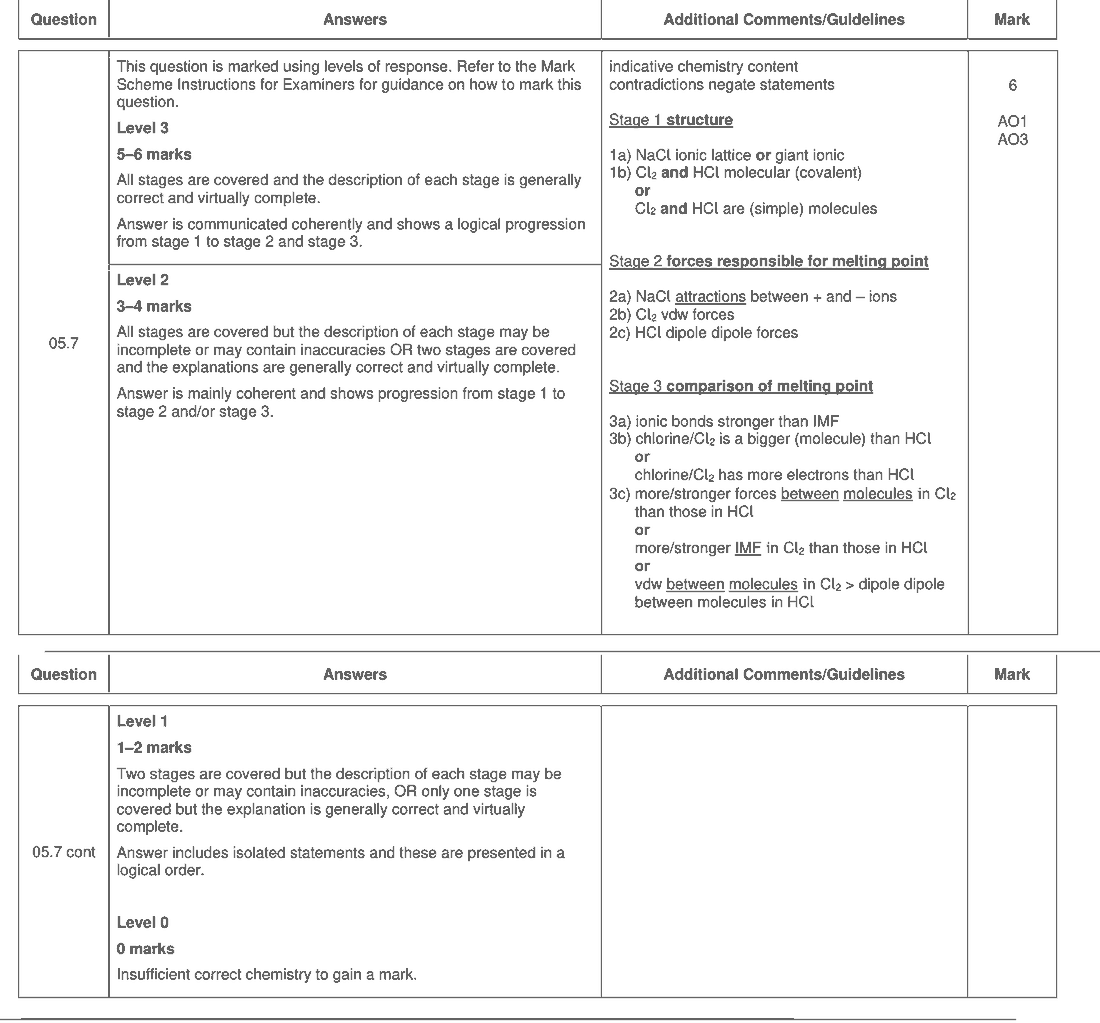
05.7 Bonding 6Level of response
06.1 Group 7(17), the halogens 1AO1=1Short answer
06.2 Group 7(17), the halogens, Oxidation, reduction and redox equations 2AO1=2Equation writing
06.3 Group 7(17), the halogens 2Equation writing
06.4 Group 7(17), the halogens, Oxidation, reduction and redox equations 3AO1=3Equation writing
06.5 Group 7(17), the halogens 3Short answer
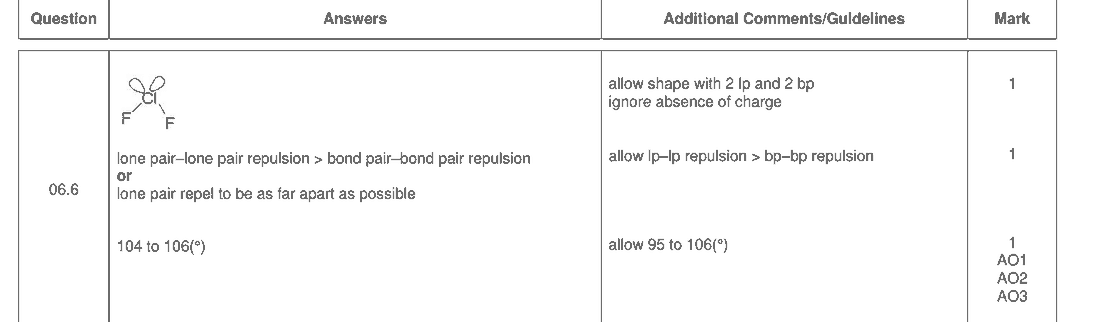
06.6 Bonding 3Diagram or structure
06.7 Group 2, the alkaline earth metals 1AO2=1Equation writing
07.1 Transition metals 2AO2=2Explanation
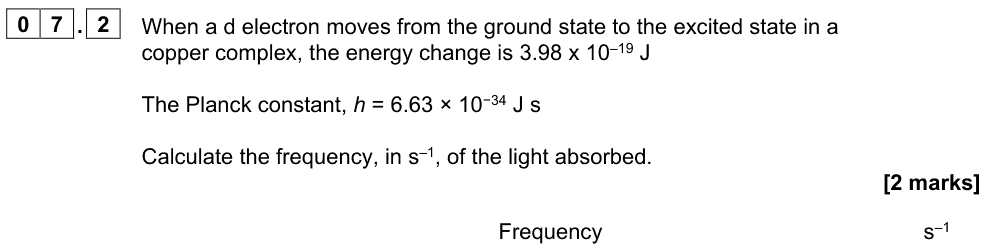
07.2 Transition metals 2AO2=2Calculation
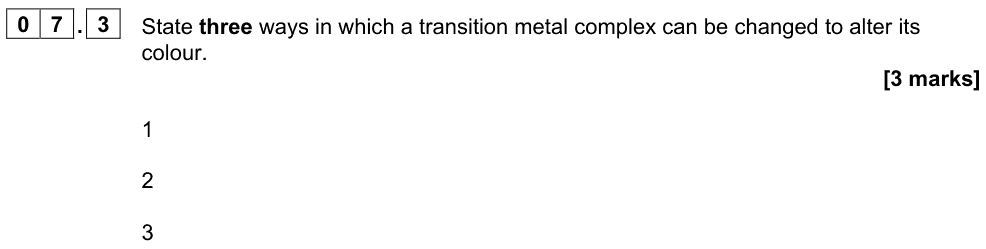
07.3 Transition metals 3AO1=3Short answer
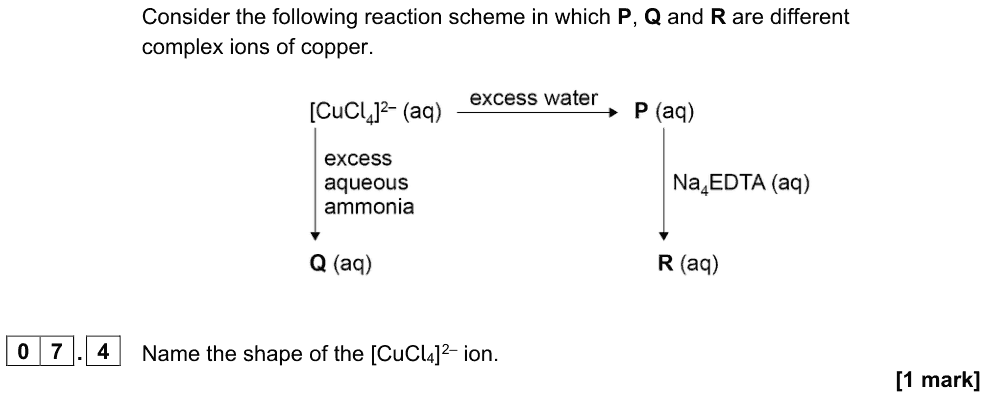
07.4 Transition metals 1AO3=1Short answer
07.5 Transition metals, Reactions of ions in aqueous solution 1AO3=1Equation writing
07.6 Transition metals, Reactions of ions in aqueous solution 2AO3=2Equation writing
07.7 Transition metals 1AO3=1Short answer
08.1 Electrode potentials and electrochemical cells 1AO2=1Short answer
08.2 Electrode potentials and electrochemical cells 1AO1=1Short answer
08.3 Electrode potentials and electrochemical cells 1AO3=1Equation writing
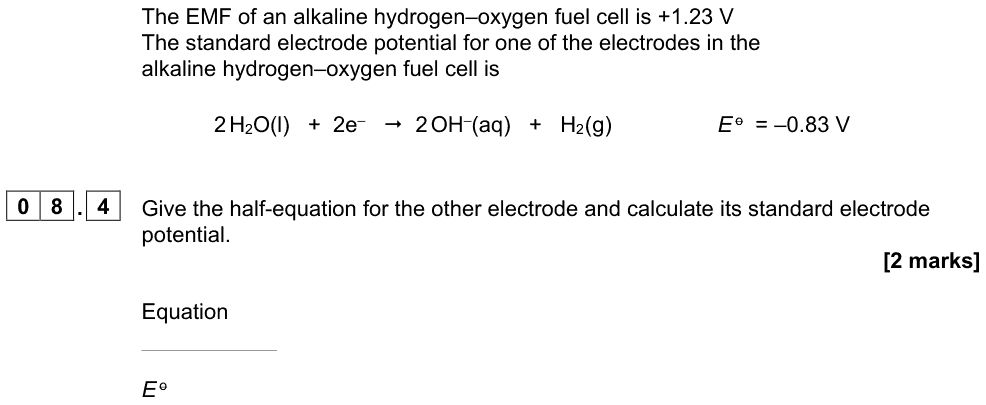
08.4 Electrode potentials and electrochemical cells 2Equation writing
08.5 Electrode potentials and electrochemical cells 1AO2=1Short answer

The questions

01.101.201.301.401.501.602.102.202.302.402.503.103.203.303.403.504.104.204.304.404.505.105.205.305.405.505.605.706.106.206.306.406.506.606.707.107.207.307.407.507.607.708.108.208.308.408.5
June 2022 · Paper 1 · Q01.1 2 marks AO1=2 Short answer Hard chemical equilibria and kc
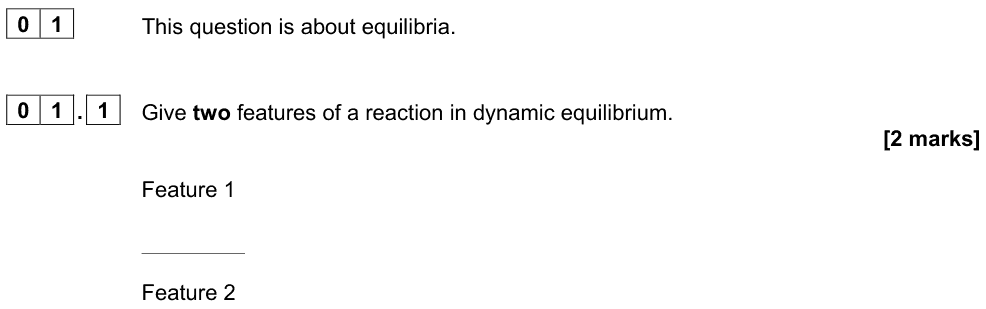
This question is about equilibria.
Give two features of a reaction in dynamic equilibrium.
[2 marks]
Feature 1
Feature 2
June 2022 · Paper 1 · Q01.2 1 mark AO3=1 Short answer chemical equilibria and kcequilibrium constant kp
Earlier part of question 01 that this part usesEarlier part of June 2022 Paper 1 question 01
A gas-phase reaction is at equilibrium.
When the pressure is increased the yield of product decreases.
State what can be deduced about the chemical equation for this equilibrium.
[1 mark]
June 2022 · Paper 1 · Q01.3 3 marks AO2=3 Calculation Easy equilibrium constant kp
Earlier part of question 01 that this part usesEarlier part of June 2022 Paper 1 question 01
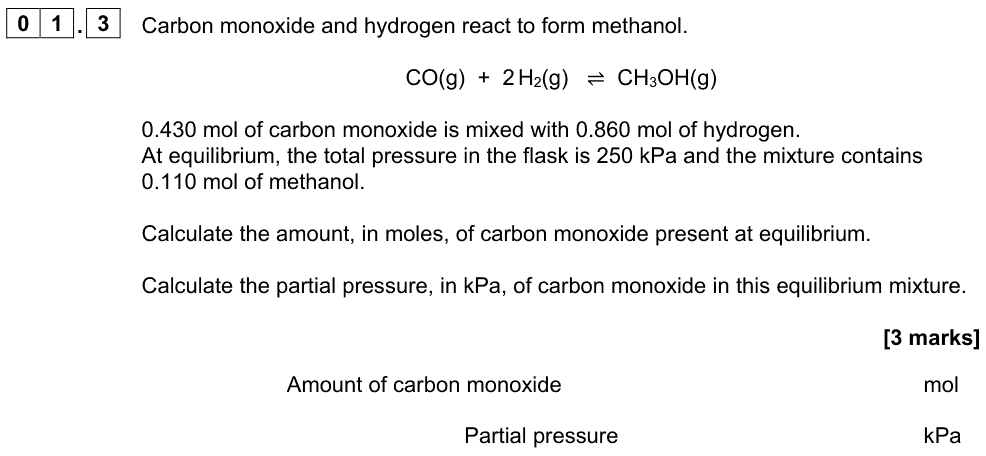
Carbon monoxide and hydrogen react to form methanol.
CO(g)  +  2 H2(g)   ⇌  CH3OH(g)
0.430 mol of carbon monoxide is mixed with 0.860 mol of hydrogen.
At equilibrium, the total pressure in the flask is 250 kPa and the mixture contains
0.110 mol of methanol.
Calculate the amount, in moles, of carbon monoxide present at equilibrium.
Calculate the partial pressure, in kPa, of carbon monoxide in this equilibrium mixture.
[3 marks]
Amount of carbon monoxide
mol
Partial pressure
kPa
June 2022 · Paper 1 · Q01.4 1 mark AO1=1 Short answer equilibrium constant kp
Earlier part of question 01 that this part usesEarlier part of June 2022 Paper 1 question 01
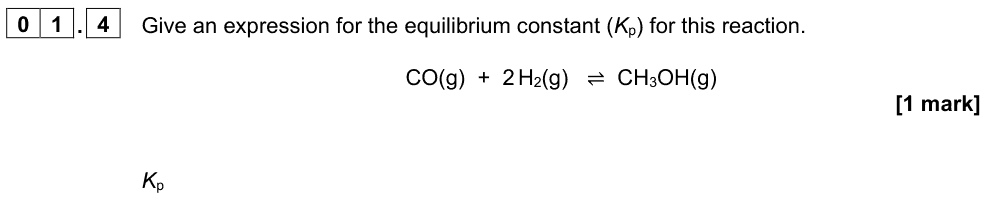
Give an expression for the equilibrium constant (Kp) for this reaction.
CO(g)  +  2 H2(g)   ⇌  CH3OH(g)
[1 mark]
Kp
June 2022 · Paper 1 · Q01.5 3 marks AO2=3 Calculation equilibrium constant kp
Earlier part of question 01 that this part usesEarlier part of June 2022 Paper 1 question 01
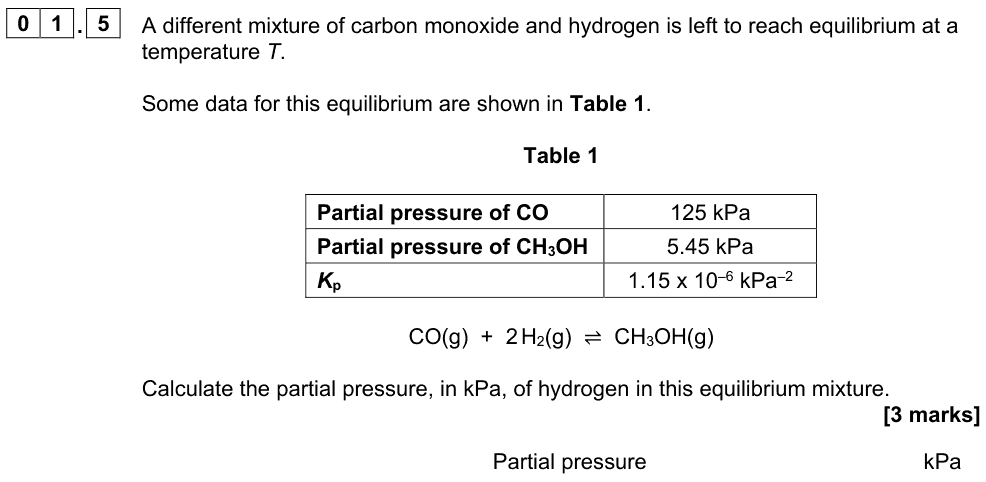
A different mixture of carbon monoxide and hydrogen is left to reach equilibrium at a
temperature T.
Some data for this equilibrium are shown in Table 1.
Table 1
Partial pressure of CO
125 kPa
Partial pressure of CH3OH
5.45 kPa
Kp
1.15 x 10⁻⁶ kPa–2
CO(g)  +  2 H2(g)  ⇌  CH3OH(g)
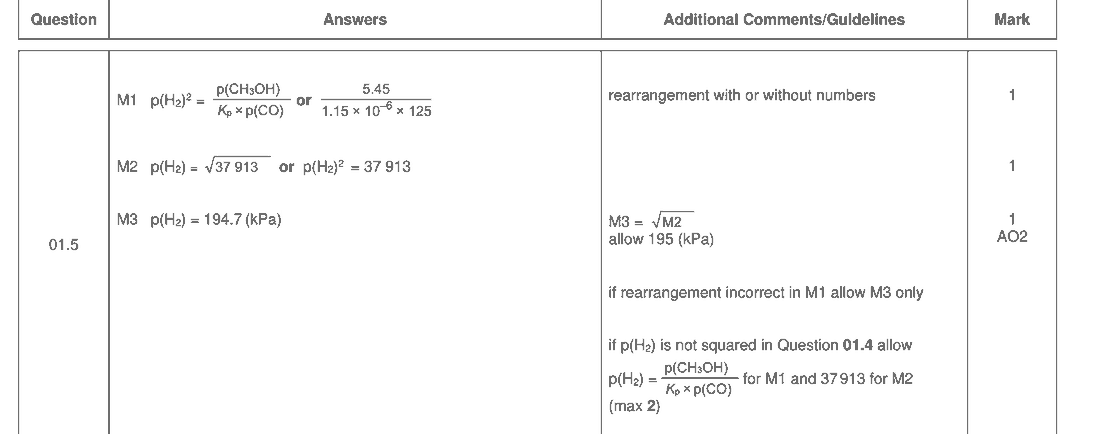
Calculate the partial pressure, in kPa, of hydrogen in this equilibrium mixture.
[3 marks]
Partial pressure
kPa
June 2022 · Paper 1 · Q01.6 2 marks AO2=2 Calculation equilibrium constant kp
Earlier parts of question 01 that this part usesEarlier part of June 2022 Paper 1 question 01Earlier part of June 2022 Paper 1 question 01
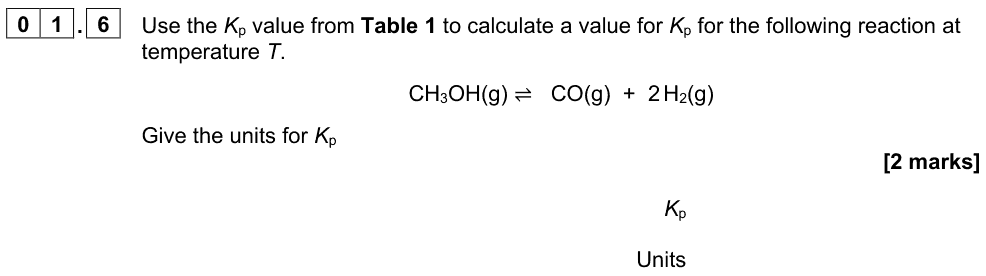
Use the Kp value from Table 1 to calculate a value for Kp for the following reaction at
temperature T.
CH3OH(g) ⇌   CO(g)  +  2 H2(g)
Give the units for Kp
[2 marks]
Kp
Units
June 2022 · Paper 1 · Q02.1 2 marks AO1=2 Short answer Hard amount of substance
Rhenium has an atomic number of 75
Define the term relative atomic mass.
[2 marks]
June 2022 · Paper 1 · Q02.2 2 marks AO2=2 Calculation atomic structure
Earlier part of question 02 that this part usesEarlier part of June 2022 Paper 1 question 02
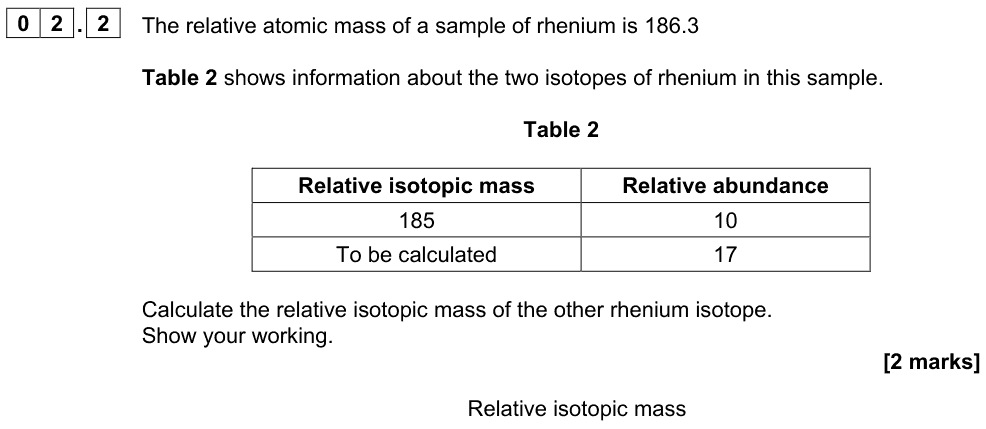
The relative atomic mass of a sample of rhenium is 186.3
Table 2 shows information about the two isotopes of rhenium in this sample.
Table 2
Relative isotopic mass
Relative abundance
185
10
To be calculated
17
Calculate the relative isotopic mass of the other rhenium isotope.
Show your working.
[2 marks]
Relative isotopic mass
June 2022 · Paper 1 · Q02.3 1 mark AO1=1 Short answer atomic structure
Earlier part of question 02 that this part usesEarlier part of June 2022 Paper 1 question 02
State why the isotopes of rhenium have the same chemical properties.
[1 mark]
June 2022 · Paper 1 · Q02.4 5 marks Calculation atomic structureamount of substance
Earlier part of question 02 that this part usesEarlier part of June 2022 Paper 1 question 02
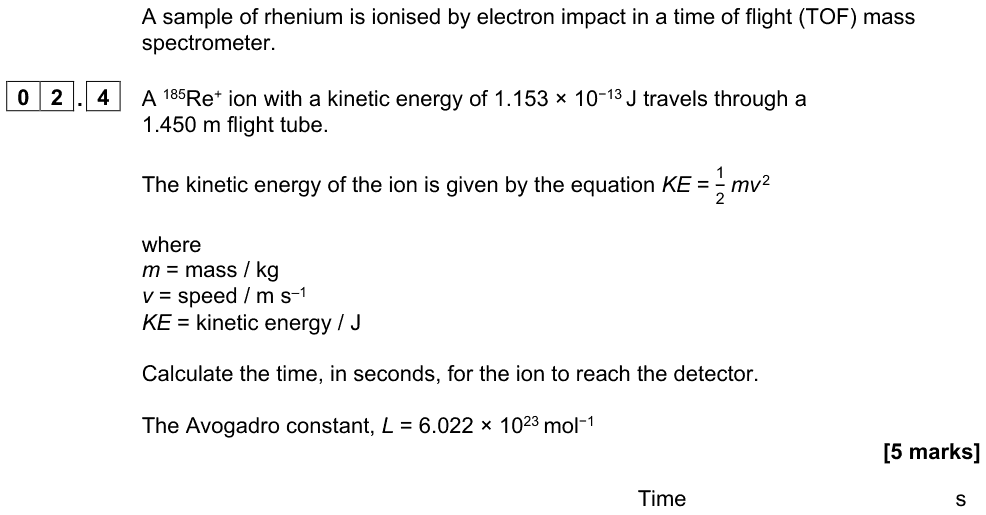
A sample of rhenium is ionised by electron impact in a time of flight (TOF) mass
spectrometer.
A 185Re+ ion with a kinetic energy of 1.153 × 10⁻¹³ J travels through a
1.450 m flight tube.
The kinetic energy of the ion is given by the equation KE =
1
2 mv  2
where
m = mass / kg
v = speed / m s–1
KE = kinetic energy / J
Calculate the time, in seconds, for the ion to reach the detector.
The Avogadro constant, L = 6.022 × 10²³ mol−1
[5 marks]
Time
s
June 2022 · Paper 1 · Q02.5 2 marks AO1=2 Short answer Hard atomic structure
Earlier part of question 02 that this part usesEarlier part of June 2022 Paper 1 question 02
State how the relative abundance of 185Re+ is determined in a TOF mass
spectrometer.
[2 marks]
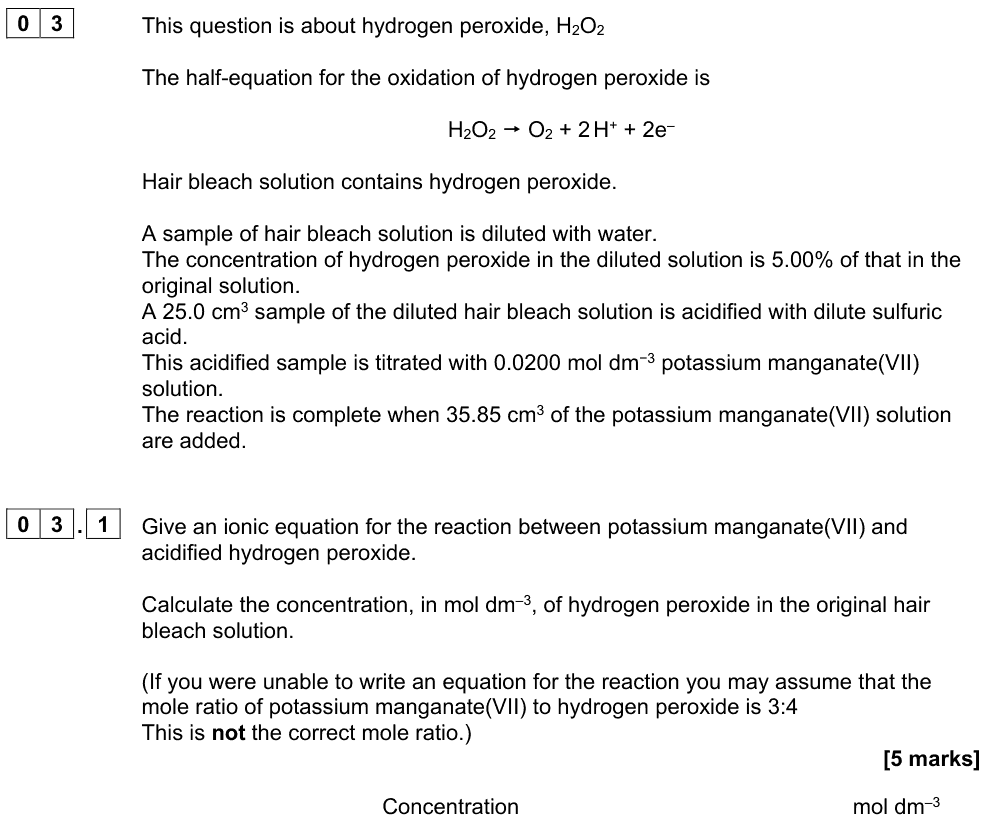
June 2022 · Paper 1 · Q03.1 5 marks AO2=5 Calculation Hard transition metalsredox
This question is about hydrogen peroxide, H2O2
The half-equation for the oxidation of hydrogen peroxide is
H2O2  O2 + 2 H+ + 2e–
Hair bleach solution contains hydrogen peroxide.
A sample of hair bleach solution is diluted with water.
The concentration of hydrogen peroxide in the diluted solution is 5.00% of that in the
original solution.
A 25.0 cm3 sample of the diluted hair bleach solution is acidified with dilute sulfuric
acid.
This acidified sample is titrated with 0.0200 mol dm−3 potassium manganate(VII)
solution.
The reaction is complete when 35.85 cm3 of the potassium manganate(VII) solution
are added.
Give an ionic equation for the reaction between potassium manganate(VII) and
acidified hydrogen peroxide.
Calculate the concentration, in mol dm–3, of hydrogen peroxide in the original hair
bleach solution.
(If you were unable to write an equation for the reaction you may assume that the
mole ratio of potassium manganate(VII) to hydrogen peroxide is 3:4
This is not the correct mole ratio.)
[5 marks]
Concentration
mol dm–3
June 2022 · Paper 1 · Q03.2 1 mark AO1=1 Short answer transition metals
Earlier part of question 03 that this part usesEarlier part of June 2022 Paper 1 question 03
State why an indicator is not added in this titration.
[1 mark]
June 2022 · Paper 1 · Q03.3 1 mark AO2=1 Short answer redox
Earlier part of question 03 that this part usesEarlier part of June 2022 Paper 1 question 03
Give the oxidation state of oxygen in hydrogen peroxide.
[1 mark]
June 2022 · Paper 1 · Q03.4 5 marks Calculation amount of substance
Earlier part of question 03 that this part usesEarlier part of June 2022 Paper 1 question 03
Hydrogen peroxide decomposes to form water and oxygen.
Give an equation for this reaction.
Calculate the amount, in moles, of hydrogen peroxide that would be needed to
produce 185 cm3 of oxygen gas at 100 kPa and 298 K
The gas constant, R = 8.31 J K−1 mol−1
[5 marks]
Equation
Amount
mol
June 2022 · Paper 1 · Q03.5 5 marks Calculation Hard energetics
Earlier part of question 03 that this part usesEarlier part of June 2022 Paper 1 question 03
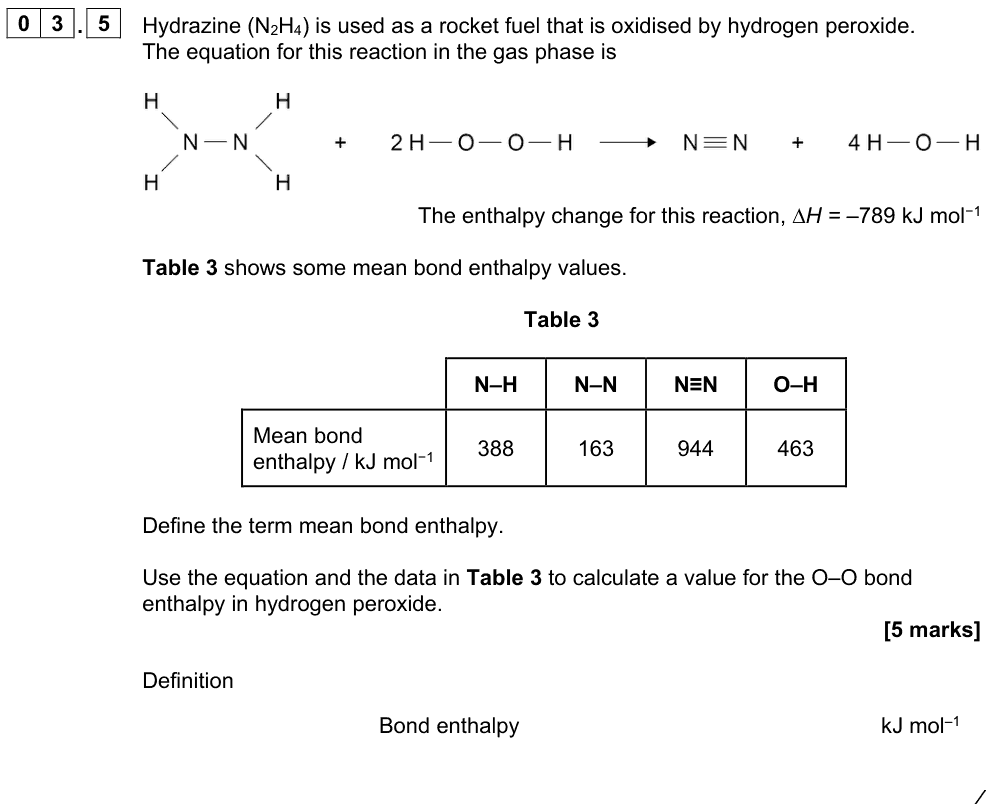
Hydrazine (N2H4) is used as a rocket fuel that is oxidised by hydrogen peroxide.
The equation for this reaction in the gas phase is
The enthalpy change for this reaction, ∆H = –789 kJ mol−1
Table 3 shows some mean bond enthalpy values.
Table 3
N–H
N–N
N≡N
O–H
Mean bond
enthalpy / kJ mol−1
388
163
944
463
Define the term mean bond enthalpy.
Use the equation and the data in Table 3 to calculate a value for the O–O bond
enthalpy in hydrogen peroxide.
[5 marks]
Definition
Bond enthalpy
kJ mol–1
June 2022 · Paper 1 · Q04.1 3 marks AO2=3 Calculation acids and bases
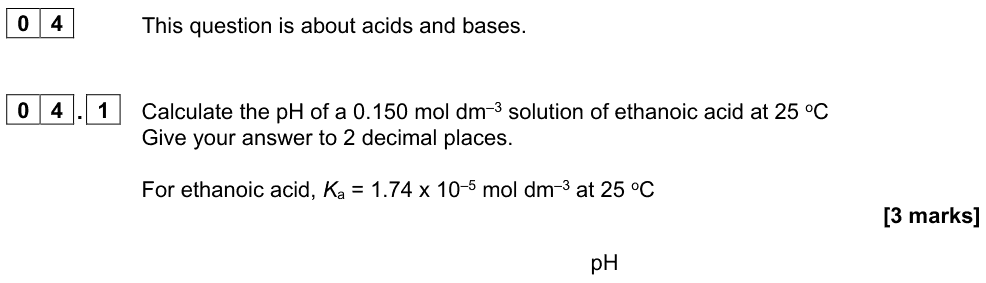
This question is about acids and bases.
Calculate the pH of a 0.150 mol dm–3 solution of ethanoic acid at 25 oC
Give your answer to 2 decimal places.
For ethanoic acid, Ka = 1.74 x 10⁻⁵ mol dm–3 at 25 oC
[3 marks]
pH
June 2022 · Paper 1 · Q04.2 3 marks AO2=3 Calculation acids and bases
Earlier part of question 04 that this part usesEarlier part of June 2022 Paper 1 question 04
Strontium is an element in Group 2.
Calculate the pH of a 0.0100 mol dm–3 solution of strontium hydroxide at 10 oC
You may assume that strontium hydroxide is completely dissociated in this solution.
At 10 oC the ionic product of water, Kw = 2.93 x 10⁻¹⁵ mol2 dm–6
[3 marks]
pH
June 2022 · Paper 1 · Q04.3 2 marks AO3=2 Short answer acids and bases
Earlier part of question 04 that this part usesEarlier part of June 2022 Paper 1 question 04
The pH of a barium hydroxide solution is lower at 50 °C than at 10 °C
At 50 °C a 25 cm3 sample of this barium hydroxide solution was neutralised by
22.45 cm3 of hydrochloric acid added from a burette.
Deduce the volume of this hydrochloric acid that should be added from a burette to
neutralise another 25 cm3 sample of this barium hydroxide solution at 10 °C
[2 marks]
Circle (       ) the correct answer.
˃ 22.45 cm3
= 22.45 cm3
˂ 22.45 cm3
Explain your answer
June 2022 · Paper 1 · Q04.4 3 marks AO3=3 Short answer Hard acids and bases
Earlier part of question 04 that this part usesEarlier part of June 2022 Paper 1 question 04
State how a buffer solution can be made from solutions of potassium hydroxide and
ethanoic acid.
Give an equation for the reaction between potassium hydroxide and ethanoic acid.
State how this buffer solution resists changes in pH when a small amount of acid is
added.
[3 marks]
How buffer solution is made
Equation
How buffer solution resists pH change
June 2022 · Paper 1 · Q04.5 5 marks Calculation acids and bases
Earlier part of question 04 that this part usesEarlier part of June 2022 Paper 1 question 04
A buffer solution is made by adding 2.00 g of sodium hydroxide to
500 cm3 of 1.00 mol dm–3 ethanoic acid solution.
Calculate the pH of this buffer solution at 25 °C
Give your answer to 2 decimal places.
For ethanoic acid, Ka = 1.74 x 10⁻⁵ mol dm–3 at 25 °C
[5 marks]
pH
June 2022 · Paper 1 · Q05.1 1 mark AO1=1 Short answer group 2
This question is about Period 3 elements and their compounds.
Which is not a correct statement about magnesium hydroxide?
[1 mark]
Tick ()  one box.
It is used to neutralise stomach acid
It forms a solution with pH = 14 at 25 °C
It has the empirical formula H2MgO2
June 2022 · Paper 1 · Q05.2 1 mark AO2=1 Equation writing period 3 elements and oxides
Earlier part of question 05 that this part usesEarlier part of June 2022 Paper 1 question 05
Give an equation for the reaction of aluminium oxide with sulfuric acid.
[1 mark]
June 2022 · Paper 1 · Q05.3 3 marks AO3=3 Practical and data analysis Hard period 3 elements and oxides
Earlier part of question 05 that this part usesEarlier part of June 2022 Paper 1 question 05
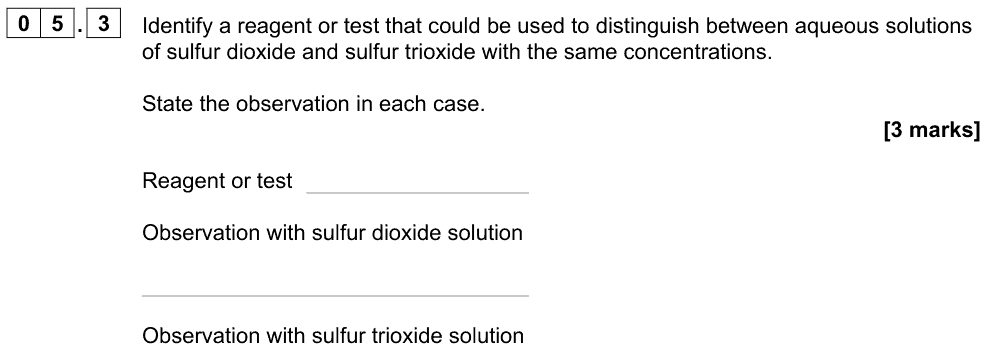
Identify a reagent or test that could be used to distinguish between aqueous solutions
of sulfur dioxide and sulfur trioxide with the same concentrations.
State the observation in each case.
[3 marks]
Reagent or test
Observation with sulfur dioxide solution
Observation with sulfur trioxide solution
June 2022 · Paper 1 · Q05.4 2 marks AO3=2 Short answer atomic structure
Earlier part of question 05 that this part usesEarlier part of June 2022 Paper 1 question 05
The mass spectrum of the element phosphorus has a peak at
m
z = 124
Give the formula of the species responsible for this peak.
[2 marks]
June 2022 · Paper 1 · Q05.5 1 mark AO1=1 Equation writing Hard period 3 elements and oxides
Earlier part of question 05 that this part usesEarlier part of June 2022 Paper 1 question 05
Give an equation for the reaction of phosphorus(V) oxide with sodium hydroxide
solution.
[1 mark]
June 2022 · Paper 1 · Q05.6 1 mark AO2=1 Diagram or structure period 3 elements and oxides
Earlier part of question 05 that this part usesEarlier part of June 2022 Paper 1 question 05
Draw the displayed formula of the molecule formed when phosphorus(V) oxide reacts
with water.
[1 mark]
June 2022 · Paper 1 · Q05.7 6 marks 6-mark level of response Hard bonding
Earlier part of question 05 that this part usesEarlier part of June 2022 Paper 1 question 05
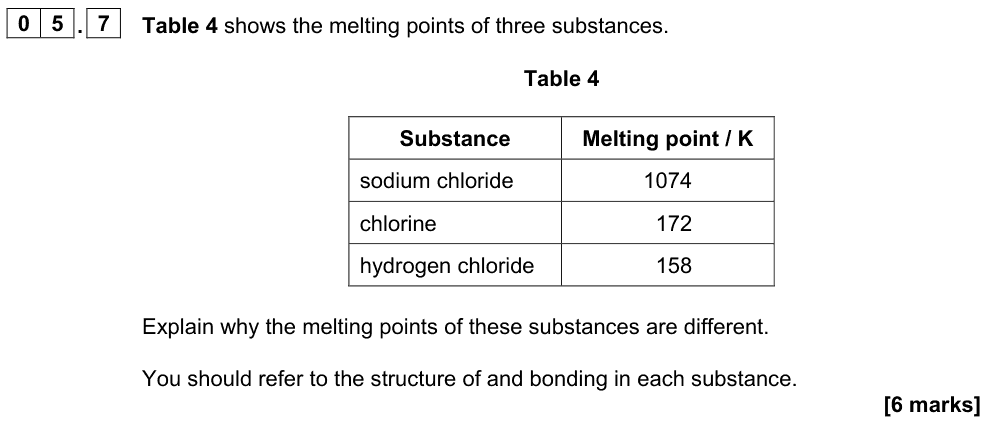
Table 4 shows the melting points of three substances.
Table 4
Substance
Melting point / K
sodium chloride
1074
chlorine
172
hydrogen chloride
158
Explain why the melting points of these substances are different.
You should refer to the structure of and bonding in each substance.
[6 marks]
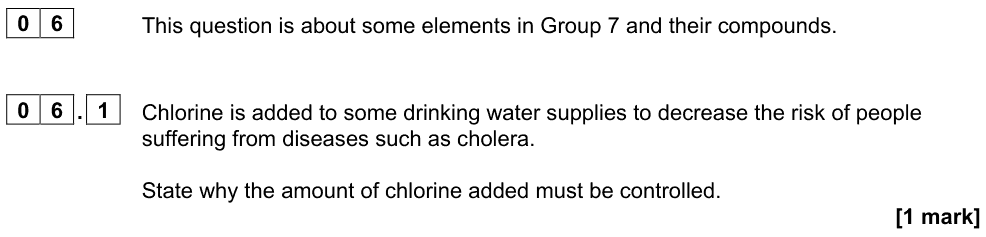
June 2022 · Paper 1 · Q06.1 1 mark AO1=1 Short answer group 7 the halogens
This question is about some elements in Group 7 and their compounds.
Chlorine is added to some drinking water supplies to decrease the risk of people
suffering from diseases such as cholera.
State why the amount of chlorine added must be controlled.
[1 mark]
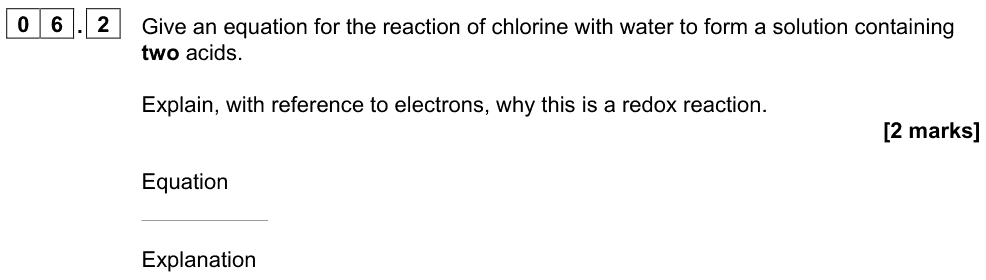
June 2022 · Paper 1 · Q06.2 2 marks AO1=2 Equation writing group 7 the halogensredox
Earlier part of question 06 that this part usesEarlier part of June 2022 Paper 1 question 06
Give an equation for the reaction of chlorine with water to form a solution containing
two acids.
Explain, with reference to electrons, why this is a redox reaction.
[2 marks]
Equation
Explanation
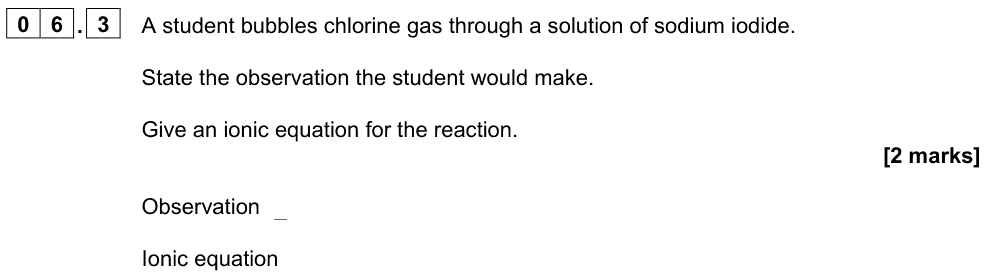
June 2022 · Paper 1 · Q06.3 2 marks Equation writing Hard group 7 the halogens
Earlier part of question 06 that this part usesEarlier part of June 2022 Paper 1 question 06
A student bubbles chlorine gas through a solution of sodium iodide.
State the observation the student would make.
Give an ionic equation for the reaction.
[2 marks]
Observation
Ionic equation
June 2022 · Paper 1 · Q06.4 3 marks AO1=3 Equation writing group 7 the halogensredox
Earlier part of question 06 that this part usesEarlier part of June 2022 Paper 1 question 06
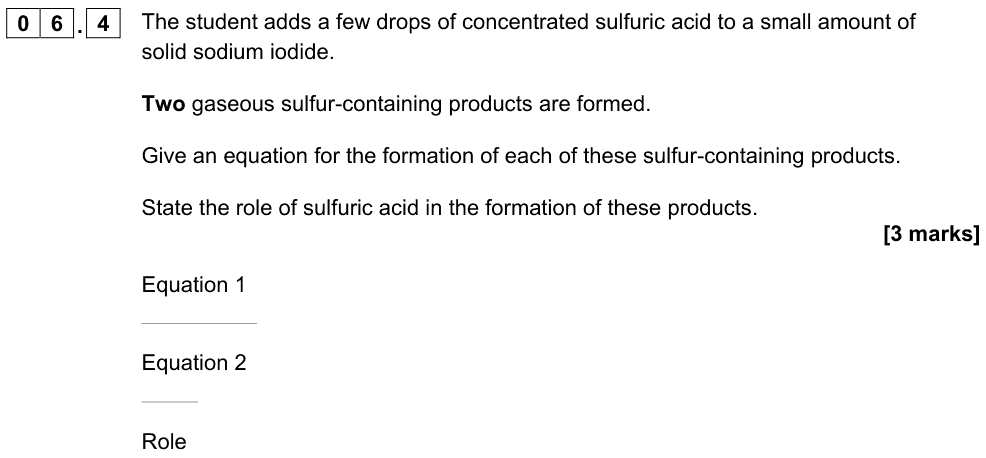
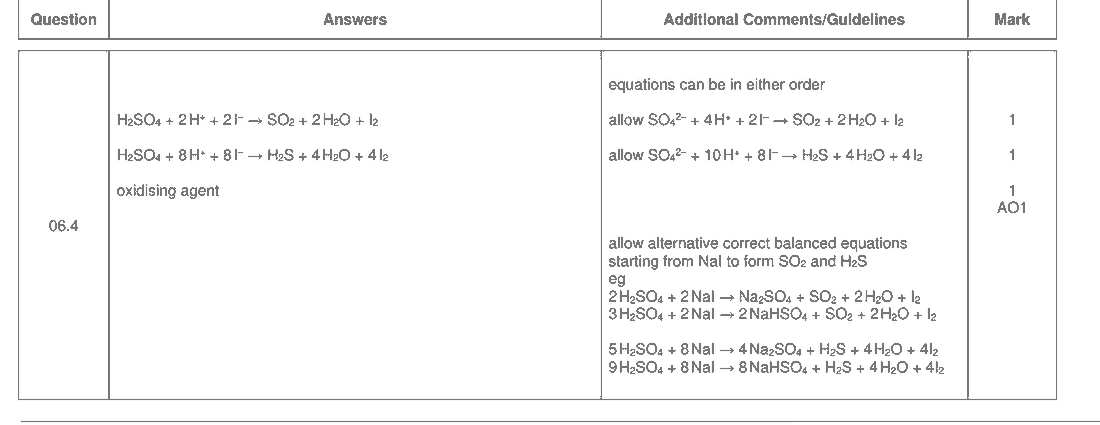
The student adds a few drops of concentrated sulfuric acid to a small amount of
solid sodium iodide.
Two gaseous sulfur-containing products are formed.
Give an equation for the formation of each of these sulfur-containing products.
State the role of sulfuric acid in the formation of these products.
[3 marks]
Equation 1
Equation 2
Role
June 2022 · Paper 1 · Q06.5 3 marks Short answer Hard group 7 the halogens
Earlier part of question 06 that this part usesEarlier part of June 2022 Paper 1 question 06
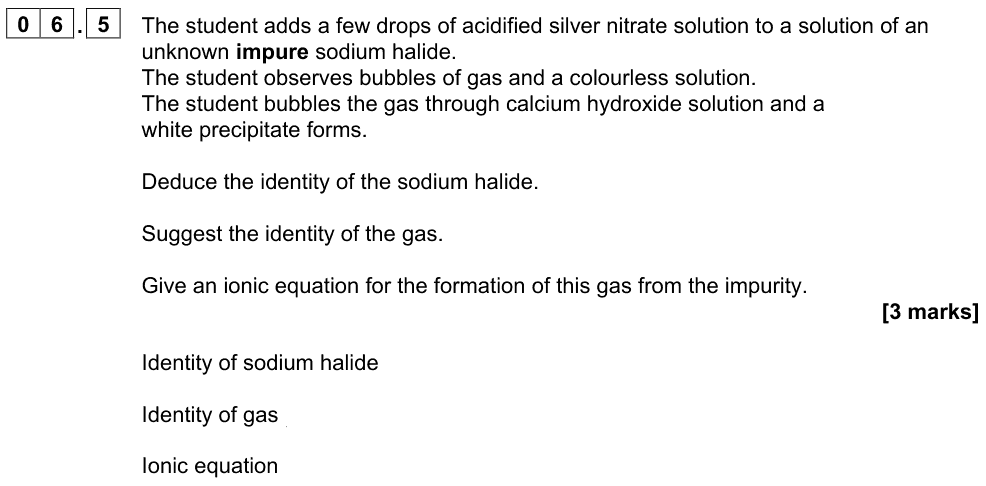
The student adds a few drops of acidified silver nitrate solution to a solution of an
unknown impure sodium halide.
The student observes bubbles of gas and a colourless solution.
The student bubbles the gas through calcium hydroxide solution and a
white precipitate forms.
Deduce the identity of the sodium halide.
Suggest the identity of the gas.
Give an ionic equation for the formation of this gas from the impurity.
[3 marks]
Identity of sodium halide
Identity of gas
Ionic equation
June 2022 · Paper 1 · Q06.6 3 marks Diagram or structure bonding
Earlier part of question 06 that this part usesEarlier part of June 2022 Paper 1 question 06
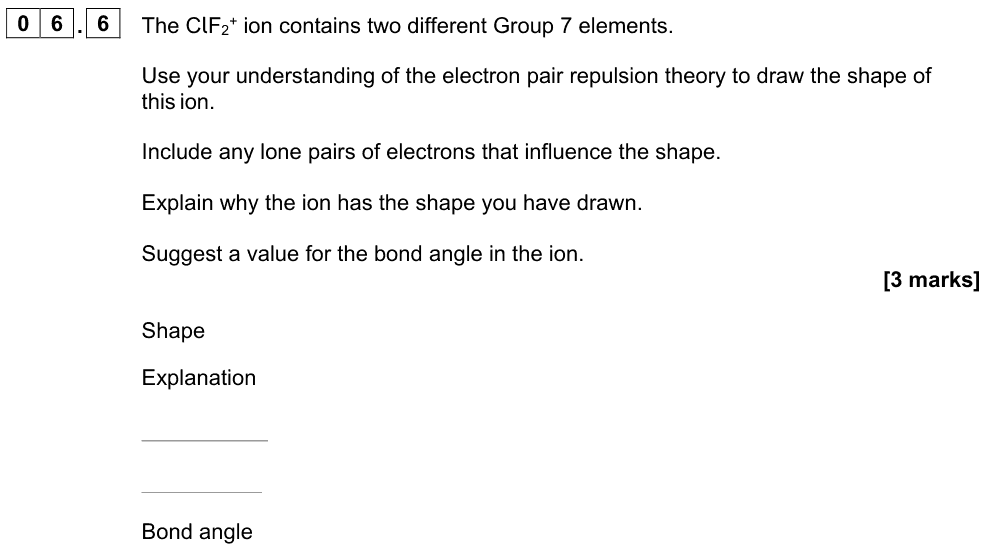
The ClF2+ ion contains two different Group 7 elements.
Use your understanding of the electron pair repulsion theory to draw the shape of
this ion.
Include any lone pairs of electrons that influence the shape.
Explain why the ion has the shape you have drawn.
Suggest a value for the bond angle in the ion.
[3 marks]
Shape
Explanation
Bond angle
June 2022 · Paper 1 · Q06.7 1 mark AO2=1 Equation writing group 2
Earlier part of question 06 that this part usesEarlier part of June 2022 Paper 1 question 06
Magnesium is used in the extraction of titanium from titanium(IV) chloride.
Give an equation for this reaction.
[1 mark]
June 2022 · Paper 1 · Q07.1 2 marks AO2=2 Explanation transition metals
Copper(II) complexes are coloured.
The colour is caused by the d electrons of copper moving from their ground state to
an excited state.
Explain why aqueous solutions containing [CuCl4] 2– ions are yellow.
[2 marks]
June 2022 · Paper 1 · Q07.2 2 marks AO2=2 Calculation transition metals
Earlier part of question 07 that this part usesEarlier part of June 2022 Paper 1 question 07
When a d electron moves from the ground state to the excited state in a
copper complex, the energy change is 3.98 x 10⁻¹⁹ J
The Planck constant, h = 6.63 × 10⁻³⁴ J s
Calculate the frequency, in s–1, of the light absorbed.
[2 marks]
Frequency
s–1
June 2022 · Paper 1 · Q07.3 3 marks AO1=3 Short answer transition metals
Earlier part of question 07 that this part usesEarlier part of June 2022 Paper 1 question 07
State three ways in which a transition metal complex can be changed to alter its
colour.
[3 marks]
1
2
3
June 2022 · Paper 1 · Q07.4 1 mark AO3=1 Short answer transition metals
Earlier part of question 07 that this part usesEarlier part of June 2022 Paper 1 question 07
Consider the following reaction scheme in which P, Q and R are different
complex ions of copper.
Name the shape of the [CuCl4] 2– ion.
[1 mark]
June 2022 · Paper 1 · Q07.5 1 mark AO3=1 Equation writing transition metalsreactions of ions in aqueous solution
Earlier parts of question 07 that this part usesEarlier part of June 2022 Paper 1 question 07Earlier part of June 2022 Paper 1 question 07
Give an ionic equation for the conversion of [CuCl4] 2– to complex ion P.
[1 mark]
June 2022 · Paper 1 · Q07.6 2 marks AO3=2 Equation writing transition metalsreactions of ions in aqueous solution
Earlier parts of question 07 that this part usesEarlier part of June 2022 Paper 1 question 07Earlier part of June 2022 Paper 1 question 07
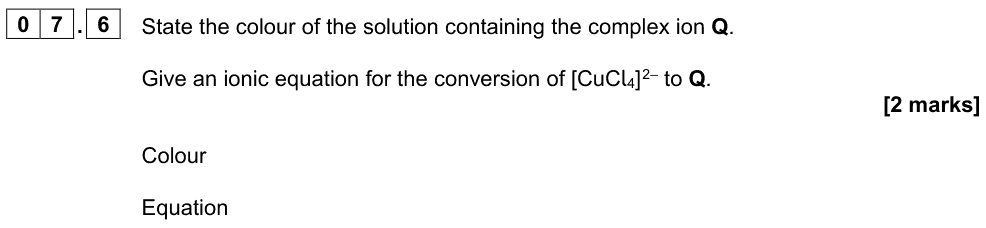
State the colour of the solution containing the complex ion Q.
Give an ionic equation for the conversion of [CuCl4] 2– to Q.
[2 marks]
Colour
Equation
June 2022 · Paper 1 · Q07.7 1 mark AO3=1 Short answer transition metals
Earlier parts of question 07 that this part usesEarlier part of June 2022 Paper 1 question 07Earlier part of June 2022 Paper 1 question 07
Identify complex ion R.
[1 mark]
June 2022 · Paper 1 · Q08.1 1 mark AO2=1 Short answer electrode potentials and cells
This question is about cells.
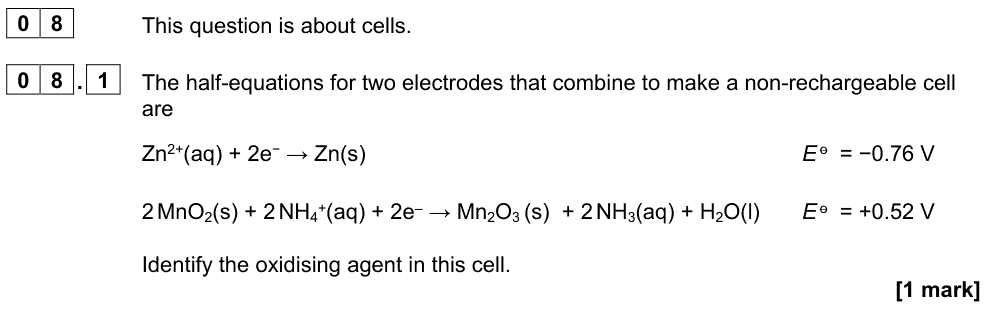
The half-equations for two electrodes that combine to make a non-rechargeable cell
are
Zn2+(aq) + 2e− → Zn(s)
E o  = −0.76 V
2 MnO2(s) + 2 NH4+(aq) + 2e– → Mn2O3 (s)  + 2 NH3(aq) + H2O(l)
E o  = +0.52 V
Identify the oxidising agent in this cell.
[1 mark]
June 2022 · Paper 1 · Q08.2 1 mark AO1=1 Short answer electrode potentials and cells
Earlier part of question 08 that this part usesEarlier part of June 2022 Paper 1 question 08
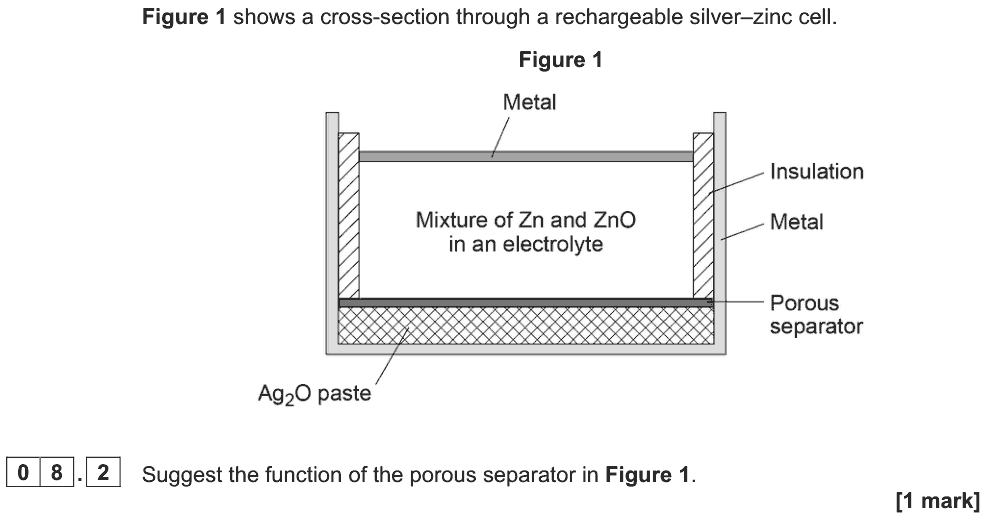
Figure 1 shows a cross-section through a rechargeable silver–zinc cell.
Figure 1
Suggest the function of the porous separator in Figure 1.
[1 mark]
June 2022 · Paper 1 · Q08.3 1 mark AO3=1 Equation writing Hard electrode potentials and cells
Earlier part of question 08 that this part usesEarlier part of June 2022 Paper 1 question 08
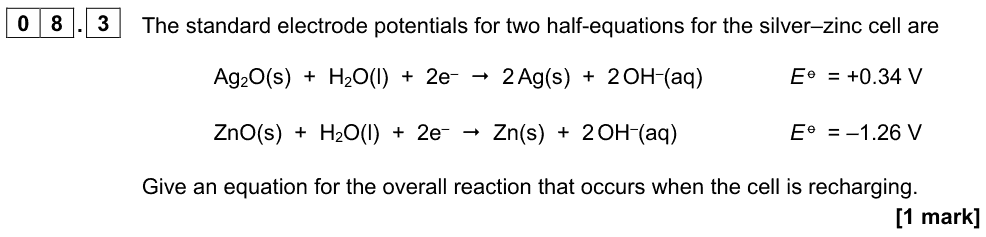
The standard electrode potentials for two half-equations for the silver–zinc cell are
Ag2O(s)  +  H2O(l)  +  2e–    2 Ag(s)  +  2 OH–(aq)
E o  = +0.34 V
ZnO(s)  +  H2O(l)  +  2e–    Zn(s)  +  2 OH–(aq)
E o  = –1.26 V
Give an equation for the overall reaction that occurs when the cell is recharging.
[1 mark]
June 2022 · Paper 1 · Q08.4 2 marks Equation writing Hard electrode potentials and cells
Earlier part of question 08 that this part usesEarlier part of June 2022 Paper 1 question 08
The EMF of an alkaline hydrogen–oxygen fuel cell is +1.23 V
The standard electrode potential for one of the electrodes in the
alkaline hydrogen–oxygen fuel cell is
2 H2O(l)   +  2e–     2 OH–(aq)   +   H2 (g)
E o  = –0.83 V
Give the half-equation for the other electrode and calculate its standard electrode
potential.
[2 marks]
Equation
E o
June 2022 · Paper 1 · Q08.5 1 mark AO2=1 Short answer electrode potentials and cells
Earlier parts of question 08 that this part usesEarlier part of June 2022 Paper 1 question 08Earlier part of June 2022 Paper 1 question 08
Suggest why the EMF values of the acidic and alkaline hydrogen–oxygen fuel cells
are the same.
[1 mark]

Work with an A-level chemistry tutor

Want a paper marked and gone through with you? Message us.

Prefer email? Send an enquiry

If you are under 18, please include a parent's contact details. Enquiries go to enquiries@chemistryaleveltutor.com and are deleted once handled. All tutoring is online.