June 2017: Paper 1, Inorganic and physical chemistry

105 marks · 42 question parts · Paper, mark scheme and report on AQA's site · Have the Data Booklet beside you

Question by question

QTopicMarksAOType
01.1 Thermodynamics: Born–Haber cycles, entropy and Gibbs free energy 2Short answer
01.2 Thermodynamics: Born–Haber cycles, entropy and Gibbs free energy 2Calculation
01.3 Thermodynamics: Born–Haber cycles, entropy and Gibbs free energy 2Explanation
01.4 Group 7(17), the halogens 2Short answer
02.1 Acids and bases: pH, Ka, titration curves and buffers 3Calculation
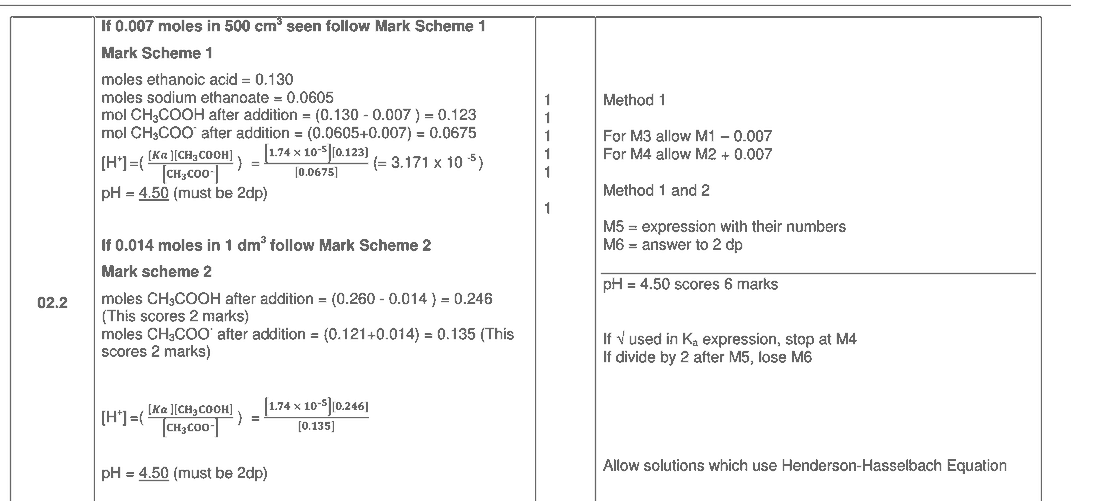
02.2 Acids and bases: pH, Ka, titration curves and buffers 6Calculation
03.1 Acids and bases: pH, Ka, titration curves and buffers 1Short answer
03.2 Acids and bases: pH, Ka, titration curves and buffers 2Calculation
03.3 Acids and bases: pH, Ka, titration curves and buffers 1Short answer
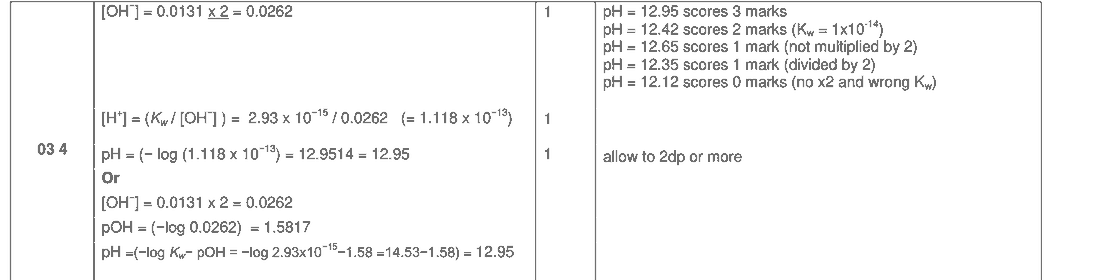
03.4 Acids and bases: pH, Ka, titration curves and buffers 3Calculation
03.5 Group 2, the alkaline earth metals 2Explanation
04.1 Atomic structure 2Calculation
04.2 Atomic structure 2Equation writing
04.3 Amount of substance 1Calculation
04.4 Atomic structure 3Calculation
05.1 Thermodynamics: Born–Haber cycles, entropy and Gibbs free energy 6Calculation
06.1 Period 3 elements and their oxides 1Equation writing
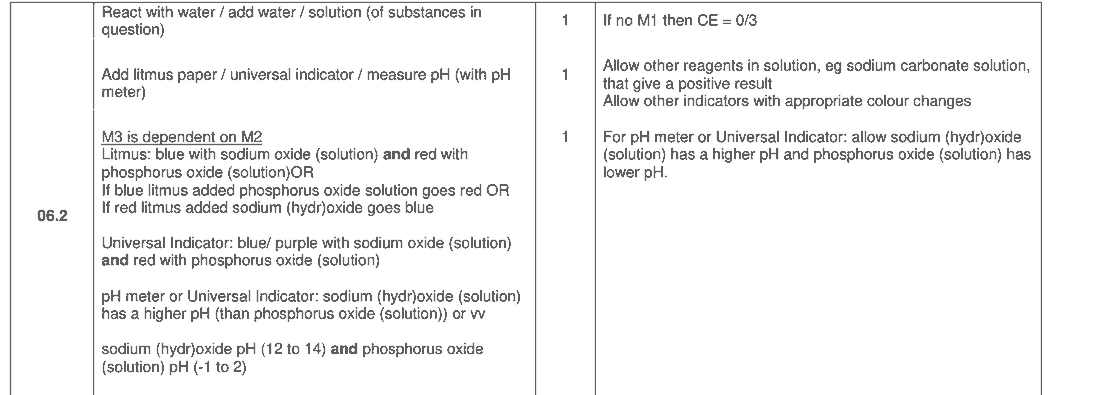
06.2 Period 3 elements and their oxides 3Practical and data analysis
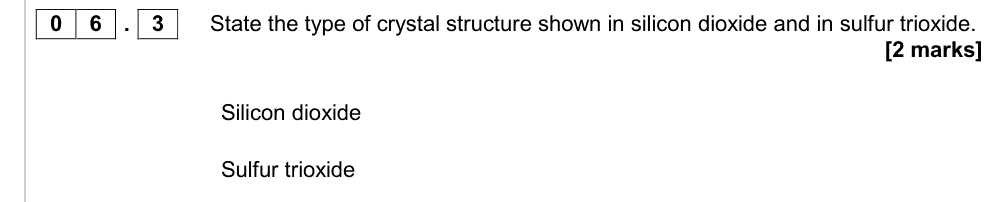
06.3 Period 3 elements and their oxides, Bonding 2Short answer
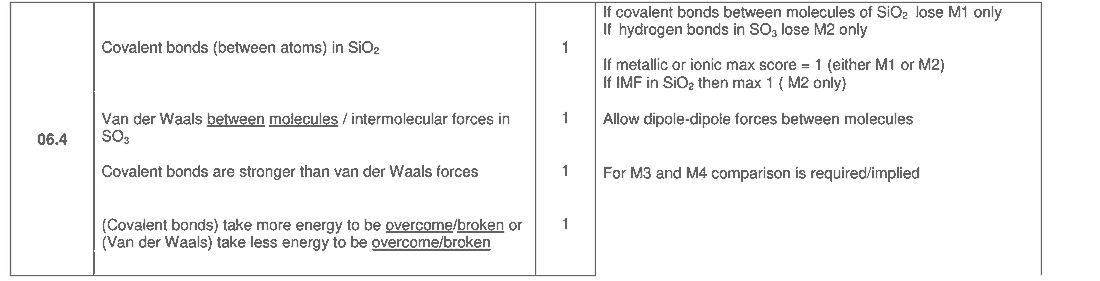
06.4 Period 3 elements and their oxides 4Explanation
06.5 Period 3 elements and their oxides 1Equation writing
06.6 Period 3 elements and their oxides 1Equation writing
06.7 Period 3 elements and their oxides 1Diagram or structure
07.1 Bonding 1Short answer
07.2 Transition metals 1Short answer
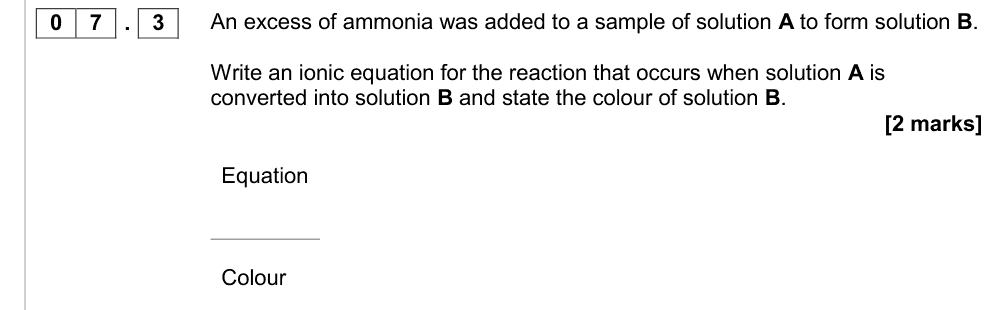
07.3 Transition metals, Reactions of ions in aqueous solution 2Equation writing
07.4 Reactions of ions in aqueous solution 1Short answer
07.5 Transition metals 2Equation writing
07.6 Transition metals 2Explanation
08.1 Group 2, the alkaline earth metals 3Practical and data analysis
08.2 Reactions of ions in aqueous solution 3Practical and data analysis
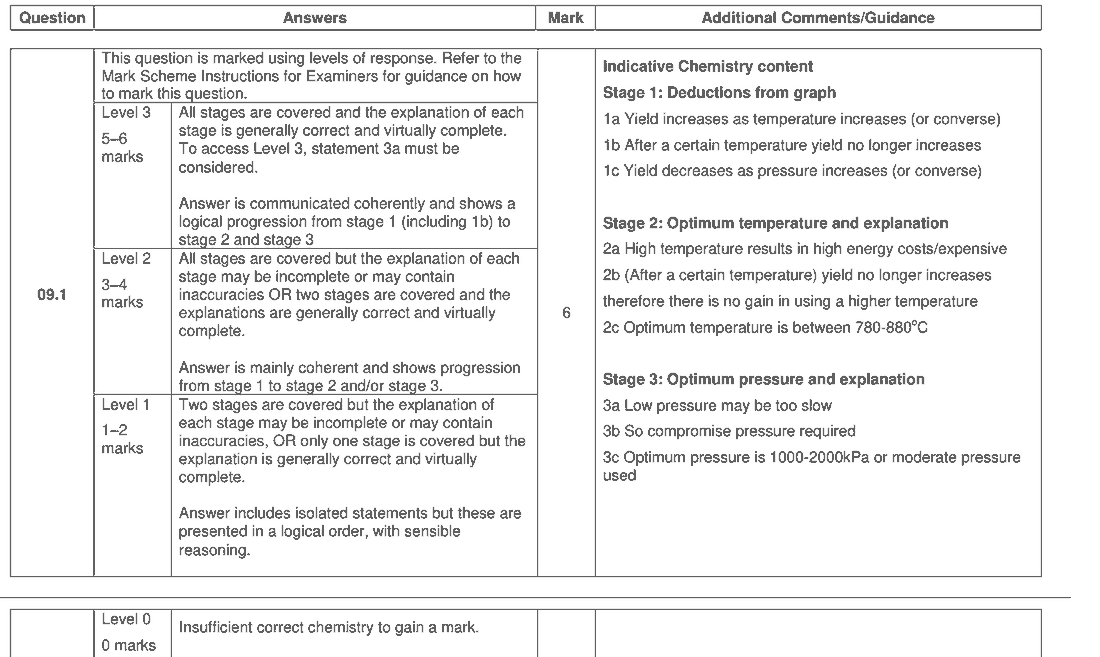
09.1 Chemical equilibria, Le Chatelier's principle and Kc 6Level of response
09.2 Chemical equilibria, Le Chatelier's principle and Kc 2Calculation
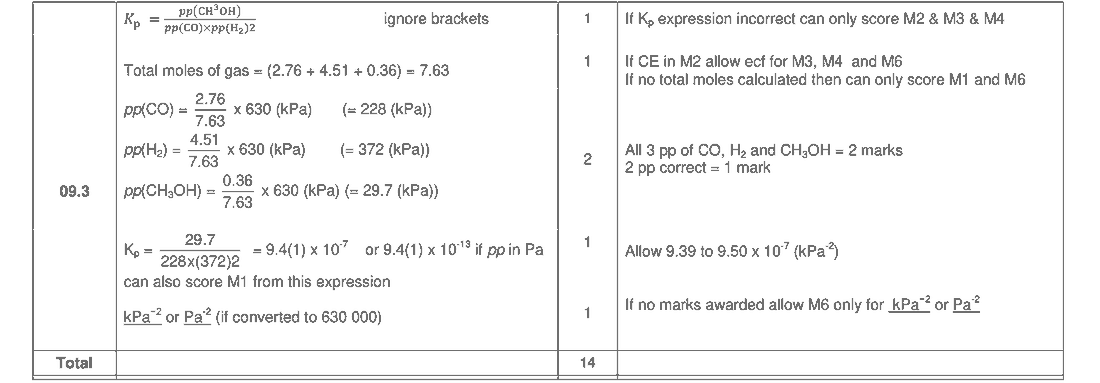
09.3 Equilibrium constant Kp 6Calculation
10.1 Oxidation, reduction and redox equations 2Short answer
10.2 Electrode potentials and electrochemical cells, Oxidation, reduction and redox equations 1Short answer
10.3 Electrode potentials and electrochemical cells 2Short answer
10.4 Electrode potentials and electrochemical cells, Oxidation, reduction and redox equations 4Explanation
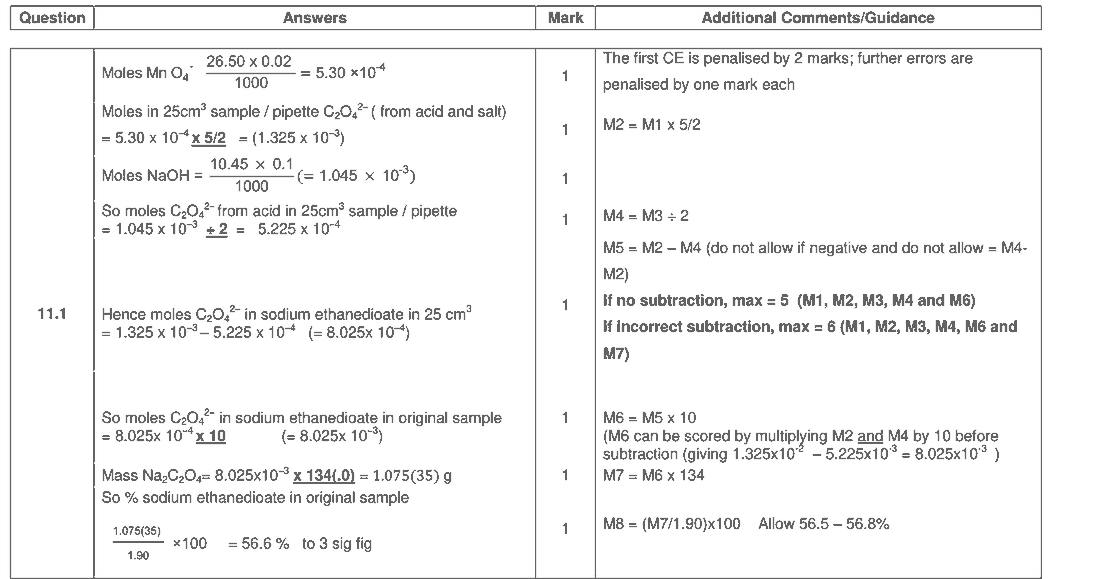
11.1 Transition metals, Acids and bases: pH, Ka, titration curves and buffers, Amount of substance 8Calculation
11.2 Transition metals 2Equation writing
11.3 Transition metals 3Diagram or structure
11.4 Transition metals 1Short answer

The questions

01.101.201.301.402.102.203.103.203.303.403.504.104.204.304.405.106.106.206.306.406.506.606.707.107.207.307.407.507.608.108.209.109.209.310.110.210.310.411.111.211.311.4
June 2017 · Paper 1 · Q01.1 2 marks Short answer thermodynamics
This question is about silver iodide.
Define the term enthalpy of lattice formation.
[2 marks]
June 2017 · Paper 1 · Q01.2 2 marks Calculation thermodynamics
Earlier part of question 01 that this part usesEarlier part of June 2017 Paper 1 question 01
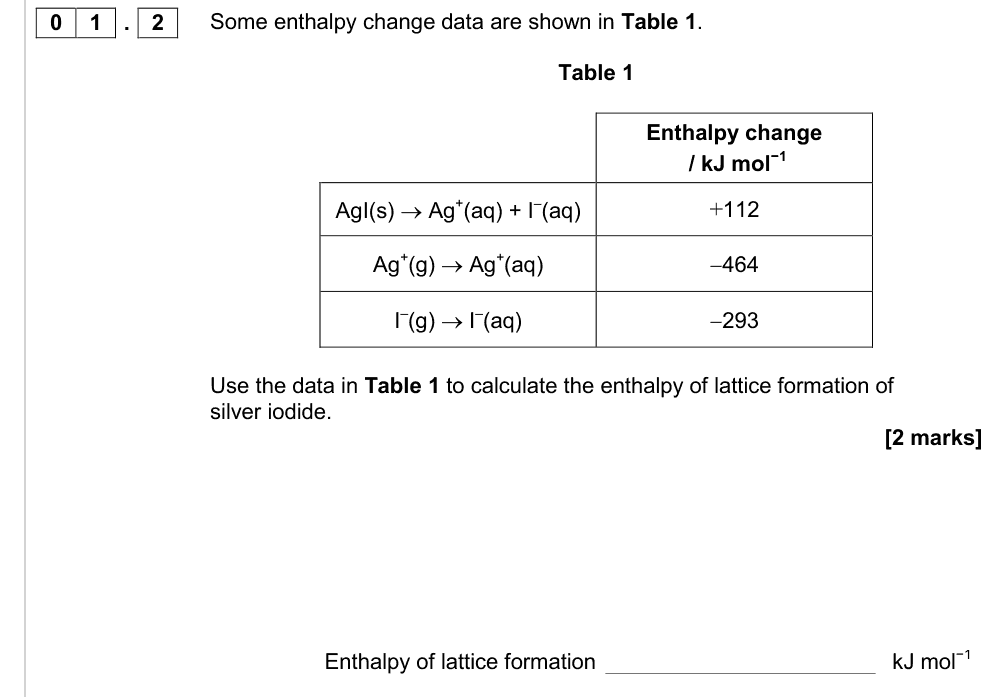
Some enthalpy change data are shown in Table 1.
Table 1
Enthalpy change
/ kJ mol−1
AgI(s) → Ag+(aq) + I–(aq)

+112
Ag+(g) → Ag+(aq)
−464
I–(g) → I–(aq)
−293
Use the data in Table 1 to calculate the enthalpy of lattice formation of
silver iodide.
[2 marks]
Enthalpy of lattice formation
kJ mol−1
June 2017 · Paper 1 · Q01.3 2 marks Explanation thermodynamics
Earlier part of question 01 that this part usesEarlier part of June 2017 Paper 1 question 01
A calculation of the enthalpy of lattice formation of silver iodide based on a
perfect ionic model gives a smaller numerical value than the value calculated in
Question 1.2
Explain this difference.
[2 marks]
June 2017 · Paper 1 · Q01.4 2 marks Short answer group 7 the halogens
Earlier part of question 01 that this part usesEarlier part of June 2017 Paper 1 question 01
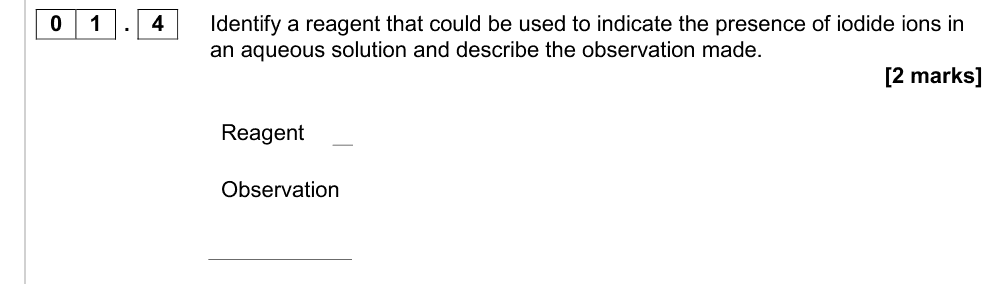
Identify a reagent that could be used to indicate the presence of iodide ions in
an aqueous solution and describe the observation made.
[2 marks]
Reagent
Observation
June 2017 · Paper 1 · Q02.1 3 marks Calculation acids and bases
This question is about acidic solutions.
The acid dissociation constant, Ka, for ethanoic acid is given by the expression
Ka =
COOH]
[CH
]
[H
]
COO
[CH
3
3
+
−
The value of Ka for ethanoic acid is 1.74 × 10⁻⁵ mol dm−3 at 25 °C
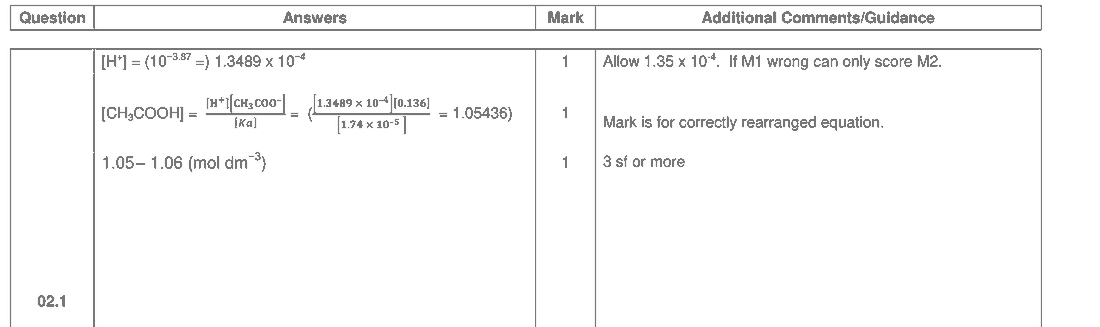
A buffer solution with a pH of 3.87 was prepared using ethanoic acid and
sodium ethanoate.  In the buffer solution, the concentration of ethanoate ions
was 0.136 mol dm−3
Calculate the concentration of the ethanoic acid in the buffer solution.
Give your answer to three significant figures.
[3 marks]
Concentration of acid
mol dm−3
June 2017 · Paper 1 · Q02.2 6 marks Calculation Hard acids and bases
Earlier part of question 02 that this part usesEarlier part of June 2017 Paper 1 question 02
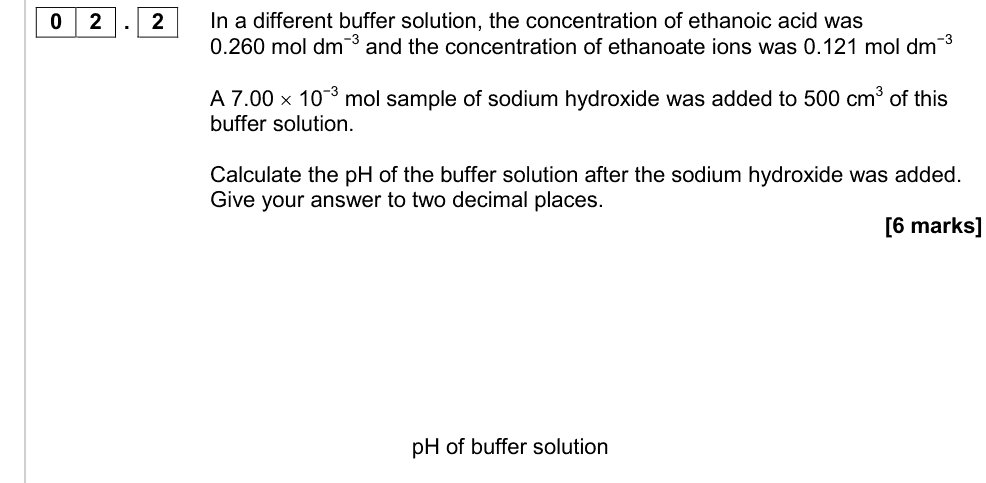
In a different buffer solution, the concentration of ethanoic acid was
0.260 mol dm−3 and the concentration of ethanoate ions was 0.121 mol dm−3
A 7.00 × 10⁻³ mol sample of sodium hydroxide was added to 500 cm3 of this
buffer solution.
Calculate the pH of the buffer solution after the sodium hydroxide was added.
Give your answer to two decimal places.
[6 marks]
pH of buffer solution
June 2017 · Paper 1 · Q03.1 1 mark Short answer Easy acids and bases
The ionic product of water, Kw = 2.93 × 10⁻¹⁵ mol2  dm−6 at 10 °C
Which is the correct expression for Kw?
Tick () one box.
[1 mark]
A Kw =
]
][OH
[H
O]
[H2
−
+
B Kw = [H+][H2O]
C Kw = [H+][OH−]
D Kw =
O]
[H
]
][OH
[H
2
−
+
June 2017 · Paper 1 · Q03.2 2 marks Calculation acids and bases
Earlier part of question 03 that this part usesEarlier part of June 2017 Paper 1 question 03
Calculate the pH of pure water at 10 °C
Give your answer to two decimal places.
[2 marks]
pH of water
June 2017 · Paper 1 · Q03.3 1 mark Short answer acids and bases
Earlier part of question 03 that this part usesEarlier part of June 2017 Paper 1 question 03
Suggest why this pure water at 10 °C is not alkaline.
[1 mark]
June 2017 · Paper 1 · Q03.4 3 marks Calculation acids and bases
Earlier part of question 03 that this part usesEarlier part of June 2017 Paper 1 question 03
Calculate the pH of a 0.0131 mol dm−3 solution of calcium hydroxide at 10 °C
Give your answer to two decimal places.
[3 marks]
pH of solution
June 2017 · Paper 1 · Q03.5 2 marks Explanation group 2
Earlier part of question 03 that this part usesEarlier part of June 2017 Paper 1 question 03
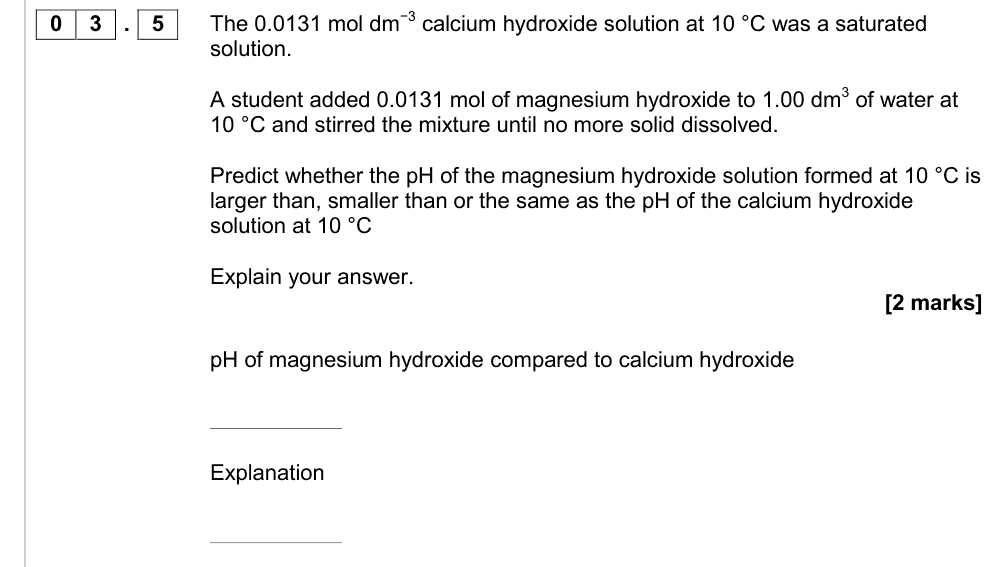
The 0.0131 mol dm−3 calcium hydroxide solution at 10 °C was a saturated
solution.
A student added 0.0131 mol of magnesium hydroxide to 1.00 dm3 of water at
10 °C and stirred the mixture until no more solid dissolved.
Predict whether the pH of the magnesium hydroxide solution formed at 10 °C is
larger than, smaller than or the same as the pH of the calcium hydroxide
solution at 10 °C
Explain your answer.
[2 marks]
pH of magnesium hydroxide compared to calcium hydroxide
Explanation
June 2017 · Paper 1 · Q04.1 2 marks Calculation atomic structure
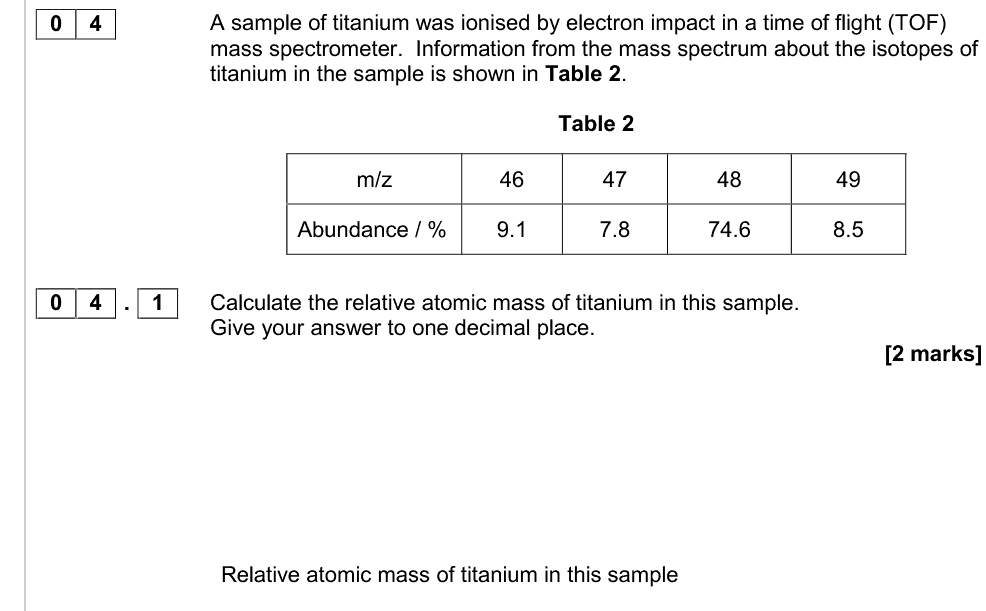
A sample of titanium was ionised by electron impact in a time of flight (TOF)
mass spectrometer.  Information from the mass spectrum about the isotopes of
titanium in the sample is shown in Table 2.
Table 2
m/z
46
47
48
49
Abundance / %
9.1
7.8
74.6
8.5
Calculate the relative atomic mass of titanium in this sample.
Give your answer to one decimal place.
[2 marks]
Relative atomic mass of titanium in this sample
June 2017 · Paper 1 · Q04.2 2 marks Equation writing atomic structure
Earlier part of question 04 that this part usesEarlier part of June 2017 Paper 1 question 04
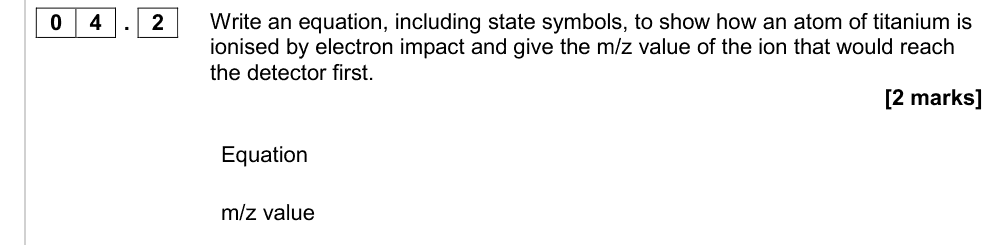
Write an equation, including state symbols, to show how an atom of titanium is
ionised by electron impact and give the m/z value of the ion that would reach
the detector first.
[2 marks]
Equation
m/z value
June 2017 · Paper 1 · Q04.3 1 mark Calculation amount of substance
Earlier part of question 04 that this part usesEarlier part of June 2017 Paper 1 question 04
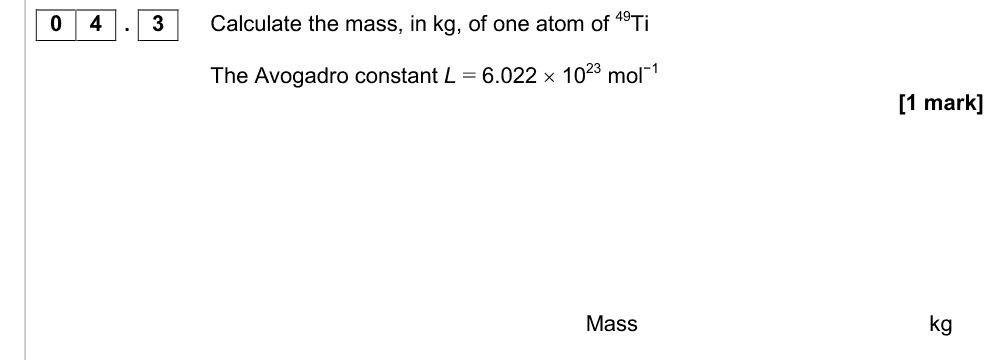
Calculate the mass, in kg, of one atom of 49Ti
The Avogadro constant L = 6.022 × 10²³ mol−1
[1 mark]
Mass
kg
June 2017 · Paper 1 · Q04.4 3 marks Calculation atomic structure
Earlier part of question 04 that this part usesEarlier part of June 2017 Paper 1 question 04
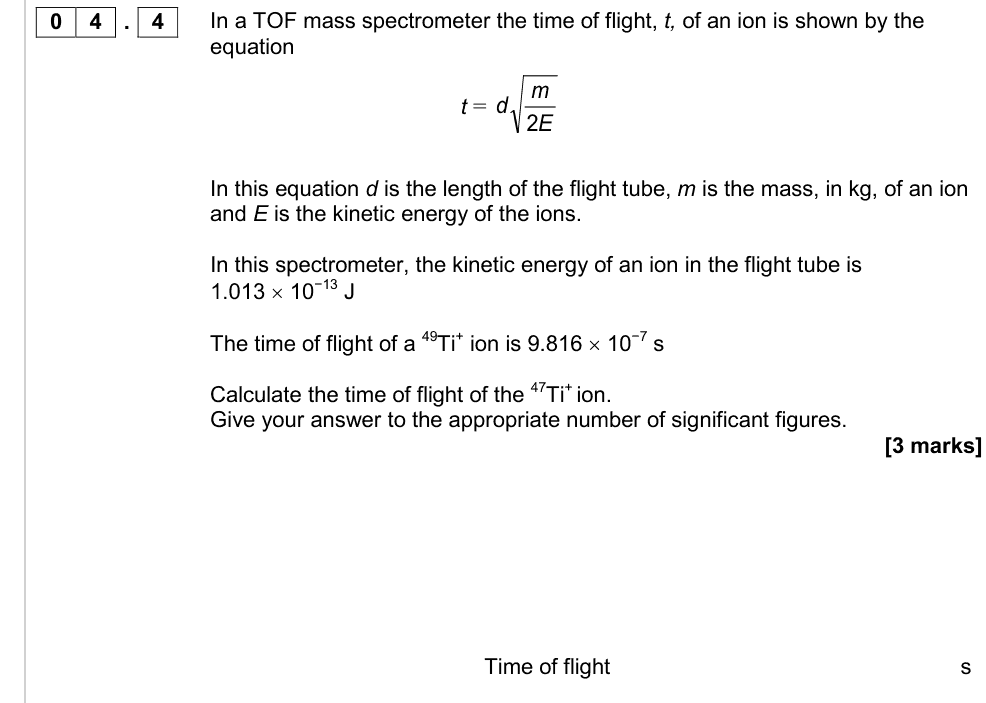
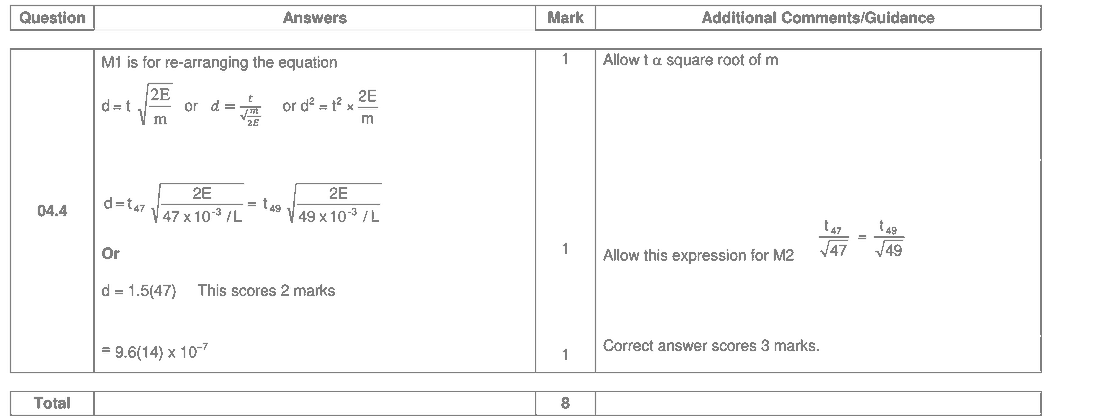
In a TOF mass spectrometer the time of flight, t, of an ion is shown by the
equation
t =
E
m
d
2
In this equation d is the length of the flight tube, m is the mass, in kg, of an ion
and E is the kinetic energy of the ions.
In this spectrometer, the kinetic energy of an ion in the flight tube is
1.013 × 10⁻¹³ J
The time of flight of a 49Ti+ ion is 9.816 × 10⁻⁷ s
Calculate the time of flight of the 47Ti+ ion.
Give your answer to the appropriate number of significant figures.
[3 marks]
Time of flight
s
June 2017 · Paper 1 · Q05.1 6 marks Calculation thermodynamics
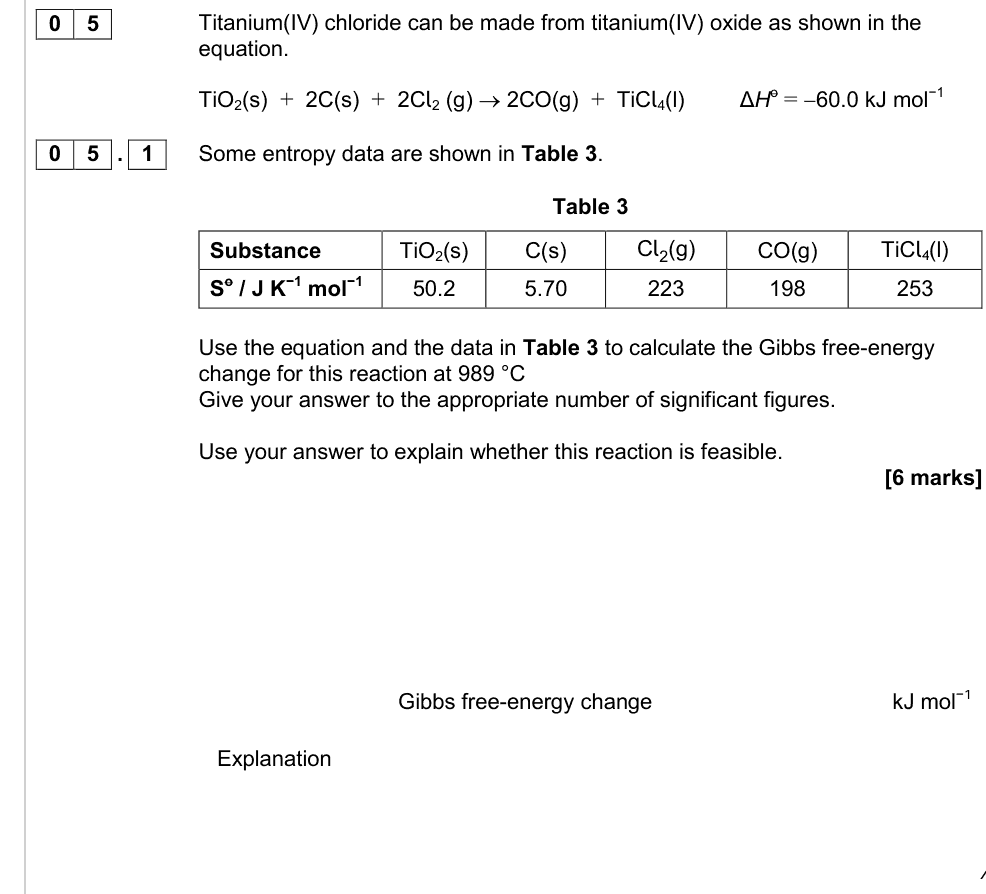
Titanium(IV) chloride can be made from titanium(IV) oxide as shown in the
equation.
TiO2(s)  +  2C(s)  +  2Cl2 (g) → 2CO(g)  +  TiCl4(l)         ΔHo = −60.0 kJ mol−1
Some entropy data are shown in Table 3.
Table 3
Substance
TiO2(s)
C(s)
Cl2(g)
CO(g)
TiCl4(l)
So / J K−1 mol−1
50.2
5.70
223
198
253
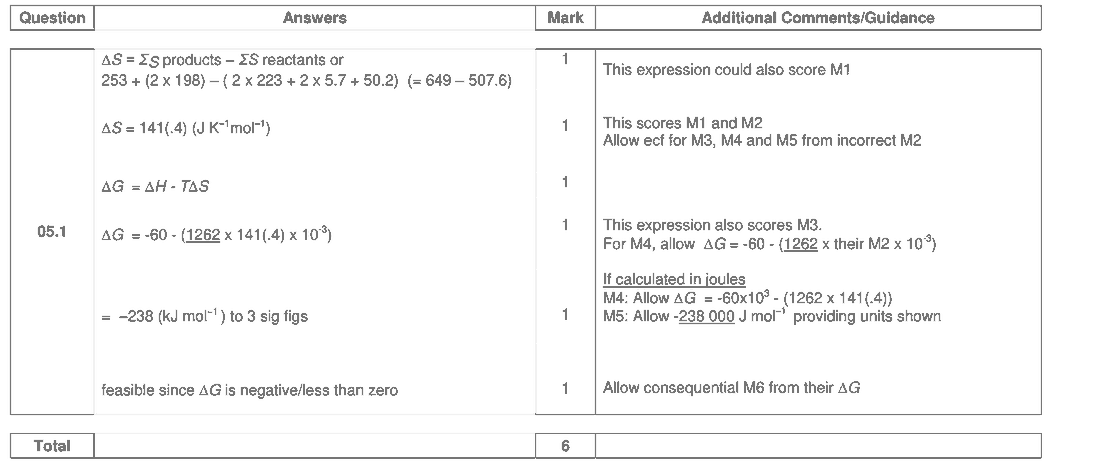
Use the equation and the data in Table 3 to calculate the Gibbs free-energy
change for this reaction at 989 °C
Give your answer to the appropriate number of significant figures.
Use your answer to explain whether this reaction is feasible.
[6 marks]
Gibbs free-energy change
kJ mol−1
Explanation
June 2017 · Paper 1 · Q06.1 1 mark Equation writing Easy period 3 elements and oxides
This question is about some Period 3 elements and their oxides.
Write an equation for the reaction of phosphorus with an excess of oxygen.
[1 mark]
June 2017 · Paper 1 · Q06.2 3 marks Practical and data analysis period 3 elements and oxides
Earlier part of question 06 that this part usesEarlier part of June 2017 Paper 1 question 06
Describe a test you could carry out in a test tube to distinguish between sodium
oxide and the product of the reaction in Question 6.1
[3 marks]
June 2017 · Paper 1 · Q06.3 2 marks Short answer period 3 elements and oxidesbonding
Earlier part of question 06 that this part usesEarlier part of June 2017 Paper 1 question 06
State the type of crystal structure shown in silicon dioxide and in sulfur trioxide.
[2 marks]
Silicon dioxide
Sulfur trioxide
June 2017 · Paper 1 · Q06.4 4 marks Explanation period 3 elements and oxides
Earlier part of question 06 that this part usesEarlier part of June 2017 Paper 1 question 06
Explain why silicon dioxide has a higher melting point than sulfur trioxide.
[4 marks]
June 2017 · Paper 1 · Q06.5 1 mark Equation writing period 3 elements and oxides
Earlier part of question 06 that this part usesEarlier part of June 2017 Paper 1 question 06
Write an equation for the reaction of sulfur trioxide with potassium hydroxide
solution.
[1 mark]
June 2017 · Paper 1 · Q06.6 1 mark Equation writing period 3 elements and oxides
Earlier part of question 06 that this part usesEarlier part of June 2017 Paper 1 question 06
Write an equation for the reaction of an excess of magnesium oxide with
phosphoric acid.
[1 mark]
June 2017 · Paper 1 · Q06.7 1 mark Diagram or structure period 3 elements and oxides
Earlier part of question 06 that this part usesEarlier part of June 2017 Paper 1 question 06
Draw the displayed formula of the undissociated acid formed when
sulfur dioxide reacts with water.
[1 mark]
June 2017 · Paper 1 · Q07.1 1 mark Short answer Easy bonding
Solution A contains the compound [Cu(H2O)6]Cl2
State the type of bonding between the oxygen and hydrogen in this compound.
[1 mark]
June 2017 · Paper 1 · Q07.2 1 mark Short answer Easy transition metals
Earlier part of question 07 that this part usesEarlier part of June 2017 Paper 1 question 07
State why the chloride ions in this compound are not considered to be ligands.
[1 mark]
June 2017 · Paper 1 · Q07.3 2 marks Equation writing transition metalsreactions of ions in aqueous solution
Earlier part of question 07 that this part usesEarlier part of June 2017 Paper 1 question 07
An excess of ammonia was added to a sample of solution A to form solution B.
Write an ionic equation for the reaction that occurs when solution A is
converted into solution B and state the colour of solution B.
[2 marks]
Equation
Colour
June 2017 · Paper 1 · Q07.4 1 mark Short answer Easy reactions of ions in aqueous solution
Earlier part of question 07 that this part usesEarlier part of June 2017 Paper 1 question 07
Aqueous sodium carbonate was added to another sample of solution A to form
a blue-green solid C.
Identify the blue-green solid C.
[1 mark]
June 2017 · Paper 1 · Q07.5 2 marks Equation writing transition metals
Earlier part of question 07 that this part usesEarlier part of June 2017 Paper 1 question 07
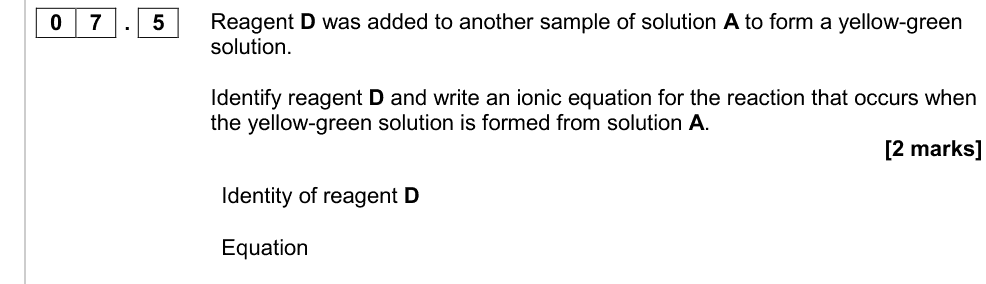
Reagent D was added to another sample of solution A to form a yellow-green
solution.
Identify reagent D and write an ionic equation for the reaction that occurs when
the yellow-green solution is formed from solution A.
[2 marks]
Identity of reagent D
Equation
June 2017 · Paper 1 · Q07.6 2 marks Explanation transition metals
Earlier part of question 07 that this part usesEarlier part of June 2017 Paper 1 question 07
Explain why colorimetry cannot be used to determine the concentration of
solutions containing [CuCl2]−
In your answer refer to the electron configuration of the metal ion.
[2 marks]
June 2017 · Paper 1 · Q08.1 3 marks Practical and data analysis group 2
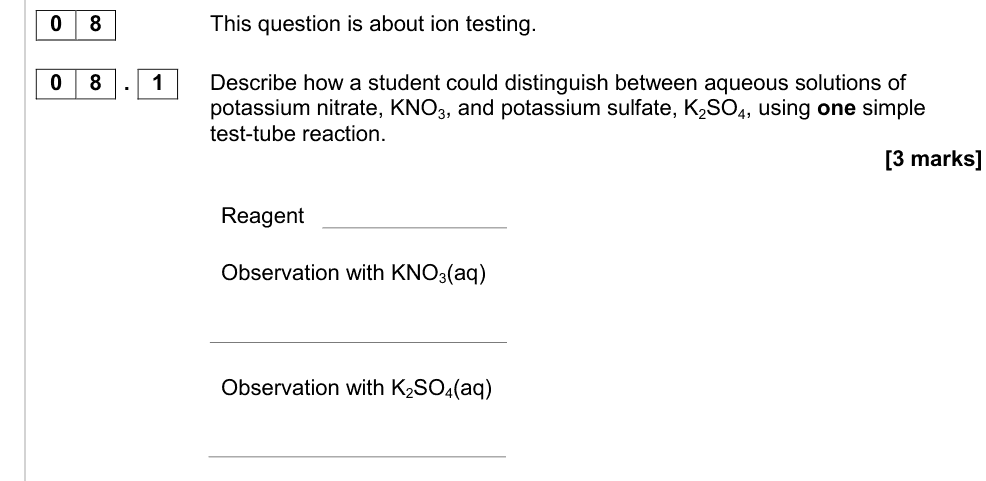
This question is about ion testing.
Describe how a student could distinguish between aqueous solutions of
potassium nitrate, KNO3, and potassium sulfate, K2SO4, using one simple
test-tube reaction.
[3 marks]
Reagent
Observation with KNO3(aq)
Observation with K2SO4(aq)
June 2017 · Paper 1 · Q08.2 3 marks Practical and data analysis reactions of ions in aqueous solution
Earlier part of question 08 that this part usesEarlier part of June 2017 Paper 1 question 08
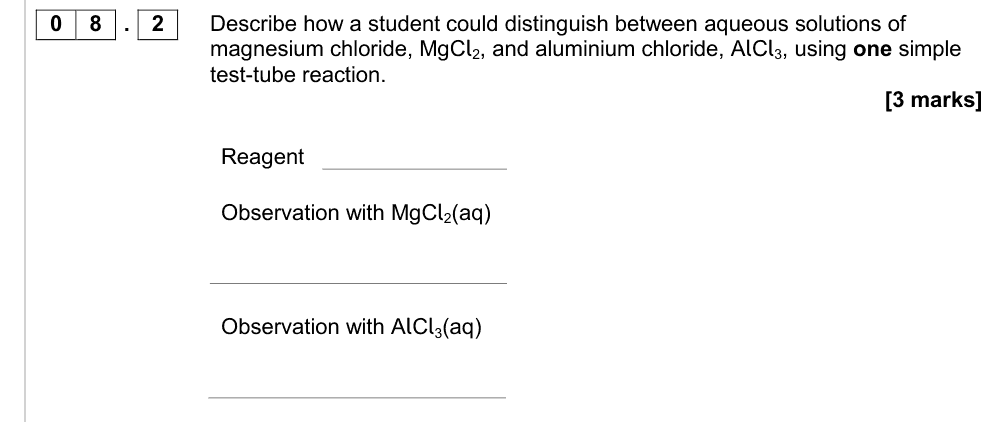
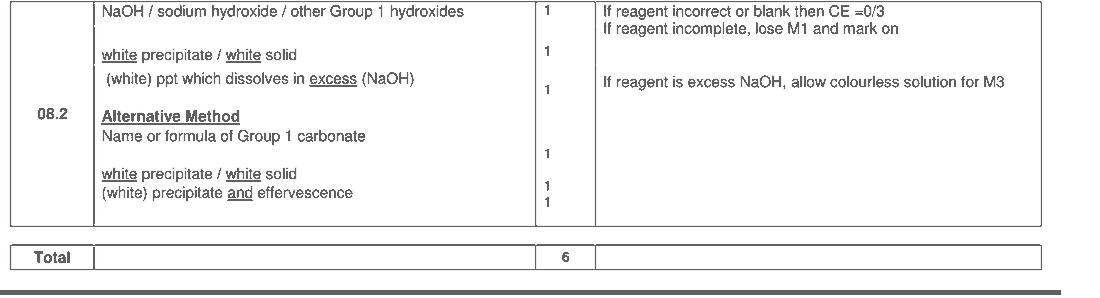
Describe how a student could distinguish between aqueous solutions of
magnesium chloride, MgCl2, and aluminium chloride, AlCl3, using one simple
test-tube reaction.
[3 marks]
Reagent
Observation with MgCl2(aq)
Observation with AlCl3(aq)
June 2017 · Paper 1 · Q09.1 6 marks 6-mark level of response chemical equilibria and kc
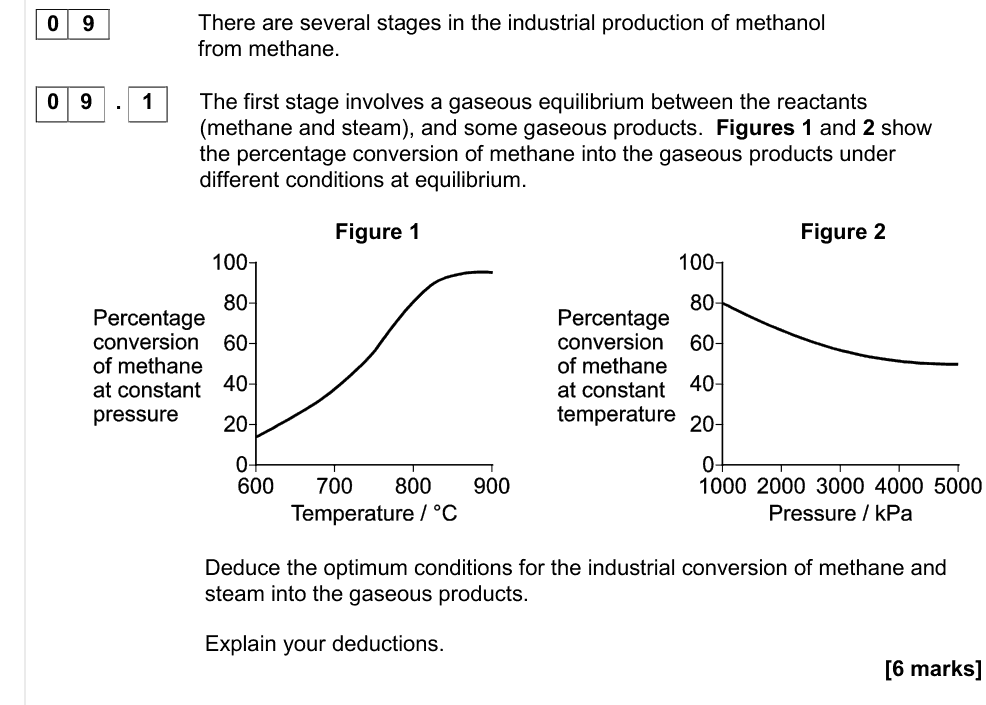
There are several stages in the industrial production of methanol
from methane.
The first stage involves a gaseous equilibrium between the reactants
(methane and steam), and some gaseous products.  Figures 1 and 2 show
the percentage conversion of methane into the gaseous products under
different conditions at equilibrium.
Figure 1                                                              Figure 2
Deduce the optimum conditions for the industrial conversion of methane and
steam into the gaseous products.
Explain your deductions.
[6 marks]
June 2017 · Paper 1 · Q09.2 2 marks Calculation chemical equilibria and kc
Earlier part of question 09 that this part usesEarlier part of June 2017 Paper 1 question 09
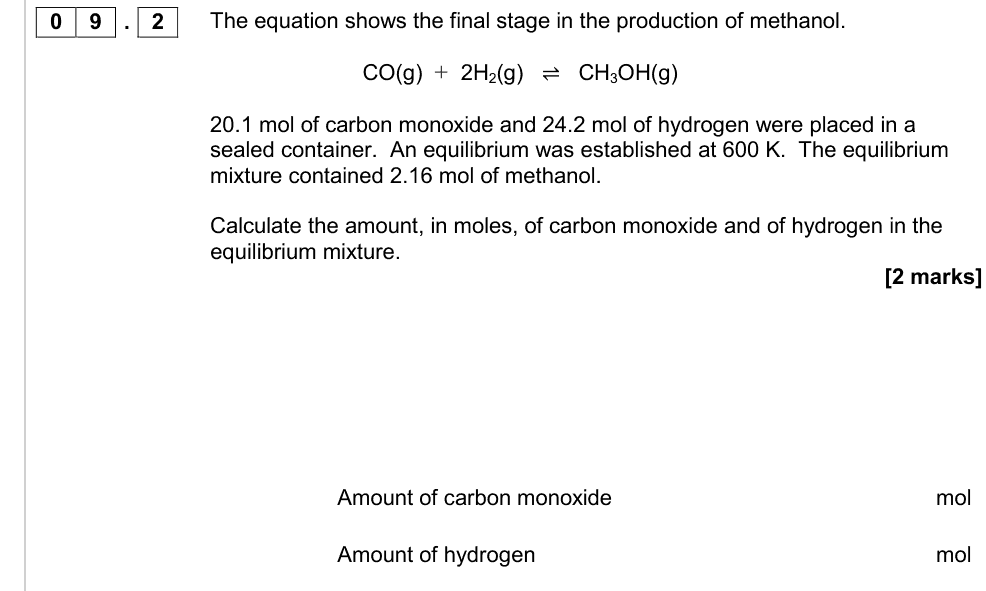
The equation shows the final stage in the production of methanol.
CO(g)  +  2H2(g)   ⇌   CH3OH(g)
20.1 mol of carbon monoxide and 24.2 mol of hydrogen were placed in a
sealed container.  An equilibrium was established at 600 K.  The equilibrium
mixture contained 2.16 mol of methanol.
Calculate the amount, in moles, of carbon monoxide and of hydrogen in the
equilibrium mixture.
[2 marks]
Amount of carbon monoxide
mol
Amount of hydrogen
mol
June 2017 · Paper 1 · Q09.3 6 marks Calculation equilibrium constant kp
Earlier part of question 09 that this part usesEarlier part of June 2017 Paper 1 question 09
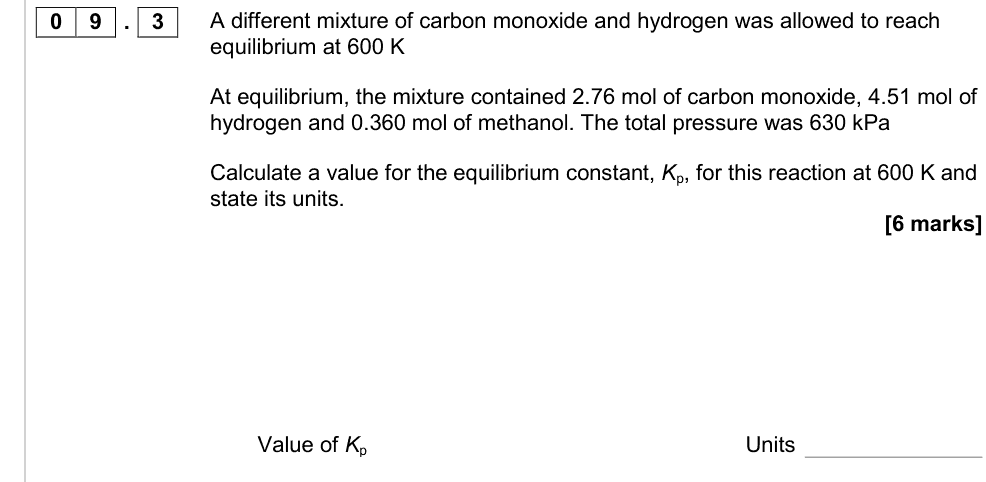
A different mixture of carbon monoxide and hydrogen was allowed to reach
equilibrium at 600 K
At equilibrium, the mixture contained 2.76 mol of carbon monoxide, 4.51 mol of
hydrogen and 0.360 mol of methanol. The total pressure was 630 kPa
Calculate a value for the equilibrium constant, Kp, for this reaction at 600 K and
state its units.
[6 marks]
Value of Kp
Units
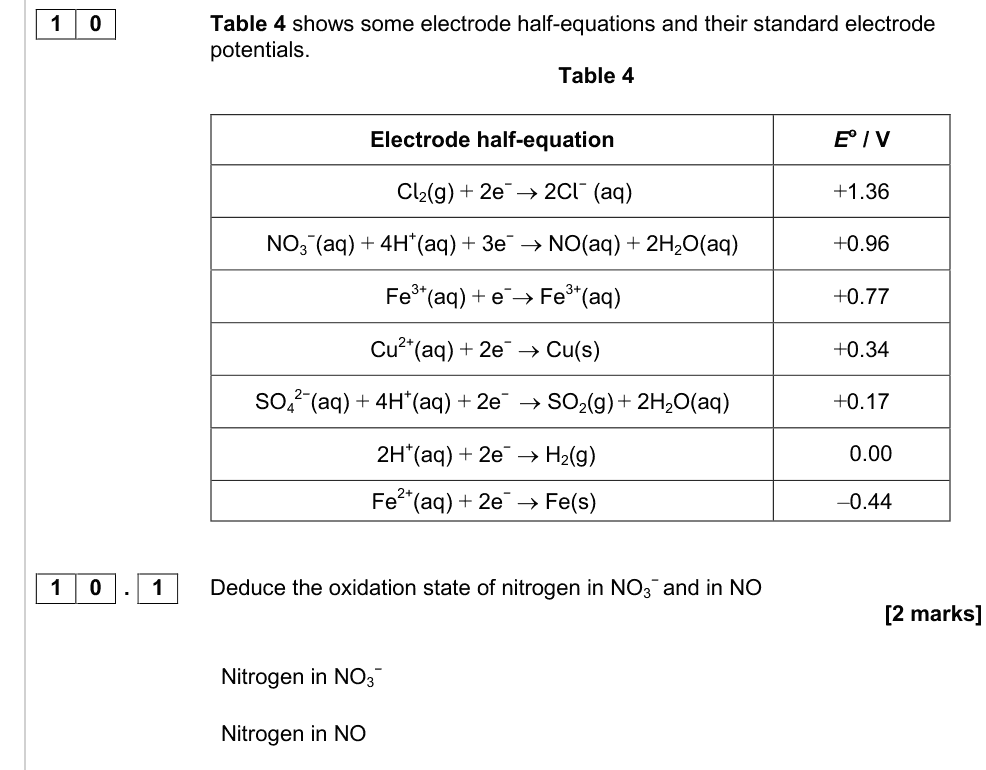
June 2017 · Paper 1 · Q10.1 2 marks Short answer Easy redox
Table 4 shows some electrode half-equations and their standard electrode
potentials.
Table 4
Electrode half-equation
Eο / V
Cl2(g) + 2e− → 2Cl− (aq)
+1.36
NO3
−(aq) + 4H+(aq) + 3e− → NO(aq) + 2H2O(aq)
+0.96
Fe3+(aq) + e−→ Fe3+(aq)
+0.77
Cu2+(aq) + 2e− → Cu(s)
+0.34
SO4
2−(aq) + 4H+(aq) + 2e−  → SO2(g) + 2H2O(aq)
+0.17
2H+(aq) + 2e− → H2(g)
0.00
Fe2+(aq) + 2e− → Fe(s)
–0.44
Deduce the oxidation state of nitrogen in NO3
− and in NO
[2 marks]
Nitrogen in NO3
−
Nitrogen in NO
June 2017 · Paper 1 · Q10.2 1 mark Short answer electrode potentials and cellsredox
Earlier part of question 10 that this part usesEarlier part of June 2017 Paper 1 question 10
State the weakest reducing agent in Table 4.
[1 mark]
June 2017 · Paper 1 · Q10.3 2 marks Short answer electrode potentials and cells
Earlier part of question 10 that this part usesEarlier part of June 2017 Paper 1 question 10
Write the conventional representation of the cell that has an EMF of +0.43 V
[2 marks]
June 2017 · Paper 1 · Q10.4 4 marks Explanation electrode potentials and cellsredox
Earlier part of question 10 that this part usesEarlier part of June 2017 Paper 1 question 10
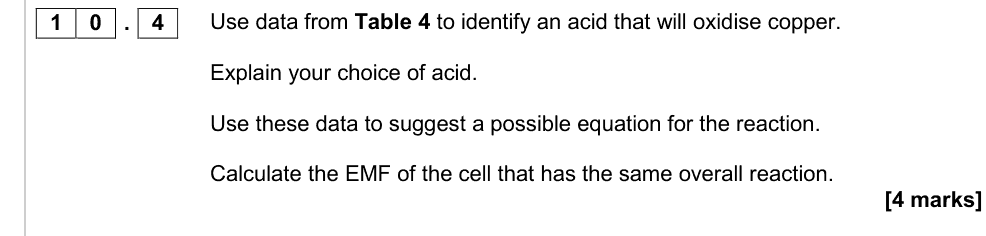
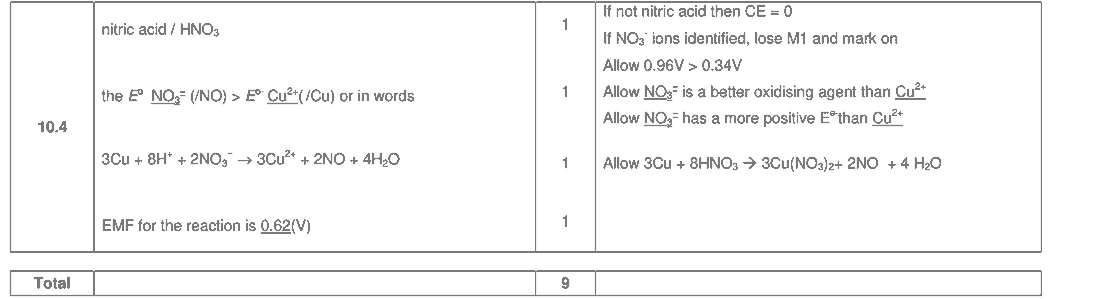
Use data from Table 4 to identify an acid that will oxidise copper.
Explain your choice of acid.
Use these data to suggest a possible equation for the reaction.
Calculate the EMF of the cell that has the same overall reaction.
[4 marks]
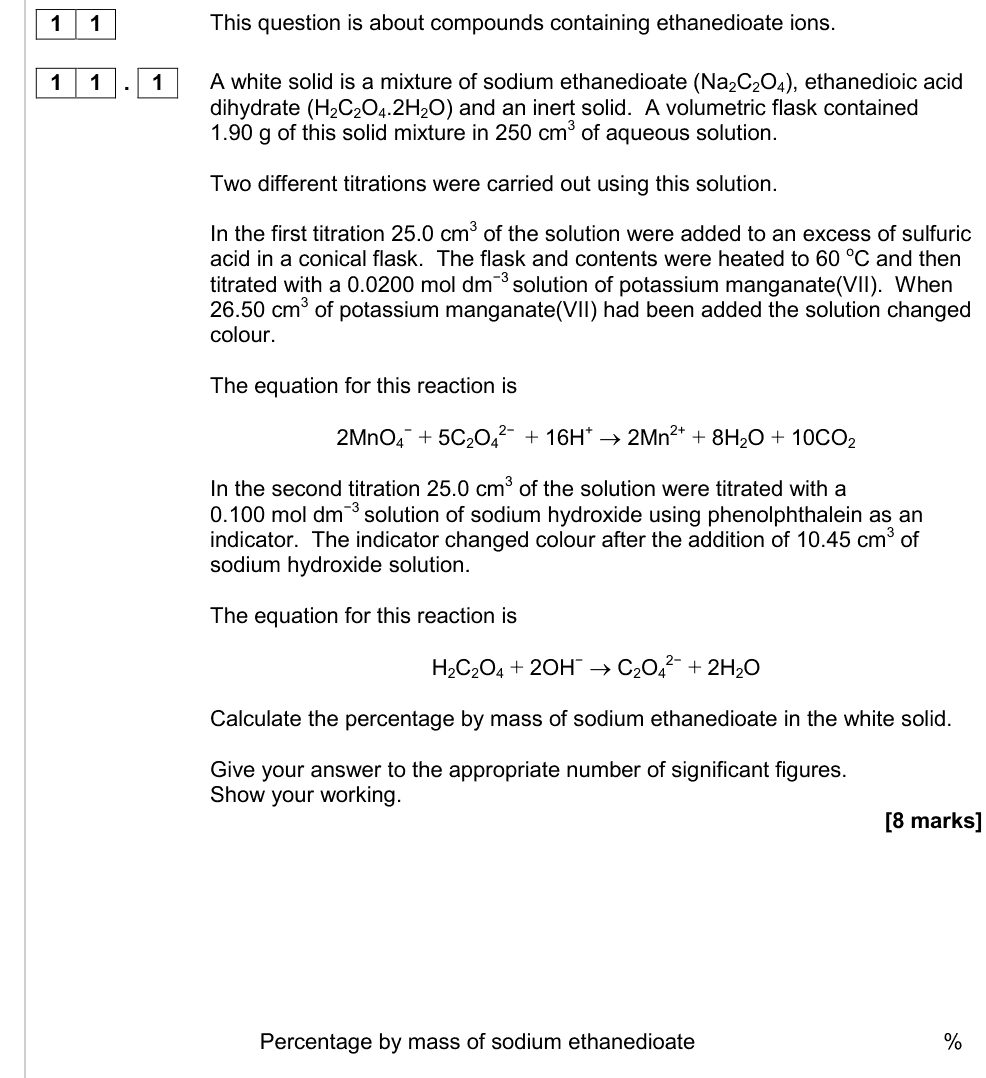
June 2017 · Paper 1 · Q11.1 8 marks Calculation transition metalsacids and basesamount of substance
This question is about compounds containing ethanedioate ions.
A white solid is a mixture of sodium ethanedioate (Na2C2O4), ethanedioic acid
dihydrate (H2C2O4.2H2O) and an inert solid.  A volumetric flask contained
1.90 g of this solid mixture in 250 cm3 of aqueous solution.
Two different titrations were carried out using this solution.
In the first titration 25.0 cm3 of the solution were added to an excess of sulfuric
acid in a conical flask.  The flask and contents were heated to 60 oC and then
titrated with a 0.0200 mol dm−3 solution of potassium manganate(VII).  When
26.50 cm3 of potassium manganate(VII) had been added the solution changed
colour.
The equation for this reaction is
2MnO4
− + 5C2O4
2−  + 16H+ → 2Mn2+ + 8H2O + 10CO2
In the second titration 25.0 cm3 of the solution were titrated with a
0.100 mol dm−3 solution of sodium hydroxide using phenolphthalein as an
indicator.  The indicator changed colour after the addition of 10.45 cm3 of
sodium hydroxide solution.
The equation for this reaction is
H2C2O4 + 2OH− → C2O4
2− + 2H2O
Calculate the percentage by mass of sodium ethanedioate in the white solid.
Give your answer to the appropriate number of significant figures.
Show your working.
[8 marks]
Percentage by mass of sodium ethanedioate
%
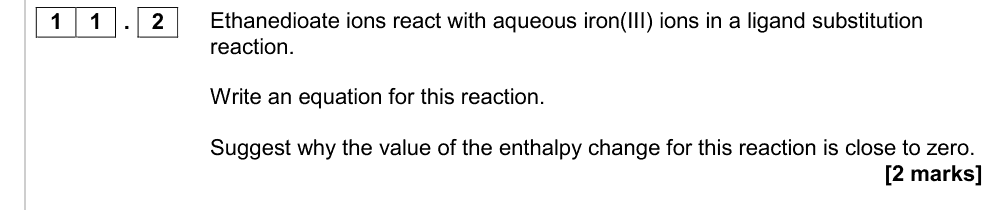
June 2017 · Paper 1 · Q11.2 2 marks Equation writing transition metals
Earlier part of question 11 that this part usesEarlier part of June 2017 Paper 1 question 11
Ethanedioate ions react with aqueous iron(III) ions in a ligand substitution
reaction.
Write an equation for this reaction.
Suggest why the value of the enthalpy change for this reaction is close to zero.
[2 marks]
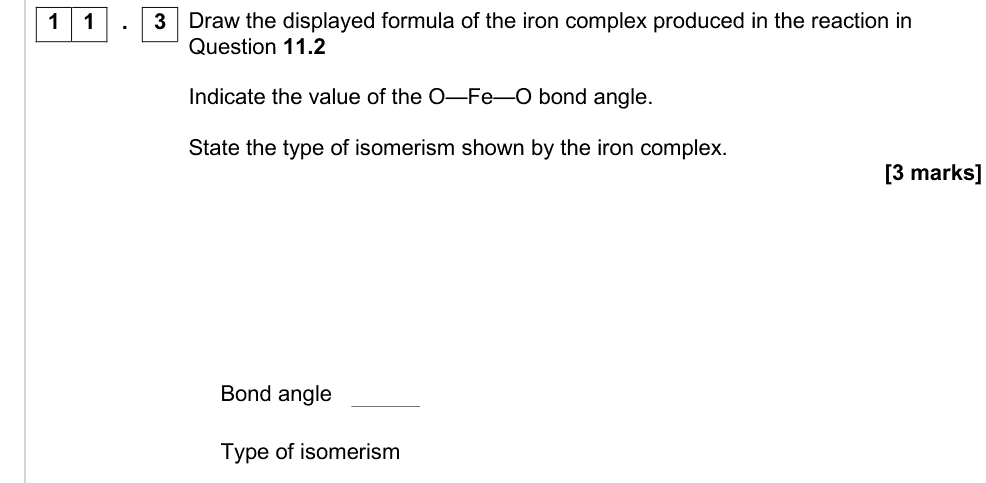
June 2017 · Paper 1 · Q11.3 3 marks Diagram or structure transition metals
Earlier part of question 11 that this part usesEarlier part of June 2017 Paper 1 question 11
Draw the displayed formula of the iron complex produced in the reaction in
Question 11.2
Indicate the value of the O—Fe—O bond angle.
State the type of isomerism shown by the iron complex.
[3 marks]
Bond angle
Type of isomerism
June 2017 · Paper 1 · Q11.4 1 mark Short answer transition metals
Earlier part of question 11 that this part usesEarlier part of June 2017 Paper 1 question 11
Ethanedioate ions are poisonous because they react with iron ions in the body.
Ethanedioate ions are present in foods such as broccoli and spinach.
Suggest one reason why people who eat these foods do not suffer from
poisoning.
[1 mark]

Work with an A-level chemistry tutor

Want a paper marked and gone through with you? Message us.

Prefer email? Send an enquiry

If you are under 18, please include a parent's contact details. Enquiries go to enquiries@chemistryaleveltutor.com and are deleted once handled. All tutoring is online.