June 2025: Paper 3, General and Practical Principles in Chemistry

120 marks · 46 question parts · Paper, mark scheme and report on Edexcel's site · Have the Data Booklet beside you

Question by question

QTopicMarksAOType
1(a) Atomic structure and the Periodic Table 2Short answer
1(b) Atomic structure and the Periodic Table 2Explanation
1(c) Atomic structure and the Periodic Table 3Explanation
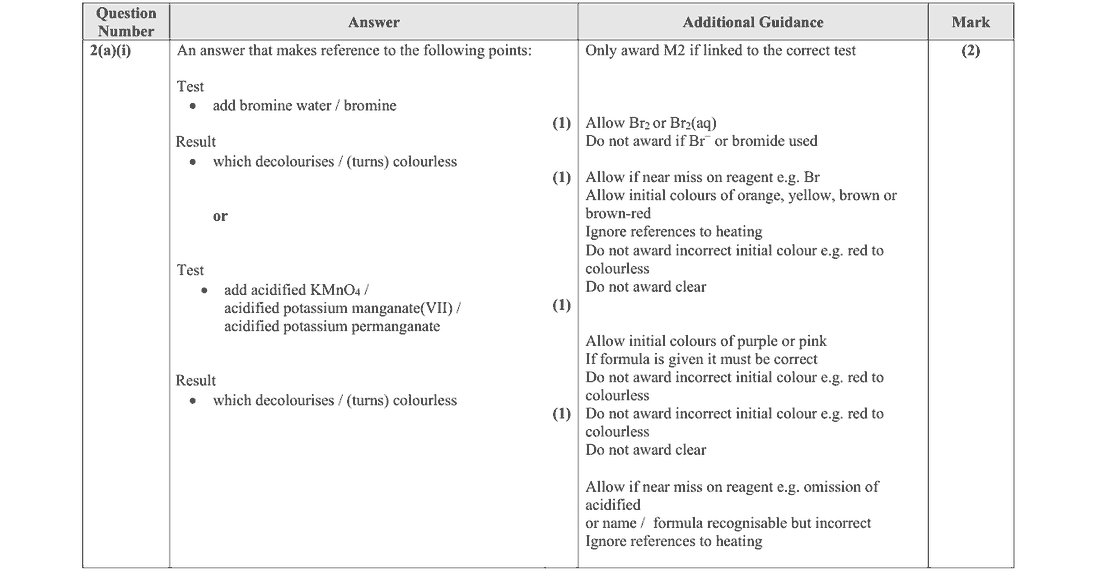
2(a)(i) Alkenes 2Practical and data analysis
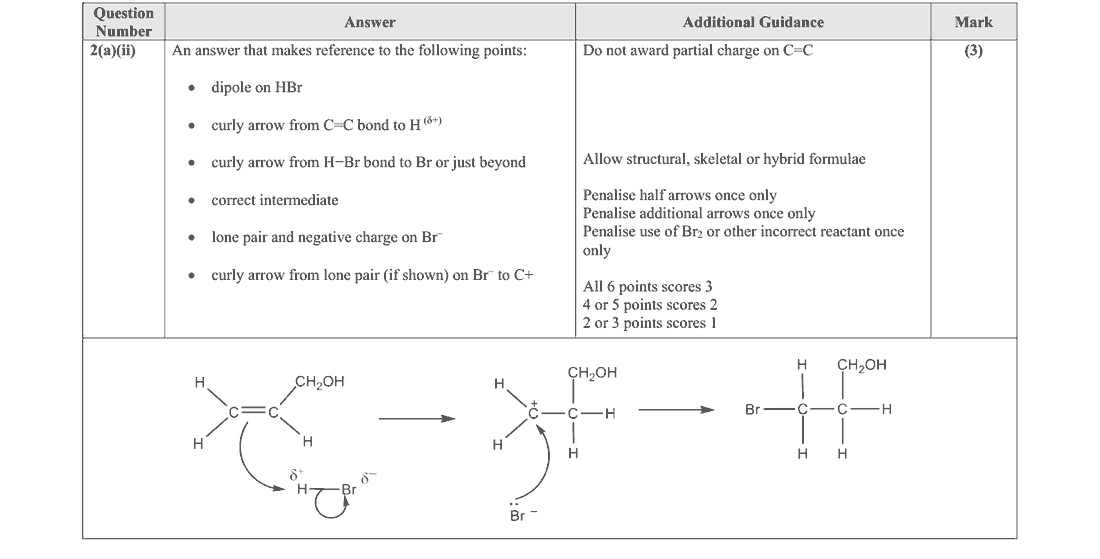
2(a)(ii) Alkenes 3Mechanism
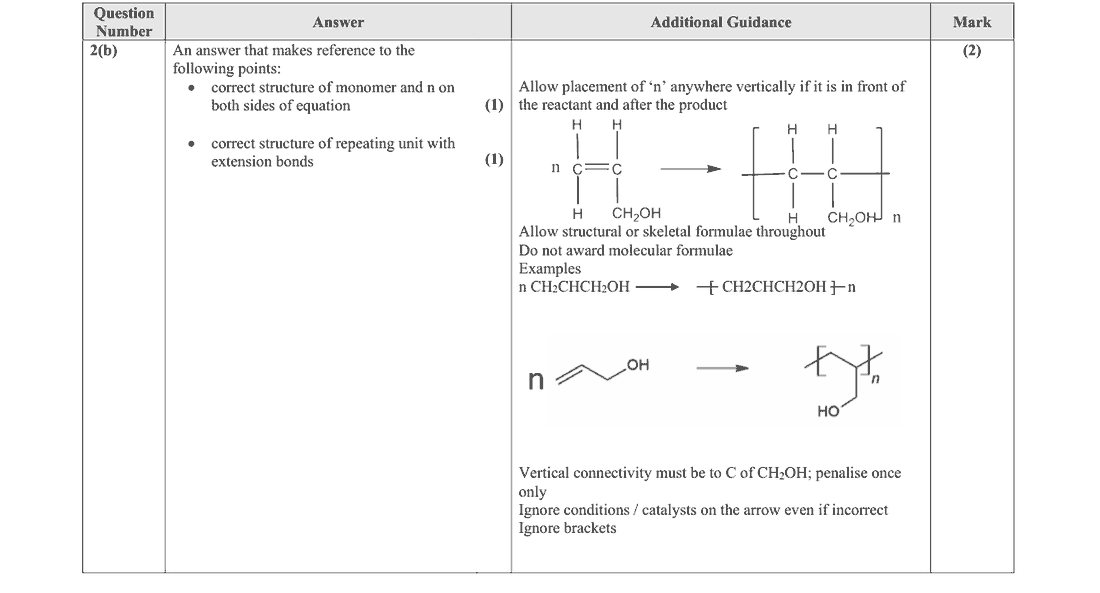
2(b) Alkenes 2Equation writing
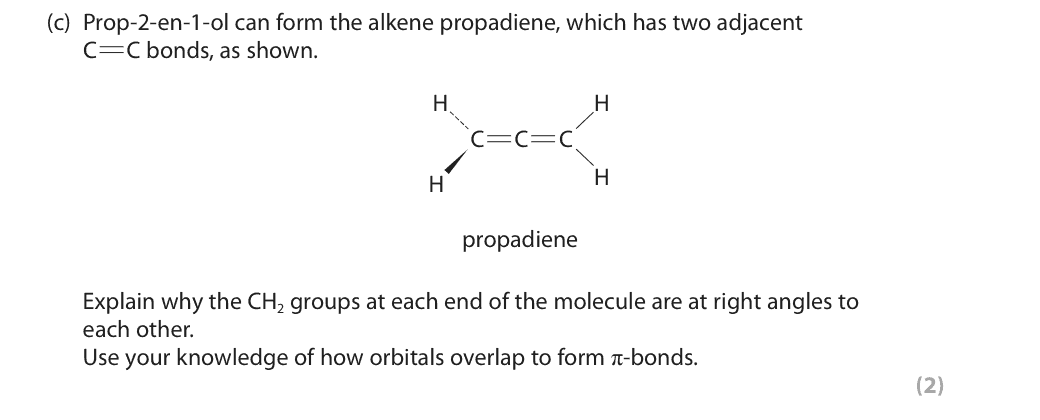
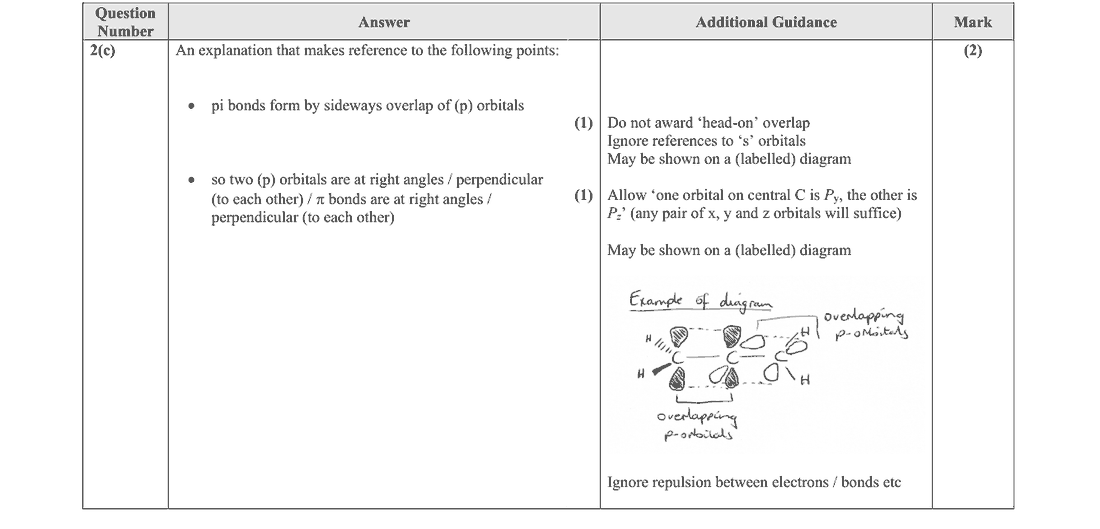
2(c) Alkenes 2Explanation
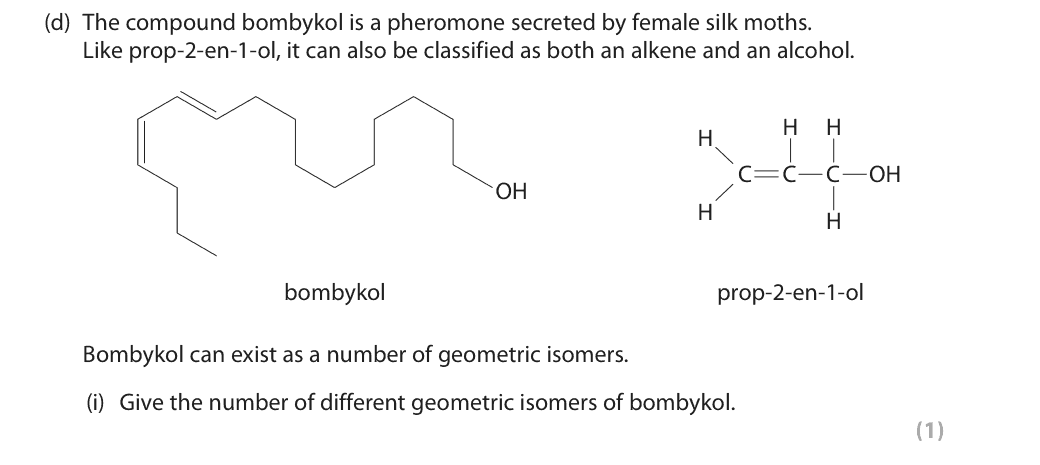
2(d)(i) Introduction to organic chemistry 1Short answer
2(d)(ii) Introduction to organic chemistry 1Short answer
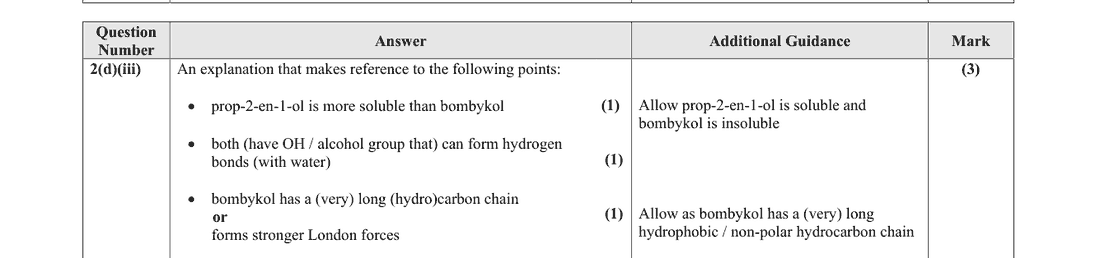
2(d)(iii) Bonding 3Explanation
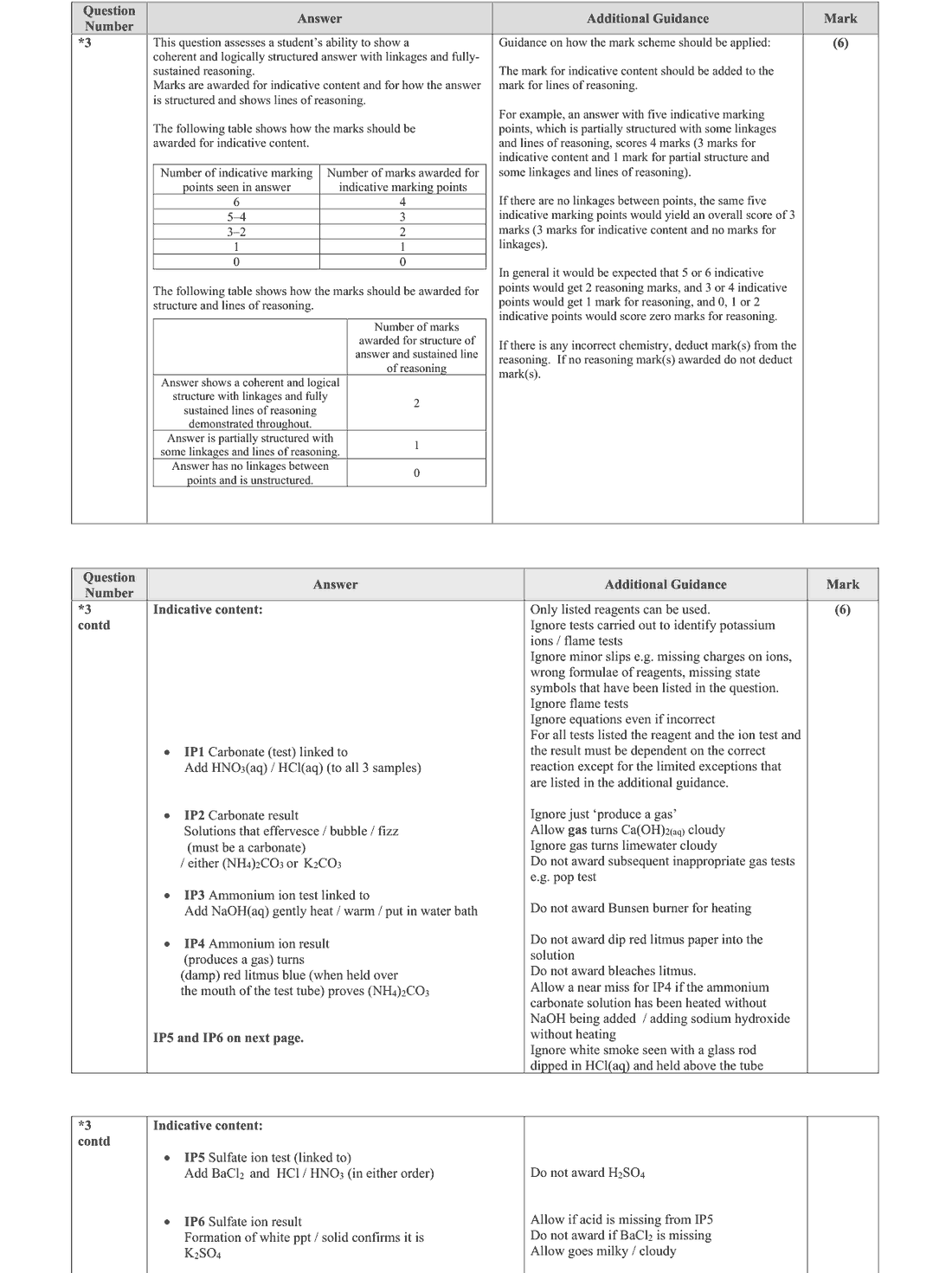
3 Analysis of inorganic compounds 6Extended response
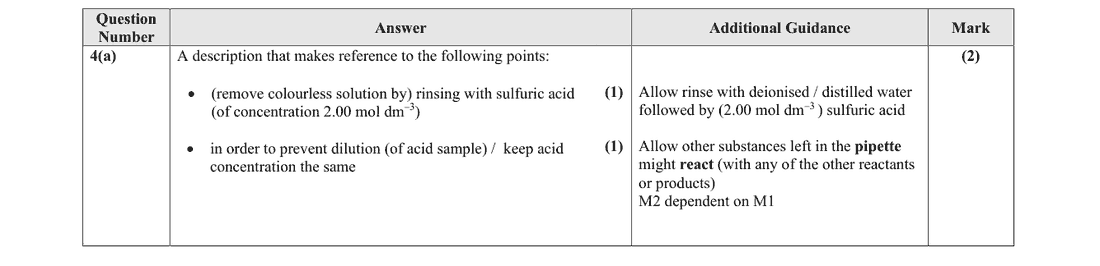
4(a) Kinetics II 2Practical and data analysis
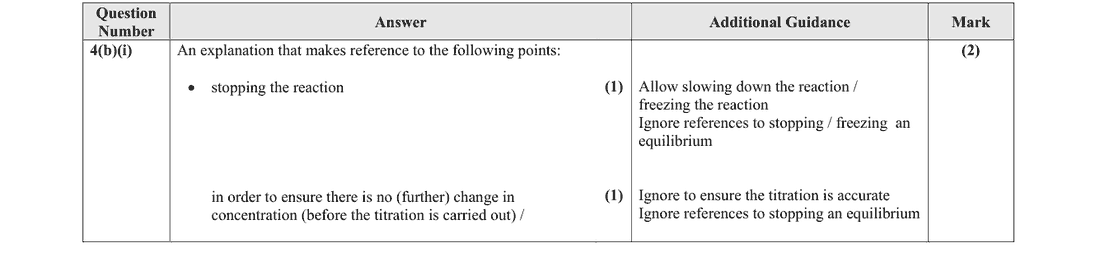
4(b)(i) Kinetics II 2Practical and data analysis
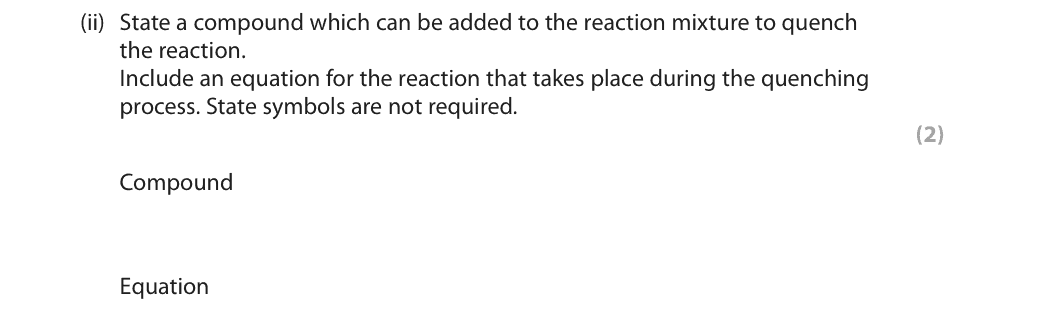
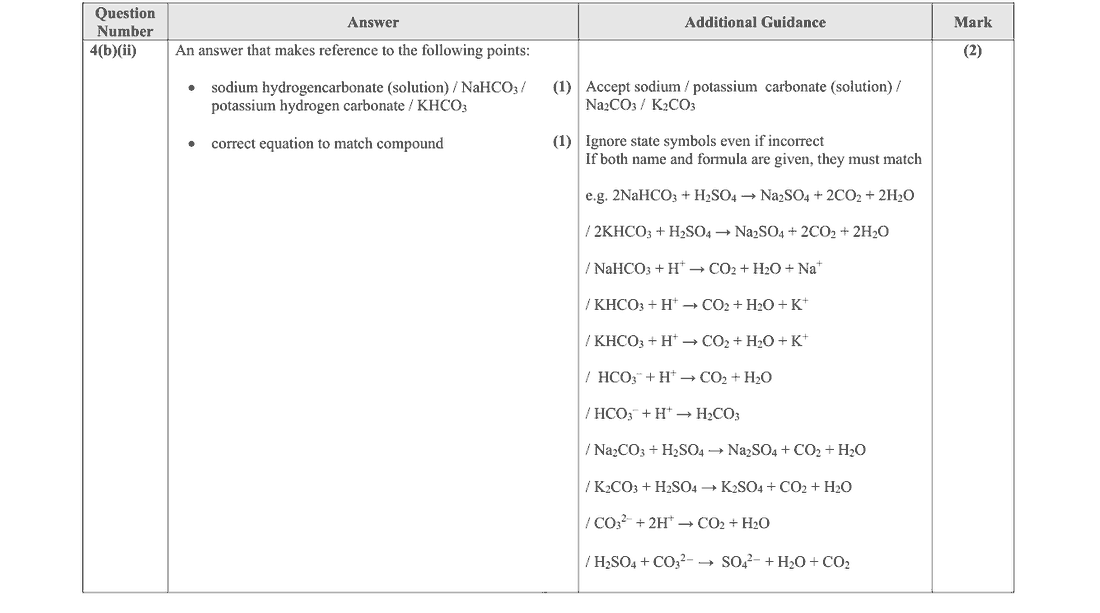
4(b)(ii) Kinetics II, Formulae, equations and amounts of substance 2Practical and data analysis
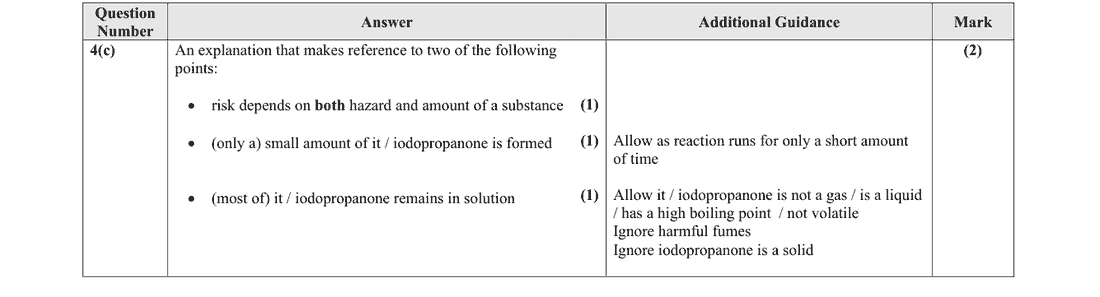
4(c) Formulae, equations and amounts of substance 2Practical and data analysis
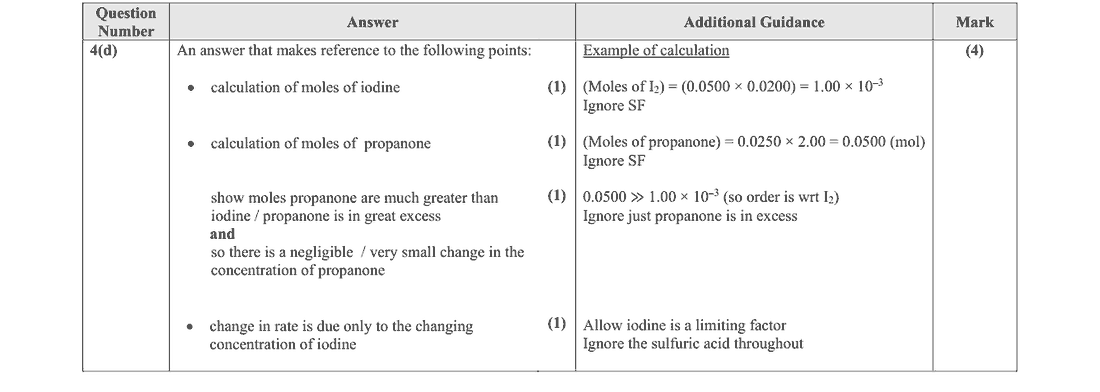
4(d) Kinetics II, Formulae, equations and amounts of substance 4Calculation
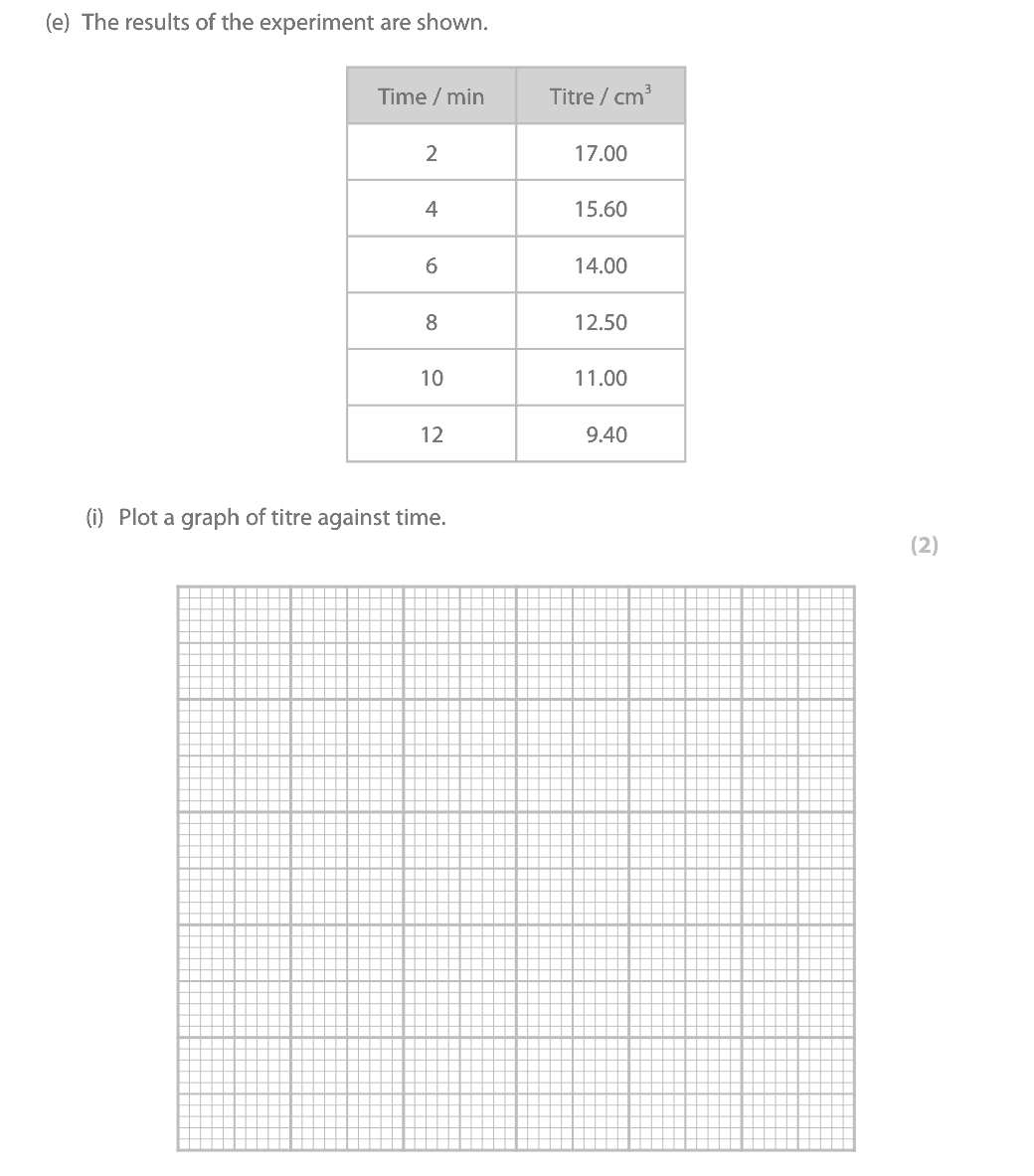
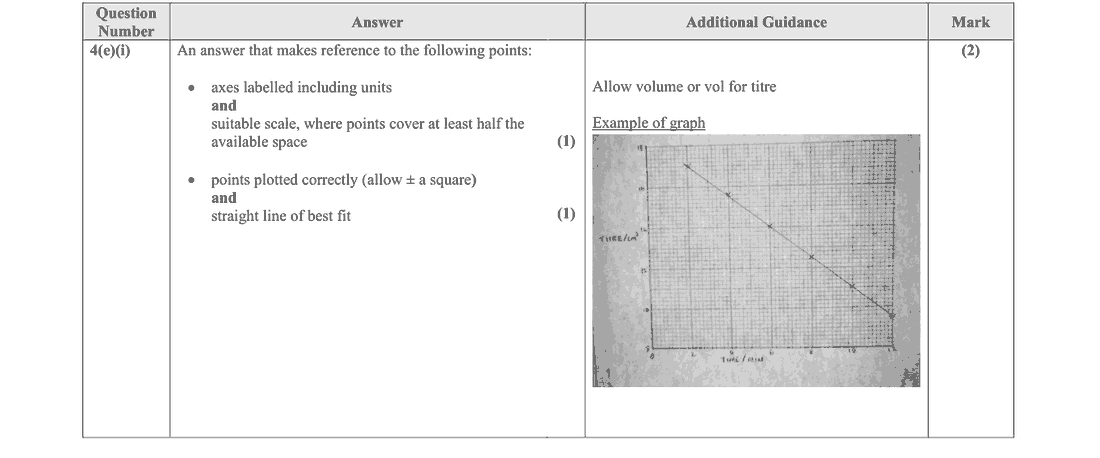
4(e)(i) Kinetics II 2Diagram or structure
4(e)(ii) Kinetics II 1Short answer
4(e)(iii) Kinetics II 2Short answer
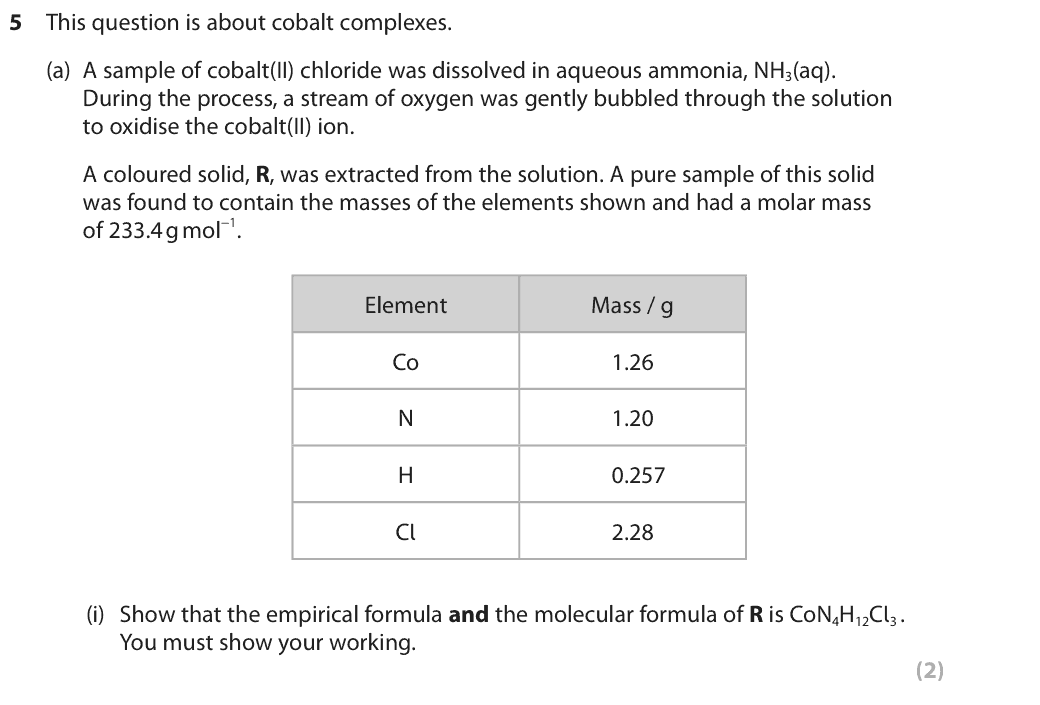
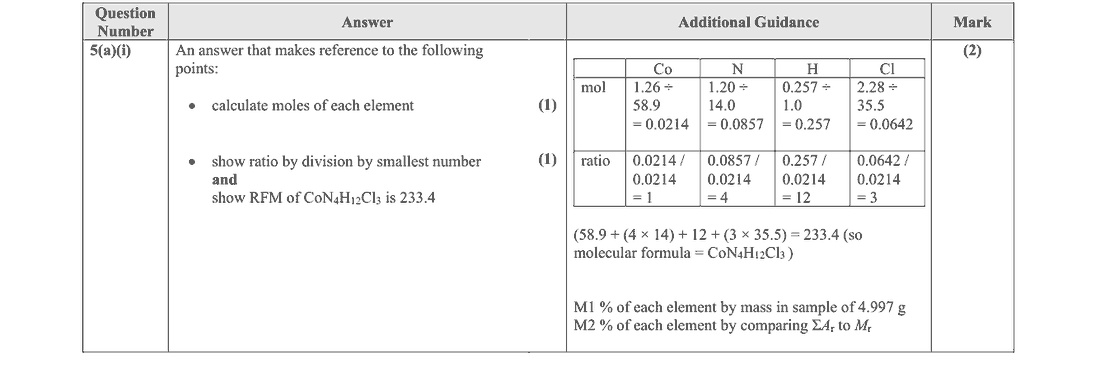
5(a)(i) Formulae, equations and amounts of substance 2Calculation
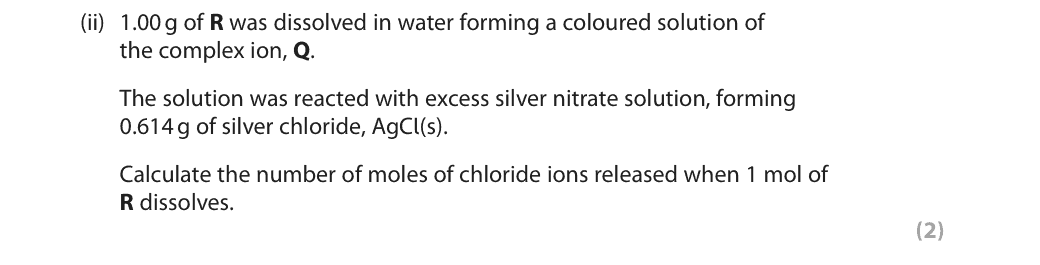
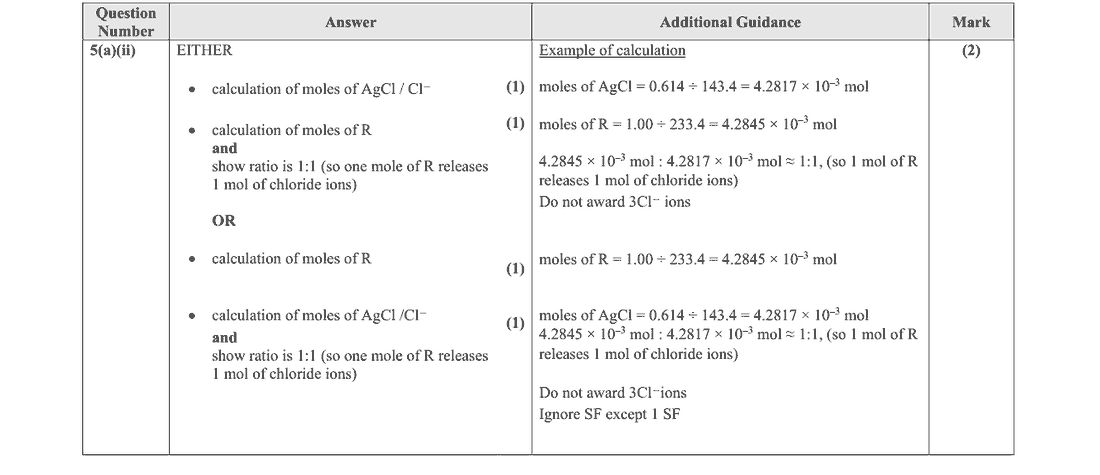
5(a)(ii) Formulae, equations and amounts of substance 2Calculation
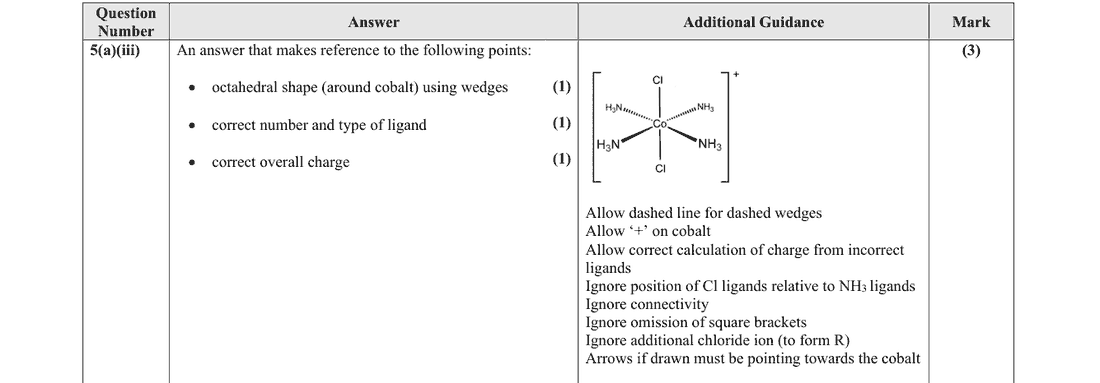
5(a)(iii) Transition metals: principles 3Diagram or structure
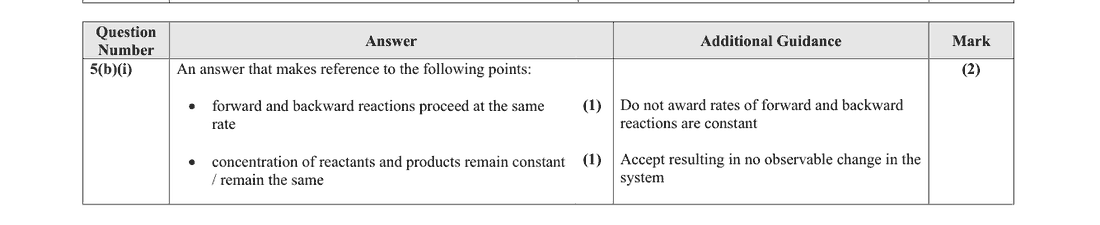
5(b)(i) Equilibrium I 2Short answer
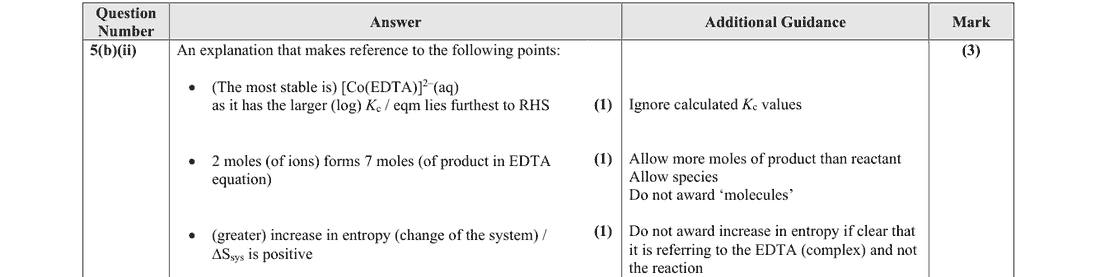
5(b)(ii) Transition metals: reactions 3Explanation
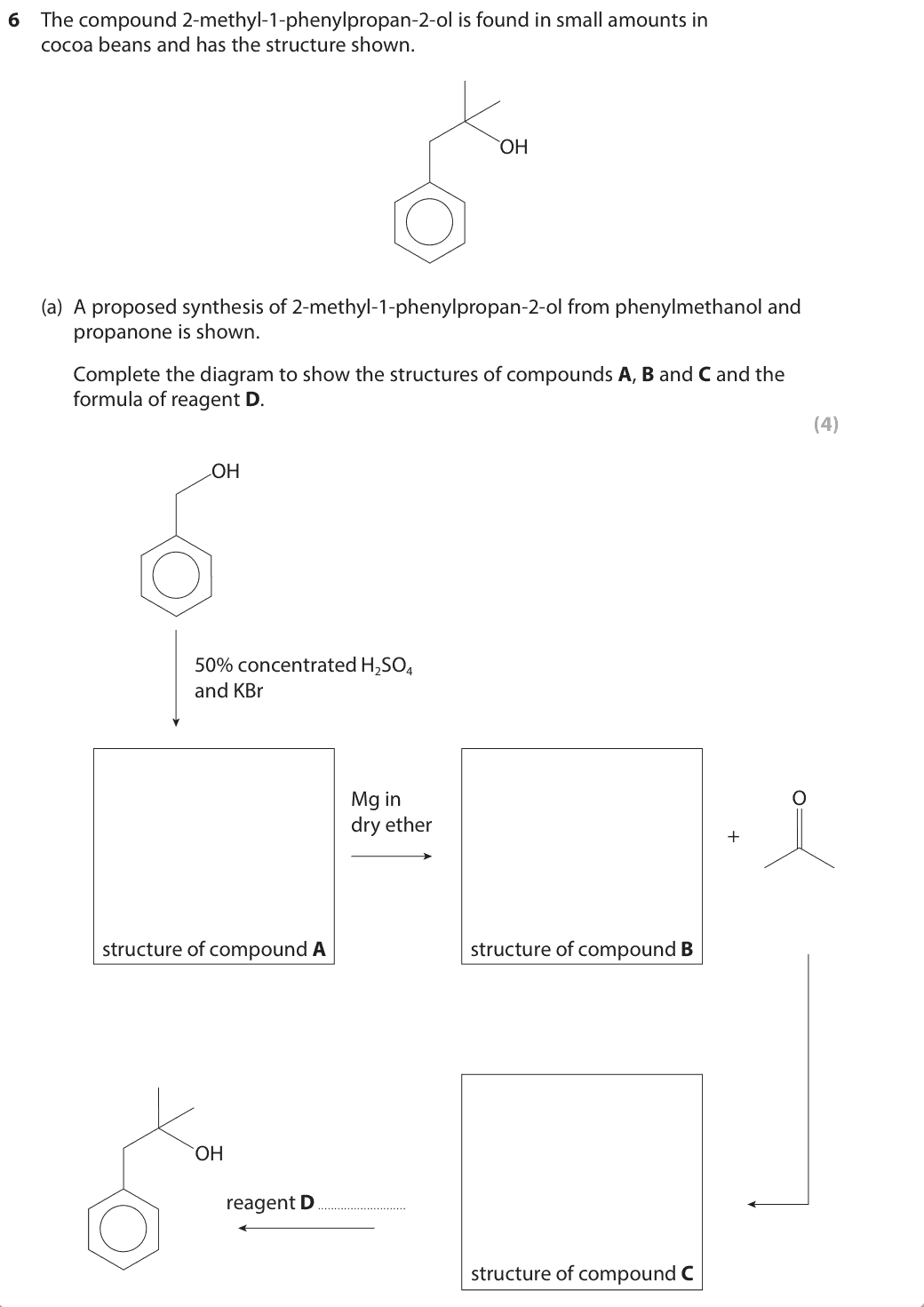
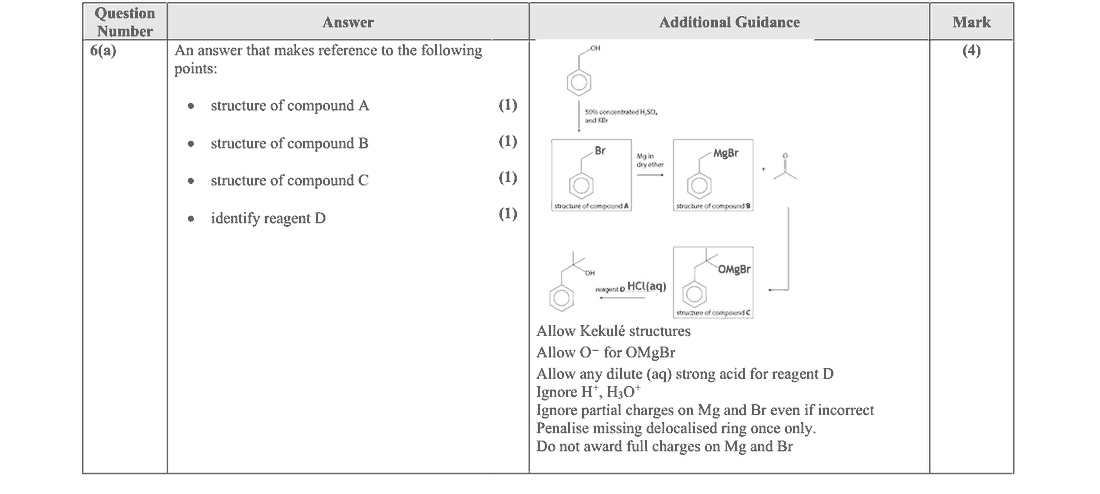
6(a) Organic synthesis, Alcohols 4Diagram or structure
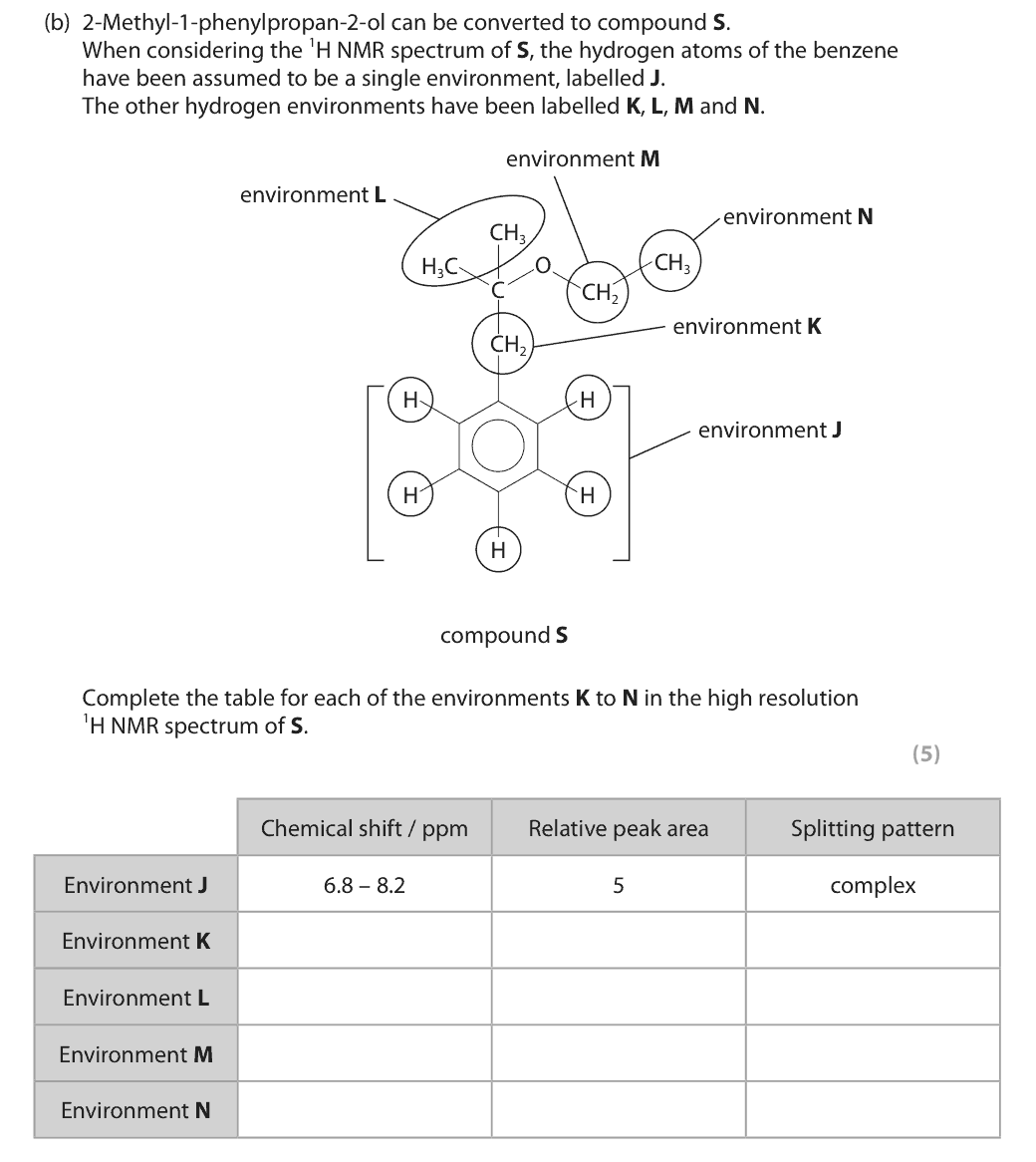
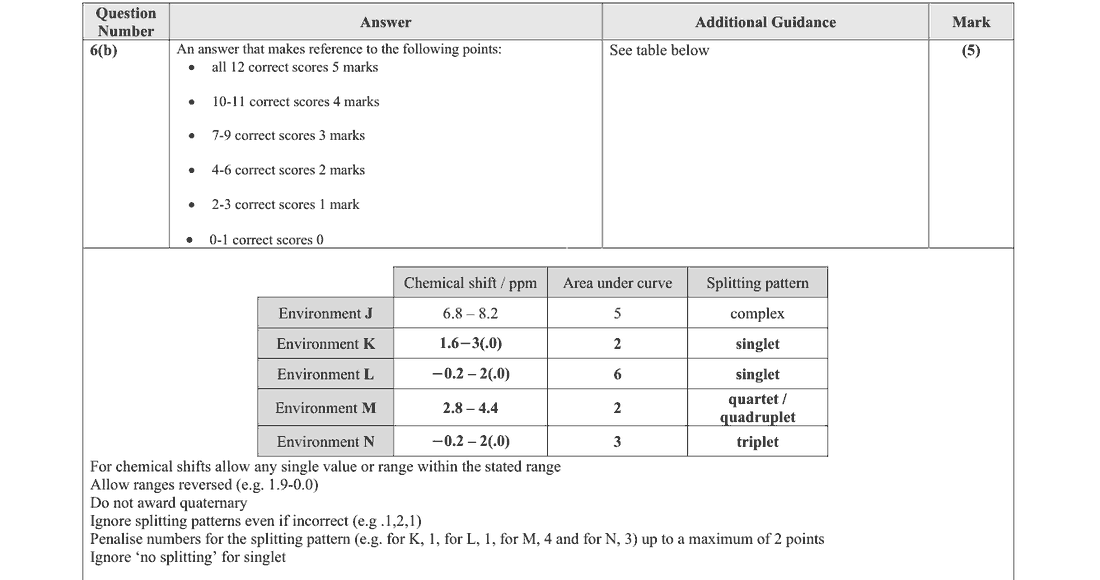
6(b) Modern analytical techniques II: NMR, mass spectrometry and chromatography 5Short answer
7(a) Alcohols 2Practical and data analysis
7(b)(i) Redox II 5Calculation
7(b)(ii) Redox II, Formulae, equations and amounts of substance 3Calculation
7(c) Redox II, Formulae, equations and amounts of substance 2Practical and data analysis
7(d) Alcohols 2Practical and data analysis
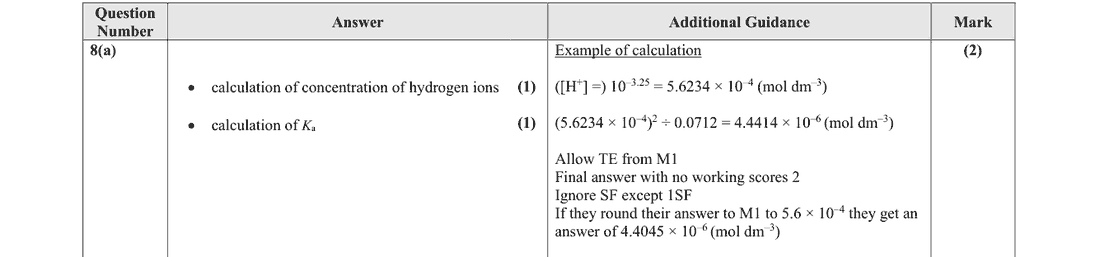
8(a) Acid-base equilibria 2Calculation
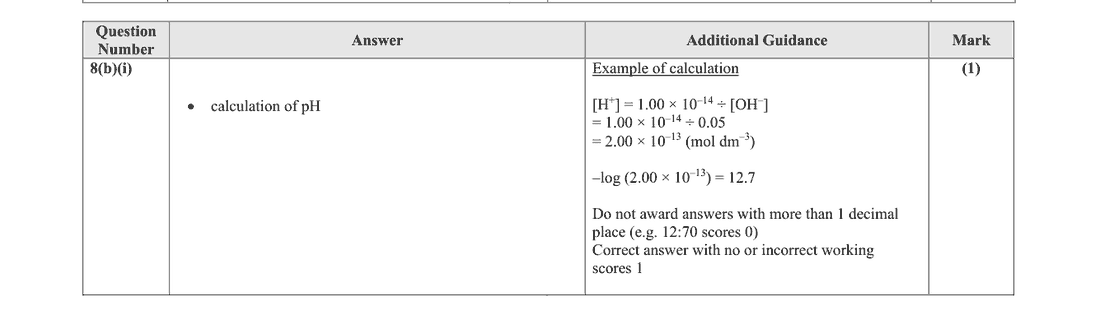
8(b)(i) Acid-base equilibria 1Calculation
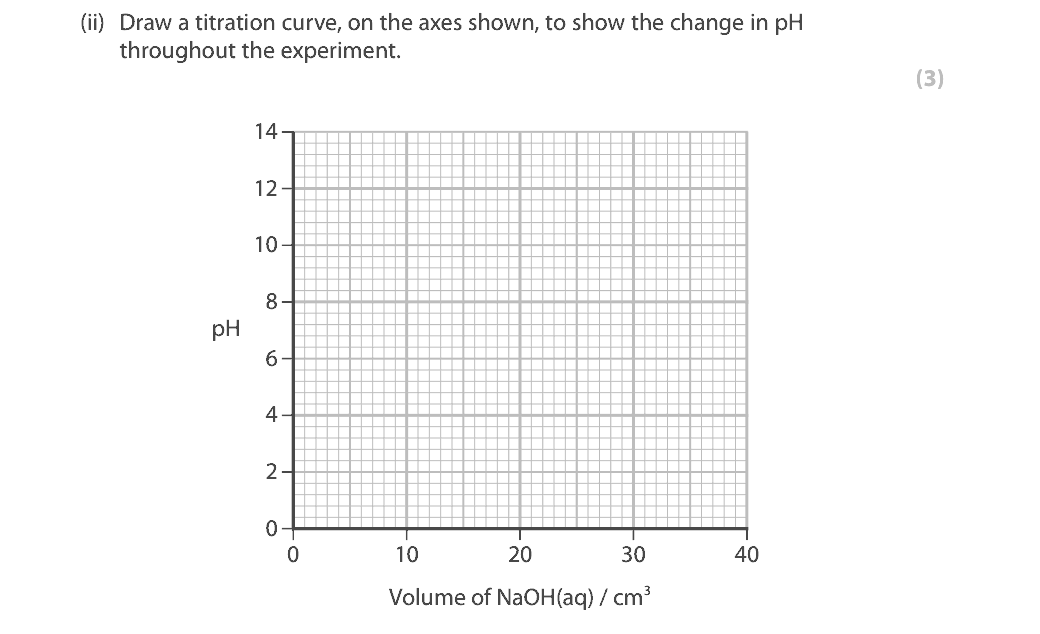
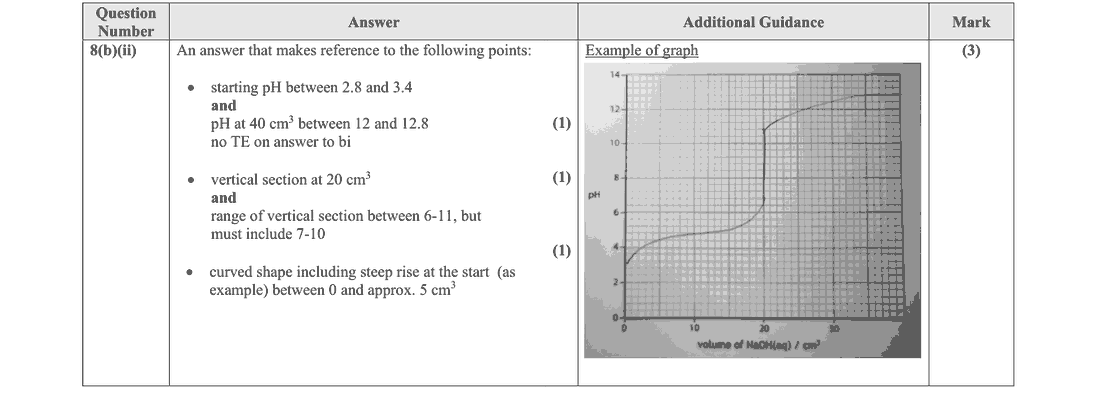
8(b)(ii) Acid-base equilibria 3Diagram or structure
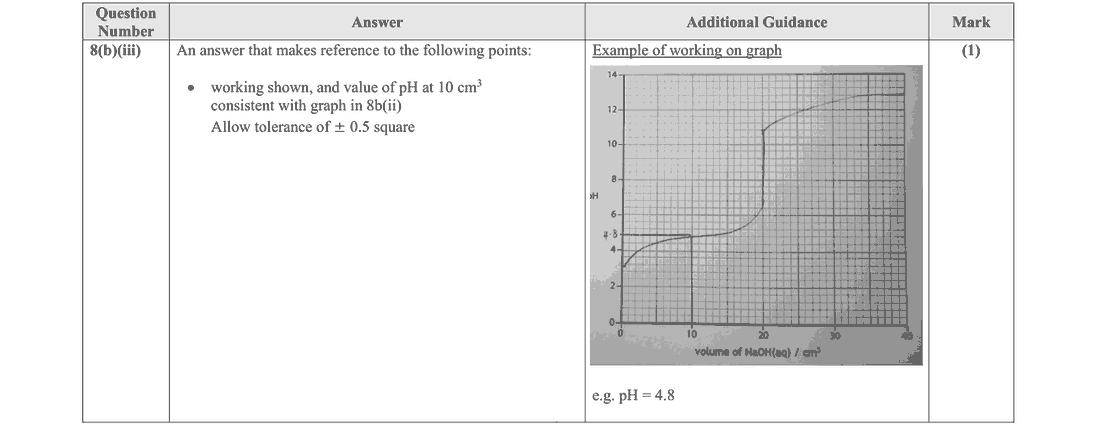
8(b)(iii) Acid-base equilibria 1Short answer
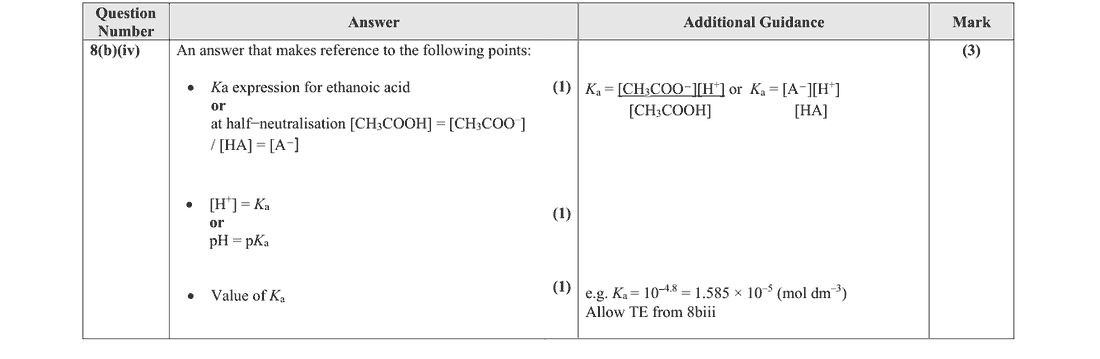
8(b)(iv) Acid-base equilibria 3Calculation
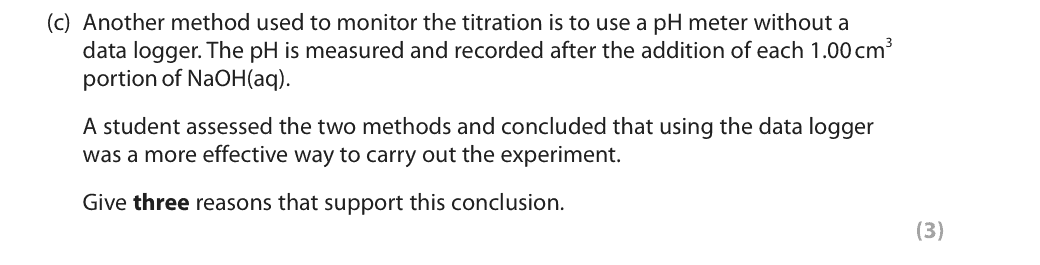
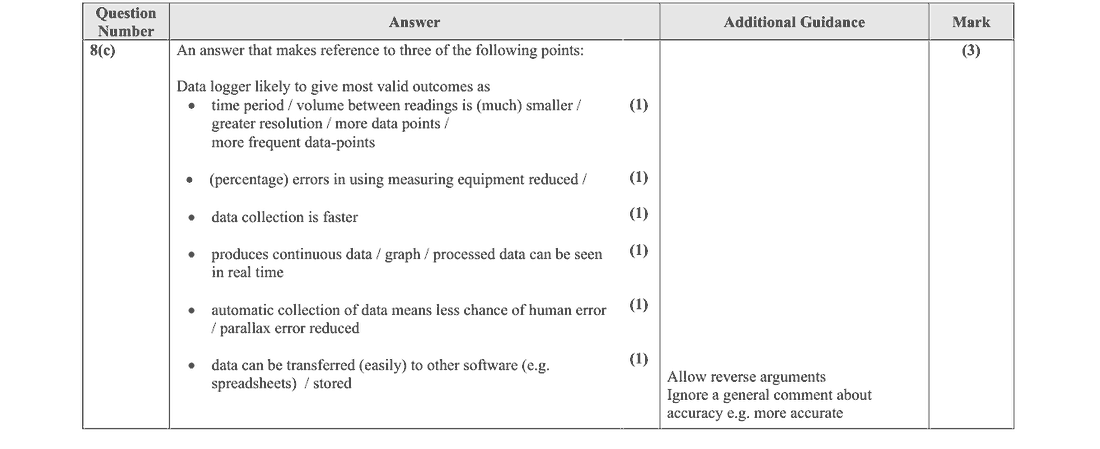
8(c) Acid-base equilibria 3Practical and data analysis
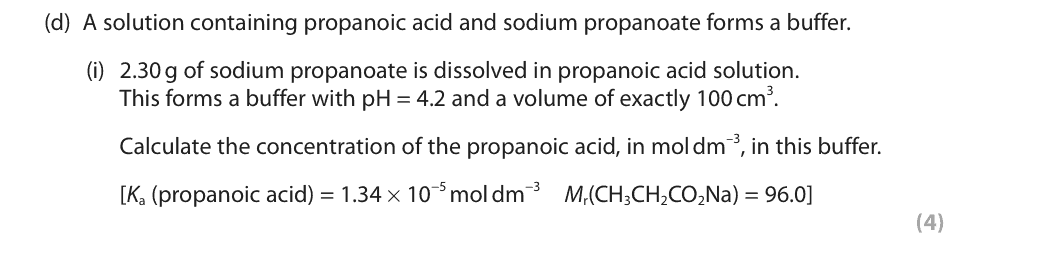
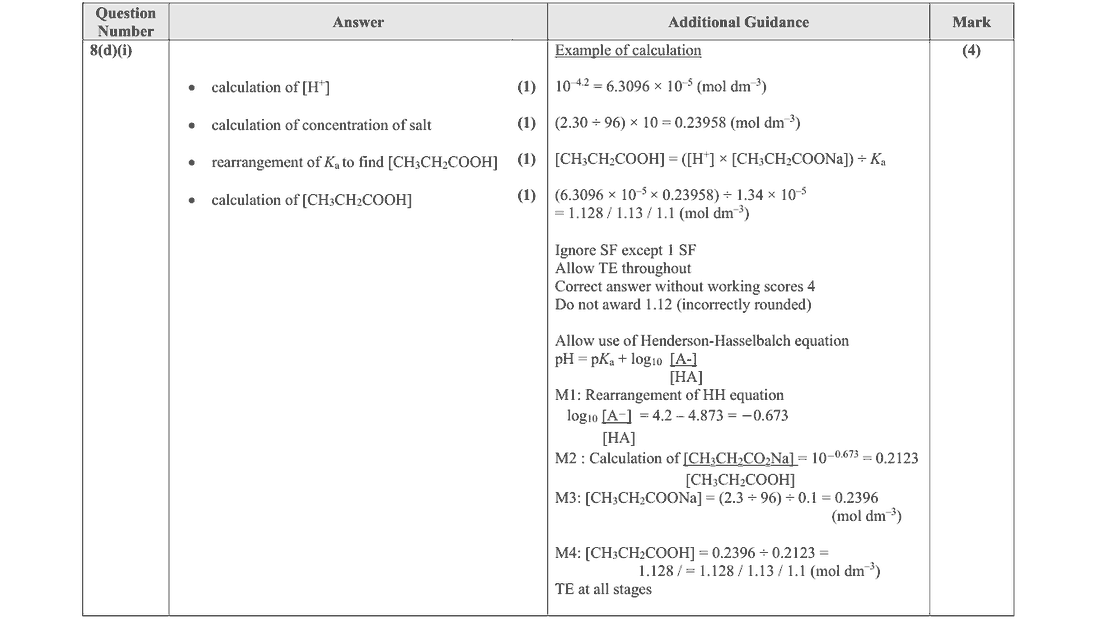
8(d)(i) Acid-base equilibria 4Calculation
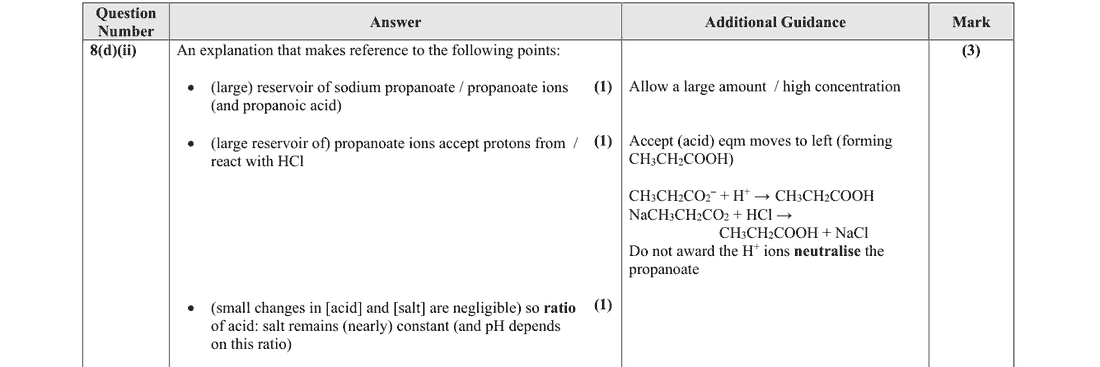
8(d)(ii) Acid-base equilibria 3Explanation
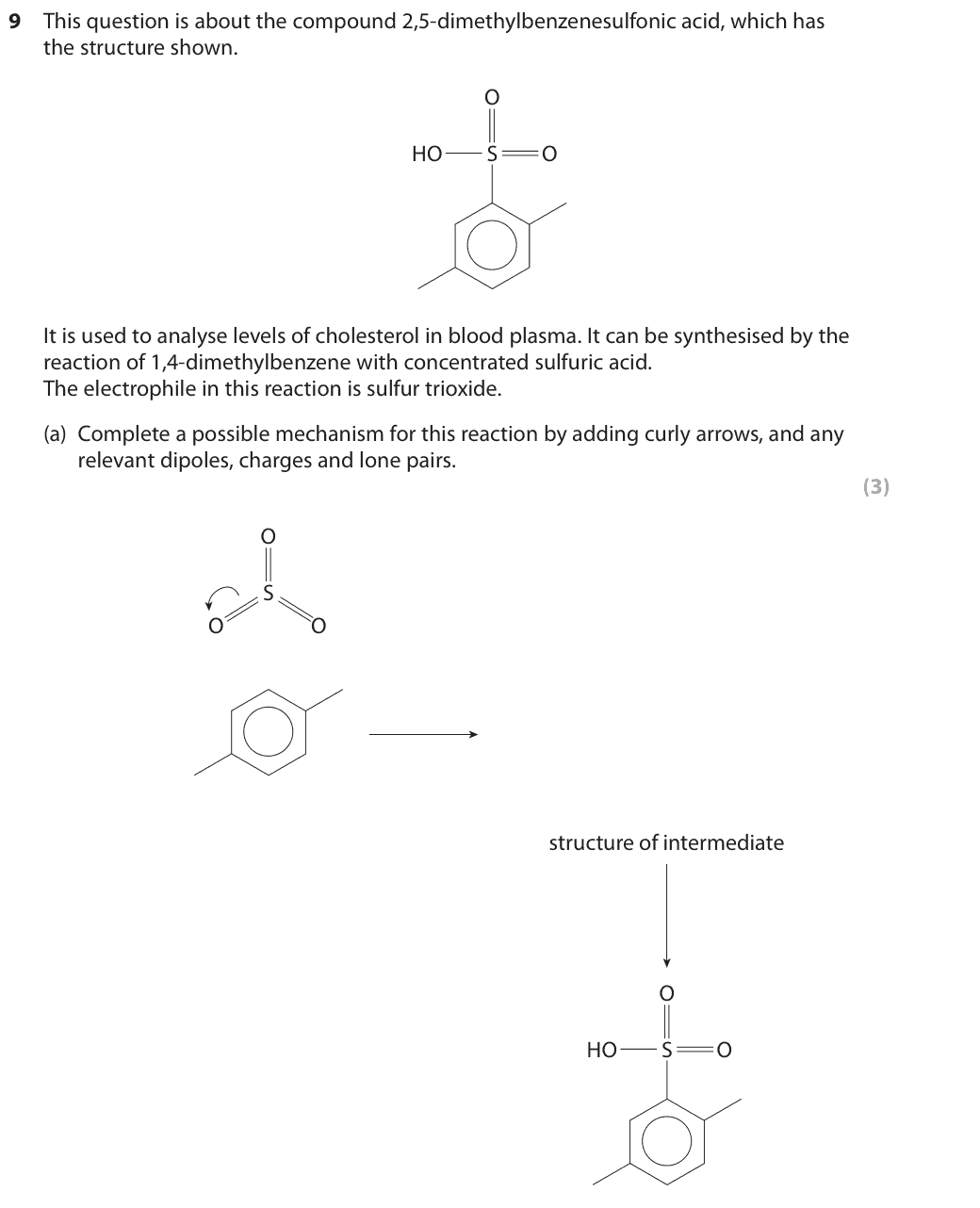
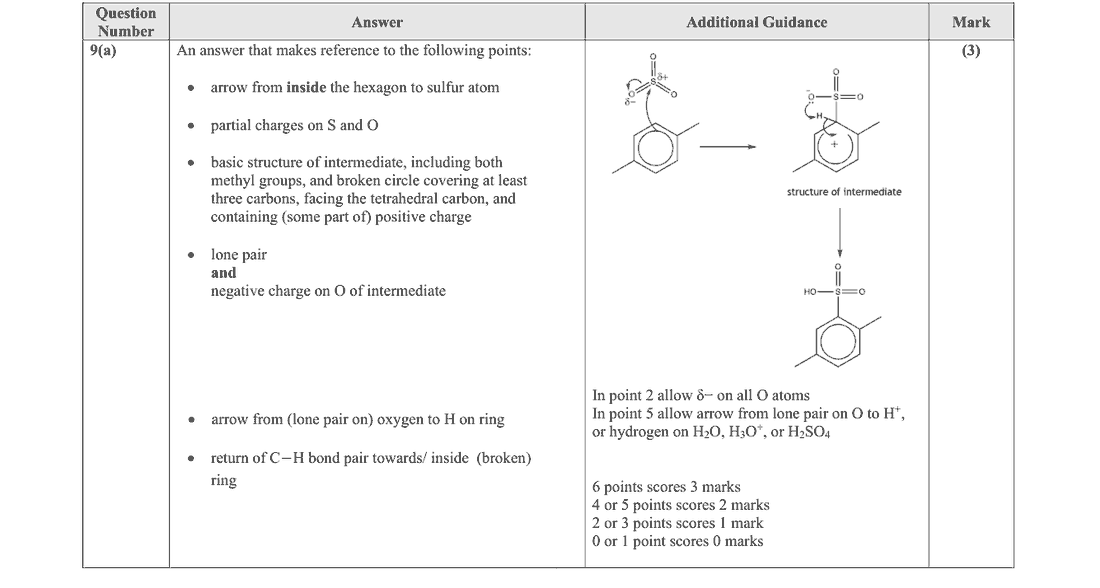
9(a) Arenes: benzene 3Mechanism
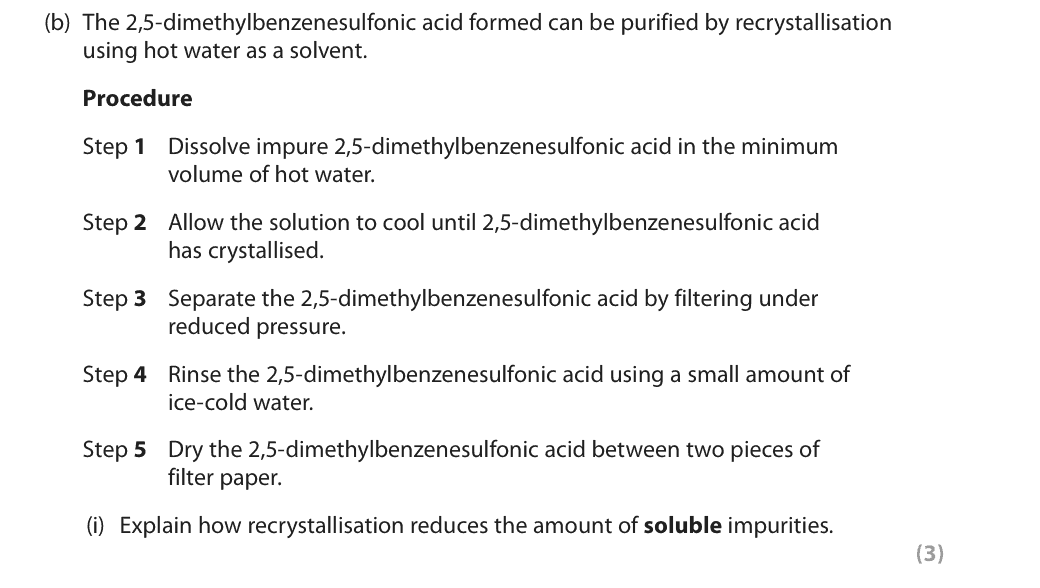
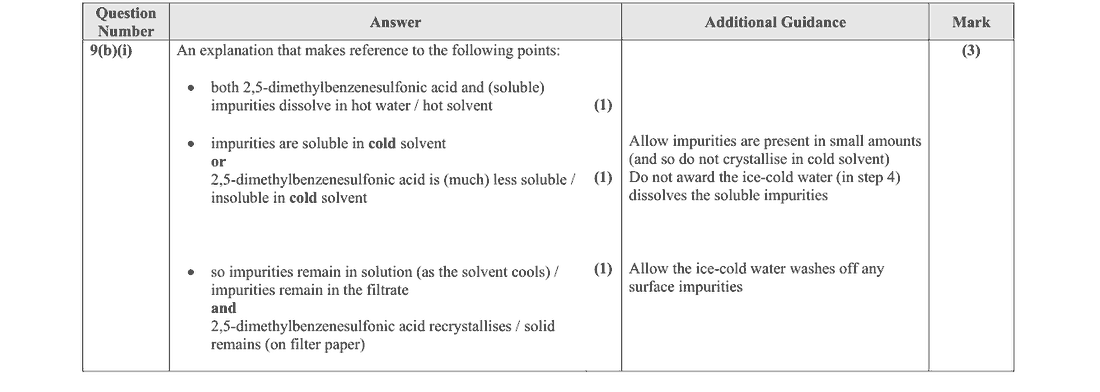
9(b)(i) Organic synthesis 3Practical and data analysis
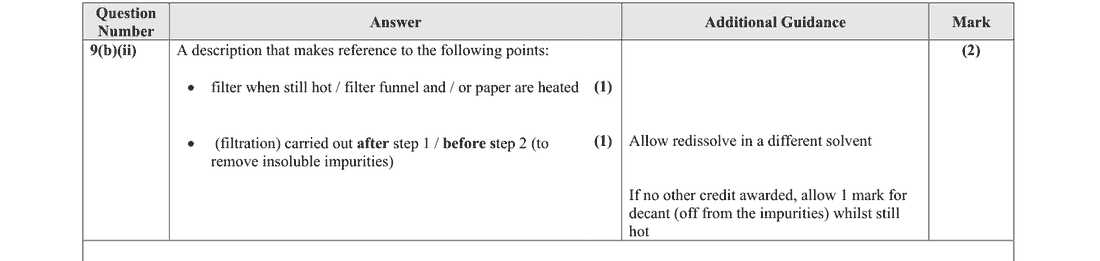
9(b)(ii) Organic synthesis 2Practical and data analysis
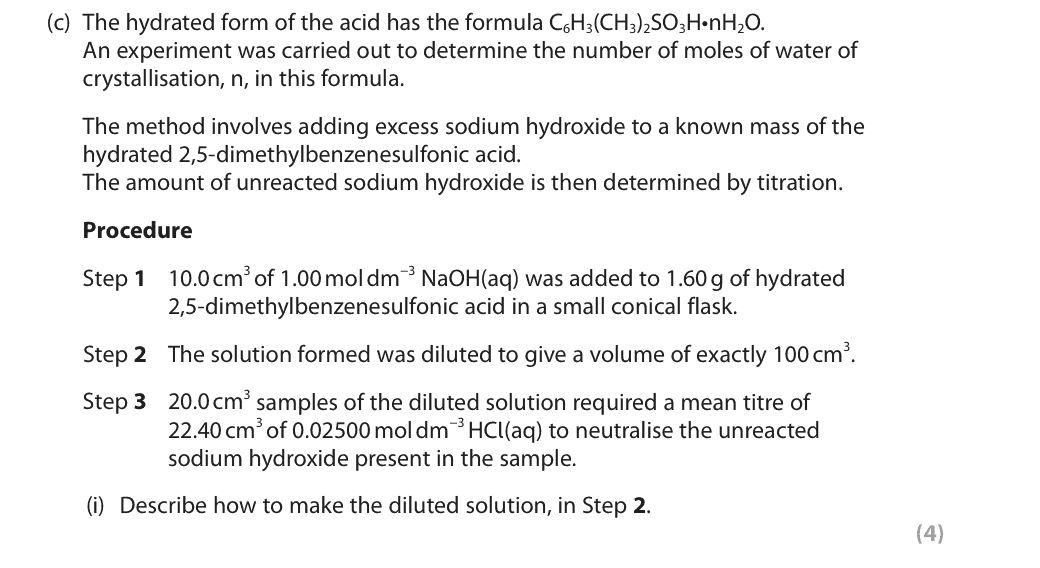
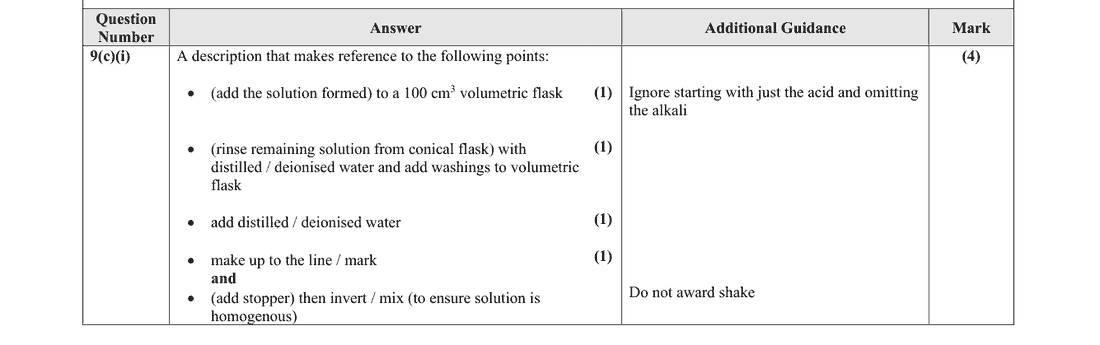
9(c)(i) Formulae, equations and amounts of substance 4Practical and data analysis
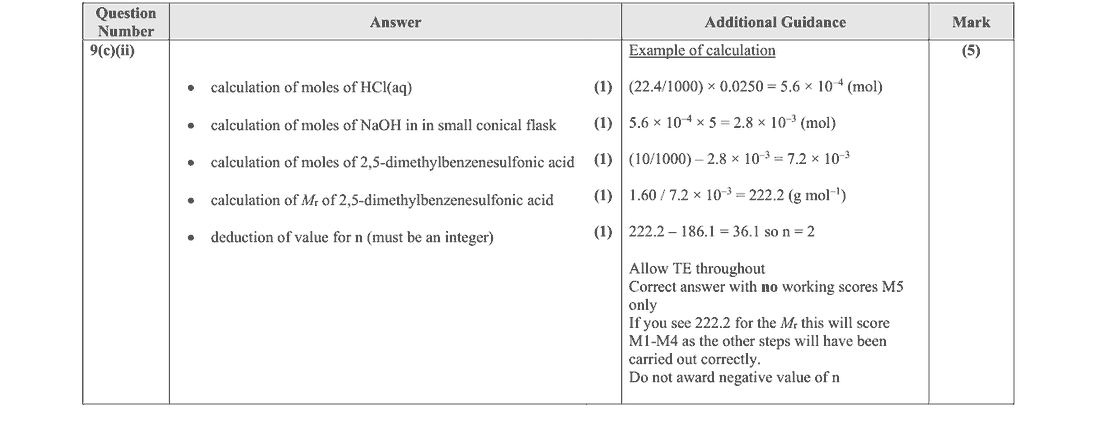
9(c)(ii) Formulae, equations and amounts of substance 5Calculation
9(d)(i) Formulae, equations and amounts of substance 1Practical and data analysis
9(d)(ii) Formulae, equations and amounts of substance 3Practical and data analysis

The questions

1(a)1(b)1(c)2(a)(i)2(a)(ii)2(b)2(c)2(d)(i)2(d)(ii)2(d)(iii)34(a)4(b)(i)4(b)(ii)4(c)4(d)4(e)(i)4(e)(ii)4(e)(iii)5(a)(i)5(a)(ii)5(a)(iii)5(b)(i)5(b)(ii)6(a)6(b)7(a)7(b)(i)7(b)(ii)7(c)7(d)8(a)8(b)(i)8(b)(ii)8(b)(iii)8(b)(iv)8(c)8(d)(i)8(d)(ii)9(a)9(b)(i)9(b)(ii)9(c)(i)9(c)(ii)9(d)(i)9(d)(ii)
June 2025 · Paper 3 · Q1(a) 2 marks Short answer atomic structure and the periodic table
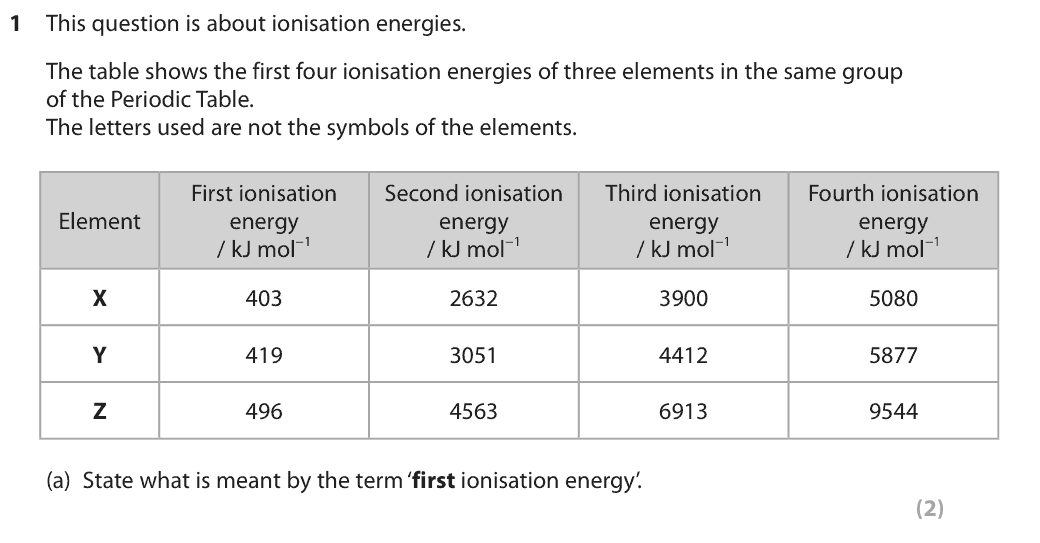
This question is about ionisation energies.
The table shows the first four ionisation energies of three elements in the same group
of the Periodic Table.
The letters used are not the symbols of the elements.
First ionisation
Second ionisation
Third ionisation
Fourth ionisation
Element
energy
energy
energy
energy
/ kJ mol−1
/ kJ mol−1
/ kJ mol−1
/ kJ mol−1
X
403
2632
3900
5080
Y
419
3051
4412
5877
Z
496
4563
6913
9544
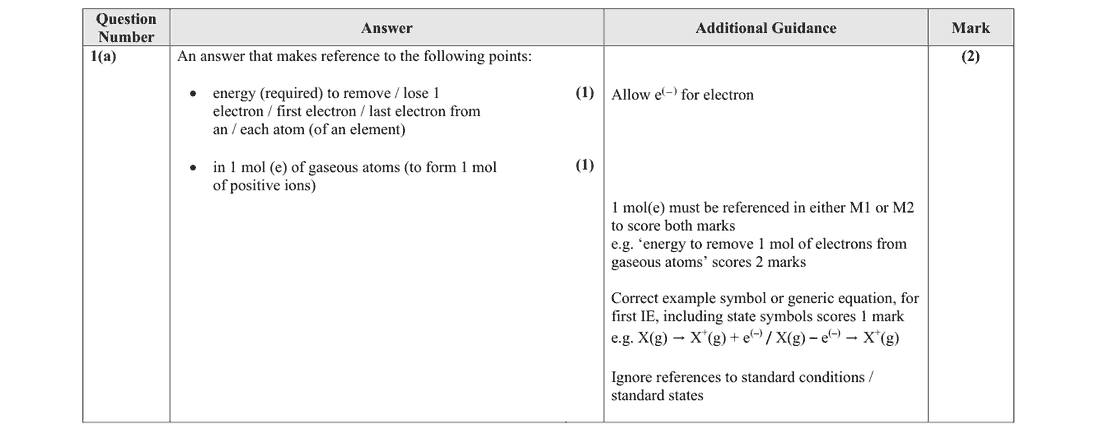
State what is meant by the term ‘first ionisation energy’.
June 2025 · Paper 3 · Q1(b) 2 marks Explanation atomic structure and the periodic table
Earlier part of question 1 that this part usesEarlier part of June 2025 Paper 3 question 1
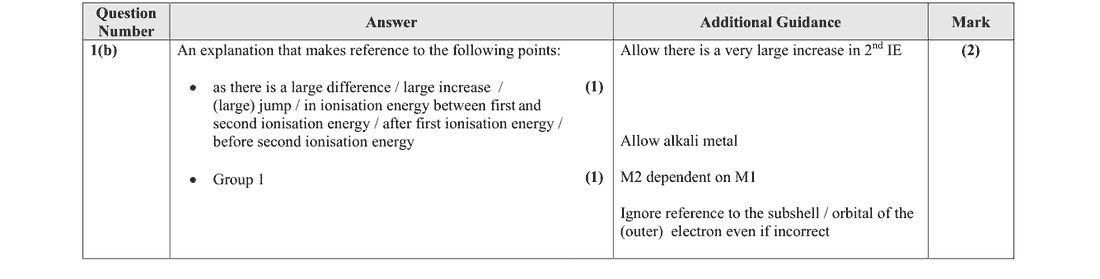
Explain to which group the elements X, Y and Z belong.
June 2025 · Paper 3 · Q1(c) 3 marks Explanation atomic structure and the periodic table
Earlier part of question 1 that this part usesEarlier part of June 2025 Paper 3 question 1
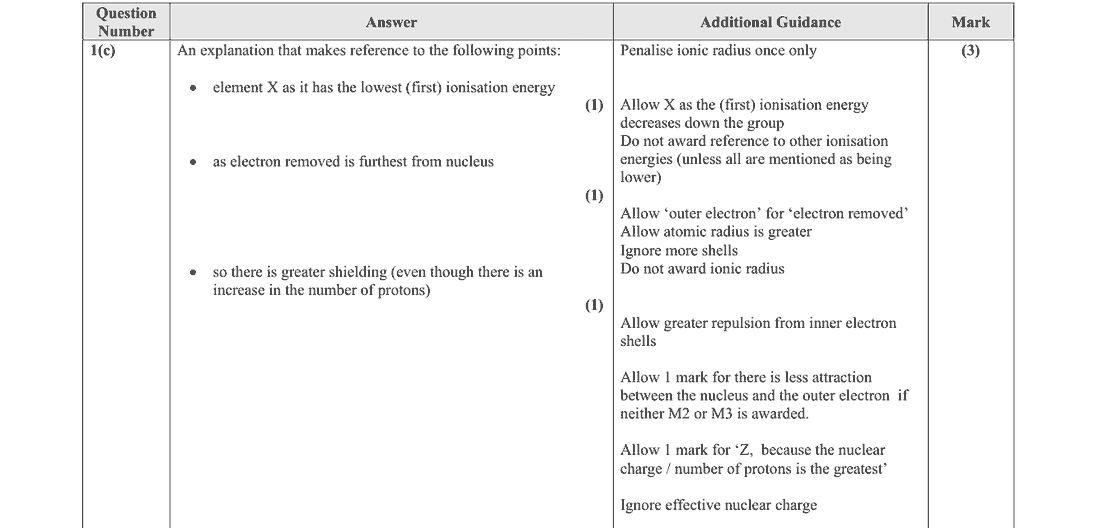
Explain which of the elements X, Y and Z has the highest atomic number.
June 2025 · Paper 3 · Q2(a)(i) 2 marks Practical and data analysis alkenes
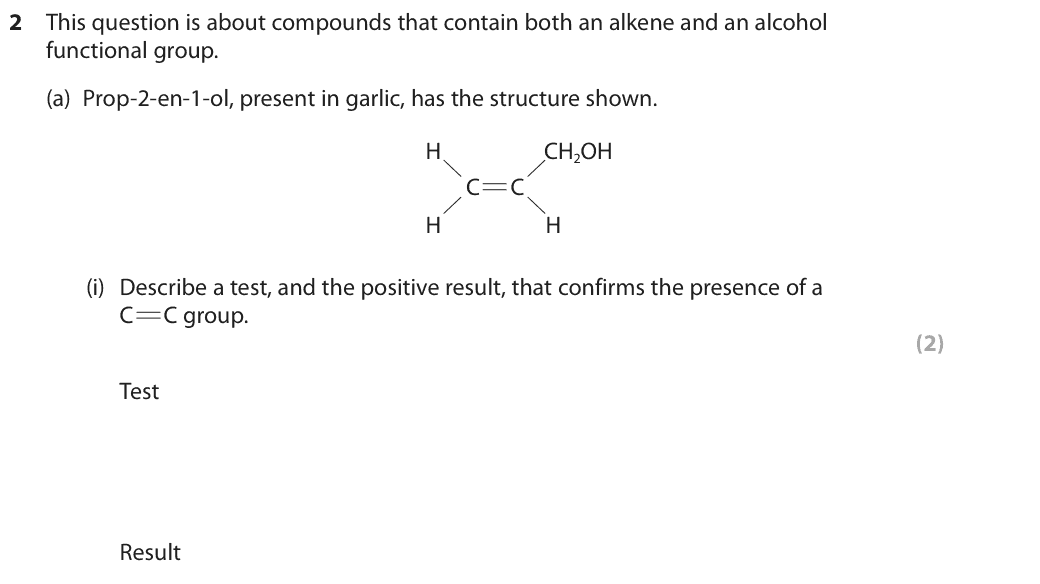
This question is about compounds that contain both an alkene and an alcohol
functional group.
Prop-2-en-1-ol, present in garlic, has the structure shown.
H
CH2OH
C
C
H
H
Describe a test, and the positive result, that confirms the presence of a
C
C group.
Test
Result
June 2025 · Paper 3 · Q2(a)(ii) 3 marks Mechanism alkenes
Earlier part of question 2 that this part usesEarlier part of June 2025 Paper 3 question 2
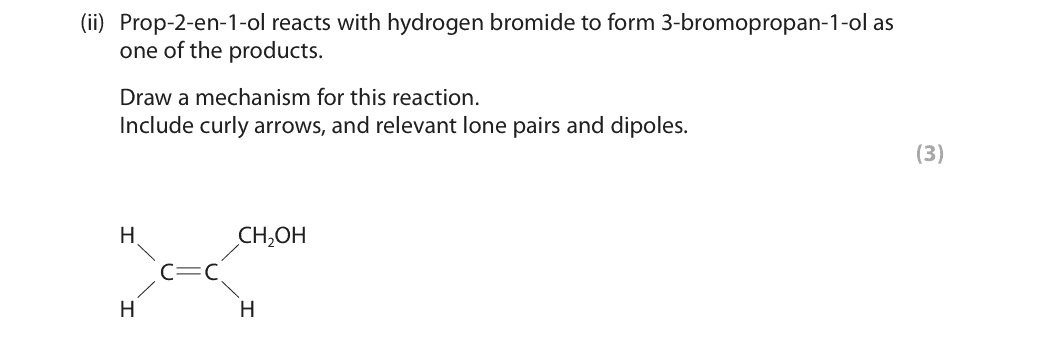
Prop-2-en-1-ol reacts with hydrogen bromide to form 3-bromopropan-1-ol as
one of the products.
Draw a mechanism for this reaction.
Include curly arrows, and relevant lone pairs and dipoles.
H
CH2OH
C
C
H
H
June 2025 · Paper 3 · Q2(b) 2 marks Equation writing alkenes
Earlier part of question 2 that this part usesEarlier part of June 2025 Paper 3 question 2
Prop-2-en-1-ol can polymerise to form an addition polymer.
Write a balanced equation for this polymerisation.
June 2025 · Paper 3 · Q2(c) 2 marks Explanation Hard alkenes
Earlier part of question 2 that this part usesEarlier part of June 2025 Paper 3 question 2
Prop-2-en-1-ol can form the alkene propadiene, which has two adjacent
C
C bonds, as shown.
H
H
C
C
C
H
H
propadiene
Explain why the CH2 groups at each end of the molecule are at right angles to
each other.
Use your knowledge of how orbitals overlap to form π-bonds.
June 2025 · Paper 3 · Q2(d)(i) 1 mark Short answer introduction to organic chemistry
Earlier part of question 2 that this part usesEarlier part of June 2025 Paper 3 question 2
The compound bombykol is a pheromone secreted by female silk moths.
Like prop-2-en-1-ol, it can also be classified as both an alkene and an alcohol.
H
H
H
C
C
C
OH
OH
H
H
bombykol
prop-2-en-1-ol
Bombykol can exist as a number of geometric isomers.
Give the number of different geometric isomers of bombykol.
June 2025 · Paper 3 · Q2(d)(ii) 1 mark Short answer introduction to organic chemistry
Earlier parts of question 2 that this part usesEarlier part of June 2025 Paper 3 question 2Earlier part of June 2025 Paper 3 question 2
Give the reason why prop-2-en-1-ol does not exhibit geometric isomerism.
June 2025 · Paper 3 · Q2(d)(iii) 3 marks Explanation bonding
Earlier parts of question 2 that this part usesEarlier part of June 2025 Paper 3 question 2Earlier part of June 2025 Paper 3 question 2
Explain the expected solubilities in water of bombykol and prop-2-en-1-ol.
June 2025 · Paper 3 · Q3 6 marks 6-mark extended response analysis of inorganic compounds
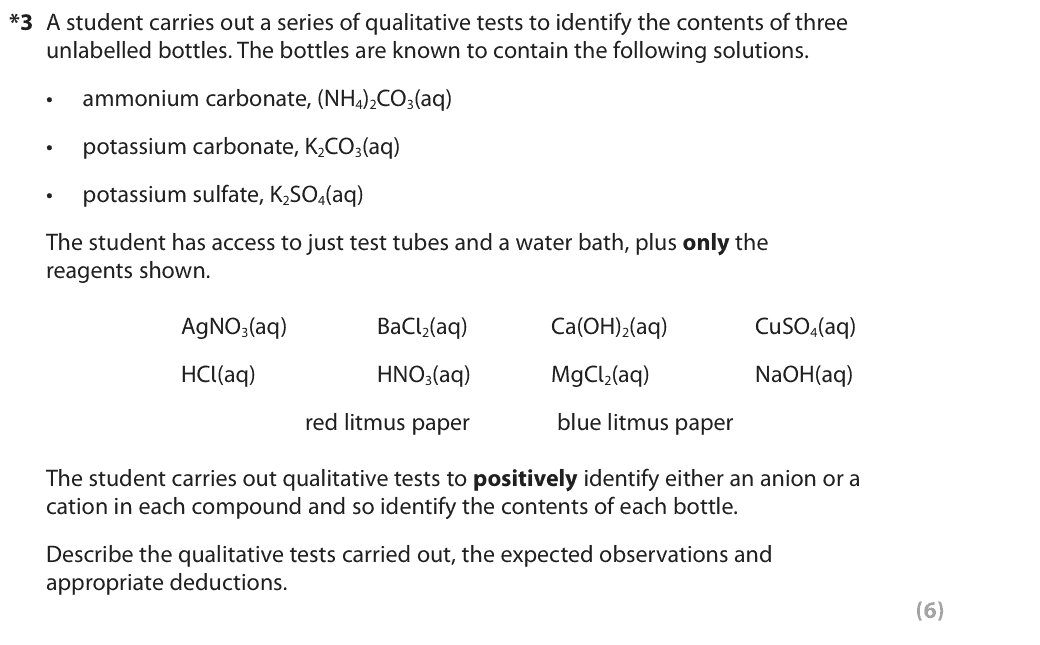
A student carries out a series of qualitative tests to identify the contents of three
unlabelled bottles. The bottles are known to contain the following solutions.
•
ammonium carbonate, (NH4)2CO3(aq)
•
potassium carbonate, K2CO3(aq)
•
potassium sulfate, K2SO4(aq)
The student has access to just test tubes and a water bath, plus only the
reagents shown.
AgNO3(aq)
BaCl2(aq)
Ca(OH)2(aq)
CuSO4(aq)
HCl(aq)
HNO3(aq)
MgCl2(aq)
NaOH(aq)
red litmus paper
blue litmus paper
The student carries out qualitative tests to positively identify either an anion or a
cation in each compound and so identify the contents of each bottle.
Describe the qualitative tests carried out, the expected observations and
appropriate deductions.
June 2025 · Paper 3 · Q4(a) 2 marks Practical and data analysis kinetics ii
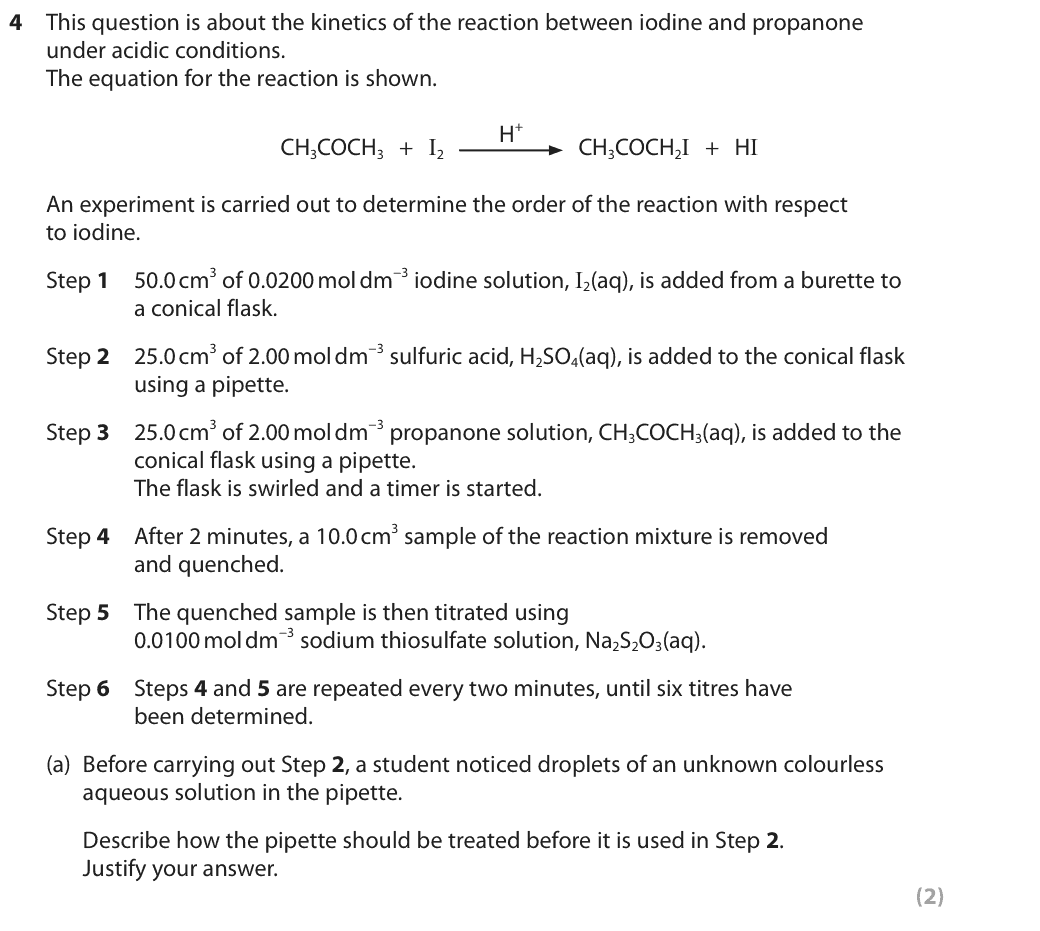
This question is about the kinetics of the reaction between iodine and propanone
under acidic conditions.
The equation for the reaction is shown.
H+
CH3COCH3   +   I2
CH3COCH2I   +   HI
An experiment is carried out to determine the order of the reaction with respect
to iodine.
Step 1  50.0 cm3 of 0.0200 mol dm−3 iodine solution, I2(aq), is added from a burette to
a conical flask.
Step 2  25.0 cm3 of 2.00 mol dm−3 sulfuric acid, H2SO4(aq), is added to the conical flask
using a pipette.
Step 3  25.0 cm3 of 2.00 mol dm−3 propanone solution, CH3COCH3(aq), is added to the
conical flask using a pipette.
The flask is swirled and a timer is started.
Step 4  After 2 minutes, a 10.0 cm3 sample of the reaction mixture is removed
and quenched.
Step 5  The quenched sample is then titrated using
0.0100 mol dm−3 sodium thiosulfate solution, Na2S2O3(aq).
Step 6  Steps 4 and 5 are repeated every two minutes, until six titres have
been determined.
Before carrying out Step 2, a student noticed droplets of an unknown colourless
aqueous solution in the pipette.
Describe how the pipette should be treated before it is used in Step 2.
Justify your answer.
June 2025 · Paper 3 · Q4(b)(i) 2 marks Practical and data analysis kinetics ii
Earlier part of question 4 that this part usesEarlier part of June 2025 Paper 3 question 4
Samples from the reaction mixture are quenched in Step 4.
Explain why quenching is necessary.
June 2025 · Paper 3 · Q4(b)(ii) 2 marks Practical and data analysis kinetics iiformulae equations and amounts of substance
Earlier parts of question 4 that this part usesEarlier part of June 2025 Paper 3 question 4Earlier part of June 2025 Paper 3 question 4
State a compound which can be added to the reaction mixture to quench
the reaction.
Include an equation for the reaction that takes place during the quenching
process. State symbols are not required.
Compound
Equation
June 2025 · Paper 3 · Q4(c) 2 marks Practical and data analysis formulae equations and amounts of substance
Earlier part of question 4 that this part usesEarlier part of June 2025 Paper 3 question 4
One of the products of the reaction, iodopropanone (CH3COCH2I) is corrosive,
strongly irritating to the eyes and can cause breathing difficulties.
Explain why a risk assessment for this experiment says it does not have to be
carried out in a fume cupboard.
June 2025 · Paper 3 · Q4(d) 4 marks Calculation kinetics iiformulae equations and amounts of substance
Earlier part of question 4 that this part usesEarlier part of June 2025 Paper 3 question 4
Show, by calculating the initial quantities of the reactants involved, that this
experiment provides evidence for the order with respect to iodine only.
June 2025 · Paper 3 · Q4(e)(i) 2 marks Diagram or structure kinetics ii
Earlier part of question 4 that this part usesEarlier part of June 2025 Paper 3 question 4
The results of the experiment are shown.
Titre / cm3
Time / min
2
17.00
4
15.60
6
14.00
8
12.50
10
11.00
12
9.40
Plot a graph of titre against time.
June 2025 · Paper 3 · Q4(e)(ii) 1 mark Short answer kinetics ii
Earlier parts of question 4 that this part usesEarlier part of June 2025 Paper 3 question 4Earlier part of June 2025 Paper 3 question 4
Give the reason why it is not necessary to calculate the concentration of
iodine so that the order can be deduced.
June 2025 · Paper 3 · Q4(e)(iii) 2 marks Short answer kinetics ii
Earlier parts of question 4 that this part usesEarlier part of June 2025 Paper 3 question 4Earlier part of June 2025 Paper 3 question 4Earlier part of June 2025 Paper 3 question 4
Deduce the order with respect to iodine. Justify your answer.
June 2025 · Paper 3 · Q5(a)(i) 2 marks Calculation formulae equations and amounts of substance
This question is about cobalt complexes.
A sample of cobalt(II) chloride was dissolved in aqueous ammonia, NH3(aq).
During the process, a stream of oxygen was gently bubbled through the solution
to oxidise the cobalt(II) ion.
A coloured solid, R, was extracted from the solution. A pure sample of this solid
was found to contain the masses of the elements shown and had a molar mass
of 233.4 g mol−1.
Element
Mass / g
Co
1.26
N
1.20
H
0.257
Cl
2.28
Show that the empirical formula and the molecular formula of R is CoN4H12Cl3 .
You must show your working.
June 2025 · Paper 3 · Q5(a)(ii) 2 marks Calculation formulae equations and amounts of substance
Earlier part of question 5 that this part usesEarlier part of June 2025 Paper 3 question 5
1.00 g of R was dissolved in water forming a coloured solution of
the complex ion, Q.
The solution was reacted with excess silver nitrate solution, forming
0.614 g of silver chloride, AgCl(s).
Calculate the number of moles of chloride ions released when 1 mol of
R dissolves.
June 2025 · Paper 3 · Q5(a)(iii) 3 marks Diagram or structure transition metals principles
Earlier parts of question 5 that this part usesEarlier part of June 2025 Paper 3 question 5Earlier part of June 2025 Paper 3 question 5
Draw the three-dimensional shape of the complex ion, Q, using your answer
to (a)(ii) to help deduce the formula and overall charge.
June 2025 · Paper 3 · Q5(b)(i) 2 marks Short answer equilibrium i
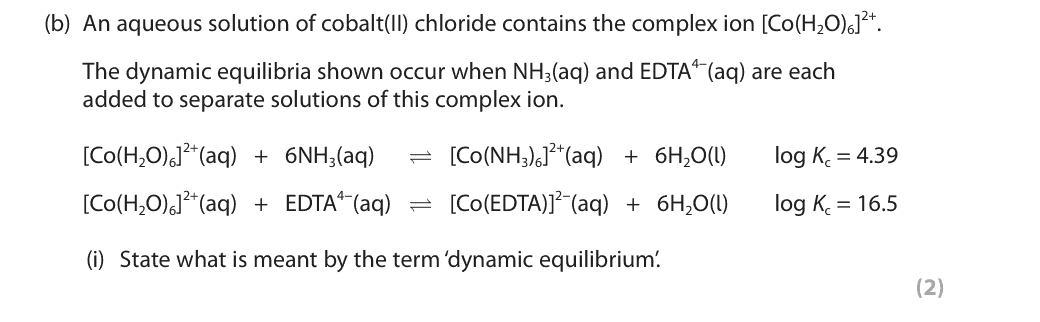
An aqueous solution of cobalt(II) chloride contains the complex ion [Co(H2O)6]2+.
The dynamic equilibria shown occur when NH3(aq) and EDTA4−(aq) are each
added to separate solutions of this complex ion.
[Co(H2O)6]2+(aq)   +   6NH3(aq)
   [Co(NH3)6]2+(aq)  +   6H2O(l)
log Kc = 4.39
[Co(H2O)6]2+(aq)   +   EDTA4−(aq)     [Co(EDTA)]2−(aq)   +   6H2O(l)
log Kc = 16.5
State what is meant by the term ‘dynamic equilibrium’.
June 2025 · Paper 3 · Q5(b)(ii) 3 marks Explanation transition metals reactions
Earlier parts of question 5 that this part usesEarlier part of June 2025 Paper 3 question 5Earlier part of June 2025 Paper 3 question 5
Explain, in terms of equilibria and entropy, which of the three complex ions is
the most stable.
June 2025 · Paper 3 · Q6(a) 4 marks Diagram or structure organic synthesisalcohols
The compound 2-methyl-1-phenylpropan-2-ol is found in small amounts in
cocoa beans and has the structure shown.
OH
A proposed synthesis of 2-methyl-1-phenylpropan-2-ol from phenylmethanol and
propanone is shown.
Complete the diagram to show the structures of compounds A, B and C and the
formula of reagent D.
OH
50% concentrated H2SO4
and KBr
Mg in
O
dry ether
+
structure of compound A
structure of compound B
OH
reagent D 
structure of compound C
June 2025 · Paper 3 · Q6(b) 5 marks Short answer nmr mass spectrometry and chromatography
Earlier part of question 6 that this part usesEarlier part of June 2025 Paper 3 question 6
2-Methyl-1-phenylpropan-2-ol can be converted to compound S.
When considering the 1H NMR spectrum of S, the hydrogen atoms of the benzene
have been assumed to be a single environment, labelled J.
The other hydrogen environments have been labelled K, L, M and N.
environment M
environment L
environment N
CH3
CH3
H3C
O
C
CH2
environment K
CH2
H
H
environment J
H
H
H
compound S
Complete the table for each of the environments K to N in the high resolution
1H NMR spectrum of S.
Chemical shift / ppm
Relative peak area
Splitting pattern
Environment J
6.8 – 8.2
5
complex
Environment K
Environment L
Environment M
Environment N
June 2025 · Paper 3 · Q7(a) 2 marks Practical and data analysis alcohols
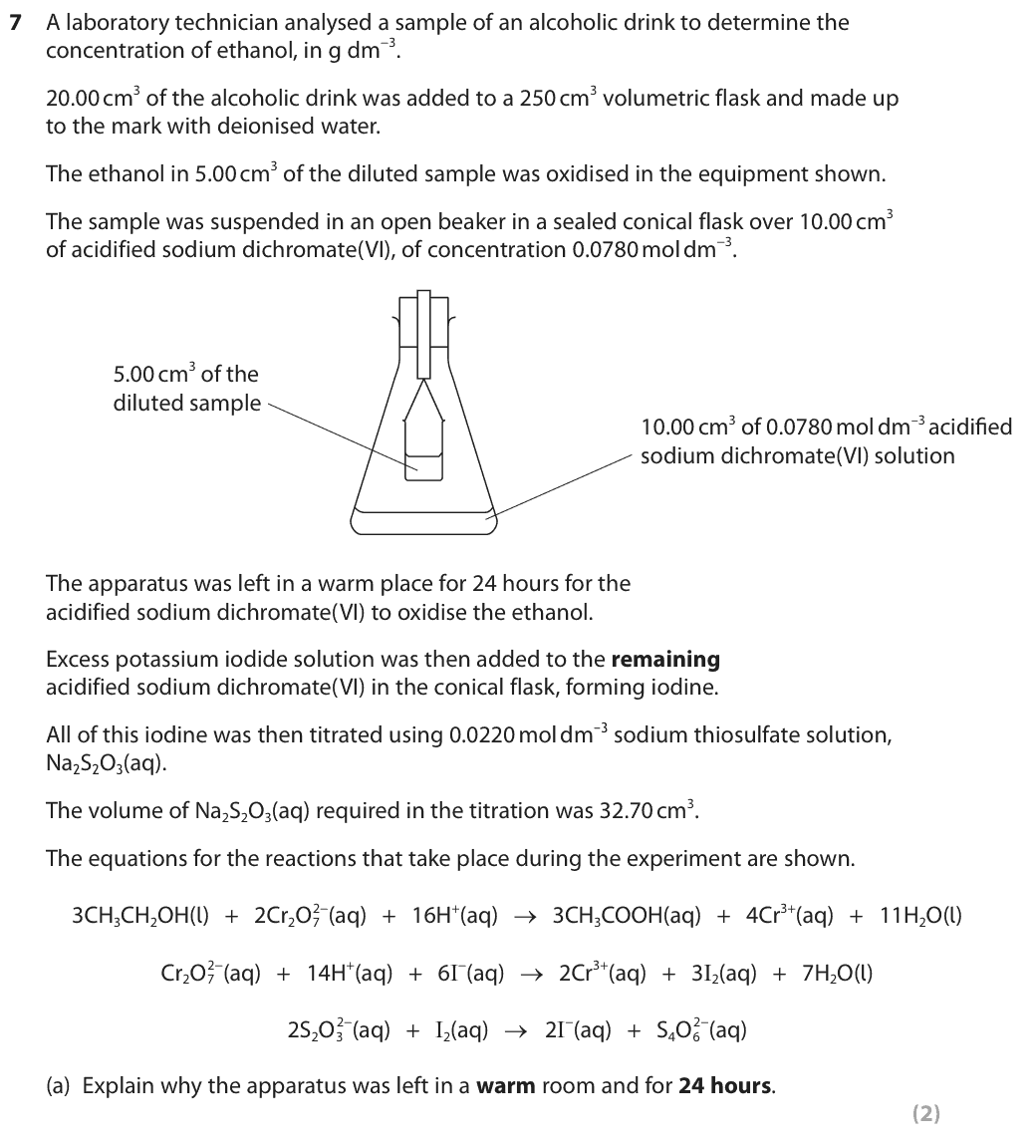
A laboratory technician analysed a sample of an alcoholic drink to determine the
concentration of ethanol, in g dm−3.
20.00 cm3 of the alcoholic drink was added to a 250 cm3 volumetric flask and made up
to the mark with deionised water.
The ethanol in 5.00 cm3 of the diluted sample was oxidised in the equipment shown.
The sample was suspended in an open beaker in a sealed conical flask over 10.00 cm3
of acidified sodium dichromate(VI), of concentration 0.0780 mol dm−3.
5.00 cm3 of the
diluted sample
10.00 cm3 of 0.0780 mol dm–3 acidified
sodium dichromate(VI) solution
The apparatus was left in a warm place for 24 hours for the
acidified sodium dichromate(VI) to oxidise the ethanol.
Excess potassium iodide solution was then added to the remaining
acidified sodium dichromate(VI) in the conical flask, forming iodine.
All of this iodine was then titrated using 0.0220 mol dm−3 sodium thiosulfate solution,
Na2S2O3(aq).
The volume of Na2S2O3(aq) required in the titration was 32.70 cm3.
The equations for the reactions that take place during the experiment are shown.
3CH3CH2OH(l)   +   2Cr2O 7
2−(aq)   +   16H+(aq)   →   3CH3COOH(aq)   +   4Cr3+(aq)   +   11H2O(l)
Cr2O 7
2−(aq)   +   14H+(aq)   +   6I−(aq)   →   2Cr3+(aq)   +   3I2(aq)   +   7H2O(l)
2−(aq)   +   I2(aq)   →   2I−(aq)   +   S4O 6
2−(aq)
2S2O 3
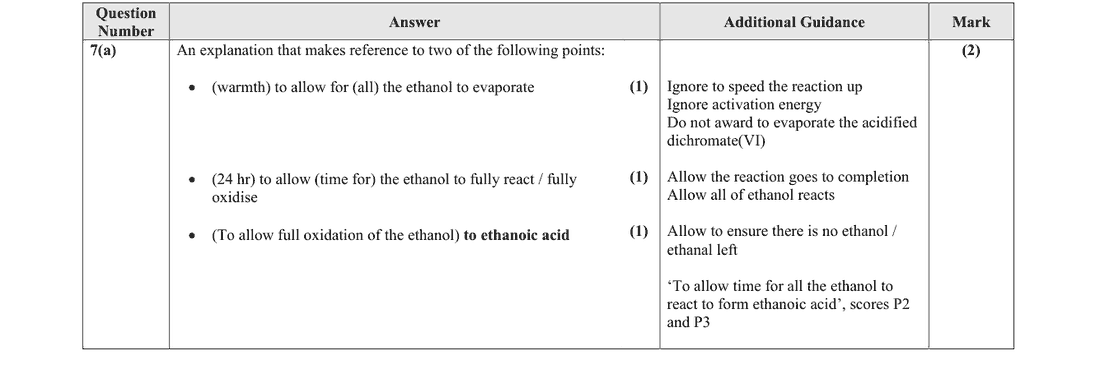
Explain why the apparatus was left in a warm room and for 24 hours.
June 2025 · Paper 3 · Q7(b)(i) 5 marks Calculation redox ii
Earlier part of question 7 that this part usesEarlier part of June 2025 Paper 3 question 7
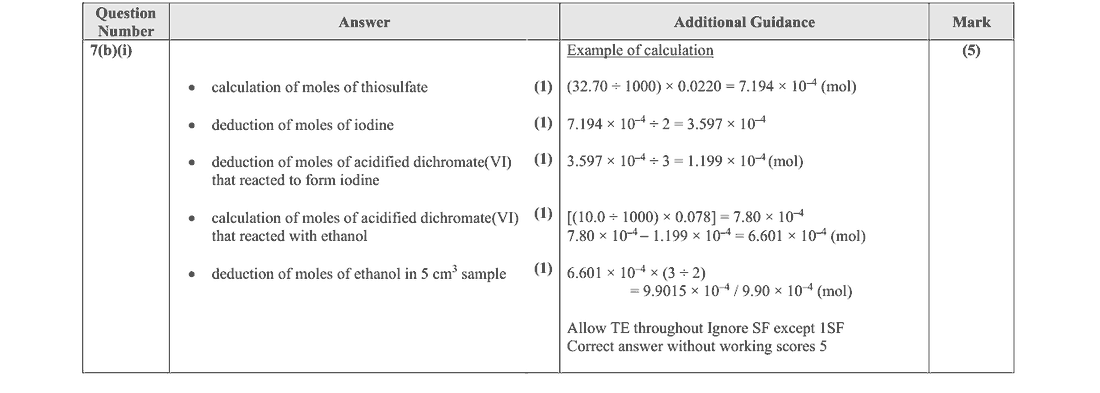
Calculate the number of moles of ethanol in 5 cm3 of the diluted drink.
June 2025 · Paper 3 · Q7(b)(ii) 3 marks Calculation redox iiformulae equations and amounts of substance
Earlier parts of question 7 that this part usesEarlier part of June 2025 Paper 3 question 7Earlier part of June 2025 Paper 3 question 7
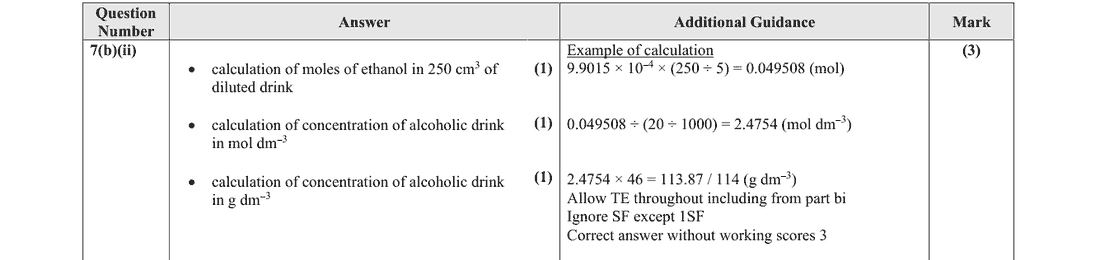
Calculate the concentration of ethanol in the alcoholic drink in g dm−3.
June 2025 · Paper 3 · Q7(c) 2 marks Practical and data analysis redox iiformulae equations and amounts of substance
Earlier part of question 7 that this part usesEarlier part of June 2025 Paper 3 question 7
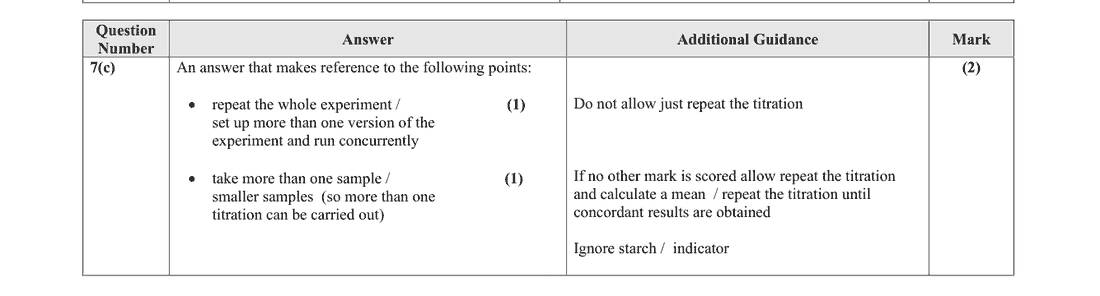
It was suggested that the titration as described might lead to an unreliable result.
State two ways the procedure could be amended to counter this suggestion.
June 2025 · Paper 3 · Q7(d) 2 marks Practical and data analysis alcohols
Earlier part of question 7 that this part usesEarlier part of June 2025 Paper 3 question 7
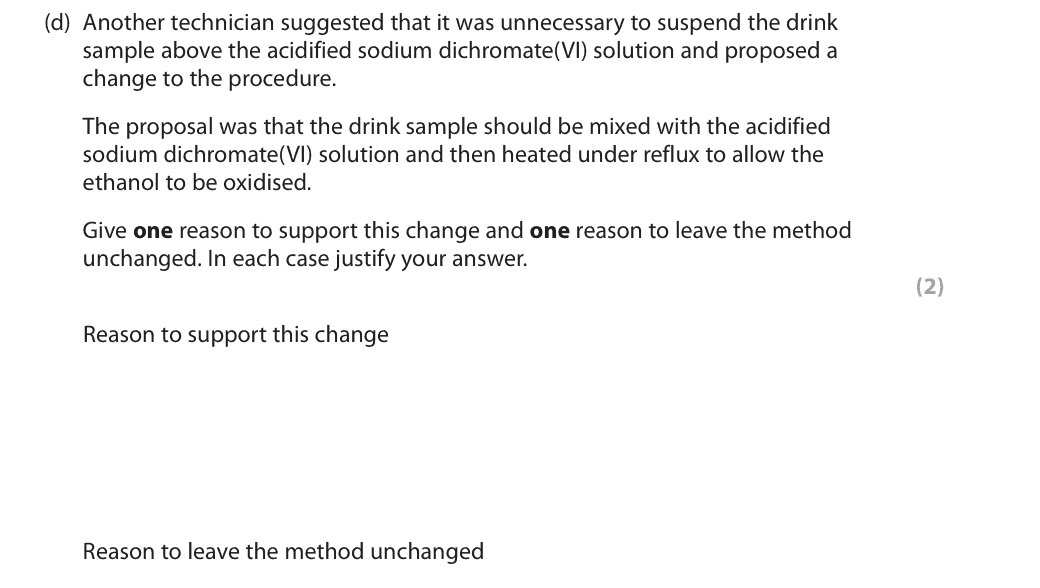
Another technician suggested that it was unnecessary to suspend the drink
sample above the acidified sodium dichromate(VI) solution and proposed a
change to the procedure.
The proposal was that the drink sample should be mixed with the acidified
sodium dichromate(VI) solution and then heated under reflux to allow the
ethanol to be oxidised.
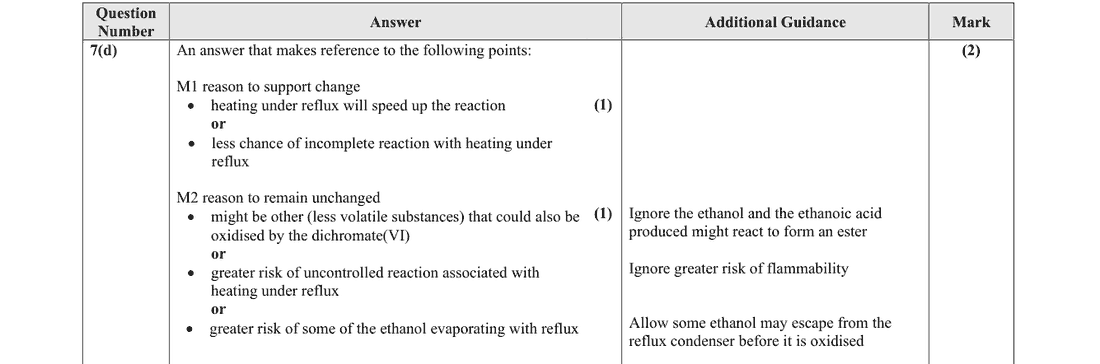
Give one reason to support this change and one reason to leave the method
unchanged. In each case justify your answer.
Reason to support this change
Reason to leave the method unchanged
June 2025 · Paper 3 · Q8(a) 2 marks Calculation acid base equilibria
This question is about weak acids.
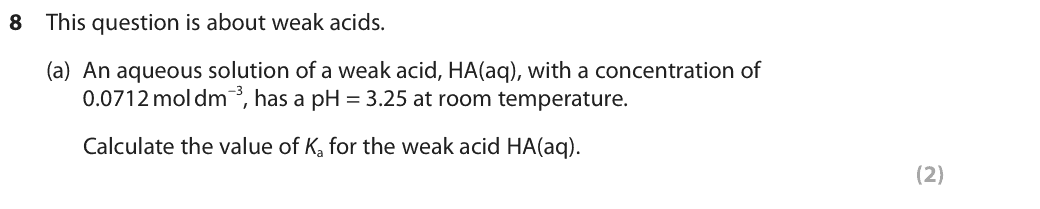
An aqueous solution of a weak acid, HA(aq), with a concentration of
0.0712 mol dm−3, has a pH = 3.25 at room temperature.
Calculate the value of Ka for the weak acid HA(aq).
June 2025 · Paper 3 · Q8(b)(i) 1 mark Calculation acid base equilibria
Earlier part of question 8 that this part usesEarlier part of June 2025 Paper 3 question 8
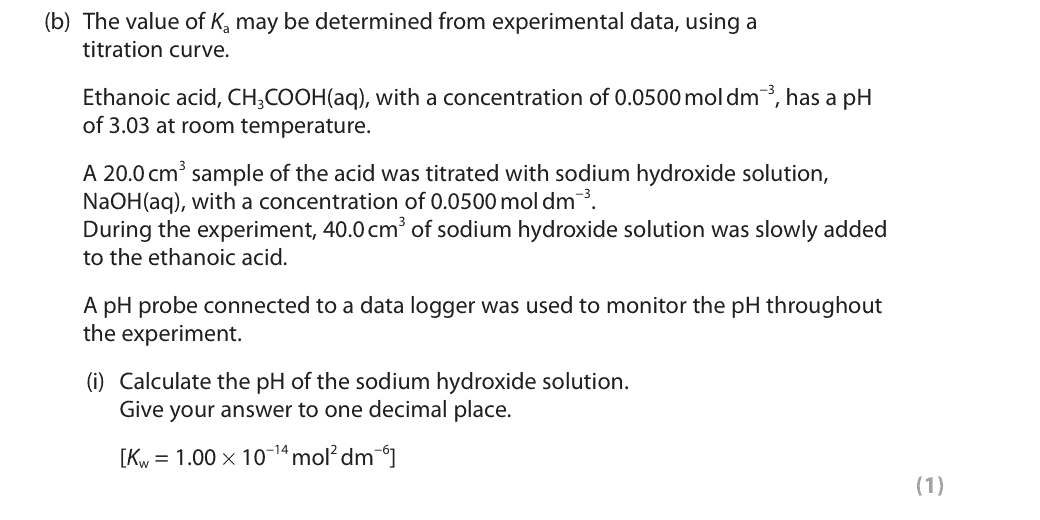
The value of Ka may be determined from experimental data, using a
titration curve.
Ethanoic acid, CH3COOH(aq), with a concentration of 0.0500 mol dm−3, has a pH
of 3.03 at room temperature.
A 20.0 cm3 sample of the acid was titrated with sodium hydroxide solution,
NaOH(aq), with a concentration of 0.0500 mol dm−3.
During the experiment, 40.0 cm3 of sodium hydroxide solution was slowly added
to the ethanoic acid.
A pH probe connected to a data logger was used to monitor the pH throughout
the experiment.
Calculate the pH of the sodium hydroxide solution.
Give your answer to one decimal place.
[Kw = 1.00 × 10−14 mol2 dm−6]
June 2025 · Paper 3 · Q8(b)(ii) 3 marks Diagram or structure acid base equilibria
Earlier parts of question 8 that this part usesEarlier part of June 2025 Paper 3 question 8Earlier part of June 2025 Paper 3 question 8
Draw a titration curve, on the axes shown, to show the change in pH
throughout the experiment.
14
12
10
8
pH
6
4
2
0
0
10
20
30
40
Volume of NaOH(aq) / cm3
June 2025 · Paper 3 · Q8(b)(iii) 1 mark Short answer acid base equilibria
Earlier parts of question 8 that this part usesEarlier part of June 2025 Paper 3 question 8Earlier part of June 2025 Paper 3 question 8
Give an estimate of the pH value at the half-equivalence point.
Show your working on the titration curve.
June 2025 · Paper 3 · Q8(b)(iv) 3 marks Calculation acid base equilibria
Earlier parts of question 8 that this part usesEarlier part of June 2025 Paper 3 question 8Earlier part of June 2025 Paper 3 question 8Earlier part of June 2025 Paper 3 question 8Earlier part of June 2025 Paper 3 question 8
Calculate a value for Ka of ethanoic acid using your answer to (b)(iii).
You must show your working.
June 2025 · Paper 3 · Q8(c) 3 marks Practical and data analysis acid base equilibria
Earlier part of question 8 that this part usesEarlier part of June 2025 Paper 3 question 8
Another method used to monitor the titration is to use a pH meter without a
data logger. The pH is measured and recorded after the addition of each 1.00 cm3
portion of NaOH(aq).
A student assessed the two methods and concluded that using the data logger
was a more effective way to carry out the experiment.
Give three reasons that support this conclusion.
June 2025 · Paper 3 · Q8(d)(i) 4 marks Calculation acid base equilibria
A solution containing propanoic acid and sodium propanoate forms a buffer.
2.30 g of sodium propanoate is dissolved in propanoic acid solution.
This forms a buffer with pH = 4.2 and a volume of exactly 100 cm3.
Calculate the concentration of the propanoic acid, in mol dm–3, in this buffer.
[Ka (propanoic acid) = 1.34 × 10−5 mol dm−3  Mr(CH3CH2CO2Na) = 96.0]
June 2025 · Paper 3 · Q8(d)(ii) 3 marks Explanation acid base equilibria
Earlier parts of question 8 that this part usesEarlier part of June 2025 Paper 3 question 8Earlier part of June 2025 Paper 3 question 8
Explain why there is no significant change in pH when a small amount of
hydrochloric acid, HCl(aq), is added to this buffer.
June 2025 · Paper 3 · Q9(a) 3 marks Mechanism arenes benzene
This question is about the compound 2,5-dimethylbenzenesulfonic acid, which has
the structure shown.
O
S
O
HO
It is used to analyse levels of cholesterol in blood plasma. It can be synthesised by the
reaction of 1,4-dimethylbenzene with concentrated sulfuric acid.
The electrophile in this reaction is sulfur trioxide.
Complete a possible mechanism for this reaction by adding curly arrows, and any
relevant dipoles, charges and lone pairs.
O
S
O
O
structure of intermediate
O
HO
S
O
June 2025 · Paper 3 · Q9(b)(i) 3 marks Practical and data analysis organic synthesis
Earlier part of question 9 that this part usesEarlier part of June 2025 Paper 3 question 9
The 2,5-dimethylbenzenesulfonic acid formed can be purified by recrystallisation
using hot water as a solvent.
Procedure
Step 1  Dissolve impure 2,5-dimethylbenzenesulfonic acid in the minimum
volume of hot water.
Step 2  Allow the solution to cool until 2,5-dimethylbenzenesulfonic acid
has crystallised.
Step 3  Separate the 2,5-dimethylbenzenesulfonic acid by filtering under
reduced pressure.
Step 4  Rinse the 2,5-dimethylbenzenesulfonic acid using a small amount of
ice‑cold water.
Step 5  Dry the 2,5-dimethylbenzenesulfonic acid between two pieces of
filter paper.
Explain how recrystallisation reduces the amount of soluble impurities.
June 2025 · Paper 3 · Q9(b)(ii) 2 marks Practical and data analysis organic synthesis
Earlier parts of question 9 that this part usesEarlier part of June 2025 Paper 3 question 9Earlier part of June 2025 Paper 3 question 9
A student carrying out this procedure noticed some insoluble impurities in
their sample.
Describe how the procedure should be amended to remove these
insoluble impurities.
June 2025 · Paper 3 · Q9(c)(i) 4 marks Practical and data analysis formulae equations and amounts of substance
Earlier part of question 9 that this part usesEarlier part of June 2025 Paper 3 question 9
The hydrated form of the acid has the formula C6H3(CH3)2SO3H•nH2O.
An experiment was carried out to determine the number of moles of water of
crystallisation, n, in this formula.
The method involves adding excess sodium hydroxide to a known mass of the
hydrated 2,5-dimethylbenzenesulfonic acid.
The amount of unreacted sodium hydroxide is then determined by titration.
Procedure
Step 1  10.0 cm3 of 1.00 mol dm−3 NaOH(aq) was added to 1.60 g of hydrated
2,5-dimethylbenzenesulfonic acid in a small conical flask.
Step 2  The solution formed was diluted to give a volume of exactly 100 cm3.
Step 3  20.0 cm3 samples of the diluted solution required a mean titre of
22.40 cm3 of 0.02500 mol dm−3 HCl(aq) to neutralise the unreacted
sodium hydroxide present in the sample.
Describe how to make the diluted solution, in Step 2.
June 2025 · Paper 3 · Q9(c)(ii) 5 marks Calculation formulae equations and amounts of substance
Earlier parts of question 9 that this part usesEarlier part of June 2025 Paper 3 question 9Earlier part of June 2025 Paper 3 question 9
Calculate the relative formula mass of hydrated
2,5-dimethylbenzenesulfonic acid and hence deduce the value of n.
June 2025 · Paper 3 · Q9(d)(i) 1 mark Practical and data analysis formulae equations and amounts of substance
Earlier part of question 9 that this part usesEarlier part of June 2025 Paper 3 question 9
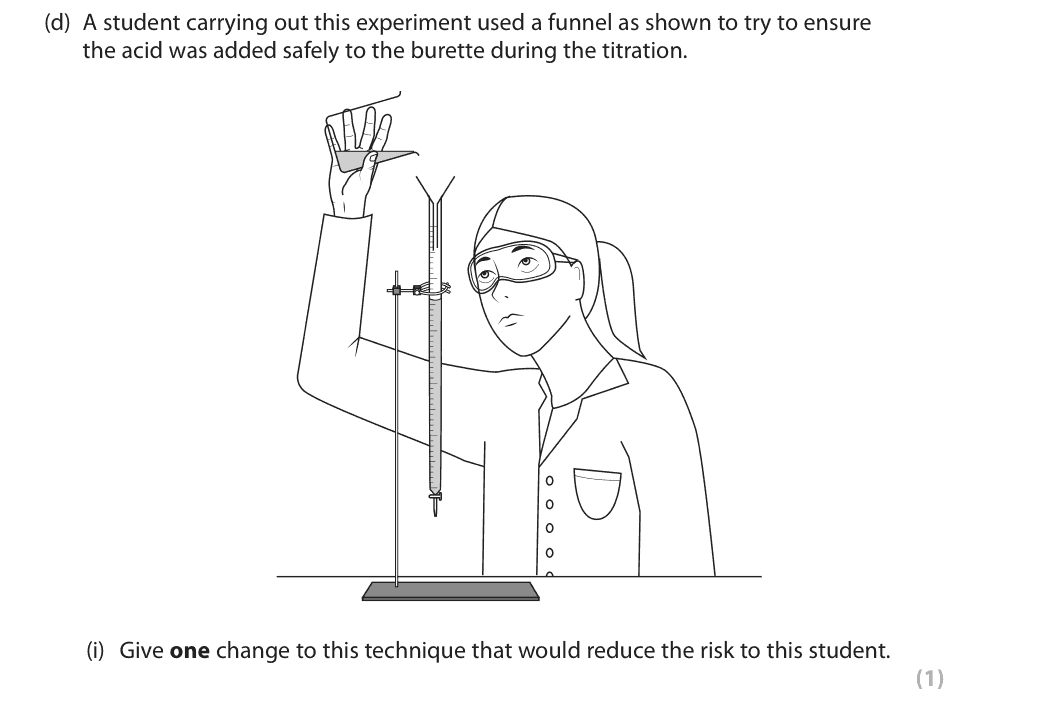
A student carrying out this experiment used a funnel as shown to try to ensure
the acid was added safely to the burette during the titration.
Give one change to this technique that would reduce the risk to this student.
June 2025 · Paper 3 · Q9(d)(ii) 3 marks Practical and data analysis formulae equations and amounts of substance
Earlier parts of question 9 that this part usesEarlier part of June 2025 Paper 3 question 9Earlier part of June 2025 Paper 3 question 9
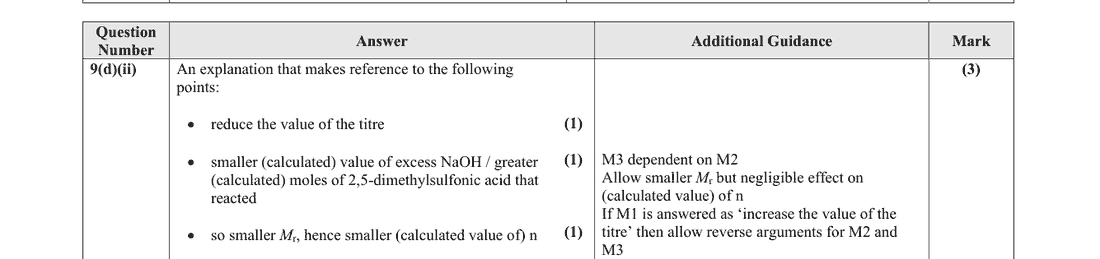
The student forgot to remove the funnel from the burette and during the
titration five drops of acid from the funnel dripped into the burette.
Explain what effect, if any, this error will have on the final value for n.

Work with an A-level chemistry tutor

Want a paper marked and gone through with you? Message us.

Prefer email? Send an enquiry

If you are under 18, please include a parent's contact details. Enquiries go to enquiries@chemistryaleveltutor.com and are deleted once handled. All tutoring is online.