Answer
C
Mark scheme
Notes from the mark scheme and report
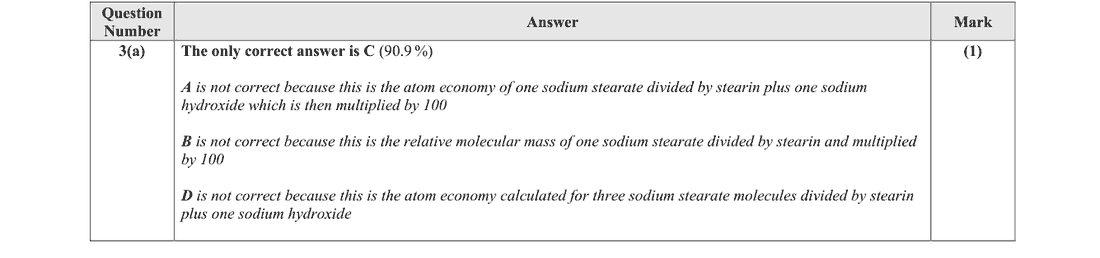
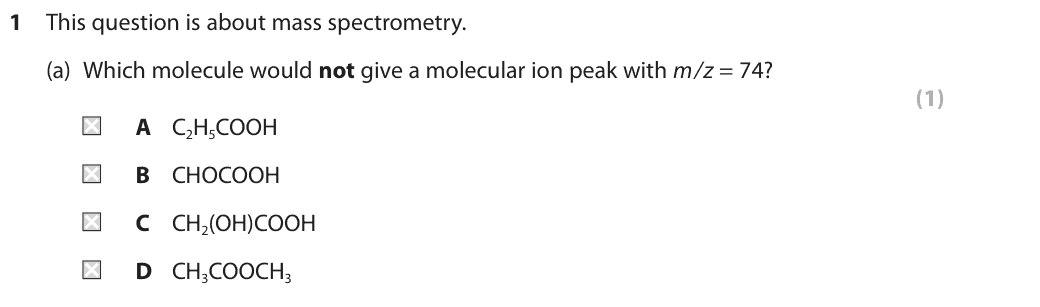
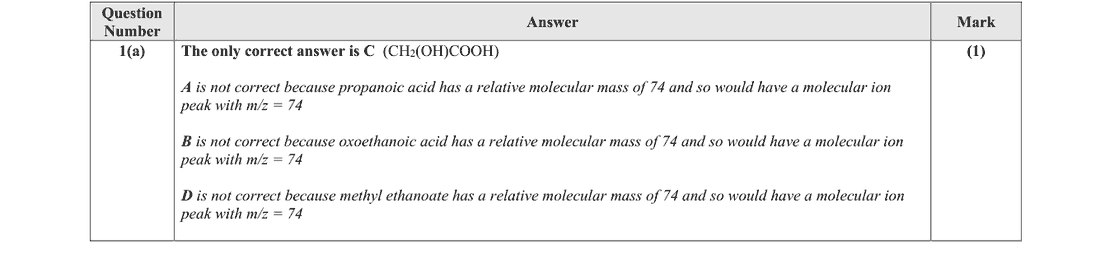
- Answer: C. CH2(OH)COOH has a relative molecular mass of 76. Propanoic acid, oxoethanoic acid (CHOCOOH) and methyl ethanoate all have Mr = 74
90 marks · 38 question parts · Paper, mark scheme and report on Edexcel's site · Have the Data Booklet beside you
C
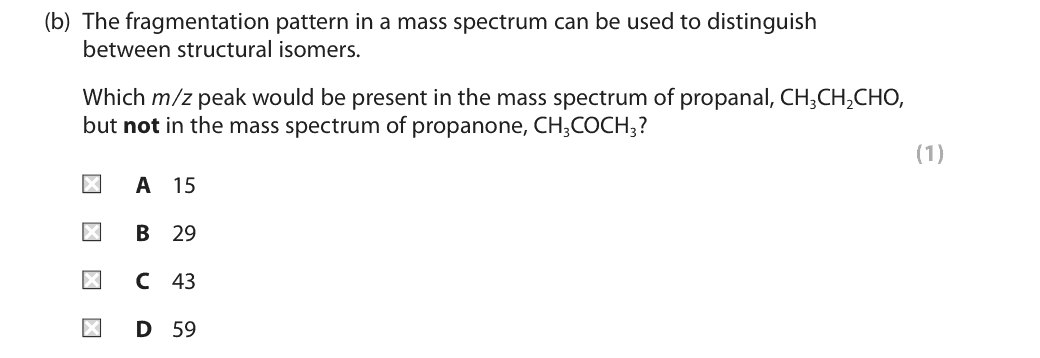
B
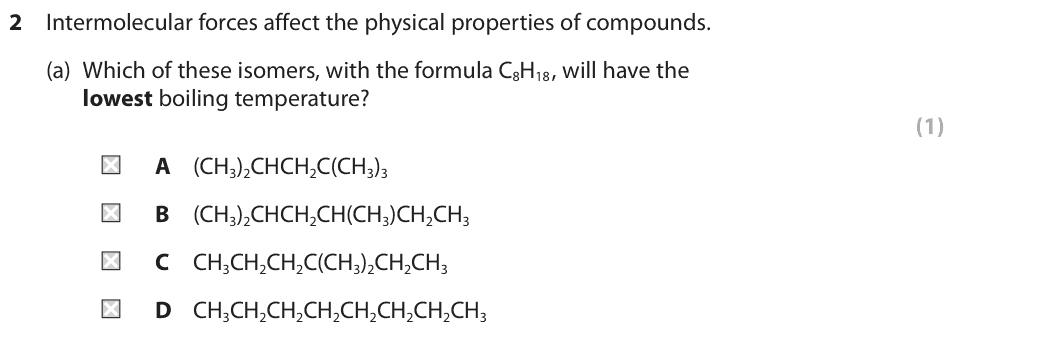
A

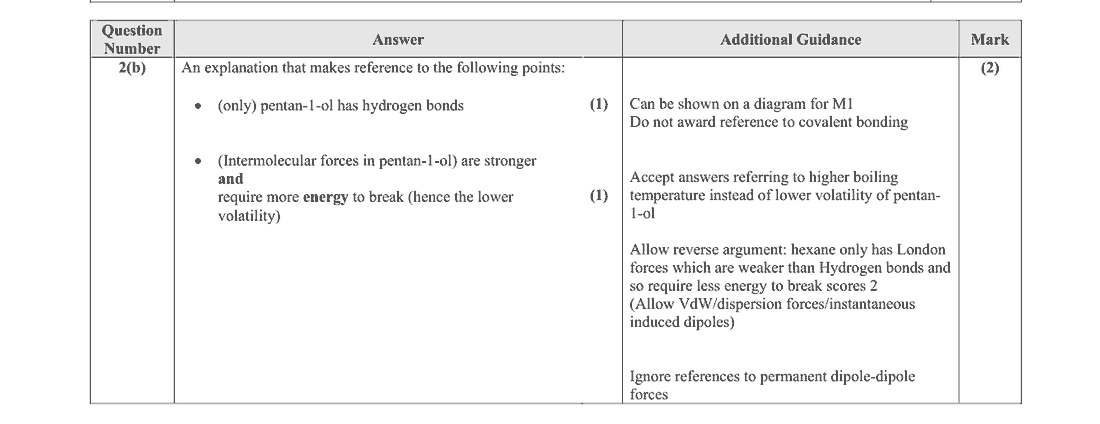
Many candidates correctly identified the strongest intermolecular forces between propan-1-ol as being hydrogen bonds and so scored M1. Some candidates either did not make it clear that hydrogen bonding was stronger and so requires more energy to break and so did not score the second marking point. Probably the most frequent error was either neglecting to mention that the hydrogen bonding required most energy to overcome, or not mentioning that the hydrogen bonding is the strongest intermolecular force of attraction. Both statements were required for M2.
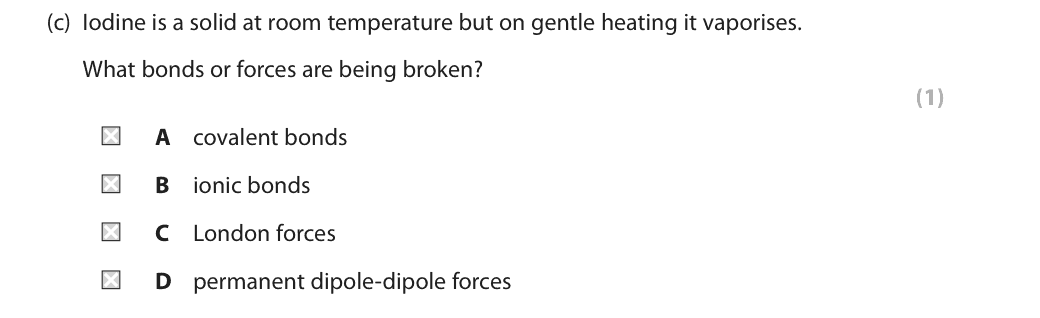
C
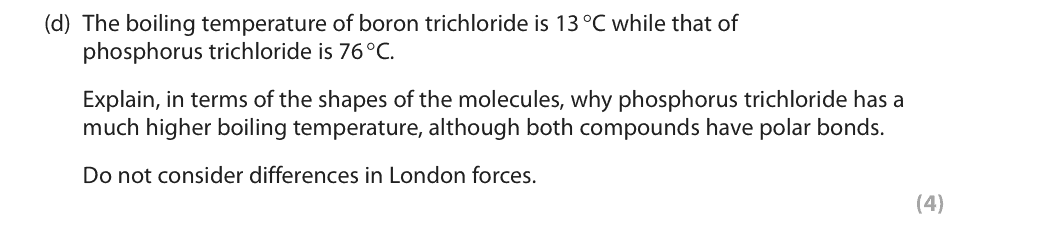
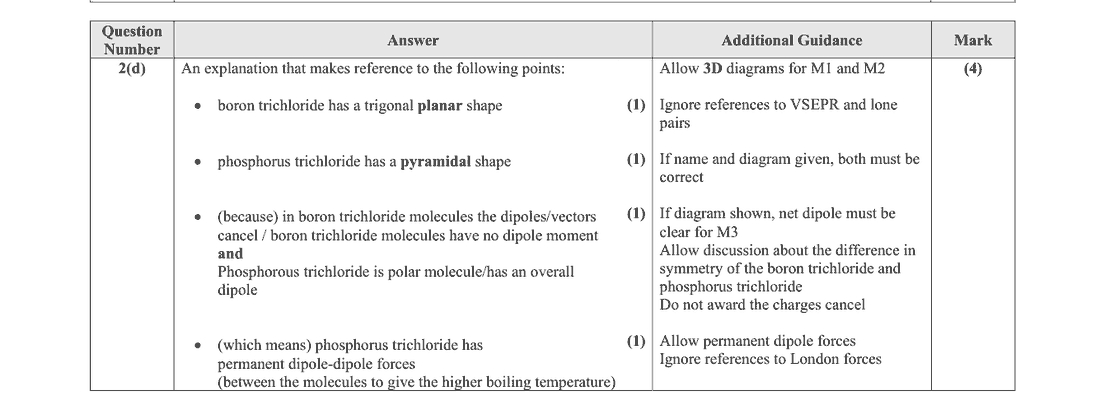
Most candidates were able to successfully identify the shape of the two molecules and so scored two marks which was also the mode and mean of this question. Many gave detailed explanations of the VSEPR theory to justify the shape and this was not required to explain the difference in boiling temperature. Candidates found it more challenging to explain how the shape influenced the type of intermolecular forces and gave rise to permanent dipole-dipole interactions.
Skills: MS4.1 Appreciate angles and shapes in regular 2D and 3D structures.
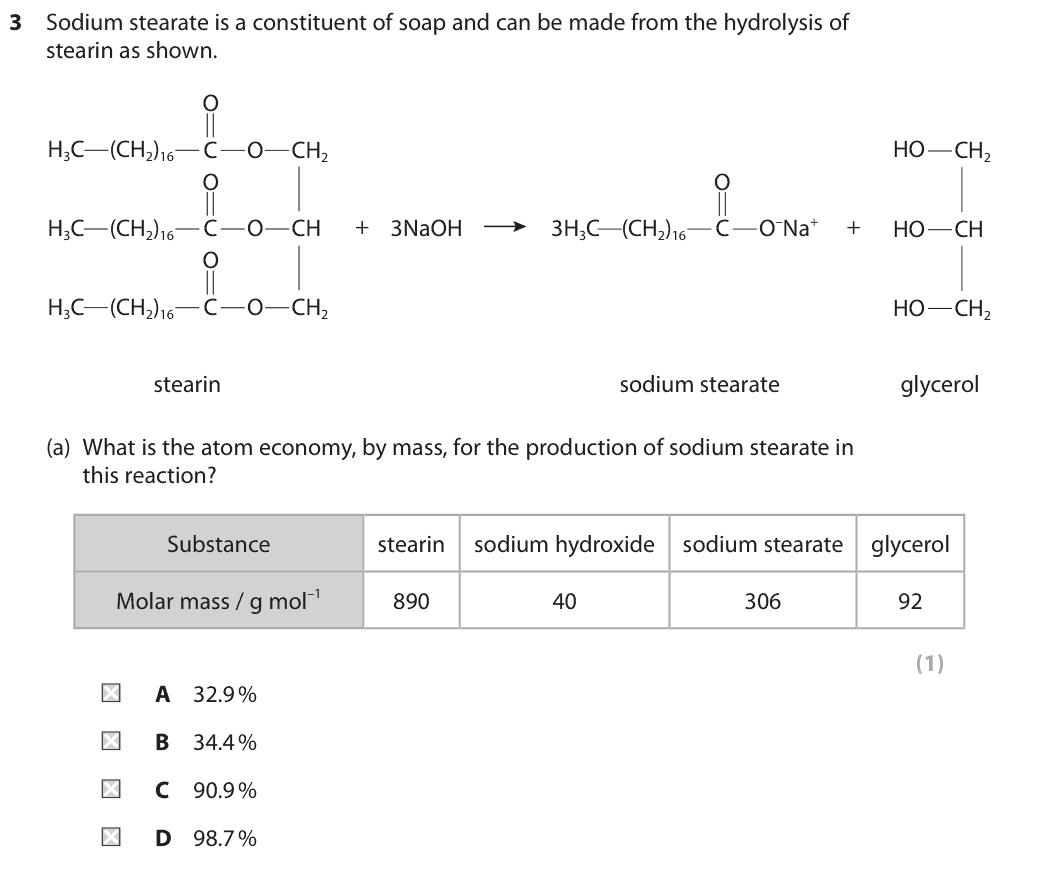
C
Skills: MS0.2 Use ratios, fractions and percentages
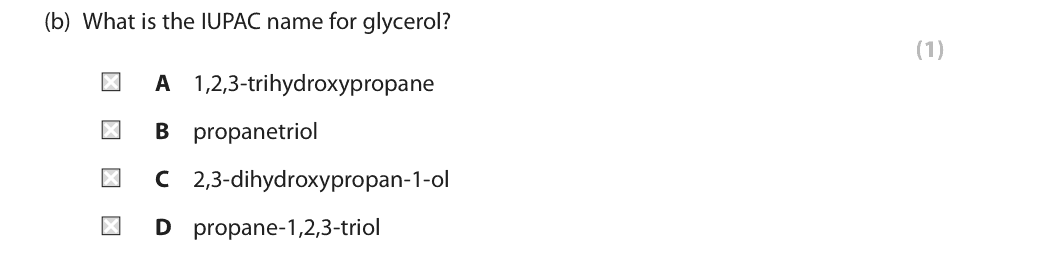
D
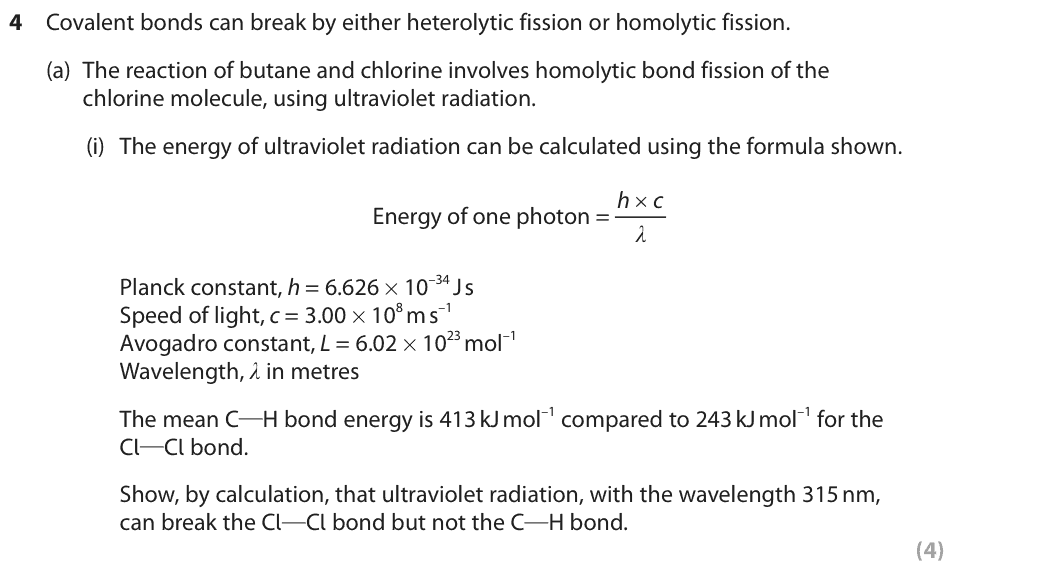
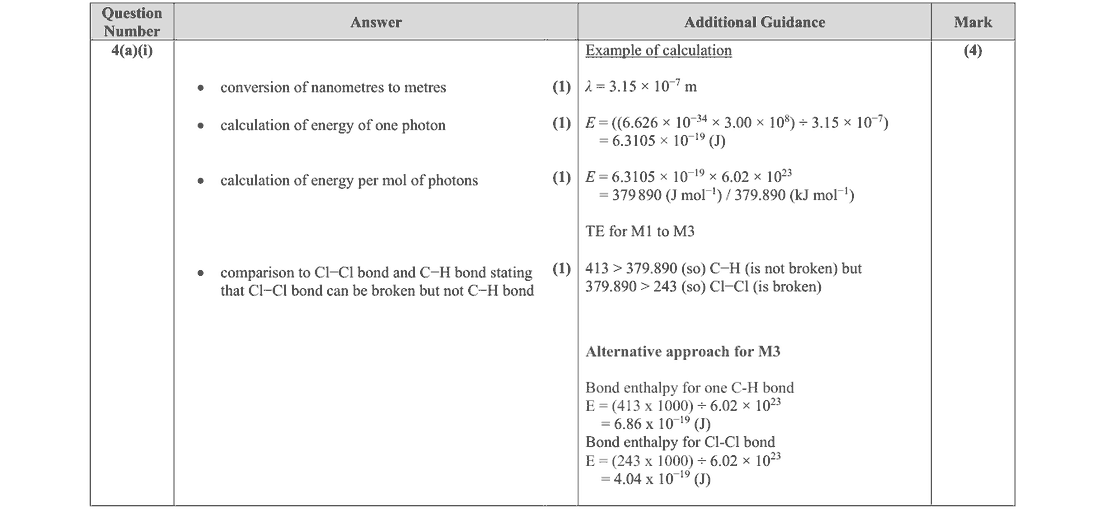
Although the question was unfamiliar and unusual, many candidates were able to score well on this question and the examining team were impressed by the quality of candidate responses to this question. Even those candidates who were unable to convert nm to m for the wavelength were still able to gain some credit for transposing their values into the equation and evaluating their answer correctly.
Skills: MS0.0 Recognise and make use of appropriate units in calculation; MS0.1 Recognise and use expressions in decimal and ordinary form; MS2.3 Substitute numerical values into algebraic equations using appropriate units for physical quantities

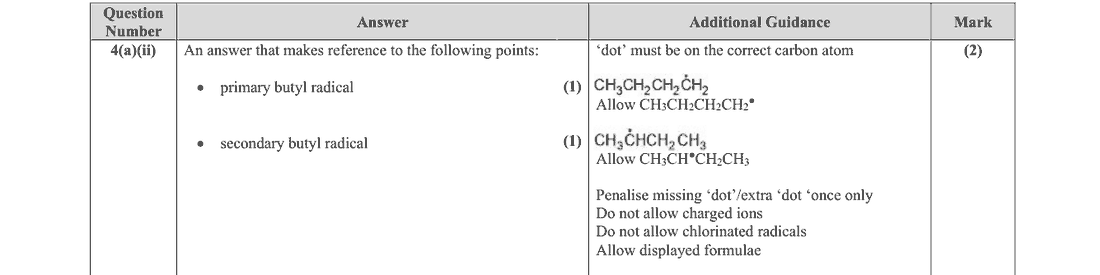
Most candidates knew the structure of the primary butyl radical but the second answer given was more challenging. •CH2CH3. Some candidates gave a response involving equations rather than the structures that the question asked for. Common errors include giving a chlorinated species and commonly CH3CH2

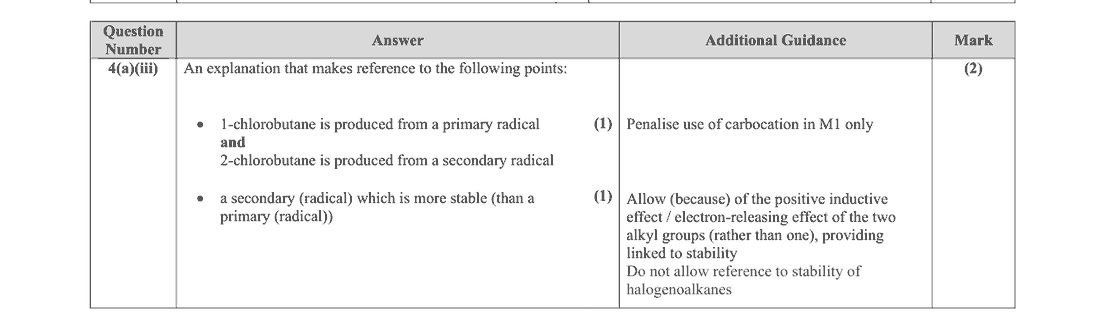
This proved to be a challenging question and most candidates frequently lost the first mark by stating that the 1-chlorobutane is formed from a primary carbocation, and the 2-chlorobutane forms from a secondary carbocation, rather than from the respective radical. Most candidates were able to score the second mark for stating the relative stability of the intermediates with 1 being the mode for this question.
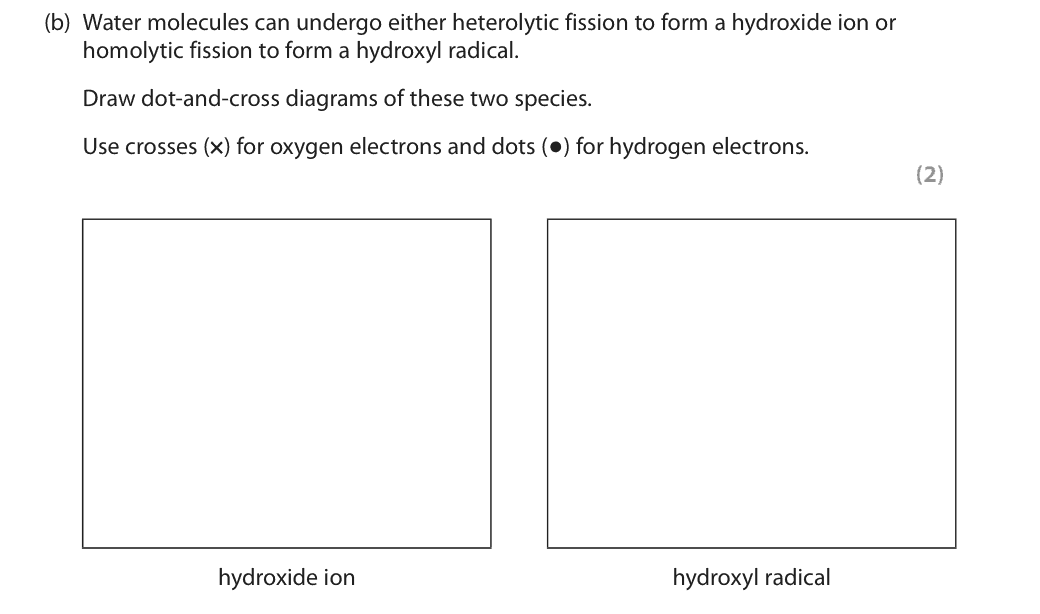
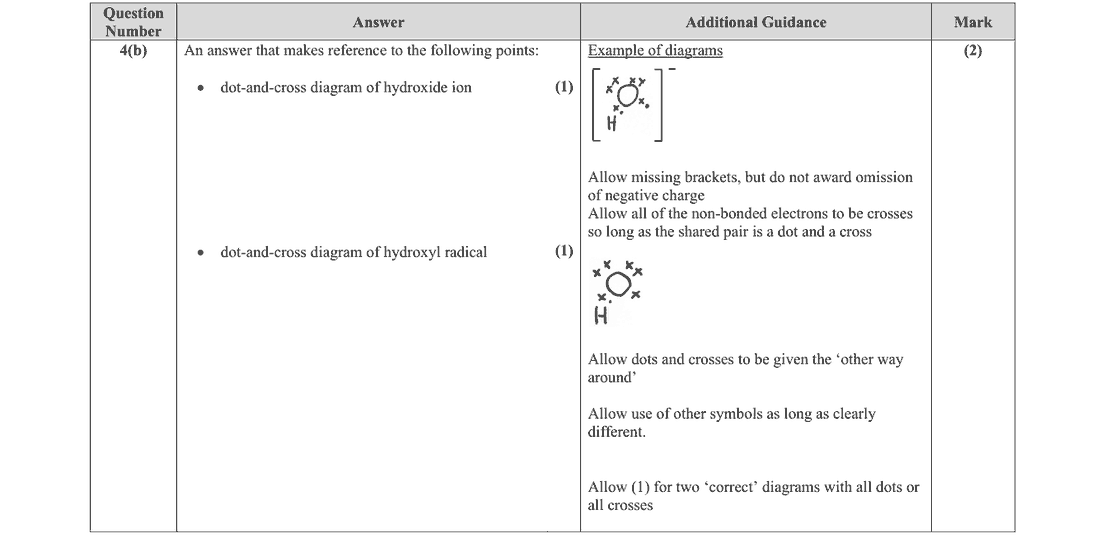
This was generally very well answered by candidates with the structure of the hydroxide ion almost always being correct. The structure of the radical proved to be more challenging for some with candidates commonly adding too many electrons, an extra 'dot', or a charge, and so not scoring the mark.
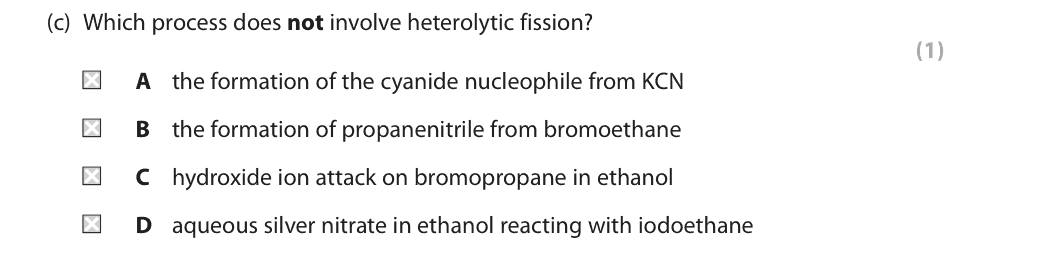
A
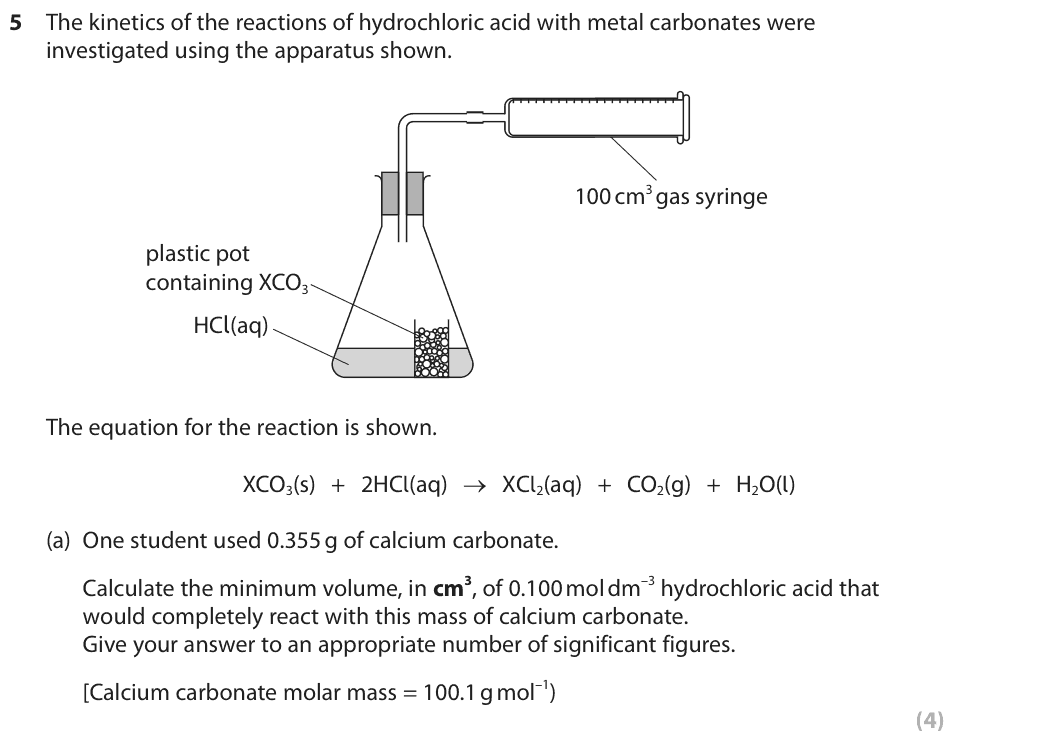
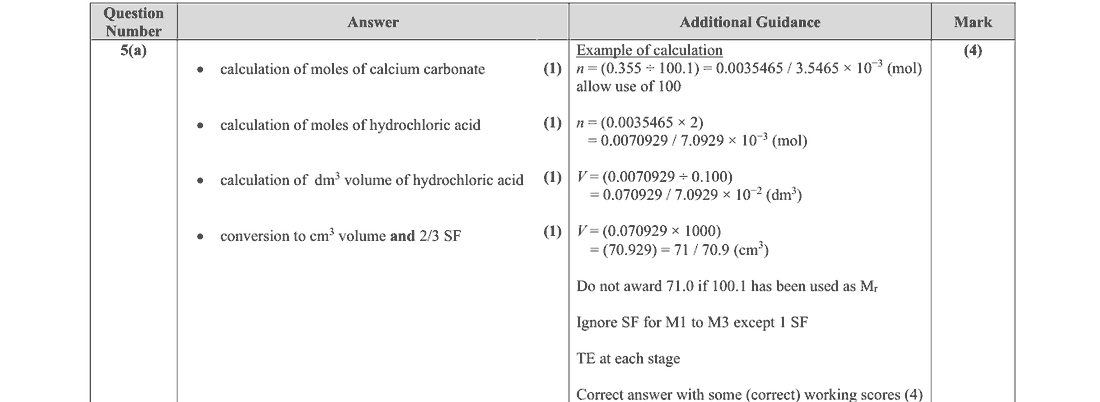
This question proved to be straightforward, with most candidates securing full marks clearly showing a good understanding of the calculation. Most were also able to give their answer to the appropriate number of significant figures, although this was most frequently the mark lost by a few candidates.
Skills: MS0.0 Recognise and make use of appropriate units in calculation; MS0.2 Use ratios, fractions and percentages; MS1.1 Use an appropriate number of significant figures

This was a straightforward question with almost all candidates scoring the mark.
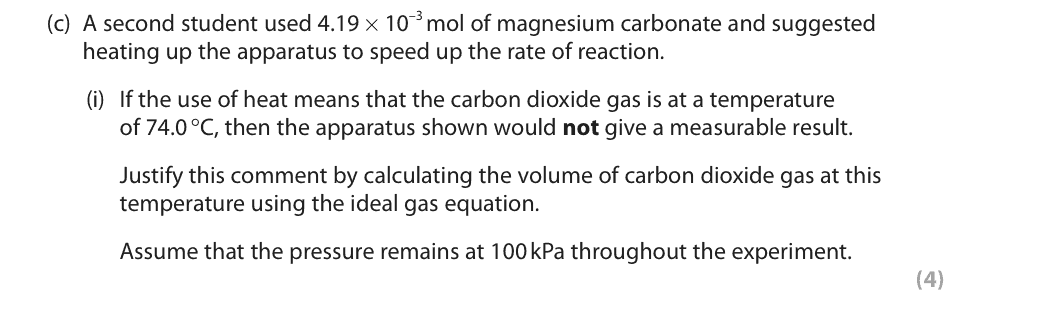
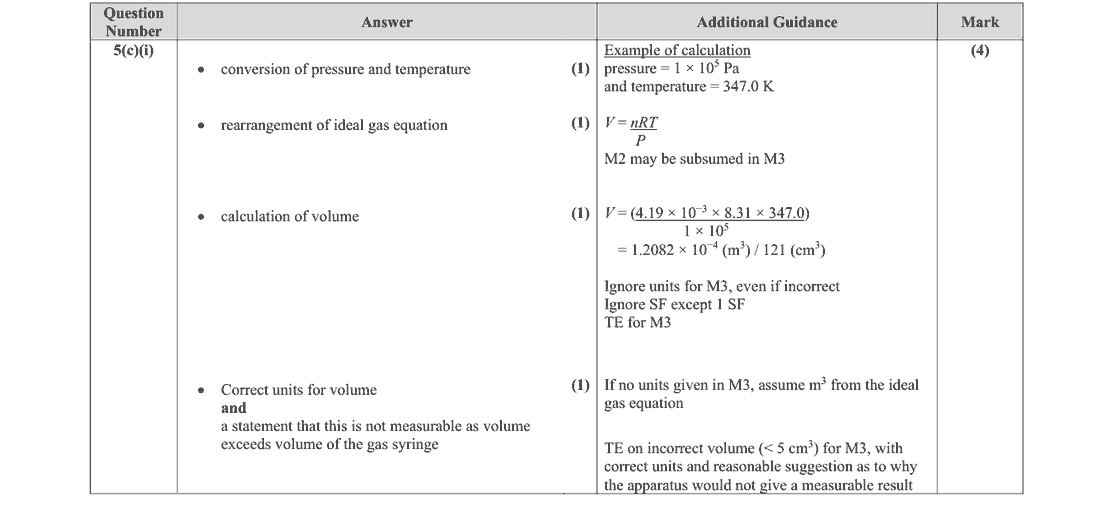
Most candidates showed that they knew what to do here since their revision must have seen this sort of question before on previous versions of paper 2. The most common errors were the incorrect conversion of pressure to Pascals or the incorrect conversion of volume when evaluating their final answer. Candidates who set out their work clearly were more likely to be able to follow through with a logical progression to get to the correct answer. It is advised that candidates learn the correct units of the Ideal Gas Equation and practise the conversions from data provided.
Skills: MS0.0 Recognise and make use of appropriate units in calculation; MS2.2 Change the subject of an equation; MS2.3 Substitute numerical values into algebraic equations using appropriate units for physical quantities
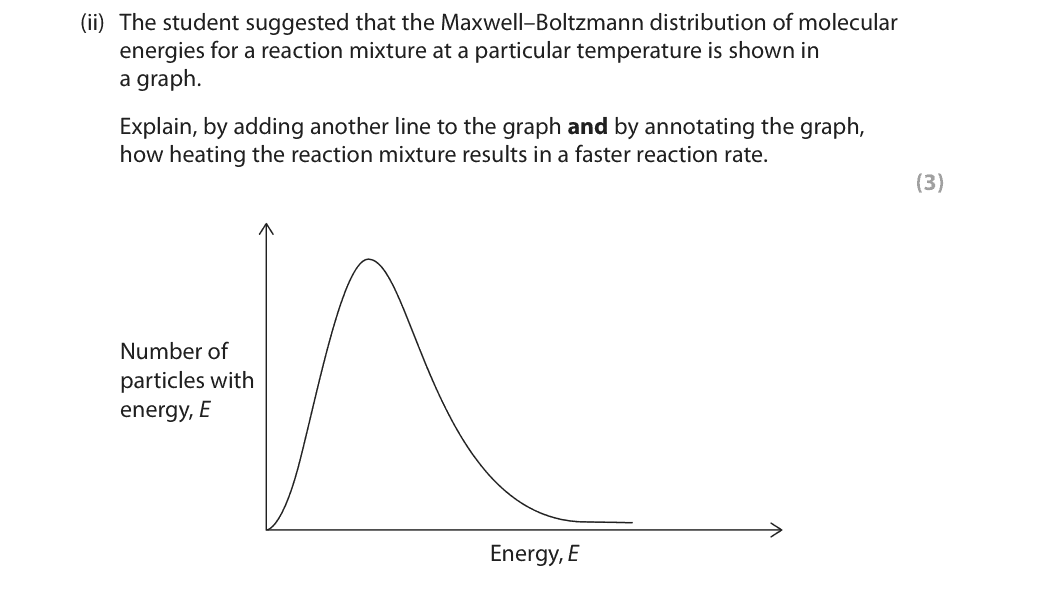
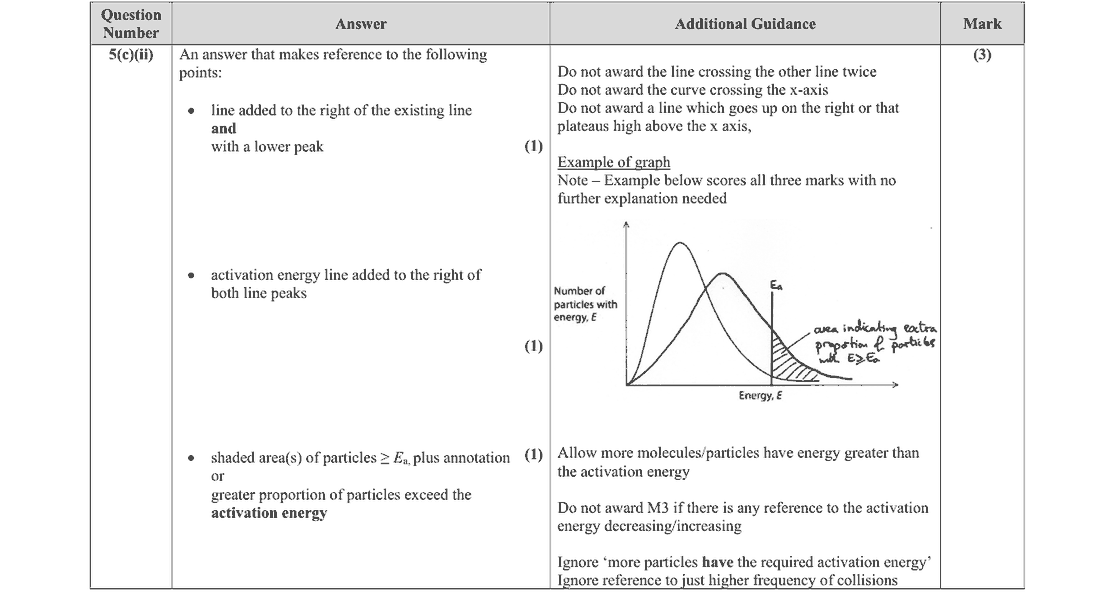
The overall standard of response to this question was varied. The standard of the curves drawn was commonly commented on by examiners, with frequent errors including the curve added in such a way that it crossed the first curve twice, the curve starting to go up at the end on the right and the curve either plateauing at some considerable height from the x axis or going too far and crossing the x axis. Frequently candidates missed the annotation of the activation energy. M3 was often awarded for stating that more particles have an energy greater than or exceeding the activation energy and some candidates went further by shading the graph to illustrate the greater proportion of particles with an energy greater than or equal to EA.
Skills: MS3.1 Translate information between graphical, numerical and algebraic forms
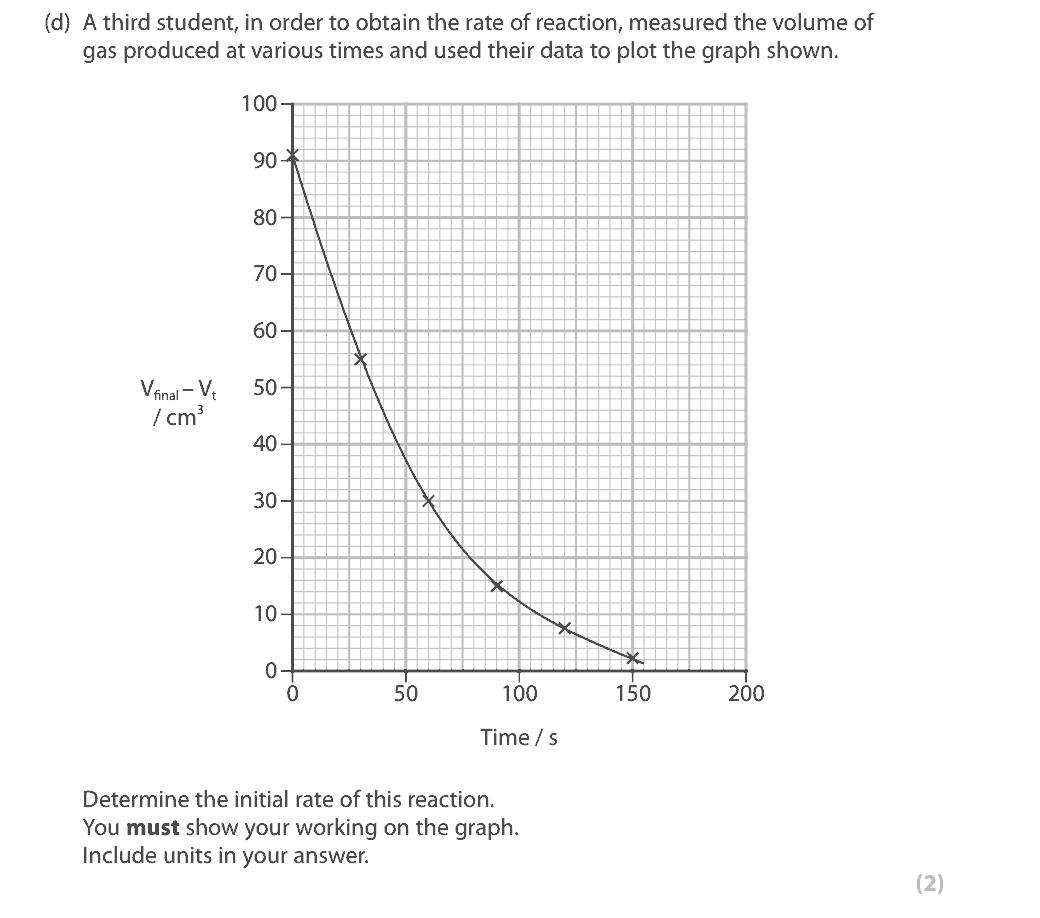
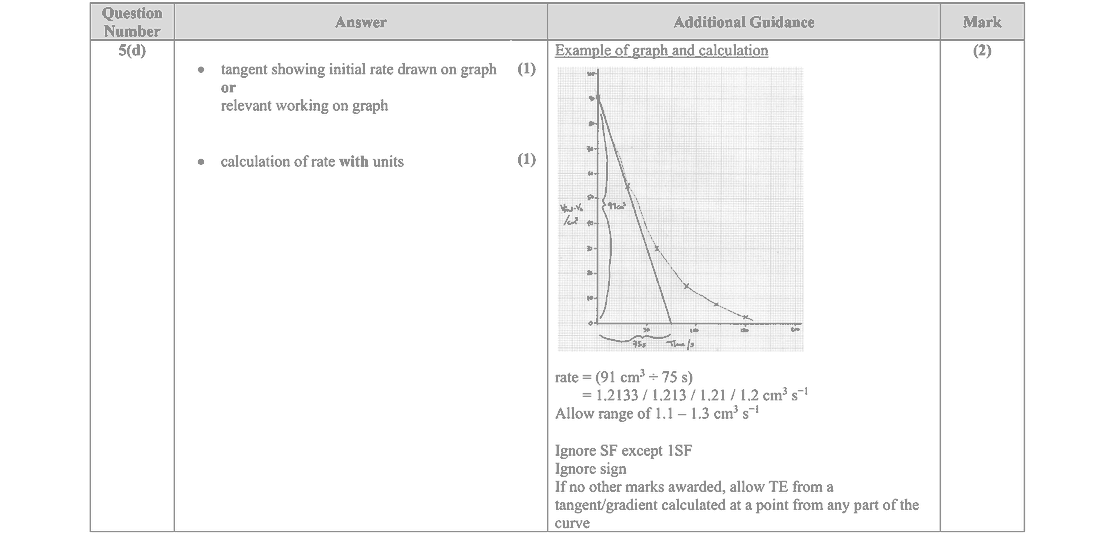
This was a well answered question, with many candidates able to score both marks for the appropriate drawing of a tangent to calculate the gradient with correct units. Common errors include drawing an initial gradient too shallow or steep and not drawing a gradient at t=0. Most were able to score M2 as a transferred error from the incorrect gradient, providing their units were correct.
Skills: MS0.0 Recognise and make use of appropriate units in calculation; MS3.5 Draw and use the slope of a tangent to a curve as a measure of rate of change; PT12 measure rates of reaction by at least two different methods, for example: an initial rate method such as a clock reaction; a continuous monitoring method
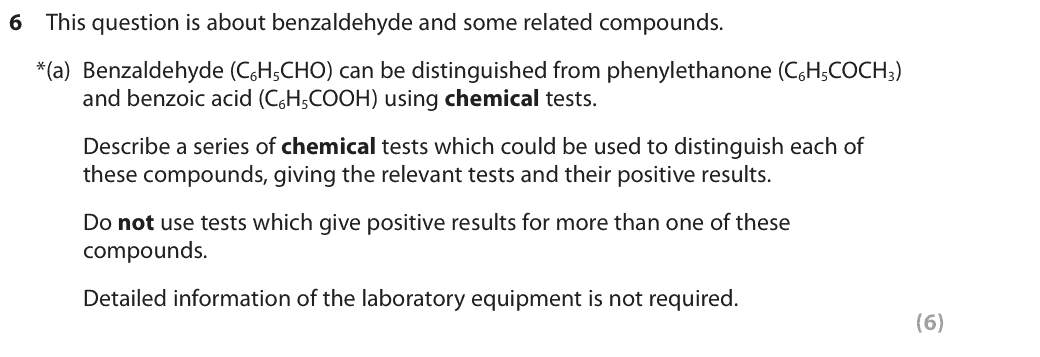
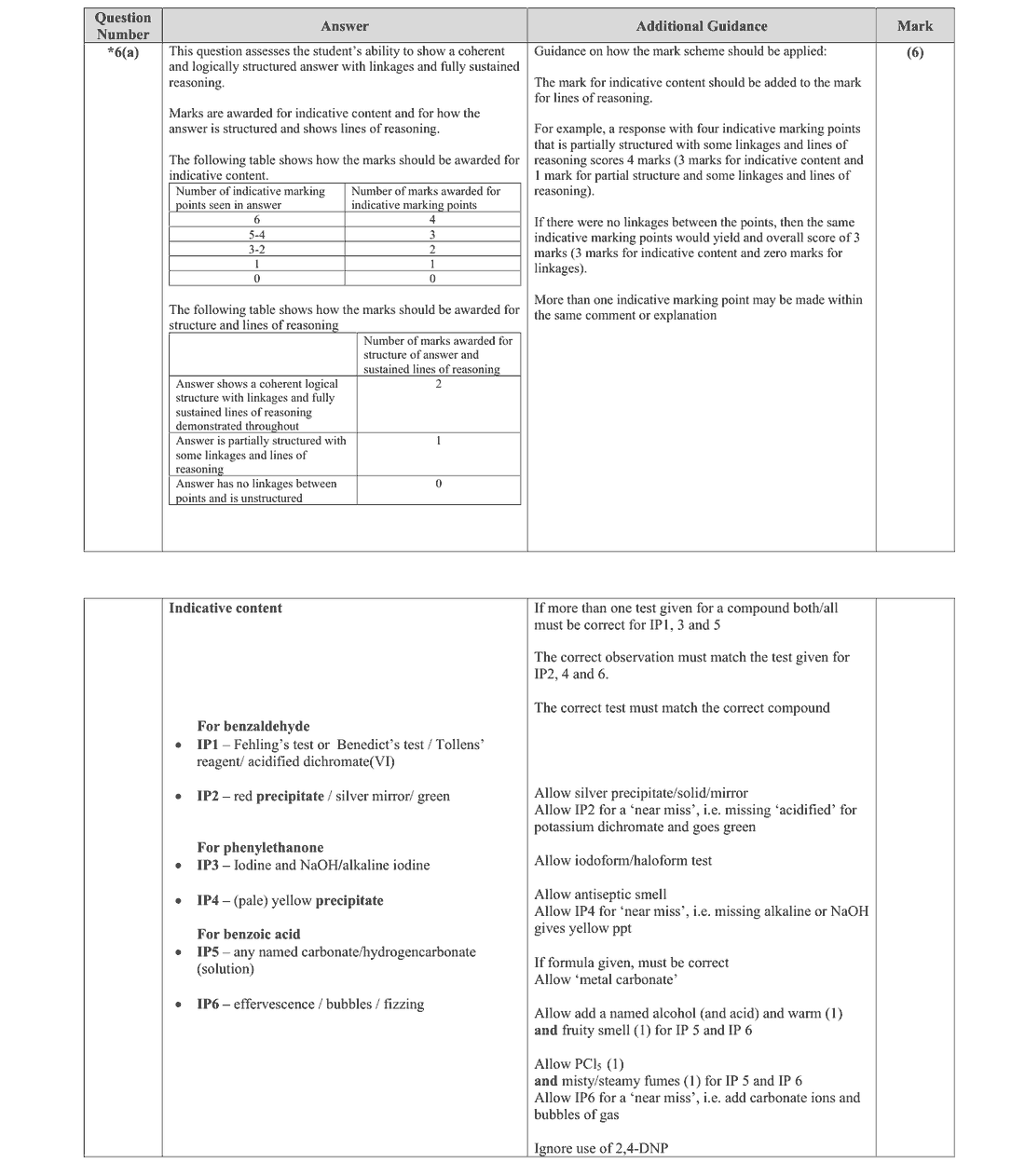
This question attracted the full range of marks with many candidates able to give at least one of the relevant tests to distinguish the three compounds. Many candidates gave more than one test for the benzaldehyde, usually losing credit for insufficient detail for one or more of the tests or for giving incomplete observations. The team of examiners commented on the quality of some of the responses which scored full marks. A few candidates thought that giving tests for two of the substances and deducing the third by elimination would be enough for full credit.
Skills: PT4 use laboratory apparatus for a variety of experimental techniques, including: titration, using burette and pipette; distillation and heating under reflux, including setting up glassware using retort stand and clamps; qualitative tests for ions and organic functional groups; filtration, including use of fluted filter paper, or filtration under reduced pressure; CP15 Core practical 15: Analysis of some inorganic and organic unknowns
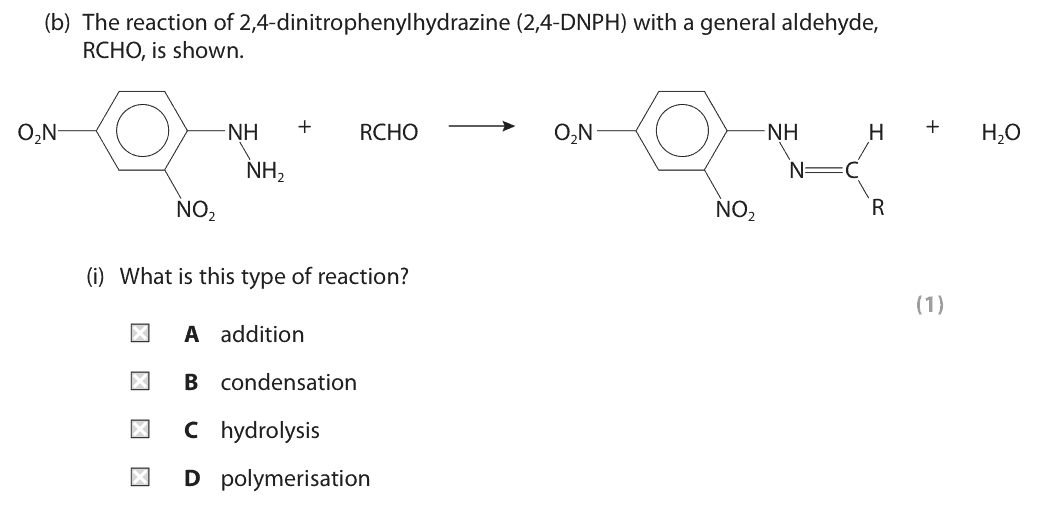
B

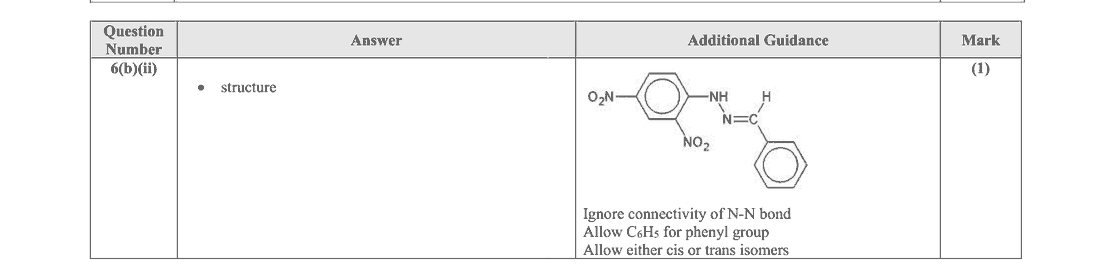
This question was answered correctly for most candidates. The most common errors were the omission of an NO2 group or a second nitrogen atom joined by a double bond to the benzene ring.
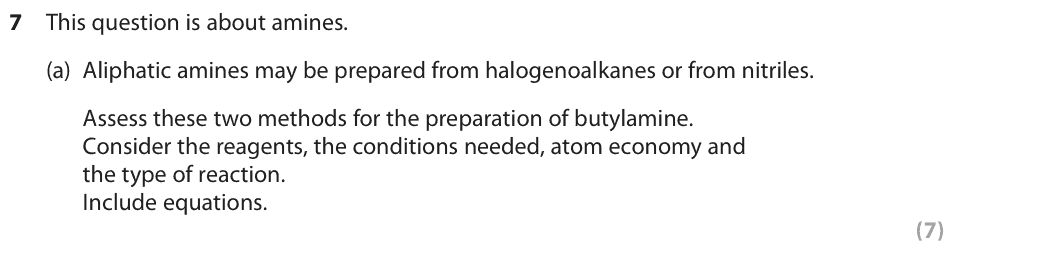
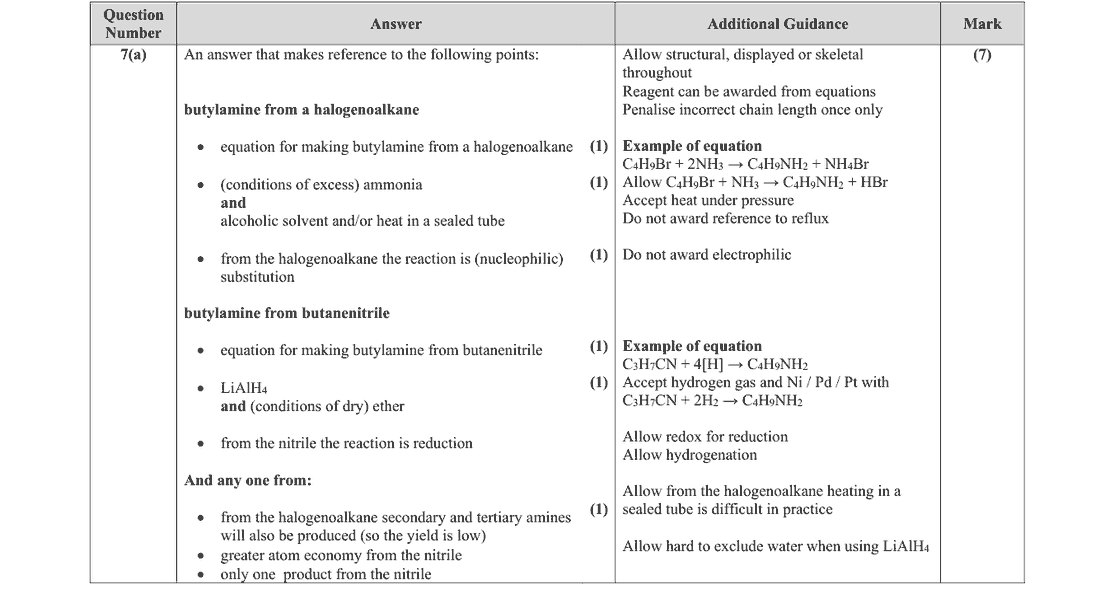
This question attracted the full range of marks with many candidates scoring at least five marks out of the available seven. Most were able to identify the (nucleophilic) substitution for producing the amine from the halogenoalkane and also for the reduction of the nitrile. A large proportion were also able to identify the reduction of the nitrile having a higher atom economy. Candidates generally struggled with the balanced equation and included the reactants above the arrow. Reactants always appear on the left and products on the right hand side, leaving the arrow for conditions and catalysts.
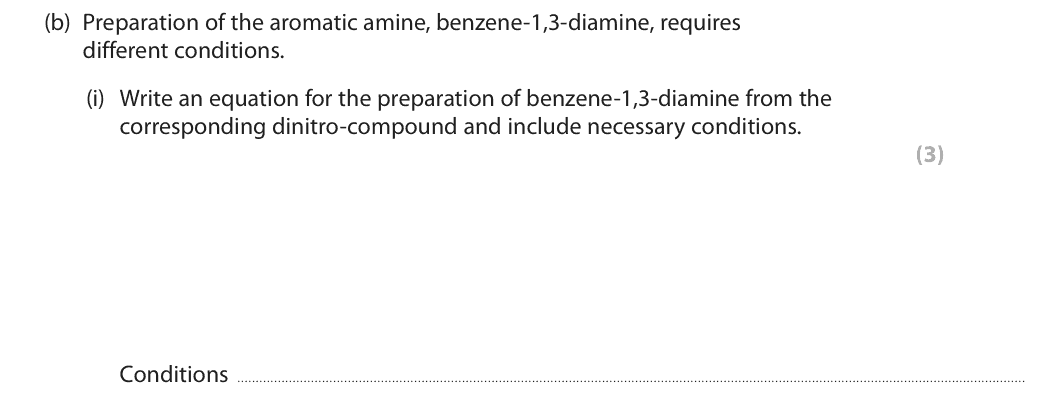
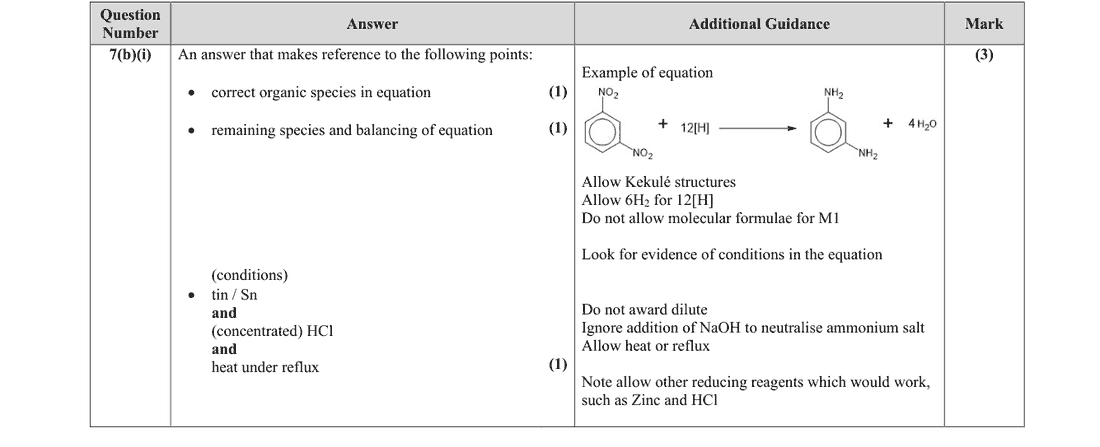
This proved to be a challenging question for many, with very few candidates securing full marks. Most were able to give the correct organic species in the equation, although correctly balancing the equation was more rarely seen. Often candidates missed the reaction conditions and only gave reagents, so not scoring M3.
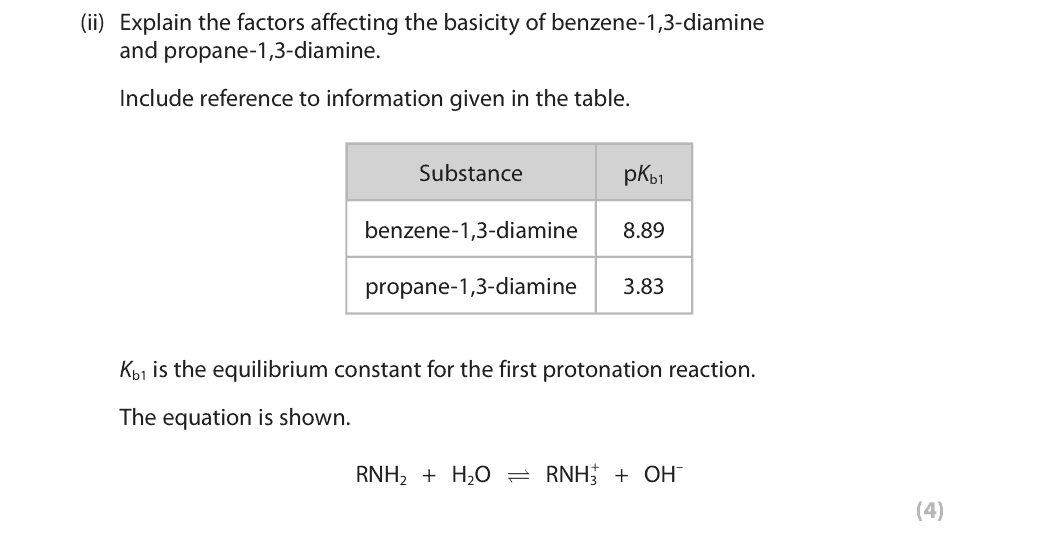
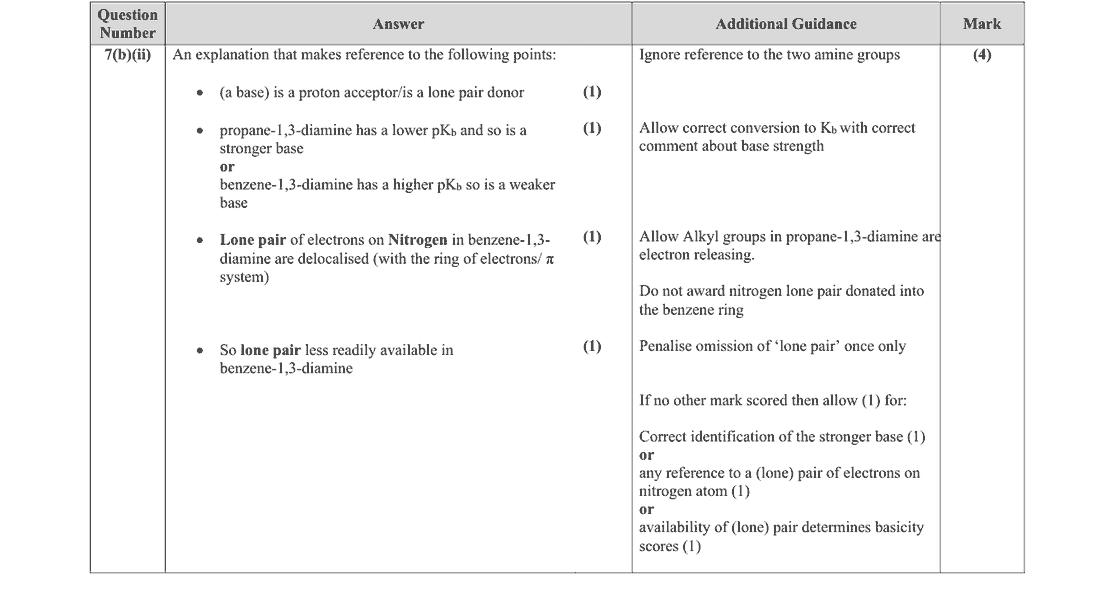
This was one of the most challenging questions on this paper and candidates struggled with the reasoning behind the difference in basicity. Very few used the pKb data as requested and for those who did, many thought that a higher pKb meant a stronger base. There were some excellent answers scoring all available marks which was pleasing to see.
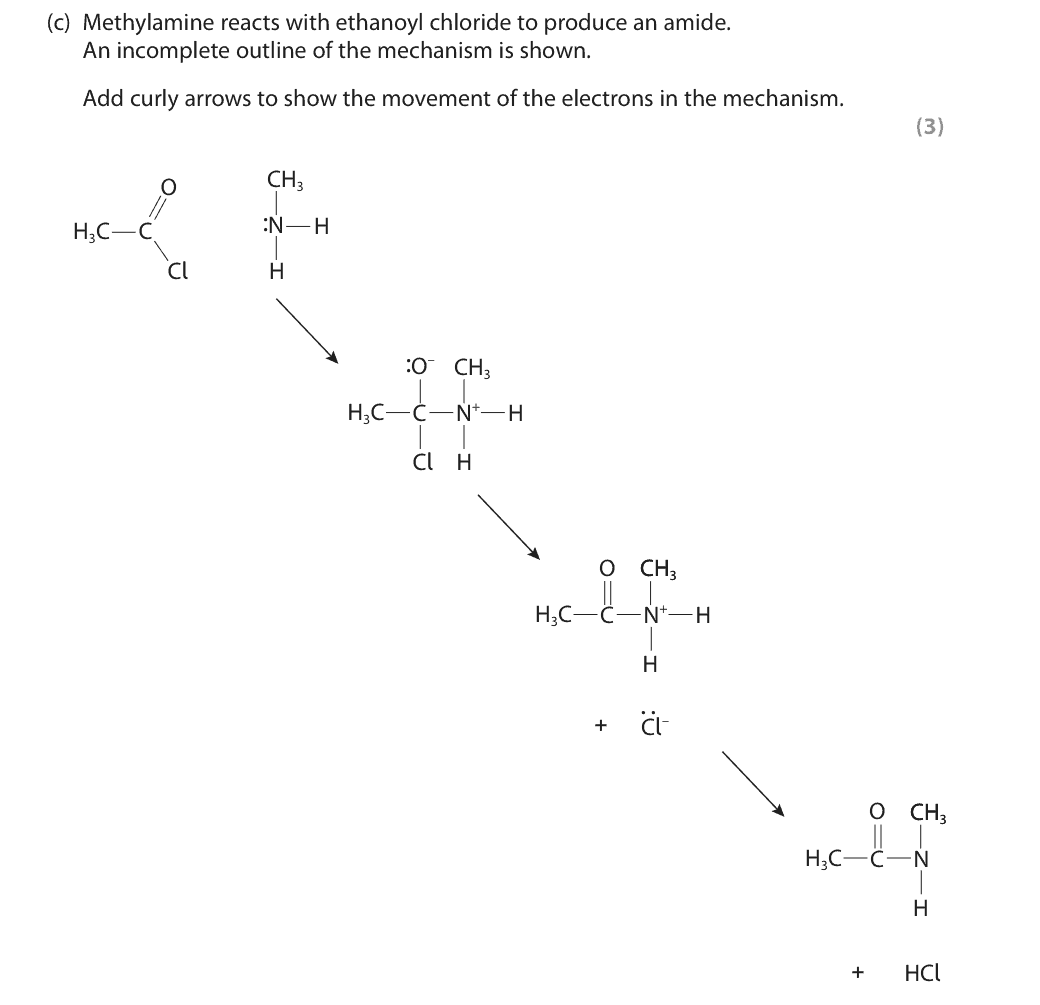
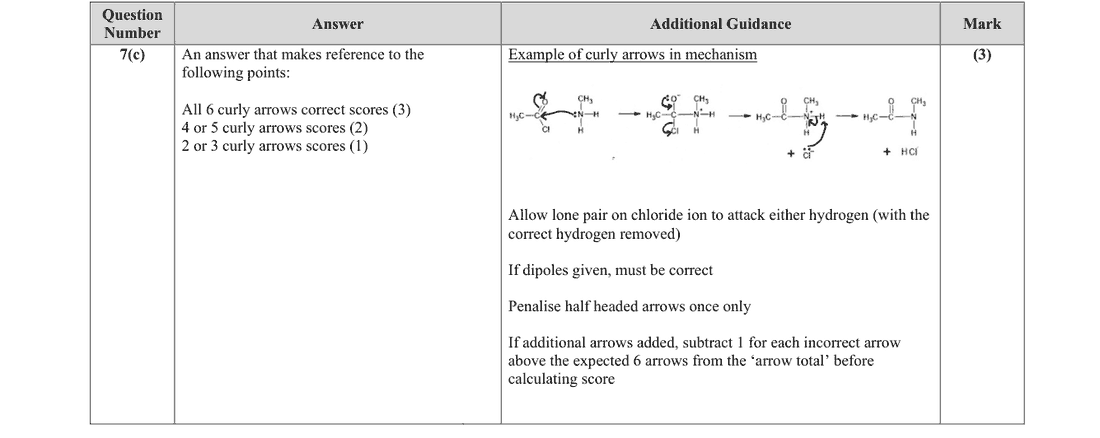
This question was generally well answered showing a good understanding of curly arrows in mechanisms. Common errors included arrows not clearly originating from a lone pair of electrons or going to an ambiguous area.
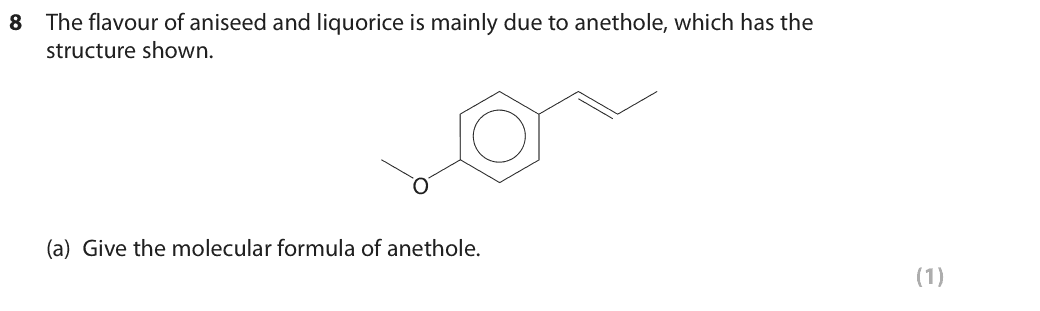
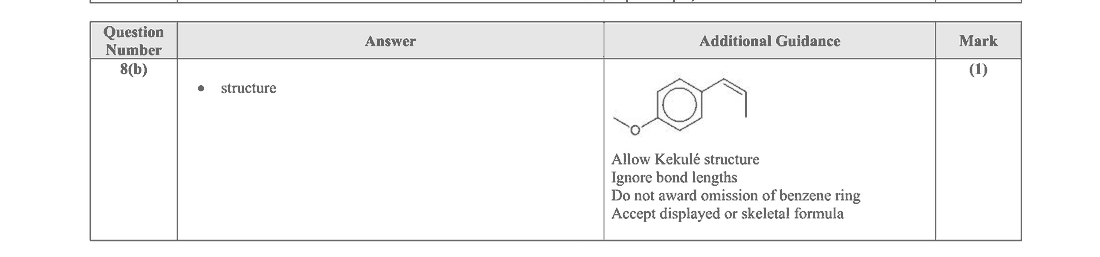
This was generally well answered with many correct responses seen.

Many candidates scored the mark here, although there were many answers simply flipping the molecule over as if reflecting it in a mirror to produce what they thought was a different optical isomer.
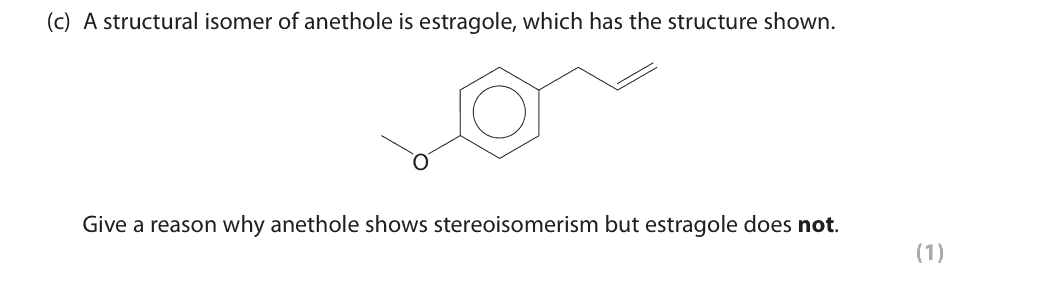
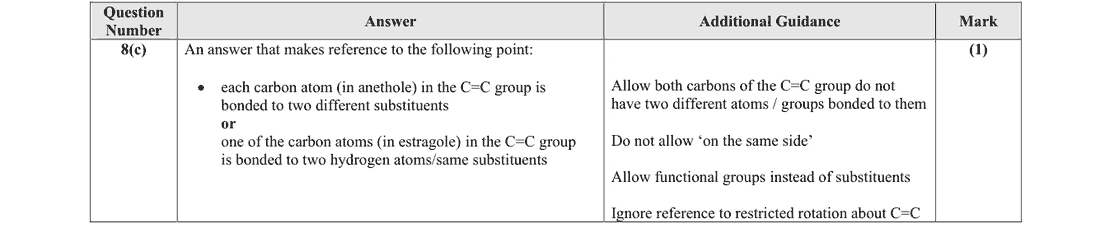
It was not expected that less than half of the candidates would score this mark. Commonly candidates referred to having the same group 'on the same side' or extraneously referred to restricted rotation around the C=C double bond. Some candidates referred to chiral carbons or the position of the C=C double bond.
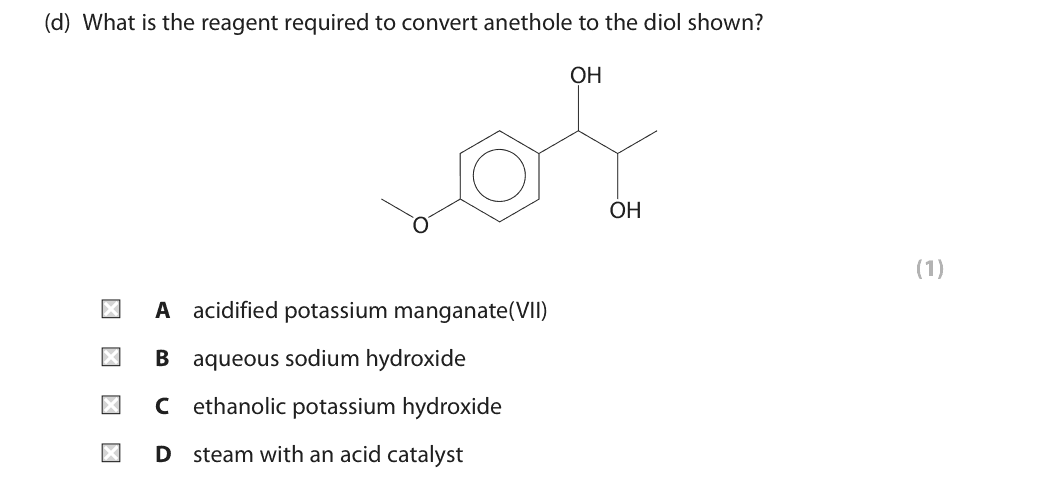
A
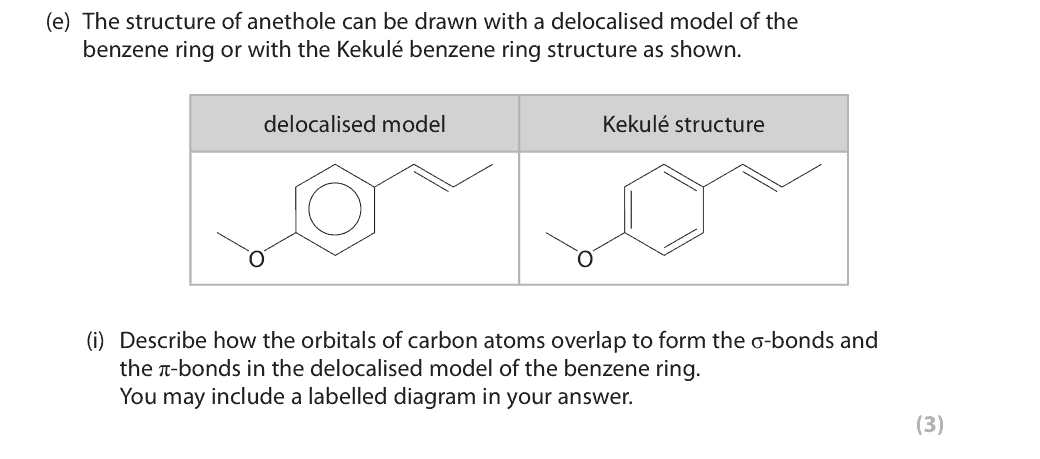
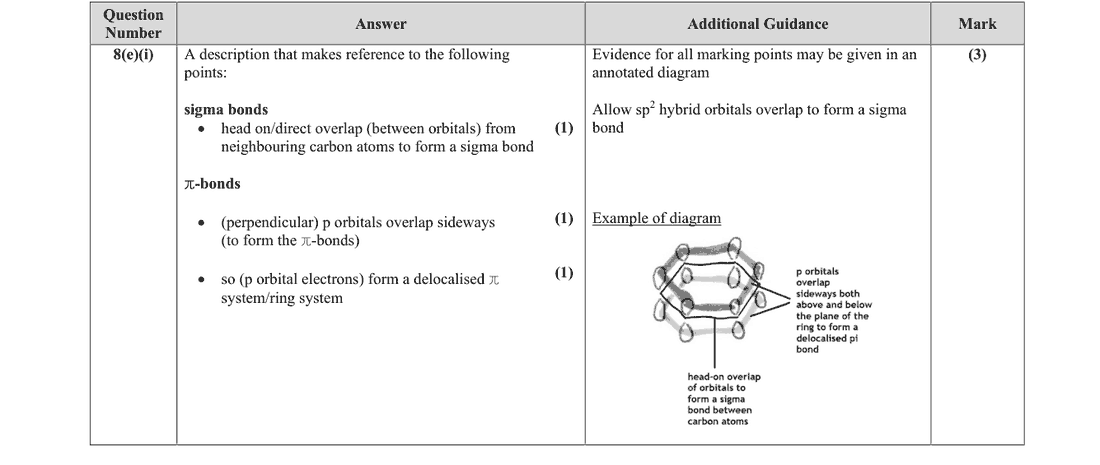
Candidates found this question to be very challenging, with very few fully correct responses seen. The best responses discussed how the orbitals overlap in the context of sigma and pi bonds and supported their explanations with a relevant diagram. Commonly, candidates referred to sigma bonds overlapping rather than orbitals, or similarly were confused between Pi orbitals overlapping instead of P orbitals overlapping sideways.

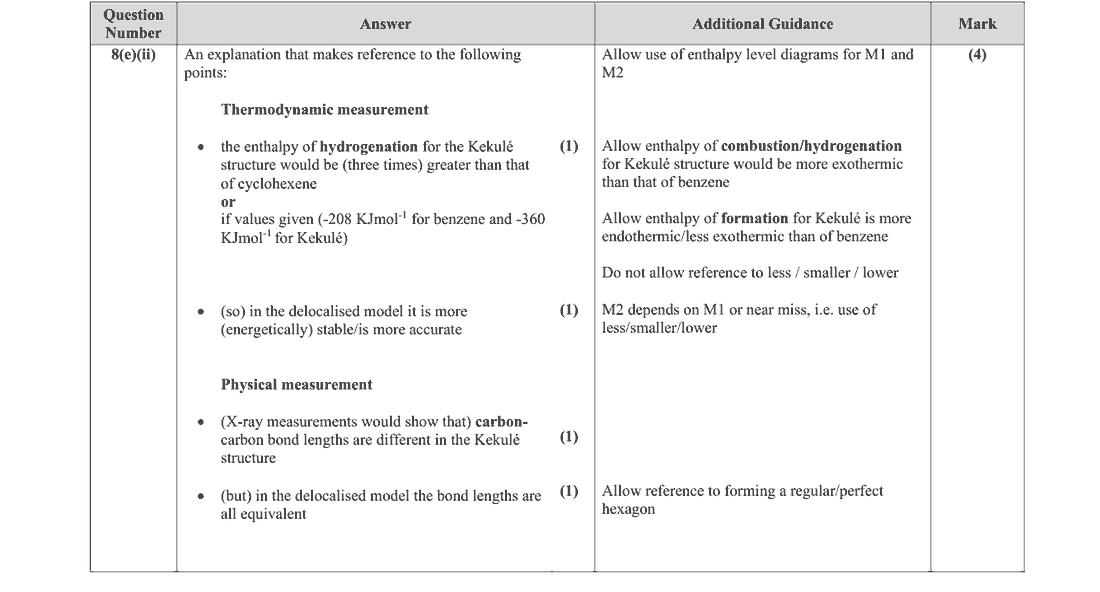
Candidates found this question to be one of the most challenging on the paper. For the thermodynamic measurements many lost both marks through vaguely referring to energy changes or bond energies, without referring to enthalpy changes of hydrogenation. Some candidates did not score M1 as they stated that the enthalpy of hydrogenation is lower or less for the delocalised model. Centres and their candidates are reminded that when exothermic enthalpy changes are being considered that a description of the value being less/smaller/lower does not score. These terms are ambiguous when dealing with negative numbers. For the physical measurements, a good number of candidates referred to 'the bond lengths in benzene' all being the same, without stipulating that they were referring to the carbon-carbon bond lengths. Commonly candidates discussed chemical evidence such as resistance to bromination or lack of the 1,2-dibromo isomers which was not asked for in the question.
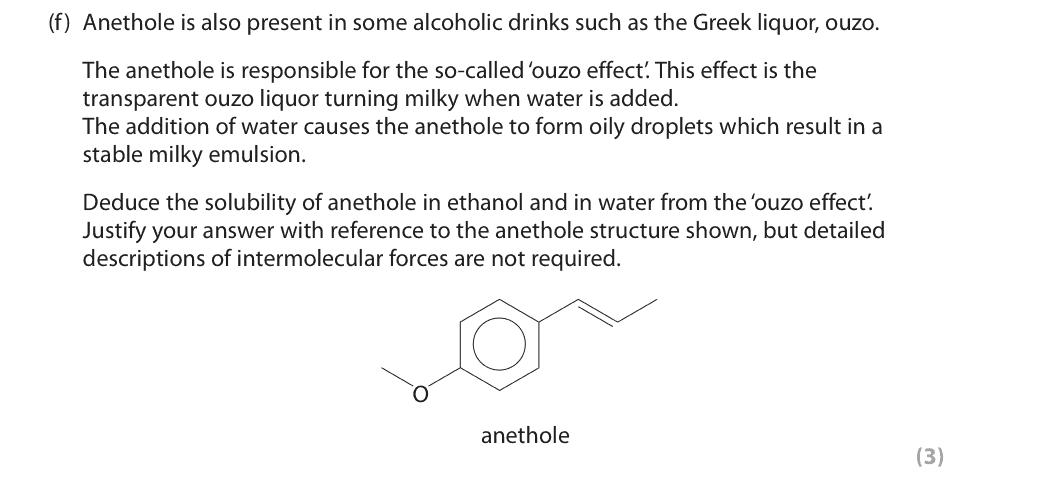
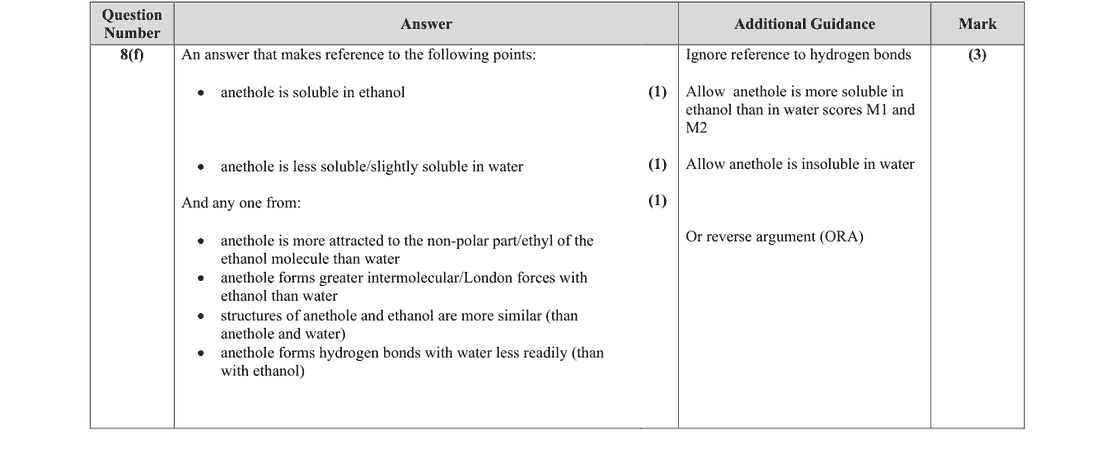
Most candidates were able to identify that the anethole is more soluble in ethanol than in water and so scored the two marks. For M3, explaining why this was the case in terms of molecular structures and intermolecular forces was seen less often. A comparison between the factors affecting solubility of anethole in the two different solvents was required.
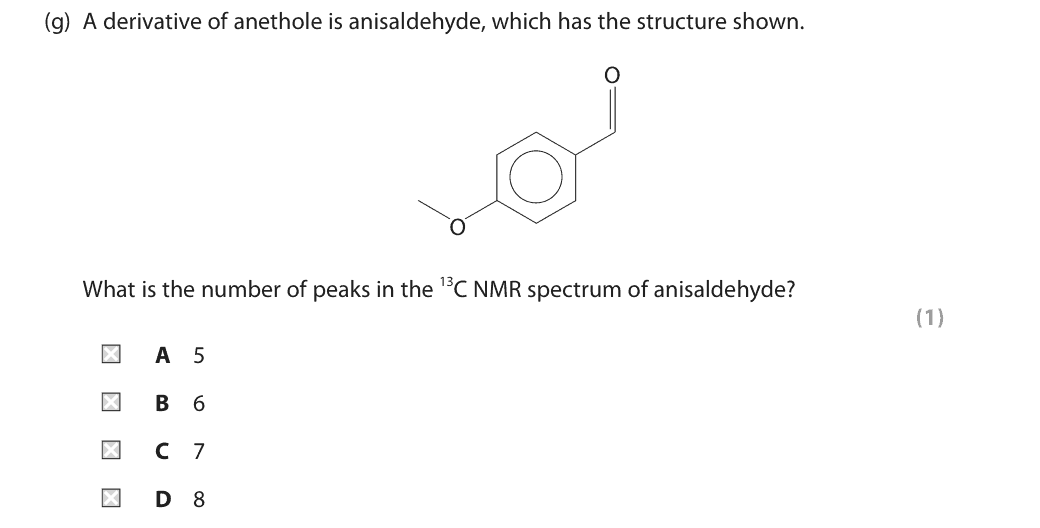
B
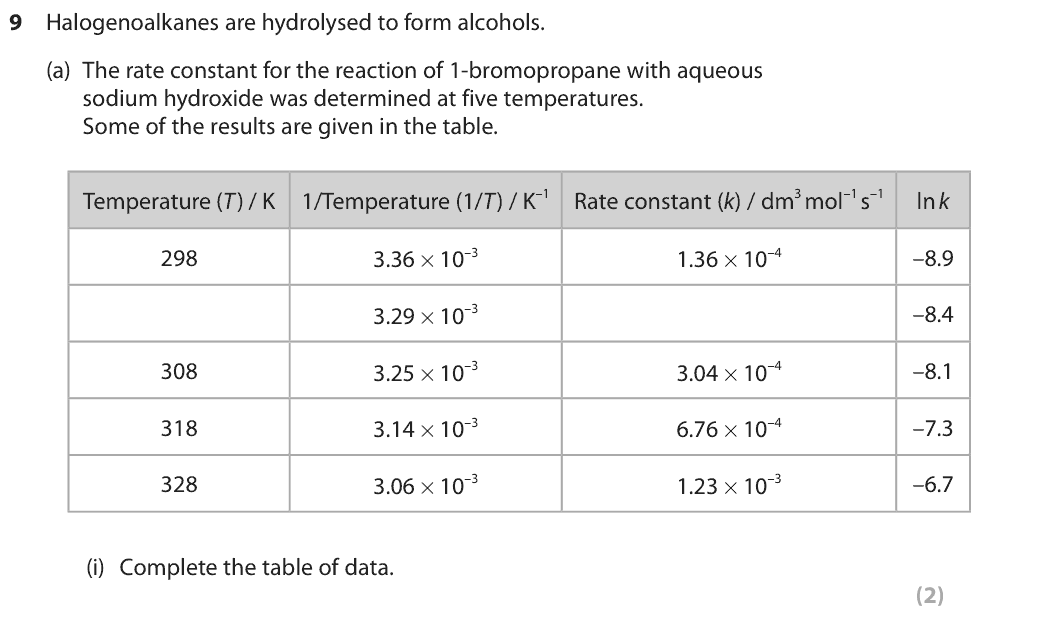
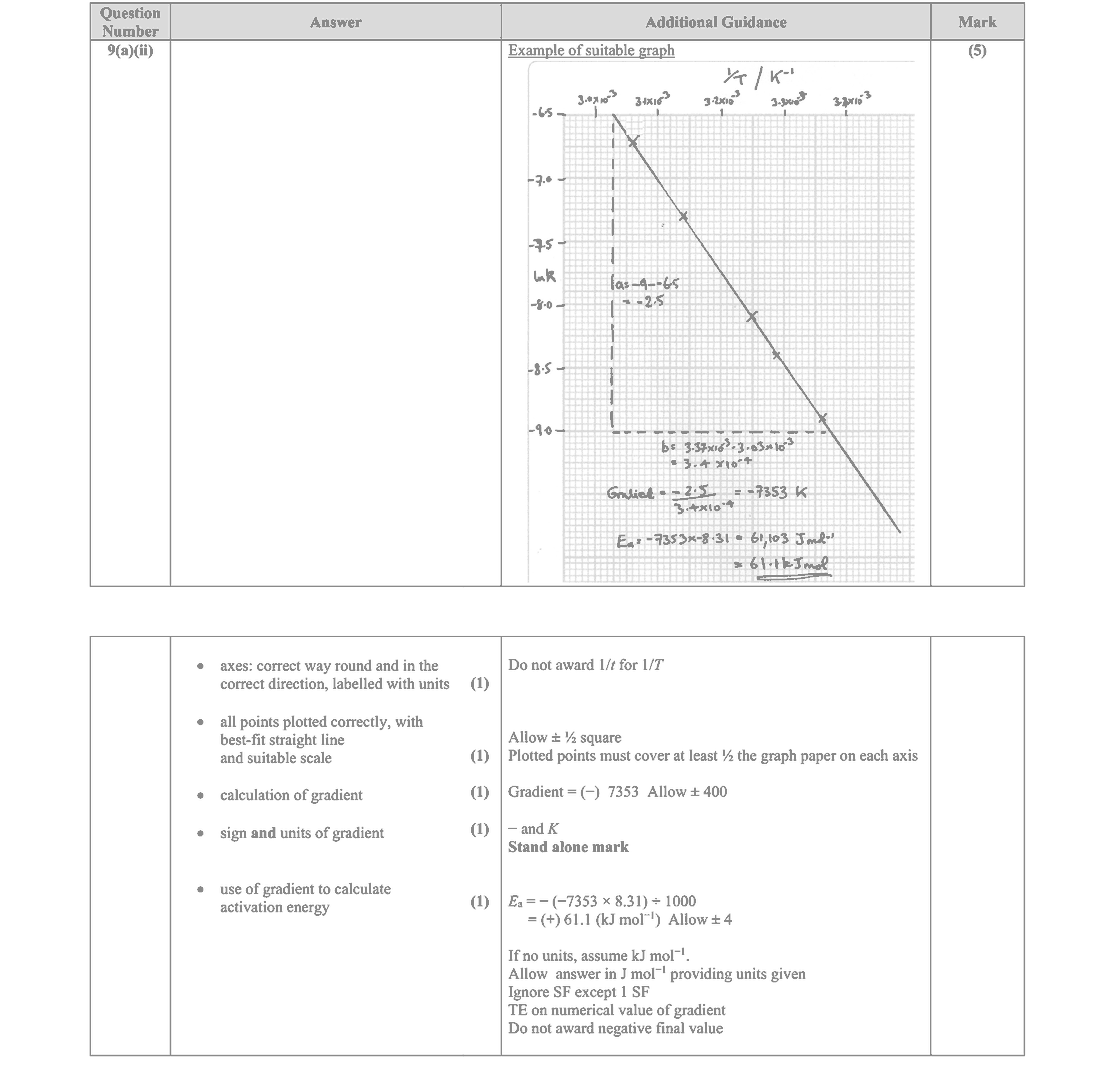
Most candidates scored two marks for Q09(a)(i). This type of calculation based on graph plotting has been seen before in previous papers, so many candidates knew what to do. It was disappointing to see a number of candidates who were unable to make the best use of the graph paper and failed to ensure that plotted points covered at least half of the graph paper, which lost M2. Also, there were still further candidates who plotted negative values becoming decreasingly negative down the page and those who plotted lnk on the x-axis and 1/T on the y- axis, so losing M2. Gradients were often determined correctly, scoring M3. Despite clear instructions given in the question, often the units were lacking for the gradient which lost M4. It was pleasing to see very few occurences of negative activation energies.
Skills: MS0.1 Recognise and use expressions in decimal and ordinary form; MS0.4 Use calculators to find and use power, exponential and logarithmic functions; MS1.1 Use an appropriate number of significant figures; CP14 Core practical 14: Finding the activation energy of a reaction
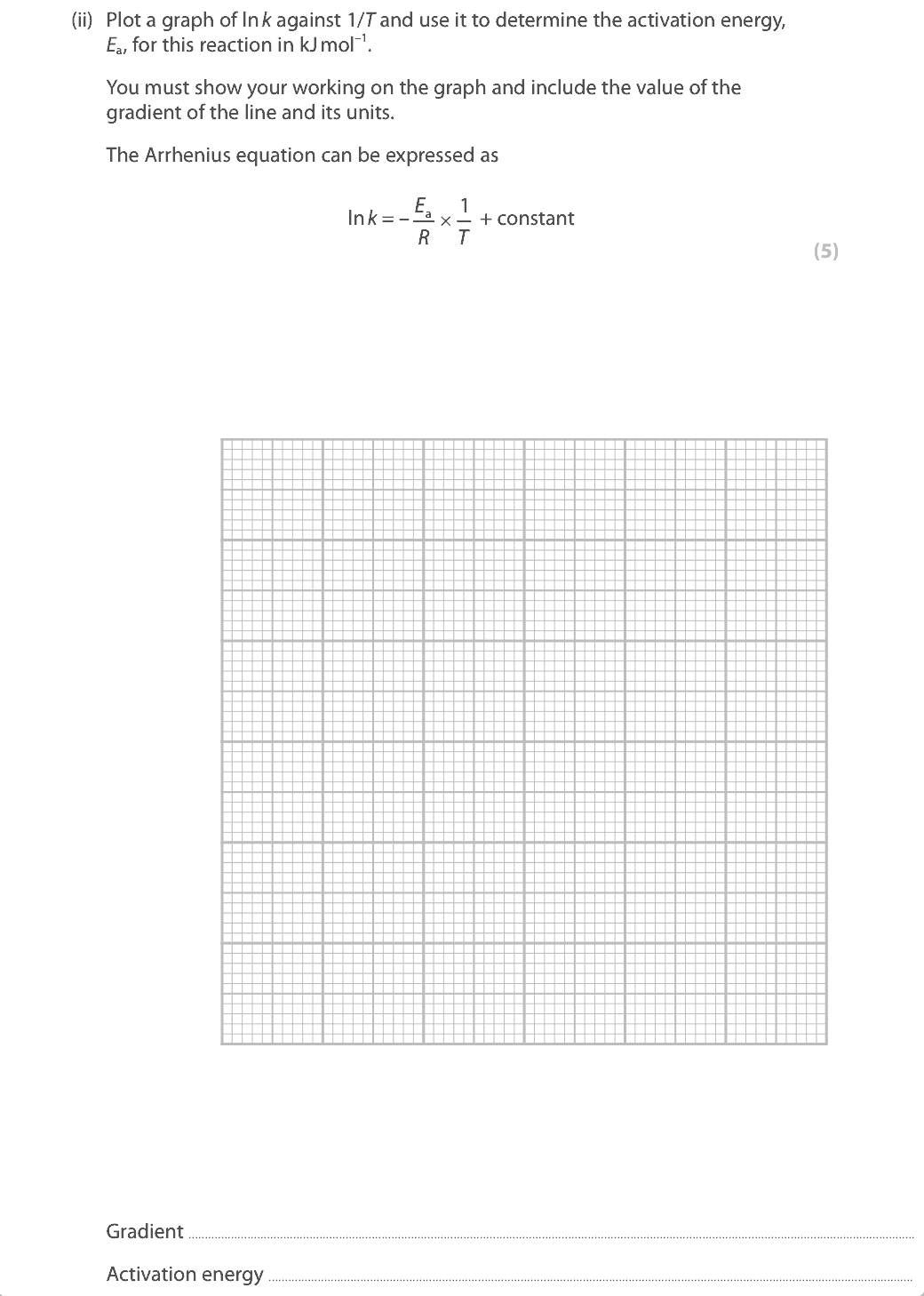
Most candidates scored two marks for Q09(a)(i). This type of calculation based on graph plotting has been seen before in previous papers, so many candidates knew what to do. It was disappointing to see a number of candidates who were unable to make the best use of the graph paper and failed to ensure that plotted points covered at least half of the graph paper, which lost M2. Also, there were still further candidates who plotted negative values becoming decreasingly negative down the page and those who plotted lnk on the x-axis and 1/T on the y- axis, so losing M2. Gradients were often determined correctly, scoring M3. Despite clear instructions given in the question, often the units were lacking for the gradient which lost M4. It was pleasing to see very few occurences of negative activation energies.
Skills: MS0.0 Recognise and make use of appropriate units in calculation; MS2.3 Substitute numerical values into algebraic equations using appropriate units for physical quantities; MS3.2 Plot two variables from experimental or other data; MS3.3 Determine the slope and intercept of a linear graph; CP14 Core practical 14: Finding the activation energy of a reaction

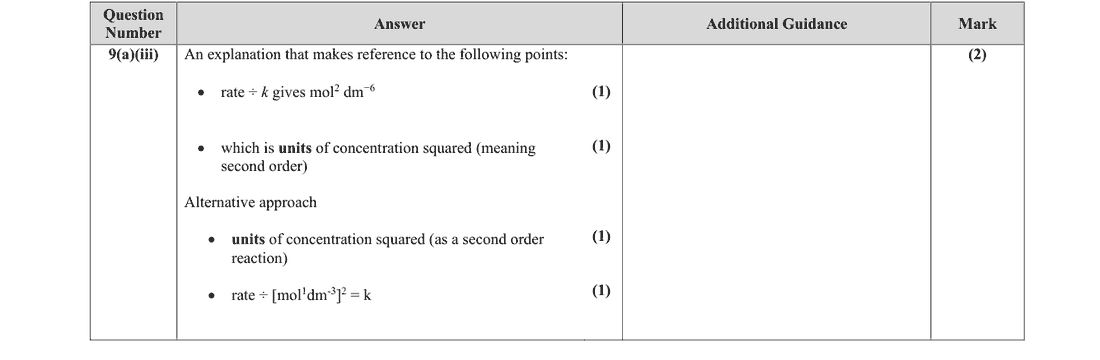
This proved to be a challenging question for candidates, with a number of responses left blank. Many candidates were able to work out the answer but often provided wordy or difficult-to-follow explanations, sometimes omitting units or reasons. Most of the candidates scoring full marks did so by assuming a rate equation with order 2, substituting units and then cancelling until they obtained the correct answer. Others used the given units of rate constant to deduce that two concentrations were involved, hence second order.
Skills: MS0.0 Recognise and make use of appropriate units in calculation

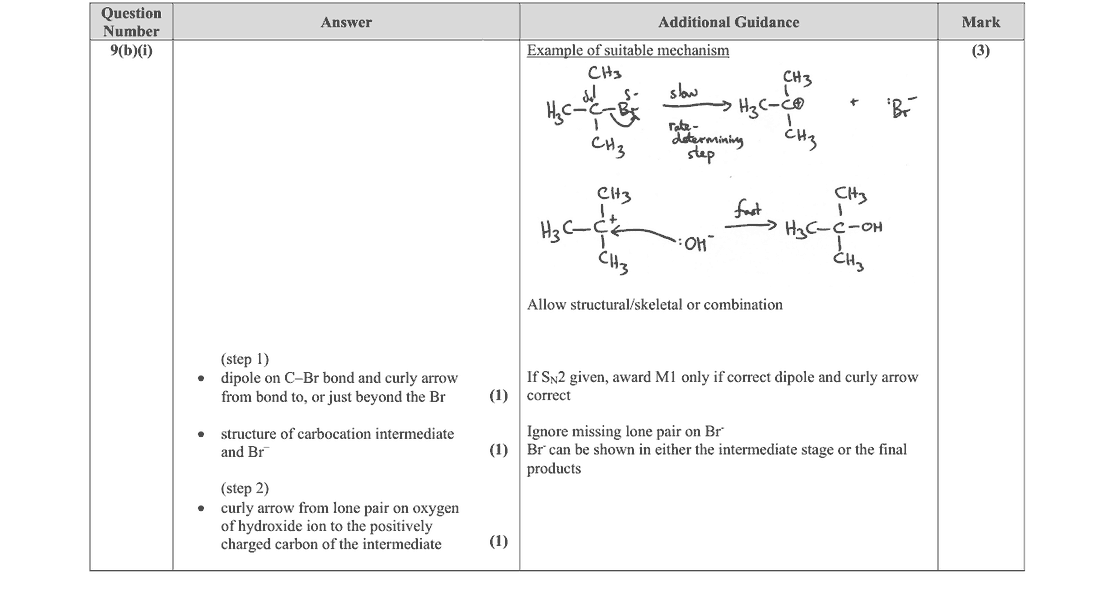
This question was generally well answered. Q09(b)(i) - A sizeable minority gave a mechanism for SN2 despite the clear instructions given in the question. For those correctly drawing the SN1 mechanism, many scored at least two marks but common incorrect responses were omitting the bromide ion or the negative charge or the lone pair of electron on the hydroxide ion, so losing a mark. Q09(b)(ii) - Many stated that the rate determining step did not involve hydroxide ions without stating that the rate determining step was the first step.

This question was generally well answered. Q09(b)(i) - A sizeable minority gave a mechanism for SN2 despite the clear instructions given in the question. For those correctly drawing the SN1 mechanism, many scored at least two marks but common incorrect responses were omitting the bromide ion or the negative charge or the lone pair of electron on the hydroxide ion, so losing a mark. Q09(b)(ii) - Many stated that the rate determining step did not involve hydroxide ions without stating that the rate determining step was the first step.
Want a paper marked and gone through with you? Message us.