June 2024: Paper 2, Advanced Organic and Physical Chemistry

90 marks · 51 question parts · Paper, mark scheme and report on Edexcel's site · Have the Data Booklet beside you

Question by question

QTopicMarksAOType
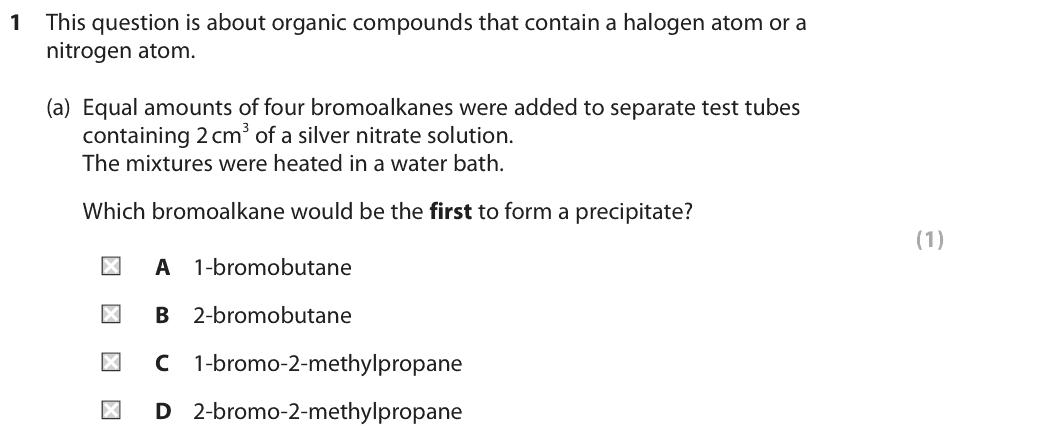
1(a) Halogenoalkanes 1Multiple choice
1(b) Carboxylic acids, Amines, amides, amino acids and proteins 1Multiple choice
1(c)(i) Halogenoalkanes 3Explanation
1(c)(ii) Amines, amides, amino acids and proteins, Halogenoalkanes 1Multiple choice
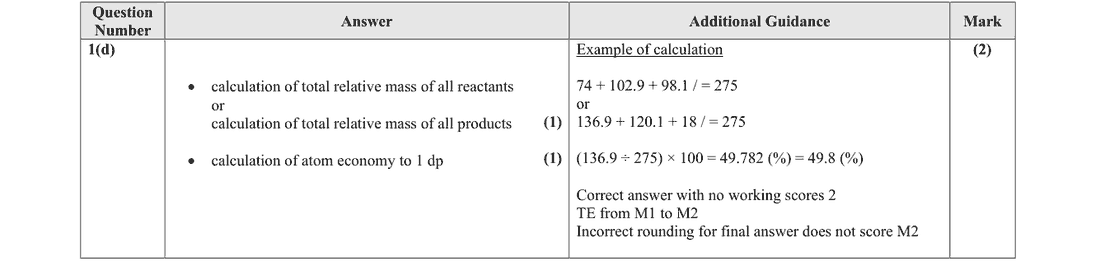
1(d) Formulae, equations and amounts of substance 2Calculation
2(a) Organic synthesis 1Multiple choice
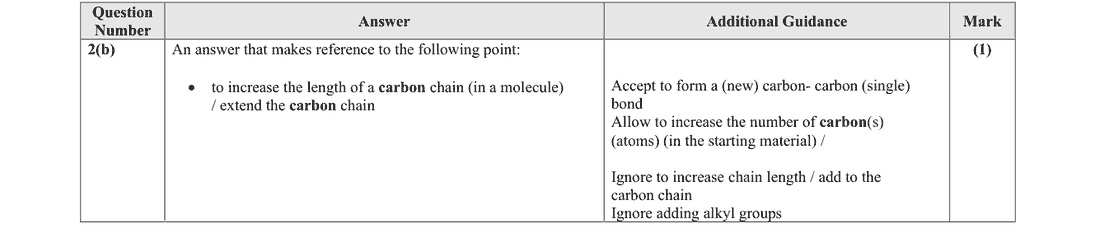
2(b) Organic synthesis 1Short answer
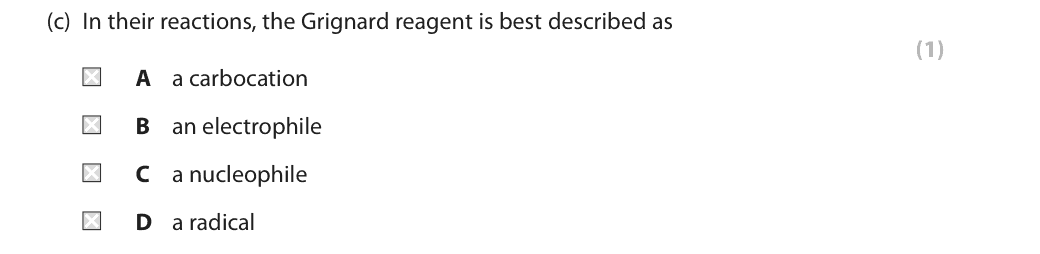
2(c) Organic synthesis 1Multiple choice
2(d) Organic synthesis 2Explanation
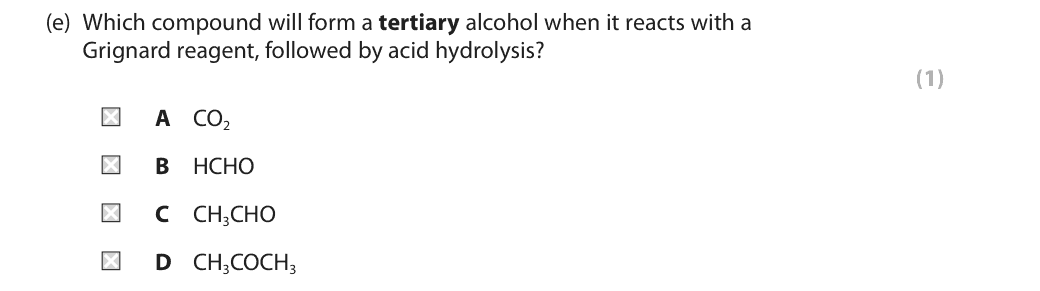
2(e) Organic synthesis 1Multiple choice
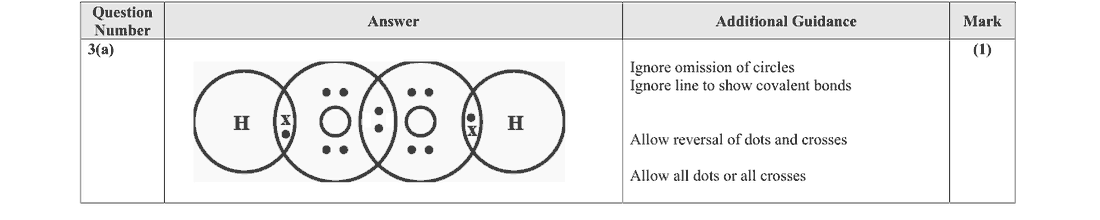
3(a) Bonding 1Diagram or structure
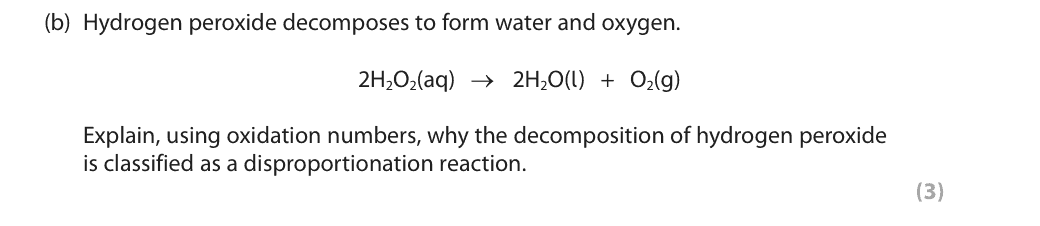
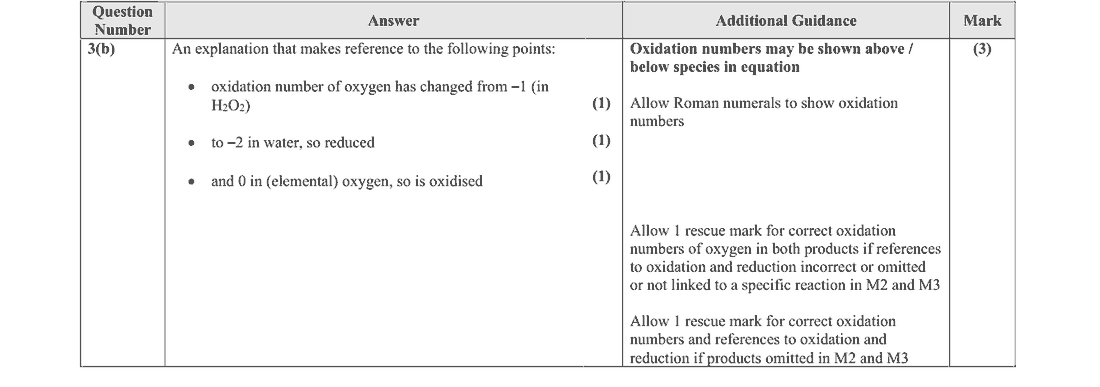
3(b) Redox I 3Explanation
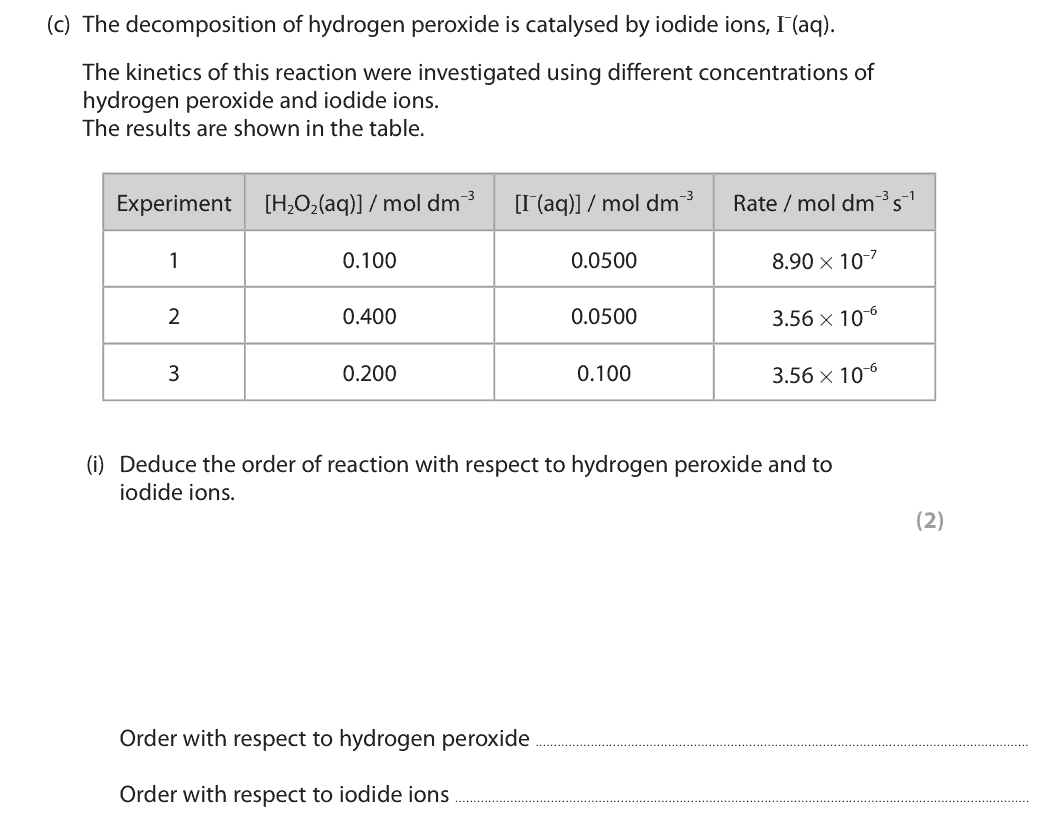
3(c)(i) Kinetics II 2Short answer
3(c)(ii) Kinetics II 1Short answer
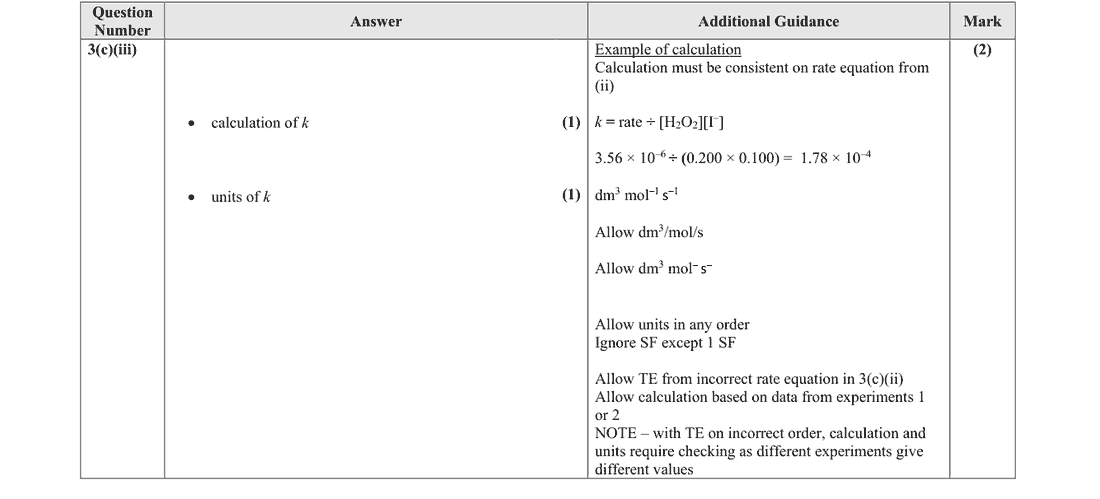
3(c)(iii) Kinetics II 2Calculation
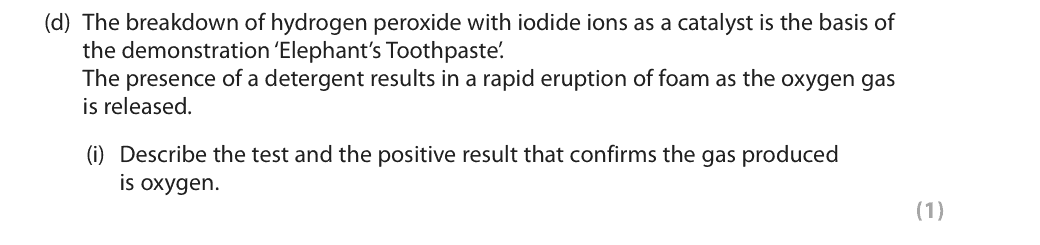
3(d)(i) Formulae, equations and amounts of substance 1Practical and data analysis
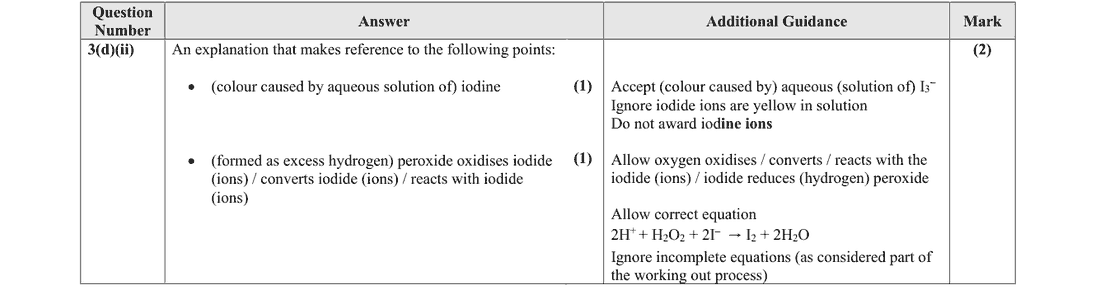
3(d)(ii) Redox I 2Explanation
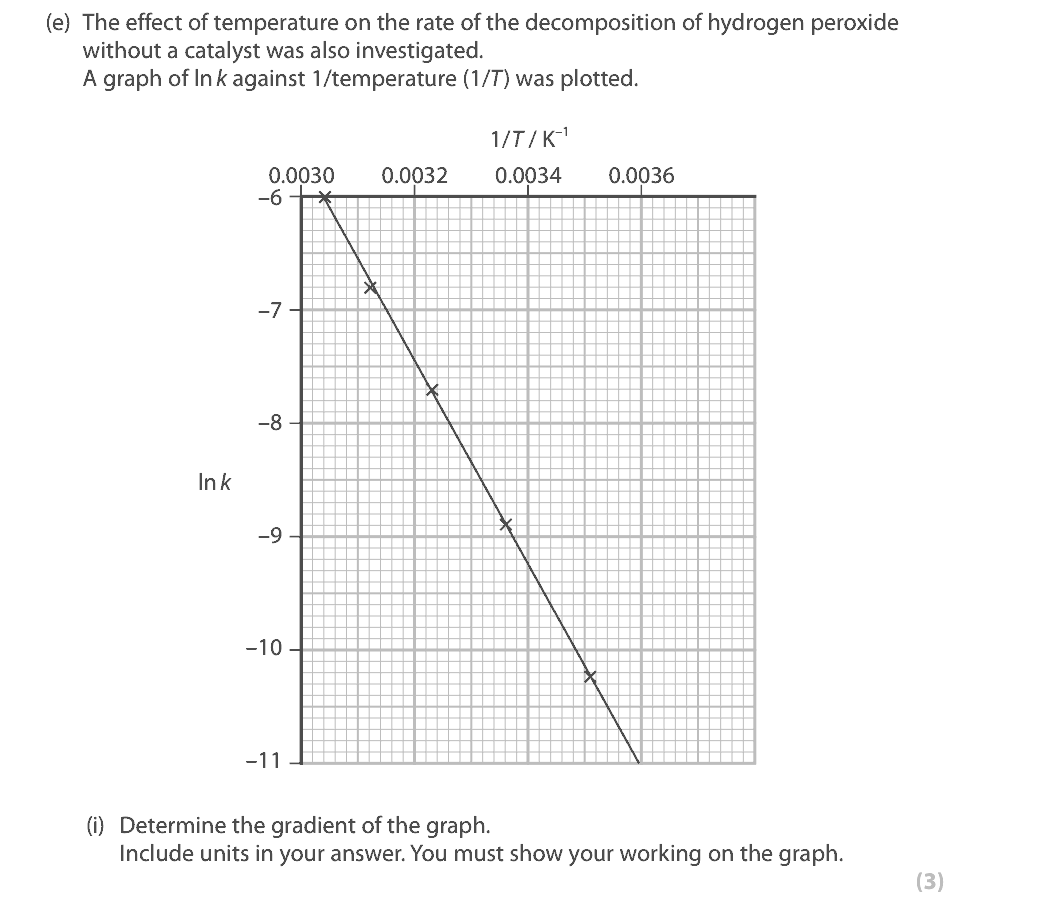
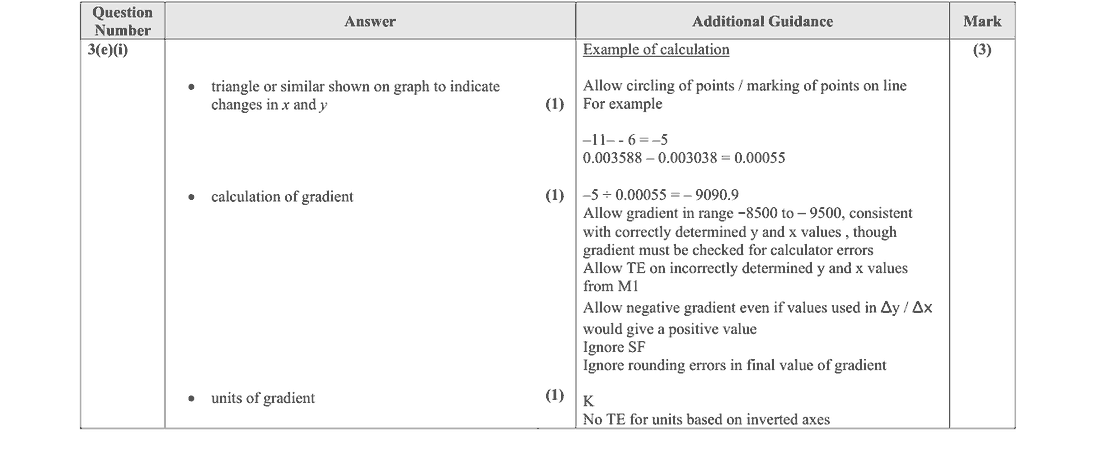
3(e)(i) Kinetics II 3Calculation
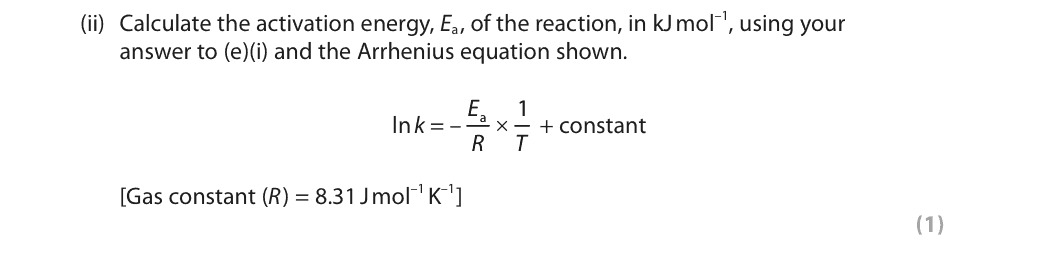
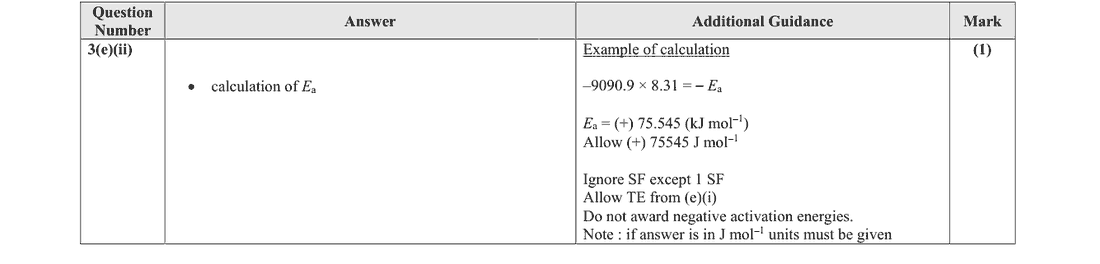
3(e)(ii) Kinetics II 1Calculation
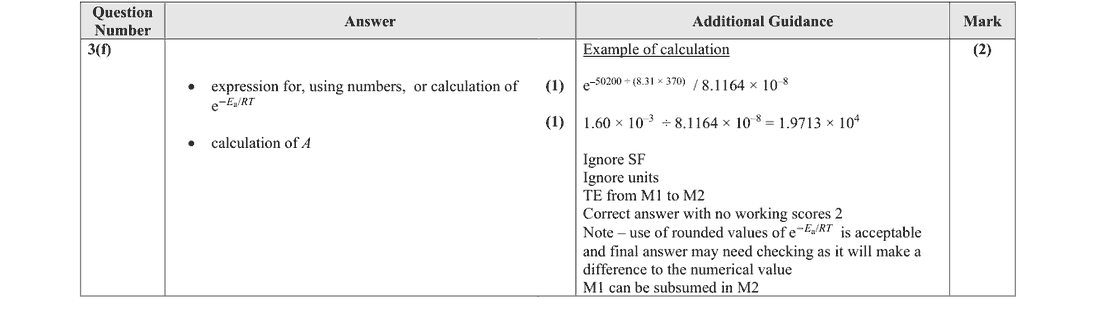
3(f) Kinetics II 2Calculation
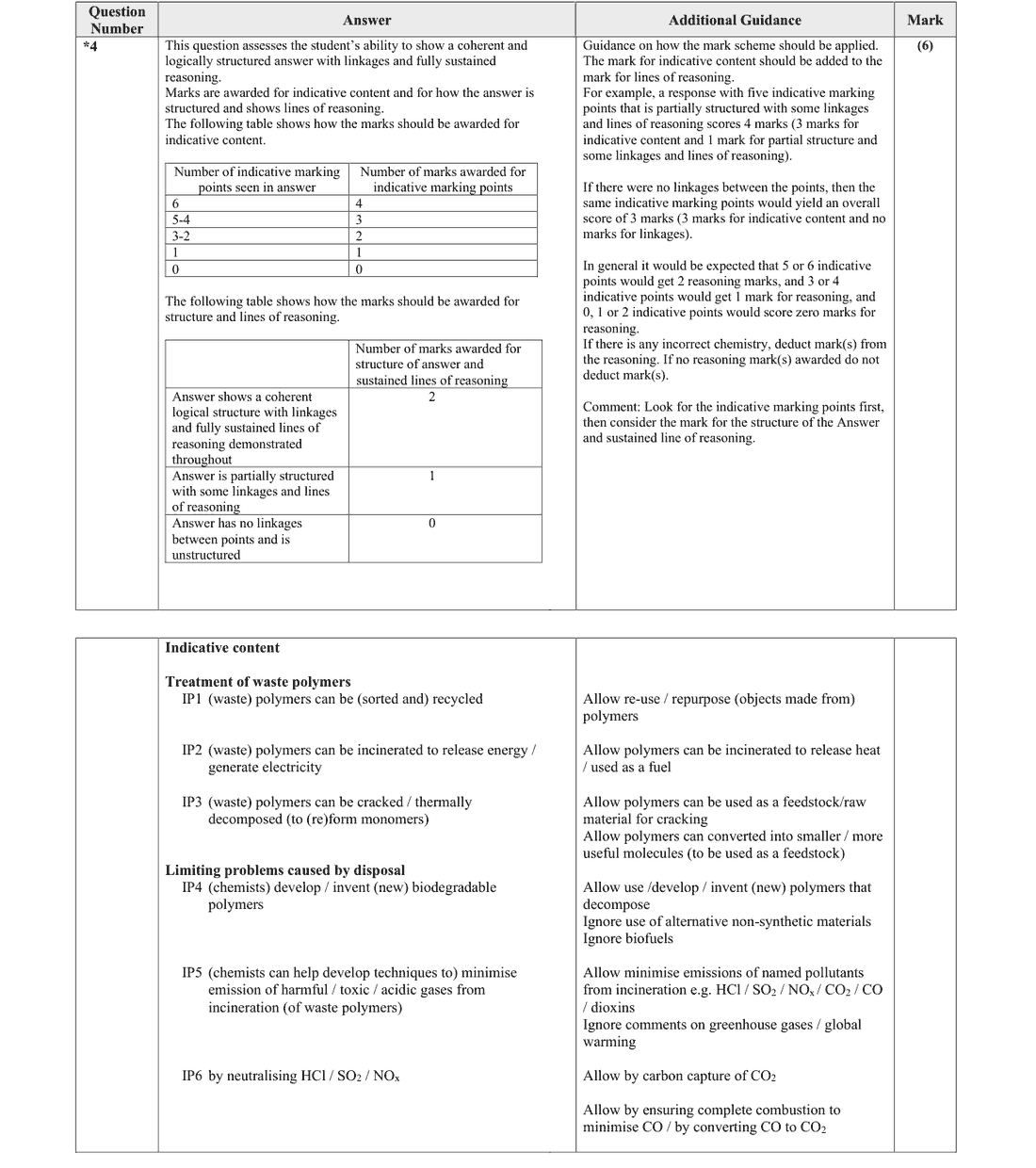
4 Alkenes 6Extended response
5(a) Alkanes 1Short answer
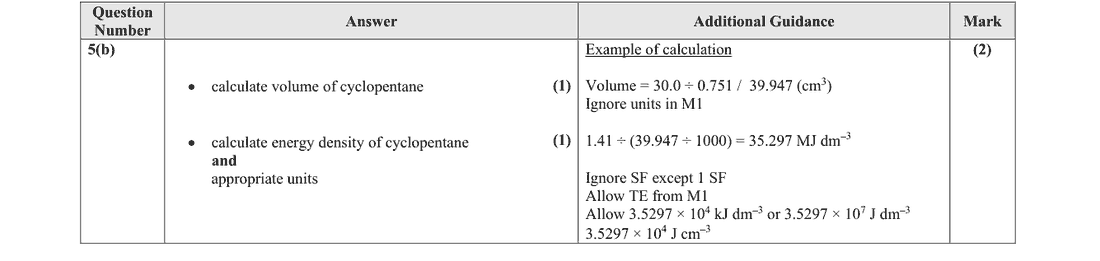
5(b) Formulae, equations and amounts of substance 2Calculation
5(c)(i) Alkanes 1Short answer
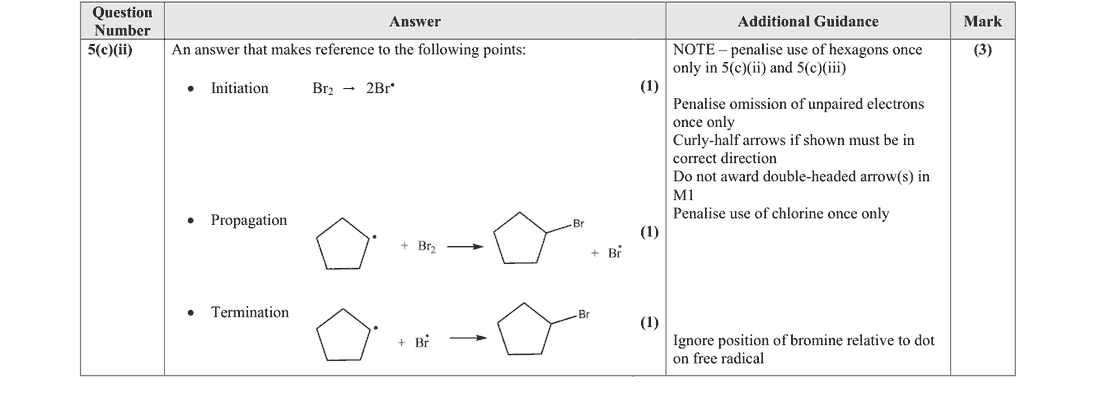
5(c)(ii) Alkanes 3Equation writing
5(c)(iii) Alkanes 1Diagram or structure
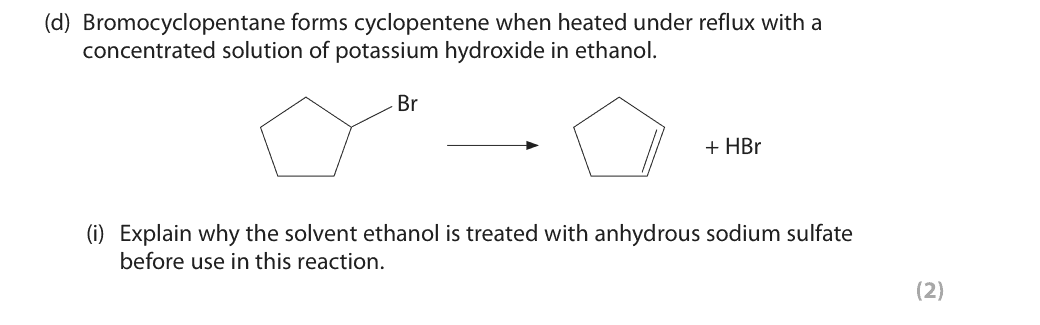
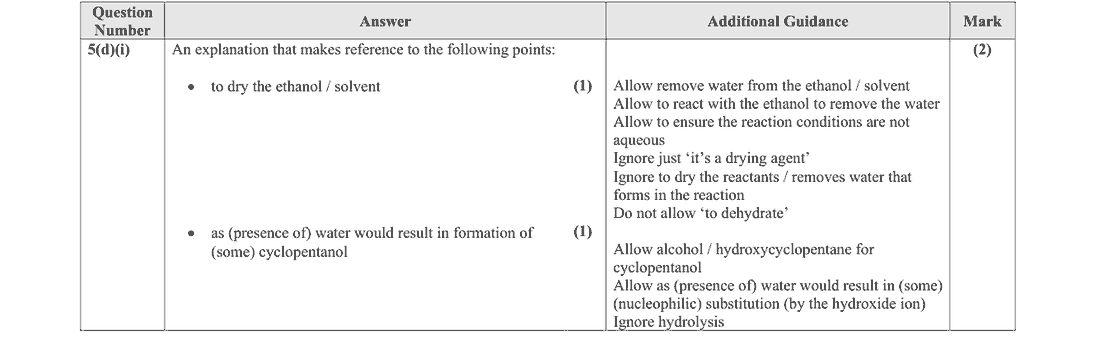
5(d)(i) Halogenoalkanes, Alcohols 2Explanation
5(d)(ii) Introduction to organic chemistry, Halogenoalkanes 1Short answer
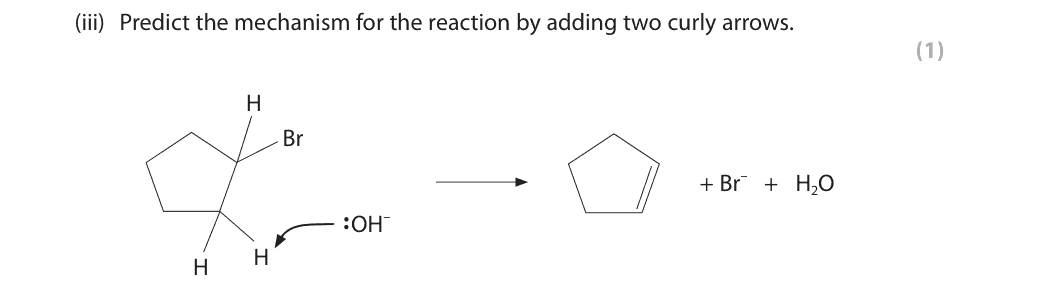
5(d)(iii) Halogenoalkanes 1Mechanism
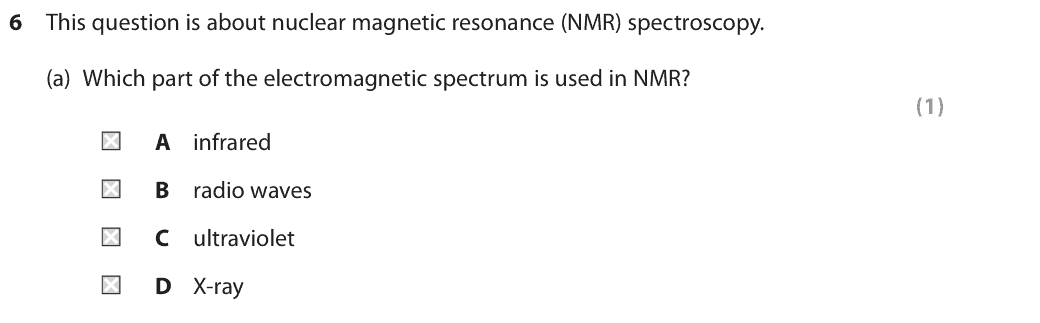
6(a) Modern analytical techniques II: NMR, mass spectrometry and chromatography 1Multiple choice
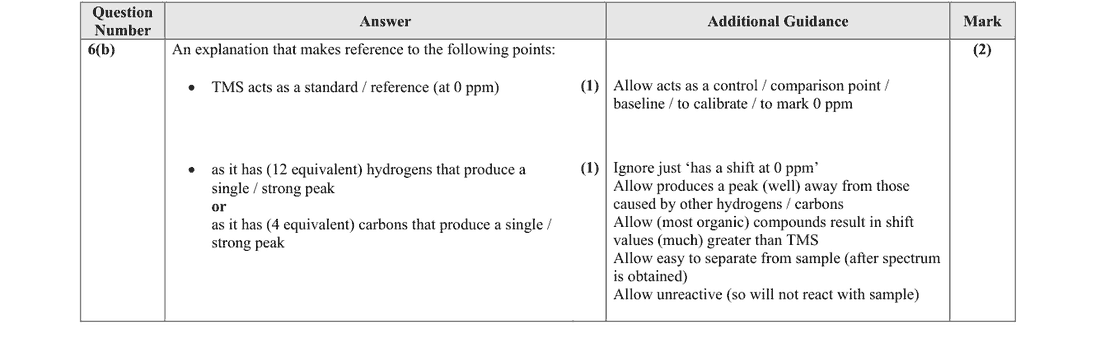
6(b) Modern analytical techniques II: NMR, mass spectrometry and chromatography 2Explanation
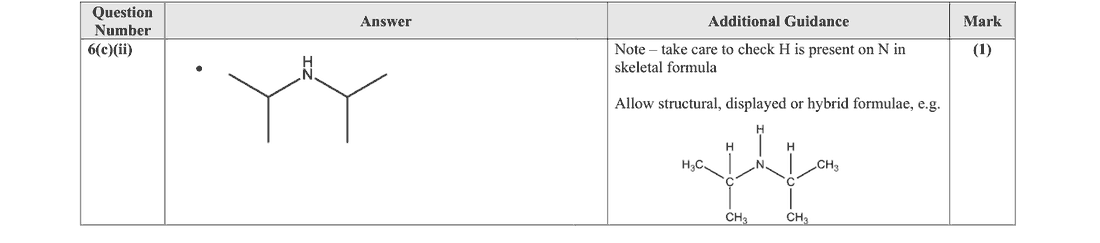
6(c)(i) Amines, amides, amino acids and proteins 1Short answer
6(c)(ii) Modern analytical techniques II: NMR, mass spectrometry and chromatography, Organic synthesis 1Diagram or structure
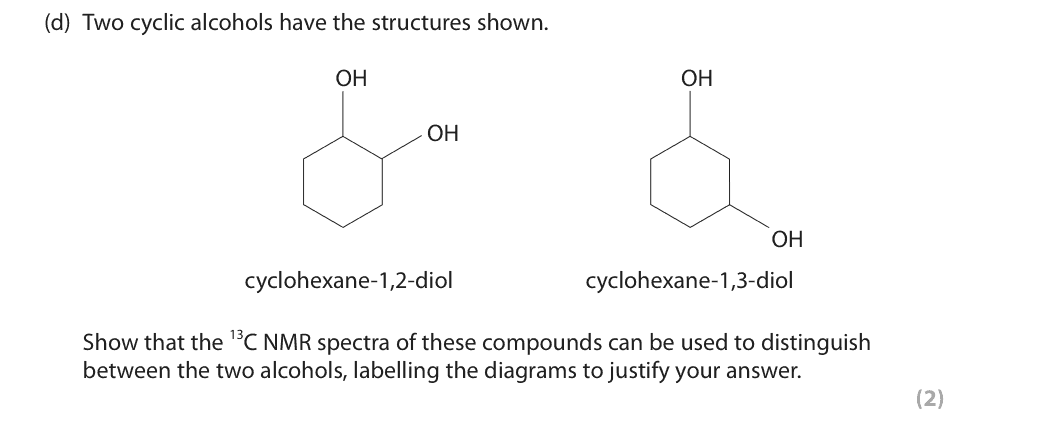
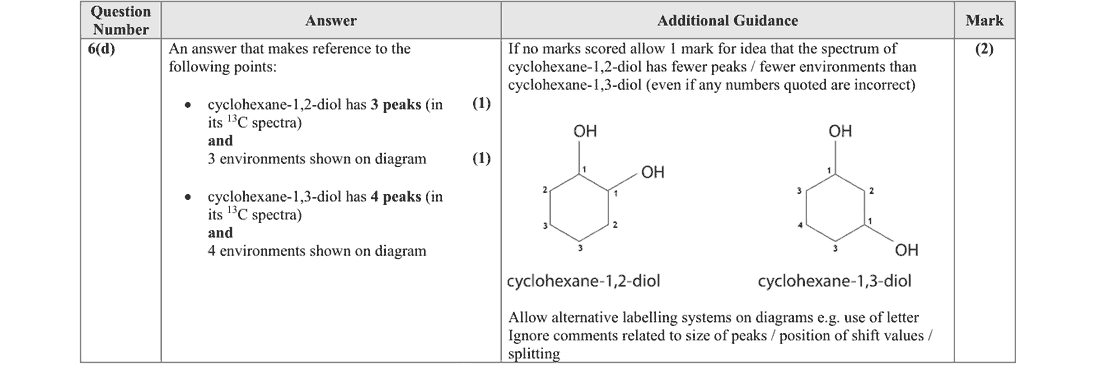
6(d) Modern analytical techniques II: NMR, mass spectrometry and chromatography 2Diagram or structure
7(a) Introduction to organic chemistry 1Multiple choice
7(b) Formulae, equations and amounts of substance 5Calculation
7(c)(i) Alkenes 2Explanation
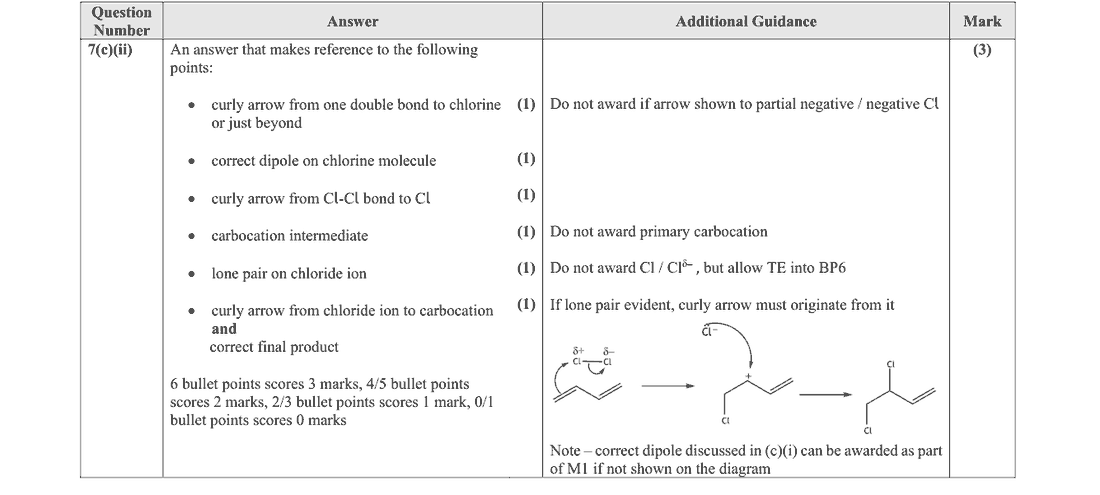
7(c)(ii) Alkenes 3Mechanism
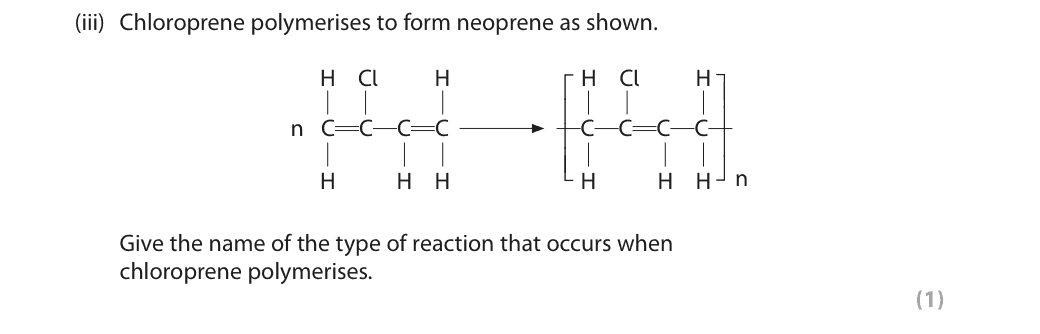
7(c)(iii) Alkenes 1Short answer
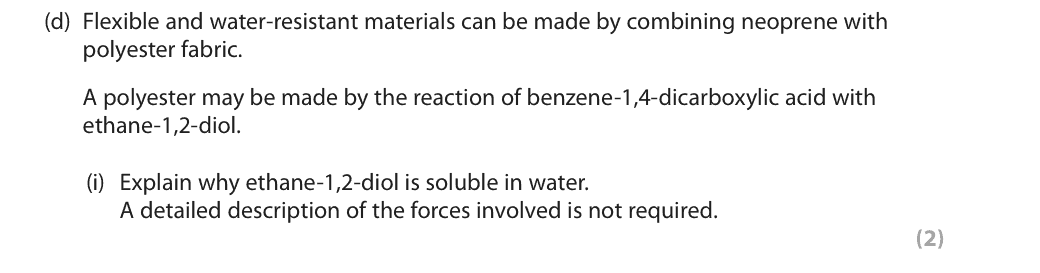
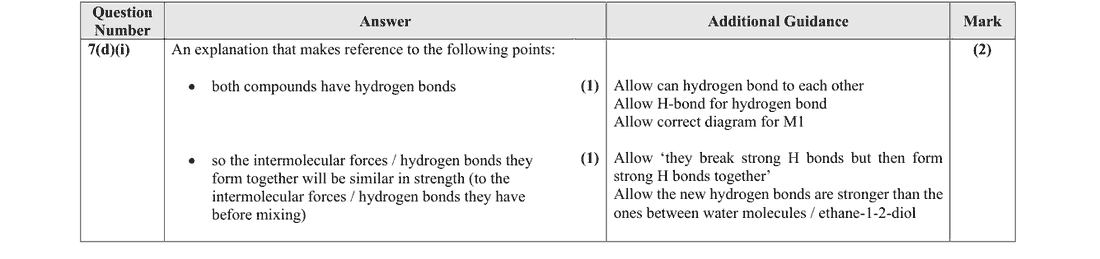
7(d)(i) Bonding 2Explanation
7(d)(ii) Formulae, equations and amounts of substance 2Calculation
7(d)(iii) Carboxylic acids 1Multiple choice
8(a)(i) Chirality 1Short answer
8(a)(ii) Chirality 2Diagram or structure
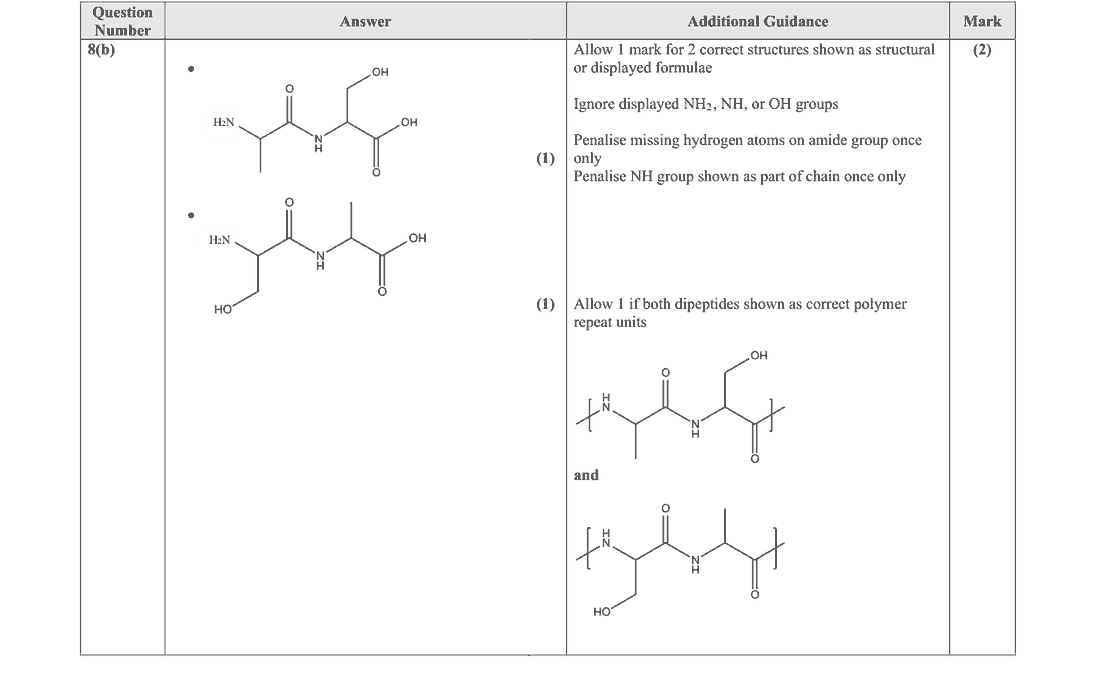
8(b) Amines, amides, amino acids and proteins, Introduction to organic chemistry 2Diagram or structure
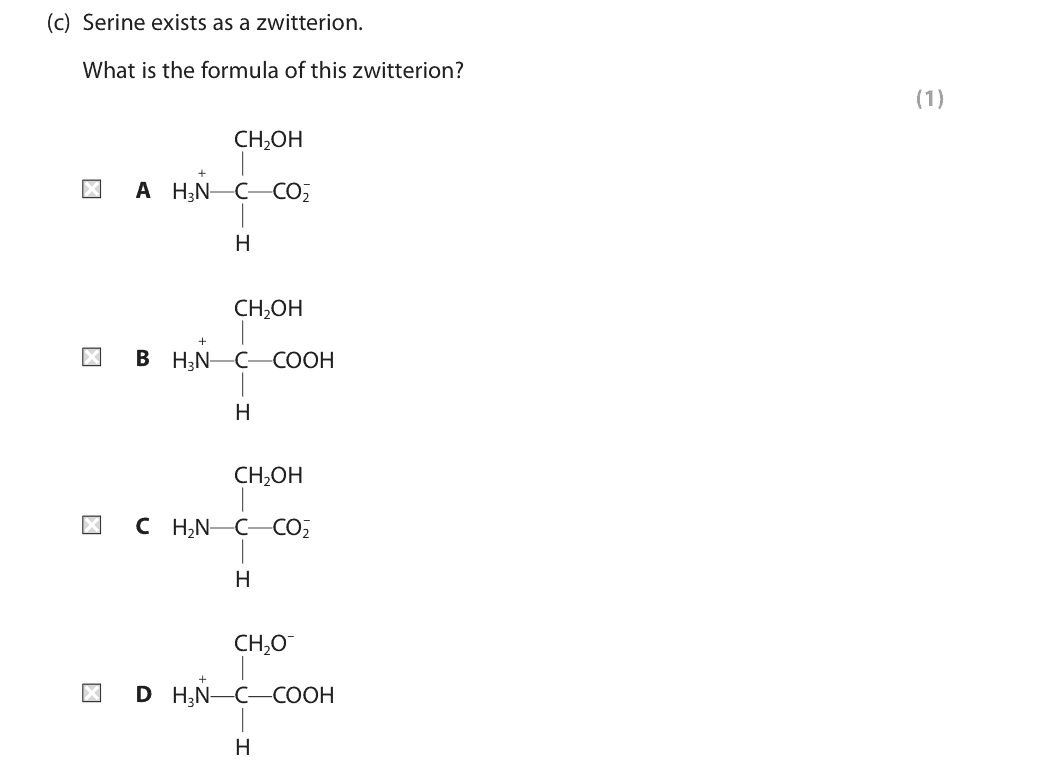
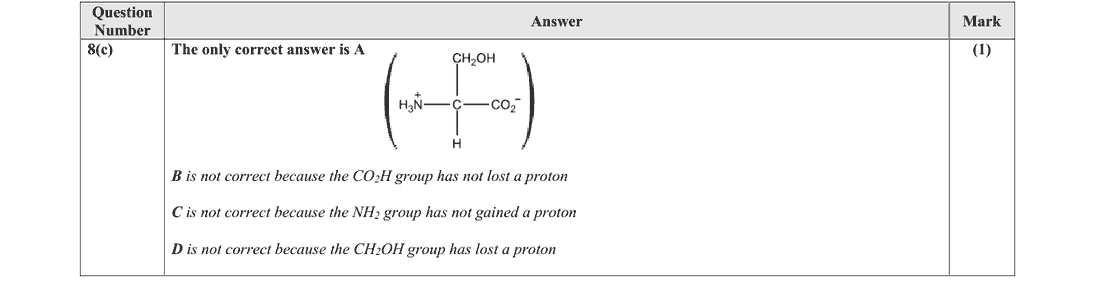
8(c) Amines, amides, amino acids and proteins 1Multiple choice
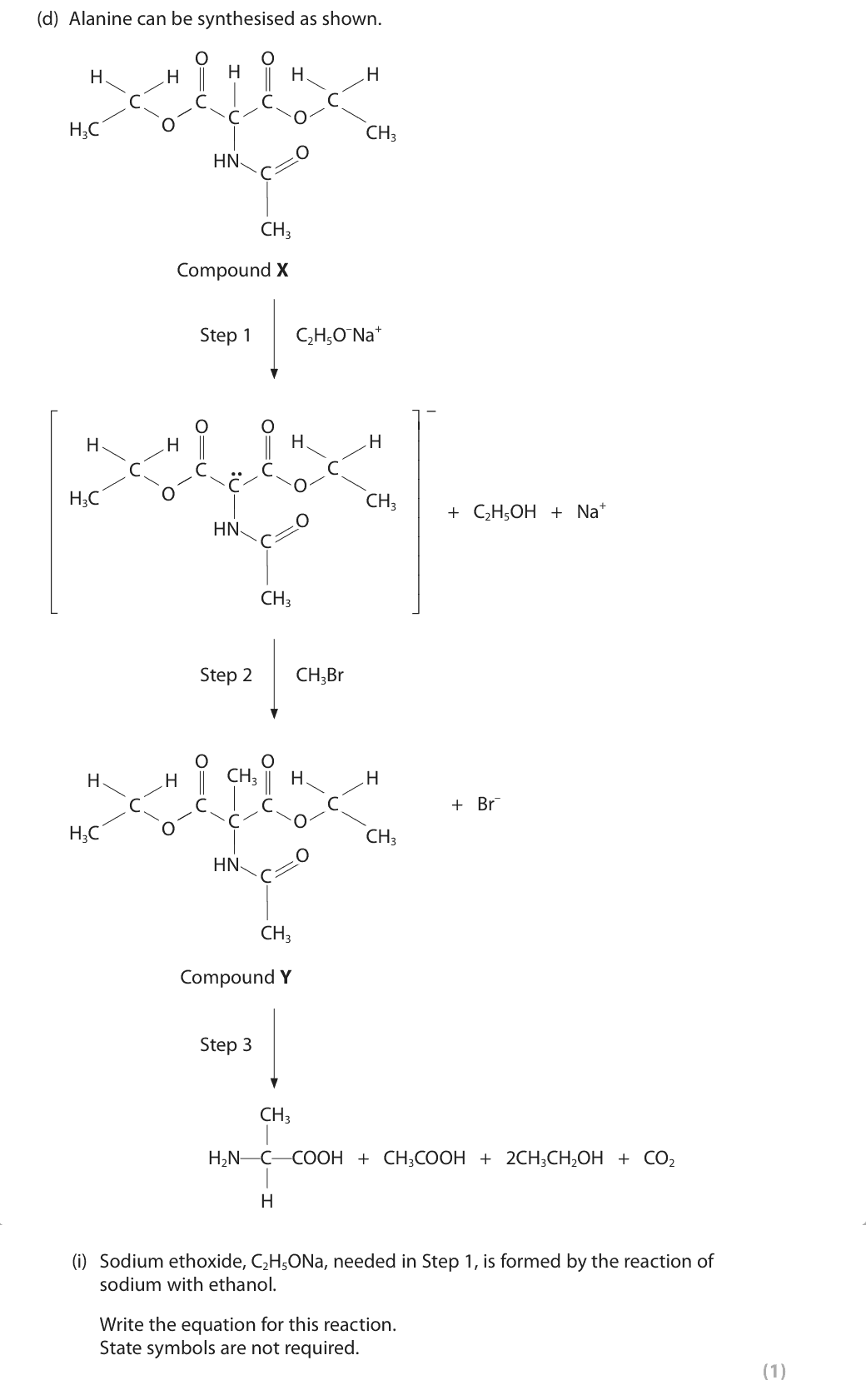
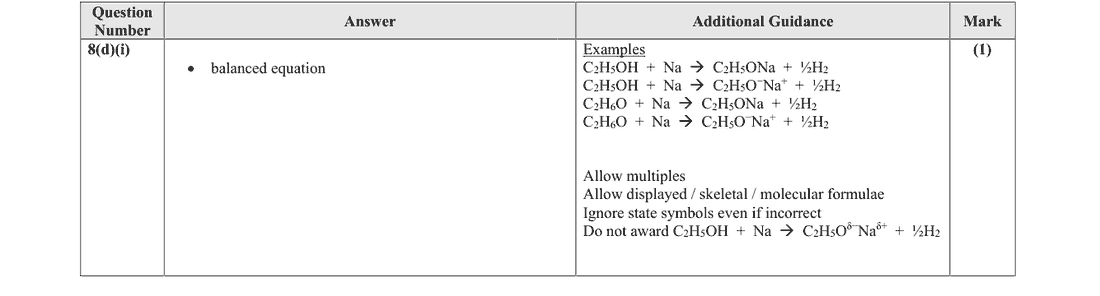
8(d)(i) Formulae, equations and amounts of substance 1Equation writing
8(d)(ii) Carboxylic acids, Amines, amides, amino acids and proteins 2Short answer
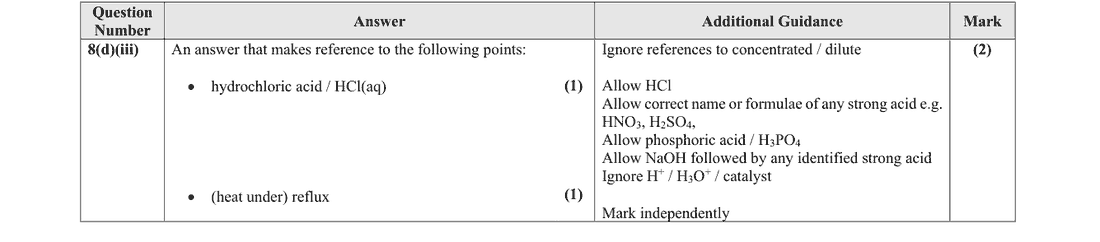
8(d)(iii) Carboxylic acids 2Short answer
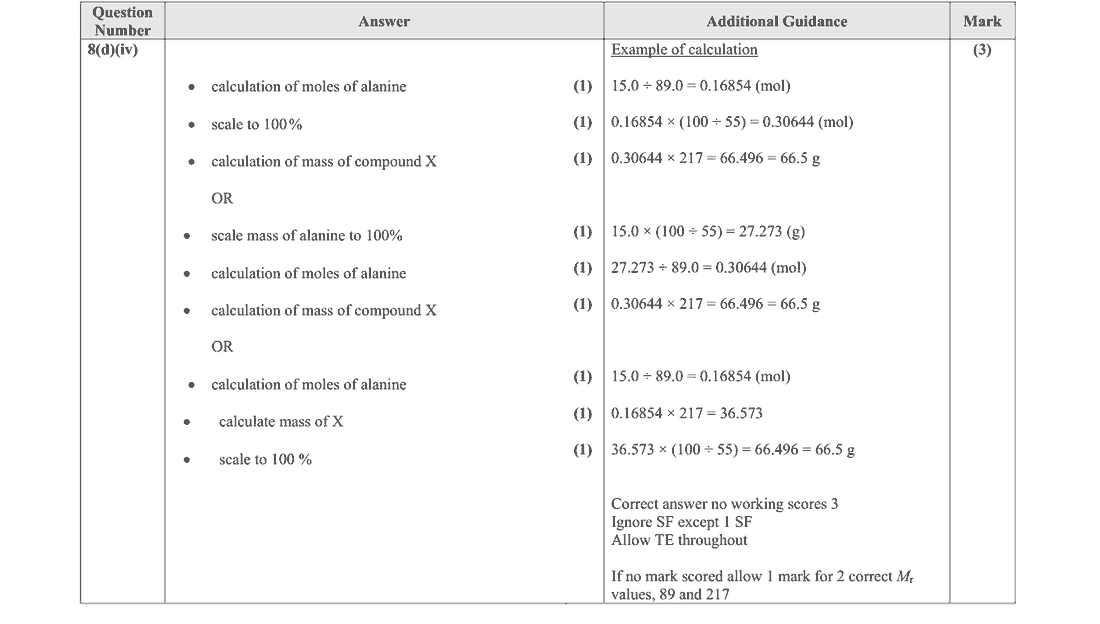
8(d)(iv) Formulae, equations and amounts of substance 3Calculation
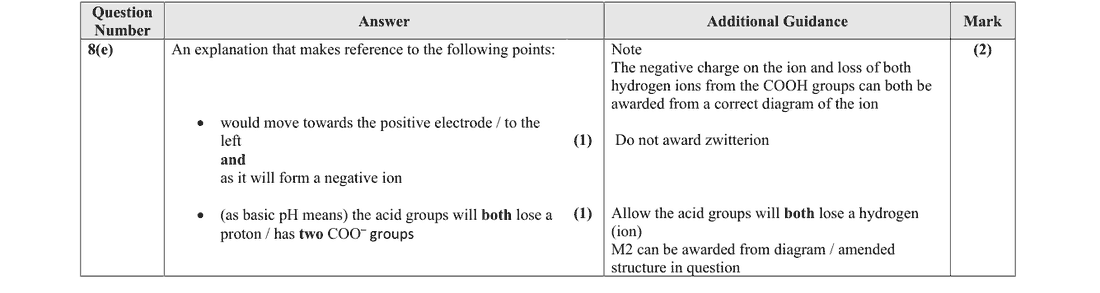
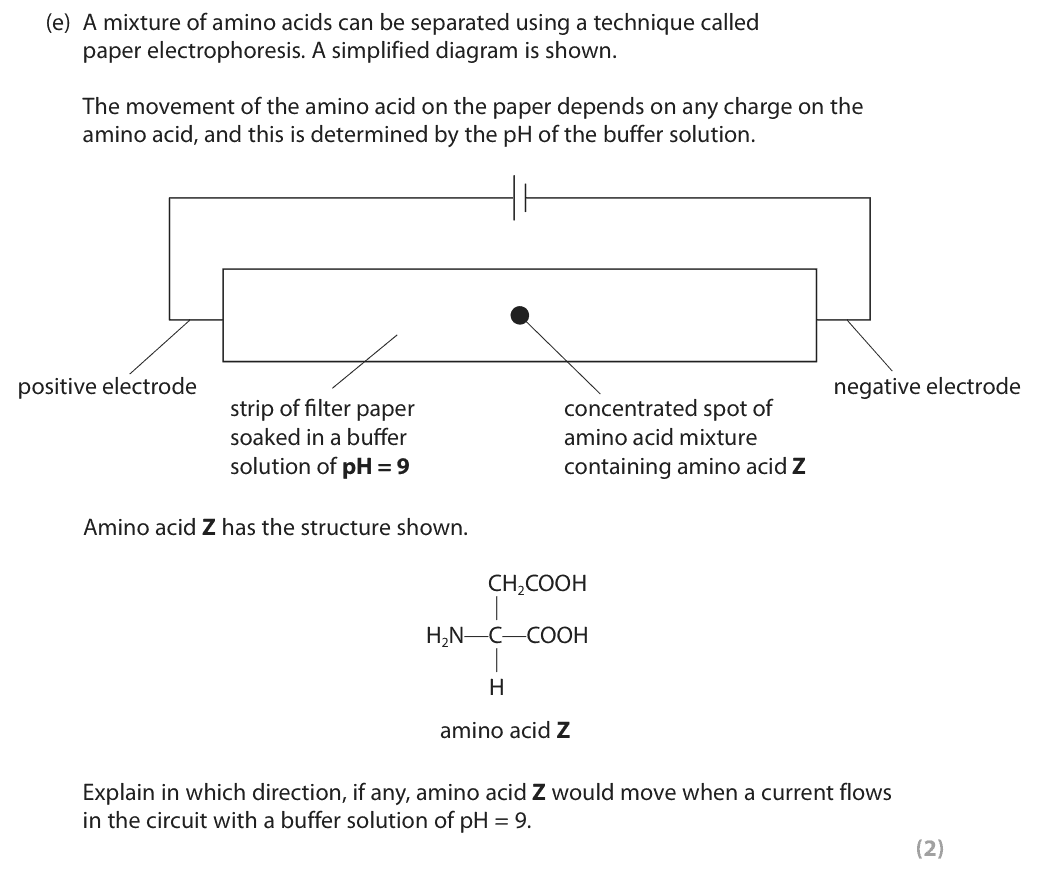
8(e) Amines, amides, amino acids and proteins 2Explanation

The questions

1(a)1(b)1(c)(i)1(c)(ii)1(d)2(a)2(b)2(c)2(d)2(e)3(a)3(b)3(c)(i)3(c)(ii)3(c)(iii)3(d)(i)3(d)(ii)3(e)(i)3(e)(ii)3(f)45(a)5(b)5(c)(i)5(c)(ii)5(c)(iii)5(d)(i)5(d)(ii)5(d)(iii)6(a)6(b)6(c)(i)6(c)(ii)6(d)7(a)7(b)7(c)(i)7(c)(ii)7(c)(iii)7(d)(i)7(d)(ii)7(d)(iii)8(a)(i)8(a)(ii)8(b)8(c)8(d)(i)8(d)(ii)8(d)(iii)8(d)(iv)8(e)
June 2024 · Paper 2 · Q1(a) 1 mark Multiple choice halogenoalkanes
This question is about organic compounds that contain a halogen atom or a
nitrogen atom.
Equal amounts of four bromoalkanes were added to separate test tubes
containing 2 cm3 of a silver nitrate solution.
The mixtures were heated in a water bath.
Which bromoalkane would be the first to form a precipitate?
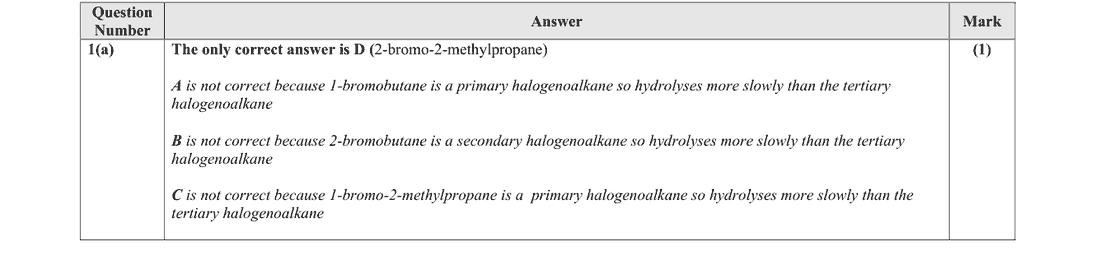
A  1‑bromobutane
B  2‑bromobutane
C  1‑bromo‑2‑methylpropane
D  2‑bromo‑2‑methylpropane
June 2024 · Paper 2 · Q1(b) 1 mark Multiple choice carboxylic acidsamines amides amino acids and proteins
Earlier part of question 1 that this part usesEarlier part of June 2024 Paper 2 question 1
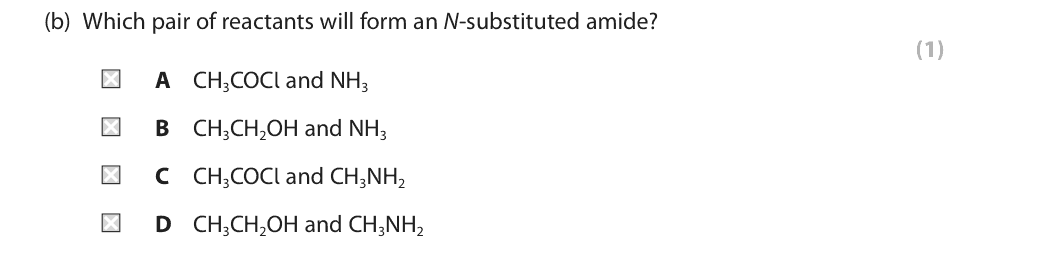
Which pair of reactants will form an N‑substituted amide?
A  CH3COCl and NH3
B  CH3CH2OH and NH3
C  CH3COCl and CH3NH2
D  CH3CH2OH and CH3NH2
June 2024 · Paper 2 · Q1(c)(i) 3 marks Explanation halogenoalkanes

Earlier part of question 1 that this part usesEarlier part of June 2024 Paper 2 question 1
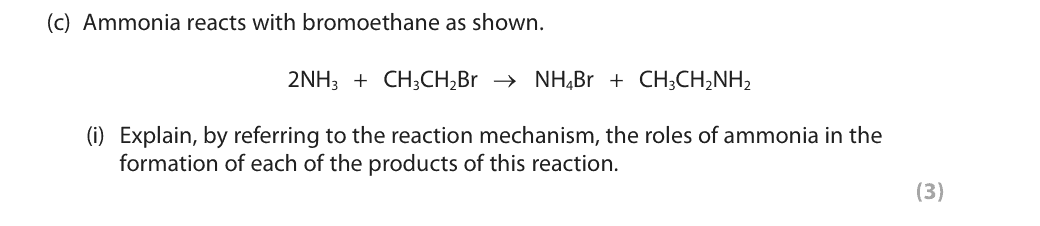
Ammonia reacts with bromoethane as shown.
2NH3   +   CH3CH2Br   →   NH4Br   +   CH3CH2NH2
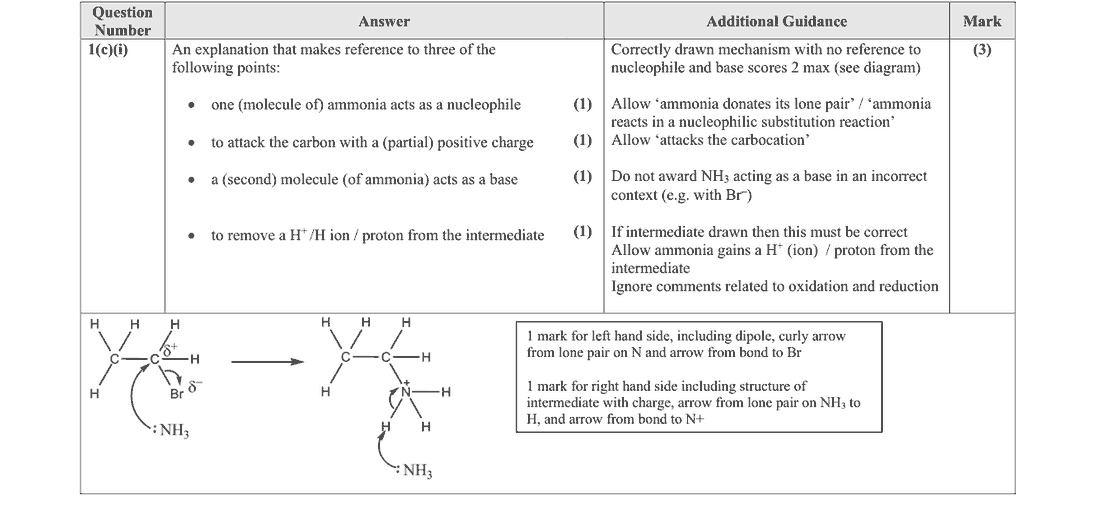
Explain, by referring to the reaction mechanism, the roles of ammonia in the
formation of each of the products of this reaction.
June 2024 · Paper 2 · Q1(c)(ii) 1 mark Multiple choice amines amides amino acids and proteinshalogenoalkanes

Earlier parts of question 1 that this part usesEarlier part of June 2024 Paper 2 question 1Earlier part of June 2024 Paper 2 question 1
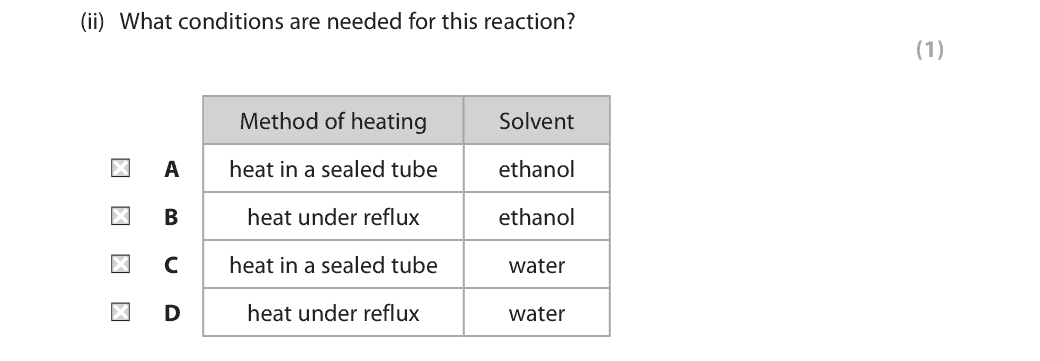
What conditions are needed for this reaction?
Method of heating
Solvent
A
heat in a sealed tube
ethanol
B
heat under reflux
ethanol
C
heat in a sealed tube
water
D
heat under reflux
water
June 2024 · Paper 2 · Q1(d) 2 marks Calculation formulae equations and amounts of substance
Earlier part of question 1 that this part usesEarlier part of June 2024 Paper 2 question 1
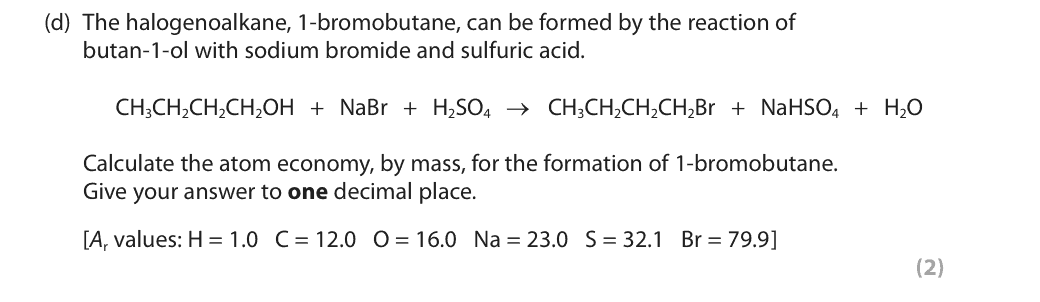
The halogenoalkane, 1‑bromobutane, can be formed by the reaction of
butan‑1‑ol with sodium bromide and sulfuric acid.
CH3CH2CH2CH2OH   +   NaBr   +   H2SO4   →   CH3CH2CH2CH2Br   +   NaHSO4   +   H2O
Calculate the atom economy, by mass, for the formation of 1‑bromobutane.
Give your answer to one decimal place.
[Ar values: H = 1.0   C = 12.0   O = 16.0   Na = 23.0   S = 32.1   Br = 79.9]
June 2024 · Paper 2 · Q2(a) 1 mark Multiple choice organic synthesis
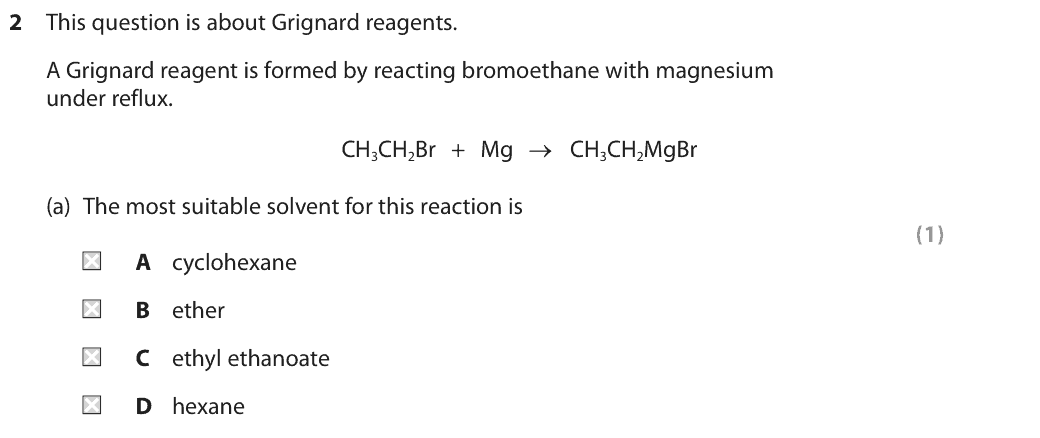
This question is about Grignard reagents.
A Grignard reagent is formed by reacting bromoethane with magnesium
under reflux.
CH3CH2Br   +   Mg   →   CH3CH2MgBr
The most suitable solvent for this reaction is
A  cyclohexane
B  ether
C  ethyl ethanoate
D  hexane
June 2024 · Paper 2 · Q2(b) 1 mark Short answer organic synthesis
Earlier part of question 2 that this part usesEarlier part of June 2024 Paper 2 question 2
State the use of Grignard reagents in organic synthesis.
June 2024 · Paper 2 · Q2(c) 1 mark Multiple choice organic synthesis
Earlier part of question 2 that this part usesEarlier part of June 2024 Paper 2 question 2
In their reactions, the Grignard reagent is best described as
A  a carbocation
B  an electrophile
C  a nucleophile
D  a radical
June 2024 · Paper 2 · Q2(d) 2 marks Explanation organic synthesis
Earlier part of question 2 that this part usesEarlier part of June 2024 Paper 2 question 2
Grignard reagents must be kept dry.
Predict the organic product that forms when CH3CH2MgBr reacts with water.
Justify your answer by considering the polarity of both CH3CH2MgBr and water.
June 2024 · Paper 2 · Q2(e) 1 mark Multiple choice organic synthesis
Earlier part of question 2 that this part usesEarlier part of June 2024 Paper 2 question 2
Which compound will form a tertiary alcohol when it reacts with a
Grignard reagent, followed by acid hydrolysis?
A  CO2
B  HCHO
C  CH3CHO
D  CH3COCH3
June 2024 · Paper 2 · Q3(a) 1 mark Diagram or structure bonding
This question is about hydrogen peroxide, H2O2 .
Draw a dot‑and‑cross diagram of a molecule of hydrogen peroxide.
June 2024 · Paper 2 · Q3(b) 3 marks Explanation redox i
Earlier part of question 3 that this part usesEarlier part of June 2024 Paper 2 question 3
Hydrogen peroxide decomposes to form water and oxygen.
2H2O2(aq)   →   2H2O(l)   +   O2(g)
Explain, using oxidation numbers, why the decomposition of hydrogen peroxide
is classified as a disproportionation reaction.
June 2024 · Paper 2 · Q3(c)(i) 2 marks Short answer kinetics ii
Earlier part of question 3 that this part usesEarlier part of June 2024 Paper 2 question 3
The decomposition of hydrogen peroxide is catalysed by iodide ions, I–(aq).
The kinetics of this reaction were investigated using different concentrations of
hydrogen peroxide and iodide ions.
The results are shown in the table.
[I–(aq)] / mol dm–3
Experiment
[H2O2(aq)] / mol dm–3
Rate / mol dm–3 s–1
1
0.100
0.0500
8.90 × 10–7
2
0.400
0.0500
3.56 × 10–6
3
0.200
0.100
3.56 × 10–6
Deduce the order of reaction with respect to hydrogen peroxide and to
iodide ions.
Order with respect to hydrogen peroxide 
Order with respect to iodide ions
June 2024 · Paper 2 · Q3(c)(ii) 1 mark Short answer kinetics ii
Earlier parts of question 3 that this part usesEarlier part of June 2024 Paper 2 question 3Earlier part of June 2024 Paper 2 question 3
Write the rate equation for the reaction using your answer to (c)(i).
June 2024 · Paper 2 · Q3(c)(iii) 2 marks Calculation kinetics ii
Earlier parts of question 3 that this part usesEarlier part of June 2024 Paper 2 question 3Earlier part of June 2024 Paper 2 question 3Earlier part of June 2024 Paper 2 question 3
Calculate the rate constant, k, using data from Experiment 3.
Include units in your answer.
June 2024 · Paper 2 · Q3(d)(i) 1 mark Practical and data analysis formulae equations and amounts of substance
The breakdown of hydrogen peroxide with iodide ions as a catalyst is the basis of
the demonstration ‘Elephant’s Toothpaste’.
The presence of a detergent results in a rapid eruption of foam as the oxygen gas
is released.
Describe the test and the positive result that confirms the gas produced
is oxygen.
June 2024 · Paper 2 · Q3(d)(ii) 2 marks Explanation redox i
Earlier parts of question 3 that this part usesEarlier part of June 2024 Paper 2 question 3Earlier part of June 2024 Paper 2 question 3
The foam produced often has a slight yellow / brown colour.
Explain what causes this colour, which is not caused by the detergent.
June 2024 · Paper 2 · Q3(e)(i) 3 marks Calculation kinetics ii
Earlier part of question 3 that this part usesEarlier part of June 2024 Paper 2 question 3
The effect of temperature on the rate of the decomposition of hydrogen peroxide
without a catalyst was also investigated.
A graph of ln k against 1/temperature (1/T) was plotted.
1/T / K–1
0.0030
0.0032
0.0034
0.0036
–6
–7
–8
ln k
–9
–10
–11
Determine the gradient of the graph.
Include units in your answer. You must show your working on the graph.
June 2024 · Paper 2 · Q3(e)(ii) 1 mark Calculation kinetics ii
Earlier parts of question 3 that this part usesEarlier part of June 2024 Paper 2 question 3Earlier part of June 2024 Paper 2 question 3
Calculate the activation energy, Ea, of the reaction, in kJ mol–1, using your
answer to (e)(i) and the Arrhenius equation shown.
ln k = – E
a × 1 + constant
R
T
[Gas constant (R) = 8.31 J mol–1 K–1]
June 2024 · Paper 2 · Q3(f) 2 marks Calculation kinetics ii
Earlier part of question 3 that this part usesEarlier part of June 2024 Paper 2 question 3
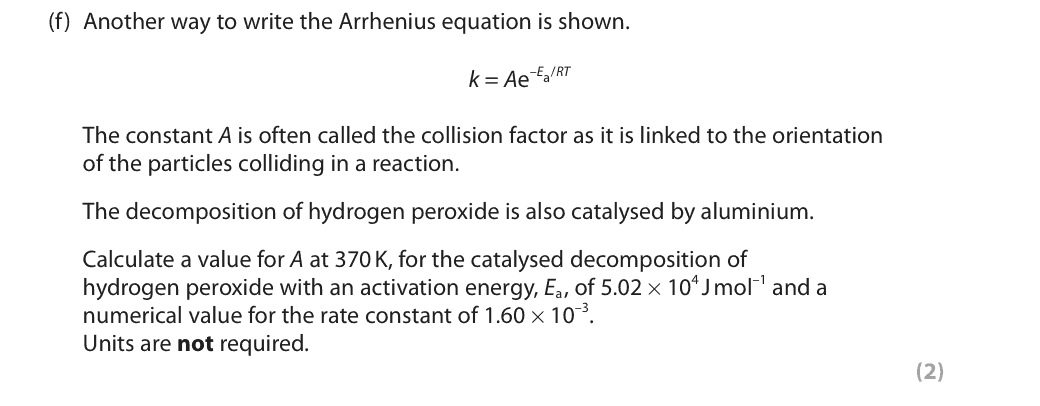
Another way to write the Arrhenius equation is shown.
k = Ae–Ea/RT
The constant A is often called the collision factor as it is linked to the orientation
of the particles colliding in a reaction.
The decomposition of hydrogen peroxide is also catalysed by aluminium.
Calculate a value for A at 370 K, for the catalysed decomposition of
hydrogen peroxide with an activation energy, Ea, of 5.02 × 104 J mol–1 and a
numerical value for the rate constant of 1.60 × 10–3.
Units are not required.
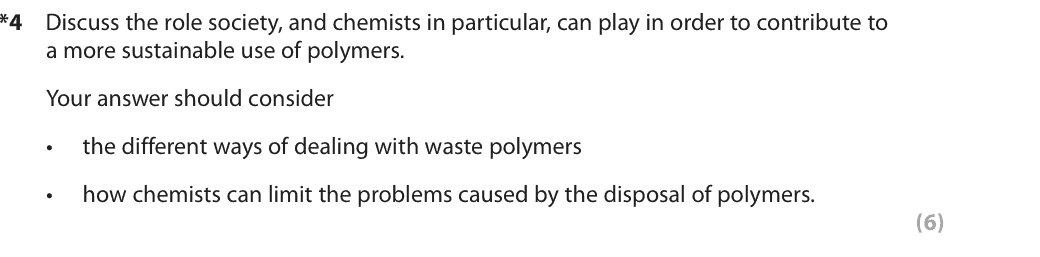
June 2024 · Paper 2 · Q4 6 marks 6-mark extended response alkenes
Discuss the role society, and chemists in particular, can play in order to contribute to
a more sustainable use of polymers.
Your answer should consider
•
the different ways of dealing with waste polymers
•
how chemists can limit the problems caused by the disposal of polymers.
June 2024 · Paper 2 · Q5(a) 1 mark Short answer alkanes
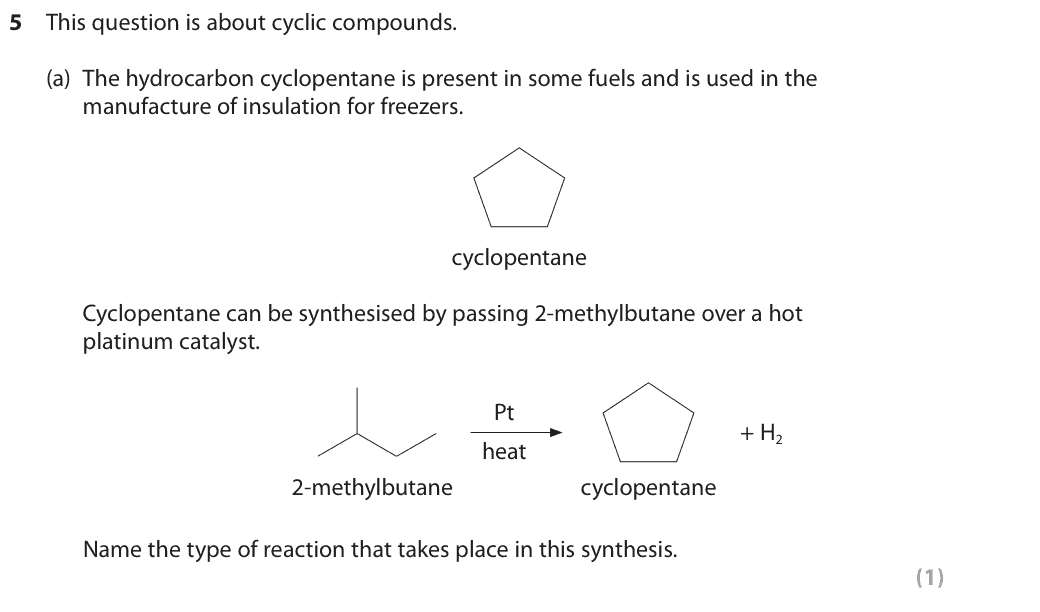
This question is about cyclic compounds.
The hydrocarbon cyclopentane is present in some fuels and is used in the
manufacture of insulation for freezers.
cyclopentane
Cyclopentane can be synthesised by passing 2‑methylbutane over a hot
platinum catalyst.
Pt
+ H2
heat
2‑methylbutane
cyclopentane
Name the type of reaction that takes place in this synthesis.
June 2024 · Paper 2 · Q5(b) 2 marks Calculation formulae equations and amounts of substance
Earlier part of question 5 that this part usesEarlier part of June 2024 Paper 2 question 5
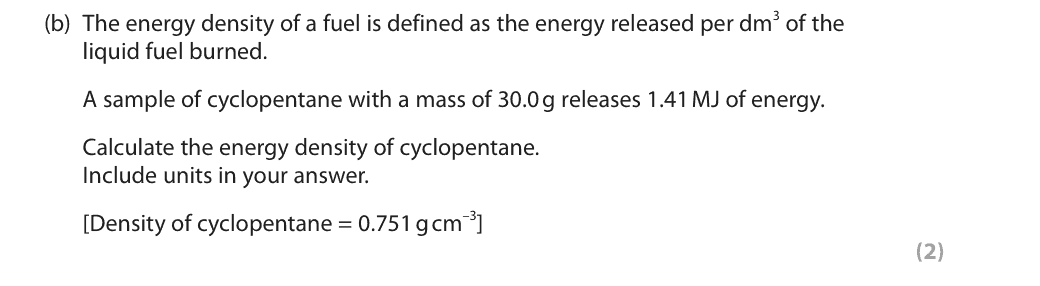
The energy density of a fuel is defined as the energy released per dm3 of the
liquid fuel burned.
A sample of cyclopentane with a mass of 30.0 g releases 1.41 MJ of energy.
Calculate the energy density of cyclopentane.
Include units in your answer.
[Density of cyclopentane = 0.751 g cm–3]
June 2024 · Paper 2 · Q5(c)(i) 1 mark Short answer alkanes
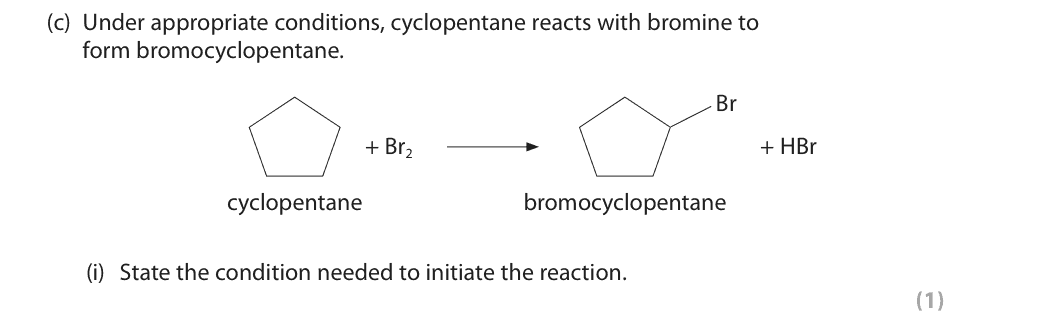
Under appropriate conditions, cyclopentane reacts with bromine to
form bromocyclopentane.
Br
+ Br2
+ HBr
cyclopentane
bromocyclopentane
State the condition needed to initiate the reaction.
June 2024 · Paper 2 · Q5(c)(ii) 3 marks Equation writing alkanes
Earlier parts of question 5 that this part usesEarlier part of June 2024 Paper 2 question 5Earlier part of June 2024 Paper 2 question 5
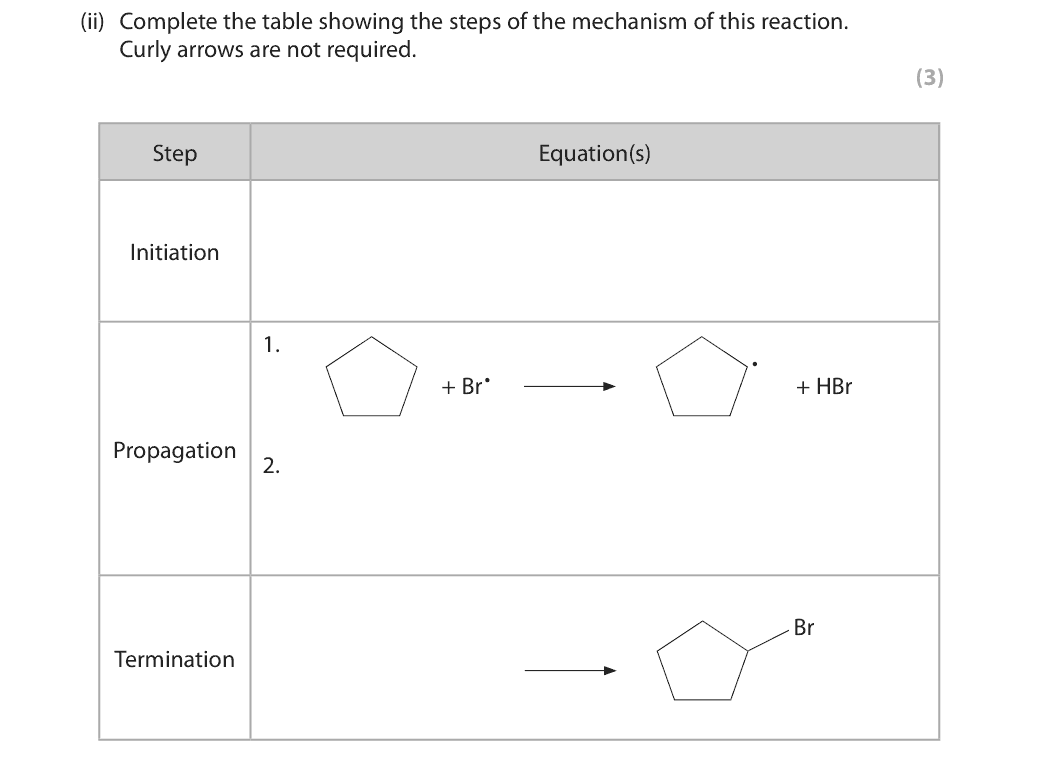
Complete the table showing the steps of the mechanism of this reaction.
Curly arrows are not required.
Step
Equation(s)
Initiation
1.
.
+ Br.
+ HBr
Propagation
2.
Br
Termination
June 2024 · Paper 2 · Q5(c)(iii) 1 mark Diagram or structure alkanes
Earlier parts of question 5 that this part usesEarlier part of June 2024 Paper 2 question 5Earlier part of June 2024 Paper 2 question 5
Draw the structure of the organic product of an alternative termination step.
June 2024 · Paper 2 · Q5(d)(i) 2 marks Explanation halogenoalkanesalcohols
Bromocyclopentane forms cyclopentene when heated under reflux with a
concentrated solution of potassium hydroxide in ethanol.
Br
+ HBr
Explain why the solvent ethanol is treated with anhydrous sodium sulfate
before use in this reaction.
June 2024 · Paper 2 · Q5(d)(ii) 1 mark Short answer introduction to organic chemistryhalogenoalkanes

Earlier parts of question 5 that this part usesEarlier part of June 2024 Paper 2 question 5Earlier part of June 2024 Paper 2 question 5
Give the name of the reaction shown in the equation.
June 2024 · Paper 2 · Q5(d)(iii) 1 mark Mechanism halogenoalkanes

Earlier parts of question 5 that this part usesEarlier part of June 2024 Paper 2 question 5Earlier part of June 2024 Paper 2 question 5
Predict the mechanism for the reaction by adding two curly arrows.
H
Br
+ Br–   +   H2O
:OH–
H
H
June 2024 · Paper 2 · Q6(a) 1 mark Multiple choice nmr mass spectrometry and chromatography
This question is about nuclear magnetic resonance (NMR) spectroscopy.
Which part of the electromagnetic spectrum is used in NMR?
A  infrared
B  radio waves
C  ultraviolet
D  X‑ray
June 2024 · Paper 2 · Q6(b) 2 marks Explanation nmr mass spectrometry and chromatography
Explain why tetramethylsilane, TMS, is used in NMR spectroscopy.
June 2024 · Paper 2 · Q6(c)(i) 1 mark Short answer amines amides amino acids and proteins
A secondary amine, Q, has the molecular formula C6H15N.
The low resolution 1H NMR spectrum of Q has three peaks.
State what is meant by the term ‘secondary amine’.
June 2024 · Paper 2 · Q6(c)(ii) 1 mark Diagram or structure Hard nmr mass spectrometry and chromatographyorganic synthesis
Earlier parts of question 6 that this part usesEarlier part of June 2024 Paper 2 question 6Earlier part of June 2024 Paper 2 question 6
Deduce the structure of Q.
June 2024 · Paper 2 · Q6(d) 2 marks Diagram or structure nmr mass spectrometry and chromatography
Earlier part of question 6 that this part usesEarlier part of June 2024 Paper 2 question 6
Two cyclic alcohols have the structures shown.
OH
OH
OH
OH
cyclohexane-1,2-diol
cyclohexane-1,3-diol
Show that the 13C NMR spectra of these compounds can be used to distinguish
between the two alcohols, labelling the diagrams to justify your answer.
June 2024 · Paper 2 · Q7(a) 1 mark Multiple choice introduction to organic chemistry
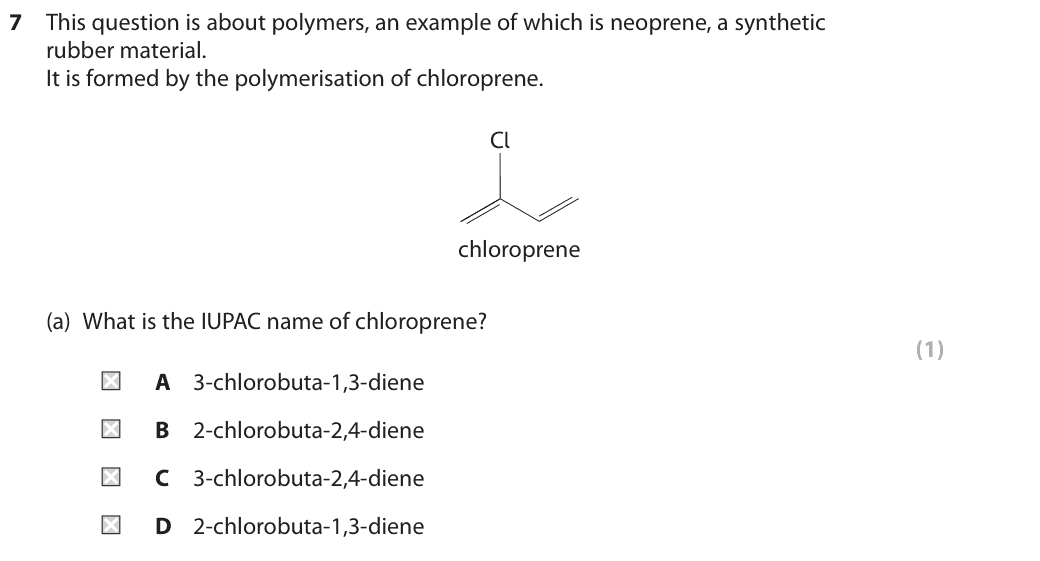
This question is about polymers, an example of which is neoprene, a synthetic
rubber material.
It is formed by the polymerisation of chloroprene.
Cl
chloroprene
What is the IUPAC name of chloroprene?
A  3‑chlorobuta‑1,3‑diene
B  2‑chlorobuta‑2,4‑diene
C  3‑chlorobuta‑2,4‑diene
D  2‑chlorobuta‑1,3‑diene
June 2024 · Paper 2 · Q7(b) 5 marks Calculation formulae equations and amounts of substance
Earlier part of question 7 that this part usesEarlier part of June 2024 Paper 2 question 7
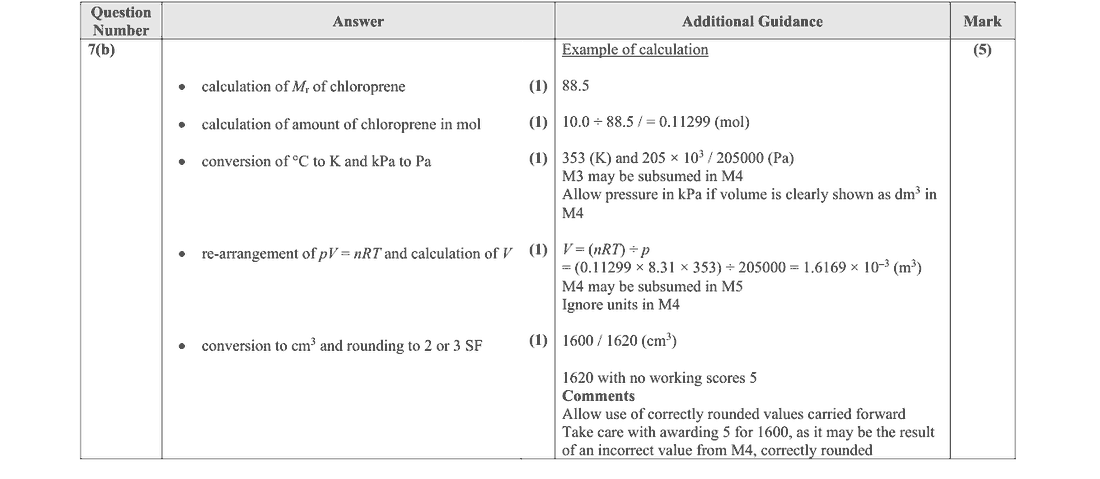
Calculate the volume, in cm3, occupied by 10.0 g of chloroprene in the
gaseous phase, at 80.0 °C and 205 kPa.
Give your answer to an appropriate number of significant figures.
[Gas constant (R) = 8.31 J mol–1 K–1]
June 2024 · Paper 2 · Q7(c)(i) 2 marks Explanation alkenes

Earlier part of question 7 that this part usesEarlier part of June 2024 Paper 2 question 7
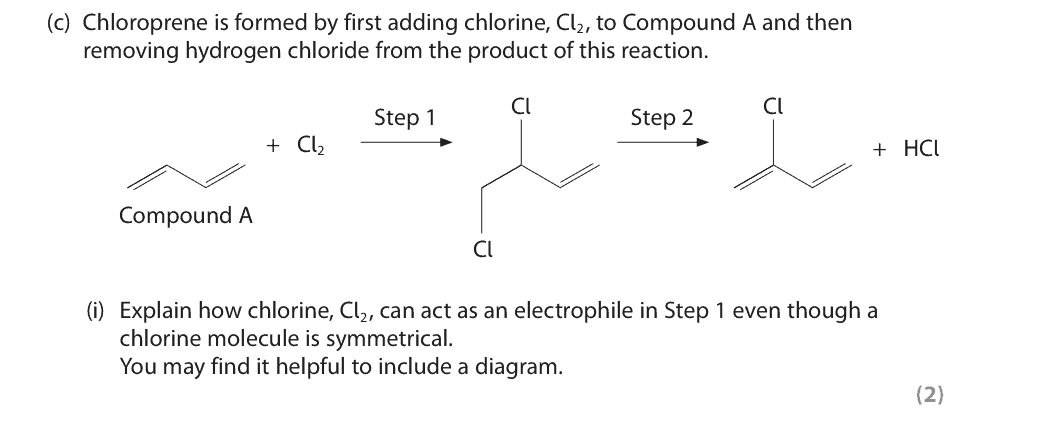
Chloroprene is formed by first adding chlorine, Cl2, to Compound A and then
removing hydrogen chloride from the product of this reaction.
Cl
Cl
Step 1
Step 2
+   Cl2
+   HCl
Compound A
Cl
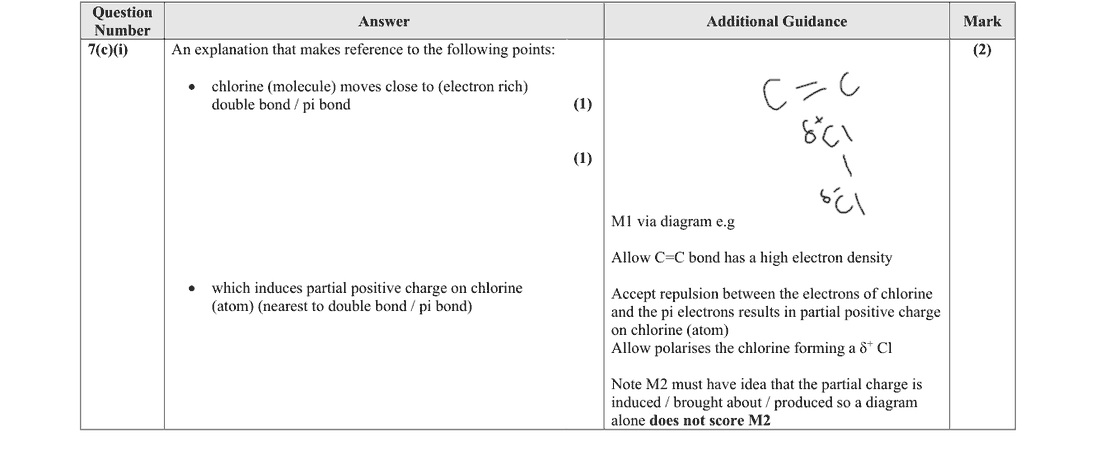
Explain how chlorine, Cl2, can act as an electrophile in Step 1 even though a
chlorine molecule is symmetrical.
You may find it helpful to include a diagram.
June 2024 · Paper 2 · Q7(c)(ii) 3 marks Mechanism alkenes
Earlier parts of question 7 that this part usesEarlier part of June 2024 Paper 2 question 7Earlier part of June 2024 Paper 2 question 7
Draw the mechanism for Step 1.
Include curly arrows, and any relevant lone pairs and dipoles.
June 2024 · Paper 2 · Q7(c)(iii) 1 mark Short answer alkenes
Earlier parts of question 7 that this part usesEarlier part of June 2024 Paper 2 question 7Earlier part of June 2024 Paper 2 question 7
Chloroprene polymerises to form neoprene as shown.
H
Cl
H
H
Cl
H
n
C
C
C
C
C
C
C
C
n
H
H
H
H
H
H
Give the name of the type of reaction that occurs when
chloroprene polymerises.
June 2024 · Paper 2 · Q7(d)(i) 2 marks Explanation bonding
Earlier part of question 7 that this part usesEarlier part of June 2024 Paper 2 question 7
Flexible and water‑resistant materials can be made by combining neoprene with
polyester fabric.
A polyester may be made by the reaction of benzene‑1,4‑dicarboxylic acid with
ethane‑1,2‑diol.
Explain why ethane‑1,2‑diol is soluble in water.
A detailed description of the forces involved is not required.
June 2024 · Paper 2 · Q7(d)(ii) 2 marks Calculation formulae equations and amounts of substance
Earlier parts of question 7 that this part usesEarlier part of June 2024 Paper 2 question 7Earlier part of June 2024 Paper 2 question 7
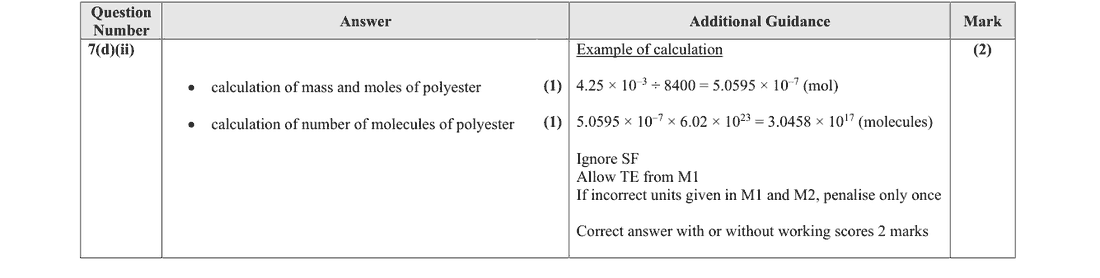
The molar mass of a polyester is 8400 g mol–1.
Calculate the number of polymer molecules in 4.25 mg of this polyester.
[Avogadro constant (L) = 6.02 × 1023 mol–1]
June 2024 · Paper 2 · Q7(d)(iii) 1 mark Multiple choice carboxylic acids
Earlier parts of question 7 that this part usesEarlier part of June 2024 Paper 2 question 7Earlier part of June 2024 Paper 2 question 7
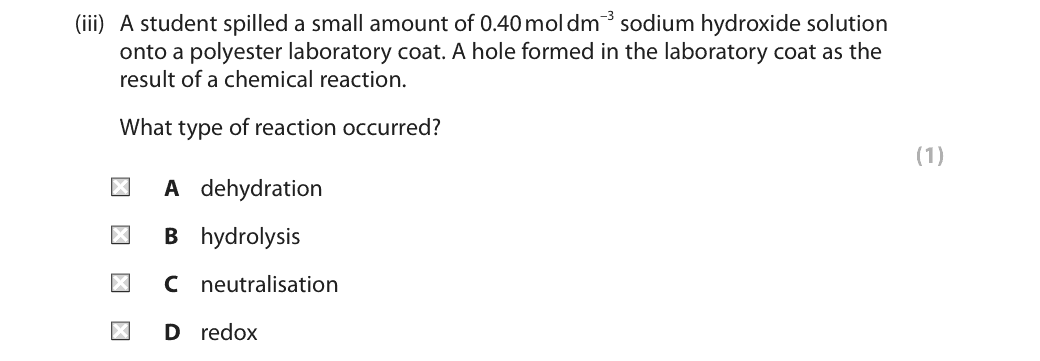
A student spilled a small amount of 0.40 mol dm–3 sodium hydroxide solution
onto a polyester laboratory coat. A hole formed in the laboratory coat as the
result of a chemical reaction.
What type of reaction occurred?
A  dehydration
B  hydrolysis
C  neutralisation
D  redox
June 2024 · Paper 2 · Q8(a)(i) 1 mark Short answer chirality
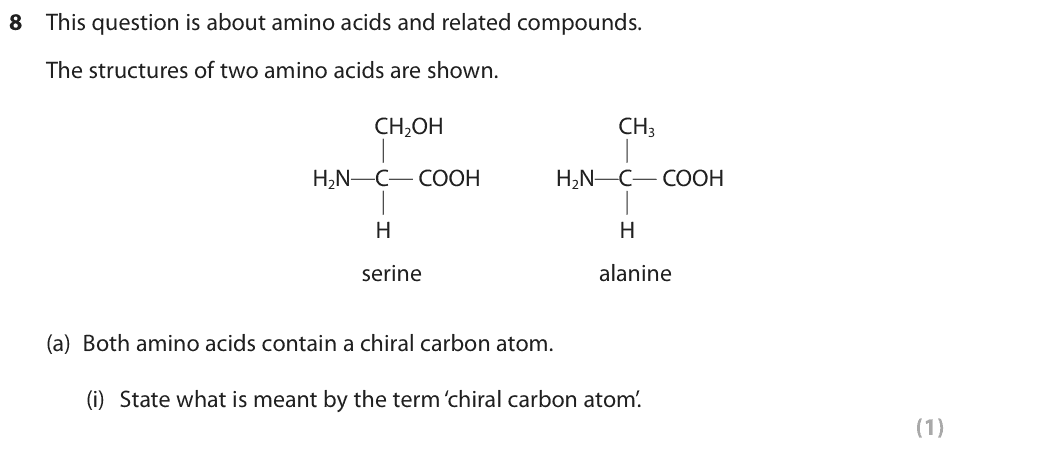
This question is about amino acids and related compounds.
The structures of two amino acids are shown.
CH2OH
CH3
H2N
C
COOH
H2N
C
COOH
H
H
serine
alanine
Both amino acids contain a chiral carbon atom.
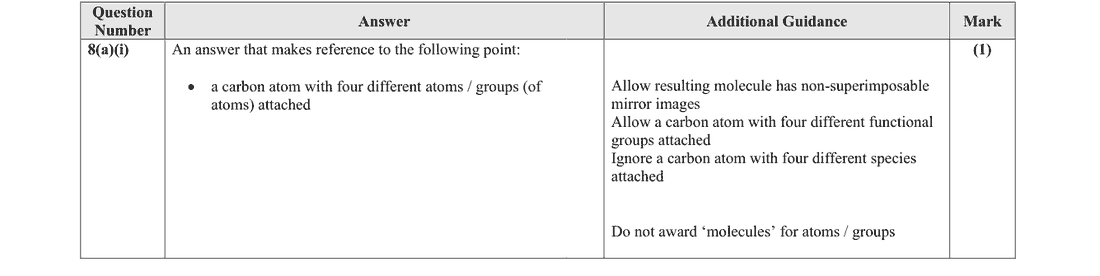
State what is meant by the term ‘chiral carbon atom’.
June 2024 · Paper 2 · Q8(a)(ii) 2 marks Diagram or structure chirality
Earlier part of question 8 that this part usesEarlier part of June 2024 Paper 2 question 8
Draw diagrams of the two stereoisomers of alanine, showing their
three‑dimensional shape.
June 2024 · Paper 2 · Q8(b) 2 marks Diagram or structure amines amides amino acids and proteinsintroduction to organic chemistry
Earlier part of question 8 that this part usesEarlier part of June 2024 Paper 2 question 8
Draw the skeletal formulae of the two dipeptides that could form when serine
and alanine react.
June 2024 · Paper 2 · Q8(c) 1 mark Multiple choice amines amides amino acids and proteins
Earlier part of question 8 that this part usesEarlier part of June 2024 Paper 2 question 8
Serine exists as a zwitterion.
What is the formula of this zwitterion?
CH2OH
+
A  H3N
C
CO2
–
H
CH2OH
+
B  H3N
C
COOH
H
CH2OH
C  H2N
C
CO2
–
H
CH2O–
+
D  H3N
C
COOH
H
June 2024 · Paper 2 · Q8(d)(i) 1 mark Equation writing formulae equations and amounts of substance
Earlier part of question 8 that this part usesEarlier part of June 2024 Paper 2 question 8
Alanine can be synthesised as shown.
O
O
H
H
H
H
H
C
C
C
C
C
O
O
H3C
CH3
O
HN
C
CH3
Compound X
Step 1
C2H5O–Na+
–
O
O
H
H
H
H
C
C
C
C
C
O
O
H3C
CH3
+   C2H5OH   +   Na+
O
HN
C
CH3
Step 2
CH3Br
O
O
CH3
H
H
H
H
C
C
C
C
+   Br–
C
O
O
H3C
CH3
O
HN
C
CH3
Compound Y
Step 3
CH3
H2N
C
COOH   +   CH3COOH   +   2CH3CH2OH   +   CO2
H
Sodium ethoxide, C2H5ONa, needed in Step 1, is formed by the reaction of
sodium with ethanol.
Write the equation for this reaction.
State symbols are not required.
June 2024 · Paper 2 · Q8(d)(ii) 2 marks Short answer carboxylic acidsamines amides amino acids and proteins
Earlier parts of question 8 that this part usesEarlier part of June 2024 Paper 2 question 8Earlier part of June 2024 Paper 2 question 8
Name the two functional groups present in Compound Y.
June 2024 · Paper 2 · Q8(d)(iii) 2 marks Short answer carboxylic acids
Earlier parts of question 8 that this part usesEarlier part of June 2024 Paper 2 question 8Earlier part of June 2024 Paper 2 question 8
Give the reagent needed and conditions required for Step 3.
June 2024 · Paper 2 · Q8(d)(iv) 3 marks Calculation formulae equations and amounts of substance
Earlier parts of question 8 that this part usesEarlier part of June 2024 Paper 2 question 8Earlier part of June 2024 Paper 2 question 8
Calculate the mass of Compound X required to make 15.0 g of alanine,
assuming the overall yield of the synthesis is 55 %.
June 2024 · Paper 2 · Q8(e) 2 marks Explanation amines amides amino acids and proteins
Earlier part of question 8 that this part usesEarlier part of June 2024 Paper 2 question 8
A mixture of amino acids can be separated using a technique called
paper electrophoresis. A simplified diagram is shown.
The movement of the amino acid on the paper depends on any charge on the
amino acid, and this is determined by the pH of the buffer solution.
positive electrode
negative electrode
strip of filter paper
concentrated spot of
soaked in a buffer
amino acid mixture
solution of pH = 9
containing amino acid Z
Amino acid Z has the structure shown.
CH2COOH
H2N
C
COOH
H
amino acid Z
Explain in which direction, if any, amino acid Z would move when a current flows
in the circuit with a buffer solution of pH = 9.

Work with an A-level chemistry tutor

Want a paper marked and gone through with you? Message us.

Prefer email? Send an enquiry

If you are under 18, please include a parent's contact details. Enquiries go to enquiries@chemistryaleveltutor.com and are deleted once handled. All tutoring is online.