June 2024: Paper 1, Advanced Inorganic and Physical Chemistry

90 marks · 42 question parts · Paper, mark scheme and report on Edexcel's site · Have the Data Booklet beside you

Question by question

QTopicMarksAOType
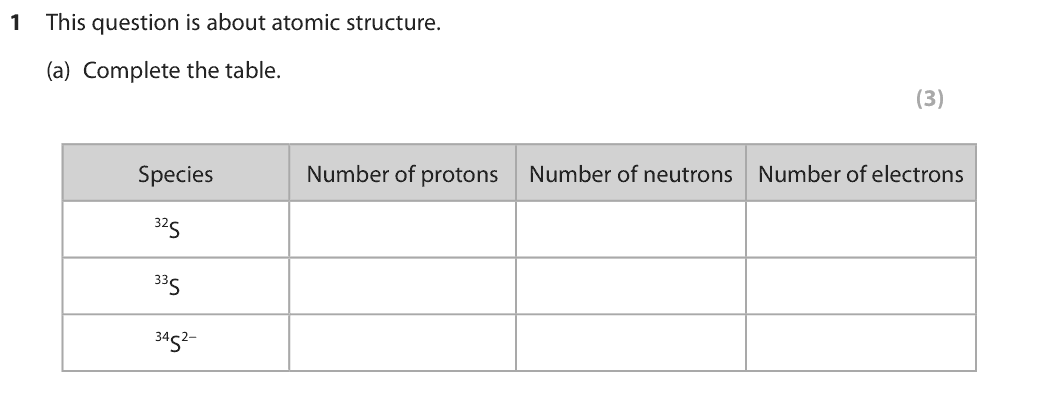
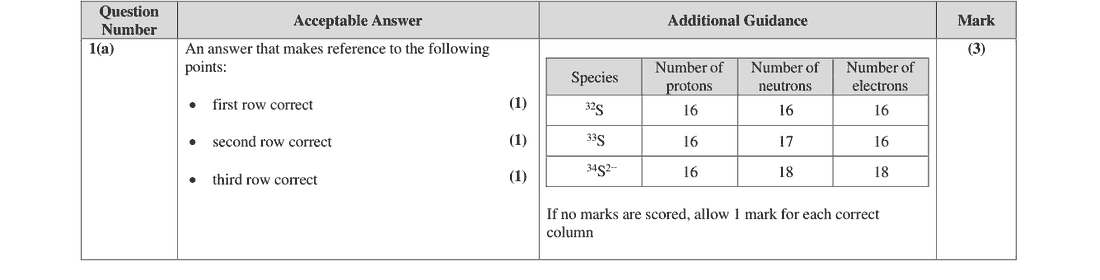
1(a) Atomic structure and the Periodic Table 3Short answer
1(b)(i) Atomic structure and the Periodic Table 1Calculation
1(b)(ii) Atomic structure and the Periodic Table 2Calculation
2(a) Energetics II: lattice energy, Atomic structure and the Periodic Table 4Explanation
2(b) Bonding 1Multiple choice
2(c)(i) Atomic structure and the Periodic Table 1Multiple choice
2(c)(ii) Atomic structure and the Periodic Table 1Multiple choice
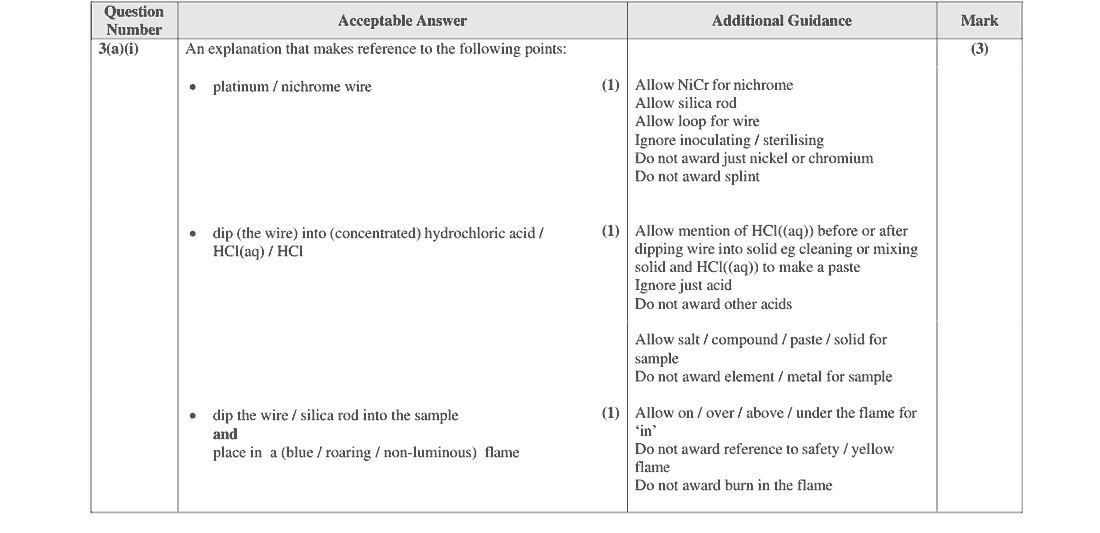
3(a)(i) The elements of Groups 1 and 2 3Practical and data analysis
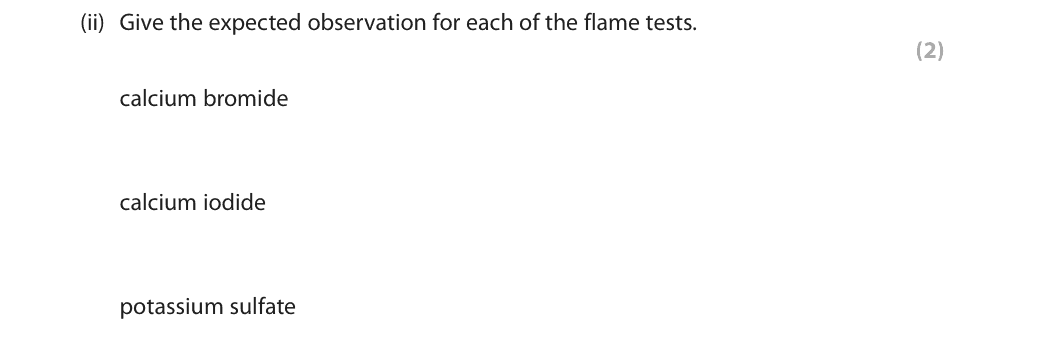
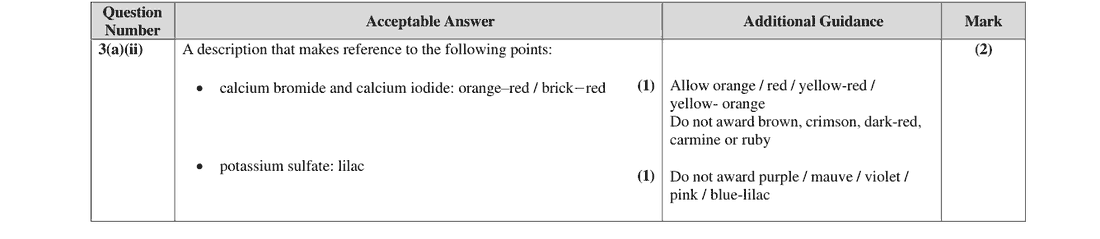
3(a)(ii) The elements of Groups 1 and 2 2Practical and data analysis
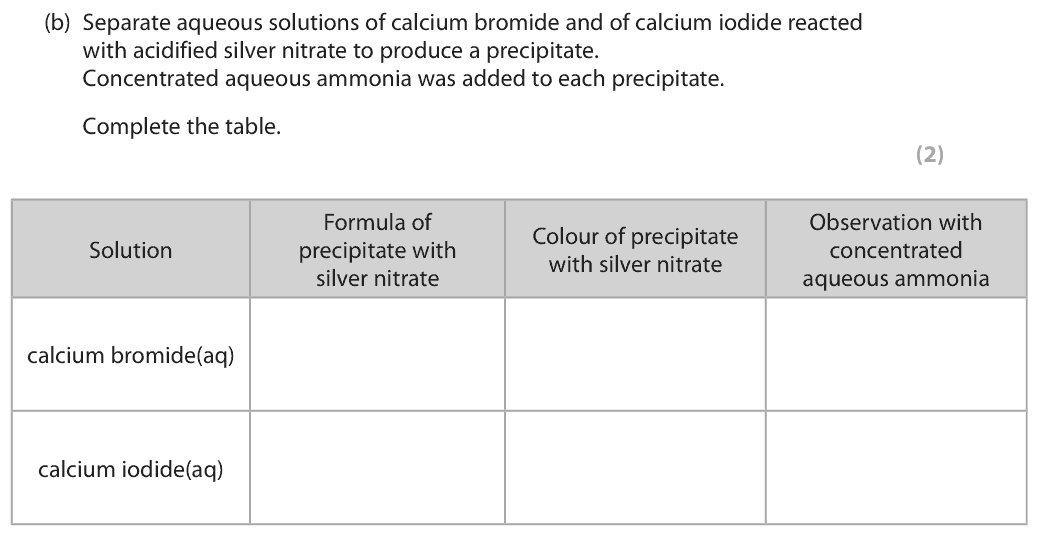
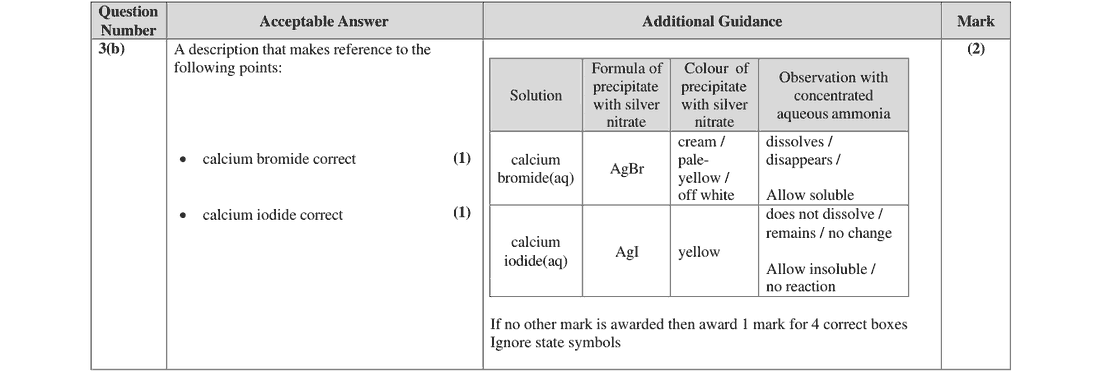
3(b) The elements of Group 7 (halogens) 2Practical and data analysis
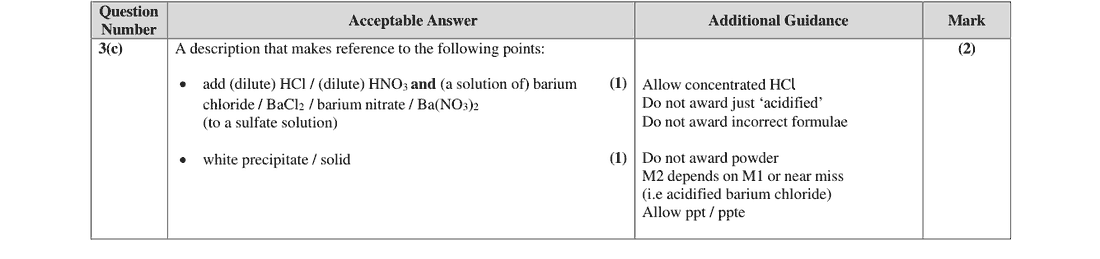
3(c) Analysis of inorganic compounds 2Practical and data analysis
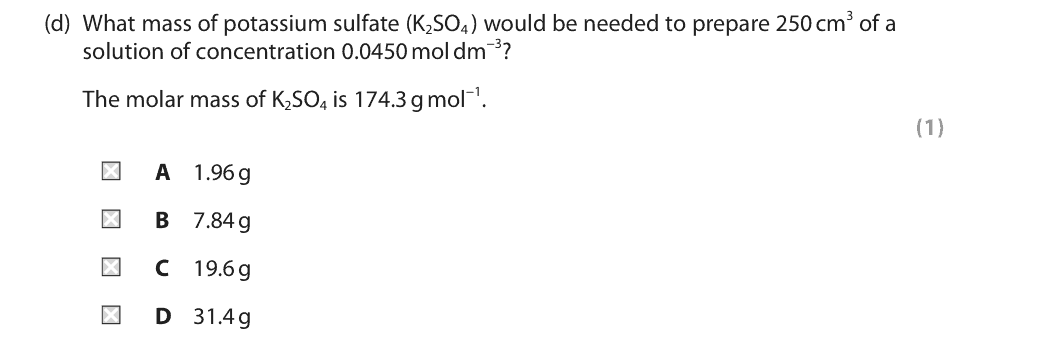
3(d) Formulae, equations and amounts of substance 1Multiple choice
4(a) Acid-base equilibria 1Short answer
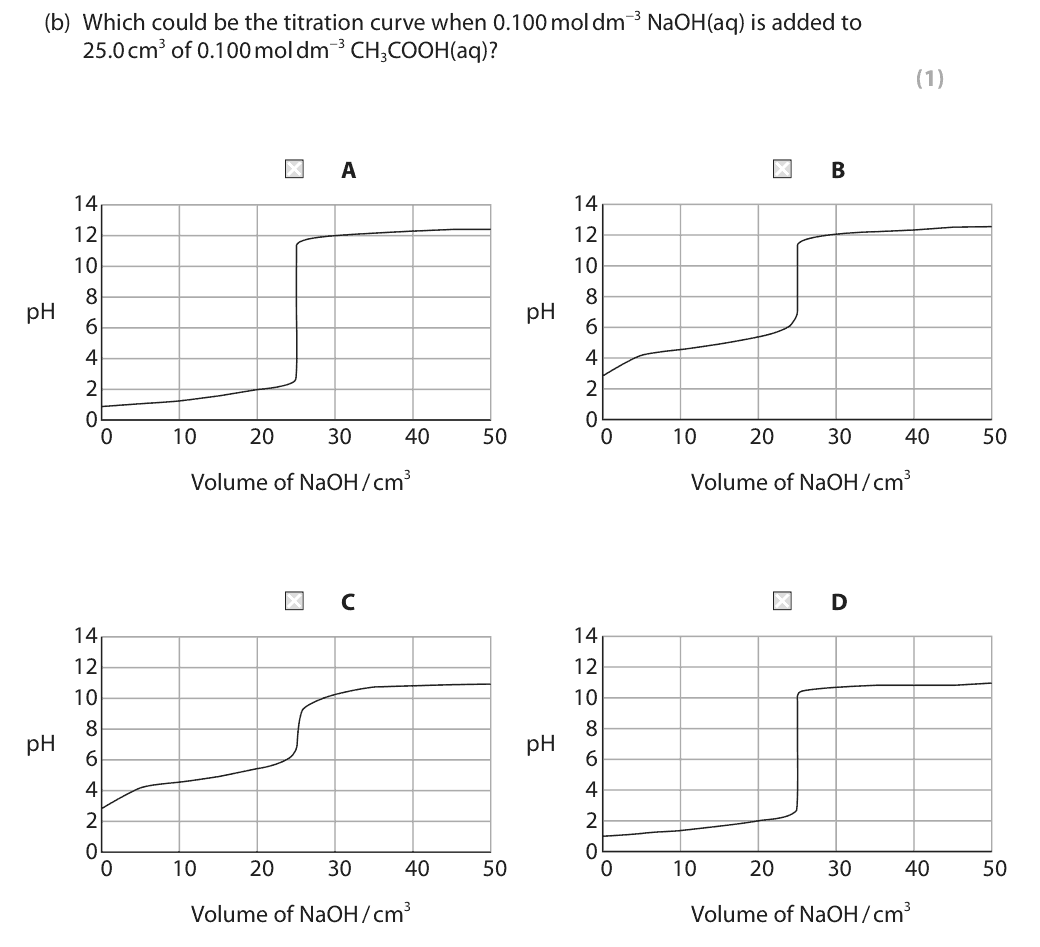
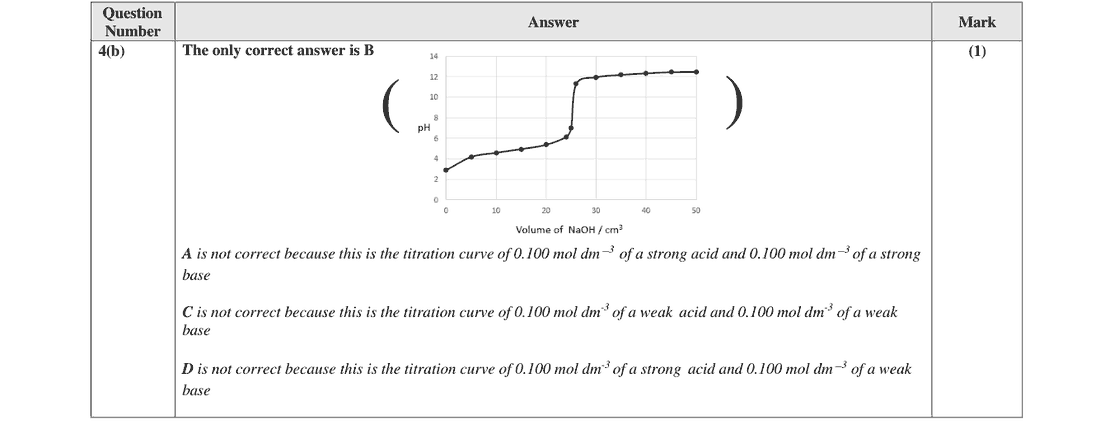
4(b) Acid-base equilibria 1Multiple choice
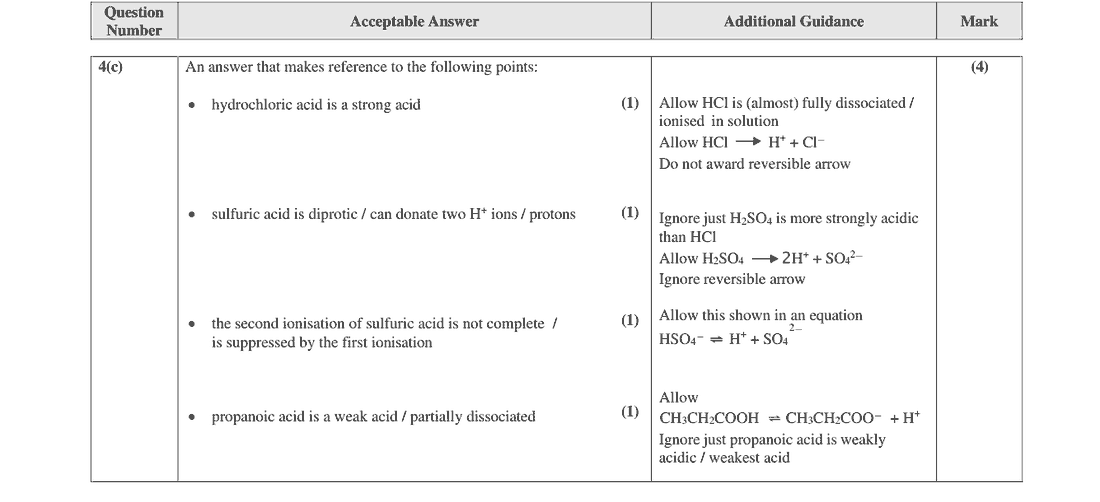
4(c) Acid-base equilibria 4Explanation
4(d)(i) Acid-base equilibria 1Short answer
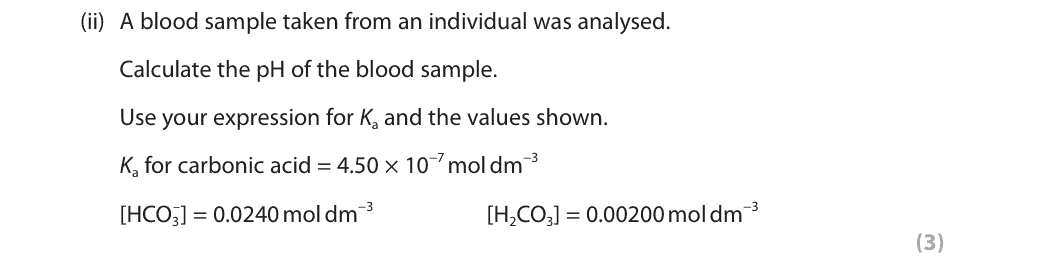
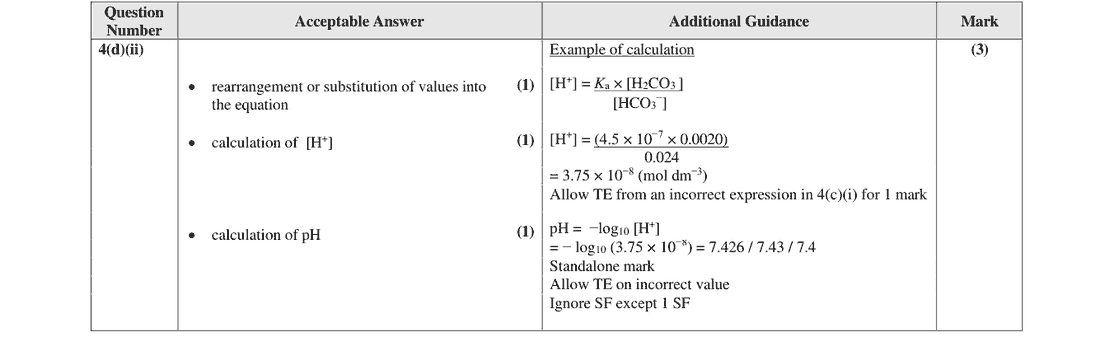
4(d)(ii) Acid-base equilibria 3Calculation
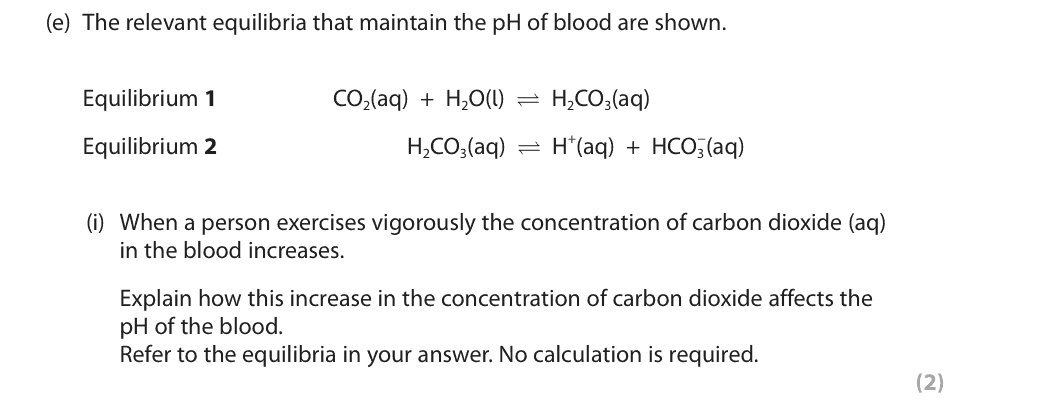
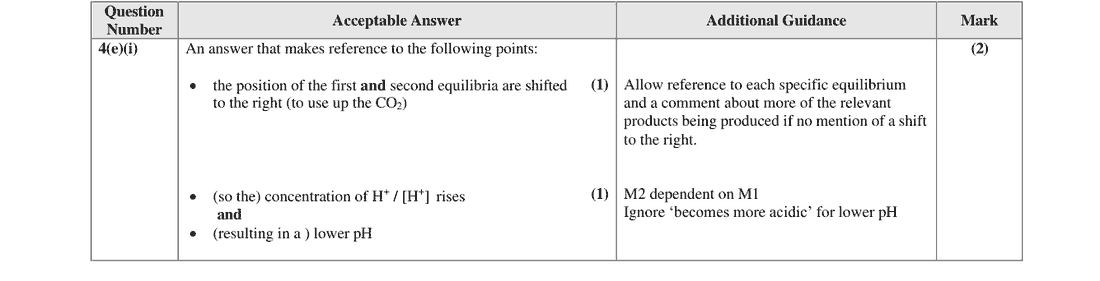
4(e)(i) Acid-base equilibria, Equilibrium I 2Explanation
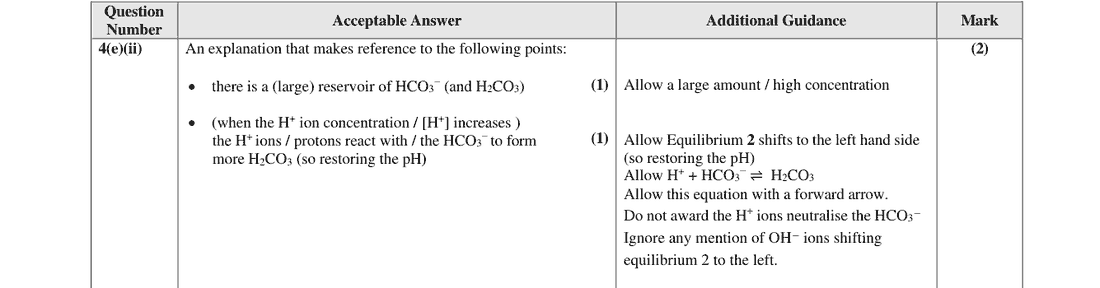
4(e)(ii) Acid-base equilibria 2Explanation
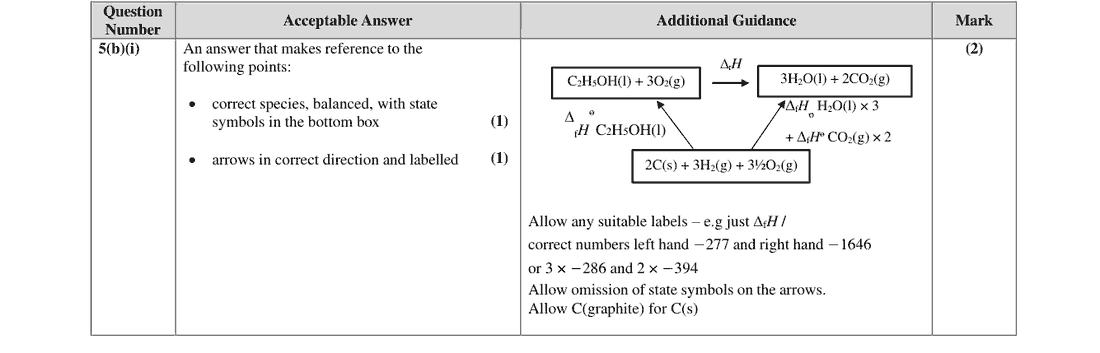
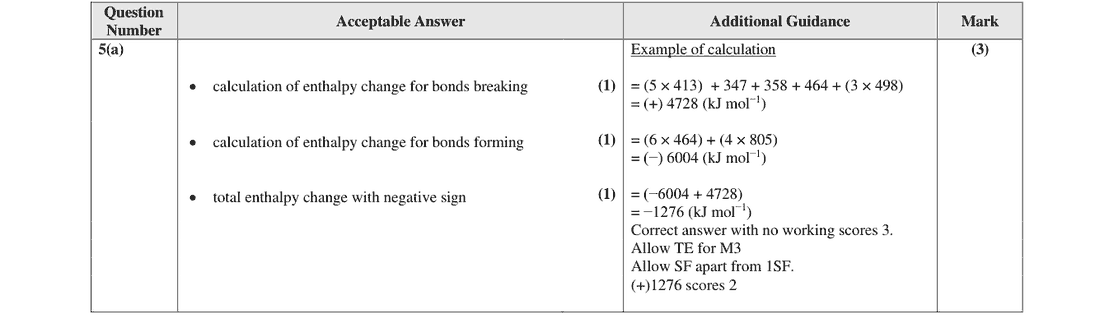
5(a) Energetics I 3Calculation
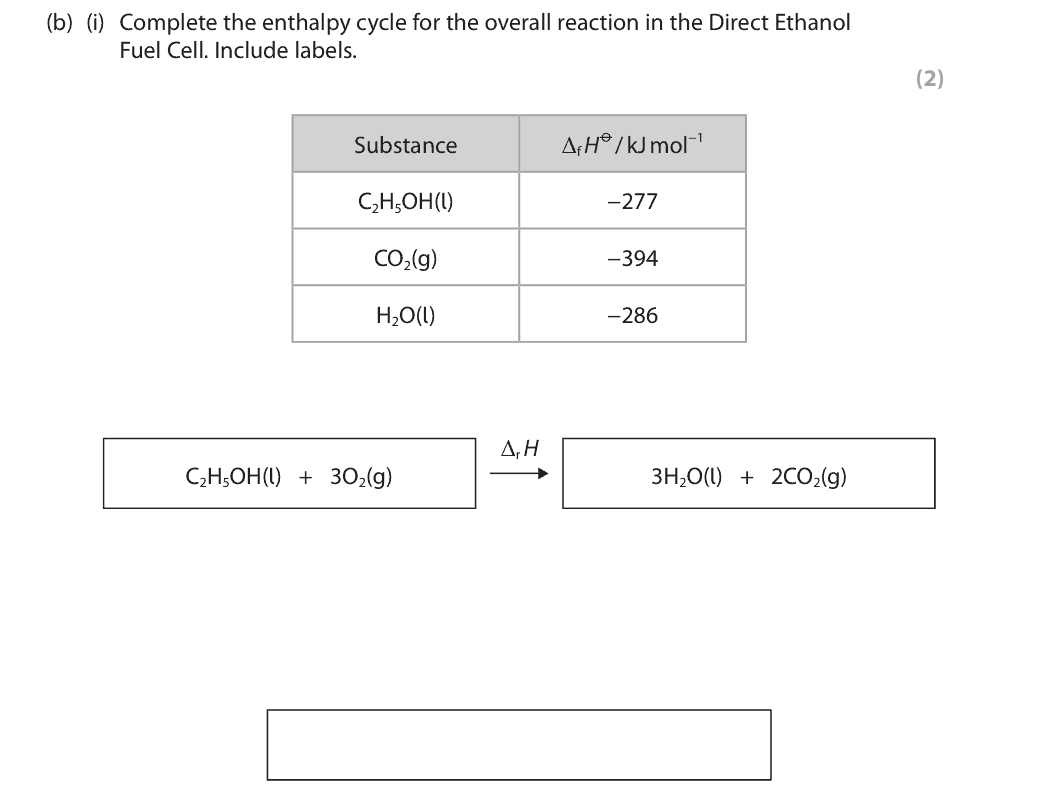
5(b)(i) Energetics I 2Diagram or structure
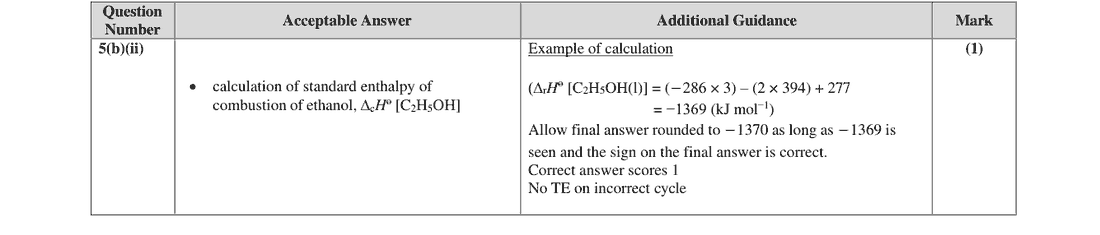
5(b)(ii) Energetics I 1Calculation
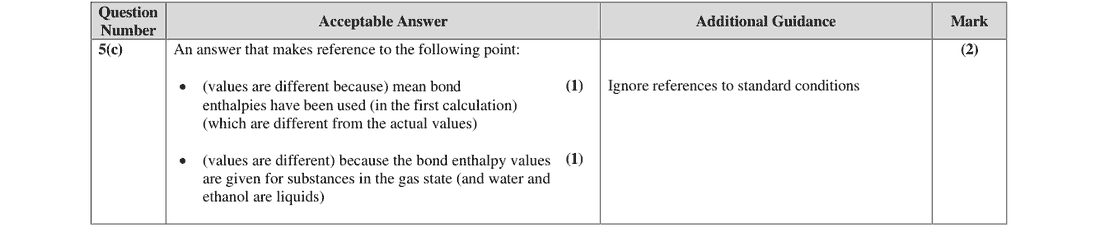
5(c) Energetics I 2Short answer
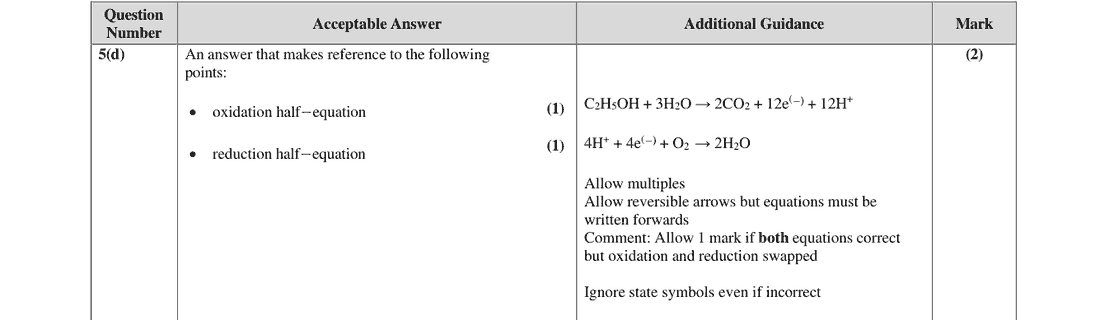
5(d) Redox I, Redox II 2Equation writing
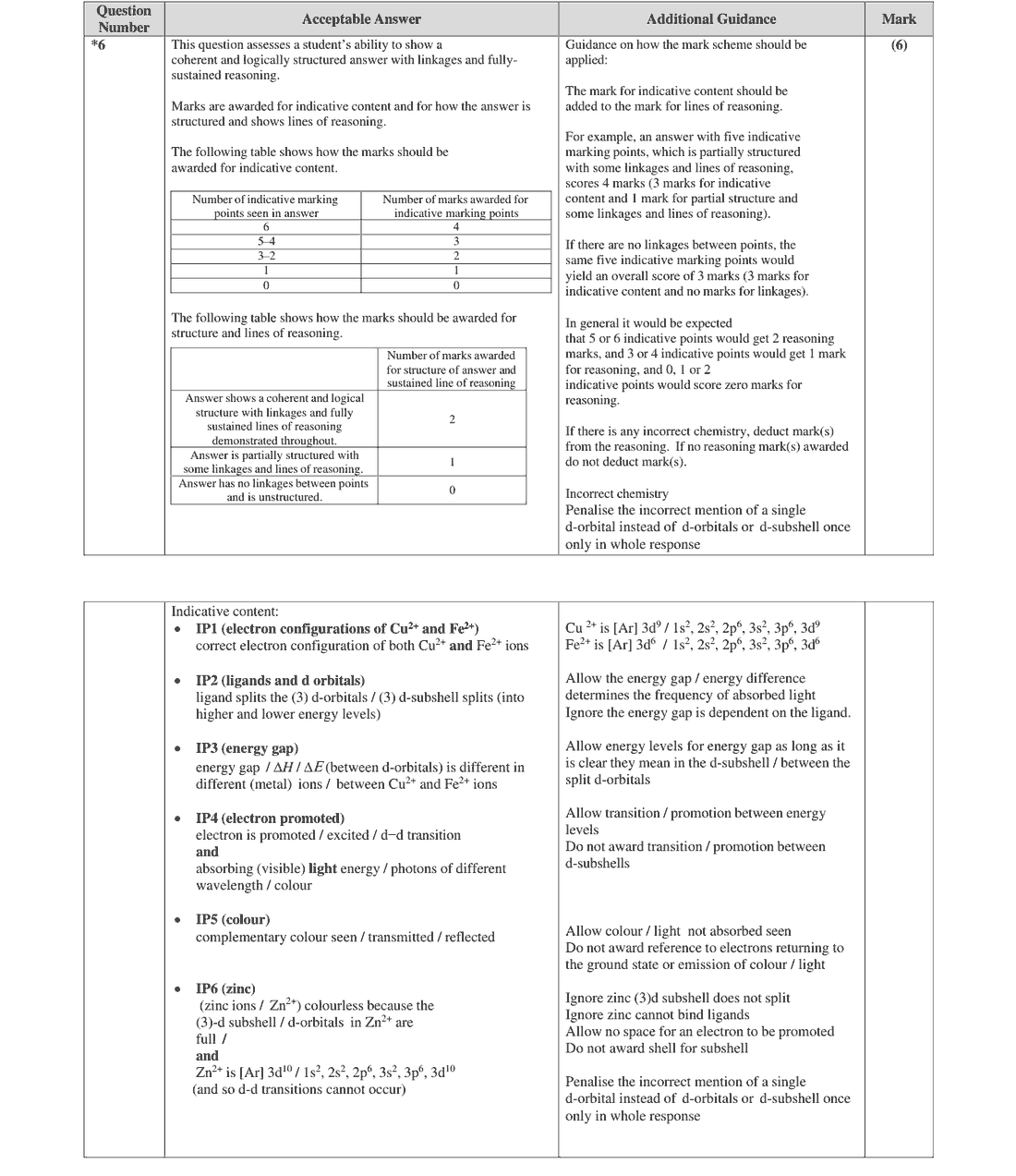
6 Transition metals: principles 6Extended response
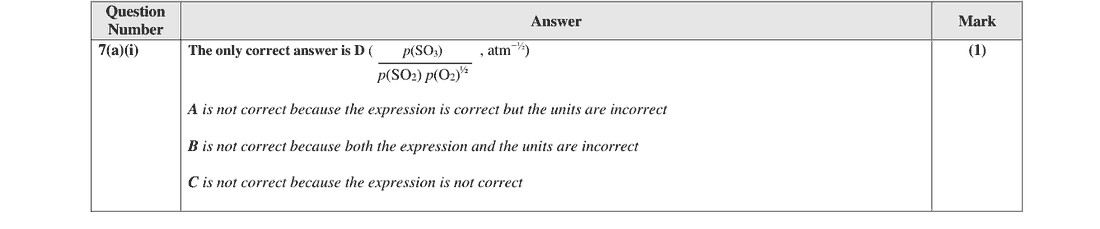
7(a)(i) Equilibrium II 1Multiple choice
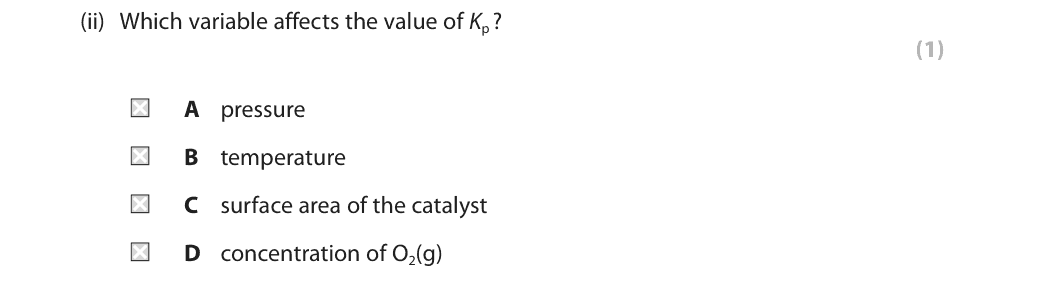
7(a)(ii) Equilibrium II 1Multiple choice
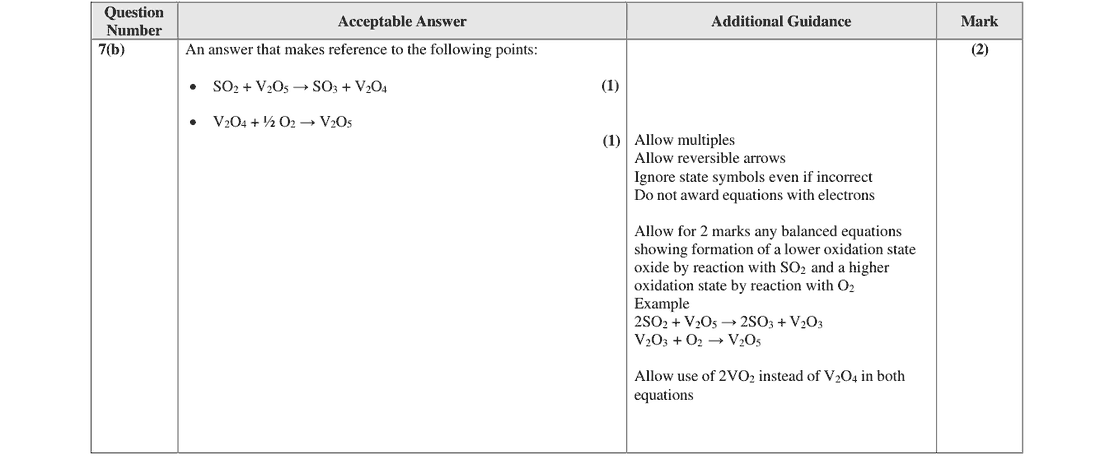
7(b) Transition metals: reactions 2Equation writing
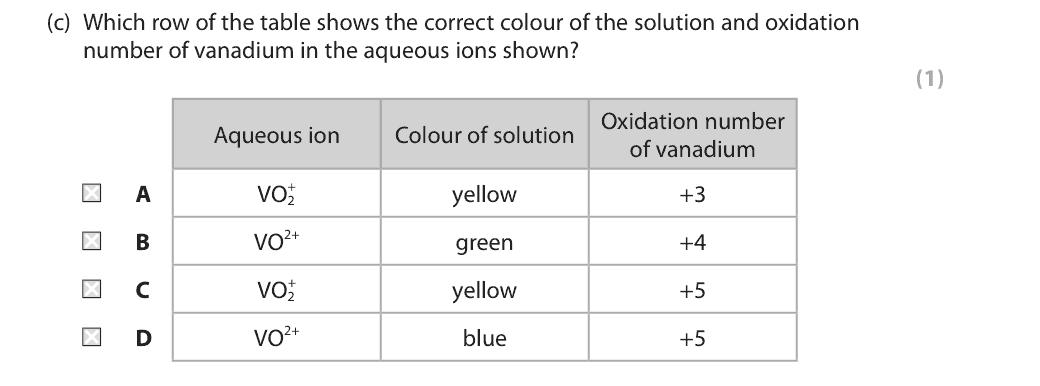
7(c) Transition metals: reactions 1Multiple choice
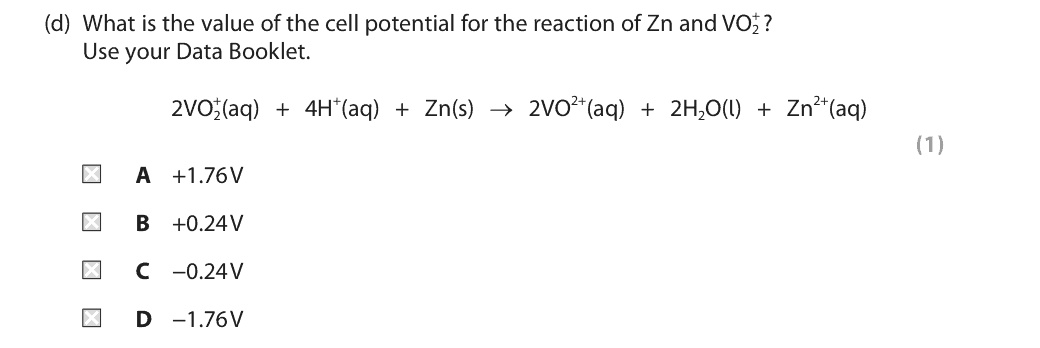
7(d) Redox II 1Multiple choice
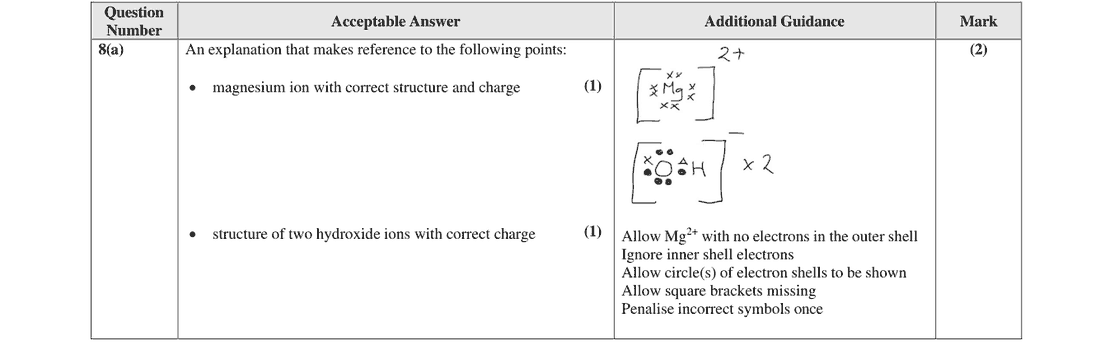
8(a) Bonding 2Diagram or structure
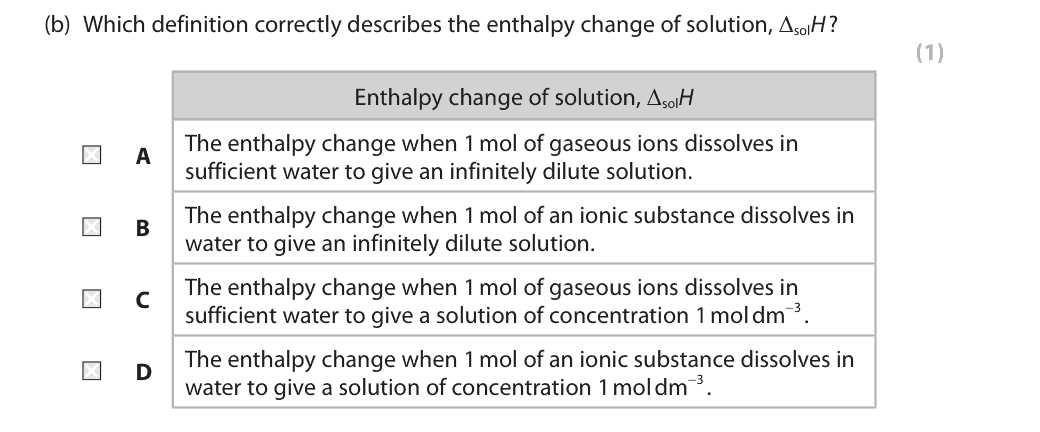
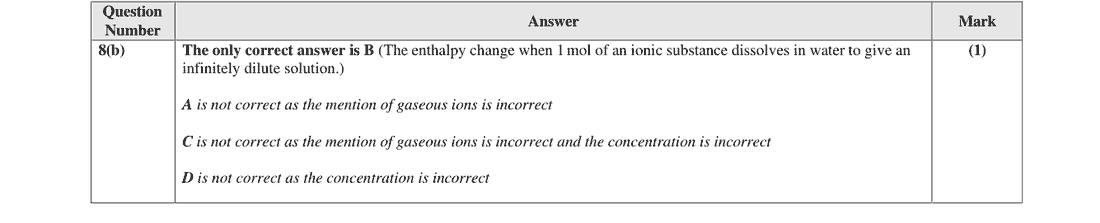
8(b) Energetics II: lattice energy 1Multiple choice
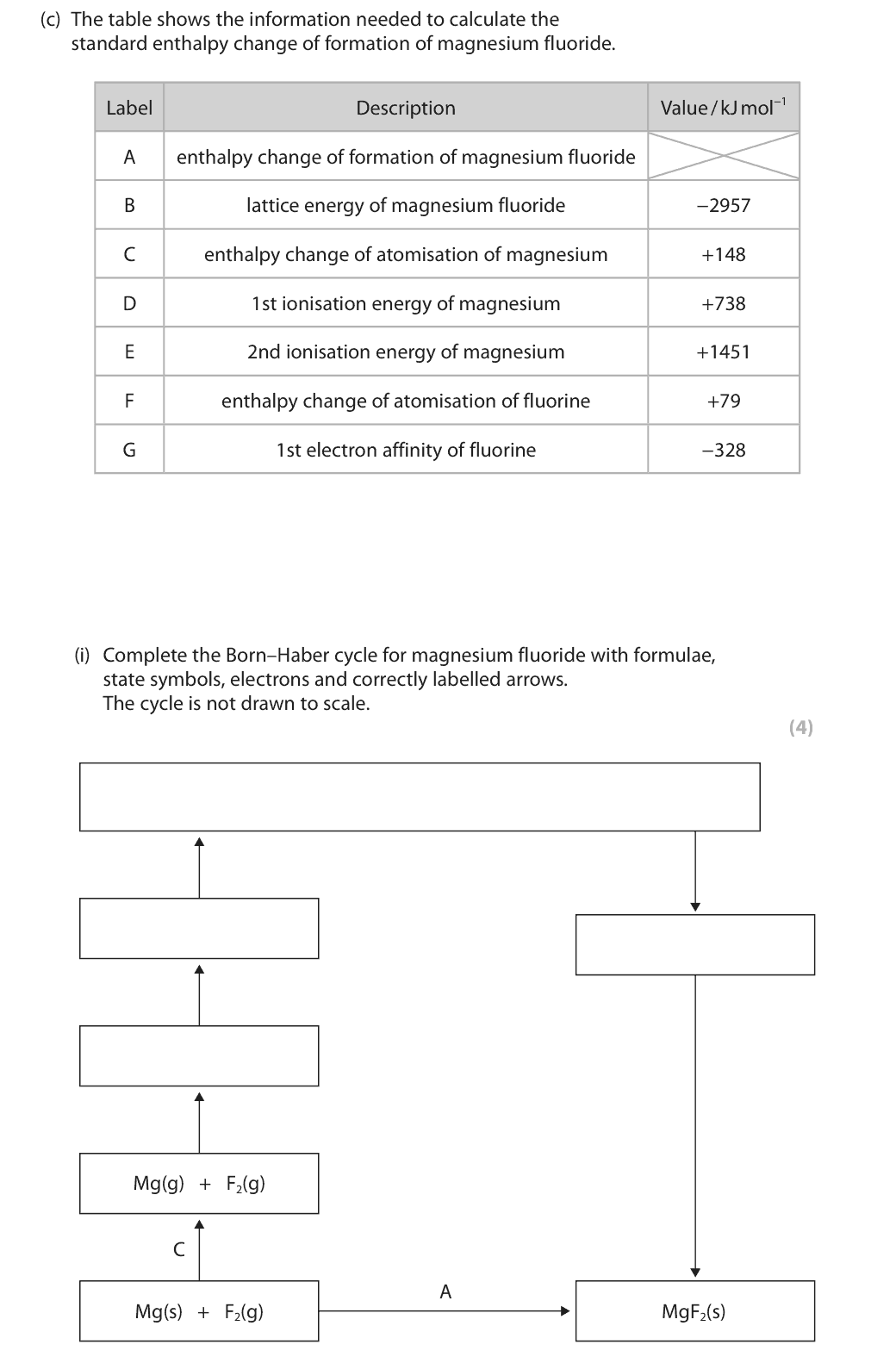
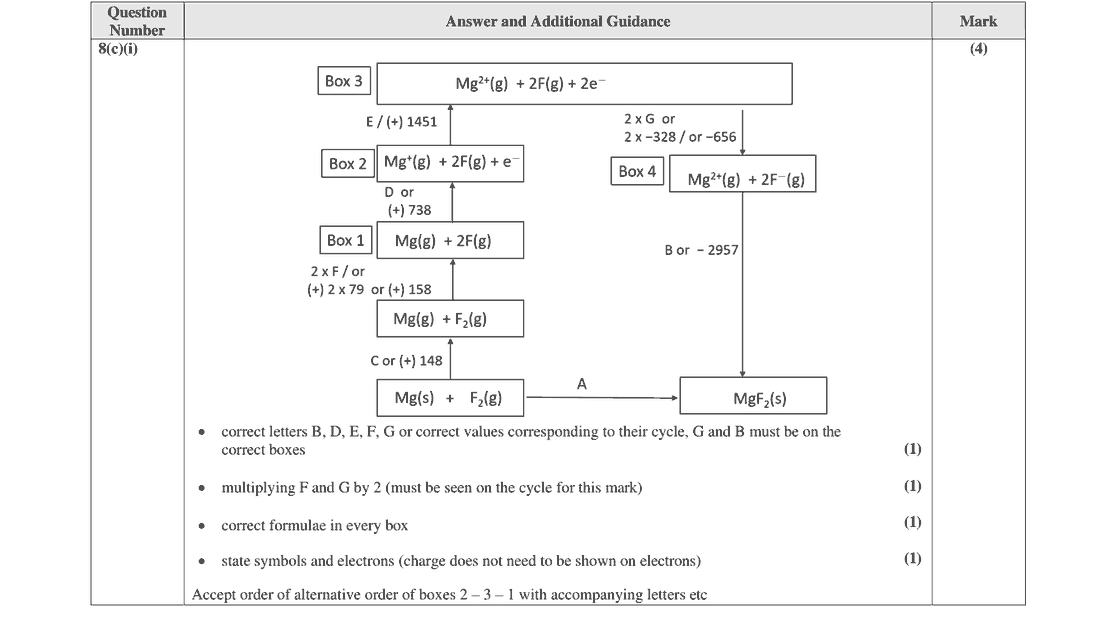
8(c)(i) Energetics II: lattice energy 4Diagram or structure
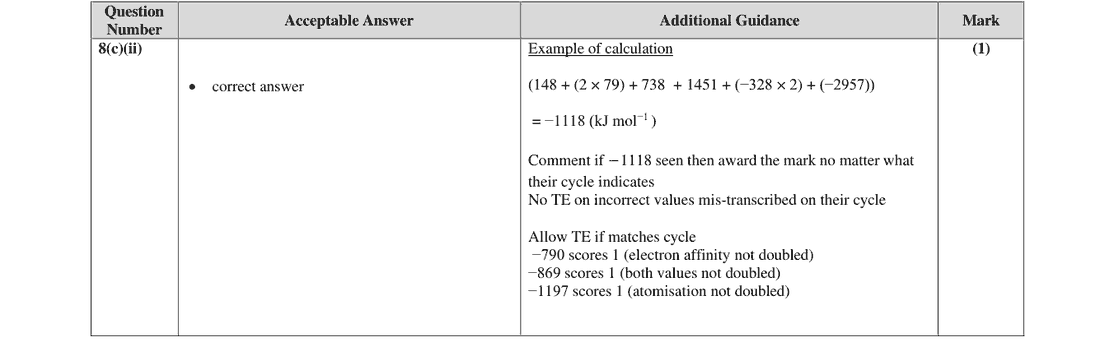
8(c)(ii) Energetics II: lattice energy 1Calculation
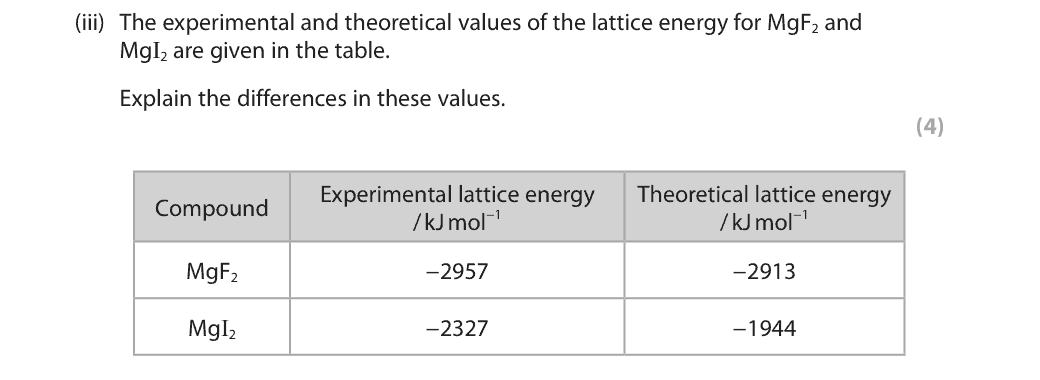
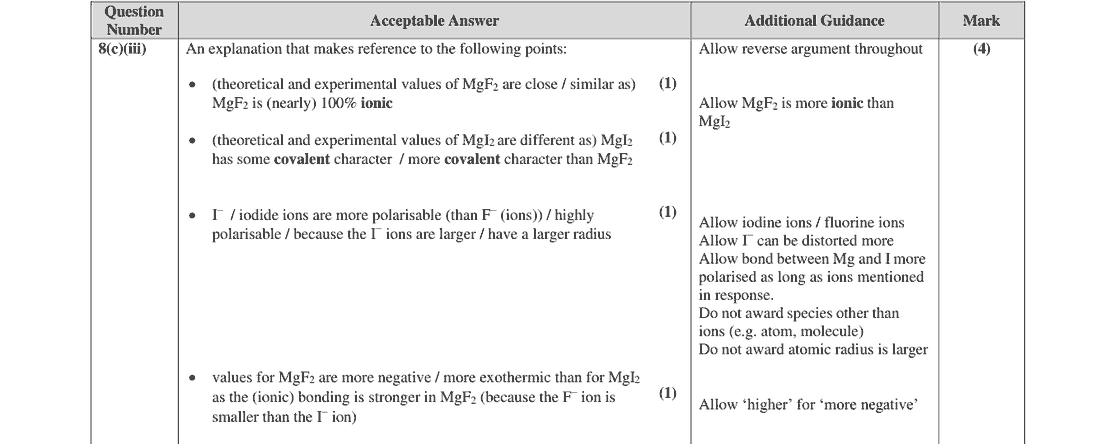
8(c)(iii) Energetics II: lattice energy 4Explanation
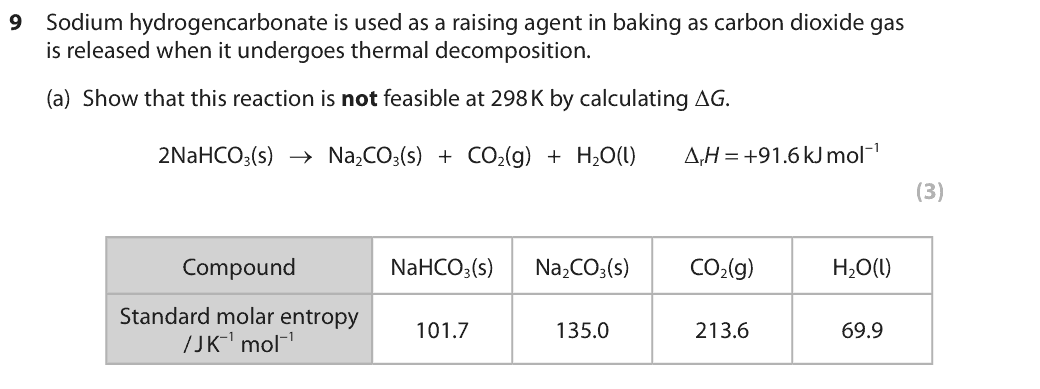
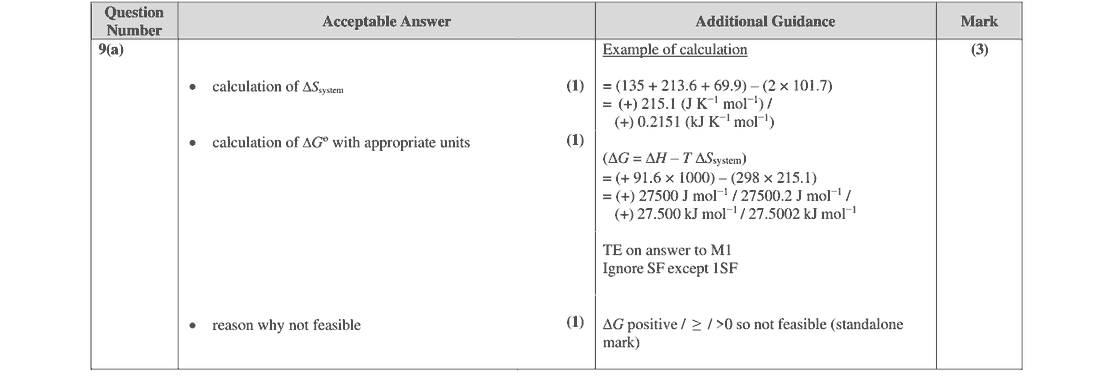
9(a) Energetics II: entropy 3Calculation
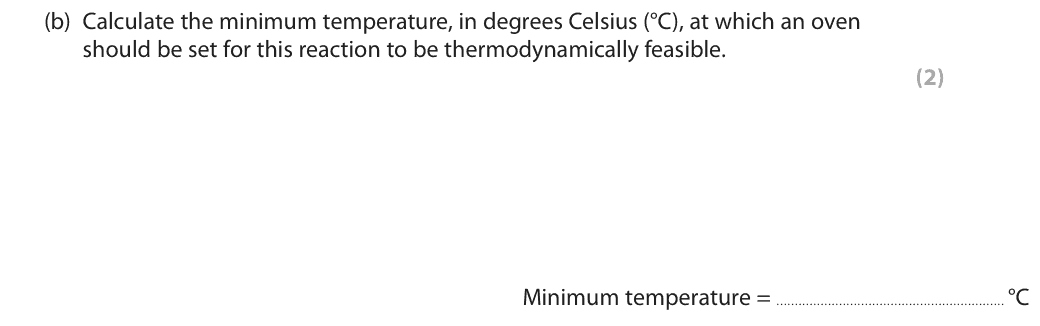
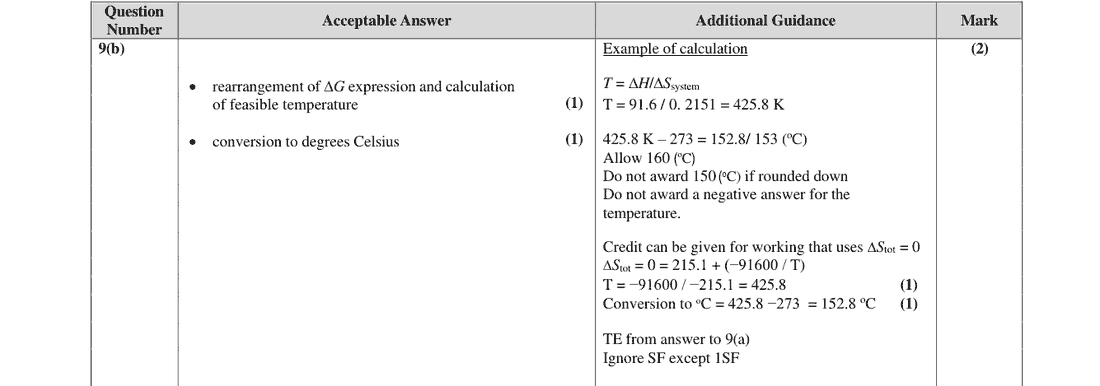
9(b) Energetics II: entropy 2Calculation
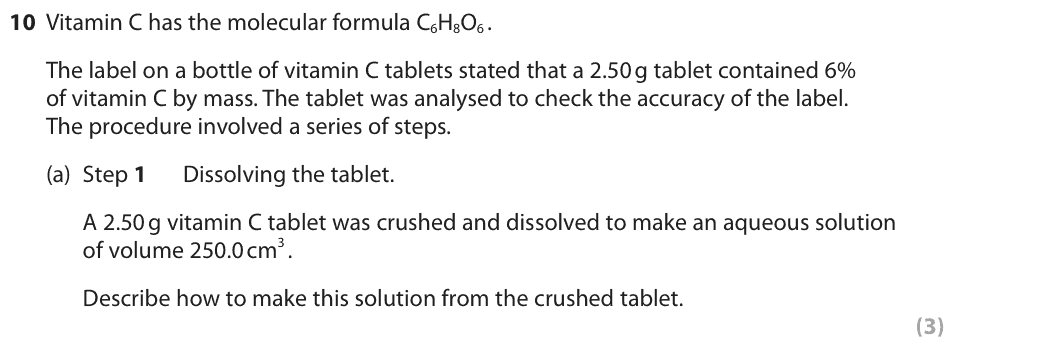
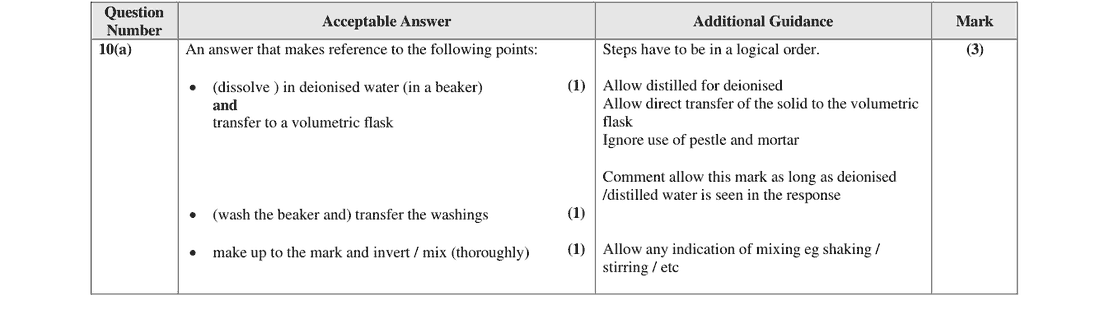
10(a) Redox II 3Practical and data analysis
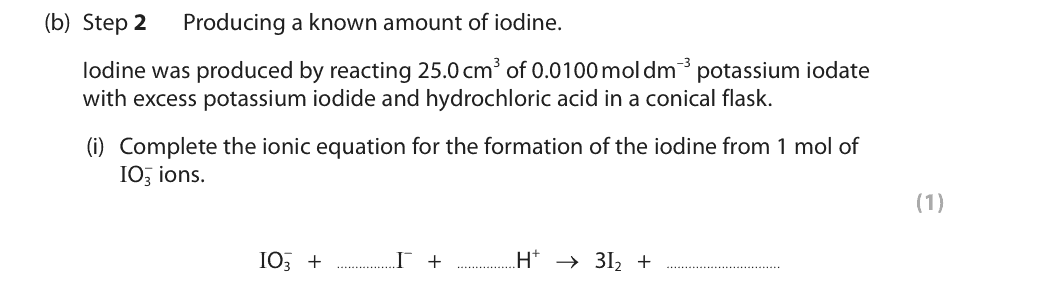
10(b)(i) Redox I, Formulae, equations and amounts of substance 1Equation writing
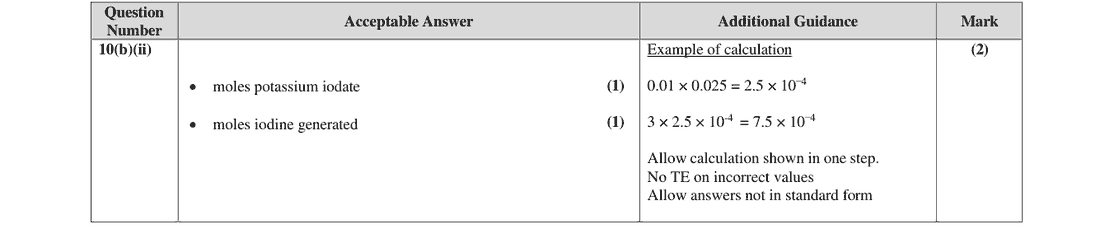
10(b)(ii) Redox II, Formulae, equations and amounts of substance 2Calculation
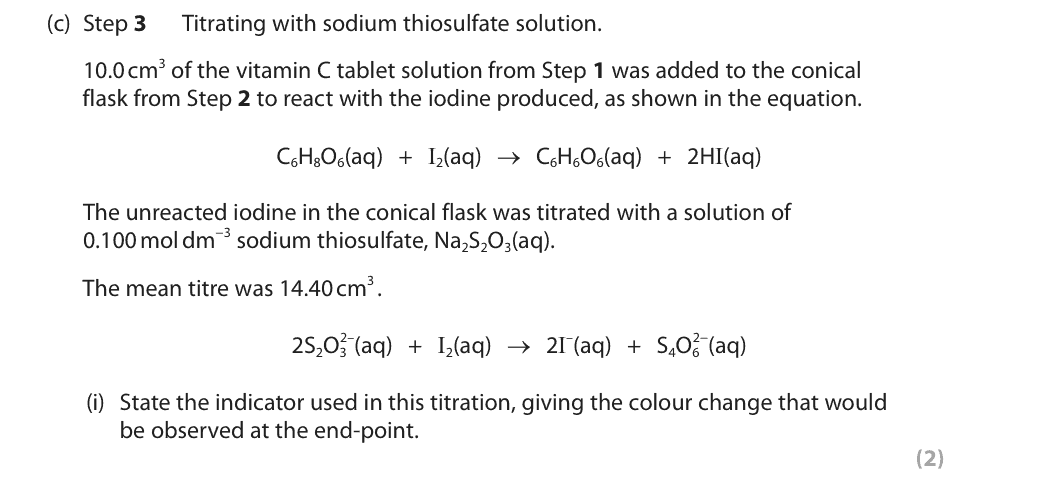
10(c)(i) Redox II 2Practical and data analysis
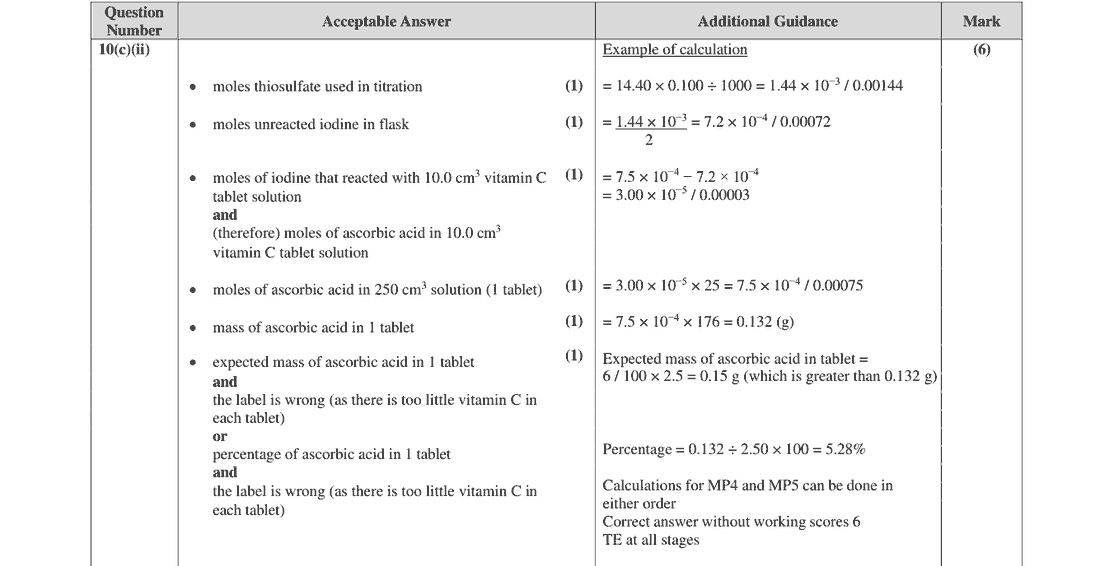
10(c)(ii) Redox II 6Calculation

The questions

1(a)1(b)(i)1(b)(ii)2(a)2(b)2(c)(i)2(c)(ii)3(a)(i)3(a)(ii)3(b)3(c)3(d)4(a)4(b)4(c)4(d)(i)4(d)(ii)4(e)(i)4(e)(ii)5(a)5(b)(i)5(b)(ii)5(c)5(d)67(a)(i)7(a)(ii)7(b)7(c)7(d)8(a)8(b)8(c)(i)8(c)(ii)8(c)(iii)9(a)9(b)10(a)10(b)(i)10(b)(ii)10(c)(i)10(c)(ii)
June 2024 · Paper 1 · Q1(a) 3 marks Short answer atomic structure and the periodic table
This question is about atomic structure.
Complete the table.
Species
Number of protons
Number of neutrons
Number of electrons
32S
33S
34S2−
June 2024 · Paper 1 · Q1(b)(i) 1 mark Calculation atomic structure and the periodic table
Earlier part of question 1 that this part usesEarlier part of June 2024 Paper 1 question 1
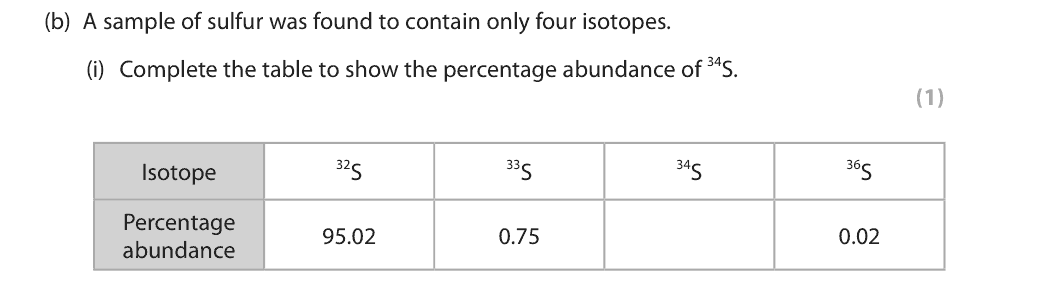
A sample of sulfur was found to contain only four isotopes.
Complete the table to show the percentage abundance of 34S.
Isotope
32S
33S
34S
36S
Percentage
95.02
0.75
0.02
abundance
June 2024 · Paper 1 · Q1(b)(ii) 2 marks Calculation atomic structure and the periodic table
Earlier parts of question 1 that this part usesEarlier part of June 2024 Paper 1 question 1Earlier part of June 2024 Paper 1 question 1
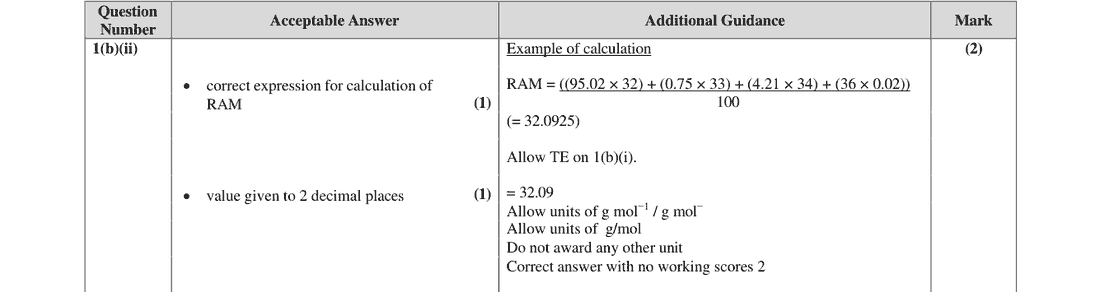
Calculate the relative atomic mass (Ar ) of the sulfur in this sample using the
data in the table. Give your answer to two decimal places.
June 2024 · Paper 1 · Q2(a) 4 marks Explanation lattice energyatomic structure and the periodic table
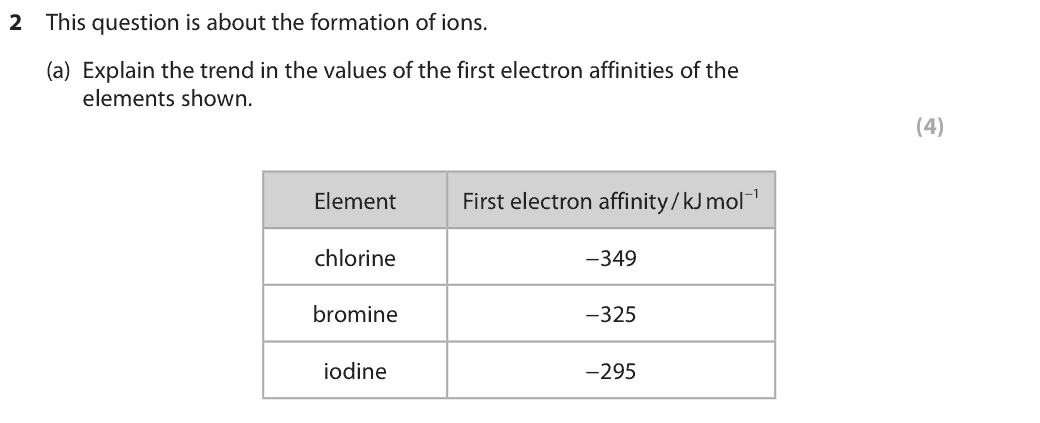
This question is about the formation of ions.
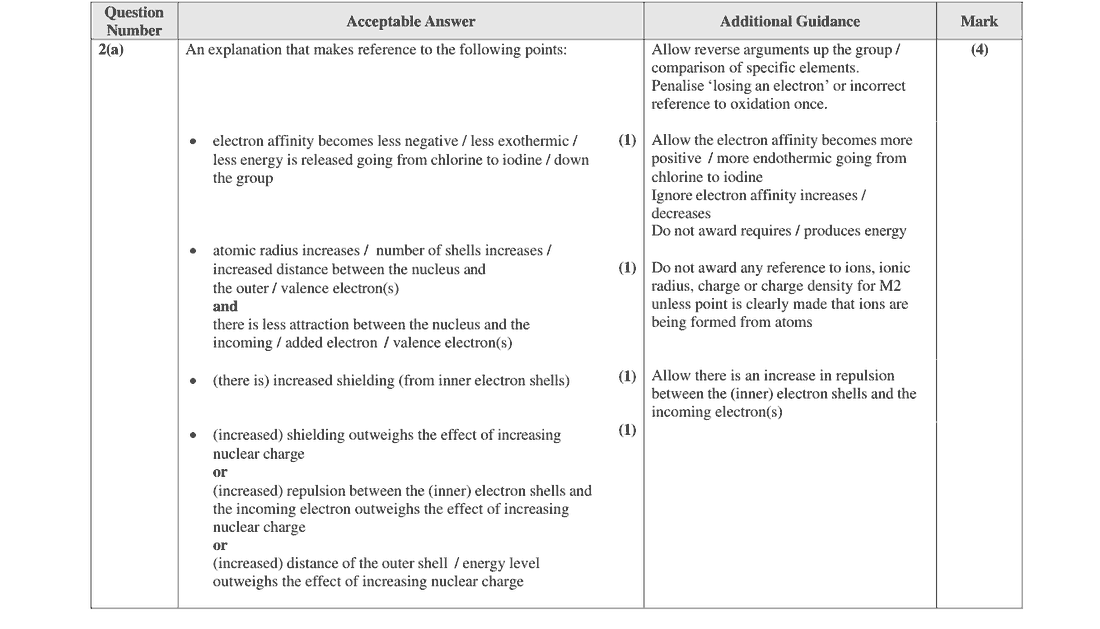
Explain the trend in the values of the first electron affinities of the
elements shown.
Element
First electron affinity / kJ mol−1
chlorine
−349
bromine
−325
iodine
−295
June 2024 · Paper 1 · Q2(b) 1 mark Multiple choice bonding
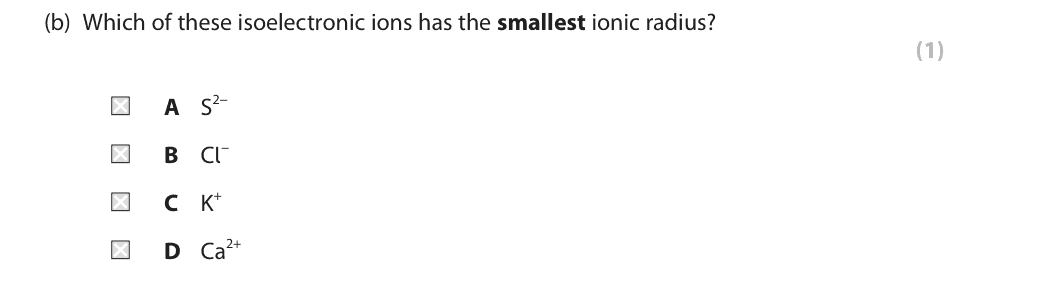
Which of these isoelectronic ions has the smallest ionic radius?
A  S2−
B  Cl−
C  K+
D  Ca2+
June 2024 · Paper 1 · Q2(c)(i) 1 mark Multiple choice atomic structure and the periodic table
Earlier part of question 2 that this part usesEarlier part of June 2024 Paper 1 question 2
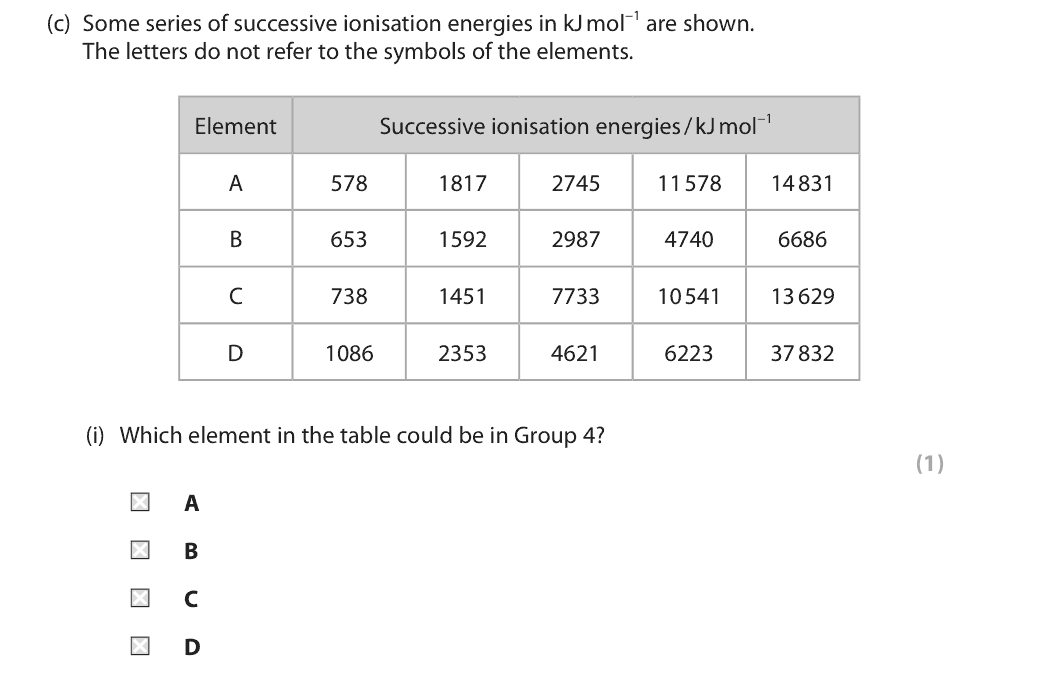
Some series of successive ionisation energies in kJ mol−1 are shown.
The letters do not refer to the symbols of the elements.
Element
Successive ionisation energies / kJ mol−1
A
578
1817
2745
11 578
14 831
B
653
1592
2987
4740
6686
C
738
1451
7733
10 541
13 629
D
1086
2353
4621
6223
37 832
Which element in the table could be in Group 4?
A
B
C
D
June 2024 · Paper 1 · Q2(c)(ii) 1 mark Multiple choice atomic structure and the periodic table
Earlier parts of question 2 that this part usesEarlier part of June 2024 Paper 1 question 2Earlier part of June 2024 Paper 1 question 2
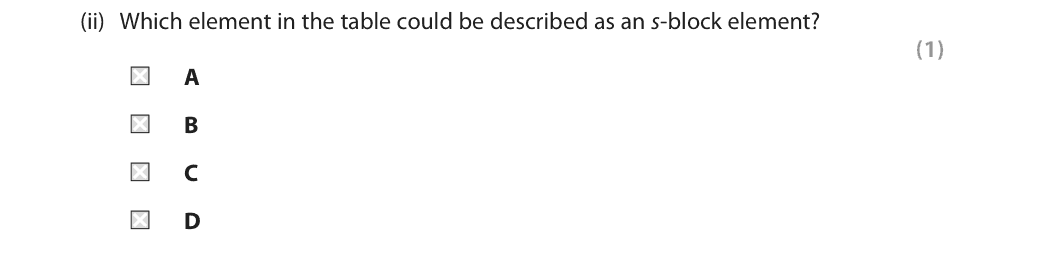
Which element in the table could be described as an s-block element?
A
B
C
D
June 2024 · Paper 1 · Q3(a)(i) 3 marks Practical and data analysis groups 1 and 2
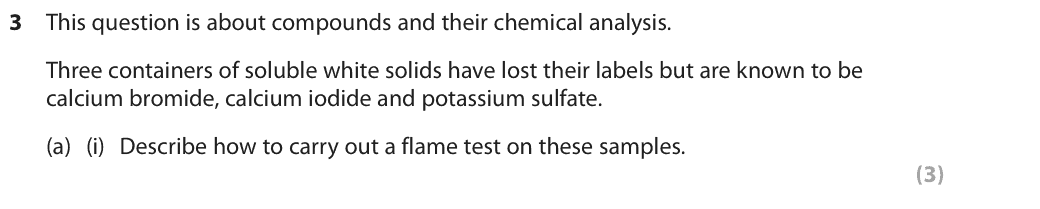
This question is about compounds and their chemical analysis.
Three containers of soluble white solids have lost their labels but are known to be
calcium bromide, calcium iodide and potassium sulfate.
Describe how to carry out a flame test on these samples.
June 2024 · Paper 1 · Q3(a)(ii) 2 marks Practical and data analysis groups 1 and 2
Earlier part of question 3 that this part usesEarlier part of June 2024 Paper 1 question 3
Give the expected observation for each of the flame tests.
calcium bromide
calcium iodide
potassium sulfate
June 2024 · Paper 1 · Q3(b) 2 marks Practical and data analysis group 7 the halogens
Earlier part of question 3 that this part usesEarlier part of June 2024 Paper 1 question 3
Separate aqueous solutions of calcium bromide and of calcium iodide reacted
with acidified silver nitrate to produce a precipitate.
Concentrated aqueous ammonia was added to each precipitate.
Complete the table.
Formula of
Observation with
Colour of precipitate
Solution
precipitate with
concentrated
with silver nitrate
silver nitrate
aqueous ammonia
calcium bromide(aq)
calcium iodide(aq)
June 2024 · Paper 1 · Q3(c) 2 marks Practical and data analysis analysis of inorganic compounds
Earlier part of question 3 that this part usesEarlier part of June 2024 Paper 1 question 3
Describe a chemical test for the sulfate ion giving the positive result.
June 2024 · Paper 1 · Q3(d) 1 mark Multiple choice formulae equations and amounts of substance
Earlier part of question 3 that this part usesEarlier part of June 2024 Paper 1 question 3
What mass of potassium sulfate (K2SO4 ) would be needed to prepare 250 cm3 of a
solution of concentration 0.0450 mol dm−3?
The molar mass of K2SO4 is 174.3 g mol−1.
A  1.96 g
B  7.84 g
C  19.6 g
D  31.4 g
June 2024 · Paper 1 · Q4(a) 1 mark Short answer acid base equilibria
This question is about acids, bases and buffers.
State what is meant by a Brønsted−Lowry acid.
June 2024 · Paper 1 · Q4(b) 1 mark Multiple choice acid base equilibria
Earlier part of question 4 that this part usesEarlier part of June 2024 Paper 1 question 4
Which could be the titration curve when 0.100 mol dm−3 NaOH(aq) is added to
25.0 cm3 of 0.100 mol dm−3 CH3COOH(aq)?
A
B
14
14
12
12
10
10
8
8
pH
pH
6
6
4
4
2
2
0
0
0
10
20
30
40
50
0
10
20
30
40
50
Volume of NaOH / cm3
C
D
14
14
12
12
10
10
8
8
pH
pH
6
6
4
4
2
2
0
0
0
10
20
30
40
50
0
10
20
30
40
50
Volume of NaOH / cm3
June 2024 · Paper 1 · Q4(c) 4 marks Explanation acid base equilibria
Earlier part of question 4 that this part usesEarlier part of June 2024 Paper 1 question 4
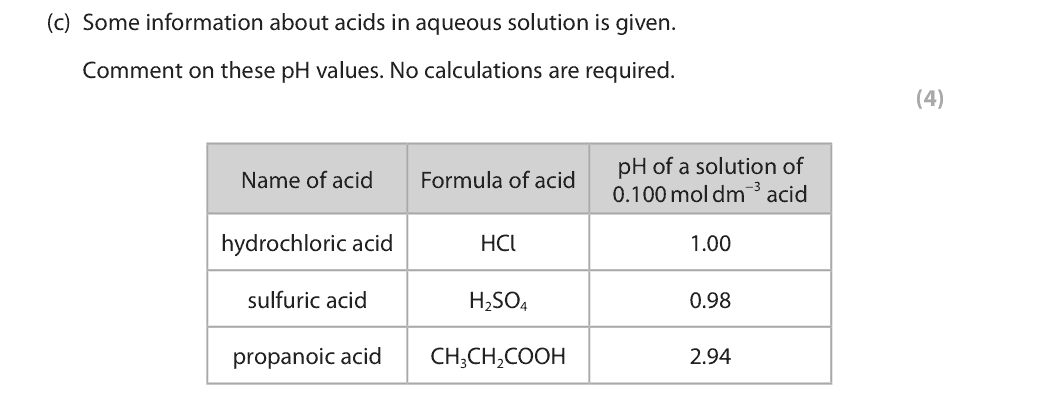
Some information about acids in aqueous solution is given.
Comment on these pH values. No calculations are required.
pH of a solution of
Name of acid
Formula of acid
0.100 mol dm−3 acid
hydrochloric acid
HCl
1.00
sulfuric acid
H2SO4
0.98
propanoic acid
CH3CH2COOH
2.94
June 2024 · Paper 1 · Q4(d)(i) 1 mark Short answer acid base equilibria
Earlier part of question 4 that this part usesEarlier part of June 2024 Paper 1 question 4
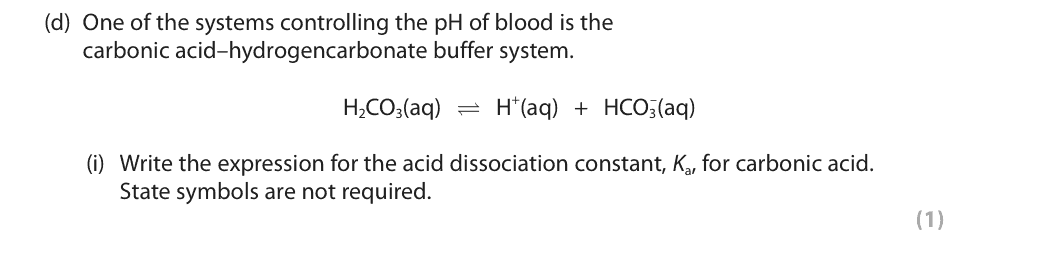
One of the systems controlling the pH of blood is the
carbonic acid–hydrogencarbonate buffer system.
H2CO3(aq)      H+(aq)   +   HCO3
–(aq)
Write the expression for the acid dissociation constant, Ka, for carbonic acid.
State symbols are not required.
June 2024 · Paper 1 · Q4(d)(ii) 3 marks Calculation acid base equilibria
Earlier parts of question 4 that this part usesEarlier part of June 2024 Paper 1 question 4Earlier part of June 2024 Paper 1 question 4
A blood sample taken from an individual was analysed.
Calculate the pH of the blood sample.
Use your expression for Ka and the values shown.
Ka for carbonic acid = 4.50 × 10⁻⁷ mol dm−3
[HCO3
–] = 0.0240 mol dm−3
[H2CO3] = 0.00200 mol dm−3
June 2024 · Paper 1 · Q4(e)(i) 2 marks Explanation acid base equilibriaequilibrium i
Earlier part of question 4 that this part usesEarlier part of June 2024 Paper 1 question 4
The relevant equilibria that maintain the pH of blood are shown.
Equilibrium 1
CO2(aq)  +  H2O(l)    H2CO3(aq)
H2CO3(aq)    H+(aq)  +  HCO3
−(aq)
Equilibrium 2
When a person exercises vigorously the concentration of carbon dioxide (aq)
in the blood increases.
Explain how this increase in the concentration of carbon dioxide affects the
pH of the blood.
Refer to the equilibria in your answer. No calculation is required.
June 2024 · Paper 1 · Q4(e)(ii) 2 marks Explanation acid base equilibria
Earlier parts of question 4 that this part usesEarlier part of June 2024 Paper 1 question 4Earlier part of June 2024 Paper 1 question 4
Explain how the carbonic acid–hydrogencarbonate buffer system in
Equilibrium 2 acts to restore the pH of the blood after a person has exercised.
June 2024 · Paper 1 · Q5(a) 3 marks Calculation energetics i
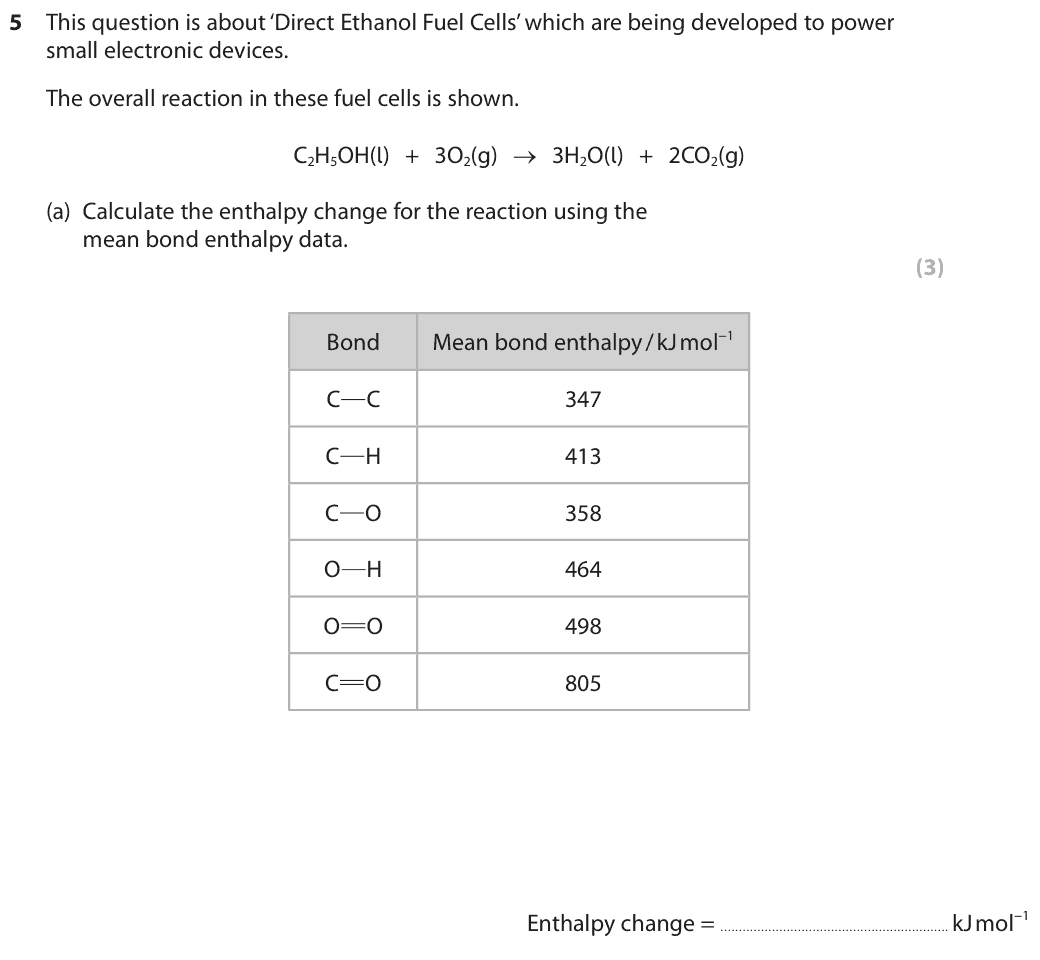
This question is about ‘Direct Ethanol Fuel Cells’ which are being developed to power
small electronic devices.
The overall reaction in these fuel cells is shown.
C2H5OH(l)   +   3O2(g)   →   3H2O(l)   +   2CO2(g)
Calculate the enthalpy change for the reaction using the
mean bond enthalpy data.
Bond
Mean bond enthalpy / kJ mol−1
C
C
347
C
H
413
C
O
358
O
H
464
O
O
498
C
O
805
Enthalpy change =  kJ mol−1
June 2024 · Paper 1 · Q5(b)(i) 2 marks Diagram or structure energetics i
Earlier part of question 5 that this part usesEarlier part of June 2024 Paper 1 question 5
Complete the enthalpy cycle for the overall reaction in the Direct Ethanol
Fuel Cell. Include labels.
Substance
Δf H   / kJ mol−1
C2H5OH(l)
−277
CO2(g)
−394
H2O(l)
−286
Δr H
C2H5OH(l)   +   3O2(g)
3H2O(l)   +   2CO2(g)
June 2024 · Paper 1 · Q5(b)(ii) 1 mark Calculation energetics i
Earlier parts of question 5 that this part usesEarlier part of June 2024 Paper 1 question 5Earlier part of June 2024 Paper 1 question 5
Calculate a value for the enthalpy change of the Direct Ethanol Fuel Cell
reaction, using your cycle.
Enthalpy change  =  kJ mol−1
June 2024 · Paper 1 · Q5(c) 2 marks Short answer energetics i
Earlier parts of question 5 that this part usesEarlier part of June 2024 Paper 1 question 5Earlier part of June 2024 Paper 1 question 5Earlier part of June 2024 Paper 1 question 5
Give two reasons for the difference between your calculated values in (a) and (b).
June 2024 · Paper 1 · Q5(d) 2 marks Equation writing redox iredox ii
Earlier part of question 5 that this part usesEarlier part of June 2024 Paper 1 question 5
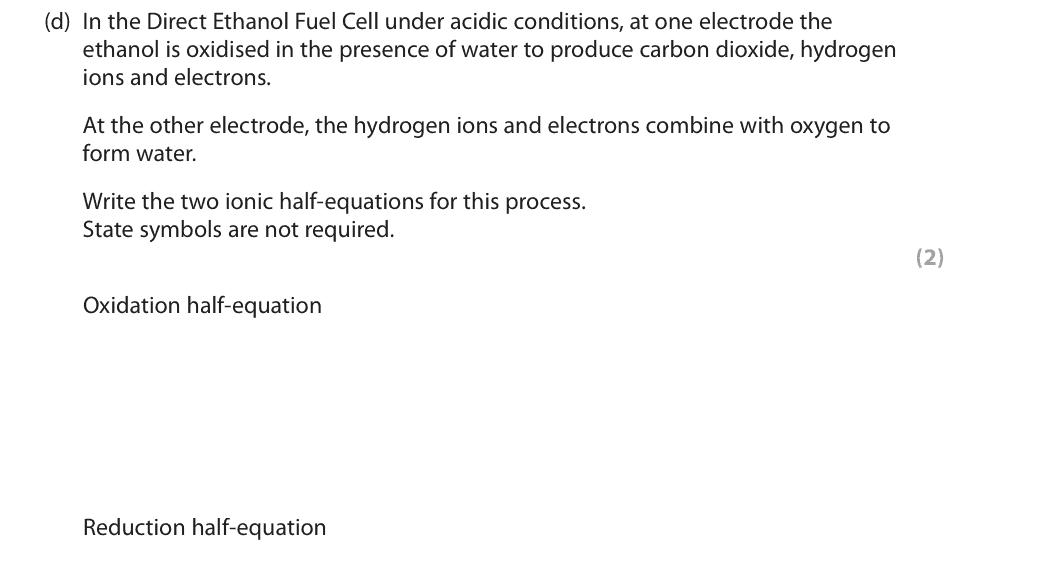
In the Direct Ethanol Fuel Cell under acidic conditions, at one electrode the
ethanol is oxidised in the presence of water to produce carbon dioxide, hydrogen
ions and electrons.
At the other electrode, the hydrogen ions and electrons combine with oxygen to
form water.
Write the two ionic half-equations for this process.
State symbols are not required.
Oxidation half-equation
Reduction half-equation
June 2024 · Paper 1 · Q6 6 marks 6-mark extended response transition metals principles
Explain why aqueous solutions of Cu2+ ions and Fe2+ ions are coloured but have
different colours, whereas aqueous solutions of Zn2+ ions are colourless.
Include any relevant electronic configurations.
June 2024 · Paper 1 · Q7(a)(i) 1 mark Multiple choice equilibrium ii
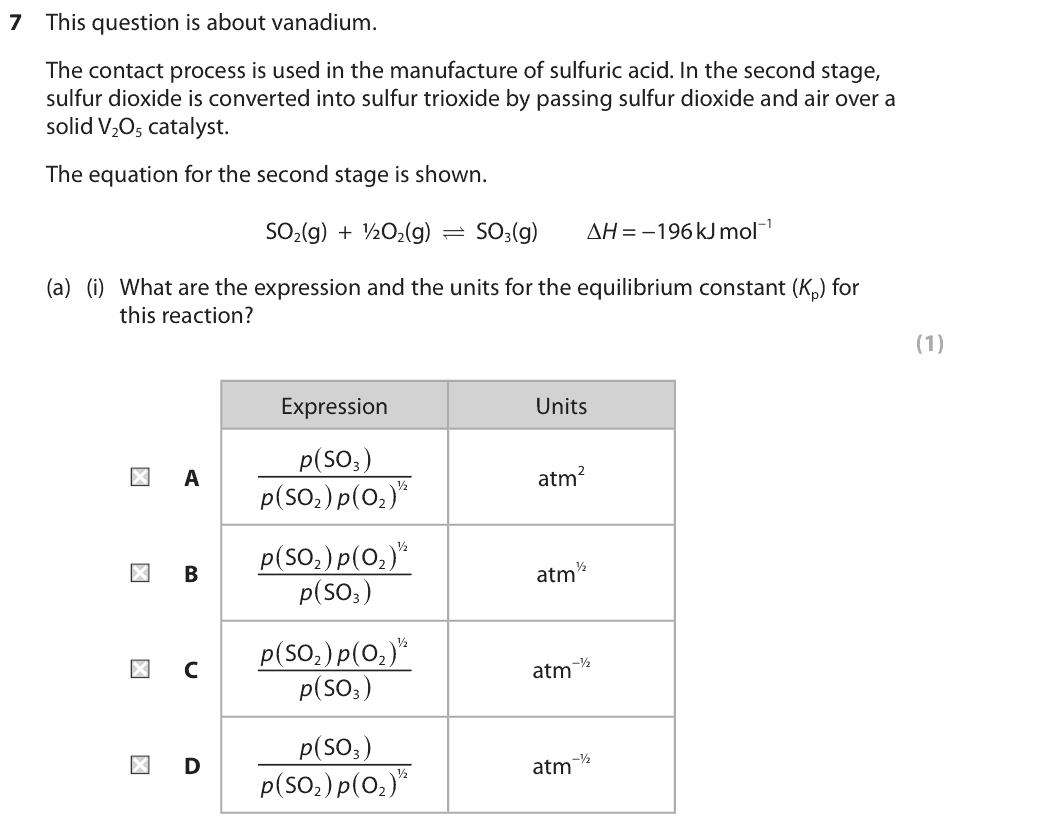
This question is about vanadium.
The contact process is used in the manufacture of sulfuric acid. In the second stage,
sulfur dioxide is converted into sulfur trioxide by passing sulfur dioxide and air over a
solid V2O5 catalyst.
The equation for the second stage is shown.
SO2(g)  +  ½O2(g)    SO3(g)        ΔH = −196 kJ mol−1
What are the expression and the units for the equilibrium constant (Kp) for
this reaction?
Expression
Units
.
/
p
SO
3
A
atm2
.
/ .
/
½
p
SO
p
O
2
2
.
/ .
/
½
p
SO
p
O
2
2
B
atm½
.
/
p
SO
3
.
/ .
/
½
p
SO
p
O
2
2
C
atm−½
.
/
p
SO
3
.
/
p
SO
3
D
atm−½
.
/ .
/
½
p
SO
p
O
2
2
June 2024 · Paper 1 · Q7(a)(ii) 1 mark Multiple choice equilibrium ii
Earlier part of question 7 that this part usesEarlier part of June 2024 Paper 1 question 7
Which variable affects the value of Kp ?
A  pressure
B  temperature
C  surface area of the catalyst
D  concentration of O2(g)
June 2024 · Paper 1 · Q7(b) 2 marks Equation writing transition metals reactions
Earlier part of question 7 that this part usesEarlier part of June 2024 Paper 1 question 7
Write two equations that show the conversion of SO2 and O2 into SO3 by using
V2O5 as the catalyst.
State symbols are not required.
June 2024 · Paper 1 · Q7(c) 1 mark Multiple choice transition metals reactions
Earlier part of question 7 that this part usesEarlier part of June 2024 Paper 1 question 7
Which row of the table shows the correct colour of the solution and oxidation
number of vanadium in the aqueous ions shown?
Oxidation number
Aqueous ion
Colour of solution
of vanadium
A
VO2
+
yellow
+3
B
VO2+
green
+4
C
VO2
+
yellow
+5
D
VO2+
blue
+5
+ ?
June 2024 · Paper 1 · Q7(d) 1 mark Multiple choice redox ii
Earlier part of question 7 that this part usesEarlier part of June 2024 Paper 1 question 7
What is the value of the cell potential for the reaction of Zn and VO2
Use your Data Booklet.
2VO2
+(aq)   +   4H+(aq)   +   Zn(s)   →   2VO2+(aq)   +   2H2O(l)   +   Zn2+(aq)
A  +1.76 V
B  +0.24 V
C  −0.24 V
D  −1.76 V
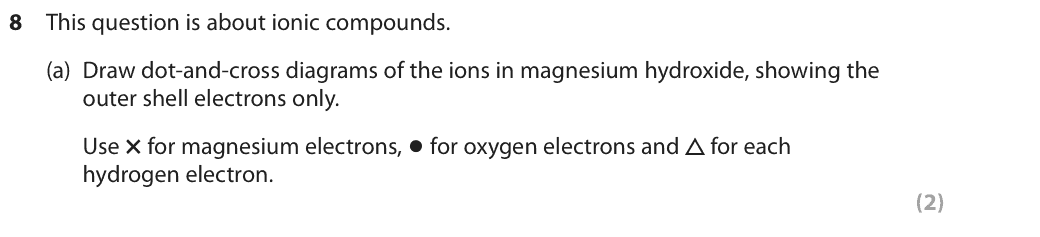
June 2024 · Paper 1 · Q8(a) 2 marks Diagram or structure bonding
This question is about ionic compounds.
Draw dot-and-cross diagrams of the ions in magnesium hydroxide, showing the
outer shell electrons only.
Use × for magnesium electrons, ● for oxygen electrons and  for each
hydrogen electron.
June 2024 · Paper 1 · Q8(b) 1 mark Multiple choice lattice energy
Which definition correctly describes the enthalpy change of solution, ΔsolH ?
Enthalpy change of solution, ΔsolH
The enthalpy change when 1 mol of gaseous ions dissolves in
A
sufficient water to give an infinitely dilute solution.
The enthalpy change when 1 mol of an ionic substance dissolves in
B
water to give an infinitely dilute solution.
The enthalpy change when 1 mol of gaseous ions dissolves in
C
sufficient water to give a solution of concentration 1 mol dm−3 .
The enthalpy change when 1 mol of an ionic substance dissolves in
D
water to give a solution of concentration 1 mol dm−3 .
June 2024 · Paper 1 · Q8(c)(i) 4 marks Diagram or structure lattice energy
Earlier part of question 8 that this part usesEarlier part of June 2024 Paper 1 question 8
The table shows the information needed to calculate the
standard enthalpy change of formation of magnesium fluoride.
Label
Description
Value / kJ mol−1
A
enthalpy change of formation of magnesium fluoride
B
lattice energy of magnesium fluoride
−2957
C
enthalpy change of atomisation of magnesium
+148
D
1st ionisation energy of magnesium
+738
E
2nd ionisation energy of magnesium
+1451
F
enthalpy change of atomisation of fluorine
+79
G
1st electron affinity of fluorine
−328
Complete the Born–Haber cycle for magnesium fluoride with formulae,
state symbols, electrons and correctly labelled arrows.
The cycle is not drawn to scale.
Mg(g)   +   F2(g)
C
A
Mg(s)   +   F2(g)
MgF2(s)
June 2024 · Paper 1 · Q8(c)(ii) 1 mark Calculation lattice energy
Earlier parts of question 8 that this part usesEarlier part of June 2024 Paper 1 question 8Earlier part of June 2024 Paper 1 question 8
Calculate the value of Δf H   [MgF2(s)].
June 2024 · Paper 1 · Q8(c)(iii) 4 marks Explanation lattice energy
Earlier parts of question 8 that this part usesEarlier part of June 2024 Paper 1 question 8Earlier part of June 2024 Paper 1 question 8Earlier part of June 2024 Paper 1 question 8
The experimental and theoretical values of the lattice energy for MgF2 and
MgI2 are given in the table.
Explain the differences in these values.
Experimental lattice energy
Theoretical lattice energy
Compound
/ kJ mol−1
/ kJ mol−1
MgF2
−2957
−2913
MgI2
−2327
−1944
June 2024 · Paper 1 · Q9(a) 3 marks Calculation entropy
Sodium hydrogencarbonate is used as a raising agent in baking as carbon dioxide gas
is released when it undergoes thermal decomposition.
Show that this reaction is not feasible at 298 K by calculating ΔG.
2NaHCO3(s)   →   Na2CO3(s)   +   CO2(g)   +   H2O(l)        ΔrH = +91.6 kJ mol−1
Compound
NaHCO3(s)
Na2CO3(s)
CO2(g)
H2O(l)
Standard molar entropy
101.7
135.0
213.6
69.9
/ J K−1 mol−1
June 2024 · Paper 1 · Q9(b) 2 marks Calculation entropy
Earlier part of question 9 that this part usesEarlier part of June 2024 Paper 1 question 9
Calculate the minimum temperature, in degrees Celsius (°C), at which an oven
should be set for this reaction to be thermodynamically feasible.
Minimum temperature =  °C
June 2024 · Paper 1 · Q10(a) 3 marks Practical and data analysis redox ii
Vitamin C has the molecular formula C6H8O6 .
The label on a bottle of vitamin C tablets stated that a 2.50 g tablet contained 6%
of vitamin C by mass. The tablet was analysed to check the accuracy of the label.
The procedure involved a series of steps.
Step 1      Dissolving the tablet.
A 2.50 g vitamin C tablet was crushed and dissolved to make an aqueous solution
of volume 250.0 cm3 .
Describe how to make this solution from the crushed tablet.
June 2024 · Paper 1 · Q10(b)(i) 1 mark Equation writing redox iformulae equations and amounts of substance
Earlier part of question 10 that this part usesEarlier part of June 2024 Paper 1 question 10
Step 2      Producing a known amount of iodine.
Iodine was produced by reacting 25.0 cm3 of 0.0100 mol dm–3 potassium iodate
with excess potassium iodide and hydrochloric acid in a conical flask.
Complete the ionic equation for the formation of the iodine from 1 mol of
IO3
− ions.
IO3
−   +   I−   +   H+   →   3I2   +
June 2024 · Paper 1 · Q10(b)(ii) 2 marks Calculation redox iiformulae equations and amounts of substance
Earlier parts of question 10 that this part usesEarlier part of June 2024 Paper 1 question 10Earlier part of June 2024 Paper 1 question 10
Show, by calculation, that 7.50 × 10⁻⁴ moles of iodine were produced in
the flask.
June 2024 · Paper 1 · Q10(c)(i) 2 marks Practical and data analysis redox ii
Earlier part of question 10 that this part usesEarlier part of June 2024 Paper 1 question 10
Step 3      Titrating with sodium thiosulfate solution.
10.0 cm3 of the vitamin C tablet solution from Step 1 was added to the conical
flask from Step 2 to react with the iodine produced, as shown in the equation.
C6H8O6(aq)   +   I2(aq)   →   C6H6O6(aq)   +   2HI(aq)
The unreacted iodine in the conical flask was titrated with a solution of
0.100 mol dm−3 sodium thiosulfate, Na2S2O3(aq).
The mean titre was 14.40 cm3 .
2–(aq)   +   I2(aq)   →   2I–(aq)   +   S4O6
2−(aq)
2S2O3
State the indicator used in this titration, giving the colour change that would
be observed at the end-point.
June 2024 · Paper 1 · Q10(c)(ii) 6 marks Calculation redox ii
Earlier parts of question 10 that this part usesEarlier part of June 2024 Paper 1 question 10Earlier part of June 2024 Paper 1 question 10Earlier part of June 2024 Paper 1 question 10
Deduce, by calculation, whether the label on the bottle of vitamin C tablets
is correct.

Work with an A-level chemistry tutor

Want a paper marked and gone through with you? Message us.

Prefer email? Send an enquiry

If you are under 18, please include a parent's contact details. Enquiries go to enquiries@chemistryaleveltutor.com and are deleted once handled. All tutoring is online.