June 2023: Paper 2, Advanced Organic and Physical Chemistry

90 marks · 43 question parts · Paper, mark scheme and report on Edexcel's site · Have the Data Booklet beside you

Question by question

QTopicMarksAOType
1(a) Introduction to organic chemistry 1Diagram or structure
1(b) Alkenes 1Multiple choice
1(c) Alkanes 2Short answer
2(a) Alkanes 1Multiple choice
2(b) Alcohols 1Equation writing
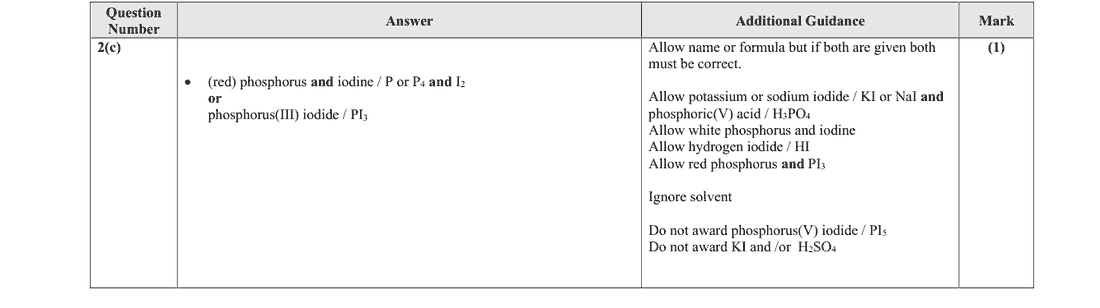
2(c) Alcohols 1Short answer
2(d)(i) Modern analytical techniques I: mass spectrometry and infrared 1Multiple choice
2(d)(ii) Modern analytical techniques II: NMR, mass spectrometry and chromatography 1Short answer
2(e) Redox I 1Equation writing
3(a) Modern analytical techniques II: NMR, mass spectrometry and chromatography 1Multiple choice
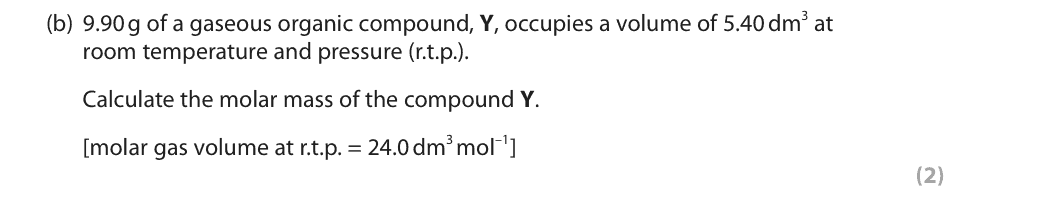
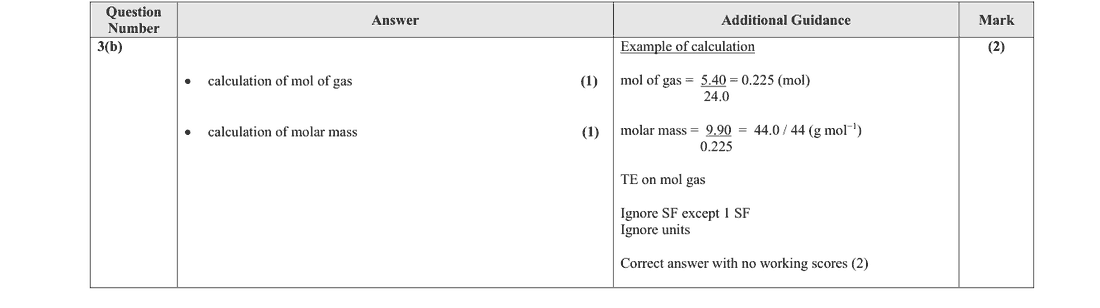
3(b) Formulae, equations and amounts of substance 2Calculation
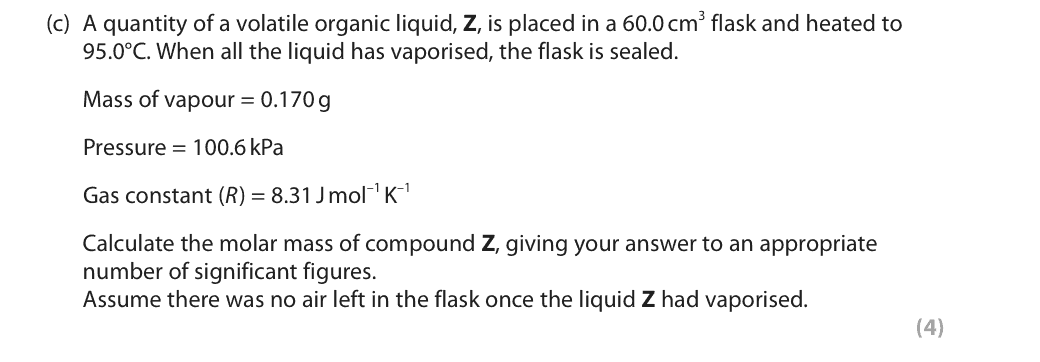
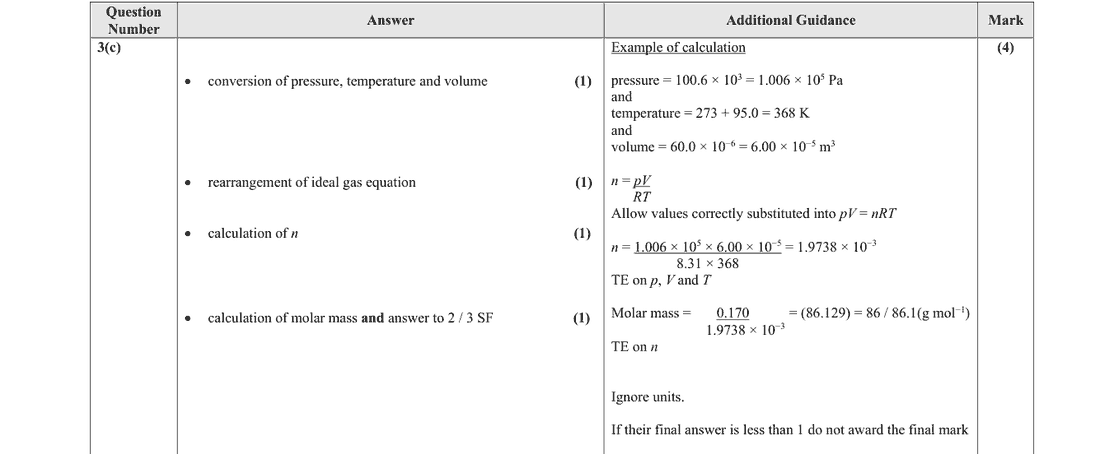
3(c) Formulae, equations and amounts of substance 4Calculation
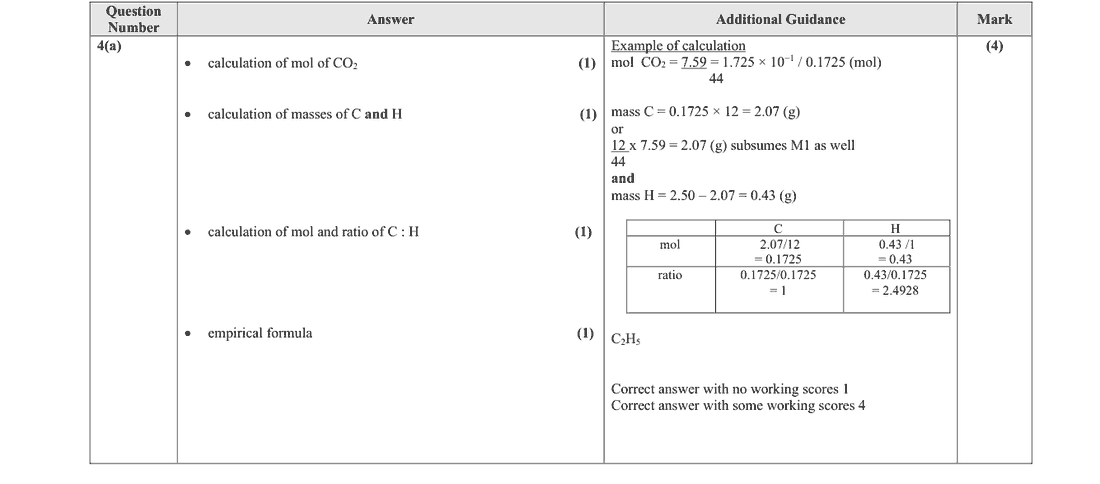
4(a) Formulae, equations and amounts of substance 4Calculation
4(b)(i) Alkenes 1Multiple choice
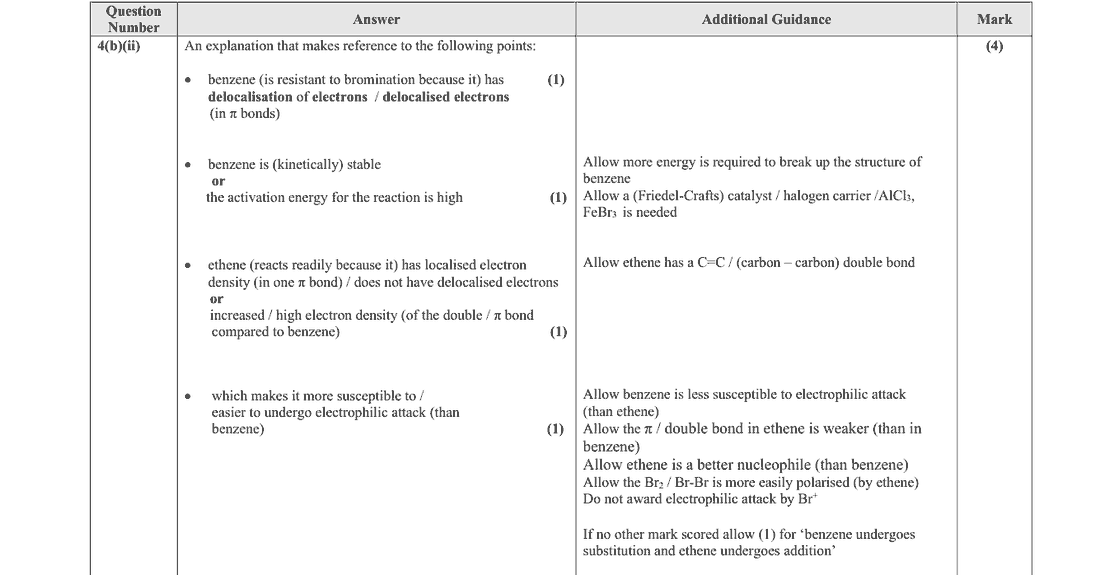
4(b)(ii) Arenes: benzene 4Explanation
5(a)(i) Kinetics II 1Short answer
5(a)(ii) Kinetics II 1Short answer
5(b)(i) Kinetics II 1Multiple choice
5(b)(ii) Kinetics II 1Multiple choice
5(c) Kinetics II 1Multiple choice
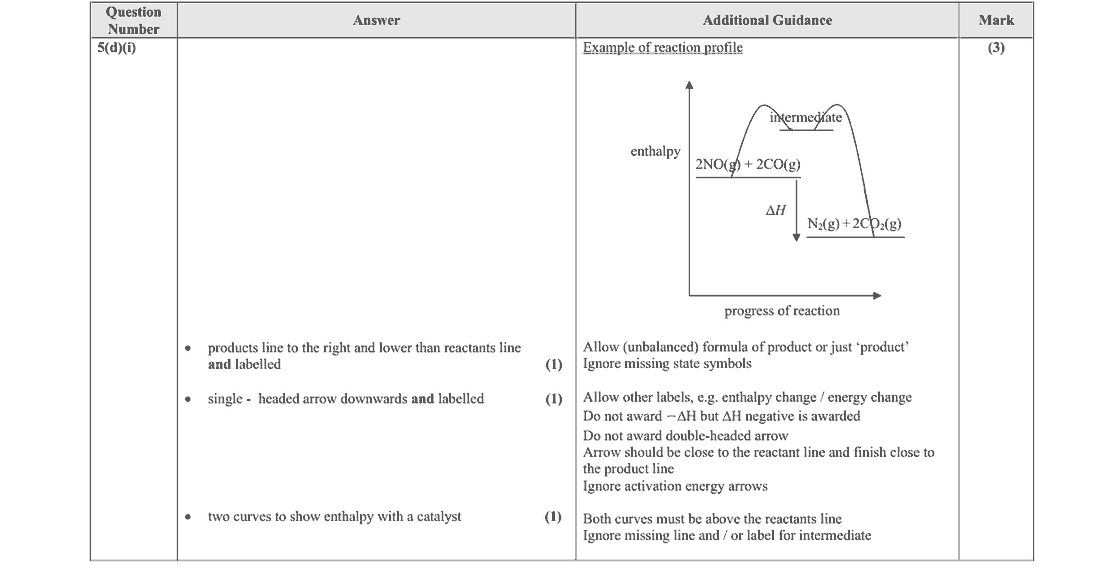
5(d)(i) Kinetics I 3Diagram or structure
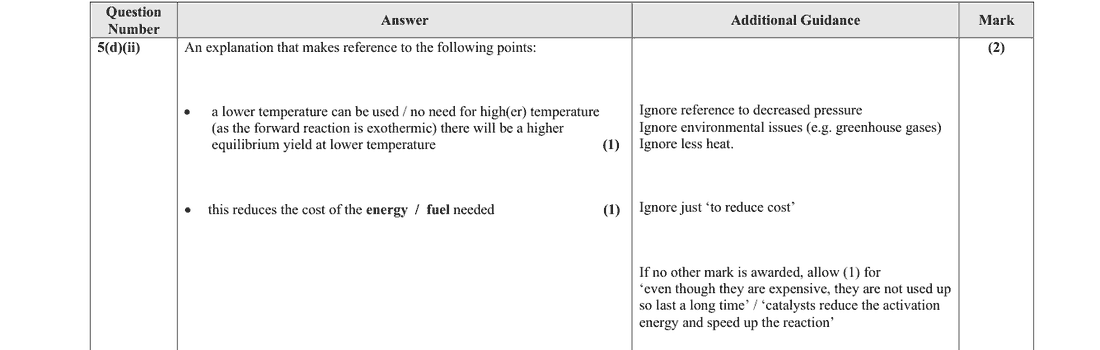
5(d)(ii) Kinetics I 2Explanation
6(a)(i) Kinetics II 1Practical and data analysis
6(a)(ii) Kinetics II 2Practical and data analysis
6(b)(i) Kinetics II 1Practical and data analysis
6(b)(ii) Kinetics II 2Diagram or structure
6(b)(iii) Kinetics II 1Short answer
6(c)(i) Kinetics II 2Equation writing
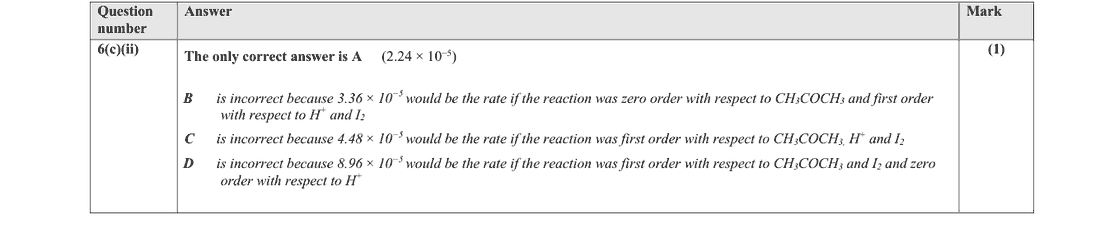
6(c)(ii) Kinetics II 1Multiple choice
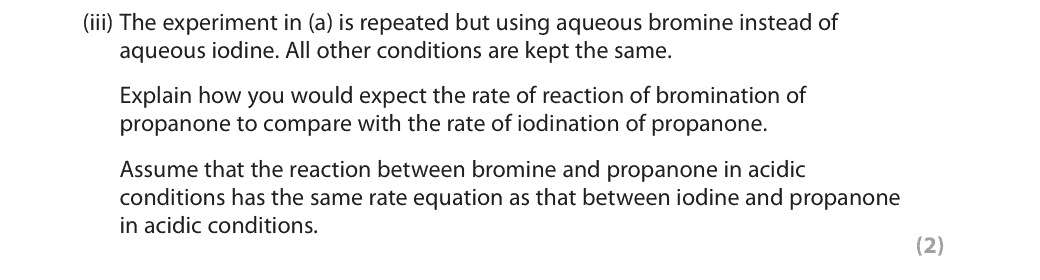
6(c)(iii) Kinetics II 2Explanation
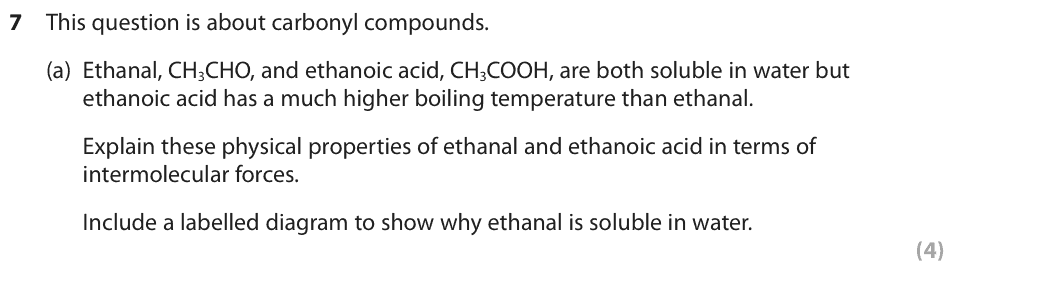
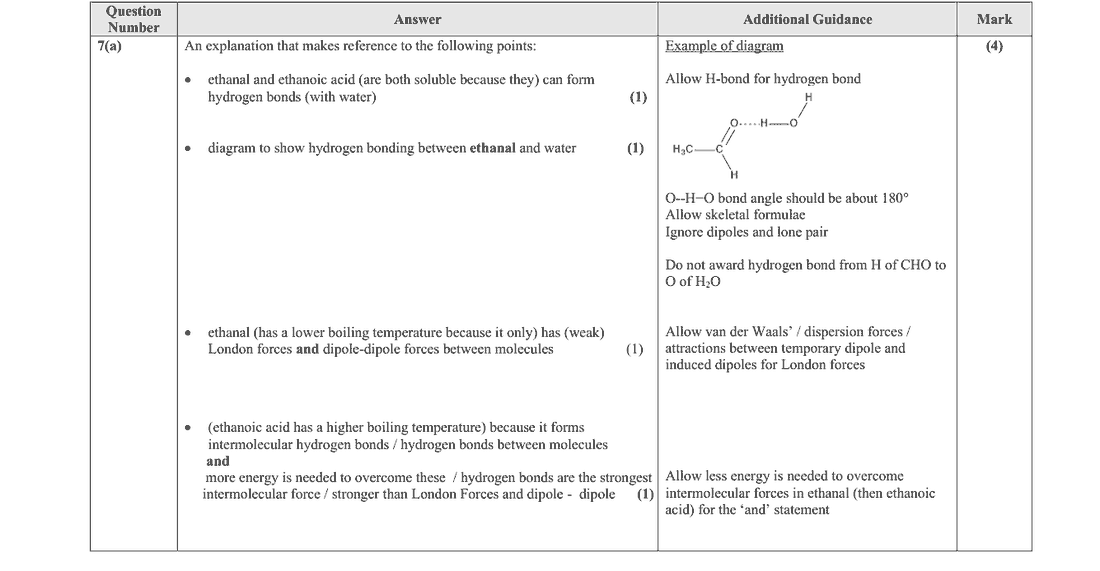
7(a) Carbonyl compounds, Carboxylic acids 4Explanation
7(b)(i) Carbonyl compounds 4Mechanism
7(b)(ii) Carbonyl compounds, Chirality 3Explanation
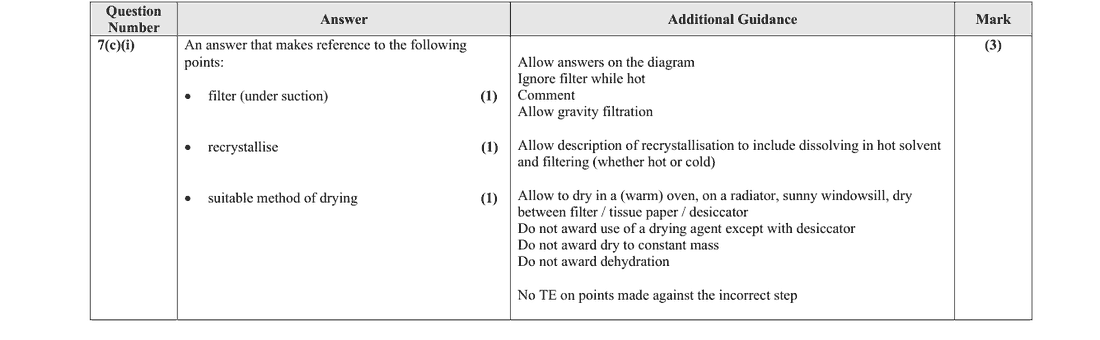
7(c)(i) Carbonyl compounds, Organic synthesis 3Practical and data analysis
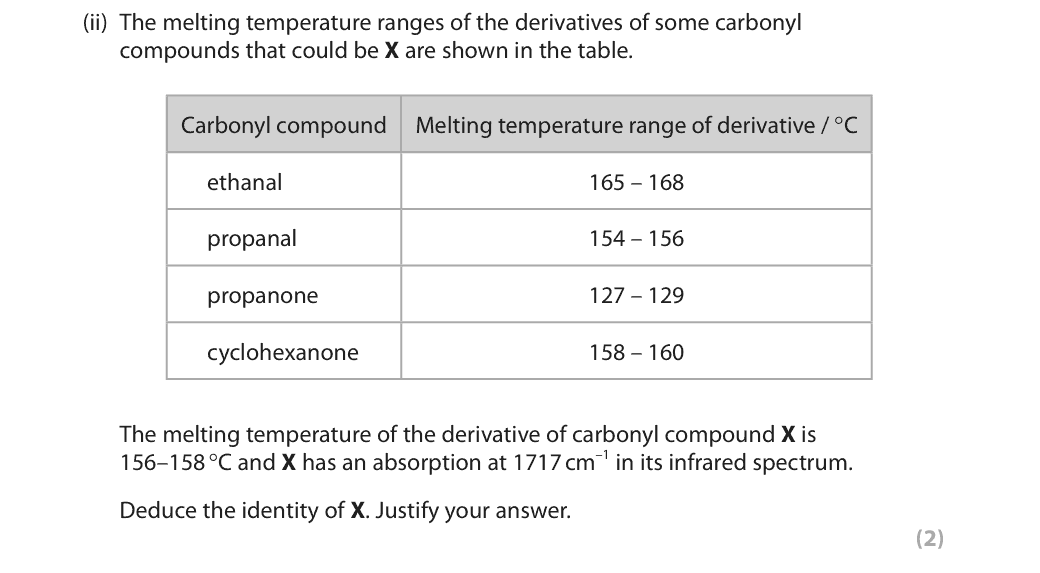
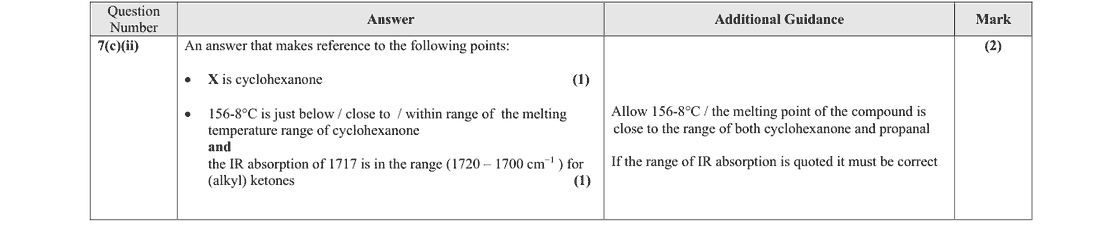
7(c)(ii) Carbonyl compounds, Modern analytical techniques I: mass spectrometry and infrared 2Short answer
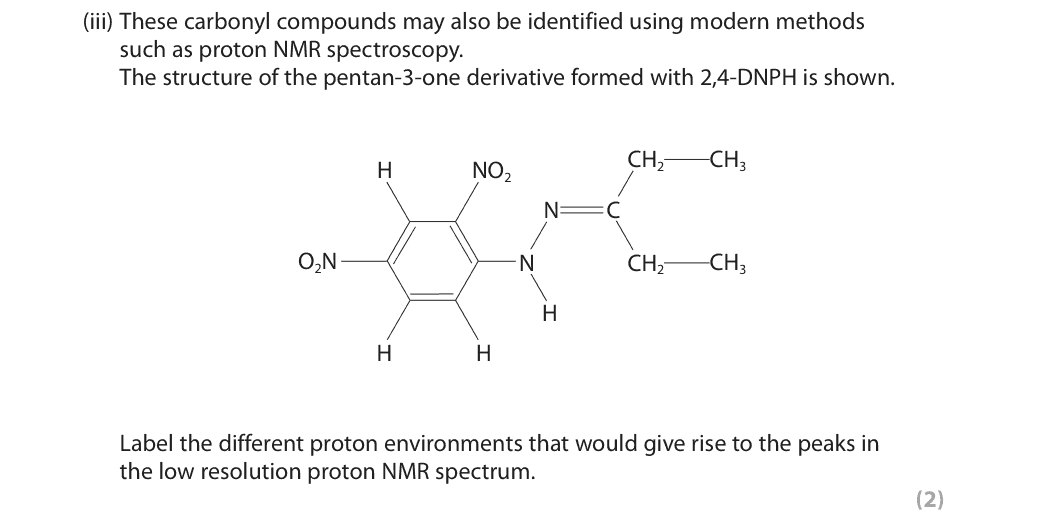
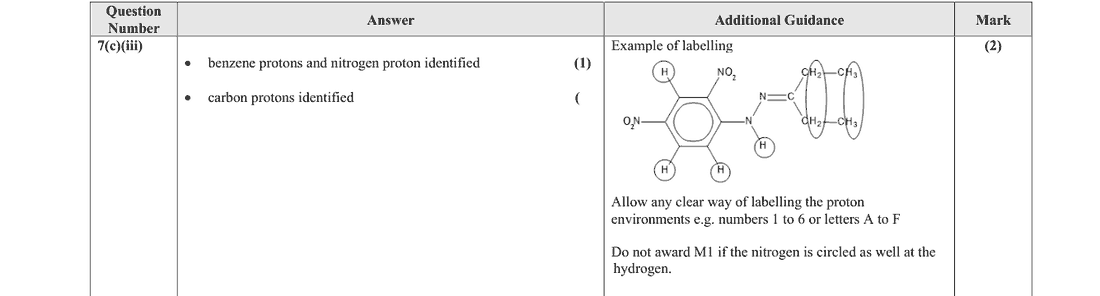
7(c)(iii) Modern analytical techniques II: NMR, mass spectrometry and chromatography 2Short answer
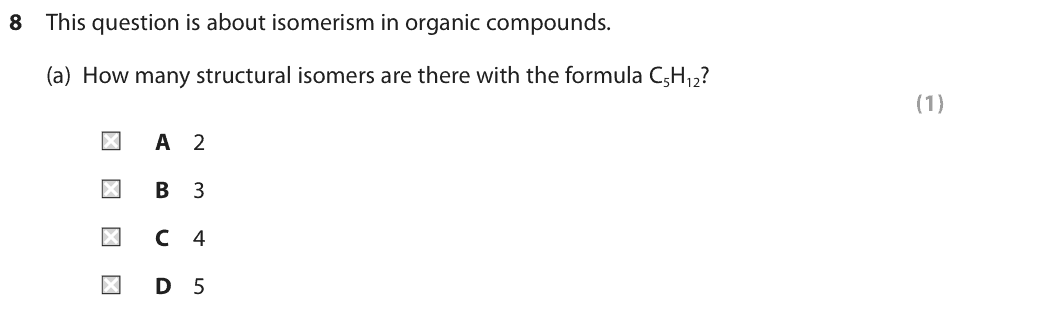
8(a) Introduction to organic chemistry 1Multiple choice
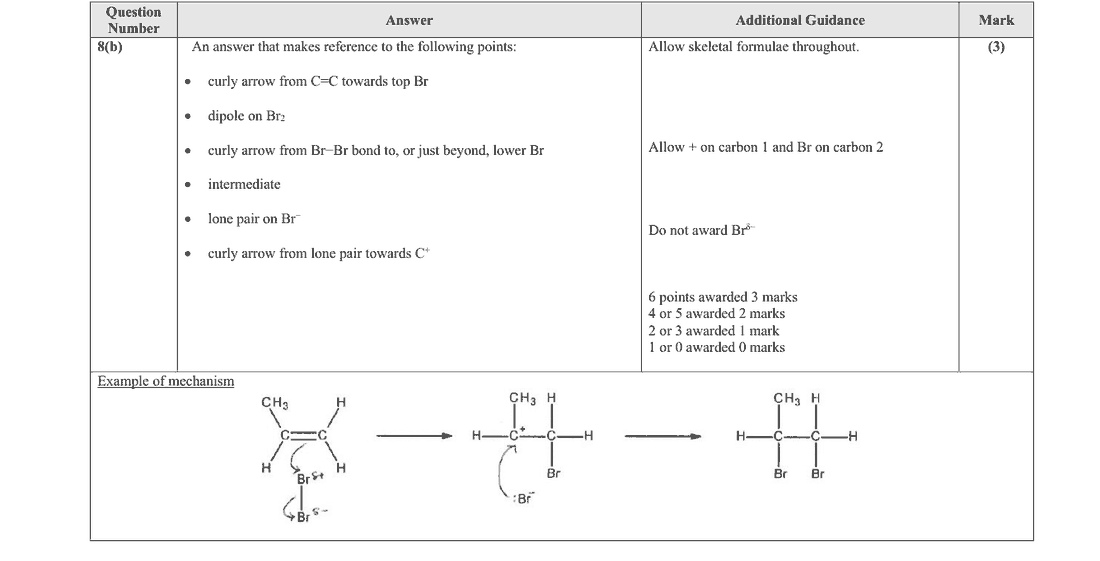
8(b) Alkenes 3Mechanism
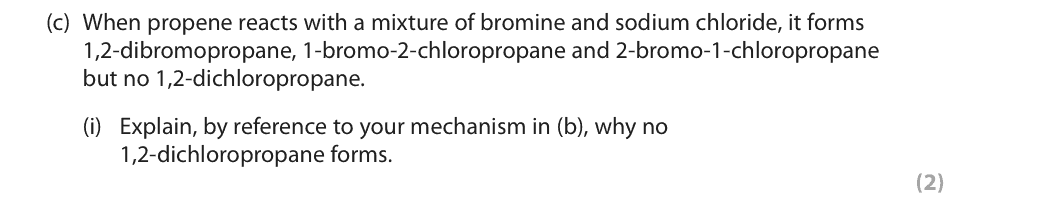
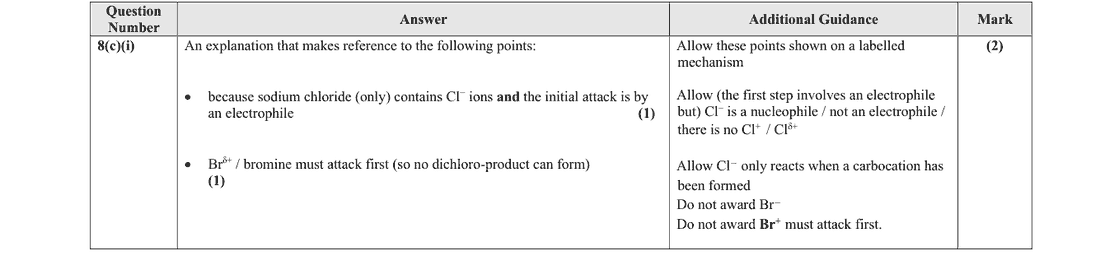
8(c)(i) Alkenes 2Explanation
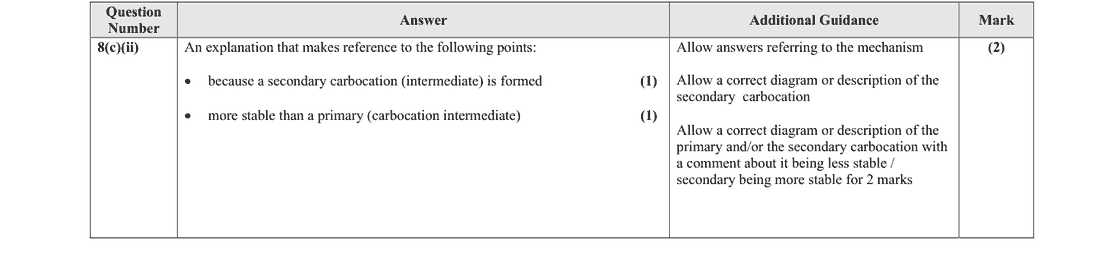
8(c)(ii) Alkenes 2Explanation
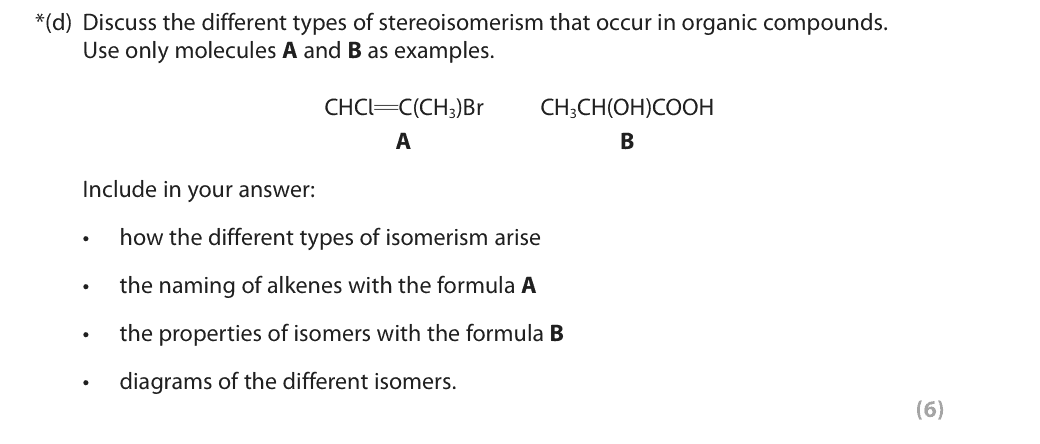
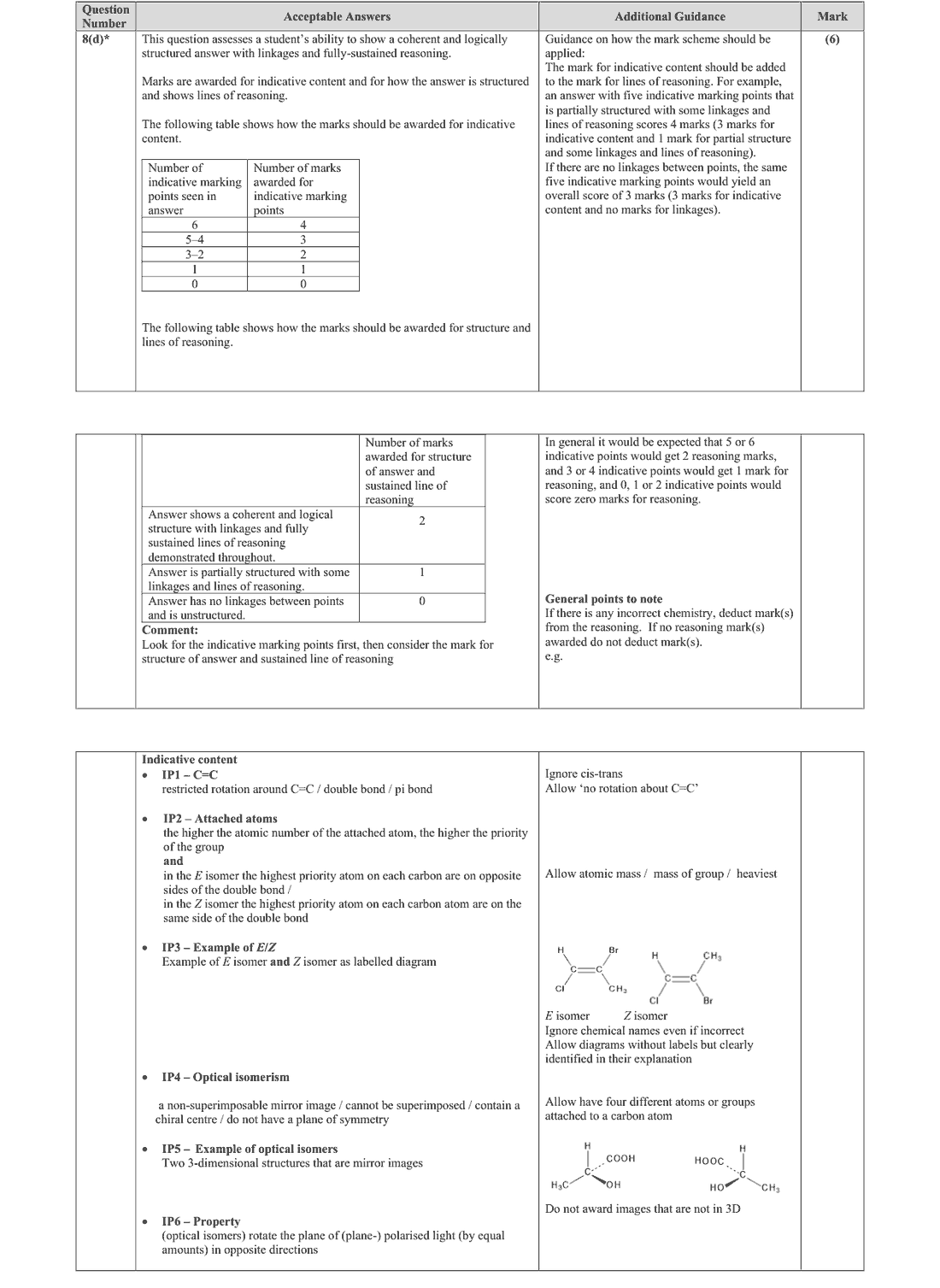
8(d) Introduction to organic chemistry, Chirality 6Extended response
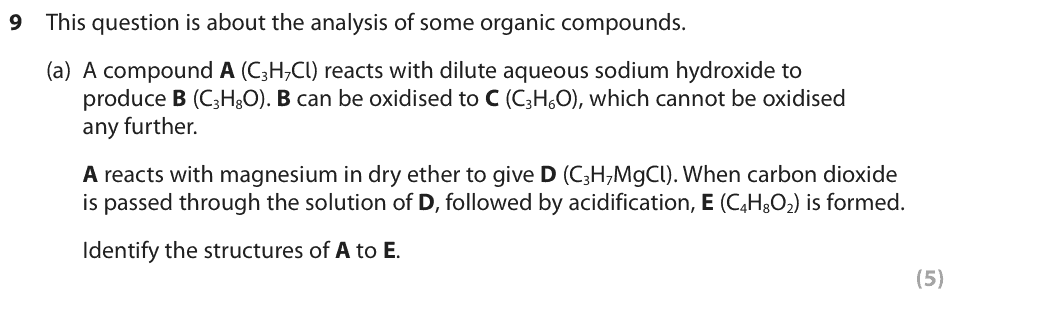
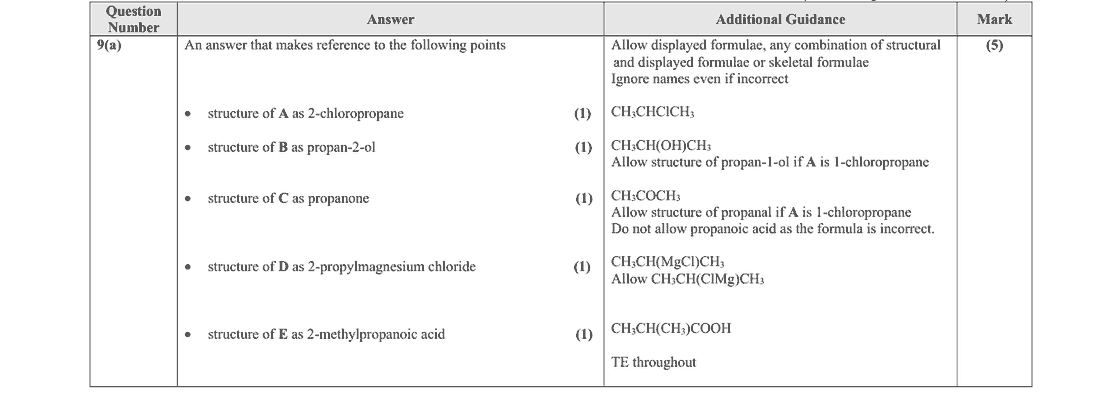
9(a) Organic synthesis 5Short answer
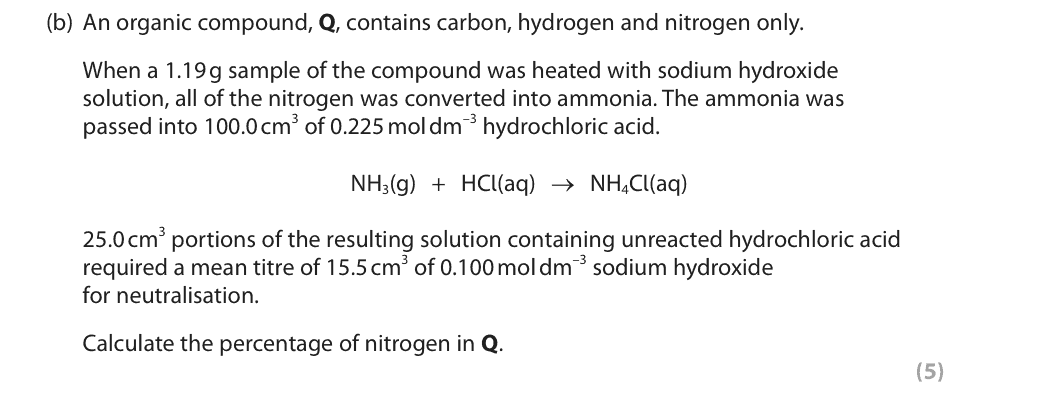
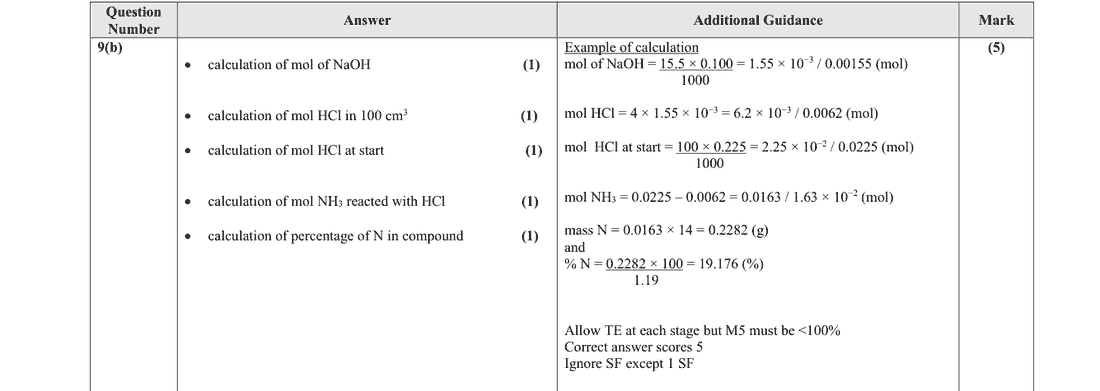
9(b) Formulae, equations and amounts of substance 5Calculation

The questions

1(a)1(b)1(c)2(a)2(b)2(c)2(d)(i)2(d)(ii)2(e)3(a)3(b)3(c)4(a)4(b)(i)4(b)(ii)5(a)(i)5(a)(ii)5(b)(i)5(b)(ii)5(c)5(d)(i)5(d)(ii)6(a)(i)6(a)(ii)6(b)(i)6(b)(ii)6(b)(iii)6(c)(i)6(c)(ii)6(c)(iii)7(a)7(b)(i)7(b)(ii)7(c)(i)7(c)(ii)7(c)(iii)8(a)8(b)8(c)(i)8(c)(ii)8(d)9(a)9(b)
June 2023 · Paper 2 · Q1(a) 1 mark Diagram or structure introduction to organic chemistry
This question is about some organic compounds.
Draw the skeletal formula of 1,3‑dimethylcyclohexane.
June 2023 · Paper 2 · Q1(b) 1 mark Multiple choice alkenes
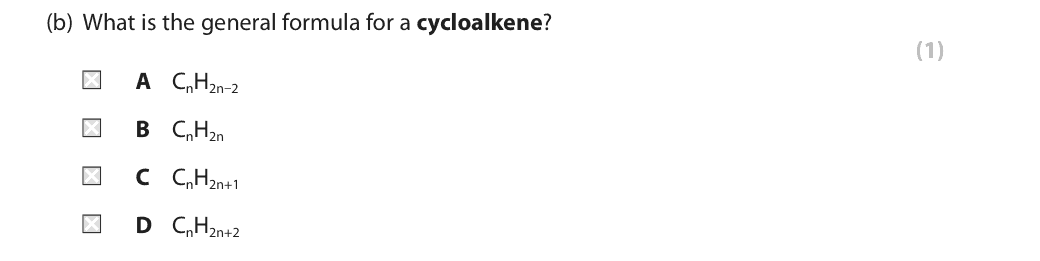
What is the general formula for a cycloalkene?
A  CnH2n–2
B  CnH2n
C  CnH2n+1
D  CnH2n+2
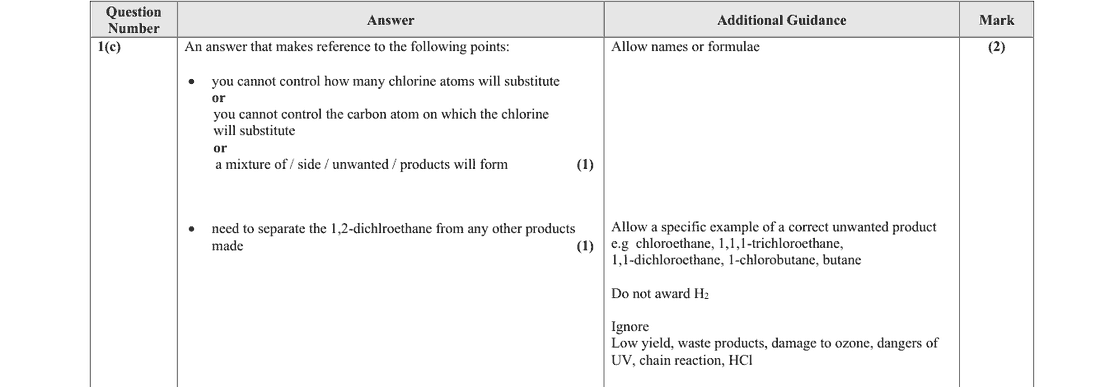
June 2023 · Paper 2 · Q1(c) 2 marks Short answer alkanes
A student is asked to devise a laboratory synthesis of 1,2‑dichloroethane.
The student suggests reacting ethane with chlorine in the presence of
ultraviolet radiation.
Give two reasons why this is not a good method to prepare 1,2‑dichloroethane.
June 2023 · Paper 2 · Q2(a) 1 mark Multiple choice alkanes
This question is about alcohols.
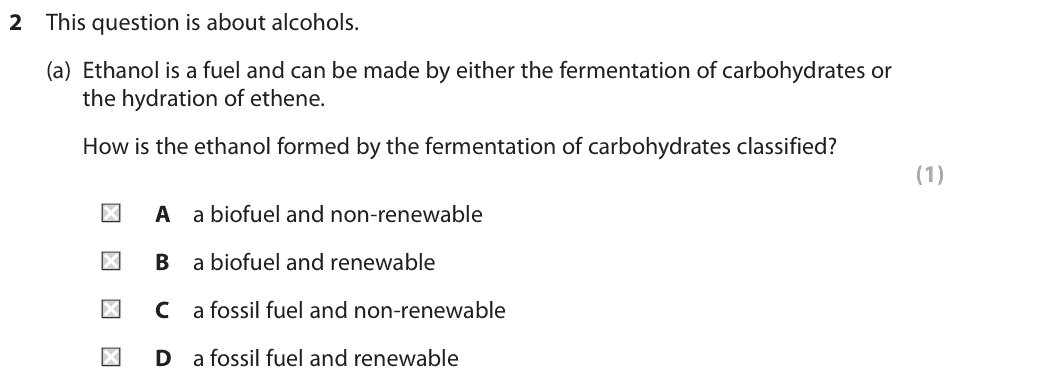
Ethanol is a fuel and can be made by either the fermentation of carbohydrates or
the hydration of ethene.
How is the ethanol formed by the fermentation of carbohydrates classified?
A  a biofuel and non‑renewable
B  a biofuel and renewable
C  a fossil fuel and non‑renewable
D  a fossil fuel and renewable
June 2023 · Paper 2 · Q2(b) 1 mark Equation writing alcohols
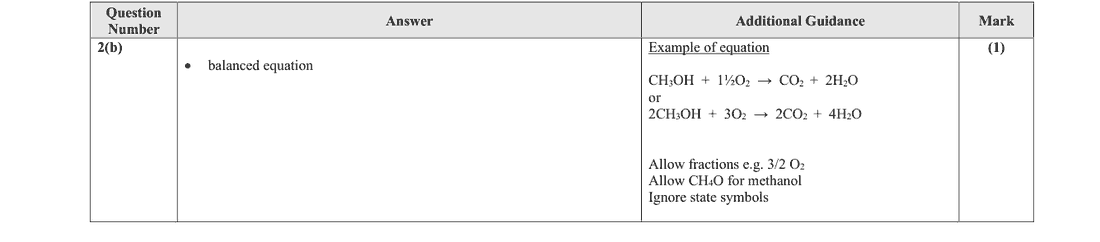
Write the equation for the complete combustion of methanol.
State symbols are not required.
June 2023 · Paper 2 · Q2(c) 1 mark Short answer alcohols
Identify, by name or formula, the reagent(s) needed to convert propan‑1‑ol
into 1‑iodopropane.
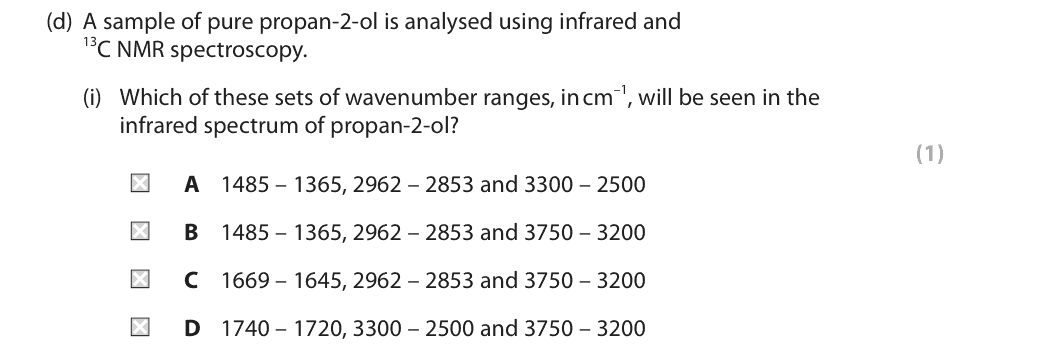
June 2023 · Paper 2 · Q2(d)(i) 1 mark Multiple choice mass spectrometry and infrared spectroscopy
A sample of pure propan‑2‑ol is analysed using infrared and
13C NMR spectroscopy.
Which of these sets of wavenumber ranges, in cm–1, will be seen in the
infrared spectrum of propan‑2‑ol?
A  1485 – 1365, 2962 – 2853 and 3300 – 2500
B  1485 – 1365, 2962 – 2853 and 3750 – 3200
C  1669 – 1645, 2962 – 2853 and 3750 – 3200
D  1740 – 1720, 3300 – 2500 and 3750 – 3200
June 2023 · Paper 2 · Q2(d)(ii) 1 mark Short answer nmr mass spectrometry and chromatography
Earlier part of question 2 that this part usesEarlier part of June 2023 Paper 2 question 2
State the number of peaks in the 13C NMR spectrum of propan‑2‑ol.
June 2023 · Paper 2 · Q2(e) 1 mark Equation writing redox i
Earlier part of question 2 that this part usesEarlier part of June 2023 Paper 2 question 2
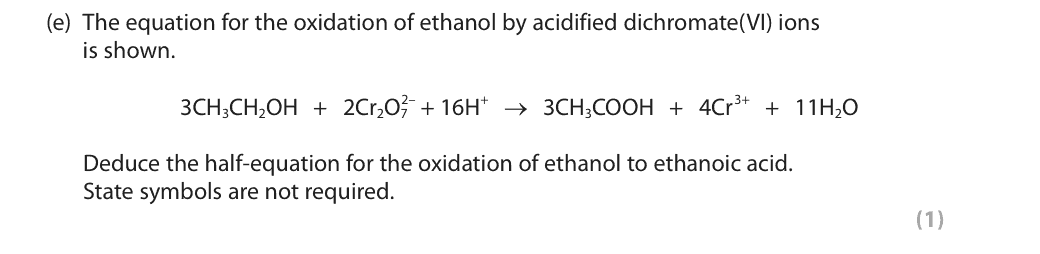
The equation for the oxidation of ethanol by acidified dichromate(VI) ions
is shown.
3CH3CH2OH   +   2Cr2O7
2– + 16H+   →   3CH3COOH   +   4Cr3+   +   11H2O
Deduce the half‑equation for the oxidation of ethanol to ethanoic acid.
State symbols are not required.
June 2023 · Paper 2 · Q3(a) 1 mark Multiple choice nmr mass spectrometry and chromatography
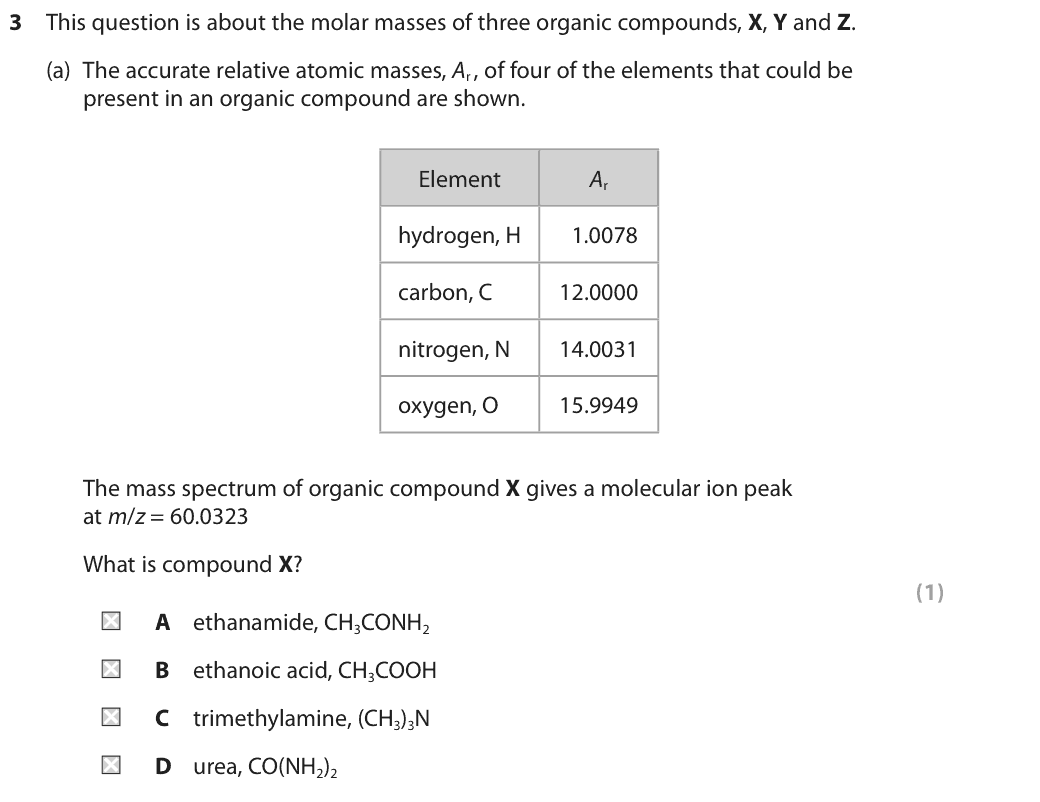
This question is about the molar masses of three organic compounds, X, Y and Z.
The accurate relative atomic masses, Ar , of four of the elements that could be
present in an organic compound are shown.
Element
Ar
hydrogen, H
1.0078
carbon, C
12.0000
nitrogen, N
14.0031
oxygen, O
15.9949
The mass spectrum of organic compound X gives a molecular ion peak
at m/z = 60.0323
What is compound X?
A  ethanamide, CH3CONH2
B  ethanoic acid, CH3COOH
C  trimethylamine, (CH3)3N
D  urea, CO(NH2)2
June 2023 · Paper 2 · Q3(b) 2 marks Calculation formulae equations and amounts of substance
9.90 g of a gaseous organic compound, Y, occupies a volume of 5.40 dm3 at
room temperature and pressure (r.t.p.).
Calculate the molar mass of the compound Y.
[molar gas volume at r.t.p. = 24.0 dm3 mol–1]
June 2023 · Paper 2 · Q3(c) 4 marks Calculation formulae equations and amounts of substance
A quantity of a volatile organic liquid, Z, is placed in a 60.0 cm3 flask and heated to
95.0°C. When all the liquid has vaporised, the flask is sealed.
Mass of vapour = 0.170 g
Pressure = 100.6 kPa
Gas constant (R) = 8.31 J mol–1 K–1
Calculate the molar mass of compound Z, giving your answer to an appropriate
number of significant figures.
Assume there was no air left in the flask once the liquid Z had vaporised.
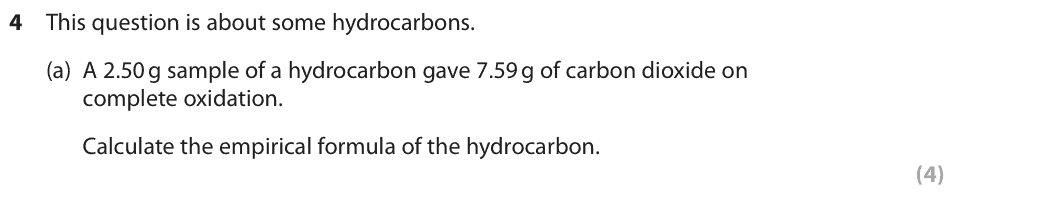
June 2023 · Paper 2 · Q4(a) 4 marks Calculation formulae equations and amounts of substance
This question is about some hydrocarbons.
A 2.50 g sample of a hydrocarbon gave 7.59 g of carbon dioxide on
complete oxidation.
Calculate the empirical formula of the hydrocarbon.
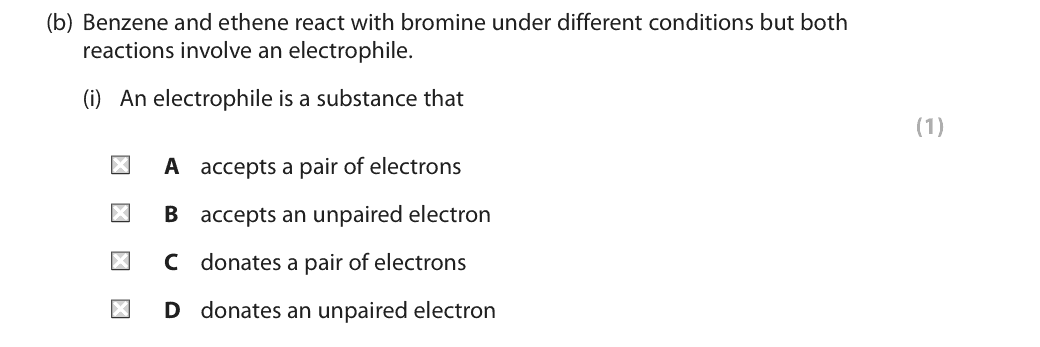
June 2023 · Paper 2 · Q4(b)(i) 1 mark Multiple choice alkenes
Benzene and ethene react with bromine under different conditions but both
reactions involve an electrophile.
An electrophile is a substance that
A  accepts a pair of electrons
B  accepts an unpaired electron
C  donates a pair of electrons
D  donates an unpaired electron
June 2023 · Paper 2 · Q4(b)(ii) 4 marks Explanation arenes benzene
Earlier part of question 4 that this part usesEarlier part of June 2023 Paper 2 question 4
Explain why benzene is resistant to bromination but ethene reacts readily
with bromine at room temperature.
June 2023 · Paper 2 · Q5(a)(i) 1 mark Short answer kinetics ii
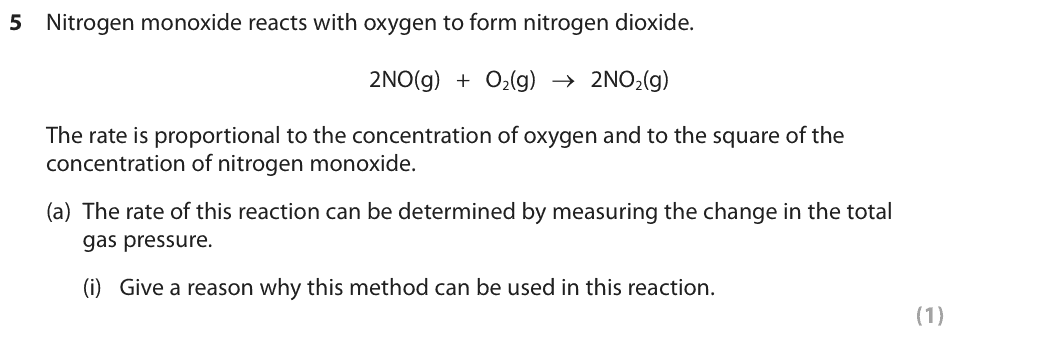
Nitrogen monoxide reacts with oxygen to form nitrogen dioxide.
2NO(g)   +   O2(g)   →   2NO2(g)
The rate is proportional to the concentration of oxygen and to the square of the
concentration of nitrogen monoxide.
The rate of this reaction can be determined by measuring the change in the total
gas pressure.
Give a reason why this method can be used in this reaction.
June 2023 · Paper 2 · Q5(a)(ii) 1 mark Short answer kinetics ii
Earlier part of question 5 that this part usesEarlier part of June 2023 Paper 2 question 5
State two factors, other than initial amounts of reactants, that must be kept
constant for this method to work.
June 2023 · Paper 2 · Q5(b)(i) 1 mark Multiple choice kinetics ii
Earlier part of question 5 that this part usesEarlier part of June 2023 Paper 2 question 5
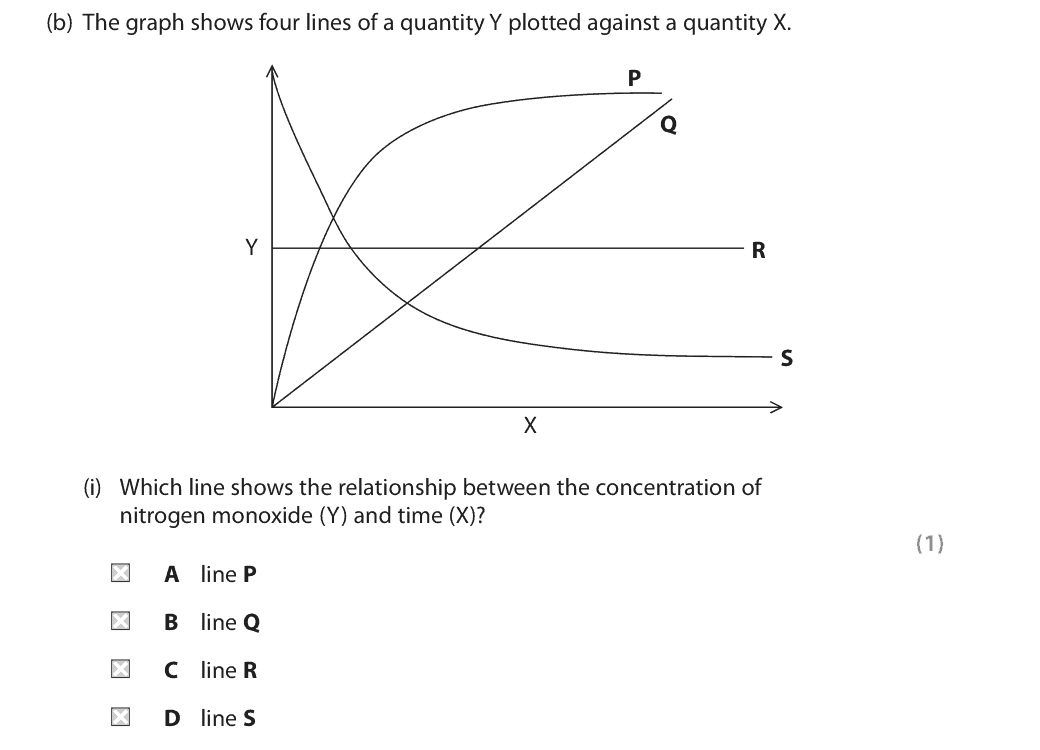
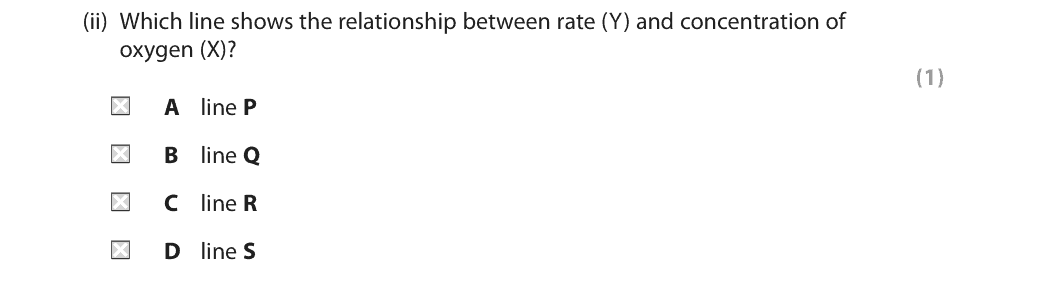
The graph shows four lines of a quantity Y plotted against a quantity X.
P
Q
Y
R
S
X
Which line shows the relationship between the concentration of
nitrogen monoxide (Y) and time (X)?
A  line P
B  line Q
C  line R
D  line S
June 2023 · Paper 2 · Q5(b)(ii) 1 mark Multiple choice kinetics ii
Earlier parts of question 5 that this part usesEarlier part of June 2023 Paper 2 question 5Earlier part of June 2023 Paper 2 question 5
Which line shows the relationship between rate (Y) and concentration of
oxygen (X)?
A  line P
B  line Q
C  line R
D  line S
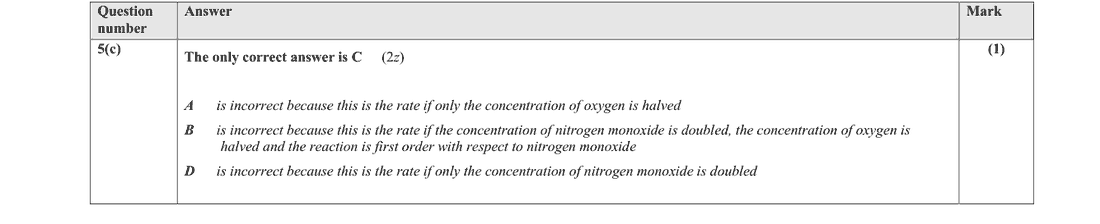
June 2023 · Paper 2 · Q5(c) 1 mark Multiple choice kinetics ii
Earlier part of question 5 that this part usesEarlier part of June 2023 Paper 2 question 5
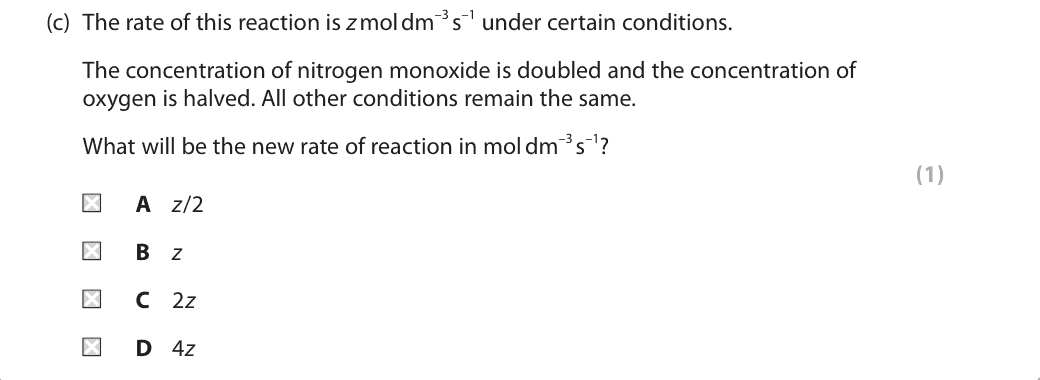
The rate of this reaction is z mol dm–3 s–1 under certain conditions.
The concentration of nitrogen monoxide is doubled and the concentration of
oxygen is halved. All other conditions remain the same.
What will be the new rate of reaction in mol dm–3 s–1?
A  z/2
B  z
C  2z
D  4z
June 2023 · Paper 2 · Q5(d)(i) 3 marks Diagram or structure kinetics i
Earlier part of question 5 that this part usesEarlier part of June 2023 Paper 2 question 5
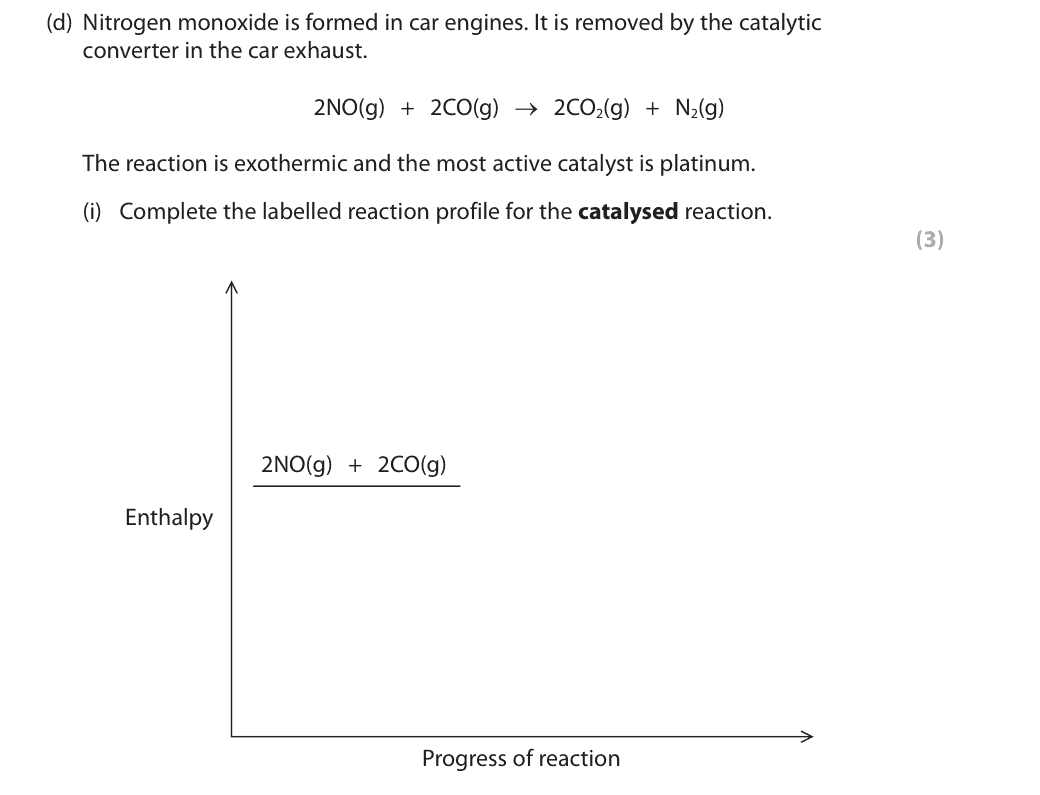
Nitrogen monoxide is formed in car engines. It is removed by the catalytic
converter in the car exhaust.
2NO(g)   +   2CO(g)   →   2CO2(g)   +   N2(g)
The reaction is exothermic and the most active catalyst is platinum.
Complete the labelled reaction profile for the catalysed reaction.
2NO(g)   +   2CO(g)
Enthalpy
Progress of reaction
June 2023 · Paper 2 · Q5(d)(ii) 2 marks Explanation kinetics i
Earlier parts of question 5 that this part usesEarlier part of June 2023 Paper 2 question 5Earlier part of June 2023 Paper 2 question 5
Catalysts, such as platinum, are very expensive.
Explain an economic benefit of using a catalyst in an industrial process.
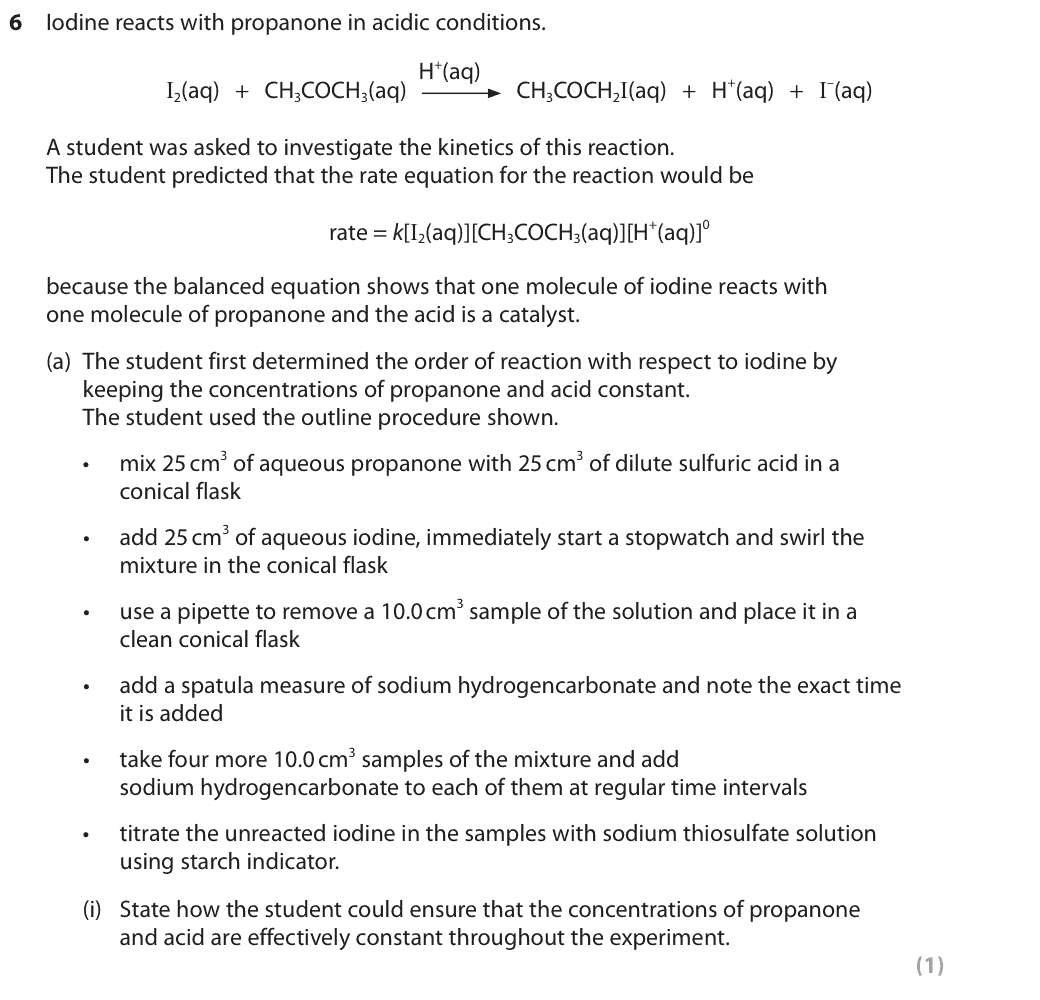
June 2023 · Paper 2 · Q6(a)(i) 1 mark Practical and data analysis kinetics ii
Iodine reacts with propanone in acidic conditions.
H+(aq)
I2(aq)   +   CH3COCH3(aq)
CH3COCH2I(aq)   +   H+(aq)   +   I–(aq)
A student was asked to investigate the kinetics of this reaction.
The student predicted that the rate equation for the reaction would be
rate = k[I2(aq)][CH3COCH3(aq)][H+(aq)]0
because the balanced equation shows that one molecule of iodine reacts with
one molecule of propanone and the acid is a catalyst.
The student first determined the order of reaction with respect to iodine by
keeping the concentrations of propanone and acid constant.
The student used the outline procedure shown.
•
mix 25 cm3 of aqueous propanone with 25 cm3 of dilute sulfuric acid in a
conical flask
•
add 25 cm3 of aqueous iodine, immediately start a stopwatch and swirl the
mixture in the conical flask
•
use a pipette to remove a 10.0 cm3 sample of the solution and place it in a
clean conical flask
•
add a spatula measure of sodium hydrogencarbonate and note the exact time
it is added
•
take four more 10.0 cm3 samples of the mixture and add
sodium hydrogencarbonate to each of them at regular time intervals
•
titrate the unreacted iodine in the samples with sodium thiosulfate solution
using starch indicator.
State how the student could ensure that the concentrations of propanone
and acid are effectively constant throughout the experiment.
June 2023 · Paper 2 · Q6(a)(ii) 2 marks Practical and data analysis kinetics ii
Earlier part of question 6 that this part usesEarlier part of June 2023 Paper 2 question 6
Explain why sodium hydrogencarbonate is added.
June 2023 · Paper 2 · Q6(b)(i) 1 mark Practical and data analysis kinetics ii
Earlier part of question 6 that this part usesEarlier part of June 2023 Paper 2 question 6
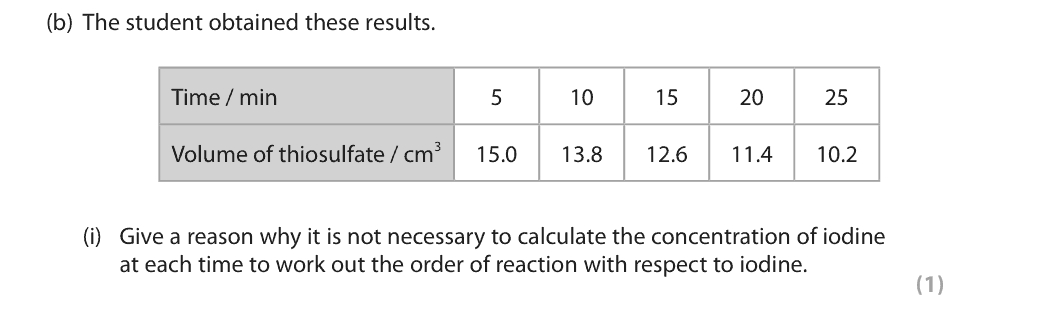
The student obtained these results.
Time / min
5
10
15
20
25
Volume of thiosulfate / cm3
15.0
13.8
12.6
11.4
10.2
Give a reason why it is not necessary to calculate the concentration of iodine
at each time to work out the order of reaction with respect to iodine.
June 2023 · Paper 2 · Q6(b)(ii) 2 marks Diagram or structure kinetics ii
Earlier parts of question 6 that this part usesEarlier part of June 2023 Paper 2 question 6Earlier part of June 2023 Paper 2 question 6
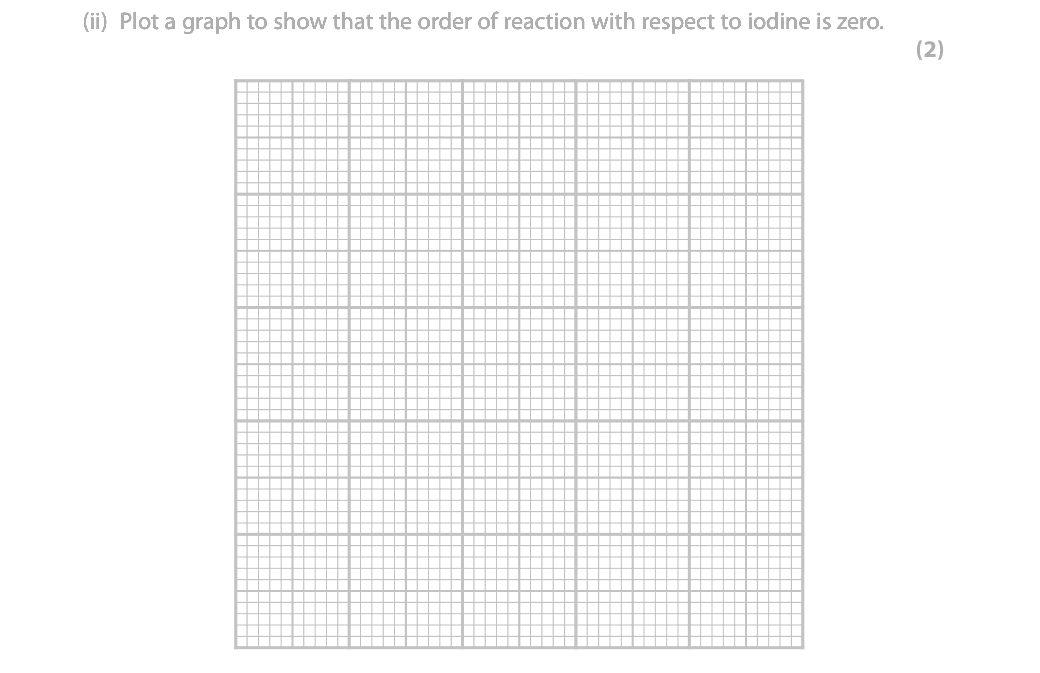
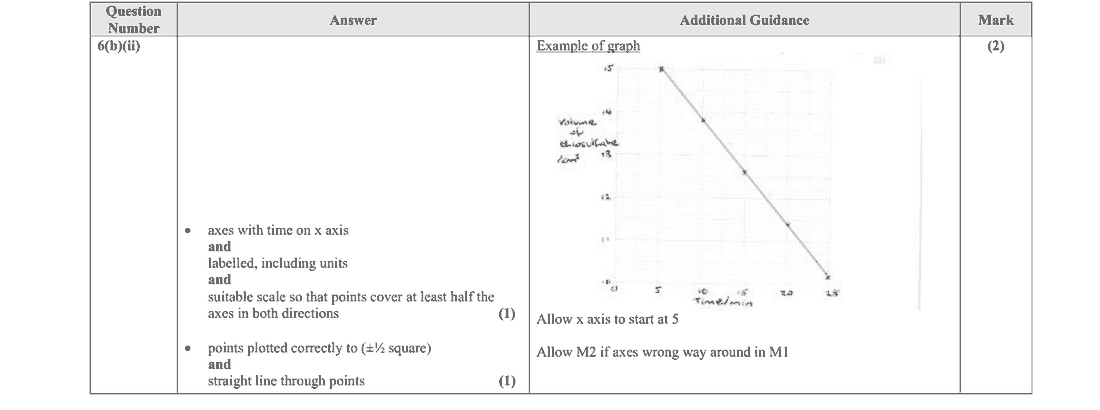
Plot a graph to show that the order of reaction with respect to iodine is zero.
June 2023 · Paper 2 · Q6(b)(iii) 1 mark Short answer kinetics ii
Earlier parts of question 6 that this part usesEarlier part of June 2023 Paper 2 question 6Earlier part of June 2023 Paper 2 question 6Earlier part of June 2023 Paper 2 question 6
Give a reason why the graph shows that the order of reaction with respect to
iodine is zero.
June 2023 · Paper 2 · Q6(c)(i) 2 marks Equation writing kinetics ii
Earlier part of question 6 that this part usesEarlier part of June 2023 Paper 2 question 6
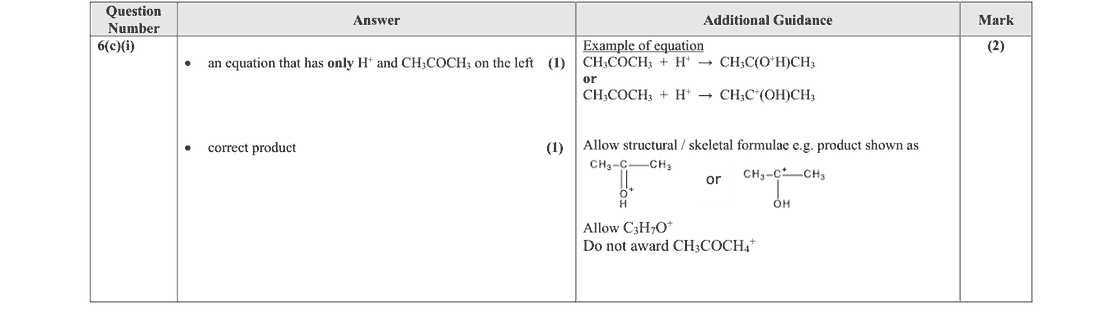
Further experiments showed that the correct overall rate equation is
rate = k[CH3COCH3(aq)][H+(aq)][I2(aq)]0
Deduce a possible rate determining step in the mechanism of this reaction.
Curly arrows are not required.
June 2023 · Paper 2 · Q6(c)(ii) 1 mark Multiple choice kinetics ii
Earlier parts of question 6 that this part usesEarlier part of June 2023 Paper 2 question 6Earlier part of June 2023 Paper 2 question 6
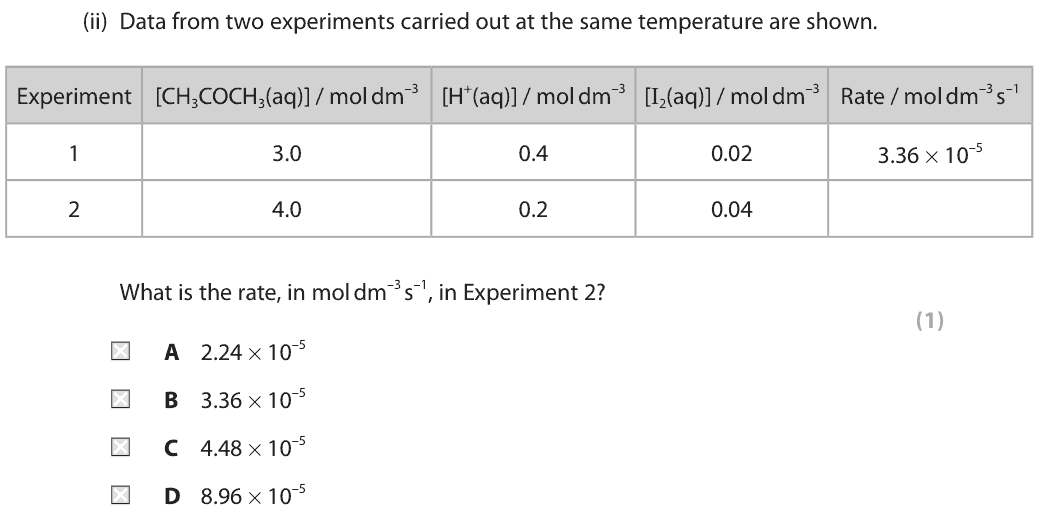
Data from two experiments carried out at the same temperature are shown.
[H+(aq)] / mol dm–3 [I2(aq)] / mol dm–3
Experiment
[CH3COCH3(aq)] / mol dm–3
Rate / mol dm–3 s–1
1
3.0
0.4
0.02
3.36 × 10–5
2
4.0
0.2
0.04
What is the rate, in mol dm–3 s–1, in Experiment 2?
A  2.24 × 10–5
B  3.36 × 10–5
C  4.48 × 10–5
D  8.96 × 10–5
June 2023 · Paper 2 · Q6(c)(iii) 2 marks Explanation kinetics ii
Earlier parts of question 6 that this part usesEarlier part of June 2023 Paper 2 question 6Earlier part of June 2023 Paper 2 question 6Earlier part of June 2023 Paper 2 question 6
The experiment in (a) is repeated but using aqueous bromine instead of
aqueous iodine. All other conditions are kept the same.
Explain how you would expect the rate of reaction of bromination of
propanone to compare with the rate of iodination of propanone.
Assume that the reaction between bromine and propanone in acidic
conditions has the same rate equation as that between iodine and propanone
in acidic conditions.
June 2023 · Paper 2 · Q7(a) 4 marks Explanation carbonyl compoundscarboxylic acids
This question is about carbonyl compounds.
Ethanal, CH3CHO, and ethanoic acid, CH3COOH, are both soluble in water but
ethanoic acid has a much higher boiling temperature than ethanal.
Explain these physical properties of ethanal and ethanoic acid in terms of
intermolecular forces.
Include a labelled diagram to show why ethanal is soluble in water.
June 2023 · Paper 2 · Q7(b)(i) 4 marks Mechanism carbonyl compounds
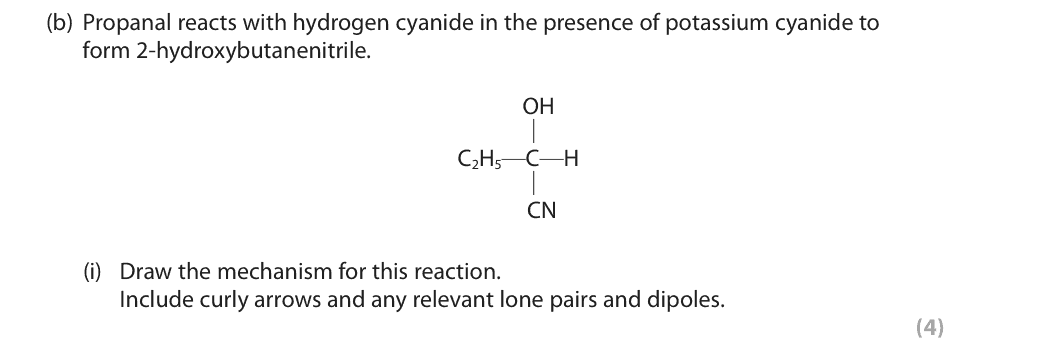
Propanal reacts with hydrogen cyanide in the presence of potassium cyanide to
form 2‑hydroxybutanenitrile.
OH
C2H5
C
H
CN
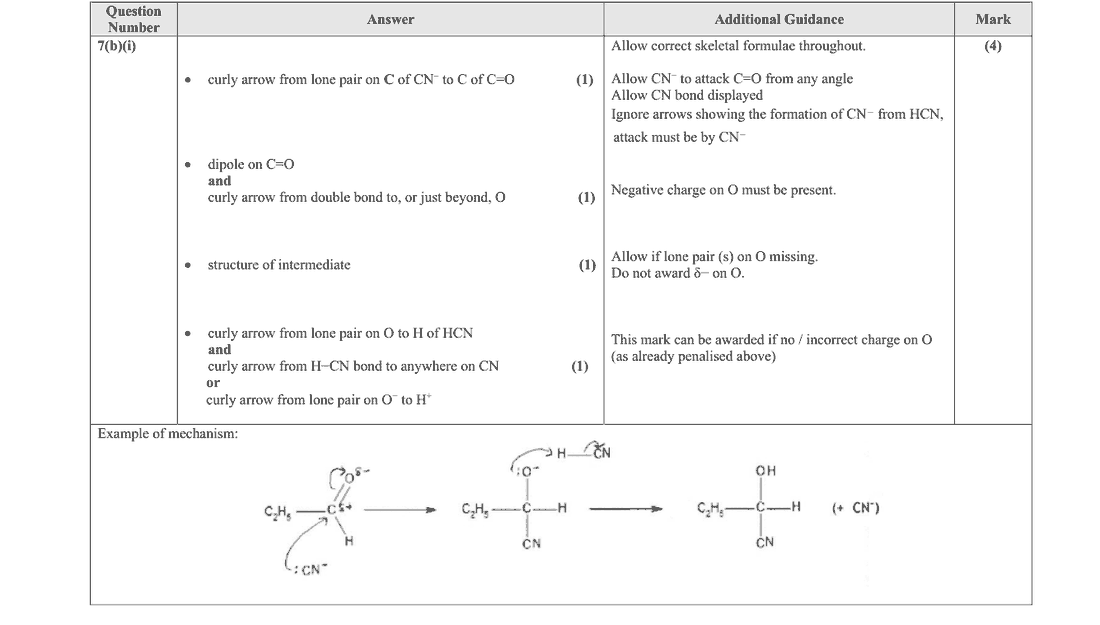
Draw the mechanism for this reaction.
Include curly arrows and any relevant lone pairs and dipoles.
June 2023 · Paper 2 · Q7(b)(ii) 3 marks Explanation carbonyl compoundschirality
Earlier part of question 7 that this part usesEarlier part of June 2023 Paper 2 question 7
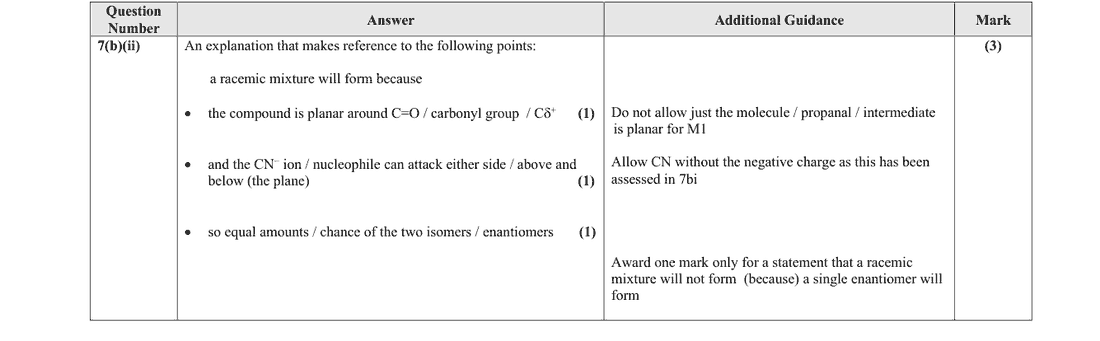
Explain whether or not the 2‑hydroxybutanenitrile formed will be a
racemic mixture.
June 2023 · Paper 2 · Q7(c)(i) 3 marks Practical and data analysis Hard carbonyl compoundsorganic synthesis
Earlier part of question 7 that this part usesEarlier part of June 2023 Paper 2 question 7
Carbonyl compounds can be identified by reacting them with
2,4‑dinitrophenylhydrazine (2,4‑DNPH) to form a solid derivative.
These derivatives have characteristic melting temperatures.
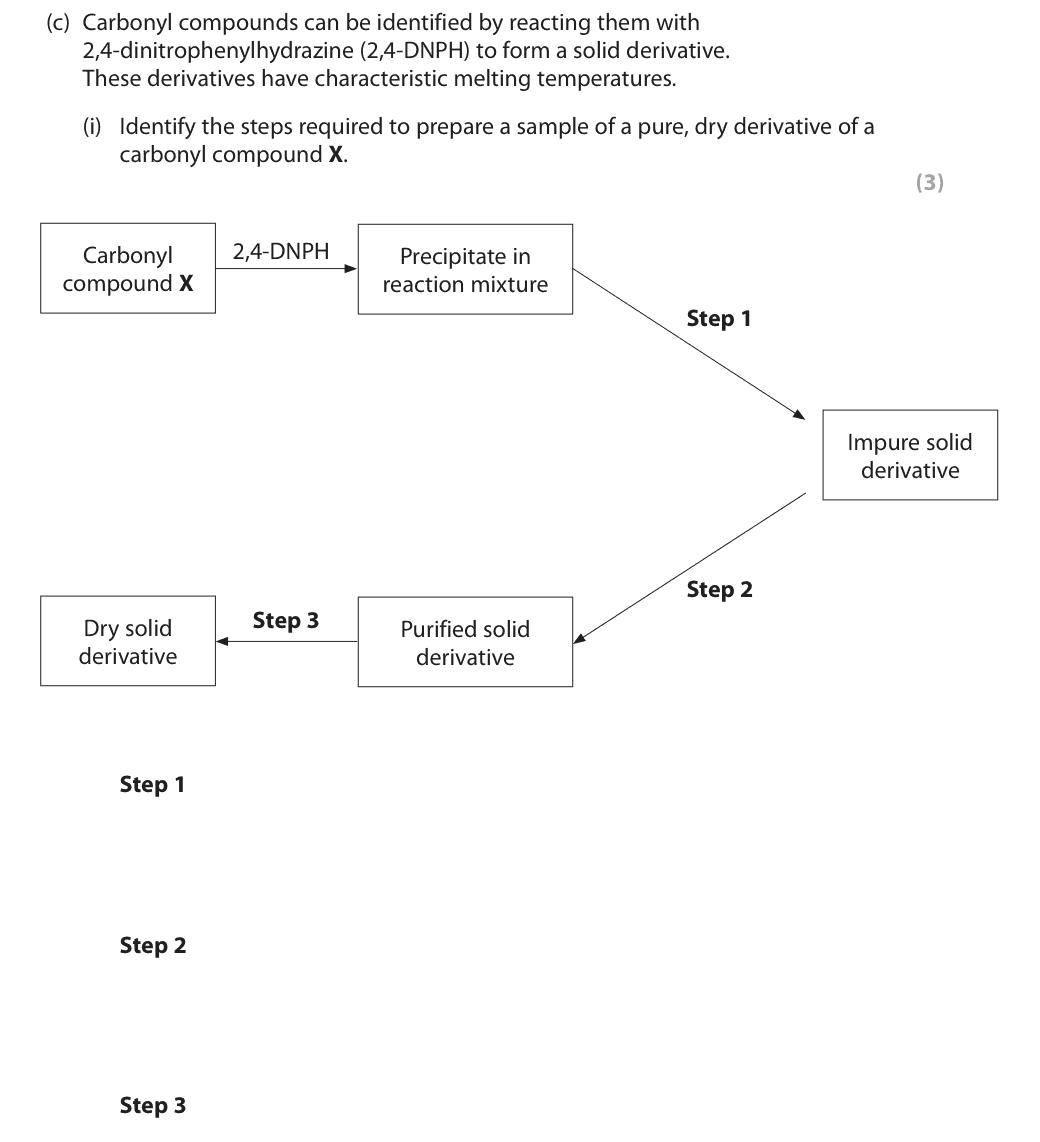
Identify the steps required to prepare a sample of a pure, dry derivative of a
carbonyl compound X.
2,4‑DNPH
Carbonyl
Precipitate in
compound X
reaction mixture
Step 1
Impure solid
derivative
Step 2
Step 3
Dry solid
Purified solid
derivative
derivative
Step 1
Step 2
Step 3
June 2023 · Paper 2 · Q7(c)(ii) 2 marks Short answer carbonyl compoundsmass spectrometry and infrared spectroscopy
Earlier parts of question 7 that this part usesEarlier part of June 2023 Paper 2 question 7Earlier part of June 2023 Paper 2 question 7
The melting temperature ranges of the derivatives of some carbonyl
compounds that could be X are shown in the table.
Carbonyl compound
Melting temperature range of derivative / °C
ethanal
165 – 168
propanal
154 – 156
propanone
127 – 129
cyclohexanone
158 – 160
The melting temperature of the derivative of carbonyl compound X is
156–158 °C and X has an absorption at 1717 cm–1 in its infrared spectrum.
Deduce the identity of X. Justify your answer.
June 2023 · Paper 2 · Q7(c)(iii) 2 marks Short answer nmr mass spectrometry and chromatography
Earlier parts of question 7 that this part usesEarlier part of June 2023 Paper 2 question 7Earlier part of June 2023 Paper 2 question 7
These carbonyl compounds may also be identified using modern methods
such as proton NMR spectroscopy.
The structure of the pentan‑3‑one derivative formed with 2,4‑DNPH is shown.
CH2
CH3

H
NO2
N
C
O2N
N
CH2
CH3
H
H
H
Label the different proton environments that would give rise to the peaks in
the low resolution proton NMR spectrum.
June 2023 · Paper 2 · Q8(a) 1 mark Multiple choice introduction to organic chemistry
This question is about isomerism in organic compounds.
How many structural isomers are there with the formula C5H12?
A  2
B  3
C  4
D  5
June 2023 · Paper 2 · Q8(b) 3 marks Mechanism alkenes
Propene reacts with bromine to form 1,2‑dibromopropane as the only product.
Draw the mechanism for the reaction between propene and bromine.
Include curly arrows and any relevant lone pairs and dipoles.
June 2023 · Paper 2 · Q8(c)(i) 2 marks Explanation alkenes
Earlier parts of question 8 that this part usesEarlier part of June 2023 Paper 2 question 8Earlier part of June 2023 Paper 2 question 8
When propene reacts with a mixture of bromine and sodium chloride, it forms
1,2‑dibromopropane, 1‑bromo‑2‑chloropropane and 2‑bromo‑1‑chloropropane
but no 1,2‑dichloropropane.
Explain, by reference to your mechanism in (b), why no
1,2‑dichloropropane forms.
June 2023 · Paper 2 · Q8(c)(ii) 2 marks Explanation alkenes
Earlier part of question 8 that this part usesEarlier part of June 2023 Paper 2 question 8
Explain why far more 1‑bromo‑2‑chloropropane forms than
2‑bromo‑1‑chloropropane.
June 2023 · Paper 2 · Q8(d) 6 marks 6-mark extended response introduction to organic chemistrychirality
Earlier part of question 8 that this part usesEarlier part of June 2023 Paper 2 question 8
Discuss the different types of stereoisomerism that occur in organic compounds.
Use only molecules A and B as examples.
CHCl
C(CH3)Br
CH3CH(OH)COOH
A                                         B
Include in your answer:
•
how the different types of isomerism arise
•
the naming of alkenes with the formula A
•
the properties of isomers with the formula B
•
diagrams of the different isomers.
June 2023 · Paper 2 · Q9(a) 5 marks Short answer organic synthesis
This question is about the analysis of some organic compounds.
A compound A (C3H7Cl) reacts with dilute aqueous sodium hydroxide to
produce B (C3H8O). B can be oxidised to C (C3H6O), which cannot be oxidised
any further.
A reacts with magnesium in dry ether to give D (C3H7MgCl). When carbon dioxide
is passed through the solution of D, followed by acidification, E (C4H8O2) is formed.
Identify the structures of A to E.
June 2023 · Paper 2 · Q9(b) 5 marks Calculation formulae equations and amounts of substance
An organic compound, Q, contains carbon, hydrogen and nitrogen only.
When a 1.19 g sample of the compound was heated with sodium hydroxide
solution, all of the nitrogen was converted into ammonia. The ammonia was
passed into 100.0 cm3 of 0.225 mol dm–3 hydrochloric acid.
NH3(g)   +   HCl(aq)   →   NH4Cl(aq)
25.0 cm3 portions of the resulting solution containing unreacted hydrochloric acid
required a mean titre of 15.5 cm3 of 0.100 mol dm–3 sodium hydroxide
for neutralisation.
Calculate the percentage of nitrogen in Q.

Work with an A-level chemistry tutor

Want a paper marked and gone through with you? Message us.

Prefer email? Send an enquiry

If you are under 18, please include a parent's contact details. Enquiries go to enquiries@chemistryaleveltutor.com and are deleted once handled. All tutoring is online.