Answer
B
Mark scheme

Notes from the mark scheme and report
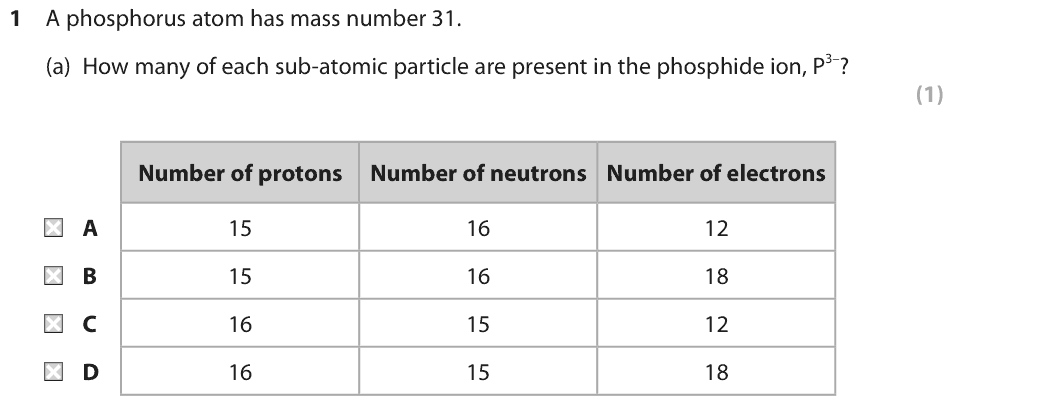
- Answer: B. 15 protons, 31 – 15 = 16 neutrons, and 15 + 3 = 18 electrons in the 3– ion. A has lost three electrons instead of gaining them
- C and D swap the protons and neutrons
90 marks · 42 question parts · Paper, mark scheme and report on Edexcel's site · Have the Data Booklet beside you
B
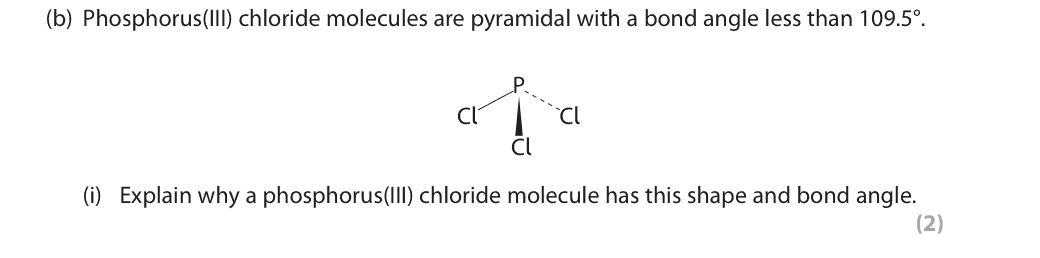
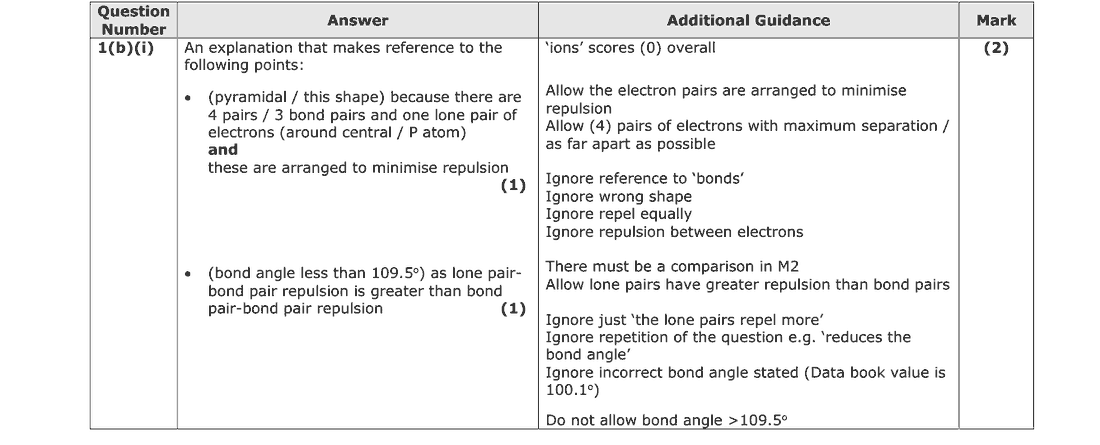
It was disappointing to see many poor answers to this question on a fundamental AS topic. Too many candidates discussed repulsion between electrons, bonds or atoms and some even thought that phosphorus(III) chloride is ionic. Few candidates explained that the shape was due to minimising repulsion or maximum separation between electron pairs, although some confused these terms and wrote about maximising repulsion. However, more candidates scored the second point as they did realise that lone pairs of electrons repel more than bonding pairs.
Skills: MS4.1 Appreciate angles and shapes in regular 2D and 3D structures.
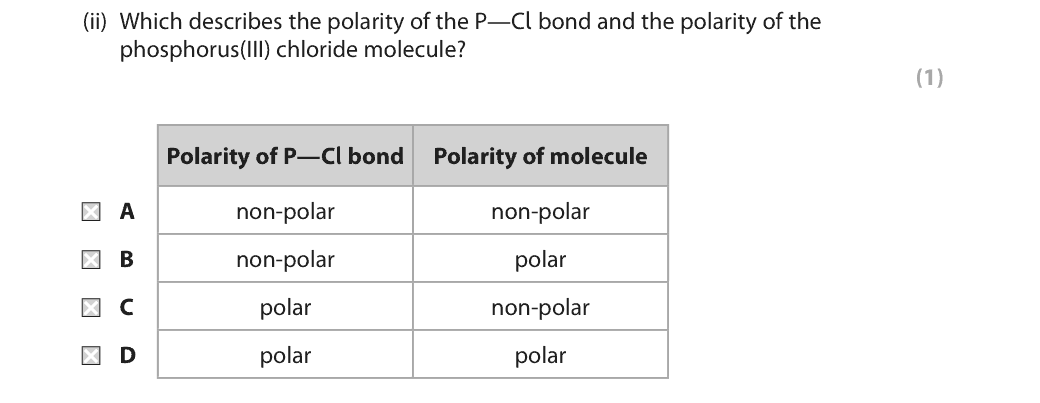
D

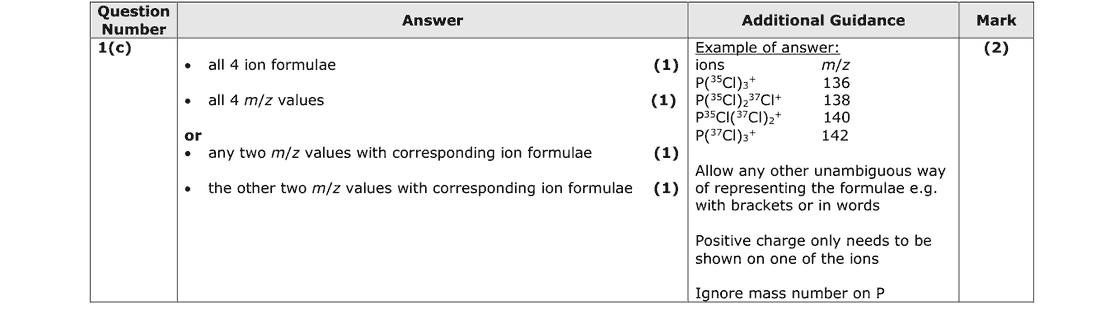
There were many clear answers to this question and it was acceptable to represent the different combinations of chlorine isotopes in many different ways. A number of candidates only identified two ions formed, one with all 35Cl atoms and the other with all 37Cl atoms. Unfortunately, some candidates ignored the word 'ion' in the question so they showed neutral molecules and lost a mark. Some candidates seemed unfamiliar with the term 'molecular ion' so they just gave the different isotopes of chlorine and omitted phosphorus. Other fragments were seen, such as PCl+ and PCl2 +.
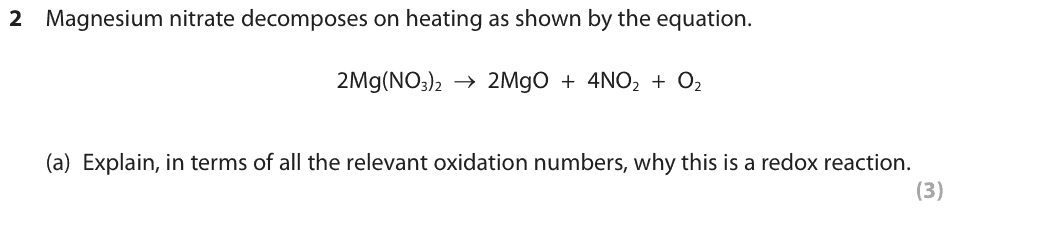
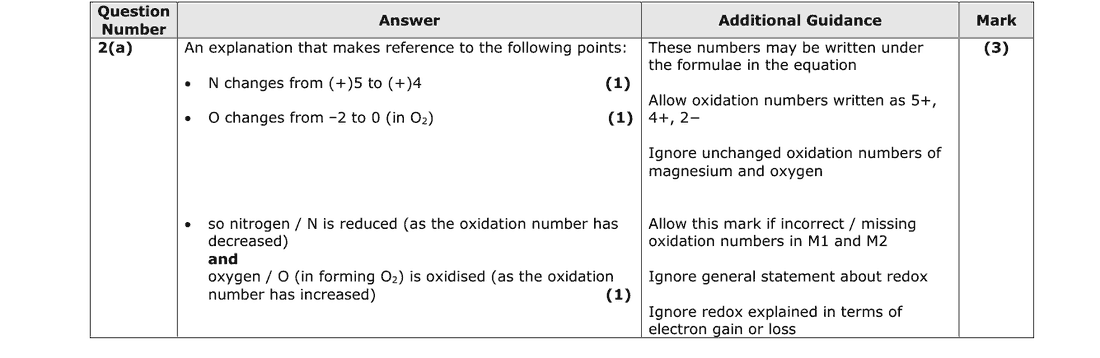
The majority of candidates demonstrated excellent understanding of redox in this question. Some candidates would benefit from more practice at determining oxidation numbers of an element in different species as +6 was a common incorrect oxidation number for nitrogen in magnesium nitrate and a few candidates gave the total of the oxidation numbers of the three oxygens in magnesium nitrate as -6 instead of the individual oxidation number. Some candidates gave the correct oxidation numbers but forgot to state which was oxidised and which was reduced while a very small minority thought that the oxidation number of magnesium was changing. Reference to 'charge' was accepted on this occasion, but candidates should be made aware that the elements do not have this charge and it would be better in future to refer to oxidation numbers. References to gain and loss of electrons were frequently seen and these were ignored as they were irrelevant to this question.

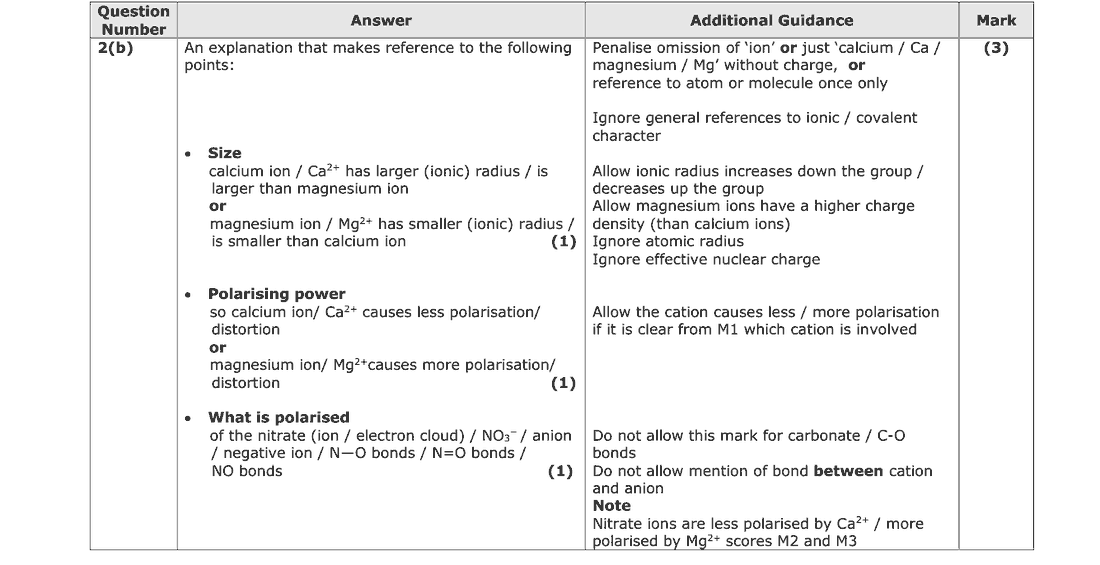
There were many excellent answers to this question, showing that the majority of candidates had clear knowledge and understanding of the thermal decomposition of Group 2 nitrates. Common errors included incorrect terminology - referring to calcium atoms instead of ions or calcium nitrate molecules and confusion about which ion does the polarising. Some candidates wrote about the bond between the cation and anion being polarised, which is incorrect; it is the N-O bonds in the nitrate ion that are polarised and weakened. Some candidates stated that calcium has a larger ionic radius but then negated this mark by stating it also has a higher charge density. A small number of candidates confused their answer with ionisation energy as they discussed shielding while others discussed intermolecular forces as they confused ease of thermal decomposition with difference in melting points.
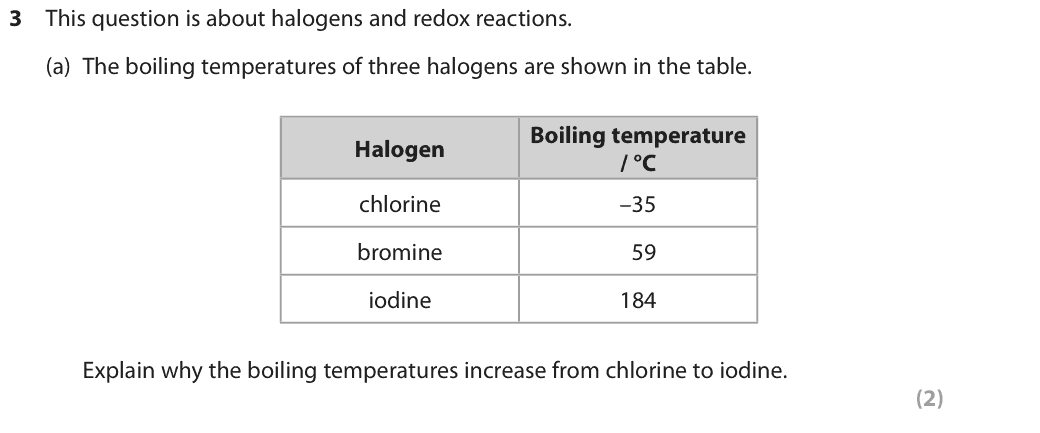
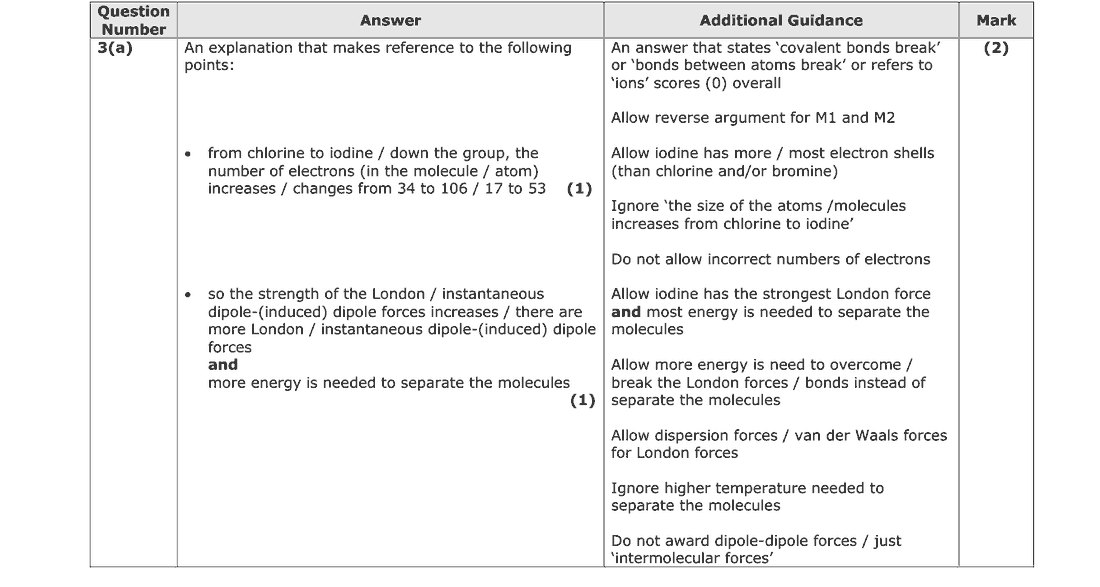
There were many excellent answers to this question as the majority of candidates were aware of the link between the increasing number of electrons and the strength of the London forces. A small number of candidates did not relate the strength of the London forces to the energy needed to overcome these forces and separate the molecules. A few candidates just referred to intermolecular forces, without specifying the type of force and a few stated or implied that the covalent bonds break.
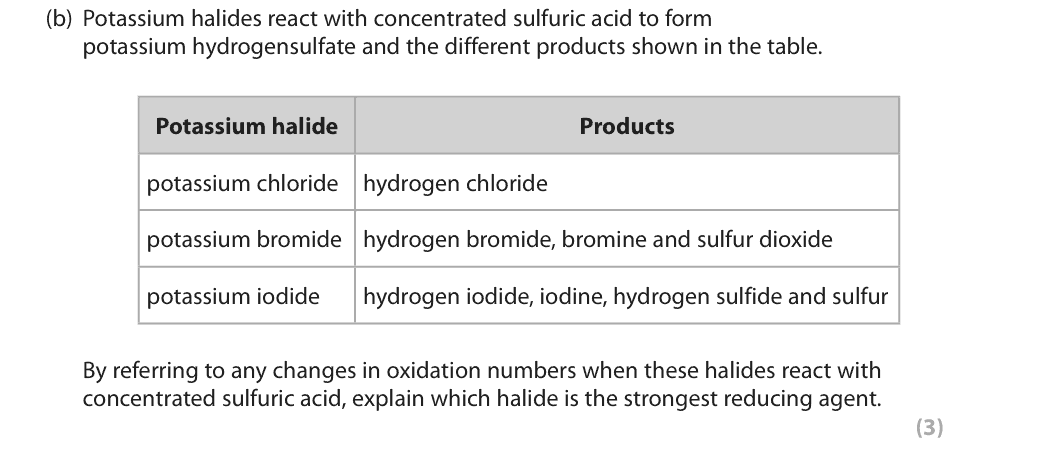
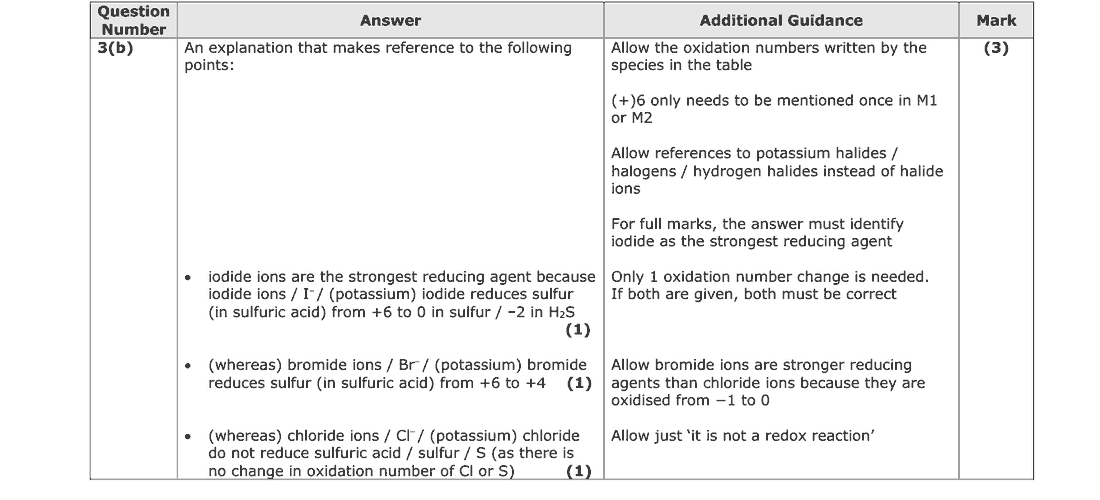
There were many excellent answers to this question. Some candidates did not read the question and did not refer to oxidation numbers: even though they wrote in detail about iodide ions losing electrons they could not score any marks. Some candidates gave an incorrect oxidation number, the most common being +2 for sulfur in hydrogen sulfide, so they lost a mark. A few candidates omitted to state that chloride ions do not reduce sulfur. Candidates are advised to write about all of the substances given in a question.
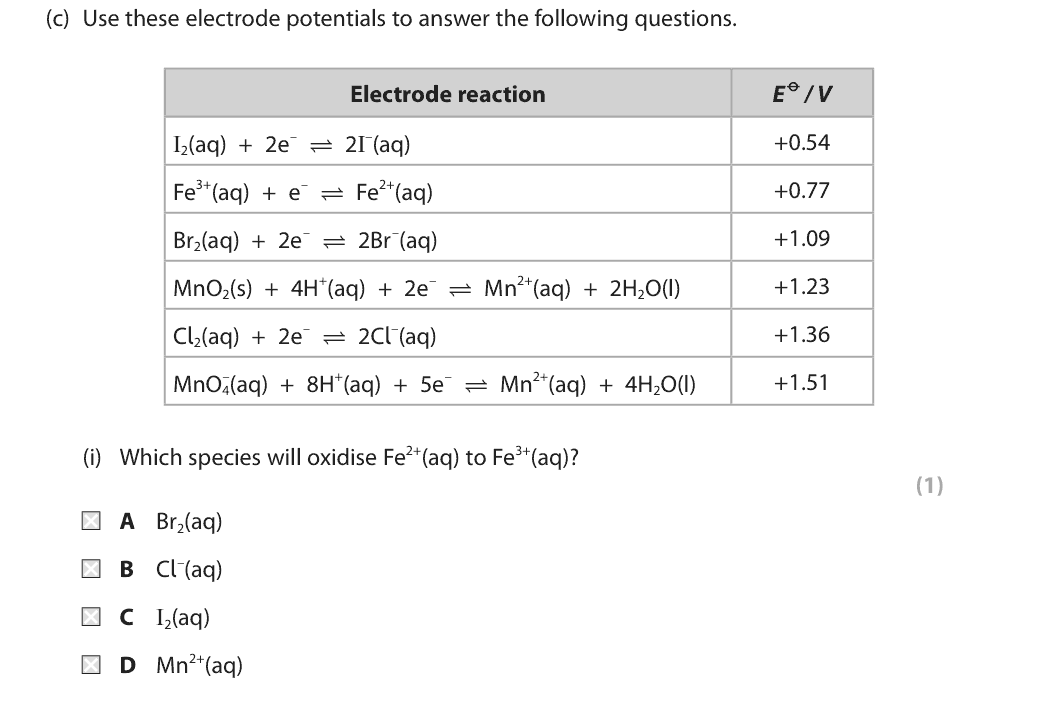
A

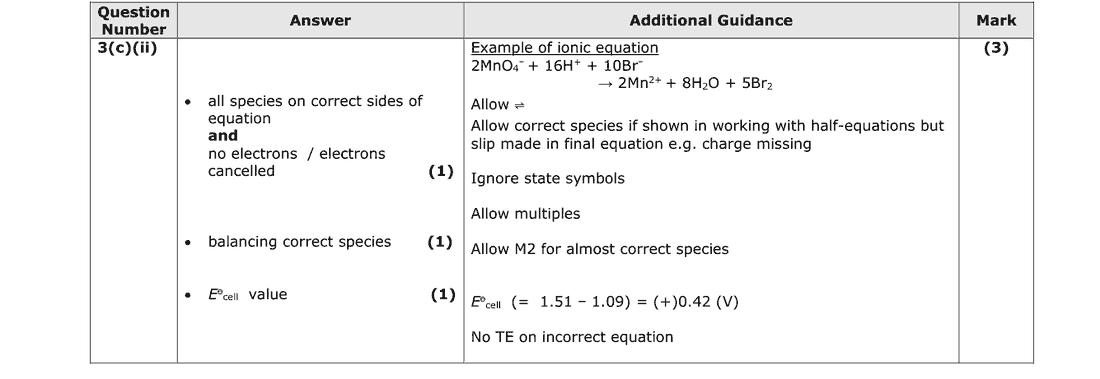
Although many correct answers were seen, many candidates made careless errors in copying the half-equations from the table. Some candidates left uncancelled electrons in their equations, some wrote the equation in the wrong direction while others tried to react manganate(VII) ions with bromine. A few candidates selected the wrong half-equation for manganese. Some candidates were unable to calculate the Eo cell value.
Skills: MS2.3 Substitute numerical values into algebraic equations using appropriate units for physical quantities
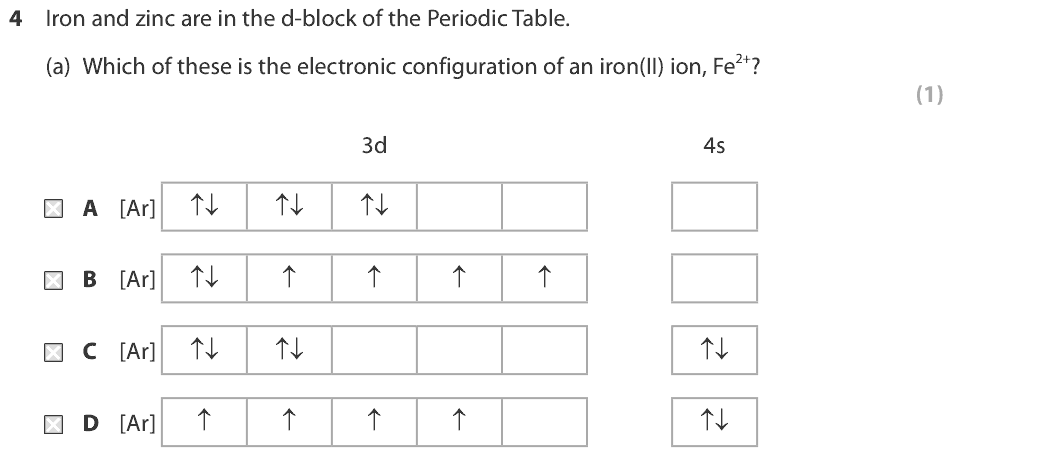
B

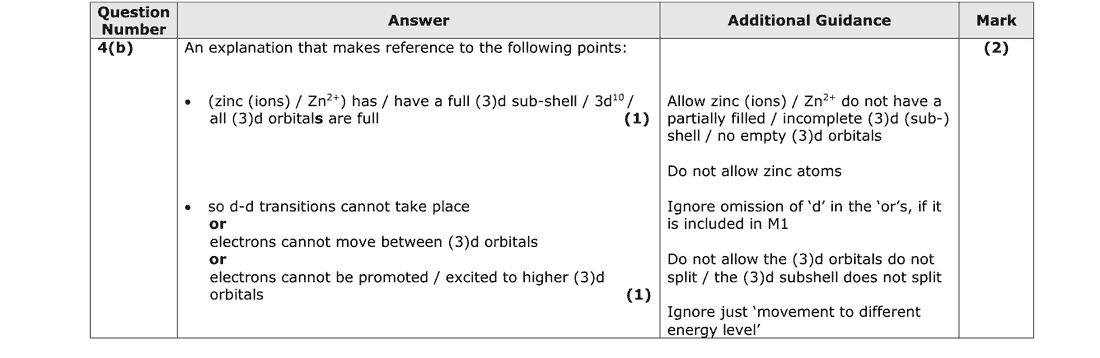
Many candidates did not score marks for this question as their terminology was not clear enough. Stating that zinc ions have a full d orbital is not acceptable for the idea that all the d orbitals are full. Candidates are advised to use the term 'd subshell' to avoid this problem. A common misconception is that when the d orbitals are full, they cannot split in energy. Some candidates wrote that the electrons cannot be excited to a higher energy level and this is not clear enough as energy level usually refers to quantum shell. 'd-d transitions cannot take place' is a useful phrase for candidates to include in an answer like this. A few candidates were confused with a flame test and wrote about emission of light while others thought the electromagnetic radiation transmitted would be outside the visible spectrum.

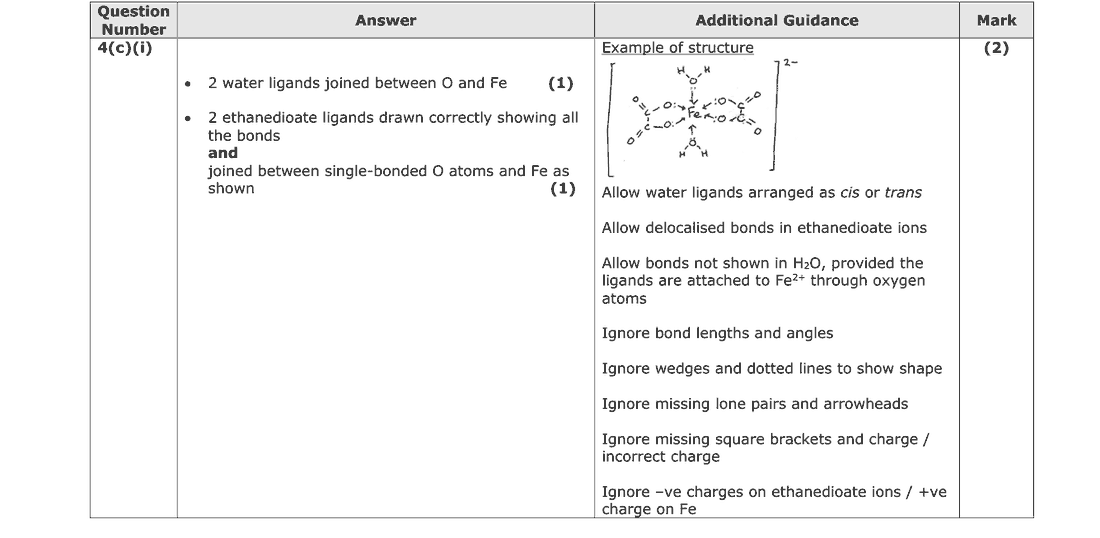
There were many clear diagrams that scored both marks. Some candidates ignored the instruction to show all of the bonds. We did allow the bonds in the water ligands not to be shown, provided they were attached to the Fe2+ ions through the oxygen atoms. Some candidates were unable to work out that ethanedioate ions are formed from ethanedioic acid and are bidentate ligands.
Skills: MS4.2 Visualise and represent 2D and 3D forms including two- dimensional representations of 3D objects

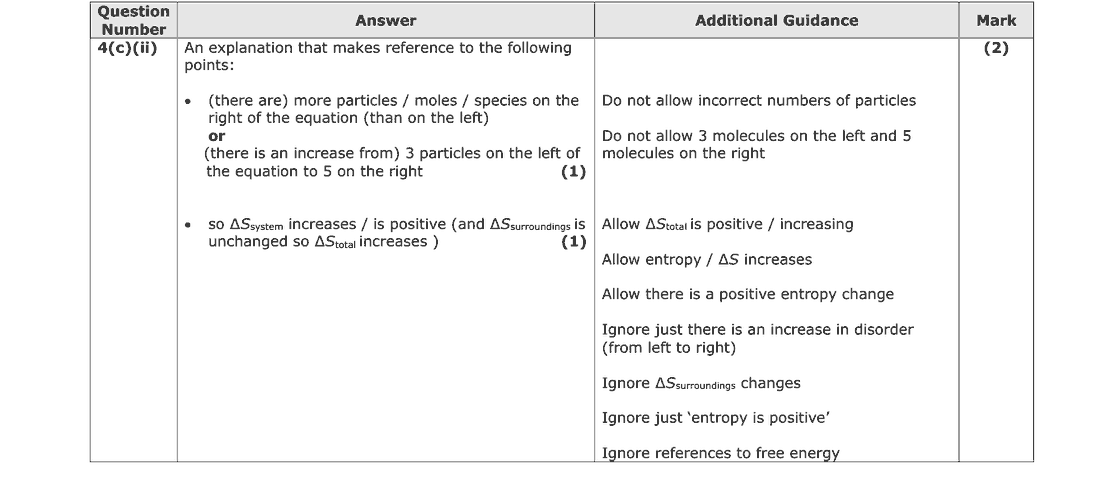
This question was answered well by the majority of candidates: they correctly identified the increased number of particles on the right-hand side so there would be an increase in entropy. Some candidates used incorrect terminology and referred to the particles as molecules while others wrote about disorder but did not mention entropy. Just stating that 'entropy is positive' was not sufficient for the second mark.
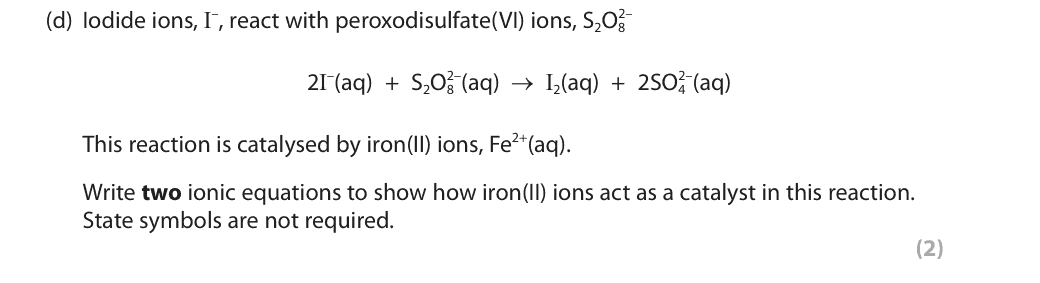
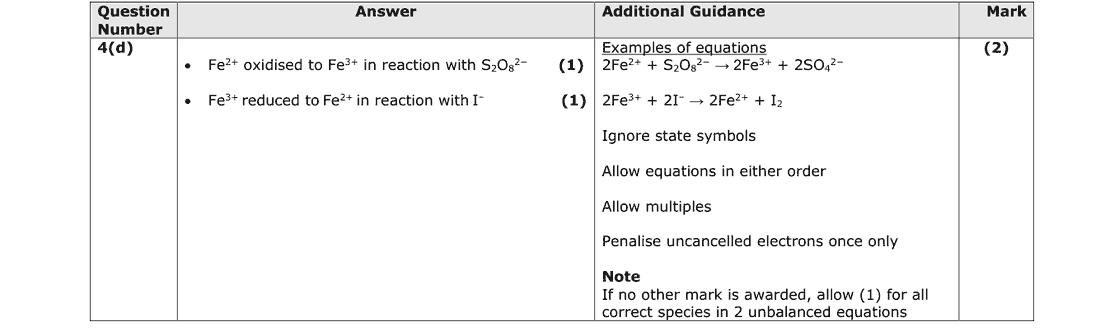
Many correct equations were seen: however, it was clear that a significant minority of candidates did not understand that they should start and end with Fe2+ ions. A common error was not balancing the equations in terms of charges. Some candidates attempted to write equations in which both reactants were oxidised or both were reduced, while others introduced Fe, Fe+ and other complexes involving Fe, S, O and I.
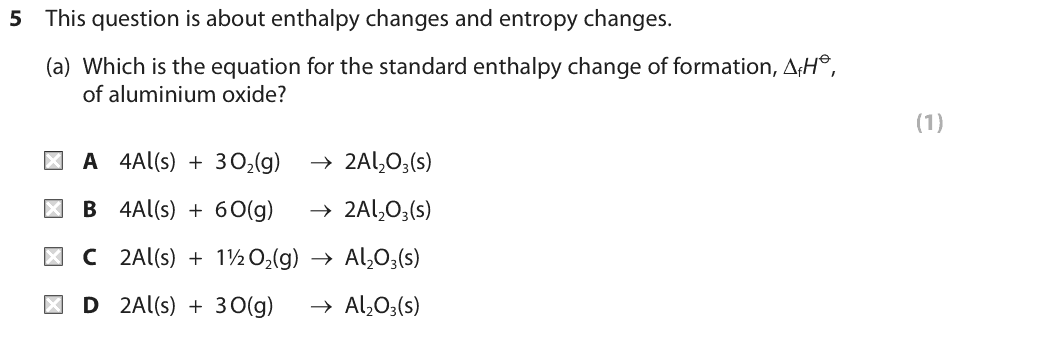
C
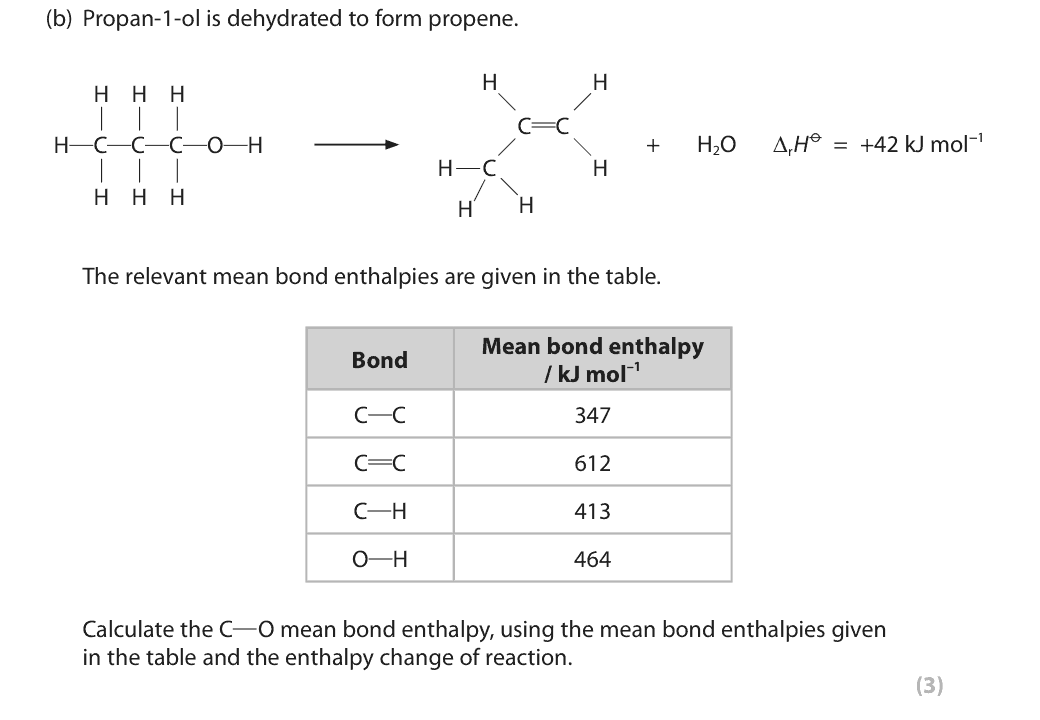
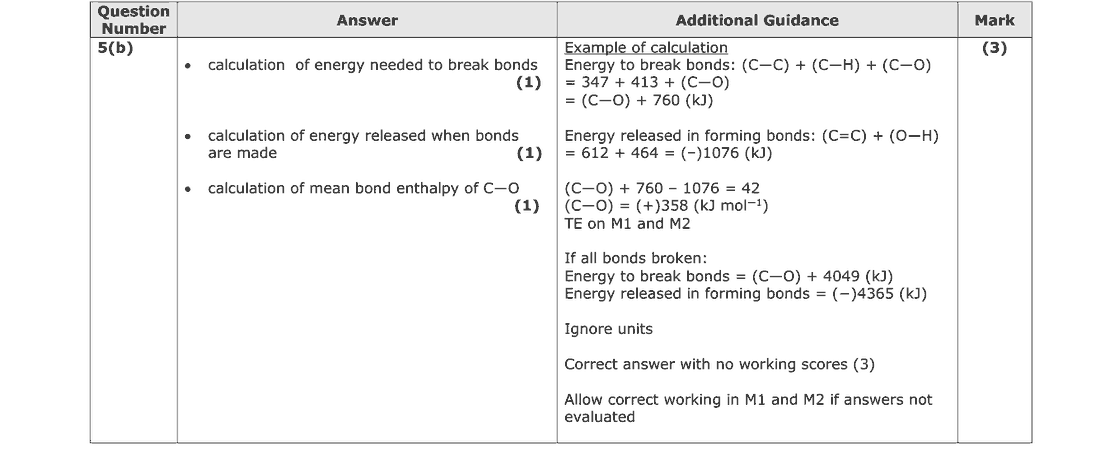
There were many correct answers to this calculation. Almost all candidates attempted to calculate the energy needed to break all bonds and the energy released in forming all bonds, rather than selecting the specific bonds that are broken and made, and as a consequence, many arithmetical errors were seen. Some candidates omitted some of the bonds, particularly the two O-H bonds in water and some of the C-C bonds. Some put the 42 on the wrong side of the equation and some omitted 42 from their calculation. A common incorrect formula used was C-O = 42 - products + reactants. Candidates should show their working clearly and use a few words to explain the working so that examiners can award transferred error marks if they make a mistake.
Skills: MS2.2 Change the subject of an equation; MS2.3 Substitute numerical values into algebraic equations using appropriate units for physical quantities; MS2.4 Solve algebraic equations
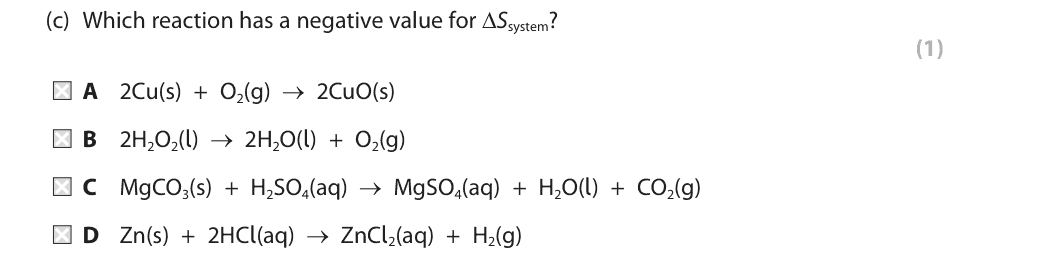
A
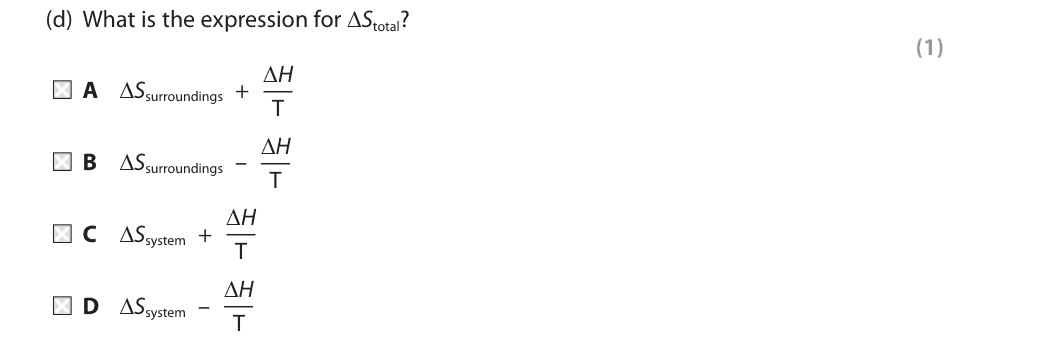
D
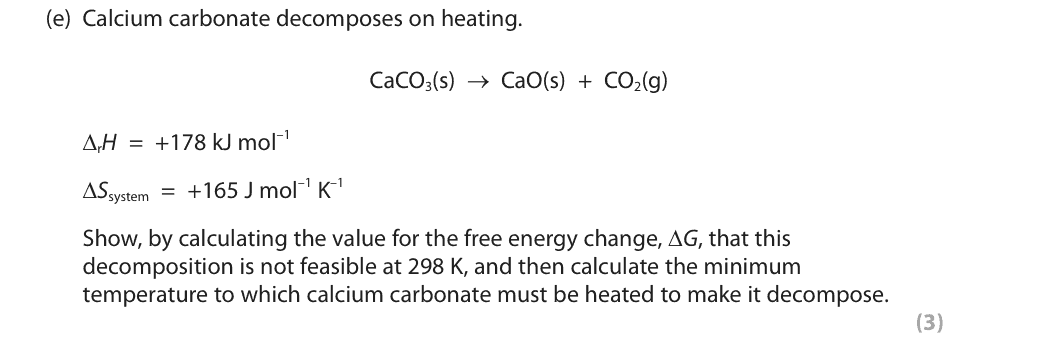
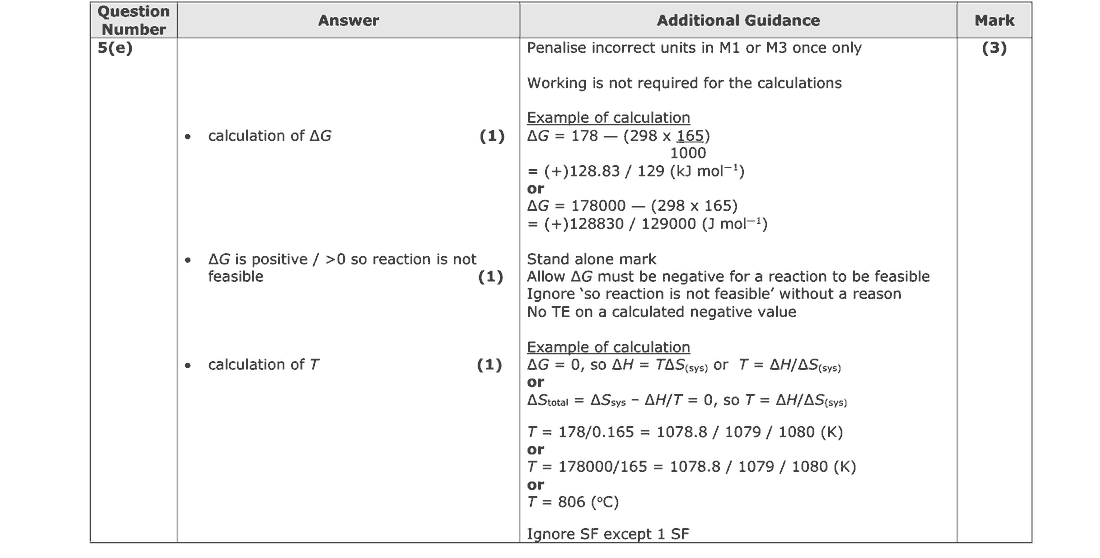
The majority of candidates scored 3 marks for this question. A few candidates did not convert the units of ΔS or ΔH so they were both the same. Some candidates lost a mark as they gave entropy units for ΔG and a few omitted to state why the reaction is not feasible at 298 K. A small number of candidates incorrectly rounded 1078.8 to 1078 K so lost a mark.
Skills: MS0.0 Recognise and make use of appropriate units in calculation; MS2.2 Change the subject of an equation; MS2.3 Substitute numerical values into algebraic equations using appropriate units for physical quantities

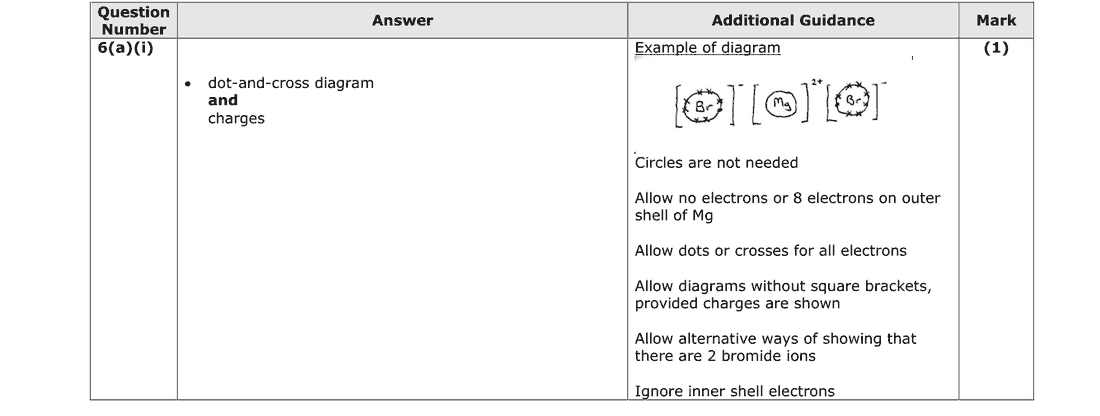
Although many candidates scored a mark for this simple question, it was disappointing that a significant minority showed a covalent molecule, even though they were told it is ionic in the first sentence!

The majority of candidates scored 1 mark for this question. Some candidates just stated molten, or just in aqueous solution, so they did not score the mark as they were asked for all the conditions under which magnesium bromide conducts electricity. A few candidates stated molten and liquid, possibly thinking that these are two different states. A small number of candidates negated the mark by adding 'so delocalised electrons can flow' to their answer.
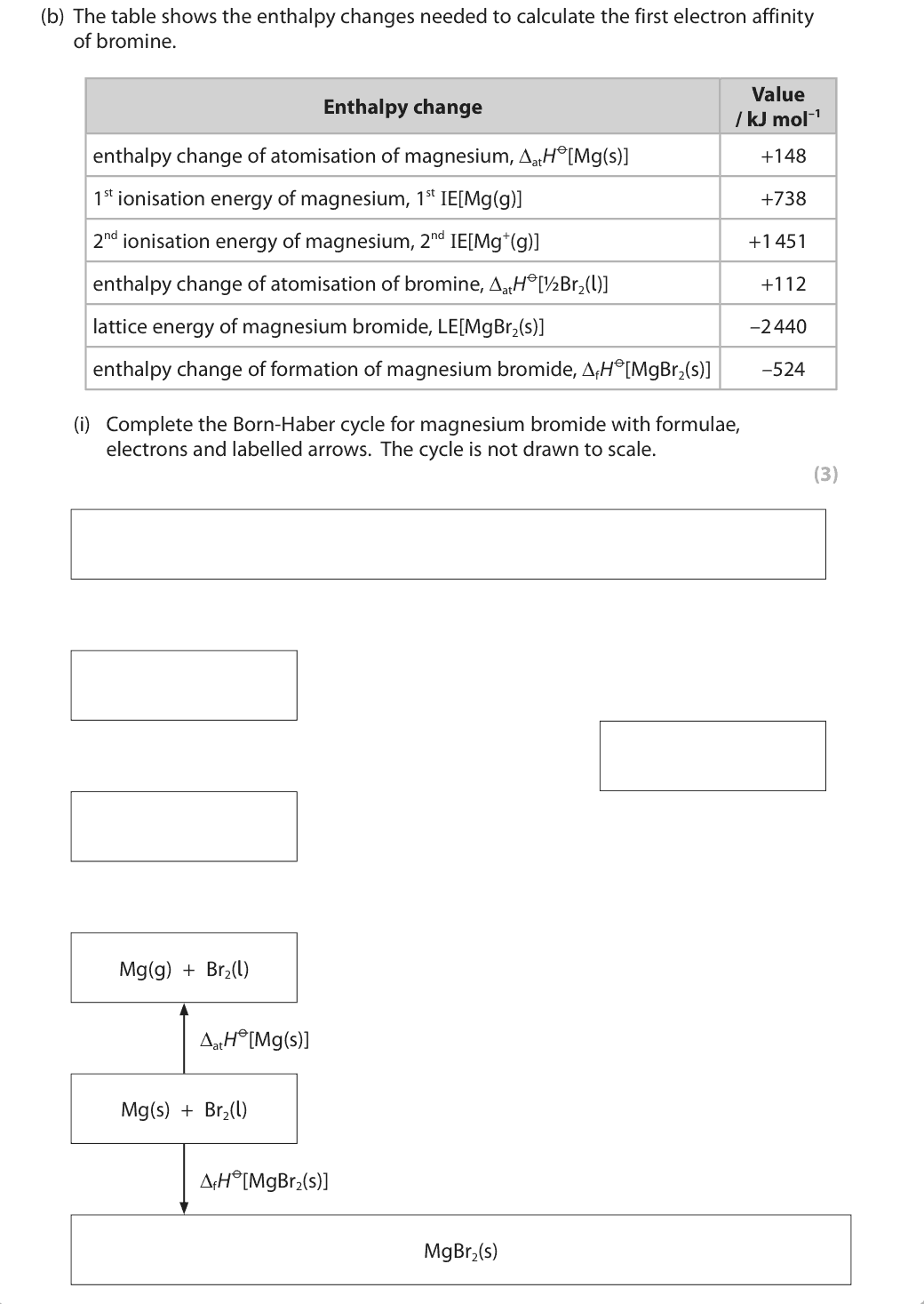
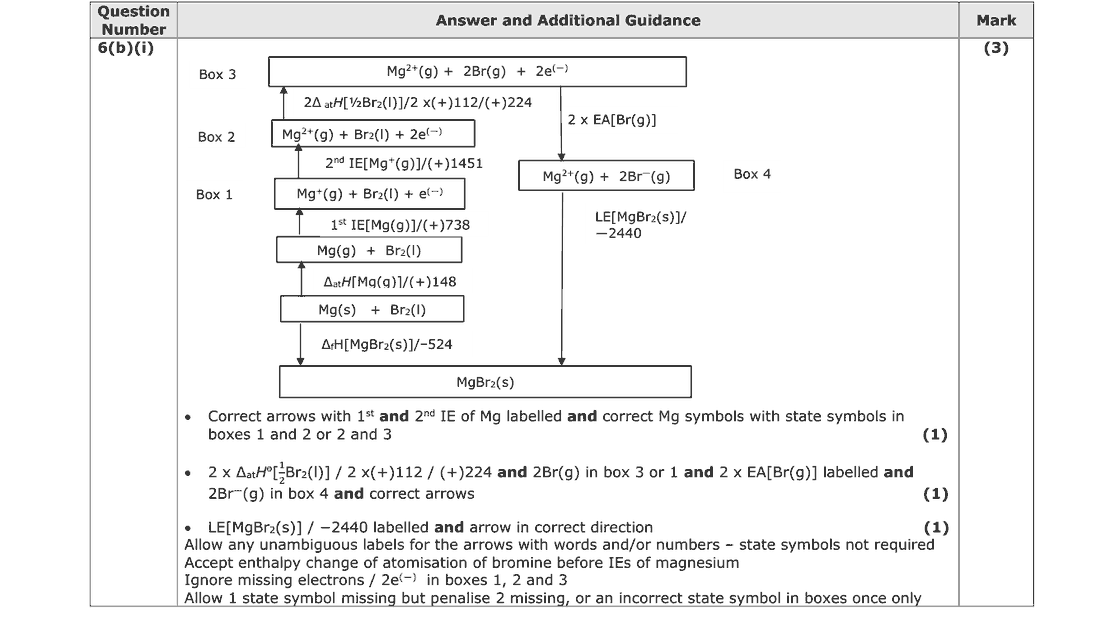
The majority of candidates made a good attempt at completing the Born-Haber cycle. Errors occurred in omitting some state symbols, not showing that the bromine enthalpy changes need to be multiplied by 2 and showing that during atomisation, bromine forms Br2(g). Candidates should give clear labels for the enthalpy changes and not just x for electron affinity. A few candidates seemed unfamiliar with the Born-Haber cycle shown in the question and they wrote the equations for the enthalpy changes in the boxes. It was rare to see the arrows in the wrong directions. Many candidates scored both marks for calculating the first electron affinity of bromine, although many candidates omitted to double one or both of the bromine enthalpy changes, even when they were correct on the cycle.

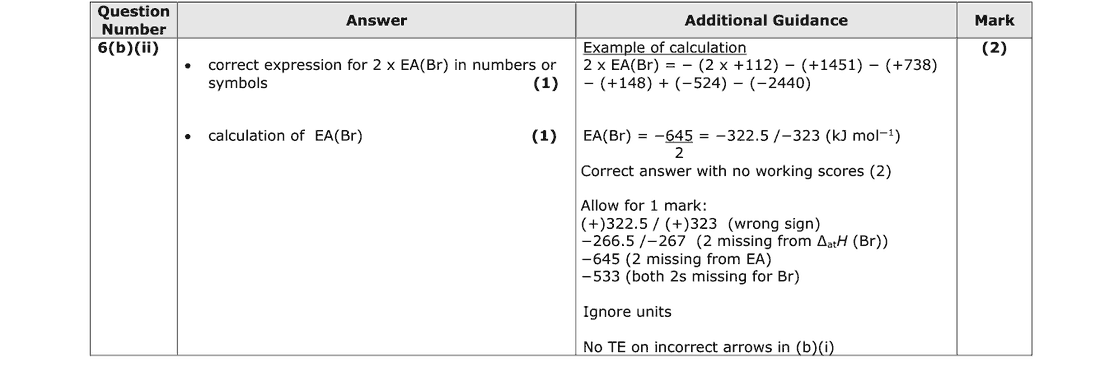
The majority of candidates made a good attempt at completing the Born-Haber cycle. Errors occurred in omitting some state symbols, not showing that the bromine enthalpy changes need to be multiplied by 2 and showing that during atomisation, bromine forms Br2(g). Candidates should give clear labels for the enthalpy changes and not just x for electron affinity. A few candidates seemed unfamiliar with the Born-Haber cycle shown in the question and they wrote the equations for the enthalpy changes in the boxes. It was rare to see the arrows in the wrong directions. Many candidates scored both marks for calculating the first electron affinity of bromine, although many candidates omitted to double one or both of the bromine enthalpy changes, even when they were correct on the cycle.
Skills: MS2.2 Change the subject of an equation; MS2.4 Solve algebraic equations

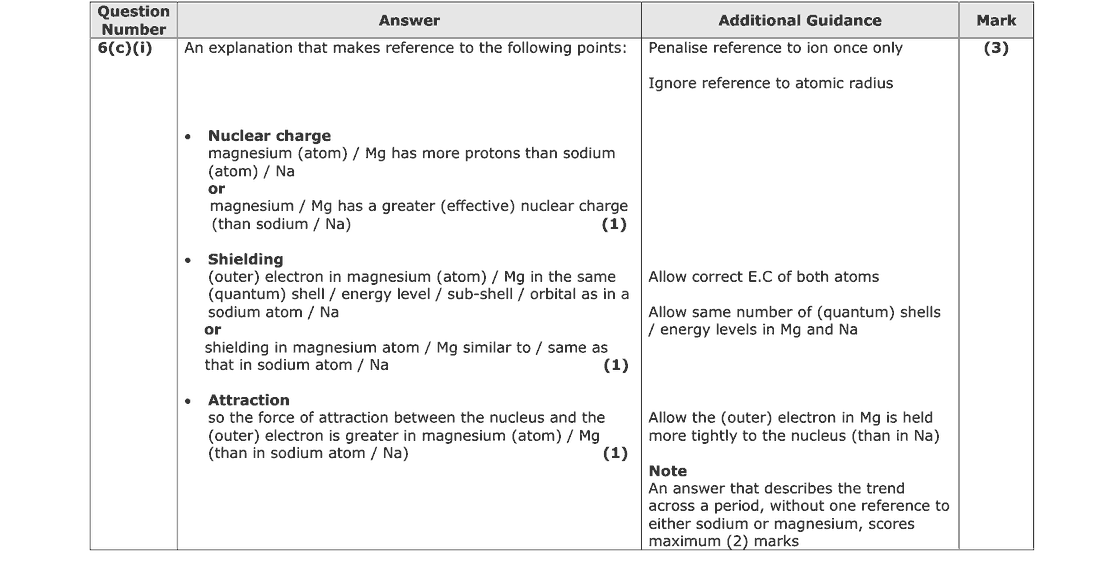
Many candidates scored 3 marks for this question and gave clear explanations about the difference in ionisation energy. Some candidates wrote about the increase in nuclear charge and greater force of attraction between the nucleus and the outer electron but they often omitted to mention that the shielding will be very similar. A significant minority of candidates were confused and wrote about sodium and magnesium ions, thinking that the nuclear charge would be +1 or +2, or they wrote about charge density without understanding what it means. Candidates could save time and space by not repeating the question in their answer.

The majority of candidates could write a correct equation to show the third ionisation energy of magnesium. Some lost a mark as they did not include state symbols or showed the incorrect symbols (aq) or (s), while others thought that a magnesium atom would lose three electrons. Some candidates tried to show electron bombardment to produce the Mg3+ ion but that is not acceptable in an equation to represent an ionisation energy. A few candidates wrote the electron on the wrong side of the equation.
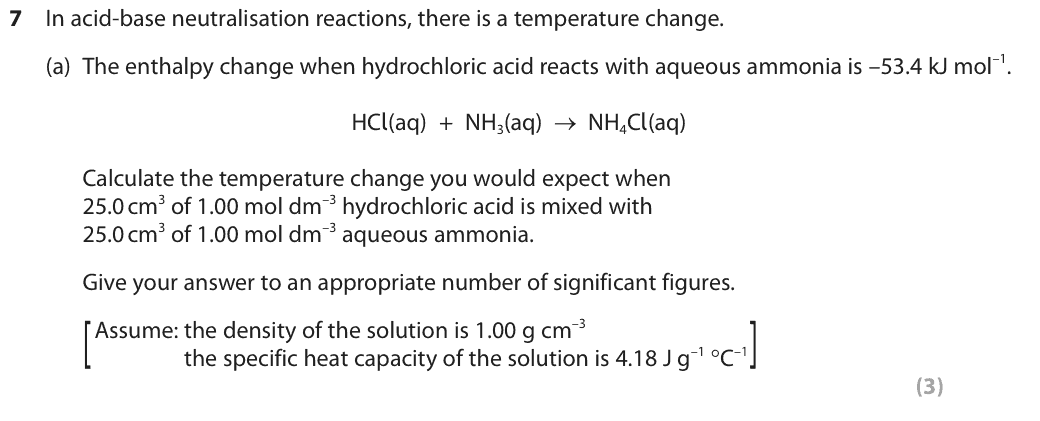
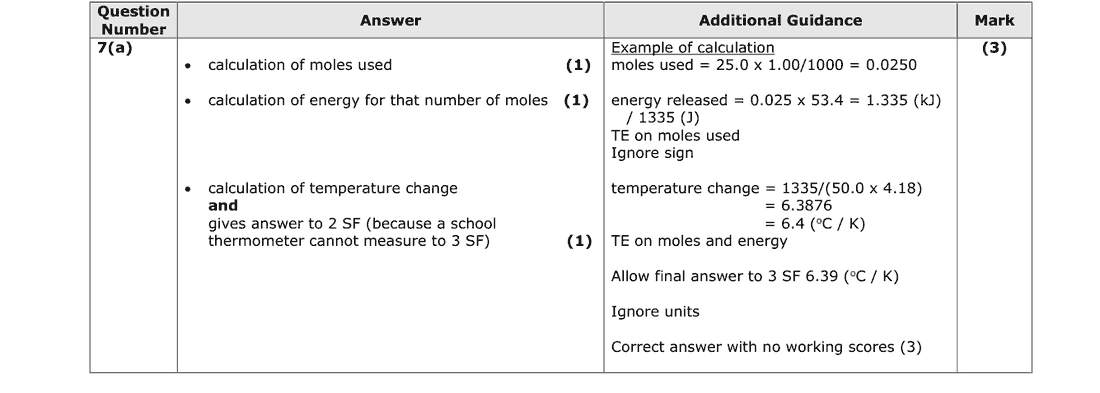
Many candidates scored 3 marks for this calculation. They should have given their final answer to 2 significant figures as school laboratory thermometers cannot measure more accurately than that, however, we did allow 3 significant figures on this occasion. Some candidates added the moles of acid and alkali together so their final answer was twice as large as it should be. Some candidates ignored the number of moles and calculated a temperature change of 256oC. Those candidates should realise that is an unrealistic temperature rise so should go back and check to see where they have made a mistake. Some candidates showed a fall in temperature, even though the reaction is exothermic.
Skills: MS1.1 Use an appropriate number of significant figures; MS2.2 Change the subject of an equation; MS2.3 Substitute numerical values into algebraic equations using appropriate units for physical quantities
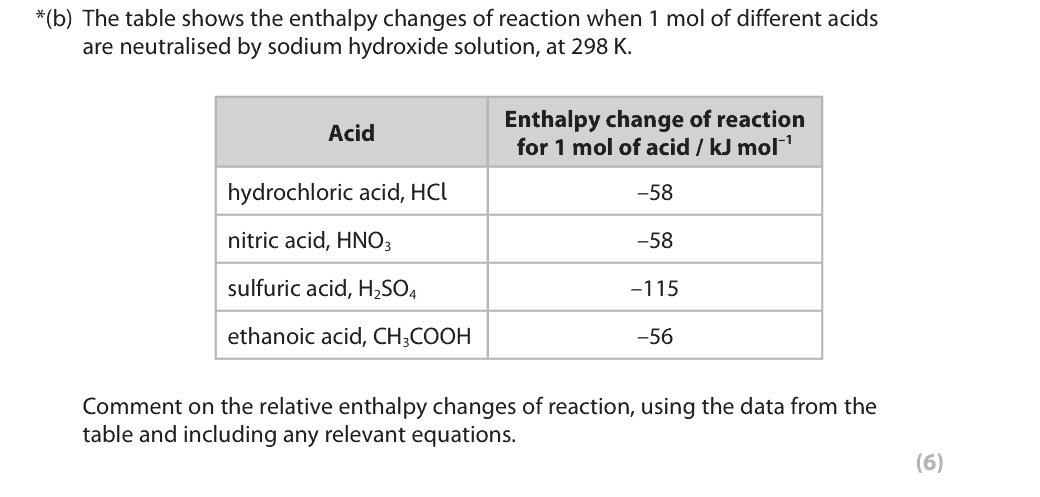
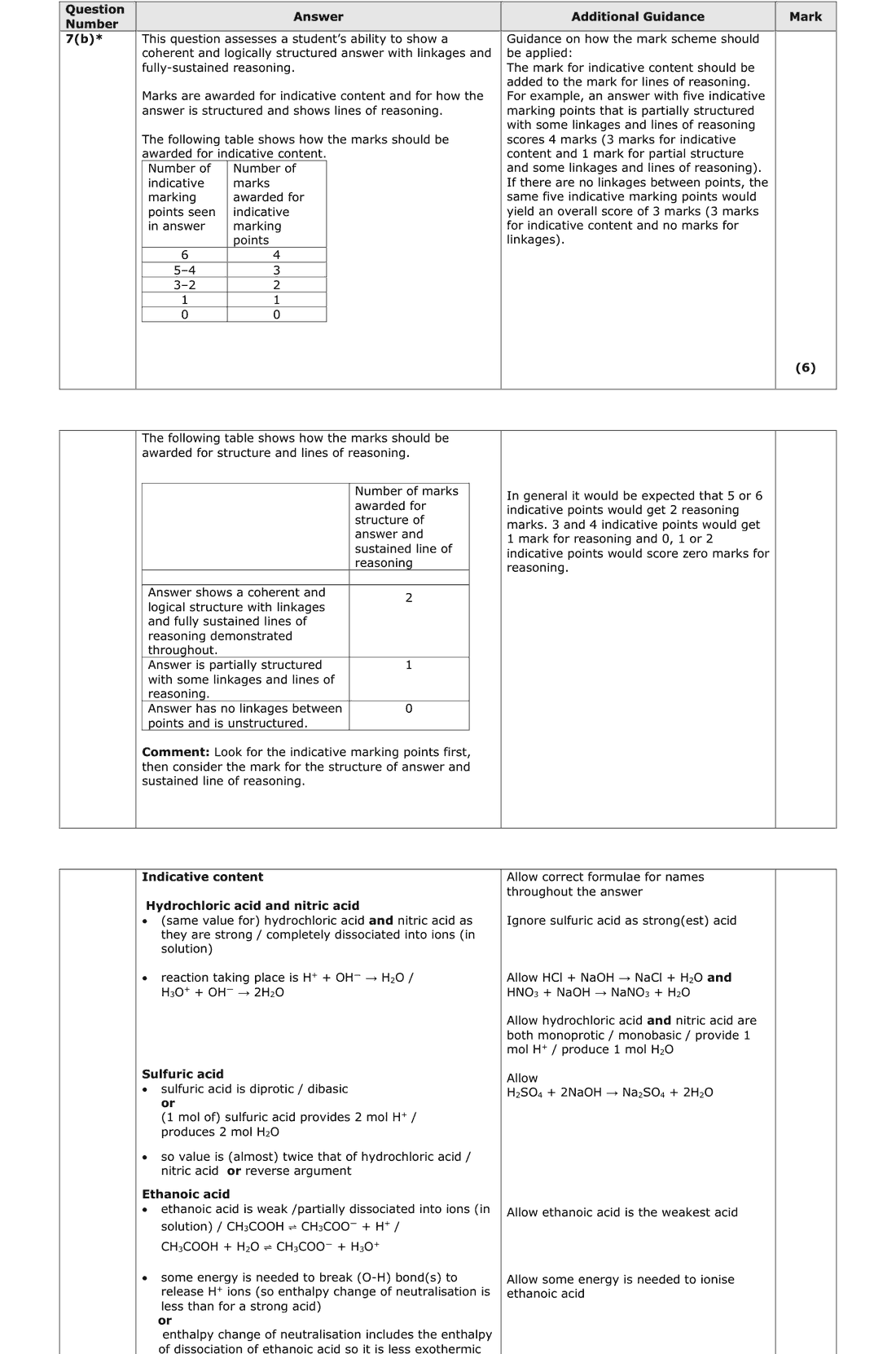
This is the first of the new 6-mark questions at A level that have marks available for the structure of the answer and lines of reasoning. Candidates generally performed very well on this question. There were many answers with full marks. Those scoring 5 marks usually did not state that some energy is needed to dissociate ethanoic acid or they did not include an equation for one of the reactions. Some candidates thought that nitric acid was also a weak acid and that weak acids do not fully dissociate so they do not react with as much sodium hydroxide. A few candidates thought that energy is required for neutralisation and others thought that ethanoic acid is the strongest acid as -56 is greater than -115.
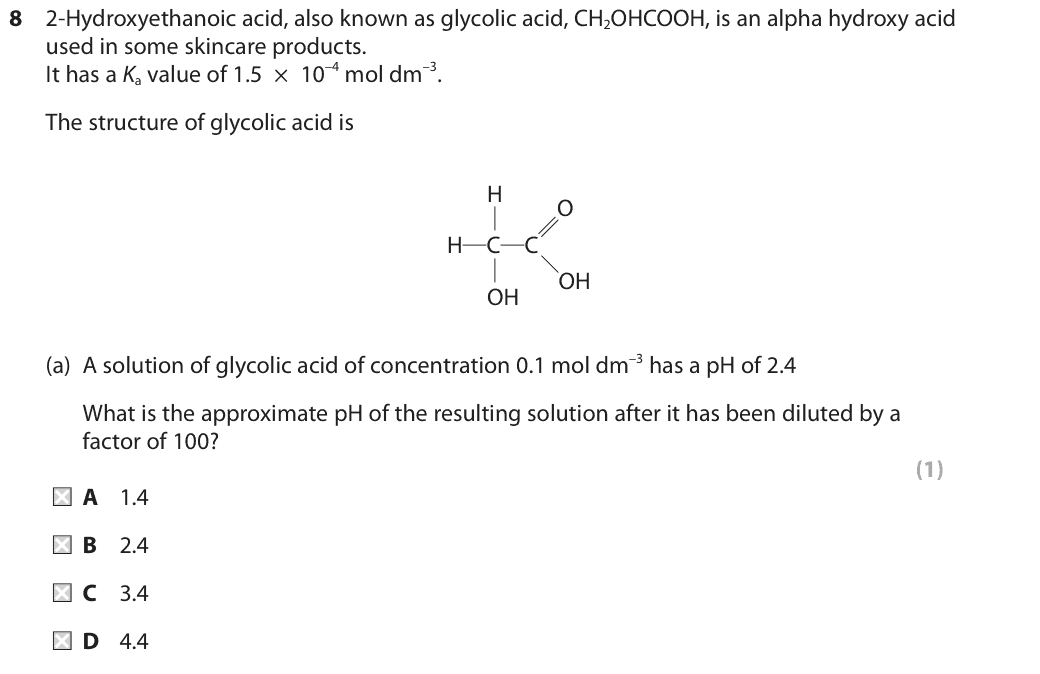
C
Skills: MS2.5 Use logarithms in relation to quantities that range over several orders of magnitude

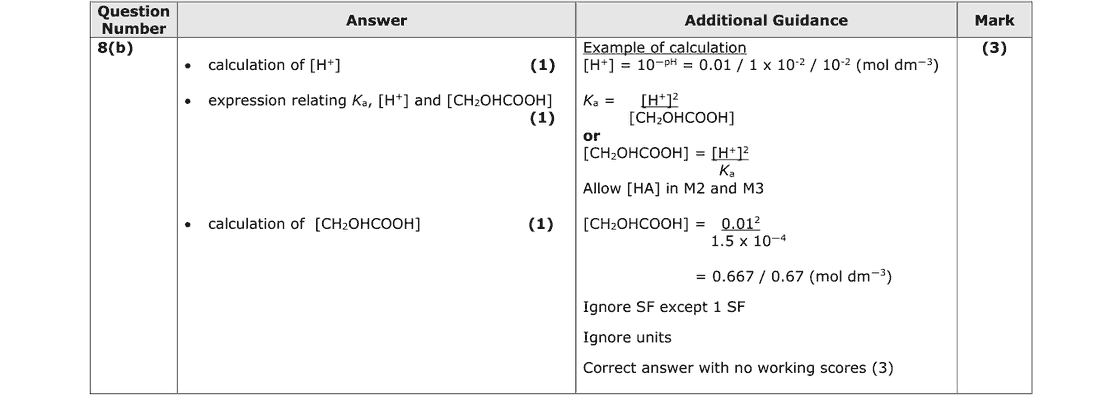
The majority of candidates scored full marks for this calculation. Some candidates thought that glycolic acid is a strong acid so they did not attempt to use Ka. A few candidates got the expression the wrong way round and a small number rounded their final answer to 1 significant figure or rounded it incorrectly.
Skills: MS0.4 Use calculators to find and use power, exponential and logarithmic functions; MS2.2 Change the subject of an equation; MS2.3 Substitute numerical values into algebraic equations using appropriate units for physical quantities; MS2.5 Use logarithms in relation to quantities that range over several orders of magnitude
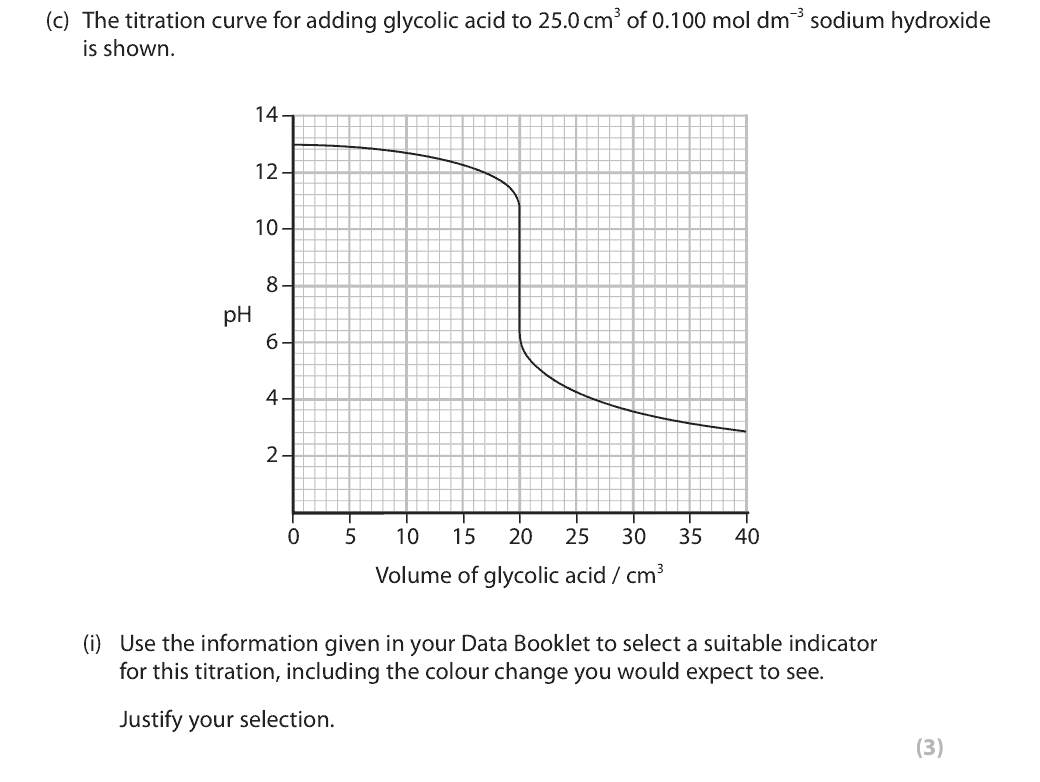
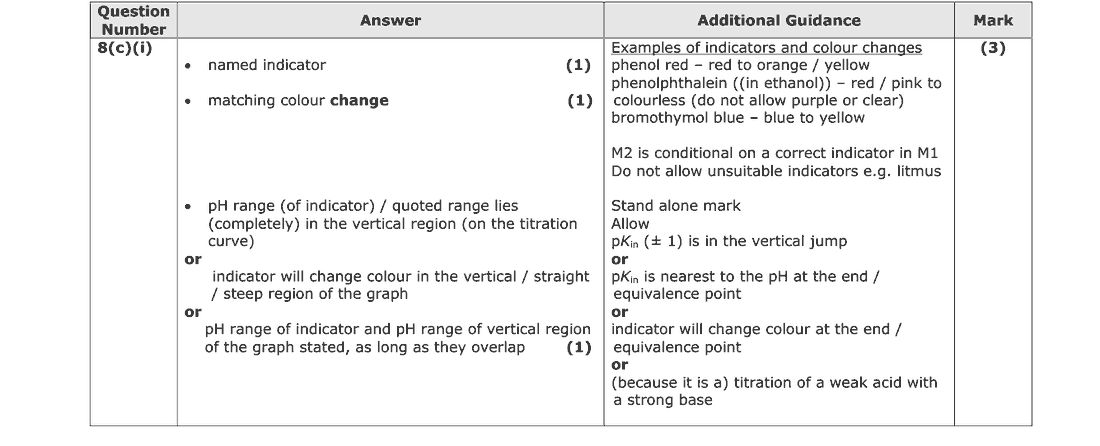
The majority of candidates scored 3 marks for this question. Some did not give a clear enough justification for their choice of indicator and some omitted the colour change or gave it the wrong way around. Very few candidates selected an unsuitable indicator.
Skills: MS3.1 Translate information between graphical, numerical and algebraic forms; PT6 use acid-base indicators in titrations of weak/strong acids with weak/strong alkalis
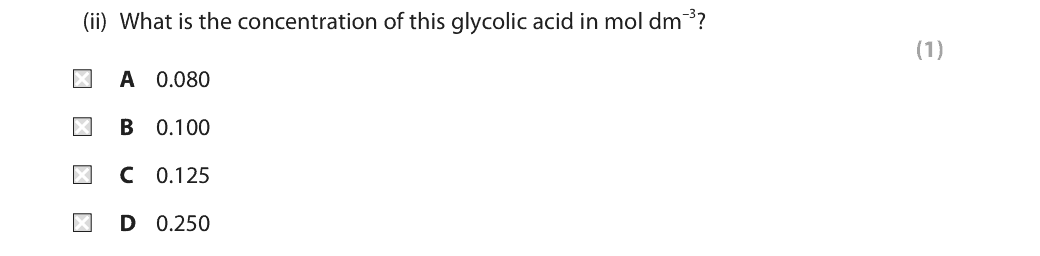
C
Skills: MS0.2 Use ratios, fractions and percentages; MS3.1 Translate information between graphical, numerical and algebraic forms
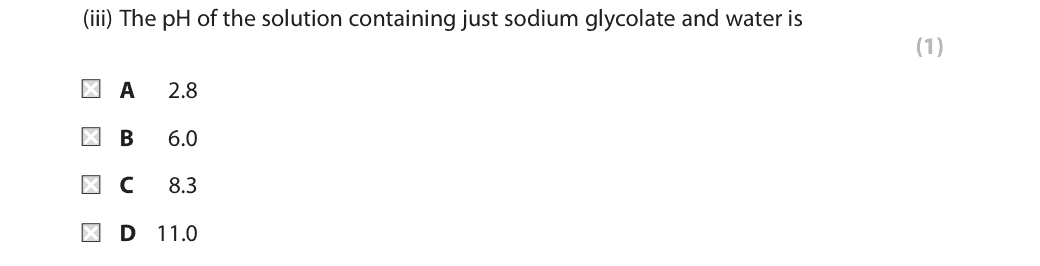
C
Skills: MS3.1 Translate information between graphical, numerical and algebraic forms

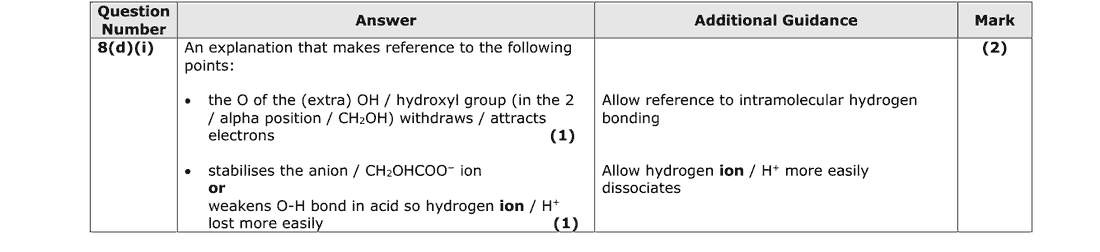
This was the most difficult question on the paper and it was intended to challenge the candidates at the top of the ability range. Candidates were not expected to know the answer but to apply their knowledge and understanding. It was encouraging to see some excellent answers in terms of the extra oxygen atom withdrawing electrons from the O-H bond, the O-H bond being weaker, the anion being stabilised or the possibility of intramolecular hydrogen bonding. The most common incorrect answer was stating that glycolic acid is dibasic.

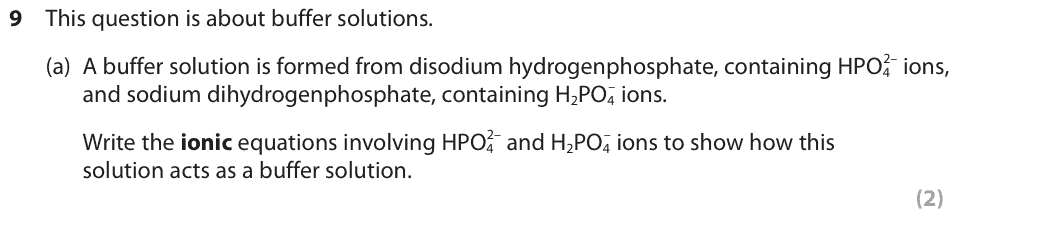
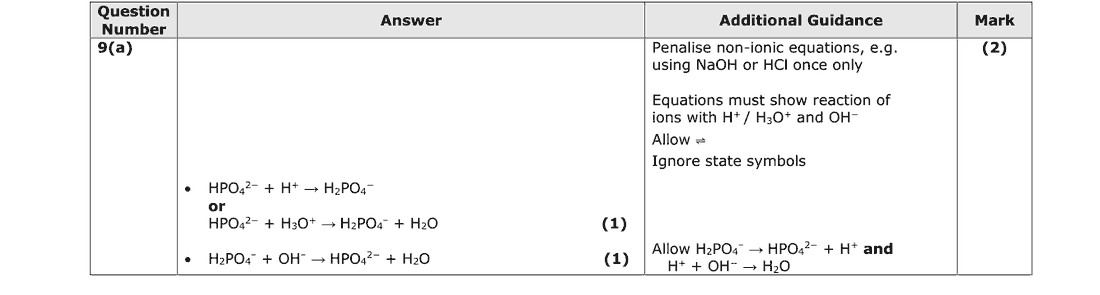
Candidates did not find it easy to write two ionic equations to show the mixture of disodium hydrogenphosphate and sodium dihydrogenphosphate acts as a buffer solution. They should have written one equation where one of the ions reacts with H+ ions and another where the other ion reacts with OH- ion. Many equations were seen that did not include H+ and OH- as reactants. Some candidates lost marks by copying the formulae of the ions incorrectly from the question and some attempted to write non-ionic equations.
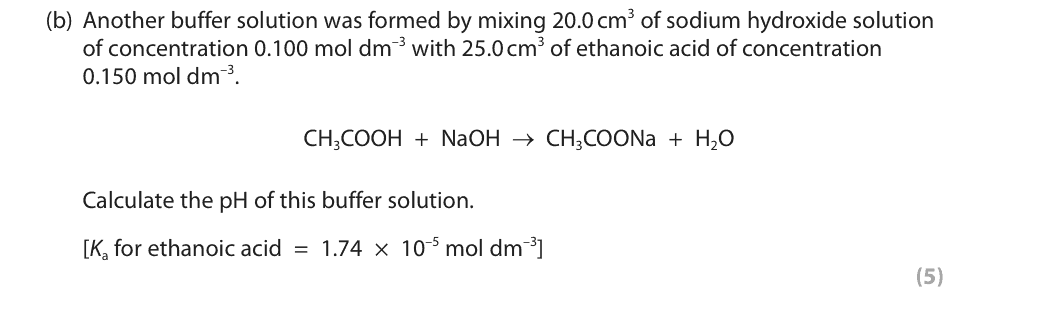
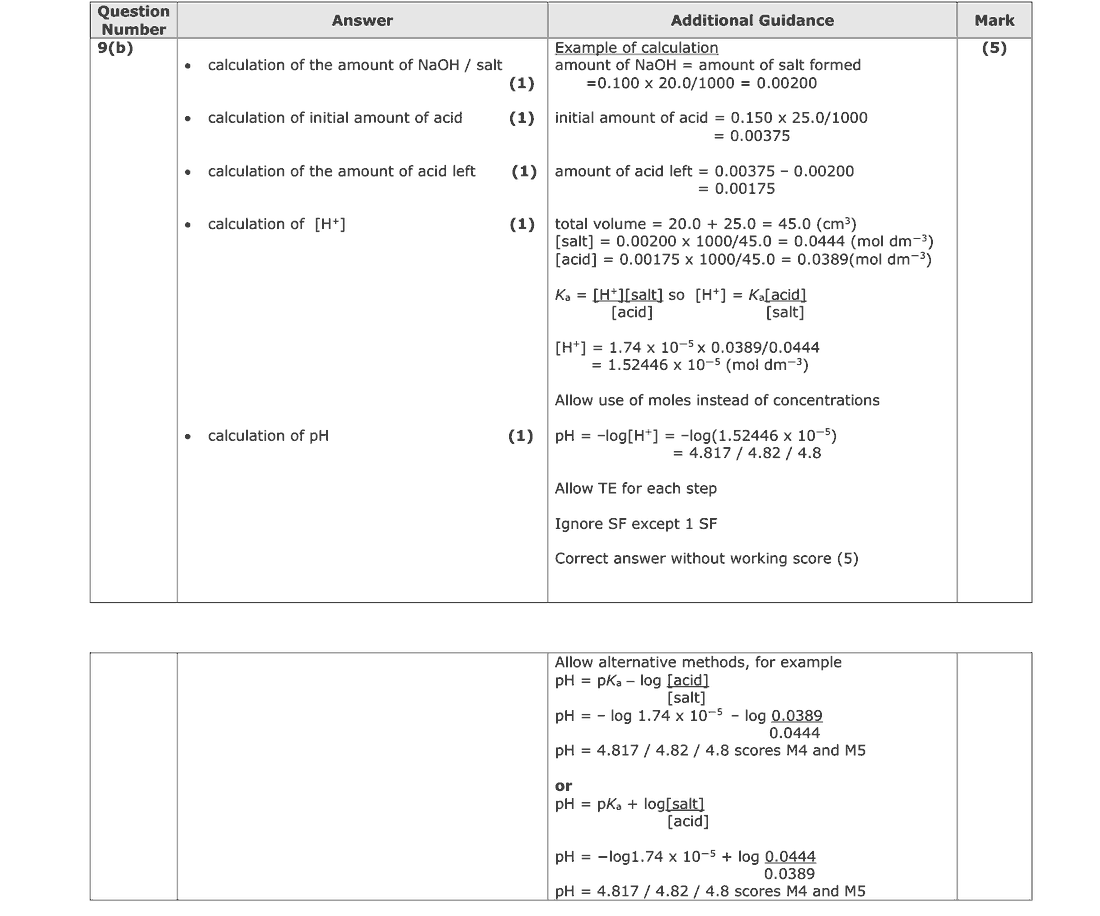
Although many excellent answers scoring 5 marks were seen, many candidates seemed unfamiliar with this style of calculation for the pH of a buffer solution. It was intended to be a demanding calculation as the candidates had to work out that the sodium hydroxide solution would react with some of the ethanoic acid to form the salt and there would be some ethanoic acid left in excess. A common incorrect answer was pH 4.49 as candidates did not use a subtraction to work out the amount of ethanoic acid left over, however, those candidates still scored 4 marks. Some candidates just worked out the pH of ethanoic acid and a significant number assumed that Ka = [H+]2/[HA]. Many candidates would benefit from more practice at buffer solution calculations.
Skills: MS0.4 Use calculators to find and use power, exponential and logarithmic functions; MS2.2 Change the subject of an equation; MS2.3 Substitute numerical values into algebraic equations using appropriate units for physical quantities; MS2.5 Use logarithms in relation to quantities that range over several orders of magnitude
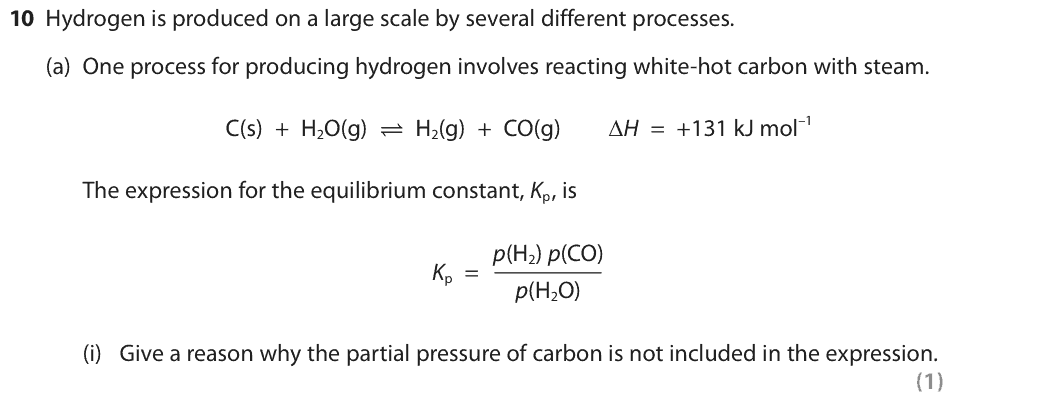
It was disappointing that many candidates just wrote short answers such as 'carbon is a solid' or 'carbon is not a gas'. The question asks about the partial pressure of carbon so the answer should refer to that. A small number of candidates had the right idea but they referred to carbon having a constant concentration instead of a constant partial pressure so they did not score a mark.

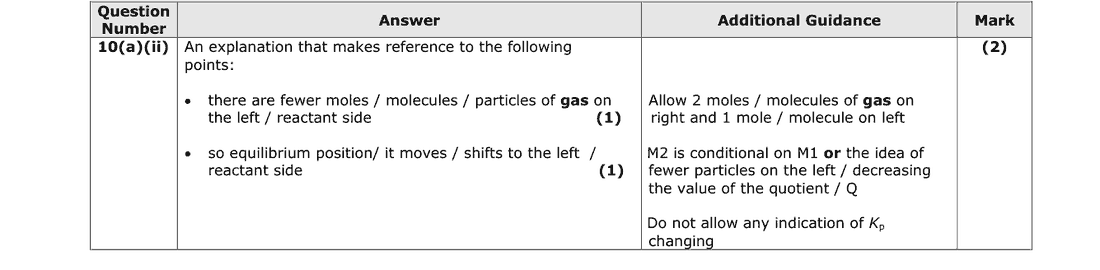
The majority of candidates scored 2 marks for this question. Some candidates thought there would be no change in the equilibrium position as they stated there are the same number of moles on each side of the equation. Some candidates omitted to mention gas when writing about fewer moles on the left. Some candidates tried to explain this in terms of the quotient but their answers were often confused and they rarely scored full marks. A straightforward answer in terms of fewer moles of gas on the left so the equilibrium position moves to the left is sufficient here. A small number of candidates wrote contradictory statements and lost a mark: for example, they wrote that more reactants are formed so the equilibrium position shifts to the right.

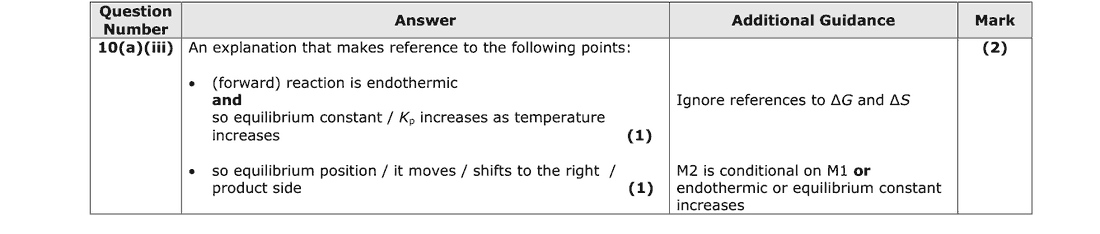
Many candidates scored 2 marks for this question. Some candidates omitted to state what would happen to the value of the equilibrium constant and some were confused and thought it would decrease. Some candidates realised that Kp would increase but did not relate this to the forward reaction being endothermic.

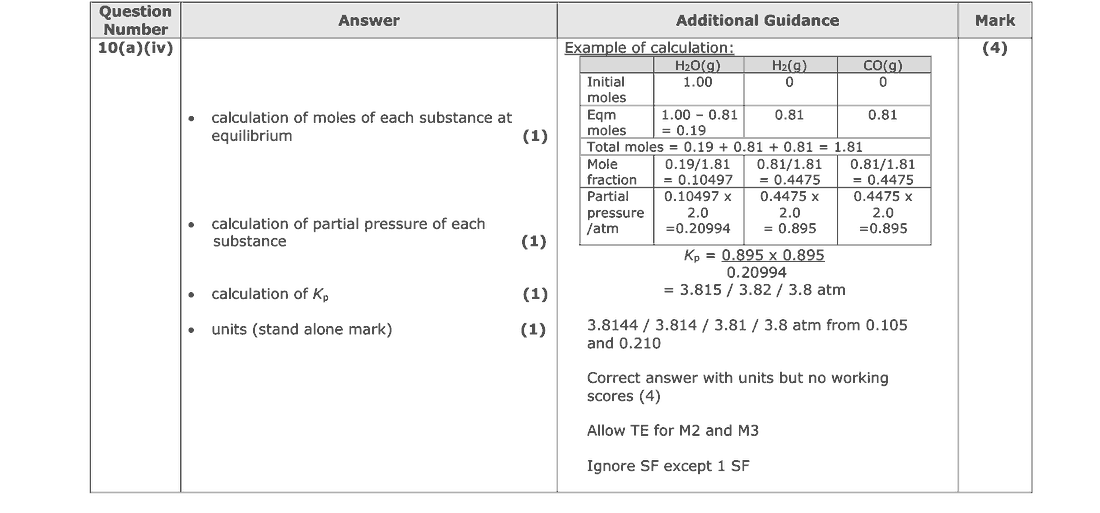
The majority of candidates made a very good attempt at this calculation, with many scoring 4 marks. Some candidates were unable to work out the partial pressures correctly but they could still score 3 marks. The use of a table for working, as in the mark scheme, would help candidates to see what they are doing and examiners to award marks when the final answer is incorrect. Some candidates worked out a partial pressure for carbon, even though they were told that it is not included in the expression for Kp. Almost all candidates scored the mark for units, although a few included mol-1 and some converted it to Pascals. Candidates are encouraged to convert their answers to decimals and not leave them as fractions.
Skills: MS0.0 Recognise and make use of appropriate units in calculation; MS0.2 Use ratios, fractions and percentages; MS2.3 Substitute numerical values into algebraic equations using appropriate units for physical quantities
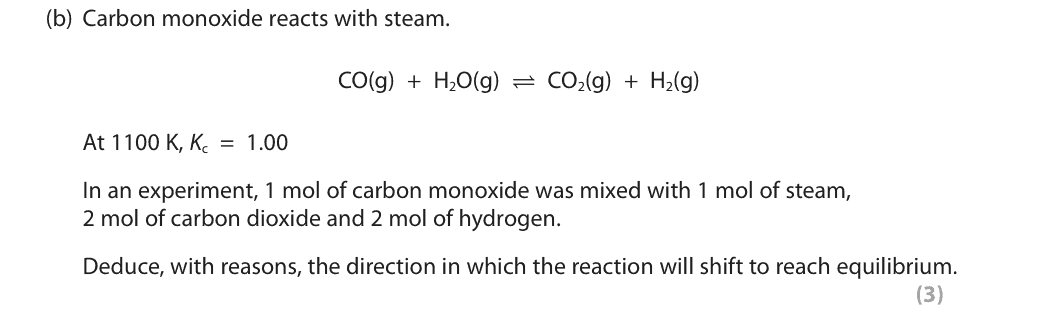
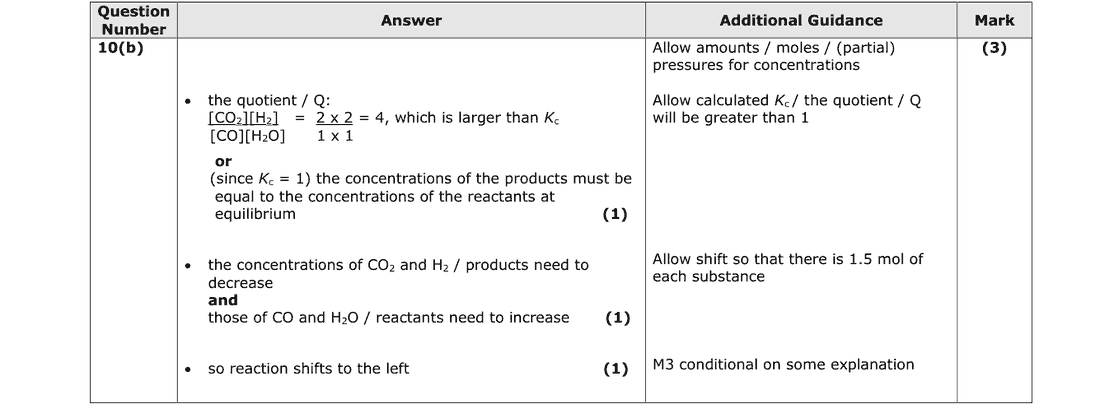
Candidates found it difficult to express their ideas clearly to explain what would happen in this question. There were many vague answers and candidates should give careful consideration to all the information given. Many candidates did not read the question carefully and assumed that the reaction was at equilibrium at the start and then it would shift left as there are more moles on the right; this idea scored 1 mark. In the best answers, candidates realised that at equilibrium, the numbers of moles of reactants and products must be equal so the number of moles of the products needs to decrease and the number of moles of reactants to increase to achieve this.
Skills: MS0.2 Use ratios, fractions and percentages; MS2.1 Understand and use the symbols: =, <, <<, >>, >, ∝, ~, equilibrium sign
Want a paper marked and gone through with you? Message us.