November 2021: Paper 2, Advanced Organic and Physical Chemistry

90 marks · 41 question parts · Paper, mark scheme and report on Edexcel's site · An autumn series, sat in place of the cancelled summer exams · Have the Data Booklet beside you

Question by question

QTopicMarksAOType
1 Formulae, equations and amounts of substance 1Multiple choice
2 Formulae, equations and amounts of substance 1Multiple choice
3 Introduction to organic chemistry 1Multiple choice
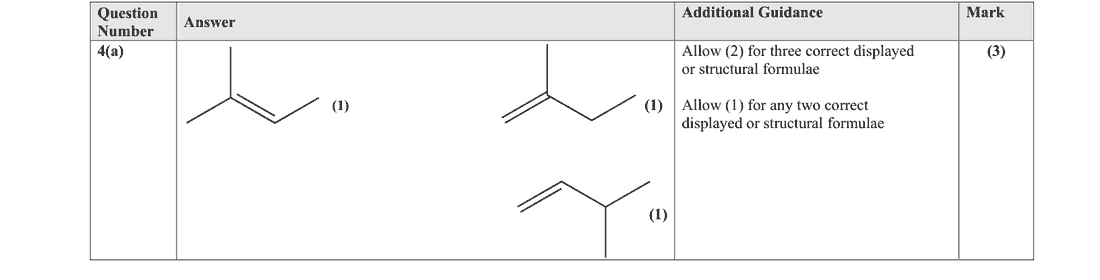
4(a) Introduction to organic chemistry 3Diagram or structure
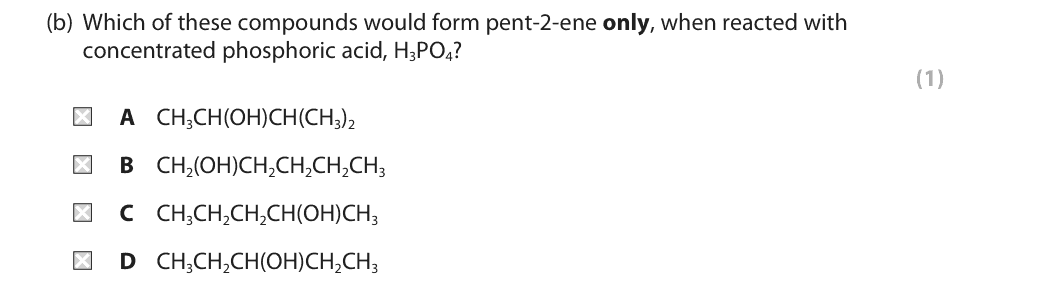
4(b) Alcohols 1Multiple choice
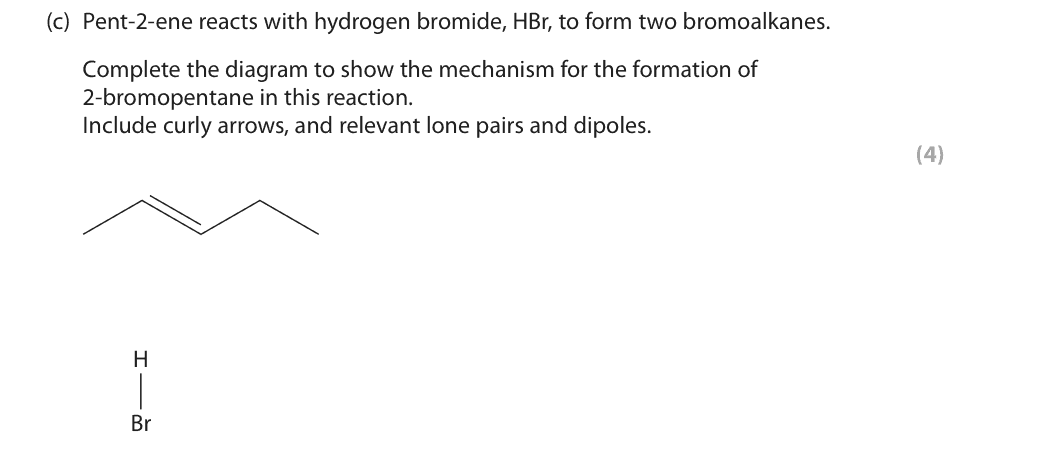
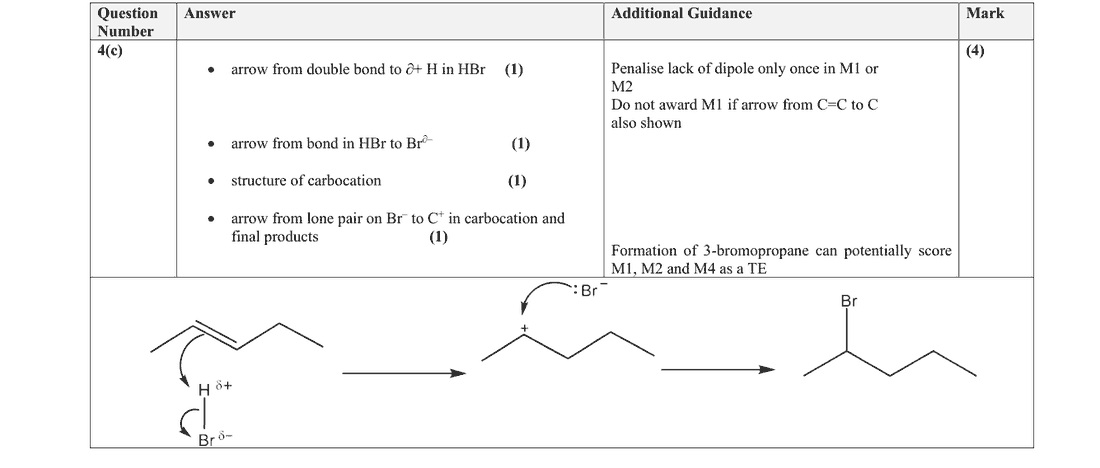
4(c) Alkenes 4Mechanism
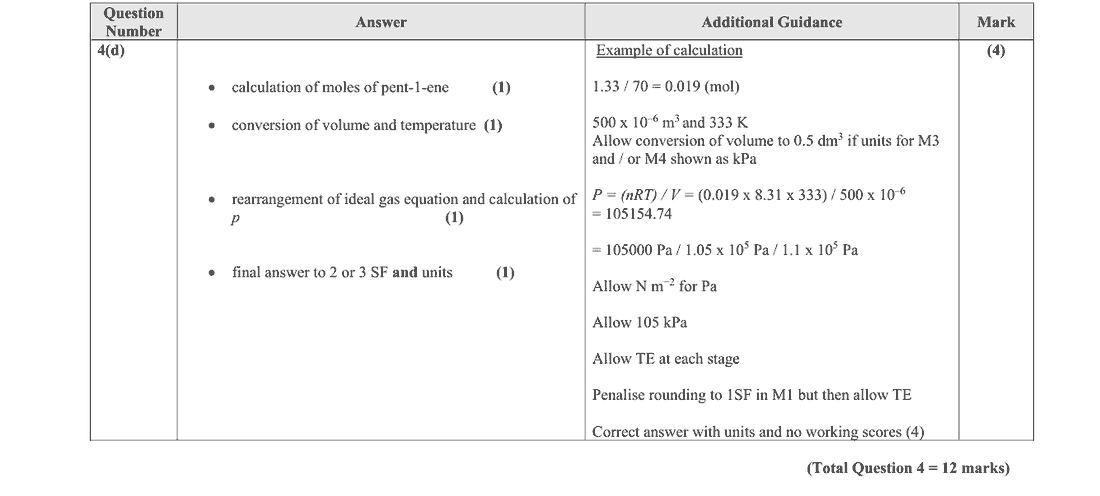
4(d) Formulae, equations and amounts of substance 4Calculation
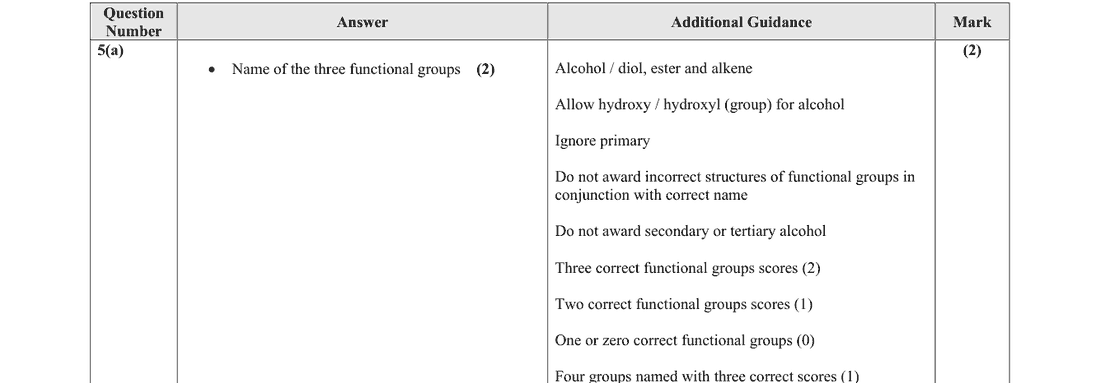
5(a) Carboxylic acids, Introduction to organic chemistry 2Short answer
5(b) Carboxylic acids 1Short answer
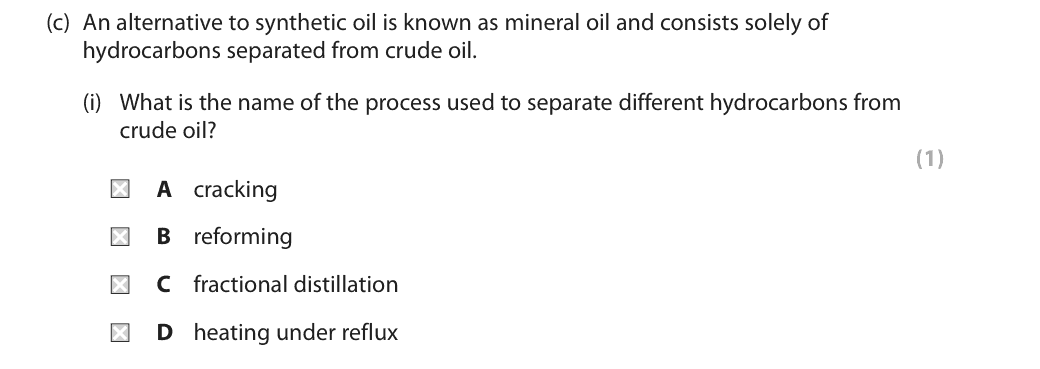
5(c)(i) Alkanes 1Multiple choice
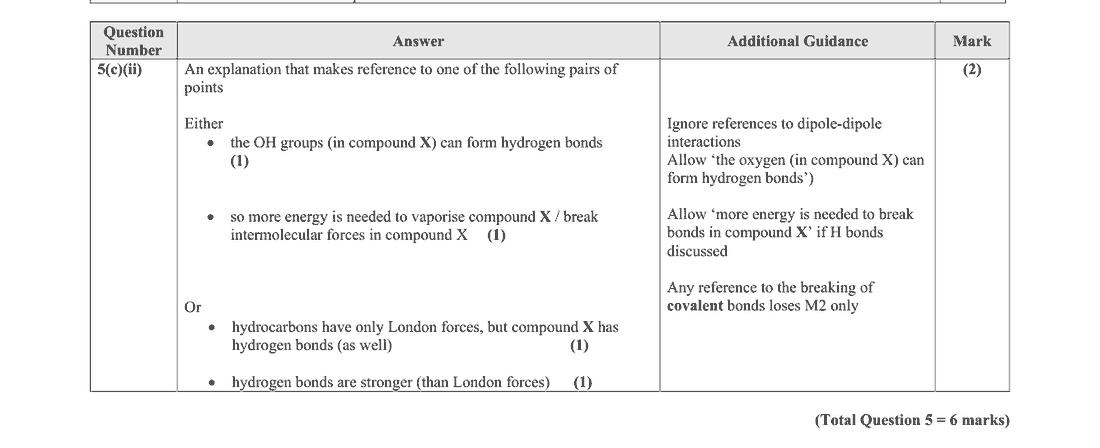
5(c)(ii) Bonding 2Explanation
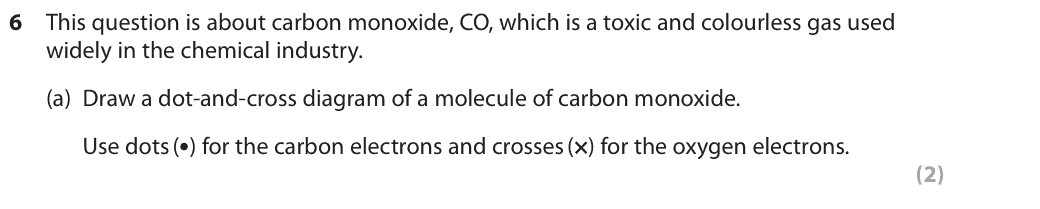
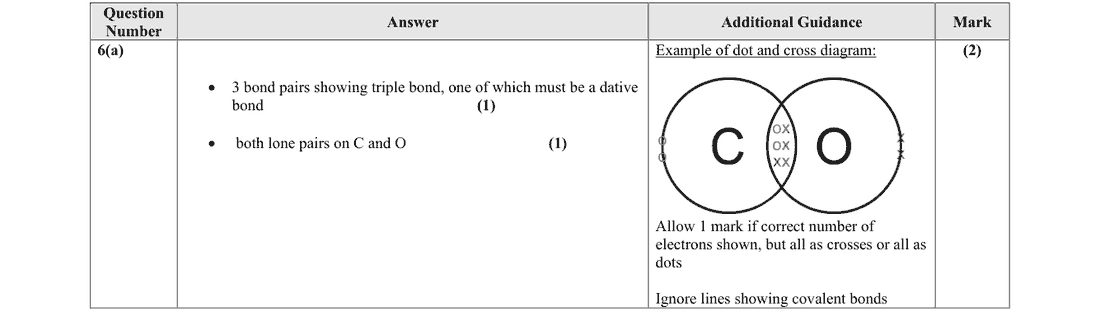
6(a) Bonding 2Diagram or structure
6(b) Formulae, equations and amounts of substance 2Calculation
6(c)(i) Kinetics II 1Calculation
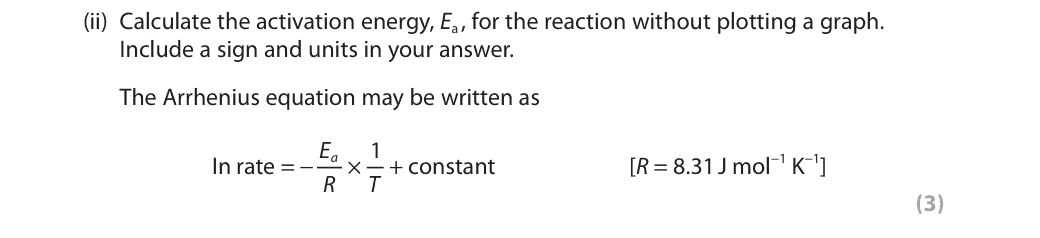
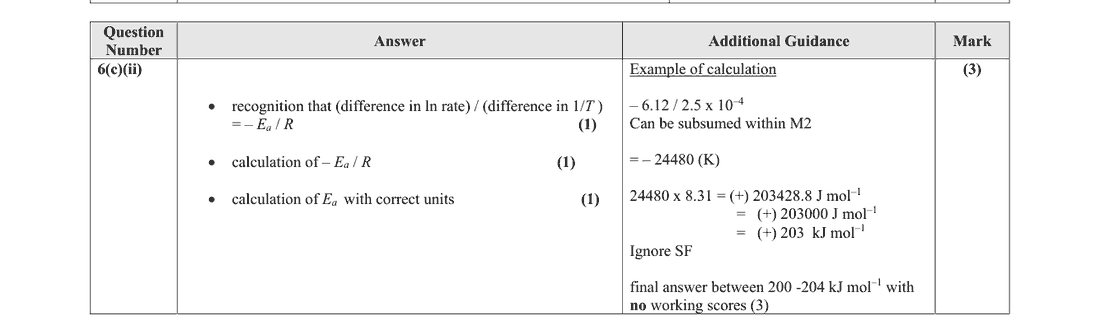
6(c)(ii) Kinetics II 3Calculation
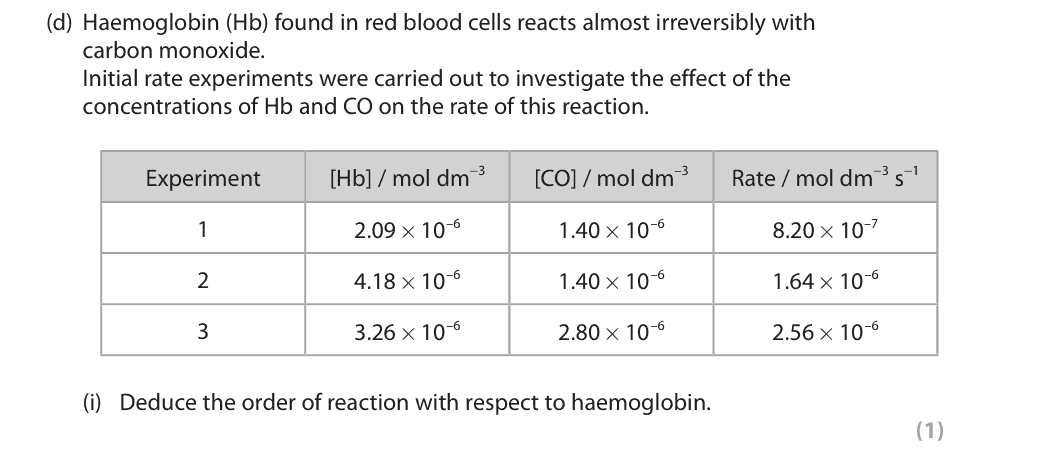
6(d)(i) Kinetics II 1Short answer
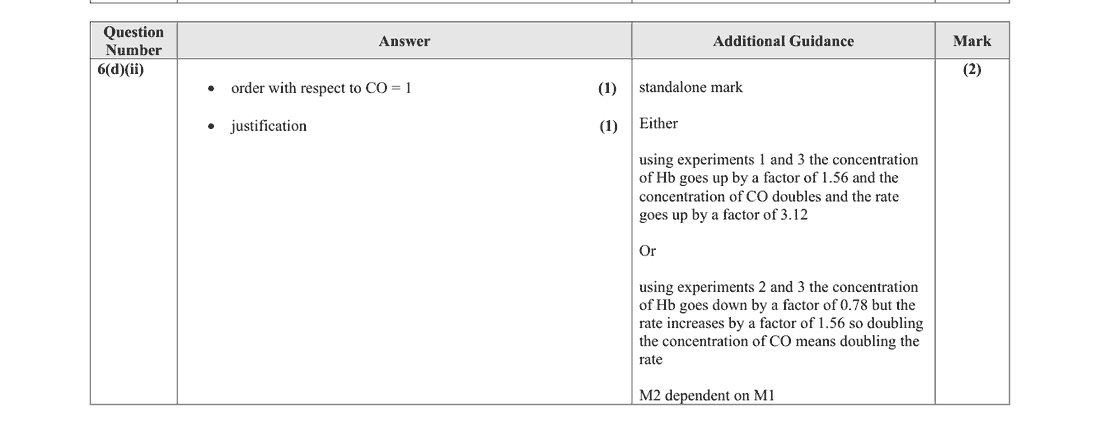
6(d)(ii) Kinetics II 2Short answer
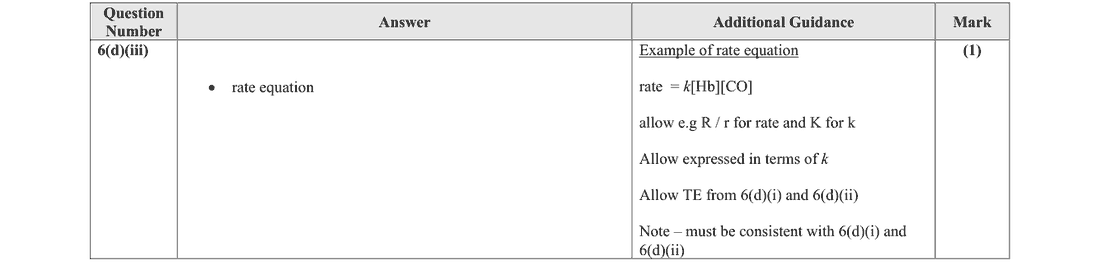
6(d)(iii) Kinetics II 1Short answer
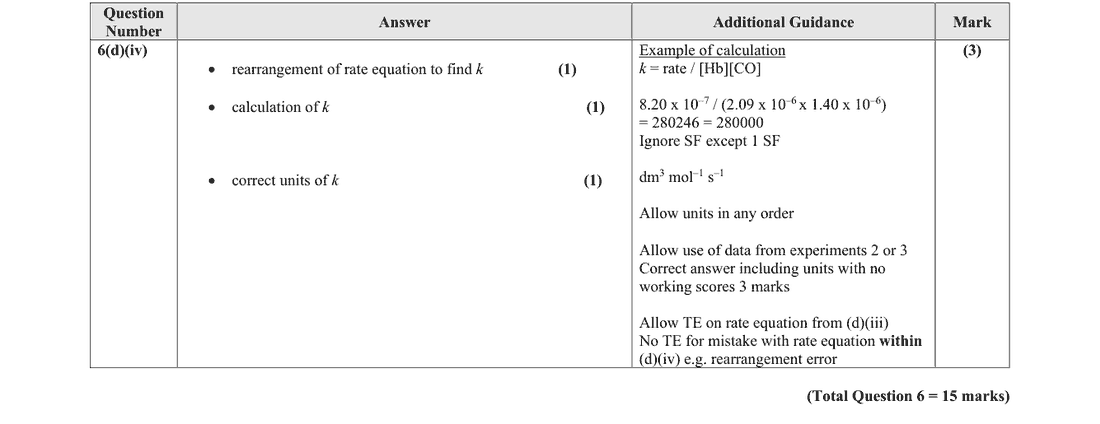
6(d)(iv) Kinetics II 3Calculation
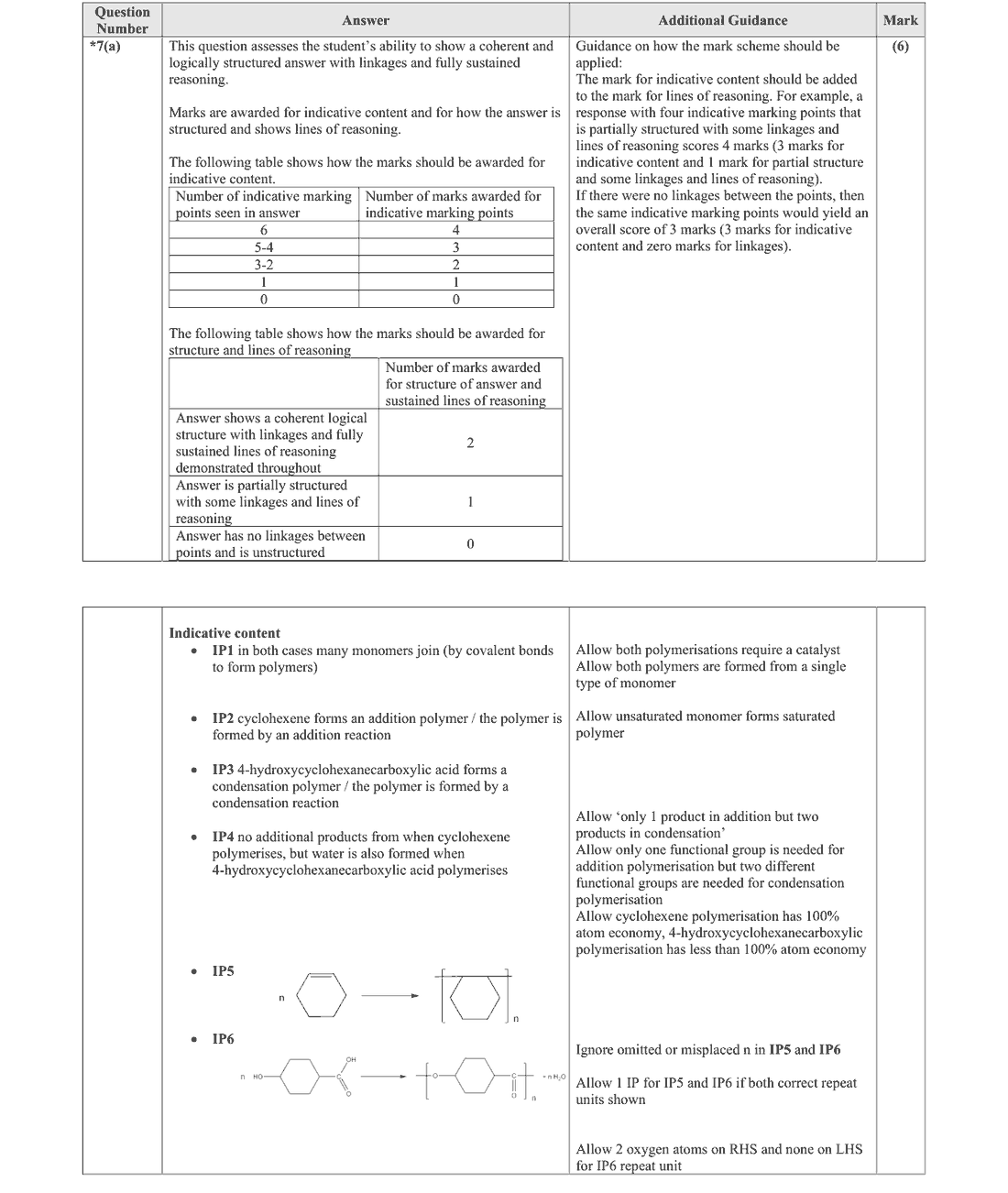
7(a) Alkenes, Carboxylic acids 6Extended response
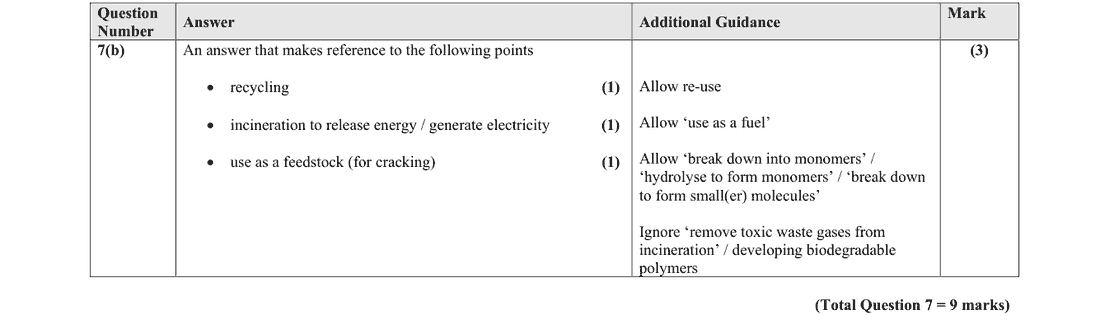
7(b) Alkenes 3Short answer
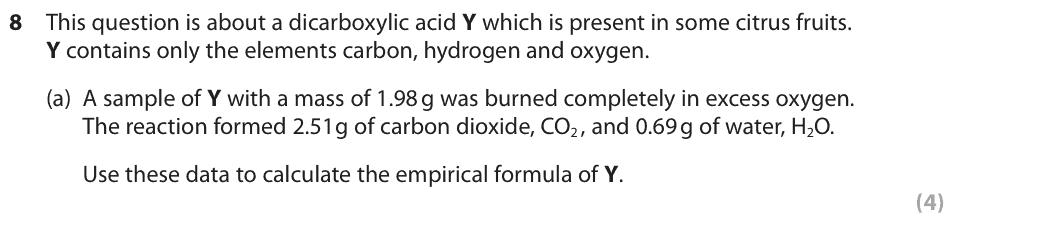
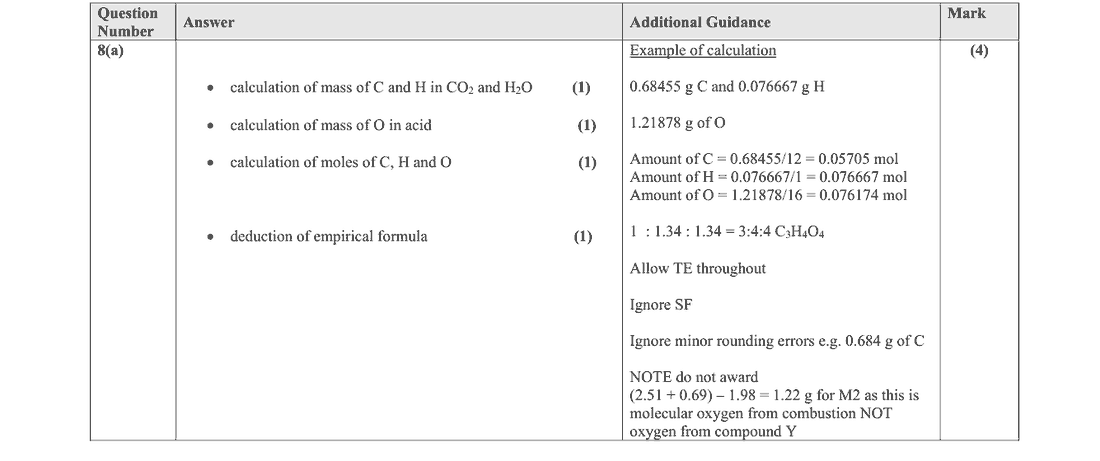
8(a) Formulae, equations and amounts of substance 4Calculation
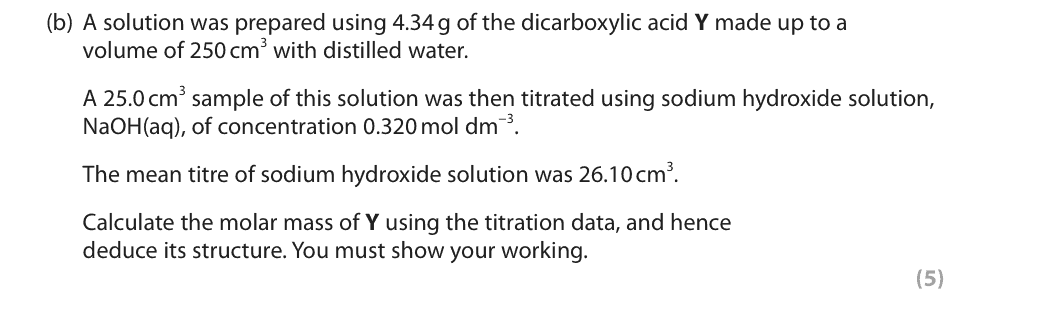
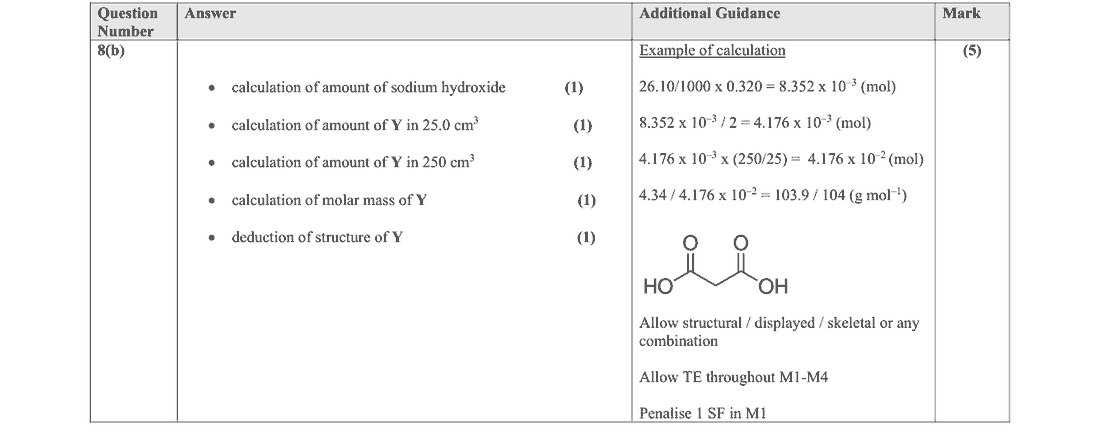
8(b) Formulae, equations and amounts of substance, Organic synthesis 5Calculation
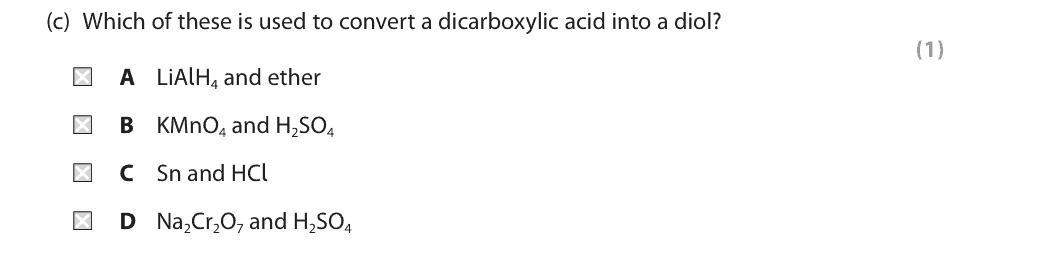
8(c) Carboxylic acids 1Multiple choice
9(a) Modern analytical techniques II: NMR, mass spectrometry and chromatography 2Short answer
9(b) Formulae, equations and amounts of substance 3Calculation
9(c)(i) Introduction to organic chemistry 1Multiple choice
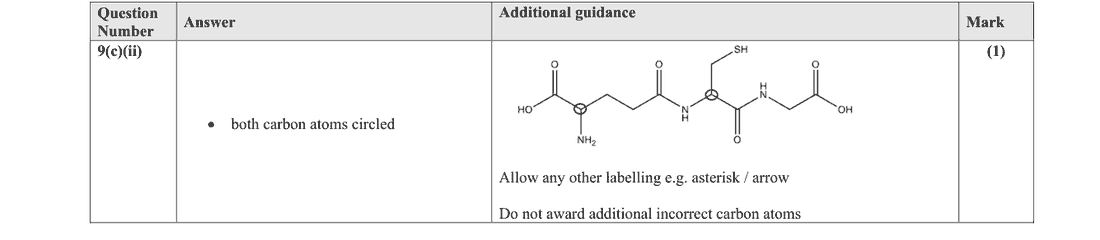
9(c)(ii) Chirality 1Short answer
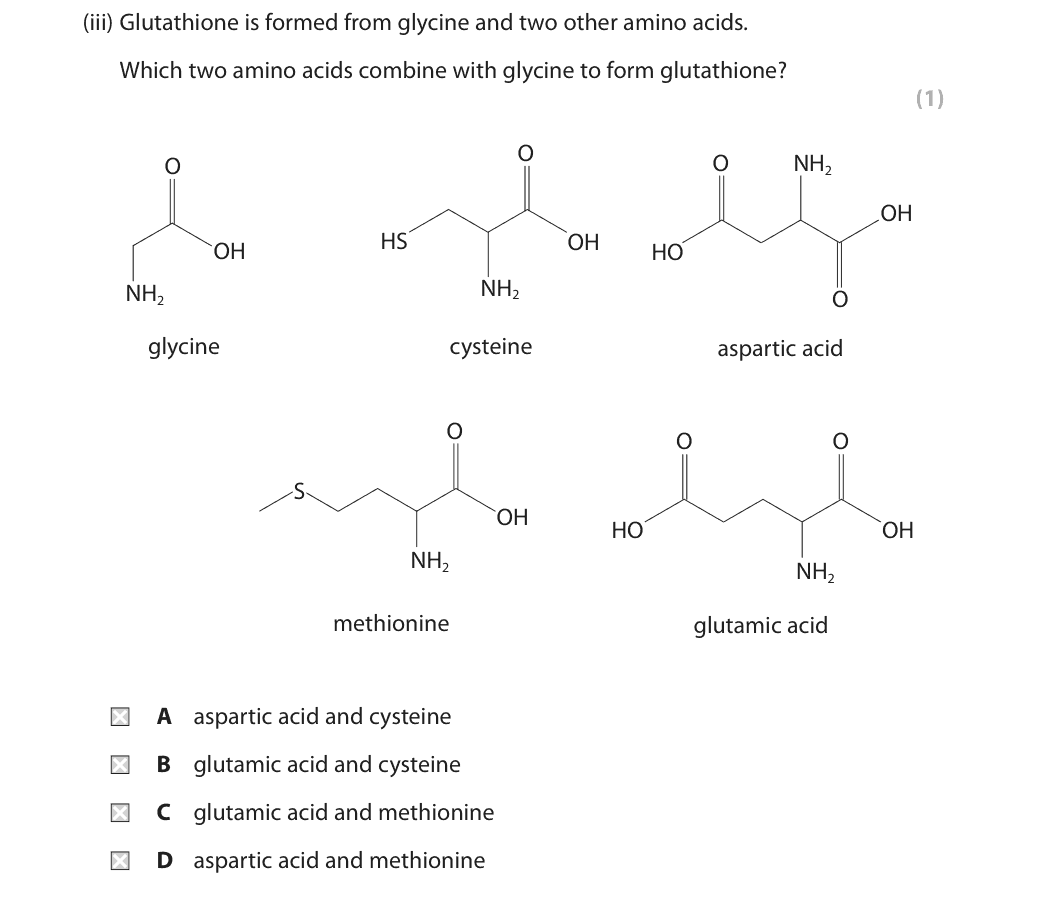
9(c)(iii) Amines, amides, amino acids and proteins 1Multiple choice
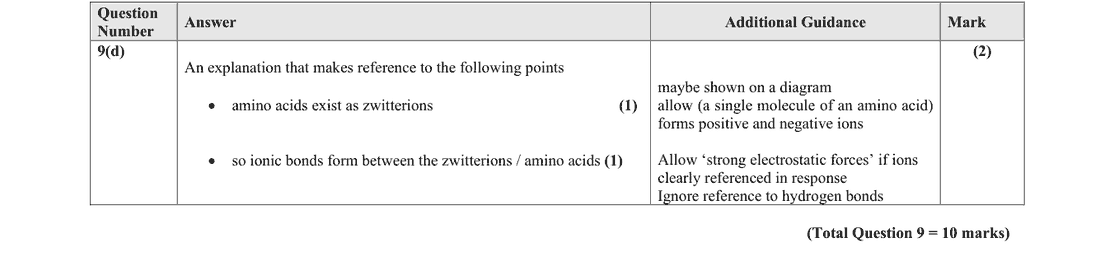
9(d) Amines, amides, amino acids and proteins 2Explanation
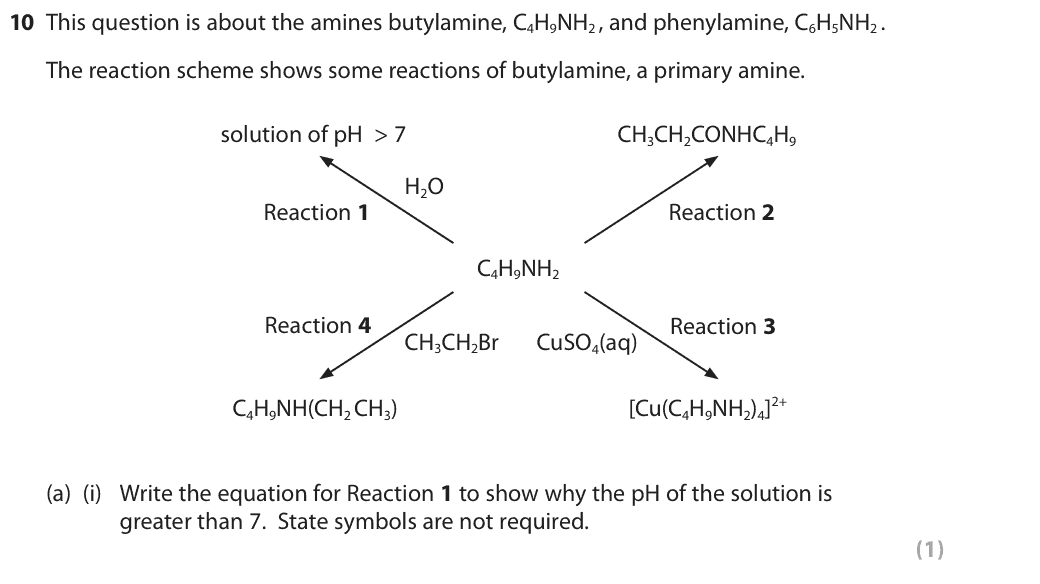
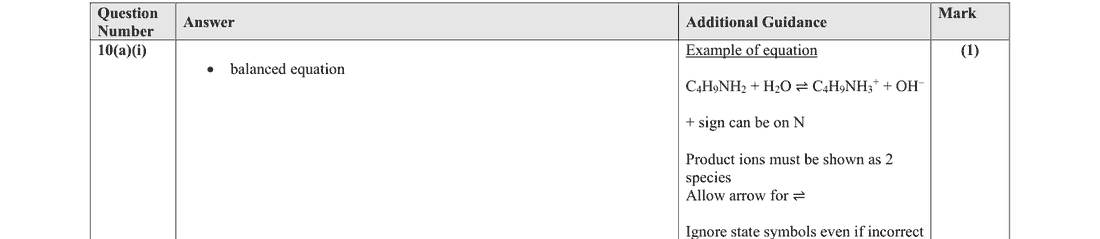
10(a)(i) Amines, amides, amino acids and proteins 1Equation writing
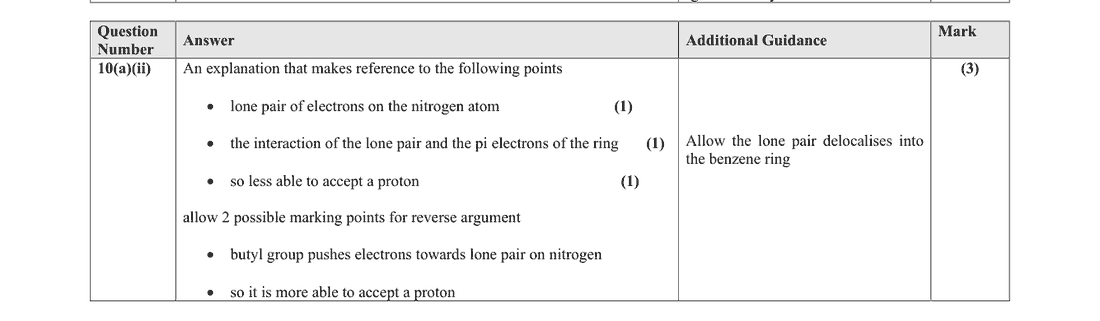
10(a)(ii) Amines, amides, amino acids and proteins 3Explanation
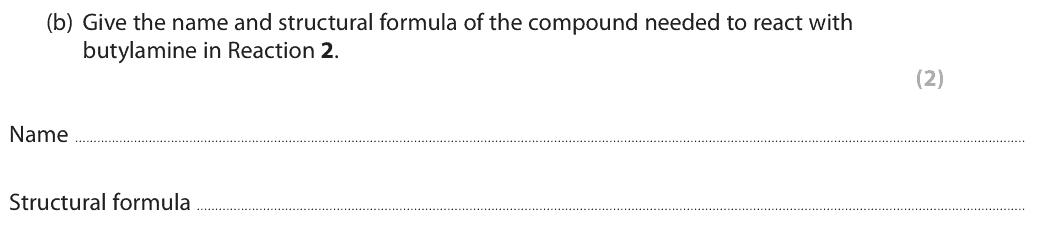
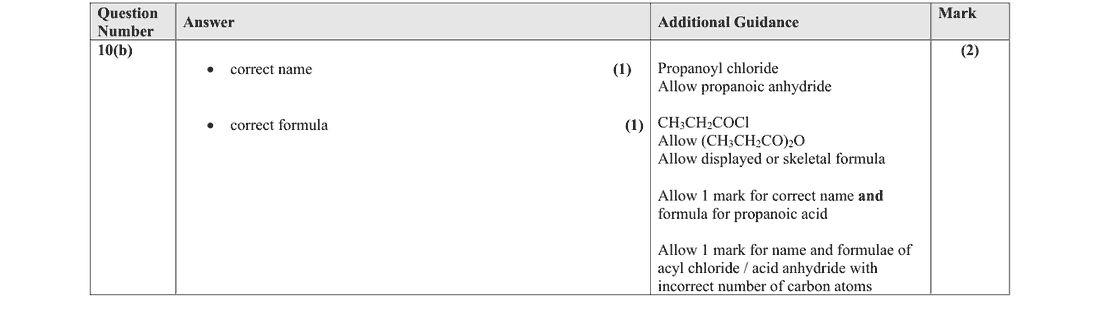
10(b) Amines, amides, amino acids and proteins 2Short answer
10(c) Amines, amides, amino acids and proteins 1Multiple choice
10(d)(i) Amines, amides, amino acids and proteins 1Multiple choice
10(d)(ii) Halogenoalkanes 4Mechanism
11(a) Kinetics II 2Diagram or structure
11(b) Kinetics II 2Short answer
11(c) Kinetics II 2Short answer
11(d) Kinetics II 1Short answer
12 Organic synthesis 6Short answer

The questions

1234(a)4(b)4(c)4(d)5(a)5(b)5(c)(i)5(c)(ii)6(a)6(b)6(c)(i)6(c)(ii)6(d)(i)6(d)(ii)6(d)(iii)6(d)(iv)7(a)7(b)8(a)8(b)8(c)9(a)9(b)9(c)(i)9(c)(ii)9(c)(iii)9(d)10(a)(i)10(a)(ii)10(b)10(c)10(d)(i)10(d)(ii)11(a)11(b)11(c)11(d)12
November 2021 · Paper 2 · Q1 1 mark Multiple choice formulae equations and amounts of substance
What is the total number of ions in 26.4 g of ammonium sulfate, (NH4)2SO4?
[Molar mass of (NH4)2SO4 = 132 g mol−1        Avogadro constant = 6.0 × 1023 mol−1]
A  4.0 × 1022
B  1.2 × 1023
C  2.4 × 1023
D  3.6 × 1023
November 2021 · Paper 2 · Q2 1 mark Multiple choice formulae equations and amounts of substance
The equation for the complete combustion of butane is
2C4H10(g) + 13O2(g) → 8CO2(g) + 10H2O(l)
What is the minimum volume of oxygen, at room temperature and pressure (r.t.p.),
needed for the complete combustion of 0.200 mol of butane?
[Molar volume of a gas at r.t.p. = 24.0 dm3 mol−1]
A  4.8 dm3
B  9.6 dm3
C  31.2 dm3
D  62.4 dm3
November 2021 · Paper 2 · Q3 1 mark Multiple choice introduction to organic chemistry
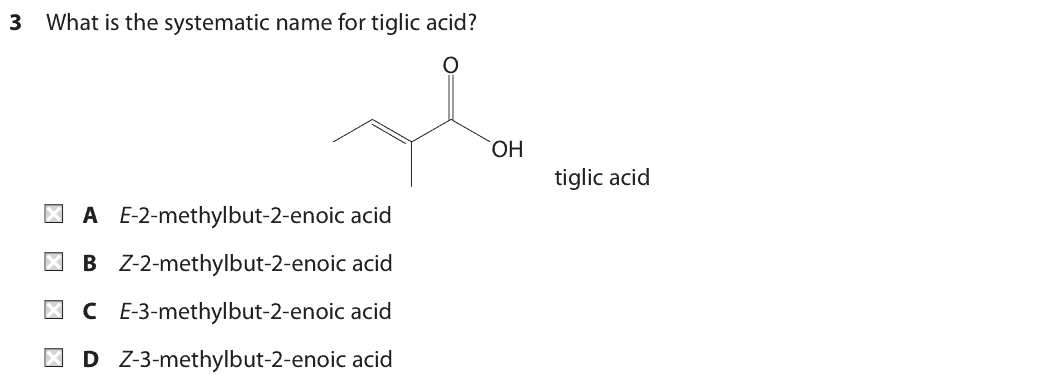
What is the systematic name for tiglic acid?
O
OH
tiglic acid
A  E-2-methylbut-2-enoic acid
B  Z-2-methylbut-2-enoic acid
C  E-3-methylbut-2-enoic acid
D  Z-3-methylbut-2-enoic acid
November 2021 · Paper 2 · Q4(a) 3 marks Diagram or structure introduction to organic chemistry
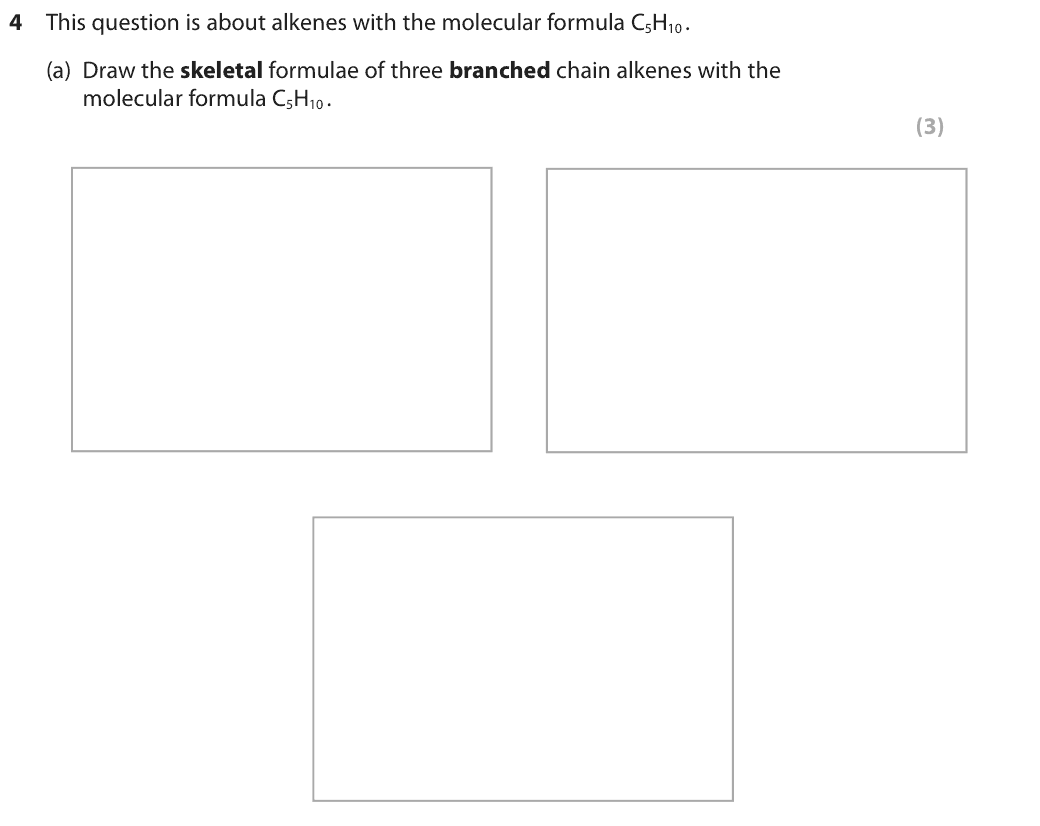
This question is about alkenes with the molecular formula C5H10 .
Draw the skeletal formulae of three branched chain alkenes with the
molecular formula C5H10 .
November 2021 · Paper 2 · Q4(b) 1 mark Multiple choice alcohols
Which of these compounds would form pent-2-ene only, when reacted with
concentrated phosphoric acid, H3PO4?
A  CH3CH(OH)CH(CH3)2
B  CH2(OH)CH2CH2CH2CH3
C  CH3CH2CH2CH(OH)CH3
D  CH3CH2CH(OH)CH2CH3
November 2021 · Paper 2 · Q4(c) 4 marks Mechanism alkenes
Earlier part of question 4 that this part usesEarlier part of November 2021 Paper 2 question 4
Pent-2-ene reacts with hydrogen bromide, HBr, to form two bromoalkanes.
Complete the diagram to show the mechanism for the formation of
2-bromopentane in this reaction.
Include curly arrows, and relevant lone pairs and dipoles.
H
Br
November 2021 · Paper 2 · Q4(d) 4 marks Calculation formulae equations and amounts of substance
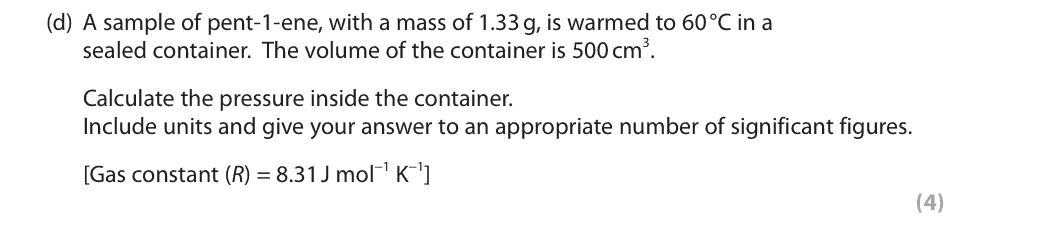
A sample of pent-1-ene, with a mass of 1.33 g, is warmed to 60 °C in a
sealed container.  The volume of the container is 500 cm3.

Calculate the pressure inside the container.
Include units and give your answer to an appropriate number of significant figures.
[Gas constant (R) = 8.31 J mol−1 K−1]
November 2021 · Paper 2 · Q5(a) 2 marks Short answer carboxylic acidsintroduction to organic chemistry
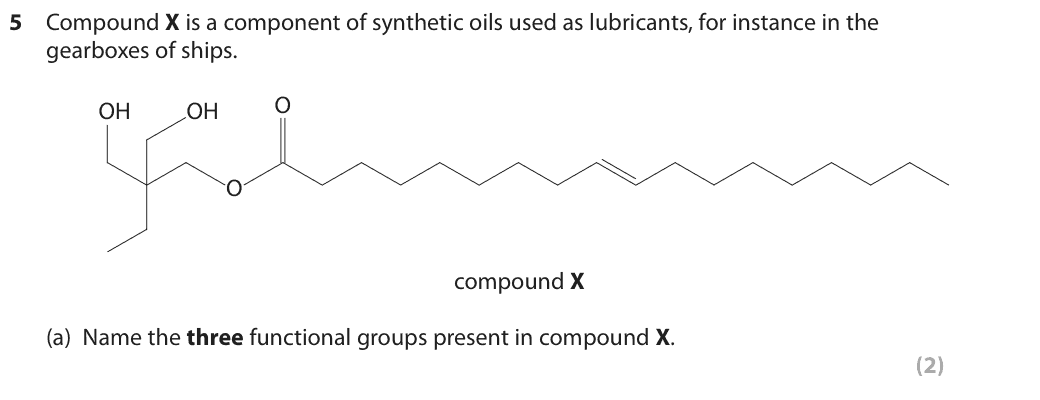
Compound X is a component of synthetic oils used as lubricants, for instance in the
gearboxes of ships.
O
OH
OH
O
compound X
Name the three functional groups present in compound X.
November 2021 · Paper 2 · Q5(b) 1 mark Short answer carboxylic acids
Earlier part of question 5 that this part usesEarlier part of November 2021 Paper 2 question 5
The effectiveness of this synthetic oil is much reduced if it is
contaminated with water.
Give, in terms of a chemical reaction, a possible reason for this.
November 2021 · Paper 2 · Q5(c)(i) 1 mark Multiple choice alkanes
Earlier part of question 5 that this part usesEarlier part of November 2021 Paper 2 question 5
An alternative to synthetic oil is known as mineral oil and consists solely of
hydrocarbons separated from crude oil.
What is the name of the process used to separate different hydrocarbons from
crude oil?
A  cracking
B  reforming
C  fractional distillation
D  heating under reflux
November 2021 · Paper 2 · Q5(c)(ii) 2 marks Explanation bonding
Earlier parts of question 5 that this part usesEarlier part of November 2021 Paper 2 question 5Earlier part of November 2021 Paper 2 question 5
Explain why compound X is likely to have a higher boiling temperature than
hydrocarbons of a similar molecular mass and shape.
A detailed description of how the intermolecular forces arise is not required.
November 2021 · Paper 2 · Q6(a) 2 marks Diagram or structure bonding
This question is about carbon monoxide, CO, which is a toxic and colourless gas used
widely in the chemical industry.
Draw a dot-and-cross diagram of a molecule of carbon monoxide.
Use dots (•) for the carbon electrons and crosses (×) for the oxygen electrons.
November 2021 · Paper 2 · Q6(b) 2 marks Calculation formulae equations and amounts of substance
Earlier part of question 6 that this part usesEarlier part of November 2021 Paper 2 question 6
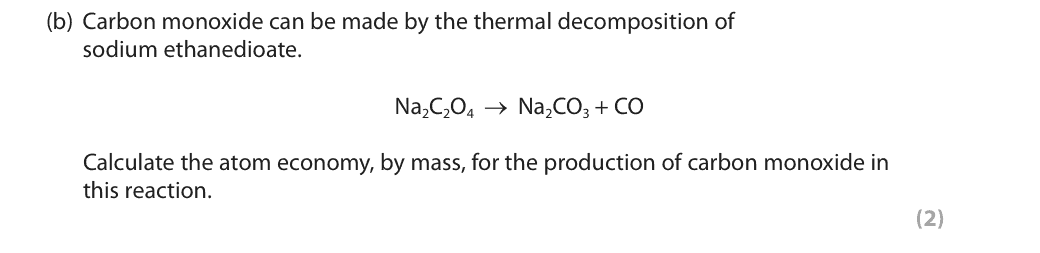
Carbon monoxide can be made by the thermal decomposition of
sodium ethanedioate.
Na2C2O4  →  Na2CO3 + CO
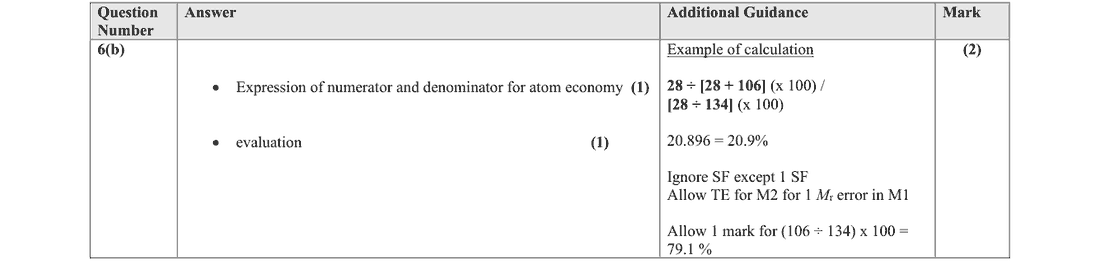
Calculate the atom economy, by mass, for the production of carbon monoxide in
this reaction.
November 2021 · Paper 2 · Q6(c)(i) 1 mark Calculation kinetics ii
Earlier part of question 6 that this part usesEarlier part of November 2021 Paper 2 question 6
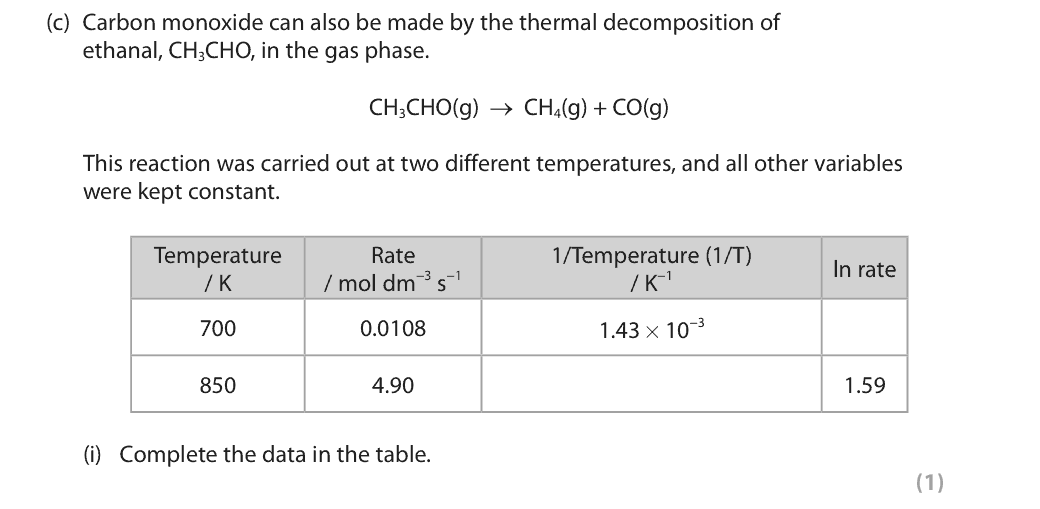
Carbon monoxide can also be made by the thermal decomposition of
ethanal, CH3CHO, in the gas phase.
CH3CHO(g)  →  CH4(g) + CO(g)
This reaction was carried out at two different temperatures, and all other variables
were kept constant.
Temperature
Rate
1/Temperature (1/T)
ln rate
/ K
/ mol dm−3 s−1
/ K−1
700
0.0108
1.43 × 10−3
850
4.90
1.59
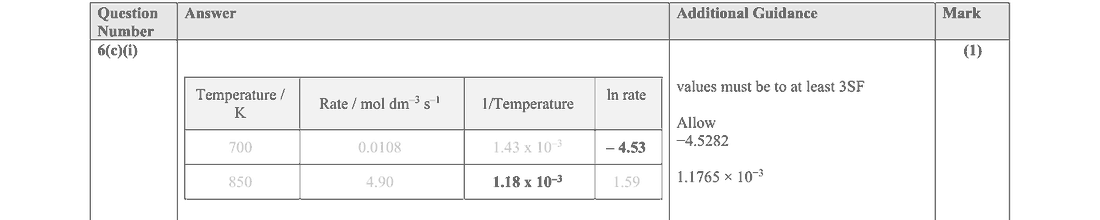
Complete the data in the table.
November 2021 · Paper 2 · Q6(c)(ii) 3 marks Calculation kinetics ii
Earlier parts of question 6 that this part usesEarlier part of November 2021 Paper 2 question 6Earlier part of November 2021 Paper 2 question 6
Calculate the activation energy, Ea , for the reaction without plotting a graph.
Include a sign and units in your answer.
The Arrhenius equation may be written as
E
1
a
In rate = −
×
T + constant
[R = 8.31 J mol−1 K−1]
R
November 2021 · Paper 2 · Q6(d)(i) 1 mark Short answer kinetics ii
Earlier part of question 6 that this part usesEarlier part of November 2021 Paper 2 question 6
Haemoglobin (Hb) found in red blood cells reacts almost irreversibly with
carbon monoxide.
Initial rate experiments were carried out to investigate the effect of the
concentrations of Hb and CO on the rate of this reaction.
Experiment
[Hb] / mol dm−3
[CO] / mol dm–3
Rate / mol dm−3 s−1
1
2.09 × 10 –6
1.40 × 10 –6
8.20 × 10–7
2
4.18 × 10 –6
1.40 × 10 –6
1.64 × 10 –6
3
3.26 × 10 –6
2.80 × 10 –6
2.56 × 10 –6
Deduce the order of reaction with respect to haemoglobin.
November 2021 · Paper 2 · Q6(d)(ii) 2 marks Short answer kinetics ii
Earlier parts of question 6 that this part usesEarlier part of November 2021 Paper 2 question 6Earlier part of November 2021 Paper 2 question 6
Determine the order with respect to carbon monoxide using your answer to
(d)(i) and the data in the table.
Justify your answer.
November 2021 · Paper 2 · Q6(d)(iii) 1 mark Short answer kinetics ii
Earlier parts of question 6 that this part usesEarlier part of November 2021 Paper 2 question 6Earlier part of November 2021 Paper 2 question 6Earlier part of November 2021 Paper 2 question 6
Write the rate equation for this reaction using your answers to (d)(i) and (d)(ii).
November 2021 · Paper 2 · Q6(d)(iv) 3 marks Calculation kinetics ii
Earlier parts of question 6 that this part usesEarlier part of November 2021 Paper 2 question 6Earlier part of November 2021 Paper 2 question 6Earlier part of November 2021 Paper 2 question 6Earlier part of November 2021 Paper 2 question 6
Calculate the rate constant, k, for the reaction, using the data from Experiment 1
and the rate equation from (d)(iii).
Include units in your answer.
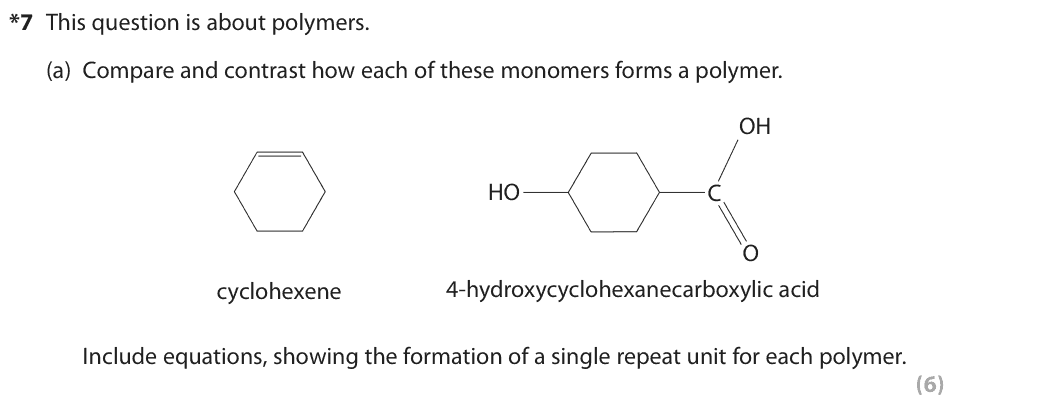
November 2021 · Paper 2 · Q7(a) 6 marks 6-mark extended response alkenescarboxylic acids
This question is about polymers.
Compare and contrast how each of these monomers forms a polymer.
OH
HO
C
O
cyclohexene
4-hydroxycyclohexanecarboxylic acid
Include equations, showing the formation of a single repeat unit for each polymer.
November 2021 · Paper 2 · Q7(b) 3 marks Short answer alkenes
Give three ways in which waste polymers can be utilised to improve
their sustainability.
November 2021 · Paper 2 · Q8(a) 4 marks Calculation formulae equations and amounts of substance
This question is about a dicarboxylic acid Y which is present in some citrus fruits.
Y contains only the elements carbon, hydrogen and oxygen.
A sample of Y with a mass of 1.98 g was burned completely in excess oxygen.
The reaction formed 2.51 g of carbon dioxide, CO2 , and 0.69 g of water, H2O.
Use these data to calculate the empirical formula of Y.
November 2021 · Paper 2 · Q8(b) 5 marks Calculation formulae equations and amounts of substanceorganic synthesis
Earlier part of question 8 that this part usesEarlier part of November 2021 Paper 2 question 8
A solution was prepared using 4.34 g of the dicarboxylic acid Y made up to a
volume of 250 cm3 with distilled water.
A 25.0 cm3 sample of this solution was then titrated using sodium hydroxide solution,
NaOH(aq), of concentration 0.320 mol dm−3.
The mean titre of sodium hydroxide solution was 26.10 cm3.
Calculate the molar mass of Y using the titration data, and hence
deduce its structure. You must show your working.
November 2021 · Paper 2 · Q8(c) 1 mark Multiple choice carboxylic acids
Earlier part of question 8 that this part usesEarlier part of November 2021 Paper 2 question 8
Which of these is used to convert a dicarboxylic acid into a diol?
A  LiAlH4 and ether
B  KMnO4 and H2SO4
C  Sn and HCl
D  Na2Cr2O7 and H2SO4
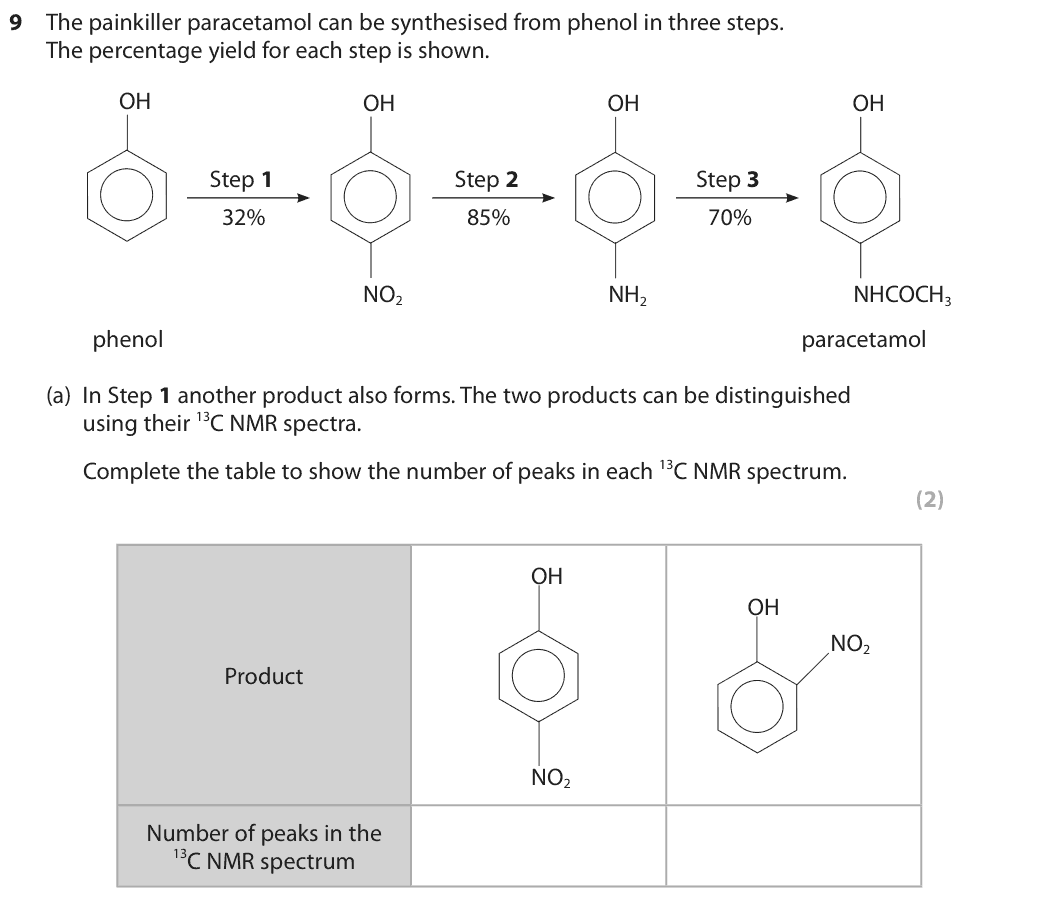
November 2021 · Paper 2 · Q9(a) 2 marks Short answer nmr mass spectrometry and chromatography
The painkiller paracetamol can be synthesised from phenol in three steps.
The percentage yield for each step is shown.
OH
OH
OH
OH
Step 1
Step 2
Step 3
32%
85%
70%
NO2
NH2
NHCOCH3
phenol
paracetamol
In Step 1 another product also forms. The two products can be distinguished
using their 13C NMR spectra.
Complete the table to show the number of peaks in each 13C NMR spectrum.
OH
OH
NO2
Product
NO2
Number of peaks in the
13C NMR spectrum
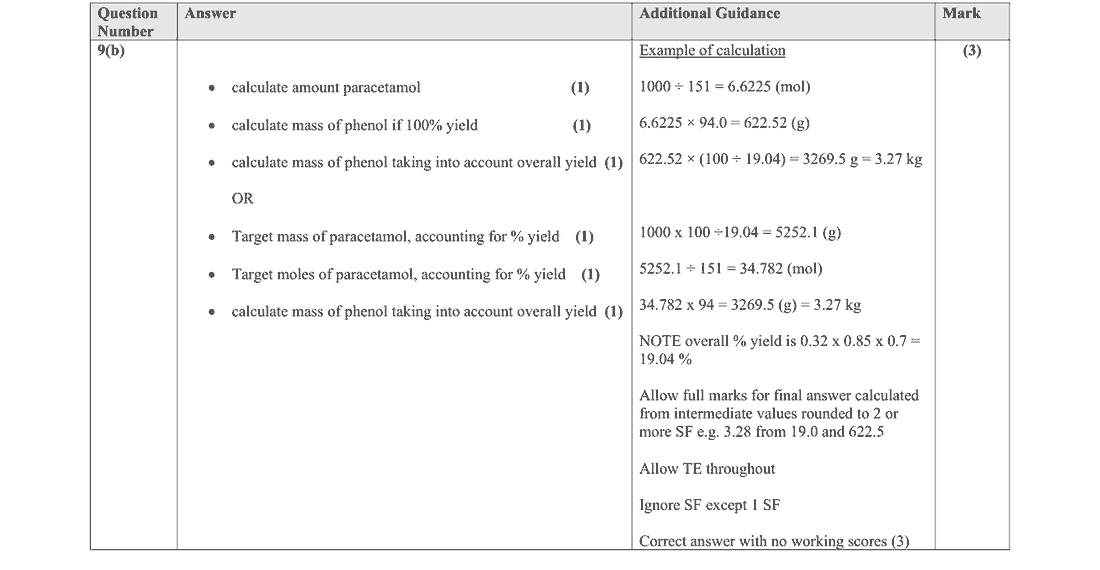
November 2021 · Paper 2 · Q9(b) 3 marks Calculation formulae equations and amounts of substance
Earlier part of question 9 that this part usesEarlier part of November 2021 Paper 2 question 9
Calculate the minimum mass of phenol needed to synthesise 1.00 kg of paracetamol.
[Mr values:  paracetamol = 151.0     phenol = 94.0]
November 2021 · Paper 2 · Q9(c)(i) 1 mark Multiple choice introduction to organic chemistry
Earlier part of question 9 that this part usesEarlier part of November 2021 Paper 2 question 9
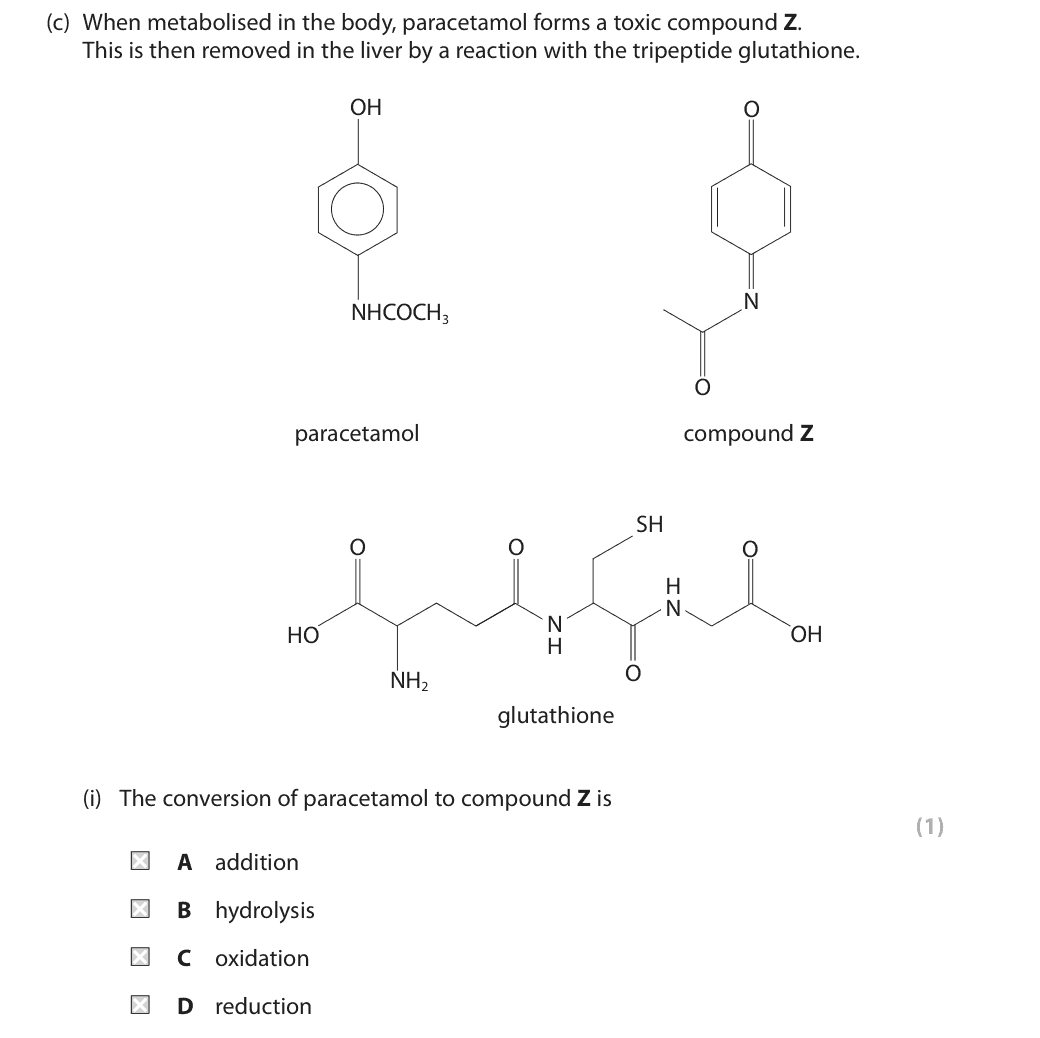
When metabolised in the body, paracetamol forms a toxic compound Z.
This is then removed in the liver by a reaction with the tripeptide glutathione.
OH
O
N
NHCOCH3
O
compound Z
paracetamol
SH
O
O
O
H
N
N
HO
OH
H
O
NH2
glutathione
The conversion of paracetamol to compound Z is
A  addition
B  hydrolysis
C  oxidation
D  reduction
November 2021 · Paper 2 · Q9(c)(ii) 1 mark Short answer chirality
Earlier parts of question 9 that this part usesEarlier part of November 2021 Paper 2 question 9Earlier part of November 2021 Paper 2 question 9
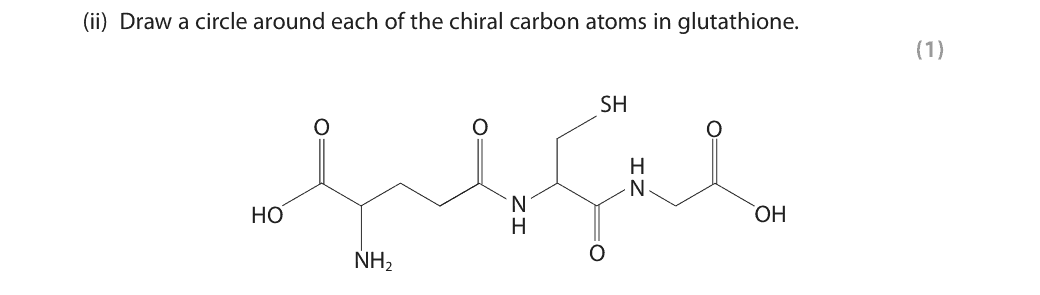
Draw a circle around each of the chiral carbon atoms in glutathione.
SH
O
O
O
H
N
N
OH
HO
H
O
NH2
November 2021 · Paper 2 · Q9(c)(iii) 1 mark Multiple choice amines amides amino acids and proteins
Earlier parts of question 9 that this part usesEarlier part of November 2021 Paper 2 question 9Earlier part of November 2021 Paper 2 question 9
Glutathione is formed from glycine and two other amino acids.
Which two amino acids combine with glycine to form glutathione?
O
O
O
NH2
OH
HS
OH
OH
HO
NH2
NH2
O
glycine
cysteine
aspartic acid
O
O
O
S
OH
HO
OH
NH2
NH2
methionine
glutamic acid
A  aspartic acid and cysteine
B  glutamic acid and cysteine
C  glutamic acid and methionine
D  aspartic acid and methionine
November 2021 · Paper 2 · Q9(d) 2 marks Explanation amines amides amino acids and proteins
Earlier part of question 9 that this part usesEarlier part of November 2021 Paper 2 question 9
Explain why amino acids such as glycine are crystalline solids at room temperature.
November 2021 · Paper 2 · Q10(a)(i) 1 mark Equation writing amines amides amino acids and proteins
This question is about the amines butylamine, C4H9NH2 , and phenylamine, C6H5NH2 .
The reaction scheme shows some reactions of butylamine, a primary amine.
solution of pH  > 7
CH3CH2CONHC4H9
H2O
Reaction 1
Reaction 2
C4H9NH2
Reaction 4
Reaction 3
CH3CH2Br
CuSO4(aq)
C4H9NH(CH2 CH3)
[Cu(C4H9NH2)4]2+
Write the equation for Reaction 1 to show why the pH of the solution is
greater than 7.  State symbols are not required.
November 2021 · Paper 2 · Q10(a)(ii) 3 marks Explanation amines amides amino acids and proteins
Earlier part of question 10 that this part usesEarlier part of November 2021 Paper 2 question 10
Explain why phenylamine is a weaker base than butylamine.
November 2021 · Paper 2 · Q10(b) 2 marks Short answer amines amides amino acids and proteins
Earlier part of question 10 that this part usesEarlier part of November 2021 Paper 2 question 10
Give the name and structural formula of the compound needed to react with
butylamine in Reaction 2.
Name 
Structural formula
November 2021 · Paper 2 · Q10(c) 1 mark Multiple choice amines amides amino acids and proteins
Earlier part of question 10 that this part usesEarlier part of November 2021 Paper 2 question 10
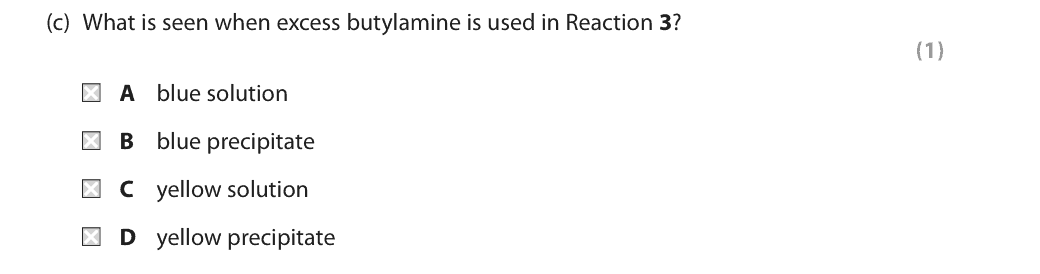
What is seen when excess butylamine is used in Reaction 3?
A  blue solution
B  blue precipitate
C  yellow solution
D  yellow precipitate
November 2021 · Paper 2 · Q10(d)(i) 1 mark Multiple choice amines amides amino acids and proteins
Earlier part of question 10 that this part usesEarlier part of November 2021 Paper 2 question 10
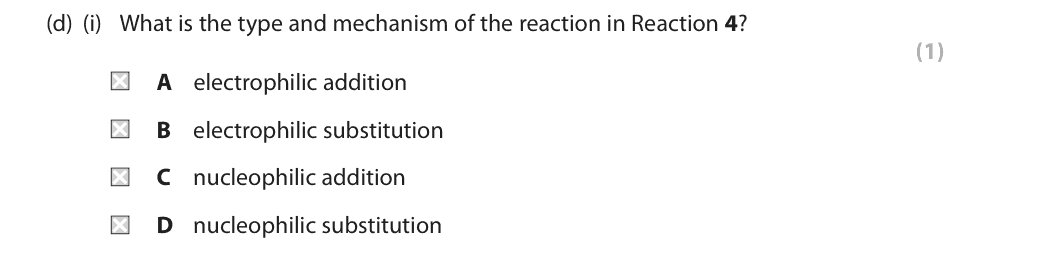
What is the type and mechanism of the reaction in Reaction 4?
A  electrophilic addition
B  electrophilic substitution
C  nucleophilic addition
D   nucleophilic substitution
November 2021 · Paper 2 · Q10(d)(ii) 4 marks Mechanism halogenoalkanes
Earlier parts of question 10 that this part usesEarlier part of November 2021 Paper 2 question 10Earlier part of November 2021 Paper 2 question 10
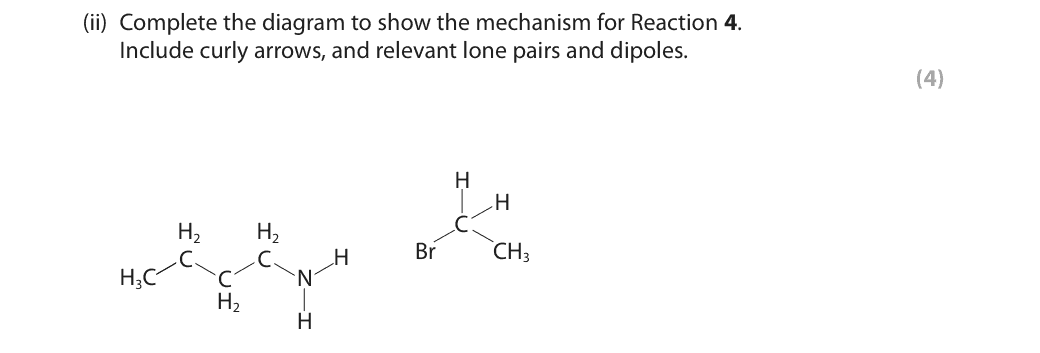
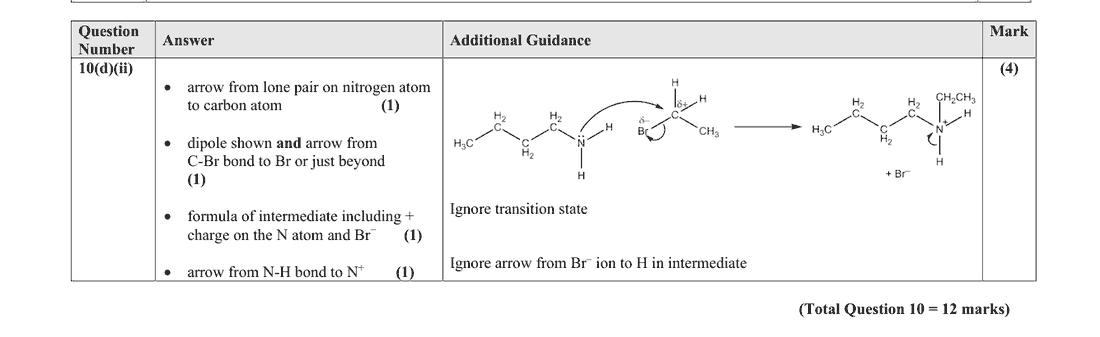
Complete the diagram to show the mechanism for Reaction 4.
Include curly arrows, and relevant lone pairs and dipoles.
H
H
C
H2
H2
Br
CH3
C
H
C
H3C
C
N
H2
H
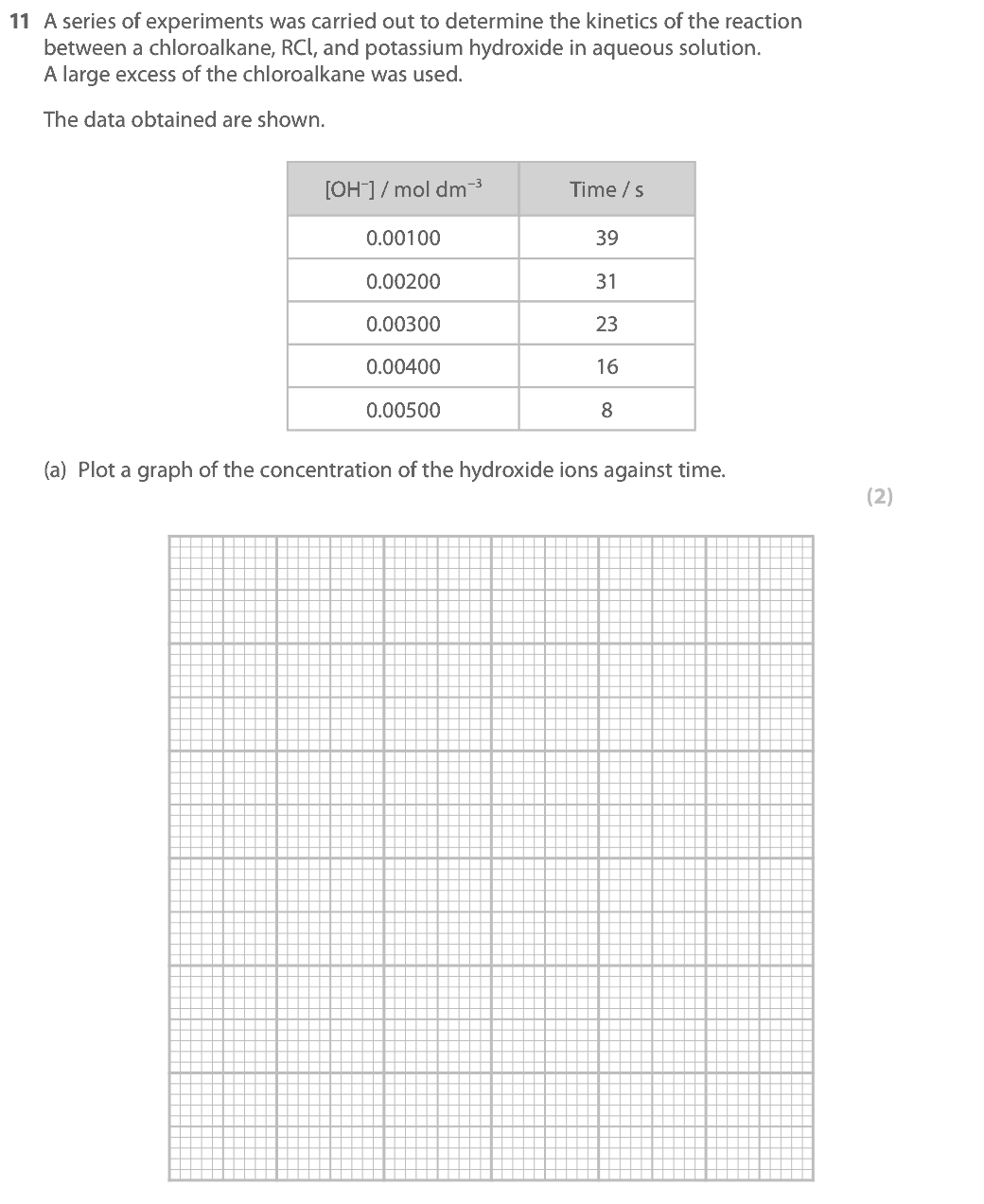
November 2021 · Paper 2 · Q11(a) 2 marks Diagram or structure kinetics ii
A series of experiments was carried out to determine the kinetics of the reaction
between a chloroalkane, RCl, and potassium hydroxide in aqueous solution.
A large excess of the chloroalkane was used.
The data obtained are shown.
[OH−] / mol dm−3
Time / s
0.00100
39
0.00200
31
0.00300
23
0.00400
16
0.00500
8
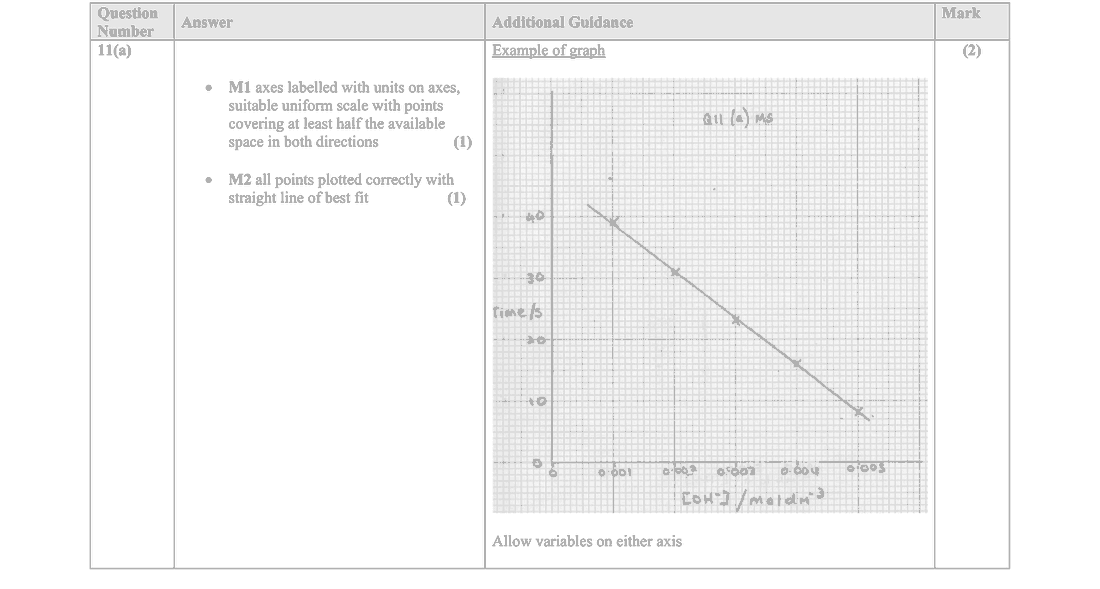
Plot a graph of the concentration of the hydroxide ions against time.
November 2021 · Paper 2 · Q11(b) 2 marks Short answer kinetics ii
Earlier part of question 11 that this part usesEarlier part of November 2021 Paper 2 question 11
State the order with respect to hydroxide ions.
Justify your answer by reference to your graph in (a).
November 2021 · Paper 2 · Q11(c) 2 marks Short answer kinetics ii
Earlier part of question 11 that this part usesEarlier part of November 2021 Paper 2 question 11
Deduce the type of mechanism occurring.
Justify your answer.
November 2021 · Paper 2 · Q11(d) 1 mark Short answer kinetics ii
Earlier part of question 11 that this part usesEarlier part of November 2021 Paper 2 question 11
Give the classification of the chloroalkane in this reaction.
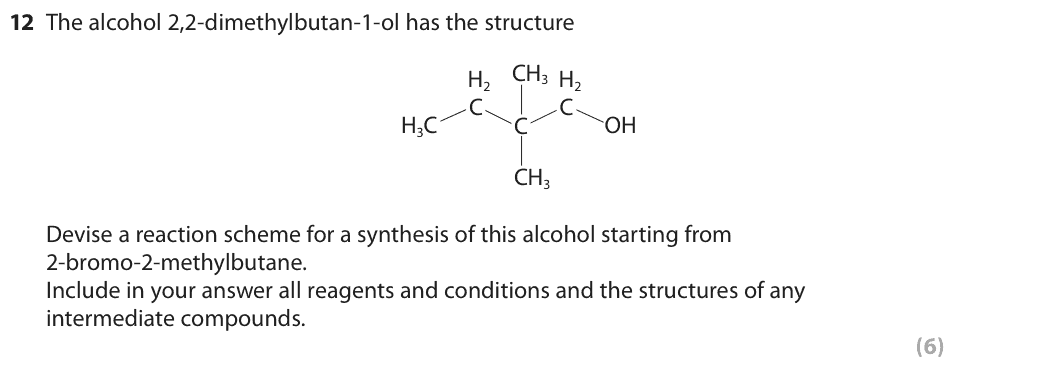
November 2021 · Paper 2 · Q12 6 marks Short answer Hard organic synthesis
The alcohol 2,2-dimethylbutan-1-ol has the structure
CH3
H2
H2
C
C
H3C
C
OH
CH3
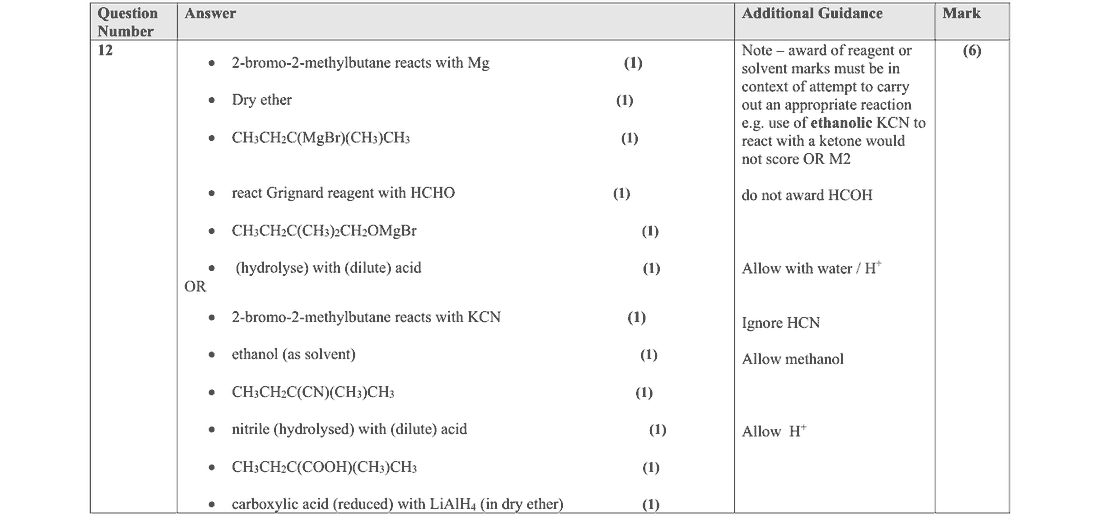
Devise a reaction scheme for a synthesis of this alcohol starting from
2-bromo-2-methylbutane.
Include in your answer all reagents and conditions and the structures of any
intermediate compounds.

Work with an A-level chemistry tutor

Want a paper marked and gone through with you? Message us.

Prefer email? Send an enquiry

If you are under 18, please include a parent's contact details. Enquiries go to enquiries@chemistryaleveltutor.com and are deleted once handled. All tutoring is online.