June 2025: Paper 1, Advanced Inorganic and Physical Chemistry

90 marks · 44 question parts · Paper, mark scheme and report on Edexcel's site · Have the Data Booklet beside you

Question by question

QTopicMarksAOType
1(a) Atomic structure and the Periodic Table 2Short answer
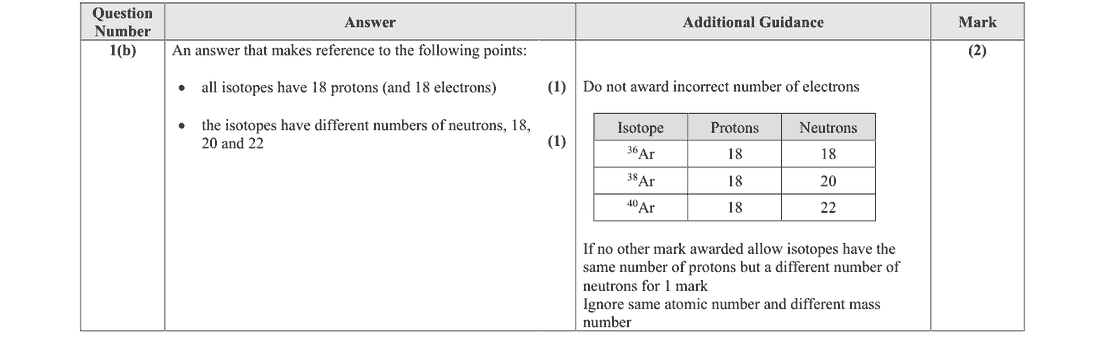
1(b) Atomic structure and the Periodic Table 2Short answer
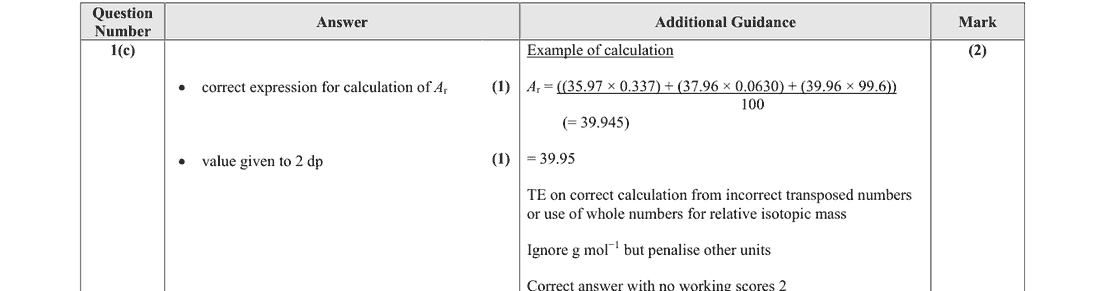
1(c) Atomic structure and the Periodic Table 2Calculation
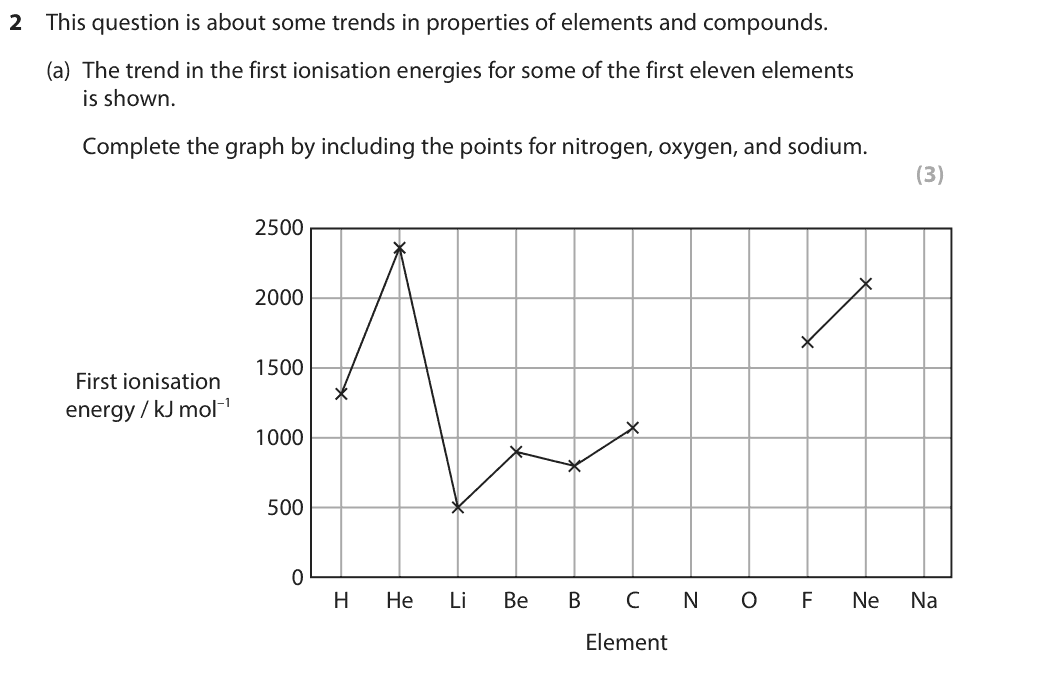
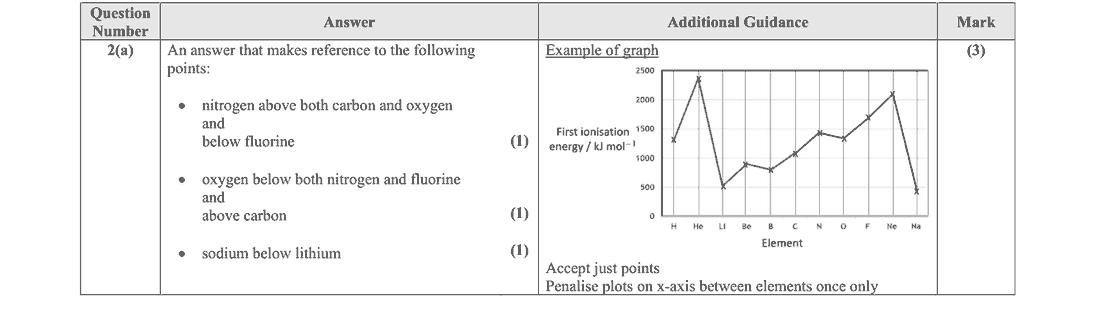
2(a) Atomic structure and the Periodic Table 3Diagram or structure
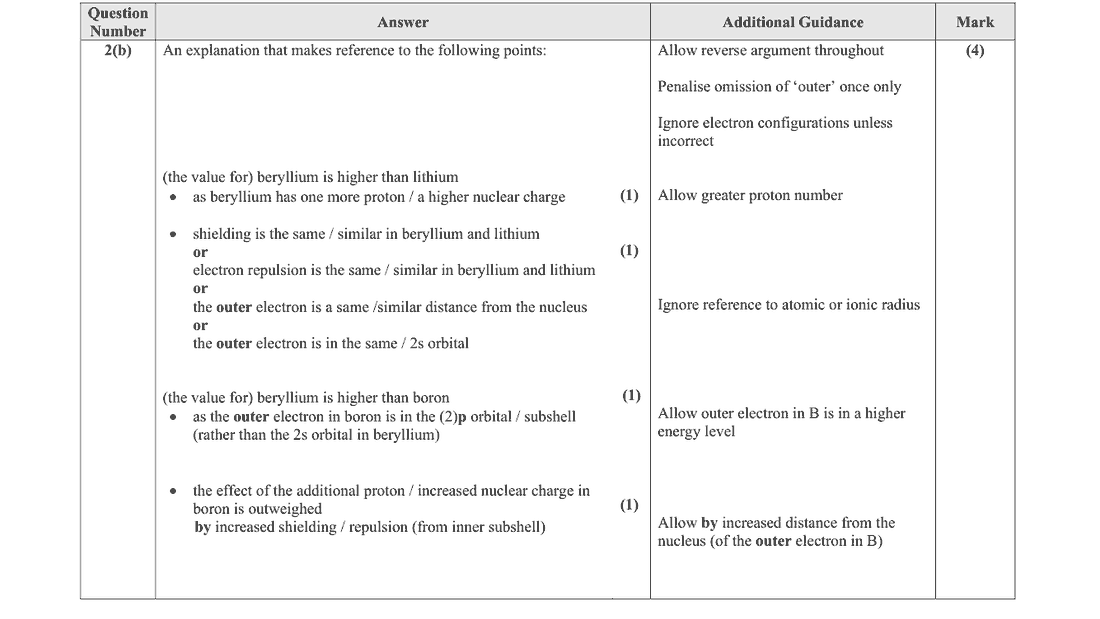
2(b) Atomic structure and the Periodic Table 4Explanation
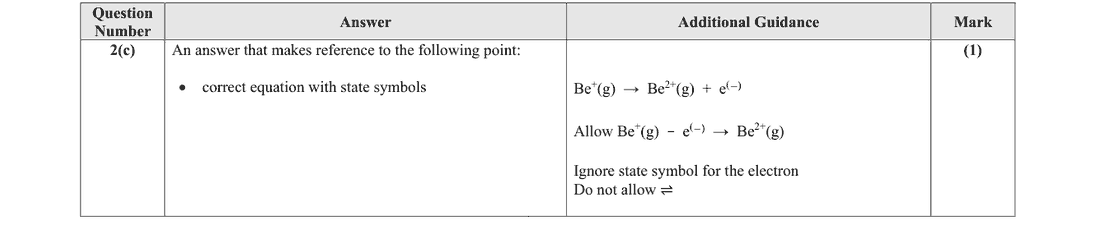
2(c) Atomic structure and the Periodic Table 1Equation writing
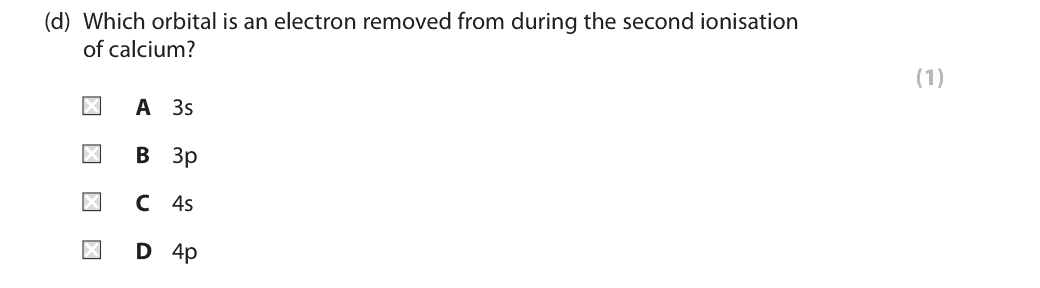
2(d) Atomic structure and the Periodic Table 1Multiple choice
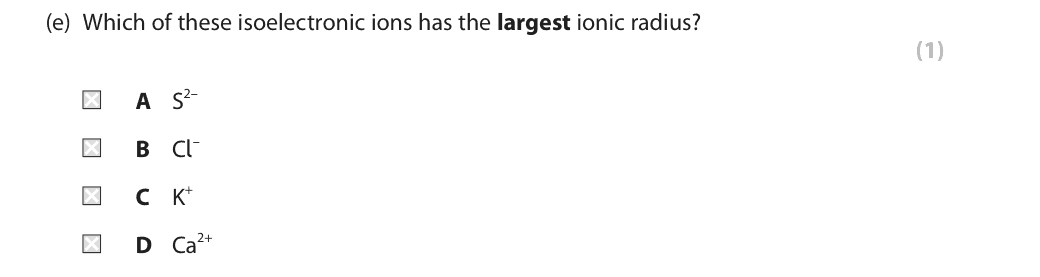
2(e) Bonding 1Multiple choice
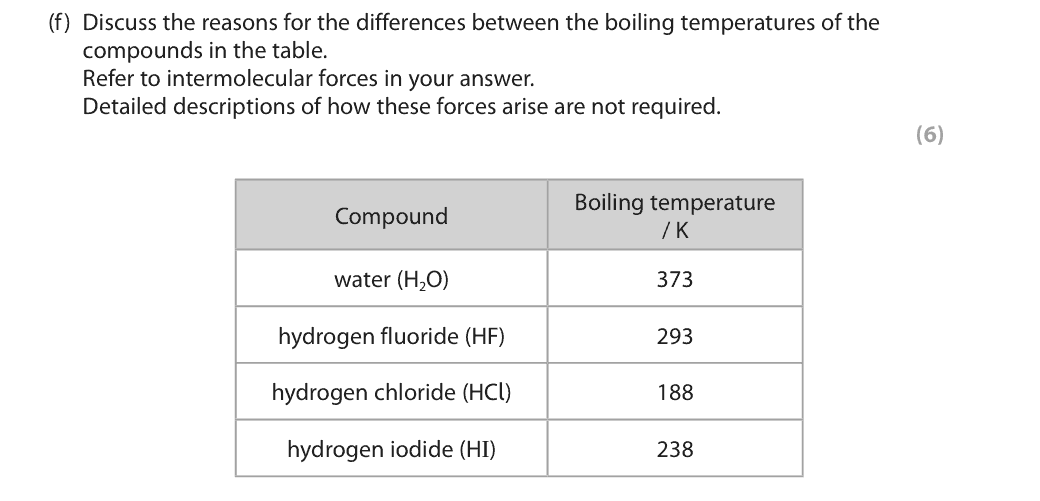
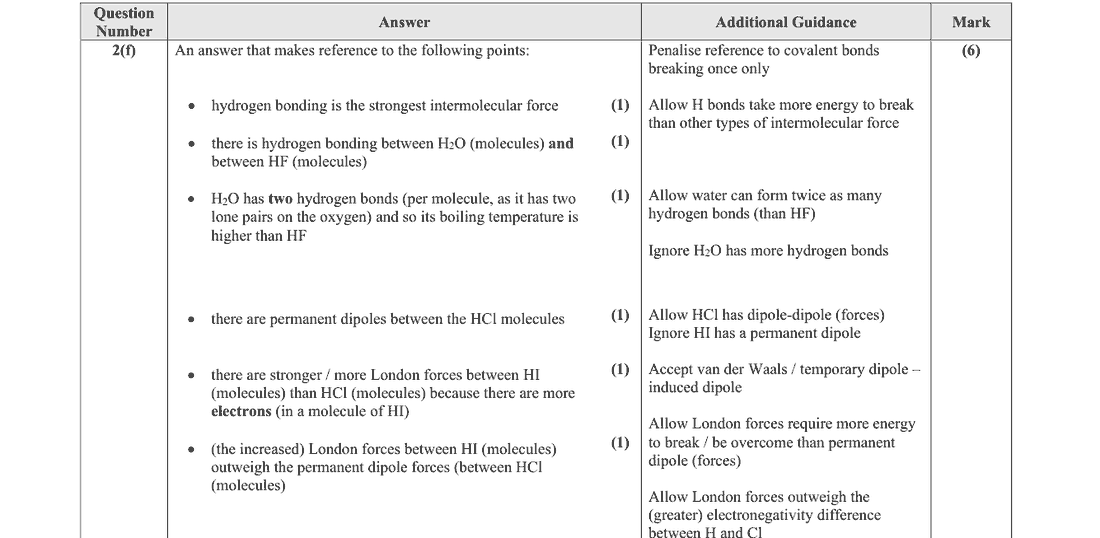
2(f) Bonding 6Explanation
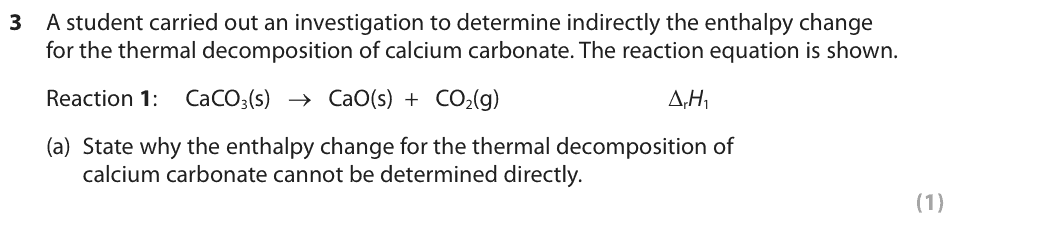
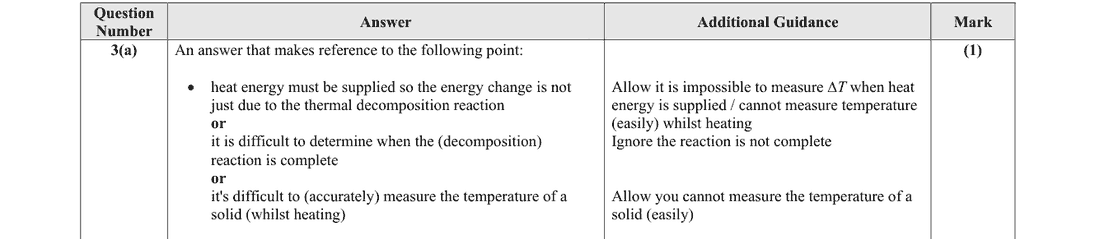
3(a) Energetics I 1Practical and data analysis
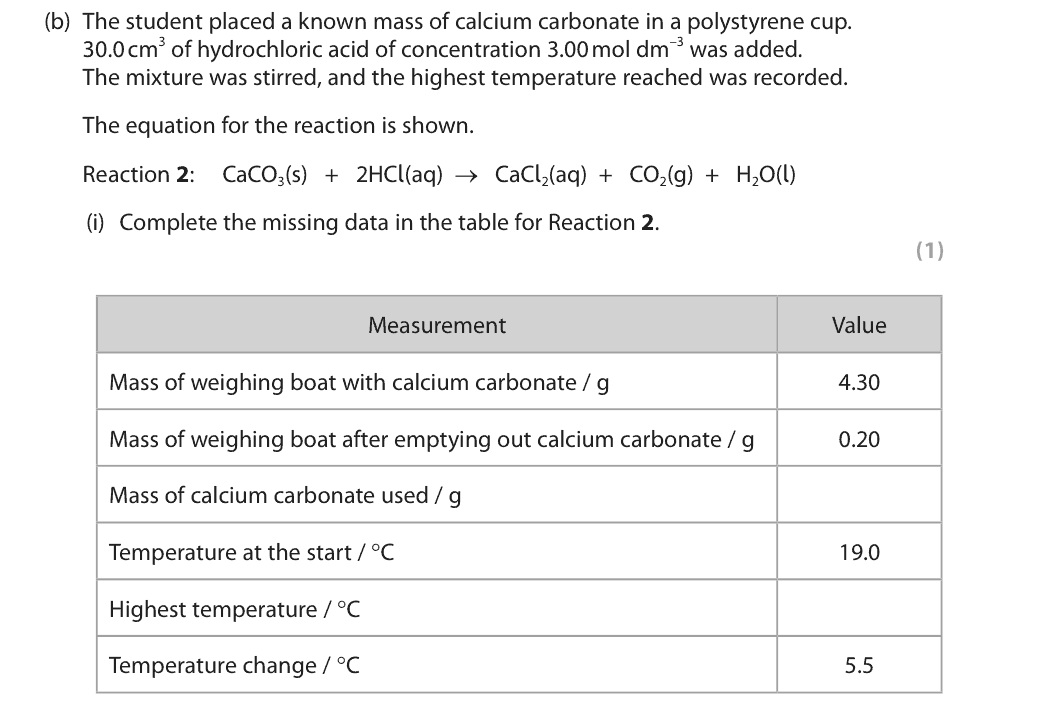
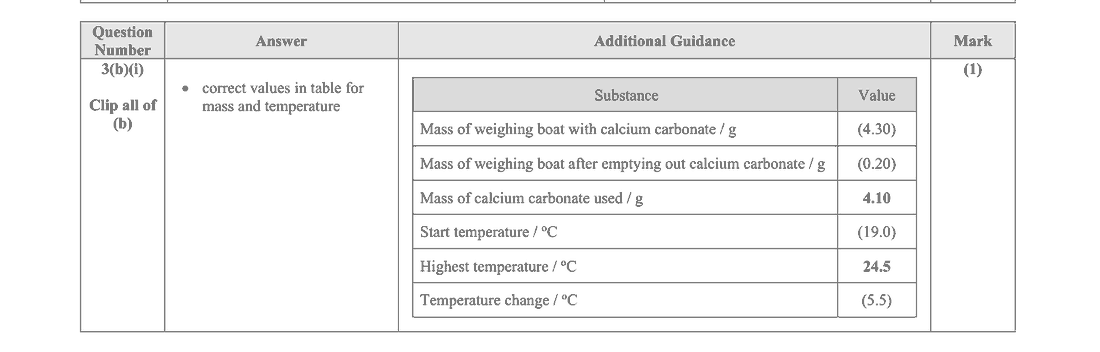
3(b)(i) Energetics I 1Short answer
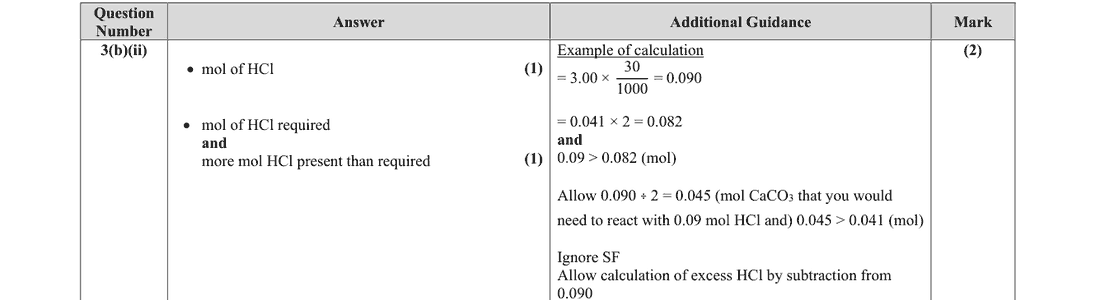
3(b)(ii) Formulae, equations and amounts of substance 2Calculation
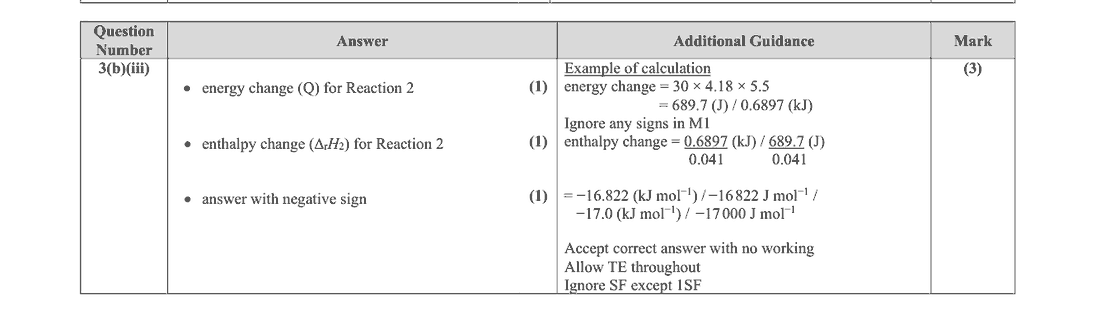
3(b)(iii) Energetics I 3Calculation
3(b)(iv) Energetics I 2Diagram or structure
3(b)(v) Energetics I 1Calculation
3(c)(i) Energetics II: entropy 3Calculation
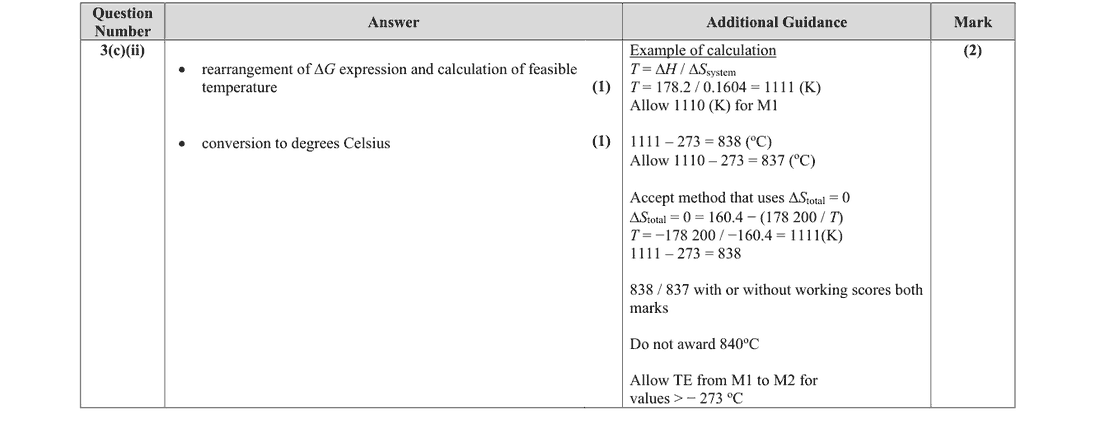
3(c)(ii) Energetics II: entropy 2Calculation
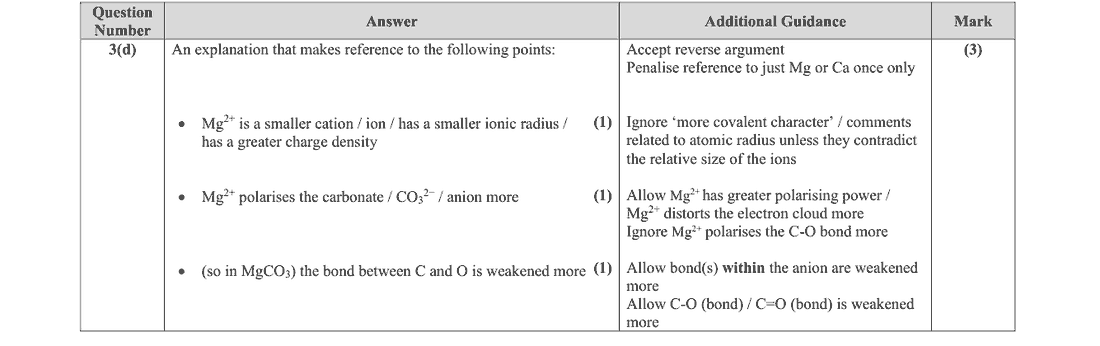
3(d) The elements of Groups 1 and 2 3Explanation
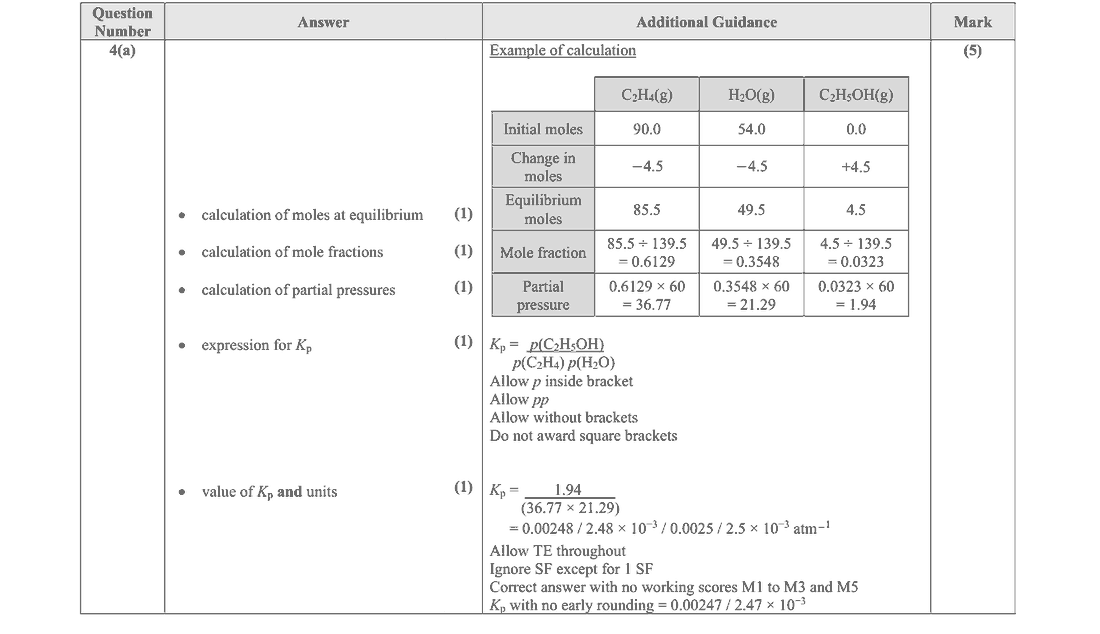
4(a) Equilibrium II 5Calculation
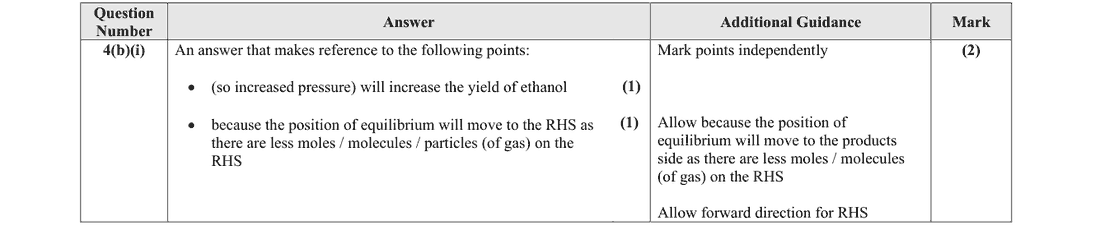
4(b)(i) Equilibrium I 2Explanation
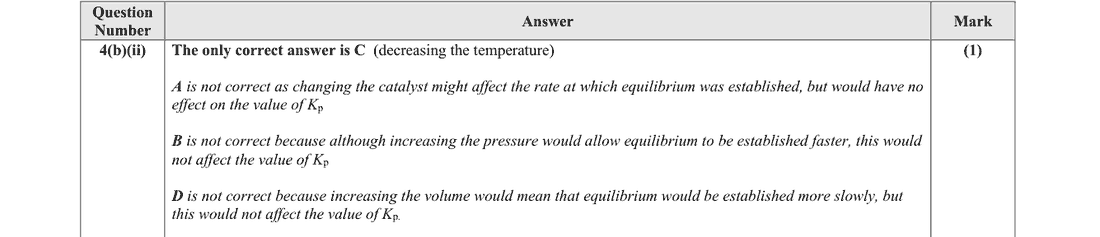
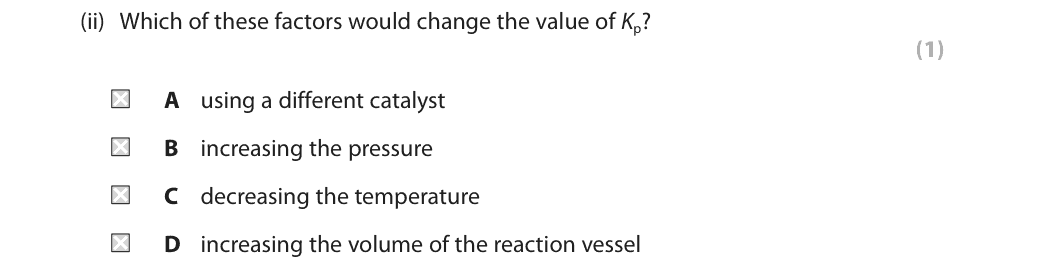
4(b)(ii) Equilibrium II 1Multiple choice
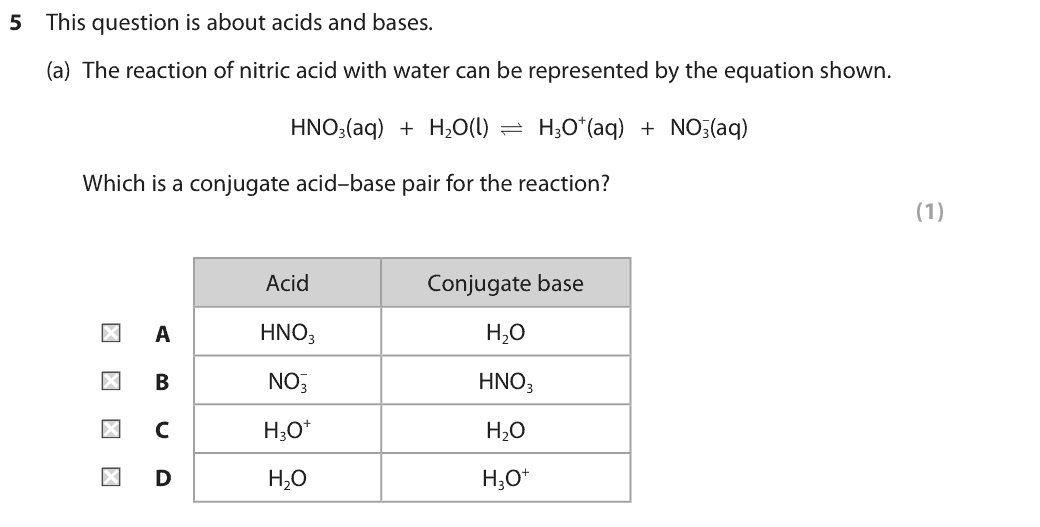
5(a) Acid-base equilibria 1Multiple choice
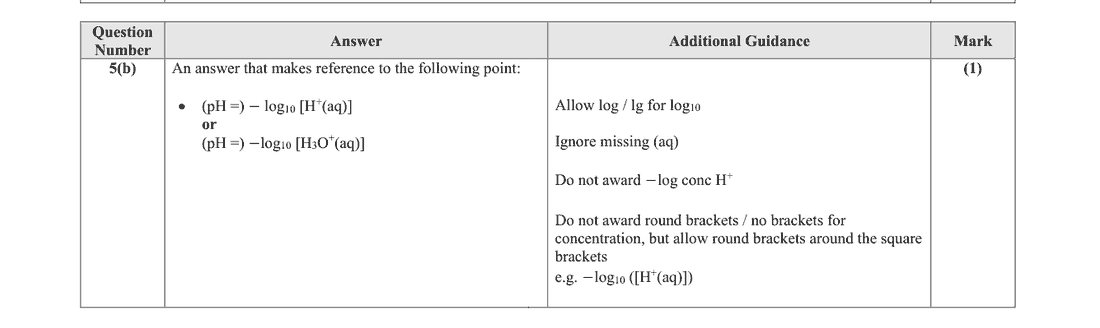
5(b) Acid-base equilibria 1Short answer
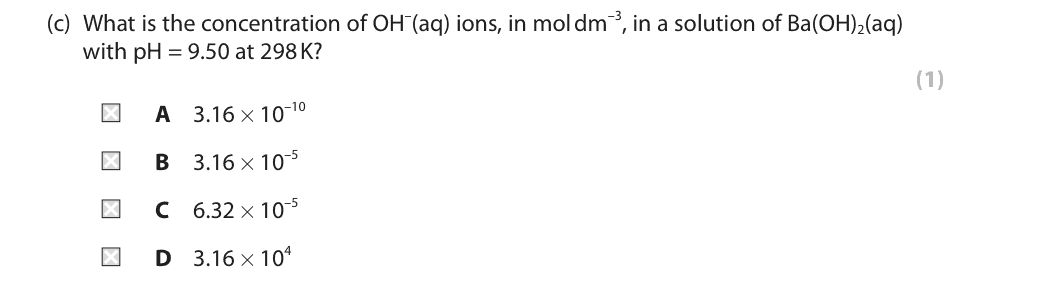
5(c) Acid-base equilibria 1Multiple choice
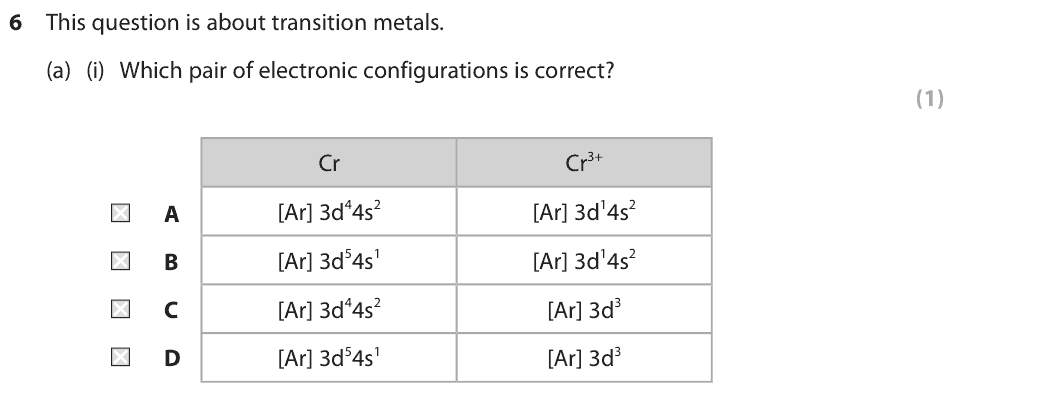
6(a)(i) Transition metals: principles 1Multiple choice
6(a)(ii) Transition metals: principles 1Short answer
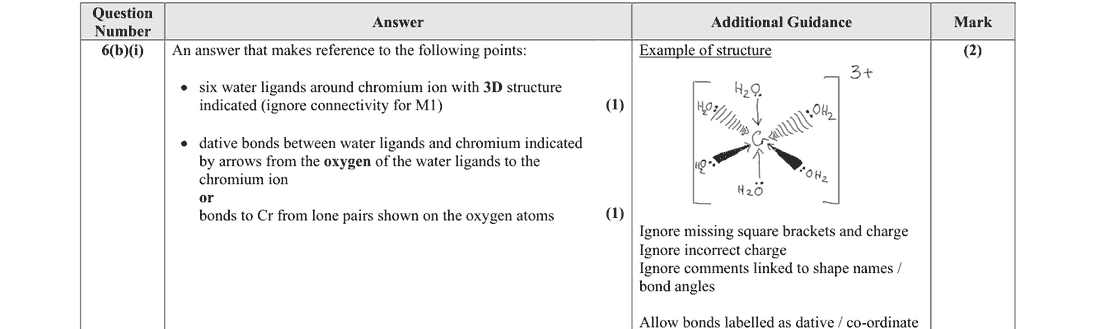
6(b)(i) Transition metals: principles 2Diagram or structure
6(b)(ii) Transition metals: principles 1Short answer
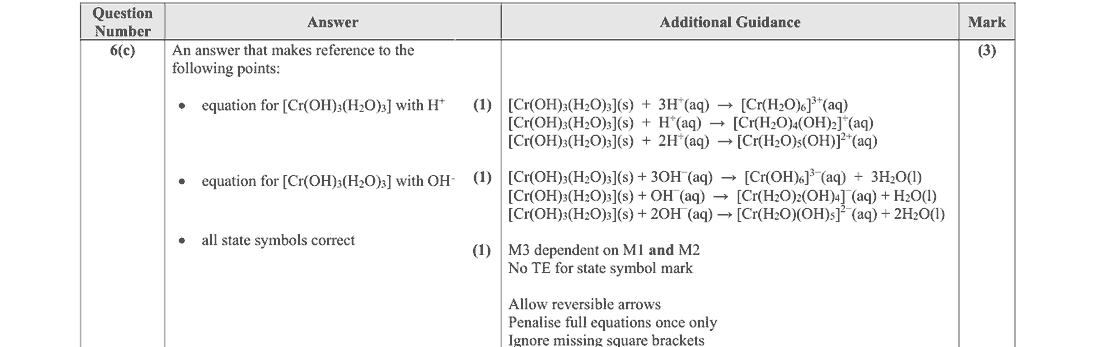
6(c) Transition metals: reactions 3Equation writing
6(d) Transition metals: reactions 1Short answer
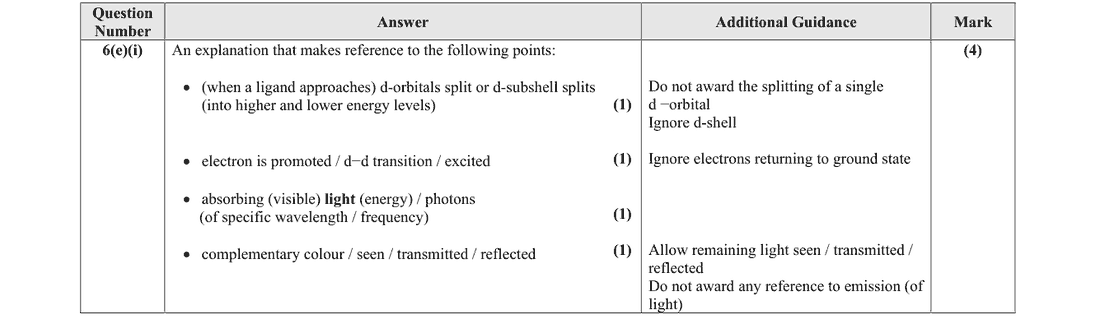
6(e)(i) Transition metals: principles 4Explanation
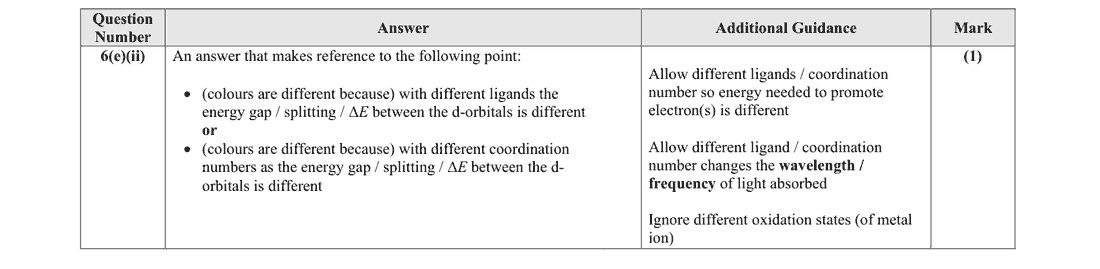
6(e)(ii) Transition metals: principles 1Short answer
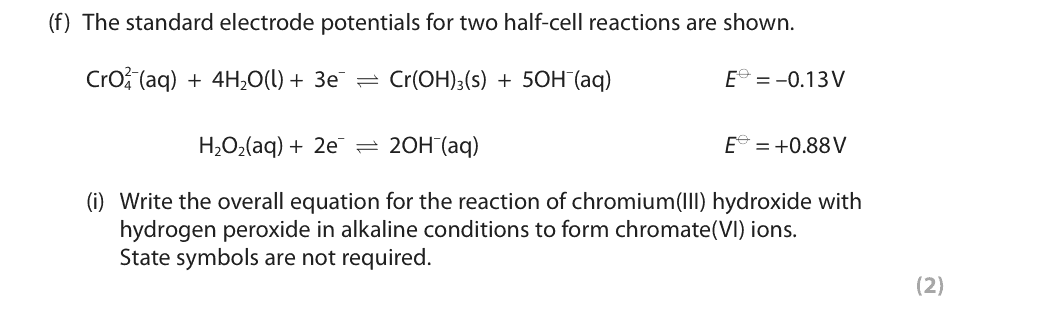
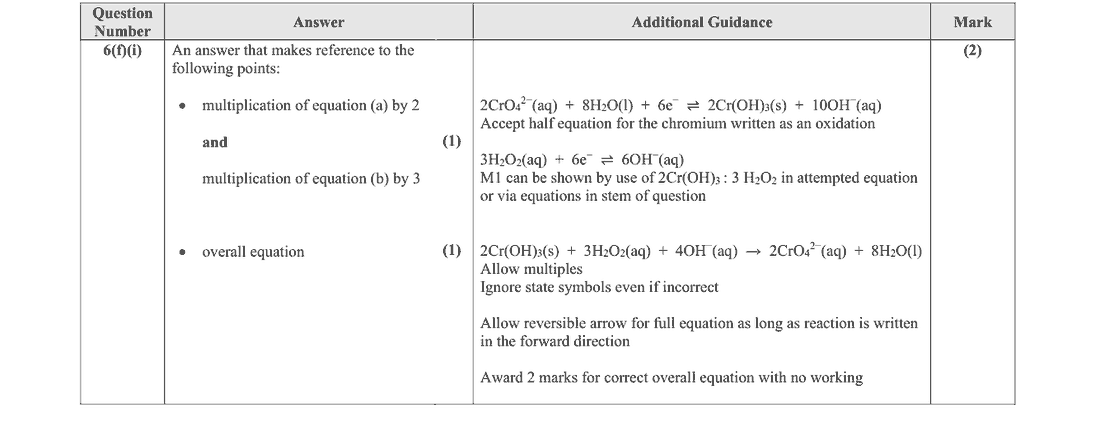
6(f)(i) Transition metals: reactions, Redox I 2Equation writing
6(f)(ii) Redox II 2Calculation
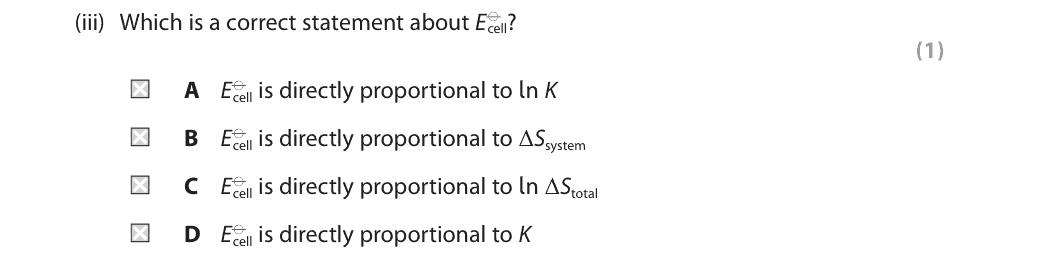
6(f)(iii) Redox II 1Multiple choice
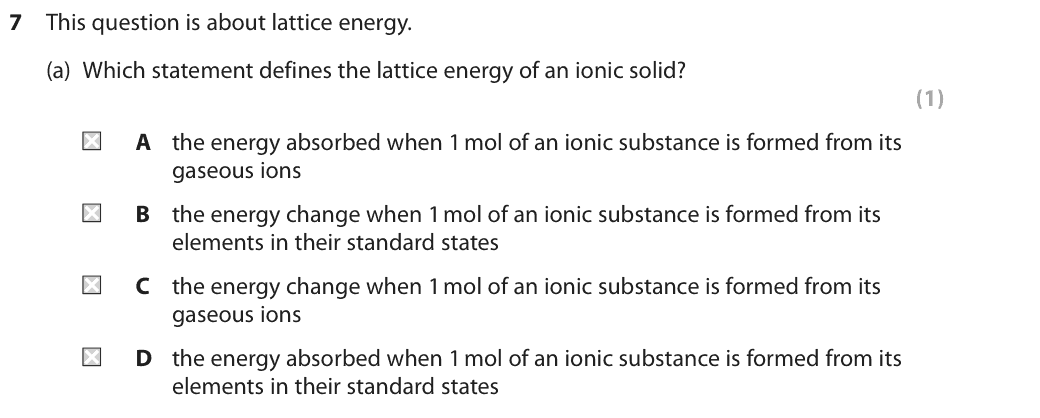
7(a) Energetics II: lattice energy 1Multiple choice
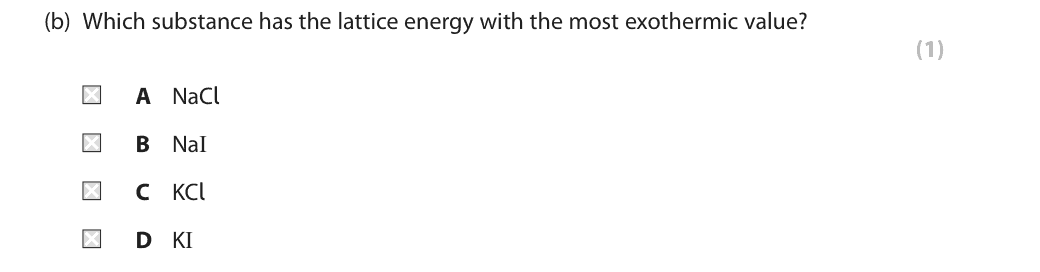
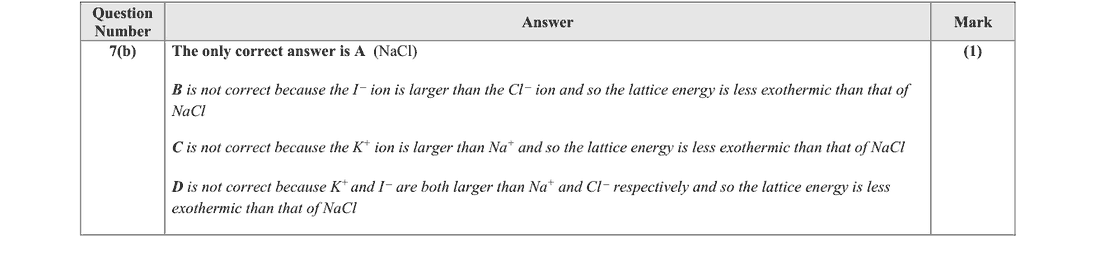
7(b) Energetics II: lattice energy 1Multiple choice
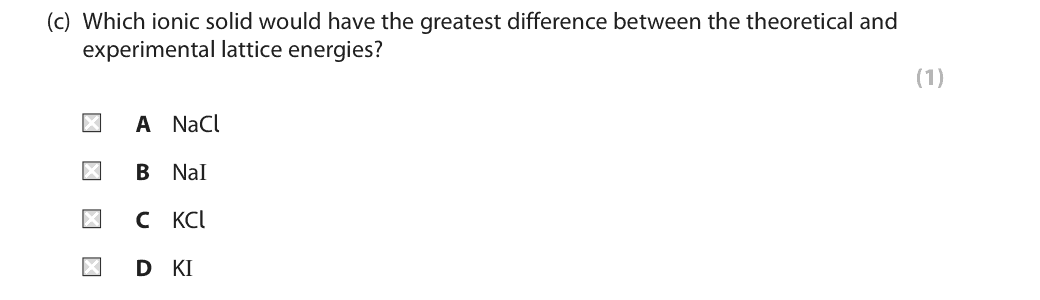
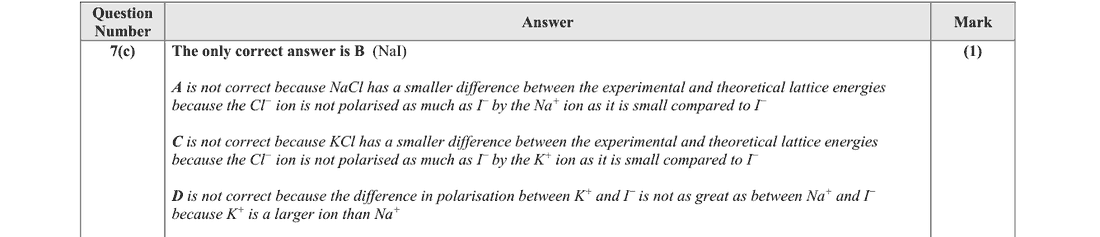
7(c) Energetics II: lattice energy 1Multiple choice
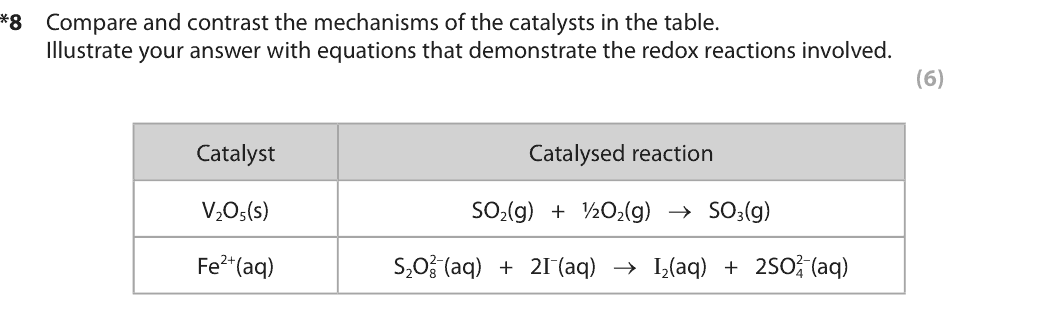
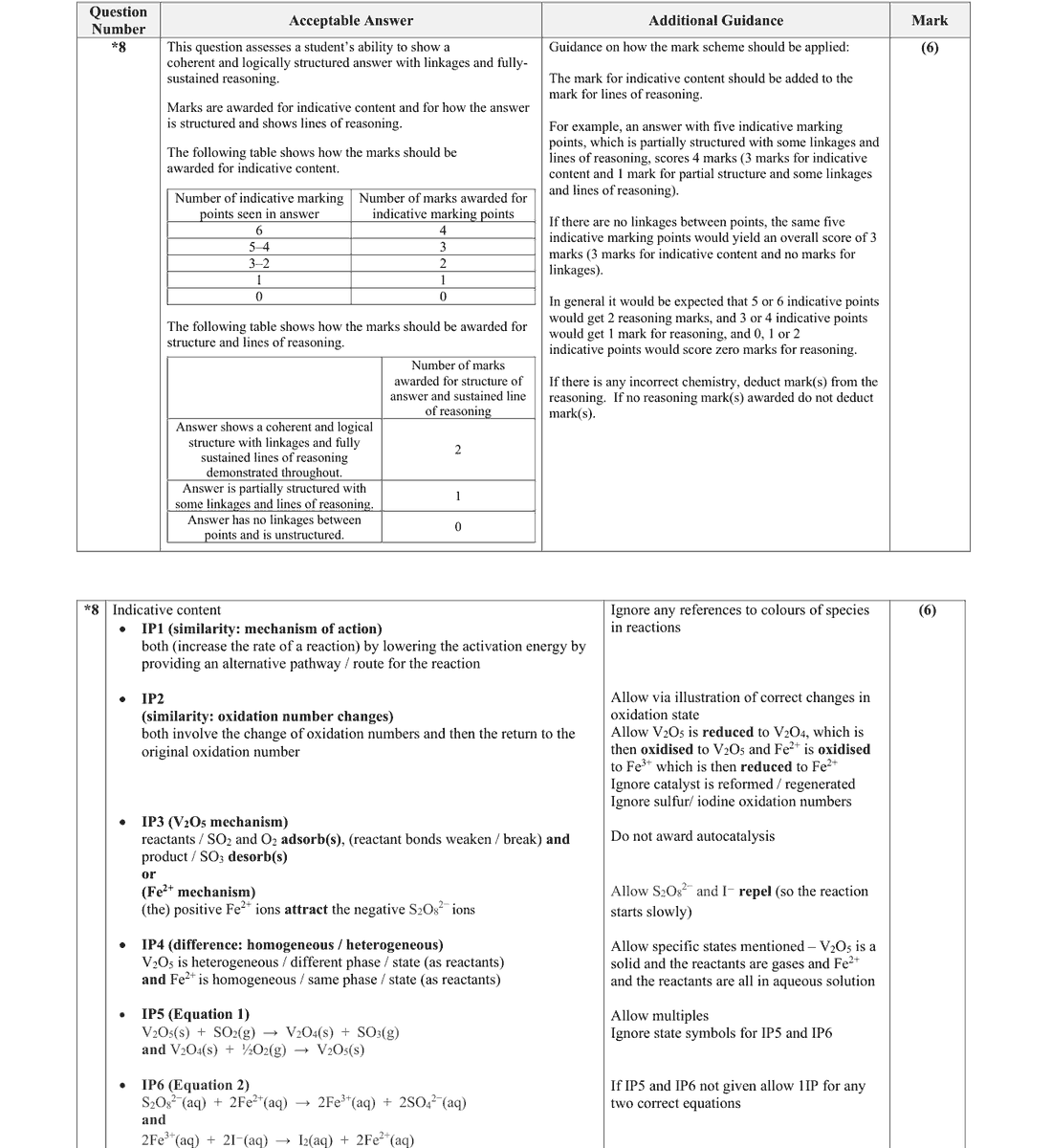
8 Transition metals: reactions 6Extended response
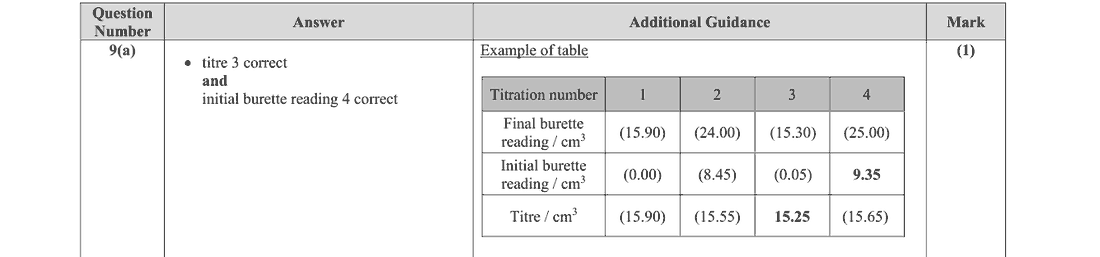
9(a) Redox II 1Short answer
9(b) Redox II 1Practical and data analysis
9(c) Redox II 2Practical and data analysis
9(d) Redox II 5Calculation
9(e) Formulae, equations and amounts of substance 2Calculation

The questions

1(a)1(b)1(c)2(a)2(b)2(c)2(d)2(e)2(f)3(a)3(b)(i)3(b)(ii)3(b)(iii)3(b)(iv)3(b)(v)3(c)(i)3(c)(ii)3(d)4(a)4(b)(i)4(b)(ii)5(a)5(b)5(c)6(a)(i)6(a)(ii)6(b)(i)6(b)(ii)6(c)6(d)6(e)(i)6(e)(ii)6(f)(i)6(f)(ii)6(f)(iii)7(a)7(b)7(c)89(a)9(b)9(c)9(d)9(e)
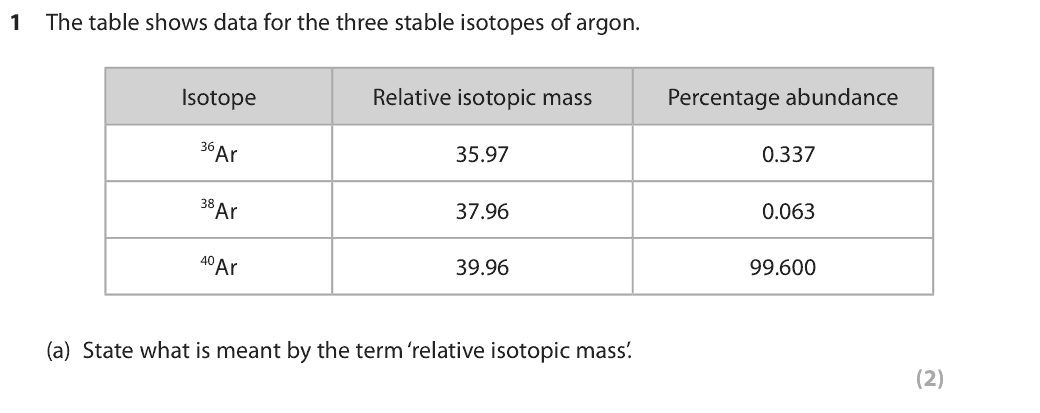
June 2025 · Paper 1 · Q1(a) 2 marks Short answer atomic structure and the periodic table
The table shows data for the three stable isotopes of argon.
Isotope
Relative isotopic mass
Percentage abundance
36Ar
35.97
0.337
38Ar
37.96
0.063
40Ar
39.96
99.600
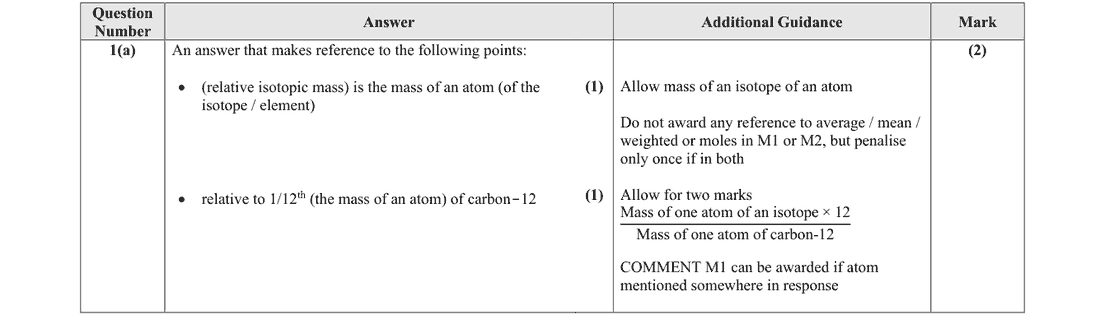
State what is meant by the term ‘relative isotopic mass’.
June 2025 · Paper 1 · Q1(b) 2 marks Short answer atomic structure and the periodic table
Earlier part of question 1 that this part usesEarlier part of June 2025 Paper 1 question 1
State what is meant by the term ‘isotope’.
Illustrate your answer by referring to the numbers of sub‑atomic particles in these
isotopes of argon.
June 2025 · Paper 1 · Q1(c) 2 marks Calculation atomic structure and the periodic table
Earlier part of question 1 that this part usesEarlier part of June 2025 Paper 1 question 1
Calculate the relative atomic mass of argon.
Give your answer to two decimal places.
June 2025 · Paper 1 · Q2(a) 3 marks Diagram or structure atomic structure and the periodic table
This question is about some trends in properties of elements and compounds.
The trend in the first ionisation energies for some of the first eleven elements
is shown.
Complete the graph by including the points for nitrogen, oxygen, and sodium.
2500
2000
1500
First ionisation
energy / kJ mol–1
1000
500
0
H
He
Li
Be
B
C
N
O
F
Ne
Na
Element
June 2025 · Paper 1 · Q2(b) 4 marks Explanation atomic structure and the periodic table
Explain why the first ionisation energy of beryllium is higher than the
first ionisation energy of both lithium and boron.
June 2025 · Paper 1 · Q2(c) 1 mark Equation writing atomic structure and the periodic table
Write the equation for the second ionisation energy of beryllium.
Include state symbols.
June 2025 · Paper 1 · Q2(d) 1 mark Multiple choice atomic structure and the periodic table
Which orbital is an electron removed from during the second ionisation
of calcium?
A  3s
B  3p
C  4s
D  4p
June 2025 · Paper 1 · Q2(e) 1 mark Multiple choice bonding
Which of these isoelectronic ions has the largest ionic radius?
A  S2–
B  Cl–
C  K+
D  Ca2+
June 2025 · Paper 1 · Q2(f) 6 marks Explanation bonding
Earlier part of question 2 that this part usesEarlier part of June 2025 Paper 1 question 2
Discuss the reasons for the differences between the boiling temperatures of the
compounds in the table.
Refer to intermolecular forces in your answer.
Detailed descriptions of how these forces arise are not required.
Boiling temperature
Compound
/ K
water (H2O)
373
hydrogen fluoride (HF)
293
hydrogen chloride (HCl)
188
hydrogen iodide (HI)
238
June 2025 · Paper 1 · Q3(a) 1 mark Practical and data analysis energetics i
A student carried out an investigation to determine indirectly the enthalpy change
for the thermal decomposition of calcium carbonate. The reaction equation is shown.
Reaction 1:     CaCO3(s)   →   CaO(s)  +   CO2(g)              ΔrH1
State why the enthalpy change for the thermal decomposition of
calcium carbonate cannot be determined directly.
June 2025 · Paper 1 · Q3(b)(i) 1 mark Short answer energetics i
Earlier part of question 3 that this part usesEarlier part of June 2025 Paper 1 question 3
The student placed a known mass of calcium carbonate in a polystyrene cup.
30.0 cm3 of hydrochloric acid of concentration 3.00 mol dm–3 was added.
The mixture was stirred, and the highest temperature reached was recorded.
The equation for the reaction is shown.
Reaction 2:     CaCO3(s)   +   2HCl(aq)  →   CaCl2(aq)  +   CO2(g)  +   H2O(l)
Complete the missing data in the table for Reaction 2.
Measurement
Value
Mass of weighing boat with calcium carbonate / g
4.30
Mass of weighing boat after emptying out calcium carbonate / g
0.20
Mass of calcium carbonate used / g
Temperature at the start / °C
19.0
Highest temperature / °C
Temperature change / °C
5.5
June 2025 · Paper 1 · Q3(b)(ii) 2 marks Calculation formulae equations and amounts of substance
Earlier parts of question 3 that this part usesEarlier part of June 2025 Paper 1 question 3Earlier part of June 2025 Paper 1 question 3
0.041 mol of CaCO3(s) was used in the experiment.
Show, by calculation, that the hydrochloric acid is in excess for Reaction 2.
June 2025 · Paper 1 · Q3(b)(iii) 3 marks Calculation energetics i
Earlier parts of question 3 that this part usesEarlier part of June 2025 Paper 1 question 3Earlier part of June 2025 Paper 1 question 3Earlier part of June 2025 Paper 1 question 3
Calculate the enthalpy change, ΔrH2 , for Reaction 2 in kJ mol–1.
Include a sign in your answer.
[Assume the specific heat capacity of the solution = 4.18 J g–1 °C–1
and the mass of the solution = 30 g]
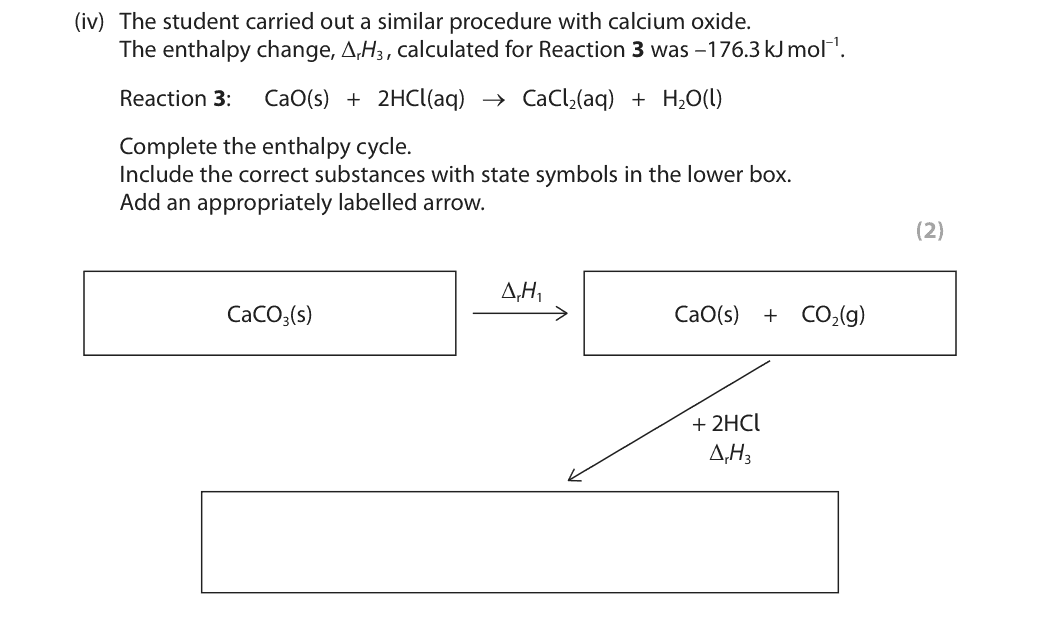
June 2025 · Paper 1 · Q3(b)(iv) 2 marks Diagram or structure energetics i
Earlier parts of question 3 that this part usesEarlier part of June 2025 Paper 1 question 3Earlier part of June 2025 Paper 1 question 3
The student carried out a similar procedure with calcium oxide.
The enthalpy change, ΔrH3 , calculated for Reaction 3 was –176.3 kJ mol–1.
Reaction 3:      CaO(s)   +   2HCl(aq)   →   CaCl2(aq)   +   H2O(l)
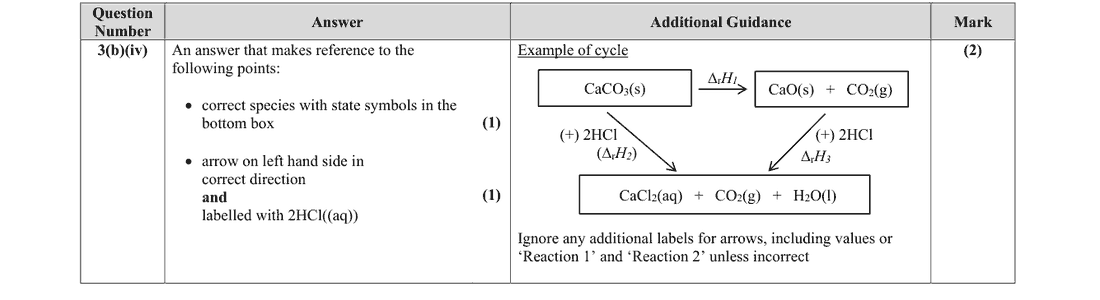
Complete the enthalpy cycle.
Include the correct substances with state symbols in the lower box.
Add an appropriately labelled arrow.
ΔrH1
CaCO3(s)
CaO(s) + CO2(g)
+ 2HCl
ΔrH3
June 2025 · Paper 1 · Q3(b)(v) 1 mark Calculation energetics i
Earlier parts of question 3 that this part usesEarlier part of June 2025 Paper 1 question 3Earlier part of June 2025 Paper 1 question 3Earlier part of June 2025 Paper 1 question 3Earlier part of June 2025 Paper 1 question 3Earlier part of June 2025 Paper 1 question 3
Calculate a value for the enthalpy change ΔrH1 for the thermal decomposition
of calcium carbonate by using your cycle.
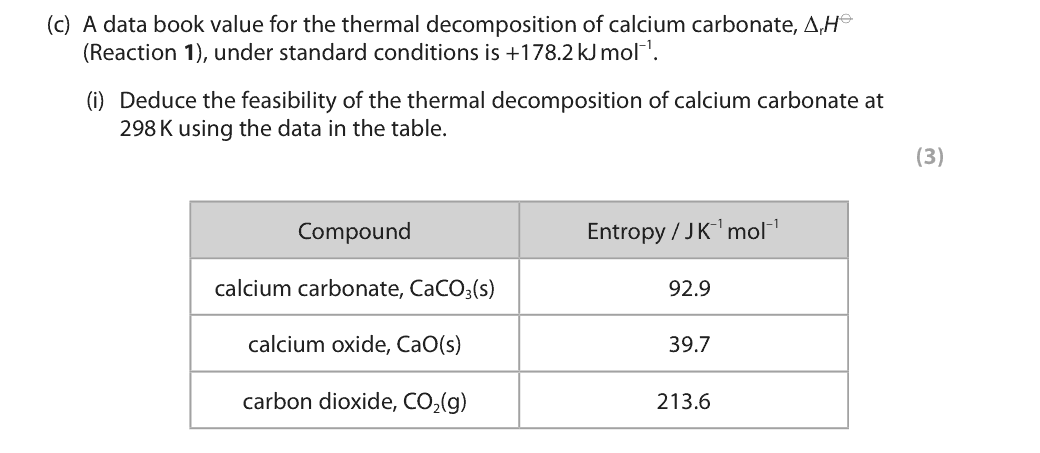
June 2025 · Paper 1 · Q3(c)(i) 3 marks Calculation entropy
Earlier part of question 3 that this part usesEarlier part of June 2025 Paper 1 question 3
A data book value for the thermal decomposition of calcium carbonate, ΔrHd
(Reaction 1), under standard conditions is +178.2 kJ mol–1.
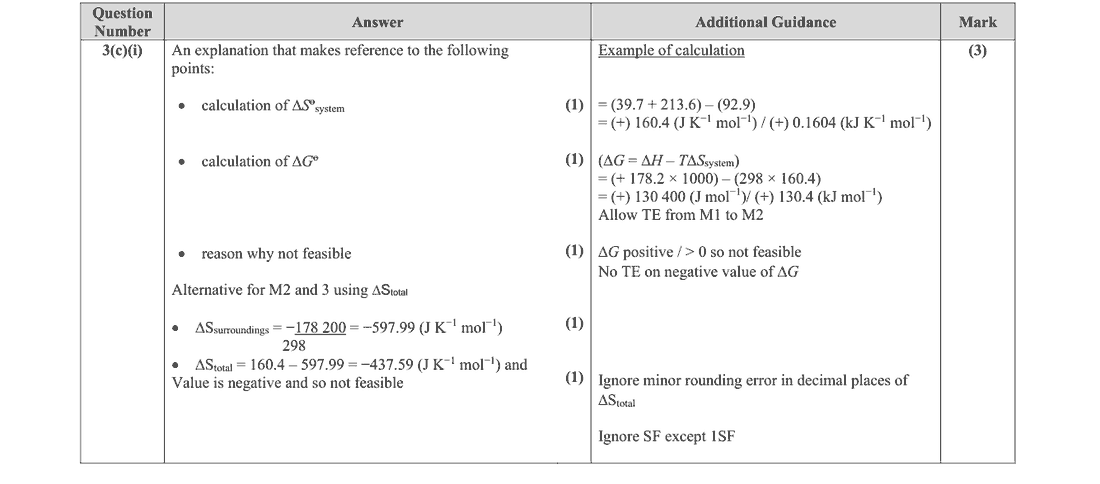
Deduce the feasibility of the thermal decomposition of calcium carbonate at
298 K using the data in the table.
Compound
Entropy / J K–1 mol–1
calcium carbonate, CaCO3(s)
92.9
calcium oxide, CaO(s)
39.7
carbon dioxide, CO2(g)
213.6
June 2025 · Paper 1 · Q3(c)(ii) 2 marks Calculation entropy
Earlier parts of question 3 that this part usesEarlier part of June 2025 Paper 1 question 3Earlier part of June 2025 Paper 1 question 3
Calculate the minimum temperature, in °C, at which thermal decomposition
would occur.
Give your answer to 3 significant figures.
June 2025 · Paper 1 · Q3(d) 3 marks Explanation groups 1 and 2
Earlier part of question 3 that this part usesEarlier part of June 2025 Paper 1 question 3
Explain why magnesium carbonate undergoes thermal decomposition at
a lower temperature than calcium carbonate.
June 2025 · Paper 1 · Q4(a) 5 marks Calculation equilibrium ii
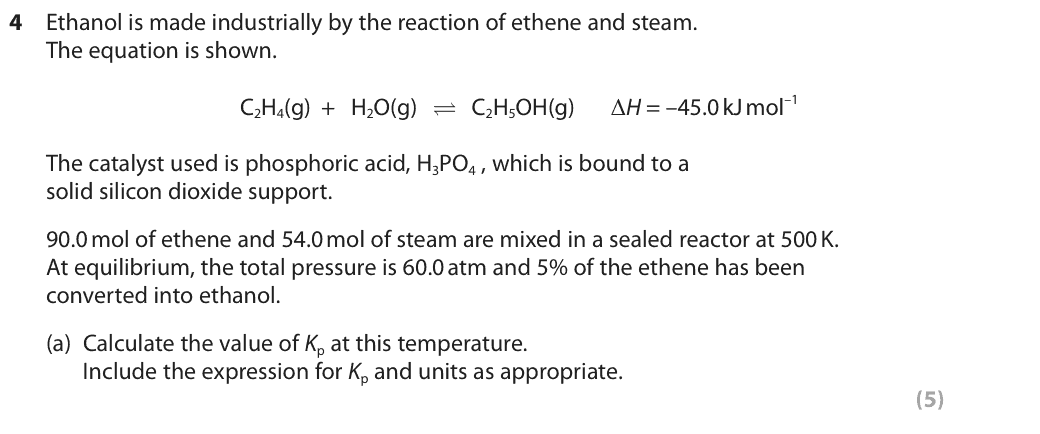
Ethanol is made industrially by the reaction of ethene and steam.
The equation is shown.
C2H4(g)  +   H2O(g)      C2H5OH(g)       ΔH = –45.0 kJ mol–1
The catalyst used is phosphoric acid, H3PO4 , which is bound to a
solid silicon dioxide support.
90.0 mol of ethene and 54.0 mol of steam are mixed in a sealed reactor at 500 K.
At equilibrium, the total pressure is 60.0 atm and 5% of the ethene has been
converted into ethanol.
Calculate the value of Kp at this temperature.
Include the expression for Kp and units as appropriate.
June 2025 · Paper 1 · Q4(b)(i) 2 marks Explanation equilibrium i
Earlier part of question 4 that this part usesEarlier part of June 2025 Paper 1 question 4
It is proposed to increase the pressure in the reactor to 70.0  atm.
Explain the effect this change would have on the yield of ethanol by referring
to the equilibrium.
June 2025 · Paper 1 · Q4(b)(ii) 1 mark Multiple choice equilibrium ii
Earlier parts of question 4 that this part usesEarlier part of June 2025 Paper 1 question 4Earlier part of June 2025 Paper 1 question 4
Which of these factors would change the value of Kp?
A  using a different catalyst
B  increasing the pressure
C  decreasing the temperature
D  increasing the volume of the reaction vessel
June 2025 · Paper 1 · Q5(a) 1 mark Multiple choice acid base equilibria
This question is about acids and bases.
The reaction of nitric acid with water can be represented by the equation shown.
HNO3(aq)   +   H2O(l)     H3O+(aq)   +   NO3
–(aq)
Which is a conjugate acid–base pair for the reaction?
Acid
Conjugate base
A
HNO3
H2O
B
NO3
–
HNO3
C
H3O+
H2O
D
H2O
H3O+
June 2025 · Paper 1 · Q5(b) 1 mark Short answer acid base equilibria
State the expression that defines the pH of a solution.
June 2025 · Paper 1 · Q5(c) 1 mark Multiple choice acid base equilibria
What is the concentration of OH–(aq) ions, in mol dm–3, in a solution of Ba(OH)2(aq)
with pH = 9.50 at 298 K?
A  3.16 × 10–10
B  3.16 × 10–5
C  6.32 × 10–5
D  3.16 × 104
June 2025 · Paper 1 · Q6(a)(i) 1 mark Multiple choice transition metals principles
This question is about transition metals.
Which pair of electronic configurations is correct?
Cr3+
Cr
A
[Ar] 3d44s2
[Ar] 3d14s2
B
[Ar] 3d54s1
[Ar] 3d14s2
C
[Ar] 3d44s2
[Ar] 3d3
D
[Ar] 3d54s1
[Ar] 3d3
June 2025 · Paper 1 · Q6(a)(ii) 1 mark Short answer transition metals principles
Earlier part of question 6 that this part usesEarlier part of June 2025 Paper 1 question 6
State why chromium is classified as a transition metal.
June 2025 · Paper 1 · Q6(b)(i) 2 marks Diagram or structure transition metals principles
Draw the structure of the complex ion, [Cr(H2O)6]3+(aq), showing clearly its
3‑dimensional shape, and the bonds between the chromium ion and the
water ligands.
June 2025 · Paper 1 · Q6(b)(ii) 1 mark Short answer transition metals principles
Earlier part of question 6 that this part usesEarlier part of June 2025 Paper 1 question 6
Name the shape of the [Cr(H2O)6]3+(aq) complex ion.
June 2025 · Paper 1 · Q6(c) 3 marks Equation writing transition metals reactions
Write two ionic equations which demonstrate the amphoteric nature of
chromium(III) hydroxide [Cr(OH)3(H2O)3].
Include state symbols.
June 2025 · Paper 1 · Q6(d) 1 mark Short answer transition metals reactions
Name the type of reaction that occurs when chromium(III) hydroxide reacts with
excess aqueous ammonia.
June 2025 · Paper 1 · Q6(e)(i) 4 marks Explanation transition metals principles
Explain why aqueous solutions of [Cr(H2O)6]3+ are coloured.
June 2025 · Paper 1 · Q6(e)(ii) 1 mark Short answer transition metals principles
Earlier part of question 6 that this part usesEarlier part of June 2025 Paper 1 question 6
Give the reason why the solutions of [Cr(H2O)6]3+ and [CrCl4]– are
different colours.
June 2025 · Paper 1 · Q6(f)(i) 2 marks Equation writing transition metals reactionsredox i
Earlier part of question 6 that this part usesEarlier part of June 2025 Paper 1 question 6
The standard electrode potentials for two half‑cell reactions are shown.
CrO4
2–(aq)  +  4H2O(l) +  3e–    Cr(OH)3(s)  +  5OH–(aq)
Ed = –0.13 V
H2O2(aq) +  2e–    2OH–(aq)
Ed = +0.88 V
Write the overall equation for the reaction of chromium(III) hydroxide with
hydrogen peroxide in alkaline conditions to form chromate(VI) ions.
State symbols are not required.
June 2025 · Paper 1 · Q6(f)(ii) 2 marks Calculation redox ii
Earlier parts of question 6 that this part usesEarlier part of June 2025 Paper 1 question 6Earlier part of June 2025 Paper 1 question 6
Calculate the Ed
cell for this reaction.
Include a reason whether or not the reaction is thermodynamically feasible.
June 2025 · Paper 1 · Q6(f)(iii) 1 mark Multiple choice redox ii
Earlier part of question 6 that this part usesEarlier part of June 2025 Paper 1 question 6
Which is a correct statement about Ed
cell?
A  Ed
cell is directly proportional to ln K
B  Ed
cell is directly proportional to ΔSsystem
C  Ed
cell is directly proportional to ln ΔStotal
D  Ed
cell is directly proportional to K
June 2025 · Paper 1 · Q7(a) 1 mark Multiple choice lattice energy
This question is about lattice energy.
Which statement defines the lattice energy of an ionic solid?
A  the energy absorbed when 1 mol of an ionic substance is formed from its
gaseous ions
B  the energy change when 1 mol of an ionic substance is formed from its
elements in their standard states
C  the energy change when 1 mol of an ionic substance is formed from its
gaseous ions
D  the energy absorbed when 1 mol of an ionic substance is formed from its
elements in their standard states
June 2025 · Paper 1 · Q7(b) 1 mark Multiple choice lattice energy
Which substance has the lattice energy with the most exothermic value?
A  NaCl
B  NaI
C  KCl
D  KI
June 2025 · Paper 1 · Q7(c) 1 mark Multiple choice lattice energy
Which ionic solid would have the greatest difference between the theoretical and
experimental lattice energies?
A  NaCl
B  NaI
C  KCl
D  KI
June 2025 · Paper 1 · Q8 6 marks 6-mark extended response transition metals reactions
Compare and contrast the mechanisms of the catalysts in the table.
Illustrate your answer with equations that demonstrate the redox reactions involved.
Catalyst
Catalysed reaction
V2O5(s)
SO2(g)   +   ½O2(g)   →   SO3(g)
2–(aq)   +   2I–(aq)   →   I2(aq)   +   2SO4
Fe2+(aq)
S2O8
2–(aq)
June 2025 · Paper 1 · Q9(a) 1 mark Short answer redox ii
Some hand sanitisers contain hydrogen peroxide (H2O2) as an active ingredient.
The World Health Organization recommends that the concentration of H2O2 is
between 3.0% and 6.0% by mass.
A higher concentration results in the hand sanitiser being caustic.
A lower concentration means the sanitiser would not be effective.
A sample of a colourless hand sanitiser of density 0.82 g cm–3 was analysed.
10.00 cm3 of the sanitiser was dissolved in deionised water to give a total volume of
250.0 cm3. An acidified solution of potassium manganate(VII) with a concentration
of 0.0200 mol dm–3 was titrated against a 25.00 cm3 sample of the
diluted hand sanitiser solution.
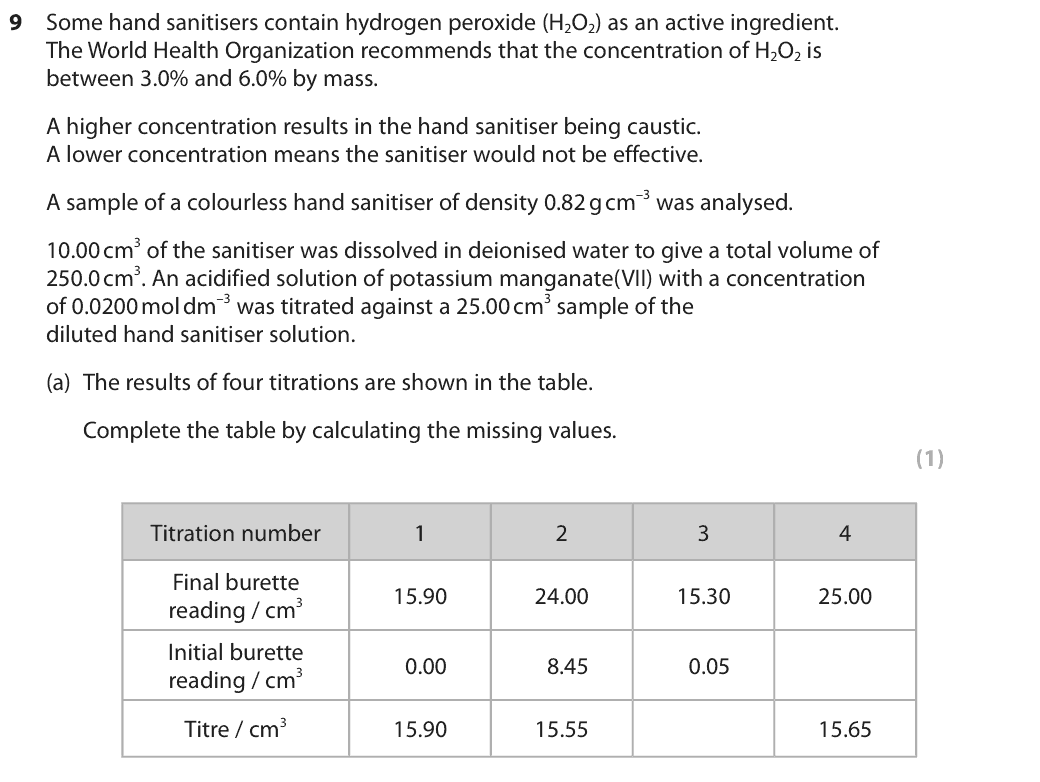
The results of four titrations are shown in the table.
Complete the table by calculating the missing values.
Titration number
1
2
3
4
Final burette
15.90
24.00
15.30
25.00
reading / cm3
Initial burette
0.00
8.45
0.05
reading / cm3
Titre / cm3
15.90
15.55
15.65
June 2025 · Paper 1 · Q9(b) 1 mark Practical and data analysis redox ii
Earlier part of question 9 that this part usesEarlier part of June 2025 Paper 1 question 9
The mean titre was calculated to be 15.60 cm3.
State how this value was determined.
June 2025 · Paper 1 · Q9(c) 2 marks Practical and data analysis redox ii
Earlier part of question 9 that this part usesEarlier part of June 2025 Paper 1 question 9
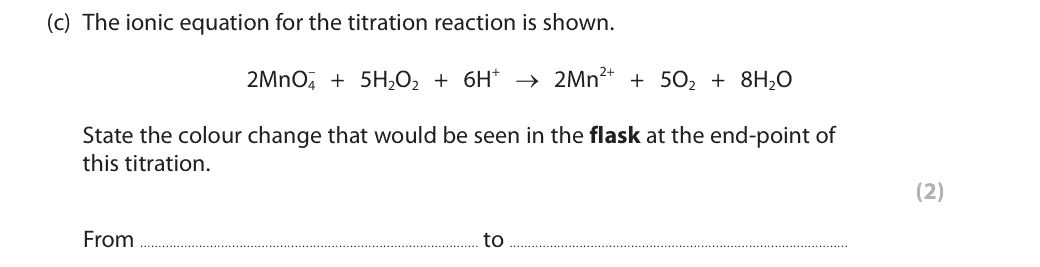
The ionic equation for the titration reaction is shown.
–   +   5H2O2   +   6H+   →   2Mn2+   +   5O2   +   8H2O
2MnO4
State the colour change that would be seen in the flask at the end‑point of
this titration.
From  to
June 2025 · Paper 1 · Q9(d) 5 marks Calculation redox ii
Earlier part of question 9 that this part usesEarlier part of June 2025 Paper 1 question 9
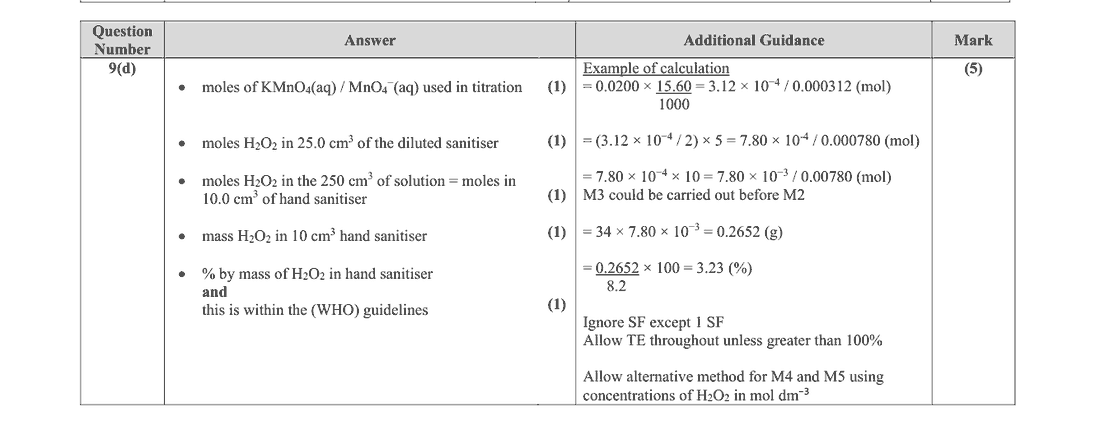
Deduce by calculation whether the concentration of hydrogen peroxide in the
hand sanitiser is within World Health Organization guidelines.
June 2025 · Paper 1 · Q9(e) 2 marks Calculation formulae equations and amounts of substance
Earlier part of question 9 that this part usesEarlier part of June 2025 Paper 1 question 9
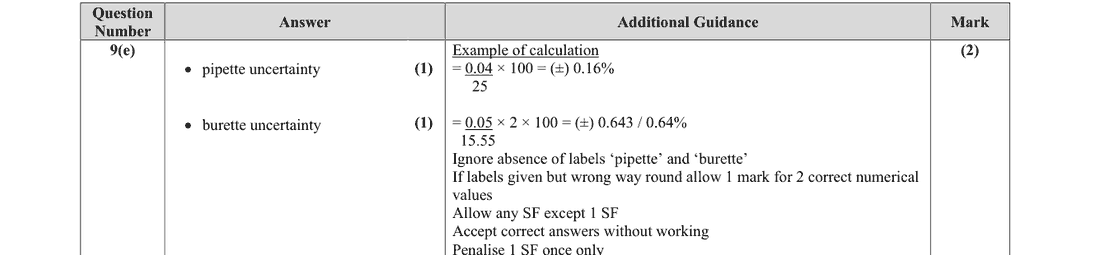
The uncertainty in the pipette volume is ± 0.04 cm3. The uncertainty in each
burette reading is ± 0.05 cm3.
Calculate the percentage uncertainties for the pipette volume of 25.00 cm3 and
the burette volume of 15.55 cm3 for titre 2.

Work with an A-level chemistry tutor

Want a paper marked and gone through with you? Message us.

Prefer email? Send an enquiry

If you are under 18, please include a parent's contact details. Enquiries go to enquiries@chemistryaleveltutor.com and are deleted once handled. All tutoring is online.