Answer
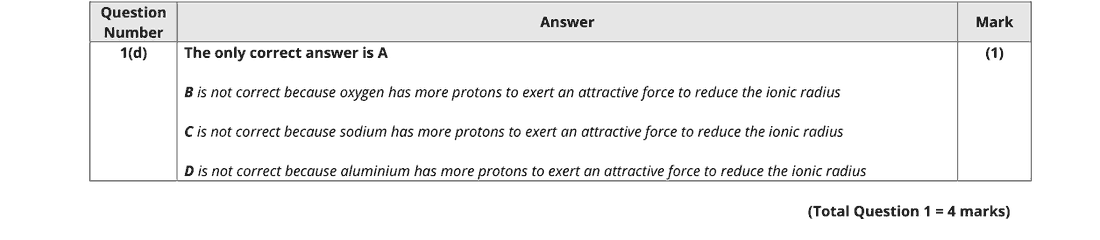
A
Mark scheme

Notes from the mark scheme and report
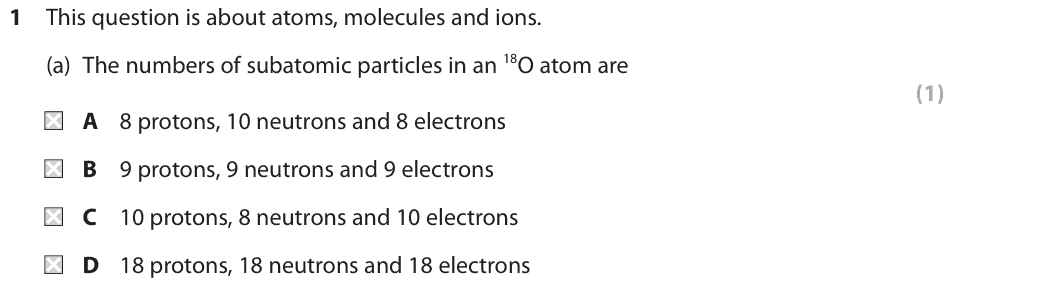
- Answer: A. Oxygen has 8 protons, so 18 – 8 = 10 neutrons and 8 electrons in the atom. B, C and D have the wrong number of protons for oxygen
90 marks · 46 question parts · Paper, mark scheme and report on Edexcel's site · Have the Data Booklet beside you
A
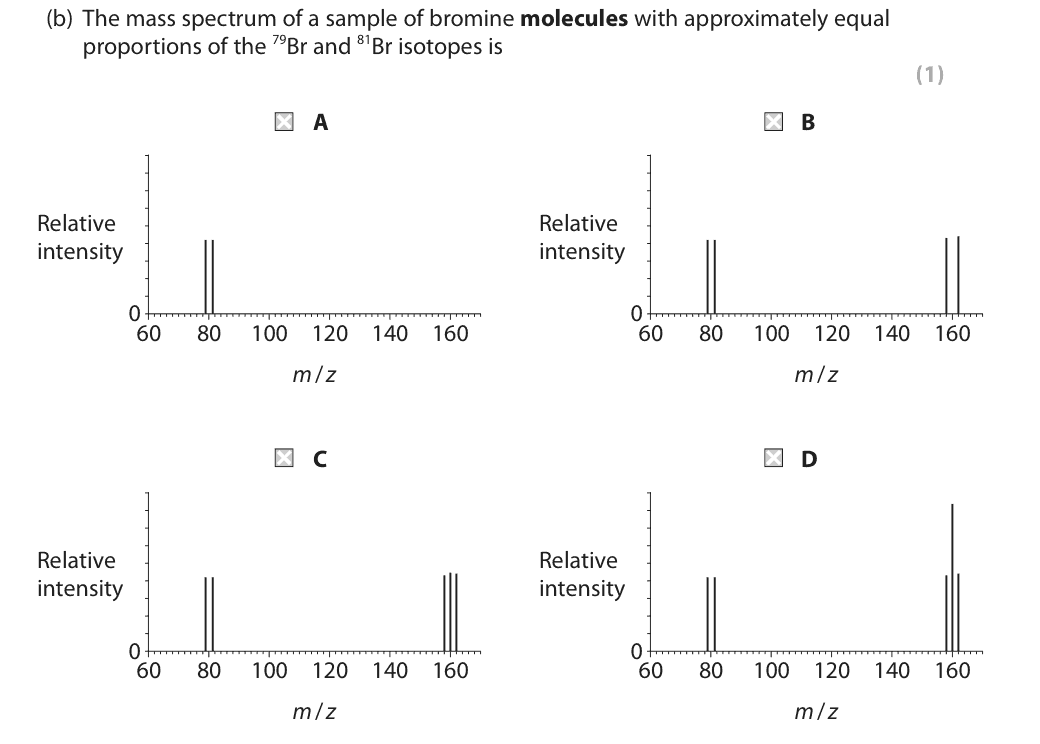
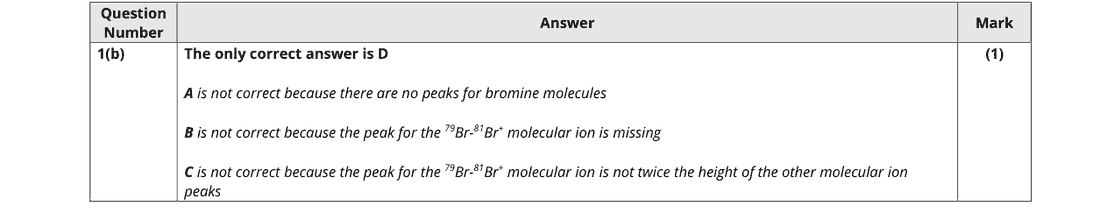
D
Skills: MS3.1 Translate information between graphical, numerical and algebraic forms
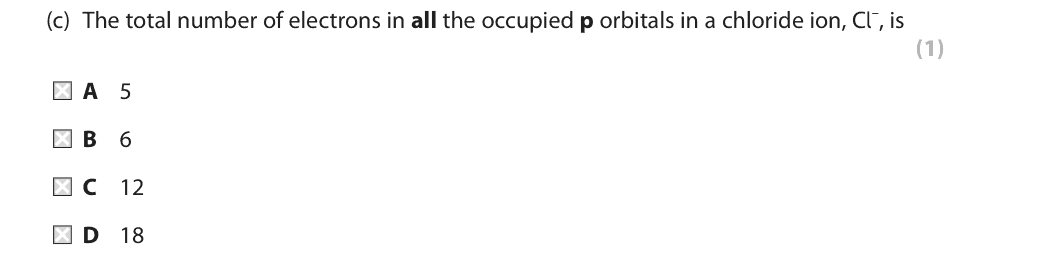
C
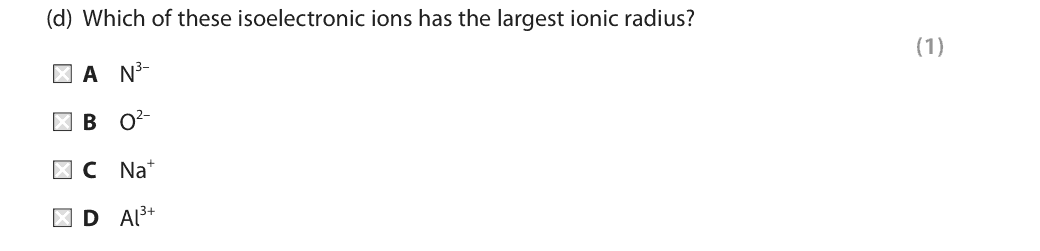
A

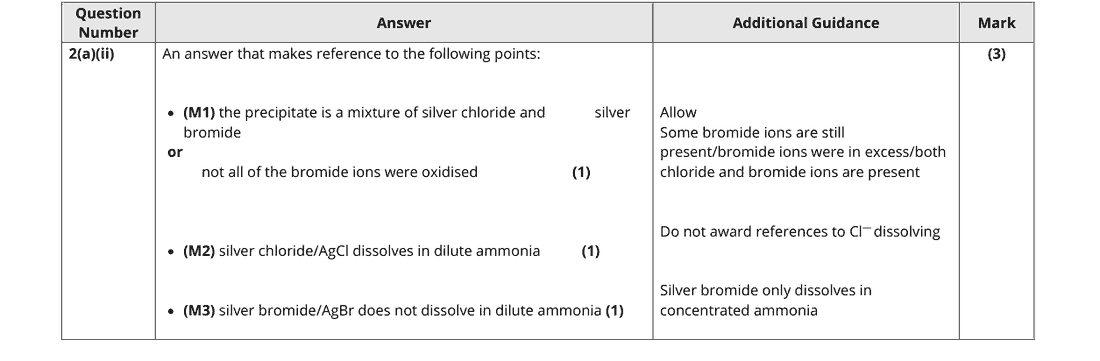
Following the multiple choice questions, this was an accessible question at the start of the question paper and the majority of candidates were awarded the mark. However, in part (i) and the subsequent part (ii) there proved to be some misunderstanding between the terms 'chlorine' and 'chloride' or 'molecular chlorine' and 'chloride ions'.

Many responses referred erroneously to the solubility of molecular halogens rather than their silver precipitates. In addition a significant number of others referred to the solubility of the halide precipitate without mentioning the silver. These errors did result in a loss of credit. This was disappointing as the majority of candidates understood the difference in the solubility between the two compounds in dilute ammonia but did not gain full marks because of such incorrect terminology.
Skills: CP7 Core practical 7: Analysis of some inorganic and organic unknowns

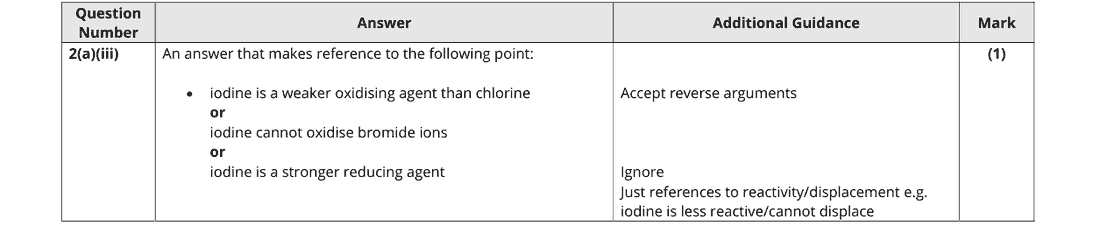
A significant number of responses simply referred to the inability of iodine to displace bromide or that it is less reactive but this question requires 'a reason'. Hence, a successful response needed to either refer to iodine being a weaker oxidising agent than chlorine or being too strong a reducing reagent.
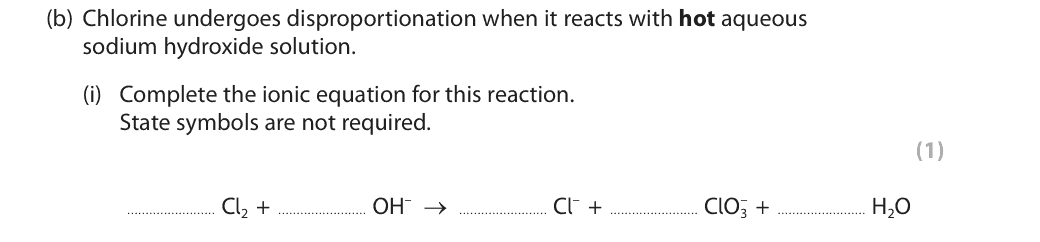
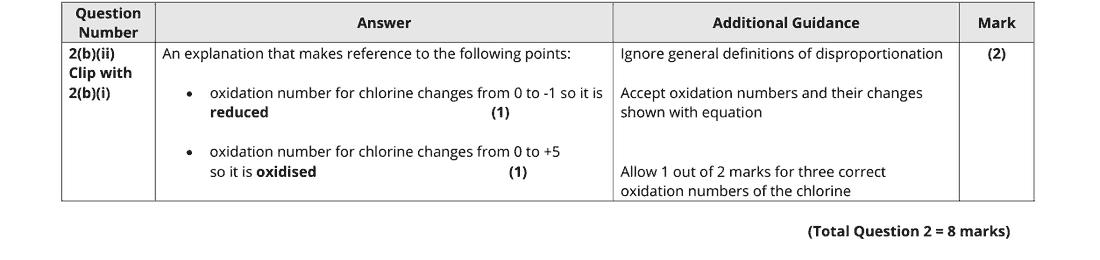
The balancing of the equation in part (i) was a question of high demand and gave an opportunity for the high ability candidates to demonstrate their understanding. This type of question is worth practicing and the oxidation number changes do provide a useful way of succeeding in this. The oxidation number changes were identified very well with the majority of candidates correctly stating these. However, the requirement for these oxidation number changes was in the context of disproportionation and so these changes needed to be correctly linked with the relevant terms of oxidation and reduction which was not always done.

The balancing of the equation in part (i) was a question of high demand and gave an opportunity for the high ability candidates to demonstrate their understanding. This type of question is worth practicing and the oxidation number changes do provide a useful way of succeeding in this. The oxidation number changes were identified very well with the majority of candidates correctly stating these. However, the requirement for these oxidation number changes was in the context of disproportionation and so these changes needed to be correctly linked with the relevant terms of oxidation and reduction which was not always done.
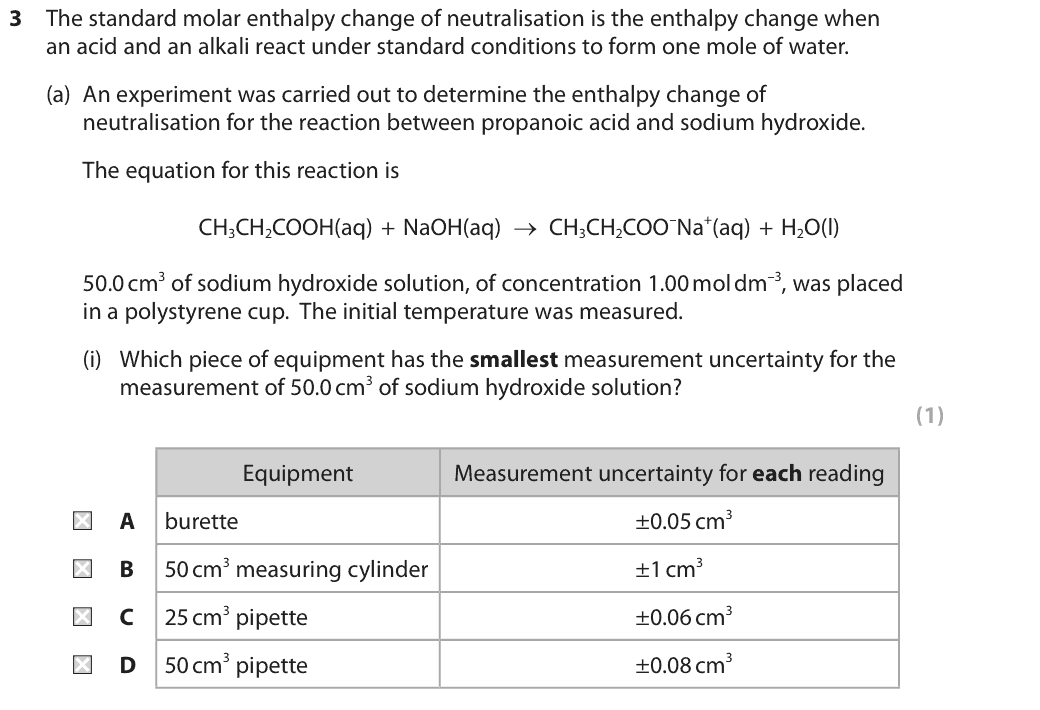
D
Skills: MS1.3 Identify uncertainties in measurements and use simple techniques to determine uncertainty when data are; PT1 use appropriate apparatus to record a range of measurements (to include mass, time, volume of liquids and gases, temperature)
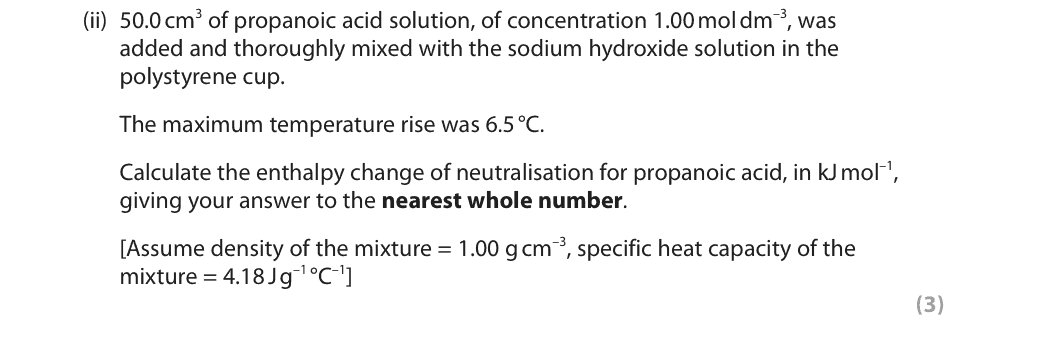
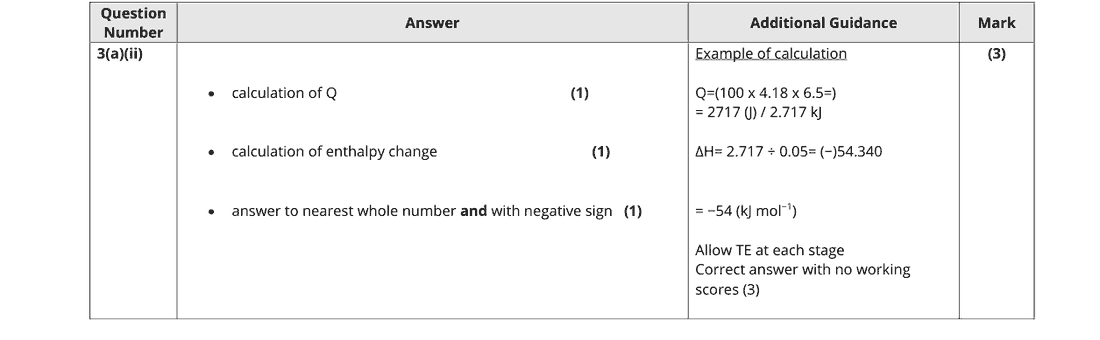
A full range of marks from 0 to 3 were awarded for this question and so, differentiated well. A significant number of candidates missed the fact that the total volume in the polystyrene cup was 100 cm3 because two volumes of 50 cm3 were added together. Nevertheless, candidates could gain credit for the remainder of the calculation. A useful reminder is to note the requirement in the question to give the final answer to the "nearest whole number", which is given in bold text. Therefore, this is an essential requirement and some candidates lost credit for giving their answer to a number of decimal places.
Skills: MS0.0 Recognise and make use of appropriate units in calculation; MS0.1 Recognise and use expressions in decimal and ordinary form; MS2.3 Substitute numerical values into algebraic equations using appropriate units for physical quantities
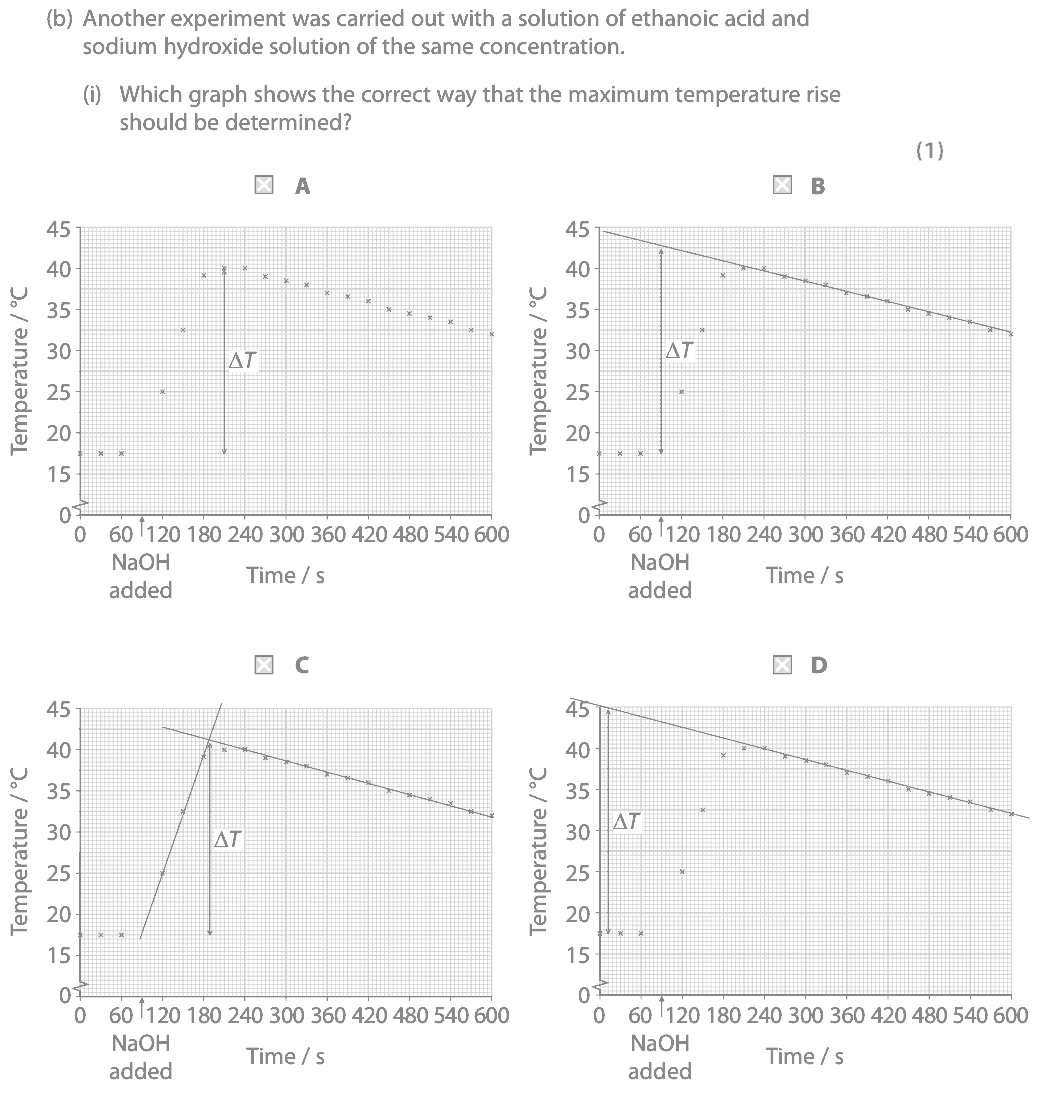
B
Skills: MS3.1 Translate information between graphical, numerical and algebraic forms; PT1 use appropriate apparatus to record a range of measurements (to include mass, time, volume of liquids and gases, temperature)

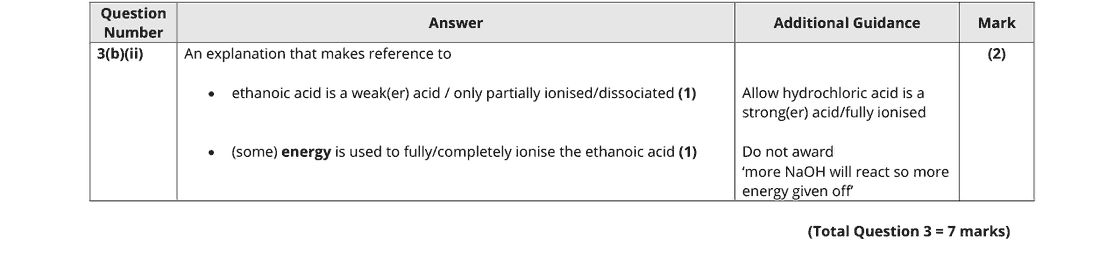
The majority of candidates correctly stated that ethanoic acid is a weak acid or that it was only partially ionised/dissociated for the first mark. The second mark required an explanation for the reason why the enthalpy of neutralisation was less exothermic and this was very discriminating. The more discerning candidate appreciated that energy is required to fully ionise the weak acid or that energy is required to break the O-H bond which results in a less exothermic enthalpy change.
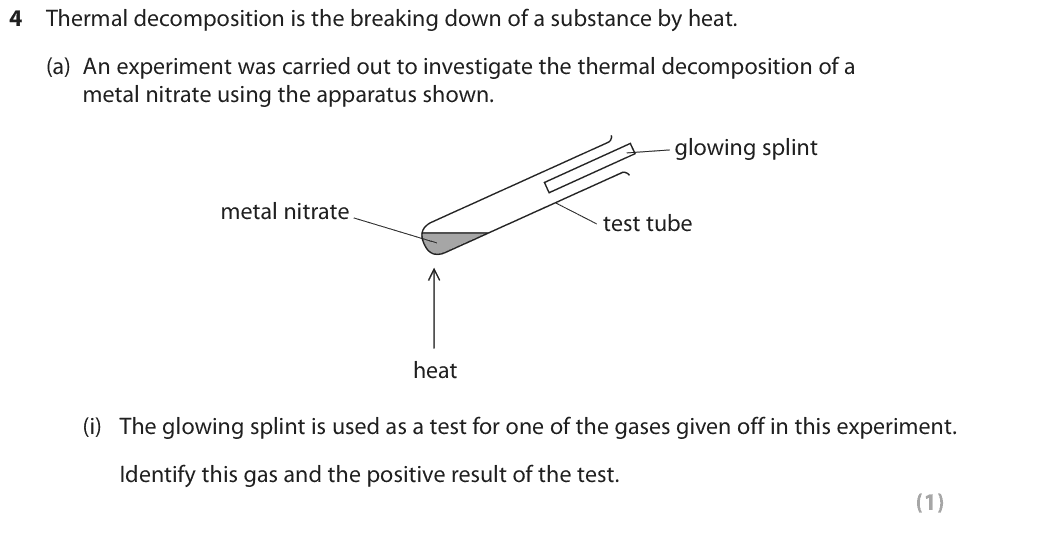
Two correct statements were required for one mark in this question because this is a topic which is learnt at GCSE level. Nonetheless a sigificant minority were unable to correctly give both parts, either giving the correct gas or the correct positive result of the test, and this did not score the mark.
Skills: PT4 use laboratory apparatus for a variety of experimental techniques, including: titration, using burette and pipette; distillation and heating under reflux, including setting up glassware using retort stand and clamps; qualitative tests for ions and organic functional groups; filtration, including use of fluted filter paper, or filtration under reduced pressure

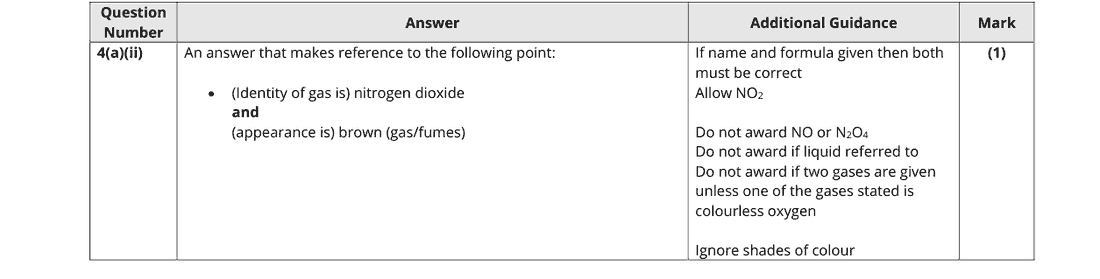
Another question reflecting the higher demand of A Level as two parts are required for the one mark. Centres would be well-advised to continually remind their candidates that if a name and formula are given then both must be correct. This principle applied throughout this paper and did have an impact on this question with some candidates attempting to give the formula as well as the name of the gas. If the formula was incorrect then this would negate the mark.

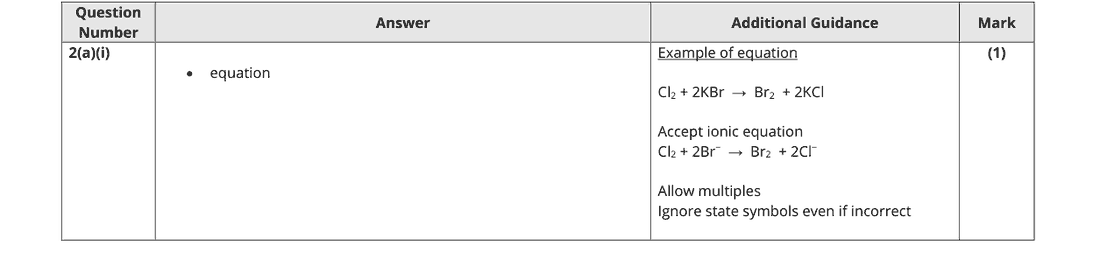
Only about a third of all candidates could correctly give a balanced equation for this question. Both this topic area and this skill of balancing equations is worthy of repeated practice.

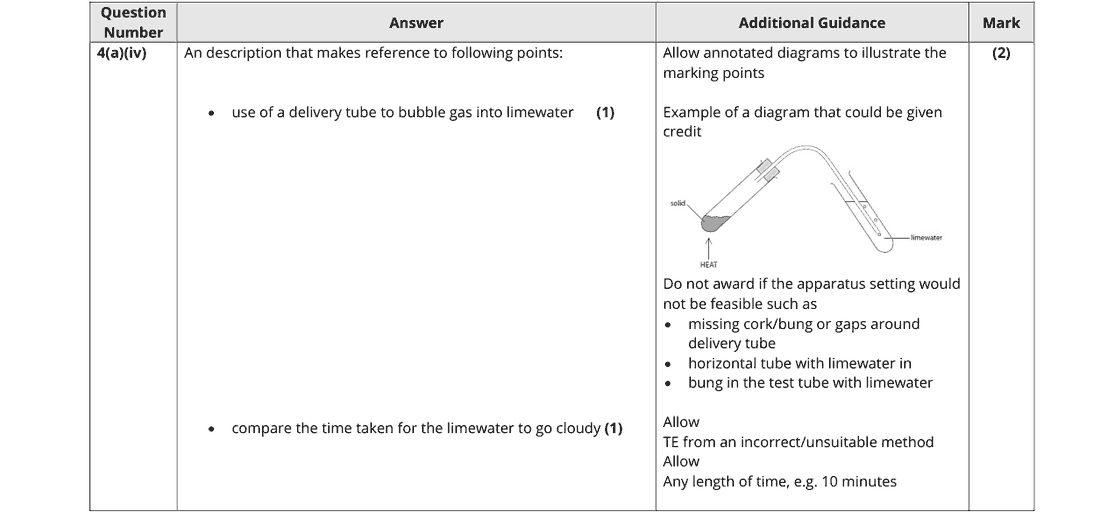
A large number of candidates approached this question by referring to the collection of gas either with a gas syringe or by water displacement. However, this is not the method that would be used and so lost the first mark but the second mark for how a comparison could be made was possible. The space provided allowed for candidates to respond with either a diagram or by prose. Many diagrams of the apparatus proposed were not drawn with sufficient care as the following examples illustrate. Centres and candidates would benefit from repeated practice from such activity.
Skills: PT4 use laboratory apparatus for a variety of experimental techniques, including: titration, using burette and pipette; distillation and heating under reflux, including setting up glassware using retort stand and clamps; qualitative tests for ions and organic functional groups; filtration, including use of fluted filter paper, or filtration under reduced pressure; PT1 use appropriate apparatus to record a range of measurements (to include mass, time, volume of liquids and gases, temperature)

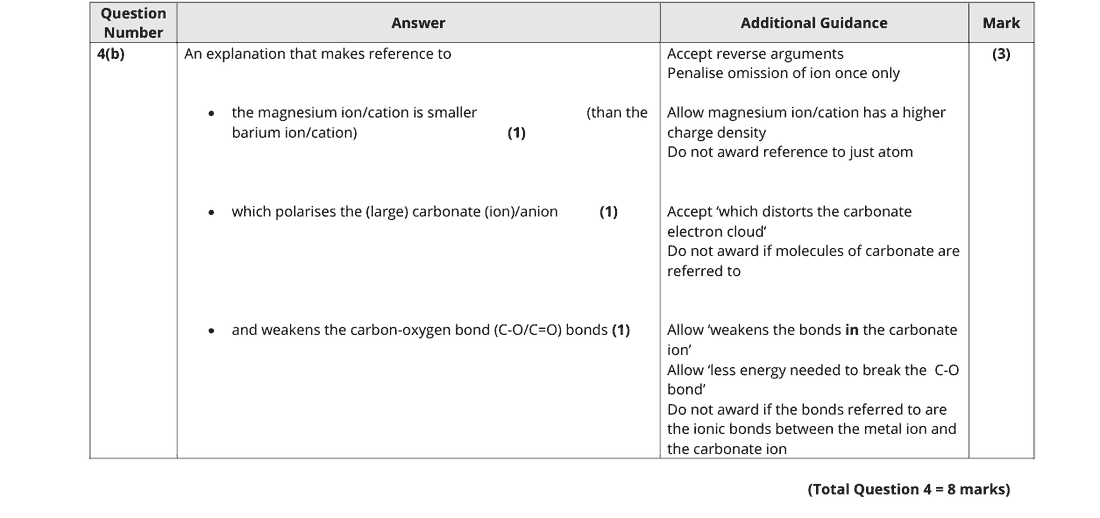
A sizeable number of candidates gave an excellent answer scoring all three marks which was pleasing and showed that these had learnt and understood this topic area very well. The lack of precision by some candidates such as by referring to the metal rather than the metal cation occasionally resulted in a loss of marks. Another common error was seen in the lack of clarity in the effect of polarisation on the carbonate ion. It was common to see a vague response stating that the carbonate bond was weakened but this could be the ionic bond between the carbonate and the metal cation instead of the bonds within the carbonate ion. Hence this vagueness was not credited.
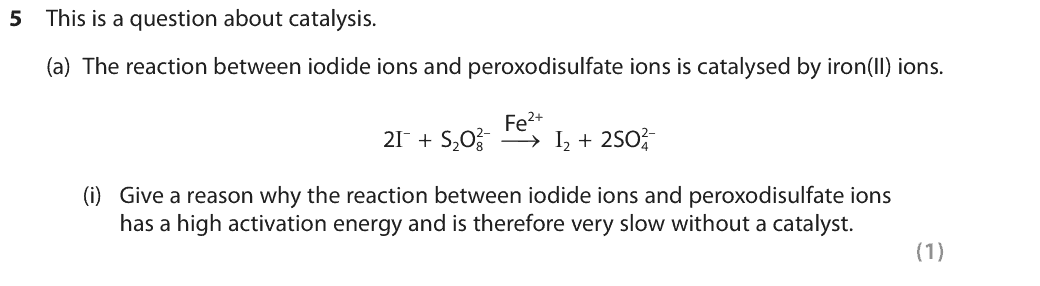
This was another question where two parts of the answer were both required for the mark. The first part was the straightforward identification of the negative charge on both species. The second part was in response to the question requiring a reason for the very slow reaction, namely that the two species would repel each other. This two-part level of demand served to differentiate well and highlights the high demand of A Level.

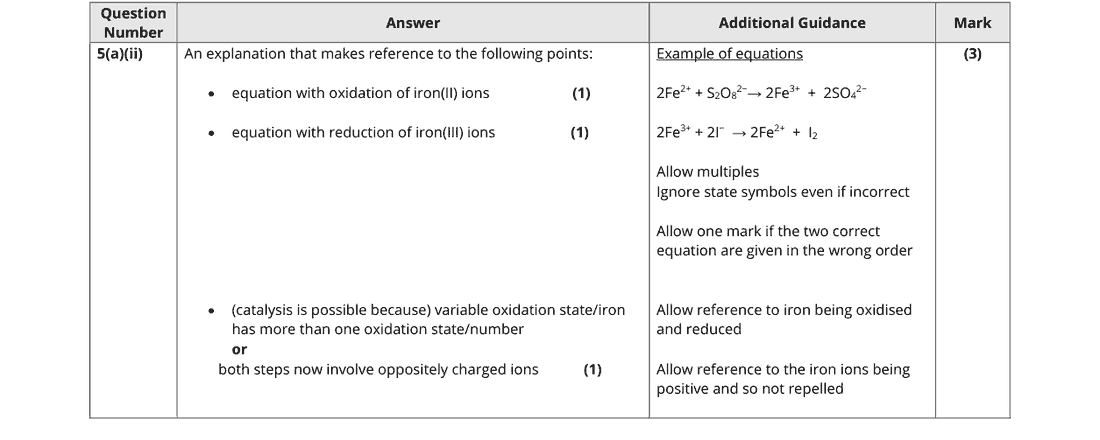
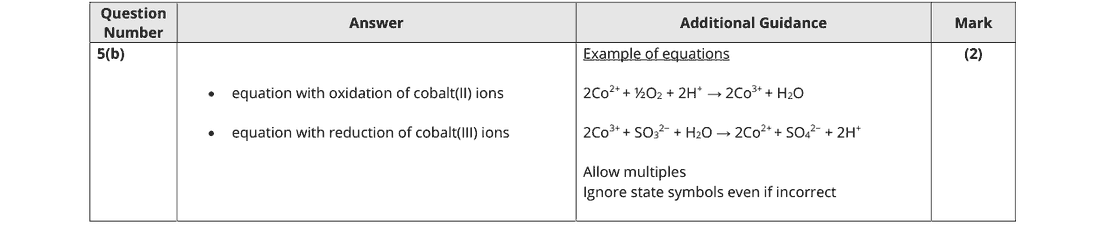
This question proved to be another effective discriminator by producing the full range of marks. Almost half of all candidates scored zero, which suggests that homogenous catalysis would be a useful area for consolidation by centres and candidates. Many candidates got the stoichiometry wrong, again highlighting the need to practice balancing equations. A significant number of candidates gave the equations in the wrong order. The question specifically stated that iron(II) ions were the catalyst and so these should have been used to start the process. However, one mark out of the first two was awarded if this was the approach. A reasonable number of candidates correctly followed on from the question in (i), where the slow reaction was due to the same charges repelling and wrote an explanation for the catalysis by iron (II) ions due to their opposite charge to the reacting species. This was pleasing to see and showed initiative by those candidates. An alternative approach was to refer to the typical property of transition elements of variable oxidation state which was also acceptable.
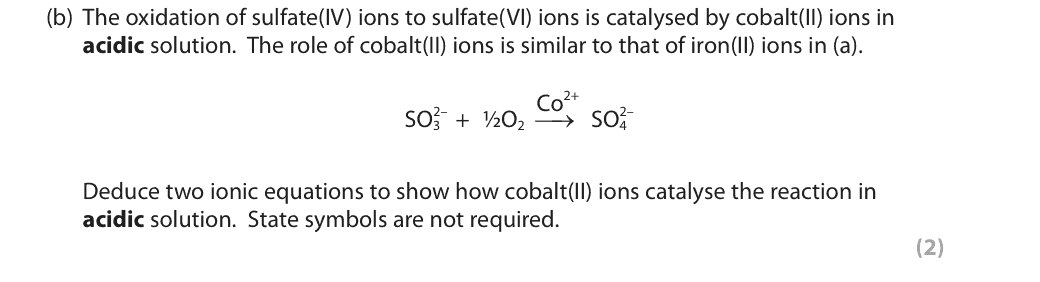
This question proved to be the most challenging on the whole paper. It was designed to be a follow- on from the previous question and provide another example of where the variable oxidation states of transition elements often enables catalytic activity. Many candidates used the space provided to try and work out the answer but often has missed the reference in the question, which had been highlighted in bold, that the reaction took place in "acidic" conditions. This was the key to obtaining correct equations and is a useful reminder of the emphasis that candidates need to note from words given in bold text.
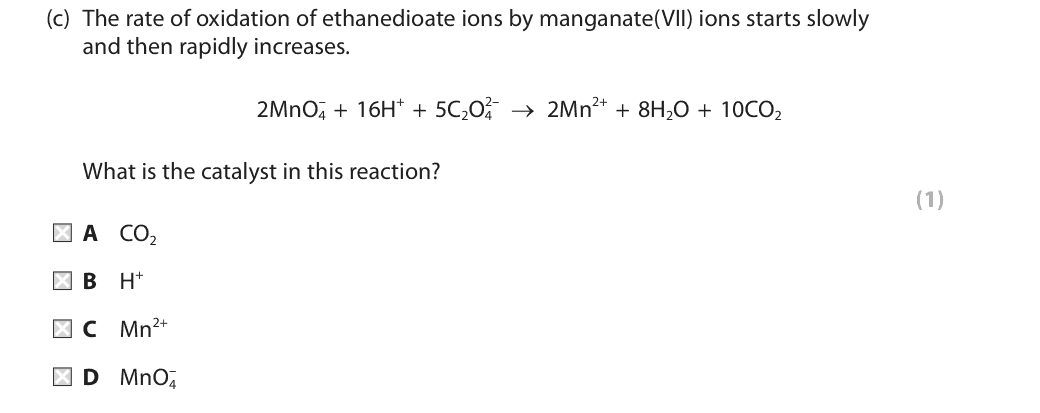
C
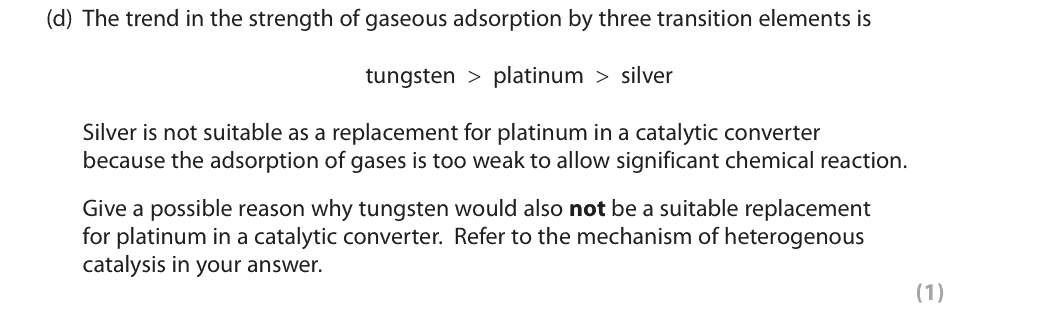
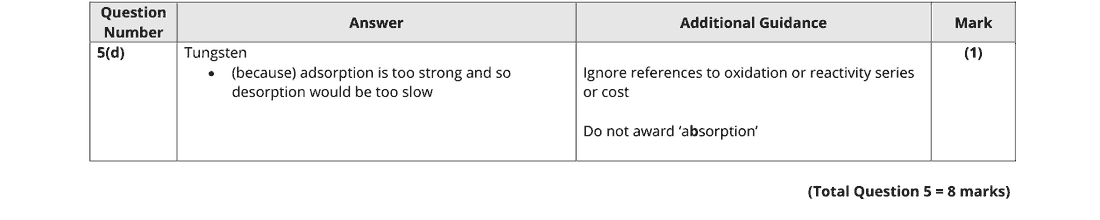
This question specifically states that reference to the mechanism of heterogeneous catalysis be provided in the answer and so mention was required of adsorption and desorption. It was pleasing to see very few references to 'absorption' and so centres and candidates are to be commended for this. However, it was not uncommon for candidates to refer to just one stage of catalysis without giving a reason for the fact that tungsten would not be a suitable catalyst.
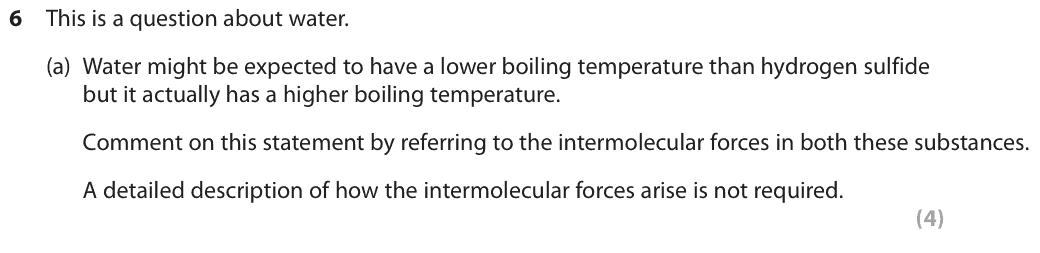
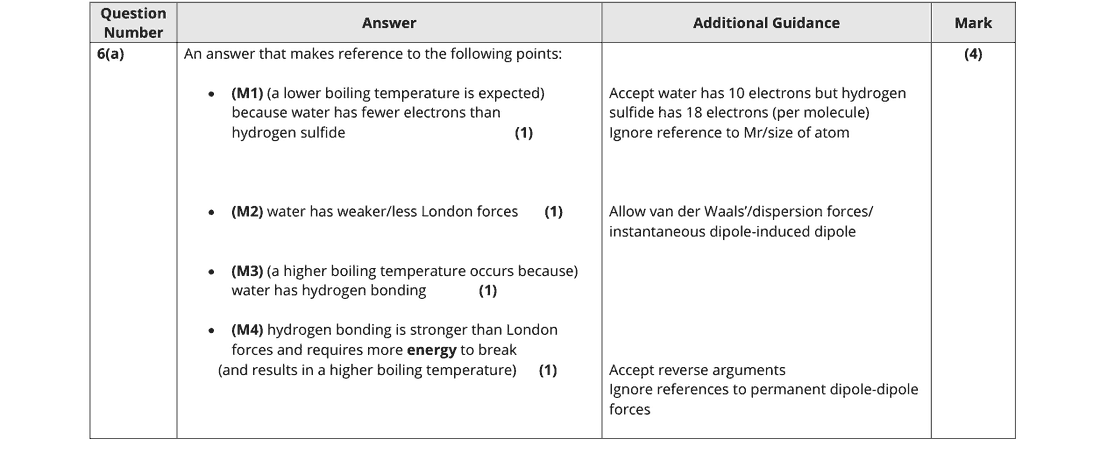
The full range of marks was awarded for this question, with only a small number of candidates scoring zero. There were some lengthy responses which largely failed to address the necessary points and often only scored one mark for the reference to the hydrogen bonding between water molecules. There was some difficulty or possible evidence of some confusion in candidates' minds, between intramolecular covalent bonds and intermolecular forces. Centres and their candidates are well-advised to take care when referring to the breaking of bonds so that it is clear that the intermolecular forces are being broken and not the covalent bonds.

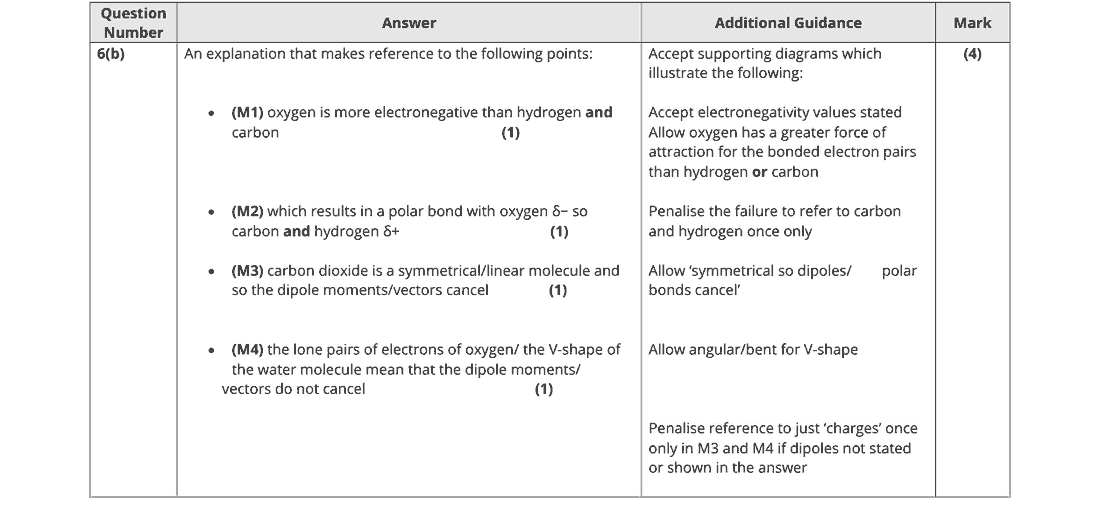
It was rare to see a fully complete answer scoring four marks. The majority of candidates focused on the reason for the polarity of the water molecule and non-polarity of the carbon dioxide molecule rather than the reason for the polar bonds. Hence, the most common score was 2 marks. Answers relating to 'dipoles cancelling out' were allowed on this occasion but it is worth noting that it is the 'dipole moment' which does or does not cancel out is the correct statement. The dipoles always cancel out because there is a delta plus and a delta minus. Those candidates that did address the difference in electronegativity as being the reason for the bond polarities, frequently failed to state which element was the more electronegative. It was wondered if this is such an obvious point in the minds of candidates that it was not necessary to state it. Centres and their candidates are reminded that assumptions cannot be made by examiners as to the meaning of a response and explicit statements about the meaning of a response is essential to be confident about gaining credit.
Skills: MS4.1 Appreciate angles and shapes in regular 2D and 3D structures.

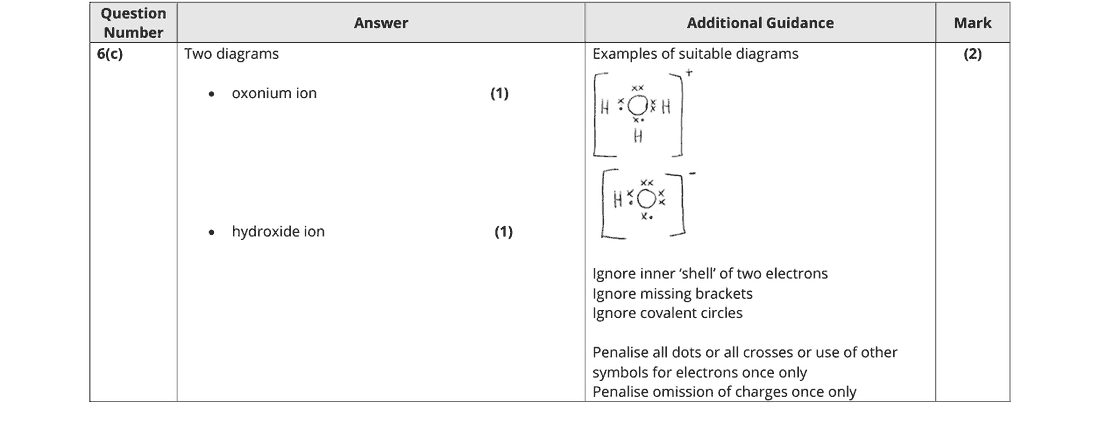
The standard of dot and cross diagrams was somewhat disappointing as about two thirds of candidates failed to gain any credit. It was not unusual to see the oxonium ion having an oxygen atom with three bonds to the hydrogen atoms with a dot and a cross, namely that there was no dative covalent bond. The problem with this is that the oxygen then has only five crosses or electrons. Similarly in the hydroxide ion, oxygen was often given with 7 crosses or electrons in order to complete an octet. Candidates appeared to have a disconnect with their knowledge of oxygen being in Group 6 and so having six electrons in its outer energy level or shell and the need for the oxygen atom in the molecule or ion to have eight electrons in the outer shell. More practice would be beneficial.
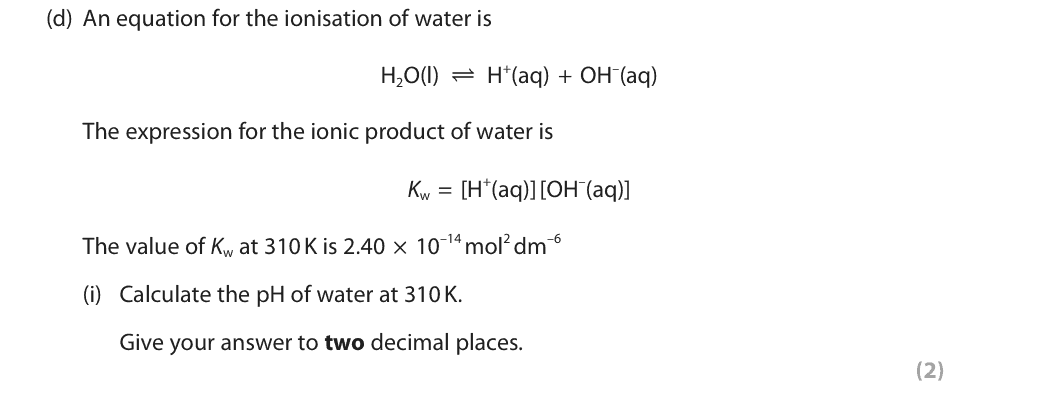
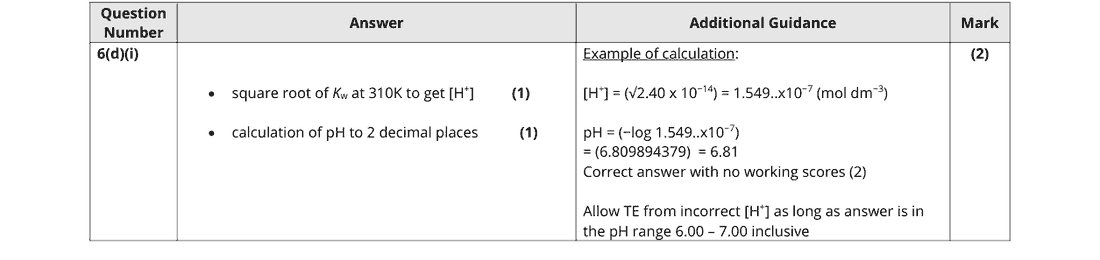
A high-scoring question with the vast majority of candidates gaining both marks by correctly calculating the pH of water and giving the answer to the required number of decimal places. A small minority of candidates just used the Kw value to calculate the pH of water and gave an answer of 13.62. This gained no credit and candidates should have realised that such a pH could not possibly be correct for pure water. A useful reminder to centres and candidates that the meaning of the numbers should be kept in mind and will help to discern if the process has been carried out correctly or not.
Skills: MS0.4 Use calculators to find and use power, exponential and logarithmic functions; MS2.4 Solve algebraic equations; MS2.5 Use logarithms in relation to quantities that range over several orders of magnitude

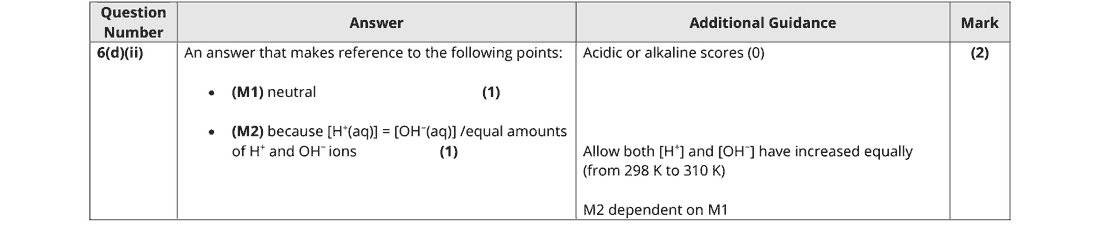
This question highlights the benefits of using the legacy papers for revision as it is a relatively common question but appeared to be novel for candidates on the new specification. The pH scale is temperature dependent and so the neutrality point or value changes with temperature but this seemed beyond the majority of candidates who scored zero. It might have been expected that logic would suggest that water has to be neutral regardless of the temperature but this was not evident to most candidates. Hence, this is an area for centres and candidates to consolidate.

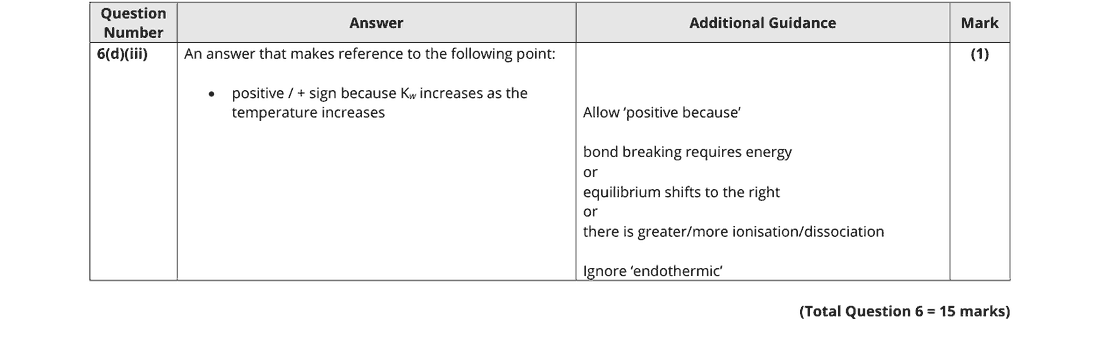
An appreciable number of candidates gave a suitable explanation but failed to state the sign of the enthalpy change and so did not gain the mark. A range of acceptable reasons were allowed for the positive sign of the enthalpy change. A small minority of candidates appeared to confuse entropy with enthalpy and so gave answers relating to the increase in the number of moles of products.

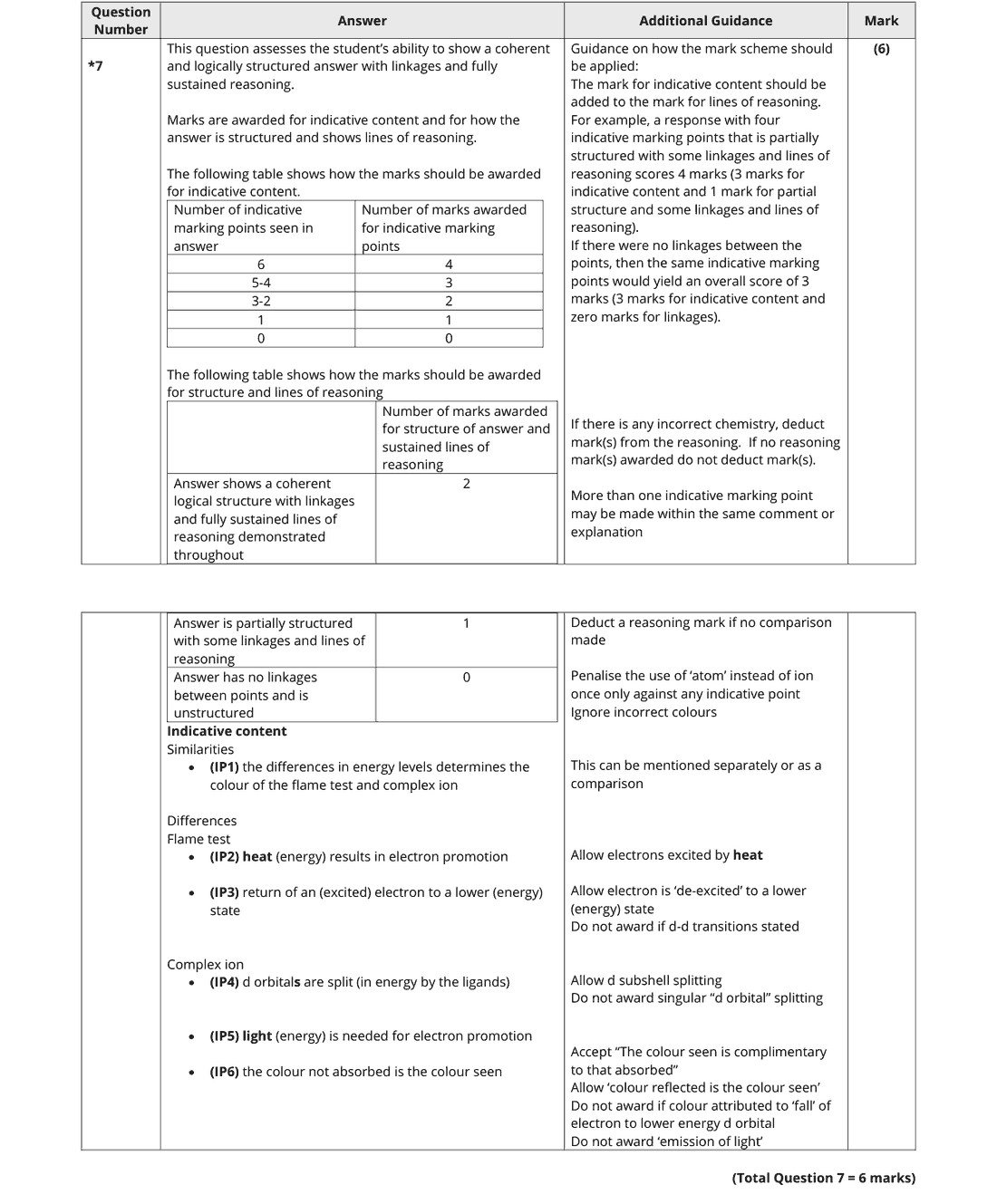
This extended response question produced a wide range of marks and was an excellent discriminator, although only a few candidates scored all six marks. The indicative point most frequently lacking was the reference to the difference in energy levels as being the determining factor in the colour observed for both the flame test and of the complex ion. A clear statement was required for both of these discussions. Since this question is a 'Compare and contrast' type of question it was important for candidates to make sure that there was at least some reference to a comparison of some description between the origin of the two colours. If this was lacking, then one of the structure and reasoning marks was lost. There was evidence of some confusion in candidates' minds over the origin of colour. For example, the origin of colour for complex ions was at times erroneously attributed to electrons 'falling back' to the lower d orbital or that the emission of light was responsible for the colour observed. These comments illustrate how some candidates had mixed up the origin of the flame test colour with that of origin of complex ion colour. Another error which was often seen was that of referring to the split of a singular d orbital rather than the splitting of the d orbital subshell.
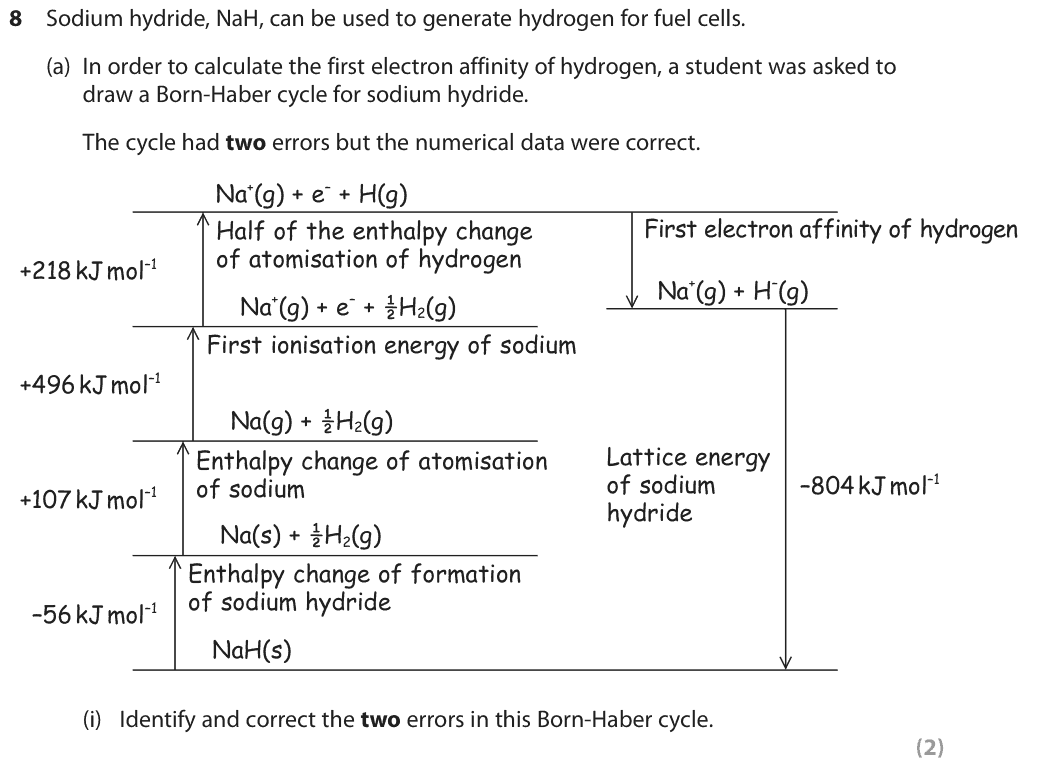
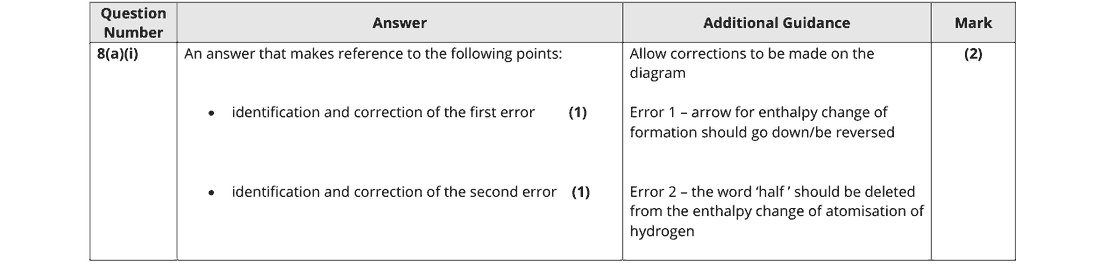
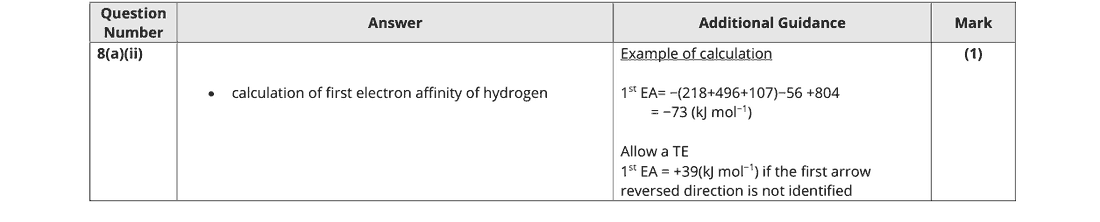
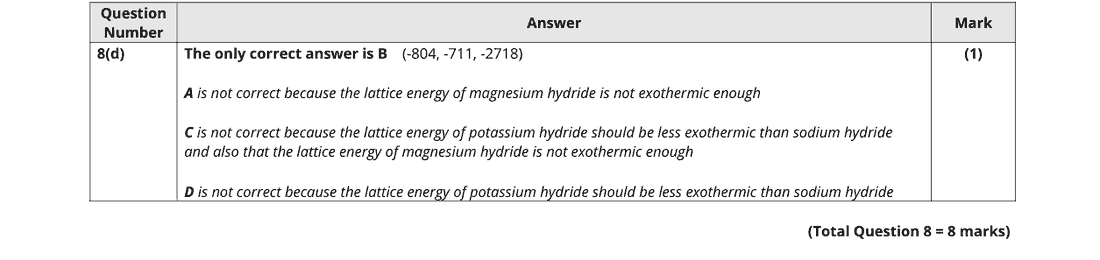
In part (i) only a small minority of candidates scored zero for these questions. The vast majority of candidates correctly identified the error in the diagram of the arrow for the enthalpy change of formation going up when it should be drawn going down. The second error of the 'half' of atomisation was less often identified and serves as a useful reminder to candidates that learning definitions is a very useful exercise as it helps in such situations. The question introduction stated that the numerical data was correct but some candidates appeared not to have noticed this when they calculated their electron affinity in part (ii) and so obtained an incorrect value. Another useful reminder to candidates to make sure that the introduction to a question often contains vital information to the successful completion of a question.

In part (i) only a small minority of candidates scored zero for these questions. The vast majority of candidates correctly identified the error in the diagram of the arrow for the enthalpy change of formation going up when it should be drawn going down. The second error of the 'half' of atomisation was less often identified and serves as a useful reminder to candidates that learning definitions is a very useful exercise as it helps in such situations. The question introduction stated that the numerical data was correct but some candidates appeared not to have noticed this when they calculated their electron affinity in part (ii) and so obtained an incorrect value. Another useful reminder to candidates to make sure that the introduction to a question often contains vital information to the successful completion of a question.
Skills: MS2.4 Solve algebraic equations
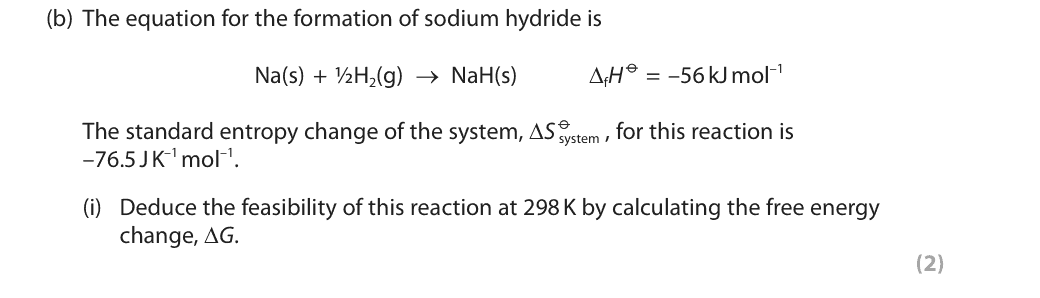
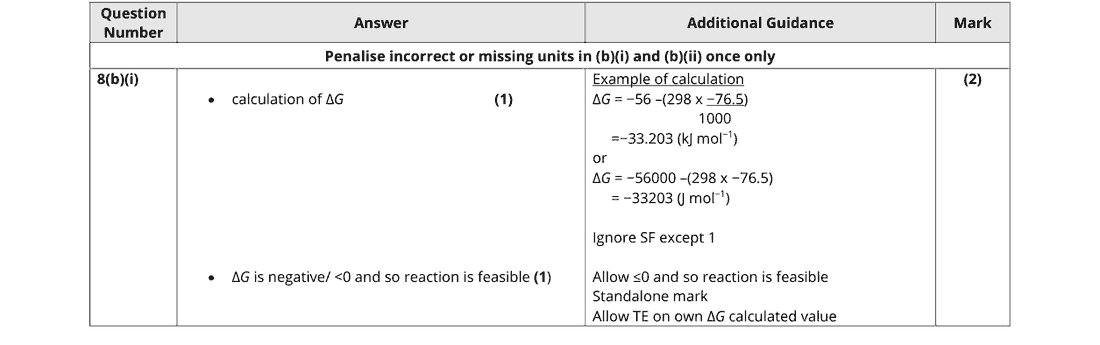
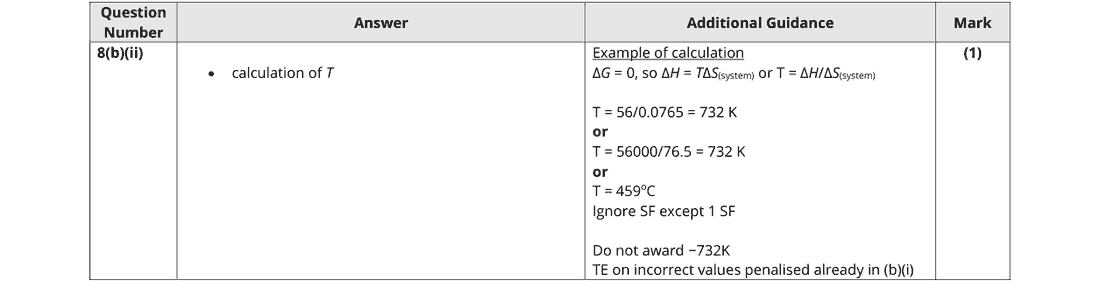
Candidates could calculate the Gibbs Free Energy change in part (i) either by converting both values to Joules or to kilo Joules but it was essential to make one or the other conversion. Some candidates did make this conversion correctly but then gave entropy units instead of enthalpy units which lost them the mark. A reminder to candidates to double-check exactly what value they are calculating. The second mark was awarded for a statement relating to the feasibility of the reaction but there needed to be reference to the reason for this conclusion by stating the sign of the Gibbs Freen Energy change. Most candidates could successfully calculate the temperature in part (ii) and gave their answers in Kelvin.
Skills: MS0.0 Recognise and make use of appropriate units in calculation; MS2.3 Substitute numerical values into algebraic equations using appropriate units for physical quantities

Candidates could calculate the Gibbs Free Energy change in part (i) either by converting both values to Joules or to kilo Joules but it was essential to make one or the other conversion. Some candidates did make this conversion correctly but then gave entropy units instead of enthalpy units which lost them the mark. A reminder to candidates to double-check exactly what value they are calculating. The second mark was awarded for a statement relating to the feasibility of the reaction but there needed to be reference to the reason for this conclusion by stating the sign of the Gibbs Freen Energy change. Most candidates could successfully calculate the temperature in part (ii) and gave their answers in Kelvin.
Skills: MS0.0 Recognise and make use of appropriate units in calculation; MS2.2 Change the subject of an equation
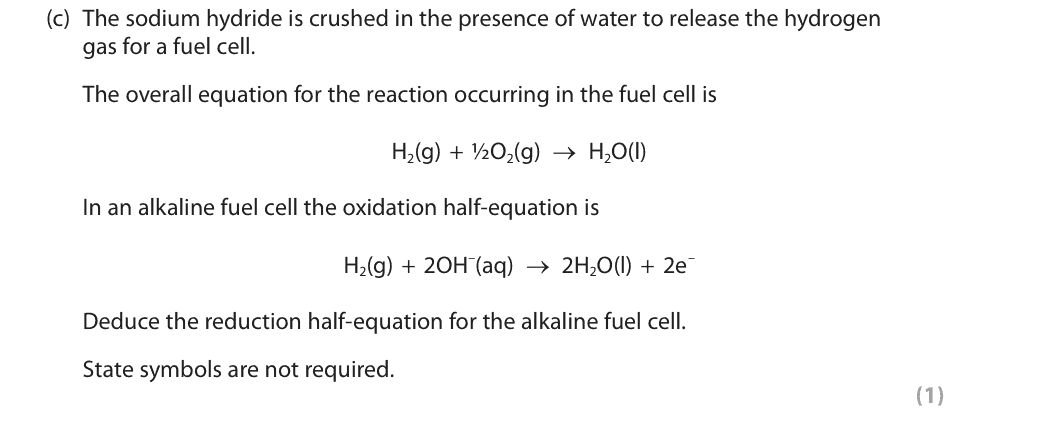
Only about a third of candidates successfully answered this question. A significant number of candidates gave the acidic half equation but the alkaline fuel cell was the subject of the question and so this did not score. Once again, a reminder to make sure that the answer given does match the question set.
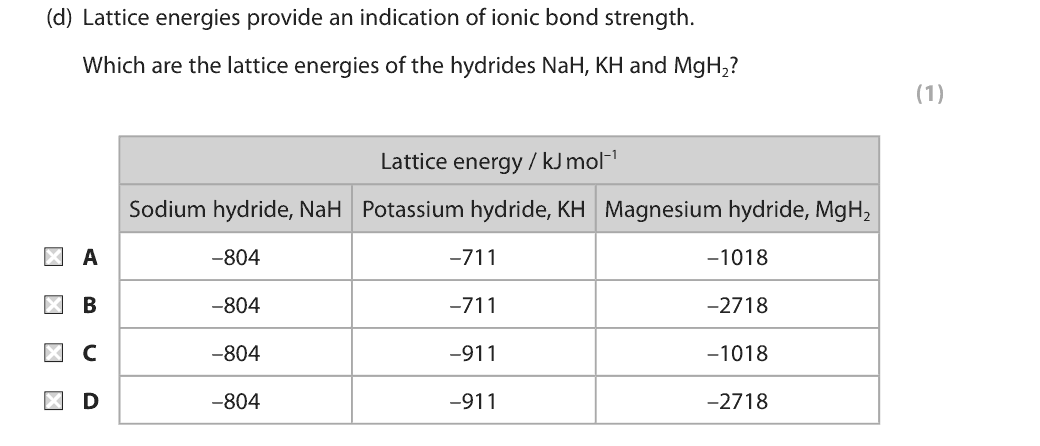
B
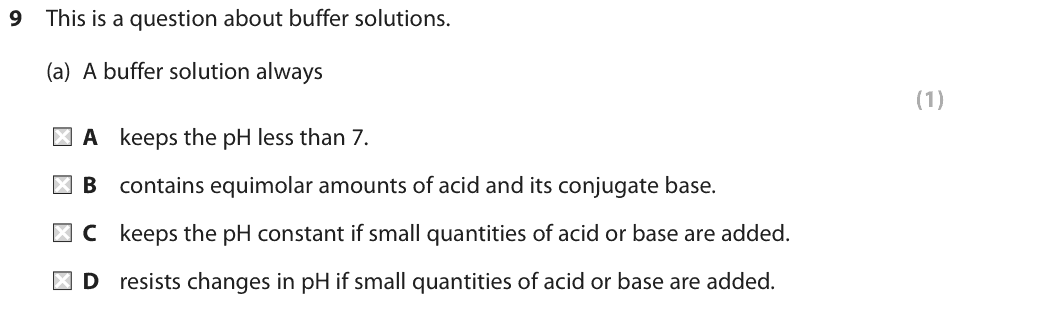
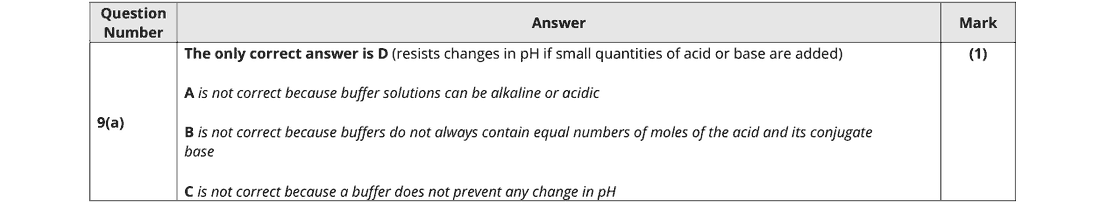
D
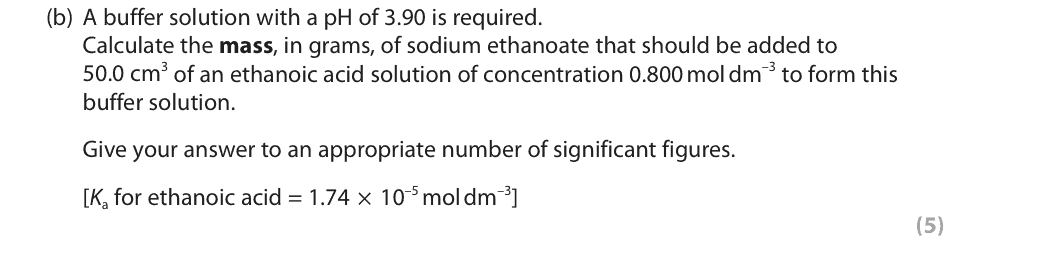
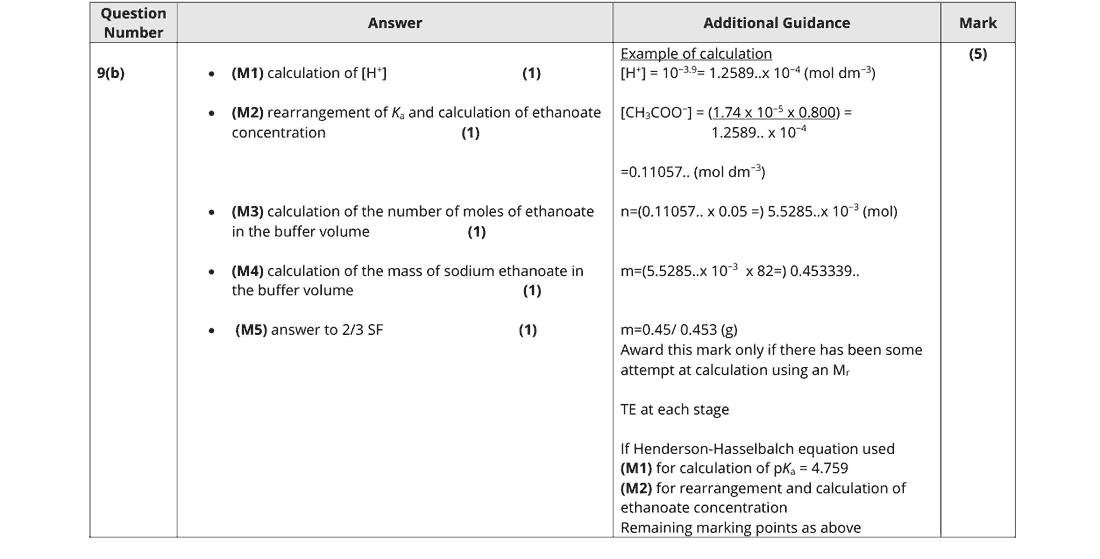
A full spread of marks was seen, with the most common score being full marks. Nonetheless, buffer calculations would prove to be a worthwhile area for practice. The advice to candidates on any calculation is to make sure that each step of the calculation is clearly laid out. Transferred errors are often applied throughout the calculation so candidates are encouraged to continue their attempt even if they are unsure of a particular step.
Skills: MS0.4 Use calculators to find and use power, exponential and logarithmic functions; MS1.1 Use an appropriate number of significant figures; MS2.2 Change the subject of an equation; MS2.3 Substitute numerical values into algebraic equations using appropriate units for physical quantities; MS2.5 Use logarithms in relation to quantities that range over several orders of magnitude
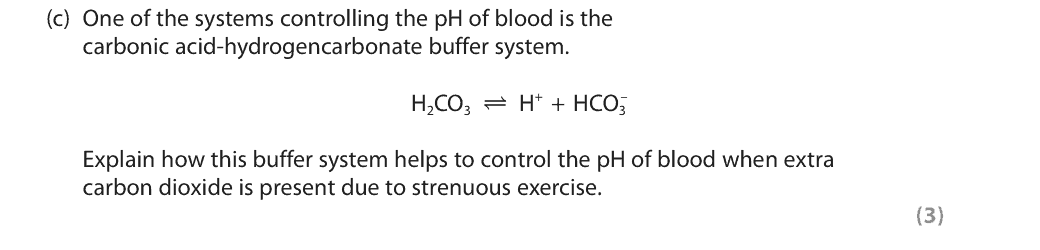
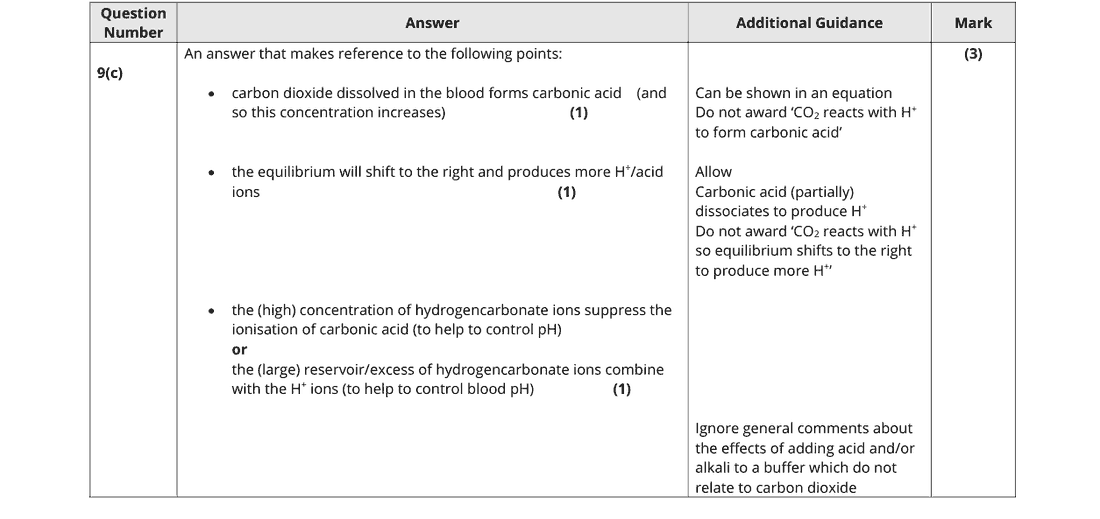
The answers to this question were the most disappointing on the paper. The majority of responses had several lines of prose but which contained a wide range of chemical errors. It was particularly important for the whole response to be read in its entirety before any credit was given. One example of a common error was the formation of carbonic acid by carbon dioxide but not from the reaction with water but rather from a 'supposed' reaction with hydrogen ions. Another common error seen starts correctly by referring to the shifting of the equilibrium to the right, but then states that this movement is due to the reaction of carbon dioxide with hydrogen ions and it is this reaction which is given as justification. A number of candidates correctly stated that the position of equilibrium shifted to the right but failed to accompany the statement with the effect of an increase in hydrogen ions. Clearly this topic area is one which centres and candidates would benefit from revision and consolidation.
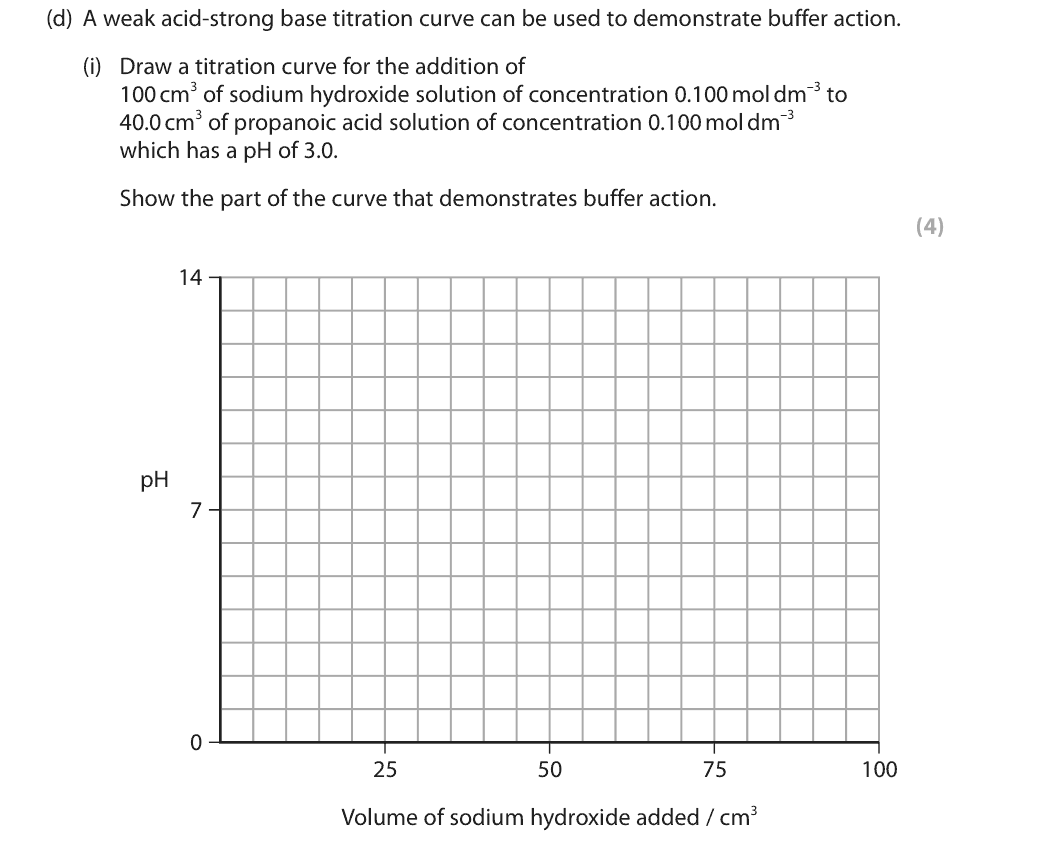
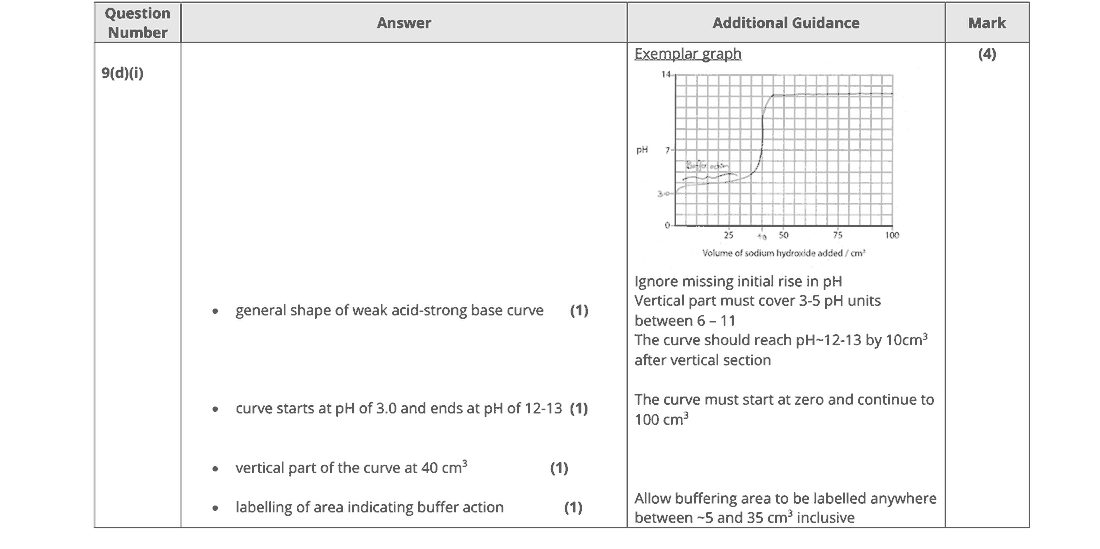
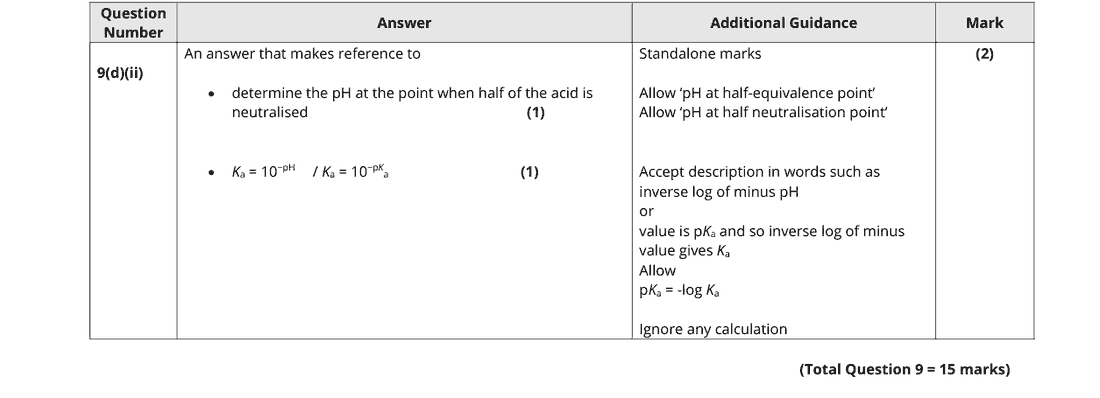
In part (i) it was evident that candidates would benefit from further practice at drawing titration curves and also need to be reminded of the need for precision/accuracy with the drawing of such curves. The mark scheme gave clear guidance of the parameters required for each marking point and these do result in a strictness which some candidates may not fully appreciate. One example is that for a strong base titration the pH should reach the required pH within 10 cm3 of the vertical part of the curve. Another example is that the curve had to be drawn from zero and finish at 100 cm3. Some candidates did not complete their curve to the end of the graph paper and so lost one mark. The answers given to part (ii) were frequently of a very high standard and it was apparent that candidates had clearly rehearsed answering this type of question. This is excellent and full marks were often awarded.
Skills: MS3.1 Translate information between graphical, numerical and algebraic forms

In part (i) it was evident that candidates would benefit from further practice at drawing titration curves and also need to be reminded of the need for precision/accuracy with the drawing of such curves. The mark scheme gave clear guidance of the parameters required for each marking point and these do result in a strictness which some candidates may not fully appreciate. One example is that for a strong base titration the pH should reach the required pH within 10 cm3 of the vertical part of the curve. Another example is that the curve had to be drawn from zero and finish at 100 cm3. Some candidates did not complete their curve to the end of the graph paper and so lost one mark. The answers given to part (ii) were frequently of a very high standard and it was apparent that candidates had clearly rehearsed answering this type of question. This is excellent and full marks were often awarded.
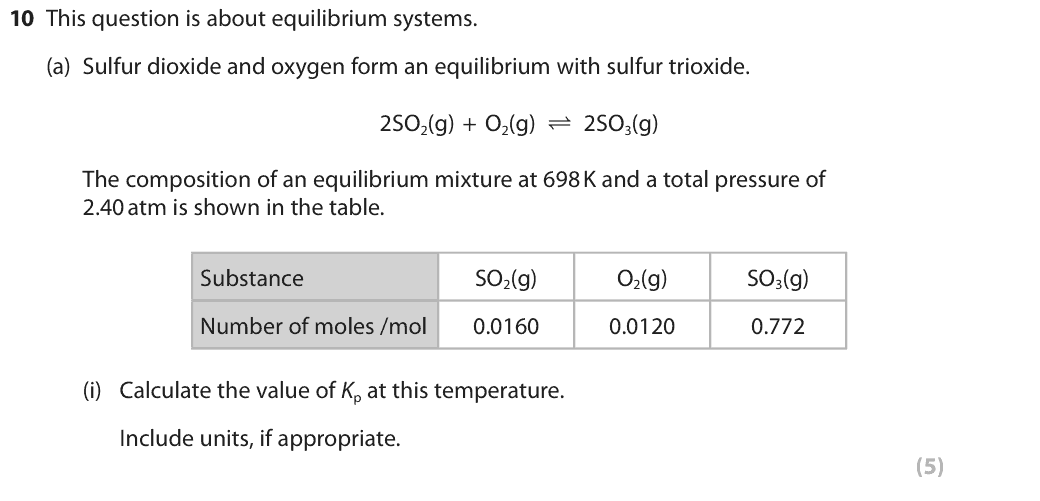
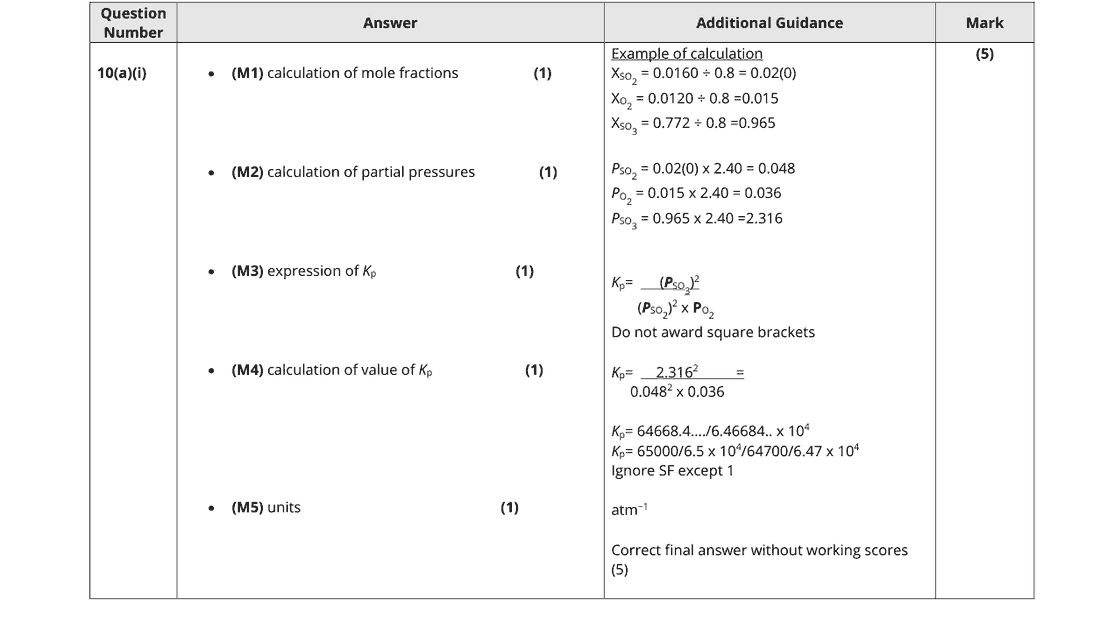
Candidates clearly have been practicing this type of calculation as just under half of all responses scored full marks. Revision had paid off. When errors were seen it was often a case of candidates using moles directly to calculate partial pressures rather than mole fractions. Occasionally candidates were rather careless with their transfer of numbers and inserted or omitted a zero which resulted in an incorrect final value. A reminder to always double-check working.
Skills: MS0.0 Recognise and make use of appropriate units in calculation; MS0.2 Use ratios, fractions and percentages; MS2.3 Substitute numerical values into algebraic equations using appropriate units for physical quantities

This calculation of the number of molecules using the Avogadro constant produced nearly a 50:50 split over those who could do this type of sum and those who couldn't. This was a bit surprising. It is possible that this is a reflection of other molar calculations being given lots of practice but this type of calculation using the Avogadro constant maybe receiving much less practice. Hence centres and their candidates would benefit from more practice in this area.
Skills: MS0.1 Recognise and use expressions in decimal and ordinary form

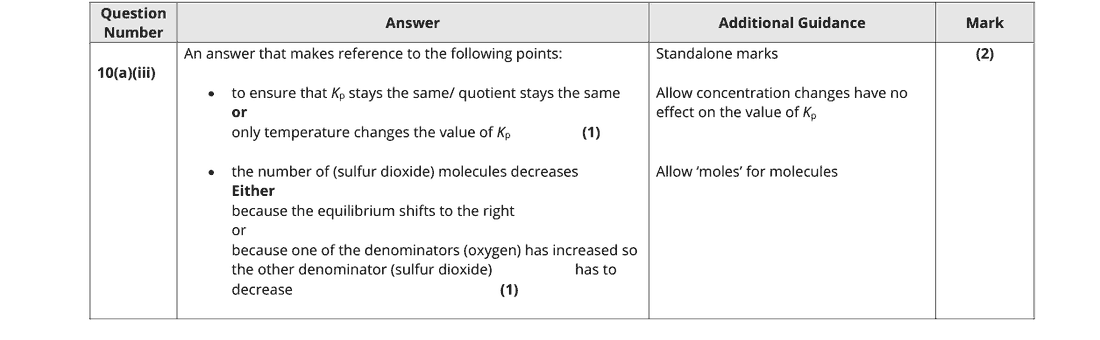
This question was worth two marks and two points were required from careful reading of the question. It was noteworthy that a large number of candidates addressed their answer to one or other of these points but rarely both. This emphasises the need to read the question again to ensure that all parts are being addressed. The question required a statement about what happened to the number of sulfur dioxide molecules and why for one mark, and also to include a reference to the value of Kp. It was rather surprising the significant number of candidates who referred to Kp changing, whereas temperature is the only factor that changes Kp. This is a topic area which would benefit from renewed emphasis by centres and their candidates.
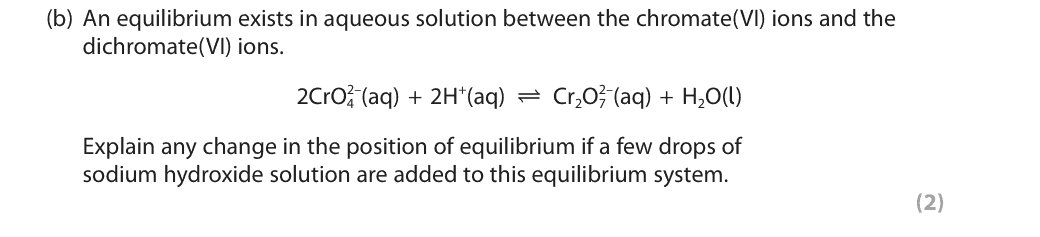
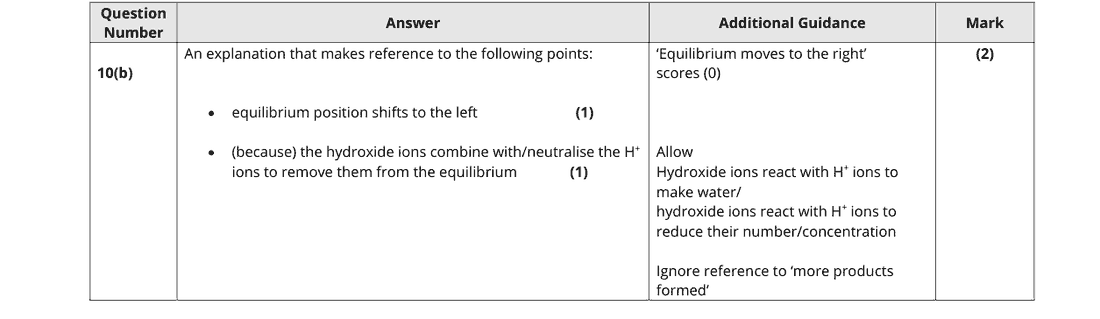
For the most part this question was answered well. Only a minority of candidates stated that the equilibrium shifted to the right which scored zero. Most candidates understood that the equilibrium position moved to the left but often simply stated that the hydroxide ions react with the hydrogen ions without referring to a decrease in concentration of the hydrogen ions or the formation of water which meant that no second mark was awarded. A small number of candidates mentioned a colour change due to the change in concentration of dichromate/chromate ions but this was irrelevant to the question set and gained no credit.
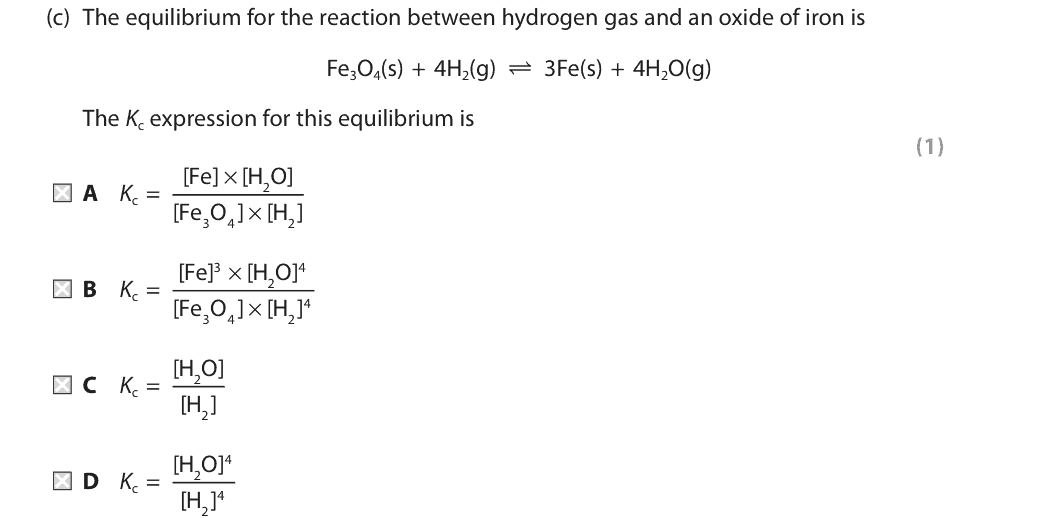
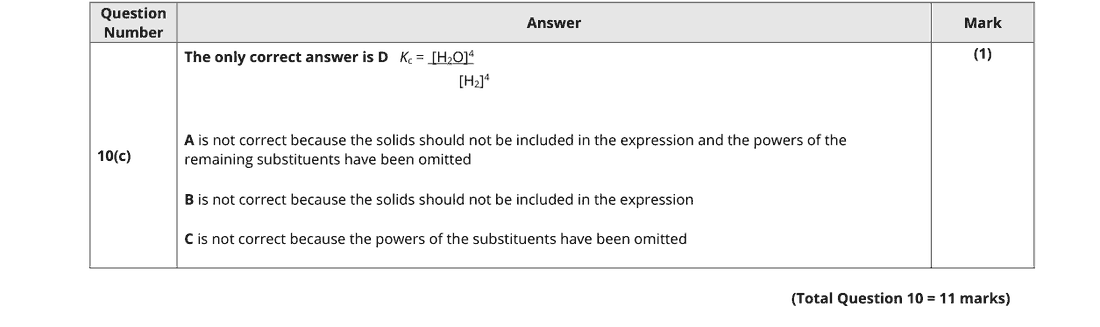
D
Want a paper marked and gone through with you? Message us.