June 2019: Paper 1, Inorganic and physical chemistry

105 marks · 40 question parts · Paper, mark scheme and report on AQA's site · Have the Data Booklet beside you

Question by question

QTopicMarksAOType
01.1 Thermodynamics: Born–Haber cycles, entropy and Gibbs free energy 2Diagram or structure
01.2 Thermodynamics: Born–Haber cycles, entropy and Gibbs free energy 2Calculation
01.3 Thermodynamics: Born–Haber cycles, entropy and Gibbs free energy 1Short answer
01.4 Thermodynamics: Born–Haber cycles, entropy and Gibbs free energy 4Calculation
02.1 Atomic structure 4Explanation
02.2 Atomic structure 1Short answer
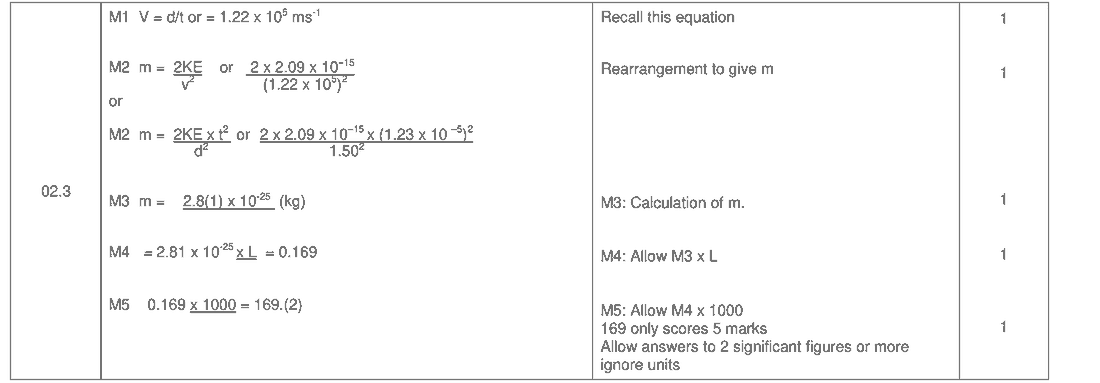
02.3 Atomic structure, Amount of substance 5Calculation
03.1 Periodicity 1Short answer
03.2 Bonding 1Short answer
03.3 Periodicity 3Explanation
03.4 Reactions of ions in aqueous solution 1Short answer
03.5 Amount of substance 1Equation writing
04.1 Reactions of ions in aqueous solution 3Short answer
04.2 Transition metals 2Equation writing
04.3 Transition metals, Oxidation, reduction and redox equations 1Short answer
04.4 Reactions of ions in aqueous solution 2Short answer
04.5 Transition metals 6Level of response
05.1 Group 7(17), the halogens, Acids and bases: pH, Ka, titration curves and buffers 2Equation writing
05.2 Group 7(17), the halogens, Oxidation, reduction and redox equations 3Equation writing
05.3 Oxidation, reduction and redox equations 1Short answer
05.4 Oxidation, reduction and redox equations 1Short answer
05.5 Group 7(17), the halogens 6Short answer
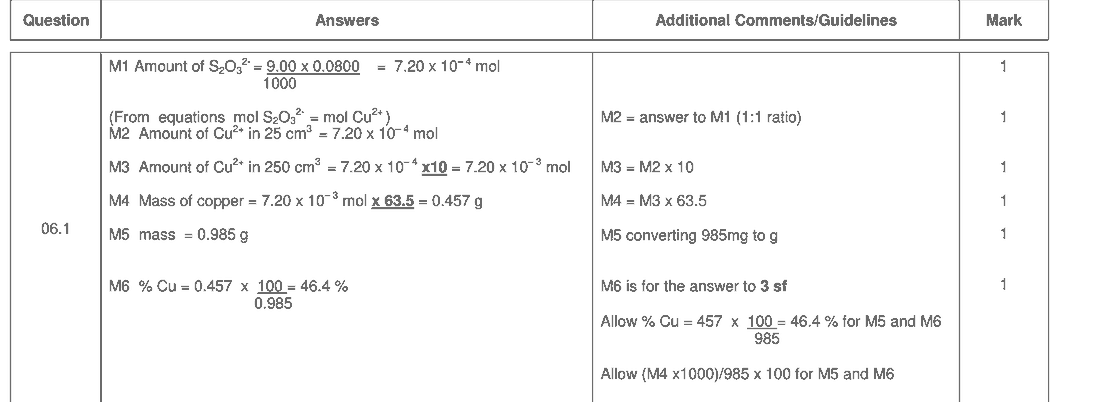
06.1 Transition metals, Amount of substance 6Calculation
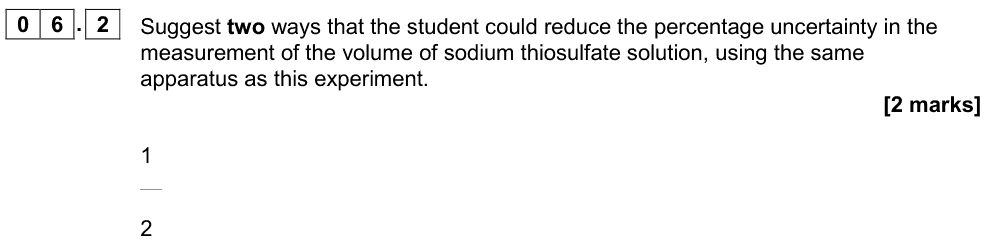
06.2 Amount of substance 2Practical and data analysis
06.3 Oxidation, reduction and redox equations 1Short answer
06.4 Atomic structure 1Short answer
06.5 Transition metals 2Explanation
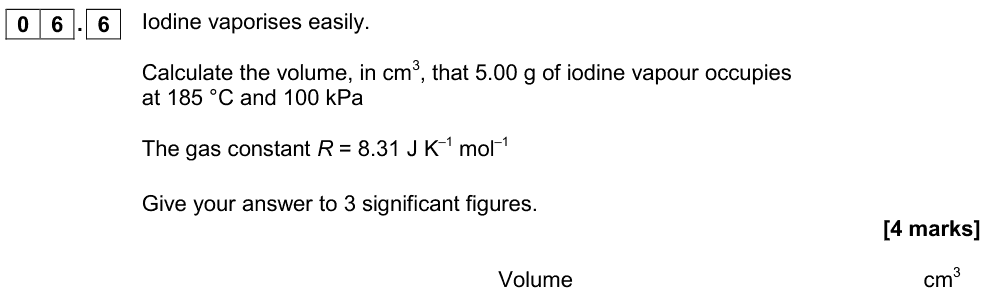
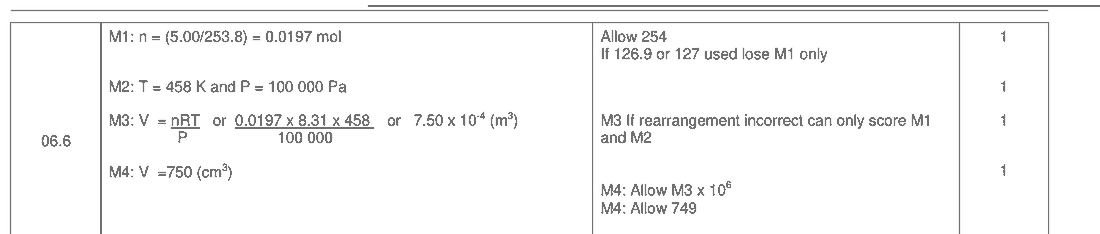
06.6 Amount of substance 4Calculation
07.1 Amount of substance 2Calculation
07.2 Equilibrium constant Kp 4Calculation
07.3 Equilibrium constant Kp, Chemical equilibria, Le Chatelier's principle and Kc 2Explanation
07.4 Equilibrium constant Kp 2Calculation
08.1 Bonding 3Diagram or structure
08.2 Bonding 3Explanation
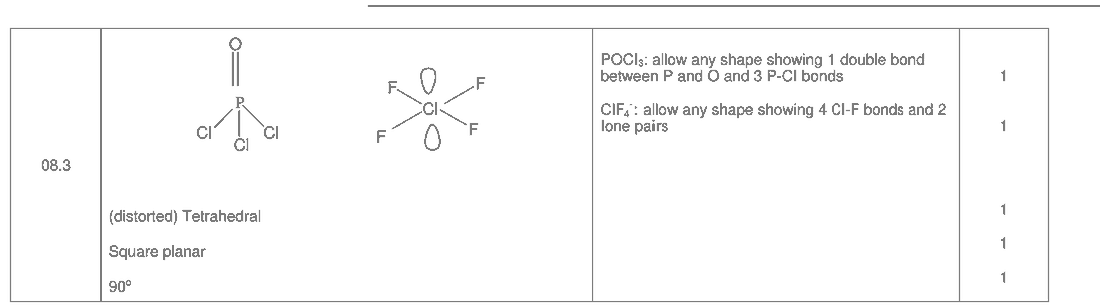
08.3 Bonding 5Diagram or structure
09.1 Acids and bases: pH, Ka, titration curves and buffers 4Calculation
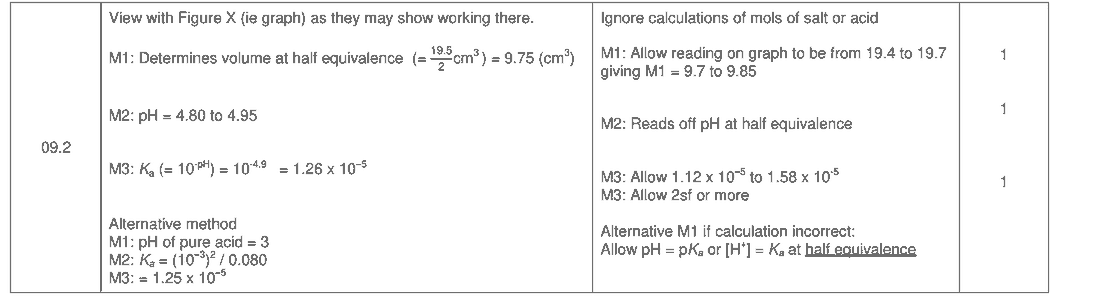
09.2 Acids and bases: pH, Ka, titration curves and buffers 3Calculation
09.3 Acids and bases: pH, Ka, titration curves and buffers 1Short answer
09.4 Acids and bases: pH, Ka, titration curves and buffers 6Calculation
09.5 Acids and bases: pH, Ka, titration curves and buffers 1Short answer

The questions

01.101.201.301.402.102.202.303.103.203.303.403.504.104.204.304.404.505.105.205.305.405.506.106.206.306.406.506.607.107.207.307.408.108.208.309.109.209.309.409.5
June 2019 · Paper 1 · Q01.1 2 marks Diagram or structure thermodynamics
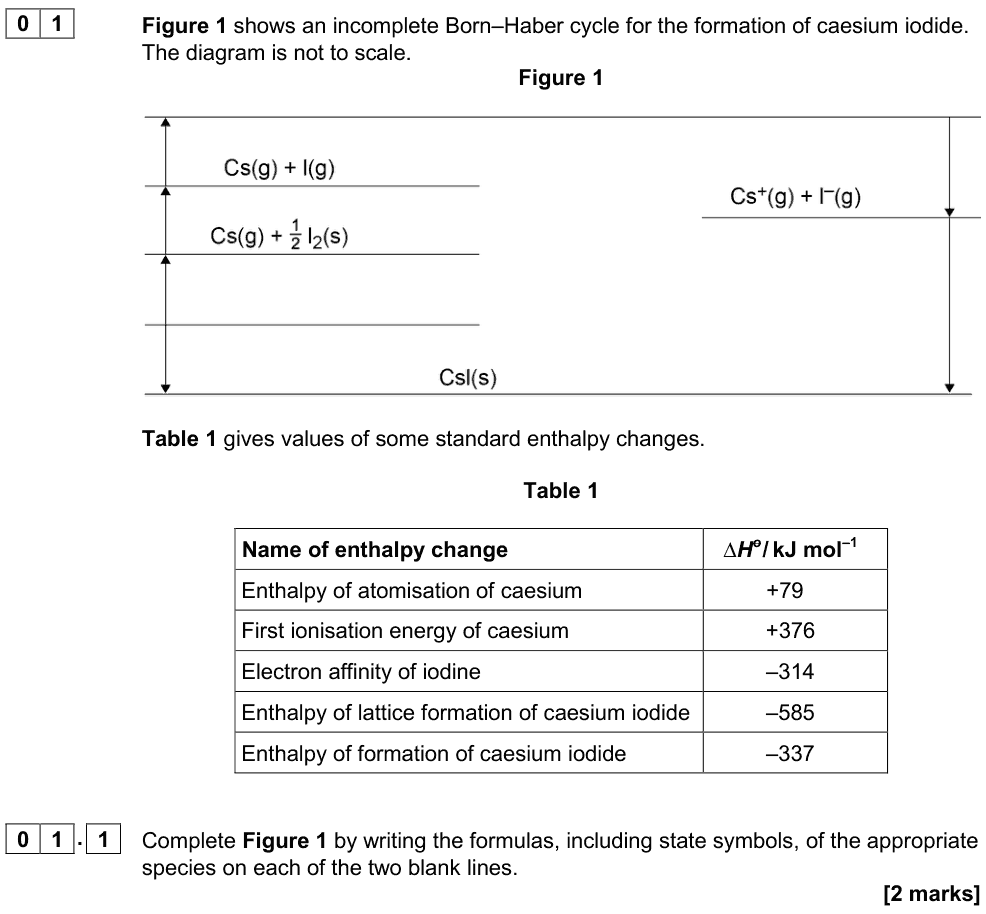
Figure 1 shows an incomplete Born–Haber cycle for the formation of caesium iodide.
The diagram is not to scale.
Figure 1
Table 1 gives values of some standard enthalpy changes.
Table 1
Name of enthalpy change
∆Ho/ kJ mol–1
Enthalpy of atomisation of caesium
+79
First ionisation energy of caesium
+376
Electron affinity of iodine
–314
Enthalpy of lattice formation of caesium iodide
–585
Enthalpy of formation of caesium iodide
–337
Complete Figure 1 by writing the formulas, including state symbols, of the appropriate
species on each of the two blank lines.
[2 marks]
June 2019 · Paper 1 · Q01.2 2 marks Calculation thermodynamics
Earlier part of question 01 that this part usesEarlier part of June 2019 Paper 1 question 01
Use Figure 1 and the data in Table 1 to calculate the standard enthalpy of
atomisation of iodine.
[2 marks]
Standard enthalpy of atomisation of iodine
kJ mol-1
June 2019 · Paper 1 · Q01.3 1 mark Short answer thermodynamics
Earlier part of question 01 that this part usesEarlier part of June 2019 Paper 1 question 01
The enthalpy of lattice formation for caesium iodide in Table 1 is a value obtained
by experiment.
The value obtained by calculation using the perfect ionic model is –582 kJ mol–1
Deduce what these values indicate about the bonding in caesium iodide.
[1 mark]
June 2019 · Paper 1 · Q01.4 4 marks Calculation thermodynamics
Earlier part of question 01 that this part usesEarlier part of June 2019 Paper 1 question 01
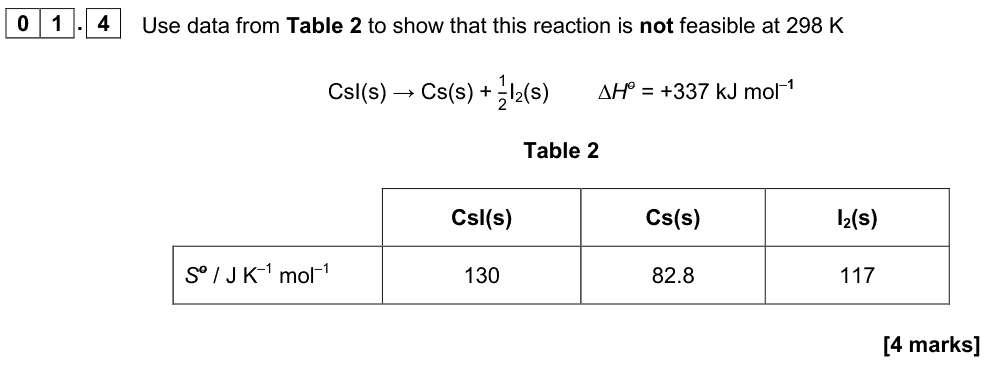
Use data from Table 2 to show that this reaction is not feasible at 298 K
CsI(s) → Cs(s) +
1
2
I2(s)        ∆Ho = +337 kJ mol–1
Table 2
CsI(s)
Cs(s)
I2(s)
So / J K–1 mol–1
130
82.8
117
[4 marks]
June 2019 · Paper 1 · Q02.1 4 marks Explanation atomic structure
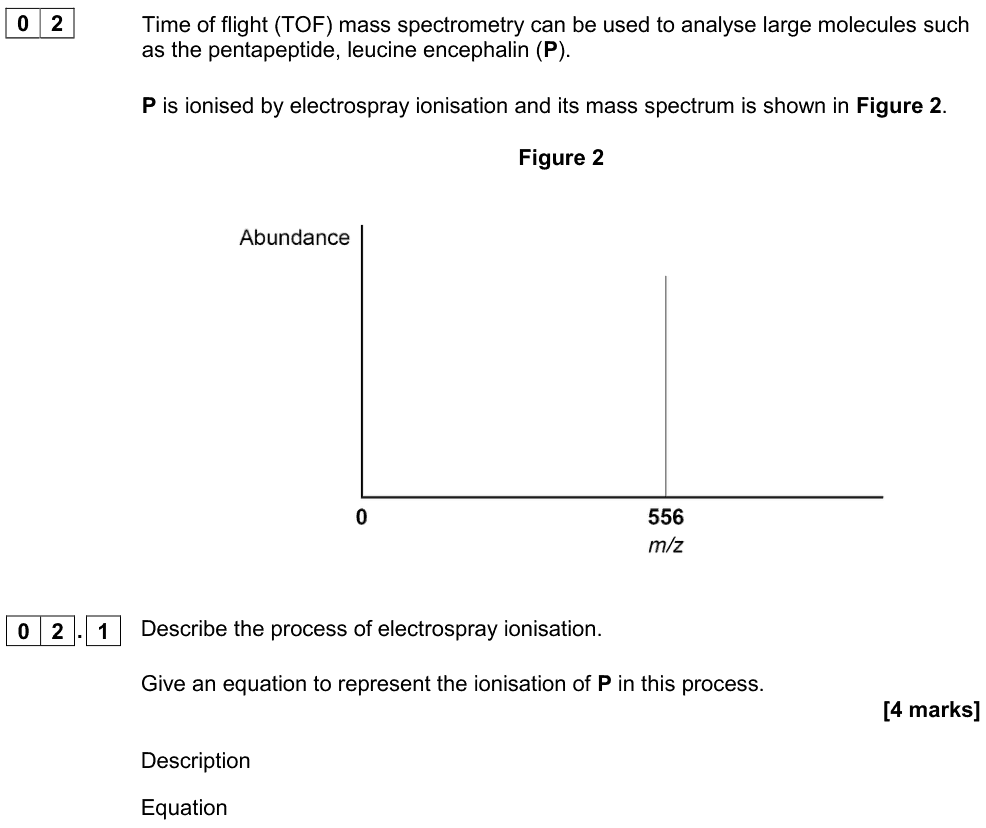
Time of flight (TOF) mass spectrometry can be used to analyse large molecules such
as the pentapeptide, leucine encephalin (P).
P is ionised by electrospray ionisation and its mass spectrum is shown in Figure 2.
Figure 2
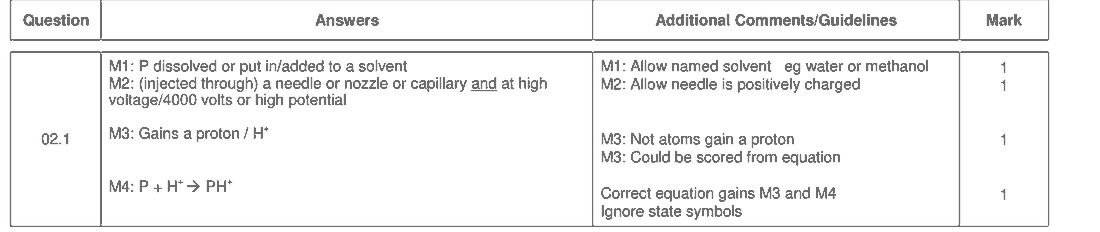
Describe the process of electrospray ionisation.
Give an equation to represent the ionisation of P in this process.
[4 marks]
Description
Equation
June 2019 · Paper 1 · Q02.2 1 mark Short answer atomic structure
Earlier part of question 02 that this part usesEarlier part of June 2019 Paper 1 question 02
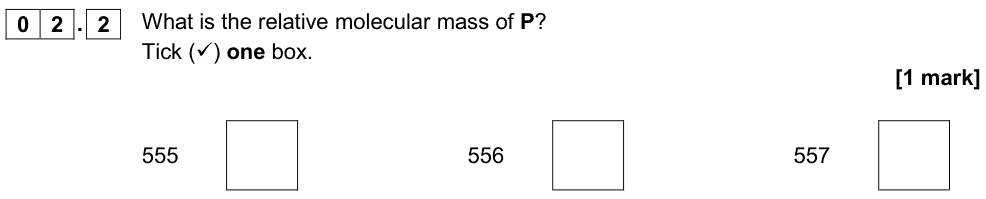
What is the relative molecular mass of P?
Tick () one box.
[1 mark]
555
556
557
June 2019 · Paper 1 · Q02.3 5 marks Calculation atomic structureamount of substance
Earlier part of question 02 that this part usesEarlier part of June 2019 Paper 1 question 02
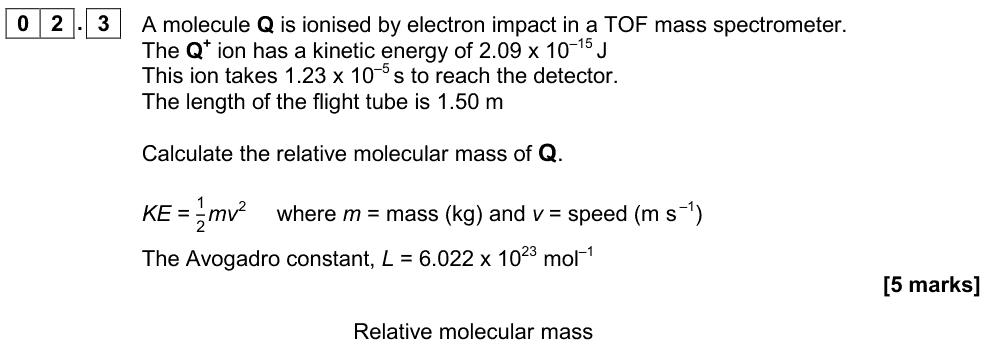
A molecule Q is ionised by electron impact in a TOF mass spectrometer.
The Q+ ion has a kinetic energy of 2.09 x 10⁻¹⁵ J
This ion takes 1.23 x 10⁻⁵ s to reach the detector.
The length of the flight tube is 1.50 m
Calculate the relative molecular mass of Q.
KE =
1
2
mv 2     where m = mass (kg) and v = speed (m s –1)
The Avogadro constant, L = 6.022 x 10²³ mol–1
[5 marks]
Relative molecular mass
June 2019 · Paper 1 · Q03.1 1 mark Short answer periodicity
This question is about periodicity, the Period 4 elements and their compounds.
State the meaning of the term periodicity.
[1 mark]
June 2019 · Paper 1 · Q03.2 1 mark Short answer bonding
Earlier part of question 03 that this part usesEarlier part of June 2019 Paper 1 question 03
Identify the element in Period 4 with the highest electronegativity value.
[1 mark]
June 2019 · Paper 1 · Q03.3 3 marks Explanation periodicity
Earlier part of question 03 that this part usesEarlier part of June 2019 Paper 1 question 03
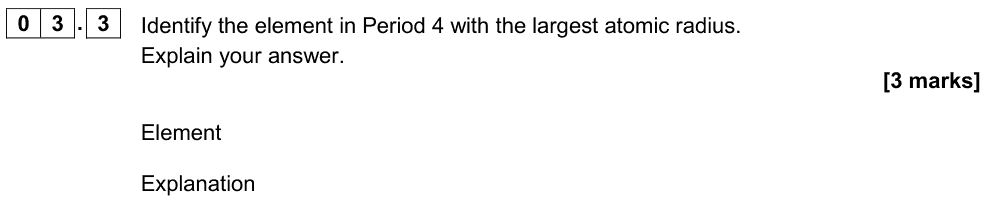
Identify the element in Period 4 with the largest atomic radius.
Explain your answer.
[3 marks]
Element
Explanation
June 2019 · Paper 1 · Q03.4 1 mark Short answer reactions of ions in aqueous solution
Earlier part of question 03 that this part usesEarlier part of June 2019 Paper 1 question 03
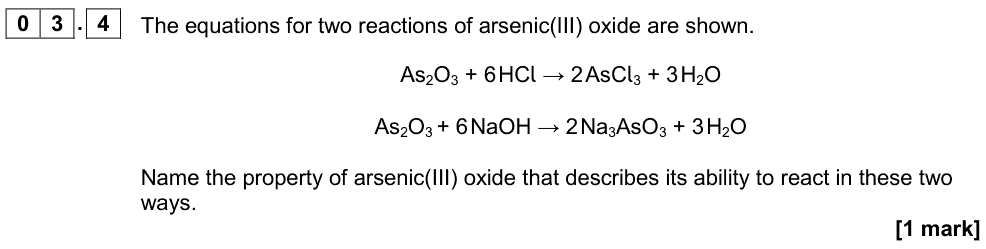
The equations for two reactions of arsenic(III) oxide are shown.
As2O3 + 6 HCl → 2 AsCl3 + 3 H2O
As2O3 + 6 NaOH → 2 Na3AsO3 + 3 H2O
Name the property of arsenic(III) oxide that describes its ability to react in these two
ways.
[1 mark]
June 2019 · Paper 1 · Q03.5 1 mark Equation writing Hard amount of substance
Earlier part of question 03 that this part usesEarlier part of June 2019 Paper 1 question 03
Complete the equation for the formation of arsenic hydride.
[1 mark]
As2O3  +           Zn  +            HNO3 →            AsH3  +           Zn(NO3)2  +           H2O
June 2019 · Paper 1 · Q04.1 3 marks Short answer reactions of ions in aqueous solution
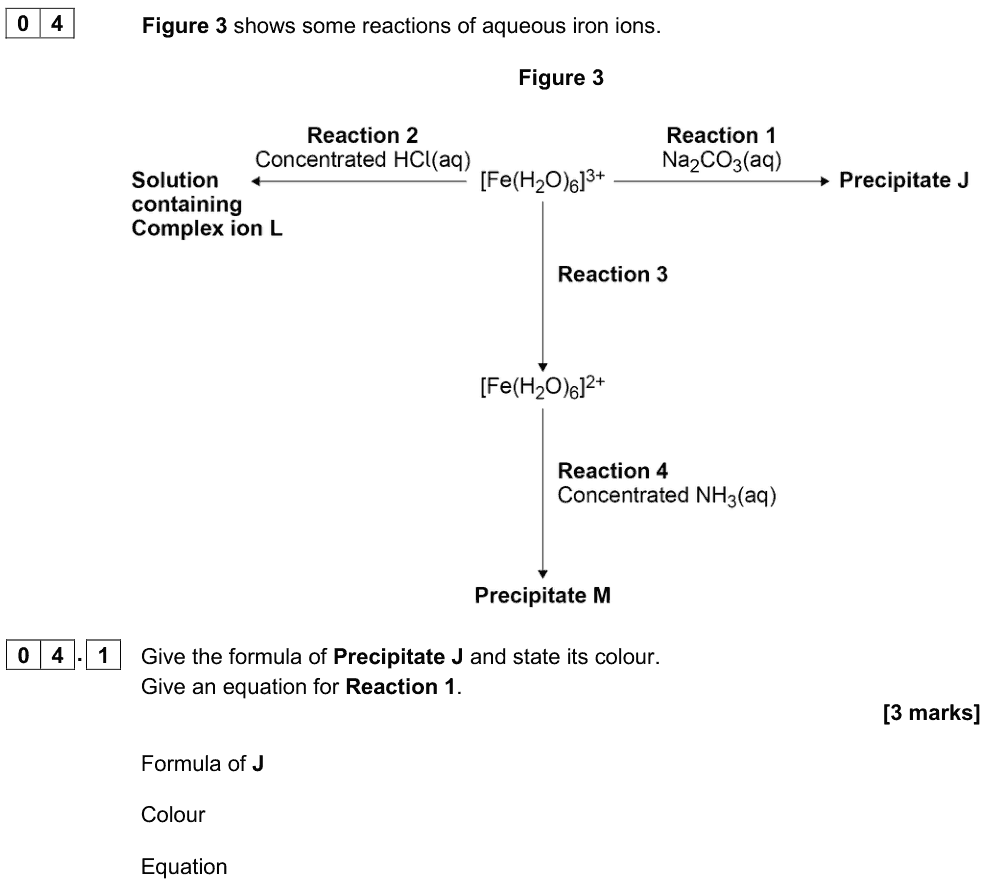
Figure 3 shows some reactions of aqueous iron ions.
Figure 3
Give the formula of Precipitate J and state its colour.
Give an equation for Reaction 1.
[3 marks]
Formula of J
Colour
Equation
June 2019 · Paper 1 · Q04.2 2 marks Equation writing transition metals
Earlier part of question 04 that this part usesEarlier part of June 2019 Paper 1 question 04
Give the formula of L and an equation for Reaction 2.
[2 marks]
Formula of L
Equation
June 2019 · Paper 1 · Q04.3 1 mark Short answer transition metalsredox
Earlier part of question 04 that this part usesEarlier part of June 2019 Paper 1 question 04
Suggest a reagent for Reaction 3.
[1 mark]
June 2019 · Paper 1 · Q04.4 2 marks Short answer reactions of ions in aqueous solution
Earlier part of question 04 that this part usesEarlier part of June 2019 Paper 1 question 04
Give the formula of Precipitate M and state its colour.
[2 marks]
Formula of M
Colour
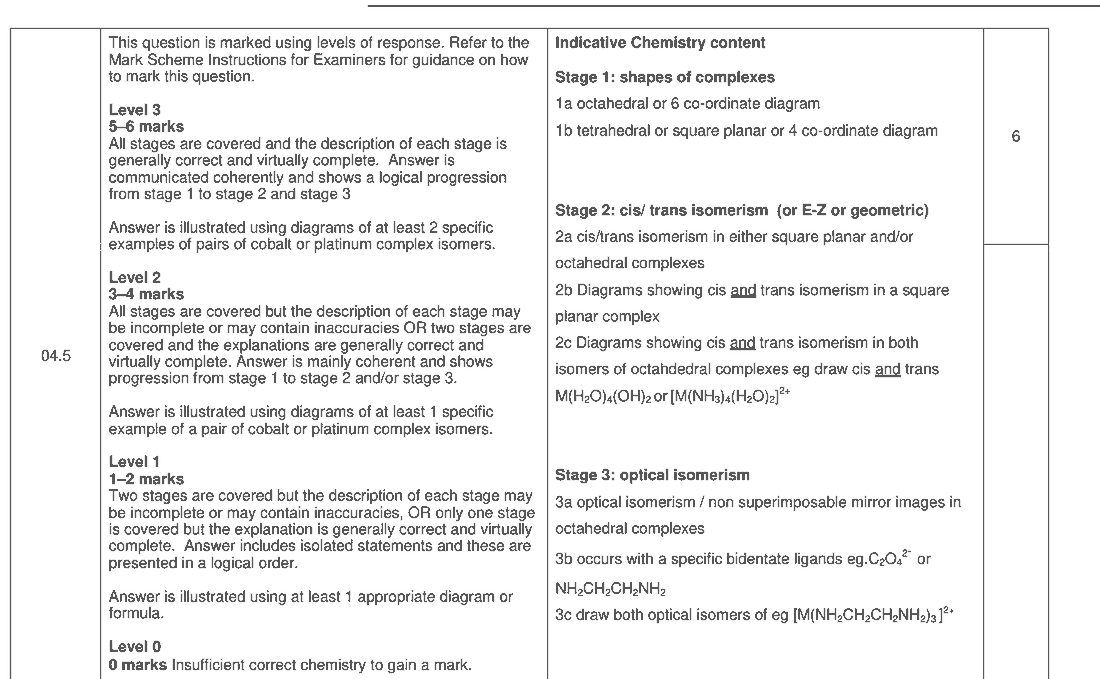
June 2019 · Paper 1 · Q04.5 6 marks 6-mark level of response transition metals
Earlier part of question 04 that this part usesEarlier part of June 2019 Paper 1 question 04
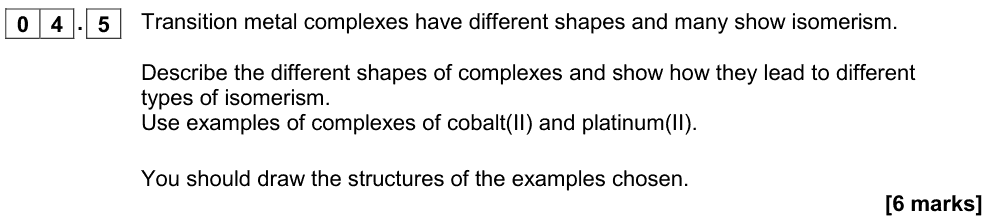
Transition metal complexes have different shapes and many show isomerism.
Describe the different shapes of complexes and show how they lead to different
types of isomerism.
Use examples of complexes of cobalt(II) and platinum(II).
You should draw the structures of the examples chosen.
[6 marks]
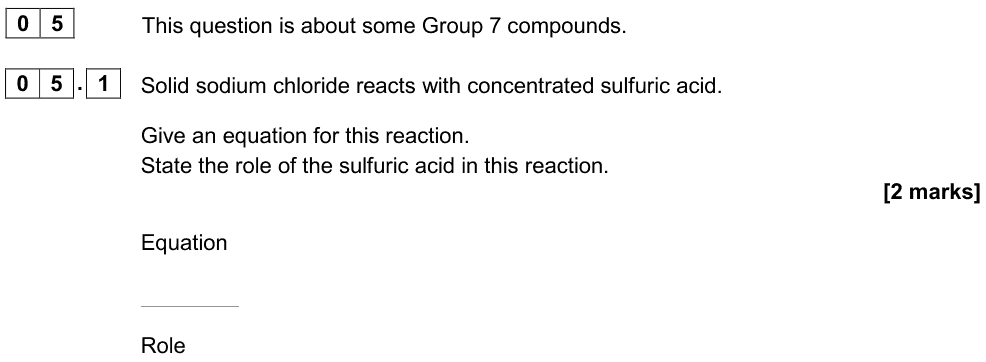
June 2019 · Paper 1 · Q05.1 2 marks Equation writing group 7 the halogensacids and bases
This question is about some Group 7 compounds.
Solid sodium chloride reacts with concentrated sulfuric acid.
Give an equation for this reaction.
State the role of the sulfuric acid in this reaction.
[2 marks]
Equation
Role
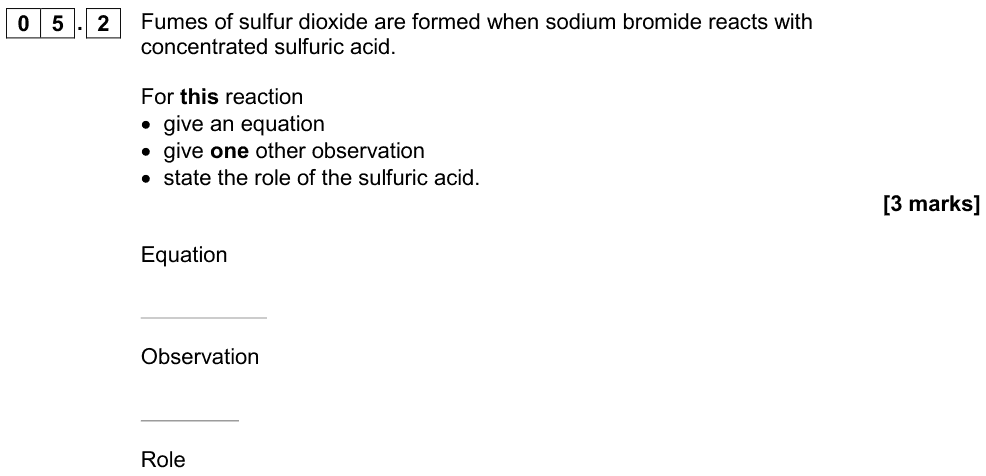
June 2019 · Paper 1 · Q05.2 3 marks Equation writing group 7 the halogensredox
Earlier part of question 05 that this part usesEarlier part of June 2019 Paper 1 question 05
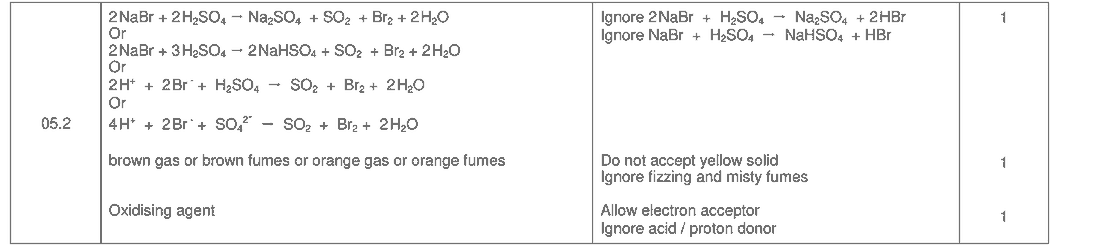
Fumes of sulfur dioxide are formed when sodium bromide reacts with
concentrated sulfuric acid.
For this reaction
• give an equation
• give one other observation
• state the role of the sulfuric acid.
[3 marks]
Equation
Observation
Role
June 2019 · Paper 1 · Q05.3 1 mark Short answer Easy redox
Earlier part of question 05 that this part usesEarlier part of June 2019 Paper 1 question 05
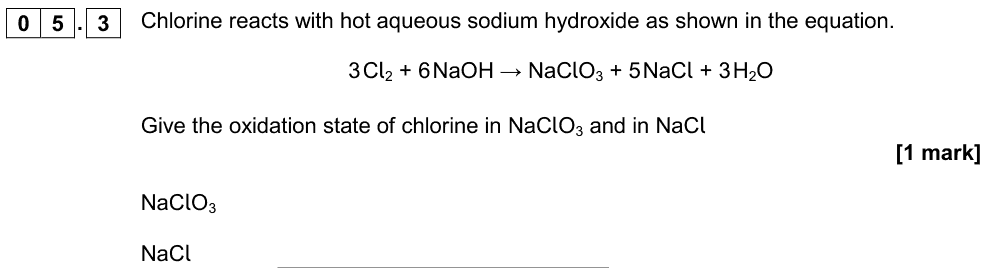
Chlorine reacts with hot aqueous sodium hydroxide as shown in the equation.
3 Cl2 + 6 NaOH → NaClO3 + 5 NaCl + 3 H2O
Give the oxidation state of chlorine in NaClO3 and in NaCl
[1 mark]
NaClO3
NaCl
June 2019 · Paper 1 · Q05.4 1 mark Short answer redox
Earlier part of question 05 that this part usesEarlier part of June 2019 Paper 1 question 05
State, in terms of redox, what happens to chlorine in the reaction in Question 05.3.
[1 mark]
June 2019 · Paper 1 · Q05.5 6 marks Short answer group 7 the halogens
Earlier part of question 05 that this part usesEarlier part of June 2019 Paper 1 question 05
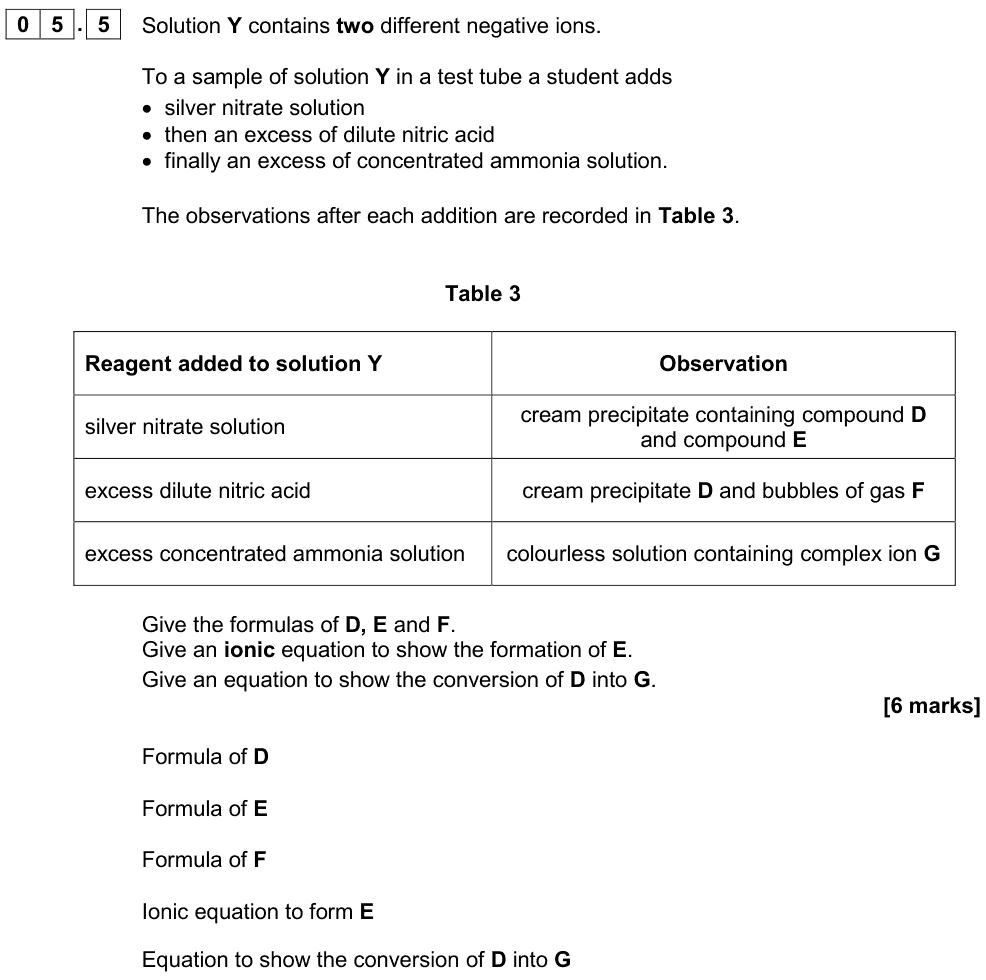
Solution Y contains two different negative ions.
To a sample of solution Y in a test tube a student adds
• silver nitrate solution
• then an excess of dilute nitric acid
• finally an excess of concentrated ammonia solution.
The observations after each addition are recorded in Table 3.
Table 3
Reagent added to solution Y
Observation
silver nitrate solution
cream precipitate containing compound D
and compound E
excess dilute nitric acid
cream precipitate D and bubbles of gas F
excess concentrated ammonia solution
colourless solution containing complex ion G
Give the formulas of D, E and F.
Give an ionic equation to show the formation of E.
Give an equation to show the conversion of D into G.
[6 marks]
Formula of D
Formula of E
Formula of F
Ionic equation to form E
Equation to show the conversion of D into G
June 2019 · Paper 1 · Q06.1 6 marks Calculation transition metalsamount of substance
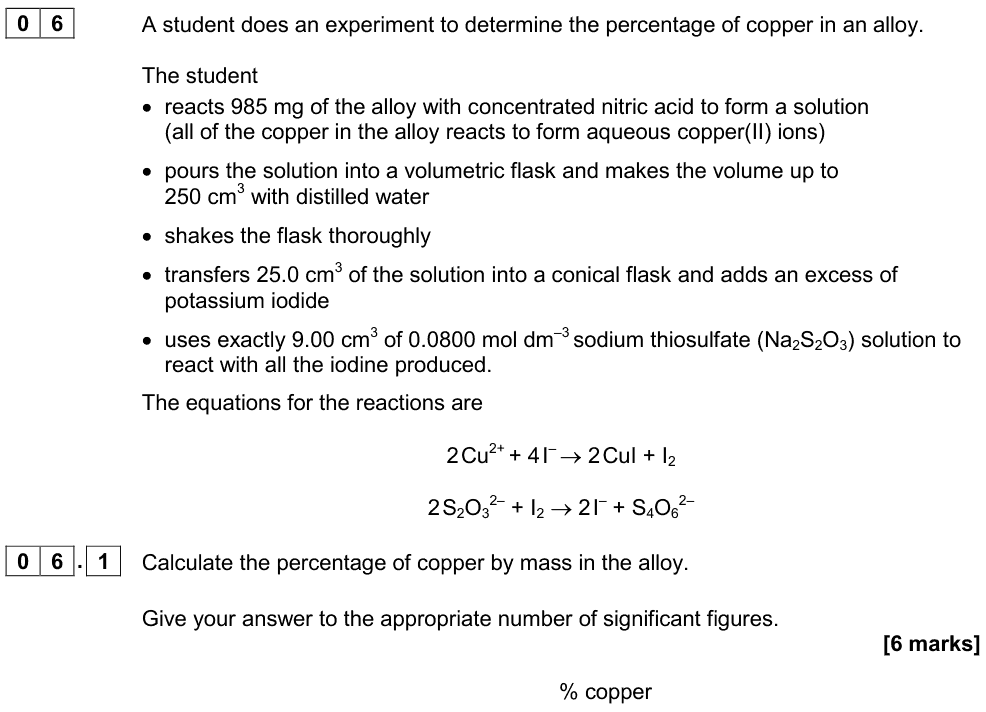
A student does an experiment to determine the percentage of copper in an alloy.
The student
• reacts 985 mg of the alloy with concentrated nitric acid to form a solution
(all of the copper in the alloy reacts to form aqueous copper(II) ions)
• pours the solution into a volumetric flask and makes the volume up to
250 cm3 with distilled water
• shakes the flask thoroughly
• transfers 25.0 cm3 of the solution into a conical flask and adds an excess of
potassium iodide
• uses exactly 9.00 cm3 of 0.0800 mol dm–3 sodium thiosulfate (Na2S2O3) solution to
react with all the iodine produced.
The equations for the reactions are
2 Cu2+ + 4 I– → 2 CuI + I2
2 S2O3
2– + I2 → 2 I– + S4O6
2–
Calculate the percentage of copper by mass in the alloy.
Give your answer to the appropriate number of significant figures.
[6 marks]
% copper
June 2019 · Paper 1 · Q06.2 2 marks Practical and data analysis amount of substance
Earlier part of question 06 that this part usesEarlier part of June 2019 Paper 1 question 06
Suggest two ways that the student could reduce the percentage uncertainty in the
measurement of the volume of sodium thiosulfate solution, using the same
apparatus as this experiment.
[2 marks]
1
2
June 2019 · Paper 1 · Q06.3 1 mark Short answer redox
Earlier part of question 06 that this part usesEarlier part of June 2019 Paper 1 question 06
State the role of iodine in the reaction with sodium thiosulfate.
[1 mark]
June 2019 · Paper 1 · Q06.4 1 mark Short answer atomic structure
Earlier part of question 06 that this part usesEarlier part of June 2019 Paper 1 question 06
Give the full electron configuration of a copper(II) ion.
[1 mark]
June 2019 · Paper 1 · Q06.5 2 marks Explanation transition metals
Earlier part of question 06 that this part usesEarlier part of June 2019 Paper 1 question 06
Copper(I) iodide is a white solid.
Explain why copper(I) iodide is white.
[2 marks]
June 2019 · Paper 1 · Q06.6 4 marks Calculation amount of substance
Earlier part of question 06 that this part usesEarlier part of June 2019 Paper 1 question 06
Iodine vaporises easily.
Calculate the volume, in cm3, that 5.00 g of iodine vapour occupies
at 185 °C and 100 kPa
The gas constant R = 8.31 J K–1 mol–1
Give your answer to 3 significant figures.
[4 marks]
Volume
cm3
June 2019 · Paper 1 · Q07.1 2 marks Calculation amount of substance
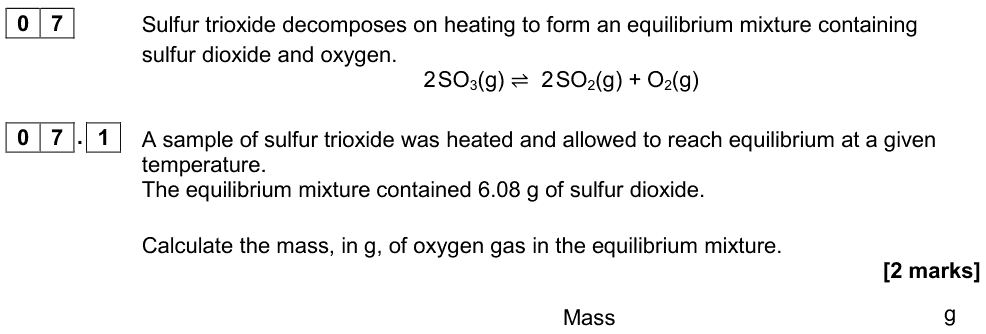
Sulfur trioxide decomposes on heating to form an equilibrium mixture containing
sulfur dioxide and oxygen.
2 SO3(g) ⇌  2 SO2(g) + O2(g)
A sample of sulfur trioxide was heated and allowed to reach equilibrium at a given
temperature.
The equilibrium mixture contained 6.08 g of sulfur dioxide.
Calculate the mass, in g, of oxygen gas in the equilibrium mixture.
[2 marks]
Mass
g
June 2019 · Paper 1 · Q07.2 4 marks Calculation equilibrium constant kp
Earlier part of question 07 that this part usesEarlier part of June 2019 Paper 1 question 07
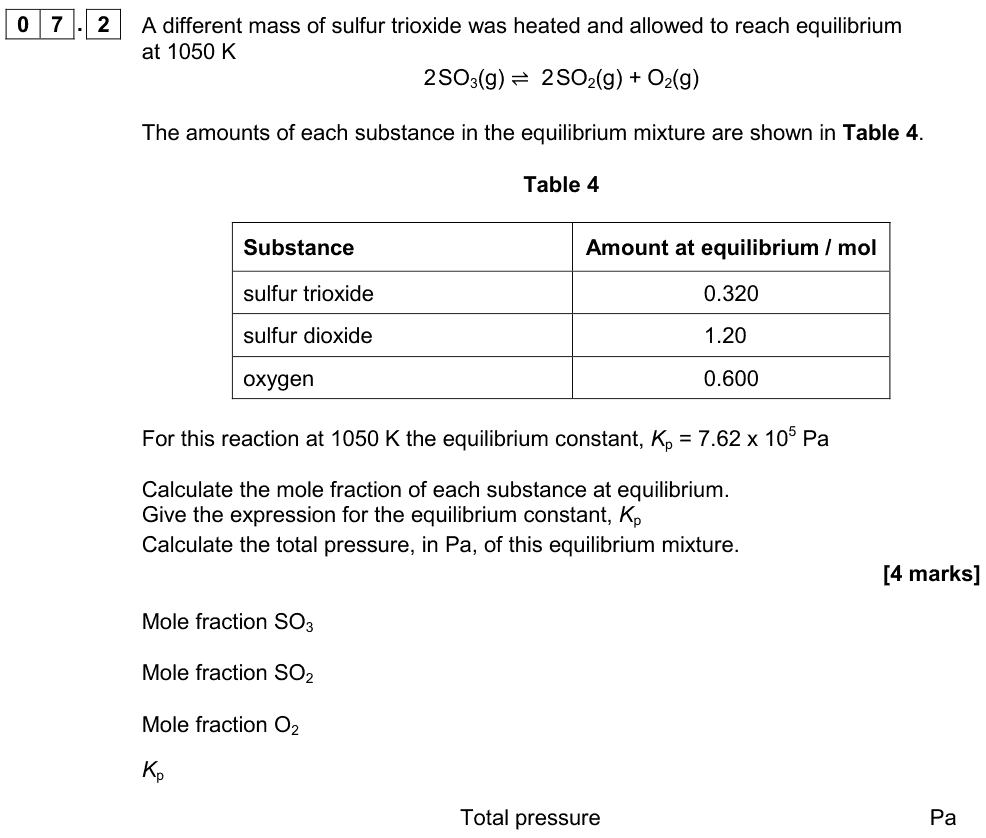
A different mass of sulfur trioxide was heated and allowed to reach equilibrium
at 1050 K
2 SO3(g) ⇌  2 SO2(g) + O2(g)
The amounts of each substance in the equilibrium mixture are shown in Table 4.
Table 4
Substance
Amount at equilibrium / mol
sulfur trioxide
0.320
sulfur dioxide
1.20
oxygen
0.600
For this reaction at 1050 K the equilibrium constant, Kp = 7.62 x 10⁵ Pa
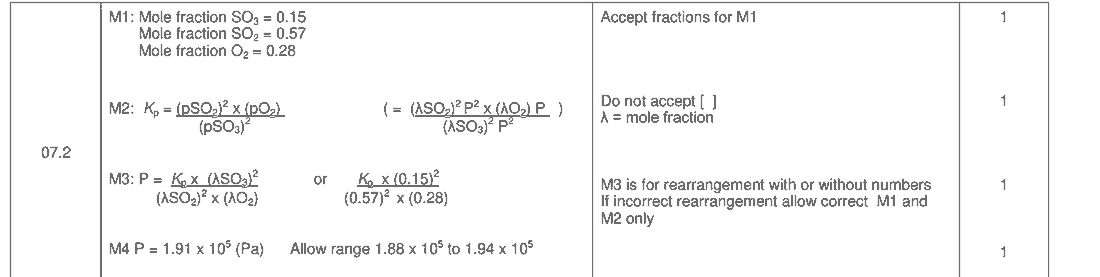
Calculate the mole fraction of each substance at equilibrium.
Give the expression for the equilibrium constant, Kp
Calculate the total pressure, in Pa, of this equilibrium mixture.
[4 marks]
Mole fraction SO3
Mole fraction SO2
Mole fraction O2
Kp
Total pressure
Pa
June 2019 · Paper 1 · Q07.3 2 marks Explanation equilibrium constant kpchemical equilibria and kc
Earlier part of question 07 that this part usesEarlier part of June 2019 Paper 1 question 07
For this reaction at 1050 K the equilibrium constant, Kp = 7.62 x 10⁵ Pa
For this reaction at 500 K the equilibrium constant, Kp = 3.94 x 10⁴ Pa
Explain how this information can be used to deduce that the forward reaction is
endothermic.
[2 marks]
June 2019 · Paper 1 · Q07.4 2 marks Calculation equilibrium constant kp
Earlier part of question 07 that this part usesEarlier part of June 2019 Paper 1 question 07
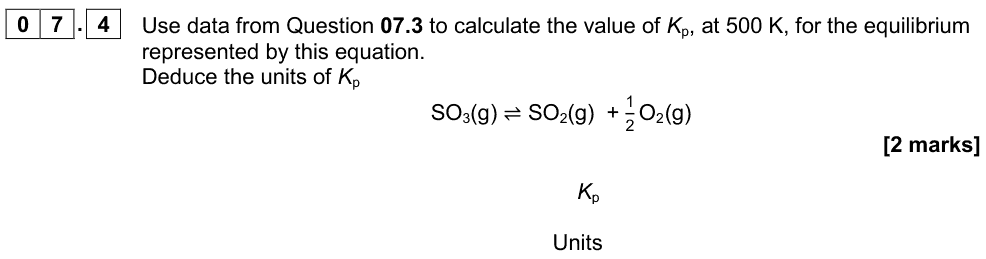
Use data from Question 07.3 to calculate the value of Kp, at 500 K, for the equilibrium
represented by this equation.
Deduce the units of Kp
SO3(g) ⇌ SO2(g)  +
1
2
O2 (g)
[2 marks]
Kp
Units
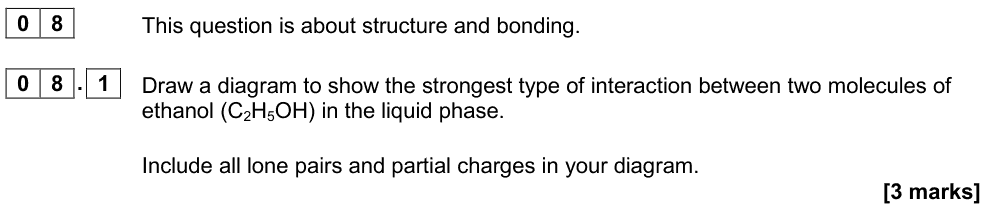
June 2019 · Paper 1 · Q08.1 3 marks Diagram or structure bonding
This question is about structure and bonding.
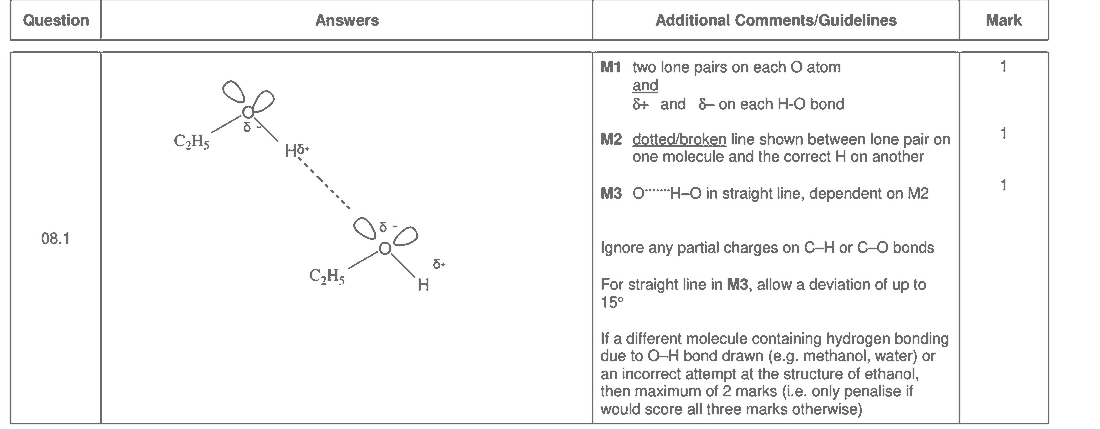
Draw a diagram to show the strongest type of interaction between two molecules of
ethanol (C2H5OH) in the liquid phase.
Include all lone pairs and partial charges in your diagram.
[3 marks]
June 2019 · Paper 1 · Q08.2 3 marks Explanation bonding
Earlier part of question 08 that this part usesEarlier part of June 2019 Paper 1 question 08
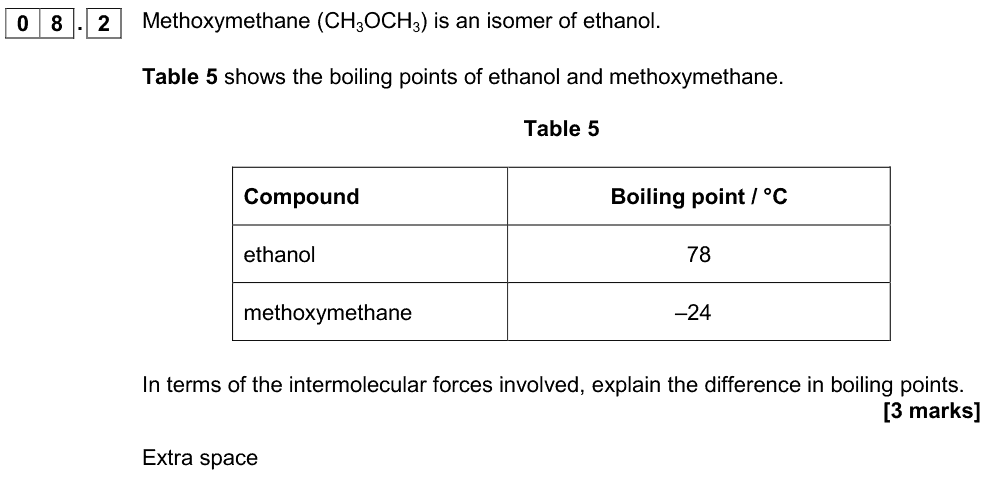
Methoxymethane (CH3OCH3) is an isomer of ethanol.
Table 5 shows the boiling points of ethanol and methoxymethane.
Table 5
Compound
Boiling point / °C
ethanol
78
methoxymethane
–24
In terms of the intermolecular forces involved, explain the difference in boiling points.
[3 marks]
Extra space
June 2019 · Paper 1 · Q08.3 5 marks Diagram or structure bonding
Earlier part of question 08 that this part usesEarlier part of June 2019 Paper 1 question 08
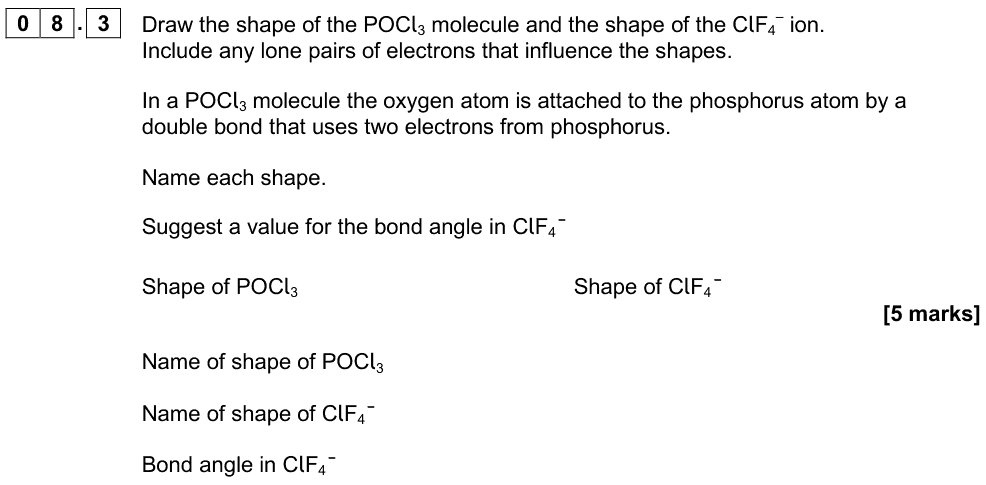
Draw the shape of the POCl3 molecule and the shape of the ClF4
– ion.
Include any lone pairs of electrons that influence the shapes.
In a POCl3 molecule the oxygen atom is attached to the phosphorus atom by a
double bond that uses two electrons from phosphorus.
Name each shape.
Suggest a value for the bond angle in ClF4 ̄
Shape of POCl3
Shape of ClF4 ̄
[5 marks]
Name of shape of POCl3
Name of shape of ClF4 ̄
Bond angle in ClF4 ̄
June 2019 · Paper 1 · Q09.1 4 marks Calculation acids and bases
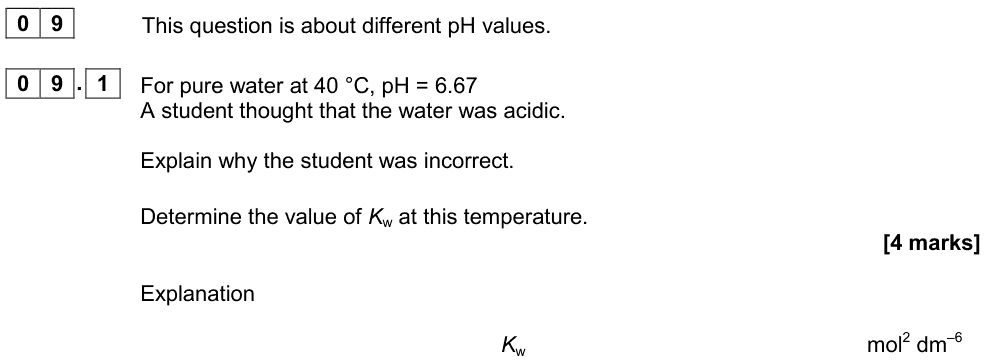
This question is about different pH values.
For pure water at 40 °C, pH = 6.67
A student thought that the water was acidic.
Explain why the student was incorrect.
Determine the value of Kw at this temperature.
[4 marks]
Explanation
Kw
mol2 dm–6
June 2019 · Paper 1 · Q09.2 3 marks Calculation acids and bases
Earlier part of question 09 that this part usesEarlier part of June 2019 Paper 1 question 09
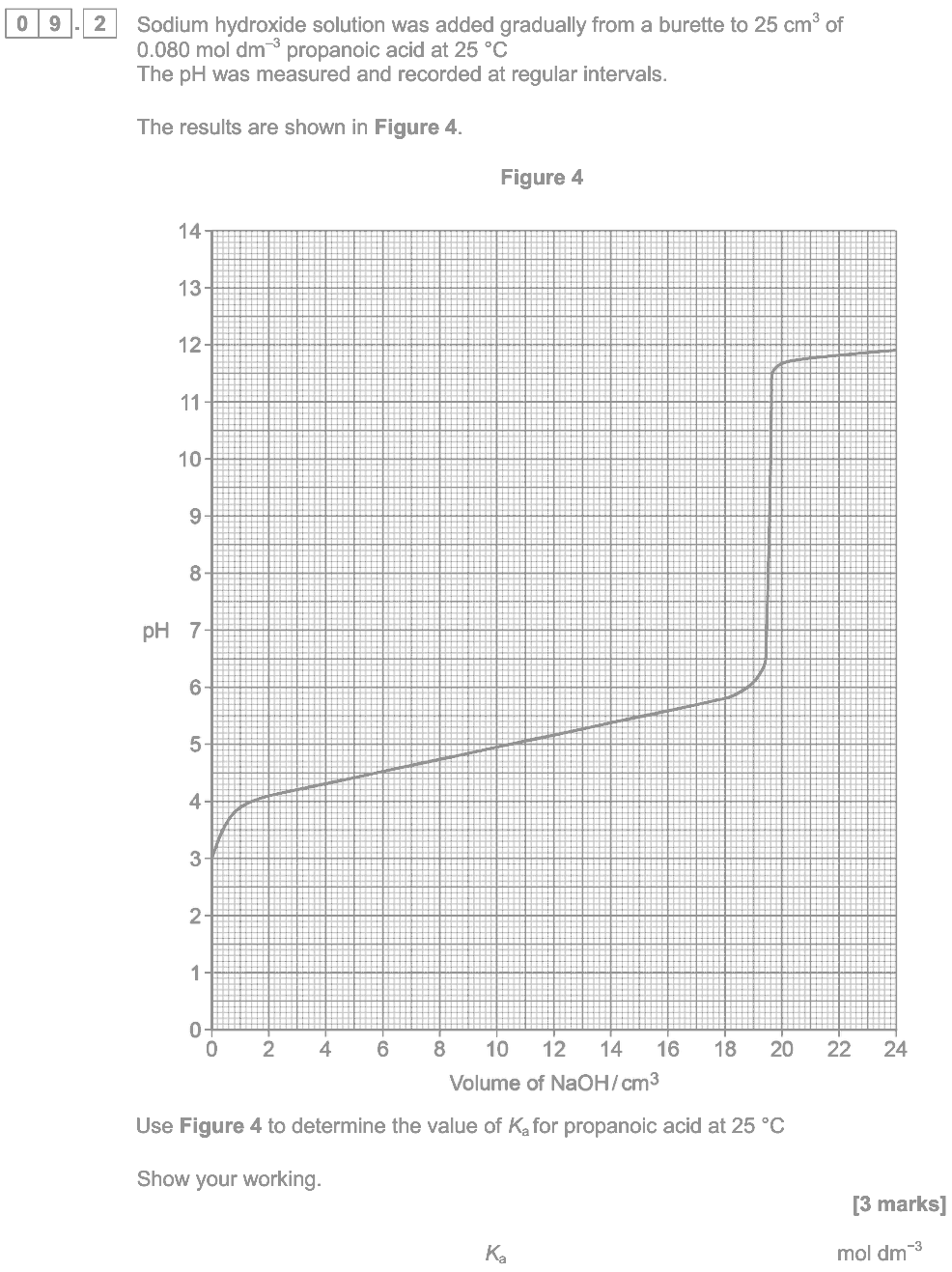
Sodium hydroxide solution was added gradually from a burette to 25 cm3 of
0.080 mol dm–3 propanoic acid at 25 °C
The pH was measured and recorded at regular intervals.
The results are shown in Figure 4.
Figure 4
Use Figure 4 to determine the value of Ka for propanoic acid at 25 °C
Show your working.
[3 marks]
Ka
mol dm−3
June 2019 · Paper 1 · Q09.3 1 mark Short answer acids and bases
Earlier part of question 09 that this part usesEarlier part of June 2019 Paper 1 question 09
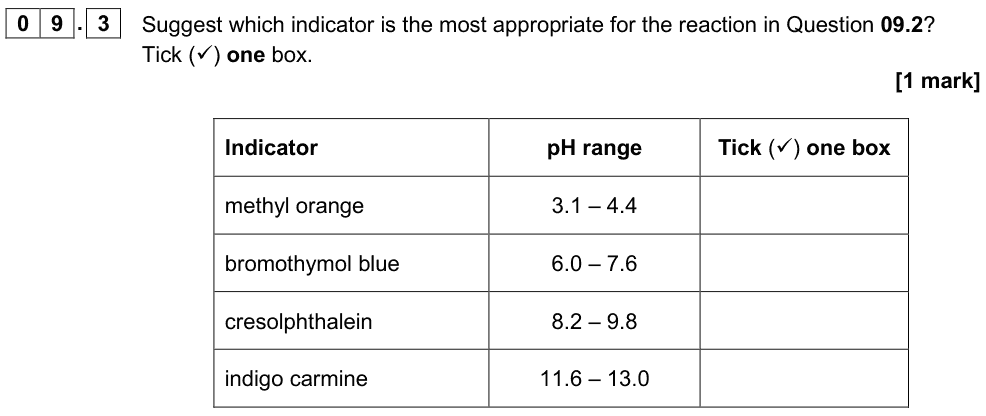
Suggest which indicator is the most appropriate for the reaction in Question 09.2?
Tick () one box.
[1 mark]
Indicator
pH range
Tick () one box
methyl orange
3.1 – 4.4
bromothymol blue
6.0 – 7.6
cresolphthalein
8.2 – 9.8
indigo carmine
11.6 – 13.0
June 2019 · Paper 1 · Q09.4 6 marks Calculation acids and bases
Earlier part of question 09 that this part usesEarlier part of June 2019 Paper 1 question 09
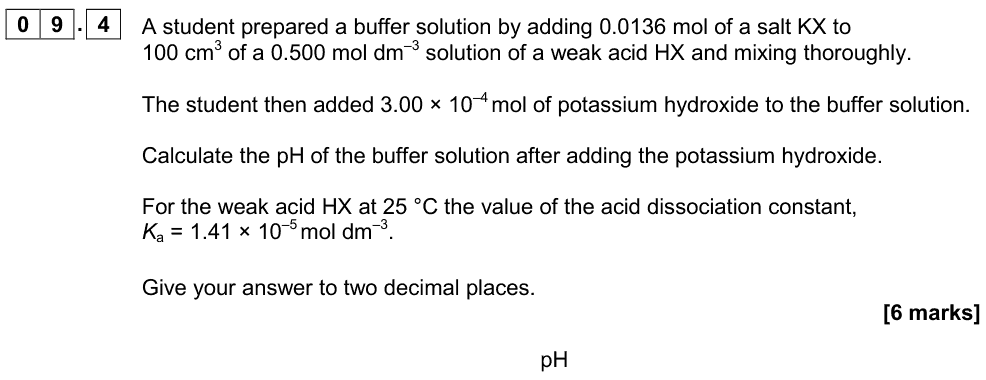
A student prepared a buffer solution by adding 0.0136 mol of a salt KX to
100 cm3 of a 0.500 mol dm–3 solution of a weak acid HX and mixing thoroughly.
The student then added 3.00 × 10⁻⁴
mol of potassium hydroxide to the buffer solution.
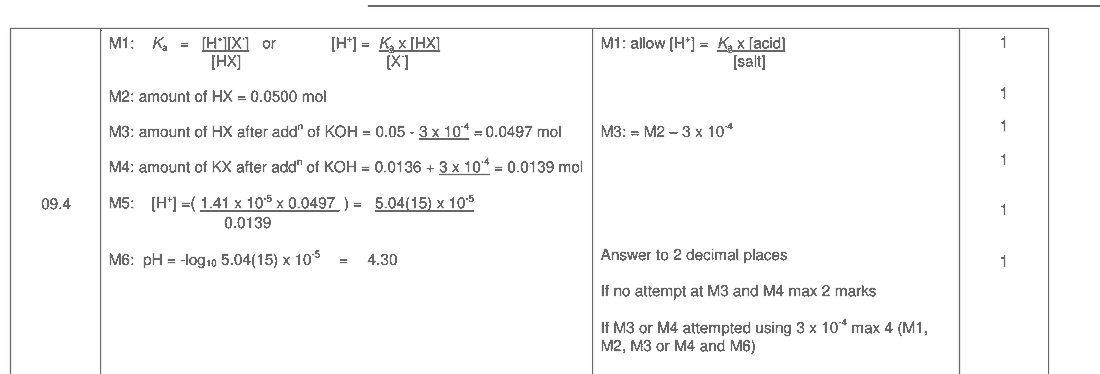
Calculate the pH of the buffer solution after adding the potassium hydroxide.
For the weak acid HX at 25 °C the value of the acid dissociation constant,
Ka = 1.41 × 10⁻⁵
mol dm–3.
Give your answer to two decimal places.
[6 marks]
pH
June 2019 · Paper 1 · Q09.5 1 mark Short answer acids and bases
Earlier part of question 09 that this part usesEarlier part of June 2019 Paper 1 question 09
A buffer solution has a constant pH even when diluted.
Use a mathematical expression to explain this.
[1 mark]

Work with an A-level chemistry tutor

Want a paper marked and gone through with you? Message us.

Prefer email? Send an enquiry

If you are under 18, please include a parent's contact details. Enquiries go to enquiries@chemistryaleveltutor.com and are deleted once handled. All tutoring is online.