June 2018: Paper 1, Inorganic and physical chemistry

105 marks · 45 question parts · Paper, mark scheme and report on AQA's site · Have the Data Booklet beside you

Question by question

QTopicMarksAOType
01.1 Thermodynamics: Born–Haber cycles, entropy and Gibbs free energy 3Diagram or structure
01.2 Thermodynamics: Born–Haber cycles, entropy and Gibbs free energy 3Calculation
02.1 Equilibrium constant Kp 3Calculation
02.2 Equilibrium constant Kp 1Short answer
02.3 Equilibrium constant Kp 2Calculation
02.4 Equilibrium constant Kp 3Explanation
03.1 Thermodynamics: Born–Haber cycles, entropy and Gibbs free energy 2Calculation
03.2 Thermodynamics: Born–Haber cycles, entropy and Gibbs free energy 2Calculation
03.3 Thermodynamics: Born–Haber cycles, entropy and Gibbs free energy 2Explanation
03.4 Transition metals 3Explanation
03.5 Oxidation, reduction and redox equations 1Short answer
03.6 Amount of substance 1Equation writing
04.1 Atomic structure 1Short answer
04.2 Atomic structure 2Explanation
04.3 Atomic structure 1Short answer
04.4 Group 2, the alkaline earth metals 1Short answer
04.5 Amount of substance 3Calculation
04.6 Atomic structure 4Calculation
04.7 Atomic structure 1Short answer
04.8 Atomic structure, Amount of substance 5Calculation
05.1 Acids and bases: pH, Ka, titration curves and buffers 1Short answer
05.2 Acids and bases: pH, Ka, titration curves and buffers 6Calculation
05.3 Acids and bases: pH, Ka, titration curves and buffers 1Short answer
05.4 Period 3 elements and their oxides 1Short answer
05.5 Acids and bases: pH, Ka, titration curves and buffers 1Short answer
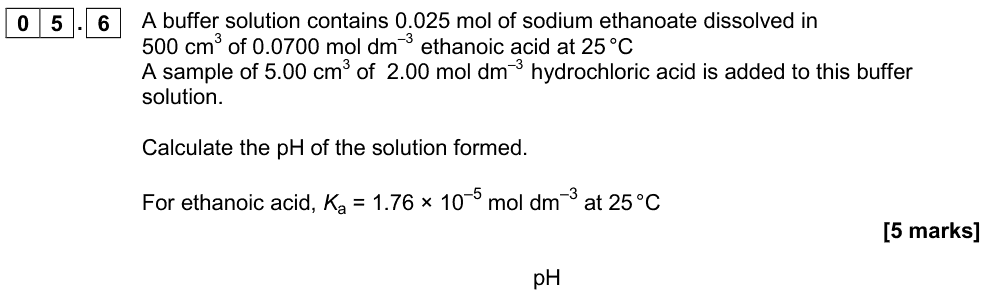
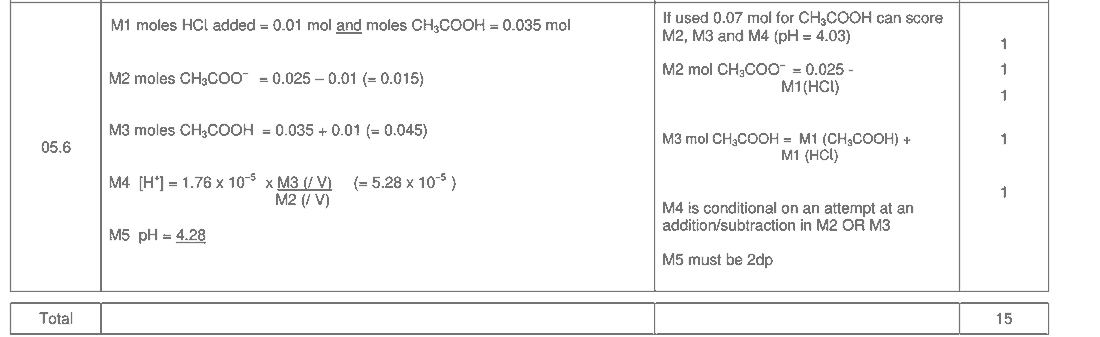
05.6 Acids and bases: pH, Ka, titration curves and buffers 5Calculation
06.1 Electrode potentials and electrochemical cells 1Practical and data analysis
06.2 Electrode potentials and electrochemical cells 1Calculation
06.3 Electrode potentials and electrochemical cells 1Short answer
06.4 Electrode potentials and electrochemical cells 1Short answer
06.5 Electrode potentials and electrochemical cells 2Short answer
07.1 Reactions of ions in aqueous solution, Amount of substance 1Equation writing
07.2 Reactions of ions in aqueous solution, Acids and bases: pH, Ka, titration curves and buffers 1Equation writing
07.3 Reactions of ions in aqueous solution 3Equation writing
07.4 Reactions of ions in aqueous solution 4Equation writing
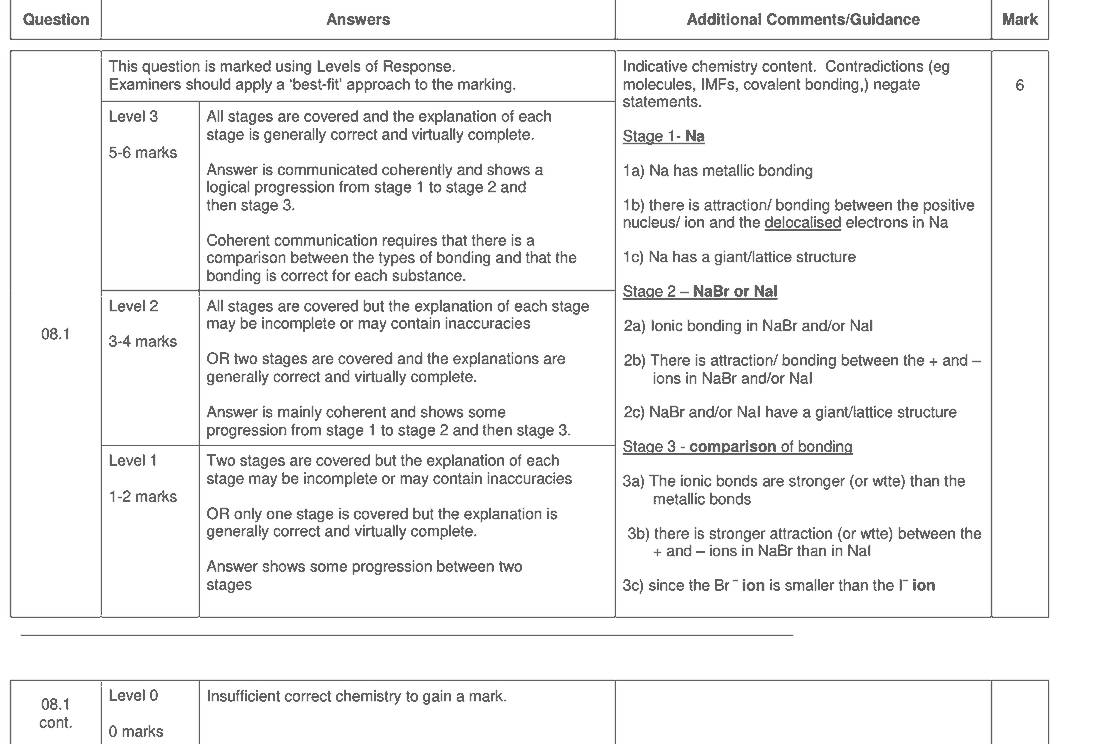
08.1 Bonding 6Level of response
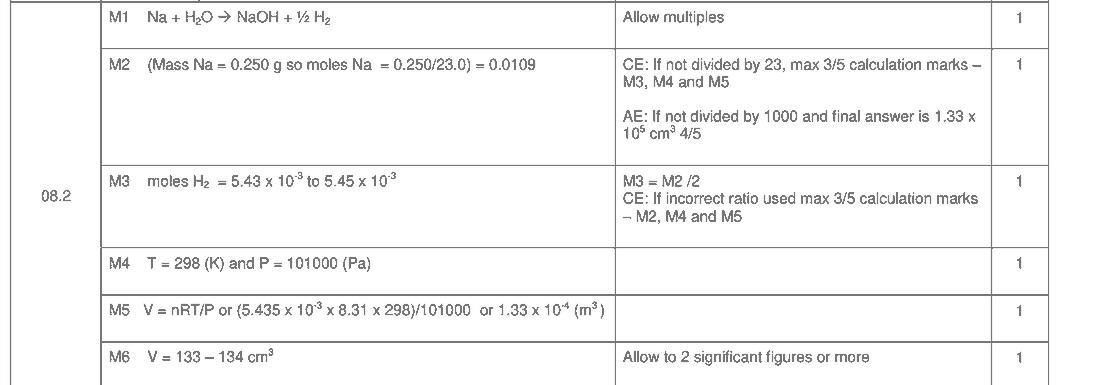
08.2 Amount of substance 6Calculation
08.3 Amount of substance 1Calculation
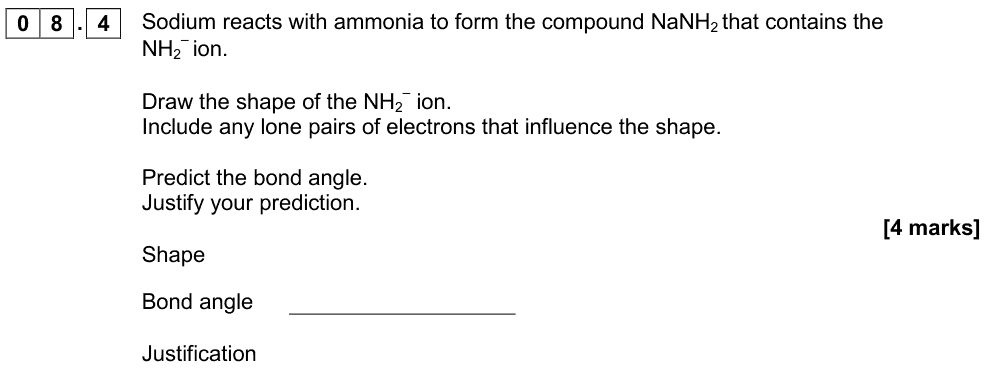
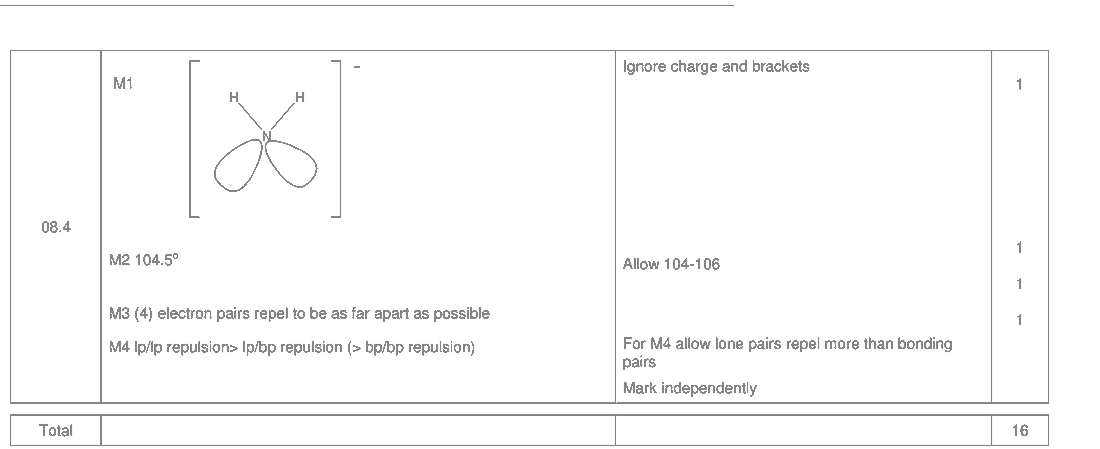
08.4 Bonding 4Diagram or structure
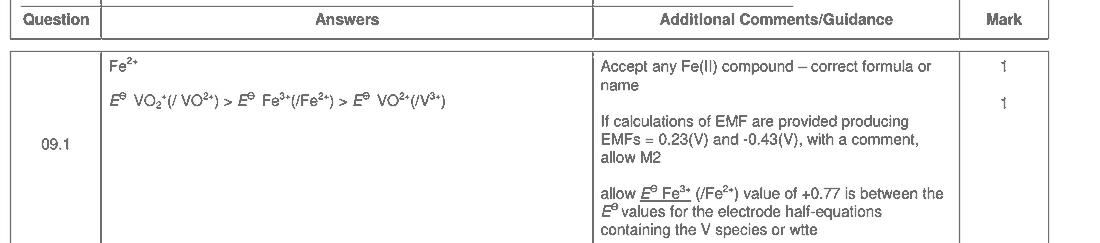
09.1 Electrode potentials and electrochemical cells 2Explanation
09.2 Oxidation, reduction and redox equations 1Short answer
09.3 Transition metals 2Diagram or structure
09.4 Amount of substance 1Equation writing
09.5 Transition metals 1Equation writing
10.1 Amount of substance 7Calculation

The questions

01.101.202.102.202.302.403.103.203.303.403.503.604.104.204.304.404.504.604.704.805.105.205.305.405.505.606.106.206.306.406.507.107.207.307.408.108.208.308.409.109.209.309.409.510.1
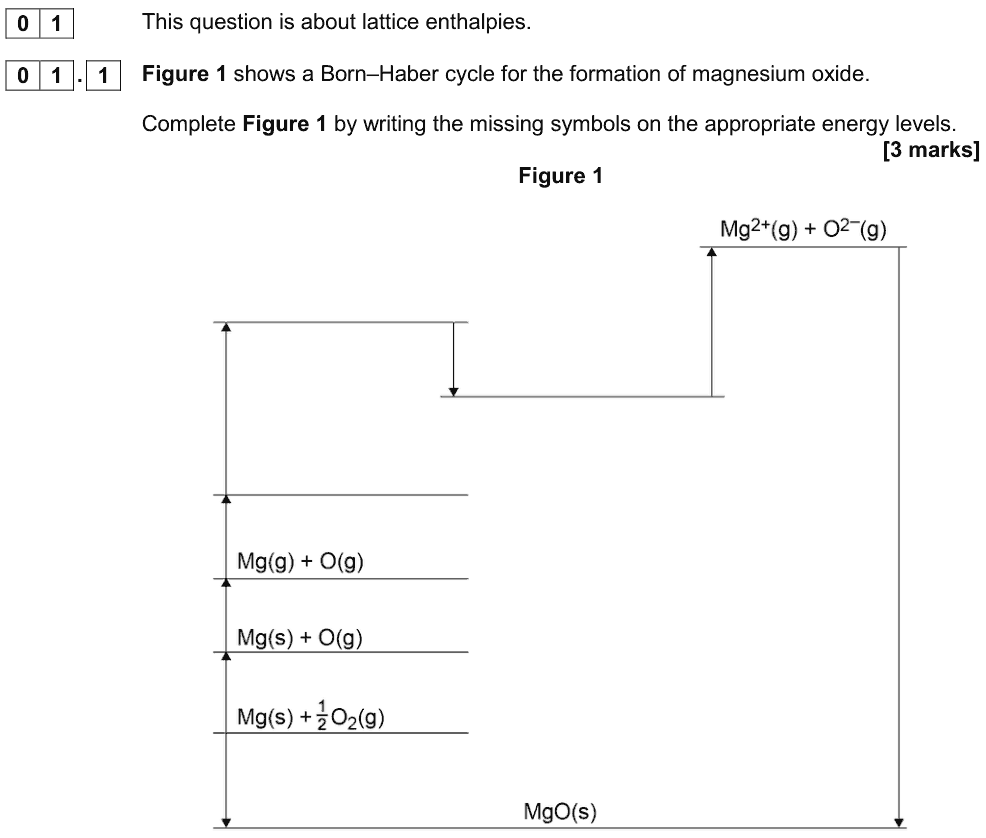
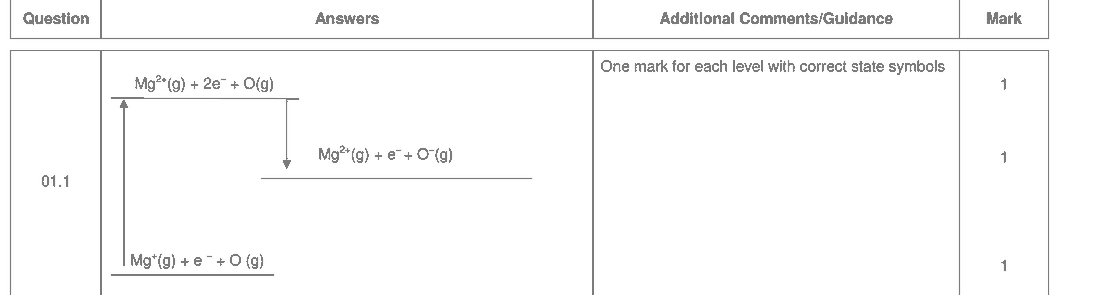
June 2018 · Paper 1 · Q01.1 3 marks Diagram or structure thermodynamics
This question is about lattice enthalpies.
Figure 1 shows a Born–Haber cycle for the formation of magnesium oxide.
Complete Figure 1 by writing the missing symbols on the appropriate energy levels.
[3 marks]
Figure 1
June 2018 · Paper 1 · Q01.2 3 marks Calculation thermodynamics
Earlier part of question 01 that this part usesEarlier part of June 2018 Paper 1 question 01
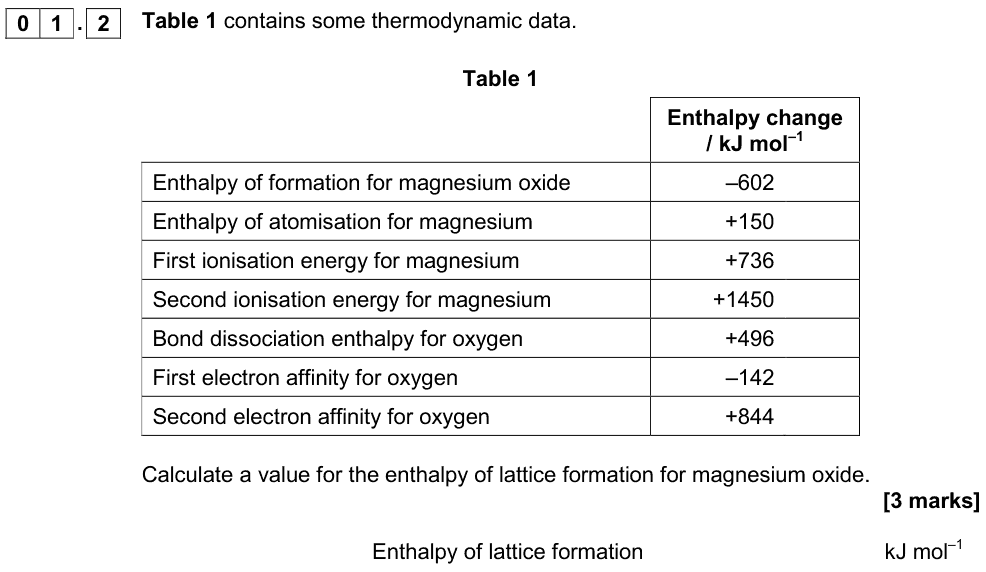
Table 1 contains some thermodynamic data.
Table 1
Enthalpy change
/ kJ mol–1
Enthalpy of formation for magnesium oxide
–602
Enthalpy of atomisation for magnesium
+150
First ionisation energy for magnesium
+736
Second ionisation energy for magnesium
+1450
Bond dissociation enthalpy for oxygen
+496
First electron affinity for oxygen
–142
Second electron affinity for oxygen
+844
Calculate a value for the enthalpy of lattice formation for magnesium oxide.
[3 marks]
Enthalpy of lattice formation
kJ mol–1
June 2018 · Paper 1 · Q02.1 3 marks Calculation equilibrium constant kp
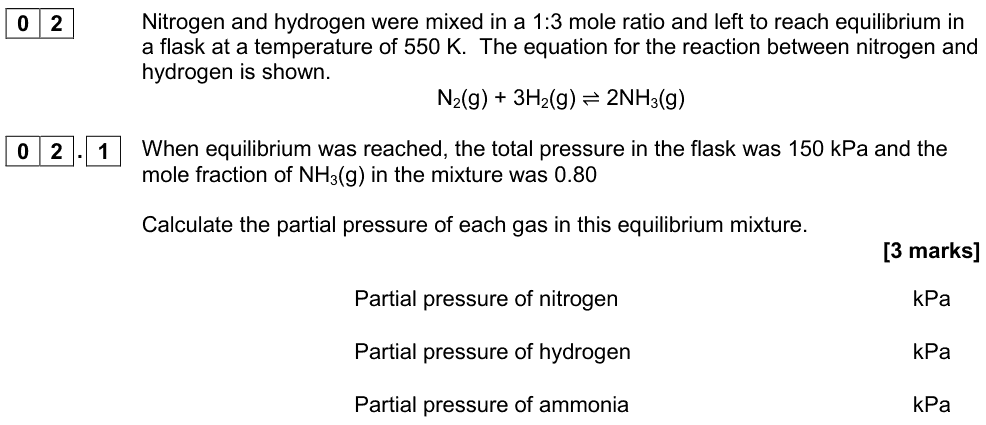
Nitrogen and hydrogen were mixed in a 1:3 mole ratio and left to reach equilibrium in
a flask at a temperature of 550 K.  The equation for the reaction between nitrogen and
hydrogen is shown.
N2(g) + 3H2(g) ⇌ 2NH3(g)
When equilibrium was reached, the total pressure in the flask was 150 kPa and the
mole fraction of NH3(g) in the mixture was 0.80
Calculate the partial pressure of each gas in this equilibrium mixture.
[3 marks]
Partial pressure of nitrogen
kPa
Partial pressure of hydrogen
kPa
Partial pressure of ammonia
kPa
June 2018 · Paper 1 · Q02.2 1 mark Short answer Easy equilibrium constant kp
Earlier part of question 02 that this part usesEarlier part of June 2018 Paper 1 question 02
Give an expression for the equilibrium constant (Kp) for this reaction.
[1 mark]
Kp
June 2018 · Paper 1 · Q02.3 2 marks Calculation equilibrium constant kp
Earlier part of question 02 that this part usesEarlier part of June 2018 Paper 1 question 02
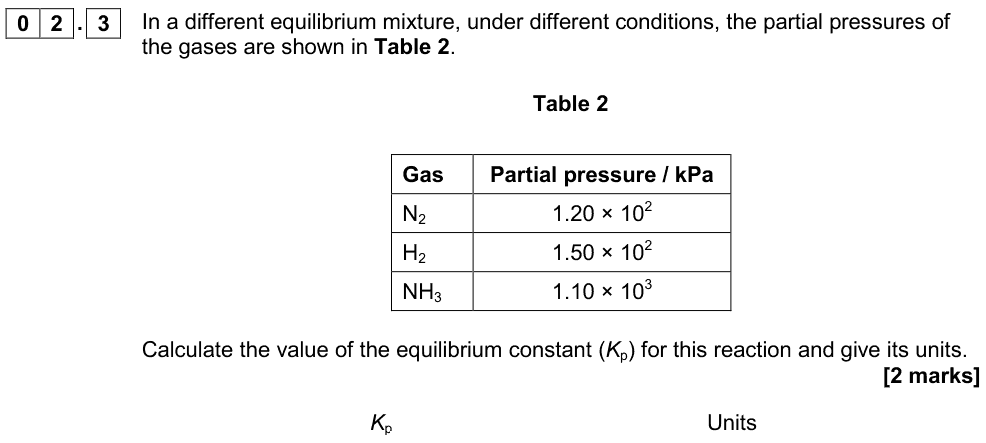
In a different equilibrium mixture, under different conditions, the partial pressures of
the gases are shown in Table 2.
Table 2
Gas
Partial pressure / kPa
N2
1.20 × 10²
H2
1.50 × 10²
NH3
1.10 × 10³
Calculate the value of the equilibrium constant (Kp) for this reaction and give its units.
[2 marks]
Kp
Units
June 2018 · Paper 1 · Q02.4 3 marks Explanation equilibrium constant kp
Earlier part of question 02 that this part usesEarlier part of June 2018 Paper 1 question 02
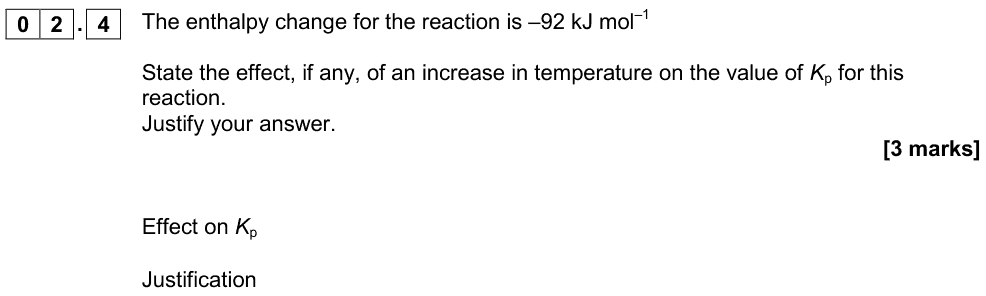
The enthalpy change for the reaction is –92 kJ mol–1
State the effect, if any, of an increase in temperature on the value of Kp for this
reaction.
Justify your answer.
[3 marks]
Effect on Kp
Justification
June 2018 · Paper 1 · Q03.1 2 marks Calculation Easy thermodynamics
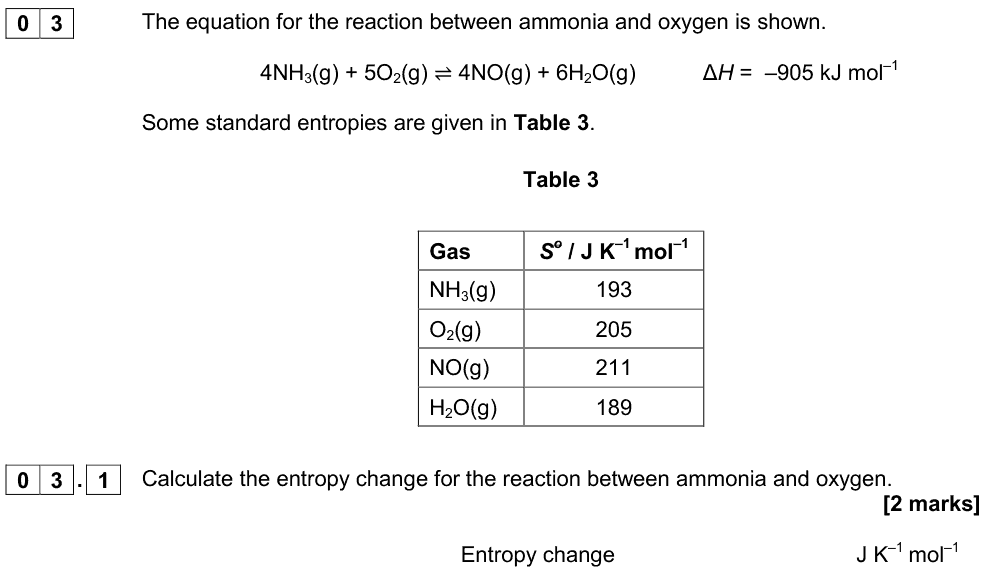
The equation for the reaction between ammonia and oxygen is shown.
4NH3(g) + 5O2(g)  ⇌  4NO(g) + 6H2O(g)           ΔH =  –905 kJ mol–1
Some standard entropies are given in Table 3.
Table 3
Gas
So / J K–1  mol–1
NH3(g)
193
O2(g)
205
NO(g)
211
H2O(g)
189
Calculate the entropy change for the reaction between ammonia and oxygen.
[2 marks]
Entropy change
J K–1  mol–1
June 2018 · Paper 1 · Q03.2 2 marks Calculation Easy thermodynamics
Earlier part of question 03 that this part usesEarlier part of June 2018 Paper 1 question 03
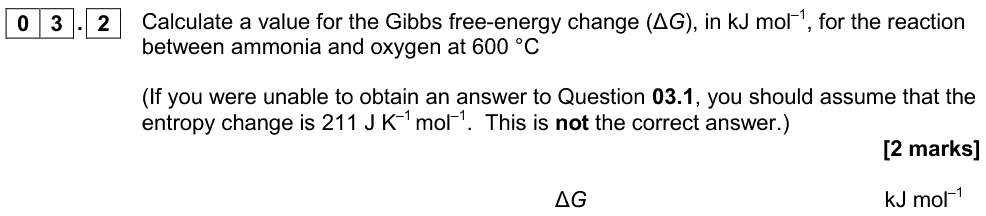
Calculate a value for the Gibbs free-energy change (ΔG), in kJ mol–1, for the reaction
between ammonia and oxygen at 600 °C
(If you were unable to obtain an answer to Question 03.1, you should assume that the
entropy change is 211 J K–1  mol–1.  This is not the correct answer.)
[2 marks]
ΔG
kJ mol–1
June 2018 · Paper 1 · Q03.3 2 marks Explanation thermodynamics
Earlier part of question 03 that this part usesEarlier part of June 2018 Paper 1 question 03
The reaction between ammonia and oxygen was carried out at a higher temperature.
Explain how this change affects the value of ΔG for the reaction.
[2 marks]
June 2018 · Paper 1 · Q03.4 3 marks Explanation transition metals
Earlier part of question 03 that this part usesEarlier part of June 2018 Paper 1 question 03
Platinum acts as a heterogeneous catalyst in the reaction between ammonia and
oxygen.  It provides an alternative reaction route with a lower activation energy.
Describe the stages of this alternative route.
[3 marks]
June 2018 · Paper 1 · Q03.5 1 mark Short answer Easy redox
Earlier part of question 03 that this part usesEarlier part of June 2018 Paper 1 question 03
Deduce the change in oxidation state of nitrogen, when NH3 is oxidised to NO
[1 mark]
June 2018 · Paper 1 · Q03.6 1 mark Equation writing amount of substance
Earlier part of question 03 that this part usesEarlier part of June 2018 Paper 1 question 03
When ammonia reacts with oxygen, nitrous oxide (N2O) can be produced instead of
NO
Give an equation for this reaction.
[1 mark]
June 2018 · Paper 1 · Q04.1 1 mark Short answer Easy atomic structure
This question is about s-block metals.
Give the full electron configuration for the calcium ion, Ca2+
[1 mark]
June 2018 · Paper 1 · Q04.2 2 marks Explanation Hard atomic structure
Earlier part of question 04 that this part usesEarlier part of June 2018 Paper 1 question 04
Explain why the second ionisation energy of calcium is lower than the second
ionisation energy of potassium.
[2 marks]
June 2018 · Paper 1 · Q04.3 1 mark Short answer atomic structure
Earlier part of question 04 that this part usesEarlier part of June 2018 Paper 1 question 04
Identify the s-block metal that has the highest first ionisation energy.
[1 mark]
June 2018 · Paper 1 · Q04.4 1 mark Short answer Easy group 2
Earlier part of question 04 that this part usesEarlier part of June 2018 Paper 1 question 04
Give the formula of the hydroxide of the element in Group 2, from Mg to Ba, that is
least soluble in water.
[1 mark]
June 2018 · Paper 1 · Q04.5 3 marks Calculation Hard amount of substance
Earlier part of question 04 that this part usesEarlier part of June 2018 Paper 1 question 04
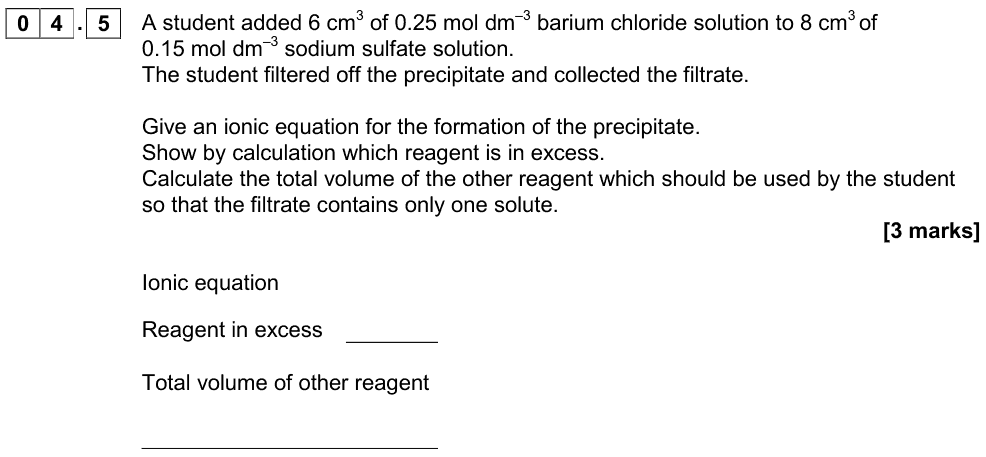
A student added 6 cm3 of 0.25 mol dm–3 barium chloride solution to 8 cm3 of
0.15 mol dm–3 sodium sulfate solution.
The student filtered off the precipitate and collected the filtrate.
Give an ionic equation for the formation of the precipitate.
Show by calculation which reagent is in excess.
Calculate the total volume of the other reagent which should be used by the student
so that the filtrate contains only one solute.
[3 marks]
Ionic equation
Reagent in excess
Total volume of other reagent
June 2018 · Paper 1 · Q04.6 4 marks Calculation atomic structure
Earlier part of question 04 that this part usesEarlier part of June 2018 Paper 1 question 04
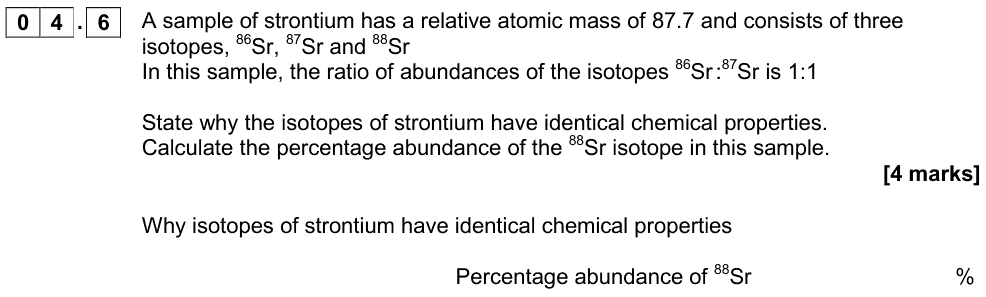
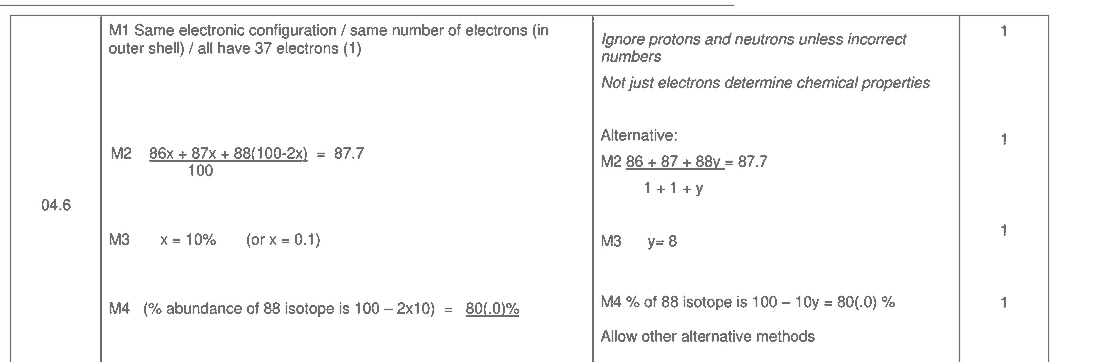
A sample of strontium has a relative atomic mass of 87.7 and consists of three
isotopes, 86Sr, 87Sr and 88Sr
In this sample, the ratio of abundances of the isotopes 86Sr :87Sr is 1:1
State why the isotopes of strontium have identical chemical properties.
Calculate the percentage abundance of the 88Sr isotope in this sample.
[4 marks]
Why isotopes of strontium have identical chemical properties
Percentage abundance of 88Sr
%
June 2018 · Paper 1 · Q04.7 1 mark Short answer Hard atomic structure
Earlier part of question 04 that this part usesEarlier part of June 2018 Paper 1 question 04
A time of flight (TOF) mass spectrum was obtained for a sample of barium that
contains the isotopes 136Ba, 137Ba and 138Ba
The sample of barium was ionised by electron impact.
Identify the ion with the longest time of flight.
[1 mark]
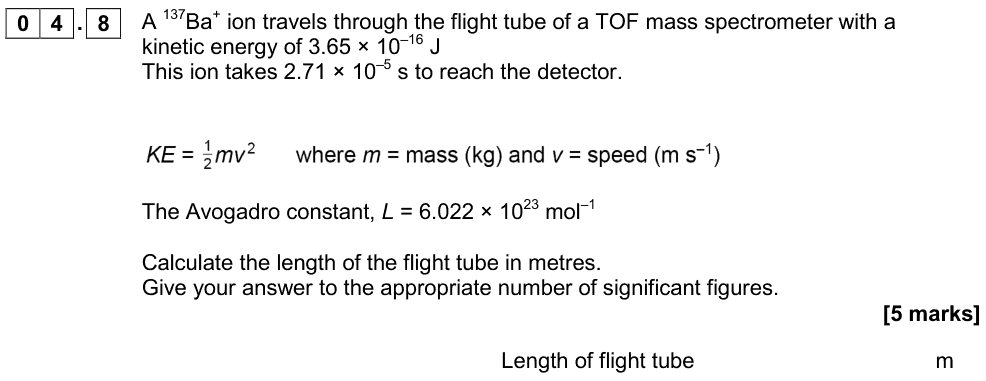
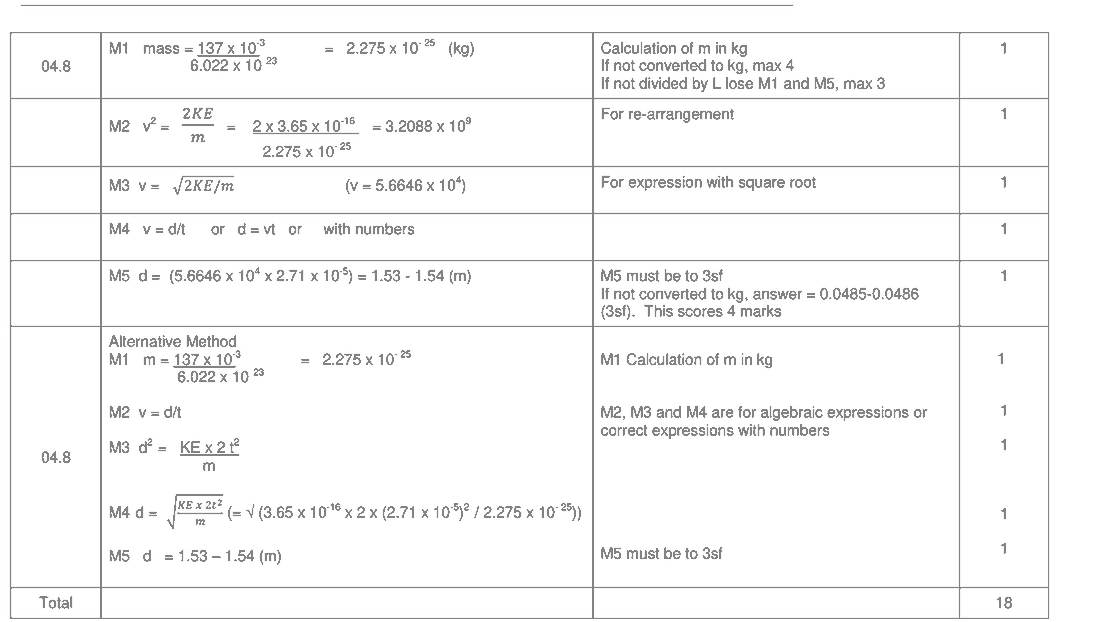
June 2018 · Paper 1 · Q04.8 5 marks Calculation atomic structureamount of substance
Earlier part of question 04 that this part usesEarlier part of June 2018 Paper 1 question 04
A 137Ba+ ion travels through the flight tube of a TOF mass spectrometer with a
kinetic energy of 3.65 × 10⁻¹⁶ J
This ion takes 2.71 × 10⁻⁵ s to reach the detector.
The Avogadro constant, L = 6.022 × 10²³ mol–1
Calculate the length of the flight tube in metres.
Give your answer to the appropriate number of significant figures.
[5 marks]
Length of flight tube
m
June 2018 · Paper 1 · Q05.1 1 mark Short answer Easy acids and bases
Hydrochloric acid is a strong acid and ethanoic acid is a weak acid.
State the meaning of the term strong acid.
[1 mark]
June 2018 · Paper 1 · Q05.2 6 marks Calculation Hard acids and bases
Earlier part of question 05 that this part usesEarlier part of June 2018 Paper 1 question 05
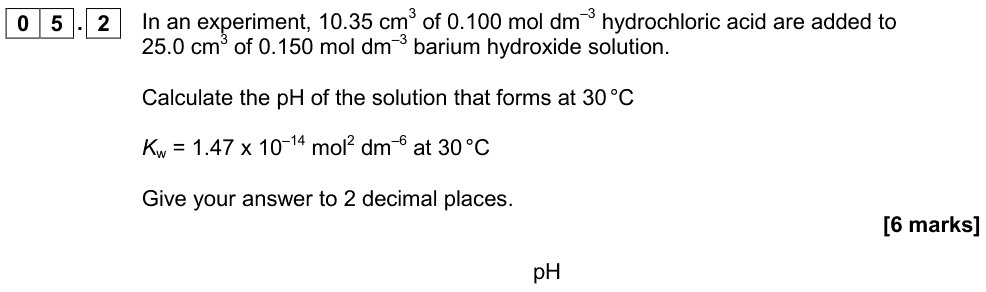
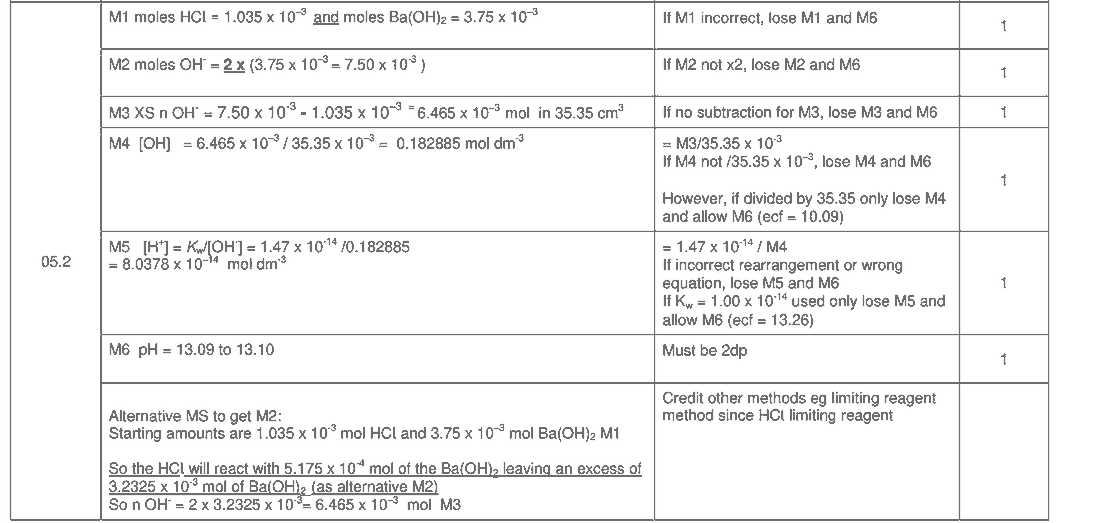
In an experiment, 10.35 cm3 of 0.100 mol dm–3 hydrochloric acid are added to
25.0 cm3 of 0.150 mol dm–3 barium hydroxide solution.
Calculate the pH of the solution that forms at 30 °C
Kw = 1.47 x 10⁻¹⁴ mol2 dm–6 at 30 °C
Give your answer to 2 decimal places.
[6 marks]
pH
June 2018 · Paper 1 · Q05.3 1 mark Short answer Easy acids and bases
Earlier part of question 05 that this part usesEarlier part of June 2018 Paper 1 question 05
The pH of water at 30 °C is 6.92
Give the reason why water is neutral at this temperature.
[1 mark]
June 2018 · Paper 1 · Q05.4 1 mark Short answer Easy period 3 elements and oxides
Earlier part of question 05 that this part usesEarlier part of June 2018 Paper 1 question 05
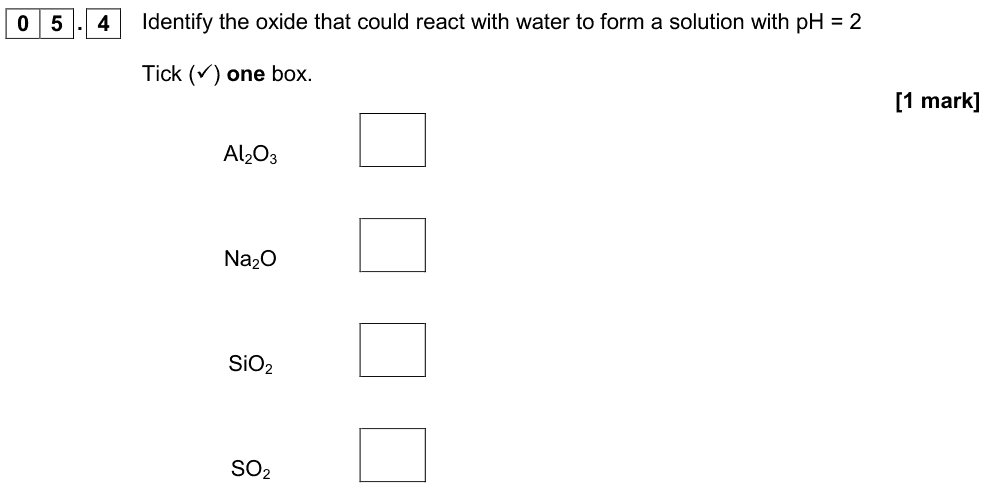
Identify the oxide that could react with water to form a solution with pH = 2
Tick () one box.
[1 mark]
Al2O3
Na2O
SiO2
SO2
June 2018 · Paper 1 · Q05.5 1 mark Short answer Easy acids and bases
Earlier part of question 05 that this part usesEarlier part of June 2018 Paper 1 question 05
Give the expression for the acid dissociation constant (Ka) for ethanoic acid
(CH3COOH).
[1 mark]
Ka
June 2018 · Paper 1 · Q05.6 5 marks Calculation acids and bases
Earlier part of question 05 that this part usesEarlier part of June 2018 Paper 1 question 05
A buffer solution contains 0.025 mol of sodium ethanoate dissolved in
500 cm3 of 0.0700 mol dm–3  ethanoic acid at 25 °C
A sample of 5.00 cm3 of  2.00 mol dm–3  hydrochloric acid is added to this buffer
solution.
Calculate the pH of the solution formed.
For ethanoic acid, Ka = 1.76 × 10⁻⁵ mol dm–3 at 25 °C
[5 marks]
pH
June 2018 · Paper 1 · Q06.1 1 mark Practical and data analysis Easy electrode potentials and cells
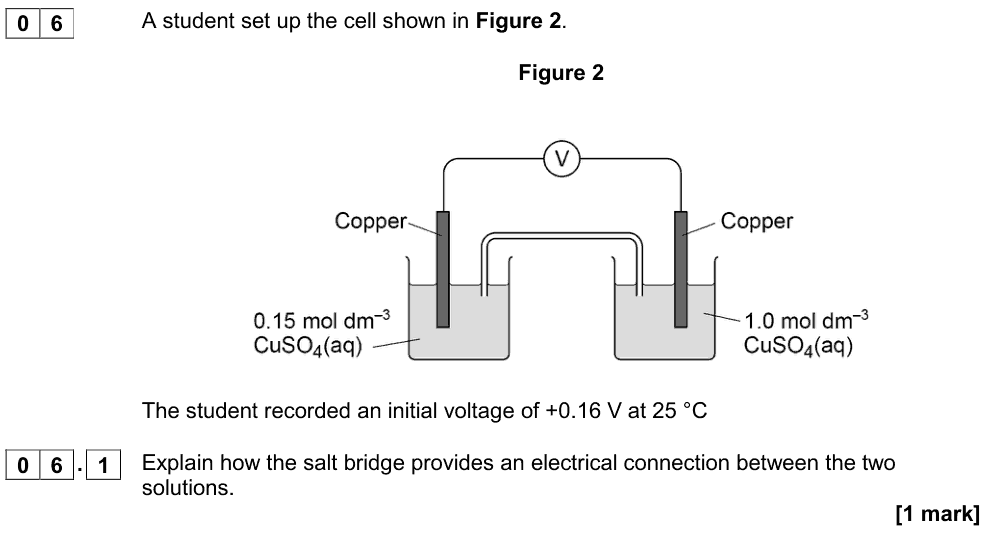
A student set up the cell shown in Figure 2.
Figure 2
The student recorded an initial voltage of +0.16 V at 25 °C
Explain how the salt bridge provides an electrical connection between the two
solutions.
[1 mark]
June 2018 · Paper 1 · Q06.2 1 mark Calculation Easy electrode potentials and cells
Earlier part of question 06 that this part usesEarlier part of June 2018 Paper 1 question 06
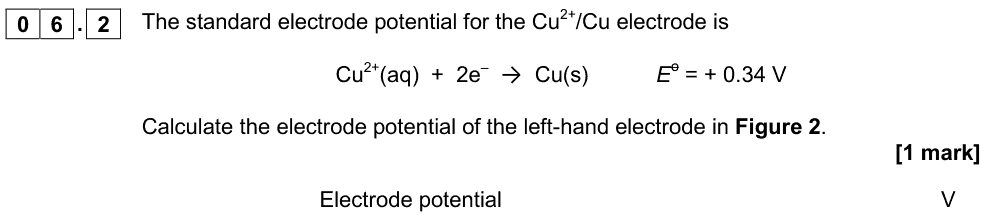
The standard electrode potential for the Cu2+/Cu electrode is
Cu2+(aq)  +  2e–  →  Cu(s)           Eo = + 0.34 V
Calculate the electrode potential of the left-hand electrode in Figure 2.
[1 mark]
Electrode potential
V
June 2018 · Paper 1 · Q06.3 1 mark Short answer Hard electrode potentials and cells
Earlier part of question 06 that this part usesEarlier part of June 2018 Paper 1 question 06
Both electrodes contain a strip of copper metal in a solution of aqueous Cu2+ ions.
State why the left-hand electrode does not have an electrode potential of +0.34 V
[1 mark]
June 2018 · Paper 1 · Q06.4 1 mark Short answer electrode potentials and cells
Earlier part of question 06 that this part usesEarlier part of June 2018 Paper 1 question 06
Give the conventional representation for the cell in Figure 2.
Include all state symbols.
[1 mark]
June 2018 · Paper 1 · Q06.5 2 marks Short answer Hard electrode potentials and cells
Earlier part of question 06 that this part usesEarlier part of June 2018 Paper 1 question 06
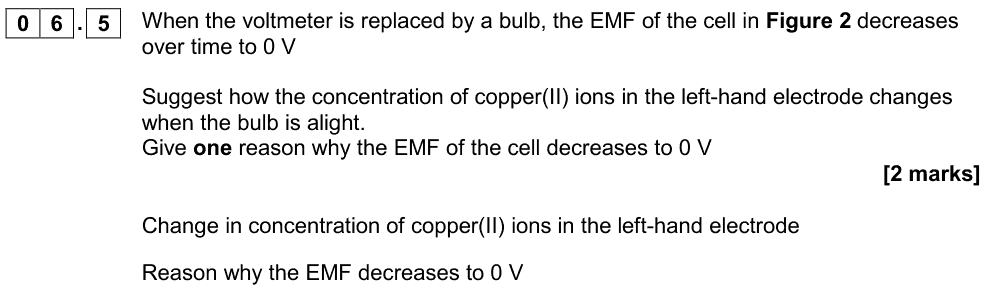
When the voltmeter is replaced by a bulb, the EMF of the cell in Figure 2 decreases
over time to 0 V
Suggest how the concentration of copper(II) ions in the left-hand electrode changes
when the bulb is alight.
Give one reason why the EMF of the cell decreases to 0 V
[2 marks]
Change in concentration of copper(II) ions in the left-hand electrode
Reason why the EMF decreases to 0 V
June 2018 · Paper 1 · Q07.1 1 mark Equation writing reactions of ions in aqueous solutionamount of substance
When anhydrous aluminium chloride reacts with water, solution Y is formed that
contains a complex aluminium ion, Z, and chloride ions.
Give an equation for this reaction.
[1 mark]
June 2018 · Paper 1 · Q07.2 1 mark Equation writing Hard reactions of ions in aqueous solutionacids and bases
Earlier part of question 07 that this part usesEarlier part of June 2018 Paper 1 question 07
Give an equation to show how the complex ion Z can act as a Brønsted–Lowry acid
with water.
[1 mark]
June 2018 · Paper 1 · Q07.3 3 marks Equation writing Hard reactions of ions in aqueous solution
Earlier part of question 07 that this part usesEarlier part of June 2018 Paper 1 question 07
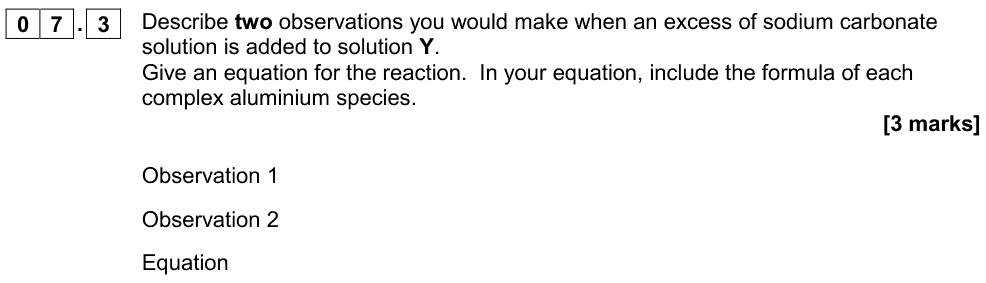
Describe two observations you would make when an excess of sodium carbonate
solution is added to solution Y.
Give an equation for the reaction.  In your equation, include the formula of each
complex aluminium species.
[3 marks]
Observation 1
Observation 2
Equation
June 2018 · Paper 1 · Q07.4 4 marks Equation writing reactions of ions in aqueous solution
Earlier part of question 07 that this part usesEarlier part of June 2018 Paper 1 question 07
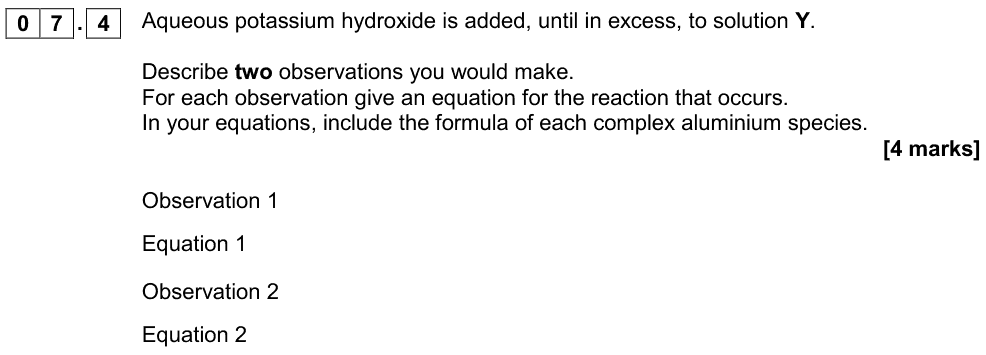
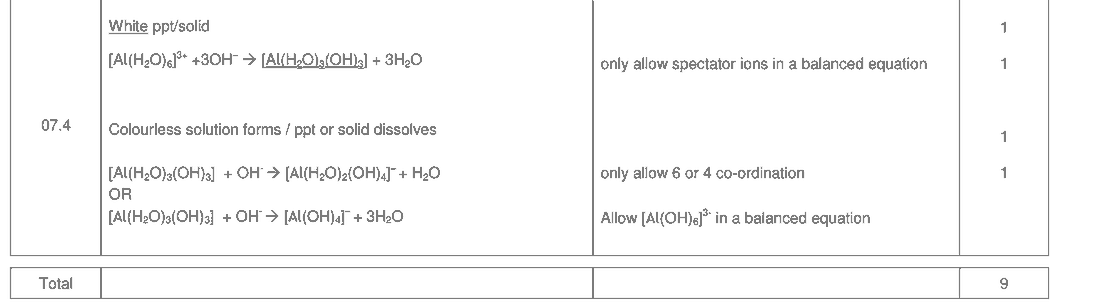
Aqueous potassium hydroxide is added, until in excess, to solution Y.
Describe two observations you would make.
For each observation give an equation for the reaction that occurs.
In your equations, include the formula of each complex aluminium species.
[4 marks]
Observation 1
Equation 1
Observation 2
Equation 2
June 2018 · Paper 1 · Q08.1 6 marks 6-mark level of response Hard bonding
This question is about sodium and some of its compounds.
Use your knowledge of structure and bonding to explain why sodium bromide has a
melting point that is higher than that of sodium, and higher than that of sodium iodide.
[6 marks]
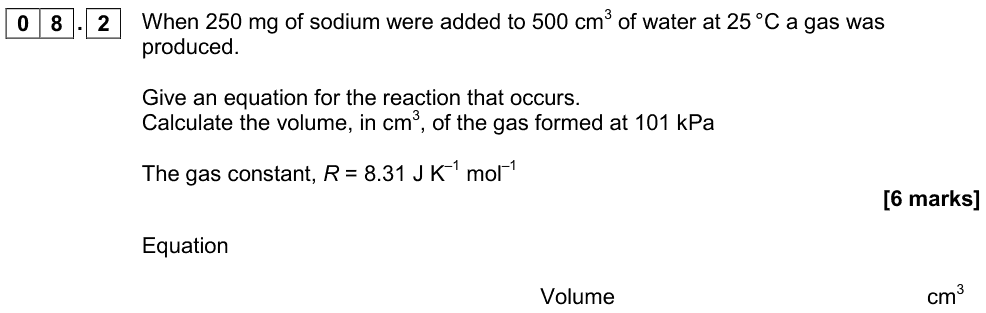
June 2018 · Paper 1 · Q08.2 6 marks Calculation Hard amount of substance
Earlier part of question 08 that this part usesEarlier part of June 2018 Paper 1 question 08
When 250 mg of sodium were added to 500 cm3 of water at 25 °C a gas was
produced.
Give an equation for the reaction that occurs.
Calculate the volume, in cm3, of the gas formed at 101 kPa
The gas constant, R = 8.31 J K–1 mol–1
[6 marks]
Equation
Volume
cm3
June 2018 · Paper 1 · Q08.3 1 mark Calculation amount of substance
Earlier part of question 08 that this part usesEarlier part of June 2018 Paper 1 question 08
Calculate the concentration, in mol dm–3, of sodium ions in the solution produced in
the reaction in Question 08.2.
[1 mark]
Concentration
mol dm–3
June 2018 · Paper 1 · Q08.4 4 marks Diagram or structure Hard bonding
Earlier part of question 08 that this part usesEarlier part of June 2018 Paper 1 question 08
Sodium reacts with ammonia to form the compound NaNH2 that contains the
NH2
–
ion.
Draw the shape of the NH2
– ion.
Include any lone pairs of electrons that influence the shape.

Predict the bond angle.
Justify your prediction.
[4 marks]
Shape
Bond angle
Justification
June 2018 · Paper 1 · Q09.1 2 marks Explanation Hard electrode potentials and cells
This question is about vanadium compounds and ions.
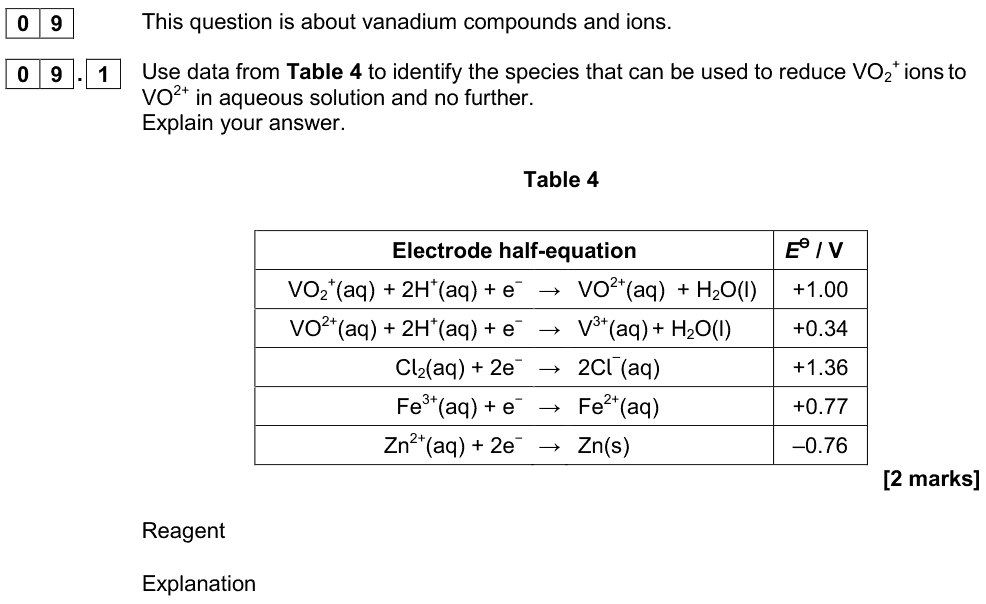
Use data from Table 4 to identify the species that can be used to reduce VO2
+ ions to
VO2+ in aqueous solution and no further.
Explain your answer.
Table 4
Electrode half-equation
EƟ / V
VO2
+(aq)  + 2H+(aq) + e− → VO2+(aq)  + H2O(l)
+1.00
VO2+(aq) + 2H+(aq) + e− → V3+(aq) + H2O(l)
+0.34
Cl2(aq) + 2e−  → 2Cl
–(aq)
+1.36
Fe3+(aq) + e− → Fe2+(aq)
+0.77
Zn2+(aq) + 2e− → Zn(s)
–0.76
[2 marks]
Reagent
Explanation
June 2018 · Paper 1 · Q09.2 1 mark Short answer Easy redox
Earlier part of question 09 that this part usesEarlier part of June 2018 Paper 1 question 09
Give the oxidation state of vanadium in [VO(H2O)5]2+
[1 mark]
June 2018 · Paper 1 · Q09.3 2 marks Diagram or structure transition metals
Earlier part of question 09 that this part usesEarlier part of June 2018 Paper 1 question 09
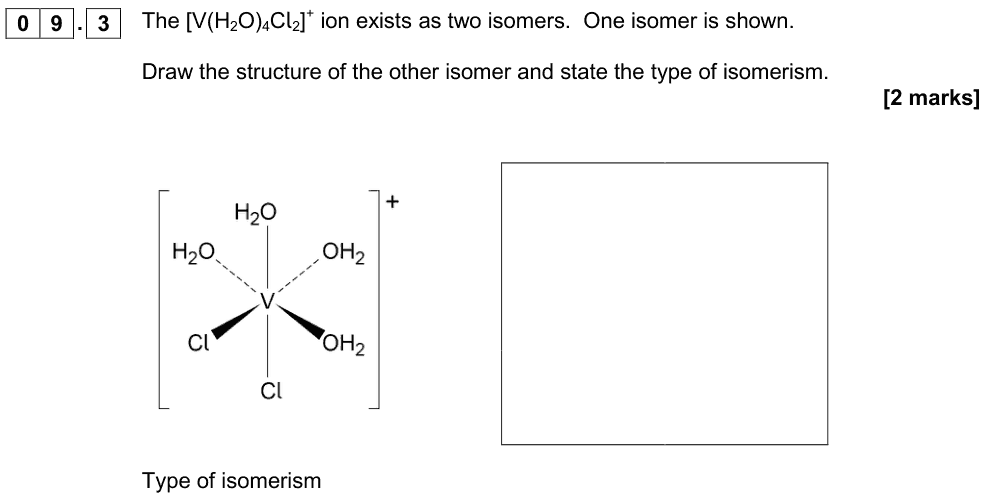
The [V(H2O)4Cl2]+ ion exists as two isomers.  One isomer is shown.
Draw the structure of the other isomer and state the type of isomerism.
[2 marks]
Type of isomerism
June 2018 · Paper 1 · Q09.4 1 mark Equation writing amount of substance
Earlier part of question 09 that this part usesEarlier part of June 2018 Paper 1 question 09
Heating NH4VO3 produces vanadium(V) oxide, water and one other product.
Give an equation for the reaction.
[1 mark]
June 2018 · Paper 1 · Q09.5 1 mark Equation writing transition metals
Earlier part of question 09 that this part usesEarlier part of June 2018 Paper 1 question 09
Vanadium(V) oxide is the catalyst used in the manufacture of sulfur trioxide.
Give two equations to show how the catalyst is used and regenerated.

[1 mark]
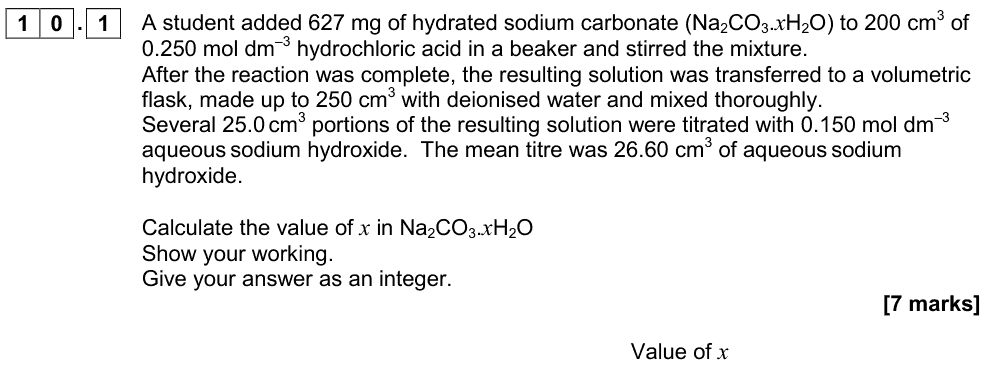
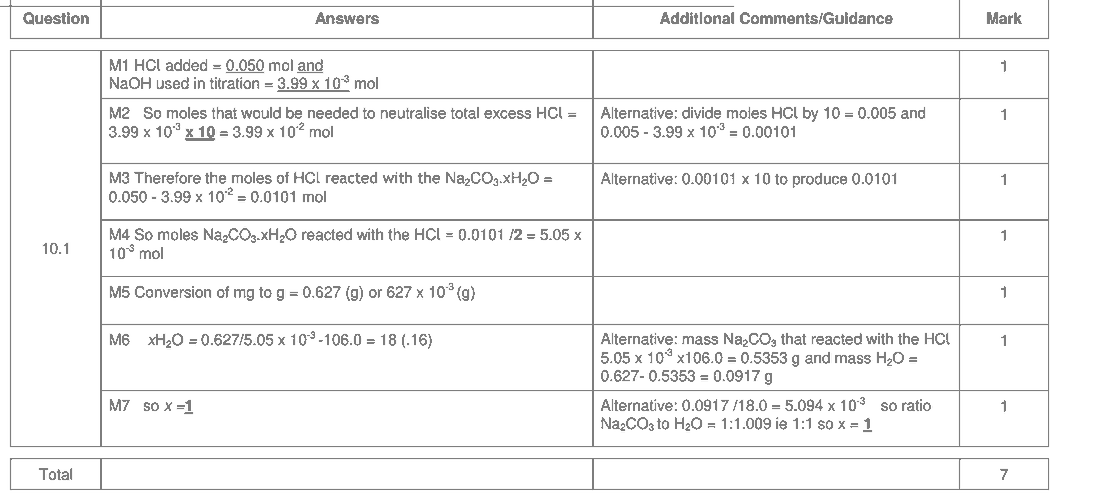
June 2018 · Paper 1 · Q10.1 7 marks Calculation Hard amount of substance
A student added 627 mg of hydrated sodium carbonate (Na2CO3.xH2O) to 200 cm3 of
0.250 mol dm–3 hydrochloric acid in a beaker and stirred the mixture.
After the reaction was complete, the resulting solution was transferred to a volumetric
flask, made up to 250 cm3 with deionised water and mixed thoroughly.
Several 25.0 cm3 portions of the resulting solution were titrated with 0.150 mol dm–3
aqueous sodium hydroxide.  The mean titre was 26.60 cm3 of aqueous sodium
hydroxide.
Calculate the value of x in Na2CO3.xH2O
Show your working.
Give your answer as an integer.
[7 marks]
Value of x

Work with an A-level chemistry tutor

Want a paper marked and gone through with you? Message us.

Prefer email? Send an enquiry

If you are under 18, please include a parent's contact details. Enquiries go to enquiries@chemistryaleveltutor.com and are deleted once handled. All tutoring is online.