June 2022: Paper 1, Advanced Inorganic and Physical Chemistry

90 marks · 45 question parts · Paper, mark scheme and report on Edexcel's site · Have the Data Booklet beside you

Question by question

QTopicMarksAOType
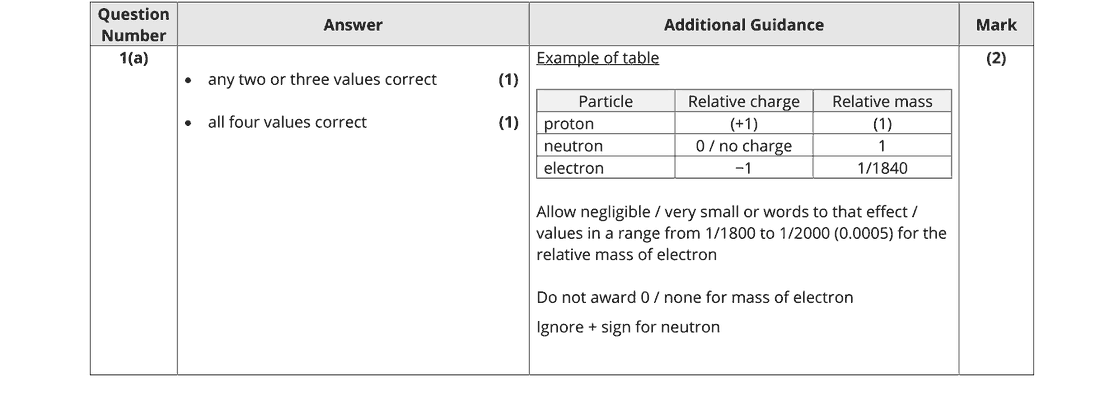
1(a) Atomic structure and the Periodic Table 2Short answer
1(b) Atomic structure and the Periodic Table 1Multiple choice
1(c) Atomic structure and the Periodic Table 1Diagram or structure
1(d) Atomic structure and the Periodic Table, Structure 3Explanation
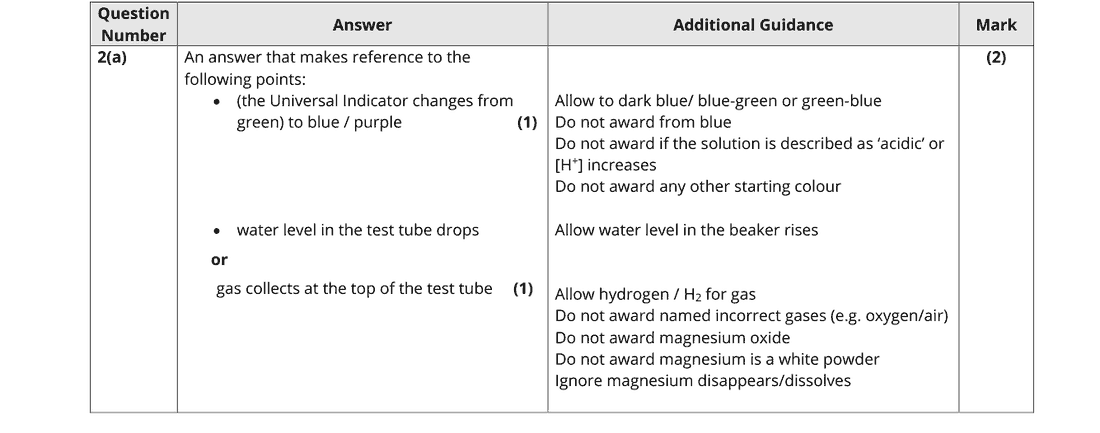
2(a) The elements of Groups 1 and 2 2Practical and data analysis
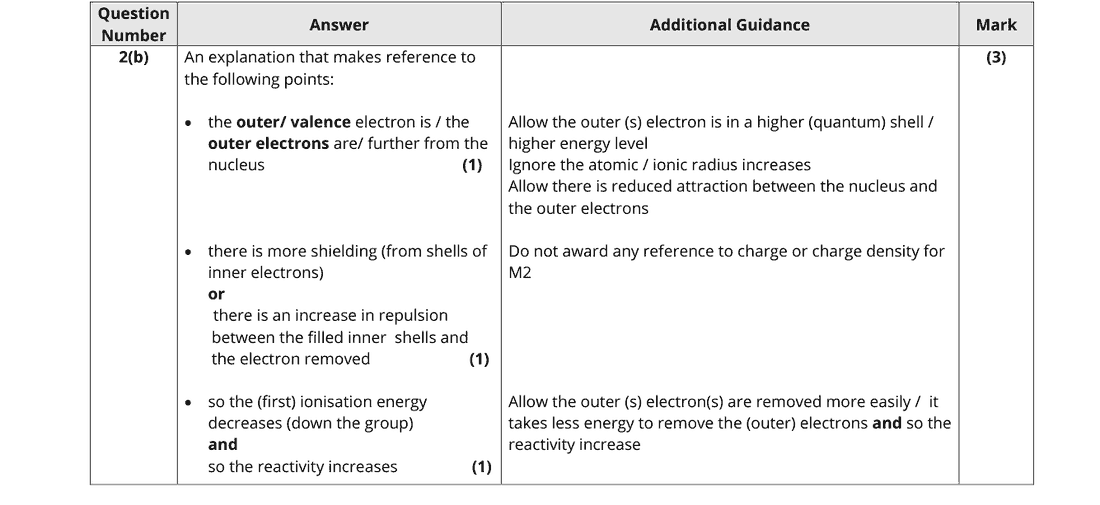
2(b) The elements of Groups 1 and 2 3Explanation
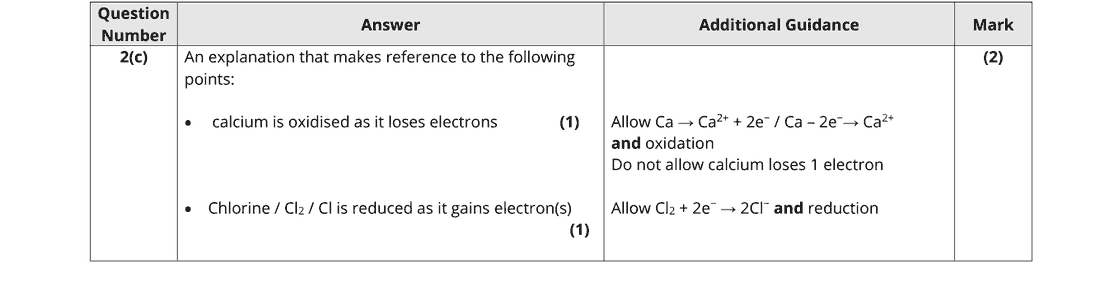
2(c) Redox I 2Explanation
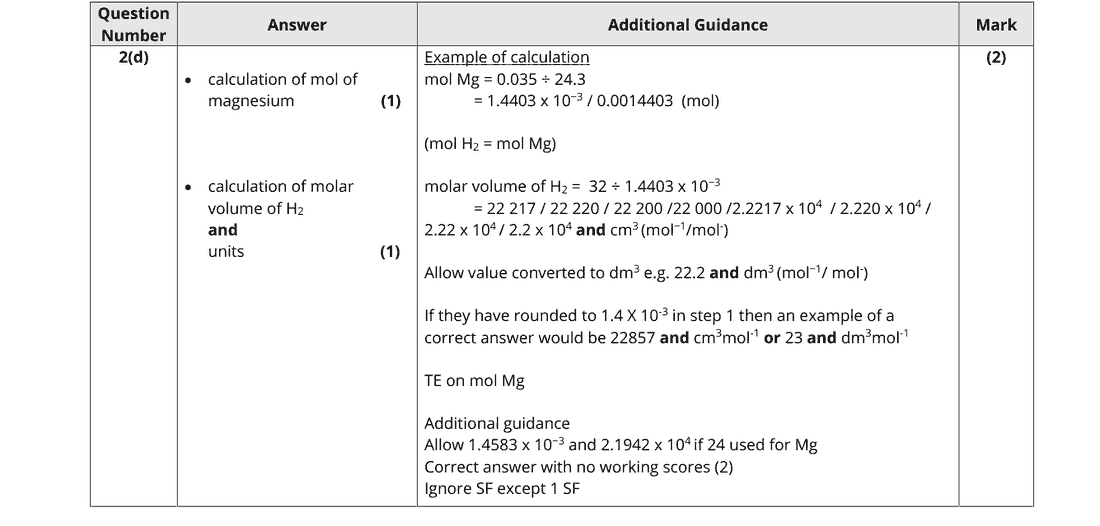
2(d) Formulae, equations and amounts of substance 2Calculation
3(a) The elements of Group 7 (halogens) 1Multiple choice
3(b) The elements of Group 7 (halogens) 1Multiple choice
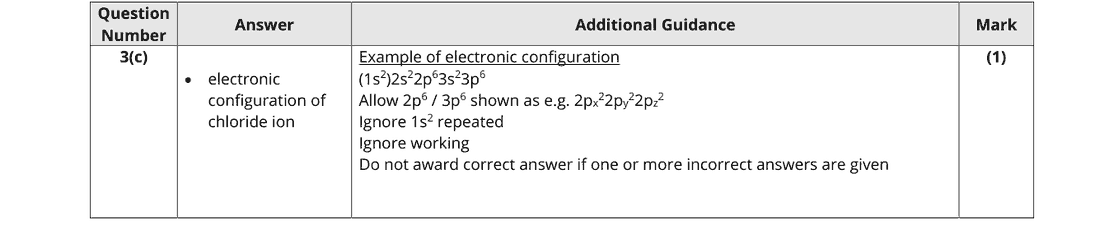
3(c) Atomic structure and the Periodic Table 1Short answer
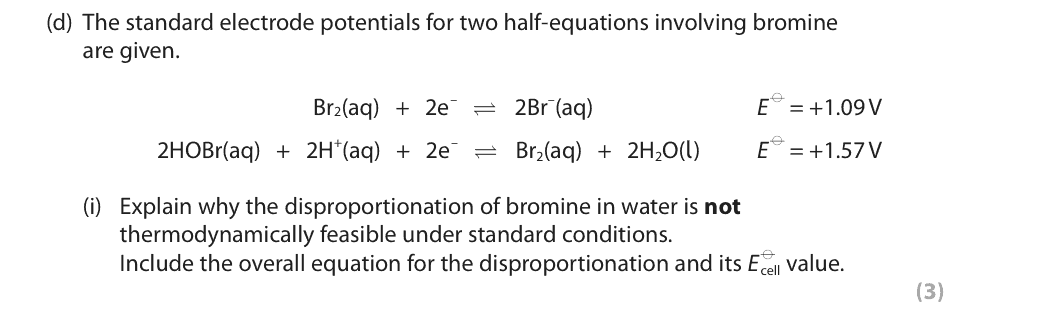
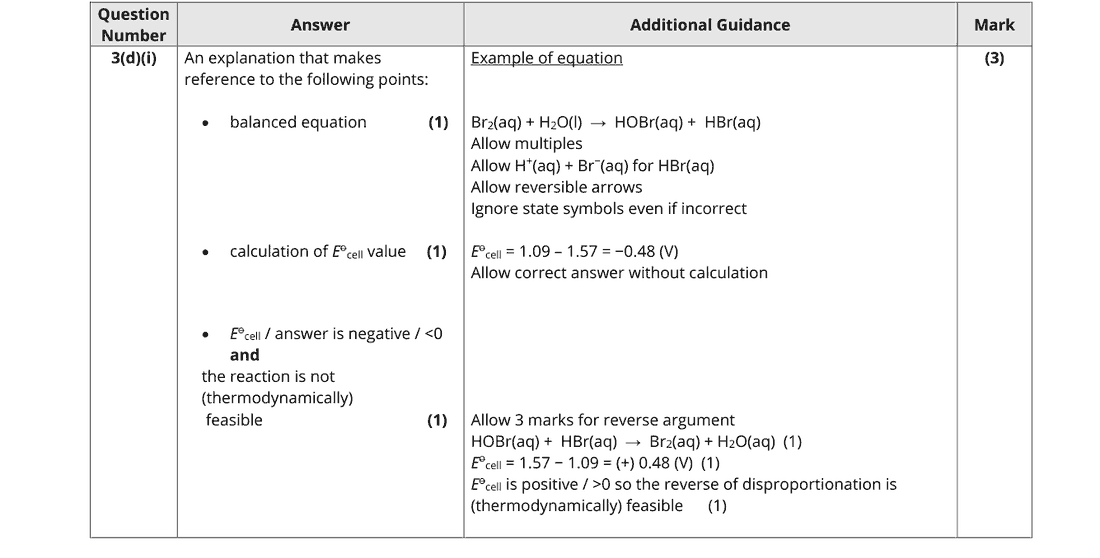
3(d)(i) Redox II 3Explanation
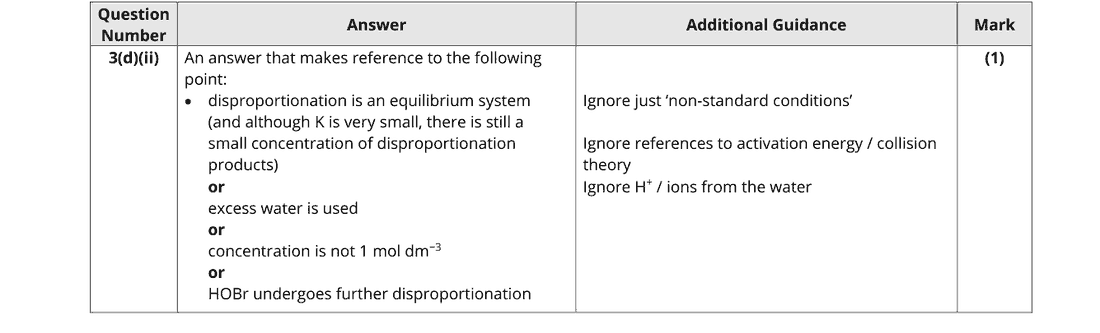
3(d)(ii) Redox II 1Short answer
3(e)(i) Bonding 1Multiple choice
3(e)(ii) The elements of Group 7 (halogens) 1Multiple choice
4(a) Bonding 1Multiple choice
4(b) Bonding 2Short answer
4(c) Bonding 1Short answer
4(d)(i) Structure 1Multiple choice
4(d)(ii) Structure 1Multiple choice
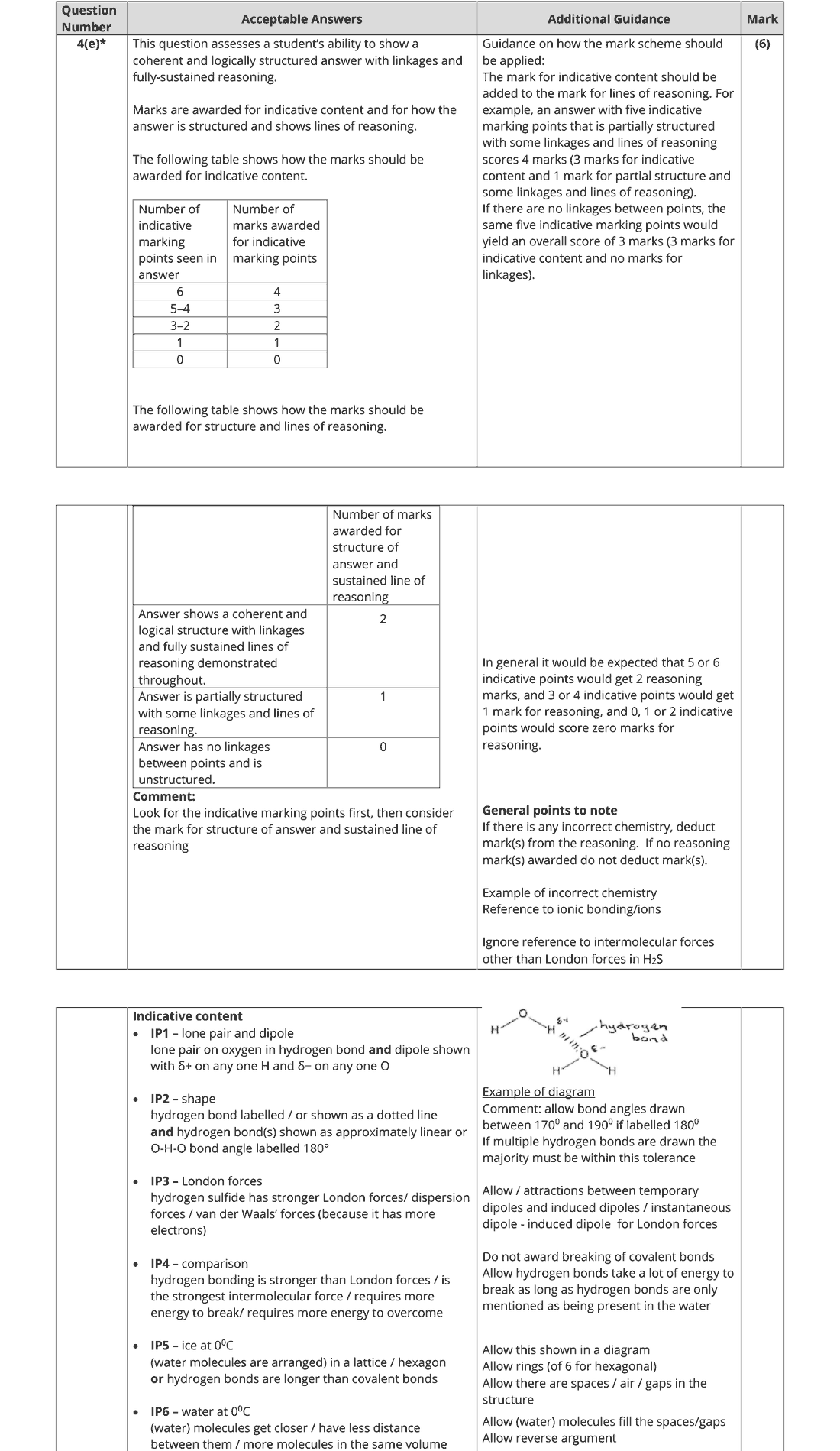
4(e) Bonding 6Extended response
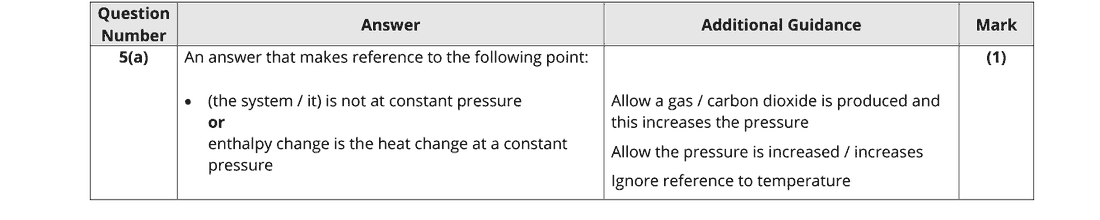
5(a) Energetics I 1Short answer
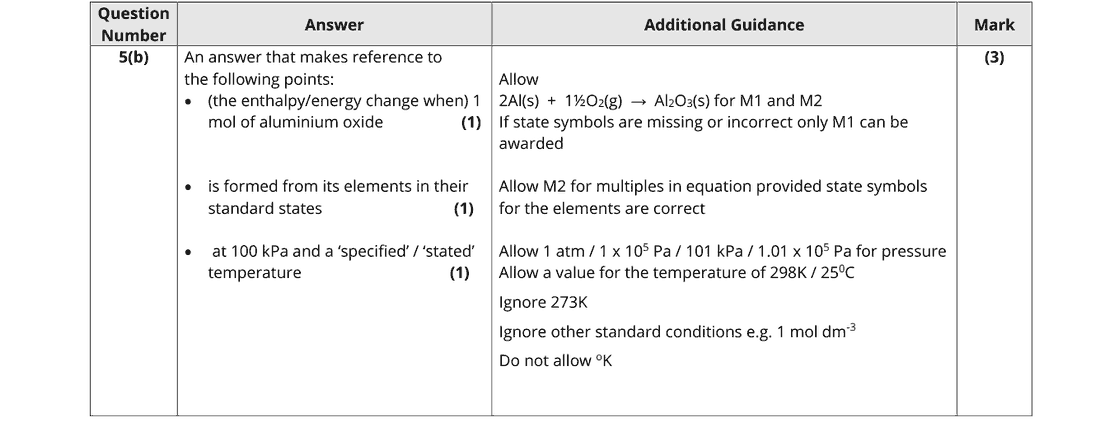
5(b) Energetics I 3Short answer
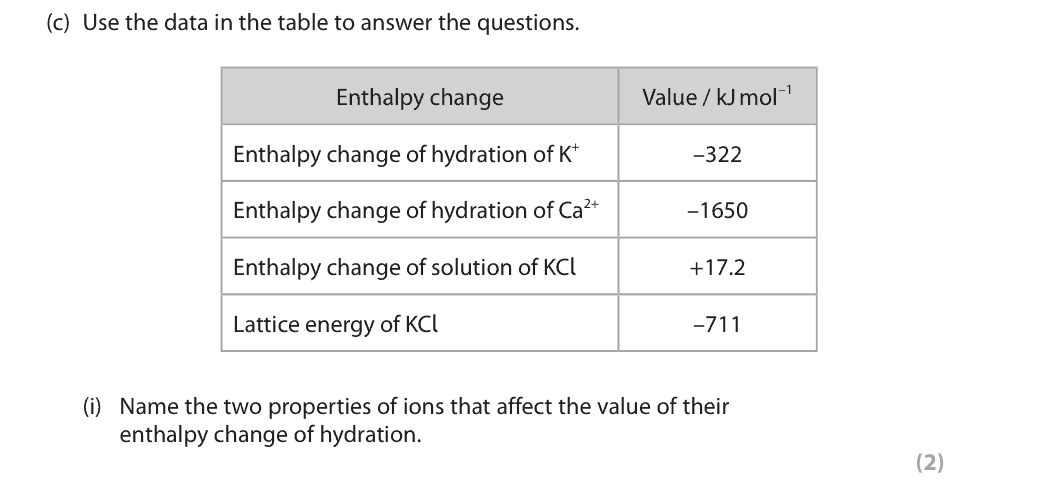
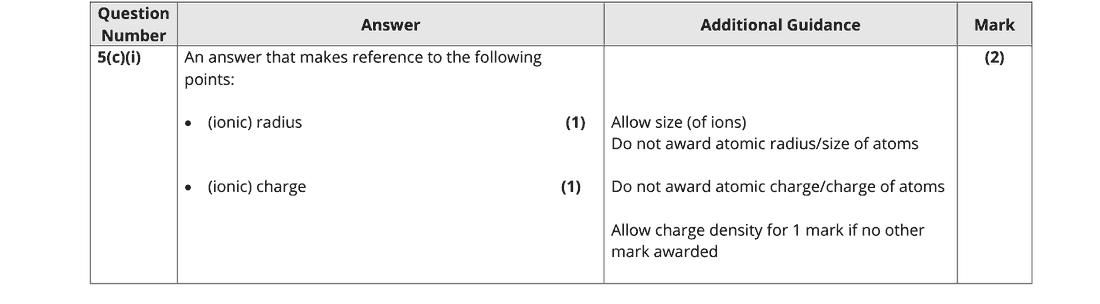
5(c)(i) Energetics II: lattice energy 2Short answer
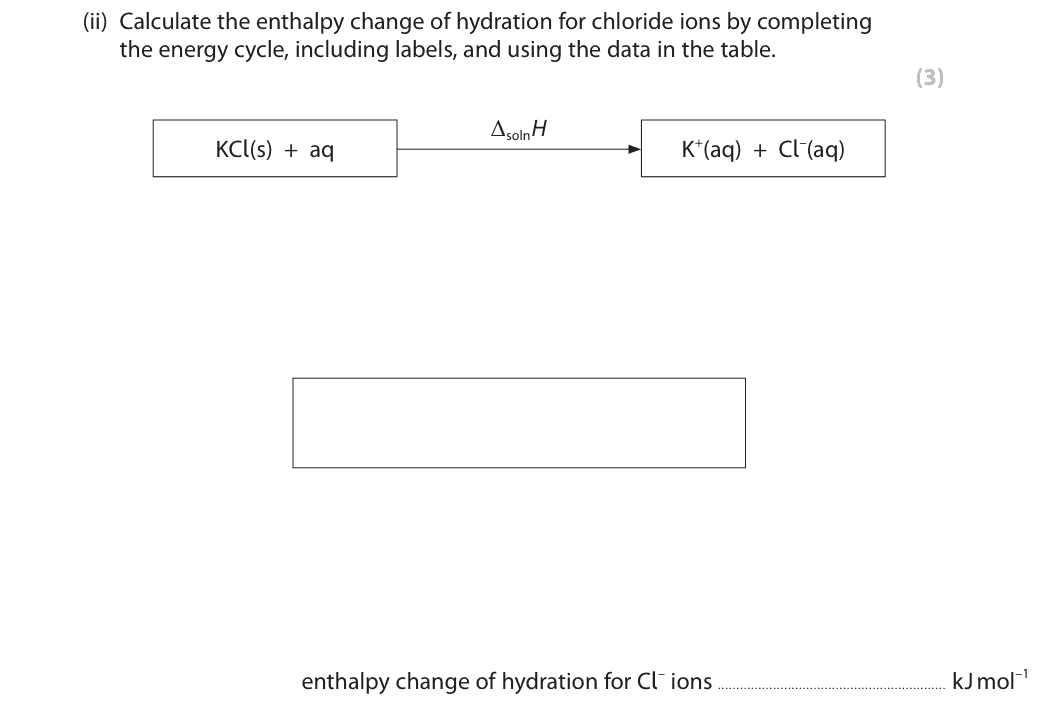
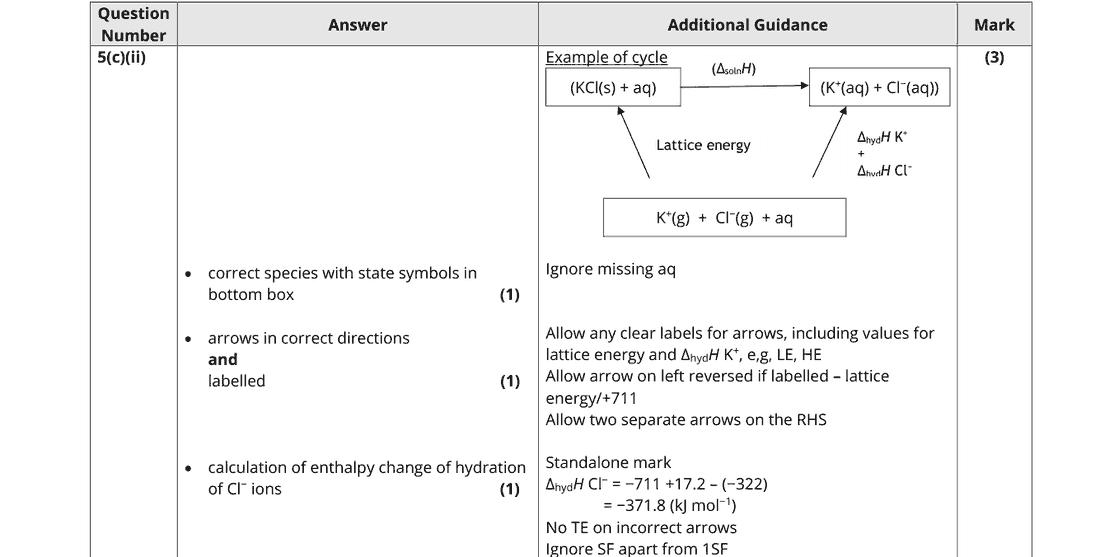
5(c)(ii) Energetics II: lattice energy 3Diagram or structure
6(a) Acid-base equilibria 1Short answer
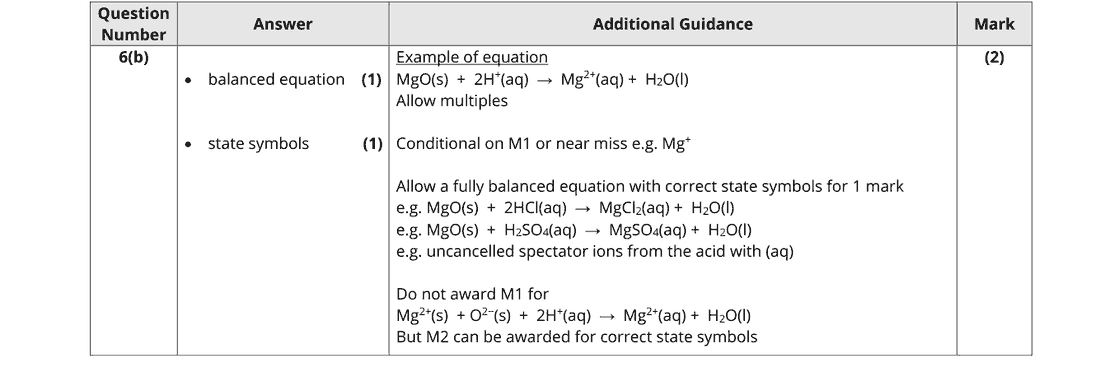
6(b) Formulae, equations and amounts of substance, The elements of Groups 1 and 2 2Equation writing
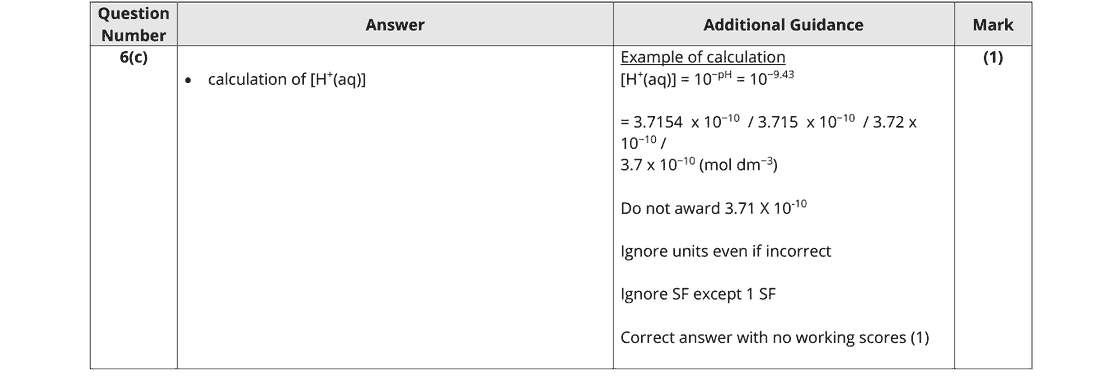
6(c) Acid-base equilibria 1Calculation
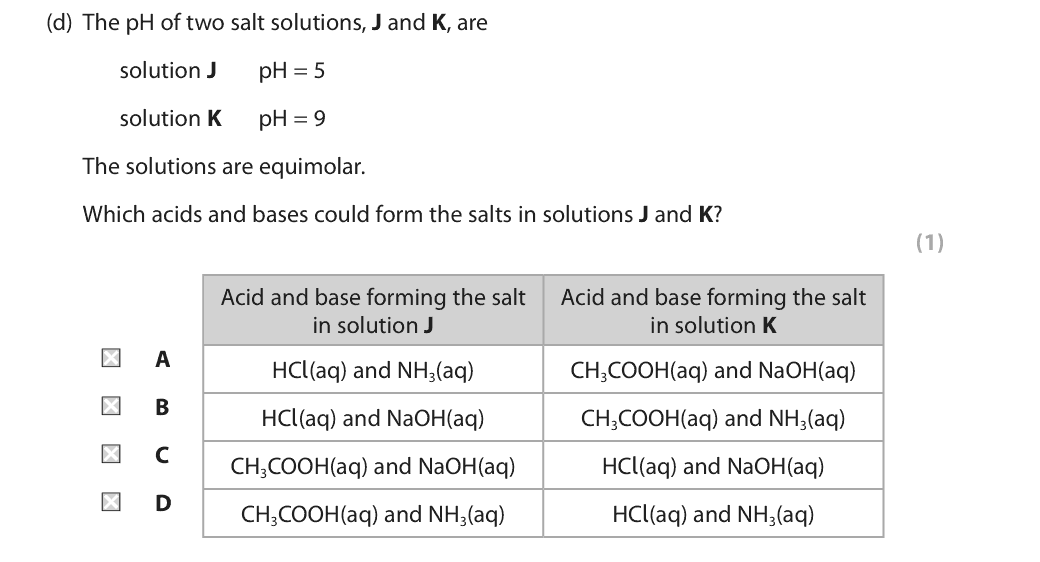
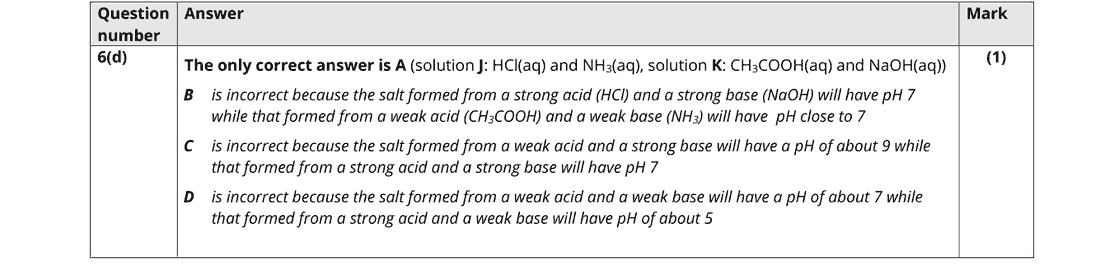
6(d) Acid-base equilibria 1Multiple choice
6(e)(i) Acid-base equilibria 3Diagram or structure
6(e)(ii) Acid-base equilibria 3Calculation
6(f)(i) Acid-base equilibria 2Short answer
6(f)(ii) Formulae, equations and amounts of substance 1Equation writing
6(f)(iii) Acid-base equilibria 3Explanation
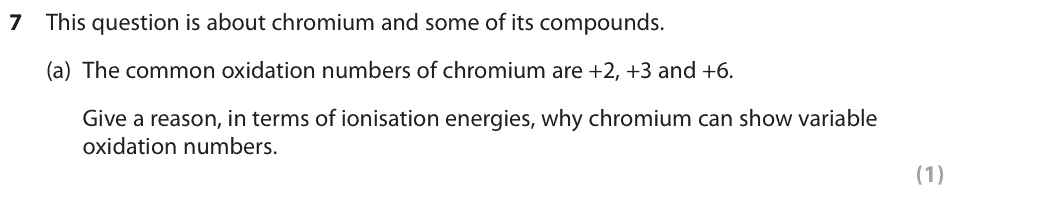
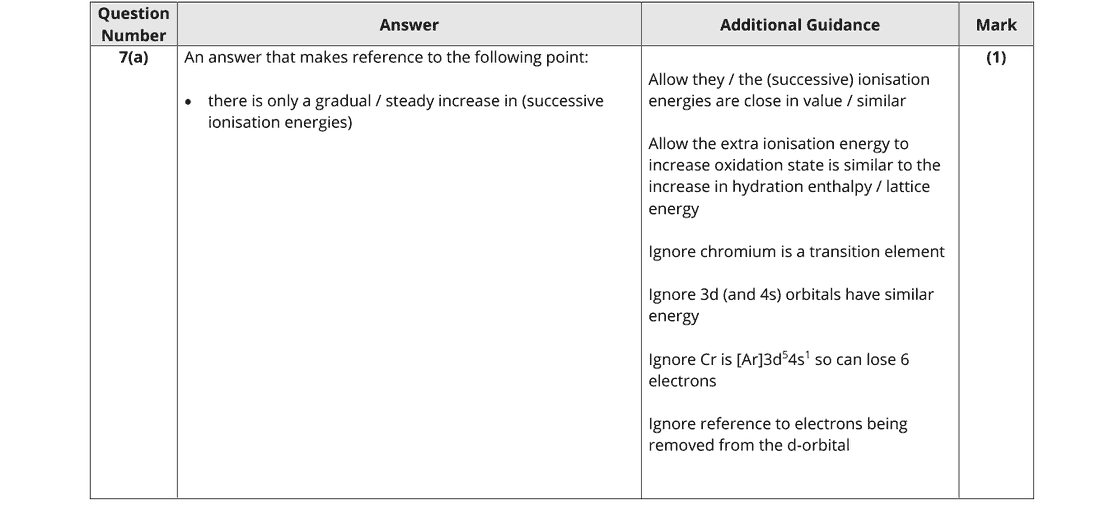
7(a) Transition metals: principles 1Short answer
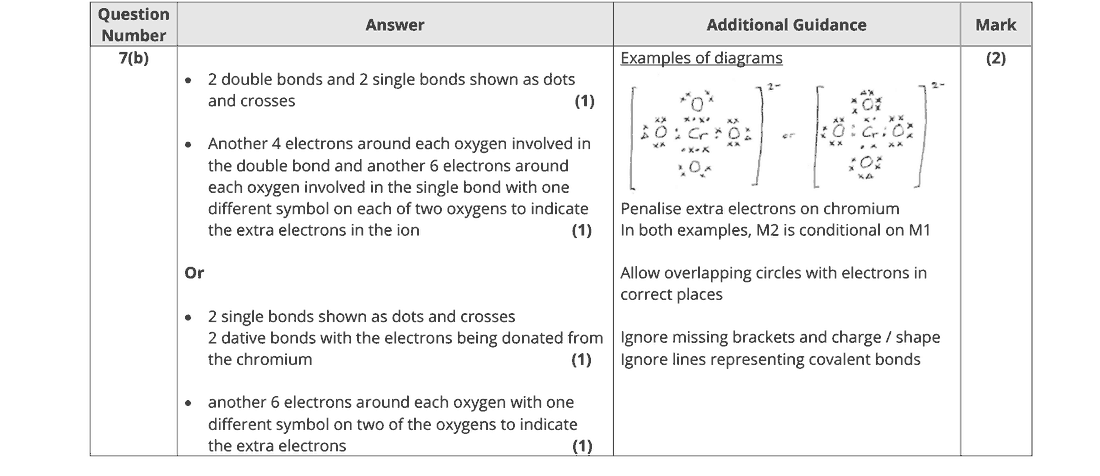
7(b) Bonding 2Diagram or structure
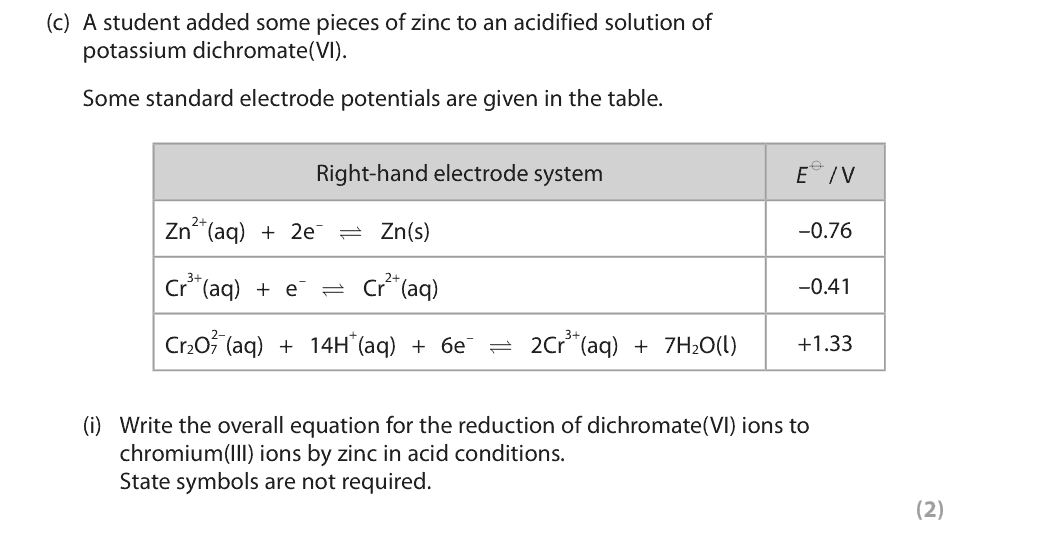
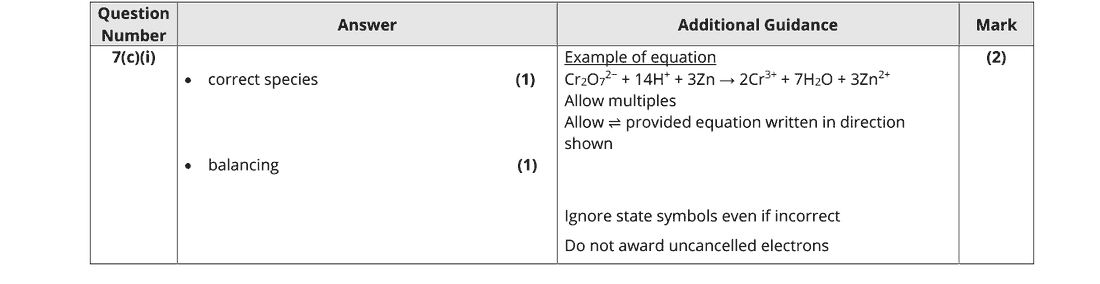
7(c)(i) Transition metals: reactions, Redox I 2Equation writing
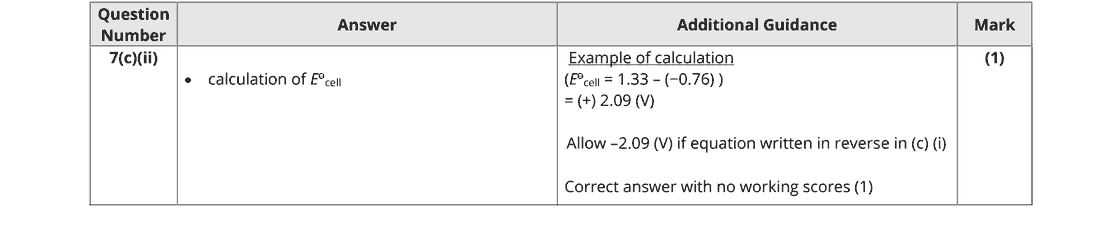
7(c)(ii) Redox II 1Calculation
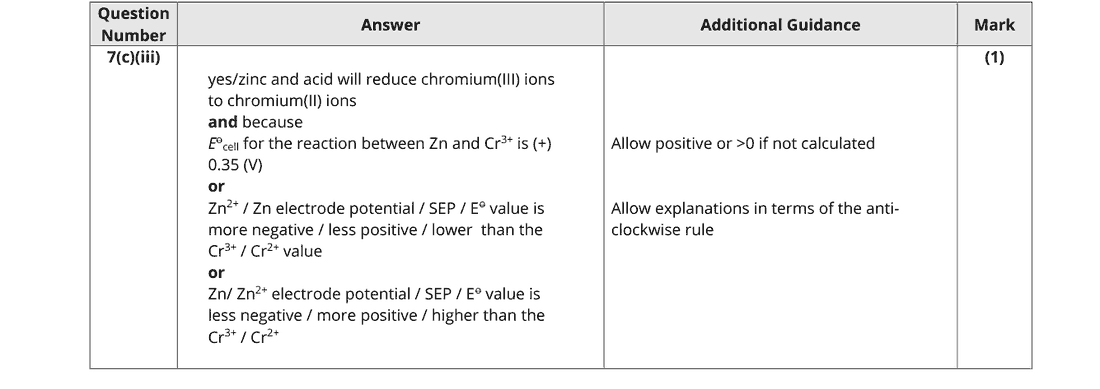
7(c)(iii) Transition metals: reactions, Redox II 1Short answer
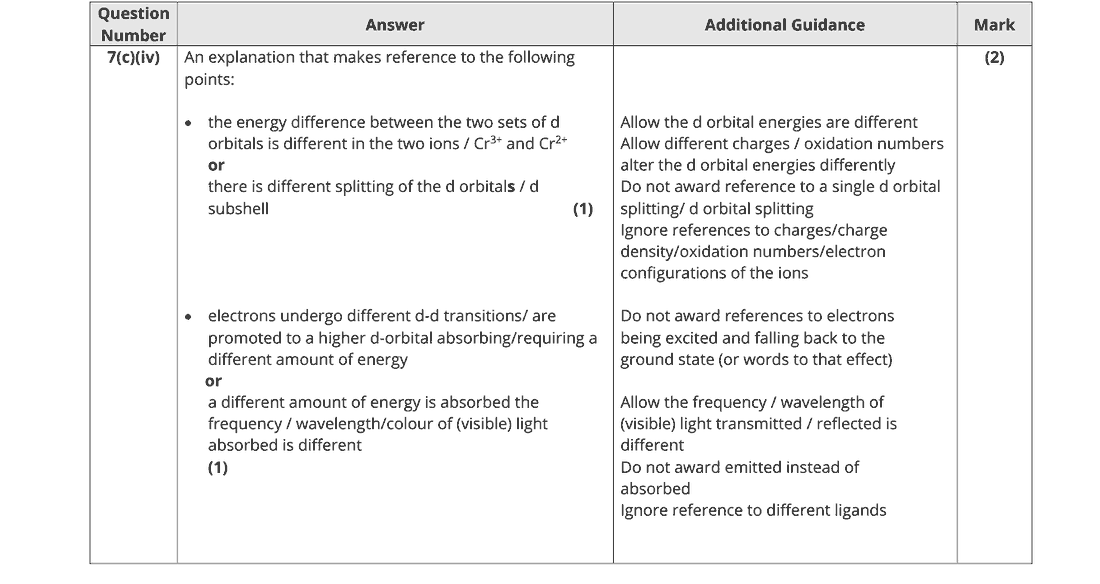
7(c)(iv) Transition metals: principles 2Explanation
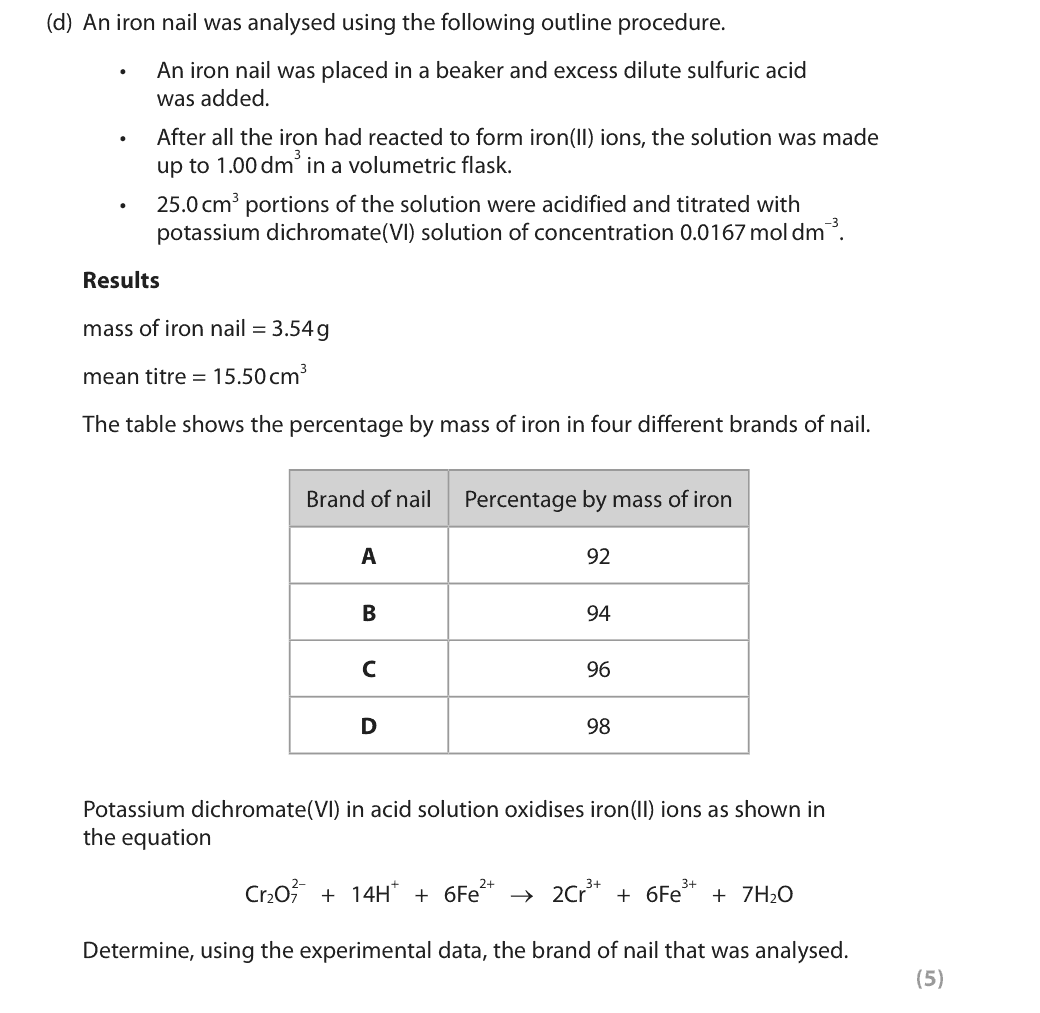
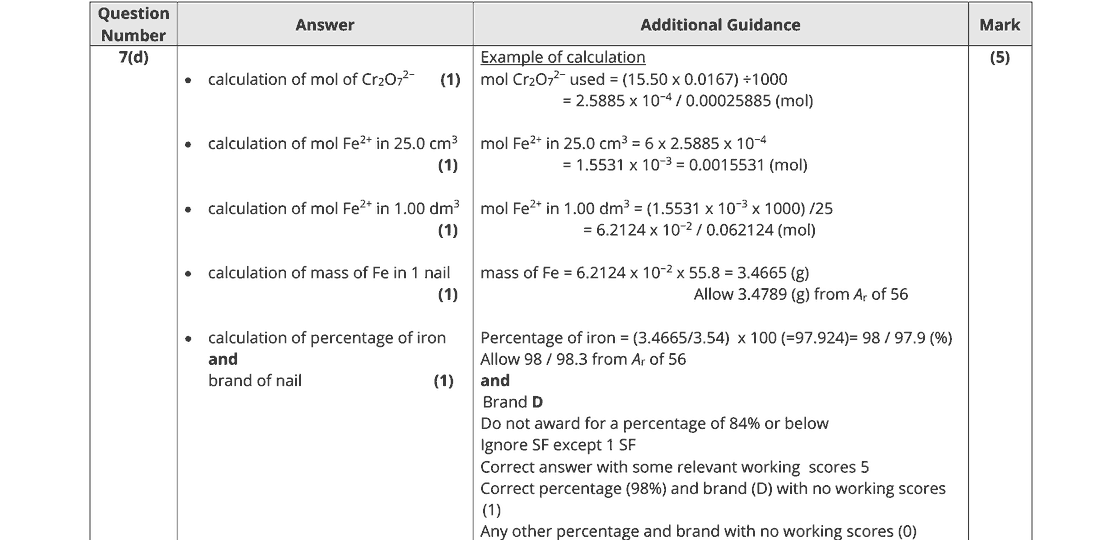
7(d) Redox II 5Calculation
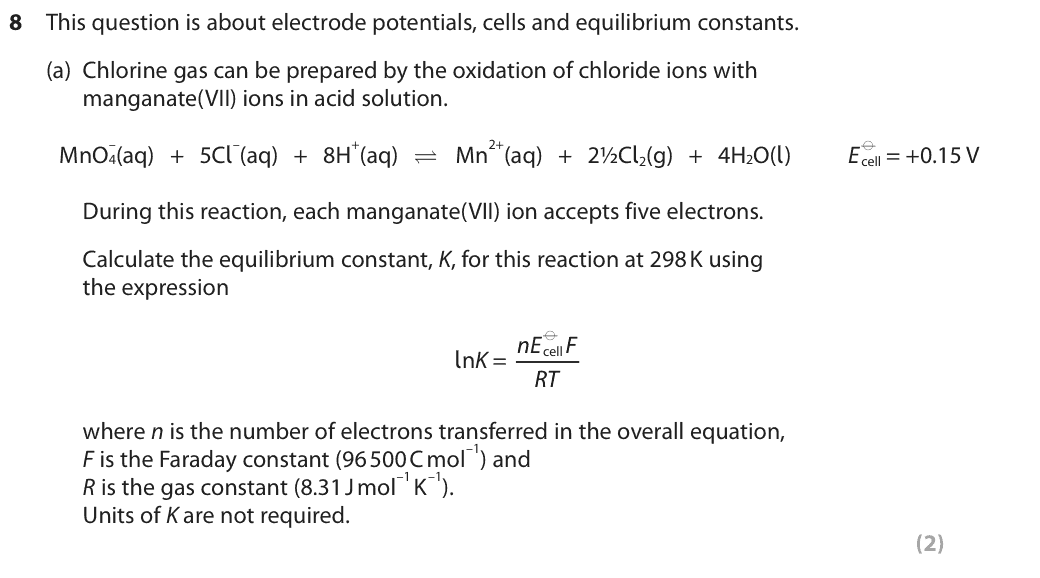
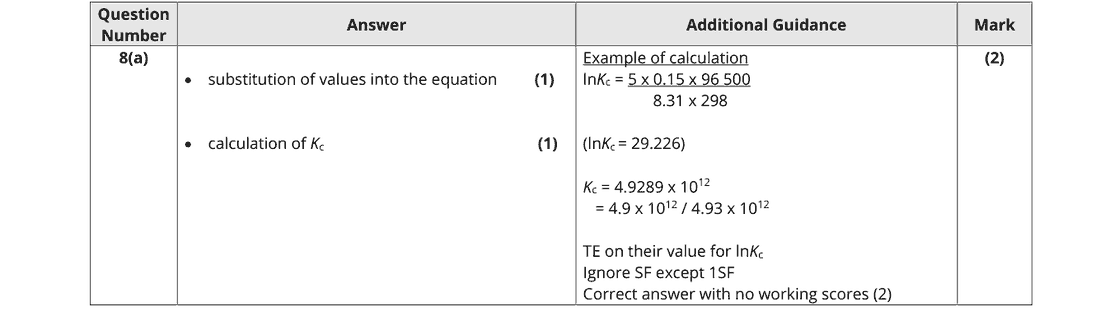
8(a) Redox II 2Calculation
8(b) Redox II 1Multiple choice
8(c) Redox II, Redox I 3Equation writing
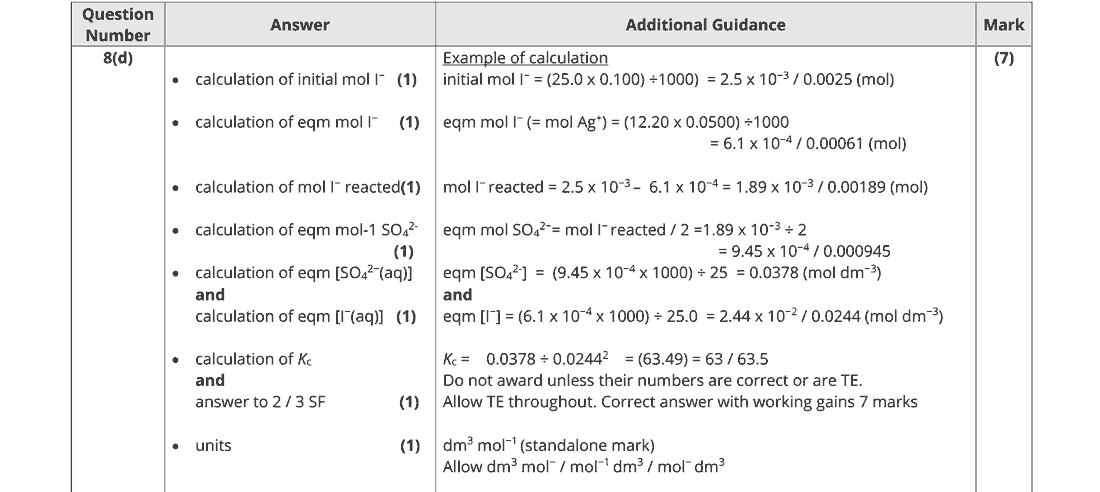
8(d) Equilibrium II 7Calculation

The questions

1(a)1(b)1(c)1(d)2(a)2(b)2(c)2(d)3(a)3(b)3(c)3(d)(i)3(d)(ii)3(e)(i)3(e)(ii)4(a)4(b)4(c)4(d)(i)4(d)(ii)4(e)5(a)5(b)5(c)(i)5(c)(ii)6(a)6(b)6(c)6(d)6(e)(i)6(e)(ii)6(f)(i)6(f)(ii)6(f)(iii)7(a)7(b)7(c)(i)7(c)(ii)7(c)(iii)7(c)(iv)7(d)8(a)8(b)8(c)8(d)
June 2022 · Paper 1 · Q1(a) 2 marks Short answer atomic structure and the periodic table
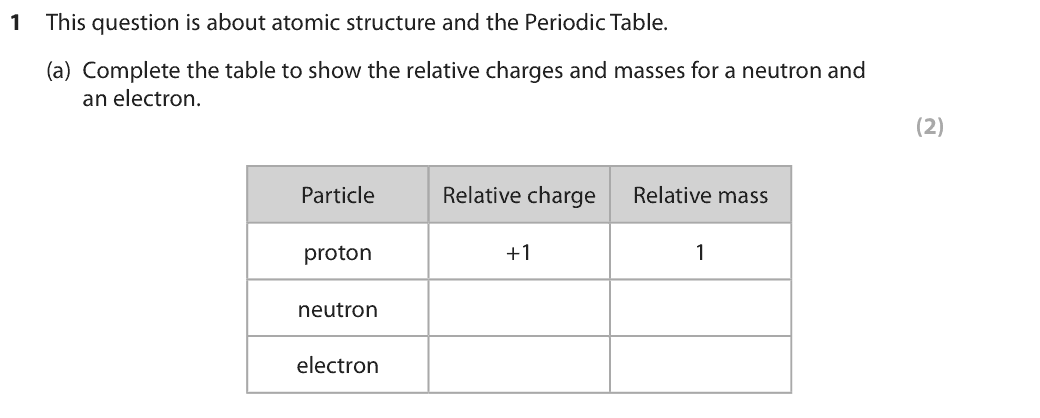
This question is about atomic structure and the Periodic Table.
Complete the table to show the relative charges and masses for a neutron and
an electron.
Particle
Relative charge
Relative mass
proton
+1
1
neutron
electron
June 2022 · Paper 1 · Q1(b) 1 mark Multiple choice atomic structure and the periodic table
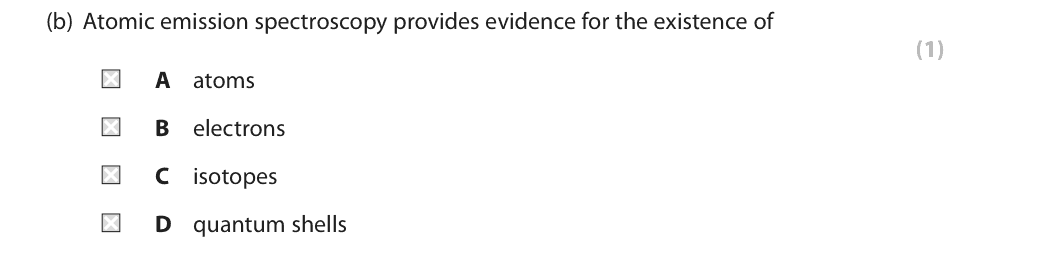
Atomic emission spectroscopy provides evidence for the existence of
A  atoms
B  electrons
C  isotopes
D  quantum shells
June 2022 · Paper 1 · Q1(c) 1 mark Diagram or structure atomic structure and the periodic table
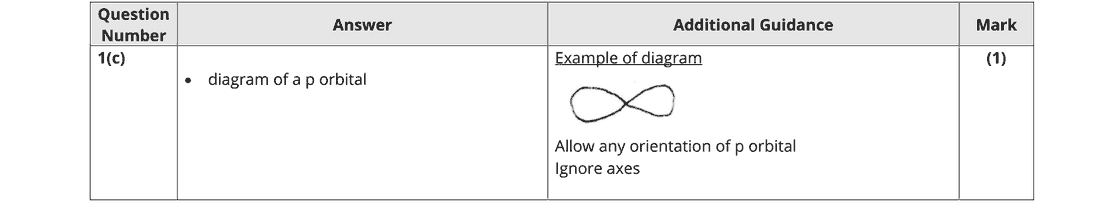
Draw the shape of a p orbital.
June 2022 · Paper 1 · Q1(d) 3 marks Explanation atomic structure and the periodic tablestructure
Earlier part of question 1 that this part usesEarlier part of June 2022 Paper 1 question 1
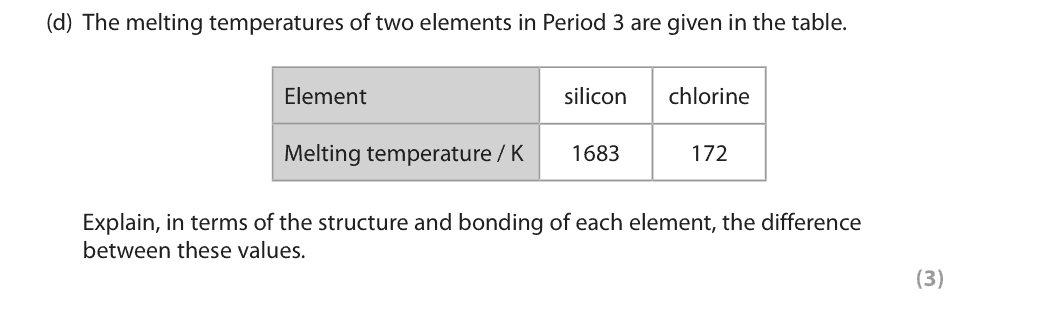
The melting temperatures of two elements in Period 3 are given in the table.
Element
silicon
chlorine
Melting temperature / K
1683
172
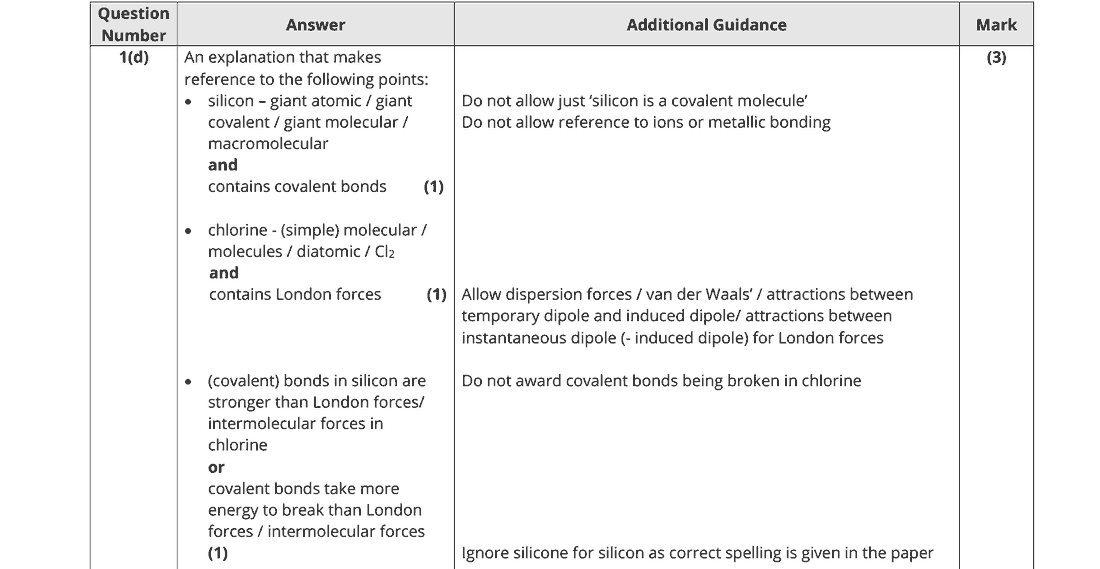
Explain, in terms of the structure and bonding of each element, the difference
between these values.
June 2022 · Paper 1 · Q2(a) 2 marks Practical and data analysis groups 1 and 2
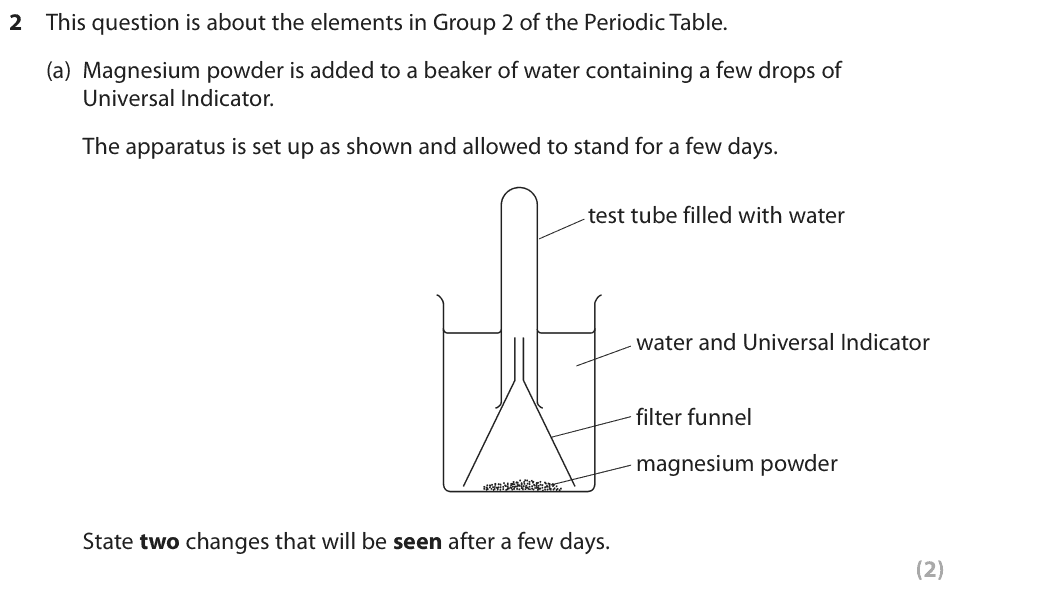
This question is about the elements in Group 2 of the Periodic Table.
Magnesium powder is added to a beaker of water containing a few drops of
Universal Indicator.
The apparatus is set up as shown and allowed to stand for a few days.
test tube filled with water
water and Universal Indicator
filter funnel
magnesium powder
State two changes that will be seen after a few days.
June 2022 · Paper 1 · Q2(b) 3 marks Explanation groups 1 and 2
Explain how the trend in the reactivity of the Group 2 elements is determined by
their electronic configurations.
June 2022 · Paper 1 · Q2(c) 2 marks Explanation redox i
Calcium reacts with chlorine.
Ca(s)   +   Cl2(g)   →   CaCl2(s)
Explain, in terms of electrons, why this is a redox reaction.
June 2022 · Paper 1 · Q2(d) 2 marks Calculation formulae equations and amounts of substance
Earlier part of question 2 that this part usesEarlier part of June 2022 Paper 1 question 2
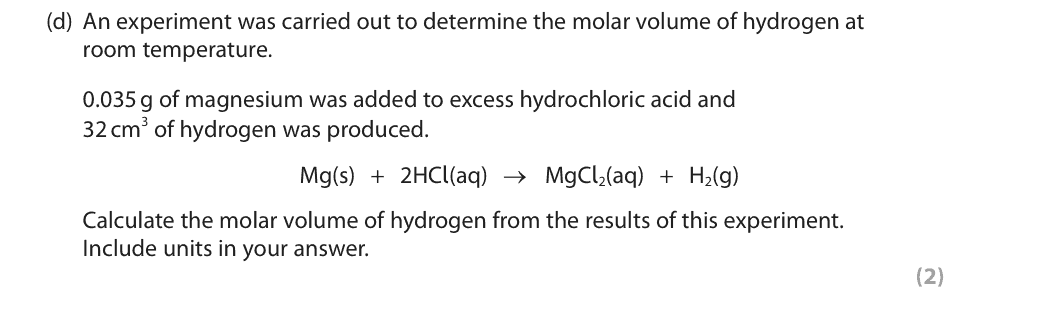
An experiment was carried out to determine the molar volume of hydrogen at
room temperature.
0.035 g of magnesium was added to excess hydrochloric acid and
32 cm3 of hydrogen was produced.
Mg(s)   +   2HCl(aq)   →   MgCl2(aq)   +   H2(g)
Calculate the molar volume of hydrogen from the results of this experiment.
Include units in your answer.
June 2022 · Paper 1 · Q3(a) 1 mark Multiple choice group 7 the halogens
This question is about the elements in Group 7 of the Periodic Table and some of
their compounds.
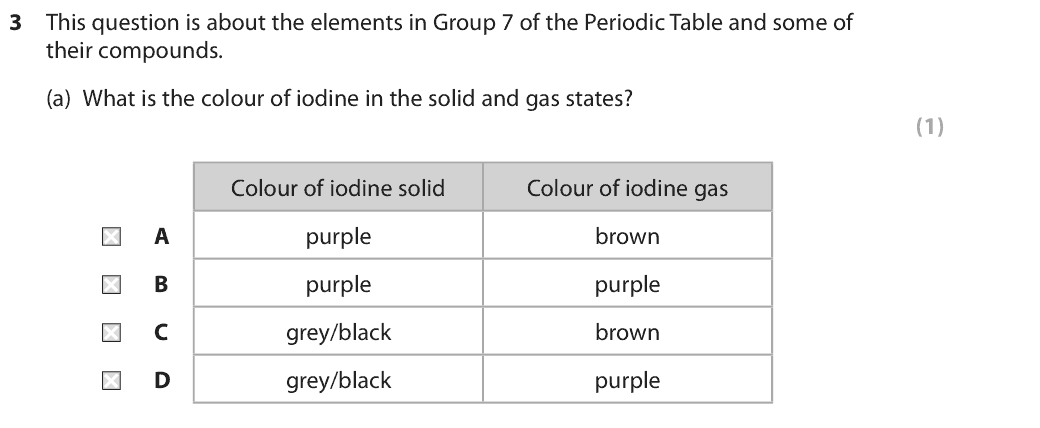
What is the colour of iodine in the solid and gas states?
Colour of iodine solid
Colour of iodine gas
A
purple
brown
B
purple
purple
C
grey/black
brown
D
grey/black
purple
June 2022 · Paper 1 · Q3(b) 1 mark Multiple choice group 7 the halogens
Earlier part of question 3 that this part usesEarlier part of June 2022 Paper 1 question 3
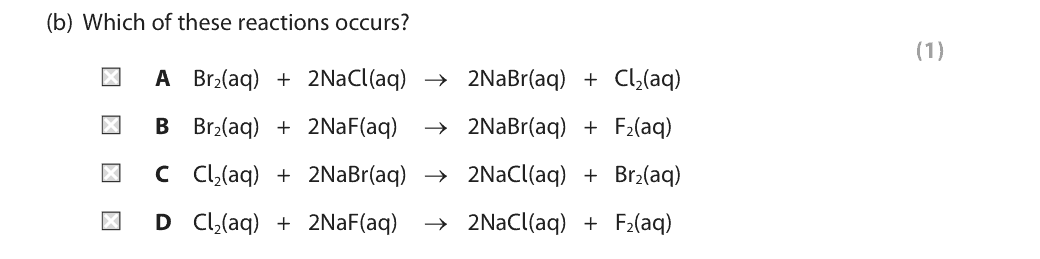
Which of these reactions occurs?
A  Br2(aq)   +   2NaCl(aq)   →   2NaBr(aq)   +   Cl2(aq)
B  Br2(aq)   +   2NaF(aq)    →   2NaBr(aq)   +   F2(aq)
C  Cl2(aq)   +   2NaBr(aq)   →   2NaCl(aq)   +   Br2(aq)
D  Cl2(aq)   +   2NaF(aq)    →   2NaCl(aq)   +   F2(aq)
June 2022 · Paper 1 · Q3(c) 1 mark Short answer atomic structure and the periodic table
Earlier part of question 3 that this part usesEarlier part of June 2022 Paper 1 question 3
The halogens can form halide ions during reactions.
Complete the electronic configuration of the chloride ion.
1s2
June 2022 · Paper 1 · Q3(d)(i) 3 marks Explanation redox ii
Earlier part of question 3 that this part usesEarlier part of June 2022 Paper 1 question 3
The standard electrode potentials for two half‑equations involving bromine
are given.
d = +1.09 V
Br2(aq)   +   2e–      2Br–(aq)
E
2HOBr(aq)   +   2H+(aq)   +   2e–      Br2(aq)   +   2H2O(l)
E
d = +1.57 V
Explain why the disproportionation of bromine in water is not
thermodynamically feasible under standard conditions.
Include the overall equation for the disproportionation and its E
cell value.
d
June 2022 · Paper 1 · Q3(d)(ii) 1 mark Short answer Hard redox ii
Earlier parts of question 3 that this part usesEarlier part of June 2022 Paper 1 question 3Earlier part of June 2022 Paper 1 question 3
Bromine disproportionates in water to a small extent at 298 K.
Give a possible reason why this reaction occurs.
June 2022 · Paper 1 · Q3(e)(i) 1 mark Multiple choice bonding
Earlier part of question 3 that this part usesEarlier part of June 2022 Paper 1 question 3
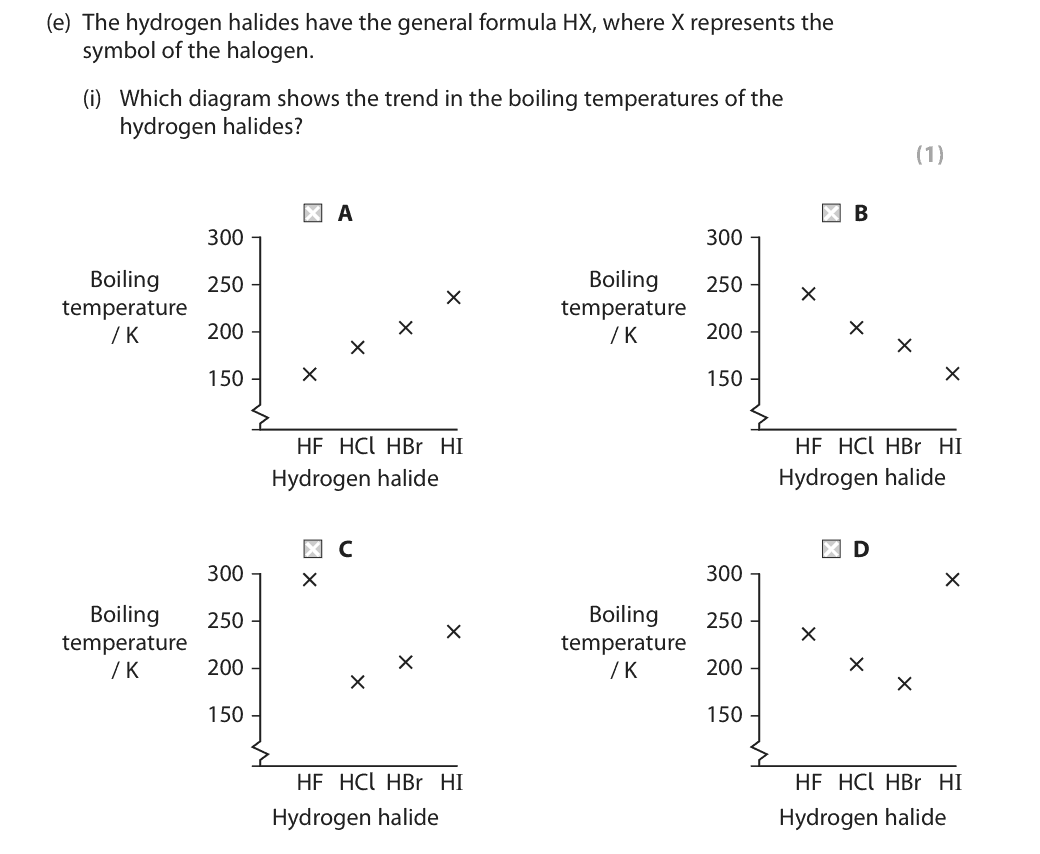
The hydrogen halides have the general formula HX, where X represents the
symbol of the halogen.
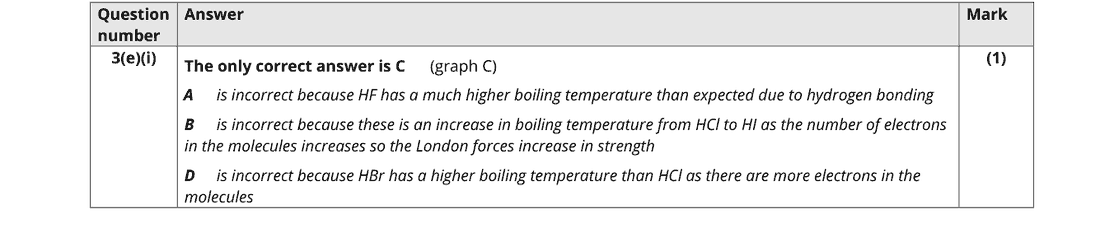
Which diagram shows the trend in the boiling temperatures of the
hydrogen halides?
A
B
300
300
Boiling
Boiling
250
250
temperature
temperature
/ K
200
/ K
200
150
150
HF HCl HBr HI
HF HCl HBr HI
Hydrogen halide
Hydrogen halide
C
D
300
300
Boiling
Boiling
250
250
temperature
temperature
/ K
200
/ K
200
150
150
HF HCl HBr HI
HF HCl HBr HI
Hydrogen halide
Hydrogen halide
June 2022 · Paper 1 · Q3(e)(ii) 1 mark Multiple choice group 7 the halogens
Earlier parts of question 3 that this part usesEarlier part of June 2022 Paper 1 question 3Earlier part of June 2022 Paper 1 question 3
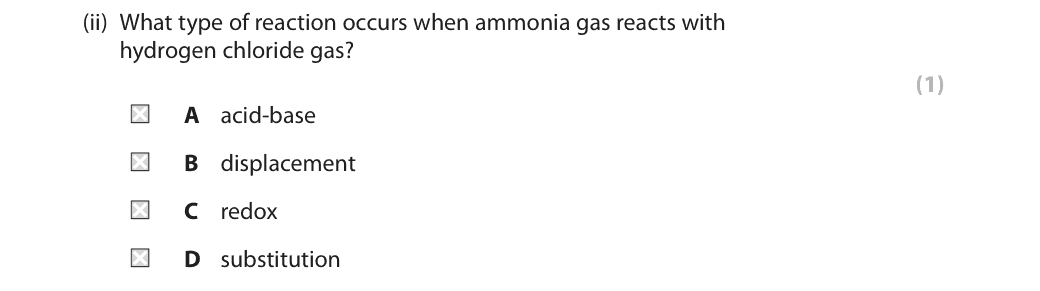
What type of reaction occurs when ammonia gas reacts with
hydrogen chloride gas?
A  acid‑base
B  displacement
C  redox
D  substitution
June 2022 · Paper 1 · Q4(a) 1 mark Multiple choice bonding
This question is about structure and bonding.
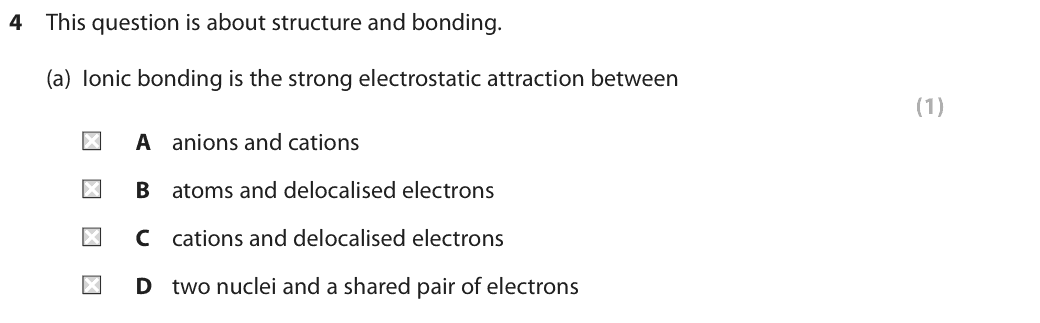
Ionic bonding is the strong electrostatic attraction between
A  anions and cations
B  atoms and delocalised electrons
C  cations and delocalised electrons
D  two nuclei and a shared pair of electrons
June 2022 · Paper 1 · Q4(b) 2 marks Short answer bonding
Earlier part of question 4 that this part usesEarlier part of June 2022 Paper 1 question 4
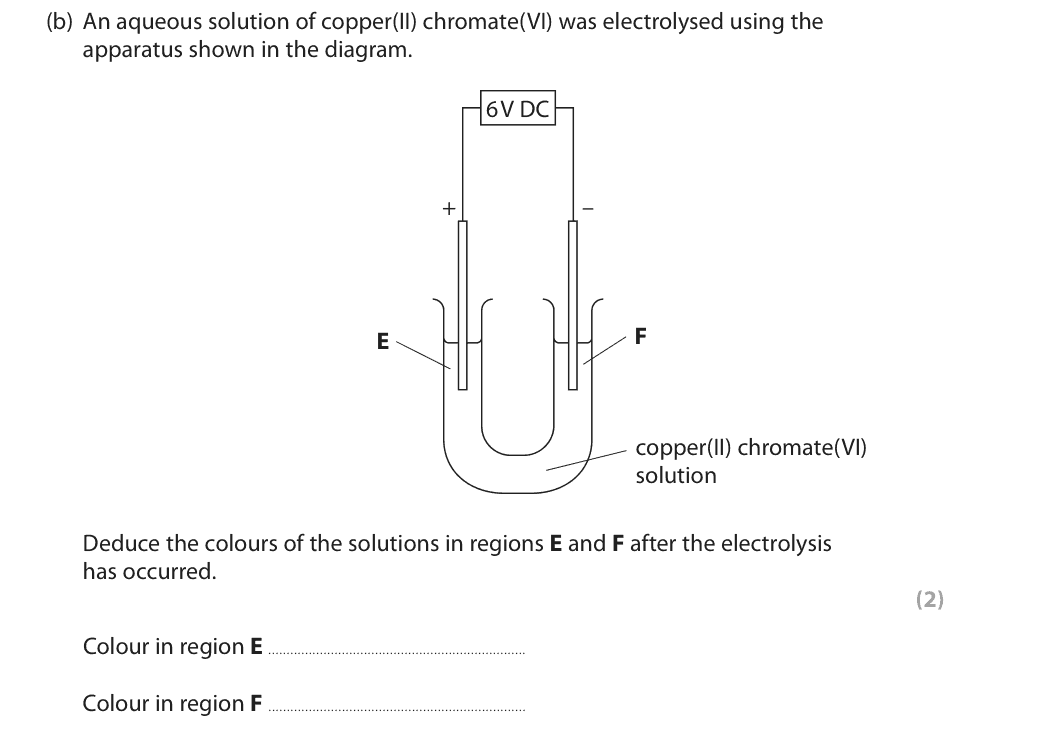
An aqueous solution of copper(II) chromate(VI) was electrolysed using the
apparatus shown in the diagram.
6 V DC
+
–
E
F
copper(II) chromate(VI)
solution
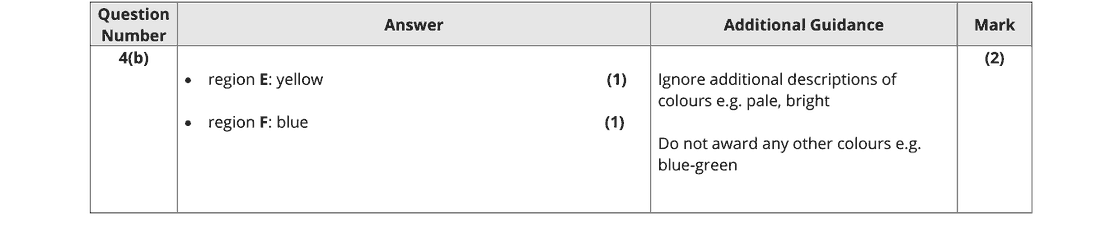
Deduce the colours of the solutions in regions E and F after the electrolysis
has occurred.
Colour in region E 
Colour in region F
June 2022 · Paper 1 · Q4(c) 1 mark Short answer bonding
Earlier part of question 4 that this part usesEarlier part of June 2022 Paper 1 question 4
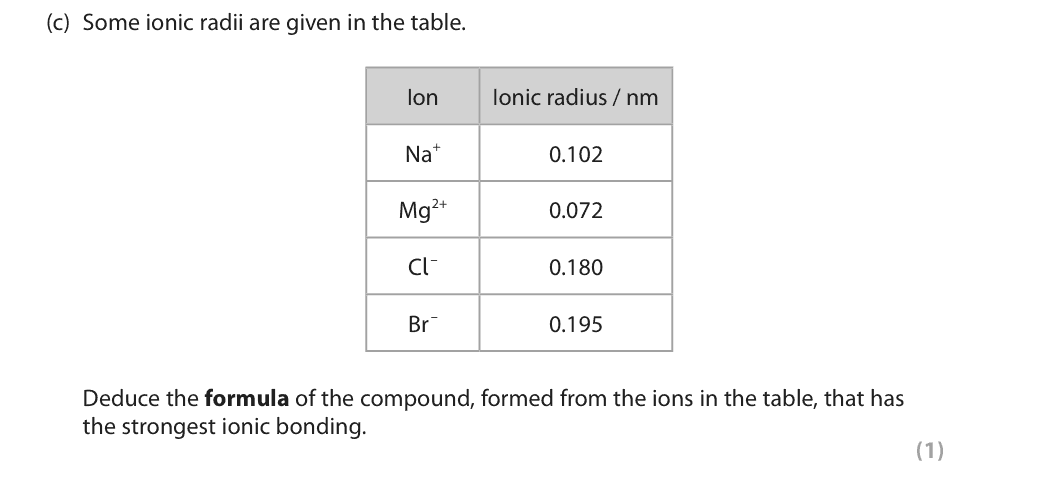
Some ionic radii are given in the table.
Ion
Ionic radius / nm
Na+
0.102
Mg2+
0.072
Cl–
0.180
Br–
0.195
Deduce the formula of the compound, formed from the ions in the table, that has
the strongest ionic bonding.
June 2022 · Paper 1 · Q4(d)(i) 1 mark Multiple choice structure
Earlier part of question 4 that this part usesEarlier part of June 2022 Paper 1 question 4
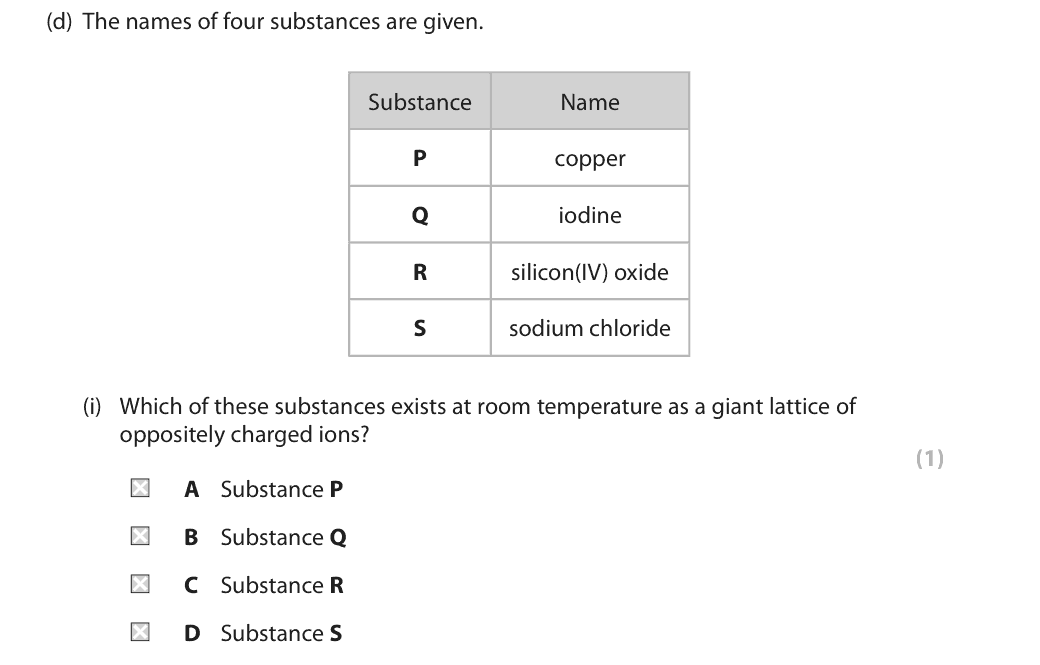
The names of four substances are given.
Substance
Name
P
copper
Q
iodine
R
silicon(IV) oxide
S
sodium chloride
Which of these substances exists at room temperature as a giant lattice of
oppositely charged ions?
A  Substance P
B  Substance Q
C  Substance R
D  Substance S
June 2022 · Paper 1 · Q4(d)(ii) 1 mark Multiple choice structure
Earlier parts of question 4 that this part usesEarlier part of June 2022 Paper 1 question 4Earlier part of June 2022 Paper 1 question 4
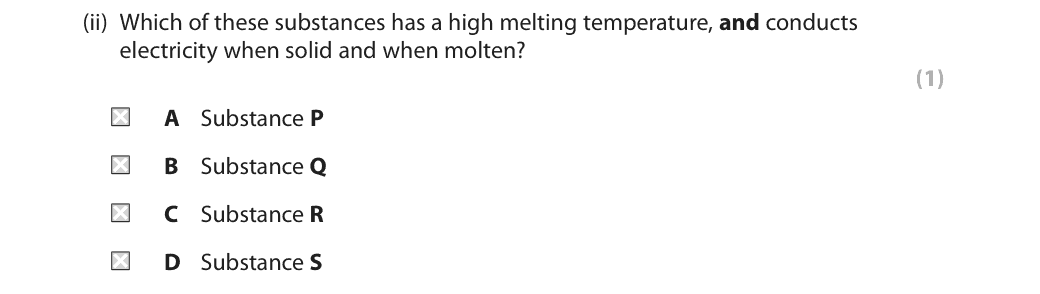
Which of these substances has a high melting temperature, and conducts
electricity when solid and when molten?
A  Substance P
B  Substance Q
C  Substance R
D  Substance S
June 2022 · Paper 1 · Q4(e) 6 marks 6-mark extended response bonding
Water has two significant anomalous properties:
•
it has a higher melting temperature than hydrogen sulfide, H2S, even
though it has fewer electrons in its molecules
•
the density of ice at 0 °C is less than that of water at 0 °C.

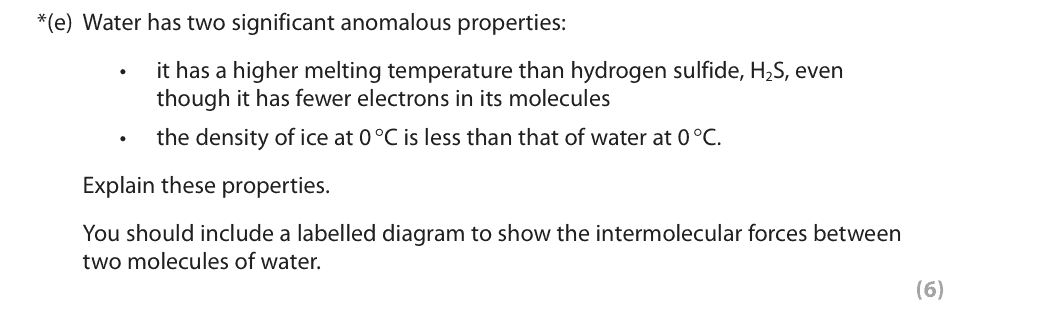
Explain these properties.
You should include a labelled diagram to show the intermolecular forces between
two molecules of water.
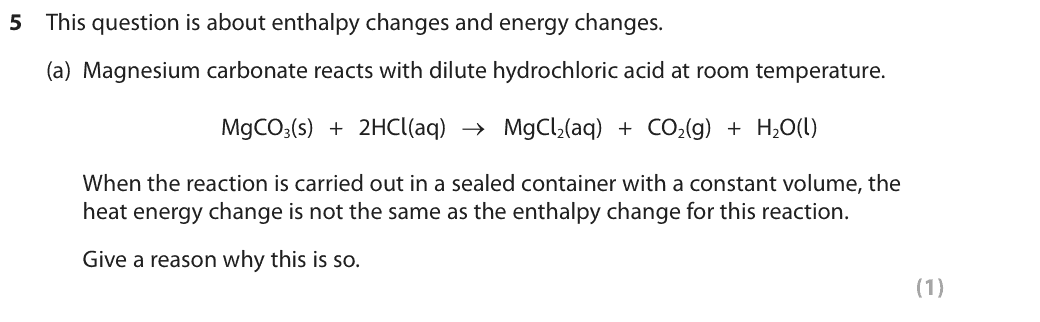
June 2022 · Paper 1 · Q5(a) 1 mark Short answer energetics i
This question is about enthalpy changes and energy changes.
Magnesium carbonate reacts with dilute hydrochloric acid at room temperature.
MgCO3(s)   +   2HCl(aq)   →   MgCl2(aq)   +   CO2(g)   +   H2O(l)
When the reaction is carried out in a sealed container with a constant volume, the
heat energy change is not the same as the enthalpy change for this reaction.
Give a reason why this is so.
June 2022 · Paper 1 · Q5(b) 3 marks Short answer energetics i
State what is meant by the standard enthalpy change of formation of
aluminium oxide, Al2O3(s).  Include standard conditions.
June 2022 · Paper 1 · Q5(c)(i) 2 marks Short answer lattice energy
Use the data in the table to answer the questions.
Value / kJ mol–1
Enthalpy change
Enthalpy change of hydration of K+
–322
Enthalpy change of hydration of Ca2+
–1650
Enthalpy change of solution of KCl
+17.2
Lattice energy of KCl
–711
Name the two properties of ions that affect the value of their
enthalpy change of hydration.
June 2022 · Paper 1 · Q5(c)(ii) 3 marks Diagram or structure lattice energy
Earlier parts of question 5 that this part usesEarlier part of June 2022 Paper 1 question 5Earlier part of June 2022 Paper 1 question 5
Calculate the enthalpy change of hydration for chloride ions by completing
the energy cycle, including labels, and using the data in the table.
ΔsolnH
KCl(s)  +  aq
K+(aq)  +  Cl–(aq)
enthalpy change of hydration for Cl– ions  kJ mol–1
June 2022 · Paper 1 · Q6(a) 1 mark Short answer acid base equilibria
This question is about acids and bases.
State what is meant by a Brønsted‑Lowry base.
June 2022 · Paper 1 · Q6(b) 2 marks Equation writing formulae equations and amounts of substancegroups 1 and 2
Write the ionic equation for the reaction between magnesium oxide and an acid.
State symbols are required.
–3, in a solution with a
June 2022 · Paper 1 · Q6(c) 1 mark Calculation acid base equilibria
Calculate the concentration of hydrogen ions, in mol dm
pH of 9.43
June 2022 · Paper 1 · Q6(d) 1 mark Multiple choice acid base equilibria
Earlier part of question 6 that this part usesEarlier part of June 2022 Paper 1 question 6
The pH of two salt solutions, J and K, are
solution J
pH = 5
solution K
pH = 9
The solutions are equimolar.
Which acids and bases could form the salts in solutions J and K?
Acid and base forming the salt
in solution J
in solution K
A
HCl(aq) and NH3(aq)
CH3COOH(aq) and NaOH(aq)
B
HCl(aq) and NaOH(aq)
CH3COOH(aq) and NH3(aq)
C
CH3COOH(aq) and NaOH(aq)
HCl(aq) and NaOH(aq)
D
CH3COOH(aq) and NH3(aq)
HCl(aq) and NH3(aq)
June 2022 · Paper 1 · Q6(e)(i) 3 marks Diagram or structure acid base equilibria
Earlier part of question 6 that this part usesEarlier part of June 2022 Paper 1 question 6
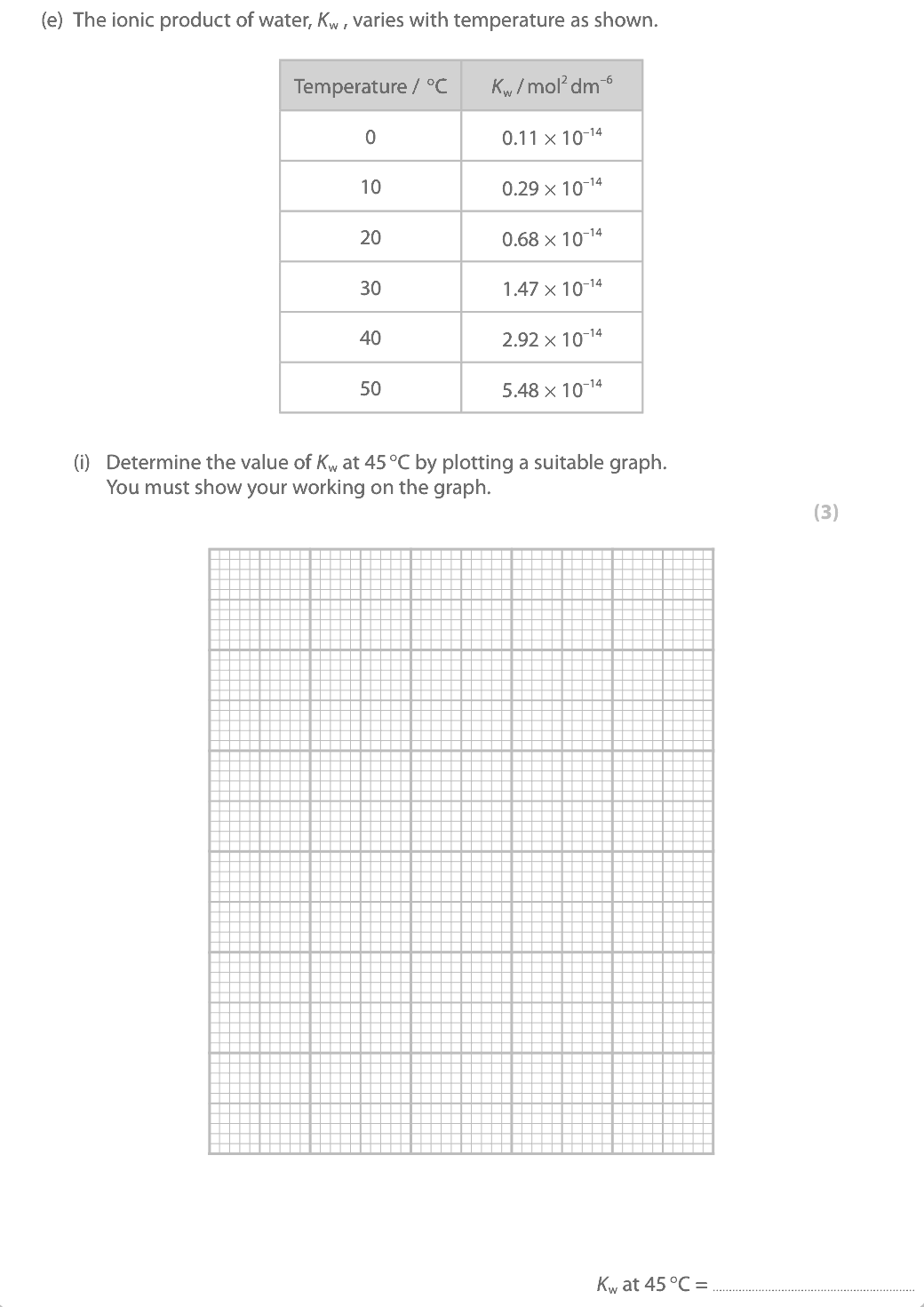
The ionic product of water, Kw , varies with temperature as shown.
Temperature /  °C
Kw / mol2 dm–6
0
0.11 × 10–14
10
0.29 × 10–14
20
0.68 × 10–14
30
1.47 × 10–14
40
2.92 × 10–14
50
5.48 × 10–14
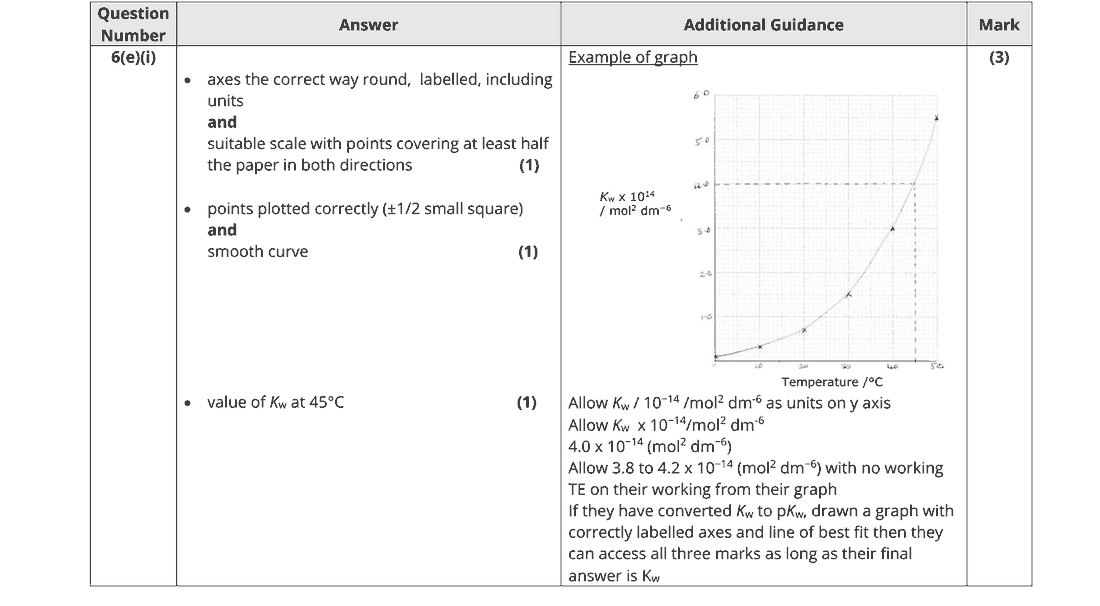
Determine the value of Kw at 45 °C by plotting a suitable graph.
You must show your working on the graph.
Kw at 45 °C =
June 2022 · Paper 1 · Q6(e)(ii) 3 marks Calculation acid base equilibria
Earlier part of question 6 that this part usesEarlier part of June 2022 Paper 1 question 6
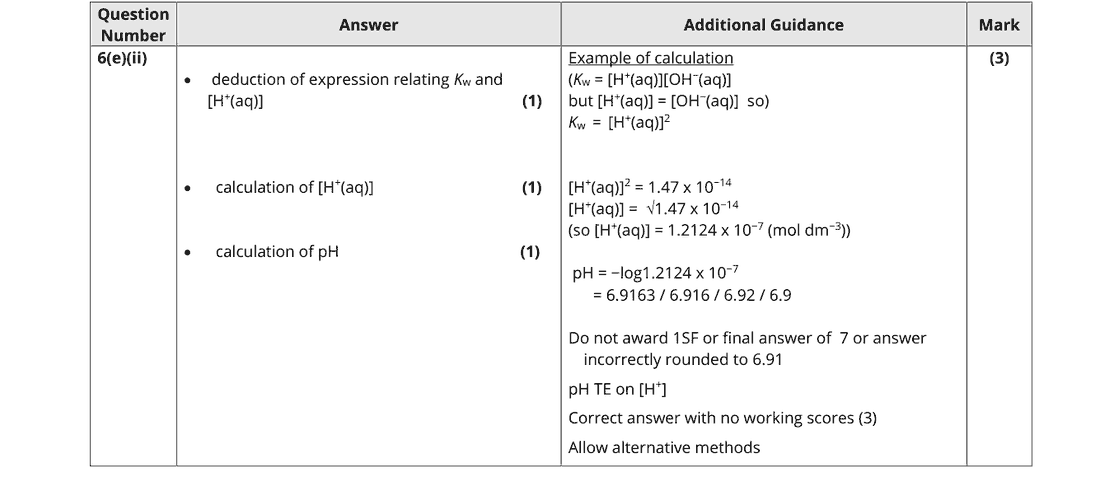
The ionic product of water at 30 °C is 1.47 × 10–14 mol2 dm–6.
Calculate the pH of water at this temperature.
June 2022 · Paper 1 · Q6(f)(i) 2 marks Short answer acid base equilibria
Earlier part of question 6 that this part usesEarlier part of June 2022 Paper 1 question 6
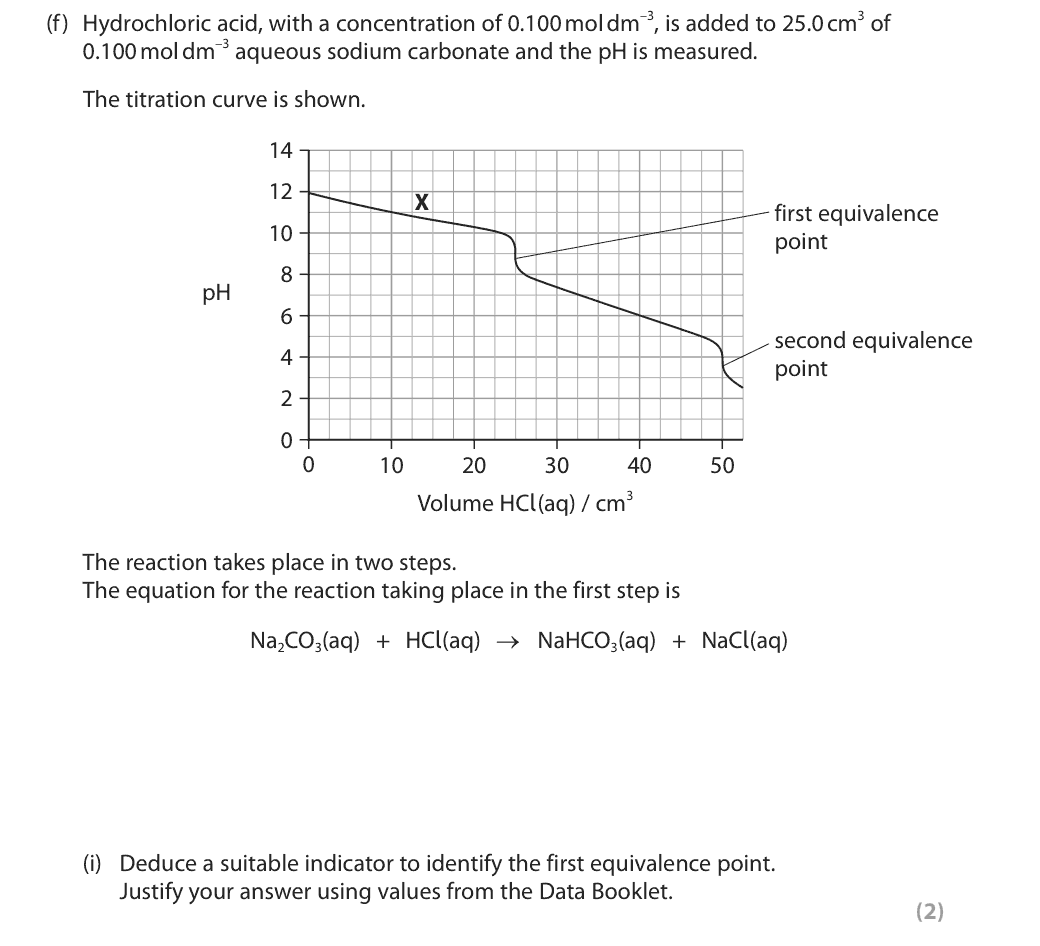
Hydrochloric acid, with a concentration of 0.100 mol dm–3, is added to 25.0 cm3 of
0.100 mol dm–3 aqueous sodium carbonate and the pH is measured.
The titration curve is shown.
14
12
X
first equivalence
10
point
8
pH
6
second equivalence
4
point
2
0
0
10
20
30
40
50
Volume HCl(aq) / cm3
The reaction takes place in two steps.
The equation for the reaction taking place in the first step is
Na2CO3(aq)   +   HCl(aq)   →   NaHCO3(aq)   +   NaCl(aq)
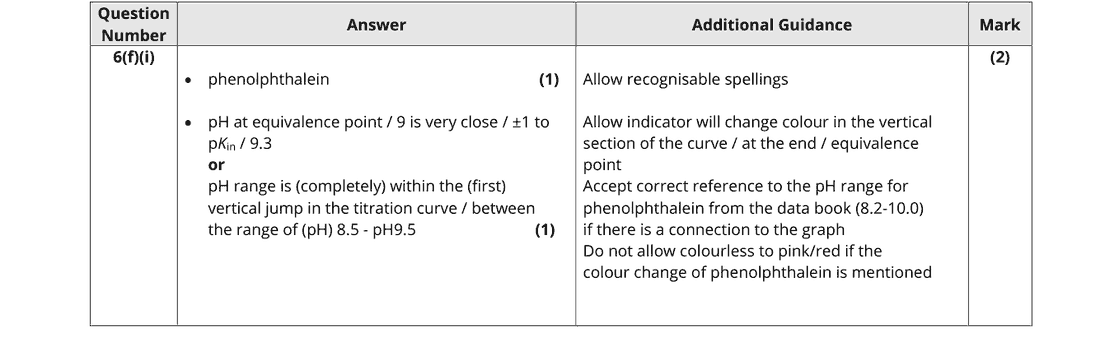
Deduce a suitable indicator to identify the first equivalence point.
Justify your answer using values from the Data Booklet.
June 2022 · Paper 1 · Q6(f)(ii) 1 mark Equation writing formulae equations and amounts of substance
Earlier parts of question 6 that this part usesEarlier part of June 2022 Paper 1 question 6Earlier part of June 2022 Paper 1 question 6
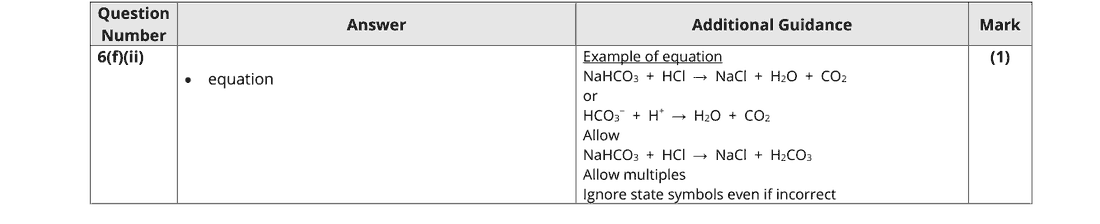
Write the equation for the reaction taking place at the second
equivalence point.
State symbols are not required.
June 2022 · Paper 1 · Q6(f)(iii) 3 marks Explanation acid base equilibria
Earlier parts of question 6 that this part usesEarlier part of June 2022 Paper 1 question 6Earlier part of June 2022 Paper 1 question 6Earlier part of June 2022 Paper 1 question 6
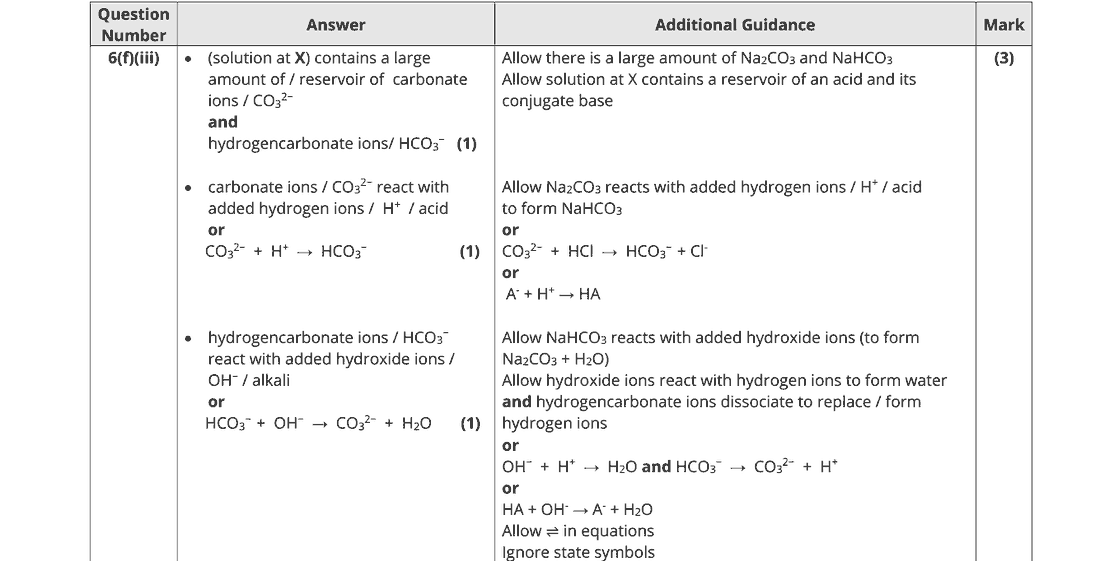
Explain how the solution at point X on the graph can act as a buffer solution.
June 2022 · Paper 1 · Q7(a) 1 mark Short answer transition metals principles
This question is about chromium and some of its compounds.
The common oxidation numbers of chromium are +2, +3 and +6.
Give a reason, in terms of ionisation energies, why chromium can show variable
oxidation numbers.
June 2022 · Paper 1 · Q7(b) 2 marks Diagram or structure bonding
The bonding in chromate(VI) ions, CrO4
2–, is similar to that in sulfate(VI) ions, SO4
2–.
Draw a possible dot‑and‑cross diagram for a chromate(VI) ion.
June 2022 · Paper 1 · Q7(c)(i) 2 marks Equation writing transition metals reactionsredox i
Earlier part of question 7 that this part usesEarlier part of June 2022 Paper 1 question 7
A student added some pieces of zinc to an acidified solution of
potassium dichromate(VI).
Some standard electrode potentials are given in the table.
Right‑hand electrode system
E
d / V
2+(aq)   +   2e–      Zn(s)
Zn
–0.76
Cr
3+(aq)   +   e–      Cr
2+(aq)
–0.41
2–(aq)   +   14H
+(aq)   +   6e–      2Cr
3+(aq)   +   7H2O(l)
Cr2O7
+1.33
Write the overall equation for the reduction of dichromate(VI) ions to
chromium(III) ions by zinc in acid conditions.
State symbols are not required.
d
June 2022 · Paper 1 · Q7(c)(ii) 1 mark Calculation redox ii
Earlier parts of question 7 that this part usesEarlier part of June 2022 Paper 1 question 7Earlier part of June 2022 Paper 1 question 7
Calculate E
cell  for the reaction in (c)(i).
June 2022 · Paper 1 · Q7(c)(iii) 1 mark Short answer transition metals reactionsredox ii
Earlier parts of question 7 that this part usesEarlier part of June 2022 Paper 1 question 7Earlier part of June 2022 Paper 1 question 7Earlier part of June 2022 Paper 1 question 7
Predict whether or not a further reduction of chromium(III) ions to
chromium(II) ions will occur.  Justify your answer.
June 2022 · Paper 1 · Q7(c)(iv) 2 marks Explanation transition metals principles
Earlier part of question 7 that this part usesEarlier part of June 2022 Paper 1 question 7
Aqueous solutions containing chromium(III) ions and chromium(II) ions have
different colours.
Explain why these solutions differ in colour.
An explanation of the origin of the colours is not required.
June 2022 · Paper 1 · Q7(d) 5 marks Calculation redox ii
Earlier part of question 7 that this part usesEarlier part of June 2022 Paper 1 question 7
An iron nail was analysed using the following outline procedure.
•
An iron nail was placed in a beaker and excess dilute sulfuric acid
was added.
•
After all the iron had reacted to form iron(II) ions, the solution was made
3 in a volumetric flask.
up to 1.00 dm
•
25.0 cm3 portions of the solution were acidified and titrated with
–3.
potassium dichromate(VI) solution of concentration 0.0167 mol dm
Results
mass of iron nail = 3.54 g
mean titre = 15.50 cm3
The table shows the percentage by mass of iron in four different brands of nail.
Brand of nail
Percentage by mass of iron
A
92
B
94
C
96
D
98
Potassium dichromate(VI) in acid solution oxidises iron(II) ions as shown in
the equation
Cr2O7
2–   +   14H
+   +   6Fe
2+   →   2Cr
3+   +   6Fe
3+   +   7H2O
Determine, using the experimental data, the brand of nail that was analysed.
June 2022 · Paper 1 · Q8(a) 2 marks Calculation redox ii
This question is about electrode potentials, cells and equilibrium constants.
Chlorine gas can be prepared by the oxidation of chloride ions with
manganate(VII) ions in acid solution.
–(aq)   +   5Cl
–(aq)   +   8H
+(aq)      Mn
2+(aq)   +   2½Cl2(g)   +   4H2O(l)
d
MnO4
E
cell = +0.15 V
During this reaction, each manganate(VII) ion accepts five electrons.
Calculate the equilibrium constant, K, for this reaction at 298 K using
the expression
d
lnK =  n
E
F
cell
RT
where n is the number of electrons transferred in the overall equation,
–1) and
F is the Faraday constant (96 500 C mol
–1 K
–1).
R is the gas constant (8.31 J mol
Units of K are not required.
June 2022 · Paper 1 · Q8(b) 1 mark Multiple choice redox ii
Earlier part of question 8 that this part usesEarlier part of June 2022 Paper 1 question 8
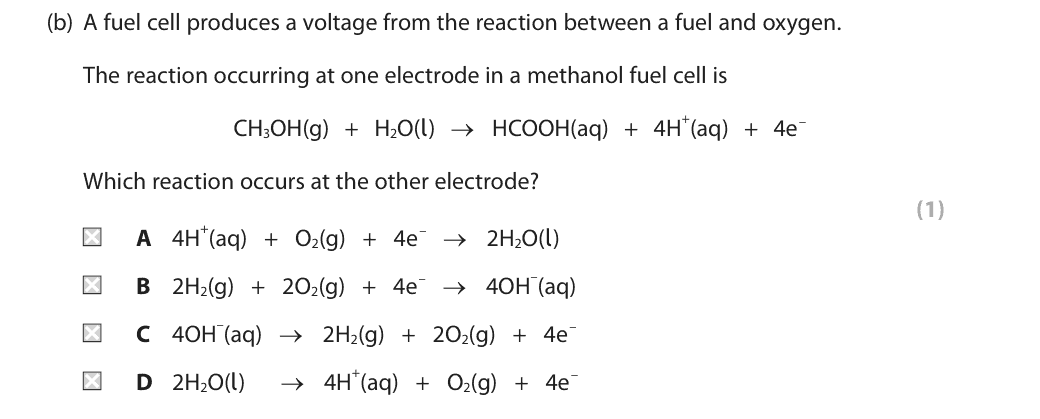
A fuel cell produces a voltage from the reaction between a fuel and oxygen.
The reaction occurring at one electrode in a methanol fuel cell is
+(aq)   +   4e–
CH3OH(g)   +   H2O(l)   →   HCOOH(aq)   +   4H
Which reaction occurs at the other electrode?
+(aq)   +   O2(g)   +   4e–   →   2H2O(l)
A  4H
–(aq)
B  2H2(g)   +   2O2(g)   +   4e–   →   4OH
–(aq)   →   2H2(g)   +   2O2(g)   +   4e–
C  4OH
+(aq)   +   O2(g)   +   4e–
D  2H2O(l)
→   4H
June 2022 · Paper 1 · Q8(c) 3 marks Equation writing redox iiredox i
Earlier part of question 8 that this part usesEarlier part of June 2022 Paper 1 question 8
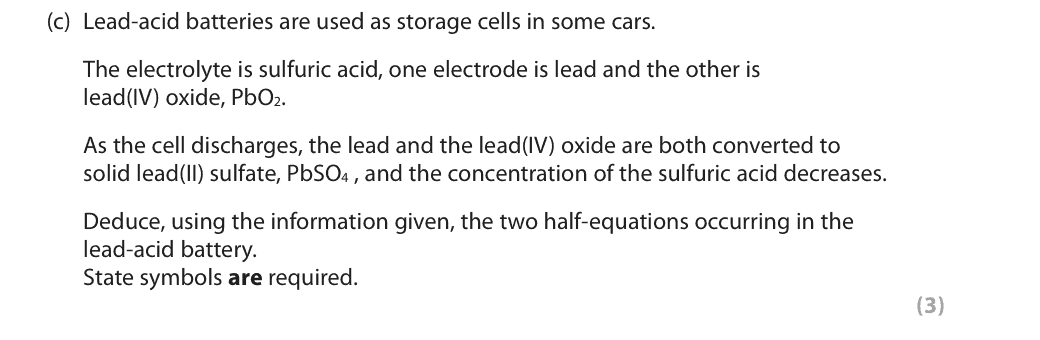
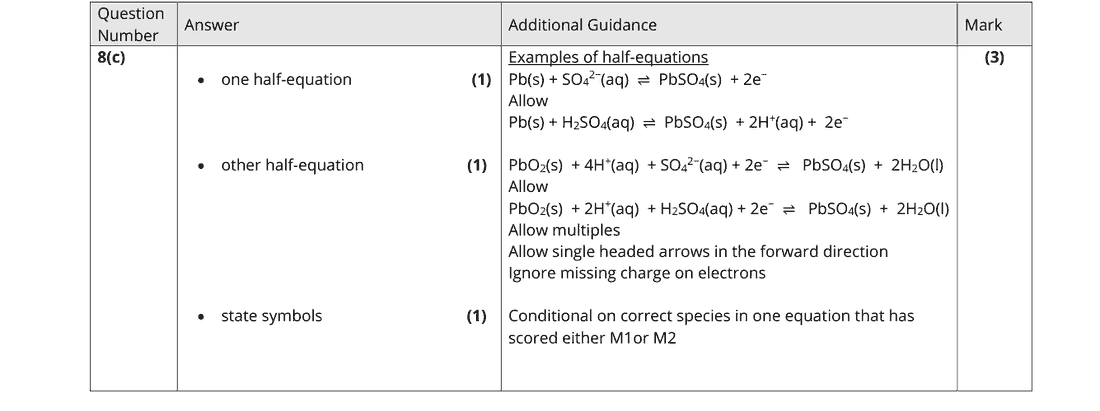
Lead‑acid batteries are used as storage cells in some cars.
The electrolyte is sulfuric acid, one electrode is lead and the other is
lead(IV) oxide, PbO2.
As the cell discharges, the lead and the lead(IV) oxide are both converted to
solid lead(II) sulfate, PbSO4 , and the concentration of the sulfuric acid decreases.
Deduce, using the information given, the two half‑equations occurring in the
lead‑acid battery.
State symbols are required.
June 2022 · Paper 1 · Q8(d) 7 marks Calculation equilibrium ii
Earlier part of question 8 that this part usesEarlier part of June 2022 Paper 1 question 8
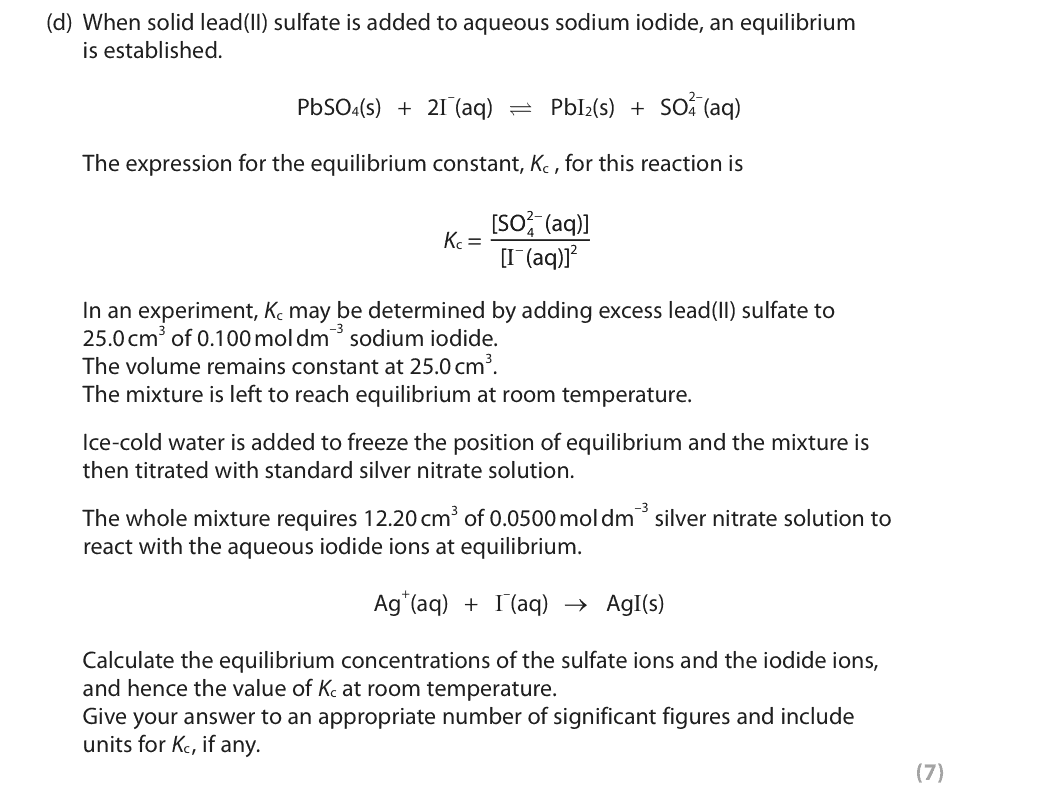
When solid lead(II) sulfate is added to aqueous sodium iodide, an equilibrium
is established.
–(aq)      PbI2(s)   +   SO4
2–(aq)
PbSO4(s)   +   2I
The expression for the equilibrium constant, Kc , for this reaction is
Kc =  [SO (aq)]
2−
4
[ (aq)]2
−I
In an experiment, Kc may be determined by adding excess lead(II) sulfate to
–3 sodium iodide.
25.0 cm3 of 0.100 mol dm
The volume remains constant at 25.0 cm3.
The mixture is left to reach equilibrium at room temperature.
Ice‑cold water is added to freeze the position of equilibrium and the mixture is
then titrated with standard silver nitrate solution.
The whole mixture requires 12.20 cm3 of 0.0500 mol dm
–3 silver nitrate solution to
react with the aqueous iodide ions at equilibrium.
+(aq)   +   I
–(aq)   →   AgI(s)
Ag
Calculate the equilibrium concentrations of the sulfate ions and the iodide ions,
and hence the value of Kc at room temperature.
Give your answer to an appropriate number of significant figures and include
units for Kc , if any.

Work with an A-level chemistry tutor

Want a paper marked and gone through with you? Message us.

Prefer email? Send an enquiry

If you are under 18, please include a parent's contact details. Enquiries go to enquiries@chemistryaleveltutor.com and are deleted once handled. All tutoring is online.