June 2024: AS Paper 2, Organic and physical chemistry

80 marks · 41 question parts · Paper, mark scheme and report on AQA's site · Have the Data Booklet beside you

Question by question

QTopicMarksAOType
01.1 Organic analysis: test-tube reactions, mass spectrometry and infrared, Alkenes, Alcohols 3AO1=3Practical and data analysis
01.2 Amount of substance 3AO3=3Calculation
02.1 Organic analysis: test-tube reactions, mass spectrometry and infrared, Introduction to organic chemistry: nomenclature, mechanisms and isomerism 2AO3=2Diagram or structure
02.2 Organic analysis: test-tube reactions, mass spectrometry and infrared 2AO1=2Short answer
02.3 Organic analysis: test-tube reactions, mass spectrometry and infrared 1AO1=1Short answer
03.1 Introduction to organic chemistry: nomenclature, mechanisms and isomerism 1AO1=1Short answer
03.2 Introduction to organic chemistry: nomenclature, mechanisms and isomerism, Alkanes 2AO2=2Equation writing
03.3 Halogenoalkanes, Introduction to organic chemistry: nomenclature, mechanisms and isomerism 1AO2=1Equation writing
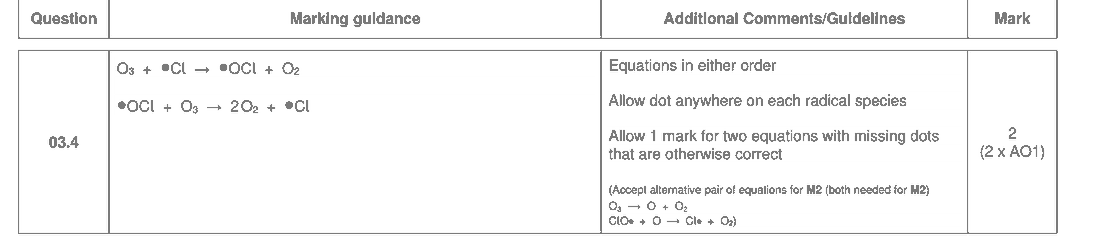
03.4 Halogenoalkanes 2AO1=2Equation writing
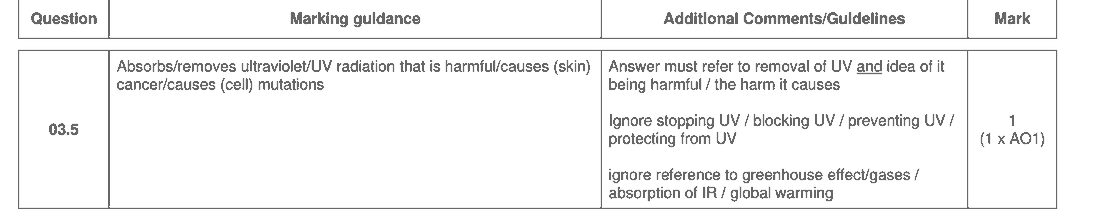
03.5 Halogenoalkanes 1AO1=1Short answer
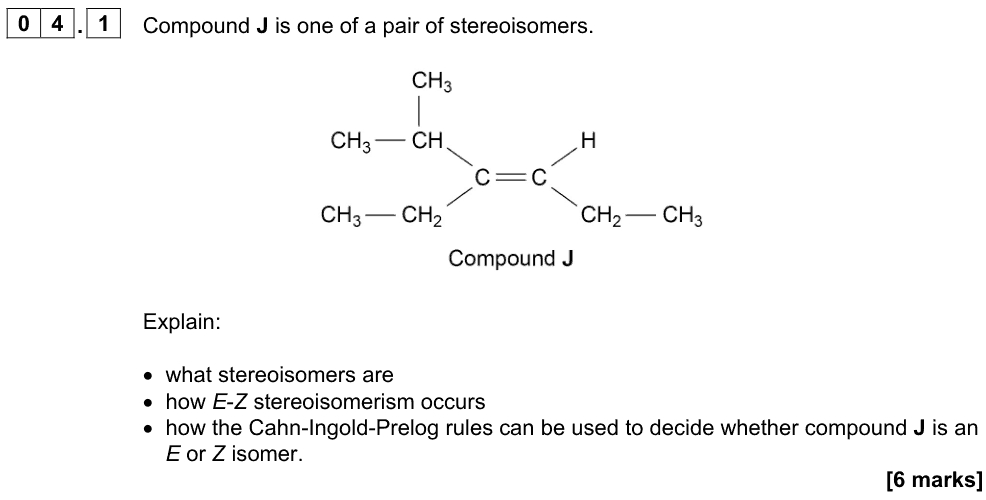
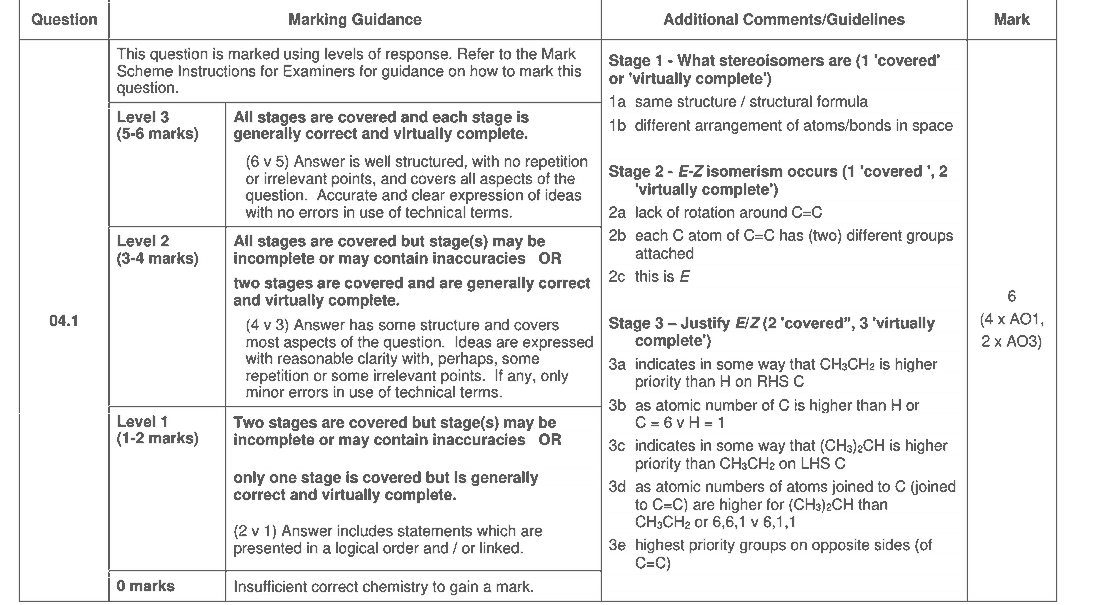
04.1 Introduction to organic chemistry: nomenclature, mechanisms and isomerism 6AO1=4,AO3=2Level of response
04.2 Alkenes, Introduction to organic chemistry: nomenclature, mechanisms and isomerism 5AO1=1,AO2=4Mechanism
04.3 Alkenes 3AO3=3Explanation
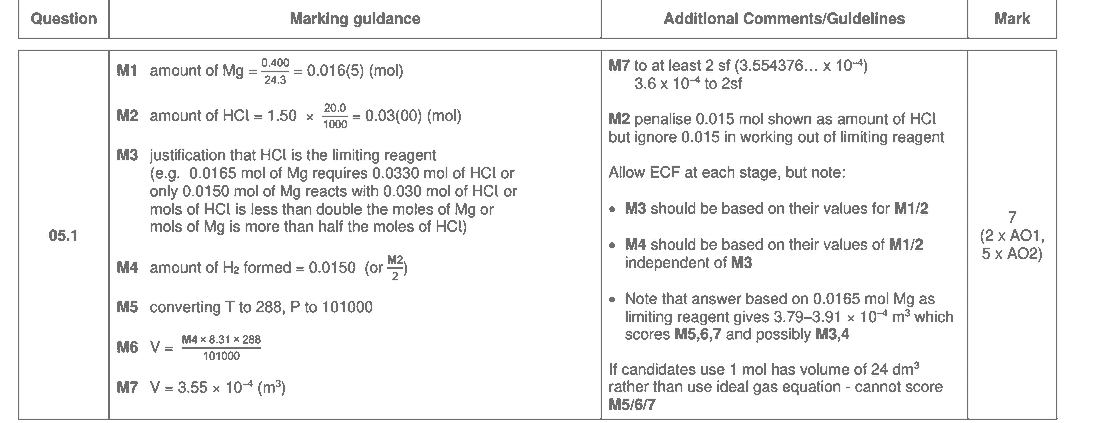
05.1 Amount of substance 7AO1=2,AO2=5Calculation
05.2 Amount of substance, Alkanes 2AO2=2Calculation
06.1 Group 7(17), the halogens 1AO2=1Short answer
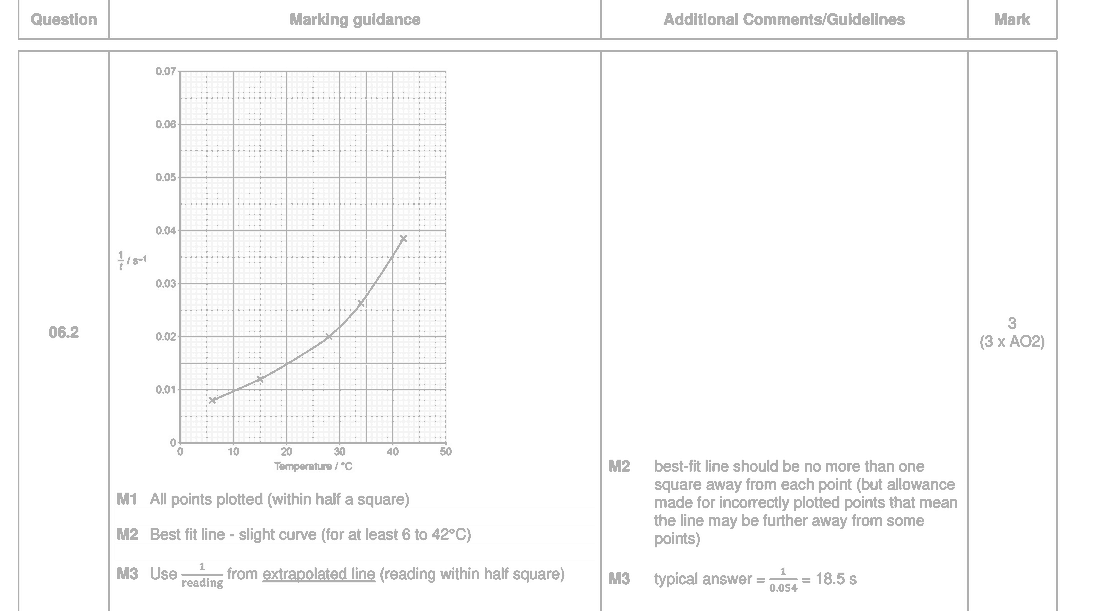
06.2 Kinetics 3AO2=3Practical and data analysis
06.3 Halogenoalkanes 3AO3=3Explanation
07.1 Alcohols 1AO1=1Short answer
07.2 Alcohols 1AO2=1Short answer
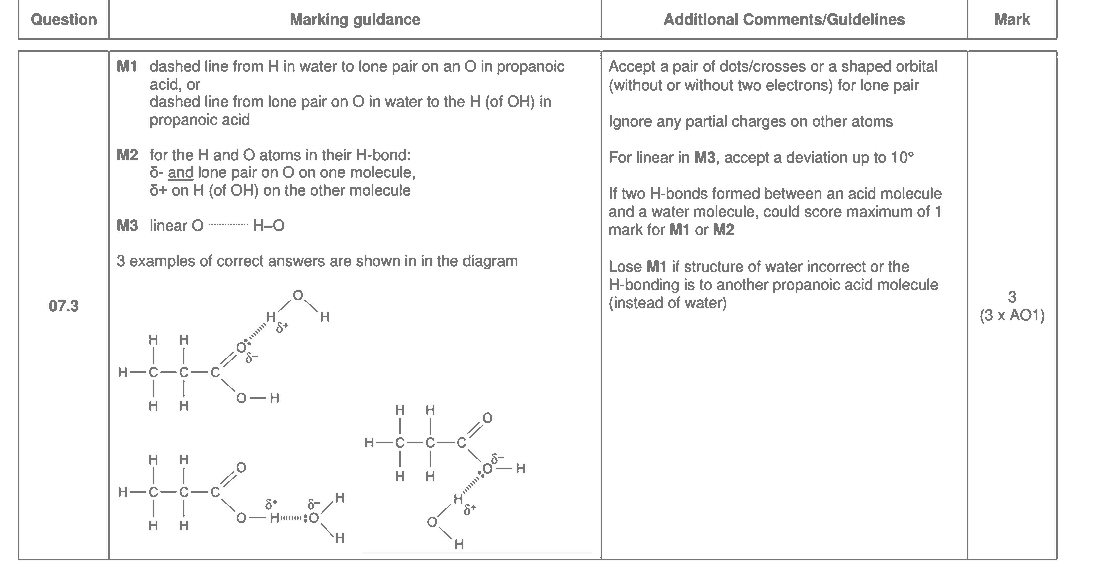
07.3 Bonding 3AO1=3Diagram or structure
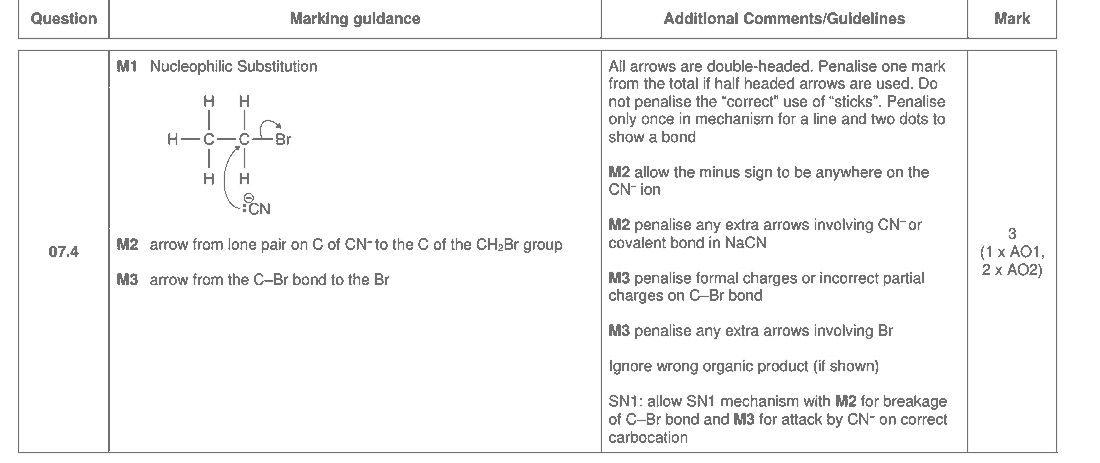
07.4 Halogenoalkanes, Introduction to organic chemistry: nomenclature, mechanisms and isomerism 3AO1=1,AO2=2Mechanism
07.5 Halogenoalkanes 1AO3=1Short answer
07.6 Chemical equilibria, Le Chatelier's principle and Kc 1AO2=1Short answer
07.7 Chemical equilibria, Le Chatelier's principle and Kc 4AO2=4Calculation
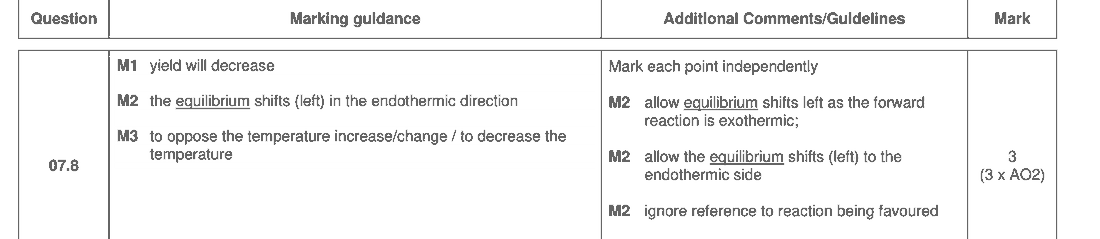
07.8 Chemical equilibria, Le Chatelier's principle and Kc 3AO2=3Explanation
08 Amount of substance 1AO2=1Multiple choice
09 Introduction to organic chemistry: nomenclature, mechanisms and isomerism, Amount of substance 1AO1=1Multiple choice
10 Kinetics 1AO1=1Multiple choice
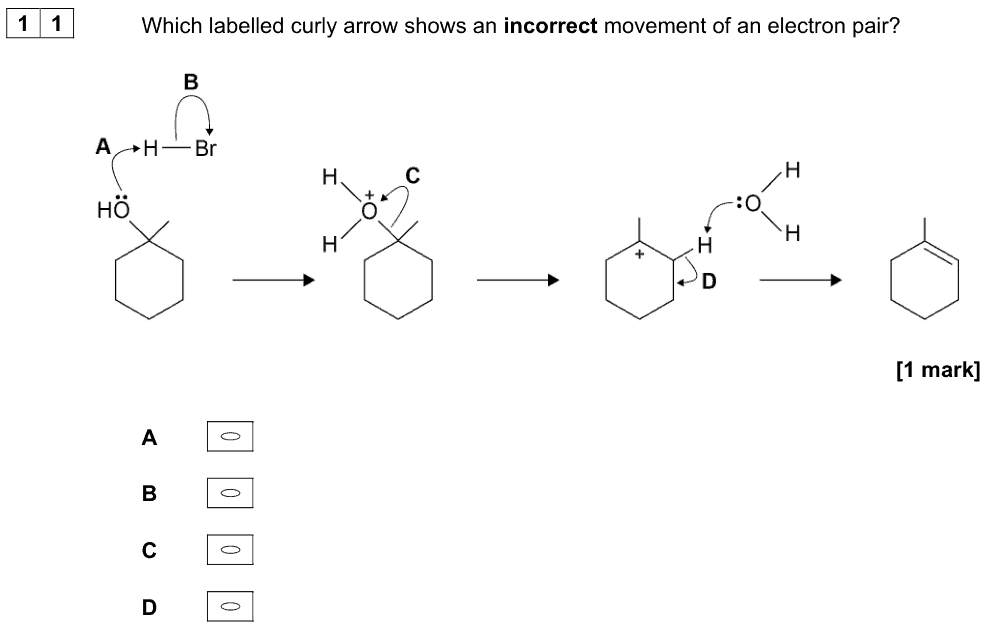
11 Introduction to organic chemistry: nomenclature, mechanisms and isomerism 1AO3=1Multiple choice
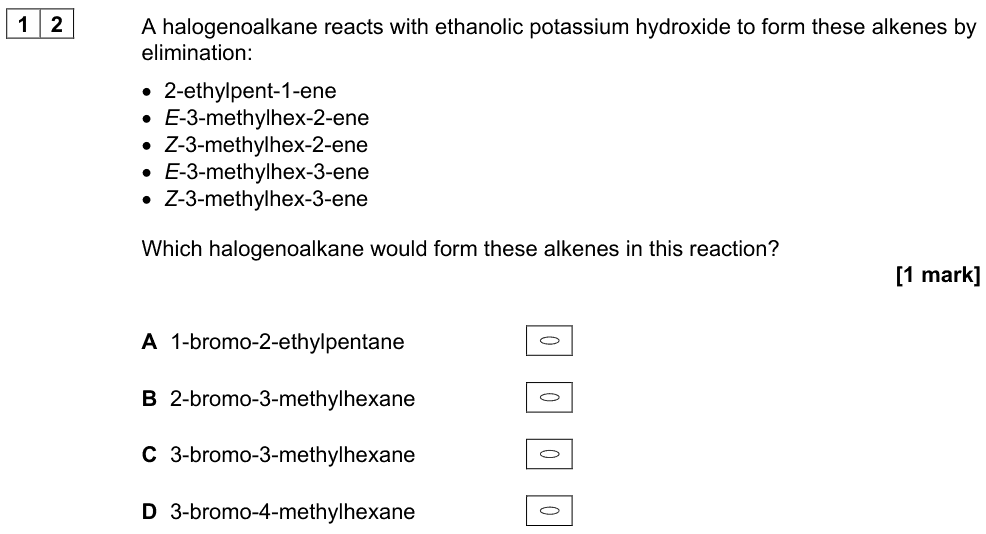
12 Halogenoalkanes, Introduction to organic chemistry: nomenclature, mechanisms and isomerism 1AO3=1Multiple choice
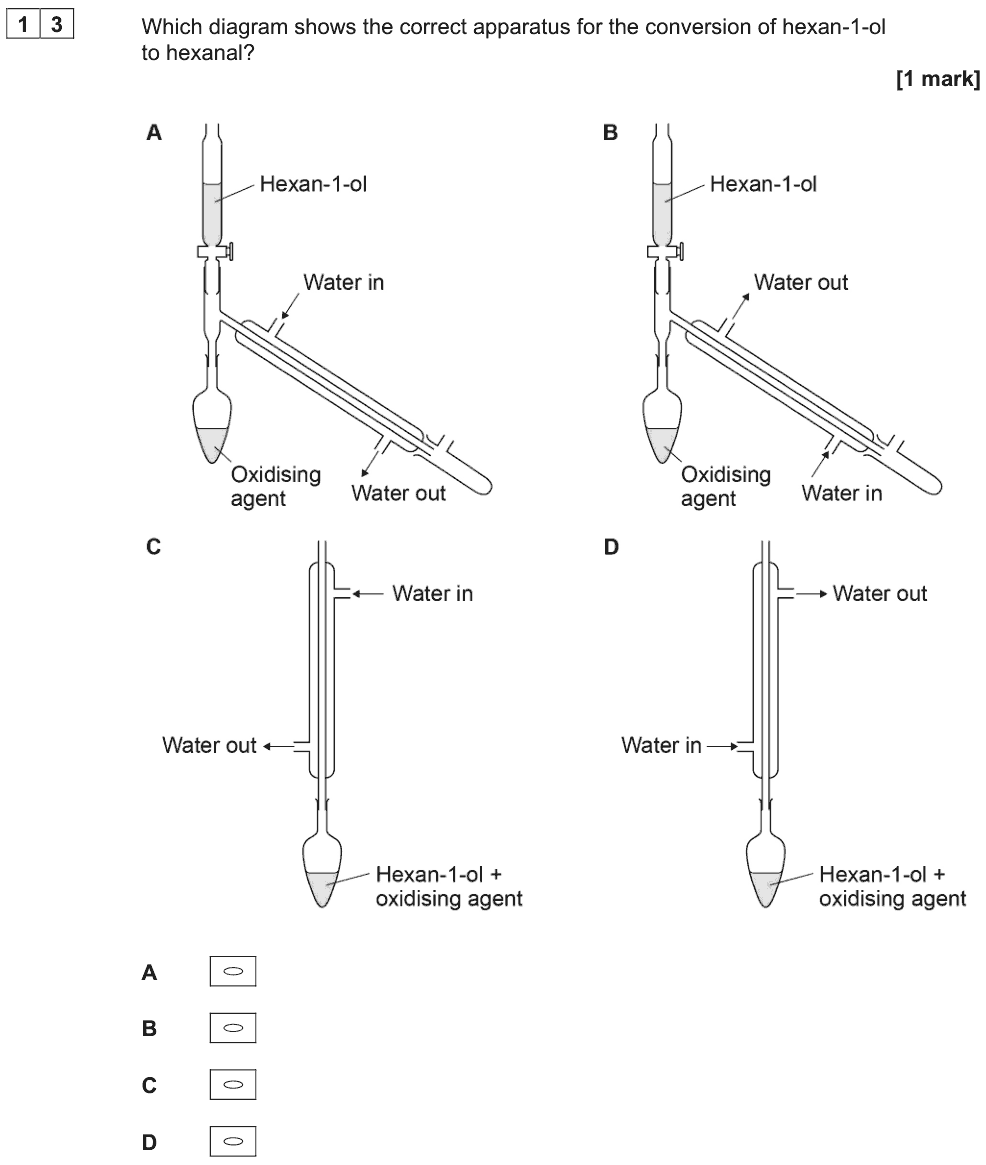
13 Alcohols 1AO1=1Multiple choice
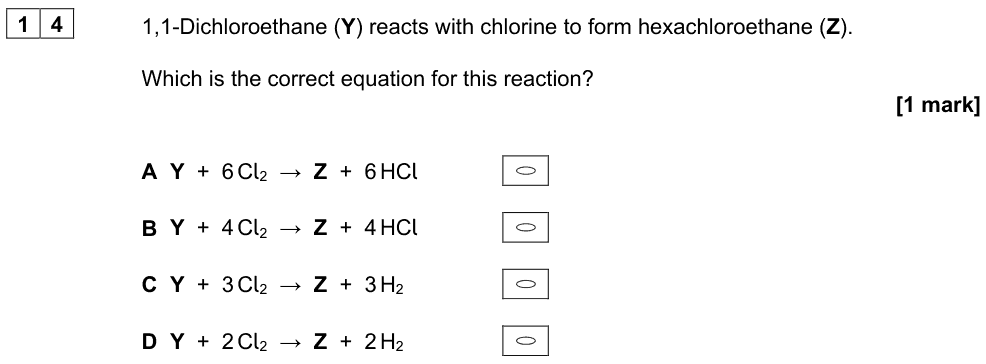
14 Alkanes, Amount of substance 1AO1=1Multiple choice
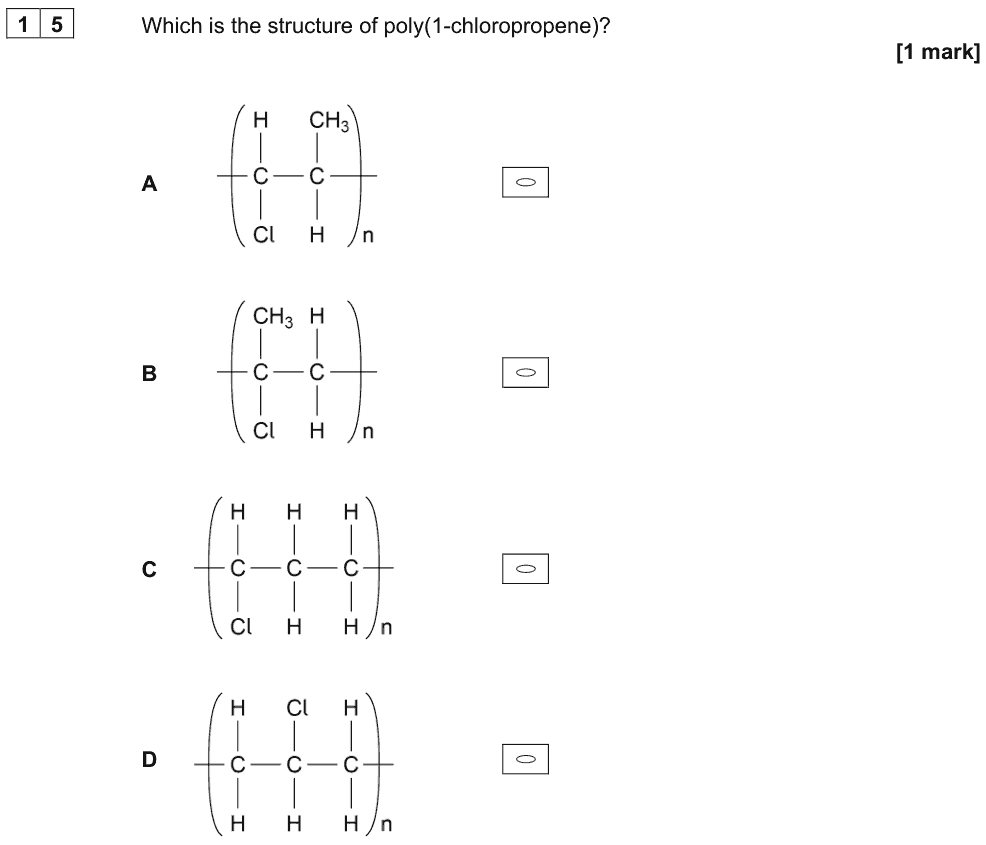
15 Alkenes 1AO2=1Multiple choice
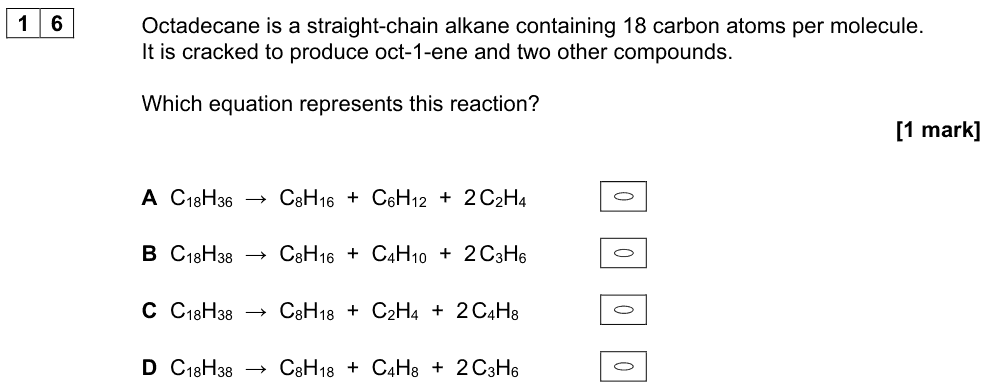
16 Alkanes, Amount of substance 1AO2=1Multiple choice
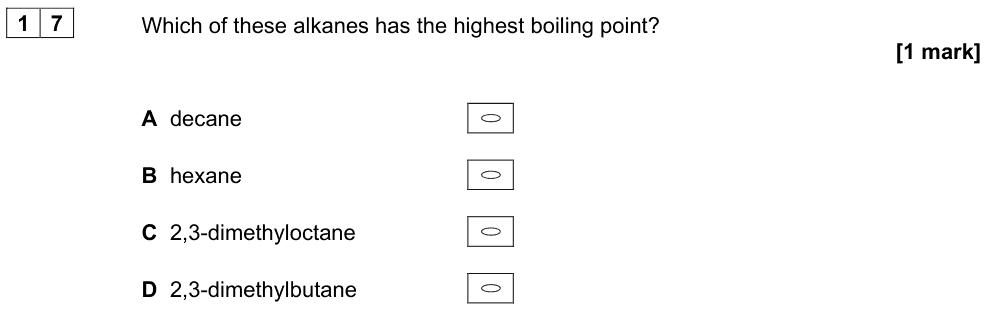
17 Bonding 1AO3=1Multiple choice
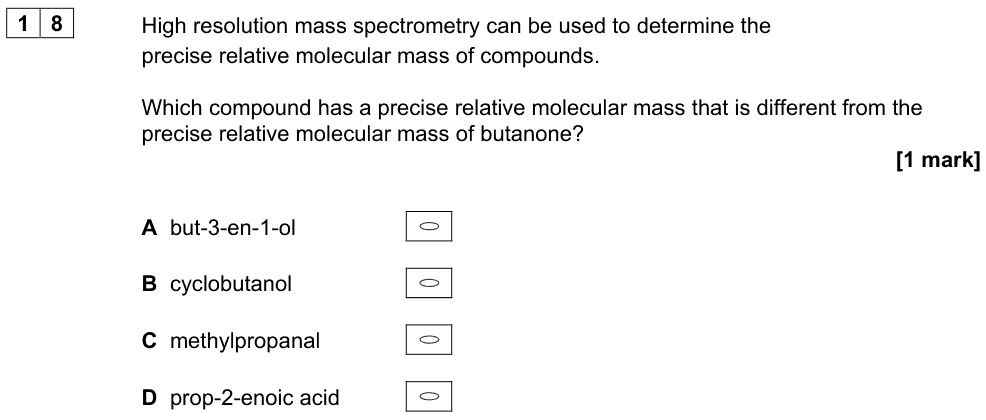
18 Organic analysis: test-tube reactions, mass spectrometry and infrared 1Multiple choice
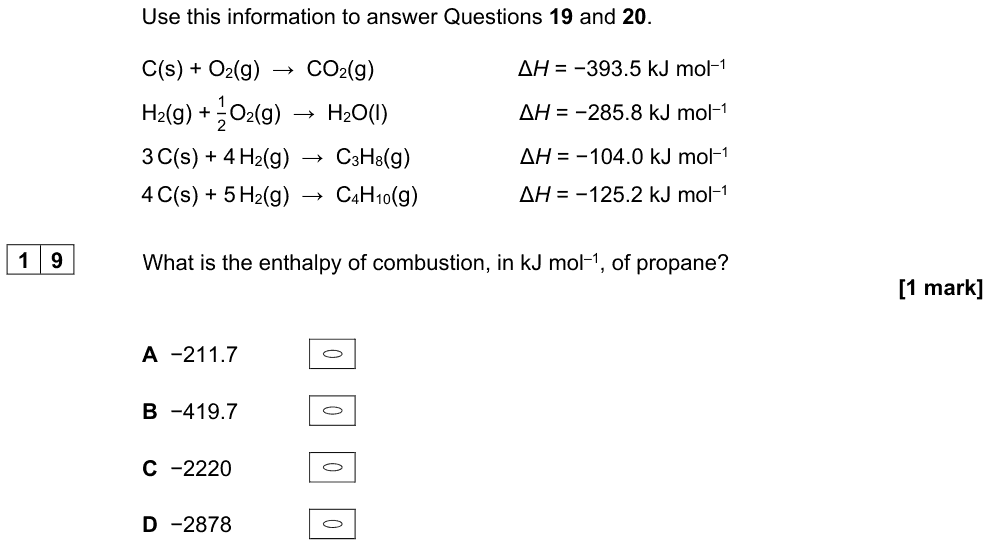
19 Energetics 1AO2=1Multiple choice
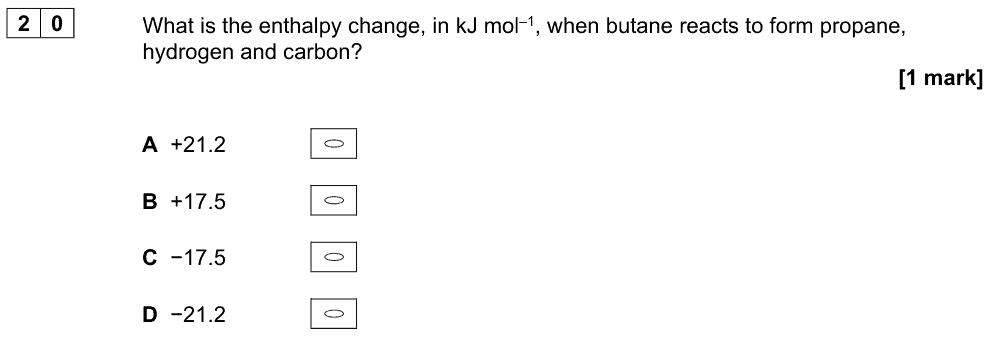
20 Energetics 1AO2=1Multiple choice
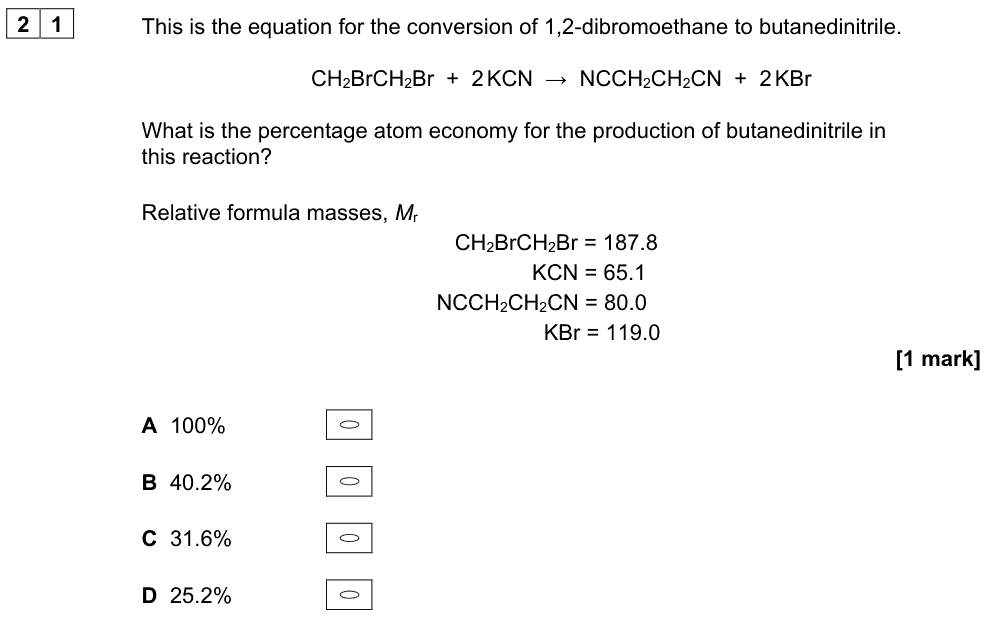
21 Amount of substance 1AO2=1Multiple choice
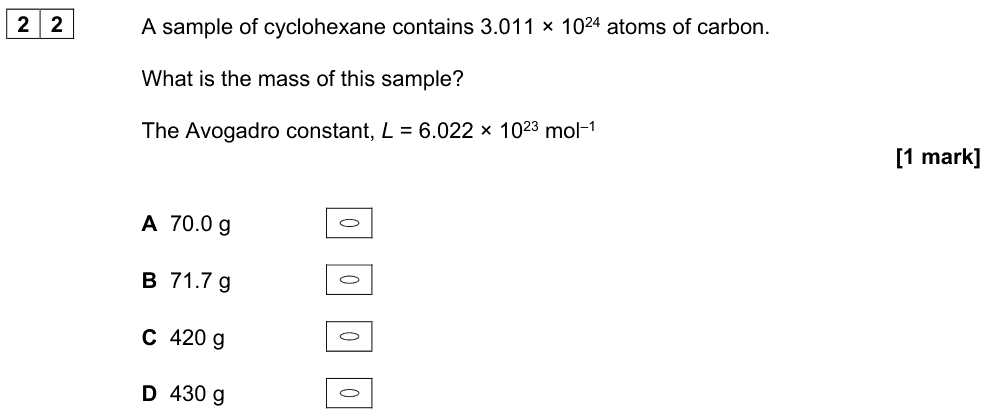
22 Amount of substance 1AO1=1Multiple choice

The questions

01.101.202.102.202.303.103.203.303.403.504.104.204.305.105.206.106.206.307.107.207.307.407.507.607.707.8080910111213141516171819202122
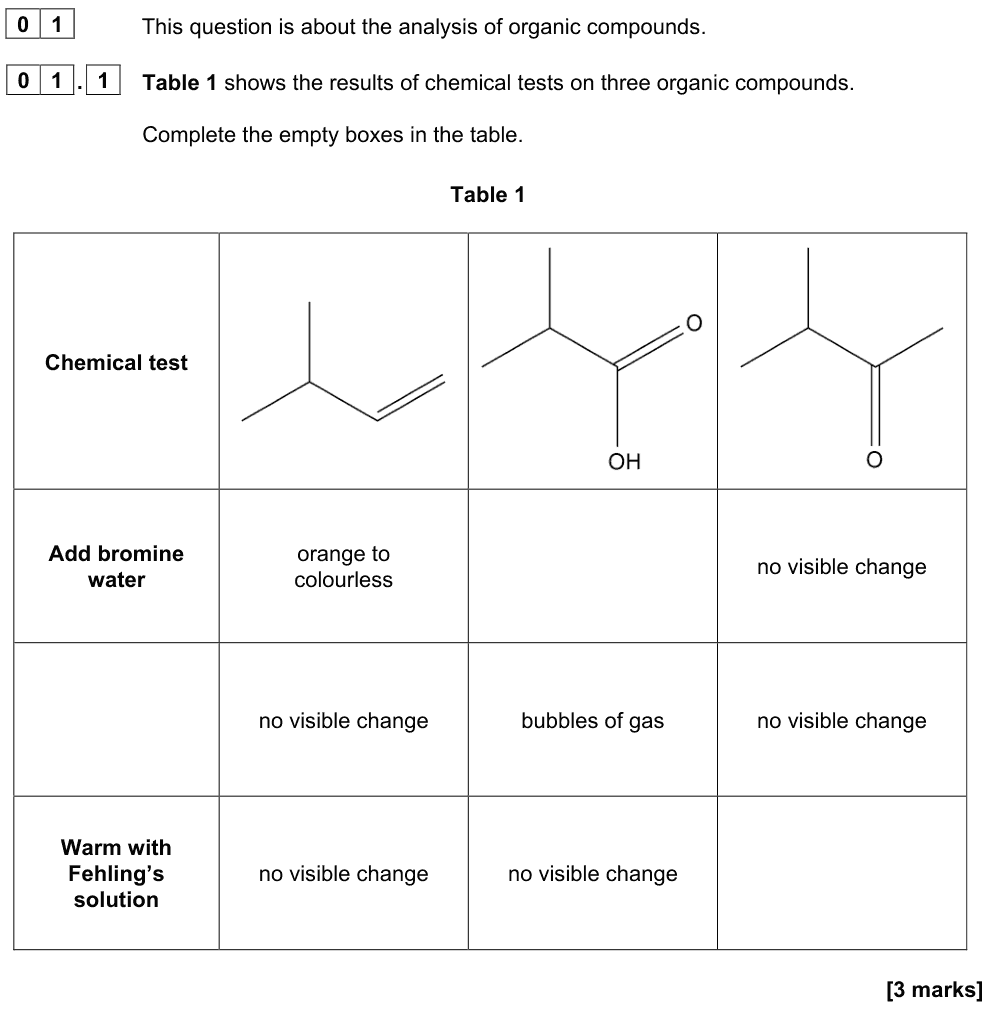
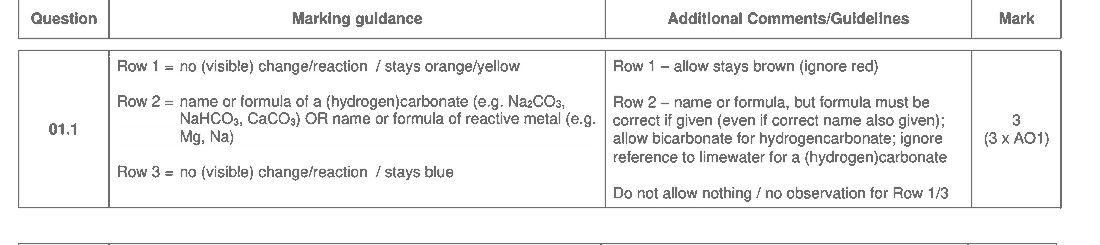
June 2024 · AS Paper 2 · Q01.1 3 marks AO1=3 Practical and data analysis organic analysisalkenesalcohols
This question is about the analysis of organic compounds.
Table 1 shows the results of chemical tests on three organic compounds.
Complete the empty boxes in the table.
Table 1
Chemical test
Add bromine
water
orange to
colourless
no visible change
no visible change
bubbles of gas
no visible change
Warm with
Fehling’s
solution
no visible change
no visible change
[3 marks]
June 2024 · AS Paper 2 · Q01.2 3 marks AO3=3 Calculation amount of substance
Earlier part of question 01 that this part usesEarlier part of June 2024 Paper 2 question 01
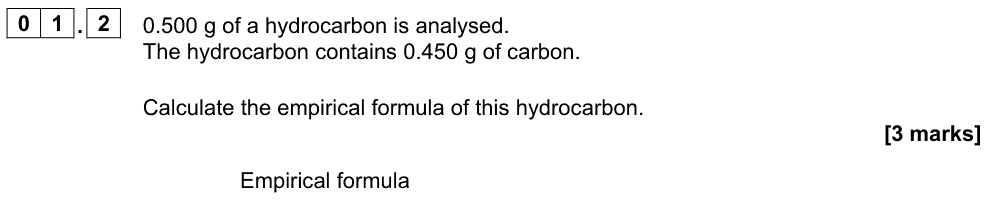
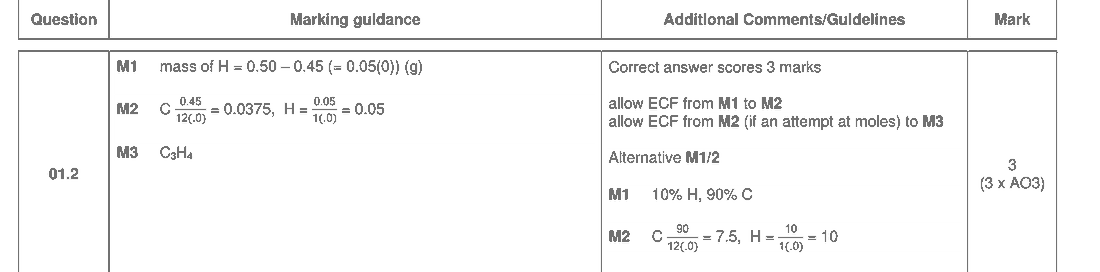
0.500 g of a hydrocarbon is analysed.
The hydrocarbon contains 0.450 g of carbon.
Calculate the empirical formula of this hydrocarbon.
[3 marks]
Empirical formula
June 2024 · AS Paper 2 · Q02.1 2 marks AO3=2 Diagram or structure organic analysisintroduction to organic chemistry
This question is about infrared spectroscopy.
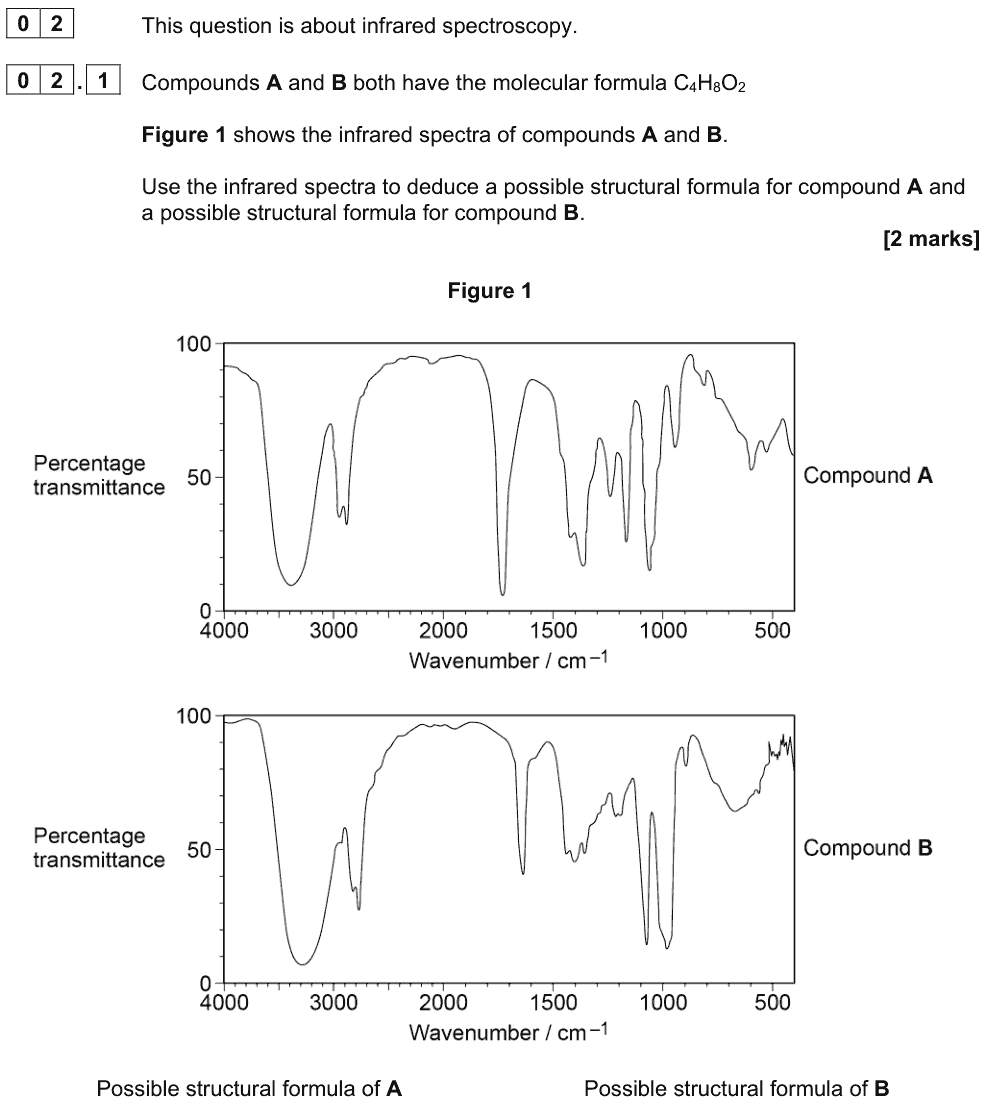
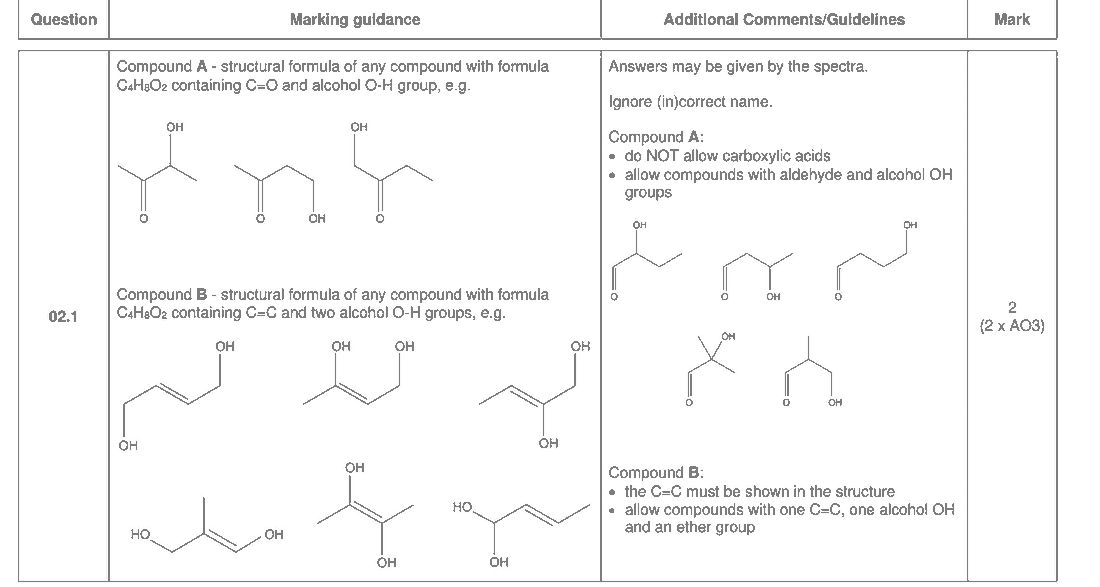
Compounds A and B both have the molecular formula C4H8O2
Figure 1 shows the infrared spectra of compounds A and B.
Use the infrared spectra to deduce a possible structural formula for compound A and
a possible structural formula for compound B.
[2 marks]
Figure 1
Possible structural formula of A
Possible structural formula of B
June 2024 · AS Paper 2 · Q02.2 2 marks AO1=2 Short answer organic analysis
Earlier part of question 02 that this part usesEarlier part of June 2024 Paper 2 question 02
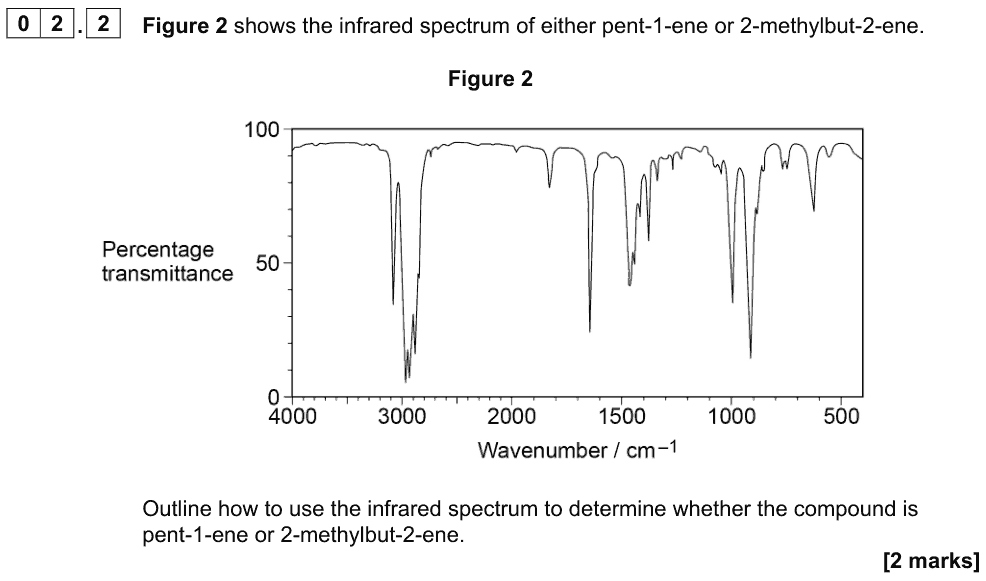
Figure 2 shows the infrared spectrum of either pent-1-ene or 2-methylbut-2-ene.
Figure 2
Outline how to use the infrared spectrum to determine whether the compound is
pent-1-ene or 2-methylbut-2-ene.
[2 marks]
June 2024 · AS Paper 2 · Q02.3 1 mark AO1=1 Short answer organic analysis
Earlier part of question 02 that this part usesEarlier part of June 2024 Paper 2 question 02
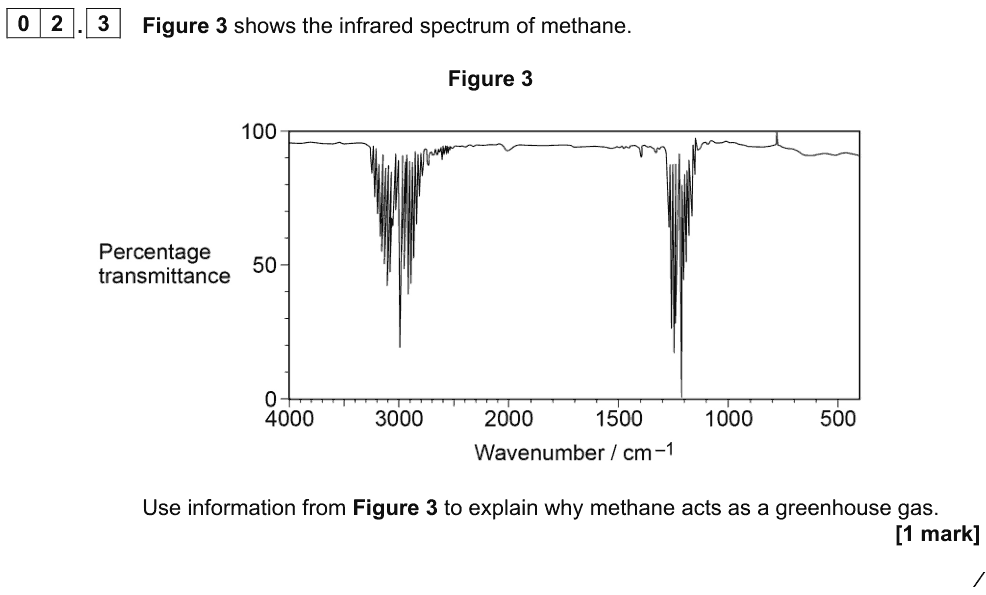
Figure 3 shows the infrared spectrum of methane.
Figure 3
Use information from Figure 3 to explain why methane acts as a greenhouse gas.
[1 mark]
June 2024 · AS Paper 2 · Q03.1 1 mark AO1=1 Short answer introduction to organic chemistry
This question is about CFCl3
CFCl3 used to be the propellant in most aerosol cans.
Use IUPAC rules to name CFCl3
[1 mark]
June 2024 · AS Paper 2 · Q03.2 2 marks AO2=2 Equation writing introduction to organic chemistryalkanes
Earlier part of question 03 that this part usesEarlier part of June 2024 Paper 2 question 03
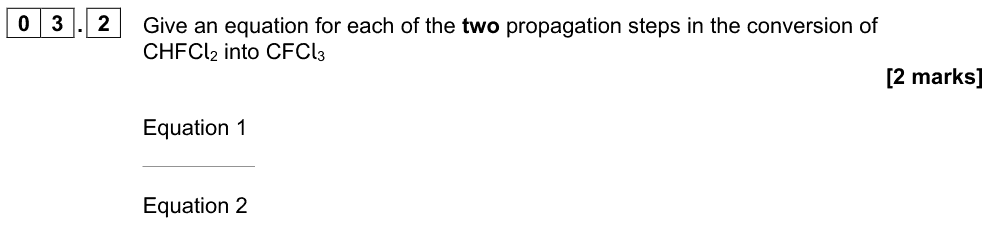
Give an equation for each of the two propagation steps in the conversion of
CHFCl2 into CFCl3
[2 marks]
Equation 1
Equation 2
June 2024 · AS Paper 2 · Q03.3 1 mark AO2=1 Equation writing halogenoalkanesintroduction to organic chemistry
Earlier part of question 03 that this part usesEarlier part of June 2024 Paper 2 question 03
In the presence of ultraviolet radiation, CFCl3 breaks down in the upper atmosphere to
form chlorine free radicals.
Give an equation for this reaction.
[1 mark]
June 2024 · AS Paper 2 · Q03.4 2 marks AO1=2 Equation writing halogenoalkanes
Earlier part of question 03 that this part usesEarlier part of June 2024 Paper 2 question 03
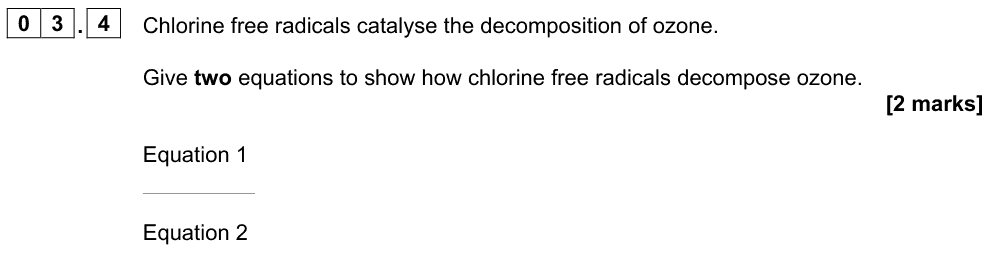
Chlorine free radicals catalyse the decomposition of ozone.
Give two equations to show how chlorine free radicals decompose ozone.
[2 marks]
Equation 1
Equation 2
June 2024 · AS Paper 2 · Q03.5 1 mark AO1=1 Short answer halogenoalkanes
Earlier part of question 03 that this part usesEarlier part of June 2024 Paper 2 question 03
The production and use of CFCs have been banned in many countries because they
decrease the amount of ozone in the upper atmosphere.
State why ozone in the upper atmosphere is important for life on Earth.
[1 mark]
June 2024 · AS Paper 2 · Q04.1 6 marks AO1=4, AO3=2 6-mark level of response introduction to organic chemistry
Compound J is one of a pair of stereoisomers.
Explain:
• what stereoisomers are
• how E-Z stereoisomerism occurs
• how the Cahn-Ingold-Prelog rules can be used to decide whether compound J is an
E or Z isomer.
[6 marks]
June 2024 · AS Paper 2 · Q04.2 5 marks AO1=1, AO2=4 Mechanism alkenesintroduction to organic chemistry
Earlier part of question 04 that this part usesEarlier part of June 2024 Paper 2 question 04
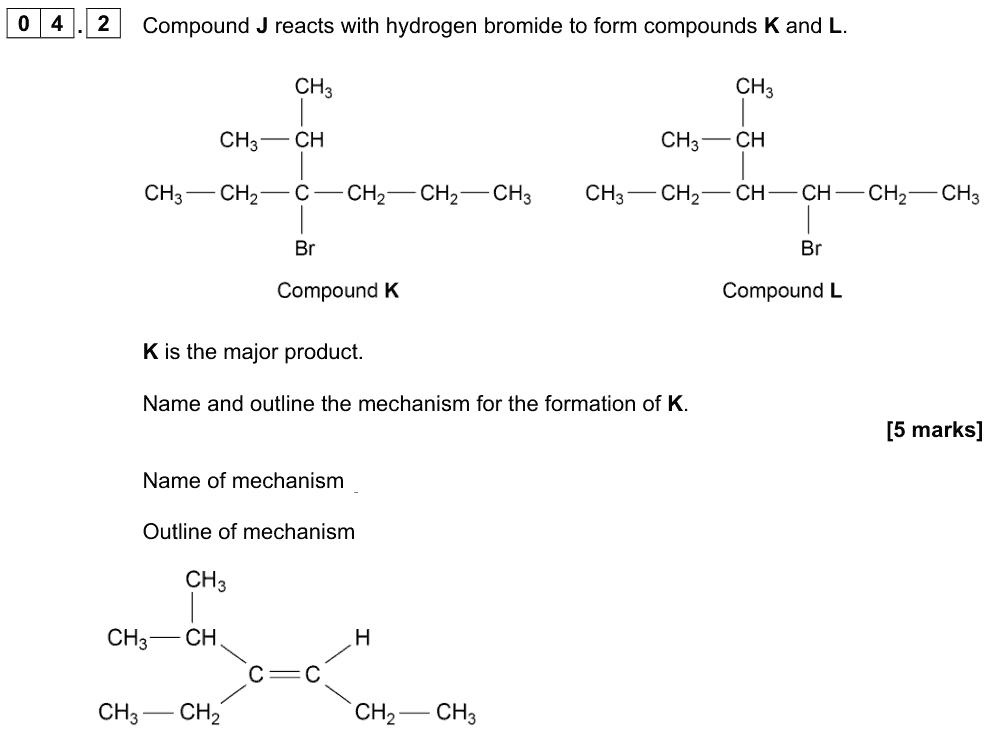
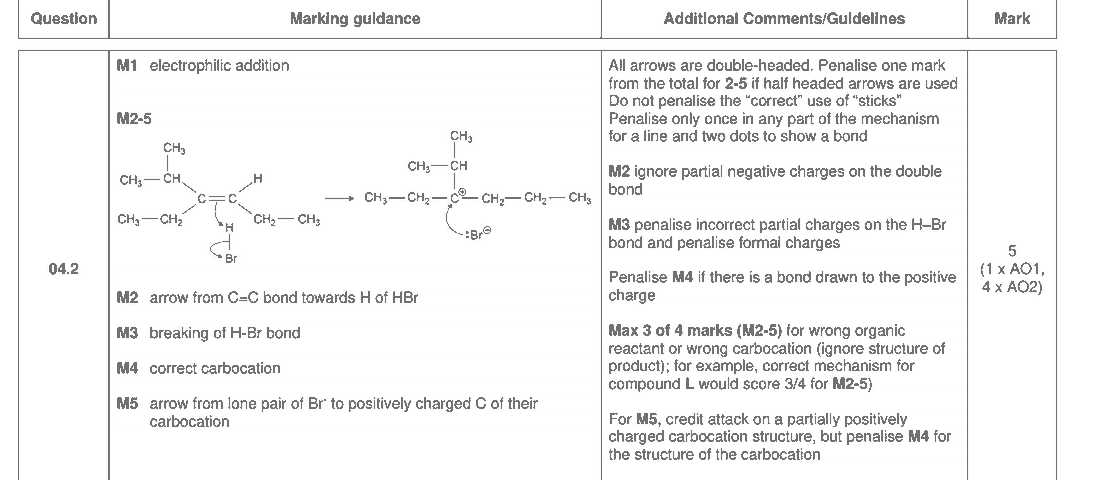
Compound J reacts with hydrogen bromide to form compounds K and L.
K is the major product.
Name and outline the mechanism for the formation of K.
[5 marks]
Name of mechanism
Outline of mechanism
June 2024 · AS Paper 2 · Q04.3 3 marks AO3=3 Explanation alkenes
Earlier parts of question 04 that this part usesEarlier part of June 2024 Paper 2 question 04Earlier part of June 2024 Paper 2 question 04
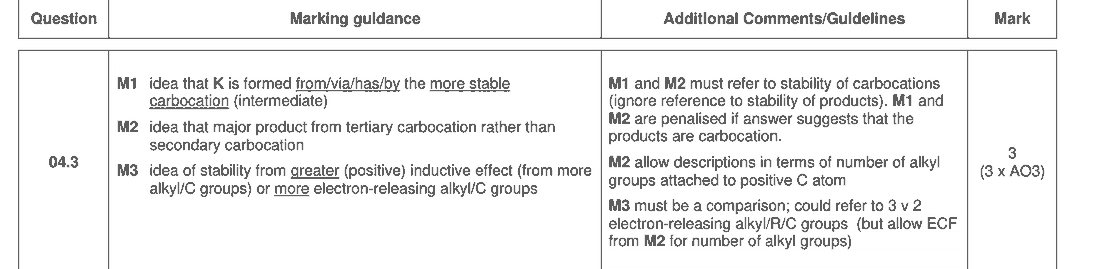
Explain why compound K is the major product in the reaction in Question 04.2.
[3 marks]
June 2024 · AS Paper 2 · Q05.1 7 marks AO1=2, AO2=5 Calculation amount of substance
This question is about the volumes of gases involved in some reactions.
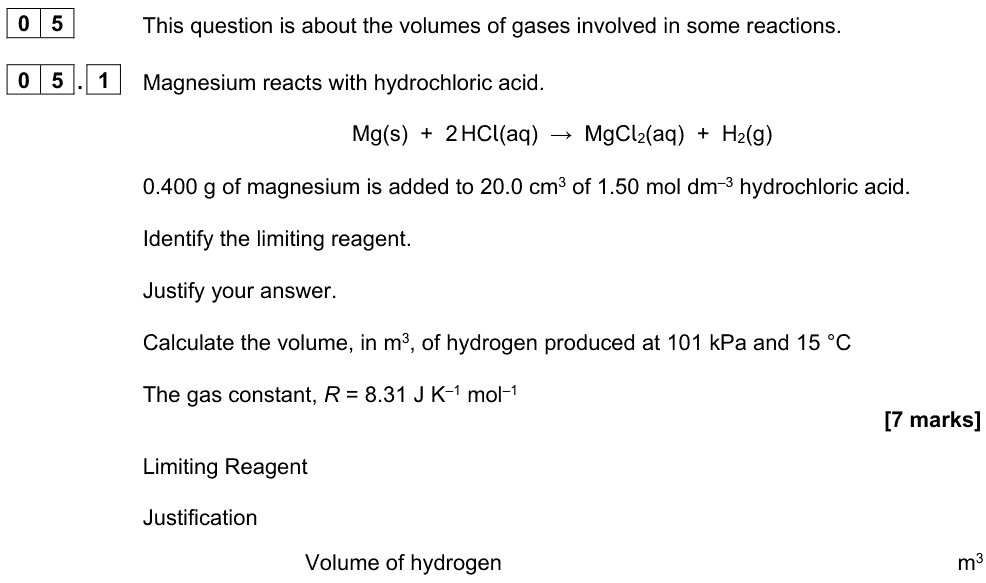
Magnesium reacts with hydrochloric acid.
Mg(s)  +  2 HCl(aq)  →  MgCl2(aq)  +  H2(g)
0.400 g of magnesium is added to 20.0 cm3 of 1.50 mol dm–3 hydrochloric acid.
Identify the limiting reagent.
Justify your answer.
Calculate the volume, in m3, of hydrogen produced at 101 kPa and 15 °C
The gas constant, R = 8.31 J K–1 mol–1
[7 marks]
Limiting Reagent
Justification
Volume of hydrogen
m3
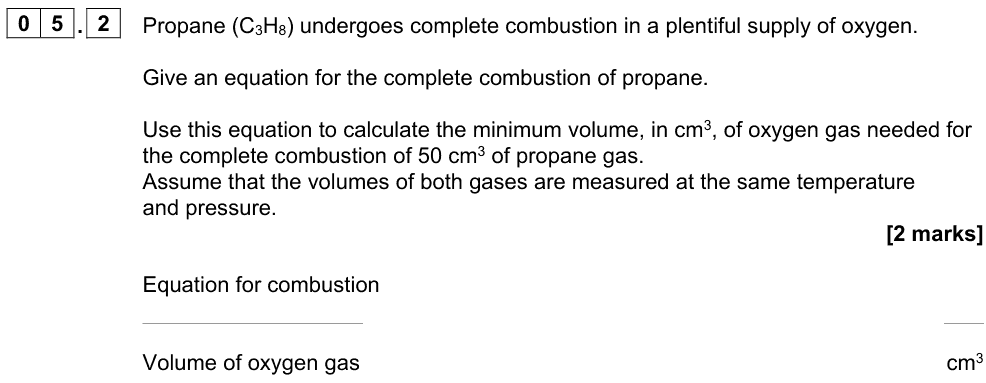
June 2024 · AS Paper 2 · Q05.2 2 marks AO2=2 Calculation amount of substancealkanes
Earlier part of question 05 that this part usesEarlier part of June 2024 Paper 2 question 05
Propane (C3H8) undergoes complete combustion in a plentiful supply of oxygen.
Give an equation for the complete combustion of propane.
Use this equation to calculate the minimum volume, in cm3, of oxygen gas needed for
the complete combustion of 50 cm3 of propane gas.
Assume that the volumes of both gases are measured at the same temperature
and pressure.
[2 marks]
Equation for combustion
Volume of oxygen gas
cm3
June 2024 · AS Paper 2 · Q06.1 1 mark AO2=1 Short answer group 7 the halogens
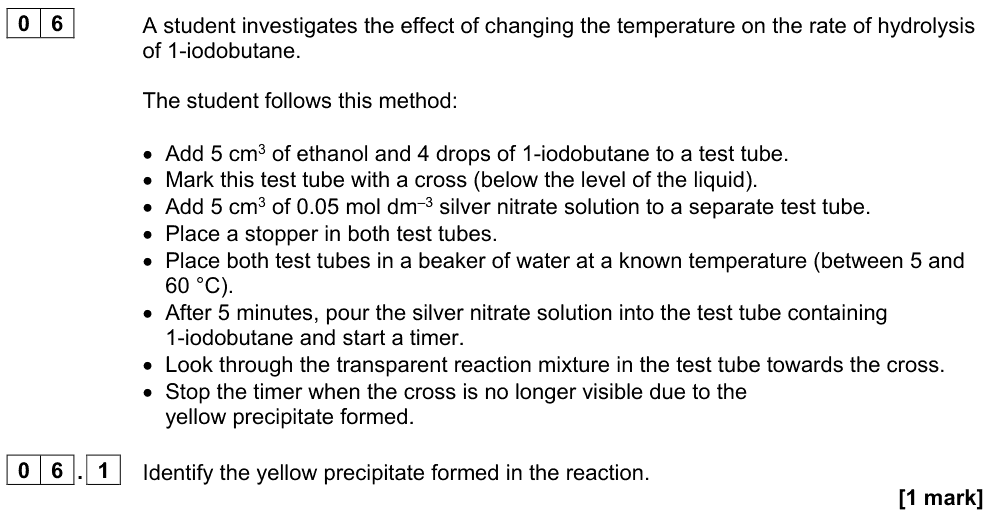
A student investigates the effect of changing the temperature on the rate of hydrolysis
of 1-iodobutane.
The student follows this method:
• Add 5 cm3 of ethanol and 4 drops of 1-iodobutane to a test tube.
• Mark this test tube with a cross (below the level of the liquid).
• Add 5 cm3 of 0.05 mol dm–3 silver nitrate solution to a separate test tube.
• Place a stopper in both test tubes.
• Place both test tubes in a beaker of water at a known temperature (between 5 and
60 °C).
• After 5 minutes, pour the silver nitrate solution into the test tube containing
1-iodobutane and start a timer.
• Look through the transparent reaction mixture in the test tube towards the cross.
• Stop the timer when the cross is no longer visible due to the
yellow precipitate formed.
Identify the yellow precipitate formed in the reaction.
[1 mark]
June 2024 · AS Paper 2 · Q06.2 3 marks AO2=3 Practical and data analysis kinetics
Earlier part of question 06 that this part usesEarlier part of June 2024 Paper 2 question 06
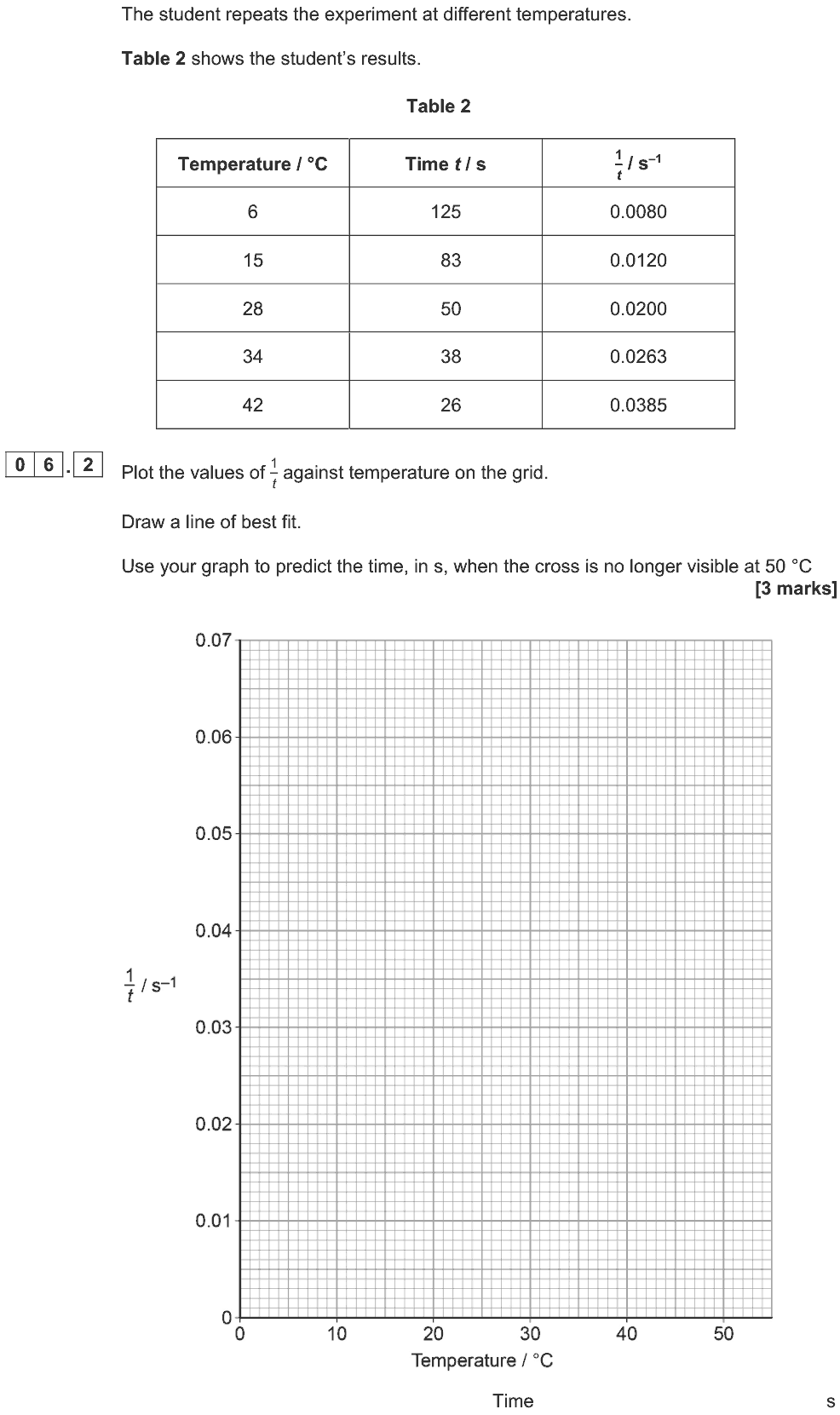
The student repeats the experiment at different temperatures.
Table 2 shows the student’s results.
Table 2
Temperature / °C
Time t / s
1
t / s–1
6
125
0.0080
15
83
0.0120
28
50
0.0200
34
38
0.0263
42
26
0.0385
Plot the values of
1
t against temperature on the grid.
Draw a line of best fit.
Use your graph to predict the time, in s, when the cross is no longer visible at 50 °C
[3 marks]
Time
s
June 2024 · AS Paper 2 · Q06.3 3 marks AO3=3 Explanation halogenoalkanes
Earlier parts of question 06 that this part usesEarlier part of June 2024 Paper 2 question 06Earlier part of June 2024 Paper 2 question 06
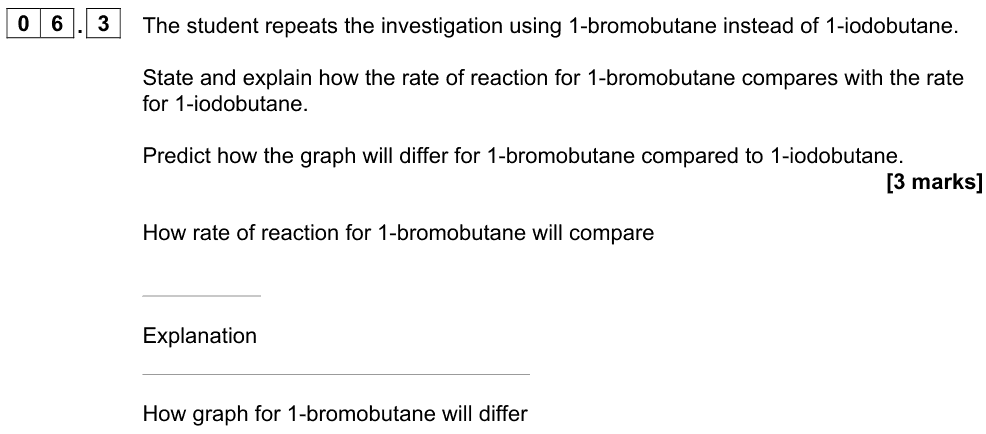
The student repeats the investigation using 1-bromobutane instead of 1-iodobutane.
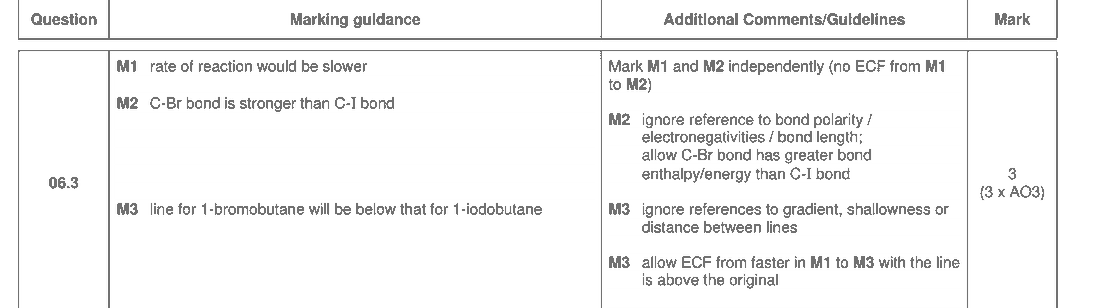
State and explain how the rate of reaction for 1-bromobutane compares with the rate
for 1-iodobutane.
Predict how the graph will differ for 1-bromobutane compared to 1-iodobutane.
[3 marks]
How rate of reaction for 1-bromobutane will compare
Explanation
How graph for 1-bromobutane will differ
June 2024 · AS Paper 2 · Q07.1 1 mark AO1=1 Short answer alcohols
This question is about propanoic acid (CH3CH2COOH).
The equation for the oxidation of propan-1-ol under reflux to form propanoic acid
is shown.
Acidified potassium dichromate(VI) is used as the oxidising agent.
State the colour change in this reaction.
[1 mark]
June 2024 · AS Paper 2 · Q07.2 1 mark AO2=1 Short answer alcohols
Earlier part of question 07 that this part usesEarlier part of June 2024 Paper 2 question 07
A second organic product, X, is formed in small quantities.
The boiling point of X is 49 °C
Identify X.
[1 mark]
June 2024 · AS Paper 2 · Q07.3 3 marks AO1=3 Diagram or structure bonding
Earlier part of question 07 that this part usesEarlier part of June 2024 Paper 2 question 07
Propanoic acid molecules cannot be separated from the reaction mixture by simple
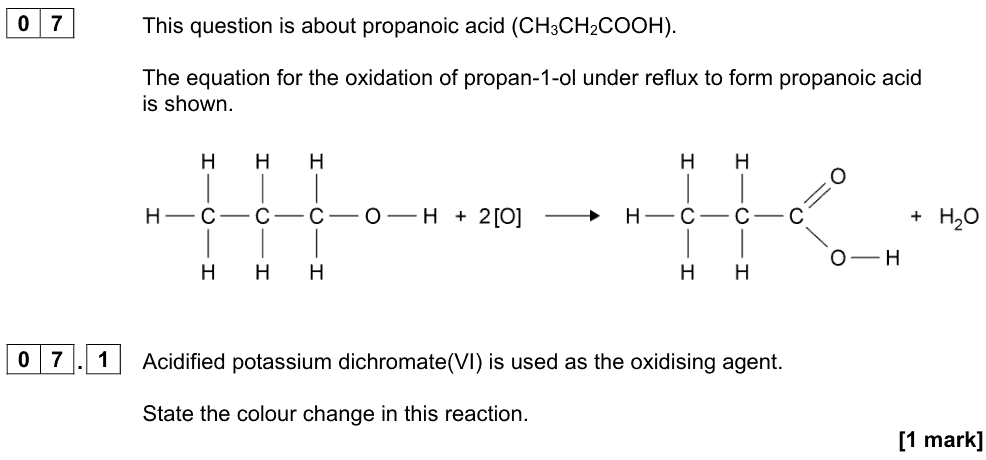
distillation because propanoic acid forms hydrogen bonds with water molecules.

Complete the diagram to show how the propanoic acid molecule interacts with

one water molecule through hydrogen bonding.
Include in the diagram all the partial charges and lone pairs of electrons involved in
this hydrogen bond.
[3 marks]
June 2024 · AS Paper 2 · Q07.4 3 marks AO1=1, AO2=2 Mechanism halogenoalkanesintroduction to organic chemistry
Earlier part of question 07 that this part usesEarlier part of June 2024 Paper 2 question 07
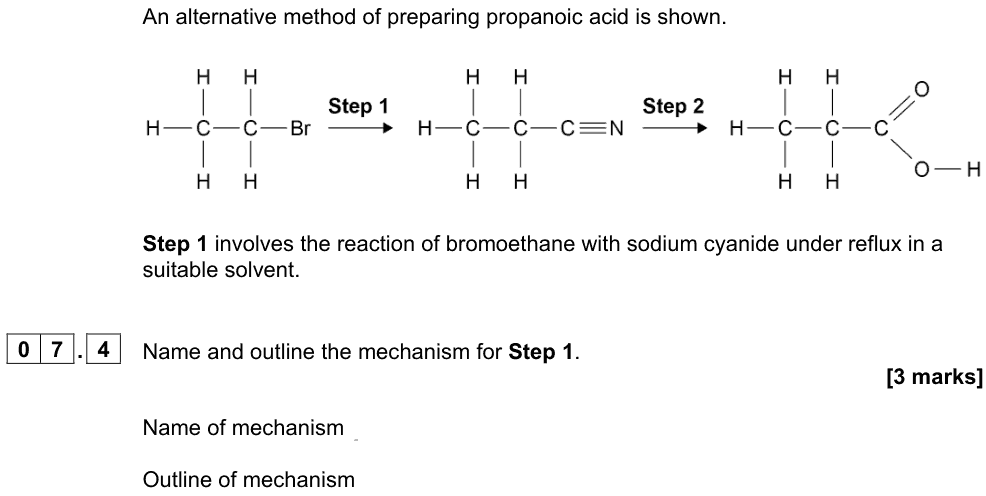
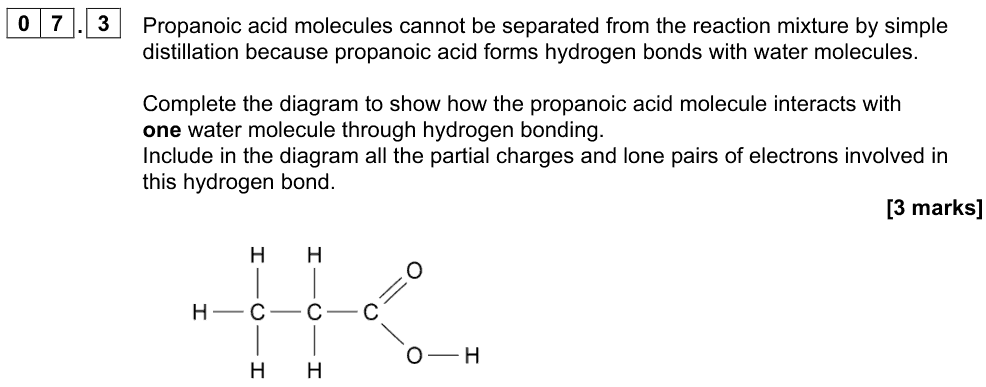
An alternative method of preparing propanoic acid is shown.

Step 1 involves the reaction of bromoethane with sodium cyanide under reflux in a
suitable solvent.
Name and outline the mechanism for Step 1.
[3 marks]
Name of mechanism
Outline of mechanism
June 2024 · AS Paper 2 · Q07.5 1 mark AO3=1 Short answer halogenoalkanes
Earlier parts of question 07 that this part usesEarlier part of June 2024 Paper 2 question 07Earlier part of June 2024 Paper 2 question 07
Suggest one reason why water is not a suitable solvent for Step 1.
[1 mark]
June 2024 · AS Paper 2 · Q07.6 1 mark AO2=1 Short answer chemical equilibria and kc
Earlier parts of question 07 that this part usesEarlier part of June 2024 Paper 2 question 07Earlier part of June 2024 Paper 2 question 07
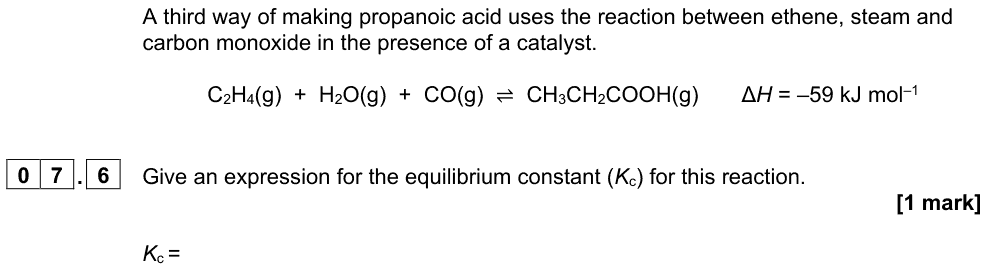
A third way of making propanoic acid uses the reaction between ethene, steam and
carbon monoxide in the presence of a catalyst.
C2H4(g)  +  H2O(g)  +  CO(g)  ⇌  CH3CH2COOH(g)       ΔH = –59 kJ mol–1
Give an expression for the equilibrium constant (Kc) for this reaction.
[1 mark]
Kc =
June 2024 · AS Paper 2 · Q07.7 4 marks AO2=4 Calculation chemical equilibria and kc
Earlier parts of question 07 that this part usesEarlier part of June 2024 Paper 2 question 07Earlier part of June 2024 Paper 2 question 07Earlier part of June 2024 Paper 2 question 07
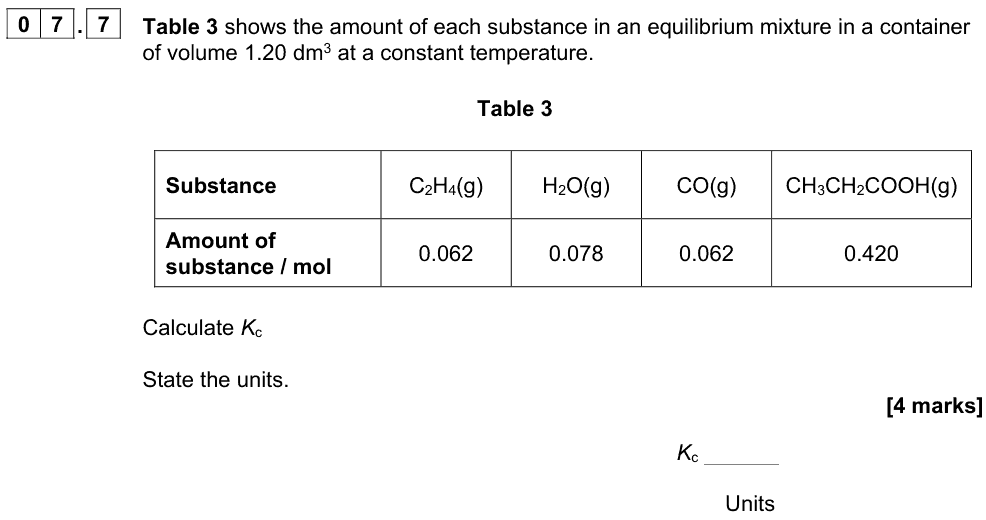
Table 3 shows the amount of each substance in an equilibrium mixture in a container
of volume 1.20 dm3 at a constant temperature.
Table 3
Substance
C2H4(g)
H2O(g)
CO(g)
CH3CH2COOH(g)
Amount of
substance / mol
0.062
0.078
0.062
0.420
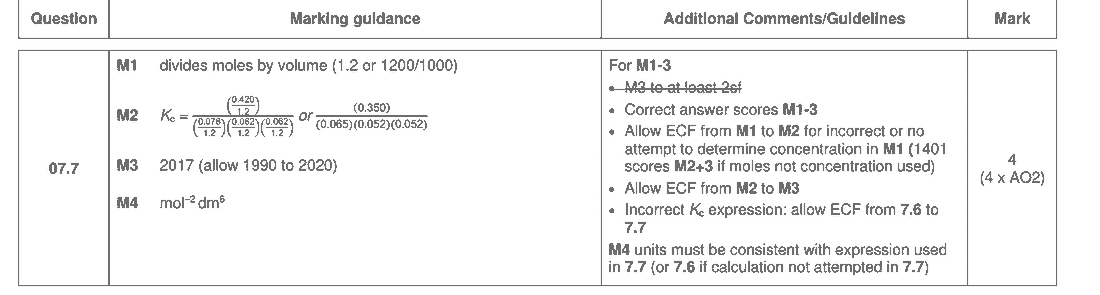
Calculate Kc
State the units.
[4 marks]
Kc
Units
June 2024 · AS Paper 2 · Q07.8 3 marks AO2=3 Explanation chemical equilibria and kc
Earlier parts of question 07 that this part usesEarlier part of June 2024 Paper 2 question 07Earlier part of June 2024 Paper 2 question 07
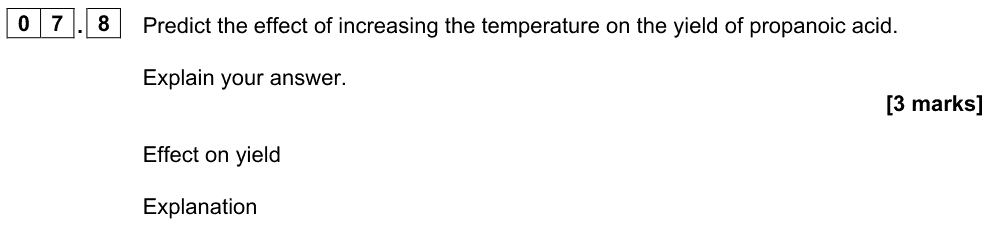
Predict the effect of increasing the temperature on the yield of propanoic acid.
Explain your answer.
[3 marks]
Effect on yield
Explanation
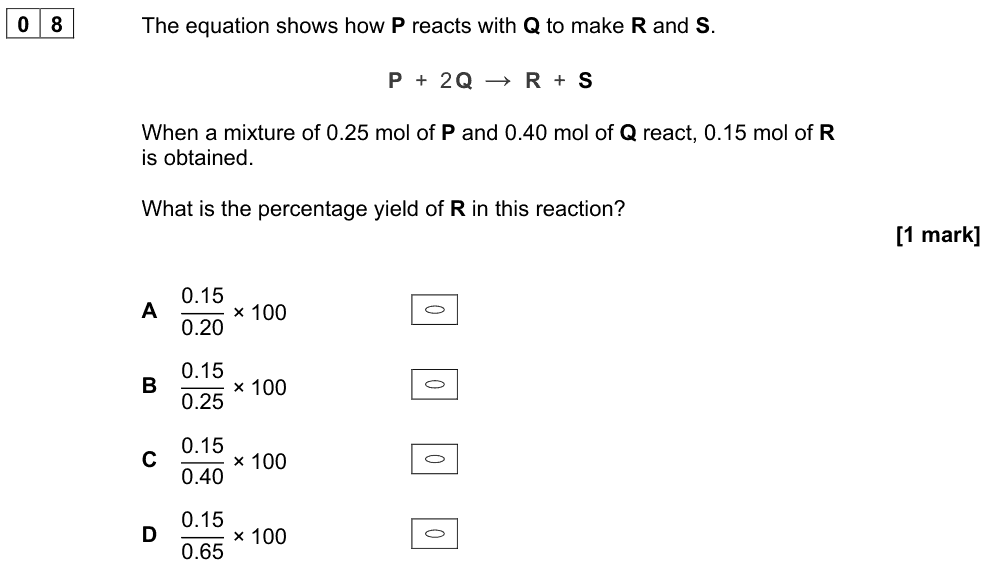
June 2024 · AS Paper 2 · Q08 1 mark AO2=1 Multiple choice amount of substance
The equation shows how P reacts with Q to make R and S.
P  +  2 Q  →  R  +  S
When a mixture of 0.25 mol of P and 0.40 mol of Q react, 0.15 mol of R
is obtained.
What is the percentage yield of R in this reaction?
[1 mark]
A
0.15
0.20 × 100
B
0.15
0.25 × 100
C
0.15
0.40 × 100
D
0.15
0.65 × 100
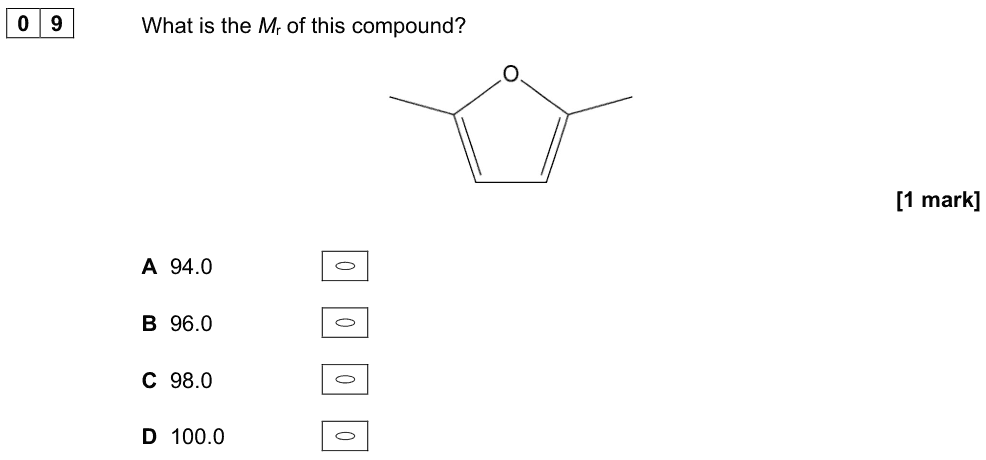
June 2024 · AS Paper 2 · Q09 1 mark AO1=1 Multiple choice Easy introduction to organic chemistryamount of substance
What is the Mr of this compound?
[1 mark]
A 94.0
B 96.0
C 98.0
D 100.0
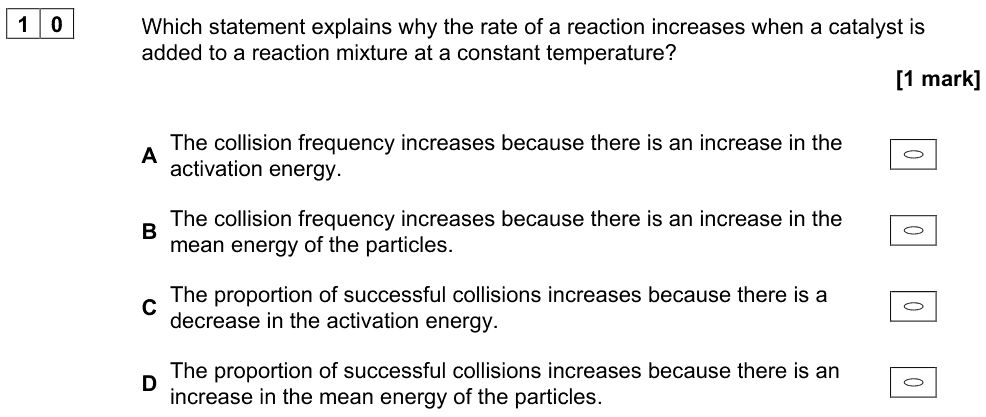
June 2024 · AS Paper 2 · Q10 1 mark AO1=1 Multiple choice Easy kinetics
Which statement explains why the rate of a reaction increases when a catalyst is
added to a reaction mixture at a constant temperature?
[1 mark]
A The collision frequency increases because there is an increase in the
activation energy.
B The collision frequency increases because there is an increase in the
mean energy of the particles.
C The proportion of successful collisions increases because there is a
decrease in the activation energy.
D The proportion of successful collisions increases because there is an
increase in the mean energy of the particles.
June 2024 · AS Paper 2 · Q11 1 mark AO3=1 Multiple choice introduction to organic chemistry
Which labelled curly arrow shows an incorrect movement of an electron pair?
[1 mark]
A
B
C
D
June 2024 · AS Paper 2 · Q12 1 mark AO3=1 Multiple choice halogenoalkanesintroduction to organic chemistry
A halogenoalkane reacts with ethanolic potassium hydroxide to form these alkenes by
elimination:
• 2-ethylpent-1-ene
• E-3-methylhex-2-ene
• Z-3-methylhex-2-ene
• E-3-methylhex-3-ene
• Z-3-methylhex-3-ene
Which halogenoalkane would form these alkenes in this reaction?
[1 mark]
A 1-bromo-2-ethylpentane
B 2-bromo-3-methylhexane
C 3-bromo-3-methylhexane
D 3-bromo-4-methylhexane
June 2024 · AS Paper 2 · Q13 1 mark AO1=1 Multiple choice alcohols
Which diagram shows the correct apparatus for the conversion of hexan-1-ol
to hexanal?
[1 mark]
A
B
C
D
June 2024 · AS Paper 2 · Q14 1 mark AO1=1 Multiple choice alkanesamount of substance
1,1-Dichloroethane (Y) reacts with chlorine to form hexachloroethane (Z).
Which is the correct equation for this reaction?
[1 mark]
A Y  +  6 Cl2  →  Z  +  6 HCl
B Y  +  4 Cl2  →  Z  +  4 HCl
C Y  +  3 Cl2  →  Z  +  3 H2
D Y  +  2 Cl2  →  Z  +  2 H2
June 2024 · AS Paper 2 · Q15 1 mark AO2=1 Multiple choice Easy alkenes
Which is the structure of poly(1-chloropropene)?
[1 mark]
A
B
C
D
June 2024 · AS Paper 2 · Q16 1 mark AO2=1 Multiple choice Easy alkanesamount of substance
Octadecane is a straight-chain alkane containing 18 carbon atoms per molecule.
It is cracked to produce oct-1-ene and two other compounds.
Which equation represents this reaction?
[1 mark]
A C18H36  →  C8H16  +  C6H12  +  2 C2H4
B C18H38  →  C8H16  +  C4H10  +  2 C3H6
C C18H38  →  C8H18  +  C2H4  +  2 C4H8
D C18H38  →  C8H18  +  C4H8  +  2 C3H6
June 2024 · AS Paper 2 · Q17 1 mark AO3=1 Multiple choice Easy bonding
Which of these alkanes has the highest boiling point?
[1 mark]
A decane
B hexane
C 2,3-dimethyloctane
D 2,3-dimethylbutane
June 2024 · AS Paper 2 · Q18 1 mark Multiple choice organic analysis
High resolution mass spectrometry can be used to determine the
precise relative molecular mass of compounds.
Which compound has a precise relative molecular mass that is different from the
precise relative molecular mass of butanone?
[1 mark]
A but-3-en-1-ol
B cyclobutanol
C methylpropanal
D prop-2-enoic acid
June 2024 · AS Paper 2 · Q19 1 mark AO2=1 Multiple choice energetics
Use this information to answer Questions 19 and 20.
C(s) + O2(g)  →  CO2(g)                        ΔH = −393.5 kJ mol–1
H2(g) +
1
2
O2(g)  →  H2O(l)                      ΔH = −285.8 kJ mol–1
3 C(s) + 4 H2(g)  →  C3H8(g)                  ΔH = −104.0 kJ mol–1
4 C(s) + 5 H2(g)  →  C4H10(g)                 ΔH = −125.2 kJ mol–1
What is the enthalpy of combustion, in kJ mol–1, of propane?
[1 mark]
A −211.7
B −419.7
C −2220
D −2878
June 2024 · AS Paper 2 · Q20 1 mark AO2=1 Multiple choice energetics
Earlier part of question 20 that this part usesEarlier part of June 2024 Paper 2 question 20
What is the enthalpy change, in kJ mol–1, when butane reacts to form propane,
hydrogen and carbon?
[1 mark]
A +21.2
B +17.5
C −17.5
D −21.2
June 2024 · AS Paper 2 · Q21 1 mark AO2=1 Multiple choice Easy amount of substance
This is the equation for the conversion of 1,2-dibromoethane to butanedinitrile.
CH2BrCH2Br  +  2 KCN  →  NCCH2CH2CN  +  2 KBr
What is the percentage atom economy for the production of butanedinitrile in
this reaction?
Relative formula masses, Mr
CH2BrCH2Br = 187.8
KCN = 65.1
NCCH2CH2CN = 80.0
KBr = 119.0
[1 mark]
A 100%
B 40.2%
C 31.6%
D 25.2%
June 2024 · AS Paper 2 · Q22 1 mark AO1=1 Multiple choice amount of substance
A sample of cyclohexane contains 3.011 × 1024 atoms of carbon.
What is the mass of this sample?
The Avogadro constant, L = 6.022 × 10²³ mol–1
[1 mark]
A 70.0 g
B 71.7 g
C 420 g
D 430 g

Work with an A-level chemistry tutor

Want a paper marked and gone through with you? Message us.

Prefer email? Send an enquiry

If you are under 18, please include a parent's contact details. Enquiries go to enquiries@chemistryaleveltutor.com and are deleted once handled. All tutoring is online.