
June 2018: AS Paper 2, Organic and physical chemistry

80 marks · 44 question parts · Paper, mark scheme and report on AQA's site · Have the Data Booklet beside you

Question by question

QTopicMarksAOType
01.1 Kinetics 2Explanation
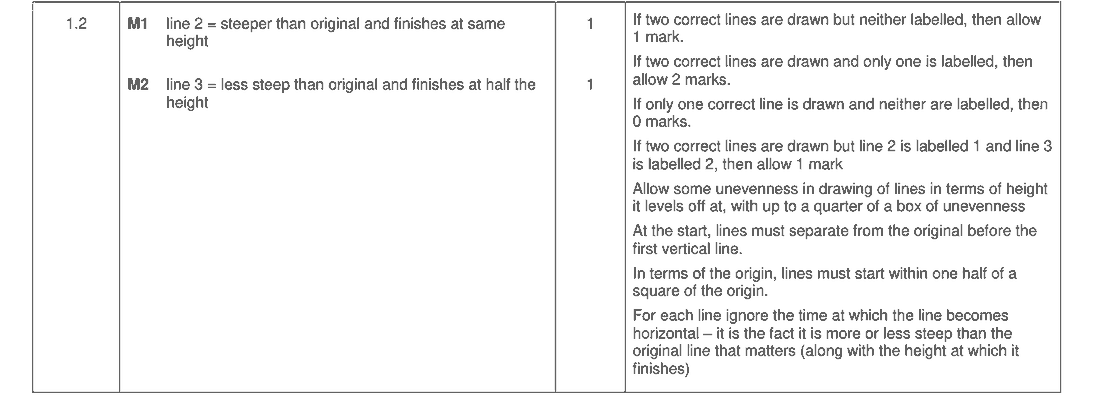
01.2 Kinetics 2Diagram or structure
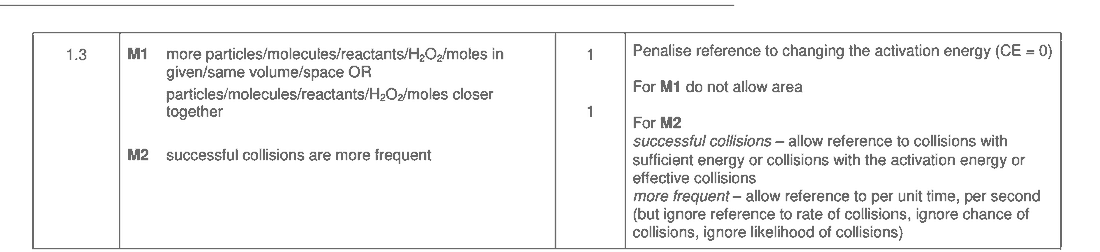
01.3 Kinetics 2Explanation
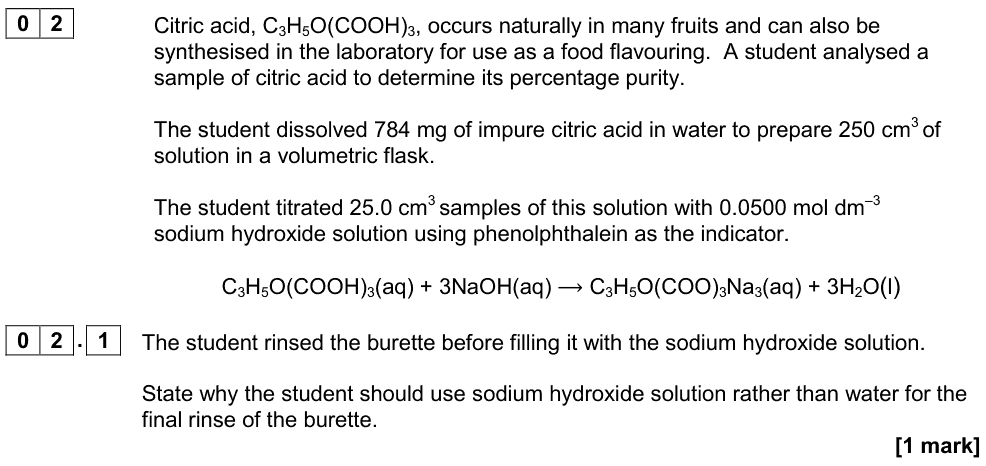
02.1 Amount of substance 1Practical and data analysis
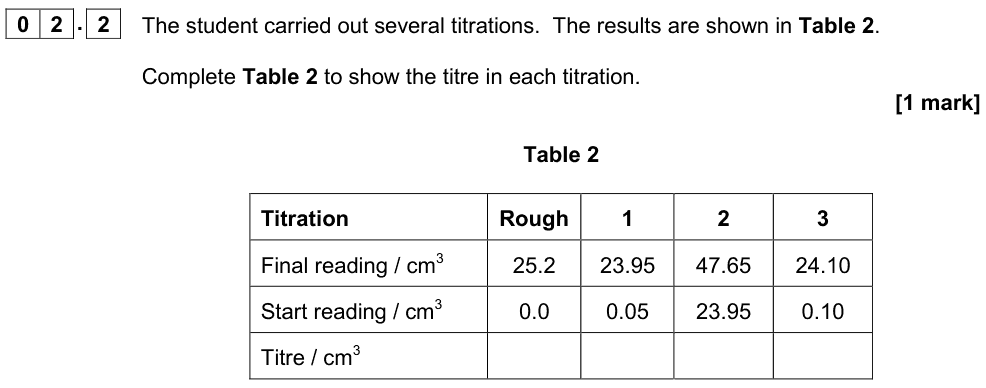
02.2 Amount of substance 1Practical and data analysis
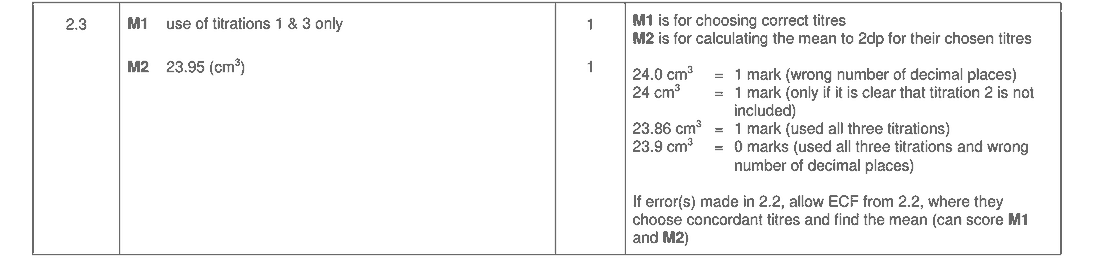
02.3 Amount of substance 2Calculation
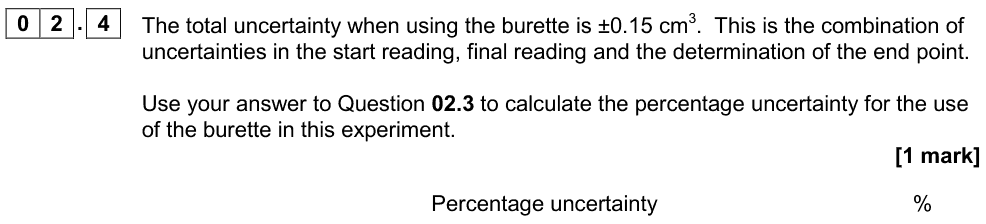
02.4 Amount of substance 1Calculation
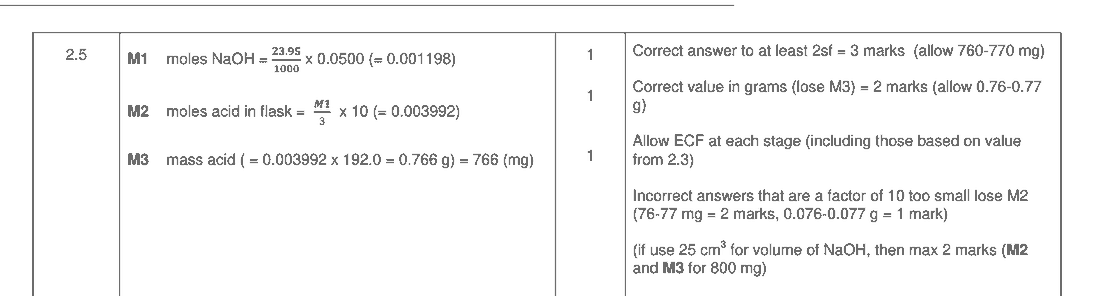
02.5 Amount of substance 3Calculation
02.6 Amount of substance 1Calculation
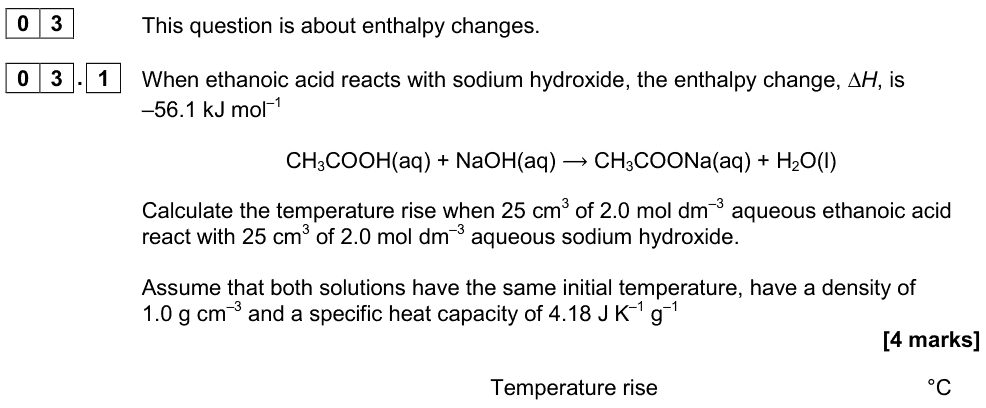
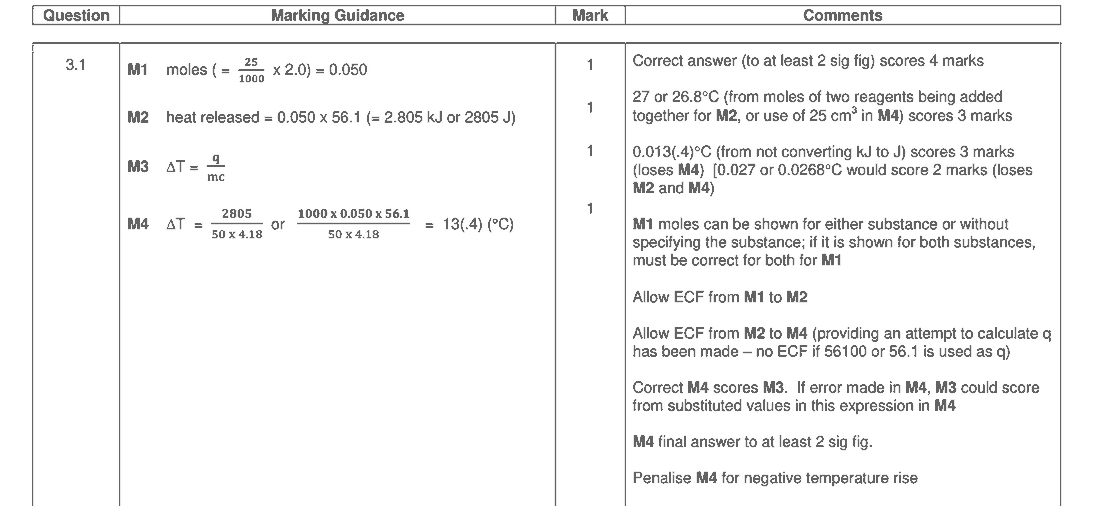
03.1 Energetics, Amount of substance 4Calculation
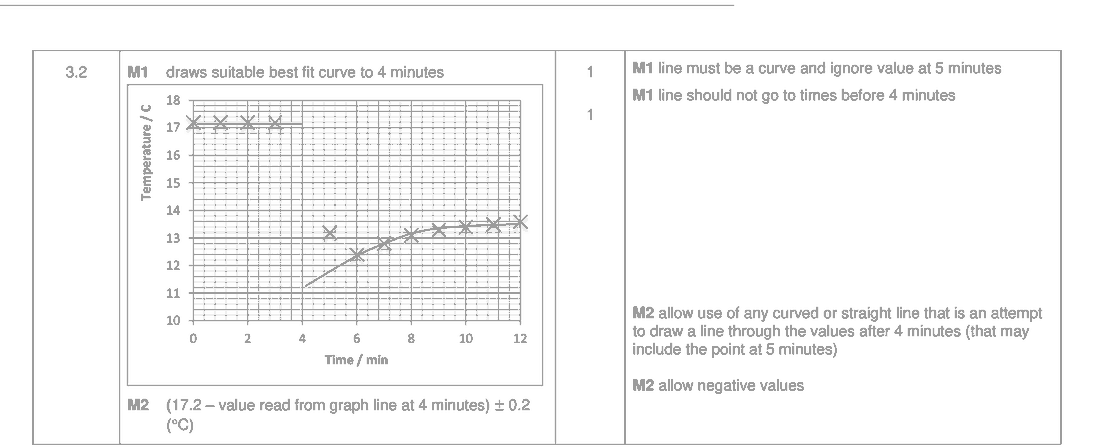
03.2 Energetics 2Practical and data analysis
04.1 Introduction to organic chemistry: nomenclature, mechanisms and isomerism, Alkanes 2Short answer
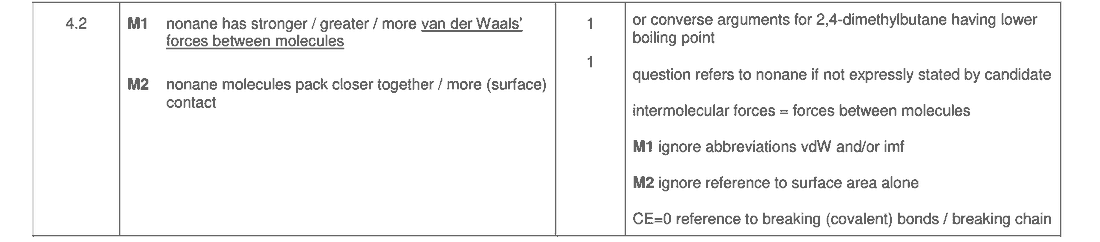
04.2 Bonding 2Explanation
04.3 Alkanes, Amount of substance 1Equation writing
04.4 Alkanes 2Explanation
04.5 Alkanes 1Short answer
04.6 Alkenes 1Diagram or structure
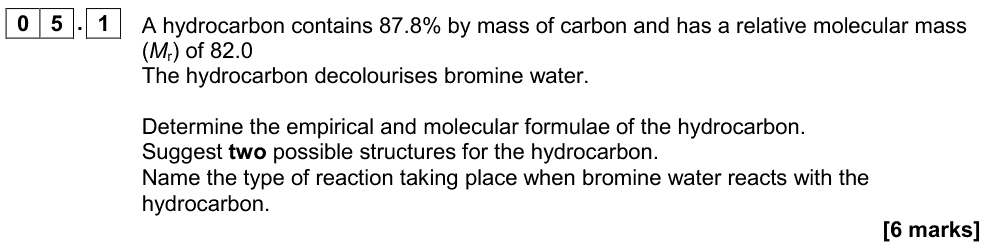
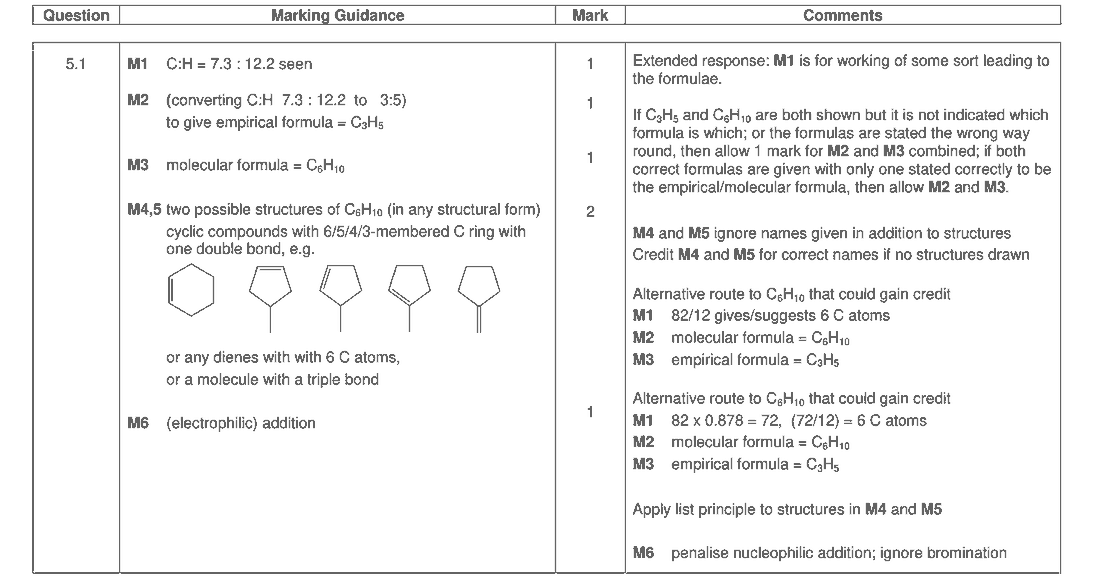
05.1 Amount of substance, Alkenes, Introduction to organic chemistry: nomenclature, mechanisms and isomerism 6Calculation
06.1 Introduction to organic chemistry: nomenclature, mechanisms and isomerism 1Short answer
06.2 Atomic structure 2Diagram or structure
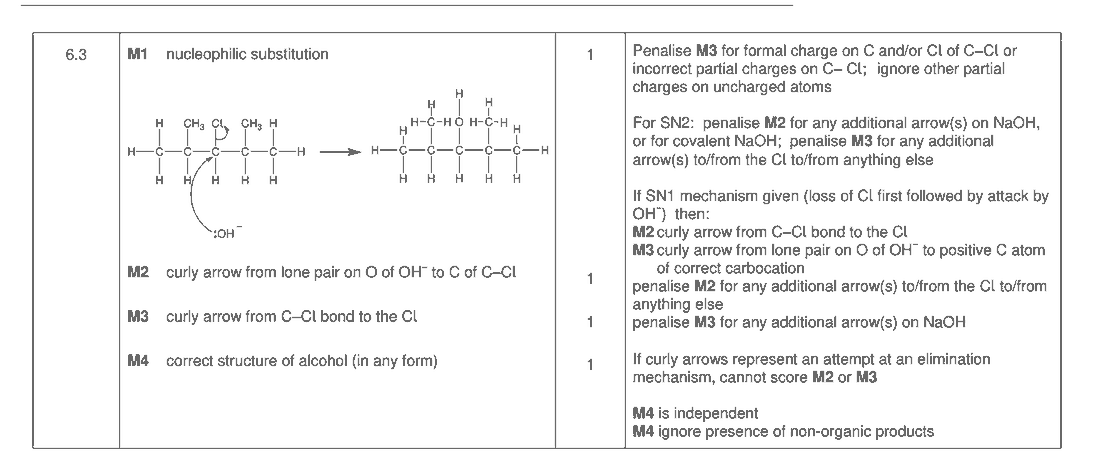
06.3 Halogenoalkanes 4Mechanism
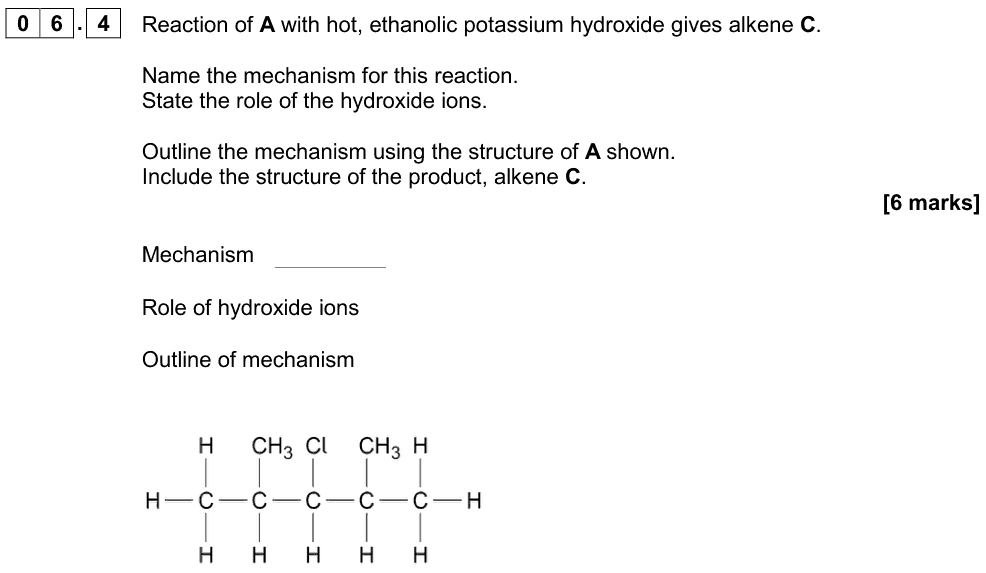
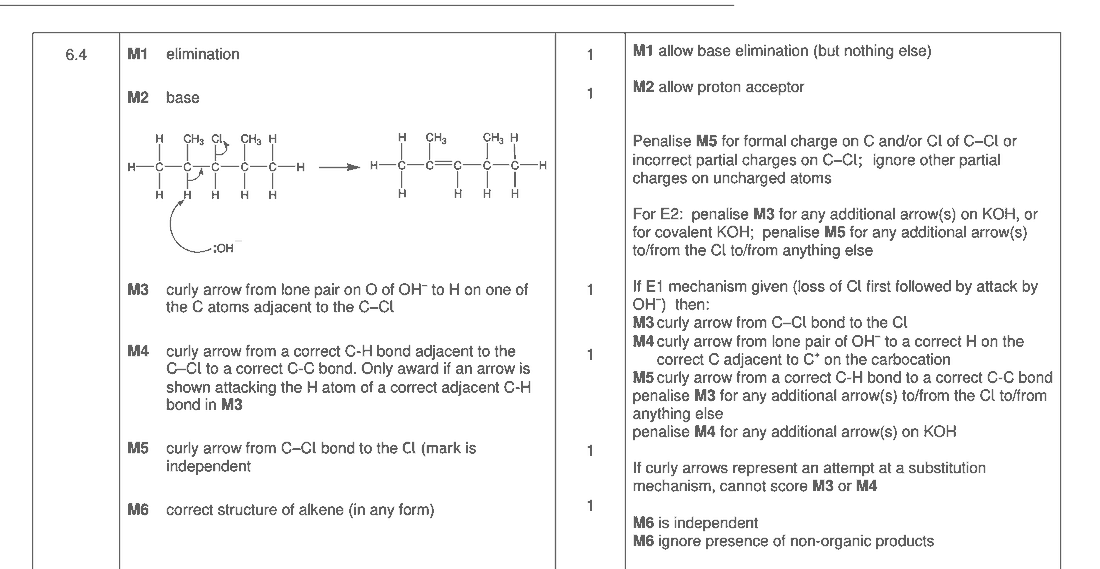
06.4 Halogenoalkanes 6Mechanism
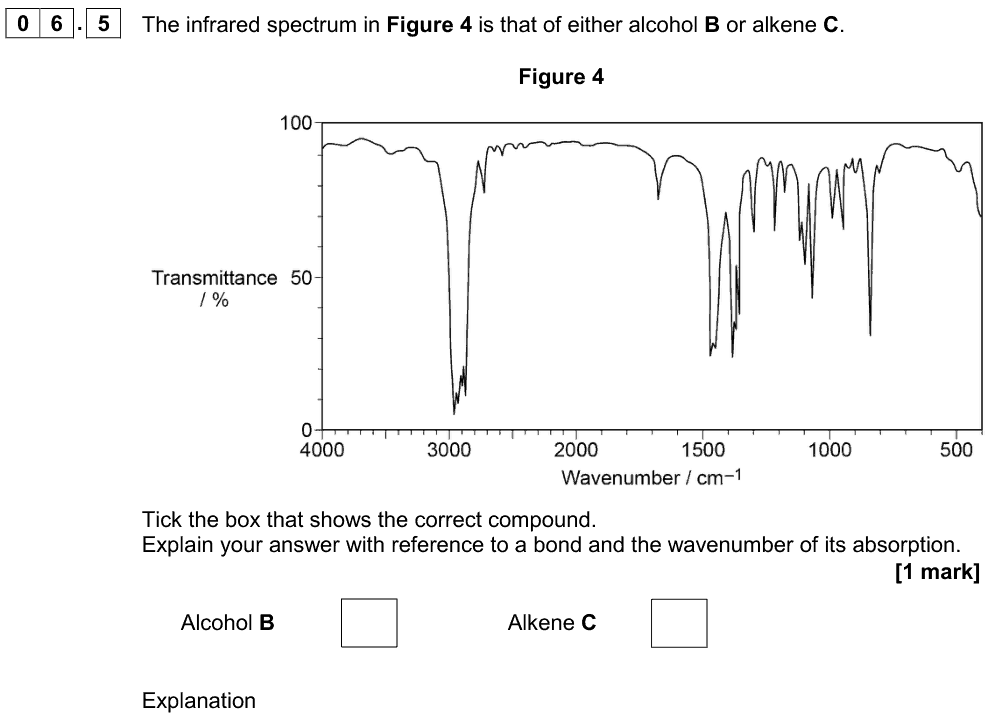
06.5 Organic analysis: test-tube reactions, mass spectrometry and infrared 1Short answer
06.6 Halogenoalkanes 1Short answer
07.1 Organic analysis: test-tube reactions, mass spectrometry and infrared, Alcohols 6Level of response
08.1 Chemical equilibria, Le Chatelier's principle and Kc 2Explanation
08.2 Chemical equilibria, Le Chatelier's principle and Kc 1Short answer
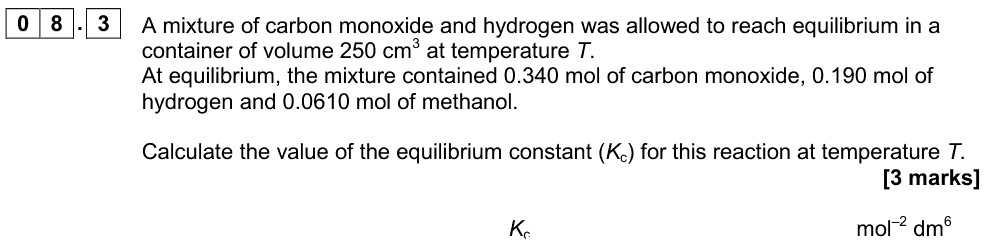
08.3 Chemical equilibria, Le Chatelier's principle and Kc 3Calculation
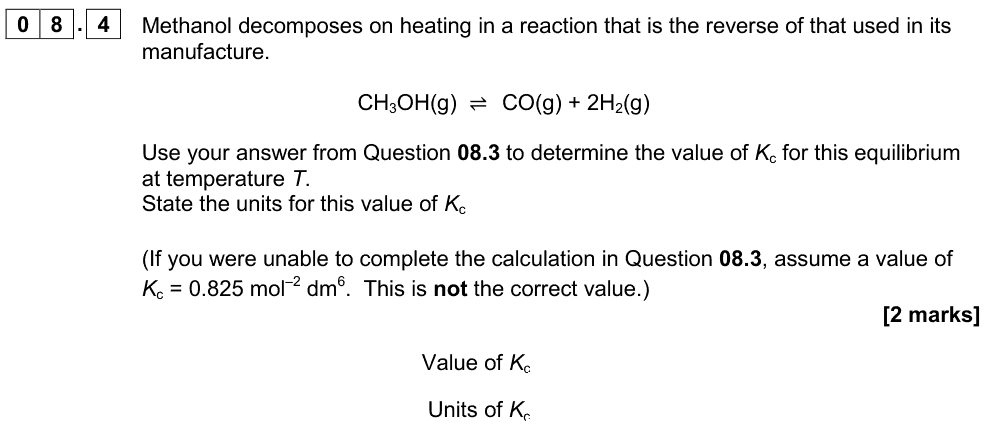
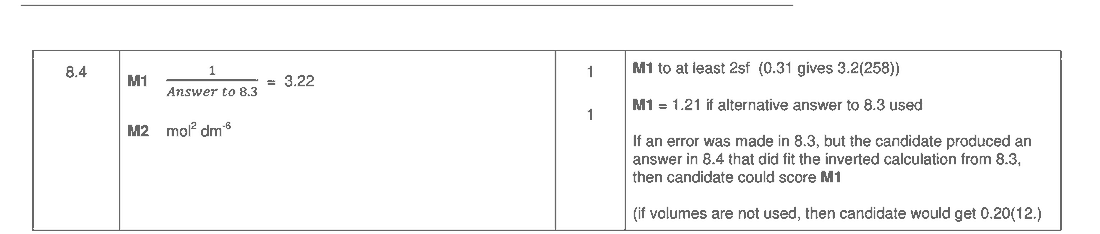
08.4 Chemical equilibria, Le Chatelier's principle and Kc 2Calculation
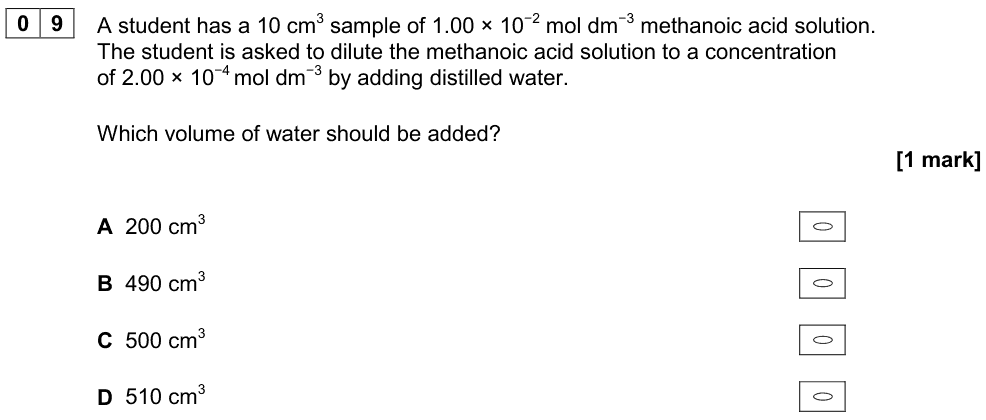
09 Amount of substance 1Multiple choice
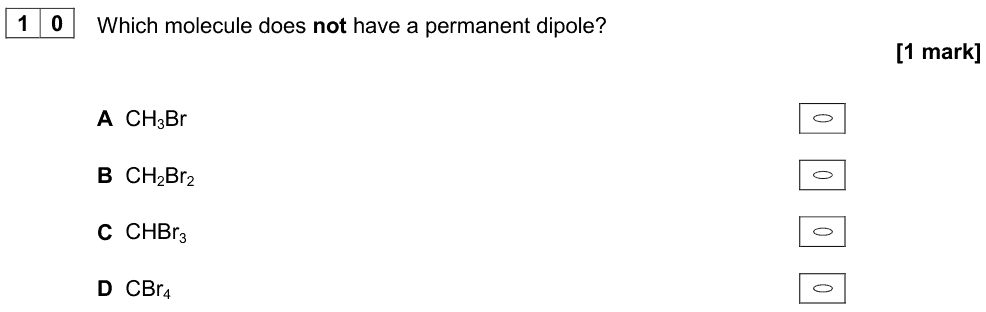
10 Bonding 1Multiple choice
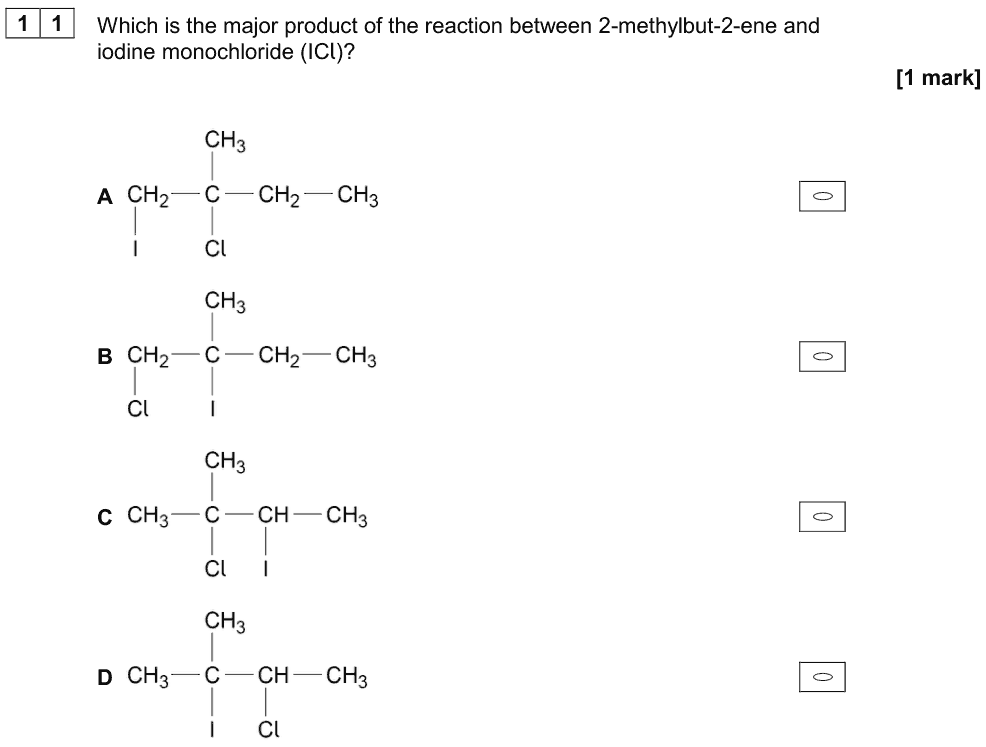
11 Alkenes 1Multiple choice
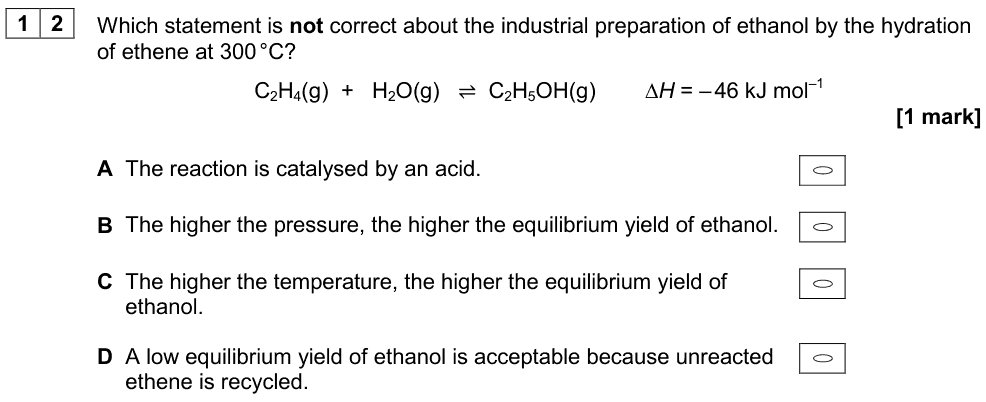
12 Chemical equilibria, Le Chatelier's principle and Kc, Alcohols 1Multiple choice
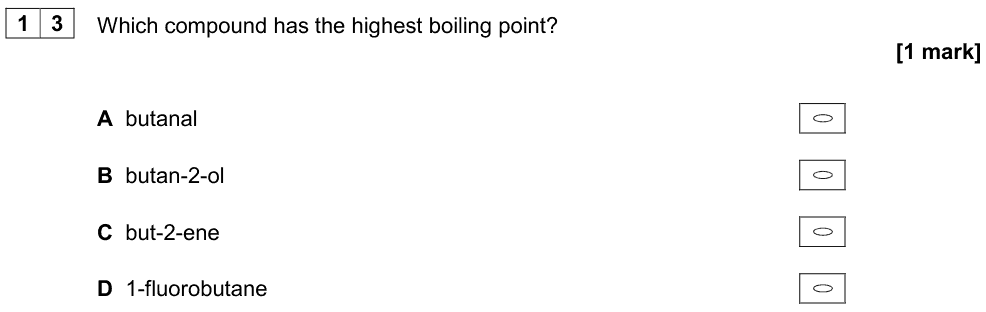
13 Bonding 1Multiple choice
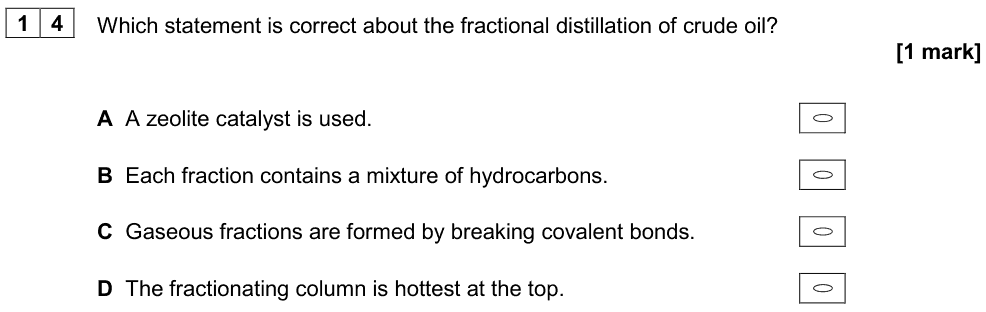
14 Alkanes 1Multiple choice
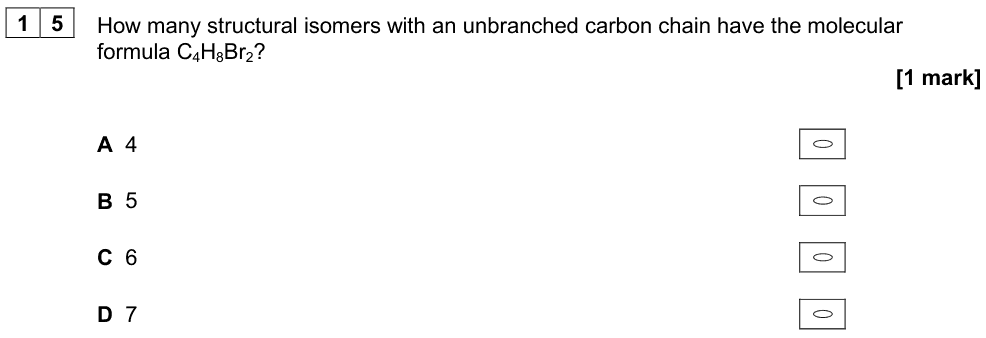
15 Introduction to organic chemistry: nomenclature, mechanisms and isomerism 1Multiple choice
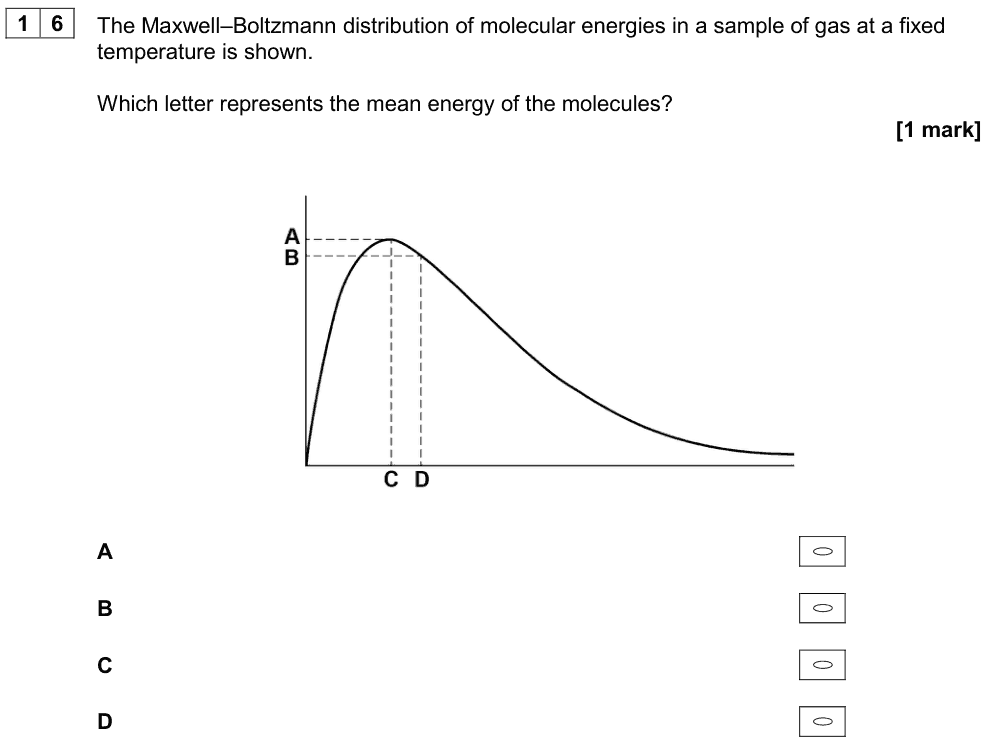
16 Kinetics 1Multiple choice
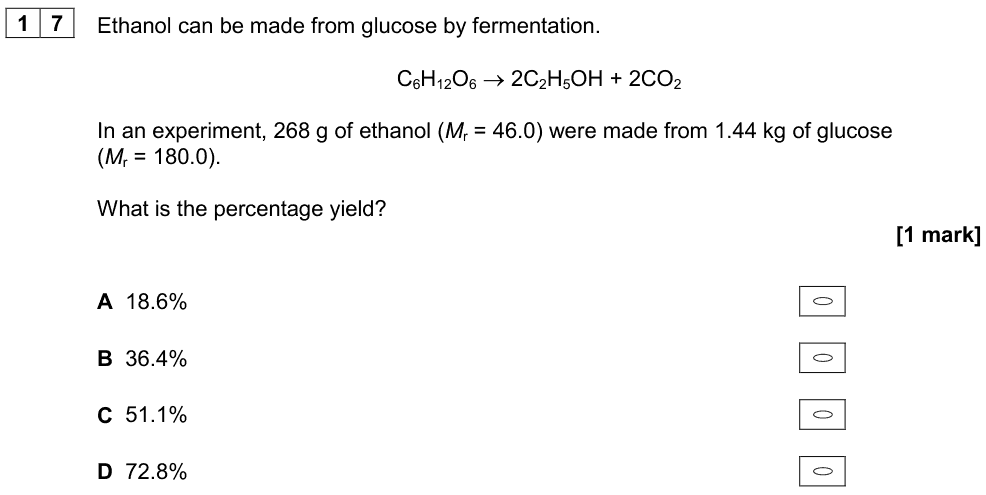
17 Amount of substance 1Multiple choice
18 Halogenoalkanes, Introduction to organic chemistry: nomenclature, mechanisms and isomerism 1Multiple choice
19 Alkenes 1Multiple choice
20 Energetics 1Multiple choice
21 Amount of substance 1Multiple choice
22 Amount of substance 1Multiple choice
23 Introduction to organic chemistry: nomenclature, mechanisms and isomerism, Halogenoalkanes 1Multiple choice

The questions

01.101.201.302.102.202.302.402.502.603.103.204.104.204.304.404.504.605.106.106.206.306.406.506.607.108.108.208.308.4091011121314151617181920212223
June 2018 · AS Paper 2 · Q01.1 2 marks Explanation Easy kinetics
Hydrogen peroxide solution decomposes slowly to form water and oxygen.
The reaction is much faster in the presence of a manganese(IV) oxide catalyst.
2H2O2(aq)  ⟶ 2H2O(l) + O2(g)
Three experiments, shown in Table 1, were carried out to investigate how the volume
of oxygen produced varied over time under different conditions.  The same mass of
catalyst was used in each experiment.
Table 1
Experiment
Concentration
of H2O2(aq)
/ mol dm–3
Volume of
H2O2(aq)
/ cm3
Temperature
/ C
Catalyst
1
1.0
50
20
lumps
2
1.0
50
20
powder
3
0.5
50
20
lumps
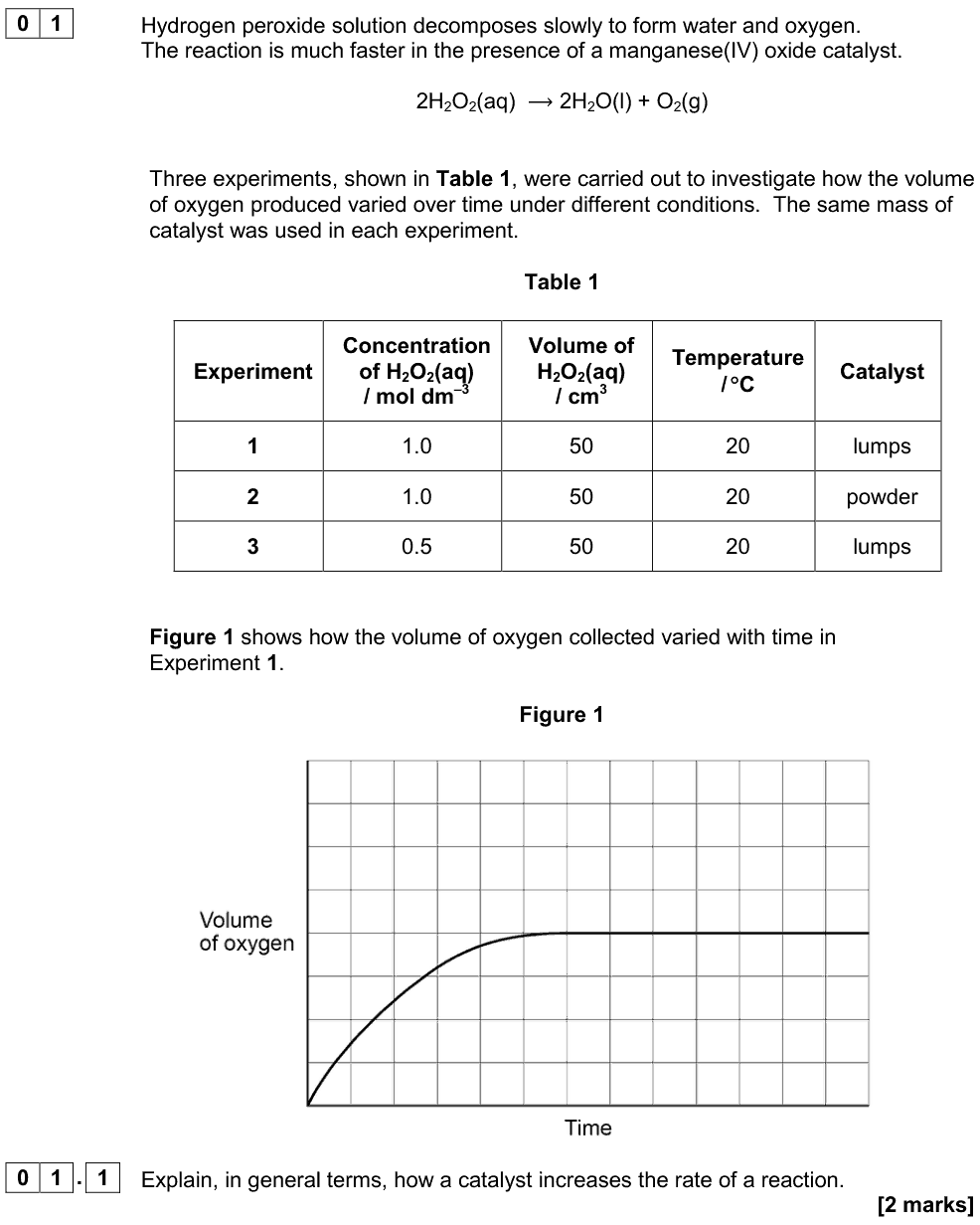
Figure 1 shows how the volume of oxygen collected varied with time in
Experiment 1.
Figure 1
Explain, in general terms, how a catalyst increases the rate of a reaction.
[2 marks]
June 2018 · AS Paper 2 · Q01.2 2 marks Diagram or structure kinetics
Earlier part of question 01 that this part usesEarlier part of June 2018 Paper 2 question 01
Draw two lines on Figure 1 to show how the volume of oxygen collected varied with
time in Experiments 2 and 3.
Label each line with the experiment number.
[2 marks]
June 2018 · AS Paper 2 · Q01.3 2 marks Explanation kinetics
Earlier part of question 01 that this part usesEarlier part of June 2018 Paper 2 question 01
Explain, in terms of collision theory, the effect of increasing the concentration of
hydrogen peroxide on the rate of reaction.
[2 marks]
June 2018 · AS Paper 2 · Q02.1 1 mark Practical and data analysis amount of substance
Citric acid, C3H5O(COOH)3, occurs naturally in many fruits and can also be
synthesised in the laboratory for use as a food flavouring.  A student analysed a
sample of citric acid to determine its percentage purity.
The student dissolved 784 mg of impure citric acid in water to prepare 250 cm3 of
solution in a volumetric flask.
The student titrated 25.0 cm3 samples of this solution with 0.0500 mol dm–3
sodium hydroxide solution using phenolphthalein as the indicator.
C3H5O(COOH)3(aq) + 3NaOH(aq) ⟶ C3H5O(COO)3Na3(aq) + 3H2O(l)
The student rinsed the burette before filling it with the sodium hydroxide solution.
State why the student should use sodium hydroxide solution rather than water for the
final rinse of the burette.
[1 mark]
June 2018 · AS Paper 2 · Q02.2 1 mark Practical and data analysis Hard amount of substance
Earlier part of question 02 that this part usesEarlier part of June 2018 Paper 2 question 02
The student carried out several titrations.  The results are shown in Table 2.
Complete Table 2 to show the titre in each titration.
[1 mark]
Table 2
Titration
Rough
1
2
3
Final reading / cm3
25.2
23.95
47.65
24.10
Start reading / cm3
0.0
0.05
23.95
0.10
Titre / cm3
June 2018 · AS Paper 2 · Q02.3 2 marks Calculation amount of substance
Earlier parts of question 02 that this part usesEarlier part of June 2018 Paper 2 question 02Earlier part of June 2018 Paper 2 question 02
Calculate the mean titre using the concordant results.
Give your answer to the appropriate number of significant figures.
[2 marks]
Mean titre
cm3
June 2018 · AS Paper 2 · Q02.4 1 mark Calculation amount of substance
Earlier parts of question 02 that this part usesEarlier part of June 2018 Paper 2 question 02Earlier part of June 2018 Paper 2 question 02
The total uncertainty when using the burette is ±0.15 cm3.  This is the combination of
uncertainties in the start reading, final reading and the determination of the end point.
Use your answer to Question 02.3 to calculate the percentage uncertainty for the use
of the burette in this experiment.
[1 mark]
Percentage uncertainty
%
June 2018 · AS Paper 2 · Q02.5 3 marks Calculation amount of substance
Earlier parts of question 02 that this part usesEarlier part of June 2018 Paper 2 question 02Earlier part of June 2018 Paper 2 question 02
Use your answer to Question 02.3 to find the mass, in mg, of citric acid dissolved in
250 cm3 of the solution.
The relative molecular mass (Mr) of citric acid is 192.0
[3 marks]
Mass
mg
June 2018 · AS Paper 2 · Q02.6 1 mark Calculation amount of substance
Earlier parts of question 02 that this part usesEarlier part of June 2018 Paper 2 question 02Earlier part of June 2018 Paper 2 question 02
Calculate the percentage purity of this sample of citric acid.
[1 mark]
Percentage purity
%
June 2018 · AS Paper 2 · Q03.1 4 marks Calculation energeticsamount of substance
This question is about enthalpy changes.
When ethanoic acid reacts with sodium hydroxide, the enthalpy change, ∆H, is
–56.1 kJ mol–1
CH3COOH(aq) + NaOH(aq) ⟶ CH3COONa(aq) + H2O(l)
Calculate the temperature rise when 25 cm3 of 2.0 mol dm–3  aqueous ethanoic acid
react with 25 cm3 of 2.0 mol dm–3 aqueous sodium hydroxide.
Assume that both solutions have the same initial temperature, have a density of
1.0 g cm–3 and a specific heat capacity of 4.18 J K–1 g–1
[4 marks]
Temperature rise
°C
June 2018 · AS Paper 2 · Q03.2 2 marks Practical and data analysis Hard energetics
Earlier part of question 03 that this part usesEarlier part of June 2018 Paper 2 question 03
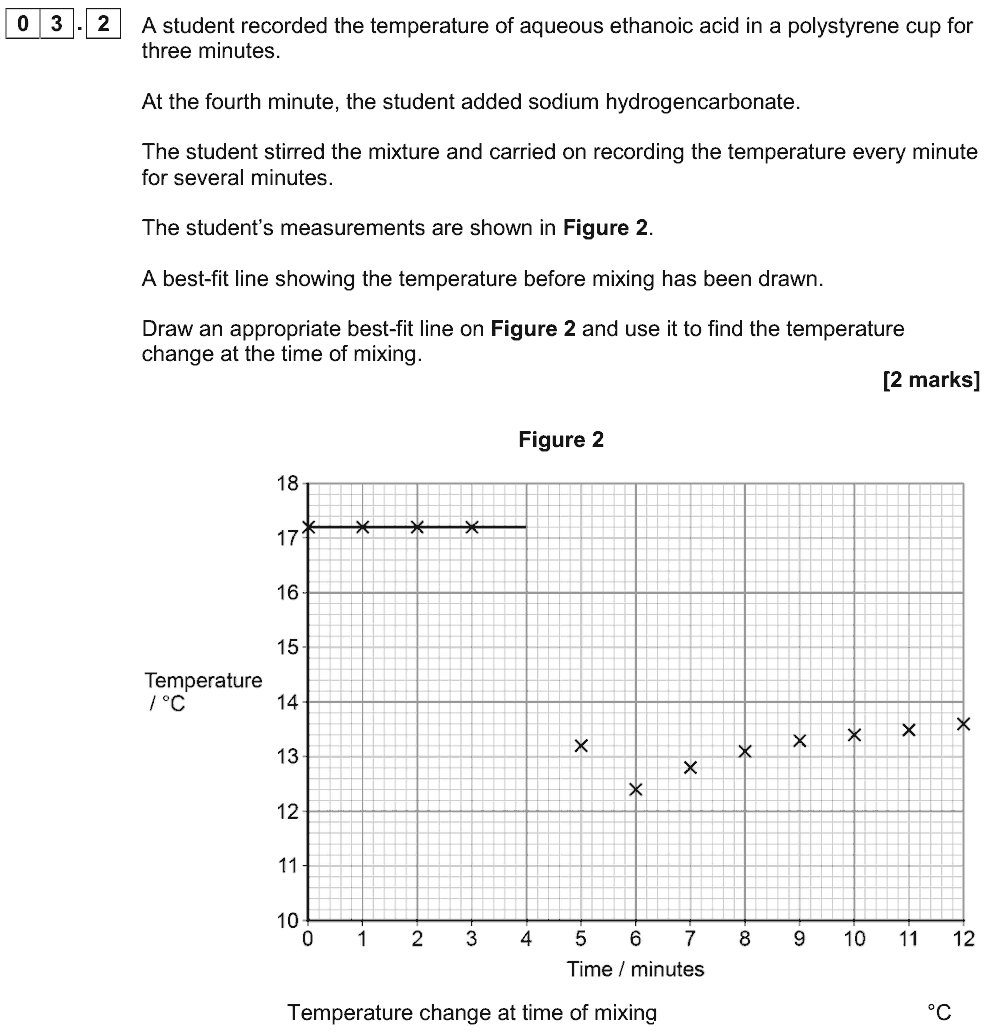
A student recorded the temperature of aqueous ethanoic acid in a polystyrene cup for
three minutes.
At the fourth minute, the student added sodium hydrogencarbonate.
The student stirred the mixture and carried on recording the temperature every minute
for several minutes.
The student’s measurements are shown in Figure 2.
A best-fit line showing the temperature before mixing has been drawn.
Draw an appropriate best-fit line on Figure 2 and use it to find the temperature
change at the time of mixing.
[2 marks]
Figure 2
Temperature change at time of mixing
°C
June 2018 · AS Paper 2 · Q04.1 2 marks Short answer introduction to organic chemistryalkanes
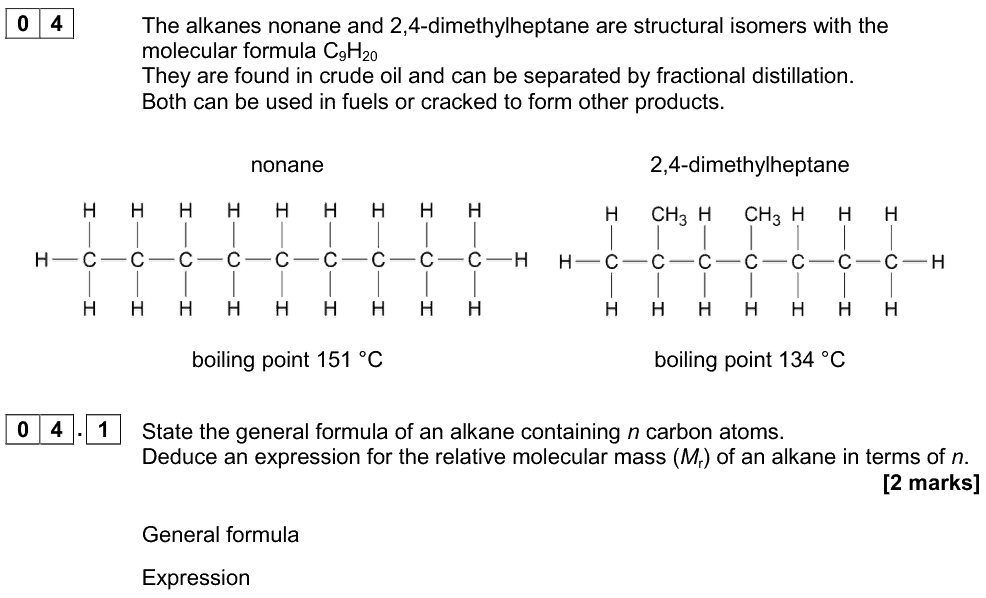
The alkanes nonane and 2,4-dimethylheptane are structural isomers with the
molecular formula C9H20
They are found in crude oil and can be separated by fractional distillation.
Both can be used in fuels or cracked to form other products.
nonane
2,4-dimethylheptane
boiling point 151 °C
boiling point 134 °C
State the general formula of an alkane containing n carbon atoms.
Deduce an expression for the relative molecular mass (Mr) of an alkane in terms of n.
[2 marks]
General formula
Expression
June 2018 · AS Paper 2 · Q04.2 2 marks Explanation bonding
Earlier part of question 04 that this part usesEarlier part of June 2018 Paper 2 question 04
Explain why nonane has a higher boiling point than 2,4-dimethylheptane.
[2 marks]
June 2018 · AS Paper 2 · Q04.3 1 mark Equation writing Easy alkanesamount of substance
Earlier part of question 04 that this part usesEarlier part of June 2018 Paper 2 question 04
Give an equation for the complete combustion of nonane.
[1 mark]
June 2018 · AS Paper 2 · Q04.4 2 marks Explanation alkanes
Earlier part of question 04 that this part usesEarlier part of June 2018 Paper 2 question 04
Nonane is often found in fuel for jet engines.  Combustion in jet engines produces
pollutants including nitrogen monoxide (NO).
Explain how this nitrogen monoxide is formed.
[2 marks]
June 2018 · AS Paper 2 · Q04.5 1 mark Short answer Easy alkanes
Earlier part of question 04 that this part usesEarlier part of June 2018 Paper 2 question 04
Nonane can be cracked to form large quantities of propene.
Name the type of cracking used.
[1 mark]
June 2018 · AS Paper 2 · Q04.6 1 mark Diagram or structure Hard alkenes
Earlier part of question 04 that this part usesEarlier part of June 2018 Paper 2 question 04
The main use of propene, formed from cracking, is to make poly(propene).
Draw the repeating unit of poly(propene).
[1 mark]
June 2018 · AS Paper 2 · Q05.1 6 marks Calculation amount of substancealkenesintroduction to organic chemistry
A hydrocarbon contains 87.8% by mass of carbon and has a relative molecular mass
(Mr) of 82.0
The hydrocarbon decolourises bromine water.
Determine the empirical and molecular formulae of the hydrocarbon.
Suggest two possible structures for the hydrocarbon.
Name the type of reaction taking place when bromine water reacts with the
hydrocarbon.
[6 marks]
June 2018 · AS Paper 2 · Q06.1 1 mark Short answer introduction to organic chemistry
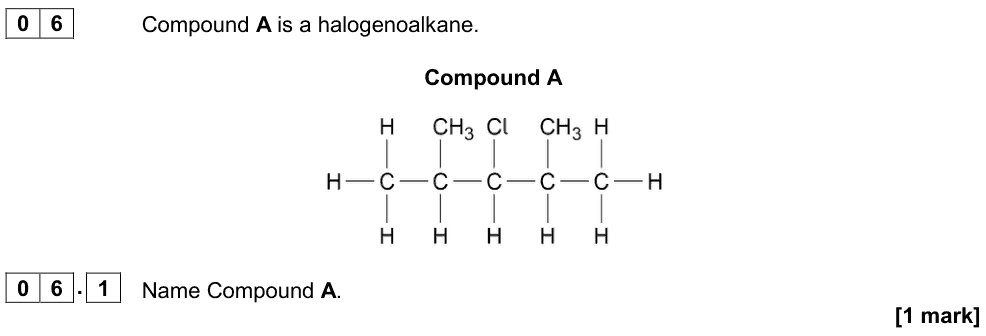
Compound A is a halogenoalkane.
Compound A
Name Compound A.
[1 mark]
June 2018 · AS Paper 2 · Q06.2 2 marks Diagram or structure Hard atomic structure
Earlier part of question 06 that this part usesEarlier part of June 2018 Paper 2 question 06
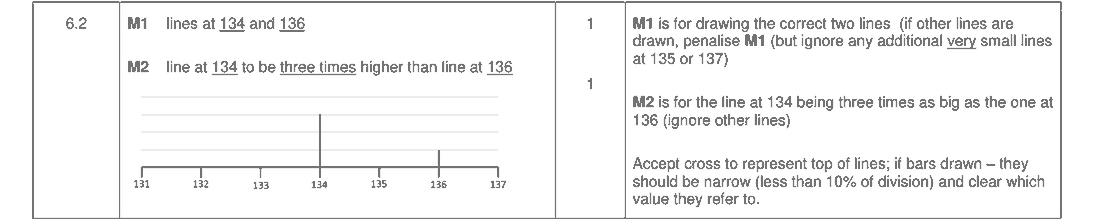
Compound A has a relative molecular mass (Mr) of 134.5
The main isotope of hydrogen is 1H
The main isotope of carbon is 12C
Chlorine consists of two common isotopes, 35Cl and 37Cl, of which 75% is 35Cl
The mass spectrum of A was recorded when A was ionised by electron impact to form
A+ ions.
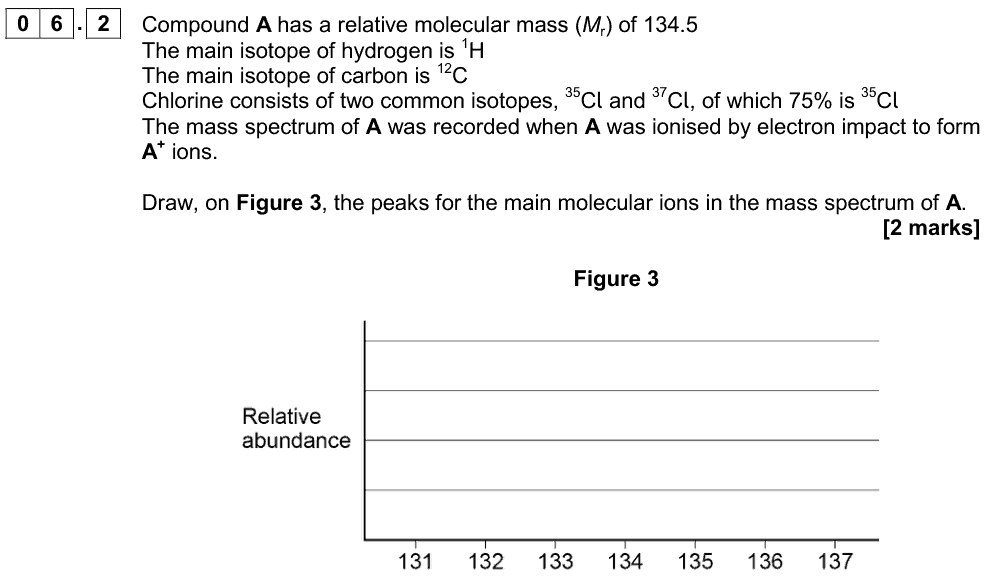
Draw, on Figure 3, the peaks for the main molecular ions in the mass spectrum of A.
[2 marks]
Figure 3
June 2018 · AS Paper 2 · Q06.3 4 marks Mechanism halogenoalkanes
Earlier part of question 06 that this part usesEarlier part of June 2018 Paper 2 question 06
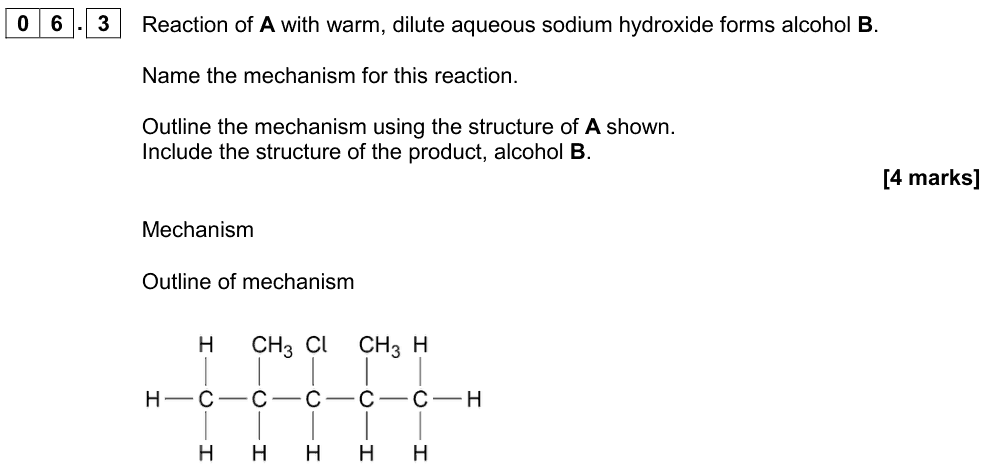
Reaction of A with warm, dilute aqueous sodium hydroxide forms alcohol B.
Name the mechanism for this reaction.
Outline the mechanism using the structure of A shown.
Include the structure of the product, alcohol B.
[4 marks]
Mechanism
Outline of mechanism
June 2018 · AS Paper 2 · Q06.4 6 marks Mechanism halogenoalkanes
Earlier part of question 06 that this part usesEarlier part of June 2018 Paper 2 question 06
Reaction of A with hot, ethanolic potassium hydroxide gives alkene C.
Name the mechanism for this reaction.
State the role of the hydroxide ions.
Outline the mechanism using the structure of A shown.
Include the structure of the product, alkene C.
[6 marks]
Mechanism
Role of hydroxide ions
Outline of mechanism
June 2018 · AS Paper 2 · Q06.5 1 mark Short answer organic analysis
Earlier part of question 06 that this part usesEarlier part of June 2018 Paper 2 question 06
The infrared spectrum in Figure 4 is that of either alcohol B or alkene C.
Figure 4
Tick the box that shows the correct compound.
Explain your answer with reference to a bond and the wavenumber of its absorption.
[1 mark]
Alcohol B                                      Alkene C
Explanation
June 2018 · AS Paper 2 · Q06.6 1 mark Short answer Hard halogenoalkanes
Earlier part of question 06 that this part usesEarlier part of June 2018 Paper 2 question 06
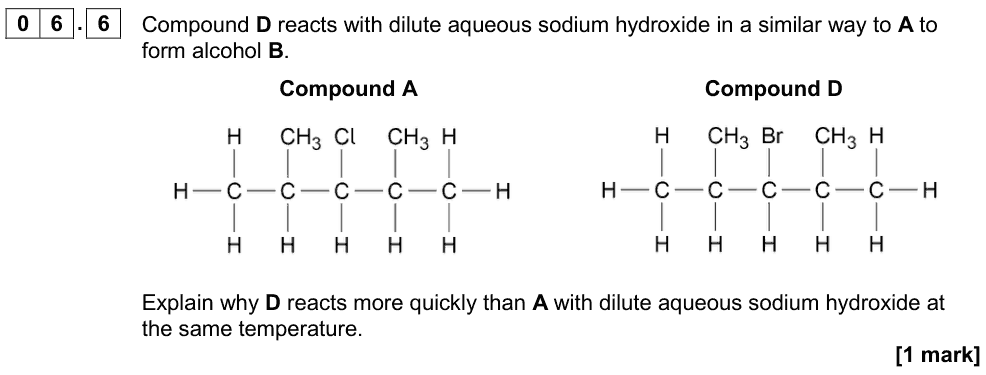
Compound D reacts with dilute aqueous sodium hydroxide in a similar way to A to
form alcohol B.
Compound A                                               Compound D
Explain why D reacts more quickly than A with dilute aqueous sodium hydroxide at
the same temperature.
[1 mark]
June 2018 · AS Paper 2 · Q07.1 6 marks 6-mark level of response organic analysisalcohols
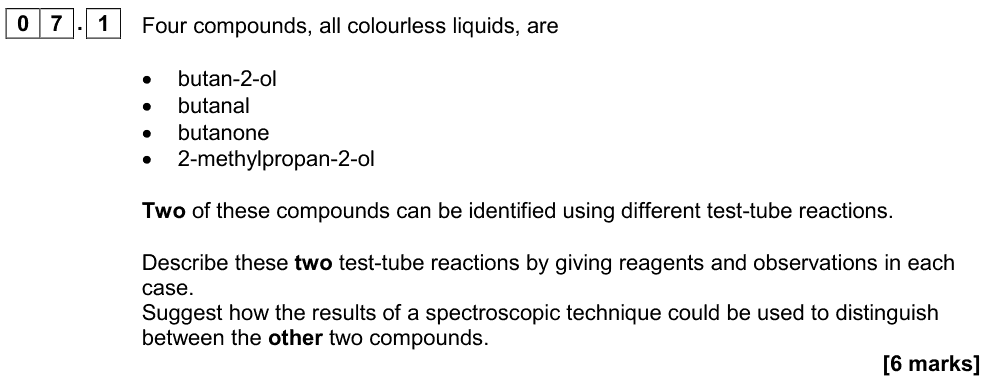
Four compounds, all colourless liquids, are
•
butan-2-ol
•
butanal
•
butanone
•
2-methylpropan-2-ol
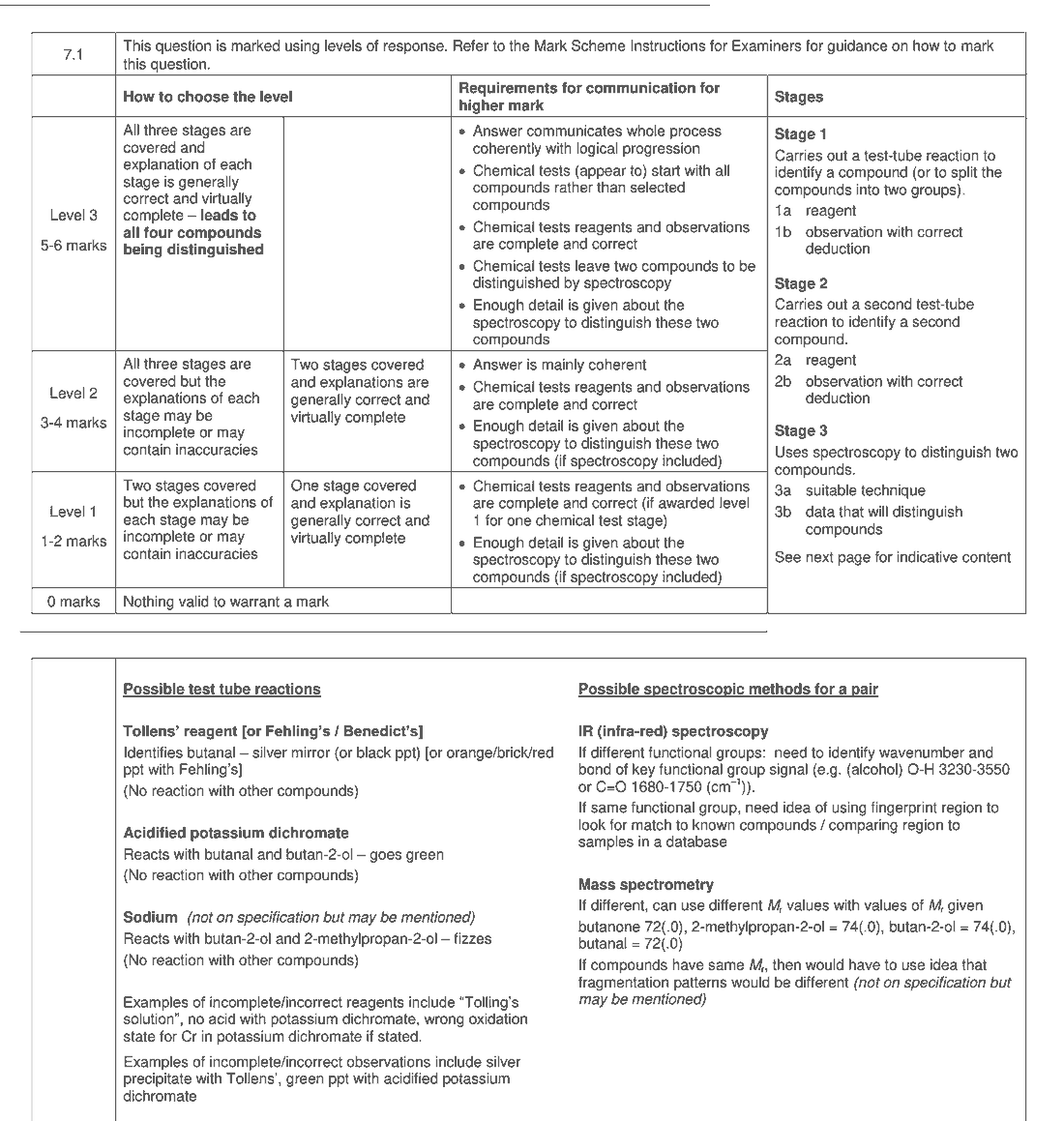
Two of these compounds can be identified using different test-tube reactions.
Describe these two test-tube reactions by giving reagents and observations in each
case.
Suggest how the results of a spectroscopic technique could be used to distinguish
between the other two compounds.
[6 marks]
June 2018 · AS Paper 2 · Q08.1 2 marks Explanation chemical equilibria and kc
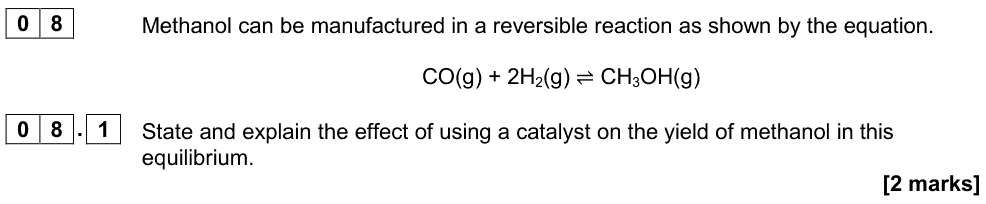
Methanol can be manufactured in a reversible reaction as shown by the equation.
CO(g) + 2H2(g) ⇌ CH3OH(g)
State and explain the effect of using a catalyst on the yield of methanol in this
equilibrium.
[2 marks]
June 2018 · AS Paper 2 · Q08.2 1 mark Short answer Easy chemical equilibria and kc
Earlier part of question 08 that this part usesEarlier part of June 2018 Paper 2 question 08
Give an expression for the equilibrium constant (Kc) for this reaction.
[1 mark]
June 2018 · AS Paper 2 · Q08.3 3 marks Calculation chemical equilibria and kc
Earlier part of question 08 that this part usesEarlier part of June 2018 Paper 2 question 08
A mixture of carbon monoxide and hydrogen was allowed to reach equilibrium in a
container of volume 250 cm3 at temperature T.
At equilibrium, the mixture contained 0.340 mol of carbon monoxide, 0.190 mol of
hydrogen and 0.0610 mol of methanol.
Calculate the value of the equilibrium constant (Kc) for this reaction at temperature T.
[3 marks]
Kc
mol–2 dm6
June 2018 · AS Paper 2 · Q08.4 2 marks Calculation chemical equilibria and kc
Earlier part of question 08 that this part usesEarlier part of June 2018 Paper 2 question 08
Methanol decomposes on heating in a reaction that is the reverse of that used in its
manufacture.
CH3OH(g)  ⇌   CO(g) + 2H2(g)
Use your answer from Question 08.3 to determine the value of Kc for this equilibrium
at temperature T.
State the units for this value of Kc
(If you were unable to complete the calculation in Question 08.3, assume a value of
Kc = 0.825 mol–2 dm6.  This is not the correct value.)
[2 marks]
Value of Kc
Units of Kc
June 2018 · AS Paper 2 · Q09 1 mark Multiple choice amount of substance
A student has a 10 cm3 sample of 1.00 × 10⁻² mol dm−3 methanoic acid solution.
The student is asked to dilute the methanoic acid solution to a concentration
of 2.00 × 10⁻⁴ mol dm−3 by adding distilled water.
Which volume of water should be added?
[1 mark]
A 200 cm3
B 490 cm3
C 500 cm3
D 510 cm3
June 2018 · AS Paper 2 · Q10 1 mark Multiple choice Easy bonding
Which molecule does not have a permanent dipole?
[1 mark]
A CH3Br
B CH2Br2
C CHBr3
D CBr4
June 2018 · AS Paper 2 · Q11 1 mark Multiple choice alkenes
Which is the major product of the reaction between 2-methylbut-2-ene and
iodine monochloride (ICl)?
[1 mark]
A
B
C
D
June 2018 · AS Paper 2 · Q12 1 mark Multiple choice Easy chemical equilibria and kcalcohols
Which statement is not correct about the industrial preparation of ethanol by the hydration
of ethene at 300 °C?
C2H4(g)  +   H2O(g)   ⇌  C2H5OH(g)        ∆H = – 46 kJ mol–1
[1 mark]
A The reaction is catalysed by an acid.
B The higher the pressure, the higher the equilibrium yield of ethanol.
C The higher the temperature, the higher the equilibrium yield of
ethanol.
D A low equilibrium yield of ethanol is acceptable because unreacted
ethene is recycled.
June 2018 · AS Paper 2 · Q13 1 mark Multiple choice bonding
Which compound has the highest boiling point?
[1 mark]
A butanal
B butan-2-ol
C but-2-ene
D 1-fluorobutane
June 2018 · AS Paper 2 · Q14 1 mark Multiple choice alkanes
Which statement is correct about the fractional distillation of crude oil?
[1 mark]
A A zeolite catalyst is used.
B Each fraction contains a mixture of hydrocarbons.
C Gaseous fractions are formed by breaking covalent bonds.
D The fractionating column is hottest at the top.
June 2018 · AS Paper 2 · Q15 1 mark Multiple choice Hard introduction to organic chemistry
How many structural isomers with an unbranched carbon chain have the molecular
formula C4H8Br2?
[1 mark]
A 4
B 5
C 6
D 7
June 2018 · AS Paper 2 · Q16 1 mark Multiple choice kinetics
The Maxwell–Boltzmann distribution of molecular energies in a sample of gas at a fixed
temperature is shown.
Which letter represents the mean energy of the molecules?
[1 mark]
A
B
C
D
June 2018 · AS Paper 2 · Q17 1 mark Multiple choice amount of substance
Ethanol can be made from glucose by fermentation.
C6H12O6 → 2C2H5OH + 2CO2
In an experiment, 268 g of ethanol (Mr = 46.0) were made from 1.44 kg of glucose
(Mr = 180.0).
What is the percentage yield?
[1 mark]
A 18.6%
B 36.4%
C 51.1%
D 72.8%
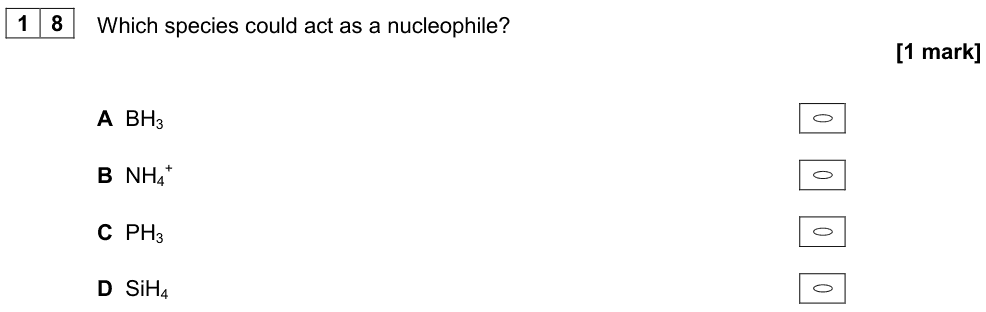
June 2018 · AS Paper 2 · Q18 1 mark Multiple choice halogenoalkanesintroduction to organic chemistry
Which species could act as a nucleophile?
[1 mark]
A BH3
B NH4
+
C PH3
D SiH4
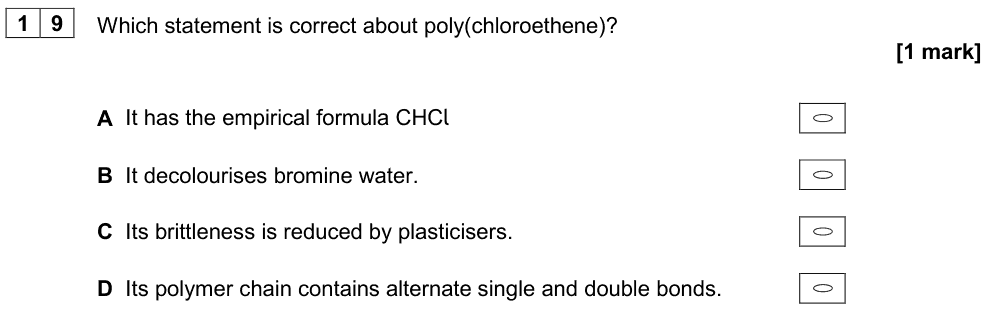
June 2018 · AS Paper 2 · Q19 1 mark Multiple choice alkenes
Which statement is correct about poly(chloroethene)?
[1 mark]
A It has the empirical formula CHCl
B It decolourises bromine water.
C Its brittleness is reduced by plasticisers.
D Its polymer chain contains alternate single and double bonds.
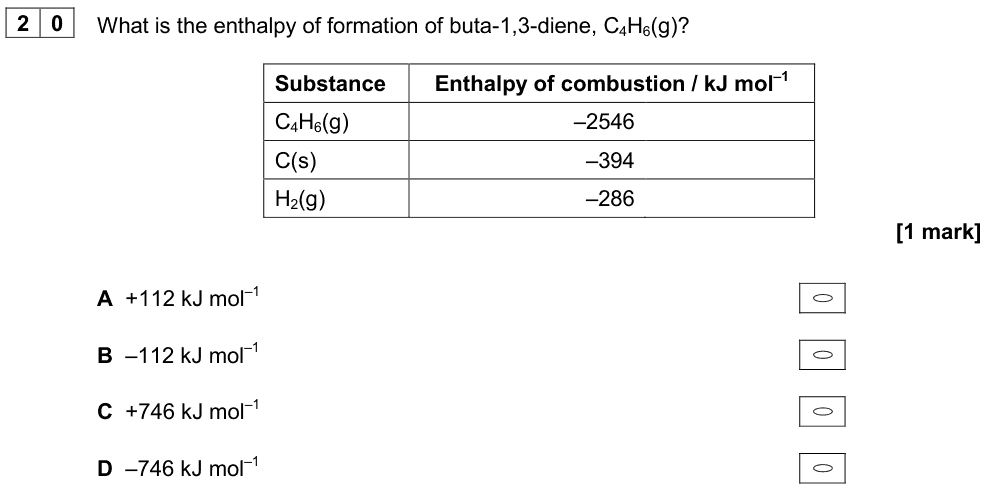
June 2018 · AS Paper 2 · Q20 1 mark Multiple choice energetics
What is the enthalpy of formation of buta-1,3-diene, C4H6(g)?
Substance
Enthalpy of combustion / kJ mol–1
C4H6(g)
–2546
C(s)
–394
H2(g)
–286
[1 mark]
A +112 kJ mol–1
B –112 kJ mol–1
C +746 kJ mol–1
D –746 kJ mol–1
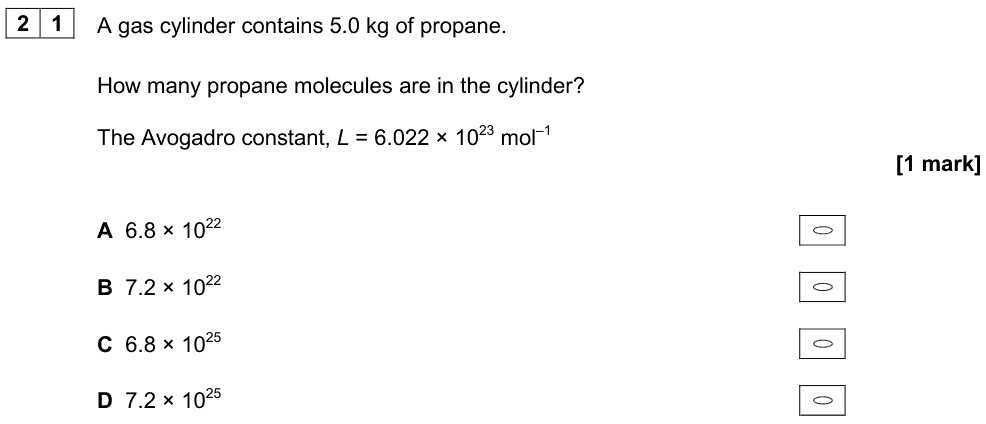
June 2018 · AS Paper 2 · Q21 1 mark Multiple choice Easy amount of substance
A gas cylinder contains 5.0 kg of propane.
How many propane molecules are in the cylinder?
The Avogadro constant, L = 6.022 × 10²³ mol–1
[1 mark]
A 6.8 × 10²²
B 7.2 × 10²²
C 6.8 × 1025
D 7.2 × 1025
June 2018 · AS Paper 2 · Q22 1 mark Multiple choice amount of substance
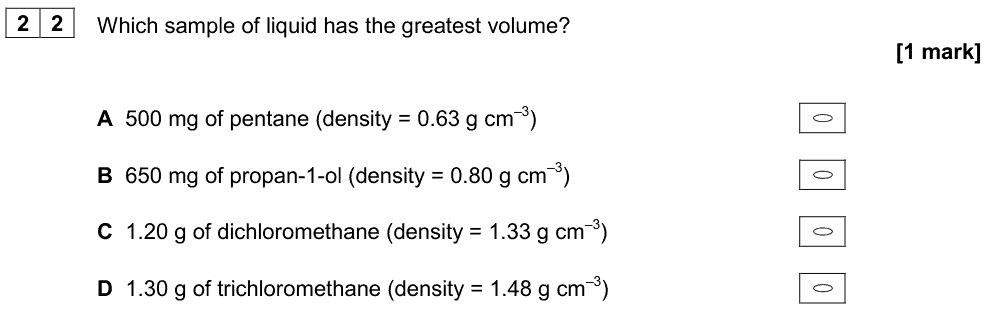
Which sample of liquid has the greatest volume?
[1 mark]
A 500 mg of pentane (density = 0.63 g cm–3)
B 650 mg of propan-1-ol (density = 0.80 g cm–3)
C 1.20 g of dichloromethane (density = 1.33 g cm–3)
D 1.30 g of trichloromethane (density = 1.48 g cm–3)
June 2018 · AS Paper 2 · Q23 1 mark Multiple choice Easy introduction to organic chemistryhalogenoalkanes
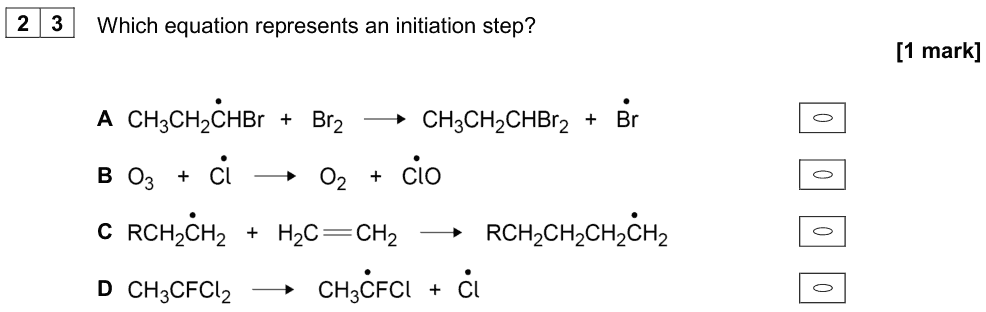
Which equation represents an initiation step?
[1 mark]
A
B
C
D

Work with an A-level chemistry tutor

Want a paper marked and gone through with you? Message us.

Prefer email? Send an enquiry

If you are under 18, please include a parent's contact details. Enquiries go to enquiries@chemistryaleveltutor.com and are deleted once handled. All tutoring is online.