November 2020: Paper 2, Synthesis and analytical techniques

100 marks · 44 question parts · Paper, mark scheme and report on OCR's site · An autumn series, sat in place of the cancelled summer exams · Have OCR's Data Sheet beside you

Question by question

QTopicMarksAOType
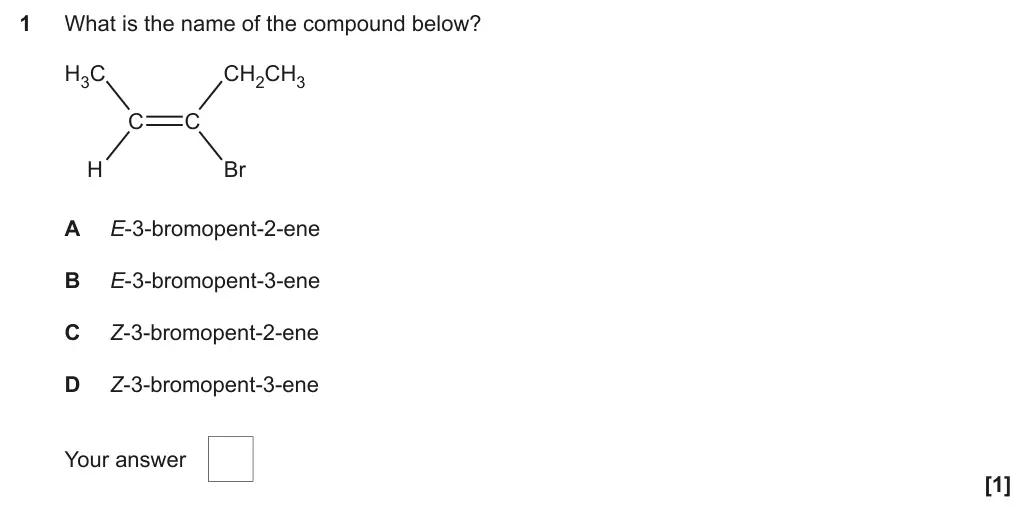
1 Alkenes, Organic basics: naming, formulae and isomerism 1AO1Multiple choice
2 Alkenes 1AO1Multiple choice
3 Organic synthesis (Module 6), Alcohols, Carboxylic acids, esters and acyl chlorides, Carbon–carbon bond formation 1AO1Multiple choice
4 Alcohols, Carbonyl compounds: aldehydes and ketones 1AO2Multiple choice
5 Alkenes 1AO1Multiple choice
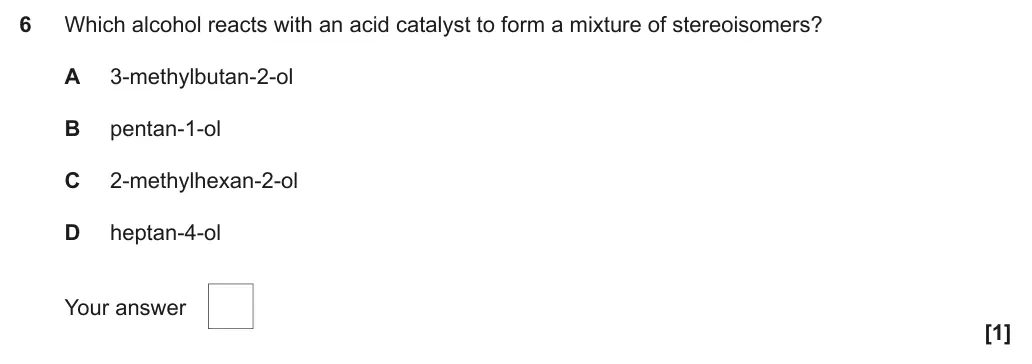
6 Alcohols, Alkenes 1AO2Multiple choice
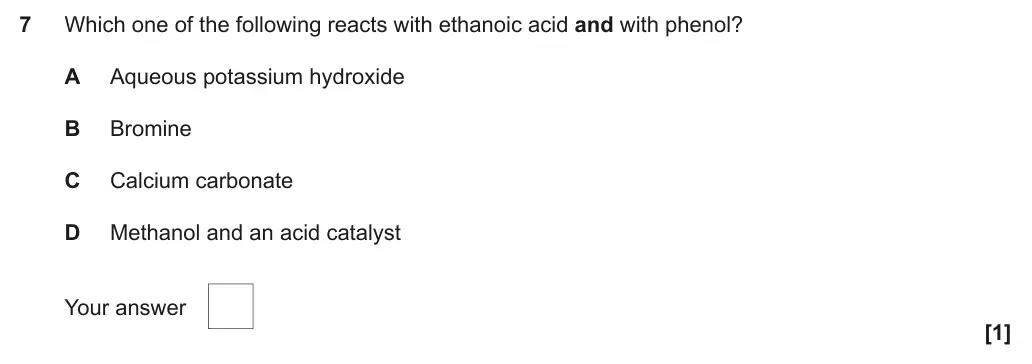
7 Aromatic compounds: benzene and phenol, Carboxylic acids, esters and acyl chlorides 1AO1Multiple choice
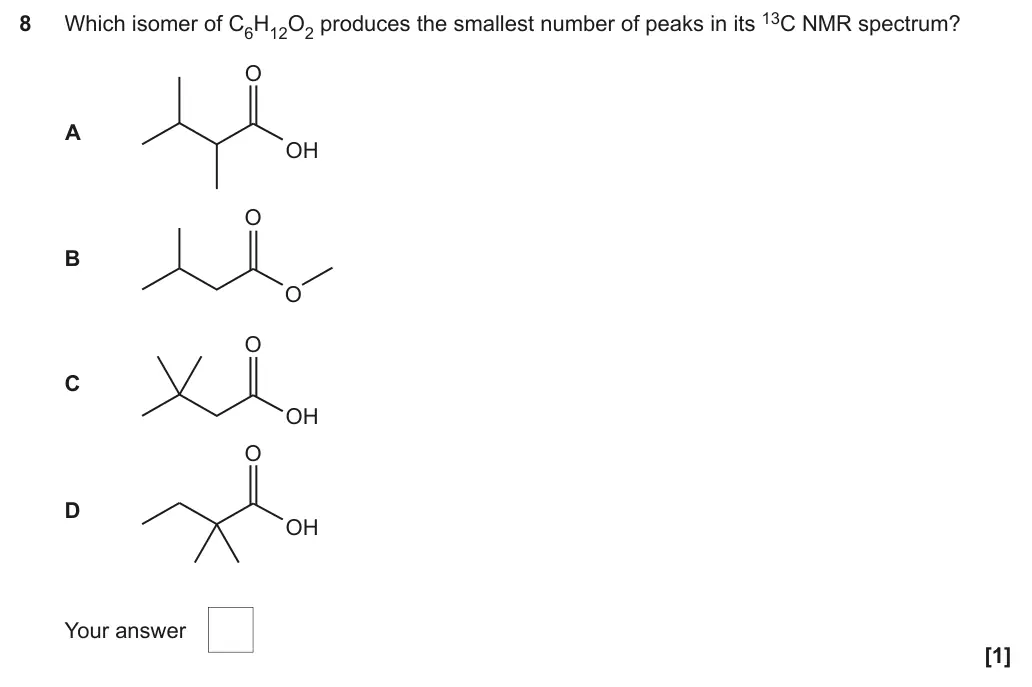
8 NMR spectroscopy and combined techniques 1AO2Multiple choice
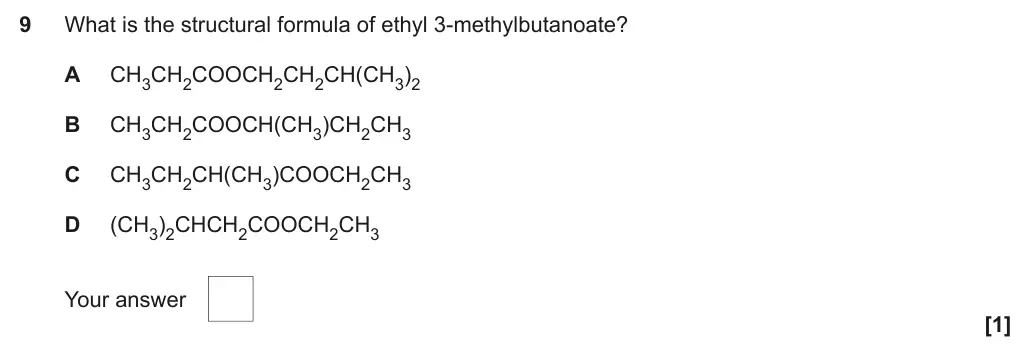
9 Organic basics: naming, formulae and isomerism 1AO1Multiple choice
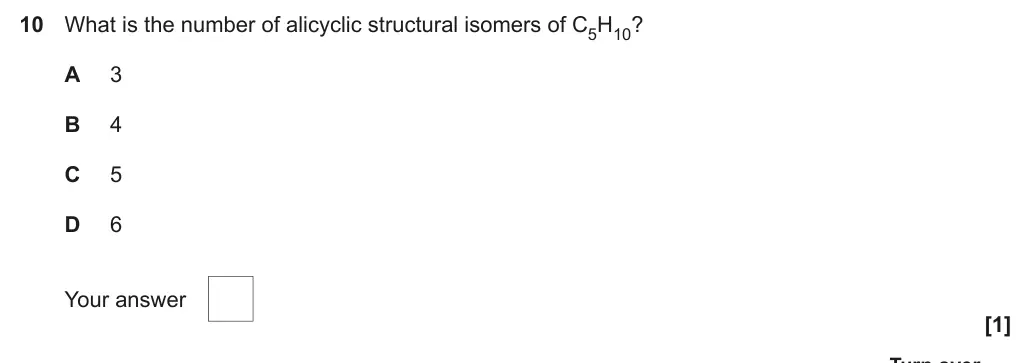
10 Organic basics: naming, formulae and isomerism 1AO2Multiple choice
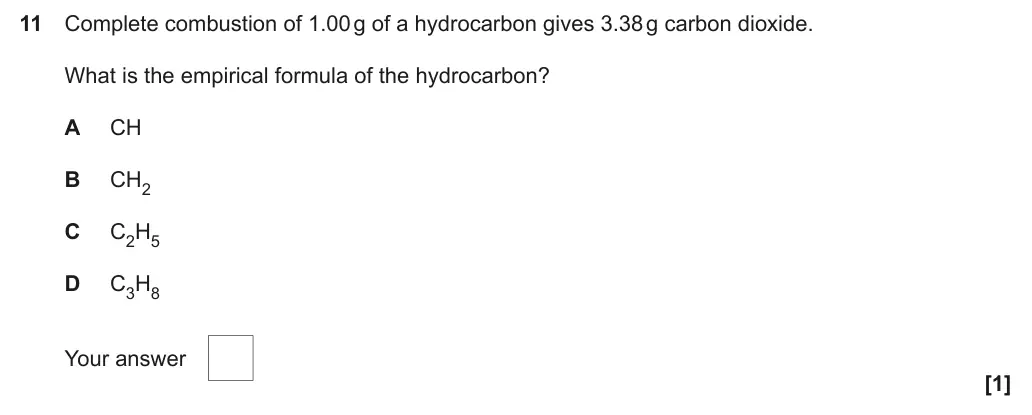
11 Amount of substance (moles) 1AO2Multiple choice
12 Organic basics: naming, formulae and isomerism, Amount of substance (moles) 1AO2Multiple choice
13 Chromatography and tests for functional groups 1AO1Multiple choice
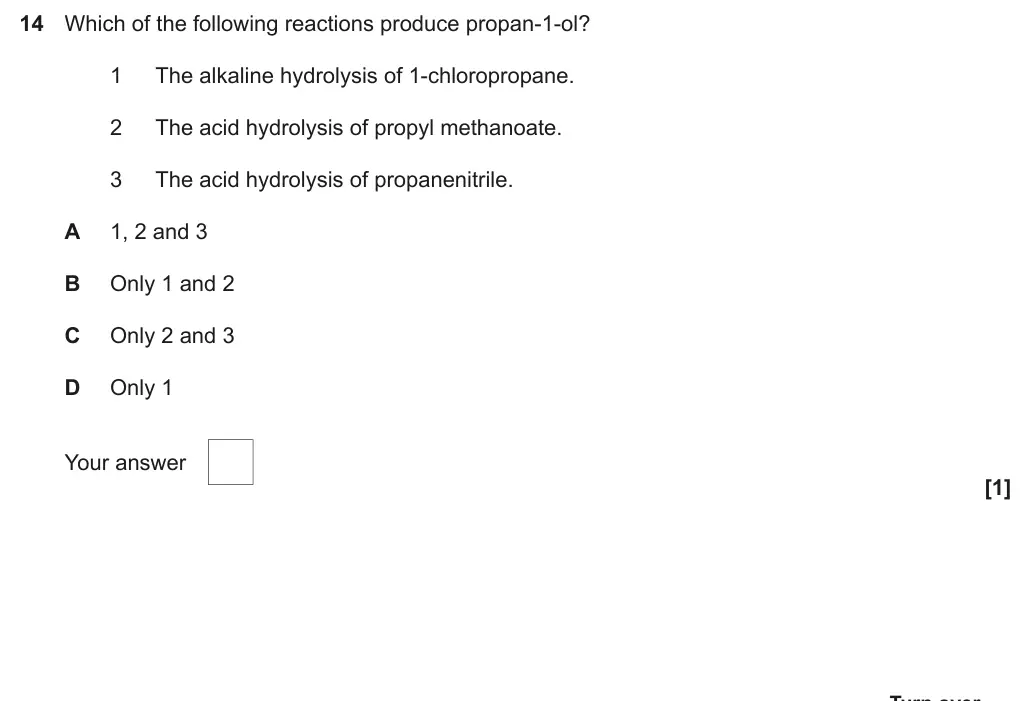
14 Haloalkanes, Carboxylic acids, esters and acyl chlorides, Carbon–carbon bond formation 1AO2Multiple choice
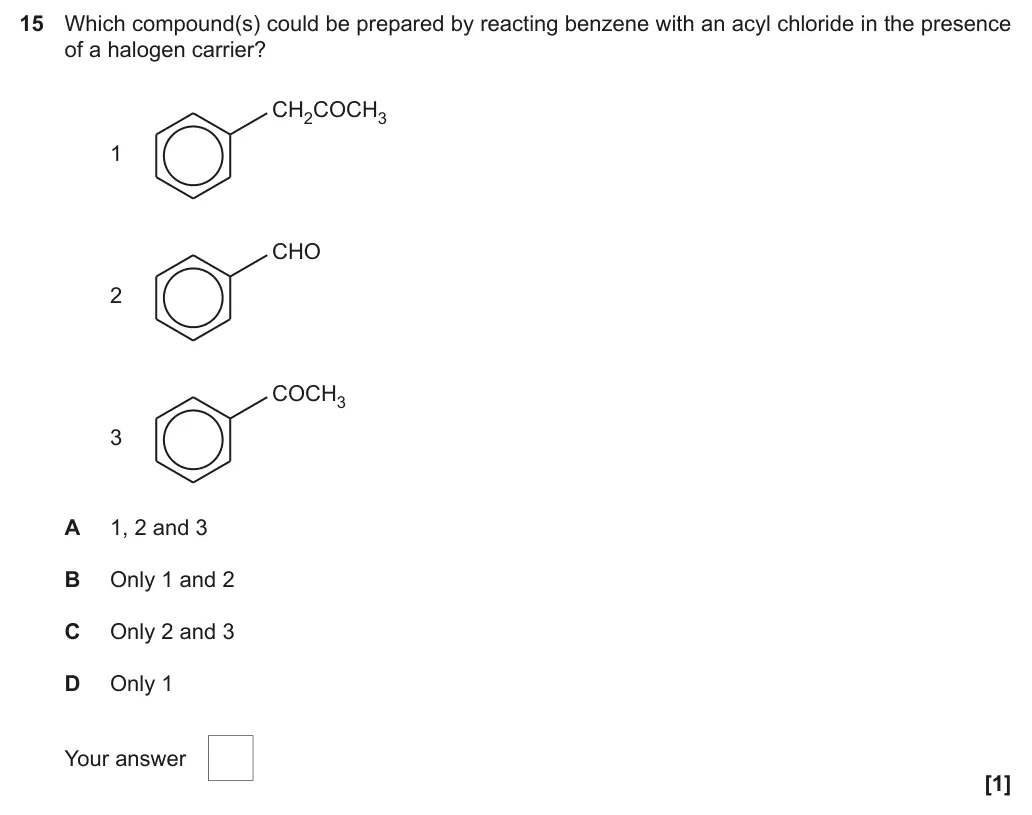
15 Aromatic compounds: benzene and phenol, Carbon–carbon bond formation 1AO1Multiple choice
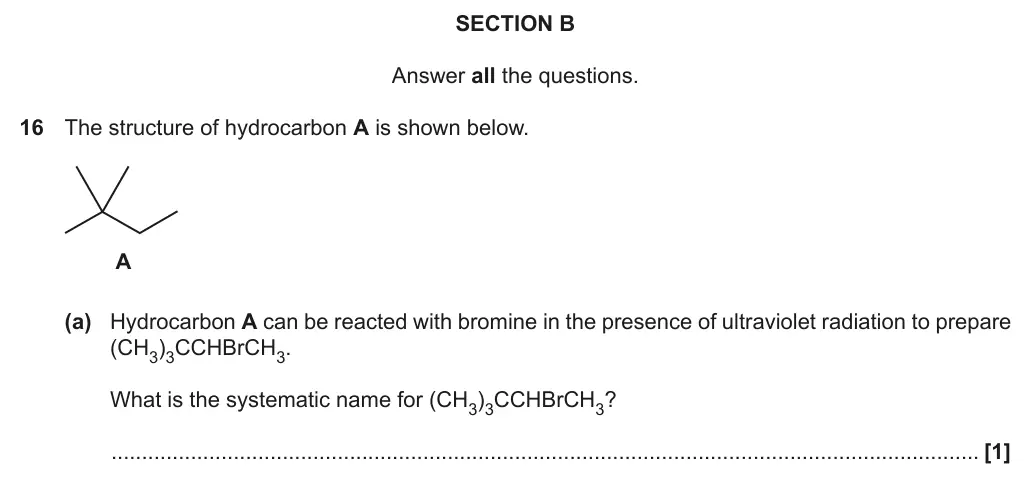
16(a) Organic basics: naming, formulae and isomerism 1AO1Short answer
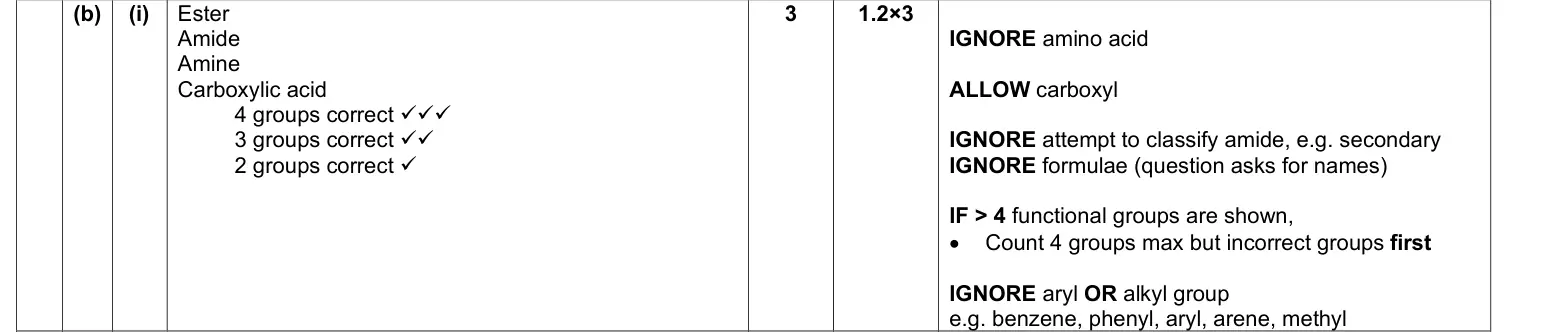
16(b)(i) Alkenes, Amino acids, amides and chirality 1AO1Short answer
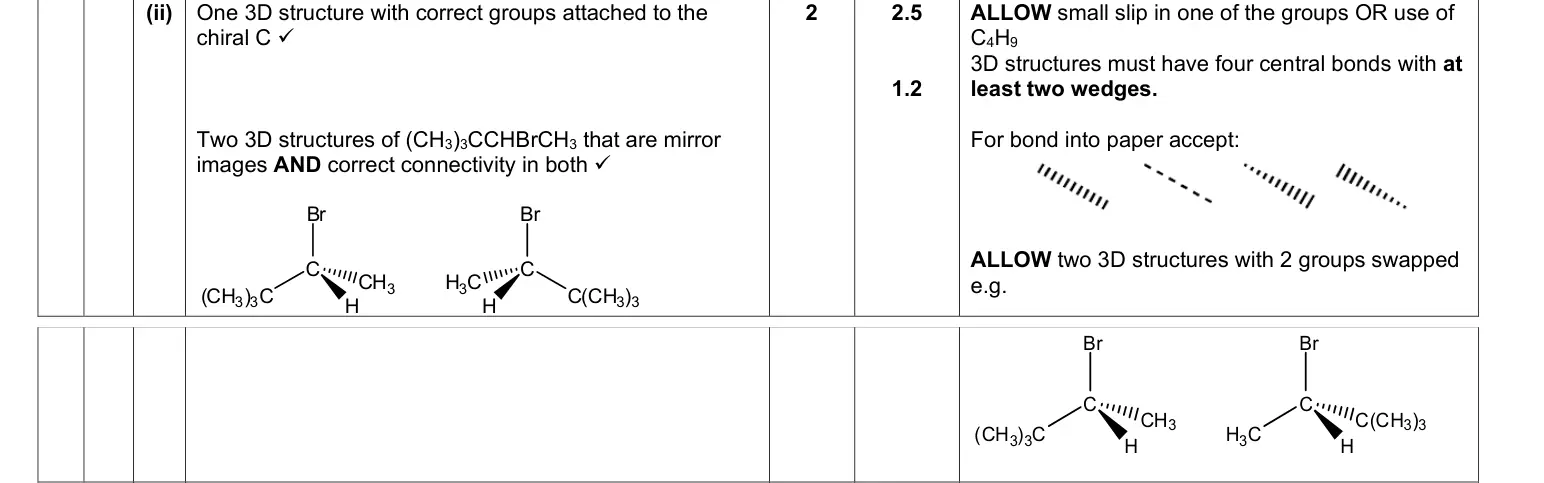
16(b)(ii) Amino acids, amides and chirality 2AO1, 2Structure / isomer
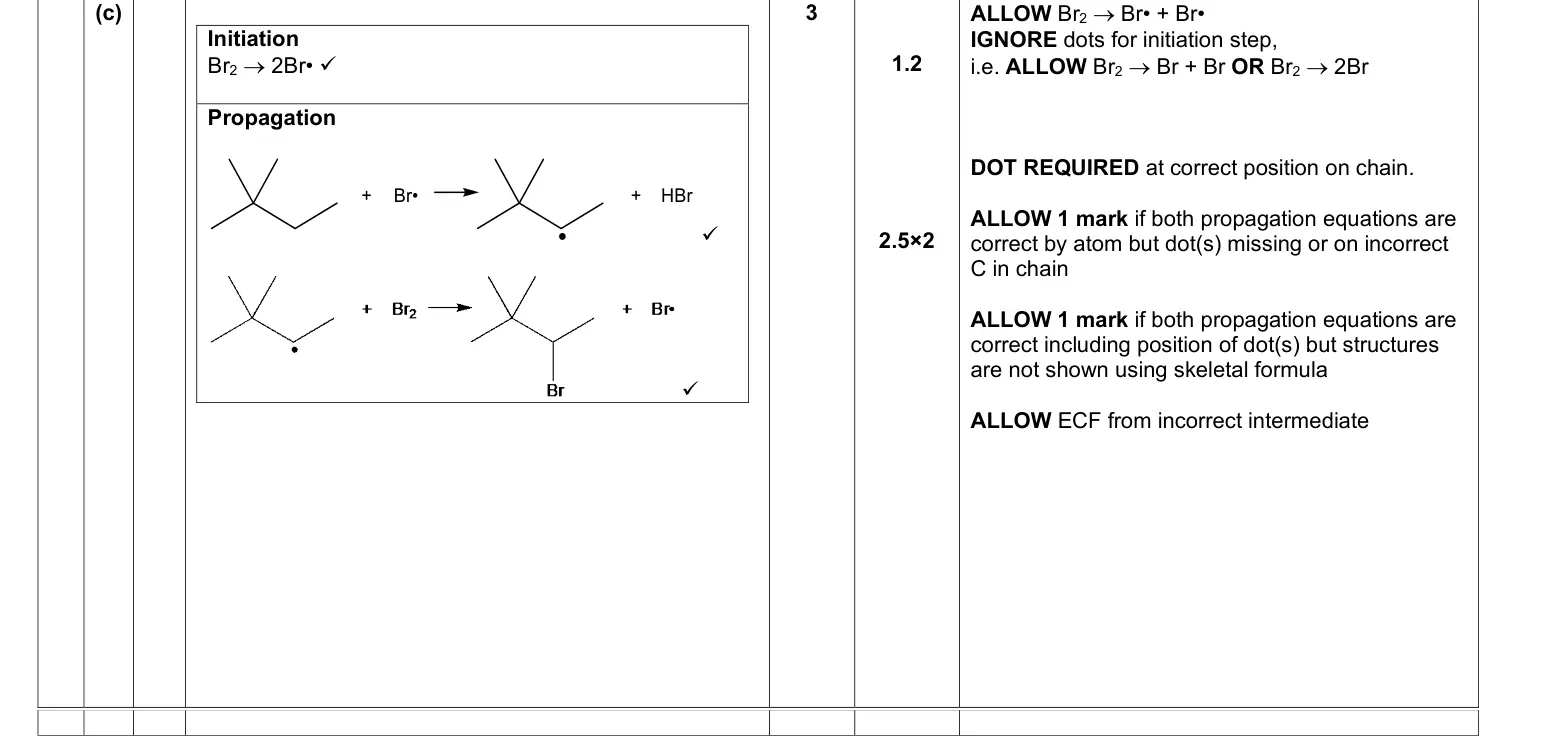
16(c) Alkanes, Organic basics: naming, formulae and isomerism 3AO1, 2Mechanism
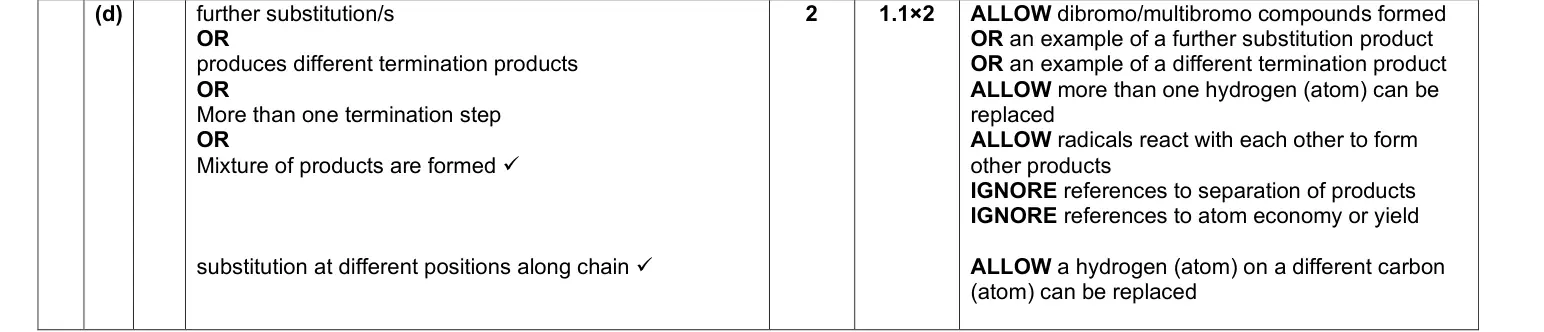
16(d) Alkanes 2AO1Short answer
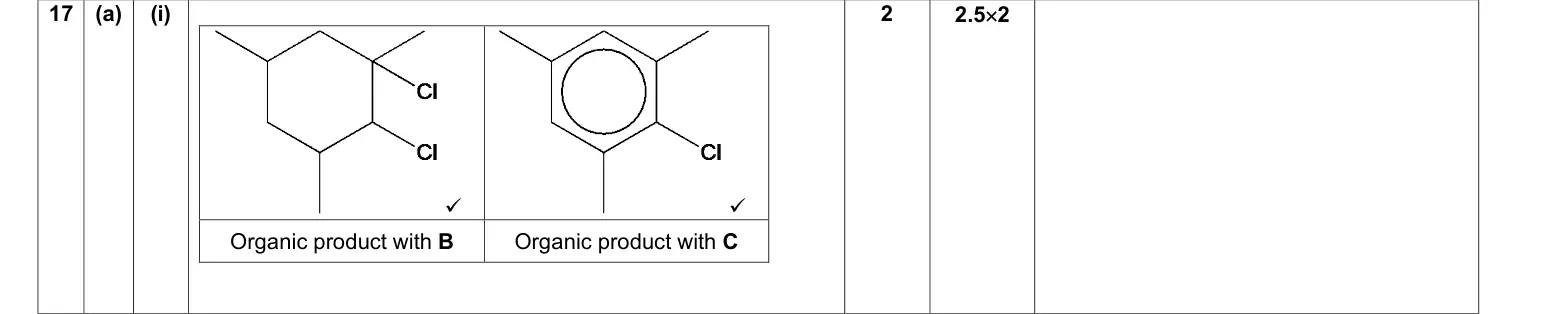
17(a)(i) Alkenes, Aromatic compounds: benzene and phenol 2AO2Structure / isomer
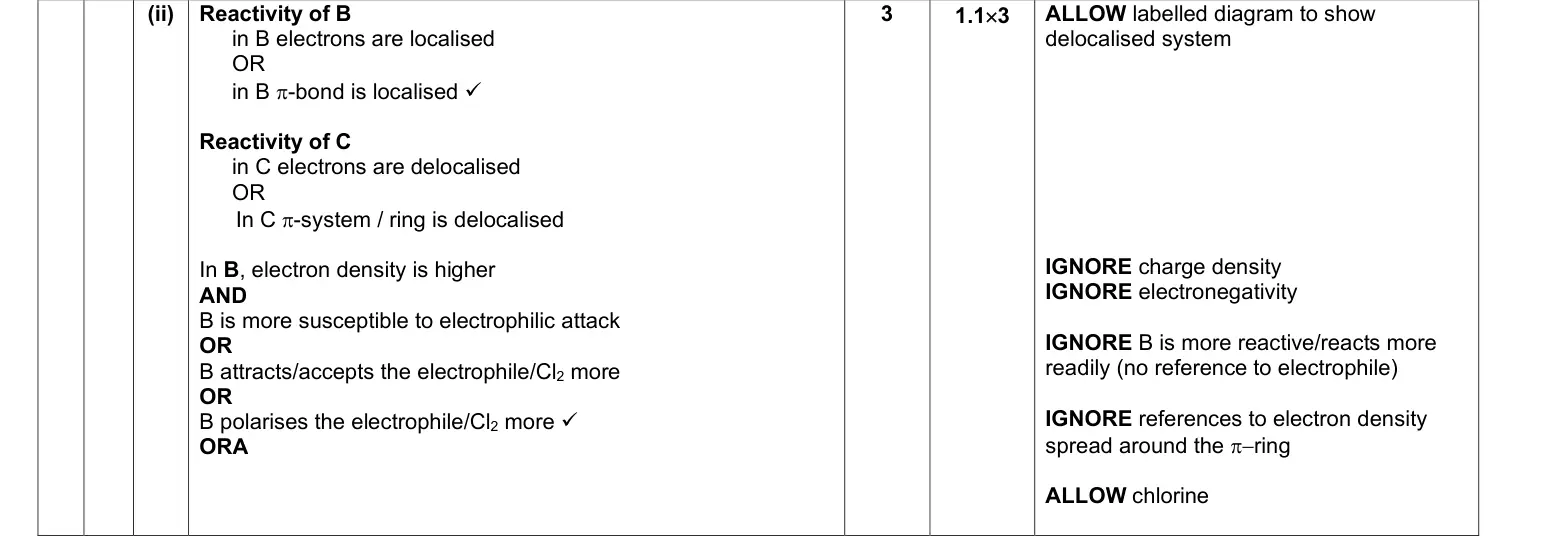
17(a)(ii) Aromatic compounds: benzene and phenol 3AO1Short answer
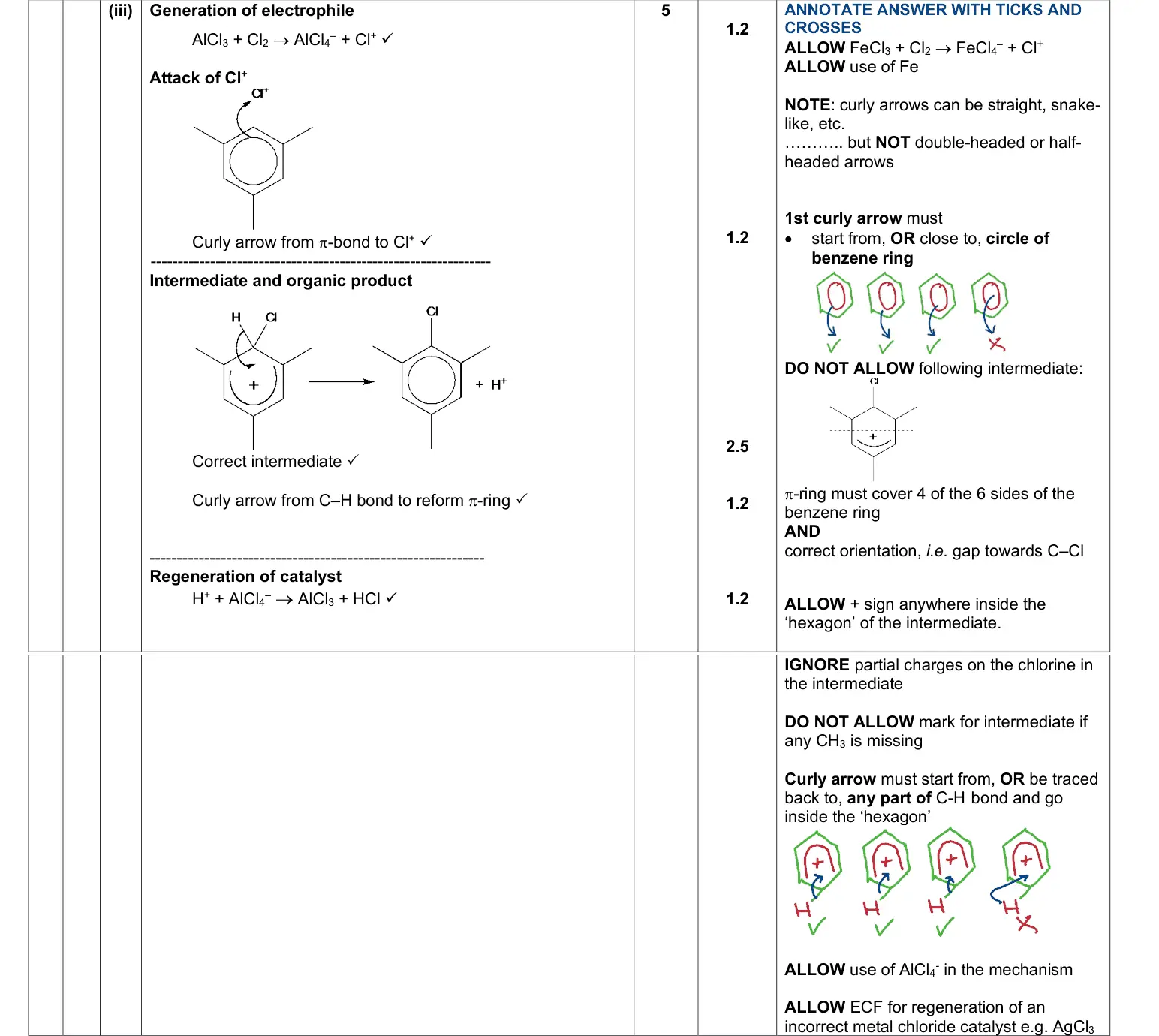
17(a)(iii) Aromatic compounds: benzene and phenol 5AO1, 2Mechanism
17(b) Formulae and equations 3AO2Short answer
17(c)(i) NMR spectroscopy and combined techniques 2AO3Short answer
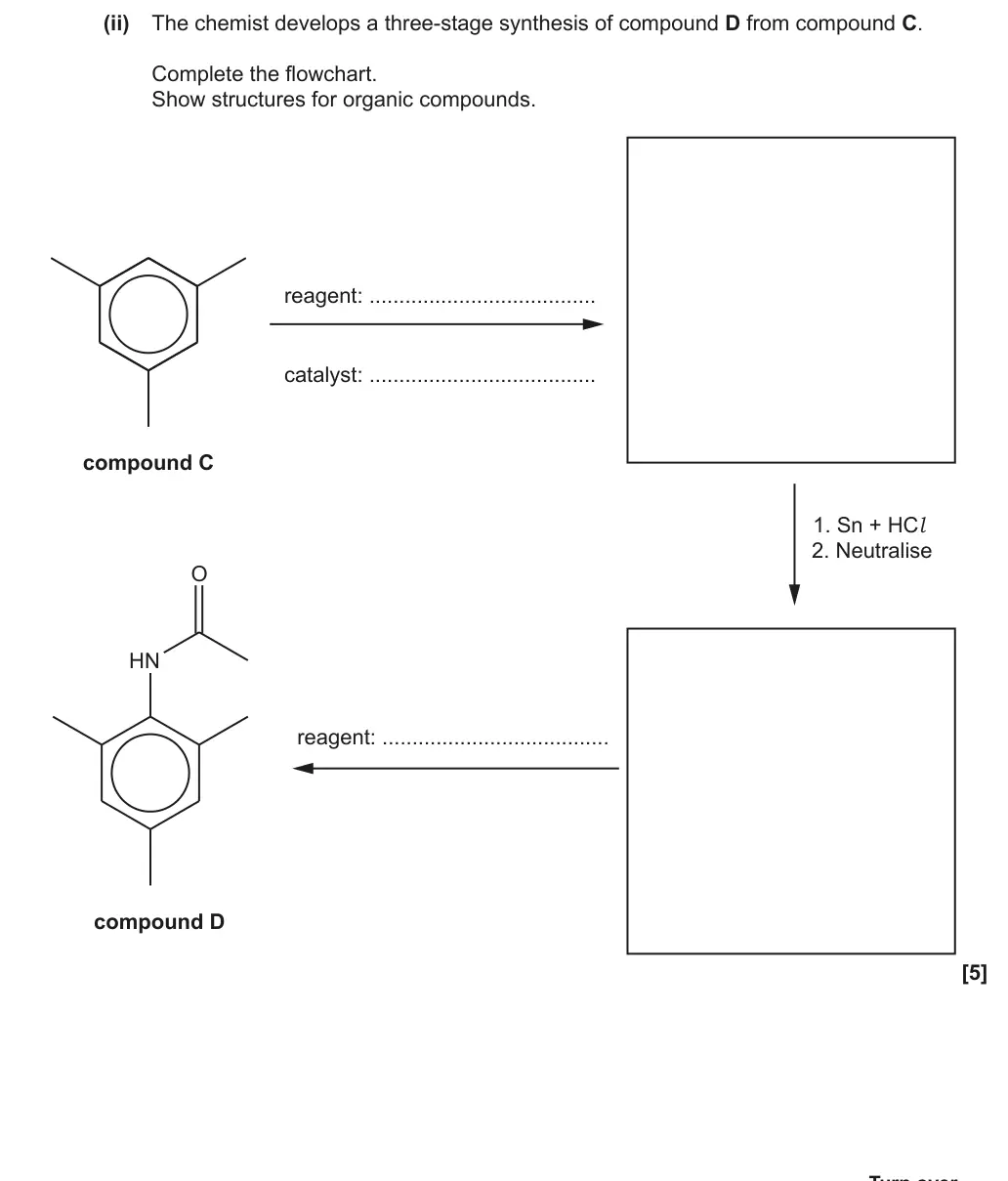
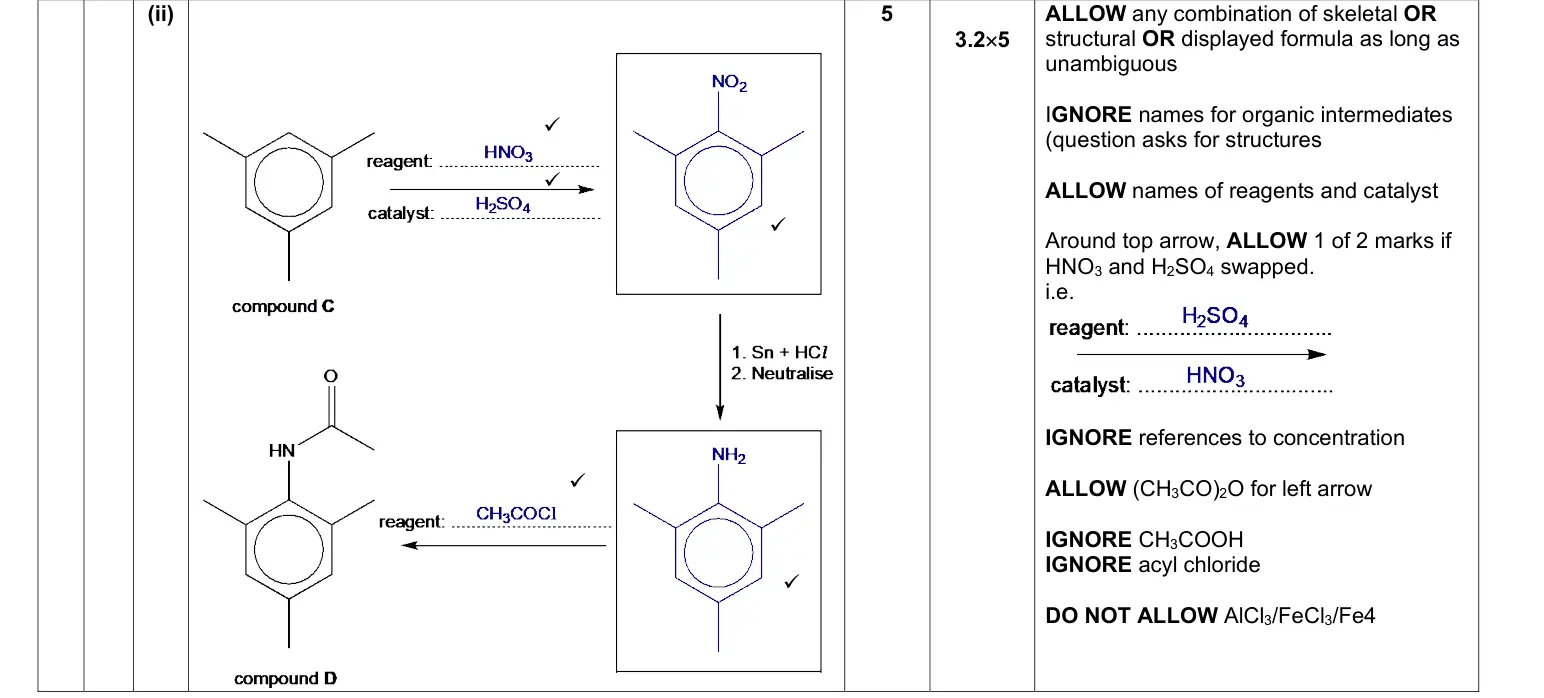
17(c)(ii) Organic synthesis (Module 6), Aromatic compounds: benzene and phenol, Carboxylic acids, esters and acyl chlorides, Amines, Amino acids, amides and chirality 5AO3Complete table/diagram
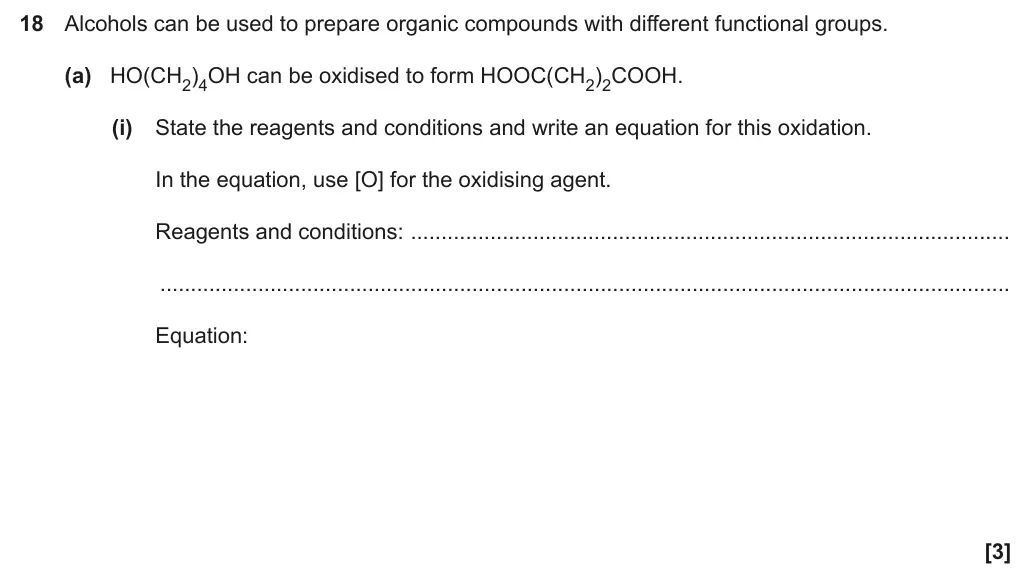
18(a)(i) Alcohols, Formulae and equations 3AO1, 2Equation writing
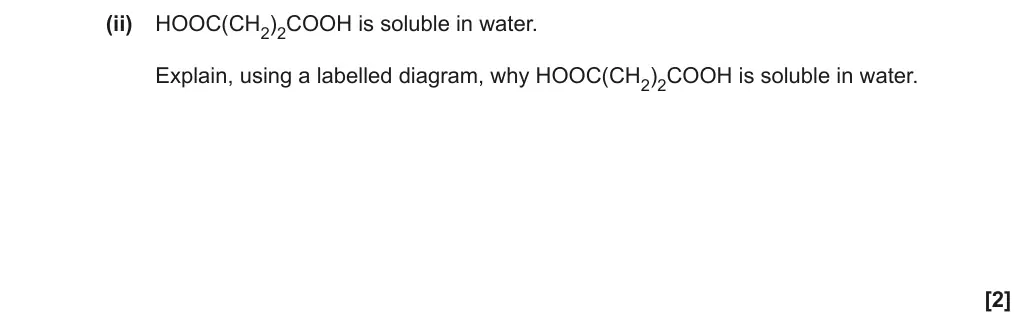
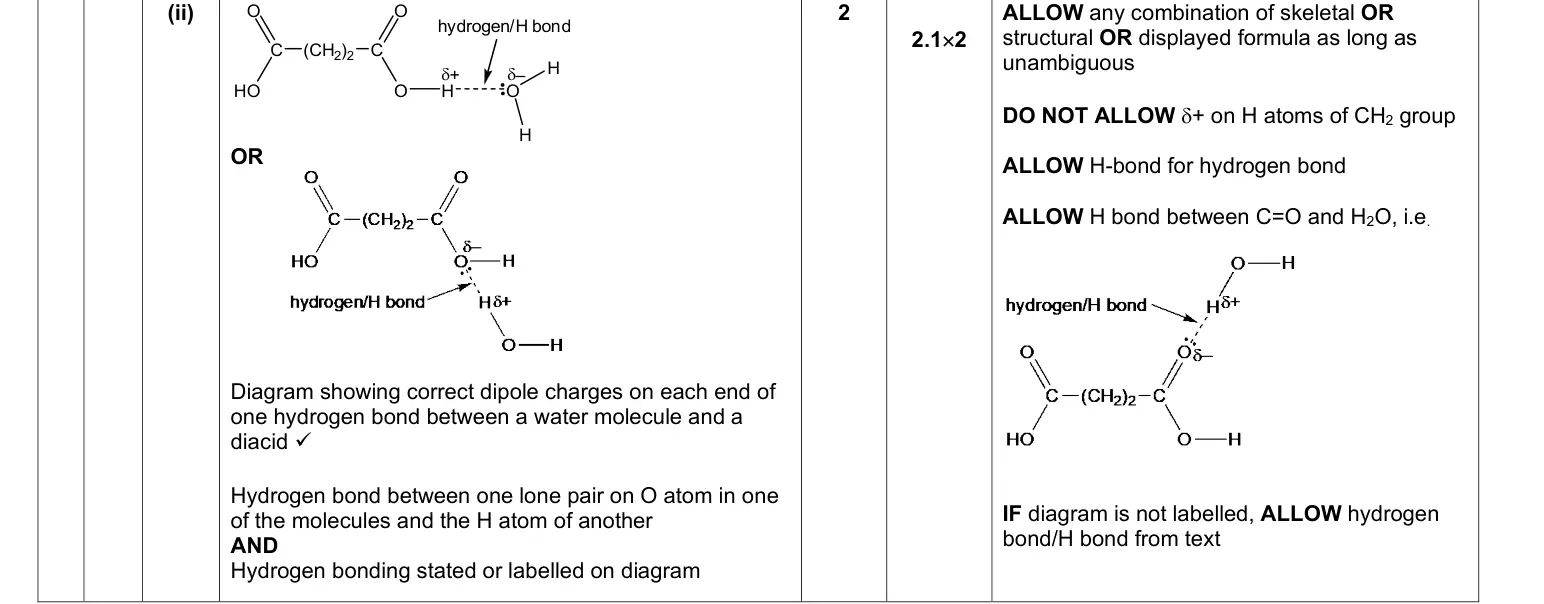
18(a)(ii) Carboxylic acids, esters and acyl chlorides, Bonding, structure and shapes of molecules 2AO2Short answer
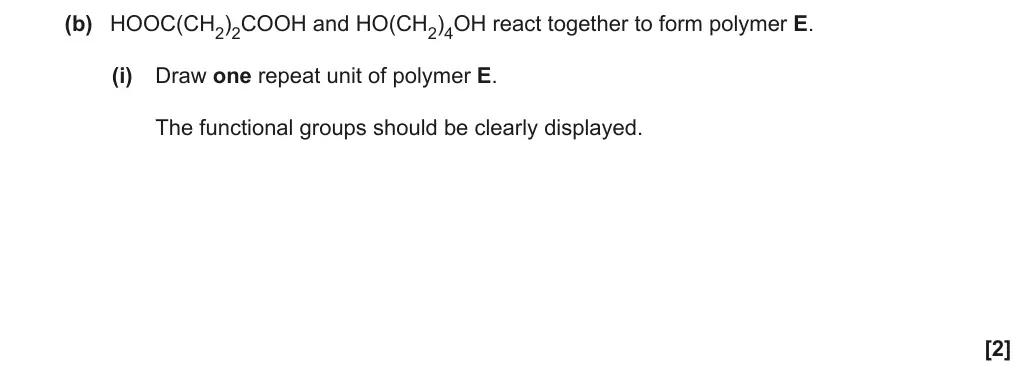
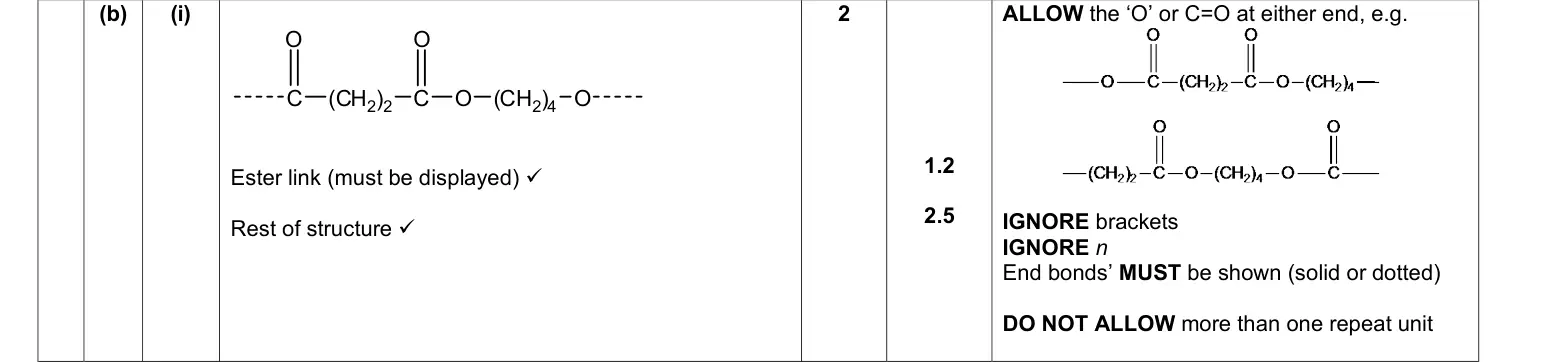
18(b)(i) Polyesters and polyamides 2AO1, 2Structure / isomer
18(b)(ii) Polyesters and polyamides, Alkenes 1AO3Short answer
18(b)(iii) Carboxylic acids, esters and acyl chlorides, Formulae and equations 3AO1, 2Complete table/diagram
19(a)(i) Organic basics: naming, formulae and isomerism 2AO1Short answer
19(a)(ii) Organic basics: naming, formulae and isomerism 1AO2Short answer
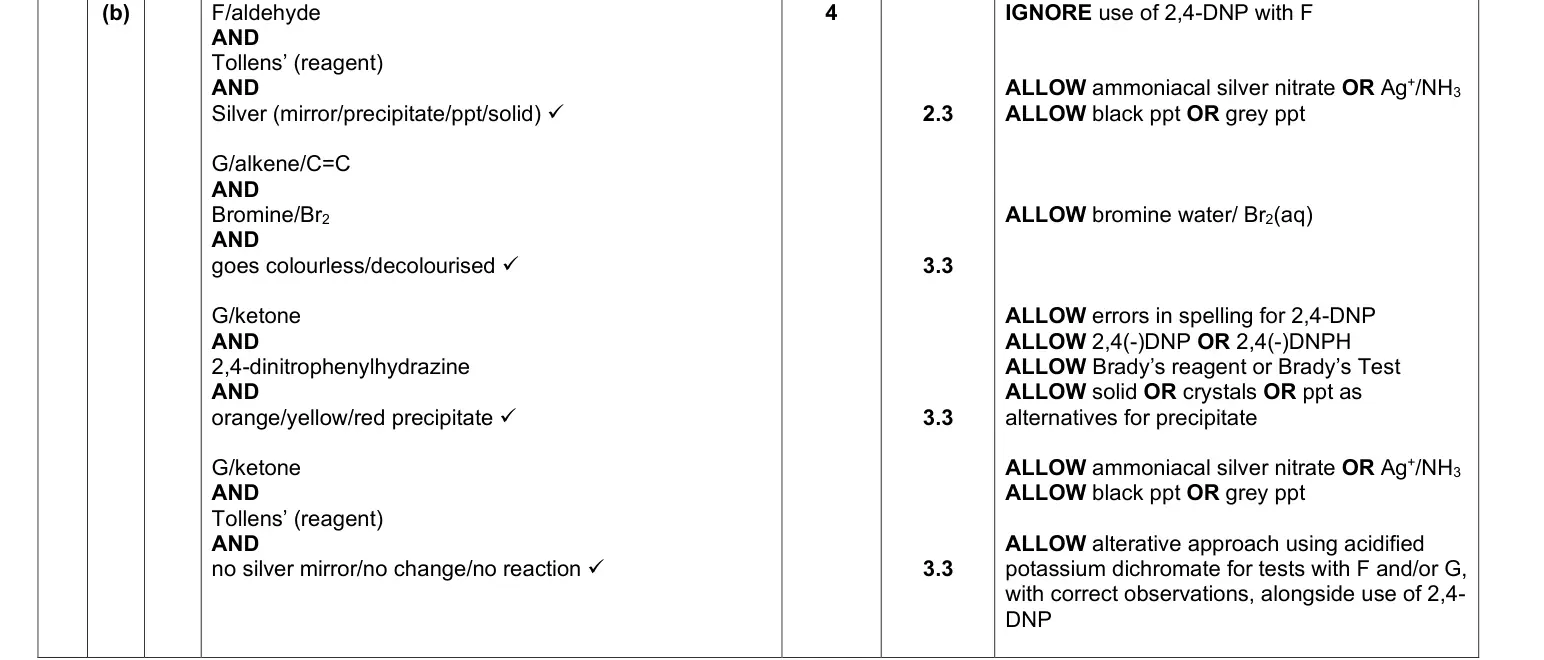
19(b) Carbonyl compounds: aldehydes and ketones, Chromatography and tests for functional groups 4AO2, 3Short answer
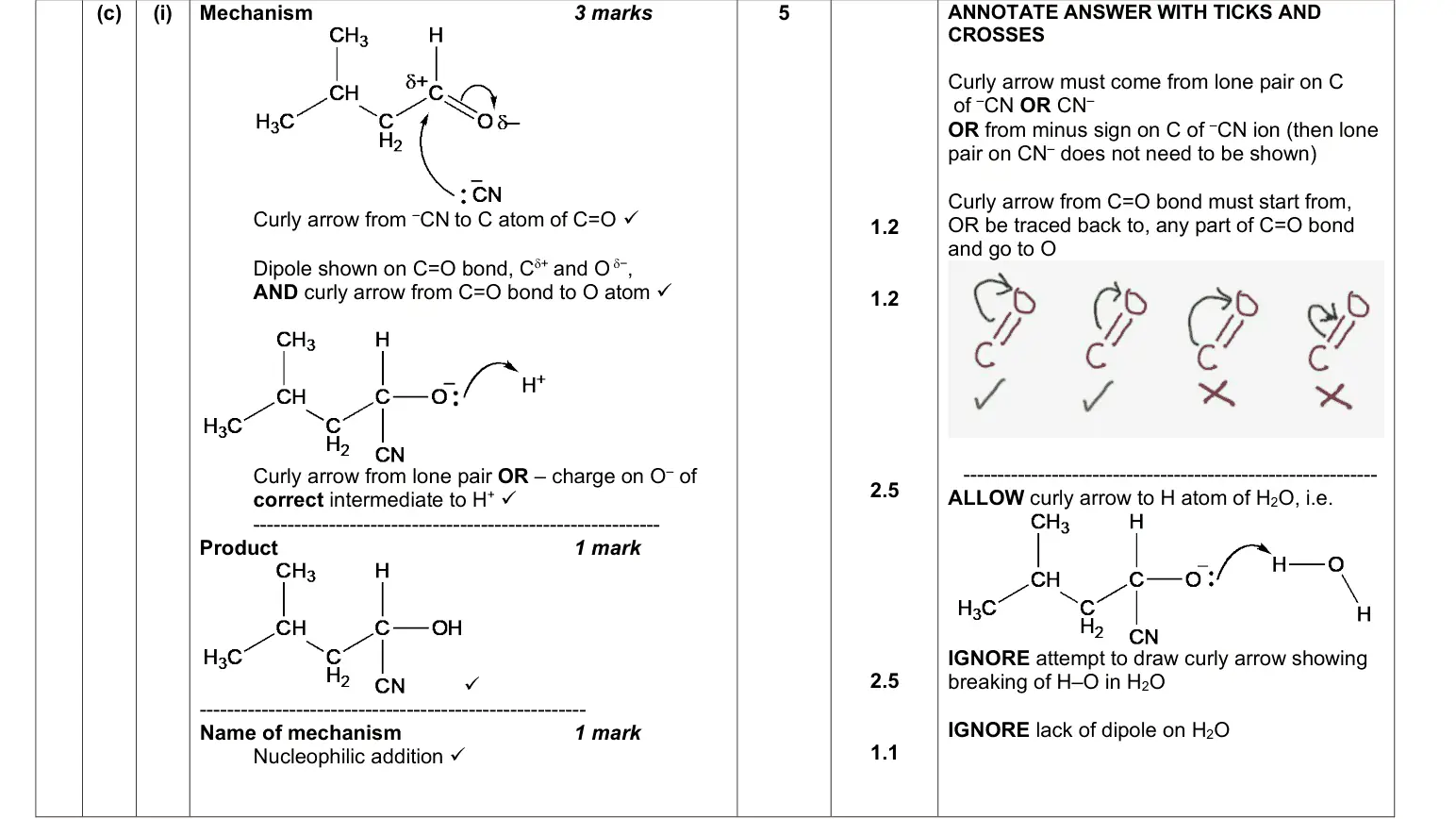
19(c)(i) Carbonyl compounds: aldehydes and ketones, Organic basics: naming, formulae and isomerism 5AO1, 2Mechanism
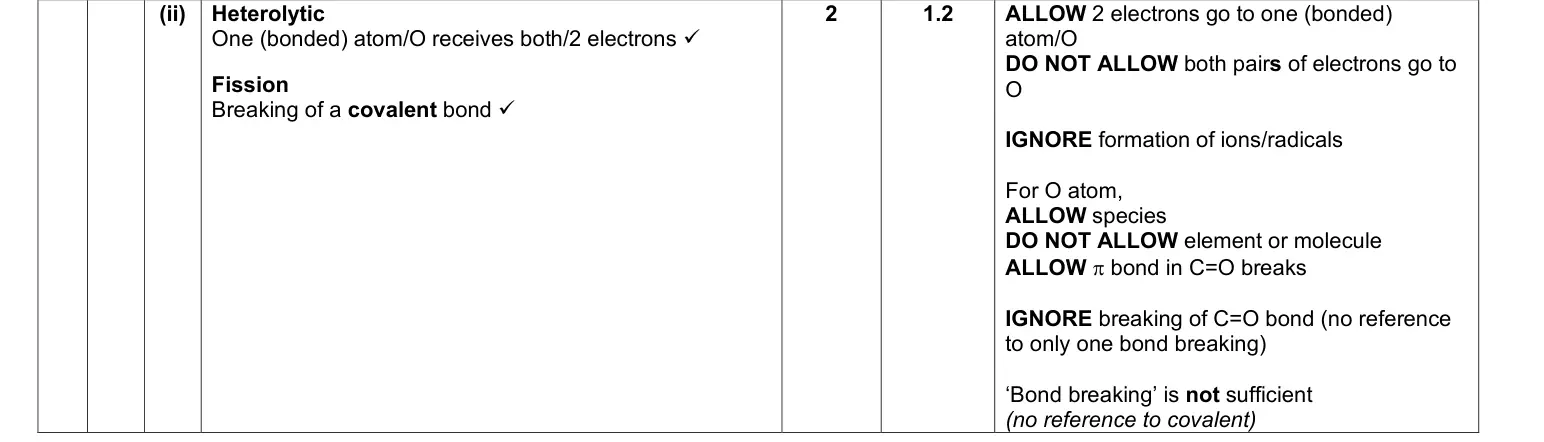
19(c)(ii) Organic basics: naming, formulae and isomerism 2AO1Short answer
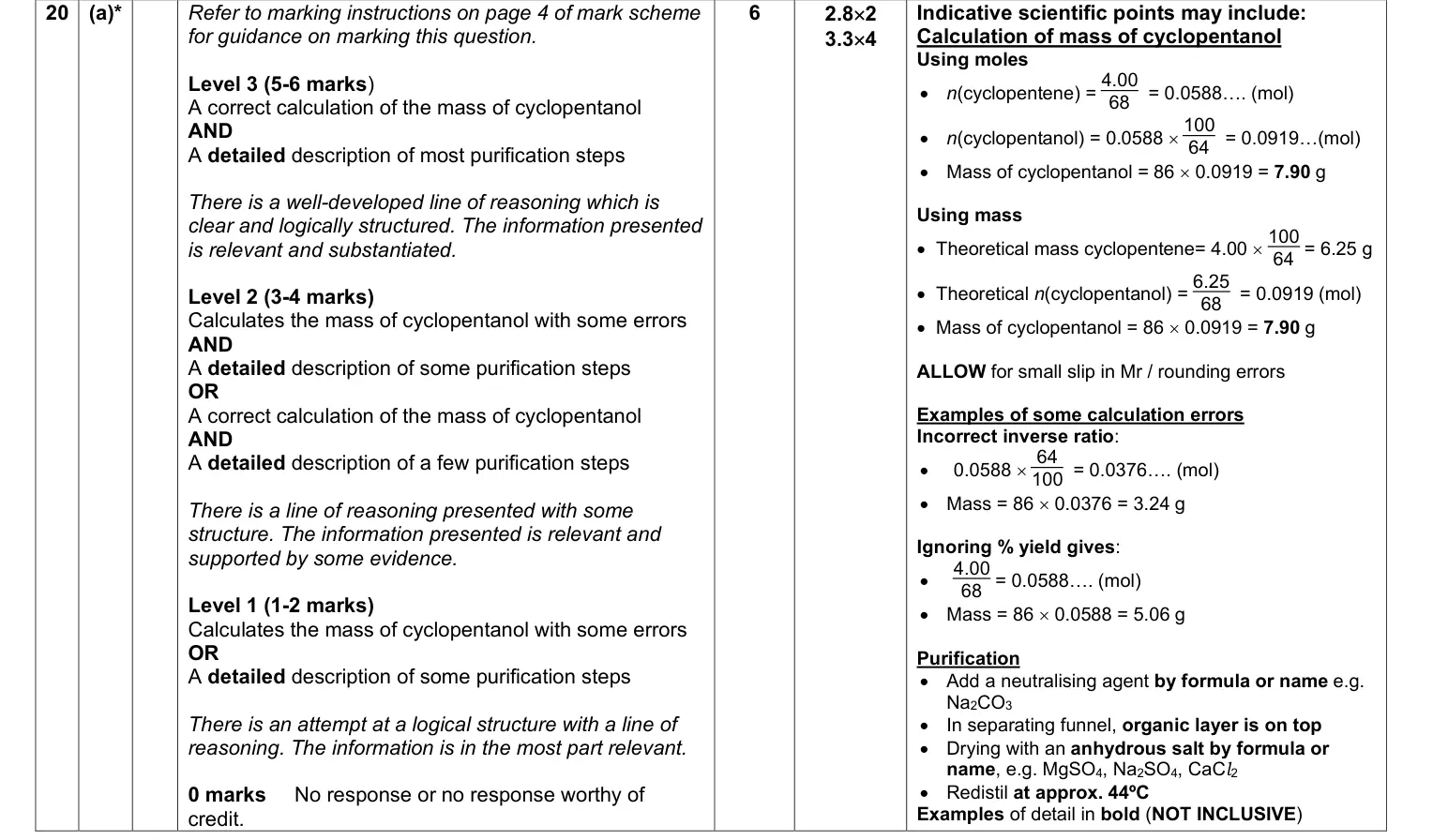
20(a) Amount of substance (moles), Practical techniques and apparatus (PAGs), Organic synthesis and practical techniques (Module 4) 6AO2, 3Level of response
20(b) Infrared spectroscopy and mass spectrometry 2AO3Short answer
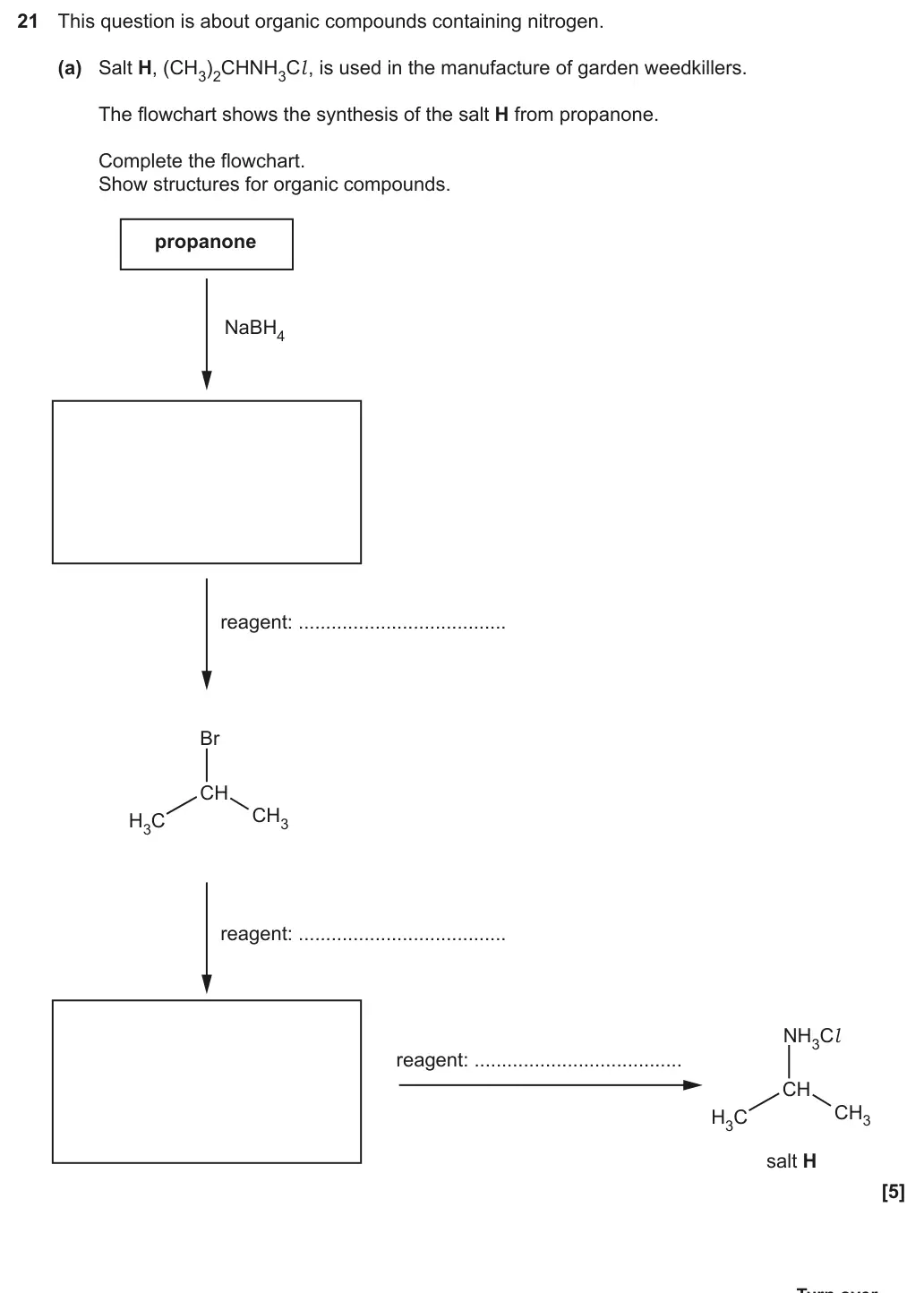
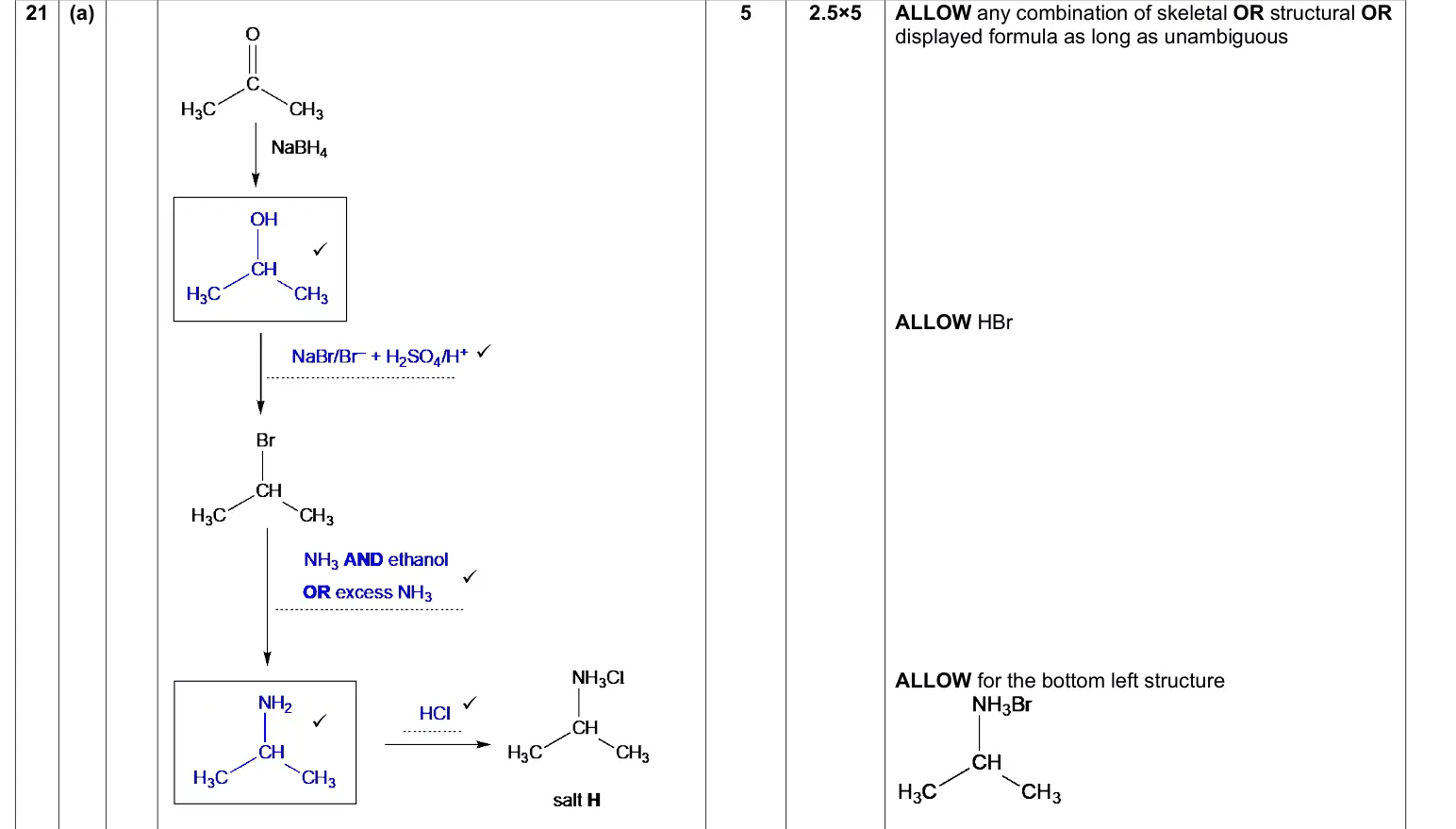
21(a) Carbonyl compounds: aldehydes and ketones, Alcohols, Amines, Organic synthesis (Module 6) 5AO2Complete table/diagram
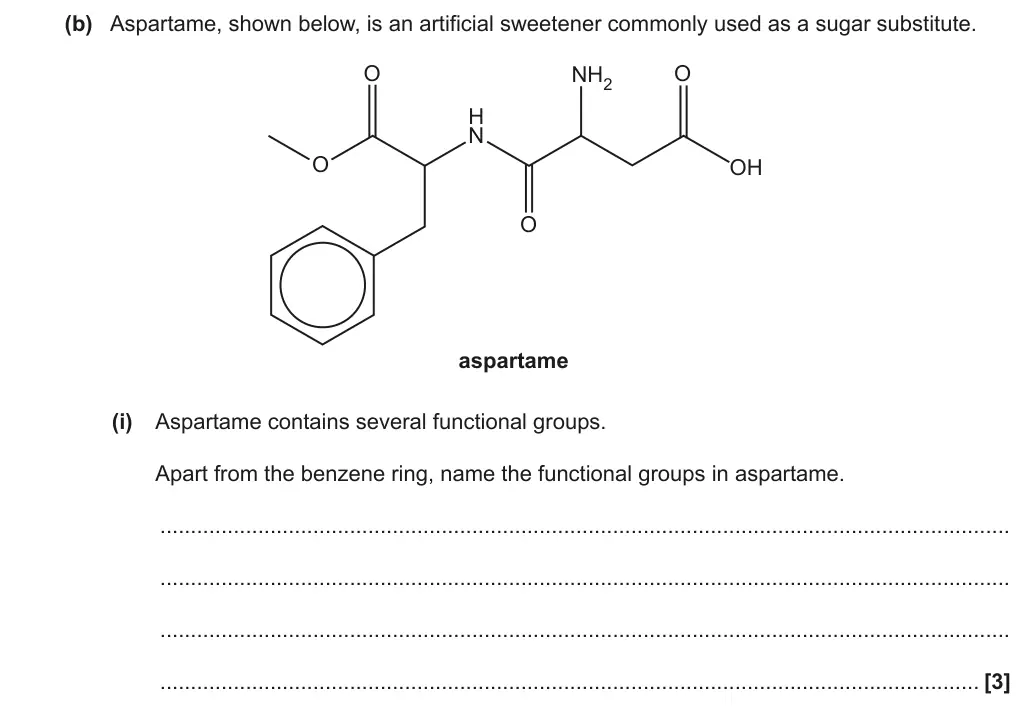
21(b)(i) Organic synthesis (Module 6), Amino acids, amides and chirality 3AO1Short answer
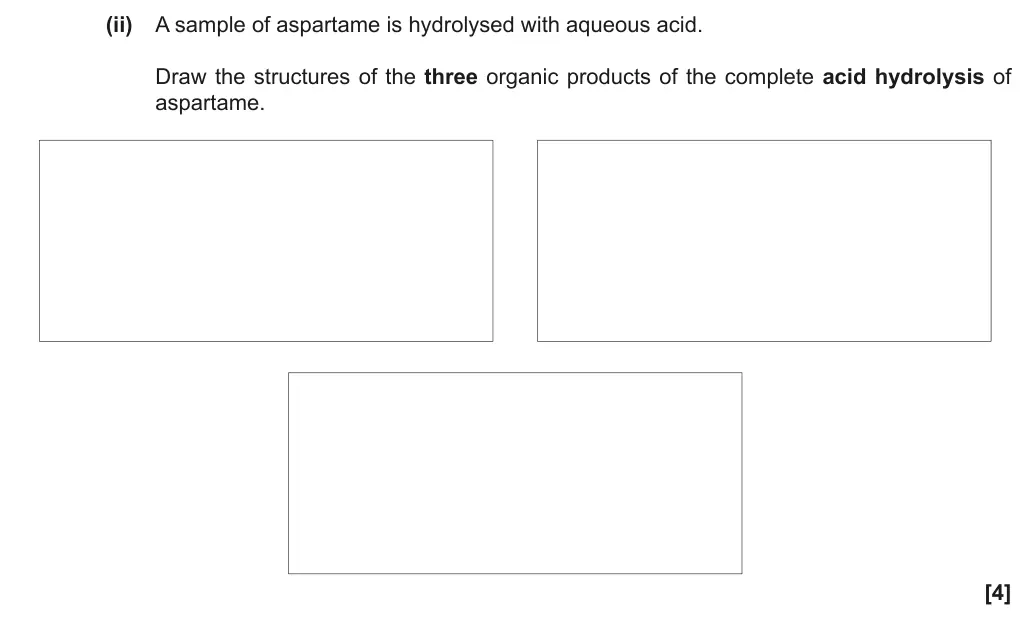
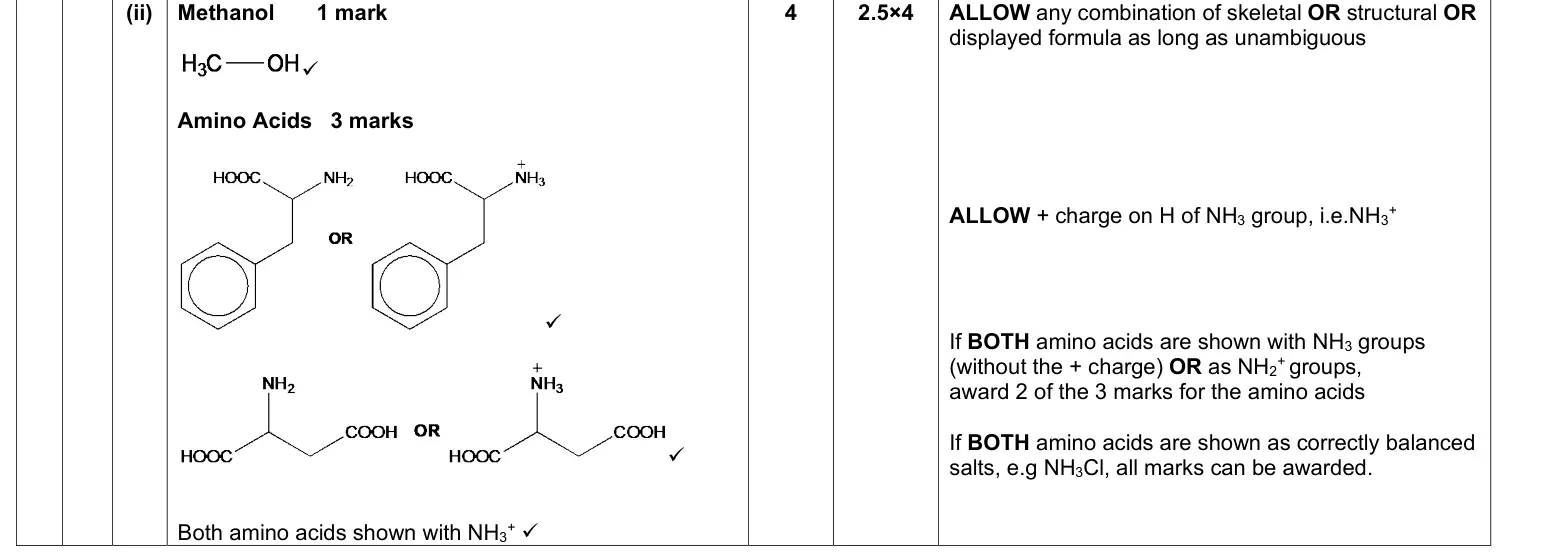
21(b)(ii) Carboxylic acids, esters and acyl chlorides, Amino acids, amides and chirality, Polyesters and polyamides, Organic synthesis (Module 6) 4AO2Structure / isomer
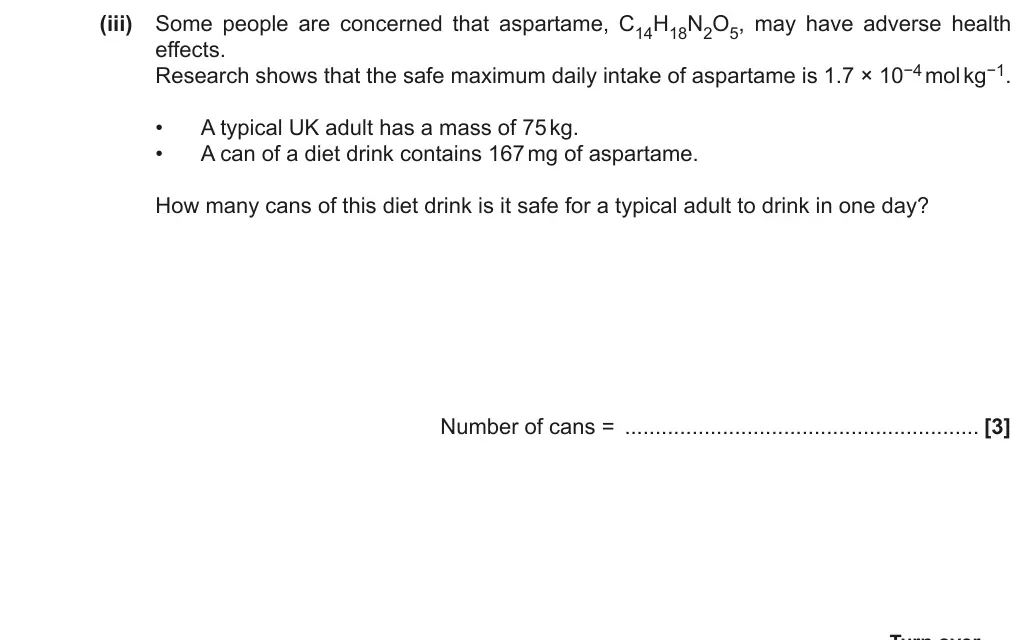
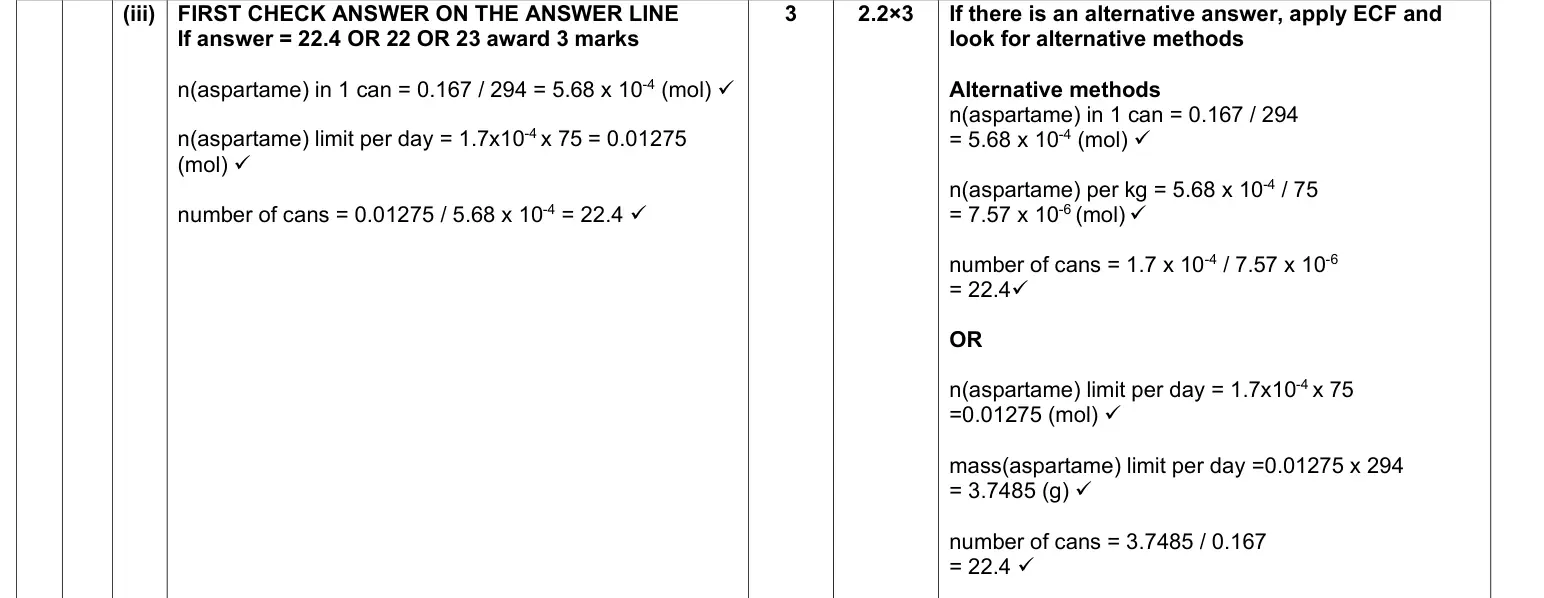
21(b)(iii) Amount of substance (moles), Atomic structure and isotopes 3AO2Calculation
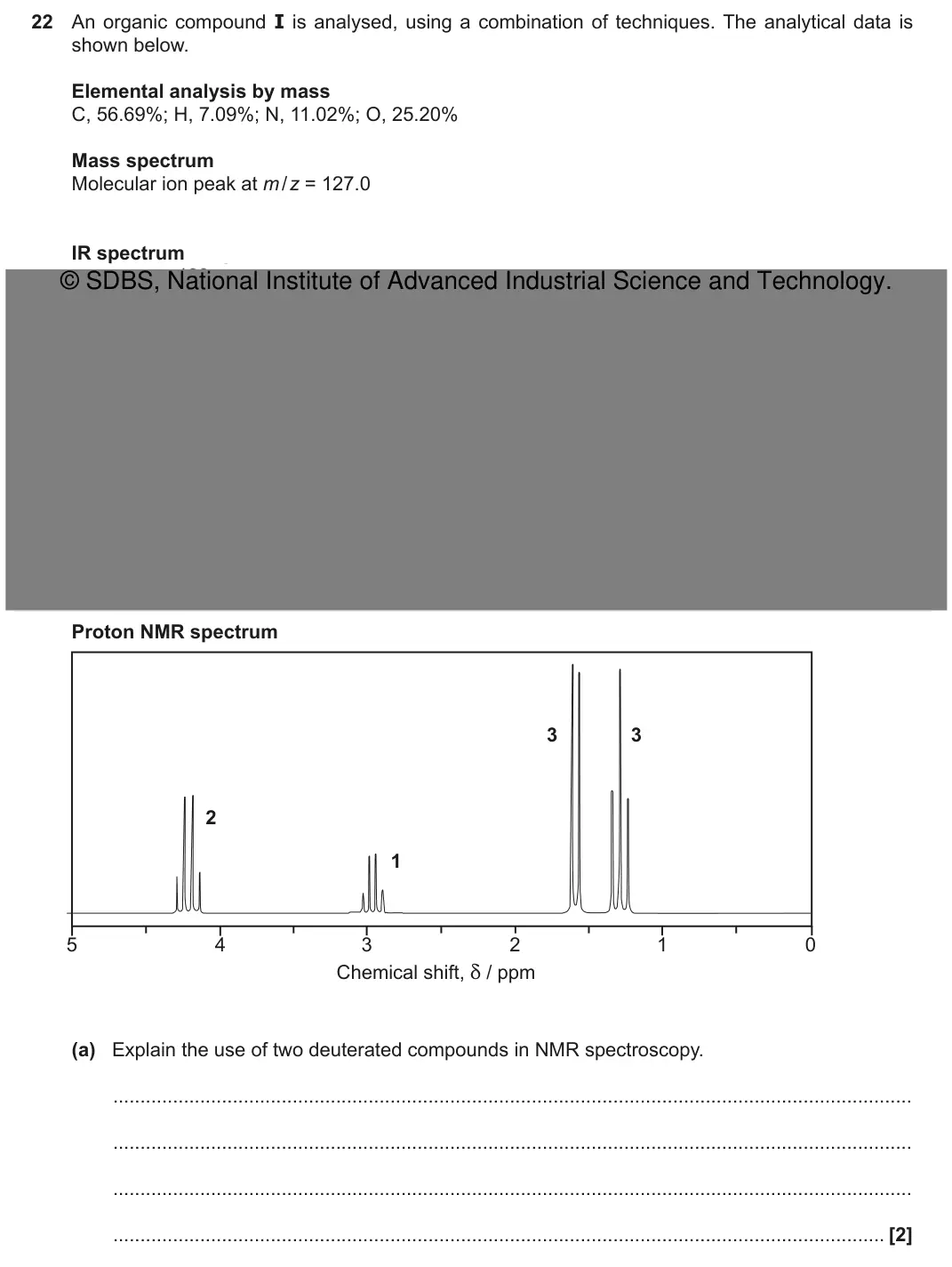
22(a) NMR spectroscopy and combined techniques 2AO1Short answer
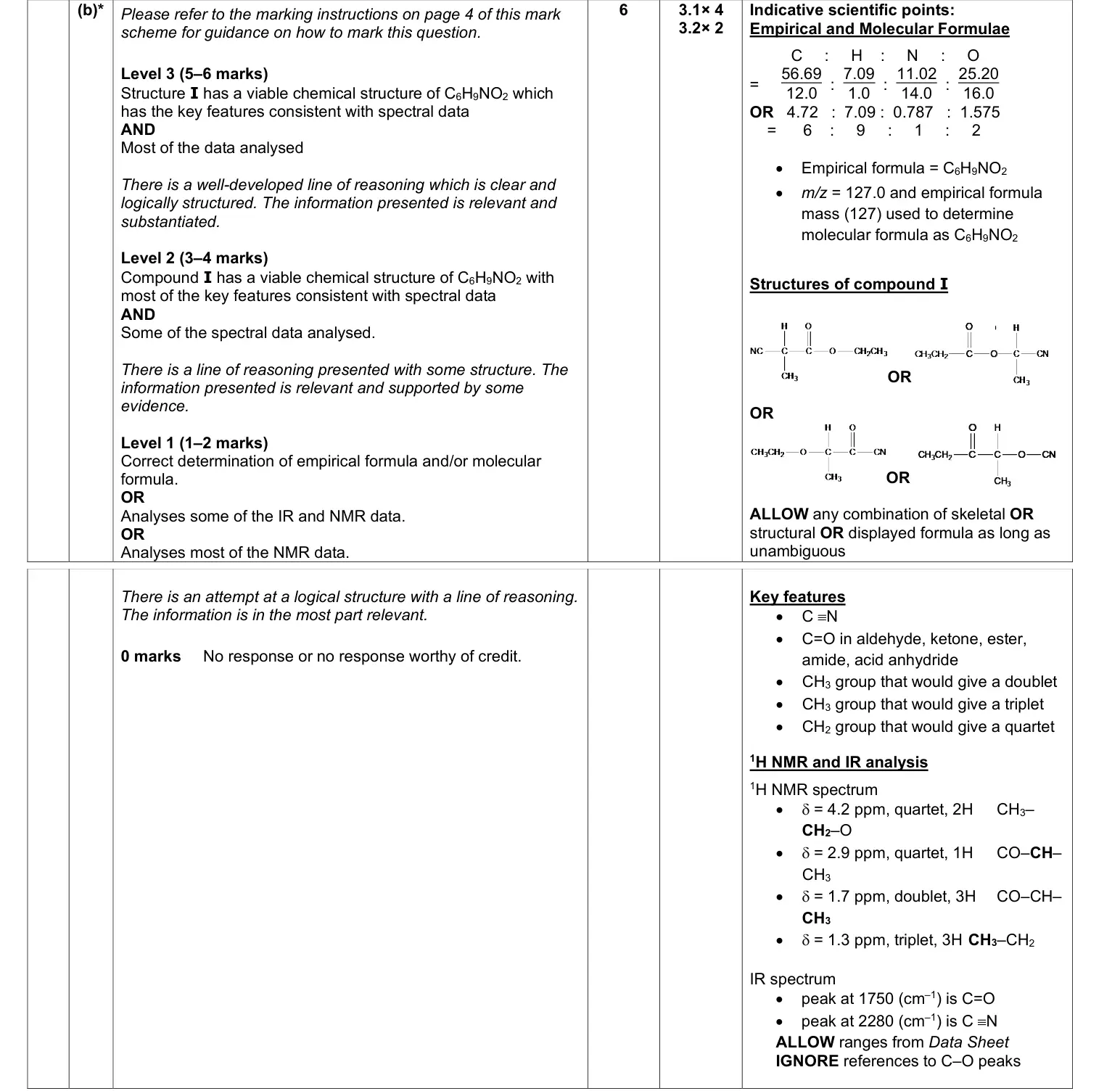
22(b) NMR spectroscopy and combined techniques, Amount of substance (moles), Infrared spectroscopy and mass spectrometry 6AO3Level of response

The questions

12345678910111213141516(a)16(b)(i)16(b)(ii)16(c)16(d)17(a)(i)17(a)(ii)17(a)(iii)17(b)17(c)(i)17(c)(ii)18(a)(i)18(a)(ii)18(b)(i)18(b)(ii)18(b)(iii)19(a)(i)19(a)(ii)19(b)19(c)(i)19(c)(ii)20(a)20(b)21(a)21(b)(i)21(b)(ii)21(b)(iii)22(a)22(b)
November 2020 · Paper 2 · Q1 1 mark AO1 Multiple choice alkenesorganic basics
1 What is the name of the compound below?
H3C CH2CH3
C C
H Br
A E-3-bromopent-2-ene
B E-3-bromopent-3-ene
C Z-3-bromopent-2-ene
D Z-3-bromopent-3-ene
Your answer
[1]
November 2020 · Paper 2 · Q2 1 mark AO1 Multiple choice alkenes
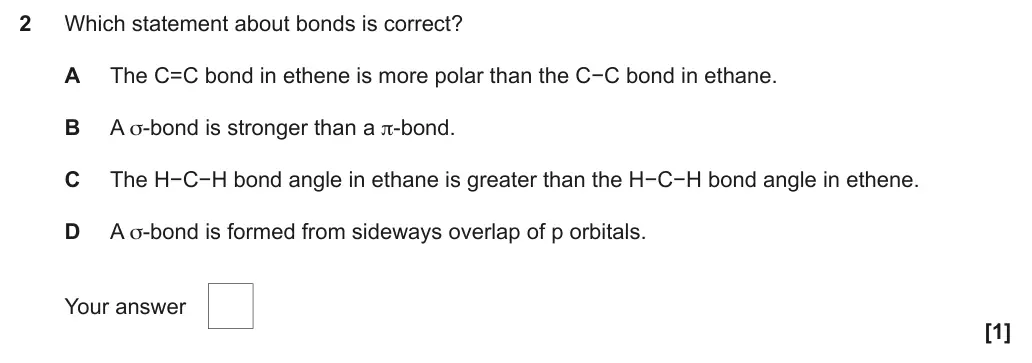
2 Which statement about bonds is correct?
A The C=C bond in ethene is more polar than the C−C bond in ethane.
B A σ-bond is stronger than a π-bond.
C The H−C−H bond angle in ethane is greater than the H−C−H bond angle in ethene.
D A σ-bond is formed from sideways overlap of p orbitals.
Your answer
[1]
November 2020 · Paper 2 · Q3 1 mark AO1 Multiple choice organic synthesisalcoholscarboxylic acids and esterscarbon carbon bond formation
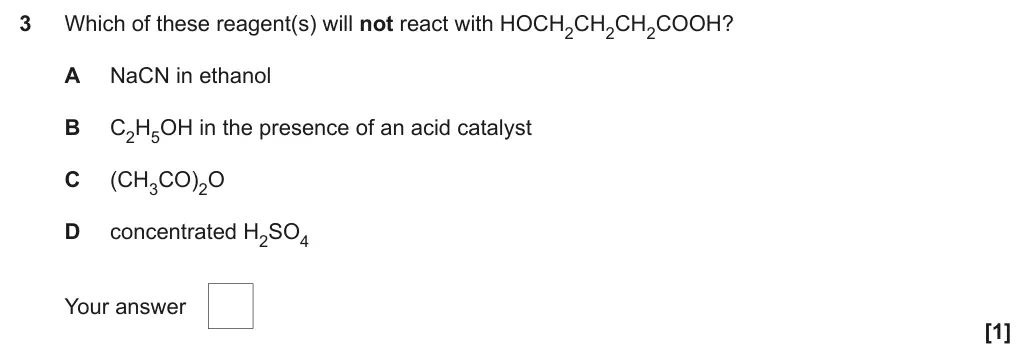
3 Which of these reagent(s) will not react with HOCH2CH2CH2COOH?
A NaCN in ethanol
B C2H5OH in the presence of an acid catalyst
C (CH3CO)2O
D concentrated H2SO4
Your answer
[1]
November 2020 · Paper 2 · Q4 1 mark AO2 Multiple choice alcoholscarbonyl compounds
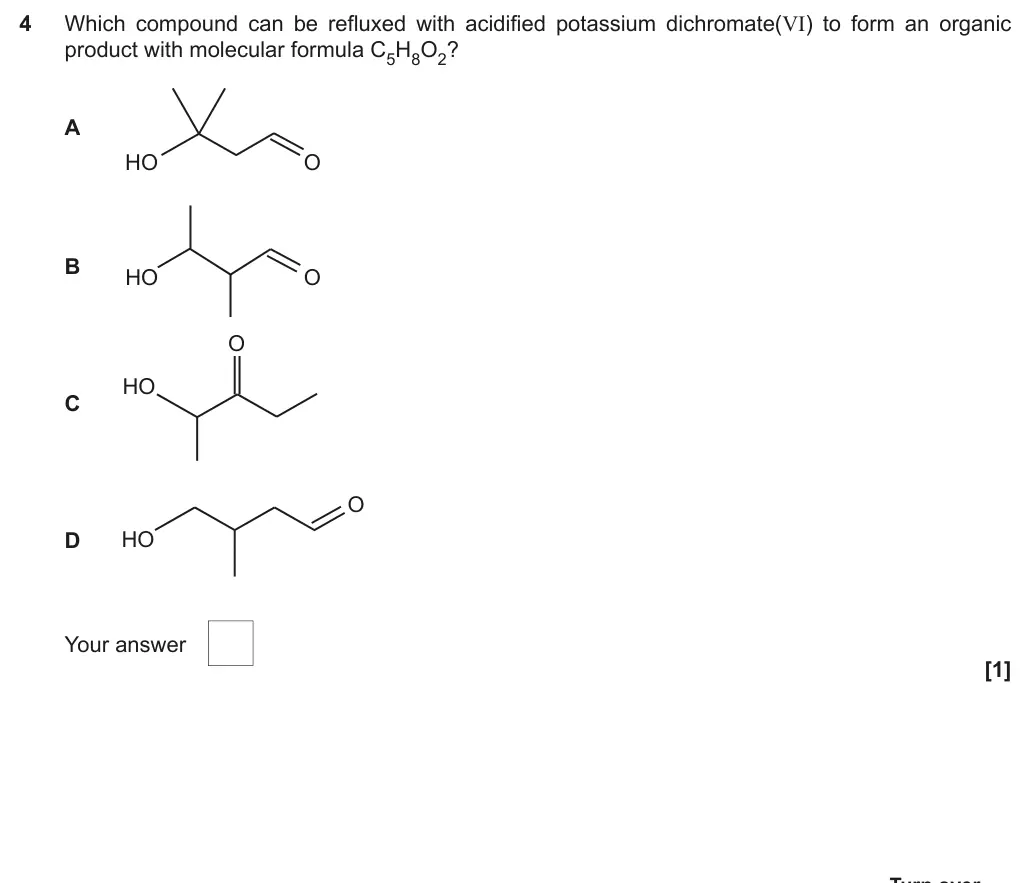
4 Which compound can be refluxed with acidified potassium dichromate(VI) to form an organic
product with molecular formula C5H8O2?
A
HO O
B
HO O
O
HO
C
O
D HO
Your answer
[1]
November 2020 · Paper 2 · Q5 1 mark AO1 Multiple choice alkenes
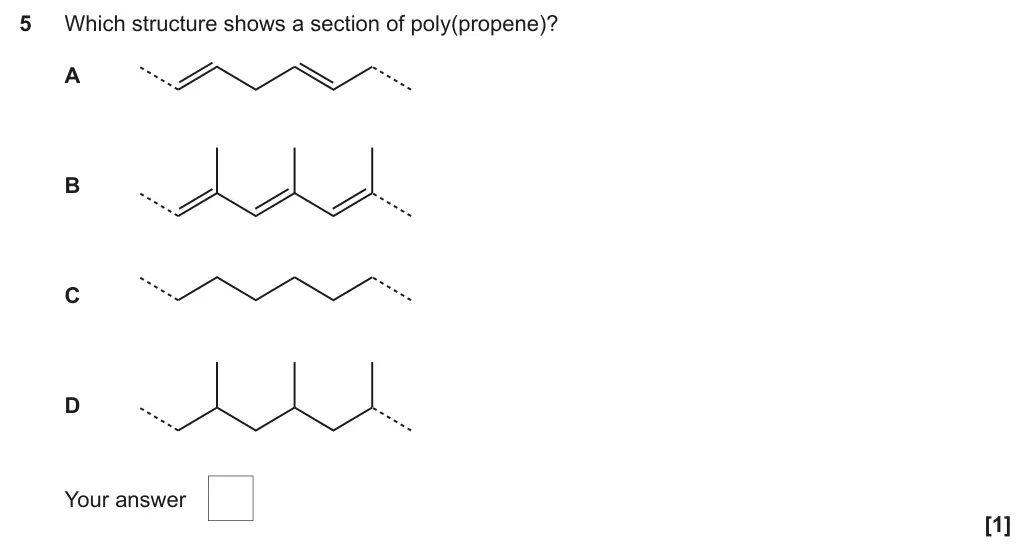
5 Which structure shows a section of poly(propene)?
A
B
C
D
Your answer
[1]
November 2020 · Paper 2 · Q6 1 mark AO2 Multiple choice alcoholsalkenes
6 Which alcohol reacts with an acid catalyst to form a mixture of stereoisomers?
A 3-methylbutan-2-ol
B pentan-1-ol
C 2-methylhexan-2-ol
D heptan-4-ol
Your answer
[1]
November 2020 · Paper 2 · Q7 1 mark AO1 Multiple choice aromatic compoundscarboxylic acids and esters
7 Which one of the following reacts with ethanoic acid and with phenol?
A Aqueous potassium hydroxide
B Bromine
C Calcium carbonate
D Methanol and an acid catalyst
Your answer
[1]
November 2020 · Paper 2 · Q8 1 mark AO2 Multiple choice nmr spectroscopy
8 Which isomer of C6H12O2 produces the smallest number of peaks in its 13C NMR spectrum?
O
A
OH
O
B
O
O
C
OH
O
D
OH
Your answer
[1]
November 2020 · Paper 2 · Q9 1 mark AO1 Multiple choice organic basics
9 What is the structural formula of ethyl 3-methylbutanoate?
A CH3CH2COOCH2CH2CH(CH3)2
B CH3CH2COOCH(CH3)CH2CH3
C CH3CH2CH(CH3)COOCH2CH3
D (CH3)2CHCH2COOCH2CH3
Your answer
[1]
November 2020 · Paper 2 · Q10 1 mark AO2 Multiple choice Hard organic basics
10 What is the number of alicyclic structural isomers of C5H10?
A 3
B 4
C 5
D 6
Your answer
[1]
November 2020 · Paper 2 · Q11 1 mark AO2 Multiple choice amount of substance
11 Complete combustion of 1.00 g of a hydrocarbon gives 3.38 g carbon dioxide.
What is the empirical formula of the hydrocarbon?
A CH
B CH2
C C2H5
D C3H8
Your answer
[1]
November 2020 · Paper 2 · Q12 1 mark AO2 Multiple choice organic basicsamount of substance
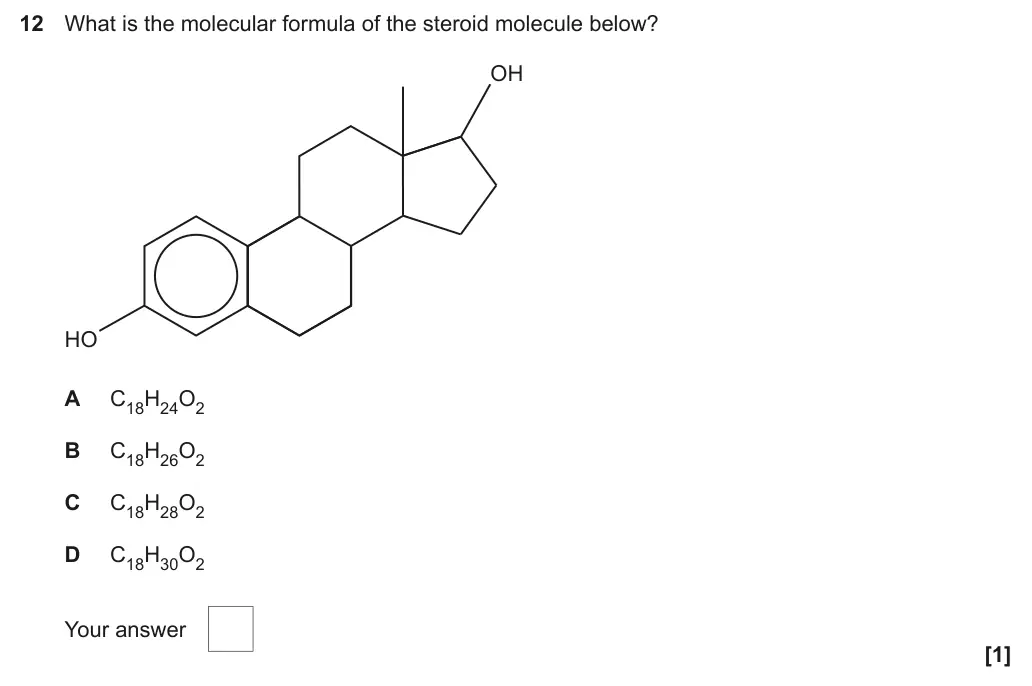
12 What is the molecular formula of the steroid molecule below?
OH
HO
A C18H24O2
B C18H26O2
C C18H28O2
D C18H30O2
Your answer
[1]
November 2020 · Paper 2 · Q13 1 mark AO1 Multiple choice chromatography and functional group tests
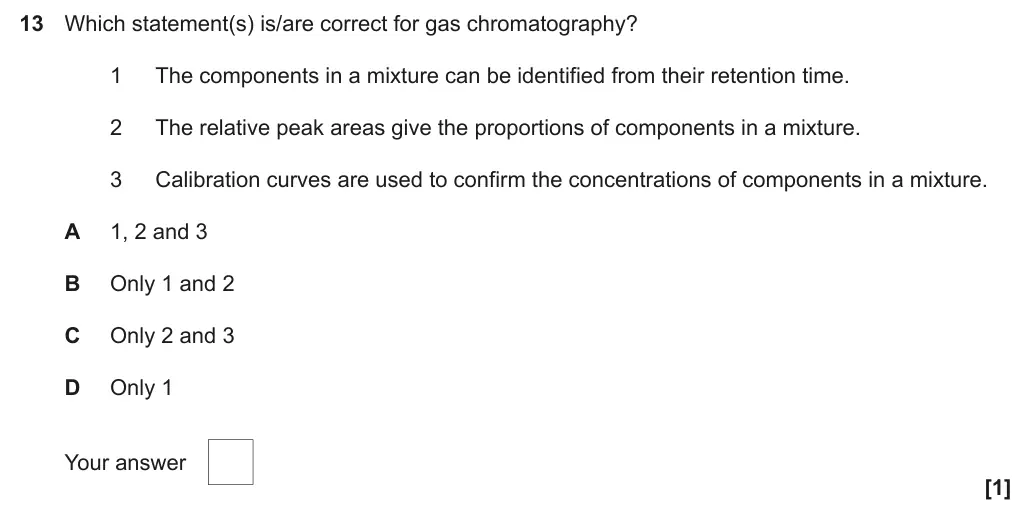
13 Which statement(s) is/are correct for gas chromatography?
1 The components in a mixture can be identified from their retention time.
2 The relative peak areas give the proportions of components in a mixture.
3 Calibration curves are used to confirm the concentrations of components in a mixture.
A 1, 2 and 3
B Only 1 and 2
C Only 2 and 3
D Only 1
Your answer
[1]
November 2020 · Paper 2 · Q14 1 mark AO2 Multiple choice haloalkanescarboxylic acids and esterscarbon carbon bond formation
14 Which of the following reactions produce propan-1-ol?
1 The alkaline hydrolysis of 1-chloropropane.
2 The acid hydrolysis of propyl methanoate.
3 The acid hydrolysis of propanenitrile.
A 1, 2 and 3
B Only 1 and 2
C Only 2 and 3
D Only 1
Your answer
[1]
November 2020 · Paper 2 · Q15 1 mark AO1 Multiple choice aromatic compoundscarbon carbon bond formation
15 Which compound(s) could be prepared by reacting benzene with an acyl chloride in the presence
of a halogen carrier?
CH2COCH3
1
CHO
2
COCH3
3
A 1, 2 and 3
B Only 1 and 2
C Only 2 and 3
D Only 1
Your answer
[1]
November 2020 · Paper 2 · Q16(a) 1 mark AO1 Short answer Medium organic basics
SECTION B
Answer all the questions.
16 The structure of hydrocarbon A is shown below.
A
(a) Hydrocarbon A can be reacted with bromine in the presence of ultraviolet radiation to prepare
(CH3)3CCHBrCH3.
What is the systematic name for (CH3)3CCHBrCH3?
.............................................................................................................................................. [1]
November 2020 · Paper 2 · Q16(b)(i) 1 mark AO1 Short answer alkenesamino acids amides and chirality
Earlier part of question 16 that this part usesEarlier part of November 2020 Paper 2 question 16
(b) (CH3)3CCHBrCH3has stereoisomers.
(i) Explain the term stereoisomers and name this type of stereoisomerism.
Explanation:  ......................................................................................................................
...........................................................................................................................................
...........................................................................................................................................
Type of stereoisomerism:  ............................................................................................. [1]
November 2020 · Paper 2 · Q16(b)(ii) 2 marks AO1, 2 Structure / isomer amino acids amides and chirality
Earlier part of question 16 that this part usesEarlier part of November 2020 Paper 2 question 16
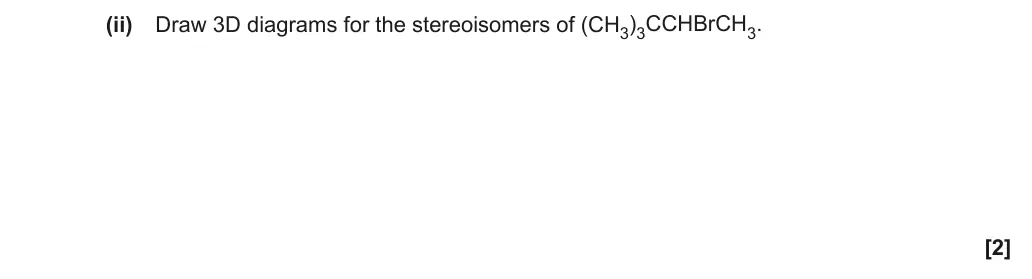
(ii) Draw 3D diagrams for the stereoisomers of (CH3)3CCHBrCH3.
[2]
November 2020 · Paper 2 · Q16(c) 3 marks AO1, 2 Mechanism Medium alkanesorganic basics
Earlier part of question 16 that this part usesEarlier part of November 2020 Paper 2 question 16
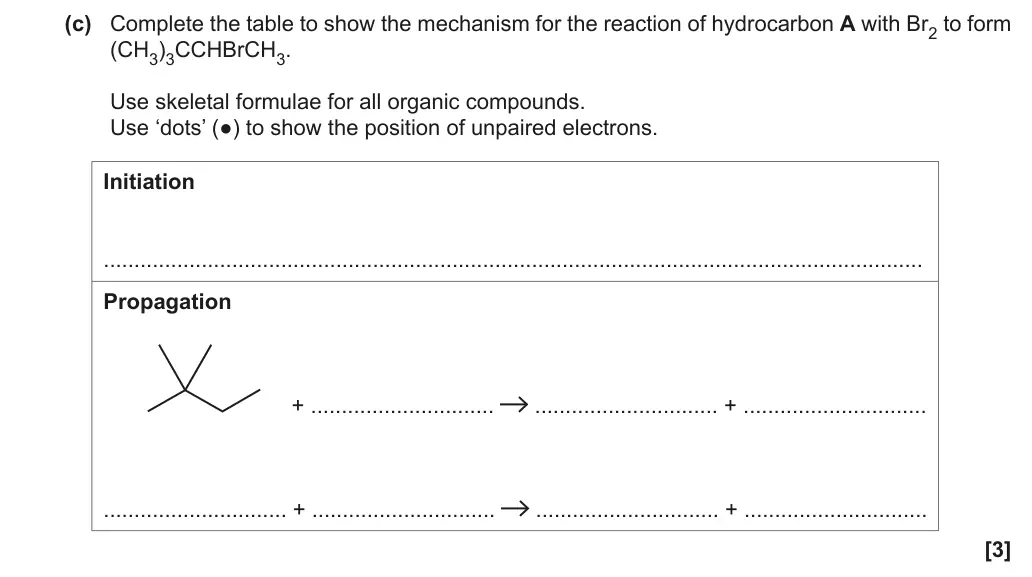
(c) Complete the table to show the mechanism for the reaction of hydrocarbon A with Br2 to form
(CH3)3CCHBrCH3.
Use skeletal formulae for all organic compounds.
Use ‘dots’ (●) to show the position of unpaired electrons.
Initiation
......................................................................................................................................
Propagation
+ .............................. .............................. + ..............................
.............................. + .............................. .............................. + ..............................
[3]
November 2020 · Paper 2 · Q16(d) 2 marks AO1 Short answer alkanes
(d) State two limitations of using radical substitution in organic synthesis.
1  ................................................................................................................................................
...................................................................................................................................................
2  ................................................................................................................................................
...................................................................................................................................................
[2]
November 2020 · Paper 2 · Q17(a)(i) 2 marks AO2 Structure / isomer alkenesaromatic compounds
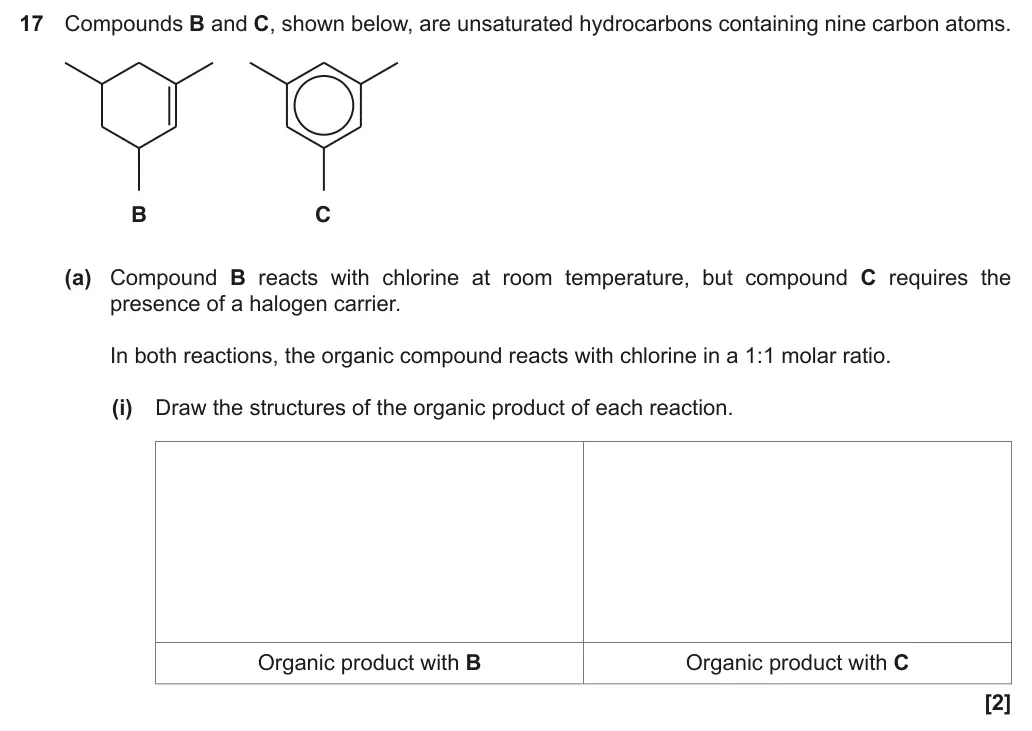
17 Compounds B and C, shown below, are unsaturated hydrocarbons containing nine carbon atoms.
B C
(a) Compound B reacts with chlorine at room temperature, but compound C requires the
presence of a halogen carrier.
In both reactions, the organic compound reacts with chlorine in a 1:1 molar ratio.
(i) Draw the structures of the organic product of each reaction.
Organic product with B Organic product with C
[2]
November 2020 · Paper 2 · Q17(a)(ii) 3 marks AO1 Short answer Medium aromatic compounds
Earlier part of question 17 that this part usesEarlier part of November 2020 Paper 2 question 17
(ii) Explain the relative resistance to chlorination of compound C compared with compound B.
...........................................................................................................................................
...........................................................................................................................................
...........................................................................................................................................
...........................................................................................................................................
...........................................................................................................................................
...........................................................................................................................................
...........................................................................................................................................
...................................................................................................................................... [3]
November 2020 · Paper 2 · Q17(a)(iii) 5 marks AO1, 2 Mechanism aromatic compounds
Earlier part of question 17 that this part usesEarlier part of November 2020 Paper 2 question 17
(iii) Outline the mechanism for the reaction of compound C with chlorine.
Show the role of the halogen carrier.
[5]
November 2020 · Paper 2 · Q17(b) 3 marks AO2 Short answer formulae and equations
Earlier part of question 17 that this part usesEarlier part of November 2020 Paper 2 question 17
(b) Compound C can be prepared by ‘trimerisation’ of propanone using concentrated sulfuric
acid as a catalyst.
Suggest an equation for this reaction, using molecular formulae.
.............................................................................................................................................. [3]
November 2020 · Paper 2 · Q17(c)(i) 2 marks AO3 Short answer nmr spectroscopy
Earlier part of question 17 that this part usesEarlier part of November 2020 Paper 2 question 17
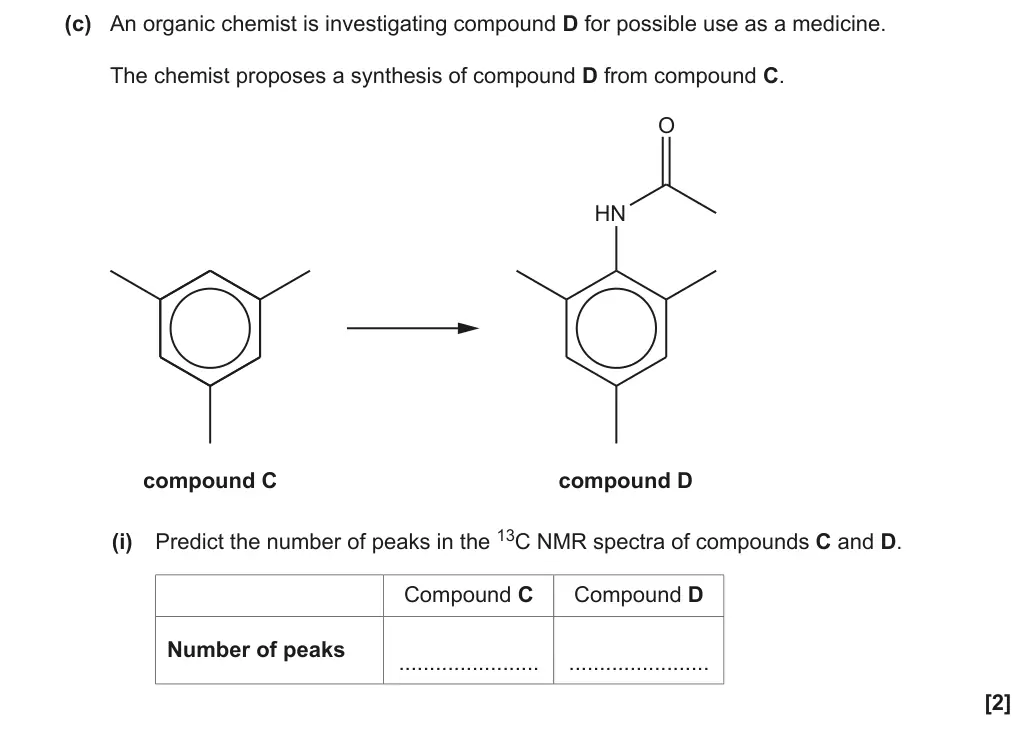
(c) An organic chemist is investigating compound D for possible use as a medicine.
The chemist proposes a synthesis of compound D from compound C.
O
HN
compound C compound D
(i) Predict the number of peaks in the 13C NMR spectra of compounds C and D.
Compound C Compound D
Number of peaks
....................... .......................
[2]
November 2020 · Paper 2 · Q17(c)(ii) 5 marks AO3 Complete table/diagram organic synthesisaromatic compoundscarboxylic acids and estersaminesamino acids amides and chirality
Earlier part of question 17 that this part usesEarlier part of November 2020 Paper 2 question 17
(ii) The chemist develops a three-stage synthesis of compound D from compound C.
Complete the flowchart.
Show structures for organic compounds.
reagent: ......................................
catalyst: ......................................
compound C
1. Sn + HCl
2. Neutralise
O
HN
reagent: ......................................
compound D
[5]
November 2020 · Paper 2 · Q18(a)(i) 3 marks AO1, 2 Equation writing Medium alcoholsformulae and equations
18 Alcohols can be used to prepare organic compounds with different functional groups.
(a) HO(CH2)4OH can be oxidised to form HOOC(CH2)2COOH.
(i) State the reagents and conditions and write an equation for this oxidation.
In the equation, use [O] for the oxidising agent.
Reagents and conditions:  ..................................................................................................
...........................................................................................................................................
Equation:
[3]
November 2020 · Paper 2 · Q18(a)(ii) 2 marks AO2 Short answer Medium carboxylic acids and estersbonding and structure
Earlier part of question 18 that this part usesEarlier part of November 2020 Paper 2 question 18
(ii) HOOC(CH2)2COOH is soluble in water.
Explain, using a labelled diagram, why HOOC(CH2)2COOH is soluble in water.
[2]
November 2020 · Paper 2 · Q18(b)(i) 2 marks AO1, 2 Structure / isomer condensation polymers
Earlier part of question 18 that this part usesEarlier part of November 2020 Paper 2 question 18
(b) HOOC(CH2)2COOH and HO(CH2)4OH react together to form polymer E.
(i) Draw one repeat unit of polymer E.
The functional groups should be clearly displayed.
[2]
November 2020 · Paper 2 · Q18(b)(ii) 1 mark AO3 Short answer condensation polymersalkenes
Earlier part of question 18 that this part usesEarlier part of November 2020 Paper 2 question 18
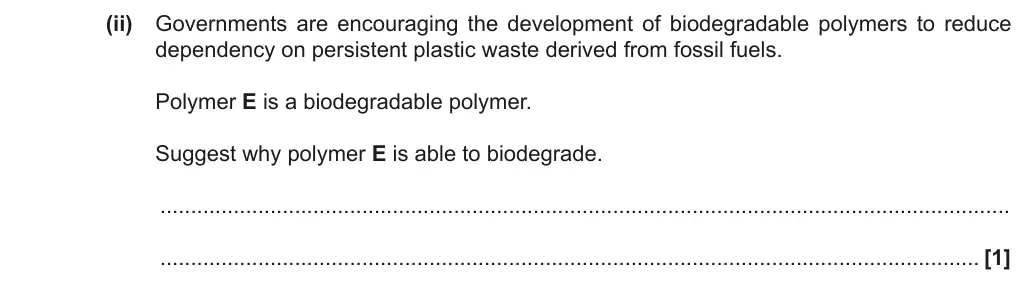
(ii) Governments are encouraging the development of biodegradable polymers to reduce
dependency on persistent plastic waste derived from fossil fuels.
Polymer E is a biodegradable polymer.
Suggest why polymer E is able to biodegrade.
...........................................................................................................................................
...................................................................................................................................... [1]
November 2020 · Paper 2 · Q18(b)(iii) 3 marks AO1, 2 Complete table/diagram carboxylic acids and estersformulae and equations
Earlier part of question 18 that this part usesEarlier part of November 2020 Paper 2 question 18
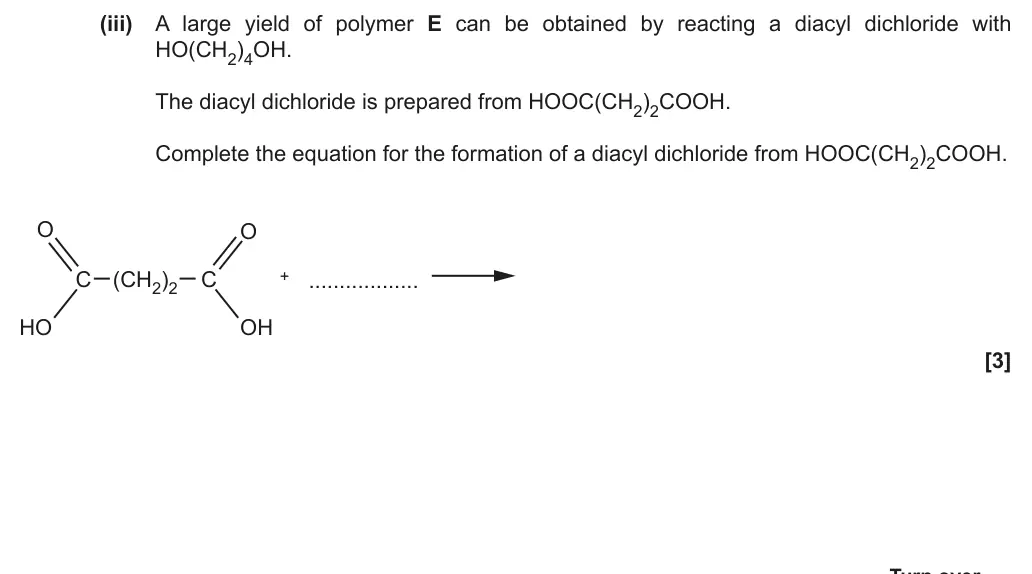
(iii) A large yield of polymer E can be obtained by reacting a diacyl dichloride with
HO(CH2)4OH.
The diacyl dichloride is prepared from HOOC(CH2)2COOH.
Complete the equation for the formation of a diacyl dichloride from HOOC(CH2)2COOH.
O O
C (CH2)2 C + ..................
HO OH
[3]
November 2020 · Paper 2 · Q19(a)(i) 2 marks AO1 Short answer organic basics
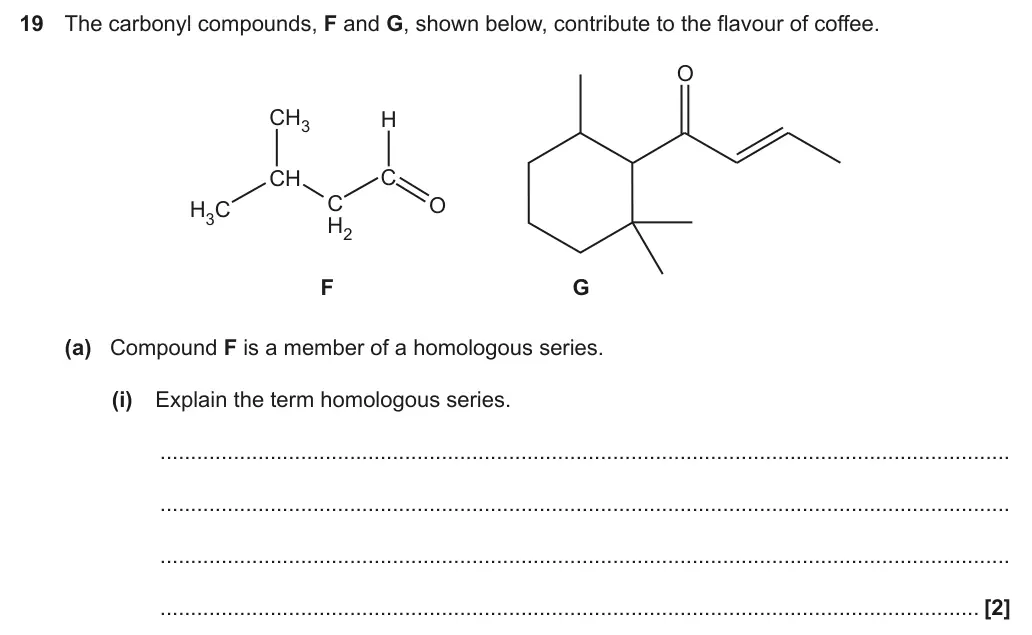
19 The carbonyl compounds, F and G, shown below, contribute to the flavour of coffee.
O
CH3 H
CH C
H3C C O
H2
F G
(a) Compound F is a member of a homologous series.
(i) Explain the term homologous series.
...........................................................................................................................................
...........................................................................................................................................
...........................................................................................................................................
...................................................................................................................................... [2]
November 2020 · Paper 2 · Q19(a)(ii) 1 mark AO2 Short answer organic basics
Earlier part of question 19 that this part usesEarlier part of November 2020 Paper 2 question 19
(ii) Predict the molecular formula for the member of this homologous series containing
24 carbon atoms.
...................................................................................................................................... [1]
November 2020 · Paper 2 · Q19(b) 4 marks AO2, 3 Short answer Hard carbonyl compoundschromatography and functional group tests
Earlier part of question 19 that this part usesEarlier part of November 2020 Paper 2 question 19
(b) Describe suitable chemical tests, with observations, that would confirm the presence of the
functional groups in F and G.
...................................................................................................................................................
...................................................................................................................................................
...................................................................................................................................................
...................................................................................................................................................
...................................................................................................................................................
...................................................................................................................................................
...................................................................................................................................................
...................................................................................................................................................
...................................................................................................................................................
.............................................................................................................................................. [4]
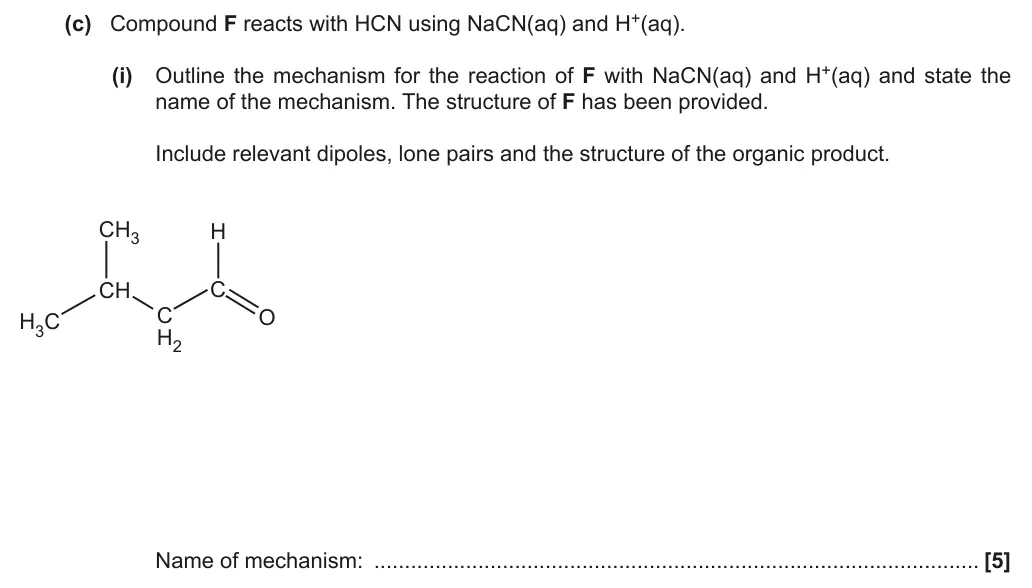
November 2020 · Paper 2 · Q19(c)(i) 5 marks AO1, 2 Mechanism carbonyl compoundsorganic basics
Earlier part of question 19 that this part usesEarlier part of November 2020 Paper 2 question 19
(c) Compound F reacts with HCN using NaCN(aq) and H+(aq).
(i) Outline the mechanism for the reaction of F with NaCN(aq) and H+(aq) and state the
name of the mechanism. The structure of F has been provided.
Include relevant dipoles, lone pairs and the structure of the organic product.
CH3 H
CH C
H3C C O
H2
Name of mechanism:  ................................................................................................... [5]
November 2020 · Paper 2 · Q19(c)(ii) 2 marks AO1 Short answer Medium organic basics
Earlier part of question 19 that this part usesEarlier part of November 2020 Paper 2 question 19
(ii) Explain why the mechanism in (c)(i) involves heterolytic fission.
...........................................................................................................................................
...........................................................................................................................................
...........................................................................................................................................
...................................................................................................................................... [2]
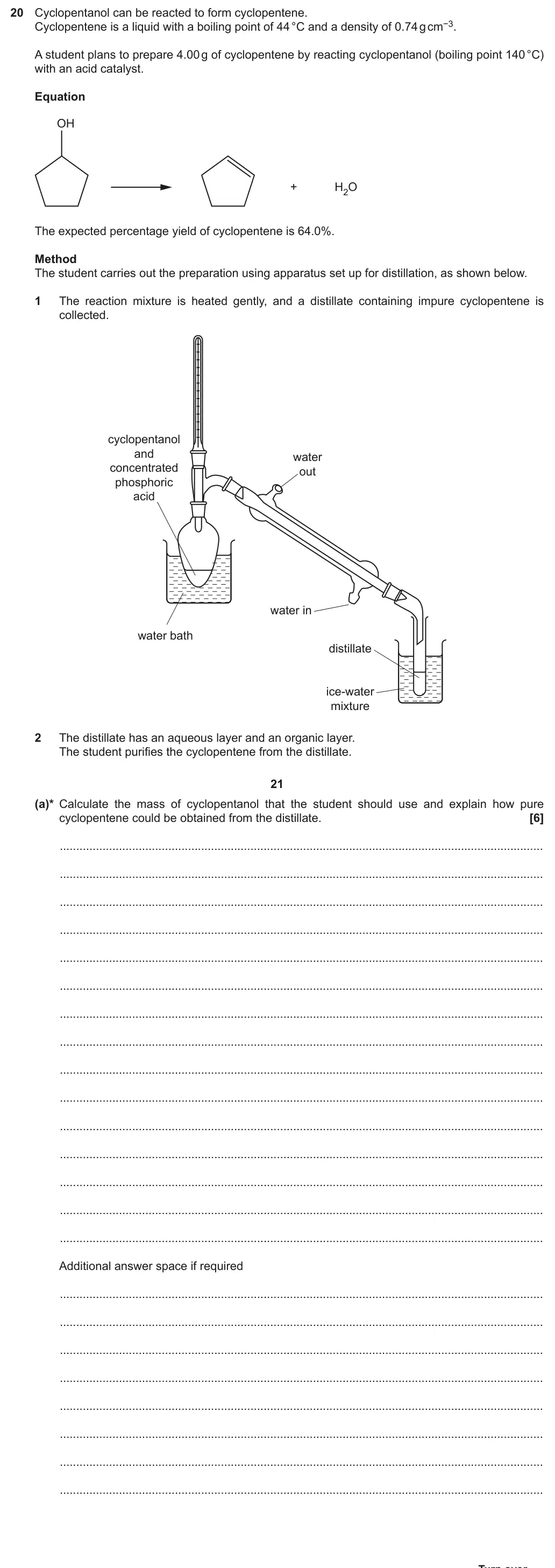
November 2020 · Paper 2 · Q20(a) 6 marks AO2, 3 6-mark level of response Medium amount of substancepractical techniquesorganic synthesis as
20 Cyclopentanol can be reacted to form cyclopentene.
Cyclopentene is a liquid with a boiling point of 44 °C and a density of 0.74 g cm−3.
A student plans to prepare 4.00 g of cyclopentene by reacting cyclopentanol (boiling point 140 °C)
with an acid catalyst.
Equation
OH
+ H2O
The expected percentage yield of cyclopentene is 64.0%.
Method
The student carries out the preparation using apparatus set up for distillation, as shown below.
1 The reaction mixture is heated gently, and a distillate containing impure cyclopentene is
collected.
cyclopentanol
and water
concentrated out
phosphoric
acid
water in
water bath
distillate
ice-water
mixture
2 The distillate has an aqueous layer and an organic layer.
The student purifies the cyclopentene from the distillate.
(a)* Calculate the mass of cyclopentanol that the student should use and explain how pure
cyclopentene could be obtained from the distillate. [6]
...................................................................................................................................................
...................................................................................................................................................
...................................................................................................................................................
...................................................................................................................................................
...................................................................................................................................................
...................................................................................................................................................
...................................................................................................................................................
...................................................................................................................................................
...................................................................................................................................................
...................................................................................................................................................
...................................................................................................................................................
...................................................................................................................................................
...................................................................................................................................................
...................................................................................................................................................
...................................................................................................................................................
Additional answer space if required
...................................................................................................................................................
...................................................................................................................................................
...................................................................................................................................................
...................................................................................................................................................
...................................................................................................................................................
...................................................................................................................................................
...................................................................................................................................................
...................................................................................................................................................
November 2020 · Paper 2 · Q20(b) 2 marks AO3 Short answer infrared and mass spectrometry
Earlier part of question 20 that this part usesEarlier part of November 2020 Paper 2 question 20
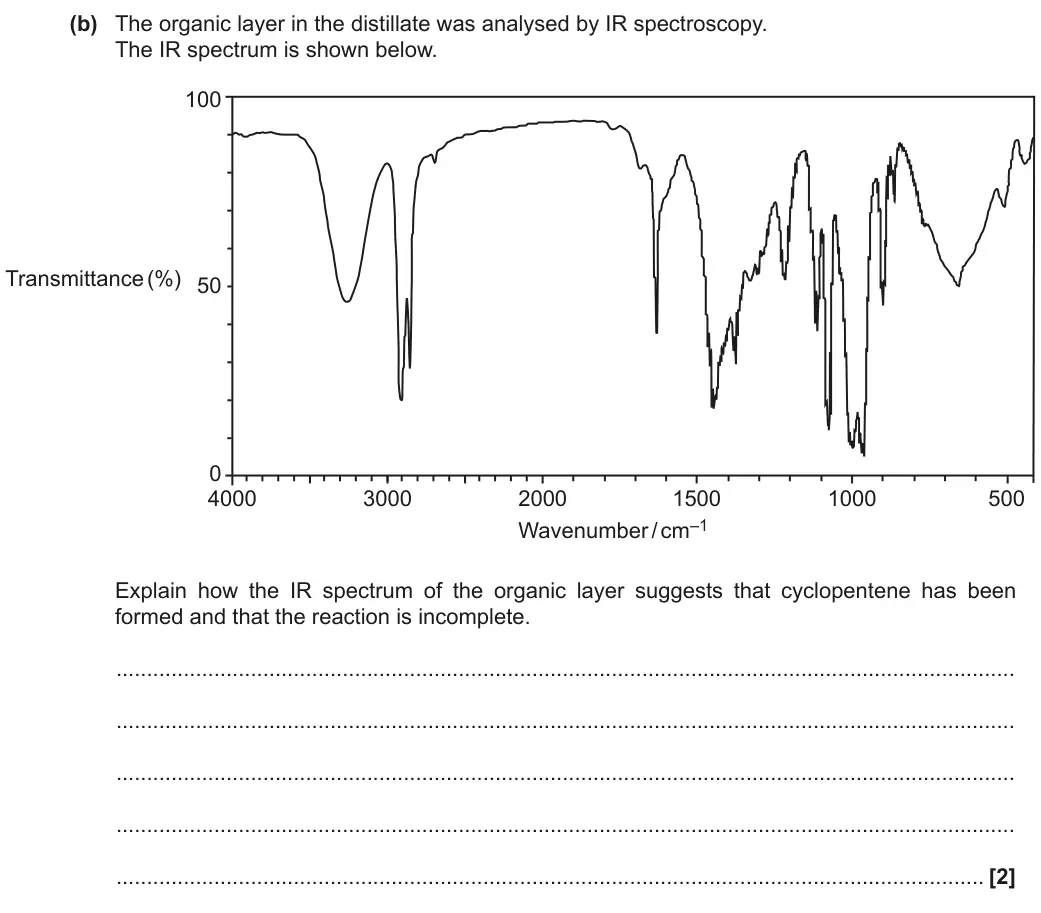
(b) The organic layer in the distillate was analysed by IR spectroscopy.
The IR spectrum is shown below.
100
Transmittance (%) 50
0
4000 3000 2000 1500 1000 500
Wavenumber / cm–1
Explain how the IR spectrum of the organic layer suggests that cyclopentene has been
formed and that the reaction is incomplete.
...................................................................................................................................................
...................................................................................................................................................
...................................................................................................................................................
...................................................................................................................................................
.............................................................................................................................................. [2]
November 2020 · Paper 2 · Q21(a) 5 marks AO2 Complete table/diagram carbonyl compoundsalcoholsaminesorganic synthesis
21 This question is about organic compounds containing nitrogen.
(a) Salt H, (CH3)2CHNH3Cl , is used in the manufacture of garden weedkillers.
The flowchart shows the synthesis of the salt H from propanone.
Complete the flowchart.
Show structures for organic compounds.
propanone
NaBH4
reagent: ......................................
Br
CH
H3C CH3
reagent: ......................................
NH3Cl
reagent: ......................................
CH
H3C CH3
salt H
[5]
November 2020 · Paper 2 · Q21(b)(i) 3 marks AO1 Short answer organic synthesisamino acids amides and chirality
(b) Aspartame, shown below, is an artificial sweetener commonly used as a sugar substitute.
O NH2 O
H
N
O OH
O
aspartame
(i) Aspartame contains several functional groups.
Apart from the benzene ring, name the functional groups in aspartame.
...........................................................................................................................................
...........................................................................................................................................
...........................................................................................................................................
...................................................................................................................................... [3]
November 2020 · Paper 2 · Q21(b)(ii) 4 marks AO2 Structure / isomer carboxylic acids and estersamino acids amides and chiralitycondensation polymersorganic synthesis
Earlier part of question 21 that this part usesEarlier part of November 2020 Paper 2 question 21
(ii) A sample of aspartame is hydrolysed with aqueous acid.
Draw the structures of the three organic products of the complete acid hydrolysis of
aspartame.
[4]
November 2020 · Paper 2 · Q21(b)(iii) 3 marks AO2 Calculation amount of substanceatomic structure and isotopes
Earlier part of question 21 that this part usesEarlier part of November 2020 Paper 2 question 21
(iii) Some people are concerned that aspartame, C14H18N2O5, may have adverse health
effects.
Research shows that the safe maximum daily intake of aspartame is 1.7 × 10⁻⁴ mol kg−1.
• A typical UK adult has a mass of 75 kg.
• A can of a diet drink contains 167 mg of aspartame.
How many cans of this diet drink is it safe for a typical adult to drink in one day?
Number of cans =  .......................................................... [3]
November 2020 · Paper 2 · Q22(a) 2 marks AO1 Short answer Medium nmr spectroscopy
22 An organic compound I is analysed, using a combination of techniques. The analytical data is
shown below.
Elemental analysis by mass
C, 56.69%; H, 7.09%; N, 11.02%; O, 25.20%
Mass spectrum
Molecular ion peak at m / z = 127.0
IR spectrum
© SDBS, National Institute of Advanced Industrial Science and Technology.
Proton NMR spectrum
3 3
2
1
5 4 3 2 1 0
Chemical shift, d / ppm
(a) Explain the use of two deuterated compounds in NMR spectroscopy.
...................................................................................................................................................
...................................................................................................................................................
...................................................................................................................................................
.............................................................................................................................................. [2]
November 2020 · Paper 2 · Q22(b) 6 marks AO3 6-mark level of response Medium nmr spectroscopyamount of substanceinfrared and mass spectrometry
Earlier part of question 22 that this part usesEarlier part of November 2020 Paper 2 question 22
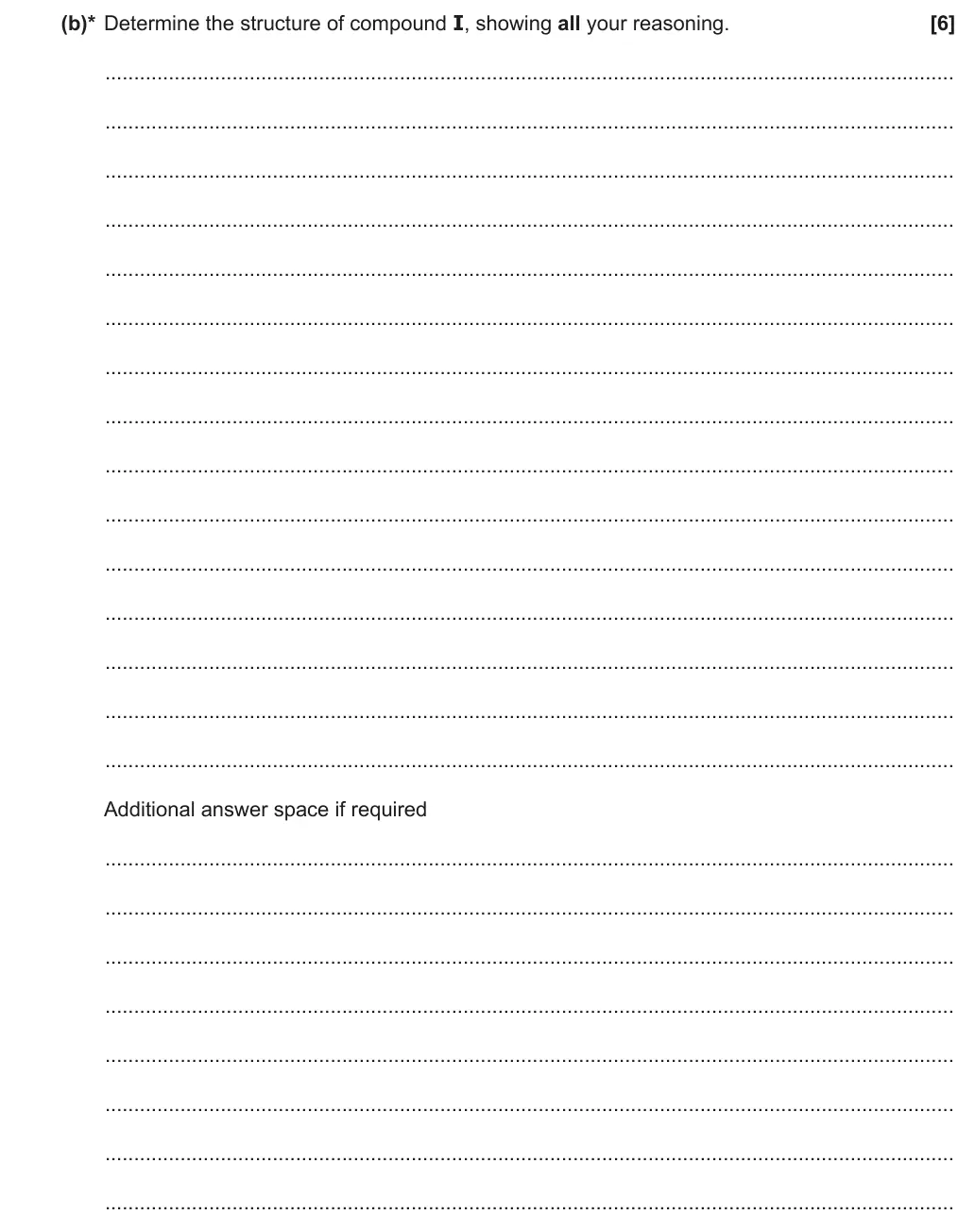
(b)* Determine the structure of compound I, showing all your reasoning. [6]
...................................................................................................................................................
...................................................................................................................................................
...................................................................................................................................................
...................................................................................................................................................
...................................................................................................................................................
...................................................................................................................................................
...................................................................................................................................................
...................................................................................................................................................
...................................................................................................................................................
...................................................................................................................................................
...................................................................................................................................................
...................................................................................................................................................
...................................................................................................................................................
...................................................................................................................................................
...................................................................................................................................................
Additional answer space if required
...................................................................................................................................................
...................................................................................................................................................
...................................................................................................................................................
...................................................................................................................................................
...................................................................................................................................................
...................................................................................................................................................
...................................................................................................................................................
...................................................................................................................................................

Work with an OCR chemistry tutor

Want a paper marked and gone through with you? Message us.

Prefer email? Send an enquiry

If you are under 18, please include a parent's contact details. Enquiries go to enquiries@chemistryaleveltutor.com and are deleted once handled. All tutoring is online.