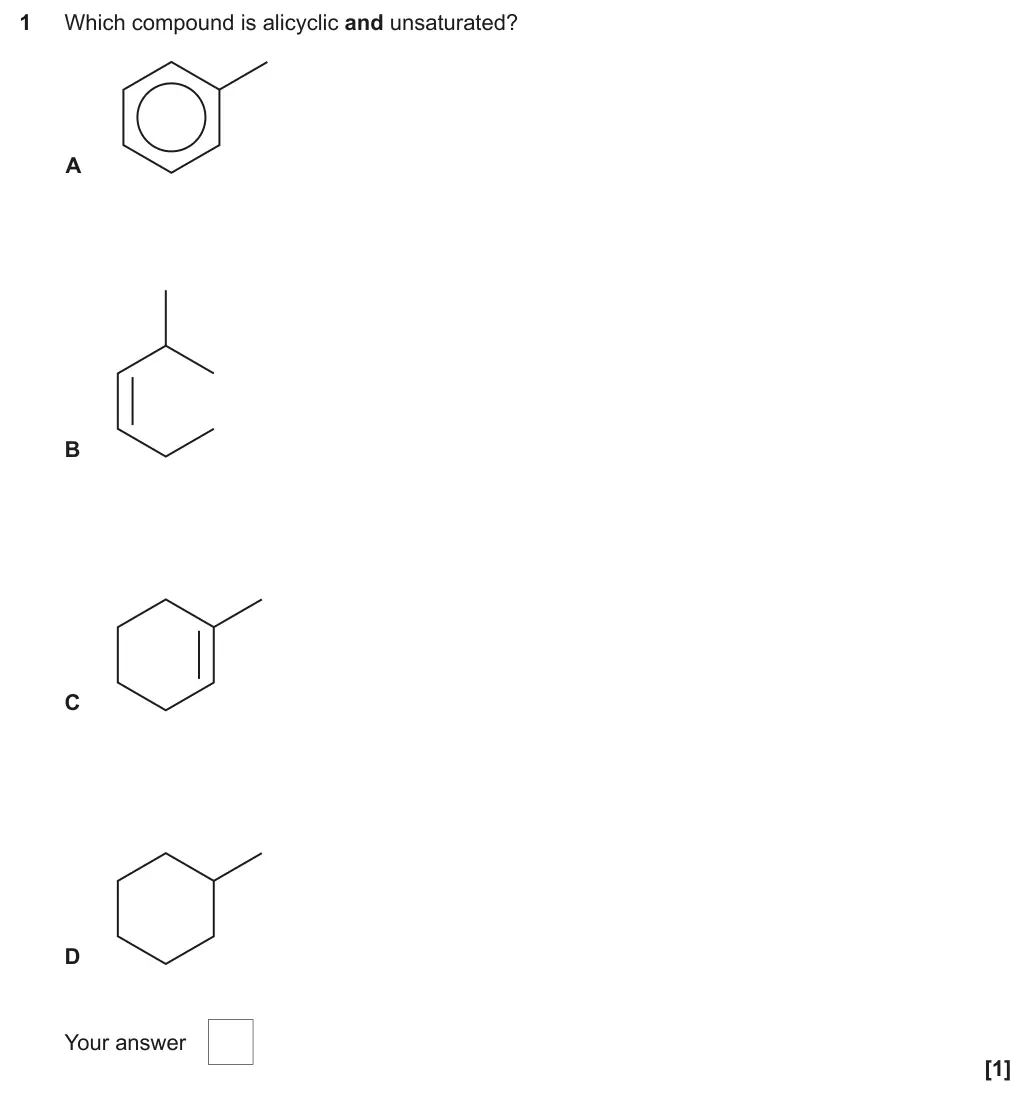
Answer
C
Mark scheme

Examiner's comment
The majority of candidates gave the correct answer, C. The most common incorrect response was D which is alicyclic but not unsaturated.
100 marks · 48 question parts · Paper, mark scheme and report on OCR's site · Have OCR's Data Sheet beside you
C
The majority of candidates gave the correct answer, C. The most common incorrect response was D which is alicyclic but not unsaturated.
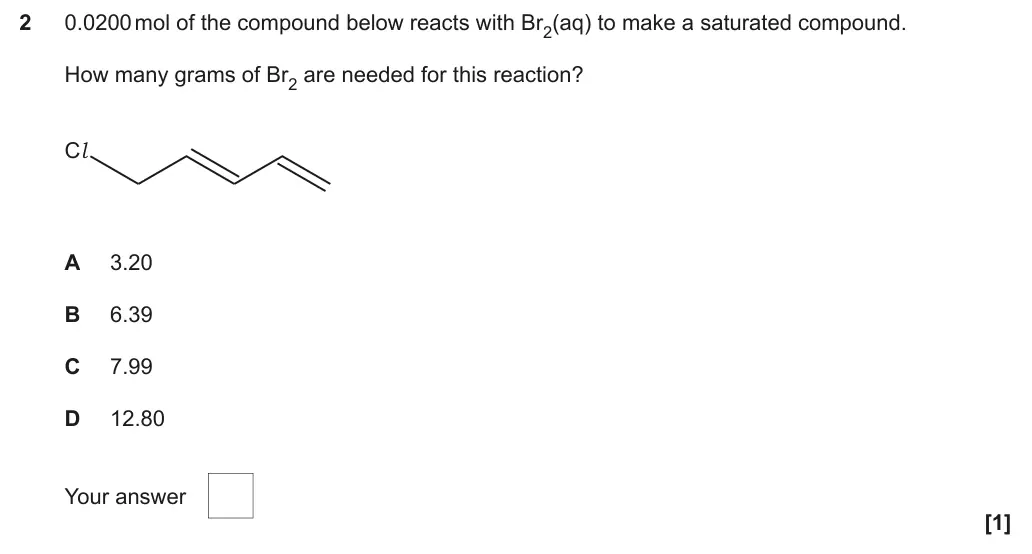
B
Most candidates gave the correct answer B here. Those that got it correct usually showed clear working on how they obtained their answer. However, many chose A, either using correct mole ratio (recognising 2 double bonds) but with the Ar of Br and not the Mr of Br2 (i.e. 0.04 × 79.9) or used the incorrect mole ratio but correct Mr (i.e. 0.02 × 159.8).
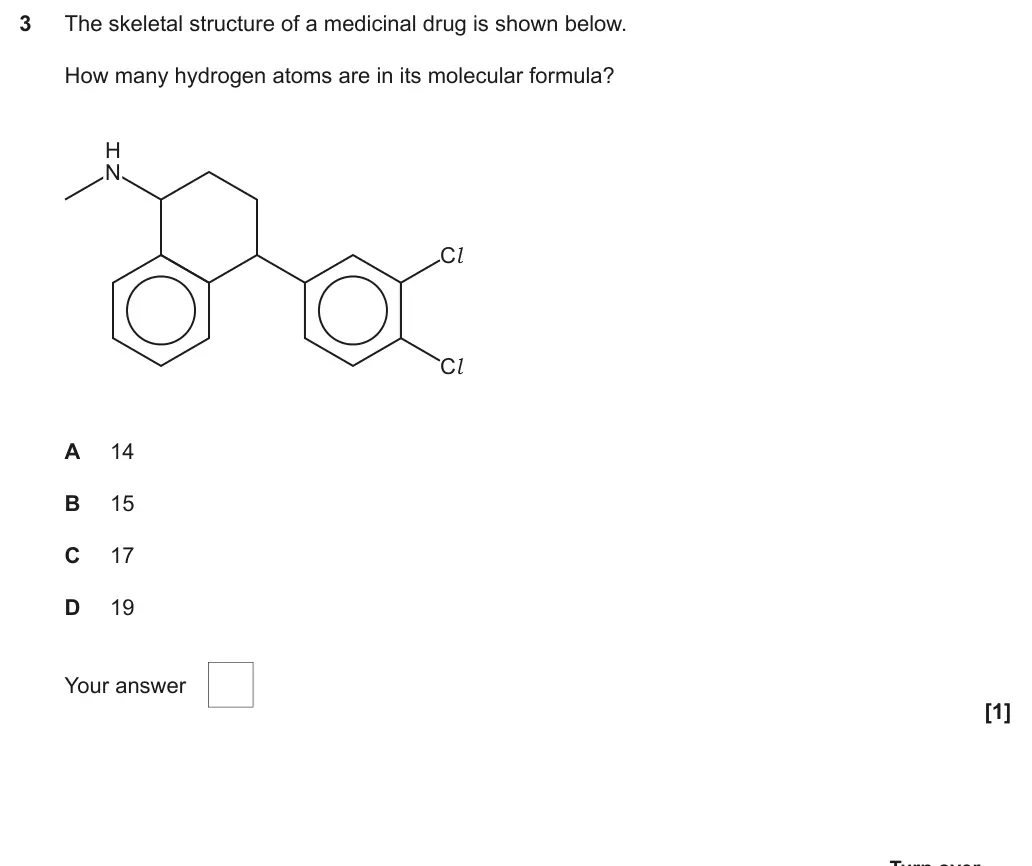
C
Most gave the correct answer C here. Many candidates added hydrogens onto the structure to aid counting with some even drawing out the displayed structure. The most common incorrect response was D.
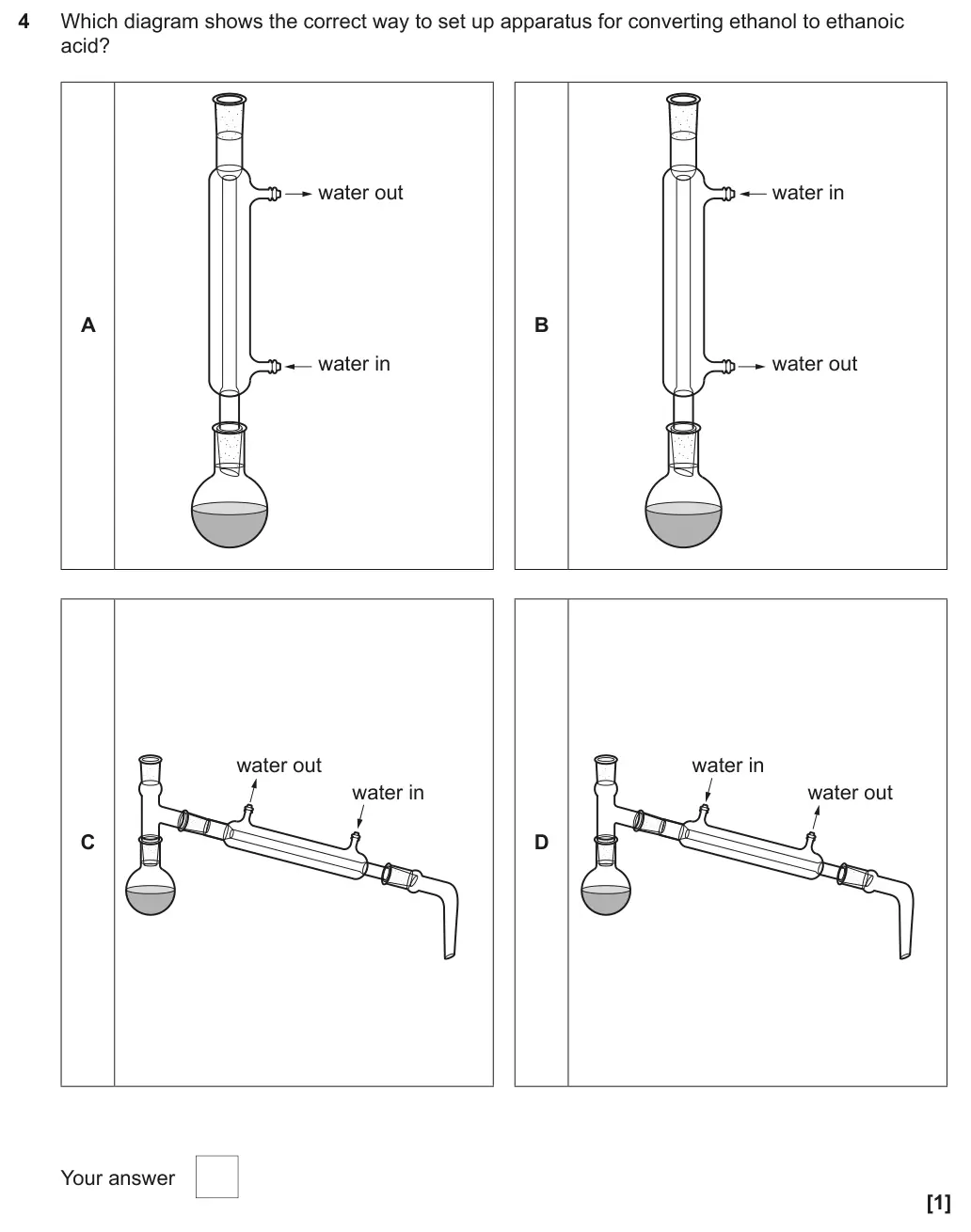
A
The majority of candidates were able to recognise that reflux should be used for this reaction and selected A with the correct water flow through the condenser. The most common incorrect response was C using distillation but a few selected B or D with the incorrect water flow.
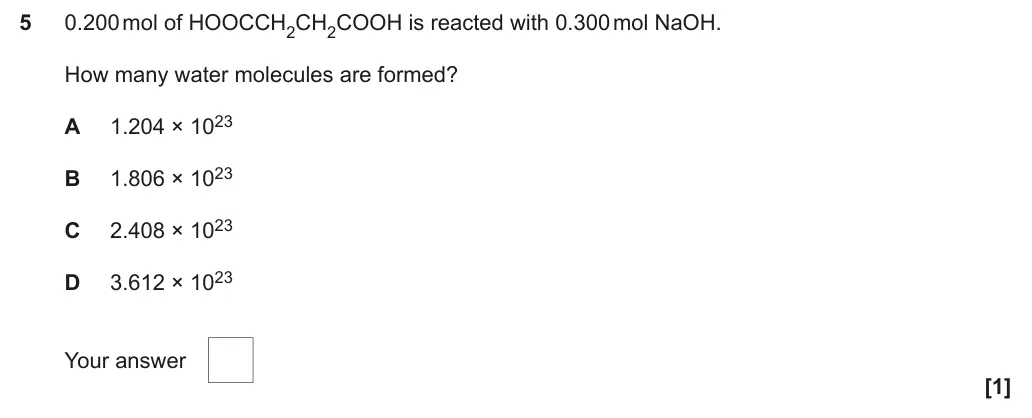
B
This question required using the idea of a limiting reagent, and candidates found it more challenging with just under half getting the correct answer. Some selected A, using just the moles of acid (i.e. 0.2 × 6.02 × 1023). C was more common, which recognises that 1 mole of acid gives 2 moles of water but does not account for NaOH being the limiting reagent (i.e. 0.4 × 6.02 × 1023). A few gave D as a response using twice the moles of NaOH (i.e. 0.6 × 6.02 × 1023).
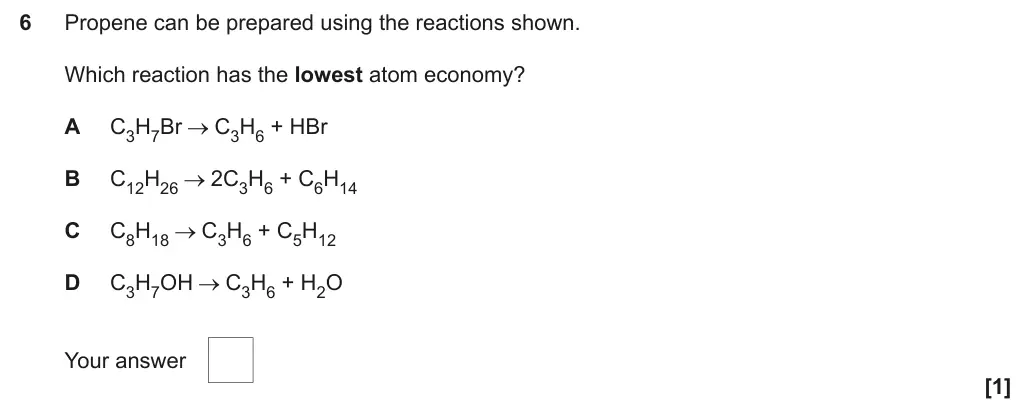
A
Most were able to give correct answer, A. D was the most common incorrect response, possibly from misreading the question and giving the highest rather than the lowest. B was also a common incorrect response where candidates only used the molar mass of C3H6 rather than 2 × C3H6.
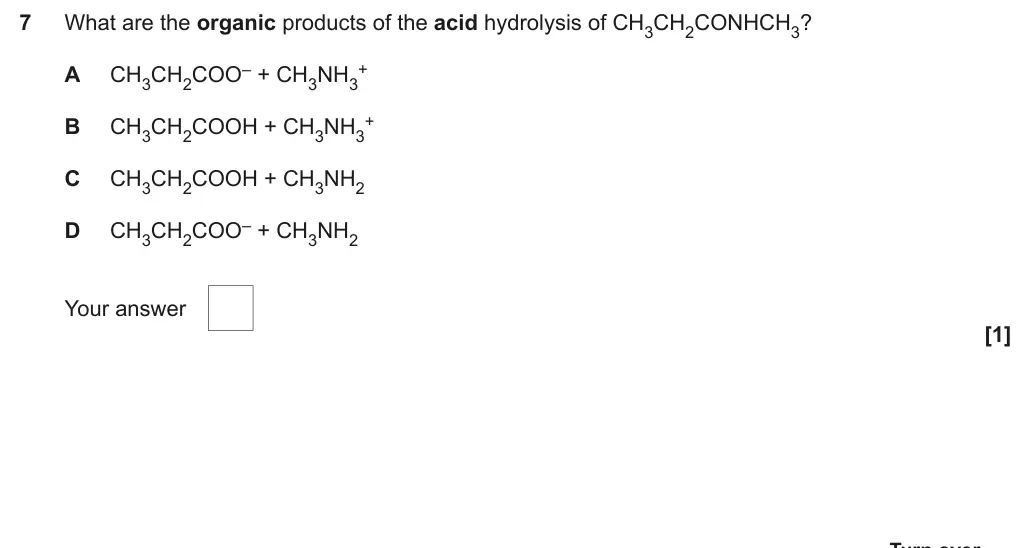
B
Most gave the correct response B. However, some found this tricky, with both A, with the acid group deprotonated and the amine protonated, and C, with no consideration of the acidic conditions, being common incorrect responses.
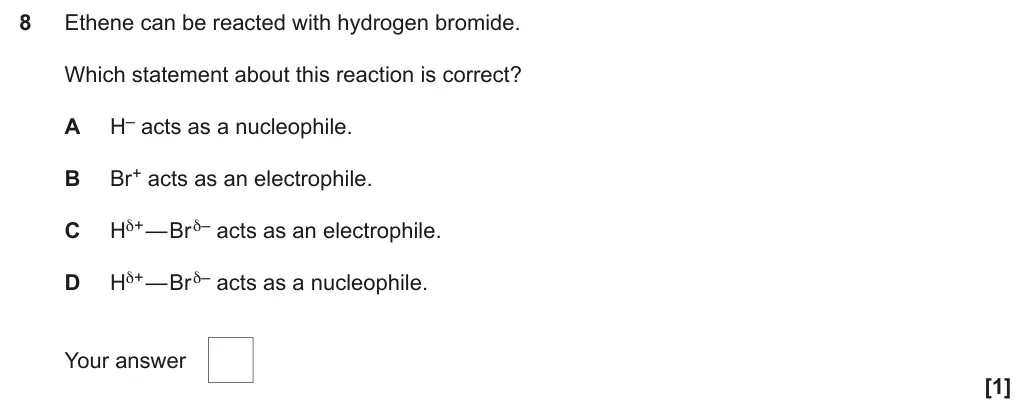
C
The majority of candidates were able to select C as the correct response here. Some selected B, possibly as Br+ would be the electrophile needed if reacting with benzene. A few candidates selected D which is the correct species reacting, but it is an electrophile not a nucleophile.
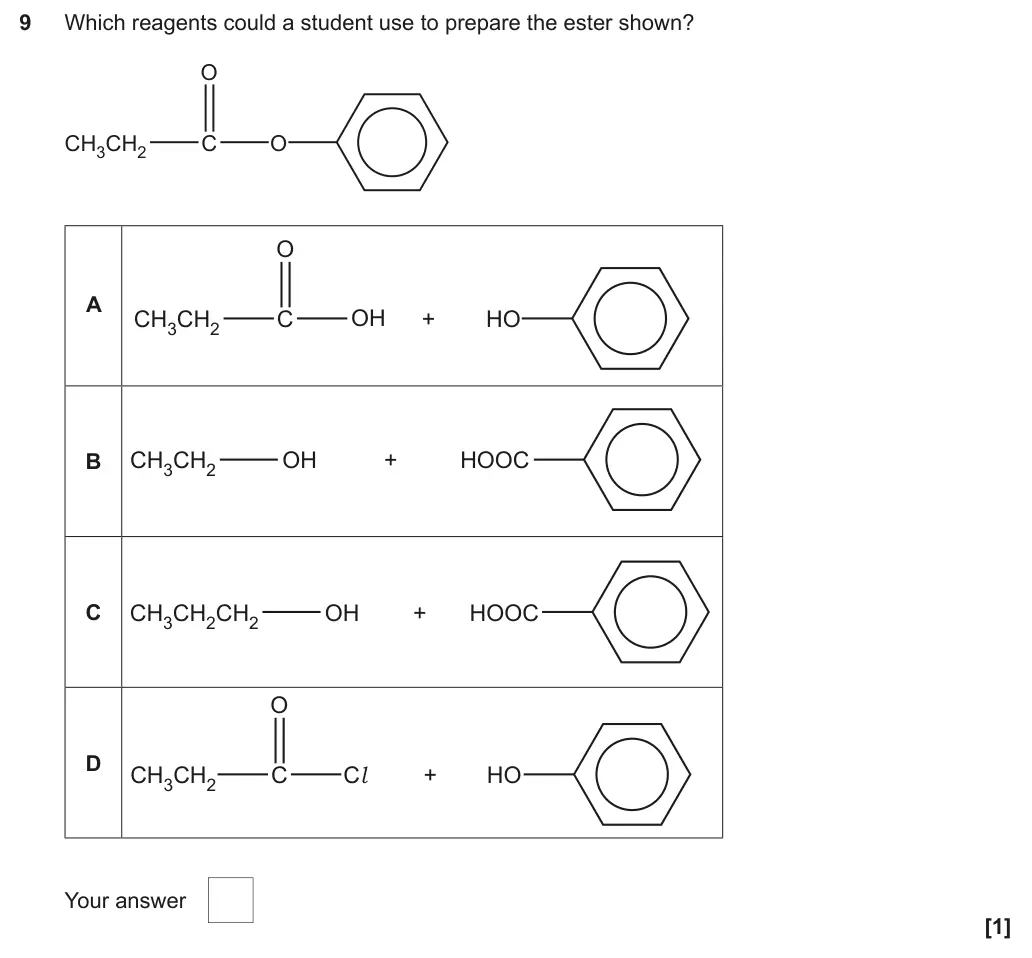
D
Both A and D were accepted here as correct responses, with nearly all candidates gaining a mark. The reaction with the carboxylic acid (A) rather than the acyl chloride (D) is likely to result in a very poor yield. Most candidates gave A, possibly as it was the first option in the list. The higher scoring candidates across the paper often selected D as the answer.
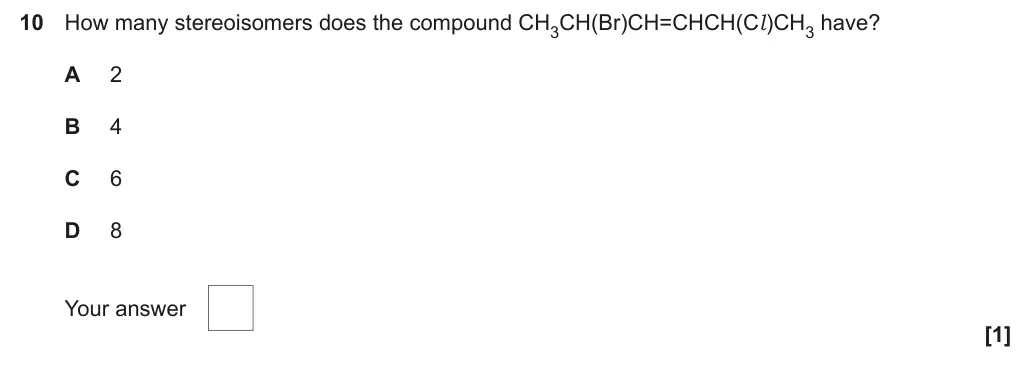
D
Very few candidates were able to give the correct answer D here, with the majority selecting A. Candidates found it challenging to recognise that with E/Z isomerism and two chiral centres in a non- symmetrical molecule there would be eight possible alternatives. For those with stronger maths skills the use of 2n rule can be encouraged but other students can be encouraged to consider all the possible alternatives.
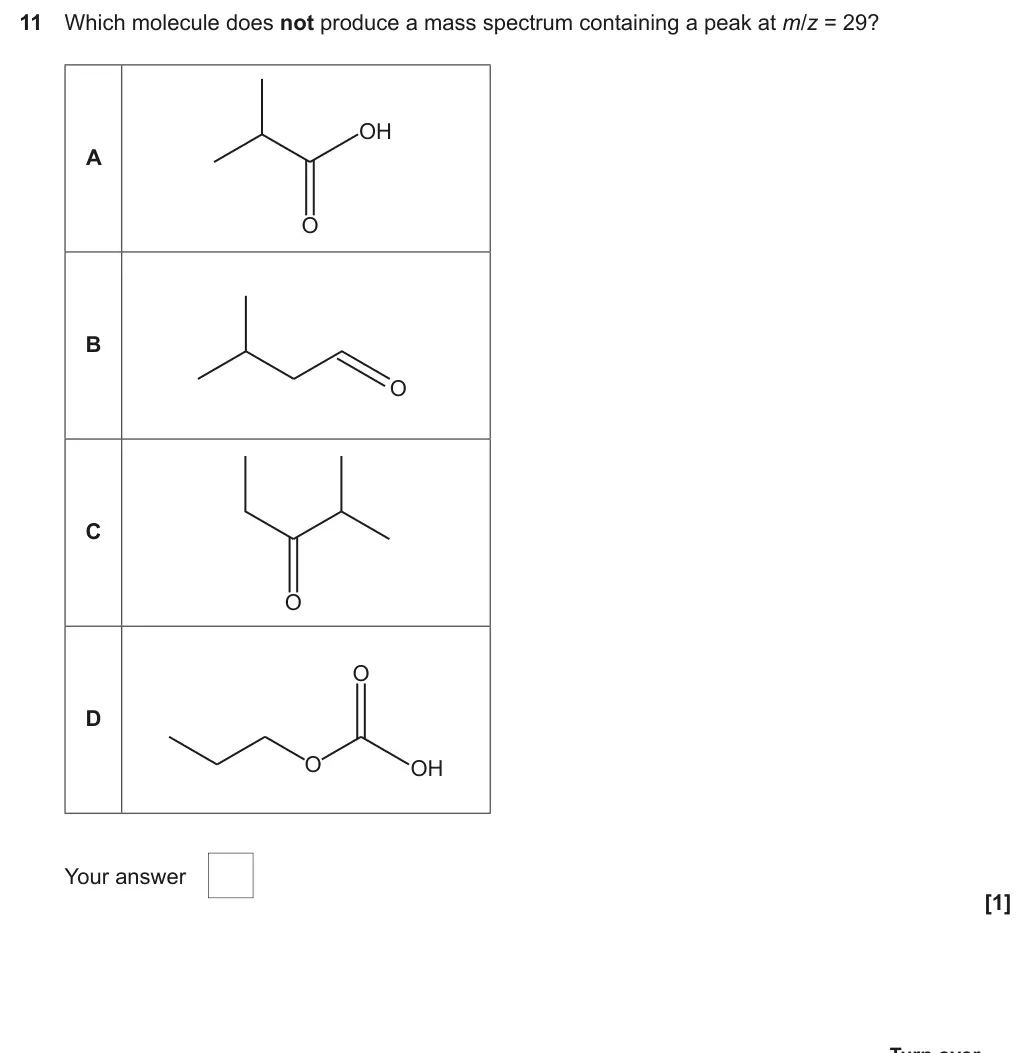
A
Most gave the correct answer A here. The most common incorrect response seen was B. It is possible that some candidates misread the question as option B is the first one that does contain a peak at m/z = 29. Alternatively, candidates may have been looking for C2H5 and may not have spotted the CHO group in B.
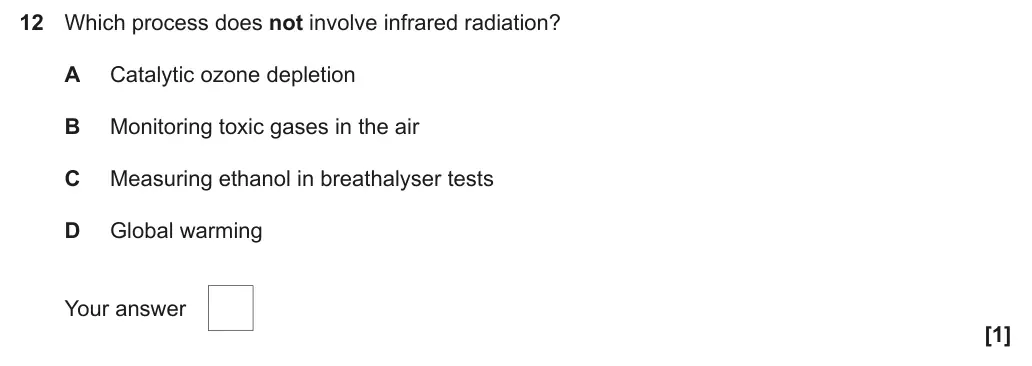
A
Most gave the correct response A here. However, a significant proportion gave an incorrect response. Many gave B or C not knowing these common examples of IR use. Some also gave D not seeing the link to global warming.
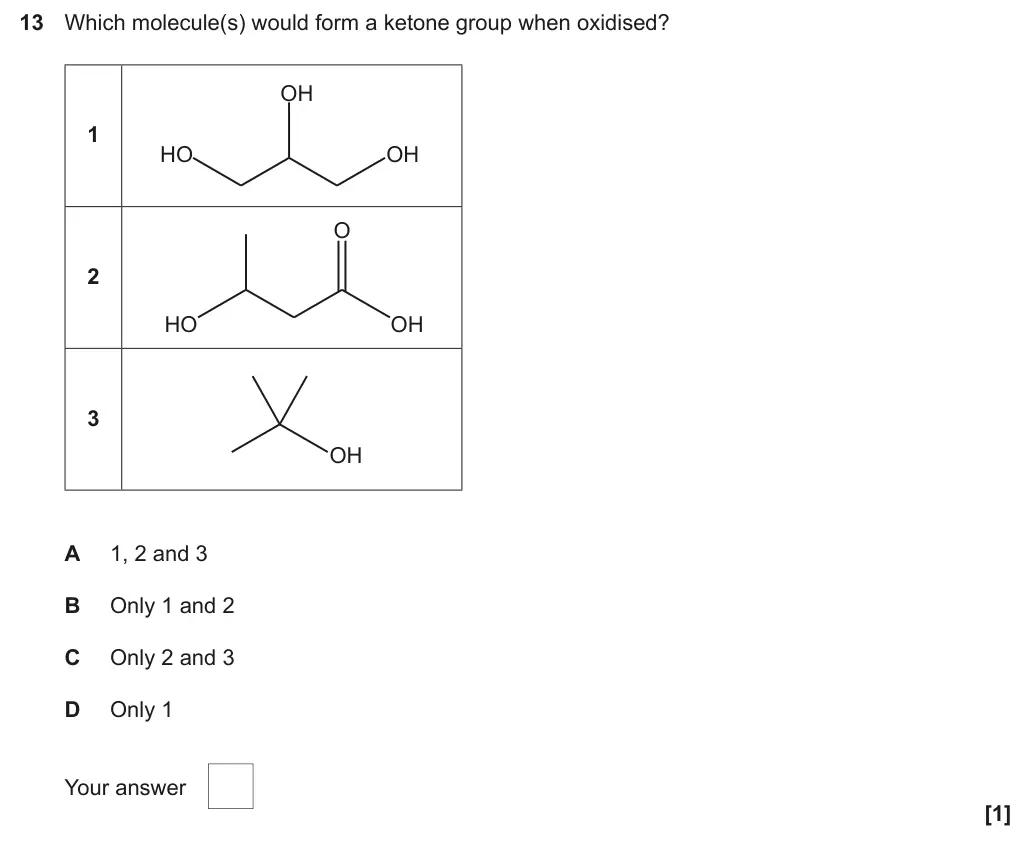
B
Most gave the correct response, B. The most common incorrect answer was D, where candidates recognised that structure 1 would form a ketone group, but not 2, as they had not spotted the secondary alcohol.
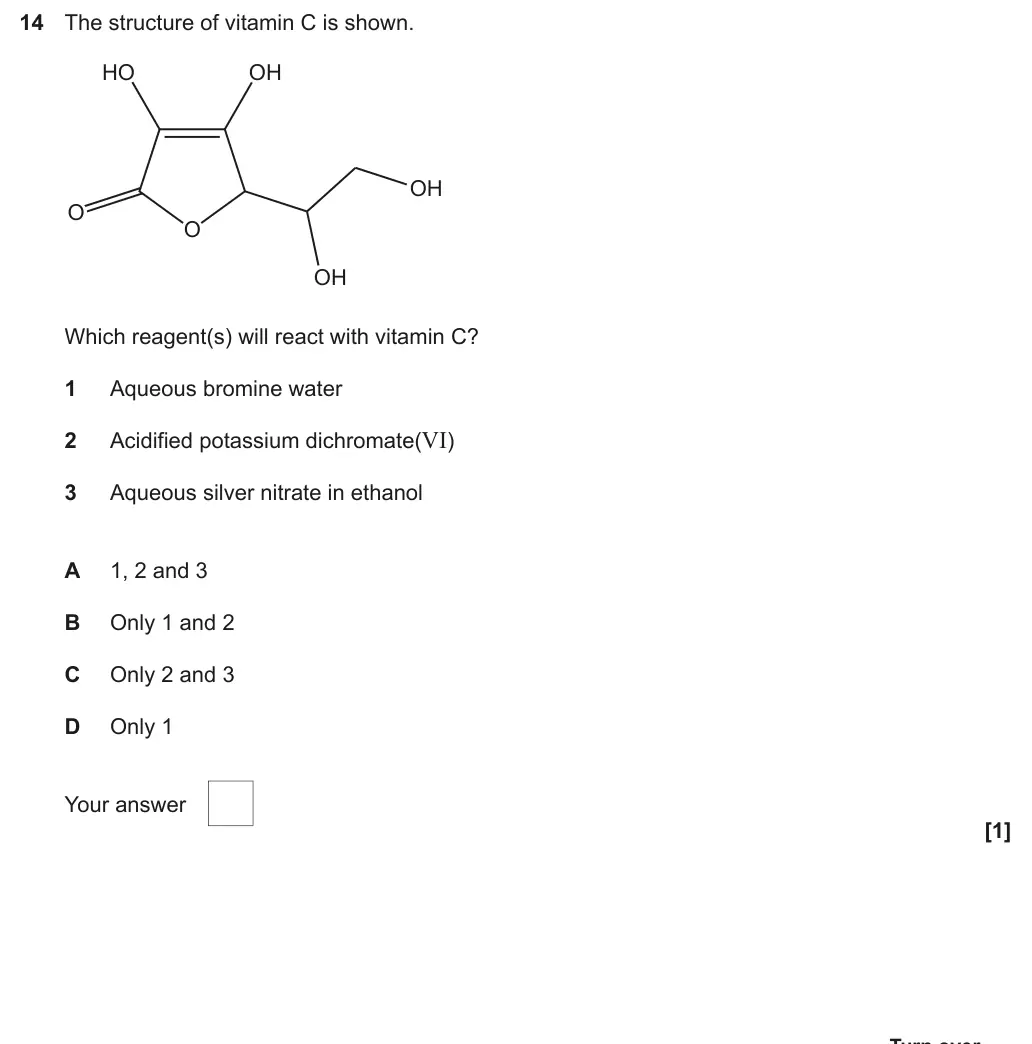
B
The majority of candidates gave the correct response, B. The most common incorrect answer was A, indicating that silver nitrate would also react with this molecule.
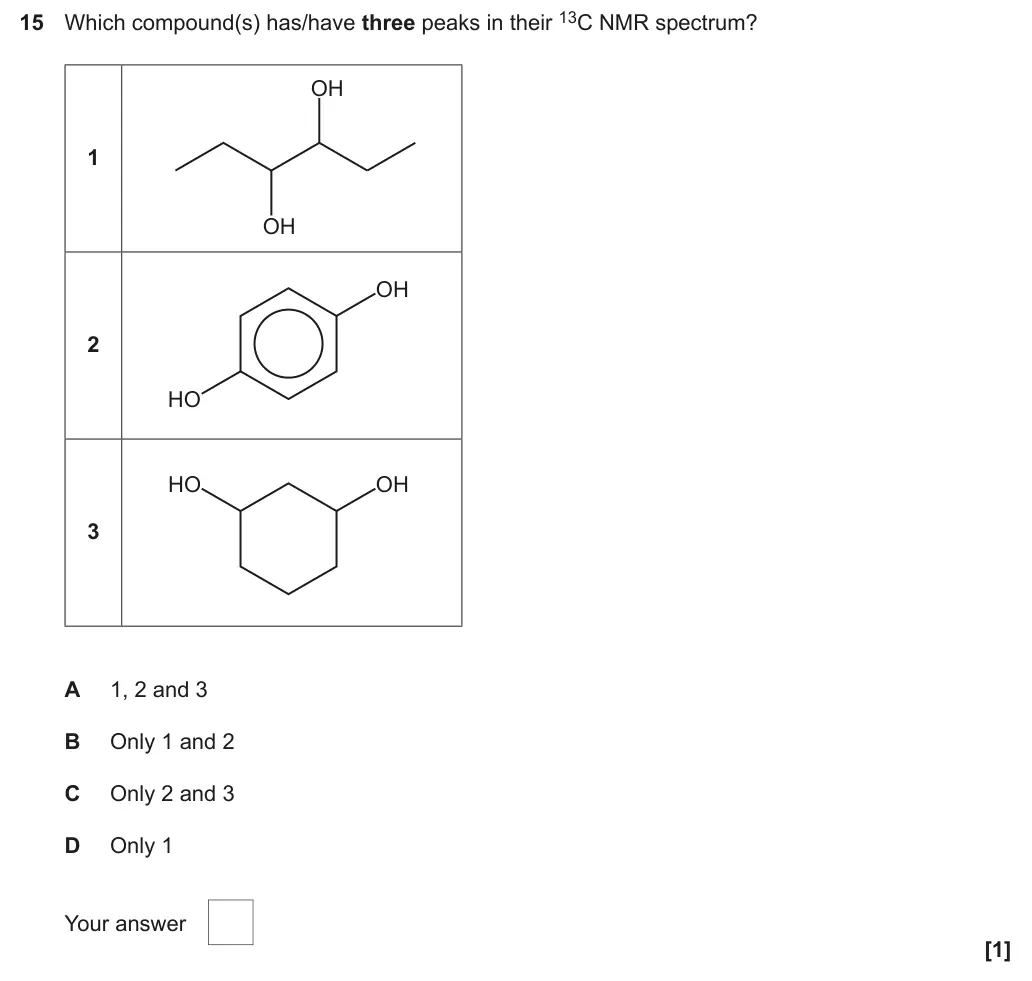
D
Just over half of candidates gave the correct answer, D. The most common incorrect response was B as many didn’t see the line of symmetry so counted each side of the benzene as different (as was evident from candidate annotations). Section B overview Section B includes a mixture of short answer and extended response questions, including two questions marked using a level of response mark scheme (Question 17 and 23 (b)). This section of the paper is worth 85 marks.
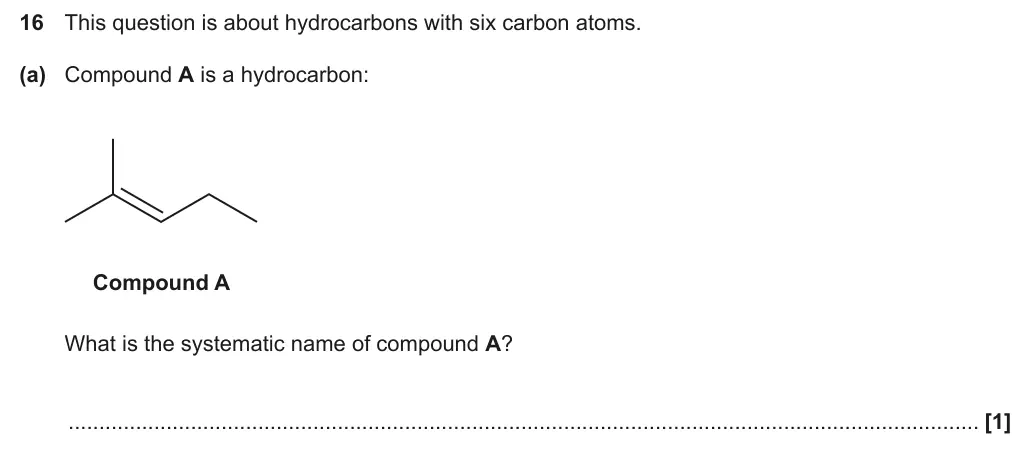
The majority of candidates scored the mark here. The most common incorrect responses included: • Incorrect spelling of ‘methyl’ (although less common than in previous series) • Missing or incorrect locant number for C=C: 2-methylpentene or 2-methyl pent-3-ene • Inclusion of ‘an’ in the name: 2-methylpentan-2-ene • Miscounting the number of carbons: 2-methylhex-2-ene or 2-methylbut-2-ene
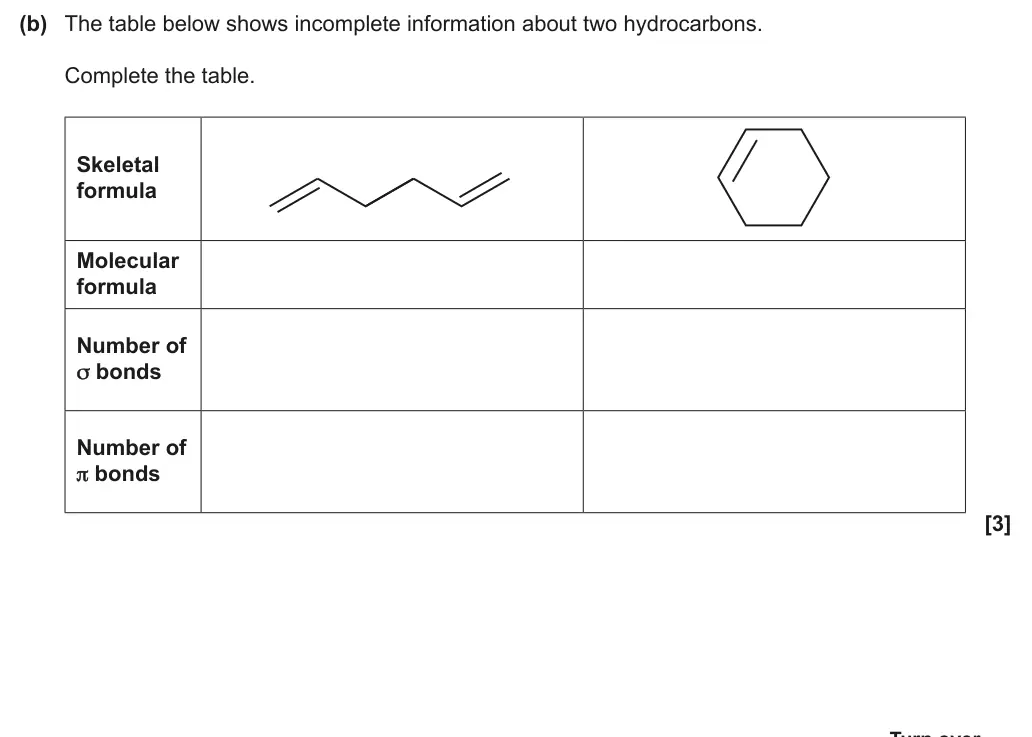
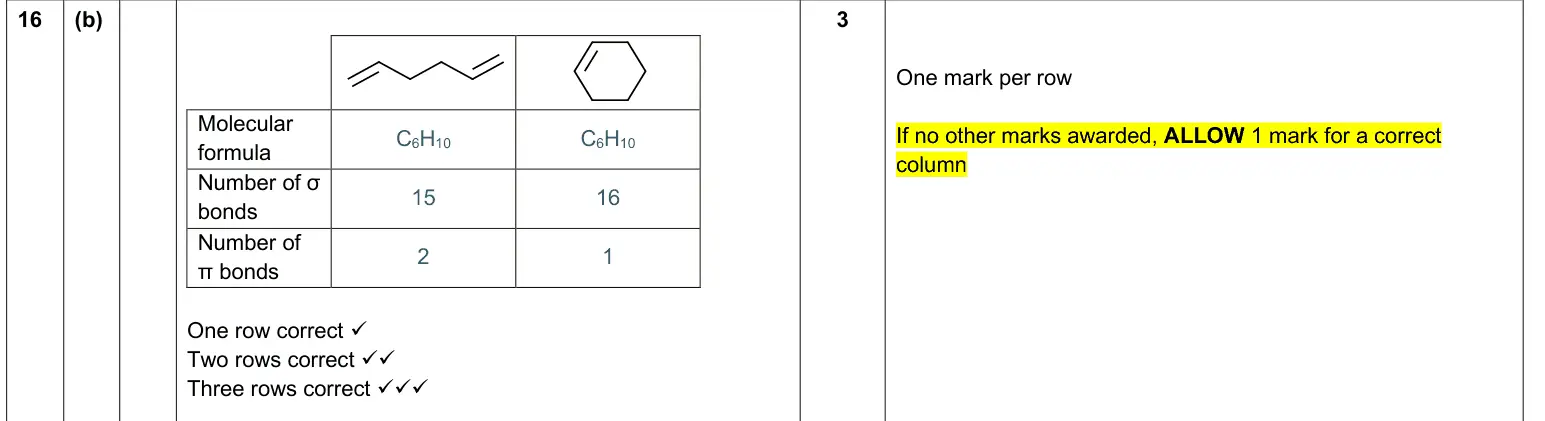
Very few candidates did not score any marks here. Most gained a mark for the correct molecular formulae in the first row, although some candidates gave structural formulae instead of molecular formulae or gave both. Candidates found counting the different types of bonds quite challenging and we would recommend drawing out displayed formulae to make it easier to label and count each type of bond. Many gave 5 and 6 respectively for the bonds, forgetting to count the C-H bonds that are not shown in the skeletal structure. More were able to correctly count the bonds but some counted the number of atoms involved in bonds instead. A few had and bonds the wrong way round.
Skills: M4.2 Visualise and represent 2-D and 3-D forms including 2-D representations of 3-D objects
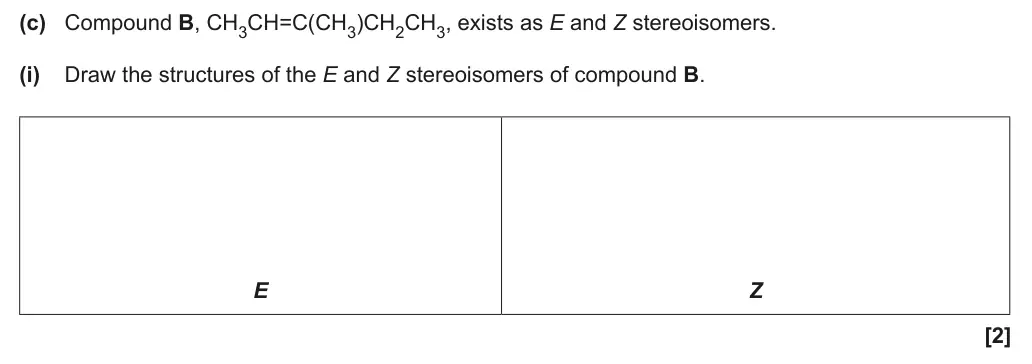
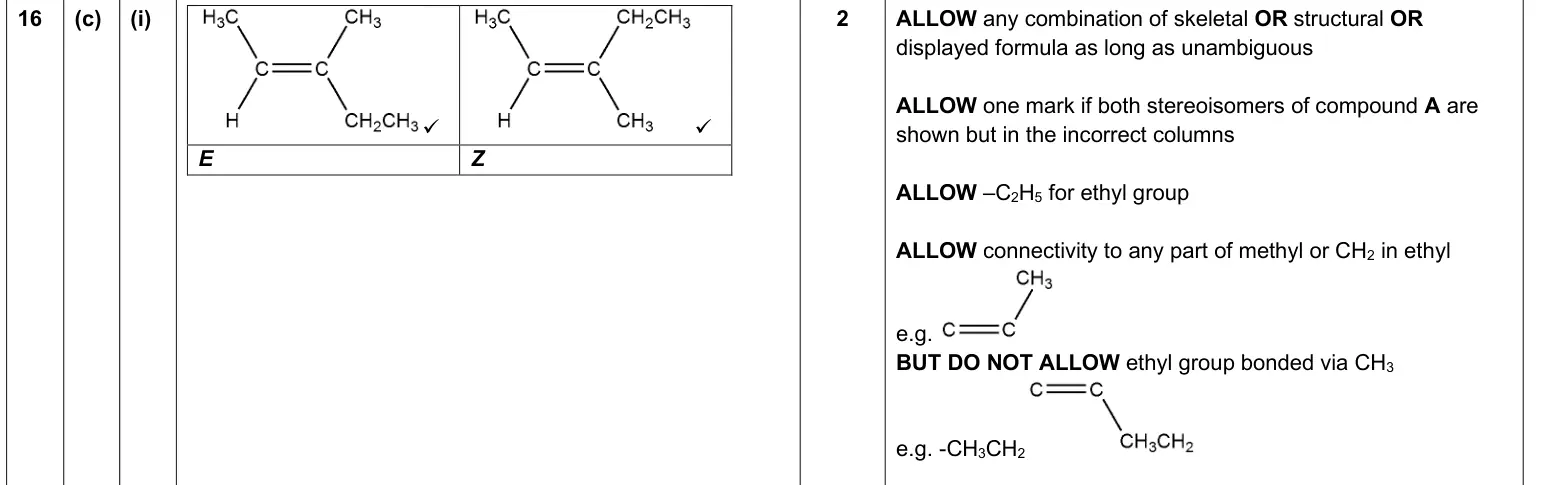
Most candidates were able to score both marks here. However, a common error, which scored only 1 mark, was drawing the E and Z isomers the wrong way round, using the -CH3 groups to assign instead of considering priority. A common reason for losing both marks was by incorrectly copying the formula from the question, e.g. CH3CH- attached to C=C. Very few candidates gained no marks due to poor connectivity on the ethyl -CH2CH3 group connecting via CH3.
Skills: M4.2 Visualise and represent 2-D and 3-D forms including 2-D representations of 3-D objects; M4.3 Understand the symmetry of 2-D and 3-D shapes
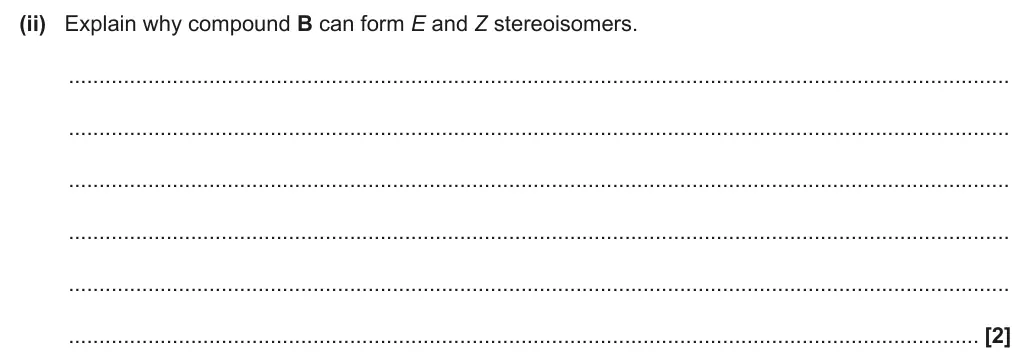
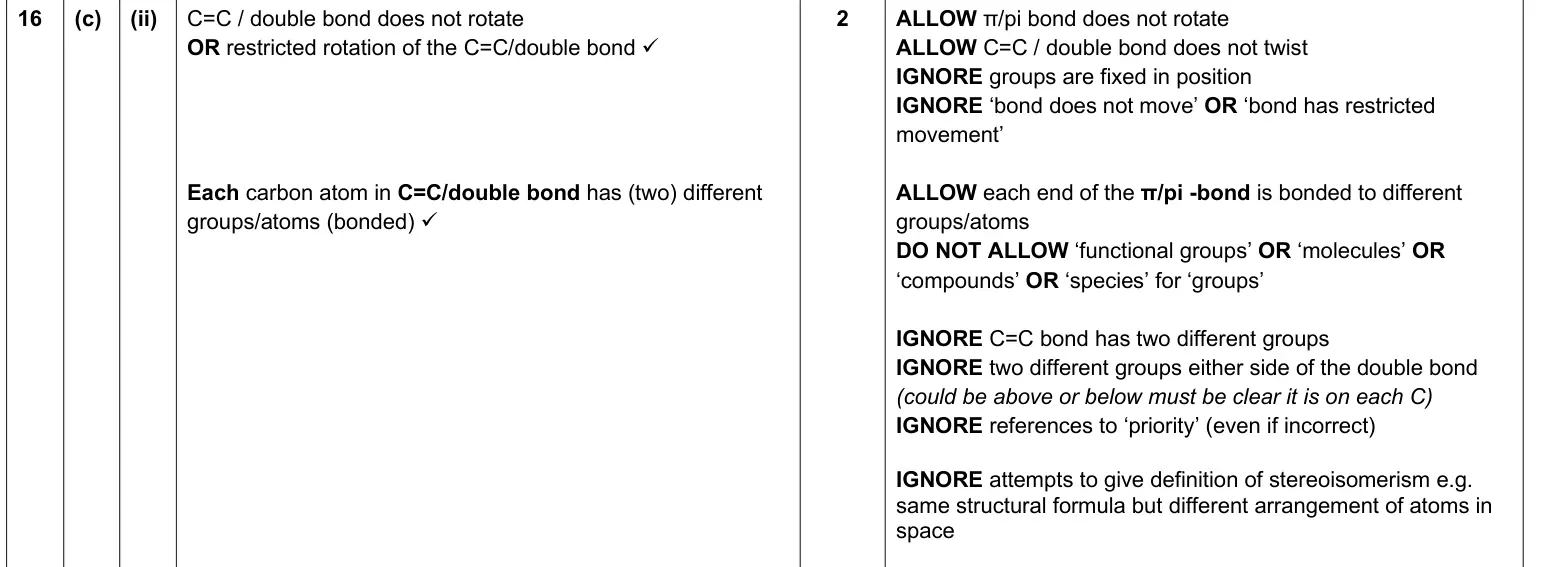
Very few candidates scored both marks here. Many appeared not to understand what was being asked so explained how to assign priority groups to be able to identify isomers as either E or Z, but they didn’t say why these isomers occur. Some just gave the definition of a stereoisomer. Many referred to the presence of the C=C or double bond but not the reason why it causes E/Z isomers i.e. the double bond doesn’t rotate. Some said that the molecule couldn’t rotate but it wasn’t clear this was due to the presence of the double bond. Some candidates suggested that the isomers arise ‘due to free rotation’. This highlighted a possible misconception which was evident when candidates justified their responses as to why 2 isomers would form – i.e. with priority groups on the same side or opposite side once the C=C had rotated. Many struggled to explain that there are different groups on each carbon of C=C, and common errors included: • no reference to the C=C so could be any C in structure • 4 different groups around the C=C. Here there are only 3 different groups • 2 different groups on each side of C=C (could be above/top or below/bottom) • use of ‘functional groups’, ‘molecules’, ‘compounds’ or ‘species’ instead of groups • has priority groups (still must be clear that there are 2 on each C of C=C) A very small number mentioned optical isomerism.
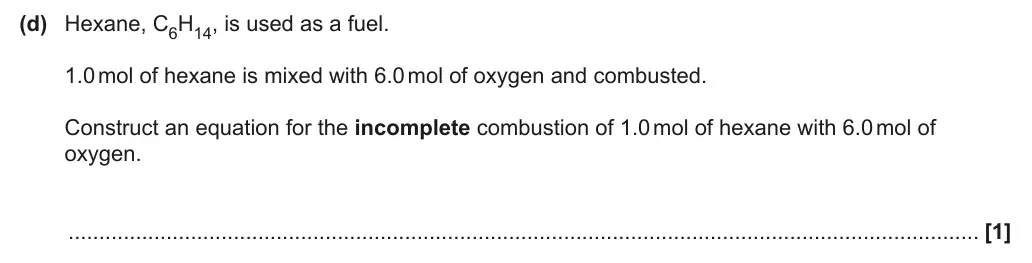
Most candidates were unable to gain credit here. The most common incorrect response given was C6H14 + 6O2 → 6CO + 7H2O which doesn’t balance in terms of oxygen. A significant number recognised that this was not balanced so gave C6H14 + 6.5O2 → 6CO + 7H2O but this misses the crucial 1:6 ratio of fuel/hexane to oxygen required in the question. Some gave H2 as a product of incomplete combustion, e.g. C6H14 + 6.5O2 → 6CO + 6H2O + H2. Candidates need to be reminded that C or CO will form in a limited supply of O2 but not H2. Candidates seemed unaware that multiple C products of combustion can be formed in one reaction. A few gave O2 as a product as well as a reactant.
Skills: M0.2 Use ratios, fractions and percentages
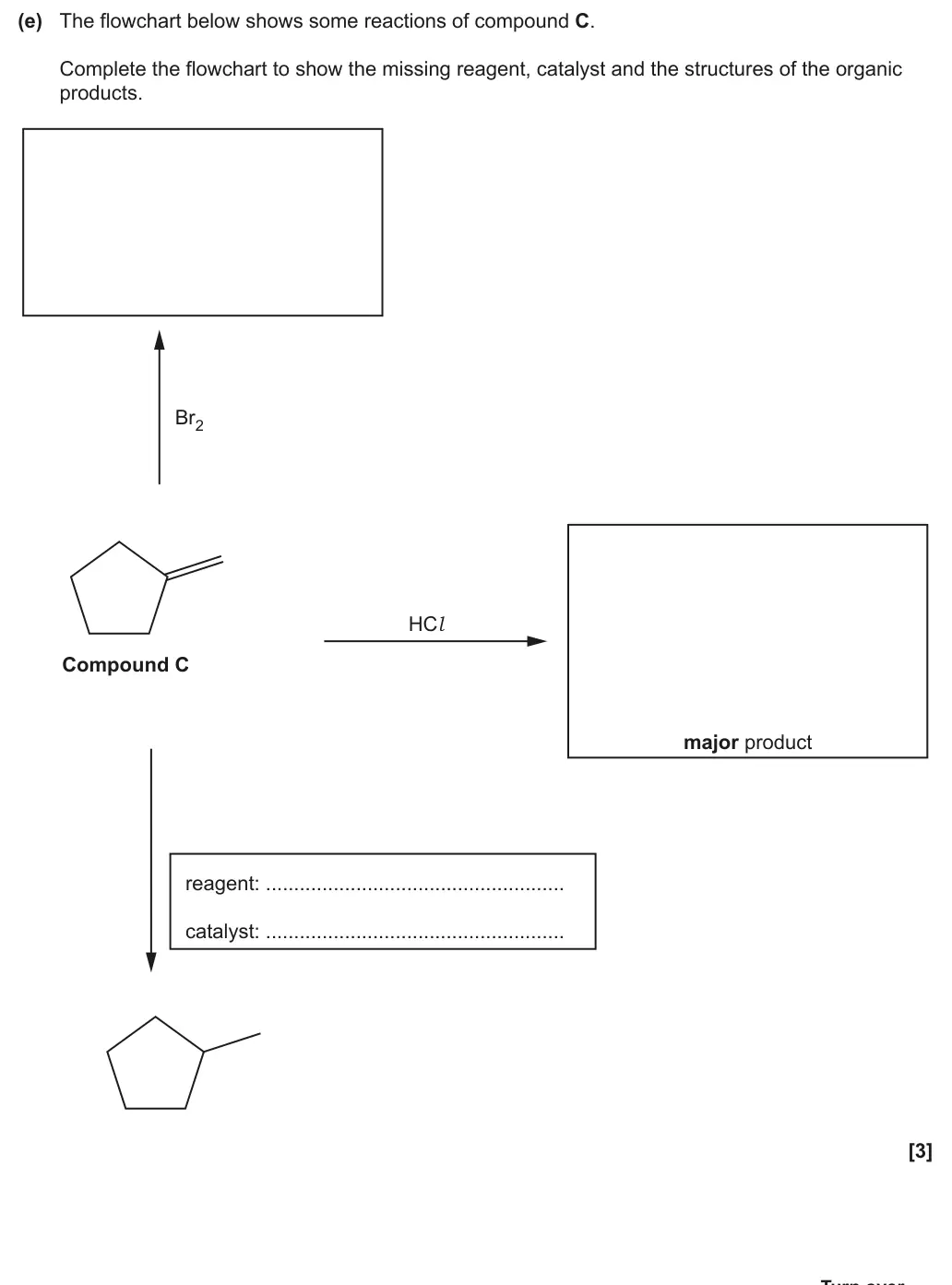
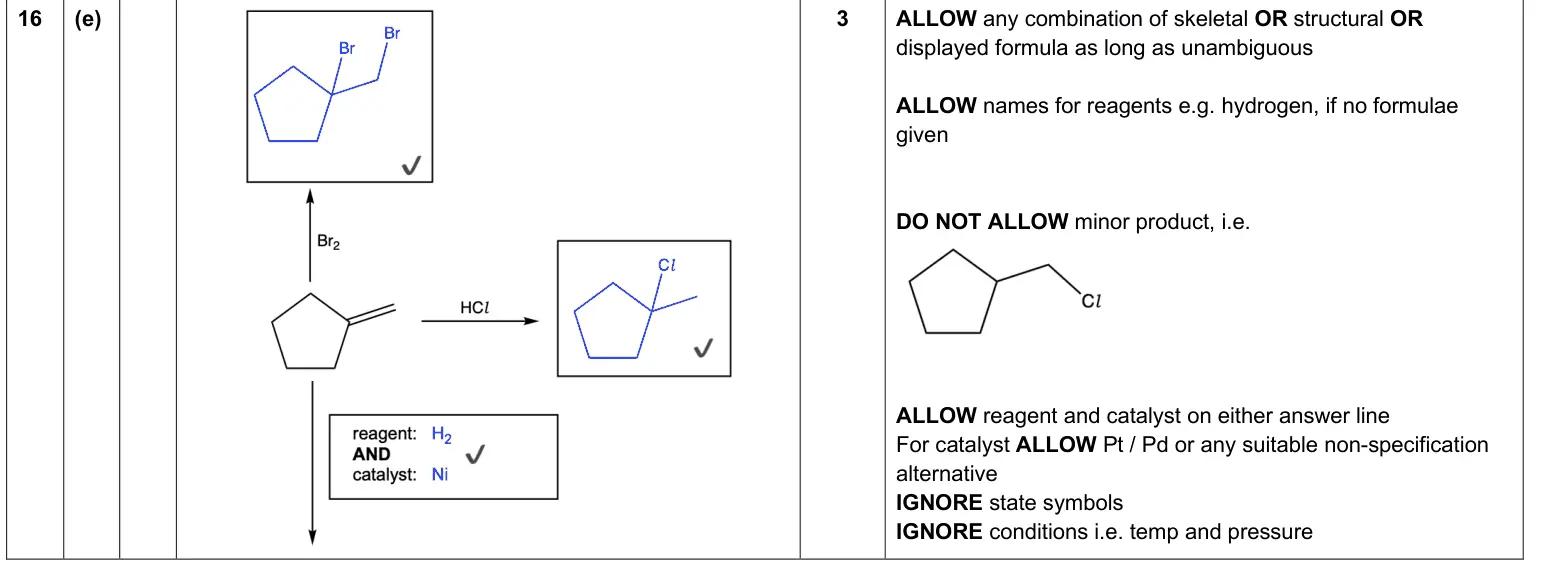
More than half of the candidates scored all 3 marks for this question. Lower attaining candidates were usually able to score at least 1 mark for the H2, and Ni required for the hydrogenation to form an alkane from compound C. The reactions with Br2 and HCl were more challenging due to the presence of a ring in compound C. This question was answered best by the candidates who demonstrated a strong understanding of skeletal formulae. Common incorrect responses seen included the following: • Swapping the C=C for either Br or Cl, e.g. • Adding Br or Cl to different positions around the ring, e.g. • Adding 1 Br atom in reaction with Br2, e.g. • Adding both Br atoms to same C, e.g. • Giving the product from HBr reacting rather than HCl • Giving the minor product from the reaction with HCl
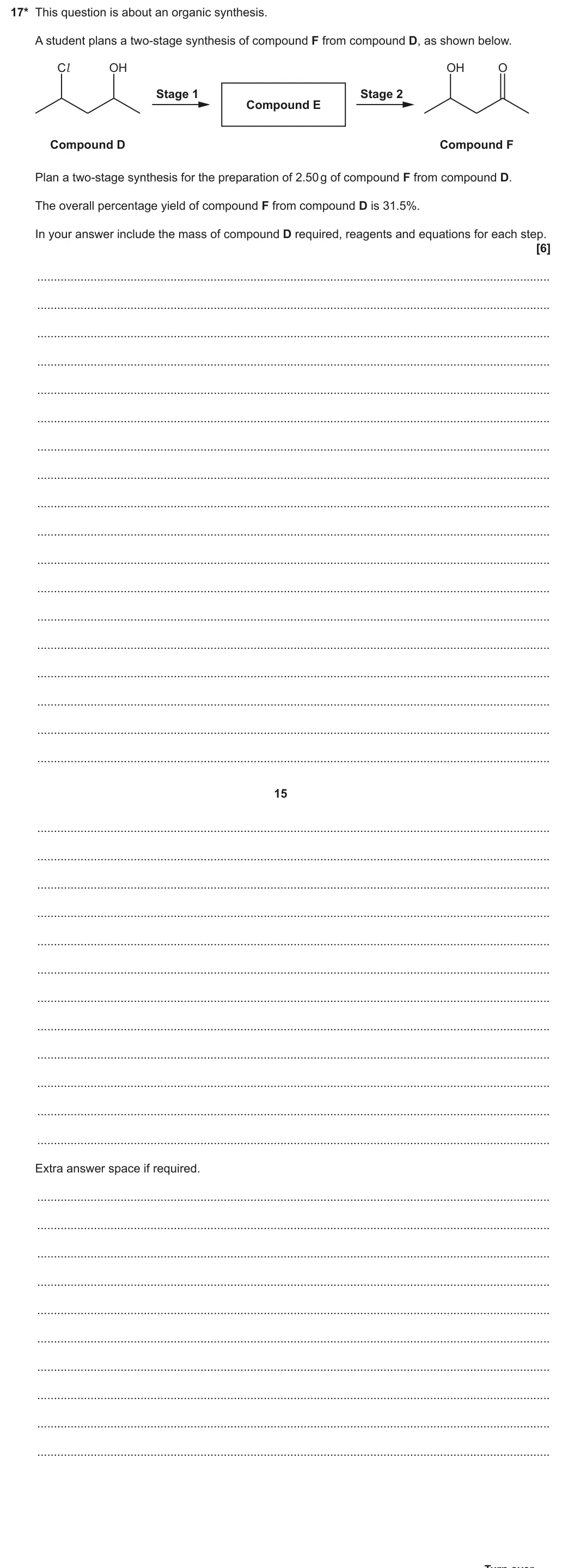
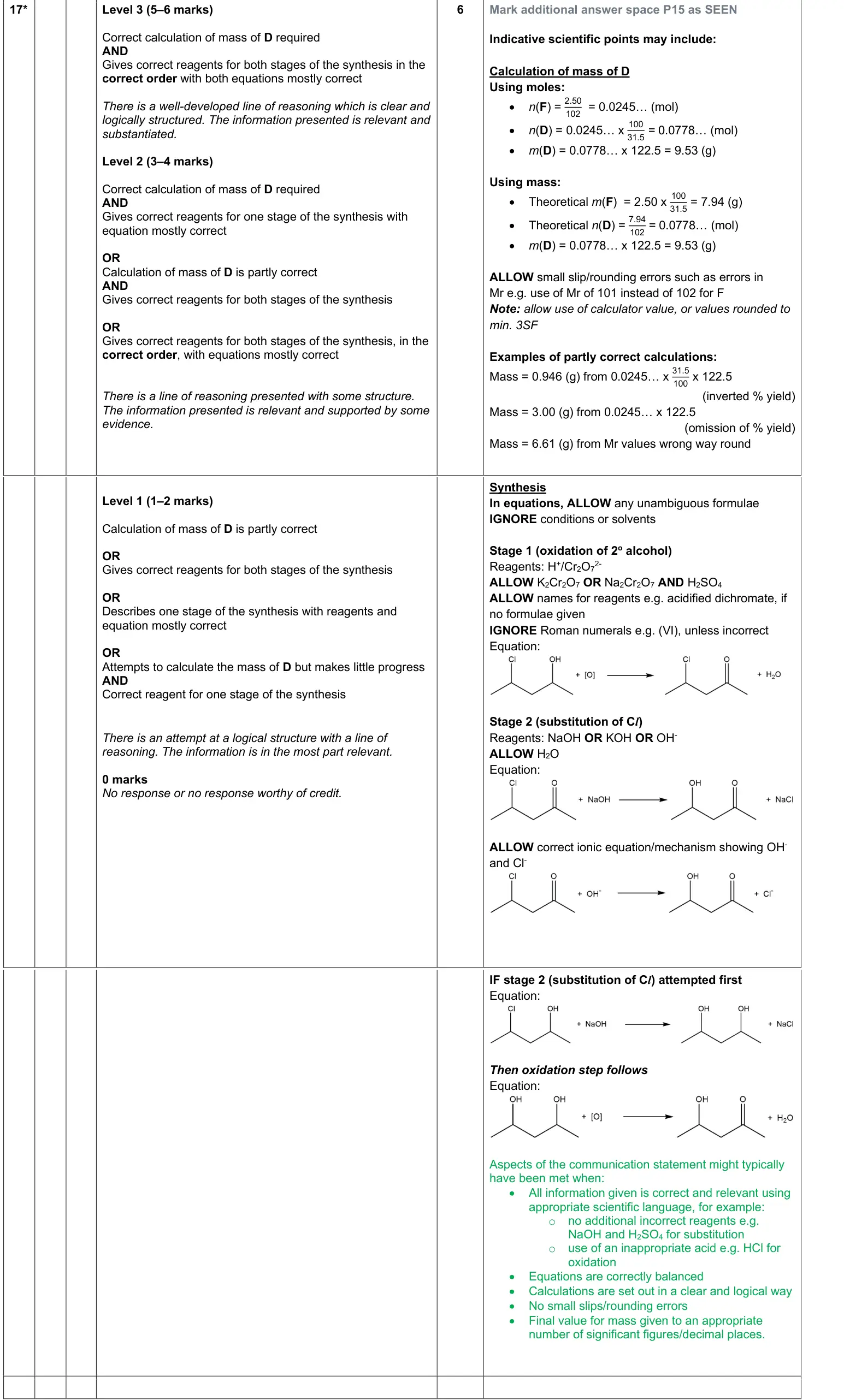
Generally, this question was well answered with most candidates achieving Level 3. Many candidates knew the correct reagents to use to carry out the two-stage synthesis. Some missed out on Level 3 as they had the steps in the wrong order. It was essential to carry out the oxidation prior to substitution otherwise both -OH groups would be oxidised. A significant number struggled with the calculation of the mass of compound D required. Many gave the answer as 7.94g so had only considered the yield, not the difference in molar mass of F compared to D. Other common errors seen in the calculation included errors in Mr values, missing or inverted percentage yield, as well as intermediate rounding of values to two significant figures. Level 2 could still be achieved without the calculation if they had the correct reagents in the correct order with equations mostly correct. To be mostly correct we required them to have at least one of the inorganic reactants or products given. Communication marks were lost if there were errors in reactants or products as well as balancing of equations. Students using skeletal structures generally made fewer mistakes with the balanced equation than those using structural formulae, where additional Hs were inserted alongside the ketone group i.e. CH3CHClCH2CHOCH3. Lower attaining students attempted to write the H+/K2Cr2O7 in the balanced equation and didn’t know to represent this with [O]. Other common errors in balancing the oxidation equation included missing H₂O or using 2[O]. A common error was to see H2SO4 as a ‘catalyst’ added with NaOH in the substitution reaction – this additional and unnecessary reagent lost candidates the communication mark. This response achieved Level 3 and all 6 marks. The calculation is laid out clearly showing both Mr values used in the calculation. Showing the values used in each step makes it much easier to spot where any errors may have been made if the correct value is not obtained. The reagents for each stage are given and the reactions are carried out in the correct order. The equations are given and are correctly balanced. This was an excellent response.
Skills: M0.2 Use ratios, fractions and percentages; M1.1 Use an appropriate number of significant figures; M2.2 Change the subject of an equation; M2.3 Substitute numerical values into algebraic equations using appropriate units for physical quantities
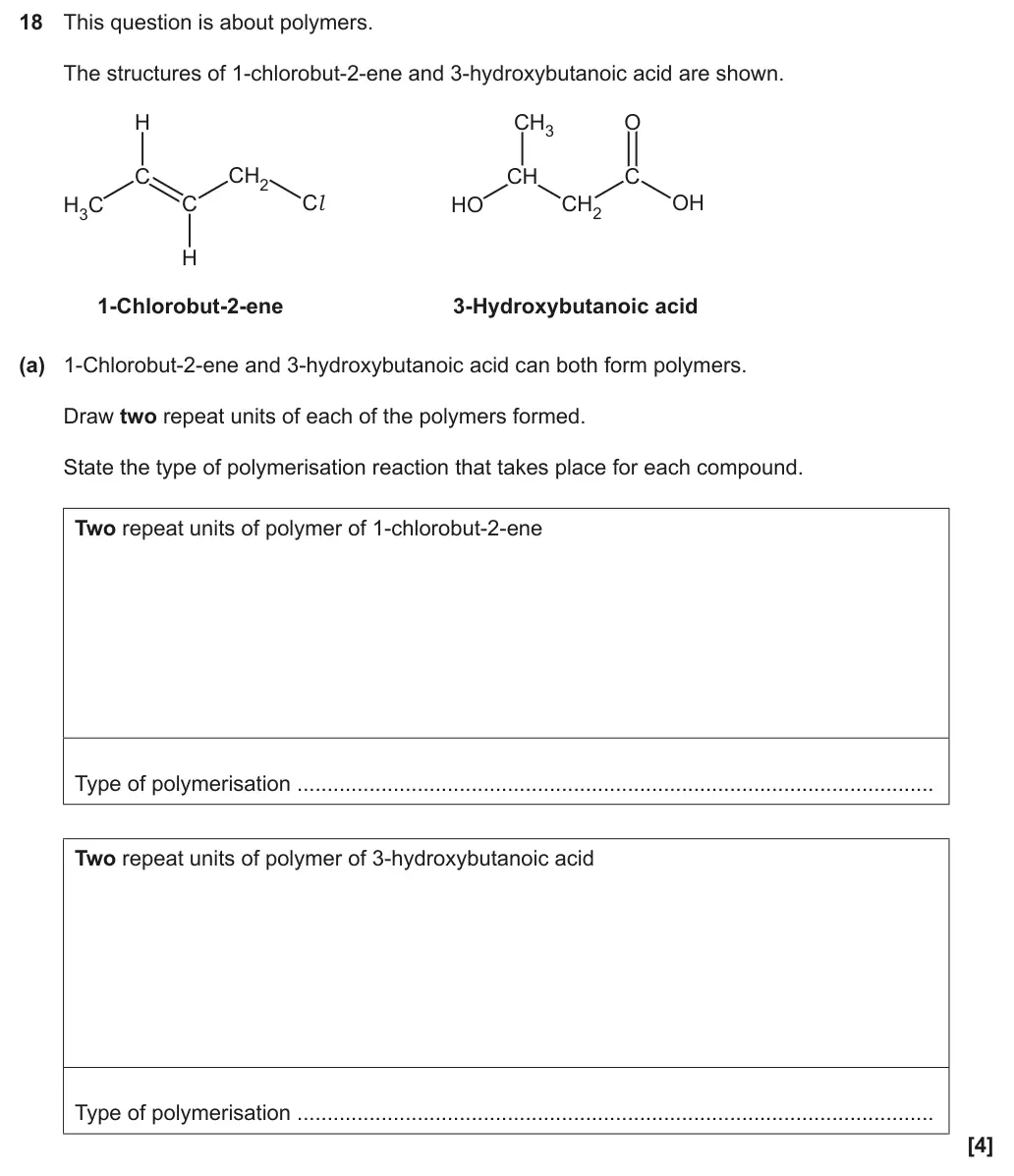
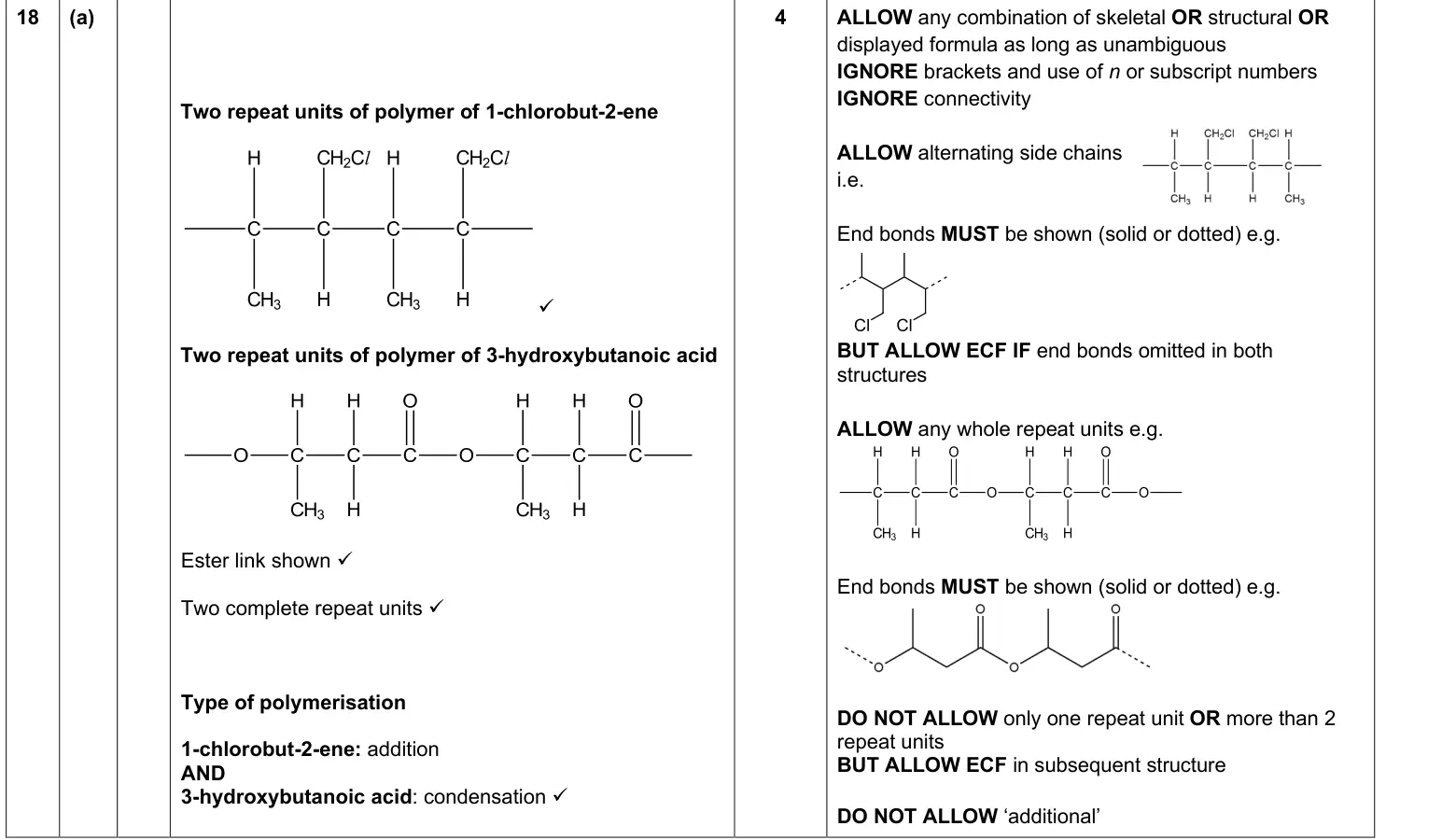
Most candidates managed to score 3 or 4 marks on this question. Some did not gain marks for structures without end bonds or for giving a complete unit of 2 molecules joined together. Some had only one repeat unit for each or gave more than two. Lower attaining candidates were often able to draw one type of polymer repeat unit but couldn’t do both. Polymer of 1-chlorobut-2-ene: Most were able to give the structure of two repeat units. Less successful candidates struggled to open the double bond and gave carbon chains with eight carbons in length connected to each other, sometimes with the C=C still present. In general, less successful candidates found it harder to get the marks for the addition polymer than with the condensation polymer, possibly as condensation polymerisation is taught later in the course. Polymer of 3-hydroxybutanoic acid: Very few didn’t gain a mark for showing the ester link between two monomers. A common error was adding -O- to both ends of the repeat unit. A few missed off Hs, particularly on C with CH3 attached. Most candidates knew the different types of polymerisations shown here. Some gave ‘alkene’ or ‘polyalkene’ rather than ‘addition’. A few gave ‘esterification’ or ‘substitution’ instead of condensation.
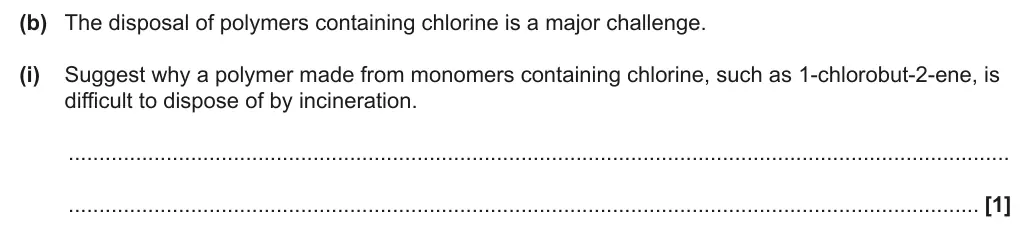
Most gained credit here. Many identified chlorine as the toxic gas instead of HCl. However, a mark was not given if candidates stated ‘chlorine is toxic’ – it was necessary to say chlorine or other toxic products are formed (when polymers are incinerated). A common reason for losing the mark here was for saying that incineration formed ‘harmful’ gases which was insufficient. Some referred to the high bond enthalpy of the C-Cl bond, making it more difficult to dispose of as more energy is needed. Some suggested that polymers with chlorine in had high boiling points. Others thought it would produce chlorine radicals and linked their answers to ozone depletion.
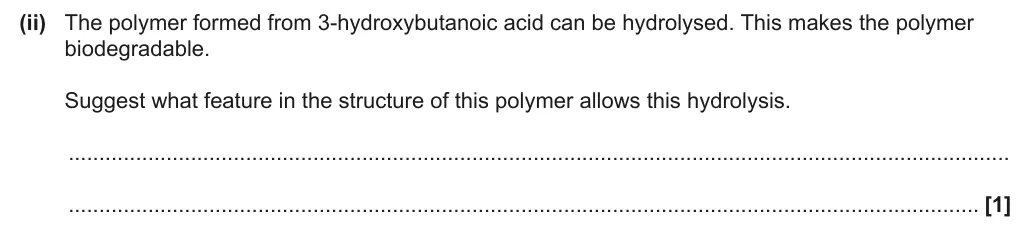
This mark was achieved by most candidates, with wrong answers largely linked to hydrogen bonding leading to hydrolysis rather than identifying the feature of the structure of this polymer that allows hydrolysis. Incorrect answers included: carboxylic acid, alcohol, hydroxyl, C-O bond (but not specific to ester).
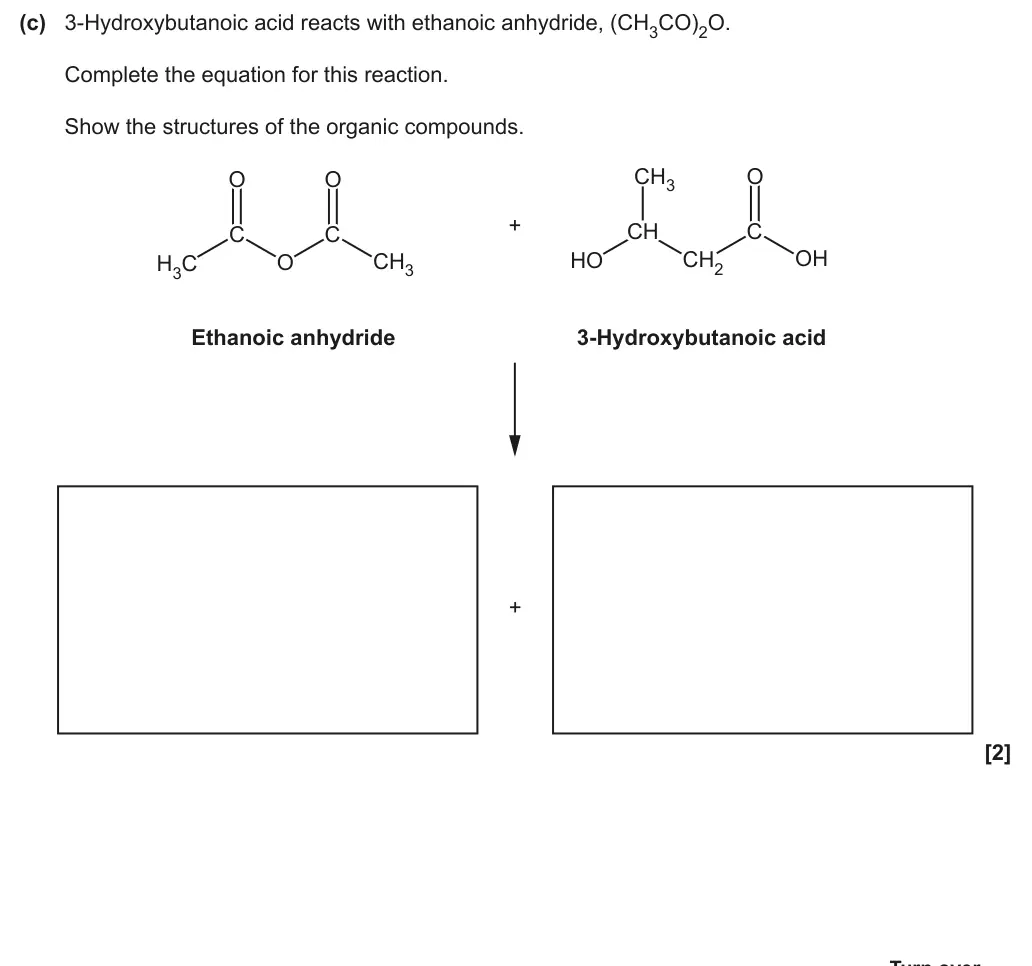
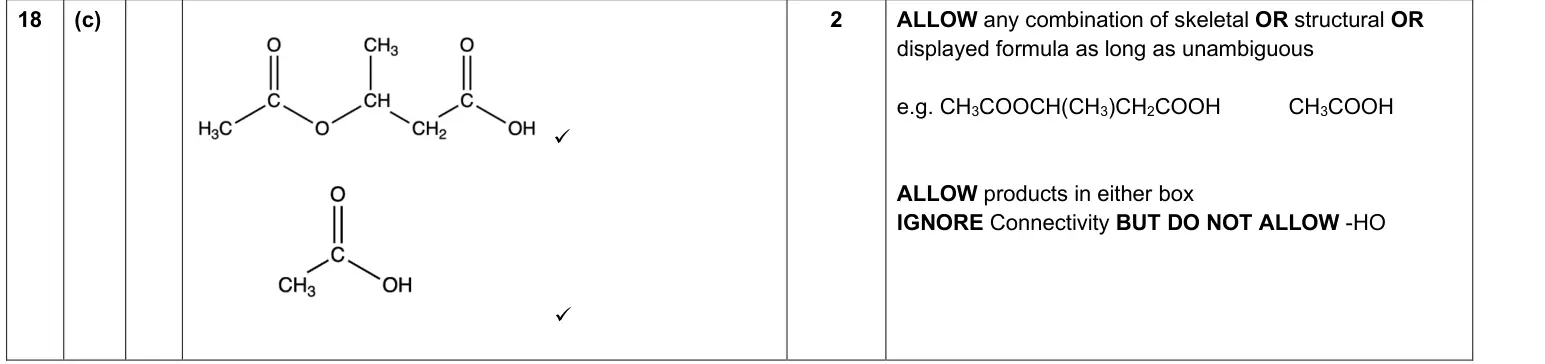
Candidates struggled with this question, about the reaction of an acid anhydride and an alcohol, with only the highest attaining across the paper scoring both marks. Possibly they were confused by the presence of the carboxylic acid group in the alcohol as well. Many showed the formation of a mixed acid anhydride product from the reaction of the two carboxylic acid groups. This reaction is not likely to occur. Lower attaining candidates clearly struggled, some drawing an aldehyde or giving water as one of the products and chemically unfeasible structures as the other product. A sizeable proportion of candidates made no attempt at this question.
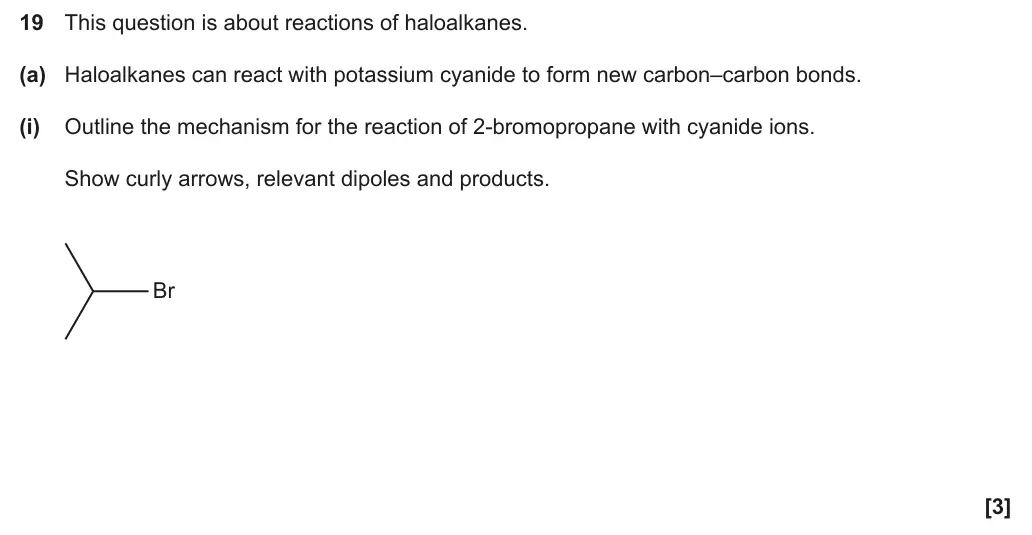
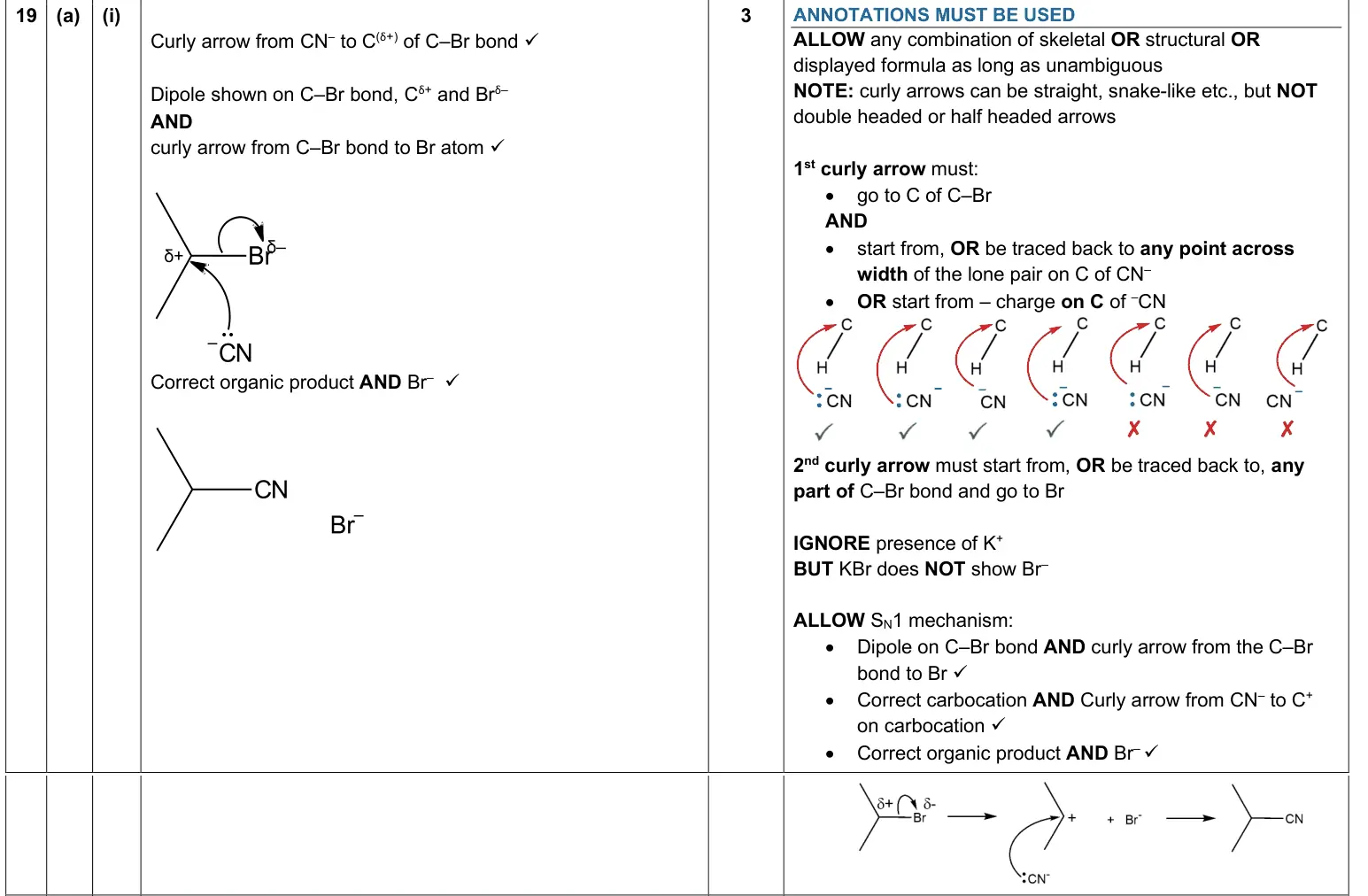
Many candidates scored all 3 marks here showing that the mechanism is well known. Some struggled with the skeletal formula given but were given credit for drawing out structural or displayed formula, provided that the central C showed correct number of bonds. Most common reasons for losing marks: • KCN and KBr shown in the mechanism rather than ions • arrow from lone pair or negative charge on N of CN • dipole on C-Br the wrong way round • missing the negative charge on CN- • curly arrows shown in the wrong direction Remind candidates that curly arrows should only be used to show the movement of a pair of electrons and not the formation/breaking of an ionic bond. A significant number of candidates chose to write more than one version of the mechanism without crossing out the one they did not wish to be marked. This led to marks being lost through contradictions. Teachers should remind candidates of the importance of submitting only one response to each question.

The majority of candidates recognised this to be nucleophilic substitution. The most common incorrect response seen was nucleophilic addition.
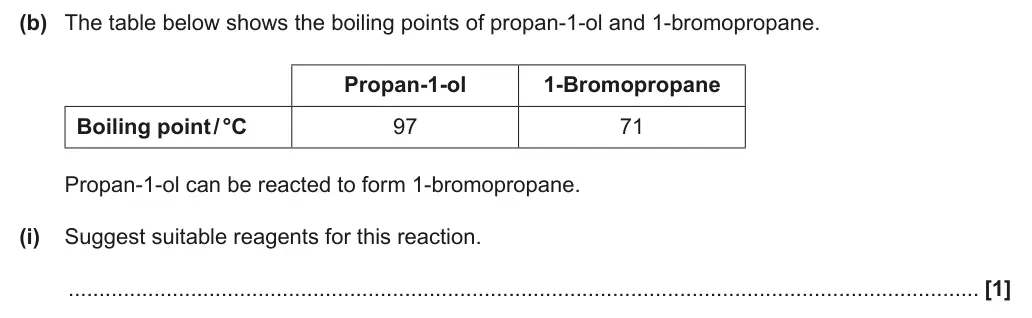
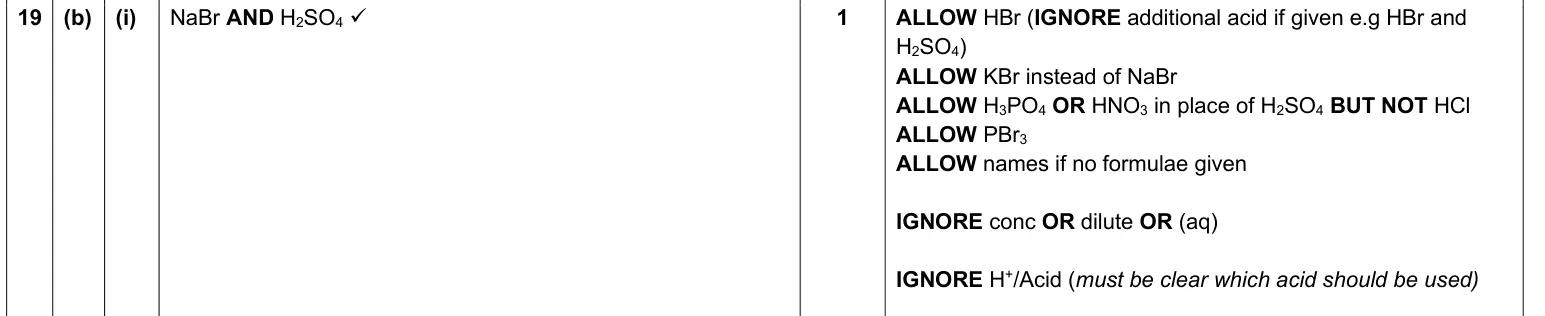
This question was well answered by most candidates. Incorrect responses often gave just the salt, NaBr, without the acid. Most common errors seen: • KBr or NaBr without acid • NaX or sodium halide without specifying that it is bromide needed here • Br2 • Using H+ without specifying which acid to use (need to be specific as HCl would be inappropriate).
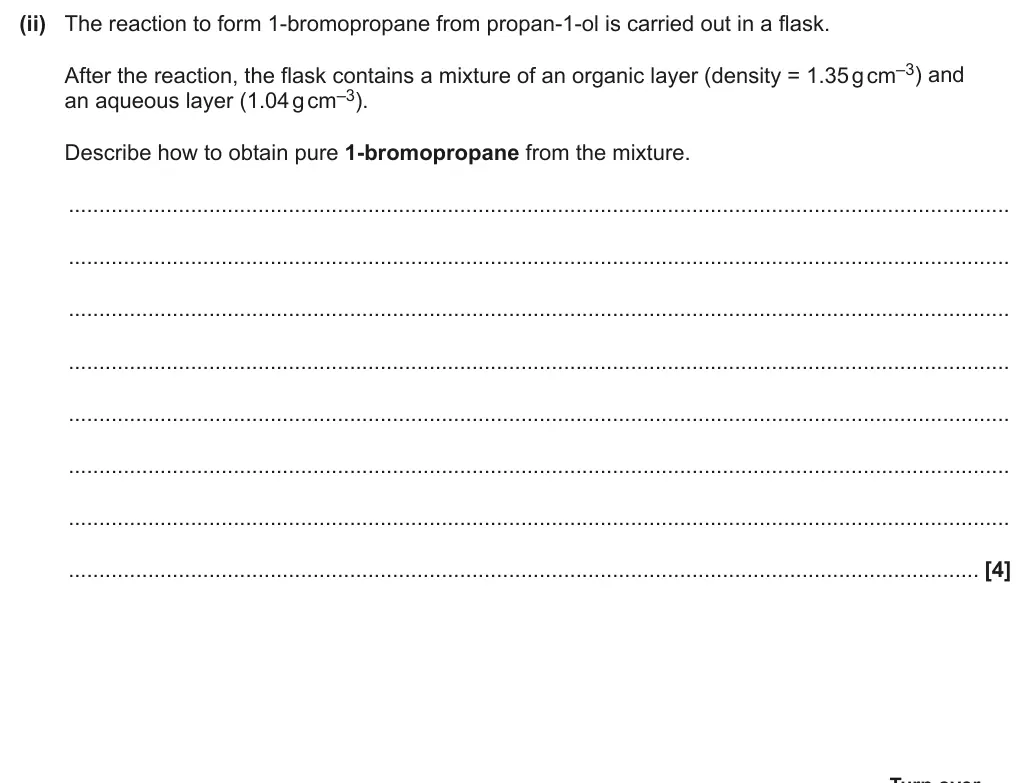
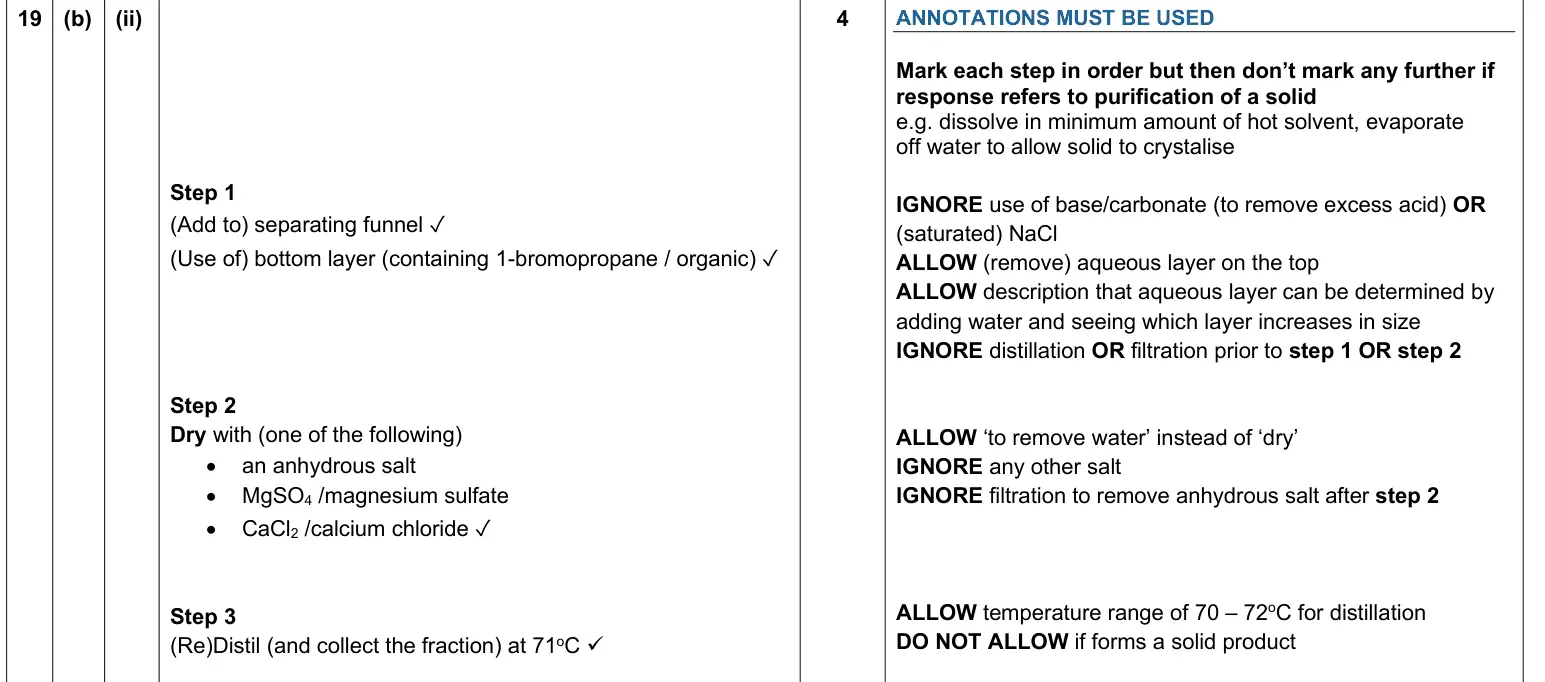
Candidates appeared better prepared for this type of question than in previous sessions, with a significant proportion achieving 3 or 4 marks. It differentiated well between candidates at different grades. Most candidates recognised the organic layer would be at the bottom but couldn’t always name the apparatus used to separate these two layers with incorrect responses including burettes, pear-shaped flasks, separating flasks and separating tubes. Some were confused about the density information, thinking that as the organic layer is denser it would be on top, or if adding more water it would then switch around the layers. Many gave the first step but not step 2 and 3. Lots of detail was given about how to use the separating funnel, e.g. invert to mix, vent to release pressure build up etc., to fill up the space provided. Most that went on to add an anhydrous salt were able to explain that it was used to dry the organic layer and were able to give a suitable example. Some candidates often misunderstood how to use them suggesting the anhydrous salt should be added to the separating funnel or the aqueous layer. Some candidates also suggested washing the layer with water or aqueous sodium carbonate to remove the acid once the organic layer had been dried. Many candidates either omitted the temperature to distil at to obtain pure 1-bromopropane or confused it with the boiling point of propan-1-ol (reactant) also given in the question. Some said to collect the distillate at its boiling point but didn’t quote the value that they had been given in the question so did not score the final mark. Many candidates introduced additional, unnecessary steps. Lower attaining candidates often confused the purification with that of an organic solid i.e. recrystallisation and scored 0 marks. A clear and concise response which scored all 4 marks.
Skills: PAG5 Synthesis of an organic liquid
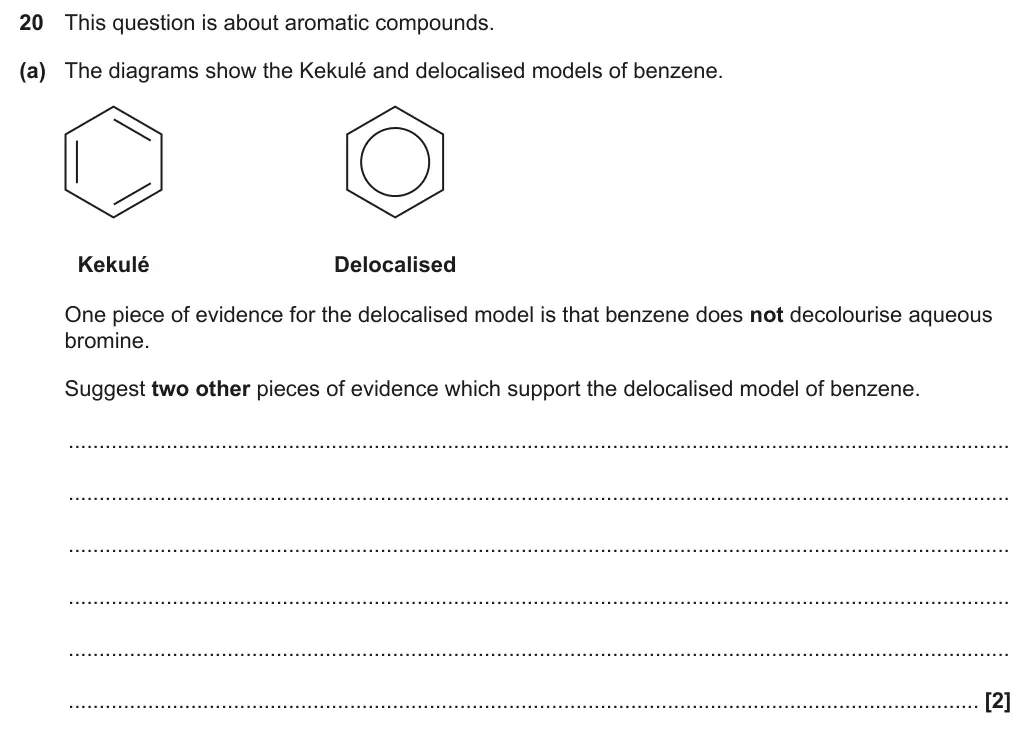
Most candidates scored at least one mark for recognising that the C-C bond lengths in the delocalised model of benzene are the all the same. Many found it difficult to articulate what they meant, e.g. ‘all the C-C and C=C bond lengths are the same’. Candidates were given the mark for stating that there were ‘equal bond lengths’. Although this is technically not true, as the C-H bonds are not the same length as the C-C bonds, we gave the mark as only skeletal structures are shown here without C-H bonds. Many also scored the second mark but slips were often made by reference to ‘hydration’ or ‘bond’ enthalpy. Some just said ‘enthalpy will be less exothermic’. Some described the hydrogenation value as being lower or higher as we are considering negative values it is much clearer to do this in terms of ‘less exothermic’ or ‘less negative’. A few described the enthalpy of hydrogenation as being ‘more exothermic than expected’. Many candidates were able to quote the actual figures in their response, and while it is not necessary for candidates to learn the values, their effort is commendable. A small number of candidates discussed the lack of reactivity in terms of electrophilic addition – not realising this had already been given in the question in terms of reaction with bromine. STEM Contributors We have produced a STEM Contributors spreadsheet linked to the H432 specification. This includes the work by Kathleen Lonsdale and Linus Pauling on our understanding of the structure of benzene. This is a great resource for broadening understanding of the contribution made by individuals to the topics being taught in the specification.
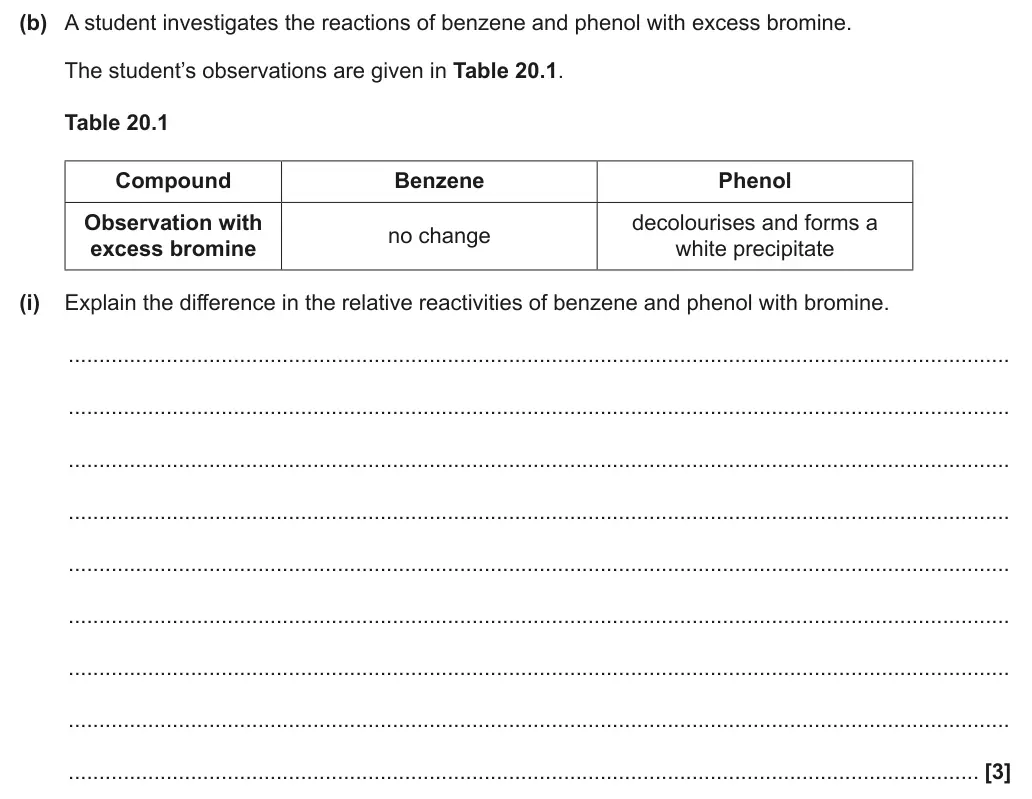
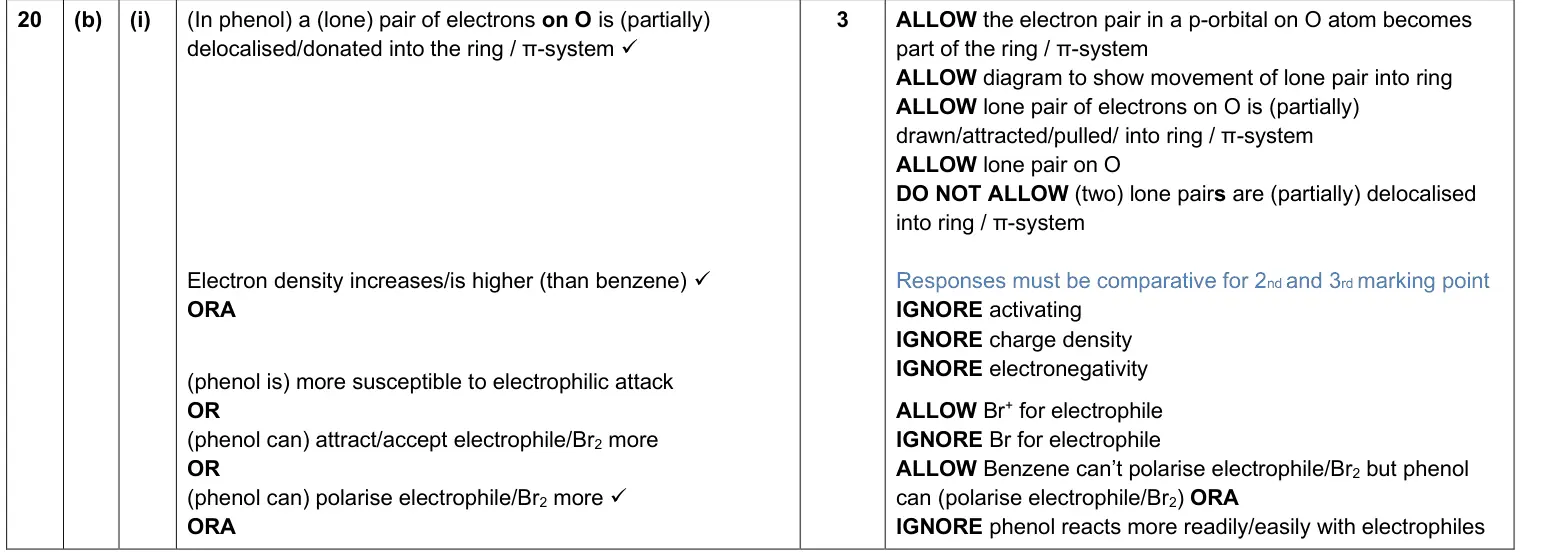
Most candidates found this familiar question relatively straightforward, achieving all 3 marks. Some did not gain marks as the electron pair came from -OH rather than from the O or it was suggested that multiple lone pairs on the O were donated to the ring. Some suggested that the presence of the -OH group on the benzene ring disrupted the delocalised electron ring thereby making it less stable and so more reactive. Some also attributed the reactivity solely to the -OH group, suggesting that bromine would react to replace the OH. Some did not gain marks for not giving comparative answers. It was necessary to compare the reactivity of both benzene and phenol here. Some lost the mark for ‘increasing electron density’ as they referred to charge density or electronegativity instead. Lower attaining candidates often just stated that ‘phenol is more reactive than benzene’ without considering why this is the case. However, it was clear that many candidates had practised this type of question and knew what to include.
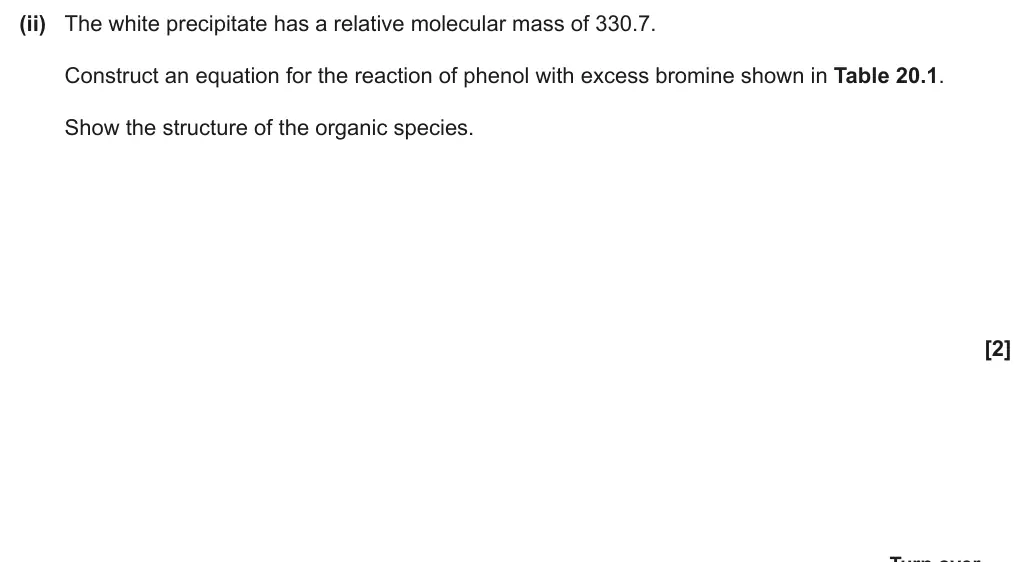
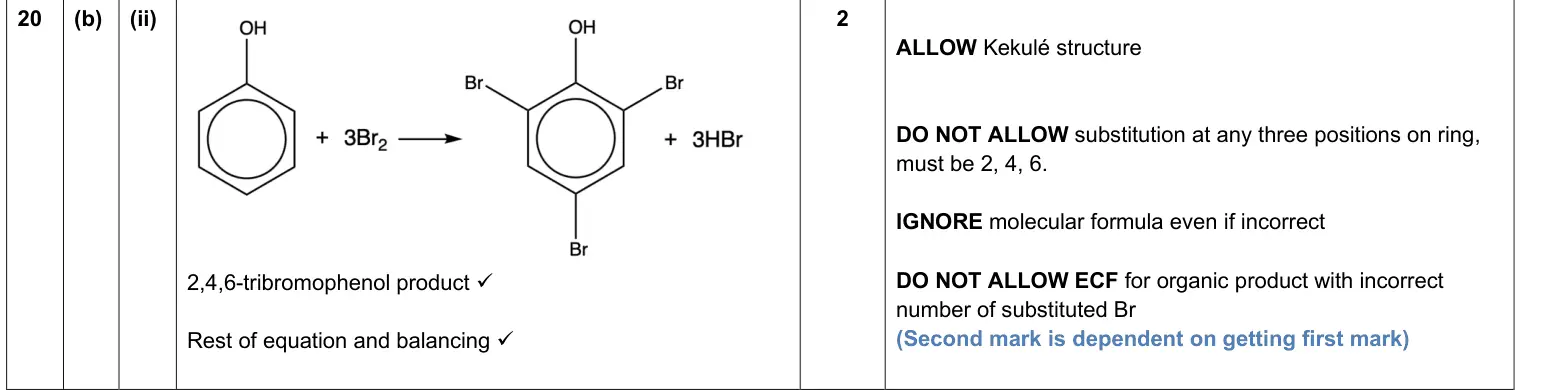
The majority were able to get the mark for the 2,4,6-tribromophenol structure, with some candidates using the relative molecular mass given to confirm their answer. Many were also able to obtain the mark for the balanced equation. Common errors seen in balancing included omitting HBr as a product or only having 1.5 Br2. Some gave H2 as a product. Lower attaining candidates struggled, often replacing the -OH with a -Br group but not accounting for the molar mass.
Skills: M0.2 Use ratios, fractions and percentages
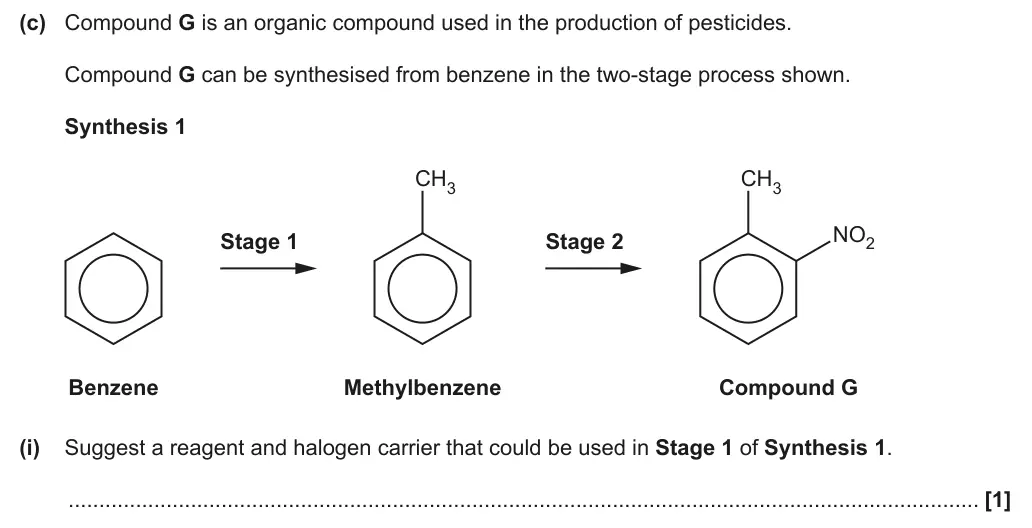
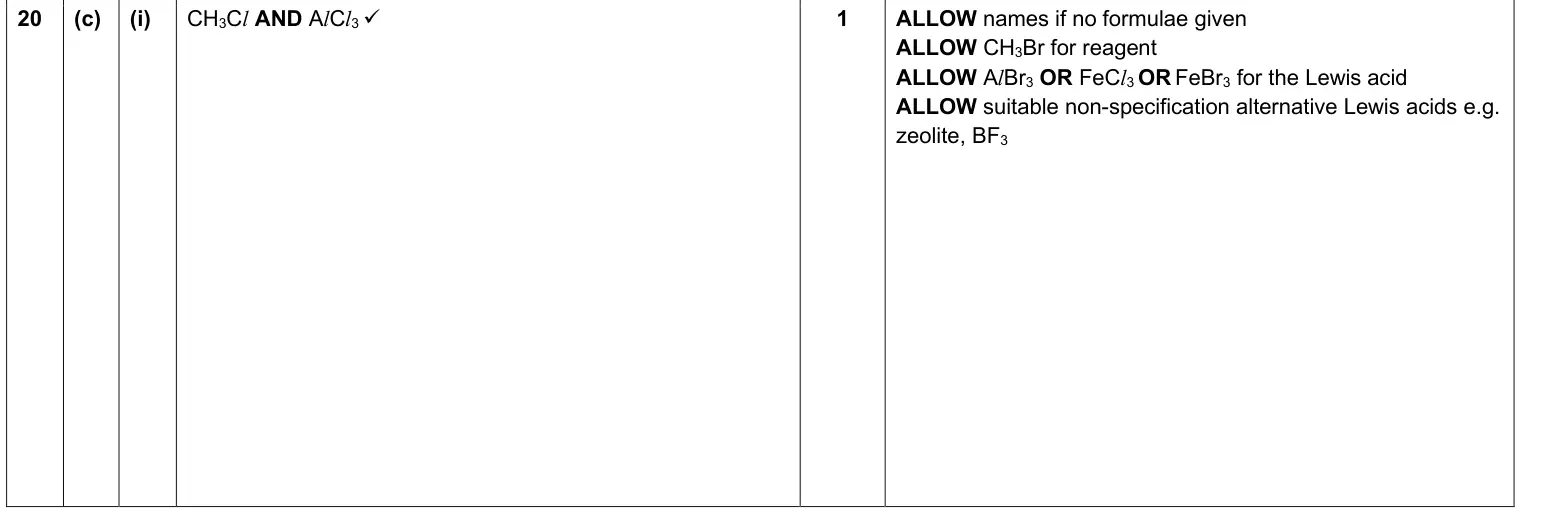
This mark was achieved by most candidates. Common errors included: • CH3 or CH4 as reagent • Missing the reagent and only giving the halogen carrier • CH3COCl as halogen carrier or reactant • AgCl3 as halogen carrier
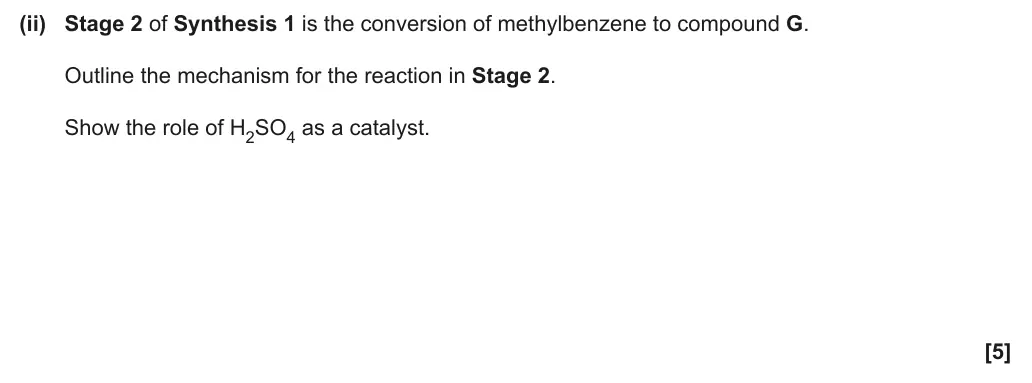
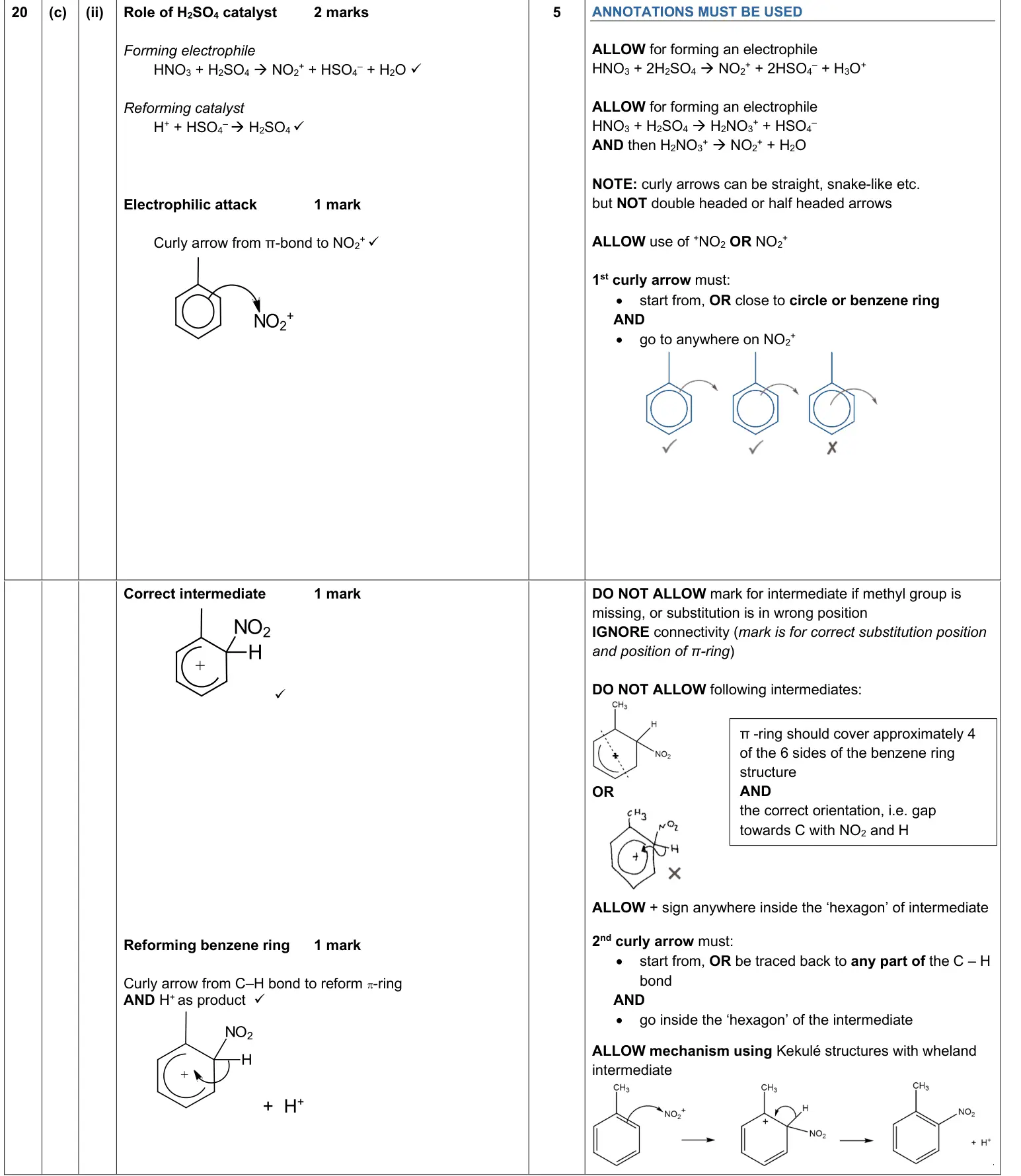
Many were confident with this mechanism with approximately half of all candidates achieving all 5 marks. Some lost a mark due to the addition of a lone pair of electrons to the NO2+ and showing the curly arrow moving towards the NO2. A missing or incorrect charge on NO2+ cost 2 marks both for the equation for the formation and for the arrow from the benzene ring to the electrophile. Some also had missing or incorrect charges on HSO4- which lost both equation marks. Some formed H3SO4 (with or without charges) which was then used to form H2 as well as H2SO4 when regenerating the catalyst. Marks were often lost for the intermediate – it was essential that the ring covered 4 out of the 6 sides with the opening orientated towards the -NO2 group. This was sometimes hard to judge if the ring was very small or the hexagon of benzene was uneven. Very few lost a mark for the omission of the methyl group on the intermediate. Some lost a mark for missing H+ with their final product. Lower attaining candidates often omitted the equations to form NO2+ and/or reform H2SO4. Some attempted to show a reaction with H2SO4 despite being given the formula of G in the question.
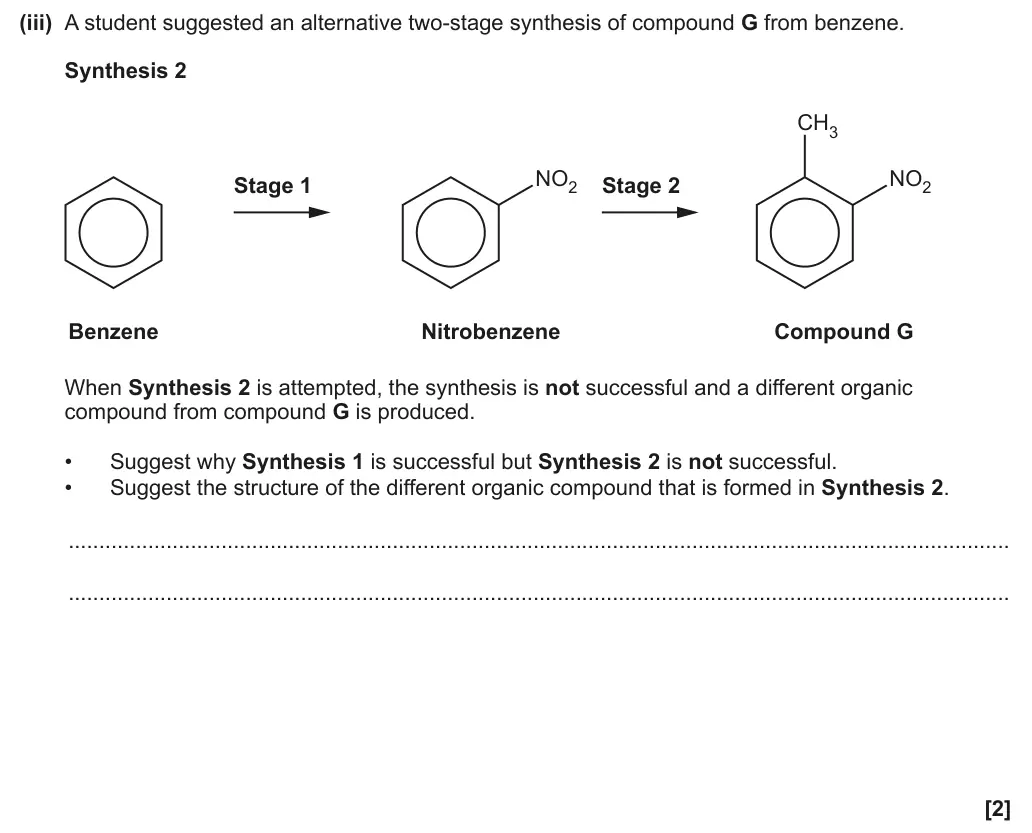
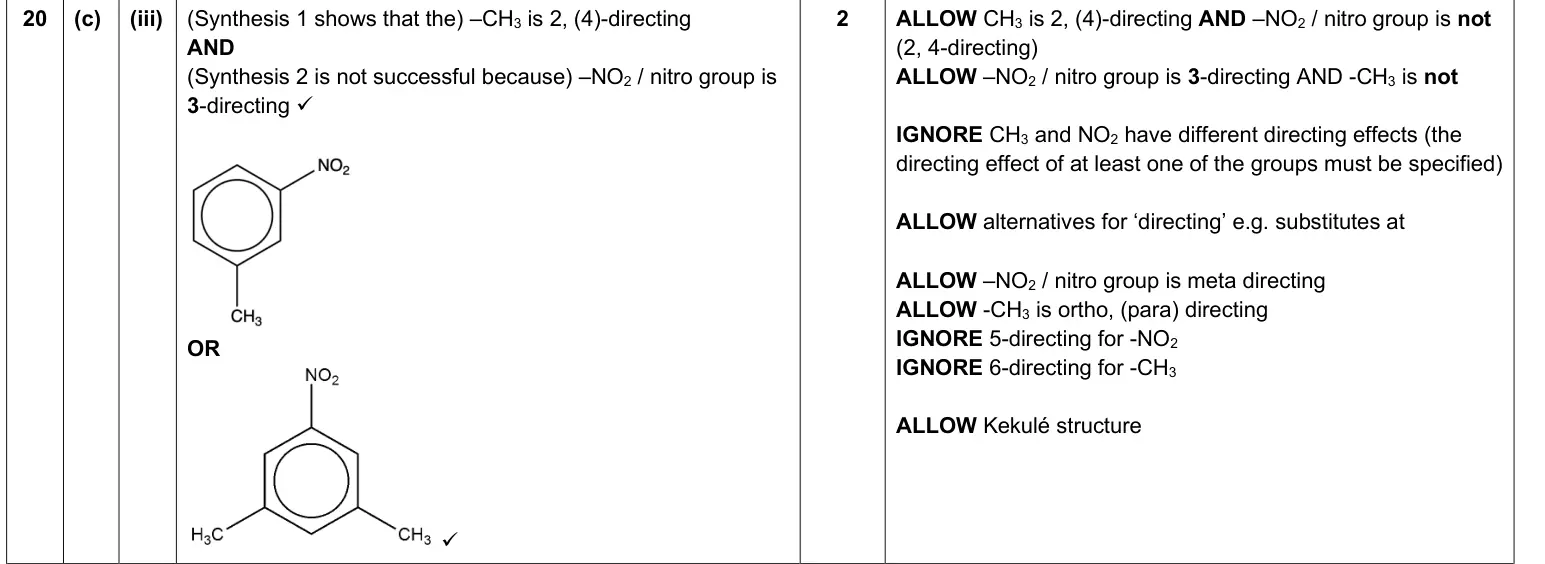
Many were able to identify that the -NO2 group is 3,5-directing as shown in both their explanations and the structure given. Only the highest attaining scored the mark for the explanation as it was necessary to suggest why synthesis 1 was successful as well as why synthesis 2 wasn’t. To do this, candidates had to deduce from synthesis 1 that -CH3 is 2,4-directing. Some suggested -NO2 or -CH3 was 1-directing. This, alongside structures showing the group next to the -NO2 group, suggests some confusion with how counting is achieved around the ring. It was also evident that some, although suggesting the -NO2 group is 3,5-directing, then drew a structure with the -CH3 in position 4. A few candidates suggested that CH3 ‘does not have a directing effect’ or ‘can direct anywhere on the ring’, presumably because it is not on the list of groups they need to know. Some candidates gave explanations based on reactivity, e.g. ‘the -NO2 group is electron withdrawing so makes the ring less reactive’, or that the -NO2 group itself would react with reagents used to add the methyl group, e.g. adding Cl to the ring instead.
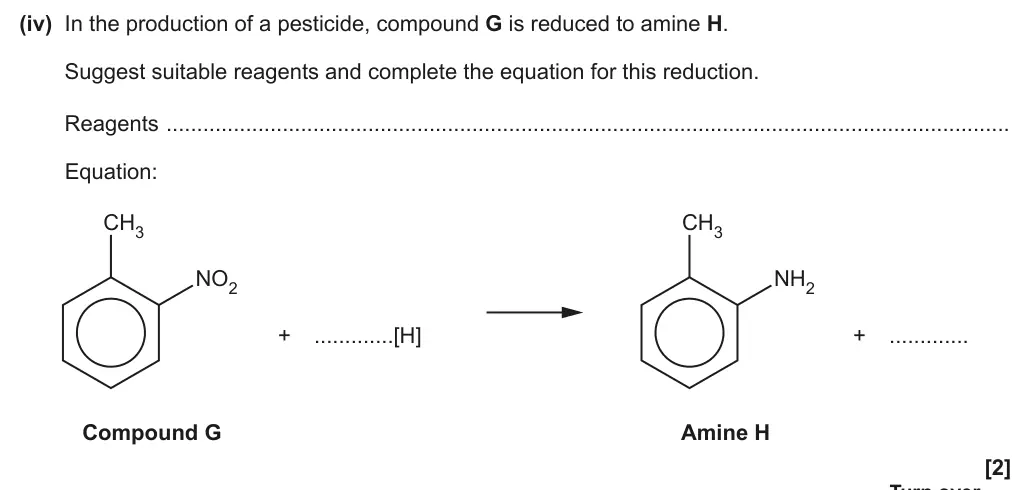
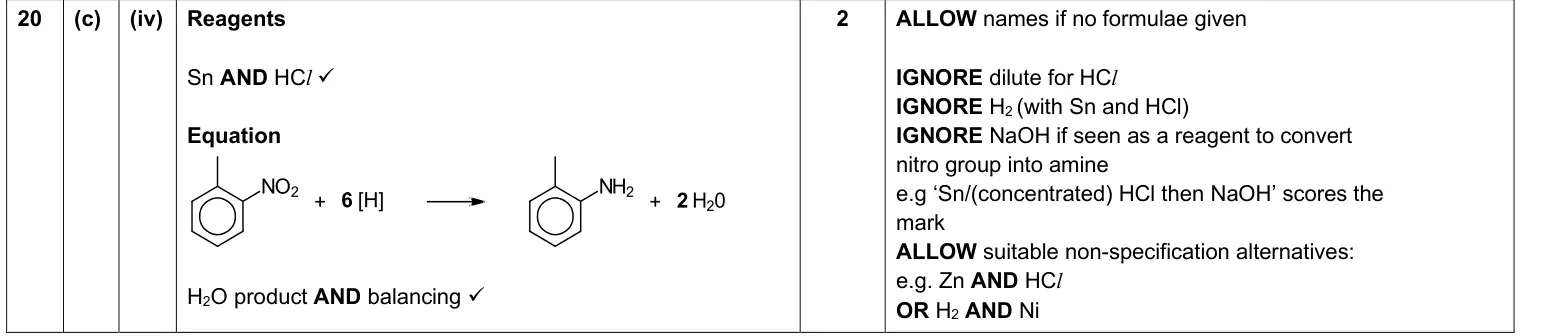
Most were able to correctly identify reagents for the reaction, with Sn/HCl being the most common response and a small number giving H2/Ni. Many incorrectly suggested NaBH4 or LiAlH4 as the reagent. A few had NH3 as reagent. Lots of candidates struggled to correctly complete and balance the equation despite both organic reactant/product and [H] being given. Some were confused by the use of [H] representing the reducing agent, so added reagents to the line, e.g. 3H2 [H], or NH3 [H]. A common error seen for balancing was 2[H] → O2.
Skills: M0.2 Use ratios, fractions and percentages
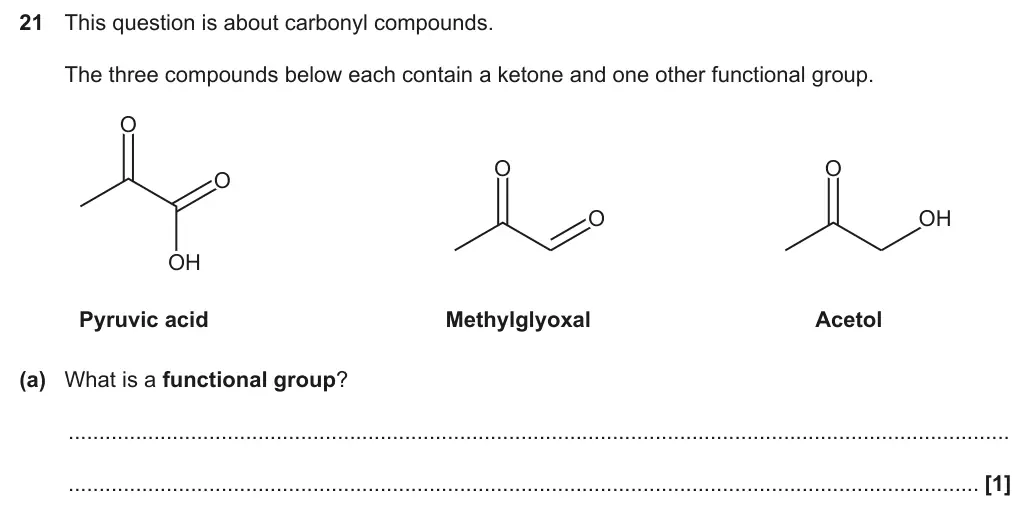
To gain credit here candidates needed to explain what is meant by both ‘group’ and ‘functional’. Consequently, many didn’t gain credit here. Many responses began ‘A group…’ which didn’t gain the mark, as they needed to explain what a group is i.e. ‘atoms’ or ‘part of a molecule’. We allowed ‘part of an organic compound’ but not just ‘part of a compound’ as this term doesn’t apply to inorganic compounds. Some found it hard to explain what they meant. It was common to see the use of incorrect terminology here such ‘molecule’ or ‘elements’ or ‘species’ or ‘bonds. Most recognised that a functional group is responsible for the reactions of the molecules. Some were not specific enough, e.g. ‘properties’ or ‘characteristics’ but without chemical wasn’t enough. Some related a ‘functional group’ to belonging to a particular homologous series, but this wasn’t sufficient. For example, ‘group which determines the homologous series’ or ‘homologous series shares the same functional group.
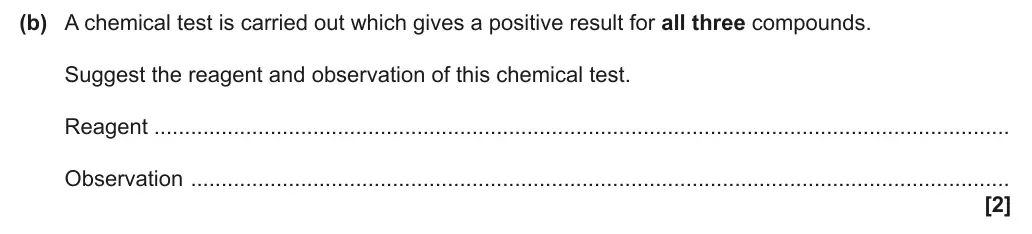
The majority of candidates scored both marks here. A few lost the second mark for just saying ‘turned orange’ without ppt. Some gave tests in (c) here as well but were usually consistent showing all three reacting in the table.
Skills: PAG7 Qualitative analysis of organic functional groups
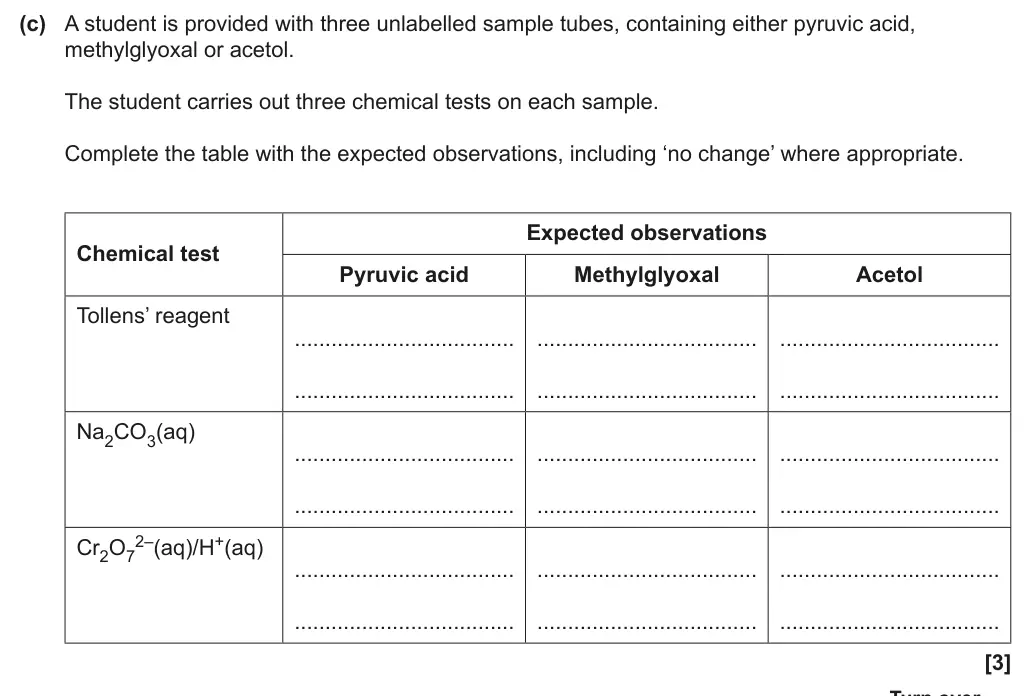
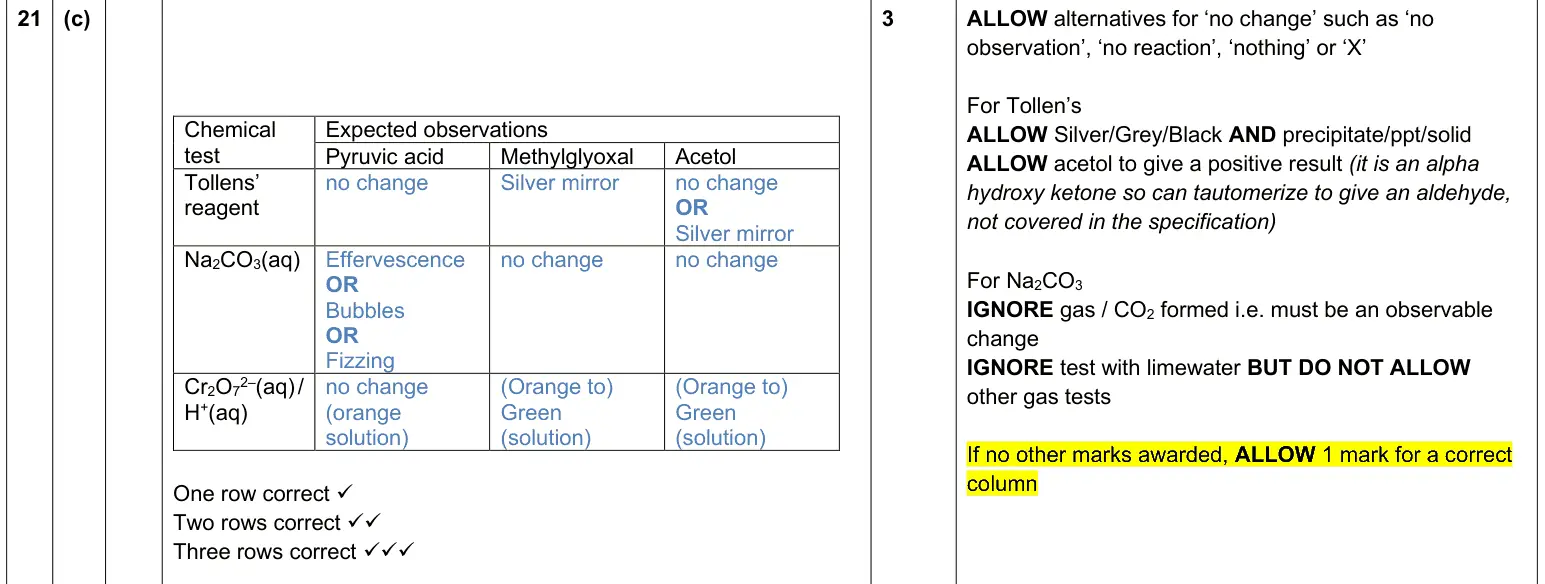
Very few candidates did not score any marks for this observation question. Common errors included: • gas/CO2 formed for the reaction with carbonate. The observation was needed • no reaction for methylglyoxal with dichromate, as they had not realised aldehydes will react as well as primary and secondary alcohols • positive test for all three with dichromate − often linked with incorrect answer in Question 9 • white precipitate with the reaction with carbonate • bubbles with acetol with carbonate (presence of C=O and O-H leading to possible confusion with an acid?). Candidates gave a range of responses for the reactions with no change, e.g. ‘no silver mirror formed’, ‘stays orange or ‘nothing’, these were still accepted but for clarity candidates should respond as the question asks.
Skills: PAG7 Qualitative analysis of organic functional groups
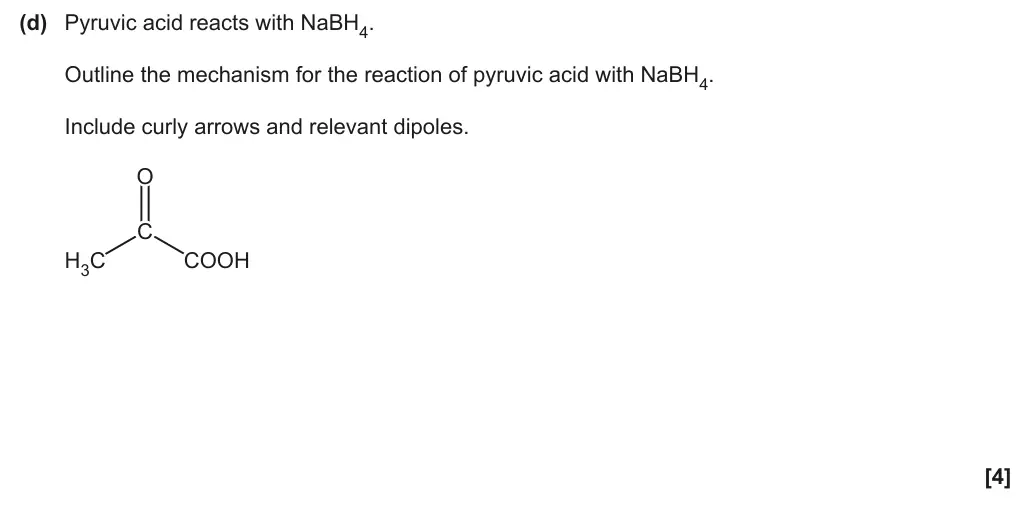
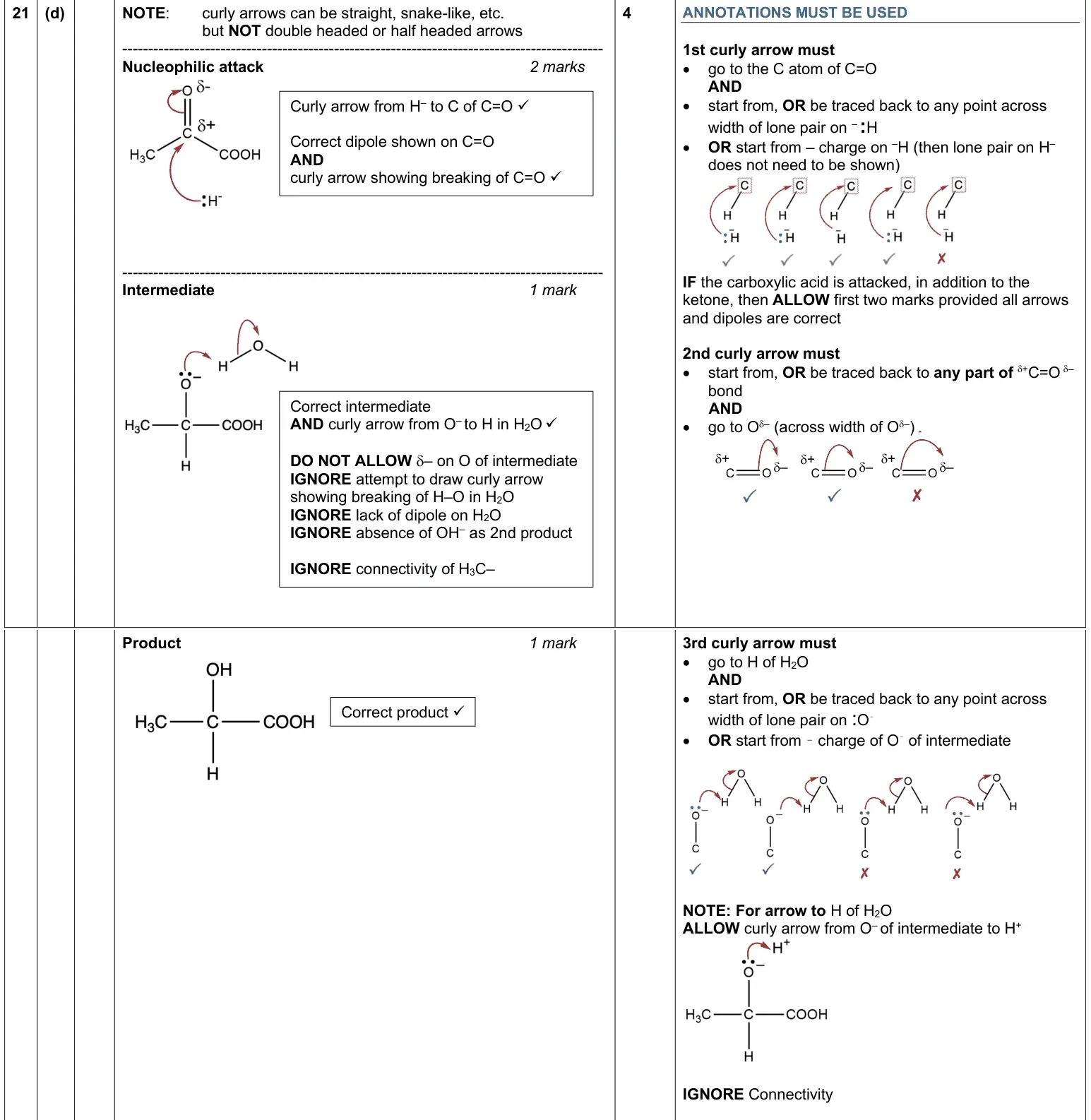
This was the most challenging of the mechanisms as it was less familiar to candidates and has not been tested in any previous exam series for this specification. Most were able to score a mark for showing the correct dipole on C=O and a curly arrow to break the bond. Some did not gain marks for their dipole being the wrong way round or adding dipoles on to the intermediate. Some did not gain marks for arrows which didn’t come from either a lone pair, negative charge or a bond – correct placement of curly arrows is vital. Some didn’t attack the C of C=O with H- before opening the bond, which led to an incorrect intermediate with a + charge on C and – charge on O. Some had the C of C=O being attacked by H+. A few candidates used CN- or OH- as the nucleophile. Some attempted to directly react the NaBH4 or BH4- directly rather than using H-. This often resulted in BH4 being part of the intermediate and final product. Many were able to give the correct product, although some had the H missing from the central C. Some omitted to show the attack of H- at all, which meant the loss of 3 marks if the C-H bond was not shown on the intermediate and the product as well. Some redrew the structure, which had been given deliberately with the COOH not displayed and attempted to reduce both the ketone and carboxylic acid functional groups. NaBH4 is not a strong enough reducing agent to react with a carboxylic acid and the reduction of COOH is not covered in our specification.
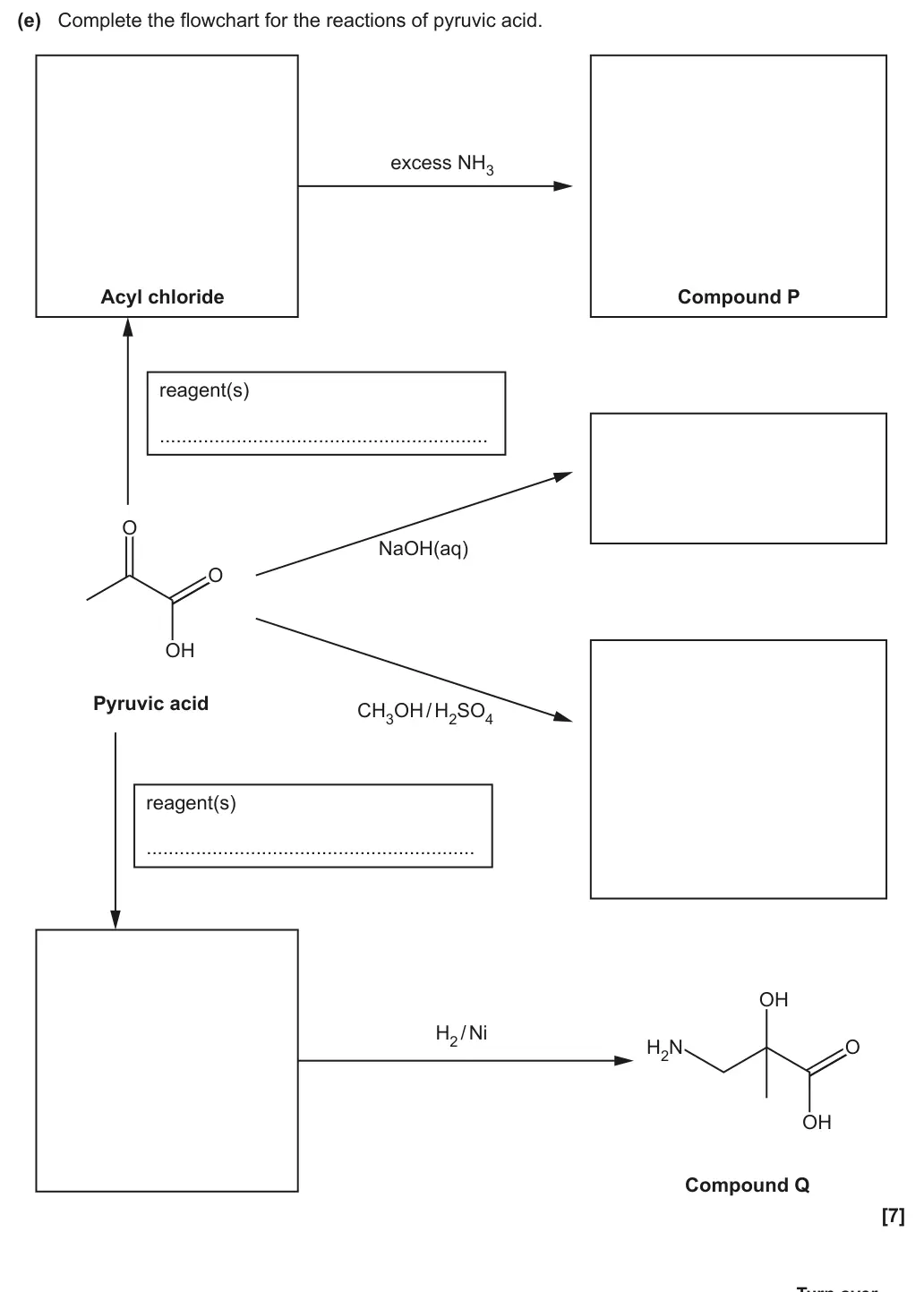
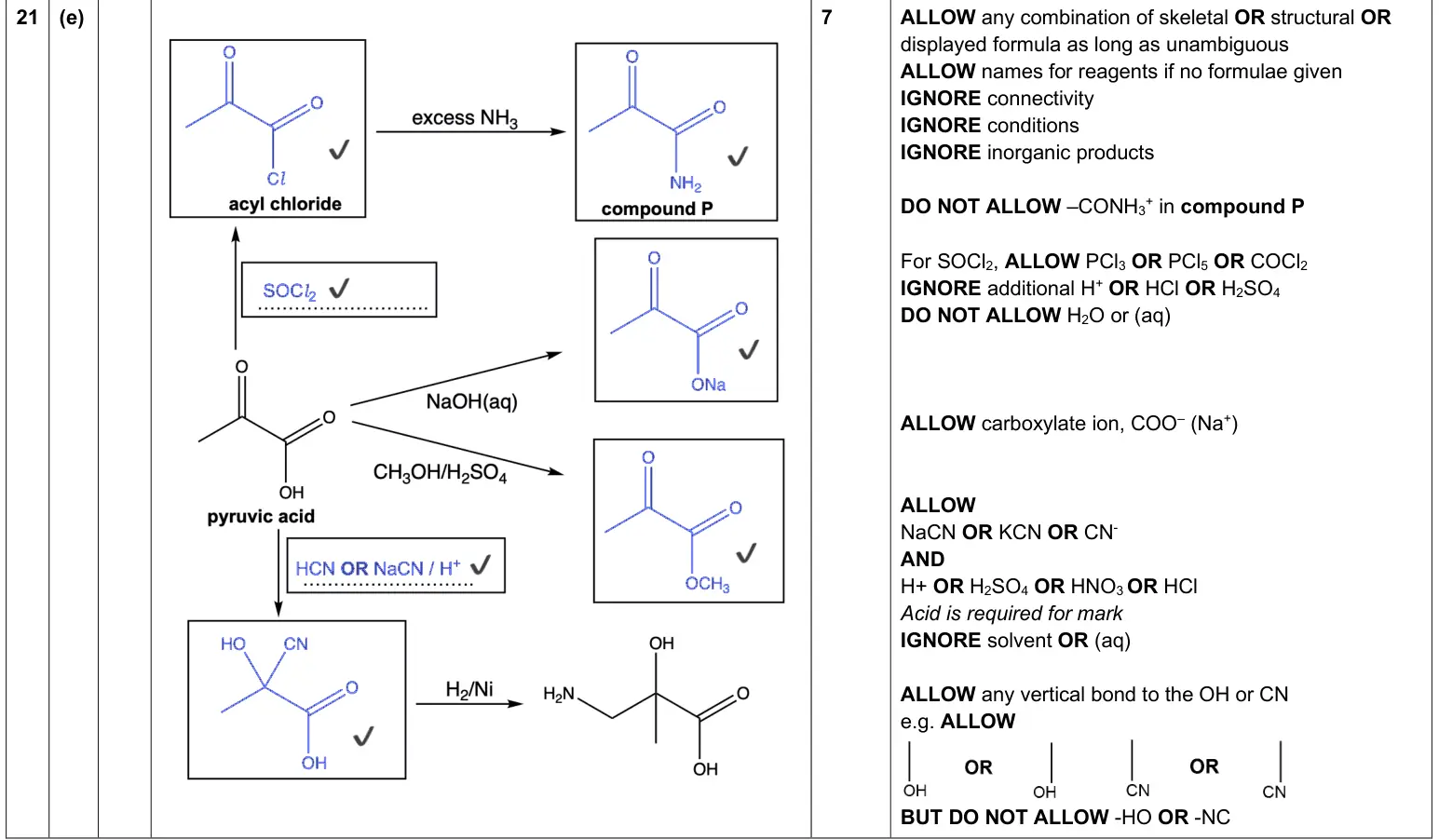
A wide range of marks were given for this question depending on candidates’ knowledge of different reactions. It was fairly common to see candidates drawing out synthetic route pathways on the additional blank pages to help them identify different reactions. This question was a good differentiator – those candidates with a wider knowledge of organic reactions were able to recall reagents and work out the structures of products, often gaining all 7 marks. Most candidates knew that SOCl2 is needed to form an acyl chloride with many giving the correct acyl chloride structure. Some attempted to use Cl2 or HCl instead of SOCl2. Some added Cl to the other end of the molecule leaving the -COOH group intact. Some had added a Cl on the structure removing only H on the -COOH group i.e. Many found it trickier to form compound P. Compound P often had -NH3 rather than -NH2. Some candidates reacted NH3 with various positions on the molecule. Many were able to react pyruvic acid with NaOH to form a salt as well as reaction with methanol in acid to for an ester. Care needed to be taken to keep the ketone group in the molecule and not attempt to react this as well. The trickiest step was the last one, which required a C-C bond forming reaction to extend the chain. Many knew that cyanide could be reacted here. Common incorrect reagents were KCN or NaCN with no H+, ammonia or NaBH4. The structure proved challenging for most candidates. Connectivity was sometimes an issue with the product formed with -NC or the omission of the triple bond between C and N if shown fully i.e. shown as C-N only. Some candidates left the C=O in place or missed out the methyl group or added an extra C before attaching the -CN i.e. Lower attaining candidates often attempted to just add NH3 or CH3NH2 here.
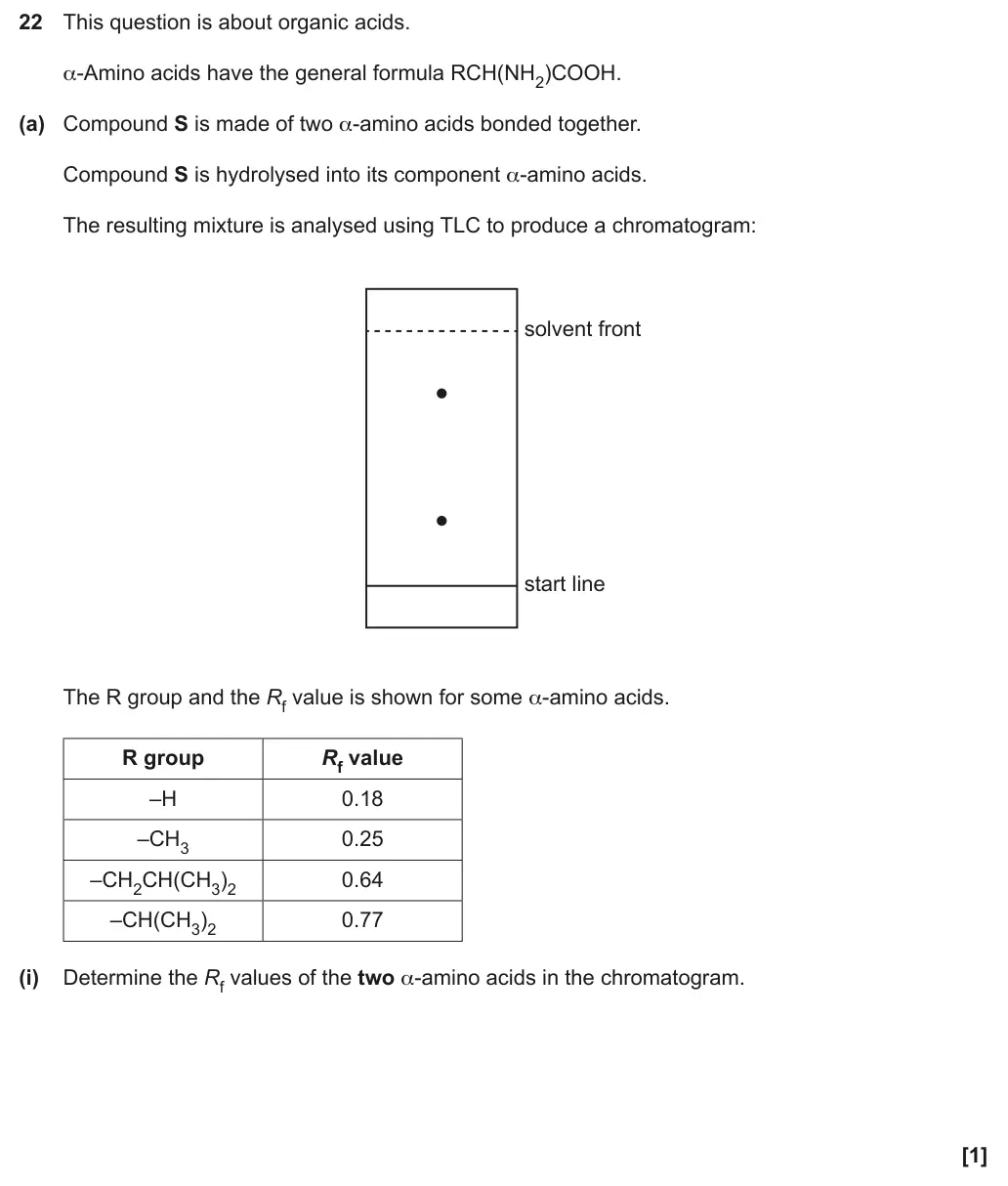
The majority were able to correctly calculate Rf values and gain a mark here. A few did not gain marks for calculator errors (they had corrected measurements but gave the wrong answer) or for incorrect measurements, e.g. from the bottom of the TLC rather than the start line.
Skills: M0.2 Use ratios, fractions and percentages; M3.1 Translate information between graphical, numerical and algebraic forms; PAG6 Synthesis of an organic solid
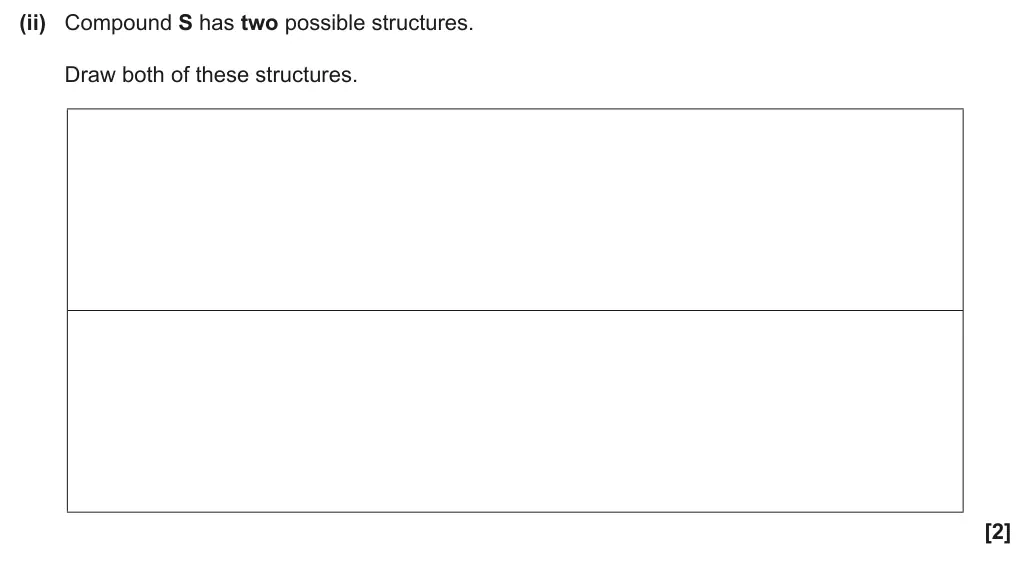
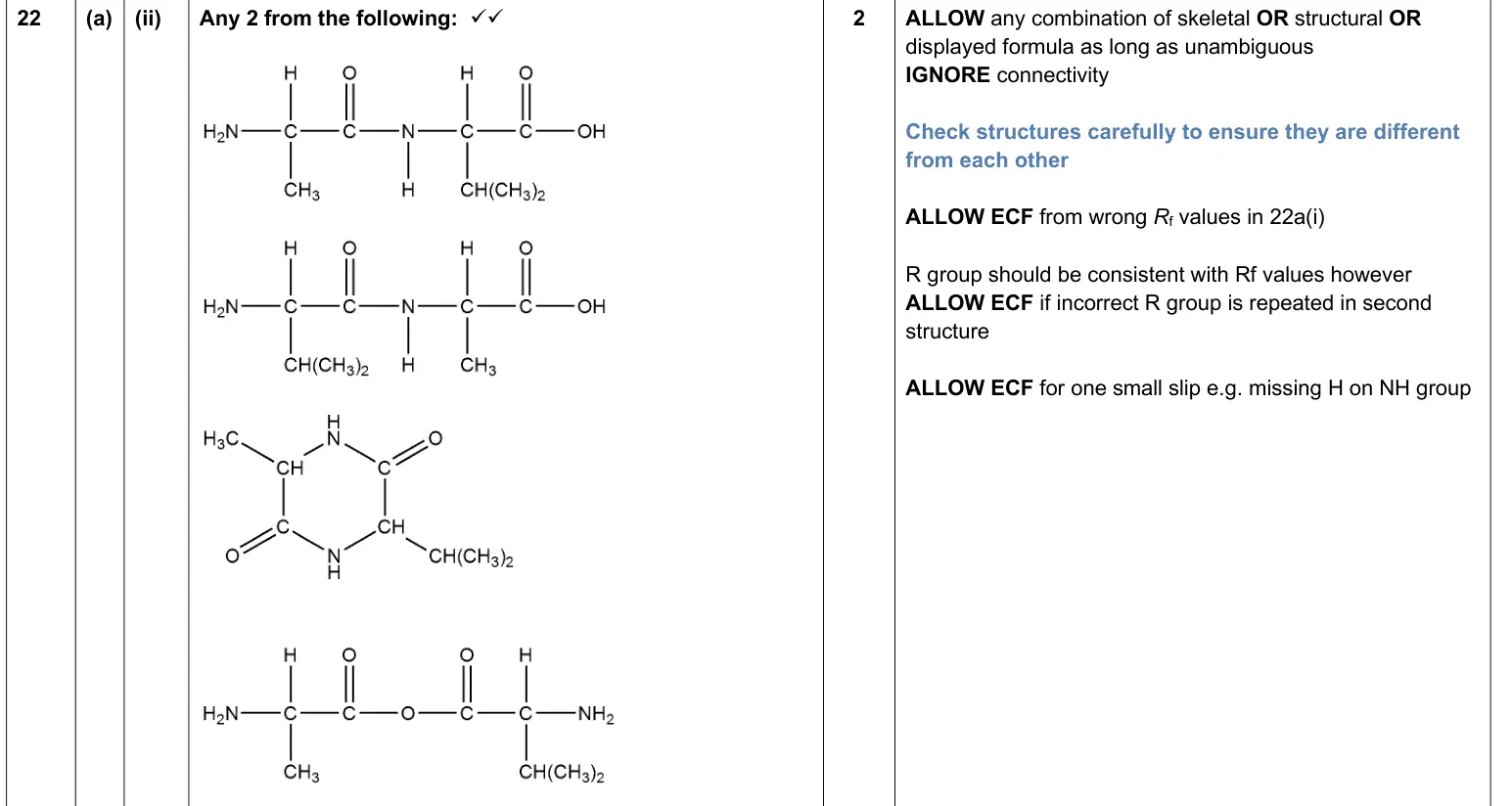
Many candidates found this question tricky with only some able to score both marks. The most common correct responses were the dipeptides given as the first two structures on the mark scheme. The acid anhydride structure was less commonly seen and the cyclic peptide structure was rare. Candidates who got this response wrong often gave just the two amino acids identified from their Rf values in part (a)(i), forgetting that the amino acids needed to be joined together to create compound S. Some included an O in their amide bond i.e. -COONH- and lost both marks. Some recognised that the central C in an amino acid is chiral so drew stereoisomers. Some added an extra CH2 in the side chain of CH(CH3)2 but ECF was given for the second structure. Around half of all candidates didn’t score any marks here with some not even attempting this question at all.
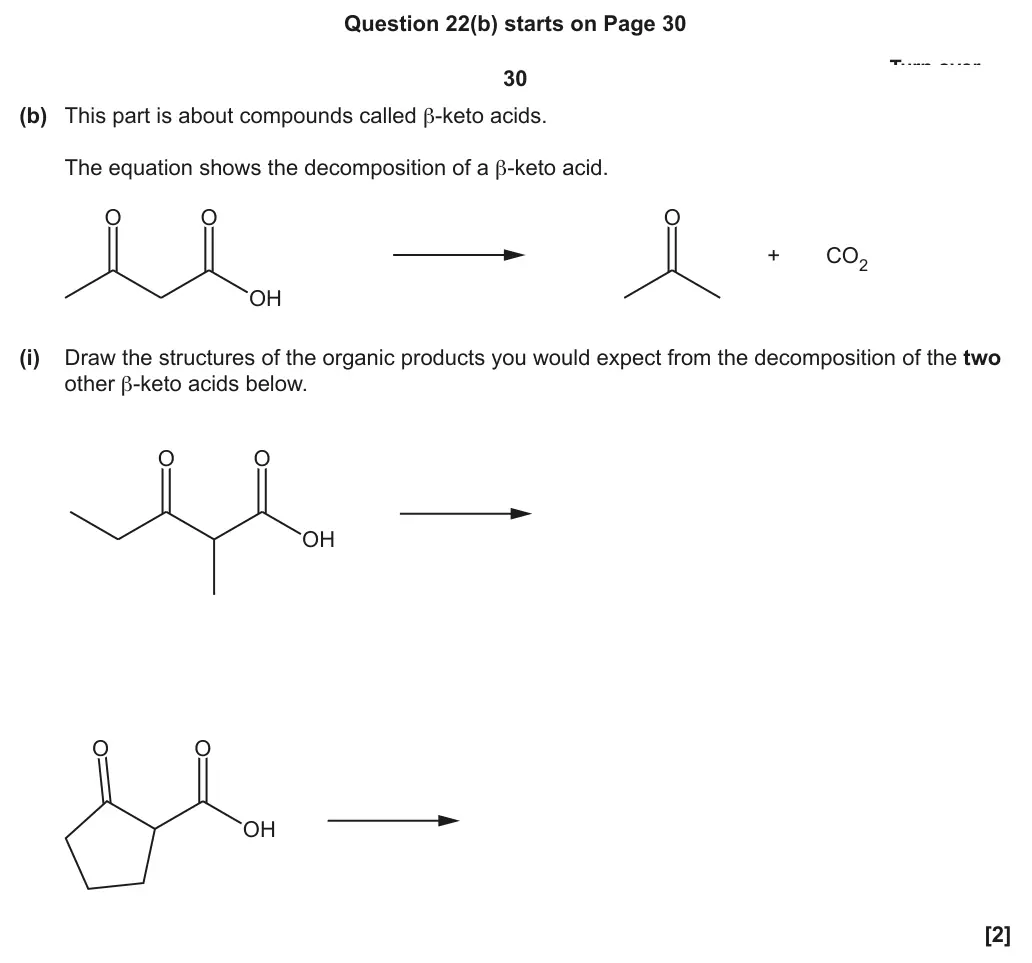
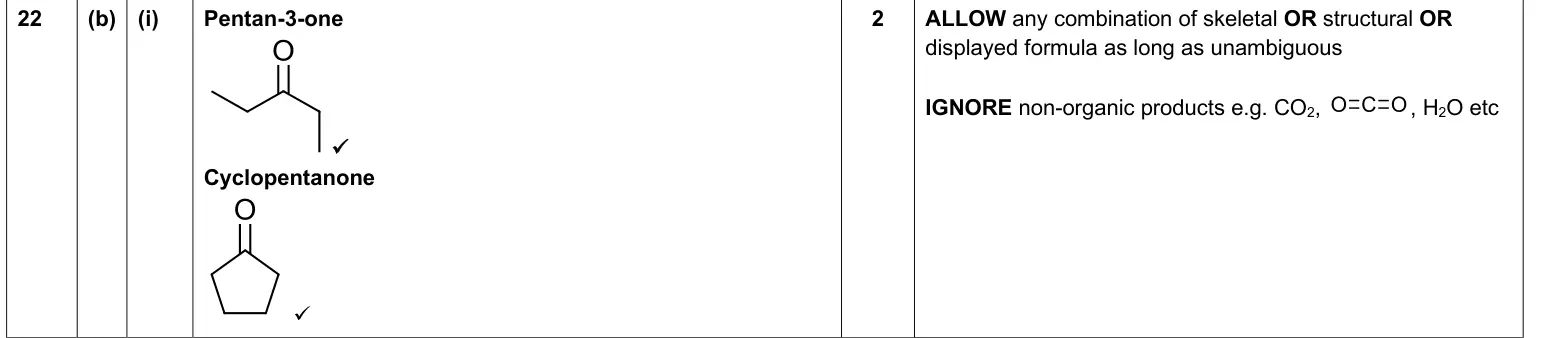
There were many excellent responses to this question requiring application of information that was provided. A lot of candidates scored both marks. Many less successful candidates were also able to correctly identify the correct organic products. Some candidates did not realise the COOH group formed the CO2 so often provided a second organic compound (usually propanone) from each reaction, as it contradicted the ketone they suggested. Some candidates struggle with skeletal formula, so marks were commonly lost for missing a C from the correct answer, e.g. pentan-2-one instead of pentan-3-one or butan-2-one rather than cyclopentone.
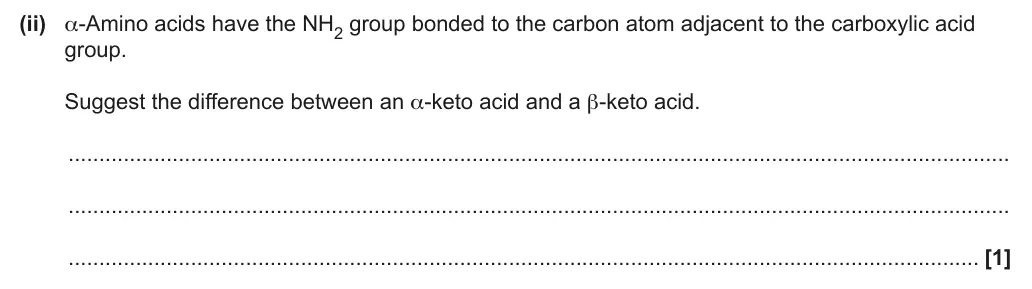
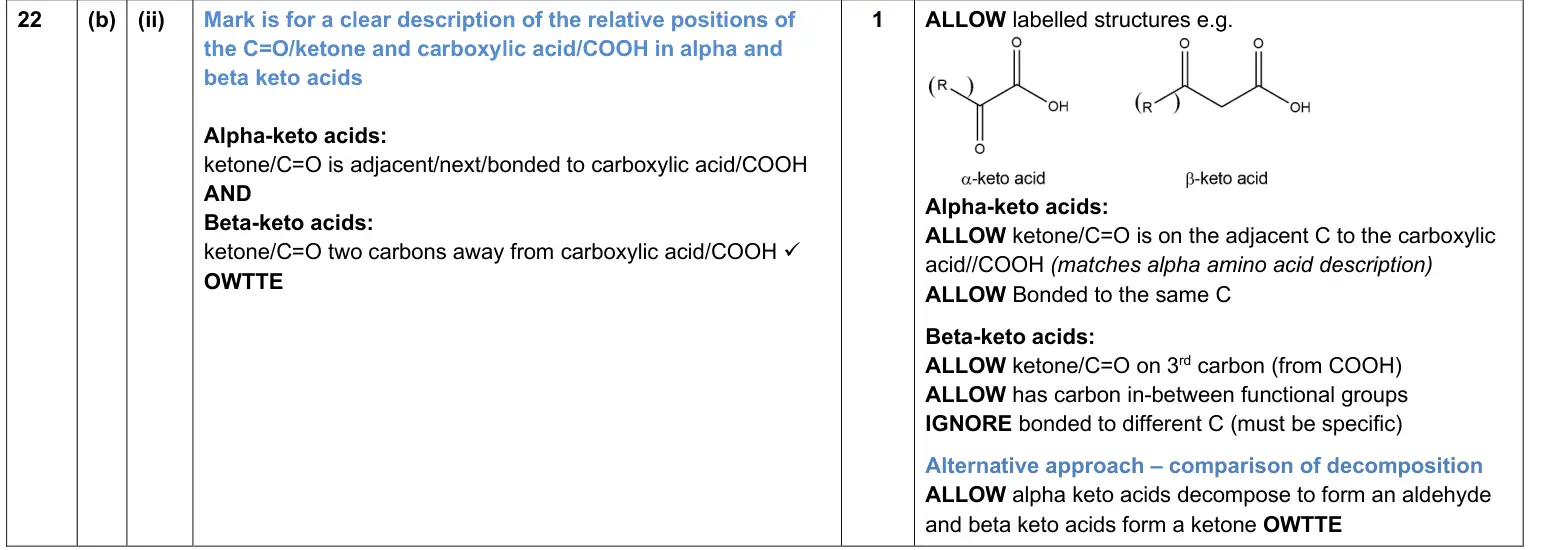
A difficult question that few candidates fully understood. Even for those that knew the difference, it was rare to get the mark as they would only describe one of the acids rather than both, e.g. ‘C=O is next to the COOH in an keto acid’ but with no reference to keto acids. Teachers should remind candidates that a comparison question needs to have information about both or all items that are being compared. Many struggled to make the comparison to amino acids (as given to help in the question) to help them explain what keto acids are. Some suggested that keto acids were amino acids and that the difference to keto acids was due to presence of C=O rather than NH2. Some linked keto acids to amino acids saying that the -NH2 group is linked to the next C along. It was also not sufficient to just say ‘in keto acids the C=O is next to COOH but keto acids it is found elsewhere on the molecule’ – it had to be clear where the C=O was relative to the COOH in each. However, we allowed for keto acid that the C=O is on the adjacent C where the C of the C=O is the adjacent C, as candidates used the terminology given for amino acids in the question. The clearest responses usually drew and labelled structures to show the difference in the positioning of C=O relative to COOH. Candidates should be advised that a well labelled diagram can help if they find it difficult to explain a point.
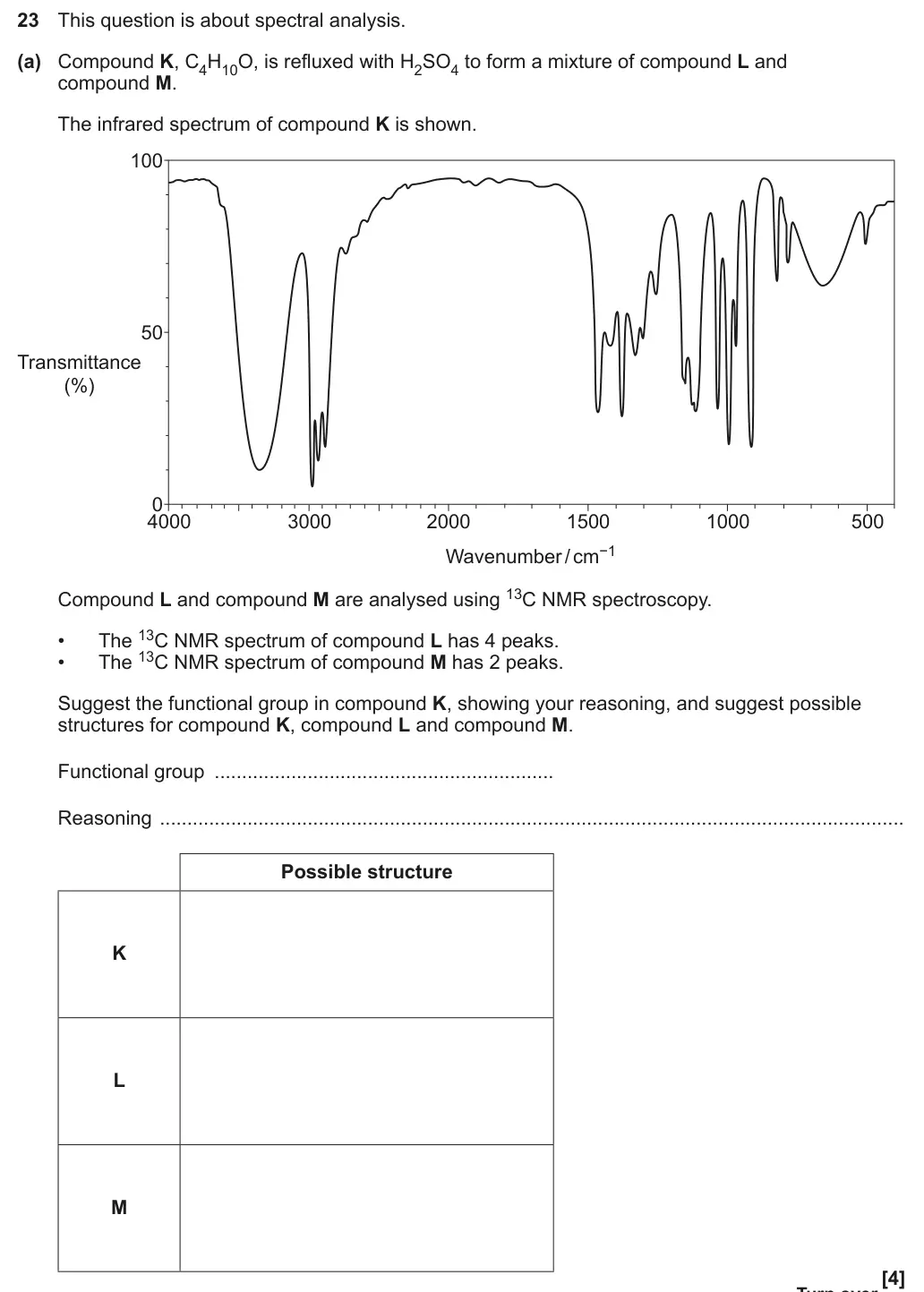
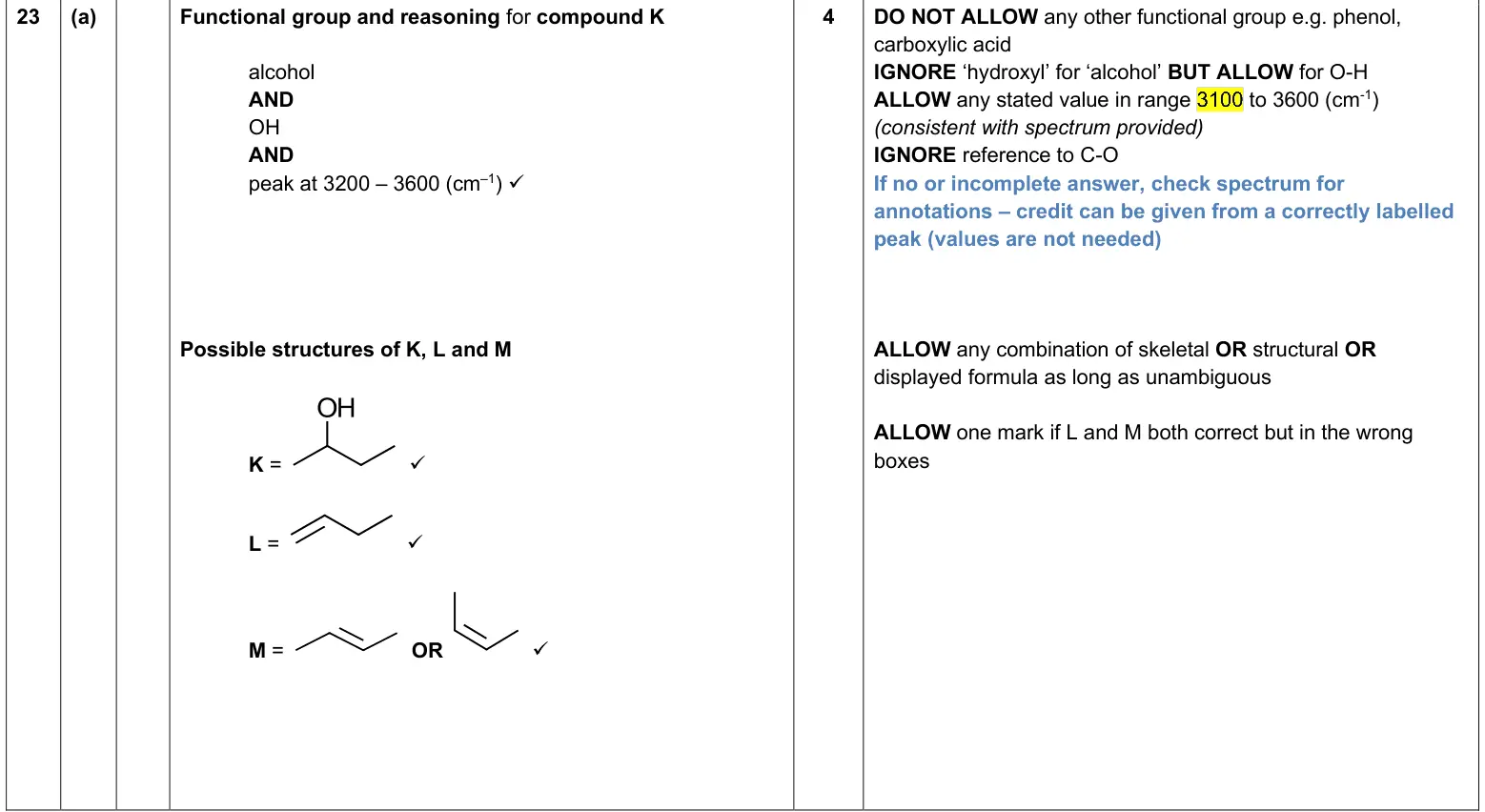
Very few candidates scored all 4 marks. The mark for identifying the alcohol functional group due to the presence of O-H bond in IR between 3200-3600 cm-1 was often lost for missing information. O-H or OH or hydroxy alone was not accepted as OH groups can be found within other functional groups i.e. phenol and carboxylic acid. Equally, it was important to identify the correct bond from the IR spectrum; in this case, O-H gives the most definitive answer. Other bonds are present, e.g. C-H and C-O but do not tell us that it is an alcohol. A few misinterpreted the ‘reasoning’ question stem and said alcohols would have the correct general formula to fit C4H10O or that alcohols could be dehydrated to make different alkenes, which is correct, but confirmation needed to come from the IR provided in the question. Many candidates gave a primary alcohol, butan-1-ol, as K. It appears many candidates focused on the fact that K was refluxed with H2SO4 and assumed this was oxidation, despite there being no K2Cr2O7, giving L and M as aldehydes, ketones or carboxylic acids. Some just gave alcohols with different structural formula for the alcohol for L and M, attempting to use the 13C NMR data. A significant proportion of candidates did not gain any marks on this question.
Skills: M3.1 Translate information between graphical, numerical and algebraic forms
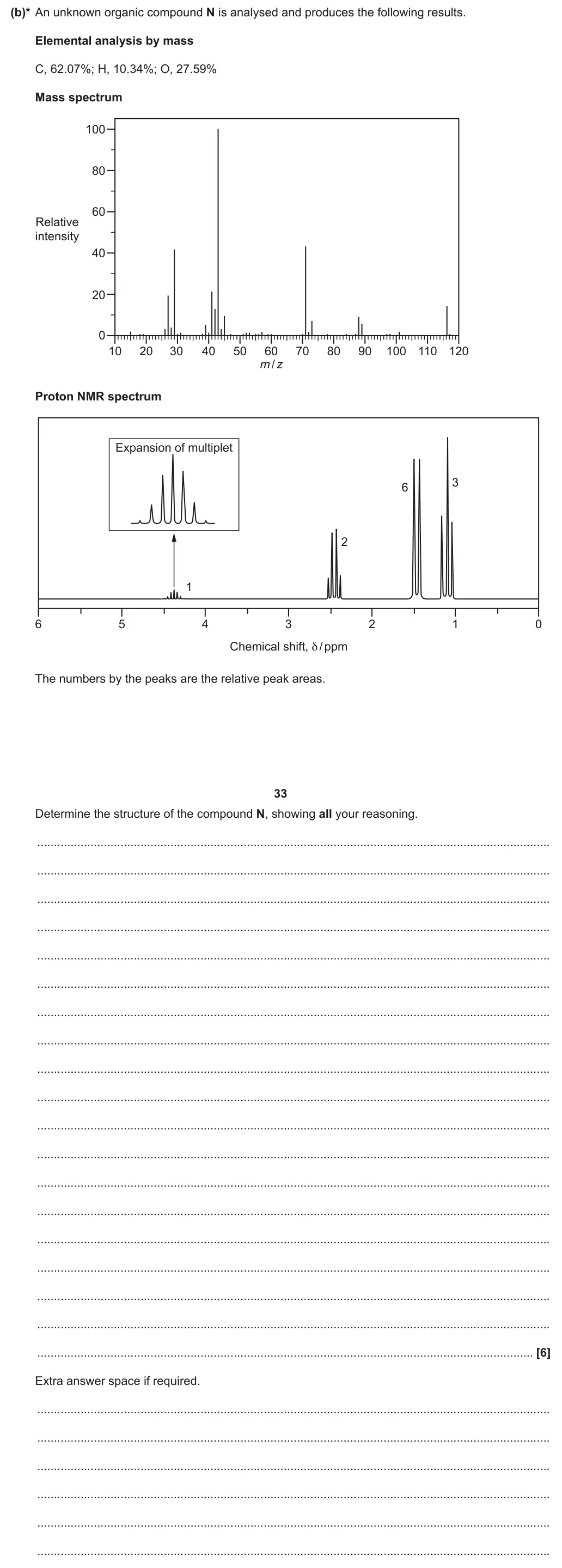
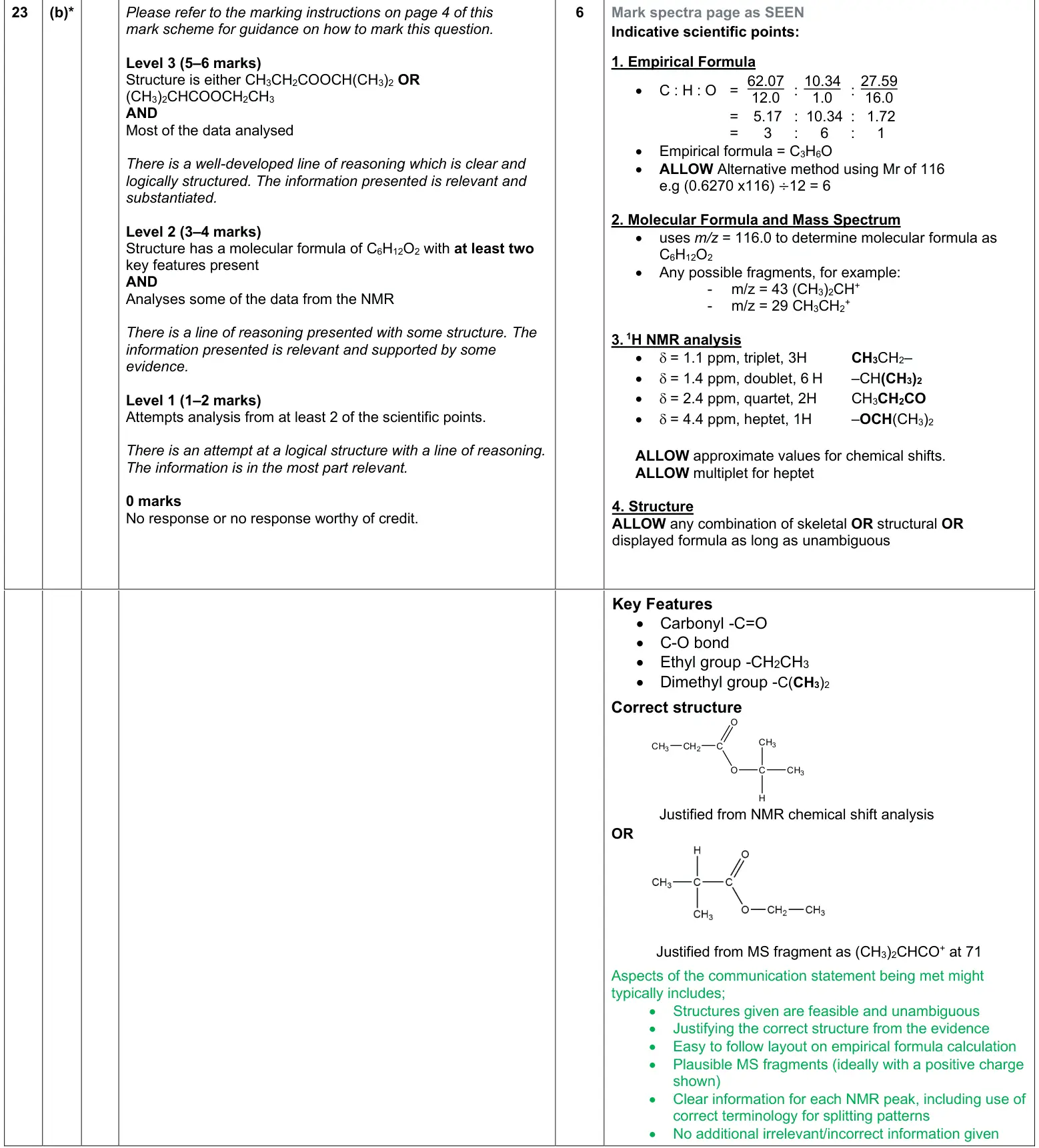
Most candidates achieved Level 3 and were able to gain 5 or 6 marks. The communication mark was given when a clear justification was given for either ester from their NMR data or from the mass spectrum fragment ions. The highest attaining candidates were able to organise their interpretation of the NMR data clearly in a table, showing how they used the information on chemical shift, integration and splitting to produce a fragment and finally linking these together to give a correct structure. However, for some candidates, while information was correctly determined, this was not then used to give a final structure. Some candidates analysed the fragment peaks from the mass spec. The best solutions linked the structure with peaks in the mass spectrum, e.g. CH3CH2+ peak at m/z 29 and C3H7+ peak at m/z 43, even though these fragments were often missing a charge when referred to. Some candidates only achieved Level 2 as although their structures had the correct molecular formula they contained -OH (suggesting N was a hydroxyl ketone or carboxylic acid) rather than H-C-O (found in esters) by misinterpreting the peak at 4.4 ppm as an O-H peak. Candidates should be reminded that the H bonded to an O will not couple with neighbouring Hs and can be present anywhere in the spectrum. This is usually highlighted by running the spectrum in D2O, removing this peak. Some candidates correctly identified parts of the molecule from their analysis of the NMR data but then gave a molecule which didn’t fit this, e.g. identified the (CH3)2CH fragment but then did not show it in the final structure or included a -COOH despite there being no peak at 10-12 ppm. Some, despite understanding that the peak at 2.4 ppm was next to -C=O and showed quartet splitting so had 3 neighbouring H, would assign it as a carbonyl group with the methyl group on one side and a CH2 on the other side. Lower attaining candidates struggled to interpret the NMR data, especially the presence of 6 equivalent Hs – many translated this as being a straight chain rather than 2 x CH3 groups. It is also important that candidates make use of the chemical shift information on the data sheet to give a chemical environment and try to use that to piece together their structure. Almost all candidates attempted to calculate the empirical formula and determine the molecular formula of the unknown compound, N, and therefore secured Level 1. However, many of these candidates gave structures which were not consistent with the molecular formula. This limited them to achieving Level 1, 2 marks only. Also, those without a final structure could only score a maximum of 2 marks. This response achieved Level 2 and 4 marks. The final structure is a hydroxy ketone, not one of the correct esters, but does have the correct molecular formula and C=O as well as an ethyl group. The candidate has analysed some of the NMR data. The communication mark has been given as the analysis shown in their response is easy to follow with clear information given for each NMR peak.
Skills: M0.2 Use ratios, fractions and percentages; M3.1 Translate information between graphical, numerical and algebraic forms
Want a paper marked and gone through with you? Message us.