
October 2020: AS Paper 2, Core Organic and Physical Chemistry

80 marks · 42 question parts · Paper, mark scheme and report on Edexcel's site · An autumn series, sat in place of the cancelled summer exams · Have the Data Booklet beside you

Question by question

QTopicMarksAOType
1(a) Introduction to organic chemistry 1Short answer
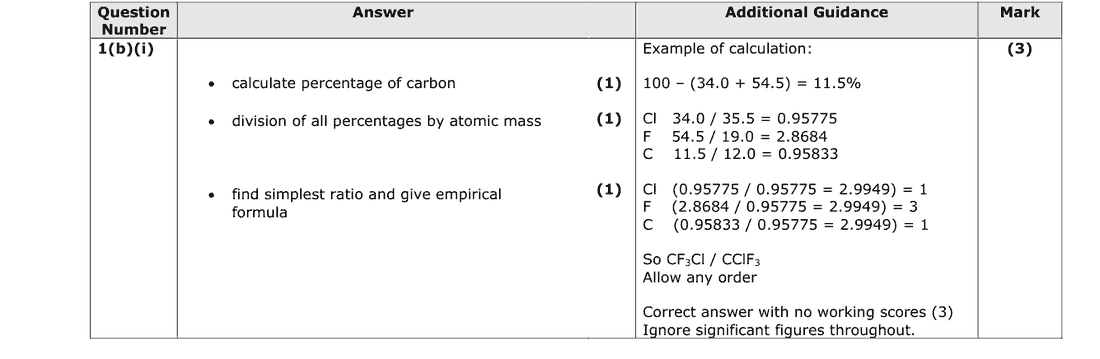
1(b)(i) Formulae, equations and amounts of substance 3Calculation
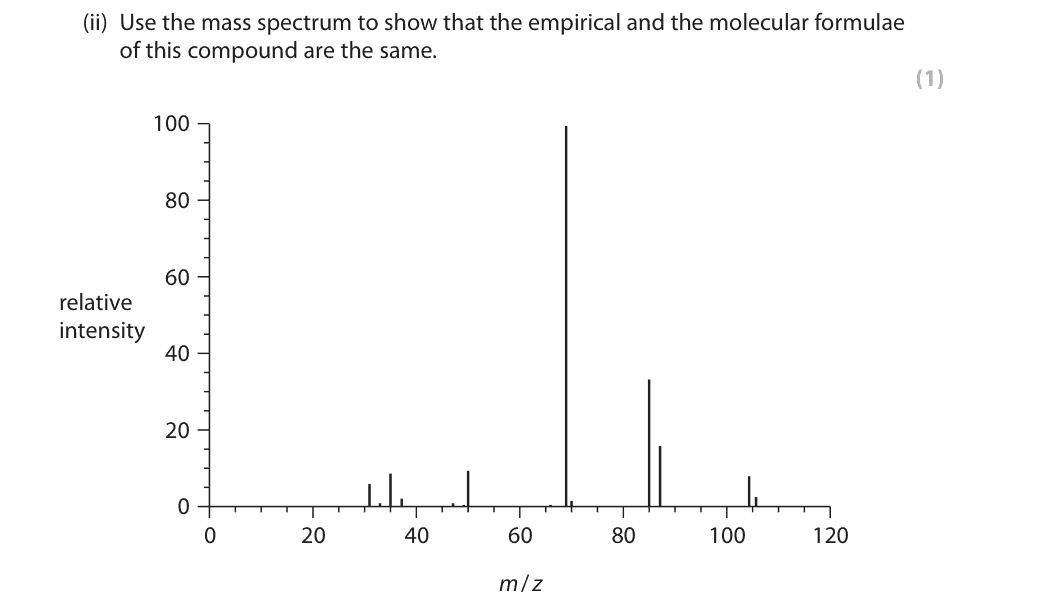
1(b)(ii) Modern analytical techniques I: mass spectrometry and infrared 1Short answer
1(b)(iii) Modern analytical techniques I: mass spectrometry and infrared 1Short answer
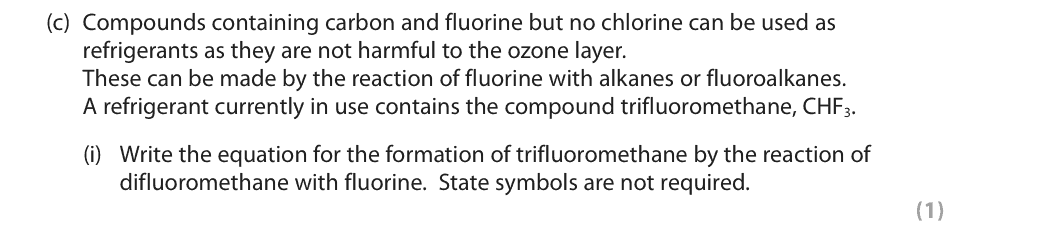
1(c)(i) Alkanes, Formulae, equations and amounts of substance 1Equation writing
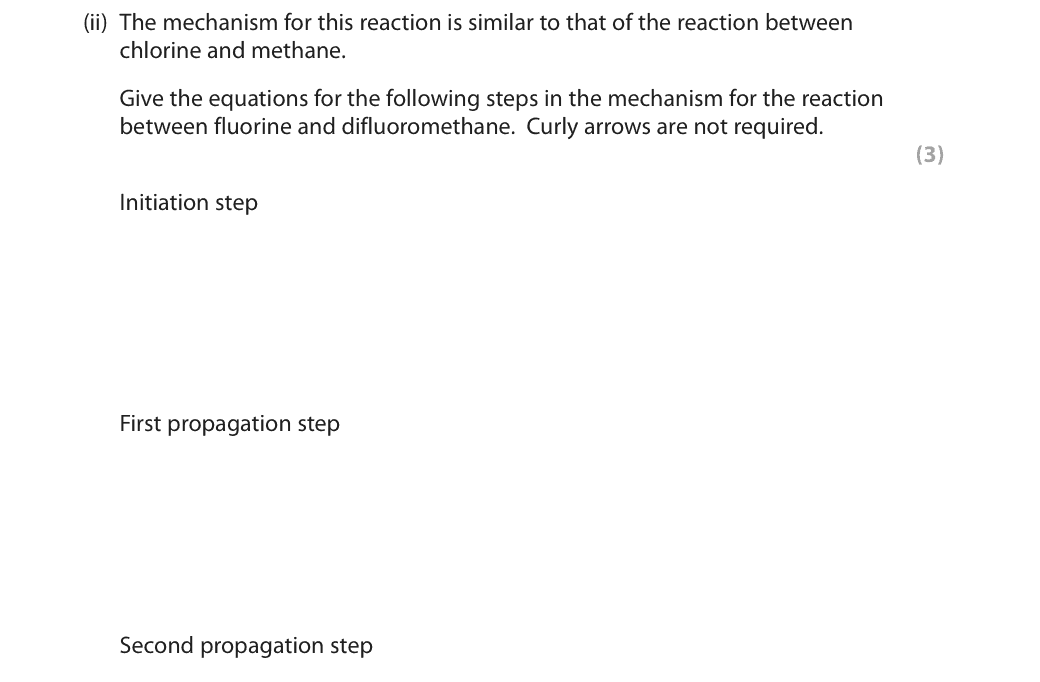
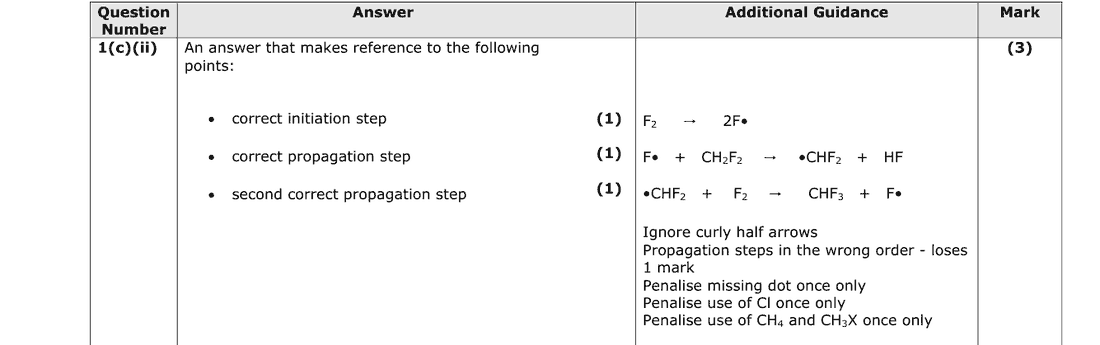
1(c)(ii) Alkanes 3Equation writing
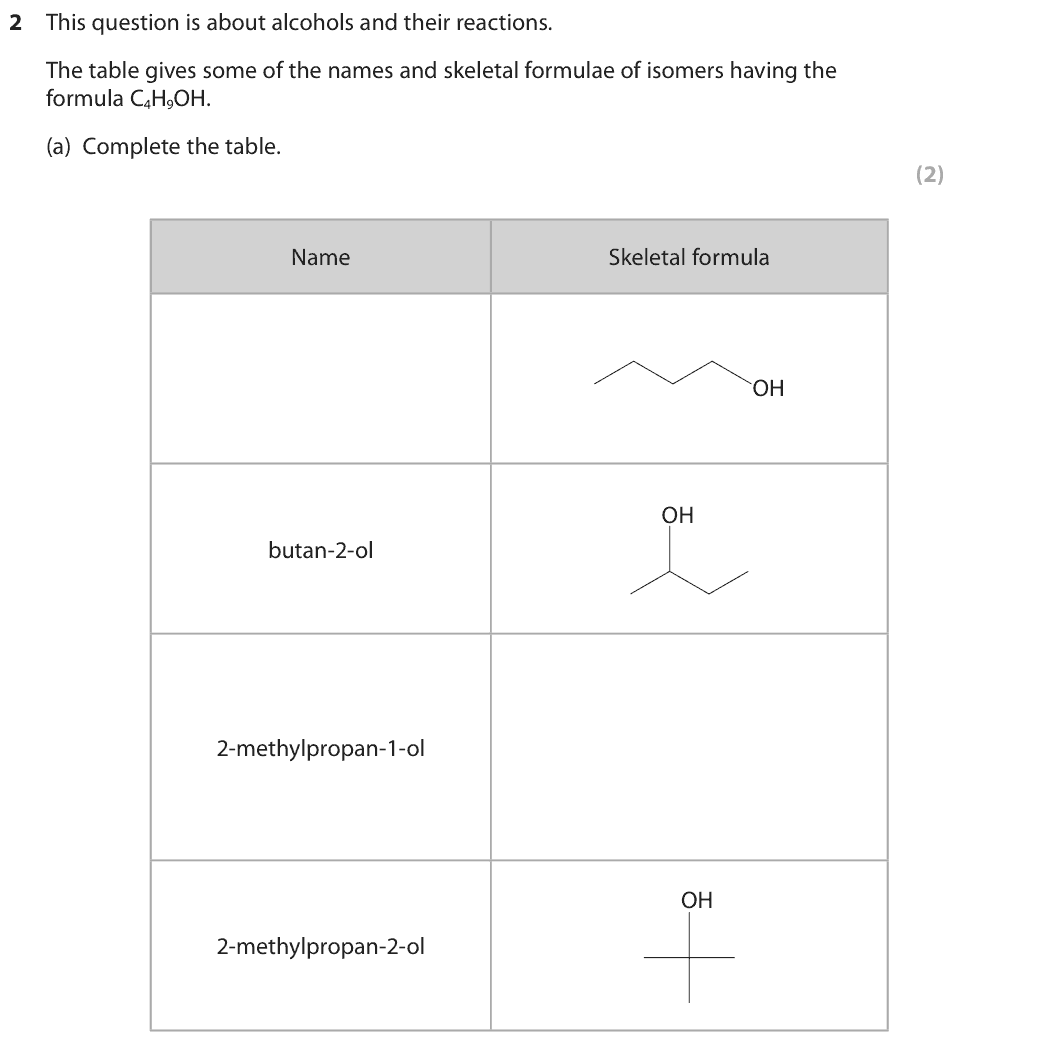
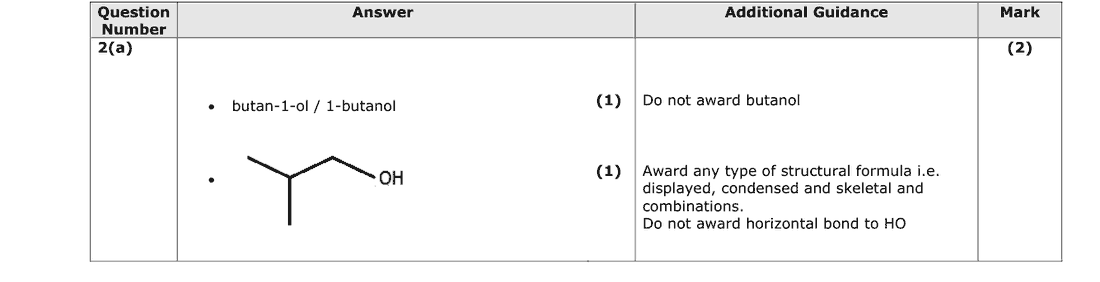
2(a) Introduction to organic chemistry 2Short answer
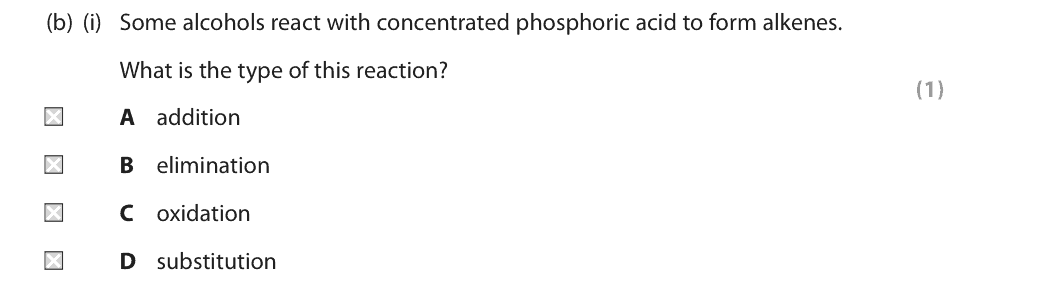
2(b)(i) Introduction to organic chemistry 1Multiple choice
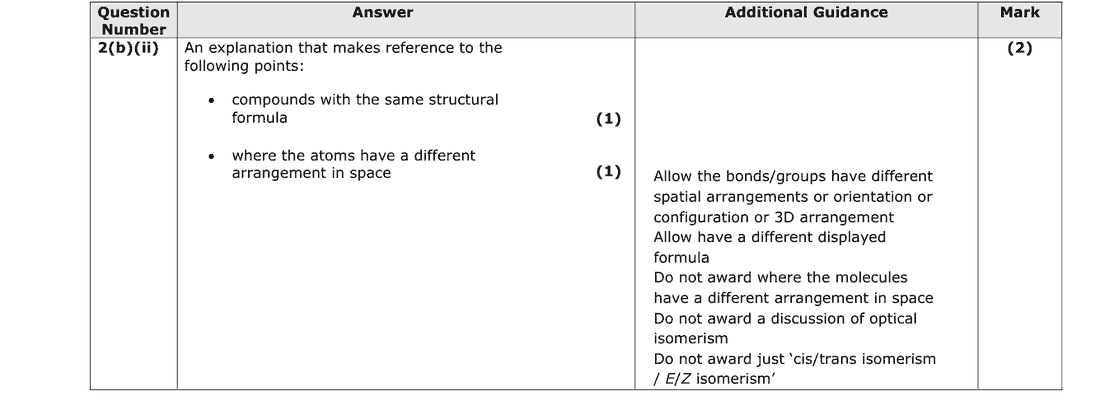
2(b)(ii) Introduction to organic chemistry 2Short answer
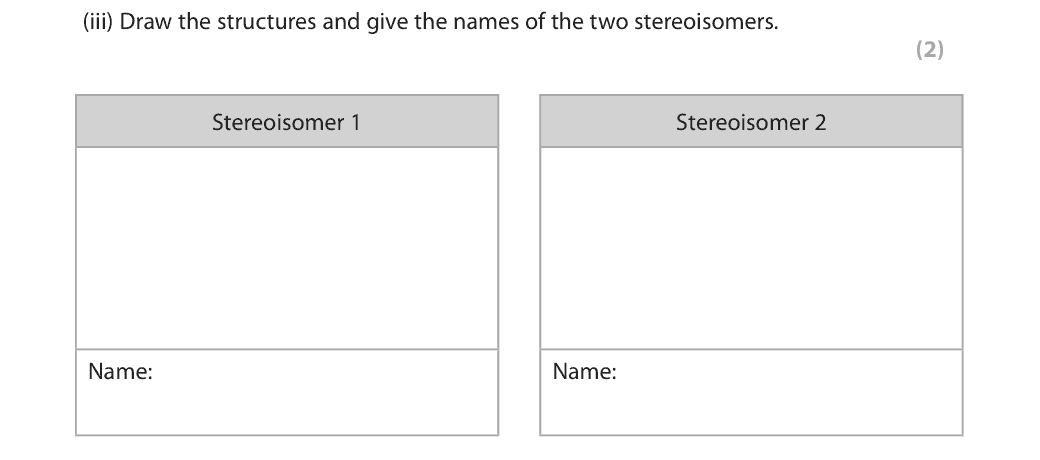
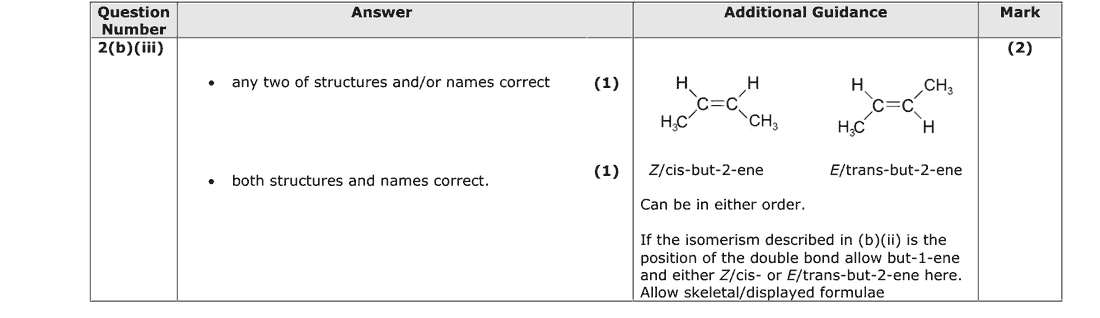
2(b)(iii) Introduction to organic chemistry 2Diagram or structure
2(b)(iv) Introduction to organic chemistry 1Short answer
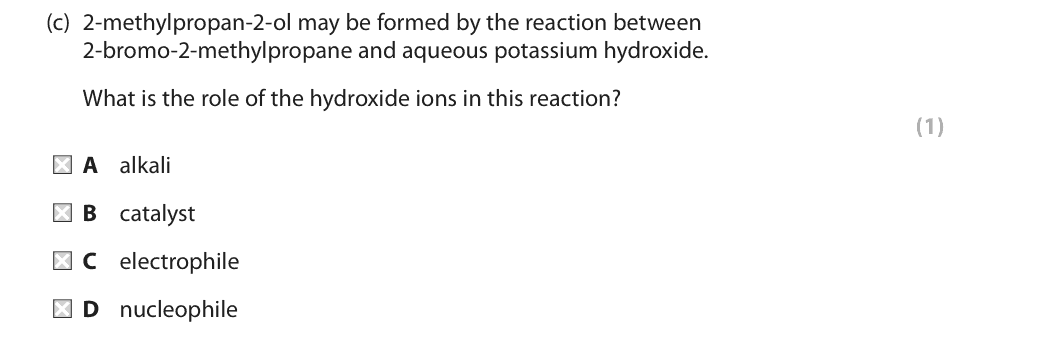
2(c) Halogenoalkanes 1Multiple choice
2(d)(i) Alcohols 3Equation writing
2(d)(ii) Alcohols 1Multiple choice
3(a) Kinetics I 1Multiple choice
3(b)(i) Kinetics I 1Multiple choice
3(b)(ii) Kinetics I 1Multiple choice
3(c) Kinetics I 1Short answer
3(d)(i) Kinetics I 1Multiple choice
3(d)(ii) Kinetics I 1Multiple choice
4(a) Energetics I 4Calculation
4(b)(i) Equilibrium I, Kinetics I 4Explanation
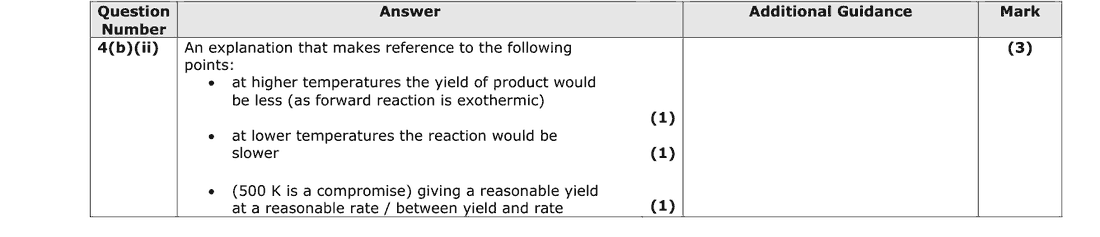
4(b)(ii) Equilibrium I 3Explanation
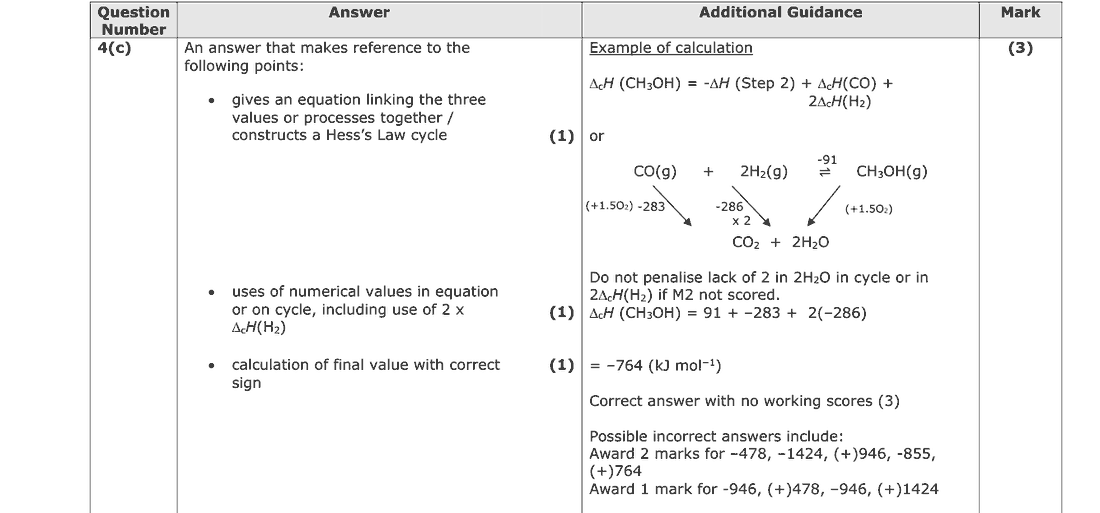
4(c) Energetics I 3Calculation
5(a) Energetics I 2Calculation
5(b)(i) Bonding 1Diagram or structure
5(b)(ii) Alkenes 3Mechanism
5(c)(i) Formulae, equations and amounts of substance 3Calculation
5(c)(ii) Formulae, equations and amounts of substance 2Calculation
5(c)(iii) Alkenes, Bonding 1Short answer
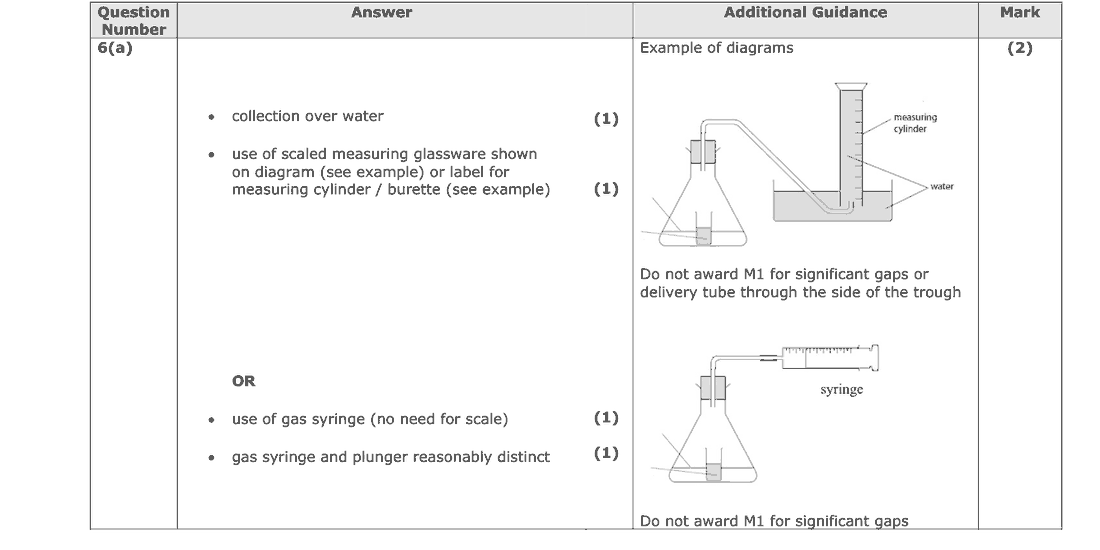
6(a) Kinetics I 2Diagram or structure
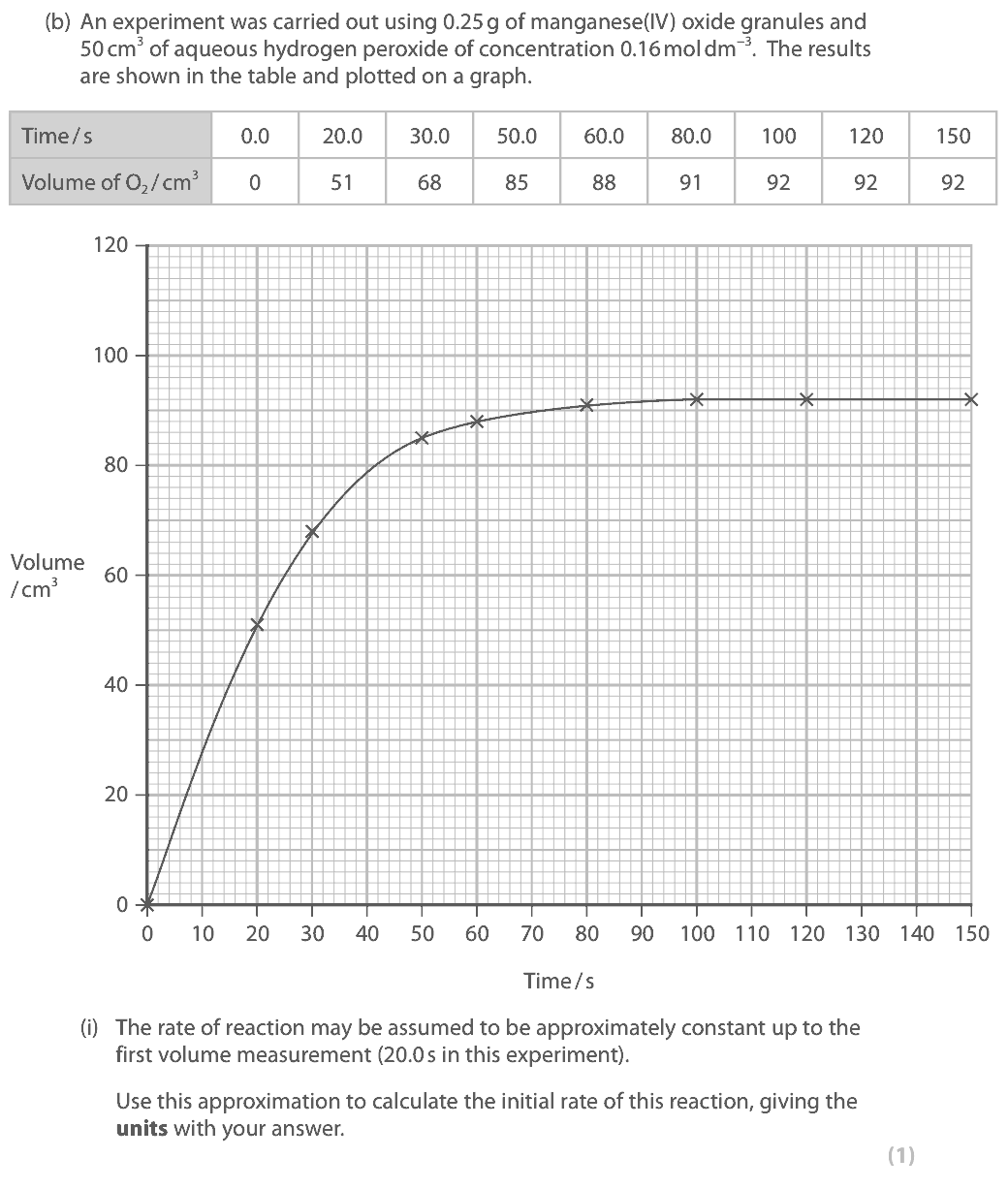
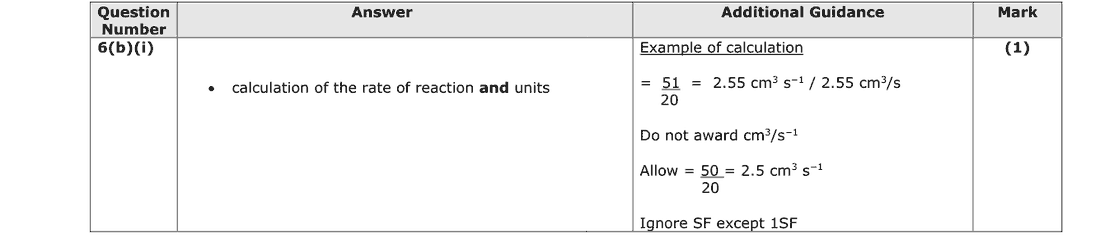
6(b)(i) Kinetics I 1Calculation
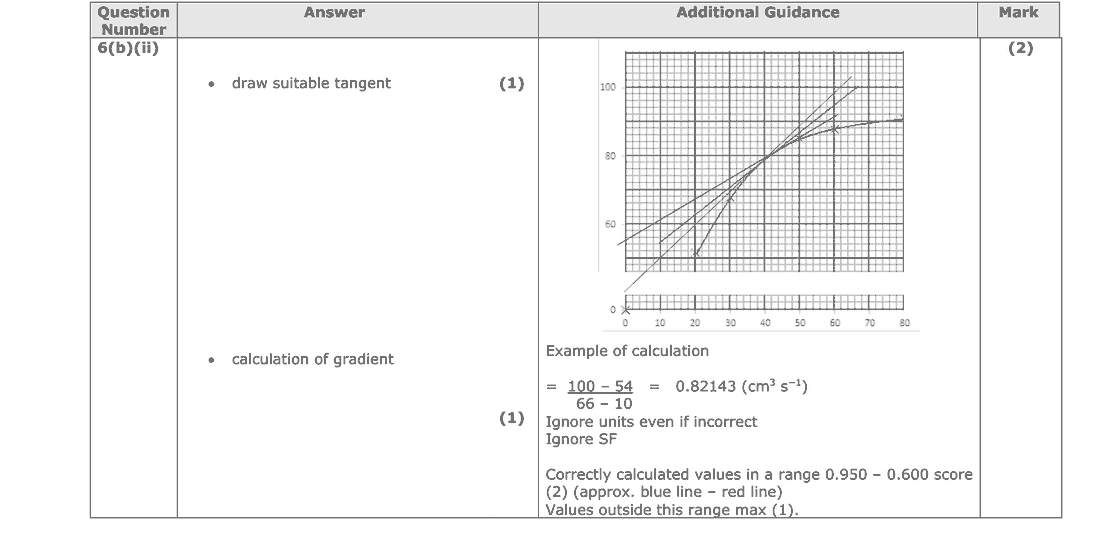
6(b)(ii) Kinetics I 2Calculation
6(b)(iii) Kinetics I 2Diagram or structure
6(b)(iv) Kinetics I 2Explanation
6(c) Kinetics I 4Practical and data analysis
7(a)(i) Halogenoalkanes, Bonding 1Practical and data analysis
7(a)(ii) Halogenoalkanes 1Practical and data analysis
7(a)(iii) Halogenoalkanes 1Practical and data analysis
7(b)(i) Halogenoalkanes, The elements of Group 7 (halogens) 1Practical and data analysis
7(b)(ii) The elements of Group 7 (halogens) 2Practical and data analysis
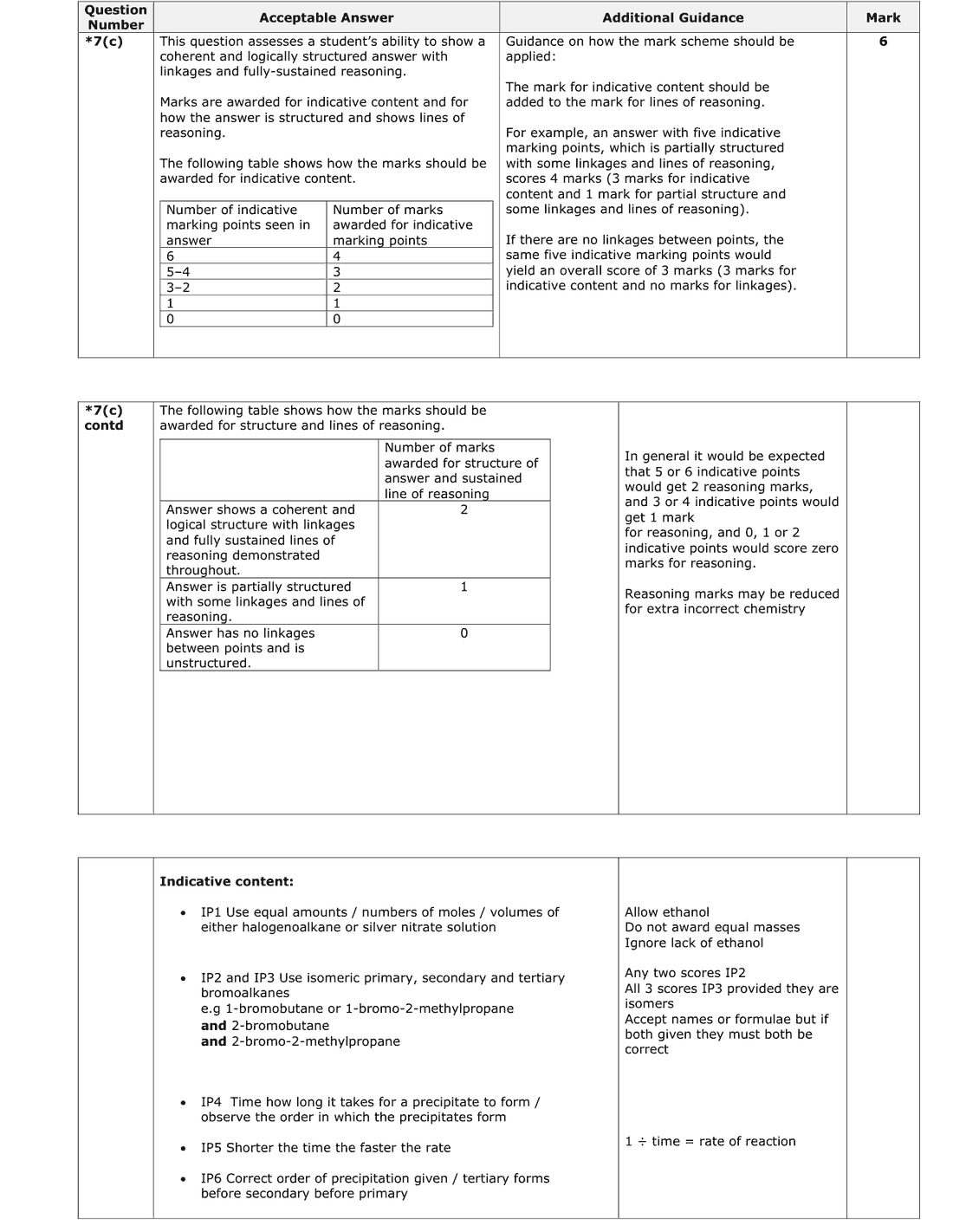
7(c) Halogenoalkanes 6Extended response

The questions

1(a)1(b)(i)1(b)(ii)1(b)(iii)1(c)(i)1(c)(ii)2(a)2(b)(i)2(b)(ii)2(b)(iii)2(b)(iv)2(c)2(d)(i)2(d)(ii)3(a)3(b)(i)3(b)(ii)3(c)3(d)(i)3(d)(ii)4(a)4(b)(i)4(b)(ii)4(c)5(a)5(b)(i)5(b)(ii)5(c)(i)5(c)(ii)5(c)(iii)6(a)6(b)(i)6(b)(ii)6(b)(iii)6(b)(iv)6(c)7(a)(i)7(a)(ii)7(a)(iii)7(b)(i)7(b)(ii)7(c)
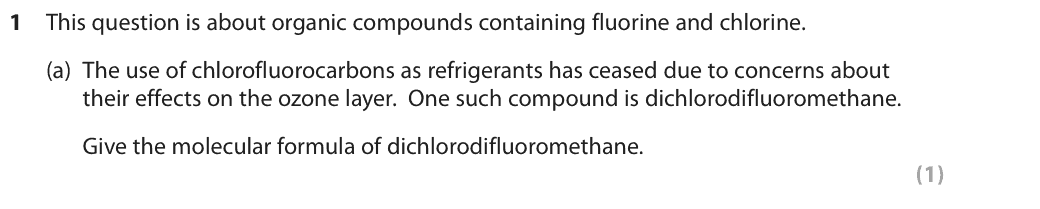
October 2020 · AS Paper 2 · Q1(a) 1 mark Short answer introduction to organic chemistry
This question is about organic compounds containing fluorine and chlorine.
The use of chlorofluorocarbons as refrigerants has ceased due to concerns about
their effects on the ozone layer.  One such compound is dichlorodifluoromethane.
Give the molecular formula of dichlorodifluoromethane.
October 2020 · AS Paper 2 · Q1(b)(i) 3 marks Calculation formulae equations and amounts of substance
A different refrigerant contains 34.0% chlorine and 54.5% fluorine by mass,
with the remainder carbon.
Calculate the empirical formula of this compound.
October 2020 · AS Paper 2 · Q1(b)(ii) 1 mark Short answer mass spectrometry and infrared spectroscopy
Earlier parts of question 1 that this part usesEarlier part of October 2020 Paper 2 question 1Earlier part of October 2020 Paper 2 question 1
Use the mass spectrum to show that the empirical and the molecular formulae
of this compound are the same.
100
80
60
relative
intensity
40
20
0
0
20
40
60
80
100
120
m / z
October 2020 · AS Paper 2 · Q1(b)(iii) 1 mark Short answer mass spectrometry and infrared spectroscopy
Earlier parts of question 1 that this part usesEarlier part of October 2020 Paper 2 question 1Earlier part of October 2020 Paper 2 question 1
Suggest the species responsible for the peak at m / z = 69 .
October 2020 · AS Paper 2 · Q1(c)(i) 1 mark Equation writing alkanesformulae equations and amounts of substance
Compounds containing carbon and fluorine but no chlorine can be used as
refrigerants as they are not harmful to the ozone layer.
These can be made by the reaction of fluorine with alkanes or fluoroalkanes.
A refrigerant currently in use contains the compound trifluoromethane, CHF3.
Write the equation for the formation of trifluoromethane by the reaction of
difluoromethane with fluorine.  State symbols are not required.
October 2020 · AS Paper 2 · Q1(c)(ii) 3 marks Equation writing alkanes
Earlier part of question 1 that this part usesEarlier part of October 2020 Paper 2 question 1
The mechanism for this reaction is similar to that of the reaction between
chlorine and methane.
Give the equations for the following steps in the mechanism for the reaction
between fluorine and difluoromethane.  Curly arrows are not required.
Initiation step
First propagation step
Second propagation step
October 2020 · AS Paper 2 · Q2(a) 2 marks Short answer introduction to organic chemistry
This question is about alcohols and their reactions.
The table gives some of the names and skeletal formulae of isomers having the
formula C4H9OH.
Complete the table.
Name
Skeletal formula
OH
OH
butan‑2‑ol
2‑methylpropan‑1‑ol
OH
2‑methylpropan‑2‑ol
October 2020 · AS Paper 2 · Q2(b)(i) 1 mark Multiple choice introduction to organic chemistry
Earlier part of question 2 that this part usesEarlier part of October 2020 Paper 2 question 2
Some alcohols react with concentrated phosphoric acid to form alkenes.
What is the type of this reaction?
A  addition
B  elimination
C  oxidation
D  substitution
October 2020 · AS Paper 2 · Q2(b)(ii) 2 marks Short answer introduction to organic chemistry
Earlier parts of question 2 that this part usesEarlier part of October 2020 Paper 2 question 2Earlier part of October 2020 Paper 2 question 2
When butan‑2‑ol reacts with concentrated phosphoric acid, two stereoisomers

are formed.
Explain what is meant by the term stereoisomers.
October 2020 · AS Paper 2 · Q2(b)(iii) 2 marks Diagram or structure introduction to organic chemistry
Earlier parts of question 2 that this part usesEarlier part of October 2020 Paper 2 question 2Earlier part of October 2020 Paper 2 question 2
Draw the structures and give the names of the two stereoisomers.
Stereoisomer 1
Stereoisomer 2
Name:
Name:
October 2020 · AS Paper 2 · Q2(b)(iv) 1 mark Short answer introduction to organic chemistry
Earlier parts of question 2 that this part usesEarlier part of October 2020 Paper 2 question 2Earlier part of October 2020 Paper 2 question 2
Name this type of stereoisomerism.
October 2020 · AS Paper 2 · Q2(c) 1 mark Multiple choice halogenoalkanes
Earlier part of question 2 that this part usesEarlier part of October 2020 Paper 2 question 2
2‑methylpropan‑2‑ol may be formed by the reaction between
2‑bromo‑2‑methylpropane and aqueous potassium hydroxide.
What is the role of the hydroxide ions in this reaction?
A  alkali
B  catalyst
C  electrophile
D  nucleophile
October 2020 · AS Paper 2 · Q2(d)(i) 3 marks Equation writing alcohols
Earlier part of question 2 that this part usesEarlier part of October 2020 Paper 2 question 2
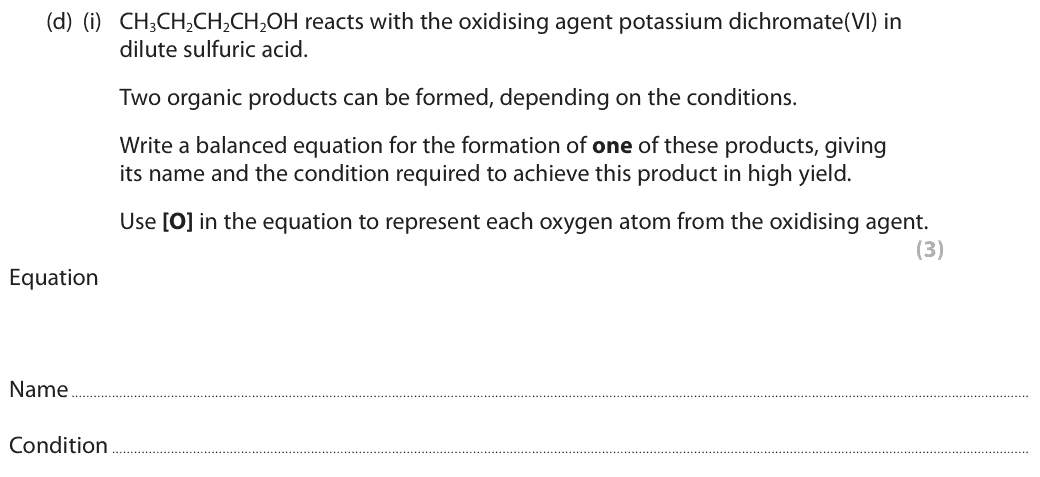
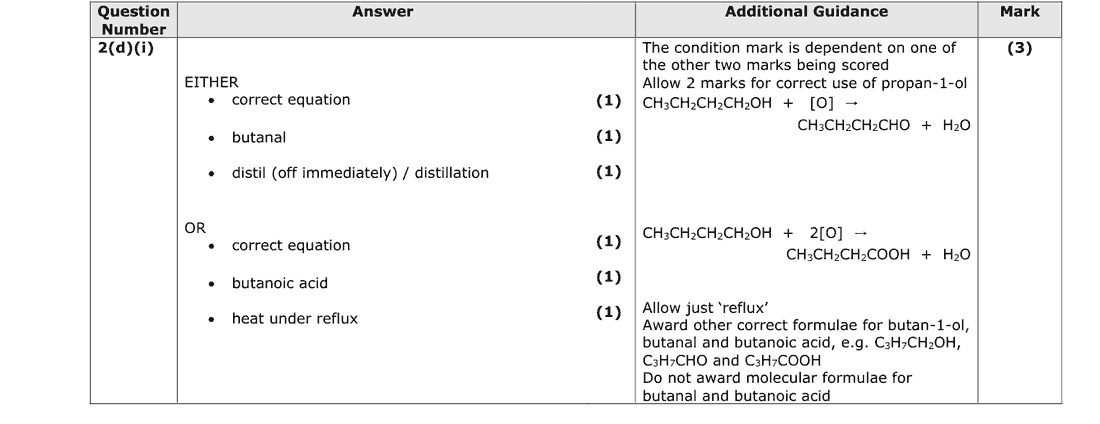
CH3CH2CH2CH2OH reacts with the oxidising agent potassium dichromate(VI) in
dilute sulfuric acid.
Two organic products can be formed, depending on the conditions.
Write a balanced equation for the formation of one of these products, giving
its name and the condition required to achieve this product in high yield.
Use [O] in the equation to represent each oxygen atom from the oxidising agent.
Equation
Name 
Condition .
October 2020 · AS Paper 2 · Q2(d)(ii) 1 mark Multiple choice alcohols
Earlier parts of question 2 that this part usesEarlier part of October 2020 Paper 2 question 2Earlier part of October 2020 Paper 2 question 2
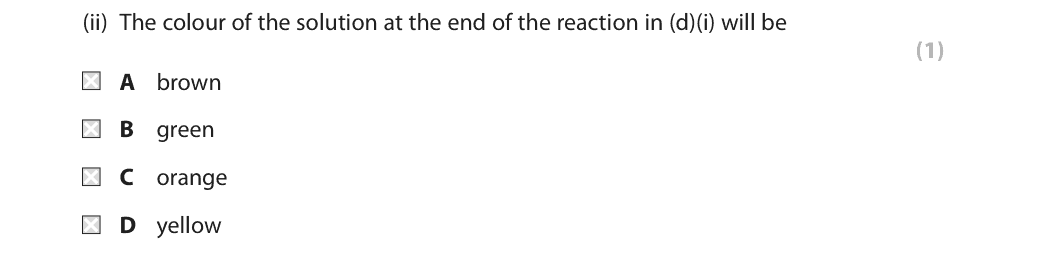
The colour of the solution at the end of the reaction in (d)(i) will be
A  brown
B  green
C  orange
D  yellow
October 2020 · AS Paper 2 · Q3(a) 1 mark Multiple choice kinetics i
This question is about reaction kinetics.
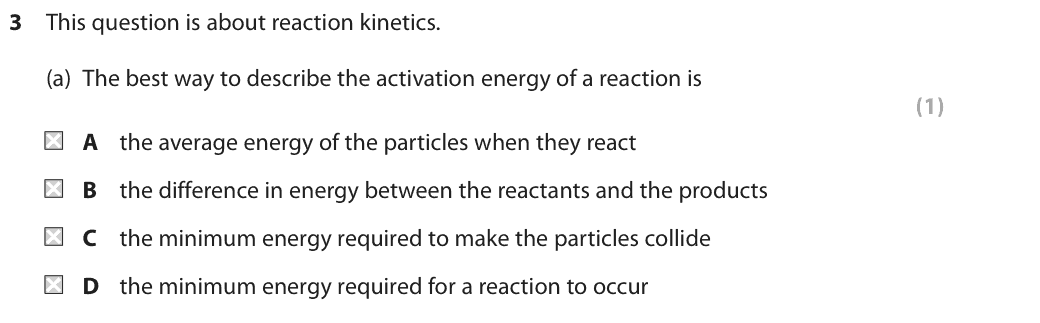
The best way to describe the activation energy of a reaction is
A  the average energy of the particles when they react
B  the difference in energy between the reactants and the products
C  the minimum energy required to make the particles collide
D  the minimum energy required for a reaction to occur
October 2020 · AS Paper 2 · Q3(b)(i) 1 mark Multiple choice kinetics i
Earlier part of question 3 that this part usesEarlier part of October 2020 Paper 2 question 3
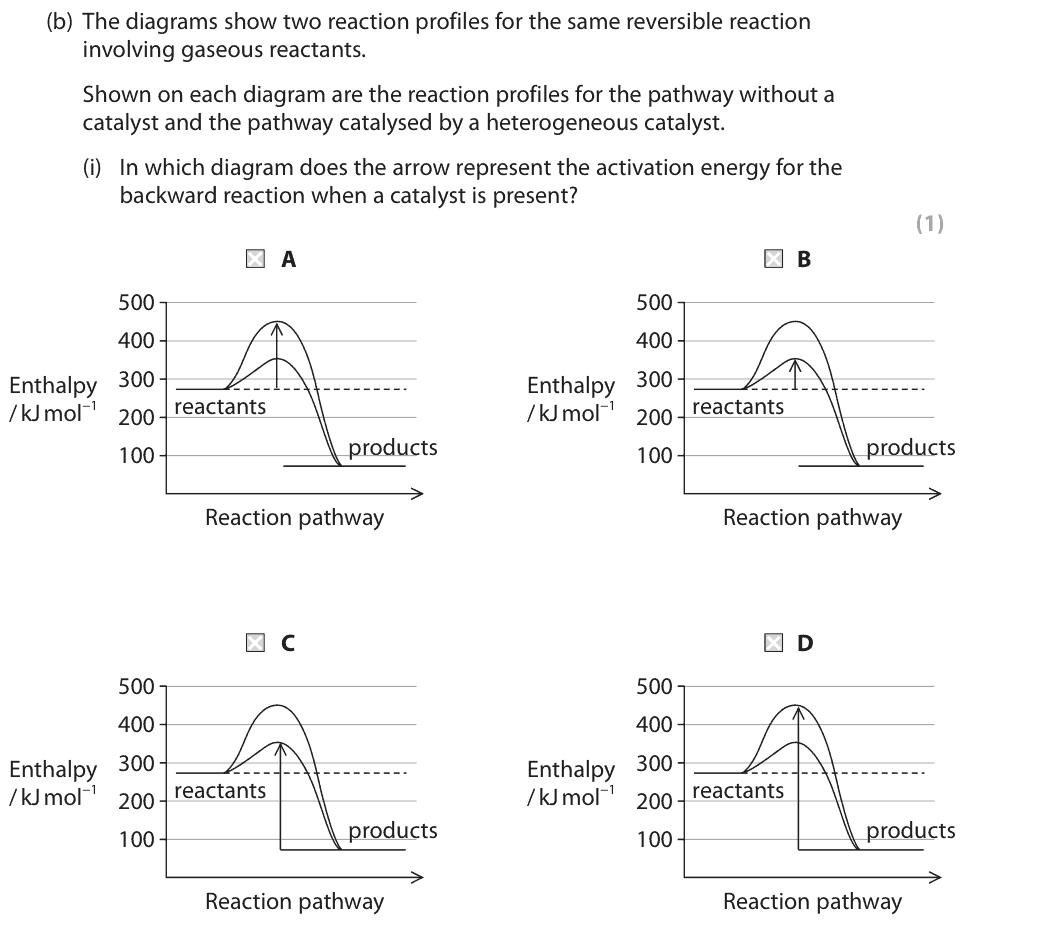
The diagrams show two reaction profiles for the same reversible reaction
involving gaseous reactants.
Shown on each diagram are the reaction profiles for the pathway without a
catalyst and the pathway catalysed by a heterogeneous catalyst.
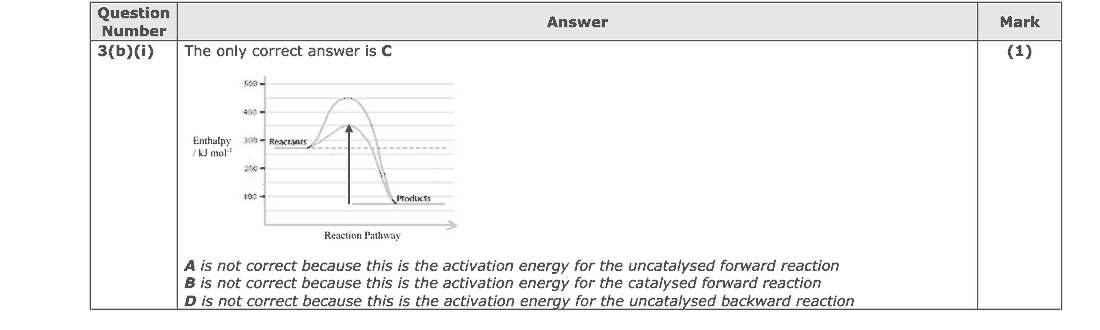
In which diagram does the arrow represent the activation energy for the
backward reaction when a catalyst is present?
A
B
500
500
400
400
300
300
Enthalpy
Enthalpy
reactants
reactants
/ kJ mol−1
/ kJ mol−1
200
200
products
products
100
100
Reaction pathway
Reaction pathway
C
D
500
500
400
400
300
300
Enthalpy
Enthalpy
reactants
reactants
/ kJ mol−1
/ kJ mol−1
200
200
products
products
100
100
Reaction pathway
Reaction pathway
October 2020 · AS Paper 2 · Q3(b)(ii) 1 mark Multiple choice kinetics i
Earlier parts of question 3 that this part usesEarlier part of October 2020 Paper 2 question 3Earlier part of October 2020 Paper 2 question 3
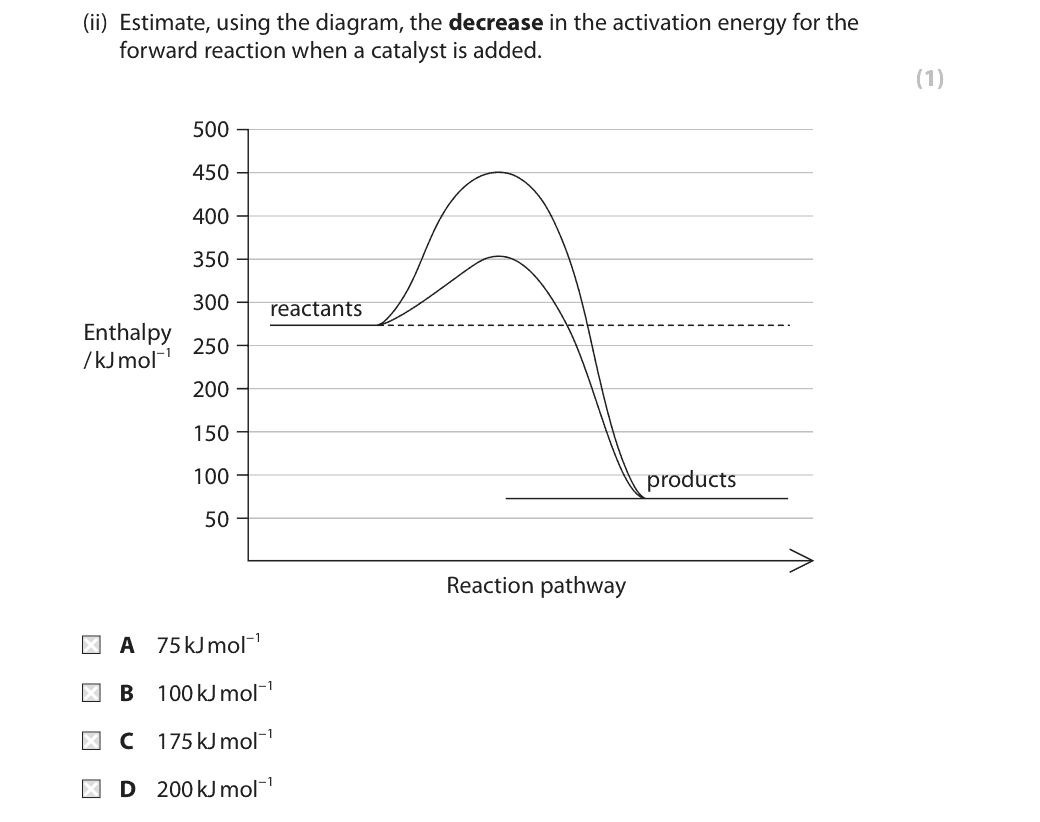
Estimate, using the diagram, the decrease in the activation energy for the
forward reaction when a catalyst is added.
500
450
400
350
300
reactants
Enthalpy
250
/ kJ mol−1
200
150
100
products
50
Reaction pathway
A  75 kJ mol−1
B  100 kJ mol−1
C  175 kJ mol−1
D  200 kJ mol−1
October 2020 · AS Paper 2 · Q3(c) 1 mark Short answer kinetics i
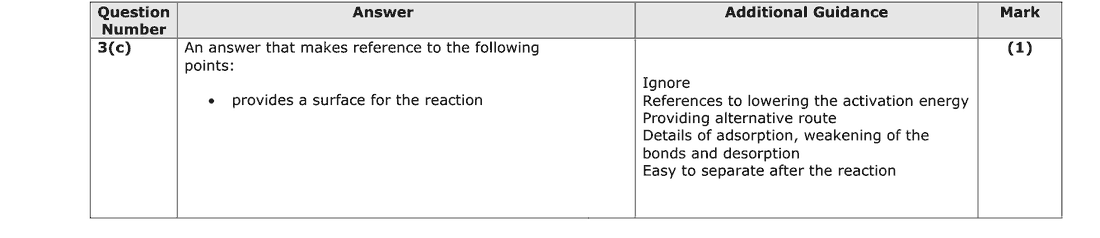
State why a solid (heterogeneous) catalyst is suitable for a reaction in the gas phase.
October 2020 · AS Paper 2 · Q3(d)(i) 1 mark Multiple choice kinetics i
Earlier part of question 3 that this part usesEarlier part of October 2020 Paper 2 question 3
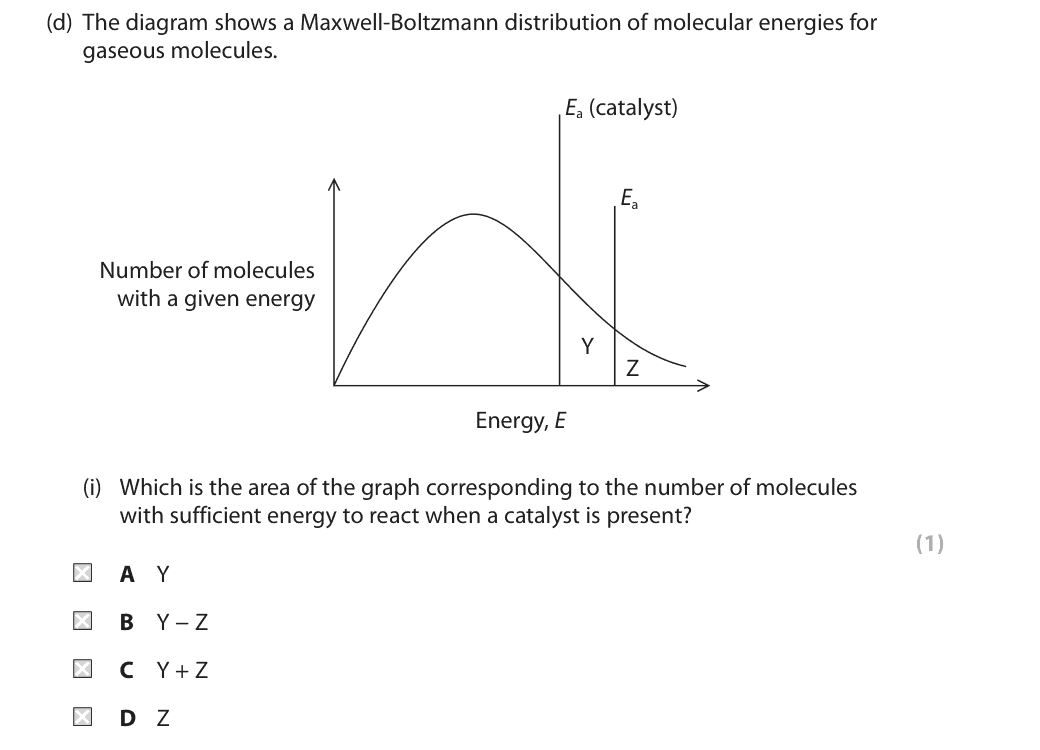
The diagram shows a Maxwell‑Boltzmann distribution of molecular energies for
gaseous molecules.
Ea (catalyst)
Ea
Number of molecules
with a given energy
Y
Z
Energy, E
Which is the area of the graph corresponding to the number of molecules
with sufficient energy to react when a catalyst is present?
A  Y
B  Y − Z
C  Y + Z
D  Z
October 2020 · AS Paper 2 · Q3(d)(ii) 1 mark Multiple choice kinetics i
Earlier parts of question 3 that this part usesEarlier part of October 2020 Paper 2 question 3Earlier part of October 2020 Paper 2 question 3
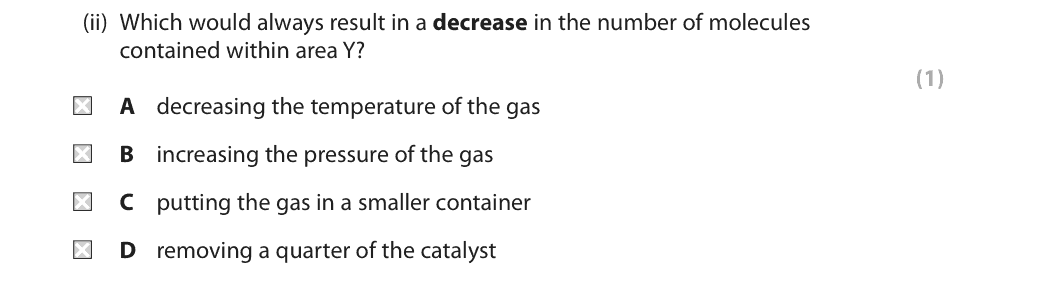
Which would always result in a decrease in the number of molecules
contained within area Y?
A  decreasing the temperature of the gas
B  increasing the pressure of the gas
C  putting the gas in a smaller container
D  removing a quarter of the catalyst
October 2020 · AS Paper 2 · Q4(a) 4 marks Calculation energetics i
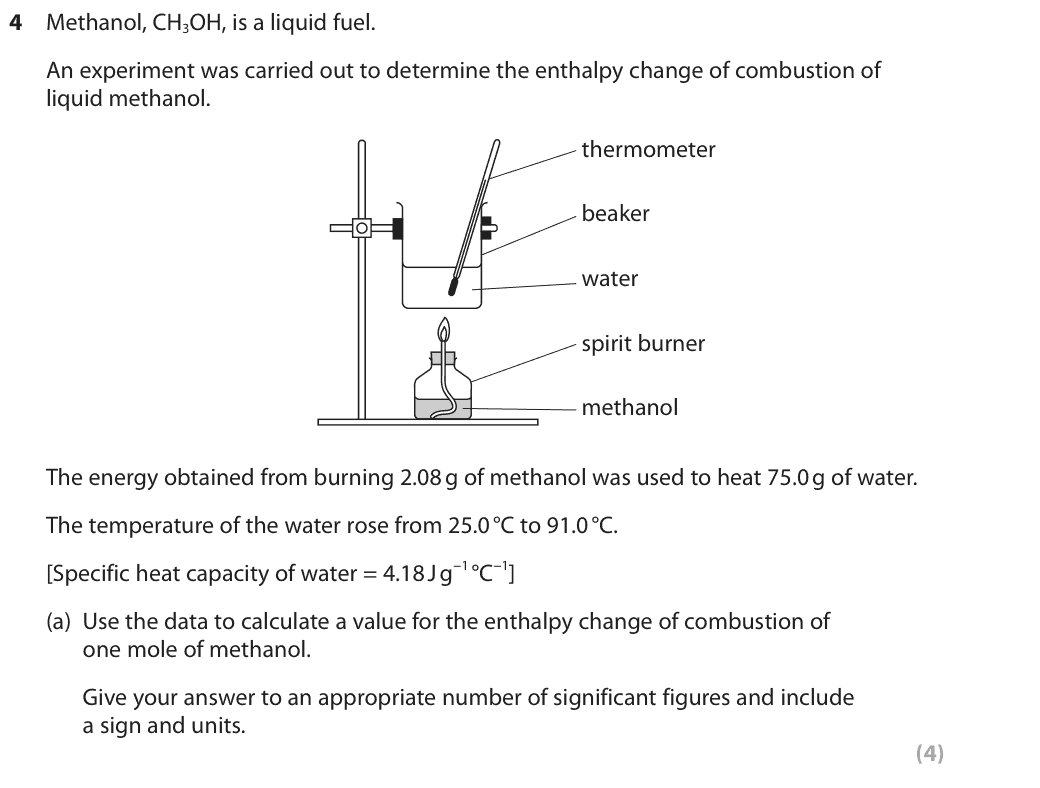
Methanol, CH3OH, is a liquid fuel.
An experiment was carried out to determine the enthalpy change of combustion of
liquid methanol.
thermometer
beaker
water
spirit burner
methanol
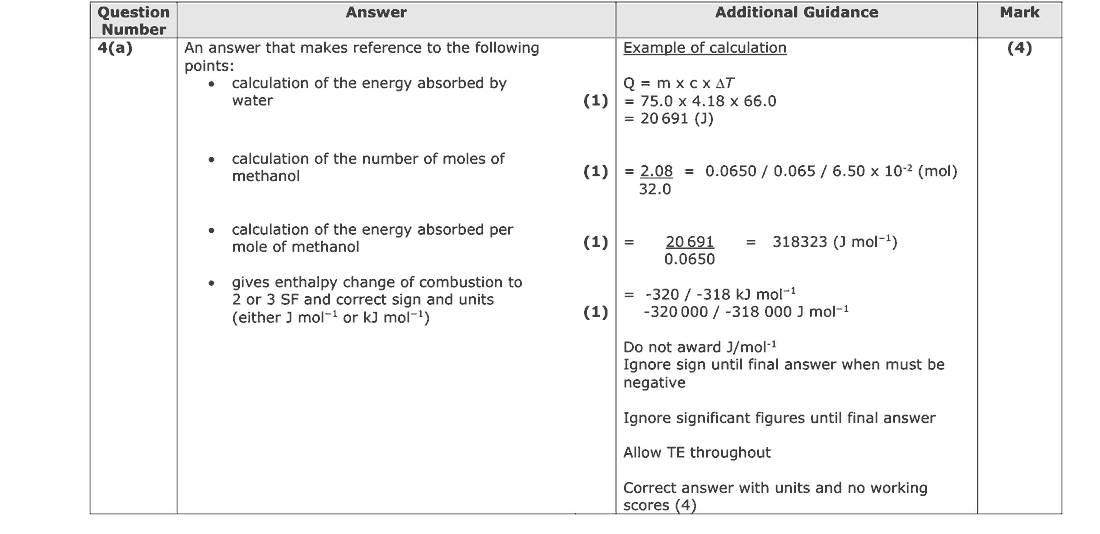
The energy obtained from burning 2.08 g of methanol was used to heat 75.0 g of water.
The temperature of the water rose from 25.0 °C to 91.0 °C.
[Specific heat capacity of water = 4.18 J g−1 °C−1]
Use the data to calculate a value for the enthalpy change of combustion of
one mole of methanol.
Give your answer to an appropriate number of significant figures and include
a sign and units.
October 2020 · AS Paper 2 · Q4(b)(i) 4 marks Explanation equilibrium ikinetics i
Earlier part of question 4 that this part usesEarlier part of October 2020 Paper 2 question 4
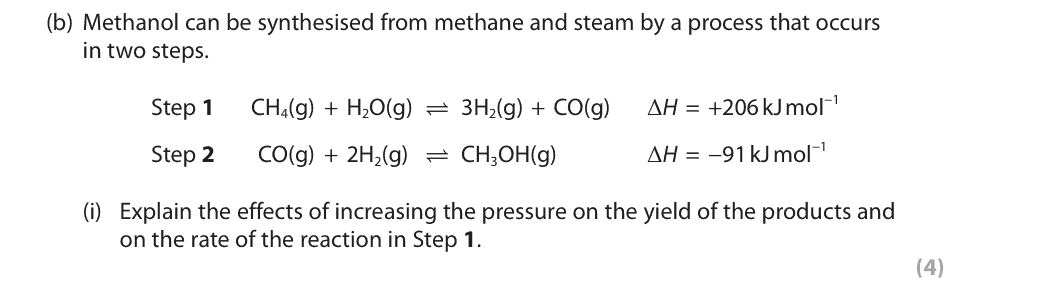
Methanol can be synthesised from methane and steam by a process that occurs
in two steps.
Step 1
CH4(g)  + H2O(g)    3H2(g) + CO(g)
ΔH = +206 kJ mol−1
Step 2
CO(g)  + 2H2(g)    CH3OH(g)
ΔH = −91 kJ mol−1
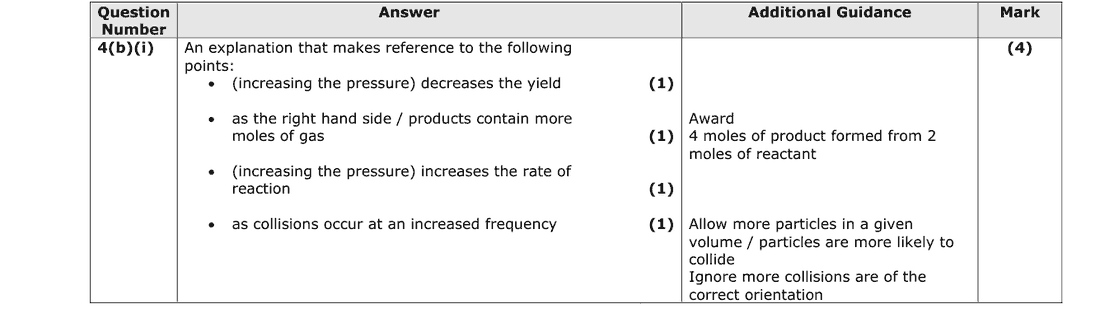
Explain the effects of increasing the pressure on the yield of the products and
on the rate of the reaction in Step 1.
October 2020 · AS Paper 2 · Q4(b)(ii) 3 marks Explanation equilibrium i
Earlier parts of question 4 that this part usesEarlier part of October 2020 Paper 2 question 4Earlier part of October 2020 Paper 2 question 4
Step 2 is carried out at a compromise temperature of 500 K.
Explain why 500 K is considered to be a compromise for Step 2 by considering
what would happen at higher and lower temperatures.
October 2020 · AS Paper 2 · Q4(c) 3 marks Calculation energetics i
Earlier part of question 4 that this part usesEarlier part of October 2020 Paper 2 question 4
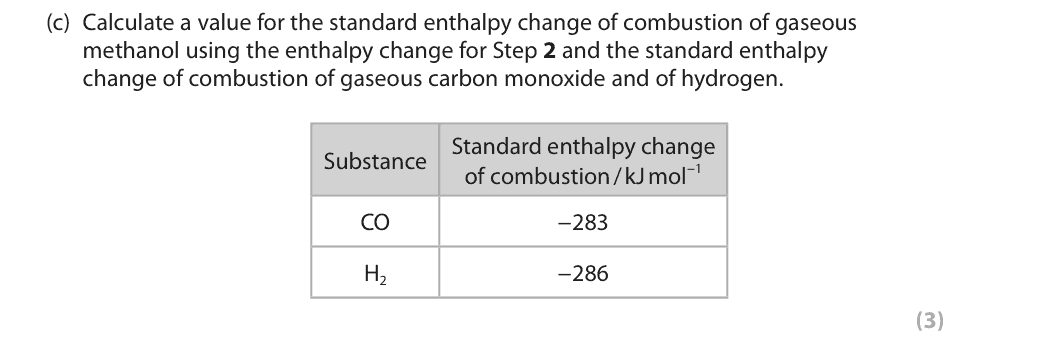
Calculate a value for the standard enthalpy change of combustion of gaseous
methanol using the enthalpy change for Step 2 and the standard enthalpy
change of combustion of gaseous carbon monoxide and of hydrogen.
Standard enthalpy change
Substance
of combustion / kJ mol−1
CO
−283
H2
−286
October 2020 · AS Paper 2 · Q5(a) 2 marks Calculation energetics i
This question concerns iodine monochloride, ICl, a red‑brown solid which melts at 27 °C
to form a red‑brown liquid.
Iodine monochloride is used in measuring unsaturation in organic compounds.
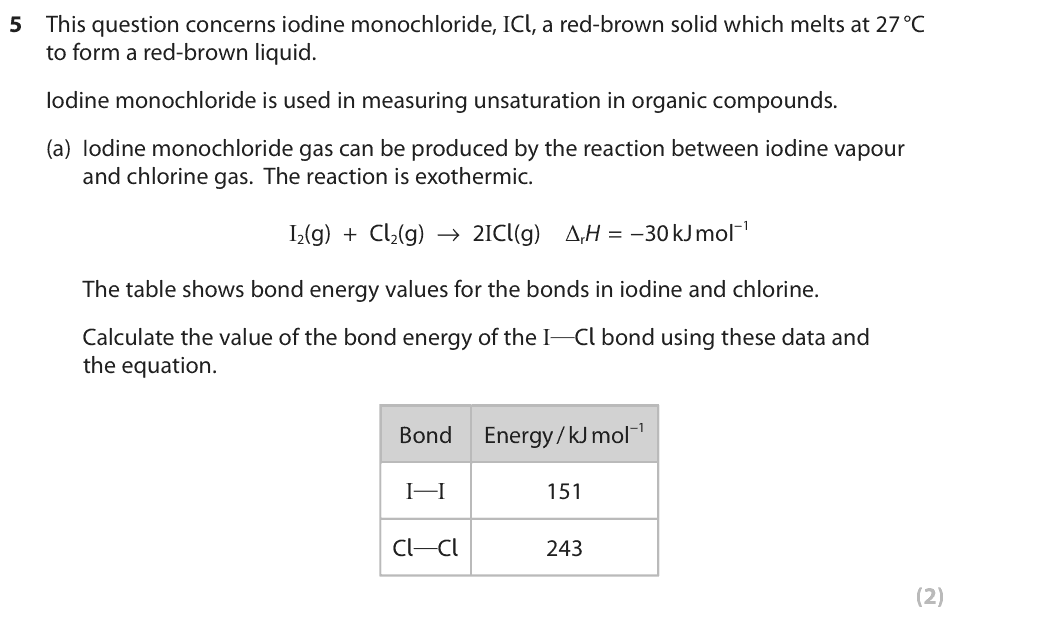
Iodine monochloride gas can be produced by the reaction between iodine vapour
and chlorine gas.  The reaction is exothermic.
I2(g)  +  Cl2(g)  →  2ICl(g)    ΔrH = −30 kJ mol−1
The table shows bond energy values for the bonds in iodine and chlorine.
Calculate the value of the bond energy of the I
Cl bond using these data and
the equation.
Bond
Energy / kJ mol−1
I
I
151
Cl
Cl
243
October 2020 · AS Paper 2 · Q5(b)(i) 1 mark Diagram or structure bonding
Earlier part of question 5 that this part usesEarlier part of October 2020 Paper 2 question 5
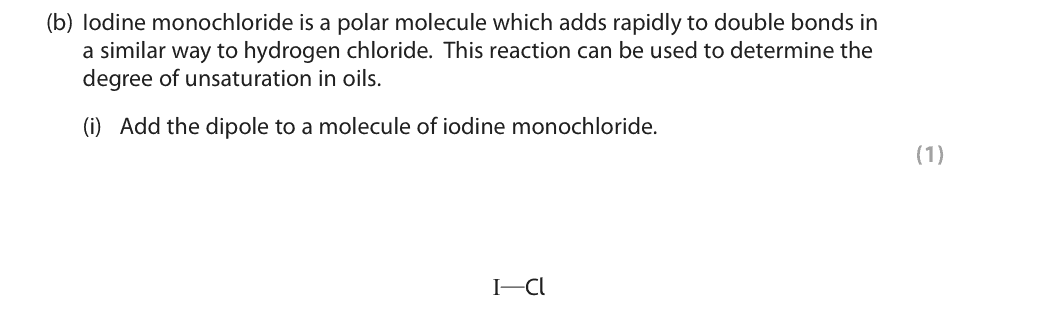
Iodine monochloride is a polar molecule which adds rapidly to double bonds in
a similar way to hydrogen chloride.  This reaction can be used to determine the
degree of unsaturation in oils.
Add the dipole to a molecule of iodine monochloride.
I
Cl
October 2020 · AS Paper 2 · Q5(b)(ii) 3 marks Mechanism alkenes
Earlier parts of question 5 that this part usesEarlier part of October 2020 Paper 2 question 5Earlier part of October 2020 Paper 2 question 5
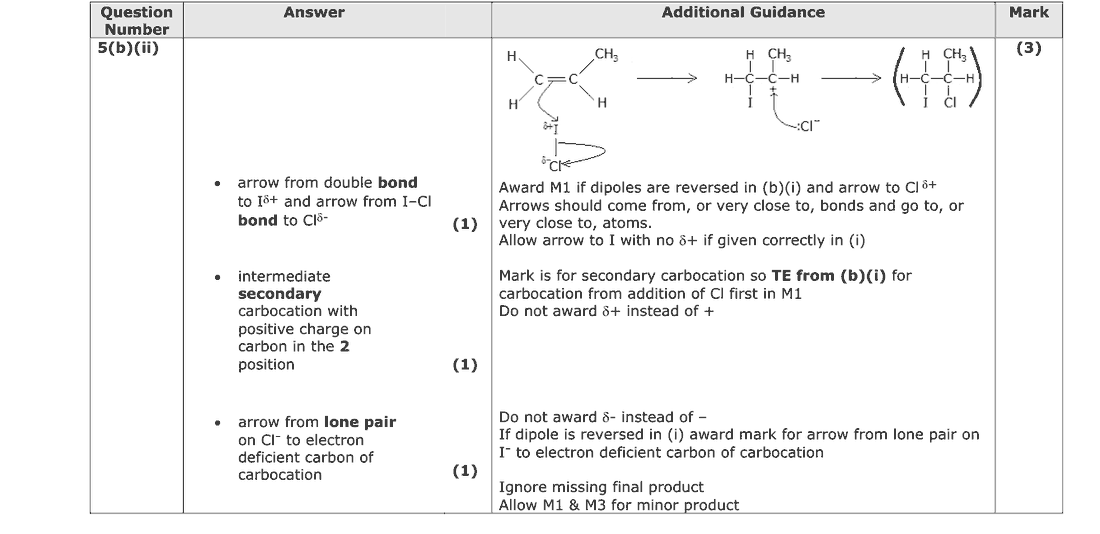
Draw the mechanism for the addition of iodine monochloride to propene.
You should include all curly arrows and relevant lone pairs and dipoles.
October 2020 · AS Paper 2 · Q5(c)(i) 3 marks Calculation formulae equations and amounts of substance
Earlier part of question 5 that this part usesEarlier part of October 2020 Paper 2 question 5
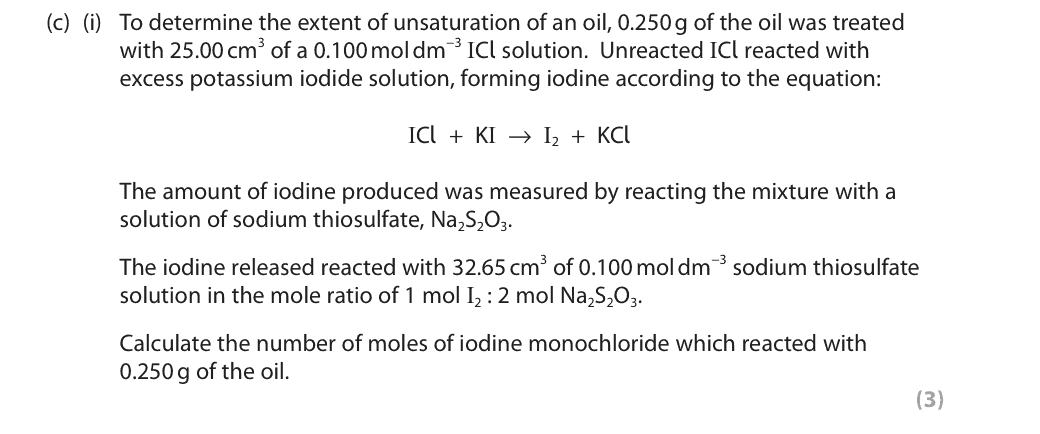
To determine the extent of unsaturation of an oil, 0.250 g of the oil was treated
with 25.00 cm3 of a 0.100 mol dm−3 ICl solution.  Unreacted ICl reacted with
excess potassium iodide solution, forming iodine according to the equation:
ICl  +  KI  →  I2  +  KCl
The amount of iodine produced was measured by reacting the mixture with a
solution of sodium thiosulfate, Na2S2O3.
The iodine released reacted with 32.65 cm3 of 0.100 mol dm−3 sodium thiosulfate
solution in the mole ratio of 1 mol I2 : 2 mol Na2S2O3.
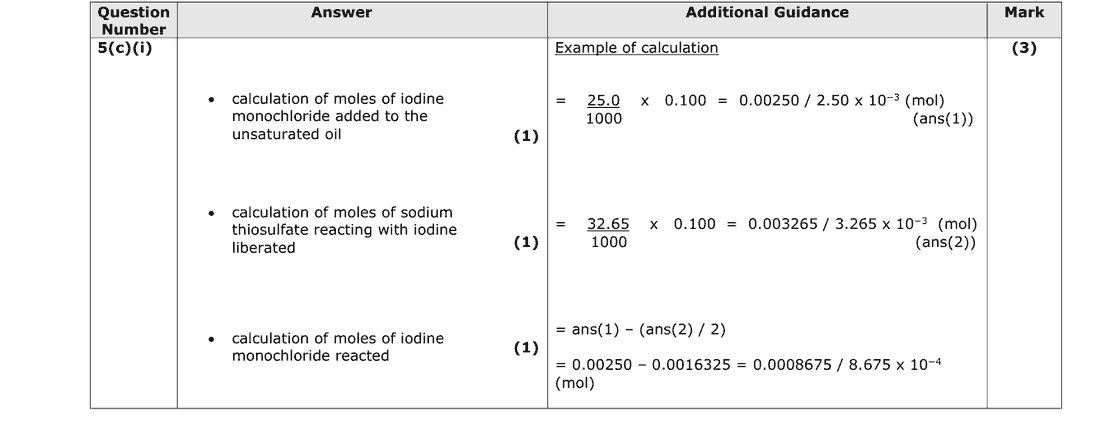
Calculate the number of moles of iodine monochloride which reacted with
0.250 g of the oil.
October 2020 · AS Paper 2 · Q5(c)(ii) 2 marks Calculation formulae equations and amounts of substance
Earlier parts of question 5 that this part usesEarlier part of October 2020 Paper 2 question 5Earlier part of October 2020 Paper 2 question 5
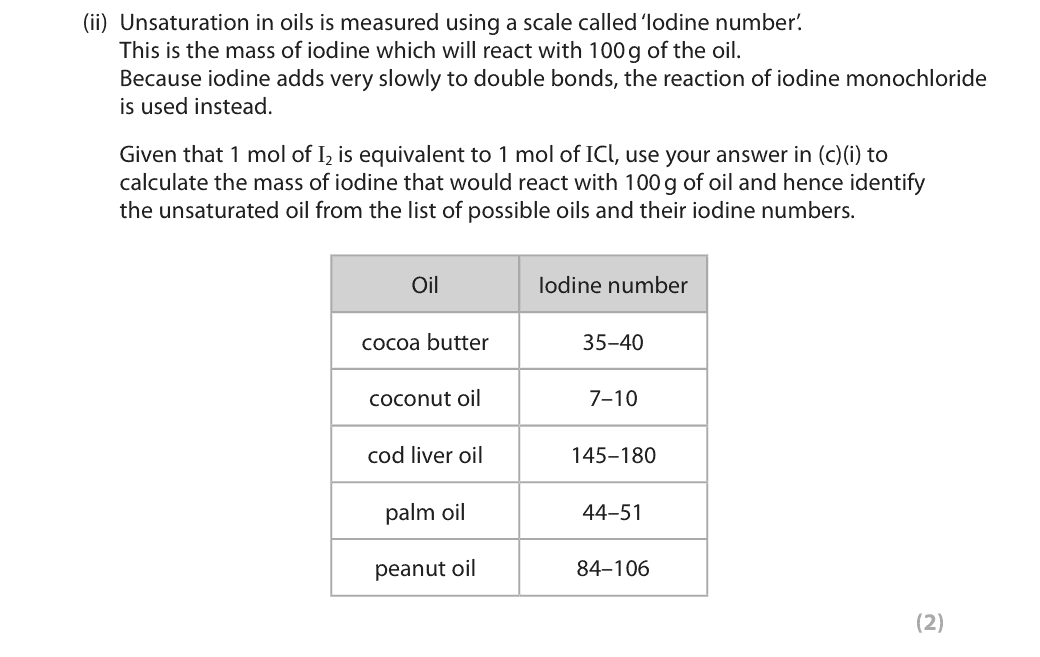
Unsaturation in oils is measured using a scale called ‘Iodine number’.
This is the mass of iodine which will react with 100 g of the oil.
Because iodine adds very slowly to double bonds, the reaction of iodine monochloride
is used instead.
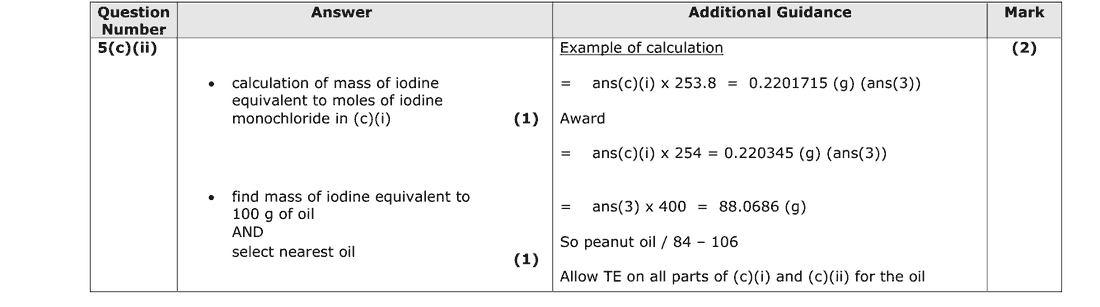
Given that 1 mol of I2 is equivalent to 1 mol of ICl, use your answer in (c)(i) to
calculate the mass of iodine that would react with 100 g of oil and hence identify
the unsaturated oil from the list of possible oils and their iodine numbers.
Oil
Iodine number
cocoa butter
35–40
coconut oil
7–10
cod liver oil
145–180
palm oil
44–51
peanut oil
84–106
October 2020 · AS Paper 2 · Q5(c)(iii) 1 mark Short answer alkenesbonding
Earlier parts of question 5 that this part usesEarlier part of October 2020 Paper 2 question 5Earlier part of October 2020 Paper 2 question 5
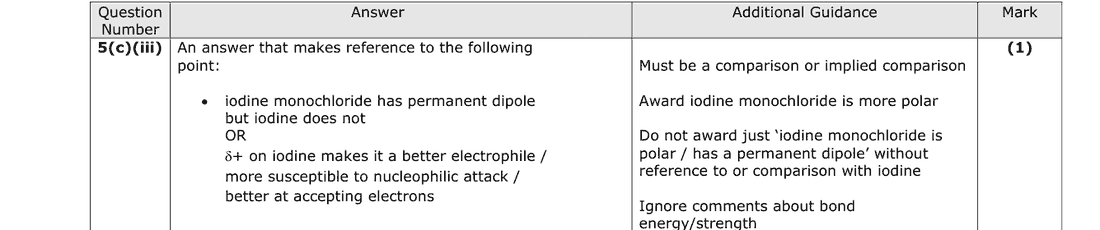
Give a reason why the reaction of iodine monochloride is significantly faster
than the reaction of iodine.
October 2020 · AS Paper 2 · Q6(a) 2 marks Diagram or structure kinetics i
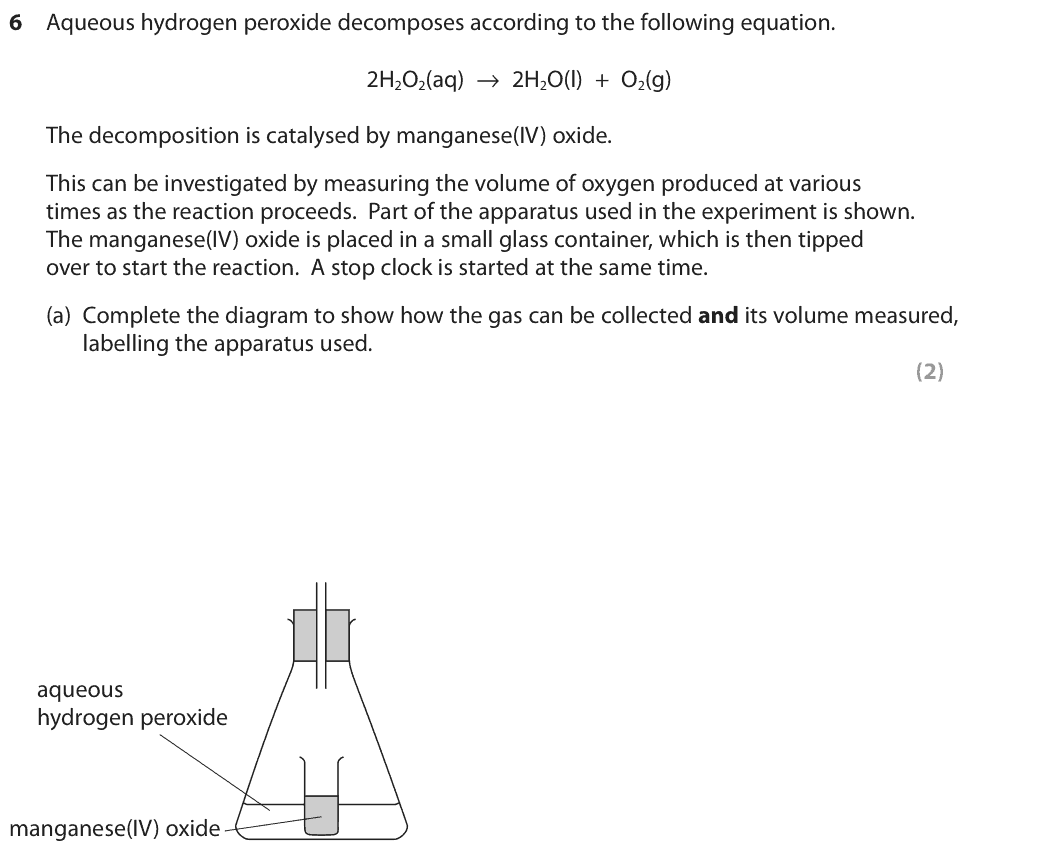
Aqueous hydrogen peroxide decomposes according to the following equation.
2H2O2(aq)  →  2H2O(l)  +  O2(g)
The decomposition is catalysed by manganese(IV) oxide.
This can be investigated by measuring the volume of oxygen produced at various
times as the reaction proceeds.  Part of the apparatus used in the experiment is shown.
The manganese(IV) oxide is placed in a small glass container, which is then tipped
over to start the reaction.  A stop clock is started at the same time.
Complete the diagram to show how the gas can be collected and its volume measured,
labelling the apparatus used.
aqueous
hydrogen peroxide
manganese(IV) oxide
October 2020 · AS Paper 2 · Q6(b)(i) 1 mark Calculation kinetics i
Earlier part of question 6 that this part usesEarlier part of October 2020 Paper 2 question 6
An experiment was carried out using 0.25 g of manganese(IV) oxide granules and
50 cm3 of aqueous hydrogen peroxide of concentration 0.16 mol dm−3.  The results
are shown in the table and plotted on a graph.
Time / s
0.0
20.0
30.0
50.0
60.0
80.0
100
120
150
Volume of O2 / cm3
0
51
68
85
88
91
92
92
92
120
100
80
Volume
60
/ cm3
40
20
0
0
10
20
30
40
50
60
70
80
90
100
110
120
130
140
150
Time / s
The rate of reaction may be assumed to be approximately constant up to the
first volume measurement (20.0 s in this experiment).
Use this approximation to calculate the initial rate of this reaction, giving the
units with your answer.
October 2020 · AS Paper 2 · Q6(b)(ii) 2 marks Calculation kinetics i
Earlier parts of question 6 that this part usesEarlier part of October 2020 Paper 2 question 6Earlier part of October 2020 Paper 2 question 6
Draw a tangent at 40 s on the graph on Page 20 and use it to calculate the rate
of reaction at this time.
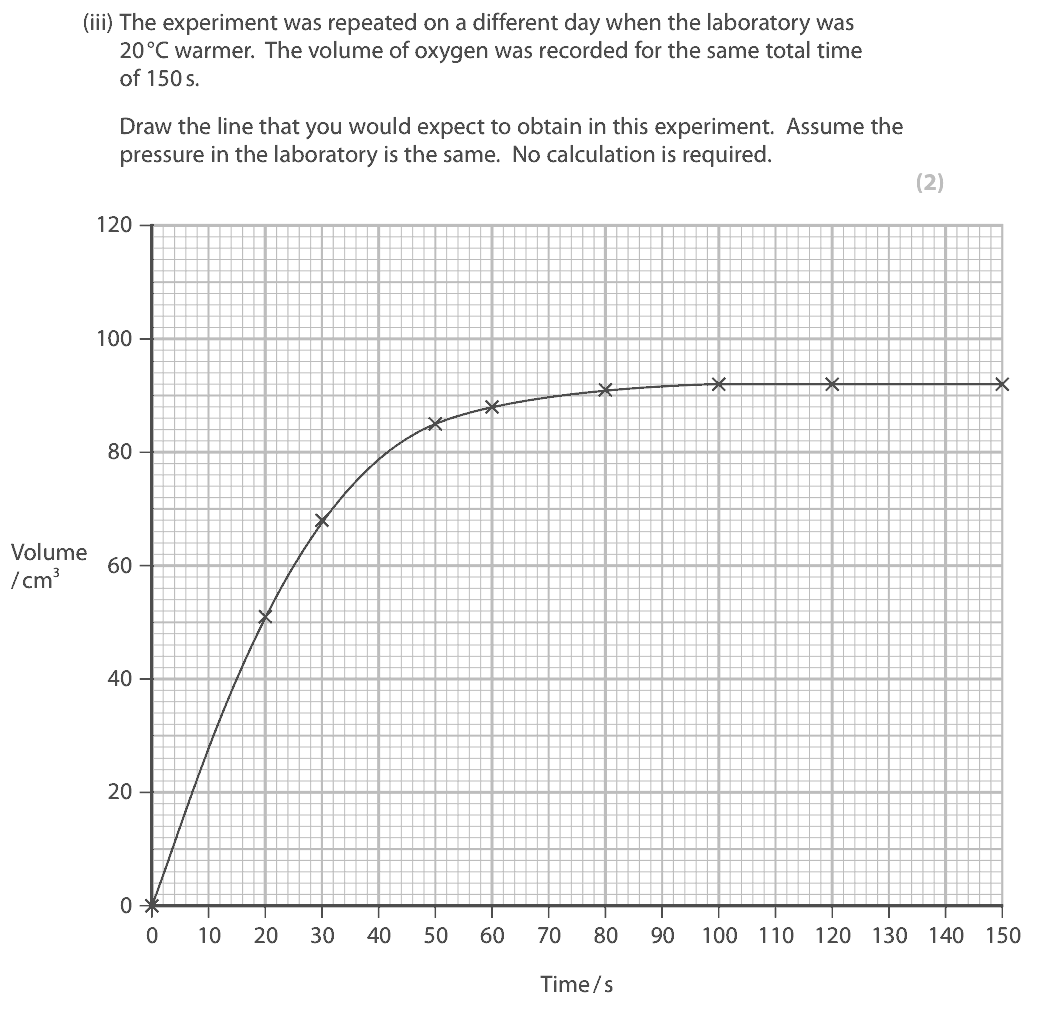
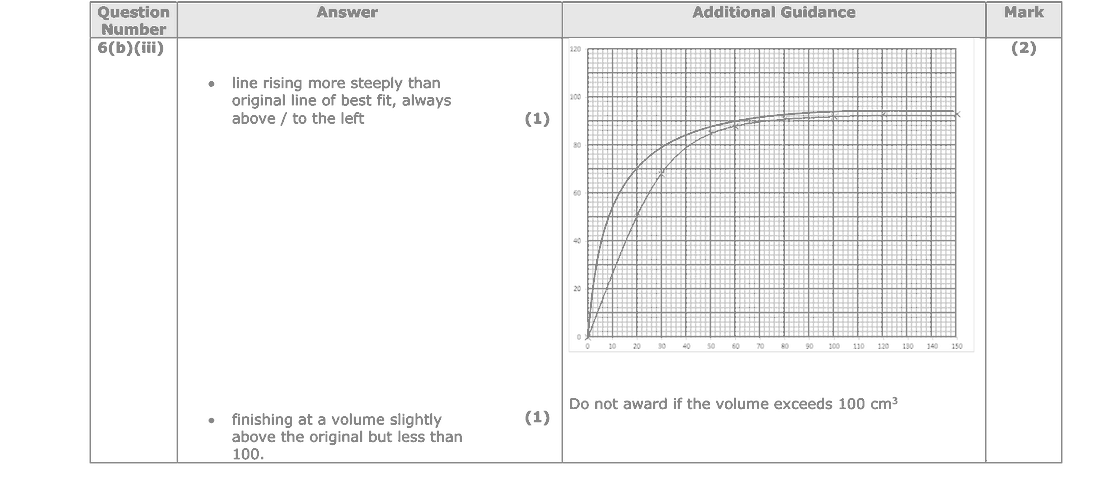
October 2020 · AS Paper 2 · Q6(b)(iii) 2 marks Diagram or structure kinetics i
Earlier parts of question 6 that this part usesEarlier part of October 2020 Paper 2 question 6Earlier part of October 2020 Paper 2 question 6Earlier part of October 2020 Paper 2 question 6
The experiment was repeated on a different day when the laboratory was
20 °C warmer.  The volume of oxygen was recorded for the same total time
of 150 s.
Draw the line that you would expect to obtain in this experiment.  Assume the
pressure in the laboratory is the same.  No calculation is required.
120
100
80
Volume
60
/ cm3
40
20
0
0
10
20
30
40
50
60
70
80
90
100
110
120
130
140
150
Time / s
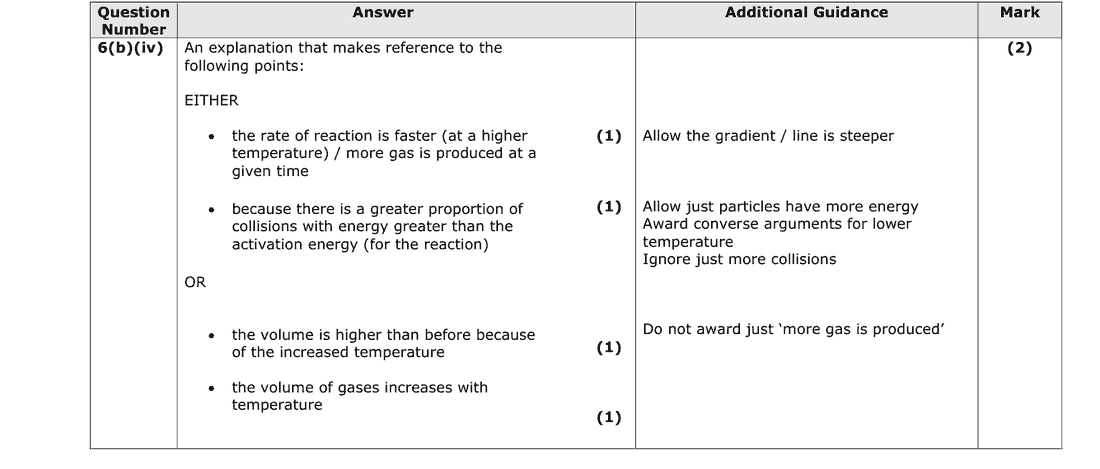
October 2020 · AS Paper 2 · Q6(b)(iv) 2 marks Explanation kinetics i
Earlier parts of question 6 that this part usesEarlier part of October 2020 Paper 2 question 6Earlier part of October 2020 Paper 2 question 6
Explain, using collision theory, any differences between the line you have
drawn and the original line of best fit.
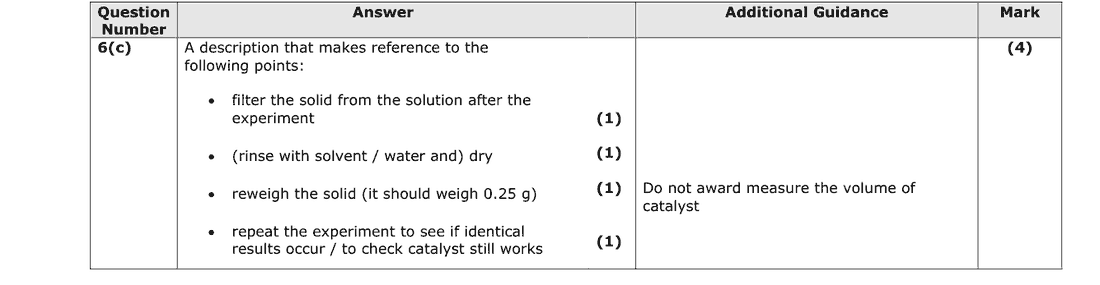
October 2020 · AS Paper 2 · Q6(c) 4 marks Practical and data analysis kinetics i
Earlier part of question 6 that this part usesEarlier part of October 2020 Paper 2 question 6
Catalysts are not used up during a reaction.  Manganese(IV) oxide acts as a
heterogeneous catalyst.
Describe in outline a method to show that the manganese(IV) oxide is not used up
in the decomposition of hydrogen peroxide and that it still functions as a catalyst.
October 2020 · AS Paper 2 · Q7(a)(i) 1 mark Practical and data analysis halogenoalkanesbonding
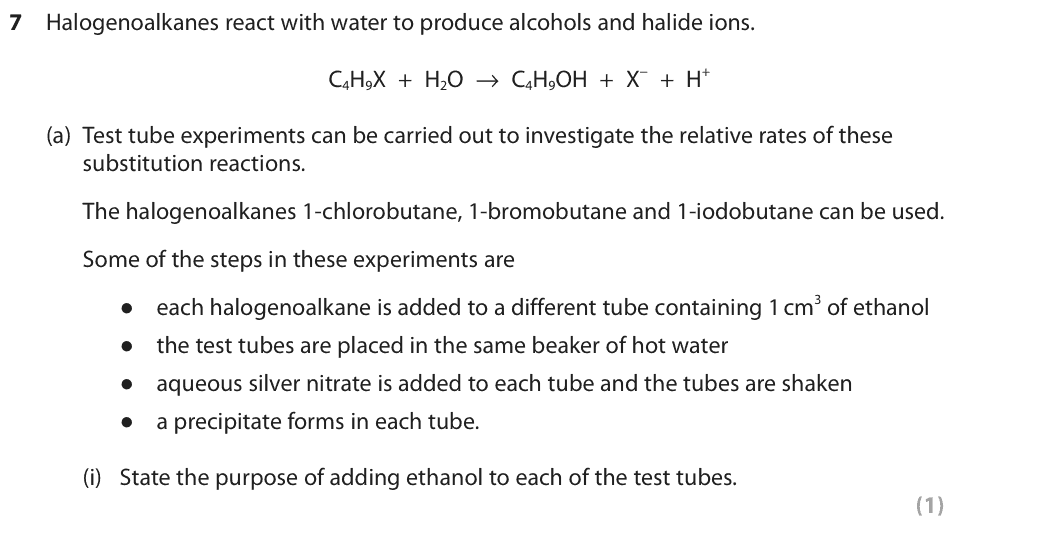
Halogenoalkanes react with water to produce alcohols and halide ions.
C4H9X  +  H2O  →  C4H9OH  +  X−  +  H+
Test tube experiments can be carried out to investigate the relative rates of these
substitution reactions.
The halogenoalkanes 1‑chlorobutane, 1‑bromobutane and 1‑iodobutane can be used.
Some of the steps in these experiments are
●  each halogenoalkane is added to a different tube containing 1 cm3 of ethanol
●  the test tubes are placed in the same beaker of hot water
●  aqueous silver nitrate is added to each tube and the tubes are shaken
●  a precipitate forms in each tube.
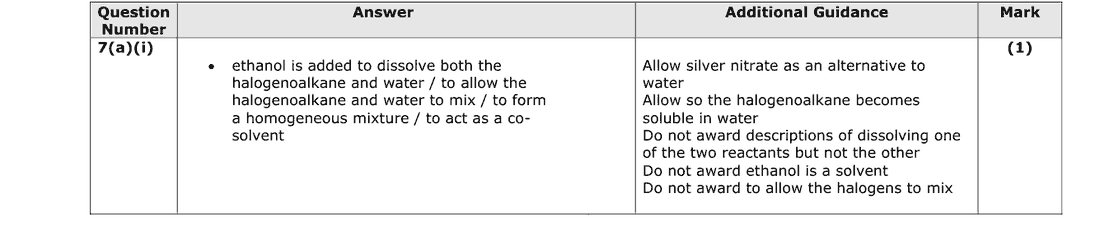
State the purpose of adding ethanol to each of the test tubes.
October 2020 · AS Paper 2 · Q7(a)(ii) 1 mark Practical and data analysis halogenoalkanes
Earlier part of question 7 that this part usesEarlier part of October 2020 Paper 2 question 7
Give one reason why the test tubes were put in the same beaker of hot water.
October 2020 · AS Paper 2 · Q7(a)(iii) 1 mark Practical and data analysis halogenoalkanes
Earlier part of question 7 that this part usesEarlier part of October 2020 Paper 2 question 7
Give one reason why the test tubes were shaken after the addition of
aqueous silver nitrate.
October 2020 · AS Paper 2 · Q7(b)(i) 1 mark Practical and data analysis halogenoalkanesgroup 7 the halogens
Earlier parts of question 7 that this part usesEarlier part of October 2020 Paper 2 question 7Earlier part of October 2020 Paper 2 question 7Earlier part of October 2020 Paper 2 question 7
State how the halogen atom present in each halogenoalkane can be
identified using observations from this experiment in (a).
October 2020 · AS Paper 2 · Q7(b)(ii) 2 marks Practical and data analysis group 7 the halogens
Earlier parts of question 7 that this part usesEarlier part of October 2020 Paper 2 question 7Earlier part of October 2020 Paper 2 question 7
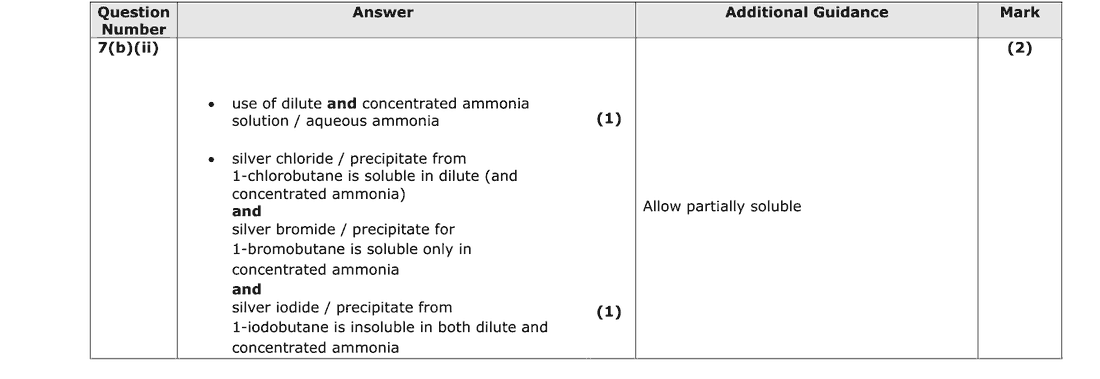
Identify further reagents that can be added, including relevant observations,
to confirm the identity of the halogen atom present in each halogenoalkane.
October 2020 · AS Paper 2 · Q7(c) 6 marks 6-mark extended response Hard halogenoalkanes
Earlier parts of question 7 that this part usesEarlier part of October 2020 Paper 2 question 7Earlier part of October 2020 Paper 2 question 7Earlier part of October 2020 Paper 2 question 7
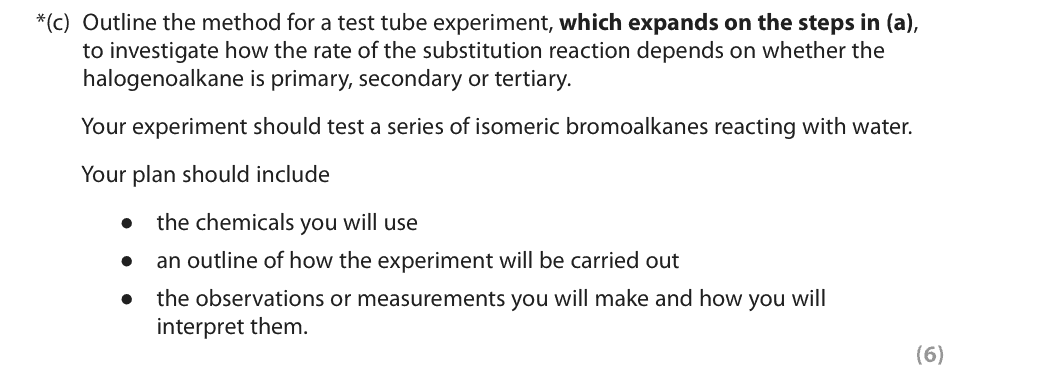
Outline the method for a test tube experiment, which expands on the steps in (a),
to investigate how the rate of the substitution reaction depends on whether the
halogenoalkane is primary, secondary or tertiary.
Your experiment should test a series of isomeric bromoalkanes reacting with water.
Your plan should include
●  the chemicals you will use
●  an outline of how the experiment will be carried out
●  the observations or measurements you will make and how you will
interpret them.

Work with an A-level chemistry tutor

Want a paper marked and gone through with you? Message us.

Prefer email? Send an enquiry

If you are under 18, please include a parent's contact details. Enquiries go to enquiries@chemistryaleveltutor.com and are deleted once handled. All tutoring is online.