November 2021: Paper 1, Advanced Inorganic and Physical Chemistry

90 marks · 46 question parts · Paper, mark scheme and report on Edexcel's site · An autumn series, sat in place of the cancelled summer exams · Have the Data Booklet beside you

Question by question

QTopicMarksAOType
1(a) Atomic structure and the Periodic Table 1Multiple choice
1(b) Atomic structure and the Periodic Table 1Multiple choice
1(c) Atomic structure and the Periodic Table 2Calculation
2(a) The elements of Groups 1 and 2 1Multiple choice
2(b) The elements of Groups 1 and 2 1Multiple choice
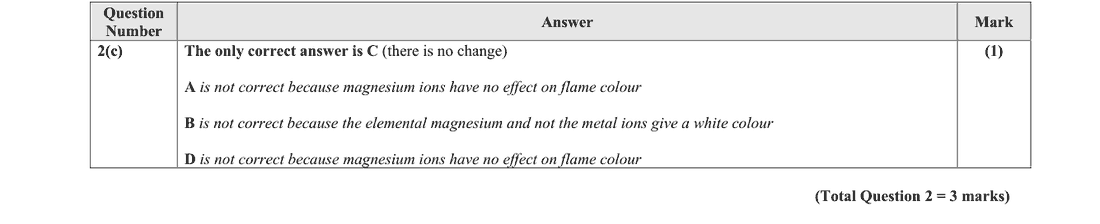
2(c) The elements of Groups 1 and 2 1Multiple choice
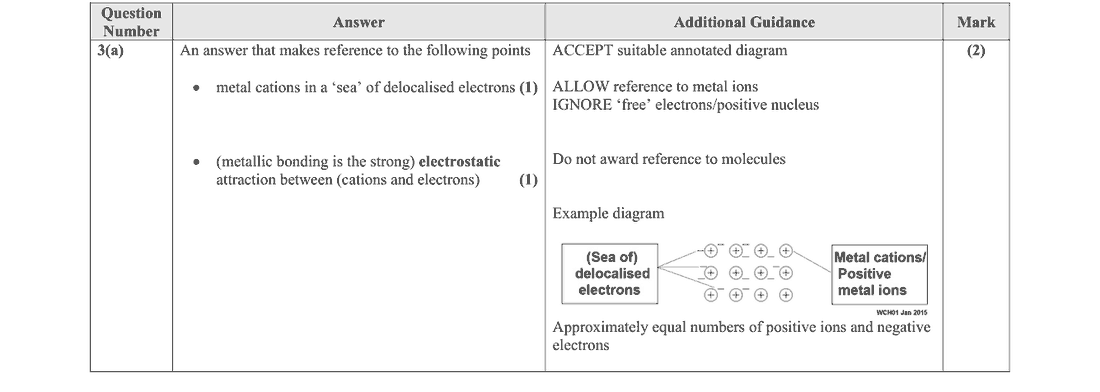
3(a) Bonding 2Short answer
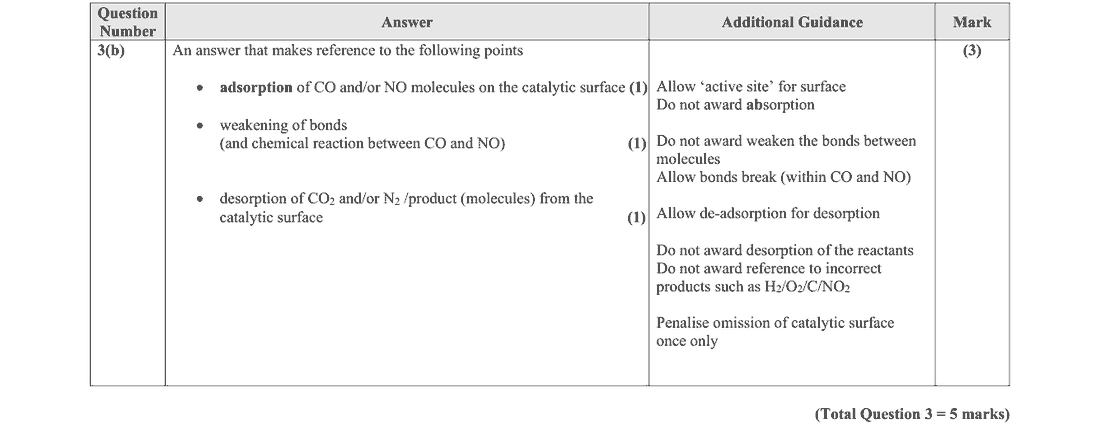
3(b) Transition metals: reactions 3Short answer
4(a) Atomic structure and the Periodic Table 2Short answer
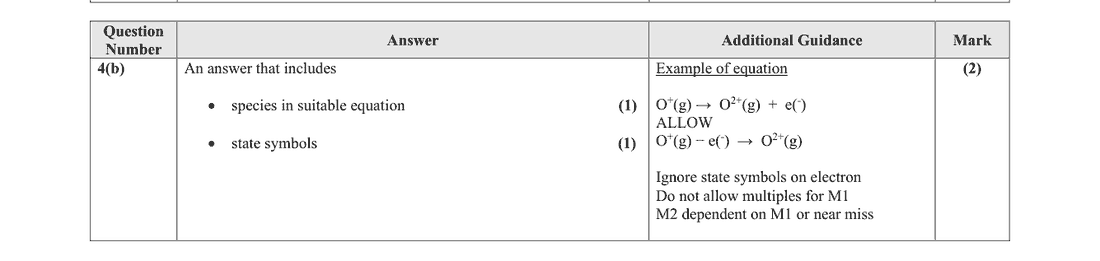
4(b) Atomic structure and the Periodic Table 2Equation writing
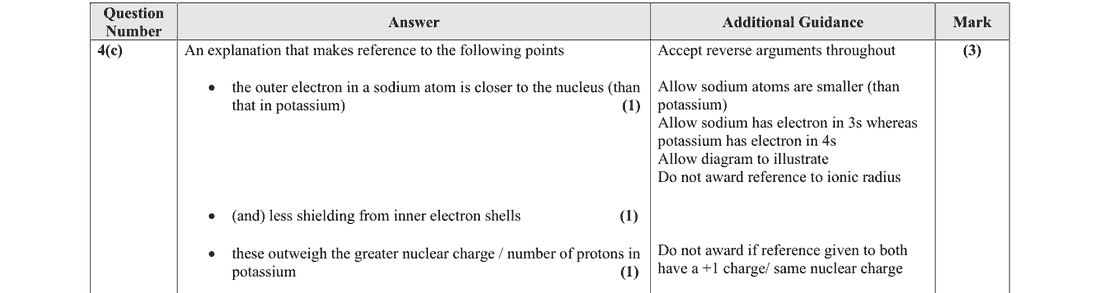
4(c) Atomic structure and the Periodic Table 3Explanation
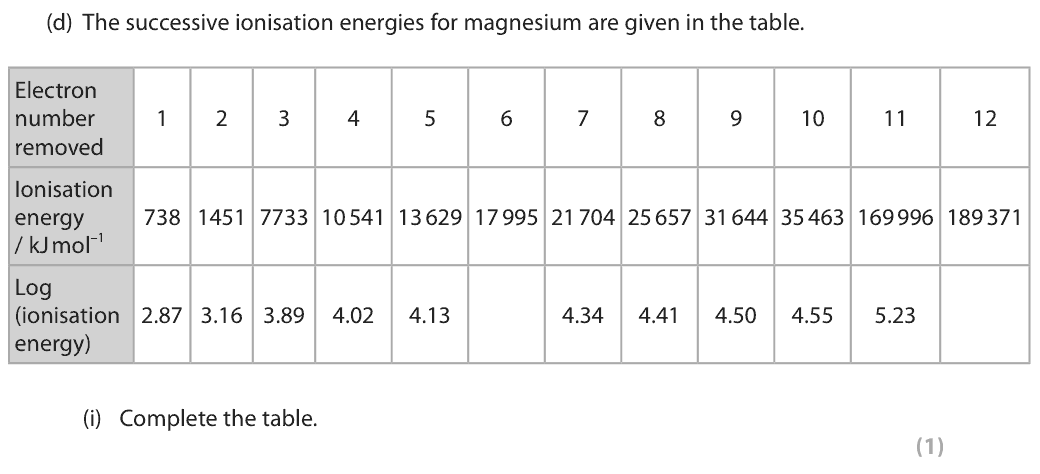
4(d)(i) Atomic structure and the Periodic Table 1Calculation
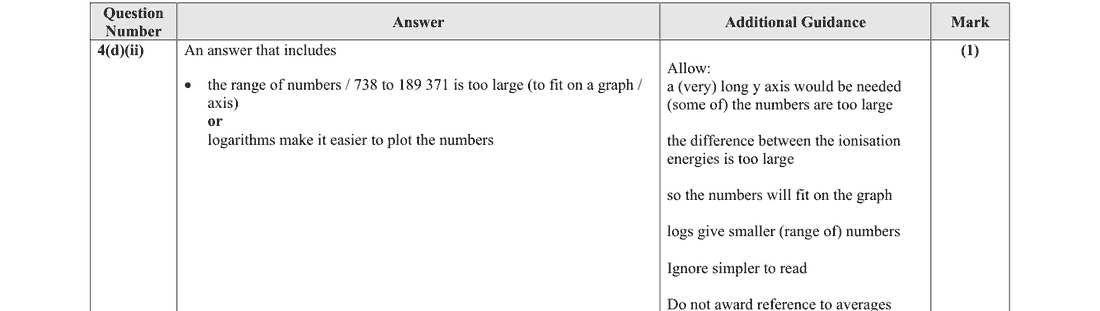
4(d)(ii) Atomic structure and the Periodic Table 1Short answer
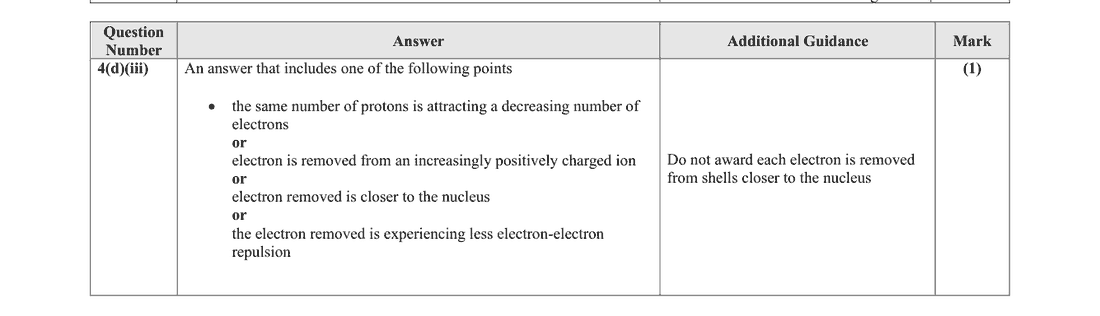
4(d)(iii) Atomic structure and the Periodic Table 1Short answer
4(d)(iv) Atomic structure and the Periodic Table 3Diagram or structure
4(d)(v) Atomic structure and the Periodic Table 1Short answer
4(e) Atomic structure and the Periodic Table 1Short answer
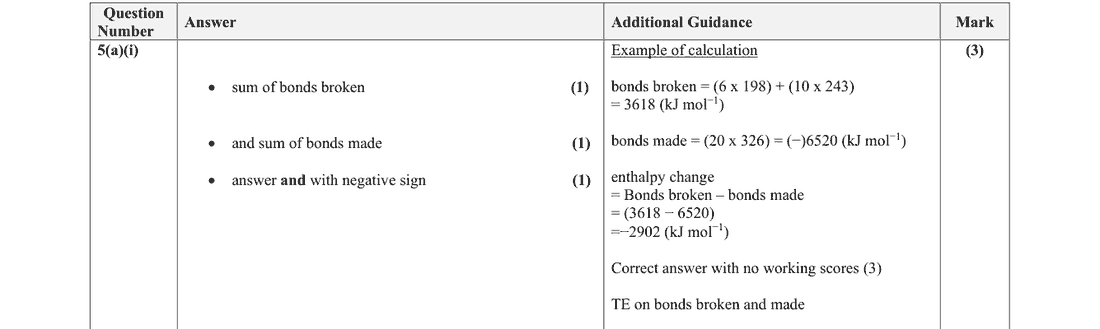
5(a)(i) Energetics I 3Calculation
5(a)(ii) Energetics I 1Short answer
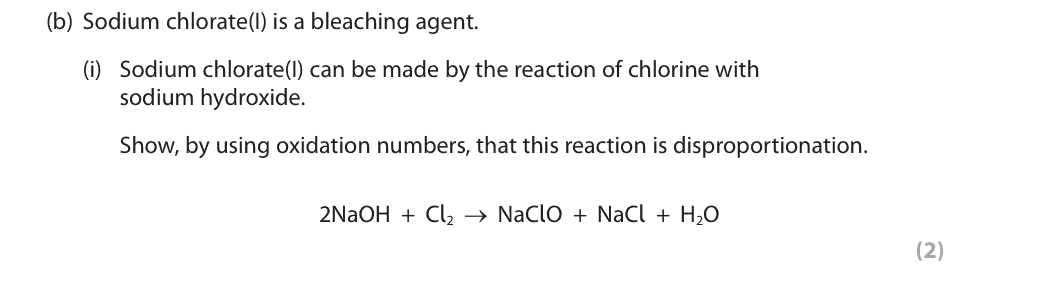
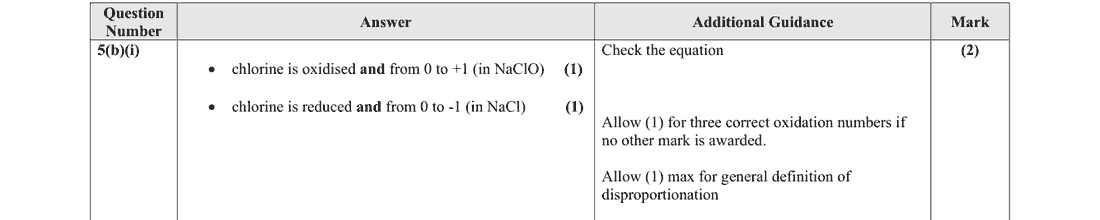
5(b)(i) Redox I 2Explanation
5(b)(ii) The elements of Group 7 (halogens) 1Equation writing
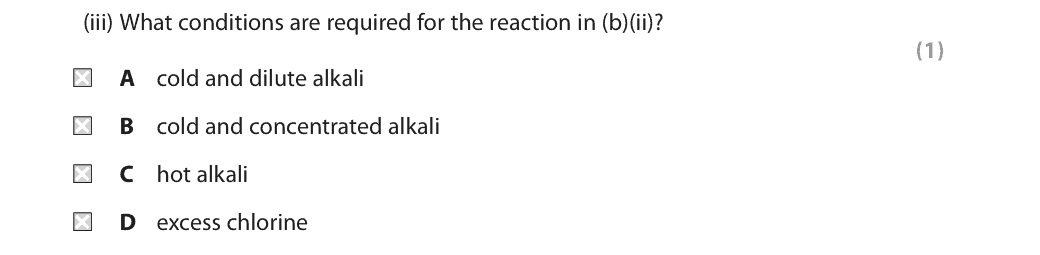
5(b)(iii) The elements of Group 7 (halogens) 1Multiple choice
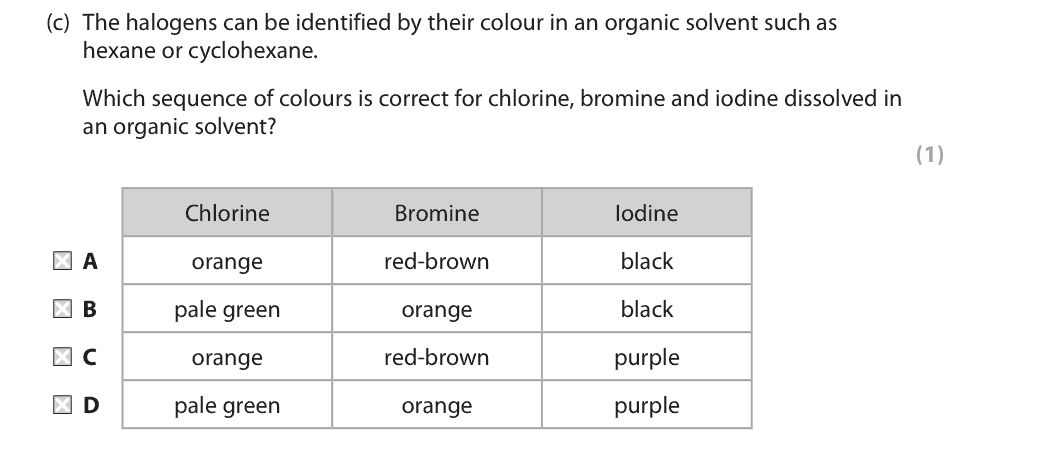
5(c) The elements of Group 7 (halogens) 1Multiple choice
5(d)(i) The elements of Group 7 (halogens), Formulae, equations and amounts of substance 2Equation writing
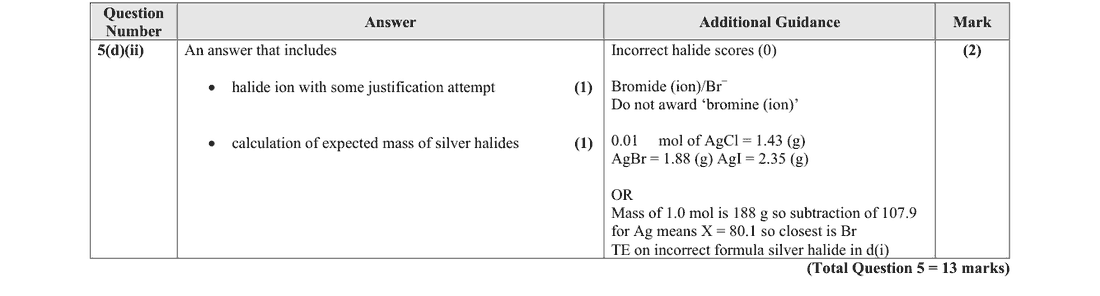
5(d)(ii) The elements of Group 7 (halogens), Formulae, equations and amounts of substance 2Calculation
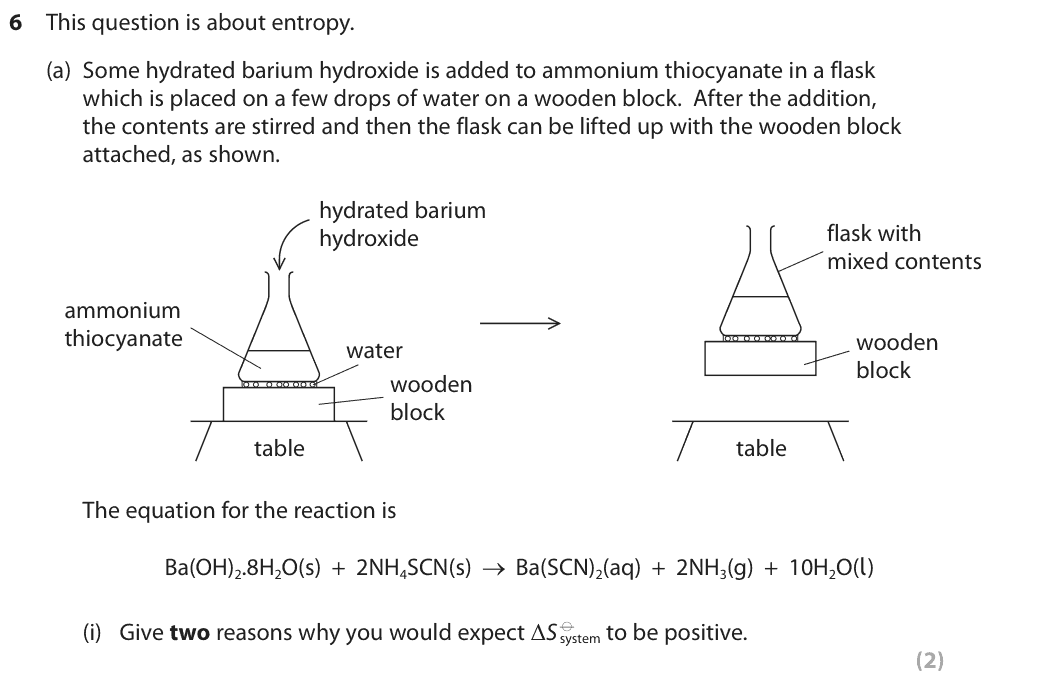
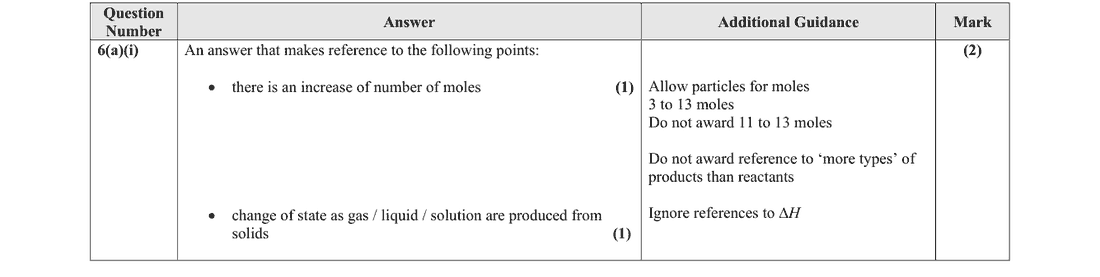
6(a)(i) Energetics II: entropy 2Short answer
6(a)(ii) Energetics II: entropy 2Explanation
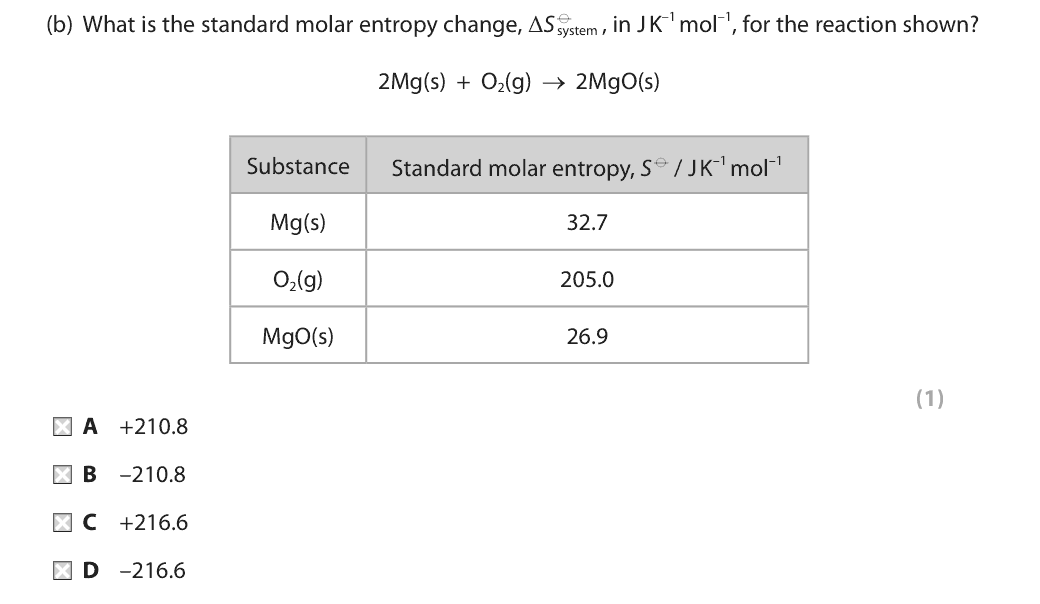
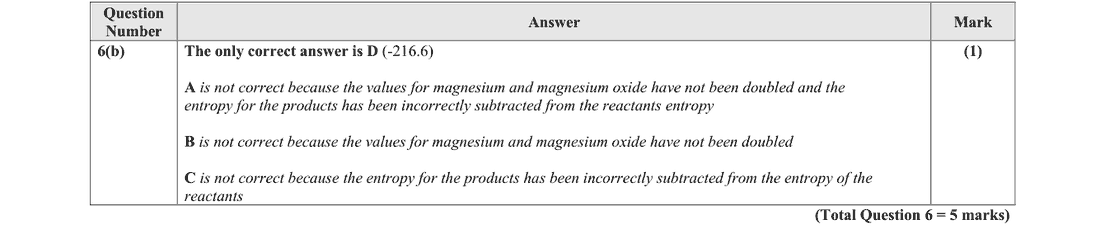
6(b) Energetics II: entropy 1Multiple choice
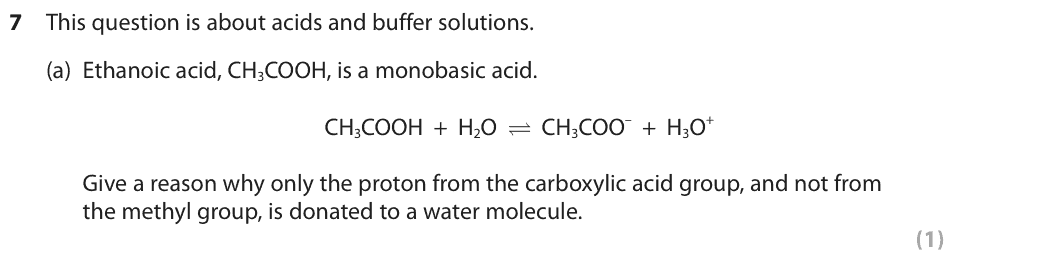
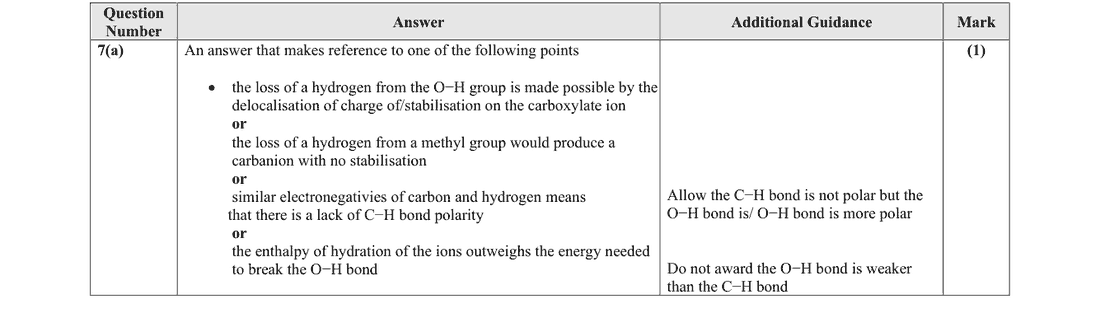
7(a) Acid-base equilibria, Bonding 1Short answer
7(b) Acid-base equilibria 1Multiple choice
7(c) Acid-base equilibria 2Calculation
7(d)(i) Acid-base equilibria 3Calculation
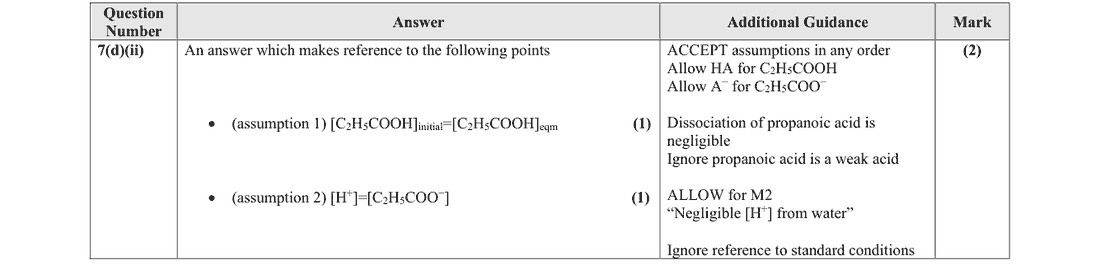
7(d)(ii) Acid-base equilibria 2Short answer
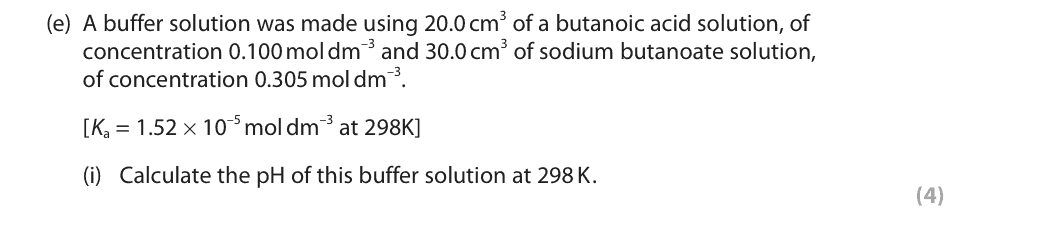
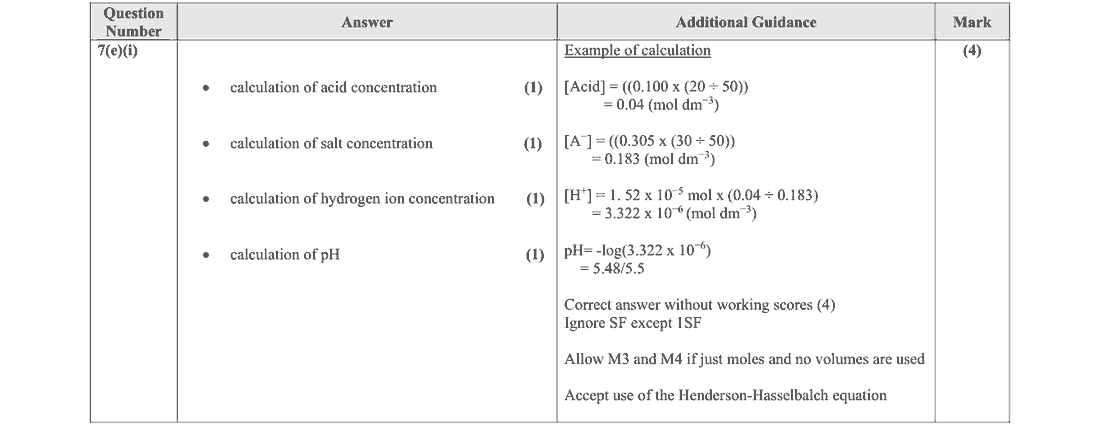
7(e)(i) Acid-base equilibria 4Calculation
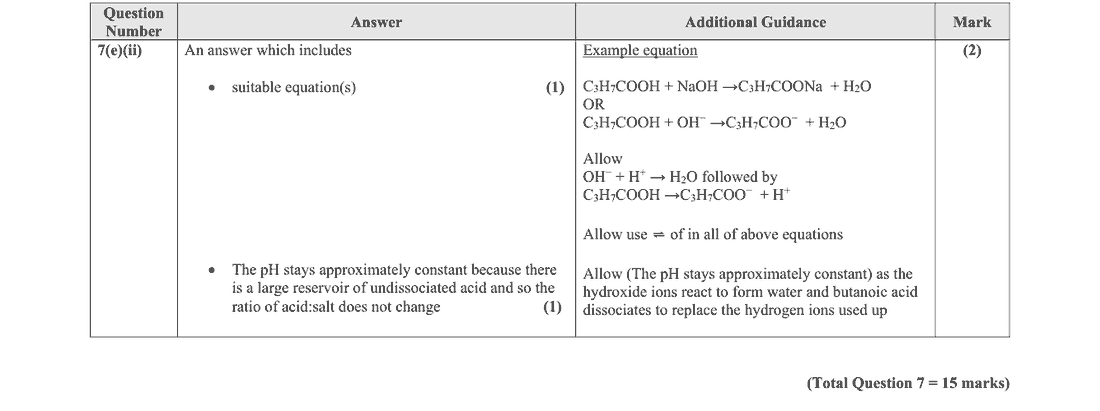
7(e)(ii) Acid-base equilibria 2Explanation
8(a)(i) Transition metals: principles 1Short answer
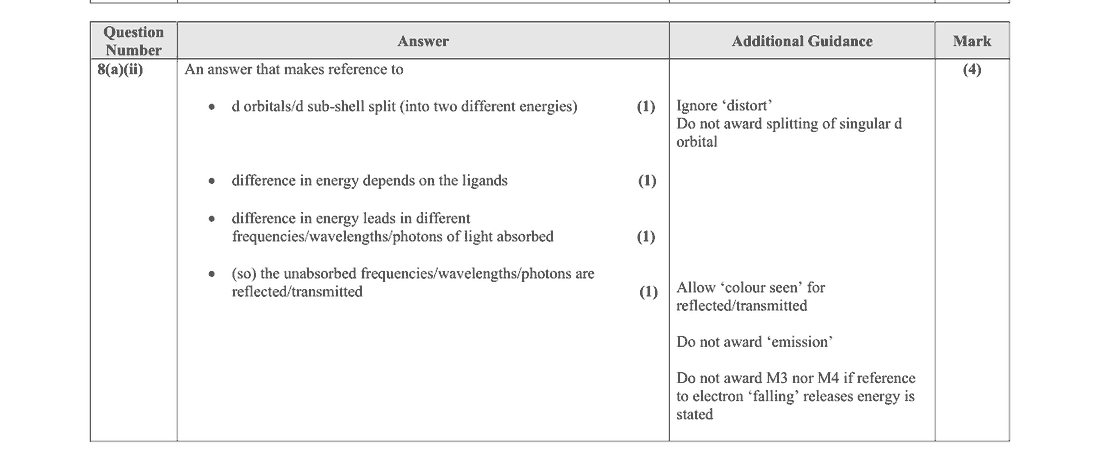
8(a)(ii) Transition metals: principles 4Explanation
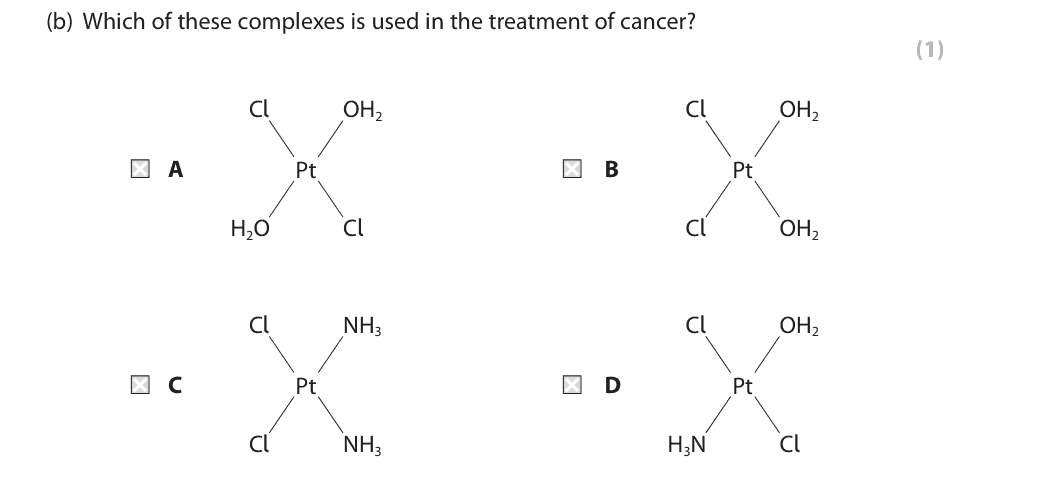
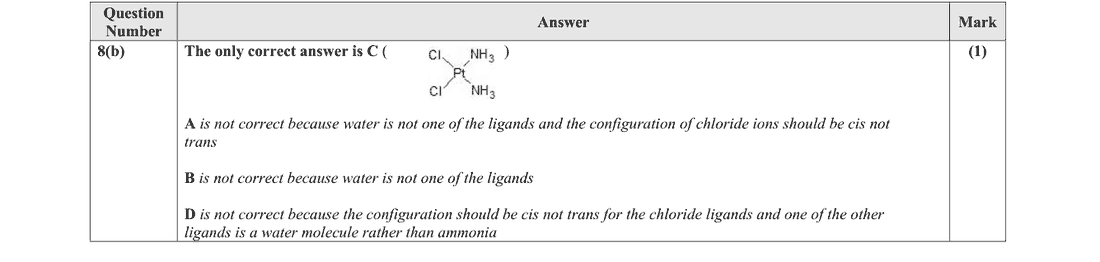
8(b) Transition metals: principles 1Multiple choice
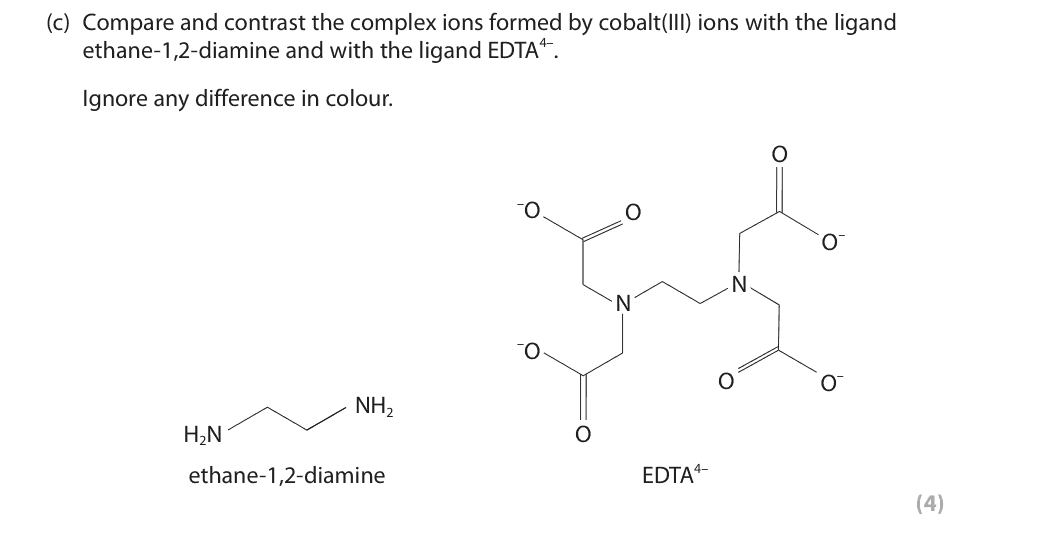
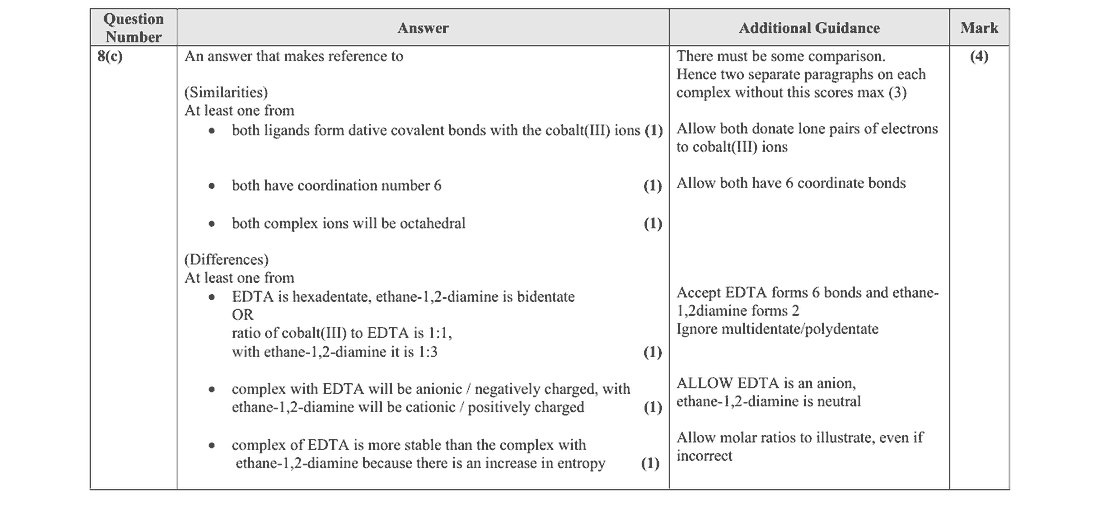
8(c) Transition metals: principles, Transition metals: reactions 4Explanation
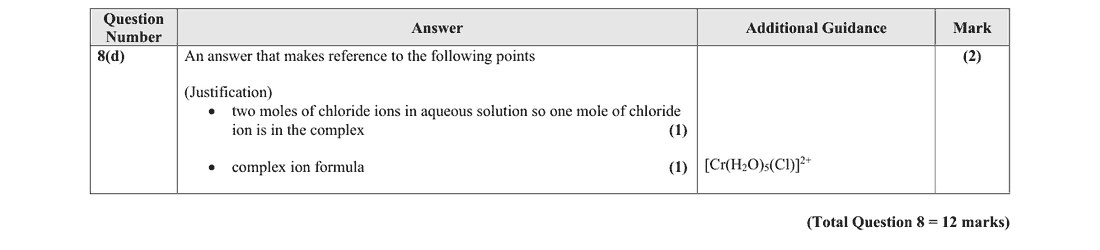
8(d) Transition metals: principles, Formulae, equations and amounts of substance 2Short answer
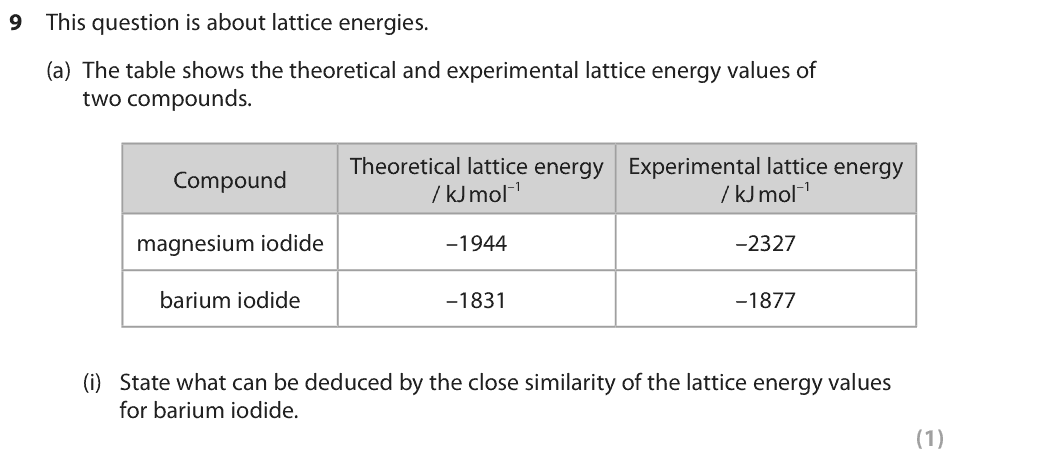
9(a)(i) Energetics II: lattice energy 1Short answer
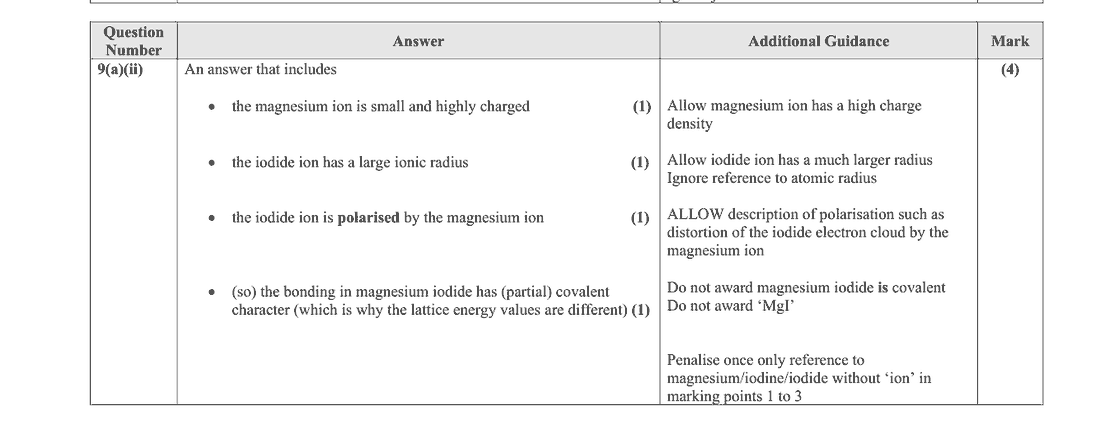
9(a)(ii) Energetics II: lattice energy 4Explanation
9(b)(i) Energetics II: lattice energy 4Diagram or structure
9(b)(ii) Energetics II: lattice energy 1Calculation
9(c) Energetics II: lattice energy 2Calculation
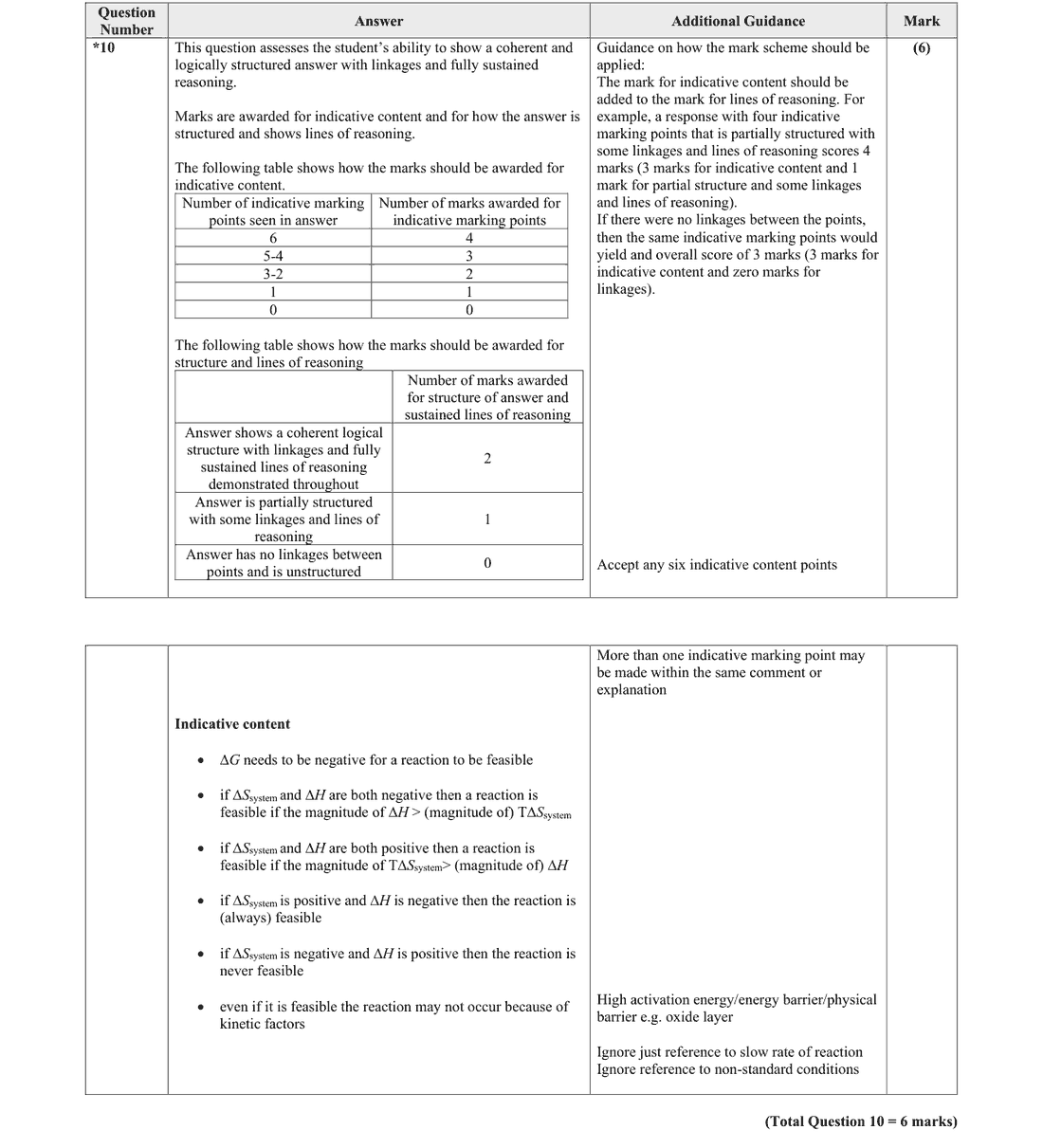
10 Energetics II: entropy 6Extended response

The questions

1(a)1(b)1(c)2(a)2(b)2(c)3(a)3(b)4(a)4(b)4(c)4(d)(i)4(d)(ii)4(d)(iii)4(d)(iv)4(d)(v)4(e)5(a)(i)5(a)(ii)5(b)(i)5(b)(ii)5(b)(iii)5(c)5(d)(i)5(d)(ii)6(a)(i)6(a)(ii)6(b)7(a)7(b)7(c)7(d)(i)7(d)(ii)7(e)(i)7(e)(ii)8(a)(i)8(a)(ii)8(b)8(c)8(d)9(a)(i)9(a)(ii)9(b)(i)9(b)(ii)9(c)10
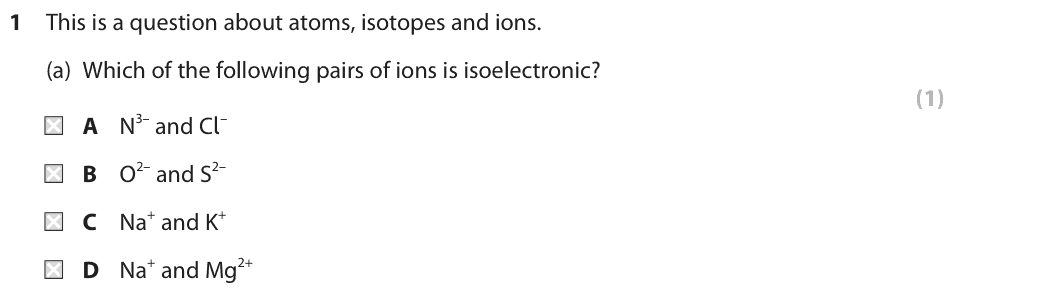
November 2021 · Paper 1 · Q1(a) 1 mark Multiple choice atomic structure and the periodic table
This is a question about atoms, isotopes and ions.
Which of the following pairs of ions is isoelectronic?
A  N3– and Cl–
B  O2– and S2–
C  Na+ and K+
D  Na+ and Mg2+
November 2021 · Paper 1 · Q1(b) 1 mark Multiple choice atomic structure and the periodic table
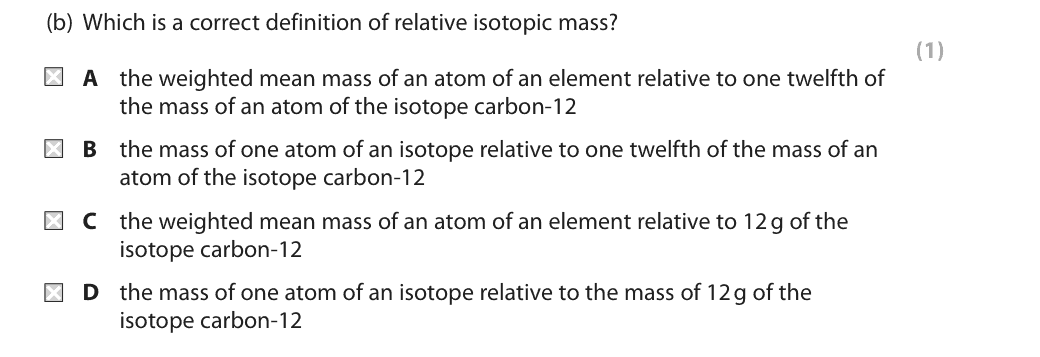
Which is a correct definition of relative isotopic mass?
A  the weighted mean mass of an atom of an element relative to one twelfth of
the mass of an atom of the isotope carbon‑12
B  the mass of one atom of an isotope relative to one twelfth of the mass of an
atom of the isotope carbon‑12
C  the weighted mean mass of an atom of an element relative to 12 g of the
isotope carbon‑12
D  the mass of one atom of an isotope relative to the mass of 12 g of the
isotope carbon‑12
November 2021 · Paper 1 · Q1(c) 2 marks Calculation atomic structure and the periodic table
Earlier part of question 1 that this part usesEarlier part of November 2021 Paper 1 question 1
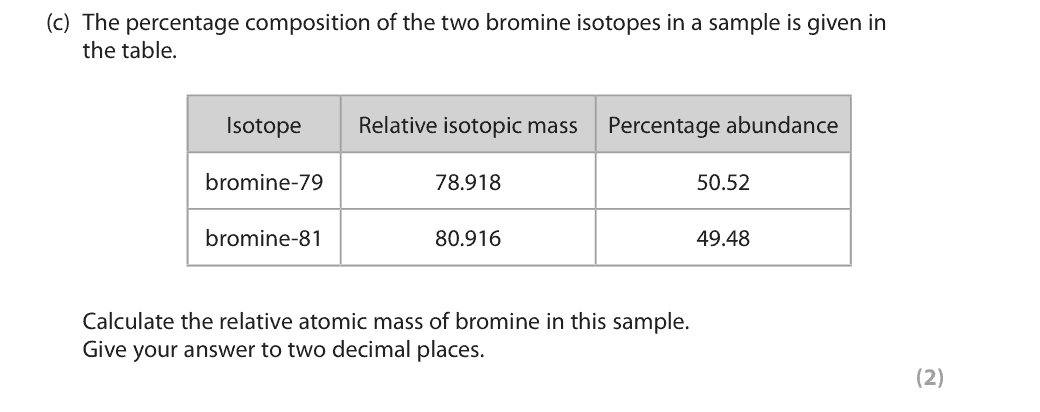
The percentage composition of the two bromine isotopes in a sample is given in
the table.
Isotope
Relative isotopic mass
Percentage abundance
bromine-79
78.918
50.52
bromine-81
80.916
49.48
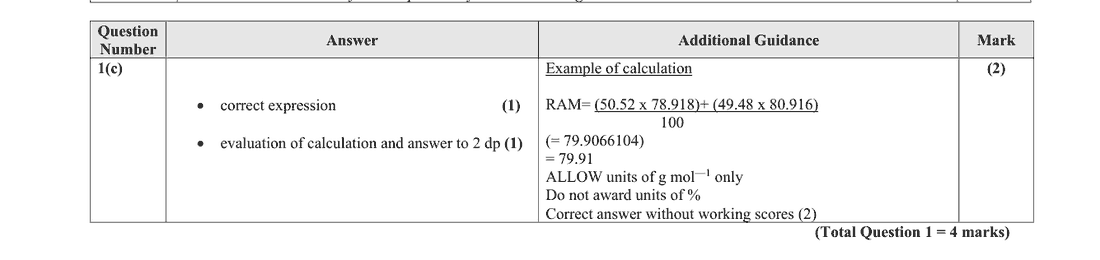
Calculate the relative atomic mass of bromine in this sample.
Give your answer to two decimal places.
November 2021 · Paper 1 · Q2(a) 1 mark Multiple choice groups 1 and 2
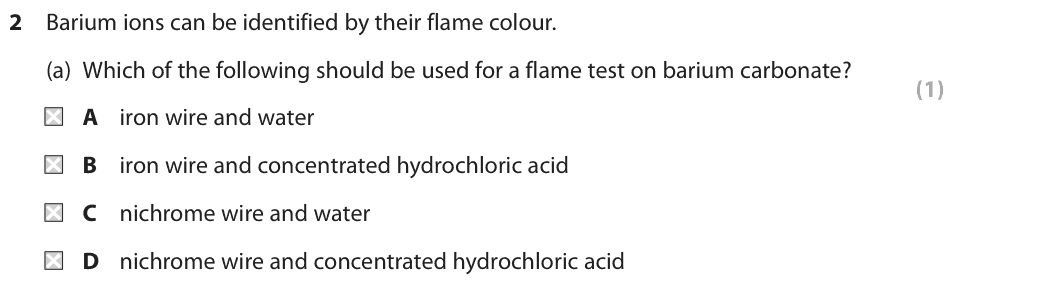
Barium ions can be identified by their flame colour.
Which of the following should be used for a flame test on barium carbonate?
A  iron wire and water
B  iron wire and concentrated hydrochloric acid
C  nichrome wire and water
D  nichrome wire and concentrated hydrochloric acid
November 2021 · Paper 1 · Q2(b) 1 mark Multiple choice groups 1 and 2
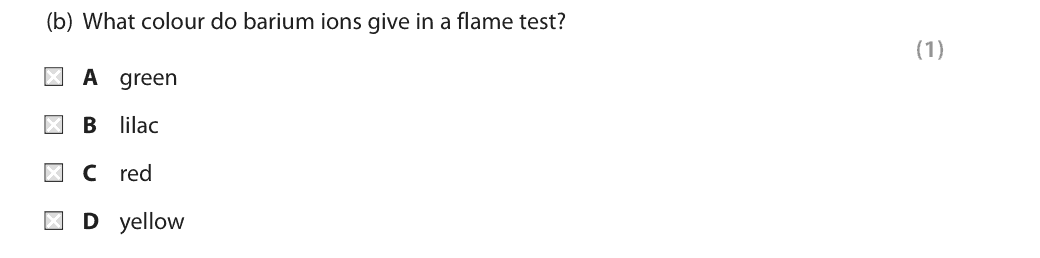
What colour do barium ions give in a flame test?
A  green
B  lilac
C  red
D  yellow
November 2021 · Paper 1 · Q2(c) 1 mark Multiple choice groups 1 and 2
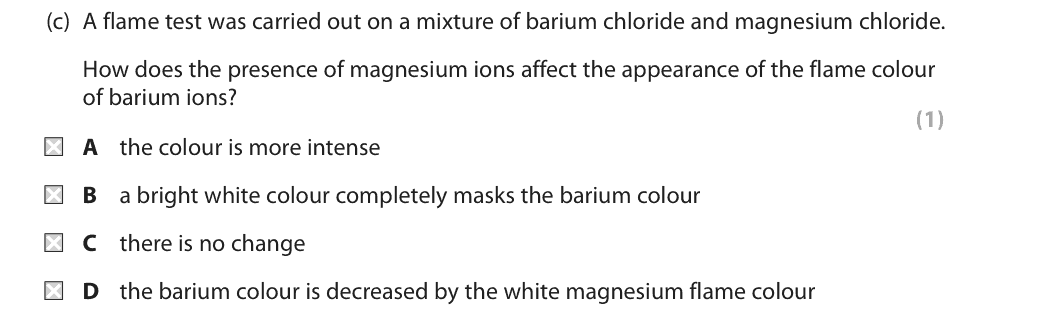
A flame test was carried out on a mixture of barium chloride and magnesium chloride.
How does the presence of magnesium ions affect the appearance of the flame colour
of barium ions?
A  the colour is more intense
B  a bright white colour completely masks the barium colour
C  there is no change
D  the barium colour is decreased by the white magnesium flame colour
November 2021 · Paper 1 · Q3(a) 2 marks Short answer bonding
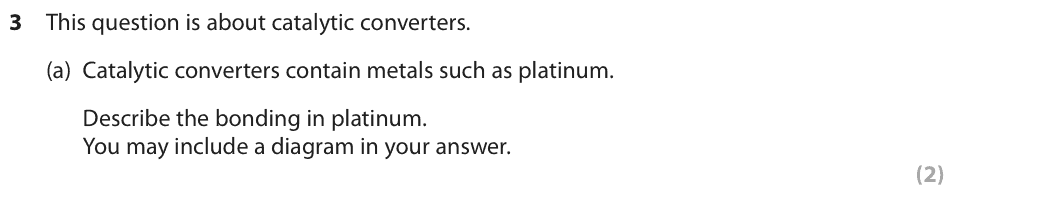
This question is about catalytic converters.
Catalytic converters contain metals such as platinum.
Describe the bonding in platinum.
You may include a diagram in your answer.
November 2021 · Paper 1 · Q3(b) 3 marks Short answer transition metals reactions
A catalytic converter decreases the emissions of gases, such as carbon monoxide
and nitrogen monoxide, from an internal combustion engine.
Describe the stages in a catalytic converter that result in this decrease.
No equations are required.
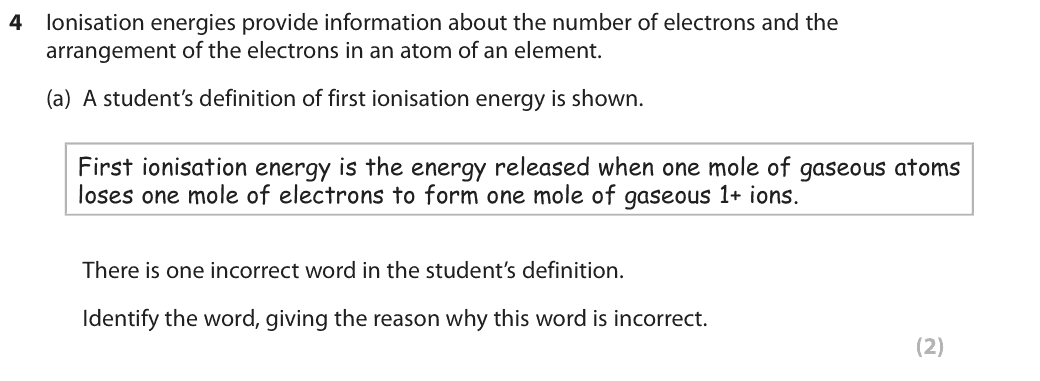
November 2021 · Paper 1 · Q4(a) 2 marks Short answer atomic structure and the periodic table
Ionisation energies provide information about the number of electrons and the
arrangement of the electrons in an atom of an element.
A student’s definition of first ionisation energy is shown.
First ionisation energy is the energy released when one mole of gaseous atoms
loses one mole of electrons to form one mole of gaseous 1+ ions.
There is one incorrect word in the student’s definition.
Identify the word, giving the reason why this word is incorrect.
November 2021 · Paper 1 · Q4(b) 2 marks Equation writing atomic structure and the periodic table
Earlier part of question 4 that this part usesEarlier part of November 2021 Paper 1 question 4
Write an equation for the second ionisation energy of oxygen.
Include state symbols.
November 2021 · Paper 1 · Q4(c) 3 marks Explanation atomic structure and the periodic table
Earlier part of question 4 that this part usesEarlier part of November 2021 Paper 1 question 4
A sodium atom has 11 protons whereas a potassium atom has 19 protons.
Explain why the first ionisation energy of sodium is greater than that of potassium.
November 2021 · Paper 1 · Q4(d)(i) 1 mark Calculation atomic structure and the periodic table
Earlier part of question 4 that this part usesEarlier part of November 2021 Paper 1 question 4
The successive ionisation energies for magnesium are given in the table.
Electron
number
1
2
3
4
5
6
7
8
9
10
11
12
removed
Ionisation
energy
738 1451 7733 10 541 13 629 17 995 21 704 25 657 31 644 35 463 169 996 189 371
/ kJ mol–1
Log
(ionisation
2.87 3.16
3.89
4.02
4.13
4.34
4.41
4.50
4.55
5.23
energy)
Complete the table.
November 2021 · Paper 1 · Q4(d)(ii) 1 mark Short answer atomic structure and the periodic table
Earlier parts of question 4 that this part usesEarlier part of November 2021 Paper 1 question 4Earlier part of November 2021 Paper 1 question 4
Give a reason why the logarithm of the ionisation energy, rather than just the
ionisation energy, is used to plot a graph.
November 2021 · Paper 1 · Q4(d)(iii) 1 mark Short answer atomic structure and the periodic table
Earlier parts of question 4 that this part usesEarlier part of November 2021 Paper 1 question 4Earlier part of November 2021 Paper 1 question 4
Give a reason why the successive ionisation energies increase.
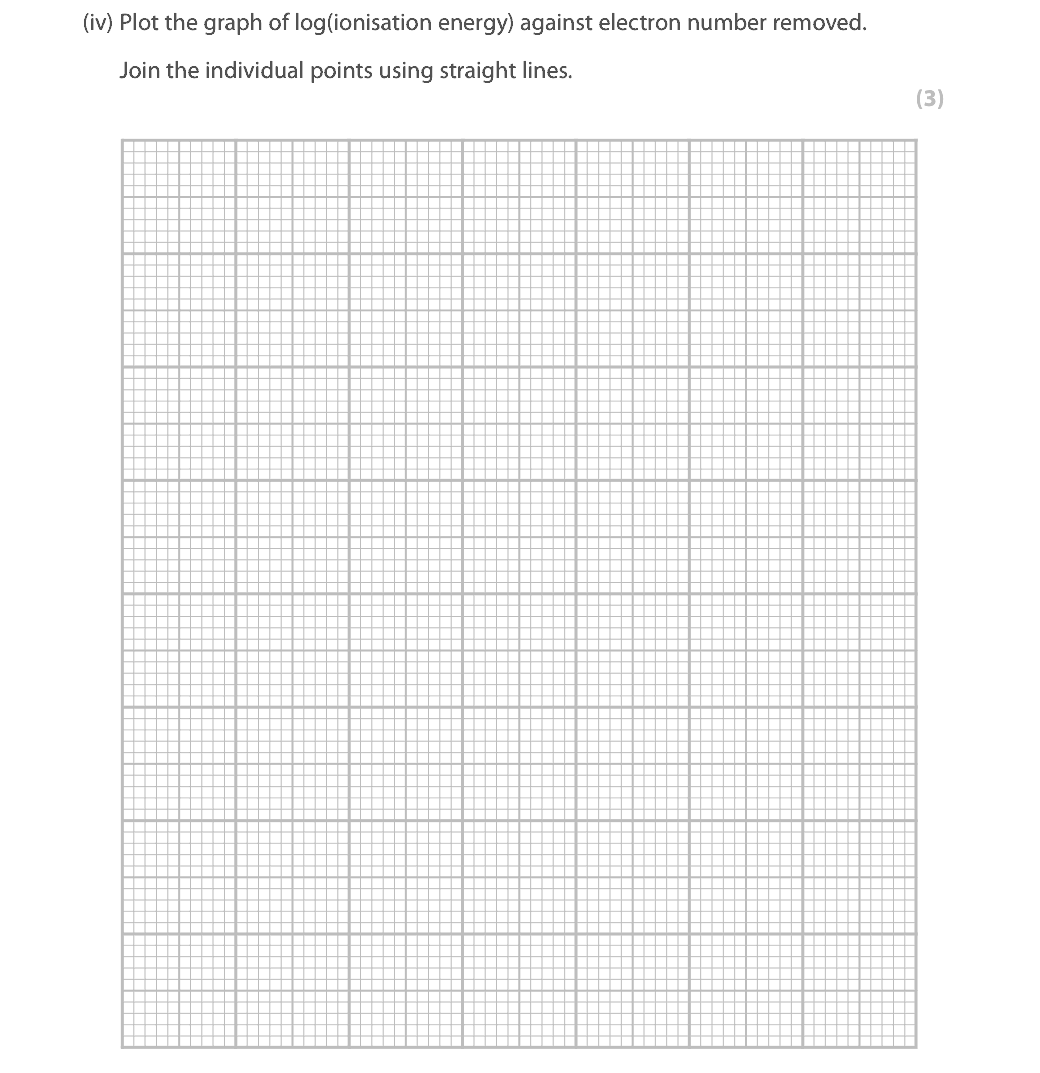
November 2021 · Paper 1 · Q4(d)(iv) 3 marks Diagram or structure atomic structure and the periodic table
Earlier parts of question 4 that this part usesEarlier part of November 2021 Paper 1 question 4Earlier part of November 2021 Paper 1 question 4Earlier part of November 2021 Paper 1 question 4Earlier part of November 2021 Paper 1 question 4
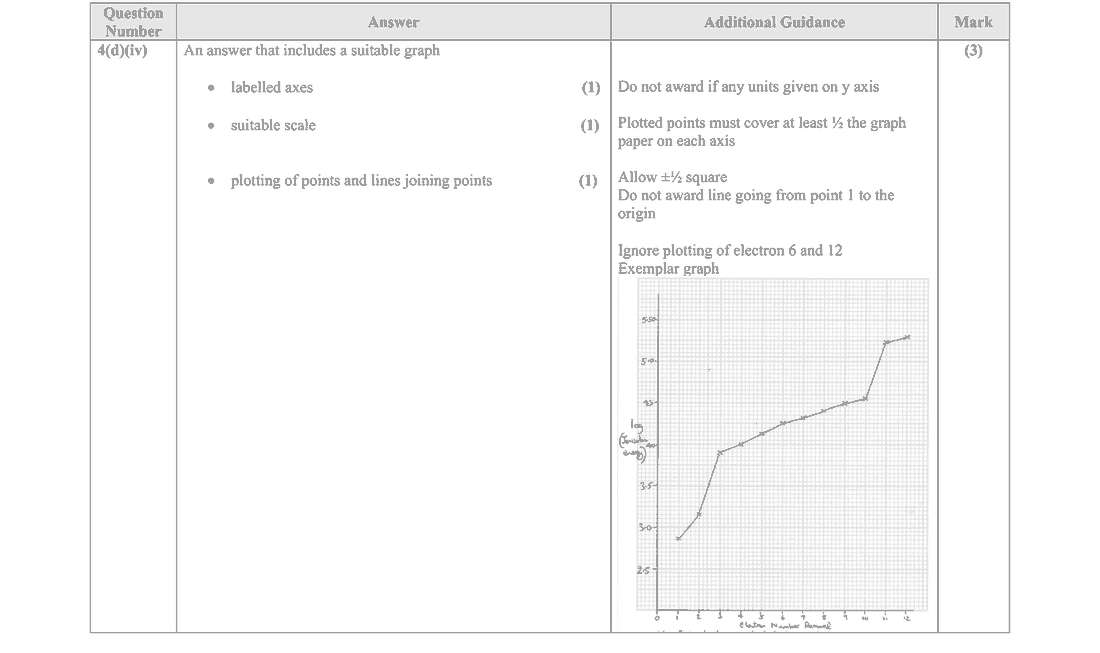
Plot the graph of log(ionisation energy) against electron number removed.
Join the individual points using straight lines.
November 2021 · Paper 1 · Q4(d)(v) 1 mark Short answer atomic structure and the periodic table
Earlier parts of question 4 that this part usesEarlier part of November 2021 Paper 1 question 4Earlier part of November 2021 Paper 1 question 4Earlier part of November 2021 Paper 1 question 4Earlier part of November 2021 Paper 1 question 4Earlier part of November 2021 Paper 1 question 4
Identify on the graph, using a circle, the points that represent the removal of
the electrons in the outermost energy level of magnesium.
November 2021 · Paper 1 · Q4(e) 1 mark Short answer Hard atomic structure and the periodic table
Earlier part of question 4 that this part usesEarlier part of November 2021 Paper 1 question 4
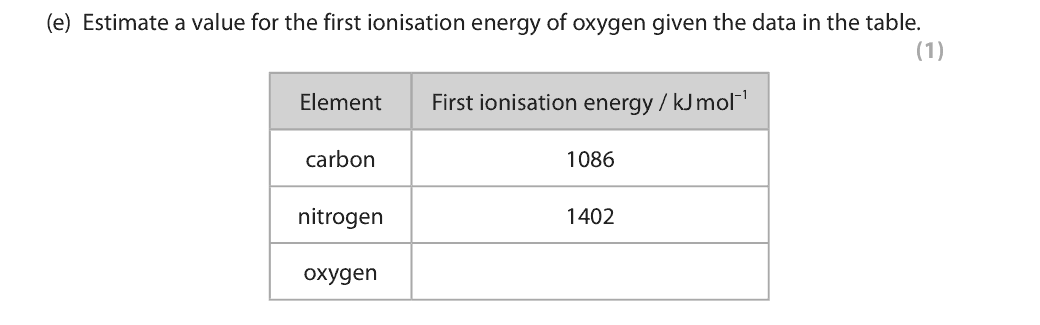
Estimate a value for the first ionisation energy of oxygen given the data in the table.
Element
First ionisation energy / kJ mol–1
carbon
1086
nitrogen
1402
oxygen
November 2021 · Paper 1 · Q5(a)(i) 3 marks Calculation energetics i
The halogens are elements in Group 7 of the Periodic Table.
Chlorine compounds have many uses, including water treatment.
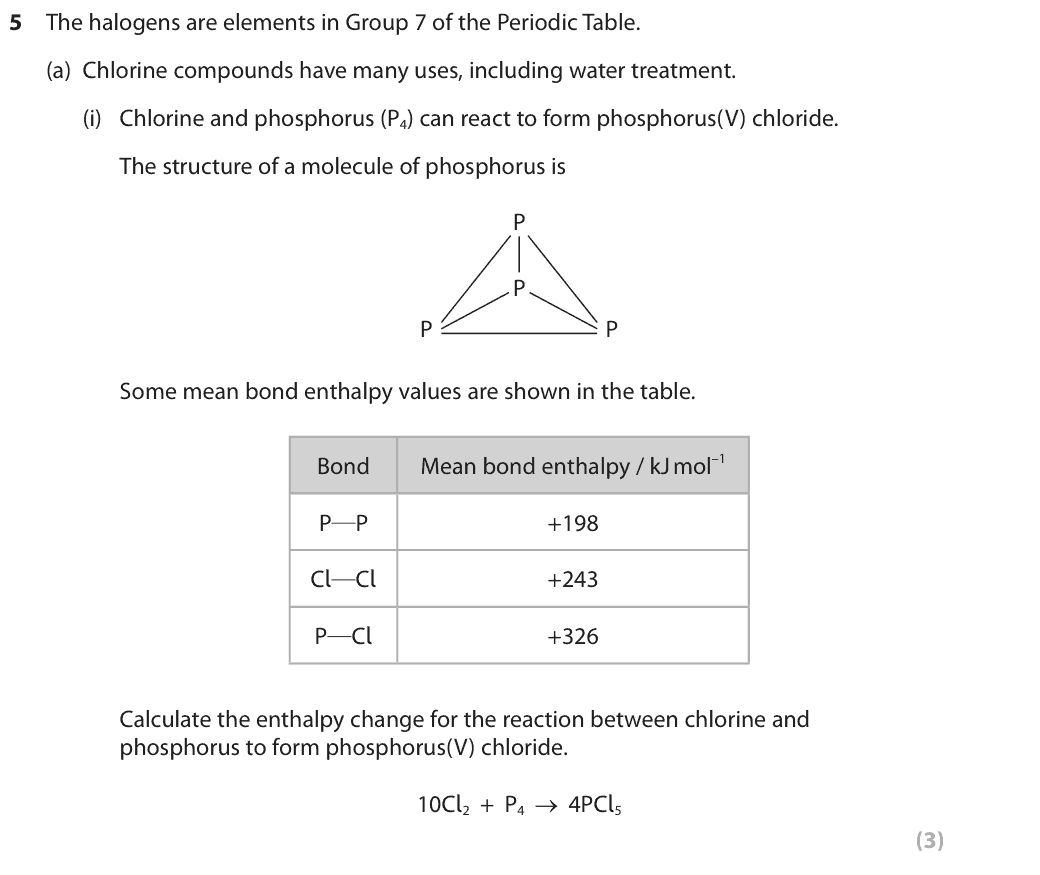
Chlorine and phosphorus (P4) can react to form phosphorus(V) chloride.
The structure of a molecule of phosphorus is
P
P
P
P
Some mean bond enthalpy values are shown in the table.
Bond
Mean bond enthalpy / kJ mol–1
P
P
+198
Cl
Cl
+243
P
Cl
+326
Calculate the enthalpy change for the reaction between chlorine and
phosphorus to form phosphorus(V) chloride.
10Cl2  +  P4  →  4PCl5
November 2021 · Paper 1 · Q5(a)(ii) 1 mark Short answer energetics i
Earlier part of question 5 that this part usesEarlier part of November 2021 Paper 1 question 5
Give a reason why bond enthalpy values are always positive.
November 2021 · Paper 1 · Q5(b)(i) 2 marks Explanation Easy redox i
Earlier part of question 5 that this part usesEarlier part of November 2021 Paper 1 question 5
Sodium chlorate(I) is a bleaching agent.
Sodium chlorate(I) can be made by the reaction of chlorine with
sodium hydroxide.
Show, by using oxidation numbers, that this reaction is disproportionation.
2NaOH  +  Cl2  →  NaClO  +  NaCl  +  H2O
November 2021 · Paper 1 · Q5(b)(ii) 1 mark Equation writing Easy group 7 the halogens
Earlier parts of question 5 that this part usesEarlier part of November 2021 Paper 1 question 5Earlier part of November 2021 Paper 1 question 5
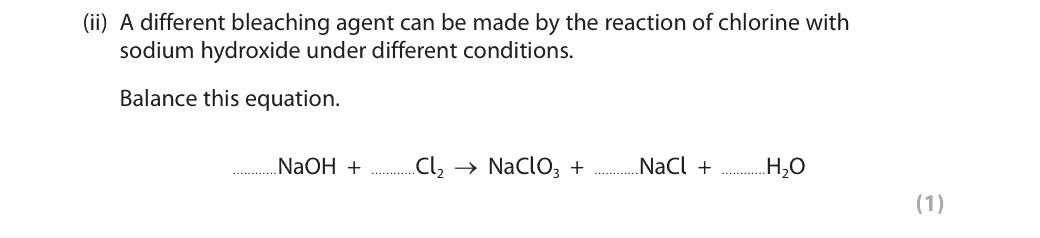
A different bleaching agent can be made by the reaction of chlorine with
sodium hydroxide under different conditions.
Balance this equation.
NaOH  +  Cl2  →  NaClO3  +  NaCl  +  H2O
November 2021 · Paper 1 · Q5(b)(iii) 1 mark Multiple choice group 7 the halogens
Earlier parts of question 5 that this part usesEarlier part of November 2021 Paper 1 question 5Earlier part of November 2021 Paper 1 question 5Earlier part of November 2021 Paper 1 question 5
What conditions are required for the reaction in (b)(ii)?
A  cold and dilute alkali
B  cold and concentrated alkali
C  hot alkali
D  excess chlorine
November 2021 · Paper 1 · Q5(c) 1 mark Multiple choice group 7 the halogens
The halogens can be identified by their colour in an organic solvent such as
hexane or cyclohexane.
Which sequence of colours is correct for chlorine, bromine and iodine dissolved in
an organic solvent?
Chlorine
Bromine
Iodine
A
orange
red‑brown
black
B
pale green
orange
black
C
orange
red‑brown
purple
D
pale green
orange
purple
November 2021 · Paper 1 · Q5(d)(i) 2 marks Equation writing group 7 the halogensformulae equations and amounts of substance
Halide ions can be identified by their reaction with silver nitrate.
Write the ionic equation for the reaction between aqueous solutions of
sodium iodide and silver nitrate.
Include state symbols.
November 2021 · Paper 1 · Q5(d)(ii) 2 marks Calculation group 7 the halogensformulae equations and amounts of substance
Earlier part of question 5 that this part usesEarlier part of November 2021 Paper 1 question 5
A solution containing 0.010 mol of a halide ion was reacted with excess
silver nitrate and produced 1.88 g of precipitate.
Identify the halide ion.
Justify your answer.
November 2021 · Paper 1 · Q6(a)(i) 2 marks Short answer entropy
This question is about entropy.
Some hydrated barium hydroxide is added to ammonium thiocyanate in a flask
which is placed on a few drops of water on a wooden block.  After the addition,
the contents are stirred and then the flask can be lifted up with the wooden block
attached, as shown.
hydrated barium
flask with
hydroxide
mixed contents
ammonium
thiocyanate
wooden
water
block
wooden
block
table
table
The equation for the reaction is
Ba(OH)2.8H2O(s)  +  2NH4SCN(s)  →  Ba(SCN)2(aq)  +  2NH3(g)  +  10H2O(l)
Give two reasons why you would expect ΔS d
system to be positive.
November 2021 · Paper 1 · Q6(a)(ii) 2 marks Explanation entropy
Earlier part of question 6 that this part usesEarlier part of November 2021 Paper 1 question 6
Explain why the wooden block is lifted up by the flask.
November 2021 · Paper 1 · Q6(b) 1 mark Multiple choice entropy
Earlier part of question 6 that this part usesEarlier part of November 2021 Paper 1 question 6
What is the standard molar entropy change, ΔS d
system , in J K–1 mol–1, for the reaction shown?
2Mg(s)  +  O2(g)  →  2MgO(s)
Substance
Standard molar entropy, S d / J K–1 mol–1
Mg(s)
32.7
O2(g)
205.0
MgO(s)
26.9
A  +210.8
B  –210.8
C  +216.6
D  –216.6
November 2021 · Paper 1 · Q7(a) 1 mark Short answer acid base equilibriabonding
This question is about acids and buffer solutions.
Ethanoic acid, CH3COOH, is a monobasic acid.
CH3COOH  +  H2O    CH3COO–  +  H3O+
Give a reason why only the proton from the carboxylic acid group, and not from
the methyl group, is donated to a water molecule.
November 2021 · Paper 1 · Q7(b) 1 mark Multiple choice acid base equilibria
Earlier part of question 7 that this part usesEarlier part of November 2021 Paper 1 question 7
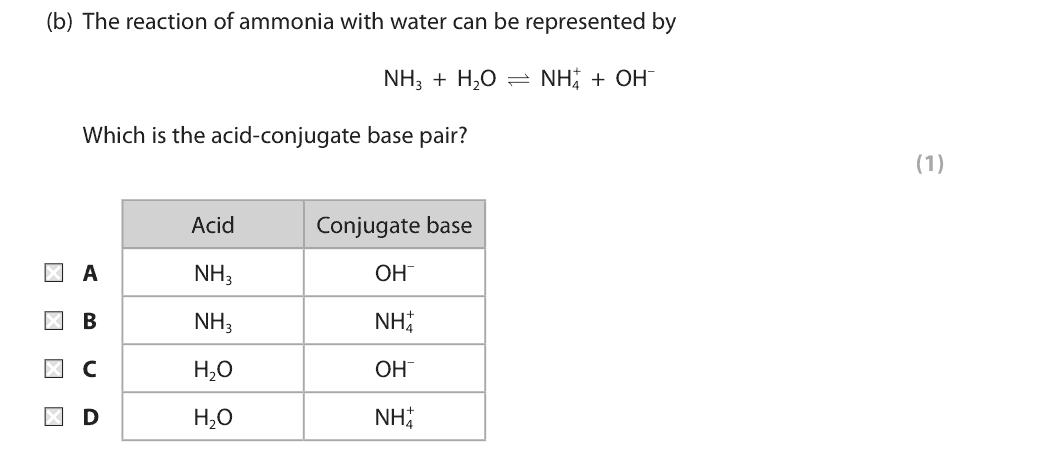
The reaction of ammonia with water can be represented by
NH3  +  H2O    NH4
+  +  OH–
Which is the acid‑conjugate base pair?
Acid
Conjugate base
A
NH3
OH–
B
NH3
NH4
+
C
H2O
OH–
D
H2O
NH4
+
November 2021 · Paper 1 · Q7(c) 2 marks Calculation acid base equilibria
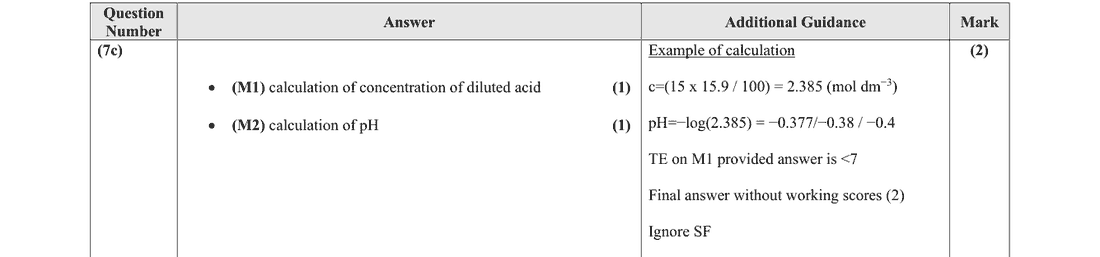
A commercial nitric acid solution, HNO3(aq), has a concentration of 15.9 mol dm–3.
A 15.0 cm3 sample was made up to 100 cm3 by adding deionised water.
Calculate the pH of this diluted solution.
November 2021 · Paper 1 · Q7(d)(i) 3 marks Calculation acid base equilibria
Earlier part of question 7 that this part usesEarlier part of November 2021 Paper 1 question 7
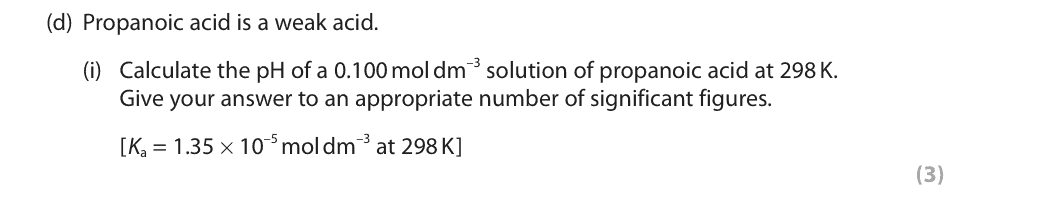
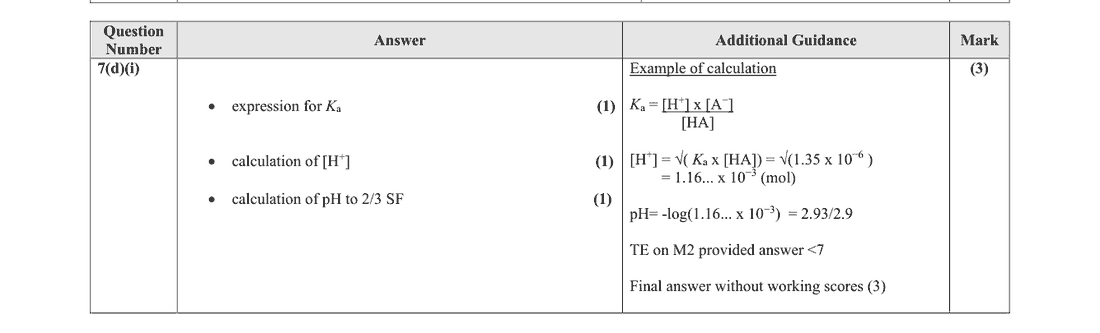
Propanoic acid is a weak acid.
Calculate the pH of a 0.100 mol dm–3 solution of propanoic acid at 298 K.
Give your answer to an appropriate number of significant figures.
[Ka = 1.35 × 10–5 mol dm–3 at 298 K]
November 2021 · Paper 1 · Q7(d)(ii) 2 marks Short answer acid base equilibria
Earlier part of question 7 that this part usesEarlier part of November 2021 Paper 1 question 7
State two assumptions that you made in the calculation in d(i).
November 2021 · Paper 1 · Q7(e)(i) 4 marks Calculation acid base equilibria
Earlier part of question 7 that this part usesEarlier part of November 2021 Paper 1 question 7
A buffer solution was made using 20.0 cm3 of a butanoic acid solution, of
concentration 0.100 mol dm–3 and 30.0 cm3 of sodium butanoate solution,
of concentration 0.305 mol dm–3.
[Ka = 1.52 × 10–5 mol dm–3 at 298K]
Calculate the pH of this buffer solution at 298 K.
November 2021 · Paper 1 · Q7(e)(ii) 2 marks Explanation Hard acid base equilibria
Earlier parts of question 7 that this part usesEarlier part of November 2021 Paper 1 question 7Earlier part of November 2021 Paper 1 question 7
Explain why the pH of the buffer solution hardly changes when a few drops of
sodium hydroxide solution are added to it.
Include an equation or equations in your answer.
Use C3H7COOH as the formula for butanoic acid.
November 2021 · Paper 1 · Q8(a)(i) 1 mark Short answer transition metals principles
Transition metals form complex ions.
Complex ions have a central metal ion surrounded by ligands.
Give a reason why the ammonium ion cannot act as a ligand.
November 2021 · Paper 1 · Q8(a)(ii) 4 marks Explanation transition metals principles
Earlier part of question 8 that this part usesEarlier part of November 2021 Paper 1 question 8
Explain why the complex ions [Co(NH3)6]2+ and [Co(H2O)6]2+ are coloured and
have different colours.
November 2021 · Paper 1 · Q8(b) 1 mark Multiple choice transition metals principles
Earlier part of question 8 that this part usesEarlier part of November 2021 Paper 1 question 8
Which of these complexes is used in the treatment of cancer?
Cl
OH2
Cl
OH2
A
Pt
B
Pt
H2O
Cl
Cl
OH2
Cl
NH3
Cl
OH2
C
Pt
D
Pt
Cl
NH3
H3N
Cl
November 2021 · Paper 1 · Q8(c) 4 marks Explanation Hard transition metals principlestransition metals reactions
Earlier part of question 8 that this part usesEarlier part of November 2021 Paper 1 question 8
Compare and contrast the complex ions formed by cobalt(III) ions with the ligand
ethane‑1,2‑diamine and with the ligand EDTA4–.
Ignore any difference in colour.
O
–O
O
O–
N
N
–O
O
O–
NH2
H2N
O
EDTA4–
ethane‑1,2‑diamine
November 2021 · Paper 1 · Q8(d) 2 marks Short answer Hard transition metals principlesformulae equations and amounts of substance
Earlier part of question 8 that this part usesEarlier part of November 2021 Paper 1 question 8
Hydrated chromium(III) chloride, CrCl3.6H2O, dissolves in water to form a number
of different complex ions containing both chloride and water ligands.
The general formula of these complex ions is [Cr(H2O)x(Cl)y](3–y)+
In an experiment, 0.10 mol of a complex reacted with excess silver nitrate solution
to produce 0.20 mol of silver chloride.
Chloride ions which are ligands within the complex do not react with
silver nitrate.
Deduce the formula of this chromium(III) complex ion.  Justify your answer.
November 2021 · Paper 1 · Q9(a)(i) 1 mark Short answer lattice energy
This question is about lattice energies.
The table shows the theoretical and experimental lattice energy values of
two compounds.
Theoretical lattice energy
Experimental lattice energy
Compound
/ kJ mol–1
/ kJ mol–1
magnesium iodide
–1944
–2327
barium iodide
–1831
–1877
State what can be deduced by the close similarity of the lattice energy values
for barium iodide.
November 2021 · Paper 1 · Q9(a)(ii) 4 marks Explanation lattice energy
Earlier part of question 9 that this part usesEarlier part of November 2021 Paper 1 question 9
Explain why there is a significant difference in the lattice energy values for
magnesium iodide.
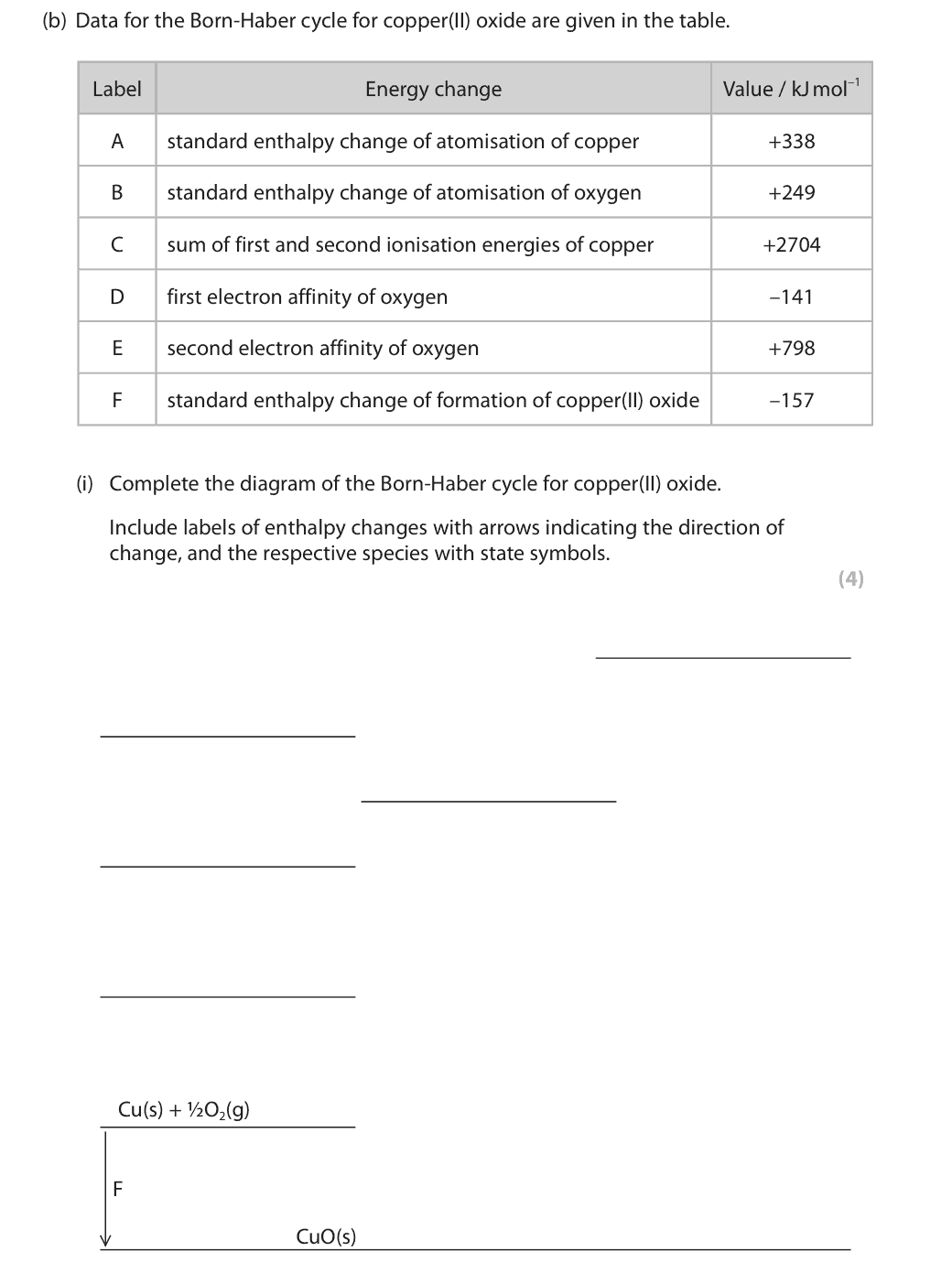
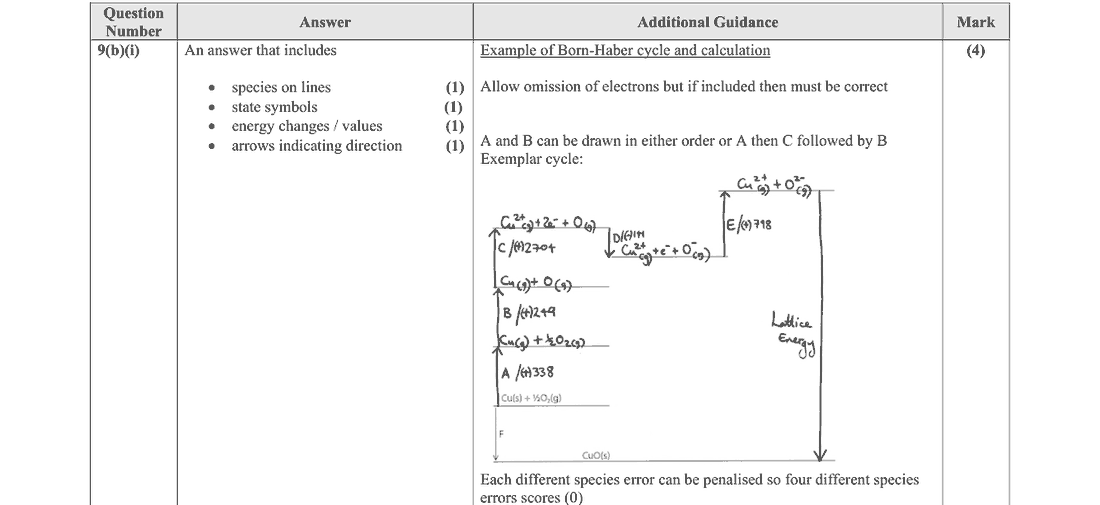
November 2021 · Paper 1 · Q9(b)(i) 4 marks Diagram or structure lattice energy
Earlier part of question 9 that this part usesEarlier part of November 2021 Paper 1 question 9
Data for the Born‑Haber cycle for copper(II) oxide are given in the table.
Value / kJ mol–1
Label
Energy change
A
standard enthalpy change of atomisation of copper
+338
B
standard enthalpy change of atomisation of oxygen
+249
C
sum of first and second ionisation energies of copper
+2704
D
first electron affinity of oxygen
–141
E
second electron affinity of oxygen
+798
F
standard enthalpy change of formation of copper(II) oxide
–157
Complete the diagram of the Born‑Haber cycle for copper(II) oxide.
Include labels of enthalpy changes with arrows indicating the direction of
change, and the respective species with state symbols.
Cu(s) + ½O2(g)
F
CuO(s)
November 2021 · Paper 1 · Q9(b)(ii) 1 mark Calculation lattice energy
Earlier parts of question 9 that this part usesEarlier part of November 2021 Paper 1 question 9Earlier part of November 2021 Paper 1 question 9
Calculate the lattice energy of copper(II) oxide.
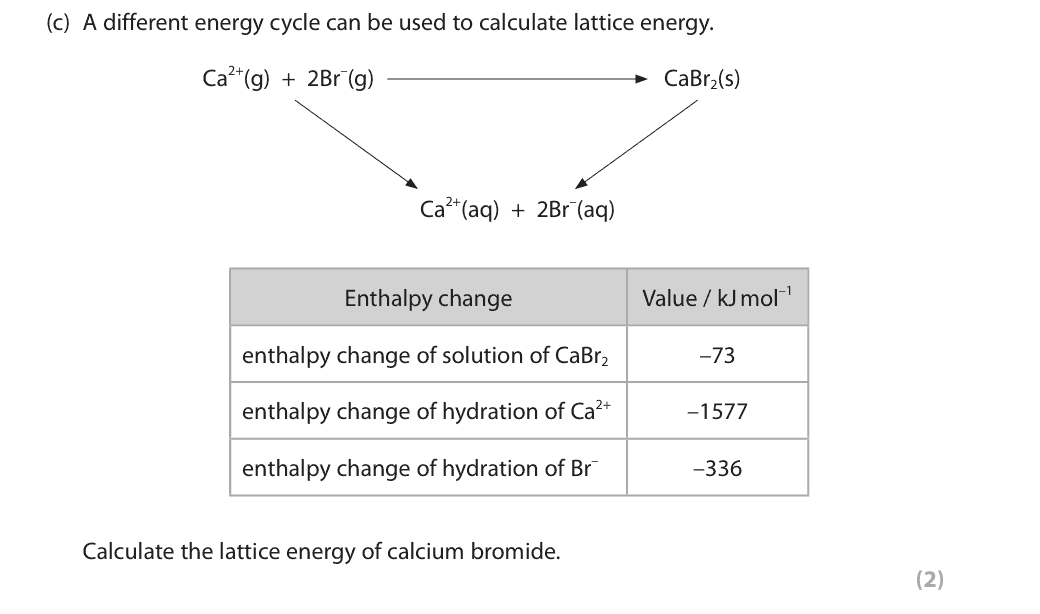
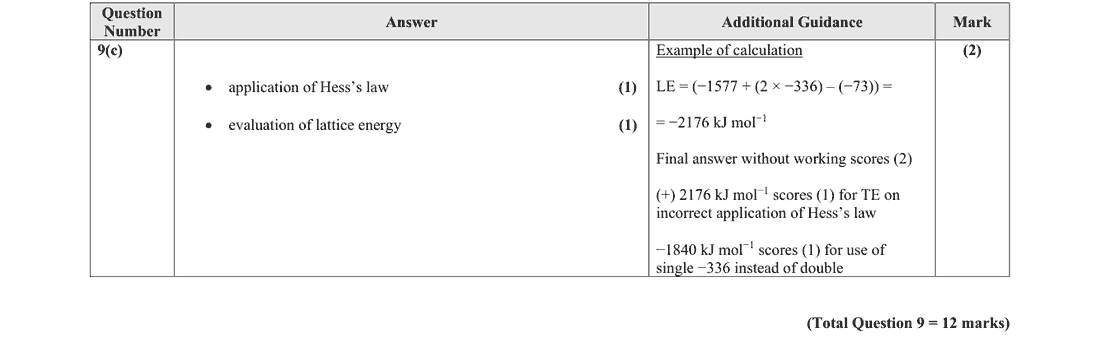
November 2021 · Paper 1 · Q9(c) 2 marks Calculation lattice energy
Earlier part of question 9 that this part usesEarlier part of November 2021 Paper 1 question 9
A different energy cycle can be used to calculate lattice energy.
Ca2+(g)  +  2Br–(g)
CaBr2(s)
Ca2+(aq)  +  2Br–(aq)
Value / kJ mol–1
Enthalpy change
enthalpy change of solution of CaBr2
–73
enthalpy change of hydration of Ca2+
–1577
enthalpy change of hydration of Br–
–336
Calculate the lattice energy of calcium bromide.
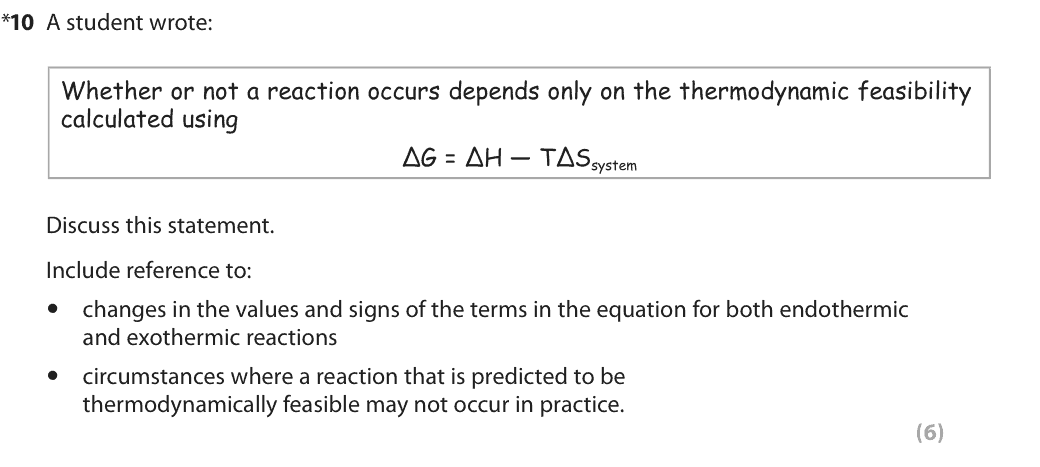
November 2021 · Paper 1 · Q10 6 marks 6-mark extended response entropy
A student wrote:
Whether or not a reaction occurs depends only on the thermodynamic feasibility
calculated using
∆G = ∆H — T∆Ssystem
Discuss this statement.
Include reference to:
  changes in the values and signs of the terms in the equation for both endothermic
and exothermic reactions
  circumstances where a reaction that is predicted to be
thermodynamically feasible may not occur in practice.

Work with an A-level chemistry tutor

Want a paper marked and gone through with you? Message us.

Prefer email? Send an enquiry

If you are under 18, please include a parent's contact details. Enquiries go to enquiries@chemistryaleveltutor.com and are deleted once handled. All tutoring is online.