June 2019: AS Paper 2, Core Organic and Physical Chemistry

80 marks · 42 question parts · Paper, mark scheme and report on Edexcel's site · Have the Data Booklet beside you

Question by question

QTopicMarksAOType
1(a)(i) Introduction to organic chemistry 1Short answer
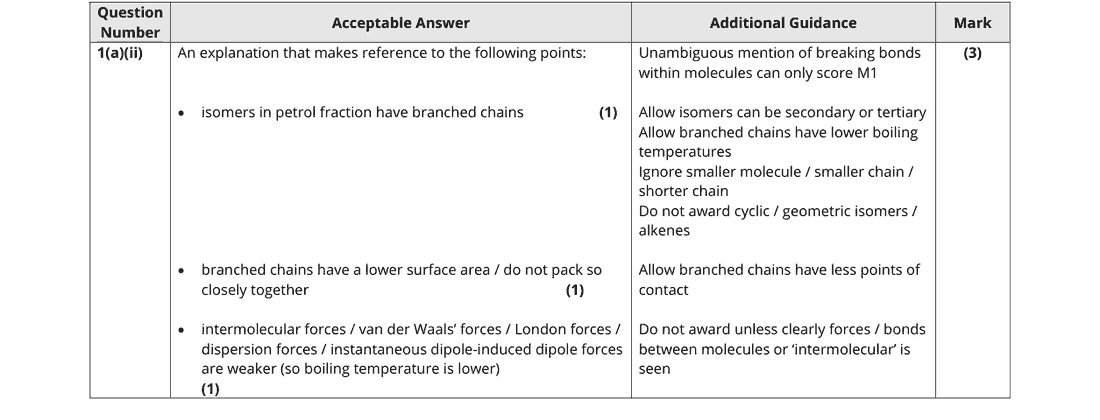
1(a)(ii) Bonding 3Explanation
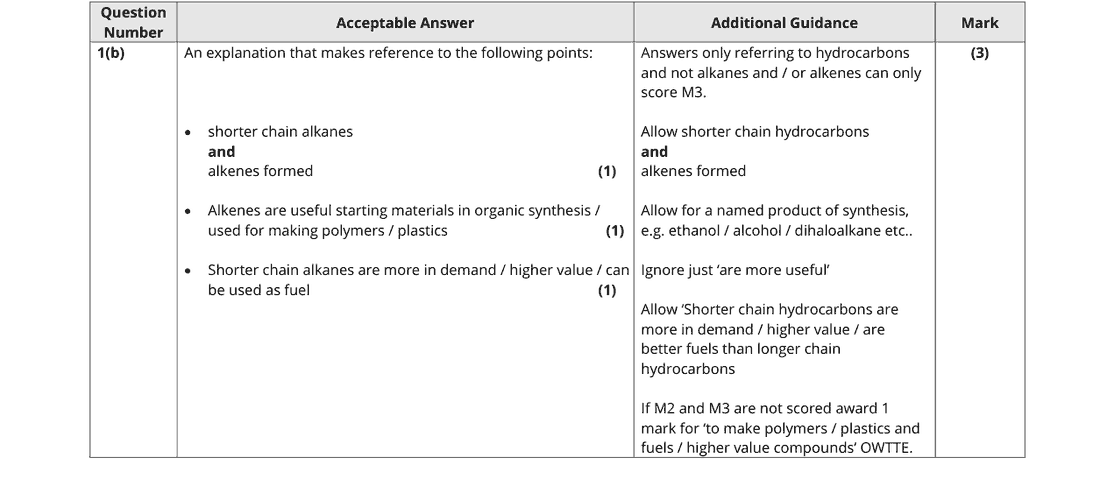
1(b) Alkanes 3Explanation
1(c) Alkanes 1Multiple choice
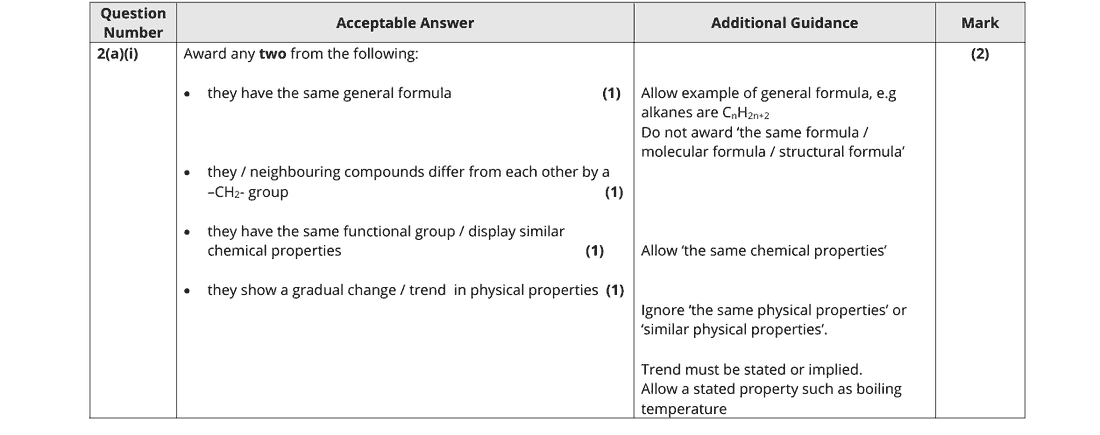
2(a)(i) Introduction to organic chemistry 2Short answer
2(a)(ii) Introduction to organic chemistry 1Short answer
2(b)(i) Alkenes 1Short answer
2(b)(ii) Alkenes 1Multiple choice
2(c)(i) Halogenoalkanes 1Multiple choice
2(c)(ii) Introduction to organic chemistry 2Short answer
2(c)(iii) Introduction to organic chemistry 2Diagram or structure
3(a)(i) Energetics I 2Short answer
3(a)(ii) Energetics I, Formulae, equations and amounts of substance 2Equation writing
3(a)(iii) Kinetics I 2Diagram or structure
3(b) Energetics I 4Calculation
3(c)(i) Energetics I 1Calculation
3(c)(ii) Energetics I 2Calculation
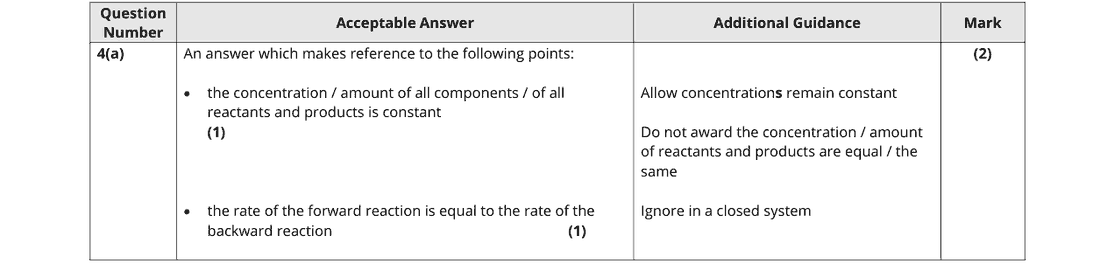
4(a) Equilibrium I 2Short answer
4(b)(i) Equilibrium I 1Multiple choice
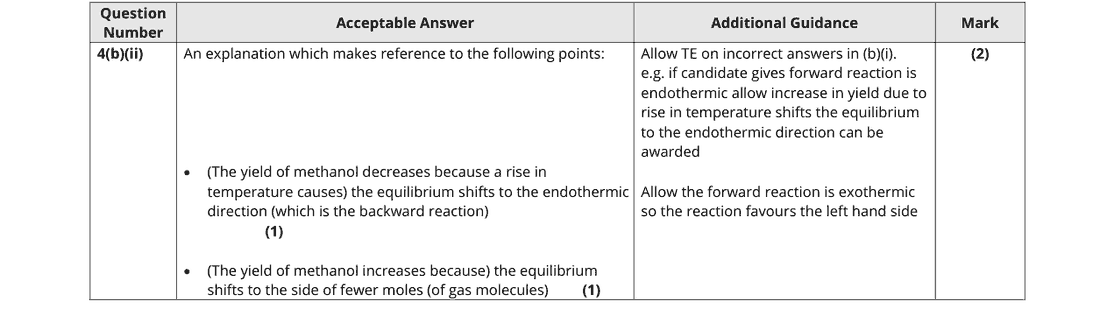
4(b)(ii) Equilibrium I 2Explanation
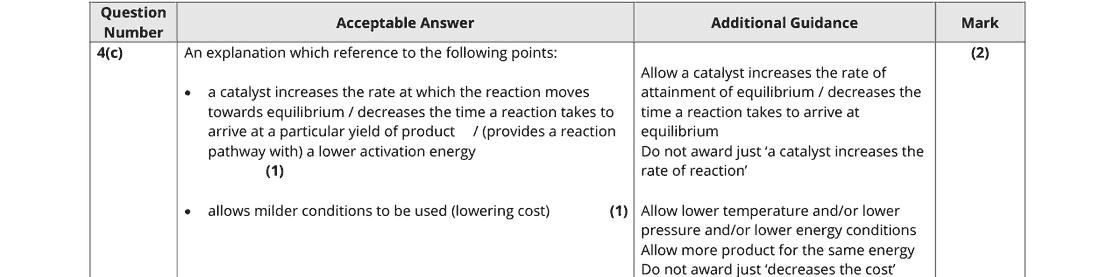
4(c) Kinetics I 2Explanation
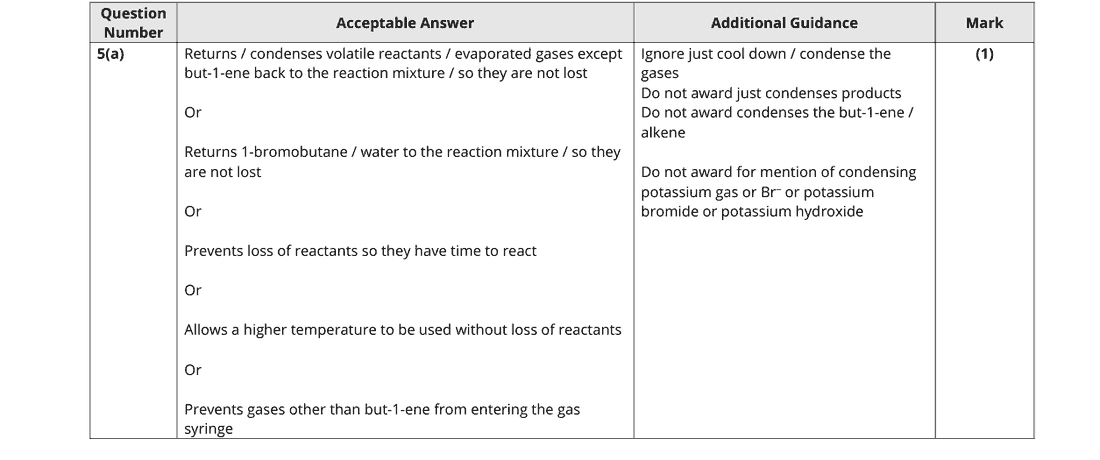
5(a) Alcohols 1Practical and data analysis
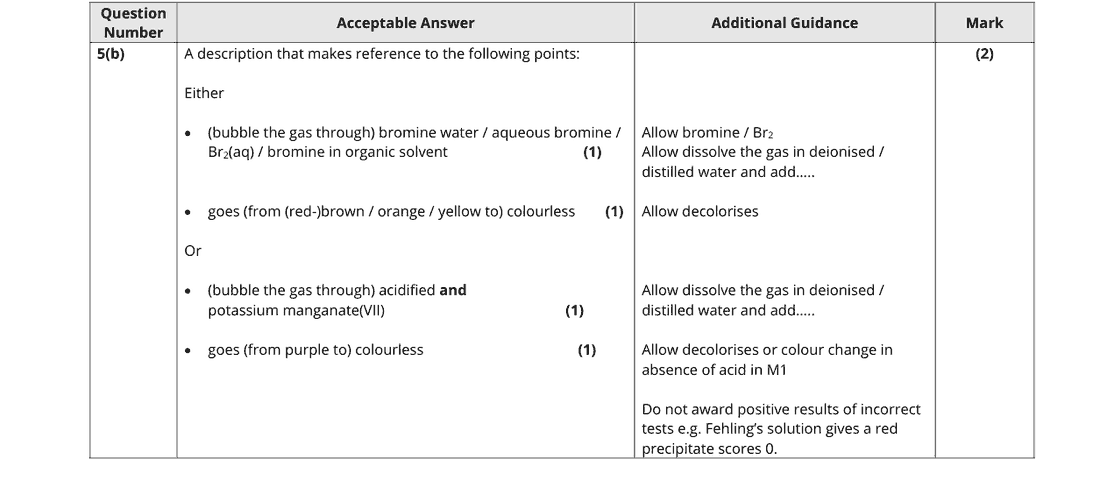
5(b) Alkenes 2Practical and data analysis
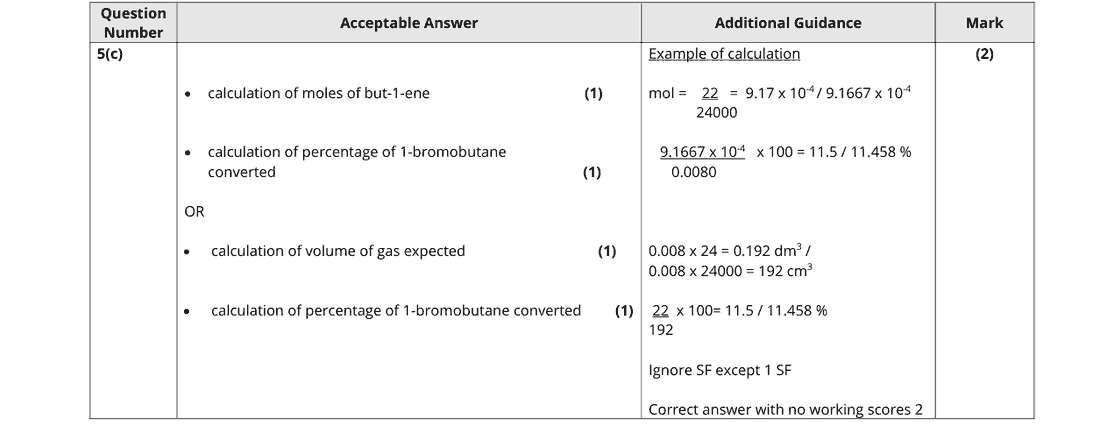
5(c) Formulae, equations and amounts of substance 2Calculation
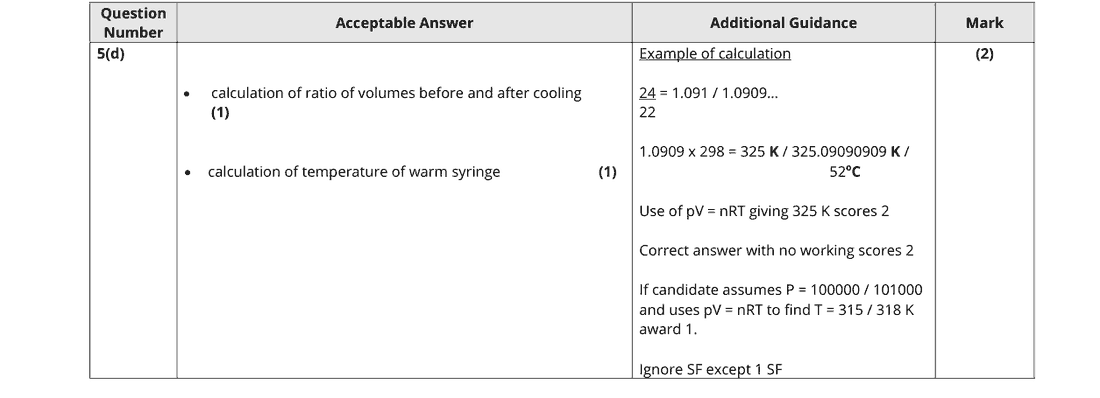
5(d) Formulae, equations and amounts of substance 2Calculation
5(e)(i) Introduction to organic chemistry 1Short answer
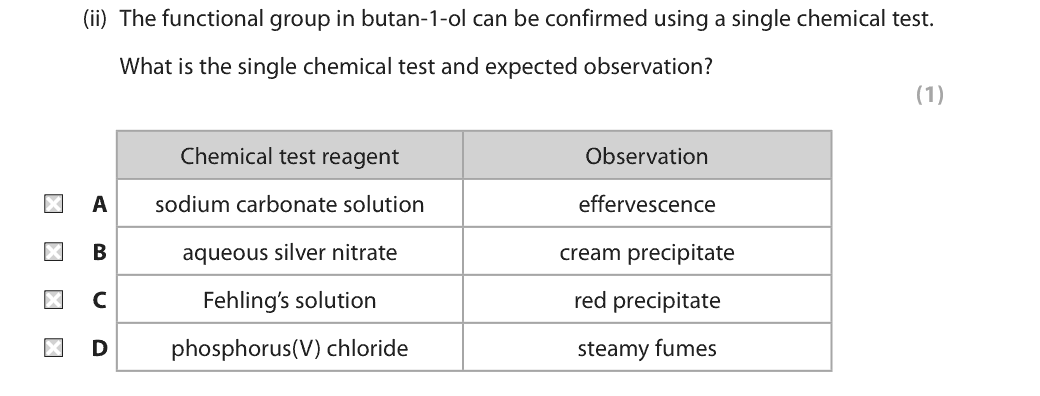
5(e)(ii) Alcohols 1Multiple choice
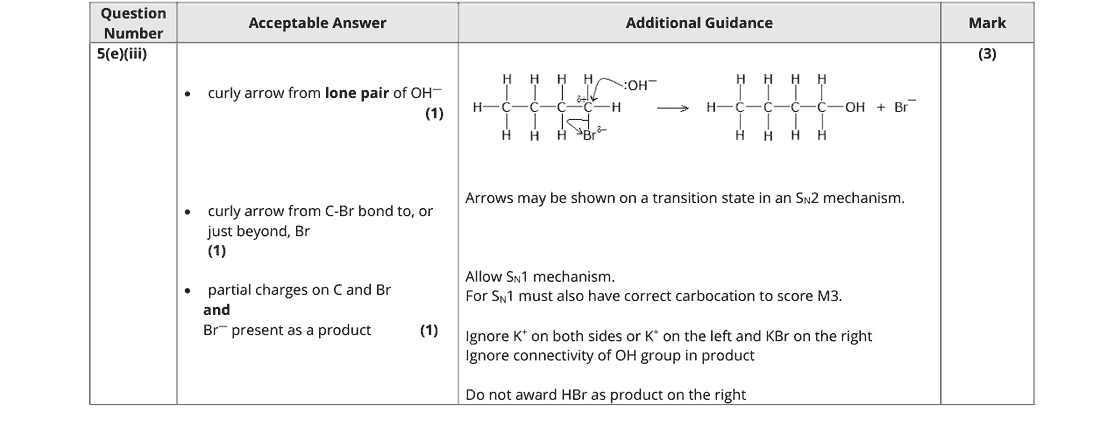
5(e)(iii) Halogenoalkanes 3Mechanism
5(f) Halogenoalkanes, Introduction to organic chemistry 1Multiple choice
6(a)(i) Formulae, equations and amounts of substance 1Practical and data analysis
6(a)(ii) Formulae, equations and amounts of substance 1Practical and data analysis
6(a)(iii) Formulae, equations and amounts of substance 1Multiple choice
6(a)(iv) Formulae, equations and amounts of substance 1Short answer
6(a)(v) Formulae, equations and amounts of substance 5Calculation
6(a)(vi) Formulae, equations and amounts of substance 1Practical and data analysis
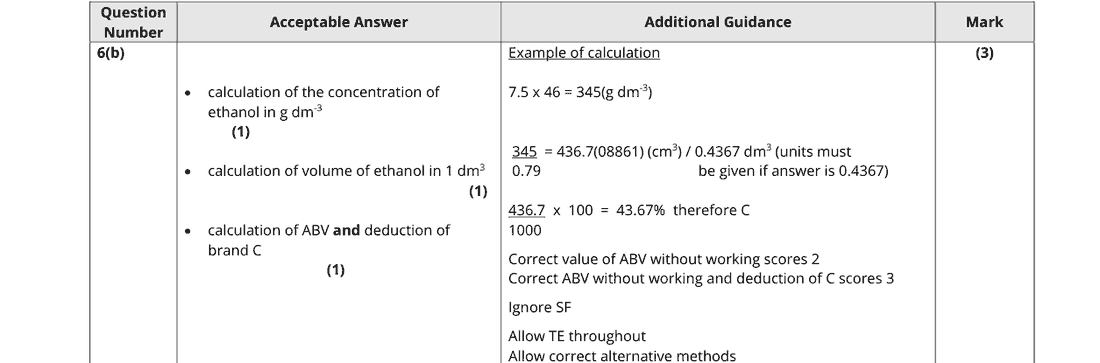
6(b) Formulae, equations and amounts of substance 3Calculation
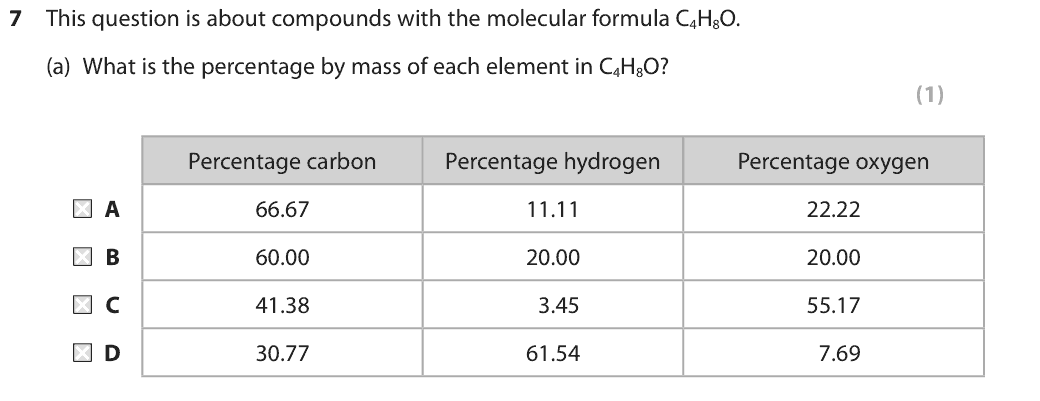
7(a) Formulae, equations and amounts of substance 1Multiple choice
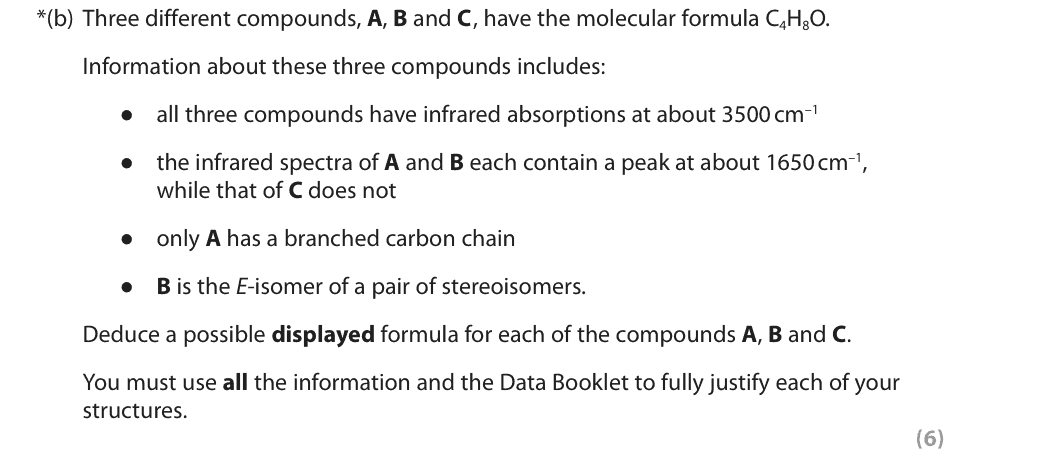
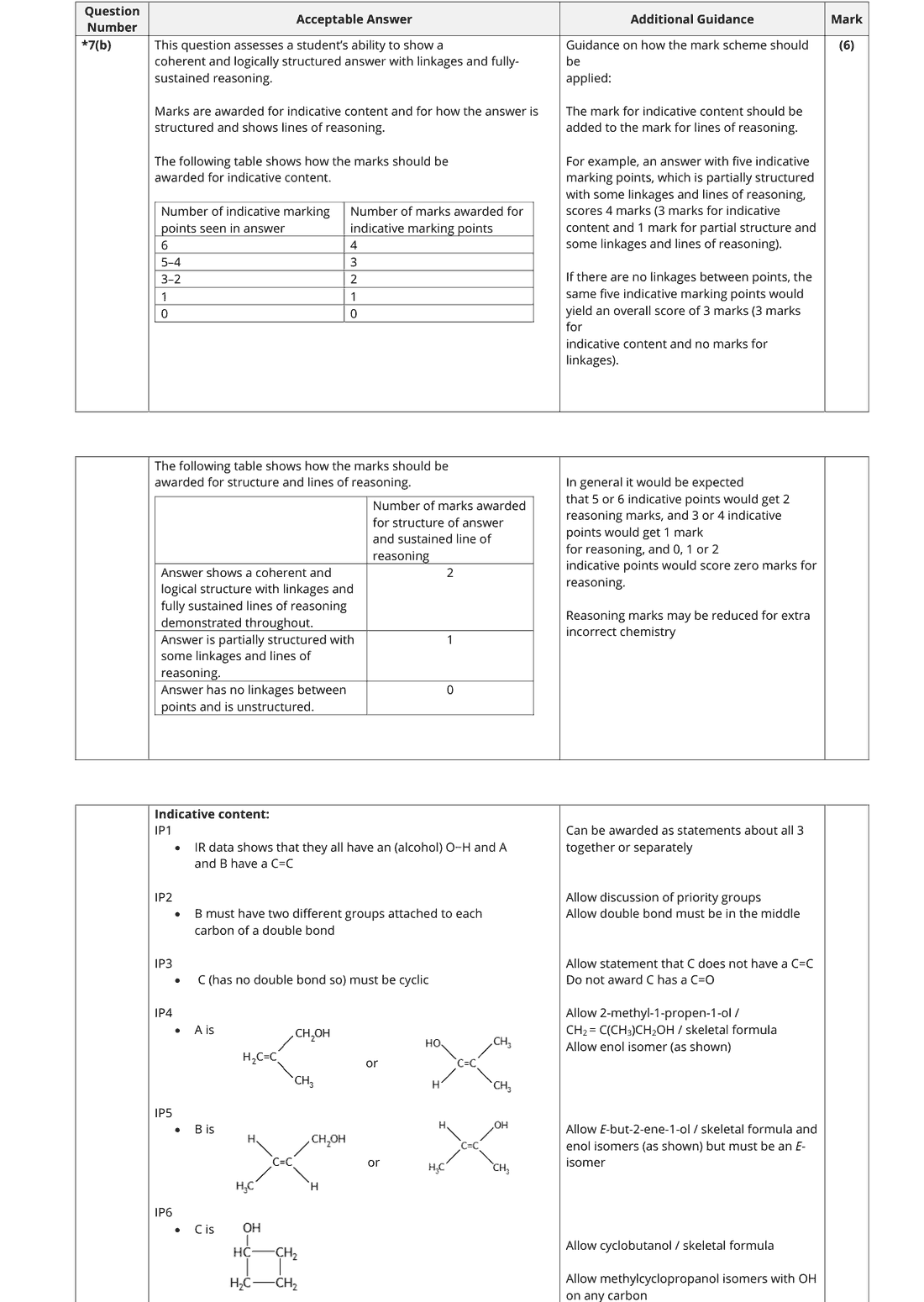
7(b) Modern analytical techniques I: mass spectrometry and infrared, Introduction to organic chemistry 6Extended response
8(a)(i) Kinetics I 2Diagram or structure
8(a)(ii) Kinetics I 4Short answer
8(b) Kinetics I 2Explanation
8(c) Kinetics I 1Short answer

The questions

1(a)(i)1(a)(ii)1(b)1(c)2(a)(i)2(a)(ii)2(b)(i)2(b)(ii)2(c)(i)2(c)(ii)2(c)(iii)3(a)(i)3(a)(ii)3(a)(iii)3(b)3(c)(i)3(c)(ii)4(a)4(b)(i)4(b)(ii)4(c)5(a)5(b)5(c)5(d)5(e)(i)5(e)(ii)5(e)(iii)5(f)6(a)(i)6(a)(ii)6(a)(iii)6(a)(iv)6(a)(v)6(a)(vi)6(b)7(a)7(b)8(a)(i)8(a)(ii)8(b)8(c)
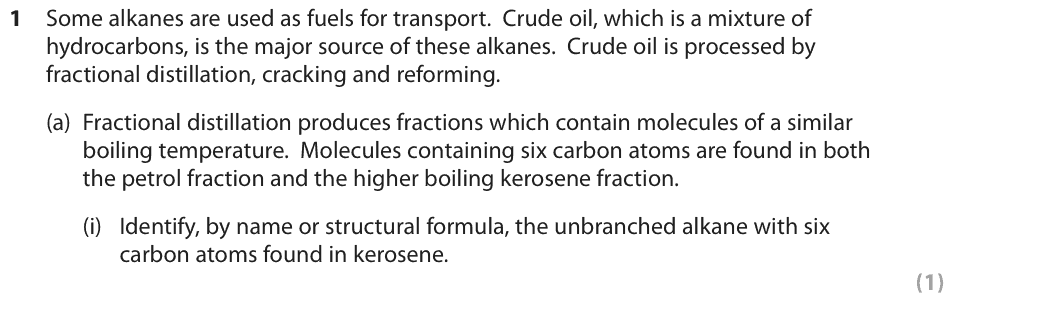
June 2019 · AS Paper 2 · Q1(a)(i) 1 mark Short answer introduction to organic chemistry
Some alkanes are used as fuels for transport.  Crude oil, which is a mixture of
hydrocarbons, is the major source of these alkanes.  Crude oil is processed by
fractional distillation, cracking and reforming.
Fractional distillation produces fractions which contain molecules of a similar
boiling temperature.  Molecules containing six carbon atoms are found in both
the petrol fraction and the higher boiling kerosene fraction.
Identify, by name or structural formula, the unbranched alkane with six
carbon atoms found in kerosene.
June 2019 · AS Paper 2 · Q1(a)(ii) 3 marks Explanation bonding
Earlier part of question 1 that this part usesEarlier part of June 2019 Paper 2 question 1
Explain why isomers of the alkane in (a)(i) have lower boiling temperatures
and so are found in the petrol fraction.
June 2019 · AS Paper 2 · Q1(b) 3 marks Explanation alkanes
Earlier part of question 1 that this part usesEarlier part of June 2019 Paper 2 question 1
During cracking, carbon to carbon bonds are broken.
Explain the two major reasons for cracking hydrocarbons.
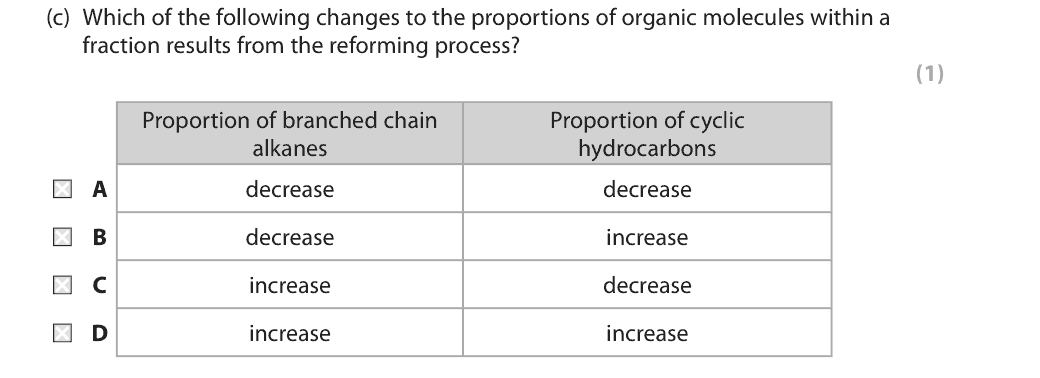
June 2019 · AS Paper 2 · Q1(c) 1 mark Multiple choice alkanes
Earlier part of question 1 that this part usesEarlier part of June 2019 Paper 2 question 1
Which of the following changes to the proportions of organic molecules within a
fraction results from the reforming process?
Proportion of branched chain
Proportion of cyclic
alkanes
hydrocarbons
A
decrease
decrease
B
decrease
increase
C
increase
decrease
D
increase
increase
June 2019 · AS Paper 2 · Q2(a)(i) 2 marks Short answer introduction to organic chemistry
This question is about organic compounds.
Organic compounds can be grouped together in homologous series.
Describe two characteristics of a homologous series.
June 2019 · AS Paper 2 · Q2(a)(ii) 1 mark Short answer introduction to organic chemistry
Earlier part of question 2 that this part usesEarlier part of June 2019 Paper 2 question 2
Name the homologous series to which propene belongs.
June 2019 · AS Paper 2 · Q2(b)(i) 1 mark Short answer alkenes
Propene can be converted into a mixture of 1-chloropropane and
2-chloropropane, in which 2-chloropropane is the major product.
Give the reagent required for this reaction.
June 2019 · AS Paper 2 · Q2(b)(ii) 1 mark Multiple choice alkenes
Earlier parts of question 2 that this part usesEarlier part of June 2019 Paper 2 question 2Earlier part of June 2019 Paper 2 question 2
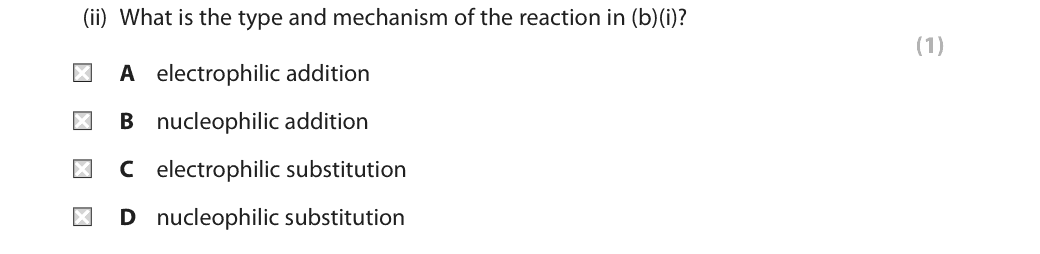
What is the type and mechanism of the reaction in (b)(i)?
A electrophilic addition
B nucleophilic addition
C electrophilic substitution
D nucleophilic substitution
June 2019 · AS Paper 2 · Q2(c)(i) 1 mark Multiple choice halogenoalkanes
1-chloropropane and 2-chloropropane can be converted into compounds
containing the nitrile functional group.
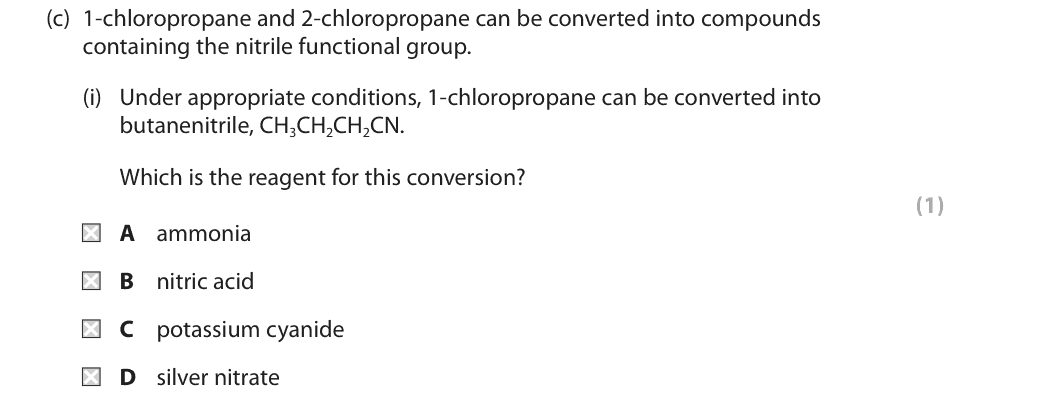
Under appropriate conditions, 1-chloropropane can be converted into
butanenitrile, CH3CH2CH2CN.
Which is the reagent for this conversion?
A ammonia
B nitric acid
C potassium cyanide
D silver nitrate
June 2019 · AS Paper 2 · Q2(c)(ii) 2 marks Short answer Easy introduction to organic chemistry
Earlier part of question 2 that this part usesEarlier part of June 2019 Paper 2 question 2
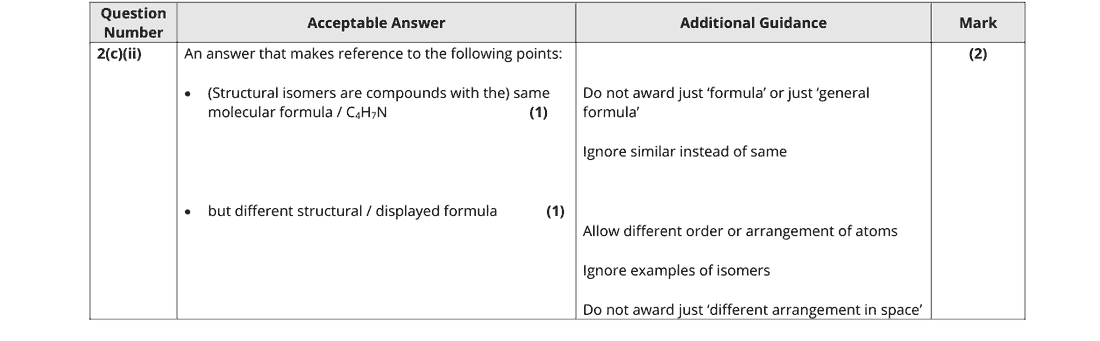
Under appropriate conditions, 2-chloropropane can be converted into a
structural isomer of butanenitrile.
State what is meant by the term ‘structural isomer’.
June 2019 · AS Paper 2 · Q2(c)(iii) 2 marks Diagram or structure Hard introduction to organic chemistry
Earlier parts of question 2 that this part usesEarlier part of June 2019 Paper 2 question 2Earlier part of June 2019 Paper 2 question 2Earlier part of June 2019 Paper 2 question 2
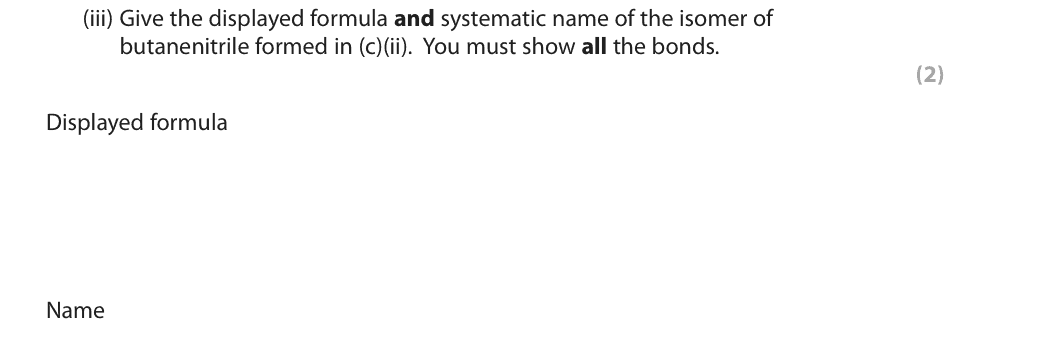
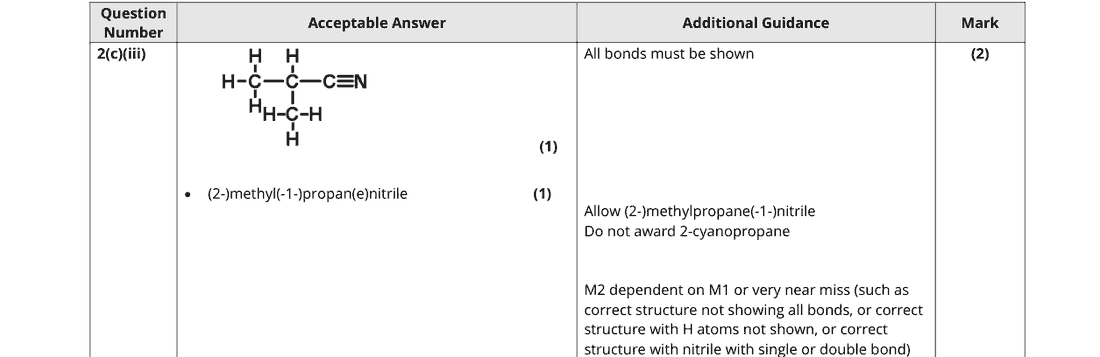
Give the displayed formula and systematic name of the isomer of
butanenitrile formed in (c)(ii).  You must show all the bonds.
Displayed formula
Name
June 2019 · AS Paper 2 · Q3(a)(i) 2 marks Short answer energetics i
This question is about enthalpy changes.
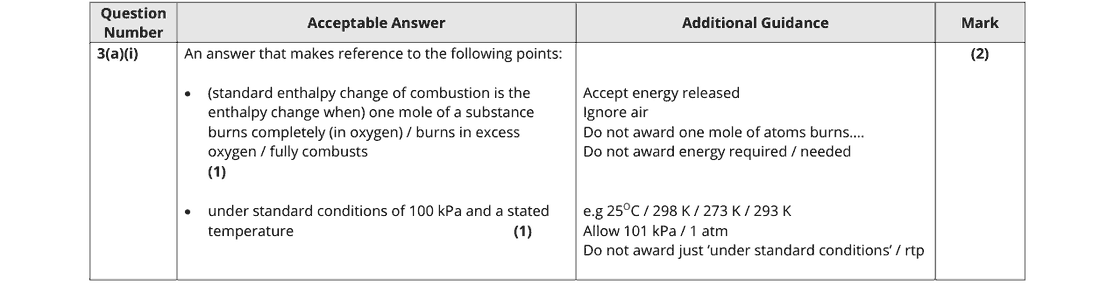
State what is meant by the term ‘standard enthalpy change of combustion’.
June 2019 · AS Paper 2 · Q3(a)(ii) 2 marks Equation writing energetics iformulae equations and amounts of substance
Earlier part of question 3 that this part usesEarlier part of June 2019 Paper 2 question 3
Write the equation, including state symbols, for the reaction that occurs when
the standard enthalpy change of combustion of octane, C8H18(l), is measured.
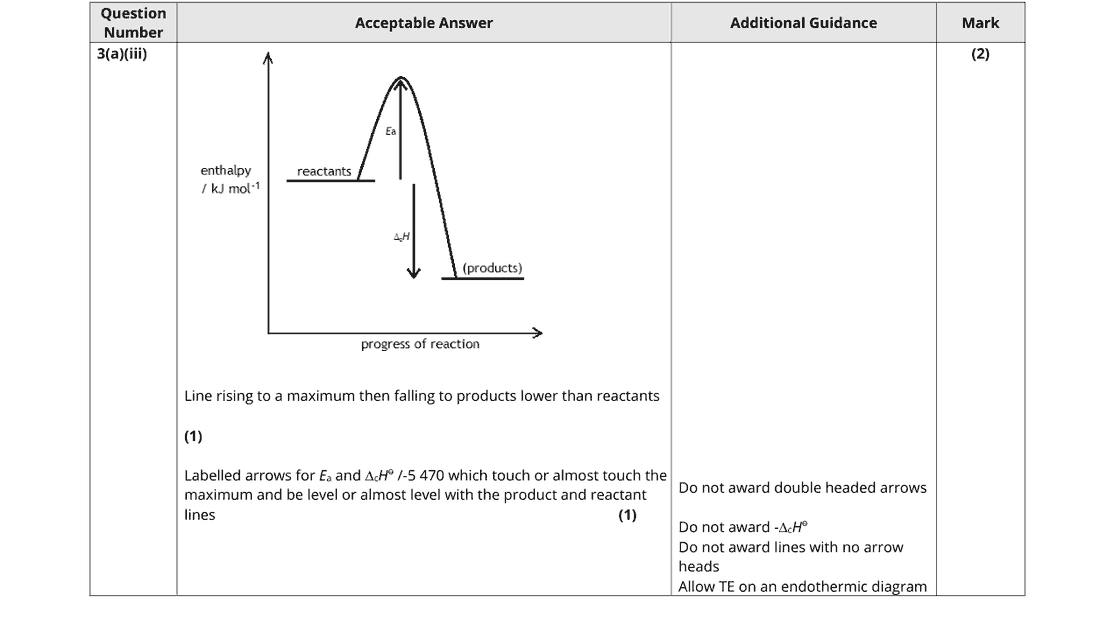
June 2019 · AS Paper 2 · Q3(a)(iii) 2 marks Diagram or structure kinetics i
Earlier part of question 3 that this part usesEarlier part of June 2019 Paper 2 question 3
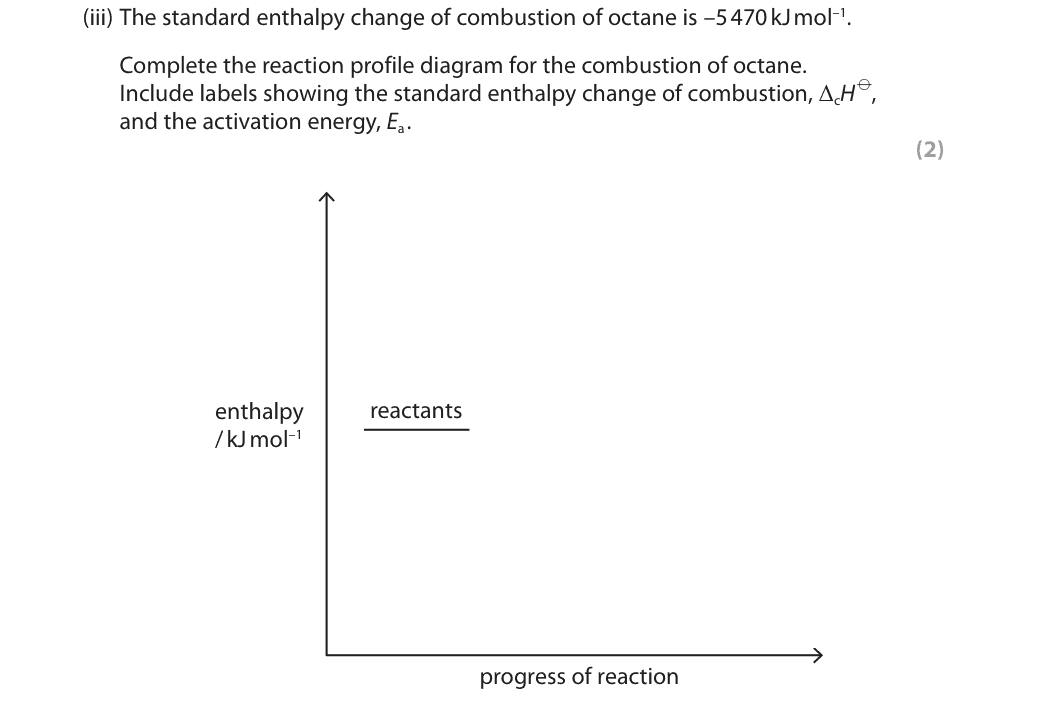
The standard enthalpy change of combustion of octane is –5 470 kJ mol–1.
Complete the reaction profile diagram for the combustion of octane.
9,
Include labels showing the standard enthalpy change of combustion, ǻcH
and the activation energy, Ea.
enthalpy
reactants
/ kJ mol–1
progress of reaction
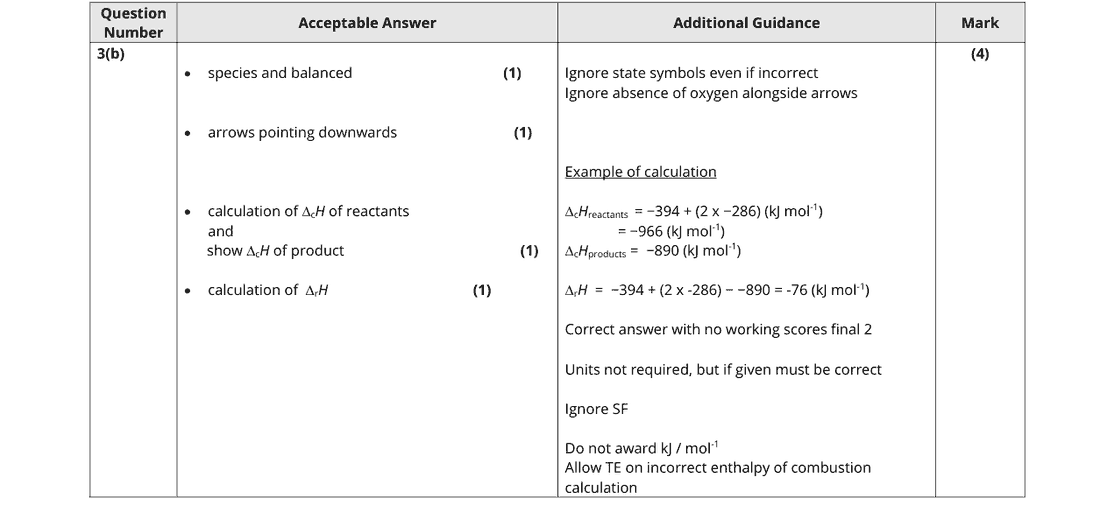
June 2019 · AS Paper 2 · Q3(b) 4 marks Calculation energetics i
Earlier part of question 3 that this part usesEarlier part of June 2019 Paper 2 question 3
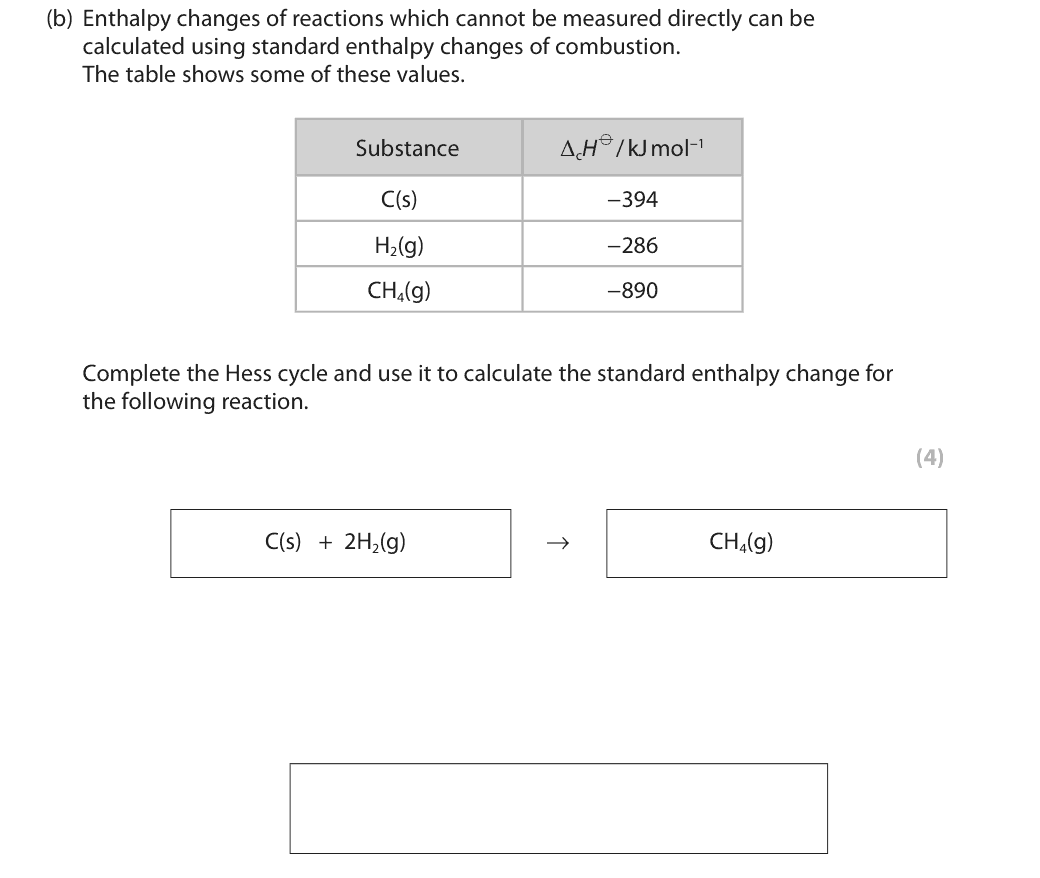
Enthalpy changes of reactions which cannot be measured directly can be
calculated using standard enthalpy changes of combustion.
The table shows some of these values.
9 / kJ mol−1
Substance
ǻcH
C(s)
−394
H2(g)
−286
CH4(g)
−890
Complete the Hess cycle and use it to calculate the standard enthalpy change for
the following reaction.
C(s)   +  2H2(g)                         →                         CH4(g)
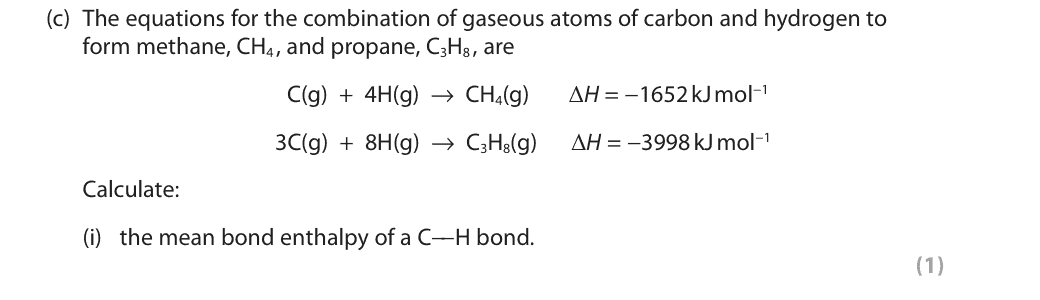
June 2019 · AS Paper 2 · Q3(c)(i) 1 mark Calculation Hard energetics i
Earlier part of question 3 that this part usesEarlier part of June 2019 Paper 2 question 3
The equations for the combination of gaseous atoms of carbon and hydrogen to
form methane, CH4, and propane, C3H8, are
C(g)  +  4H(g)  →  CH4(g)       ǻH = −1652 kJ mol−1
3C(g)  +  8H(g)  →  C3H8(g)      ǻH = −3998 kJ mol−1
Calculate:
the mean bond enthalpy of a C−−H bond.
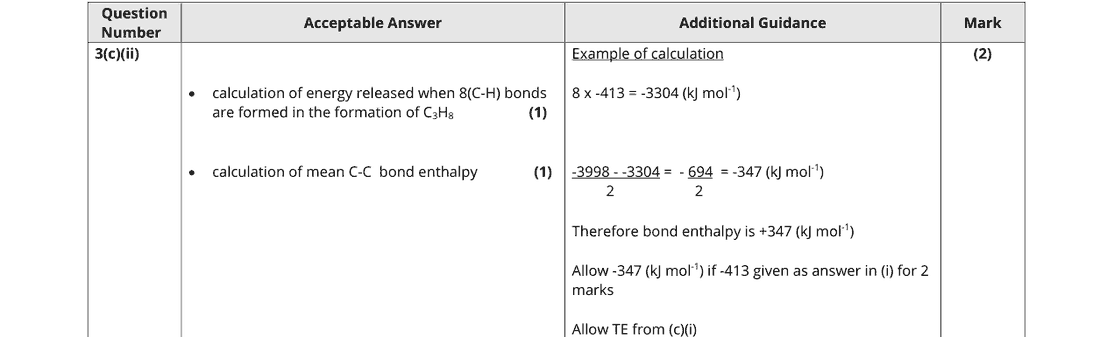
June 2019 · AS Paper 2 · Q3(c)(ii) 2 marks Calculation energetics i
Earlier parts of question 3 that this part usesEarlier part of June 2019 Paper 2 question 3Earlier part of June 2019 Paper 2 question 3
the mean bond enthalpy of a C−−C bond.
June 2019 · AS Paper 2 · Q4(a) 2 marks Short answer equilibrium i
Methanol is manufactured from a mixture of carbon monoxide and hydrogen.
CO(g) + 2H2(g) U CH3OH(g)   ¨H = –90.8 kJ mol–1
Give two characteristics of all reactions at equilibrium.
June 2019 · AS Paper 2 · Q4(b)(i) 1 mark Multiple choice equilibrium i
Earlier part of question 4 that this part usesEarlier part of June 2019 Paper 2 question 4
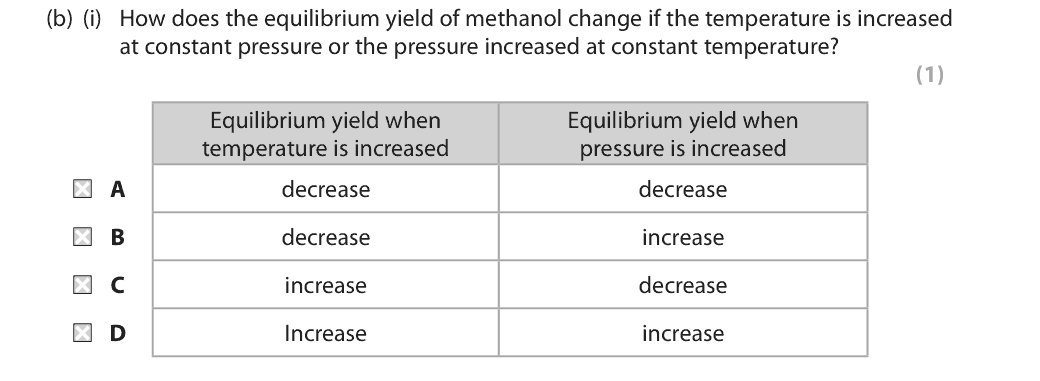
How does the equilibrium yield of methanol change if the temperature is increased
at constant pressure or the pressure increased at constant temperature?
Equilibrium yield when
temperature is increased
pressure is increased
decrease
decrease
A
decrease
increase
B
increase
decrease
C
Increase
increase
D
June 2019 · AS Paper 2 · Q4(b)(ii) 2 marks Explanation equilibrium i
Earlier parts of question 4 that this part usesEarlier part of June 2019 Paper 2 question 4Earlier part of June 2019 Paper 2 question 4
Explain your answer to (b)(i).
June 2019 · AS Paper 2 · Q4(c) 2 marks Explanation kinetics i
Earlier part of question 4 that this part usesEarlier part of June 2019 Paper 2 question 4
Explain why, in the industrial process involving this reaction, a catalyst is used.
June 2019 · AS Paper 2 · Q5(a) 1 mark Practical and data analysis alcohols
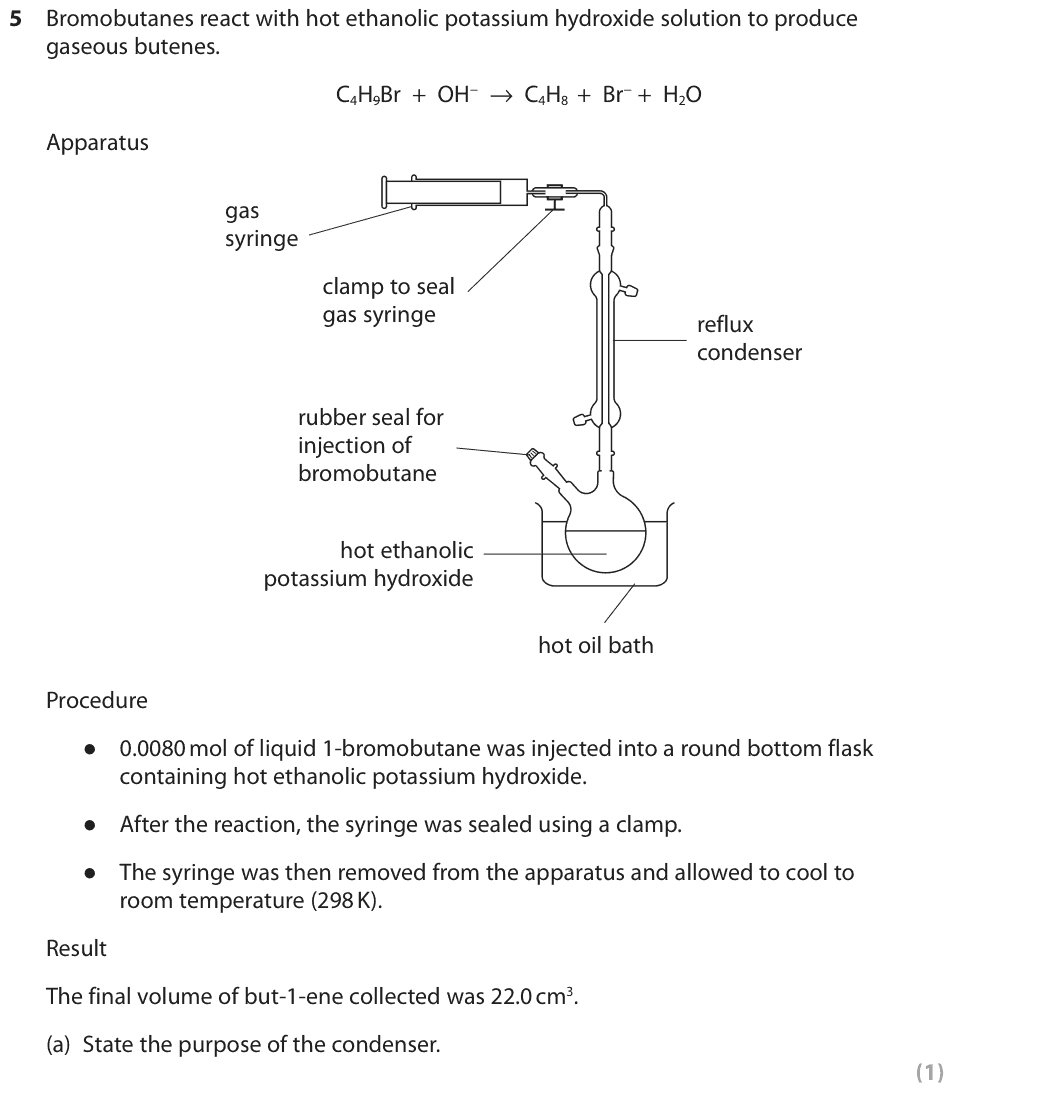
Bromobutanes react with hot ethanolic potassium hydroxide solution to produce
gaseous butenes.
C4H9Br  +  OH−  →  C4H8  +  Br− +  H2O
Apparatus
gas
syringe
clamp to seal
gas syringe
reflux
condenser
rubber seal for
injection of
bromobutane
hot ethanolic
potassium hydroxide
hot oil bath
Procedure
Ɣ 0.0080 mol of liquid 1-bromobutane was injected into a round bottom flask
containing hot ethanolic potassium hydroxide.
Ɣ After the reaction, the syringe was sealed using a clamp.
Ɣ The syringe was then removed from the apparatus and allowed to cool to
room temperature (298 K).
Result
The final volume of but-1-ene collected was 22.0 cm3.
State the purpose of the condenser.
June 2019 · AS Paper 2 · Q5(b) 2 marks Practical and data analysis alkenes
Earlier part of question 5 that this part usesEarlier part of June 2019 Paper 2 question 5
Describe a chemical test on the gas in the syringe to identify its functional group.
Include the expected result.
June 2019 · AS Paper 2 · Q5(c) 2 marks Calculation formulae equations and amounts of substance
Earlier part of question 5 that this part usesEarlier part of June 2019 Paper 2 question 5
Calculate the percentage of 1-bromobutane which was converted to but-1-ene.
[Molar volume of a gas at r.t.p. = 24 000 cm3 mol–1]
June 2019 · AS Paper 2 · Q5(d) 2 marks Calculation Hard formulae equations and amounts of substance
Earlier part of question 5 that this part usesEarlier part of June 2019 Paper 2 question 5
Before cooling, the volume of but-1-ene in the gas syringe was 24.0 cm3.
Calculate the temperature of the gas in the syringe before it cooled.
[Assume no loss from the gas syringe during cooling, and a constant pressure]
June 2019 · AS Paper 2 · Q5(e)(i) 1 mark Short answer introduction to organic chemistry
Earlier part of question 5 that this part usesEarlier part of June 2019 Paper 2 question 5
Another compound formed from 1-bromobutane under these conditions is butan-1-ol.
Identify the type of reaction taking place to form butan-1-ol.
June 2019 · AS Paper 2 · Q5(e)(ii) 1 mark Multiple choice alcohols
Earlier parts of question 5 that this part usesEarlier part of June 2019 Paper 2 question 5Earlier part of June 2019 Paper 2 question 5
The functional group in butan-1-ol can be confirmed using a single chemical test.
What is the single chemical test and expected observation?
Chemical test reagent
Observation
A
sodium carbonate solution
effervescence
B
aqueous silver nitrate
cream precipitate
C
Fehling’s solution
red precipitate
D
phosphorus(V) chloride
steamy fumes
June 2019 · AS Paper 2 · Q5(e)(iii) 3 marks Mechanism halogenoalkanes
Earlier parts of question 5 that this part usesEarlier part of June 2019 Paper 2 question 5Earlier part of June 2019 Paper 2 question 5
Draw the mechanism for the reaction of 1-bromobutane with hydroxide ions
to form butan-1-ol.
Include curly arrows, and any appropriate lone pairs and dipoles.
June 2019 · AS Paper 2 · Q5(f) 1 mark Multiple choice halogenoalkanesintroduction to organic chemistry
Earlier part of question 5 that this part usesEarlier part of June 2019 Paper 2 question 5
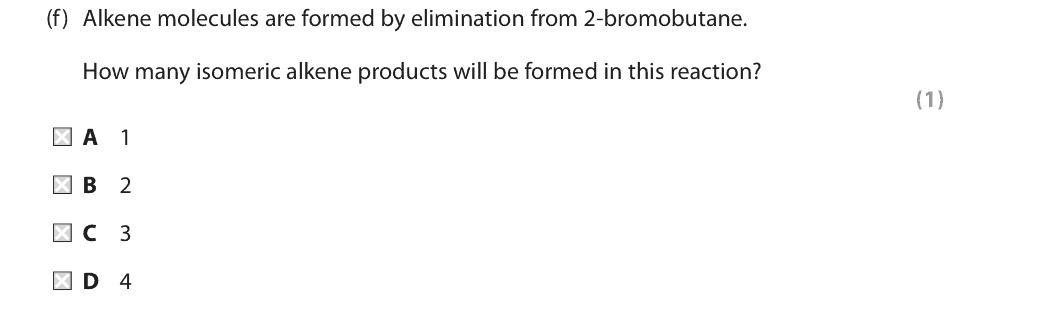
Alkene molecules are formed by elimination from 2-bromobutane.
How many isomeric alkene products will be formed in this reaction?
A 1
B 2
C 3
D 4
June 2019 · AS Paper 2 · Q6(a)(i) 1 mark Practical and data analysis formulae equations and amounts of substance
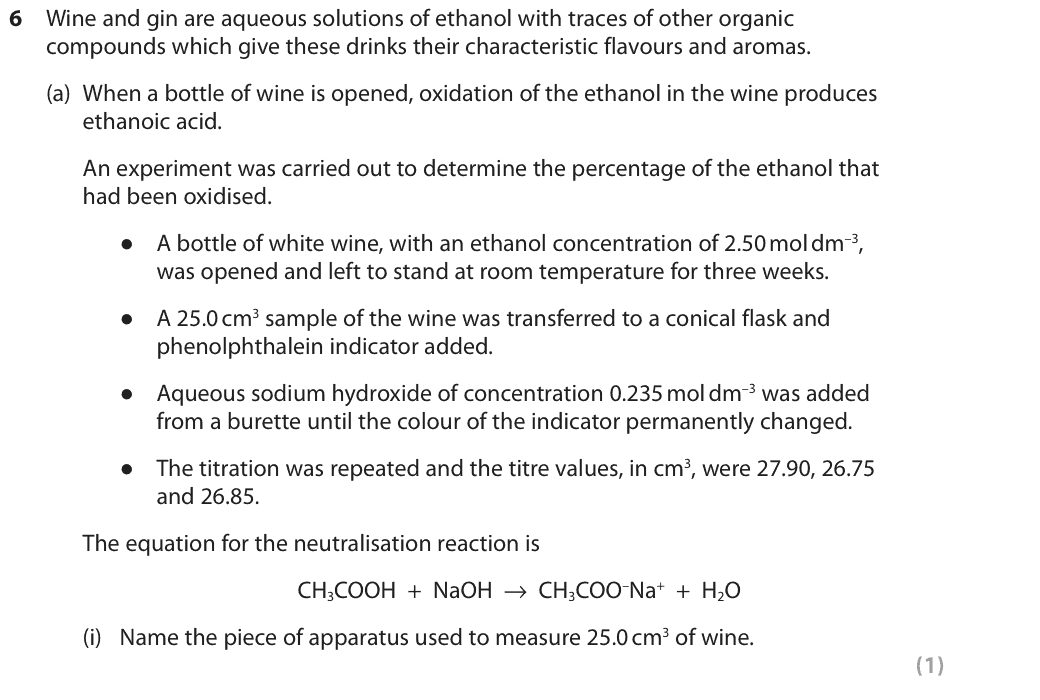
Wine and gin are aqueous solutions of ethanol with traces of other organic
compounds which give these drinks their characteristic flavours and aromas.
When a bottle of wine is opened, oxidation of the ethanol in the wine produces
ethanoic acid.
An experiment was carried out to determine the percentage of the ethanol that
had been oxidised.
Ɣ A bottle of white wine, with an ethanol concentration of 2.50 mol dm–3,
was opened and left to stand at room temperature for three weeks.
Ɣ A 25.0 cm3 sample of the wine was transferred to a conical flask and
phenolphthalein indicator added.
Ɣ Aqueous sodium hydroxide of concentration 0.235 mol dm–3 was added
from a burette until the colour of the indicator permanently changed.
Ɣ The titration was repeated and the titre values, in cm3, were 27.90, 26.75
and 26.85.
The equation for the neutralisation reaction is
CH3COOH  +  NaOH  →  CH3COO–Na+  +  H2O
Name the piece of apparatus used to measure 25.0 cm3 of wine.
June 2019 · AS Paper 2 · Q6(a)(ii) 1 mark Practical and data analysis formulae equations and amounts of substance
Earlier part of question 6 that this part usesEarlier part of June 2019 Paper 2 question 6
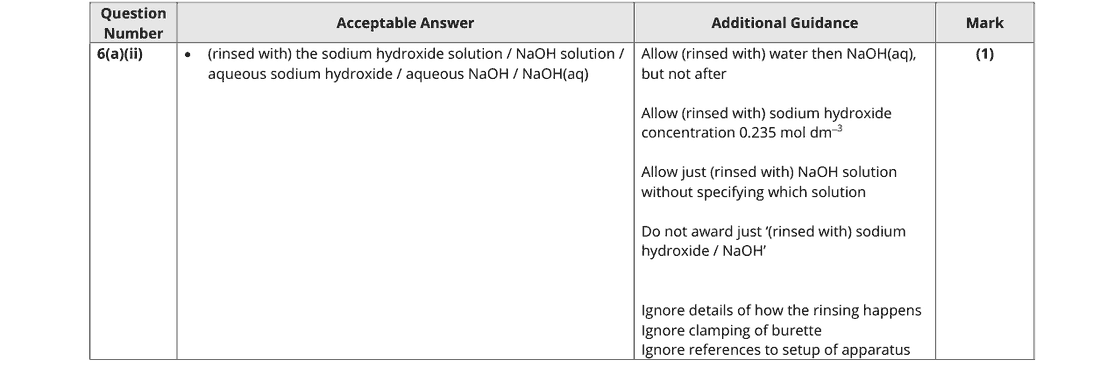
To improve the accuracy, the burette should be rinsed.
State what should be used.
June 2019 · AS Paper 2 · Q6(a)(iii) 1 mark Multiple choice formulae equations and amounts of substance
Earlier part of question 6 that this part usesEarlier part of June 2019 Paper 2 question 6
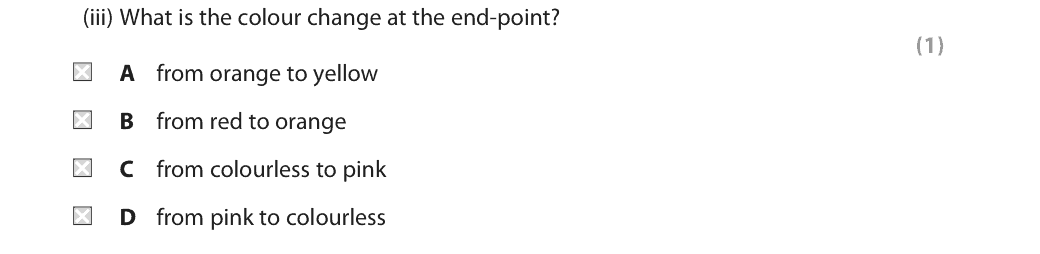
What is the colour change at the end-point?
A from orange to yellow
B from red to orange
C from colourless to pink
D from pink to colourless
June 2019 · AS Paper 2 · Q6(a)(iv) 1 mark Short answer formulae equations and amounts of substance
Earlier part of question 6 that this part usesEarlier part of June 2019 Paper 2 question 6
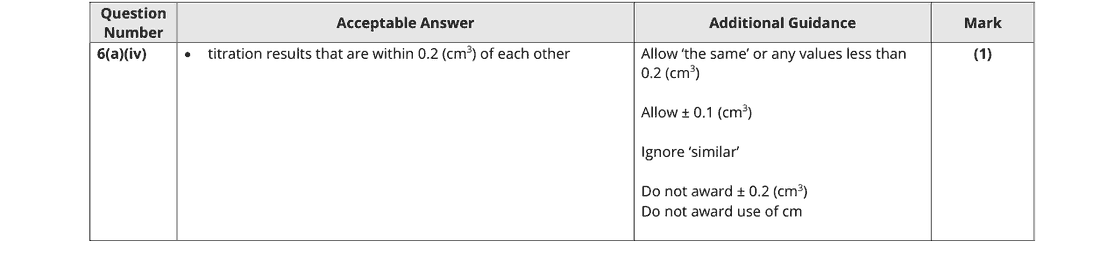
State what is meant by the term ‘concordant results’ as applied to a titration experiment.
June 2019 · AS Paper 2 · Q6(a)(v) 5 marks Calculation formulae equations and amounts of substance
Earlier parts of question 6 that this part usesEarlier part of June 2019 Paper 2 question 6Earlier part of June 2019 Paper 2 question 6Earlier part of June 2019 Paper 2 question 6Earlier part of June 2019 Paper 2 question 6
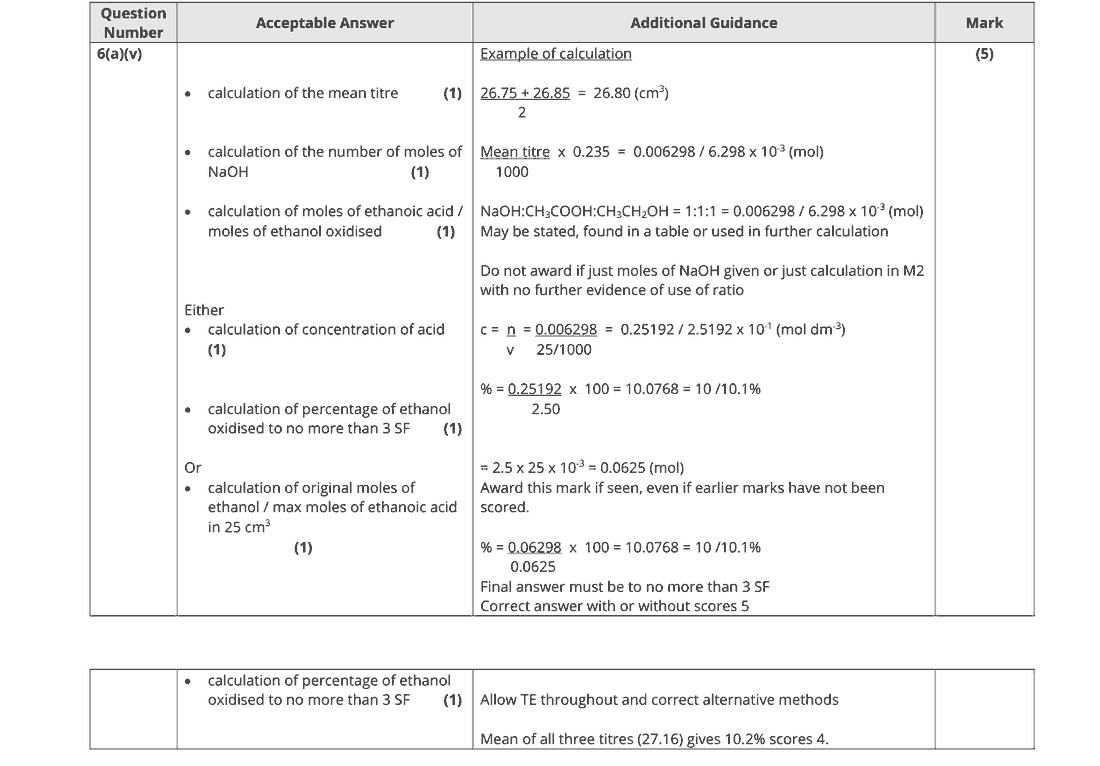
Calculate the percentage of ethanol that has oxidised, given that one mole of
ethanol forms one mole of ethanoic acid.
Give your answer to an appropriate number of significant figures.
June 2019 · AS Paper 2 · Q6(a)(vi) 1 mark Practical and data analysis formulae equations and amounts of substance
Earlier part of question 6 that this part usesEarlier part of June 2019 Paper 2 question 6
Deduce why this method would not be effective for the analysis of the acid
content of a red wine.
June 2019 · AS Paper 2 · Q6(b) 3 marks Calculation formulae equations and amounts of substance
Earlier part of question 6 that this part usesEarlier part of June 2019 Paper 2 question 6
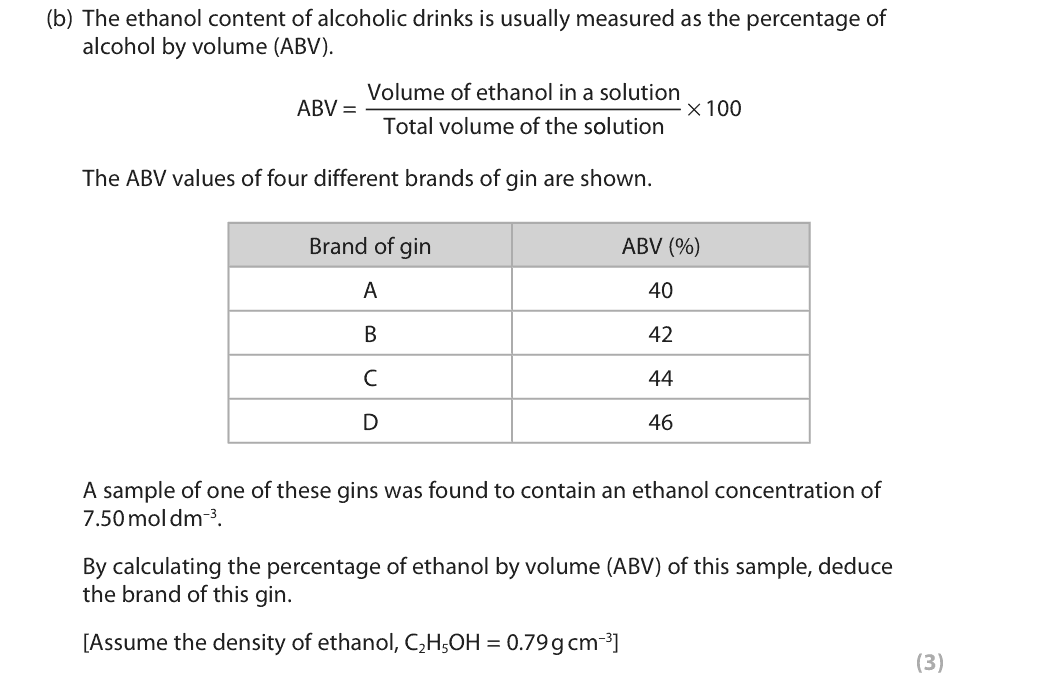
The ethanol content of alcoholic drinks is usually measured as the percentage of
alcohol by volume (ABV).
ABV = Volume of ethanol in a solution
× 100
Total volume of the solution
The ABV values of four different brands of gin are shown.
Brand of gin
ABV (%)
A
40
B
42
C
44
D
46
A sample of one of these gins was found to contain an ethanol concentration of
7.50 mol dm–3.
By calculating the percentage of ethanol by volume (ABV) of this sample, deduce
the brand of this gin.
[Assume the density of ethanol, C2H5OH = 0.79 g cm–3]
June 2019 · AS Paper 2 · Q7(a) 1 mark Multiple choice formulae equations and amounts of substance
This question is about compounds with the molecular formula C4H8O.
What is the percentage by mass of each element in C4H8O?
Percentage carbon
Percentage hydrogen
Percentage oxygen
66.67
11.11
22.22
A
60.00
20.00
20.00
B
41.38
3.45
55.17
C
30.77
61.54
7.69
D
June 2019 · AS Paper 2 · Q7(b) 6 marks 6-mark extended response mass spectrometry and infrared spectroscopyintroduction to organic chemistry
Earlier part of question 7 that this part usesEarlier part of June 2019 Paper 2 question 7
Three different compounds, A, B and C, have the molecular formula C4H8O.
Information about these three compounds includes:
Ɣ all three compounds have infrared absorptions at about 3500 cm–1
Ɣ the infrared spectra of A and B each contain a peak at about 1650 cm–1,
while that of C does not
Ɣ only A has a branched carbon chain
Ɣ B is the E-isomer of a pair of stereoisomers.
Deduce a possible displayed formula for each of the compounds A, B and C.
You must use all the information and the Data Booklet to fully justify each of your
structures.
June 2019 · AS Paper 2 · Q8(a)(i) 2 marks Diagram or structure Easy kinetics i
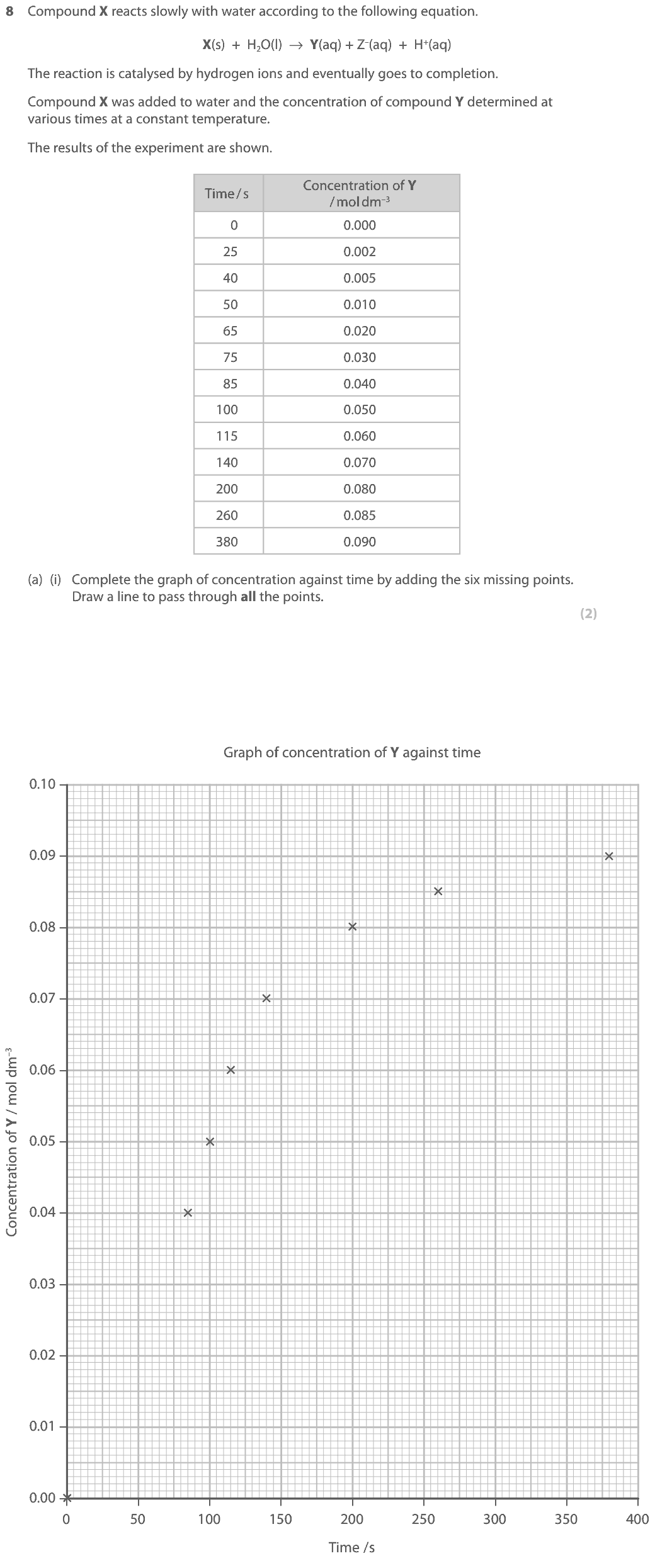
Compound X reacts slowly with water according to the following equation.
X(s)  +  H2O(l)  →  Y(aq) + Z–(aq)  +  H+(aq)
The reaction is catalysed by hydrogen ions and eventually goes to completion.
Compound X was added to water and the concentration of compound Y determined at
various times at a constant temperature.
The results of the experiment are shown.

Concentration of Y
Time / s

/ mol dm–3
0
0.000
25
0.002
40
0.005
50
0.010
65
0.020
75
0.030
85
0.040
100
0.050
115
0.060
140
0.070
200
0.080
260
0.085
380
0.090
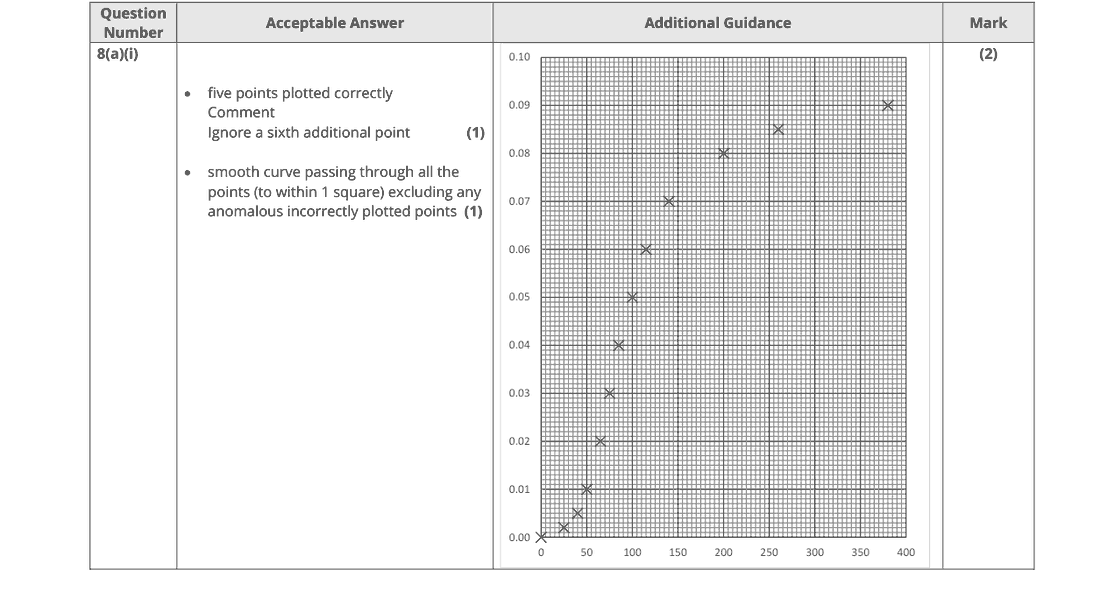
Complete the graph of concentration against time by adding the six missing points.
Draw a line to pass through all the points.
Graph of concentration of Y against time
0.10 –
0.09 –
0.08 –
0.07 –
0.06 –
0.05 –
0.04 –
0.03 –
0.02 –
0.01 –
0.00 –
0
50
100
150
200
250
300
350
400
Time / s
June 2019 · AS Paper 2 · Q8(a)(ii) 4 marks Short answer kinetics i
Earlier part of question 8 that this part usesEarlier part of June 2019 Paper 2 question 8
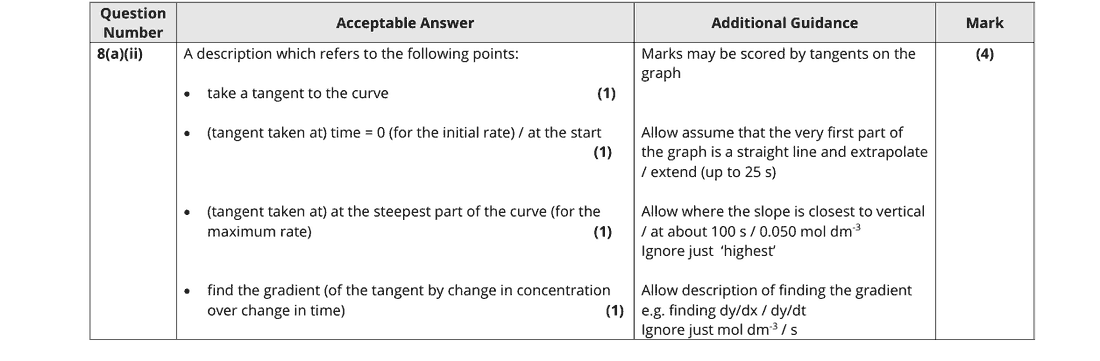
Describe how you would find a numerical value for the initial rate of reaction
and for the maximum rate of reaction in this experiment from the graph.
No actual calculations are required.
June 2019 · AS Paper 2 · Q8(b) 2 marks Explanation kinetics i
Earlier part of question 8 that this part usesEarlier part of June 2019 Paper 2 question 8
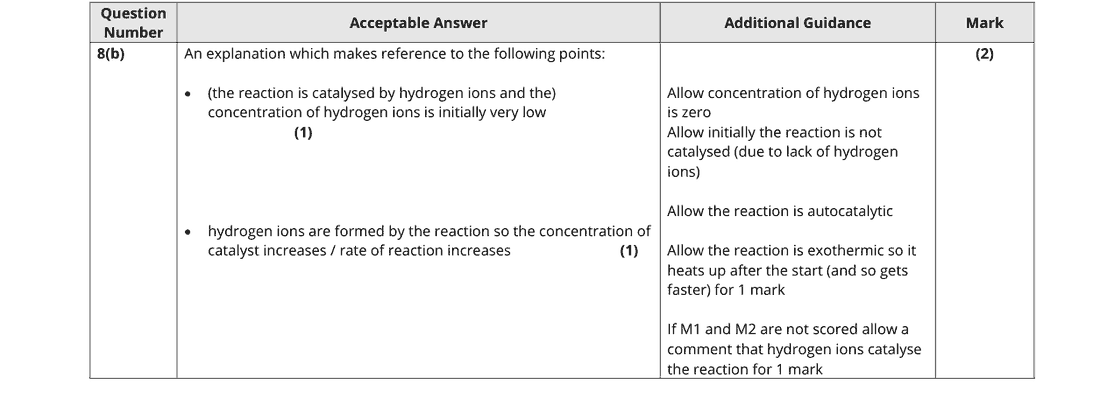
For many reactions, the values of the initial rate and the maximum rate are the same.
Explain why the values of the two reaction rates obtained in this experiment are
different from each other.
June 2019 · AS Paper 2 · Q8(c) 1 mark Short answer Hard kinetics i
Earlier part of question 8 that this part usesEarlier part of June 2019 Paper 2 question 8
Give a reason why the measurement of the initial rate of reaction is likely to be
less accurate than the measurement of the maximum rate.

Work with an A-level chemistry tutor

Want a paper marked and gone through with you? Message us.

Prefer email? Send an enquiry

If you are under 18, please include a parent's contact details. Enquiries go to enquiries@chemistryaleveltutor.com and are deleted once handled. All tutoring is online.