
November 2021: AS Paper 2, Organic and physical chemistry

80 marks · 44 question parts · Paper, mark scheme and report on AQA's site · An autumn series using the paper written for the cancelled summer exams · Have the Data Booklet beside you

Question by question

QTopicMarksAOType
01.1 Kinetics 1Short answer
01.2 Kinetics 1Short answer
01.3 Kinetics 1Short answer
01.4 Kinetics 2Diagram or structure
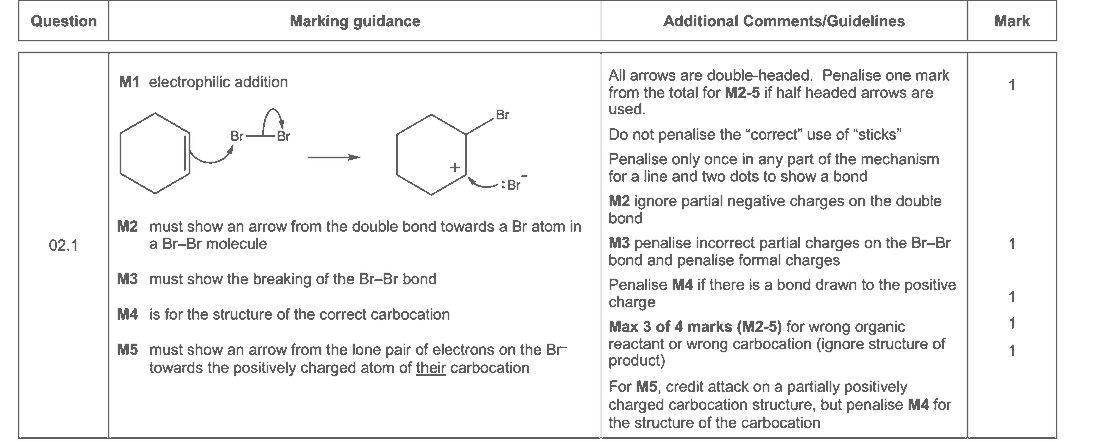
02.1 Alkenes, Introduction to organic chemistry: nomenclature, mechanisms and isomerism 5Mechanism
02.2 Alkenes 3Explanation
02.3 Alkenes, Introduction to organic chemistry: nomenclature, mechanisms and isomerism 1Diagram or structure
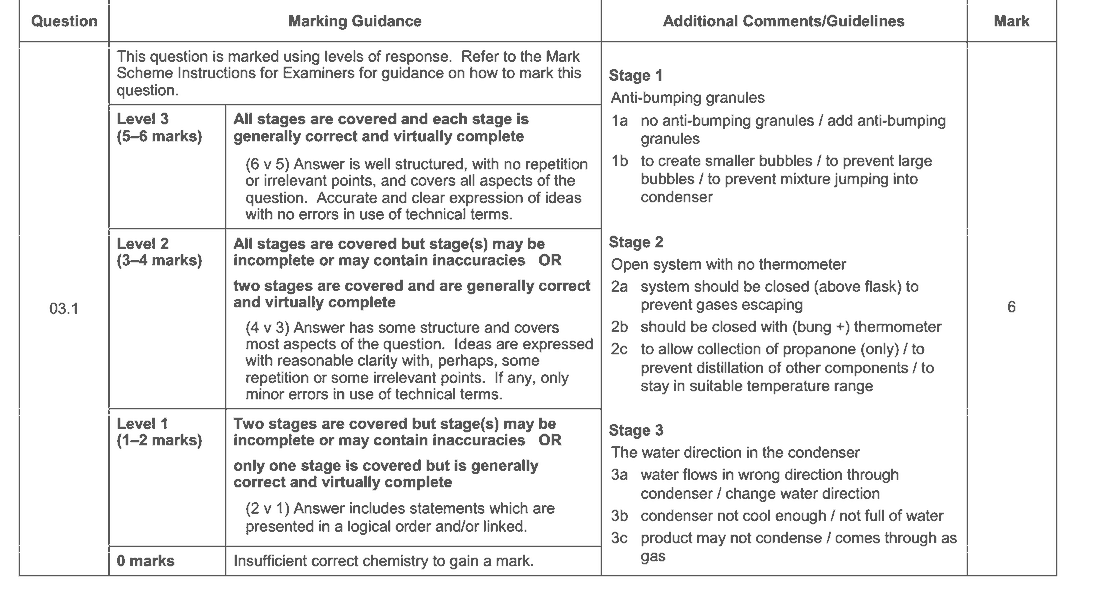
03.1 Alcohols 6Level of response
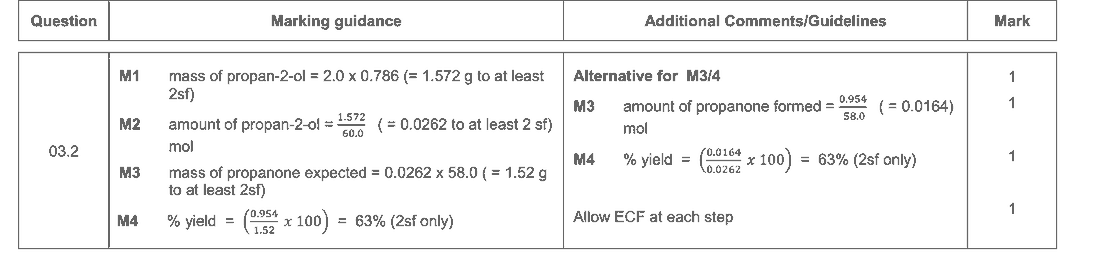
03.2 Amount of substance 4Calculation
03.3 Bonding 2Short answer
03.4 Bonding 3Explanation
04.1 Introduction to organic chemistry: nomenclature, mechanisms and isomerism 1Short answer
04.2 Halogenoalkanes 1Equation writing
04.3 Amount of substance 2Calculation
04.4 Halogenoalkanes 1Short answer
04.5 Halogenoalkanes 1Short answer
04.6 Organic analysis: test-tube reactions, mass spectrometry and infrared 2Explanation
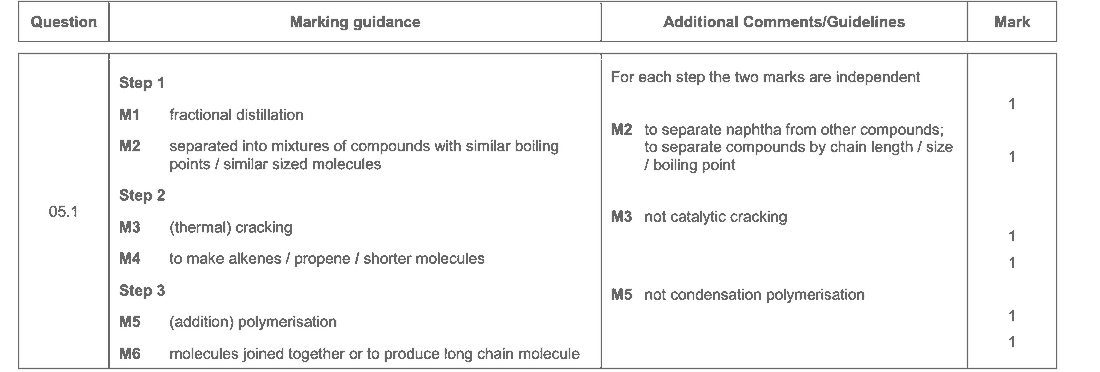
05.1 Alkanes, Alkenes 6Short answer
05.2 Alkenes 1Short answer
05.3 Alkenes 1Short answer
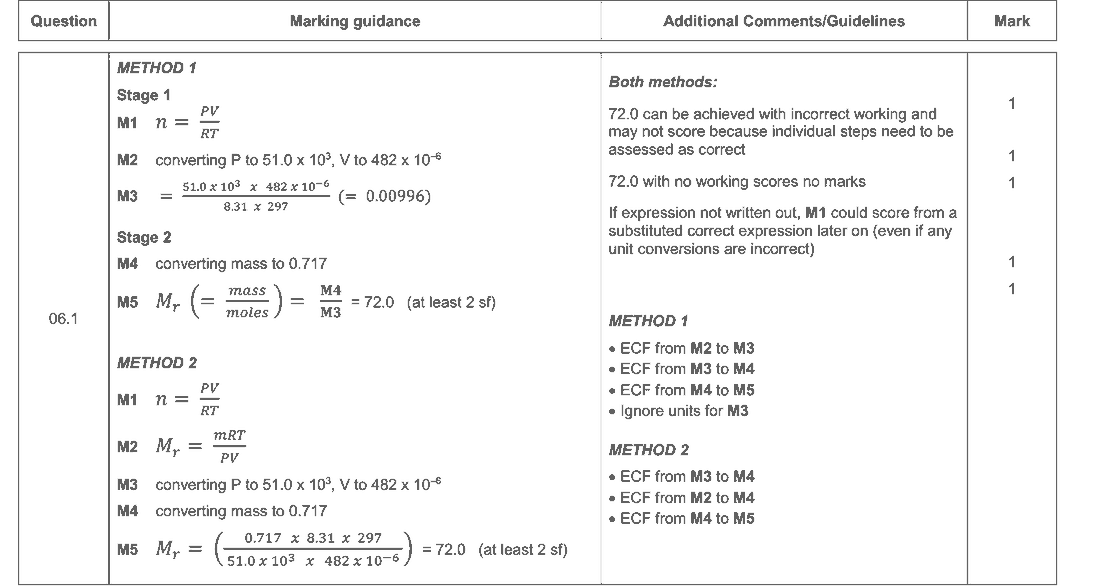
06.1 Amount of substance 5Calculation
06.2 Amount of substance 2Calculation
07.1 Halogenoalkanes 1Short answer
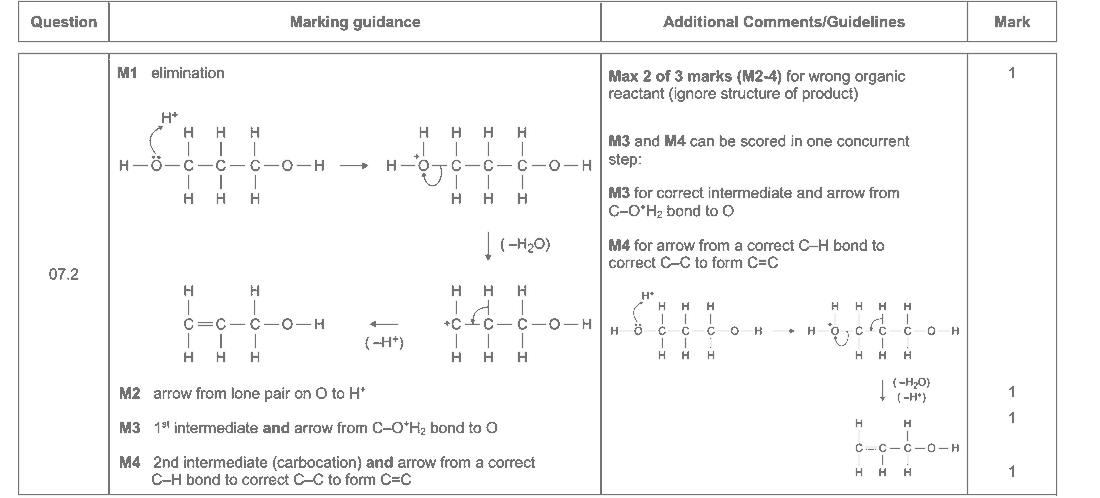
07.2 Alcohols, Introduction to organic chemistry: nomenclature, mechanisms and isomerism 4Mechanism
07.3 Alkenes 1Diagram or structure
07.4 Organic analysis: test-tube reactions, mass spectrometry and infrared, Introduction to organic chemistry: nomenclature, mechanisms and isomerism, Alcohols 1Diagram or structure
08.1 Energetics 1Short answer
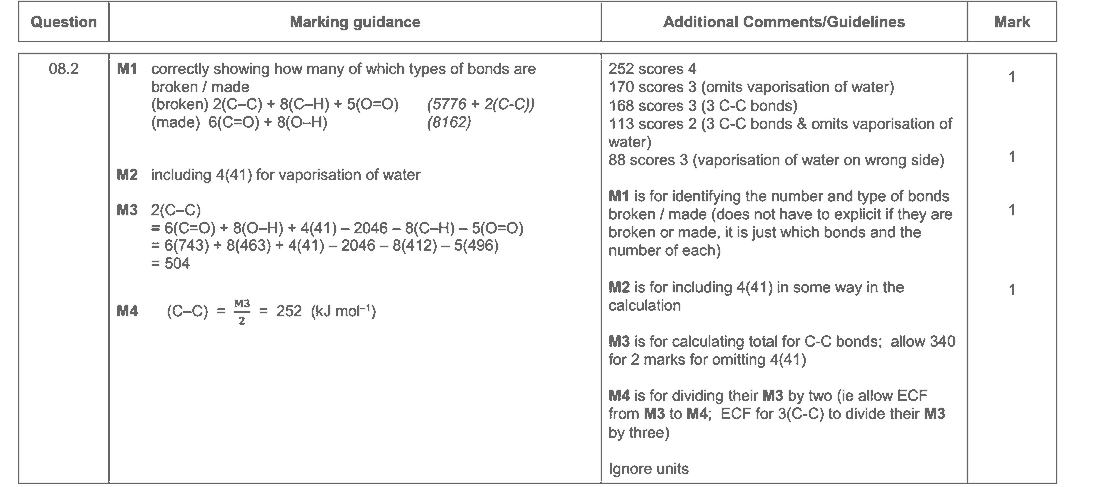
08.2 Energetics 4Calculation
08.3 Energetics 1Short answer
09 Introduction to organic chemistry: nomenclature, mechanisms and isomerism 1Multiple choice
10 Amount of substance 1Multiple choice
11 Amount of substance 1Multiple choice
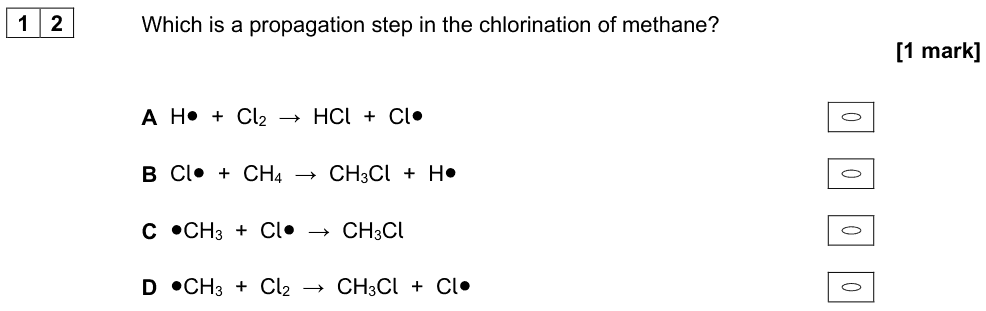
12 Alkanes, Introduction to organic chemistry: nomenclature, mechanisms and isomerism 1Multiple choice
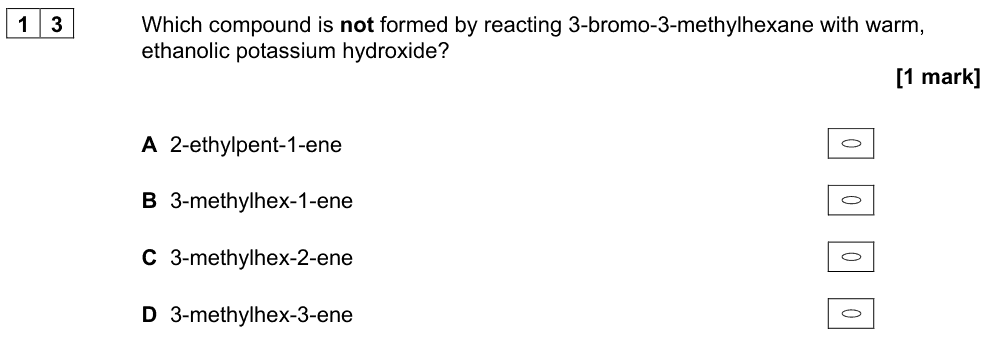
13 Halogenoalkanes 1Multiple choice
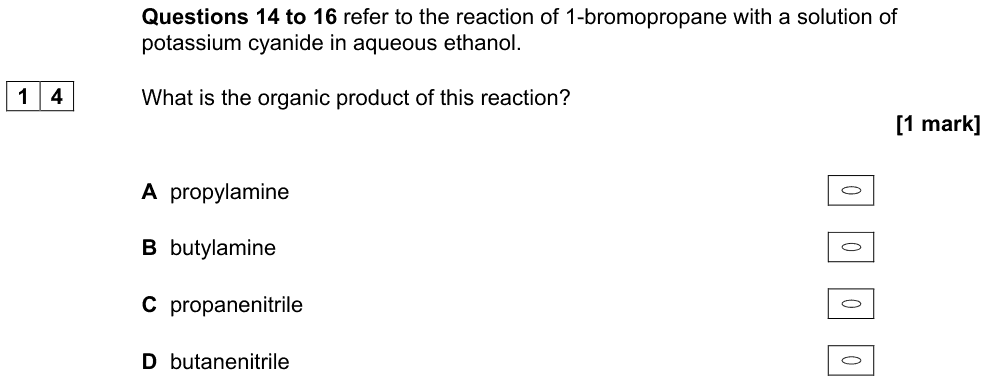
14 Halogenoalkanes 1Multiple choice
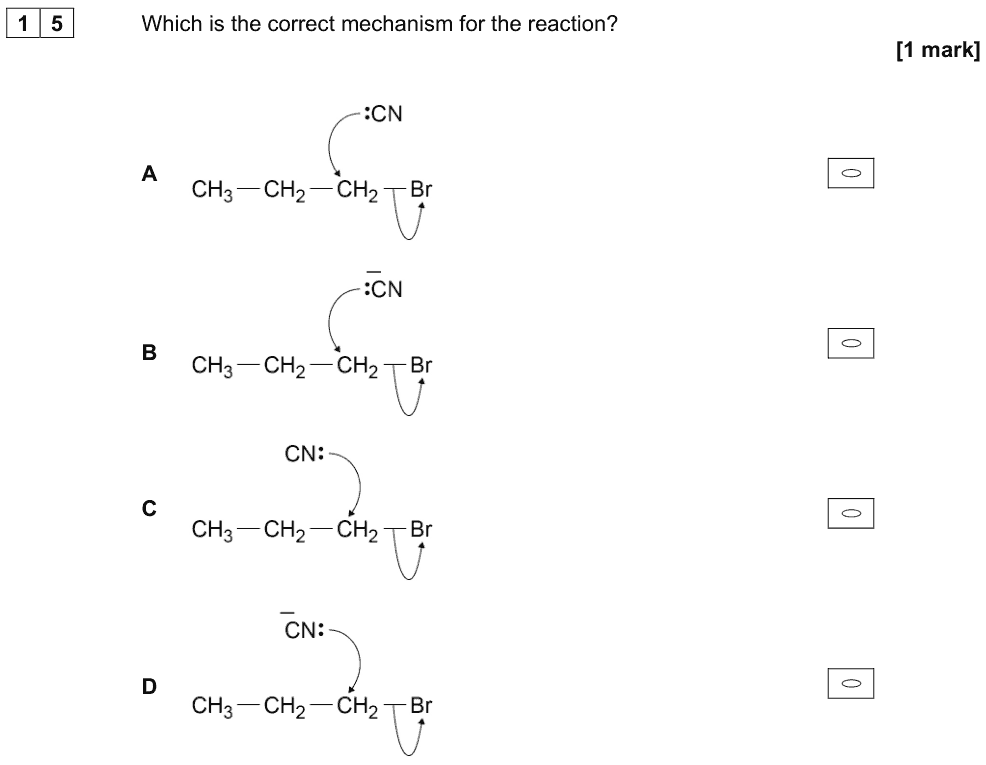
15 Halogenoalkanes, Introduction to organic chemistry: nomenclature, mechanisms and isomerism 1Multiple choice
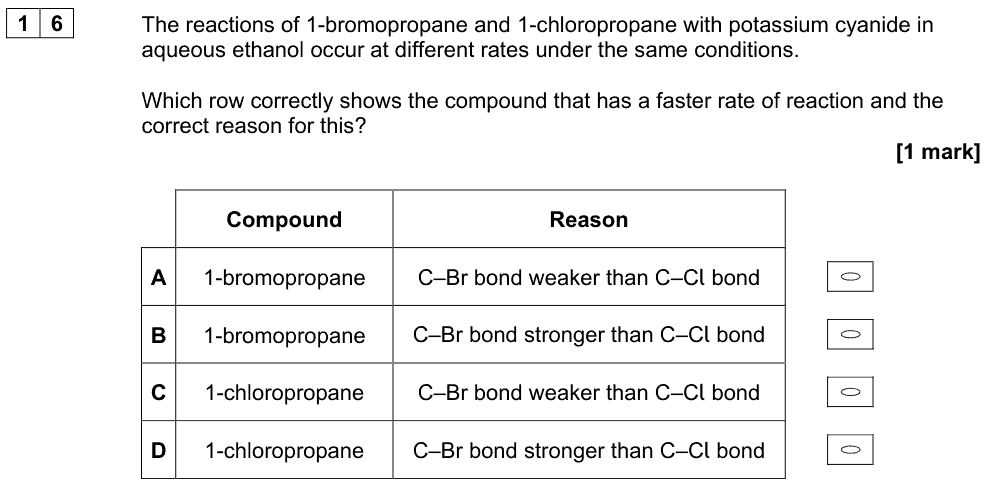
16 Halogenoalkanes 1Multiple choice
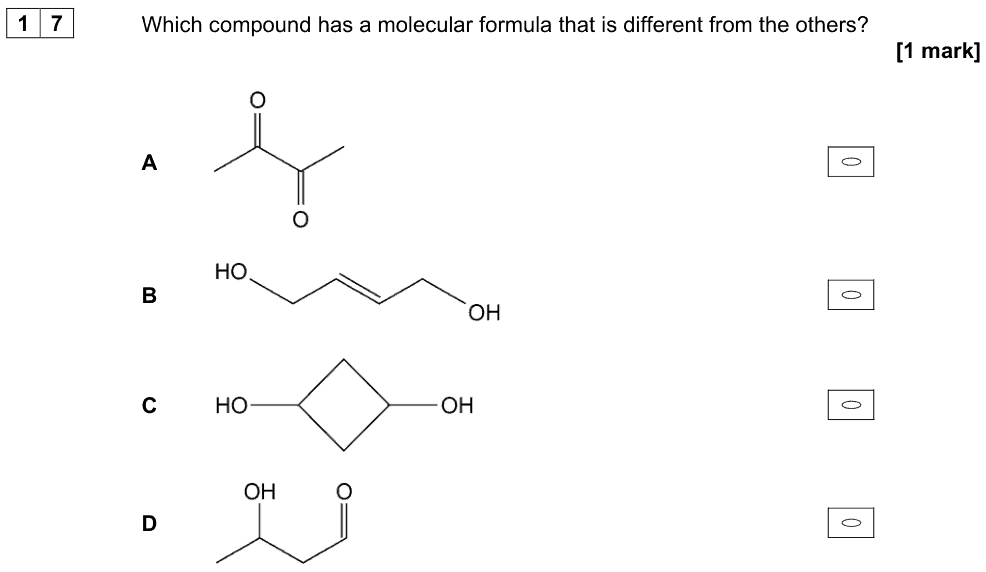
17 Introduction to organic chemistry: nomenclature, mechanisms and isomerism 1Multiple choice
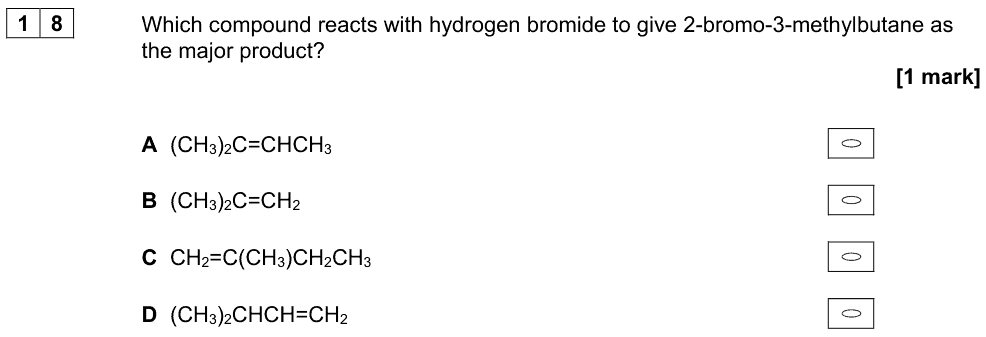
18 Alkenes 1Multiple choice
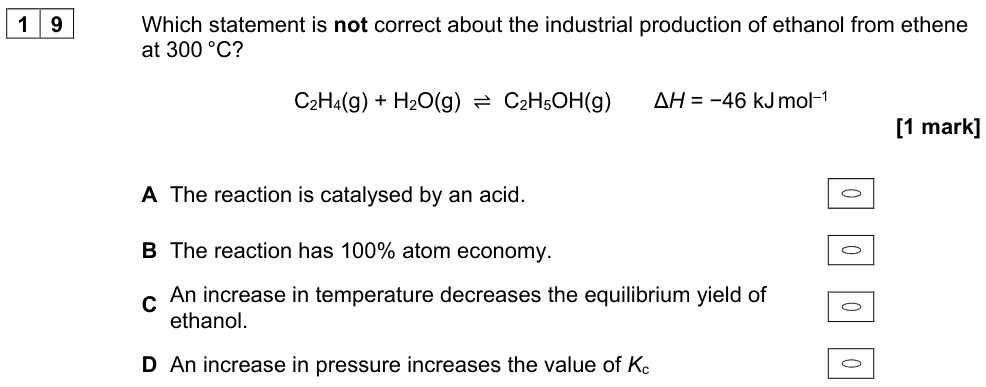
19 Chemical equilibria, Le Chatelier's principle and Kc 1Multiple choice
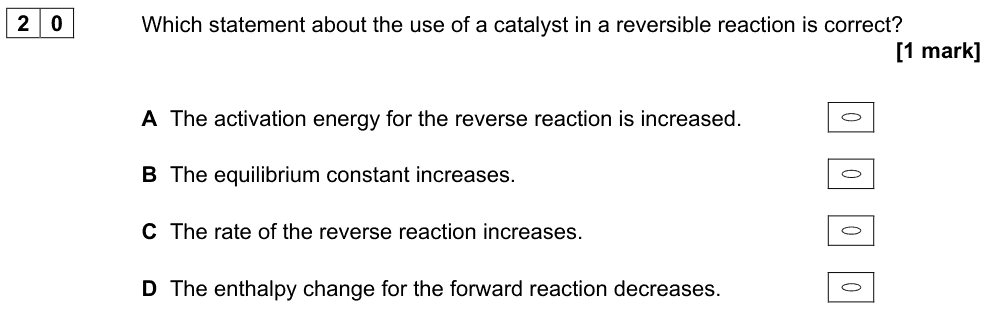
20 Chemical equilibria, Le Chatelier's principle and Kc, Kinetics 1Multiple choice
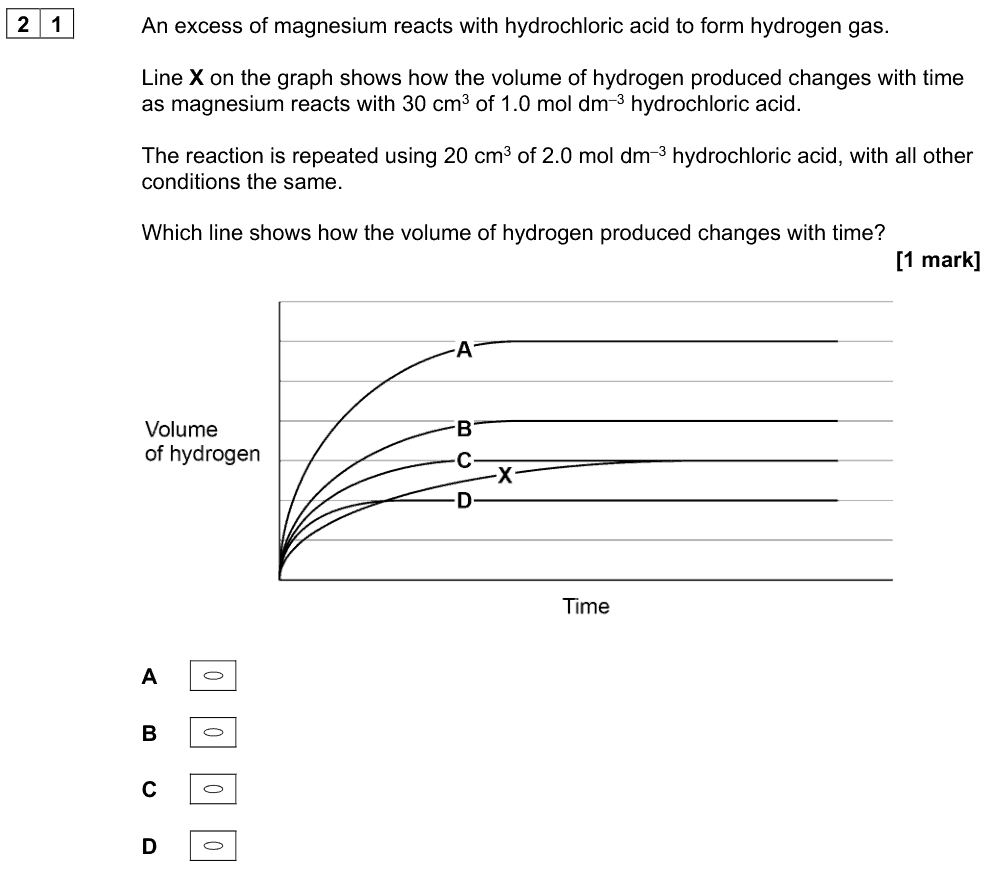
21 Kinetics, Amount of substance 1Multiple choice
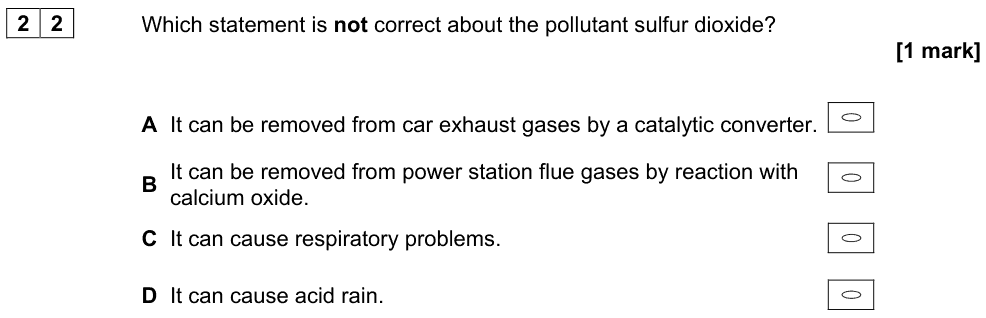
22 Alkanes 1Multiple choice
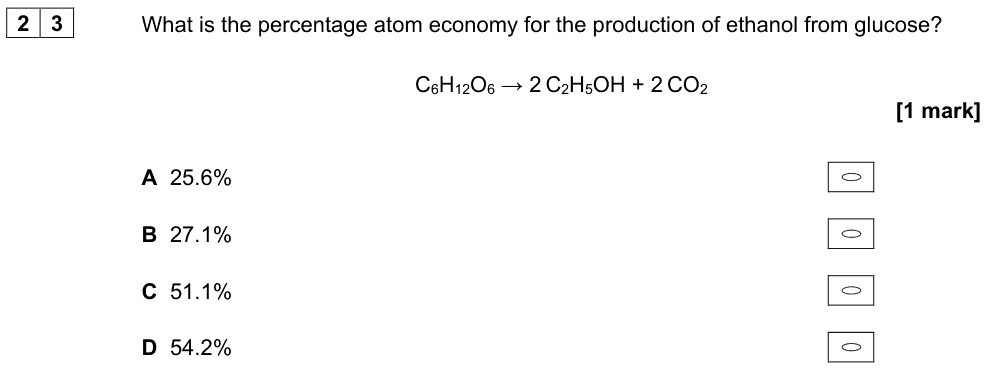
23 Amount of substance 1Multiple choice

The questions

01.101.201.301.402.102.202.303.103.203.303.404.104.204.304.404.504.605.105.205.306.106.207.107.207.307.408.108.208.3091011121314151617181920212223
November 2021 · AS Paper 2 · Q01.1 1 mark Short answer kinetics
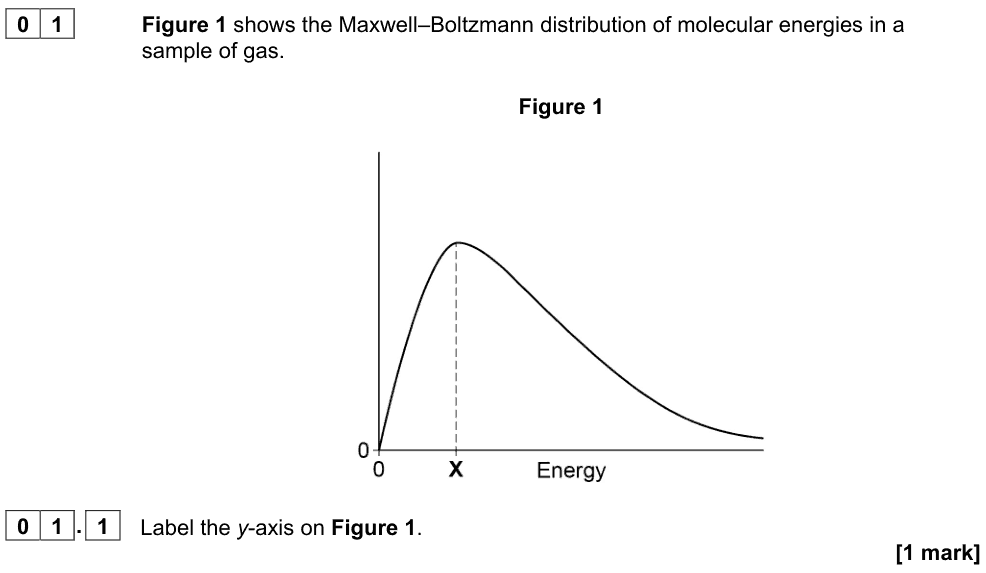
Figure 1 shows the Maxwell–Boltzmann distribution of molecular energies in a
sample of gas.
Figure 1
Label the y-axis on Figure 1.
[1 mark]
November 2021 · AS Paper 2 · Q01.2 1 mark Short answer kinetics
Earlier part of question 01 that this part usesEarlier part of November 2021 Paper 2 question 01
State why the curve starts at the origin.
[1 mark]
November 2021 · AS Paper 2 · Q01.3 1 mark Short answer kinetics
Earlier part of question 01 that this part usesEarlier part of November 2021 Paper 2 question 01
State what X indicates on Figure 1.
[1 mark]
X indicates
November 2021 · AS Paper 2 · Q01.4 2 marks Diagram or structure kinetics
Earlier part of question 01 that this part usesEarlier part of November 2021 Paper 2 question 01
Half of the gas molecules in the sample are removed.
The remaining gas molecules are kept at the same temperature.
Draw the new distribution of molecular energies for the remaining gas on Figure 1.
[2 marks]
November 2021 · AS Paper 2 · Q02.1 5 marks Mechanism alkenesintroduction to organic chemistry
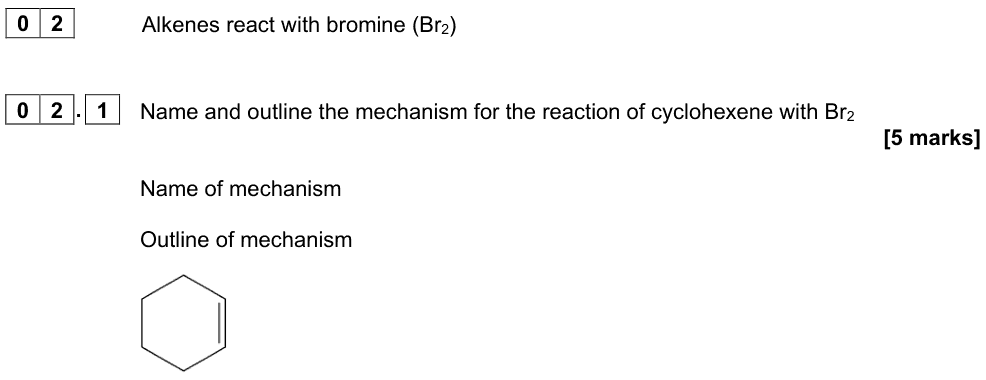
Alkenes react with bromine (Br2)
Name and outline the mechanism for the reaction of cyclohexene with Br2
[5 marks]
Name of mechanism
Outline of mechanism
November 2021 · AS Paper 2 · Q02.2 3 marks Explanation alkenes
Earlier part of question 02 that this part usesEarlier part of November 2021 Paper 2 question 02
Explain why there is an attraction between a C=C double bond and Br2
[3 marks]
November 2021 · AS Paper 2 · Q02.3 1 mark Diagram or structure alkenesintroduction to organic chemistry
Earlier part of question 02 that this part usesEarlier part of November 2021 Paper 2 question 02
Draw the skeletal formula of the halogenoalkane formed when
buta-1,3-diene (CH2=CHCH=CH2) reacts with an excess of Br2
[1 mark]
November 2021 · AS Paper 2 · Q03.1 6 marks 6-mark level of response alcohols
Propanone can be made by reacting propan-2-ol with an excess of
acidified potassium dichromate(VI).
The propanone is removed from the reaction mixture by distillation.
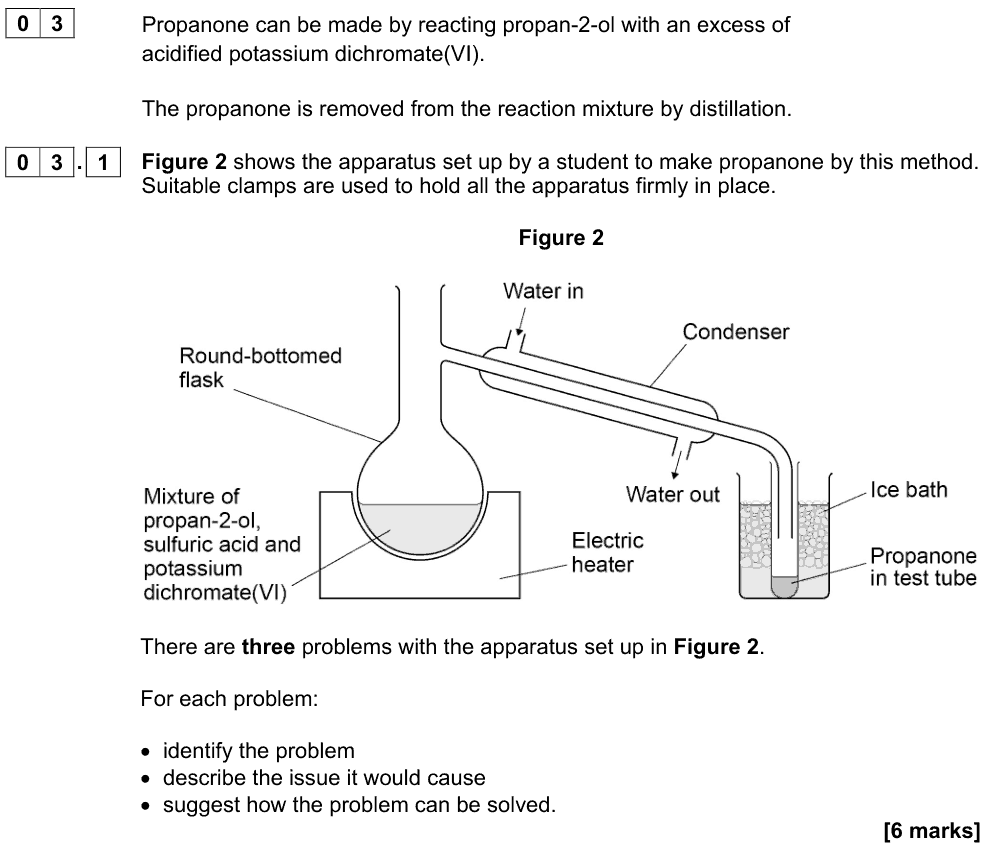
Figure 2 shows the apparatus set up by a student to make propanone by this method.
Suitable clamps are used to hold all the apparatus firmly in place.
Figure 2
There are three problems with the apparatus set up in Figure 2.
For each problem:
• identify the problem
• describe the issue it would cause
• suggest how the problem can be solved.
[6 marks]
November 2021 · AS Paper 2 · Q03.2 4 marks Calculation amount of substance
Earlier part of question 03 that this part usesEarlier part of November 2021 Paper 2 question 03
Another student completes the experiment using apparatus that is set up correctly.
The student reacts 2.0 cm3 of propan-2-ol (CH3CH(OH)CH3) with an excess of
acidified potassium dichromate(VI).
The student obtains 0.954 g of propanone (CH3COCH3).
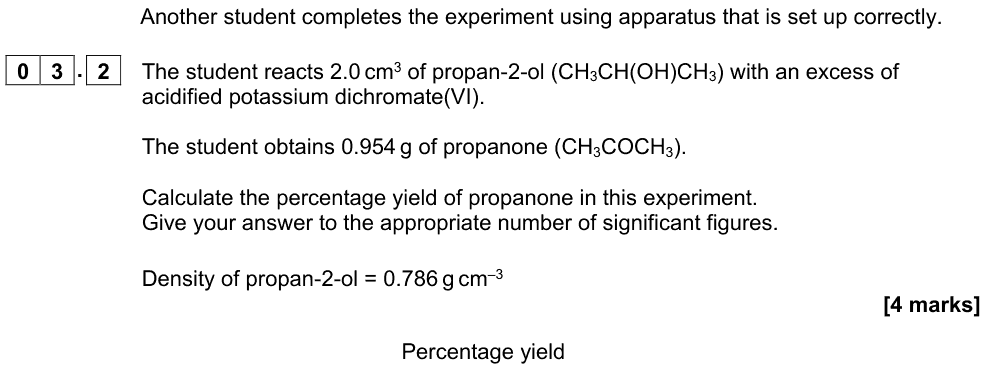
Calculate the percentage yield of propanone in this experiment.
Give your answer to the appropriate number of significant figures.
Density of propan-2-ol = 0.786 g cm–3
[4 marks]
Percentage yield
November 2021 · AS Paper 2 · Q03.3 2 marks Short answer bonding
Earlier parts of question 03 that this part usesEarlier part of November 2021 Paper 2 question 03Earlier part of November 2021 Paper 2 question 03
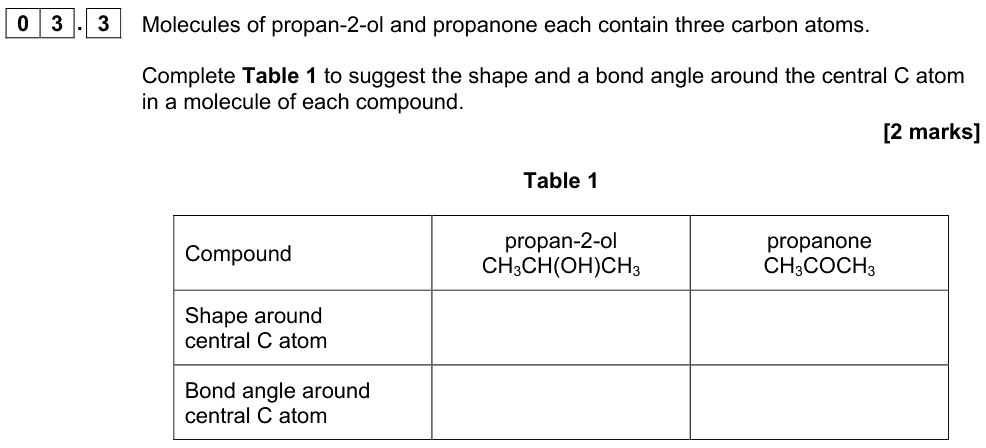
Molecules of propan-2-ol and propanone each contain three carbon atoms.
Complete Table 1 to suggest the shape and a bond angle around the central C atom
in a molecule of each compound.
[2 marks]
Table 1
Compound
propan-2-ol
CH3CH(OH)CH3
propanone
CH3COCH3
Shape around
central C atom
Bond angle around
central C atom
November 2021 · AS Paper 2 · Q03.4 3 marks Explanation bonding
Earlier parts of question 03 that this part usesEarlier part of November 2021 Paper 2 question 03Earlier part of November 2021 Paper 2 question 03
Explain why propanone has a lower boiling point than propan-2-ol.
[3 marks]
November 2021 · AS Paper 2 · Q04.1 1 mark Short answer introduction to organic chemistry
CFCs were used as refrigerants and in aerosols.
The scientists Rowland and Molina published research in 1974 to show that CFCs are
responsible for the destruction of ozone molecules in the upper atmosphere.
A few years later, other scientists discovered that the concentration of ozone in the
upper atmosphere was decreasing.
In 1987 there was an agreement by many countries to restrict the use of CFCs.
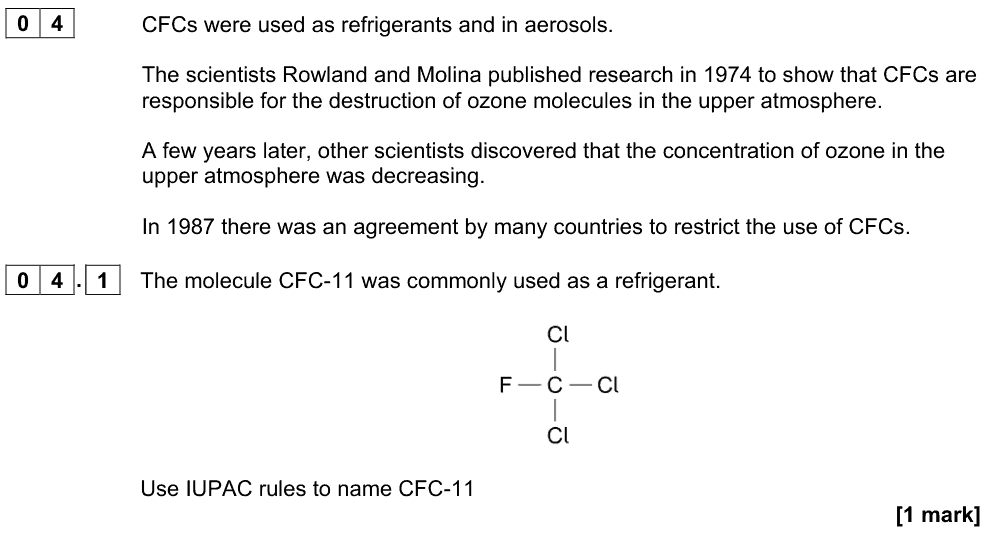
The molecule CFC-11 was commonly used as a refrigerant.
Use IUPAC rules to name CFC-11
[1 mark]
November 2021 · AS Paper 2 · Q04.2 1 mark Equation writing halogenoalkanes
Earlier part of question 04 that this part usesEarlier part of November 2021 Paper 2 question 04
A molecule of CFC-11 breaks down in the upper atmosphere to form a
chlorine free radical.
Give the equation for this reaction.
[1 mark]
November 2021 · AS Paper 2 · Q04.3 2 marks Calculation amount of substance
Earlier part of question 04 that this part usesEarlier part of November 2021 Paper 2 question 04
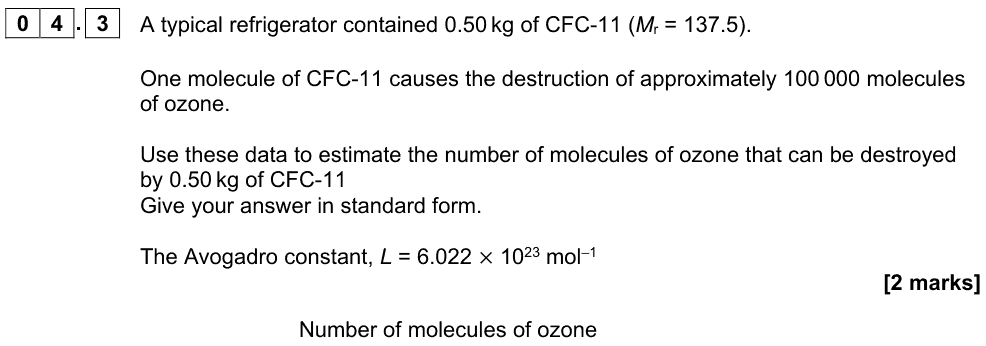
A typical refrigerator contained 0.50 kg of CFC-11 (Mr = 137.5).
One molecule of CFC-11 causes the destruction of approximately 100 000 molecules
of ozone.
Use these data to estimate the number of molecules of ozone that can be destroyed
by 0.50 kg of CFC-11
Give your answer in standard form.
The Avogadro constant, L = 6.022 × 10²³ mol–1
[2 marks]
Number of molecules of ozone
November 2021 · AS Paper 2 · Q04.4 1 mark Short answer halogenoalkanes
Earlier part of question 04 that this part usesEarlier part of November 2021 Paper 2 question 04
State the benefit to life on Earth of ozone in the upper atmosphere.
[1 mark]
November 2021 · AS Paper 2 · Q04.5 1 mark Short answer halogenoalkanes
Earlier part of question 04 that this part usesEarlier part of November 2021 Paper 2 question 04
Suggest one reason why the use of CFCs was not restricted until several years
after Rowland and Molina published their research.
[1 mark]
November 2021 · AS Paper 2 · Q04.6 2 marks Explanation organic analysis
Earlier part of question 04 that this part usesEarlier part of November 2021 Paper 2 question 04
CFC-11 is a greenhouse gas that can contribute to global warming.
State and explain how CFC-11 is able to contribute to global warming.
[2 marks]
November 2021 · AS Paper 2 · Q05.1 6 marks Short answer alkanesalkenes
This question is about poly(propene).
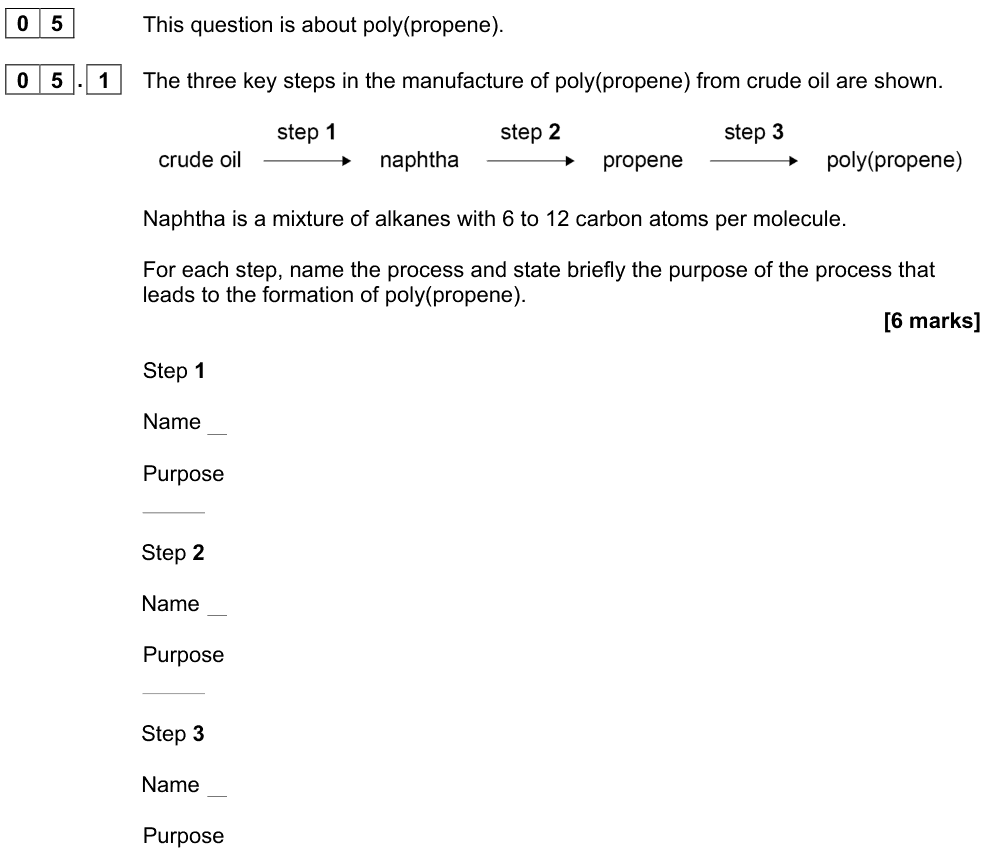
The three key steps in the manufacture of poly(propene) from crude oil are shown.
Naphtha is a mixture of alkanes with 6 to 12 carbon atoms per molecule.
For each step, name the process and state briefly the purpose of the process that
leads to the formation of poly(propene).
[6 marks]
Step 1
Name
Purpose
Step 2
Name
Purpose
Step 3
Name
Purpose
November 2021 · AS Paper 2 · Q05.2 1 mark Short answer alkenes
Earlier part of question 05 that this part usesEarlier part of November 2021 Paper 2 question 05
Poly(propene) is not biodegradable because it is unreactive.
Explain why poly(propene) is unreactive.
[1 mark]
November 2021 · AS Paper 2 · Q05.3 1 mark Short answer alkenes
Earlier part of question 05 that this part usesEarlier part of November 2021 Paper 2 question 05
Scientists are developing new polymers, including some that are biodegradable.
Suggest why it is beneficial for some polymers to be biodegradable.
[1 mark]
November 2021 · AS Paper 2 · Q06.1 5 marks Calculation amount of substance
This question is about two experiments on gases.
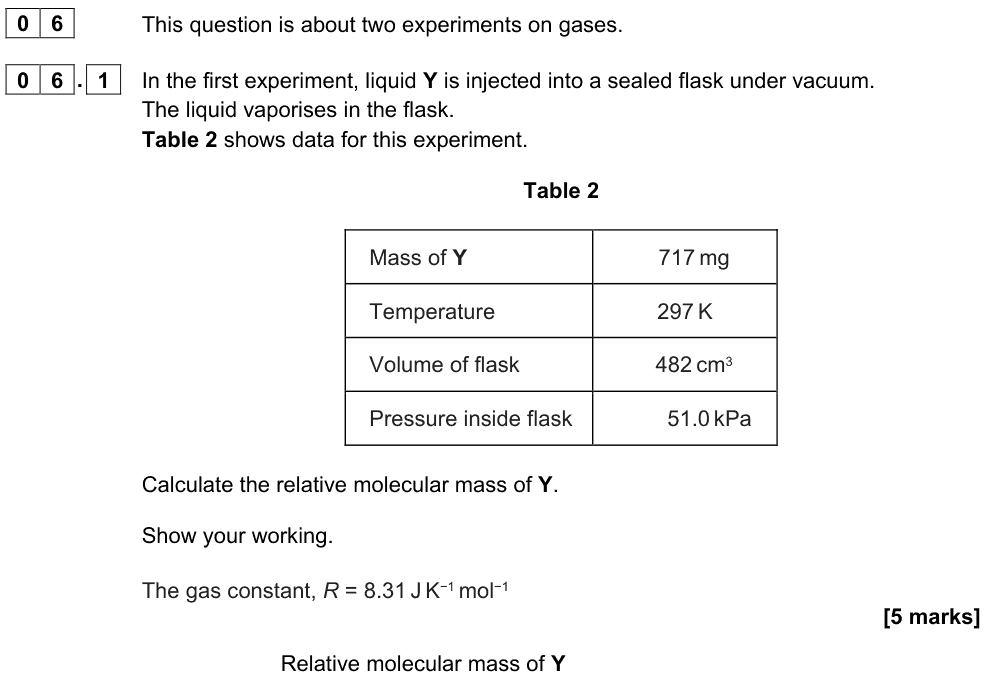
In the first experiment, liquid Y is injected into a sealed flask under vacuum.
The liquid vaporises in the flask.
Table 2 shows data for this experiment.
Table 2
Mass of Y
717 mg
Temperature
297 K
Volume of flask
482 cm3
Pressure inside flask
51.0 kPa
Calculate the relative molecular mass of Y.
Show your working.
The gas constant, R = 8.31 J K−1 mol−1
[5 marks]
Relative molecular mass of Y
November 2021 · AS Paper 2 · Q06.2 2 marks Calculation amount of substance
Earlier part of question 06 that this part usesEarlier part of November 2021 Paper 2 question 06
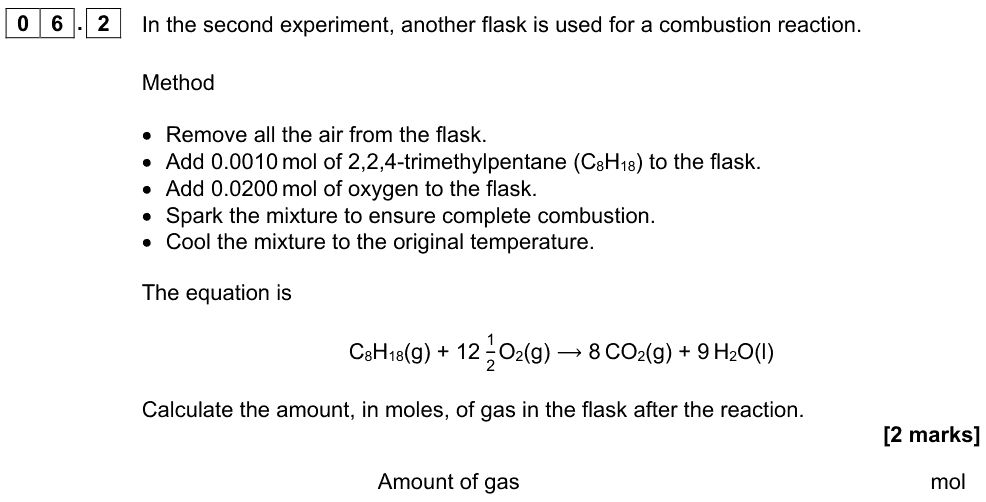
In the second experiment, another flask is used for a combustion reaction.
Method
• Remove all the air from the flask.
• Add 0.0010 mol of 2,2,4-trimethylpentane (C8H18) to the flask.
• Add 0.0200 mol of oxygen to the flask.
• Spark the mixture to ensure complete combustion.
• Cool the mixture to the original temperature.
The equation is
C8H18(g) + 12
1
2
O2(g) ⟶ 8 CO2(g) + 9 H2O(l)
Calculate the amount, in moles, of gas in the flask after the reaction.
[2 marks]
Amount of gas
mol
November 2021 · AS Paper 2 · Q07.1 1 mark Short answer halogenoalkanes
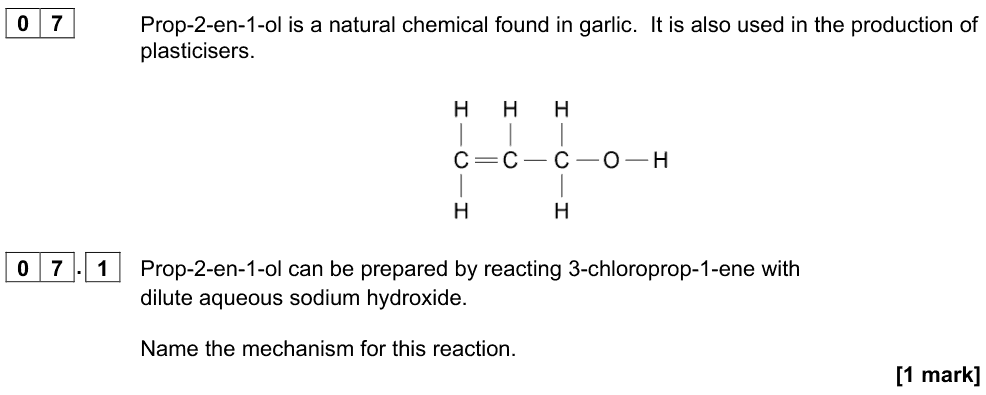
Prop-2-en-1-ol is a natural chemical found in garlic.  It is also used in the production of
plasticisers.
Prop-2-en-1-ol can be prepared by reacting 3-chloroprop-1-ene with
dilute aqueous sodium hydroxide.
Name the mechanism for this reaction.
[1 mark]
November 2021 · AS Paper 2 · Q07.2 4 marks Mechanism alcoholsintroduction to organic chemistry
Earlier part of question 07 that this part usesEarlier part of November 2021 Paper 2 question 07
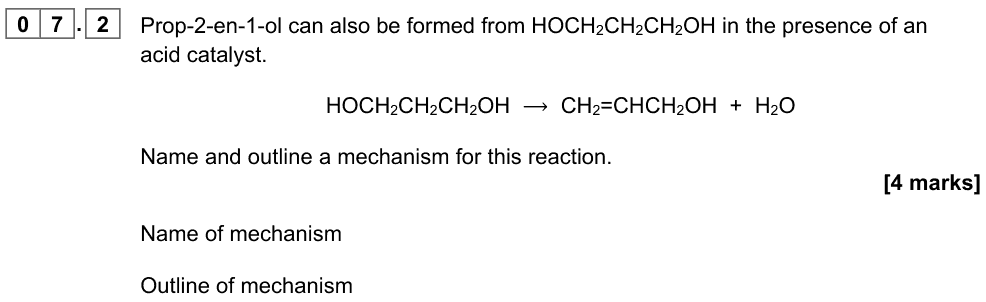
Prop-2-en-1-ol can also be formed from HOCH2CH2CH2OH in the presence of an
acid catalyst.
HOCH2CH2CH2OH  ⟶  CH2=CHCH2OH  +  H2O
Name and outline a mechanism for this reaction.
[4 marks]
Name of mechanism
Outline of mechanism
November 2021 · AS Paper 2 · Q07.3 1 mark Diagram or structure alkenes
Earlier part of question 07 that this part usesEarlier part of November 2021 Paper 2 question 07
Prop-2-en-1-ol forms an addition polymer.
Draw the repeating unit of poly(prop-2-en-1-ol).
[1 mark]
November 2021 · AS Paper 2 · Q07.4 1 mark Diagram or structure organic analysisintroduction to organic chemistryalcohols
Earlier part of question 07 that this part usesEarlier part of November 2021 Paper 2 question 07
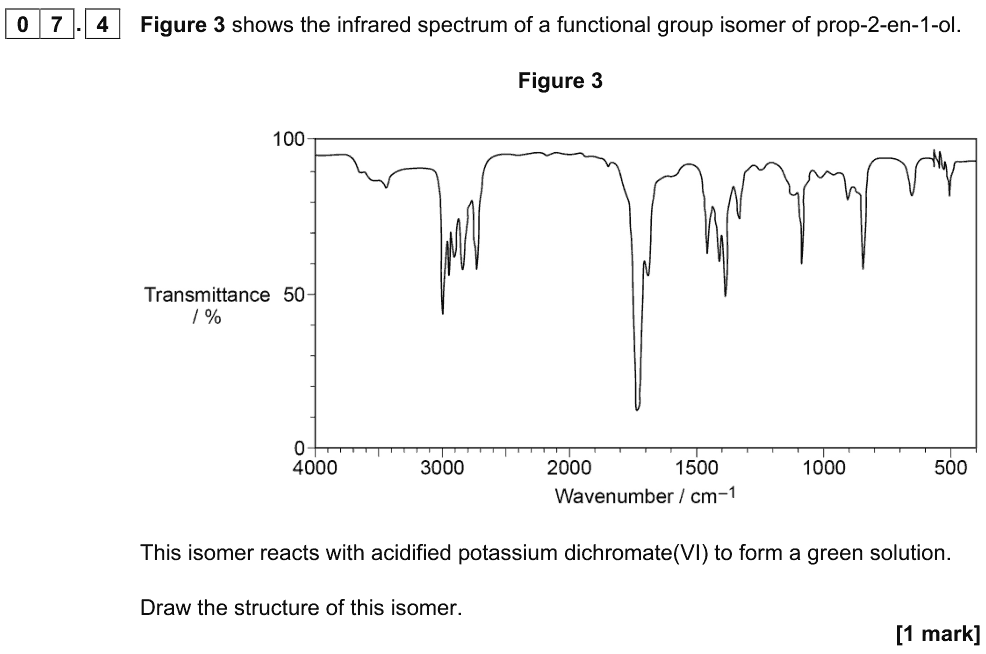
Figure 3 shows the infrared spectrum of a functional group isomer of prop-2-en-1-ol.
Figure 3
This isomer reacts with acidified potassium dichromate(VI) to form a green solution.
Draw the structure of this isomer.
[1 mark]
November 2021 · AS Paper 2 · Q08.1 1 mark Short answer energetics
This question is about enthalpy changes.
Define the term enthalpy change.
[1 mark]
November 2021 · AS Paper 2 · Q08.2 4 marks Calculation energetics
Earlier part of question 08 that this part usesEarlier part of November 2021 Paper 2 question 08
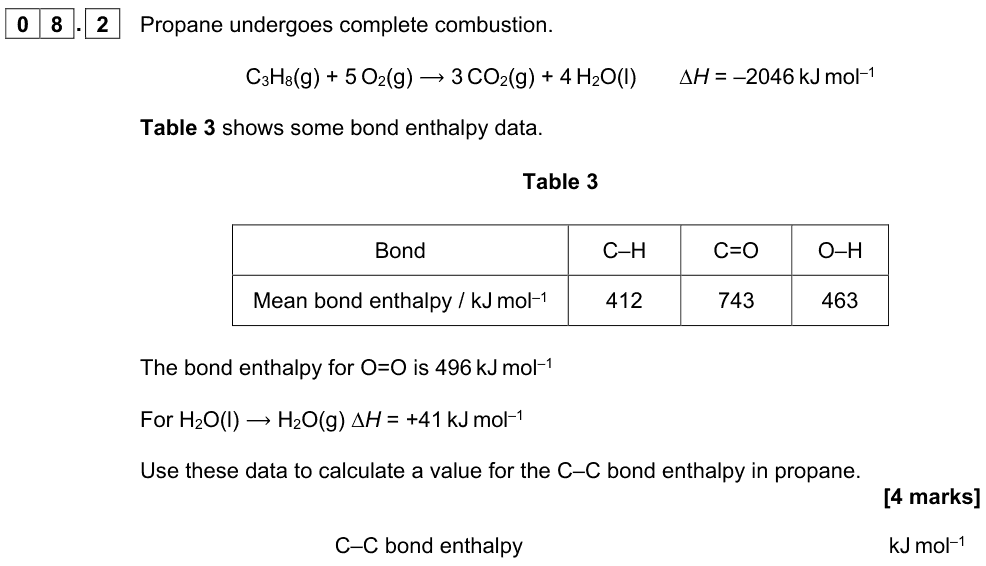
Propane undergoes complete combustion.
C3H8(g) + 5 O2(g) ⟶ 3 CO2(g) + 4 H2O(l)       ∆H = –2046 kJ mol–1
Table 3 shows some bond enthalpy data.
Table 3
Bond
C–H
C=O
O–H
Mean bond enthalpy / kJ mol–1
412
743
463
The bond enthalpy for O=O is 496 kJ mol–1
For H2O(l) ⟶ H2O(g) ∆H = +41 kJ mol–1
Use these data to calculate a value for the C–C bond enthalpy in propane.
[4 marks]
C–C bond enthalpy
kJ mol‒1
November 2021 · AS Paper 2 · Q08.3 1 mark Short answer energetics
Earlier part of question 08 that this part usesEarlier part of November 2021 Paper 2 question 08
Explain why the value given for the O=O bond enthalpy in Question 08.2 is not a
mean value.
[1 mark]
November 2021 · AS Paper 2 · Q09 1 mark Multiple choice introduction to organic chemistry
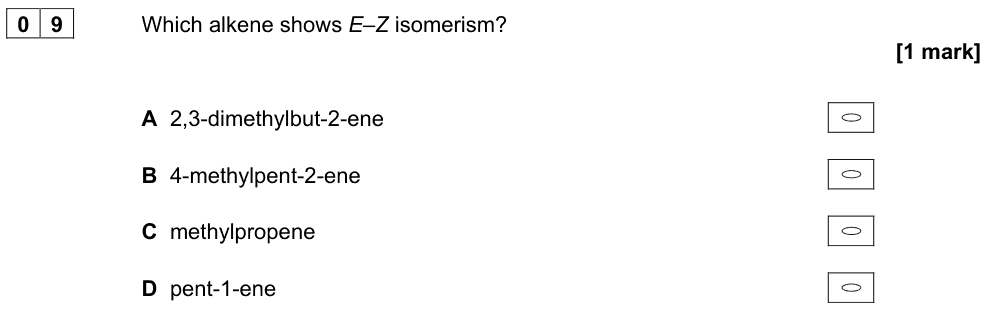
Which alkene shows E–Z isomerism?
[1 mark]
A 2,3-dimethylbut-2-ene
B 4-methylpent-2-ene
C methylpropene
D pent-1-ene
November 2021 · AS Paper 2 · Q10 1 mark Multiple choice amount of substance
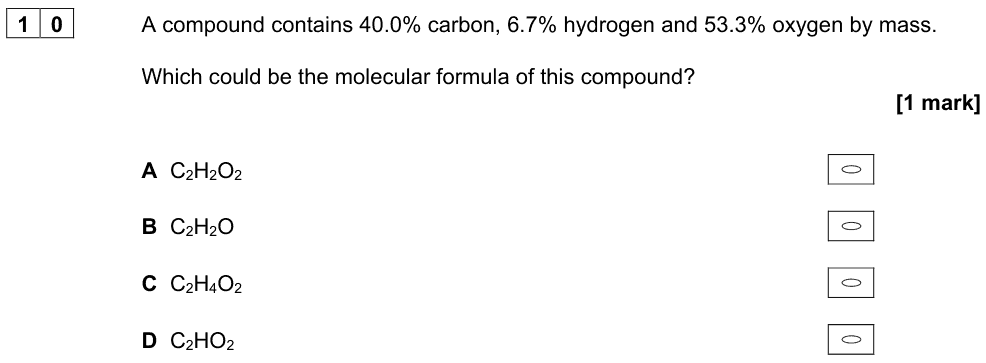
A compound contains 40.0% carbon, 6.7% hydrogen and 53.3% oxygen by mass.
Which could be the molecular formula of this compound?
[1 mark]
A C2H2O2
B C2H2O
C C2H4O2
D C2HO2
November 2021 · AS Paper 2 · Q11 1 mark Multiple choice amount of substance
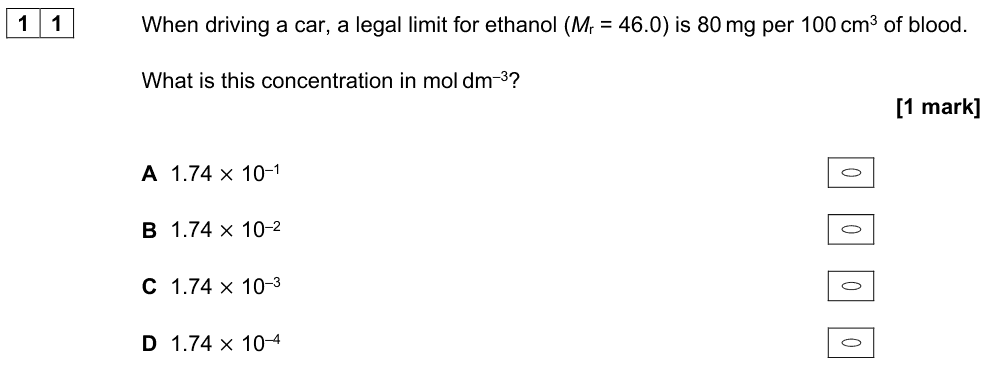
When driving a car, a legal limit for ethanol (Mr = 46.0) is 80 mg per 100 cm3 of blood.
What is this concentration in mol dm–3?
[1 mark]
A 1.74 × 10⁻¹
B 1.74 × 10⁻²
C 1.74 × 10⁻³
D 1.74 × 10⁻⁴
November 2021 · AS Paper 2 · Q12 1 mark Multiple choice alkanesintroduction to organic chemistry
Which is a propagation step in the chlorination of methane?
[1 mark]
A H●  +  Cl2  →  HCl  +  Cl●
B Cl●  +  CH4  →  CH3Cl  +  H●
C ●CH3  +  Cl●  →  CH3Cl
D ●CH3  +  Cl2  →  CH3Cl  +  Cl●
November 2021 · AS Paper 2 · Q13 1 mark Multiple choice halogenoalkanes
Which compound is not formed by reacting 3-bromo-3-methylhexane with warm,
ethanolic potassium hydroxide?
[1 mark]
A 2-ethylpent-1-ene
B 3-methylhex-1-ene
C 3-methylhex-2-ene
D 3-methylhex-3-ene
November 2021 · AS Paper 2 · Q14 1 mark Multiple choice halogenoalkanes
Questions 14 to 16 refer to the reaction of 1-bromopropane with a solution of
potassium cyanide in aqueous ethanol.
What is the organic product of this reaction?
[1 mark]
A propylamine
B butylamine
C propanenitrile
D butanenitrile
November 2021 · AS Paper 2 · Q15 1 mark Multiple choice halogenoalkanesintroduction to organic chemistry
Earlier part of question 15 that this part usesEarlier part of November 2021 Paper 2 question 15
Which is the correct mechanism for the reaction?
[1 mark]
A
B
C
D
November 2021 · AS Paper 2 · Q16 1 mark Multiple choice halogenoalkanes
Earlier part of question 16 that this part usesEarlier part of November 2021 Paper 2 question 16
The reactions of 1-bromopropane and 1-chloropropane with potassium cyanide in
aqueous ethanol occur at different rates under the same conditions.
Which row correctly shows the compound that has a faster rate of reaction and the
correct reason for this?
[1 mark]
Compound
Reason
A
1-bromopropane
C–Br bond weaker than C–Cl bond
B
1-bromopropane
C–Br bond stronger than C–Cl bond
C
1-chloropropane
C–Br bond weaker than C–Cl bond
D
1-chloropropane
C–Br bond stronger than C–Cl bond
November 2021 · AS Paper 2 · Q17 1 mark Multiple choice introduction to organic chemistry
Which compound has a molecular formula that is different from the others?
[1 mark]
A
B
C
D
November 2021 · AS Paper 2 · Q18 1 mark Multiple choice alkenes
Which compound reacts with hydrogen bromide to give 2-bromo-3-methylbutane as
the major product?
[1 mark]
A (CH3)2C=CHCH3
B (CH3)2C=CH2
C CH2=C(CH3)CH2CH3
D (CH3)2CHCH=CH2
November 2021 · AS Paper 2 · Q19 1 mark Multiple choice chemical equilibria and kc
Which statement is not correct about the industrial production of ethanol from ethene
at 300 °C?
C2H4(g) + H2O(g)  ⇌  C2H5OH(g)
ΔH = −46 kJ mol–1
[1 mark]
A The reaction is catalysed by an acid.
B The reaction has 100% atom economy.
C An increase in temperature decreases the equilibrium yield of
ethanol.
D An increase in pressure increases the value of Kc
November 2021 · AS Paper 2 · Q20 1 mark Multiple choice chemical equilibria and kckinetics
Which statement about the use of a catalyst in a reversible reaction is correct?
[1 mark]
A The activation energy for the reverse reaction is increased.
B The equilibrium constant increases.
C The rate of the reverse reaction increases.
D The enthalpy change for the forward reaction decreases.
November 2021 · AS Paper 2 · Q21 1 mark Multiple choice kineticsamount of substance
An excess of magnesium reacts with hydrochloric acid to form hydrogen gas.
Line X on the graph shows how the volume of hydrogen produced changes with time
as magnesium reacts with 30 cm3 of 1.0 mol dm–3 hydrochloric acid.
The reaction is repeated using 20 cm3 of 2.0 mol dm–3 hydrochloric acid, with all other
conditions the same.
Which line shows how the volume of hydrogen produced changes with time?
[1 mark]
A
B
C
D
November 2021 · AS Paper 2 · Q22 1 mark Multiple choice alkanes
Which statement is not correct about the pollutant sulfur dioxide?
[1 mark]
A It can be removed from car exhaust gases by a catalytic converter.
B It can be removed from power station flue gases by reaction with
calcium oxide.
C It can cause respiratory problems.
D It can cause acid rain.
November 2021 · AS Paper 2 · Q23 1 mark Multiple choice amount of substance
What is the percentage atom economy for the production of ethanol from glucose?
C6H12O6 → 2 C2H5OH + 2 CO2
[1 mark]
A 25.6%
B 27.1%
C 51.1%
D 54.2%

Work with an A-level chemistry tutor

Want a paper marked and gone through with you? Message us.

Prefer email? Send an enquiry

If you are under 18, please include a parent's contact details. Enquiries go to enquiries@chemistryaleveltutor.com and are deleted once handled. All tutoring is online.