November 2020: AS Paper 2, Organic and physical chemistry

80 marks · 39 question parts · Paper, mark scheme and report on AQA's site · An autumn series using the paper written for the cancelled summer exams · Have the Data Booklet beside you
Question by question

QTopicMarksAOType
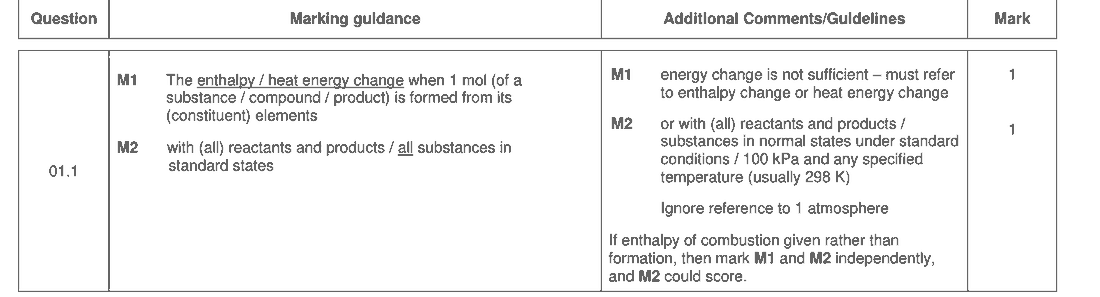
01.1 Energetics 2Short answer
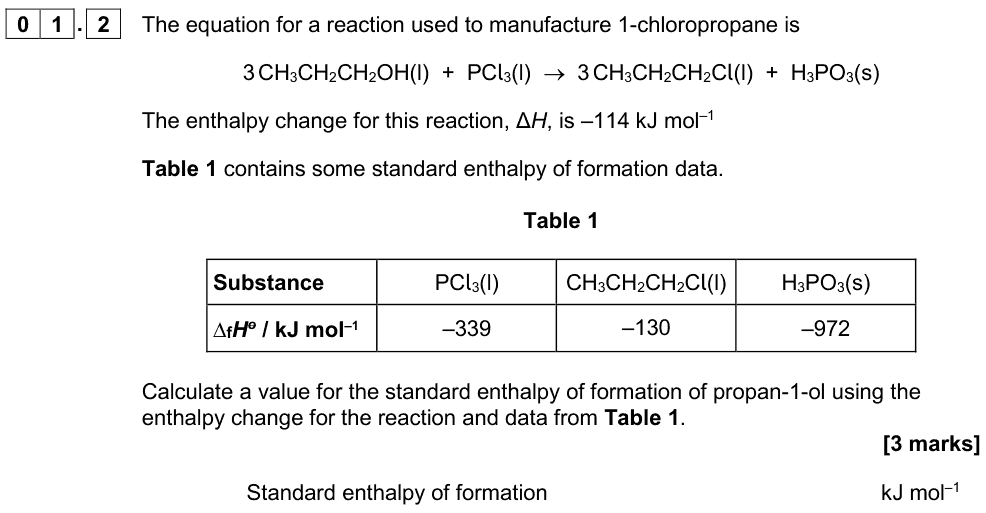
01.2 Energetics 3Calculation
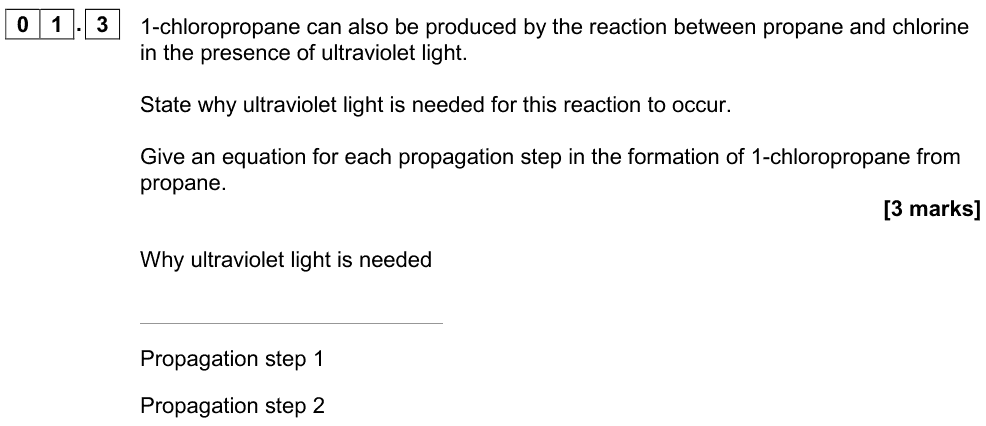
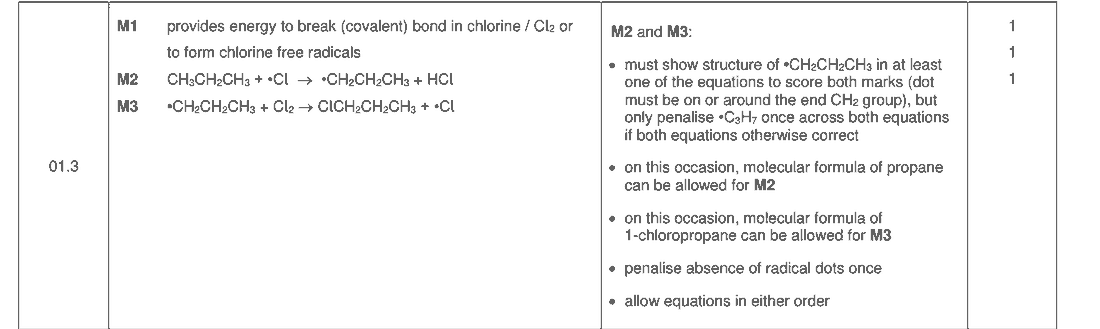
01.3 Alkanes, Introduction to organic chemistry: nomenclature, mechanisms and isomerism 3Equation writing
01.4 Bonding 1Short answer
01.5 Halogenoalkanes 5Mechanism
02.1 Kinetics 1Practical and data analysis
02.2 Kinetics 1Practical and data analysis
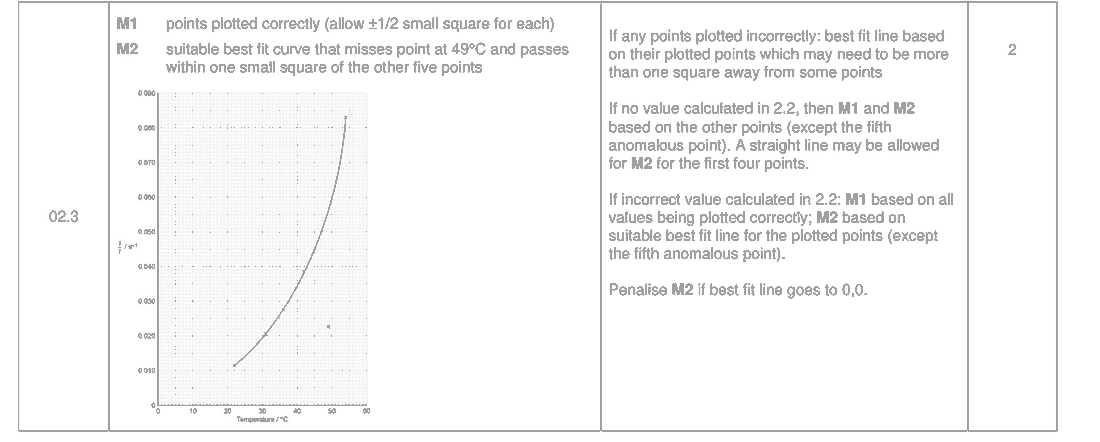
02.3 Kinetics 2Practical and data analysis
02.4 Kinetics 1Practical and data analysis
02.5 Kinetics 1Practical and data analysis
02.6 Kinetics 1Practical and data analysis
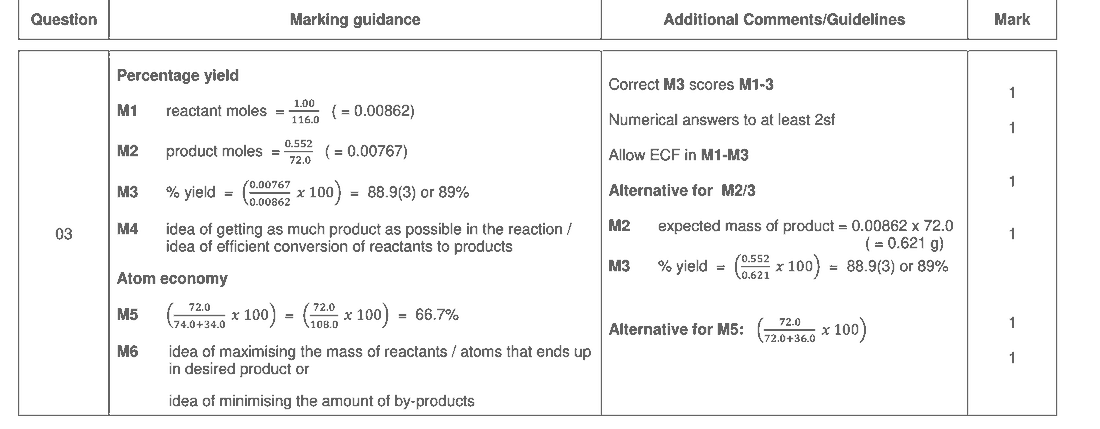
03 Amount of substance 6Calculation
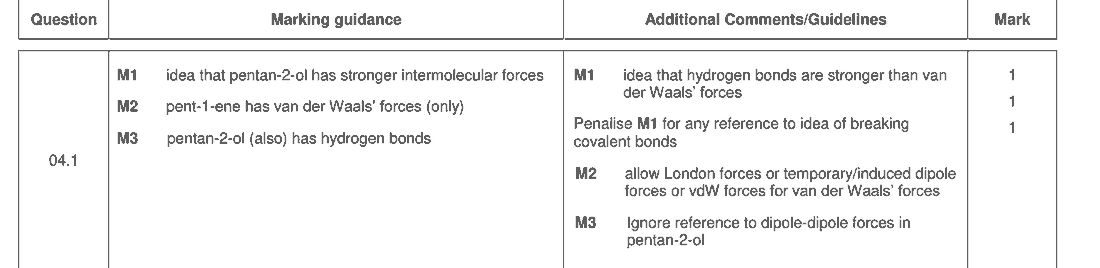
04.1 Bonding 3Explanation
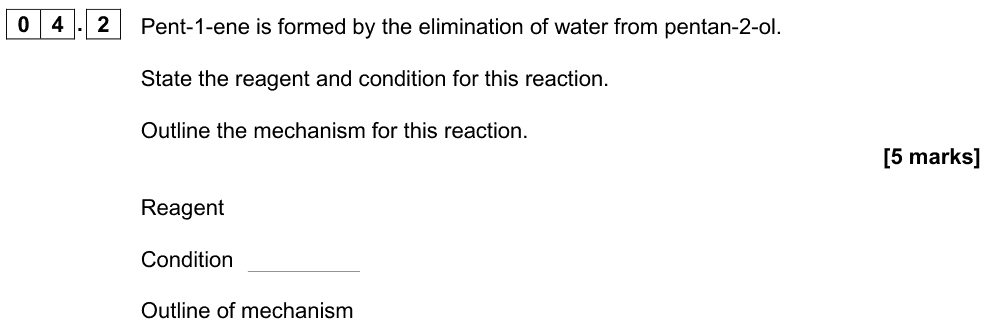
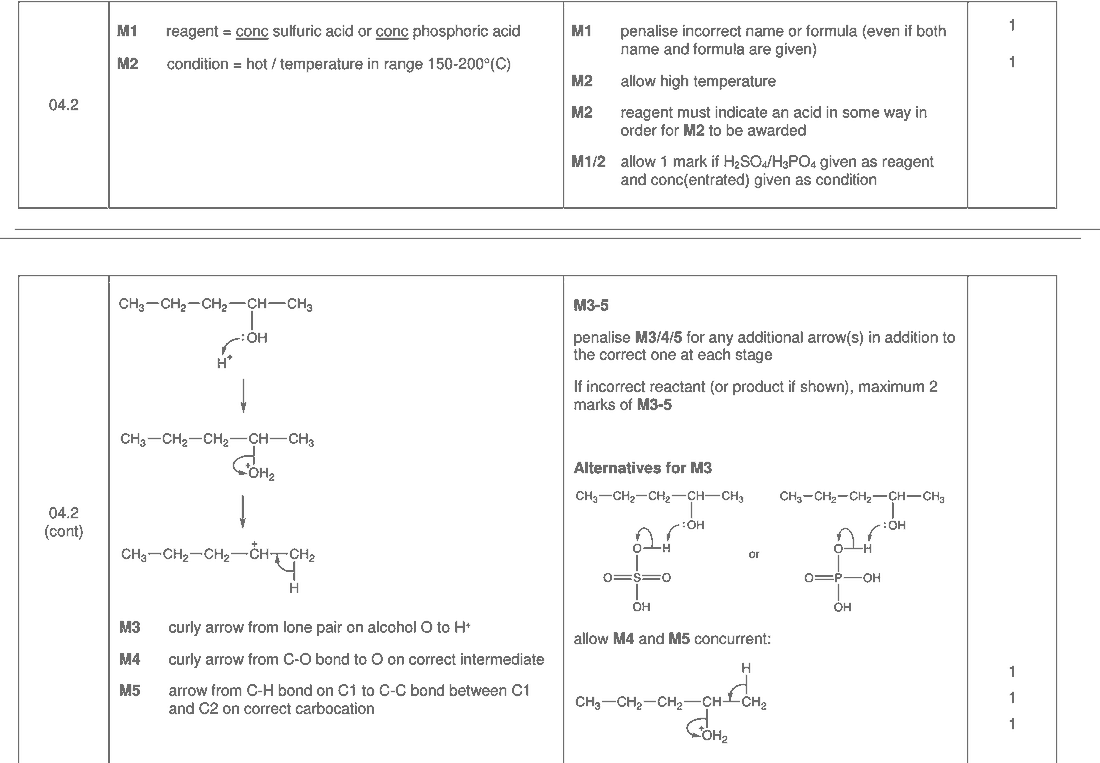
04.2 Alcohols 5Mechanism
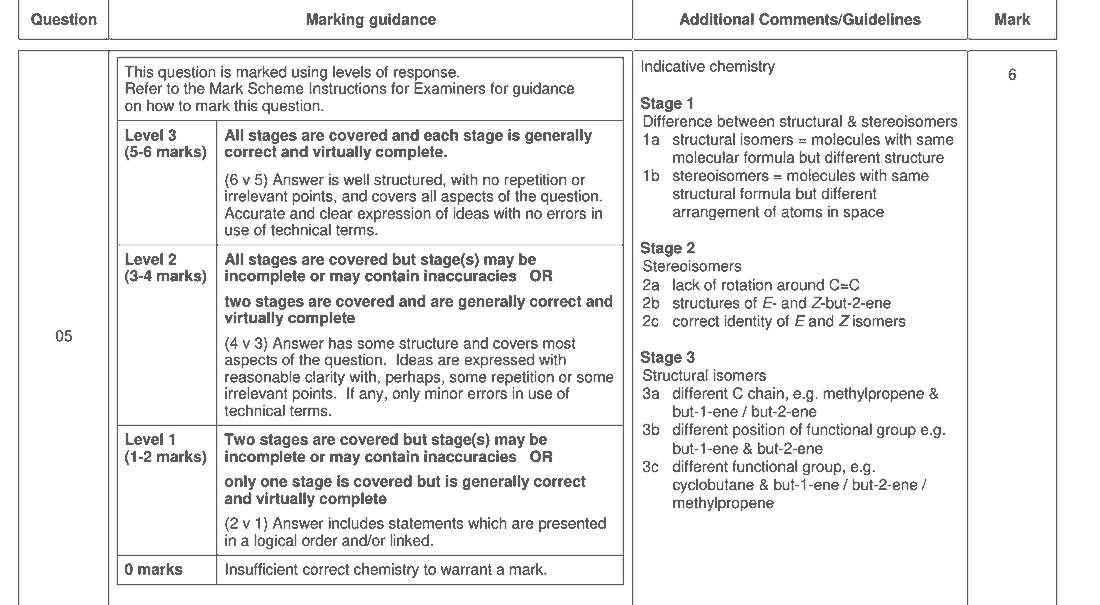
05 Introduction to organic chemistry: nomenclature, mechanisms and isomerism 6Level of response
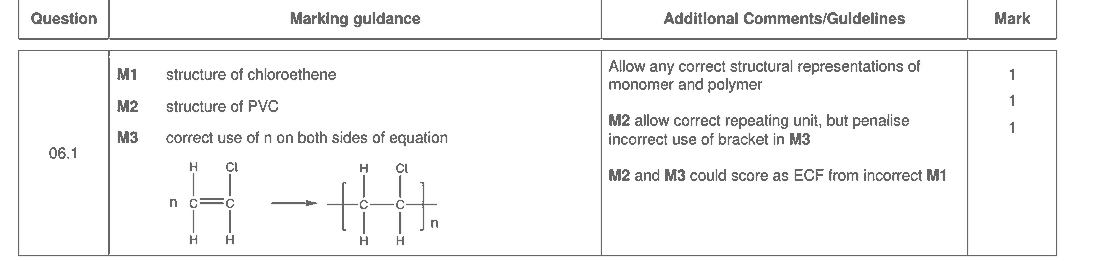
06.1 Alkenes 3Equation writing
06.2 Alkenes 2Explanation
06.3 Introduction to organic chemistry: nomenclature, mechanisms and isomerism, Alkenes 2Short answer
07.1 Introduction to organic chemistry: nomenclature, mechanisms and isomerism 1Diagram or structure
07.2 Alcohols 2Short answer
07.3 Amount of substance 5Calculation
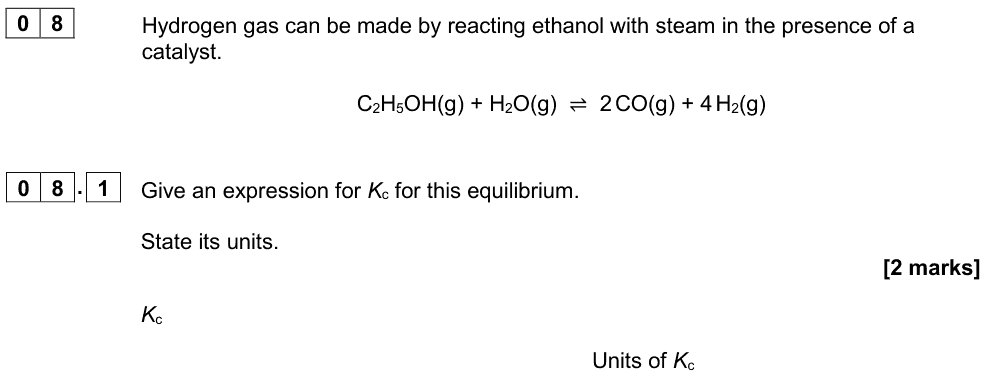
08.1 Chemical equilibria, Le Chatelier's principle and Kc 2Short answer
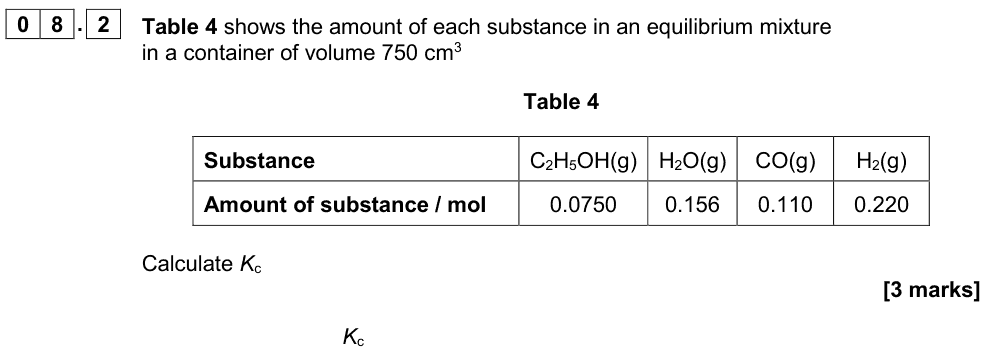
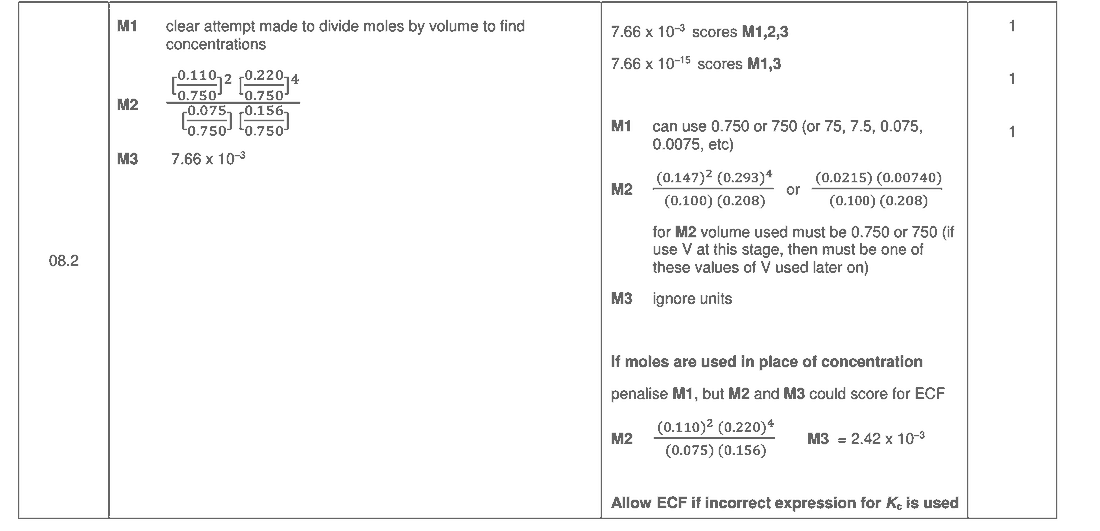
08.2 Chemical equilibria, Le Chatelier's principle and Kc 3Calculation
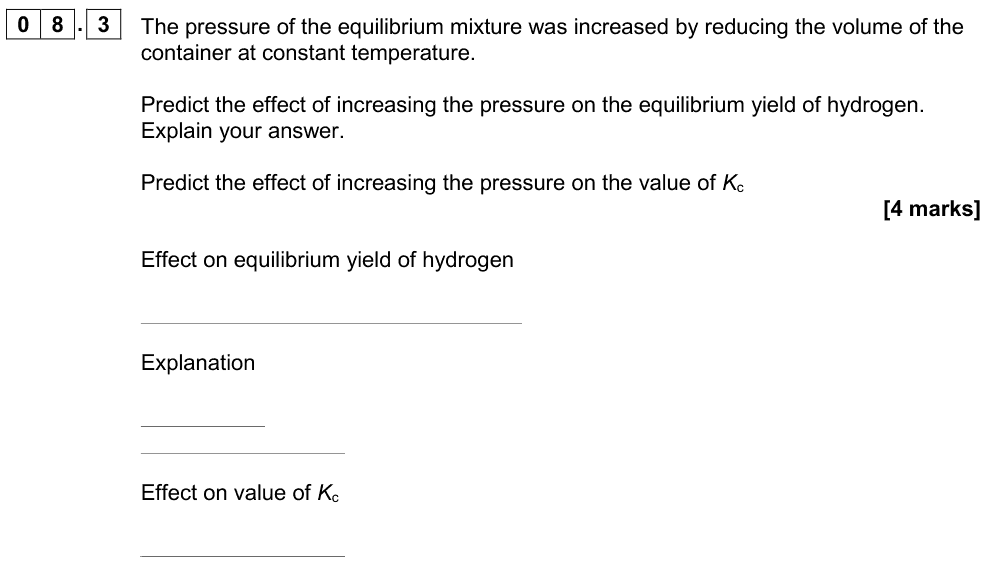
08.3 Chemical equilibria, Le Chatelier's principle and Kc 4Explanation
09 Alkanes 1Multiple choice
10 Halogenoalkanes 1Multiple choice
11 Introduction to organic chemistry: nomenclature, mechanisms and isomerism 1Multiple choice
12 Alkenes, Introduction to organic chemistry: nomenclature, mechanisms and isomerism 1Multiple choice
13 Organic analysis: test-tube reactions, mass spectrometry and infrared 1Multiple choice
14 Alkanes 1Multiple choice
15 Alkenes 1Multiple choice
16 Amount of substance 1Multiple choice
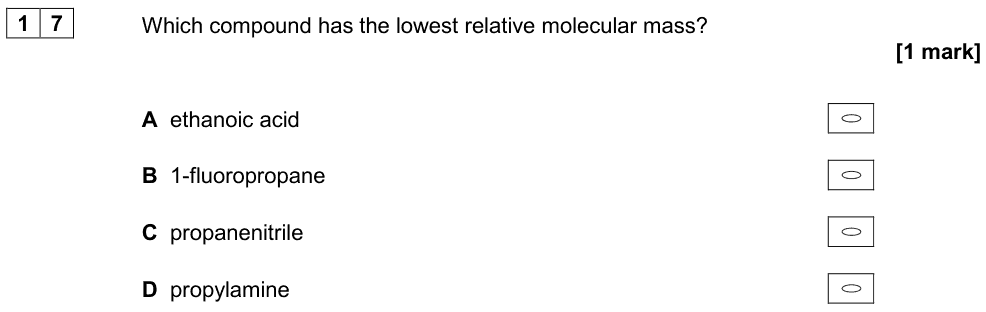
17 Amount of substance, Introduction to organic chemistry: nomenclature, mechanisms and isomerism 1Multiple choice
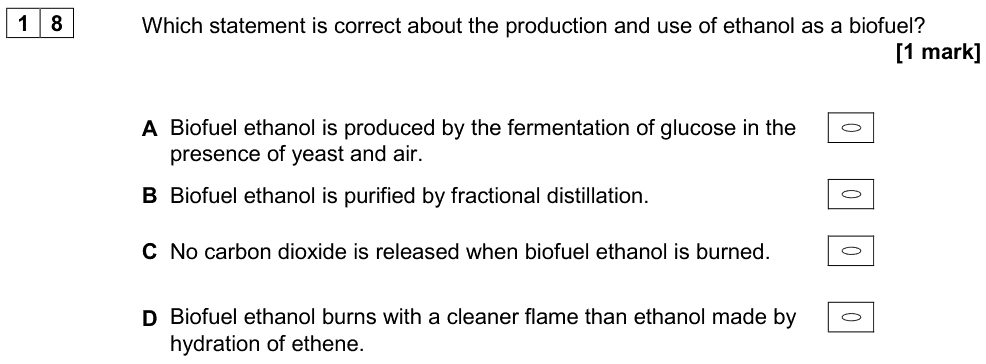
18 Alcohols 1Multiple choice
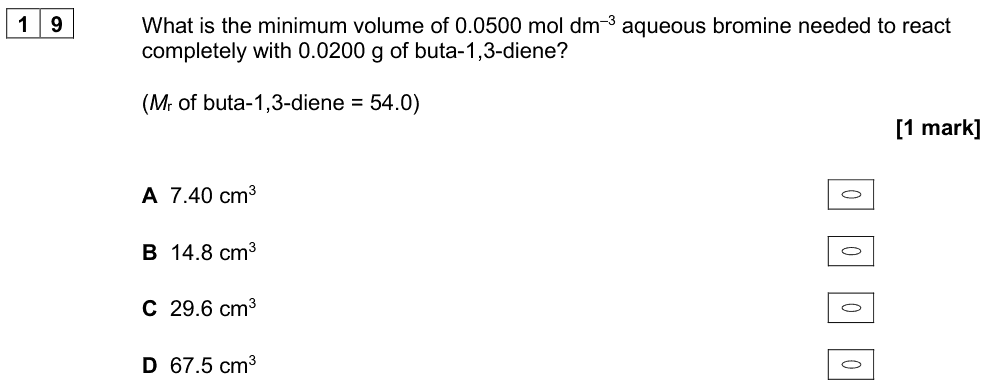
19 Amount of substance, Alkenes 1Multiple choice
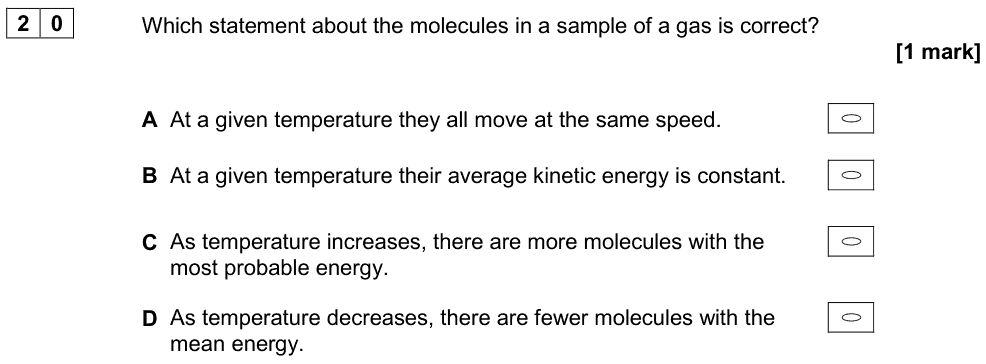
20 Kinetics 1Multiple choice
21 Energetics 1Multiple choice
22 Energetics 1Multiple choice
23 Energetics 1Multiple choice

The questions

01.101.201.301.401.502.102.202.302.402.502.60304.104.20506.106.206.307.107.207.308.108.208.3091011121314151617181920212223
November 2020 · AS Paper 2 · Q01.1 2 marks Short answer energetics
This question is about 1-chloropropane.
Define the term standard enthalpy of formation.
[2 marks]
November 2020 · AS Paper 2 · Q01.2 3 marks Calculation energetics
Earlier part of question 01 that this part usesEarlier part of November 2020 Paper 2 question 01
The equation for a reaction used to manufacture 1-chloropropane is
3 CH3CH2CH2OH(l)  +  PCl3(l)  →  3 CH3CH2CH2Cl(l)  +  H3PO3(s)
The enthalpy change for this reaction, ΔH, is –114 kJ mol–1
Table 1 contains some standard enthalpy of formation data.
Table 1
Substance
PCl3(l)
CH3CH2CH2Cl(l)
H3PO3(s)
∆fHo / kJ mol–1
–339
–130
–972
Calculate a value for the standard enthalpy of formation of propan-1-ol using the
enthalpy change for the reaction and data from Table 1.
[3 marks]
Standard enthalpy of formation
kJ mol–1
November 2020 · AS Paper 2 · Q01.3 3 marks Equation writing alkanesintroduction to organic chemistry
Earlier part of question 01 that this part usesEarlier part of November 2020 Paper 2 question 01
1-chloropropane can also be produced by the reaction between propane and chlorine
in the presence of ultraviolet light.
State why ultraviolet light is needed for this reaction to occur.
Give an equation for each propagation step in the formation of 1-chloropropane from
propane.
[3 marks]
Why ultraviolet light is needed
Propagation step 1
Propagation step 2
November 2020 · AS Paper 2 · Q01.4 1 mark Short answer bonding
Earlier part of question 01 that this part usesEarlier part of November 2020 Paper 2 question 01
The C–Cl bond in 1-chloropropane is polar because carbon and chlorine have
different electronegativities.
Define the term electronegativity.
[1 mark]
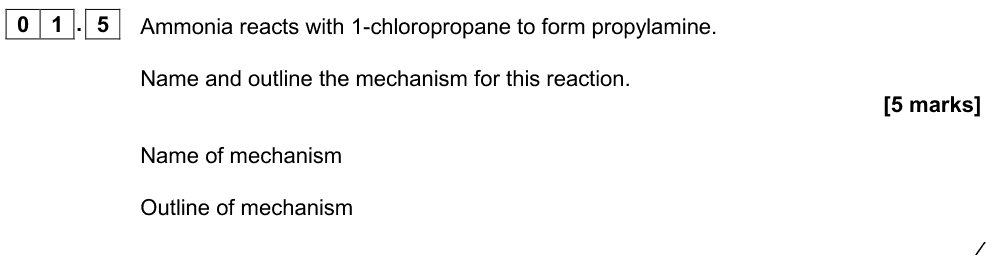
November 2020 · AS Paper 2 · Q01.5 5 marks Mechanism halogenoalkanes
Earlier part of question 01 that this part usesEarlier part of November 2020 Paper 2 question 01
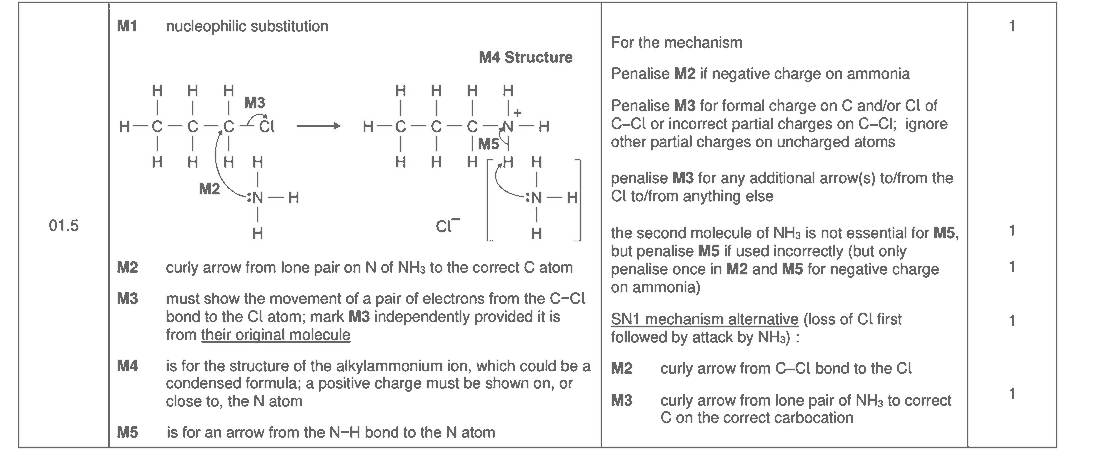
Ammonia reacts with 1-chloropropane to form propylamine.
Name and outline the mechanism for this reaction.
[5 marks]
Name of mechanism
Outline of mechanism
November 2020 · AS Paper 2 · Q02.1 1 mark Practical and data analysis kinetics
A student investigates the effect of temperature on the rate of reaction between
sodium thiosulfate solution and dilute hydrochloric acid.
Na2S2O3(aq) + 2 HCl(aq) ⟶ 2 NaCl(aq) + SO2(g) + S(s) + H2O(l)
The student mixes the solutions together in a flask and places the flask on a piece of
paper marked with a cross.
The student records the time for the cross to disappear.  The cross disappears
because the mixture becomes cloudy.
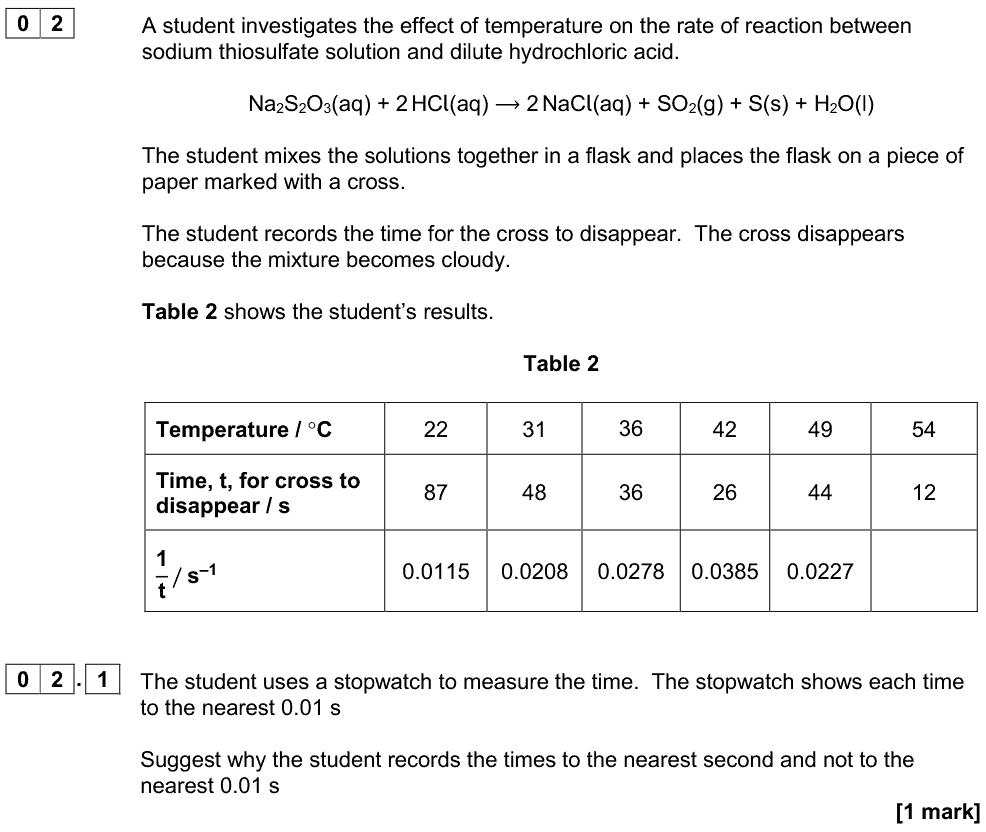
Table 2 shows the student’s results.
Table 2
Temperature / °C
22
31
36
42
49
54
Time, t, for cross to
disappear / s
87
48
36
26
44
12
1
t / s–1
0.0115
0.0208
0.0278
0.0385
0.0227
The student uses a stopwatch to measure the time.  The stopwatch shows each time
to the nearest 0.01 s
Suggest why the student records the times to the nearest second and not to the
nearest 0.01 s
[1 mark]
November 2020 · AS Paper 2 · Q02.2 1 mark Practical and data analysis kinetics
Earlier part of question 02 that this part usesEarlier part of November 2020 Paper 2 question 02
The rate of reaction is proportional to
1
t
Complete Table 2.
[1 mark]
November 2020 · AS Paper 2 · Q02.3 2 marks Practical and data analysis kinetics
Earlier part of question 02 that this part usesEarlier part of November 2020 Paper 2 question 02
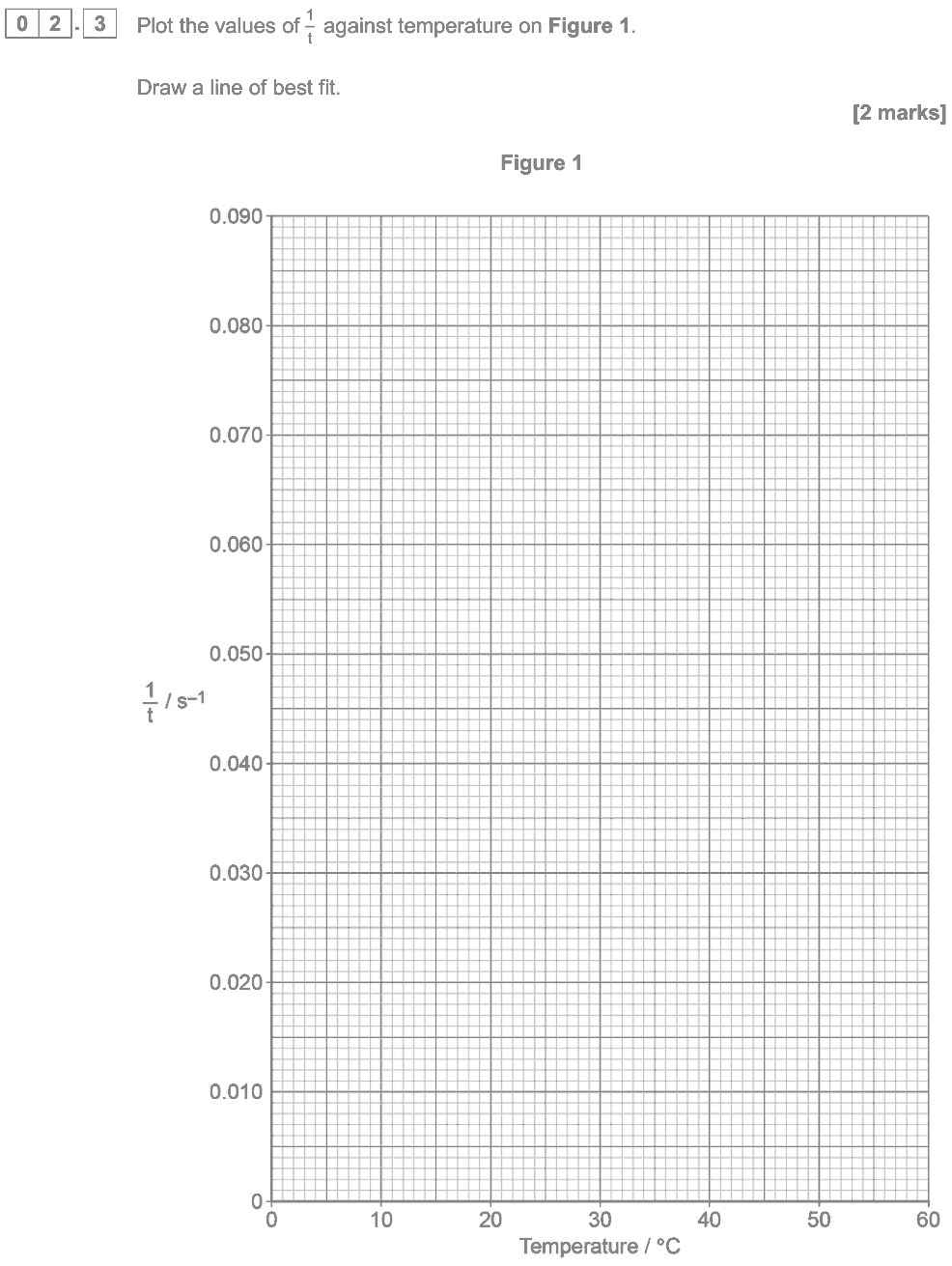
Plot the values of
1
Draw a line of best fit.
[2 marks]
Figure 1
November 2020 · AS Paper 2 · Q02.4 1 mark Practical and data analysis kinetics
Earlier part of question 02 that this part usesEarlier part of November 2020 Paper 2 question 02
Use your line of best fit to estimate the time for the cross to disappear at 40 °C
Show your working.
[1 mark]
Time
s
November 2020 · AS Paper 2 · Q02.5 1 mark Practical and data analysis kinetics
Earlier part of question 02 that this part usesEarlier part of November 2020 Paper 2 question 02
Suggest, by considering the products of this reaction, why small amounts of reactants
are used in this experiment.
[1 mark]
November 2020 · AS Paper 2 · Q02.6 1 mark Practical and data analysis kinetics
Earlier part of question 02 that this part usesEarlier part of November 2020 Paper 2 question 02
The student could do the experiment at lower temperatures using an ice bath.
Suggest why the student chose not to carry out experiments at temperatures in the
range 1–10 °C
[1 mark]
November 2020 · AS Paper 2 · Q03 6 marks Calculation amount of substance
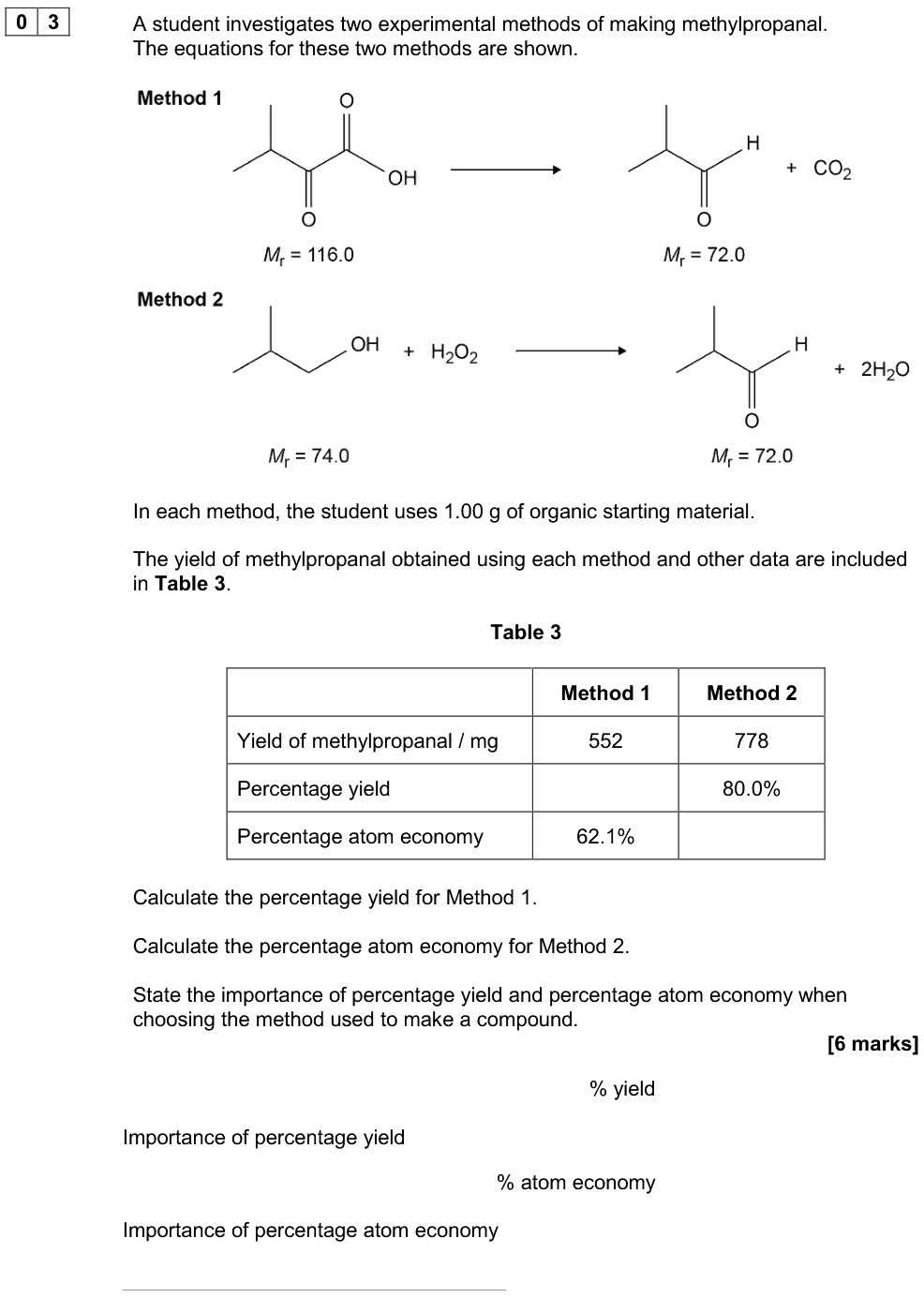
A student investigates two experimental methods of making methylpropanal.
The equations for these two methods are shown.
In each method, the student uses 1.00 g of organic starting material.
The yield of methylpropanal obtained using each method and other data are included
in Table 3.
Table 3
Method 1
Method 2
Yield of methylpropanal / mg
552
778
Percentage yield
80.0%
Percentage atom economy
62.1%
Calculate the percentage yield for Method 1.
Calculate the percentage atom economy for Method 2.
State the importance of percentage yield and percentage atom economy when
choosing the method used to make a compound.
[6 marks]
% yield
Importance of percentage yield
% atom economy
Importance of percentage atom economy
November 2020 · AS Paper 2 · Q04.1 3 marks Explanation bonding
This question is about pentan-2-ol and pent-1-ene.
The boiling point of pentan-2-ol is 119 °C
The boiling point of pent-1-ene is 30 °C
Explain why pentan-2-ol has a higher boiling point than pent-1-ene.
[3 marks]
November 2020 · AS Paper 2 · Q04.2 5 marks Mechanism alcohols
Earlier part of question 04 that this part usesEarlier part of November 2020 Paper 2 question 04
Pent-1-ene is formed by the elimination of water from pentan-2-ol.
State the reagent and condition for this reaction.
Outline the mechanism for this reaction.
[5 marks]
Reagent
Condition
Outline of mechanism
November 2020 · AS Paper 2 · Q05 6 marks 6-mark level of response introduction to organic chemistry
Explain the differences between structural isomerism and stereoisomerism.
Use examples to show how compounds with the molecular formula C4H8 exhibit
stereoisomerism and the three types of structural isomerism.
[6 marks]
November 2020 · AS Paper 2 · Q06.1 3 marks Equation writing alkenes
This question is about poly(chloroethene), commonly known as PVC.
Give an equation, showing structural formulas, for the conversion of chloroethene into
poly(chloroethene).
[3 marks]
November 2020 · AS Paper 2 · Q06.2 2 marks Explanation alkenes
Earlier part of question 06 that this part usesEarlier part of November 2020 Paper 2 question 06
State what you would observe if bromine water was added to poly(chloroethene).
Explain this observation.
[2 marks]
Observation
Explanation
November 2020 · AS Paper 2 · Q06.3 2 marks Short answer introduction to organic chemistryalkenes
Earlier part of question 06 that this part usesEarlier part of November 2020 Paper 2 question 06
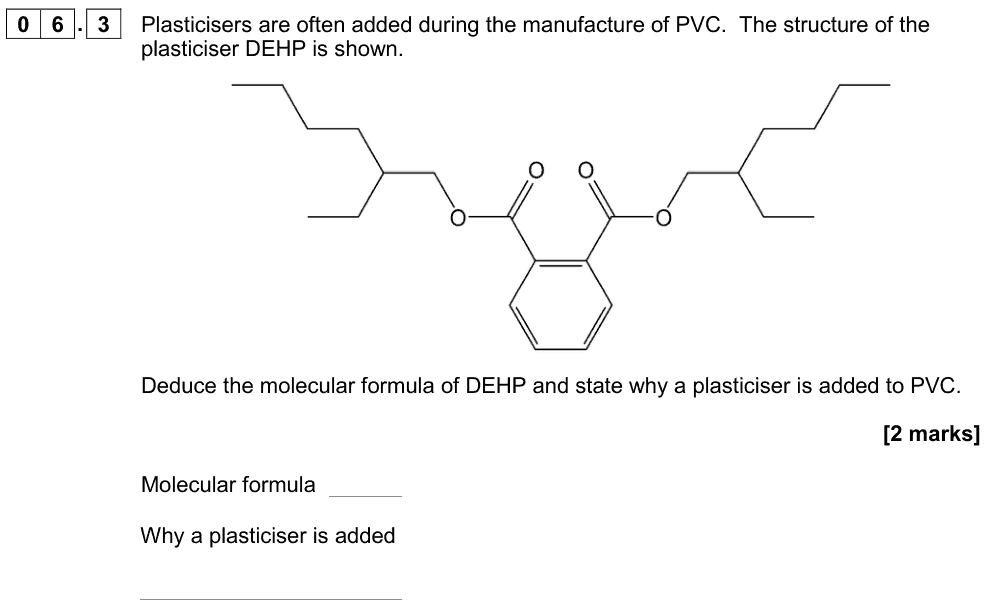
Plasticisers are often added during the manufacture of PVC.  The structure of the
plasticiser DEHP is shown.
Deduce the molecular formula of DEHP and state why a plasticiser is added to PVC.
[2 marks]
Molecular formula
Why a plasticiser is added
November 2020 · AS Paper 2 · Q07.1 1 mark Diagram or structure introduction to organic chemistry
This question is about ethanedioic acid (H2C2O4) which is a dicarboxylic acid.
Draw the skeletal formula of ethanedioic acid.
[1 mark]
November 2020 · AS Paper 2 · Q07.2 2 marks Short answer alcohols
Earlier part of question 07 that this part usesEarlier part of November 2020 Paper 2 question 07
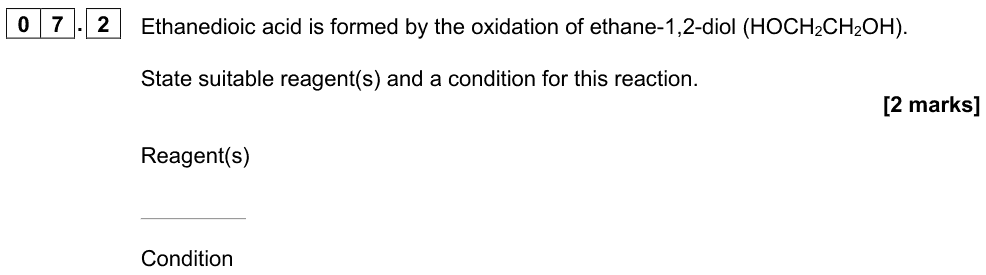
Ethanedioic acid is formed by the oxidation of ethane-1,2-diol (HOCH2CH2OH).
State suitable reagent(s) and a condition for this reaction.
[2 marks]
Reagent(s)
Condition
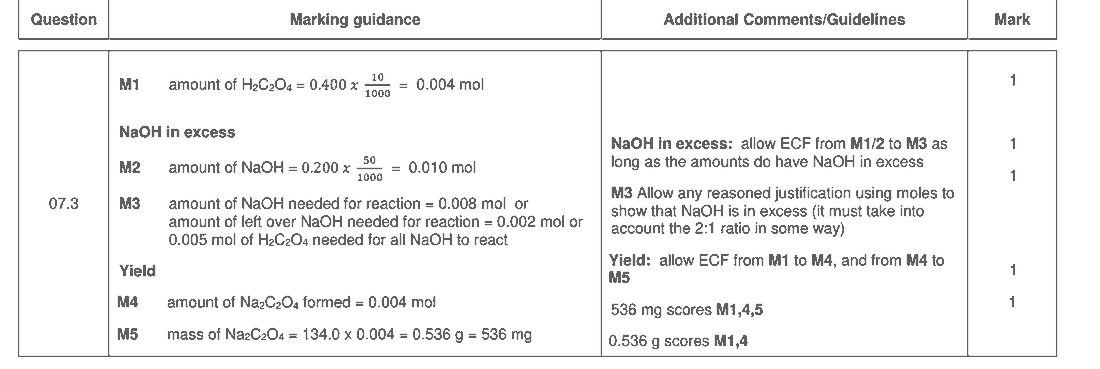
November 2020 · AS Paper 2 · Q07.3 5 marks Calculation amount of substance
Earlier part of question 07 that this part usesEarlier part of November 2020 Paper 2 question 07
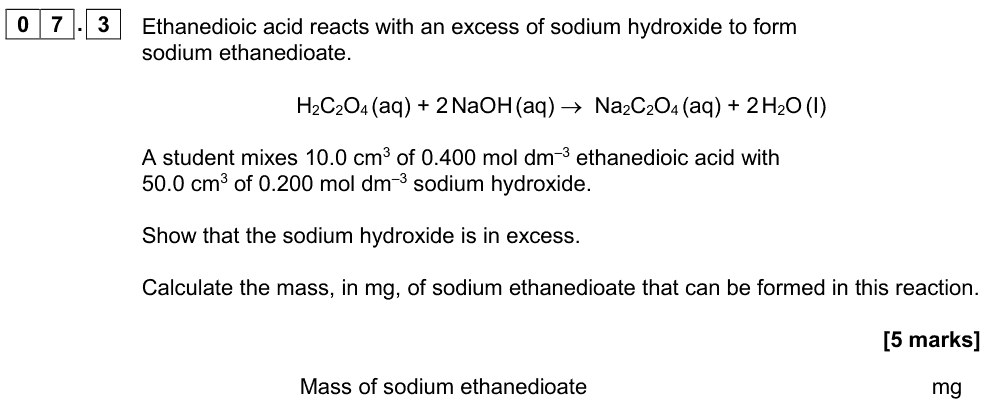
Ethanedioic acid reacts with an excess of sodium hydroxide to form
sodium ethanedioate.
H2C2O4 (aq) + 2 NaOH (aq) →  Na2C2O4 (aq) + 2 H2O (I)
A student mixes 10.0 cm3 of 0.400 mol dm–3 ethanedioic acid with
50.0 cm3 of 0.200 mol dm–3 sodium hydroxide.
Show that the sodium hydroxide is in excess.
Calculate the mass, in mg, of sodium ethanedioate that can be formed in this reaction.
[5 marks]
Mass of sodium ethanedioate
mg
November 2020 · AS Paper 2 · Q08.1 2 marks Short answer chemical equilibria and kc
Hydrogen gas can be made by reacting ethanol with steam in the presence of a
catalyst.
C2H5OH(g) + H2O(g)  ⇌  2 CO(g) + 4 H2(g)
Give an expression for Kc for this equilibrium.
State its units.
[2 marks]
Kc
Units of Kc
November 2020 · AS Paper 2 · Q08.2 3 marks Calculation chemical equilibria and kc
Earlier part of question 08 that this part usesEarlier part of November 2020 Paper 2 question 08
Table 4 shows the amount of each substance in an equilibrium mixture
in a container of volume 750 cm3
Table 4
Substance
C2H5OH(g) H2O(g)
CO(g)
H2(g)
Amount of substance / mol
0.0750
0.156
0.110
0.220
Calculate Kc
[3 marks]
Kc
November 2020 · AS Paper 2 · Q08.3 4 marks Explanation chemical equilibria and kc
Earlier part of question 08 that this part usesEarlier part of November 2020 Paper 2 question 08
The pressure of the equilibrium mixture was increased by reducing the volume of the
container at constant temperature.
Predict the effect of increasing the pressure on the equilibrium yield of hydrogen.
Explain your answer.
Predict the effect of increasing the pressure on the value of Kc
[4 marks]
Effect on equilibrium yield of hydrogen
Explanation
Effect on value of Kc
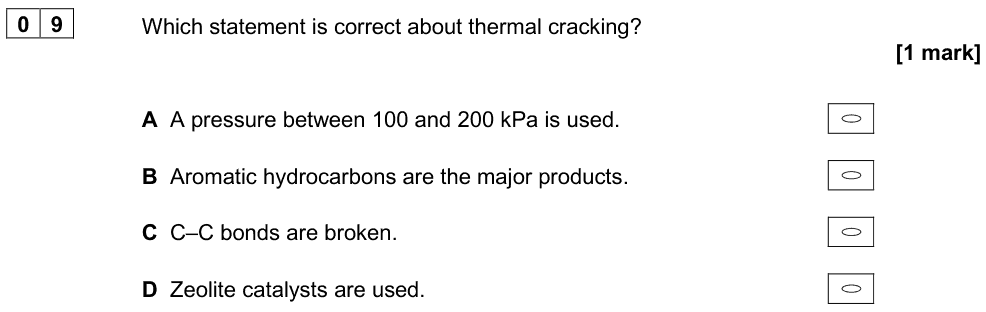
November 2020 · AS Paper 2 · Q09 1 mark Multiple choice alkanes
Which statement is correct about thermal cracking?
[1 mark]
A A pressure between 100 and 200 kPa is used.
B Aromatic hydrocarbons are the major products.
C C–C bonds are broken.
D Zeolite catalysts are used.
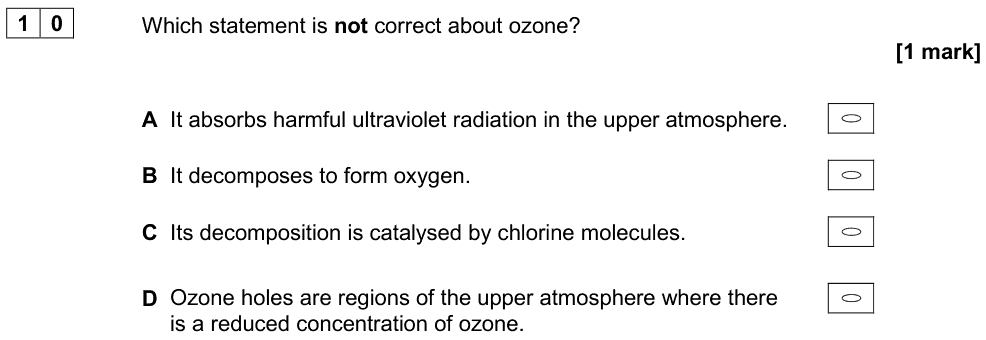
November 2020 · AS Paper 2 · Q10 1 mark Multiple choice halogenoalkanes
Which statement is not correct about ozone?
[1 mark]
A It absorbs harmful ultraviolet radiation in the upper atmosphere.
B It decomposes to form oxygen.
C Its decomposition is catalysed by chlorine molecules.
D Ozone holes are regions of the upper atmosphere where there
is a reduced concentration of ozone.
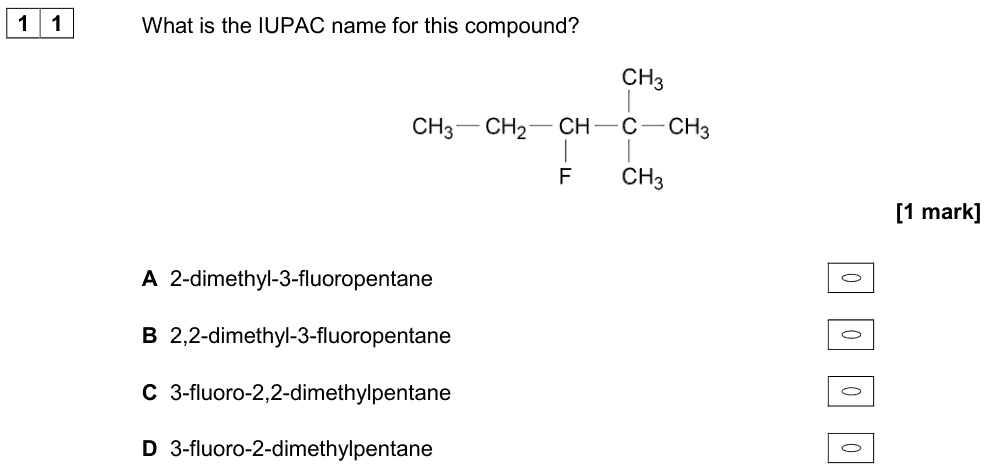
November 2020 · AS Paper 2 · Q11 1 mark Multiple choice introduction to organic chemistry
What is the IUPAC name for this compound?
[1 mark]
A 2-dimethyl-3-fluoropentane
B 2,2-dimethyl-3-fluoropentane
C 3-fluoro-2,2-dimethylpentane
D 3-fluoro-2-dimethylpentane
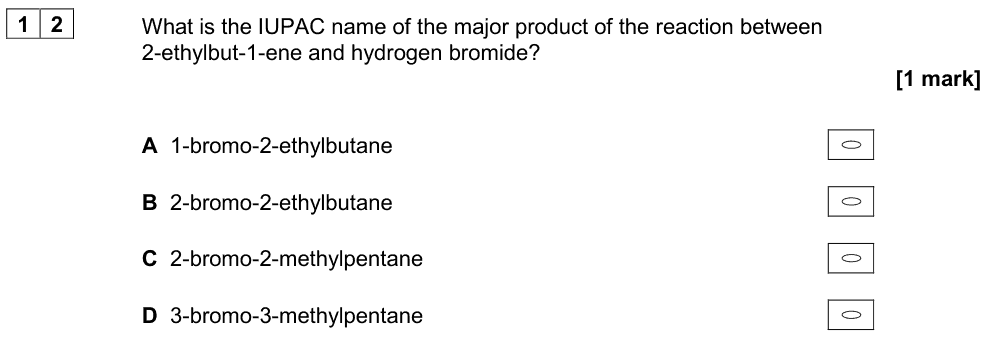
November 2020 · AS Paper 2 · Q12 1 mark Multiple choice alkenesintroduction to organic chemistry
What is the IUPAC name of the major product of the reaction between
2-ethylbut-1-ene and hydrogen bromide?
[1 mark]
A 1-bromo-2-ethylbutane
B 2-bromo-2-ethylbutane
C 2-bromo-2-methylpentane
D 3-bromo-3-methylpentane
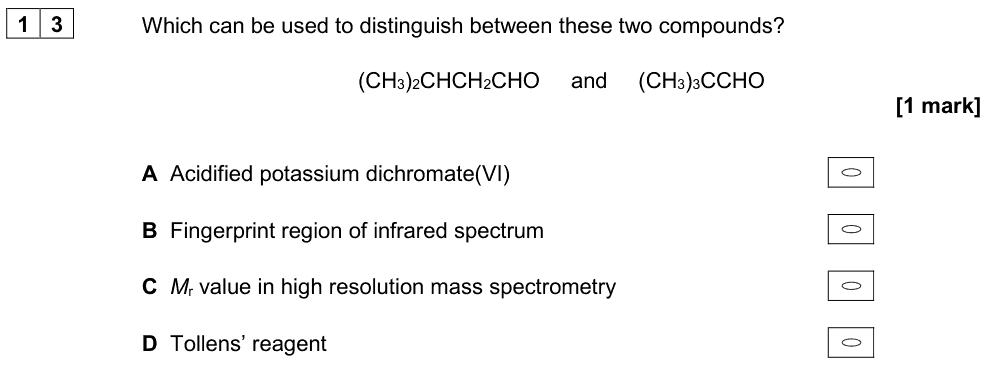
November 2020 · AS Paper 2 · Q13 1 mark Multiple choice organic analysis
Which can be used to distinguish between these two compounds?
(CH3)2CHCH2CHO     and     (CH3)3CCHO
[1 mark]
A Acidified potassium dichromate(VI)
B Fingerprint region of infrared spectrum
C Mr value in high resolution mass spectrometry
D Tollens’ reagent
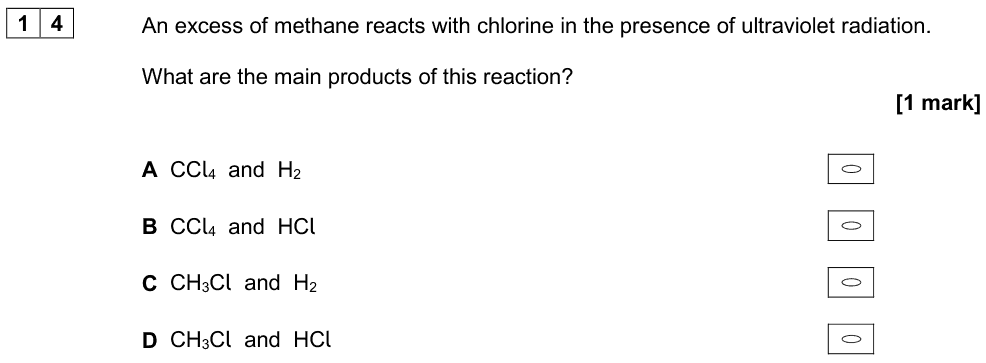
November 2020 · AS Paper 2 · Q14 1 mark Multiple choice alkanes
An excess of methane reacts with chlorine in the presence of ultraviolet radiation.
What are the main products of this reaction?
[1 mark]
A CCl4  and  H2
B CCl4  and  HCl
C CH3Cl  and  H2
D CH3Cl  and  HCl
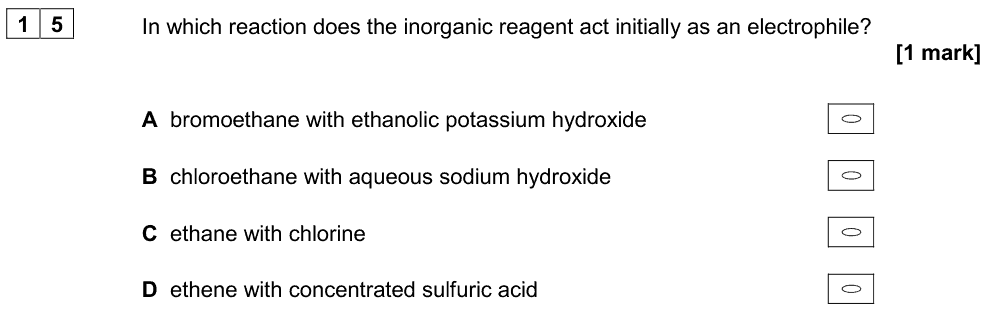
November 2020 · AS Paper 2 · Q15 1 mark Multiple choice alkenes
In which reaction does the inorganic reagent act initially as an electrophile?
[1 mark]
A bromoethane with ethanolic potassium hydroxide
B chloroethane with aqueous sodium hydroxide
C ethane with chlorine
D ethene with concentrated sulfuric acid
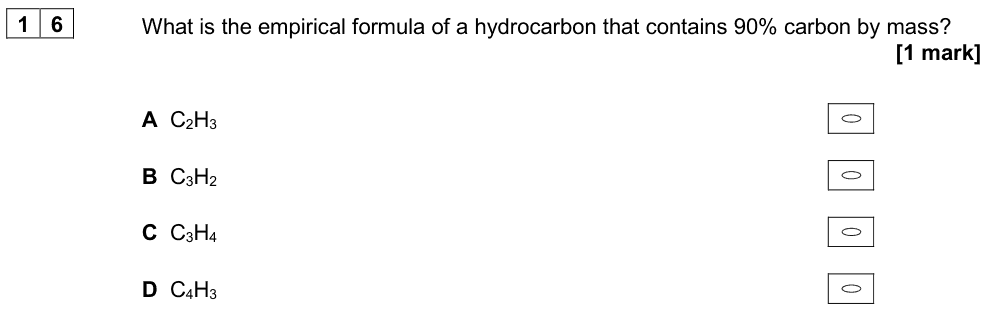
November 2020 · AS Paper 2 · Q16 1 mark Multiple choice amount of substance
What is the empirical formula of a hydrocarbon that contains 90% carbon by mass?
[1 mark]
A C2H3
B C3H2
C C3H4
D C4H3
November 2020 · AS Paper 2 · Q17 1 mark Multiple choice amount of substanceintroduction to organic chemistry
Which compound has the lowest relative molecular mass?
[1 mark]
A ethanoic acid
B 1-fluoropropane
C propanenitrile
D propylamine
November 2020 · AS Paper 2 · Q18 1 mark Multiple choice alcohols
Which statement is correct about the production and use of ethanol as a biofuel?
[1 mark]
A Biofuel ethanol is produced by the fermentation of glucose in the
presence of yeast and air.
B Biofuel ethanol is purified by fractional distillation.
C No carbon dioxide is released when biofuel ethanol is burned.
D Biofuel ethanol burns with a cleaner flame than ethanol made by
hydration of ethene.
November 2020 · AS Paper 2 · Q19 1 mark Multiple choice amount of substancealkenes
What is the minimum volume of 0.0500 mol dm–3 aqueous bromine needed to react
completely with 0.0200 g of buta-1,3-diene?
(Mr of buta-1,3-diene = 54.0)
[1 mark]
A 7.40 cm3
B 14.8 cm3
C 29.6 cm3
D 67.5 cm3
November 2020 · AS Paper 2 · Q20 1 mark Multiple choice kinetics
Which statement about the molecules in a sample of a gas is correct?
[1 mark]
A At a given temperature they all move at the same speed.
B At a given temperature their average kinetic energy is constant.
C As temperature increases, there are more molecules with the
most probable energy.
D As temperature decreases, there are fewer molecules with the
mean energy.
November 2020 · AS Paper 2 · Q21 1 mark Multiple choice energetics
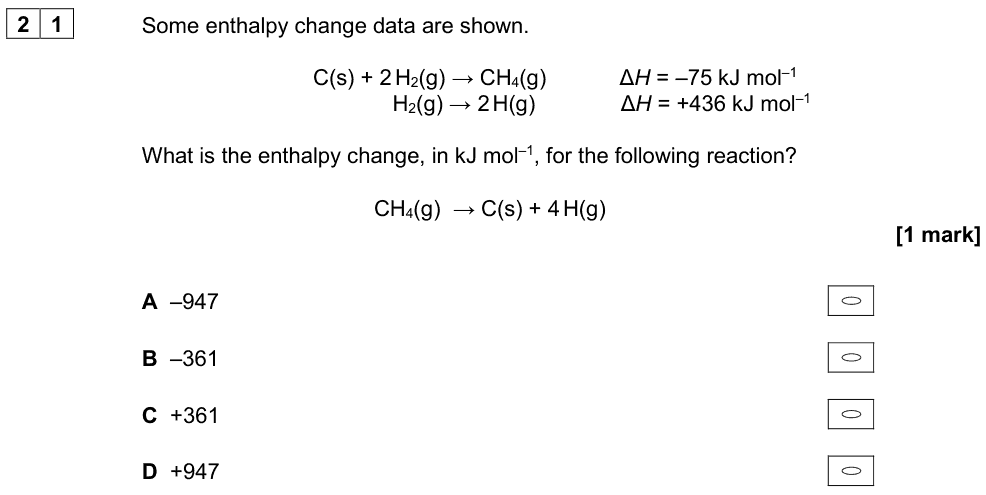
Some enthalpy change data are shown.
C(s) + 2 H2(g) → CH4(g)            ΔH = –75 kJ mol–1
H2(g) → 2 H(g)              ΔH = +436 kJ mol–1
What is the enthalpy change, in kJ mol–1, for the following reaction?
CH4(g)  → C(s) + 4 H(g)
[1 mark]
A –947
B –361
C +361
D +947
November 2020 · AS Paper 2 · Q22 1 mark Multiple choice energetics
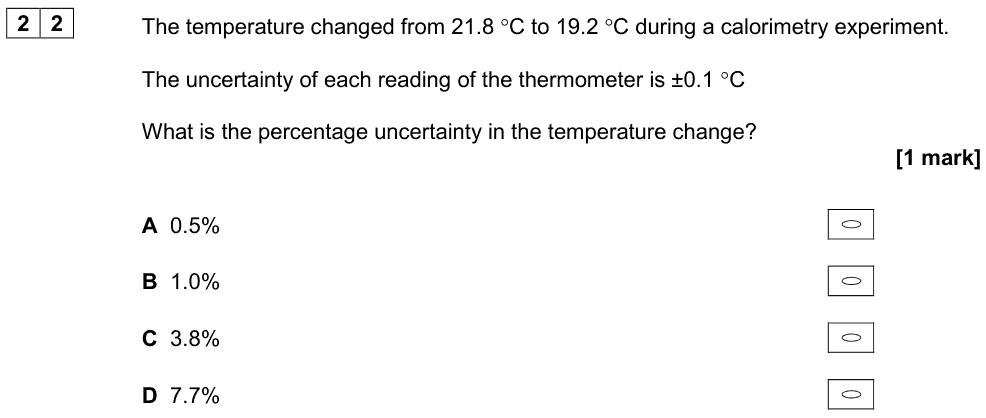
The temperature changed from 21.8 °C to 19.2 °C during a calorimetry experiment.
The uncertainty of each reading of the thermometer is ±0.1 °C
What is the percentage uncertainty in the temperature change?
[1 mark]
A 0.5%
B 1.0%
C 3.8%
D 7.7%
November 2020 · AS Paper 2 · Q23 1 mark Multiple choice energetics
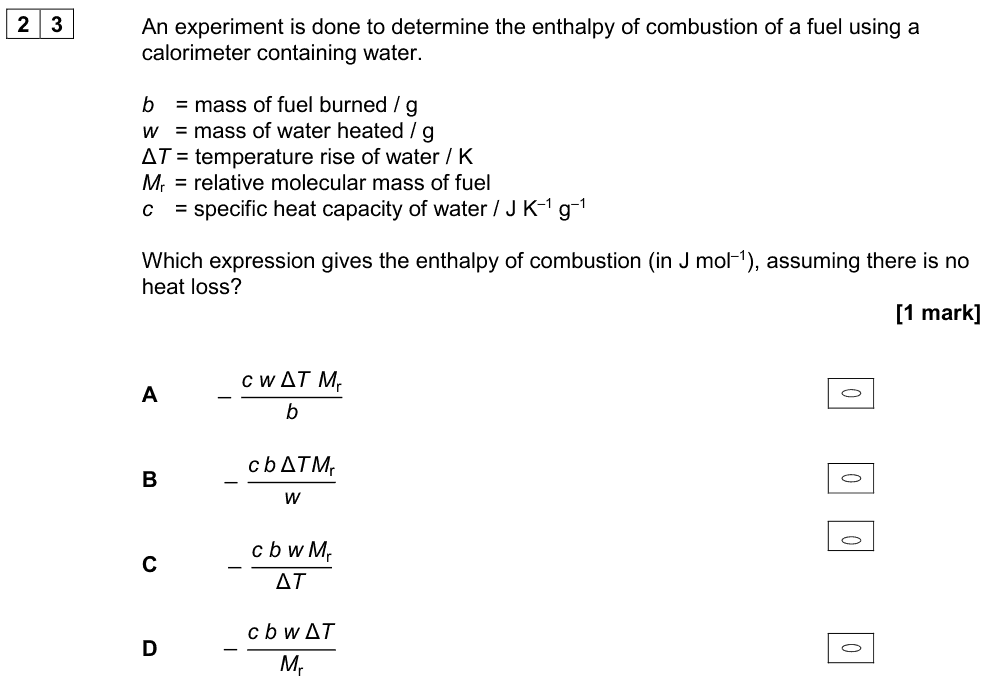
An experiment is done to determine the enthalpy of combustion of a fuel using a
calorimeter containing water.
b    = mass of fuel burned / g
w   = mass of water heated / g
ΔT  = temperature rise of water / K
Mr  = relative molecular mass of fuel
c     = specific heat capacity of water / J K–1 g–1
Which expression gives the enthalpy of combustion (in J mol–1), assuming there is no
heat loss?
[1 mark]
A
− c w ΔT  Mr
b
B
− c b ΔT Mr
w
C
− c b w Mr
ΔT
D
− c b w ΔT
Mr

Work with an A-level chemistry tutor

Want a paper marked and gone through with you? Message us.

Prefer email? Send an enquiry

If you are under 18, please include a parent's contact details. Enquiries go to enquiries@chemistryaleveltutor.com and are deleted once handled. All tutoring is online.