June 2023: AS Paper 2, Organic and physical chemistry

80 marks · 42 question parts · Paper, mark scheme and report on AQA's site · Have the Data Booklet beside you

Question by question

QTopicMarksAOType
01.1 Organic analysis: test-tube reactions, mass spectrometry and infrared, Alcohols 3AO3=3Practical and data analysis
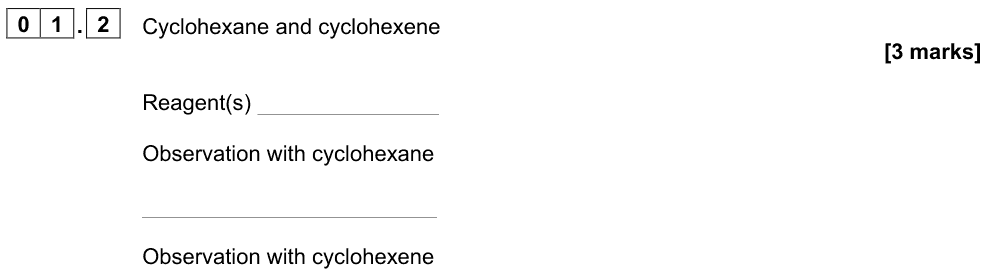
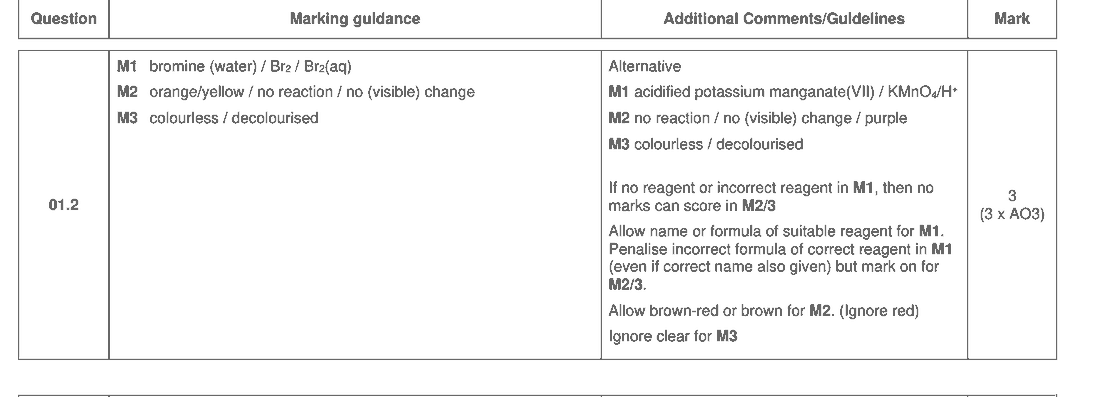
01.2 Alkenes, Organic analysis: test-tube reactions, mass spectrometry and infrared 3AO3=3Practical and data analysis
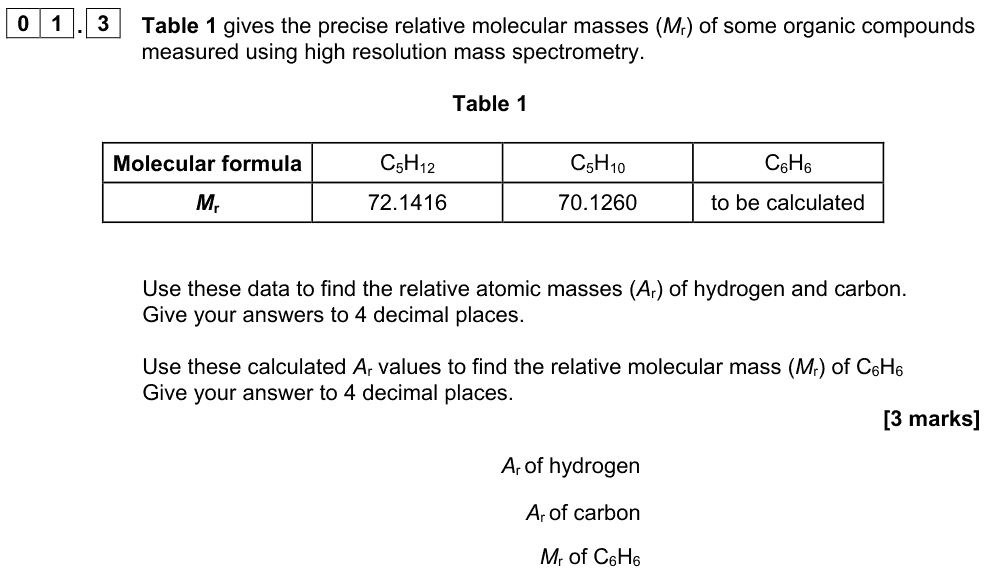
01.3 Organic analysis: test-tube reactions, mass spectrometry and infrared 3AO2=3Calculation
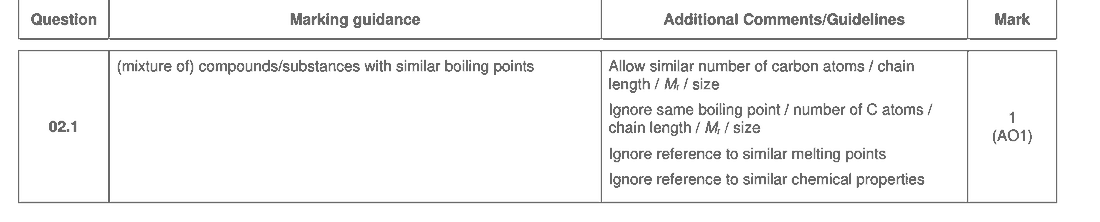
02.1 Alkanes 1AO1=1Short answer
02.2 Alkanes 1AO1=1Short answer
02.3 Introduction to organic chemistry: nomenclature, mechanisms and isomerism 1AO1=1Diagram or structure
02.4 Alkanes, Amount of substance, Introduction to organic chemistry: nomenclature, mechanisms and isomerism 2AO1=2Equation writing
02.5 Organic analysis: test-tube reactions, mass spectrometry and infrared 1AO1=1Short answer
02.6 Alkanes 2AO1=2Short answer
02.7 Alcohols 1AO1=1Short answer
03.1 Halogenoalkanes 2AO2=2Mechanism
03.2 Halogenoalkanes 2AO2=2Short answer
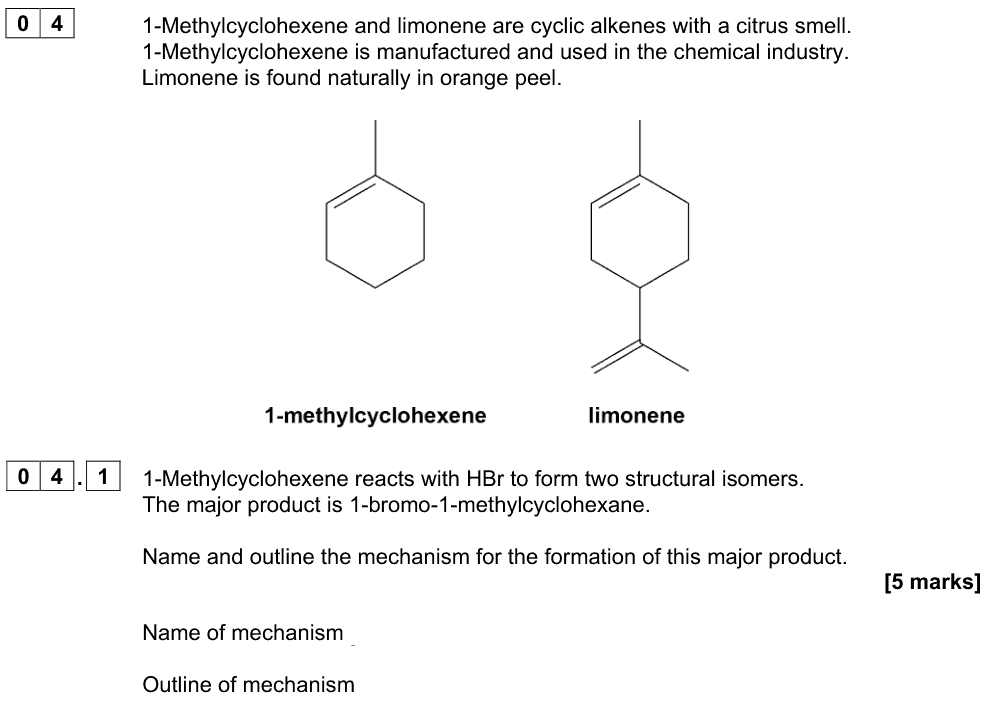
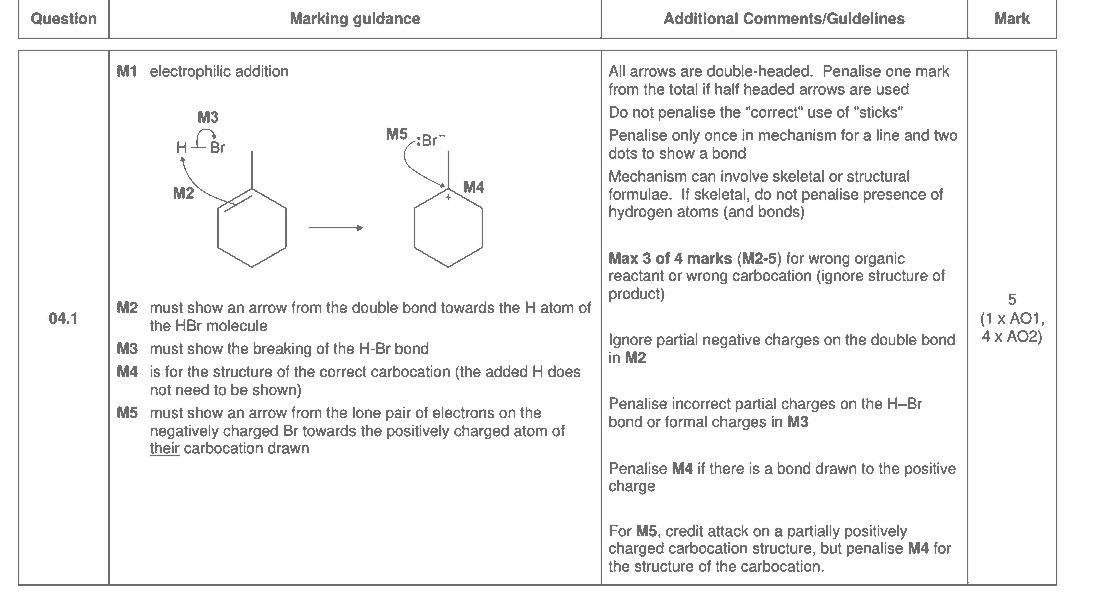
04.1 Alkenes 5AO1=1,AO2=4Mechanism
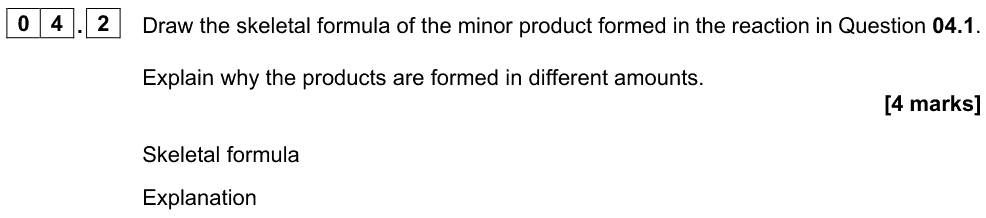
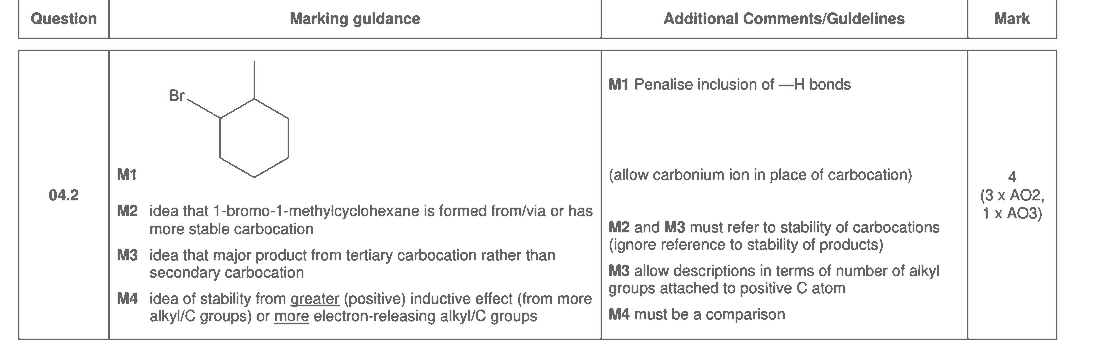
04.2 Alkenes 4AO2=3,AO3=1Explanation
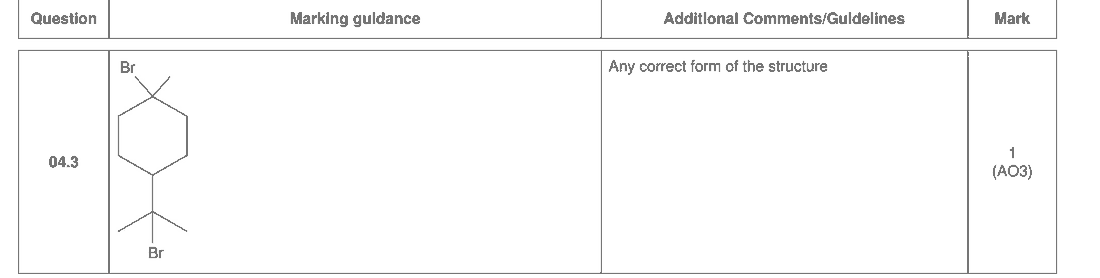
04.3 Alkenes 1AO3=1Diagram or structure
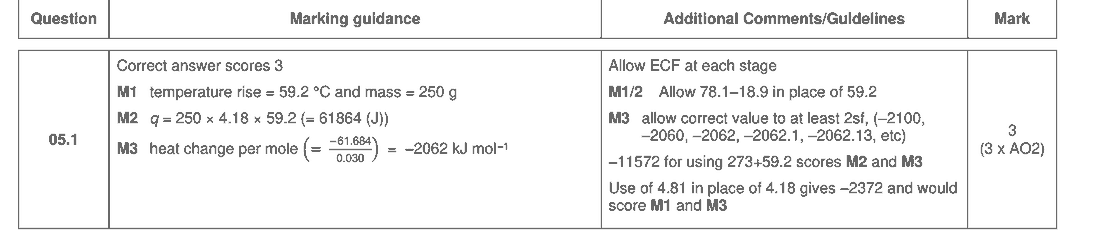
05.1 Energetics 3AO2=3Calculation
05.2 Energetics 2AO3=2Practical and data analysis
05.3 Energetics 3AO2=3Calculation
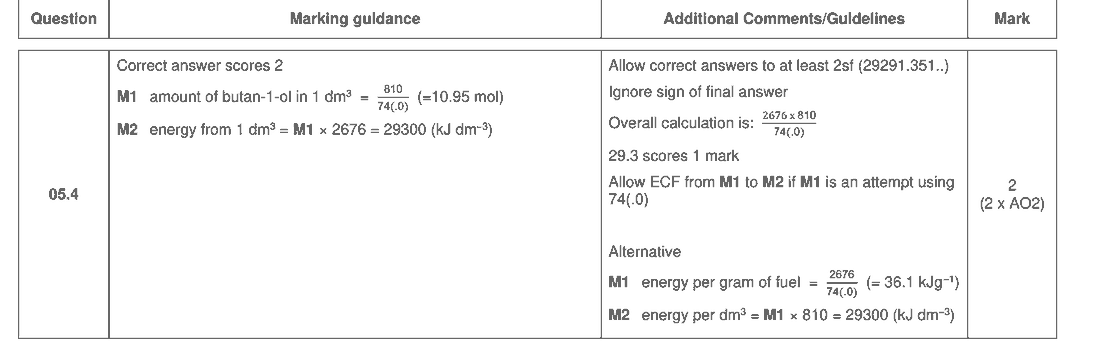
05.4 Amount of substance 2AO2=2Calculation
06.1 Bonding 1AO1=1Short answer
06.2 Bonding 1AO3=1Short answer
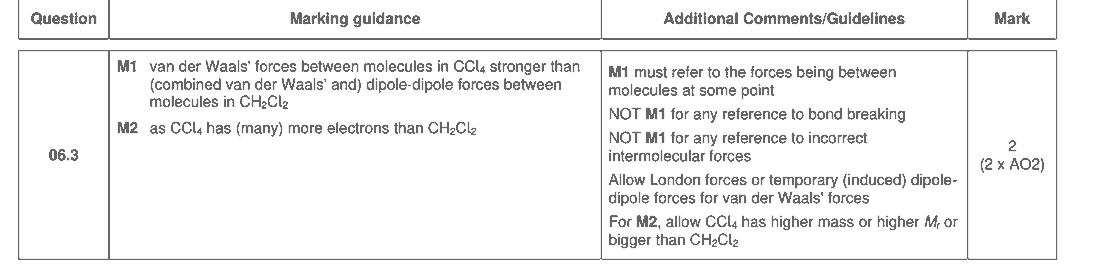
06.3 Bonding 2AO2=2Explanation
06.4 Bonding 2AO1=2Short answer
07.1 Alcohols 2AO3=2Practical and data analysis
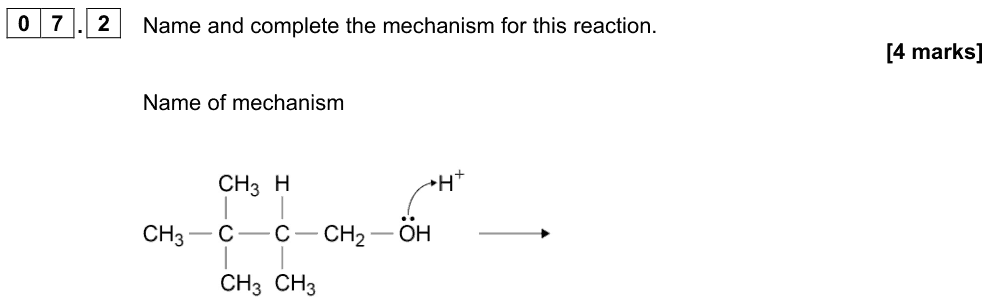
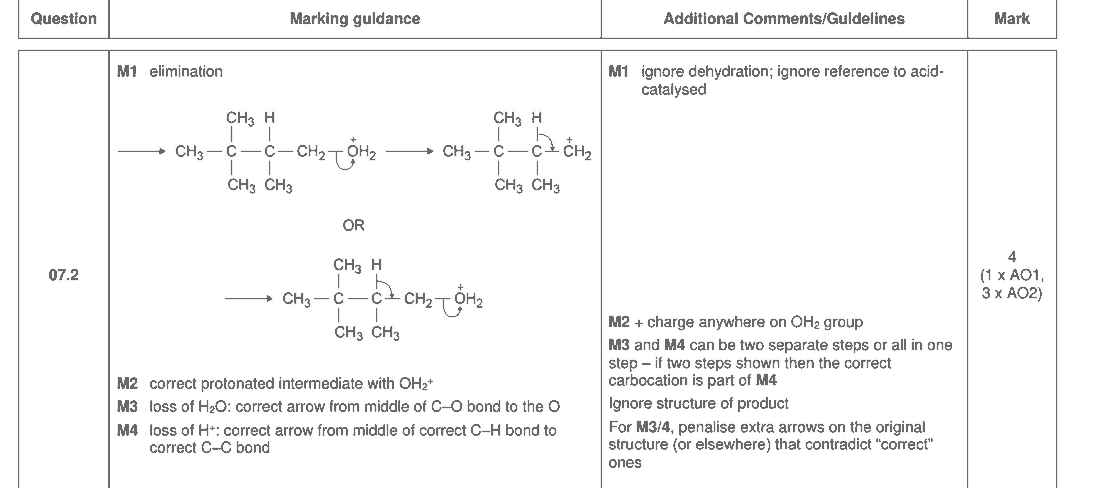
07.2 Alcohols 4AO1=1,AO2=3Mechanism
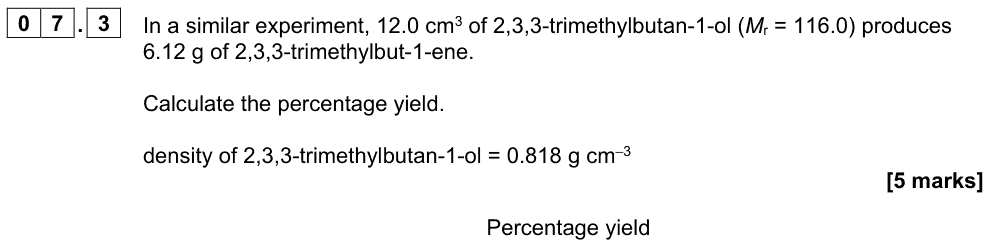
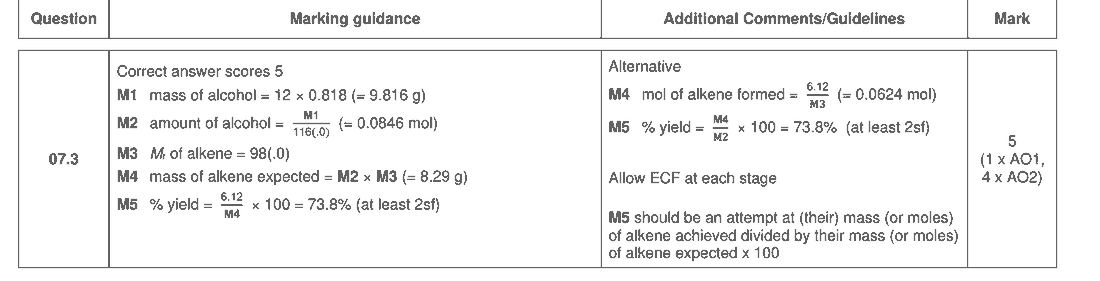
07.3 Amount of substance 5AO1=1,AO2=4Calculation
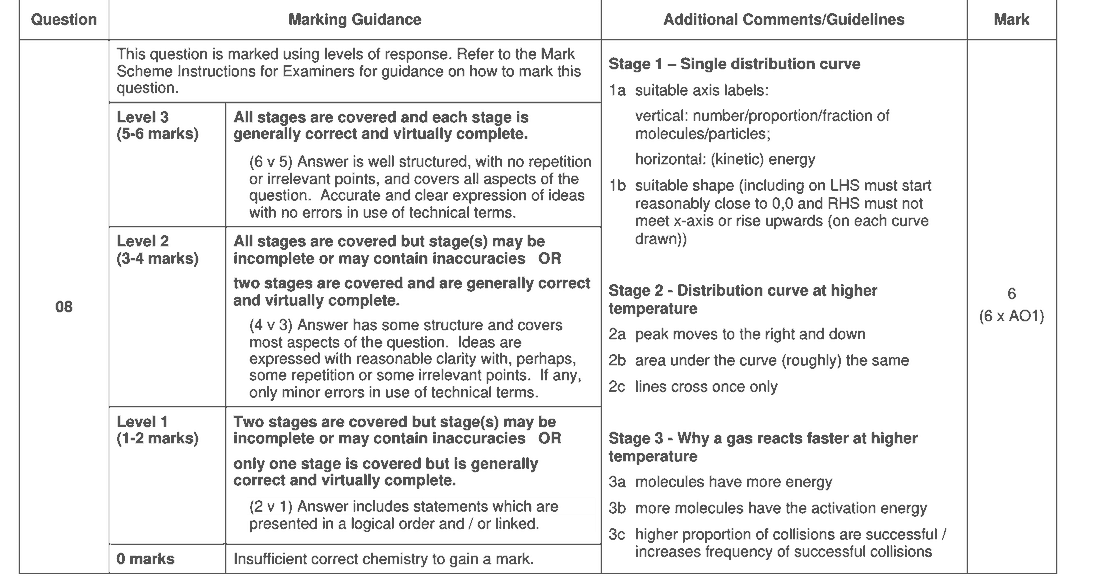
08 Kinetics 6AO1=6Level of response
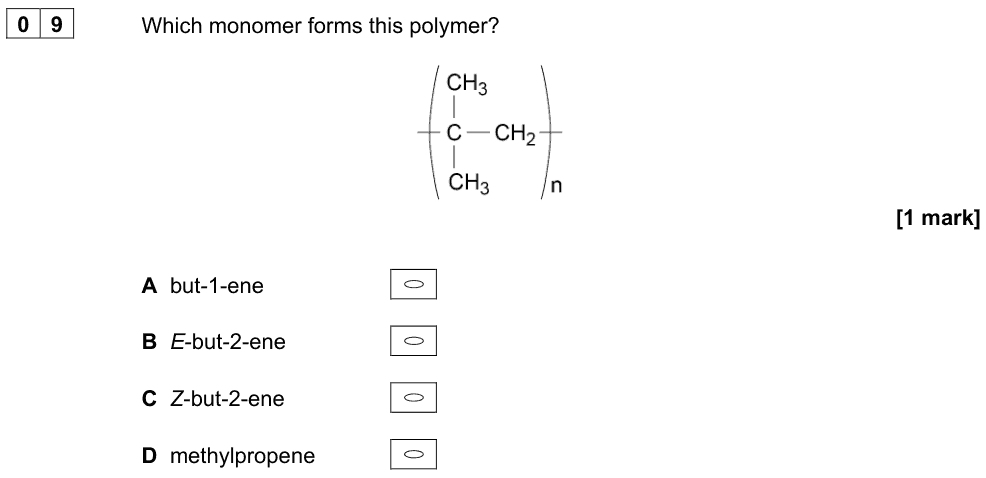
09 Alkenes 1AO3=1Multiple choice
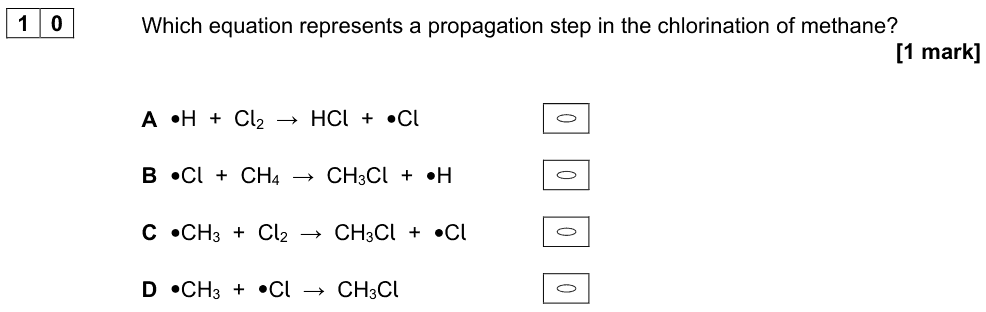
10 Alkanes, Introduction to organic chemistry: nomenclature, mechanisms and isomerism 1AO1=1Multiple choice
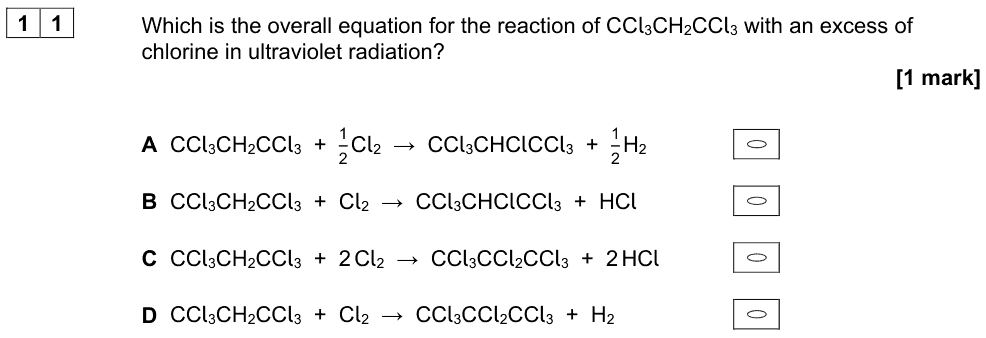
11 Alkanes 1AO1=1Multiple choice
12 Halogenoalkanes 1AO1=1Multiple choice
13 Halogenoalkanes 1AO2=1Multiple choice
14 Organic analysis: test-tube reactions, mass spectrometry and infrared 1AO2=1Multiple choice
15 Alkenes, Bonding 1AO3=1Multiple choice
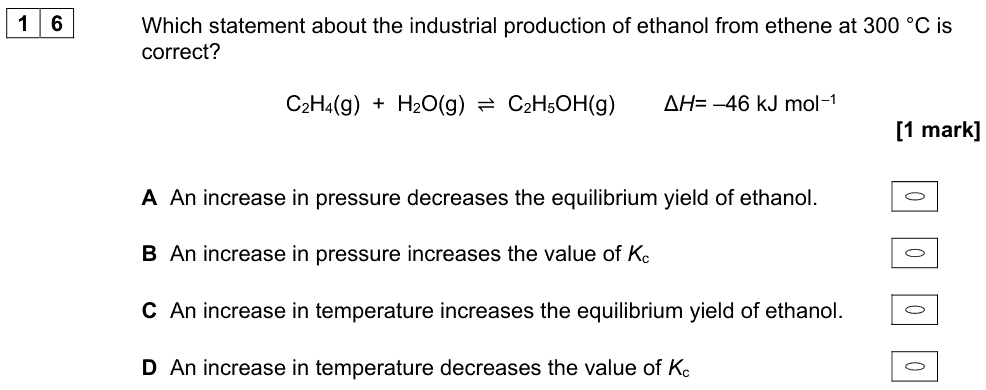
16 Chemical equilibria, Le Chatelier's principle and Kc 1AO3=1Multiple choice
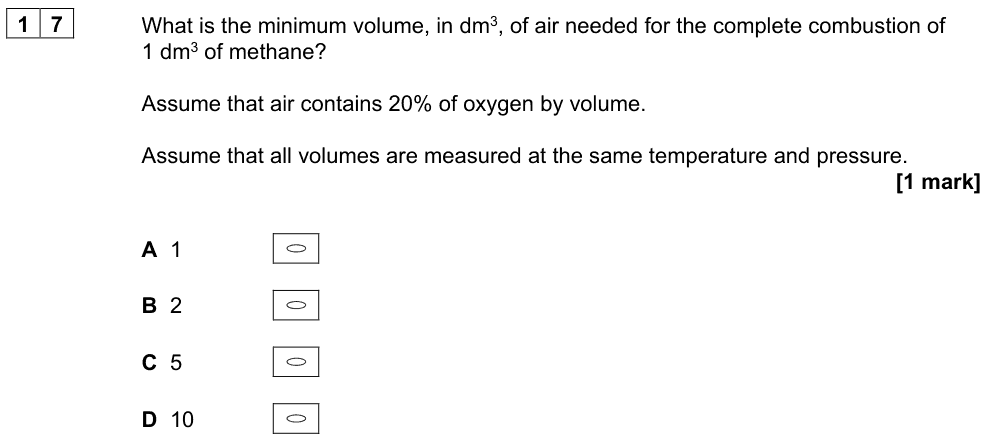
17 Amount of substance 1AO3=1Multiple choice
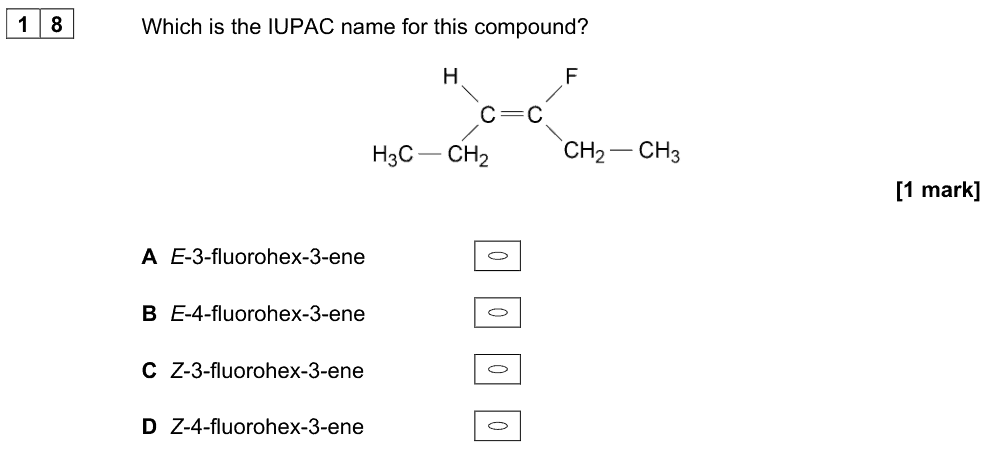
18 Introduction to organic chemistry: nomenclature, mechanisms and isomerism 1AO2=1Multiple choice
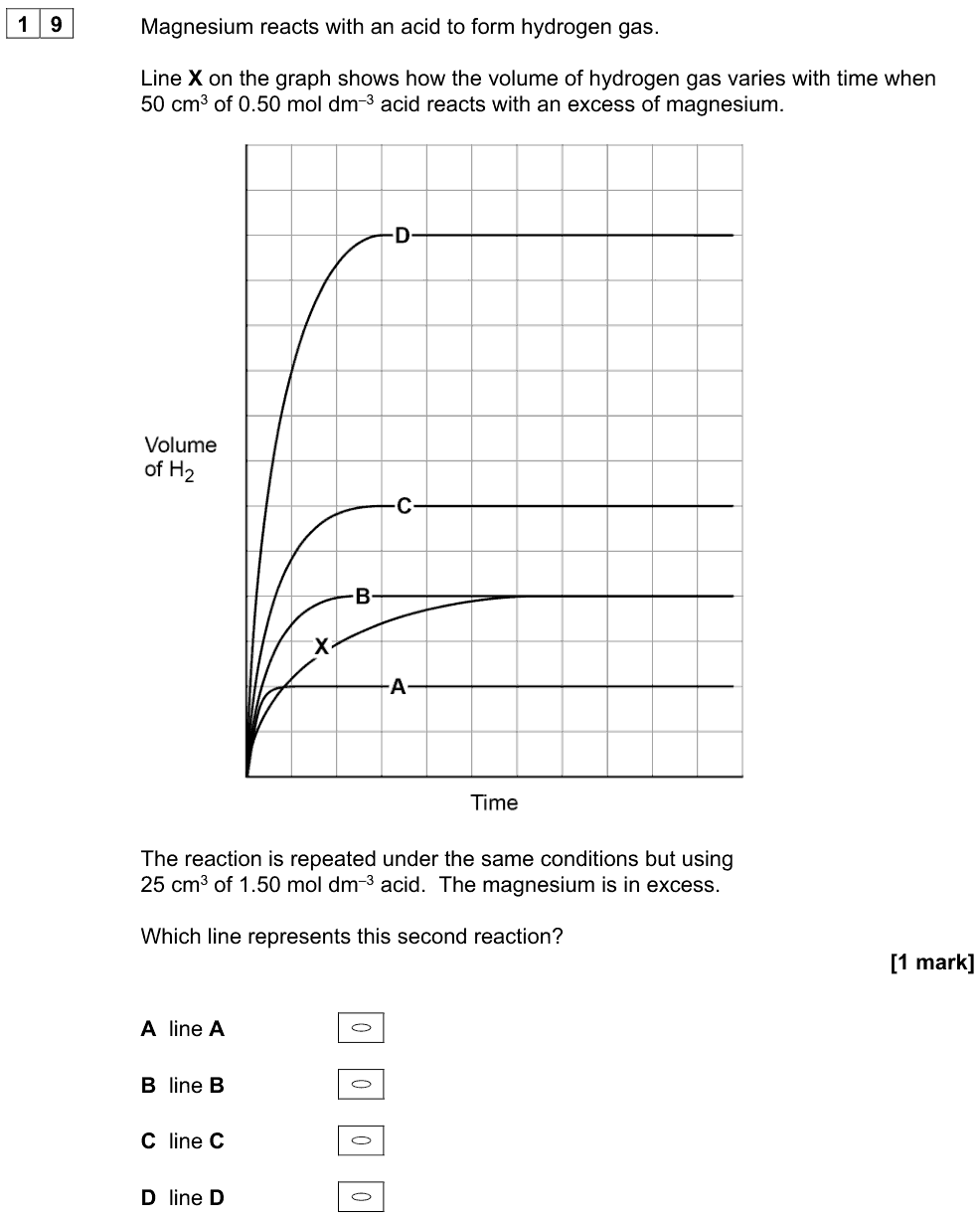
19 Kinetics, Amount of substance 1AO2=1Multiple choice
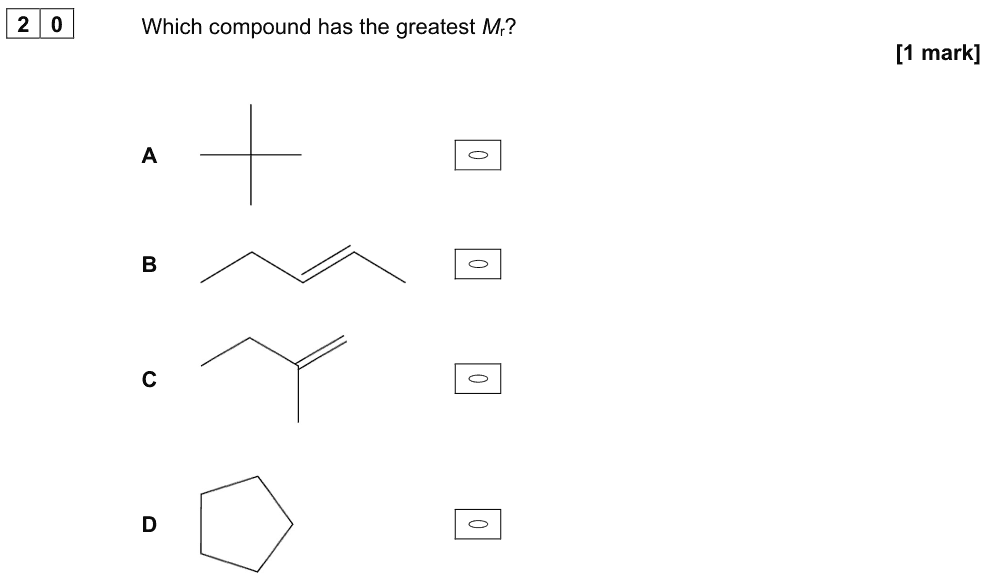
20 Introduction to organic chemistry: nomenclature, mechanisms and isomerism 1AO1=1Multiple choice
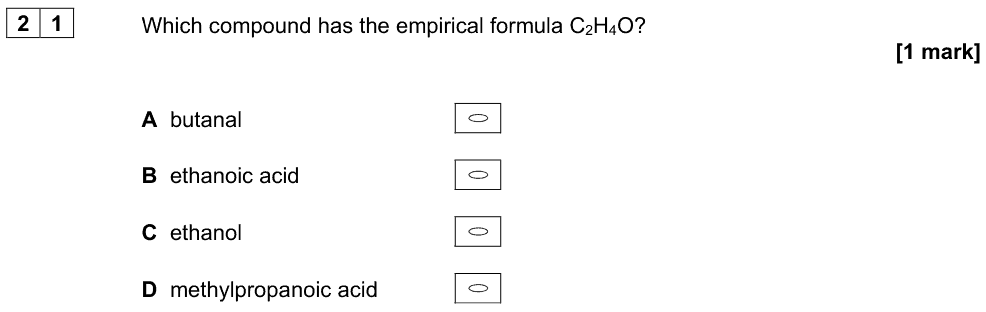
21 Amount of substance, Introduction to organic chemistry: nomenclature, mechanisms and isomerism 1AO1=1Multiple choice
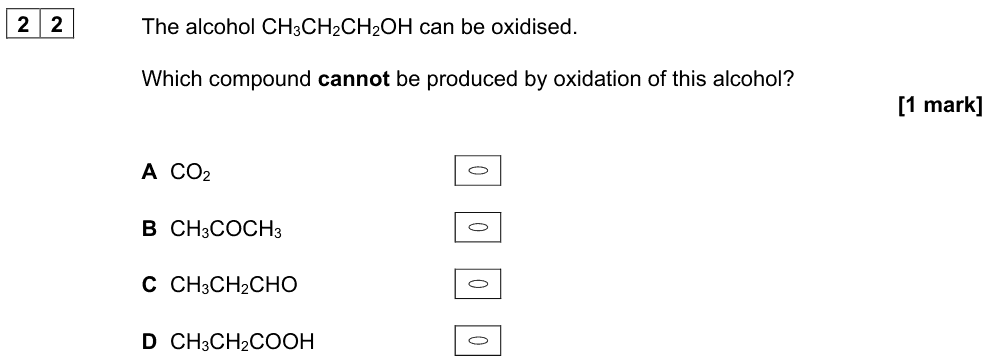
22 Alcohols 1AO1=1Multiple choice
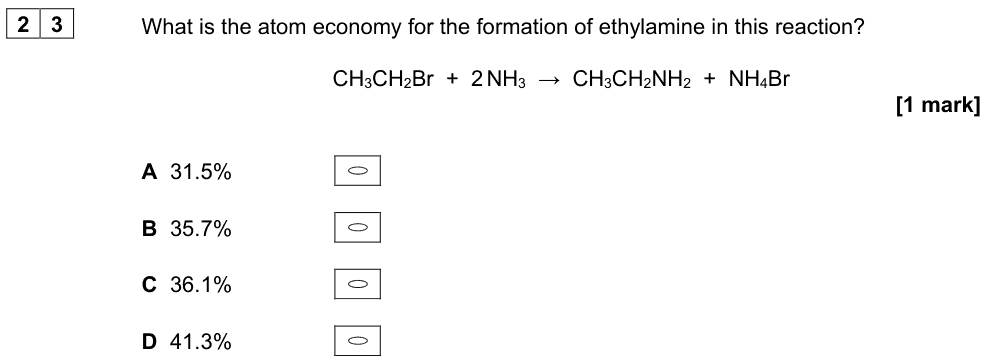
23 Amount of substance 1AO1=1Multiple choice

The questions

01.101.201.302.102.202.302.402.502.602.703.103.204.104.204.305.105.205.305.406.106.206.306.407.107.207.308091011121314151617181920212223
June 2023 · AS Paper 2 · Q01.1 3 marks AO3=3 Practical and data analysis organic analysisalcohols
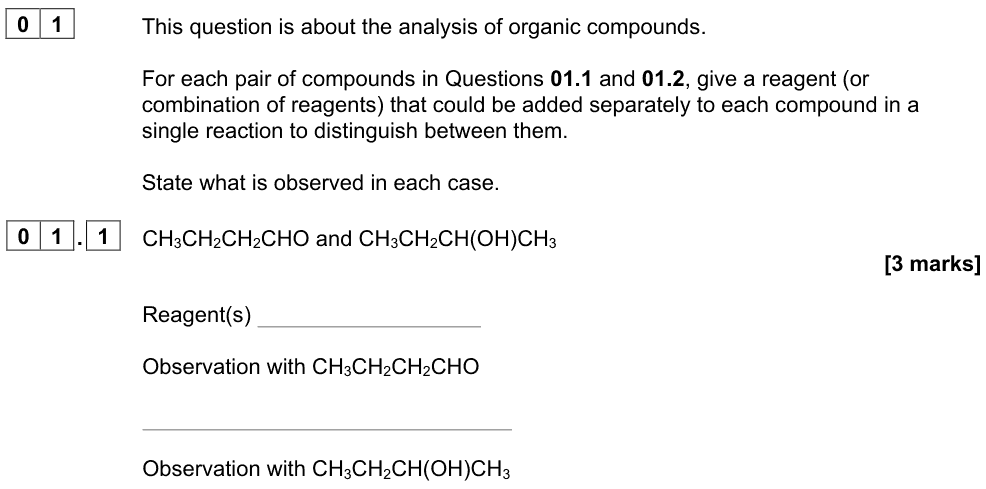
This question is about the analysis of organic compounds.
For each pair of compounds in Questions 01.1 and 01.2, give a reagent (or
combination of reagents) that could be added separately to each compound in a
single reaction to distinguish between them.
State what is observed in each case.
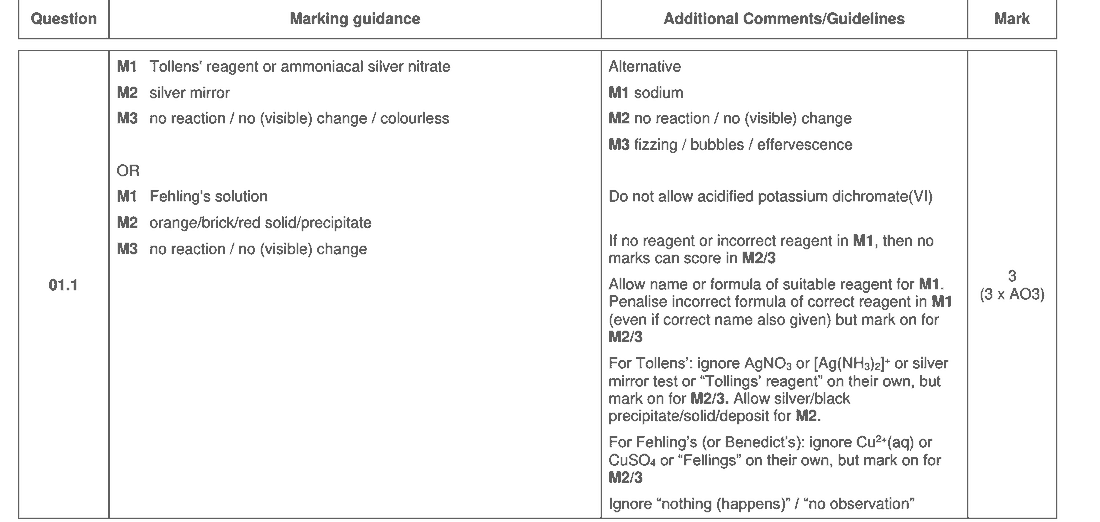
CH3CH2CH2CHO and CH3CH2CH(OH)CH3
[3 marks]
Reagent(s)
Observation with CH3CH2CH2CHO
Observation with CH3CH2CH(OH)CH3
June 2023 · AS Paper 2 · Q01.2 3 marks AO3=3 Practical and data analysis Easy alkenesorganic analysis
Earlier part of question 01 that this part usesEarlier part of June 2023 Paper 2 question 01
Cyclohexane and cyclohexene
[3 marks]
Reagent(s)
Observation with cyclohexane
Observation with cyclohexene
June 2023 · AS Paper 2 · Q01.3 3 marks AO2=3 Calculation Easy organic analysis
Earlier part of question 01 that this part usesEarlier part of June 2023 Paper 2 question 01
Table 1 gives the precise relative molecular masses (Mr) of some organic compounds
measured using high resolution mass spectrometry.
Table 1
Molecular formula
C5H12
C5H10
C6H6
Mr
72.1416
70.1260
to be calculated
Use these data to find the relative atomic masses (Ar) of hydrogen and carbon.
Give your answers to 4 decimal places.
Use these calculated Ar values to find the relative molecular mass (Mr) of C6H6
Give your answer to 4 decimal places.
[3 marks]
Ar of hydrogen
Ar of carbon
Mr of C6H6
June 2023 · AS Paper 2 · Q02.1 1 mark AO1=1 Short answer alkanes
This question is about fuels.
Crude oil is separated into fractions by fractional distillation.
State the meaning of the term ‘fraction’ in this context.
[1 mark]
June 2023 · AS Paper 2 · Q02.2 1 mark AO1=1 Short answer alkanes
Earlier part of question 02 that this part usesEarlier part of June 2023 Paper 2 question 02
Petrol for cars contains branched and cyclic alkanes produced by catalytic cracking.
Identify the catalyst used in this process.
[1 mark]
June 2023 · AS Paper 2 · Q02.3 1 mark AO1=1 Diagram or structure introduction to organic chemistry
Earlier part of question 02 that this part usesEarlier part of June 2023 Paper 2 question 02
3-Ethyl-4-methylhexane is a branched alkane in petrol.
Draw the skeletal formula of this alkane.
[1 mark]
June 2023 · AS Paper 2 · Q02.4 2 marks AO1=2 Equation writing alkanesamount of substanceintroduction to organic chemistry
Earlier part of question 02 that this part usesEarlier part of June 2023 Paper 2 question 02
Give the equation for the complete combustion of 3-ethyl-4-methylhexane.
Use the molecular formula for 3-ethyl-4-methylhexane in your equation.
[2 marks]
June 2023 · AS Paper 2 · Q02.5 1 mark AO1=1 Short answer organic analysis
Earlier part of question 02 that this part usesEarlier part of June 2023 Paper 2 question 02
Carbon dioxide is a product from the combustion of petrol in cars.  Carbon dioxide
acts as a greenhouse gas when it absorbs infrared radiation.
Give one reason why carbon dioxide absorbs infrared radiation.
[1 mark]
June 2023 · AS Paper 2 · Q02.6 2 marks AO1=2 Short answer alkanes
Earlier part of question 02 that this part usesEarlier part of June 2023 Paper 2 question 02
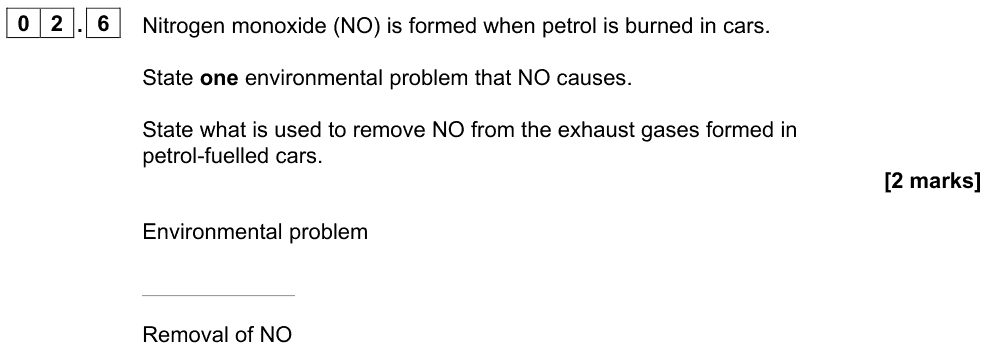
Nitrogen monoxide (NO) is formed when petrol is burned in cars.
State one environmental problem that NO causes.
State what is used to remove NO from the exhaust gases formed in
petrol-fuelled cars.
[2 marks]
Environmental problem
Removal of NO
June 2023 · AS Paper 2 · Q02.7 1 mark AO1=1 Short answer alcohols
Earlier part of question 02 that this part usesEarlier part of June 2023 Paper 2 question 02
Petrol sold in the UK contains 10% bioethanol.  Bioethanol is ethanol made from crops
by fermentation and is considered to be carbon-neutral.
State what is meant by the term ‘carbon-neutral’.
[1 mark]
June 2023 · AS Paper 2 · Q03.1 2 marks AO2=2 Mechanism halogenoalkanes
This question is about reactions of halogenoalkanes with hydroxide ions.
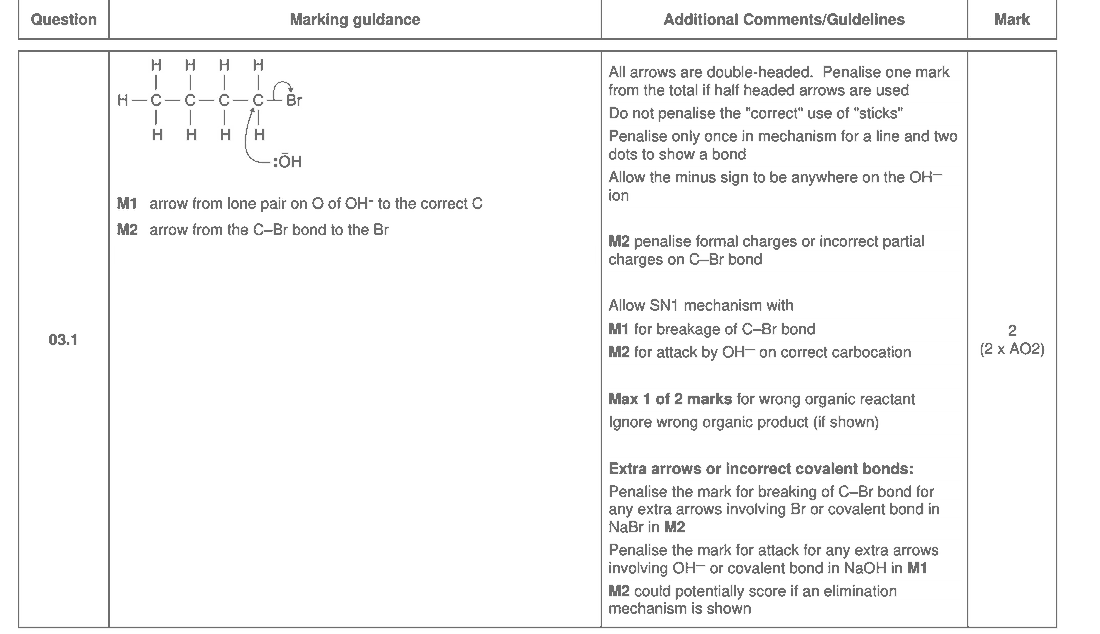
Outline the mechanism for the nucleophilic substitution reaction of 1-bromobutane
with sodium hydroxide.
[2 marks]
June 2023 · AS Paper 2 · Q03.2 2 marks AO2=2 Short answer Hard halogenoalkanes
Earlier part of question 03 that this part usesEarlier part of June 2023 Paper 2 question 03
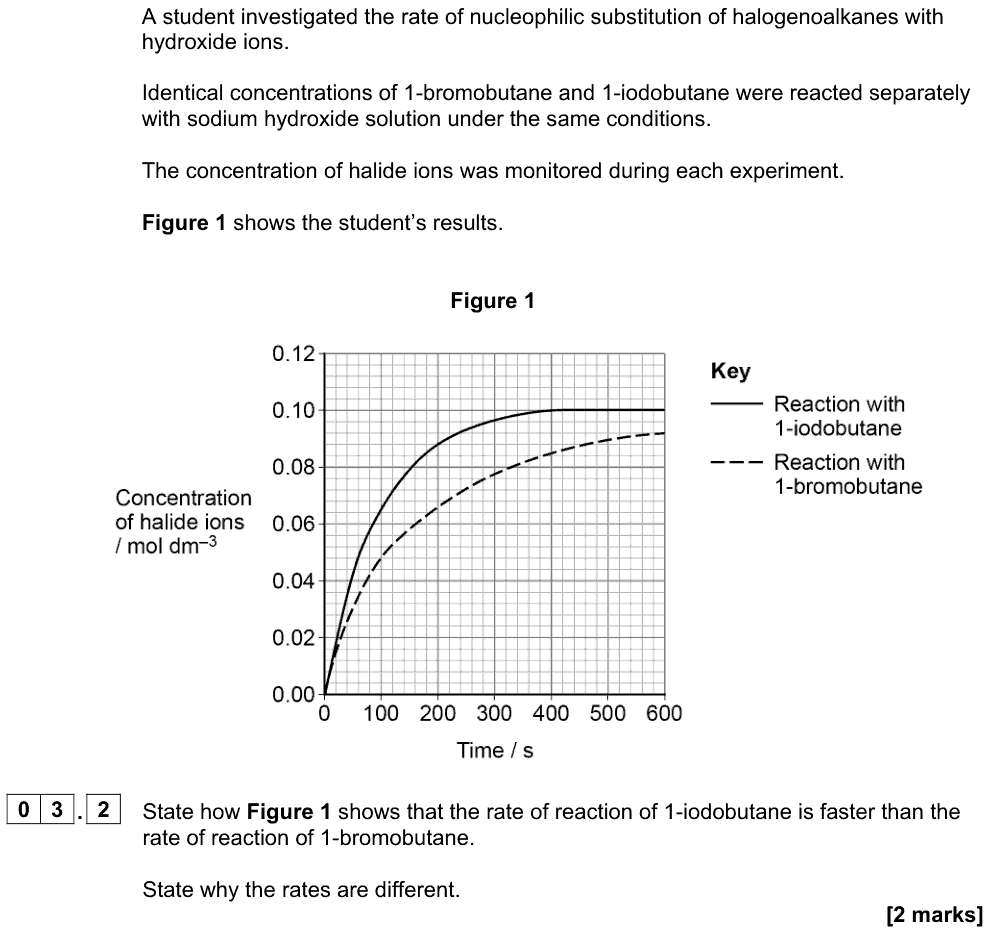
A student investigated the rate of nucleophilic substitution of halogenoalkanes with
hydroxide ions.
Identical concentrations of 1-bromobutane and 1-iodobutane were reacted separately
with sodium hydroxide solution under the same conditions.
The concentration of halide ions was monitored during each experiment.
Figure 1 shows the student’s results.
Figure 1
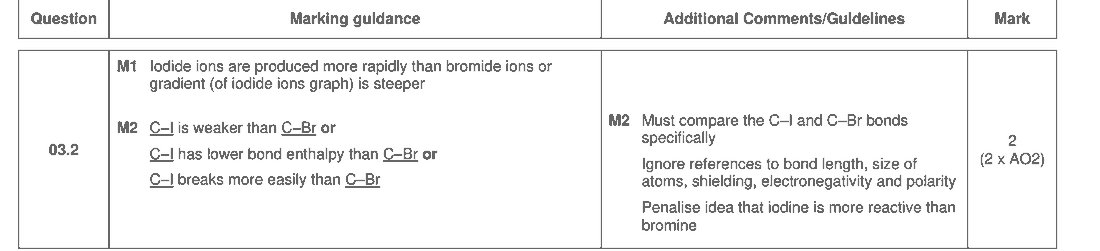
State how Figure 1 shows that the rate of reaction of 1-iodobutane is faster than the
rate of reaction of 1-bromobutane.
State why the rates are different.
[2 marks]
June 2023 · AS Paper 2 · Q04.1 5 marks AO1=1, AO2=4 Mechanism alkenes
1-Methylcyclohexene and limonene are cyclic alkenes with a citrus smell.
1-Methylcyclohexene is manufactured and used in the chemical industry.
Limonene is found naturally in orange peel.
1-Methylcyclohexene reacts with HBr to form two structural isomers.
The major product is 1-bromo-1-methylcyclohexane.
Name and outline the mechanism for the formation of this major product.
[5 marks]
Name of mechanism
Outline of mechanism
June 2023 · AS Paper 2 · Q04.2 4 marks AO2=3, AO3=1 Explanation alkenes
Earlier part of question 04 that this part usesEarlier part of June 2023 Paper 2 question 04
Draw the skeletal formula of the minor product formed in the reaction in Question 04.1.
Explain why the products are formed in different amounts.
[4 marks]
Skeletal formula
Explanation
June 2023 · AS Paper 2 · Q04.3 1 mark AO3=1 Diagram or structure alkenes
Earlier part of question 04 that this part usesEarlier part of June 2023 Paper 2 question 04
Draw the structure of the major product when an excess of HBr reacts with limonene.
[1 mark]
June 2023 · AS Paper 2 · Q05.1 3 marks AO2=3 Calculation energetics
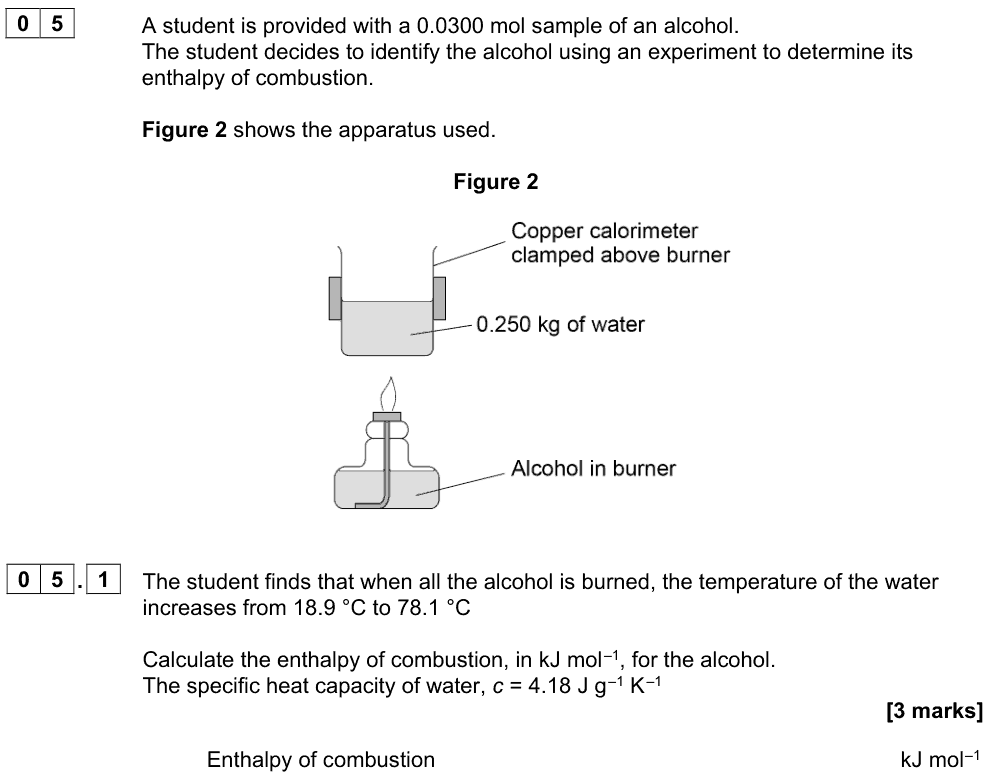
A student is provided with a 0.0300 mol sample of an alcohol.
The student decides to identify the alcohol using an experiment to determine its
enthalpy of combustion.
Figure 2 shows the apparatus used.
Figure 2
The student finds that when all the alcohol is burned, the temperature of the water
increases from 18.9 °C to 78.1 °C
Calculate the enthalpy of combustion, in kJ mol –1, for the alcohol.
The specific heat capacity of water, c = 4.18 J g –1 K –1
[3 marks]
Enthalpy of combustion
kJ mol –1
June 2023 · AS Paper 2 · Q05.2 2 marks AO3=2 Practical and data analysis energetics
Earlier part of question 05 that this part usesEarlier part of June 2023 Paper 2 question 05
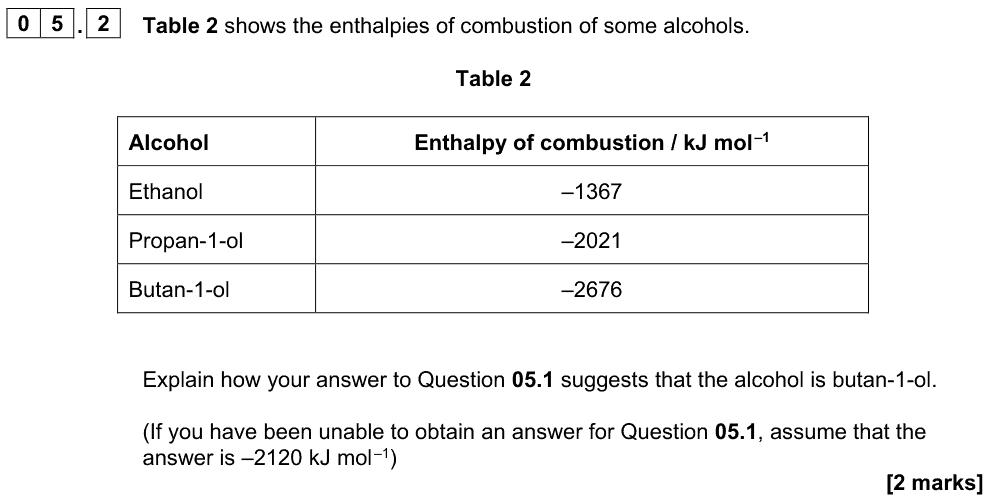
Table 2 shows the enthalpies of combustion of some alcohols.
Table 2
Alcohol
Enthalpy of combustion / kJ mol –1
Ethanol
–1367
Propan-1-ol
–2021
Butan-1-ol
–2676
Explain how your answer to Question 05.1 suggests that the alcohol is butan-1-ol.
(If you have been unable to obtain an answer for Question 05.1, assume that the
answer is –2120 kJ mol –1)
[2 marks]
June 2023 · AS Paper 2 · Q05.3 3 marks AO2=3 Calculation energetics
Earlier part of question 05 that this part usesEarlier part of June 2023 Paper 2 question 05
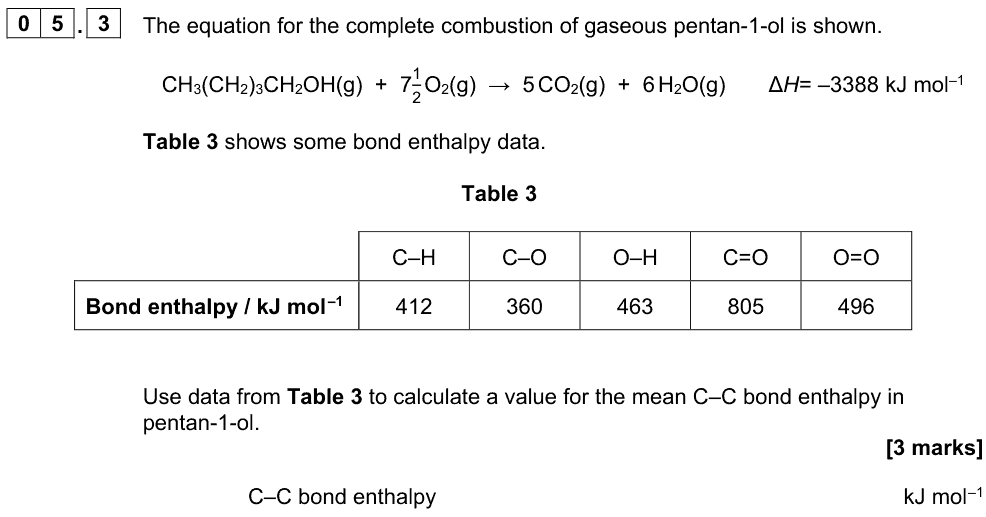
The equation for the complete combustion of gaseous pentan-1-ol is shown.
CH3(CH2)3CH2OH(g)  +  7
1
2
O2(g)  →  5 CO2(g)  +  6 H2O(g)       ΔH= –3388 kJ mol–1
Table 3 shows some bond enthalpy data.
Table 3
C–H
C–O
O–H
C=O
O=O
Bond enthalpy / kJ mol –1
412
360
463
805
496
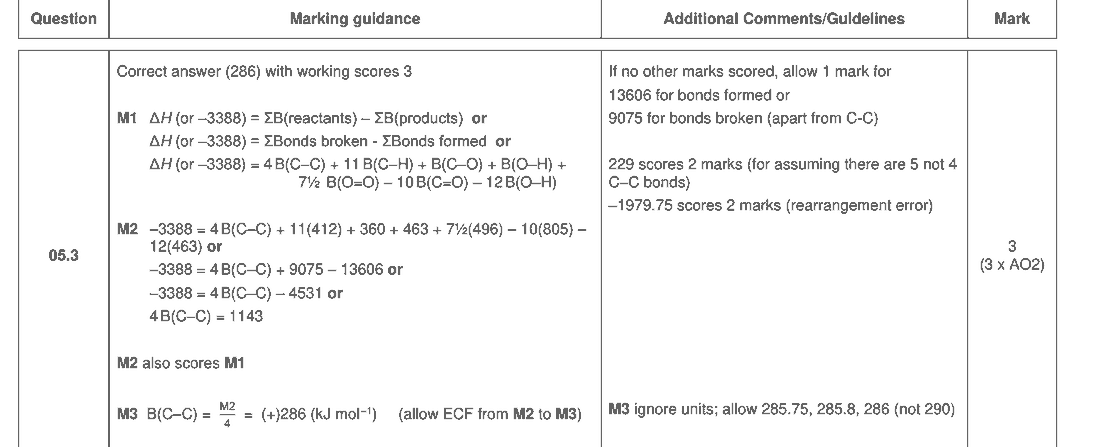
Use data from Table 3 to calculate a value for the mean C–C bond enthalpy in
pentan-1-ol.
[3 marks]
C–C bond enthalpy
kJ mol –1
June 2023 · AS Paper 2 · Q05.4 2 marks AO2=2 Calculation amount of substance
Earlier part of question 05 that this part usesEarlier part of June 2023 Paper 2 question 05
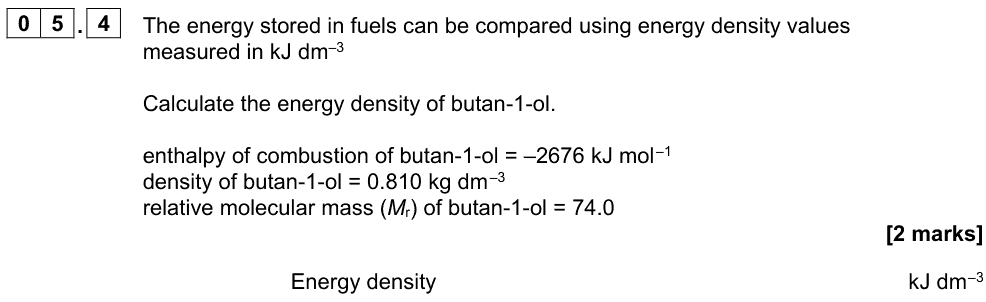
The energy stored in fuels can be compared using energy density values
measured in kJ dm–3
Calculate the energy density of butan-1-ol.
enthalpy of combustion of butan-1-ol = –2676 kJ mol –1
density of butan-1-ol = 0.810 kg dm –3
relative molecular mass (Mr) of butan-1-ol = 74.0
[2 marks]
Energy density
kJ dm –3
June 2023 · AS Paper 2 · Q06.1 1 mark AO1=1 Short answer bonding
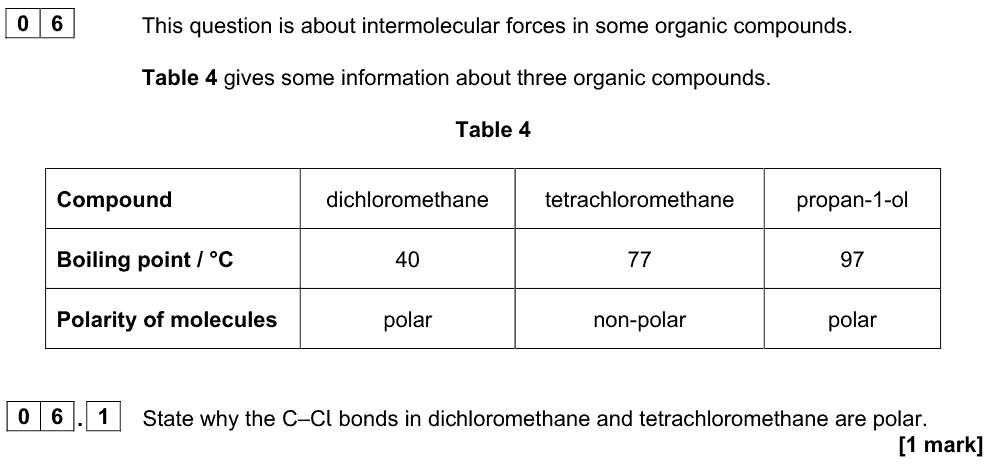
This question is about intermolecular forces in some organic compounds.
Table 4 gives some information about three organic compounds.
Table 4
Compound
dichloromethane
tetrachloromethane
propan-1-ol
Boiling point / °C
40
77
97
Polarity of molecules
polar
non-polar
polar
State why the C–Cl bonds in dichloromethane and tetrachloromethane are polar.
[1 mark]
June 2023 · AS Paper 2 · Q06.2 1 mark AO3=1 Short answer bonding
Earlier part of question 06 that this part usesEarlier part of June 2023 Paper 2 question 06
Suggest why tetrachloromethane molecules are non-polar.
[1 mark]
June 2023 · AS Paper 2 · Q06.3 2 marks AO2=2 Explanation bonding
Earlier part of question 06 that this part usesEarlier part of June 2023 Paper 2 question 06
Explain why tetrachloromethane has a higher boiling point than dichloromethane.
[2 marks]
June 2023 · AS Paper 2 · Q06.4 2 marks AO1=2 Short answer bonding
Earlier part of question 06 that this part usesEarlier part of June 2023 Paper 2 question 06
Propan-1-ol has a higher boiling point than the other two compounds because of
hydrogen bonding.
Describe the hydrogen bonding in propan-1-ol.
[2 marks]
June 2023 · AS Paper 2 · Q07.1 2 marks AO3=2 Practical and data analysis alcohols
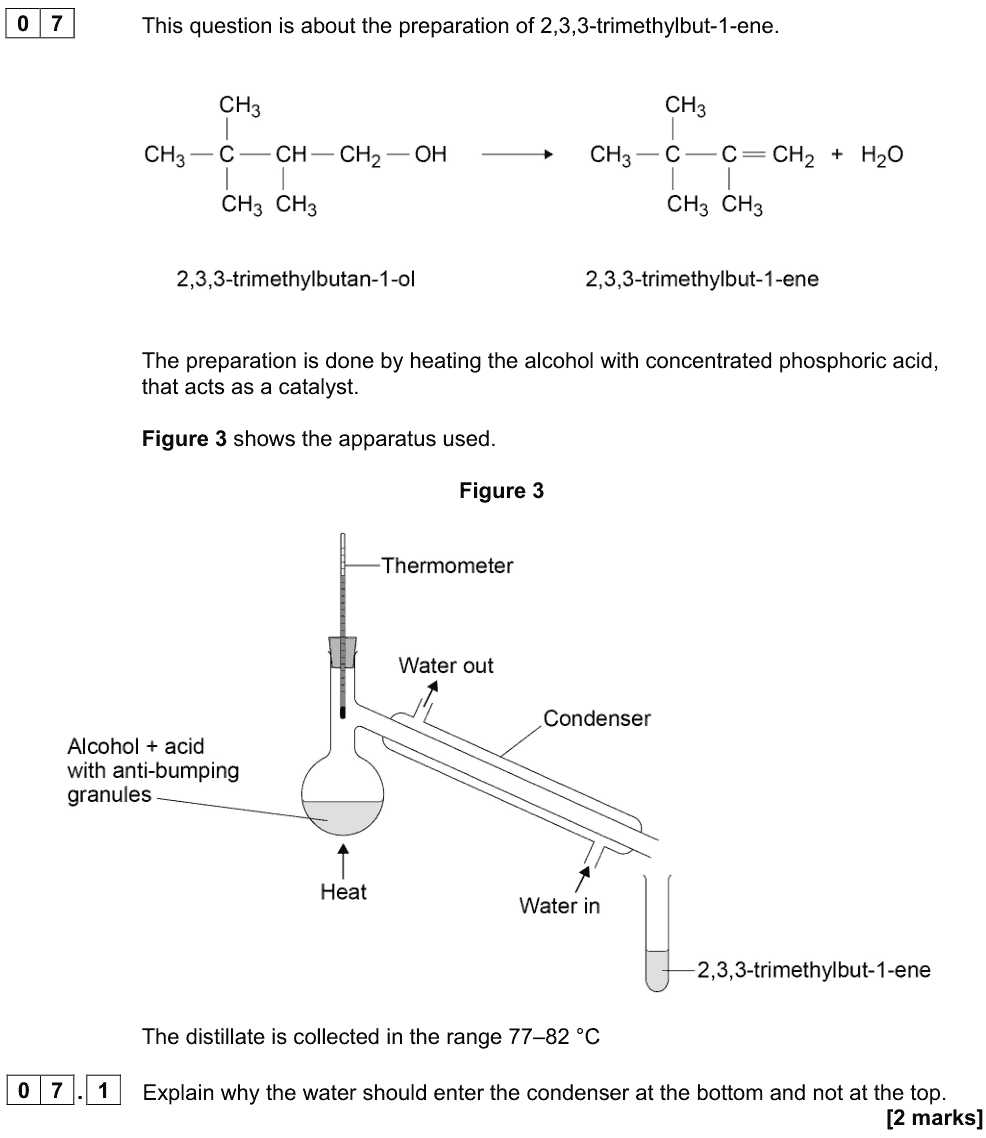
This question is about the preparation of 2,3,3-trimethylbut-1-ene.
The preparation is done by heating the alcohol with concentrated phosphoric acid,
that acts as a catalyst.
Figure 3 shows the apparatus used.
Figure 3
The distillate is collected in the range 77–82 °C
Explain why the water should enter the condenser at the bottom and not at the top.
[2 marks]
June 2023 · AS Paper 2 · Q07.2 4 marks AO1=1, AO2=3 Mechanism Hard alcohols
Earlier part of question 07 that this part usesEarlier part of June 2023 Paper 2 question 07
Name and complete the mechanism for this reaction.
[4 marks]
Name of mechanism
June 2023 · AS Paper 2 · Q07.3 5 marks AO1=1, AO2=4 Calculation amount of substance
Earlier part of question 07 that this part usesEarlier part of June 2023 Paper 2 question 07
In a similar experiment, 12.0 cm3 of 2,3,3-trimethylbutan-1-ol (Mr = 116.0) produces
6.12 g of 2,3,3-trimethylbut-1-ene.
Calculate the percentage yield.
density of 2,3,3-trimethylbutan-1-ol = 0.818 g cm–3
[5 marks]
Percentage yield
June 2023 · AS Paper 2 · Q08 6 marks AO1=6 6-mark level of response kinetics
Draw the Maxwell–Boltzmann distribution curves for a fixed mass of a gas at two
different temperatures.
This gas decomposes when heated.
By reference to these distribution curves, explain why the rate of decomposition of this
gas increases at higher temperatures.
[6 marks]
June 2023 · AS Paper 2 · Q09 1 mark AO3=1 Multiple choice Easy alkenes
Which monomer forms this polymer?
[1 mark]
A but-1-ene
B E-but-2-ene
C Z-but-2-ene
D methylpropene
June 2023 · AS Paper 2 · Q10 1 mark AO1=1 Multiple choice Easy alkanesintroduction to organic chemistry
Which equation represents a propagation step in the chlorination of methane?
[1 mark]
A ●H  +  Cl2  →  HCl  +  ●Cl
B ●Cl  +  CH4  →  CH3Cl  +  ●H
C ●CH3  +  Cl2  →  CH3Cl  +  ●Cl
D ●CH3  +  ●Cl  →  CH3Cl
June 2023 · AS Paper 2 · Q11 1 mark AO1=1 Multiple choice alkanes
Which is the overall equation for the reaction of CCl3CH2CCl3 with an excess of
chlorine in ultraviolet radiation?
[1 mark]
A CCl3CH2CCl3  +
1
2
Cl2  →  CCl3CHClCCl3  +
1
2
H2
B CCl3CH2CCl3  +  Cl2  →  CCl3CHClCCl3  +  HCl
C CCl3CH2CCl3  +  2 Cl2  →  CCl3CCl2CCl3  +  2 HCl
D CCl3CH2CCl3  +  Cl2  →  CCl3CCl2CCl3  +  H2
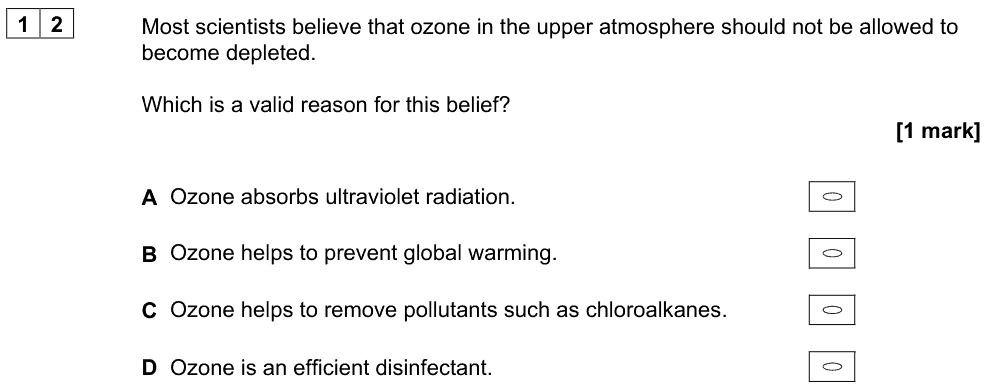
June 2023 · AS Paper 2 · Q12 1 mark AO1=1 Multiple choice Easy halogenoalkanes
Most scientists believe that ozone in the upper atmosphere should not be allowed to
become depleted.
Which is a valid reason for this belief?
[1 mark]
A Ozone absorbs ultraviolet radiation.
B Ozone helps to prevent global warming.
C Ozone helps to remove pollutants such as chloroalkanes.
D Ozone is an efficient disinfectant.
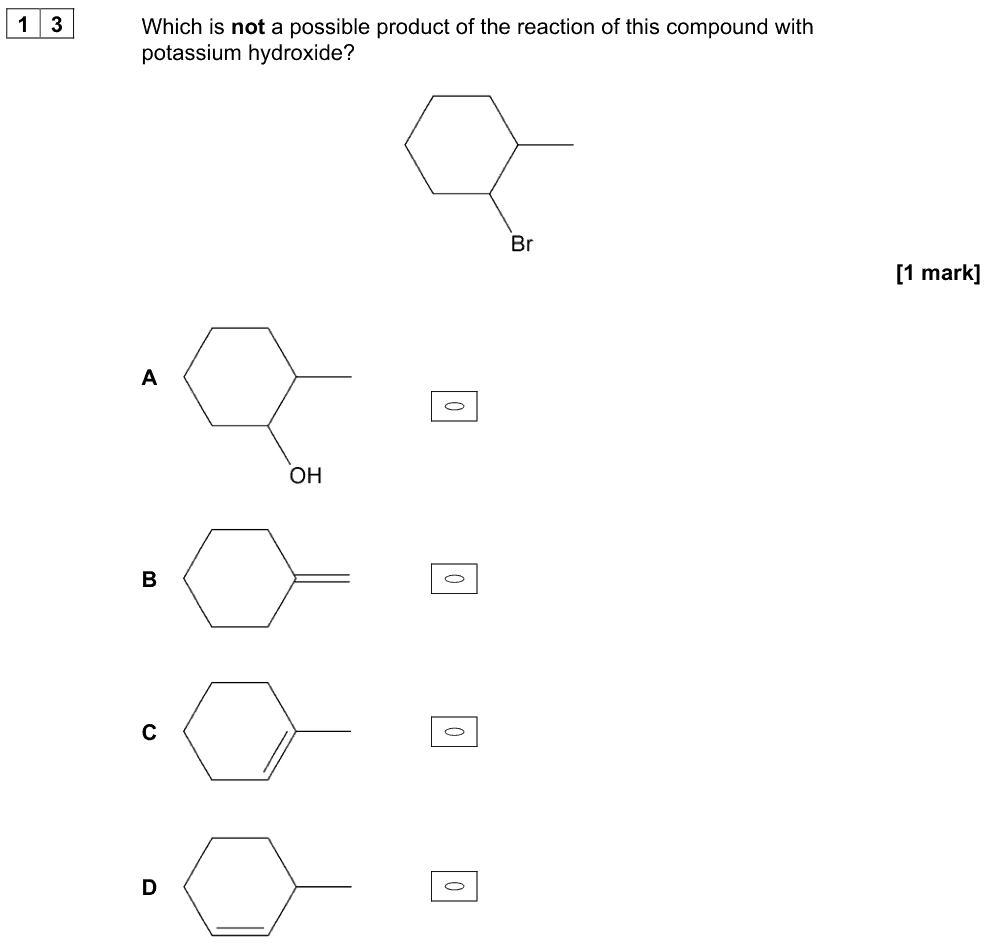
June 2023 · AS Paper 2 · Q13 1 mark AO2=1 Multiple choice Easy halogenoalkanes
Which is not a possible product of the reaction of this compound with
potassium hydroxide?
[1 mark]
A
B
C
D
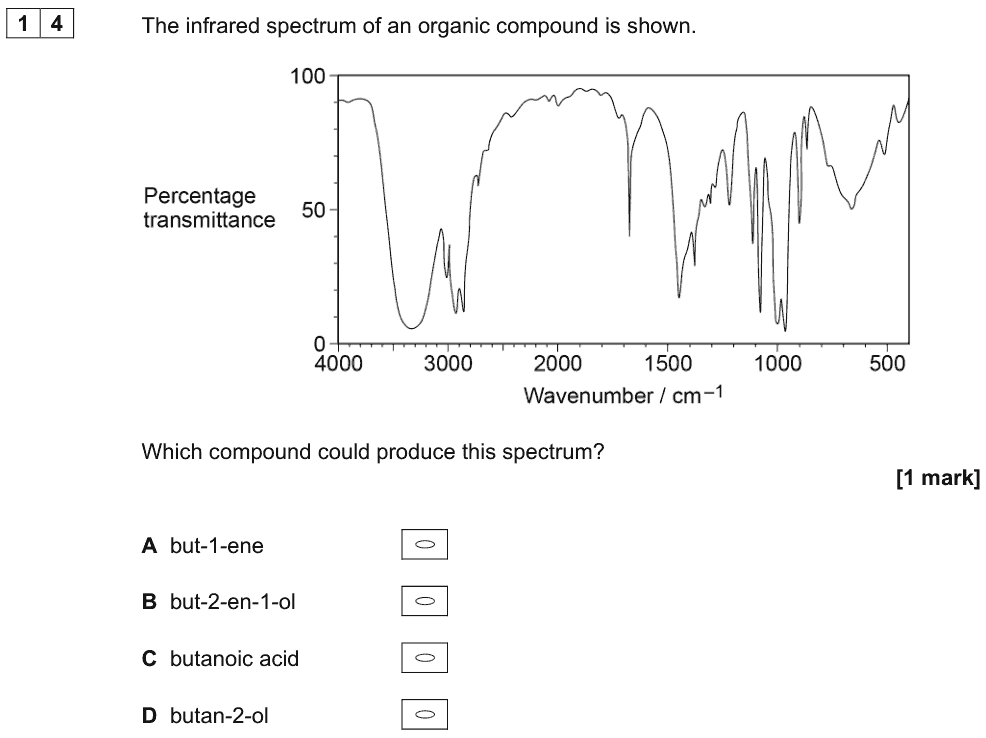
June 2023 · AS Paper 2 · Q14 1 mark AO2=1 Multiple choice organic analysis
The infrared spectrum of an organic compound is shown.
Which compound could produce this spectrum?
[1 mark]
A but-1-ene
B but-2-en-1-ol
C butanoic acid
D butan-2-ol
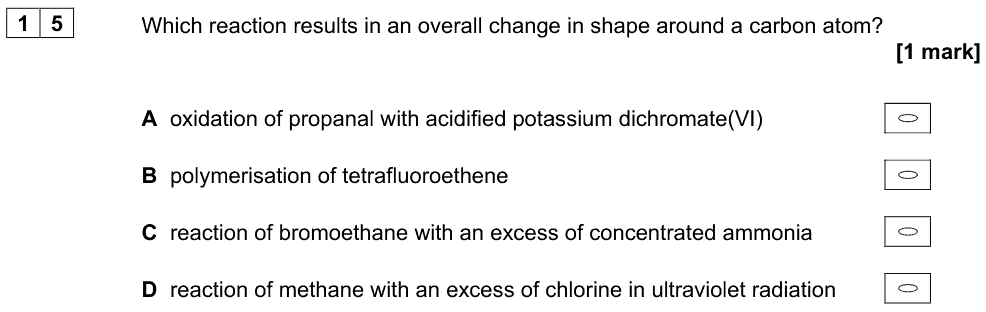
June 2023 · AS Paper 2 · Q15 1 mark AO3=1 Multiple choice alkenesbonding
Which reaction results in an overall change in shape around a carbon atom?
[1 mark]
A oxidation of propanal with acidified potassium dichromate(VI)
B polymerisation of tetrafluoroethene
C reaction of bromoethane with an excess of concentrated ammonia
D reaction of methane with an excess of chlorine in ultraviolet radiation
June 2023 · AS Paper 2 · Q16 1 mark AO3=1 Multiple choice chemical equilibria and kc
Which statement about the industrial production of ethanol from ethene at 300 °C is
correct?
C2H4(g)  +  H2O(g)  ⇌  C2H5OH(g)        ΔH= –46 kJ mol –1
[1 mark]
A An increase in pressure decreases the equilibrium yield of ethanol.
B An increase in pressure increases the value of Kc
C An increase in temperature increases the equilibrium yield of ethanol.
D An increase in temperature decreases the value of Kc
June 2023 · AS Paper 2 · Q17 1 mark AO3=1 Multiple choice amount of substance
What is the minimum volume, in dm3, of air needed for the complete combustion of
1 dm3 of methane?
Assume that air contains 20% of oxygen by volume.
Assume that all volumes are measured at the same temperature and pressure.
[1 mark]
A 1
B 2
C 5
D 10
June 2023 · AS Paper 2 · Q18 1 mark AO2=1 Multiple choice introduction to organic chemistry
Which is the IUPAC name for this compound?
[1 mark]
A E-3-fluorohex-3-ene
B E-4-fluorohex-3-ene
C Z-3-fluorohex-3-ene
D Z-4-fluorohex-3-ene
June 2023 · AS Paper 2 · Q19 1 mark AO2=1 Multiple choice kineticsamount of substance
Magnesium reacts with an acid to form hydrogen gas.
Line X on the graph shows how the volume of hydrogen gas varies with time when
50 cm3 of 0.50 mol dm–3 acid reacts with an excess of magnesium.
The reaction is repeated under the same conditions but using
25 cm3 of 1.50 mol dm–3 acid.  The magnesium is in excess.
Which line represents this second reaction?
[1 mark]
A line A
B line B
C line C
D line D
June 2023 · AS Paper 2 · Q20 1 mark AO1=1 Multiple choice introduction to organic chemistry
Which compound has the greatest Mr?
[1 mark]
A
B
C
D
June 2023 · AS Paper 2 · Q21 1 mark AO1=1 Multiple choice amount of substanceintroduction to organic chemistry
Which compound has the empirical formula C2H4O?
[1 mark]
A butanal
B ethanoic acid
C ethanol
D methylpropanoic acid
June 2023 · AS Paper 2 · Q22 1 mark AO1=1 Multiple choice alcohols
The alcohol CH3CH2CH2OH can be oxidised.
Which compound cannot be produced by oxidation of this alcohol?

[1 mark]
A CO2
B CH3COCH3
C CH3CH2CHO
D CH3CH2COOH
June 2023 · AS Paper 2 · Q23 1 mark AO1=1 Multiple choice Easy amount of substance
What is the atom economy for the formation of ethylamine in this reaction?
CH3CH2Br  +  2 NH3  →  CH3CH2NH2  +  NH4Br
[1 mark]
A 31.5%
B 35.7%
C 36.1%
D 41.3%

Work with an A-level chemistry tutor

Want a paper marked and gone through with you? Message us.

Prefer email? Send an enquiry

If you are under 18, please include a parent's contact details. Enquiries go to enquiries@chemistryaleveltutor.com and are deleted once handled. All tutoring is online.