June 2022: AS Paper 2, Organic and physical chemistry

80 marks · 43 question parts · Paper, mark scheme and report on AQA's site · Have the Data Booklet beside you

Question by question

QTopicMarksAOType
01.1 Kinetics 1AO3=1Practical and data analysis
01.2 Kinetics 1AO1=1Practical and data analysis
01.3 Kinetics 1AO3=1Practical and data analysis
01.4 Kinetics 3AO1=2,AO2=1Practical and data analysis
01.5 Kinetics 1AO3=1Practical and data analysis
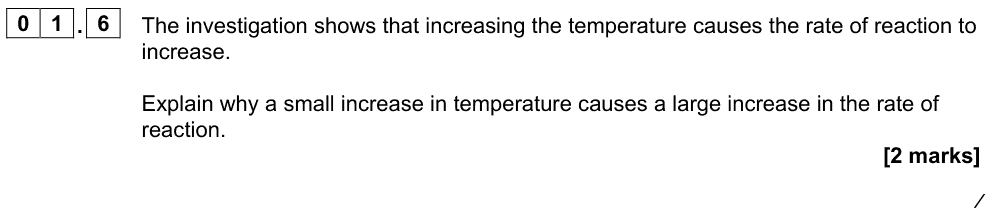
01.6 Kinetics 2AO1=2Explanation
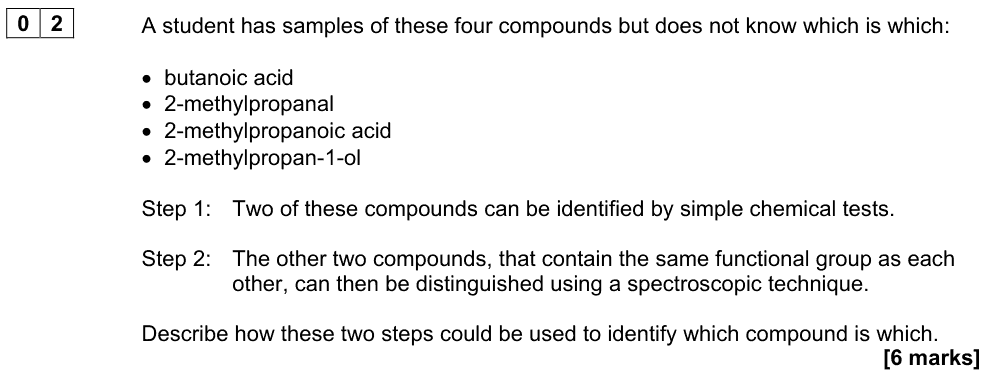
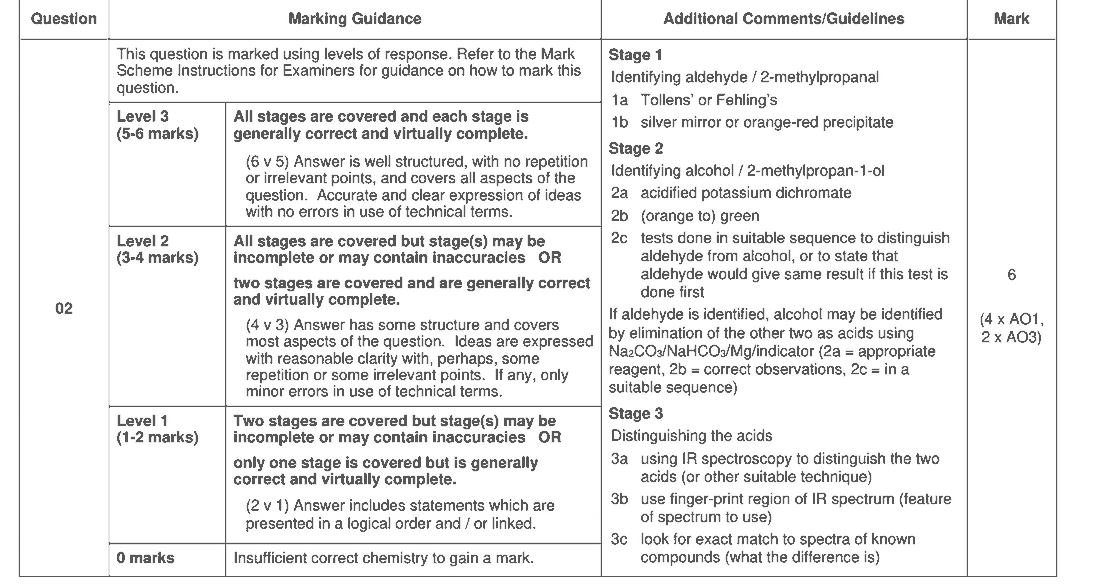
02 Organic analysis: test-tube reactions, mass spectrometry and infrared, Alcohols 6AO1=4,AO3=2Level of response
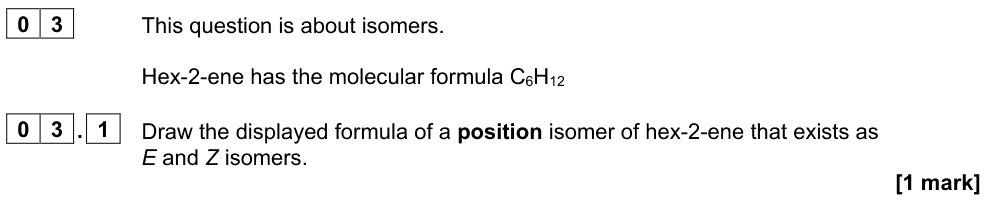
03.1 Introduction to organic chemistry: nomenclature, mechanisms and isomerism 1AO2=1Diagram or structure
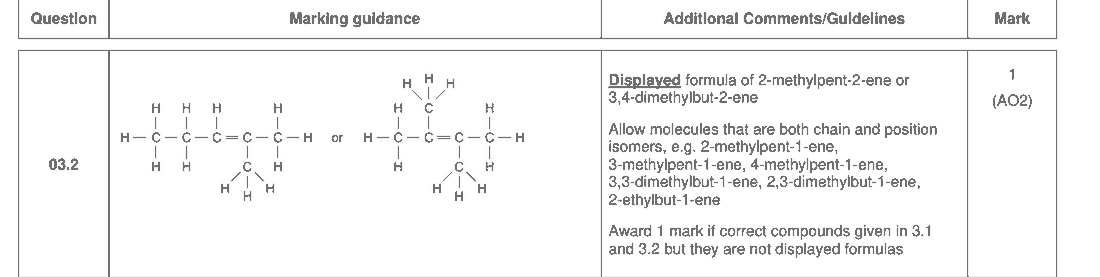
03.2 Introduction to organic chemistry: nomenclature, mechanisms and isomerism 1AO2=1Diagram or structure
03.3 Introduction to organic chemistry: nomenclature, mechanisms and isomerism, Organic analysis: test-tube reactions, mass spectrometry and infrared 1AO2=1Diagram or structure
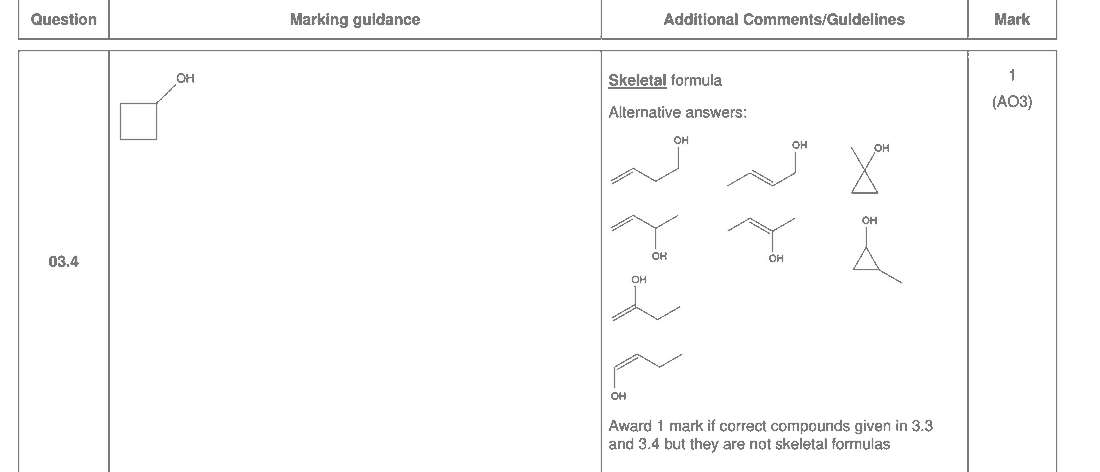
03.4 Introduction to organic chemistry: nomenclature, mechanisms and isomerism, Organic analysis: test-tube reactions, mass spectrometry and infrared 1AO3=1Diagram or structure
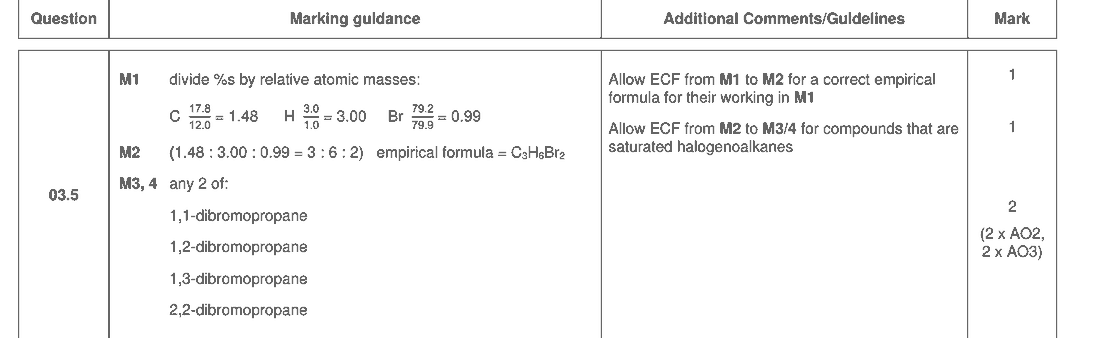
03.5 Amount of substance, Introduction to organic chemistry: nomenclature, mechanisms and isomerism 4AO2=2,AO3=2Calculation
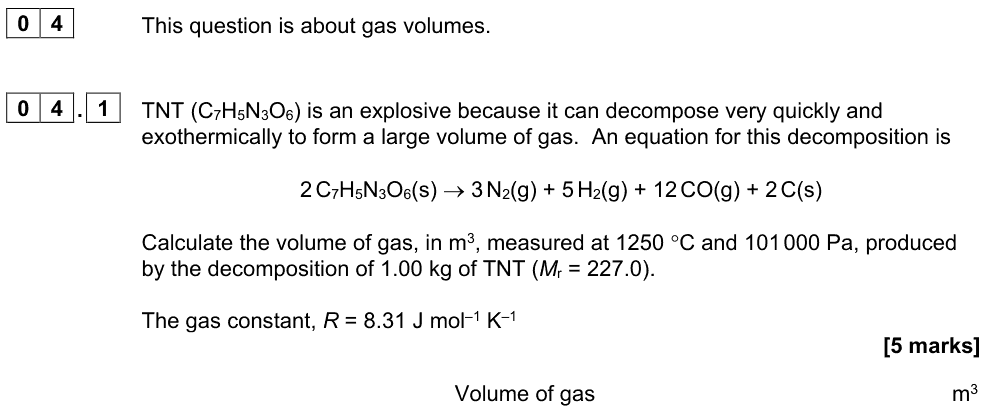
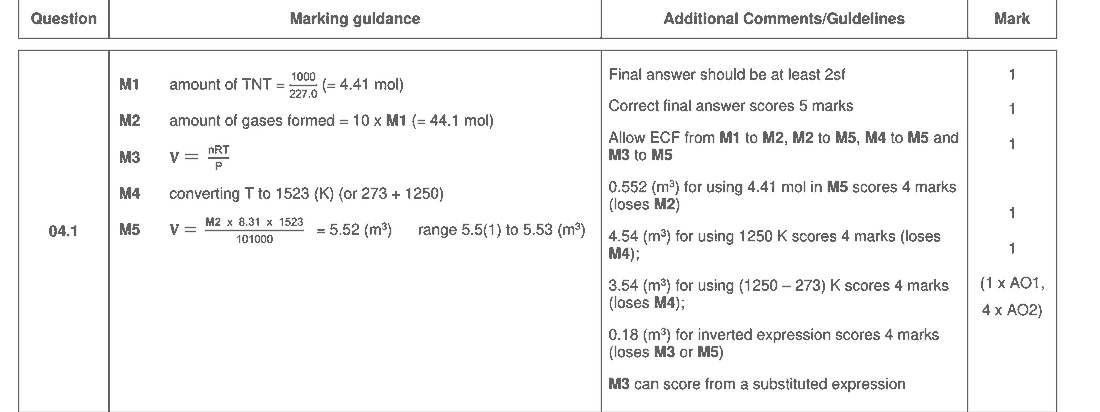
04.1 Amount of substance 5AO1=1,AO2=4Calculation
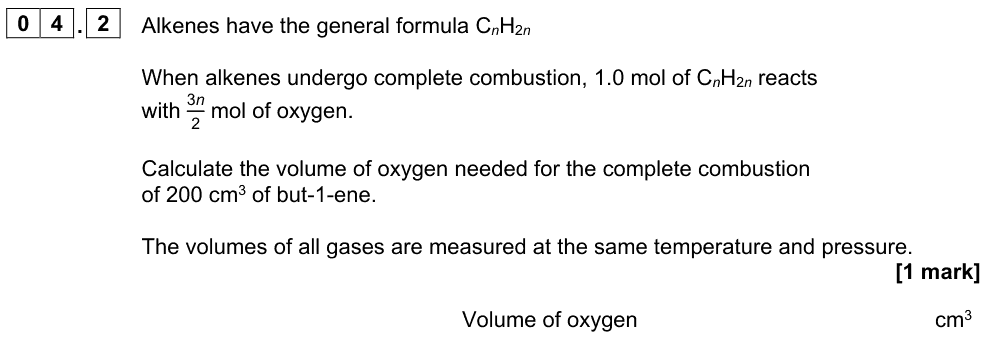
04.2 Amount of substance 1AO1=1Calculation
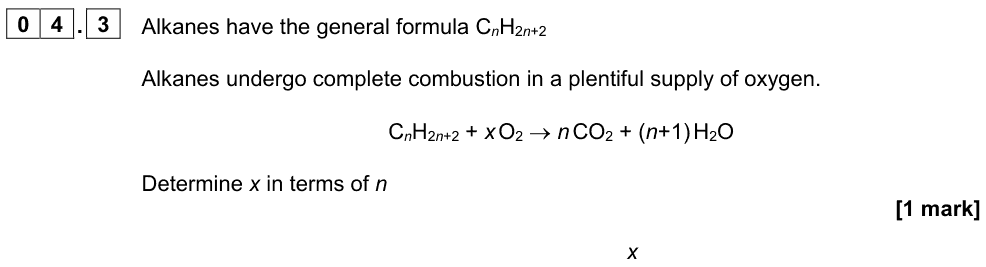
04.3 Amount of substance 1AO1=1Short answer
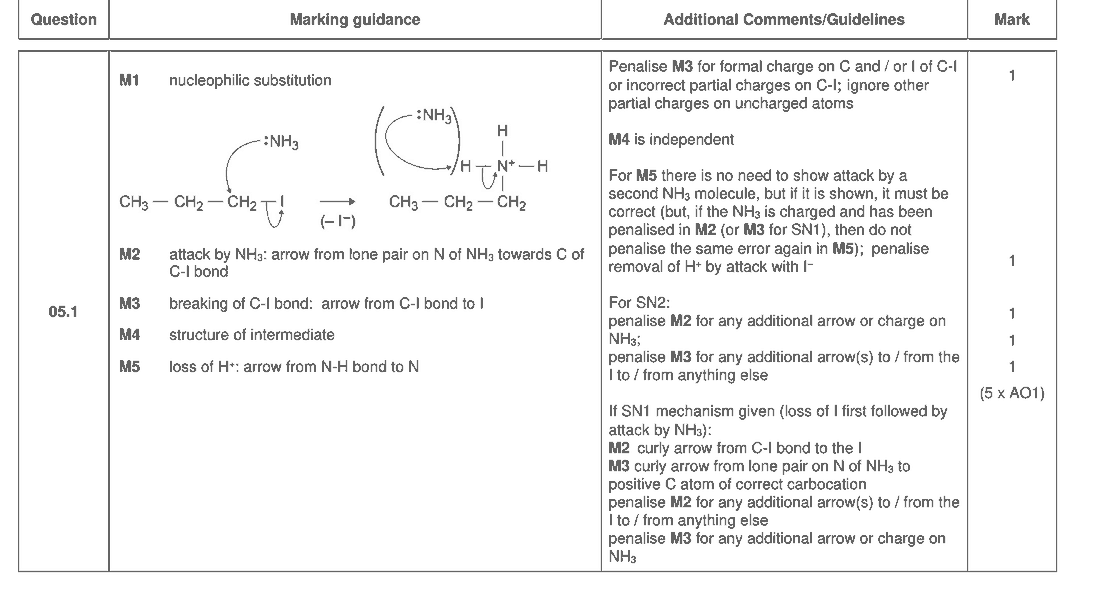
05.1 Halogenoalkanes, Introduction to organic chemistry: nomenclature, mechanisms and isomerism 5AO1=5Mechanism
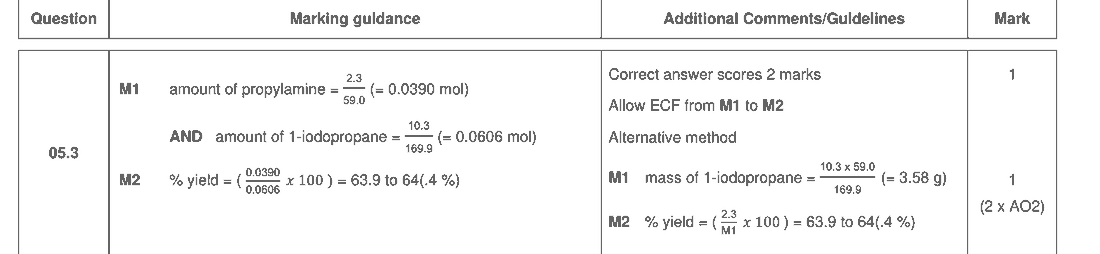
05.2 Amount of substance 2AO2=2Calculation
05.3 Amount of substance 2AO2=2Calculation
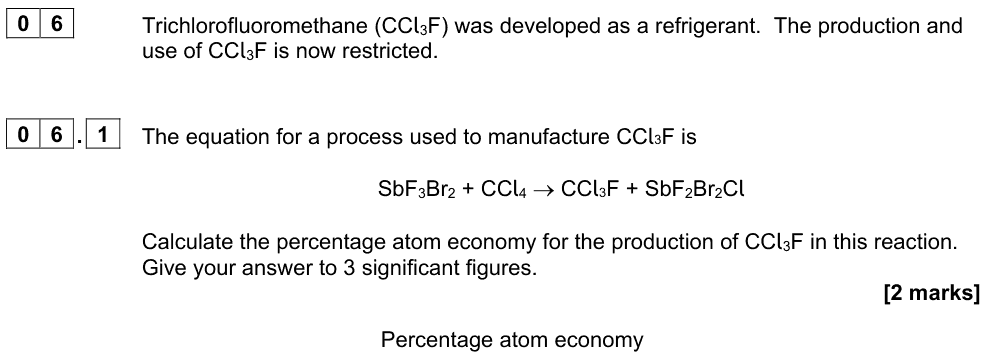
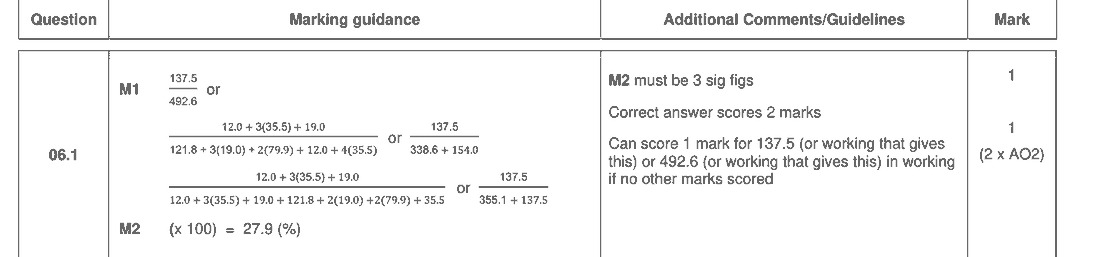
06.1 Amount of substance 2AO2=2Calculation
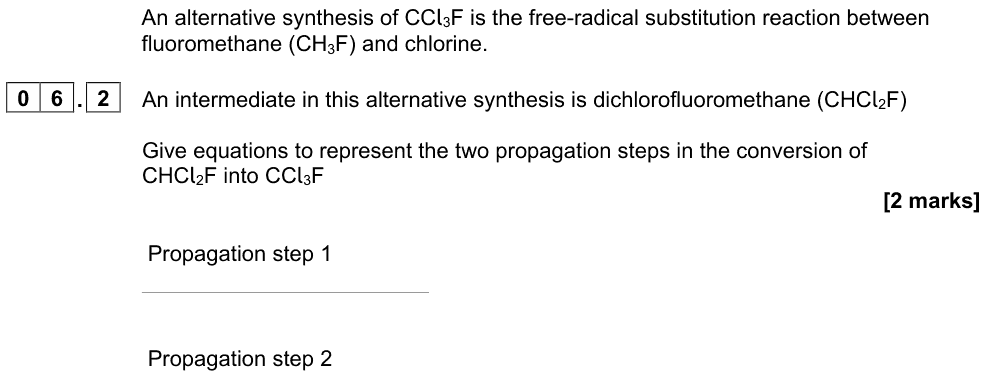
06.2 Alkanes, Introduction to organic chemistry: nomenclature, mechanisms and isomerism 2AO2=2Equation writing
06.3 Alkanes, Introduction to organic chemistry: nomenclature, mechanisms and isomerism 1AO3=1Equation writing
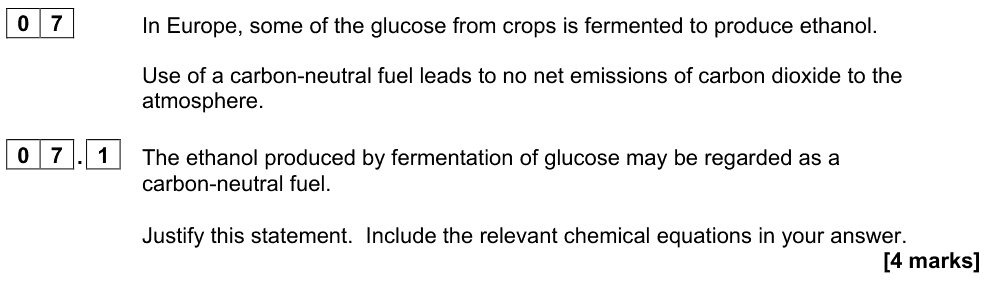
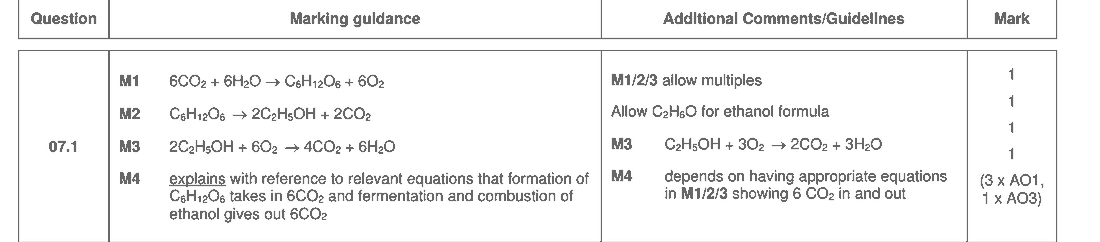
07.1 Alcohols 4AO1=3,AO3=1Explanation
07.2 Alcohols 1AO3=1Short answer
07.3 Energetics 2AO3=2Calculation
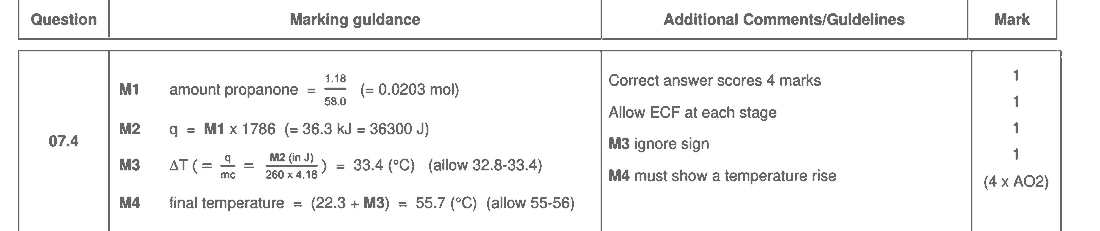
07.4 Energetics 4AO2=4Calculation
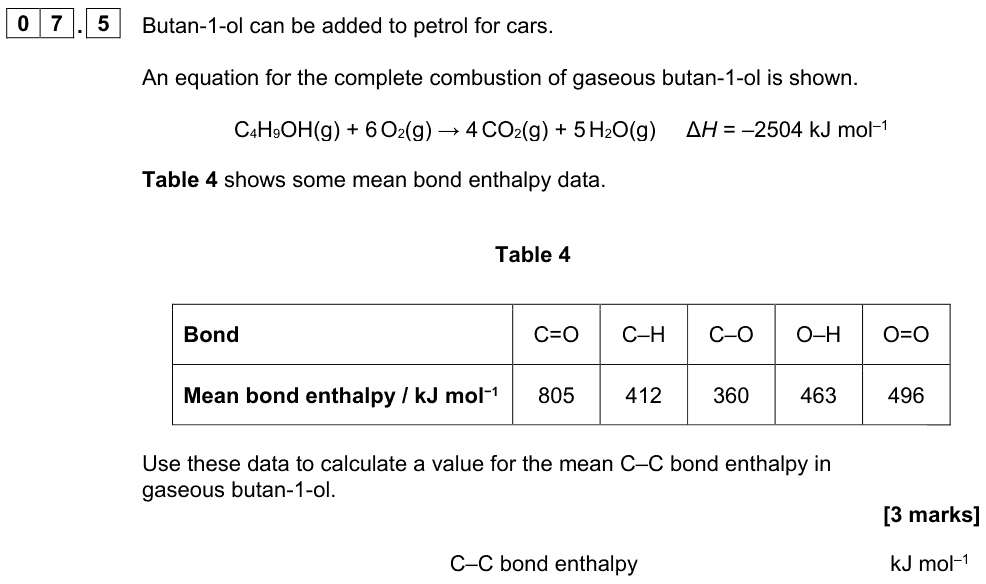
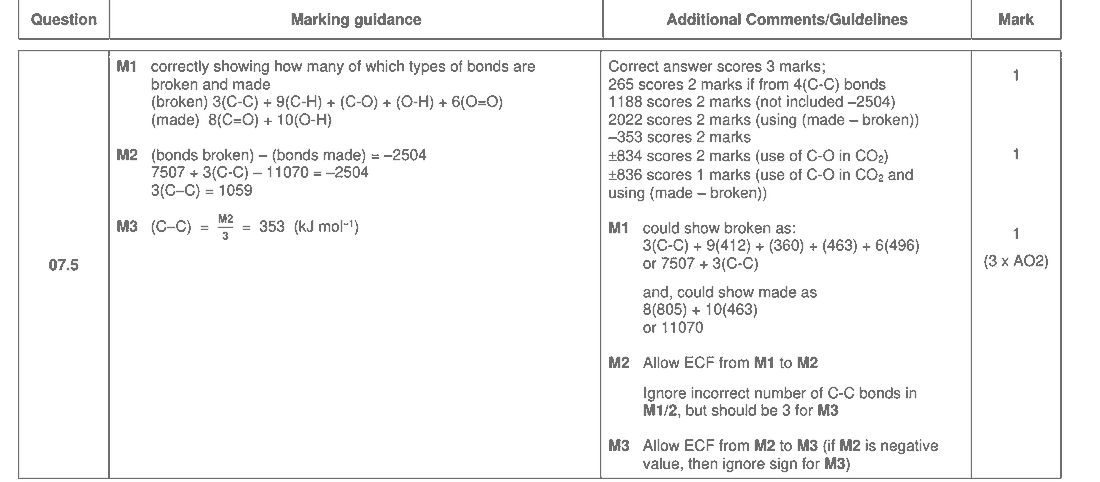
07.5 Energetics 3AO2=3Calculation
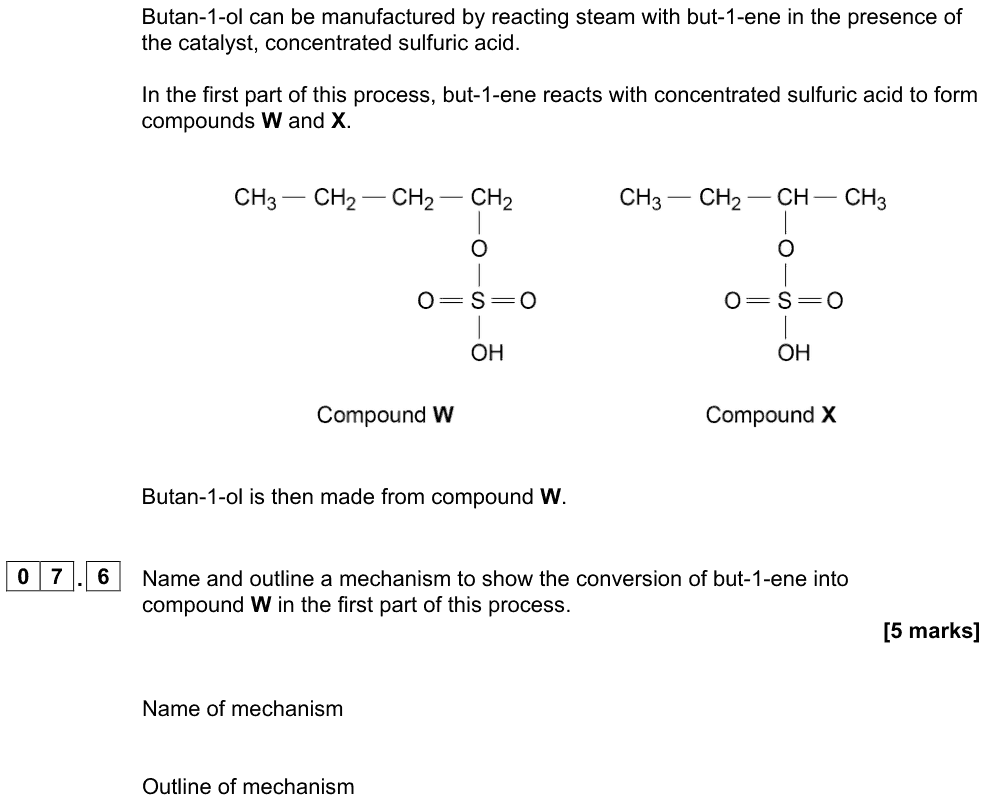
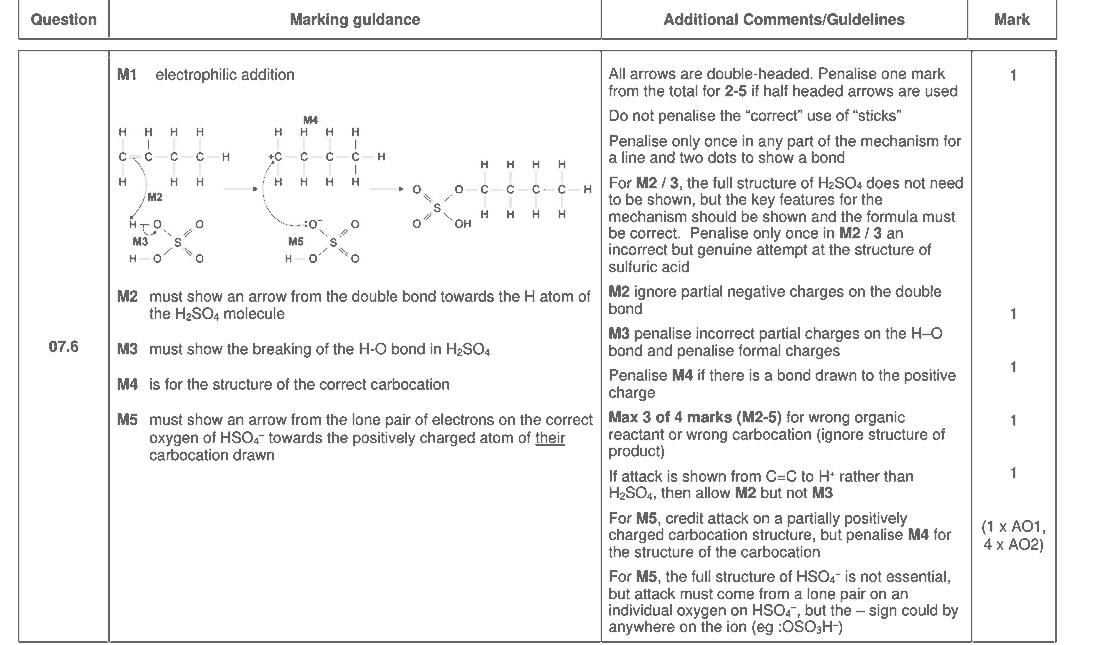
07.6 Alkenes, Introduction to organic chemistry: nomenclature, mechanisms and isomerism 5AO1=1,AO2=4Mechanism
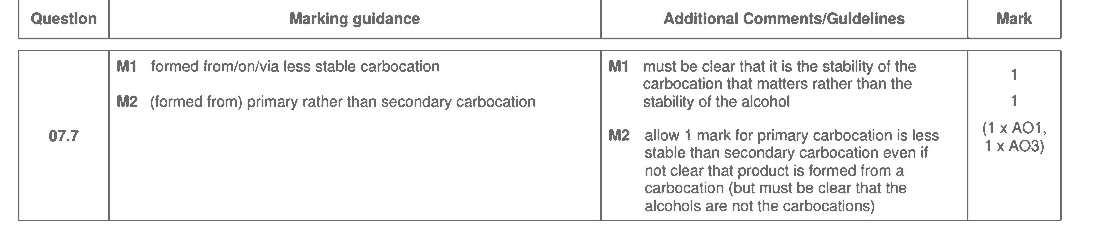
07.7 Alkenes 2AO1=1,AO3=1Explanation
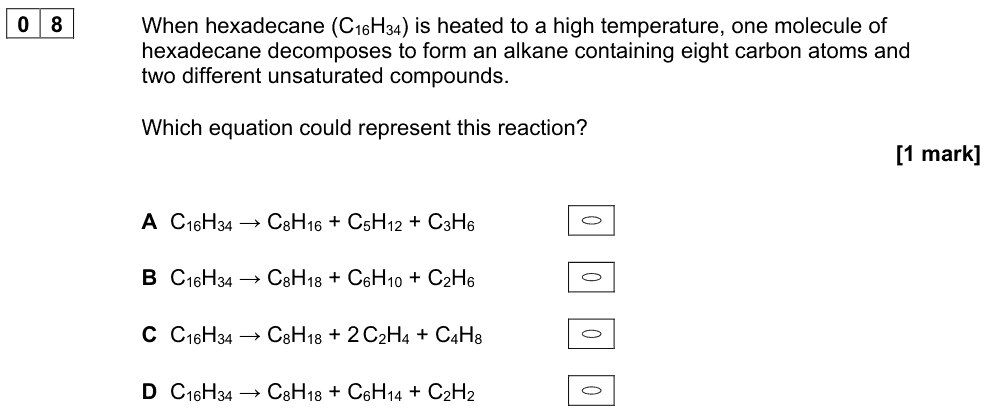
08 Alkanes 1AO2=1Multiple choice
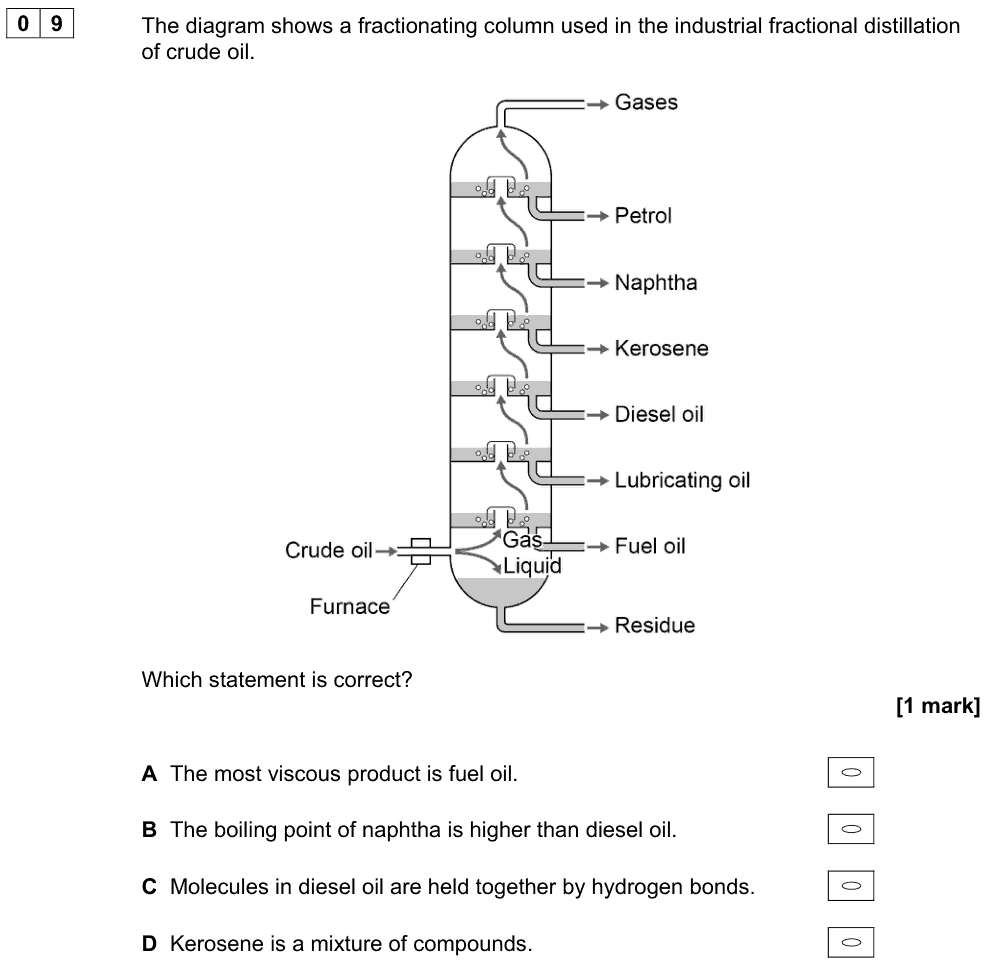
09 Alkanes 1AO1=1Multiple choice
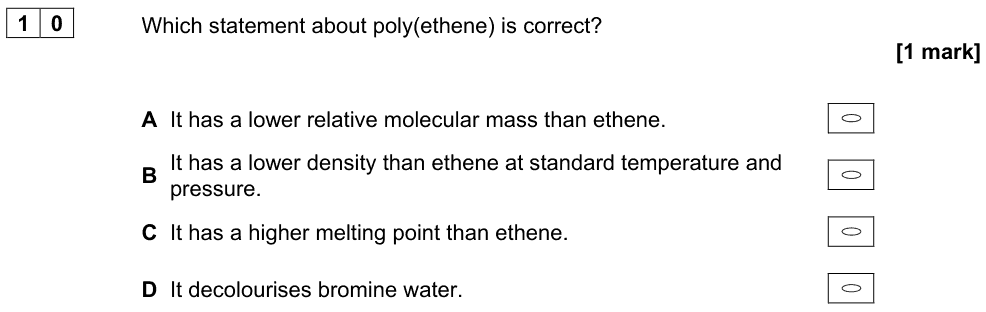
10 Alkenes 1AO1=1Multiple choice
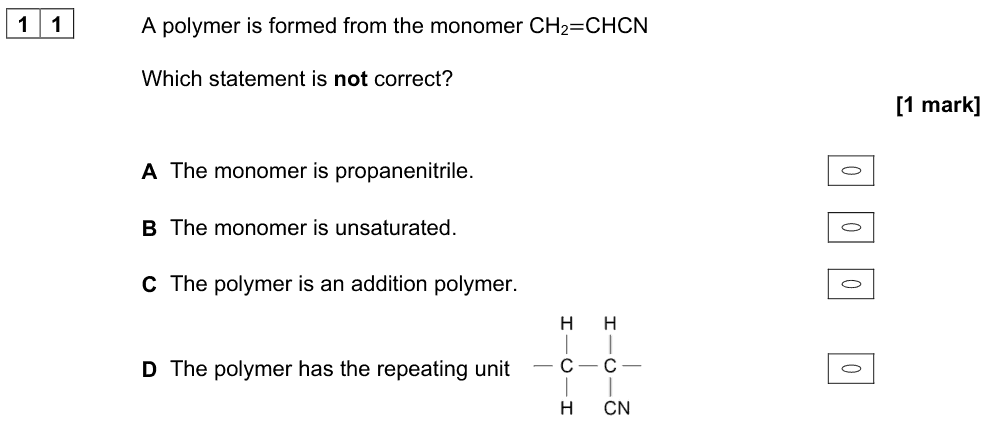
11 Alkenes, Introduction to organic chemistry: nomenclature, mechanisms and isomerism 1AO3=1Multiple choice
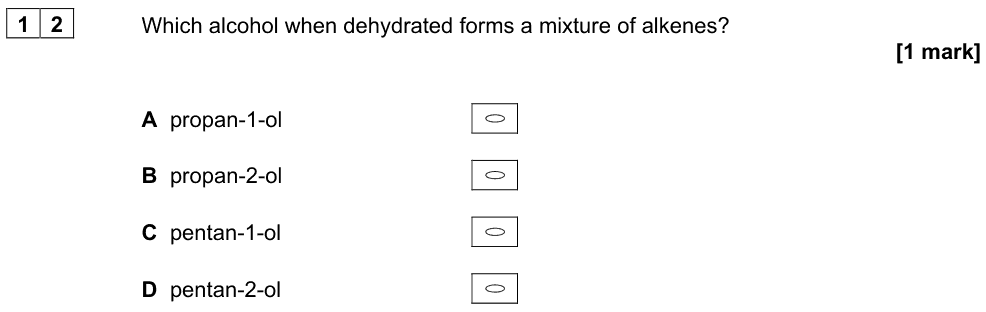
12 Alcohols, Introduction to organic chemistry: nomenclature, mechanisms and isomerism 1AO3=1Multiple choice
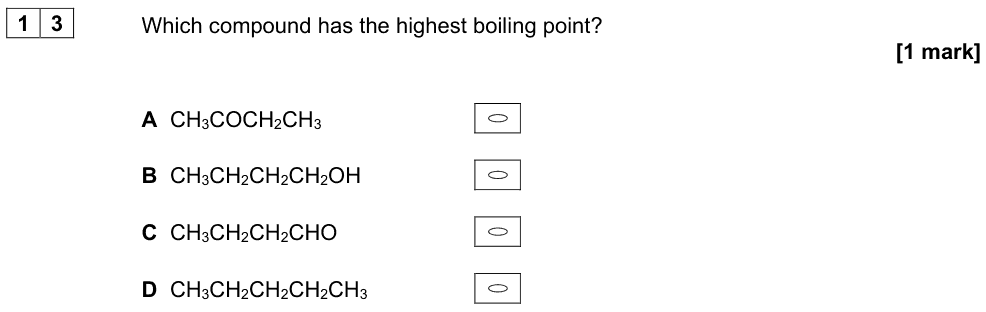
13 Bonding 1AO2=1Multiple choice
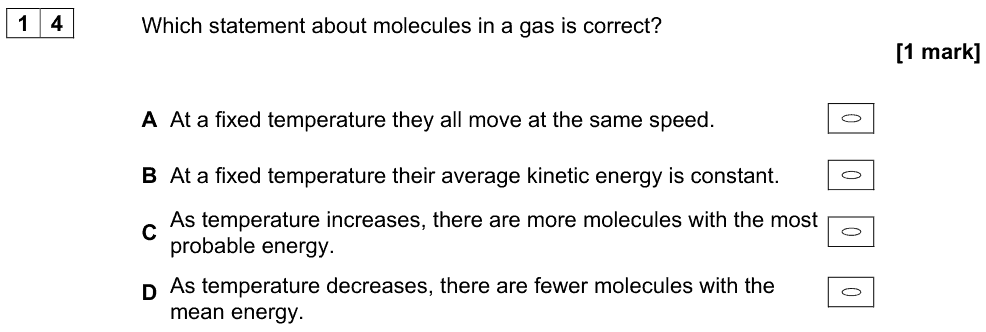
14 Kinetics 1AO1=1Multiple choice
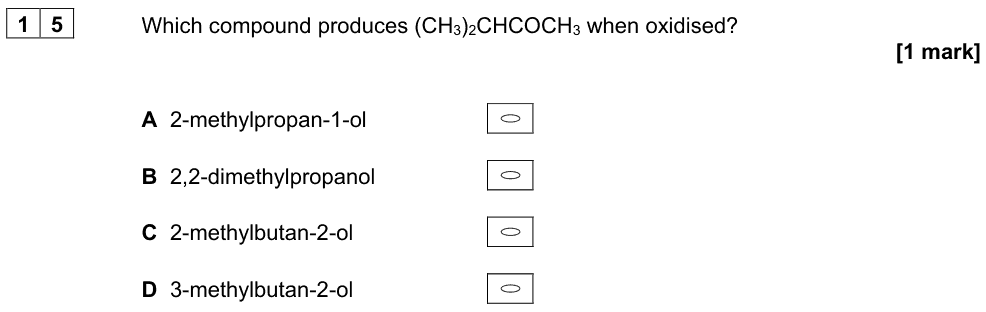
15 Alcohols, Introduction to organic chemistry: nomenclature, mechanisms and isomerism 1AO1=1Multiple choice
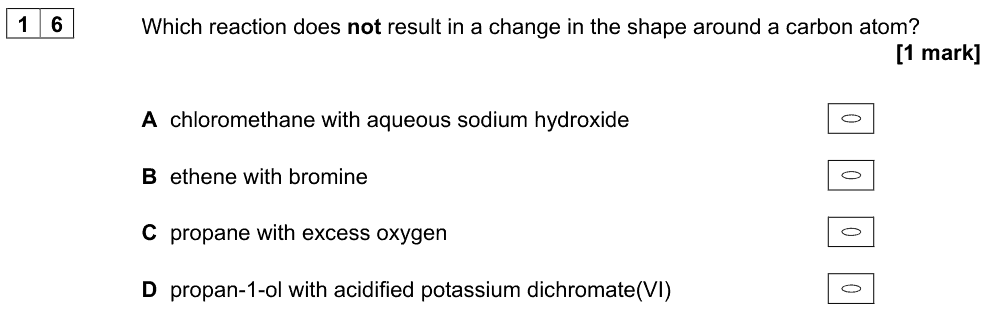
16 Bonding 1AO2=1Multiple choice
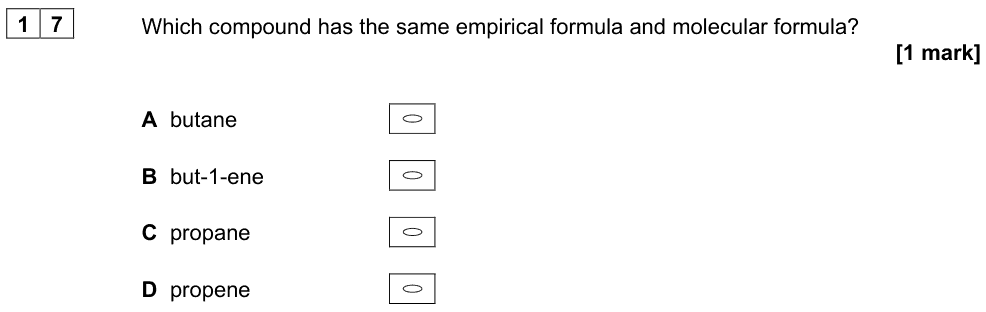
17 Amount of substance 1AO1=1Multiple choice
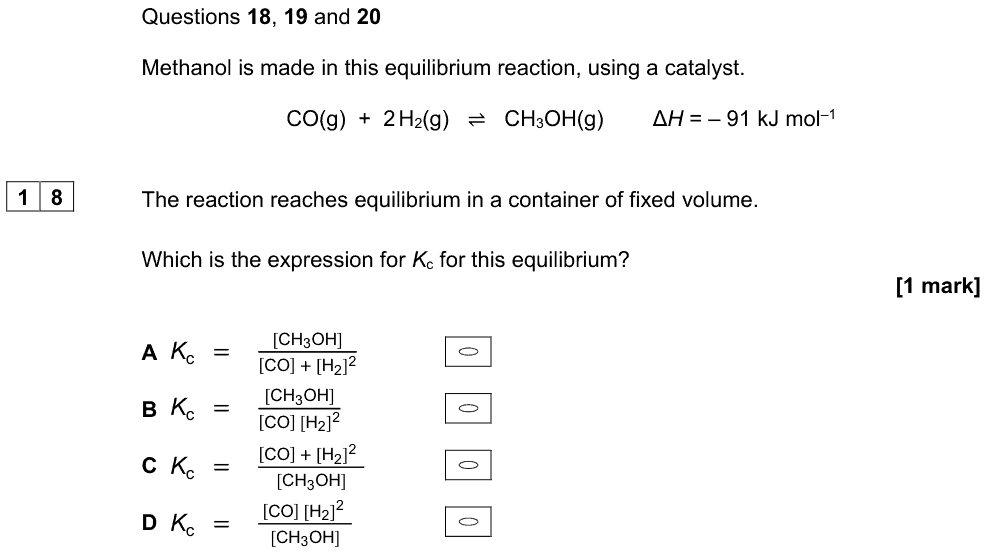
18 Chemical equilibria, Le Chatelier's principle and Kc 1AO2=1Multiple choice
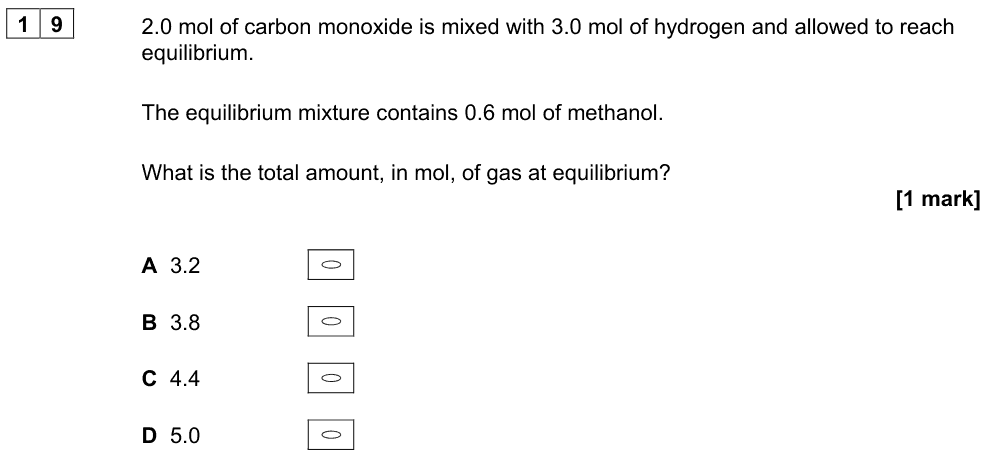
19 Chemical equilibria, Le Chatelier's principle and Kc, Amount of substance 1AO2=1Multiple choice
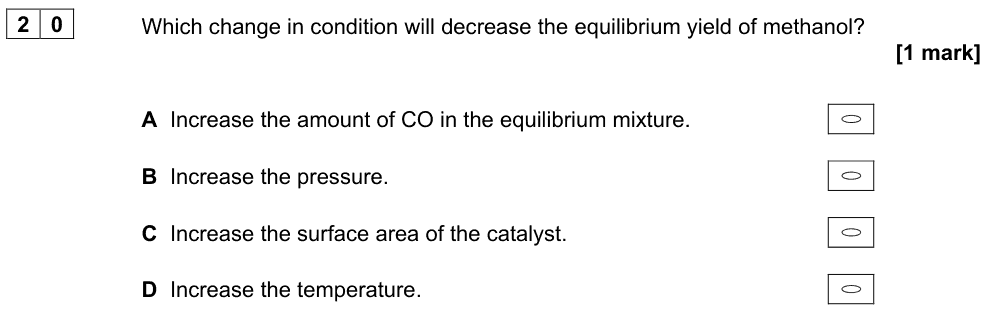
20 Chemical equilibria, Le Chatelier's principle and Kc 1AO3=1Multiple choice
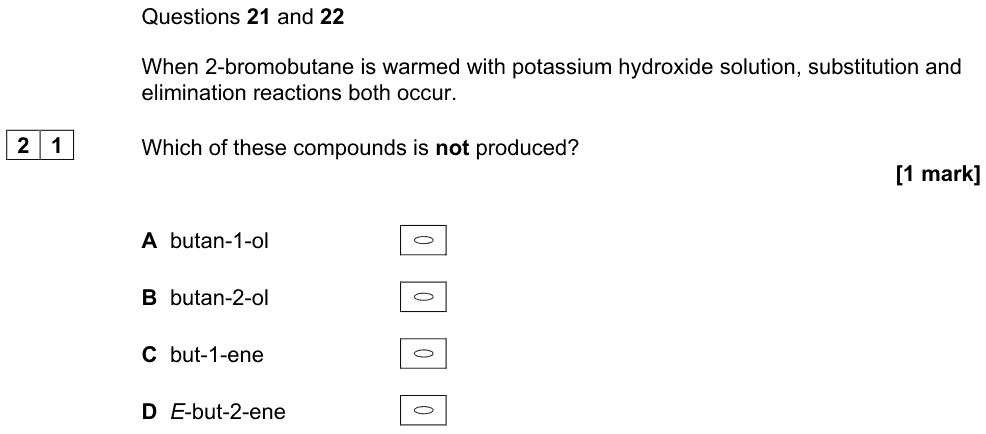
21 Halogenoalkanes, Introduction to organic chemistry: nomenclature, mechanisms and isomerism 1AO2=1Multiple choice
22 Halogenoalkanes 1AO1=1Multiple choice

The questions

01.101.201.301.401.501.60203.103.203.303.403.504.104.204.305.105.205.306.106.206.307.107.207.307.407.507.607.7080910111213141516171819202122
June 2022 · AS Paper 2 · Q01.1 1 mark AO3=1 Practical and data analysis kinetics
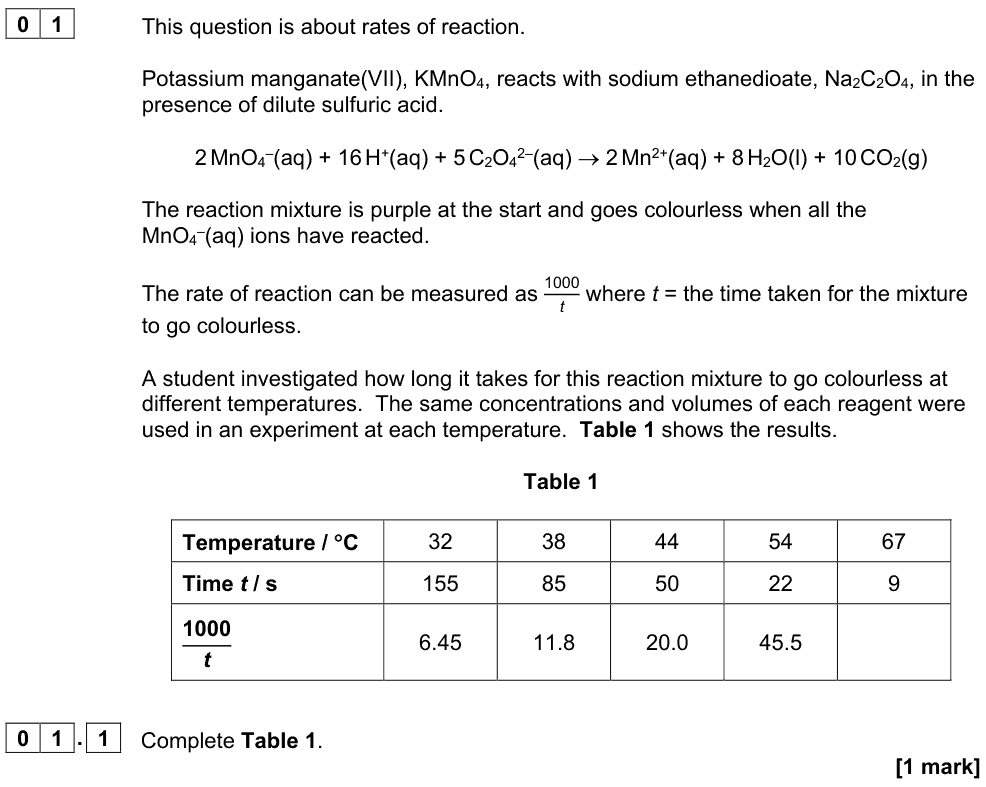
This question is about rates of reaction.
Potassium manganate(VII), KMnO4, reacts with sodium ethanedioate, Na2C2O4, in the
presence of dilute sulfuric acid.
2 MnO4–(aq) + 16 H+(aq) + 5 C2O42–(aq) → 2 Mn2+(aq) + 8 H2O(l) + 10 CO2(g)
The reaction mixture is purple at the start and goes colourless when all the
MnO4–(aq) ions have reacted.
The rate of reaction can be measured as
1000
t where t = the time taken for the mixture
to go colourless.
A student investigated how long it takes for this reaction mixture to go colourless at
different temperatures.  The same concentrations and volumes of each reagent were
used in an experiment at each temperature.  Table 1 shows the results.
Table 1
Temperature / C
32
38
44
54
67
Time t / s
155
85
50
22
9
1000
t
6.45
11.8
20.0
45.5
Complete Table 1.
[1 mark]
June 2022 · AS Paper 2 · Q01.2 1 mark AO1=1 Practical and data analysis kinetics
Earlier part of question 01 that this part usesEarlier part of June 2022 Paper 2 question 01
State the independent variable in this investigation.
[1 mark]
June 2022 · AS Paper 2 · Q01.3 1 mark AO3=1 Practical and data analysis kinetics
Earlier part of question 01 that this part usesEarlier part of June 2022 Paper 2 question 01
The student noticed that the temperature of each reaction mixture decreased during
each experiment.
Suggest how the student calculated the temperature values in Table 1.
[1 mark]
June 2022 · AS Paper 2 · Q01.4 3 marks AO1=2, AO2=1 Practical and data analysis kinetics
Earlier part of question 01 that this part usesEarlier part of June 2022 Paper 2 question 01
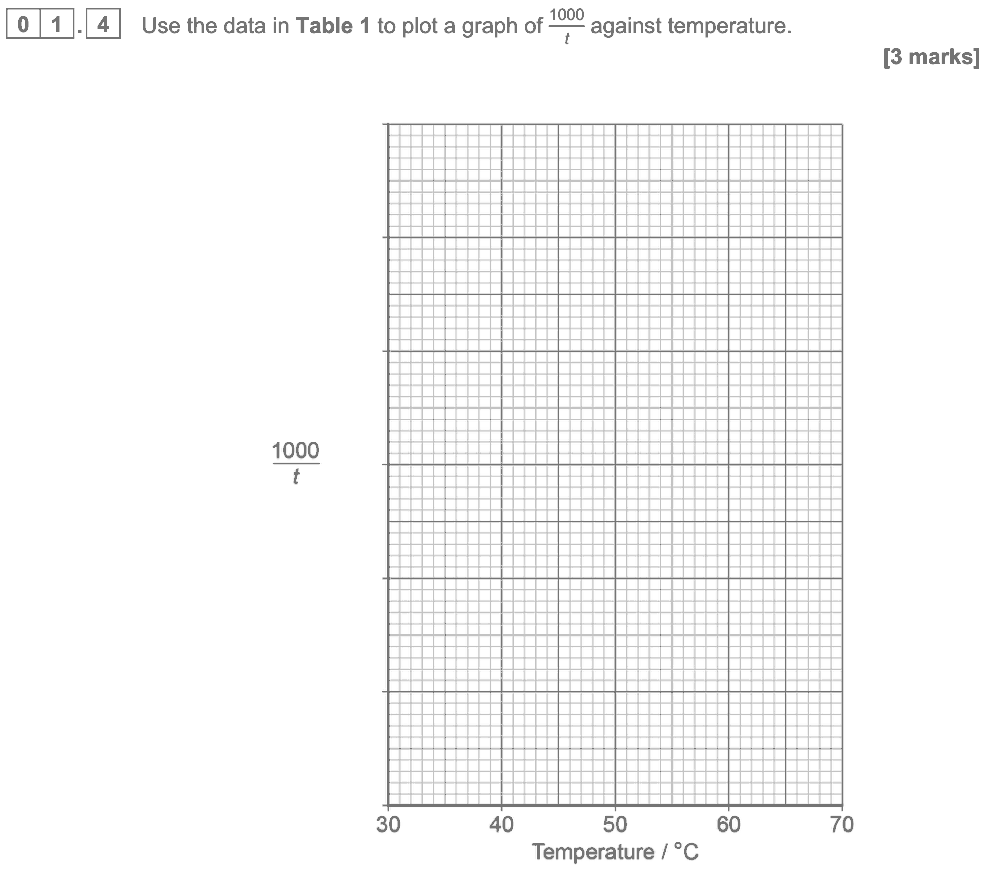
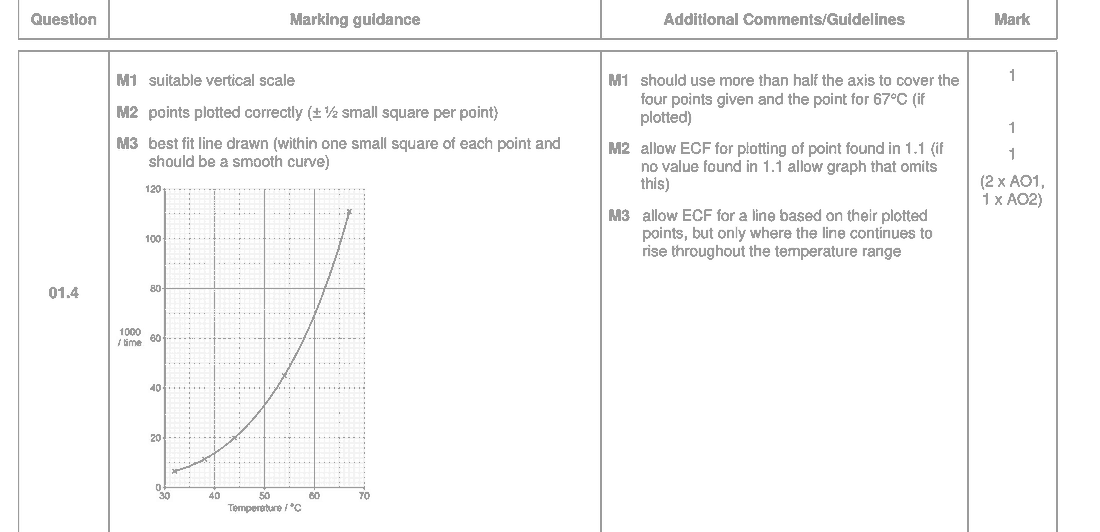
Use the data in Table 1 to plot a graph of
1000
t against temperature.
[3 marks]
June 2022 · AS Paper 2 · Q01.5 1 mark AO3=1 Practical and data analysis kinetics
Earlier part of question 01 that this part usesEarlier part of June 2022 Paper 2 question 01
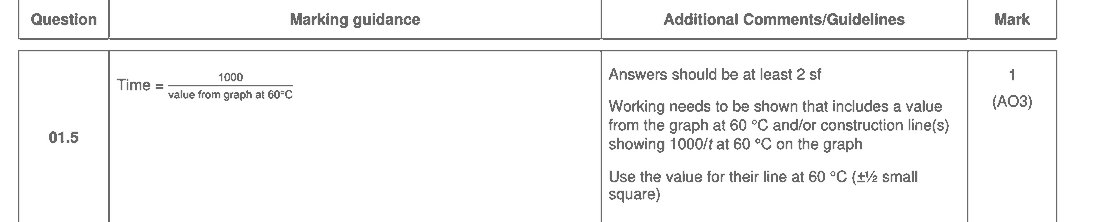
Use your graph in Question 01.4 to find the time taken for the mixture to go colourless
at 60 °C
Show your working.
[1 mark]
Time t
s
June 2022 · AS Paper 2 · Q01.6 2 marks AO1=2 Explanation kinetics
Earlier part of question 01 that this part usesEarlier part of June 2022 Paper 2 question 01
The investigation shows that increasing the temperature causes the rate of reaction to
increase.
Explain why a small increase in temperature causes a large increase in the rate of
reaction.
[2 marks]
June 2022 · AS Paper 2 · Q02 6 marks AO1=4, AO3=2 6-mark level of response organic analysisalcohols
A student has samples of these four compounds but does not know which is which:
• butanoic acid
• 2-methylpropanal
• 2-methylpropanoic acid
• 2-methylpropan-1-ol
Step 1:   Two of these compounds can be identified by simple chemical tests.
Step 2:   The other two compounds, that contain the same functional group as each
other, can then be distinguished using a spectroscopic technique.
Describe how these two steps could be used to identify which compound is which.
[6 marks]
June 2022 · AS Paper 2 · Q03.1 1 mark AO2=1 Diagram or structure introduction to organic chemistry
This question is about isomers.
Hex-2-ene has the molecular formula C6H12
Draw the displayed formula of a position isomer of hex-2-ene that exists as
E and Z isomers.
[1 mark]
June 2022 · AS Paper 2 · Q03.2 1 mark AO2=1 Diagram or structure introduction to organic chemistry
Earlier part of question 03 that this part usesEarlier part of June 2022 Paper 2 question 03
Draw the displayed formula of a chain isomer of hex-2-ene that does not exist as
E and Z isomers.
[1 mark]
June 2022 · AS Paper 2 · Q03.3 1 mark AO2=1 Diagram or structure introduction to organic chemistryorganic analysis
Earlier part of question 03 that this part usesEarlier part of June 2022 Paper 2 question 03
Butanal has the molecular formula C4H8O
Draw the skeletal formula of a functional group isomer of butanal that has an
absorption in the range 1680–1750 cm–1 in its infrared spectrum.
[1 mark]
June 2022 · AS Paper 2 · Q03.4 1 mark AO3=1 Diagram or structure introduction to organic chemistryorganic analysis
Earlier parts of question 03 that this part usesEarlier part of June 2022 Paper 2 question 03Earlier part of June 2022 Paper 2 question 03
Draw the skeletal formula of a structural isomer of butanal that has an absorption in
the range 3230–3550 cm–1 in its infrared spectrum.
[1 mark]
June 2022 · AS Paper 2 · Q03.5 4 marks AO2=2, AO3=2 Calculation amount of substanceintroduction to organic chemistry
Earlier part of question 03 that this part usesEarlier part of June 2022 Paper 2 question 03
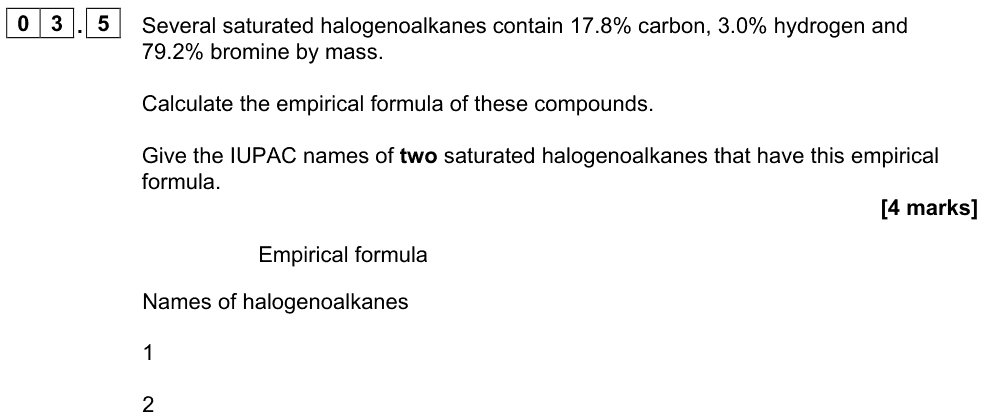
Several saturated halogenoalkanes contain 17.8% carbon, 3.0% hydrogen and
79.2% bromine by mass.
Calculate the empirical formula of these compounds.
Give the IUPAC names of two saturated halogenoalkanes that have this empirical
formula.
[4 marks]
Empirical formula
Names of halogenoalkanes
1
2
June 2022 · AS Paper 2 · Q04.1 5 marks AO1=1, AO2=4 Calculation amount of substance
This question is about gas volumes.
TNT (C7H5N3O6) is an explosive because it can decompose very quickly and
exothermically to form a large volume of gas.  An equation for this decomposition is
2 C7H5N3O6(s) → 3 N2(g) + 5 H2(g) + 12 CO(g) + 2 C(s)
Calculate the volume of gas, in m3, measured at 1250 °C and 101 000 Pa, produced
by the decomposition of 1.00 kg of TNT (Mr = 227.0).
The gas constant, R = 8.31 J mol–1 K–1
[5 marks]
Volume of gas
m3
June 2022 · AS Paper 2 · Q04.2 1 mark AO1=1 Calculation amount of substance
Earlier part of question 04 that this part usesEarlier part of June 2022 Paper 2 question 04
Alkenes have the general formula CnH2n
When alkenes undergo complete combustion, 1.0 mol of CnH2n reacts
with
3n
2 mol of oxygen.
Calculate the volume of oxygen needed for the complete combustion
of 200 cm3 of but-1-ene.
The volumes of all gases are measured at the same temperature and pressure.
[1 mark]
Volume of oxygen
cm3
June 2022 · AS Paper 2 · Q04.3 1 mark AO1=1 Short answer amount of substance
Earlier part of question 04 that this part usesEarlier part of June 2022 Paper 2 question 04
Alkanes have the general formula CnH2n+2
Alkanes undergo complete combustion in a plentiful supply of oxygen.
CnH2n+2 + x O2 → n CO2 + (n+1) H2O
Determine x in terms of n
[1 mark]
x
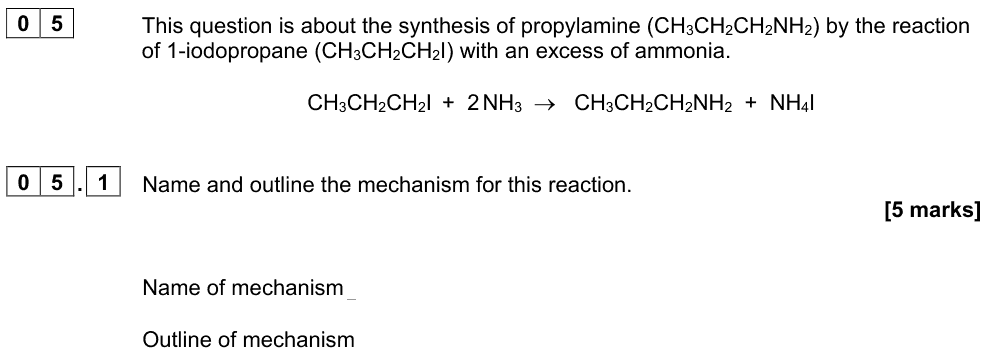
June 2022 · AS Paper 2 · Q05.1 5 marks AO1=5 Mechanism halogenoalkanesintroduction to organic chemistry
This question is about the synthesis of propylamine (CH3CH2CH2NH2) by the reaction
of 1-iodopropane (CH3CH2CH2I) with an excess of ammonia.
CH3CH2CH2I  +  2 NH3  →   CH3CH2CH2NH2  +  NH4I
Name and outline the mechanism for this reaction.
[5 marks]
Name of mechanism
Outline of mechanism
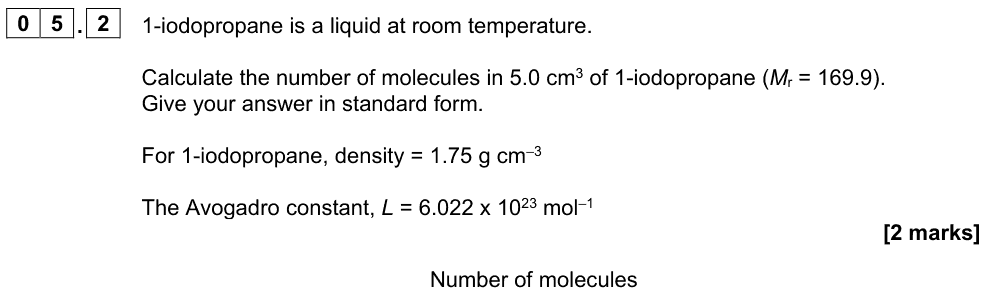
June 2022 · AS Paper 2 · Q05.2 2 marks AO2=2 Calculation amount of substance
Earlier part of question 05 that this part usesEarlier part of June 2022 Paper 2 question 05
1-iodopropane is a liquid at room temperature.
Calculate the number of molecules in 5.0 cm3 of 1-iodopropane (Mr = 169.9).
Give your answer in standard form.
For 1-iodopropane, density = 1.75 g cm–3
The Avogadro constant, L = 6.022 x 10²³ mol–1
[2 marks]
Number of molecules
June 2022 · AS Paper 2 · Q05.3 2 marks AO2=2 Calculation amount of substance
Earlier part of question 05 that this part usesEarlier part of June 2022 Paper 2 question 05
In an experiment, 10.3 g of 1-iodopropane (Mr = 169.9) are reacted with an excess of
ammonia.  2.3 g of propylamine (Mr = 59.0) are produced.
Calculate the percentage yield in this experiment.
[2 marks]
Percentage yield
June 2022 · AS Paper 2 · Q06.1 2 marks AO2=2 Calculation amount of substance
Trichlorofluoromethane (CCl3F) was developed as a refrigerant.  The production and
use of CCl3F is now restricted.
The equation for a process used to manufacture CCl3F is
SbF3Br2 + CCl4 → CCl3F + SbF2Br2Cl
Calculate the percentage atom economy for the production of CCl3F in this reaction.
Give your answer to 3 significant figures.
[2 marks]
Percentage atom economy
June 2022 · AS Paper 2 · Q06.2 2 marks AO2=2 Equation writing alkanesintroduction to organic chemistry
Earlier part of question 06 that this part usesEarlier part of June 2022 Paper 2 question 06
An alternative synthesis of CCl3F is the free-radical substitution reaction between
fluoromethane (CH3F) and chlorine.
An intermediate in this alternative synthesis is dichlorofluoromethane (CHCl2F)
Give equations to represent the two propagation steps in the conversion of
CHCl2F into CCl3F
[2 marks]
Propagation step 1
Propagation step 2
June 2022 · AS Paper 2 · Q06.3 1 mark AO3=1 Equation writing alkanesintroduction to organic chemistry
Earlier parts of question 06 that this part usesEarlier part of June 2022 Paper 2 question 06Earlier part of June 2022 Paper 2 question 06
Analysis of the products of this reaction shows the formation of a compound with the
empirical formula CCl2F
Give an equation to represent a termination step forming this compound.
Show the structural formula of the product in the equation.
[1 mark]
June 2022 · AS Paper 2 · Q07.1 4 marks AO1=3, AO3=1 Explanation alcohols
In Europe, some of the glucose from crops is fermented to produce ethanol.
Use of a carbon-neutral fuel leads to no net emissions of carbon dioxide to the
atmosphere.
The ethanol produced by fermentation of glucose may be regarded as a
carbon-neutral fuel.
Justify this statement.  Include the relevant chemical equations in your answer.
[4 marks]
June 2022 · AS Paper 2 · Q07.2 1 mark AO3=1 Short answer alcohols
Earlier part of question 07 that this part usesEarlier part of June 2022 Paper 2 question 07
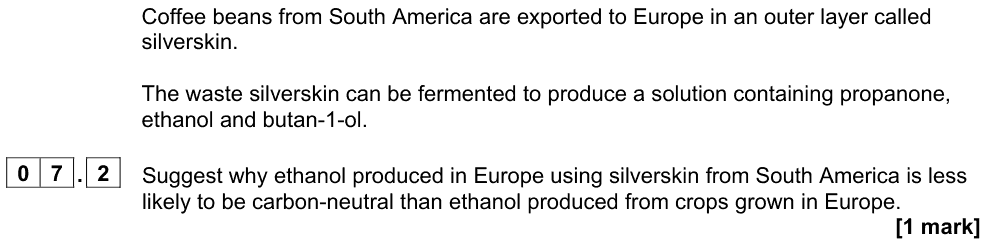
Coffee beans from South America are exported to Europe in an outer layer called
silverskin.
The waste silverskin can be fermented to produce a solution containing propanone,
ethanol and butan-1-ol.
Suggest why ethanol produced in Europe using silverskin from South America is less
likely to be carbon-neutral than ethanol produced from crops grown in Europe.
[1 mark]
June 2022 · AS Paper 2 · Q07.3 2 marks AO3=2 Calculation energetics
Earlier parts of question 07 that this part usesEarlier part of June 2022 Paper 2 question 07Earlier part of June 2022 Paper 2 question 07
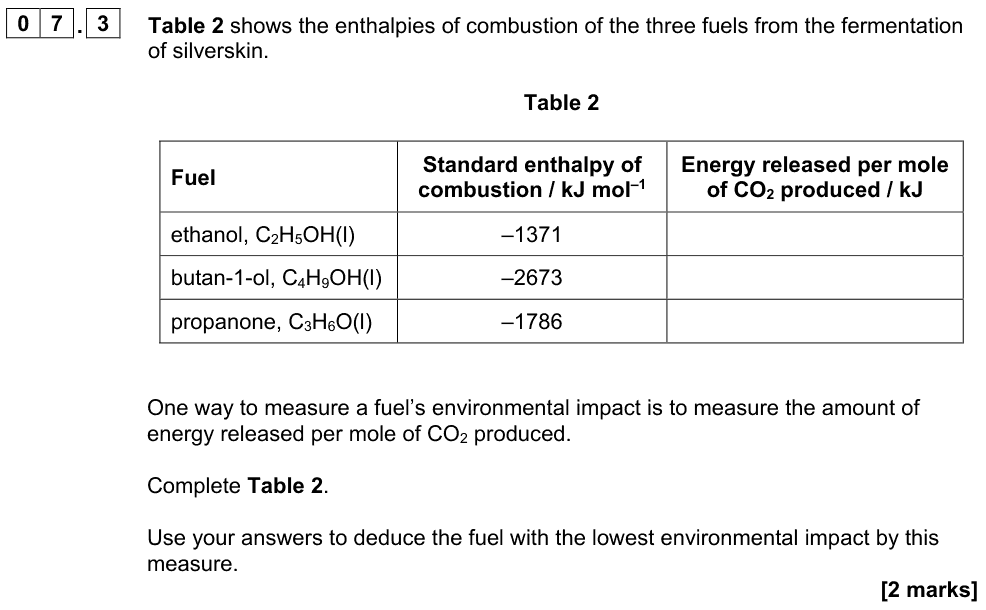
Table 2 shows the enthalpies of combustion of the three fuels from the fermentation
of silverskin.
Table 2
Fuel
Standard enthalpy of
combustion / kJ mol–1
Energy released per mole
of CO2 produced / kJ
ethanol, C2H5OH(l)
–1371
butan-1-ol, C4H9OH(l)
–2673
propanone, C3H6O(l)
–1786
One way to measure a fuel’s environmental impact is to measure the amount of
energy released per mole of CO2 produced.
Complete Table 2.
Use your answers to deduce the fuel with the lowest environmental impact by this
measure.
[2 marks]
June 2022 · AS Paper 2 · Q07.4 4 marks AO2=4 Calculation energetics
Earlier parts of question 07 that this part usesEarlier part of June 2022 Paper 2 question 07Earlier part of June 2022 Paper 2 question 07
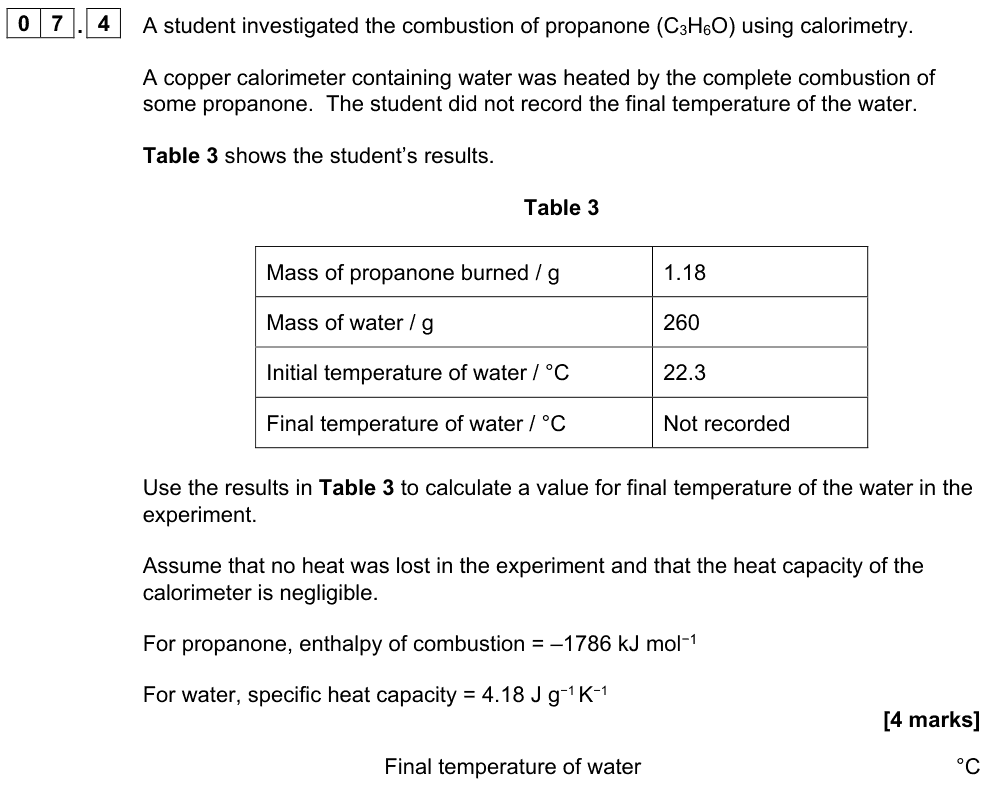
A student investigated the combustion of propanone (C3H6O) using calorimetry.
A copper calorimeter containing water was heated by the complete combustion of
some propanone.  The student did not record the final temperature of the water.
Table 3 shows the student’s results.
Table 3
Mass of propanone burned / g
1.18
Mass of water / g
260
Initial temperature of water / °C
22.3
Final temperature of water / °C
Not recorded
Use the results in Table 3 to calculate a value for final temperature of the water in the
experiment.
Assume that no heat was lost in the experiment and that the heat capacity of the
calorimeter is negligible.
For propanone, enthalpy of combustion = –1786 kJ mol−1
For water, specific heat capacity = 4.18 J g−1 K−1
[4 marks]
Final temperature of water
°C
June 2022 · AS Paper 2 · Q07.5 3 marks AO2=3 Calculation energetics
Earlier part of question 07 that this part usesEarlier part of June 2022 Paper 2 question 07
Butan-1-ol can be added to petrol for cars.
An equation for the complete combustion of gaseous butan-1-ol is shown.
C4H9OH(g) + 6 O2(g) → 4 CO2(g) + 5 H2O(g)     ΔH = –2504 kJ mol–1
Table 4 shows some mean bond enthalpy data.
Table 4
Bond
C=O
C–H
C–O
O–H
O=O
Mean bond enthalpy / kJ mol−1
805
412
360
463
496
Use these data to calculate a value for the mean C–C bond enthalpy in
gaseous butan-1-ol.
[3 marks]
C–C bond enthalpy
kJ mol–1
June 2022 · AS Paper 2 · Q07.6 5 marks AO1=1, AO2=4 Mechanism alkenesintroduction to organic chemistry
Earlier part of question 07 that this part usesEarlier part of June 2022 Paper 2 question 07
Butan-1-ol can be manufactured by reacting steam with but-1-ene in the presence of
the catalyst, concentrated sulfuric acid.
In the first part of this process, but-1-ene reacts with concentrated sulfuric acid to form
compounds W and X.
Butan-1-ol is then made from compound W.
Name and outline a mechanism to show the conversion of but-1-ene into
compound W in the first part of this process.
[5 marks]
Name of mechanism
Outline of mechanism
June 2022 · AS Paper 2 · Q07.7 2 marks AO1=1, AO3=1 Explanation alkenes
Earlier parts of question 07 that this part usesEarlier part of June 2022 Paper 2 question 07Earlier part of June 2022 Paper 2 question 07
There is a very low yield of butan-1-ol from but-1-ene in this manufacturing process.
Explain why.
[2 marks]
June 2022 · AS Paper 2 · Q08 1 mark AO2=1 Multiple choice Easy alkanes
When hexadecane (C16H34) is heated to a high temperature, one molecule of
hexadecane decomposes to form an alkane containing eight carbon atoms and
two different unsaturated compounds.
Which equation could represent this reaction?
[1 mark]
A C16H34 → C8H16 + C5H12 + C3H6
B C16H34 → C8H18 + C6H10 + C2H6
C C16H34 → C8H18 + 2 C2H4 + C4H8
D C16H34 → C8H18 + C6H14 + C2H2
June 2022 · AS Paper 2 · Q09 1 mark AO1=1 Multiple choice alkanes
The diagram shows a fractionating column used in the industrial fractional distillation
of crude oil.
Which statement is correct?
[1 mark]
A The most viscous product is fuel oil.
B The boiling point of naphtha is higher than diesel oil.
C Molecules in diesel oil are held together by hydrogen bonds.
D Kerosene is a mixture of compounds.
June 2022 · AS Paper 2 · Q10 1 mark AO1=1 Multiple choice Easy alkenes
Which statement about poly(ethene) is correct?
[1 mark]
A It has a lower relative molecular mass than ethene.
B It has a lower density than ethene at standard temperature and
pressure.
C It has a higher melting point than ethene.
D It decolourises bromine water.
June 2022 · AS Paper 2 · Q11 1 mark AO3=1 Multiple choice alkenesintroduction to organic chemistry
Which statement is not correct?
[1 mark]
A The monomer is propanenitrile.
B The monomer is unsaturated.
C The polymer is an addition polymer.
D The polymer has the repeating unit
June 2022 · AS Paper 2 · Q12 1 mark AO3=1 Multiple choice Easy alcoholsintroduction to organic chemistry
Which alcohol when dehydrated forms a mixture of alkenes?
[1 mark]
A propan-1-ol
B propan-2-ol
C pentan-1-ol
D pentan-2-ol
June 2022 · AS Paper 2 · Q13 1 mark AO2=1 Multiple choice Easy bonding
Which compound has the highest boiling point?
[1 mark]
A CH3COCH2CH3
B CH3CH2CH2CH2OH
C CH3CH2CH2CHO
D CH3CH2CH2CH2CH3
June 2022 · AS Paper 2 · Q14 1 mark AO1=1 Multiple choice kinetics
Which statement about molecules in a gas is correct?
[1 mark]
A At a fixed temperature they all move at the same speed.
B At a fixed temperature their average kinetic energy is constant.
C As temperature increases, there are more molecules with the most
probable energy.
D As temperature decreases, there are fewer molecules with the
mean energy.
June 2022 · AS Paper 2 · Q15 1 mark AO1=1 Multiple choice alcoholsintroduction to organic chemistry
Which compound produces (CH3)2CHCOCH3 when oxidised?
[1 mark]
A 2-methylpropan-1-ol
B 2,2-dimethylpropanol
C 2-methylbutan-2-ol
D 3-methylbutan-2-ol
June 2022 · AS Paper 2 · Q16 1 mark AO2=1 Multiple choice Hard bonding
Which reaction does not result in a change in the shape around a carbon atom?
[1 mark]
A chloromethane with aqueous sodium hydroxide
B ethene with bromine
C propane with excess oxygen
D propan-1-ol with acidified potassium dichromate(VI)
June 2022 · AS Paper 2 · Q17 1 mark AO1=1 Multiple choice Easy amount of substance
Which compound has the same empirical formula and molecular formula?
[1 mark]
A butane
B but-1-ene
C propane
D propene
June 2022 · AS Paper 2 · Q18 1 mark AO2=1 Multiple choice Easy chemical equilibria and kc
Questions 18, 19 and 20
Methanol is made in this equilibrium reaction, using a catalyst.
CO(g)  +  2 H2(g)   ⇌   CH3OH(g)        ΔH = – 91 kJ mol–1
The reaction reaches equilibrium in a container of fixed volume.
Which is the expression for Kc for this equilibrium?
[1 mark]
A Kc  =
[CH3OH]
[CO] + [H2]2
B Kc  =
[CH3OH]
[CO] [H2]2
C Kc  =
[CO] + [H2]2
[CH3OH]
D Kc  =
[CO] [H2]2
[CH3OH]
June 2022 · AS Paper 2 · Q19 1 mark AO2=1 Multiple choice chemical equilibria and kcamount of substance
Earlier part of question 19 that this part usesEarlier part of June 2022 Paper 2 question 19
2.0 mol of carbon monoxide is mixed with 3.0 mol of hydrogen and allowed to reach
equilibrium.
The equilibrium mixture contains 0.6 mol of methanol.
What is the total amount, in mol, of gas at equilibrium?
[1 mark]
A 3.2
B 3.8
C 4.4
D 5.0
June 2022 · AS Paper 2 · Q20 1 mark AO3=1 Multiple choice Easy chemical equilibria and kc
Earlier part of question 20 that this part usesEarlier part of June 2022 Paper 2 question 20
Which change in condition will decrease the equilibrium yield of methanol?
[1 mark]
A Increase the amount of CO in the equilibrium mixture.
B Increase the pressure.
C Increase the surface area of the catalyst.
D Increase the temperature.
June 2022 · AS Paper 2 · Q21 1 mark AO2=1 Multiple choice halogenoalkanesintroduction to organic chemistry
Questions 21 and 22
When 2-bromobutane is warmed with potassium hydroxide solution, substitution and
elimination reactions both occur.
Which of these compounds is not produced?
[1 mark]
A butan-1-ol
B butan-2-ol
C but-1-ene
D E-but-2-ene
June 2022 · AS Paper 2 · Q22 1 mark AO1=1 Multiple choice halogenoalkanes
Earlier part of question 22 that this part usesEarlier part of June 2022 Paper 2 question 22
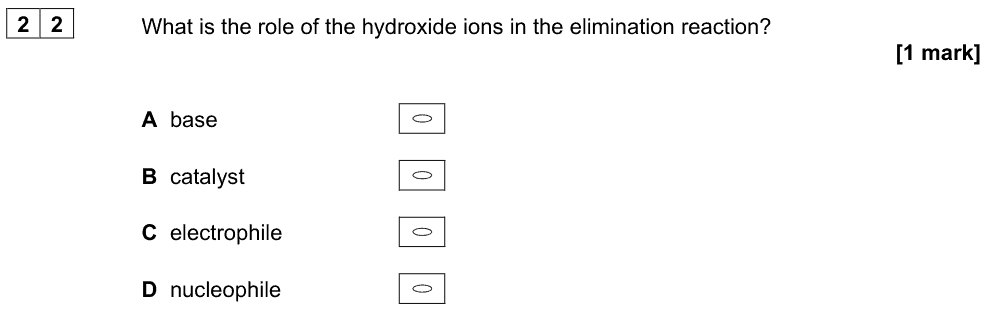
What is the role of the hydroxide ions in the elimination reaction?
[1 mark]
A base
B catalyst
C electrophile
D nucleophile

Work with an A-level chemistry tutor

Want a paper marked and gone through with you? Message us.

Prefer email? Send an enquiry

If you are under 18, please include a parent's contact details. Enquiries go to enquiries@chemistryaleveltutor.com and are deleted once handled. All tutoring is online.