June 2019: AS Paper 2, Organic and physical chemistry

80 marks · 40 question parts · Paper, mark scheme and report on AQA's site · Have the Data Booklet beside you

Question by question

QTopicMarksAOType
01.1 Organic analysis: test-tube reactions, mass spectrometry and infrared 3Practical and data analysis
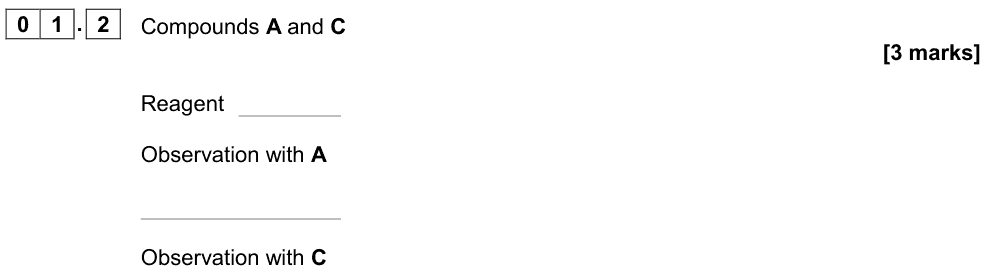
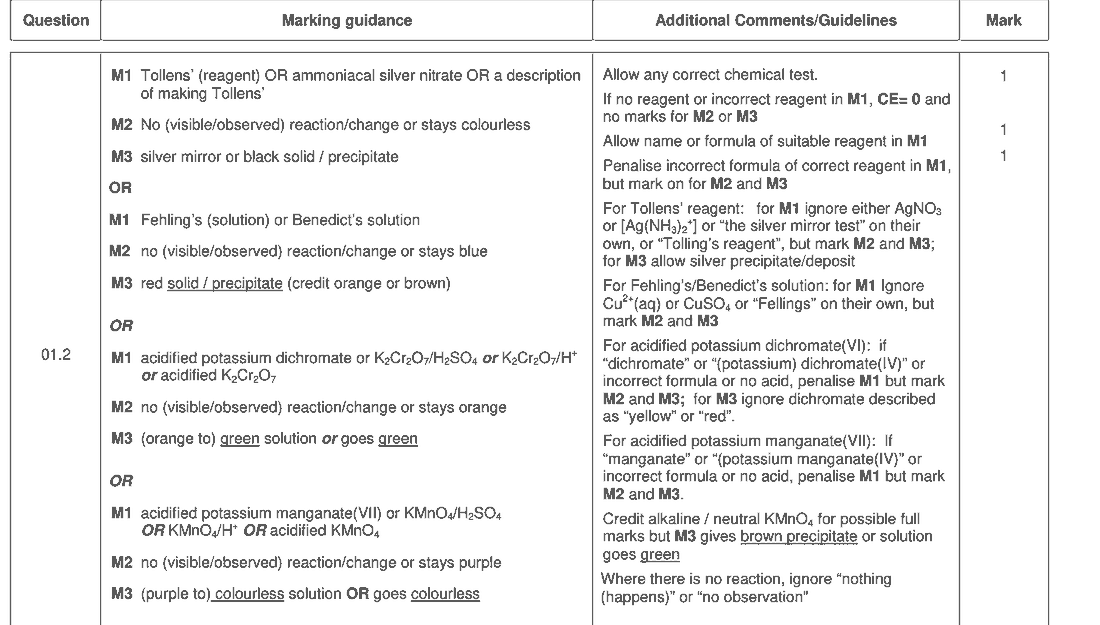
01.2 Alcohols, Organic analysis: test-tube reactions, mass spectrometry and infrared 3Practical and data analysis
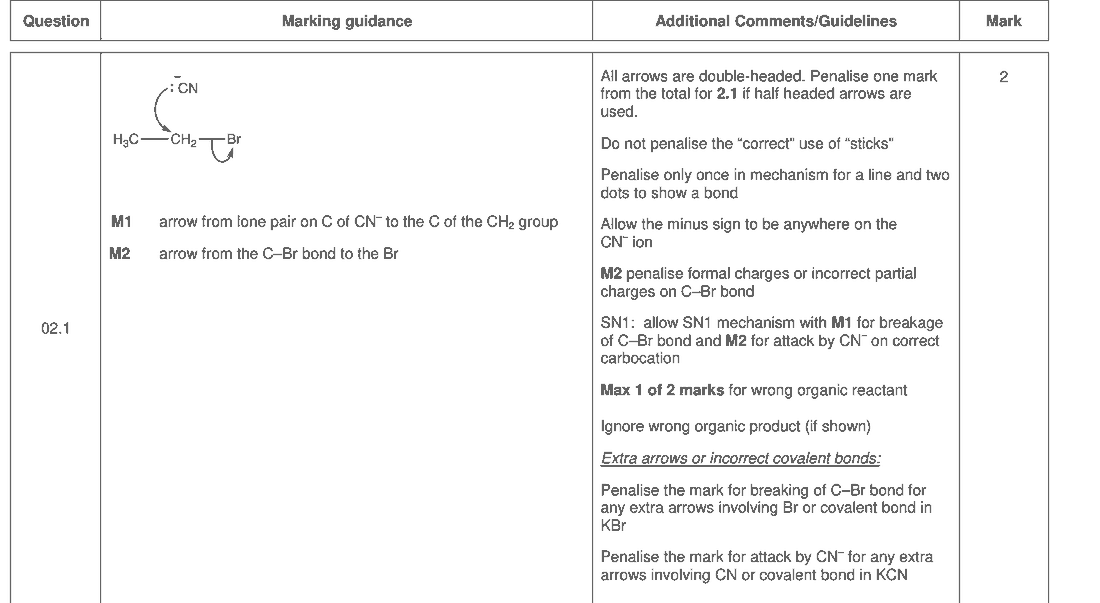
02.1 Halogenoalkanes, Introduction to organic chemistry: nomenclature, mechanisms and isomerism 2Mechanism
02.2 Introduction to organic chemistry: nomenclature, mechanisms and isomerism 1Short answer
02.3 Amount of substance 2Calculation
03.1 Energetics 4Calculation
03.2 Energetics 1Practical and data analysis
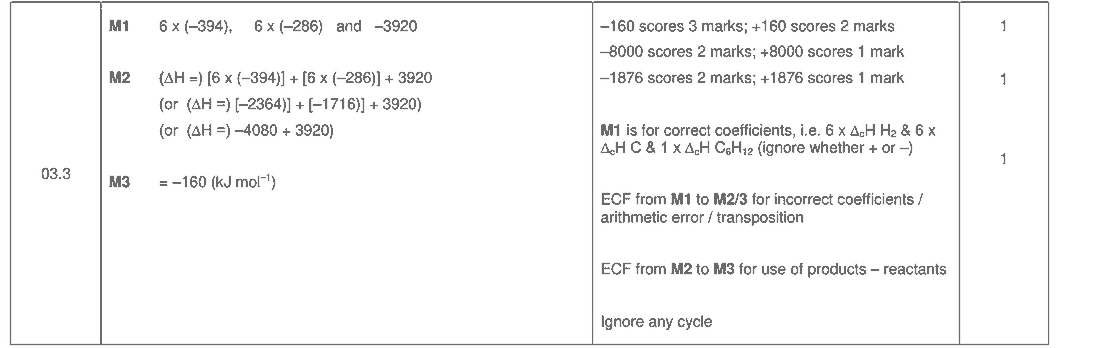
03.3 Energetics 3Calculation
04.1 Alkanes, Amount of substance 1Equation writing
04.2 Alkanes 1Equation writing
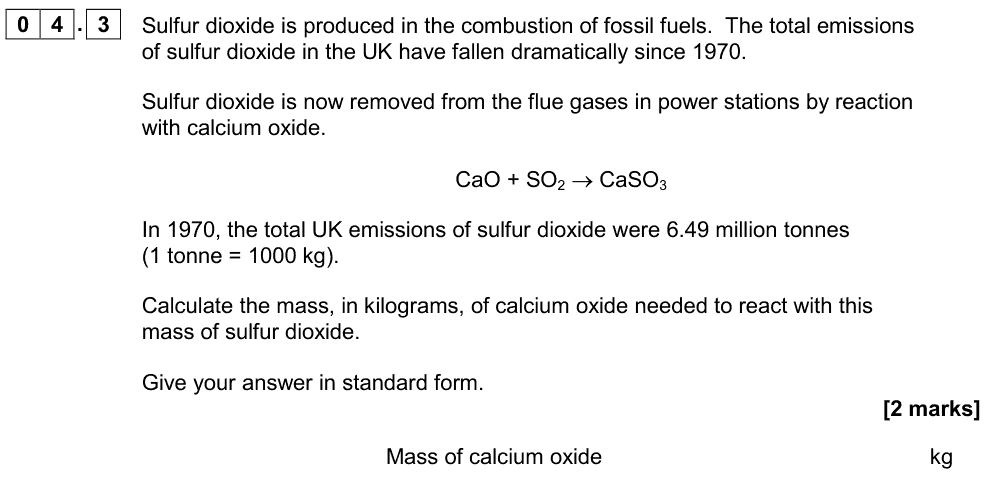
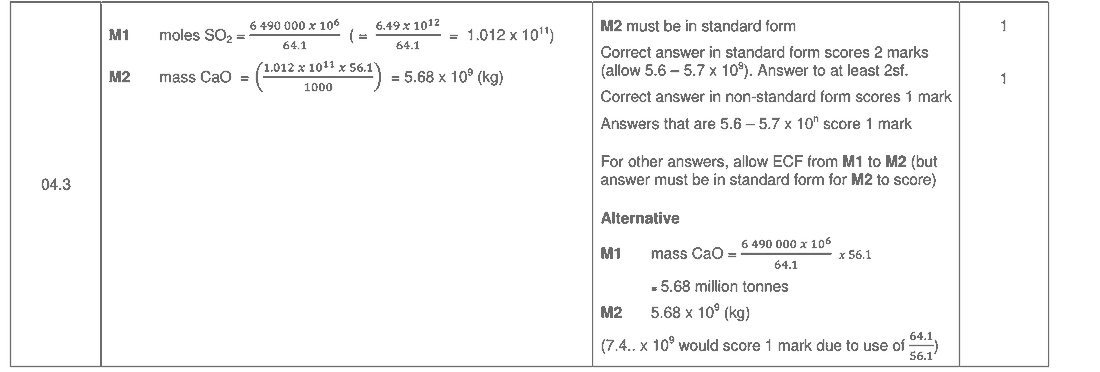
04.3 Amount of substance 2Calculation
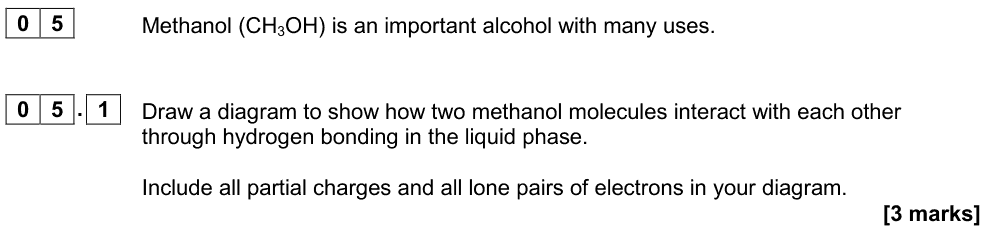
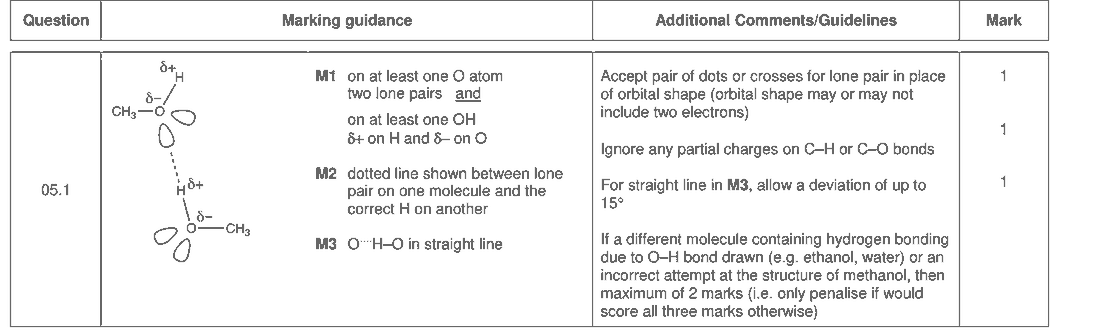
05.1 Bonding 3Diagram or structure
05.2 Bonding 1Short answer
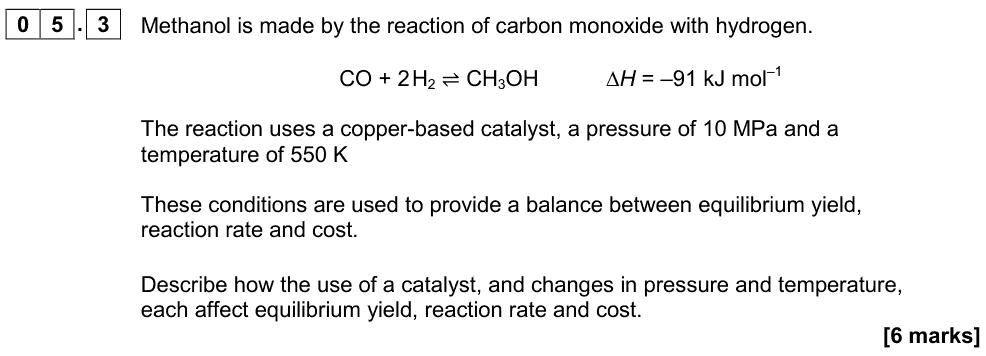
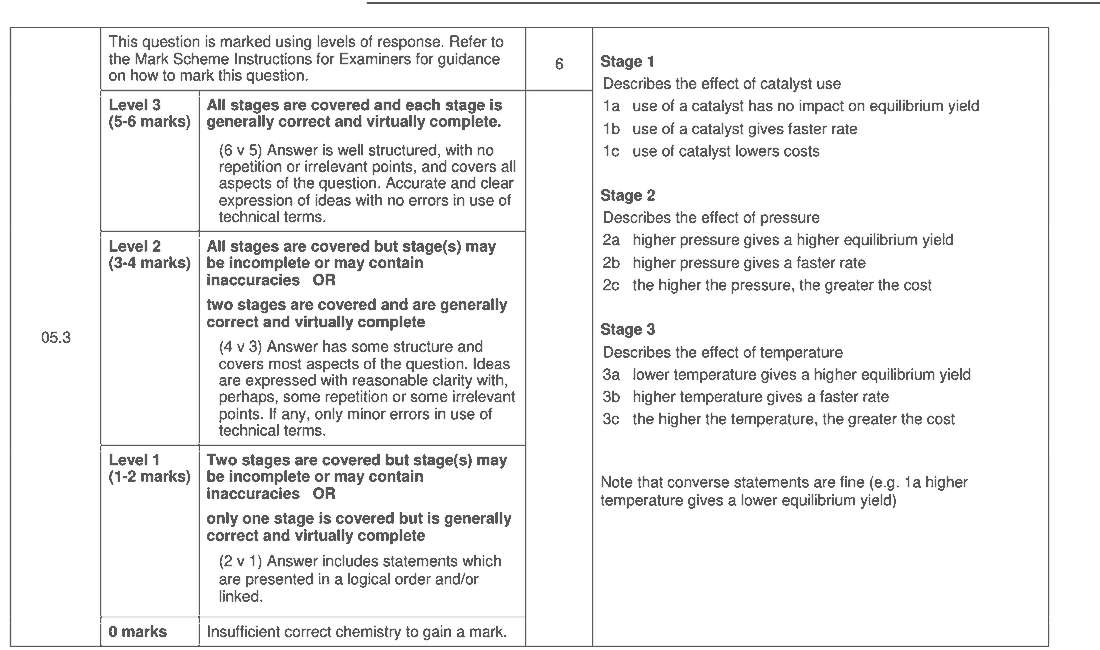
05.3 Chemical equilibria, Le Chatelier's principle and Kc, Kinetics 6Level of response
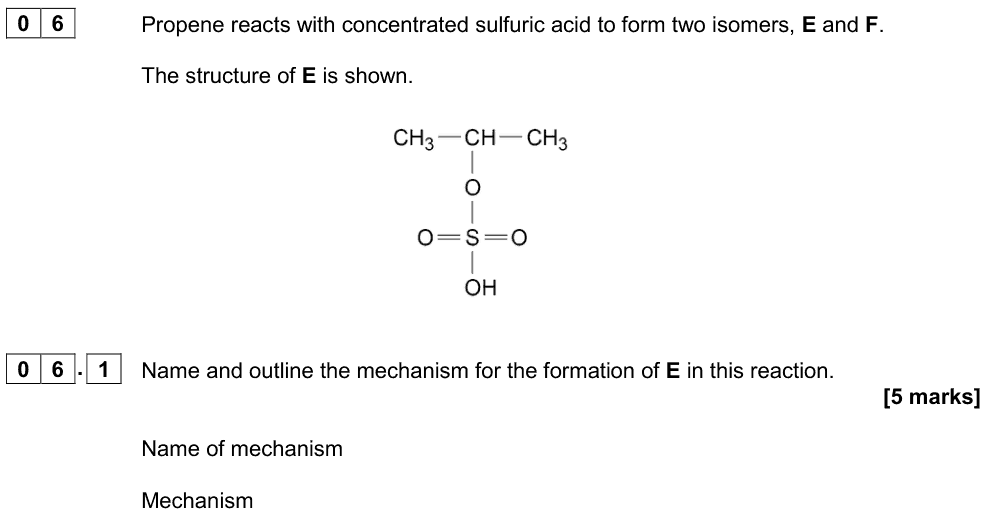
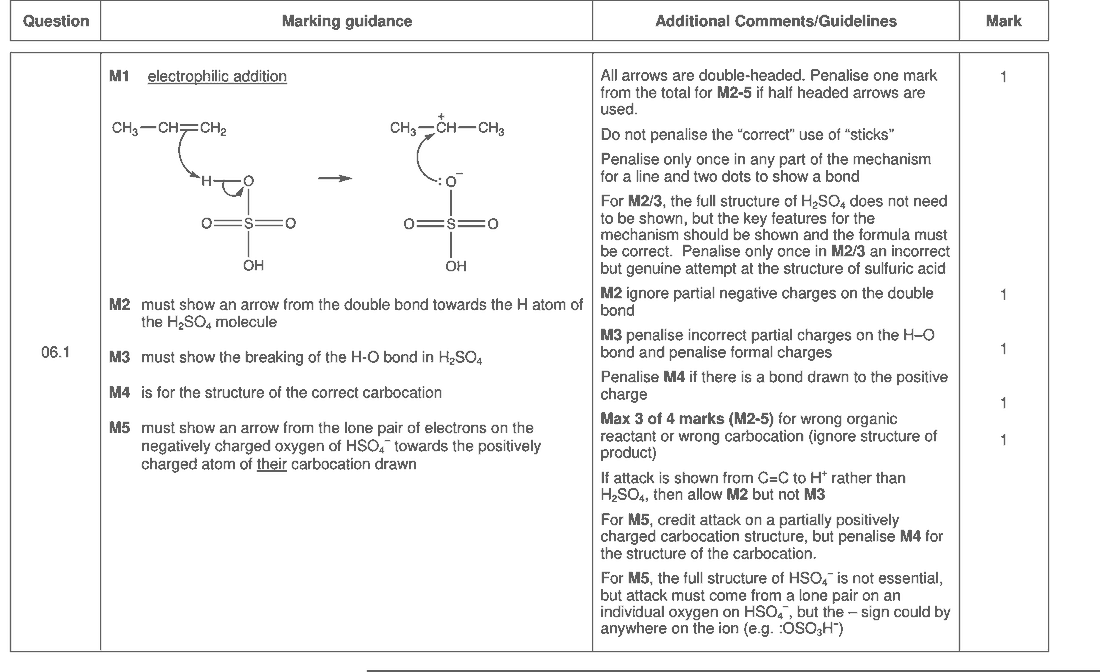
06.1 Alkenes, Introduction to organic chemistry: nomenclature, mechanisms and isomerism 5Mechanism
06.2 Alkenes, Introduction to organic chemistry: nomenclature, mechanisms and isomerism 1Diagram or structure
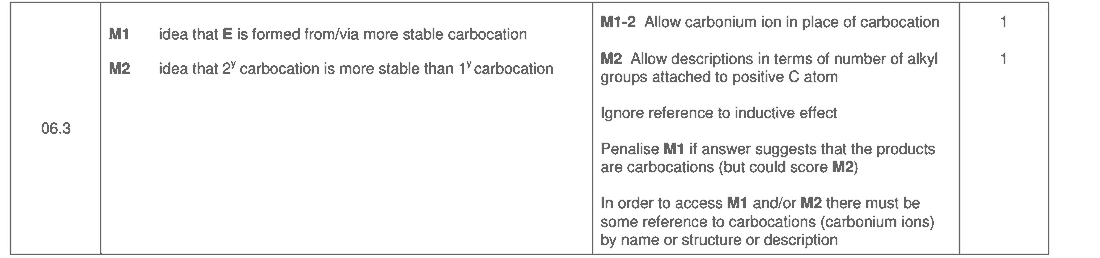
06.3 Alkenes 2Explanation
07.1 Introduction to organic chemistry: nomenclature, mechanisms and isomerism 1Diagram or structure
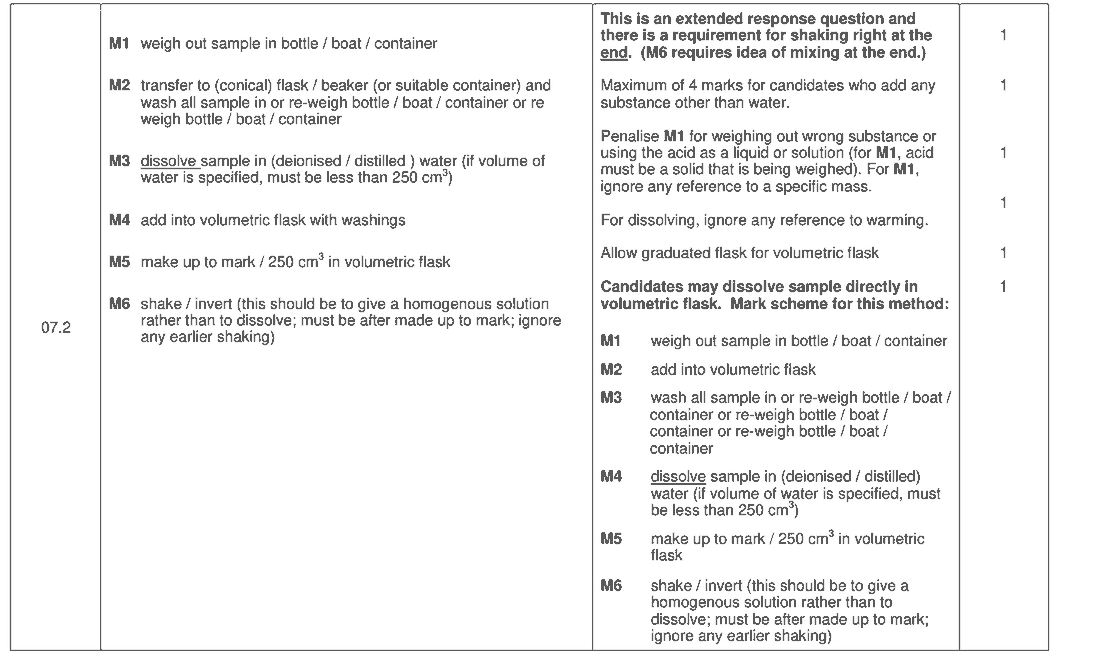
07.2 Amount of substance 6Practical and data analysis
07.3 Amount of substance 2Calculation
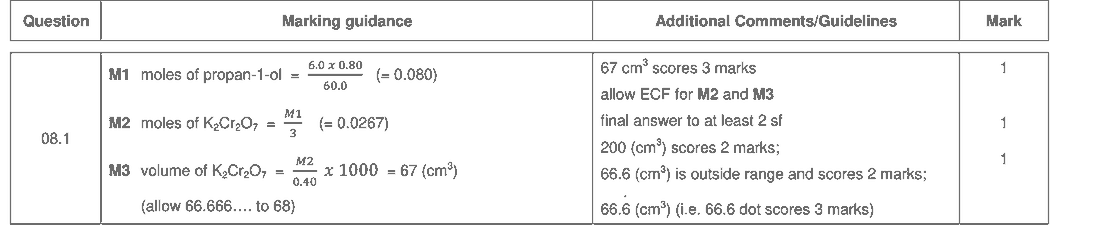
08.1 Amount of substance 3Calculation
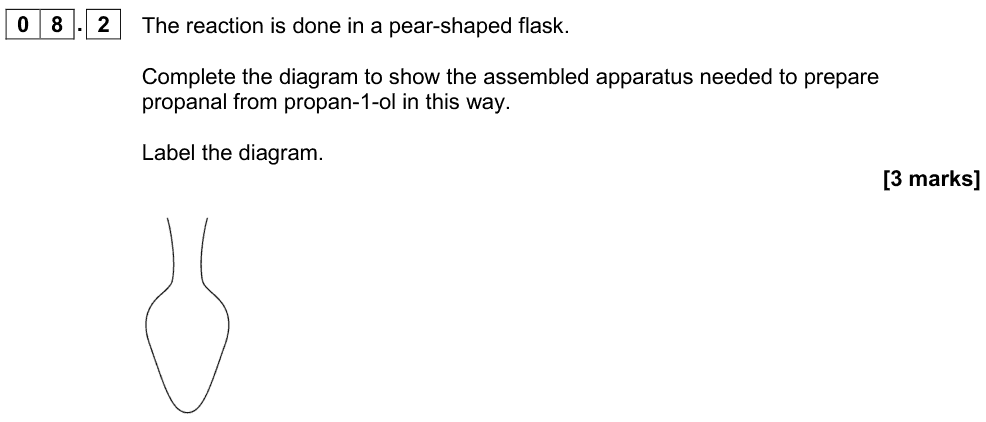
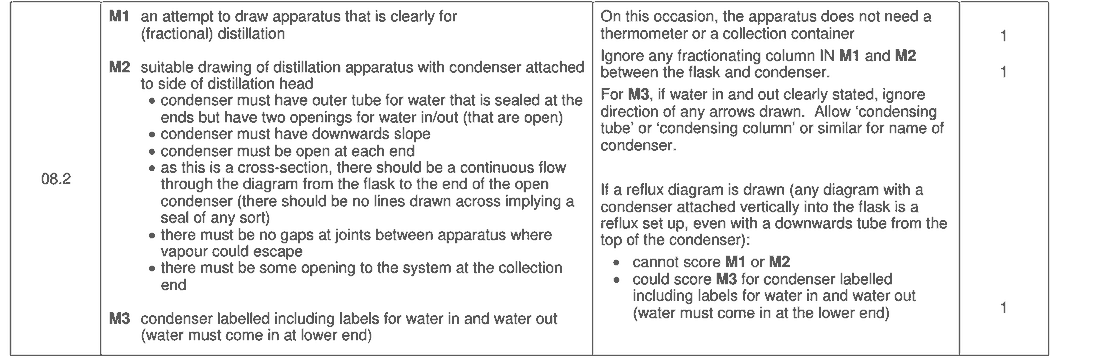
08.2 Alcohols 3Practical and data analysis
09.1 Halogenoalkanes 1Equation writing
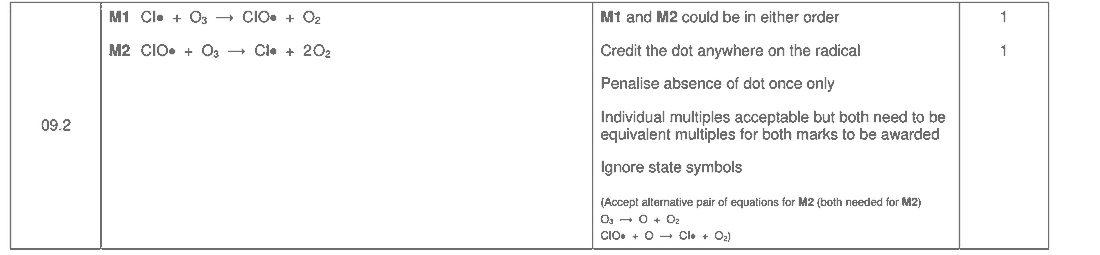
09.2 Halogenoalkanes 2Equation writing
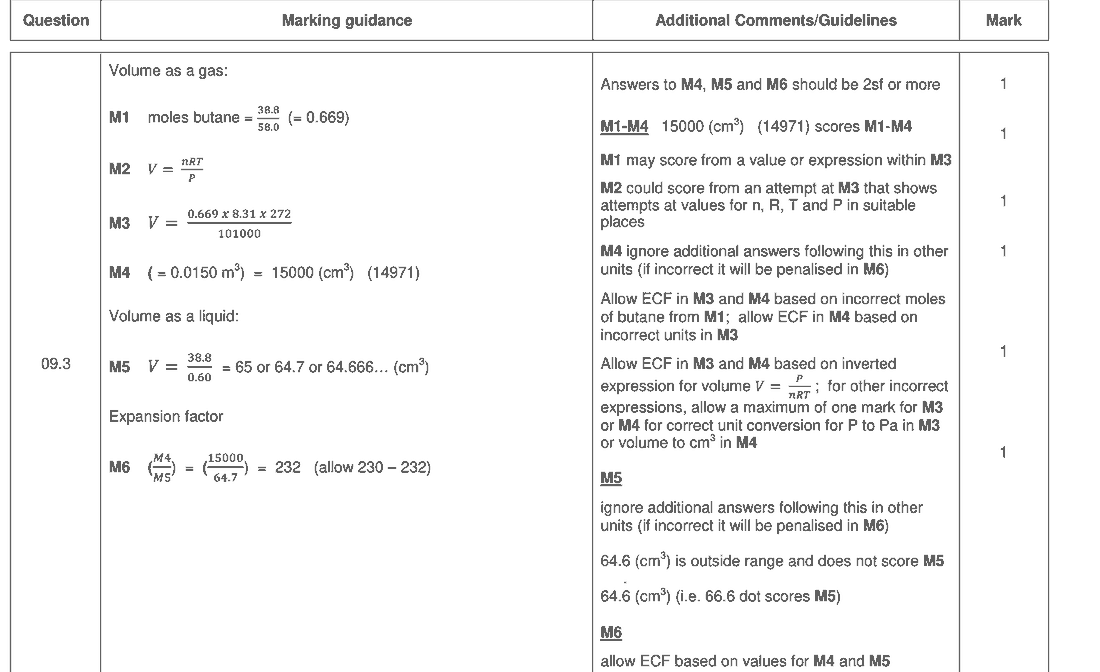
09.3 Amount of substance 6Calculation
10 Amount of substance 1Multiple choice
11 Kinetics 1Multiple choice
12 Chemical equilibria, Le Chatelier's principle and Kc 1Multiple choice
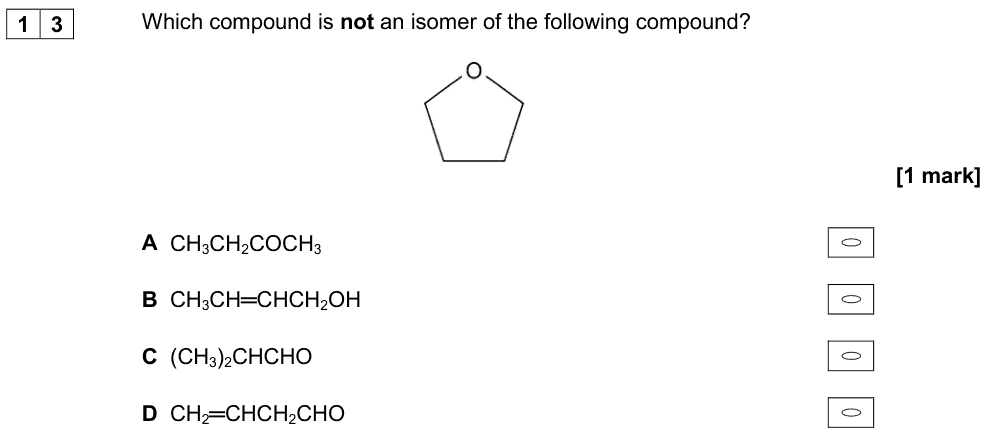
13 Introduction to organic chemistry: nomenclature, mechanisms and isomerism 1Multiple choice
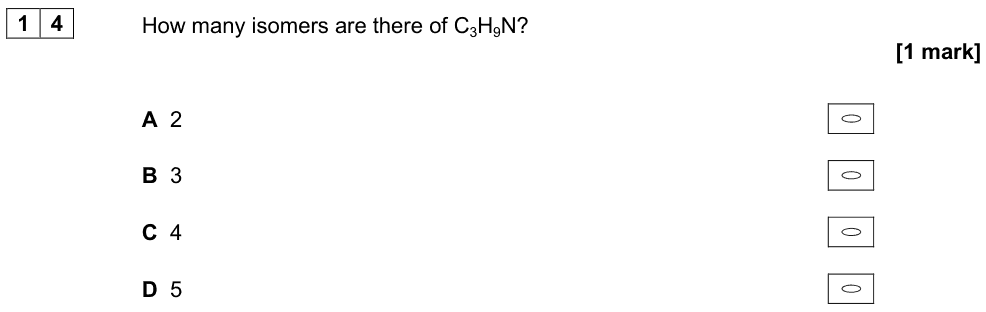
14 Introduction to organic chemistry: nomenclature, mechanisms and isomerism 1Multiple choice
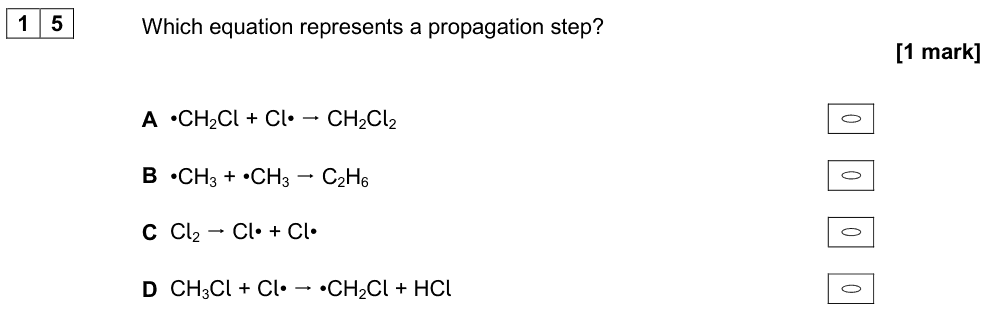
15 Alkanes, Introduction to organic chemistry: nomenclature, mechanisms and isomerism 1Multiple choice
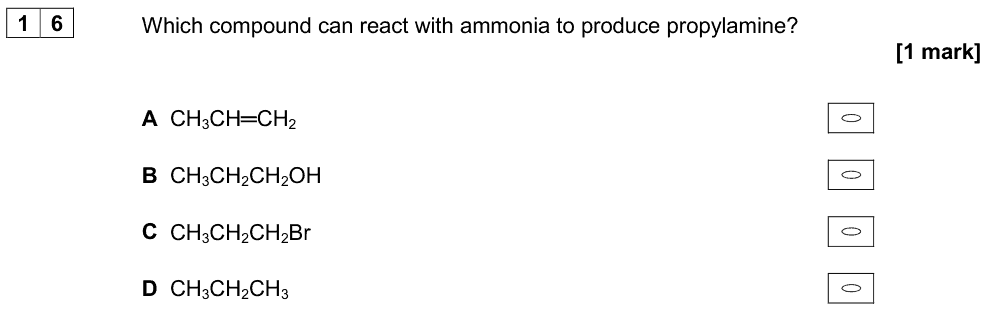
16 Halogenoalkanes 1Multiple choice
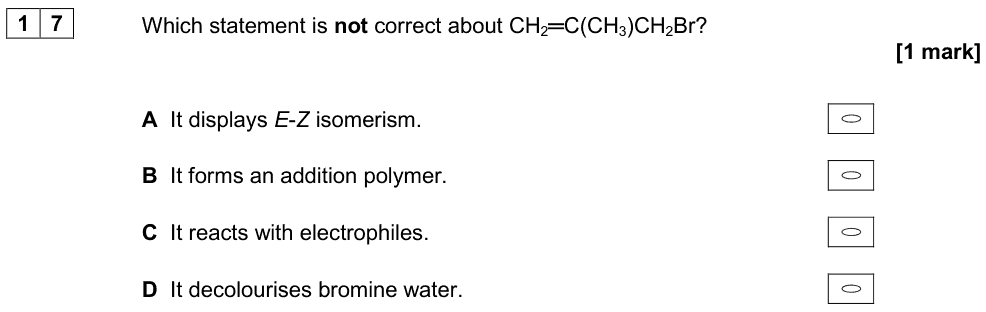
17 Introduction to organic chemistry: nomenclature, mechanisms and isomerism 1Multiple choice
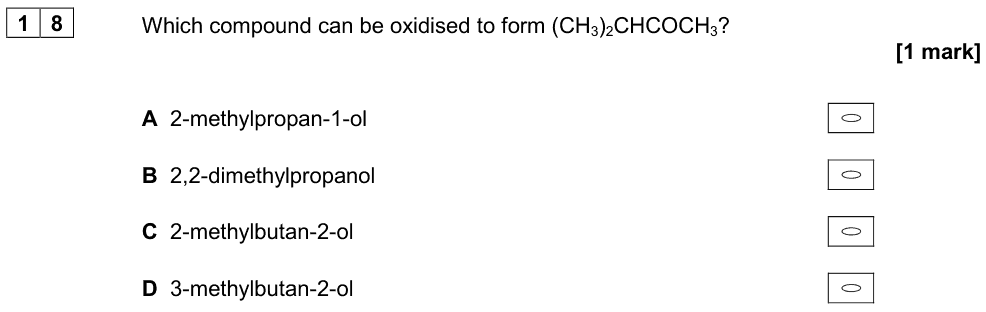
18 Alcohols, Introduction to organic chemistry: nomenclature, mechanisms and isomerism 1Multiple choice
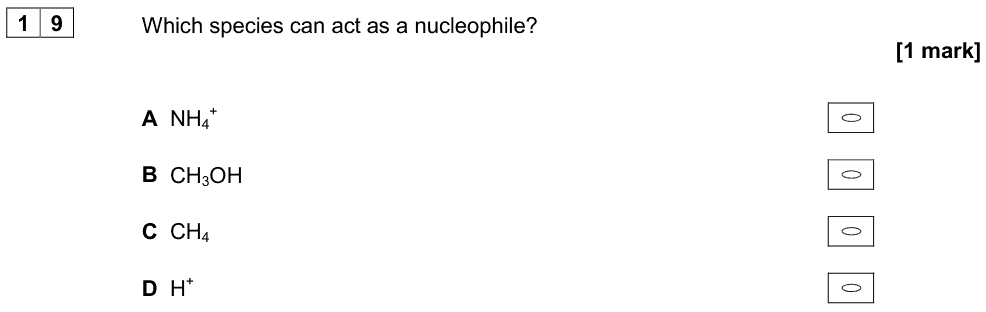
19 Halogenoalkanes 1Multiple choice
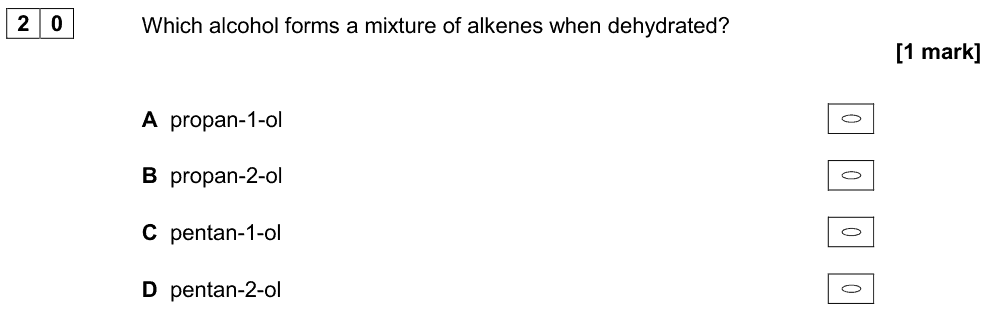
20 Alcohols, Introduction to organic chemistry: nomenclature, mechanisms and isomerism 1Multiple choice
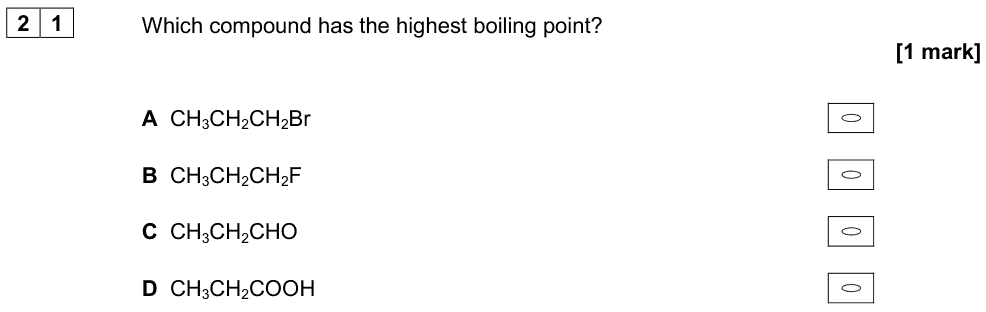
21 Bonding 1Multiple choice
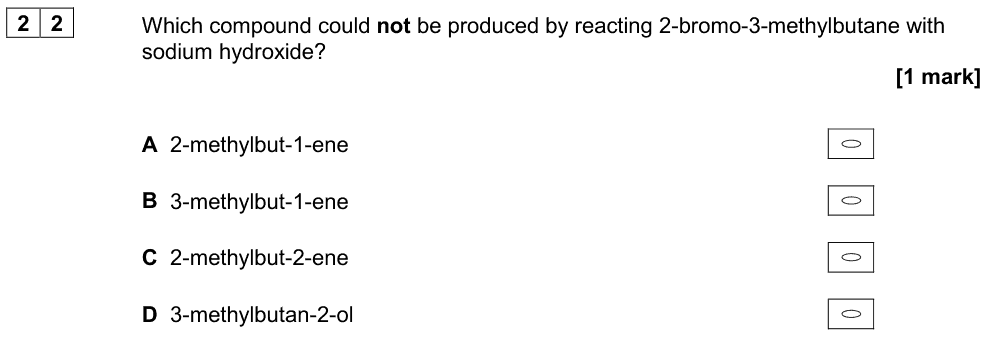
22 Halogenoalkanes 1Multiple choice
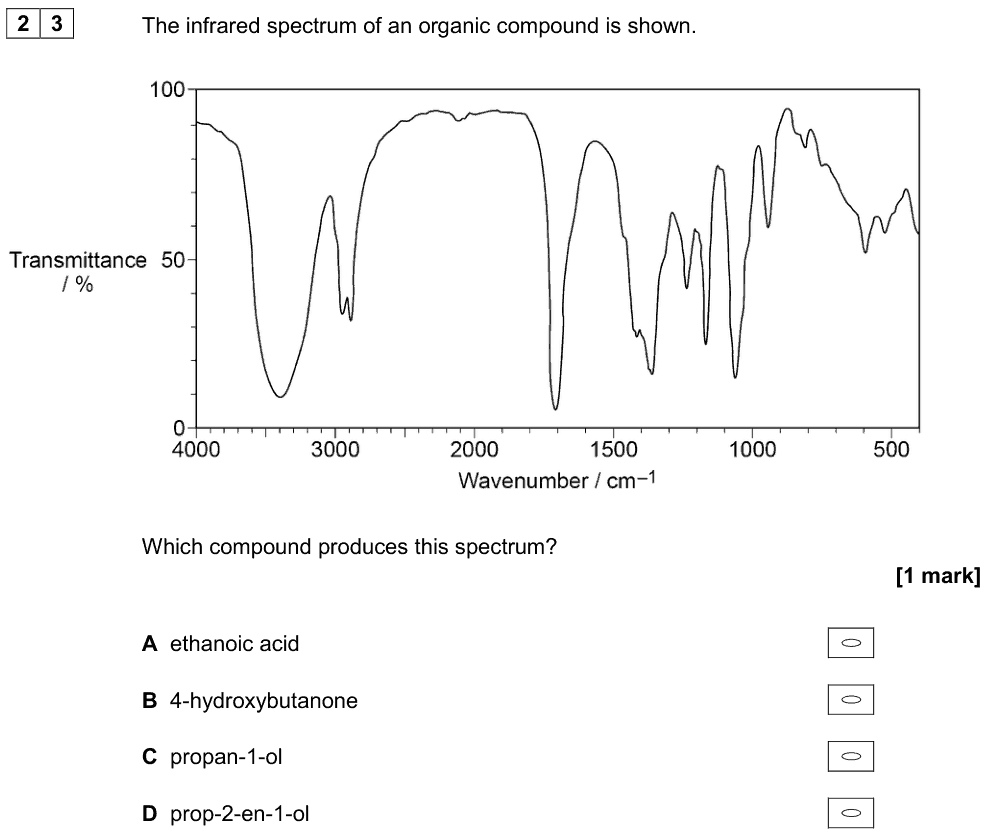
23 Organic analysis: test-tube reactions, mass spectrometry and infrared 1Multiple choice
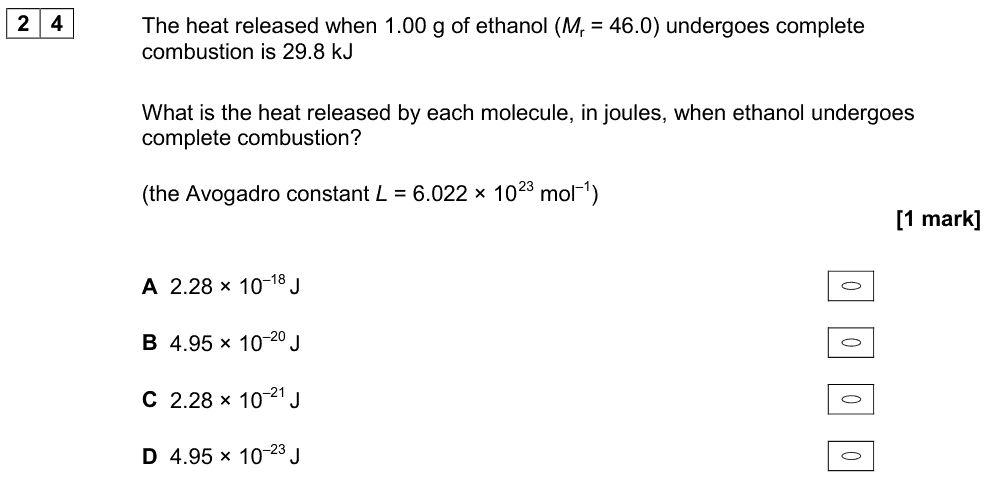
24 Amount of substance 1Multiple choice

The questions

01.101.202.102.202.303.103.203.304.104.204.305.105.205.306.106.206.307.107.207.308.108.209.109.209.3101112131415161718192021222324
June 2019 · AS Paper 2 · Q01.1 3 marks Practical and data analysis organic analysis
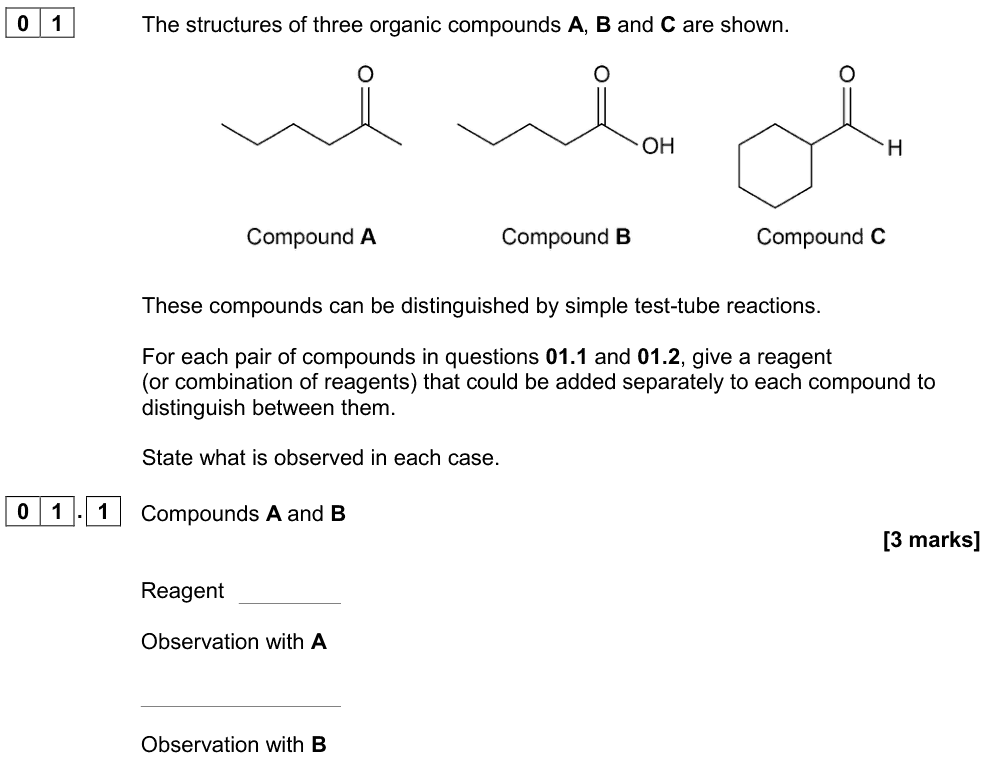
The structures of three organic compounds A, B and C are shown.
These compounds can be distinguished by simple test-tube reactions.
For each pair of compounds in questions 01.1 and 01.2, give a reagent
(or combination of reagents) that could be added separately to each compound to
distinguish between them.
State what is observed in each case.
Compounds A and B
[3 marks]
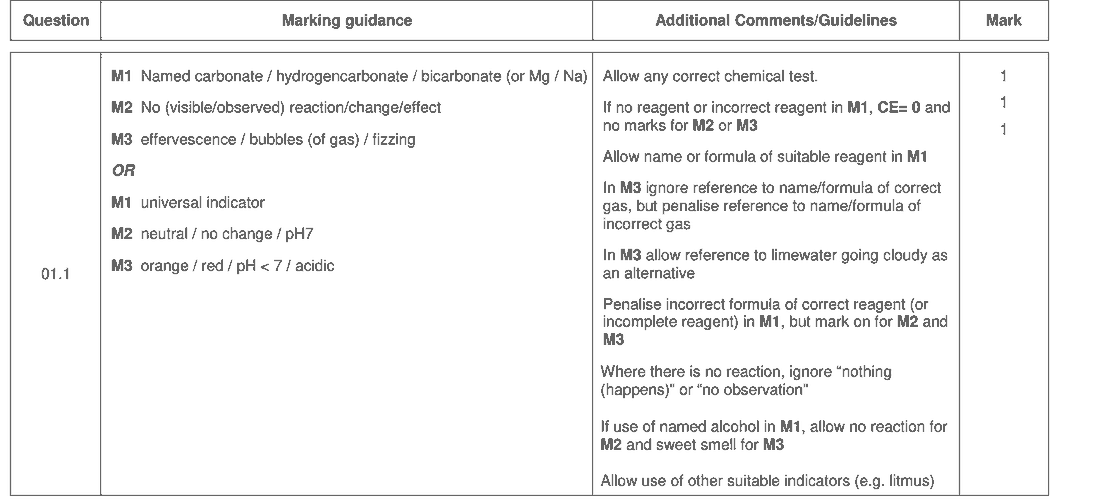
Reagent
Observation with A
Observation with B
June 2019 · AS Paper 2 · Q01.2 3 marks Practical and data analysis alcoholsorganic analysis
Earlier part of question 01 that this part usesEarlier part of June 2019 Paper 2 question 01
Compounds A and C
[3 marks]
Reagent
Observation with A
Observation with C
June 2019 · AS Paper 2 · Q02.1 2 marks Mechanism halogenoalkanesintroduction to organic chemistry
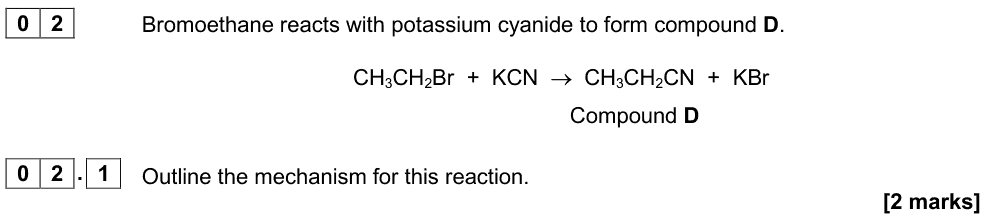
Bromoethane reacts with potassium cyanide to form compound D.
CH3CH2Br  +  KCN  →  CH3CH2CN  +  KBr
Compound D
Outline the mechanism for this reaction.
[2 marks]
June 2019 · AS Paper 2 · Q02.2 1 mark Short answer introduction to organic chemistry
Earlier part of question 02 that this part usesEarlier part of June 2019 Paper 2 question 02
Give the IUPAC name of D.
[1 mark]
June 2019 · AS Paper 2 · Q02.3 2 marks Calculation amount of substance
Earlier part of question 02 that this part usesEarlier part of June 2019 Paper 2 question 02
Calculate the percentage atom economy for the formation of D in this reaction.
Give your answer to the appropriate number of significant figures.
[2 marks]
% atom economy
June 2019 · AS Paper 2 · Q03.1 4 marks Calculation energetics
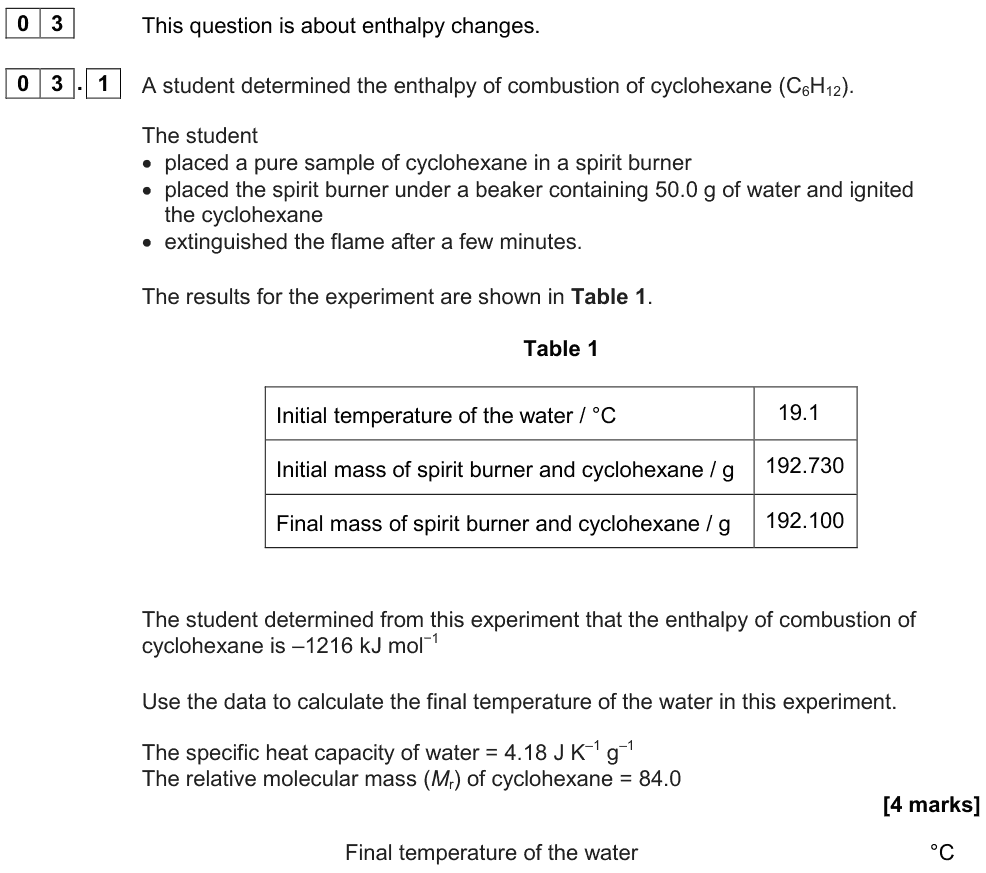
This question is about enthalpy changes.
A student determined the enthalpy of combustion of cyclohexane (C6H12).
The student
• placed a pure sample of cyclohexane in a spirit burner
• placed the spirit burner under a beaker containing 50.0 g of water and ignited
the cyclohexane
• extinguished the flame after a few minutes.
The results for the experiment are shown in Table 1.
Table 1
Initial temperature of the water / °C
19.1
Initial mass of spirit burner and cyclohexane / g
192.730
Final mass of spirit burner and cyclohexane / g
192.100
The student determined from this experiment that the enthalpy of combustion of
cyclohexane is –1216 kJ mol−1
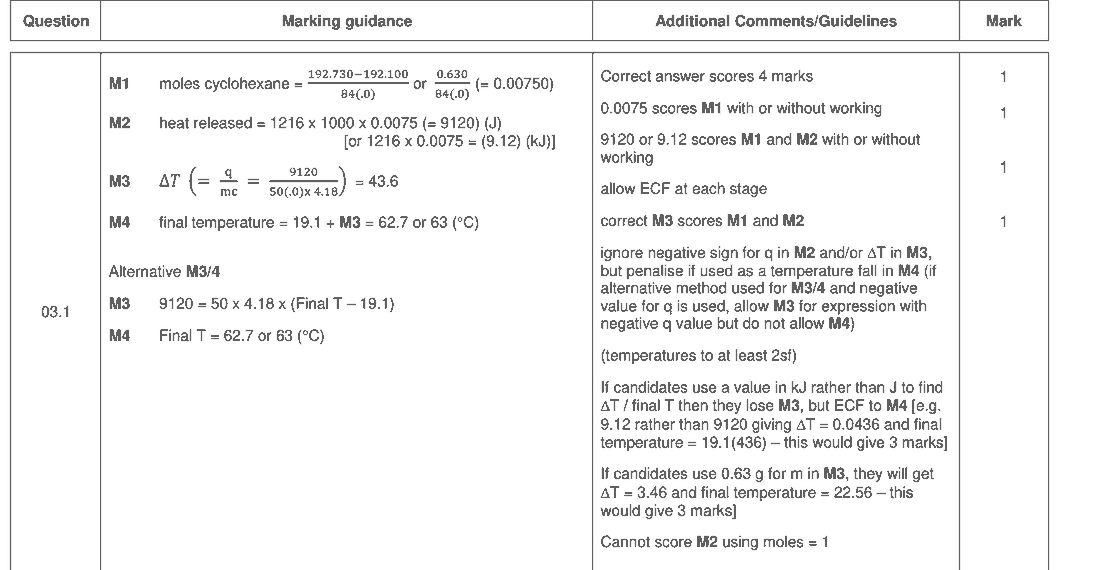
Use the data to calculate the final temperature of the water in this experiment.
The specific heat capacity of water = 4.18 J K–1 g–1
The relative molecular mass (Mr) of cyclohexane = 84.0
[4 marks]
Final temperature of the water
°C
June 2019 · AS Paper 2 · Q03.2 1 mark Practical and data analysis energetics
Earlier part of question 03 that this part usesEarlier part of June 2019 Paper 2 question 03
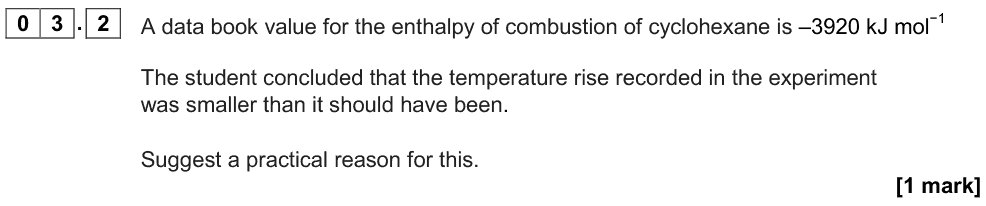
A data book value for the enthalpy of combustion of cyclohexane is –3920 kJ mol−1
The student concluded that the temperature rise recorded in the experiment
was smaller than it should have been.
Suggest a practical reason for this.
[1 mark]
June 2019 · AS Paper 2 · Q03.3 3 marks Calculation energetics
Earlier part of question 03 that this part usesEarlier part of June 2019 Paper 2 question 03
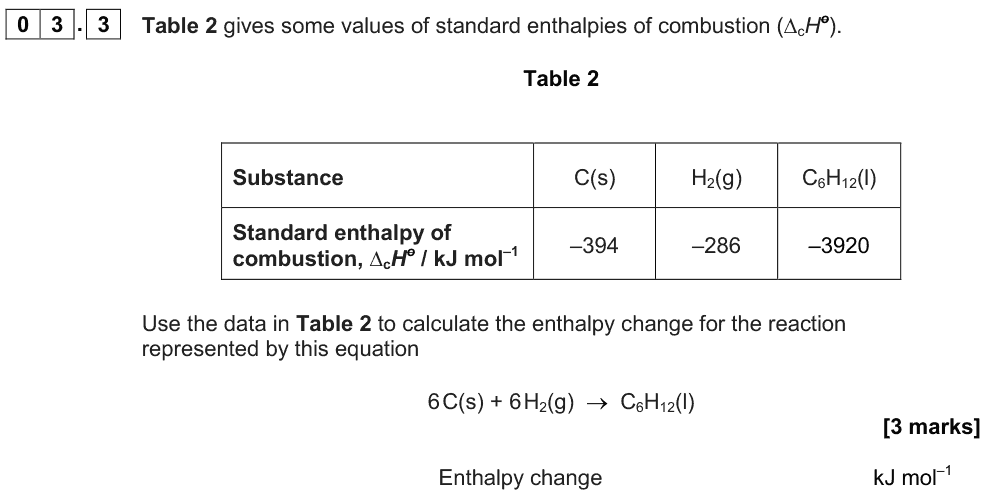
Table 2 gives some values of standard enthalpies of combustion (∆cHo).
Table 2
Substance
C(s)
H2(g)
C6H12(l)
Standard enthalpy of
combustion, ∆cHo / kJ mol–1
–394
–286
–3920
Use the data in Table 2 to calculate the enthalpy change for the reaction
represented by this equation
6 C(s) + 6 H2(g)  →  C6H12(l)
[3 marks]
Enthalpy change
kJ mol–1
June 2019 · AS Paper 2 · Q04.1 1 mark Equation writing alkanesamount of substance
This question is about fossil fuels.
The petrol fraction from crude oil contains octane (C8H18).
Give an equation for the complete combustion of octane.
[1 mark]
June 2019 · AS Paper 2 · Q04.2 1 mark Equation writing alkanes
Earlier part of question 04 that this part usesEarlier part of June 2019 Paper 2 question 04
The combustion of petrol in car engines produces the pollutant
nitrogen monoxide.
Give an equation for a reaction that removes nitrogen monoxide in
a catalytic converter.
[1 mark]
June 2019 · AS Paper 2 · Q04.3 2 marks Calculation amount of substance
Earlier part of question 04 that this part usesEarlier part of June 2019 Paper 2 question 04
Sulfur dioxide is produced in the combustion of fossil fuels.  The total emissions
of sulfur dioxide in the UK have fallen dramatically since 1970.
Sulfur dioxide is now removed from the flue gases in power stations by reaction
with calcium oxide.
CaO + SO2 → CaSO3
In 1970, the total UK emissions of sulfur dioxide were 6.49 million tonnes
(1 tonne = 1000 kg).
Calculate the mass, in kilograms, of calcium oxide needed to react with this
mass of sulfur dioxide.
Give your answer in standard form.
[2 marks]
Mass of calcium oxide
kg
June 2019 · AS Paper 2 · Q05.1 3 marks Diagram or structure bonding
Methanol (CH3OH) is an important alcohol with many uses.
Draw a diagram to show how two methanol molecules interact with each other
through hydrogen bonding in the liquid phase.
Include all partial charges and all lone pairs of electrons in your diagram.
[3 marks]
June 2019 · AS Paper 2 · Q05.2 1 mark Short answer bonding
Earlier part of question 05 that this part usesEarlier part of June 2019 Paper 2 question 05
The bond angle around the oxygen atom in methanol is slightly smaller than the
regular tetrahedral angle of 109.5°
Explain why this bond angle is smaller than 109.5°
[1 mark]
June 2019 · AS Paper 2 · Q05.3 6 marks 6-mark level of response chemical equilibria and kckinetics
Earlier part of question 05 that this part usesEarlier part of June 2019 Paper 2 question 05
Methanol is made by the reaction of carbon monoxide with hydrogen.
CO + 2 H2 ⇌ CH3OH           ∆H = –91 kJ mol–1
The reaction uses a copper-based catalyst, a pressure of 10 MPa and a
temperature of 550 K
These conditions are used to provide a balance between equilibrium yield,
reaction rate and cost.
Describe how the use of a catalyst, and changes in pressure and temperature,
each affect equilibrium yield, reaction rate and cost.
[6 marks]
June 2019 · AS Paper 2 · Q06.1 5 marks Mechanism alkenesintroduction to organic chemistry
Propene reacts with concentrated sulfuric acid to form two isomers, E and F.
The structure of E is shown.
Name and outline the mechanism for the formation of E in this reaction.
[5 marks]
Name of mechanism
Mechanism
June 2019 · AS Paper 2 · Q06.2 1 mark Diagram or structure alkenesintroduction to organic chemistry
Earlier part of question 06 that this part usesEarlier part of June 2019 Paper 2 question 06
Draw the structure of F.
[1 mark]
June 2019 · AS Paper 2 · Q06.3 2 marks Explanation alkenes
Earlier part of question 06 that this part usesEarlier part of June 2019 Paper 2 question 06
Explain why more of isomer E than isomer F is formed in this reaction.
[2 marks]
June 2019 · AS Paper 2 · Q07.1 1 mark Diagram or structure introduction to organic chemistry
Propanedioic acid contains two carboxylic acid groups.  It is a solid organic acid that is


soluble in water.
Draw the skeletal formula of propanedioic acid.
[1 mark]
June 2019 · AS Paper 2 · Q07.2 6 marks Practical and data analysis amount of substance
Earlier part of question 07 that this part usesEarlier part of June 2019 Paper 2 question 07
Describe how to prepare 250 cm3 of an aqueous standard solution of
propanedioic acid containing an accurately measured mass of the acid.

Include essential practical details in your answer.
[6 marks]
June 2019 · AS Paper 2 · Q07.3 2 marks Calculation amount of substance
Earlier part of question 07 that this part usesEarlier part of June 2019 Paper 2 question 07
Calculate the mass, in mg, of propanedioic acid (Mr = 104.0) needed to prepare

250 cm3 of a 0.00500 mol dm–3 solution.
[2 marks]
Mass of propanedioic acid
mg
June 2019 · AS Paper 2 · Q08.1 3 marks Calculation amount of substance
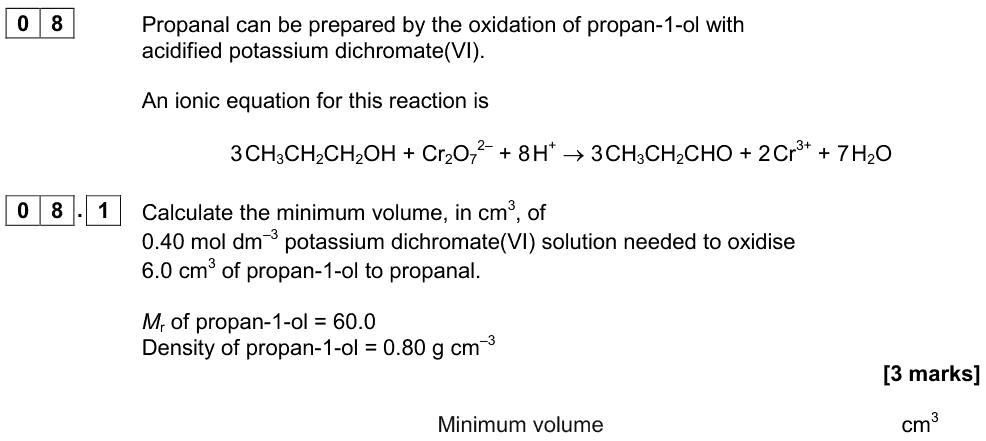
Propanal can be prepared by the oxidation of propan-1-ol with
acidified potassium dichromate(VI).
An ionic equation for this reaction is
3 CH3CH2CH2OH + Cr2O7
2– + 8 H+ → 3 CH3CH2CHO + 2 Cr3+ + 7 H2O
Calculate the minimum volume, in cm3, of
0.40 mol dm–3 potassium dichromate(VI) solution needed to oxidise
6.0 cm3 of propan-1-ol to propanal.
Mr of propan-1-ol = 60.0
Density of propan-1-ol = 0.80 g cm–3
[3 marks]
Minimum volume
cm3
June 2019 · AS Paper 2 · Q08.2 3 marks Practical and data analysis alcohols
Earlier part of question 08 that this part usesEarlier part of June 2019 Paper 2 question 08
The reaction is done in a pear-shaped flask.
Complete the diagram to show the assembled apparatus needed to prepare
propanal from propan-1-ol in this way.
Label the diagram.
[3 marks]
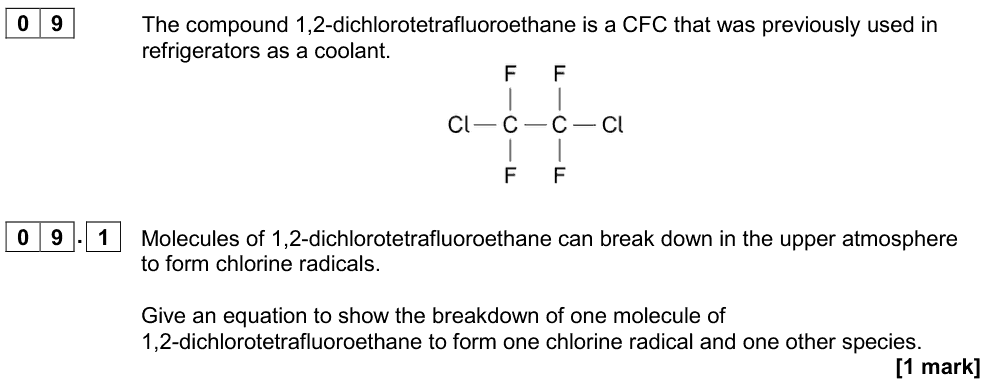
June 2019 · AS Paper 2 · Q09.1 1 mark Equation writing halogenoalkanes
The compound 1,2-dichlorotetrafluoroethane is a CFC that was previously used in
refrigerators as a coolant.
Molecules of 1,2-dichlorotetrafluoroethane can break down in the upper atmosphere
to form chlorine radicals.
Give an equation to show the breakdown of one molecule of
1,2-dichlorotetrafluoroethane to form one chlorine radical and one other species.
[1 mark]
June 2019 · AS Paper 2 · Q09.2 2 marks Equation writing halogenoalkanes
Earlier part of question 09 that this part usesEarlier part of June 2019 Paper 2 question 09
Give two equations to show how chlorine radicals catalyse the decomposition of
ozone.
[2 marks]
June 2019 · AS Paper 2 · Q09.3 6 marks Calculation amount of substance
Earlier part of question 09 that this part usesEarlier part of June 2019 Paper 2 question 09
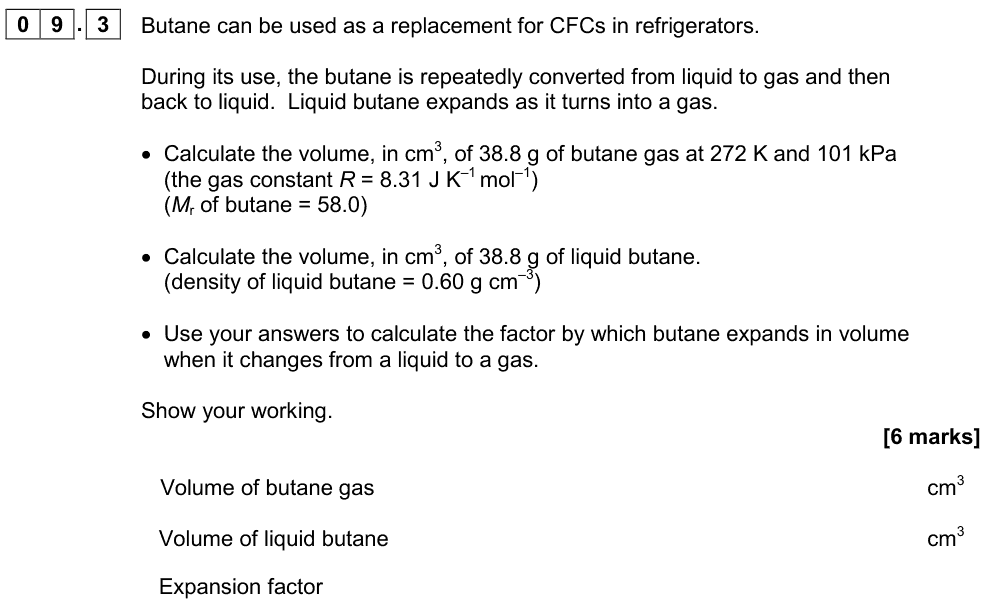
Butane can be used as a replacement for CFCs in refrigerators.
During its use, the butane is repeatedly converted from liquid to gas and then
back to liquid.  Liquid butane expands as it turns into a gas.
• Calculate the volume, in cm3, of 38.8 g of butane gas at 272 K and 101 kPa
(the gas constant R = 8.31 J K–1 mol–1)
(Mr of butane = 58.0)
• Calculate the volume, in cm3, of 38.8 g of liquid butane.
(density of liquid butane = 0.60 g cm–3)
• Use your answers to calculate the factor by which butane expands in volume
when it changes from a liquid to a gas.
Show your working.
[6 marks]
Volume of butane gas
cm3
Volume of liquid butane
cm3
Expansion factor
June 2019 · AS Paper 2 · Q10 1 mark Multiple choice amount of substance
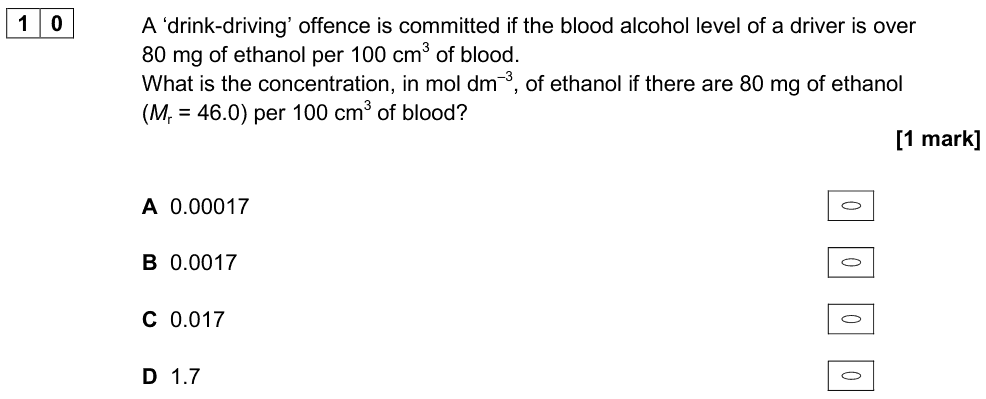
A ‘drink-driving’ offence is committed if the blood alcohol level of a driver is over
80 mg of ethanol per 100 cm3 of blood.
What is the concentration, in mol dm–3, of ethanol if there are 80 mg of ethanol
(Mr = 46.0) per 100 cm3 of blood?
[1 mark]
A 0.00017
B 0.0017
C 0.017
D 1.7
June 2019 · AS Paper 2 · Q11 1 mark Multiple choice kinetics
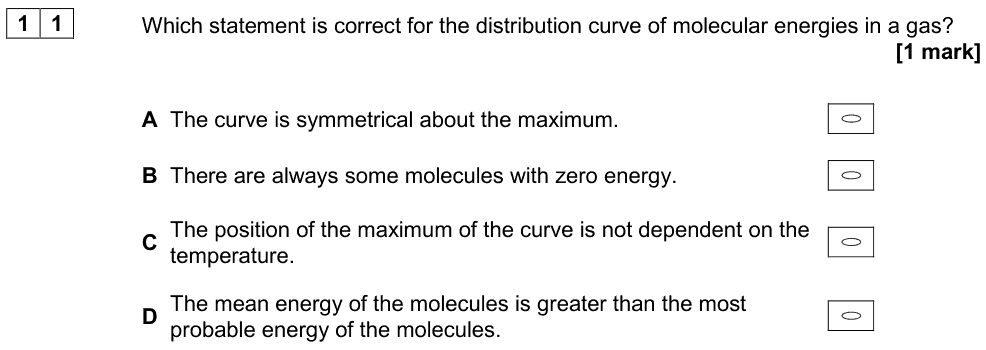
Which statement is correct for the distribution curve of molecular energies in a gas?
[1 mark]
A The curve is symmetrical about the maximum.
B There are always some molecules with zero energy.
C The position of the maximum of the curve is not dependent on the
temperature.
D The mean energy of the molecules is greater than the most
probable energy of the molecules.
June 2019 · AS Paper 2 · Q12 1 mark Multiple choice chemical equilibria and kc
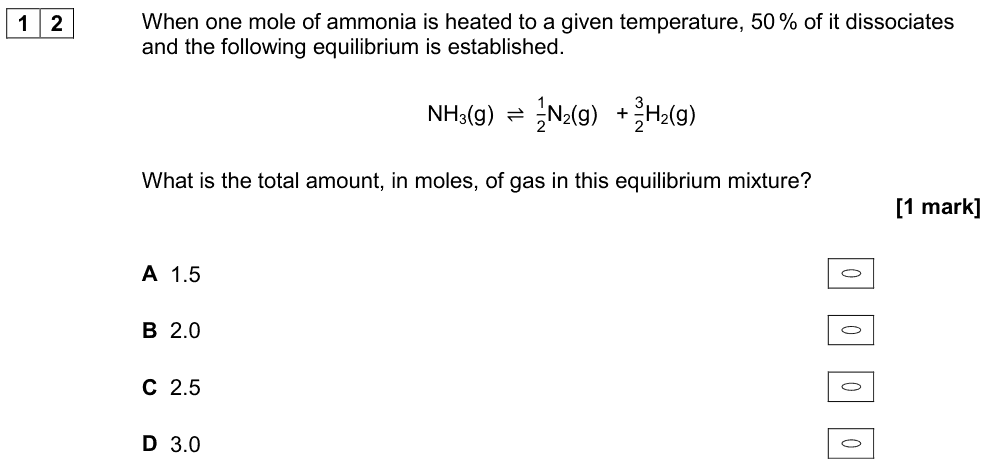
When one mole of ammonia is heated to a given temperature, 50 % of it dissociates
and the following equilibrium is established.
NH3(g)  ⇌
1
2
N2(g)   +
3
2
H2(g)
What is the total amount, in moles, of gas in this equilibrium mixture?
[1 mark]
A 1.5
B 2.0
C 2.5
D 3.0
June 2019 · AS Paper 2 · Q13 1 mark Multiple choice introduction to organic chemistry
Which compound is not an isomer of the following compound?
[1 mark]
A CH3CH2COCH3
B CH3CH═CHCH2OH
C (CH3)2CHCHO
D CH2═CHCH2CHO
June 2019 · AS Paper 2 · Q14 1 mark Multiple choice introduction to organic chemistry
How many isomers are there of C3H9N?
[1 mark]
A 2
B 3
C 4
D 5
June 2019 · AS Paper 2 · Q15 1 mark Multiple choice alkanesintroduction to organic chemistry
Which equation represents a propagation step?
[1 mark]
A •CH2Cl + Cl•  CH2Cl2
B •CH3 + •CH3  C2H6
C Cl2  Cl• + Cl•
D CH3Cl + Cl•  •CH2Cl + HCl
June 2019 · AS Paper 2 · Q16 1 mark Multiple choice halogenoalkanes
Which compound can react with ammonia to produce propylamine?
[1 mark]
A CH3CH═CH2
B CH3CH2CH2OH
C CH3CH2CH2Br
D CH3CH2CH3
June 2019 · AS Paper 2 · Q17 1 mark Multiple choice introduction to organic chemistry
Which statement is not correct about CH2═C(CH3)CH2Br?
[1 mark]
A It displays E-Z isomerism.
B It forms an addition polymer.
C It reacts with electrophiles.
D It decolourises bromine water.
June 2019 · AS Paper 2 · Q18 1 mark Multiple choice alcoholsintroduction to organic chemistry
Which compound can be oxidised to form (CH3)2CHCOCH3?
[1 mark]
A 2-methylpropan-1-ol
B 2,2-dimethylpropanol
C 2-methylbutan-2-ol
D 3-methylbutan-2-ol
June 2019 · AS Paper 2 · Q19 1 mark Multiple choice halogenoalkanes
Which species can act as a nucleophile?
[1 mark]
A NH4
+
B CH3OH
C CH4
D H+
June 2019 · AS Paper 2 · Q20 1 mark Multiple choice alcoholsintroduction to organic chemistry
Which alcohol forms a mixture of alkenes when dehydrated?
[1 mark]
A propan-1-ol
B propan-2-ol
C pentan-1-ol
D pentan-2-ol
June 2019 · AS Paper 2 · Q21 1 mark Multiple choice bonding
Which compound has the highest boiling point?
[1 mark]
A CH3CH2CH2Br
B CH3CH2CH2F
C CH3CH2CHO
D CH3CH2COOH
June 2019 · AS Paper 2 · Q22 1 mark Multiple choice halogenoalkanes
Which compound could not be produced by reacting 2-bromo-3-methylbutane with
sodium hydroxide?
[1 mark]
A 2-methylbut-1-ene
B 3-methylbut-1-ene
C 2-methylbut-2-ene
D 3-methylbutan-2-ol
June 2019 · AS Paper 2 · Q23 1 mark Multiple choice organic analysis
The infrared spectrum of an organic compound is shown.
Which compound produces this spectrum?
[1 mark]
A ethanoic acid

B 4-hydroxybutanone
C propan-1-ol
D prop-2-en-1-ol
June 2019 · AS Paper 2 · Q24 1 mark Multiple choice amount of substance
The heat released when 1.00 g of ethanol (Mr = 46.0) undergoes complete
combustion is 29.8 kJ
What is the heat released by each molecule, in joules, when ethanol undergoes
complete combustion?
(the Avogadro constant L = 6.022 × 10 23 mol–1)
[1 mark]
A 2.28 × 10⁻¹⁸ J
B 4.95 × 10⁻²⁰ J
C 2.28 × 10⁻²¹ J
D 4.95 × 10⁻²³ J

Work with an A-level chemistry tutor

Want a paper marked and gone through with you? Message us.

Prefer email? Send an enquiry

If you are under 18, please include a parent's contact details. Enquiries go to enquiries@chemistryaleveltutor.com and are deleted once handled. All tutoring is online.